SCHOOL SAFETY
Lead authors: Dr. George Bear and Angela Harris, M.A.
University of Delaware
Funding and support from:
DE Positive Behavior Support Project – School Climate & Student Success
R E S E A R C H A N D R E C O M M E N D E D I N T E R V E N T I O N S
MODULE STRUCTURE
• Module series goal:
• Provide information to schools that can lead to improvements in school
climate and behavioral outcomes.
• Module narratives provide additional information to
accompany PowerPoint Presentation.
• Endnotes throughout slides correspond to the references in the module
narrative.
• Gold star = Resource on Delaware PBS website
SCHOOL SAFETY
• Refers to the actual safety of students, teachers, and other in school,
but also to their perceptions of safety
• In safe schools:
• Students experience few, if any, acts of violence or other acts that are harmful to
their physical and emotional well-being
• Emotional harm, such as high levels of fear, anxiety, sadness, anger, and avoidance of
school can be lasting
• Students and staff feel safe from acts of violence and other harmful actions such
as bullying
• In unsafe schools:
• Harm is experienced by those who are victims or who fear violence and other
acts that threaten safety and by witnesses of violent and traumatic events1
• Outcomes can be more serious and tragic
DELAWARE SCHOOL SURVEYS
• School safety is one of multiple subscales on the Delaware School
Climate Scale of the Delaware School Surveys (DSS)
• Appears on the student, teacher/staff, and home surveys
• Consists of three items that assess perceptions of safety:
• “Students are safe in the hallways”
• “Students feel safe”
• “Students know they are safe in this school”
ESTIMATES AND INDICATORS OF SCHOOL SAFETY
• Depend greatly on how being safe is defined
• Indicators of school safety reported in the 2018 NCES “Indicators of
School Crime and Safety: 2017” report2
• During the 2014-15 school year, 20 students were victims of homicides and 9 of
suicides
• In the 2017-18 school year, 29 students died from 17 school shootings in K-12 settings33
• About 15% of public schools report 1 or more “serious violent crimes”
• E.g., rape, sexual assault, robbery, physical attack/fight with a weapon
• When fights or physical attacks (without a weapon) and threats of physical
attacks with or without a weapon are added as “violent incidents,” the
percentage of schools reporting one or more of these incidents increases
substantially
• Fighting and physical attacks without a weapon are the most commonly reported
incidents (64.9% of public schools)
ESTIMATES AND INDICATORS OF SCHOOL SAFETY
• Despite those statistics, schools are among the safest places for
students and staff, especially when compared to other places and
causes of injury and death3-4
• For example…
The rate of the aforementioned serious violent incidents is less than 1 crime per
100 students
Approximately 97% of student homicides occur outside of school, and
approximately 1 student homicide or suicide at school occurs for every 1.9 million
students
Students are more likely to be killed or seriously injured in their homes or
community, riding a bicycle, swimming, and especially riding in vehicles5
SO…ARE SCHOOLS SAFE?
• Overall, schools are quite safe from events that involve death, serious
physical harm, and serious violence
• If all types of crimes (violent & non-violent) are viewed as indicators of
school safety, schools vary greatly with respect to safety
• E.g., theft, vandalism; illegal and prescription drug/alcohol activity; possession of a
firearm or explosive device; possession of a knife or sharp object
• Approximately 79% of public schools reported such crimes in 2015-16
• The NCES report includes additional indicators of safety, such as:
• Gangs at school
• Hate language and hate-related graffiti
• Teachers reports of being threatened and student actions that interfere with teaching
• Disciplinary problems and serious disciplinary problems (e.g., expelling a student)
SCHOOL SAFETY IN DELAWARE
• Data reported by the Delaware DOE indicates that schools in
Delaware are safe
• In the 2016-17 school year, 806 school crimes were reported in public schools6
• Felonies, misdemeanors, or violations defined in the Delaware Code
• This equals approximately 6 school crimes per 1,000 students
• According to the Delaware School Surveys in 2018:
• 84% of students
• 93% of teachers/staff
• 95% of parents
• Agreed with the statement: “Students know they are safe in this school.”
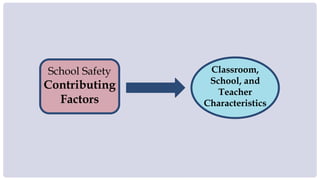
School Safety
Contributing
Factors
Classroom,
School, and
Teacher
Characteristics
CLASSROOM, SCHOOL, & TEACHER CHARACTERISTICS
CONTRIBUTING FACTORS
• Students and teachers/staff tend to feel safer in schools in which the
following are present:
• Clear and fair rules and expectations for
behavior. Including clear and fair policies for
addressing school violence7-10,34
• Physical safety features, especially security
cameras, secure entrances, and locked
doors8,11
• Research is not always consistent35,36
• Little evidence that school resource officers
(SROs) and police increase perceptions of
safety.4
Interactions with SROs that are
respectful, fair, and genuine are likely to be
viewed as positive experiences by
students.12-14
• Cleanly and well-maintained school facilities,
displayed student work, bulletin boards11,15
• Teachers and staff who are highly visible,
especially in areas prone to violence/crime8
• Positive teacher-student, student-student,
home-school, and staff relationships
CLASSROOM, SCHOOL, & TEACHER CHARACTERISTICS
CONTRIBUTING FACTORS
• Students and teachers/staff tend to feel safer in schools in
which the following are present:
• Students are cognitively, emotionally, and behaviorally engaged in
school
• Efforts are made to develop students’ social and emotional
competencies, both school-wide and in individual classrooms
• An overall positive school climate8,16
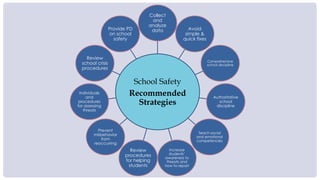
School Safety
Recommended
Strategies
Collect
and
analyze
data Avoid
simple &
quick fixes
Comprehensive
school discipline
Authoritative
school
discipline
Teach social
and emotional
competencies
Increase
students’
awareness to
threats and
how to report
Review
procedures
for helping
students
Prevent
misbehavior
from
reoccurring
Individuals
and
procedures
for assessing
threats
Review
school crisis
procedures
Provide PD
on school
safety
COLLECT AND EXAMINE DATA
RECOMMENDED STRATEGIES
• Collect and analyze data, especially school climate data, related to
school safety
• E.g., the Delaware School Climate Scale of the DSS
• Results of the surveys would help answer the critical question:
• Is my school perceived as being safe across students, teachers/staff, and parents,
and across subgroups within those respondents, including grades (e.g., 9th versus
12th grade), racial/ethnic groups, and gender?
• Finding positive perceptions = little or no need for interventions that follow,
especially if other data support those perceptions
• Finding negative perceptions across multiple subgroups = need for efforts to
improve school safety
• Finding negative perceptions across specific subgroups = need for more targeted
interventions and deeper information gathering
COLLECT AND EXAMINE DATA
RECOMMENDED STRATEGIES
• Examine responses to specific survey items, especially on the School
Safety subscale
• Will help determine which interventions are most appropriate
• Examine other sources of data related to school safety
• Office disciplinary referrals, suspensions and expulsions, absences, police reports
and arrests
• Generally, data should be disaggregated by behavior, person making the
referral, and student demographics
• Share results of surveys and other data with focus groups comprised of
representatives that responded unfavorably to the items
CONDUCTING FOCUS GROUPS
Focus group guide
• Information on:
• Designing questions
• Recruiting participants
• Conducting the group
• Analyzing data
• Provides examples
from Duke University
(https://assessment.trinity.duke.edu/documents/How_to_Con
duct_a_Focus_Group.pdf)
AVOID SIMPLE & QUICK FIXES
RECOMMENDED STRATEGIES
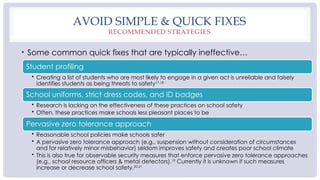
• Some common quick fixes that are typically ineffective…
Student profiling
• Creating a list of students who are most likely to engage in a given act is unreliable and falsely
identifies students as being threats to safety17-18
School uniforms, strict dress codes, and ID badges
• Research is lacking on the effectiveness of these practices on school safety
• Often, these practices make schools less pleasant places to be
Pervasive zero tolerance approach
• Reasonable school policies make schools safer
• A pervasive zero tolerance approach (e.g., suspension without consideration of circumstances
and for relatively minor misbehavior) seldom improves safety and creates poor school climate
• This is also true for observable security measures that enforce pervasive zero tolerance approaches
(e.g., school resource officers & metal detectors).19
Currently it is unknown if such measures
increase or decrease school safety.20-21
COMPREHENSIVE SCHOOL DISCIPLINE
RECOMMENDED STRATEGIES
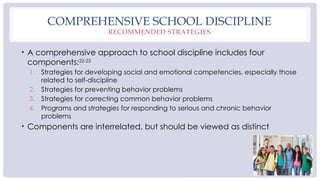
• A comprehensive approach to school discipline includes four
components:22-23
1. Strategies for developing social and emotional competencies, especially those
related to self-discipline
2. Strategies for preventing behavior problems
3. Strategies for correcting common behavior problems
4. Programs and strategies for responding to serious and chronic behavior
problems
• Components are interrelated, but should be viewed as distinct
AUTHORITATIVE SCHOOL DISCIPLINE
RECOMMENDED STRATEGIES
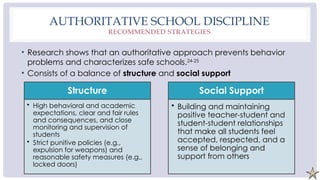
• Research shows that an authoritative approach prevents behavior
problems and characterizes safe schools.24-25
• Consists of a balance of structure and social support
Structure
• High behavioral and academic
expectations, clear and fair rules
and consequences, and close
monitoring and supervision of
students
• Strict punitive policies (e.g.,
expulsion for weapons) and
reasonable safety measures (e.g.,
locked doors)
Social Support
• Building and maintaining
positive teacher-student and
student-student relationships
that make all students feel
accepted, respected, and a
sense of belonging and
support from others
TEACH SOCIAL AND EMOTIONAL COMPETENCIES
RECOMMENDED STRATEGIES
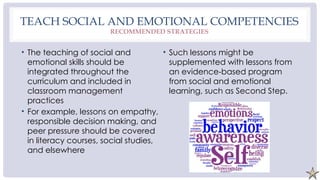
• The teaching of social and
emotional skills should be
integrated throughout the
curriculum and included in
classroom management
practices
• For example, lessons on empathy,
responsible decision making, and
peer pressure should be covered
in literacy courses, social studies,
and elsewhere
• Such lessons might be
supplemented with lessons from
an evidence-based program
from social and emotional
learning, such as Second Step.
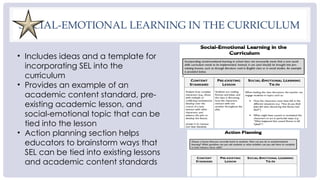
SOCIAL-EMOTIONAL LEARNING IN THE CURRICULUM
• Includes ideas and a template for
incorporating SEL into the
curriculum
• Provides an example of an
academic content standard, pre-
existing academic lesson, and
social-emotional topic that can be
tied into the lesson
• Action planning section helps
educators to brainstorm ways that
SEL can be tied into existing lessons
and academic content standards
INCREASE AWARENESS OF THREATS AND HOW TO REPORT
RECOMMENDED STRATEGIES
• Common reasons bystanders fail to
intervene & report potential acts of
violence:19
• They do not believe the perpetrator is
serious
• They do not foresee the seriousness of
the threat
• They do not accept responsibility for
intervening
• They fear retaliation
• They believe no one will do anything
about it
• They do not know how to report it
• Schools can help prevent the most
serious acts of violence by increasing
students’ awareness of threats to safety,
helping them recognize their
responsibility to report it, and knowing
how to report it.
• Communicate these messages while not
inducing unnecessary fear, such as scare
tactics
• This information might be presented in
the context of social emotional learning
curriculum or other lessons or discussions
• It might also be taught/reinforced via:
• School assemblies, special projects, posters,
school announcements, pledges taken by
students, and school media
REVIEW PROCEDURES FOR HELPING STUDENTS
RECOMMENDED STRATEGIES
• Pertains to students at
Tiers 2 & 3 and all
students who engage in
acts that make schools
unsafe (e.g., those who
possess drugs, bully, are
depressed or suicidal,
etc.)
• Questions that should be
addressed are
• Who in the school provides mental health, including threat assessment,
interventions, and crisis responses services?
• Do they have sufficient time to provide needed services?
• To what extent does close coordination and collaboration of services exist
between the school and various outside agencies, including social services, child
protective services, mental health agencies, and law enforcement?
• When, and how, are outside resources obtained?
• What services exist within the school (e.g., mental health interventions),
and which ones are lacking, based on student needs?
• Do teachers/staff have the knowledge, skills, and awareness to recognize students
who need services?
• Do teachers/staff have adequate time to address students’ needs, and
administrative support in doing so?
• What are the procedures for students to receive needed services? Are services
available, such academic and mental health services for students with behavior
problems? Are students, parents, teachers, and other staff aware of the
procedures? Are services easily requested and delivered in a reasonable period of
time?
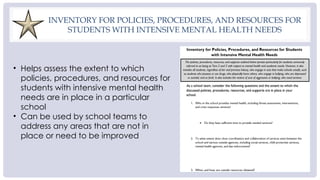
INVENTORY FOR POLICIES, PROCEDURES, AND RESOURCES FOR
STUDENTS WITH INTENSIVE MENTAL HEALTH NEEDS
• Helps assess the extent to which
policies, procedures, and resources for
students with intensive mental health
needs are in place in a particular
school
• Can be used by school teams to
address any areas that are not in
place or need to be improved
PREVENT MISBEHAVIOR FROM REOCCURRING
RECOMMENDED STRATEGIES
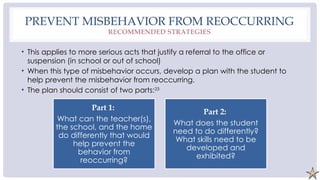
• This applies to more serious acts that justify a referral to the office or
suspension (in school or out of school)
• When this type of misbehavior occurs, develop a plan with the student to
help prevent the misbehavior from reoccurring.
• The plan should consist of two parts:23
Part 1:
What can the teacher(s),
the school, and the home
do differently that would
help prevent the
behavior from
reoccurring?
Part 2:
What does the student
need to do differently?
What skills need to be
developed and
exhibited?
PROFESSIONALLY TRAINED INDIVIDUALS AND PROCEDURES IN
PLACE FOR ASSESSING THREATS
RECOMMENDED STRATEGIES
• Highly recommended that more than 1 trained individual is available
at all times
• Mental health professionals (e.g., school psychologists)
• School administrators
• Law enforcement or school resource officers
• Primary goal of threat assessment interview:
• Determine seriousness of threat and need for follow-up actions (e.g., contacting
parents and law enforcement)
• Effective threat assessments avoid over-reactions and under-reactions
to threats19
• Also deter other students from acts of violence by making them aware that their
threats are taken seriously29
REVIEW SCHOOL CRISIS PREVENTION AND RESPONSE PROCEDURES
RECOMMENDED STRATEGIES
• Schools should have a school
crisis team and crisis plan in place
that addresses crisis prevention,
preparedness, emergency
response, and recovery
capacities
• National Association of School
Psychologists’ (NASP) PREPaRE
crisis curriculum: assists in
strengthening school crisis plans26
(see next slide)
• Crisis teams should be multidisciplinary:
• School representation: administrators,
teachers, school psychologists, nurses,
counselors, school resource officers,
transportation managers, and family
service representatives
• Community representation: parents, law
enforcement, EMS, fire officials, and
mental health practitioners
• Crisis plans should include 4 stages of
crisis management:
• Preparedness
• Prevention
• Response
• Recovery
NASP PREPaRE MODEL
• Prevent and prepare for psychological trauma
• Reaffirm physical health and perceptions of security and safety
• Evaluate psychological trauma risk
• Provide interventions and Respond to psychological needs
• Examine the effectiveness of crisis prevention and intervention
http://www.nasponline.org/professional-
development/prepare-training-curriculum
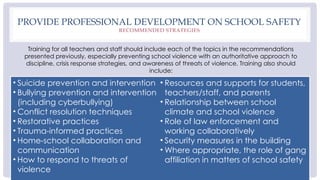
PROVIDE PROFESSIONAL DEVELOPMENT ON SCHOOL SAFETY
RECOMMENDED STRATEGIES
Training for all teachers and staff should include each of the topics in the recommendations
presented previously, especially preventing school violence with an authoritative approach to
discipline, crisis response strategies, and awareness of threats of violence. Training also should
include:
• Suicide prevention and intervention
• Bullying prevention and intervention
(including cyberbullying)
• Conflict resolution techniques
• Restorative practices
• Trauma-informed practices
• Home-school collaboration and
communication
• How to respond to threats of
violence
• Resources and supports for students,
teachers/staff, and parents
• Relationship between school
climate and school violence
• Role of law enforcement and
working collaboratively
• Security measures in the building
• Where appropriate, the role of gang
affiliation in matters of school safety
Making a Plan
Who is going to do
what actions by
when?
THANK YOU
• Based on areas of need identified by data, check out other modules
and resources provided through the School Climate and Student
Success Module Series.
• www.delawarepbs.org
• Questions can be directed to Sarah Hearn
• skhearn@udel.edu
SCHOOL SAFETY
• Lead Authors: Dr. George Bear and Angela Harris, M.A.
• University of Delaware & Delaware Positive Behavior Support Project
• Research Narrative Reviewed by: Dr. Aaron Kupchik
• University of Delaware
• PowerPoint Developed and Reviewed by: Angela Harris and Fiona
Lachman
• University of Delaware & Delaware Positive Behavior Support Project
• Audio Recorded by: Fiona Lachman
• Funding and Support from: The Delaware Department of Education
through the Delaware Positive Behavior Support Project and the
School Climate and Student Success Grant
School-Safety-Web-Version-how to be.pptx

  • 1.
    SCHOOL SAFETY Lead authors:Dr. George Bear and Angela Harris, M.A. University of Delaware Funding and support from: DE Positive Behavior Support Project – School Climate & Student Success R E S E A R C H A N D R E C O M M E N D E D I N T E R V E N T I O N S
  • 2.
    MODULE STRUCTURE • Moduleseries goal: • Provide information to schools that can lead to improvements in school climate and behavioral outcomes. • Module narratives provide additional information to accompany PowerPoint Presentation. • Endnotes throughout slides correspond to the references in the module narrative. • Gold star = Resource on Delaware PBS website
  • 3.
    SCHOOL SAFETY • Refersto the actual safety of students, teachers, and other in school, but also to their perceptions of safety • In safe schools: • Students experience few, if any, acts of violence or other acts that are harmful to their physical and emotional well-being • Emotional harm, such as high levels of fear, anxiety, sadness, anger, and avoidance of school can be lasting • Students and staff feel safe from acts of violence and other harmful actions such as bullying • In unsafe schools: • Harm is experienced by those who are victims or who fear violence and other acts that threaten safety and by witnesses of violent and traumatic events1 • Outcomes can be more serious and tragic
  • 4.
    DELAWARE SCHOOL SURVEYS •School safety is one of multiple subscales on the Delaware School Climate Scale of the Delaware School Surveys (DSS) • Appears on the student, teacher/staff, and home surveys • Consists of three items that assess perceptions of safety: • “Students are safe in the hallways” • “Students feel safe” • “Students know they are safe in this school”
  • 5.
    ESTIMATES AND INDICATORSOF SCHOOL SAFETY • Depend greatly on how being safe is defined • Indicators of school safety reported in the 2018 NCES “Indicators of School Crime and Safety: 2017” report2 • During the 2014-15 school year, 20 students were victims of homicides and 9 of suicides • In the 2017-18 school year, 29 students died from 17 school shootings in K-12 settings33 • About 15% of public schools report 1 or more “serious violent crimes” • E.g., rape, sexual assault, robbery, physical attack/fight with a weapon • When fights or physical attacks (without a weapon) and threats of physical attacks with or without a weapon are added as “violent incidents,” the percentage of schools reporting one or more of these incidents increases substantially • Fighting and physical attacks without a weapon are the most commonly reported incidents (64.9% of public schools)
  • 6.
    ESTIMATES AND INDICATORSOF SCHOOL SAFETY • Despite those statistics, schools are among the safest places for students and staff, especially when compared to other places and causes of injury and death3-4 • For example… The rate of the aforementioned serious violent incidents is less than 1 crime per 100 students Approximately 97% of student homicides occur outside of school, and approximately 1 student homicide or suicide at school occurs for every 1.9 million students Students are more likely to be killed or seriously injured in their homes or community, riding a bicycle, swimming, and especially riding in vehicles5
  • 7.
    SO…ARE SCHOOLS SAFE? •Overall, schools are quite safe from events that involve death, serious physical harm, and serious violence • If all types of crimes (violent & non-violent) are viewed as indicators of school safety, schools vary greatly with respect to safety • E.g., theft, vandalism; illegal and prescription drug/alcohol activity; possession of a firearm or explosive device; possession of a knife or sharp object • Approximately 79% of public schools reported such crimes in 2015-16 • The NCES report includes additional indicators of safety, such as: • Gangs at school • Hate language and hate-related graffiti • Teachers reports of being threatened and student actions that interfere with teaching • Disciplinary problems and serious disciplinary problems (e.g., expelling a student)
  • 8.
    SCHOOL SAFETY INDELAWARE • Data reported by the Delaware DOE indicates that schools in Delaware are safe • In the 2016-17 school year, 806 school crimes were reported in public schools6 • Felonies, misdemeanors, or violations defined in the Delaware Code • This equals approximately 6 school crimes per 1,000 students • According to the Delaware School Surveys in 2018: • 84% of students • 93% of teachers/staff • 95% of parents • Agreed with the statement: “Students know they are safe in this school.”
  • 9.
  • 10.
    CLASSROOM, SCHOOL, &TEACHER CHARACTERISTICS CONTRIBUTING FACTORS • Students and teachers/staff tend to feel safer in schools in which the following are present: • Clear and fair rules and expectations for behavior. Including clear and fair policies for addressing school violence7-10,34 • Physical safety features, especially security cameras, secure entrances, and locked doors8,11 • Research is not always consistent35,36 • Little evidence that school resource officers (SROs) and police increase perceptions of safety.4 Interactions with SROs that are respectful, fair, and genuine are likely to be viewed as positive experiences by students.12-14 • Cleanly and well-maintained school facilities, displayed student work, bulletin boards11,15 • Teachers and staff who are highly visible, especially in areas prone to violence/crime8 • Positive teacher-student, student-student, home-school, and staff relationships
  • 11.
    CLASSROOM, SCHOOL, &TEACHER CHARACTERISTICS CONTRIBUTING FACTORS • Students and teachers/staff tend to feel safer in schools in which the following are present: • Students are cognitively, emotionally, and behaviorally engaged in school • Efforts are made to develop students’ social and emotional competencies, both school-wide and in individual classrooms • An overall positive school climate8,16
  • 12.
    School Safety Recommended Strategies Collect and analyze data Avoid simple& quick fixes Comprehensive school discipline Authoritative school discipline Teach social and emotional competencies Increase students’ awareness to threats and how to report Review procedures for helping students Prevent misbehavior from reoccurring Individuals and procedures for assessing threats Review school crisis procedures Provide PD on school safety
  • 13.
    COLLECT AND EXAMINEDATA RECOMMENDED STRATEGIES • Collect and analyze data, especially school climate data, related to school safety • E.g., the Delaware School Climate Scale of the DSS • Results of the surveys would help answer the critical question: • Is my school perceived as being safe across students, teachers/staff, and parents, and across subgroups within those respondents, including grades (e.g., 9th versus 12th grade), racial/ethnic groups, and gender? • Finding positive perceptions = little or no need for interventions that follow, especially if other data support those perceptions • Finding negative perceptions across multiple subgroups = need for efforts to improve school safety • Finding negative perceptions across specific subgroups = need for more targeted interventions and deeper information gathering
  • 14.
    COLLECT AND EXAMINEDATA RECOMMENDED STRATEGIES • Examine responses to specific survey items, especially on the School Safety subscale • Will help determine which interventions are most appropriate • Examine other sources of data related to school safety • Office disciplinary referrals, suspensions and expulsions, absences, police reports and arrests • Generally, data should be disaggregated by behavior, person making the referral, and student demographics • Share results of surveys and other data with focus groups comprised of representatives that responded unfavorably to the items
  • 15.
    CONDUCTING FOCUS GROUPS Focusgroup guide • Information on: • Designing questions • Recruiting participants • Conducting the group • Analyzing data • Provides examples from Duke University (https://assessment.trinity.duke.edu/documents/How_to_Con duct_a_Focus_Group.pdf)
  • 16.
    AVOID SIMPLE &QUICK FIXES RECOMMENDED STRATEGIES • Some common quick fixes that are typically ineffective… Student profiling • Creating a list of students who are most likely to engage in a given act is unreliable and falsely identifies students as being threats to safety17-18 School uniforms, strict dress codes, and ID badges • Research is lacking on the effectiveness of these practices on school safety • Often, these practices make schools less pleasant places to be Pervasive zero tolerance approach • Reasonable school policies make schools safer • A pervasive zero tolerance approach (e.g., suspension without consideration of circumstances and for relatively minor misbehavior) seldom improves safety and creates poor school climate • This is also true for observable security measures that enforce pervasive zero tolerance approaches (e.g., school resource officers & metal detectors).19 Currently it is unknown if such measures increase or decrease school safety.20-21
  • 17.
    COMPREHENSIVE SCHOOL DISCIPLINE RECOMMENDEDSTRATEGIES • A comprehensive approach to school discipline includes four components:22-23 1. Strategies for developing social and emotional competencies, especially those related to self-discipline 2. Strategies for preventing behavior problems 3. Strategies for correcting common behavior problems 4. Programs and strategies for responding to serious and chronic behavior problems • Components are interrelated, but should be viewed as distinct
  • 18.
    AUTHORITATIVE SCHOOL DISCIPLINE RECOMMENDEDSTRATEGIES • Research shows that an authoritative approach prevents behavior problems and characterizes safe schools.24-25 • Consists of a balance of structure and social support Structure • High behavioral and academic expectations, clear and fair rules and consequences, and close monitoring and supervision of students • Strict punitive policies (e.g., expulsion for weapons) and reasonable safety measures (e.g., locked doors) Social Support • Building and maintaining positive teacher-student and student-student relationships that make all students feel accepted, respected, and a sense of belonging and support from others
  • 19.
    TEACH SOCIAL ANDEMOTIONAL COMPETENCIES RECOMMENDED STRATEGIES • The teaching of social and emotional skills should be integrated throughout the curriculum and included in classroom management practices • For example, lessons on empathy, responsible decision making, and peer pressure should be covered in literacy courses, social studies, and elsewhere • Such lessons might be supplemented with lessons from an evidence-based program from social and emotional learning, such as Second Step.
  • 20.
    SOCIAL-EMOTIONAL LEARNING INTHE CURRICULUM • Includes ideas and a template for incorporating SEL into the curriculum • Provides an example of an academic content standard, pre- existing academic lesson, and social-emotional topic that can be tied into the lesson • Action planning section helps educators to brainstorm ways that SEL can be tied into existing lessons and academic content standards
  • 21.
    INCREASE AWARENESS OFTHREATS AND HOW TO REPORT RECOMMENDED STRATEGIES • Common reasons bystanders fail to intervene & report potential acts of violence:19 • They do not believe the perpetrator is serious • They do not foresee the seriousness of the threat • They do not accept responsibility for intervening • They fear retaliation • They believe no one will do anything about it • They do not know how to report it • Schools can help prevent the most serious acts of violence by increasing students’ awareness of threats to safety, helping them recognize their responsibility to report it, and knowing how to report it. • Communicate these messages while not inducing unnecessary fear, such as scare tactics • This information might be presented in the context of social emotional learning curriculum or other lessons or discussions • It might also be taught/reinforced via: • School assemblies, special projects, posters, school announcements, pledges taken by students, and school media
  • 22.
    REVIEW PROCEDURES FORHELPING STUDENTS RECOMMENDED STRATEGIES • Pertains to students at Tiers 2 & 3 and all students who engage in acts that make schools unsafe (e.g., those who possess drugs, bully, are depressed or suicidal, etc.) • Questions that should be addressed are • Who in the school provides mental health, including threat assessment, interventions, and crisis responses services? • Do they have sufficient time to provide needed services? • To what extent does close coordination and collaboration of services exist between the school and various outside agencies, including social services, child protective services, mental health agencies, and law enforcement? • When, and how, are outside resources obtained? • What services exist within the school (e.g., mental health interventions), and which ones are lacking, based on student needs? • Do teachers/staff have the knowledge, skills, and awareness to recognize students who need services? • Do teachers/staff have adequate time to address students’ needs, and administrative support in doing so? • What are the procedures for students to receive needed services? Are services available, such academic and mental health services for students with behavior problems? Are students, parents, teachers, and other staff aware of the procedures? Are services easily requested and delivered in a reasonable period of time?
  • 23.
    INVENTORY FOR POLICIES,PROCEDURES, AND RESOURCES FOR STUDENTS WITH INTENSIVE MENTAL HEALTH NEEDS • Helps assess the extent to which policies, procedures, and resources for students with intensive mental health needs are in place in a particular school • Can be used by school teams to address any areas that are not in place or need to be improved
  • 24.
    PREVENT MISBEHAVIOR FROMREOCCURRING RECOMMENDED STRATEGIES • This applies to more serious acts that justify a referral to the office or suspension (in school or out of school) • When this type of misbehavior occurs, develop a plan with the student to help prevent the misbehavior from reoccurring. • The plan should consist of two parts:23 Part 1: What can the teacher(s), the school, and the home do differently that would help prevent the behavior from reoccurring? Part 2: What does the student need to do differently? What skills need to be developed and exhibited?
  • 25.
    PROFESSIONALLY TRAINED INDIVIDUALSAND PROCEDURES IN PLACE FOR ASSESSING THREATS RECOMMENDED STRATEGIES • Highly recommended that more than 1 trained individual is available at all times • Mental health professionals (e.g., school psychologists) • School administrators • Law enforcement or school resource officers • Primary goal of threat assessment interview: • Determine seriousness of threat and need for follow-up actions (e.g., contacting parents and law enforcement) • Effective threat assessments avoid over-reactions and under-reactions to threats19 • Also deter other students from acts of violence by making them aware that their threats are taken seriously29
  • 26.
    REVIEW SCHOOL CRISISPREVENTION AND RESPONSE PROCEDURES RECOMMENDED STRATEGIES • Schools should have a school crisis team and crisis plan in place that addresses crisis prevention, preparedness, emergency response, and recovery capacities • National Association of School Psychologists’ (NASP) PREPaRE crisis curriculum: assists in strengthening school crisis plans26 (see next slide) • Crisis teams should be multidisciplinary: • School representation: administrators, teachers, school psychologists, nurses, counselors, school resource officers, transportation managers, and family service representatives • Community representation: parents, law enforcement, EMS, fire officials, and mental health practitioners • Crisis plans should include 4 stages of crisis management: • Preparedness • Prevention • Response • Recovery
  • 27.
    NASP PREPaRE MODEL •Prevent and prepare for psychological trauma • Reaffirm physical health and perceptions of security and safety • Evaluate psychological trauma risk • Provide interventions and Respond to psychological needs • Examine the effectiveness of crisis prevention and intervention http://www.nasponline.org/professional- development/prepare-training-curriculum
  • 28.
    PROVIDE PROFESSIONAL DEVELOPMENTON SCHOOL SAFETY RECOMMENDED STRATEGIES Training for all teachers and staff should include each of the topics in the recommendations presented previously, especially preventing school violence with an authoritative approach to discipline, crisis response strategies, and awareness of threats of violence. Training also should include: • Suicide prevention and intervention • Bullying prevention and intervention (including cyberbullying) • Conflict resolution techniques • Restorative practices • Trauma-informed practices • Home-school collaboration and communication • How to respond to threats of violence • Resources and supports for students, teachers/staff, and parents • Relationship between school climate and school violence • Role of law enforcement and working collaboratively • Security measures in the building • Where appropriate, the role of gang affiliation in matters of school safety
  • 29.
    Making a Plan Whois going to do what actions by when?
  • 30.
    THANK YOU • Basedon areas of need identified by data, check out other modules and resources provided through the School Climate and Student Success Module Series. • www.delawarepbs.org • Questions can be directed to Sarah Hearn • skhearn@udel.edu
  • 31.
    SCHOOL SAFETY • LeadAuthors: Dr. George Bear and Angela Harris, M.A. • University of Delaware & Delaware Positive Behavior Support Project • Research Narrative Reviewed by: Dr. Aaron Kupchik • University of Delaware • PowerPoint Developed and Reviewed by: Angela Harris and Fiona Lachman • University of Delaware & Delaware Positive Behavior Support Project • Audio Recorded by: Fiona Lachman • Funding and Support from: The Delaware Department of Education through the Delaware Positive Behavior Support Project and the School Climate and Student Success Grant