C a m b r i d g e
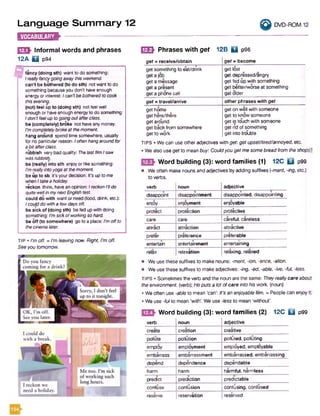
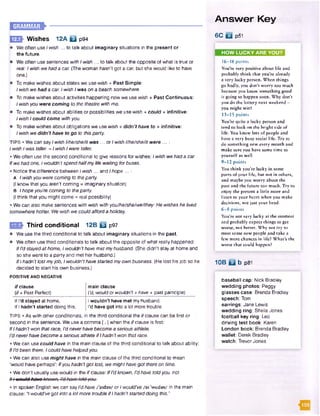
Chris Redston & Gillie Cunningham
Pocket Edition
Intermediate
Student's Book
DVD-ROM
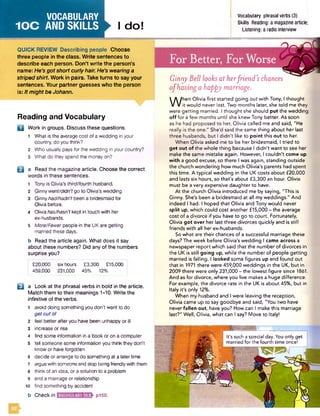
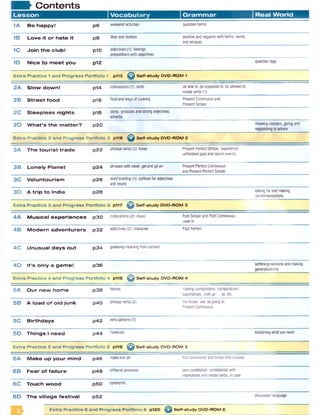
Contents
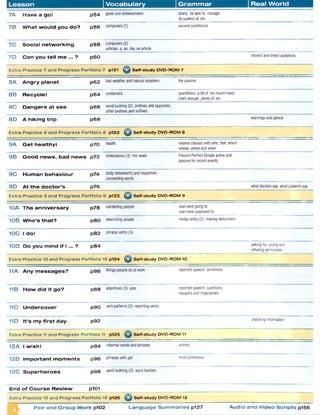
|Lesson Vocabulary Gram m ar Real World |
1A Be happy! p6 weekend activities question forms
1B Love it or hate it p 8 H(esand dtsikes positiveand negative verb forms, words
and phrases
1C Join the club! p-IO adjectives (1): feelings
prepositions with adjectives
1D Nice to meet you p12 question tags
E x tra P ra c tic e 1 a n d P ro g re s s P o rtfo lio 1 pH5 A S e lf-s tu d y DVD -R O M 1
2 A Slow down! p14
.. a
beableto,besupposedto,beatom )to.
modal verbs (1)
2 B Street food p16 food and ways of cooking PresentContinuous and
PresentSimple
2C Sleepless nights p18 sleep; gradable and strong adjectives;
adverbs
2 D What’s the matter? p20 showing concern, giving and
responding to advice
E x tra P ra c tic e 2 a n d P ro g re s s P o rtfo lio 2 p H 6 ^ S e lf-s tu d y D VD -R O M 2
3 A The tourist trade p22 phrasalverbs (1): travel Present Perfect Simple: experience,
unfinished past and recent events
3 B Lonely Planet p24 phrases with travel,getandgo on Present Perfect Continuous
and PresentPerfect Simple
3C Voluntourism p26 word bolding (1); suffixes for adjectives
and nouns
3 D A trip to India p28 asking for and making
recommendations
E x tra P ra c tic e 3 a n d P ro g re s s P o rtfo lio 3 p117 ^ S e lf-s tu d y D VD -R O M 3
4 A Musical experiences p 3 0 colocations (2): music Past Simple and Past Continuous;
usedto
4 B Modern adventurers p32 adjectives (2): character Past Perfect
4C Unusual days out p34 guessing meaning from context
4 D It’s only a game! p36 softening opinionsand making
generalsations
E x tra P ra c tic e 4 a n d P ro g re s s P o rtfo lio 4 p118 ^ S e lf-s tu d y D VD -R O M 4
5 A Our new home p38 homes making comparisons: comparatives,
superlatives. (rwfl as... as. etc.
5 B A load of old junk p40 phrasalverbs (2) the future: wtf. begoingto.
Present Continuous
5C Birthdays p42 verb patterns (1)
5 D Things Ineed p44 materials explaining what you need
E x tra P ra c tic e 5 a n d P ro g re s s P o rtfo lio 5 p119 ^ S e lf-s tu d y DVD -R O M 5
6 A Make up your mind p46 makeand do first conditionaland future time clauses
6 B Fear of failure p48 reflexive pronouns zero conditional; conditionals with
imperatives and modalverbs: in case
6C Touch wood p50 synonyms
6 D The village festival p52 (fiscussion language
E x tra P ra c tic e 6 a n d P ro g re s s P o rtfo lio 6 p120 ^ S e lf-s tu d y DVD -R O M 6
T e a ch e r’s DVD
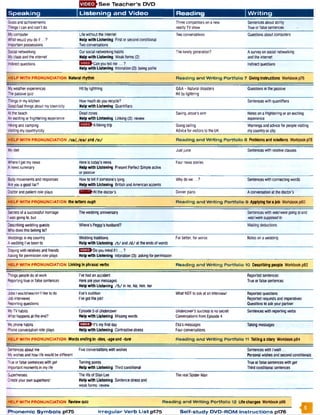
1Speaking Listening and Video R eading Writing
Myweekendactivities
Thingstnat matemehappy
Whatmakesmehappy?
Helpwith Listening Ouestionswithyou
Thesecretofhappiness Questionswithprepositionsat theend;
subjectquestions
Howdoyoufed about...?
Things1likeanddon'tike
Loveit orhateit Sentenceswithanegativemeaning
Thingsl Ekeanddon'tlike
Thelasttime1feltlikethis
Startingaclub
Fourclubs
Helpwith Listening Sentencestress(1)
Laughteris thebesl medicine
Thelastparly 1wentto
Conversationsataparty
E2£>Niceto meetyou Questionswithquestiontags
HELP WITH PRONUNCIATION -« /adjectives R eading and W ritin g P o rtfo lio 1 Describinga holiday Workbookp64
Howharddotheywork?
Ourrdes
Inpraiseofslow
Workingcomftions
Rulesatmyplaceoiwork,
schoolor university
roodIoften/nevereat
Findsomeonewho...
Sieve'sStreet Foodbiog
TheLA StreetFoodFestival
Eatinghabitsin mycountry
Mysleephabits
Asleepsurvey
Interviewwilba sleepscientist
Helpwith Listening Weakforms(1)
It's anightmare! Sentenceswithadjectivesandadverbs
Asleepsurvey
Problemsandadvice
Whatshould1do?
EEH>V/nai'sthe matter?
Helpwith Listening Intonation(1): soundingconcerned
Twoconversations
h e lp w ith p r o n u n c ia tio n Strongand weakforms R eading and W ritin g P o rtfo lio 2 Notices atwork Workbookp66
Ouestionsabout navel
Myexperiences
Yourholiday, myjob
Help with Listening PresentPerfectSimpleor
PastSimple
LewisandVeronica’s lesiaurant
Guidebooks
Atimelineof myHe
Theworld'sgreatesttravellers
AgudebookwriterInKenya
Questionsin the PresentPerfectSimple
orContinuous
Myholidays
Choosingthebestholiday
Aninterviewwith atravelexpert
Helpwith Listening Unking(1): consonant-vowelEnks
Twovtfuntourism holidays
Holidayfacifiies
Recommendationsabouta placethat
l knowwell
EEEStAtrfp toIndia Threeconversations
i -------------------
HELP WITH PRONUNCIATION Theschwa/a / Insuffixes R eading and W ritin g P o rtfo lio 3 Holidayarrangements Workbookp68
Mymusic
Mybestevermusicalexperience
Threepeople'sbestevermusical
experiences
Questionswith usedlo
People1knew
Aninterestingjourney
EdStafford'samaangjourney
Help with Listening PastSimpleorPastPerfect
BigRiverMan
BigRiverMan Notesonaninterestingjourney
Topfivemuseumsorartgalleriesin
■ycountry
Myfreetimeactivities
Help with Listening Linking(2):/tv /, /}/and/r /
sounds
Freedaysoutin London
Theworld'sweirdestmuseums
Football
M ng youropinion
it's onlyagame! Softeningopinionsaboutchfcfren
HELP WITH PRONUNCIATION The letters Of R eading and W ritin g P o rtfo lio 4 Reviewing a novel Workbookp70
Fivethingsto look(orin anewhome
Threehouses/flats 1knowwen
Anewplacetolive Threepaces torent Sentencesthatmakecomparisons
Comparinghouses/flais l knowwel
Ouestionswithphrasalverbs
Oscussingfutureplans
Settingridofthings
Giveaway,throwaway,keep?
Helpwtth Listening Futureverbforms
Whataboutthesecurtains?
Justgelrid ofit!
Whataboutthesecurtains?
Srthdays
Mymostmemorablebirthday
Fourmemorablebirthdays
Helpwith Listening Fillersandfalsestarts
Happybirthdaytoyou! Notesona memorablebirthday
Conversationsinadepartmentstore
Fourthings1need
Things1need Conversationsinadepartment store
HELP WITH PRONUNCIATION /d j/, /]/ and/ju s / R eading and W ritin g P o rtfo lio 5 Emailswith news Workbookp72
Findsomeonewho ...
Ehscussingproblems
Twobigdecisions Sentenceswith if, unless,might
Sentencesabout me
WhenI wasachad
~ootipsforlanguagelearners
Helpwith Listening Zeroorfirstconditional Howto measuresuccess Toptipsforlanguagelearners
Superstitionsinmycountry
Howluckyareyou?
Thehistoryofsuperstitions
Helpwith Listening Sentencestress(2)
Thesecretsofluck Britishsuperstitions
(fcganisingout ownfestival
h e lp w ith p ro n u n c ia tio n Wordsending In -ate R eading and W ritin g P o rtfo lio 6 Utters to anewspaper Workbookp74
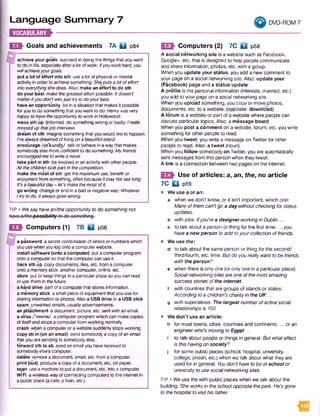
Lesson Vocabulary Gram m ar Real World
7A Have a gol p 5 4 goalsandachievements ability:beableto, manage,
beuselessat, etc.
7 B What would you do? p 5 6 computers(1) secondconditional
7 C Social networking p 5 8 computers(2)
articles: a. an, the,noarticle 9
7D Can you tell me ... ? p 6 0 indirectanddirectquestions
E x tra P ra c tic e 7 a n d P ro g re s s P o rtfo lio 7 p i2 1 ^ S e lf-s tu d y D VD -R O M 7
8 A Angry planet p 6 2 badweatherandnaturaldisasters thepassive
8 B Recycle! p 6 4 containers quantifiers: a bitof. toomucb/many,
(not) enough,plentyof. etc.
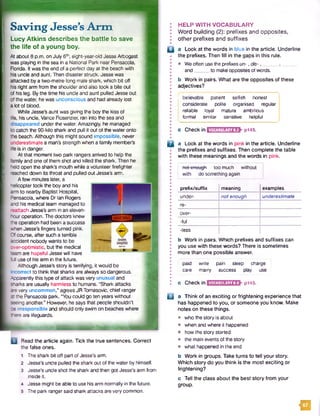
8 C Dangers at sea p 6 6 wordbuilding(2):prefixesandopposites,
otherprefixesandsuffixes
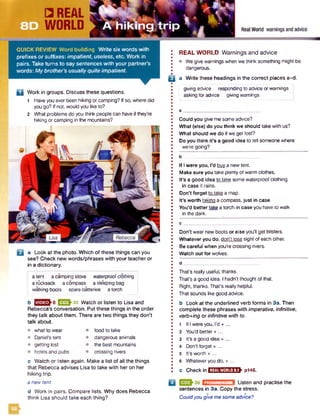
8 D A hiking trip p 6 8 warningsandadvice
E x tra P ra c tic e 8 a n d P ro g re s s P o rtfo lio 8 p122 ^ S e lf-s tu d y DVD -R O M 8
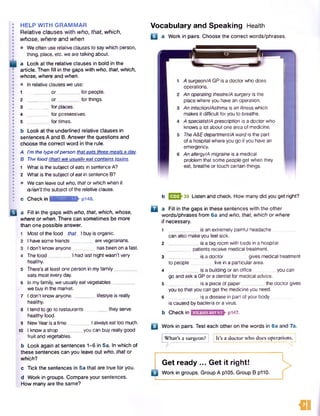
9 A Get healthyl p 7 0 health relativeclauseswith who. that,which,
whose, whereandwhen
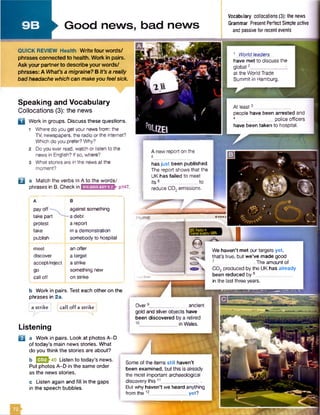
9 B Good news, bad news p 7 2 collocations(3):thenews PresentPerfectSimpleactiveand
passiveforrecentevents
9 C Human behaviour p 7 4 bodymovementsandresponses
connectingwords
9 D At the doctor's p 7 6 whatdoctorssay;whatpatientssay
E x tra P ra c tic e 9 a n d P ro g re s s P o rtfo lio 9 p123 ^ S e lf-s tu d y D VD -R O M 9
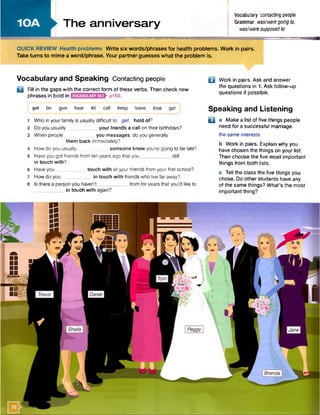
10A The anniversary p 7 8 contactingpeople was/wetegoingto.
was/wensupposedto
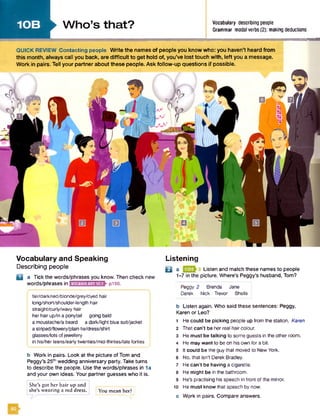
1 0 B Who’s that? p 8 0 describingpeople modalverbs(2):makingdeductions
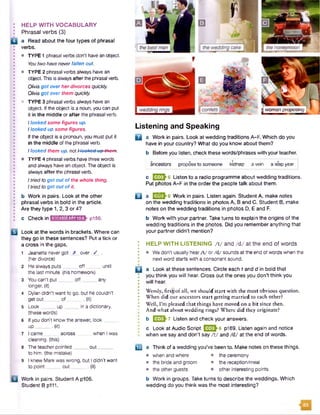
10C 1do! p 8 2 phrasalverbs(3)
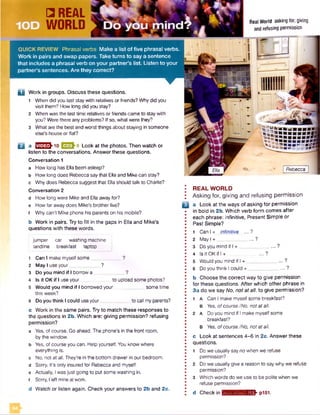
10D Do you mind if 1... ? p 8 4 askingfor.givingand
refusingpermission
E x tra P ra c tic e 10 a n d P ro g re s s P o rtfo lio 10 p124 ^ S e lf-s tu d y D VD -R O M 10
11A Any messages? p 8 6 thingspeopledoatwork reportedspeech:sentences
11B How did it go? p 8 8 adjectives(3):jobs reportedspeech:questions,
requestsandimperatives
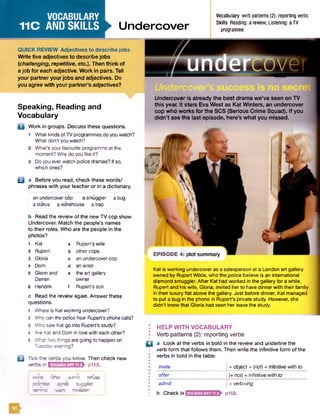
11C Undercover p 9 0 verbpatterns(2):reportingverbs
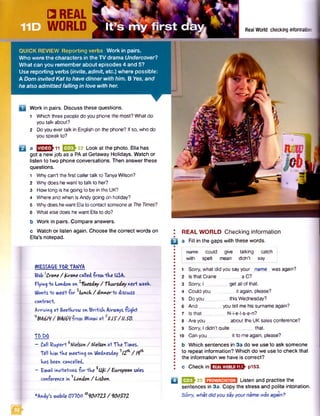
11D It's my first day p 9 2 checkinginformation
E x tra P ra c tic e 11 a n d P ro g re s s P o rtfo lio 11 p125 ^ S e lf-s tu d y D VD -R O M 11
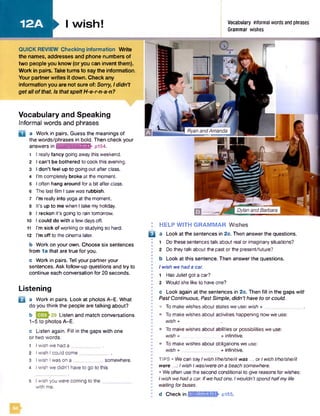
12A 1wish! p 9 4 informalwordsandphrases wishes
12B Important moments p 9 6 phraseswithgef thirdconditional
1 2 C Superheroes p 9 8 wordbuilding(3):wordfamilies
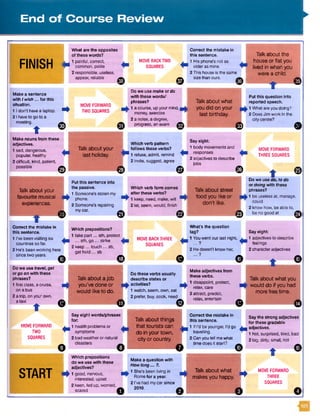
End of Course Review p101
E x tra P ra c tic e 12 a n d P ro g re s s P o rtfo lio 12 p126 ^ S e lf-s tu d y DVD -R O M 12
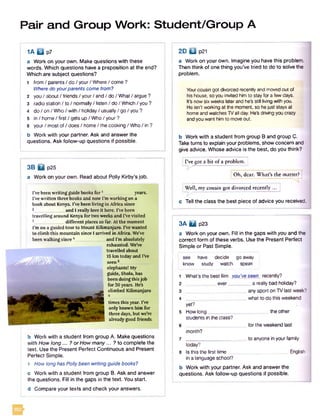
Pair and Group Work p102 Language Summaries p127 Audio and Video Scripts p156
5 E 3 2 Jse e T ea che r’s DVD
Speaking Listening and Video Reading Writing |
Goalsandachievements
ThingsIcanandcan’t do
Threecompetitorsonanew
realityTVshow
Sentencesaboutability
Trueorfalsesentences
Mycomputer
Whatwouldyoudoif...?
Importantpossessions
Lifewithoutthe internet
Helpwith Listening Firstorsecondconditional
Twoconversations
Twoconversations Questionsaboutcomputers
Socialnetworking
Mydassandtheinternet
Oursocial networkinghabits
Help with Listening Weakforms(2)
Thelonelygeneration? Asurveyonsocialnetworking
andtheinternet
ktirect questions Canyoutell me... ?
Helpwith Listening Intonation(2): beingpolite
Indirectquestions
HELP WITH PRONUNCIATION Natural rhythm R eading and W riting P o rtfo lio 7 Givinginstructions Workbookp76
Myweatherexperiences
Thepassivequiz
Hitbylightning Q&A- Natural(Bsasters
Hit bylightning
Questionsin thepassive
Thingsin mykitchen
Good/badthingsabout mytown/dty
Howmuchdoyourecycle?
Helpwith Listening Quantifiers
Sentenceswithquantifiers
Atthebeach
Anexcitingor frighteningexperience
Deadzones
Helpwith Listening Linking(3): review
SavingJesse’sarm Notesona frighteningoranexciting
experience
Wangandcamping
Visitingmycountry/city
hfldngtrip Goingsailing
AdviceforvisitorstotheUK
Warningsandadviceforpeoplevisiting
mycountryordty
HELPWITH PRONUNCIATION /» /, /e a / and/$ :/ R eading and W riting P o rtfo lio 8 Problemsand solutions Workbookp78
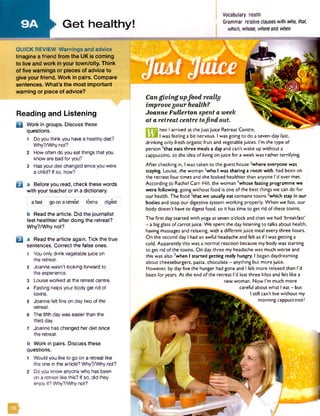
Mydet Justjuice Sentenceswith relativeclauses
WhereI getmynews
Anewssummary
Hereis today’snews
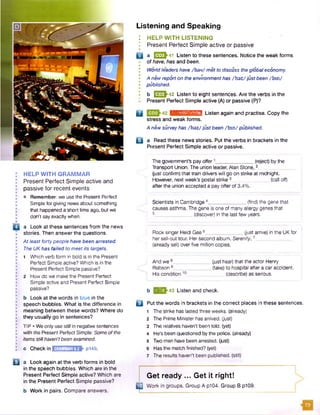
Helpwith Listening PresentPerfectSimpleactive
orpassive
Fournewsstories
Bodymovementsandresponses
Areyoua goodliar?
Howtotel if someone'slying
Helpwith Listening BritishandAmericanaccents
Whydowe...? Sentenceswithconnectingwords
Doctorandpatientrole-plays Mww A t thedoctor’s Dinnerplans Aconversationatthedoctor's
HELP WITH PRONUNCIATION the letters ough R eading and W ritin g P o rtfo lio 9 Applyingforajob Workbookp80
Secretsofasuccessfulmarriage
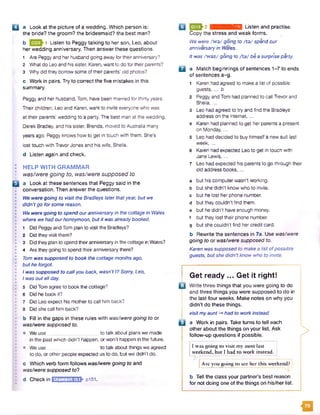
iwas goingto.but...
Theweddinganniversary Sentenceswith was/megoingtoand
was/mesupposedto
Describingweddingguests
Whodoesthisbelongto?
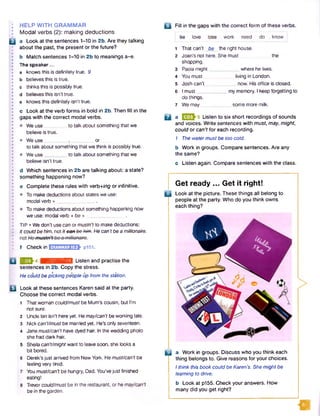
Where'sPeggy'shusband? Makingdeductions
Weddingsinmycountry
AweddingI'vebeento
Weddingtraditions
Helpwith Listening / t / and/d / attheendsofwords
Forbetter, (orworse Notesonawedding
Stayingwithrelativesandfriends
Askingforpermissionrole-plays
BESSf-DoyoumindIf 1... ?
Help wtth Listening Intonation(3): askingforpermission
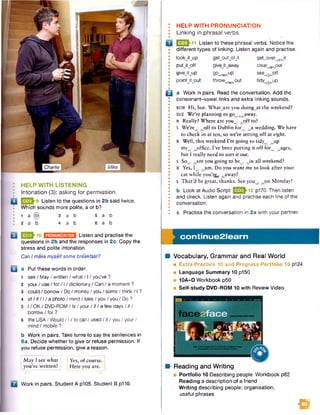
HELP WITH PRONUNCIATION Linking in phrasal verbs R eading and W ritin g P o rtfo lio 10 Describing people Workbookp82
Thingspeopledoatwork
Reportingtrueor falsesentences
I'vehadanaccident
Hereareyourmessages
Helpwith Listening /h / in he.hts. him.her
Reportedsentences
Trueorfalsesentences
JobsIwould/wouldn't fiketodo
Jobinterviews
Reportingquestions
Eva'saudition
I'vegottheJob!
WhatNOTto askataninterview! Reportedquestions
Reportedrequestsandimperatives
Questionsto askyourpartner
MyTVhabits
Whathappensattheend?
Episode5 of Unfefcover
Helpwith Listening Missingwords
Undercover's successis nosecret
ConversationsfromEpisode4
Sentenceswith reportingverbs
Myphonehabits
Phoneconversationrole-plays
B B 3& it’smyfirstday
Helpwith Listening Contrastivestress
Ella'smessages
Fourconversations
Takingmessages
h e lp w ith p ro n u n c ia tio n Wordsending in -ffon, -ageand ‘tun R eading and W ritin g P o rtfo lio 11 TeNingastory Workbookp84
Sentencesaboutme Fiveconversationswithwishes
Mywishesandhowlife wouldbedifferent
Sentenceswith Iwish...
Personalwishesandsecondconditionals
irueorfalsesentenceswith get
baportantmomentsin myfife
Turningpoints
Helpwith Listening Thirdconditional
Trueorfalsesentenceswithget
Thirdconditional sentences
Superheroes
Createyourownsuperhero!
ThelifeofStanLee
Helpwith Listening Sentencestressand
weakforms:review
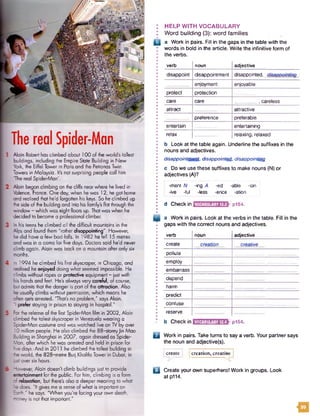
TherealSpider-Man
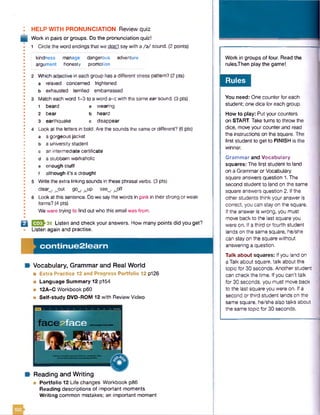
HELP WITH PRONUNCIATION Review quiz R eading and W ritin g P o rtfo lio 12 Life changes Workbookp86
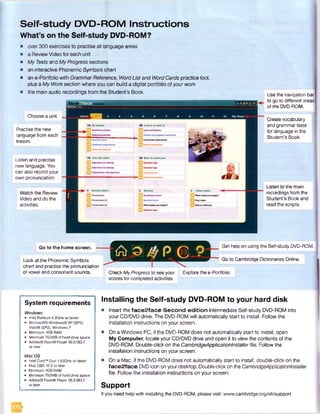
P h o n e m ic S y m b o ls p175___________Ir re g u la r V e rb L is t p175________S e lf-s tu d y D V D -R O M In s tru c tio n s p176
1A
I
QUICK REVIEW Meeting new people Talk to
three other students. Introduce yourself and
find out two things about each person. Then
tell the class about one person you spoke to.
Vocabulary and Speaking
Weekend activities
D 3 Match the verbs in A to the words/phrases
in B. Then check in Language Summary 1
p127.VOCABULARY 1.1
A
visit —w
have N
goto
B
a lie-in
- relatives
concerts/gigs/festivals
! chat
I have
| do
a quiet night in
yoga
to friends online
meet up j
tidy up
goto
museums/art galleries
with friends
the house/the flat
I do
| have
go out
people round fordinner
for a drink/meal
exercise
b Work in pairs. Ask questions with How often do you...?,
When did you last...? or Do you ever...? about the activities
in 1a. Ask follow-up questions if possible.
Many people think that
being clever, rich and
attractive isthe best way to
find happiness. But according
to a report In NewScientist
magazine, these things aren't
as Important aswe think.
A group of scientists examined
hundreds of research studies
from around the world and
then made a list of the top
ten reasons for happiness
- and their list makesvery
surprising reading.
How ofren do you visit relatives? | : About once a month.
|When did you last have a lie-in? |Last Sunday. ]
Do you ever go to gigs? j j Yes, sometimes, j
Reading and Speaking
B a Read the beginning of the article about happiness. How did the
scientists make their top ten list?
b Look at these reasons for happiness. Put them in order from
1-10 (1 = the most important).
• friends and family • being attractive
• money • growing old
• being married • religion
• helping others • intelligence
• your genes • not wanting more than you've got
c Work in pairs. Compare lists. Explain the order you chose.
B Turn to p112. Read the rest of the article
and answer the questions.
Listening and Speaking
a a Look at the photos of Fiona, Maxie and
Caroline. What makes them happy, do you
think?
b EQfr1 Listen and write two things
that make each person happy.
c Listen again. Answer these questions.
1 How often does Fiona teach yoga
classes? Three times a week.
2 What is Fiona's son doing at the moment?
3 What did Fionado last Sunday?
4 How many songs has Maxie written?
s What did he put on YouTubelast month?
6 How many countries has he been to?
7 Who does Caroline go to art galleries with?
8 What makes her husband happy?
9 Who visits them most weekends?
Q g h a p p y ! I Vocabulary weekend activities
Grammar question forms
B -
: HELP WITH GRAMMAR Question forms
B a Match questions 1-4 in 4c to these verb forms.
I Present Simple 1 Past Simple
Present Continuous Present Perfect Simple
b Write questions 2-4 from 4c in the table.
question
word
auxiliary subject
How often does Fiona teach yoga classes?
c Look at questions 5-9 in 4c. Answer these questions.
1 Is thequestion word the object orthe subject in each question?
2 Why don't questions 8 and 9 have an auxiliary?
d Find two questions in 4c which have a preposition at the end.
e Check in p i28.
Q | Fill in the gaps in these questions with do, are,
have, did or - {= no auxiliary).
1 Whereabouts do you live?
2 How long_ _you lived there?
3 Who_ _ liveswith you?
4 What time_ _you get upon Sundays?
5 Why_ _you studying English?
6 Where_ _you go on holiday last year?
7 Howmanycountries____ you visited?
8 Who_ _ emailsyou the most?
9 What _ _ you do yesterdayevening?
10 W hat_
weekend?
_ you planning to do next
: HELP WITH LISTENING
• Questions with you
a a Work in pairs. How do we usually say the
auxiliaries and you in the questions in 6?
b 031*2 Listen to the questions in 6.
Notice how we say do you /daja/, haveyou
I /havja/, areyou /aja/ and didyou /d id3a/.
Q a EEDh2 B M M S M Listen again and
practise. Copy the weak forms.
Whereaboutsdo you/daja/ live?
b Work in pairs. Ask and answer the
questions in 6. Ask follow-up questions.
( j] Work in new pairs. Student A p102.
Student B p107.
Get ready ... Get it right!
m Write a list of five things you do that make
you happy.
1 writingmybtog
2 going forwalksin thepark
i l l a Work in groups of three. Take turns to
tell the group about each thing on your
list. Ask one or two questions about
each thing your partners tell you about.
IWriting my blog j jHow often do
|makes me happy. | you write it? j
What do you
write about?
b Tell the class about one thing that
makes you happy.
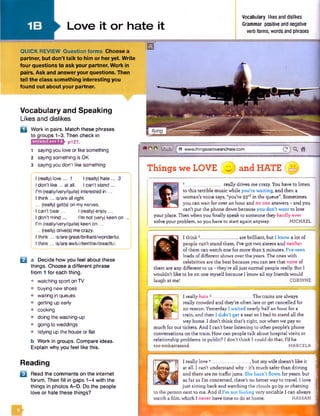
Love it or hate it
Vocabulary likes and dislikes
Grammar positive andnegative
verbforms, words and phrases
QUICK REVIEW Question form s Choose a
partner, but don’t talk to him or her yet. W rite
four questions to ask your partner. Work in
pairs. Ask and answer your questions. Then
tell the class something interesting you
found out about your partner.
Vocabulary and Speaking
Likes and dislikes
l o l
□ Work in pairs. Match these phrases
to groups 1-3. Then check in
i m m i m i i * - pi27.
1 saying you love or like something
2 saying something is OK
3 sayingyou don't like something
I (really)love... 1 I (really) hate ... 3
I don’t like... at all. I can't stand...
I'm (really/very/quite) interested in ...
I think... is/are all right.
... (really) get(s) on mynerves.
I can’t bear... I(really)enjoy...
I don’t mind ... I’m not (very)keen on ,
| I'm (really/very/quite) keenon ...
... (really) drive(s) mecrazy.
I think... is/are great/brilliant/wonderful.
I think... is/are awful/terrible/dreadful.
a Decide how you feel about these
things. Choose a different phrase
from 1 for each thing.
• watching sport on TV
• buying new shoes
• waiting in queues
• getting up early
• cooking
• doing the washing-up
© going to weddings
• tidying up the house or flat
b Work in groups. Compare ideas.
Explain why you feel like this.
Reading
H Read the comments on the internet
forum, then fill in gaps 1-4 with the
things in photos A-D. Do the people
love or hate these things?
B
e o e B S f e www.thingsweloveandhate.com " c jQ . a
Things we LOVE @ and HATE
1 ___ really drives me crazy. You have to listen
to this terrible music while you’re waiting, and then a
woman’s voice says, “you’re 93rdin the queue”. Sometimes
you can wait for over an hour and no one answers - and you
can’t put the phone down because you don’t want to lose
your place. Then when you finallyspeak to someone they hardly ever
solve your problem, so you have to start again anyway. MICHAEL
I think2. . are brilliant, but I know a lot of
people can’t stand them. I’ve got two sisters and neither
of them can watch one for more than 5 minutes. I’ve seen
loads of different shows over the years. The ones with
celebrities are the best because you can see that none of
them are any different to us - they’re alljust normal people really. But 1
wouldn’t like to be on one myself because I know all my friends would
laugh at me! CORINNE
I really hate 3_________________ The trains are always
really crowded and they’re often late or get cancelled for
no reason. Yesterday I waited nearly half an hour for a
train, and then I didn’t get a seat so I had to stand all the
way home. I don’t think that’s right, not when we pay so
much for our tickets. And I can’t bear listening to other people's phone
conversations on the train. How can people talk about hospital visits or
relationship problems in public? I don’t think I could do that. I'd be
too embarrassed. MARCELA
I really love 4________________, but my wife doesn’t like it
at all. I can’t understand why - it’s much safer than driving
and there are no trafficjams. She hasn’t flown for years, but
as far as I’m concerned, there’s no better way to travel. I love
just sitting back and watching the clouds go by or chatting
to the person next to me. And if I’m not feeling very sociable I can always
watch a film, which I never have time to do at home. HASSAN
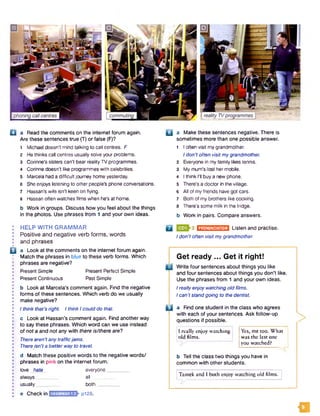
O a Read the comments on the internet forum again. □ a Make these sentences negative. There is
Are these sentences true (T) or false (F)? sometimes more than one possible answer.
1 Michael doesn't mind talking to call centres. F 1 I often visit mygrandmother.
2 He thinks call centres usually solve your problems. 1don’t often visit mygrandmother.
3 Corinne’s sisters can't bear realityTV programmes. 2 Everyone in my family likes tennis.
4 Corinne doesn’t like programmes with celebrities. 3 My mum's lost hermobile.
5 Marcela had a difficult journey home yesterday. 4 1think I'll buy a new phone.
6 She enjoys listening to other people's phone conversations. 5 There’s a doctor in the village.
7 Hassan's wife isn't keen on flying. 6 All of myfriends have got cars.
8 Hassan often watches films when he's at home. 7 Both of my brothers like cooking.
b Work in groups. Discuss how you feel about the things 8 There’s some milk in the fridge.
in the photos. Use phrases from 1 and your own ideas. b Work in pairs. Compare answers.
• HELP W ITH GRAMMAR Q 3 EHJHEEESMI Listen and practise.
: Positive and negative verb form s, words , do„,t often visit mygrandmolhgr.
I and phrases
9 ........
Q a Look at the comments on the internet forum again.
Match the phrases in blue to these verb forms. Which G e t re a d y . . . G e t it fig h t!
; phrases are negative? JL „ . . . ...,
U j Write four sentences about things you like
Present Simple Present Perfect Simple ancj four sentences about things you don’t like.
• Present Continuous Past Simple Use the phrases from 1 and your own ideas.
• b Look at Marcela's comment again. Find the negative Ireally enjoy watching old films.
I forms of these sentences. Which verb do we usually / can’t standgoing to the dentist.
I make negative?
: I think that’s right. I think Icould do that. i l a Find one student in the class who agrees
with each of your sentences. Ask follow-up
• c Look at Hassan's comment again. Find another way mioctinn® if nnceihi®
• to say these phrases. Which word can we use instead
; of not a and not any with there is/there arel jI really enjoy watching Yes, me too. What
• There aren'tany trafficjams. M f j t o L ................I the last one
• There isn'ta better wayto travel. you watc e . I
J d Match these positive words to the negative words/ I) jqu the class two things you have in
 phrases in pink on the internet forum. common with other students.
• love hate everyone________ I 1
• always all j Tamek and I both enjoy watching old films. |
• usually________both__________________
• e Check in p128.
H
Get ready ... Get it right!
□ Write four sentences about things you like
and four sentences about things you don’t like.
Use the phrases from 1 and your own ideas.
Ireally enjoy watching old films.
/ can’t standgoing to the dentist.
C l a Find one student in the class who agrees
with each of your sentences. Ask follow-up
questions if possible.
I really enjoy watching
old films.
Yes, me too. What
was the last one
you watched?
b Tell the class two things you have in
common with other students.
|Tamek and I both enjoy watching old films.
VOCABULARY I
1C AND SKILLS ] Join the club!
Vocabulary adjectives (1): feelings;
prepositionswith adjectives
Skills Listening: aninformal conversation;
Reading: amagazinearticle
QUICK REVIEW Likes and dislikes Write the names of three
people you know. Think of one thing they like doing and one thing
they don’t like doing. Work in pairs. Take turns to tell each other
about the people: My brother Federico can't stand waiting in queues. Q
Vocabulary and Speaking
Adjectives (1): feelings
Q a Work in pairs. Which of these adjectives do you know? Do they
describe positive or negative feelings? Then check new words in
P127.
| relaxed nervous pleased embarrassed angry annoyed
fed up disappointed stressed calm upset scared
satisfied confused shocked glad concerned depressed :
b Choose six adjectives from 1a. Make notes on the last time you
felt like this.
c Work in pairs. Tell your partner about the adjectives you chose.
Ask follow-up questions if possible.
I felt quite stressed last week because
I had to go for a job interview. Did you get the job?
Listening and Speaking
B a Work in new pairs. Answer these questions.
1 Have you (or people you know) ever been a member of a club?
If so, tell your partner about it.
2 What kinds ofclubs are popular in your school, university or city?
What do people do in these clubs?
3 What are the advantages and disadvantages of being in a club?
b Listen to four friends, Sally, Eric, Alice and Peter. Put
these clubs in the order they talk about them. What do people do
in each club?
• a book club • a glee club
• an animation club • a drama club
c Listen again. Tick (✓) the true sentences. Correct the false ones.
1 Sally's new play is a musical, comedy
2 Her characterin the play is an angry old lady.
3 Eric's book club meets once a week.
4 He doesn't always finish reading every book.
5 Peter runs an animation club.
6 Eric might go to an animation club meeting.
7 Alice is better at dancing than singing.
8 She's too embarrassed to sing in the restaurant.
d Work in pairs. Compare answers. Would you like to join any of
these clubs? Why?/Why not?
HELP W ITH LISTENING
Sentence stress (1)
a GEDh,: Read and listen to the
beginning of the conversation. Notice
which words are stressed.
SALLY Sorry I’m late. Did you get my
text?
p e te r Hi, Sally. Yes, I’ve ordered you
the vegetarian pizza.
SALLY Great, thanks a lot.
e r ic Were you working late?
sally No, I go to a drama dub on
Mondays.
ALICE I didn’t know you’ve joined a
drama dub.
b Find examples of these parts of
speech in the conversation in 3a. Are
these types of words usually stressed
(S) or not stressed (N)?
adjectives S pronouns
positive auxiliaries main verbs
nouns articles prepositions
negative auxiliaries
c Look at Audio Script Q Jflh 4
p156. Listen again and follow the
sentence stress.
Reading and Speaking
Q a Look at the photos and the headline
of the article on p11. What do you think
the article is about?
b Before you read, check these
words/phrases with your teacher or
in a dictionary.
reduce clap your hands
strengthen your immune system
fake chemicals
c Read the article. Match topics a-e to
paragraphs 1-5.
a It worked for me - try it yourself
b Why laughter is good foryou
c Start the day with a laugh
d Myfirst visit to a Laughter Club
e How Laughter Clubs began
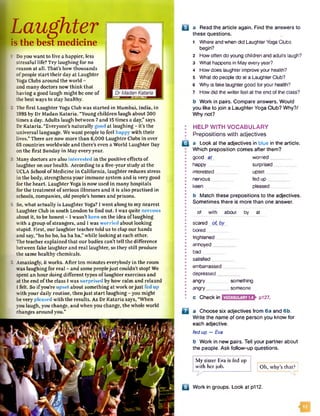
Laughter
is the best medicine
Do you want to live a happier, less
stressful life? Try laughing for no
reason at all. That's how thousands
of people start their day at Laughter
Yoga Clubs around the world -
and many doctors now think that
having a good laugh might be one of
the best ways to stay healthy.
The first Laughter Yoga Club was started in Mumbai, India, in
1995 by Dr Madan Kataria. “Young children laugh about 300
times a day. Adults laugh between 7 and 15 times a day,” says
Dr Kataria. “Everyone’s naturally good at laughing - it’s the
universal language. We want people to feel happy with their
lives.” There are now more than 6,000 Laughter Clubs in over
65 countries worldwide and there’s even a World Laughter Day
on the first Sunday in May every year.
Many doctors are also interested in the positive effects of
laughter on our health. According to a five-year study at the
UCLA School of Medicine in California, laughter reduces stress
in the body, strengthens your immune system and is very good
for the heart. Laughter Yoga is now used in many hospitals
for the treatment of serious illnesses and it is also practised in
schools, companies, old people’s homes and prisons.
So, what actually is Laughter Yoga? I went along to my nearest
Laughter Club in south London to find out. I was quite nervous
about it, to be honest - 1 wasn’t keen on the idea of laughing
with a group of strangers, and I was worried about looking
stupid. First, our laughter teacher told us to clap our hands
and say, “ho ho ho, ha ha ha,”while looking at each other.
The teacher explained that our bodies can’t tell the difference
between fake laughter and real laughter, so they still produce
the same healthy chemicals.
Amazingly, it works. After ten minutes everybody in the room
was laughing for real - and some peoplejust couldn’t stop! We
spent an hour doing different types of laughter exercises and
at the end of the class I was surprised by how calm and relaxed
I felt. So if you’re upset about something at work orjust fed up
with your daily routine, thenjust start laughing - you might
be very pleased with the results. As Dr Kataria says, “When
you laugh, you change, and when you change, the whole world
changes around you.”
I I
Q a Read the article again. Find the answers to
these questions.
1 Where and when did LaughterYogaClubs
begin?
2 How often do young children and adults laugh?
3 What happens in Mayeveryyear?
4 How does laughter improve your health?
5 What do people do at a LaughterClub?
6 Whyis fake laughtergood for your health?
7 How did the writer feelat the end of the class?
b Work in pairs. Compare answers. Would
you like to join a Laughter Yoga Club? Why?/
Why not?
HELP W ITH VOCABULARY
Prepositions w ith adjectives
a Look at the adjectives in blue in the article.
Which preposition comes after them?
good at worried__
happy _____ surprised_
interested________ upset __
nervous________ fed up _
keen pleased
b Match these prepositions to the adjectives.
Sometimes there is more than one answer.
of with about by at
scared of, by
bored _
frightened
annoyed ________
bad
satisfied
embarrassed_
depressed________
angry
angry_____
c Checkin
something
.someone
VOCABULARY1.4 p127.
□ a Choose six adjectives from 6a and 6b.
Write the name of one person you know for
each adjective.
fed up — Eva
b Work in new pairs. Tell your partner about
the people. Ask follow-up questions.
My sister Eva is fed up
with her job. Oh, why’s that?
B Work in groups. Look at p112.
QUICK REVIEW Prepositions w ith adjectives
Work in pairs. Find one thing that you’re both:
scared of, interested in, worried about, good at,
fed up with, happy about. A I’m scared of spiders.
B Me too!
n Work in pairs. Discuss these questions.
1 When did you last meet someone new (apart from
students in this class)? Where were you at the time?
2 What did you talk about?
3 Did you get on well with the person? Why?/Whynot?
E3a Look at the photo. Where are the people? What
are they doing?
b QH&l EEOMWatch or listen to the
conversation. Then choose the correct names in
these sentences.
1 (Qanief)/Chariieis Lisa's new boyfriend.
2 Lisa/Daniel is Charlie and Rebecca's neighbour.
3 Rebecca's/Lisa’s sister shared a flat with Daniel’s
brother.
4 Daniel/Charlie teaches people how to sail.
5 Charlie/Lisa works for a package tour company.
6 Lisa/Danieland Rebecca/Charlie both support
Manchester United.
7 Rebecca and Charlie have a son calledAiex/Harry.
c Work in pairs. Compare answers.
□ a Work in the same pairs. Complete questions 1-6 with
these question tags.
don’t-you? wasn’t it? do you?
haveyou? haven’t you? didn’t she?
) You live next door to Lisa,
don’t you?
)Barbara went to Liverpool I b I
---]university, _
Yes. Ido.
'You’ve been diving,
) It was a great match
yesterday, _
) You haven’t ordered any
food yet, ...
'You don’t have any kids,
b Work in the same pairs. Write these short answers
in a-f.
Yea. l do. No. I don’t. Yes. shedid. Yes, it was.
' No, I haven’t, actually. No, we haven’t.
c ^ 2 ^ 1 ESQM Watch or listen again. Check your
answers to 3a and 3b.
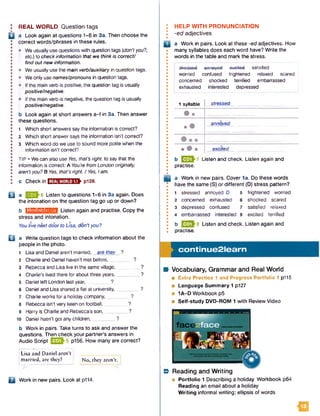
I REAL WORLD Question tags
Q a Look again at questions 1-6 in 3a. Then choose the
j correct words/phrases in these rules.
• • We usually use questions with question tags (don’tyou?,
etc.) to check information that we thinkis correct/
! find out new information.
• • We usually use the main verb/auxiliary in question tags.
• • Weonly usenames/pronouns in question tags.
■ • If the main verb is positive, the question tag is usually
I positive/negative.
• • If the main verb is negative, the question tag is usually
positive/negative.
! b Look again at short answers a -f in 3a. Then answer
I these questions.
•
I 1 Which short answers saythe information is correct?
I 2 Which short answer says the information isn’t correct?
• 3 Which word do we use to sound more polite when the
S information isn't correct?
•
I TIP • Wecan also use Yes, that's right, to saythat the
• information is correct: A You'refromLondon originally,
I aren'tyou? B Yes, that'sright. / Vfes, Iam.
I c Check in E B S B B IH F P 1 2 8 .
Q j a QZDh6 Listen to questions 1-6 in 3a again. Does
the intonation on the question tag go up or down?
b IJM lM M IM ill Listen again and practise. Copy the
stress and intonation.
Youlive nextdoor to Lisa, don'tyou?
u a Write question tags to check information about the
people in the photo.
1 Lisa and Daniel aren't married, are they ?
2 Charlie and Daniel haven't met before,_________?
3 Rebecca and Lisa live in the samevillage,________ ?
4 Charlie's lived there for about three years,________ ?
5 Daniel left London last year, _____ ?
6 Daniel and Lisa shared a flat at university, ?
7 Charlie works for a holiday company,_________?
8 Rebecca isn't very keen on football,________ ?
9 Harry is Charlie and Rebecca’s son,________ ?
10 Daniel hasn't got any children, ...........?
b Work in pairs. Take turns to ask and answer the
questions. Then check your partner's answers in
Audio Script Q Q frs P156* How many are correct?
|Lisa and Daniel aren’t |
married, arc they? j No, they aren’t.
□ Work in new pairs. Look at p114.
HELP W ITH PRONUNCIATION
-ed adjectives
n a Work in pairs. Look at these -ed adjectives. How
many syllables does each word have? Write the
words in the table and mark the stress.
ootiofiAHo tttS o S u n u n iiu y c u U A tn tu a g c iu o iic u
j worried confused frightened relaxed scared
! concerned shocked terrified embarrassed
' exhausted interested depressed
1 syllable stressed
# •
» •
annoyed
• # » excited
b H |^ ^ 7 Listen and check. Listen again and
practise.
a Work in new pairs. Cover la . Do these words
have the same (S) or different (D) stress pattern?
1 stressed annoyed D 5 frightened worried
2 concerned exhausted 6 shocked scared
3 depressed confused 7 satisfied relaxed
4 embarrassed interested 8 excited terrified
b ^ ^ 8 Listen and check. Listen again and
practise.
continue2learn
Vocabulary, Grammar and Real W orld
■ Extra Practice 1 and Progress Portfolio 1 p115
■ Language Summary 1 p127
■ 1A-D Workbook p5
■ Self-study DVD-ROM 1 with Review Video
B Reading and W riting
■ Portfolio 1 Describing a holiday Workbook p64
Reading an email about a holiday
W riting informal writing; ellipsis of words
ia
Slow down!
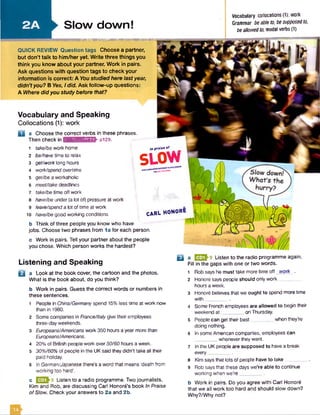
Vocabulary collocations (1): work
Grammar beableto, besupposedto,
beallowedto, modal verbs (1)
■■■■■■■■■■■■■■■■■■■■■■■■■■■■■I
QUICK REVIEW Question tags Choose a partner,
but don’t talk to him /her yet. W rite three things you
think you know about your partner. Work in pairs.
Ask questions with question tags to check your
information is correct: A You studied here last year,
didn't you? B Yes, I did. Ask follow-up questions:
A Where did you study before that?
Vocabulary and Speaking
Collocations (1): work
a a Choose the correct verbs in these phrases.
Then check in rinwiviuf^nHCV pi29.
1 take/be work home
2 be/have time to relax
3 get/worklong hours
4 work/spendovertime
5 get/be a workaholic
6 meet/takedeadlines
7 take/be time offwork
8 have/be under(a lot of) pressure at work
9 leave/spenda lot of time at work
10 have/begood working conditions
b Think of three people you know who have
m p r s l * * o f
SLOW
CARL honore
jobs. Choose two phrases from la for each person.
c Work in pairs. Tell your partner about the people
you chose. Which person works the hardest?
Listening and Speaking
B a Look at the book cover, the cartoon and the photos.
What is the book about, do you think?
b Work in pairs. Guess the correct words or numbers in
these sentences.
1 People in China/Germany spend 15% less time at work now
than in 1980.
2 Some companies in France/Italygive their employees
three-day weekends.
3 Europeans/Americans work 350 hours a year more than
Europeans/Americans.
4 20% of British people work over50/60 hours a week.
5 30%/60%of people in the UK said they didn’t take all their
paid holiday.
6 In German/Japanese there’s a word that means 'death from
working too hard’.
c EZDh9 Listen to a radio programme. Two journalists,
Kim and Rob, are discussing Carl H onor’s book In Praise
ofSlow. Check your answers to 2a and 2b.
Q a U flh 9 Listen to the radio programme again.
Fill in the gaps with one or two words.
1 Rob sayshe must take more time off work .
2 Honorg says people should only work ...
hours a week.
3 Honor6 believesthat we ought to spend more time
with________ .
4 Some French employees are allowed to begin their
weekend a t_________on Thursday.
5 People can get their best when they’re
doing nothing.
6 In some American companies, employees can
whenever they want.
7 In the UK people are supposed to havea break
every_________.
8 Kim saysthat lots of people have to take ..
9 Rob saysthat these days we’re able to continue
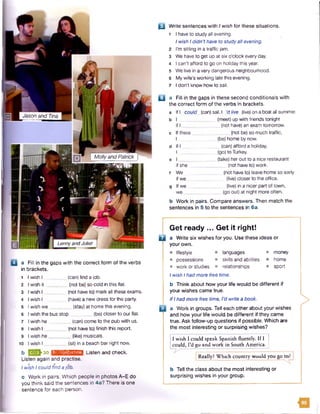
working when we're_________.
b Work in pairs. Do you agree with Carl Honore
that we all work too hard and should slow down?
Why?/Why not?
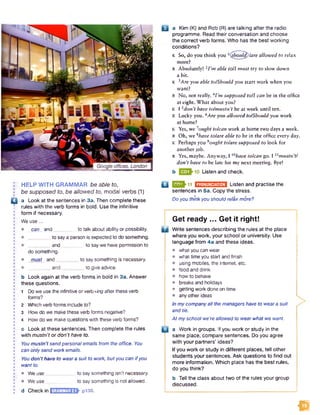
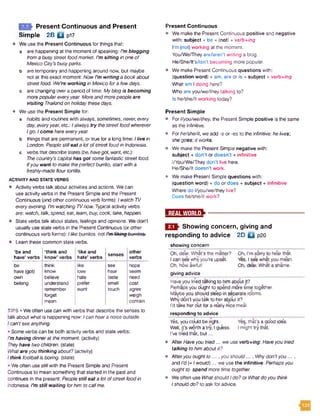
HELP WITH GRAMMAR be able to,
be supposed to, be allowed to, modal verbs (1)
Q a Look at the sentences in 3a. Then complete these
rules with the verb forms in bold. Use the infinitive
form if necessary.
We use ...
• can and to talk about ability or possibility.
to say a person is expected to do something.
and________ to saywe have permission to
do something.
• must and________ to say something is necessary.
and_________to give advice.
b Look again at the verb forms in bold in 3a. Answer
these questions.
1 Do we use the infinitive or verb+/ng after these verb
forms?
2 Which verb forms include to?
3 How do we make these verb forms negative?
4 How do we make questions with these verb forms?
c Look at these sentences. Then complete the rules
with mustn’t or don't have to.
Youmustn’t sendpersonal emails from the office. You
can only send work emails.
Youdon’t have to weara suit to work, butyou can ifyou
wantto.
• We use to say something isn't necessary.
• We use to say something is not allowed.
d Check in EHZGEGBSF pi30.
q p m . 11 E H E B n M I Listen and practise the
sentences in 5a. Copy the stress.
Do you thinkyou should relaxmore?
Get ready ... Get it right!
B Write sentences describing the rules at the place
where you work, your school or university. Use
language from 4a and these ideas.
• what you can wear
• what time you start and finish
• using mobiles, the internet, etc.
• food and drink
• how to behave
• breaks and holidays
• getting work done on time
• anyother ideas
Inmycompanyall the managers have to weara suit
and tie.
At myschool we'reallowed to wearwhat we want.
a Work in groups. If you work or study in the
same place, compare sentences. Do you agree
with your partners' ideas?
If you work or study in different places, tell other
students your sentences. Ask questions to find out
more information. Which place has the best rules,
do you think?
b Tell the class about two of the rules your group
discussed.
i i a Kim (K) and Rob (R) are talking after the radio
programme. Read their conversation and choose
the correct verb forms. Who has the best working
conditions?
K So, do you think you l(^houj^)/are allowed to relax
more?
R Absolutely! 2I*m able toll must try to slow down
a bit.
K 3Are you able tolShould you start work when you
want?
R No, not really. 4I'm supposed toll can be in the office
at eight. W hat about you?
K 1 5don’t have to/mustn’t be at work until ten.
R Lucky you. 6Are you allowed tolShould you work
at home?
K Yes, we 7ought to/can work at home two days a week.
R Oh, we *have tolare able to be in the office every day.
K Perhaps you 9ought tolare supposed to look for
another job.
R Yes, maybe. Anyway, I l®haue to/can go. I xxmustn't!
don’t have to be late for my next meeting. Bye!
b Listen and check.
a
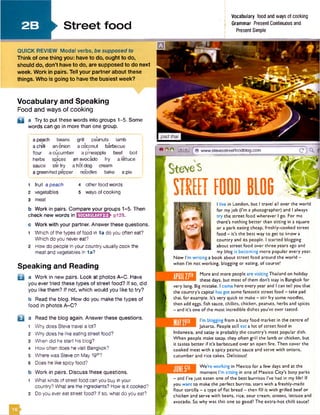
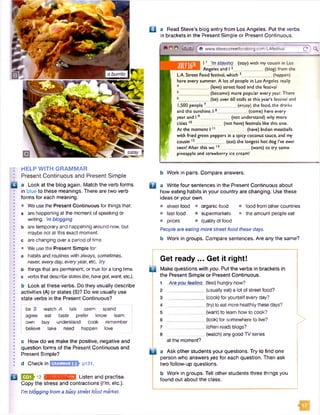
2 B ►S tre e t food
Vocabulary food and ways of cooking
Grammar Present Continuous and
Present Simple
I live in London, but I travel all over the world
for my job (I'm a photographer) and I always
try the street food wherever I go. For me
there's nothing better than sitting in a square
or a park eating cheap, freshly-cooked street
food - it’s the best way to get to know a
country and its people. I started blogging
about street food over three years ago and
my blog is becoming more popular every year.
Now I'm writing a book about street food around the world -
when I'm not working, blogging or eating, of course!
B B
More and more people are visiting Thailand on holiday
these days, but most of them don't stay in Bangkokfor
very long. Big mistake. I come here every year and I can tell you that
the country's capital hasgotsome fantastic street food - take pad
thai, for example. It's very quick to make—stir fry some noodles,
then add eggs, fish sauce, chillies, chicken, peanuts, herbs and spices
- and it's one of the most incredible dishes you've ever tasted.
I'm blogging from a busy food market in the centre of
Jakarta. People still eat a lot of street food in .
Indonesia, and satay is probably the country's most popular dish.
When people make satay. they often grill the lamb or chicken, but
it tastes better if it's barbecued over an open fire. Then cover the
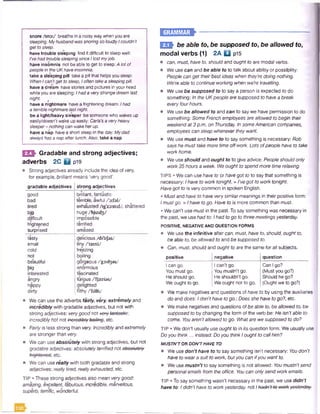
cooked meat with a spicy peanut sauce and serve with onions,
cucumber and rice cakes. Delicious!
We're working in Mexico for a few days and at the
moment I'm sitting in one of Mexico City's busy parks
- and I've just eaten one of the best burritos I've had in my life! If
you want to make the perfect burrito, start with a freshly-made
flour tortilla - a type of flat bread - then fill it with grilled beefor
chicken and serve with beans, rice, sour cream, onions, lettuce and
avocado. So why was this one so good? The extra-hot chilli sauce!
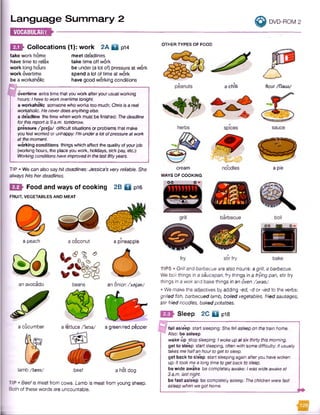
a peach beans grill pe'anuts lamb
a chilli an onion a coconut barbecue
* •
flour a cucumber a pineapple beef boil
herbs spices an avocado fry a lettuce
sauce stir fry a hot dog cream
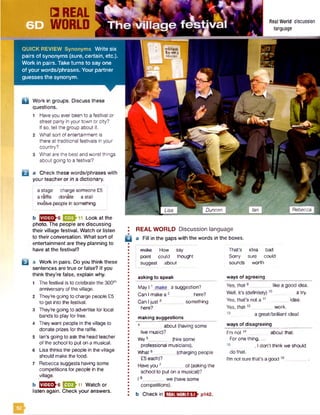
a green/red pepper noodles bake a pie
Vocabulary and Speaking
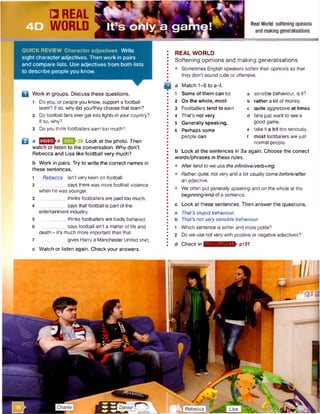
Food and ways of cooking
a a Try to put these words into groups 1-5. Some
words can go in more than one group.
1 fruit a peach 4 other food words
2 vegetables 5 ways of cooking
3 meat
b W ork in pairs. Compare your groups 1-5. Then
check new words in IkM AyiUiflHEE p129.
c W ork w ith your partner. Answer these questions.
1 Which of the types of food in 1a do you often eat?
Which do you never eat?
2 How do people in your country usually cook the
meat and vegetables in la ?
Speaking and Reading
B a W ork in new pairs. Look at photos A -C . Have
you ever tried these types of street food? If so, did
you like them? If not, which would you like to try?
b Read the blog. How do you make the types of
food in photos A-C ?
□ a Read the blog again. Answer these questions.
1 Why does Steve travel a lot?
2 Why does he like eating street food?
3 When did he start his blog?
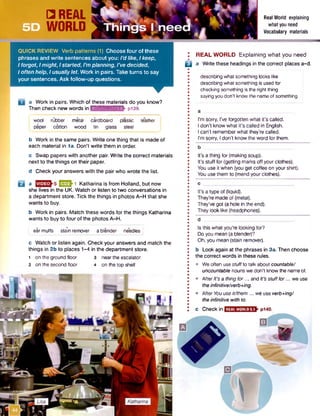
4 How often does he visit Bangkok?
5 Where was Steve on May 191h?
6 Does he like spicy food?
b W ork in pairs. Discuss these questions.
1 What kinds of street food can you buy in your
country? What are the ingredients? How is it cooked?
2 Do you ever eat street food? If so, what do you eat?
QUICK REVIEW Modal verbs, be supposed to
Think of one thing you: have to do, ought to do,
should do, don’t have to do, are supposed to do next
week. Work in pairs. Tell your partner about these
things. Who is going to have the busiest week?
g o o 14 iH j[ www.stevesstreetfoodbiog.com
Ste'veS
STREET FOOD BL06
a burrito
HELP W ITH GRAMMAR
Present Continuous and Present Simple
a Look at the blog again. Match the verb forms
in blue to these meanings. There are two verb
forms for each meaning.
• We use the Present Continuous for things that:
a are happening at the moment of speaking or
writing, ’mblogging
b are temporary and happening around now, but
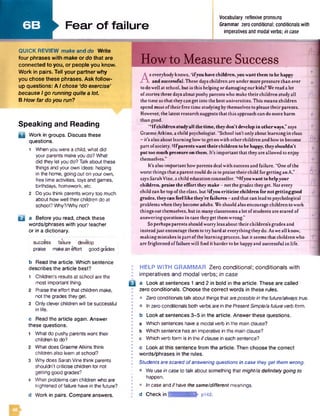
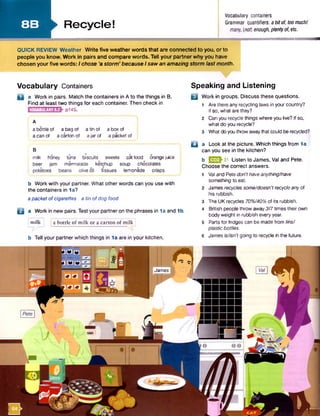
maybe not at this exact moment,
c are changing over a period of time.
• We use the Present Simple for:
a habits and routines with always, sometimes,
never,everyday, everyyear, etc. try
b things that are permanent, or true for a long time,
c verbsthat describe states(be,havegot, want,etc.).
b Look at these verbs. Do they usually describe
activities (A) or states (S)? Do we usually use
state verbs in the Present Continuous?
be S watch A talk seem spend
agree eat taste prefer know learn
own buy understand cook remember
believe take need happen love
c How do we make the positive, negative and
question forms of the Present Continuous and
Present Simple?
d Checkin GRAMMAR2.2 p131.
B E 3 J 1 2 rjinKm.'iHnMl Listen and practise.
Copy the stress and contractions (I'm, etc.).
I’m blogging from a busystreet food market.
□ a Read Steve’s blog entry from Los Angeles. Put the verbs
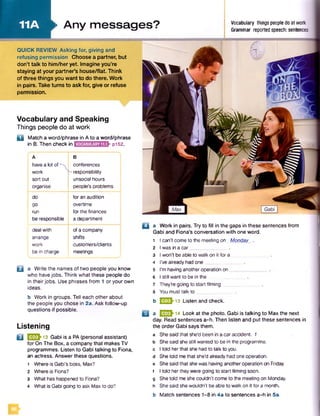
in brackets in the Present Simple or Present Continuous.
© 0 © f e www.stevesstreetfoodblog.com/LAfestival c )<K
11 ’m staying (stay) with my cousin in Los
Angeles and I 2__________ (blog) from the
LA. Street Food festival,which 3_____________ (happen)
here every summer. A lot of people in LosAngeles really
|_ (love) street food and the festival
(become) more popular every year. There
(be) over 60 stalls at this year’s festival and
1,500 people 7_____________ (enjoy) the food, the drinks
and the sunshine.I *_____________ (come) here every
year and 19_____________(not understand) why more
cities 10____ (not have) festivals like this one.
At the moment 111 . (have) Indian meatballs
with fried green peppers ina spicy coconut sauce, and my
cousin 13_____________ (eat) the longest hot dog I’ve ever
seen! After this we 13. ___ (want) to try some
pineapple and strawberry ice cream!
b Work in pairs. Compare answers.
D a Write four sentences in the Present Continuous about
how eating habits in your country are changing. Use these
ideas or your own.
• street food • organic food • food from other countries
• fast food • supermarkets • the amount people eat
• prices • quality of food
People are eating more street food these days.
b Work in groups. Compare sentences. Are any the same?
Get ready ... Get it right!
D Make questions with you. Put the verbs in brackets in
the Present Simple or Present Continuous.
Are you feeling (feel) hungry now?
(usually eat) a lot of street food?
(cook) for yourself every day?
__ (try)to eatmorehealthilythese days?
(want) to learn how to cook?
(look) for somewhere to live?
(often read) blogs?
__(watch) anygood TV series
at the moment?
>
0 a Ask other students your questions. Try to find one
person who answers yes for each question. Then ask
two follow-up questions.
b Work in groups. Tell other students three things you
found out about the class.
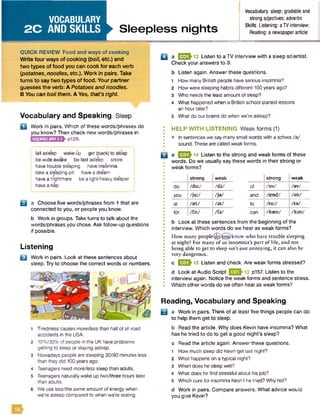
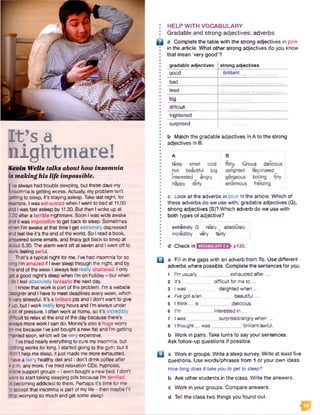
VOCABULARY
2 C AND SKILLS Sleepless nights
Vocabulary sleep; gradable and
strong adjectives; adverbs
Skills Listening: aTVinterview;
Reading: a newspaperarticle
QUICK REVIEW Food and ways of cooking
W rite four ways of cooking {boil, etc.) and
tw o types of food you can cook fo r each verb
(potatoes, noodles, etc.). Work in pairs. Take
turns to say tw o types of food. Your partner
guesses the verb: A Potatoes and noodles.
B You can boil them. A Yes, that's right.
Vocabulary and Speaking Sleep
D Work in pairs. Which of these words/phrases do
you know? Then check new words/phrases in
p129.VOCABULARY2.3
! fall asleep wakeip get (back) to sleep
bewide awake be fastasleep snore
havetrouble sleeping have insomnia
take a sleeping pill havea dream
havea nightmare be a light/heavy sleeper I
I havea nap
B a Choose five words/phrases from 1 that are
connected to you, or people you know.
b Work in groups. Take turns to talk about the
words/phrases you chose. Ask follow-up questions
if possible.
Listening
B Work in pairs. Look at these sentences about
sleep. Try to choose the correct words or numbers.
Tirednesscauses more/less than halfof all road
accidents in the USA.
7096/30% of people in the UK have problems
getting to sleep or staying asleep.
Nowadays people are sleeping 30/90 minutes less
than theydid 100years ago.
Teenagers need more/less sleep than adults.
Teenagers naturally wake up two/three hours later
than adults.
We useless/the same amount ofenergy when
we’re asleep compared to when we're resting.
Q a E S J 13 Listen to a TV interview with a sleep scientist.
Check your answers to 3.
b Listen again. Answer these questions.
1 How many British people have serious insomnia?
2 How were sleeping habits different 100years ago?
3 Who needs the least amount of sleep?
4 What happened when a British school started lessons
an hourlater?
5 What do our brains do when we’re asleep?
HELP W ITH LISTENING Weak form s (1)
• In sentences we say many small words with a schwa /a /
sound. These are called weak forms.
B aEES’14Listen to the strong and weak forms of these
words. Do we usually say these words in their strong or
weak forms?
strong w eak strong weak
do /du:/ /d a / o f / dv/ /av/
you /ju :/ /ja / and /send/ /an/
at /aet/ /a t/ to /tu :/ /ta /
for /fe :/ /fa / can /kasn/ /kan/
b Look at these sentences from the beginning of the
interview. Which words do we hear as weak forms?
How many people^gj^oy) know who have trouble sleeping
at night? For many of us insomnia’s part of life, and not
being able to get to sleep isn’t just annoying, it can also be
very dangerous.
c E E -13 Listen and check. Are weak forms stressed?
d Look at Audio Script 13 p157. Listen to the
interview again. Notice the weak forms and sentence stress.
Which other words do we often hear as weak forms?
Reading, Vocabulary and Speaking
B a Work in pairs. Think of at least five things people can do
to help them get to sleep.
b Read the article. Why does Kevin have insomnia? What
has he tried to do to get a good night’s sleep?
c Read the article again. Answer these questions.
1 How much sleep did Kevin get last night?
2 What happens on a typical night?
3 When does he sleep well?
4 What does he find stressful about his job?
5 Which cure for insomnia hasn’t he tried? Whynot?
d Work in pairs. Compare answers. What advice would
you give Kevin?
ph’ fi
nightmare!
K evin W e lls talks about how insom nia
is m aking h is life im possible•
I've always had trouble sleeping, but these days my
jlinsomnia is getting worse. Actually, myproblem isn't
getting to sleep, it's staying asleep. Take last night, for
sample. Iwas exhausted when Iwent to bed at 11.00
and I was fast asleep by 11.30. But then Iwoke up at
3.00 after a terrible nightmare. Soon I was wide awake
and it was impossible to get back to sleep. Sometimes
when I’m awake at that time I get extremely depressed
andfeel like it's the end of the world. So I read a book,
answered some emails, and finally got back to sleep at
about 5.30. The alarm went off at seven and I went off to
work feeling awful.
That’s a typical night for me. I’ve had insomnia for so
long I'm amazed if I eversleep through the night, and by
tie end of the week I always feel really shattered. I only
get a good night’s sleep when I’m on holiday - but when
I do I feel absolutely fantastic the next day.
I know that work is part of the problem. I’m a website
designerand I have to meet deadlines everyweek, which
isvery stressful. It’s a brilliantjob and I don't want to give
i up, but I work really long hours and I’m always under
a totof pressure. Ioften work at home, so it’s incredibly
cffficult to relax at the end of the day because there's
aiways more work I can do. Money’s also a huge worry
for me because I'vejust bought a new fiat and I'm getting
married soon, which will be very expensive.
I've tried nearlyeverything to cure my insomnia, but
nothing works for long. I started going to the gym, but it
cfidn’t help me sleep, it just made me more exhausted.
I have a fairly healthy diet and I don't drink coffee after
4 p.m. any more. I've tried relaxation CDs, hypnosis,
online support groups - 1even bought a new bed. I don’t
want to start taking sleeping pills because I’m terrified
of becoming addicted to them. Perhaps it’s time for me
to accept that insomnia is part of my life - then maybe I’ll
stop worrying so much and get some sleep!
: HELP WITH VOCABULARY
I Gradable and strong adjectives; adverbs
D a Complete the table with the strong adjectives in pink
in the article. What other strong adjectives do you know
; that mean 'very good’?
gradable adjectives strong adjectives
good brilliant
bad
tired ________
big
difficult
frightened
surprised
b Match the gradable adjectives in A to the strong
adjectives in B.
A B
tasty small cold
hot beautiful big
interested angry
happy dirty
filthy furious delicious
delighted fascinated
gorgeous boiling tiny
enormous freezing
* c Look at the adverbs in blue In the article. Which of
* these adverbs do we use with: gradable adjectives (G),
* strong adjectives ($)? Which adverb do we use with
* both types of adjective?
* -------------------------------------------------
I extremely G really absolutely
I incredibly very fairly
• 1 __
I d Check in pi30.
H a Fill in the gaps with an adverb from 7c. Use different
adverbs where possible. Complete the sentences for you.
1 I'm usually__ _exhausted after...
2 It’s _ _ difficult for meto ...
3 I was delighted when...
4 I’ve got a/an beautiful...
5 I think... is__ _delicious.
6 I’m _ _interested in ...
7 I was.__ _ surprised/angry when...
8 I thought... was___________ brilliant/awful.
b Work in pairs. Take turns to say your sentences.
Ask follow-up questions if possible.
a a Work in groups. Write a sleep survey. Write at least five
questions. Use words/phrases from 1 or your own ideas.
How long does it takeyou to get to sleep?
b Ask other students in the class. Write the answers,
c Work in your groups. Compare answers,
d Tell the class two things you found out.
<a
3
Yes, you could be right.
Well, it’s worth a try, I guess.
I've tried that, but (wejust start arguing again.)
Yes, that’s a good idea.
I might try that.
b Which verb forms come after the phrases in bold?
c Look at these ways to ask for advice. Fill in the gaps
with Ishould or should I.
1 What _ do?
2 What do you think.............. do?
d Check in l;l?:mvn];mTEV pl31.
a Work in pairs. Discuss these questions.
1 What types of problem do people often ask for
advice about?
2 Whowas the last person you asked for advice?
What did you ask them about? Did their advice
help you?
3 When did you last give someone advice? What
was it about? Did he/she take your advice?
Why?/Whynot?
E l a Work in new pairs. Look at the photos. What
do you remember about Lisa, Rebecca and
Charlie?
b 2 [EEDh 15 Watch or listen to two
conversations. What problems do Rebecca
and Charlie talk about?
c Work with your partner. Compare answers.
□ a Work in the same pairs. Do you think these
sentences are true (T) or false (F)?
Conversation 1
a The baby wakes up two or three times every
night.
b Rebecca and Charlie are arguing more than
usual.
c Rebecca thinks Charlie is spending too much
money.
d Lisa thinks that Rebecca and Charlie should
have two evenings off a week.
Conversation 2
e Andy thinks that Rebecca and Charlie should
sleep in separate rooms,
f Charlie thinks Rebecca buys too many things for
herself.
g Andy doesn’t think Charlie will lose hisjob.
h Andy thinks Charlie should take Rebecca on
holiday.
b ^ ^ ^ ^ 2 |^Q ^1 5 Watch or listen again.
Check your answers.
c Work with your partner. Compare answers.
Correct the false sentences.
2
Have you tried talking to him about it?
Perhaps you ought to spend more time together.
Maybe you should sleep in separate rooms.
Why don't you talk to herabout it?
I'd take herout for a really nice meal.
QUICK REVIEW Gradable and strong adjectives
Write five strong adjectives (gorgeous, etc.).
Work in pairs and compare lists. What are the
gradable adjectives fo r each one (jbeautiful, etc.)?
Then think of one thing, place or person for each
strong adjective: The dress my sister wore for her
wedding was absolutely gorgeous.
Real World showing concern,
giving and respondingto
advice
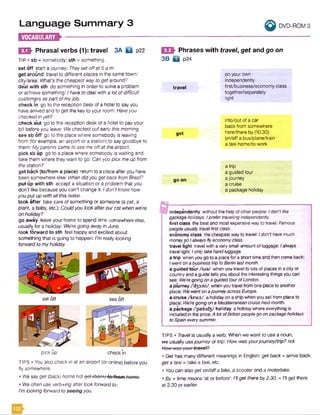
REAL WORLD
Showing concern, giving and responding to advice
□ a Write these headings in the correct places 1-3.
giving advice responding to advice showing concern
1
Oh, dear. What's the matter?
I can see why you’re upset.
Oh, dear. What a shame.
Oh, how awful!
I’m sorry to hearthat.
Yes, I see whatyou mean.
I : HELP W ITH LISTENING
Intonation (1): sounding concerned
16 Listen to the same sentences said twice.
Which person sounds more concerned, a or b?
; 1 (a) b 3 a b 5 a b
i I 2 a b 4 a b 6 a b
Q 0 3 ^ 1 7 m m m m Listen and practise the
phrases in 4a. Copy the stress and intonation.
Oh, dear. What's the matter?
B a Use these prompts to write two conversations.
bob H i, Tim. You look terrible. ‘What / matter?
1 What's thematter?
TIM My girlfriend and I have had a big argument.
BOB 2Oh dear. / sorry / hear that.
TIM And now she won’t answer my calls. •‘What / 1 do?
BOB 4Perhaps / ought / write her an email to say sorry.
TIM 5Wcll, / worth / try, / guess.
BOB 6And I / send her some flowers.
TIM 7Yes, / good idea. 8I / try that. Thanks a lot.
MIA Look at this plant. It’s dying, isn’t it?
Liz 9Yes, / see what / mean.
MIA ,0What / think I / do?
LIZ “ Have / try / give / it more water?
mia I2Yes, / try / that, but it didn’t work.
LIZ ,3Well, why / put it in a bigger pot?
mia ,4Yes, / could / right. Thanks for the advice.
b Work in pairs. Compare answers.
c Practise the conversations with your partner.
Q Work in groups of three. Student A p102. Student B
p107. Student C p113.
: HELP W ITH PRONUNCIATION
I Strong and weak forms
•
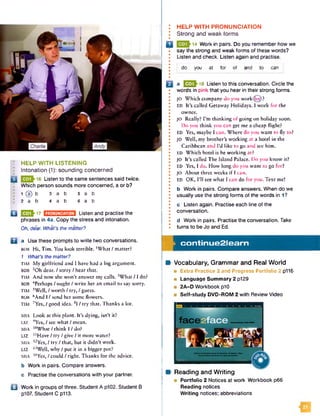
Q 14 Work in pairs. Do you remember how we
say the strong and weak forms of these words?
Listen and check. Listen again and practise.
do you at for of and to can
a Q J J } 18 Listen to this conversation. Circle the
words in pink that you hear in their strong forms.
JO Which company do you workdjoj)?
ED It’s called Getaway Holidays. I work for the
owner.
JO Really? I’m thinking of going on holiday soon.
Do you think you can get me a cheap flight?
ED Yes, maybe I can. Where do you want to fly to?
JO Well, my brother’s working at a hotel in the
Caribbean and I’d like to go and sec him.
ED Which hotel is he working at?
JO It’s called The Island Palace. Do you know it?
ED Yes, I do. How long do you want to go for?
JO About three weeks if I can.
ED OK, I’ll see what I can do for you. Text me!
b Work in pairs. Compare answers. When do we
usually use the strong forms of the words in 1?
c Listen again. Practise each line of the
conversation.
d Work in pairs. Practise the conversation. Take
turns to be Jo and Ed.
j
i
co n tin u e 2 le a rn
Vocabulary, Grammar and Real W orld
■ Extra Practice 2 and Progress Portfolio 2 p116
■ Language Summary 2 p129
■ 2A-D Workbook p10
■ Self-study DVD-ROM 2 with Review Video
Reading and W riting
■ Portfolio 2 Notices at work Workbook p66
Reading notices
W riting notices; abbreviations
72 LAKES
. HOTEL
II rj&
Clive, hotelmanager, theLake District, UK
The tourist trade
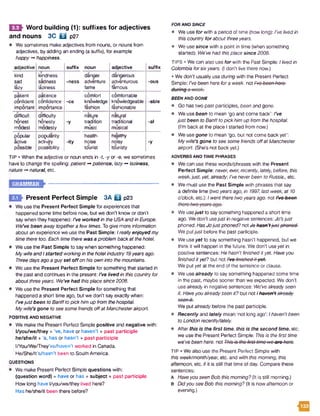
Q a Work in pairs. Can you guess the
meaning of the phrasal verbs in bold
in these sentences? Then check in
p132.VOCABULARY3.1
Megan, hiking tourguide, Banff, Canada
QUICK REVIEW Giving and
responding to advice W rite three
problems that you, or people you
know, have at the moment. Work in
pairs. Take turns to tell your partner
the problems and give advice.
Vocabulary phrasal verbs(1): travel
Grammar PresentPerfectSimple: experience
unfinished pastand recentevents
Have you ever set off very
early to go on holiday?
Yes, I have, actually. ]
What time did you
leave home?
At 3.30 a.m.!
Vocabulary and Speaking
Phrasal verbs (1): travel
Have you ever set off very early to
go on holiday?
What's the best way for tourists to
get around your country?
What problems do people
sometimes have to deal with on
holiday?
When people stay in a hotel, what
happens when they check in?
What time do they usually have to
check out?
6 Did anyone see you off the last time
you went on holiday?
7 Did anyone pick you up from the
airport or the station when you
got back?
8 Haveyou everhad to put up with
noisy people on holiday?
9 Does anyone look after your pets or
plants when you go away?
10 Are you looking forward to your
next holiday?
b Work in new pairs. Ask and
answer the questions in 1a. Ask
follow-up questions if possible.
Listening
B a EEQh’ft Look at the photos of Megan and Clive. Listen to them
talking about their jobs. Answer these questions.
1 Do they like theirjobs?
2 What problems do they have in their jobs?
b Work in pairs. Who said these sentences. Megan or Clive?
a I’ve worked in the USAand in Europe, and I really enjoyed my time there too.
b We've been away afew times, but each time there wasa problem at the hotel,
c My wife and I started working in the hotel industry 19years ago.
d Three days ago a guy set off on his own into the mountains without telling
anyone where hewas going,
e I’ve lived in this country for about three years,
f We’ve had this place since 2008.
g I’vejust been to Banffto pick him up from the hospital,
h My wife's gone to see some friends off at Manchesterairport.
c Listen again. Check your answers and put the sentences in the order
you hear them.
22
: HELP WITH GRAMMAR
I Present Perfect Simple
Q a Look at the sentences in 2b again. Then
complete these rules with Present Perfect Simple
(PPS) or Past Simple (PS). Which sentences in 2b
• match each rule?
• • We use the_________ for experiencesthat happened
sometime before now, but we don't know or don't
saywhen they happened. To give more information
aboutan experience we use the_________.
m
• • We use the to say when something
happened.
I • We use the_________ for something that started in
the past and continues in the present.
• • We use the for something that happened
a short time ago, but we don't say exactly when.
• b How do we make positive sentences, negatives
and questions in the Present Perfect Simple?
c Look at sentences e-h in 2b again. What is the
difference between: for and since? been and gone?
d Which of these words/phrases can we use with
» the Present Perfect Simple? Which do we use with
• the Past Simple?
• C;f~"" ’ ' "
• never ago ever recently lately
• before in 1997 this week last week
. j just at 10o'clock yet already
I J
•
! e Look at this sentence. Then choose the correct
I verb form in the rule.
•
• This is the first time we've run a hotelin a touristy
• place like the Lake District.
! • Afterthisis thefirsttime, thisis thesecondtime, etc.
we usethe PresentSimple/PresentPerfect Simple.
I f Check in EjQuIBEBk p 1 3 3 .
Q U J U 20 ij;nKni-'[H^MI Listen and practise.
Copy the stress and contractions {I've, etc.).
I've workedin the USA andin Europe.
I HELP WITH LISTENING
• Present Perfect Simple or Past Simple
H a E 3 *2 1 Listen to how we say these phrases.
Notice the difference.
1 I've met I met 4 they've told theytold
• 2 yoCi'vehad you had 5 he's wanted hewanted
• 3 we've won we won 6 she's lived she lived
•
* b 22 Listen to six sentences. Are the verbs
• in the Present Perfect Simple (PPS) or Past Simple
: (ps)?
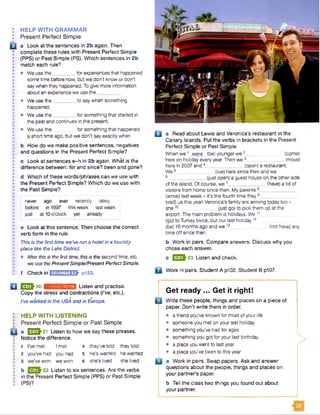
□ a Read about Lewis and Veronica's restaurant in the
Canary Islands. Put the verbs in brackets in the Present
Perfect Simple or Past Simple.
When w e1 were (be) youngerwe 2 (come)
here on holiday everyyear. Then we 3 __________(move)
here in 2007 and4 (open) a restaurant.
We 5 (live) here since then and we
8______________(just open) a guest house on the other side
ofthe island. Ofcourse, we7______________ (have) a lot of
visitors from home since then. My parents 8__
(arrive) last week - it’s the fourth time they 9__
(visit) us this year! Veronica’s family are arriving today too -
she10 (just go)to pick them up at the
airport. The main problem is holidays. We11__
(go) to Turkey twice, but our last holiday12
(be) 18 months ago and w e13 (not have) any
time off since then.
b Work in pairs. Compare answers. Discuss why you
chose each answer.
c E H > 2 3 Listen and check.
Q Work in pairs. Student A p102. Student B p107.
>
Get ready... Get it right!
□ Write these people, things and places on a piece of
paper. Don’t write them in order.
• afriend you've known for most of your life
• someone you met on your last holiday
• something you’ve had for ages
• something you got for your last birthday
• a place you went to last year
• a place you've been to this year
a a Work in pairs. Swap papers. Ask and answer
questions about the people, things and places on
your partner's paper.
b Tell the class two things you found out about
your partner.
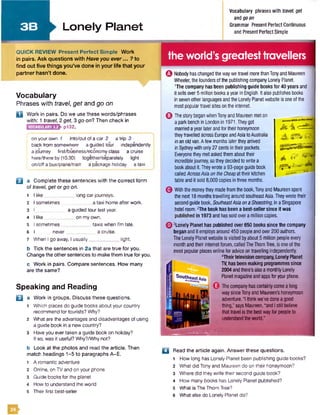
3B Lonely Planet
Vocabulary phrases with travel, get
and goon
Grammar Present Perfect Continuous
and PresentPerfect Simple
QUICK REVIEW Present Perfect Simple Work
in pairs. Ask questions with Haveyou ever... ? to
find out five things you’ve done in your life that your
partner hasn’t done.
Vocabulary
Phrases with travel, get and go on
Q W ork in pairs. Do we use these words/phrases
w ith: 1 travel, 2 get, 3 go on? Then check in
p132.VOCABULARY 3.2
on your own 7 into/out of a car 2 a trip 3
back from somewhere a guided tour independently
a journey first/business/economy class a cruise
here/there by (10.30) together/separately light
on/off a bus/plane/train a package holiday a taxi
B a Complete these sentences with the correct form
of travel, get or go on.
1 I like long car journeys.
2 I sometimes a taxi home after work.
3 I a guided tour last year.
4 I like on my own.
5 I sometimes________ ___ taxis when I'm late.
6 I never a cruise.
7 When I go away. I usually light.
b Tick the sentences in 2a that are true for you.
Change the other sentences to make them true for you.
c W ork in pairs. Compare sentences. How many
are the same?
the world’s greatesttravellers
Q Nobody has changed the waywe travel more thanTonyand Maureen
Wheeler, the founders of the publishing company Lonely Planet.
1The company has been publishing guide books for 40 years and
It sells over 5 million books a year in English. It also publishes books
in sevenother languagesand the LonelyPlanetwebsite is one of the
mostpopulartravel sites on the internet.
Q Thestory began whenTonyand Maureen meton
a park bench in London in 1971.They got
married ayear later and fortheir honeymoon
they travelled across EuropeandAsia toAustralia
in an old van.A few months later theyarrived
in Sydneywith only 27 cents in their pockets.
Everyonethey met asked them abouttheir
incrediblejourney, so they decided to write a
bookaboutit Theywrote a 93-page guide book
called AcrossAsiaontheCheapat their kitchen
table and it sold 8,000 copies in three months.
GWith the moneythey made from the book,Tony and Maureen spent
the next 18 monthstravelling around southeastAsia.Theywrote their
second guide book, SoutheastAsiaonaShoestring,in a Singapore
hotel room, ^he book has been a best-seller since it was
in 1973 and hassold overa million copies.
A
Speaking and Reading
B
m
a Work in groups. Discuss these questions.
1 Which places do guide books about your country
recommend for tourists? Why?
2 What are the advantages and disadvantages of using
a guide book in a new country?
3 Have you ever taken a guide book on holiday?
If so, was it useful? Why?/Why not?
b Look at the photos and read the article. Then
match headings 1-5 to paragraphs A-E.
1 A romantic adventure
2 Online, on TV and on your phone
3 Guide books for the planet
4 How to understand the world
5 Their first best-seller
a Read the article again. Answer these questions.
1 How long has Lonely Planet been publishing guide books?
2 What did Tony and Maureen do on their honeymoon?
3 Where did they write their second guide book?
4 How many books has Lonely Planet published?
5 What is The Thom Tree?
6 What else do Lonely Planet do?
0 3Lonely Planet has published over650 books since the company
began and it employs around 450 peopleand over200 authors.
The LonelyPlanetwebsite is visited byabout5 million peopleevery
month and their internet forum, called TheThomTree, is one ofthe
most popular places online for advice on travelling independently.
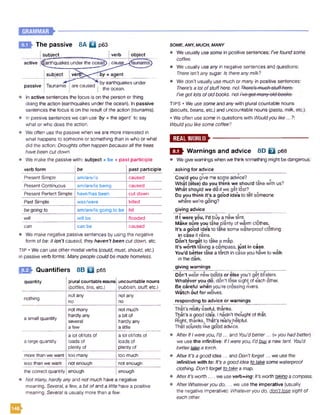
4Theirtelevision company,Lonely Planet
TV,has been making programmes since
2004 andthere’s alsoa monthlyLonely
Planetmagazineandappsforyour phone.
Thecompanyhas certainlycome a long
way sinceTonyand Maureen’s honeymoon
adventure. al think we've done a good
thing," says Maureen,"and I still believe
that travel is the bestwayfor people to
understand the world."
■ ■ ■ ■ ■ ■ ■ ■
: HELP WITH GRAMMAR Present Perfect
j Continuous and Present Perfect Simple
Q a Look at sentences 1 and 2 in bold in the article.
Then fill in the gaps in these rules with Present
I Perfect Continuous (PPC) or Present Perfect
I Simple (PPS).
p
p • We usually use the_____ to talk about an a c tiv ity
that started in the past and continues in the present.
E • Weusually use the_____ to talk about a state that
started in the past and continues in the present.
•
I b Fill in the gaps for the Present Perfect
I Continuous with Ve, haven’t, ’s, hasn’t, been
I or verb+ing.
B
I POSITIVE
I l/you/we/they + ... orhave + been + verb+/ng
I he/she/it + or has + been +
• NEGATIVE
■ l/you/we/they + ______+ been + verb+/ng
I he/she/it + + _.+ verb+/ngp
• c Look at sentences 3 and 4 in bold in the article.
• Then choose the correct words in these rules.
C • We usually use the Present Perfect ContinuousI
Simple to say how long an activity has been
happening.
• • We usually use the Present Perfect Continuous/
Simpleto say how m any things are finished.
d Look at questions 1 and 4 in 4. How do we
• make Present Perfect Continuous questions with
I How long... ? How do we make Present Perfect
P Simple questions with How many... ?
I e Check in E332EHIS&’ P134.
□ a Put the verb in brackets in the Present Perfect
Continuous or the Present Perfect Simple. Use the
Present Perfect Continuous where possible. Then
choose for or since where necessary.
1 1 Ve been working (work) here(fop/since six months.
2 How long _you____ (travel)?
3 Scott (write books) fOr/since2006.
4 He .__(write) five books so far.
5 They (not play) golffor/since long.
6 How long _ _he (have) that car?
7 l _ (know) Zak for/sincewe were kids.
8 We (wait) for/since two hours.
b Work in pairs. Compare answers. Discuss why you
chose each verb form.
c |[2 3 }2 4 U-JiMiilii'MMTiTTl Listen and check. Listen again
and practise. Copy the stress and weak forms.
I’vebeen /b in / working here for /fa / six months.
How long have /a v/ you been /b in / travelling?
Q Work in groups. Student A pl02. Student B p107.
Get ready ... Get it right!
□ a Draw a timeline of your life. Write when these
things happened on the line.
• you started living in your house/flat
• you first metyour oldest friend
• you started learning English
• you started the job/course you’re doing now
• you first met your boyfriend/girlfriend/husband/wife
• you got your favourite possessions)
• you bought the car/mobile/computeryou have now
® your own ideas
met started living started
Marco in flat job
2001 2006 July NOW
b Plan what you’re going to say about your timeline.
Use the Present Perfect Continuous or Present
Perfect Simple with for and since.
E ] a Work in pairs. Take turns to talk about your
timeline. Ask follow-up questions if possible.
; I’ve been living in my i Where did you
flat since May 2011. ! live before that?
b Tell the class two things you found out about
your partner.
VOCABULARY
3 C AND SKILLS Voluntourism
Vocabulary word building (1):
suffixesfor adjectivesand nouns
Skills Listening: aradio interview;
Reading: holidayblogs
QUICK REVIEW Present Perfect Continuous
Work in groups. Ask questions with How
long... ? to find out who has been: coming
to this school the longest, learning English the
longest, working in the same job the longest,
living in the same house or fla t the longest.
Reading, Vocabulary and Speaking
□
Speaking and Listening
a Work in pairs. Discuss these questions.
B
B
Which holidays can you rememberfrom your
childhood?
What’s the best (orworst) holiday you've ever
had?
Imagine your perfect holiday. Where would you
go? What would you do there?
a Listen to an interview with
Alison Armstrong, a travel expert. What is
‘voluntourism’? Why is it becoming so popular?
a Two tourists have written blogs on the Voluntours
website. Work in two groups. Group A, read Shelley’s blog.
Group B, read William’s blog. Find the answers to these
questions.
Where is he/she on holiday?
How long has he/she been there?
Where is he/she staying?
What sort ofwork does he/she do?
What does he/she do on his/her days off?
What's the best thing about the holiday?
What's the most difficult thing?
Would he/she recommend the holiday?
b Work with a student from the other group. Ask and
answer the questions.
c Read your partner’s blog. Check his/her answers.
d Would you like to go on either of these holidays?
Why?/Why not?
b Listen again. Choose the correct words,
phrases or numbers in these sentences.
1 17%/25%of people in the UK take a yearoff
before they are 17/25.
Voluntourism holidays are onlyforyoungpeoplef
forpeople ofallages.
Alison thinks it's easy/hardto meet local people
on a normal holiday.
Tourists have to/don’t haveto pay to go on
voluntourism holidays.
The presenterthinks/doesn't thinkthese holidays
are a good idea.
9 0 0 6 www.voluntours.net/mecliacentre/blogs
VOLUNTOURS W
Giving the world a helping hand
c Work in pairs. Compare answers.
HELP WITH LISTENING
Linking (1): consonant-vowel links
• We usually link words that end in a consonant
sound with words that start with a vowel sound.
a Listen to the beginning of the
interview again. Notice the consonant-vowel
links.
Good^afternoonwand welcome to Takeja
Break. Today we’re cakingwa lookwat the ri$ejn
voluntourism^around the world. I’m here
with^Alison^Armstrong from the travel website
volunrours.net. Alison, first^of^all, can you
tell all our listeners what voluntourism is?
b Look at Audio Script EEOh25 p159.
Listen again and notice the linking.
Shelley Parker, Australia
I’m on a voluntourism holiday in Nepal and wanted to tell
everyone all about it! I’ve been working at a school in a village
near Kathmandu for two weeks and I've enjoyed every minute
of it. The best thing about the holiday has been working with
the children. I spend six hours a day at the school, mainly
helping the teachers in the classroom and organising games
for the younger kids. I’ve also been teaching English to the
older children, which is great fun. I’m amazed at the kindness
and patience of the local staff, they’ve really helped me feel
at home. I’m staying with a Nepalese family in the village
and I share a room with another volunteer. My bed isn’t very
comfortable, but I'm usually so exhausted it doesn’t matter!
On our days off we go walking in the mountains and I’m
getting very fit and healthy. The scenery here is absolutely
wonderful and I love being surrounded by nature. But it can
be a bit dangerous so we always take a guide with us. The
most difficult thing about the holiday is being away from my
family- this is the first time I've been out of Australia. I'm glad
this type of holiday is becoming more popular with young
people and I'd recommend this experience to anyone.
William Boyd, Scotland
I’ve been staying on Grenada, an island in the Caribbean, for three
weeks and I’m having a brilliant time! There are nine volunteers in
our group and everyone's very kind and helpful. We’re staying at a
campsite by the beach and I share a tent with two other volunteers.
At first I had a lot of difficulty getting to sleep and I missed the
comfort of my own bed. but I’m sleeping OK now and I love living in
such a natural environment. We take turns to prepare meals for the
group, which is the worst part of the holiday for me because I hate
cooking. We have one day off a week, which I spend diving around
the coral reefs near here. But of course the main reason we're here
is to protect the turtles from other animals and people who want to
steal their eggs. We also check each turtle's health and measure
how big they are. Turtles have been living on our planet for 230
million years - they're even older than the dinosaurs - but now
they’re in danger of becoming extinct. You have to be very patient,
but it’s incredible to watch a turtle walk out of the sea and lay her
eggs on the beach. That’s definitely been the most amazing part of
the holiday for me. I’m not surprised voluntourism is increasing in
popularity and I'd definitely recommend coming to Grenada.
f t
HELP WITH VOCABULARY
Word building (1): suffixes for adjectives
and nouns
• We sometimes make adjectives from nouns,
and nouns from adjectives, by adding a suffix
(-ness, -ous. etc.).
a W ork in pairs. Look at the words in blue
and pink in the blogs. Which are adjectives
and which are nouns? Underline the suffix in
each pair of words.
kind kindness
b Write the words in the correct places in
these tables.
adjective noun suffix
kind kindness -ness
-ce
-y
noun adjective
-ity
suffix
-ous
-able
-al
-y
c Which words in 5b only add the suffix?
Which words have extra changes in spelling?
d Look at the suffixes of these words. Are
they adjectives (A) or nouns (N)?
knowledgeable A sadness N
traditional noisy confidence
adventurous activity musical
possibility honesty fashionable
famous touristy importance
laziness modesty
e What are the nouns for the adjectives in
5d? What are the adjectives for the nouns?
knowledgeable -* knowledge sadness — sad
f Check in IH E lS E S IE h P133.
f t Work in pairs. Take turns to test each other
on the nouns and adjectives in 5b and 5 d.
possible p o ssib ility
a Work in groups of three. Student A p105.
Student B p110. Student C p113.
QUICK REVIEW Suffixes fo r adjectives and nouns Work
in pairs. Student A: write six adjectives you can remember
from lesson 3C. Student B: write six nouns you can
remember from lesson 3C. Take turns to say your words.
Your partner says the noun or adjective: A Kind. B Kindness.
a Work in groups. Look at the photos. What do you know about
India? Would you like to go there? Why?/Why not?
Q a n ^ ^ - 3 E 3 *2 6 i_00k at the photo on p29. Ella and
Mike are going on a trip to Delhi. They’re asking Rebecca
and Charlie for recommendations. Watch or listen to their
conversation and tick the topics they talk about. Which two
topics don’t they talk about?
• the best time to visit
• things (not) to seein the city
• things to see outside Delhi
• dangers and problems
getting around
changing money
places to eat
places to stay
b Watch or listen again. Tick the true sentences. Correct the
false ones.
Rebecca and Charlie think that...
1 ... rickshaws are the best way to get around the city.
2 ... it's better to travel to other cities by bus.
3 ... Ellaand Mike should visit the museumsin Delhi.
4 ... they should go to the Red Fort in Old Delhi.
5 ... they can visit the Taj Mahal and come back the same day.
6 ... there’s only one good restaurant in Connaught Place.
: REAL WORLD
I Asking for and making recommendations
n a Fill in the gaps with the words in the boxes.
asking for recommendations
geed visiting tips about best
Do you know any1 good places to stay/eat?
What's the2 way to (get around)?
What else is worth 3______________ ?
What4 (places outside Delhi)?
Haveyou got any others______________ ?
recommending things
worth best definitely must recommend
It’s probably 6__
I'd7_________
You should 8
That's well9___
You really10__
must
to (use rickshaws).
(the trains).
_ see (the Red Fort).
_ seeing.
_ go to (Agra) to see
(the Taj Mahal),
n ot recom m ending things
bother Don't wouldn’t worth
going to (the museums).
visiting, (Idon’t think).
Don't11__
It isn't really12_____
drink anything with ice in it.
114______________ eat any salads.
responding to recom m endations
useful heard know sounds i
That’s good to 15__
That 16„
Thanks, that’s really ,7_
Yes, I've18
good.
that before.
b Which verb form comes after these phrases?
1 It’s (well/not) worth ...
2 Don’t bother...
3 rd/I wouldn’t ...
c Check in ■swjmvxutwll^ p134.
Q | U JJ-27 ■asumiKMMHw Listen and practise the
sentences in 3a. Copy the stress.
Do you know anygood places to stay?
What’s the best way to get around?
Rebecca Charlie
f j] a Use these prompts to write conversations.
1
A / know / good places to eat in town?
Doyou know anygoodplaces to eat in town?
B Well, you / definitely go / Nero's in the city centre.
A What/ places nearwhere we're staying?
B / recommend the Grove Restaurant. It's opposite
the hotel.
A Thanks, that / useful.
2
A Where / best place/ stay?
B / probably best/ stay in the Madison. It’s the nicest
hotel in the city.
A OK, thanks. / got/ other tips?
B I/ carry too much money at night.
A / good / know. Thanks.
3
A What/ best places / visit in the city centre?
B / must go to the National Art Gallery. It's amazing.
A What else/ worth / see ?Are there anygood museums?
B Well, I/ bother/ go / the City Museum. It / not worth /
visit, / 1/ think.
A Yes/hear/before.
b Work in pairs. Compare answers.
c Practise the conversations with your partner.
b a Choose a town, city or country you know well.
Make a list of at least four recommendations you can
give about the place you have chosen. Use the topics
in 2a or your own ideas.
b Work in pairs. If you have chosen different places,
take turns to ask for and give recommendations. If you
have chosen the same place, take turns to be a tourist
and ask your partner for recommendations. Use
language in 3a and your own ideas.
: HELP WITH PRONUNCIATION
I The schwa /a / in suffixes
Q a ES3h28 Listen and notice how we say the
suffixes in blue. We say each suffix with a schwa /a/.
• |
* kindness laziness assistant accountant
* i dangerous famous comfortable fashionable
* ; musical natural improvement argument
* i author director collection decision
*
e
• b Listen again and practise. Are the suffixes
• stressed?
B a Underline the suffixes from 1a in these
sentences.
•
• 1 It's dangerous to be ambitious and adventurous.
I 2 The accountant's assistant is very important.
• 3 She's knowledgeable, reliable and fashionable.
• 4 He felt both happiness and sadness after his illness.
I 5 The director had three visitors - an author, a doctor
• and an actor.
I 6 We had a discussion and made a decision to do
• some revision.
o 7 It’s a traditional medical centre that uses natural
herbal medicine.
• 8 There’s disappointment in the government because
there's no improvement in unemployment.
• ____
• b E S I 29 Listen and practise the sentences.
! c Work in pairs. Take turns to say the sentences.
f t co n tin u e 2 le a rn
M Vocabulary, Grammar and Real W orld
■ Extra Practice 3 and Progress Portfolio 3 p117
■ Language Summary 3 p132
■ 3A-D Workbook p15
■ Self-study DVD-ROM 3 with Review Video
Reading and W riting
■ P ortfolio 3 Holiday arrangements Workbook p68
Reading a formal letter
W riting formal writing; American and British
English
m
QUICK REVIEW Asking for and
making recommendations Work in
pairs. Student A, imagine you are a
tourist in the town/city you are in now.
Ask your partner for recommendations
for places to stay, eat and visit. Student
B, answer your partner’s questions and
make recommendations.
Vocabulary and Speaking
Collocations (2): music
Work in pairs. Match the verbs
in A to words/phrases in B. Then
check in p135.
A
do/play
be
release
B
a new single/
album/CD
^ a concert/a gig
a big fan of a
singer/band
do
download
be/go
on tour
an encore
a track onto my
phone
have
see
be/go
onstage
someone play live
an album/a CD in
the charts
NIKKI WILLIAMS, USA
Five years ago I was living in New
York with my cousin and I used to
go to a lot of gigs. Back then I was
one of Lady Gaga's biggest fans and
I listened to her second album all
the time. For my 21il birthday my
boyfriend bought tickets to see her
play live - I've never been so excited
in my life! We had really good seats
near the front and when Lady Gaga
came onstage the whole crowd went
absolutely crazy. It was a fantastic
atmosphere and all the fans w ere
singing along. That night she sang
for over two hours and changed her
costume about 20 times! While she
was doing an encore, she threw her
shoes into the crowd - and I caught
one of them! My boyfriend w anted
to sell it on eBay, but I w ouldn't
let him. Now it's my m ost valuable
possession - and a great souvenir of
a fantastic gig.
DANNY BREEN, IRELAND
When I was a teenager in Dublin I loved dance music and wanted to become a
famous DJ. I practised for hours every day in my bedroom and I used to DJ at
friends' parties. Then I m oved to London and got a job working behind the bar
at a club called Dreamworld. One Saturday night the main DJ d id n 't turn up and
the manager asked me to play instead. Twenty minutes later I was standing in
front of 1,000 people! I was incredibly nervous, but as soon as I started playing
the first track I began to relax. All the clubbers w ere dancing and having a good
tim e - it was the best feeling in the world. While I was playing my last track,
the manager came over and congratulated me. I gave up DJing later that year
because I broke my arm, but I'll never forget that amazing night!
Musical experiences
Vocabulary collocations (2): music
Grammar Past Simple and
Past Continuous; used to
IfrK a Write the names of three
bands, musicians, composers or
singers you like. Choose phrases
from 1 that you can use to talk
about them.
b Work in pairs. Talk about the
bands or people you have chosen.
Ask questions to find out more
information.
I'm a big fan
o f C o ld p lay .
Y e s, m e to o .
H av e you ever
seen th em p lay
live?
Reading
f t Read about Nikki and Danny's
best ever musical experiences.
What was special about each one?
Q a Read about Nikki and Danny again.
Answer these questions.
1 When did Nikki see Lady Gaga live?
2 Where did Nikki and her boyfriend sit?
3 How long was LadyGaga onstage?
4 What did her boyfriend want to do with
the shoe?
5 Where did Dannyfirst start DJing?
6 Where did hework when he moved to
London?
7 Whydid hismanageraskhim to DJ inthedub?
8 Why did Dannygive up DJing?
b Work in.pairs. Compare answers.
: HELP WITH GRAMMAR Past Simple
I and Past Continuous, used to
B a Look at the phrases in bold in the texts.
Match the verb forms in blue to these
meanings. There are two verb forms for
each meaning.
• We use the Past Simple for:
a a single completed action in the
past, bought
b a repeated action or habit in the past,
c a state in the past.
• We use the Past Continuous for:
a an action in progress at a point of time
in the past, was living
b the background events of a story,
c an action in progress when another
(shorter)action happened.
b How do we make the positive, negative
and question forms of the Past Simple and
Past Continuous?
PRONUNCIATION Listen and practise. Copy the stress and
c Checkin GRAMMAR4.1 p136.
a Look at sentences a-d. Then answer
questions 1-3.
a I used to go to a lot of gigs,
b I listened to her second album all the time,
c Iwas one of Lady Gaga’s biggest fans,
d That night she sang for over two hours.
1 Which sentences talk about repeated
actions, habits or states in the past?
2 Can we use used to in sentences b, c or d?
Why?/Why not?
3 Which verb form comes after used to?
b How do we make the positive, negative
and question forms of used to?
c Check in ESEMEBEh pi37.
Q UJ3J-30
weak forms.
she threwhershoes into tie crowd -»Whileshe was /w ez/ doing an
encore, she threwhershoes into thecrowd.
B a Read about Sophie. What was her best ever musical experience?
El
SOPHIE TAYLOR, UK When 11(wa$)/was being younger I
2played/was playing the guitar, but I 3didn't use to like/didn't like
it very much. Then my aunt4gave/was giving me a violin for my
14thbirthday. I 5had/used to have violin lessons every week and
16was loving/loved learning how to play a new instrument.
Last year I 7joined/wasjoining the school orchestra and in March
we awon/used to win a music competition in our city. The prize
9was/used to be the opportunity to play at the Schools Prom at
the Albert Hall in London! The big night finally 10used to arrive/
arrived, and while we 11waited/were waiting to go onstage
112started/used to start shaking because I was so nervous! But as
soon asw e13got/were getting onstage 114used to begin/began
to relax and enjoy myself. When we Splayed/were playing the
last piece of music 116noticed/was noticing my mum and dad in
the audience. They both 17looked/used to look very proud!
b Read about Sophie again. Choose the correct verb forms.
Sometimes both verb forms are possible.
c Work in pairs. Compare answers.
a Make questions with you and these words. Use a form of
used to if possible.
1
2
3
4
5
6
7
Who/ be / your best friend when you were 12?
Where / first meet him or her?
/ like the samemusic?
/g o to gigs together?
/ buy the same singles or albums?
/ like the sameTV programmes?
When / last see him or her?
Work in new pairs. Ask and answer the questions in 9a.
t
Get ready ... Get it right!
Work in groups. Look at p113.
M3
4 B
I
I
Vocabulary and Speaking
Adjectives (2): character
D a Work in pairs. Which of these character
adjectives do you know? Then check new words
in VOCABULARY4.2
QUICK REVIEW Past Continuous Write two true
and two false sentences about what you were doing
at different times of the day yesterday: At 3 p.m.
yesterday I was playing tennis. Work in pairs. Swap
sentences. Ask questions to find out which sentences
are false: Who were you playing tennis with?
►Modern adventurers Vocabulary adjectives (2): character
Grammar Past Perfect
adventurous talented ( sensible slnsitive
brave determined reliable independent
organised stubborn ambitious confident
practical generous mean responsible
aggressive optimistic pessimistic
b Think of four people you know. Choose adjectives
from 1a to describe them. Think of reasons why you
chose those adjectives.
c Work in pairs. Take turns to tell your partner about
the people you know. Who do you think is the most
interesting?
My friend Gregory is very talented.
He’s a designer and he works ...
Listening and Speaking
B Work in new pairs. Discuss these questions.
1 What's the most adventurous thing you've everdone?
2 Are there any famous adventurers from your country?
If so, what do you know about them?
3 Look at the photos and the map. Why do you think the
two men look so happy?
i a Before you listen, check these words/phrases with
your teacher or in a dictionary.
ajungle an expedition insect repellent an ant
a wasp a scorpion a sting a marathon
b ^ ^ ^ 3 1 Listen to a conversation between two TV
producers, Paul and Josie. Answer these questions.
1 What is the first episode of Josie's new TV series about?
2 What problems did Ed Stafford have on thejourney?
3 How did his friends and family know where he was?
4 What did he do when he got home?
a Work in pairs. Can you remember what Paul and
Josie said about these numbers and people?
a 2010 d 68 days g 200.000
b 2V&years e Cho h 600,12
c Luke Collyer f 6,000 miles I 27 hours
b E2|>31 Listen again. Check your answers.
c Work in new pairs. Compare answers. Which
adjectives in 1a describe Ed Stafford, do you think?
: HELP W ITH GRAMMAR Past Perfect
a Look at the verb forms in bold in these sentences.
Then answer the questions.
Chojoined the expedition after Luke had gone back to the UK.
I He also read messages that people had sent him.
• Ed ca lcu la te d that he’d w alked about 6,000 miles.
1 Which action happened first in each sentence?
• 2 Which action happened second?
• 3 Which verbs are in the Past Simple?
I 4 Which verbs are in the Past Perfect?
I b Choose the correct word in the rule.
• When thereis morethanone action in the past, weoften use
the Past Perfect for the action that happened first/second.
c Look at these two sentences. What is the difference
• in meaning?
• 1 When I turned on the TV, theprogramme started.
I 2 When I turned on the TV, theprogramme had started.
d Fill in the gaps for the Past Perfect with hadn't, had or
• pastparticiple.
•
positive subject + ________ o r’d + past participle
I NEGATIVE Subject + __________ + _
: e Check in E IH B B k P137.
32
Venezuela
Colombia
fin ish
Ecuador
The River Amazon
Bolivia
EdandCho
2 ^3 2 IsMiMWMMTifll Listen and practise.
Copy the stress, weak forms and contractions.
Luke had /a d / gone back to /ta / the UK -* Cho
joined the expedition afterLuke had /a d / gone
back to /ta / the UK.
□ a Put the verbs in brackets in the Past Perfect
or Past Simple.
1 Nobody had walked
before Ed Stafford.
(walk) the Amazon
W e _
Brazil until we
Stafford’s adventure.
(notthink) of going to
_ (hear)about Ed
bread, but they
The meeting__
time l _
but she
something else.
When I
realisedthat I__
Erica_
with her, but I
a holiday in Italy.
when I .
I____
(go) to the shop to get some
(sell out).
(finish) by the
_ (get) there.
(invite) Florence to dinner,
_ (already arrange) to do
(get)to theairport, I
(forget)mypassport.
(ask) me to go to Spain
(alreadybook)
(see) Trevor Robertson
(be) in town yesterday.
.(not see) him for ten years!
B
a
b Work in pairs. Compare answers.
: HELP WITH LISTENING
I Past Simple or Past Perfect
Q a Q£Q^33 Listen to these sentences. Notice the difference
between the Past Simple and the Past Perfect.
•
• 1 I finished work. I’d finished work.
I 2 He left home. He’d left home.
• 3 My parents bought it. My parents had bought it.
• 4 Nick worked there. Nick had worked there.
b Listen to six pairs of sentences. Which do you
hear first: the Past Simple (PS) or the Past Perfect (PP)?
Q a Read about the swimmer Martin Strel. What is his
connection to Ed Stafford?
b Read about Martin Strel again. Put the verbs in brackets
in the Past Simple or Past Perfect.
c B 3J-35 Listen and check your answers.
Martin Strel - or Big River Man, as he is often called - is
a long-distance swimmer from Slovenia. Martin 1 taught
(teach) himself to swim when he was six, and in 1997 he
2________________(become) the first man to swim from Africa
to Europe by crossing the Mediterranean Sea. Seven people
3________________ (already try) to complete this swim without
success. In 2002 Strel4_________________(swim) the length of
the Mississippi, which 5_________________(take) him 68 days.
The year before that he 6_________________(break) the world
non-stop record by swimming for 84 hours and 10 minutes
without stopping. But he's probably best known as the man
who 7 [>tt ■ aM (swim) the length of the Amazon in
2007, something nobody 8________________ (ever do) before.
H e9_________________(travel) 5,268 km and 10________________
(swim) for over 10 hours a day. By the time he “ _______________
.. (arrive) at Bel6m, in Brazil, he 12________________ (be) in the
water for 66 days. He now runs an adventure swimming holiday
company with his son in Slovenia.
Get ready ... Get it right!
E3Work in groups. Look at p114.
VOCABULARY
4 C AND SKILLS Unusual days out
Vocabulary guessing meaning
from context
Skills Reading: a magazinearticle;
Listening: a radiodiscussion
QUICK REVIEW Past Perfect Write two
things you had done, or had learned to
do, by the time you were 5,10 and 15
years old. Work in pairs. Talk aboutthe
things on your list. By the time I was five,
I’d learned how to ride a bike. Did you
talk about any of the same things?
Speaking and Reading
D a Make a list of the five best museums,
art galleries or famous buildings for
tourists to visit in your country.
b Work in pairs. If you’re from the same
country, decide on the top five places
from both lists. If you're from different
countries, take turns to tell your partner
about the places on your list.
B a Work in new pairs. Look at photos
A-E. What can you see in each photo?
b Read the article. Match photos A-E
to the museums in the article.
c Read the article again. Answer
these questions.
1 In which two places can you see the
Museum of Bad Art?
2 Who was Imelda Marcos and how
many shoes did she have?
3 How can you explore the Cancun
Underwater Museum?
4 Why is the MiniaturWunderland 'huge
and tiny at the same time’?
5 What can you see at the Hamburger
Museum?
d Work in pairs. Compare answers.
Which museum would you most like
to visit? Why?
me world’s .
weirdestmuseums
Ifyou'reboredoftraditionalmuseums, thenperhapsit's time
to try somethingnew. Matthew Clifford visitssome
ofthestrangestmuseumson theplanet
H
ave you ever wandered around a famous art gallery looking at paintings by
well-known artists and secretly thought theywere dreadful? Well, perhaps
you should check out the Museum of BadArt in Massachusetts, USA. It’s the only
museum in the world that celebrates bad art in all its forms. From blue-faced
people to surreal landscapes, nothing is too bizarre for this museum (which you
can also visit online).
If fashion is more your thing, then you might want to visit the Marikina Shoe
Museum in the Philippines. The highlight ofthis museum is Imelda Marcos's
massive shoe collection. When her husband was President she famously owned
over 3,000 pairs ofshoes, and 749 pairs are nowdisplayed in the museum. Oh,
and there’s also a giant high-heeled shoe you can drive around like a car.
Another unusual day out is the Cancun Underwater Museum offthe coast of
Mexico. It was created byan English artist named Jason deCaires Taylor, who
placed about 300 life-size concrete sculptures of real people on the seabed. You
need to be able to dive or snorkel to explore the museum, oryou can hire a glass-
bottomed boat The sight ofbrightly-coloured tropical fish swimming between
the sculptures, which appear to be frozen in time, is absolutely breathtaking.
In the days before video games, boys used to spend their free time playingwith
toytrains. Askyourgrandad- or betterstill, take him to visit the largest miniature
railwaymuseum in the world.The MiniaturWunderland in Hamburg, Germany, is
huge and tinyat the same time. It has 13,000 metres oftrack, 930 trains with over
14,000 carriages, 300,000 lights, 228,000 trees and 215,000 human figures. It’s an
impressive sight - and they haven’t finished building ityet!
Are you feeling a bit peckish? If so, perhaps the Hamburger Museum at
Daytona Beach, Florida, is the place foryou. There are burger-shaped biscuit
jars, clocks, hats, music boxes, pencil holders, children's toys, and much more.
The museum was set upbya man called Hamburger Harry, who has collected
over 1,000 burger-related items. The best exhibit is probably the bed that’s
shaped like a giant cheeseburger - or perhaps it’s the hamburger-shaped
Hariey-Davidson motorbike!
: HELP WITH VOCABULARY
I Guessing meaning from context
Q a Look at the words in blue in the article. What parts of speech
are they? Do you know a similar word in your language or another
• language you know?
b Choose the correct meanings, a or b. What information in the
• article helped you decide?
1 wandered a walked around slowly b walked around quickly
2 well-known a common b famous
3 bizarre a expensive b strange
4 highlight a most interesting part b biggest part
5 appear a want b seem
6 carriages a parts of a train that b the people who
people travel in drive trains
7 peckish a a bit thirsty b a bit hungry
8 set up a started b bought
c Work in pairs. Look at the words in pink in the article. What
• part of speech are they? Can you guess what they mean?
•
: d Check in B iH in E IH E I1P136.
Listening and Speaking
Q a Work in groups. Where can you go for a free day out in the
town or city you're in now?
b E S h 36 Listen to a radio programme about free days out in
London. Put these things in the order they are discussed.
• radio and TV programmes • a trial at the Old Bailey
• city farms • downloadable walking tours
• the Houses of Parliament • museums and art galleries
• free music
c Listen again. Tick the true sentences. Correct the false ones.
1 It's free to visit the British Museum.
2 You need to take a mapwhen you follow a downloadable walking tour.
3 You can see free opera at lunchtime on Sundays.
4 You can get tickets online to see aTV programme being recorded.
5 You can go on a tour of the Houses of Parliament for free.
6 You need some IDto get into the Old Bailey.
7 You can't feed the animals at city farms.
d Work in pairs. Compare answers. Which of the free activities
discussed on the programme would you like to do? Why?
HELP WITH LISTENING
Linking (2): /w/, / j/ and /r/ sounds
• Wien a word ends in a vowel sound and the
next word also starts with a vowel sound,
we often link these words with a /w /, / j/
or /r / sound.
word ends in linking sound
/u :/ /su/ /au/ /w /
/ i/ /'J /a i/ / j/
/a / /vj /o://ea/ /r /
a E 3 *3 7 Listen to these sentences from
the radio programme. Notice the linking
sounds.
To^rw/_a lor of people, London appears to
be^-i^a very^jyjexpensive city to visit.
Thergyr^argyr^jactually^i^ lot of things
you can do_/w/J n the city for free.
My favourite is the tour^^of
the./j^area./^round London Bridge.
And you can also go_/w/<_and see^/Lca
radiow/w/_or TV programme being recorded.
b Look at Audio Script ^ ^ ^ 3 6 p160.
Listen to the programme again and notice
the linking sounds.
a Think of a free time activity you’ve done
recently. Choose one of these ideas or your
own. Then make notes on what happened
that day.
a museum an art gallery
the cinema the theatre the zoo
the countryside the beach a party
a sports event visiting friends
b Work in groups. Take turns to tell each
other about your free time activity. Try to talk
for at least one minute. Which was the most
interesting story, do you think?
m
4D
QUICK REVIEW Character adjectives Write
eight characteradjectives. Then work in pairs
and compare lists. Use adjectives from both lists
to describe people you know.
D Work in groups. Discuss these questions.
1 Doyou, or people you know, support a football
team? If so, why did you/they choose that team?
2 Do football fans ever get into fights in your country?
If so, why?
3 Do you think footballers earn too much?
Q a Look at the photo. Then
watch or listen to the conversation. Why don’t
Rebecca and Lisa like football very much?
b Work in pairs. Try to write the correct names in
these sentences.
1 Rebecca isn't very keen on football.
2 __________says there was more football violence
when he was younger.
3______ ______thinks footballers are paid too much.
4 says that football is part of the
entertainment industry.
5 _____thinks footballers are badly behaved.
6 _____says football isn't a matter of life and
death - it's much more importantthan that.
7 gives Harry a Manchester United shirt.
c Watch or listen again. Check your answers.
REAL WORLD
Softening opinions and making generalisations
• Sometimes English speakers soften their opinions so that
they don't sound rude oroffensive.
a Match 1-6 to a-f.
1 Some of them can be a sensible behaviour, is it?
2 On the whole, most b rather a lot of money.
3 Footballers tend to earn c quite aggressive at times.
4 That's not very d fansjust want to see a
5 Generally speaking, good game.
6 Perhaps some e take it a bit too seriously.
people can f most footballers arejust
normal people.
b Look at the sentences in 3a again. Choose the correct
words/phrases in these rules.
• After tendto we use theinfinitive/verb+ing.
• Rather, quite, not veryand a bit usually come before/after
an adjective.
• We often putgenerallyspeaking and on the whole at the
beginning/end of a sentence.
c Look at these sentences. Then answer the questions.
A That’s stupidbehaviour.
B That’s not verysensible behaviour.
1 Which sentence is softer and more polite?
2 Do we usenot verywith positive or negative adjectives?
d Check in ■ :i*m vn i;n » n V pi37.
3J-39 rjiiih'iimHfimnoB Listen and practise the
sentences in 3a. Copy the stress.
Some of them can be quite aggressive at times.
B a Use the words/phrases in brackets to soften these
opinions about children.
1 Children don't do enough sport. (On the whole; most)
On the whole, mostchildren don't do enough sport.
2 They're very stubborn. (Perhaps; tend to; a bit)
3 They're rude to their teachers, (can; quite; at times)
4 They're very unhealthy, (some of them; not very)
5 Theywatch a lot ofTV. (On the whole; tend to; quite)
6 They're impatient. (Generally speaking; notvery)
7 They’re selfish. (Some of them; can; rather; at times)
8 They spend too much time playing video games.
(Perhaps; some of them; a bit)
b Work in pairs. Compare sentences. Do you agree
with the sentences you have written? Why?/Why not?
B a Work on your own. Think of reasons why you tend
to agree or disagree with these sentences. Decide how
you can use language in 3a to soften your opinions.
1 Men watch too much sport.
2 Men are better at sport than women.
3 Teenagers are lazy and sleep too much.
4 Fast food is very bad foryour health.
5 People don't care enough about the environment.
6 Students always cheat in exams.
b Work in groups. Discuss the sentences in 6a.
c Tell the class which sentences everyone in your
group agreed or disagreed with.
! HELP WITH PRONUNCIATION The letters or
|y | a |3 3 J 40 Listen and notice three ways we say
the letters or. Listen again and practise.
* 1 /y./ organised morning divorced
* 2 /a / forget opportunity stubborn
I 3 /3 :/ worse world workaholic
*
! b Look at the words in 1a again. How do we say the
I letters or. when this syllable is stressed? when this
I syllable is not stressed? after the letter w?
•
Q a Work in pairs. Match the letters or in these words
to sounds 1,2 or 3 in 1a.
• --
0 correct 2 worst enormous information snoring
1 worth gorilla gorgeous boring motorbike
• homework unfortunately uniform mirror
•
•
* b E » 4 1 Listen and check. Listen again and
I practise.
jc l Work in pairs. Take turns to say these sentences.
* 1 Unfortunately it wasn't the correct information.
I 2 The enormous stubborn gorilla is still snoring.
I 3 He's a boring workaholic, but he's very organised.
• 4 After hegot divorced, things got worse and worse.
• 5 Don’t forget to weara uniform in the morning.
I 6 How much is that gorgeous motorbike worth?
I 7 This is the worst homework in the world!
continue2learn
B Vocabulary, Grammar and Real World
■ Extra Practice 4 and Progress Portfolio 4 p118
■ Language Summary 4 p135
■ 4A-D Workbook p20
■ Self-study DVD-ROM 4 with Review Video
Reading and Writing
■ Portfolio 4 Reviewing a novel Workbook p70
Reading book reviews
W riting book reviews: organisation, useful phrases
5A
PROPERTIES TO RENT Q E S B S H k
QUICK REVIEW Making generalisations
Write three sentences to describe typical
characteristics of your nationality: We
tend to ..., We can be rather/a bit/quite
..., Mostpeople aren't very..., Generally
speaking, ..., On the whole,.... Work in
groups. Tell the group your sentences.
Do you agree with your partners’
sentences? Why?/Why not?
Vocabulary and Speaking
Homes
D Work in pairs. Put these words/phrases
into groups 1-3. Then check in
I H H H H F 1 P138.
in the city centre an apartment block
a balcony in the country a loft
in the suburbs a study
in a quiet/lively/friendly neighbourhood
a cottage in a residential area
a garage a detached house a roof
on the ground/first/top floor
a terraced house stairs
Our new home
Vocabulary homes
Grammar making comparisons: comparatives,
superlatives, (not) as... as, etc.
REDLAND
Large detached house in quiet residential area
B
1 homes and buildings an apartmentblock
2 parts of a home a balcony
3 location in the city centre
a What are the five most important
things to look for in a new home? Use
words/phrases in 1 and your own ideas.
a garden ora balcony
in a quietneighbourhood
b Work in new pairs. Compare ideas
and give reasons for your choices. Did
you choose any of the same things?
%O © L iiiJ f 0 www.brownandwood.co.uk/bfistol Q ) Q*
Large kitchen/
breakfast room,
three double
bedrooms, new
bathroom, living
room, electric
central heating,
garage, front and
back garden.
Unfurnished
£1,350 pcm
HOTWELLS
Spacious flat on top floor of new apartment block
BISHOPSTON
Spacious terraced house in friendly neighbourhood
Three bedrooms
(two double
and one single),
bathroom, large
living room, new
kitchen, loft, gas
central heating, ,
attractive front
and back gardens.
Unfurnished
£1,100 pcm
Reading and Listening
B a Read about three places to rent in
Bristol, England. Which do you like best?
Why?
b EEQM2 Tim and Jo are looking
for a new place to live. Listen to their
conversation. Which place do they want
to see again? Why?
Two double
bedrooms,
bathroom,
kitchen, living
room, electric
central heating,
air conditioning,
balcony with
river views,
parking space.
Unfurnished
£1,200 pcm
Q a Work in pairs. Look at these sentences. Do you
think they describe the house in Bishopston (B).
the house in Redland (R) or the flat in Hotwells (H)?
1 It seemed slightly biggerthan where we live now. B
2 It's the least expensive place we've seen so far.
3 It's one of the oldest houses we've looked at.
4 It’s a little further away from the city centre.
5 It was a lot more spacious than I’d expected.
6 It had the most amazing view.
7 It’s got the worst kitchen I’ve ever seen.
8 The back garden was far smaller than I’d expected.
9 It was much noisier than the othertwo.
10 The first place we saw was better.
11 It's a bit less expensive than the Redland house.
b B J J -4 2 Listen again and check.
HELP WITH GRAMMAR
Making comparisons
a Look at the words/phrases in blue in the
sentences in 4a. Then answer these questions.
1 Which are comparatives?
2 Which are superlatives?
3 When do we use -er or -esf?
4 When do we use more or most?
5 Which comparatives and superlatives are irregular?
6 What are the opposites of more and most?
TIP • We can also use more or mostwith nouns:
It’s gotmore space. Itfs got the mostrooms.
b Look at the words in pink in the sentences
in 4a. Which mean: a big difference? a small
difference?
c Look at the phrases in bold in these sentences.
Then answer the questions.
It's the same size as our house.
It’s not as big as the other two places.
It was different from anything else we’ve seen.
It’s as small as the one we've got now.
It’s very similar to where we live now.
1 Which phrases mean the things we are comparing
are: the same? nearly the same? not the same?
2 Do we use the adjective or its comparative form
with (not)a s... as?
d Checkin GRAMMAR 5.1, p139.
1 1 Listen and practise.
Copy the stress and weak forms.
Itseemed slightly bigger than /fla n / where we
live now.
It’s not as /az/ big as /a z / the other twoplaces.
□ Fill in the gaps with the comparative or superlative forms
of the adjectives in brackets. Use the where necessary.
The terraced house in Bishopston is:
1 the smallest . (small) of the three properties.
2 ______________ (near) to the shops than the flat.
3 _______________(expensive) of the three properties.
The detached house in Redland is:
4 in a (busy) street than the terraced house.
5 much (attractive) than the flat.
6 _____________ (far) from the city centre.
The top-floor flat in Hotwells is:
a lot
in
(bright) inside than the two houses,
(modem) of the three properties.
_ (friendly) neighbourhood in the city.
a Rewrite these sentences with the words in brackets.
1 Her flat is more spacious than mine, (not a s ... as)
My flat isn’t as spacious as hers.
2 I'm not as organised as her. (more)
3 I don't look the same as her. (different)
4 Her taste in music is almost the same as mine, (similar)
5 I'm a bit more confident than her. (less)
6 I'm more ambitious than her. (not as ... as)
7 I'm much less stubborn than her. (more)
8 We're the same age. (as... as)
b Choose a woman or girl you know well. Tick sentences
in 8a that are true for you and her.
c Work in pairs. Tell your partner about the woman or girl
you chose. Use sentences from 8a.
Get ready ... Get it right!
Choose three houses or flats that you know well.
Write six sentences to compare these homes. Use
the language in 5 and these ideas.
• location and size of house/flat
• size of rooms/balcony/garden
• age and condition of house/flat
• distance from shops/centre/station
a type of neighbourhood
• your own ideas
My friend Julia’s house is a bit larger than mine.
My sister’s flat is a lot closer to the city centre.
My grandparents’ flat is probably the oldest.
m a Work in pairs. Tell your partner about the houses
or flats you chose. Ask follow-up questions.
b Tell the class two interesting things about the
homes you talked about.
>
5 B
Vocabulary phrasalverbs(2)
> lo a d Of Old iu n k Grammar thefuture: will,begoingto,
* Present Continuous
Just get rid ofit!
QUICK REVIEW Making comparisons Write the
names of five people in your family. Think of how
you can compare these people to yourself and other
people in your family. Work in pairs. Take turns to tell
your partner about the people.
Reading, Vocabulary and Speaking
Phrasal verbs (2)
Q a Work in pairs. Which of these words do you know?
Check new words with your teacher or in a dictionary.
get rid of keep stuff junk
adrawer a cupboard a pile
b Read the article. Tick the true sentences. Correct
the false ones.
1 The article tells you howto get rid ofjunk.
2 Youneed about an hour for each room.
3 Youshould put things in three piles.
4 Put thingsyou don't want in ajunk drawer.
5 Don't buythings if you’vegot something similar.
c What do you think of the advice in the article?
Do you need to do this in your home?
B Work in pairs. Guess the meaning of the phrasal verbs
in bold in the article. Check in
Is your home full of stuff that you never use? If so,
the time has com e to get rid of all your junk and
create a peaceful, relaxed atmosphere in your home.
■ Give yourself at least two hours to clear out a room.
■ Make a space on the floor and empty all the cupboards
and drawers.
■ Sort out the things you haven't used for six months
and make three piles: things to give away, things
to throw away, things to keep.
■ Put the first and second piles into separate rubbish
bags and take them out of the room.
■ Allow yourself onejunk drawer in each room for the
stuff you can't decide about.
■ Tidy up the room and put everything away, then sit
down and enjoy the calm space you have created.
And here's how to stop all your junk com ing back.
■ Before you buy anything, ask yourself: Have I got
something similar? Do I need it? Where will I put it?
■ When you buy something new, always throw out
something else.
■ Go through the cupboards and drawers in a different
room every month and throw away anything you
don't need.
VOCABULARY5.2
Q Work in pairs. Student A p103. Student B
p108.
Listening and Speaking
O a Work in pairs. Look at the picture.
Tim and Jo are moving house. What is in
piles 1-3?
b Work in the same pairs. Which pile do
you think Tim and Jo are going to: give
away? throw away? keep?
c Q 2J-44 Listen and check your
answers to 4b.
a Work in pairs. Match these sentences
to things A-E in the picture.
1 He’s picking it up tomorrow evening after
work.
2 Yes. you're probably right. OK. I'll throw
those away.
3 I’m going to sort out the rest of them at
the weekend.
4 But you'll never listen to them again.
5 It’s twenty years oldI It's going to break
the first time she uses it.
b Q Q ^44 Listen again and check.
HELP WITH GRAMMAR
The future
a Look at sentences 1-3 in 5a. Then
fill in the gaps in these rules with will,
be going to or the Present Continuous.
a We use______________when we
decide to do something at the time of
speaking.
b We use_________ when we
already have a plan or an intention to
do something.
c We use ____________ when we have
an arrangementwith another person.
b Look at sentences 4 and 5 in 5a.
Then choose the correct verb forms in
these rules.
d We use will/begoing to for a prediction
that is based on present evidence
(something we can see now),
e We use will/begoing to for a prediction
that is a personal opinion and is not based
on present evidence.
c How do we make the positive, negative
and question forms of willand be going to7
I HELP WITH LISTENING Future verb forms
• ____
Q a 1520^45 Listen and write the sentences you hear. You will hear
each sentence twice.
•
I b Listen again to sentences 1 and 2. What are the two ways we
I can say going to?
•
I c Work in pairs. Match the sentences you wrote in 7a to rules a-e
I In 6a and 6b.
B Q Q h46
u
PRONUNCIATION Listen again and practise. Copy the stress.
a Read the rest of Tim and Jo's conversation. What are they going
to: give away? throw away? keep?
JO What about these curtains? Shall we give them to your brother?
TIM Sorry, but I don't think 1he’ll use/he’s using them.
JO O K ,2I’m throwingH'll throw them away. They're really old anyway.
TIM And what about your guitar?
JO Barry wants that. iHe’s cominglHe’ll come to pick it up on Friday.
TIM Right,4I’ll putfl’m going to put it in the ‘give away* pile.
JO Do you want to keep your old trainers?
TIM Yes, definitely. sI’m starting/I’m going to start running again soon.
JO Yeah, right. Shall we keep this mirror? 6It’s looking/it’ll look
nice in the new house.
TIM Yes, why not? Oh, is it half past three already? Don't forget
7we’re meeting/we’ll meet the estate agent at four.
JO You go. 9I’m finishing/ril finish sorting out this stuff.
b Read the conversation again. Choose the correct verb forms.
c E f lh ? Listen and check. What does Jo do when Tim leaves?
03 a Write two things you have arranged to do, two things you have
planned to do and two things you will probably do in the next four
weeks.
b Work in groups. Tell each other your ideas. Who’s going to have
the busiest or the most interesting four weeks?
Get ready ... Get it right!
Make a list of six things in your home that you want to get
rid of. Use these ideas or your own.
CDs video games electrical equipment
DVDs toys books computerequipment
clothes furniture sports equipment
a Try to sell or give away your things to other students.
Each person has £50 to spend. Write who agrees to buy or
take each thing.
Do you want to buy
my MP3 player?
IMaybe. I’ll give
you £10 for it.
d Checkin GRAMMAR52 p140.
b Work in groups. Tell other students about the things on
your list. Who made the most money?
VOCABULARY
5C ANDSKILLS ►Birthdays
Vocabulary verb patterns (1)
Skills Reading: a magazinearticle;
Listening: Personal stories
QUICK REVIEW begoing to W ork in pairs. Find five things you’re going to do next weekend that
your partner isn’t going to do: A Areyougoing to havea lie-in on Sunday? B No, probablynot
' - - y y ; v
'Happybirthday to you!
Margaret Robson investigates the origins of birthday traditions around the world.
F
or manypeople,youcan’t celebrateyourbirthday
withoutabirthdaycake.Thesehavebeencommon
inWesterncountriessincethe 15thcentury,but
peoplehavebeenmakingthemforover2,000years. It
wastheAncientGreekswhodecided to makethecakes
roundsothattheylooklikethefull moon.Theyalsoput
candlesonthecakesto make themshinelike themoon.
Nowadaysparentstell theirchildrentomakeawish
beforetheyblowoutthecandles(onecandleforeach
year,ofcourse).InChinatheyhavesmallbirthdaycakes
calledsoubao,whicharethesameshapeandcolouras
a peach,while in Korea,thetraditionalbirthdayfood isn't
cake, butseaweedsoup.
InmostEnglish-speakingcountries,peoplestart
singing HappyBirthdaytoYoubeforethecakeis
cut.Thisis themostrecognisedsongin theEnglish
language,but it isn’t asoldasyoumightthink. Itfirst
appeared in printin 1912andwasboughtbyTheTime-
WamerCompanyfor $5 million In 1998.Thecompany
earnsover$2 millionfrom publicperformancesofthe
songeveryyear.
Everyonelikes getting birthdaycards,ofcourse,
butthis is alsoafairlynewtradition. Peopleonlybegan
sending birthdaycardsabout 100yearsagoif they
couldn’t cometoaperson’s birthdaypartyor
if theydidn’t remembertosenda presentThe
British lovesending birthdaycards- theysend
about800 million everyyear- butin placeslike
Spain,sendingcardsstill isn'tverycommon.
Fora lot ofpeoplewholive in LatinAmerica,the
piriataiscentralto birthdaycelebrations.Apiriatais
acontainer, usuallyinthe shapeof adonkey,filled
withsweetsandhungfromatree.Thebirthday
personis blindfoldedandthentries tohitthepiriata
with astick.Theperson keeps hitting thepiriata until
it breaksopenandthesweetsfall to theground.
Interestingly, noteveryonecelebratestheirbirthday
on thedaytheywerebom.InVietnam,everyone
celebratestheirbirthdayon NewYear’s Day- orTet,
asIt’s called inVietnamese.Onthe first morning
ofTet,adultsgivechildrenaredenvelopecontaining
'luckymoney' to help themcelebratebecoming
oneyearolder.
Whateveryourcountry'straditions,abirthday
should alwaysbeaspecialday.SoI hopeyou
enjoyyourselfnexttimesomeoneasksyouto
gotoabirthdayparty- anddon'tforgettobuy
themapresent!
Speaking, Reading and Vocabulary
D Work in groups. Discuss these questions.
1 How do people celebrate birthdays in your country?
2 When's your birthday? What are the advantages and
disadvantages of having a birthday at that time of the year?
3 Where were you on your last birthday? What did you do?
B a Before you read, check these words with your teacher or
in a dictionary.
a candle shine seaweed blindfold a donkey a stick
b Work in pairs. Look at photos A-E. What do you know
v about these birthday traditions?
c Read the article. Put the photos in the order they are
discussed.
Q a Read the article again. Answer these questions.
1 Why are birthday cakes round and why do we
put candles on them?
2 How much does Time-Wamer earn from
Happy Birthdayto You every year?
3 What do people eat on their birthdays in China
and Korea?
4 Why did people send birthday cards a hundred
years ago?
5 What does a piriata usually look like and how
do you get the sweets out of it? f
6 What happens on Tet in Vietnam?
b Work in pairs. Compare answers. Which
things in the article did you find the most
interesting or surprising?
HELP WITH VOCABULARY
Verb patterns (1)
a Look at the verbs in bold in the article.
Underline the verb form that follows them.
Then write the infinitive form of the verbs in
bold in the table.
J
start + verb+ing
d ecid e
f
+ infinitive w ith to
can + infinitive
- te ll + object + infinitive
w ith to
m ake + o b je ct 4- infinitive
b Write these verbs in the table in 4a. Some
verbs can go in more than one place.
I enjoy need allow would finish teach
| let would like will want mind plan
j prefer must hate continue learn
pay seem would rather
c Check in pi39.
Q Work in pairs. Student A p103. Student B p108.
Listening and Speaking
Q a E H 45 Listen to four people talking about their
most memorable birthdays. Which person:
1 got a very unusualcard on his/her birthday?
2 wasvery happy to have his/her own birthday cake?
3 met someone special at his/her birthday party?
4 had three milion people at his/her birthday party?
b Work in pairs. Compare answers. Explain why each
person’s birthday was so memorable.
: HELP WITH LISTENING Fillers and false starts
• • In spoken English weoften usefillers {well,youknow, um,etc.)
and false starts (/Ve... I'vebeen, etc.) to give us time to think.
Q a Underline the fillers and false starts in these sentences.
• 1 So it’s ... I mean, it’s always a bit strange because people
kind of forget about my birthday.
• 2 You see, my husband died um thirteen years ago, but er
you know life goes on, doesn't it?
• 3 I never ... um I didn’t enjoy birthdays very much when 1 was
a kid because you know I always had to like share it with
my sister.
• 4 Well, I don’t like ... er I hate getting older, so I just sort of
pretend that it’s a normal day.
I b Look at Audio Script E H 48 P162-Listen to Ashley and
Jean and notice all the fillers and false starts. Then listen to
Ruby and Stuart and underline all the fillers and false starts.
a Think about your most memorable birthday. Make notes
on these things.
• where you were that day
• who you spent your birthday with
• what you dkf during the day and in the evening
• what you had to eat and drink
• what presents you got
• why your birthday was so memorable
• any other things that madethe birthday special
i -
b Work in groups. Ten each other about your memorable
birthdays. Which do you think is the most interesting?
c Tell the class about one of your group’s
memorable birthdays. * w t
r
□ REAL
WORLD
Real World explaining
what you need
Vocabulary materials
QUICK REVIEW Verb patterns (1) Choose four of these
phrases and write sentences about you: I'd like, Ikeep,
Iforgot, Imight, Istarted, I’m planning, I've decided,
I often help, Iusually let. Work in pairs. Take turns to say
your sentences. Ask follow-up questions.
D a Work in pairs. Which of these materials do you know?
Then check new words in ktoi*fa4w:i;flElfr pi39.
I wool rubber metal cardboard plastic leather
j paper cotton wood tin glass steel
b Work in the same pairs. Write one thing that is made of
each material in la . Don't write them in order.
c Swap papers with another pair. Write the correct materials
next to the things on their paper.
d Check your answers with the pair who wrote the list.
a E 23h1 Katharina is from Holland, but now
she lives in the UK. Watch or listen to two conversations in
a department store. Tick the things in photos A-H that she
wants to buy.
b Work in pairs. Match these words for the things Katharina
wants to buy to four of the photos A-H.
earmuffs stain remover a blender needles
c Watch or listen again. Check your answers and match the
things in 2b to places 1-4 in the department store.
1 on the ground floor 3 nearthe escalator
2 on the second floor 4 on the top shelf
I REAL WORLD Explaining what you need
B a Writethese headings in the correct placesa-d.
describing what something looks like
describing what something is used for
checking something is the right thing
sayingyou don't know the nameof something
I'm sorry, I've forgotten what it’s called.
I don’t know what it’s called in English.
I can’t rememberwhat they're called.
I'm sorry, I don’t know the word for them.
It's a thing for (making soup).
It's stuff for (getting marks off your clothes).
You use it when (you get coffee on your shirt).
You use them to (mend your clothes).
c „
It’s a type of (liquid).
They’re made of (metal).
They’ve got (a hole in the end).
They look like (headphones).
d
Is this what you're looking for?
Do you mean (a blender)?
Oh, you mean (stain remover).
b Look again at the phrases in 3a. Then choose
the correct words in these rules.
• We often use stuffto talk about countable/
uncountable nounswe don’t know the nameof.
• AfterIt’s a thing for... and It's stufffor... we use
the infinitive/verb+ing.
• After Youuseit/them... we use verb+ing/
the infinitive with to.
c Checkinl REALWORLD5.1 , p140.
j>U 2 Listen and practise the
sentences in 3a. Copy the stress.
I’m sorry. I've forgotten what it’s called.
Q a Write conversations between Katharina (K) and
a sales assistant (S) from these prompts.
K 'It’s / thing/ boil/ water.
1 It’s a thing for boiling water.
2I / sorry, I / forget f what / called.
S 3Is this / you / look / for?
K Yes, that’s right. 4What / called / English?
S A kettle.
K 5It’s stuff for / make / things smell nice.
6l / sorry, I / not know / word / it.
s 7Do / mean perfume?
K sNo, you use / when / want / make a room
smell nicer.
S 9Oh, / mean air freshener.
K l0I / not know / what they / call / English.
“ They / make / metal and they f got I round top.
S l2I / not sure what / mean.
K 13You use them / put posters / the wall.
S l4Oh, / mean drawing pins.
K l5I / sorry, ! can’t remember / it’s called.
16You use it / cut up paper.
S l7Do / mean / pair / scissors?
K 18N o, / type / machine. l9It I look / a rubbish bin.
S 20Oh, / mean a shredder.
b Work in pairs. Compare answers. Match the things
Katharina wants to buy to four of the photos A-H.
c Practise the conversations in 5a with your partner.
Take turns to be the sales assistant.
: HELP WITH PRONUNCIATION
• /d3/, / j / and /ju :/
JJjJ-3 Listen to these sounds and words. Listen
again and practise.
1 /d3/ jungle jacket gorgeous large
2 / j/ yellow yoga yesterday young
3 /ju :/ university student Tuesday few
a Work in pairs. Look at the letters in bold in these
words. Match the words to sounds 1-3 in 1.
your 2 journey usually year
huge vegetable barbecue July
yet dangerous music onions
b 1220^4 Listen and check. Listen again and
practise.
El a Cover 1 and 2a. Underline four of these sounds
in each sentence.
1 / j / Youryoungersisterwent to yoga yesterday.
2 AI3 / Shegrows gorgeous large vegetables in July.
3 /ju :/1 usually have huge barbecues with great music.
4 / j / There aren’t any yellow onions yet this year.
5 AI3 / Weara jacket on yourdangerous junglejourney.
6 /ju :/ A few students went to university on Tuesday.
b Work in pairs. Compare answers. Then take
turns to say the sentences. Check your partner's
pronunciation.
continue2learn
Vocabulary, Grammar and Real World
■ Extra Practice 5 and Progress Portfolio 5 p119
■ Language Summary 5 p138
■ 5A-D Workbook p25
■ Self-study DVD-ROM 5 with Review Video
H Work in new pairs. Student A p104. Student B p109.
Reading and Writing
■ Portfolio 5 Emails with news Workbook p72
Reading an informal email
W riting short emails and notes; useful phrases
Vocabulary and Speaking
make and do
Q a Work in pairs. Do we use make or do with these
words/phrases? Then check in mnfci;una;riflfr pi4l.
the cleaning a decision a course a mistake
homework money friends nothing exercise
the washing-up a noise the shopping dinner
some work the washing a degree an excuse
someone laugh/cry an exam up yourmind
the housework progress acake an appointment
someone a favour a mess of something
> M ake up your mind
Vocabulary makeanti do
Grammar first conditional and
future time clauses
QUICK REVIEW Explaining what you need Write a list
of four things in your house. Work in pairs. Take turns to
describe the things to your partner. Don’t say the thing:
It’s made ofmetalandyou use it to mend clothes. Your
partner guesses whatthe things are: A needle?
do the cleaning make a decision
b Work in pairs. Take turns to test each other.
{ a decision make a decision
B a Fill in the gaps in these questions with the correct
form of make or do.
1 Are you going to do some shopping after class?
2 Did you someone a favour last weekend?
3 Are you good a t people laugh?
4 Do you usually the washing-up?
5 Haveyou any exercise this week?
6 Doyou ever haveto excusesfor being late?
7 Are you another course at the moment?
8 Have you any new friends this year?
9 Do you like_________nothing at the weekend?
10 Doyou usually haveto _.............. dinnerfor other
people?
b Ask other students your questions from 2a. Try to
find one person who answersyes to each question.
Ask follow-up questions if possible.
; Are you going to do some
i shopping after class? [Yes, I am. I
Speaking and Listening
B
□
What arc you going to buy?
a Work in pairs. Discuss these questions.
1 Do you find it easy to make decisions? Why?/Whynot?
2 What was the last big decision you made? How did you
decide what to do?
b ESSh5 Listen to Lily talking to her brother, Adam.
Work in pairs. Student A, answer these questions about
Lily. Student B, answer these questions about Adam.
1 Doesshe/he havea job at the moment? If so, what does
she/he do?
2 What decision does she/he have to make?
3 What advice does she/he give to the other person?
c Work with your partner. Compare answers. What do
you think Lily and Adam should do?
a Work in the same pairs. Who said these sentences,
Lily or Adam?
1 If I start teaching again, I’ll be exhausted after a year.
2 What will you study if you do anotherdegree?
3 You might not get in this yearif you don't apply soon.
4 But unless I do it soon, I'll be too old.
5 I'll ask them before they go on holiday.
6 As soon as I make up my mind, I'll let you know.
7 I'll make a decision after I talk to him.
8 I won’t sayanything until you decide what to do.
9 I’ll callyou when I know what I’m doing.
b E E h Listen again and check.
E*
Adam
I HELP WITH GRAMMAR
I First conditional and future time clauses
• FIRST CONDITIONAL
B a Look at this first conditional. Answer questions a-c.
I If I start teaching again, I’ll be exhaustedafter a year.
:•
• a Which is the if clause?
• b Which is the main clause?
• c Which verb form do we use in each clause?
j•
• b Look at sentences 1-3 in 4a. Answer questions a-e.
;•
• a Do these sentencestalk about the present or the future?
I b Does the ifclause talk about things that are possible or certain?
• c Is the ifclause always first in the sentence?
• d How do we make questions in the first conditional?
• a Which word in sentence 3 means'wll perhaps'?
!•
; c Look at sentence 4 in 4a. Answer questions a-b.
I a Which word means ‘if not'?
• b How can you say this sentence with if?
• d Check in p142.
• FUTURE TIME CLAUSES
Q a Look at sentences 5-9 in 4a. Answer questions a-c.
a Do these sentences talk about the present or the future?
• b Which verb form do we use in the main clause?
I c Which verb form do we use in clauses beginning with before,
as soon as, after, until and when?
• _________
b Check in p142.
2 ^ 6 rjmi.’umnMMI Listen and practise. Copy the stress.
I'll be exhausted after ayear. -*
If I start teaching again, I'll be exhaustedaftera year.
□ Rewrite these sentences. Use the words in
brackets. Change the verb forms if necessary.
1 Hewon't do it unless we pay him. (if)
He won’tdo it if we don'tpay him.
2 I'll come out tonight if I don’t have to work,
(unless)
3 Perhaps he'll callyou if he has time, (might)
4 I'll have to sell the car unless I find a job soon, (if)
5 IfTony doesn't get here in the next ten minutes,
we'll go without him. (unless)
6 Maybe I'll go away this weekend unless my
friends come to visit, (might; if)
B Look at these sentences about the future. Fill in
the gaps with the correct form of make or do.
1 She 7/make a decision when her boss gets
back.
2 I ________ dinnerafter I the
washing-up.
3 I _______ some work before they arrive.
4 lfy o u _ _ the cleaning, I the
shopping.
5 As soon as I some progress, I'll let
you know.
6 I _______ my homework after this programme
finishes.
7 You won't any money until you
a business course.
8 I an appointment with the doctor
when I have time.
9 I .. _ _the washing if you
Jamie’s birthday cake.
IE a Complete these sentences for you.
1 As soon as Iget home today, I ...
2 Before I go to bed tonight, I ...
3 If I'm bored this weekend, I ...
4 I'll be at the next class unless...
5 After Ifinish this course, I ...
6 I wantto study English until...
7 I’m going to ...this weekend unless...
8 When I retire, I think I ...
9 111be very happy if ...
10 I might move house when ...
b Work in pairs. Take turns to say your
sentences. Are any the same?
>
Get ready ... Get it right!
m Work in groups of three. Student A p103.
Student B p108. Student C p113.
u
6 B Fear of failure
Vocabulary reflexive pronouns
Grammar zeroconditional; conditionalswith
imperatives and modal verbs; incase
QUICK REVIEW make and do Write
four phrases with make or do that are
connected to you, or people you know.
Work in pairs. Tell your partnerwhy
you chose these phrases. Ask follow-
up questions: A I chose ‘do exercise'
because I go running quite a lot.
B How far do you run?
Speaking and Reading
Q Work in groups. Discuss these
questions.
1 When you were a child, what did
your parents make you do? What
did they let you do? Talkabout these
things and your own ideas: helping
in the home, going out on your own,
free time activities, toys and games,
birthdays, homework, etc.
2 Doyou think parents worry too much
about how well theirchildren do at
school? Why?/Whynot?
a a Before you read, check these
words/phrases with your teacher
or in a dictionary.
success failure develop
praise makeaneffort goodgrades
b Read the article. Which sentence
describes the article best?
1 Children's results at school are the
most important thing.
2 Praise the effort that children make,
not the grades they get.
3 Only cleverchildren will be successful
in life.
c Read the article again. Answer
these questions.
1 What do pushy parents want their
children to do?
2 What does GraemeAtkins think
children also learn at school?
3 Why does SarahVine think parents
shouldn’t criticise children for not
getting good grades?
4 What problems can children who are
frightened of failure havein the future?
d Work in pairs. Compare answers.
B
Howto Measure Success
A
s everybodyknows, 'ifyou have children,youwantthem to be happy
. and successful. These dayschildren are under more pressure than ever
to dowellat school, but is this helpingor damagingourkids? We read a lot
ofstoriesthese daysaboutpushy parents who make theirchildren studyall
thetime so thatthey can get into the bestuniversities. This means children
spend most oftheirfree time studyingbythemselves to please theirparents.
However, the latest research suggests that thisapproachcan domore harm
than good.
^ If children studyall the time, they don’t develop in otherways,”says
GraemeAtkins, a child psychologist. “School isn’t onlyabout learning in class
—it’s also about learninghowto get onwith otherchildrenand howto become
part ofsociety. 3Ifparents wanttheir children to be happy, theyshouldn’t
put too much pressure on them, it’s important that theyare allowed to enjoy
themselves.”
It’s also important howparents dealwith successand failure. “One ofthe
worst things that a parent could dois to praise theirchild forgettinganA."
says SarahVine, a child education counsellor. **Ifyouwant to helpyour
children, praise the efforttheymake - notthe gradestheyget. Not eveiy
child can be top of the class, but5ifyou criticise children for notgettinggood
grades, theycan feel like they’re failures - and that can leadto psychological
problemswhentheybecome adults. We should also encourage children to work
things outthemselves, but in manyclassrooms a lot ofstudents are scared of
answeringquestions in case theyget them wrong.”
Soperhaps parents shouldworry lessabout their children’s grades and
insteadjust encourage themto try hard at everythingtheydo. Asweall know, “
makingmistakes is part ofthe learningprocess, but it seems that childrenwho
are frightened of failurewill find it harderto be happyand successful in life.
HELP W ITH GRAMMAR Zero conditional; conditionals with
im peratives and m odal verbs; in case
a Look at sentences 1 and 2 in bold in the article. These are called
zero conditionals. Choose the correct words in these rules.
© Zero conditionals talk about things that arepossiblein thefuture/alwaystrue.
• Inzero conditionals both verbs are in thePresentSimple/aMure verbform.
b Look at sentences 3-5 in the article. Answer these questions.
a Which sentences havea modal verb in the main clause?
b Which sentence has an imperative in the main clause?
c Which verb form is in the ifclause in each sentence?
c Look at this sentence from the article. Then choose the correct
words/phrases in the rules.
Students are scared ofanswering questions in case theyget them wrong.
• Weuse in case to talk about something that might/is definitelygoing to
happen.
• Incase and ifhave thesame/different meanings,
d Check in imMiMAMsidlfr' pl42.
a
: HELP WITH LISTENING
• Zero or first conditional# •
Q a 1323^8 Listen to these sentences. Notice the
difference between I and I'll. What is the difference
I in meaning?
• Ifmychildren makea lot ofeffort, Ipraise them.
I Ifmychildren make a lot ofeffort, I’llpraise them.
; b 1 3 3 -9 Listen and write the sentences you hear.
* You will hear each sentence twice. Which are zero
' conditionals? Which are first conditionals?
PRONUNCIATION Listen and practise. Copy theQ | 3 3 7
stress.
you want them to be happyand successful -+ Ifyou have
children, you want them to be happyandsuccessful.
Q a Fill in the gaps with these verb forms. Then choose
if or in case.
feel should start don't want give is playing
have don't get can’t workget lose
1 I feel terrible if/in case I enough sleep.
2 I usually________ a glass of water bythe bed iffin case
I _ j thirsty in the night.
3 I _________saving moneyiffincase I myjob.
4 I _iffin case someone music.
5 IffIncase you__ those clothes, _
them to charity.
b Work in pairs. Compare answers. Are any of
sentences 1-4 true for you?
Q
HELP WITH VOCABULARY
Reflexive pronouns
a Look at sentences a-c from the article. Notice the
reflexive pronouns in bold. Then choose the correct
words/phrases in the rules.
a It's important that they are allowed to enjoythemselves,
b This meanschildren spend most of their free time
studying bythemselves,
c Weshould also encourage children to work things out
themselves.
• In sentence a, Theyand themselves are the same/
different people.
• In sentence b, by themselves means with otherpeople/
alone.
• In sentence c, themselves emphasises that children do
this with/instead of someone else.
b What are the reflexive pronouns for I,you (singular),
he, she, it, we, you (plural) and they?
c Check In IVOCABULARY6.2 p141.
Q Fill in the gaps with the correct reflexive pronoun.
1 I made my daughter'sjumper mvself .
2 My son likes playing by___________ .
3 Wewant to educate our children____________.
4 Deborah looks after three children by__
5 I usually cut the kids’ hair___________ .
6 Thepartywas great. All the kids enjoyed _
Get ready ... Get it right!
P Work in pairs. Write your top five tips on how to
be successful at learning languages.
Ifyou don’t understandsomething, ask the teacher.
Always have a dictionary withyou in caseyou need
to looksomethingup.
I B a Work with another pair. Tell each other your
tips. Then choose the best five tips.
b Compare tips with another pair or with the
whole class. What are the best five tips?
>
m
VOCABULARY
6 C AND SKILLS Touch wood
Vocabulary synonyms
Skills Listening: an informal conversation;
Reading: a magazinearticle
QUICK REVIEW Zero conditional Think about what
you usually do if you: feel a bit depressed, get a cold,
can’t get to sleep, feel stressed, have too much work
to do. Work in groups. Tell the group your ideas: IfI
feel a bit depressed, Ieat chocolate and watch TV!
Do any people in your group do the same things?
Vocabulary and Speaking
D 3 Work in pairs. Match these words/phrases to
photos A-H.
a black cat a shooting star a mirror salt
a ladder wood a lucky charm an umbrella
b Read about some British superstitions. Fill in the
gaps with words/phrases from 1a.
B Work in groups. Discuss these questions.
1 Whichofthe British superstitionsaretrue in yourcountry?
2 What othersuperstitions do people have in yourcountry?
3 Do you believe in any superstitions? If so, which ones?
Listening
B a Before you listen, check these words with your
teacher or in a dictionary.
the Romans crops fertility good/evil spirits
b E S 2hio Listen to Edward and Charlotte talking
about superstitions. Tick the British superstitions in
1b they talk about.
c Listen again. Complete these sentences.
1 The idea of seven years’ bad luck was started by
2 Rabbits were good luck because they had a lot of
3 People used to believe that good spirits lived in
4 Manyyears ago salt was used as a ______
5 In the UKyou throw salt over your__
shoulder.
: HELP WITH LISTENING
• Sentence stress (2)
□ a Choose the correct words/phrases in these rules.
• Weusually/don’tusuallystress names, nouns, main
verbs, adjectives and negative auxiliaries.
• Weusually/don't usually stress pronouns, prepositions,
articles and positive auxiliaries.
b Work in pairs. Look at the beginning of the
conversation. Which words do you think are stressed?
EDWARD Charlotte, are you very superstitious?
CHARLOTTE No, not really. Why do you ask?
e d w a rd I’m reading a fascinating book called The
History ofSuperstitions. Did you know that in
Britain, people think that seeing a black cat is good
luck, but in nearly every other country in the world
it’s bad luck?
c E 2 J io Listen to the beginning of the
conversation again. Check your answers.
d Look at Audio Script (•£ £ } 10 p163. Listen to
the conversation again. Follow the sentence stress.
Are question words (Why, etc.), adverbs (very, etc.)
and connecting words (and, etc.) usually stressed
or unstressed?
If1 walks in front of you, you'll have good luck.
If you break 2 , you'll have seven years' bad luck.
If you carry 3___________like a rabbit's foot, it'll bring you
good luck.
If you see4____________in the sky, you can make awish.
If you want a good thing to continue, you should touch
5 ____________________
If you spill6___________ on the table, you should throw
it over your shoulder.
Ifyou walk under7____________or open_8__
Speaking, Reading and Vocabulary
H a Work in pairs. Do you agree or disagree with these
sentences? Give reasons for your answers.
1 Some people are born lucky.
2 Some people make theirown luck.
3 People can learn to be lucky.
b Read the article about luck. Does Dr Wiseman agree or
disagree with the sentences in 5a?
c Read the article again. Which of these sentences is
correct? Correct the mistakes in the other sentences.
1 Maureen Wilcox won the lottery in June 1980.
2 DrWiseman has spent nearly ten years studying luck.
3 Lucky people behave in the sameway as unlucky people.
4 Unlucky people meet more new people than lucky people.
5 Thevolunteers at luck schoolwere all unlucky people.
6 All the volunteers who went to luck school became luckier.
d Work in pairs. Compare answers. What do you think of
Dr Wiseman’s ideas about luck?
: HELP WITH VOCABULARY Synonyms
Q a Look at the words/phrases in pink in the article. Check
any words/phrases you don't know with your teacher.
b The words in blue in the article are synonyms of the
• words in pink. Write them in the correct place in the tables.
• Write the infinitive form ofthe verbs.
choose pick by chance
satisfied attitude
lucky sure
behave deal with
notice show
c Match a word/phrase in A to a synonym in B.
A B
j concerned ! chat to someone
j frightened glad
! makea decision 'j I havea go at doing
I try to do  ! huge
j talk to someone  | scared
nice  make up yourmind
enormous l~-worried
; pleased brilliant
wonderful awful
I terrible ; pleasant
d Check in AmuMmlritflEISE p i4i.
Q Work in pairs. Test each other on the synonyms in 6b and 6c.
j by chance j accidentally
B Work in two groups. Group A p103. Group B p108.
InJune 1980, MaureenWilcoxbecameoneofthe USlottery's
biggestlosers.Shechosethewinning numbersforboththe
RhodeIslandandMassachusetts lotteries.Butunfortunately
forher,thenumbersshepickedfor
the RhodeIsland lotterywerethe
correctonesforthe Massachusetts
lottery,andviceversa.
Weall knowluckypeople- they
havegoodrelationships,successful
careersandareverysatisfiedwith
theirlives.Butwhatmakesthem
solucky?DrRichardWiseman
hasbeenstudyingluckforover
tenyearsandhasfoundthat lucky
peoplehaveacompletelydifferent
approachtotheworld.
FOUR WAYS TO BE LUCKY
Theresultsofhiswork revealedthatpeoplearen'tbomlucky.
Instead,fortunatepeoplebehavein awaythat createsgoodluck
intheirlives.
• Theynoticeopportunitiesthat happenbychance moreoften
thanunluckypeople.Theyalsomeetmorenewpeopleand
havemorenewexperiences.
• Theytendto makegooddecisionsbylisteningtotheir intuition.
• They'reoptimisticandarecertainthatthefuture is goingto
befull ofgoodluck.Thispositiveattitudeoften makesgood
thingshappen.
• They'realsogoodatcopingwith badluckandoftencheer
themselvesupbyimaginingthingscouldbeworsethantheyare.
LUCK SCHOOL
DrWisemantested hisideasbystartingaluckschool,wherehe
hopedthatunluckypeoplecouldlearnto belucky.400volunteers
spentamonth doingexercisesto helpthemthinkandactlike
aluckyperson.Theseexerciseshelpedthevolunteersspot
opportunitiesthathappenaccidentally,trusttheirintuition more,
feel surethey're goingto beluckyandbecomebetteratdealing
with badluck.Theresultsweredramaticandshowedthat 80%of
thevolunteerswerenowhappierandmorecontentwiththeir lives
- andmostimportantofall, luckier.
DrWiseman'sideaswon’t helpyouwinthelottery, buttheymight
helpyou inyourday-to-daylife - fingerscrossed!
asking to speak
May 11make a suggestion?
Can I makea 2 here?
Can Ijust3_________something
here?
making suggestions
4 about (having some
live music)?
We5_________(hire some
professional musicians).
What6______ (charging people
£5 each)?
Haveyou7_________of (asking the
school to put on a musical)?
18_________we (have some
competitions).
b Checkin
ways of agreeing
Yes, that9 like a good idea.
Well, it's (definitely)1 0 a try.
Yes, that’s not a 11_________idea.
Yes, that12_ _ work.
a great/brilliant ideal
ways of disagreeing
I'm not14 about that.
Forone tiling,...
, I don’t think we should
do that.
I’m not surethat’s agood16 _
REAL WORLD6.1
□ REAL
WORLD
QUICK REVIEW Synonyms W rite six
pairs of synonyms (sure, certain, etc.).
Work in pairs. Take turns to say one
of your words/phrases. Your partner
guesses the synonym.
Q Work in groups. Discuss these
questions.
1 Haveyou ever been to a festival or
street party in your town or city?
If so, tell the group about it.
2 What sort of entertainment is
there at traditional festivals in your
country?
3 What are the best and worst things
about going to a festival?
Real World discussion
language
B
a Check these words/phrases with
your teacher or in a dictionary.
a stage charge someone £5
a raffle donate a stall
involve people in something
b Look at the
photo. The people are discussing
their village festival. Watch or listen
to their conversation. What sort of
entertainment are they planning to
have at the festival?
a Work in pairs. Do you think these
sentences are true or false? If you
think they’re false, explain why.
1 The festival is to celebrate the 300th
anniversaryof the village.
2 They're going to charge people £5
to get into the festival.
3 They’re going to advertise for local
bands to playfor free.
4 Theywant people in the village to
donate prizes for the raffle.
5 Ian's going to ask the head teacher
of the school to put on a musical.
6 Lisa thinks the people in the village
should make the food.
7 Rebecca suggests having some
competitions for people in the
village.
b EEJSSh6 E D h 11 Watch or
listen again. Check your answers.
REAL WORLD Discussion language
□ a Fill in the gaps with the words in the boxes.
make How say That's idea bad
I point could thought Sorry sure could
suggest about sounds worth
RebeccaDuncan
52
I32J-12 m m r n m Listen and practise the
sentences in 4a. Copy the stress and polite intonation.
MayI make a suggestion?
a Ian (I), Rebecca (R), Lisa (L) and Duncan (D)
continue their discussion about the festival. Put the
words in sentences 1-13 in order.
I OK, next we need to decide a date for the festival.
R ' m a k e / a / 1 / suggestion/ May ?
1 May Imake a suggestion?
I Of course.
R 2having / August / about / What / the / in / festival ?
L 3like / Yes, / idea / good / sounds / that / a .
The weather’s usually good in August.
D ^festival / three-day / have / we / Perhaps / a / could .
I 5do / don’t / should / that / 1/ think / Sorry, / w e.
I think two days is enough.
D Yes, you’re probably right.
I OK, what other entertainment can we have?
L 6match / How / organising / about / a / football ?
I "idea / bad / Yes, / a / not / that’s .
D ®wc / club / suggest / football / to / talk / the / 1/ local.
R 9here / say / 1/ something / just / Can ?
I Yes, of course.
R 10thought / the festival / Have / a celebrity / of / asking
/ you / to open ?
L 1’that’s / idea / a / Yes, / brilliant!
I 12it’s / try / Well, / worth / a / definitely.
D 13sure / good / I’m f Sorry, / a / that’s / idea / n o t.
For one thing, celebrities are expensive. And also ...
b Work in pairs. Compare answers.
a Your class is going to organise a festival at your
school, college or university. Work in pairs. Think of
ideas for these topics. Use language from 4a in your
discussion.
• when and where to • food and drink
have the festival • how to pay for
• music the festival
• competitions • howto advertise
• other types of the festival
entertainment • any other ideas
b Work in groups of four. Discuss the festival with your
partners and decide on the things in 7a. Make notes of
any decisions your group makes.
|May 1 make a suggestion? Yes, of course^
How about having the Yes, that’s not
festival at the end of term? a bad idea.
^
c Tell the class about your group’s plans for your
festival. Which festival will be the best, do you think?
: HELP WITH PRONUNCIATION
I Words ending in -ate
Q a E E J 13 Listen and notice the two ways we say
-ate at the end of words. How do we usually say -ate
* at the end of: verbs? nouns and adjectives?•
• 1 /e it/ educate operate investigate demonstrate
I 2 /a t/ fortunate intermediate certificate private
#
I b Listen again and practise.
Q a Work in pairs. Match the way we say -ate at the
end ofthese words to sounds 1or 2 in 1a.
#
• decorate 1 considerate donate
* immediate create climate meditate
* pirate appreciate chocolate
•
•
• TIP • A few words ending in -ate can be verbs and
0 nouns or adjectives:graduate/e it/ (verb);a graduate/a t/
1 (noun); separate/e it/ (verb); separate /a t/ (adjective).
* b 14 Listen and check. Listen again and
* practise.
•
Work in pairs. Taketurns to say these sentences.
• Check your partner’s pronunciation.•
• 1 I get a certificate from my intermediate English class.
! 2 We're fortunate that people donate moneyto charity.
• 3 Someof our graduates investigate climate change.
•
• 4 She’s going to graduate from a private university.
• s Theyeducate and meditate in separate rooms.
• 6 Considerate people appreciate good chocolatel
continue2learn
B Vocabulary, Grammar and Real World
■ Extra Practice 6 and Progress Portfolio 6 p120
■ Language Summary 6 p141
■ 6A-D Workbook p30
■ Self-study DVD-ROM 6 with Review Video
Reading and Writing
■ Portfolio 6 Letters to a newspaper Workbook p74
Reading an article and two comments
Writing giving an opinion
Have a go!
Vocabulary goalsand achievements
Grammar ability: beableto, manage,
beuselessat, etc.
QUICK REVIEW Discussion language
Decide if you agree or disagree with these
sentences: 1 Video games are bad for children.
2 People depend on computers too much.
3 Twenty is too young to get married. Then
work in groups and discuss the sentences.
Vocabulary and Speaking
Goals and achievements
D a Look at these questions. Which of the
words/phrases in bold do you know? Check
new words/phrases in imuMillll&rBnk pi43.
9
10
Would you like to have the opportunity to
travel more than you do now?
Do you know any people who have achieved
their goals in life?
What do you put a lot of effort into?
Haveyou ever messed up an exam or an
interview?
Doyou everdream of becoming rich orfamous?
Do you think you've made the most of the
opportunities you've had in life?
Do you always try to do your best at
everything you do?
Think of a time when you weren't successful at
something. What went wrong?
Do you enjoytaking part in competitive sports?
Do you think that parents should always
encourage their children to do what they want
in life?
b Work in pairs. Ask and answer the
questions. Ask follow-up questions if
possible.
Would you like to have the
opportunity to travel more
than you do now? Yes, definitely.
B a Read the web page about a new reality TV programme
called Have a got. Complete these sentences.
Contestants on Havea go! have to ... learn a new skill.
Vicky’s teacher has been an opera singer fo r...
Vicky thought that the most difficult thing was ...
Shewas surprised at the end of the programme because...
Ben thinks the most important part of being a magician is ...
Hesays that he can't do...
He's planning to ...
Read about the contestants again. Find all the words/
phrases in bold in 1a.
f 0 O 0
0QsXS3&@sBis a new realityTV show where
members of the public have just four weeks to leam a new skill
before they perform live in front of a studio audience. Here's
how last week's contestants felt about the experience.
Where would you like to go?
Speaking and Reading
Work in new pairs. Discuss these questions.
1 Do you everwatch realityTV programmes?
Ifso, which ones do you watch? If not, why
.don’t you watch them?
2 Would you like to appearon a reality TV
programme yourself? If so, which programme?
Ifnot, why not?
V icky, opera singer
FourweeksagoIdidn'thave aclue howtosingopera. I‘dneversung
inpublicin mylife, apartfromkaraoke,andI'd neverdreamedofsinging
onstage. LuckilyIhadafabulousteacher,Irene,who'sbeenanopera
singerforovertwentyyears.She'svery good atencouragingpeopleand
Iwasdeterminedto makethemostof theopportunity.Atfirst Ifound it
impossible tobreatheandsingat thesametime, butthemoreIpractised,
thebetterI got.Thehardestpartwaslearningthewords,whichwere
in Italian! Iwas useless at learning languagesatschool andIwas
terrifiedof forgettingthewords. FortunatelyIwas able to giveagood
performance- andIcouldn'tbelieve itwhentheytoldmeI'dwon! It shows
that ifyouputalotofeffort intosomething,youcanachieveyourgoals.
Ben, m agician
I usedto lovemagicwhenIwasakid.but
I had no idea howtodoanymagictricks.
SowhenIhadtheopportunityto becomea
magicianIjumpedatthechance. Myteacher,
Silvio, isaverytalentedmagicianandhe
knows how todosomereallyamazingtricks.
Themostimportantpartof beingamagician
ismisdirection- makingpeople lookwhere
youwantthemto. Ifound someof the
tricks quite easyto learn,but l‘mno good
atdoingcardtricks- theyalwaysseemto
gowrong! Before IwentonstageyesterdayI
wasincrediblynervous,but I managed todo
all thetrickswithout messingthemup. Iwas
disappointedthat Iwasn't able to win. but I
didmybestandreallyenjoyedtakingpartinthe
programme. I'mgoingtocontinuedoingmagic-
andI’ll alwaysbepopularatkids' parties!
: HELP WITH GRAMMAR Ability
□ a Look at the words/phrases in blue on the
web page. Match them to these meanings.
• things you can or could do
• things you can’t or couldn't do
b Look at this sentence. Then answer the
questions.
Imanaged to do all the tricks withoutmessing
them up.
1 Did Ben do all the magic tricks successfully?
2 Was this easy or difficult for him?
c Look at the web page again. Then
complete these phrases with infinitive,
infinitive with to or verb+ing.
1
2
3
4
s
6
7
8
9
not have a clue how + infinitive with to
be quite/very/really good at + ...
find something impossible/quite easy + ...
be useless at + ...
(not) be able to + ...
have no idea how + ...
know how + ...
be no good at + ...
manage + ...
d Which other adjectives can we use with:
be + adjective + af?
be brilliantat be hopeless at
e Check in IS S S Q Q h P144.
u a Read about Zoe and Vince.
Did Zoe enjoy appearing on
Have a go/? If not, why not?
b Read about Zoe and Vince
again. Put the verbs in brackets
in the correct form.
Zoe and Vince,
ballroom dancers
zo e I wasquitegoodat1 dancing {dance)atschoolandVince
knowshow2 (salsa), butneitherofushadaclue
how3 {do)ballroomdancing. Ourteacher, Evelyn,
spentfourweekstrying to teachusathree-minutedancesequence.
Iwasableto4. _ {learn) thedancequitequickly, but
Vincefoundit difficult5______________ (remember) all thesteps
andhehadnoideahow6 (catch)mecorrectly.We
practisedandpractised,but unfortunatelyit all wentwrongonthenight.
HalfwaythroughthedanceVincemissedacatchandIfell ontothefloor.
Wemanaged7 . (carryon)andfinishthedance,but
IwasreallyupsetthatVincehadmessedupourbigopportunitytobecome
famous.Ididn'tthinkhe’dbesohopelessat8______________ (dance)
inpublic. Myfriendshadagoodlaughaboutit, though!
Q Q Q -16 BHBHB2EIZI Listen and practise.
Copy the stress and weak forms.
Ididn't have a clue how to /to/ sing opera.
She’s verygood at /a t/ encouragingpeople.
a a Rewrite these sentences using the words in brackets.
1 I can play tennis quite well, (good)
I'mquite good atplaying tennis.
2 I can’t remember people’s names, (useless)
3 I don't know how to cook, (idea)
4 I can understand songs in English, (find / easy)
5 Iwas able to run 15 km last weekend, (manage)
6 I have no idea how to change a wheel on a car. (clue)
7 Ican't type without looking at the keyboard, (find / impossible)
8 I find it hard to make decisions, (no good)
9 I know someone who can play guitar verywell, (brilliant)
b Work in pairs. Compare sentences. Are any true for you?
I'mquite good at doing crosswords.
Ihave no idea how to ride a motorbike.
a Work in pairs. Take turns to say your sentences. Your
partner can ask two questions about each sentence. Then
guess if your partner's sentences are true or false.
b Tell the class two things your partner can or can't do.
Which student has the most interesting or unusual ability?
Get ready ... Get it right!
Write three true sentences and three false sentences about
things you can and can't do. Use a different phrase from 4c
in each sentence.
7 B ►W hat would you do? Vocabulary computers(1)
* " Grammar second conditional
QUICK REVIEW Ability Write onething: you're quite
good at; you’re haven’t got a clue how to do; you
were able to do when you were a child; you know
how to do; you never managed to do. Work in pairs.
Tell each other about the things on your list.
Vocabulary and Speaking
Computers (1)
D a Work in pairs. Which of these words/phrases
connected to computers do you know? Check
new words/phrases in vttitkvmiMiWfr pl43.
j a password install software back up
| store a hard drive a memorystick spam
anattachment avirus crash copy in
| forward delete print scan WiFi
b Work on your own. Write five questions about
computers to ask your partner. Use vocabulary in 1a.
Do you store allyourphotos on yourhard drive?
When didyou fastinstall some software ontoyour
computer?
c Work with your partner. Ask and answer your
questions. Ask follow-up questions if possible.
! Do you store all your I No, I store
|photos on your hard drive? them online.
Speaking and Listening
B a Work in pairs. Look at the photos. Why do you
think the internet is important to each person’s
company?
b Listen and check your answers.
What disadvantage of the internet does each
person talk about?
c Work with your partner. Match these
sentences to the people in the photos.
1 If I lost my laptop, I’d probably lose myjobl
2 If the internet didn’t exist, Iwouldn’t havea
business.
3 If we didn't have WiFi, this place would be empty.
4 We’d lose a lot of customers if our website crashed.
5 If they turned off their computers, they might make
some new friends.
6 Ifwe didn’t have so manyonline meetings, I could
get out of the office more often.
d Listen again and check.
: HELP WITH GRAMMAR Second conditional
B a Look at sentences 1-4 in 2c. Choosethe correct
• words/phrases in these rules.
I • We use the second conditional to talk about real/imaginary
situations.
• • The second conditional talks about the present or futuref
thepast.
• • Inthe if clause/main clause we use the Past Simple.
• • In the if clause/main clause we use ‘d, would orwouldn't +
infinitive.
b Look at these sentences. Then answerthe questions.
I A If I have enough money, I'll buy a new laptop.
I B If I had enough money, I’d buy a new laptop.
•
• 1 Which sentence is a real possibility (the person might buy
a new laptop)?
I 2 Which sentence is an imaginary situation (the person can't
buy a new laptop)?
• TlP • We can sayIfl/he/she/it was ... orIfl/he/she/it were ...
• in the second conditional.•
c Look at sentences 5 and 6 in 2c. Which modal verb
can we use in the main clause to mean: would perhaps?
• would be able to?•
• d Fill in the gaps in these questions with if, do or would.
I What are the short answers for question 2?•
: 1 What you_________________you lost your laptop?
• 2 someone asked you to lend them your computer,
you_________it?
e Check in E025HB0k P144.
2J-18 m m m m Listen and practise. Copy the
stress and contractions (I’d, etc.).
I’d probably lose myjob -*
If I lost my laptop, I’d probably lose myjobl
&
B a Fill in the gaps with the correct form of
the verbs in brackets. Then complete the
sentences for you.
1 If I _________(win) a holiday anywhere in the
worldJ (go) to...
2 If I (not live)where Ido. I ________
(like)to live in ...
3 If I ________ (can) change places with one
person in the world, I ________ (choose)...
4 If I _________(be)a film star, I (like)
to make a film w ith...
5 If I (live) in a different country.
I ________(miss)...
6 If I ________ (can) talk to a famous person
from history, I _________(talk) to ... about...
b Work in pairs and compare sentences.
Continue the conversations if possible.
If I won a holiday, I'd go to Africa.
I HELP W ITH LISTENING
• First or second conditional
Q a Q 3 - 19 Listen to these sentences. Notice the difference
between the verb forms. What is the difference in meaning?
• If I have time, I'll help you.
I If I had time, I’d help you.
b E E |>20 Listen to six pairs ofsentences. Which do you
. hear first: the first conditional or the second conditional?
B a Choose the correct words in these conversations.
1
p ete Oh, dear. I’ll never finish these T-shirts by 5 o’clock.
JUDY Sorry, lI*WIM help you if I l don’tldidn’t have all these
calendars to do.
p ete If Megan 3islwas here, she 4can/could do some of them,
but she’s still on holiday.
JUDY Well, don’t worry. If you 5don’tfdidn’t finish them,
H’llfVd email the customer and explain.
2
FRANK What time’s my online meeting with the sales reps?
RUTH It’s at 3.30. But Brian emailed to say that he might not be
able to do it. If he 7misses/missed the meeting,sI ’llfI’d ask him
to call you tomorrow.
FRANK Great, thanks. And can you help me back up these
documents online? I 9won't/wouldn’t ask if I ™know!knew
how to do it, but I’m useless at this kind of thing.
RUTH Yes, of course. If you ngiuefgave me your laptop,
nriUrddo it now.
b J333K21 Listen and check.
Get ready ... Get it right!
0 a Write these things on a piece of paper. Don't write them
in order.
• three of your possessions that you couldn't live without
• three things you don't have, but would like to have
a laptop a car
b Write second conditionals about how your life would
be different with or without these things.
If I didn’t have a laptop, I couldn't workon the train.
If I had a car, I’d go away for the weekend more often.
IB a Work in pairs. Swap papers. Take turns to ask and
answer questions about the things on your partner’s paper.
a Work in new pairs. Student A p105.
Student B p110.
>
Have you got a laptop? Yes, I have.
wnac wouia you oo cnererj
Why is it important Because I travel a lot
I'd go on a safari, j Ito you? for work. If I didn’t i
have a laptop,...
b Tell the class two things about your partner.
57
VOCABULARY
7 C AND SKILLS Social networking
Vocabulary computers (2); articles:
a, an, the, no article
Skills Reading: a magazine article;
Listening: an informal conversation
QUICK REVIEW Second conditional
Decide what you would do if you: won the
lottery, were the leader of your country, spoke
English fluently, were ten years younger.
Work in groups and compare ideas. Which
students have the same ideas as you?
Vocabulary and Speaking
Computers (2)
a a Look at these sentences. Which of the
words/phrases in bold do you know? Check
new words/phrases in M iM jiuiM iriBfr pi43.
1 II’m on a social networking site such as
Facebook, Google+ orTwitter.
I update my status every day.
I change my profile quite often.
I’ve downloaded one or two new apps
recently.
I sometimes upload videos to websites like
YouTube.
I sometimes post comments on news sites
and forums.
I’m on Twitter and I tweet quite often.
I also follow some famous people on Twitter.
I often share links to interesting websites,
blogs or videos with myfriends.
b Work on your own. Tick the sentences
that are true for you.
c Work in pairs. Compare sentences.
Ask follow-up questions if possible.
Speaking and Reading
B Work in groups. Discuss these questions.
In what ways do social networking sites help
people's social lives?
What problems can social networking sites
cause?
How is social networking affecting teenagers
and children, do you think?
b Before you read, check these words/
phrases with your teacher or in a dictionary.
acollection lonely loneliness
bullying be addicted to
c Read the article. Which of the ideas that
you discussed in 2a are mentioned in the
article?
B Read the article again. Answer these questions.
Why doesn't Robin Dunbarthink we can have 1,000friends?
Why does the writer think some people collect friends?
How did people get a free burger from Burger King?
What does the British children's charity say about loneliness
and online bullying?
5 What do some young people find difficult to cope with?
6 Why do professional people use sites like Linkedin?
b Work in pairs. Compare answers. Do you agree with the
points discussed in the article? Why?/Why not?
T
hese days, millions of people
organise their lives on social
networking sites like Facebook,
Google-t- or Twitter, and many of
them can’t go a day - or even
an hour- without checking for
status updates. But what effect
is this having on society and how
is it changing the way we see
our friends?
The scientist Robin Dunbar suggests that the largest number of active social
relationships a person's brain can deal with is 150. However, most people have
hundreds, sometimes even thousands, of Facebook friends, partly because making
friends online is so easy. When you receive a friend request, youjust click 'Confirm'
and you have a new person to add to your collection of online friends. But do you
really want to be friends with the person, or are youjust trying to appear more
popular? To illustrate the point, the Burger King chain of restaurants in the USA
offered to give people a free burger if they deleted 10 friends from their Facebook
page. Amazingly, over 530,000 people did just that, which shows how little some
peoplevalue many of these online friendships.
Experts are also concerned that spending so much time online is making
children feel lonelier than ever before. According to a children's charity in the UK,
the numberof calls they receive about loneliness from teenage boys has gone up
by 500% compared to five years ago. The charity also reportsthat online bullying is
also increasing. In another report, a third of people at university said they spenttoo
much time communicating online and not enough in person. So it's not surprising
that young people who are addicted to social networking sites find it harder to form
strong, long-lasting relationships. Forthem, to be offline is to be disconnected from
their network of friends, which can be very hard to cope with.
Of course, you don't have to be at school or university to usesocial networking
sites. Many professional people use networking sites like Linkedin to make work
contacts. And of course being part of a global professional network means that
people can make the most of opportunities anywhere in the world. So if you’re
a designerworking in Dublin or an engineer who's moving to Egypt, the online
community is oneof the most effectiveways to help your career.
Social networking sites are one of the most amazing success stories of
the internet and Facebook now has over a billion users all over the world. However,
the effect these sites are having on our friendships is changing our society forever.
HELP WITH VOCABULARY
Articles: a, an, the,no article
a Look at the words/phrases in blue in the article.
Match one word/phrase to each of these rules.
• We use a or an:
a when we don't know, or it isn't important, which one.
a day
b with jobs.
c to talk about a person orthing for the first time.
• We use the:
d to talk about the same person or thing for the second/
third/fourth, etc. time,
e when there is only one (or only one in a particular place),
f with countries that are groups of islands or states,
g with superlatives.
• We don't use an article:
h for most towns, cities, countries and continents,
i to talk about people or things in general,
j for some public places (school, hospital, etc.) when we
talk about what they are used for in general.
b Check in P143.
U a Look at the words/phrases in pink in the article.
Match them to rules a-j in 4a. There is one word/
phrase for each rule.
b Work in pairs. Compare answers.
Q Work in new pairs. Student A p104. Student B p109.
Listening and Speaking
Q a E 3>22 Lookat the photo ofthree work colleagues,
Jenny, Simon and Gary. Then listen to them talking
about how they use social networking sites. Put these
topics in the order they talk about them.
• videos and YouTube
• how Jenny uses Facebook
• today’s office meeting
• Twitter and tweeting
• number of Facebook friends
• how often Simon goes on Facebook
b Listen again. Are these sentences true orfalse?
1 All three people went to the meeting.
2 Simon goes on Facebook five times a day.
3 Jenny doesn't use Facebook as much as she used to.
4 She saw her friends more often because of Facebook.
5 Simon says that his sister has more Facebook friends
than Jenny.
6 Gary likes following famous people on Twitter.
7 Simon watches videos of baby animals on YouTube.
c Work in pairs. Compare answers, if a sentence is
false, explain why.
HELP WITH LISTENING Weak forms (2)
• Remember: in sentences we say many small words
with a schwa /a / sound. These are called weak forms.
Q a Work in pairs. How do we say the strong and
weak forms of these words?
! do you at for of and to can
b 1^2^23 Listen and notice the difference
between the strong and weak forms of these words.
strong weak | strong weak
are /a :/ /a / but I / b A t / / b a t /
was /W D Z / /waz/ as /soj /az/
were /war/ /W 9 / from | /from / /fram /
your / j o : / / j a / them I /flem/ /dam/
c Look at these sentences from the conversation.
Which words do we hear as weak forms?
1 Here (ari*)your drinks. We were lucky to get a table,
weren't we?
2 But I was spending hours and hours on it and it
wasn’t as much fun as it used to be.
3 No, but I like reading tweets from film stars and
footballers and people like that.
4 Well, my wife posts videos of the children so our
relatives can watch them.
d E S h 24 Listen and check.
e Look at Audio Script QJ£ } 2 2 p165. Listen to the
conversation again. Follow the sentence stress and
notice the weak forms.
□ a Work in groups. Write a survey about the internet
and social networking. Write at least five questions.
Use words/phrases from 1a or your own ideas.
1 Which social networkingsites areyou on?
b Ask other students in the class. Write the answers.
c Work in your groups. Compare answers.
d Tell the class what you found out about other
students’ social networking and internet habits.
Simon
rases
etc.). Work
some of the
last night.
D a Look at the photos. Where is Charlie in each photo? What do
you think the people are talking about?
b H EU 25 Watch or listen to Charlie's conversations
with a colleague, Tanya, and his wife, Rebecca. Then choose the
correct words/phrases in these sentences.
Conversation 1
Charlie and Tanya are discussing a meeting/conference next week.
Theirclients are arriving on Monday/Tuesdayfrom London/New York.
Charlie and Tanyaare going to take the clients for lunch in ahotel/pub.
Barry Mackenzie is definitely/mightbe coming to the meeting.
Conversation 2
e Harry's first birthday party is at one/three o’clock on Friday/Saturday,
t 'Rebecca's parents are/aren't staying with Charlie and Rebecca,
g Theyknow/don'tknow how many people are coming to the party,
h Charlie gets on/doesn'tgeton well with Rebecca’s uncle.
Q a [J2J2J-7 E 3 J 2 5 Watch or listen
again. Put these questions in the order
you hear them.
Conversation 1
a Could you tell me what time it starts?
b Have you any idea if he’s been invited?
c Can you tell me when they’re arriving?
d Do you know whether we’ve booked
them a hotel room?
e Do you think we should email
everyone again?
Conversation 2
f When are they arriving?
g What time does it start?
h Should we email everyone again?
i Has he been invited?
j Havewe booked them a hotel room?
b Work in pairs. Compare answers.
Then match questions a-e to questions
B
REAL WORLD
Indirect and direct questions
a Look at indirect questions a-e and
direct questions f-j in 2a. Then choose
the correct word in this rule.
• In more formal situations we often use
indirect/directquestions because they
sound more polite.
b Look again at questions a-e in 2a.
Notice the phrases in blue that we use
to introduce indirect questions. Then
choose the correct word/phrase in
these rules.
• We useiforwhetherin indirect questions
whenthereis/isn'ta question word.
• In indirect questions, ifand whether are
the same/different.
• We use/donYuse ifor whetherwith
Doyou think... ?
c Look at the phrases in pink in
questions a-e in 2a. Then choose the
correct word in the rule.
• In indirect questions, the main verb is in
thepositive/question form.
El
d Checkinl REALWORLD7.1 p144.
■ ft}
HELP WITH LISTENING
In to n a tio n (2): being p olite
• We know if people are being polite by how much their
voices move up and down. If their voices are flat, they
often sound rude or impatient.
lfE JJ-26 Listen to the same questions said twice.
Which sounds more polite, a or b?
i @ b 3 a b 5 a b
2 a b 4 a b
|353h27 EH2ECSESEI1 Listen and practise the
questions in 2a. Copy the polite intonation.
• • • t
Could you tell me what time it starts?
Put these words in order to make indirect questions.
1 whether / you / this / office / is / me / Can / tell /
Mr Maxwell's ?
Can you tell me whether this is Mr Maxwell's office?
2 think / the meeting / be / will / you / Do / Elizabeth /
at / tomorrow ?
3 Could / been /'s /m e /h o w long / you / he / here /
tell / working ?
4 Ismay and Ali / holiday / you / Do / going / are / on /
know / when ?
5 idea / Have / if / went / Wayne / you / any / away /
weekend / last ?
6 whether / you / Manchester / me / to / Can / goes /
train / this / tell ?
b Work in pairs. Compare answers.
a Look at these direct questions that tourists often
ask. Rewrite the questions as indirect questions. Use
these phrases.
1 Is there a bookshop near here?
Do you know...
2 How do I get to the station?
Could you tell me ...
3 Should I give taxi drivers a tip?
Do you think ...
4 What time do the banks close?
Have you any idea ...
5 Where’s the nearest post office?
Can you tell me ...
b Imagine you're a tourist in the tow n/city you’re
in now. Write three more indirect questions to ask
someone who lives here.
c Work in pairs. Take turns to be the tourist. Ask and
answer the questions from 7a and 7b.
Excuse me. D o you know if
there’s a bookshop near here?
Y es, th ere is. G o
a lo n g th is ro ad ...
: HELP WITH PRONUNCIATION
I N atural rhyth m
m a U J J 28 Listen to these sentences. Notice the
sentence stress, linking and weak form s in pink.
I These help to give English its natural rhythm.
* m • • • •
• 1 Where would you livejf you had a lotwof money?
I 2 I’ve been livingjnJEngland for 6ne_and_a half years.
• 3 WhileJ w ason my way home, I met^anjSld friend.
• 4 Who do you thinkJ should invite to the wedding?
•
• b Listen again and practise.
a Work in pairs. Mark the stress and linking in this
conversation. Then circle the weak forms.
• ^
I ANN H i , T o m . W h a t ^ a § X @ ) d d i n g @ i t h e mom ent?
I TOM I’m trying to dow nload an attach m ent, but my
laptop keeps crashing. D o you think it’s got a virus?
• ANN M aybe. Perhaps the softw are’s a bit out o f date.
W hen did you last update it?
TOM I c a n ’t rem em ber. And it slows dow n every time
I try to send an email.
ANN 1 think it’s time to get yourself a new computer.
• TOM I w as thinking exactly the sam e thing!
• b Look at Audio Script p166. Then listen
• and check. Listen again and practise each line of the
• conversation.
•
• c Work in pairs. Practise the conversation in 2a.
• Check your partner’s pronunciation. Take turns to
I be Tom.
Wt Vocabulary, Grammar and Real World
■ Extra Practice 7 and Progress P ortfolio 7 p121
■ Language Summary 7 p143
■ 7A-D Workbook p35
a Self-study DVD-ROM 7 with Review Video
c o n tin u e 2 le a r n
Reading and Writing
P o rtfo lio 7 Giving instructions W orkbook p76
R eading instructions
W riting connecting words (1): useful phrases
Angry planet Vocabulary bad weather and natural disasters
Grammar the passive
■■■■■■■HU
QUICK REVIEW Indirect questions Imagine you are
new to this town or city. Write three indirect questions you
want to ask: Can you tell me how to get to the nearest
station? Work in pairs. Ask and answer the questions.
Vocabulary and Speaking
Bad weather and natural disasters
Q Work in pairs. Which of these words do you know?
Check new words in KEHBIQIQES} p145.
a storm thunder lightning agale a hurricane
a tornado a heatwave a blizzard a flood
i a tsunami ane*arthquake a drought a landslide |
Q Work in groups. Discuss these questions.
1 Havethere beenanystories about bad weatheror
natural disasters in the news recently? Ifso, where?
What happened?
2 Haveyou ever experienced very bad weather? Ifso, tell
the group what happened.
3 Doyou thinkthe weatherwhere you live haschanged
sinceyou werea child? Ifso, how?
Reading
Q a Before you read, check these words with your
teacher or in a dictionary.
prevent melt deep erupt evaporate I
b Work in pairs. Look at questions 1-5. What do you
think the answers are? Give reasons if possible.
1 Can people predict whereand when earthquakes
will happen?
2 What can we do to help prevent droughts?
3 What causes a tsunami?
4 Is the Earth realtygetting warmer?
5 What will happen ifthe North and South Polesmelt?
c Read the Q&A article. Match questions 1-5 in 3b to
paragraphs A-E. Were your answers correct?
d Read the article again. Answer these questions.
1 Whydo tsunamis get stronger near thecoast?
2 Whydoes cutting down trees cause droughts?
3 What percentage of the world's population live on or
nearthe coast?
4 Which parts ofthe world are more likely to behit by
earthquakes?
s What evidence is there for global warming?
Q&A Natural disasters
Tsunamisare caused by earthquakes under the ocean, or they
can also be caused by a landslide or a volcanoerupting. A large
quantityofwater is pushed to the surface ofthe ocean, creating
waves. In the deep ocean these waves are small,but they get
biggerand more dangerous as they get closer to the coast
because the ocean is lessdeep there. The tsunami in SouthAsia
in 2004destroyed a large number ofcoastal towns and villages
and about a quarterof a million peoplewere killed.
B
A drought is caused by not enough rainfall,and ofcourse we
can't control the weather- not yet, anyway. Droughtsoften
happen because all the trees have been cut down in a particular
area. This means the rainwaterevaporates because it isn'theld
inthe groundby the trees. So part ofthe solution is to plant
more trees. In north Africa, tens of millionsoftrees are going
to be planted in the next decade, whichmay help to reduce the
number ofdroughts in the region.
Ifthis happens, the sea levelwill rise around the worldand a
lot of towns and cities on the coast willbe flooded. This isa
frightening thought because over halfthe world’s population live
near the coast and manyofthese placeswill be destroyed.
It’s still not possible to make an accurate prediction ofthe place,
time and strength ofan earthquake. However, itis possible
to predict which places are going to be hit byan earthquake
sometime inthe future. A recent report identifiedthe fivemost
likelyplaces for future earthquakes as the Caribbean, Chile,
Indonesia,Japan and North America.
Yes, it is. Theworld’s temperature has been measured accurately
forabout 150years and it shows that on average it has increased
by about i.5°C. Also, eight ofthe ten hottestyears have been
recorded in the last two decades, which isvery good evidence
that this increase in temperatureis being caused by man-made
climate change.
HELP WITH GRAMMAR The passive
a Look at these sentences. Then answer questions 1-4.
ACTIVE
Earthquakes under the ocean cause
tsunamis.
PASSIVE
Tsunamis are caused by earthquakes
under the ocean.
B a Look again at the Q&A article. Underline other
examples of the passive.
b Work in pairs. Compare answers.
Q E H - 30 m m n m Listen and practise. Copy the
stress and weak forms.
Tsunamis are /a / caused byearthquakes underthe ocean.
□ a Read about Roy Sullivan. What happened to him?
The Earth 'hits/ishit by lightning 8.6 million times a day.
Scientists saythere's a 1in 3 million chance you
2willhit/willbehit by lightning, but that depends on how
much time you 3are spent/spend outdoors. RoySullivan,
a park rangerfrom Virginia, USA, Ahit/washit by lightning
seven times in his lifetime. On different occasions he
5lost/wa$lost his toenails, hair and eyebrows. The final
lightning strike 6happened/washappened while he was
fishing and he 7took/was taken to hospital with chest and
stomach burns.
b Read the text again. Choose the correct verb forms.
a Look at the photo. Which city is it? What problems
does this city have?
1 What is the subject of each sentence?
2 What is the object of the active sentence?
3 Inwhich sentence is the focus on: tsunamis?
earthquakes underthe ocean?
4 Inwhich sentence do we usebyto saywhat does the
action (the agent)?
b Look at this sentence. Then choose the correct
phrase in the rule.
Droughts often happen because all the trees have been
cut down.
• We often use the passive when weknow/wedon'tknow
who or what did the action.
c Look at the passive forms in bold in the article.
Write them in the table.
verb form be past participle
Present Simple are caused
Present Continuous
Present Perfect Simple
Past Simple
be going to
will
can
d How do we make negatives in the passive?
e Check in B iB IS IH n k P146. ¥
b Put the verbs in the correct form of the passive.
There is sometimes more than one possible answer.
These days parts ofVenice1 (flood)
one day in three. People believethe waterwill rise another
20 cm in the next 50 years. This means that Venice
_ (flood) much more often.
A lot of money 3 ___ (alreadycollect)
for the Save Venice Fund and now manyold buildings
4_________________ (repair). However, more money
must5_________________ (find) quickly and some people
don’t think the city can6_________________(save). Most
experts agree that if important work 7__
(not do) soon, someof the world's most beautiful buildings
8_________________ (lose) forever.
Get ready ... Get it right!
Work in groups. Group A p106. Group B p111.
63
8 B ►Recycle!
Vocabulary containers
Grammar quantifiers: abitof, toomuchf
many, (not) enough, plentyof, etc.
QUICK REVIEW Weather Write five weatherwords that are connected to you, or to
people you know. Work in pairs and compare words. Tell your partnerwhy you have
chosen yourfive words: I chose ‘a storm’ because Isaw an amazing storm lastmonth.
Vocabulary Containers
n a Work in pairs. Match the containers in A to the things in B.
Find at least two things for each container. Then check in
p145.VOCABULARY8.2
A
a bottle of a bag of a tin of a box of
a can of a carton of ajar of a packet of j
B
milk honey tuna biscuits sweets cat food orangejuice
beer jam marmalade ketchup soup chocolates
i potatoes beans olive oil tissues lemonade crisps
b Work with your partner. What other words can you use with
the containers in 1a?
apacket of cigarettes a tin ofdog food
B a Work in new pairs. Testyour partner on the phrases in 1a and 1b.
a bottle of m ilk or a carton of m ilkjmilk
b Tell your partner which things in 1a are in your kitchen.
Speaking and Listening
□ Work in groups. Discuss these questions.
1 Are there any recycling laws in your country?
If so, what are they?
2 Can you recycle things where you live? If so,
what do you recycle?
3 What do youthrow awaythatcould be recycled?
□ a Look at the picture. Which things from 1a
can you see in the kitchen?
b HJ2J-31 Listen to James, Val and Pete.
Choose the correct answers.
1 Val and Petedon't haveanything/have
something to eat.
2 Jamesrecycles some/doesn'trecycleanyof
his rubbish.
3 The UK recycles 70%/40%of its rubbish.
4 British people throw away3/7times their own
body weight in rubbish everyyear.
5 Parts for fridges can be made from tins/
plastic bottles.
6 Jamesis/isn't going to recycle in the future.
James
Q a Work in pairs. Who says these sentences, Val, Pete or
James?
1 Oh, there’s a bit of pasta left if you're hungry. James
2 Well, I've found some coffee, but there’s no sugar.
3 There’s enough milk for two cups, but not enough for three.
4 There are plenty of tins of cat food in the cupboard.
5 Too much rubbish is just thrown away.
6 Hardly any people in our building recycle stuff.
7 And there aren’t enough places to recycle in this city.
8 Look, there's loads of paper and several plastic bottles.
9 Well, there's plenty of information on the internet.
10 Yes, too many peoplejust don't make the effort.
11 I’ve got a few friends who recycle things.
12 We made a little progress there, Ithink.
b Q ^ 3 1 Listen again and check.
HELP WITH GRAMMAR
Quantifiers
a Look at the words in pink in 5a. Are they countable
nouns (C) or uncountable nouns (U)?
b Look at the words/phrases in blue in 5a. Write them in
the table.
quantity
plural countable
nouns
(bottles, tins, etc.)
uncountable
nouns
(rubbish, stuff, etc.)
nothing not any
no
not any
a small quantity not many
hardly any
not much
a large quantity a lot of/lots of
loads of
a lot of/lots of
more than we want
less than we want
the correct quantity enough
c Look at these sentences. Then choose the correct
words in the rules.
I’vefound some coffee. There isn't any sugar.
Is there anymilk? There’s a lot ofstuffhere.
Ihaven'tgot many cups. Is there much rubbish?
• We usually use some/any in positive sentences.
• weusually use some/any in negative sentences and
questions.
• We don't usually usea lot offmuch ormanyin positive
sentences.
: HELP WITH LISTENING
* Quantifiers
Q a 1323^32 Listen and write the sentences you
hear. You will hear each sentence twice.
•
• b How many words are there in each sentence?
I Contractions (there’s, etc.) count as two words.
•
I c Work in pairs. Compare sentences. Underline
I the quantifiers in each sentence.
Listen again and
practise. Copy the linking.
Ithink there’sja bitjo f milkJn the fridge.
□
8
9
10
Choose the correct words/phrases.
There are no/anyrecycling bins in my street.
I probably drink too much/too manycoffee.
I got too many/hardlyany sleep last night.
I know a few/a little words in other languages.
I know a bitof/severalpeople from the UK.
I always havemany/plentyoftime to do my
homework.
I haven't got enough/severalmoney to go on
holiday.
I’ve been to some/any interesting places.
I probably eat too much/toomany sweets.
I usually haveseveral/a little milk in my tea.
Tick the sentences in 9a that are true for you.
c Work in pairs. Take turns to say your true
sentences. Ask follow-up questions if possible.
d Checkin GRAMMAR 8.2 p146.
Get ready ... Get it right!
Q2 Write four good things and four bad things
about the town or city you are in now.
Use these ideas and your own. Use the
quantifiers from 6b in your sentences.
rubbish recyclingbins traffic cyclelanes
parks public transport placesto park
pollution shops places to go at night
cinemas art galleries noiseat night
There’s too much rubbish in the streets.
There aren't enough recycling bins.
a Work in groups. Tell the other students
your sentences. Discuss your ideas. Do you
agree? Then choose the two best and two
worst things about this town or city.
b Tell the class the two best and two worst
things about this town or city.
>
u
VOCABULARY
8 C AND SKILLS
QUICK REVIEW Containers Work in
pairs. Take turns to say a container.
Your partner says as many things
as possible that can come in that
container: A a tin. B soup, beans,___
Speaking and Listening
B
Work in groups. Discuss these
questions.
1 When did you last go to the
beach? Where was it? What did
you do there?
2 Do you havea favourite beach?
If so. where is it?
3 What kind of problems can
people have at the beach?
a Before you listen, check these
words with your teacher or in a
dictionary.
a shark attack
bite (bit. bitten) oxygen
b E *E h 34 Listen to a TV news
report. Answer these questions.
1 What has happened in the USA?
2 What are dead zones?
3 What causes dead zones?
4 How many dead zonesare there
in the world?
c Listen again. Choose the
correct answers.
1 There have been six/eightshark
attacks in the USAthis year.
2 The tourist was attacked a long
wayfrom/quitenearthe beach.
3 Hewas bitten on the arm/leg.
4 The dead zone off the coast of
Texas is quitesmall/verybig.
5 Therearea lot/a few more dead
zonesthan there were five years
ago.
6 The evening is agood/bad time
to go swimming neara dead
zone.
7 The Texas Wildlife Department
are/aren't telling people to stop
swimming in the sea.
: HELP WITH LISTENING Linking (3): review
B a Look at this sentence from the news report. Notice the links. Then
choose the correct words in the rules.
• So what turnsjinjireaWr/ofthewi/oceanjntowvt/a deadzone?
• We usually linkwords that end in a consonant sound with words that start with
a consonant/vowelsound.
• When a word ends in a consonant/vowelsound and the next word also starts
with a consonant/vowel sound, we often link these words with a /vv/. / j / or/ r /
sound.
b Work in pairs. Look at these sentences from the beginning of the news
report. Draw the consonant-vowel links and complete the extra linking
sounds.
A British tourist has been^attacked b y ^ a shark off the coast of Texas,
making it the, .eighth shark attack in America this year. We now go^ Aover
live to , .Andrew , .Evans for , ,;a special report. Andrew, 1^ .understand
that the man didn't d o , .anything unusual to cause this attack.
c Look at Audio Script U JJ-34 p166. Check your answers. Then listen to
the news report again and notice the different types of linking.
Reading, Vocabulary and Speaking
B a Before you read, check these words with your teacher or in a dictionary,
conscious estimate a park ranger harm a lifeguard attach
b Look at the title of the article. What do you think happened to Jesse?
c Read the article. Were you correct?
Dangers at se a
Vocabulary word building (2): prefixes
andopposites,other prefixes andsuffixes
Skills Listening: aTVnewsreport;
Reading: a newspaperarticle
Saving Jesse’s A rm
Lucy Atkins describes the battle to save
the life of a young boy.
At about 8 p.m. on July 6th, eight-year-old Jesse Arbogast
was playing in the sea in a National Park near Pensacola,
Florida. It was the end of a perfect day at the beach with
his uncle and aunt. Then disaster struck. Jesse was
attacked by a two-metre-long male shark, which bit off
his right arm from the shoulderand also took a bite out
of his leg. By the time his unde and aunt pulled Jesse out
of the water, he was unconscious and had already lost
a lot of blood.
While Jesse's aunt was giving the boy the kiss of
fife, his uncle, Vance Rosenzier, ran into the sea and
[ disappeared under the water. Amazingly, he managed
to catch the 90-kilo shark and pull it out of the water onto
the beach. Although this might sound impossible, never
■underestimate a man's strength when a family member’s
fife is in danger.
At that moment two park rangers arrived to help the
family and one of them shot and killed the shark. Then he
held open the shark’s mouth while a volunteer firefighter
reached down its throat and pulled out Jesse's arm.
A few minutes later, a ______ _
helicopter took the boy and his
arm to nearby Baptist Hospital,
Pensacola, where Dr Ian Rogers
and his medical team managed to
reattach Jessed arm in an eleven-
.hour operation. The doctors knew
the operation had been a success
when Jesse’s fingers turned pink.
Ofcourse, after such a terrible
accident nobody wants to be
lover-optimistic, but the medical
team are hopeful Jesse will have
fci use of his arm in the future.
Although Jesse’s story is terrifying, it would be
incorrect to think that sharks are always so dangerous.
Apparently this type of attack was very unusual and
sharks are usually harmless to humans. "Shark attacks
are very uncommon," agrees JR Tomasovic, chief ranger
at the Pensacola park. “You could go ten years without
seeing another.” However, he says that people shouldn’t
be irresponsible and should only swim on beaches where
ffiere are lifeguards.
HELP WITH VOCABULARY
Word building (2): prefixes and opposites,
other prefixes and suffixes
Q a Look at the words in blue in the article. Underline
the prefixes. Then fill in the gaps in this rule.
• Weoften usethe prefixesun- ,dis- , _____ , __
and to makeopposites of words.
b Work in pairs. What are the opposites of these
adjectives?
Read the article again. Tick the true sentences. Correct
the false ones.
1 The shark bit off part of Jesse's arm.
2 Jesse’s uncle pulled the shark out of the water by himself.
3 Jesse’s uncle shot the shark and then got Jesse's arm from
inside it.
4 Jesse might be able to use his arm normally in the future.
5 The park rangersaid shark attacks are very common.
j believable patient selfish honest
I considerate polite organised regular
! reliable loyal mature ambitious
i formal similar sensitive helpful
c Checkin VOCABULARY8.3 : p145.
B a Look at the words in pink in the article. Underline
the prefixes and suffixes. Then complete the table
with these meanings and the words in pink.
not-enough too much without
with do something again
prefix/suffix meaning examples
under- not enough underestimate
re-
over-
-ful
-less
b Work in pairs. Which prefixes and suffixes can
you use with these words? There is sometimes
more than one possible answer.
paid write pain sleep charge
care marry success play use
c Check in VOCABULARY8.4 p145.
u a Think of an exciting or frightening experience that
has happened to you, or someone you know. Make
notes on these things.
• who the story is about
• when and where it happened
• how the story started
• the main events of the story
• what happened in the end
b Work in groups. Take turns to tell your story.
Which story do you think is the most exciting or
frightening?
c Tell the class about the best story from your
group.
m
QUICK REVIEW Word building W rite six words with
prefixes or suffixes: impatient, useless, etc. Work in
pairs. Take turns to say sentences with your partner’s
words: My brother’s usually quite impatient.
D Work in groups. Discuss these questions.
1 Haveyou ever been hiking or camping? Ifso, where did
you go? Ifnot, would you like to?
2 What problems do you think people can have if they’re
hiking or camping in the mountains?
a Look at the photo. Which of these things can you
see? Check new words/phrases with your teacher or
in a dictionary.
a tent a camping stove waterproofclothing
a rucksack a compass a sleeping bag
walking boots spare batteries a torch
b EESh35 Watch or listen to Lisa and
Rebecca’s conversation. Put these things in the order
they talk about them. There are two things they don’t
talk about.
what to wear
Daniel's tent
getting lost
hotels and pubs
food to take
dangerous animals
the best mountains
crossing rivers
REAL WORLD Warnings and advice
• We give warnings when we think something might be
dangerous.
B a Write these headings in the correct places a-d.
giving advice responding to advice orwarnings
asking for advice giving warnings
c Watch or listen again. Make a list of all the things
that Rebecca advises Lisa to take with her on her
hiking trip.
Could you give me some advice?
What (else) do you think we should take with us?
What should we do if we get lost?
Do you think it’s a good idea to tell someone where
we’re going?
b
If I were you, I’d buy a new tent.
Make sure you take plenty of warm clothes.
It’s a good idea to take some waterproofclothing
in case it rains.
Don’t forget to take a map.
It's worth takino acompass, just in case.
You’d better take a torch in case you have to walk
in the dark.
Don’t wear new boots or else you’ll get blisters.
Whatever you do, don't lose sight of each other.
Be careful when you’re crossing rivers.
Watch out for wolves.
d _
That's really useful, thanks.
That's a good idea. I hadn’t thought of that.
Right, thanks. That’s really helpful.
That sounds like good advice.
b Look at the underlined verb forms in 3a. Then
complete these phrases with imperative, infinitive,
verb+ing or infinitive with to.
1 If I were you, I’d + ...
2 You’d better +...
3 It’s a good idea + ...
4 Don’t forget + ...
5 It’s worth + ...
6 Whateveryou do, + ...
c Checkin IliM iiM U h P146.
a new tent ':um« Listen and practise the
d Work in pairs. Compare lists. Why does Rebecca sentences in 3a. Copy the stress,
think Lisa should take each thing? Couldyou give mesome advice?
PRONUNCIATION
U a Choose the correct words/phrases in these
sentences.
MIA I’m going sailing with some friends next weekend.
1Should/^ould) you give me ^an/some advice?
ZAK W ell,3make/making sure you always hold onto
something. And ^you’Wyou’d better 5wear/u/earittg a
lifejacket Hnion case you fall in.
MIA Yes, that sounds 7like/as good advice. What do you
think 91should/should I take with me?
ZAK Well, it's worth 9takeftaking some suncream,
l0just/only in case. You can get very burnt on boats
without realising it.
m ia HThat*sfThis is a good idea. I ^haven’t/hadn't
thought of that. And what should we do 13//7m case
the weather changes?
ZAK If I Mam/were you, ISTillI'd come back in
immediately. Better safe than sorry. Oh, and watch
out ^from/for other boats or ferries.
MIA Right, thanks. That’s really 17help/helpful.
b Work in pairs. Compare answers. Then practise the
conversation. Take turns to be Mia.
Q a Look at this advice for people visiting the UK. Fill in
the gaps with these words/phrases.
Oon't-forget Makesure It's a good idea Be careful
It’s worth Whateveryou do. Don't If Iwereyou,
• www.explor8-uk.net/advice C") ^ ft
ex
1 A
p lo re U K 4
1 Don’t forget to book hotels beforeyou travel.
2 you take somewarm clothes.
3 ___ don't drive whenyou’rein London.
Use the tube instead.
4 ______________ to book theatretickets in advance.
5 ____ ____ spend all yourtime in London.
ThereSso much to see in the rest of the UK.
6 _____ whencrossing the road because
they driveon the left.
7 ______________ I’d visit the UKin May. It's really
beautifulat that time of year.
8 ______________ taking an umbrella, just in easel
b Work in pairs. Compare answers.
Q a Write five warnings or pieces of advice for people
visiting your country or city. Use phrases from 3a.
b Work in groups. Take turns to say your sentences.
If you're from the same country or city, do you agree
with your partners’ sentences? Which warning or
piece of advice do you think is the most useful?
HELP WITH PRONUNCIATION
AW, /eW and /3 :/
a 37 Listen and notice three ways we say the
letters ear.
1 AW ear beard disappear
2 /eW wear bear pear
3 / 3 :/ earthquake learn search
b Listen again and practise. Do we usually say the
letter r in the words in 1a?
B a Work in pairs. Look at the letters in bold in these
words. Match the words to sounds 1-3 in 1a.
• ,
• hear 1 early scared nightmare earn
I near software fear spare heard beer
I stairs murder volunteer turn engineer
I fair further cheer hair burglar
• j
•
• b E 2 J 3 8 Listen and check. Listen again and
• practise. What other ways can we spell sounds 1-3
: in 1a?
•
»
B Work in pairs. Look at the letters in bold. Circle the
I word with a different sound.
• 1 burglar (near) learn 5 disappear fear bear
* 2 beard murder beer 6 wear earthquake turn
* 3 search pear stairs 7 nightmare scared ear
• 4 hear heard further 8 engineer early cheer
co n tin u e 2 le a rn
Vocabulary, Grammar and Real World
■ Extra Practice 8 and Progress Portfolio 8 p122
■ Language Summary 8 p145
■ 8A-D Workbook p40
■ Self-study DVD-ROM 8 with Review Video
49
Reading and Writing
■ Portfolio 8 Problems and solutions Workbook p78
Reading letters to an online newspaper
W riting organising a letter/email: connecting
words (2), the passive
9A
I
I
Can g iv in g upfo o d really
im prove y o u r health?
Joanne Fu lle rto n spent a week
at a retreat centre tofin d o u t
hen Iarrived at the JustJuice Retreat Centre.
Iwas feeling a bit nervous. Iwas going to do a seven-day fast,
drinking only fresh organic fruit and vegetable juices. I’m the type of
person 1that eats three meals a day and can’t wake up without a
cappuccino, so the idea of livingon juice for a week was rather terrifying.
After checking in, Iwas taken to the guest house ^where everyone was
staying. Louise, the woman *who Iwas sharing a room with, had been on
the retreat four times and she looked healthier than anyone I'd ever met.
According to Rachel Carr-Hill. the woman 4whose fasting programme we
were following, going without food is one of the best things we can do for
our health. The food 5that we usually eat contains toxins *whlch stay In our
bodies and stop our digestive system working properly. When we fast, our
body doesn't have to digest food, so it has time to get rid of these toxins.
►Get healthy!
QUICK REVIEW Warnings and advice
Imagine a friend from the UK is coming
to live and work in your tow n/city. Think
of five warnings or pieces of advice to
give your friend. Work in pairs. Compare
sentences. What’s the most im portant
warning or piece of advice?
Reading and Listening
D Work in groups. Discuss these
questions.
1 Doyou think you havea healthy diet?
Why?/Why not?
2 How often do you eat things that you
know are bad for you?
3 Hasyour diet changed since you were
a child? If so, how?
B a Before you read, check these words
with your teacher or in a dictionary.
afast go ona retreat toxins digest
b Read the article. Did the journalist
feel healthier after doing the retreat?
Why?/Why not?
□ a Read the article again. Tick the true
sentences. Correct the false ones.
1 Youonly drink vegetable juice on
the retreat.
2 Joanne wasn’t looking forward to
the experience.
3 Louise worked at the retreat centre.
4 Fasting helps your body get rid of
toxins.
5 Joanne felt fine on day two of the
retreat.
6 The fifth day was easierthan the
third day.
7 Joanne haschanged her diet since
the retreat.
, Vocabulary health
I Grammar relative clauseswith who, that,
which, whose, whereand when
The first day started with yoga at seven o'clock and then we had 'breakfast'
- a bigglass of carrot juice. We spent the day listening to talks about health,
having massages and relaxing, with a different juice meal every three hours.
On the second day Ihad an awful headache and felt as ifIwas getting a
cold. Apparently this was a normal reaction because my body was starting
to get rid of the toxins. On day three my headache was much worse and
this was also 7when I started getting really hungry. I began daydreaming
about cheeseburgers, pasta, chocolate - anything but more juice.
However, by day five the hunger had gone and Ifelt more relaxed than I'd
been for years. At the end of the retreat I'd lost three kilos and felt like a
new woman. Now I'm much more
careful about what Ieat - but
Istill can’t live without my
morning cappuccinos!
b Work in pairs. Discuss these
questions.
1 Would you like to go on a retreat like
the one in the article? Why?/Whynot?
2 Doyou know anyone who has been
on a retreat like this? If so, did they
enjoy it? Why?/Whynot?
HELP WITH GRAMMAR
Relative clauses with who, that, which,
whose, where and when
• Weoften use relative clauses to saywhich person,
thing, place, etc. we are talking about.
a Look at the relative clauses in bold in the
article. Then fill in the gaps with who, that, which,
whose, where and when.
• In relative clauses we use:
1 ________ o r ___ _for people.
2 ________ o r_________ for things.
3 ________ for places.
4 for possessives.
5 ________ for times.
b Look at the underlined relative clauses in
sentences A and B. Answer the questions and
choose the correct word in the rule.
A I’m the typeofperson thateats threemealsa day.
B The food (that) we usually eat contains toxins.
1 What is the subjectofeats in sentence A?
2 What is the subjectofeatin sentence B?
• We can leave out who, thator which when it
is/isn’t the subject of the relative clause.
c Check in ■ctifimftMinKE pi48.
B a Fill in the gaps with who, that, which, whose,
where or when. There can sometimes be more
than one possible answer.
Vocabulary and Speaking Health
B a Work in pairs. Choose the correct words/phrases.
Most of the food that
I have some friends__
I don't know anyone _
I buy is organic.
are vegetarians.
has been on a fast.
Thefood_________I had last night wasn’t very
healthy.
5 There's at least one person in myfamily _
eats meat every day.
6 In my family, we usually eat vegetables _
we buy in the market.
7 I don’t know anyone_________lifestyle is really
healthy.
8 I tend to go to restaurants_________they serve
healthy food.
9 NewYearis a tim e________ Ialwayseattoo much.
10 I know a shop_________you can buy really good
fruit and vegetables.
b Look again at sentences 1-6 in 5a. In which of
these sentences can you leave out who, that or
which?
c Tick the sentences in 5a that are true for you.
d Work in groups. Compare your sentences.
How many are the same?
A surgeon/A GP is a doctorwho does
operations.
An operating theatre/Asurgery is the
place where you havean operation.
An infection/Asthma is an illness which
makes it difficult for you to breathe.
A specialist/Aprescription is a doctor who
knows a lot about one area of medicine.
TheA&Edepartment/A ward is the part
of a hospital where you go if you have an
emergency.
An allergy/A migraine is a medical
problem that some people get when they
eat, breathe or touch certain things.
b 033^39 Listen and check. How many did you get right?
Q | a Fill in the gaps in these sentences with the other
words/phrases from 6a and who, that, which or where
if necessary.
1 ___________ is an extremely painful headache
can also make you feel sick.
2 ___________is a big room with beds in a hospital
_ patients receive medical treatment.
3 ___________ is a doctor gives medical treatment
to people live in a particular area.
4 ____________is a building oran office you can
go and ask a GPor a dentist for medical advice.
5 . is a piece of paper________ the doctor gives
you so that you can get the medicine you need.
6 is a disease in part of your body
is caused by bacteria or a virus.
b Checkin p147.
Q Work in pairs. Test each other on the words in 6a and 7a.
[» hWhat's a surgeon? i It's a doctor who does operations.
Get ready ... Get it right!
Work in groups. Group A p105. Group B p110.
fli
% *r:'£
'frsvadP'
►Good news, bad news
Speaking and Vocabulary
Collocations (3): the news
a Work in groups. Discuss these questions.
1 Where do you getyour news from: the
TV, newspapers, the radio or the internet?
Which do you prefer? Why?
2 Do you ever read, watch or listen to the
news in English? Ifso, where?
3 What stories are in the news at the
moment?
□ a Match the verbs in A to the words/
phrases in B. Check in pi47.
pay off
take part
protest
take
publish
meet
discover
accept/reject
go
call off
against something
-a debt
a report
in a demonstration
somebody to hospital
an offer
a target
a strike
something new
on strike
b Work in pairs. Test each other on the
phrases in 2a.
a strike j |call off a strike j
Listening
D a Work in pairs. Look at photos A-D
of today’s main news stories. What
do you think the stories are about?
b E S h o Listen to today’s news.
Put photos A-D in the same order
as the news stories.
c Listen again and fill in the gaps
in the speech bubbles.
_________________________________________
Vocabulary collocations (3): the news
Grammar Present Perfect Simple active
and passive for recent events
1 World leaders
have met to discuss the
global2__
at the World Trade
Summit in Hamburg.
QUICK REVIEW Health Write four words/
phrases connected to health. Work in pairs.
Ask yourpartnerto describe yourwords/
phrases: A What’s a migraine? B It’s a really
bad headache which can makeyou feel sick.
At least3
people have been arrested and
4 _ police officers
have been taken to hospital.
We haven’t met our targets yet,
that's true, but we’ve made good
. The amount of
C 0 2 produced by the UK has already
been reduced by 8__
in the last three years.
Over ancient
gold and silver objects have
been discovered by a retired
in Wales.
A new report on the
s__
has just been published.
The report shows that the
UK has failed to meet
its 6 to
reduce C02emissions.
Some of the items still haven’t
been examined, but this is already
the most important archaeological
discovery this11_______________.
But why haven’t we heard anything
from the12_______________yet?
Listening and Speaking
: HELP WITH LISTENING
'• Present Perfect Simple active or passive
Q a J2Z3K41 Listen to these sentences. Notice the weak forms
of have, has and been.
• Worldleaders have /h ev/ metto discuss theglobal economy.
A new reporton the environment has /h az/just been /b in /
• published.
• b [^ 3 ^ 4 2 Listen to eight sentences. Are the verbs in the
*• Present Perfect Simple active (A) or passive (P)?
Q liiihMiKHfaffim Listen again and practise. Copy the
stress and weak forms.
A new surveyhas /h az/just been /b in / published.
o a Read these news stories. Put the verbs in brackets in the
Present Perfect Simple active or passive.
The government’s pay offer .(reject) by the
HELP WITH GRAMMAR
Present Perfect Simple active and
passive for recent events
• Remember: we use the Present Perfect
Simple for giving news about something
that happened a short time ago, but we
don’t say exactly when.
a Look at these sentences from the news
stories. Then answer the questions.
At least fortypeople have been arrested.
The UK has failed to meetits targets.
Transport Union. The union leader, Alan Stone, 2_
(just confirm) that train drivers will go on strike at midnight.
However, next week's postal strike 3_____ (call off)
after the union accepted a pay offer of 3.4%.
.(find) the gene thatScientists in Cambridge 4__
causes asthma. The gene is one of many allergy genes that
5______________ (discover) in the last few years.
Rock singer Heidi Gee 6_______ (just arrive) in the UK for
her sell-out tour. Her second album. Serenity. 7_
(already sell) over five million copies.
1 Which verb form in bold is in the Present
Perfect Simple active? Which is in the And we 8__ _ (just hear) that the actor Henry
Present Perfect Simple passive? Robson9 (take) to hospital aftera car accident.
2 How do we make the Present Perfect His condition10 (describe) as serious.
Simple active and Present Perfect Simple
passive? b Q *3^43 Listen and check.
b Look at the words in blue in the
speech bubbles. What is the difference in
meaning between these words? Where do
they usually go in sentences?
TIP • We only use still in negative sentences
with the Present Perfect Simple: Someofthe
items stillhaven'tbeen examined.
c Checkin GRAMMAR 9.2 ►p149.
B a Look again at the verb forms in bold
in the speech bubbles. Which are in the
Present Perfect Simple active? Which are
in the Present Perfect Simple passive?
b Work in pairs. Compare answers.
□ Put the words in brackets in the correct places in these sentences.
1 The strike has lasted three weeks, (already)
2 The Prime Minister has arrived. Gust)
3 The relatives haven't been told, (yet)
4 He's been questioned by the police, (already)
5 Two men have been arrested. Gust)
6 Has the match finished? (yet)
7 The results haven’t been published, (still)
Get ready ... Get it right!
ED Work in groups. Group A p104. Group B p109.
VOCABULARY
9C ANDSKILLS ► Human behaviour
Vocabulary body movements and
responses; connecting words
Skills Reading: a magazine article;
Listening: a TV interview
QUICK REVIEW Present Perfect Simple
active and passive Think of three pieces of
news about yourself, your family or friends:
I'vejust booked a holiday. My brotherhasjust
been promoted. Work in groups. Tell the other
students your news. Ask follow-up questions
if possible.
Vocabulary and Speaking
Body movements and responses
Q a Work in pairs. Which of these verbs do
you know? Check in hmnkMuyjiwiW' pi47.
1 cry laugh smile yawn wave i
shiver blush stretch scratch
crawl frown sweat
b Taketurns to ask your partner when
people do the things in la.
When do
people cry?
When they’re upset,
in pain or very happy.
Reading
B a Before you read, check these words
with yourteacher or in a dictionary.
evolve bond with someone
tears an itch forgive
b Work in pairs. Match pictures A-E to
these reasons why people do these things.
1 to bond with other people in a group
2 to turn off parts of the brain connected with
bad feelings and memories
3 to show that we have broken a social rule
4 to increase the amount of oxygen in the
brain
5 to release stress-related chemicals from
our bodies
c Read the article. Check your answers.
Q a Read the article again. What other
reasons does the article give for each
body movement or response?
b Work in pairs. Compare answers.
Which piece of information do you think
is the most interesting or surprising?
WHY DO WE CRY?
Although we don't enjoycrying, it’sactuallyverygood for us.The tears that are
producedwhenwe’re upsetcontain largeamounts ofdifferent chemicals that are
related to stress,and crying reduces theamounts of these chemicalswe havein
our body.This iswhywealways feel better after agood cry. It’s also thought that
cryingevolved to showother humans that we are unhappyor in pain andwe need
help from other people in our group.
WHY DO WE YAWN?
Whenwe’re tired or bored, we don’t breatheverydeeplyand not enoughoxygenis
carried to the brain. Ayawn takes in more oxygenand increasesyour heart rate by
30%, making us feel moreawake. Soif peopleyawnwhenyou’re talking to them,
don’t get too upset. Despite appearing rude, theycould beyawningso theycan
listen more closelyto whatyou’re saying. It is also thought thatyawningevolved to
help groups of earlyhumansstayawakeand notice danger, which mayalso bewhy
we oftenyawnwhen someone else does.
WHY DO WE LAUGH?
Even though most people thinkwe laugh because somethingis funny, that’s
usually not true. In fact, laughing at something funnyaccounts for only 15%ofall
laughter. More frequently, laughter is awayof bondingwith another person ora
group,and it’s 30times more common to laugh in social situations thanwhen we’re
alone. It is believed that humansdeveloped the ability to laughso that we could
signal to other humans that we’re playing, or that danger haspassed.
WHY DO WE SCRATCH?
The obvious answer is that we havean itch andsoweautomaticallyscratch it.
Ofcourse, we knowthe itch will come back in afewminutes andscratchingwill
probably makeit worse. In spite ofthis knowledge,we still can't stop ourselves
from scratching. It seems that scratching turnsoff partsof the brain that are
connected to unpleasant feelings and memories, andit also stimulates the parts
of the brain that make us happy- which iswhyit feels sogood!
WHY DO WE BLUSH?
People usuallyblush because they’re embarrassed, particularlyif they havebroken
asocial rule, forexample,gettingsomeone’s namewrong. Blushinghasevolved
to showtheother person that we knowwe havedone somethingwrong,and that
we're sorryabout this. Interestingly, scientists have shown that people are more
likely to forgiveyou if youblush. However, people might not forgiveyou so easily
if youdon’t blushat all!
El
HELP WITH VOCABULARY
Connecting words
a Look at the words in blue in the article. Then choose
the correct words/phrases in these rules.
• Although, even though, despite, Inspiteofand however
are similar in meaning to and/but.
• We usealthough, even though, despite andin spite ofto
contrasttwosentences/twoclausesin thesamesentence.
• We use howeverto contrast two sentences/two clauses
in die same sentence.
• Weput/don’tput a comma (,) afterhowever.
b Fill in the gaps in these rules with although, even
though, despite or in spite of.
• After________ and_________ we usually usea noun
or verb+/ng.
• After________ and_________ we usually usea clause.
c Check in pl47.
B a Rewrite these sentences using the words in brackets.
Change other words in the sentence if necessary.
1 Iwent out last night. Ifelt really tired, (despite)
I went outlast night, despite feeling really tired.
2 Robin slept reallywell. There wasa lot of noise, (inspite of)
3 Idon't get paid very much. I enjoy myjob. (even though)
4 Erica was well-qualified. She didn’t get the job. (however)
5 We enjoyed the concert. There weren't many people
there, (even though)
6 Theywatched TV all night. They had to work the next
day. (despite)
7 The teacherexplained it twice. I stilldidn't understand it.
(even though)
b Work in pairs. Compare answers.
Speaking and Listening
B a Work in pairs. Discuss these questions.
1 Why do people ie?
2 When do you think it’s OKto Se?
3 What makessome people better liars than others?
4 How can you ten if people are lying?
b Look at photos 1-4. Do you think this person is
lying or telling the truth in each photo?
B
□
c E 33h44 Listen to an interview with Dr Miriam
Richards, an expert in body language. Check your
answers to 6b.
a Work in pairs. Try to choose the correct words/
phrases in these sentences.
1
2
3
4
5
6
b
Good liarsoften makemore/lesseyecontactthan usual.
People who are lying oftensmilea lotlneversmile.
Real smiles use the muscles around the mouth/eyes.
Theleft/right side of the brain controls the right side of
the body.
Theleft/right side of the brain controls imagination.
People often covertheirmouth/nosewhen they're lying.
23^44 Listen again. Check your answers.
HELP WITH LISTENING
British and American accents
a I32J-45 Listen to these words. Notice how
British and American people say the letters in bold
I differently. You will hear the British accent first.
• 1 hot, lot, body
I 2 saw, talk, thought
I 3 aunt, ask, can't
4 girl, forty, mother
■ 5 party, better, water
b I32J-46 Listen to six sentences. Which do you
hear first: a British accent or an American accent?
• c Look at Audio Script E 3 h 44 P168. Listen again
and notice the difference between the interviewer’s
British accent and Dr Richards’s American accent.
B Are you a good liar? Work in groups. Look at p114.
m
B
asthma antibiotics a runny nose
i a blocked-up nose an allergy wheezy
I penicillin hayfever flu sneeze
j a migraine be sick throw up an infection
a sore throat painkillers avirus
; paracetamol a temperature food poisoning
a cough acold a rash diarrhoea
I a stomach ache cough medicine
1 health problems asthma
2 symptoms a runnynose
3 treatment antibiotics
REAL WORLD What doctors say
a Look at these sentences that doctors often
say to patients. Fill in the gaps with these words.
problem back feeling taking
i look eaten allergic temperature
prescription symptoms
1 Now, what seems to be the problem ?
2 How long have you been_________like this?
3 Doyou know if you’re_________to anything?
4 What haveyou_________recently?
5 Come_________if you’re not feeling better in
two days.
6 Haveyou been_________anything forthem?
7 Haveyou got anyother________ ?
8 Right, let me have a _________at you.
9 I’m just going to take your_________.
10 Here’s a _________for some painkillers.
b E 2 J 47 Listen and check your answers.
Q 223^48 Look at the photos. Then
watch or listen to two conversations in a GP's
surgery. Answerthese questions.
1 What aceeach patient’s symptoms?
2 What does the doctorthink is wrong with each
patient?
Q E 2 h 8 Watch or listen again. Tick the true
sentences. Correct the false ones.
Conversation 1
a Mr Philips isn't allergic to anything,
b His children cooked him a meal for his birthday,
c Thedoctor sayshe shouldn't eat for a day.
d Mr Philips has to come back and see the doctor again.
Conversation 2
e MrGreen has been taking paracetamol,
f He started feeling ill two days ago.
g Thedoctor tells him go to bed and rest,
h Thedoctor gives him a prescription for some antibiotics.
I REAL W ORLD W hat patients say
B a Match the beginnings and the ends of these sentences.
1 I'm not feeling -n. a feeling very well recently.
2 I haven’t been  b getting really bad headaches.
3 I’ve got v. c very well.
4 Mychest d a terrible stomach ache.
5 I keep e hurts.
6 I can't stop f to penicillin.
7 Do I need g sneezing.
8 I'm allergic h should Itake them?
9 How often i make another appointment?
10 Do I need to J some antibiotics?
b Look again at sentences 5 and 6 in 5a. Then choose the
correct words/phrases in these rules.
• We useIkeep... andIcan'tstop... forthingsthat happenonce/
lots of times. We want/don't want these things to happen.
• After Ikeep... and Ican'tstop ... we use the infinitive/
verb+ing.
c Check in E S S S ZB E & PH9.
Real World what doctors say;
what patients say
Vocabulary health problems,
symptoms and treatment
□ REAL
WORLD
QUICK REVIEW Body movements and
responses W rite four verbs that describe body
movements and responses [blush, etc.). Work
in pairs. Take turns to mime or describe the
verbs. Your partner says the verb.
n Work in pairs. Put these words/phrases into
groups 1-3. Then check in I'niftmiifJiriHEV pl48.
f t
Q E & 4 9 m m m m Listen and practise the
sentences in 5a. Copy the stress.
I’mnot feeling verywell.
B Cross outthe incorrect words/phrases in these sentences.
1 I've been feeling terrible/great/vime lately.
2 I've got asthma/arash/throwup.
3 I'm allergic to cats/antibiotics/hayfever.
4 I keep wakingup atnight/a temperature/gettingcolds.
5 I can't stop coughing/beingsick/foodpoisoning.
6 I feel a bit wheezy/run down/headache.
7 You need some painkillers/migraine/penicillin.
8 I've got a sneeze/runnynose/blocked-upnose.
B a Work in pairs. Cover p76. Then use these prompts to
write a conversation at the doctor’s.
DOCTOR Hello, Mrs Wells. !Now, what / seem / be /
problem?
1 Now, whatseems tobe theproblem?
MRS WELLS 2I / not feel / very well recently. 3My chest /
hurt / and / can’t stop / cough .
DR 4Do / know if you / be / allergic / anything?
MRS w No, I don’t think so.
DR OK. 5Have / got / other symptoms?
MRS W 6Yes, / keep /wake up /night with /blocked-up
nose.
DR 7Right, let / have / look / you. 8How long / you /
feel / like this?
MRS w For about three days now.
DR Right. 9I / just / go / take / temperature. Yes, it’s a
bit high. I think you’ve got a chest infection. 10Here /
prescription / some antibiotics.
MRS w UHow often / take / ?
DR 1,2Four times / day for / week. 13Come back / you /
not feel / better / three days.
MRS W Thank you, doctor. Goodbye.
b Practise the conversation with your partner. Take
turns to be the doctor.
Q Work in new pairs. Student A p106. Student B p111.
: HELP WITH PRONUNCIATION
• The letters ough
B a Work in pairs. Check you know how to say the
sounds and words in the table.
/ d : / s o r t
/ a / s t u f f
/au/ g r o w
/au/ s h o u t
/u :/ too
/ d / o f f
I b Work in pairs. Write these words in the table.
•
• ought drought enough rough through
• bought though brought cough
• fought tough although thought• I
•
• c ESSh50 Listen and check. Listen again and
I practise.
•
B Work in new pairs. Practise saying these sentences.
• 1 Weought to took through those books we bought.
I 2 Ithought we had brought enough stuff.
• 3 Eventhough hewas tough, he hadacough.
• 4 Hebought a house in a rough neighbourhood.
I 5 Ithink there ought to be adrought.
I 6 Although they weren’t very tough, they fought a tot.
continue2learn
M Vocabulary, Grammar and Real World
■ Extra Practice 9 and Progress Portfolio 9 p123
■ Language Summary 9 p147
■ 9A-D Workbook p45
■ Self-study DVD-ROM 9 with Review Video
B Reading and Writing
■ Portfolio 9 Applying for a job Workbook p80
Reading a job advertisement; an application email
W riting application letters/emails; organisation;
useful phrases
10A i
i The anniversary
waamamKmam
Vocabulary contacting people
Grammar was/weregoingto,
was!weresupposedto
QUICK REVIEW Health problems W rite six words/phrases fo r health problems. Work in pairs.
Take turns to mime a word/phrase. Your partner guesses what the problem is.
Vocabulary and Speaking Contacting people
0 Fill in the gaps with the correct form of these verbs. Then check new
phrases in bold in p150.
| get be give hear let call keep leave lose get
1 Who in your family is usually difficult to get hold of?
2 Doyou usually
_
your friends a call on their birthdays?
3 When people you messages, do you generally
them back immediately?
4 How do you usually someone know you're going to be late?
5 Have you got friends from ten years ago that you___________ still
in touch with?
6 Haveyou touch with all your friends from your first school?
7 How do you in touch with friends who live far away?
8 Is there a person you haven't____________from for years that you'd like to
. .. in touch with again?
Q Work in pairs. Ask and answer
the questions in 1. Ask follow-up
questions if possible.
Speaking and Listening
B a Make a list of five things people
need for a successful marriage.
the same interests
b Work in pairs. Explain why you
have chosen the things on your list.
Then choose the five most important
things from both lists.
c Tell the class the five things you
chose. Do other students have any
of the same things? What’s the most
important thing?
□ a Look at the picture of a wedding. Which person is:
the bride? the groom? the bridesmaid? the best man?
b 1 Listen to Peggy talking to her son, Leo, about
her wedding anniversary. Then answer these questions.
1 Are Peggyand her husband going away for theiranniversary?
2 What do Leoand hissister, Karen, want to do for their parents?
3 Why did they borrow some of their parents' old photos?
c Work in pairs. Try to correct the five mistakes in this
summary.
Peggyand her husband, Tom, have been married for thirty years.
Their children, Leo and Karen, want to invite everyonewho was
at their parents' wedding to a party. The best man at the wedding,
Derek Bradley, and his sister, Brenda, moved to Australia many
years ago. Peggy knows how to get in touch with them. She’s
lost touch with TrevorJones and his wife, Sheila,
d Listen again and check.
: HELP WITH GRAMMAR
was/were going to, was/were supposed to
H a Look at these sentences that Peggy said in the
conversation. Then answer the questions.
• We were going to visit the Bradleys laterthatyear, but we
I didn’tgo forsome reason.
! We were going to spend ouranniversaryin the cottage in Wales
I where we hadourhoneymoon, butit was alreadybooked.
•
; 1 Did Peggy and Tom plan to visit the Bradleys?
I 2 Did they visit them?
'• 3 Did they plan to spend theiranniversary in the cottage in Wales?
1 4 Are they going to spend their anniversary there?
11 Tom was supposed to book the cottage months ago,
I but he forgot
• / was supposed to callyou back, wasn’t I? Sorry, Leo,
• Iwas outallday.
' •
• 5 Did Tom agree to book the cottage?
I 6 Did he book it?
> 7 Did Leo expect his mother to call him back?•
• 8 Did she call him back?
b Fill in the gaps in these rules with was/were going to or
> was/were supposed to.
I? • We use ___ to talk about plans we made
in the past which didn't happen, orwon’t happen in the future.
• o We use to talk about things we agreed
to do, or other people expected us to do, but we didn’t do.
c Which verb form follows was/were going to and
• was/were supposed to?
'• d Check in hn;r-i.M^M;4nTV p i5 l.
g > 2 iit.KHKinnffiTTl Listen and practise.
Copy the stress and weak forms.
We were /w o / going to /to / spend our
anniversaryin Wales.
Itwas /W 92/ going to AW be a surprise party.
□ a Match beginnings of sentences 1-7 to ends
of sentences a-g.
1 Karen had agreed to make a list of possible
guests.... b
2 Peggy and Tom had planned to call Trevor and
Sheila,...
3 Leo had agreed to try and find the Bradleys’
address on the internet,...
4 Karen had planned to get her parents a present
on Monday,...
5 Leo had decided to buy himselfa new suit last
week,...
6 Karen had expected Leo to get in touch with
Jane Lewis....
7 Leo had expected his parents to go through their
old address books,...
a but his computerwasn’t working,
b but she didn’t know who to invite,
c but he lost her phone number,
d but they couldn’t find them,
e but he didn't have enough money,
f but they lost their phone number,
g but shecouldn't find hercredit card.
b Rewrite the sentences in 7a. Use was/were
going to or was/were supposed to.
Karen was supposed to makea listofpossible
guests, but she didn’tknow who to invite.
>
Get ready ... Get it right!
□ Write three things that you were going to do
and three things you were supposed to do in
the last four weeks. Make notes on why you
didn’t do these things.
visitmyaunt -*had to workinstead
P a Work in pairs. Take turns to tell each
other about the things on your list. Ask
follow-up questions if possible.
I was going co visit my aunt last
weekend, but I had to work instead.
Are you going to see her this weekend?
b Tell the class your partner’s best reason
for not doing one of the things on his/her list.
m
Who’s that? Vocabulary describing people
Grammar modal verbs (2): making deductions
QUICK REVIEW Contacting people Write the names of people you know who: you haven’t heard from
this month, always call you back, are difficult to get hold of, you’ve lost touch with, left you a message.
Work in pairs. Tell your partner about these people. Ask follow-up questions if possible.
Vocabulary and Speaking
Describing people
B a Tick the words/phrases you know. Then check new
words/phrases in p150.
fair/dark/red/blonde/grey/dyed hair
long/short/shoulder-length hair
straight/curly/wavy hair
herhairup/in a ponytail going bald
a moustache/a beard a dark/light bluesuit/jacket
a striped/flowery/plain tie/dress/shirt
glasses/lotsofjewellery
| in his/her teens/early twenties/mid-thirties/late forties I
b Work in pairs. Look at the picture of Tom and
Peggy’s 25thwedding anniversary party. Take turns
to describe the people. Use the words/phrases in 1a
and your own ideas. Your partner guesses who it is.
She’s got her hair up and I
jshe’s wearing a red dress. You mean her?
Listening
B a Listen and match these names to people
1-7 in the picture. Where’s Peggy’s husband, Tom?
Peggy 2 Brenda Jane
Derek Nick Trevor Sheila
b Listen again. Who said these sentences: Peggy,
Karen or Leo?
1 He could be picking people up from the station. Karen
2 That can’t be her real haircolour.
3 He must be talking to someguests in theother room.
4 He may want to be on hisown for abit.
5 It could be the guythat moved to NewYork.
6 No, that isn't Derek Bradley.
7 Hecan’t be having a cigarette.
8 He might be in the bathroom.
9 He's practising his speech in front of the mirror.
10 He must know that speech by now.
c Work in pairs. Compare answers.
I: HELP WITH GRAMMAR
I Modal verbs (2): making deductions
B a Look at the sentences 1-10 in 2b. Are they talking
about the past, the present or the future?
b Match sentences 1-10 in 2b to meanings a-e.
• The speaker...
0 a knows this is definitely true. 9
• b believes this is true.L•
j * c thinks this is possibly true.
1 d believes this isn’t true.
• e knows this definitely isn’t true.
I •
! c Look at the verb forms in bold in 2b. Then fill in the
• gaps with the correct modal verbs.
I •
l • We use_________to talk about something that we
believe is true.
I* • We use________ , _________ or
to talk about something that we think is possibly true.
• • We use_________to talk about something that we
believe isn’t true.L•
d Which sentences in 2b are talking about: a state?
something happening now?
e Complete these rules with verb+/ng or infinitive.
• • To make deductions about states we use:
modal verb + _________ _....
• To make deductions about something happening now
we use: modal verb + be +_______________.
I •
I TIP • We don’t usecan or mustn't to make deductions:
| • Itcouldbe him. not Itcan bohim.He can’tbe a millionaire.
•
! f C heck in E n m n S E S -p 151.
2 3 ^ 4 ■jhh.mii.'ihmM I Listen and practise the
sentences in 2b. Copy the stress.
He could be picking people up from the station.
B Look at these sentences Karen said at the party.
Choose the correct modal verbs.
1 That woman could/must be Mum's cousin, but I'm
not sure.
2 Uncle Ian isn't here yet. Hemay/can't be working late.
3 Nick can't/must be married yet. He's only seventeen.
4 Jane must/can’t have dyed hair. Inthe wedding photo
she had dark hair.
5 Sheilacan't/might want to leavesoon, she looks a
bit bored.
6 Derek’s just arrived from New York. Hemust/can’t be
feeling very tired.
7 Youmust/can’tbe hungry, Dad. You’vejust finished
eating!
8 Trevorcould/must be in the restaurant, or hemay/can't
be in the garden.
B Fill in the gaps with the correct form of these verbs,
be love lose work need do . know
1 That can’t be the right house.
2 Joan's not here. She must the
shopping.
3 Paola might where he lives.
4 You must living in London.
5 Josh can't___________ now. His office is closed.
6 I must___________ my memory. I keep forgetting to
do things.
7 Wemay___________some more milk.
D aEEM Listen to six short recordings of sounds
and voices. Write sentences with must, may, might,
could or can't for each recording.
7 The watermustbe too cold.
b Work in groups. Compare sentences. Are any
the same?
c Listen again. Compare sentences with the class.
Get ready ... Get it right!
B Look at the picture. These things all belong to
people at the party. Who do you think owns
each thing?
Q | a Work in groups. Discuss who you think each
thing belongs to. Give reasons for your choices.
Ithink this book could be Karen’s. She mightbe
learning to drive.
b Look at p155. Check your answers. How
many did you get right?
I
VOCABULARY
IO C AND SKILLS I do!
QUICK REVIEW Describing people Choose
three people in the class. Write sentences to
describe each person. Don’t write the person’s
name: He’s got short curly hair. He’s wearing a
striped shirt. Work in pairs. Take turns to say your
sentences. Your partner guesses who the person
is: Itmight be Johann.
Reading and Vocabulary
O
E3
B
Work in groups. Discuss these questions.
1 What is the averagecost of a wedding in your
country, do you think?
2 Who usually pays for the wedding in your country?
3 What do they spend the moneyon?
a Read the magazine article. Choose the correct
words in these sentences.
1 Tony is Olivia’s third/fourth husband.
2 Ginnywent/didn’tgo to Olivia's wedding.
3 Ginnyhad/hadn't been a bridesmaid for
Olivia before.
4 Olivia has/hasn't kept in touch with her
ex-husbands.
5 More/Fewerpeople in the UK are getting
married these days.
b Read the article again. What does it say
about these numbers? Did any of the numbers
surprise you?
I £20,000 six hours £3,300 £15,000 :
459,000 231,000 45% 12%
a Look at the phrasal verbs in bold in the article.
Match them to their meanings 1-10. Write the
infinitive of the verbs.
1 avoid doing something you don't want to do
get out of
2 feel better after you have been unhappy or ill
3 increase or rise
4 find some information in a book oron a computer
5 tell someone some information you think they don't
know or have forgotten
6 decide or arrange to do something at a latertime
7 arguewith someoneand stop being friendlywith them
8 think ofan idea, or a solution to a problem
9 end a marriage or relationship
10 find something by accident
b Check in i'iiHfcwufaivdfaWfc pi50.
Vocabulary phrasal verbs (3)
Skills Reading: a magazine article;
Listening: a radio interview
For Better, For Worse
Ginny Bell looks at herfriend’s chances
o fhaving a happy marriage.
W hen Olivia first started going out with Tony, I thought ,
it would never last. Two months later, she told me they
were getting married. I thought she should put the wedding
o ff for a few months until she knew Tony better. As soon
as he had proposed to her, Olivia called me and said, "He
really is the one." She'd said the same thing about her last
three husbands, but I didn't like to point this out to her.
When Olivia asked me to be her bridesmaid, I tried to
get out of the whole thing because I didn't want to see her
make the same mistake again. However, I couldn't come up
with a good excuse, so there I was again, standing outside
the church wondering how much Olivia's parents had spent
this time. A typical wedding in the UK costs about £20,000
and lasts six hours, so that's about £3,300 an hour. Olivia
must be a very expensive daughter to have.
At the church Olivia introduced me by saying, "This is
Ginny. She's been a bridesmaid at all my weddings." And
indeed I had. I hoped that Olivia and Tony would never
split up, which could cost another £15,000 - the average
cost of a divorce if you have to go to court. Fortunately,
Olivia got over her last three divorces quickly and is still
friends with all her ex-husbands.
So what are their chances of a successful marriage these
days? The week before Olivia's wedding I came across a
newspaper report which said that the number of divorces in
the UK is still going up, while the number of people getting
married is falling. I looked some figures up and found out
that in 1971 there were 459,000 weddings in the UK, but in
2009 there were only 231,000 - the lowest figure since 1861.
And as for divorce, where you live makes a huge difference.
For example, the divorce rate in the UK is about 45%, but in
Italy it's only 12%.
When my husband and I were leaving the reception,
Olivia came up to say goodbye and said, "You two have
never fallen out, have you? How can I make this marriage
last?" Well, Olivia, what can I say? Move to Italy!
It's such a special day. You only get
married for the fourth time once!
HELP WITH VOCABULARY
Phrasal verbs (3)
a Read about the four types of phrasal
verbs.
• TYPE 1 phrasalverbs don't havean object.
Youtwohaveneverfallen out.
• TYPE 2 phrasal verbs always have an
object. Thisis always afterthe phrasalverb.
Olivia got overher divorces quickly.
Olivia got over them quickly.
• TYPE 3 phrasal verbs always havean
object. Ifthe object is a noun, you can put
it In the middle or after the phrasalverb.
Ilooked some figures up.
Ilooked up some figures.
If the object is a pronoun, you must put it
in the middle of the phrasal verb.
Ilooked them up. not Ilooked-up-them.
• TYPE 4 phrasal verbs have three words
and always havean object. The object is
always after the phrasalverb.
Itried to get out of the whole thing.
Itriedto get out ofit.
b Work in pairs. Look at the other
phrasal verbs in bold in the article.
Are they type 1,2,3 or 4?
c Check in IwtMUMVIffink piso.
Look at the words in brackets. Where can
they go in these sentences? Put a tick or
a cross in the gaps.
1 Jeanette never got _X_ over / .
(herdivorce)
2 He always puts o ff until
the last minute, (his homework)
3 You can’t put off . any
longer, (it)
4 Dylan didn’t want to go, but he couldn't
get out o f . (it)
5 Look up in a dictionary.
(these words)
6 If you don't know the answer, look
up . (it)
7 I came across when I was
cleaning, (this)
8 The teacher pointed out_____
to him. (the mistake)
9 I knew Markwas wrong, but I didn't want
to point out . (it)
Work in pairs. Student A p106.
Student B p ill.
Listening and Speaking
a a Work in pairs. Look at wedding traditions A-F. Which do you
have in your country? What do you know about them?
b Before you listen, check these words/phrases with your teacher,
ancestors propose to someone kidnap a vein a leap year
c EESM Listen to a radio programme about wedding traditions.
Put photos A-F in the order the people talk about them.
Q | a E iS h 6 Work in pairs. Listen again. Student A, make notes
on the wedding traditions in photos A, B and C. Student B, make
notes on the wedding traditions in photos D, E and F.
b Work with your partner. Take turns to explain the origins of the
wedding traditions in the photos. Did you remember anything that
your partner didn’t mention?
: HELP WITH LISTENING / t / and /d / at the end of words
• • We don't usually hear/t/ or /d / sounds at the end of words when the
next word starts with a consonant sound.
□ a Look at these sentences. Circle each t and d in bold that
you think you will hear. Cross out the ones you don’t think you
• will hear.
* Wendy, firs®of all, we should'start with the most obvious question.
When did our ancestors start getting married to each other?
Well, I’m pleased that things have moved on a bit since then.
* And what about wedding rings? Where did they originate?
b E S h 7 Listen and check your answers.
c Look at Audio Script E 23h6 pl69. Listen again and notice
when we say and don’t say / t / and /d / at the end of words.
03 a Think of a wedding you’ve been to. Make notes on these things.
• when and where • the ceremony
• the bride and groom • the reception/meal
• the other guests • other interesting points
b Work in groups. Take turns to describe the weddings. Which
wedding do you think was the most interesting?
thehoneymoon
womenproposing
83
B a E E S hiO Q 33h8 Look at the photos. Then watch or
listen to the conversations. Answer these questions.
Conversation 1
a How long has Ella been asleep?
b How long does Rebecca say that Ella and Mikecan stay?
c Why does Rebecca suggest that Ella should talk to Charlie?
Conversation 2
d How long were Mike and Ellaaway for?
e How far away does Mike's brother live?
f Whycan't Mike phone his parents on his mobile?
b Work in pairs. Try to fill in the gaps in Ella and Mike's
questions with these words.
• REAL WORLD
; Asking for, giving and refusing permission
Q a Look at the ways of asking for permission
• in bold in 2b. Which verb form comes after
• each phrase: infinitive. Present Simple or
• Past Simple?
•
J 1 Can I + infinitive ... ?
I 2 M a y l+ ___________ ...?
• 3 Do you mind if I + __________ ...?
• 4 Is it OK if I + _____ ?•
I 5 Would you mind if I + ... ?
• 6 Do you think I could + ____________... ?
•
• b Choose the correct way to give permission
I for these questions. After which other phrase in
I 3a do we say No, not at all. to give permission?
• 1 a Can I make myself some breakfast?
• B Yes, ofcourse./No, not at all.
! 2 A Do you mind if I make myselfsome
I breakfast?
• b Yes, ofcourse./No, not at all.
•
• c Look at sentences 4-6 in 2c. Answer these
I questions.
• 1 Do we usually say no when we refuse
• permission?
• 2 Do we usually give a reason to saywhy we refuse
• permission?
! 3 Which words do we use to be polite when we
• refuse permission?
• d Check in myjavniiwlBEK pl51.
Rebecca
□ REAL
WORLD
jumper car washing machine
landline breakfast laptop
1 Can I make myselfsome____________?
2 May I use your____________?
3 Do you mind if I borrow a ?
4 Is it OK if I use your to upload some photos?
5 Would you mind if I borrowed your sometime
this week?
6 Do you think I could useyour___________ to call myparents?
c Work in the same pairs. Try to match these responses to
the questions in 2b. Which are: giving permission? refusing
permission?
a Yes, of course. Go ahead. The phone's in the front room,
by the window,
b Yes, of course you can. Help yourself. You know where
everything is.
c No, not at all. They’re in the bottom drawerin our bedroom,
d Sorry, it's only insured for Rebecca and myself,
e Actually, Iwasjust going to put some washing in.
f Sorry, I left mine atwork.
d Watch or listen again. Check your answers to 2b and 2c.
Real World asking for, giving
and refusing permission
QUICK REVIEW Phrasal verbs Make a list o f five phrasal verbs.
Work in pairs and swap papers. Take turns to say a sentence
that includes a phrasal verb on your partner’s list. Listen to your
partner’s sentences. Are they correct?
D Work in groups. Discuss these questions.
1 When did you last stay with relatives or friends? Whydid you
visit them? How long did you stay?
2 When was the last time relatives or friends came to staywith
you? Werethere any problems? If so, what were they?
3 What are the best and worst things about staying in someone
else's house or flat?
Charlie
HELP WITH LISTENING
Intonation (3): asking for permission
Listen to the questions in 2b said twice.
Which sounds more polite, a or b?
1 a @ 3 a b 5 a b
2 a b 4 a b 6 a b
£ }1 0 Listen and practise the
questions in 2b and the responses in 2c. Copy the
stress and polite intonation.
Can Imake myselfsome breakfast?
a Put these words in order.
1 see / May/ written / what / 1/ you’ve ?
2 your/ use/ for/ 1/ dictionary / Can / a moment ?
3 could / borrow / Do/ money/ you / some / think / 1?
4 of / if / 1/a photo / mind / take /you /you / Do ?
5 I / OK/ DVD-ROM / Is/ your/ if/ a few days/ it /
borrow / for ?
6 theU S A /W ould/I/tocall/used/if/you/your/
mind / mobile ?
b Work in pairs. Take turns to say the sentences in
6a. Decide whether to give or refuse permission. If
you refuse permission, give a reason.
I May I see what 1Yes, of course. I
I you’ve written? i Here you are. |
Work in pairs. Student A p105. Student B p110.
HELP WITH PRONUNCIATION
Linking in phrasal verbs
Q2|>11 Listen to these phrasal verbs. Notice the
different types of linking. Listen again and practise.
lookJtjjp g etjo utjtfjt g e tjive r^Jt
putjtjoff givejtjaway dear^.out
giveJtjjp 90Vw/up s e e ^p ff
pointJtjDut throww/w/_out tid y ^ jjp
B a Work in pairs. Read the conversation. Add the
consonant-vowel links and extra linking sounds.
ROB Hi, Sue. Whatjare you doingwat the weekend?
SUE We’re planning to goVwyCaway.
r Really? Where are youw/ , off to?
S We’re , f j A i to Dublin for , .a wedding. We have
to check in at ten, so we’re setting off at eight.
R Well, this weekend Pm going to tidy , .up
my . .office. I’ve been putting it off for . .ages,
but I really need to sort it out.
S So^ fjx e you going to be^ Ain all weekend?
R Yes, I . ,am . Do you want me to look after your
cat while you’re^ ^away?
S That’d be great, thanks. See youv .o n Monday!
b Look at Audio Scnpt 12 P170-Then listen
and check. Listen again and practise each line of the
conversation.
c Practise the conversation in 2a with your partner.
co n tin u e 2 le a rn
Vocabulary, Grammar and Real World
■ Extra Practice 10 and Progress Portfolio 10 p124
■ Language Summary 10 p150
■ 10A-D Workbook p50
■ Self-study DVD-ROM 10 with Review Video
Portfolio 10 Describing people Workbook p82
Reading a description of a friend
W riting describing people: organisation,
useful phrases
Reading and Writing
m
11A
Vocabulary and Speaking
Things people do at work
D Match a word/phrase in A to a word/phrase
in B. Then check in pi52.
A
havea lot of ■
work
sort out
organise
B
conferences
-responsibility
unsocial hours
people’s problems
do for an audition
go overtime
run for the finances
be responsible a department
deal with ofa company
arrange shifts
work customers/clients
be in charge meetings
□ a Work in pairs. Try to fill in the gaps in these sentences from
Gabi and Fiona's conversation with one word.
□ a Write the names of two people you know
who have jobs. Think what these people do
in their jobs. Use phrases from 1 or your own
ideas.
b Work in groups. Tell each other about
the people you chose in 2a. Ask follow-up
questions if possible.
Listening
Q b 13 Gabi is a PA (personal assistant)
for On The Box, a company that makes TV
programmes. Listen to Gabi talking to Fiona,
an actress. Answer these questions.
1 Where is Gabi’s boss, Max?
2 Where is Fiona?
3 What has happened to Fiona?
4 What is Gabi going to ask Max to do?
I can’t come to the meeting on Monday
Iwas in a car__________
Iwon't be able to walk on it for a
I’ve already had one
I’m having anotheroperation on_
I stillwant to be in the
They’re going to start filming
1
2
3
4
5
6
7
8 You must talk to ...
b EESh13 Listen and check.
B a Q B h 14 Look at the photo. Gabi is talking to Max the next
day. Read sentences a-h. Then listen and put these sentences in
the order Gabi says them,
a Shesaid that she'd been in a car accident. 1
b Shesaid shestill wanted to be in the programme,
c I told her that she had to talk to you.
d Shetold me that she'd already had one operation,
e Shesaid that she was having anotheroperation on Friday,
f I told herthey were going to start filming soon,
g She told me she couldn’t come to the meeting on Monday,
h She said she wouldn’t be able to walk on it for a month,
b Match sentences 1-8 in 4a to sentences a-h in 5a.
►Any messages? Vocabulary things people do at work
Grammar reported speech: sentences
QUICK REVIEW Asking for, giving and
refusing permission Choose a partner, but
don’t talk to him/heryet. Imagine you’re
staying at your partner’s house/fiat. Think
of three things you want to do there. Work
in pairs. Take turns to ask for, give or refuse
permission.
H
HELP WITH GRAMMAR
Reported speech: sentences
a Look at the sentences in 4a and 5a. Notice how the
verb form changes in reported speech. Then fill in the
table with these verb forms. Use one verb form twice.
Pe9t-Simpte Past Perfect Past Continuous :
would could had to wasAveregoing to
verb form in direct speech verb form in reported speech
Present Simple Past Simple
Present Continuous
Present Perfect Simple
Past Simple
am/areAsgoing to
will
can
must
b Look again at the sentences in 5a. Then choose the
correct words in these rules.
• Wealways/never use an object (me, her, etc.) with say.
• Wea/ways/never use an object (me, her, etc.) with tell.
• Wehave to/don'thave to use that after say and tell in
reported speech.
• Pronouns (/, he, etc.) and possessive adjectives (my.his,
etc.) usually/neverchange in reported speech.
TIP • The modal verbs could, should, would, might and
oughtto don't change in reported speech.
c Check in j-GRAMMAR 11.1 p153.
Q 15 H D B i l Listen and practise the sentences
in 5a. Copy the stress, weak forms and contractions.
She said that/O at/ she’d been in a car accident.
Q a Gabi also took some other messages for Max
yesterday. She is now giving Max the messages. Write
what she says in reported speech. Use the verbs in
brackets.
1 MR HALL I must talk to Max. (say)
MrHall said (that)he had to talk toyou.
2 CARL I'm going to be in New York next week, (tell)
3 SID I didn't understand your email, (say)
4 UNDAWISE I can't come to Monday’s meeting, (say)
5 MRS LEE The designs will be ready on Monday, (tell)
6 TED BLACK I'm having a party on Saturday, (say)
7 TED BLACK I want to talk to Max about a new project, (say)
8 MAX'S EX-WIFE I've sold the house, (tell)
b Listen and check.
HELP WITH LISTENING
/h / in he, his, him and her
£ J a E I> 1 6 Listen to the beginning of the
conversation again. Circle each h in bold you hear.
. Cross out each h you don’t hear.
GABI Well, M r Hall said be had to talk to you.
MAX OK, I’ll call him later. What’s his number?
GABI He only gave me his mobile number. Here
it is.
MAX What does he want, anyway? I talked to him
last week.
GABI Apparently his wife wants her script back,
b Choose the correct words in these rules.
• We usually hear/h / in he, his, himand her if it
follows a consonant/vowel sound.
• We don’t usually hear /h / in he, his, himand herif
it follows a consonant/vowel sound.
c Look at Audio Script Q 3j}-16 p171. Listen to
Gabi and Max's conversation again. Notice when
we say and don’t say /h / in he, his, him and her.
Get ready ... Get it right!
1 3 Write eight sentences about yourself. Four
sentences should be true and four should be
false. Use these phrases and your own ideas.
El
Ican/can't..
I really like...
I've been to .
I've never...
I’m ... this weekend.
I ... last year.
I think I’ll...
Next year I’m going to ...
Ican playgolfquite well.
Ireally like going to artgalleries.
a Work in pairs. Tell each other your
sentences. Your partner guesses if they’re
true or false. You can write one word only to
help you remember each of your partner’s
sentences.
b Work with a new partner. Tell each other
your first partner’s sentences. Use reported
speech. Your new partner guesses if they are
true or false.
>
Bulent said he could play golf quite well.
11 think that’s false. |
No, it’s true!
c Tell the class two things you found out
about your first partner.
ta
11B
Vocabulary and Speaking
Adjectives (3): jobs
Q a Work in pairs. Which of these adjectives
do you know? Check new words in
p152.VOCABULARY11.2
demanding well-paid badly-paid
temporary permanent full-time part-time
stressful challenging rewarding
; repetitive lonely glamorous dull
b Write two jobs that you would like to do
and two that you wouldn’t like to do. Think of
adjectives from 1a to describe each job.
c Work in groups. Take turns to say which
jobs you chose and why you chose them.
Speaking and Listening
Q a Work in pairs. Discuss these questions.
1 What's the best way to find ajob in your
town/city?
2 Haveyou ever had ajob interview? If so,
howdid it go?
3 Which questions are people usuallyasked
at ajob interview?
b E S h 17 Look at the photo. Eva is having
an audition at On The Box. Listen and fill in
the gaps with one or two words.
1 Areyou working at the moment?
2 Doyou haveanyacting work in the next
?
3 And what wasyourlast 1
4 What other haveyou
had recently?
5 Andwheredid you_________________?
6 Areyouavailableto start..
c Listen again. What are Eva’s answers to
the questions in 2b?
d Work in pairs. Compare answers.
Q a UJESh18 Eva is telling her boyfriend, Joe, about the
audition. Read sentences a-f. Then listen and put these
sentences in order.
a First heasked meif Iwas working at the moment. 1
b Hewanted to knowwhere I'd studied acting,
c Heasked what mylast acting job had been,
d Hewanted to know whether Iwas available to start next week,
e Heasked mewhat other parts I'd had recently,
f Healsoasked if Ihad anyactingwork in the next three months.
b Match Max’s questions in 2b to Eva’s sentences in 3a.
I HELP WITH GRAMMAR Reported speech: questions
□ a Look at the reported questions in 3a. Choose the correct
words/phrases in these rules.
• • Weuse/don’t use theauxiliariesdo, doesor did in
reported questions.
I • Weuseifor whetherto report questions with/withouta
question word.
• Wealways/sometimes/neveruseanobject(me,him, etc.)withask.
• Thechanges in the verb formsin reported questions are the
sameas/different from reported sentences.
b Look again atthe reported questions in 3a. Then fill in the
° gaps with asked, wanted, whether, question word,subjector verb.
! REPORTED WH-QUESTIONS
He/She (me)
He/Shewanted to know |
REPORTED YES/NOQUESTIONS
+ subject
He/She asked (me)
He/She to know
c Checkin GRAMMAR11.2
+ ifor
p153.
+ verb
Vocabulary adjectives (3): jobs
Grammar reported speech: questions,
requests and imperatives
►How did it go?
QUICK REVIEW Reported speech Think of
four things that people have said to you this
week. Work in pairs. Tell your partner who the
people are and what they said, using reported
speech. Ask follow-up questions. A My sister
Annette told me she was going on holiday.
B Where’s she going?
BBSEl-19 U B M S M I Listen and practise the reported
questions in 3a. Copy the stress and weak forms.
First he asked me if I was /w a z/ working at the moment.
Q a Look at these real questions that people have asked in
interviews. Write the questions in reported speech. Use
the phrases in brackets.
WHATNOT TO ASK IN AN INTERVIEW!
Can my rabbit come to
work with me?
She asked... ifher
rabbit could come to
work with her.
What isyourstarsign?
She asked him ...
Isit a problem if I'm angry
mostof the time?
He askedhim ...
Will the company pay to
look after my horse?
He asked her...
Do I have to wear a suit
for the next Interview?
He wanted to know ...
Which Job am Iapplying
for?
He wanted to know...
7 Have you been In prison
» too?
He asked him ...
8 Why am Ihere?
She wantedto know...
9 Why aren't you in a more
• Interesting business?
She asked them...
10 Can Icome back when
, i find my glasses?
She wanted to know...
b Work in pairs. Compare answers. Which question do
you think is the funniest?
Q Max phones Eva later that day. She’s got the
job! Listen and answer these questions.
1 Where does Eva have to go on Monday?
2 What time does she have to be there?
3 Who is she going to meet?
4 How long is the job going to last?
; MfcLK W l I n U K A M M A K
: Reported speech: requests and imperatives
Q a Look at these sentences. Which is'a request?
Which are imperatives?
Can you come to a meeting on Monday?
Be at ouroffices at ten.
Don't accept any more work.
b Look at how Eva reported what Max said. Then
complete the rules with imperatives and requests.
He asked me to come to a meeting on Monday.
He told me to be at theiroffices at ten.
He told me not to accept any more work.
• To report ...... .we use:
asked + object + (no/) + infinitive with to.
• To report . we use:
told + object + (not) + infinitive with to.
c Check in E H JE njU B h p 153.
B Eva and Joe are talking later that day. Write Eva’s
sentences in reported speech.
1 Could you give me a lift tomorrow?
She asked him to give hera lift tomorrow.
2 Call me at lunchtime.
3 Will you pick me up after the meeting?
4 Don’t worry about me.
5 Can you book a table at our favourite restaurant?
6 Don’t tell anyone about the job yet.
7 Do you think you could help me leam my lines?
Get ready ... Get it right!
GDChoose a partner, but don’t work with him/her
yet. Write six questions to ask your partner.
Choose questions you don’t know the answer
to. Use these phrases and your own ideas.
• What are you doing ... • Do you usually ...
• How often do you... • Have you ever...
• When did you last... • Can you ...
[ | a Work with your partner. Ask and answer
your questions. Make notes on your partner’s
answers.
b Work with a new partner. Tell him/her about
your conversation with your first partner. Use
reported speech.
>
! Francesca asked me if I’d ever been to
the UK. I told her I’d been there once.
c Tell the class two interesting things you
found out about your first partner.
m
VOCABULARY
11C AND SKILLS ► Undercover
Vocabulary verb patterns (2): reporting verbs
Skills Reading: a review; Listening: a TV
programme
B a Before you read, check these words/
phrases with your teacher or in a dictionary.
an undercover cop a smuggler a bug
a statue a warehouse a trap
QUICK REVIEW Adjectives to describe jobs
Write five adjectives to describe jobs
(challenging, repetitive, etc.). Then think of
a job for each adjective. Work in pairs. Tell
your partner yourjobs and adjectives. Do
you agree with your partner’s adjectives?
Speaking, Reading and
Vocabulary
a Work in groups. Discuss these questions.
1 W hat kinds of TV programmes do you watch?
W hat don’t you watch?
2 W hat's your favourite programme at the
moment? Why do you like it?
3 Do you ever watch police dramas? If so,
which ones?
B
b Read the review of the new TV cop show
Undercover. Match the people’s names
to their roles. Who are the people in the
photos?
1 Kat a Rupert's wife
2 Rupert b other cops
3 Gloria c an undercover cop
4 Dom d an artist
5 Glenn and e the a rt gallery
Darren owner
6 Hendrik f Rupert’s son
c Read the review again. Answer these
questions.
1 Where is Kat working undercover?
2 Why can the police hear Rupert’s phone calls?
3 W ho saw Kat go into Rupert's study?
4 Are Kat and Dorn in love w ith each other?
5 W hat tw o things are going to happen on
Tuesday evening?
Tick the verbs you know. Then check new
verbs in I'./JLIIII.LVIIBk p152.
j imtte •offer admit refuse j
j promise agree suggest
i remind worn Vvooten
Undercover is already the best drama we’ve seen on TV
this year. It stars Eva West as Kat Winters, an undercover
cop who works for the SCS (Serious Crime Squad). If you
didn’t see the last episode, here’s what you missed.
HELP WITH VOCABULARY
Verb patterns (2): reporting verbs
□ a Look at the verbs in bold in the review and underline the
verb form that follows them. Then write the infinitive form of the
verbs in bold in the table.
invite + object + (not) + infinitive w ith to
offer (+ not) + infinitive w ith to
admit + verb+/ng
b Checkin p152.
JH
EPISODE 4: plot summary
Kat is working undercover as a salesperson at a London art gallery
owned by Rupert Wilde, who the police believe is an international
diamond smuggler. After Kat had worked in the gallery for a while,
Rupert and his wife, Gloria, invited herto have dinnerwith their family
in their luxury flat above the gallery. Just before dinner, Kat managed
to put a bug in the phone in Rupert's private study. However, she
didn't know that Gloria had seen her leave the study.
After dinner, Rupert's son, Dom, offered to give Kat a lift home.
While they were in the car, Dom admitted being madly in love with
Kat. She was rathershocked bythis, particularly when Dom refused
to drive her home until she promised to go out on a date with him.
However, Kat needed an opportunity to find out more about the
Wilde family, so she agreed to have dinner with Dom on Tuesday
evening. Dom suggested meeting at the gallery at seven.
The next day, two other SCS cops, Glenn and Darren, sat in a
van outside the art gallery listening to Rupert’s phone calls. They
heard him call Hendrik Petersen, a famous Dutch artist. Hendrik
agreed to deliver three of his statues to Rupert's warehouse at
7.30 p.m. on Tuesday, and reminded Rupert to bring the money
in used ten-pound notes. Rupert warned Hendrik not to tell
anyone about their plan and threatened to kill him if anything
went wrong.
Is Kat walking into a trap? What’s going to happen at
Rupert’s warehouse? Find out in EPISODE 5!
u a Look at these conversations from episode 4 of Undercover.
Put the sentences in bold in reported speech. Use the verbs
in brackets.
DOM 1Why don’t we go to the Ritz? (suggest)
1 Dom suggestedgoing to the Ritz.
KAT That sounds nice. I’ve never been there before.
DOM 2Shall I book a table? (offer)
KAT Good idea.
DOM And 3would you like to come to Paris next weekend? (invite)
KAT Hey, slow down! We haven’t even had dinner yet!
DOM Yes, 1 know, I’m sorry. 4I say some stupid things
sometimes, (admit)
KAT O K .5Let's talk about Paris after dinner, (agree)
RUPERT 6Don’t be late, Hendrik, (warn)
HENDRIK Don’t worry, 7I'll be there on time, (promise)
RUPERT 8And don’t forget to watch out for the cops, (remind)
HENDRIK I’ll be careful. But if you don’t bring the money,
9I'll tell the police everything I know, (threaten)
RUPERT Sorry, Hendrik, ,0I don't believe you. (refuse)
b Work in pairs. Compare sentences.
Listening and Speaking
Q a Work in pairs. What do you think is going to
happen in episode 5 of Undercover?
Hendrik might steal Rupert’s money.
b E J F 21 Listen to the beginning of the next
episode. Were any of your ideas correct?
c Listen again. Are these sentences true or
false?
1 Glenn and Darren are outside the warehouse.
2 They call Kat to tell herwhat's happening.
3 Rupert and Hendrik meet at the warehouse.
4 Rupert phoned Hendrik earlier that afternoon.
5 Hendrik hasn’t got the statues.
6 Gloria threatens to shoot Kat.
7 Gloria agrees to help the police.
8 Dom arrives to take Kat on their date.
HELP WITH LISTENING Missing words
• In informal spoken English we often miss out
words when the meaning is clear.
H a Readthe beginning of episode 5 of Undercover.
Notice the missing words in brackets. What
• kind of words do we often miss out?•
• DARREN [Are you] Sure this is the place, Glenn?
• GLENN Yeah. [The] Warehouse on Tudor Street.
I [At] Seven thirty.
DARREN [It] Looks closed to me. [Do you] Want
• a cigarette?
GLENN No, thanks, mate. [I] Gave up last week.
• DARREN Yeah, right. [Have you] Heard from
• Kat recently?
• b Look at Audio Script |»Q<^21 p172. Listen
I to the first two parts of episode 5 again. Notice
I the missing words in brackets.
B Work in pairs. Look again at Audio Script
*0^21 p172. Take turns to say sentences
1-10 in bold in reported speech.
Darren agreed to wait and sec what happened.
n s
B a Work in pairs. Decide what happens at the
end of episode 5 of Undercover. Try to include
all the characters. Make notes on your ideas.
b Work in groups of four with another pair.
Compare ideas and discuss the best way to
end the episode.
c Tell the class your group's ideas. Which
ideas are the best, do you think?
□ REAL
WORLD
QUICK REVIEW Reporting verbs Work in pairs.
Who were the characters in the TV drama Undercover?
What can you remember about episodes 4 and 5?
Use reporting verbs (invite, admit, etc.) where possible:
A Dom invited Kat to have dinner with him. B Yes, and
he also admitted falling in love with her.
Work in pairs. Discuss these questions.
1 Which three people do you phone the most?What do
you talk about?
2 Doyou evertalk in English on the phone? Ifso, who do
you speak to?
a E E E h n EZSh22 Look at the photo. Ella has
got a new job as a PA at Getaway Holidays. Watch or
listen to two phone conversations. Then answer these
questions.
1 Why can'tthe first callertalk to TanyaWilson?
2 Why doeshewant to talk to her?
3 Howlong is hegoing to be in the UK?
4 Where andwhen is Andygoing on holiday?
s Whydoeshewant Ellato contact someoneat TheTimes?
6 What elsedoes hewant Ellato do?
b Work in pairs. Compare answers.
Real World checking information
§§f
c Watch or listen again. Choose the correct words on
Ella’s notepad.
WESSA&E F6ETANVA
Bob Crane / fcrane calledfrowv"Hve USA.
Flying io London on luesday / Thursday nexi week
Wants *to weet -for lunch / dinnerio discuss
contract.
Arriving art Reatkrow on Brrtisk Airways ■fligkt
HB A 6 l 9 / B A Wliawu ort *UJ?/IISO.
TO DO
- Call fcupert6Nielson/ Mielsen atTke Tiwves.
Tell kivfc*tke vweeting on Wednesday112^ /19^
kas been cancelled.
- EAvail invitations -fortke ^Ufo/ European sales
- conference in **London / Lisbon.
*Andy,s wobile 01100 '*<100723/ 900372
El
REAL WORLD Checking information
a Fill in the gaps with these words.
name could give talking catch
with spelt mean didn't say
1 Sorry, what did you sayyour name wasagain?
2 Isthat Crane aC?
3 Sorry, I get allof that.
4 Could you it again, please?
5 Doyou _ this Wednesday?
6 And_ _ you tell me his surnameagain?
7 Isthat _ N-i-e-l-s-e-n?
8 Areyou about the UKsalesconference?
9 Sorry, 1didn't q u ite ______ that.
10 Canyou _ it to meagain, please?
b Which sentences in 3a do we use to ask someone
to repeat information? Which do we use to check that
the information we have is correct?
c Checkin REALWORLD11.1 p153.
Q E 2 J 23 m m m m Listen and practise the
sentences in 3a. Copy the stress and polite intonation.
Sorry, what didyousayyourname wasagain?
HELP WITH LISTENING
Contrastive stress
• We usually put the main stress on words, numbersor
letters that we want to check or correct.
a E E M 4 Listen to these sentences. Where are the
main stresses in Mr Krane’s sentence?
ELLA And it arrives at eleven fifty.
MR KRANE No, not eleven fifty, eleven fifteen.
b E 2 J - 2 5 Listen to four more pairs of sentences
from Ella's conversations. Which words, letters or
numbers have the main stress?
c Work in pairs. Look at Audio Script QSSh25 p173.
Practise saying these pairs of sentences. Take turns to
I * be Ella.
Q a Choose the correct words.
1
A Hello, /will I help you?
B Yes, can I speak to M r Smith, please?
A Do you 2mean!say Ron Smith?
B No, Ed Smith.
2
A Can you call Gary on extension 223 and remind him
about the meeting?
B Sorry, I didn’t 3give/gel all of that. Did you 4say/tell
extension 233?
A No, extension 223.
B And are you stalking/saying about today’s meeting?
A N o, tomorrow’s meeting.
3
A Sorry, I didn’t quite 6hear/catch that. Can you
7give/get me your address again?
B 23 Jerrard Street, SE19.
A I s 8this/that G errard9with/for a G?
B No, it’s l()with/for a J.
4
A Sorry,11what/who did you say his name was again?
B It’s Trevor Martyn.
A And is that l2spelt/said M-a-r-t-i-n?
B No, it’s M-a-r-t-y-n.
A And do you nwant/like to talk to him
14about/for this year’s conference?
B N o, next year’s conference.
b Work in pairs. Compare answers. Where are the
main stresses in the sentences in bold in 6a?
c E E M e Listen and check
d Work with your partner. Practise the conversations
in 6a. Take turns to be A and B.
Q Work in new pairs. Student A p106. Student B p111.
I HELP W ITH PRONUNCIATION
! Words ending in -tion, -age and -ture
•
Q 0 3 ^ 2 7 Listen to these sounds and words. Notice
how we say the suffixes in bold. Listen again and
• practise.
• 1 /fan/ audition prescription infection
0 2 /id3/ manage cottage encourage
• 3 /tfd / nature adventure sculpture
•
|Q a Work in pairs. Mark the stress on these words.
•
reception collection promotion prescription
education invitation conversation information
organisation pronunciation examination
message village language damage
sausage luggage package
future miniature temperature manufacture
*
• b [jJ23h28 Listen and check. Are the suffixes
• stressed or unstressed? Which syllable is stressed in
• words ending in -tion? Listen again and practise.
•
Q j Work in pairs. Practise saying these sentences.
! 1 There's a prescription for collection at reception.
• 2 Can you give a messageto the cottage in the village?
* 3 Our organisation manufactures miniature sculptures.
* 4 We encourage languageeducation in our organisation.
• 5 I've damaged the package of sausages in my luggage.
©
• 6 I managed to get some information on his promotion.
* 7 We're all going on a nature adventure in the future.
1 8 Good pronunciation is an invitation to conversation!
co n tin u e 2 le a rn
M Vocabulary, Grammar and Real World
■ Extra Practice 11 and Progress P ortfolio 11 p125
■ Language Summary 11 p152
■ 11A-D Workbook p55
■ Self-study DVD-ROM 11 with Review Video
B Reading and Writing
■ Portfolio 11 Telling a story Workbook p84
Reading a story about an interview
W riting verb forms in stories
93
12A ► I wish! Vocabulary informal words and phrases
Grammar wishes
Vocabulary and Speaking
Informal words and phrases
a Work in pairs. Guess the meanings of
the words/phrases in bold. Then check your
answers in ruimiiufjrtFEKV pi54.
1 I really fancy going awaythis weekend.
2 I can't be bothered to cook this evening.
3 I don't feel up to going out after class.
4 I’m completely broke at the moment.
5 I often hang around for a bit afterclass.
6 The last film I saw was rubbish.
7 I’m really into yoga at the moment.
8 It’s up to me when I take my holiday.
9 I reckon it's going to rain tomorrow.
10 I could do with a few days off.
11 I’m sick of working or studying so hard.
12 I’m off to the cinema later.
b Work on your own. Choose six sentences
from 1a that are true for you.
c Work in pairs. Tell your partner your
sentences. Ask follow-up questions and try to
continue each conversation for 20 seconds.
Listening
B a Work in pairs. Look at photos A-E. What
do you think the people are talking about?
b Listen and match conversations
1-5 to photos A-E.
c Listen again. Fill in the gaps with one
or two words.
1 I wish we had a _______ _ .
2 I wish I could come____________
3 I wish Iwas on a ____________somewhere.
4 I wish we didn't have to go to this
5 I wish you were coming to the__
with me.
HELP WITH GRAMMAR Wishes
a Look at the sentences in 2c. Then answer the questions.
1 Do these sentences talk about real or imaginary situations?
2 Do they talk about the past or the present/future?
b Look at this sentence. Then answer the questions.
I wfsh we had a car.
1 Has Juliet got a car?
2 Would she like to haveone?
c Look again at the sentences in 2c. Then fill in the gaps witf
Past Continuous, Past Simple, didn'thave to or could.
• To make wishes about states we use: wish + _______________.
• To make wishes about activities happening now we use:
wish +
• To make wishes about abilities or possibilities we use:
wish + + infinitive.
• To make wishes about obligations we use:
wish + ______________ + infinitive.
tip s • We can sayIwishl/he/she/it was ...or Iwishl/he/she/it
were ...:l wish Iwas/wereon a beach somewhere.
• Weoften usethe second conditional to give reasons for wishes:
Iwish wehada car. Ifwehad one, Iwouldn'tspendhalfmylife
waiting forbuses.
d Check in IHifJAUfchKUK pi55.
QUICK REVIEW Checking inform ation Write
the names, addresses and phone numbers of
two people you know (or you can invent them).
Work in pairs. Take turns to say the information,
Your partner writes it down. Check any
information you are not sure of: Sorry, Ididn't
get all o f that Is that spelt H-e-r-n-a-n?
B
Jason and Tina
Molly and Patrick
LennyandJuliet
B Write sentences with I wish for these situations.
1 I have to study all evening.
I wish Ididn’t have to studyall evening.
2 I'm sitting in a traffic jam.
3 We have to get up at six o'clock every day.
4 I can't afford to go on holiday this year.
5 We live in a very dangerous neighbourhood.
6 My wife’s working late this evening.
7 I don't know how to sail.
B a Fill in the gaps in these second conditionals with
the correct form of the verbs in brackets,
a IfI could (can)sail, I ’dlive (live) on a boatall summer.
b I (meet) up with friends tonight
if I ______________ (not have) an exam tomorrow.
c If there (not be) so much traffic,
I (be)home by now.
d If I (can)afford a holiday,
I _________ (go) to Turkey.
e I ______ (take) her out to a nice restaurant
if she __________ (not have to) work.
f We _______ (not have to) leave home so early
if we _ (five)closer to the office.
g If we ____ (live) in a nicer part of town,
we . (go out) at night more often.
b Work in pairs. Compare answers. Then match the
sentences in 5 to the sentences in 6a.
a Fill in the gaps with the correct form of the verbs
in brackets.
1 I wish I _ (can) find a job.
2 I wish it _ _(not be) so cold in this flat.
3 Iwish I (not have to) mark all these exams.
4 Iwish I (have) a new dress for the party.
5 I wish we _______(stay) at home this evening.
6
7
I wish the bus stop _ _ _ _ _ (be) closer to our flat.
I wish he (can)come to the pub with us.
8 Iwish I__ _ (not have to) finish this report.
9 Iwish he. _ (like) musicals.
10 I wish I _ (sit) in a beach bar right now.
g!p||-30b IJsMMWIflMJl Listen and check.
Listen again and practise.
Iwish Icould findajob.
c Work in pairs. Which people in photos A-E do
you think said the sentences in 4a? There is one
sentence for each person.
□
Get ready ... Get it right!
a Write six wishes for you. Use these ideas or
your own.
• lifestyle • languages • money
• possessions • skills and abilities • home
• work or studies * relationships • sport
Iwish Ihadmore free time.
b Think about how your life would be different if
your wishes came true.
IfIhad more free time, I'd write a book.
a Work in groups. Tell each other about your wishes
and how your life would be different if they came
true. Ask follow-up questions if possible. Which are
the most interesting or surprising wishes?
I wish I could speak Spanish fluently. If I
could, I’d go and work in South America.
Really? Which country would you go to
b Tell the class about the most interesting or
surprising wishes in your group.
>
13
12B ► Im portant m om ents Vocabulary phrases with get
Grammar third conditional
QUICK REVIEW Wishes Write one thing you wish:
you had, you could do, you didn’t have to do: I wish I
had a scooter. Think of reasons for your wishes: IfI had
a scooter, I could get to school quicker. Work in pairs.
Tell your partner about your wishes and your reasons.
Vocabulary and Speaking
Phrases with get
a a Look at the table. Notice the different meanings of
get. Tick the phrases you know in the table.
get = receive/obtain get = become
get something to eat/drink iget lost__
get ajob ;get depressed/angry
get = travel/arrive | other phrases with get
get home get on well with someone
get here/there get to know someone
b Work in pairs. Fill in the gaps in the table with these
phrases. Then check in b w ja in d ia rw p154.
i get fed up with something get in touch with someone
i get around get a message get back from somewhere
j get rid of something get into trouble
j get a present get to work get a phone call
I get better/worse at something get older
c Work in the same pairs. Which other phrases with
get do you know?
get on someone’s nerves
getannoyedaboutsomething
El a Write three true sentences and three false sentences
about yourself using phrases from la and 1b.
Iget on really well withmyneighbours.
Iused to get into trouble a lot at school.
b Work in pairs. Take turns to say your sentences.
You can ask your partner two questions about each
sentence. Guess which of your partner’s sentences
are false.
Listening
Q Look at the photos. Then listen to Carol,
Anthony and Michelle talking about important
moments in their lives. Choose the correct answers.
1 Carol met her husband in the USA/ata party.
2 Owen couldn't fly home because he losthispassport/
theairport was closed.
3 Anthonygotintofinancialtrouble/losthisjob.
4 He now lives in London/thecountry.
5 Michelle used to workveryhard/getinto trouble
at school.
6 Shehas competed/wants to compete in the Olympics.
□ a Work in pairs. Who said these sentences: Carol,
Anthony or Michelle?
a If I’d stayed at home, Iwouldn’t have met my husband,
b If I hadn’t lost myjob, Iwouldn't have started my
own business,
c He’d have flown home that day if the weather hadn't
been so bad.
d If I hadn'twon that race. I’d never have become a
serious athlete,
e I wouldn’t have left London if I'd stayed with the
ad agency.
1 If I hadn’t started doing this, I’d havegot into a lot
more trouble.
b E2J-31 Listen again and check. Put the
sentences in 4a in the order you hear them.
□
HELP WITH GRAM M AR Third conditional
a Look at this sentence. Answer the questions.
if clause main clause
IfI’d stayedathome, 1wouldn’t have metmyhusband.
1 Does the sentence talk about the past or the present?
2 Doesthis sentence talk about something that is real
or imaginary?
3 Did Carol stay at home?
4 Did she meet her husband?
1 If herfriend hadn't introduced (not introduce) them,
they wouldn’t have met. (not meet)
2 She_________________(become) a serious athlete
if s h e ________________ (come) last.
3 Ifthe agency_________________ (not get) into financial
trouble, he_________________(not start) his own
business.
4 He____________' (stay) in London if he
(not lose) hisjob.
5 Ifhe________________ (go back) to Boston, he
_ (not see) heragain.
b Work in pairs. Compare answers. Then match the
sentences to the people in photos A-C.
Michelle
□ a Fill in the gaps in these third conditionals with the
correct form of the verbs.
I b Look at the third conditionals In 4a. Then choose
* the correct words in these rules.
K • In the Ifclause we use the Past Simple/Past Perfect.
I •
I • In the main clause we use'd, wouldor wouldn’t + have
+ Past Simple/pastparticiple.
Wm • Theifclause is always first/can be first orsecond in
the sentence.
j •
I c Check in dEMEEIEBh piss.
: HELP W ITH LISTENING Third conditional
Q a ESSh32 Listen to these third conditionals. Notice
; how we say the contractions {I’d, etc.) and the weak
[ • form of have.
* IfI'dstayedathome, Iwouldn'thave/av/ metmyhusband.
* IfIhadn'tlostmyjob, I wouldn'thave/a v/ started my
E own business.
b ESSh33 Listen and write the sentences you hear.
! You will hear each sentence twice.
J ^ 3 4 IJiMMNMMfifll Listen and practise. Copy the
contractions and the weak form of have.
if they’d wanted to -*
They'd have /a v/ come to thepartyif they'd wanted to.
B Write third conditionals for these situations.
1 I overslept so I was late for work.
IfIhadn’toverslept, Iwouldn'thavebeen late for work.
2 Theygot lost because they didn't take a map.
3 Roberta was exhausted so she didn’t go out.
4 Paula was ill so she didn't go to school.
5 Kevin got depressed because his wife left him.
6 I didn’t callyou because I lost my phone.
Get ready ... Get it right!
a Think about three important moments in your
life. Use these ideas or your own.
• people you've met • having children
• places you’ve visited • getting or losing jobs
• examsyou’ve taken • choosing what to study
b Write three third conditionals about how your
life would have been different if these things hadn't
happened.
y | Work in pairs. Tell each other about the important
moments in your life. Ask follow-up questions.
VOCABULARY
12C AND SKILLS Superheroes
Vocabulary word building (3):
wordfamilies
Skills Listening: aradio interview;
Reading: amagazine article
QUICK REVIEW Third conditional Write three sentences
with because about good or bad things that happened to you
last week: On Friday I was late for workbecause Imissed the
train. Work in pairs. Swap sentences. Make third conditionals
from your partner's sentences: Ifyou hadn’t missed the train
on Friday, you wouldn’t have been late for work.
Speaking and Listening
U Work in groups. Discuss these questions.
1 Look at the photo of Spider-Man. What superpowers does
he have?
2 Haveyou seen anyof the Spider-Man films? If so, did you like
them? Why?/Why not?
3 What othersuperheroes do you know? What superpowers do
they have?
4 Look at the photo of Stan Lee. What do you think he did?
Q a E E h s s Listen to an interview with the writer, Robin Baker.
Put topics a-e in the order he talks about them.
Stan Lee's other superhero characters.
WhySpider-Man is different from other superheroes.
How Spider-Man got his name.
Stan Lee and his characters' movies.
Spider-Man’s superpowers.
Listen again. Are these sentences true or false?
Stan Lee's comic TheFantastic Foursaved his company.
He thought of the idea for Spider-Man when he saw a spider
walking up a wall.
Spider-Man was the first name that Stan Lee thought of.
Spider-Man doesn't have problems like normal people.
He got his superpowers when he was bitten by a spider.
Stan Lee is usually a newspaper seller in his characters' movies.
a
b
c
d
e
b
1
2
HELP W ITH LISTENING
Sentence stress and weak forms: review
B a Work in pairs. Look at the beginning of the
interview. Mark the stressed words and circle
the weak forms.
Hello(gnt}) welcome (to) the programme. Stories
of superheroes have entertained us for nearly
eighty years, and one of the most popular of
these is Spider-Man. Today I’m talking to the
author Robin Baker, whose new book, Superhero,
tells the story of Spider-Man’s creator, Stan
Lee. Welcome to the programme, Robin.
b Look at Audio Script Q ^ 3 5 p174. Read
and listen to the beginning of the interview.
Check your answers.
c Listen to the whole interview again. Follow
the sentence stress and weak forms.
Reading and Vocabulary
□ a Look at the photo on p99. What is the man
doing? Why is he doing this, do you think?
b Before you read, check these words with
your teacher or in a dictionary.
a coma a rope equipment a skyscraper
c Read about Alain Robert. Match these
topics to paragraphs 1-6.
a A childhood adventure
b The real Spider-Man 1
c Dangerand police
d A terrible fall
e Why he likes climbing
f Three amazing climbs
d Read the article again. Answer these
questions.
1 Whydid he climb up the side of the building
where his family lived?
2 Whywere the doctors wrong?
3 Why is his style of climbing so dangerous?
4 Why does he usually get arrested?
5 What did he do for the first Spider-Man movie?
6 What happened after he climbed the Jin Mao
Building?
7 Why does he climb?
TherealSpider-Man
Alain Robert has climbed about 100 of the world's tallest
buildings, including the Empire State Building in New
r York, the Eiffel Tower in Paris and the Petronas Twin
1Towers in Malaysia. It's not surprising people call him
The real SpiderMan'.
Alain began climbing on the cliffs near where he lived in
Valence, France. One day, when he was 12, he got home
and realised that he'd forgotten his keys. So he climbed up
the side of the building and into his family's Bat through the
window - which was eight floors up. That was when he
decided to become a professional dimber.
In his teens he climbed all the difficult mountains in the
Alps and found them "rather disappointing''. However,
he did have a few bad falls. In 1982 heTell 15 metres
and was in a coma for five days. Doctors said he'd never
climb again. Alain was back on a mountain after only six
I months.
In 1994 he climbed his first skyscraper, in Chicago, and
realised he enjoyed doing what seemed impossible. He
climbs without ropes or protective equipment - just with
his hands and feet. He's always very careful, of course,
but admits that the danger is part of the attraction. Also
he usually climbs without permission, which means he
often gets arrested. "That's no problem," says Alain.
'I prefer staying in prison to staying in hospital."
For the release of the first Spider-Man film in 2002, Alain
dimbed the tallest skyscraper in Venezuela wearing a
Spider-Man costume and was watched live on TV by over
: 10 million people. He also climbed the 88-storeyJin Mao
Building in Shanghai in 2007, again dressed as Spider*
Man, after which he was arrested and held in prison for
five days.*And in 2011 he climbed the tallest building in
l the world, the 828-metre Burj Khalifa Tower in Dubai, in
just over six hours.
However, Alain doesn't climb buildings just to provide
entertainment for the public. For him, climbing is a form
of relaxation, but there's also a deeper meaning to what
he does. "It gives me a sense of what is important on
* Barth," he says. "When you're facing your own death,
money is not that important.'
I H E LP W IT H V O C A B U L A R Y
• W ord b u ild in g (3): w o rd fa m ilies
Q a Work in pairs. Fill in the gaps in the table with the
words in bold in the article. Write the infinitive form of
the verbs.
verb noun adjective
disappoint disappointment disappointed, disappointing
enjoyment enjoyable
protect protection
care care _ , careless
attract attractive
preference preferable
entertain entertaining
relax relaxing, relaxed
b Look at the table again. Underline the suffixes in the
nouns and adjectives.
disappointment, disappointed, disappointing
c Do we use these suffixes to make nouns (N) or
adjectives (A)?
-ment N -ing A -ed -able -ion
-ive -ful -less -ence -ation
d Checkin 1VOCABULARY12.33 p154.
a Work in pairs. Look at the verbs in the table. Fill in the
gaps with the correct nouns and adjectives.
verb noun adjective
create creation creative
pollute
employ
embarrass
depend
harm
predict
confuse
reserve
b Checkin VOCABULARY12.43p154.
Q Work in pairs. Taketurns to say a verb. Your partner says
the noun and adjective(s).
Iere; creation, creativ
□ Create your own superhero! Work in groups. Look
at p114.
i g
HELP WITH PRONUNCIATION Review quiz
Work in pairs or groups. Do the pronunciation quiz!
1 Circle the word endings that we don't say with a /a / sound. (2 points)
kindness
argument
manage
honesty
dangerous
promotion
adventure
Which adjective in each group has a different stress pattern? (2 pts)
a relaxed concerned frightened
b exhausted terrified embarrassed
Match each word 1-3 to a word a-c with the same earsound. (3 pts)
1 beard a wearing
2 bear b heard
3 earthquake c disappear
Look at the letters in bold. Are the sounds the same or different? (6 pts)
a a gorgeous jacket
a university student
an intermediate certificate
a stubborn workaholic
enough stuff
although it's a drought
Write the extra linking sounds in these phrasal verbs. (3 pts)
clear , .out gow/ ^up see^ ^off
Look at this sentence. Do we say the words in pink in their strong or weak
forms? (4 pts)
We were trying to find out who this email was from.
Q I32J-36 Listen and check your answers. How many points did you get?
Listen again and practise.
co n tin u e 2 le a rn
Vocabulary, Grammar and Real World
■ Extra Practice 12 and Progress Portfolio 12 p126
■ Language Summary 12 p154
■ 12A-C Workbook p60
■ Self-study DVD-ROM 12 with Review Video
Reading and Writing
■ Portfolio 12 Life changes Workbook p86
Reading descriptions of important moments
W riting common mistakes; an important moment
Work in groups of four. Read the
rulesThen play the gamel.
Rules
You need: One counter for each
student; one dice for each group.
How to play: Put your counters
on START. Take turns to throw the
dice, move your counter and read
the instructions on the square. The
first student to get to FINISH is the
winner.
Grammar and Vocabulary
squares: The first student to land
on a Grammaror Vocabulary
square answers question 1. The
second student to land on the same
square answers question 2. If the
other students think your answer is
correct, you can stay on the square.
If the answer is wrong, you must
move back to the last square you
were on. If a third or fourth student
lands on the same square, he/she
can stay on the square without
answering a question.
Talk about squares: If you land on
a Talk about square, talk about the
topic for 30 seconds. Another student
can check the time. If you can't talk
for 30 seconds, you must move back
to the last square you were on. If a
second or third student lands on the
same square, he/she also talks about
the same topic for 30 seconds.
End of Course Review ►
FINISHI n
What are the opposites
ofthese words?
1 painful, correct,
common, polite
2 responsible, useless,
appear, reliable
MOVE BACKTWO
SQUARES
©
Correct the mistake in
this sentence.
1 His phone'snot as
olderas mine.
2This house is the same
sizethan ours. ^
Talk about the
house or flat you
lived in when you
were a child.
©
n
©
Make a sentence
with I wish ... forthis
situation.
1 1don't havea laptop.
2 1haveto go to a
meeting.
■ EMake nounsfrom these
adjectives.
1sad, dangerous,
popular, healthy
2 difficult, kind, patient,
possible
MOVE FORWARD
TWO SQUARES
Do we use make ordo
with these words/
phrases?
1 acourse, upyourmind, g© l
T money, exercise
2 a noise,a degree,
progress, an exam
Talk about what
you did on your
last birthday.
©
Putthis question into
reported speech.
1 What areyou doing?
2 DoesJim workIn the
citycentre?
©
©
Talk about your
last holiday.
r
Which verb pattern
follows these verbs?
1 refuse, admit, remind
2 invite, suggest, agree
©
Say eight:
1 bodymovementsand
responses
2 adjectivesto describe
jobs
©
Talk about your
favourite musical
experiences.
Correct the mistake in
this sentence.
1 1'vebeen visiting six
countries so far.
2 He'sbeen working here
since two years.
r
Put this sentence into
the passive.
1 Someone'sstolen my
phone.
2 Someone'srepairing
mycar.
©
Which verb form comes
afterthese verbs?
1 keep, need, make,will
2 let, seem,would, finish
Talk about street
food you like or
don't like.
MOVE FORWARD
THREE SQUARES
tDo we use do, to do
ordoing with these
phrases?
©
■ k 1 be uselessat, manage,
“ r could
©
Which prepositions?
1 take part... sth, protest
...sth, go... strike
2 keep ...touch ...sb,
get hold... sb
©
MOVE BACKTHREE
SQUARES
©
What's the question
tag?
1 Youwentout last night,
;1 ?
2 Hedoesn’t knowher,
... ?
©
2 know how, be able to,
be nogood at
Say eight:
1 adjectives to describe
feelings
2 character adjectives
© ©Do we use travel,get
orgo on with these
phrases?
1 first class, a cruise,
on a bus
2 atrip, on your own,
ataxi
MOVE FORWARD
TWO
SQUARES
©
Talk about a job
you’ve done or
would like to do.
;
Dothese verbs usually
describe states or
activities?
1 watch,seem,own, eat
2 prefer, buy, cook, need
©
Make adjectives from
these verbs.
1 disappoint, protect,
relax, care
2 attract, predict,
relax, entertain
r
©
Talk about what you
would do if you had
more free time.
©
< -
©
START M
Sayeight words/phrases
for
1 health problems or ^
symptoms ▼
2 bad weather or natural
disasters
©Which prepositions
do we use with these
adjectives?
1 good, nervous, ■ !
interested, upset
2 keen, fed up,worried,
scared ©
Talk about things
that tourists can
do in your town,
city or country.
:
Correct the mistake in SaythQstrong adjectives
this sentence. forthese gradable
1 1fI'd be younger, I'd go ^ adjectives.
travelling. 1 hoti surprise tired, bad
2 Canyoutell mewhat 2 bi dirt ^ ^
timedoesit start? ^
© a ©
Make a question with
Howlong... ?.
1 She’s been fiving in
Romefor a year.
2 I've had mycarsince
2010.
Talk about what
makes you happy.
:
MOVE FORWARD
THREE
SQUARES
Pair and Group Work: Student/Group A
i a B p?
a Work on your own. Make questions with these
words. Which questions have a preposition at the end?
Which are subject questions?
1 from / parents / do / your/ Where / come ?
Where do yourparents come from?
2 you / about / friends / your/ and / do / What/ argue ?
3 radio station / to / normally/ listen / do / Which / you ?
4 do / on / Who/ with / holiday / usually/ go / you ?
5 in / home/ first / gets up / Who / your ?
6 your / most of/ does / home / the cooking / Who / in ?
b Work with your partner. Ask and answer the
questions. Ask follow-up questions if possible.
3B H p25
a Work on your own. Read about Polly Kirby’s job.
b Work with a student from group A. Make questions
with How long... ? or How many... ? to complete the
text. Use the Present Perfect Continuous and Present
Perfect Simple.
1 How long has Polly been writing guide books?
c Work with a student from group B. Ask and answer
the questions. Fill in the gaps in the text. You start.
2D Q p21
a Work on your own. Imagine you have this problem.
Then think of one thing you’ve tried to do to solve the
problem.
Youroousin got divorced recentlyand moved out of
hishouse, so you invited him to stay for a few days.
Itfenow six weeks laterand he's still living with you.
He isn't working at the moment, so hejust stays at
home and watchesTVall day. He'Sdriving you crazy
andyou want him to moveout.
b Work with a student from group B and group C.
Taketurns to explain your problems, show concern and
give advice. Whose advice is the best, do you think?
[ I’ve got a bit of a problem. |
! Oh, dear. What’s the matter?!
Well, my cousin got divorced recently ... [
c Tell the class the best piece of advice you received.
3A Q p23
a Work on your own. Fill in the gaps with you and the
correct form of these verbs. Use the Present Perfect
Simple or Past Simple.
see have decide go away
know study watch speak
1 What’s the best film you'veseen recently?
2 _ever__ _a really bad holiday?
3 _any sport on TV last week? 1
4 _what to do this weekend
yet?
5 How long__ the other
students in the class?
6 _for the weekend last
month?
7 _to anyone in your family
today?
8 Is this the first time__ _ English 1
in a language school?
b Work with your partner. Ask and answer the
questions. Ask follow-up questions if possible.
I’ve been writing guide books fo r1 years.
I've written three books and now I'm working on a
book about Kenya. I've been living in Africa since
2______________ and I really love it here. I’ve been
travelling around Kenya for two weeks and I've visited
different places so far. At the moment
I’m on a guided tour to Mount Kilimanjaro. I've wanted
to climb this mountain since I arrived in Africa. We've
been walking since 4_____________ and I’m absolutely
exhausted. WeVe
travelled about
15 km today and I've
seen5___
. elephants! My
I guide, Shola, has
g been doing this job
I for 30 years. He’s
climbed Kilimanjaro
times this year. I've
only known him for
three days, but we’re
alreadygood friends.
d Compare your texts and check your answers.
Pair and Group Work: Student/Group A
a Work on your own. Fill In the gaps with away,
through, out or up.
1 Which room in your housedo you need to clear out ?
2 Who tidies the house in your family?
3 Doyou tend to keep everything or do you give things
?
4 When did you last sort________ your photos, DVDs
or music?
5 Do you put your clothes________ before you go
to bed?
6 How often do you go your drawers and
throw things ______?
7 What was the last thing you threw
b Work in pairs. Ask and answer the questions.
Who is tidier, you or your partner?
5B B p41
6A if l p47
a Work on your own. Read about a problem you
have. Think of three ways you can deal with the
problem and decide what will happen if you choose
each of these options.
You're doing a medical degree and you’re in the third
year of a five-yearcourse. However, you have money
problems. Youneed £9,000 to pay for next year's
course, butyou haven't gotthe money. Your parents
havealready lentyou £3,000 and you alsoowe the
bank £6,000.
geta part-timejob -*not have enough time to study
b Work with a student from group B and group C.
Take turns to talk about your problem and your options.
Discuss what will happen if you choose each option.
Your partners can also suggest other options.
If I get a part-time job, I won’t : Why don’t I
have enough time to study. you ... ?
[If I do th a t,... |
C Decide what to do. Does your group think you’ve
made the right decision?
5C Q p43
a Work on your own. Put the verbs in brackets in the
correct form. There may be more than one possible
answer.
1 Doyou enjoy_________(go)to birthday parties?
2 Haveyou everhelped someone_________(organise)
a birthday party?
3 Would you rather_________(have)your birthday at a
different time ofthe year?
4 Haveyou everforgotten_________(buy) someone in
your family a birthday present?
5 Did your parents make you________ (thank) your
relatives for your birthday presents?
6 What do you think the class should_________(give)
your teacher on his/her birthday?
b Work with your partner. Ask and answer the
questions. Ask follow-up questions.
6C Q p51
a Work with a student from group A. Write the
correct synonym for the words in bold.
pleasant
1 Do you expect people you meetto be niee and easy
to talk to?
a Yes, always, b Sometimes, c No, not usually.
2 How content do you feel about your life?
a Very. b Quite. c Not very.
3 How often do you make a decision about something
based on your intuition?
a Usually. b Sometimes, c Hardly ever.
4 When did you last talk to a stranger, for example in
a queue or on a train?
a Last week. b Last month, c Morethan a
month ago.
5 Do you everfeel frightened when you’re going to do
something new?
a Yes, usually, b Yes, sometimes, c No, not usually.
6 Do you think you're a lucky person?
a Yes, definitely, b Sometimes, c No, not really.
b Work with a student from group B. Ask and answer
the questions. Say the three possible answers when
you ask your questions.
c Give your partner 3 points for every a answer,
2 points for every b answer and 1 point for every
c answer. What is his/her score?
d Tell your partner his/her score. Then look at p155.
Who is luckier, you or your partner?
Pair and Group Work: Student/Group A
5D Q p45
a Work on your own. You want to buy these things.
Decide how you can explain them to a sales assistant.
b Work with your partner. You are a customer. Your
partner is a sales assistant. Describe the four things in
a you want to buy from his/her shop. Write the English
words for each thing under the pictures. Don't look at
your partner's book.
c You are a sales assistant. Your partner is a customer.
Look at these things in your shop. Listen to your partner
describe the things he/she wants to buy. When you
understand which thing he/she is describing, tell him/
her the English word. Don't show your partner the
pictures.
e'ar plugs washing-up liquid
a pan scourer furniture polish a duster
d Work in pairs. Check your answers. Did you write the
correct words?
a fan
7C □ p59
a Work on your own. Fill in the gaps in these
questions with a, an, the or - (= no article).
1 Doyou know anyone who has just bought new
laptop?
2 When did you last have __ problem with your
computer? Did you manageto solve problem
yourself?
3 Which do you like best, _ Italian food or
Chinese food?
4 Where's best place for tourists to visit in _
south of yourcountry?
5 Would you prefer to go on holiday t o USAor
South Africa?
6 What is/was the best thing about going to
school?
7 Do you know anyone who’s singeror .
actor?
b Work with your partner. Ask and answer the
questions. Ask follow-up questions if possible.
9 B m p73
a Work with a student from group A. Choose the
correct auxiliaries in the news summary.
Hello, here is {your name) with the news
headlines. The USA 'has/has been had
more bad weather today. Tornadoes 2have/
have been hit towns and cities in Texas,
and hundreds of homes 3have/have been
destroyed. Over 50 people Ahave/have been
injured, but so far nobody 5has/has been died.
The England footballer Phil West shasjust1
hasjust been told the media that he’s getting
married next year. Phil and his girlfriend, Sally,
7have/have been already decided where to
have the wedding, but so far the location
Bhas/has been kept a secret.
b Practise reading the news summary to your partner
from group A.
c Work in pairs with a student from group B. Take
turns to read your news summary without stopping.
Make brief notes on your partners news summary.
d Work with your partner from group A. Compare
notes. What were group B's news stories about?
Pair and Group Work: Student/Group A
7B Q p57
a Work on your own. Fill in the gaps with the correct
form of the verbs in brackets.
1 What _ you (do) if you suddenly
(become) incredibly rich?
2 If you _ _ (not study) English, which language
y o u .............. (like) to study?
3 If you __ (have to) sing in a karaoke bar, which
song. you ....(sing)?
4 How your life _____(be) different if you
(live) in the USA?
5 Ifyou (can) have dinner with a famous actor
or actress, who you________ (choose)?
b Work with your partner. Ask and answer the
questions. Continue the conversation if possible.
10D B p85
a Work on your own. Read the information about
conversations 1 and 2. Decide what you want to say
in each conversation.
1 You are staying with student B for a few days. Make
questions to ask permission to do these things.
• make yourself something to eat
• phone your friend in Kenya
• borrow his/hercar tomorrow evening
• use his/her computer to check your email
• invite your cousin to stay the night on Saturday
• have a shower
2 Student B is staying with you for a few days. He/She
is going to ask permission to do these things. Decide
if you want to give or refuse permission. If you want to
refuse permission, think of a reason why.
• watch a DVDthis evening
• borrow £100 until next week
• make himseif/hersetf a cup of tea
■ stay an extra couple of days
• give his/her sister a call
• invite some of his/her friends to come round for
dinner tomorrow
b Work with your partner. Role-play the conversations.
You start conversation 1. Your partner starts
conversation 2.
c Tell the class which things your partner refused
permission for and why.
3C B p27
a Read the fact file about a voluntourism holiday. You
are going to tell the other students in your group about
the holiday. Make notes on the main points.
PLACE Cambodia,southeastAsia
TYPEOFWORK helpto build a newmedical centre for
the area with people from the local
community
ACCOMMODATION stayin own room in localvillagers'
AND FOOD homes;share mealswith their host
family
FREETIME go hiking in the jungle with a localguide
from the village; relax on beautiful
beaches
OTHER You must bephysicallyfit and healthy.
INFORMATION The projectis in a remote area ofthe
country - no internet, phone,TV,etc.
b Work in your groups. Close your books. Take turns
to tell your group about the holiday.
c Choose which holiday you’d like to go on. Give
reasons for your choices.
d Tell the class which holiday you’ve chosen. Which
holiday is the most popular?
9A B p7l
a Work with a student from group A. Write sentences
to describe these words/phrases. Use who, that, which
or where. Check words you don't know in a dictionary.
a lifeguard a garage a blender
a memory stick a vegetarian an optimist
a residential area an estate agent
A person who saves people's lives at the beach.
b Work in groups of four with a pair from group B. Take
turns to say your sentences. Guess the other pair’s
words. Which pair guessed the most words correctly?
VOLUNTOURS
Pair and Group Work: Student/Group A
8A □ p63
a Work in pairs with a student from group A. Write
questions with these words. Put the verbs in the correct
active or passive form. Use by if necessary.
1 Inwhich year/ New Orleans/ destroy/ Hurricane
Katrina?
a In 2001. b In 2005. c in 2009.
2 What percentage of people who / kill / lightning every
year are male?
a 50% b 70% c 85%
3 Which of these countries / have/ the most tornadoes
in the last 20 years?
a Mexico. b The USA. c Cuba.
4 Which country/ hit / the world's biggest earthquake
in 1960?
a China. b The USA. c Chile.
5 Which country/ have got / the largest numberof active
volcanoes in the world?
a Indonesia. b Japan. c The Philippines.
6 What percentage of the Earth's surface / cover/ water?
a About 60%. b About 70%. c About 80%.
b Work in a group of four with a pair from group B.
Ask and answer the questions. Say the three possible
answers when you ask your questions. (The correct
answers are in bold.)
c Which pair got more answers right?
10C □ p83
a Work on your own. Fill in the gaps with the correct
form of these phrasal verbs.
get out of get over split up
lookup put off come up with
1 What do you think is the most common reason why
couples______________ ?
2 How long does it usually take you to _
a bad cold?
3 Are you good at solutions to problems?
4 When did you last try to ______________ something you
didn't want to do?
5 What was the last word you______________ in a
dictionary?
6 Do you usually do things immediately, or do you
them until the last minute?
b Work with your partner. Ask and answer the
questions. Ask follow-up questions if possible.
9D □ p77
a Work on your own. Read the information for
conversations 1 and 2. Decide what you want to say in
each conversation.
1 You are a doctor. Your next patient hasjust rhoved
to this town and you haven’t seen him/her before.
Firstly, find out a few things about him/her (job,
family, etc.). Then ask what his/her symptoms are.
Finally, decide on the correct treatment.
2 You are a patient. You have already seen your doctor
twice this month, but he/she wasn’t very helpful (last
time he/she told you to take some paracetamol).
Decide what your symptoms are and how long
you've had them. Also decide if you’ve had these
symptoms before.
b Work with your partner. Role-play the conversations.
You start conversation 1. Your partner starts
conversation 2.
c Tell the class about the treatment your doctor
suggested. Were you happy with your doctor’s advice?
Why?/Why not?
11D □ p93
a Work on your own. Read this information. Underline
the main points and plan what you are going to say.
Your nameis Chris Baker and you work for a travel
company called East Coast Breaks in California, USA.
You are going to call Getaway Holidays in the UK.
You want to speak to TanyaWilson. You have already
arranged a meeting with Tanyaat 3.15 p.m. on Friday.
You are arriving at Gatwick Airport, London, at 12.35.
Your flight number is BA4517. You would like
someone to pick you up at the airport. Yourwork
phone numberis 001 212 5551229.
b Look again at the information you underlined in a,
then phone Tanya Wilson. If she isn't there, leave a
message with her PA.
c You are Bob Krane's PA at Miami Hotels Ltd In
Florida, USA. Mr Krane is in a meeting at the moment.
Answer the phone and take a message for him. Check
information when you need to.
d Work with your partner. Check his/her message.
Is it correct?
Pair and Group Work: Student/Group B
1 A 0 p 7
a Work on your own. Make questions with these
words. Which questions have a preposition at the end?
Which are subject questions?
1 to / you / music / What/ do / kind of/ listen ?
What kind ofmusic doyou listen to?
2 you and your friends / What/ about / talking / do / like ?
3 the / you / do / go to / with / usually/ cinema / Who ?
4 to / you / countries / want/ to / Which / go / do ?
5 hom e/goes/W ho/in/bed/your/last/to ?
6 home/ the most/ watches / your / in / Who / TV ?
b Work with your partner. Ask and answer the
questions. Ask follow-up questions if possible.
3B H p25
a Work on your own. Read about Polly Kirby’s job.
2D Q p21
a Work on your own. Imagine you have this problem.
Then think of one thing you’ve tried to do to solve the
problem.
You've got some new neighbours and they’revery
friendly. However, theycome round to yourhouse every
dayasking for help, orjust a chat. They usually stayfor
at least an houreach time. Youwork at home, and your
neighbours' visits are starting to get on yournerves.
b Work with a student from group A and group C.
Take turns to explain your problems, show concern and
give advice. Whose advice is the best, do you think?
I’ve got a bit of a problem.
Oh, dear. W hat’s the matter?
| Well, I’ve got some new neighbours ... :
c Tell the class the best piece of advice you received.
b Work with a student from group 6. Make questions
with How long... ? or How many... ? to complete the
text. Use the Present Perfect Continuous and Present
Perfect Simple.
a How manybooks has she written?
c Work with a student from group A. Ask and answer
the questions. Fill in the gaps in the text. Your partner
starts.
d Compare your texts and check your answers.
3A B p23
a Work on your own. Fill in the gaps with you and the
correct form of these verbs. Use the Present Perfect
Simple or Past Simple.
miss go on get
do study see
have
look
1 Have you ever _ missed
2 How lonq
3 ;
last birthday?
4
5 ________________ _ i
this week?
6 How manyemails _
yesterday?
7
lesson yet?
8 Is this the first time.
your mobile?
anything specialon your
any long journeys lately?
anything good on TV
at the DVD-ROM for this
the Present Perfect Simple?
b Work with your partner. Ask and answer the
questions. Ask follow-up questions if possible.
I've been writing guide books for four years. IVe written
a books and now I’m working on a book
about Kenya. I’ve been living in Africa since I left
university and I really love it here. iVe been travelling
around Kenya for b and I’ve visited six
different places so far. At the moment I’m on a guided
torn* to Mount Kilimanjaro. I’ve wanted to climb this
mountain since c_______________ We’ve been walking
since 7 a.m. and I’m absolutely exhausted. We’ve travelled
d______________ km
today and IVe seen
about 15 elephants!
My guide, Shola, has
been doing thisjob for
| He’s
climbed Kilimanjaro
nine times this year.
IVe only known him
fo rf .............,
but we’re already
good friends.
Pair and Group Work: Student/Group B
5B B p41
a Work on your own. Fill in the gaps with away,
through, out or up.
1 Do you always put things away afteryou use them?
2 How often do you clear your wardrobe?
3 Whendid you last tidy your bedroom?
4 Do you throw________ clothes and shoes that you
neverwear?
5 Who takes _ the rubbish in your family?
6 Do you usually go________ your homework to check
for mistakes?
7 Whenwas the last time you sorted_________your
notes from class?
b Work in pairs. Ask and answer the questions.
Who is tidier, you or your partner?
6 A ED p47
a Work on your own. Read about a problem you
have. Think of three ways you can deal with the
problem and decide what will happen if you choose
each of these options.
Yesterdayyouwere in a department store and you
sawyourfriend's wife, Kathy, put some make-upand
a skirt in herbag and walkout of the shop without
paying for them. Kathyand her husband are quite
rich, but you knowthey’re having problems with their
marriage.
tell thepolice -* Kathywill be arrested
b Work with a student from group A and group C.
Take turns to talk about your problem and your options.
Discuss what will happen if you choose each option.
Your partners can also suggest other options.
If I tell the police, Why don’t j
Kathy will be arrested. yo u ... ?
If I do chat,...
c Decide what to do. Does your group think you’ve
made the right decision?
a Work on your own. Put the verbs in brackets in the
correct form. There may be more than one possible
answer.
a What would you like (do) on your next
birthday?
b Doyou know anyone who hates_________(celebrate)
his or her birthday?
c Do you need (buy) a birthday present for
anyone soon?
d When you were a child, did your parents let you
(stay) up very late on your birthday?
e What do you wantyour family _ (get) you for
your next birthday?
f Have you started (plan) whatyou’re going to
do on your next birthday?
b Work with your partner. Ask and answer the
questions. Ask follow-up questions.
5C B p43
6C B P51
a Work with a student from group B. Write the correct
synonym for the words in bold.
certain
1 How swe are you that your future will be positive?
a Very. b Quite. c Notvery.
2 When was the last time something good happened to
you accidentally?
a Last week. b Last month, c More than a
month ago.
3 What kind of approach to life do you have?
a Very positive, b Quite positive, cGenerally negative.
4 Doyou feel worried about the future?
a No, not usually, b Yes, sometimes, c Yes, mostof
the time.
5 How good are you at dealing with problems in your
daily life?
a Very. b Quite. c Notvery.
6 When was the lasttime you tried to do something that
you’ve neverdone before?
a In the last b In the last c More than three
four weeks. three months. years ago.
b Work with a student from group A. Ask and answer
the questions. Say the three possible answers when
you ask your questions.
c Give your partner 3 points for every a answer,
2 points for every b answer and 1 point for every
c answer. What is his/her score?
d Tell your partner his/her score. Then look at p155.
Who is luckier, you or your partner?
Pair and Group Work: Student/Group B
a Work on your own. You want to buy these things.
Decide how you can explain them to a sales assistant.
5D U p45
b Work with your partner. You are a sales assistant.
Your partner is a customer. Look at these things in your
shop. Listen to your partner describe the things he/she
wants to buy. When you understand which thing he/she
is describing, tell him /her the English word. D on't show
your partner the pictures.
a marker pen a highlighter an adapter
it
a lead toothpicks
toothbrush
mosquito
repellent
c You are a customer. Your partner is a sales assistant.
Describe the four things in a you want to buy from his/
her shop. Write the English words for each thing under
the pictures. Don’t look at your partner’s book.
d Work in pairs. Check your answers. Did you write the
correct words?
7 C f c j p59
a Work on your own. Fill in the gaps in these
questions with a, an, the or - (= no article).
a When did you last get email w ith photo
attachment? Who or what w as photo of?
b Which do you like more, catsor dogs?
c What's the worst thing about being in hospital?
d Would you prefer to go on holiday to Australia
o r ______ UK?
e What’s most expensive restaurant in
centre of your town or city?
f Are you planning to go to football match next
month?
g Is anyone in your family doctor,________architect
or lawyer?
b Work with your partner. Ask and answer the
questions. Ask follow-up questions if possible.
9B p73
a Work with a student from group B. Choose the
correct auxiliaries in the news summary.
Hello, here is (your name) with the news
headlines. Seven paintings 'have/have been
stolen from the British Gallery in London. The
gallery’s manager, Brian Lee, 2has/has been
asked the public for help in catching the robbers.
And we 3have just/have just been told that
three m en4have/have been arrested in
connection with the robbery.
The actor Gary Sanders 5has just/has just been
arrived in the UK for the opening of his new film,
Better Late Than Never. The film Ghas already/
has already been seen by over 20 million
people in the USA, and the actor has/has been
said that it's the best film he's ever made.
b Practise reading the news summary to your partner
from group B.
c Work in pairs with a student from group A. Take
turns to read your news summary without stopping.
Make brief notes on your partner’s news summary.
d Work with your partner from group B. Compare
notes. What were group A’s nev/s stories about?
IS
Pair and Group Work: Student/Group B
7 B □ P57
a Work on your own. Fill in the gaps with the correct
form of the verbs in brackets.
a If you (not be) in an English class now, where
you (be)?
b What you________ (do) if you _
(find) someone's personal diary?
c Ifyou (have to) go and live on your own for
a month, which books you (take)
with you?
d How yourlife _________(change) if you
suddenly (become) famous?
e If you (find) someone's mobile phone in a
cate, what________ you__________(do)?
b Work with your partner. Ask and answer the
questions. Continue the conversation if possible.
10D 0 p85
a Work on your own. Read the information about
conversations 1 and 2. Decide what you want to say
in each conversation.
1 Student A is staying with you for a few days. He/She
is going to ask permission to do these things. Decide
if you want to give or refuse permission. If you want to
refuse permission, think ofa reason why.
• make himself/herself something to eat
• phone his/herfriend in Kenya
• borrow yourcar tomorrow evening
• use your computer to check his/her email
• invite his/her cousin to stay the night on Saturday
• have a shower
2 You are staying with student A for a few days. Make
questions to ask permission to do these things.
• watch a DVDthis evening
• borrow £100 until next week
• make yourselfa cup of tea
• stay an extra couple of days
• give your sister a call
• invite some of your friends to oome round for
dinner tomorrow
b Work with your partner. Role-play the
conversations. Your partner starts conversation 1.
You start conversation 2.
c Tell the class which things your partner refused
permission for and why.
3C 0 p27
a Read the fact file about a voluntourism holiday. You
are going to tell the other students in your group about
the holiday. Make notes on the main points.
A VOLUNTOURS
S f c a l
PLACE Tanzania, east Africa
TYPE OF WORK work on a wildlife reserve; help
scientists to m onitor and protect the
animals (lions, zebras, giraffes, etc.).
ACCOMMODATION stay in shared bedrooms in an old
AND FOOD farm house near the reserve; cook fo r
yourself
FREE TIME go on trip s to villages to m eet local
people and learn about th e ir way of life;
go on safari
OTHER You w ill also work on our tree planting
INFORMATION program m es and spend tim e working in
our animal hospital.
b Work in your groups. Close your books. Take turns to
tell your group about the holiday.
c Choose which holiday you'd like to go on. Give
reasons for your choices.
d Tell the class which holiday you’ve chosen. Which
holiday is the most popular?
9A □ p71
a Work with a student from group B. Write sentences
to describe these words/phrases. Use who, that, which
or where. Check words you don't know in a dictionary.
a jar a volunteer a package holiday
a detached house a football fan a loft
an internet forum a workaholic
A glass container thatyou putjam in.
b Work in groups of four with a pair from group A. Take
turns to say your sentences. Guess the other pair's
words. Which pair guessed the most words correctly?
Pairand Group Work: Student/Group B
8A B p63
a Work in pairs with a student from group B. Write
questions with these words. Put the verbs in the correct
active or passive form. Use by if necessary.
1 In which year/ Japan / hit / a tsunami?
a In 2007. b In 2009. c In 2011.
2 What is the fastest wind that/ ever record / inside a
tornado?
a 700 km per b 512 km per c 370 km per
hour. hour. hour.
3 Which of these natural disasters / kill / more people
every year?
a Landslides. b Hurricanes. c Floods.
4 What percentage of the earth's surface/ cover/ forest?
a About 3%. b About 9%. c About 15%.
5 What is the most snow that/ everfall / in a single storm?
a 4.8 metres. b 3.7 metres. c 2.1 metres.
6 Which of these countries / not affect / a rise in sea levels
In the future?
a Bangladesh, b Bolivia. c Holland.
b Work in a group of four with a pair from group A.
Ask and answer the questions. Say the three possible
answers when you ask your questions. (The correct
answer is in bold).
c Which pair got more answers right?
10C B p83
a Work on your own. Fill in the gaps with the correct
form of these phrasal verbs.
I come across get over get out of
tell out point out go up
a Have you evertried to ______________going to a
wedding or a party?
b Have you and a close friend ever __ ?
c What's the best way to your boyfriend
or girlfriend leaving you?
d Have prices a lot in your country
this year?
e If a friend made a mistake in English, would you
it ______ tohimorher?
f Haveyou ever______________ something interesting
while you were tidying up your house or flat?
b Work with your partner. Ask and answer the
questions. Ask follow-up questions if possible.
9D B p77
a Work on your own. Read the information for
conversations 1 and 2. Decide what you want to say in
each conversation.
1 You are a patient. You'vejust moved to a new
town and you are going to see a doctorforthe
first time. You have a stressful job (you're a police
officer) and you've been having some health
problems recently. Decide what your symptoms
are and how long you've had them.
2 You are a doctor. You've already seen your next
patient twice this month, but you didn’t think there
was anything wrong with him/her. The last time
you saw him/her you told him/her to take some
paracetamol. Ask the patient what his/her symptoms
are. Then decide what treatment to give (ifany).
b Work with your partner. Role-play the conversations.
Your partner starts conversation 1. You start
conversation 2.
c Tell the class about the treatment your doctor
suggested. Were you happy with your doctor's advice?
Why?/Why not?
11D B p93
a Work on your own. Read this information. Underline
the main points and plan what you are going to say.
Yourname is Alex Smith and you work for a travel
company called FlyToursin Southampton, England.
You are going to call a company called Miami Hotels
in the USA. You want to speak to Bob Krane, who is
the sales director there. You are flying to Miami on the
30th of next month and would like to meet Mr Krane
to discuss a new contract for nextyear. He can
call you back on your mobile (0044 7655 443229)
between 9.15 and 4.30 tomorrow.
b You are Tanya Wilson's PA at Getaway Holidays in
the UK. Tanya is out of the office today. Answer the
phone and take a message for her. Check information
when you need to.
c Look again at the information you underlined in a,
then phone Bob Krane. If he isn't there, leave a
message with his PA.
d Work with your partner. Check his/her message.
Is it correct?
m
Pair and Group Work: Other activities
1 A Q p 6
a Read the rest of the article. Compare the top ten list in the article with your list from 2b.
How many reasons are in the same place in both lists?
The top ten reasons for happiness
1 YOUR GENES
Some p e o ple a re sim ply born ha p pier
th a n others. In a study o f 4.000 a d u lt twins,
d ifferences In th e ir genes w ere th e m ain
reasons fo r th e ir d iffe re n t levels o f happiness.
2 BEING MARRIED
A ll studies show th a t m arried couples are
h a p pier th a n single p eople. Just living
to g eth e r w ith o u t being m arried d o e sn't
have th e sam e e ffe ct.
3 FRIENDS AND FAMILY
People w ith la rge fam ilies a n d lots o f close
friends are usually h a p pier th a n p e o ple w ho
have a lo t o f m oney a n d live on their ow n.
4 NOT WANTING MORE THAN YOU'VE GOT
P eople w ho e xp e ct to have a successful
career, lots o f m oney a n d th e p e rfe ct
relationship a re n 't as h a p py as p e o ple w ho
a c c e p t w h a t th e y've g o t.
5 HELPING OTHERS
Studies by psychologists in d iffe re n t countries
show th a t w hen you h e lp other p eople, it's
n o t only g o o d fo r them , it also m akes you
feel happier.
6 RELIGION
Four o u t o f five studies show a positive link
betw een religion a n d happiness. Very
religious p e o ple usually live longer to o .
7 BEING ATTRACTIVE
A ttra ctive p e o ple believe th e y're very happy
- m aybe because th e y also have g ood
genes a n d are therefore healthier. C osm etic
surgery does n o t have th e sam e e ffe c tl
8 GROWING OLD
Studies show th a t o ld p e o p le are happy as
o fte n as young p e o ple a n d a re unhappy less
o fte n. This is p ro b a b ly because they spend
m ore tim e do in g th e things th e y enjoy.
9 MONEY
W hen you're poor, m oney ca n buy you som e
happiness. However, w hen p e o ple have
enough m oney to live com fortably, m ore
m oney d o e sn't m ake them happier.
10 INTELLIGENCE
Surprisingly, this has very little e ffe c t on
happiness. Being a b le to g e t on w e ll w ith
p e o p le is m uch m ore im p orta n t th a n how
In telligent you are.
b Work in groups. Discuss these questions.
1 Are the reasons in the article true for people you know? Give examples if possible.
2 Do you disagree with anything in the article? If so. why?
3 Are there any other reasons for happiness that you think should be in the article?
1C □ pH
a Work with your partners. You are going
to start a club for your school, university
or local community. Discuss what sort of
club you would like to start. Use one of
these ideas or your own.
drama singing and dancing
books animation film art
sports nature TV English
food and drink travel
video games cycling hiking
b Work with the same partners. Decide on these things.
Make notes on what you have decided.
the name of the club
what people are going to do in
the club
when, where and how often
you’ll meet
why people should join
your club
how you're going to advertise
the club
any other ideas
c Work in new groups or with the whole class. Taketurns to talk
about your club. Use your notes and ideas from b.
d Decide which of the other clubs you want to join. Which club
is the most popular?
m
Adapted from the DailyMatt
Pair and Group Work: Other activities
2D Q p2l
a Work on your own. Imagine you have this problem.
Then think of one thing you’ve tried to do to solve the
problem.
Yourhusband/wifegoesout with friends a lot in the
evenings. You often have to work late and he/she is
usually outwhen you get home, so you haveto cook
dinner and eat onyour own. You’d like him/herto stay
at home moreoften in the evenings so you can spend
sometime together.
b Work with a student from group A and group B.
Take turns to explain your problems, show concern and
give advice. Whose advice is the best, do you think?
' I’ve got a bit of a problem. ] Oh, dear. What’s
the matter?
My husband/wife goes out >.vith friends a lo t... j
c Tell the class the best piece of advice you received.
6A ED p47
a Work on your own. Read about a problem you
have. Think of three ways you can deal with the
problem and decide what will happen if you choose
each of these options.
Youwork for a big companythat has officesall overthe
country. You'reverygood at yourjob and you likeyour
colleagues, but your new boss, Colin, never givesyou
any interesting work. Yourold boss, Maria, is now
Colin’s manager.
look foranotherjob -*might have to move house
b Work with a student from group A and group B.
Taketurns to talk about your problem and your options.
Discuss what will happen if you choose each option.
Your partners can also suggest other options.
Why don’t
you... ?
c Decide what to do. Does your group think you’ve
made the right decision?
If I look for another job, I
might have to move house.
------------------
If I do that,
3C B p27
a Read the fact file about a voluntourism holiday. You
are going to tell the other students in your group about
the holiday. Make notes on the main points.
VOLUIMTOURS
PLACE Fiji, south Pacific
TYPE OF WORK teach English to children aged 6 -1 1
with help from local teachers; help with
a rt classes, sports and school trips
ACCOMMODATION stay in school buildings; share a room
AND FOOD with 3 people; food provided by school
FREE TIME go swimming, diving or snorkelling to the
coral reefs; climb volcanoes with a guide
OTHER Many of the children are from poor
INFORMATION families so your work will make a real
difference in their lives.
b Work in your groups. Close your books. Take turns to
tell your group about the holiday.
c Choose which holiday you'd like to go on. Give
reasons for your choices.
d Tell the class which holiday you’ve chosen. Which
holiday is the most popular?
4 A EQ p31
a Work on your own. Think of your best ever musical
experience. Make notes on what happened. Use these
ideas or your own.
• what the experience was (a concert, a club night, etc.)
• where and when this happened
• where you were living at the time
• what you were doing around that time (work, studies, etc.)
• who you were with on that day
• the main events of the story
• what you did afterwards
• anyother interesting information
b Work in your groups. Take turns to talk about your
experience. Ask questions to find out more information.
Which experience is the most interesting?
1D □ p13 9 C □ p75
a Work with your partner. Write questions with
question tags to check information you think you
know about six other students in the class.
SILVIO-* You live nearthe school, don'tyou?
ISMAY-* You didn't study here lastyear, did you?
b Ask the students your questions. Is your
information about them correct? Ask follow-up
questions if possible.
Silvio, you live near the
school, don’t you? Yes, I do.
Whereabouts exactly?
t / -------------
c Tell the class two things you found out about
other students.
4B Q3 p33
a Work on your own. Think of an interesting journey
you’ve been on. Make notes on these things. Think
about when you can use the Past Simple, Past
Continuous and Past Perfect.
• when the story happened
• the reason for thejourney
• where the journey started
• what you had done before you set off
• what happened on the journey
• what you were doing during the journey
• what you did when you arrived
• any other interesting things about the story
b Work in your groups. Take turns to tell your story.
Ask questions to find out more information. Which
story is the most interesting?
c Tell the class about the most interesting story in
your group.
a Work on your own. Think of two things that you’ve
done that are true and two things that are false. Write
one or two words only to help you remember each
thing.
b Work in your groups. Take turns to tell the group
your things from a. You can ask each person one
question about each thing. What is each person lying
about, do you think?
c Tell the class who was the worst liar in the group.
How did you know he/she was lying? Who was the
best liar in the group?
SSEF
12C □ p99
a Work in your groups. Create your own superhero!
Choose your hero’s superpowers. Use these ideas or
your own.
has super strength/speed can read minds
has X-ray vision can becom e invisible can fly
can travel in tim e can turn into an animal
is indestructible can breathe underwater
b Make notes on these things.
• your superhero’s name and where he/she lives
• how he/she got his/her superpowers
• what he/she wears
• what his/her norm al life is like
• any weaknesses he/she has
• his/her enemies
c
to
Work with students from different groups. Take turns
describe your superhero. Which is the best?
Extra Practice 1 Language Summary 1 p127
1A p6
Q Choose the correct words.
1 go to/<fneetug>with friends
2 do/go exercise
3 go/visit relatives
4 go out/havefor a drink
5 have/do a lie-in
6 go out/go to gigs
7 meet up/tidyup the flat
8 meet/chat to friends online
9 have/visit a quiet night in
10 do/go yoga
11 go to/go outa rt galleries
12 have/visit people round for dinner
Make questions about the words
in bold.
1 I live in London.
Where do you live?
2 Iwas born in 1996.
3 Alice worked in London.
4 Her mum lived in Rome.
5 He’s talking about the party.
6 I’ve known them for a year.
7 She went out with Dave.
8 Kevin leaves home at 8.30.
9 Gabi gets home at 6.00.
10 Jim’s been to ten countries.
1B p8
E l Fill in the gaps with these words.
leve right awful drive
all nerves on in
mind stand
1 I really love eating out.
2 I’m very interested _ art.
3 I’m not very keen sport.
4 I think tennis is a ll___
5 Callcentres_____ mecrazy.
6 I don’t like flying a t____
7 I don’t getting up early.
8 I really can't_____ sitting in
traffic jams.
9 Ithink most realityTV
programmes are .
10 Waiting in queues really gets
on m y_____
a Make these sentences negative
by changing the underlined
words/phrases.
1 I think I’ll go out tonight.
Idon't thinkI'llgo out tonight.
2 M of myfriends like football.
3 Everyone I know has a car.
4 I usually work on Saturdays.
5 I toys travelling by train.
6 I always study at the weekend.
7 I bought a laptop last month.
8 There's a cafe in my street.
9 Kim's been there before.
10 They’re watching TV.
1C p10
B Write the vowels (a, e, i, o, u) in
these adjectives. Do they
describe positive (P) or negative
(N ) feelings?
1 a n n o y e d
2 sh c k _ d
3 str ss _ d
4 c _ nc _ m _ (
5 r I .. x _ d
6 d _ s _ pp
7 c _ lm
8 sc r d
9 mb r ss
10 pi . s _ d
11 c _ nf s d
12 g l_ d
13 _ ps t
14 s _ t _ sf
□ Choose the correct prepositions.
1 l’m good b y /® ...
2 I’m frightened with/of...
3 I’m happyby/with ...
4 I’m annoyedatffrom...
5 I’m fed up for/with...
6 I’m bored with/about...
7 I’m surprised by/on...
8 I’m nervous about/by...
9 I’m angry with/for...
10 I'm upset from/about...
11 I'm bad for/at...
12 I'm worried of/about...
1D p12
□ Fill in the gaps with the correct
question tags and complete the
short answers.
A Carla's Spanish,1 isn't she ?
B Yes,2 she is .
A You don't eat meat,3
B No,4_____ .
A Robcalled you,5_____ ?
B Yes,6_____ .
A You're a doctor,7_____ ?
B No,8 __, actually. I’m a
dentist.
A Jack likesjazz,9_____ ?
B Yes,10_____ .
A Tom’s met her,11_____ ?
B Yes,12_____ .
A Anita didn’t call, 13_____ ?
B Yes,14_____ actually. She left
you a message.
A You haven’t seen Jo,15 ?
B No,16_____ .
A They've movedhouse,17_____ "i
B Yes,1 8 ___ .
f t Progress Portfolio 1
I— ........................................................
Tick the things you can do
in English.
| I can talk about weekend
activities.
D I can ask and answer questions
about the past, the present and
the future.
[> I can talk about things I like and
don't like.
D I can describe feelings.
D I can use question tags to check
information.
What do you need to
study again? See
Self-study DVD-ROM 1.
Extra Practice 2 Language Summary 2 p129
2A pl4
a Choose the correct verbs.
11(§pemj)/cfc>a lot of time at work
because I sometimes haveto
2take/meet important deadlines.
Some people say that I must
2have/be a workaholic because I
4spend/workvery long hours, but
I never5take/havework home with
me. I think it's very important to
6have/spendtime to relax and I
always 7be/have time offwork when
I need it. Yes. I can 6be/have under
pressure at work sometimes, but
I'm lucky because I ‘-’have/meet
good working conditions and I
don't usually have to ]0take/work
overtime.
B Rewrite these sentences using
the words in brackets. Begin
each sentence with You ....
1 You must tell him. (haveto)
You have to tellhim.
2 You should apologise to him.
(ought)
3 You can't go into that room.
(not allowed)
4 People expect you to weara tie.
(supposed)
5 You're not allowed to tell your
father, (mustn't)
6 Youcan leavework early on
Fridays, (be able to)
7 It isn't necessary foryou to call
him back, (not have to)
8 You can wearjeans in the office,
(allowed)
2B p16
U Which word is the odd one out?
Why?
1 avocado (beef) lettuce
2 flour fry grill
3 peach pineapple cucumber
4 herbs bakes spices
5 coconut boil barbecue
6 hot dog red pepper lamb
7 onions beans pie
8 sauce cream noodles
□ Put the verbs in brackets into
the Present Simple or Present
Continuous.
A What1 are you doing ?(do)
B 12 (make) a pie.
_ y o u (want)
some?
2D p20
A I 4 (think)street
food5___________ (become)
more popularthese days.
B Oh, 16___________(nevereat)
street food. 17__
(prefer) going to restaurants.
a I 8
fora few weeks.
B 9_________you.
(work) in a cate
.(like)
working there?
A I enjoyed it at first, but now
it 10 (get) a bit
boring.
2C p18
B Choose the correct words.
1 fallsleep/(gsieeg)
2 fall/havea nap
3 get back to sleep/asleep
4 be wide wake/awake
s have trouble sleep/sleeping
6 be fast sleep/asleep
7 have/sleep insomnia
8 be a heavysleep/sleeper
B Write the strong adjectives.
1 good -* fantastic
2 big -*■en
3 frightened -* te
4 angry-* fu
s interested -* fa
6 beautiful -» go
7 tired -* ex
B Choose the correct adverbs.
Sometimes both are possible.
1 very/absolutelygood
2 extremely/absolutelybig
3 fairly/reallyexpensive
4 very/absolutelyawful
5 incredibly/extremelycold
6 fairly/reallyboiling
B Fill in the gaps with these words/
phrases.
I'm sorry
I’d worth a try
could be should
A What’s 1 thematter ?
B I'm very stressed at work.
A Oh,2 to hearthat. ■
Maybeyou3____________talk
to your boss.
B Well, it’s 4____________,
I guess.
A And 5___________ start looking
for anotherjob.
B Yes, you 6 right.
good idea I’ve tried
oughtto you tried ashame
A What’s wrong?
B I've lost my mobile phone.
A Oh, dear. What7
Have8 calling it?
B Yes,9 _ that, but
it’s switched off.
A Perhapsyou10__
contact the phone company.
b Yes, that’s a 11____________.
I'll do that now.
Progress Portfolio 2
Tick the things you can do
in English.
Q Ican talk about work.
D Ican talk about things Iam
expected to do and have
permission to do.
y l can describe things that are
happening now or around now.
D I can talk about routines and
things that are permanent.
I can show concern, give and
respond to advice.
What do you need to
study again? See
Self-study DVD-ROM 2.
Extra Practice 3 Language Summary 3 p132
3A p22
D Match the phrasal verbs in A to
words/phrases in B.
A
setoff------
pick up 
get around
check in
B
at reception
the UK
— early
your parents
check out
look after
go away
deal with
for a week
at 10a.m.
problems
a cat
get back
put up with
see them off
look forward to
a holiday
at the airport
from Spain
a lot of noise
B Choose the correct words.
A 'Did/Have you ever2go/been to
the USA?
b Yes. 13went/’vebeen there
twice. I dVe visited/visited Miami
in 2005 and two years ago
16went/’vebeen to New York.
A 6Did/Haveyou 7enjoy/enjoyed
NewYork?
B Yes, I Bhad/‘vehada brilliant
time there.
a Where’s Jack?
B He'sjust 9been/gone out.
A 1°Did/Has he11say/saidwhere
he was going?
B No, he ’2didnVhasn’t. But his
brother '3phoned/hasphoned a
few minutes ago, so maybe he’s
1Abeen/goneto see him.
3B p24
□ Fill in the gaps with travel, get or
goon.
1 get back from somewhere
2 a trip
3 _______ a taxi home
4__ _____ independently
5 off a bus
6___ ___ _ a cruise
7 economy class
8 a guided tour
9 6ght
□ Correct the mistakes in these
sentences.
since
1 We’ve been married fer 2003.
2 Marco and Luis has been
studying English forthree years.
3 My son's been having this bike
for six months.
4 She’s working for the company
since July.
5 They’ve been living in their fiat
since ten years.
6 I’ve been liking this band since
I was a child.
7 We’ve been waiting for the train
since two hours ago.
8 I’ve knew my boss for five years.
B Make questions about the words
in bold using How long... ? or
How many... ?.
1 He's been to fifteen countries.
How manycountries has he
been to?
2 She’s been living in Moscow
for a year.
3 They've been chatting online
since 6 o'clock.
4 He's visited three art galleries
this month.
s I've had eight English teachers
in mylife.
6 I’ve had mylaptop for a month.
7 He’s worked for six companies.
8 She's been working since 7 a.m.
3C p26
□ a Are these words nouns (N) or
adjectives (A)?
1 kind A 9 fashionable
2 healthy 10 traditional
3 fame 11 activity
4 honest 12 popular
5 sadness 13 confidence
6 patient 14 possible
7 nature 15 modesty
8 comfort 16 adventurous
b Change the nouns into
adjectives and the adjectives
into nouns.
kind >kindness
3D p28
B Read the conversation and
choose the correct words.
A Doyou Vj<now)/have anygood
places to eat nearthe hotel?
B I’d 2recommend/recommending
The Garden Restaurant. It's really
nice and quite cheap.
A That 3sound/sounds good. And
what’s the Abetter/best way to
5go/get around the city?
b Well, 6/f//f*sprobably best
7take/to taketaxis. And you really
must 8fo go/go to the National
Art Gallery 9to see/forto see the
Picassos.
A That's good 10to know/knowing.
Haveyou got anyother
11recommends/tips?
B Wei, you '2can/should definitely
go on a boat trip along the river,
but don’t 13bother/worrygoing
to the City Museum. It isn’t really
worth ]isee/seeing.
A Yes, I’ve heard15it/that before.
B And Iwouldn’t '6buy/buying
souvenirs on the street. They're
often very bad quality.
A Thanks, '7that/that's really useful.
See you next week!
Progress Portfolio 3
Tick the things you can do
in English.
D I can talk about travel.
_> I can talk about past and recent
events.
□ > I can say how long something
has been happening.
__]> I can say and ask how many
things have been completed.
D I can describe holidays.
I can ask for, make and respond
to recommendations.
What do you need to
study again? See
Self-study DVD-ROM 3.
Extra Practice 4 Language Summary 4 p135
4A p30
a Choosethe correct words.
I'm a '(big)/large fan ofa band
called OutThere. They'vejust
2bought/releasedtheirfirst single
and I've alreadydownloaded it
3on/onto my phone. I've also
Aseen/been them play 5ative/live
lots of times. Lastweekthey
6did/made theirfirst ever gig in
London. I was a bit nervouswhen
they went 7stage/onstage, but the
audience loved them and they
adid/madethree encores. Next
month they're 9doing/going on tour •
and maybe nextyearthey’ll1°have/
release an album in the charts!
B Put the verbs in the Past Simple
or Past Continuous.
Once, when 11 was (be) quite
young, 12______________
(walk) by a lake in a park and
13 (fall) into the
water. 14__
(not know) how to swim, and as
I 5______________ (wear) a lot of
clothes 16 ____________ (start)
going under the water. Luckily
two men7_______________(run)
around the park and they
6 (see)me.
One of them 9_______
(jump) into the waterand
(pul) me out.
11,_ ____________ (start) taking
swimming lessons the next day!
E l Changethe underlined verbs to
used to + infinitive if possible.
1 Tim hated going to school.
Timused tohategoing to
school.
2 He started school in 1998.
3 Hewent to school by bus.
4 He got into trouble a lot.
5 Hedid a lot of sports.
6 He changed schools in 2006.
7 He played video games a lot.
8 He left schoolwhen he was 16.
9 Heoot a iob in a cafe.
10 He enioved working there.
11 Heworked 50 hours a week.
12 He became the managerin 2010.
4B p32
□ Find 10 characteradjectives. (-*i).
u Fill in the gaps with the Past
Simple or the Past Perfect of the
verbs in brackets.
1 By the time she met (meet)
Jack, he (be) married
three times.
2 Kim (not be) tired
because she (already
have) a few hours’ sleep.
3 When I got home I
(realise) that I (leave)
my keys at the office.
4 She________ (buy) me a book
but I ________ (already read) it.
5 By the time w e (get)
home, Ben (go) to
bed.
4C p34
□ Fill in the gaps with these words.
peckish wander carriage
appear check out
i well-known highlight
1 I'm a b it________ . I think I'll
havea sandwich.
2 That actor is very
3 I often________around the
park in my lunch break.
4 The________of our trip was a
visit to theTaj Mahal.
s You really must that
new exhibition.
6 We to be lost.
7 There weren't many people in
our________.
4D p36
Q Make sentences with these
words.
1 at times / optimistic / not /
He’s / very.
He’s not veryoptimistic at
times.
2 a lot ofTV/ Generally speaking.
/ rather/ old people / watch /
tend to .
3 be/abit/Trafficjam s/attim es/
can / annoying.
4 some/ be / noisy / a bit/
Perhaps / can / neighbours.
5 very / my/ reliable / friends/
On the whole, / aren’t .
6 a bit / too / Generally speaking, /
people / fast / tend to / young /
drive/ most.
7 aggressive / can / at times /
boys/ be / teenage/ Some /
quite.
8 tend to / boring / most / rather/
On thewhole,/ soap operas/ be.
9 a bit / the news/ be / at times /
Watching/ can / depressing.
10 quite / tends to / grandfather/
be / My/ stubborn.
Progress Portfolio 4
Tick the things you can do
in English.
D I can talk about music.
D Ican tell stories about things
that happened in the past.
D I can describe people’s
character.
D I can guess the meaning of
some words from the context.
D I can understand a radio
interview.
I can soften the way I express
myopinions.
What do you need to
study again? See
Self-study DVD-ROM 4.
Extra Practice 5 Language Summary 5 p138
5A p38
D Complete the words.
1 I live in the city ce n t r e .
2 My aunt lives in a nice little
c tt_ g _ in the co t_ y .
3 The car's in the g . r _e .
4 We live on the top fl _ _ofan
ap _ tm ___t b . _k.
5 Their house has a b Ic y
and a big I f
6 We want to buy a de_._ ch _
house in the s _ b _ . _b .
7 I live in a te __ ac house in
a lively ne _ bo h - d
B Correct the mistakes in these
sentences.
taller
1 He’s moro-toH than I thought.
2 Yourflat is biggeras mine.
3 This flat isn't as nicer as ours.
4 Your boyfriend’s new car is the
same than John's.
5 This hotel is similar as the one we
stayed in last year.
6 It's certainly different for all the
other hotels.
7 She's as older as I am.
8 He’s least patient than me.
9 I have bit more free time than I
used to.
10 This room’s a bit noisyerthan the
other one.
11 Paul’s definitely the worse driver
I've ever seen.
5B p40
B Choose the correct verbs.
1 Rease(gut)/sort awayyour toys.
2 He took/tidiedout the rubbish.
3 You really need to go/throwaway
some of this junk.
4 Shall Isort/give this jacket away
or throw/tidy it out?
5 I need to clear/go through all my
English notes.
6 I have to sort/takeout my study.
7 When Lizcomes/takes back, tell
her to sort/tidy up her room.
8 Pleaseput/clear out the garage.
□ Cross out the verb form that is
not possible. Sometimes both
verb forms are possible.
A What 'wilf-you-de/areyou doing
at the weekend?
B 2I'mgoing to visit/i'm visitingmy
brother in London. It's his 21st
birthday and 3he’llhave/he’s
having a big party by the river.
A That sounds nice. How many
people Awillbe/arebeing there?
B About a hundred. And my sister
s/sgoing to fly/isHyingin from
Italy for the party.
A Well, I’m sure6you’re having/
you’llhavea greattime.
B Yes, I hope so. Oh dear, we'd
better go. I think7it’s raining/
it’s going torain soon.
A OK, 8I’Hget/i’mgetting my
umbrella.
5C p42
Q Fill in the gaps with the correct
form of the verbs in brackets.
I needed1 to find (find)
somewhere to live, so I asked the
estate agent2 (look) for
two-bedroom flats. He kept
(show) me ones that
seem4________ (be) far too
expensive, but my parents said they
would 5________(lend) me some
money. I don’t mind 6__
(borrow) from them, so I decided
_ (rent)a nice little fiat near
the park. I really enjoy8
(live) here - and I must remember
(pay) my parents back
one day!
5D p44
B Write the letters in these
materials.
1 t in 7 m._t_ _l
2 P -P _ r 8 r _ b
3 g — ss 9 c _. r_ b
4 w __ I 10 c_.t__—
5 s t_ . J 11 p l t.
6 w __ d 12 le h
a Read these conversations in a
department store. Fill in the gaps
with these words.
need forgotten what
stuff looking type
remember made use (x2)
mean (x2) called (x2)
SA Do you 1 need any help?
c Yes, please. I can’t 2__________ what
they’re 3__________ , but you
4______ them when it’s noisy.
SA Do you5. earplugs?
C Yes, that’s right. Thanks.
SA Can I help you?
C Yes, please. I need some 6
for cleaning furniture. It’s a
of liquid. I’m sorry, I’ve
__ what it’s called.
SA Is this what you’re 9 . for?
Furniture polish?
C Yes, that’s it. Furniture polish.
SA Do you need anything else?
C Yes, but I don’t know 10__
they’re 11__________ in English. You
12_______ them to clean your teeth
after a meal.
SA Do you mean a toothbrush?
C No, they’re l3_ ___ of wood.
SA Oh, you 14 toothpicks.
Progress Portfolio 5
Tick the things you can do
in English.
D I can describe homes.
D I can compare two or more
people and things.
D I can talk about future
arrangements and plans.
D I can make predictions about
the future.
D I can describe things I need
and say what they are used for.
What do you need to
study again? See
Self-study DVD-ROM 5.
1
Extra Practice 6 Language Summary 6 p141
6A p46
a Fill in the gaps with the correct
form of make or do.
1 I’m good at making decisions.
2 I think you’ve _a mistake.
3 I have to _ _ some work.
4 I’ve never _ a cake.
5 l hate__ the housework.
6 We’ve_ _our homework.
7 You must_ _up your mind.
8 I don’t mind. _exams.
9 I have to ___ _some washing.
10 I’d like a law degree.
11 Please don't _a noise.
12 I need__ _an appointment.
B Look at these sentences about
the future. Put the verbs in
brackets in the correct form.
1 If I see (see) himJ 7/give
(give) him the message.
2 When Joe_____ (get) home,
I _____ (tell) him you called.
3 I _____(phone) Eva before I
(go) to work.
4 We . (not go)out if you
(not come) with us.
5 I _____(not go) to the gig
unless you (come) too.
6 As soon as I (finish)this
email, I (help) you.
7 We____ (wait) here until you
_ (get) back.
8 If we (need) any help,
we (give)you a call.
6B p48
B Complete these sentences with
a reflexive pronoun.
1 Ouch! I'vejust cut mvself I
2 My parents usually go on holiday
by_______ .
3 Ourdaughterwrote it________.
4 Did you makethe pie . ?
5 He likes travelling by
6 Daveand I always cook for
_ when we go camping.
7 Did you and Gary go walking in
the mountains by ?
□ Make sentences with these words.
1 an umbrella / rains / in case /
Take/ it.
Takean umbrella in case it rains.
2 gets/ him / when / He / angry /
with / agree / don’t / people /
extremely.
3 Y o u /it/like /to /d o n 't/ta ke /
back / if / can / you / the shop / it.
4 in case / something up / always/
want/ a dictionary / 1/ have/ 1/
in / to look / my bag.
5 ought to /lo st/Y o u /g e t/ta ke /
in case / a map / you.
6 every/ have/ you / If/ you / kids, /
them / read/ should / night/ to .
7 you / When / instead / to sleep, /
a book/ can't / read / get.
8 healthy. / fast food / want/ If/
don't / you / eat / to stay.
9 I/ you / to call / your / in case /
phone number/ me/ need/ Give.
B Do sentences a and b have
different meanings? If so, how
are they different?
1 a If I’m too tired, I go home,
b If I'm too tired, I’ll go home.
2 a I'll take the car if it rains.
b I’ll take the car in case it rains.
3 a When she’s late, she calls us.
b If she’s late, she calls us.
4 a If he can't do it, I might help,
b If he can't do it, I'll help.
5 a I’ll carry it if it’s not too big.
b I'll carry it unless it’s too big.
6C p50
Q Write the synonyms.
1 notice s
2 accidentally b
3 frightened s
4 sure c
5 deal with c
6 lucky f.
7 satisfied c
8 choose p
9 nice p
10 behave a
6D p52
□ Read the conversation between
Ian, Rebecca, Lisa and Duncan.
Choose the correct words.
I W e need to discuss how
to spend the money we
ldidl(tnade) from the festival.
L May 1 1dolmake a suggestion?
I Yes, of course.
L How about iuse/using the
money to repair the village hall?
D Yes, that sounds 4as/like a
good idea.
R Sorry, I don’t think we should
5do/doing that. For 6alone
thing, a lot of people don’t use
the village hall.
I What about7spend/spending
the money on some new trees?
D Yes, that’s not a 8good/bad
idea.
L 9Catt/Do I just say something!
anything here?
I Of course, Lisa.
L Have you thought1xfor/of
asking people in the village
what they think? We l2must/
could ask them to post their
ideas on the website.
R 13What/That a great idea!
I Well, worth *5tryla try.
Progress Portfolio 6
Tick the things you can do
in English.
o I can talk about things that are
possible in the future.
D I can talk about things that are
always true.
D I can use some synonyms.
o I can ask to speak and make
suggestions in a discussion.
o I can agree and disagree with
people and give my opinion.
What do you need to
study again? See
Self-study DVD-ROM 6.
Extra Practice 7 Language Summary 7 p143
7A p54
B i Fill in the gaps with the correct
form of these verbs.
put make do encourage
have achieve dream
go take messup
1 They out a lot of effort into
everything they do.
2 Ifyou work very hard, you will
your goals.
3 Mydad has always_
me to become a writer.
4 I'd lik e ________ the
opportunity to travel more.
5 Youshould the most
of everyopportunity you get.
6 I think I _________my English
exam yesterday.
7 I used to of becoming
a famous footballer.
8 Whatever Ido, it always seems
wrong.
9 Sorry you didn't win, but you
your best.
10 Haveyou ever partin
a competition?
Q Rewrite these sentences using
the words in brackets.
1 Matt can sail, (know how)
Matt knowshow to sail.
2 Karen can't cook Japanese
food, (have no idea)
3 We couldn't understand what
he was saying, (not be able to)
4 Henrietta can't read maps.
(be no good at)
5 We got to the meeting on time,
(manage)
6 Christopher can play football
very well, (be really good at)
7 Mark can't play video games.
(be useless at)
8 My mum couldn't speak Italian,
(not have a clue how)
9 My parents can pick us up from
the airport, (be able to)
to My brothercan't keep a secret,
(find it impossible)
7B p56
B Complete the words in this
conversation.
A Oh nol Someone 'copied me
in on an email and when I
opened the 2at mylaptop
3cr I
B I think you've got a 4vi
Did you 5ba up all your
important 6do ?
a Yes, I alwayscopy them onto
this7me st .
B Well, that's good. I’d restart the
computerand then 0de
the email.
A Thanks. I really hope my
9ha -dr _ is OK
because I always 10st all
my photos on it.
B Oh, it’s probably fine. But I'd
,1in some new anti-virus
12so immediately.
□ Write second conditionals with
these words.
1 I / help / you if I/ have/ time.
I’d hetpyou ifIhad time.
2 What/ you do if you / lose / your
mobile?
3 If I/ live / in the USA, I/ be able
to speak English fluently.
4 He/ come out tonight if he/ not/
have to work.
5 Ifyou / can / go anywhere in the
world, where / you go ?
6 If I/ know/ the answer, I / not /
need to ask.
7C p58
BI Choose the correct words.
1 I follow herin/(gri) Twitter.
2 To get to the homepage, click on
thislink/status.
3 I’vejust uploaded a newprofile/
forum for my Facebook page.
4 When did you last upload/
updateyour status?
5 Lots of people downloaded/
postedcomments on your blog.
6 When did he last tweet/Twitter?
Q Fill in the gaps with a, an, the
or - (= no article).
1 I met film director and
actor last week.
actor lives in Spain and
director lives in ....
USA.
2 Doyou prefer _ _ burgers or
_ hot dogs?
3 Marco’s going to
university in UK.
4 Lee’s _____ doctor and he
works in hospital where
my son was born. It's__
biggest hospital in city.
7D p60
Q Rewrite these direct questions as
indirect questions. Use you and
the words in brackets.
1 Where is he? (know)
Do you know where he is?
2 When does it start? (could, tell)
3 Where did Pete go? (any idea)
4 Does this bus go to Ely? (know)
5 Should we leave now? (think)
6 Is this Ali’s number? (can, tell)
7 What's it called? (any idea)
8 Has she lost herjob? (think)
m Progress Portfolio 7
Tick the things you can do
in English.
D I can describe mygoals and
achievements.
D I can talk about people’s ability
in the present or past.
D I can talk about computers.
D I can talk about imaginary
situations in the present or
the future.
D I can ask indirect questions.
What do you need to
study again? See
Self-study DVD-ROM 7.
8A p62
D Find 10 words for bad weather
and natural disasters {-*1).
Extra Practice 8
T E (B L I z Z A R D)
L A N D S L I D E I
T R O S T O R M Z L
S T E D O E T H U K
U H U R R I C A N E
N Q W O N V L E N F
A U E U A E N G O L
M A J G D S E A K O
I K F H O G P L E O
H E A T W A V E N D
Q Fill in the gaps with the correct
active or passive form of the
verbs in brackets.
1 Wind can be used (use) to
make clean energy.
2 About 300 billion emails
_ (send) every day.
3 People in the UK__
(send) 30 billion texts every day.
4 My car________ (repair) at the
moment.
5 Tom (drive) his
parents to the airport now.
6 I think in the future mostjobs
(do) by machines.
7 Hurricane Katrina _
(destroy) New Orleans in 2005.
8 The causes of global warming
(know) for years.
9 Several houses________ (hit)
by lightning last night.
10 Climate change should
(teach) in schools.
8B p64
H Write the containers.
i a b a g of sweets
2 a c of cola
3 a p of crisps
4 a j of marmalade
5 a t of cat food
6 a b . . . of ketchup
7 a b ___ of chocolates
8 a c _________of orange juice
□ Cross out the incorrect word/
phrase. Sometimes both words/
phrases are correct.
1 I haven’t got any/ne money.
2 There weren’t much/many
people at the meeting.
3 Myaunt knows loads of/several
famous people.
4 There aren’t enough/much cups.
5 There’s a few/a littlejam left.
6 I need a bitof/alittle time to
think about it.
7 Thereareplentyof/a bitof
biscuits in the cupboard.
8 Please be quiet! You're making
too much/toomany noise!
9 We've got lots of/plentyoftime.
10 He’s got toads of/hardlyany
Facebook friends.
8C p66
u Make the opposites of these
adjectives by adding a prefix.
1 unusual 11 reliable
2 __honest 12 __patient
3 __correct 13 .__organised
4 ^selfish 14 __responsible
5 __polite 15 __considerate
6 __ loyal 16 ___similar
7 __ regular 17 __conscious
8 __formal 18 possible
9 helpful 19 __sensitive
10 __mature 20 _ believable
Q Fill in the gaps with under-, re-,
over-, -ful or -less.
1 I .reuse most of myjam jars.
2 £1,000 for that old car? You're
being rather -optimistic.
3 Don’t worry about the dog. He's
completely harm .
4 I slept and missed mytrain.
5 It’s dangerous to estimate
the dangers of climate change.
6 Ow! My knee is really pain
7 I need to charge myphone.
8 The bill is only £1011think the
waiter has charged us.
9 She's a very success author.
10 Throw it away. It’s use___
Language Summary 8 p145
8D p68
a Read this conversation. Fill in the
gaps with these phrases.
; Could you What else
it’s worth watch out
I good idea makesure
: hadn't thought just in case
sounds like really helpful
If Iwere you don’t forget
A We’re planning to drive across
Australia.1 Could you give us
some advice?
B Well,2_____________your car is
in good condition. And of course
_ to take a map.
A OK.4___________ doyouthink
we should take with us?
B 5______________ I'dtakelotsof
water, sun cream and a hat.
a That6____________ good advice
b And7_____________taking
a spare can of petrol,
8
A Yes, that’s a 9_____________ .
110_____________ of that.
B Also,11_____________for
kangaroos on the road, particularly
in the evening.
a Right, thanks a lot. That’s
12
B No problem. Have a good trip!
Progress Portfolio 8
Tick the things you can do
in English.
I r Ican talk about bad weather
and natural disasters.
D I can use passive verb forms.
D I can talk about quantity.
I can understand a short news
report.
D I can give, ask for and respond
to warnings and advice.
Extra Practice 9 Language Summary 9 p147
9A p70
D Write the letters in these words
connected to health.
1 a w a r d
2 a s rg n
3 an op _ rat g th _ t _ e
4 a s p _ c ___I t
5 a s _ r g ___y
6 a p sc pt n
7 a n i _ f t n
8 ast _ m _
9 an a er _ y
10 a m . g r n _
B a Fill in the gaps with who, that,
which, whose, where or when.
1 Coffee and chocolate are things
that you should try to avoid.
2 A person_________body is full
of toxins isn't very healthy.
3 People usually feel awful
they first start fasting.
4 A gym is a place_________you
can do exercise.
5 Guarana is a type of plant
gives you energy.
6 A personal trainer is someone
helps you get fit.
7 Meditation and yoga are things
people do to relax.
8 Kim Is the doctor _
I told you about on the phone.
b In which sentences in 2a can
we leave out who, that or which?
9B p72
Q Choose the correct verbs.
1 <§§>/haveon strike
2 take/meeta target
3 protest/publish a report
4 take/go part in a demonstration
s reject/protest against something
6 discover/calloffsomething new
7 payoff/calloffa strike
8 take/meet somebody to hospital
9 protest/acceptan offer
10 payoff/reject a debt
Q Tick the verb forms in blue that
are correct. Change the ones
that are incorrect.
The government ’have been
published a survey which shows
that drivers don't slow down in
bad weather. Over2,000 people
2have already been injured in
accidents this year.
The one-day strike by tube drivers
3has called off. The transport union
4has been accepted a new pay
offer, which the government
5has increased by 2%.
A new report 6has just published
which shows that the government
7has spent an extra £5 billion
on schools this year. This news
8has welcomed by teachers’ unions
and parents' groups.
9C p74
B Write the words for body
movements and responses.
1 ycr cry
2 gluha I__
3 limes s
4 ahsctrc s__
5 wornf f__
6 wates s
7 veaw w__
8 tcrhets s__
9 wany y
10 husbl b _
11 alcwr c__
12 vesrhi s__
B Choose the correct words.
1 in spiteof/Aithough Iwasn’t very
hungry, I had a pizza.
2 Despite/Although feeling tired,
Iwent to my sister's party.
3 She was very angry. However,/
Despite, she didn’t show it.
4 I was late for work, however/
even though I left home early.
s He went out for a run althoughI
in spiteofthe rain.
6 I went to my cousin’s wedding
although/howeverI didn't feel
very well.
9D p76
D a Choose the correct words.
DOCTOR
a Hello, Mrs Smith. Now, what
’seem/($eem§)to be the
problem?
b No. but come back if you're not
feeling 2good/betterin two days,
c And how long haveyou been
3feit/feeiing like this?
d Right, let me *having/havea look
at you. Yes, your temperature is
rather high. I think you've got flu.
e Haveyou got anyother
treatments/symptoms'?
1 No, but here’s a 6prescriptionI
recipe for some painkillers.
MRS SMITH
g Forabout two orthree days,
h Yes, I thought so. Do I need
some 7virus/antibioticsl
i I’ve got a temperature and I can’t
*stop/keepsneezing,
j Yes, I've got a runny nose and I
keep 9gei/gatting headaches,
k Thanks. Do I need 10fo make/
make anotherappointment?
b Put the conversation in 7a in
the correct order.
a, i, e, ...
Progress Portfolio 9
Tick the things you can do
in English.
D I can say which person, thing,
place and time I'm talking about.
D I can talk about things that have
happened in the news.
D I can use connecting words to
join sentences and clauses.
D I can talk about health and
medical problems with a doctor.
What do you need to
study again? See
Self-study DVD-ROM 9.
Extra Practice 10 Language Summary 10p150
10A p78
B Choose the correct verbs.
LEAH Guess what? Jim’s back in
the UK! He 1got/kept in touch
with me yesterday.
FAY Really? I haven’t 1calledfbeard
from him for years.
L He’s trying to ^get/keep hold of
people from school. Have you
Agot!kept in touch with anyone?
F No, I’ve 5kept/lost touch with
most of them, but 1 6,mlget still
in touch with Bev. I’ll 'leave/
give her a call and *make/let her
know that Jim’s back in town.
B Rewrite these sentences using
the verb form in brackets.
1 I'd agreed to babysit forJo. but
l had to work, (be supposed to)
Iwas supposed tobabysit for
Jo, butIhad to work.
2 I had planned to go to the gym
afterwork, but Iwas too tired.
(be going to)
3 Liam expected me to help him
buy anew laptop, but Iwas ill.
(be supposed to)
4 I'd agreed to take Daveand
Tinato the airport, but Iforgot!
(be supposed to)
5 Wehad planned to drive to the
wedding, but we went bytrain
instead, (be going to)
10B p80
B Complete the words in these
descriptions of people.
1 She’s gotw a v y hair and she's
wearing a fl w y dress.
2 He’s wearing a I_ g _ t blue
jacket and as r p dtie.
3 She’s got a p yt land
she’s wearing a pi n shirt.
4 He's got sh I er-le g h
hairand he’s going b d.
5 She'swearing g ss and
lots ofj _ w _ II y.
6 He’s got short c _ I hair-
and it’s d d pinkl
Q Choose the correct verbs.
a Where’s Jo? She isn’t in her
office. Isuppose she 1may/can’t
be out with a client.
B Well, it's one o'clock, so she
might 2have/behavinglunch.
A Yes, maybe. Orshe 3could/must
be in a meeting.
A Youwork in a prison, don't you?
It Amust/maybe hard work.
B Yes, it is. But 15can't/might look
foranotherjob soon. I may
6try/betryingto join the police.
a Is that Paulagoing fora run?
b It 7might/can’t be her, surely!
Shehates doing exercise.
A Shemust 6try/betryingto get
fit before the summer holidays.
10C p82
B a Fill in the gaps with the correct
form of these phrasal verbs.
go-up get over put off
come up with point out
get out of split upwith
look up fall out come across
1 The price of petrol is going up .
2 Mysister and I had an argument
and
3 Canyou______________ this
word for me?
4 The mechanic_
the problem to us.
5 I'm sure we’ll
a solution sooneror later.
6 I_____________ this photo
when Iwas clearing out the loft.
7 It took Samantha along timeto
______________ her divorce.
8 Sam's his
girlfriend.
9 I _____________ the meeting
by pretending to be ill.
10 Wehad to the
wedding because mydad was ill.
b Rewrite sentences 3-10 in 5a
using a pronoun instead of the
words in blue.
3 Canyou look it up forme?
10D p84
Q a Choose the correct phrases.
Sometimes both are possible.
1 Doyou thinkIcould/MayI
borrowyour scooter?
2 MayI/WouldyoumindifIstayed
at your placetonight?
3 DoyoumindifI/Isit OK use
your phone?
4 is it OKifI/CanIuse the
photocopier?
5 Can1/WouldyoumindifImake
myselfsome tea?
6 Do youmindifI/Wouldyoumind
ifIleft early today?
b Match questions 1-6 to
answers a-f.
a No, not at all. Go ahead. 3
b Yes, ofcourse. It's parked
outside. Hereare the keys,
c Sorry, I'm afraid it's broken,
d No, not at all. What timedo you
want to leave?
e Yes, ofcourse you can. Help
yourself.
f Actually, myparents arestaying
with us at the moment.
Progress Portfolio 1C
Tick the things you can do
in English.
D Ican talk about contacting
people.
I y Iexplain why Ididn’t do things
Ihad planned to do or had
agreed to do.
D Ican describe people’s
clothes and physical
appearance.
D Ican makedeductions about
the present.
D Ican askfor, giveand refuse
permission.
What do you need to
study again? See
Self-study DVD-ROM 10.
1
Extra Practice 11 Language Summary 11 P152
11A p86
D Choose the correct verbs.
1 (5e)/do in charge of a company
2 go/work unsocial hours
3 do/go for an audition
4 dealwith/work customers
5 work/run a department
6 arrange/sortout a problem
7 go/organiseconferences
8 work/arrange meetings
9 do/go overtime
10 have/run a lot of responsibility
11 run/workshifts
12 have/be responsible for the
finances
Q Put these sentences into
reported speech. Use the
phrases in brackets.
1 "I live in L.A.” (He said)
He said (that)he livedin LA.
2 “I can’t swim." (She told me)
3 “We're going on holidayon
Sunday." (They said)
4 “I got your email." (He said)
5 “My brother is going to buy a
new car." (He told me)
6 “I’ll text you.” (She said)
7 “I must go." (She told me)
8 “I’ve been to Brazil." (He said)
9 “We need to borrow some
money.” (They told him)
10 “They didn’t call.” (She said)
11B p88
B Complete these adjectives that
describe jobs. What's the hidden
adjective?
1
'w L A D
2S S F L
3t M 0 Y
4g L R S
3r w D G
6d M D G
7c L N G
8L L Y
9p T M
□ Joe is going for ajob interview
tomorrow. Put his mother’s
comments into reported speech.
1 "Weara suit." (tell)
She told him to weara suit.
2 "Don't weartrainers." (tell)
3 "Be polite to everyone." (tell)
4 "Don't be late." (tell)
5 "Can you give me a call after the
interview?" (ask)
6 "Would you like to come for
dinnertomorrow evening?” (ask)
B Joe is having dinnerat his
parents’ house after the interview.
Put their questions into reported
speech.
1 "How did it go?" (mum/ask)
His mum asked (him)how it
went.
2 “Haveyou heard from them yet?"
(dad/want to know)
3 "When are they going to contact
you?" (mum/ask)
4 “What does the company do?”
(dad/want to know)
5 “Doyou want to work for them?"
(mum/ask)
11C p90
□ Usethe verbs in the box to report
these sentences.
agree invite suggest admit
! threaten offer promise
! remind refuse warn
1 "OK, let's buy a new car." (Ian)
Ianagreed to buya new car.
2 “Why don’t we go to the cinema?’
(Fiona)
3 "I won’t apologise." (Gabi)
4 "I’ll pay for dinner." (Kevin)
s "I'll pay you back soon.” (Zak)
6 "I stole the money." (Mark)
7 "If you don't give it back, I'll tell
the police." (Chris -* Mark)
8 "Would you like to go for a drink?"
(Tom -► Ruth)
9 "Don't trust him." (Liz-* Ann)
10 "Don’t forget to paythe gas bill."
(Patricia -* Dave)
11D p92
B Joe is checking information on
the phone. Fill in the gaps.
JOE Sorry,1 what did you say your
name 2_______ again?
MATT It’s M att Parker.
j Is 3____ Barker4 a B?
M N o, with a P. And our address is
22 Stanton Road, Glasgow,
G L22 6FR.
J Sorry, I didn’t 5 all of
that. Could you 6__________ it again,
please?
M 22 Stanton Road, Glasgow, GL22
6FR. We’re arriving at Gatwick on
Friday.
J Do you 7_________ this Friday?
M No, next Friday, the 23rd. The
flight number is BA402 and we
get in at 17.45.
J , I didn’t quite -
it to methat. Can you 10
11_________ , please?
M We're on flight BA402 and we
arrive at 17.45.
j And 12 you 13
your colleague's name?
M It’s Erica Minton.
J Is th at14__________ M-i-n-t-e-n?
M No, it’s M-i-n-t-o-n.
J OK, I’ll give him the message.
Thanks for calling. Goodbye.
Progress Portfolio 11
Tick the things you can do
in English.
D I can talk about things people
do at work.
D I can report what people say
and questions they ask.
I can describe jobs.
D I can understand a TV drama.
I can check information.
What do you need to
study again? See
Self-study DVD-ROM 11.
Extra Practice 12
12A p94
Q Fill in the gaps with these words/
phrases.
eff rubbish broke fancy
hang around could do up to
reallyinto reckon feel
can't be bothered sick of
1 I'm off now. Bye!
2 I've been working really hard.
I with a dayoff.
3 Teenagers often
together after school.
4 Sorry, I don't up to
going out. Pmexhausted.
5 I’d love to go clubbing, but Pm
completely_______
6 I don’t mind where we go on
holiday, it’s __________ you.
7 I think mostTV programmes are
8 My son’s ___ diving at
the moment. He loves it.
9 I really__________ going out for
a meal this evening.
10 I he's going to
propose to her soon.
11 I’m tidying up after
the children.
12 I __________ to go out tonight.
I’m too tired.
Q Make wishes about these
situations.
1 I can't find mykeys.
1wish 1could find mykeys.
2 1don't have a job.
3 1have to get up at 5.30
tomorrow morning.
4 Pmworking in a fast food
restaurant and 1hate it!
5 1can’t afford a new phone.
6 1get nervous when 1meet
new people.
7 1have to work all weekend.
8 I'm standing in the rain waiting
for a bus.
9 1live next to a railway line and it’s
very noisy.
10 I’m not going awayon holiday
this year.
'KSb
12B p96
U Choose the correct words. Fill in
the gaps with the correct form of
get and these words/phrases.
a-present rid of fed up with
in touch with backfrom
to eat message around
betterat lost
1 Haveyou got your mother
apresent for her birthday?
2 They because
they didn't take a map.
3 When are you__
your holiday?
4 We don’t need this old table.
Shall we it?
5 Pmhungry. Why don’t we
something ?
6 I'd ________ living at
home so I moved out.
7 I'm trying to _
an old friend from school.
8 What’s the best way to __
Istanbul?
9 He’s playing
the piano. He practises for two
hours every day.
10 Sorry I didn't call you back.
I never your
□ Look at these third conditionals.
Put the verbs in brackets in the
correct form.
1 If he 'dasked (ask) me,
I ‘d have gone _(go) with him.
2 If you (not tell) me,
I ________ (not know)about it.
3 She________ (not be) late for
the meeting if she
(leave) home earlier.
4 Brian________ (become) a
professional footballer if he
(not break) his leg.
5 If Sue_________(know) about
the party, she (go).
6 I ________ (finish) my essay
by now if my laptop
(not crash).
7 IfChris (not go) on
holiday to Ibiza, he
(not meet) his wife.
Language Summary 12 p154
12C p98
Q a Write nouns for these verbs.
1 attract attraction
2 enjoy
3 create
4 predict
5 reserve
6 depend
7 protect
8 entertain
9 prefer
b Write the adjectives for the
main verbs in 5a.
attract-* attractive
B a Write two adjectives for each
of these verbs.
relax relaxed
disappoint
harm
pollute
confuse
care
employ
8 embarrass
relaxing
b Write the nouns for the verbs
in 6a.
relax relaxation
Progress Portfolio 12
Tick the things you can do
in English.
^ I can use some informal words
and phrases,
o I can make wishes about the
present and the future.
J> I can talk about imaginary
situations in the past.
J> I can understand an interview
about someone's career.
What do you need to
study again? See
Self-study DVD-ROM 12.
Language Summary 1
l ! i i i l l -----------
DVD-ROM 1
Weekend activities 1A Q p6
visit relatives
have a lie-in
go to concerts/gigs/festivals
chat to friends online
have a quiet night in
do yoga
meet up with friends
tidy up the house/the flat
go to museums/art galleries
do exercise
have people round for dinner
go out for a drink/meal
TIPS • Arelativeisa person inyourfamily(anaunt, agrandparent,
a cousin, etc.). Yourparentsare your mother and fatheronly.
• A gig isan informal word for a concert: Iwenttoanamazing
giglastnight.
• Wealso use chatorhavea chatto mean ’talk to someone in a
friendlyand informal way': He'schattingwithsomefriends. Ihad
a chatwithournewneighbour.
Likes and dislikes 1B Q p8
phrases to say you love or like
something __________
I (really) love...
I’m (really/very/quite) interested in ..
I (really) enjoy...
I'm (really/very/quite) keen on...
Ithink... is/aregreat/brilliant/
wonderful.__________________
phrases to say something is OK
Ithink... is/are all right.
I don’t mind...
phrases to say you
don’t like something
I (really) hate...
I don’t like... at all.
I can’t stand...
... (really) get(s) on my
nerves.
I can't bear/bea/...
I’mnot (very)keenon..
... drive(s) mecrazy.
I think... is/areawful/
terrible/dreadful.
TIPS • Ican'tstandand Ican’tbearmean ‘I hate’.
• Greaf,brilliantand wonderfulall mean ’very good'.Awful,
terribleand dreadfulall mean ‘very bad'.
• Wecan use pronouns, nouns or verb+/ng with the phrases
for likes and dislikes: Ireallyloveit. Ican'tstandfootball.
Waiting in queues reallydrivesmecrazy.
US’Adjectives (1): feelings 1C D pio
relaxed /n'lzkst/ happy because you aren’t worried about
anything: AdelafeltveryrelaxedafterherholidayinSpain.
nervous Aurvas/ worried because ofsomething that is going
to happen: IalwaysgetnervousbeforeIspeakinpublic.
pleased happy or satisfied: I'mpleasedyoulikethepresent.
embarrassed /im'baerest/ feel stupid becauseof something
you did or something that happened: Ifeltso embarrassed
whenoursonsaidhedidn’tlikethefood.
angry having a strong negative feeling about someone and
wanting to shout at them or hurt them: Iwasreallyangryathim
forcrashingthecar.
annoyed abit angry: IgetannoyedwhenIhavetowaitinqueues.
fed up annoyed or bored because you have done something
for too long: I’mtedupwithworkingsohard.
disappo'inted unhappy because something is not as good as
you wanted it to be, or because something hasn’t happened:
Theyweredisappointedthatonlytenpeoplecametotheirparty.
stressed worried and not able to relax: He's verystressed
abouthisnewjob.
calm relaxed and peaceful: Ialwaysfeelverycalmafteryoga.
upset unhappy or worried because something bad has
happened: Shewasveryupset whenshelostherjob.
scared frightened: I'mreallyscaredofspiders.
satisfied pleased because something has happened in the way
that you want: Shewas verysatisfiedwithherstudents'work.
confused when you can't think clearly or understand
something: Mattwas confusedanddidn’tknowwhattodo.
shocked very surprised and upset: Iwasshockedbythenews
ofhisdeath.
glad happyand pleased: I'mgladyouenjoyedthemeal.
concerned worried: I'mveryconcernedabouttheenvironment.
depressed unhappy and not able to enjoyanything: He
becameverydepressedwhenhelosthisjob.
TIPS • We use -ed adjectives to describe how people feel:
Iwas verydisappointedwhenIgotmyexamresults.
• We use -ing adjectives to describe the thing, situation,
place or person that causes the feeling: Myexamresultswere
disappointing.
Prepositions w ith adjectives 1C 0 pH
• Weoften use prepositionswith adjectives. The most common
prepositionsfortheseadjectives arein bold. Otherprepositions
that we can also use with these adjectives are in brackets ().
good at
happywith (about)
interested in
nervous about (of)
keen on
worried about
surprised by (at)
upset about (by)
fed up with (of)
pleased with (by, about)
scared of (by)
boredwith (by, of)
frightened of (by)
annoyed at (with, by)
bad at
satisfied with (by)
embarrassed by (about)
concerned about (by)
angry about (at)something
angry with (at)someone
TIP • After prepositionswe use a noun, a pronoun or verb+/ng.
TIP • Inthe Language Summaries we only show the main
stress (•) in words and phrases.
havea lie-in whenyoustayinbed
longerthanusual inthemorning:
Ioften havea lie-in on Sundays.
have people round for dinner invite
peopletoyourhouseto havedinner
We'rehaving Tom'sparentsroundfor
dinneron Saturday.
tidy upthe house/flat putthings
back intheplaceswhereyouusually
keepthem: Iusuallytidyup the flat
beforeIgo to work.
E O t Question forms 1A 0 p 7
AUXILIARIES
• We usually use an auxiliary (does, are, did, has, etc.) to make questions.
question
word
auxiliary subject verb
PRESENT SIMPLE Howoften does Fiona teach yoga classes?
PRESENT
CONTINUOUS
What is
Fiona's
son
doing at the moment?
PAST SIMPLE What did Fiona do last Sunday?
PRESENT
PERFECT SIMPLE
How many
songs
has Maxie written ?
• We use the auxiliaries do and does to make questions in the Present
Simple: Who do you workfor? What does he do in his free time?
• We use the auxiliaries am, are and is to make questions in the Present
Continuous: Wheream Igoing? Whatareyou watching? What's he doing?
• We use the auxiliaries have and has to make questions in the Present
Perfect Simple: Wherehaveyou been? Has he calledyet?
SUBJECT QUESTIONS
• Most questions with auxiliaries ask about the object of a sentence:
A How many songs has Maxie written? BHe’s writtenabout 25 songs.
• Subject questions ask about the subject of a sentence: A Whatmakes
herhusbandhappy? B Cooking makeshimhappy.
e We don't use do, does or did in Present Simple and PastSimple subject
questions: Who visits themmost weekends?not Who■dooe-visit-thom-
moot-wookondo?
• Subject questions have the same word order as positive sentences.
• Wecan make subject questions with Who, What, Whose and Which.
QUESTIONS WITH PREPOSITIONS
• Weoften put prepositions at the end of questions: How manycountries
has he been to? Who does Caroline go toart galleries with?
TIP • We don’t usually put prepositions at the beginning of questions:
Whatareyou talkingabout? notAbout whQt-aroyou talking?
FCT- Positive and negative verb
forms, words and phrases 1B Q p9
I positive I negative
PRESENT SIMPLE
PRESENT
CONTINUOUS
PAST SIMPLE
PRESENT
PERFECT SIMPLE
Iknow
youre
waiting
Iwaited
I've seen
you don't want
I’m not feeling
I didn't get
she hasn’t flown'
I DON’TTHINK...; THEREIS/ARENO...
• We often make negative sentences with
I don’t think...: Idon't thinkthat’s right, not
Ithinkthatisn'tright. Idon’t thinkIcoulddo
that, not / thinkIcouldn't do-thot:
e We can useno to make negatives with there
is/thereare: Therearen'tanytrafficjams. =
Thereare no trafficjams. Thereisn'ta better
way to travel. =There’s no betterwayto travel.
WORDS AND PHRASES
positive negative positive negative
love hate everyone no one
always never all none
usually hardly ever both neither
TIPS • We can say don'talways/usually/often, but
• We can say everyone or everybodyand no one
ornobody.
• We don't usually use double negatives. We say:
Ididn’t see anyone, not / didn'tsoo no one.
• We use plural verb forms with both: Both ofmy
sisters have got cars. We use singularverb forms
with neither: Neitherofthemlikes driving.
E S I Question tags 1D Q pl3
• We usually use question tags [don'tyou?, etc.)
to check information that we think is correct.
• We usually use the auxiliary in question tags: Youlivenext
door to Lisa, don’t you?
• We only use pronouns in question tags: Barbara went to
LiverpoolUniversity, didn’tshe?
• Ifthe main verb is positive, the question tag is usually
negative: Itwas a greatmatchyesterday, wasn'tit?
• Ifthe main verb is negative, the question tag is usually
positive: Youhaven’t orderedanyfoodyet, have you?
• Weoften use short answers [Yes, Ido. No, Idon’t., etc.) to
saythat the information is correct.
• When the information isn't correct, we often use actually
after the short answer to sound more polite, then give more
information: A You’vebeen diving, haven'tyou? B No, I
haven’t, actually. Itsoundsa bit too dangerous tome.
TIPS • We can also use Ves, that’s right, to saythat the
information is correct: A You’re fromLondon originally, aren’t
you? B Yes, that's right./Yes, Iam.
• Ifthe main verb is in the positive form of the Present Simple or
Past Simple, we use don't, doesn’t or didn’t in the question tag:
Jim lives in theUSA, doesn’t he?
• We sayaren't I? notomn't-l?:I'mlate, aren’t I?
Language Summary 2
I W a a m a s w ---------------------------------------
^ DVD-ROM 2
B I Collocations (1): work 2A Q pi4
OTHER TYPES OF FOOD
take work home
have time to relax
work long hours
work overtime
be a workaholic
meet deadlines
take time off work
be under (a lot of) pressure at work
spend a lot of time at work
have good working conditions
overtime extratimethatyouworkafteryourusualworking
hours: Ihavetoworkovertimetonight
a workaholic someonewho works toomuch: Chrisisareal
workaholic. Heneverdoesanythingelse.
a deadline thetime whenwork must befinished: Thedeadline
forthisreportis 9 a.m. tomorrow.
pressure /prefa/ difficultsituationsorproblemsthat make
youfeel worriedorunhappy: i'munderalotofpressureatwork
atthemoment
working conditions thingswhichaffectthequalityofyourjob
(working hours, the placeyouwork, holidays, sick pay,etc.):
Workingconditionshaveimprovedinthelastfiftyyears.
TIP • We can also sayhitdeadlines:Jessica's veryreliable. She
alwayshitsherdeadlines.
EQh Food and ways of cooking 2B Q pi6
FRUIT, VEGETABLES AND MEAT
a peach a coconut a pineapple
an avocado
U r
a cucumber
.<s % «
an onion Anjan/
a lettuce /le tis / a green/red pepper
lamb /la m / beef a hot dog
TIP • Beefis meat from cows. Lamb is meat from young sheep.
Both of these words are uncountable.
a chilli flour/flaua/
cream
WAYS OF COOKING
oo o -
a pie
TIPS • Grilland barbecue are also nouns: a grill,a barbecue.
We boil things in a saucepan, fry things in a fryingpan, stir fry
things in a wokand bake things in an oven Avan/.
• We make the adjectives by adding -ed, -d or -ied to the verbs:
grilledfish, barbecuedlamb, boiled vegetables, fried sausages,
stir fried noodles, bakedpotatoes.
Sleep 2C f l pis
9 fall asleep start sleeping:Shefellasleeponthetrainhome.
Also: be asleep
wake up stop sleeping: Iwokeupatsixthirtythismorning.
getto sleep startsleeping, often with somedifficulty: Itusually
takesmehalfanhourtogettosleep.
get back to sleep startsleeping againafteryou havewoken
up: Ittookmealongtimetogetback tosleep.
bewide awake becompletely awake:Iwaswideawakeat
3a.m. lastnight
be fast asle*ep becompletely asleep: Thechildrenwerefast
asleep whenwegothome.
snore /sno:/ breathe in a noisy way when you are
sleeping: My husbandwas snoring so loudly Icouldn't
get to sleep.
have trouble sleeping find it difficult to sleep well:
I'vehad troublesleeping since Ilostmyjob.
have insomnia not be able to get to sleep: A lot of
people in the UK haveinsomnia.
take a sleeping pill take a pill that helps you sleep:
When Ican'tget to sleep, Ioften takea sleeping pm.
have a dream have stories and pictures in your head
while you are sleeping: Ihad a verystrangedream last
night. #
have a nightmare havea frightening dream: Ihad
a terriblenightmarelast night.
be a light/heavy sleeper be someone who wakes up
easily/doesn’t wake up easily: Carla's a veryheavy
sleeper- nothing can wake herup.
have a nap have a short steep in the day: Mydad
always has a nap afterlunch. Also: take a nap
B » Gradable and strong adjectives;
adverbs 2 C o p19
• Strong adjectives already include the idea of very,
for example, brilliant means Very good'.
gradable adjectives strong adjectives
good
• 0
brilliant, fantastic
bad terrible, awful /o :fa l/
tired exhausted /ig ’zDistid/, shattered
big huge /hju:d3/
difficult impossible
frightened terrified
surprised amazed
tasty
•
delicious /di'lijas/
small tirw /ta in i/
cold freezing
hot boiling
beautiful gorgeous /'go:d3as/
big enormous
interested fascinated
angry furious /fjoirias/
happy delighted
dirty filthy /'filO i/
• We can use the adverbs fairly, very, extremely and
incredibly with gradable adjectives, but not with
strong adjectives: verygood not vary fantoetie:
incredibly hot not incredibly boiling, etc.
© Fairly is less strong than very. Incredibly and extremely
are stronger than very.
• We can use absolutely with strong adjectives, but not
gradable adjectives: absolutely terrified not (absolutely
frightened, etc.
• We can use really with both gradable and strong
adjectives: really tired, really exhausted, etc.
TIP • These strong adjectives also mean very good:
amazing, excellent, fabulous, incredible, marvellous,
superb, terrific, wonderful.
EEEEB----------------------------- :
B I be able to,be supposed to, be allowed to,
modal verbs (1) 2A Q pis
• can, must, have to, should and ought to aremodalverbs.
• Weusecan andbe able to to talk about abilityorpossibility:
People can get theirbest ideas when they're doing nothing.
We’re able to continue working when we're traveling.
• We usebe supposed to to saya person isexpected to do
something:In the UK people are supposed to have a break
every fourhours.
• Weusebeallow ed to andcan to saywehavepermission to do
something: Some French employees are allowed to begin their
weekend at 3 p.m. on Thursday. In some American companies,
employees can sleep whenever they want.
• Weusemustandhave to to saysomething is necessary:Rob
says he must take more time off work. Lots ofpeople have to take
work home.
• Weuseshouldandoughtto to giveadvice: People should only
work 35 hours a week. We ought to spend more time relaxing.
TIPS • Wecanusehave to orhave got to to saythat something is
necessary: Ihave to work tonight. = I've got to work tonight.
Have got to isverycommon in spoken English.
• Must andhave to haveverysimilarmeaningsin their positiveform:
I must go. = Ihave to go. Have to is morecommonthanmust.
• Wecan’t usemust in the past. Tosaysomethingwas necessaryin
the past,we usehad to: Ihad to go to three meetings yesterday.
POSITIVE, NEGATIVEAND QUESTION FORMS
© Weusethe infinitive after can, must, have to, should, ought to,
be able to, be allowed to andbe supposed to.
• Can,must, should andought to arethesamefor all subjects.
positive negative question
1can go. 1can’t go. Can 1go?
You must go. You mustn't go. (Must you go?)
He should go. He shouldn’t go. Should he go?
We ought to go. We ought not to go. (Ought we to go?)
• We make negatives and questions of have to by using the auxiliaries
do and does: Idon't have to go.: Does she have to go?, etc.
• We make negatives and questions of be able to, be allowed to, be
supposed to by changing the form of the verb be: He isn't able to
come. You aren't allowed to go. What are we supposed to do?
TIP • We don’t usually use ought to in its question form. We usually use
Doyou think... instead: Do you think I ought to caH him?
MUSTNT OR DON'THAVE TO
• We use don't have to to say something isn’t necessary: Vbu don't
have to wear a suit to work, butyou can ifyou want to.
o We use m ustn't to say something is not allowed: Vbu mustn't send
personalemails from the office. You can only send work emails.
TIP • To say something wasn’t necessary in the past, we use didn't
have to: I didn't have to work yesterday, not I hadn't to work yootorday:
F & L Present C ontinuous and Present
Sim ple 2B Q pl7
• We use the Present Continuous for things that:
a are happening at the moment of speaking: I’m blogging
froma busystreet foodmarket. I'm sitting in oneof
Mexico City's busyparks.
b are temporary and happening around now, but maybe
not at this exact moment: Now I’m writing a bookabout
street food. We’re working in Mexico fora fewdays.
c are changing over a period of time: My blog is becoming
morepopulareveryyear. Moreandmorepeople are
visiting Thailandon holiday thesedays.
• We use the Present Simple for:
a habits and routines with always, sometimes, never, every
day, everyyear, etc.: Ialways try thestreet food wherever
Igo. Icome hereeveryyear.
b things that are permanent, or true for a long time: Ilive in
London. People stilleat a lot ofstreet foodin Indonesia,
c verbsthat describestates(be,havegot, want,etc.):
Thecountry'scapitalhas got somefantastic street food.
Ifyou want tomaketheperfectburrito, start witha
freshly-madeflour tortilla.
ACTIVITY AND STATE VERBS
• Activity verbs talk about activities and actions. Wecan
use activityverbs in the Present Simple and the Present
Continuous (and other continuous verb forms): Iwatch TV
everyevening. I’m watching TVnow. Typical activity verbs
are: watch, talk,spend, eat, learn, buy,cook, take, happen.
• State verbs talk about states, feelings and opinions. Wedon't
usually use state verbs in the Present Continuous (or other
continuous verb forms): / likeburritos. not I’m liking burritoo.
• Learn these common state verbs.
‘be and
have' verbs
‘think and
know’ verbs
'like and
hate’ verbs
senses
other
verbs
be think like see hope
have (got) know love hear seem
own believe hate taste need
belong understand prefer smell cost
remember want touch agree
forget weigh
mean contain
TIPS • Weoften usecan with verbs that describe the sensesto
talk about what is happening now: / can heara noise outside.
Ican'tseeanything.
• Someverbs can be both activity verbs and state verbs:
I’m having dinnerat themoment, (activity)
Theyhave twochildren, (state)
Whatare you thinking about? (activity)
I think footballis boring, (state)
• Weoften use stillwith the Present Simple and Present
Continuous to mean something that started in the past and
continues in the present: People still eat a lot ofstreet foodin
Indonesia. I’m still waiting forhim to callme.
Present Continuous
• Wemake the Present Continuous positive and negative
with: subject + be + (not) + verb+/ng
I’m (not) working at the moment.
You/We/They are/aren’t writing a blog.
He/She/lt's/isn’t becoming more popular.
• We make Present Continuous questions with:
(question word) + am, are or is + subject + verb+/ng
What am I doing here?
Who are you/we/they talking to?
Is he/she/it working today?
Present Simple
• Forl/you/we/they, the Present Simple positive is the same
as the infinitive.
• Forhe/she/it, we add -s or -es to the infinitive: helives',
she goes’,it works.
• We make the Present Simple negative with:
subject + don't or doesn’t + infinitive
I/You/We/They don’t live here.
He/She/It doesn't work.
• We make Present Simple questions with:
(question word) + do or does + subject + infinitive
Where do l/you/we/they live?
Does he/she/it work?
B B I M B V ------------------------------------------------------
► Showing concern, giving and
responding to advice 2D Q p20
showing concern
Oh, dear. What’s the matter? Oh, I’msorry to hear that.
Ican seewhyyou're upset. Yes, Isee whatyou mean.
Oh, how awful! Oh, dear. What a shame.
giving advice
Haveyou tried talking to him about it?
Perhapsyou ought to spend more time together.
Maybeyou should sle*epin separate rooms.
Whydon't you tilk to her about it?
I'd take herout fora really nice meal.
responding to advice
— . » • . 7 7 7---------------
Yes, you could be right. Yes, that’s a good idea.
Well, it’s worth atry, Iguess. I might try that.
I’ve tried that, but...
• After Haveyou tried... we use verb+/ng: Haveyou tried
talking tohimaboutit?
• Afteryouought to..., you should..., Whydon'tyou...,
and I'd(= Iwould)... we use the infinitive: Perhapsyou
ought to spend more time together.
• We often use Whatshould Ido? or What doyou think
Ishoulddo? to ask for advice.
2.1
Language Summary 3
H E » -------------
I I DVD-ROM 3
E S I Phrasal verbs (1): travel 3A Q p22
TIP • sb = somebody; sth = something.
set off start a journey: Theysetoffat 5 a.m.
get around travel to different places in the same town/
city/area: What's the cheapest way to getaround?
deal with sth do something in order to solve a problem
or achieve something: Ihave to dealwitha lot ofdifficult
customersaspart ofmyjob.
check in go to the reception desk of a hotel to say you
have arrived and to get the keyto your room: Haveyou
checkedinyet?
check out go to the reception desk of a hotel to payyour
bill before you leave: We checkedout earlythismorning.
see sb off go to the place where somebody is leaving
from (for example, an airport or a station) to say goodbye to
them: Myparents came to see me offat theairport
pick sb up go to a place where somebody is waiting and
take them where they want to go: Canyou pickmeup from
thestation?
get back (to/from a place) return to a place afteryou have
been somewhereelse: Whendidyougetback fromBrazil?
put up with sth accept a situation or a problem that you
don't like because you can’t change it: Idon’tknow how
youput up withall thisnoise.
look after take care of something or someone (a pet, a
plant, a baby, etc.): Couldyou lookafterourcat when we're
on holiday?
go away leaveyour home to spend time somewhere else,
usually for a holiday: We'regoing awayin June.
look forward to sth feel happy and excited about
something that is going to happen: I'mreallylooking
forwardtomyholiday.
EQh Phrases with travel, get and go on
3B D p24
travel
get
go on
on yourown
independently
first/business/economy class
together/separately
light
into/out of a car
back from somewhere
here/there by (10.30)
on/off a bus/plane/train
a taxi home/to work
atrip
a guided tour
a journey
a cruise
a package holiday
c independently withoutthehelpofotherpeople: Idon'tlike
packageholidays. IprefertravellingIndependently.
first class the bestand mostexpensivewayto travef:Famous
peopleusuallytravelfirstclass.
economyclass thecheapestwayto travel: / don’thavemuch
moneysoIalwaysflyeconomyclass.
travel light travelwith averysmall amountofluggage: Ialways
travellight Ionlytakehandluggage.
atrip whenyougoto a placeforashort timeandthencomeback:
IwentonabusinesstriptoBerlinlastmonth.
a guided tour/toe/ whenyoutravelto lotsof places inacityor
countryandaguidetellsyouabouttheinterestingthingsyoucan
see: We'regoingonaguidedtourofLondon.
ajourney /'d33:ni/ whenyoutravel fromoneplaceto another
place: WewentonajourneyacrossEurope.
a cruise /kro:z/ aholidayon ashipwhenyousail from placeto
place: We'regoingonaMediterraneancruisenextmonth.
a package /'p»kid3/ holiday aholidaywhereeverything is
included in the price:A lotofBritishpeoplegoonpackageholidays
toSpaineverysummer.
TIPS • Travelis usually a verb. Whenwe want to use a noun,
we usually usejourneyor trip:How wasyourjoumey/trip? not
TIPS • You also check in at an airport (or online) before you
fly somewhere.
• We sayget (back) home not got (bock) to/from home.
• We often useverb+/ng after look forwardto:
I'mlooking forwardto seeing you.
• Get has manydifferent meanings in English: getback = arrive back;
get a taxi= take a taxi, etc.
• Youcan also get on/offa bike, a scooterand a motorbike.
• By +time means ‘at or before': I’llget thereby2.30. - I'll get there
at 2.30 or earlier.
setoff see off
pick up checkin
Q E } Word building (1): suffixes for adjectives
and nouns 3C B p27
• We sometimes make adjectives from nouns, or nouns from
adjectives, by adding an ending (a suffix), for example
happy-*happiness.
adjective noun suffix noun adjective suffix
kind
sad
lazy
kindness
sadness
laziness
-ness
danaer
adventure
fame
dangerous
adventurous
famous
-ous
patient
confident
important
patience
confidence
importance
-ce
comfort
knowledge
fashion
comfortable
knowledgeable
fashionable
-able
difficult
honest
modest
difficulty
honesty
modesty
-y
nature
tradition
music
natural
traditional
musical
-al
popular
active
possible
popularity
activity
possibility
■ity
health
noise
tourist
healthy
noisy
touristy
-y
TIP • When the adjective or noun ends in -t, -yor -e, we sometimes
have to change the spelling: patient -*patience, lazy -*laziness,
nature natural, etc.
Present Perfect Simple 3A Q p23
• We use the Present Perfect Simple for experiences that
happened some time before now, but we don’t know or don’t
say when they happened: I've worked in the USA andin Europe.
We've been away togethera few times. Togive more information
about an experience we use the Past Simple: Ireallyenjoyed my
timethere too. Each time there was aproblem backat thehotel.
• We use the Past Simple to saywhen something happened:
My wifeandIstarted workingin thehotelindustry 19yearsago.
Threedaysagoa guy set offon hisowninto themountains.
• We use the Present Perfect Simple for something that started in
the past and continues in the present: I've lived in thiscountryfor
about threeyears. We’ve had thisplace since 2006.
• We use the Present Perfect Simple for something that
happened a short time ago, but we don’t say exactly when:
I’vejustbeen to Banfftopick himup from thehospital.
Mywife’s gone to see somefriends offat Manchesterairport.
POSITIVE AND NEGATIVE
• We make the Present Perfect Simple positive and negative with:
l/you/we/they + ’ve, have or haven’t + past participle
he/she/it + 's, has or hasn’t + past participle
l/You/We/They've/haven't worked in Canada.
He/She/lt’s/hasn’t been to South America.
QUESTIONS
• We make Present Perfect Simple questions with:
(question word) + have or has + subject + past participle
How long have l/you/we/they lived here?
Has he/she/it been there before?
FOR AND SINCE
• We use for with a period of time (how long): /Velivedin
this countryfor about threeyears.
e We usesince with a point in time (when something
started): We’vehad thisplace since 2006.
TIPS • We can also use for with the Past Simple: Ilivedin
Colombiaforsixyears. (I don’t live there now.)
• We don't usually useduring with the Present Perfect
Simple: I’vebeen herefora week, not Vve-been-here-
BEEN AND GONE
e Go has two past participles, been and gone.
• We use been to mean 'go and come back’: I've
justbeen to Banfftopickhim up from thehospital.
(I'm back at the place I started from now.)
• We use gone to mean 'go, but not come back yet’:
My wife’s gone to see someMends offatManchester
airport. (She's not back yet.)
ADVERBS AND TIME PHRASES
• Wecan use these words/phrases with the Present
Perfect Simple: never, ever, recently, lately,before, this
week,just, yet, already: I'veneverbeen toRussia., etc.
• We must use the Past Simple with phrases that say
a definite time (two yearsago, in 1997,last week, at 10
o'clock, etc.): Iwent theretwoyearsago. not I've been
• We usejust to saysomething happeneda short time
ago. Wedon’t usejust in negativesentences:Jo'sjust
phoned. HasJojustphoned? not Jo hasn’tjustphoned.
We putjust before the past participle.
• we useyet to say something hasn’t happened, but we
think it will happen in the future. We don't useyet in
positive sentences: He hasn'tfinishedit yet. Haveyou
finishedityet? but not Pve-finished-it-yet?
We putyet at the end of the sentence or clause.
• We use already to say something happened some time
in the past, maybe sooner than we expected. We don’t
use already in negative sentences: We'vealreadyseen
it. Haveyoualreadyseen ft?but not Ihaven't already
seefhitr
We put already before the past participle.
• Recently and lately mean ‘not long ago': Ihaven'tbeen
to London recently/lately.
• After this is the first time, this is the second time, etc.
we use the Present Perfect Simple: Thisis the first time
we’vebeenhere, not This-is-the-first-time-weare-here.
TIP • We also use the Present Perfect Simple with
this week/month/year, etc. and with thismorning, this
afternoon, etc. if it is still that time of day. Compare these
sentences:
A Haveyou seen Bob thismorning?(It is still morning.)
B Didyou see Bob thismorning? (It is now afternoon or
evening.)
<||||
E Q } Present Perfect Continuous and
Present Perfect Simple 3B B p25
• We usually use the Present Perfect Continuous to talk
about an activity that started in the past and continues
in the present: 7??ecompanyhas been publishing guide
books for40years.
has been publishing for40years
past 40 yearsago NOW future
Weusually use the Present Perfect Simple to talk about
a state that started in the past and continues in the present:
Thebookhas been a best-sellersince it waspublished
in 1973.
since 1973 has been abest-seller
past 1973
=4NOW future
TIPS • We often use the Present Perfect Continuous with verbs
that talk about longer activities: leam, rain, try,play, work, read,
wait, etc.: I'vebeen learningEnglish forfiveyears.
• We don't usually use the Present Perfect Continuous with
verbs that talk about short actions: start, find, lose, break, buy,
stop, etc.: I'vestarteda course, not /Voboon otorttnga ooutqc.
• With some verbs, both verb forms are possible: I'velived/been
livingheretorfiveyears. He's worked/been workingin Australia
since 2011.
Present Perfect Continuous
• We make the Present Perfect Continuous positive with:
l/you/we/they + ’ve or have + been + verb+/ng
he/she/it + ’s or has + been + verb+/ng
They’ve been travelling since 1972.
The company has been publishing guide books for 40 years.
• We make the Present Perfect Continuous negative with:
l/you/we/they + haven’t + been + verb-wng
he/she/it + hasn’t + been + verb+/ng
I haven’t been sleeping very well lately.
He hasn't been working herefor very long.
TIPS • Weoften use the Present Perfect Continuous to talk
about the activity we have been doing: /Ve been doing my
homework. (We don't know if the homework is finished or not.)
• We often use the Present Perfect Simple to sayan activity is
finished: I'vedonemyhomework. (Thehomeworkis finished now.)
HOW LO NG... AND HOW MANY...
• We usually use the Present Perfect Continuous to say
how long an activity has been happening: Theirtelevision
company, Lonely Planet TV, has been makingprogrammes
since 2004,
• We usually use the Present Perfect Simple to say how
many things are finished: LonelyPlanethaspublishedover
650guidebooks since the companybegan.
Questions w ith How long... ? and How m any... ?
• We make Present Perfect Continuous questions with
Howlong... ?with:
How long + have + l/you/we/they + been + verb+Zng
How long + has + he/she/it + been + verb+ing
How long haveyou been waiting here?
How long has Lonely Planet been publishing guide books?
• We make Present Perfect Simple questions with
Howmany... ?with:
How many + have + l/you/we/they + past participle
How many + has + he/she/it + past participle
How manycountries have you visited?
How many books has Lonely Planet published?
TIP • We can also make questions with the Present Perfect
Simple and How much (+ noun)... ?: How much moneyhave
youspentso tor?
E M
O f r Asking for and making
recommendations 3D □ p28
asking for recommendations
Doyou know any good places to stay/eat?
What's the best way to (get around)?
What else is worth seeing?
What about (places outside Delhi)?
Haveyou got anyothertips?
recommending things
It's probably bestto (use rickshaws).
I'd recommend (the trains).
Youshould definitely see (the Red Fort).
That's well worth seeing.
Youreally must go to (Agra) to se*e(theTaj Mahal).
not recommending things
Don't bothergoing to (themuseums].
It isn't reallyworth visiting (Idon't think).
Don’t drink anything with ice in it.
I wouldn't eat anysalads.
responding to recommendations
That’s good to know.
Thatsounds good.
Thanks, that’s really useful.
Yes, I've heard that before.
• After It's [well/not) worth ... we use verb+/ng: That's well
worth seeing.
• AfterDon't bother... we use verb+/ng: Don'tbothergoing
to themuseums.
• After I'dfl wouldn't... we use the infinitive: I'drecommend
the trains.
134
Language Sum m ary 4 DVD-ROM 4
►Collocations (2): music 4A Q p30
do/play a concert/a gig
be a big fan of aosinger/band
release a new single/album/CD
do an encore
download a track onto my phone
be/go on tour
have an album/a CD in the charts
see someone play live
be/go onstage
a gig (informal) a concert (rock, pop,jazz, etc.):Iwent toa brilliant
giglastnight.
afan a person who likesa particularband, singer, sports team,etc.:
I’ma big fanofColdplay. Mybrother'sa ManchesterUnitedfan.
a single a CDor record that has onlyone main song: Haveyou
heardMadonna’s newsingle?
an album acollection of songsor pieces ofmusic on a CDor
arecord, or that you can download from the internet: TheBeaties'
firstalbumwascalled ‘Please PleaseMe’.
release makea CD, 19m, etc. availablefor the public to buyor see:
Theirfirstalbumwasreleasedlast week.
an encore anextra song or piece of music that is performed at
the end ofthe show, usually because the audienceshouts for it:
WhenIsaw U2at Wembley, theydidthreeencores.
a track a song or pieceof music on a CDor record, orthat you
can download from the internet: Idownloadedthistrackfromthe
band's website.
on tour when a band or singeris on tour, they travel from one city
or countryto anotherand playconcerts in each place: Bandscan
makea lotofmoneywhen theygo on tour.
the charts official lists that show which singlesand albumshave
sold the most copies eachweek: LadyGagahas twoalbumsIn
thecharts.
play live /la iv / play in front ofan audience: Haveyoueverseen
theRollingStonesplaylive?
be onstage beon a stage in aconcert hall ora theatre: What
timeare thebandonstage?
TIPS • We can also use touras a verb: My favourite band are
touring at the moment.
• We can also use live to talk about TV programmes or sporting
events that we can see at the same time as they are happening:
The WorldCup finalIs shown livein over 160countries.
• We often use a venue/'venju:/ to talk about a place where bands
or singers play concerts: Therearelots ofgreat venues in London.
m Adjectives(2): character 4B U p32
Adventurous people like visiting new places and having new
experiences.
Talented people have a natural ability to do something, like paint,
write, play music, etc.
Sensible /'sensibel/ people can make good decisions based on
reasons and facts.
Sensitive people are able to understand other people’s feelings
and problems, and help them in a way that does not upset them.
4.1
Brave people are not frightened in dangerous or difficult
situations.
Determined /di't3:m ind/ people want to do something very
much and don't allow anything to stop them.
Reliable /n'laiabal/ people always do what you want or
expect them to do.
Independent people don’t want or need other people to do
things for them.
Organised people plan things well and don’t waste time.
Stubborn /stAban/ people won't change their ideas or plans
when other people want them to.
Ambitious /aem'bifas/ people want to be very successful or
powerful.
Confident people are sure that they can do things
successfully or well.
Practical people are good at planning things and dealing
with problems.
Generous /^ensras/ people like giving money and presents
to other people.
Mean people don't like spending money or giving things to
other people.
Responsible /ri'sponsibal/ people behave sensibly and can
make good decisions on their own.
Aggressive people behave in an angry or violent way
towards other people.
Optimistic people always think that good things will happen
in the future.
Pessimistic people always think that bad things will happen
in the future.
TIP • Someone who is optimistic is an optimist. Someone
who is pessimistic is a pessimist.
He's brave. He's stubborn. She's organised.
He’s adventurous. She's talented. She’s ginerous.
Eat your vegetables.
0 Guessing meaning from context
4C B p35
• Sometimesyou can guess the meaning ofa word by:
a deciding which part of speech it is (noun, verb,
adjective, etc.).
b understanding the rest ofthe sentenceand the
general meaningof the text,
c recognising a similarword in your language, or
another languageyou know.
1 wandered (regularverb) walked around slowly:
Haveyoueverwanderedaroundanartgallery?
2 well-known (adjective) famous: Welookedat
paintingsbywell-knownartists.
3 bizarre /bi'za:/ (adjective) strange: Nothingis too
bizarreforthismuseum.
4 highlight (noun) most interesting part: Thehighlight
ofthismuseumis ImeldaMarcos'smassiveshoe
collection.
5 appear(regularverb) seem: Thesculpturesappear
tobe frozenin time.
6 carriages Aasrid3iz/(noun) parts ofa train that
people travel In: Thereare930 trainswith over
14,000carriages.
7 peckish (adjective) a bit hungry:Areyoufeelinga
bitpeckish?
8 set up (irregular phrasal verb) started (fora
business, company, museum, etc.): Themuseum
wassetupbyamancalledHamburgerHarry.
TIP • Becareful ofwords/phrases that are ‘false friends'
in your language. Forexample, sensible in Spanish
meanssensitiveand fast in German meansalmost.
Bcheckout (regularphrasalverb) gotoa placetosee
whatit islike: Vbushould check out The Museum of
Bad Art.
massive (adjective) verybig: Imelda Marcos's massive
shoe collection.
displayed (regularverb) organisedinawaythatthey
canbeseenbythepublic: 749pairs are now displayed
in the museum.
sculptures (noun) apieceofart madeoutofstone,
wood, metalorconcrete:He placed about 300life-size
concrete sculptures ofrealpeople on the sea bed.
breathtaking (adjective) extremelyexciting, beautiful
orsurprising: The sight ofbrightly-coloured tropical
fish swimming between the sculptures is absolutely
breathtaking.
miniature/'minitje/ (adjective) verysmall, particularly
forsomethingthat isusuallymuchbigger:Whynot take
him to visit the largest miniature railwaymuseum in
the world?
track (noun) Thelongpiecesofmetalontheground
thatatraintravelson: The museum has 13,000 metres
o ftrack.
impressive (adjective) admiredandrespected, often
becauseit's special,important, orverylarge:It's an
impressive sight.
Past Simple and Past Continuous 4A Q p3i
Weuse the Past Simple for:
a a single completed action in the past. Myboyfriendbought
ticketstosee herplaylive. Then Imoved toLondon. .
b a repeated action or habit in the past. Ilistened tohersecond
albumallthetime. Ipractised forhourseveryday.
c a state in the past. Myboyfriendwanted toselliton eBay.
Iloveddancemusic.
Weuse the Past Continuous for:
a an action in progress at a point oftime in the past. Fiveyearsago
Iwasliving inNew York. TwentyminuteslaterIwas standingin
frontof 1,000people.
b the background events of astory.All thefans were singing
along.Alltheclubbers were dancing andhavingagood time,
c anaction in progress when another(shorter) action happened.
WhileIwasplaying mylast track, themanagercameoverand
congratulatedme. Whileshe was doing anencore, shethrewher
shoes intothecrowd. Lookat thisdiagram.
wasdoing anencore
past start
encore
threw
shoes
'■I*
finish
encore
NOW future
TIPS • Wecan also use the PastContinuous when the longeraction is
interrupted: Whilewewerehavingapicnic, itstartedtorain.
• Wecan use when orwhilewith the PastContinuous: Hephonedme
when/while Iwas waitingforthetrain. Wedon't usually usewhilewith
Past Simple
• Weusually makethe Past Simple positive of regularverbsby adding
-ed or -d to the infinitive: work-* worked, live-»lived, etc. Thereare
no rules for irregularverbs. There is an IrregularVerb List on p175.
Istayed at homeand watched TV.
• Wemake the Past Simple negative with:
subject + didn’t (=did not) + infinitive
Hedidn't go to workyesterday.
• Wemake Past Simple questions with:
(question word) + did + subject + infinitive
What time did he call you?
Past Continuous
• Wemakethe Past Continuous positive and negative with:
subject + was, were, wasn’t or weren’t + verb+/ng
I/He/She/It was/wasn't working when you called.
We/You/Theywere/weren't living inAustralia in 2010.
• Wemake Past Continuous questions with:
(question word) + was or were + subject + verb+ing
Was l/he/she/it waiting foryou?
What were you/we/they doing at 2 p.m. yesterday?
E E * used to 4A Q p3i
• We can use used to or the Past Simple to talk about
repeated actions, habits or states in the past:
Iwent/used to go toa lotofgigs.
Ilistened/used to listen to hersecondalbum all the time.
Back thenI was/used to be one ofLadyGaga's biggest fans.
• We can't use used to to talk about one action in the past:
Thatnightshe sang forovertwohours, not Thatnight sho
TIP • We can only useused to to talk about the past. Totalk
about habits or repeated actions in the present, we use usually
+ Present Simple. Compare these sentences:
Iused to workattheweekend. (Idon’t work atthe weekendnow.)
Iusually work at theweekend. (Iwork at the weekend now.)
POSITIVE AND NEGATIVE
• We make positive sentences with used to with:
subject + used to + infinitive
He used to live in Dublin when he was a teenager.
• We make negative sentences with used to with:
subject + didn’t + use to + infinitive
We didn't use to go clubbing very often.
QUESTIONS
• We make questions with used to with:
(question word) + did + subject + use to + infinitive
Did you use to go out a lot when you lived in New York?
Where did you use to live when you were young?
TIPS • Used to is the same for all subjects:
l/You/He/She/We/Theyused tolivein Ireland.
• Notice how we spell the negative and question forms: didn't
use to not didn’-t-used-to-,didyou use to not did-you-used-ter
• Inthe negative we can saydidn't use to orneverused to:
Ineverused to go togigs when Iwasyoung.
• The short answers to yes/noquestions with used to are:
Yes, Idid./No, Ididn't: Yes, hedid./No, he didn't., etc.
EH> Past Perfect 4B Q p32
• When there is more than one action in the past, we often use
the Past Perfect for the action that happened first.
second action (Past Simple) first action (Past Perfect)
Chojoined the expedition after
Healso read messages that
Ed calculated that
Luke had gone back to the UK.
people had sent him.
he’d walked about 6,000 miles.
• Compare these sentences:
1 When Iturnedon the TV, theprogrammestarted.
FirstI turned on the TV, then the programme started
almost immediately.
2 When Iturnedon the TV, theprogrammehad started.
First the programme started, then I turned on the TV.
TIPS • If the order of past events is clear from the context, we
don’t usually use the Past Perfect: Wehad dinner, watched TV
and then went to bed.
• We don’t alwaysuse the Past Perfect with before and after
because the order of events is clear: We(had)finishedeating
before theyarrived. Iwenthomeafterthemeeting(had) finished.
POSITIVE AND NEGATIVE
• We makethe Past Perfect positive with:
subject + had o r'd + past participle
They had planned to do the whole walk together.
• We make the Past Perfect negative with:
subject + hadn't + past participle
He hadn’t been to the Amazon jungle before.
TIP • The Past Perfect is the same for all subjects: I/You/He/
She/It/We/TheyhadalreadyarrivedwhenJohn gothome.
QUESTIONS
• We make Past Perfect questions with:
(question word) + had + subject + past participle
What had he done before he became an explorer?
TIPS • The short answers to Past Perfectyes/no questions are:
Yes, Ihad./No, Ihadn't., etc.
• Weoften use the Past Perfect afterrealised, thought, forgot
and remembered: / realised1‘d leftmywalletat home.
• Weoften useby the time, when, as soon as, because and
so to make sentences with the Past Perfect and Past Simple:
Thepartyhadfinishedby the timehe arrived.
• We use the sameadverbs and time phrases with the Past
Perfect as we do with the Present Perfect Simple: Tracyhad
just/already finished it. SeeEjHHEGEBk p133 for more
information on adverbs and time phrases.
m m s *---------------------------------------------
ESft Softening opinions and making
generalisations 4D Q p36
• Sometimes English speakers soften the way they express
their opinions so that they don't sound rude oroffensive.
© Weoften use these phrases in bold to soften our opinions:
Some of them can be quite aggressive at times.
On the whole, most fans just want to se*ea good game.
Footballers tend to earn rather a lot of money.
That’s not very sensible behaviour, is it?
Generally spe*aking, most footballers are just normal people.
Perhaps some people can take it a bit too seriously.
• After tend to we usethe infinitive: He tends to be a bitmean.
• Rather, quite, not very and a bit usually come before an
adjective: Theycan get quite/rather/abitnoisyat times.
• Weoften put generally speaking and on the whole at the
beginning of a sentence: Generallyspeaking/On thewhole,
most footballfans aren't violentatall.
• Weoften use not very + positive adjective to criticise
someone or something politely:
That'snot verysensible behaviour. (That's stupid behaviour.)
He wasn't verypolite. (Hewas rude.)
Language Summary 5
E B B -------------
^ DVD-ROM 5
EDh Homes 5A Q p38
HOMES AND BUILDINGS
an apartment block a cottage A otid3/
a roof stairs
TIP • Wecan also say upstairs and downstairs to talk aboutthe
floorabove or below where we are now: Ithinkyouleftyourwallet
upstairs. Ifyou'regoingdownstairs, canyoumakesome tea?
LOCATION
in the city centre
in the country
in the suburbs
in a quiet/lively/friendly neighbourhood
in a residential area
on the ground/first/top floor
a suburb /'sAt>3:b/ anareawhere peopleliveoutsidethe
centreofacity: TheylivedInasuburbofNew York. Peoplewho
livein thesuburbshavetocommuteintothecity.
a neighbourhood /'neibahud/ theareaofa townorcity that
isaround someone'shome: Iliveinaquietneighbourhood.
lively /'la iv li/ a livelyneighbourhoodhasalotofplacesto go
(caf§s, restaurants, clubs, etc.)anda lotof interestingthings
happening in it: Weliveina verylivelyneighbourhood.
a residential area a part oftownwith alot ofhousesorflats,
but nooffices, big shopsorfactories: Myparentsliveina
residentialareajustoutsidethecitycentre.
TIPS • Inthe UK the suburbs often have a lot of detached
houses and are usually quite expensive places to live.
• thegroundfloor(UKJ = thefirst floor[US]; thefirst floor [UK]=
the second floor[US], etc.
• Wecan also saya ground-floorflat,a top’floor flat, etc.
Jjj^^ Phrasal verbs (2) 5B E3 p40
e clear sth out tidy aroom, cupboard, etc. andget rid ofthe
things in it thatyoudon’t wantanymore: I’mgoingtodearout
thegaragethisweekend.
sort sth out arrangeororganisethingsthat arenot in orderor
are untidy: Ineedtosortoutmynotes- 1can’tfindanything!
give sth away givesomething to someonewithoutasking for
money: Ididn'tneedmyold TVsoIgaveitaway.
throw sth awayor throw sth out put something intherubbish
bin that youdon'twant anymore: A WhatshouldIdo withthis
lamp?B Throwitaway/out. It'sbroken.
take sth out removesomethingfrom a place: Canyoutake
therubbishoutforme,please?
tidy (sth) up makearoomorplacetidy byputtingthings
back intheplacewhereyouusuallykeep them: Ialwaystidy
upbeforeIgotobed.
put sth away put something in theplacewhereyou usually
keep it: Don'tleaveyourclothes onthefloor- putthemaway.
come back returnto aplace:John’s onholiday, buthe's
comingbacktomorrowafternoon.
go through sth carefullylookat thingsto findsomething or
to seeif youwantto keepthem: Iwentthrougheverythingin
theseboxesandthrewawayalotofjunk.
throw away/out put away
a detached /di'uetjt/ house a terraced A erist/ house
TIP • Wecan sayanapartmentblock, an apartmentbuilding or
a block offlats.
PARTS OF A HOME
a balcony a garage /feaerag/
3* Verb patterns (1) 5C Q p43
When we use two verbs together, the form of the second
verb usually depends on the first verb: startsinging; decided
to make: can’t celebrate; tell theirchildren to make: make it
shine, etc. This is called a verb pattern.
Materials 5D f l p44
start like begin love keep
enjoy finish mind prefer
hate continue
+ verb+fng
(doing)
decide remember forget try
start like begin love need
would like want plan prefer
hate continue learn seem
+ infinitive with to
(todo)
can might could should
would will must would rather
+ infinitive
(do)
tell ask help allow teach
would like want pay
+ object + infinitive with to
(sb/sth to do)
make help let + object + infinitive
(sb/sth do)
wool cardboard
plastic leather
TIPS • The verbs in blue in the table have more than one verb
pattern. Both verb patterns have the same meaning: Istarted
to write an email. = Istarted writing an email.
• In British English, like/love/hate + verb-nhg is more common:
Ilike/love/hate watching golf. InAmerican English, like/love/hate
+ infinitive with to is more common: Hike to watch golf.
paper
A
glass
cotton
steel
I E *
B B ' Making comparisons 5A Q p39 other 2-syllable adjectives; long adjectives
COMPARATIVESANDSUPERLATIVES
• We use comparatives (bigger, more expensive, etc.)
to compare two things.
• we use superlatives (biggest, most expensive, etc.)
to compare three or more things.
adjective comparative superlative
spacious more spacious most spacious
amazing more amazing most amazing
patient more patient most patient
expensive more expensive most expensive
1-syllable adjectives; 2-syllable adjectives
ending in -y
adjective comparative superlative
old older oldest
small smaller smallest
nice nicer nicest
big bigger biggest
noisy noisier noisiest
TIPS • When the adjective ends in -e, we only add -r
or -st: safe -* safer, safest.
• When the adjective ends in consonant + vowel +
consonant, we double the final consonant: thin -*
thinner, thinnest
• When a two-syllable adjective ends in -y, we change
the -y to -iand add -er or -esf: funny -* funnier, funniest
• Good, bad and far are irregular: good -* better, best: bad -* worse,
worst: far -* further/farther, furthest/farthest.
• The opposites of more and most are less and least: It’s a bitless
expensive than the Redlandhouse. It's theleast expensiveplace
we've seen.
• We use much, far ora lot before a comparative to say there’s a big
difference: Thatplace was much/farfa lot noisier than the other two.
• We use slightly, a little or a bit before a comparative to say there's a
small difference: Itseemed slightly/alittle/a bit bigger than where we
live now.
TIPS • We use the, possessive's or a possessive adjective before a
superlative: Ithad the most amazing view. He’s Peter’s best friend. That’s
theiroldest daughter. The most common form is ‘the + superlative'.
• When we compare two things we use than after the comparative:
The backgarden was farsmaller than I'dexpected.
• We can also use more and most with nouns: It’s got morespace.
It’s got the mostrooms.
OTHER WAYS TO MAKE COMPARISONS
• Wecan use the same + (noun) + as to say two people or
things are the same: It’s thesamesizeas ourhouse.
• We can also useas + adjective + as to say two people or
things are the same: Itwas as smallas theone we'vegotnow.
• We can use similar to +noun to say two people or things are
nearly the same: It’s verysimilarto where welivenow.
• We can use not as + adjective + as to say two people or
things are not the same: It'snotas big as theothertwoplaces.
• We can also use different from + noun to say two people
or things are not the same: Itwas differentfromanythingelse
we'veseen.
TIP • Wecan saydifferent from or different to: Itwas different
from/toanythingelse we’veseen.
m - The future: will, be going to, Present
Continuous 5B b p41
• We usewill when we decide to do something at the time of
speaking: OK, I'llthrowthoseaway.
• We usebe going to when we already havea plan or an
intention to do something: I’mgoing to sort out therest of
themat theweekend.
• We use the Present Continuous when we have an
arrangement with another person: He'spicking themup
tomorroweveningafterwork.
• We usebe going to for a prediction that is based on present
evidence (something we can see now): It'sgoing tobreak the
first timeshe uses itl
• We use will for a prediction that is a personalopinion and is not
based on present evidence: Butyou'llneverlisten to themagain.
TIPS • When we use the Present Continuous for future
arrangements, we usually know exactly when the arrangements
are happening. Theyare the kind of arrangements we can write in
a diary: I'mhavingdinnerwith Richardon Saturday.
• For how to make the positive, negative and question forms of the
Present Continuous, see
• We can also use be going to to talk about future arrangements:
Whatareyou going to do tomorrow?
will
POSITIVE AND NEGATIVE
• We make the positive and negative forms ofwillwith:
subject + 'II, will or won’t (= will not) + infinitive
I’ll give you a ring next week.
He won't talk to anyone about it.
TIP • Will/won’t is the same for all subjects:
l/you/he/she/it/we/theywill/won’t do it.
QUESTIONS
• We make questions with willwith:
(question word) + will + subject +infinitive
Will you use that old printer again?
What will he decide to throw away?
TIPS • We often use Doyou think...? to make questions with
will: Doyou thinkyoursisterwilllike thisdress?
• We often useprobably or definitelywith will: He’llprobably/
definitelycallyouback tomorrow.
• We often use might to mean ‘will possibly': Imight finishit
this weekend.
• We also use willto talk about future facts and for offers:
i’llbe 45nextbirthday. I'llhelpyou clearoutthestudy.
be going to
POSITIVE AND NEGATIVE
• Wemake the positive and negative ofbegoing to with:
subject + am, are or is + (not) + going to + infinitive
I'm/’m not going to keep this jumper.
You/We/They’re/aren’t going to use it again.
He/She/lt’s/isn't going to work any more.
QUESTIONS
• Wemakequestions with begoing to with:
(question word) + am, are or is + subject + going to
+ infinitive
When am Igoing to see you again?
Are you/we/they going to move house?
What’s he/she/it going to do tomorrow?
TIP • With the verbgo, we usuallysayI'mgoing to thecinema.
notI’mgoingtogo to thecinema. But both arecorrect.
— ► ----------------------------------------------------
Explaining what you need 5D Q p44
saying you don’t know the name of something
I’m sorry, I've forgotten what it's called.
I don't know what it's called in English.
I can't remember what they’re called.
I’m sorry, I don't know the word for them.
describing what something is used for
It's a thing for(making soup).
It’s stuff for (getting marks off yourclothes^.
You use it when (you get coffee on yourshirt).
You use them to (mendyourclothes).
describing what something looks like
It’s a type of (liquid).
They’re madeof (metal).
They’ve got (ahole in the end).
Theylook like (headphones).
checking something is the right thing
Is this what you’re looking for?
Doyou mean (a blender)?
Oh, you mean (stain remover).
• Weoften usestuffto talk about uncountable nouns we
don’t know the nameof.
• AfterIt’s a thingfor... and It’s stufffor ...we use
verb+ing.
• After Youuse it/them ... we usethe infinitive with to.
GRAMMAR22
5.1
Language Sum m ary 6 ^ dvd-rom e
E H H f r ;--------
m ’> Reflexive pronouns 6B Q p49
• We use reflexive pronouns [myself, yourself, etc.) when the subject and object
are the same people: It's important that they areallowed to enjoy themselves.
• We use by myself, by yourself, etc. to mean alone: This means children spend
most of their free timestudying by themselves.
• We also use reflexive pronouns to emphasise that we do something instead
of someone else doing it for us: We shouldalso encourage children to work
things out themselves.
E 5 » make and do 6A E l p46
make do
a decision the cleaning
a mistake a course
money homework
friends nothing
aanoise exercise
dinner the washing-up
an excuse the shopping
someone jaugh/cry some work
up your mind the washing
progress a degree
a cake a an exam
an appointment the housework
a mess of something someone a favour
---------------------------------------
make an excuse give a reason to explain
whyyou did somethingwrong (often used in
the plural): Youneed tostopmakingexcuses
andbe moreresponsible.
make up your mind makea decision: Ican't
makeupmymindwhere togo onholiday.
make progress get closerto achieving or
finishing something: Wehaven'tfinishedyet,
butwe’remakinggoodprogress.
make an appointment arrange a time and
place to meet someone, particularlya doctor,
dentist, etc.: I'vemadeanappointment to
see thedoctor.
make a mess of something (informal) do
something badlyor makea lot of mistakes:
Imadea mess ofmyexam. Ionlygot23%.
do the housework do things like washing,
cleaning, etc. in order to keep the houseclean
and tidy: Ican'tstanddoing thehousework.
do someone a favour do something to help
someone: Couldyoudomea favourand
helpmewithmyhomework?
do the washing-up do the washing
TIPS • We often use make for 'food' words:
makelunch, make dinner, make a cake, etc.
• We often use do for 'study' words:
do homework, do a degree, do an exam, etc.
• We usually use do for jobs connected to the
house: do the cleaning, do the washing, etc.
• do the washing-up [UK] = do the dishes (US)
subject pronouns reflexive pronouns
I myself
you (singular) yourself
he himself
she herself
subject pronouns reflexive pronouns
it itself
we ourselves
you (plural) yourselves
they themselves
TIPS • Some verbs that are reflexive in other languages aren't reflexive in English,
for example meet, relax and feel.
• We can say on myown, on yourown, etc. instead ofbymyself, byyourself, etc.:
I enjoyliving bymyself/on my own. We don't say by myown.-
• Notice the difference between themselves and each other.
Nicky and Alice are looking at Nicky and Alice are looking at
themselves. each other.
Synonyms 6C Q p5i
• We often use synonyms when we are speaking or writing so that we don't
repeat words.
choose pick concerned worried
satisfied content frightened scared
lucky fortunate
IT
make a decision make up your mind
behave act try to do have a go at doing
notice spot talk to someone chat to someone
by chance accidentally nice pleasant
attitude approach enormous huge
sure certain pleased glad
deal with cope with wonderful brilliant
show reveal terrible awful
TIP • Many synonyms in English have small differences in meaning or use.
For example, chat to someone is more informal than talk to someone.
H
mmm
EZ»First conditional 6 A B p47
• Look at this first conditional. Notice the different clauses.
if clause
[if+Present Simple)
main clause
('//, willor won't + infinitive)
If 1start teaching again, | I'll be exhausted after a year.
• The first conditional talks about the result of a possible
event or situation in the future.
• Theif clause talks about things that are possible, but
not certain: IfIstart teaching again, HIbe exhausted
aftera year, (maybe I will start teaching again). The
main clause says what we think the result will be in this
situation (I’m sure I will be exhausted after a year).
• Theif clause can be first or second in the sentence:
HIbe exhaustedaftera yearif Istart teaching again.
• We make first conditional questions with:
(question word) + will + subject + infinitive +if ...:
What willyou studyifyou do anotherdegree?
• We often use might in the main clause to mean 'will
perhaps': Youmight not get in thisyearifyou don't
apply soon.
• We can use unless to mean 'if not' in the first
conditional: Unless Ido it now, I’llbe too old. =
IfIdon’t do itnow, I'llbe too old.
E Q } Future time clauses 6A Q p47
• We can also use sentences with before, as soon as,
after, untiland when to talk about the future: I’llask
them before theygo on holiday.
• In these sentences we use will/won’t + infinitive in the
main clause: I’ll make a decision afterItalk to him.
• We use the Present Simple in clauses beginning with
before, as soon as, after, untiland when: Iwon't say
anything to them untilyou decide what to do.
TIP • We use when to say we are certain that something
will happen. Compare these two sentences:
A I'lltellJo when Isee her. (I’m certain I will see Jo.)
B I'lltellJo ifIsee her. (Maybe Iwill see Jo.)
Zero conditional; conditionals
with modal verbs and imperatives;
in case 6B E l p 48
ZERO CONDITIONAL
• Zero conditionals talk about things that are always
true: Ifyou havechildren, you want them to be happy.
• In zero conditionals both verbs are in the Present
Simple: Ifchildren study all the time, theydon’t
develop in otherways.
TIP • Ifand when have the same meaning in zero
conditionals: IffWhen I'm stressed, Idon't sleep verywell.
ZERO OR FIRST CONDITIONAL
• Compare these sentences:
A Ifmychildren get goodgrades, Itake them to thebeach.
This sentence is a zero conditional. It talks about something that
is always true. (I lake my children to the beach every time they get
good grades at school.)
B ifmychildren get goodgrades. I’ll take them to thebeach.
This sentence is a first conditional. It talks about one specific
time in the future. (I'll take my children to the beach if they get
good grades in their next exam.)
CONDITIONALS WITH MODAL VERBS AND IMPERATIVES
• We can use modal verbs {should, can, etc.) in the main clause
of conditionals: Ifparents want theirchildren to be happy, they
shouldn’t put too muchpressure on them. Ifyou criticise children
fornotgettinggoodgrades, theycan feellike they’re failures.
• We can also use imperatives {praise, don’tgive, etc.) in the main
clause of conditionals: Ifyou want to help yourchildren, praise the
effort theymake.
• In these conditionals we use the Present Simple in the if clause:
Ifyou need some help, ask me.
TIP • We can use other modal verbs (must, have to,might, etc.) in
conditionals: Ifyou don't understand, you must ask the teacher.
INCASE
• We use in case to say that we are prepared for something that
might happen: Students are scared ofanswering questions in
case theyget them wrong. I'll takean umbrella in case it rains.
• In case and if have different meanings. Compare these sentences:
m ik e I’ll buy some food in case Igethungry.
Mike is definitely going to buy some food so that he is prepared if
he gets hungry in the future.
JAMES I'llbuy some foodif Iget hungry.
James might buy some food, but only if he gets hungry in the future.
mrnsy--------------------------
E * Discussion language 6D f l p52
asking to speak ways of agreeing
May 1make a suggestion?
Can 1make a point here?
Can 1just say something here?
making suggestions
• • * •
Yes, that sounds like a good
idea.
Well, it’s (definitely) worth a try.
Yes, that's not a bad idea.
Yes, that could work.
What a great/brilliant ideal
ways of disagreeing
• • • * •
How about (having some live music)?
We could (hire some professional
musicians).
What about (charging people five
pounds each)?
Haveyou thought of (asking the
school to put on a musical)?
1suggest,we (have some
competitions).
I'm not sure about that. For
one thing,... m
Sorry, 1don’t think we should
do that.
I'm not sure that’s a good
idea.
Language Summary 7
m um *-------------
DVD-ROM 7
E9h Goals and achievements 7A D p54
achieve your goals succeed indoing the thingsthat youwant
to do in life, especiallyafteralotofwork:Ifyou work hard, you
willachieve yourgoals.
put a lot of effort into sth usealot of physical ormental
activityin orderto achievesomething:Sheputs a lot o feffort
Into everything she does. Also: makean effort to do sth
do your best makethe greatest effort possible: It doesn’t
matterifyou don't win, just try to do your best.
have an opportunity bein asituationthat makesit possible
foryouto dosomething thatyouwant to do: Henry wasvery
happy to have the opportunity to work in Hollywood.
mess sth up (informal) do something wrongor badly: Ireally
messed up thatjob interview.
dream of sth imaginesomething that youwould liketo happen:
I’ve always dreamed ofliving on a beautifulIsland.
encourage /in'kAric^/ talkorbehavein awaythat makes
somebodyelsemoreconfident to do something:My friends
encouraged me to write a novel.
take part in sth be involvedinanactivitywithother people:
All the children tookpart In the competition.
make the mostof sth get themaximum use, benefit or
enjoymentfromsomething, often becauseit maynotlast long:
It's a beautifulday - let’s make the most o fIt.
go wrong changeorend in abadornegativeway: Whatever
I try to do, it a/waysgoes wrong.
TIP • We sayhave an/the opportunity to do som ething not
havQ d /th cp o e sib ilityto d o something.
EQh Computers (1) 7B Q p56
a password asecretcombination oflettersornumberswhich
youusewhenyoulog ontoacomputerwebsite.
install software (onto a computer) putacomputerprogram
ontoacomputersothat thecomputercan useit.
back sth up copydocuments, files, etc. fromacomputer
ontoamemorystick, anothercomputer, online,etc.
store put orkeepthings in a particularplacesoyoucan read
or usethemin thefuture.
a hard drive partofacomputerthat storesinformation,
a memory stick asmall pieceofequipmentthat youusefor
storing informationorphotos. Also a USBdrive ora USBstick
spam unwantedemails, usuallyadvertisements,
an attachment adocument, picture, etc. sent withanemail,
a virus /'vaires/ acomputerprogramwhichcan makecopies
ofitselfand stopsacomputerfromworking normally,
crash whena computerorawebsitesuddenlystopsworking,
copy sb in (on an email) sendsomebodyacopyofanemail
that youaresending to somebodyelse,
forward sth to sb sendanemailyouhavereceivedto
somebodyelse’s computer.
delete removeadocument, email,etc. from acomputer,
print (out) produceacopyofadocument, etc. on paper,
scan useamachineto put a document, etc. intoa computer.
WiFi awirelesswayofconnecting computersto theinternet in
apublic place (acafe,atrain, etc.).
E E i Computers (2) 7C fc l p58
A social networking site is a website such as Facebook,
Google+, etc. that is designed to help people communicate
and share information, photos, etc. with a group.
When you update your status, you add a new comment to
your page on a social networking site. Also: update your
(Facebook) page and a status update
A profile is the personal information (interests, married, etc.)
you add to your page on a social networking site.
Whenyou uplo*ad something, you copy or move photos,
documents, etc. to a website, (opposite: download)
A forum is a website or part ofa website where people can
discuss particular topics. Also: a message board
When you post a comment on a website, forum, etc. you write
something forother people to read.
When you tweet, you write a message on Twitterfor other
people to read. Also: a tweet (noun)
When you follow somebody on Twitter, you are automatically
sent messages from this person when they tweet.
A link is a connection between two pages on the internet.
Use of articles: a, an, the, no article
7C Q P59
• We use a or an:
a when we don't know, or it isn’t important, which one:
Manyofthemcan’t go a day withoutcheckingfor status
updates.
b with jobs: Ifyou'rea designerworkingin Dublin...
c to talk about a person or thing for the first time:... you
havea new person toadd toyourcollection offriends.
• We use the:
d to talk about the same person or thing for the second/
third/fourth, etc. time: Butdo you realtywant tobe friends
with theperson?
e when there is only one (oronly one in a particular place):
Socialnetworkingsitesareone ofthemostamazing
success stories ofthe internet,
f with countries that are groups of islands or states:
According toa children'scharityin the U K ...
g with superlatives: The largest numberofactivesocial
relationshipsis 150.
• We don’t use an article:
h for most towns, cities, countries and continents: ...oran
engineerwho'smoving to Egypt...
i to talk about people or things in general: But whateffect
is thishavingon society?
j for some public places (school, hospital, university,
college, prison, etc.) when we talk about what they are
used for in general: You don'thave tobeat school or
universityto use socialnetworkingsites.
TIP ■We use the with public places when we talk about the
building: She worksin theschoolopposite thepark. He's gone
to thehospitalto visithis father.
►Ability 7A Q p55
• These phrases talk about things you can or could do:
be quite/very/really good at (doing sth): She’s verygood at
encouragingpeople.
be able to (do sth): Iwasable togivea goodperformance.
know how (to do sth): He knows how to do somereally
amazing tricks.
find sth quite/very/really easy (to do): Ifound some of the
tricks quiteeasy to leam.
manage to (do sth): Imanagedto doall thetricks without
messing them up.
• These phrasestalk about things you can't or couldn't do:
not have a clue how (to do sth): Ididn'thavea clue how to
sing opera.
find sth impossible (to do): Ifoundit impossible tobreathe
andsing at thesame time.
be useless at (doing sth): Iwas uselessat learninglanguages
atschool.
have no idea how (to do sth): Ihad no ideahow to do any
magic tricks.
be no good at (doing sth): I’m no goodat doing card tricks.
not be able to (do sth): Iwas disappointedthat Iwasn'table
to win.
TIPS • We usemanage todo sth to talk about something you do
successfully, but is difficult.
• We can also saybe brilliant/great/excellent/not bad atdoing
sth and be hopeless/bad/terrible/awful/rubbish atdoing sth.
•We can also say find something difficult/hard to do.
+ infinitive + infinitive with to + verb+/ng
(do) (to do) (doing)
(not) be able to not havea clue how be quite/very/
can find something impossible/ really good at
could quite easy be useless at
haveno idea how be no good at
know how manage
TIP • We can also use a noun or a pronoun after begoodat,be
useless at, etc.: 77m’s hopeless at tennis, butIan'sbrilliantatit.
m - Second conditional 7B Q p56
• We use the second conditional to talk about imaginary
situations: IfIlostmylaptop. I'dprobablylosemyjobl (I don't
think this will ever happen to me.)
• The second conditional talks about the present or future.
• We often use the second conditional to talk about the opposite
of what is true or real: Ifwedidn’thave WiFi, thisplace would
be empty. (But we have WiFi, so this is an imaginary situation.)
POSITIVEAND NEGATIVE
if clause
(//+ Past Simple)
main clause
(’d, would orwouldn't + infinitive)
If I lost my laptop.
If the internet didn’t exist,
I'd probably lose myjob!
Iwouldn’t have a business.
• Compare these sentences:
A IfIhave enough money, I’ll buy a newlaptop.
This is a real possibility (the person might buy a new
laptop).
b ifIhad enough money. I’d buy a newlaptop.
This is an imaginary situation (the person can't buy a
new laptop).
TIPS • The ifclause can be first or second in the sentence:
We’d losea lot ofcustomers if ourwebsite crashed.
Ifour website crashed, we’d losea lot ofcustomers.
• We can say Ifl/he/she/it was... orIfl/he/she/it were ... in
the second conditional: IfIwas/wererich, I’d buya big house.
• We can use might + infinitive in the main clause of the
second conditional to mean 'would perhaps’: Iftheyturnedoff
theircomputers, theymightmakesomenew friends.
• We can use could + infinitive in the main clause of the
second conditional to mean 'would be able to': Ifwedidn’t
haveonlinemeetings, Icould travela bitmore.
QUESTIONS
• We often make questions in the second conditional with
What wouldyou doif... ?: Whatwouldyou do ifyou lost
yourlaptop?
• Wecan also makeyes/noquestions in the second
conditional: Ifsomeoneaskedyou tolend themyour
computer, wouldyou do it?
• The short answers to theseyes/no questions are: Yes,
Iwould./No, Iwouldn’t. We can also say (Yes,)Imight.
E f f l l E B k -------------------------------------------
E l Indirect and direct questions 7D B p60
• In more formalsituations we often use indirect questions
because they sound more polite: Couldyou tellmewhattime
itstarts? soundsmore polite than What timedoes itstart?
indirect question
phrase
question word
or if/whether
main clause
(positive verb form)
Could you tell me
9 9
what time it starts?
Have you any ide*a if he’s been invited?
Can you tell me when they’re arriving?
Do you know whether
we've booked them a
hotel room?
• We useif or whether in indirect questions when there isn't
a question word. Ifand whetherare the same: Haveyouany
idea if/whetherweaskedhim to come?
• We don't useifor whetherwith Do you think...?: Doyou
thinkwe shouldemaileveryoneagain? not Doyou thinkif/
whcthor woohoukfcmoileveryoneagain?
• In indirect questions, the main verb is in the positive form.
We say: Canyou tellme when they'rearriving? not Conyou
7.1
Language Sum m ary 8 ^ 9 DVD-ROM 8
Bad weather and natural disasters
8 A BI p62
a storm very bad weatherwith lots of rain, snow, wind, etc.:
Therewasa terriblestormlastnight.
thunder the loud noise that comesfrom the sky during a storm:
LastnightIwaswoken upbythethunder.Also: a thunderstorm
lightning a bright light in the skycaused byelectricity during a storm,
usuallyfollowed by thunder:A manwashitbylightninglastnight.
a gale a very strong wind: Therewillbegalesin thesouth tonight.
a hurricane (= a typhoon /tai'fu:n/ or a cyclone) aviolent storm
with extremely strong winds: Dozensofhousesweredestroyedby
lastnight'shurricane.#
a tornado (US: a twister) an extremelystrong and dangerous wind
that blows in a circle and destroys buildings: Thereareoften tornados
inthe Caribbeanin thesummer.
a heat wave a period of unusuallyhot weather that continues fora
longtime: Theheat waveInTexashasbeengoingon forovera month,
a blizzard avery bad snow storm with strong winds: Wegotstuck
ina blizzardforsixhours.
a flood /fU d / when a lot of watercovers an area that is usually dry,
especiallywhen it rains a lot or a riverbecomes too full: Therehave
been floodsinmanyparts ofIndia.
an e*arthquake /*3:0kweik/ a sudden violentmovementofthe
Earth's surface, often causing a lot of damage: In 1906parts ofSan
Francisco weredestroyedbya huge earthquake.
a tsunami an extremelylarge wave that can causea lot ofdamage
when it hits the coast: ThetsunamiinAsia wasoneofthemost
powerfuleverrecorded.
a drought /draut/ a long period of time with no rainand not
enoughwater for plants and animals: ThedroughtinnorthAfricahas
continuedforoversixmonths.
a landslide when a large quantityof rocks and earth tells down
the side ofa mountain: Thelandslideclosedtheroad throughthe
mountains foroveramonth.
TIPS • The adjective for storm is stormy:Itwas a verystormy night.
• We say thunderandlightning not lightning ond'thunder:
• Flood is a noun and a verb: The whole village was Hooded.
Containers 8 B fifl p64
a bottle a bag
y
w
a tin a box
a can a carton ajar a packet
COMMON COLLOCATIONS
a bottle of milk, beer, ketchup, olive oil, lemonade
a bag of sweets, potatoes, crisps [US: chips]
a tin of tuna, biscuits, cat food, soup, beans
a box of chocolates, tissues
a can of beer, lemonade
a carton of milk, orange juice, soup
a jar of honey, jam, marmalade
a packet of biscuits, sweets, soup, beans, tissues, crisps
TIPS • We usually use a tin for food (a tin of tomatoes)
and a can for drink (a can ofcola).
• Marmalade is made from citrus fruit (oranges, etc.).
Jam is made from soft fruit (strawberries, etc.).
Word building (2): prefixes and
opposites 8C □ p67
• We often use the prefixes un-, disim -, in- and ir- to
make opposites of words.
prefix examples
un-
unconscious unusual uncommon unbelievable
unselfish unreliable unambitious unhelpful
dis-
disappear dishonest disorganised
disloyal dissimilar
im- impossible impatient impolite immature
in- incorrect inconsiderate informal insensitive
ir- irresponsible irregular
TIPS • We can use these prefixes to make opposites of
adjectives and verbs: unconscious, dishonest (adjectives);
undo, disappear (verbs).
• Adjectives beginning with p usually take the prefix im-:
patient -» impatient.
• Adjectives beginning with r usually take the prefix ir-:
responsible -* irresponsible.
ESI Word building (2): other prefixes
and suffixes 8C D p67
• We often use other prefixes and suffixes to change the
meaning of words.
prefix/
suffix
meaning examples
under- not enough
9 A-
underestimate underpaid
undercharge underuse
re-
do something
again
reattach repaid rewrite
recharge remarry replay reuse
over- too much
over-optimistic overpaid
oversleep overcharge overuse
-ful with
• * %
hopeful painful careful
successful playful useful
-less without
harmless painless
sleepless careless useless
The passive 8A Q p63
subject verb 1object
active |(|arthquakes under the ocear^ | cause^-(tsunamis)
j subject vero^x^■"jiby + agent
passive Tsunamis are caused
i by earthquakes under
the ocean.
In active sentences the focus is on the person or thing
doing the action (earthquakes under the ocean). In passive
sentences the focus is on the result of the action (tsunamis).
In passive sentences we can use ‘by + the agent* to say
what or who does the action.
We often use the passive when we are more interested in
what happens to someone or something than in who or what
did the action: Droughts often happen because all the trees
have been cut down.
We make the passive with: subject + be + past participle
verb form be past participle
Present Simple am/are/is caused
Present Continuous am/are/is being caused
Present Perfect Simple have/has been cut down
Past Simple was/were killed
be going to am/are/is going to be hit
will will be flooded
can can be caused
• We make negative passive sentences by using the negative
form of be: it isn’t caused, they haven’t been cut down, etc.
TIP • We can use other modal verbs {could, must, should, etc.)
in passive verb forms: Manypeople could be made homeless.
K jQ k Quantifiers 8B u p65
quantity plural countable nouns
{bottles, tins, etc.)
uncountable nouns
{rubbish, stuff, etc.)
nothing
not any
no
not any
no
a small quantity
not many
hardly any
several
a few
not much
a bit of
hardly any
a little
a lot of/lots of a lot of/lots of
a large quantity loads of loads of
plenty of plenty of
more than we want too many too much
less than we want not enough not enough
the correct quantity enough enough
Not many, hardly any and not much have a negative
meaning. Several, a few, a bit of and a little have a positive
meaning. Several is usually more than a few.
• We usually use some in positive sentences: I’ve found some
coffee.
• We usually use any in negative sentences and questions:
There isn’t any sugar. Is there any milk?
• We don’t usually use much or many in positive sentences:
There’s a lot ofstuffhere, not i
I'vegot lots of old books, not I
TIPS • We use some and any with plural countable nouns
{biscuits, beans, etc.) and uncountable nouns {pasta, milk, etc.).
• We often use some in questions with Wouldyou like...?:
Wouldyou like some coffee?
SOME, ANY, MUCH, MANY
r a n
Q » Warnings and advice 8D B p68
• We give warnings when we thinksomething might be dangerous.
asking for advice
■ " • •
Could you give me some advice?
What (else) do you think we should take with us?
What should we do if we get lost?
Do you think it’s a good ide*ato tell someone
where we're going?
giving advice
If I were you, I'd buy a new tent.
Make sure you take plenty of warm clothes.
It’s a good idea to take some waterproof clothing
in case it rains.
Don’t forget to take a map.
It's worth taking a compass, just in case.
You'd better take a torch in case you have to walk
in the dark.
giving warnings______________________________
Don't wear new boots or else you'll get blisters.
Whatever you do, don’t lose sight ofe*achother.
Be careful when you're crossing rivers.
Watch out for wolves.
responding to advice or w a r n in g s ______
That’s really useful, thanks.
That’s a good idea. I hadn't thought of that.
Right, thanks^That’s re’allyjielpful.
That sounds like good advice.
After IfIwere you. I’d ... and You'd better... (=you had better)
we use the infinitive: IfI were you, I’d buvanew tent. You'd
better take a torch.
After ft's a good idea ... and Don't forget... we use the
infinitive with fo: It’s a good Idea to take some waterproof
clothing. Don’t forget to take a map.
AfterIt’s worth.... we useverb+/ng: It's worth taking a compass.
After Whateveryou d o ,... we use the imperative (usually
the negative imperative): Whateveryou do. don't lose sight of
each other.
im >
Language Summary 9
W EEMS*-----------------------
DVD-ROM 9
Health 9A Q Q p7l
A surgeon /'s3:d3an/ isa doctorwho doesoperations.
An operating theatre isthe placewhereyou haveanoperation.
Asthma/ssm a/ isanillnesswhich makesit difficultforyouto
breathe.
A specialist isa doctorwho knowsalotaboutone areaof
medicin^.
TheA&Edepartment is thepart ofa hospitalwhereyougo if
youhaveanemergency. (A&E=Accident and Emergency)
An allergy /'asla^i:/ isa medical problem that somepeople
get whenthey eat, breatheor touch certain things.
A migraine isanextremelypainful headachethat/whichcan
alsomakeyoufeel sick.
A ward isabig roomwith bedsin ahospital wherepatients
receivemedical treatment.
A surgery /s3:d3an:/ isa building or anoffice whereyoucan
goand askaGPoradentistformedical advice.
A GP isadoctorwho/thatgivesmedicaltreatment to people
who/thatJivein aparticulararea. (GP= general practitioner)
A prescription isapieceof paperthat/whichthe doctorgives
yousothatyoucan get the medicineyou need.
An infection isadisease in partofyourbodythat/whichis
caused bybacteria oravirus.
TIP • Wecan also saythat we areallergic /al*3:d3ik/ to
something: My sisteris allergic to nuts.
E S I Collocations (3): the news 9B Qj p72
pay off a debt
take part in a demonstration
protest against something
take somebody to hospital
publish a report
meet a target
discover something new
accept/reject an offer
go on strike
call off a strike
a debt/d el/ moneywhich is owedto somebodyelse:
Thecompanyhashugedebts. Also: be In debt
payoff paybackmoneyyouoweto abank, a person,etc.:
A lotofcountriesarefindingithardtopayofftheirdebts.
a demonstration whenagroup ofpeoplestand orwalk
somewhereto showthat theydisagree withor support
something: 30,000peopletookpartinthedemonstration.
protest sayorshowthat youdisagreewith something:A large
crowdwereprotestingagainst thewar.
atarget something youwant to achieve: Thecompanyhas
alreadymetitssales targetfortheyear.
discover find information, a placeoranobjectforthe firsttime:
Scientistshavediscoveredanewwaytopredictearthquakes.
reject notaccept: Theworkersrejectedthepayoffer.
a strike a period oftimewhenpeopledon’t goto work
becausetheywant moremoney,betterworking conditions, etc.:
Thepostalworkers'strikeisnowinitsfifthday.
call sth off cancel something thatwasplanned: Thematch
was calledoffbecauseofbadweather.
TIP • People who take part in a demonstration are called
demonstrators. Peoplewho protest against something are called
protesters.
E E t Body movements and responses
9C D p74
cry laugh smile
scratch crawl frown
TIP • If you havean itch, you want to scratch it.
1 2 ^ Connecting words 9C Q p75
• Although /od'tou/, even though /uvsn'fisu/, despite,
in spite of and however are similarin meaning to but.
• We usealthough, even though, despite and in spite ofto
contrast two clauses in the same sentence: Although/
Even though wedon’tenjoycrying, it’s actuallygood forus.
Despite/In spiteofappearingrude, theycouldbeyawningso
theycan listenmore closely to whatyou're saying.
• We usehoweverto contrast two sentences. We put a
comma (,) afterhowever: Scientists haveshown thatpeople
are morelikelyto forgiveyou ifyou blush. However,people
mightnotforgiveyou so easilyifyou don’tblush atalll
• Afterdespite andin spite ofwe usually use a noun or
verb+/ng: Inspite ofthis knowledge. ...; Despiteappearing
rude, ...
• Afteralthough and even though we usually use a clause:
Although/Even though wedon't eniovcrvina. ...
TIPS • Even though is usually stronger thanalthough.
• We can putalthough, even though, despite and in spite ofat
the beginning or in the middle of a sentence. We usually put
howeverat the beginning of a sentence.
• In spoken English, we often use though/fo u / instead of
although or even though. We usually put though at the end of
a sentence: A Ienjoyedthe film. B Me too. Ididn'tlike the
ending, though.
m
blush
yawn
stretch
sweat
FEE- Health problems, symptoms and
treatment 9D Q p76
health
problems
asthma an allergy hay fever flu a migraine
an infection a virus food poisoning a cold
symptoms
a runny nose, a blocked-up nose wheezy
sneeze be sick throw up a sore throat /Oroot/
a temperature /'tempratfa/ a cough /kof/
a rash diarrhoea a stomach ache /'stAmakeik/
treatment
antibiotics penicillin painkillers
paracetamol cough medicine
hay fever an illnesswith symptomssimilarto a cold that is
' caused byflowers or grass in the spring and summer,
a virus /'vairas/ a very small living thing which can cause
illnesses, diseaseand infections,
food poisoning whenyou eatsomefood that is bad and
makesyou ill.
a runny nose when your nose produces liquid all the time,
usually when you havea cold.
a blocked-up nose when you can't breathe through your nose.
wheezy when you breathe noisily and with difficulty,
particularly when you haveasthmaor an allergy.
sneeze whenyou blowair down through yournose suddenly,
forexamplewhenyou have acold.
throw up (informal) be sick, vomit.
diarrhoea /daia'rie/ when you have to go to the toilet all
the time.
a rash a group of small red spots on the skin, often caused by
allergies, that you want to scratch,
penicillin /pena'silan/ a type of antibiotic,
paracetamol /pcera'sktamol/ atype ofpainkiller.
TIPS • We can say I'vegota stomach ache, or I've got
stomach ache. We can also say I'vegota toothache, or I've got
toothache, and I'vegot a headache, but not Tvegot-headaehe.-
• We can use be sick to mean ‘be ill’ or ‘vomit/throw up'.
In American English, be sick is more common than be ill:
Sorry, Ican't come to work today. I’m ill. (UK) I'msick. (US)
• Sneeze is a noun and a verb. When a person sneezes, we
often say Bless you!.
hay fever a sore throat a temperature
a stomach ache
E B - -----------------------------------------------------
Relative clauses with who, that, which,
whose, where and when 9A D p71
• We often use relative clauses to say which person, thing,
place, etc. we are talking about.
• In relative clauses we use:
a who or that for people: The woman who Iwas sharing
a room with... .I'm the type ofperson thateats three
meals a day.
b that or which for things: The food thatwe usually eat
contains toxins which stayin ourbodies.
c where for places: Iwas taken to the guest house where
everyone was staying.
d whose for possessives: The woman whose fasting
programme we were following....
e when for times: This was also when Istartedgetting
reallyhungry.
TIPS • We usually use who for people {that is also correct).
• We usually use that for things (which is also correct).
• We don't use what in relative clauses: The food what-we-
usuQlly-eet .... We can use whatto mean ‘the thing/things that':
Now I’m much more carefulabout what Ieat. (= the things that
I eat).
LEAVING OUT WHO, THAT, WHICH
• We can leave out who, that or which when it isn't the subject
of the relative clause.
• Compare the relative clauses in these sentences:
A I’m the tvoe o f person that eats three m eals a dav.
In this sentence we must use that because it is the subject of
the relative clause.
B The food (that) we usually eat contains toxins.
In this sentence we can leave out that because it is the object
of the relative clause (we is the subject).
TIPS • We never leave out whose in relative clauses.
• We can usually leave out where if we add a preposition at the
end of the relative clause: That's the cafe where Imetmywife.
-* That’s the cafe Imet my wife in.
• We can only leave out when if the time reference is clear:
Monday's the day (when) Iplay tennis.
That’s the man who That's the house where
stole my phone! I was bom.
9.1
cough medicinepainkillers
H I Present Perfect Simple active and
passive for recent events 9B Q p73
• We use the Present Perfect Simple for giving news about
something that happened a short time ago, but we don't
say exactly when.
Worldleaders have met to discuss theglobaleconomy.
A newreporton theenvironment hasjust been published.
• We make the Present Perfect Simple active with:
l/you/we/they + 've, have or haven’t + past participle
he/she/it + 's, has or hasn’t + past participle
The UK has failed to meet its targets.
We haven't met our targets yet.
• We make the Present Perfect Simple passive with:
l/you/we/they + ’ve, have or haven’t + been + past
participle
he/she/it + ’s, has or hasn’t + been + past participle
At least forty people have been arrested.
Some of the items still haven’t been examined.
• We often use passiveverb forms in radio and TV news
reports and newspaperarticles.
• When we say the exact time something happened, we must
use the Past Simple active or passive: GarethJones found
the treasurefivedaysago.
JUST, YET, ALREADY, STILL
• We usejust to say something happened a short time ago.
We putjust after the auxiliary: Theministershavejusthada
meeting. A newreporthasjustbeenpublished.
• We useyet to say something hasn’t happened, but we
think it will happen in the future. We putyet at the end of the
sentence or clause: Wehaven'tmet our targetsyet. Why
haven’t weheard anythingfrom thegovernmentyet?
• We usealready to say something happened some time in
the past, maybe sooner than we expected. We put already
after the auxiliary: Expertshavealreadyexaminedmost ofthe
items. COzhas alreadybeenreducedby2.7%.
• We usestillto say something started in the past and
continues in the present. Weput stillbefore the auxiliary:
Someof theitems stillhaven’tbeen examined.
TIPS • We don't usejustor alreadyin negative sentences:
I'vejustseen him. not Ihavon’t-just-seen-hifrh:Themeetinghas
• Wedon't useyet in positive sentences: She hasn’t toldhim
yet. Has she toldhimyet? but not She’s-tokt-Nm-yetr
• We only usestillin negative sentences with the Present
Perfect Simple: Someoftheitemsstill haven'tbeen examined.
noXi
E S S
What doctors say 9D Q p?6
Now, what seems to be the problem?
How long haveyou been feeling like this?
Do you know if you’re allergic to anything?
What haveyou eaten recently?
Come back if you’re not feeling better in two days.
Have you been taking anything for them?
Haveyou got any other symptoms?
Right, let me have a look at you.
I'm just going to take your temperature.
Here's a prescription for some painkillers.
What patients say 9D Q p76
I’m not fe'eling very well.
I haven't been feeling very well recently.
I've got a terrible stomach ache.
My chest hurts.
I keep getting really bad headaches.
I can't stop sneezing.
I’m allergic to penicillin.
Do I need some antibiotics?
How often should I take them?
Do I need to makeanother appointment?
• We use / keep ... and Ican'tstop ... for things that happen
lots of times. We don't want these things to happen.
• After Ikeep ... and / can't stop... we use verb+mg: Ikeep
waking up atnight. Ican't stop sneezing.
TIPS • We can use -acheto talk about a pain in your head,
tooth, stomach, back or ear {headache, toothache, stomach
ache, backache, earache): I'vegota terribleheadache.
• Forother parts of the body, we useM y... hurts: My knee
• Wecan also sayI'vegot a pain in my...: I’vegota pain
in myknee.
< 3
Now, what seems
to be the problem?
I keep getting really
bad headaches.
Language Summary 10
IMMillUM*------------------------
IESF Contacting people 10A Q p78
9g e t h o ld o f sb oontactsomebody,oftenwith difficulty:Did
youmanagetogetholdofMrsEdwards?
le t sb k n o w sth tell somebodysomeinformation: Letmeknow
whenyougetthere.
b e in t o u c h / t A t J / w it h s b communicateregularlywith
somebodybyphone, email, letter, etc.:Areyoustillin touch
withanyofyouroldschoolfriends?
lo s e t o u c h w it h s b not b e intouch withsomebodyanymore,
usuallybecausetheyhavemovedhouse, changedjob, etc.:
Ilost touchwith TimafterhemovedtoAustralia.
k e e p in t o u c h w it h s b ors t a y in t o u c h with s b not losetouch
with somebody:Ihopewekeepintouchwhileyou’reintheUSA.
get in t o u c h with s b contact somebodybywriting, emailing
orphoning them:I’mtryingtogetin touchwithsomebodyfrom
theoffice.
TIPS • Wecan saybe/keep/iose/getin touch withsomebody
orbe/keep/lose/getin contact with somebody: I’m stillin
touch/contact withmyold boss.
• We can also say getback in touch withsomebody, which
means ‘communicate with somebody again after a long time'.
Describing people 10B f l p80
APPEARANCE
dyed hair shoulder- straight hair curly hair wavy hair
length hair
$her hair up a ponytail going bald a dark blue a light blue
/b a ld / jacket jacket
a flowery a plain shirt
dress
glasses jewellery
/'d3u:alri:/
a striped
tie
AGE
• Weoften usein his/herteens/earlytwenties/mid-thirties/
lateforties, etc. to talk about someone's approximate age.
TIP • We use Theperson/man/woman/one with ... + (red) hair,
glasses, a beard, etc., but 7776person/man/woman/onein ...
+ clothes: She’s thewoman with long wavyhairandglasses.
He’s theonein a blue suit.
DVD-ROM 10
(Q3h Phrasal verbs (3): meanings
10C □ P82
9get out of sth avoiddoing something youdon'twant to do:
Itriedtogetoutofthewholething.
get over sth feel betterafteryouhavebeenunhappyorill:
OIMagotoverherlastthreedivorcesquitequickly.
go up increaseor rise: ThenumberofdivorcesintheUKis still
goingup.'
look sth up findsomeinformationin abookoronacomputer.
Ilookedsomefiguresup.
point sth out tell someonesomeinformationyouthinkthatthey
don'tknoworhaveforgotten: Ididn’tliketopointthisouttoher.
put sth off decideorarrangeto do somethingat a later time:
Sheshouldputtheweddingoff.
fall out (with sb) arguewith somebodyand stop beingfriendly
with them: Youtwohaveneverfallenout.
come up with sth thinkofan ideaorasolution to aproblem:
Icouldn'tcomeupwithagoodenoughexcuse.
split up (with sb) end amarriage or relationship: Iwondered
howlongitwouldbebeforeOliviaandTonysplitup.
come across sth findsomething byaccident: Icameacross
anewspaperreport.
Phrasal verbs (3): grammar
10C Q p83
• Phrasal verbs have two or three words: wake up,lookafter,
get on with, etc. Look at the differences between the four
types of phrasalverbs.
TYPE 1 phrasal verbs don't have an object {fallout, splitup,
go up, etc.):
Youtwohaveneverfallen out.
TYPE 2 phrasal verbs alwayshave an object {getoversth,
comeacross sth, etc.). The object is always after the
phrasalverb:
Olivia got overherdivorces quickly.
Oliviagot over themquickly.
TYPE 3 phrasal verbs always have an object (looksth up,
put sth off,pointsth out, etc.). If the object is a noun, you
can put it in the middle or after the phrasal verb:
Ilookedsome figures up.
Ilooked up some figures.
If the object is a pronoun, you must put it in the middle of
the phrasal verb:
Ilooked them up. not Ilooked up-them?
TYPE 4 phrasal verbs havethree words and always have an
object {getoutofsth, comeup withsth, etc.). The object is
always after the phrasal verb:
Itriedto get out of the whole thing.
Itriedto get out ofit.
TIP • We can sometimes add a preposition to some type 1
phrasal verbs to make them type 4 phrasal verbs: I'venever
fallen out with mybrother. Georgina hasjust splitup with
herboyfriend.
fm was/were going to, was/were
supposed to 10A B p7d
• We use was/weregoing to to talk about plans we made in
the past which didn’t happen, or won't happen in the future.
Look at these sentences.
We were going to visit theBradleyslaterthatyear, but we
didn'tgo forsome reason.
(They planned to visit the Bradleys, but they didn't.)
Wewere going to spend ouranniversaryInthecottage
in Wales wherewehadourhoneymoon, butit was
alreadybooked.
(They planned to spend their anniversary in the cottage in
Wales, but now they aren’t going to go there.)
• We use was/weresupposed to to talk about things we
agreed to do, or other people expected usto do, but we
didn't do. Look at these sentences.
Tomwas supposed to book the cottage monthsago,
but heforgot.
(Tom agreed to book the cottage, but he didn’t book it.)
Iwas supposed to callyou back, wasn’t I?Sorry, Leo,
Iwasoutallday.
(Leo expected his motherto call him back, but she didn’t.)
• After was/weregoing to and was/weresupposed to we use
the infinitive: Itwasgoing tobe a surpriseparty.
Iwas supposed to callyouback.
TIP • We often use was/weregoing to or was/weresupposed to
to apologise for not doing something. We usually give a reason:
Sorry, Iwasgoing to callyou backlastnight, butIdidn’tget
homeuntillate.
Q B Modal verbs (2): making deductions
10B Q p8i
• We often use the modalverbs must, might, could, may and
can't to make deductions in the present.
• We usemust to talk about something that we believe is true:
He mustbe talking tosomeguests in theotherroom. He
mustknow thatspeech bynow.
• We usecould, may or might to talk about something that
we think is possibly true: He mightbein thebathroom.
He maywant tobe on his own fora bit. He couldbepicking
people up from thestation. Itcouldbe theguy that moved
toNew York.
• We use can’t to talk about something that we believe isn’t
true: Thatcan't be herrealhaircolour. He can’tbehaving
a cigarette.
• Whenwe know something is definitely true, or is definitely not
true, we don’t use a modal verb: He’s practising his speech
in frontof themirror. No, thatisn'tDerek Bradley.
• To make deductions about states we use:
modal verb + infinitive
He mustknow thatspeech bynow.
• To make deductions about something happening now
we use: modal verb + be + verb+/ng
He mustbe talking tosomeguests in theotherroom.
TIP • We don't use can ormustn'tto makedeductions:
Itcouldbe him. not it con bo him;He can’tbea millionaire.
not /
FTE1- Asking for, giving and refusing
permission 10D B p84
ASKING FOR PERMISSION
Can I (make myselfsome bre*akfast)?
May I (use your washing machine)?
Do you mind if I (borrow ajumper)?
Is it OK if I (useyour laptop to upload some photos)? a
Would you mind if I (borrowed your car some time this week)?
Do you think I could (use your landline to call myparents)?
• After Can/...?, May!...? and Do you thinkIcould...? we
use the infinitive: May Iuseyourphone?
• After Doyou mindifI...? and Isit OK ifI...? we use the
Present Simple: Doyou mindifIwatch TV?1$it OK ifI
borrowyourbike?
• After WouldyoumindifI...? we use the Past Simple:
WouldyoumindifIusedyourmotorbike this weekend?
GIVING PERMISSION
• We usually give permission by saying: Vbs, ofcourse.;
Sure, go ahead.; Help yourself., etc.
• Doyoumindifl...? and Wouldyoumind ifI...? mean ‘Is it
a problem if I do this?’. To give permission for these phrases,
we usually say: No, notatall. (- It’s not a problem for me if
you do this.) Compare these conversations.
1 A Can Imakemyseifa sandwich?
B Yes, ofcourse.
2 a Do youmindifImakemyselfa sandwich?
B No, notatall.
REFUSING PERMISSION
• Wedon’t usually sayno to refuse permission because it
isn’t polite.
• To refuse permission politely, we often saySorry,... or
Actually,... then we give a reason: Actually, Iwasjustgoing
toput some washingin. Sorry, it’s onlyinsuredforRebecca
andmyself.
TIPS • Wecan also ask permission for otherpeople to do
things: Can John stayfordinner?Is it OK if Luis uses your
computer?
• Wouldyoumindif I...? is a very polite way to ask for
permission. Weoften use this phrase if we don’t know the other
person very well or if we havea big favourto ask: Wouldyou
mindifIstayedfora fewdays?
• We can also useCouldI...? orIsitallrightifI...? to ask for
permission: CouldIborrowyourpen? Isitallright ifIsit here?
Language Summary 11
D B m -------------
U DVD-ROM 11
Things people do at work 11A D
have a lot of responsibility
work unsocial hours
sort out people's problems
organise conferences
do overtime
go for an audition
p86
run a department #
be responsible for the finances
deal with customers/clients
arrange^me'etings
work shifts
be in charge of a company
Reporting verbs 11C Q p90
unsocial hours thetimesofthe dayorweekwhenmost
peopledon't haveto work, forexampleat night, at theweekend,
etc.: I'mfedupwithworkingunsocialhours.
overtime the timeyouworkafterthe usual timeneededor
expected inajob: Wegetpaidmoreforworkingovertime.
an audition /D:'dijen/ whensomeonedoesashort
performanceto tryand get ajob asanactor, singer,etc.:
Hugo'sJustgoneforanauditionforapartina TVdrama.
run a department organiseormanageapartofa business,
company, school, etc.: She’s beenrunningtheadvertising
departmentfortwoyears.
finances Aainaensaz/themoneythat acompanyorperson
has: Thisdepartmentisresponsibleforthecompany'sfinances,
a shift aperiodofwork inahospital, factory, etc.:Ambulance
driversusuallyhavetoworkshifts.
be in charge of sth beresponsibleforagroupof people, or
anactivity: He'sinchargeof 15peopleinhisdepartment.
TIP • You can do overtimeor workovertime.
ETffV Adjectives (3): jobs 11B Q p88
A demanding job needs a lot of time and energy.
In a well-paid job you earn a lot of money.
In a badly-paid job you don't earn very much money.
You have a temporary job forjust a short time.
You have a permanent job for a long time.
Ifyou have a full-time job, you work every day in the working
week (usually Mondayto Friday).
Ifyou have a part-time job, you only work part of the week.
Ifyou have a stressful job, you worry about it a lot.
A challenging job is very difficult, but in an enjoyable way.
A rewarding job makesyou feel satisfied when you do it well.
In a repetitive job you do the same things again and again.
If you have a lonely job, you work on your own and don’t see or
talk to many people.
A glamorous job is very exciting and attractive because it is
connected with fame or success.
A dull job is very boring.
TIP • We can also sayIworkfull-time, and Iworkpart-time.
L L J - L
f f
invite asksomebodyto go to anevent(ameal,aconcert, etc.):
"Wouldyouliketohavedinnerwithustonight?"-* Heinvited
hertohavedinnerwiththem.
offer asksomeoneif theywould likeyouto do somethingfor
them:"CanIgiveyoualifthome?"-* Heofferedtogiveher
alifthome.
admit agreethatsomething istrue, especiallywhenyoudon't
wantto: "It'strue. I'mmadlyinlovewithyou."-*Headmitted
beingmadlyinlovewithher.
refuse sayyouwon’t do oraccept something: “Iwon'tdrive
youhome."-* Herefusedtodriveherhome.
promise tell somebodyyouwill certainlydo something: "Tilgo
ona datewithyou.”-*Shepromisedtogoonadatewithhim.
agre*e accept asuggestion oridea: "OK. I'llhavedinnerwith
you."—*Sheagreedtohavedinnerwithhim.
suggest sayapossible plan, actionorideaforotherpeople
to thinkabout: “Let'smeetatthegalleryatseven."-* He
suggestedmeetingat thegalleryatseven.
remind makesomebodythinkof something theyhave
forgotten: "Don'tforgettobringthemoney."-*Hereminded
himtobringthemoney.
warn tellsomebodyabout apossible problemordanger, often
in the future: “Don’ttellanyoneaboutourplan."-* Hewarned
Mmnot totellanyoneabout theirplan.
thre*aten tell somebodyyouwill hurt, kill orcauseproblemsfor
themiftheydon’t dowhatyouwant. “I'llkillyouifanythinggoes
wrong."-*Hethreatenedtokillhimifanythingwentwrong.
Q g } Verb patterns (2): reporting verbs
11C Q p90
o Weoften use verbs like offer, invite, etc. to report what
people say. These verbs are followed by different verb
patterns.
invite remind warn
+ object + [not)+ infinitive with to
(sb/sth (not) todo)
offer refuse promise + [not)+ infinitive with to
agree threaten [(not)todo)
admit suggest +verb+ing
[doing)
a stressfuljob a repetitive job
Rupert invited her to have dinner with his family.
Dom offered to give Kat a lift home.
Dom admitted being madly in love with Kat.
TIPS • We don't haveto report every word people say. It’s more
important to report the idea: "OK, it's true. Iwas theone who
crashedyourcar." -* Headmittedcrashinghercar.
• Some reporting verbs can have more than one verb pattern.
For example, afterpromise, agree, admitand suggest we can
also use that + clause: Katpromised (Dom) thatshe wouldgo
out withhim. Dom admitted thathe wasin love withKat.
• We often usenot with warn: Rupert warnedHendrick not to
tellanyoneabout theirplan.
Reported speech: sentences 11A Q pB7
We use reported speech to tell someone what another person said.
We usually change the verb form in reported speech. Look at the table.
verb form in direct speech verb form in reported speech
Present Simple
I stillwant to be in the
programme.
Past Simple
She said she still wanted to be in the
programme.
Present Continuous
I'm having anotheroperation
on Friday.
Past Continuous
She said that she washaving another
operation on Friday.
Present Perfect Simple
I've already hadone operation.
Past Perfect
She told me she'd alreadyhad one operation.
Past Simple
I was in a caraccident.
Past Perfect
She said that she’d been in acar accident.
am/are/is going to
They’re going to start filming
soon.
was/weregoing to
Itold hertheyweregoing tostart filming soon.
will
I won’t be able to walk on it for
a month.
would
She said shewouldn’t be able to walk on it
fora month.
can
I can’t come to the meeting
on Monday.
could
She told me shecouldn't come to the
meeting on Monday.
must
You must talk to Max.
had to
I told herthat she had to talk to you.
SAY AND TELL
• To introduce reported speech we usually use say or tell.
• We never use an object (me, her, etc.) with say: He said (that)...
• We always use an object (me, her, etc.) with tell:He toldme (that)...
• We don't have to use thatafter say and tellin reported speech.
• Subject pronouns (/,he, etc.) and possessive adjectives (my,his, etc.) usually
change in reported speech: "Wecan't come toyourparty.”-*She told me
that theycouldn’tcome tomyparty.
TIPS • The modal verbs could, should, would, might and ought to don't change
in reported speech.
• The Past Simple doesn’t have to change to the Past Perfect. It can stay the
same: 7 methimin 2011.” -* She saidshe (had)methimin 2011.
• We don't have to change the verb form if the reported sentence is about
something general, or something that is still in the future: 7 loveclassical
music."-* ItoldhimIloveclassicalmusic.
•We often change time expressions in reported speech: tomorrow -* thenext
day; next week-* the following week;last week -* the weekbefore, etc.
B E } R eported speech: questions 11B Q p88
• We use reported questions when we want to tell someone what another
person asked us.
• We don't use the auxiliaries do, does or did in reported questions: He asked
ifIhadanyacting work, not Hoaeked-if/ did have anyactingwork.
• We use if or whether when we reportyes/no questions: "Areyou workingat
themoment?" -*He askedmeif/whetherIwas workingat themoment.
• We sometimes use an object (me, him,
etc.) with ask: Heasked (me)whetherIwas
available to startnextweek.
• The changes in the verb forms in reported
questions are the same as reported
sentences: “Whatotherparts haveyou had
recently?" -*Heaskedme whatotherparts
I’d hadrecently.
REPORTED QUESTIONS
He/Sheasked(me)
He/Shewantedto
know
question word
if/whether
subject + verb
Hewanted to know where I'd studied acting.
Heasked me if/whether I was working at the
moment.
TIP • The word order in reported questions is the
same as in positive sentences: Iaskedherwhere
herbrotherwas. not l-oskedher-where-washer-
hfAfhPf-v r u in c r r
B E } Reported speech: requests
and imperatives 11B B p89
• To report requests, we use:
asked + object + (not) + infinitive with to
He asked me to come to a meeting on
Monday.
• To report imperatives, we use:
told + object + (not) + infinitive with to
He told me to be at their offices at ten.
He told me not to accept anymore work.
B E } Checking information
11D Q p92
asking someone to repeat information
—•------- • • • » ■------
Sorry, what didyou say (yourname) was again?
Sorry, Ididn't get allaof that.
Could yousay it again, ple*ase?
And coulgiyout^fl me(hissurname) again?
Sorry, Ididn't quite catch that.
Can you give it to me again, ple*ase?
checking the information you have is correct
Is that (Crane) wjth a (C)?
Doyou meanjthis Wednesday)?
Isthat spelt (N-i-e-l-s-e-n)?#
Are you talking about (the UKsales conference)?
TIP • We can sayIdidn't quitecatch that, or
/ didn’t quiteget that.
153
Language Summary 12
IViMillllJiM-----------------
^ DVD-ROM 12
[ 0 ^ Inform al words and phrases
12A D p94
fancy (doing sth) want to do something:
^ Ireally fancygoing away this wee/fend,
can't be bothered (to do sth) not want to do
something because you don't have enough
energy or interest: i can't be bothered to cook
th/s evening.
(not) feel up to (doing sth) not feel well
enough or have enough energy to do something:
Idon't feelup to going out afterclass.
be (completely) broke not have any money:
I'm completelybroke at themoment.
hang around spend time somewhere, usually
for no particular reason: Ioften hang around for
a bitafterclass.
rubbish very bad quality: The last film Isaw
was rubbish.
be (really) into sth enjoy or like something:
I'm reallyIntoyoga at the moment.
be up to sb it’s your decision: It's up to me
when I take a holiday.
reckon think, have an opinion: / reckon I'lldo
quite wellin mynext English test.
could do with want or need (food, drink, etc.):
Icould do with a few days off.
be sick of (doing sth) be fed up with doing
something: I'm sick ofworking so hard.
be off (to somewhere) go to a place: I'm offto
the cinema later.
SBJ- Phrases w ith get 12B Q p96
get = receive/obtain g ef = become
s *
get something to eat/drink
get a job
get a message
get a present
get a phone call
get lost
get depressed/angry
get fed up with something
get better/worse at something
get older
g ef = travel/arrive other phrases with get
get home
get here/there
get around
get back from somewhere
get to work
get on well with someone
get to know someone
get in touch with someone
get rid of something
get into trouble
TIPS • We can use other adjectives with get: get upset/tired/annoyed, etc.
• We also use get to mean buy: Could you get me some bread from the shops?
W ord building (3): w ord fam ilies (1) 12C E l p99
• We often make nouns and adjectives by adding suffixes (-menf, -ing, etc.)
to verbs.
verb noun adjective
------------•-------
disappoint disappointment disappointed, disappointing
enjoy enjoyment enjoyable
protect protection protective
care care careful, careless
attract attraction attractive
prefer preference preferable
entertain entertainment entertaining
relax relaxation relaxing, relaxed
• We use these suffixes to make nouns: -ment, -ion, -ence, -ation.
9 We use these suffixes to make adjectives: -ing, -ed, -able, -ive, -ful, -less.
TIPS • Sometimes the verb and the noun are the same: They really care about
the environment (verb); He puts a lot o f care into his work, (noun)
• We often use -able to mean 'can': It’s an enjoyable film. = People can enjoy it
• We use -ful to mean 'with'. We use -less to mean 'without'.
Word building (3): w ord fam ilies (2) 12C Q p99
verb noun adjective
create creation creative
pollute pollution polluted, polluting
employ employment employed, employable
embarrass embarrassment embarrassed, embarrassing
depend dependence dependable
harm harm harmful, harmless
*
predict
•
prediction predictable
confuse confusion confusing, confused
reserve reservation reserved
TIP • I'm off. = I’m leaving now. Right, I’m off.
See you tomorrow.
emat-----------------------------
E B W ishes 12A £1 p94
• We often use I wish ... to talk about imaginary situations in the present or
the future.
• We often use sentences with I wish ... to talk about the opposite of what is true or
real: I wish vve had a car. (The woman hasn't got a car, but she would like to have
one.)
• To make wishes about states we use wish + Past Simple:
I wish we had a car. I wish I was on a beach somewhere.
• To make wishes about activities happening now we use wish + Past Continuous:
I wish you were coming to the theatre with me.
• To make wishes about abilities or possibilities we use wish + could + infinitive:
I wish I could come with you.
• To make wishes about obligations we use wish + didn’t have to + infinitive:
I wish we didn’t have to go to this party.
TIPS • We can say / wish l/he/she/it was ... or I wish l/he/she/it were ... :
I wish I was taller. = I wish I were taller.
• We often use the second conditional to give reasons for wishes: I wish we had a car.
If we had one, I wouldn’t spend halfmy life waiting for buses.
• Notice the difference between / wish ... and I hope ...:
a / wish you were coming to the party.
(I know that you aren't coming = imaginary situation)
B / hope you’re coming to the party.
(I think that you might come = real possibility)
• We can also make sentences with wish with you/he/she/we/they: He wishes he lived
somewhere hotter. We wish we could afford a holiday.
rflEV Third con ditio n al 12B fcj p97
• We use the third conditional to talk about imaginary situations in the past.
• We often use third conditionals to talk about the opposite of what really happened:
If I'd stayed at home, I wouldn't have met my husband. {She didn’t stay at home and
so she went to a party and met her husband.)
If I hadn’t lost myjob, I wouldn't have started my own business. (He lost his job so he
decided to start his own business.)
POSITIVE AND NEGATIVE
//clause
(if + Past Perfect)
main clause
('d, would or wouldn't +• have + past participle)
If I’d stayed at home,
If I hadn’t started doing this.
I wouldn’t have met my husband.
I’d have got into a lot more trouble.
TIPS • As with other conditionals, in the third conditional the if clause can be first or
second in the sentence. We use a comma ( ,) when the if clause is first:
If I hadn't won that race, I’d never have become a serious athlete.
I’d never have become a serious athlete if I hadn't won that race.
• We can use could have in the main clause of the third conditional to talk about ability:
If I'd been there, I could have helped you.
• We can also use m ight have in the main clause of the third conditional to mean
‘would have perhaps': If you hadn't got lost, we might have got there on time.
• We don't usually use would in the if clause: IfI'd known, I’d have told you. not
ff-t-would-toave-kneworl’d-have-teld-yeur
• In spoken English we can say I'd have /'aidav/ or I would've /ar 'wudav/ in the main
clause: "I would've got into a lot more trouble if I hadn't started doing this."
Answer Key
6C fcj P51
HOW LUCKY ARE YOU?
16-18 points
You’re very positive about life and
probably think that you’re already
a very lucky person. When things
go badly, you don’t worry too much
because you know something good
is going to happen soon. Why don't
you do the lottery next weekend -
you might win!
13-15 points
You’re quite a lucky person and
tend to look on the bright side of
life. You know lots of people and
have a very busy social life. Try ro
do something new every month and
make sure you have some time to
yourself as well.
9 -1 2 points
You think you’re lucky in some
parts of your life, but not in others,
and maybe you worry about the
past and the future too much. Try to
enjoy the present a little more and
listen ro your heart when you make
decisions, not just your head.
6 - 8 points
You’re not very lucky at the moment
and probably expect things to get
worse, not better. Why not try to
meet some new people and take a
few more chances in life? W hat’s the
worst that could happen?
10B £1 b p8l
baseball cap: Nick Bradley
wedding photos: Peggy
glasses case: Brenda Bradley
speech: Tom
earrings: Jane Lewis
wedding ring: Sheila Jones
football key ring: Leo
driving test book: Karen
London book: Brenda Bradley
wallet: Derek Bradley
watch: Trevor Jones
Audio and Video Scripts
Q S fr i
FIONA What makes me happy? Well, I love
doing yoga, that’s very important to me and
I do it every day. I'm also a yoga teacher and
I teach classes three times a week. I really
enjoy teaching and it never really feels like
work. And I love spending time with my
son Leo, of course. He’s nearly seven now
and it’s wonderful watching him grow up.
At the moment he’s playing a video game
- it’s amazing how good he is, he’s much
better than I am and he beats me every time.
Er, what else? Well, I love having a lie-in,
which doesn’t happen very often, as you can
imagine! But last Sunday Leo stayed with his
grandparents, so my husband and I didn’t get
up till midday. It was heaven!
MAXIE Well, um, playingguitar makes
me happy. I got my first guitar when I was
twelve and now I’m in a band at uni. I started
writing my own songs about two years ago
and, er, so far I’ve written about twenty-five
songs. Our band isn’t famous or anything,
but we play every weekend, usually at local
pubs or parties, and there’s always a really
good atmosphere. Oh, and last month I put
a video of the band on YouTube and so far
it’s got over 20,000 hits, which is fantastic!
Er, what else? Well, I love visiting new places
- that makes me happy too. I’ve been to six
countries so far, and maybe one day we’ll
play gigs all over the world —now that would
be amazing!
CAROLINE What makes me happy? Well,
I really enjoy going to art galleries with my
twin sister, Mary. We go to an exhibition
together once or twice a month and we
always have a wonderful time. Another thing
that makes me really happy is working in the
garden. I’ve always loved growing plants and
flowers, ever since I was a little girl, and this
year I’ve started a small vegetable garden. We
often have friends round for dinner and it’s
nice to eat things we’ve grown ourselves. But
I don’t do the cooking, my husband does all
that - it’s one of the things that makes him
happy. I just do the eating! Hm, what else?
Well, seeing our grandchildren, of course.
They visit us most weekends and we love
every minute we spend with them.
£ 0 ^ 2
Whereabouts do you /daja/ live? I How long
have you /havja/ lived there? IWho lives with
you? IWhat time do you /daja/ get up on
Sundays? IWhy are you /dja/ studying
English? IWhere did you /did3a / go on
holiday last year? IHow many countries have
you /havja/ visited? IWho emails you the
most? IWhat did you /did3d/ do yesterday
evening? IWhat are you /aja/ planning to do
next weekend?
r m ,3
I don't often visit my grandmother. INo one
in my family likes tennis. I My mum hasn't
lost her mobile. 11 don’t think I’ll buy a new
phone. IThere’s no doctor in the village. I
None of my friends have got cars. INeither
of my brothers likes cooking. IThere’s no
milk in the fridge.
SALLY Sorry I’m late. Did you get my text?
PETER Hi, Salty. Yes, I’ve ordered you the
vegetarian pizza.
S Great, thanks a lot.
ERIC Were you working late?
S No, I go to a drama club on Mondays.
ALICE I didn’t know you’ve joined a drama
club. '
S I only joined a few weeks ago, but I’m
really enjoying it.
P So what do you do exactly?
S Well, first we choose a play, then three
months later we put it on at the local
theatre. We don’t get paid or anything,
it’s just for fun.
A And what play arc you working on at the
moment?
S It’s a comedy called The Best Years o f our
Lives. It’s very funny. I play a confused
old lady who’s fed up with her husband.
P Well, that shouldn’t be too difficult.
S Hey!
E I’d love to come and see you onstage.
A Yeah, me too.
S Hm, I’m not sure about that. I’d feel very
nervous if I knew you were all watching
me. Anyway, how’s your book club
going, Eric?
E Oh, it’s going very well, thanks.
P So what do you do in your book club?
E Well, every month someone chooses a
book and we all read it. Then we meet up
a month later at someone’s house and talk
about what we thought of the book.
S With lots of food and drink, probably.
E Yes, of course. That’s the best bit!
A Do you always read the books?
E Yes... well, I try to, but I don’t always
finish them. Sometimes I just read the last
page to see what happened in the end.
P Well, my brother runs an animation dub,
which is quite interesting.
S What’s that abo*ut?
P It’s for people who like making animated
films - you know, short cartoons, things
you might see on YouTube.
A Are you a member?
P No, but I’ve been to a couple of meetings.
They’re great fun. People watch each
other’s films and then talk about how
they made them.
S You’re interested in that sort of thing,
aren’t you, Eric?
E Yes, I do some animation on my laptop.
Maybe I should go sometime.
P Sure. I’ll let you know when the next
meeting is.
E Great, thanks.
A Well, I’ve just joined a glee club.
P Er, what’s a glee club?
A Basically it’s a club for people who like
singing and dancing. We choose some
songs and then learn the words and
dance steps, and at the end of the year
we’re going to put on a performance
for charity.
P Oh. Are you any good?
A Well, I’m OK at singing, but I’m not the
best dancer in the world. They always put
me near the back!
E Go on, give us a song, then.
A No, I couldn’t sing here, I’d be too
embarrassed. Oh, look, here comes the
food.
S That was lucky!
EEO h5
REBECCA I’m really looking forward to
meeting Lisa’s new boyfriend. She was
telling me all about him last weekend.
He sounds really nice. They’re very late,
though.
CHARLIE They’ll be here soon, I'm sure.
LISA Ah, here they are. Hi, Rebecca. Hello,
Charlie. How are you?
R We’re fine, thanks.
L And how’s the most beautiful baby in the
world?
C Hi, you must be Daniel. I’m Charlie and
this is Rebecca.
DANIEL Hi, nice to meet you. You live next
door to Lisa, don't you?
C Yes, I do.
D How long have you lived in this village?
C Oh, about three years now. It’s a really
nice place to live - apart from the noisy
neighbours, of course.
L Hey! You’re the ones with the baby that
cries all night.
R Yeah, that’s true. So, Daniel, you’re from
London originally, aren’t you?
D Yes, that’s right. I moved out to the
country about two years ago.
R So where do you live now?
D In Renficld - you know, about 20 miles
away.
C Yes, I know it. And how did you and Lisa
meet?
D Well, my brother Alex used to share a flat
with Lisa’s sister Barbara when they were
students.
C Barbara went to Liverpool university,
didn’t she?
L Yes, she did. Anyway, last month Alex
invited me and my sister to his birthday
party, which is where I met Daniel.
R And what do you do, Daniel?
D I work for a water sports company.
I teach sailing, canoeing, diving - that
sort of thing.
L You’ve been diving, haven't you?
C No, I haven't, actually. It sounds a bit too
dangerous to me.
D Oh, it's not really, not if you know what
you’re doing. And what do you do,
Charlie?
C I work for Getaway Holidays, you know,
the package tour company. It's a boring
office job, really, but the money's OK.
D Oh, right.
L Well, I know something you two have got
in common.
D Oh, what’s that?
L You both support Manchester United.
C Really? Well, you’ll have to come round
and watch a match sometime.
D That would be nice, thanks. It was a great
match yesterday, wasn’t it?
C Yes, it was. They played really well - and
three brilliant goals.
R Isn't it amazing? You put two men
together, and after five minutes they’re
already talking about football.
D It's how we communicate.
C Yeah, and it means we never have to talk
about our feelings.
R Very funny.
L I’m getting hungry. You haven’t ordered
any food yet, have you?
R No, we haven’t. We were waiting for you.
Shall we go and get some menus?
L Yeah, good idea. You two can talk about
football while we’re gone.
R And keep an eye on Harry.
C Yeah, of course... Why does that always
happen? You don’t have any kids, do you?
D No, I don’t. One day, maybe.
C Well, I wouldn’t hurry if I were you. I
haven’t had a good night's sleep for six
months. What's the matter, little man?
Do you want mummy to change you
when she gets back? Do you?
1 syllabic stressed, scared, shocked
w • worried, frightened
• 0 annoyed, confused, relaxed,
concerned, depressed
® • • satisfied, terrified, interested
• 9 • excited, embarrassed, exhausted
E a h
PRESENTER Welcome to Cover to Cover.
Today we're talking about Carl Honorc’s
book In Praise o f Slow, which tells us
that we’re all living too fast and working
too hard, and that we should all just
slow down. With me arc two journalists,
Kim Mayhcw and Rob Davis - both
workaholics, of course. Kim, what did
you think of the book?
KIM I thought it was very interesting and
quite funny in places too.
P And what about you, Rob?
ROB Well, as soon as I finished it, I decided
that I must take more time off work.
K Yes, me too. Honore says people should
only work 35 hours a week.
P And do you think that’s a good idea?
K Yes, definitely. Firstly, a lot of people arc
unemployed these days, as we know, so
if everyone worked fewer hours, it might
create more jobs.
R But according to Honore, people are
already working less in some countries.
For example, Germans spend 15% less
time at work now than in 1980.
P Honore also believes that we ought to
spend more time with our families.
K And that’s already happening in some
countries too, isn't it? It says in the book
that some French employees are allowed
to begin their weekend at 3 p.m. on
Thursday.
R Yes, and Honore also says people can
get their best ideas when they’re doing
nothing. Albert Einstein was famous for
just looking into space at his office at
Princeton University. And you can't say
he didn't have a few good ideas!
P Absolutely. Kim, what else interested you
about the book?
K Well, I was interested to read that
Americans work 350 hours a year more
than Europeans, but in some American
companies, employees can sleep whenever
they want. Apparently they have special
rooms where people can go and relax if
they’re tired.
P Really? If we had one here, I’d be in there
every afternoon!
R Actually, by law people in the UK arc
supposed to have a break every four
hours, but a lot don’t, of course. I was
also surprised to read that 20% of British
people work more than 60 hours a week.
We work the most hours in Europe and
it's certainly not making us happier.
K Yes, and lots of people have to take work
home because they’re under a lot of
pressure to meet deadlines. Apparently
60% of British people who were
interviewed said they didn’t take all their
paid holiday. Now that’s just crazy!
R And these days of course we’re able to
continue working when we’re travelling.
You know, on the train or on a plane or
whatever.
K Yes, the Japanese even have a word for
it - karoshi - which means ‘death from
working too hard’.
P On that happy note, we’ll leave it there.
ANSWERS 2 1must 3 Are you able to
4 I’m supposed to 5 don’t have to 6 Are you
allowed to 7 can 8 have to 9 ought to
10 have to 11 mustn’t
I’m blogging from a busy stre*ct food market. I
I’m sitting in one of Mexico City’s busy
parks. INow I’m writing a book about street
food. IWe’re working in Mexico for a few
days. IMy blog is becoming more popular
every year. I More people are visiting
Thailand on holiday these days.
QEDh13
[words in pink = weak forms]
MAN How many people do you know who
have trouble sleeping at night? For many
of^us insomnia’s part of life, and not
being able to get to sleep isn’t just
annoying, it can also be very dangerous.
WOMAN Yes, and with us today is sleep
scientist, Doctor Angela Moore. Welcome
to the programme.
ANGELA Thank you.
W Doctor Moore, how much of a problem
is this, do you think?
A Well, we know tiredness can cause
accidents. More than hftv per cent of
road accidents in the USA arc because
of people driving when they’re tired.
M That’s amazing!
A Yes, it is, isn’t it? And when you think
thirty per cent of people in (he UKcan
have problems getting to sleep or staying
asleep, and ten per cent have serious
insomnia - that’s a lot of accidents
waiting to happen.
W So how much sleep do you think people
are getting these days?
A Well, a hundred years ago, before
electricity, people went to sleep when it
got dark and woke up when it got light.
But now in our twenty-four-hour
society we sleep about an hour and a
half less than we did a century ago.
W Well, I’ve got two teenagers and no one
can say they’re sleeping less!
A I’m sure a lot of parents would say that.
Actually, scientists now believe teenagers
need about an hour more sleep than
adults.
W Really?
A Yes, it’s because their bodies are still
growing. Of course, teenagers don’t
need as much sle*ep as babies and small
children - they need the most sle'ep. It’s
actually older people who generally need
the l&st amount of sleep.
W That's very interesting.
A Yes, and another interesting thing about
twnagers is their body clock is different,
so they naturally want to go to bed and
wake up about two hours later than
adults.
W So that's why our children aren’t very
bright in the morning.
A And because they have to get up early for
school, this means they can feel exhausted
when they get there. Recently a school
in the north of England decided to start
lessons at ten rather than nine. With a
later starting time, fewer students missed
school and the exam results in English
and maths were much better than the
previous year.
M So do you think all schools should start
later?
A Well, that's certainly what a lot of sleep
experts think nowadays.
M So why do we need sleep?
A We don’t really know. Scientists used to
think sleep was the only time you had
complete rest, but in fact we use about the
same amount of energy when we’re asleep
as when we’re sitting on the sofa relaxing.
M Really? That's very surprising.
A Yes, and our brains are very active for
some of the time we're asleep. Apparently
that’s when our brains can organise
information they’ve collected during the
day.
W Well, it's be*en absolutely fascinating
talking to you. Thank you for coming
in today.
A My pleasure.
Conversation 1
REBECCA Here you are, Lisa. One sugar.
LISA Thanks, Rebecca. Where’s Harry?
R Oh, he’s having his afternoon nap.
L Right. You look a bit stressed. Is
everything OK?
R Well, Charlie and I are having a difficult
time at the moment.
L Oh, dear. What’s the matter?
R Harry isn’t sleeping very well. He wakes
up four or five times every night, which
means Charlie and I wake up too, of
course. The trouble is, Charlie finds
it difficult to get back to sleep, so he’s
always absolutely shattered the next day.
L Hmm, I can sec why you’re upset. That
must be really difficult.
R Yes, it is. And when Charlie gets home
from work he’s really exhausted and fed
up. So we’re arguing a lot more than we
usually do.
L Oh, dear. What a shame.
R Whatshould I do, Lisa?
L Well, have you tried talking to him
about it?
R Yes, but we just end up having another
argument. Then he tells me I’m spending
too much money and starts getting really
angry at me.
L Oh, how awfull
R But I only buy things we need for the
house - and for the baby, of course.
L Perhaps you ought to spend more time
together - you know, just the two of you.
I think you need at least one evening off
a week.
R Yes, you could be right. I’ll talk to Charlie
when he gets home.
L I’d be happy to babysit for you, ifyou like.
R Oh, that’s very kind of you, Lisa, thanks
a lot. Uh oh. Sounds like someone's
woken up. Back in a minute.
Conversation 2
ANDY Charlie? Have you got the file for the
Bradley account?
CHARLIE Oh, er, yeah, here it is.
A Thanks. Are you OK? You look exhausted.
C Yeah, I’m fine. Just having trouble
sleeping these days, that’s all.
A I’m sorry to hear that. What’s the
problem?
C Well, Harry isn’t sleeping very well. He
wakes us up in the middle of the night
then we can’t get back to sleep.
A Maybe you should sleep in separate
rooms. You know, just till Harry’s
sleeping better. Then you won’t wake up
so often.
C Well, it’s worth a try, I guess. But it’s not
just that. Rebecca’s spending too much
money. Not on herself, but she buys lots
of things for the house and the baby that
we just don’t need.
A Well, why don’t you talk to her about it?
C I’ve tried that, but we just start arguing
again, and then she tells me I’m working
too hard, which is probably true. But I’ve
heard that some people arc going to lose
their jobs soon, and I don’t want to be
one of them.
A Yes, I see what you mean. But I really
don’t think you’re going to lose your job.
The company needs you.
C Thanks, Andy, that’s good to hear. So
what do you think I should do?
A Well, I’d take her out for a really nice
meal, you know, just the two of you.
That’s what Fiona and I do when we’re
having problems and it’s always really
helpful.
C Yes, that’s a good idea. I might try that.
Thanks, Andy.
A No problem. Good luck.
C Cheers. Actually, I’ll call her now.
REBECCA Hi.
C Hi honey, it’s me. Look, do you think we
could get a babysitter this evening?
ANSWERS 2 a 3 b 4 b 5 a 6 b
E f lh is
[pink = weak forms; blue = strong forms]
JO Which company do you work for?
ED It’s called Getaway Holidays. I work for
the owner.
J Really? I’m thinking of going on holiday
soon. Do you think you can get me a
cheap flight?
E Yes, maybe I can. Where do you want to
fly to?
J Well, my brother’s working at a hotel in
the Caribbean and I’d like to go and see
him.
E Which hotel is he working at?
J It’s called The Island Palace. Do you
know it?
E Yes, I do. How long do you want to go
for?
J About three weeks if I can.
E OK, I’ll see what I can do for you. Text
me!
Q ^ 1 9
MEGAN I’m a guide for a company
that organises hiking tours in the Rocky
Mountains in Canada. I’m actually
American, not Canadian, but I’ve lived in
this country for about three years and I really
love working here. I’ve worked in the USA
and in Europe and I really enjoyed my time
there too, but for me there’s nowhere like the
Canadian Rockies. A lot of our customers
have been hiking before, but when they get
back to the hotel they often say it’s the best
experience they’ve ever had, which is very
satisfying. It’s not always an easy job - you
have to deal with difficult weather conditions
and sometimes it can be quite dangerous.
Also I have to put up with a few people who
do stupid things. For example, three days ago
a guy set off on his own into the mountains
without telling anyone. He got lost, then fell
and broke his leg. Luckily he had GPS on
his phone and we were able to rescue him.
Actually, I’ve just been to Banff to pick him
up from the hospital. He can’t do any more
hiking, of course, but at least he’ll have a
good story to tell his friends when he gets
back home.
CLIVE My wife and I started working in
the hotel industry 19 years ago, but this is
the first time we’ve run a hotel in a touristy
place like the Lake District. We’ve had this
place since 2008 and I’m a bit fed up with it,
to be honest. Running a tourist hotel is quite
stressful, particularly when people complain
about things. It can be difficult for tourists
to get around in the summer because of all
the cars, but I don’t know why they complain
| ^ ^ 1 6
to me about it! Also some people think they
can check in and out whenever they want.
We have to clean the rooms, of course, so
if guests don’t check out on time it makes
life very difficult for us. Another problem
is that one of us always has to be here. For
example, my wife’s gone to see some friends
off at Manchester airport, so I have to stay
and look after the hotel. And because we’re
open all year, it’s difficult for us to have a
holiday together. We’ve been away a few
times, but each time there was a problem at
the hotel so we had to come back early. But
this December we’re closing the hotel and
going to South America - we’re really looking
forward to it.
I've worked in the USA and in Europe. i
We’ve b&n away a few times. II’ve lived in
this country for about thre*e years. IWe’ve
had this place since 2 0 0 8 .1My wife’s gone to
see some friends off. II’ve just been to Banff
to pick him up from the hospital. IThis is the
first time we’ve run a hotel in a touristy place.
1 They lived in Egypt for ten years.
2 We’ve opened a restaurant.
3 I’ve decided to stay here.
4 You lost a lot of money.
5 She’s visited a lot of interesting places.
6 He phoned all his friends.
0 J |^ 2 3
ANSWERS 2 came 3 moved 4 opened
5 ’vc lived 6 've just opened 7 ’ve had
8 arrived 9 ’ve visited 10’s just gone
11 ’ve been 12 was 13 haven’t had
Q ^ - 2 4
I’ve been /bin/ working here for /fa/ six
months. IHow long have /av/ you been /bin/
travelling? IScott’s been /bin/ writing books
since 2 0 0 6 .1He’s written five books so far.!
They haven’t been /bin/ playing golf for /fa/
long. IHow long has /az/ he had that car? I
I’ve known Zak since we were kids. I We’ve
been /bin/ waiting for /fa/ two hours.
PRESENTER Good_aftcrnoonwand
welcome to Takea Break. Today
we’re takings look at the risejn
voluntourismjaround the world. I’m
here with^Alison_Armstrong from the
travel website voluntours.net. Alison,
firstjofwall, can you telljalljour listeners
what voluntourismjs?
ALISON Well, e r ... it’s when people go to
another partjof the worldjon holiday,
orjonji longer trip, and volunteer to
work for free in the place they’re visiting.
Andjat the moment it’s one of the fastest-
growing typesjof tourismJn the world.
P And what kindjof holidays_are we
talkingjabout?
A They can be almostjinything, really.
Typicaljcxamplcsjire helping to buildji
schoolJn vAsia, planting treesjnji
national parkjn_Australia, or perhaps
workingjon_anjorganic farmjn Spain.
P And what sortjof people go on these
holidays?
A Oh, all sortsjof people. These days_a
lotjof students takea gap-ycar - thatj s
to say, a yearjoff between schooljand
university - and_about twenty-five per
centjof peoplejn the UK takcji yearjoff
work between the agesjof seventeen_and
twenty-five. These young pcoplcjoftcn
want to travel the worldjind do
something usefuljit the same time.
P Butj t jsn ’t just young people goingjon
these holidaysjjsjt?
A Oh no, absolutely not. There’sj i
hugcjncrcascjn the numberjof
volunteersj n their thirtiesjand forties,
andjalso a lotjof retired people too.
P And why do you think this typejaf
holiday’s becoming so popular?
A Well, weget so muchjnformation about all
the problemsj n the world these
days^andja lotjof people want to do
something practical to help. It’swalso a
great way to get to know the people and
cultut«_pf the place you’re visiting.
P Yes, that’sji good point.
A And_a lotjofjoldcr people want more
from their holiday than just sittingjonji
beach_or goingjon guided tours. Butj t
can be difficult to meet local people when
you stay in tourist hotels, andjeatjn
tourist restaurants.
P OK, but do the volunteers really help the
countries they visit?
A If the holiday’s well organised, yes,
definitely. Tourists still have to pay to
go on these holidays, of course, and
somejjf that money is used to help the
local community. The touristsjilso do
useful work while they’re thctcjind local
peopleenjoy sharing their culture with
people from different countries.
P And whatjibout the tourists? Do they
have a good time?
A Yes, mostjof them do, and_a lotjof
people say thatjt's the best holiday
they’ye_ever had. If you read soncj>f the
blogsjonjour website, you’ll find that
for many people, voluntourismjs ja life-
changingjexperience.
P Well, it seems like_everybody wins.
Perhapsj should take my family on
onejof these holidays next year. Alison,
thanks very much for comingjn today.
A Notjatjall.
REBECCA Mmm, these samosas arc nice.
Try one.
ELLA Mmm, yeah, they're delicious.
CHARLIE So, are you two looking forward
to your trip to India?
MIKE Yeah, we can't wait.
R Where are you flying to?
M New Delhi. It was the cheapesr flight we
could get.
E You’ve been to Delhi, haven’t you?
R Yes, we went there about 18 months ago.
M Well, maybe you can give us some tips.
C Sure. What do you want to know?
E Well, firstly, do you know any good
places to stay?
C Um, well, there are lots of good hotels
in Connaught Place - that’s right in the
centre of New Delhi.
R Yes, the place we stayed in is called The
Raj Hotel. It’s not too expensive and very
comfortable. You can book rooms online.
M Great, thanks. We’ll check it out. And
what’s the best way to get around?
R In Delhi it’s probably best to use
rickshaws. They’re quicker than taxis,
and quite cheap.
E OK.
C And to travel to other cities I’d
recommend the trains. They’re a lot safer
than the buses, especially at night.
E Hmm, that’s good to know. So what
should we go and see - are there any good
museums?
R Oh no, don’t bother going to the
museums. They’re not that interesting
and there are much better things to see in
Delhi.
C Yeah, but you should definitely see the
Red Fort in Old Delhi. It was built in the
IT111century and it’s absolutely huge.
M Right, the Red Fort in Old Delhi. What
else is worth visiting?
R Well, there’s the Jami Masjid, of course.
That’s well worth seeing. It’s the biggest
mosque in India and it’s only a few
minutes from the Red Fort.
E OK, that sounds good.
C And there’s a much older fort about half
an hour from the centre.
R Yes, but it isn’t really worth visiting, I
don’t think.
M OK. And what about places outside Delhi?
C Well, it’s probably already on your list,
but you really must go to Agra to see the
Taj Mahal. It’s only three hours away by
train —you can do it in a day if you start
early.
E Yes, we’re planning to go there. And, er,
what about the food? Do you know any
good places to eat in Delhi?
EQ}26
59
C Yes, there arc lots of reallygood restaurants
in Connaught Place. Oh, what was the
name of that place we used to go to?
R Oh, yes, I know the place you mean ...
I think it’s called The Shanti.
C Yes, that’s right. It’s only a few minutes
from the Raj Hotel and the food there
was amazing!
M Thanks, that’s really useful. Er, have you
got any other rips?
R Well, only drink bottled water, of course.
And don’t drink anything with ice in it.
Ice is usually made with tap water, which
isn’t very safe.
E Yes, I’ve heard that before.
C And I wouldn’t eat any salads because
they’re often washed in tap water too.
M Yes, that sounds like good advice.
R AH this talk of India is making me want
to come with you.
C Yeah, me too. Perhaps we can ask Lisa
and Daniel to babysit for a month!
E Oh look, here comes our food.
E 5 |> 3 0
she threw her shoes into the crowd -* While
she was Avaz/ doing an encore, she threw
her shoes into the crowd. Ithe manager
came over and /an / congratulated me -+
While I was /w az/ playing my last track, the
manager came over and /an / congratulated
me. Iall the fans were /w a/ singing along “♦
It was /w az/ a fantastic atmosphere and
all the fans were /w a/ singing along. I
dancing and /an / having a good time
All the clubbers were /w a/ dancing and /an/
having a good time. Igo to a lot of /av/ gigs
—* I used to /ta / go to a lot of /av/ gigs. I
play at /a t/ friends’ parties -* I used to /ta /
play at /a t/ friends’ parties.
| ^ ^ 3 1
PAUL What are you working on at the
moment, Josie?
JOSIE I’ve been making a TV series called
Modern Adventurers.
P That sounds interesting.
J Yes, it's fascinating. The first episode
is about a man called Ed Stafford, who
became the first person to walk the length
of the River Amazon in 2010.
P Wow, that sounds like hard work. How
long did it take him?
J About two-and-a-half years.
P You’re joking! Why didn't he go by boat?
J Very funny. But that’s the point of the
series. Why do some people go on these
crazy adventures? Just to be the first
person to do something?
P Good question. So did this guy - what
was his name again?
J Ed Stafford.
P Right. So did Ed Stafford walk the
Amazon on his own?
J No, he set off with a friend called Luke
Coliyer. They'd planned to do the whole
walk together, but Luke went home after
68 days.
P I’m not surprised. I wouldn’t last 68
minutes!
J No, me neither. Anyway, a Peruvian
guide called Cho joined the expedition
after Luke had gone back to the UK. Cho
had planned to walk with Ed for only five
days, but ended up staying with him until
the end.
P And what did they eat?
J They mainly lived on rice and beans,
which they bought in villages and carried
with them. But they also went to parts of
the forest that nobody had ever been to
before. So they sometimes ran out of food
and had to cat whatever they could find.
P So did they just disappear into the jungle
for two-and-a-half years?
J No, not really. Every day Ed wrote his
blog or uploaded a video of his journey
onto his website, and of course he also
read messages that people had sent him.
P So how far did he walk in total?
J Well, the River Amazon is about 4,000
miles long, but Ed calculated that he’d
walked about 6,000 miles.
P I hope he took some insect repellent.
J Well, if he did, he didn’t take enough. He
says that during the trip he got 200,000
mosquito and ant bites.
P Really? That’s amazing!
J Yes, and he also got 600 wasp stings and
12 scorpion stings.
P Ouch! So what did he do when he’d
finished the journey?
J He flew back to England, had a rest,
and then a few weeks later he ran four
marathons in 27 hours!
P Wow! This guy makes me feel exhausted
just hearing about him.
J Well, if you think he’s extreme, the
second programme is about another
modem adventurer called Martin Strel.
He was the first person t o ...
Q *Q ^32
•t a t • a• a *
Luke had /ad / gone back to /ta / the UK ~*
Cho joined the expedition after Luke had
/ad / gone back to /ta / the UK. Ipeople had
/ad / sent him -* He also read messages that
/flat/ people had /ad / sent him. Ihe’d walked
about six thousand miles -■+Ed calculated
that /flat/ he’d walked about six thousand
miles. Ithe whole walk together -* They’d
planned to /ta / do the whole walk together. I
nobody had /ad / ever been to before -* They
went to /ta / parts of the forest that /flat/
nobody had /ad / ever been to before. Ihe’d
finished the journey ~* So what did he do
when he’d finished the journey?
1 I had a bad day. I’d had a bad day.
2 John had arrived early. John arrived early.
3 She made a mistake. She’d made a
mistake.
4 Tom had thought it was wrong. Tom
thought it was wrong.
5 The couple had asked for a bigger room.
The couple asked for a bigger room.
6 We told him the news. We’d told him the
news.
Q ^ 3 5
ANSWERS 2 became 3 had already tried
4 swam 5 took 6 ’d broken 7 swam
8 had ever done 9 travelled 10 swam
11 arrived 12’d been
E Q h 36
PRESENTER ... and with the weekend
just around the comer, I have with
m eyj/jn the studio Gabrielle Wallace,
from they)/^excellent website
londonfbmothing.com, to tell us how
to_/w/_enjoy London for free.
GABRIELLE Hi there.
P Welcome to the programme, Gabrielle.
ToJvt/^a lot of people, London appears to
beyj/^a veryyj/yxpensive city to visit.
G Well, it can be, but
there/r/yre/r/yctuallyy j/ y lot of things
you can doyw/yn the city for free.
P Such as?
G Well, of course you don’t have to pay
to visit manyyj/y>f London’s museums
o ryr/art galleries, such as the British
Museum or the National Gallery.
P Right.
G And if you’d prefer to wanderyr/waround
the cityyj/,on youryr/wown, you can
download free walking tours onto your
phone. My favourite is the tourjv jA
the_/j/_arcayr/_around London Bridge,
which is reallyyj/Jnteresting. And all the
tours come with a free downloadable map
so you don’t get lost.
P OK. And is chere/r/ynywhere you can
hear some free music?
G Yes, there/r/Js, actually. Foryr/wexample
there’s free jazz at the National Theatre
six days a week, and if you go to the
Royal Opera House at lunchtimc on
Mondays, you can enjoy some
freeyj/ypera.
P Really? I didn’t know that.
G Yes,- and you can also goyw/ynd secyj/_a
radioyw/wor TV programme being
recorded. I’ve seen a few TV comedies
and chat shows being made, and
thcy’rc/r/ylways great fun - and
theyj/yudience always gets in for free.
P And how do you get tickets?
^ ^ 3 4
G You normally have toyw/_apply_/j/,online.
There/r/^arc various websites that
specialise in free tickets.
P Right. And what about morc/r/wunusual
days out?
G Well, you can visit the Houses of.
Parliament, of course. Anyone can
qucuc/w/wup and goyw/Jin for free, and
then you can watch a live debate from the
public gallery.
P Hm, I’m sure that would be
very^^interesting.
G Yes, it can be, and it’s worth going just
to goyw/Jnside the building, which is
veryyj/ympressivc, of course. But if you
want to goyw/won an official tour, you
have to payyj/^unfortunatcly.
P Right.
G And you can also go_/w/and watch a trial
at theyj/_01d Bailey, which is the biggest
criminal court in the country. If you
get a good case, it can beyj/yibsolutely
fascinating. But don’t forget to take some
ID with you.
P And what about if you have
toyw/yntcrtain children for
theyj/yfternoon?
G Well, why not take them toyw/y city
farm? Thereyr/yrc/r/ybout thirteen in
the city, and most of them are free. And at
all of these places, children are/r/yllowed
to feed theyj/ynimals, play with the
rabbits, or whatever.
P Gabrielle, thank you for coming in to
seeyj/ys today. For free, obviously.
G Obviously!
^ ^ ^ 4 EEQ^38
COMMENTATOR And he’s just outside the
box. He shoots! It’s just wide. And there
goes the whistle for half time here at Old
Trafford...
CHARLIE That’ll be Rebecca and Lisa.
DANIEL Just in time for the second half.
C Hi, honey. We’re watching the football.
LISA Hello, you two. Good match?
D Yeah, United are winning two-one.
REBECCA Oh, that’s wonderful news.
I’m pleased you haven’t wasted your
afternoon.
C Rebecca isn’t very keen on football.
R Well, I just think that most football fans
are really rude and aggressive.
C Well, some of them can be quite
aggressive at times, I agree, but it’s not
as bad as it used to be when I was a boy.
There was a lot more football violence
then.
D Yeah, I agree. On the whole, most fans
just want to sec a good game and have
fun.
C It’s not much fun when your team loses,
though, is it?
D Yeah, that’s true.
L Well, it’s the players I have a problem
with, not the fans. I can’t believe how
much they get paid. Some of them get
over £200,000 a week, just for kicking a
ball around. It’s ridiculous.
D Well, I agree that footballers tend to
earn rather a lot of money, but you have
to remember that football is part of
the entertainment industry. Hundreds
of millions of people are watching this
match all around the world. That’s why
footballers get paid so much, because so
many people want to see them play.
C Yeah, singers and film stars get paid
millions every year too, but you don’t
hear people complaining about that.
R Well, I wouldn’t mind so much if they
behaved themselves. But every week you
read stories about famous footballers
getting into fights in nightclubs or um
crashing their Porsche into a tree and
things like that. That’s not very sensible
behaviour, is it?
C I agree. But generally speaking, most
footballers are just normal people and
never get into any trouble. It’s only a few
who are a bit crazy.
L Well, maybe. But I don’t understand
why men take football so seriously. Who
wants to spend their weekends watching
a group of millionaires kicking a ball
around? I mean, it’s only a game!
D Well, perhaps some people can take it a
bit too seriously. But what was it someone
once said? "Football isn’t a matter of life
and death - it’s much more important
than that.”
R Very funny. Anyway, I just don't want
Harry growing up and becoming
obsessed with football, like you two are.
C Too late. Look what Daniel’s bought
Harry.
L Daniel!
D Well, you have to get them when they’re
young. Otherwise he might end up
supporting Manchester City!
R Oh, I give up!
L Anyway, are you coming next door to
help me with the washing machine? It still
doesn’t work.
D I’d love to, but the second half is just
about to start.
R Come on. Let’s leave the boys in peace.
L Yeah, it's hard having three children to
look after, isn’t it?
1 /v j enormous, snoring, gorgeous,
boring, unfortunately, uniform
2 /a / correct, information, gorilla,
motorbike, mirror
3 /v j worst, worth, homework
TIM OK, let’s start with the first place we
saw. What did you think of the terraced
house in Bishopston?
JO Yeah, I thought it was nice. It seemed
slightly bigger than where we live now.
T No, I think it’s the same size as our
house. It just seemed bigger because it
didn't have any furniture in it.
J Yes, you’re probably right. I thought the
back garden was lovely, and it had a new
kitchen.
T Yes, I liked the kitchen too. And it’s the
least expensive place we’ve seen so far.
J Yes, that’s true.
T Mm. OK, so what about the detached
house in Redland?
J Well, it’s one of the oldest houses we’ve
looked at, and I like old houses, they’ve
got a lot of character. It’s got more space
than the other two places.
T Yeah, and it’s got a garage, which is
useful. But it’s quite a long way from the
station, which might be a problem.
J Yes, you could be right. And it’s a little
further away from the city centre than we
wanted to be.
T Mm. OK. And what did you think of the
flat in Hotwells?
J Well, it’s not as big as the other two
places.
T Yes, that’s true. But it is a flat, not
a house. Actually, it was a lot more
spacious than I’d expected.
J Yes, it was, wasn’t it? I think that’s
because of those enormous windows.
T Yes, I suppose so. It was different from
anything else we’ve seen.
J And it had the most amazing view. You
know, all the way down the river.
T Yes, that was fantastic, wasn’t it?
J But it’s got the worst kitchen I’ve ever
seen. The cupboards were felling off the
wall! And it hasn’t got a garden.
T So that’s a no, then.
J Yes, I think so. It's just not right for us.
T OK. So what about the other two places?
Do you want to go and see either of them
again?
J Well, the house in Redland was nice, but
the back garden was far smaller than
I’d expected, you know, for a detached
house. It's as small as the one we’ve got
now.
T And it was much noisier than the other
two. It’s on a very busy road.
J Yes, that’s true.
T That might be a problem, especially at
night.
J Right. So you thought the first place we
saw was better?
03^42
<|||
T You mean the house in Bishopston? Yes, I
think so. It’s very similar to where we live
now, so all our furniture will fit in OK. ;
J And it’s a bit less expensive than the
Redland house.
T OK, let’s go back and see it again
tomorrow. Then we can decide.
J Right. I’ll give the estate agent a ring.
Have you got their number?
It se*emed slightly bigger than /dan/ where
we live now. I It’s not as /a z / big as /az/ the
other two places. IIt was /w az/ a lot
more spacious than /dan/ I’d expected. IIt’s
very similar to /ta / where we live now. IIt’s
the same size as /az/ our house. IThe back
garden was /w az/ far smaller than /dan/
I’d expected, i It was /w az/ different from
/from/ anything else we’ve seen. IIt was
/w az/ much noisier than /dan/ the other
two. IIt’s as /az/ small as /az/ the one we’ve
got now.
| ^ ^ 4 4
TIM Right, what’s next?
JO What about this old laptop?
T Actually, I’m going to give it to my
brother. He says it’ll be fine for his kids to
use. He’s picking it up tomorrow evening
after work.
J Yeah, OK.
T So that goes in ...
J ... the ‘give away’ pile, with the books.
T And what about that old printer?
J Oh, I think we should throw that out. It
doesn’t work any more so we can’t really
give it away.
T Right. So which pile?
J Put it next to that old TV and the videos.
T And what about these old letters? I don’t
know why you’ve kept them. You’ll never
read them again.
J Hmm ... Yes, you’re probably right. OK,
I’ll throw those away.
T Right.
J And what shall we do with all these old
photos?
T Oh, I’m in the middle of going through
those.
J But we never look at them any more.
T I know, but that’s because they’re not in
order or anything. I’m going to sort out
the rest of them at the weekend. Then we
can get rid of the ones we don’t want.
J OK, so we’re keeping these for now.
T Yes. S o ... that pile.
J Yes, the one with the suitcase and the
lamp. And can we throw out your old
CDs?
T Sorry, I don’t really want to get rid of
those.
J But you’ll never listen to them again.
You only listen to music on your MP3
player these days.
T Yeah, but I want to copy the CDs onto
the laptop. Then I can get rid of them.
J Fine, put them in the ‘keep’ pile. You really
don’t like throwing things away, do you?
T That’s not true. I’m definitely going to get
rid of this awful jumper. It’s really ugly.
J Er, that was a birthday present from my
mother.
T Oh, was it? Er, OK. I should probably
keep it, then.
J Not if you’re not going to wear it.
T OK, I’ll put it on the ‘give away’ pile.
We can take it to a charity shop.
J And what about your old tennis racket?
You’ve got to throw that out.
T Actually, I’m going to give that to Julia
next door. She’s going to start taking
tennis lessons.
J You’re joking! That old thing? It’s twenty
years old! It’s going to break the first time
she uses it.
T Oh, it’s fine for a nine-year-old.
J Right, what’s next? What about these
curtains?
03^45 IBJ-46
1 I’m going to sort out the living room
tomorrow.
2 It’s going to rain in a few minutes.
3 I’ll put away all the stuff we want to k«jp.
4 I think he’ll become famous one day.
5 We’re having some friends round for
dinner on Saturday.
E B M 7
ANSWERS 1 he’ll use 2 I’ll throw 3 He’s
coming 4 I’ll put 5 I’m going to start
6 it’ll look 7 we’re meeting 8 I’ll finish
TIM Ok. See you later. Bye.
JO Bye, darling. Right, now he’s gone I can
start doing this properly. Let’s throw out
those smelly old trainers, for a start. And
that broken tennis racket. Oh, and I’m
definitely keeping all my old love letters!
Q * ^ 4 8
ASHLEY My birthday’s on mu January I41,
you know. New Year’s Day. So it’s ... I mean.
it’s always a bit strange because people kind
of forget about my birthday. It’s kind of like
- Happy New Year! - oh, and £i by the way,
happy birthday, Ashley! The best... gr my
most memorable birthday was in 2000, vou
know, the beginning of the new millennium.
We all... er me and some friends went to
London to watch the fireworks by the river.
Apparently there were like three million
people there that evening! The atmosphere
was absolutely brilliant and it sort of felt as
if three million people had all come to my
birthday party!
JEAN Well £r my most memorable birthday
was last year because I was ... um I was a
hundred years old! You sec, my husband
died um 13 years ago, but er you know
life goes on, doesn't it? And it was ... mn I
had a really lovely day. My two daughters
organised a party for me and MSI I didn’t
have to do a thing. All my family were there,
you see, including my four grandchildren
and my urn seven great-grandchildren. There
weren’t ... they didn’t put 100 candles on the
cake, though, it wasn’t big enough for that!
And er I got lots of lovely birthday cards,
including um one from the Queen with a
special birthday message inside, which was
wonderful.
RUBY I’m er ... I’m a twin, you see, and so
every birthday is my sister Daisy’s birthday
too. I never ... um I didn’t enjoy birthdays
very much when I was a kid because you
know I always had to like share them with
my sister. And we ... um we only had one
cake between the two of us! After we grew
up Daisy moved to Ireland so we like stopped
having birthday parties together. And I really
missed her - 1 mean, it just wasn’t the same.
Anyway, last year it was our 30thso Daisy
and I had an old-fashioned birthday party at
our parents’ house, you know, with balloons
and er party games and um ice cream and
stuff. And it... um it was the best birthday
party I've ever had! And er we both had
our own birthday cakes with our names on,
which was fantastic!
STUART Well, I don’t like... er I hate
getting older, so I just sort of pretend that
it’s a normal day. People send m e... um I
still get a lot of birthday cards, which is kind
of annoying. But the best... er my most
memorable birthday must be my 40thwhen
my brother organised a surprise party for me.
I mean, it was nice of him, I suppose, but um
I wasn’t very happy about it at the time. He
had ... um he’d invited some of his friends
along, including um a woman called Patricia,
who I thought was you know absolutely
gorgeous. Anyway, to cut a long story short,
Patricia and I spent the whole evening talking
and um we started going out together soon
afterwards. So er birthdays can be good
sometimes, I suppose!
E 23H
KATHARINA Excuse me?
LISA Can I help you?
K Er, yes, I hope so.
L What do you need?
K Um, I’m sorry, I’ve forgotten what it’s
called. It’s a thing for making soup.
L Is this what you’re looking for? A
saucepan?
K No, it’s a type of machine. It’s ... cr you
put food and water in, then er you turn it
on and it cuts up the food.
L Do you mean a blender?
K Oh yes, that’s right. A blender.
L OK, the blenders are over there, on the
top shelf.
K Oh, OK, OK, thanks a lot.
L Is there anything else you need?
K Um, yes, er I don’t know what it’s called
in English. Um, it’s stuff for getting
marks off your clothes.
L Do you mean washing powder?
K No, it’s a type of liquid. Um, you use it
when you get coffee or wine on your shirt.
L Oh, you mean stain remover. That’s on
the second floor, in the Home Laundry
department.
K Thanks very much. What’s it called again?
L Stain remover.
K Thank you for your help. Goodbye.
L Goodbye.
LISA Hello again. Did you find what you
were looking for?
KATHARINA Oh, yes, thanks. But I’m still
looking for one or two other things.
L Well, can I help at all? What is it that you
need?
K I ... I can’t remember what they’re called,
but you use them to mend your clothes.
Um, they’re made of metal and they’ve
got a hole in the end.
L Oh, you mean needles.
K Yes, that’s right, needles.
L They’re over there, near the escalator.
You’ll find all sorts of different types of
cotton there too.
K Oh yes, I can see them. Thanks a lot.
L Can I help you with anything else?
K Um, yes, just one more thing. Um ... I’m
sorry, I don’t know the word for them. Er,
you wear them when it’s cold outside.
L Do you mean gloves, you know, you wear
them on your hands?
K No, you wear them on your ears. They
look like headphones.
L Oh, you mean ear muffs. They’re on
the ground floor, in the accessories
department.
K Right. Um, what are they called again?
L Ear muffs.
K OK, well, thank you very much for all
your help.
L No problem. Have a nice day.
K You too.
1 AI3/ journey, vegetable,July, dangerous
2 / j / your, year, yet, onions
3 /ju :/ usually, huge, barbecue, music
ADAM Hello?
LILY Hi, Adam.
A Hi, Lily. How are things?
L Oh, um not too bad, I suppose. But
now the kids are at school, I’ve been
wondering what to do with my time. I get
bored being at home all day on my own.
A So, er what choices do you have?
L Well, I could go back to teaching, but I’m
thinking of doing another degree instead.
A Really? Wow!
L Well, if I start teaching again, I’ll be
exhausted after a year. And I don’t know
if I want to work in a school all day and
then look after three children when I get
home.
A What will you study if you do another
degree?
L I’d like to do fashion design. You know
I’ve always been interested in that kind of
thing. I’ve talked to a few colleges and I
don’t think it’ll be a problem getting in.
A Well, that’s good. But you might not ger
in this year if you don’t apply soon. It’s
already June.
L Yes, I know.
A What does Jack think?
L Well, he’s worried about the money side
of things. You know how expensive
university fees arc nowadays. But unless I
do it soon, I’ll be too old.
A Well, have you asked Mum and Dad?
They might lend you some money.
L Yes, that’s a good idea. I’ll ask them
before they go on holiday.
A Anyway, I don’t think you should worry
about the money. I think you should do
what will make you happy.
L Yes, you’re probably right. As soon as I
make up my mind, I’ll let you know. So,
how are things with you?
A Yeah, good thanks. Actually, I’ve just
been offered a new job.
L Really? Where?
A Beijing.
L Really? Wow, that’s fantastic news!
What’s the job?
A The same as I’m doing now, sales
manager. They want me to set up a new
sales team there.
L So, are you going to take it?
A I don’t know. I’m not sure I want to live
on the other side of the world.
L Oh, I’m sure you’ll enjoy it when you get
there.
A Maybe. I’ve got a meeting with my boss
on Monday about it. I’ll make a decision
after I talk to him.
L Well, I think you should take the job. You
might never get this kind of opportunity
again.
A But I can’t speak a word of Chinese.
L Well, why don’t you do an intensive
course before you go? I’m sure the
company would pay for it.
A Yes, that’s not a bad idea.
L Have you talked to Mum and Dad about
this?
A Er, no, not yet.
L Well, don’t worry. I won’t say anything
until you decide what to do. I know
they’ll want you to go, though.
A Yes, probably. Anyway, I’ll call you when
I know what I’m doing. So, how’s Billy
getting on at his new school?
0 * ^ 6
I’ll be exhausted after a year. —* If I start
teaching again, I’ll be exhausted after a year.
Iif you do another degree -♦ What will you
study if you do another degree? I if you don’t
apply soon You might not get in this year
if you don’t apply soon. II’ll be too old -*♦
But unless I do it soon, I’ll be too old. II’ll
let you know —♦ As soon as I make up my
mind, I’ll let you know. Iuntil you decide
what to do —* I won’t say anything until you
decide what to do.
E & 7
you want them to be happy and successful -»
If you have children, you want them to be
happy and successful. Ithey don’t develop in
other ways -* If children study all the time,
they don’t develop in other ways. Ithey
shouldn’t put too muchpressure on them
If parents want their children to be happy,
they shouldn’t put too much pressure on
them. Ipraise the effort they make ~♦ If you
want to help your children, praise the
effort they make. Ithey can feel like they’re
failures -+ If you criticise children for not
getting good grades, they can feel like
they’re failures.
1 If my children work hard, they get good
grades.
2 If you fail the exam, you have to take it
again.
3 I’ll text you if there’s a problem.
4 We’ll call you if we don’t get there on
time.
5 If she doesn’t call me, I worry.
6 If I see him, I’ll say hello.
Q Q 'IO
EDWARD Charlotte, are you very
superstitious?
CHARLOTTE No, not rKilly. Why do you ask?
E I’m reading a fascinating book called The
History o f Superstitions. Did you know
that in Britain, people think that seeing a
black cat is good luck, but in nearly every
other country in the world it’s bad luck?
C That's quite strange, isn’t it?
E Yes, I thought so too. And do you know
why breaking a mirror is seven years' bad
luck?
C No, why?
E Well um the Romans believed that life
started again every seven years. If a
mirror broke, then people thought the last
person who looked at it was very ill and
would continue to be ill for the next seven
y«irs of their life - you know, until they
got a ‘new life'.
C OK then - my uncle always carries a
rabbit’s foot around with him. Why
would a rabbit’s foot be lucky?
E Hang on, lucky charms are here
somewhere - yes, here it is - er, rabbits
were believed to help families grow their
crops because they lived in the fields and
had lots of babies. So they became a sign
of fertility and good luck.
C Hmm. Not so lucky for the rabbit, though.
E Yeah, true. So, what superstitions do you
believe in?
C Well, let me think ... Oh, I touch wood -
but everyone does that, don’t they?
E Ah, that’s an interesting one. According
to this book, thousands of years ago,
people used to believe that good spirits
lived in the trees and that touching wood
called on these spirits and protected
people from danger.
C That’s interesting. I also do that thing
with salt, you know, throw it over my
shoulder. I’ve no idea why, though.
E Ah, that’s in here to o ... Yes, here it is.
Apparently hundreds of years ago salt
used to be very expensive and valuable,
and was mainly used as a medicine, so
spilling it was a really bad thing to do.
You throw it over your left shoulder —or
the right one if you live in Argentina or
Ital^ - into the races of the evil spirits
behind you, to stop them hurting you.
C Hmm, sounds like an interesting book.
E Yes, it is. You can borrow it when I’ve
finished, if you like.
C Yes, please. Thanks a lot.
IAN Right, are we ready to start? OK, as you
know, we’re planning to hold a festival
in the summer to celebrate the 200th
anniversary of our village. Now, we’ve
never done anything like this before, so
I’m happy to hear everyone’s opinions
and suggestions.
REBECCA Perhaps the first thing to discuss is
what sort of entertainment we want.
LISA Yes, that seems a good place to start.
DUNCAN May I make a suggestion?
I Yes, of course, Duncan.
D How about having some live music? We
could put up a stage on the village green
for the weekend.
L Yes, that sounds like a good idea. Who
shall we get to play?
R We could hire some professional
musicians.
I I’m not sure about that. For one thing,
they could be quite expensive.
D What about charging people five pounds
each to get into the festival? That would
raise quite a lot of money.
R Sorry, I don’t think we should do that.
I think the festival should be free for
everyone.
L Yes, I agree. A lot of people won’t come if
they have to pay.
D Well, we could ask bands to play for free.
There are lots of local bands who’d love
to play at a festival, I’m sure.
R Yes, we could put an ad in the local paper
and on the website.
I Well, it’s definitely worth a try. But we’ll
still need to raise some money to pay for
the stage and the lights, that sort of thing.
L I’ve got an idea! Let’s have a festival raffle
and ask people to buy raffle tickets when
they come in. Then we can use the money
we make to pay for the festival.
D Yes, that’s not a bad idea.
R Can I make a point here?
I Of course.
R If we have a raffle, we’ll need to buy
prizes. So we might not make enough
money to pay for the festival.
D Well, why don’t we ask local businesses
to donate the prizes for free? It would be
good advertising for them.
I Yes, that could work. OK, what else
could we do?
L Have you thought of asking the school to
put on a musical in the daytime?
R That’s a brilliant idea! Parents would love
that.
I OK. I’ll talk to the head teacher this
week. And what about food and drink?
D Why don’t we make all the food
ourselves?
L I’m not sure that’s a good idea. I think
people in the village will want to enjoy
the festival, not make sandwiches all day.
I Well, we can just have stalls selling
burgers, chips, sandwiches and stuff -
every festival has those.
D Er, can I just say something here?
I Sure, go ahead.
D As it’s a village festival, I think we need to
involve the people who live in the village
in the festival a bit more.
I OK. So how can we do that?
D I suggest we have some competitions,
you know, the best cake, the biggest
vegetables, the most beautiful pet, that
kind of thing. People always love those.
I Yes, that’s a great idea! OK, let’s just go
over what we’ve got so far.
1 /eit/ decorate, donate, create, meditate,
appreciate, graduate (verb), separate
(verb)
2 /a t/ considerate, immediate, climate,
pirate, chocolate, graduate (noun),
separate (adjective)
Listening Test (see Teacher’s Book)
I didn’t have a due how to /ta / sing opera. I
She’s very good at /a t/ encouraging people.
I found it impossible to /ta / breathe and
/an / sing at /a t/ the same time. 11 was
/w az/ useless at /a t/ learning languages at
/a t/ school. 11 was /w az/ able to /ta / give a
good performance. 11 had no idea how to
/ta / do any magic tricks. IHe knows how to
/ta / do some really amazing tricks, iI found
some of /av/ the tncks quite easy to /ta /
learn. II’m no good at /a t/ doing card
tncks. 11 managed to /ta / do all the tricks
without messing them up.
ESSM?
JUDY I run a company that makes
personalised gifts. Basically people send
us their photos online and we put them on
posters, T-shirts, calendars, mouse mats,
that kind of thing. All of our customers order
online. If the internet didn’t exist, I wouldn’t
have a business. The most important part of
the company is our website because that’s
how everyone places their order. We’d lose a
lot of customers if our website crashed. It’s
a very cheap business to run, but one thing
I don’t like about it is that I never talk to
customers any more, it’s all just online order
forms and emails. I’d like to talk to a real
customer again, you know, face-to-face.
WESLEY I’ve owned this cafe for 12 years
and I’d say that the internet is essential for
my business. There’s an art college across
the road and the students come in here all
the time, you know, just to have a coffee and
check their email or whatever. If we didn’t
have WiFi, this place would be empty. They
don’t even need a password to log on. But it
docs mean people talk less than they used
to. Sometimes I look round and nobody’s
talking to each other, they’re all online in
their own little worlds. If they turned off
their computers, they might make some new
friends. But it also means they stay longer
and spend more money, so I can’t complain,
I suppose.
FRANK I’m the sales manager for a sports
equipment company and like most people
I couldn’t live without the internet —or my
laptop. I’ve got all my personal stuff on there
^ ^ 1 4
64,
and a lot of information about the company
too. If I lost my laptop, I’d probably lose my
job! One thing that’s changed because of
the internet is that a lot of my meetings arc
online nowadays. In some ways they’re great,
because they save a lot of time. But of course
this means I hardly ever travel for work any
more. I used to enjoy visiting other parts of
the world and staying in nice hotels. If we
didn’t have so many online meetings, I could
get out of the office more often.
|» £ £ }1 8
I’d probably lose my job ~* If I lost my
laptop, I’d probably lose my job! 11 wouldn’t
have a business -* If the internet didn’t exist,
I wouldn’t have a business. I this place would
be empty p If we didn’t have WiFi, this
place would be empty. I if our website
crashed We’d lose a lot of customers if our
website crashed. Ithey might make some new
friends -* If they turned off their computers,
they might make some new friends. 11 could
get out of the office more often —♦ If we
didn’t have so many online meetings, I could
get out of the office more often.
Q ^ 2 0
1 If I have enough money, I’ll buy a new
laptop. If I had enough money, I’d buy a
new laptop.
2 If you opened that attachment, it’d
crash your computer. If you open that
attachment, it’ll crash your computer.
3 I’d give you a lift if I had time. I’ll give
you a lift if I have time.
4 You’ll see them if you get there early.
You’d see them if you got there early.
5 If they study harder, they’ll pass their
exams. If they studied harder, they’d pass
their exams.
6 If we moved house, we’d miss our
friends. If we move house, we’ll miss our
friends.
Q £ }2 1
ANSWERS 1 I’d 2 didn’t 3 was 4 could
S don’t 6 I’ll 7 misses 8 I’ll 9 wouldn’t
10 knew 11 give 12 I’ll
E J U 22
[words in pink = weak forms]
GARY Here are your drinks. We were lucky
to get a table, weren’t we?
JENNY Yes, it’s always quite busy in here
after work.
SIMON Ch&rs.
G&J Cheers.
G So how was the meeting?
J Oh, it was quite boring, actually. Marcus
went on about sales figures and cutting
costs and stuff like that.
G Right. Did you go to the meeting, Simon?
Simon?
J Oh, don’t worry about him, he’s probably
updating his Facebook page. Saying
something fascinating like ’in pub with
people from work’ or whatever.
S Just because I’m online, it doesn’t m&in I
can’t hear you.
G I can see why they don’t allow people to
go on Facebook in the office.
J Yeah, what did Marcus call it? ’Social
not-working.’
G So how often do you go on Facebook,
Simon?
S Oh, I don’t know. About ten or fifteen
times a day, probably.
G Really?
S Yeah. All of my friends are on it and I like
to know what’s happening to them.
G Arc you on Facebook, Jenny?
J Yes, but I don’t check it very often any
more. I used to do it all the time —it’s
very addictive. But I was spending hours
and hours on it and it wasn’t as much fun
as it used to be. And in the end, you’re
still just sitting on your own in front of a
computer screen.
G Yeah, I see what you mean.
J Actually, I thought it was damaging my
friendships. I always knew what my
friends were doing, so I never phoned
them up for a chat or arranged to me*et
up with them. There didn’t seem to be
a reason to. Now I only check it once a
week and try to m a t up with friends
face-to-face more often.
S So how many friends do you have?
J Do you mean real friends or Facebook
friends?
S Er, Facebook friends.
J Oh, I don’t know. Abo’ut a hundred, I
think.
S Is that all? I’ve go t... um, let's se*e ...
seven hundred and sixty-two. And even
my sister’s rabbit’s got over two hundred
friends.
G Which means your sister’s rabbit is twice
as popular as Jenny.
S Exactly. Computers never lie.
J Very funny.
S What about you, Gary? Arc you on
Facebook?0 I f
G No, I’m not, but I’m on Twitter.
J Oh, right. Do you tweet a lot?
G No, but I like reading twe*ets from film
stars and footballers and people like that.
S And what abo*ut YouTube?
J Yeah, I love YouTube. I can spend hours
watching videos of baby animals.
S Yeah, women love that sort of thing. My
favourite YouTube videos are the ones of
people having hilarious accidents.
G Well, my wife posts videos of the children
so our relatives can watch them.
S Yeah, that’s the wonderful thing.about
the internet. You can use it to share
videos of your kids...
J ... or to tell your Facebook friends it’s
your turn to buy theadrinks?
S What? Oh, yeah, OK then. Same again?
E jJJ-2 5
Conversation 1
CHARLIE Hello, Tanya. Have you got a
minute?
TANYA Hello, Charlie. Yes, of course. Take
a seat.
C Thanks.
T Right. How can I help?
C I just wanted to talk about next week’s
meeting with Sunspot Hotels. As you
know, they’re very important clients and
we need everything to go perfectly.
T Yes, absolutely. Right. Jack and Melissa
Johnson from Sunspot are flying over
from the States on Monday.
C Can you tell me when they’re arriving?
T They’re arriving in London from New
York a t ... let’s sec... 15.23.
C Good. Do you know whether we’ve
booked them a hotel room?
T Yes, we have. Jenny’s booked them into
the Holiday Inn near the airport.
C Fine. And the meeting’s on Tuesday
morning, is that correct?
T Yes, it is.
C Could you tell me what time it starts?
T It starts at 10 and should finish about
12.30. Then you and I are taking them
for lunch at the Rose and Crown. You
know, that lovely old pub by the river.
C That’s a good choice. And what about all
the other people attending the meeting?
T Jenny emailed everyone about it last
week.
C I think it’s important that Barry
Mackenzie should be there. He knows
more about the American market than
anyone else. Have you any idea if he’s
been invited?
T Er, I’m not sure.
C Well, perhaps you could check.
T Yes, I will.
C Do you think we should email everyone
again? You know, just to remind everyone.
T OK, I'll do that myself this afternoon.
C Great. OK, perhaps we should talk about
our presentation. Do you want to talk
about the new products, or shall I?
Conversation 2
CHARLIE Hi, darling, I’m home.
REBECCA Hello. Good day at work?
C Yes, not bad, thanks. Mm, that smells
good.
R Don’t get excited. It’s for Harry, not for
you. You haven’t forgotten about his first
birthday party on Saturday, have you?
C No, of course not. What time does it
start?
R At 3 o’clock, but some people have said
they'll be a bit late.
C Right. Are your parents coming?
R Yes, of course they arc. They wouldn’t
miss their grandson’s first birthday!
C When are they arriving?
R On Friday. It’s a long way to come and
they wanted to make a weekend of it.
C Right. They’re not staying here, are they?
R No, we thought it would be easier if they
didn’t.
C Have we booked them a hotel room?
R Yes, I did it this afternoon.
C OK. So, how many people are coming?
R Er, I’m not sure yet. Some people haven’t
replied.
C Should we email everyone again?
R Yeah, good idea.
C What about your uncle Bob?
R What about him?
C Has he been invited?
R Of course. I know you don’t get on with
him, but he’s family. Just try not to get
into an argument with him this time.
C I will. Perhaps you can ask him not to
break my TV this time too.
R That was an accident. Anyway, come and
see what I’ve got Harry for his birthday.
1 Could you tell me what time it starts? (a)
2 Have you any idea if he’s been invited?
<b) . .
3 Can you tell me when they’re arriving?
(a)
4 Do you know whether we’ve booked
them a hotel room? (b)
5 Do you think we should email everyone
again?(b)
|» Q ^ 2 9
(words in pink = weak forms]
ANN Hi, Tom. Whatware you doing_at the
moment?
TOM I’m trying to downlo*ad_an_attachment,
but my laptop keeps crashing. Do you
thinkj t ’s gotjl virus?
A Maybe. Perhaps the software’s^
bitjoutjof date. When did you
lastjipdatejt?
T I can’t remember. Andjt slows
downjevery tim cj try to sendjanjemail.
A I thinkj t ’s time to get yourselfji new
computer.
T I was chinking_exactly the same thing!
Tsunamis are /a / caused by earthquakes
under the-ocean. IThey can /kan/ also be
caused by a landslide or a volcano erupting. I
About a quarter of /av/ a million people
were /w a/ killed. 1Droughts often happen
because all the trees have /av/ been /bin/
cut down. IA lot of /av/ towns and /an /
cities on the coast will be flooded. IIt’s
possible to /ta / predict which places arc
/a / going to /ta / be hit by an earthquake. I
This increase in temperature is being caused
by man-made climate change.
VAL Hi, James.
JAMES Hello, Val. Hi, Pete. Come in.
PETE Hi.
V Arc you ready to go?
J Er, not quite. Do you want a coffee? I’ve
just put the kettle on.
V Yes, sure. You get ready, we’ll make it.
J OK. Oh, there’s a bit of pasta left if you’re
hungry.
V Er, no thanks, we’ve just eaten. Well, I’ve
found some coffee, but there’s no sugar.
P There’s some in that jar by the toaster.
V Oh yes.
P Hm. There’s enough milk for two cups,
but not enough for three, I don’t think.
V It’s OK, I’ll have it black.
J And can someone feed the cat? There are
plenty of tins of cat food in the cupboard.
He has one small tin.
V Sure. Here you go, kitty. James, where do
you put your recycling?
J Er, in the bin.
V What, the rubbish bin?
J Yes, that green one over there.
V You should recycle things like tin cans.
Too much rubbish is just thrown away
when a lot of it could be made into
something useful.
J Yeah, you’re probably right. I never
recycle anything, I’m sorry to say.
P Well, you’re not the only one. Hardly any
people in our building recycle stuff. Did
you know that Germany recycles over
70% of its rubbish, but in the UK it’s still
only about 40%?
J Hm, that’s not much, is it?
V No, it isn’t. And there aren’t enough
places to recycle in this city. And did you
know that on average, every person in the
UK throws away seven times their own
body weight in rubbish every year?
J Really? Wow!
V Well, it’s never too late to start. There’s
a lot of stuff in your bin that could be
recycled. Look, there’s loads of paper and
several plastic bottles. The bottles can be
made into clothes and the paper is used to
make toilet paper. And all these empty cat
food tins can be recycled and the metal
used for making fridge parts.
J You seem to know a lot about all this.
P Well, there’s plenty of information on
the internet. But it takes time to change
people’s habits. People are naturally lazy,
I think.
V Yes, too many people just don’t make
the effort. But the government should
do more too. In Germany people have to
recycle their rubbish - it’s the law. They
should do that here too, I think.
J Yes, I suppose you’re right. I’ve got a few
friends who recycle things like you do, but
most people I know just throw everything
away. But in future I’ll recycle what I can.
P Come on, we’re late.
J Let me get my coat. Won’t be a second.
V We made a little progress there, I think.
P Yes, I think so. But I think he should
recycle that coat. It looks like his cat
sleeps on it!
^ ^ ^ 3 2 1 5 2 ^3 3
1 I think thcrc’sji bit_of milkJn the fridge.
2 We haven’t gotenough bagsjof crisps.
3 There’s hardly_/J/wany foodJn the
cupboard.
4 He’s got_a lotjof tinsjof cat food.
5 We need to get_a few packetsjof biscuits.
6 There’s lotswof coffee_/j/^and plentyjy j&
cups.
Q > £ }3 4
BEVERLY A British tourist has
becn_attacked by_/]/wa sharkjoff the
coastjof Texas, makingJ t thejj/^cighth
shark_attackJn^America this year.
We now go_/vr/_over live
toyw/wAndrew_/w/_Evans forji/ja special
report. Andrew, Ij^understand that the
man didn’t do_/w/wanythingjinusual to
cause thisjittack.
ANDREW Yes, that’s right, Beverly.
Mark Skipper, a 49-yearyr/^old man
fromvOxford, was just swimmingjon
hisjown quite close to the beach when he
wasvattacked.
B How badly was he hurt?
A Well, we don’t have muchjnformation
yet, but we know that his leg was bitten
quite badly. He wasjmmediately taken
to hospital and we’re waiting to hear how
he’s doing.
B So_/w/_Andrew, whyyj^are the sharks
comingjn so close?
A Well, Ryan Williamson, who works for
the Texas Parksjind Wildlife Department,
believes that theyj/Jncreasejn shark
attacksjs bccausejof what they call
dead zones. Thcsc^areyr/_arcasjn
the_/j/wocean where therejr/Jsn ’t
enoughjoxygen, soyw^all the fish die.
B So there_/r/_arcn’tjiny fish for the sharks
tojw/jsat.
A Exactly. Many_/j//>f these dead zones
are^/b^actually quite close to the coast, so
the sharks comejn closeryi/j&nd closer
looking for food.
B So what turnsjtnjareajt/jA
thej}/j)ccanJnto_/w/wa dead zone?
A I’mjafraidJt’sjis, Beverly, people. There’s
too much pollutionJn the sea_/j/wandJt’s
killing_all the fish. And these dead zones
cover fairly largejireas - the one.we’re
talkingjabout here, foryr/^example,
covers about 5,800 square miles.
B Andjarc these dead zonesjonlyyj^around
the US coast?
A No, they’re not. According to the United
Nations, there_/r/wareji/jsvtr four
hundred dead zoneswaround the world -
that’s nearly three timesj i s many_/j/_as
there were five years ago.
B So_/w/Js the wildlife departmentJn Texas
now saying that people shouldn’t go
swimming?
A No, they^/j^aren’t telling people to .
stay_/J/out of the water, but
they’vejidvised holidaymakers not
to go swimming carlyyj/Jn the morning
or_/r/jn the_/j/wevening, because
thosejire the times when sharks feed.
B Thank you, Andrewyw^Evans, for that
report.
REBECCA So, how can I help?
LISA Well, Daniel’s asked me to go on a
hiking holiday in the Lake District with
him.
R Oh, right. That sounds fun.
L Er, yes, maybe. Anyway, he wanted me to
look at his old tent to see if it’s still OK.
R Well, I wouldn’t like to be on top of a
mountain in that. If I were you, I’d buy
a new tent.
L Yes, maybe you’re right. You and Charlie
have been hiking a few times, haven’t you?
R Yes, we used to go quite a lot before
Harry was born.
L Well, could you give me some advice? I’ve
never been hiking before and I’m a bit
nervous about it.
R Yes, of course. Well, firstly, make sure
you take plenty of warm clothes. It can
get really cold at night in a tent.
L OK.
R And it’s a good idea to take some
waterproof clothing in case it rains.
Which it probably will - this is England,
after all.
L Yes, Daniel’s going to lend me his
waterproof jacket. And I’ve already got
a rucksack, a camping stove and a warm
sleeping bag.
R Great! And make sure you wear
comfortable walking boots. Don’t wear
new boots or else you’ll get blisters on
your feet.
L Yes, I’ve got some old boots that are very
comfortable.
R OK, that’s good.
L And what about food? What should we
take?
R Well, dried food and pasta is good
because it isn’t very heavy to carry. You
can camp by a river and use the water to
cook with.
L OK. That’s really useful, thanks. What
else do you think we should take with us?
R Well, you’d better take a torch in case you
have to walk in the dark. And you’ll need
it when you’re camping too, of course.
And take some spare batteries for your
torch and your camera.
L That’s a good idea. I hadn’t thought of
that.
R And don’t forget to take a map. It’s easy
to get lost in the mountains, particularly
in bad weather.
L Right. And what should we do if we get
lost?
R Well, you can try to use the GPS on your
phone, but you can’t always get reception,
so it’s worth taking a compass, just in
case. And whatever you do, don’t lose
sight of each other. If the weather is bad,
you and Daniel must stay together at all
times.
L Right, thanks. That’s really helpful.
R Oh, and be careful when you’re crossing
rivers. They can be more dangerous than
they look.
L Yes, we will. Do you think it’s a good
idea to tell someone where we’re going?
R Yes, definitely. And when you expect to
get back. Then, if you’re not back on time,
someone can come and look for you.
L Right. That sounds like good advice.
R Oh, and one more thing.
L What’s that?
R Watch out for wolves. There are quite a
few in the Lake District, and you don’t
want one of those coming into your tent
at night.
L Wolves? Are you serious?
R No, don’t worry, I’m only joking. The
most dangerous thing in the mountains is
always the weather.
L And Daniel’s cooking, probably.
R Right, I’d better go and pick up Harry
from his grandparents. See you later.
L Thanks, Rebecca. See you!
R Bye!
1 /W hear, near, fear, beer, volunteer,
engineer, cheer
2 /ea/ scared, nightmare, software, spare,
stairs, fair, hair
3 /x / early, earn, heard, murder, turn,
further, burglar
ANSWERS 1 A surgeon 2 An operating
theatre 3 Asthma 4 A specialist 5 The A&E
department 6 An allergy
MOIRA DIXON Hello, I’m Moira Dixon, and
here are today’s main news stories.
World leaders have met to discuss the
global economy at the World Trade
Summit in Hamburg. EU Finance
Ministers have asked for more help from
the World Bank for countries that are
having problems paying off their debts.
Outside the conference hall, thousands
of people have taken part in a
demonstration to protest against the
World Bank’s economic policies. The
demonstration began peacefully, but
soon turned violent as protesters tried
to enter the conference hall and were
stopped by police. At least forty people
have been arrested and six police officers
have been taken to hospital.
A new report on the environment has just
been published. The report shows that the
UK has failed to meet its targets to reduce
CO, emissions. However, environment
ministerJack Clarke told reporters that
some progress has been made.
JACK CLARKE We haven’t met our targets
yet, that’s true, but we’ve made good
progress. The amount of C 0 2produced
by the UK has already been reduced by
2.7% in the last three years, which will
help reduce global warming. But wc could
- and wc should - do better, and I’m sure
that we will.
MD Over 1,500 ancient gold and silver
objects have been discovered by a retired
teacher in Wales. 72-year-old Gareth
Jones found the treasure five days ago
while he was walking around his brother-
in-law’s farm with a metal detector.
Experts say the find, which includes
coins, swords and items of jewellery,
dates back to the 7thcentury and could be
worth over £10 million. One of the UK’s
leading archaeologists, Professor Geoffrey
Baxter, says that the government needs to
act fast to make sure the treasure stays in
public hands.
GEOFFREY BAXTER Some of the items still
haven’t been examined, but this is already
the most important archaeological
discovery this century. But why haven’t
wc heard anything from the government
yet? It’s important that these pieces are
kept for the nation and eventually put
on display in the British Museum. If the
government doesn’t act soon, some of
them might end up in private collections.
^ ^ ^ 3 9
1 A new survey has /haz/ just been /bin/
published.
2 The government has /h az/ just published
a new survey.
3 Three people have /hav/ been /bin/
taken to hospital.
4 Thepolice have /hav/ taken thre*e people
to hospital.
5 The government hasn't met its targets yet.
6 The targets haven’t been /bin/ met yet.
7 The pay offer has /h az/ already been
/bin/ rejected.
8 The workers have /hav/ already rejected
the pay offer.
£ Q jj}4 3
ANSWERS 1 has been rejected 2 has just
confirmed 3 has been called off 4 have found
5 have been discovered 6 has just arrived
7 has already sold S ’ve/have just heard
9 has been taken 10 has been described
E J J -4 4
INTERVIEWER Welcome back. With me
in the studio is Dr Miriam Richards,
who’s a psychologist at the University of
Pennsylvania and has just published a
new report on the psychology of lying.
MIRIAM Hi there.
I Now, Dr Richards, why exactly do we lie?
M Well, put simply, we lie because we want
to control what other people think of
us, and how we see ourselves. The main
reasons we lie are to avoid arguments, to
protect ourselves from harm or danger,
to save face - you know, so that we don’t
look stupid in front of other people - and
of course just to get what we want in life.
I And does everybody lie?
M Yes, I would say that everyone lies at
some time or other. And anyone who says
that they don’t is obviously a liarl
I And how can we tell that someone is lying
to us?
M Well, it’s often easier to look at the
person’s body language than to listen to
what they’re saying. For example, when
someone is lying, they’ll often avoid eye
contact. However, very good liars might
make more eye contact than usual to try
and make you think they’re telling the
truth.
I Really?
M Yes, and they often smile a lot too - but
they won’t be real smiles, of course.
I So how can you tell if a smile is real?
M Well, a real smile uses the muscles around
the eyes, but a fake smile doesn’t. So if
you can’t tell.if someone’s really smiling,
then look at their eyes, not their mouth.
I Are there any other ways you can tell if
someone is lying?
M Oh yes. When we tell the truth, our eyes
tend to move to the right, because the
left side of the brain, which stores facts,
controls the right side of the body.
I I see.
M Yes, and when we’re lying, the right side
of the brain, which controls imagination,
makes the eyes go left.
I Hmm, that’s interesting.
M Yes, and people tend to look up when
they’re telling the truth, because they’re
getting information from their brain.
If they start lying, they’ll look down or
straight ahead. When they go back to
telling the truth, their eyes will go up
again.
I I’ve also been told that people put their
hands over their mouths when they’re
lying. Is that true?
M Yes, it is. People also touch their noses a
lot when they’re lying, because that covers
the mouth too.
I That’s fascinating. And what about white
lies?
M Well, of course most people tell white lies
when they don’t want to hurt people’s
feelings, for example, er, saying a meal
was delicious when it was awful. But
some people can also train themselves to
become expert liars, like, er, politicians,
for example.
I Dr Richards, thanks for coming in to talk
to us today.
M My pleasure. And I really mean that!
E J J -4 6
1 My aunt is 40 today. (1MBritish)
2 I saw a girl walking across the park.
(1st American)
3 Why can’t you ask your mother?
(1st American)
4 My brother’s got a lot of cars. (1MBritish)
5 The water isn't very hot. (1“ British)
6 This party’s better than I thought.
(ln American)
|5EE}47
ANSWERS 2 feeling 3 allergic 4 eaten
5 back 6 taking 7 symptoms 8 look
9 temperature 10 prescription
Conversation 1
DOCTOR Hello, Mr Philips. Take a seat.
MR PHILIPS Thank you.
DR Now what seems to be the problem?
MR P I’m not feeling very well. I’ve got
a terrible stomach ache and I keep
throwing up.
DR Have you had any diarrhoea?
MRP N o,I haven’t.
DR How long have you been feeling like this?
MR P Since um late last night.
DR Do you know if you’re allergic to
anything?
MR P No, not that I know of.
DR What have you eaten recently?
MR P Well, my two children cooked dinner
for my wife and me last night. It was our
wedding anniversary, you see, and they
wanted to surprise us.
DR That was a nice thought. What did you
have?
MR P Well, I'm not sure what it was,
actually. Some sort of er seafood and
pasta dish. They spent a long time
cooking it, so you know I felt I had to cat
it. It wasn’t very nice, to be honest. My
wife hardly ate any, so I ate hers too.
DR OK, I think you’ve got food poisoning.
The best thing to do is to rest and don’t
eat anything for the next 24 hours. After
that you can eat things like bread or rice,
but no milk or cheese.
MRP Right.
DR And drink lots of water, or black tea
with a little sugar in.
MR P OK. Do I need to make another
appointment?
DR No, I’m sure you’ll be fine, but come back
if you’re not feeling better in two days.
MR P Thanks a lot.
DR And maybe tell your children that you
want to go to a restaurant next year.
MR P Yes, I will. Goodbye.
DR Goodbye.
Conversation 2
DOCTOR Hello, M r Green. Please sit down.
MR GREEN Thanks. Achooo!
DR What seems to be the problem?
MR G Well, I haven’t been feeling very
well recently. My chest hurts and I keep
getting really bad headaches.
DR Have you been taking anything for
them?
MR G Yes, paracetamol, but er it didn’t
really help much.
DR Have you got any other symptoms?
MR G Yes, I can’t stop sneezing. Achooo!
DR Yes, I can see that. And how long have
you been feeling like this?
MR G Oh, let me see, it’s three days now.
DR Right, let me have a look at you. Say
“aaaah”.
MRG A aaah...
DR That’s fine, thanks. I’m just going to take
your temperature.... Yes, you’ve got a bit
of a temperature, but nothing serious. I
think you’ve got a virus. You need to stay
in bed and rest for two or three days.
MRG Do I need a ... a ...
DR A what?
MRG ACHOOO!
DR Bless you!
MR G Thanks. Do I need some antibiotics?
I’m allergic to penicillin, by the way.
DR No, antibiotics don’t work with viruses,
but I’m going to give you something
stronger for the headaches.
MR C Oh, right.
DR Here’s a prescription for some
painkillers.
MR G Thanks a lot. How often should I take
them?
DR Every four hours. If you’re not better in
three days, then come back and we’ll do
some blood tests.
MRG Thank you, doctor.
DR Not at all. Goodbye.
MRG Bye.
DR Right, who’s the next patient?
AchOOO! Oh no ...
/v j sort, ought, bought, brought, fought,
thought
/ a / stuff, enough, rough, tough
/au/ grow, though, although
/au/ shout, drought
/u :/ too, through
/d / off, cough
PEGGY Hello?
LEO Hi, Mum.
P Oh, hello darling. How are you?
L I’m OK, thanks. Did you get the message
I left yesterday?
P Oh, dear, yes I did. I was supposed to call
you back, wasn’t I? Sorry, Leo, I was out
all day. Hope it wasn’t important.
L No, it’s OK. It’s just that, well, Karen and
I wondered if you had any special plans
for your wedding anniversary this year.
You know, as it's your 25thand all that.
P Er, well, we were going to spend our
anniversary in the cottage in Wales
where we had our honeymoon, but it was
already booked. Tom was supposed to
book it months ago, but he forgot. So the
short answer is no, no plans.
L Right. Karen and I want to organise
a party for you. It was going to be a
surprise party, but we can’t organise it
without you.
.P What a lovely idea!
L Actually, we want to invite all the
people who came to your wedding so
we borrowed some of your old wedding
photos. But we haven’t got a clue who
most of them are.
P Well, we’ve lost touch with most of them.
25 years is a long time.
L What about the best man?
P Oh, Derek Bradley. Yes, he and his
wife, Brenda, were our closest friends
back then. She was my bridesmaid.
They moved to New York just after our
wedding. We were going to visit them
later that year, but we didn’t go for some
reason. Haven’t heard from them in, oh,
er 15 years or so. I’ve no idea how to get
in touch with them.
L Well, if you let me have all the
information you’ve got, I’ll try to get hold
of as many people as I can.
P Well, let's see. I'm still in touch with
Trevor Jones and his wife, Sheila - they
met at our wedding, you know. And then
there’s Jane Lewis. We used to share a
flat together. I think I still have a phone
number for her somewhere ...
E S S M
We were /w a/ going to /ta / spend our
anniversary in Wales, f It was /w az/ going
to^/ta/ be a surprise party. IWe were /w a/
going to /ta / visit them later that year. 11 was
/w az/ supposed to /ta / call you back. IYour
father was /w az/ supposed to /ta / book it
months ago. IWe were /w a/ supposed to /ta /
leave a message.
KAREN You look lovely with your hair up,
Mum. And I love that red dress.
PEGGY Thank you, Karen. Have you seen
your father?
K Not for a while, no. Anyway, how are you
feeling?
P A bit nervous, actually. And where’s Leo?
K I’m not sure. He could be picking people
up from the station.
P Oh, right.
K Who’s that, Mum? The woman in the
flowery skirt with wavy hair and glasses.
P That’s Brenda Bradley. She was my
bridesmaid.
K That’s right. That can’t be her real hair
colour, though, can it? It looks dyed to
me.
P Yes, I think it is. She used to be fair,
I think. She must be going grey.
K And who’s the woman with the blonde
hair in the blue suit? Is that Jane Lewis?
P Yes, it might be. Hang on, she's spotted
us.
JANE Peggy! Gosh, it must be, what, 15
years since I last saw you.
P Hi, Jane. You look fantastic!
J Thank you. You too. Um, where’s Tom?
P Good question. He must be talking to
some guests in the other room. Er so,
anyway, what are you doing these days?
LEO Karen!
K Ah, there you are. Have you seen Dad?
L No, why?
K Mum’s looking for him.
L Well, he must be around somewhere. He
may want to be on his own for a bit. You
know, it’s a big thing, this party.
K Yes, maybe.... Hey, who’s that?
L Who?
K Him - the guy in the dark suit with curly
hair and the moustache. It could be the
guy that moved to New York, er, what’s
his name, Derek something?
L No, that isn’t Derek Bradley. He’s the tall
guy over there, the one in the grey suit.
K With the beard?
L Yeah.
K Oh, right.
L And that’s his son, Nick, next to him,
with the flowery tie and glasses.
K Look, the man with the curly hair is
coming over.
TREVOR Hi, you must be Peggy’s daughter.
K Yes, that’s right, I’m Karen. Hi. And this
is my brother, Leo.
L Nice to meet you.
T Hi, I’m Trevor Jones. Thanks very much
for inviting us, it’s a wonderful party.
K Glad you’re having a good time.
T Have you met my wife, Sheila?
K Er, no, not yet.
T She’s over there - the one with red hair
in the dark brown dress. We first met at
your parents’ wedding, you know...
K Haven’t you found him yet, Mum?
P No, I haven’t.
K Maybe he’s having a secret cigarette
somewhere.
P Oh, don’t be silly. He can’t be having a
cigarette. He stopped smoking months
ago. Ah, Leo, there you are. Where’s your
father? He should be here talking to the
guests.
L Well, he might be in the bathroom.
P Yes, perhaps. Go and check, will you, Leo?
L Sure, won’t be a minute.... Yes, he’s in
there. He’s practising his speech in front
of the mirror. He says he’ll be out in a few
minutes.
P Oh, honestly, he must know that speech
by now. Wc spent hours going over it
last night. Go and get him, will you? I’m
going back to join the party.
I. Sure. I’m glad we only have to do this
every 25 years!
PRESENTER Today I'm talking to Wendy
Robinson, whose new book, I Do, is a
history of wedding traditions.
WENDY Hello.
P Wendy, firstof all, we shoul(d] star[t]
with the mostjobvious question. When
didjour ancestors star[t] getting marrie[d]
to each other?
W Oh, weddings have been aroun(d) since
the beginning of civilisation, bu[t] they
haven’talways been as peaceful as they
are now. In parts of Europe aroun[d]
two thousanfd] years ago, if there
weren’tenough single women in the
village, men often wentjin(d]
kidnappedji woman from another village.
P Really?
W Yes, and the man always took a dose
frien[d] with him to help with the
kidnapping, which is where the tradition
of the ‘besftj man’ comes from.
P That’s interesting.
W That’s also why the bes(tj man stands
ncx[t] to the groom during the wedding
ceremony, so he could protcc[t] the bride
if her family trie(d) to come an(d) take her
back.
P Well, I’m pleasc[d] tha(t] things have
movedjon a bi(t] since then. An[d]
whatabou[t] wedding rings? Where di[d]
they originate?
W Tha[t] tradition was starte(d) by the
AncientEgyptians. An[d] the wedding
ring is always worn on the thir[d]
finger of the left han[d] because the
AncientEgyptians believe[d] the vein of
tha[t) finger was the ‘vein of love’ an[d]
ran directly to the heart.
P Oh, right. An[d] whatabou(t) wedding
cakes?
W Well, they’ve been aroun[d] since
Ancien(t] Greek an[d] Roman times.
The Greeks use[d] to throw small cakes
a[t] the bride an[d] groom, while the
Romans usc[d] to break a cake over the
bride’s head. Both of these were symbols
of fertility - you know, to help the bride
have lots of children.
P And am I rightjn thinking that’s why
people throw confetti too?
W Yes, exactly. Guests usc[d] to throw
wheat, rice or nuts coatedjn sugar over
the happy couple to help them have
children, and_also to wish for a successful
harvest. Now, of course, people tcn[d] to
throw confetti instead.
P OK, so then the happy couple go on their
honeymoon. Where di[d] tha[t] tradition
originate?
W Well, one theory says this startedJn
Babylonia abouft] 4,000 years ago. After
the wedding the bride’s father gave his
new son-in-law all the mead - that’s
beer made from honey - the man coulfd]
drink. This was drunk for the ncx[t]
month - andy s the calendar was
basedjon the moon, this periodjof time
after the wedding became known as the
honeymoon.
P Andjn the UK, women are traditionally
allowefd) to propose to men on the 29th
February. Why is that?
W Ah, this dates back hundreds of years,
when the leap year wasn’[t] recognise(d)
by law. For this reason, women believefd]
thaft] they didn’[t] have to follow the
usual traditions, so they fel[t] they
couldysk their men to marry them.
P An[d] whataboutother traditions, such
a s ...
I n s ^ - 1 0 E 2 > e
Conversation 1
REBECCA Morning, Ella. Sleep well?
ELLA Yes, like a log. What’s the time?
R About 11.30.
E Really? I’ve been asleep for nearly 12
hours!
R Well, I’m sure it'll take a few days to
recover. It’s a long flight from Delhi.
E Yeah, it took about 11 hours, and we
didn't sleep at all on the plane. Mike’s
still fast asleep. I’m starving. Can I make
myselfsome breakfast?
R Yes, of course you can. Help yourself.
You know where everything is.
E Thanks. And thanks a lot for letting us
stay for a bit, Rebecca. That’s really kind
of you.
R No problem. Stay as long as you like,
it’s nice to have the company. Is there
anything else you need?
E Er, well, all our clothes are absolutely
filthy from all the travelling. May I use
your washing machine?
R Actually, I was just going to put some
washing in. I need some clean clothes for
Harry. But you can use it later if you like.
E Great, thanks.
R So what are your plans?
E Well, I need to look for a job, actually.
We spent all our money on the India trip.
R You could talk to Charlie. Apparently
they need a new PA in the office.
E Really? That’s interesting. I’ll talk to him
about it later. It’s much colder here than in
Delhi. Do you mind if I borrow a jumper?
R No, not at all. They’re in the bottom
drawer in our bedroom. Pick whichever
one you like.
E Great, thanks a lot. Be back in a minute.
Conversation 2
CHARLIE Oh, Mike, what’s it like to be
back in the UK?
MIKE Well, it’s quite strange, actually. We
were only in India for a month, but it feels
like we were away for a year. But it’s very
nice to be back.
C And when are we going to see your
photos?
M Oh er they’re all still on our camera at the
moment. Er, is it OK if I use your laptop
to upload some photos?
C Sorry, I left mine at work. But I’m sure
Rebecca will let you use hers.
M Thanks a lot. Then I can show them to
you and Rebecca later, if you like.
C Yeah, good idea. We could do it after
dinner.
M Oh, I have another big favour to ask you.
Would you mind if I borrowed your car
some time this week? My brother lives
about 20 miles away and I haven’t seen
him for ages.
C Sorry, it’s only insured for Rebecca and
myself. But we can drop you at the station
whenever you like.
M No problem, I just thought I’d ask.
C Is there anything else you need?
M Er, do you think I could use your landlinc
to call my parents? I said I would phone
them today and I don’t have any credit
left on my mobile.
C Yes, of course. Go ahead. The phone’s in
the front room, by the window.
M Thanks a lot.
C While you do that, I’ll get Rebecca’s
laptop so you can upload those photos.
M Thanks.
ANSWERS 2 a 3 b 4 a 5 a 6 b
^ 12
ROB Hi, Sue. What_are you doing_at the
weekend?
SUE We’re planning to goyw&yway.
R Really? W hercyre youyw/yff to?
S We’reyr/yff to Dublin foryr/wa wedding.
We have to checkJn^at ten, so we're
settingyffytyight.
R Well, this weekendwI’m going to
tidy_/J/yp myyj^office. I’ve been
puttingJ t y f f foryr/yges, but^I really
need to sortJtyu t.
S Soyw^are you going to beyj/Jnyll
weekend?
R Yes,wIyyym . Do you want me to
lookyfter your cat while you're/r/away?
S That’d be great, thanks. See youyw/yn
Monday!
GABI Hello, On The Box. Can I help you?
FIONA Hello. Um, can I speak to Max
Foster, please?
G I’m afraid he’s in a meeting all day. I’m
his PA, Gabi. Can I take a message?
F Er, yes, probably. My name’s Fiona
Robbins, and I’m er going to be in your
new TV drama Undercover.
G Oh yes, of course. You’re going to be Kat,
aren’t you?
F That’s right, yes. Anyway um I’m afraid I
can’t come to the meeting on Monday.
G Oh, dear. Why’s that?
F Well, um I’m in hospital. I was in a car
accident and I’ve broken my leg.
G Oh, how terrible!
F Yes, I won’t be able to walk on it for a
month, or so they tell me.
G Poor you! That must be awful!
F Well, it’s quite painful, yes. But I've
already had one operation. It went quite
well, I think.
G Well, that’s good news, at least.
F Yes, I suppose so. And I’m having another
operation on Friday. I hope it’s going to
be OK.
G Oh, I’m sure it is.
F Thanks. Anyway, about Undercover.
I still want to be in the programme, of
course, but I don’t know what to do.
G Well, they're going to start Aiming soon,
I think.
F Yes, I know.
G Well, um, you must talk to Max. And the
sooner, the better, really. Um, can he call
you tomorrow?
F Yes, please. He can call me on my mobile,
which is 07700 900348.
G Hr, yes, of course.
F Thanks. Look, I’m really sorry about this.
G Don’t worry. I’ll ask Max to call you back
in the morning.
F OK.
G And get well soon!
F Thanks a lot. Bye.
G Bye.
E E J-1 4
GABI Hello, Max.
MAX Morning, Gabi. Any messages?
G Yes, quite a few, actually. Um, we’ve got
a problem.
M Oh, what’s that?
G Fiona Robbins called. You know,
the actress who’s going to be Kat in
Undercover.
M Uh huh...
G Well, she’s broken her leg.
M You’re joking!
G No, really, it’s true. She said that she’d
been in a car accident.
M Oh no! That’s the last thing we need.
G Yes, I know. But she’s being looked after
very well, I think. She told me that she’d
already had one operation.
M Well, that’s good news, I guess.
G Yes, I think so. And she said that she was
having another operation on Friday.
M Did she say when she’d be able to work
again?
G Not exactly. But she said she wouldn’t be
able to walk on it for a month.
M Oh, I don’t believe it! Does she realise
how serious this is?
.G Yes, I think so. She sounded quite worried
about it.
M Not her leg - the feet that we’re going to
lose our lead actress!
G Anyway, she told me she couldn’t come to
the meeting on Monday.
M No, obviously not. What was she
thinking of?
G Well, I don’t think she planned to be in a
car crash.
M No, I suppose not. What else did she say?
G She said she still wanted to be in the
programme.
M What, in a wheelchair? She’s supposed to
be an undercover cop!
G Yes, I know.
M So what did you tell her?
G I told her they were going to start Aiming
soon.
M Good. So she knows that we have to And
someone else.
G Well, er, not exactly.
M What do you mean?
G I told her that she had to talk to you.
Here’s her mobile number.
M Right. While I’m doing this, And someone
else to play Kat. I want three people
here for auditions Arst thing tomorrow
morning.
G Sure, will do. Before you go, you had
some other messages too.
M Who from?
G Well, M r Hall said h e...
GABI Sure, will do. Before you go, you had
some other messages too.
MAX Who from?
G Well, Mr Hall said (h)e had to talk to
you.
M OK, I’ll call [h]im later. What’s [h]is
number?
G He only gave me his mobile number.
Here it is.
M What does [h]e want, anyway? I talked to
him last week.
G Apparently his wife wants [hjer script
back.
M Well, send it to her - it was rubbish
anyway. What’s next?
G E r ... Carl told me he was going to be in
New York next week.
M Why is (hjc going to New York? He
should be going to L.A. That man’s an
idiot. I’ll call [h]im later.
G And Sid said that [h]c hadn’t understood
your email. Maybe you should call [h]im
back.
M OK, I will. Is that it?
G Er, not quite. Who’s next? Um, oh yes,
Linda Wise said she couldn’t come to
Monday’s meeting.
M Did she say why?
G Yes, she’s hurt [h]er back again.
M Typical. I told (h]cr to see a doctor. She
just won’t listen.
G And Mrs Lee told me the designs would
be ready on Monday.
M Well, that’s some good news, at least.
G Yes, I told [hjer you’d be pleased. What’s
next? Oh, Ted Black said [h]e was having
a party on Saturday.
M Who on earth is Ted Black?
G You know, the Aim producer. I told [h]im
you’d be there.
M Oh no! You know I can’t stand (hjim.
G He said (hje wanted to talk to you about
a new project.
M Fine. Is that all?
G And there’s er one more. '
M What’s that?
G Your ex-wife told me she’d sold the house.
M What?! Get [hjer on the phone - now!
0 2 ^ 1 7
GABI I’m sorry, I don’t know what you’re
talking about.
EVA We’ve been watching you for a while,
you know. We’ve got it all - phone
conversations, emails, text messages,
bank statements, the lot.
G You’re joking! You mean you’re a cop?
E Got it in one, mate. And I hope you like
prison food, because unless you start
giving me some names, you’re going to be
eating it for the next ten years.
MAX Thank you very much um Eva. That
was very good. Thanks, Gabi.
G No problem. See you later.
M Now, Eva, I’d like to ask you a few
questions.
E Sure, go ahead.
M Are you working at the moment?
E Er, not at the moment, no.
M Do you have any acting work in the next
three months?
E Well, maybe. I’ve had some auditions
for other TV programmes, but I’m still
waiting to hear back from them.
M And what was your last acting job?
E I played a nurse in an episode of Ward
Six recently - you know, the TV hospital
soap. I got hit by a car and ended up as a
patient in the hospital I worked in. I died
at the end of the episode. But it was a very
challenging part.
M OK, that sounds good. What other parts
have you had recently?
E Before that, well, I was a schoolteacher in
a Aim called Flowers in Winter. I had the
lead role in that. It was quite a demanding
role, but very rewarding too. The Aim’s
coming out next month, I think.
M Right. And where did you study acting?
E I trained at the London School of Drama
for three years.
M Really? Hm, that’s good. And the last
question. Are you available to start next
week?
E Next week? Yes, I think so.
M OK, that’s about all. Thanks for coming
in. We’ve got your number, haven’t we?
E Yes, it’s on my CV - or you can call my
agent.
M Fine. We’ll let you know by the end of the
day. Have you got any questions?
E Yes, I’ve got a couple, actually. Who are
the other actors in Undercover?
IB
JOE So, how did it go?
EVA Oh, quite well, I think. It was quite
stressful, though. I had to read from
the script, then M ax, the producer,
interviewed me.
J What did he ask you?
E First he asked me if I was working at the
moment.
J And how did you deal with that?
E Well, um I couldn't tell him I was a
waitress working part-time in a cafe,
could I? So I said no. Then he asked what
my last acting job had been, so I told him
about Ward Six.
J That’s good. It shows you’re a working
actress - well, some of the time, anyway.
E Very funny. He also asked if I had any
acting work in the next three months.
J And what did you say?
E I told him about the other auditions and
said I was very hopeful. That was the best
thing to say, don’t you think?
J Yes, probably.
E Oh, and he wanted to know where I’d
studied acting.
J Uh-huh.
E So I told him about the drama school, of
course.
J Did he ask anything else?
E E r ... let me think ... yes, he asked me
what other parts I’d had recently.
J You told him about Flou/ers in Winter,
I hope.
E Of course. Then ... guess what?
J What?
E He wanted to know whether I was
available to start next week!
J Next week?! So you’ve got the part?
E Er, no, not exactly - he said he’d let me
know by the end of the day. But I have a
good feeling about this, I really do.
J Well, I really hope you get it. Will you
still love me when you’re famous?
E No, I’ll start going out with a good-
looking man who’s got a well-paid,
glamorous job!
J Hey!
Q ^ 2 0
EVA Hello?
MAX Hello, is that Eva West?
E9hl8
E Yes, it is.
M This is Max Foster from On The Box.
E Oh, er, yes, hi!
M Good news! You’ve got the job!
E Really? Oh, that’s wonderful, thank you!
M No problem. Can you come to a meeting
on Monday?
E Er, yes, of course. What time?
M Be at our offices at ten. The director and
all the other actors will be here too.
E Yes, of course.
M Oh, and one more thing. Don’t accept any
more work. This is a full-time job and
you’ll be busy for the next three months,
at least.
E No, of course not. Thanks again. Bye.
M Bye.
E Wow! I’ve got the job!
JOE Congratulations! That’s brilliant!
E Yes, I can’t believe it! A TV series ... and
I’m the main character!
J So what did he say?
E Well, he asked me to come to a meeting
on Monday. He wants me to meet the
director and the other actors.
J That’s great!
E Yes, he told me to be at their offices at ten.
J Excellent. Did he say anything else?
E Yes, he told me not to accept any more
work. This is going to last three months,
at least,
J Fantastic! So what’s your character’s
name again?
E Kat. I don’t know much about her yet, but
it sounds like a really challenging part.
Apparently she’s an undercover cop...
E g * 21
DARREN [Are you] Sure this is the place,
Glenn?
GLENN Yeah. [The] Warehouse on Tudor
Street. [At] Seven thirty.
D [It] Looks closed to me. [Do you] Want a
cigarette?
G No, thanks, mate. [I] Gave up last week.
D Yeah, right. [Have you] Heard from Kat
recently?
G Not since four. She’ll call if she needs to.
They’re late.
D Only five minutes. Maybe they’re stuck in
traffic or something.
G Maybe. Let’s wait a few more minutes.
D Yeah, OK. 'Well wait and see what
happens.
G I’m getting a bad feeling about this.
D Me too. 2Why don’t we call Kat? Where is
she tonight, anyway?
G [She's] Out on a date.
D A date? You’re joking. Who with?
G The son, Dom. [She] Thought she could
get some information out of him.
D Information. Right.
G [Have you] Got a cigarette?
D [I] Thought you said you’d given up.
G That was last week. 3Oh, don’t forget
to turn the camera on when they arrive.
We need this on film.
D Yeah, I know. Where are they?
RUPERT Hendrik. At last. I said seven thirty.
HENDRIK Sorry I’m late, Rupert. [I] Had a
bit of a problem finding it. Why didn’t we
meet at the warehouse, like we usually
do?
R [The] Cops arc watching me, that’s why.
H What?!
R They’ve put an undercover cop in the
gallery. [A] Girl called Kat.
H You're joking.
R Do I look like I’m joking? That’s why I
called you back this afternoon from a
payphone and told you to meet me here
instead.
H [Are you] Sure you weren’t followed?
R No, the cops went to the warehouse.
Idiots. So, [have you] got the statues?
H [They’re] In the van. 4H1 put them in your
car myself, if yon like.
R Hang on a minute. Are the diamonds
inside them?
H [Of] Course they are.
R They’d better be. Or we’ll both end up
dead.
H Hey, relax. All I want is the money. E r ...
where is it, by the way?
R [It’s] In the bag. Two million, used ten-
pound notes, just like we agreed.
H Perfect. Hey, Rupert, when this is all over,
swould you like to come and visit me in
Amsterdam?
R [I] Don’t think that’s a good idea. But if
this works, 6F11 definitely buy some more
of your statues. Now help me carry this
one . . . v
KAT I’ve locked up the gallery, Gloria. Here
are the keys.
GLORIA Thanks. Um, Kat, before you go,
can I talk to you in the office?
K Of course.
G After you.... Put your hands on your
head. Now!
K What’s going on?
G I have a gun pointing at your head.
7If you turn around, I’ll kill you.
K Gloria, there must be some mistake.
G There’s no mistake, ‘Kat’ - if that is your
real name. We know you’re a cop, so let’s
stop playing games, shall we?
K What are you talking about? Of course I’m
not a cop. Whatever gave you that idea?
G I saw you bugging our phone the other
night. Now if you don’t start telling me
the truth, I’ll put a bullet between your
pretty little ears.
K OK, you’re right. 8I work for the SCS.
We know what you and Rupert have
been doing. But if you help us, I’ll make
it easier for you.
G vI’m not going to help the police. I’d
rather go to prison.
K They’ve probably arrested Rupert already,
you know.
G I don't think so. We’re one step ahead of
you. Now sit down and shut up.
DOM Kat, are you there? Kat?
G ,0Don’t say a word.
D Kat, the taxi’s waiting ... where are you?
Kat?
HE*" B3k22
ELLA Hello, Getaway Holidays. How can
I help you?
MR KRANE Hello, my name’s Bob Krane.
Can I speak to Tanya Wilson, please?
E I’m sorry, she’s out of the office all day.
Would you like to leave a message?
MR K E r ... yes, if you don’t mind.
E Sorry, what did you say your name was
again?
MRK Bob Krane.
E Is that Crane with a C?
MR K No, with a K.
E Right, thank you. And what was the
message?
MR K Um, well, your company wants to
send customers to our hotels here in
Florida and I’d like to meet with her when
I come to the UK next week to discuss a
contract.
E OK. Shall I ask her to call you?
MR K Actually, I’m flying to London
Heathrow on Thursday on other
business. I’m only in the UK for 48 hours,
so perhaps Tanya could meet me at a
hotel near Heathrow for lunch on the
day I arrive. I’m on ... er, let’s see, British
Airways flight BA614 from Miami, which
arrives at Heathrow at 11.15 a.m.
E Sorry, I didn’t get all of that. Could you
say it again, please?
MR K Yes, British Airways flight BA614
from Miami, which arrives at Heathrow
at eleven fifteen.
E Flight BA614 from Miami.
MRK That's right.
E And it arrives at eleven fifty.
MR K No, not eleven fifty, eleven fifteen.
E OK, Mr Krane, I’ll let her know as soon
as she gets in tomorrow.
MR K Thank you very much. Bye.
E Goodbye.
ELLA Hello, Getaway Holidays. Can I help
you?
ANDY Hi, it’s Andy. How are things?
E Oh, hello Andy. Er, fine, I think. There’s a
lot to learn, though.
A I’m sure you’ll be fine. If you’re not sure
about anything, just ask Charlie.
E Yes, I will. Anyway, aren’t you supposed
to be on holiday in Morocco?
A Yes, I am, but I’m not leaving till
tomorrow, and there are a couple of
things I didn’t have time to do before 1
left on Friday.
E Well, can I help?
A Yes, if you don’t mind. Firstly, could you
call Rupert Nielson at The Times and tell
him that the meeting on Wednesday has
been cancelled.
E Do you mean this Wednesday, the
twelfth?
A No, next Wednesday, the nineteenth.
E And could you tell me his surname again?
A Nielson.
E Is that spelt N-i-e-l-s-e-n?
A No, it’s N-i-e-l-s-o-n.
E Right. Got it.
A And could you check that all our sales
reps have been invited to the sales
conference?
E Er, are you talking about the UK sales
conference?
A No, the European one. It’s in Lisbon next
month.
E OK. I’ll check they’ve alt been invited.
A Thanks a lot.
E Is there anything else I can help you with?
A No, that’s all, I think. But if you have any
problems, give me a call on my mobile.
E Er, I haven’t got your number.
A Oh, right hang on. It’s um, 07700 900372.
E Sorry, I didn’t quite catch that. Can you
give it to me again, please?
A Sure. 07700 900372.
E Thanks. I won’t call unless I have to.
Have a great holiday!
A Will do. And good luck with the new job!
Bye.
E Bye.
A Thanks for waiting. City centre please.
1
ELLA Is that Crane with a C?
MR KRANE No, with a ft.
2
ELLA Do you mean this Wednesday, the
twelfth?
ANDY No, next Wednesday, the nineteenth.
3
ELLA Is that spelt N-i-e-l-s-e-n?
ANDY No, it’s N-i-e-l-s-o-n.
4
ELLA Er, are you talking about the UK
sales conference?
ANDY No, the European one.
Q *Q ^26
1
A Hello, ’can I help you?
B Yes, can I speak to M r Smith, please?
A Do you 2mean Ron Smith?
B No, Ed Smith.
2
A Can you call Gary on extension 223 and
remind him about the meeting?
B Sorry, I didn’t 3get all of that. Did you
4say extension 233?
A No, extension 223.
B And are you 5ralking about today’s
meeting?
A No, tomorrow’s meeting.
3
A Sorry, I didn’t quite 6catch that. Can you
7give me your address again?
B 23 Jerrard Street, SE19.
A Is sthat Gerrard ’ with a G?
B No, it’s ,0with a j .
4
A Sorry, Uwhat did you say his name was
again?
B It’s Trevor Martyn.
A And is that 12spelt M-a-r-t-i-n?
B No, it’s M-a-r-t-y-n.
A And do you 13want to talk to him Mabout
this year’s conference?
B No, next year’s conference.
1 /Jan/ reception, collection, promotion,
prescription, education, invitation,
conversation, information, organisation,
pronunciation, examination
2 /id3/ message, village, language,
damage, sausage, luggage, package
3 /tja/ future, miniature, temperature,
manufacture
Q 3 & 2 9
1
JULIET We’ve been standing here for nearly
twenty minutes.
LENNY Yes, I know. But I’m sure one will be
along soon.
J I wish we had a car.
L Yeah, me too, but you know wc can’t
afford one, not until I find a job.
J Yeah, I know, I’m just saying. If we had a
car, I wouldn’t spend half my life waiting
for buses.
L Oh look, here’s one. See, I told you.
2
AMANDA Do you fancy a drink? Sally and I
are off to the pub.
RYAN Oh, I wish I could come with you. But
I have to stay and finish this report.
A Can’t you do it tomorrow?
R No, Brian wants it before he goes home.
He’s off to New York in the morning.
A Well, if you finish it in the next hour or
two, give me a call.
R Yes, I will. I could really do with a drink.
Anyway, have a good time. Now, where
was I?
3
JASON Are you enjoying this film?
TINA No, it’s rubbish, isn’t it? Actually, I’m
sick of sitting here watching telly in this
freezing cold flat.
J Yeah. I wish I was on a beach somewhere,
you know, relaxing in the sunshine.
T Yeah, wc could really do with a holiday,
couldn’t we? It’s a shame we’re so broke.
J Do you fancy going for a walk?
T No, I can’t be bothered. Let’s see what
else is on.
4
MOLLY You look nice. I can't remember
when I last saw you in a suit.
PATRICK Thanks. But I wish we didn't have
to go to this party. I don’t really feel up
to it.
M Oh, you can’t miss your sister's birthday.
Anyway, you’ll enjoy it when you’re there.
P Yes, I suppose so. But let’s not hang
around for too long after dinner.
M No, of course not. So, which of these
dresses should I wear?
P Er ... I don’t mind, it’s up to you.
M The red one, I think ... or maybe the
green one.
5
DYLAN Arc you off?
BARBARA Yes, I’m meetingJackie at the
station in a few minutes.
D Well, give her my love.
B Will do. I wish you were coming to the
theatre with me.
D You know I’m not really into musicals.
Anyway, I’ve got to finish marking all
these exams.
B OK. I’ll see you later.
D Have a good time. Bye.
Q ^ 3 0
ANSWERS 1 could 2 wasn’t/weren’t
3 didn’t have to 4 had 5 were staying
6 was/were 7 could 8 didn’t have to
9 liked 10 was/were sitting
UJ2J-31
CAROL The most important moment in
my life was um the day I met Owen. An old
friend was having a party, but the weather
was so bad that I nearly didn’t bother going.
Just think, if I’d stayed at home, I wouldn’t
have met my husband. Anyway, my friend
introduced me to Owen and we got on really
well. He was only in London for a few days -
he’s American, you see - and he was supposed
to fly back to Boston the following day. But
the next morning Owen called me to say that
Heathrow airport was closed because of ice
and snow. He’d have flown home that day if
the weather hadn’t been so bad. Anyway, he
invited me out for lunch and we got to know
each other a bit better. He flew home the next
day, but by that time we were already madly
in love. We got married two years later - and
the rest, as they say, is history.
ANTHONY For me the, um ... probably the
biggest turning point in my life was when I
lost my job. I was working for an advertising
agency, but they got into financial trouble and
had to get rid of some people, including me. I
got quite depressed at first, but I was getting
fed up with working for a big agency anyway.
So I decided to start my own online design
company. If I hadn’t lost my job, I wouldn’t
have started my own business, but it’s been
really successful. I’ve always fancied working
from home, and so I moved to the country
and bought a nice little cottage. I wouldn’t
have left London if I’d stayed with the ad
agency. I don’t get as much money as I used
to, but I’m much happier than I was then.
MICHELLE Well, for me it's probably the
day I won my first race. When I was a kid I
used to get into trouble a lot at school, and
the only thing I enjoyed was running, which
I was always quite good at. Then one day my
dad took me to the local athletics club. When
we got there I found out that he'd entered
me for the 400 metres! I was really nervous,
but I won by over two seconds. That was the
turning point for me. If I hadn’t won that
race, I’d never have become a serious athlete.
I started training really hard and three years
later I managed to get into the British youth
athletics team. I’ve got better as I’ve got
older and now I want to compete in the next
Olympics. So, yeah, running's changed my
life. If I hadn’t started doing this, I’d have got
into a lot more trouble, I’m sure of that.
^ ^ } 3 3
1 They’d have come to the party if they’d
wanted to.
2 If you’d left a message, I’d have called
you back.
3 He wouldn’t have sold his car if he
hadn’t lost his job.
4 If I hadn’t been so tired, I’d have gone
out last night.
5 If he hadn’t moved to New York, he
wouldn’t have met his wife.
|[Q ^ 3 4
if they’d wanted to -* They’d have /av/ come
to the party if they’d wanted to. II’d have
/av/ called you back —» If you’d left a
message, I’d have /av/ called you back. I if he
hadn’t lost his job -♦ He wouldn’t have /av/
sold his car if he hadn’t lost his job. II’d have
/av/ gone out last night -* If I hadn't been
so tired, I’d have /av/ gone out last night. I
he wouldn’t have /av/ met his wife -*
If he hadn’t moved to New York, he
wouldn’t have /av/ met his wife.
ESh35
[words in pink = weak forms]
PRESENTER Hello and welcome to the
programme. Stories of superheroes have
entertained us for nearly eighty ye*ars, and
one of the most popular of these is Spider-
Man. Today I’m talking to the author
Robin Baker, whose new book.
Superhero, tells the story of Spider-Man’s
creator, Stan Lc*e. Welcome to the
programme, Robin.
ROBIN Thank you.
P Robin, what can you tell us about Stan
Lee’s early life?
R Well, his real name was Stanley Lieber,
and he started working for a company
called Timely Comics when he was
sixteen. Twenty years later the company
- which was now called Marvel Comics
- was almost broke, so Lee was asked to
invent some new superheroes.
P Which characters did he create?
R First he created a comic called The
Fantastic Four, which was very successful
and saved the company. This was
followed by The Incredible Hulk, The
X-Mett, and then, er, Spider-Man.
P Where did the idea for Spider-Man come
from?
R Well, according to Stan Lee himself, he
was in his office trying to come up with a
superpower for a new character he’d just
created. While he was sitting there,
he was watching a fly walking up a wall.
Then he thought, wouldn’r it be great if
my character could walk up walls like
an insect? So Spider-Man was born.
Actually, he nearly called him Inscct-
Man.
P Really?
R Yes, but he thought it just didn’t sound
right. Then he tried Crawling-Man,
Mosquito-Man ... and then finally
Spider-Man.
P And Spider-Man was rather different to
earlier superheroes, wasn’t he?
R Yes, absolutely. The character Peter
Parker - who’s Spider-Man, of course -
was a typical young guy. He had problems
with girls, he missed appointments, he
couldn’t pay the rent, that kind of thing.
So um even though he had these amazing
superpowers, he was still a normal guy
with all the problems yo*ung people
usually have.
P How did he get his superpowers?
R Well, in the original comic Peter Parker
was bitten by a radioactive spider at a
science museum. This gave him his super
strength and his “spider sense”, which is
his ability to sense danger. And of course
he er can also climb up the sides of
buildings, which is very useful!
P As we’ve all seen in the films.
R Yes, indeed. And a funny little fact is Stan
Lee often appeared in his characters’
movies - usually as a hot-dog seller.
P Robin, thanks very much for coming in to
talk to us today.
R My pleasure.
Q S h 3 7
Listening Test (see Teacher’s Book)
m
Phonemic Symbols
Vowel sounds
/a /
father ago
/ae/
apple cat
/u /
book could
/D/
an gat
/i/
in swim
A /
happy easy
/e/
bad any
/A/
cup under
/3:/
her shfct
/a :/
arm car
/u :/
blye toe
/o:/
barn walk
/i:/
eat mast
/ea/
chain where
/ra/
near here
/ua/
tour mature
/oi/
boy noisy
/ai/
nine eye
/ei/
Sight day
/au/
ga over
/au /
out brown
Consonant sounds
/p/
park soup
/b/
be rob
/f/
face laugh
/V/
very live
/t/
time white
/d/
dog red
/k/
cold look
/g/
girl bag
/e/
itlink both
/e/
mother ibe
/tj/
Chips teach
/ d y
job page
/s/
gee rice
/z/
zoo days
/J/
shoe action
/3/
television
/m/
me name
/n/
now raiQ
A)/
sing think
/h/
hot hand
/i/
{ate hello
/r/
many write
/w/
we white
/j/
you yes
Irregular Verb List
infinitive Past Simple past participle infinitive Past Simple past participle
be was/were been let let let
become became become lie lay lain
begin began begun lose /lu a / lost lost
bet bet bet make made made
bite bit bitten meet met met
blow blew blown pay paid /peid/ paid /p eid /
break broke broken put put put
bring brought /bn>:t/ brought /b ra t/ read /ri:d / read /re d / read /re d /
build /b ild / built /b ilt/ built /b ilt/ ride rode ridden
buy bought /bo:t/ bought Am t/ ring rang rung / tax] /
can could /ku d / been able run ran run
catch caught /k o :t/ caught / k o : t / say said /sed/ said /sed/
choose chose /tjaoz/ chosen see saw /so:/ seen
come came come sell sold sold
cost cost cost send sent sent
cut cut cut set set set
do did done /dAn/ shake shook /Juk/ shaken
draw /d ra / drew /d ru :/ drawn /dran/ shoot shot shot
drink drank drunk /drAijk/ show showed shown
drive drove driven sing sang sung /saq/
eat ate eaten sink sank sunk
fall fell falen sit sat sat
feed fed fed sleep slept slept
feel felt felt speak spoke spoken
find found found spell spelled/spelt spelt
fly flew /flu :/ flown /fla u n / spend spent spent
forget forgot forgotten split split split
get got got (US: gotten) spread spread spread
give gave given stand stood stood
90 went been/gone steal stole stolen
grow /grau/ grew /gru:/ grown /green/ strike struck struck
hang hung hung swim swam swum /swAm/
have had had take took /tu k / taken
hear heard /h3:d/ heard /ha:d/ teach taught /ra t/ taught /to: 1/
hide hid hidden tel told told
hit hit hit think thought /©D:t/ thought /0D:t/
hold held held throw /0rau/ threw /0 ru :/ thrown /Braun/
keep kept kept understand understood understood
know knew /nju:/ known /neun/ wake woke woken
learn learned/learnt learned/learnt wear worn worn
leave left left win won /wAn/ won /w An/
lend lent lent write wrote written
Self-study DVD-ROM Instructions
What’s on the Self-study DVD-ROM?
Go to the home screen. —
Look at the PhonemicSymbols
chart and practise the pronunciation
of vowel and consonant sounds.
tnt 9 P
CheckMy Progress to seeyour
scores for completed activities.
I Get help on using the Self-study DVD-ROM.
Goto Cambridge Dictionaries Online.
Explore the e-Portfolio.
System requirements
Windows
• IntelPentium 4 2GHz or foster
• Microsoft® Windows® XP (SP3).
Vista® (SP2).Windows 7
• Minimum 1GB RAM
• Minimum 750MB ofharddrive space
• Adobe© Rash® Ptayw 10.3.183.7
o r later
Mac OS
• IntelCoro™ Olio 1.83GHzor taster
• Mac OSX 10.5 or later
• Minimum 1GB RAM
• Minimum 750MB of hard drive space
• Adobe® Flash® Player 10.3.183.7
or later
Installing the Self-study DVD-ROM to your hard disk
• Insert the face2face Second edition Intermediate Self-study DVD-ROM into
your CD/DVD drive. The DVD-ROM will automatically start to install. Follow the
installation instructions on your screen.
• On a Windows PC, if the DVD-ROM does not automatically start to install, open
My Computer, locate your CD/DVD drive and open it to view the contents of the
DVD-ROM. Double-click on the CambridgeApplicationlnstaller file. Follow the
installation instructions on your screen.
• On a Mac, if the DVD-ROM does not automatically start to install, double-click on the
face2face DVDicon on yourdesktop. Double-clickon the CambridgeApplicationlnstaller
file. Follow the installation instructions on your screen.
Support
If you need help with installing the DVD-ROM, please visit: www.cambridge.org/elt/support
• over 300 exercises to practise all language areas
• a Review Video for each unit
• My Tests and My Progress sections
• an interactive Phonemic Symbols chart
• an e-Portfolio with Grammar Reference, Word List and Word Cards practice tool,
plus a My Work section where you can build a digital portfolio of your work
• the main audio recordings from the Student's Book
Choosea unit.
Practise the new
language from each
lesson.
Listen and practise
new language. You
can also record your
own pronunciation.
Watch the Review
1Video and do the
: activities.
Listen to the main
recordingsfrom the
Student's Book and
read the scripts.
Usethe navigation ban
to go to different areas
of the DVD-ROM.
Createvocabulary
and grammartests
for language in the
Student's Book.
A c k n o w le d g e m e n ts
The authors would like to than* everyone at CamDnoge University Press
far ail their haid work and dedication in the production of the second edition
Of (ace2(ace. in particular: Greg Sibley. Chrs Williams. Lian-. Guyton. Tom
Allen. Matt Winson, Nomn Burke. Jessica Emngton ;free*ance editor). Nicnoias
Tims(DVD-ROM aulhon. ever/one at Eloktra Media lOVD-ROM proiect
managemeitl. Phaobus Media Group ivideo productioni and BlOObOtry
(book design).
Chris Redston would like to thank the following people tor keeping him
cheerfulduring the writing ot the second edition of face2face: Maja Pieces,
Lily Pickles. Mark Skipper. Will Ord. Anitha Mcdig, Rutn Atkinson. Sue Ullstein.
Joss Whedon. Sam and Dean Winchester. Dr Riaz Jetha. Mary Broon, Jean
Barmor. his Sisters Anne and Carol, brother-in-laws David and Richard, nieces
Olivia and Desi. and course his wonderful father. Bill Redston. He would
also like to extend particular thanks to Jessica Emngton lor being such a
committed editor and for being so much lun to work with (and for not phoning
him before 2 p.m.|. Finally, enormous thanks to his labulOuS tiancee Adela
Pickles for all her love, support and patience over the years, and to Skipper
the Bunnytor all the late-nighi running around, bunnyflops and bmkies.
G illie Cunningham would like to thank her family and frienas for all their
support and understanding over the last ten years. Also, enormous thanks go
to Sue Ullstoin and Ruth Atkinson for seeing us salcly nio the second editions
of face2face.
The authors and publishers w ould like to thank Ihe following teachers for
their invaluable feedback w hich they provided: Emma Pearce (Australia),
Omatseyin Ogbebor(Mexico), Luiza WOjtOwicz-Waga (Poland), Fiona Dunbar
(Spain), Utku Takko (Turkey), Catherine She'lock |UK).
The authors and publishers are grateful to the following contributors:
Blooberry Design Ltd: text design and page make-up
Hilary Luckcock: picture research, commissioned photography
TrevorClifford: photography
Neil Matthews: photography
Gareth Boden: photography
LeonChambers: audio recordings
Phaebus Media Group: video recordings
The authors and publishers acknow ledge the following sourcos of
copyright m aterial and are grateful fo r the permissions granted. While
every effort has been made, it has n o t always been possible to identify
the sources o f all the m aterial used, o r to trace all copyright holders. If
any om issions are brought to o ur notice, w o w ill be happy to include the
appropriate acknow ledgem ents on reprinting.
TheOrion Publishing Group Ltd for the jacket coveron p. 14 from In Praise
of Slow by Carl HonorC. Copyright (9 The Orion Publishing Group Ltd 2004;
Lonely Planet for the texi on p. 24 reproduced with permission from www.
lonelyplanet.com. Copyright •£• 2012 Lonely Planet.
The publisher has used its best endeavours to ensure that the URLs fo r
external w ebsites referred to in this book are co rre ct and active a t the
tim e o f going to press. However, the publisher has no responsibility fo r
the w ebsites and can make no guarantee th a t a site w ill rem ain live or
th a t the content is or will remain appropriate.
The publishers are grateful to Ihe following for permission to reproduce
copyright photographs and material:
Key: I ■ left, c = centre, r = rigid. I = top. b = bottom
P6(T): Fotolia/adirrias: p6(B): Thinkstock/istockphoto: p7ITL}: Golty/
Compassonate Eye rcuncation: p7(TR): Alamv/lomborro; p7|8|: Alamy/
Radius Images: pBITl Alamy-'Anthony Kay/Flight: p&jM chad): Ihmkstock/
Juprierimaaes: p8(Corinne): Tnmkstcck/ComstccK Images: p8<Marce(a): Cortxs/
LarryWilliams& Assoc-ates; polHassan): Thinkstock/istockphoto: p9(TLj: Rex
Features/Action Press: o9fTC): Alamy/RobOrl Stoinlorth: p9(TR|: Big Pictures
(UK) Ltd: pi tfT.Bi: www.iaughteryoga.org: p14: Alamy/Oote Bou 3: pl5. www.
google.com: p16|Ti: Elizabeth Cassidy: piG(B>: Glowimoges: p i 7(T): Jason
Lam; p17(B): www.adorasbox.net; p22(T): Yamnuska Mountain Adventures.
Alberta.Canada; p22(BXhotel|: Alamy-'John Davidson Photos; p22|B|(malo):
Masterfile; p23(restaurani): Alamy.-mceartphoto: p23(couple): Masterfile;
pp24,25: Lonely Planet: p27(T): Golly/Gavin Helher: p27iBj:Alamy/Mnt images
Ltd; p28(str00t|: DK/Chris Stowers; p28lTaj Maha'i: Glowimages: p3C(T): Rex
Features; p30(B): Shutterstock/Anatema; p3l: Chrs Chnstodoulou: p32
PressAssociation/Keith Ducatel; p33(TL): Press Associalion/Renoto Ch.Hu/
AP; p33(BR): wivw.amazonswim.com; p34(L): Hamburger Harry/Harrod Blank;
p34(C|: Rex Features; p34(R): Jason deCairesTaytar. p35(T): Rex Features/
Yann.ck Yanoff; p35(BL): used with perniission of The Museum of Bad Art {www.
museumofbadan.org); p35(BR): Getty ImagesNews: p37: PressAssociation./
Eamonn& James Clatke/EMPICS Entertainment: p38(T): Alamy/Litescenes:
p38(C): Shutterstock/Sourxlsnaps; p38(B): Thinkstock/istockphoto: p42|photo
Al: Thinkstock/Comstock Images: p42(photo B): AJamy,-DavidPearson;
p42(phota C): Aiamy/Corbis Flirt: p42{photo 0): Alamy/Andres Rodriguez;
p43lAshtoyi: Thinkstock/Comstock Images: p43(Jean): AJamy/Jelf Greenberg;
p43lRuby): Masterfile; p43(Stuart): Fotofia/Felix Miziozrvkov; p44(photo F):
Alamy/Arl Directors & TRIP; p46: Alamy/Corbis Flirt; p47:Getty/Andreas
Poiick; p49(T);Alamy/Bubbles Photo Ubrary; p49(B): © Gordon Scammell/
Alamy; p50(photo A): Shutterstock/Orla: p50(photo 3|: Thinkstock/istockphoto:
pSOl.ohotoC):Alamy/Phototake Inc: p50(phoio 0): Glowimages; p50(photo E):
CorbiS/©RFCorbis; pSO(photo F): Alamy.-'Superstock;p50(phOtOG): Getty/
Stone: p50(photO H): istockphoto/Mehmei Torlak: p51(T): Cartoonstock/Roy
Delgado; p51(B):Antje M Pohsegger: p54:Corbis/HillStreet Studios/Blend
Images: p55(T): Alamy/Mikhail Kondrasho'fotomik"; p55(B): Shutterstock/Kalim;
p56(maln): Snapfish UK; p56(family): Alamy/iloveimages/family; p56(baby):
AJamy/YuriArcurs; p57(T): Glowimages/Cultura: p58: Cartoonstock/Tim Cordell;
p62{L): RoxFeatures/Butler/Bauer A/'C: p62lRj:Alamy.-'An Directors4 TRIP:
p63{TLj: PressAssociation/AP; p63(CL): Fotolia/kavring; p63(R): RexFeatures/
Acton Press; p66: KurtJones; p67: www.fearbeneabi.com;p70(B): Superstock;
p72|photo A): Reuters/Kai Pfaffonbach; p72(photo B): Alamy/TheArt Archive:
p72|pholOC): Gk)wimages/Westend6l: p73: Rex Features/Keystone USA-
ZUMA; p83(photoA): Getty/Buccina Studios; p83(photo B): Glowimages/
Tetra: p83|photo C): Thinkstock/Comstock Images: p83(photo D): Thinkstock/
istockpnoio; p83(photo E):Alamy/Studiomcde: p83|photo F): Rex Features/
Henryk T Kaiser; p96: Alamy/lmagoSource; p97|L): Getty/LWA; p97(R): Corbis/
Paul Bums p9S(L): Ronald Grant Archive/Columbia Pictures; p98(R>: Rex
Features-'Broadimage: p99: Getty Images; pl02: Rex Features/PaulBrown;
pt05: Robert Harding/agefotostock; p107: RexFeatures/Paul Brown: p i 10;
Getty/Mitch Diamond; p112(T): Superstock/Design Pics:p112(B): Masterfile:
pt 13: Alamy/Maic Anderson: Real Workl Headers: Alamy/Glowlmages.
Realia images: p1€(lemon): i9tockphoto/Christoph Kadur; p16(groen frame):
istockpnoto/Juan Facundo Mora Soria; pp42.43(party confetti, party hat):
Tninkstock/istockphoto; pp48/49(report card): Thinkstock/istockphoto;
pp54/5S(arrow grunge): istockphoto/Michael McDonald; pp67(watersurface).
CBiUK Hag). 6BiLondonat night: Thinkstock/istockphoto: p66(C0untryside):
p70;orarge slices): Thinkstock/Siri Stafford; Thmkstock/Hemera: p72(digital
radio): Alamy/Davld J Green; p72(technology): Thinkstock/Hemera
Techno/ogies: p72icoloured keys): Thinkstock/istockphoto; p82 (wedding
bells): Shullerstock/Jennifer Johnson, Blue Cherry Graphics.
Front cover photos by: Corbis/Laura Doss(TR); Glowimages (TL. TCL TC.
LC. BCL. BCR): Shuttorstock/TylerOlson (LIC); Shutterstock/ZINO Stock (BL);
Thmkstcck/Jupiierimages (TCR. UCL. LCL); Thinkstock/ Lite Productions
(UCR): Thmkstock/Bananastock (BC): Thinkstock/George Doyle (BR).
The follow ing photographs w ere taken on com m ission by Trevor C lifford
for CUP: pp19. 44(photos A-E.G-H): 59.70(T). 75.86.88.90. 91.94.95.
The follow ing photographs w ere takon on com m ission by Gareth Boden
for CUP: pp21,44.52. 60(1). 76. 77.92.
The follow ing photographs w ere taken on com m ission by Neil M atthews
fo r CUP: pp 12.20.29.36.60(B). 68. 84. 65.
We are grateful to th e follow ing fo r their help w ith the com m issioned
photography: Claire Butler; Kettle's Yard. Cambridge; Sylvie Gummery; The
Ftying Pig, Cambridge.
Picture research and commissioned photography by Hilary Luckcock.
The publishers w ould like to thank the follow ing Illustrators: Fred Blunt.
Mark Duffin. Graham Kennedy. NAF c/o New Division, Lucy Truman c/o New
Division. Dirty Vectors.
Corpus Development of this publication has made useof the Cambridge
English Corpus (CEC). TheCEC is a computer database of contemporary
spoken and written English, which currently stands at over one billion words.
It includes British English.American Englishand other varieties of English. It
also includes the Cambridge Learnor Corpus, developed in collaboration with
the University of Cambridge ESOL Examinations. Cambridgo University Press
has built up the CEC to provide evidence about language use that helps to
produce belter language teaching materials.
English Profile This product is informed by the English Vocabulary Profile,
built as part of English Profile, acollaborative programme designed to
enhuncu the learning, teaching and assessmentof English worldwide. Its
mamfunding partners are Cambridgo University Pressand Cambridge ESOL
and its aim is to create a 'profile' for English linked to the Common European
Framework of Reference for Languages (CEFR). English Profile outcomes,
sucn as the English Vocabulary Profilo, will provide detailed information
about the language that learners can be expected to demonstrate at each
CEFR level, offering a clear benchmark for learners' proficiency. Formore
information, please visit www.englishprofile.org
Intermediate Student’s Book
Chris Redston & Gillie Cunningham
£=£S«getSecond edition is a fully updated and redesigned edition of this best-selling general English course
for adults and young adults who want to leam quickly and effectively in today's world. Based on the communicative
approach, it combines the best in current methodology with innovative new features designed to make learning and
teaching easier. Vocabulary and grammar are given equal importance and there is a strong focus on listening and
speaking in social situations. Each double-page lesson is easily teachable off the page with minimal preparation.
■N jftjgrideo presentation material for the double­
page Real World lessons, which focus on the
functional and social language students need for
day-to-day life. This video material is available on
the new Teacher’s DVD.
^ ^ S jlH e lp with Pronunciation sections enable
students to improve their pronunciation and help
them to communicate more effectively.
^ ^ J jfo e s ig n and user-friendly signposting for
easy navigation.
Vocabulary selection is informed by English
Vocabulary Profile in addition to the Cambridge
English Corpus and Cambridge LearnerCorpus.
H Interactive Self-study DVD-ROM, has fully updated
exercises in all language areas, including video,
record-and-listen capability, progress check,
custom isable tests and e-Portfolio.
D Full-page Extra Practice sections for each unit provide
further controlled practice for all new language.
H Innovative Help with Listening sections help students
to understand natural spoken English in context.
(Class Audio CDs are available seperately.)
D Quick Reviews at the beginning of each lesson gets
each class off to a lively, student-centred start.
H The redesigned Language Summary includes all
new vocabulary, grammar and functional language.
Second edition Intermediate Students Book
provides 80 hours of core teaching material, which can be
extended to 120 hours with the inclusion of the photocopiable
resources (including the new Extra Reading worksheets) in the
Teacher's Book (now with new Teacher's DVD).
£=£9H§&Second edition is fully compatible with the
Common European Framework of Reference for Languages
(CEFR) and gives students regular opportunities to evaluate
their progress.
Visit www.cambridge.org/elt/face2face for more free
learning resources.
English Profile
wwMcnglbhprofile.org
P CEFR level: Cambridge ESOL exams: ^
fa c e 2 fa c e
C l Advanced
I
Advanced (CAE)
B2
r
Upper Intermediate j First (FCE)
B1 +
B1 Pre-intermediate
L
Preliminary (PET)
A2
r” '•
Elementary
.
Key (KET)
A1 Starter
-------------------------- -
Intermediate covers B1+ and starts B2
CAMBRIDGE ENGLISH CORPUS
ISBN9780 521 185134
Englistf
Grammar
in Use
^ l oimondtltfpfty
ISBN9780 521 18939 2 KS8N978 0 521 14989 1
coThe Cambridge English Corpusis a
multi-billion wordcollection olwritten
and spokenEnglish. N includesthe
Cambridge LearnerCorpus,a unique
bonko iexam candidate papers.
Our authorsstudy theCorpusto see how English is
really used,and to identitytypicallearnermistakes.
Thismeansthat Cambridge materialshelp studentsto
avoid mistakes,and you can be confident the language
taught b useful,naturaland fully up todate,
w w w xam brldgexrg/corpus
CAMBRIDGE QUALITY GUARANTEE
gpl C a m b r id g e
U N IV E R S IT Y P R E S S
www.cambridge.org
ISBN 978-1-107-42210-0
07 422100 >
9781107422100

Student's book

  • 1.
    C a mb r i d g e Chris Redston & Gillie Cunningham Pocket Edition Intermediate Student's Book DVD-ROM
  • 2.
    Contents |Lesson Vocabulary Gramm ar Real World | 1A Be happy! p6 weekend activities question forms 1B Love it or hate it p 8 H(esand dtsikes positiveand negative verb forms, words and phrases 1C Join the club! p-IO adjectives (1): feelings prepositions with adjectives 1D Nice to meet you p12 question tags E x tra P ra c tic e 1 a n d P ro g re s s P o rtfo lio 1 pH5 A S e lf-s tu d y DVD -R O M 1 2 A Slow down! p14 .. a beableto,besupposedto,beatom )to. modal verbs (1) 2 B Street food p16 food and ways of cooking PresentContinuous and PresentSimple 2C Sleepless nights p18 sleep; gradable and strong adjectives; adverbs 2 D What’s the matter? p20 showing concern, giving and responding to advice E x tra P ra c tic e 2 a n d P ro g re s s P o rtfo lio 2 p H 6 ^ S e lf-s tu d y D VD -R O M 2 3 A The tourist trade p22 phrasalverbs (1): travel Present Perfect Simple: experience, unfinished past and recent events 3 B Lonely Planet p24 phrases with travel,getandgo on Present Perfect Continuous and PresentPerfect Simple 3C Voluntourism p26 word bolding (1); suffixes for adjectives and nouns 3 D A trip to India p28 asking for and making recommendations E x tra P ra c tic e 3 a n d P ro g re s s P o rtfo lio 3 p117 ^ S e lf-s tu d y D VD -R O M 3 4 A Musical experiences p 3 0 colocations (2): music Past Simple and Past Continuous; usedto 4 B Modern adventurers p32 adjectives (2): character Past Perfect 4C Unusual days out p34 guessing meaning from context 4 D It’s only a game! p36 softening opinionsand making generalsations E x tra P ra c tic e 4 a n d P ro g re s s P o rtfo lio 4 p118 ^ S e lf-s tu d y D VD -R O M 4 5 A Our new home p38 homes making comparisons: comparatives, superlatives. (rwfl as... as. etc. 5 B A load of old junk p40 phrasalverbs (2) the future: wtf. begoingto. Present Continuous 5C Birthdays p42 verb patterns (1) 5 D Things Ineed p44 materials explaining what you need E x tra P ra c tic e 5 a n d P ro g re s s P o rtfo lio 5 p119 ^ S e lf-s tu d y DVD -R O M 5 6 A Make up your mind p46 makeand do first conditionaland future time clauses 6 B Fear of failure p48 reflexive pronouns zero conditional; conditionals with imperatives and modalverbs: in case 6C Touch wood p50 synonyms 6 D The village festival p52 (fiscussion language E x tra P ra c tic e 6 a n d P ro g re s s P o rtfo lio 6 p120 ^ S e lf-s tu d y DVD -R O M 6
  • 3.
    T e ach e r’s DVD 1Speaking Listening and Video R eading Writing Myweekendactivities Thingstnat matemehappy Whatmakesmehappy? Helpwith Listening Ouestionswithyou Thesecretofhappiness Questionswithprepositionsat theend; subjectquestions Howdoyoufed about...? Things1likeanddon'tike Loveit orhateit Sentenceswithanegativemeaning Thingsl Ekeanddon'tlike Thelasttime1feltlikethis Startingaclub Fourclubs Helpwith Listening Sentencestress(1) Laughteris thebesl medicine Thelastparly 1wentto Conversationsataparty E2£>Niceto meetyou Questionswithquestiontags HELP WITH PRONUNCIATION -« /adjectives R eading and W ritin g P o rtfo lio 1 Describinga holiday Workbookp64 Howharddotheywork? Ourrdes Inpraiseofslow Workingcomftions Rulesatmyplaceoiwork, schoolor university roodIoften/nevereat Findsomeonewho... Sieve'sStreet Foodbiog TheLA StreetFoodFestival Eatinghabitsin mycountry Mysleephabits Asleepsurvey Interviewwilba sleepscientist Helpwith Listening Weakforms(1) It's anightmare! Sentenceswithadjectivesandadverbs Asleepsurvey Problemsandadvice Whatshould1do? EEH>V/nai'sthe matter? Helpwith Listening Intonation(1): soundingconcerned Twoconversations h e lp w ith p r o n u n c ia tio n Strongand weakforms R eading and W ritin g P o rtfo lio 2 Notices atwork Workbookp66 Ouestionsabout navel Myexperiences Yourholiday, myjob Help with Listening PresentPerfectSimpleor PastSimple LewisandVeronica’s lesiaurant Guidebooks Atimelineof myHe Theworld'sgreatesttravellers AgudebookwriterInKenya Questionsin the PresentPerfectSimple orContinuous Myholidays Choosingthebestholiday Aninterviewwith atravelexpert Helpwith Listening Unking(1): consonant-vowelEnks Twovtfuntourism holidays Holidayfacifiies Recommendationsabouta placethat l knowwell EEEStAtrfp toIndia Threeconversations i ------------------- HELP WITH PRONUNCIATION Theschwa/a / Insuffixes R eading and W ritin g P o rtfo lio 3 Holidayarrangements Workbookp68 Mymusic Mybestevermusicalexperience Threepeople'sbestevermusical experiences Questionswith usedlo People1knew Aninterestingjourney EdStafford'samaangjourney Help with Listening PastSimpleorPastPerfect BigRiverMan BigRiverMan Notesonaninterestingjourney Topfivemuseumsorartgalleriesin ■ycountry Myfreetimeactivities Help with Listening Linking(2):/tv /, /}/and/r / sounds Freedaysoutin London Theworld'sweirdestmuseums Football M ng youropinion it's onlyagame! Softeningopinionsaboutchfcfren HELP WITH PRONUNCIATION The letters Of R eading and W ritin g P o rtfo lio 4 Reviewing a novel Workbookp70 Fivethingsto look(orin anewhome Threehouses/flats 1knowwen Anewplacetolive Threepaces torent Sentencesthatmakecomparisons Comparinghouses/flais l knowwel Ouestionswithphrasalverbs Oscussingfutureplans Settingridofthings Giveaway,throwaway,keep? Helpwtth Listening Futureverbforms Whataboutthesecurtains? Justgelrid ofit! Whataboutthesecurtains? Srthdays Mymostmemorablebirthday Fourmemorablebirthdays Helpwith Listening Fillersandfalsestarts Happybirthdaytoyou! Notesona memorablebirthday Conversationsinadepartmentstore Fourthings1need Things1need Conversationsinadepartment store HELP WITH PRONUNCIATION /d j/, /]/ and/ju s / R eading and W ritin g P o rtfo lio 5 Emailswith news Workbookp72 Findsomeonewho ... Ehscussingproblems Twobigdecisions Sentenceswith if, unless,might Sentencesabout me WhenI wasachad ~ootipsforlanguagelearners Helpwith Listening Zeroorfirstconditional Howto measuresuccess Toptipsforlanguagelearners Superstitionsinmycountry Howluckyareyou? Thehistoryofsuperstitions Helpwith Listening Sentencestress(2) Thesecretsofluck Britishsuperstitions (fcganisingout ownfestival h e lp w ith p ro n u n c ia tio n Wordsending In -ate R eading and W ritin g P o rtfo lio 6 Utters to anewspaper Workbookp74
  • 4.
    Lesson Vocabulary Gramm ar Real World 7A Have a gol p 5 4 goalsandachievements ability:beableto, manage, beuselessat, etc. 7 B What would you do? p 5 6 computers(1) secondconditional 7 C Social networking p 5 8 computers(2) articles: a. an, the,noarticle 9 7D Can you tell me ... ? p 6 0 indirectanddirectquestions E x tra P ra c tic e 7 a n d P ro g re s s P o rtfo lio 7 p i2 1 ^ S e lf-s tu d y D VD -R O M 7 8 A Angry planet p 6 2 badweatherandnaturaldisasters thepassive 8 B Recycle! p 6 4 containers quantifiers: a bitof. toomucb/many, (not) enough,plentyof. etc. 8 C Dangers at sea p 6 6 wordbuilding(2):prefixesandopposites, otherprefixesandsuffixes 8 D A hiking trip p 6 8 warningsandadvice E x tra P ra c tic e 8 a n d P ro g re s s P o rtfo lio 8 p122 ^ S e lf-s tu d y DVD -R O M 8 9 A Get healthyl p 7 0 health relativeclauseswith who. that,which, whose, whereandwhen 9 B Good news, bad news p 7 2 collocations(3):thenews PresentPerfectSimpleactiveand passiveforrecentevents 9 C Human behaviour p 7 4 bodymovementsandresponses connectingwords 9 D At the doctor's p 7 6 whatdoctorssay;whatpatientssay E x tra P ra c tic e 9 a n d P ro g re s s P o rtfo lio 9 p123 ^ S e lf-s tu d y D VD -R O M 9 10A The anniversary p 7 8 contactingpeople was/wetegoingto. was/wensupposedto 1 0 B Who’s that? p 8 0 describingpeople modalverbs(2):makingdeductions 10C 1do! p 8 2 phrasalverbs(3) 10D Do you mind if 1... ? p 8 4 askingfor.givingand refusingpermission E x tra P ra c tic e 10 a n d P ro g re s s P o rtfo lio 10 p124 ^ S e lf-s tu d y D VD -R O M 10 11A Any messages? p 8 6 thingspeopledoatwork reportedspeech:sentences 11B How did it go? p 8 8 adjectives(3):jobs reportedspeech:questions, requestsandimperatives 11C Undercover p 9 0 verbpatterns(2):reportingverbs 11D It's my first day p 9 2 checkinginformation E x tra P ra c tic e 11 a n d P ro g re s s P o rtfo lio 11 p125 ^ S e lf-s tu d y D VD -R O M 11 12A 1wish! p 9 4 informalwordsandphrases wishes 12B Important moments p 9 6 phraseswithgef thirdconditional 1 2 C Superheroes p 9 8 wordbuilding(3):wordfamilies End of Course Review p101 E x tra P ra c tic e 12 a n d P ro g re s s P o rtfo lio 12 p126 ^ S e lf-s tu d y DVD -R O M 12 Pair and Group Work p102 Language Summaries p127 Audio and Video Scripts p156
  • 5.
    5 E 32 Jse e T ea che r’s DVD Speaking Listening and Video Reading Writing | Goalsandachievements ThingsIcanandcan’t do Threecompetitorsonanew realityTVshow Sentencesaboutability Trueorfalsesentences Mycomputer Whatwouldyoudoif...? Importantpossessions Lifewithoutthe internet Helpwith Listening Firstorsecondconditional Twoconversations Twoconversations Questionsaboutcomputers Socialnetworking Mydassandtheinternet Oursocial networkinghabits Help with Listening Weakforms(2) Thelonelygeneration? Asurveyonsocialnetworking andtheinternet ktirect questions Canyoutell me... ? Helpwith Listening Intonation(2): beingpolite Indirectquestions HELP WITH PRONUNCIATION Natural rhythm R eading and W riting P o rtfo lio 7 Givinginstructions Workbookp76 Myweatherexperiences Thepassivequiz Hitbylightning Q&A- Natural(Bsasters Hit bylightning Questionsin thepassive Thingsin mykitchen Good/badthingsabout mytown/dty Howmuchdoyourecycle? Helpwith Listening Quantifiers Sentenceswithquantifiers Atthebeach Anexcitingor frighteningexperience Deadzones Helpwith Listening Linking(3): review SavingJesse’sarm Notesona frighteningoranexciting experience Wangandcamping Visitingmycountry/city hfldngtrip Goingsailing AdviceforvisitorstotheUK Warningsandadviceforpeoplevisiting mycountryordty HELPWITH PRONUNCIATION /» /, /e a / and/$ :/ R eading and W riting P o rtfo lio 8 Problemsand solutions Workbookp78 Mydet Justjuice Sentenceswith relativeclauses WhereI getmynews Anewssummary Hereis today’snews Helpwith Listening PresentPerfectSimpleactive orpassive Fournewsstories Bodymovementsandresponses Areyoua goodliar? Howtotel if someone'slying Helpwith Listening BritishandAmericanaccents Whydowe...? Sentenceswithconnectingwords Doctorandpatientrole-plays Mww A t thedoctor’s Dinnerplans Aconversationatthedoctor's HELP WITH PRONUNCIATION the letters ough R eading and W ritin g P o rtfo lio 9 Applyingforajob Workbookp80 Secretsofasuccessfulmarriage iwas goingto.but... Theweddinganniversary Sentenceswith was/megoingtoand was/mesupposedto Describingweddingguests Whodoesthisbelongto? Where'sPeggy'shusband? Makingdeductions Weddingsinmycountry AweddingI'vebeento Weddingtraditions Helpwith Listening / t / and/d / attheendsofwords Forbetter, (orworse Notesonawedding Stayingwithrelativesandfriends Askingforpermissionrole-plays BESSf-DoyoumindIf 1... ? Help wtth Listening Intonation(3): askingforpermission HELP WITH PRONUNCIATION Linking in phrasal verbs R eading and W ritin g P o rtfo lio 10 Describing people Workbookp82 Thingspeopledoatwork Reportingtrueor falsesentences I'vehadanaccident Hereareyourmessages Helpwith Listening /h / in he.hts. him.her Reportedsentences Trueorfalsesentences JobsIwould/wouldn't fiketodo Jobinterviews Reportingquestions Eva'saudition I'vegottheJob! WhatNOTto askataninterview! Reportedquestions Reportedrequestsandimperatives Questionsto askyourpartner MyTVhabits Whathappensattheend? Episode5 of Unfefcover Helpwith Listening Missingwords Undercover's successis nosecret ConversationsfromEpisode4 Sentenceswith reportingverbs Myphonehabits Phoneconversationrole-plays B B 3& it’smyfirstday Helpwith Listening Contrastivestress Ella'smessages Fourconversations Takingmessages h e lp w ith p ro n u n c ia tio n Wordsending in -ffon, -ageand ‘tun R eading and W ritin g P o rtfo lio 11 TeNingastory Workbookp84 Sentencesaboutme Fiveconversationswithwishes Mywishesandhowlife wouldbedifferent Sentenceswith Iwish... Personalwishesandsecondconditionals irueorfalsesentenceswith get baportantmomentsin myfife Turningpoints Helpwith Listening Thirdconditional Trueorfalsesentenceswithget Thirdconditional sentences Superheroes Createyourownsuperhero! ThelifeofStanLee Helpwith Listening Sentencestressand weakforms:review TherealSpider-Man HELP WITH PRONUNCIATION Review quiz R eading and W ritin g P o rtfo lio 12 Life changes Workbookp86 P h o n e m ic S y m b o ls p175___________Ir re g u la r V e rb L is t p175________S e lf-s tu d y D V D -R O M In s tru c tio n s p176
  • 6.
    1A I QUICK REVIEW Meetingnew people Talk to three other students. Introduce yourself and find out two things about each person. Then tell the class about one person you spoke to. Vocabulary and Speaking Weekend activities D 3 Match the verbs in A to the words/phrases in B. Then check in Language Summary 1 p127.VOCABULARY 1.1 A visit —w have N goto B a lie-in - relatives concerts/gigs/festivals ! chat I have | do a quiet night in yoga to friends online meet up j tidy up goto museums/art galleries with friends the house/the flat I do | have go out people round fordinner for a drink/meal exercise b Work in pairs. Ask questions with How often do you...?, When did you last...? or Do you ever...? about the activities in 1a. Ask follow-up questions if possible. Many people think that being clever, rich and attractive isthe best way to find happiness. But according to a report In NewScientist magazine, these things aren't as Important aswe think. A group of scientists examined hundreds of research studies from around the world and then made a list of the top ten reasons for happiness - and their list makesvery surprising reading. How ofren do you visit relatives? | : About once a month. |When did you last have a lie-in? |Last Sunday. ] Do you ever go to gigs? j j Yes, sometimes, j Reading and Speaking B a Read the beginning of the article about happiness. How did the scientists make their top ten list? b Look at these reasons for happiness. Put them in order from 1-10 (1 = the most important). • friends and family • being attractive • money • growing old • being married • religion • helping others • intelligence • your genes • not wanting more than you've got c Work in pairs. Compare lists. Explain the order you chose. B Turn to p112. Read the rest of the article and answer the questions. Listening and Speaking a a Look at the photos of Fiona, Maxie and Caroline. What makes them happy, do you think? b EQfr1 Listen and write two things that make each person happy. c Listen again. Answer these questions. 1 How often does Fiona teach yoga classes? Three times a week. 2 What is Fiona's son doing at the moment? 3 What did Fionado last Sunday? 4 How many songs has Maxie written? s What did he put on YouTubelast month? 6 How many countries has he been to? 7 Who does Caroline go to art galleries with? 8 What makes her husband happy? 9 Who visits them most weekends? Q g h a p p y ! I Vocabulary weekend activities Grammar question forms B -
  • 7.
    : HELP WITHGRAMMAR Question forms B a Match questions 1-4 in 4c to these verb forms. I Present Simple 1 Past Simple Present Continuous Present Perfect Simple b Write questions 2-4 from 4c in the table. question word auxiliary subject How often does Fiona teach yoga classes? c Look at questions 5-9 in 4c. Answer these questions. 1 Is thequestion word the object orthe subject in each question? 2 Why don't questions 8 and 9 have an auxiliary? d Find two questions in 4c which have a preposition at the end. e Check in p i28. Q | Fill in the gaps in these questions with do, are, have, did or - {= no auxiliary). 1 Whereabouts do you live? 2 How long_ _you lived there? 3 Who_ _ liveswith you? 4 What time_ _you get upon Sundays? 5 Why_ _you studying English? 6 Where_ _you go on holiday last year? 7 Howmanycountries____ you visited? 8 Who_ _ emailsyou the most? 9 What _ _ you do yesterdayevening? 10 W hat_ weekend? _ you planning to do next : HELP WITH LISTENING • Questions with you a a Work in pairs. How do we usually say the auxiliaries and you in the questions in 6? b 031*2 Listen to the questions in 6. Notice how we say do you /daja/, haveyou I /havja/, areyou /aja/ and didyou /d id3a/. Q a EEDh2 B M M S M Listen again and practise. Copy the weak forms. Whereaboutsdo you/daja/ live? b Work in pairs. Ask and answer the questions in 6. Ask follow-up questions. ( j] Work in new pairs. Student A p102. Student B p107. Get ready ... Get it right! m Write a list of five things you do that make you happy. 1 writingmybtog 2 going forwalksin thepark i l l a Work in groups of three. Take turns to tell the group about each thing on your list. Ask one or two questions about each thing your partners tell you about. IWriting my blog j jHow often do |makes me happy. | you write it? j What do you write about? b Tell the class about one thing that makes you happy.
  • 8.
    Love it orhate it Vocabulary likes and dislikes Grammar positive andnegative verbforms, words and phrases QUICK REVIEW Question form s Choose a partner, but don’t talk to him or her yet. W rite four questions to ask your partner. Work in pairs. Ask and answer your questions. Then tell the class something interesting you found out about your partner. Vocabulary and Speaking Likes and dislikes l o l □ Work in pairs. Match these phrases to groups 1-3. Then check in i m m i m i i * - pi27. 1 saying you love or like something 2 saying something is OK 3 sayingyou don't like something I (really)love... 1 I (really) hate ... 3 I don’t like... at all. I can't stand... I'm (really/very/quite) interested in ... I think... is/are all right. ... (really) get(s) on mynerves. I can’t bear... I(really)enjoy... I don’t mind ... I’m not (very)keen on , | I'm (really/very/quite) keenon ... ... (really) drive(s) mecrazy. I think... is/are great/brilliant/wonderful. I think... is/are awful/terrible/dreadful. a Decide how you feel about these things. Choose a different phrase from 1 for each thing. • watching sport on TV • buying new shoes • waiting in queues • getting up early • cooking • doing the washing-up © going to weddings • tidying up the house or flat b Work in groups. Compare ideas. Explain why you feel like this. Reading H Read the comments on the internet forum, then fill in gaps 1-4 with the things in photos A-D. Do the people love or hate these things? B e o e B S f e www.thingsweloveandhate.com " c jQ . a Things we LOVE @ and HATE 1 ___ really drives me crazy. You have to listen to this terrible music while you’re waiting, and then a woman’s voice says, “you’re 93rdin the queue”. Sometimes you can wait for over an hour and no one answers - and you can’t put the phone down because you don’t want to lose your place. Then when you finallyspeak to someone they hardly ever solve your problem, so you have to start again anyway. MICHAEL I think2. . are brilliant, but I know a lot of people can’t stand them. I’ve got two sisters and neither of them can watch one for more than 5 minutes. I’ve seen loads of different shows over the years. The ones with celebrities are the best because you can see that none of them are any different to us - they’re alljust normal people really. But 1 wouldn’t like to be on one myself because I know all my friends would laugh at me! CORINNE I really hate 3_________________ The trains are always really crowded and they’re often late or get cancelled for no reason. Yesterday I waited nearly half an hour for a train, and then I didn’t get a seat so I had to stand all the way home. I don’t think that’s right, not when we pay so much for our tickets. And I can’t bear listening to other people's phone conversations on the train. How can people talk about hospital visits or relationship problems in public? I don’t think I could do that. I'd be too embarrassed. MARCELA I really love 4________________, but my wife doesn’t like it at all. I can’t understand why - it’s much safer than driving and there are no trafficjams. She hasn’t flown for years, but as far as I’m concerned, there’s no better way to travel. I love just sitting back and watching the clouds go by or chatting to the person next to me. And if I’m not feeling very sociable I can always watch a film, which I never have time to do at home. HASSAN
  • 9.
    O a Readthe comments on the internet forum again. □ a Make these sentences negative. There is Are these sentences true (T) or false (F)? sometimes more than one possible answer. 1 Michael doesn't mind talking to call centres. F 1 I often visit mygrandmother. 2 He thinks call centres usually solve your problems. 1don’t often visit mygrandmother. 3 Corinne’s sisters can't bear realityTV programmes. 2 Everyone in my family likes tennis. 4 Corinne doesn’t like programmes with celebrities. 3 My mum's lost hermobile. 5 Marcela had a difficult journey home yesterday. 4 1think I'll buy a new phone. 6 She enjoys listening to other people's phone conversations. 5 There’s a doctor in the village. 7 Hassan's wife isn't keen on flying. 6 All of myfriends have got cars. 8 Hassan often watches films when he's at home. 7 Both of my brothers like cooking. b Work in groups. Discuss how you feel about the things 8 There’s some milk in the fridge. in the photos. Use phrases from 1 and your own ideas. b Work in pairs. Compare answers. • HELP W ITH GRAMMAR Q 3 EHJHEEESMI Listen and practise. : Positive and negative verb form s, words , do„,t often visit mygrandmolhgr. I and phrases 9 ........ Q a Look at the comments on the internet forum again. Match the phrases in blue to these verb forms. Which G e t re a d y . . . G e t it fig h t! ; phrases are negative? JL „ . . . ..., U j Write four sentences about things you like Present Simple Present Perfect Simple ancj four sentences about things you don’t like. • Present Continuous Past Simple Use the phrases from 1 and your own ideas. • b Look at Marcela's comment again. Find the negative Ireally enjoy watching old films. I forms of these sentences. Which verb do we usually / can’t standgoing to the dentist. I make negative? : I think that’s right. I think Icould do that. i l a Find one student in the class who agrees with each of your sentences. Ask follow-up • c Look at Hassan's comment again. Find another way mioctinn® if nnceihi® • to say these phrases. Which word can we use instead ; of not a and not any with there is/there arel jI really enjoy watching Yes, me too. What • There aren'tany trafficjams. M f j t o L ................I the last one • There isn'ta better wayto travel. you watc e . I J d Match these positive words to the negative words/ I) jqu the class two things you have in phrases in pink on the internet forum. common with other students. • love hate everyone________ I 1 • always all j Tamek and I both enjoy watching old films. | • usually________both__________________ • e Check in p128. H Get ready ... Get it right! □ Write four sentences about things you like and four sentences about things you don’t like. Use the phrases from 1 and your own ideas. Ireally enjoy watching old films. / can’t standgoing to the dentist. C l a Find one student in the class who agrees with each of your sentences. Ask follow-up questions if possible. I really enjoy watching old films. Yes, me too. What was the last one you watched? b Tell the class two things you have in common with other students. |Tamek and I both enjoy watching old films.
  • 10.
    VOCABULARY I 1C ANDSKILLS ] Join the club! Vocabulary adjectives (1): feelings; prepositionswith adjectives Skills Listening: aninformal conversation; Reading: amagazinearticle QUICK REVIEW Likes and dislikes Write the names of three people you know. Think of one thing they like doing and one thing they don’t like doing. Work in pairs. Take turns to tell each other about the people: My brother Federico can't stand waiting in queues. Q Vocabulary and Speaking Adjectives (1): feelings Q a Work in pairs. Which of these adjectives do you know? Do they describe positive or negative feelings? Then check new words in P127. | relaxed nervous pleased embarrassed angry annoyed fed up disappointed stressed calm upset scared satisfied confused shocked glad concerned depressed : b Choose six adjectives from 1a. Make notes on the last time you felt like this. c Work in pairs. Tell your partner about the adjectives you chose. Ask follow-up questions if possible. I felt quite stressed last week because I had to go for a job interview. Did you get the job? Listening and Speaking B a Work in new pairs. Answer these questions. 1 Have you (or people you know) ever been a member of a club? If so, tell your partner about it. 2 What kinds ofclubs are popular in your school, university or city? What do people do in these clubs? 3 What are the advantages and disadvantages of being in a club? b Listen to four friends, Sally, Eric, Alice and Peter. Put these clubs in the order they talk about them. What do people do in each club? • a book club • a glee club • an animation club • a drama club c Listen again. Tick (✓) the true sentences. Correct the false ones. 1 Sally's new play is a musical, comedy 2 Her characterin the play is an angry old lady. 3 Eric's book club meets once a week. 4 He doesn't always finish reading every book. 5 Peter runs an animation club. 6 Eric might go to an animation club meeting. 7 Alice is better at dancing than singing. 8 She's too embarrassed to sing in the restaurant. d Work in pairs. Compare answers. Would you like to join any of these clubs? Why?/Why not? HELP W ITH LISTENING Sentence stress (1) a GEDh,: Read and listen to the beginning of the conversation. Notice which words are stressed. SALLY Sorry I’m late. Did you get my text? p e te r Hi, Sally. Yes, I’ve ordered you the vegetarian pizza. SALLY Great, thanks a lot. e r ic Were you working late? sally No, I go to a drama dub on Mondays. ALICE I didn’t know you’ve joined a drama dub. b Find examples of these parts of speech in the conversation in 3a. Are these types of words usually stressed (S) or not stressed (N)? adjectives S pronouns positive auxiliaries main verbs nouns articles prepositions negative auxiliaries c Look at Audio Script Q Jflh 4 p156. Listen again and follow the sentence stress. Reading and Speaking Q a Look at the photos and the headline of the article on p11. What do you think the article is about? b Before you read, check these words/phrases with your teacher or in a dictionary. reduce clap your hands strengthen your immune system fake chemicals c Read the article. Match topics a-e to paragraphs 1-5. a It worked for me - try it yourself b Why laughter is good foryou c Start the day with a laugh d Myfirst visit to a Laughter Club e How Laughter Clubs began
  • 11.
    Laughter is the bestmedicine Do you want to live a happier, less stressful life? Try laughing for no reason at all. That's how thousands of people start their day at Laughter Yoga Clubs around the world - and many doctors now think that having a good laugh might be one of the best ways to stay healthy. The first Laughter Yoga Club was started in Mumbai, India, in 1995 by Dr Madan Kataria. “Young children laugh about 300 times a day. Adults laugh between 7 and 15 times a day,” says Dr Kataria. “Everyone’s naturally good at laughing - it’s the universal language. We want people to feel happy with their lives.” There are now more than 6,000 Laughter Clubs in over 65 countries worldwide and there’s even a World Laughter Day on the first Sunday in May every year. Many doctors are also interested in the positive effects of laughter on our health. According to a five-year study at the UCLA School of Medicine in California, laughter reduces stress in the body, strengthens your immune system and is very good for the heart. Laughter Yoga is now used in many hospitals for the treatment of serious illnesses and it is also practised in schools, companies, old people’s homes and prisons. So, what actually is Laughter Yoga? I went along to my nearest Laughter Club in south London to find out. I was quite nervous about it, to be honest - 1 wasn’t keen on the idea of laughing with a group of strangers, and I was worried about looking stupid. First, our laughter teacher told us to clap our hands and say, “ho ho ho, ha ha ha,”while looking at each other. The teacher explained that our bodies can’t tell the difference between fake laughter and real laughter, so they still produce the same healthy chemicals. Amazingly, it works. After ten minutes everybody in the room was laughing for real - and some peoplejust couldn’t stop! We spent an hour doing different types of laughter exercises and at the end of the class I was surprised by how calm and relaxed I felt. So if you’re upset about something at work orjust fed up with your daily routine, thenjust start laughing - you might be very pleased with the results. As Dr Kataria says, “When you laugh, you change, and when you change, the whole world changes around you.” I I Q a Read the article again. Find the answers to these questions. 1 Where and when did LaughterYogaClubs begin? 2 How often do young children and adults laugh? 3 What happens in Mayeveryyear? 4 How does laughter improve your health? 5 What do people do at a LaughterClub? 6 Whyis fake laughtergood for your health? 7 How did the writer feelat the end of the class? b Work in pairs. Compare answers. Would you like to join a Laughter Yoga Club? Why?/ Why not? HELP W ITH VOCABULARY Prepositions w ith adjectives a Look at the adjectives in blue in the article. Which preposition comes after them? good at worried__ happy _____ surprised_ interested________ upset __ nervous________ fed up _ keen pleased b Match these prepositions to the adjectives. Sometimes there is more than one answer. of with about by at scared of, by bored _ frightened annoyed ________ bad satisfied embarrassed_ depressed________ angry angry_____ c Checkin something .someone VOCABULARY1.4 p127. □ a Choose six adjectives from 6a and 6b. Write the name of one person you know for each adjective. fed up — Eva b Work in new pairs. Tell your partner about the people. Ask follow-up questions. My sister Eva is fed up with her job. Oh, why’s that? B Work in groups. Look at p112.
  • 12.
    QUICK REVIEW Prepositionsw ith adjectives Work in pairs. Find one thing that you’re both: scared of, interested in, worried about, good at, fed up with, happy about. A I’m scared of spiders. B Me too! n Work in pairs. Discuss these questions. 1 When did you last meet someone new (apart from students in this class)? Where were you at the time? 2 What did you talk about? 3 Did you get on well with the person? Why?/Whynot? E3a Look at the photo. Where are the people? What are they doing? b QH&l EEOMWatch or listen to the conversation. Then choose the correct names in these sentences. 1 (Qanief)/Chariieis Lisa's new boyfriend. 2 Lisa/Daniel is Charlie and Rebecca's neighbour. 3 Rebecca's/Lisa’s sister shared a flat with Daniel’s brother. 4 Daniel/Charlie teaches people how to sail. 5 Charlie/Lisa works for a package tour company. 6 Lisa/Danieland Rebecca/Charlie both support Manchester United. 7 Rebecca and Charlie have a son calledAiex/Harry. c Work in pairs. Compare answers. □ a Work in the same pairs. Complete questions 1-6 with these question tags. don’t-you? wasn’t it? do you? haveyou? haven’t you? didn’t she? ) You live next door to Lisa, don’t you? )Barbara went to Liverpool I b I ---]university, _ Yes. Ido. 'You’ve been diving, ) It was a great match yesterday, _ ) You haven’t ordered any food yet, ... 'You don’t have any kids, b Work in the same pairs. Write these short answers in a-f. Yea. l do. No. I don’t. Yes. shedid. Yes, it was. ' No, I haven’t, actually. No, we haven’t. c ^ 2 ^ 1 ESQM Watch or listen again. Check your answers to 3a and 3b.
  • 13.
    I REAL WORLDQuestion tags Q a Look again at questions 1-6 in 3a. Then choose the j correct words/phrases in these rules. • • We usually use questions with question tags (don’tyou?, etc.) to check information that we thinkis correct/ ! find out new information. • • We usually use the main verb/auxiliary in question tags. • • Weonly usenames/pronouns in question tags. ■ • If the main verb is positive, the question tag is usually I positive/negative. • • If the main verb is negative, the question tag is usually positive/negative. ! b Look again at short answers a -f in 3a. Then answer I these questions. • I 1 Which short answers saythe information is correct? I 2 Which short answer says the information isn’t correct? • 3 Which word do we use to sound more polite when the S information isn't correct? • I TIP • Wecan also use Yes, that's right, to saythat the • information is correct: A You'refromLondon originally, I aren'tyou? B Yes, that'sright. / Vfes, Iam. I c Check in E B S B B IH F P 1 2 8 . Q j a QZDh6 Listen to questions 1-6 in 3a again. Does the intonation on the question tag go up or down? b IJM lM M IM ill Listen again and practise. Copy the stress and intonation. Youlive nextdoor to Lisa, don'tyou? u a Write question tags to check information about the people in the photo. 1 Lisa and Daniel aren't married, are they ? 2 Charlie and Daniel haven't met before,_________? 3 Rebecca and Lisa live in the samevillage,________ ? 4 Charlie's lived there for about three years,________ ? 5 Daniel left London last year, _____ ? 6 Daniel and Lisa shared a flat at university, ? 7 Charlie works for a holiday company,_________? 8 Rebecca isn't very keen on football,________ ? 9 Harry is Charlie and Rebecca’s son,________ ? 10 Daniel hasn't got any children, ...........? b Work in pairs. Take turns to ask and answer the questions. Then check your partner's answers in Audio Script Q Q frs P156* How many are correct? |Lisa and Daniel aren’t | married, arc they? j No, they aren’t. □ Work in new pairs. Look at p114. HELP W ITH PRONUNCIATION -ed adjectives n a Work in pairs. Look at these -ed adjectives. How many syllables does each word have? Write the words in the table and mark the stress. ootiofiAHo tttS o S u n u n iiu y c u U A tn tu a g c iu o iic u j worried confused frightened relaxed scared ! concerned shocked terrified embarrassed ' exhausted interested depressed 1 syllable stressed # • » • annoyed • # » excited b H |^ ^ 7 Listen and check. Listen again and practise. a Work in new pairs. Cover la . Do these words have the same (S) or different (D) stress pattern? 1 stressed annoyed D 5 frightened worried 2 concerned exhausted 6 shocked scared 3 depressed confused 7 satisfied relaxed 4 embarrassed interested 8 excited terrified b ^ ^ 8 Listen and check. Listen again and practise. continue2learn Vocabulary, Grammar and Real W orld ■ Extra Practice 1 and Progress Portfolio 1 p115 ■ Language Summary 1 p127 ■ 1A-D Workbook p5 ■ Self-study DVD-ROM 1 with Review Video B Reading and W riting ■ Portfolio 1 Describing a holiday Workbook p64 Reading an email about a holiday W riting informal writing; ellipsis of words ia
  • 14.
    Slow down! Vocabulary collocations(1): work Grammar beableto, besupposedto, beallowedto, modal verbs (1) ■■■■■■■■■■■■■■■■■■■■■■■■■■■■■I QUICK REVIEW Question tags Choose a partner, but don’t talk to him /her yet. W rite three things you think you know about your partner. Work in pairs. Ask questions with question tags to check your information is correct: A You studied here last year, didn't you? B Yes, I did. Ask follow-up questions: A Where did you study before that? Vocabulary and Speaking Collocations (1): work a a Choose the correct verbs in these phrases. Then check in rinwiviuf^nHCV pi29. 1 take/be work home 2 be/have time to relax 3 get/worklong hours 4 work/spendovertime 5 get/be a workaholic 6 meet/takedeadlines 7 take/be time offwork 8 have/be under(a lot of) pressure at work 9 leave/spenda lot of time at work 10 have/begood working conditions b Think of three people you know who have m p r s l * * o f SLOW CARL honore jobs. Choose two phrases from la for each person. c Work in pairs. Tell your partner about the people you chose. Which person works the hardest? Listening and Speaking B a Look at the book cover, the cartoon and the photos. What is the book about, do you think? b Work in pairs. Guess the correct words or numbers in these sentences. 1 People in China/Germany spend 15% less time at work now than in 1980. 2 Some companies in France/Italygive their employees three-day weekends. 3 Europeans/Americans work 350 hours a year more than Europeans/Americans. 4 20% of British people work over50/60 hours a week. 5 30%/60%of people in the UK said they didn’t take all their paid holiday. 6 In German/Japanese there’s a word that means 'death from working too hard’. c EZDh9 Listen to a radio programme. Two journalists, Kim and Rob, are discussing Carl H onor’s book In Praise ofSlow. Check your answers to 2a and 2b. Q a U flh 9 Listen to the radio programme again. Fill in the gaps with one or two words. 1 Rob sayshe must take more time off work . 2 Honorg says people should only work ... hours a week. 3 Honor6 believesthat we ought to spend more time with________ . 4 Some French employees are allowed to begin their weekend a t_________on Thursday. 5 People can get their best when they’re doing nothing. 6 In some American companies, employees can whenever they want. 7 In the UK people are supposed to havea break every_________. 8 Kim saysthat lots of people have to take .. 9 Rob saysthat these days we’re able to continue working when we're_________. b Work in pairs. Do you agree with Carl Honore that we all work too hard and should slow down? Why?/Why not?
  • 15.
    HELP WITH GRAMMARbe able to, be supposed to, be allowed to, modal verbs (1) Q a Look at the sentences in 3a. Then complete these rules with the verb forms in bold. Use the infinitive form if necessary. We use ... • can and to talk about ability or possibility. to say a person is expected to do something. and________ to saywe have permission to do something. • must and________ to say something is necessary. and_________to give advice. b Look again at the verb forms in bold in 3a. Answer these questions. 1 Do we use the infinitive or verb+/ng after these verb forms? 2 Which verb forms include to? 3 How do we make these verb forms negative? 4 How do we make questions with these verb forms? c Look at these sentences. Then complete the rules with mustn’t or don't have to. Youmustn’t sendpersonal emails from the office. You can only send work emails. Youdon’t have to weara suit to work, butyou can ifyou wantto. • We use to say something isn't necessary. • We use to say something is not allowed. d Check in EHZGEGBSF pi30. q p m . 11 E H E B n M I Listen and practise the sentences in 5a. Copy the stress. Do you thinkyou should relaxmore? Get ready ... Get it right! B Write sentences describing the rules at the place where you work, your school or university. Use language from 4a and these ideas. • what you can wear • what time you start and finish • using mobiles, the internet, etc. • food and drink • how to behave • breaks and holidays • getting work done on time • anyother ideas Inmycompanyall the managers have to weara suit and tie. At myschool we'reallowed to wearwhat we want. a Work in groups. If you work or study in the same place, compare sentences. Do you agree with your partners' ideas? If you work or study in different places, tell other students your sentences. Ask questions to find out more information. Which place has the best rules, do you think? b Tell the class about two of the rules your group discussed. i i a Kim (K) and Rob (R) are talking after the radio programme. Read their conversation and choose the correct verb forms. Who has the best working conditions? K So, do you think you l(^houj^)/are allowed to relax more? R Absolutely! 2I*m able toll must try to slow down a bit. K 3Are you able tolShould you start work when you want? R No, not really. 4I'm supposed toll can be in the office at eight. W hat about you? K 1 5don’t have to/mustn’t be at work until ten. R Lucky you. 6Are you allowed tolShould you work at home? K Yes, we 7ought to/can work at home two days a week. R Oh, we *have tolare able to be in the office every day. K Perhaps you 9ought tolare supposed to look for another job. R Yes, maybe. Anyway, I l®haue to/can go. I xxmustn't! don’t have to be late for my next meeting. Bye! b Listen and check. a
  • 16.
    2 B ►Stre e t food Vocabulary food and ways of cooking Grammar Present Continuous and Present Simple I live in London, but I travel all over the world for my job (I'm a photographer) and I always try the street food wherever I go. For me there's nothing better than sitting in a square or a park eating cheap, freshly-cooked street food - it’s the best way to get to know a country and its people. I started blogging about street food over three years ago and my blog is becoming more popular every year. Now I'm writing a book about street food around the world - when I'm not working, blogging or eating, of course! B B More and more people are visiting Thailand on holiday these days, but most of them don't stay in Bangkokfor very long. Big mistake. I come here every year and I can tell you that the country's capital hasgotsome fantastic street food - take pad thai, for example. It's very quick to make—stir fry some noodles, then add eggs, fish sauce, chillies, chicken, peanuts, herbs and spices - and it's one of the most incredible dishes you've ever tasted. I'm blogging from a busy food market in the centre of Jakarta. People still eat a lot of street food in . Indonesia, and satay is probably the country's most popular dish. When people make satay. they often grill the lamb or chicken, but it tastes better if it's barbecued over an open fire. Then cover the cooked meat with a spicy peanut sauce and serve with onions, cucumber and rice cakes. Delicious! We're working in Mexico for a few days and at the moment I'm sitting in one of Mexico City's busy parks - and I've just eaten one of the best burritos I've had in my life! If you want to make the perfect burrito, start with a freshly-made flour tortilla - a type of flat bread - then fill it with grilled beefor chicken and serve with beans, rice, sour cream, onions, lettuce and avocado. So why was this one so good? The extra-hot chilli sauce! a peach beans grill pe'anuts lamb a chilli an onion a coconut barbecue * • flour a cucumber a pineapple beef boil herbs spices an avocado fry a lettuce sauce stir fry a hot dog cream a green/red pepper noodles bake a pie Vocabulary and Speaking Food and ways of cooking a a Try to put these words into groups 1-5. Some words can go in more than one group. 1 fruit a peach 4 other food words 2 vegetables 5 ways of cooking 3 meat b W ork in pairs. Compare your groups 1-5. Then check new words in IkM AyiUiflHEE p129. c W ork w ith your partner. Answer these questions. 1 Which of the types of food in 1a do you often eat? Which do you never eat? 2 How do people in your country usually cook the meat and vegetables in la ? Speaking and Reading B a W ork in new pairs. Look at photos A -C . Have you ever tried these types of street food? If so, did you like them? If not, which would you like to try? b Read the blog. How do you make the types of food in photos A-C ? □ a Read the blog again. Answer these questions. 1 Why does Steve travel a lot? 2 Why does he like eating street food? 3 When did he start his blog? 4 How often does he visit Bangkok? 5 Where was Steve on May 191h? 6 Does he like spicy food? b W ork in pairs. Discuss these questions. 1 What kinds of street food can you buy in your country? What are the ingredients? How is it cooked? 2 Do you ever eat street food? If so, what do you eat? QUICK REVIEW Modal verbs, be supposed to Think of one thing you: have to do, ought to do, should do, don’t have to do, are supposed to do next week. Work in pairs. Tell your partner about these things. Who is going to have the busiest week? g o o 14 iH j[ www.stevesstreetfoodbiog.com Ste'veS STREET FOOD BL06
  • 17.
    a burrito HELP WITH GRAMMAR Present Continuous and Present Simple a Look at the blog again. Match the verb forms in blue to these meanings. There are two verb forms for each meaning. • We use the Present Continuous for things that: a are happening at the moment of speaking or writing, ’mblogging b are temporary and happening around now, but maybe not at this exact moment, c are changing over a period of time. • We use the Present Simple for: a habits and routines with always, sometimes, never,everyday, everyyear, etc. try b things that are permanent, or true for a long time, c verbsthat describe states(be,havegot, want,etc.). b Look at these verbs. Do they usually describe activities (A) or states (S)? Do we usually use state verbs in the Present Continuous? be S watch A talk seem spend agree eat taste prefer know learn own buy understand cook remember believe take need happen love c How do we make the positive, negative and question forms of the Present Continuous and Present Simple? d Checkin GRAMMAR2.2 p131. B E 3 J 1 2 rjinKm.'iHnMl Listen and practise. Copy the stress and contractions (I'm, etc.). I’m blogging from a busystreet food market. □ a Read Steve’s blog entry from Los Angeles. Put the verbs in brackets in the Present Simple or Present Continuous. © 0 © f e www.stevesstreetfoodblog.com/LAfestival c )<K 11 ’m staying (stay) with my cousin in Los Angeles and I 2__________ (blog) from the LA. Street Food festival,which 3_____________ (happen) here every summer. A lot of people in LosAngeles really |_ (love) street food and the festival (become) more popular every year. There (be) over 60 stalls at this year’s festival and 1,500 people 7_____________ (enjoy) the food, the drinks and the sunshine.I *_____________ (come) here every year and 19_____________(not understand) why more cities 10____ (not have) festivals like this one. At the moment 111 . (have) Indian meatballs with fried green peppers ina spicy coconut sauce, and my cousin 13_____________ (eat) the longest hot dog I’ve ever seen! After this we 13. ___ (want) to try some pineapple and strawberry ice cream! b Work in pairs. Compare answers. D a Write four sentences in the Present Continuous about how eating habits in your country are changing. Use these ideas or your own. • street food • organic food • food from other countries • fast food • supermarkets • the amount people eat • prices • quality of food People are eating more street food these days. b Work in groups. Compare sentences. Are any the same? Get ready ... Get it right! D Make questions with you. Put the verbs in brackets in the Present Simple or Present Continuous. Are you feeling (feel) hungry now? (usually eat) a lot of street food? (cook) for yourself every day? __ (try)to eatmorehealthilythese days? (want) to learn how to cook? (look) for somewhere to live? (often read) blogs? __(watch) anygood TV series at the moment? > 0 a Ask other students your questions. Try to find one person who answers yes for each question. Then ask two follow-up questions. b Work in groups. Tell other students three things you found out about the class.
  • 18.
    VOCABULARY 2 C ANDSKILLS Sleepless nights Vocabulary sleep; gradable and strong adjectives; adverbs Skills Listening: aTVinterview; Reading: a newspaperarticle QUICK REVIEW Food and ways of cooking W rite four ways of cooking {boil, etc.) and tw o types of food you can cook fo r each verb (potatoes, noodles, etc.). Work in pairs. Take turns to say tw o types of food. Your partner guesses the verb: A Potatoes and noodles. B You can boil them. A Yes, that's right. Vocabulary and Speaking Sleep D Work in pairs. Which of these words/phrases do you know? Then check new words/phrases in p129.VOCABULARY2.3 ! fall asleep wakeip get (back) to sleep bewide awake be fastasleep snore havetrouble sleeping have insomnia take a sleeping pill havea dream havea nightmare be a light/heavy sleeper I I havea nap B a Choose five words/phrases from 1 that are connected to you, or people you know. b Work in groups. Take turns to talk about the words/phrases you chose. Ask follow-up questions if possible. Listening B Work in pairs. Look at these sentences about sleep. Try to choose the correct words or numbers. Tirednesscauses more/less than halfof all road accidents in the USA. 7096/30% of people in the UK have problems getting to sleep or staying asleep. Nowadays people are sleeping 30/90 minutes less than theydid 100years ago. Teenagers need more/less sleep than adults. Teenagers naturally wake up two/three hours later than adults. We useless/the same amount ofenergy when we’re asleep compared to when we're resting. Q a E S J 13 Listen to a TV interview with a sleep scientist. Check your answers to 3. b Listen again. Answer these questions. 1 How many British people have serious insomnia? 2 How were sleeping habits different 100years ago? 3 Who needs the least amount of sleep? 4 What happened when a British school started lessons an hourlater? 5 What do our brains do when we’re asleep? HELP W ITH LISTENING Weak form s (1) • In sentences we say many small words with a schwa /a / sound. These are called weak forms. B aEES’14Listen to the strong and weak forms of these words. Do we usually say these words in their strong or weak forms? strong w eak strong weak do /du:/ /d a / o f / dv/ /av/ you /ju :/ /ja / and /send/ /an/ at /aet/ /a t/ to /tu :/ /ta / for /fe :/ /fa / can /kasn/ /kan/ b Look at these sentences from the beginning of the interview. Which words do we hear as weak forms? How many people^gj^oy) know who have trouble sleeping at night? For many of us insomnia’s part of life, and not being able to get to sleep isn’t just annoying, it can also be very dangerous. c E E -13 Listen and check. Are weak forms stressed? d Look at Audio Script 13 p157. Listen to the interview again. Notice the weak forms and sentence stress. Which other words do we often hear as weak forms? Reading, Vocabulary and Speaking B a Work in pairs. Think of at least five things people can do to help them get to sleep. b Read the article. Why does Kevin have insomnia? What has he tried to do to get a good night’s sleep? c Read the article again. Answer these questions. 1 How much sleep did Kevin get last night? 2 What happens on a typical night? 3 When does he sleep well? 4 What does he find stressful about his job? 5 Which cure for insomnia hasn’t he tried? Whynot? d Work in pairs. Compare answers. What advice would you give Kevin?
  • 19.
    ph’ fi nightmare! K evinW e lls talks about how insom nia is m aking h is life im possible• I've always had trouble sleeping, but these days my jlinsomnia is getting worse. Actually, myproblem isn't getting to sleep, it's staying asleep. Take last night, for sample. Iwas exhausted when Iwent to bed at 11.00 and I was fast asleep by 11.30. But then Iwoke up at 3.00 after a terrible nightmare. Soon I was wide awake and it was impossible to get back to sleep. Sometimes when I’m awake at that time I get extremely depressed andfeel like it's the end of the world. So I read a book, answered some emails, and finally got back to sleep at about 5.30. The alarm went off at seven and I went off to work feeling awful. That’s a typical night for me. I’ve had insomnia for so long I'm amazed if I eversleep through the night, and by tie end of the week I always feel really shattered. I only get a good night’s sleep when I’m on holiday - but when I do I feel absolutely fantastic the next day. I know that work is part of the problem. I’m a website designerand I have to meet deadlines everyweek, which isvery stressful. It’s a brilliantjob and I don't want to give i up, but I work really long hours and I’m always under a totof pressure. Ioften work at home, so it’s incredibly cffficult to relax at the end of the day because there's aiways more work I can do. Money’s also a huge worry for me because I'vejust bought a new fiat and I'm getting married soon, which will be very expensive. I've tried nearlyeverything to cure my insomnia, but nothing works for long. I started going to the gym, but it cfidn’t help me sleep, it just made me more exhausted. I have a fairly healthy diet and I don't drink coffee after 4 p.m. any more. I've tried relaxation CDs, hypnosis, online support groups - 1even bought a new bed. I don’t want to start taking sleeping pills because I’m terrified of becoming addicted to them. Perhaps it’s time for me to accept that insomnia is part of my life - then maybe I’ll stop worrying so much and get some sleep! : HELP WITH VOCABULARY I Gradable and strong adjectives; adverbs D a Complete the table with the strong adjectives in pink in the article. What other strong adjectives do you know ; that mean 'very good’? gradable adjectives strong adjectives good brilliant bad tired ________ big difficult frightened surprised b Match the gradable adjectives in A to the strong adjectives in B. A B tasty small cold hot beautiful big interested angry happy dirty filthy furious delicious delighted fascinated gorgeous boiling tiny enormous freezing * c Look at the adverbs in blue In the article. Which of * these adverbs do we use with: gradable adjectives (G), * strong adjectives ($)? Which adverb do we use with * both types of adjective? * ------------------------------------------------- I extremely G really absolutely I incredibly very fairly • 1 __ I d Check in pi30. H a Fill in the gaps with an adverb from 7c. Use different adverbs where possible. Complete the sentences for you. 1 I'm usually__ _exhausted after... 2 It’s _ _ difficult for meto ... 3 I was delighted when... 4 I’ve got a/an beautiful... 5 I think... is__ _delicious. 6 I’m _ _interested in ... 7 I was.__ _ surprised/angry when... 8 I thought... was___________ brilliant/awful. b Work in pairs. Take turns to say your sentences. Ask follow-up questions if possible. a a Work in groups. Write a sleep survey. Write at least five questions. Use words/phrases from 1 or your own ideas. How long does it takeyou to get to sleep? b Ask other students in the class. Write the answers, c Work in your groups. Compare answers, d Tell the class two things you found out. <a
  • 20.
    3 Yes, you couldbe right. Well, it’s worth a try, I guess. I've tried that, but (wejust start arguing again.) Yes, that’s a good idea. I might try that. b Which verb forms come after the phrases in bold? c Look at these ways to ask for advice. Fill in the gaps with Ishould or should I. 1 What _ do? 2 What do you think.............. do? d Check in l;l?:mvn];mTEV pl31. a Work in pairs. Discuss these questions. 1 What types of problem do people often ask for advice about? 2 Whowas the last person you asked for advice? What did you ask them about? Did their advice help you? 3 When did you last give someone advice? What was it about? Did he/she take your advice? Why?/Whynot? E l a Work in new pairs. Look at the photos. What do you remember about Lisa, Rebecca and Charlie? b 2 [EEDh 15 Watch or listen to two conversations. What problems do Rebecca and Charlie talk about? c Work with your partner. Compare answers. □ a Work in the same pairs. Do you think these sentences are true (T) or false (F)? Conversation 1 a The baby wakes up two or three times every night. b Rebecca and Charlie are arguing more than usual. c Rebecca thinks Charlie is spending too much money. d Lisa thinks that Rebecca and Charlie should have two evenings off a week. Conversation 2 e Andy thinks that Rebecca and Charlie should sleep in separate rooms, f Charlie thinks Rebecca buys too many things for herself. g Andy doesn’t think Charlie will lose hisjob. h Andy thinks Charlie should take Rebecca on holiday. b ^ ^ ^ ^ 2 |^Q ^1 5 Watch or listen again. Check your answers. c Work with your partner. Compare answers. Correct the false sentences. 2 Have you tried talking to him about it? Perhaps you ought to spend more time together. Maybe you should sleep in separate rooms. Why don't you talk to herabout it? I'd take herout for a really nice meal. QUICK REVIEW Gradable and strong adjectives Write five strong adjectives (gorgeous, etc.). Work in pairs and compare lists. What are the gradable adjectives fo r each one (jbeautiful, etc.)? Then think of one thing, place or person for each strong adjective: The dress my sister wore for her wedding was absolutely gorgeous. Real World showing concern, giving and respondingto advice REAL WORLD Showing concern, giving and responding to advice □ a Write these headings in the correct places 1-3. giving advice responding to advice showing concern 1 Oh, dear. What's the matter? I can see why you’re upset. Oh, dear. What a shame. Oh, how awful! I’m sorry to hearthat. Yes, I see whatyou mean.
  • 21.
    I : HELPW ITH LISTENING Intonation (1): sounding concerned 16 Listen to the same sentences said twice. Which person sounds more concerned, a or b? ; 1 (a) b 3 a b 5 a b i I 2 a b 4 a b 6 a b Q 0 3 ^ 1 7 m m m m Listen and practise the phrases in 4a. Copy the stress and intonation. Oh, dear. What's the matter? B a Use these prompts to write two conversations. bob H i, Tim. You look terrible. ‘What / matter? 1 What's thematter? TIM My girlfriend and I have had a big argument. BOB 2Oh dear. / sorry / hear that. TIM And now she won’t answer my calls. •‘What / 1 do? BOB 4Perhaps / ought / write her an email to say sorry. TIM 5Wcll, / worth / try, / guess. BOB 6And I / send her some flowers. TIM 7Yes, / good idea. 8I / try that. Thanks a lot. MIA Look at this plant. It’s dying, isn’t it? Liz 9Yes, / see what / mean. MIA ,0What / think I / do? LIZ “ Have / try / give / it more water? mia I2Yes, / try / that, but it didn’t work. LIZ ,3Well, why / put it in a bigger pot? mia ,4Yes, / could / right. Thanks for the advice. b Work in pairs. Compare answers. c Practise the conversations with your partner. Q Work in groups of three. Student A p102. Student B p107. Student C p113. : HELP W ITH PRONUNCIATION I Strong and weak forms • Q 14 Work in pairs. Do you remember how we say the strong and weak forms of these words? Listen and check. Listen again and practise. do you at for of and to can a Q J J } 18 Listen to this conversation. Circle the words in pink that you hear in their strong forms. JO Which company do you workdjoj)? ED It’s called Getaway Holidays. I work for the owner. JO Really? I’m thinking of going on holiday soon. Do you think you can get me a cheap flight? ED Yes, maybe I can. Where do you want to fly to? JO Well, my brother’s working at a hotel in the Caribbean and I’d like to go and sec him. ED Which hotel is he working at? JO It’s called The Island Palace. Do you know it? ED Yes, I do. How long do you want to go for? JO About three weeks if I can. ED OK, I’ll see what I can do for you. Text me! b Work in pairs. Compare answers. When do we usually use the strong forms of the words in 1? c Listen again. Practise each line of the conversation. d Work in pairs. Practise the conversation. Take turns to be Jo and Ed. j i co n tin u e 2 le a rn Vocabulary, Grammar and Real W orld ■ Extra Practice 2 and Progress Portfolio 2 p116 ■ Language Summary 2 p129 ■ 2A-D Workbook p10 ■ Self-study DVD-ROM 2 with Review Video Reading and W riting ■ Portfolio 2 Notices at work Workbook p66 Reading notices W riting notices; abbreviations
  • 22.
    72 LAKES . HOTEL IIrj& Clive, hotelmanager, theLake District, UK The tourist trade Q a Work in pairs. Can you guess the meaning of the phrasal verbs in bold in these sentences? Then check in p132.VOCABULARY3.1 Megan, hiking tourguide, Banff, Canada QUICK REVIEW Giving and responding to advice W rite three problems that you, or people you know, have at the moment. Work in pairs. Take turns to tell your partner the problems and give advice. Vocabulary phrasal verbs(1): travel Grammar PresentPerfectSimple: experience unfinished pastand recentevents Have you ever set off very early to go on holiday? Yes, I have, actually. ] What time did you leave home? At 3.30 a.m.! Vocabulary and Speaking Phrasal verbs (1): travel Have you ever set off very early to go on holiday? What's the best way for tourists to get around your country? What problems do people sometimes have to deal with on holiday? When people stay in a hotel, what happens when they check in? What time do they usually have to check out? 6 Did anyone see you off the last time you went on holiday? 7 Did anyone pick you up from the airport or the station when you got back? 8 Haveyou everhad to put up with noisy people on holiday? 9 Does anyone look after your pets or plants when you go away? 10 Are you looking forward to your next holiday? b Work in new pairs. Ask and answer the questions in 1a. Ask follow-up questions if possible. Listening B a EEQh’ft Look at the photos of Megan and Clive. Listen to them talking about their jobs. Answer these questions. 1 Do they like theirjobs? 2 What problems do they have in their jobs? b Work in pairs. Who said these sentences. Megan or Clive? a I’ve worked in the USAand in Europe, and I really enjoyed my time there too. b We've been away afew times, but each time there wasa problem at the hotel, c My wife and I started working in the hotel industry 19years ago. d Three days ago a guy set off on his own into the mountains without telling anyone where hewas going, e I’ve lived in this country for about three years, f We’ve had this place since 2008. g I’vejust been to Banffto pick him up from the hospital, h My wife's gone to see some friends off at Manchesterairport. c Listen again. Check your answers and put the sentences in the order you hear them. 22
  • 23.
    : HELP WITHGRAMMAR I Present Perfect Simple Q a Look at the sentences in 2b again. Then complete these rules with Present Perfect Simple (PPS) or Past Simple (PS). Which sentences in 2b • match each rule? • • We use the_________ for experiencesthat happened sometime before now, but we don't know or don't saywhen they happened. To give more information aboutan experience we use the_________. m • • We use the to say when something happened. I • We use the_________ for something that started in the past and continues in the present. • • We use the for something that happened a short time ago, but we don't say exactly when. • b How do we make positive sentences, negatives and questions in the Present Perfect Simple? c Look at sentences e-h in 2b again. What is the difference between: for and since? been and gone? d Which of these words/phrases can we use with » the Present Perfect Simple? Which do we use with • the Past Simple? • C;f~"" ’ ' " • never ago ever recently lately • before in 1997 this week last week . j just at 10o'clock yet already I J • ! e Look at this sentence. Then choose the correct I verb form in the rule. • • This is the first time we've run a hotelin a touristy • place like the Lake District. ! • Afterthisis thefirsttime, thisis thesecondtime, etc. we usethe PresentSimple/PresentPerfect Simple. I f Check in EjQuIBEBk p 1 3 3 . Q U J U 20 ij;nKni-'[H^MI Listen and practise. Copy the stress and contractions {I've, etc.). I've workedin the USA andin Europe. I HELP WITH LISTENING • Present Perfect Simple or Past Simple H a E 3 *2 1 Listen to how we say these phrases. Notice the difference. 1 I've met I met 4 they've told theytold • 2 yoCi'vehad you had 5 he's wanted hewanted • 3 we've won we won 6 she's lived she lived • * b 22 Listen to six sentences. Are the verbs • in the Present Perfect Simple (PPS) or Past Simple : (ps)? □ a Read about Lewis and Veronica's restaurant in the Canary Islands. Put the verbs in brackets in the Present Perfect Simple or Past Simple. When w e1 were (be) youngerwe 2 (come) here on holiday everyyear. Then we 3 __________(move) here in 2007 and4 (open) a restaurant. We 5 (live) here since then and we 8______________(just open) a guest house on the other side ofthe island. Ofcourse, we7______________ (have) a lot of visitors from home since then. My parents 8__ (arrive) last week - it’s the fourth time they 9__ (visit) us this year! Veronica’s family are arriving today too - she10 (just go)to pick them up at the airport. The main problem is holidays. We11__ (go) to Turkey twice, but our last holiday12 (be) 18 months ago and w e13 (not have) any time off since then. b Work in pairs. Compare answers. Discuss why you chose each answer. c E H > 2 3 Listen and check. Q Work in pairs. Student A p102. Student B p107. > Get ready... Get it right! □ Write these people, things and places on a piece of paper. Don’t write them in order. • afriend you've known for most of your life • someone you met on your last holiday • something you’ve had for ages • something you got for your last birthday • a place you went to last year • a place you've been to this year a a Work in pairs. Swap papers. Ask and answer questions about the people, things and places on your partner's paper. b Tell the class two things you found out about your partner.
  • 24.
    3B Lonely Planet Vocabularyphrases with travel, get and goon Grammar Present Perfect Continuous and PresentPerfect Simple QUICK REVIEW Present Perfect Simple Work in pairs. Ask questions with Haveyou ever... ? to find out five things you’ve done in your life that your partner hasn’t done. Vocabulary Phrases with travel, get and go on Q W ork in pairs. Do we use these words/phrases w ith: 1 travel, 2 get, 3 go on? Then check in p132.VOCABULARY 3.2 on your own 7 into/out of a car 2 a trip 3 back from somewhere a guided tour independently a journey first/business/economy class a cruise here/there by (10.30) together/separately light on/off a bus/plane/train a package holiday a taxi B a Complete these sentences with the correct form of travel, get or go on. 1 I like long car journeys. 2 I sometimes a taxi home after work. 3 I a guided tour last year. 4 I like on my own. 5 I sometimes________ ___ taxis when I'm late. 6 I never a cruise. 7 When I go away. I usually light. b Tick the sentences in 2a that are true for you. Change the other sentences to make them true for you. c W ork in pairs. Compare sentences. How many are the same? the world’s greatesttravellers Q Nobody has changed the waywe travel more thanTonyand Maureen Wheeler, the founders of the publishing company Lonely Planet. 1The company has been publishing guide books for 40 years and It sells over 5 million books a year in English. It also publishes books in sevenother languagesand the LonelyPlanetwebsite is one of the mostpopulartravel sites on the internet. Q Thestory began whenTonyand Maureen meton a park bench in London in 1971.They got married ayear later and fortheir honeymoon they travelled across EuropeandAsia toAustralia in an old van.A few months later theyarrived in Sydneywith only 27 cents in their pockets. Everyonethey met asked them abouttheir incrediblejourney, so they decided to write a bookaboutit Theywrote a 93-page guide book called AcrossAsiaontheCheapat their kitchen table and it sold 8,000 copies in three months. GWith the moneythey made from the book,Tony and Maureen spent the next 18 monthstravelling around southeastAsia.Theywrote their second guide book, SoutheastAsiaonaShoestring,in a Singapore hotel room, ^he book has been a best-seller since it was in 1973 and hassold overa million copies. A Speaking and Reading B m a Work in groups. Discuss these questions. 1 Which places do guide books about your country recommend for tourists? Why? 2 What are the advantages and disadvantages of using a guide book in a new country? 3 Have you ever taken a guide book on holiday? If so, was it useful? Why?/Why not? b Look at the photos and read the article. Then match headings 1-5 to paragraphs A-E. 1 A romantic adventure 2 Online, on TV and on your phone 3 Guide books for the planet 4 How to understand the world 5 Their first best-seller a Read the article again. Answer these questions. 1 How long has Lonely Planet been publishing guide books? 2 What did Tony and Maureen do on their honeymoon? 3 Where did they write their second guide book? 4 How many books has Lonely Planet published? 5 What is The Thom Tree? 6 What else do Lonely Planet do? 0 3Lonely Planet has published over650 books since the company began and it employs around 450 peopleand over200 authors. The LonelyPlanetwebsite is visited byabout5 million peopleevery month and their internet forum, called TheThomTree, is one ofthe most popular places online for advice on travelling independently. 4Theirtelevision company,Lonely Planet TV,has been making programmes since 2004 andthere’s alsoa monthlyLonely Planetmagazineandappsforyour phone. Thecompanyhas certainlycome a long way sinceTonyand Maureen’s honeymoon adventure. al think we've done a good thing," says Maureen,"and I still believe that travel is the bestwayfor people to understand the world." ■ ■ ■ ■ ■ ■ ■ ■
  • 25.
    : HELP WITHGRAMMAR Present Perfect j Continuous and Present Perfect Simple Q a Look at sentences 1 and 2 in bold in the article. Then fill in the gaps in these rules with Present I Perfect Continuous (PPC) or Present Perfect I Simple (PPS). p p • We usually use the_____ to talk about an a c tiv ity that started in the past and continues in the present. E • Weusually use the_____ to talk about a state that started in the past and continues in the present. • I b Fill in the gaps for the Present Perfect I Continuous with Ve, haven’t, ’s, hasn’t, been I or verb+ing. B I POSITIVE I l/you/we/they + ... orhave + been + verb+/ng I he/she/it + or has + been + • NEGATIVE ■ l/you/we/they + ______+ been + verb+/ng I he/she/it + + _.+ verb+/ngp • c Look at sentences 3 and 4 in bold in the article. • Then choose the correct words in these rules. C • We usually use the Present Perfect ContinuousI Simple to say how long an activity has been happening. • • We usually use the Present Perfect Continuous/ Simpleto say how m any things are finished. d Look at questions 1 and 4 in 4. How do we • make Present Perfect Continuous questions with I How long... ? How do we make Present Perfect P Simple questions with How many... ? I e Check in E332EHIS&’ P134. □ a Put the verb in brackets in the Present Perfect Continuous or the Present Perfect Simple. Use the Present Perfect Continuous where possible. Then choose for or since where necessary. 1 1 Ve been working (work) here(fop/since six months. 2 How long _you____ (travel)? 3 Scott (write books) fOr/since2006. 4 He .__(write) five books so far. 5 They (not play) golffor/since long. 6 How long _ _he (have) that car? 7 l _ (know) Zak for/sincewe were kids. 8 We (wait) for/since two hours. b Work in pairs. Compare answers. Discuss why you chose each verb form. c |[2 3 }2 4 U-JiMiilii'MMTiTTl Listen and check. Listen again and practise. Copy the stress and weak forms. I’vebeen /b in / working here for /fa / six months. How long have /a v/ you been /b in / travelling? Q Work in groups. Student A pl02. Student B p107. Get ready ... Get it right! □ a Draw a timeline of your life. Write when these things happened on the line. • you started living in your house/flat • you first metyour oldest friend • you started learning English • you started the job/course you’re doing now • you first met your boyfriend/girlfriend/husband/wife • you got your favourite possessions) • you bought the car/mobile/computeryou have now ® your own ideas met started living started Marco in flat job 2001 2006 July NOW b Plan what you’re going to say about your timeline. Use the Present Perfect Continuous or Present Perfect Simple with for and since. E ] a Work in pairs. Take turns to talk about your timeline. Ask follow-up questions if possible. ; I’ve been living in my i Where did you flat since May 2011. ! live before that? b Tell the class two things you found out about your partner.
  • 26.
    VOCABULARY 3 C ANDSKILLS Voluntourism Vocabulary word building (1): suffixesfor adjectivesand nouns Skills Listening: aradio interview; Reading: holidayblogs QUICK REVIEW Present Perfect Continuous Work in groups. Ask questions with How long... ? to find out who has been: coming to this school the longest, learning English the longest, working in the same job the longest, living in the same house or fla t the longest. Reading, Vocabulary and Speaking □ Speaking and Listening a Work in pairs. Discuss these questions. B B Which holidays can you rememberfrom your childhood? What’s the best (orworst) holiday you've ever had? Imagine your perfect holiday. Where would you go? What would you do there? a Listen to an interview with Alison Armstrong, a travel expert. What is ‘voluntourism’? Why is it becoming so popular? a Two tourists have written blogs on the Voluntours website. Work in two groups. Group A, read Shelley’s blog. Group B, read William’s blog. Find the answers to these questions. Where is he/she on holiday? How long has he/she been there? Where is he/she staying? What sort ofwork does he/she do? What does he/she do on his/her days off? What's the best thing about the holiday? What's the most difficult thing? Would he/she recommend the holiday? b Work with a student from the other group. Ask and answer the questions. c Read your partner’s blog. Check his/her answers. d Would you like to go on either of these holidays? Why?/Why not? b Listen again. Choose the correct words, phrases or numbers in these sentences. 1 17%/25%of people in the UK take a yearoff before they are 17/25. Voluntourism holidays are onlyforyoungpeoplef forpeople ofallages. Alison thinks it's easy/hardto meet local people on a normal holiday. Tourists have to/don’t haveto pay to go on voluntourism holidays. The presenterthinks/doesn't thinkthese holidays are a good idea. 9 0 0 6 www.voluntours.net/mecliacentre/blogs VOLUNTOURS W Giving the world a helping hand c Work in pairs. Compare answers. HELP WITH LISTENING Linking (1): consonant-vowel links • We usually link words that end in a consonant sound with words that start with a vowel sound. a Listen to the beginning of the interview again. Notice the consonant-vowel links. Good^afternoonwand welcome to Takeja Break. Today we’re cakingwa lookwat the ri$ejn voluntourism^around the world. I’m here with^Alison^Armstrong from the travel website volunrours.net. Alison, first^of^all, can you tell all our listeners what voluntourism is? b Look at Audio Script EEOh25 p159. Listen again and notice the linking. Shelley Parker, Australia I’m on a voluntourism holiday in Nepal and wanted to tell everyone all about it! I’ve been working at a school in a village near Kathmandu for two weeks and I've enjoyed every minute of it. The best thing about the holiday has been working with the children. I spend six hours a day at the school, mainly helping the teachers in the classroom and organising games for the younger kids. I’ve also been teaching English to the older children, which is great fun. I’m amazed at the kindness and patience of the local staff, they’ve really helped me feel at home. I’m staying with a Nepalese family in the village and I share a room with another volunteer. My bed isn’t very comfortable, but I'm usually so exhausted it doesn’t matter! On our days off we go walking in the mountains and I’m getting very fit and healthy. The scenery here is absolutely wonderful and I love being surrounded by nature. But it can be a bit dangerous so we always take a guide with us. The most difficult thing about the holiday is being away from my family- this is the first time I've been out of Australia. I'm glad this type of holiday is becoming more popular with young people and I'd recommend this experience to anyone.
  • 27.
    William Boyd, Scotland I’vebeen staying on Grenada, an island in the Caribbean, for three weeks and I’m having a brilliant time! There are nine volunteers in our group and everyone's very kind and helpful. We’re staying at a campsite by the beach and I share a tent with two other volunteers. At first I had a lot of difficulty getting to sleep and I missed the comfort of my own bed. but I’m sleeping OK now and I love living in such a natural environment. We take turns to prepare meals for the group, which is the worst part of the holiday for me because I hate cooking. We have one day off a week, which I spend diving around the coral reefs near here. But of course the main reason we're here is to protect the turtles from other animals and people who want to steal their eggs. We also check each turtle's health and measure how big they are. Turtles have been living on our planet for 230 million years - they're even older than the dinosaurs - but now they’re in danger of becoming extinct. You have to be very patient, but it’s incredible to watch a turtle walk out of the sea and lay her eggs on the beach. That’s definitely been the most amazing part of the holiday for me. I’m not surprised voluntourism is increasing in popularity and I'd definitely recommend coming to Grenada. f t HELP WITH VOCABULARY Word building (1): suffixes for adjectives and nouns • We sometimes make adjectives from nouns, and nouns from adjectives, by adding a suffix (-ness, -ous. etc.). a W ork in pairs. Look at the words in blue and pink in the blogs. Which are adjectives and which are nouns? Underline the suffix in each pair of words. kind kindness b Write the words in the correct places in these tables. adjective noun suffix kind kindness -ness -ce -y noun adjective -ity suffix -ous -able -al -y c Which words in 5b only add the suffix? Which words have extra changes in spelling? d Look at the suffixes of these words. Are they adjectives (A) or nouns (N)? knowledgeable A sadness N traditional noisy confidence adventurous activity musical possibility honesty fashionable famous touristy importance laziness modesty e What are the nouns for the adjectives in 5d? What are the adjectives for the nouns? knowledgeable -* knowledge sadness — sad f Check in IH E lS E S IE h P133. f t Work in pairs. Take turns to test each other on the nouns and adjectives in 5b and 5 d. possible p o ssib ility a Work in groups of three. Student A p105. Student B p110. Student C p113.
  • 28.
    QUICK REVIEW Suffixesfo r adjectives and nouns Work in pairs. Student A: write six adjectives you can remember from lesson 3C. Student B: write six nouns you can remember from lesson 3C. Take turns to say your words. Your partner says the noun or adjective: A Kind. B Kindness. a Work in groups. Look at the photos. What do you know about India? Would you like to go there? Why?/Why not? Q a n ^ ^ - 3 E 3 *2 6 i_00k at the photo on p29. Ella and Mike are going on a trip to Delhi. They’re asking Rebecca and Charlie for recommendations. Watch or listen to their conversation and tick the topics they talk about. Which two topics don’t they talk about? • the best time to visit • things (not) to seein the city • things to see outside Delhi • dangers and problems getting around changing money places to eat places to stay b Watch or listen again. Tick the true sentences. Correct the false ones. Rebecca and Charlie think that... 1 ... rickshaws are the best way to get around the city. 2 ... it's better to travel to other cities by bus. 3 ... Ellaand Mike should visit the museumsin Delhi. 4 ... they should go to the Red Fort in Old Delhi. 5 ... they can visit the Taj Mahal and come back the same day. 6 ... there’s only one good restaurant in Connaught Place. : REAL WORLD I Asking for and making recommendations n a Fill in the gaps with the words in the boxes. asking for recommendations geed visiting tips about best Do you know any1 good places to stay/eat? What's the2 way to (get around)? What else is worth 3______________ ? What4 (places outside Delhi)? Haveyou got any others______________ ? recommending things worth best definitely must recommend It’s probably 6__ I'd7_________ You should 8 That's well9___ You really10__ must to (use rickshaws). (the trains). _ see (the Red Fort). _ seeing. _ go to (Agra) to see (the Taj Mahal), n ot recom m ending things bother Don't wouldn’t worth going to (the museums). visiting, (Idon’t think). Don't11__ It isn't really12_____ drink anything with ice in it. 114______________ eat any salads. responding to recom m endations useful heard know sounds i That’s good to 15__ That 16„ Thanks, that’s really ,7_ Yes, I've18 good. that before. b Which verb form comes after these phrases? 1 It’s (well/not) worth ... 2 Don’t bother... 3 rd/I wouldn’t ... c Check in ■swjmvxutwll^ p134. Q | U JJ-27 ■asumiKMMHw Listen and practise the sentences in 3a. Copy the stress. Do you know anygood places to stay? What’s the best way to get around?
  • 29.
    Rebecca Charlie f j]a Use these prompts to write conversations. 1 A / know / good places to eat in town? Doyou know anygoodplaces to eat in town? B Well, you / definitely go / Nero's in the city centre. A What/ places nearwhere we're staying? B / recommend the Grove Restaurant. It's opposite the hotel. A Thanks, that / useful. 2 A Where / best place/ stay? B / probably best/ stay in the Madison. It’s the nicest hotel in the city. A OK, thanks. / got/ other tips? B I/ carry too much money at night. A / good / know. Thanks. 3 A What/ best places / visit in the city centre? B / must go to the National Art Gallery. It's amazing. A What else/ worth / see ?Are there anygood museums? B Well, I/ bother/ go / the City Museum. It / not worth / visit, / 1/ think. A Yes/hear/before. b Work in pairs. Compare answers. c Practise the conversations with your partner. b a Choose a town, city or country you know well. Make a list of at least four recommendations you can give about the place you have chosen. Use the topics in 2a or your own ideas. b Work in pairs. If you have chosen different places, take turns to ask for and give recommendations. If you have chosen the same place, take turns to be a tourist and ask your partner for recommendations. Use language in 3a and your own ideas. : HELP WITH PRONUNCIATION I The schwa /a / in suffixes Q a ES3h28 Listen and notice how we say the suffixes in blue. We say each suffix with a schwa /a/. • | * kindness laziness assistant accountant * i dangerous famous comfortable fashionable * ; musical natural improvement argument * i author director collection decision * e • b Listen again and practise. Are the suffixes • stressed? B a Underline the suffixes from 1a in these sentences. • • 1 It's dangerous to be ambitious and adventurous. I 2 The accountant's assistant is very important. • 3 She's knowledgeable, reliable and fashionable. • 4 He felt both happiness and sadness after his illness. I 5 The director had three visitors - an author, a doctor • and an actor. I 6 We had a discussion and made a decision to do • some revision. o 7 It’s a traditional medical centre that uses natural herbal medicine. • 8 There’s disappointment in the government because there's no improvement in unemployment. • ____ • b E S I 29 Listen and practise the sentences. ! c Work in pairs. Take turns to say the sentences. f t co n tin u e 2 le a rn M Vocabulary, Grammar and Real W orld ■ Extra Practice 3 and Progress Portfolio 3 p117 ■ Language Summary 3 p132 ■ 3A-D Workbook p15 ■ Self-study DVD-ROM 3 with Review Video Reading and W riting ■ P ortfolio 3 Holiday arrangements Workbook p68 Reading a formal letter W riting formal writing; American and British English m
  • 30.
    QUICK REVIEW Askingfor and making recommendations Work in pairs. Student A, imagine you are a tourist in the town/city you are in now. Ask your partner for recommendations for places to stay, eat and visit. Student B, answer your partner’s questions and make recommendations. Vocabulary and Speaking Collocations (2): music Work in pairs. Match the verbs in A to words/phrases in B. Then check in p135. A do/play be release B a new single/ album/CD ^ a concert/a gig a big fan of a singer/band do download be/go on tour an encore a track onto my phone have see be/go onstage someone play live an album/a CD in the charts NIKKI WILLIAMS, USA Five years ago I was living in New York with my cousin and I used to go to a lot of gigs. Back then I was one of Lady Gaga's biggest fans and I listened to her second album all the time. For my 21il birthday my boyfriend bought tickets to see her play live - I've never been so excited in my life! We had really good seats near the front and when Lady Gaga came onstage the whole crowd went absolutely crazy. It was a fantastic atmosphere and all the fans w ere singing along. That night she sang for over two hours and changed her costume about 20 times! While she was doing an encore, she threw her shoes into the crowd - and I caught one of them! My boyfriend w anted to sell it on eBay, but I w ouldn't let him. Now it's my m ost valuable possession - and a great souvenir of a fantastic gig. DANNY BREEN, IRELAND When I was a teenager in Dublin I loved dance music and wanted to become a famous DJ. I practised for hours every day in my bedroom and I used to DJ at friends' parties. Then I m oved to London and got a job working behind the bar at a club called Dreamworld. One Saturday night the main DJ d id n 't turn up and the manager asked me to play instead. Twenty minutes later I was standing in front of 1,000 people! I was incredibly nervous, but as soon as I started playing the first track I began to relax. All the clubbers w ere dancing and having a good tim e - it was the best feeling in the world. While I was playing my last track, the manager came over and congratulated me. I gave up DJing later that year because I broke my arm, but I'll never forget that amazing night! Musical experiences Vocabulary collocations (2): music Grammar Past Simple and Past Continuous; used to IfrK a Write the names of three bands, musicians, composers or singers you like. Choose phrases from 1 that you can use to talk about them. b Work in pairs. Talk about the bands or people you have chosen. Ask questions to find out more information. I'm a big fan o f C o ld p lay . Y e s, m e to o . H av e you ever seen th em p lay live? Reading f t Read about Nikki and Danny's best ever musical experiences. What was special about each one?
  • 31.
    Q a Readabout Nikki and Danny again. Answer these questions. 1 When did Nikki see Lady Gaga live? 2 Where did Nikki and her boyfriend sit? 3 How long was LadyGaga onstage? 4 What did her boyfriend want to do with the shoe? 5 Where did Dannyfirst start DJing? 6 Where did hework when he moved to London? 7 Whydid hismanageraskhim to DJ inthedub? 8 Why did Dannygive up DJing? b Work in.pairs. Compare answers. : HELP WITH GRAMMAR Past Simple I and Past Continuous, used to B a Look at the phrases in bold in the texts. Match the verb forms in blue to these meanings. There are two verb forms for each meaning. • We use the Past Simple for: a a single completed action in the past, bought b a repeated action or habit in the past, c a state in the past. • We use the Past Continuous for: a an action in progress at a point of time in the past, was living b the background events of a story, c an action in progress when another (shorter)action happened. b How do we make the positive, negative and question forms of the Past Simple and Past Continuous? PRONUNCIATION Listen and practise. Copy the stress and c Checkin GRAMMAR4.1 p136. a Look at sentences a-d. Then answer questions 1-3. a I used to go to a lot of gigs, b I listened to her second album all the time, c Iwas one of Lady Gaga’s biggest fans, d That night she sang for over two hours. 1 Which sentences talk about repeated actions, habits or states in the past? 2 Can we use used to in sentences b, c or d? Why?/Why not? 3 Which verb form comes after used to? b How do we make the positive, negative and question forms of used to? c Check in ESEMEBEh pi37. Q UJ3J-30 weak forms. she threwhershoes into tie crowd -»Whileshe was /w ez/ doing an encore, she threwhershoes into thecrowd. B a Read about Sophie. What was her best ever musical experience? El SOPHIE TAYLOR, UK When 11(wa$)/was being younger I 2played/was playing the guitar, but I 3didn't use to like/didn't like it very much. Then my aunt4gave/was giving me a violin for my 14thbirthday. I 5had/used to have violin lessons every week and 16was loving/loved learning how to play a new instrument. Last year I 7joined/wasjoining the school orchestra and in March we awon/used to win a music competition in our city. The prize 9was/used to be the opportunity to play at the Schools Prom at the Albert Hall in London! The big night finally 10used to arrive/ arrived, and while we 11waited/were waiting to go onstage 112started/used to start shaking because I was so nervous! But as soon asw e13got/were getting onstage 114used to begin/began to relax and enjoy myself. When we Splayed/were playing the last piece of music 116noticed/was noticing my mum and dad in the audience. They both 17looked/used to look very proud! b Read about Sophie again. Choose the correct verb forms. Sometimes both verb forms are possible. c Work in pairs. Compare answers. a Make questions with you and these words. Use a form of used to if possible. 1 2 3 4 5 6 7 Who/ be / your best friend when you were 12? Where / first meet him or her? / like the samemusic? /g o to gigs together? / buy the same singles or albums? / like the sameTV programmes? When / last see him or her? Work in new pairs. Ask and answer the questions in 9a. t Get ready ... Get it right! Work in groups. Look at p113. M3
  • 32.
    4 B I I Vocabulary andSpeaking Adjectives (2): character D a Work in pairs. Which of these character adjectives do you know? Then check new words in VOCABULARY4.2 QUICK REVIEW Past Continuous Write two true and two false sentences about what you were doing at different times of the day yesterday: At 3 p.m. yesterday I was playing tennis. Work in pairs. Swap sentences. Ask questions to find out which sentences are false: Who were you playing tennis with? ►Modern adventurers Vocabulary adjectives (2): character Grammar Past Perfect adventurous talented ( sensible slnsitive brave determined reliable independent organised stubborn ambitious confident practical generous mean responsible aggressive optimistic pessimistic b Think of four people you know. Choose adjectives from 1a to describe them. Think of reasons why you chose those adjectives. c Work in pairs. Take turns to tell your partner about the people you know. Who do you think is the most interesting? My friend Gregory is very talented. He’s a designer and he works ... Listening and Speaking B Work in new pairs. Discuss these questions. 1 What's the most adventurous thing you've everdone? 2 Are there any famous adventurers from your country? If so, what do you know about them? 3 Look at the photos and the map. Why do you think the two men look so happy? i a Before you listen, check these words/phrases with your teacher or in a dictionary. ajungle an expedition insect repellent an ant a wasp a scorpion a sting a marathon b ^ ^ ^ 3 1 Listen to a conversation between two TV producers, Paul and Josie. Answer these questions. 1 What is the first episode of Josie's new TV series about? 2 What problems did Ed Stafford have on thejourney? 3 How did his friends and family know where he was? 4 What did he do when he got home? a Work in pairs. Can you remember what Paul and Josie said about these numbers and people? a 2010 d 68 days g 200.000 b 2V&years e Cho h 600,12 c Luke Collyer f 6,000 miles I 27 hours b E2|>31 Listen again. Check your answers. c Work in new pairs. Compare answers. Which adjectives in 1a describe Ed Stafford, do you think? : HELP W ITH GRAMMAR Past Perfect a Look at the verb forms in bold in these sentences. Then answer the questions. Chojoined the expedition after Luke had gone back to the UK. I He also read messages that people had sent him. • Ed ca lcu la te d that he’d w alked about 6,000 miles. 1 Which action happened first in each sentence? • 2 Which action happened second? • 3 Which verbs are in the Past Simple? I 4 Which verbs are in the Past Perfect? I b Choose the correct word in the rule. • When thereis morethanone action in the past, weoften use the Past Perfect for the action that happened first/second. c Look at these two sentences. What is the difference • in meaning? • 1 When I turned on the TV, theprogramme started. I 2 When I turned on the TV, theprogramme had started. d Fill in the gaps for the Past Perfect with hadn't, had or • pastparticiple. • positive subject + ________ o r’d + past participle I NEGATIVE Subject + __________ + _ : e Check in E IH B B k P137. 32
  • 33.
    Venezuela Colombia fin ish Ecuador The RiverAmazon Bolivia EdandCho 2 ^3 2 IsMiMWMMTifll Listen and practise. Copy the stress, weak forms and contractions. Luke had /a d / gone back to /ta / the UK -* Cho joined the expedition afterLuke had /a d / gone back to /ta / the UK. □ a Put the verbs in brackets in the Past Perfect or Past Simple. 1 Nobody had walked before Ed Stafford. (walk) the Amazon W e _ Brazil until we Stafford’s adventure. (notthink) of going to _ (hear)about Ed bread, but they The meeting__ time l _ but she something else. When I realisedthat I__ Erica_ with her, but I a holiday in Italy. when I . I____ (go) to the shop to get some (sell out). (finish) by the _ (get) there. (invite) Florence to dinner, _ (already arrange) to do (get)to theairport, I (forget)mypassport. (ask) me to go to Spain (alreadybook) (see) Trevor Robertson (be) in town yesterday. .(not see) him for ten years! B a b Work in pairs. Compare answers. : HELP WITH LISTENING I Past Simple or Past Perfect Q a Q£Q^33 Listen to these sentences. Notice the difference between the Past Simple and the Past Perfect. • • 1 I finished work. I’d finished work. I 2 He left home. He’d left home. • 3 My parents bought it. My parents had bought it. • 4 Nick worked there. Nick had worked there. b Listen to six pairs of sentences. Which do you hear first: the Past Simple (PS) or the Past Perfect (PP)? Q a Read about the swimmer Martin Strel. What is his connection to Ed Stafford? b Read about Martin Strel again. Put the verbs in brackets in the Past Simple or Past Perfect. c B 3J-35 Listen and check your answers. Martin Strel - or Big River Man, as he is often called - is a long-distance swimmer from Slovenia. Martin 1 taught (teach) himself to swim when he was six, and in 1997 he 2________________(become) the first man to swim from Africa to Europe by crossing the Mediterranean Sea. Seven people 3________________ (already try) to complete this swim without success. In 2002 Strel4_________________(swim) the length of the Mississippi, which 5_________________(take) him 68 days. The year before that he 6_________________(break) the world non-stop record by swimming for 84 hours and 10 minutes without stopping. But he's probably best known as the man who 7 [>tt ■ aM (swim) the length of the Amazon in 2007, something nobody 8________________ (ever do) before. H e9_________________(travel) 5,268 km and 10________________ (swim) for over 10 hours a day. By the time he “ _______________ .. (arrive) at Bel6m, in Brazil, he 12________________ (be) in the water for 66 days. He now runs an adventure swimming holiday company with his son in Slovenia. Get ready ... Get it right! E3Work in groups. Look at p114.
  • 34.
    VOCABULARY 4 C ANDSKILLS Unusual days out Vocabulary guessing meaning from context Skills Reading: a magazinearticle; Listening: a radiodiscussion QUICK REVIEW Past Perfect Write two things you had done, or had learned to do, by the time you were 5,10 and 15 years old. Work in pairs. Talk aboutthe things on your list. By the time I was five, I’d learned how to ride a bike. Did you talk about any of the same things? Speaking and Reading D a Make a list of the five best museums, art galleries or famous buildings for tourists to visit in your country. b Work in pairs. If you’re from the same country, decide on the top five places from both lists. If you're from different countries, take turns to tell your partner about the places on your list. B a Work in new pairs. Look at photos A-E. What can you see in each photo? b Read the article. Match photos A-E to the museums in the article. c Read the article again. Answer these questions. 1 In which two places can you see the Museum of Bad Art? 2 Who was Imelda Marcos and how many shoes did she have? 3 How can you explore the Cancun Underwater Museum? 4 Why is the MiniaturWunderland 'huge and tiny at the same time’? 5 What can you see at the Hamburger Museum? d Work in pairs. Compare answers. Which museum would you most like to visit? Why? me world’s . weirdestmuseums Ifyou'reboredoftraditionalmuseums, thenperhapsit's time to try somethingnew. Matthew Clifford visitssome ofthestrangestmuseumson theplanet H ave you ever wandered around a famous art gallery looking at paintings by well-known artists and secretly thought theywere dreadful? Well, perhaps you should check out the Museum of BadArt in Massachusetts, USA. It’s the only museum in the world that celebrates bad art in all its forms. From blue-faced people to surreal landscapes, nothing is too bizarre for this museum (which you can also visit online). If fashion is more your thing, then you might want to visit the Marikina Shoe Museum in the Philippines. The highlight ofthis museum is Imelda Marcos's massive shoe collection. When her husband was President she famously owned over 3,000 pairs ofshoes, and 749 pairs are nowdisplayed in the museum. Oh, and there’s also a giant high-heeled shoe you can drive around like a car. Another unusual day out is the Cancun Underwater Museum offthe coast of Mexico. It was created byan English artist named Jason deCaires Taylor, who placed about 300 life-size concrete sculptures of real people on the seabed. You need to be able to dive or snorkel to explore the museum, oryou can hire a glass- bottomed boat The sight ofbrightly-coloured tropical fish swimming between the sculptures, which appear to be frozen in time, is absolutely breathtaking. In the days before video games, boys used to spend their free time playingwith toytrains. Askyourgrandad- or betterstill, take him to visit the largest miniature railwaymuseum in the world.The MiniaturWunderland in Hamburg, Germany, is huge and tinyat the same time. It has 13,000 metres oftrack, 930 trains with over 14,000 carriages, 300,000 lights, 228,000 trees and 215,000 human figures. It’s an impressive sight - and they haven’t finished building ityet! Are you feeling a bit peckish? If so, perhaps the Hamburger Museum at Daytona Beach, Florida, is the place foryou. There are burger-shaped biscuit jars, clocks, hats, music boxes, pencil holders, children's toys, and much more. The museum was set upbya man called Hamburger Harry, who has collected over 1,000 burger-related items. The best exhibit is probably the bed that’s shaped like a giant cheeseburger - or perhaps it’s the hamburger-shaped Hariey-Davidson motorbike!
  • 35.
    : HELP WITHVOCABULARY I Guessing meaning from context Q a Look at the words in blue in the article. What parts of speech are they? Do you know a similar word in your language or another • language you know? b Choose the correct meanings, a or b. What information in the • article helped you decide? 1 wandered a walked around slowly b walked around quickly 2 well-known a common b famous 3 bizarre a expensive b strange 4 highlight a most interesting part b biggest part 5 appear a want b seem 6 carriages a parts of a train that b the people who people travel in drive trains 7 peckish a a bit thirsty b a bit hungry 8 set up a started b bought c Work in pairs. Look at the words in pink in the article. What • part of speech are they? Can you guess what they mean? • : d Check in B iH in E IH E I1P136. Listening and Speaking Q a Work in groups. Where can you go for a free day out in the town or city you're in now? b E S h 36 Listen to a radio programme about free days out in London. Put these things in the order they are discussed. • radio and TV programmes • a trial at the Old Bailey • city farms • downloadable walking tours • the Houses of Parliament • museums and art galleries • free music c Listen again. Tick the true sentences. Correct the false ones. 1 It's free to visit the British Museum. 2 You need to take a mapwhen you follow a downloadable walking tour. 3 You can see free opera at lunchtime on Sundays. 4 You can get tickets online to see aTV programme being recorded. 5 You can go on a tour of the Houses of Parliament for free. 6 You need some IDto get into the Old Bailey. 7 You can't feed the animals at city farms. d Work in pairs. Compare answers. Which of the free activities discussed on the programme would you like to do? Why? HELP WITH LISTENING Linking (2): /w/, / j/ and /r/ sounds • Wien a word ends in a vowel sound and the next word also starts with a vowel sound, we often link these words with a /w /, / j/ or /r / sound. word ends in linking sound /u :/ /su/ /au/ /w / / i/ /'J /a i/ / j/ /a / /vj /o://ea/ /r / a E 3 *3 7 Listen to these sentences from the radio programme. Notice the linking sounds. To^rw/_a lor of people, London appears to be^-i^a very^jyjexpensive city to visit. Thergyr^argyr^jactually^i^ lot of things you can do_/w/J n the city for free. My favourite is the tour^^of the./j^area./^round London Bridge. And you can also go_/w/<_and see^/Lca radiow/w/_or TV programme being recorded. b Look at Audio Script ^ ^ ^ 3 6 p160. Listen to the programme again and notice the linking sounds. a Think of a free time activity you’ve done recently. Choose one of these ideas or your own. Then make notes on what happened that day. a museum an art gallery the cinema the theatre the zoo the countryside the beach a party a sports event visiting friends b Work in groups. Take turns to tell each other about your free time activity. Try to talk for at least one minute. Which was the most interesting story, do you think? m
  • 36.
    4D QUICK REVIEW Characteradjectives Write eight characteradjectives. Then work in pairs and compare lists. Use adjectives from both lists to describe people you know. D Work in groups. Discuss these questions. 1 Doyou, or people you know, support a football team? If so, why did you/they choose that team? 2 Do football fans ever get into fights in your country? If so, why? 3 Do you think footballers earn too much? Q a Look at the photo. Then watch or listen to the conversation. Why don’t Rebecca and Lisa like football very much? b Work in pairs. Try to write the correct names in these sentences. 1 Rebecca isn't very keen on football. 2 __________says there was more football violence when he was younger. 3______ ______thinks footballers are paid too much. 4 says that football is part of the entertainment industry. 5 _____thinks footballers are badly behaved. 6 _____says football isn't a matter of life and death - it's much more importantthan that. 7 gives Harry a Manchester United shirt. c Watch or listen again. Check your answers. REAL WORLD Softening opinions and making generalisations • Sometimes English speakers soften their opinions so that they don't sound rude oroffensive. a Match 1-6 to a-f. 1 Some of them can be a sensible behaviour, is it? 2 On the whole, most b rather a lot of money. 3 Footballers tend to earn c quite aggressive at times. 4 That's not very d fansjust want to see a 5 Generally speaking, good game. 6 Perhaps some e take it a bit too seriously. people can f most footballers arejust normal people. b Look at the sentences in 3a again. Choose the correct words/phrases in these rules. • After tendto we use theinfinitive/verb+ing. • Rather, quite, not veryand a bit usually come before/after an adjective. • We often putgenerallyspeaking and on the whole at the beginning/end of a sentence. c Look at these sentences. Then answer the questions. A That’s stupidbehaviour. B That’s not verysensible behaviour. 1 Which sentence is softer and more polite? 2 Do we usenot verywith positive or negative adjectives? d Check in ■ :i*m vn i;n » n V pi37.
  • 37.
    3J-39 rjiiih'iimHfimnoB Listenand practise the sentences in 3a. Copy the stress. Some of them can be quite aggressive at times. B a Use the words/phrases in brackets to soften these opinions about children. 1 Children don't do enough sport. (On the whole; most) On the whole, mostchildren don't do enough sport. 2 They're very stubborn. (Perhaps; tend to; a bit) 3 They're rude to their teachers, (can; quite; at times) 4 They're very unhealthy, (some of them; not very) 5 Theywatch a lot ofTV. (On the whole; tend to; quite) 6 They're impatient. (Generally speaking; notvery) 7 They’re selfish. (Some of them; can; rather; at times) 8 They spend too much time playing video games. (Perhaps; some of them; a bit) b Work in pairs. Compare sentences. Do you agree with the sentences you have written? Why?/Why not? B a Work on your own. Think of reasons why you tend to agree or disagree with these sentences. Decide how you can use language in 3a to soften your opinions. 1 Men watch too much sport. 2 Men are better at sport than women. 3 Teenagers are lazy and sleep too much. 4 Fast food is very bad foryour health. 5 People don't care enough about the environment. 6 Students always cheat in exams. b Work in groups. Discuss the sentences in 6a. c Tell the class which sentences everyone in your group agreed or disagreed with. ! HELP WITH PRONUNCIATION The letters or |y | a |3 3 J 40 Listen and notice three ways we say the letters or. Listen again and practise. * 1 /y./ organised morning divorced * 2 /a / forget opportunity stubborn I 3 /3 :/ worse world workaholic * ! b Look at the words in 1a again. How do we say the I letters or. when this syllable is stressed? when this I syllable is not stressed? after the letter w? • Q a Work in pairs. Match the letters or in these words to sounds 1,2 or 3 in 1a. • -- 0 correct 2 worst enormous information snoring 1 worth gorilla gorgeous boring motorbike • homework unfortunately uniform mirror • • * b E » 4 1 Listen and check. Listen again and I practise. jc l Work in pairs. Take turns to say these sentences. * 1 Unfortunately it wasn't the correct information. I 2 The enormous stubborn gorilla is still snoring. I 3 He's a boring workaholic, but he's very organised. • 4 After hegot divorced, things got worse and worse. • 5 Don’t forget to weara uniform in the morning. I 6 How much is that gorgeous motorbike worth? I 7 This is the worst homework in the world! continue2learn B Vocabulary, Grammar and Real World ■ Extra Practice 4 and Progress Portfolio 4 p118 ■ Language Summary 4 p135 ■ 4A-D Workbook p20 ■ Self-study DVD-ROM 4 with Review Video Reading and Writing ■ Portfolio 4 Reviewing a novel Workbook p70 Reading book reviews W riting book reviews: organisation, useful phrases
  • 38.
    5A PROPERTIES TO RENTQ E S B S H k QUICK REVIEW Making generalisations Write three sentences to describe typical characteristics of your nationality: We tend to ..., We can be rather/a bit/quite ..., Mostpeople aren't very..., Generally speaking, ..., On the whole,.... Work in groups. Tell the group your sentences. Do you agree with your partners’ sentences? Why?/Why not? Vocabulary and Speaking Homes D Work in pairs. Put these words/phrases into groups 1-3. Then check in I H H H H F 1 P138. in the city centre an apartment block a balcony in the country a loft in the suburbs a study in a quiet/lively/friendly neighbourhood a cottage in a residential area a garage a detached house a roof on the ground/first/top floor a terraced house stairs Our new home Vocabulary homes Grammar making comparisons: comparatives, superlatives, (not) as... as, etc. REDLAND Large detached house in quiet residential area B 1 homes and buildings an apartmentblock 2 parts of a home a balcony 3 location in the city centre a What are the five most important things to look for in a new home? Use words/phrases in 1 and your own ideas. a garden ora balcony in a quietneighbourhood b Work in new pairs. Compare ideas and give reasons for your choices. Did you choose any of the same things? %O © L iiiJ f 0 www.brownandwood.co.uk/bfistol Q ) Q* Large kitchen/ breakfast room, three double bedrooms, new bathroom, living room, electric central heating, garage, front and back garden. Unfurnished £1,350 pcm HOTWELLS Spacious flat on top floor of new apartment block BISHOPSTON Spacious terraced house in friendly neighbourhood Three bedrooms (two double and one single), bathroom, large living room, new kitchen, loft, gas central heating, , attractive front and back gardens. Unfurnished £1,100 pcm Reading and Listening B a Read about three places to rent in Bristol, England. Which do you like best? Why? b EEQM2 Tim and Jo are looking for a new place to live. Listen to their conversation. Which place do they want to see again? Why? Two double bedrooms, bathroom, kitchen, living room, electric central heating, air conditioning, balcony with river views, parking space. Unfurnished £1,200 pcm
  • 39.
    Q a Workin pairs. Look at these sentences. Do you think they describe the house in Bishopston (B). the house in Redland (R) or the flat in Hotwells (H)? 1 It seemed slightly biggerthan where we live now. B 2 It's the least expensive place we've seen so far. 3 It's one of the oldest houses we've looked at. 4 It’s a little further away from the city centre. 5 It was a lot more spacious than I’d expected. 6 It had the most amazing view. 7 It’s got the worst kitchen I’ve ever seen. 8 The back garden was far smaller than I’d expected. 9 It was much noisier than the othertwo. 10 The first place we saw was better. 11 It's a bit less expensive than the Redland house. b B J J -4 2 Listen again and check. HELP WITH GRAMMAR Making comparisons a Look at the words/phrases in blue in the sentences in 4a. Then answer these questions. 1 Which are comparatives? 2 Which are superlatives? 3 When do we use -er or -esf? 4 When do we use more or most? 5 Which comparatives and superlatives are irregular? 6 What are the opposites of more and most? TIP • We can also use more or mostwith nouns: It’s gotmore space. Itfs got the mostrooms. b Look at the words in pink in the sentences in 4a. Which mean: a big difference? a small difference? c Look at the phrases in bold in these sentences. Then answer the questions. It's the same size as our house. It’s not as big as the other two places. It was different from anything else we’ve seen. It’s as small as the one we've got now. It’s very similar to where we live now. 1 Which phrases mean the things we are comparing are: the same? nearly the same? not the same? 2 Do we use the adjective or its comparative form with (not)a s... as? d Checkin GRAMMAR 5.1, p139. 1 1 Listen and practise. Copy the stress and weak forms. Itseemed slightly bigger than /fla n / where we live now. It’s not as /az/ big as /a z / the other twoplaces. □ Fill in the gaps with the comparative or superlative forms of the adjectives in brackets. Use the where necessary. The terraced house in Bishopston is: 1 the smallest . (small) of the three properties. 2 ______________ (near) to the shops than the flat. 3 _______________(expensive) of the three properties. The detached house in Redland is: 4 in a (busy) street than the terraced house. 5 much (attractive) than the flat. 6 _____________ (far) from the city centre. The top-floor flat in Hotwells is: a lot in (bright) inside than the two houses, (modem) of the three properties. _ (friendly) neighbourhood in the city. a Rewrite these sentences with the words in brackets. 1 Her flat is more spacious than mine, (not a s ... as) My flat isn’t as spacious as hers. 2 I'm not as organised as her. (more) 3 I don't look the same as her. (different) 4 Her taste in music is almost the same as mine, (similar) 5 I'm a bit more confident than her. (less) 6 I'm more ambitious than her. (not as ... as) 7 I'm much less stubborn than her. (more) 8 We're the same age. (as... as) b Choose a woman or girl you know well. Tick sentences in 8a that are true for you and her. c Work in pairs. Tell your partner about the woman or girl you chose. Use sentences from 8a. Get ready ... Get it right! Choose three houses or flats that you know well. Write six sentences to compare these homes. Use the language in 5 and these ideas. • location and size of house/flat • size of rooms/balcony/garden • age and condition of house/flat • distance from shops/centre/station a type of neighbourhood • your own ideas My friend Julia’s house is a bit larger than mine. My sister’s flat is a lot closer to the city centre. My grandparents’ flat is probably the oldest. m a Work in pairs. Tell your partner about the houses or flats you chose. Ask follow-up questions. b Tell the class two interesting things about the homes you talked about. >
  • 40.
    5 B Vocabulary phrasalverbs(2) >lo a d Of Old iu n k Grammar thefuture: will,begoingto, * Present Continuous Just get rid ofit! QUICK REVIEW Making comparisons Write the names of five people in your family. Think of how you can compare these people to yourself and other people in your family. Work in pairs. Take turns to tell your partner about the people. Reading, Vocabulary and Speaking Phrasal verbs (2) Q a Work in pairs. Which of these words do you know? Check new words with your teacher or in a dictionary. get rid of keep stuff junk adrawer a cupboard a pile b Read the article. Tick the true sentences. Correct the false ones. 1 The article tells you howto get rid ofjunk. 2 Youneed about an hour for each room. 3 Youshould put things in three piles. 4 Put thingsyou don't want in ajunk drawer. 5 Don't buythings if you’vegot something similar. c What do you think of the advice in the article? Do you need to do this in your home? B Work in pairs. Guess the meaning of the phrasal verbs in bold in the article. Check in Is your home full of stuff that you never use? If so, the time has com e to get rid of all your junk and create a peaceful, relaxed atmosphere in your home. ■ Give yourself at least two hours to clear out a room. ■ Make a space on the floor and empty all the cupboards and drawers. ■ Sort out the things you haven't used for six months and make three piles: things to give away, things to throw away, things to keep. ■ Put the first and second piles into separate rubbish bags and take them out of the room. ■ Allow yourself onejunk drawer in each room for the stuff you can't decide about. ■ Tidy up the room and put everything away, then sit down and enjoy the calm space you have created. And here's how to stop all your junk com ing back. ■ Before you buy anything, ask yourself: Have I got something similar? Do I need it? Where will I put it? ■ When you buy something new, always throw out something else. ■ Go through the cupboards and drawers in a different room every month and throw away anything you don't need. VOCABULARY5.2
  • 41.
    Q Work inpairs. Student A p103. Student B p108. Listening and Speaking O a Work in pairs. Look at the picture. Tim and Jo are moving house. What is in piles 1-3? b Work in the same pairs. Which pile do you think Tim and Jo are going to: give away? throw away? keep? c Q 2J-44 Listen and check your answers to 4b. a Work in pairs. Match these sentences to things A-E in the picture. 1 He’s picking it up tomorrow evening after work. 2 Yes. you're probably right. OK. I'll throw those away. 3 I’m going to sort out the rest of them at the weekend. 4 But you'll never listen to them again. 5 It’s twenty years oldI It's going to break the first time she uses it. b Q Q ^44 Listen again and check. HELP WITH GRAMMAR The future a Look at sentences 1-3 in 5a. Then fill in the gaps in these rules with will, be going to or the Present Continuous. a We use______________when we decide to do something at the time of speaking. b We use_________ when we already have a plan or an intention to do something. c We use ____________ when we have an arrangementwith another person. b Look at sentences 4 and 5 in 5a. Then choose the correct verb forms in these rules. d We use will/begoing to for a prediction that is based on present evidence (something we can see now), e We use will/begoing to for a prediction that is a personal opinion and is not based on present evidence. c How do we make the positive, negative and question forms of willand be going to7 I HELP WITH LISTENING Future verb forms • ____ Q a 1520^45 Listen and write the sentences you hear. You will hear each sentence twice. • I b Listen again to sentences 1 and 2. What are the two ways we I can say going to? • I c Work in pairs. Match the sentences you wrote in 7a to rules a-e I In 6a and 6b. B Q Q h46 u PRONUNCIATION Listen again and practise. Copy the stress. a Read the rest of Tim and Jo's conversation. What are they going to: give away? throw away? keep? JO What about these curtains? Shall we give them to your brother? TIM Sorry, but I don't think 1he’ll use/he’s using them. JO O K ,2I’m throwingH'll throw them away. They're really old anyway. TIM And what about your guitar? JO Barry wants that. iHe’s cominglHe’ll come to pick it up on Friday. TIM Right,4I’ll putfl’m going to put it in the ‘give away* pile. JO Do you want to keep your old trainers? TIM Yes, definitely. sI’m starting/I’m going to start running again soon. JO Yeah, right. Shall we keep this mirror? 6It’s looking/it’ll look nice in the new house. TIM Yes, why not? Oh, is it half past three already? Don't forget 7we’re meeting/we’ll meet the estate agent at four. JO You go. 9I’m finishing/ril finish sorting out this stuff. b Read the conversation again. Choose the correct verb forms. c E f lh ? Listen and check. What does Jo do when Tim leaves? 03 a Write two things you have arranged to do, two things you have planned to do and two things you will probably do in the next four weeks. b Work in groups. Tell each other your ideas. Who’s going to have the busiest or the most interesting four weeks? Get ready ... Get it right! Make a list of six things in your home that you want to get rid of. Use these ideas or your own. CDs video games electrical equipment DVDs toys books computerequipment clothes furniture sports equipment a Try to sell or give away your things to other students. Each person has £50 to spend. Write who agrees to buy or take each thing. Do you want to buy my MP3 player? IMaybe. I’ll give you £10 for it. d Checkin GRAMMAR52 p140. b Work in groups. Tell other students about the things on your list. Who made the most money?
  • 42.
    VOCABULARY 5C ANDSKILLS ►Birthdays Vocabularyverb patterns (1) Skills Reading: a magazinearticle; Listening: Personal stories QUICK REVIEW begoing to W ork in pairs. Find five things you’re going to do next weekend that your partner isn’t going to do: A Areyougoing to havea lie-in on Sunday? B No, probablynot ' - - y y ; v 'Happybirthday to you! Margaret Robson investigates the origins of birthday traditions around the world. F or manypeople,youcan’t celebrateyourbirthday withoutabirthdaycake.Thesehavebeencommon inWesterncountriessincethe 15thcentury,but peoplehavebeenmakingthemforover2,000years. It wastheAncientGreekswhodecided to makethecakes roundsothattheylooklikethefull moon.Theyalsoput candlesonthecakesto make themshinelike themoon. Nowadaysparentstell theirchildrentomakeawish beforetheyblowoutthecandles(onecandleforeach year,ofcourse).InChinatheyhavesmallbirthdaycakes calledsoubao,whicharethesameshapeandcolouras a peach,while in Korea,thetraditionalbirthdayfood isn't cake, butseaweedsoup. InmostEnglish-speakingcountries,peoplestart singing HappyBirthdaytoYoubeforethecakeis cut.Thisis themostrecognisedsongin theEnglish language,but it isn’t asoldasyoumightthink. Itfirst appeared in printin 1912andwasboughtbyTheTime- WamerCompanyfor $5 million In 1998.Thecompany earnsover$2 millionfrom publicperformancesofthe songeveryyear. Everyonelikes getting birthdaycards,ofcourse, butthis is alsoafairlynewtradition. Peopleonlybegan sending birthdaycardsabout 100yearsagoif they couldn’t cometoaperson’s birthdaypartyor if theydidn’t remembertosenda presentThe British lovesending birthdaycards- theysend about800 million everyyear- butin placeslike Spain,sendingcardsstill isn'tverycommon. Fora lot ofpeoplewholive in LatinAmerica,the piriataiscentralto birthdaycelebrations.Apiriatais acontainer, usuallyinthe shapeof adonkey,filled withsweetsandhungfromatree.Thebirthday personis blindfoldedandthentries tohitthepiriata with astick.Theperson keeps hitting thepiriata until it breaksopenandthesweetsfall to theground. Interestingly, noteveryonecelebratestheirbirthday on thedaytheywerebom.InVietnam,everyone celebratestheirbirthdayon NewYear’s Day- orTet, asIt’s called inVietnamese.Onthe first morning ofTet,adultsgivechildrenaredenvelopecontaining 'luckymoney' to help themcelebratebecoming oneyearolder. Whateveryourcountry'straditions,abirthday should alwaysbeaspecialday.SoI hopeyou enjoyyourselfnexttimesomeoneasksyouto gotoabirthdayparty- anddon'tforgettobuy themapresent! Speaking, Reading and Vocabulary D Work in groups. Discuss these questions. 1 How do people celebrate birthdays in your country? 2 When's your birthday? What are the advantages and disadvantages of having a birthday at that time of the year? 3 Where were you on your last birthday? What did you do? B a Before you read, check these words with your teacher or in a dictionary. a candle shine seaweed blindfold a donkey a stick b Work in pairs. Look at photos A-E. What do you know v about these birthday traditions? c Read the article. Put the photos in the order they are discussed. Q a Read the article again. Answer these questions. 1 Why are birthday cakes round and why do we put candles on them? 2 How much does Time-Wamer earn from Happy Birthdayto You every year? 3 What do people eat on their birthdays in China and Korea? 4 Why did people send birthday cards a hundred years ago? 5 What does a piriata usually look like and how do you get the sweets out of it? f 6 What happens on Tet in Vietnam? b Work in pairs. Compare answers. Which things in the article did you find the most interesting or surprising?
  • 43.
    HELP WITH VOCABULARY Verbpatterns (1) a Look at the verbs in bold in the article. Underline the verb form that follows them. Then write the infinitive form of the verbs in bold in the table. J start + verb+ing d ecid e f + infinitive w ith to can + infinitive - te ll + object + infinitive w ith to m ake + o b je ct 4- infinitive b Write these verbs in the table in 4a. Some verbs can go in more than one place. I enjoy need allow would finish teach | let would like will want mind plan j prefer must hate continue learn pay seem would rather c Check in pi39. Q Work in pairs. Student A p103. Student B p108. Listening and Speaking Q a E H 45 Listen to four people talking about their most memorable birthdays. Which person: 1 got a very unusualcard on his/her birthday? 2 wasvery happy to have his/her own birthday cake? 3 met someone special at his/her birthday party? 4 had three milion people at his/her birthday party? b Work in pairs. Compare answers. Explain why each person’s birthday was so memorable. : HELP WITH LISTENING Fillers and false starts • • In spoken English weoften usefillers {well,youknow, um,etc.) and false starts (/Ve... I'vebeen, etc.) to give us time to think. Q a Underline the fillers and false starts in these sentences. • 1 So it’s ... I mean, it’s always a bit strange because people kind of forget about my birthday. • 2 You see, my husband died um thirteen years ago, but er you know life goes on, doesn't it? • 3 I never ... um I didn’t enjoy birthdays very much when 1 was a kid because you know I always had to like share it with my sister. • 4 Well, I don’t like ... er I hate getting older, so I just sort of pretend that it’s a normal day. I b Look at Audio Script E H 48 P162-Listen to Ashley and Jean and notice all the fillers and false starts. Then listen to Ruby and Stuart and underline all the fillers and false starts. a Think about your most memorable birthday. Make notes on these things. • where you were that day • who you spent your birthday with • what you dkf during the day and in the evening • what you had to eat and drink • what presents you got • why your birthday was so memorable • any other things that madethe birthday special i - b Work in groups. Ten each other about your memorable birthdays. Which do you think is the most interesting? c Tell the class about one of your group’s memorable birthdays. * w t r
  • 44.
    □ REAL WORLD Real Worldexplaining what you need Vocabulary materials QUICK REVIEW Verb patterns (1) Choose four of these phrases and write sentences about you: I'd like, Ikeep, Iforgot, Imight, Istarted, I’m planning, I've decided, I often help, Iusually let. Work in pairs. Take turns to say your sentences. Ask follow-up questions. D a Work in pairs. Which of these materials do you know? Then check new words in ktoi*fa4w:i;flElfr pi39. I wool rubber metal cardboard plastic leather j paper cotton wood tin glass steel b Work in the same pairs. Write one thing that is made of each material in la . Don't write them in order. c Swap papers with another pair. Write the correct materials next to the things on their paper. d Check your answers with the pair who wrote the list. a E 23h1 Katharina is from Holland, but now she lives in the UK. Watch or listen to two conversations in a department store. Tick the things in photos A-H that she wants to buy. b Work in pairs. Match these words for the things Katharina wants to buy to four of the photos A-H. earmuffs stain remover a blender needles c Watch or listen again. Check your answers and match the things in 2b to places 1-4 in the department store. 1 on the ground floor 3 nearthe escalator 2 on the second floor 4 on the top shelf I REAL WORLD Explaining what you need B a Writethese headings in the correct placesa-d. describing what something looks like describing what something is used for checking something is the right thing sayingyou don't know the nameof something I'm sorry, I've forgotten what it’s called. I don’t know what it’s called in English. I can’t rememberwhat they're called. I'm sorry, I don’t know the word for them. It's a thing for (making soup). It's stuff for (getting marks off your clothes). You use it when (you get coffee on your shirt). You use them to (mend your clothes). c „ It’s a type of (liquid). They’re made of (metal). They’ve got (a hole in the end). They look like (headphones). d Is this what you're looking for? Do you mean (a blender)? Oh, you mean (stain remover). b Look again at the phrases in 3a. Then choose the correct words in these rules. • We often use stuffto talk about countable/ uncountable nounswe don’t know the nameof. • AfterIt’s a thing for... and It's stufffor... we use the infinitive/verb+ing. • After Youuseit/them... we use verb+ing/ the infinitive with to. c Checkinl REALWORLD5.1 , p140.
  • 45.
    j>U 2 Listenand practise the sentences in 3a. Copy the stress. I’m sorry. I've forgotten what it’s called. Q a Write conversations between Katharina (K) and a sales assistant (S) from these prompts. K 'It’s / thing/ boil/ water. 1 It’s a thing for boiling water. 2I / sorry, I / forget f what / called. S 3Is this / you / look / for? K Yes, that’s right. 4What / called / English? S A kettle. K 5It’s stuff for / make / things smell nice. 6l / sorry, I / not know / word / it. s 7Do / mean perfume? K sNo, you use / when / want / make a room smell nicer. S 9Oh, / mean air freshener. K l0I / not know / what they / call / English. “ They / make / metal and they f got I round top. S l2I / not sure what / mean. K 13You use them / put posters / the wall. S l4Oh, / mean drawing pins. K l5I / sorry, ! can’t remember / it’s called. 16You use it / cut up paper. S l7Do / mean / pair / scissors? K 18N o, / type / machine. l9It I look / a rubbish bin. S 20Oh, / mean a shredder. b Work in pairs. Compare answers. Match the things Katharina wants to buy to four of the photos A-H. c Practise the conversations in 5a with your partner. Take turns to be the sales assistant. : HELP WITH PRONUNCIATION • /d3/, / j / and /ju :/ JJjJ-3 Listen to these sounds and words. Listen again and practise. 1 /d3/ jungle jacket gorgeous large 2 / j/ yellow yoga yesterday young 3 /ju :/ university student Tuesday few a Work in pairs. Look at the letters in bold in these words. Match the words to sounds 1-3 in 1. your 2 journey usually year huge vegetable barbecue July yet dangerous music onions b 1220^4 Listen and check. Listen again and practise. El a Cover 1 and 2a. Underline four of these sounds in each sentence. 1 / j / Youryoungersisterwent to yoga yesterday. 2 AI3 / Shegrows gorgeous large vegetables in July. 3 /ju :/1 usually have huge barbecues with great music. 4 / j / There aren’t any yellow onions yet this year. 5 AI3 / Weara jacket on yourdangerous junglejourney. 6 /ju :/ A few students went to university on Tuesday. b Work in pairs. Compare answers. Then take turns to say the sentences. Check your partner's pronunciation. continue2learn Vocabulary, Grammar and Real World ■ Extra Practice 5 and Progress Portfolio 5 p119 ■ Language Summary 5 p138 ■ 5A-D Workbook p25 ■ Self-study DVD-ROM 5 with Review Video H Work in new pairs. Student A p104. Student B p109. Reading and Writing ■ Portfolio 5 Emails with news Workbook p72 Reading an informal email W riting short emails and notes; useful phrases
  • 46.
    Vocabulary and Speaking makeand do Q a Work in pairs. Do we use make or do with these words/phrases? Then check in mnfci;una;riflfr pi4l. the cleaning a decision a course a mistake homework money friends nothing exercise the washing-up a noise the shopping dinner some work the washing a degree an excuse someone laugh/cry an exam up yourmind the housework progress acake an appointment someone a favour a mess of something > M ake up your mind Vocabulary makeanti do Grammar first conditional and future time clauses QUICK REVIEW Explaining what you need Write a list of four things in your house. Work in pairs. Take turns to describe the things to your partner. Don’t say the thing: It’s made ofmetalandyou use it to mend clothes. Your partner guesses whatthe things are: A needle? do the cleaning make a decision b Work in pairs. Take turns to test each other. { a decision make a decision B a Fill in the gaps in these questions with the correct form of make or do. 1 Are you going to do some shopping after class? 2 Did you someone a favour last weekend? 3 Are you good a t people laugh? 4 Do you usually the washing-up? 5 Haveyou any exercise this week? 6 Doyou ever haveto excusesfor being late? 7 Are you another course at the moment? 8 Have you any new friends this year? 9 Do you like_________nothing at the weekend? 10 Doyou usually haveto _.............. dinnerfor other people? b Ask other students your questions from 2a. Try to find one person who answersyes to each question. Ask follow-up questions if possible. ; Are you going to do some i shopping after class? [Yes, I am. I Speaking and Listening B □ What arc you going to buy? a Work in pairs. Discuss these questions. 1 Do you find it easy to make decisions? Why?/Whynot? 2 What was the last big decision you made? How did you decide what to do? b ESSh5 Listen to Lily talking to her brother, Adam. Work in pairs. Student A, answer these questions about Lily. Student B, answer these questions about Adam. 1 Doesshe/he havea job at the moment? If so, what does she/he do? 2 What decision does she/he have to make? 3 What advice does she/he give to the other person? c Work with your partner. Compare answers. What do you think Lily and Adam should do? a Work in the same pairs. Who said these sentences, Lily or Adam? 1 If I start teaching again, I’ll be exhausted after a year. 2 What will you study if you do anotherdegree? 3 You might not get in this yearif you don't apply soon. 4 But unless I do it soon, I'll be too old. 5 I'll ask them before they go on holiday. 6 As soon as I make up my mind, I'll let you know. 7 I'll make a decision after I talk to him. 8 I won’t sayanything until you decide what to do. 9 I’ll callyou when I know what I’m doing. b E E h Listen again and check. E*
  • 47.
    Adam I HELP WITHGRAMMAR I First conditional and future time clauses • FIRST CONDITIONAL B a Look at this first conditional. Answer questions a-c. I If I start teaching again, I’ll be exhaustedafter a year. :• • a Which is the if clause? • b Which is the main clause? • c Which verb form do we use in each clause? j• • b Look at sentences 1-3 in 4a. Answer questions a-e. ;• • a Do these sentencestalk about the present or the future? I b Does the ifclause talk about things that are possible or certain? • c Is the ifclause always first in the sentence? • d How do we make questions in the first conditional? • a Which word in sentence 3 means'wll perhaps'? !• ; c Look at sentence 4 in 4a. Answer questions a-b. I a Which word means ‘if not'? • b How can you say this sentence with if? • d Check in p142. • FUTURE TIME CLAUSES Q a Look at sentences 5-9 in 4a. Answer questions a-c. a Do these sentences talk about the present or the future? • b Which verb form do we use in the main clause? I c Which verb form do we use in clauses beginning with before, as soon as, after, until and when? • _________ b Check in p142. 2 ^ 6 rjmi.’umnMMI Listen and practise. Copy the stress. I'll be exhausted after ayear. -* If I start teaching again, I'll be exhaustedaftera year. □ Rewrite these sentences. Use the words in brackets. Change the verb forms if necessary. 1 Hewon't do it unless we pay him. (if) He won’tdo it if we don'tpay him. 2 I'll come out tonight if I don’t have to work, (unless) 3 Perhaps he'll callyou if he has time, (might) 4 I'll have to sell the car unless I find a job soon, (if) 5 IfTony doesn't get here in the next ten minutes, we'll go without him. (unless) 6 Maybe I'll go away this weekend unless my friends come to visit, (might; if) B Look at these sentences about the future. Fill in the gaps with the correct form of make or do. 1 She 7/make a decision when her boss gets back. 2 I ________ dinnerafter I the washing-up. 3 I _______ some work before they arrive. 4 lfy o u _ _ the cleaning, I the shopping. 5 As soon as I some progress, I'll let you know. 6 I _______ my homework after this programme finishes. 7 You won't any money until you a business course. 8 I an appointment with the doctor when I have time. 9 I .. _ _the washing if you Jamie’s birthday cake. IE a Complete these sentences for you. 1 As soon as Iget home today, I ... 2 Before I go to bed tonight, I ... 3 If I'm bored this weekend, I ... 4 I'll be at the next class unless... 5 After Ifinish this course, I ... 6 I wantto study English until... 7 I’m going to ...this weekend unless... 8 When I retire, I think I ... 9 111be very happy if ... 10 I might move house when ... b Work in pairs. Take turns to say your sentences. Are any the same? > Get ready ... Get it right! m Work in groups of three. Student A p103. Student B p108. Student C p113. u
  • 48.
    6 B Fearof failure Vocabulary reflexive pronouns Grammar zeroconditional; conditionalswith imperatives and modal verbs; incase QUICK REVIEW make and do Write four phrases with make or do that are connected to you, or people you know. Work in pairs. Tell your partnerwhy you chose these phrases. Ask follow- up questions: A I chose ‘do exercise' because I go running quite a lot. B How far do you run? Speaking and Reading Q Work in groups. Discuss these questions. 1 When you were a child, what did your parents make you do? What did they let you do? Talkabout these things and your own ideas: helping in the home, going out on your own, free time activities, toys and games, birthdays, homework, etc. 2 Doyou think parents worry too much about how well theirchildren do at school? Why?/Whynot? a a Before you read, check these words/phrases with your teacher or in a dictionary. success failure develop praise makeaneffort goodgrades b Read the article. Which sentence describes the article best? 1 Children's results at school are the most important thing. 2 Praise the effort that children make, not the grades they get. 3 Only cleverchildren will be successful in life. c Read the article again. Answer these questions. 1 What do pushy parents want their children to do? 2 What does GraemeAtkins think children also learn at school? 3 Why does SarahVine think parents shouldn’t criticise children for not getting good grades? 4 What problems can children who are frightened of failure havein the future? d Work in pairs. Compare answers. B Howto Measure Success A s everybodyknows, 'ifyou have children,youwantthem to be happy . and successful. These dayschildren are under more pressure than ever to dowellat school, but is this helpingor damagingourkids? We read a lot ofstoriesthese daysaboutpushy parents who make theirchildren studyall thetime so thatthey can get into the bestuniversities. This means children spend most oftheirfree time studyingbythemselves to please theirparents. However, the latest research suggests that thisapproachcan domore harm than good. ^ If children studyall the time, they don’t develop in otherways,”says GraemeAtkins, a child psychologist. “School isn’t onlyabout learning in class —it’s also about learninghowto get onwith otherchildrenand howto become part ofsociety. 3Ifparents wanttheir children to be happy, theyshouldn’t put too much pressure on them, it’s important that theyare allowed to enjoy themselves.” It’s also important howparents dealwith successand failure. “One ofthe worst things that a parent could dois to praise theirchild forgettinganA." says SarahVine, a child education counsellor. **Ifyouwant to helpyour children, praise the efforttheymake - notthe gradestheyget. Not eveiy child can be top of the class, but5ifyou criticise children for notgettinggood grades, theycan feel like they’re failures - and that can leadto psychological problemswhentheybecome adults. We should also encourage children to work things outthemselves, but in manyclassrooms a lot ofstudents are scared of answeringquestions in case theyget them wrong.” Soperhaps parents shouldworry lessabout their children’s grades and insteadjust encourage themto try hard at everythingtheydo. Asweall know, “ makingmistakes is part ofthe learningprocess, but it seems that childrenwho are frightened of failurewill find it harderto be happyand successful in life. HELP W ITH GRAMMAR Zero conditional; conditionals with im peratives and m odal verbs; in case a Look at sentences 1 and 2 in bold in the article. These are called zero conditionals. Choose the correct words in these rules. © Zero conditionals talk about things that arepossiblein thefuture/alwaystrue. • Inzero conditionals both verbs are in thePresentSimple/aMure verbform. b Look at sentences 3-5 in the article. Answer these questions. a Which sentences havea modal verb in the main clause? b Which sentence has an imperative in the main clause? c Which verb form is in the ifclause in each sentence? c Look at this sentence from the article. Then choose the correct words/phrases in the rules. Students are scared ofanswering questions in case theyget them wrong. • Weuse in case to talk about something that might/is definitelygoing to happen. • Incase and ifhave thesame/different meanings, d Check in imMiMAMsidlfr' pl42. a
  • 49.
    : HELP WITHLISTENING • Zero or first conditional# • Q a 1323^8 Listen to these sentences. Notice the difference between I and I'll. What is the difference I in meaning? • Ifmychildren makea lot ofeffort, Ipraise them. I Ifmychildren make a lot ofeffort, I’llpraise them. ; b 1 3 3 -9 Listen and write the sentences you hear. * You will hear each sentence twice. Which are zero ' conditionals? Which are first conditionals? PRONUNCIATION Listen and practise. Copy theQ | 3 3 7 stress. you want them to be happyand successful -+ Ifyou have children, you want them to be happyandsuccessful. Q a Fill in the gaps with these verb forms. Then choose if or in case. feel should start don't want give is playing have don't get can’t workget lose 1 I feel terrible if/in case I enough sleep. 2 I usually________ a glass of water bythe bed iffin case I _ j thirsty in the night. 3 I _________saving moneyiffincase I myjob. 4 I _iffin case someone music. 5 IffIncase you__ those clothes, _ them to charity. b Work in pairs. Compare answers. Are any of sentences 1-4 true for you? Q HELP WITH VOCABULARY Reflexive pronouns a Look at sentences a-c from the article. Notice the reflexive pronouns in bold. Then choose the correct words/phrases in the rules. a It's important that they are allowed to enjoythemselves, b This meanschildren spend most of their free time studying bythemselves, c Weshould also encourage children to work things out themselves. • In sentence a, Theyand themselves are the same/ different people. • In sentence b, by themselves means with otherpeople/ alone. • In sentence c, themselves emphasises that children do this with/instead of someone else. b What are the reflexive pronouns for I,you (singular), he, she, it, we, you (plural) and they? c Check In IVOCABULARY6.2 p141. Q Fill in the gaps with the correct reflexive pronoun. 1 I made my daughter'sjumper mvself . 2 My son likes playing by___________ . 3 Wewant to educate our children____________. 4 Deborah looks after three children by__ 5 I usually cut the kids’ hair___________ . 6 Thepartywas great. All the kids enjoyed _ Get ready ... Get it right! P Work in pairs. Write your top five tips on how to be successful at learning languages. Ifyou don’t understandsomething, ask the teacher. Always have a dictionary withyou in caseyou need to looksomethingup. I B a Work with another pair. Tell each other your tips. Then choose the best five tips. b Compare tips with another pair or with the whole class. What are the best five tips? > m
  • 50.
    VOCABULARY 6 C ANDSKILLS Touch wood Vocabulary synonyms Skills Listening: an informal conversation; Reading: a magazinearticle QUICK REVIEW Zero conditional Think about what you usually do if you: feel a bit depressed, get a cold, can’t get to sleep, feel stressed, have too much work to do. Work in groups. Tell the group your ideas: IfI feel a bit depressed, Ieat chocolate and watch TV! Do any people in your group do the same things? Vocabulary and Speaking D 3 Work in pairs. Match these words/phrases to photos A-H. a black cat a shooting star a mirror salt a ladder wood a lucky charm an umbrella b Read about some British superstitions. Fill in the gaps with words/phrases from 1a. B Work in groups. Discuss these questions. 1 Whichofthe British superstitionsaretrue in yourcountry? 2 What othersuperstitions do people have in yourcountry? 3 Do you believe in any superstitions? If so, which ones? Listening B a Before you listen, check these words with your teacher or in a dictionary. the Romans crops fertility good/evil spirits b E S 2hio Listen to Edward and Charlotte talking about superstitions. Tick the British superstitions in 1b they talk about. c Listen again. Complete these sentences. 1 The idea of seven years’ bad luck was started by 2 Rabbits were good luck because they had a lot of 3 People used to believe that good spirits lived in 4 Manyyears ago salt was used as a ______ 5 In the UKyou throw salt over your__ shoulder. : HELP WITH LISTENING • Sentence stress (2) □ a Choose the correct words/phrases in these rules. • Weusually/don’tusuallystress names, nouns, main verbs, adjectives and negative auxiliaries. • Weusually/don't usually stress pronouns, prepositions, articles and positive auxiliaries. b Work in pairs. Look at the beginning of the conversation. Which words do you think are stressed? EDWARD Charlotte, are you very superstitious? CHARLOTTE No, not really. Why do you ask? e d w a rd I’m reading a fascinating book called The History ofSuperstitions. Did you know that in Britain, people think that seeing a black cat is good luck, but in nearly every other country in the world it’s bad luck? c E 2 J io Listen to the beginning of the conversation again. Check your answers. d Look at Audio Script (•£ £ } 10 p163. Listen to the conversation again. Follow the sentence stress. Are question words (Why, etc.), adverbs (very, etc.) and connecting words (and, etc.) usually stressed or unstressed? If1 walks in front of you, you'll have good luck. If you break 2 , you'll have seven years' bad luck. If you carry 3___________like a rabbit's foot, it'll bring you good luck. If you see4____________in the sky, you can make awish. If you want a good thing to continue, you should touch 5 ____________________ If you spill6___________ on the table, you should throw it over your shoulder. Ifyou walk under7____________or open_8__
  • 51.
    Speaking, Reading andVocabulary H a Work in pairs. Do you agree or disagree with these sentences? Give reasons for your answers. 1 Some people are born lucky. 2 Some people make theirown luck. 3 People can learn to be lucky. b Read the article about luck. Does Dr Wiseman agree or disagree with the sentences in 5a? c Read the article again. Which of these sentences is correct? Correct the mistakes in the other sentences. 1 Maureen Wilcox won the lottery in June 1980. 2 DrWiseman has spent nearly ten years studying luck. 3 Lucky people behave in the sameway as unlucky people. 4 Unlucky people meet more new people than lucky people. 5 Thevolunteers at luck schoolwere all unlucky people. 6 All the volunteers who went to luck school became luckier. d Work in pairs. Compare answers. What do you think of Dr Wiseman’s ideas about luck? : HELP WITH VOCABULARY Synonyms Q a Look at the words/phrases in pink in the article. Check any words/phrases you don't know with your teacher. b The words in blue in the article are synonyms of the • words in pink. Write them in the correct place in the tables. • Write the infinitive form ofthe verbs. choose pick by chance satisfied attitude lucky sure behave deal with notice show c Match a word/phrase in A to a synonym in B. A B j concerned ! chat to someone j frightened glad ! makea decision 'j I havea go at doing I try to do ! huge j talk to someone | scared nice make up yourmind enormous l~-worried ; pleased brilliant wonderful awful I terrible ; pleasant d Check in AmuMmlritflEISE p i4i. Q Work in pairs. Test each other on the synonyms in 6b and 6c. j by chance j accidentally B Work in two groups. Group A p103. Group B p108. InJune 1980, MaureenWilcoxbecameoneofthe USlottery's biggestlosers.Shechosethewinning numbersforboththe RhodeIslandandMassachusetts lotteries.Butunfortunately forher,thenumbersshepickedfor the RhodeIsland lotterywerethe correctonesforthe Massachusetts lottery,andviceversa. Weall knowluckypeople- they havegoodrelationships,successful careersandareverysatisfiedwith theirlives.Butwhatmakesthem solucky?DrRichardWiseman hasbeenstudyingluckforover tenyearsandhasfoundthat lucky peoplehaveacompletelydifferent approachtotheworld. FOUR WAYS TO BE LUCKY Theresultsofhiswork revealedthatpeoplearen'tbomlucky. Instead,fortunatepeoplebehavein awaythat createsgoodluck intheirlives. • Theynoticeopportunitiesthat happenbychance moreoften thanunluckypeople.Theyalsomeetmorenewpeopleand havemorenewexperiences. • Theytendto makegooddecisionsbylisteningtotheir intuition. • They'reoptimisticandarecertainthatthefuture is goingto befull ofgoodluck.Thispositiveattitudeoften makesgood thingshappen. • They'realsogoodatcopingwith badluckandoftencheer themselvesupbyimaginingthingscouldbeworsethantheyare. LUCK SCHOOL DrWisemantested hisideasbystartingaluckschool,wherehe hopedthatunluckypeoplecouldlearnto belucky.400volunteers spentamonth doingexercisesto helpthemthinkandactlike aluckyperson.Theseexerciseshelpedthevolunteersspot opportunitiesthathappenaccidentally,trusttheirintuition more, feel surethey're goingto beluckyandbecomebetteratdealing with badluck.Theresultsweredramaticandshowedthat 80%of thevolunteerswerenowhappierandmorecontentwiththeir lives - andmostimportantofall, luckier. DrWiseman'sideaswon’t helpyouwinthelottery, buttheymight helpyou inyourday-to-daylife - fingerscrossed!
  • 52.
    asking to speak May11make a suggestion? Can I makea 2 here? Can Ijust3_________something here? making suggestions 4 about (having some live music)? We5_________(hire some professional musicians). What6______ (charging people £5 each)? Haveyou7_________of (asking the school to put on a musical)? 18_________we (have some competitions). b Checkin ways of agreeing Yes, that9 like a good idea. Well, it's (definitely)1 0 a try. Yes, that’s not a 11_________idea. Yes, that12_ _ work. a great/brilliant ideal ways of disagreeing I'm not14 about that. Forone tiling,... , I don’t think we should do that. I’m not surethat’s agood16 _ REAL WORLD6.1 □ REAL WORLD QUICK REVIEW Synonyms W rite six pairs of synonyms (sure, certain, etc.). Work in pairs. Take turns to say one of your words/phrases. Your partner guesses the synonym. Q Work in groups. Discuss these questions. 1 Haveyou ever been to a festival or street party in your town or city? If so, tell the group about it. 2 What sort of entertainment is there at traditional festivals in your country? 3 What are the best and worst things about going to a festival? Real World discussion language B a Check these words/phrases with your teacher or in a dictionary. a stage charge someone £5 a raffle donate a stall involve people in something b Look at the photo. The people are discussing their village festival. Watch or listen to their conversation. What sort of entertainment are they planning to have at the festival? a Work in pairs. Do you think these sentences are true or false? If you think they’re false, explain why. 1 The festival is to celebrate the 300th anniversaryof the village. 2 They're going to charge people £5 to get into the festival. 3 They’re going to advertise for local bands to playfor free. 4 Theywant people in the village to donate prizes for the raffle. 5 Ian's going to ask the head teacher of the school to put on a musical. 6 Lisa thinks the people in the village should make the food. 7 Rebecca suggests having some competitions for people in the village. b EEJSSh6 E D h 11 Watch or listen again. Check your answers. REAL WORLD Discussion language □ a Fill in the gaps with the words in the boxes. make How say That's idea bad I point could thought Sorry sure could suggest about sounds worth RebeccaDuncan 52
  • 53.
    I32J-12 m mr n m Listen and practise the sentences in 4a. Copy the stress and polite intonation. MayI make a suggestion? a Ian (I), Rebecca (R), Lisa (L) and Duncan (D) continue their discussion about the festival. Put the words in sentences 1-13 in order. I OK, next we need to decide a date for the festival. R ' m a k e / a / 1 / suggestion/ May ? 1 May Imake a suggestion? I Of course. R 2having / August / about / What / the / in / festival ? L 3like / Yes, / idea / good / sounds / that / a . The weather’s usually good in August. D ^festival / three-day / have / we / Perhaps / a / could . I 5do / don’t / should / that / 1/ think / Sorry, / w e. I think two days is enough. D Yes, you’re probably right. I OK, what other entertainment can we have? L 6match / How / organising / about / a / football ? I "idea / bad / Yes, / a / not / that’s . D ®wc / club / suggest / football / to / talk / the / 1/ local. R 9here / say / 1/ something / just / Can ? I Yes, of course. R 10thought / the festival / Have / a celebrity / of / asking / you / to open ? L 1’that’s / idea / a / Yes, / brilliant! I 12it’s / try / Well, / worth / a / definitely. D 13sure / good / I’m f Sorry, / a / that’s / idea / n o t. For one thing, celebrities are expensive. And also ... b Work in pairs. Compare answers. a Your class is going to organise a festival at your school, college or university. Work in pairs. Think of ideas for these topics. Use language from 4a in your discussion. • when and where to • food and drink have the festival • how to pay for • music the festival • competitions • howto advertise • other types of the festival entertainment • any other ideas b Work in groups of four. Discuss the festival with your partners and decide on the things in 7a. Make notes of any decisions your group makes. |May 1 make a suggestion? Yes, of course^ How about having the Yes, that’s not festival at the end of term? a bad idea. ^ c Tell the class about your group’s plans for your festival. Which festival will be the best, do you think? : HELP WITH PRONUNCIATION I Words ending in -ate Q a E E J 13 Listen and notice the two ways we say -ate at the end of words. How do we usually say -ate * at the end of: verbs? nouns and adjectives?• • 1 /e it/ educate operate investigate demonstrate I 2 /a t/ fortunate intermediate certificate private # I b Listen again and practise. Q a Work in pairs. Match the way we say -ate at the end ofthese words to sounds 1or 2 in 1a. # • decorate 1 considerate donate * immediate create climate meditate * pirate appreciate chocolate • • • TIP • A few words ending in -ate can be verbs and 0 nouns or adjectives:graduate/e it/ (verb);a graduate/a t/ 1 (noun); separate/e it/ (verb); separate /a t/ (adjective). * b 14 Listen and check. Listen again and * practise. • Work in pairs. Taketurns to say these sentences. • Check your partner’s pronunciation.• • 1 I get a certificate from my intermediate English class. ! 2 We're fortunate that people donate moneyto charity. • 3 Someof our graduates investigate climate change. • • 4 She’s going to graduate from a private university. • s Theyeducate and meditate in separate rooms. • 6 Considerate people appreciate good chocolatel continue2learn B Vocabulary, Grammar and Real World ■ Extra Practice 6 and Progress Portfolio 6 p120 ■ Language Summary 6 p141 ■ 6A-D Workbook p30 ■ Self-study DVD-ROM 6 with Review Video Reading and Writing ■ Portfolio 6 Letters to a newspaper Workbook p74 Reading an article and two comments Writing giving an opinion
  • 54.
    Have a go! Vocabularygoalsand achievements Grammar ability: beableto, manage, beuselessat, etc. QUICK REVIEW Discussion language Decide if you agree or disagree with these sentences: 1 Video games are bad for children. 2 People depend on computers too much. 3 Twenty is too young to get married. Then work in groups and discuss the sentences. Vocabulary and Speaking Goals and achievements D a Look at these questions. Which of the words/phrases in bold do you know? Check new words/phrases in imuMillll&rBnk pi43. 9 10 Would you like to have the opportunity to travel more than you do now? Do you know any people who have achieved their goals in life? What do you put a lot of effort into? Haveyou ever messed up an exam or an interview? Doyou everdream of becoming rich orfamous? Do you think you've made the most of the opportunities you've had in life? Do you always try to do your best at everything you do? Think of a time when you weren't successful at something. What went wrong? Do you enjoytaking part in competitive sports? Do you think that parents should always encourage their children to do what they want in life? b Work in pairs. Ask and answer the questions. Ask follow-up questions if possible. Would you like to have the opportunity to travel more than you do now? Yes, definitely. B a Read the web page about a new reality TV programme called Have a got. Complete these sentences. Contestants on Havea go! have to ... learn a new skill. Vicky’s teacher has been an opera singer fo r... Vicky thought that the most difficult thing was ... Shewas surprised at the end of the programme because... Ben thinks the most important part of being a magician is ... Hesays that he can't do... He's planning to ... Read about the contestants again. Find all the words/ phrases in bold in 1a. f 0 O 0 0QsXS3&@sBis a new realityTV show where members of the public have just four weeks to leam a new skill before they perform live in front of a studio audience. Here's how last week's contestants felt about the experience. Where would you like to go? Speaking and Reading Work in new pairs. Discuss these questions. 1 Do you everwatch realityTV programmes? Ifso, which ones do you watch? If not, why .don’t you watch them? 2 Would you like to appearon a reality TV programme yourself? If so, which programme? Ifnot, why not? V icky, opera singer FourweeksagoIdidn'thave aclue howtosingopera. I‘dneversung inpublicin mylife, apartfromkaraoke,andI'd neverdreamedofsinging onstage. LuckilyIhadafabulousteacher,Irene,who'sbeenanopera singerforovertwentyyears.She'svery good atencouragingpeopleand Iwasdeterminedto makethemostof theopportunity.Atfirst Ifound it impossible tobreatheandsingat thesametime, butthemoreIpractised, thebetterI got.Thehardestpartwaslearningthewords,whichwere in Italian! Iwas useless at learning languagesatschool andIwas terrifiedof forgettingthewords. FortunatelyIwas able to giveagood performance- andIcouldn'tbelieve itwhentheytoldmeI'dwon! It shows that ifyouputalotofeffort intosomething,youcanachieveyourgoals. Ben, m agician I usedto lovemagicwhenIwasakid.but I had no idea howtodoanymagictricks. SowhenIhadtheopportunityto becomea magicianIjumpedatthechance. Myteacher, Silvio, isaverytalentedmagicianandhe knows how todosomereallyamazingtricks. Themostimportantpartof beingamagician ismisdirection- makingpeople lookwhere youwantthemto. Ifound someof the tricks quite easyto learn,but l‘mno good atdoingcardtricks- theyalwaysseemto gowrong! Before IwentonstageyesterdayI wasincrediblynervous,but I managed todo all thetrickswithout messingthemup. Iwas disappointedthat Iwasn't able to win. but I didmybestandreallyenjoyedtakingpartinthe programme. I'mgoingtocontinuedoingmagic- andI’ll alwaysbepopularatkids' parties!
  • 55.
    : HELP WITHGRAMMAR Ability □ a Look at the words/phrases in blue on the web page. Match them to these meanings. • things you can or could do • things you can’t or couldn't do b Look at this sentence. Then answer the questions. Imanaged to do all the tricks withoutmessing them up. 1 Did Ben do all the magic tricks successfully? 2 Was this easy or difficult for him? c Look at the web page again. Then complete these phrases with infinitive, infinitive with to or verb+ing. 1 2 3 4 s 6 7 8 9 not have a clue how + infinitive with to be quite/very/really good at + ... find something impossible/quite easy + ... be useless at + ... (not) be able to + ... have no idea how + ... know how + ... be no good at + ... manage + ... d Which other adjectives can we use with: be + adjective + af? be brilliantat be hopeless at e Check in IS S S Q Q h P144. u a Read about Zoe and Vince. Did Zoe enjoy appearing on Have a go/? If not, why not? b Read about Zoe and Vince again. Put the verbs in brackets in the correct form. Zoe and Vince, ballroom dancers zo e I wasquitegoodat1 dancing {dance)atschoolandVince knowshow2 (salsa), butneitherofushadaclue how3 {do)ballroomdancing. Ourteacher, Evelyn, spentfourweekstrying to teachusathree-minutedancesequence. Iwasableto4. _ {learn) thedancequitequickly, but Vincefoundit difficult5______________ (remember) all thesteps andhehadnoideahow6 (catch)mecorrectly.We practisedandpractised,but unfortunatelyit all wentwrongonthenight. HalfwaythroughthedanceVincemissedacatchandIfell ontothefloor. Wemanaged7 . (carryon)andfinishthedance,but IwasreallyupsetthatVincehadmessedupourbigopportunitytobecome famous.Ididn'tthinkhe’dbesohopelessat8______________ (dance) inpublic. Myfriendshadagoodlaughaboutit, though! Q Q Q -16 BHBHB2EIZI Listen and practise. Copy the stress and weak forms. Ididn't have a clue how to /to/ sing opera. She’s verygood at /a t/ encouragingpeople. a a Rewrite these sentences using the words in brackets. 1 I can play tennis quite well, (good) I'mquite good atplaying tennis. 2 I can’t remember people’s names, (useless) 3 I don't know how to cook, (idea) 4 I can understand songs in English, (find / easy) 5 Iwas able to run 15 km last weekend, (manage) 6 I have no idea how to change a wheel on a car. (clue) 7 Ican't type without looking at the keyboard, (find / impossible) 8 I find it hard to make decisions, (no good) 9 I know someone who can play guitar verywell, (brilliant) b Work in pairs. Compare sentences. Are any true for you? I'mquite good at doing crosswords. Ihave no idea how to ride a motorbike. a Work in pairs. Take turns to say your sentences. Your partner can ask two questions about each sentence. Then guess if your partner's sentences are true or false. b Tell the class two things your partner can or can't do. Which student has the most interesting or unusual ability? Get ready ... Get it right! Write three true sentences and three false sentences about things you can and can't do. Use a different phrase from 4c in each sentence.
  • 56.
    7 B ►What would you do? Vocabulary computers(1) * " Grammar second conditional QUICK REVIEW Ability Write onething: you're quite good at; you’re haven’t got a clue how to do; you were able to do when you were a child; you know how to do; you never managed to do. Work in pairs. Tell each other about the things on your list. Vocabulary and Speaking Computers (1) D a Work in pairs. Which of these words/phrases connected to computers do you know? Check new words/phrases in vttitkvmiMiWfr pl43. j a password install software back up | store a hard drive a memorystick spam anattachment avirus crash copy in | forward delete print scan WiFi b Work on your own. Write five questions about computers to ask your partner. Use vocabulary in 1a. Do you store allyourphotos on yourhard drive? When didyou fastinstall some software ontoyour computer? c Work with your partner. Ask and answer your questions. Ask follow-up questions if possible. ! Do you store all your I No, I store |photos on your hard drive? them online. Speaking and Listening B a Work in pairs. Look at the photos. Why do you think the internet is important to each person’s company? b Listen and check your answers. What disadvantage of the internet does each person talk about? c Work with your partner. Match these sentences to the people in the photos. 1 If I lost my laptop, I’d probably lose myjobl 2 If the internet didn’t exist, Iwouldn’t havea business. 3 If we didn't have WiFi, this place would be empty. 4 We’d lose a lot of customers if our website crashed. 5 If they turned off their computers, they might make some new friends. 6 Ifwe didn’t have so manyonline meetings, I could get out of the office more often. d Listen again and check. : HELP WITH GRAMMAR Second conditional B a Look at sentences 1-4 in 2c. Choosethe correct • words/phrases in these rules. I • We use the second conditional to talk about real/imaginary situations. • • The second conditional talks about the present or futuref thepast. • • Inthe if clause/main clause we use the Past Simple. • • In the if clause/main clause we use ‘d, would orwouldn't + infinitive. b Look at these sentences. Then answerthe questions. I A If I have enough money, I'll buy a new laptop. I B If I had enough money, I’d buy a new laptop. • • 1 Which sentence is a real possibility (the person might buy a new laptop)? I 2 Which sentence is an imaginary situation (the person can't buy a new laptop)? • TlP • We can sayIfl/he/she/it was ... orIfl/he/she/it were ... • in the second conditional.• c Look at sentences 5 and 6 in 2c. Which modal verb can we use in the main clause to mean: would perhaps? • would be able to?• • d Fill in the gaps in these questions with if, do or would. I What are the short answers for question 2?• : 1 What you_________________you lost your laptop? • 2 someone asked you to lend them your computer, you_________it? e Check in E025HB0k P144. 2J-18 m m m m Listen and practise. Copy the stress and contractions (I’d, etc.). I’d probably lose myjob -* If I lost my laptop, I’d probably lose myjobl &
  • 57.
    B a Fillin the gaps with the correct form of the verbs in brackets. Then complete the sentences for you. 1 If I _________(win) a holiday anywhere in the worldJ (go) to... 2 If I (not live)where Ido. I ________ (like)to live in ... 3 If I ________ (can) change places with one person in the world, I ________ (choose)... 4 If I _________(be)a film star, I (like) to make a film w ith... 5 If I (live) in a different country. I ________(miss)... 6 If I ________ (can) talk to a famous person from history, I _________(talk) to ... about... b Work in pairs and compare sentences. Continue the conversations if possible. If I won a holiday, I'd go to Africa. I HELP W ITH LISTENING • First or second conditional Q a Q 3 - 19 Listen to these sentences. Notice the difference between the verb forms. What is the difference in meaning? • If I have time, I'll help you. I If I had time, I’d help you. b E E |>20 Listen to six pairs ofsentences. Which do you . hear first: the first conditional or the second conditional? B a Choose the correct words in these conversations. 1 p ete Oh, dear. I’ll never finish these T-shirts by 5 o’clock. JUDY Sorry, lI*WIM help you if I l don’tldidn’t have all these calendars to do. p ete If Megan 3islwas here, she 4can/could do some of them, but she’s still on holiday. JUDY Well, don’t worry. If you 5don’tfdidn’t finish them, H’llfVd email the customer and explain. 2 FRANK What time’s my online meeting with the sales reps? RUTH It’s at 3.30. But Brian emailed to say that he might not be able to do it. If he 7misses/missed the meeting,sI ’llfI’d ask him to call you tomorrow. FRANK Great, thanks. And can you help me back up these documents online? I 9won't/wouldn’t ask if I ™know!knew how to do it, but I’m useless at this kind of thing. RUTH Yes, of course. If you ngiuefgave me your laptop, nriUrddo it now. b J333K21 Listen and check. Get ready ... Get it right! 0 a Write these things on a piece of paper. Don't write them in order. • three of your possessions that you couldn't live without • three things you don't have, but would like to have a laptop a car b Write second conditionals about how your life would be different with or without these things. If I didn’t have a laptop, I couldn't workon the train. If I had a car, I’d go away for the weekend more often. IB a Work in pairs. Swap papers. Take turns to ask and answer questions about the things on your partner’s paper. a Work in new pairs. Student A p105. Student B p110. > Have you got a laptop? Yes, I have. wnac wouia you oo cnererj Why is it important Because I travel a lot I'd go on a safari, j Ito you? for work. If I didn’t i have a laptop,... b Tell the class two things about your partner. 57
  • 58.
    VOCABULARY 7 C ANDSKILLS Social networking Vocabulary computers (2); articles: a, an, the, no article Skills Reading: a magazine article; Listening: an informal conversation QUICK REVIEW Second conditional Decide what you would do if you: won the lottery, were the leader of your country, spoke English fluently, were ten years younger. Work in groups and compare ideas. Which students have the same ideas as you? Vocabulary and Speaking Computers (2) a a Look at these sentences. Which of the words/phrases in bold do you know? Check new words/phrases in M iM jiuiM iriBfr pi43. 1 II’m on a social networking site such as Facebook, Google+ orTwitter. I update my status every day. I change my profile quite often. I’ve downloaded one or two new apps recently. I sometimes upload videos to websites like YouTube. I sometimes post comments on news sites and forums. I’m on Twitter and I tweet quite often. I also follow some famous people on Twitter. I often share links to interesting websites, blogs or videos with myfriends. b Work on your own. Tick the sentences that are true for you. c Work in pairs. Compare sentences. Ask follow-up questions if possible. Speaking and Reading B Work in groups. Discuss these questions. In what ways do social networking sites help people's social lives? What problems can social networking sites cause? How is social networking affecting teenagers and children, do you think? b Before you read, check these words/ phrases with your teacher or in a dictionary. acollection lonely loneliness bullying be addicted to c Read the article. Which of the ideas that you discussed in 2a are mentioned in the article? B Read the article again. Answer these questions. Why doesn't Robin Dunbarthink we can have 1,000friends? Why does the writer think some people collect friends? How did people get a free burger from Burger King? What does the British children's charity say about loneliness and online bullying? 5 What do some young people find difficult to cope with? 6 Why do professional people use sites like Linkedin? b Work in pairs. Compare answers. Do you agree with the points discussed in the article? Why?/Why not? T hese days, millions of people organise their lives on social networking sites like Facebook, Google-t- or Twitter, and many of them can’t go a day - or even an hour- without checking for status updates. But what effect is this having on society and how is it changing the way we see our friends? The scientist Robin Dunbar suggests that the largest number of active social relationships a person's brain can deal with is 150. However, most people have hundreds, sometimes even thousands, of Facebook friends, partly because making friends online is so easy. When you receive a friend request, youjust click 'Confirm' and you have a new person to add to your collection of online friends. But do you really want to be friends with the person, or are youjust trying to appear more popular? To illustrate the point, the Burger King chain of restaurants in the USA offered to give people a free burger if they deleted 10 friends from their Facebook page. Amazingly, over 530,000 people did just that, which shows how little some peoplevalue many of these online friendships. Experts are also concerned that spending so much time online is making children feel lonelier than ever before. According to a children's charity in the UK, the numberof calls they receive about loneliness from teenage boys has gone up by 500% compared to five years ago. The charity also reportsthat online bullying is also increasing. In another report, a third of people at university said they spenttoo much time communicating online and not enough in person. So it's not surprising that young people who are addicted to social networking sites find it harder to form strong, long-lasting relationships. Forthem, to be offline is to be disconnected from their network of friends, which can be very hard to cope with. Of course, you don't have to be at school or university to usesocial networking sites. Many professional people use networking sites like Linkedin to make work contacts. And of course being part of a global professional network means that people can make the most of opportunities anywhere in the world. So if you’re a designerworking in Dublin or an engineer who's moving to Egypt, the online community is oneof the most effectiveways to help your career. Social networking sites are one of the most amazing success stories of the internet and Facebook now has over a billion users all over the world. However, the effect these sites are having on our friendships is changing our society forever.
  • 59.
    HELP WITH VOCABULARY Articles:a, an, the,no article a Look at the words/phrases in blue in the article. Match one word/phrase to each of these rules. • We use a or an: a when we don't know, or it isn't important, which one. a day b with jobs. c to talk about a person orthing for the first time. • We use the: d to talk about the same person or thing for the second/ third/fourth, etc. time, e when there is only one (or only one in a particular place), f with countries that are groups of islands or states, g with superlatives. • We don't use an article: h for most towns, cities, countries and continents, i to talk about people or things in general, j for some public places (school, hospital, etc.) when we talk about what they are used for in general. b Check in P143. U a Look at the words/phrases in pink in the article. Match them to rules a-j in 4a. There is one word/ phrase for each rule. b Work in pairs. Compare answers. Q Work in new pairs. Student A p104. Student B p109. Listening and Speaking Q a E 3>22 Lookat the photo ofthree work colleagues, Jenny, Simon and Gary. Then listen to them talking about how they use social networking sites. Put these topics in the order they talk about them. • videos and YouTube • how Jenny uses Facebook • today’s office meeting • Twitter and tweeting • number of Facebook friends • how often Simon goes on Facebook b Listen again. Are these sentences true orfalse? 1 All three people went to the meeting. 2 Simon goes on Facebook five times a day. 3 Jenny doesn't use Facebook as much as she used to. 4 She saw her friends more often because of Facebook. 5 Simon says that his sister has more Facebook friends than Jenny. 6 Gary likes following famous people on Twitter. 7 Simon watches videos of baby animals on YouTube. c Work in pairs. Compare answers, if a sentence is false, explain why. HELP WITH LISTENING Weak forms (2) • Remember: in sentences we say many small words with a schwa /a / sound. These are called weak forms. Q a Work in pairs. How do we say the strong and weak forms of these words? ! do you at for of and to can b 1^2^23 Listen and notice the difference between the strong and weak forms of these words. strong weak | strong weak are /a :/ /a / but I / b A t / / b a t / was /W D Z / /waz/ as /soj /az/ were /war/ /W 9 / from | /from / /fram / your / j o : / / j a / them I /flem/ /dam/ c Look at these sentences from the conversation. Which words do we hear as weak forms? 1 Here (ari*)your drinks. We were lucky to get a table, weren't we? 2 But I was spending hours and hours on it and it wasn’t as much fun as it used to be. 3 No, but I like reading tweets from film stars and footballers and people like that. 4 Well, my wife posts videos of the children so our relatives can watch them. d E S h 24 Listen and check. e Look at Audio Script QJ£ } 2 2 p165. Listen to the conversation again. Follow the sentence stress and notice the weak forms. □ a Work in groups. Write a survey about the internet and social networking. Write at least five questions. Use words/phrases from 1a or your own ideas. 1 Which social networkingsites areyou on? b Ask other students in the class. Write the answers. c Work in your groups. Compare answers. d Tell the class what you found out about other students’ social networking and internet habits. Simon
  • 60.
    rases etc.). Work some ofthe last night. D a Look at the photos. Where is Charlie in each photo? What do you think the people are talking about? b H EU 25 Watch or listen to Charlie's conversations with a colleague, Tanya, and his wife, Rebecca. Then choose the correct words/phrases in these sentences. Conversation 1 Charlie and Tanya are discussing a meeting/conference next week. Theirclients are arriving on Monday/Tuesdayfrom London/New York. Charlie and Tanyaare going to take the clients for lunch in ahotel/pub. Barry Mackenzie is definitely/mightbe coming to the meeting. Conversation 2 e Harry's first birthday party is at one/three o’clock on Friday/Saturday, t 'Rebecca's parents are/aren't staying with Charlie and Rebecca, g Theyknow/don'tknow how many people are coming to the party, h Charlie gets on/doesn'tgeton well with Rebecca’s uncle. Q a [J2J2J-7 E 3 J 2 5 Watch or listen again. Put these questions in the order you hear them. Conversation 1 a Could you tell me what time it starts? b Have you any idea if he’s been invited? c Can you tell me when they’re arriving? d Do you know whether we’ve booked them a hotel room? e Do you think we should email everyone again? Conversation 2 f When are they arriving? g What time does it start? h Should we email everyone again? i Has he been invited? j Havewe booked them a hotel room? b Work in pairs. Compare answers. Then match questions a-e to questions B REAL WORLD Indirect and direct questions a Look at indirect questions a-e and direct questions f-j in 2a. Then choose the correct word in this rule. • In more formal situations we often use indirect/directquestions because they sound more polite. b Look again at questions a-e in 2a. Notice the phrases in blue that we use to introduce indirect questions. Then choose the correct word/phrase in these rules. • We useiforwhetherin indirect questions whenthereis/isn'ta question word. • In indirect questions, ifand whether are the same/different. • We use/donYuse ifor whetherwith Doyou think... ? c Look at the phrases in pink in questions a-e in 2a. Then choose the correct word in the rule. • In indirect questions, the main verb is in thepositive/question form. El d Checkinl REALWORLD7.1 p144. ■ ft}
  • 61.
    HELP WITH LISTENING Into n a tio n (2): being p olite • We know if people are being polite by how much their voices move up and down. If their voices are flat, they often sound rude or impatient. lfE JJ-26 Listen to the same questions said twice. Which sounds more polite, a or b? i @ b 3 a b 5 a b 2 a b 4 a b |353h27 EH2ECSESEI1 Listen and practise the questions in 2a. Copy the polite intonation. • • • t Could you tell me what time it starts? Put these words in order to make indirect questions. 1 whether / you / this / office / is / me / Can / tell / Mr Maxwell's ? Can you tell me whether this is Mr Maxwell's office? 2 think / the meeting / be / will / you / Do / Elizabeth / at / tomorrow ? 3 Could / been /'s /m e /h o w long / you / he / here / tell / working ? 4 Ismay and Ali / holiday / you / Do / going / are / on / know / when ? 5 idea / Have / if / went / Wayne / you / any / away / weekend / last ? 6 whether / you / Manchester / me / to / Can / goes / train / this / tell ? b Work in pairs. Compare answers. a Look at these direct questions that tourists often ask. Rewrite the questions as indirect questions. Use these phrases. 1 Is there a bookshop near here? Do you know... 2 How do I get to the station? Could you tell me ... 3 Should I give taxi drivers a tip? Do you think ... 4 What time do the banks close? Have you any idea ... 5 Where’s the nearest post office? Can you tell me ... b Imagine you're a tourist in the tow n/city you’re in now. Write three more indirect questions to ask someone who lives here. c Work in pairs. Take turns to be the tourist. Ask and answer the questions from 7a and 7b. Excuse me. D o you know if there’s a bookshop near here? Y es, th ere is. G o a lo n g th is ro ad ... : HELP WITH PRONUNCIATION I N atural rhyth m m a U J J 28 Listen to these sentences. Notice the sentence stress, linking and weak form s in pink. I These help to give English its natural rhythm. * m • • • • • 1 Where would you livejf you had a lotwof money? I 2 I’ve been livingjnJEngland for 6ne_and_a half years. • 3 WhileJ w ason my way home, I met^anjSld friend. • 4 Who do you thinkJ should invite to the wedding? • • b Listen again and practise. a Work in pairs. Mark the stress and linking in this conversation. Then circle the weak forms. • ^ I ANN H i , T o m . W h a t ^ a § X @ ) d d i n g @ i t h e mom ent? I TOM I’m trying to dow nload an attach m ent, but my laptop keeps crashing. D o you think it’s got a virus? • ANN M aybe. Perhaps the softw are’s a bit out o f date. W hen did you last update it? TOM I c a n ’t rem em ber. And it slows dow n every time I try to send an email. ANN 1 think it’s time to get yourself a new computer. • TOM I w as thinking exactly the sam e thing! • b Look at Audio Script p166. Then listen • and check. Listen again and practise each line of the • conversation. • • c Work in pairs. Practise the conversation in 2a. • Check your partner’s pronunciation. Take turns to I be Tom. Wt Vocabulary, Grammar and Real World ■ Extra Practice 7 and Progress P ortfolio 7 p121 ■ Language Summary 7 p143 ■ 7A-D Workbook p35 a Self-study DVD-ROM 7 with Review Video c o n tin u e 2 le a r n Reading and Writing P o rtfo lio 7 Giving instructions W orkbook p76 R eading instructions W riting connecting words (1): useful phrases
  • 62.
    Angry planet Vocabularybad weather and natural disasters Grammar the passive ■■■■■■■HU QUICK REVIEW Indirect questions Imagine you are new to this town or city. Write three indirect questions you want to ask: Can you tell me how to get to the nearest station? Work in pairs. Ask and answer the questions. Vocabulary and Speaking Bad weather and natural disasters Q Work in pairs. Which of these words do you know? Check new words in KEHBIQIQES} p145. a storm thunder lightning agale a hurricane a tornado a heatwave a blizzard a flood i a tsunami ane*arthquake a drought a landslide | Q Work in groups. Discuss these questions. 1 Havethere beenanystories about bad weatheror natural disasters in the news recently? Ifso, where? What happened? 2 Haveyou ever experienced very bad weather? Ifso, tell the group what happened. 3 Doyou thinkthe weatherwhere you live haschanged sinceyou werea child? Ifso, how? Reading Q a Before you read, check these words with your teacher or in a dictionary. prevent melt deep erupt evaporate I b Work in pairs. Look at questions 1-5. What do you think the answers are? Give reasons if possible. 1 Can people predict whereand when earthquakes will happen? 2 What can we do to help prevent droughts? 3 What causes a tsunami? 4 Is the Earth realtygetting warmer? 5 What will happen ifthe North and South Polesmelt? c Read the Q&A article. Match questions 1-5 in 3b to paragraphs A-E. Were your answers correct? d Read the article again. Answer these questions. 1 Whydo tsunamis get stronger near thecoast? 2 Whydoes cutting down trees cause droughts? 3 What percentage of the world's population live on or nearthe coast? 4 Which parts ofthe world are more likely to behit by earthquakes? s What evidence is there for global warming? Q&A Natural disasters Tsunamisare caused by earthquakes under the ocean, or they can also be caused by a landslide or a volcanoerupting. A large quantityofwater is pushed to the surface ofthe ocean, creating waves. In the deep ocean these waves are small,but they get biggerand more dangerous as they get closer to the coast because the ocean is lessdeep there. The tsunami in SouthAsia in 2004destroyed a large number ofcoastal towns and villages and about a quarterof a million peoplewere killed. B A drought is caused by not enough rainfall,and ofcourse we can't control the weather- not yet, anyway. Droughtsoften happen because all the trees have been cut down in a particular area. This means the rainwaterevaporates because it isn'theld inthe groundby the trees. So part ofthe solution is to plant more trees. In north Africa, tens of millionsoftrees are going to be planted in the next decade, whichmay help to reduce the number ofdroughts in the region. Ifthis happens, the sea levelwill rise around the worldand a lot of towns and cities on the coast willbe flooded. This isa frightening thought because over halfthe world’s population live near the coast and manyofthese placeswill be destroyed. It’s still not possible to make an accurate prediction ofthe place, time and strength ofan earthquake. However, itis possible to predict which places are going to be hit byan earthquake sometime inthe future. A recent report identifiedthe fivemost likelyplaces for future earthquakes as the Caribbean, Chile, Indonesia,Japan and North America. Yes, it is. Theworld’s temperature has been measured accurately forabout 150years and it shows that on average it has increased by about i.5°C. Also, eight ofthe ten hottestyears have been recorded in the last two decades, which isvery good evidence that this increase in temperatureis being caused by man-made climate change.
  • 63.
    HELP WITH GRAMMARThe passive a Look at these sentences. Then answer questions 1-4. ACTIVE Earthquakes under the ocean cause tsunamis. PASSIVE Tsunamis are caused by earthquakes under the ocean. B a Look again at the Q&A article. Underline other examples of the passive. b Work in pairs. Compare answers. Q E H - 30 m m n m Listen and practise. Copy the stress and weak forms. Tsunamis are /a / caused byearthquakes underthe ocean. □ a Read about Roy Sullivan. What happened to him? The Earth 'hits/ishit by lightning 8.6 million times a day. Scientists saythere's a 1in 3 million chance you 2willhit/willbehit by lightning, but that depends on how much time you 3are spent/spend outdoors. RoySullivan, a park rangerfrom Virginia, USA, Ahit/washit by lightning seven times in his lifetime. On different occasions he 5lost/wa$lost his toenails, hair and eyebrows. The final lightning strike 6happened/washappened while he was fishing and he 7took/was taken to hospital with chest and stomach burns. b Read the text again. Choose the correct verb forms. a Look at the photo. Which city is it? What problems does this city have? 1 What is the subject of each sentence? 2 What is the object of the active sentence? 3 Inwhich sentence is the focus on: tsunamis? earthquakes underthe ocean? 4 Inwhich sentence do we usebyto saywhat does the action (the agent)? b Look at this sentence. Then choose the correct phrase in the rule. Droughts often happen because all the trees have been cut down. • We often use the passive when weknow/wedon'tknow who or what did the action. c Look at the passive forms in bold in the article. Write them in the table. verb form be past participle Present Simple are caused Present Continuous Present Perfect Simple Past Simple be going to will can d How do we make negatives in the passive? e Check in B iB IS IH n k P146. ¥ b Put the verbs in the correct form of the passive. There is sometimes more than one possible answer. These days parts ofVenice1 (flood) one day in three. People believethe waterwill rise another 20 cm in the next 50 years. This means that Venice _ (flood) much more often. A lot of money 3 ___ (alreadycollect) for the Save Venice Fund and now manyold buildings 4_________________ (repair). However, more money must5_________________ (find) quickly and some people don’t think the city can6_________________(save). Most experts agree that if important work 7__ (not do) soon, someof the world's most beautiful buildings 8_________________ (lose) forever. Get ready ... Get it right! Work in groups. Group A p106. Group B p111. 63
  • 64.
    8 B ►Recycle! Vocabularycontainers Grammar quantifiers: abitof, toomuchf many, (not) enough, plentyof, etc. QUICK REVIEW Weather Write five weatherwords that are connected to you, or to people you know. Work in pairs and compare words. Tell your partnerwhy you have chosen yourfive words: I chose ‘a storm’ because Isaw an amazing storm lastmonth. Vocabulary Containers n a Work in pairs. Match the containers in A to the things in B. Find at least two things for each container. Then check in p145.VOCABULARY8.2 A a bottle of a bag of a tin of a box of a can of a carton of ajar of a packet of j B milk honey tuna biscuits sweets cat food orangejuice beer jam marmalade ketchup soup chocolates i potatoes beans olive oil tissues lemonade crisps b Work with your partner. What other words can you use with the containers in 1a? apacket of cigarettes a tin ofdog food B a Work in new pairs. Testyour partner on the phrases in 1a and 1b. a bottle of m ilk or a carton of m ilkjmilk b Tell your partner which things in 1a are in your kitchen. Speaking and Listening □ Work in groups. Discuss these questions. 1 Are there any recycling laws in your country? If so, what are they? 2 Can you recycle things where you live? If so, what do you recycle? 3 What do youthrow awaythatcould be recycled? □ a Look at the picture. Which things from 1a can you see in the kitchen? b HJ2J-31 Listen to James, Val and Pete. Choose the correct answers. 1 Val and Petedon't haveanything/have something to eat. 2 Jamesrecycles some/doesn'trecycleanyof his rubbish. 3 The UK recycles 70%/40%of its rubbish. 4 British people throw away3/7times their own body weight in rubbish everyyear. 5 Parts for fridges can be made from tins/ plastic bottles. 6 Jamesis/isn't going to recycle in the future. James
  • 65.
    Q a Workin pairs. Who says these sentences, Val, Pete or James? 1 Oh, there’s a bit of pasta left if you're hungry. James 2 Well, I've found some coffee, but there’s no sugar. 3 There’s enough milk for two cups, but not enough for three. 4 There are plenty of tins of cat food in the cupboard. 5 Too much rubbish is just thrown away. 6 Hardly any people in our building recycle stuff. 7 And there aren’t enough places to recycle in this city. 8 Look, there's loads of paper and several plastic bottles. 9 Well, there's plenty of information on the internet. 10 Yes, too many peoplejust don't make the effort. 11 I’ve got a few friends who recycle things. 12 We made a little progress there, Ithink. b Q ^ 3 1 Listen again and check. HELP WITH GRAMMAR Quantifiers a Look at the words in pink in 5a. Are they countable nouns (C) or uncountable nouns (U)? b Look at the words/phrases in blue in 5a. Write them in the table. quantity plural countable nouns (bottles, tins, etc.) uncountable nouns (rubbish, stuff, etc.) nothing not any no not any a small quantity not many hardly any not much a large quantity a lot of/lots of loads of a lot of/lots of more than we want less than we want the correct quantity enough c Look at these sentences. Then choose the correct words in the rules. I’vefound some coffee. There isn't any sugar. Is there anymilk? There’s a lot ofstuffhere. Ihaven'tgot many cups. Is there much rubbish? • We usually use some/any in positive sentences. • weusually use some/any in negative sentences and questions. • We don't usually usea lot offmuch ormanyin positive sentences. : HELP WITH LISTENING * Quantifiers Q a 1323^32 Listen and write the sentences you hear. You will hear each sentence twice. • • b How many words are there in each sentence? I Contractions (there’s, etc.) count as two words. • I c Work in pairs. Compare sentences. Underline I the quantifiers in each sentence. Listen again and practise. Copy the linking. Ithink there’sja bitjo f milkJn the fridge. □ 8 9 10 Choose the correct words/phrases. There are no/anyrecycling bins in my street. I probably drink too much/too manycoffee. I got too many/hardlyany sleep last night. I know a few/a little words in other languages. I know a bitof/severalpeople from the UK. I always havemany/plentyoftime to do my homework. I haven't got enough/severalmoney to go on holiday. I’ve been to some/any interesting places. I probably eat too much/toomany sweets. I usually haveseveral/a little milk in my tea. Tick the sentences in 9a that are true for you. c Work in pairs. Take turns to say your true sentences. Ask follow-up questions if possible. d Checkin GRAMMAR 8.2 p146. Get ready ... Get it right! Q2 Write four good things and four bad things about the town or city you are in now. Use these ideas and your own. Use the quantifiers from 6b in your sentences. rubbish recyclingbins traffic cyclelanes parks public transport placesto park pollution shops places to go at night cinemas art galleries noiseat night There’s too much rubbish in the streets. There aren't enough recycling bins. a Work in groups. Tell the other students your sentences. Discuss your ideas. Do you agree? Then choose the two best and two worst things about this town or city. b Tell the class the two best and two worst things about this town or city. > u
  • 66.
    VOCABULARY 8 C ANDSKILLS QUICK REVIEW Containers Work in pairs. Take turns to say a container. Your partner says as many things as possible that can come in that container: A a tin. B soup, beans,___ Speaking and Listening B Work in groups. Discuss these questions. 1 When did you last go to the beach? Where was it? What did you do there? 2 Do you havea favourite beach? If so. where is it? 3 What kind of problems can people have at the beach? a Before you listen, check these words with your teacher or in a dictionary. a shark attack bite (bit. bitten) oxygen b E *E h 34 Listen to a TV news report. Answer these questions. 1 What has happened in the USA? 2 What are dead zones? 3 What causes dead zones? 4 How many dead zonesare there in the world? c Listen again. Choose the correct answers. 1 There have been six/eightshark attacks in the USAthis year. 2 The tourist was attacked a long wayfrom/quitenearthe beach. 3 Hewas bitten on the arm/leg. 4 The dead zone off the coast of Texas is quitesmall/verybig. 5 Therearea lot/a few more dead zonesthan there were five years ago. 6 The evening is agood/bad time to go swimming neara dead zone. 7 The Texas Wildlife Department are/aren't telling people to stop swimming in the sea. : HELP WITH LISTENING Linking (3): review B a Look at this sentence from the news report. Notice the links. Then choose the correct words in the rules. • So what turnsjinjireaWr/ofthewi/oceanjntowvt/a deadzone? • We usually linkwords that end in a consonant sound with words that start with a consonant/vowelsound. • When a word ends in a consonant/vowelsound and the next word also starts with a consonant/vowel sound, we often link these words with a /vv/. / j / or/ r / sound. b Work in pairs. Look at these sentences from the beginning of the news report. Draw the consonant-vowel links and complete the extra linking sounds. A British tourist has been^attacked b y ^ a shark off the coast of Texas, making it the, .eighth shark attack in America this year. We now go^ Aover live to , .Andrew , .Evans for , ,;a special report. Andrew, 1^ .understand that the man didn't d o , .anything unusual to cause this attack. c Look at Audio Script U JJ-34 p166. Check your answers. Then listen to the news report again and notice the different types of linking. Reading, Vocabulary and Speaking B a Before you read, check these words with your teacher or in a dictionary, conscious estimate a park ranger harm a lifeguard attach b Look at the title of the article. What do you think happened to Jesse? c Read the article. Were you correct? Dangers at se a Vocabulary word building (2): prefixes andopposites,other prefixes andsuffixes Skills Listening: aTVnewsreport; Reading: a newspaperarticle
  • 67.
    Saving Jesse’s Arm Lucy Atkins describes the battle to save the life of a young boy. At about 8 p.m. on July 6th, eight-year-old Jesse Arbogast was playing in the sea in a National Park near Pensacola, Florida. It was the end of a perfect day at the beach with his uncle and aunt. Then disaster struck. Jesse was attacked by a two-metre-long male shark, which bit off his right arm from the shoulderand also took a bite out of his leg. By the time his unde and aunt pulled Jesse out of the water, he was unconscious and had already lost a lot of blood. While Jesse's aunt was giving the boy the kiss of fife, his uncle, Vance Rosenzier, ran into the sea and [ disappeared under the water. Amazingly, he managed to catch the 90-kilo shark and pull it out of the water onto the beach. Although this might sound impossible, never ■underestimate a man's strength when a family member’s fife is in danger. At that moment two park rangers arrived to help the family and one of them shot and killed the shark. Then he held open the shark’s mouth while a volunteer firefighter reached down its throat and pulled out Jesse's arm. A few minutes later, a ______ _ helicopter took the boy and his arm to nearby Baptist Hospital, Pensacola, where Dr Ian Rogers and his medical team managed to reattach Jessed arm in an eleven- .hour operation. The doctors knew the operation had been a success when Jesse’s fingers turned pink. Ofcourse, after such a terrible accident nobody wants to be lover-optimistic, but the medical team are hopeful Jesse will have fci use of his arm in the future. Although Jesse’s story is terrifying, it would be incorrect to think that sharks are always so dangerous. Apparently this type of attack was very unusual and sharks are usually harmless to humans. "Shark attacks are very uncommon," agrees JR Tomasovic, chief ranger at the Pensacola park. “You could go ten years without seeing another.” However, he says that people shouldn’t be irresponsible and should only swim on beaches where ffiere are lifeguards. HELP WITH VOCABULARY Word building (2): prefixes and opposites, other prefixes and suffixes Q a Look at the words in blue in the article. Underline the prefixes. Then fill in the gaps in this rule. • Weoften usethe prefixesun- ,dis- , _____ , __ and to makeopposites of words. b Work in pairs. What are the opposites of these adjectives? Read the article again. Tick the true sentences. Correct the false ones. 1 The shark bit off part of Jesse's arm. 2 Jesse’s uncle pulled the shark out of the water by himself. 3 Jesse’s uncle shot the shark and then got Jesse's arm from inside it. 4 Jesse might be able to use his arm normally in the future. 5 The park rangersaid shark attacks are very common. j believable patient selfish honest I considerate polite organised regular ! reliable loyal mature ambitious i formal similar sensitive helpful c Checkin VOCABULARY8.3 : p145. B a Look at the words in pink in the article. Underline the prefixes and suffixes. Then complete the table with these meanings and the words in pink. not-enough too much without with do something again prefix/suffix meaning examples under- not enough underestimate re- over- -ful -less b Work in pairs. Which prefixes and suffixes can you use with these words? There is sometimes more than one possible answer. paid write pain sleep charge care marry success play use c Check in VOCABULARY8.4 p145. u a Think of an exciting or frightening experience that has happened to you, or someone you know. Make notes on these things. • who the story is about • when and where it happened • how the story started • the main events of the story • what happened in the end b Work in groups. Take turns to tell your story. Which story do you think is the most exciting or frightening? c Tell the class about the best story from your group. m
  • 68.
    QUICK REVIEW Wordbuilding W rite six words with prefixes or suffixes: impatient, useless, etc. Work in pairs. Take turns to say sentences with your partner’s words: My brother’s usually quite impatient. D Work in groups. Discuss these questions. 1 Haveyou ever been hiking or camping? Ifso, where did you go? Ifnot, would you like to? 2 What problems do you think people can have if they’re hiking or camping in the mountains? a Look at the photo. Which of these things can you see? Check new words/phrases with your teacher or in a dictionary. a tent a camping stove waterproofclothing a rucksack a compass a sleeping bag walking boots spare batteries a torch b EESh35 Watch or listen to Lisa and Rebecca’s conversation. Put these things in the order they talk about them. There are two things they don’t talk about. what to wear Daniel's tent getting lost hotels and pubs food to take dangerous animals the best mountains crossing rivers REAL WORLD Warnings and advice • We give warnings when we think something might be dangerous. B a Write these headings in the correct places a-d. giving advice responding to advice orwarnings asking for advice giving warnings c Watch or listen again. Make a list of all the things that Rebecca advises Lisa to take with her on her hiking trip. Could you give me some advice? What (else) do you think we should take with us? What should we do if we get lost? Do you think it’s a good idea to tell someone where we’re going? b If I were you, I’d buy a new tent. Make sure you take plenty of warm clothes. It’s a good idea to take some waterproofclothing in case it rains. Don’t forget to take a map. It's worth takino acompass, just in case. You’d better take a torch in case you have to walk in the dark. Don’t wear new boots or else you’ll get blisters. Whatever you do, don't lose sight of each other. Be careful when you’re crossing rivers. Watch out for wolves. d _ That's really useful, thanks. That's a good idea. I hadn’t thought of that. Right, thanks. That’s really helpful. That sounds like good advice. b Look at the underlined verb forms in 3a. Then complete these phrases with imperative, infinitive, verb+ing or infinitive with to. 1 If I were you, I’d + ... 2 You’d better +... 3 It’s a good idea + ... 4 Don’t forget + ... 5 It’s worth + ... 6 Whateveryou do, + ... c Checkin IliM iiM U h P146. a new tent ':um« Listen and practise the d Work in pairs. Compare lists. Why does Rebecca sentences in 3a. Copy the stress, think Lisa should take each thing? Couldyou give mesome advice? PRONUNCIATION
  • 69.
    U a Choosethe correct words/phrases in these sentences. MIA I’m going sailing with some friends next weekend. 1Should/^ould) you give me ^an/some advice? ZAK W ell,3make/making sure you always hold onto something. And ^you’Wyou’d better 5wear/u/earittg a lifejacket Hnion case you fall in. MIA Yes, that sounds 7like/as good advice. What do you think 91should/should I take with me? ZAK Well, it's worth 9takeftaking some suncream, l0just/only in case. You can get very burnt on boats without realising it. m ia HThat*sfThis is a good idea. I ^haven’t/hadn't thought of that. And what should we do 13//7m case the weather changes? ZAK If I Mam/were you, ISTillI'd come back in immediately. Better safe than sorry. Oh, and watch out ^from/for other boats or ferries. MIA Right, thanks. That’s really 17help/helpful. b Work in pairs. Compare answers. Then practise the conversation. Take turns to be Mia. Q a Look at this advice for people visiting the UK. Fill in the gaps with these words/phrases. Oon't-forget Makesure It's a good idea Be careful It’s worth Whateveryou do. Don't If Iwereyou, • www.explor8-uk.net/advice C") ^ ft ex 1 A p lo re U K 4 1 Don’t forget to book hotels beforeyou travel. 2 you take somewarm clothes. 3 ___ don't drive whenyou’rein London. Use the tube instead. 4 ______________ to book theatretickets in advance. 5 ____ ____ spend all yourtime in London. ThereSso much to see in the rest of the UK. 6 _____ whencrossing the road because they driveon the left. 7 ______________ I’d visit the UKin May. It's really beautifulat that time of year. 8 ______________ taking an umbrella, just in easel b Work in pairs. Compare answers. Q a Write five warnings or pieces of advice for people visiting your country or city. Use phrases from 3a. b Work in groups. Take turns to say your sentences. If you're from the same country or city, do you agree with your partners’ sentences? Which warning or piece of advice do you think is the most useful? HELP WITH PRONUNCIATION AW, /eW and /3 :/ a 37 Listen and notice three ways we say the letters ear. 1 AW ear beard disappear 2 /eW wear bear pear 3 / 3 :/ earthquake learn search b Listen again and practise. Do we usually say the letter r in the words in 1a? B a Work in pairs. Look at the letters in bold in these words. Match the words to sounds 1-3 in 1a. • , • hear 1 early scared nightmare earn I near software fear spare heard beer I stairs murder volunteer turn engineer I fair further cheer hair burglar • j • • b E 2 J 3 8 Listen and check. Listen again and • practise. What other ways can we spell sounds 1-3 : in 1a? • » B Work in pairs. Look at the letters in bold. Circle the I word with a different sound. • 1 burglar (near) learn 5 disappear fear bear * 2 beard murder beer 6 wear earthquake turn * 3 search pear stairs 7 nightmare scared ear • 4 hear heard further 8 engineer early cheer co n tin u e 2 le a rn Vocabulary, Grammar and Real World ■ Extra Practice 8 and Progress Portfolio 8 p122 ■ Language Summary 8 p145 ■ 8A-D Workbook p40 ■ Self-study DVD-ROM 8 with Review Video 49 Reading and Writing ■ Portfolio 8 Problems and solutions Workbook p78 Reading letters to an online newspaper W riting organising a letter/email: connecting words (2), the passive
  • 70.
    9A I I Can g ivin g upfo o d really im prove y o u r health? Joanne Fu lle rto n spent a week at a retreat centre tofin d o u t hen Iarrived at the JustJuice Retreat Centre. Iwas feeling a bit nervous. Iwas going to do a seven-day fast, drinking only fresh organic fruit and vegetable juices. I’m the type of person 1that eats three meals a day and can’t wake up without a cappuccino, so the idea of livingon juice for a week was rather terrifying. After checking in, Iwas taken to the guest house ^where everyone was staying. Louise, the woman *who Iwas sharing a room with, had been on the retreat four times and she looked healthier than anyone I'd ever met. According to Rachel Carr-Hill. the woman 4whose fasting programme we were following, going without food is one of the best things we can do for our health. The food 5that we usually eat contains toxins *whlch stay In our bodies and stop our digestive system working properly. When we fast, our body doesn't have to digest food, so it has time to get rid of these toxins. ►Get healthy! QUICK REVIEW Warnings and advice Imagine a friend from the UK is coming to live and work in your tow n/city. Think of five warnings or pieces of advice to give your friend. Work in pairs. Compare sentences. What’s the most im portant warning or piece of advice? Reading and Listening D Work in groups. Discuss these questions. 1 Doyou think you havea healthy diet? Why?/Why not? 2 How often do you eat things that you know are bad for you? 3 Hasyour diet changed since you were a child? If so, how? B a Before you read, check these words with your teacher or in a dictionary. afast go ona retreat toxins digest b Read the article. Did the journalist feel healthier after doing the retreat? Why?/Why not? □ a Read the article again. Tick the true sentences. Correct the false ones. 1 Youonly drink vegetable juice on the retreat. 2 Joanne wasn’t looking forward to the experience. 3 Louise worked at the retreat centre. 4 Fasting helps your body get rid of toxins. 5 Joanne felt fine on day two of the retreat. 6 The fifth day was easierthan the third day. 7 Joanne haschanged her diet since the retreat. , Vocabulary health I Grammar relative clauseswith who, that, which, whose, whereand when The first day started with yoga at seven o'clock and then we had 'breakfast' - a bigglass of carrot juice. We spent the day listening to talks about health, having massages and relaxing, with a different juice meal every three hours. On the second day Ihad an awful headache and felt as ifIwas getting a cold. Apparently this was a normal reaction because my body was starting to get rid of the toxins. On day three my headache was much worse and this was also 7when I started getting really hungry. I began daydreaming about cheeseburgers, pasta, chocolate - anything but more juice. However, by day five the hunger had gone and Ifelt more relaxed than I'd been for years. At the end of the retreat I'd lost three kilos and felt like a new woman. Now I'm much more careful about what Ieat - but Istill can’t live without my morning cappuccinos! b Work in pairs. Discuss these questions. 1 Would you like to go on a retreat like the one in the article? Why?/Whynot? 2 Doyou know anyone who has been on a retreat like this? If so, did they enjoy it? Why?/Whynot?
  • 71.
    HELP WITH GRAMMAR Relativeclauses with who, that, which, whose, where and when • Weoften use relative clauses to saywhich person, thing, place, etc. we are talking about. a Look at the relative clauses in bold in the article. Then fill in the gaps with who, that, which, whose, where and when. • In relative clauses we use: 1 ________ o r ___ _for people. 2 ________ o r_________ for things. 3 ________ for places. 4 for possessives. 5 ________ for times. b Look at the underlined relative clauses in sentences A and B. Answer the questions and choose the correct word in the rule. A I’m the typeofperson thateats threemealsa day. B The food (that) we usually eat contains toxins. 1 What is the subjectofeats in sentence A? 2 What is the subjectofeatin sentence B? • We can leave out who, thator which when it is/isn’t the subject of the relative clause. c Check in ■ctifimftMinKE pi48. B a Fill in the gaps with who, that, which, whose, where or when. There can sometimes be more than one possible answer. Vocabulary and Speaking Health B a Work in pairs. Choose the correct words/phrases. Most of the food that I have some friends__ I don't know anyone _ I buy is organic. are vegetarians. has been on a fast. Thefood_________I had last night wasn’t very healthy. 5 There's at least one person in myfamily _ eats meat every day. 6 In my family, we usually eat vegetables _ we buy in the market. 7 I don’t know anyone_________lifestyle is really healthy. 8 I tend to go to restaurants_________they serve healthy food. 9 NewYearis a tim e________ Ialwayseattoo much. 10 I know a shop_________you can buy really good fruit and vegetables. b Look again at sentences 1-6 in 5a. In which of these sentences can you leave out who, that or which? c Tick the sentences in 5a that are true for you. d Work in groups. Compare your sentences. How many are the same? A surgeon/A GP is a doctorwho does operations. An operating theatre/Asurgery is the place where you havean operation. An infection/Asthma is an illness which makes it difficult for you to breathe. A specialist/Aprescription is a doctor who knows a lot about one area of medicine. TheA&Edepartment/A ward is the part of a hospital where you go if you have an emergency. An allergy/A migraine is a medical problem that some people get when they eat, breathe or touch certain things. b 033^39 Listen and check. How many did you get right? Q | a Fill in the gaps in these sentences with the other words/phrases from 6a and who, that, which or where if necessary. 1 ___________ is an extremely painful headache can also make you feel sick. 2 ___________is a big room with beds in a hospital _ patients receive medical treatment. 3 ___________ is a doctor gives medical treatment to people live in a particular area. 4 ____________is a building oran office you can go and ask a GPor a dentist for medical advice. 5 . is a piece of paper________ the doctor gives you so that you can get the medicine you need. 6 is a disease in part of your body is caused by bacteria or a virus. b Checkin p147. Q Work in pairs. Test each other on the words in 6a and 7a. [» hWhat's a surgeon? i It's a doctor who does operations. Get ready ... Get it right! Work in groups. Group A p105. Group B p110. fli
  • 72.
    % *r:'£ 'frsvadP' ►Good news,bad news Speaking and Vocabulary Collocations (3): the news a Work in groups. Discuss these questions. 1 Where do you getyour news from: the TV, newspapers, the radio or the internet? Which do you prefer? Why? 2 Do you ever read, watch or listen to the news in English? Ifso, where? 3 What stories are in the news at the moment? □ a Match the verbs in A to the words/ phrases in B. Check in pi47. pay off take part protest take publish meet discover accept/reject go call off against something -a debt a report in a demonstration somebody to hospital an offer a target a strike something new on strike b Work in pairs. Test each other on the phrases in 2a. a strike j |call off a strike j Listening D a Work in pairs. Look at photos A-D of today’s main news stories. What do you think the stories are about? b E S h o Listen to today’s news. Put photos A-D in the same order as the news stories. c Listen again and fill in the gaps in the speech bubbles. _________________________________________ Vocabulary collocations (3): the news Grammar Present Perfect Simple active and passive for recent events 1 World leaders have met to discuss the global2__ at the World Trade Summit in Hamburg. QUICK REVIEW Health Write four words/ phrases connected to health. Work in pairs. Ask yourpartnerto describe yourwords/ phrases: A What’s a migraine? B It’s a really bad headache which can makeyou feel sick. At least3 people have been arrested and 4 _ police officers have been taken to hospital. We haven’t met our targets yet, that's true, but we’ve made good . The amount of C 0 2 produced by the UK has already been reduced by 8__ in the last three years. Over ancient gold and silver objects have been discovered by a retired in Wales. A new report on the s__ has just been published. The report shows that the UK has failed to meet its 6 to reduce C02emissions. Some of the items still haven’t been examined, but this is already the most important archaeological discovery this11_______________. But why haven’t we heard anything from the12_______________yet?
  • 73.
    Listening and Speaking :HELP WITH LISTENING '• Present Perfect Simple active or passive Q a J2Z3K41 Listen to these sentences. Notice the weak forms of have, has and been. • Worldleaders have /h ev/ metto discuss theglobal economy. A new reporton the environment has /h az/just been /b in / • published. • b [^ 3 ^ 4 2 Listen to eight sentences. Are the verbs in the *• Present Perfect Simple active (A) or passive (P)? Q liiihMiKHfaffim Listen again and practise. Copy the stress and weak forms. A new surveyhas /h az/just been /b in / published. o a Read these news stories. Put the verbs in brackets in the Present Perfect Simple active or passive. The government’s pay offer .(reject) by the HELP WITH GRAMMAR Present Perfect Simple active and passive for recent events • Remember: we use the Present Perfect Simple for giving news about something that happened a short time ago, but we don’t say exactly when. a Look at these sentences from the news stories. Then answer the questions. At least fortypeople have been arrested. The UK has failed to meetits targets. Transport Union. The union leader, Alan Stone, 2_ (just confirm) that train drivers will go on strike at midnight. However, next week's postal strike 3_____ (call off) after the union accepted a pay offer of 3.4%. .(find) the gene thatScientists in Cambridge 4__ causes asthma. The gene is one of many allergy genes that 5______________ (discover) in the last few years. Rock singer Heidi Gee 6_______ (just arrive) in the UK for her sell-out tour. Her second album. Serenity. 7_ (already sell) over five million copies. 1 Which verb form in bold is in the Present Perfect Simple active? Which is in the And we 8__ _ (just hear) that the actor Henry Present Perfect Simple passive? Robson9 (take) to hospital aftera car accident. 2 How do we make the Present Perfect His condition10 (describe) as serious. Simple active and Present Perfect Simple passive? b Q *3^43 Listen and check. b Look at the words in blue in the speech bubbles. What is the difference in meaning between these words? Where do they usually go in sentences? TIP • We only use still in negative sentences with the Present Perfect Simple: Someofthe items stillhaven'tbeen examined. c Checkin GRAMMAR 9.2 ►p149. B a Look again at the verb forms in bold in the speech bubbles. Which are in the Present Perfect Simple active? Which are in the Present Perfect Simple passive? b Work in pairs. Compare answers. □ Put the words in brackets in the correct places in these sentences. 1 The strike has lasted three weeks, (already) 2 The Prime Minister has arrived. Gust) 3 The relatives haven't been told, (yet) 4 He's been questioned by the police, (already) 5 Two men have been arrested. Gust) 6 Has the match finished? (yet) 7 The results haven’t been published, (still) Get ready ... Get it right! ED Work in groups. Group A p104. Group B p109.
  • 74.
    VOCABULARY 9C ANDSKILLS ►Human behaviour Vocabulary body movements and responses; connecting words Skills Reading: a magazine article; Listening: a TV interview QUICK REVIEW Present Perfect Simple active and passive Think of three pieces of news about yourself, your family or friends: I'vejust booked a holiday. My brotherhasjust been promoted. Work in groups. Tell the other students your news. Ask follow-up questions if possible. Vocabulary and Speaking Body movements and responses Q a Work in pairs. Which of these verbs do you know? Check in hmnkMuyjiwiW' pi47. 1 cry laugh smile yawn wave i shiver blush stretch scratch crawl frown sweat b Taketurns to ask your partner when people do the things in la. When do people cry? When they’re upset, in pain or very happy. Reading B a Before you read, check these words with yourteacher or in a dictionary. evolve bond with someone tears an itch forgive b Work in pairs. Match pictures A-E to these reasons why people do these things. 1 to bond with other people in a group 2 to turn off parts of the brain connected with bad feelings and memories 3 to show that we have broken a social rule 4 to increase the amount of oxygen in the brain 5 to release stress-related chemicals from our bodies c Read the article. Check your answers. Q a Read the article again. What other reasons does the article give for each body movement or response? b Work in pairs. Compare answers. Which piece of information do you think is the most interesting or surprising? WHY DO WE CRY? Although we don't enjoycrying, it’sactuallyverygood for us.The tears that are producedwhenwe’re upsetcontain largeamounts ofdifferent chemicals that are related to stress,and crying reduces theamounts of these chemicalswe havein our body.This iswhywealways feel better after agood cry. It’s also thought that cryingevolved to showother humans that we are unhappyor in pain andwe need help from other people in our group. WHY DO WE YAWN? Whenwe’re tired or bored, we don’t breatheverydeeplyand not enoughoxygenis carried to the brain. Ayawn takes in more oxygenand increasesyour heart rate by 30%, making us feel moreawake. Soif peopleyawnwhenyou’re talking to them, don’t get too upset. Despite appearing rude, theycould beyawningso theycan listen more closelyto whatyou’re saying. It is also thought thatyawningevolved to help groups of earlyhumansstayawakeand notice danger, which mayalso bewhy we oftenyawnwhen someone else does. WHY DO WE LAUGH? Even though most people thinkwe laugh because somethingis funny, that’s usually not true. In fact, laughing at something funnyaccounts for only 15%ofall laughter. More frequently, laughter is awayof bondingwith another person ora group,and it’s 30times more common to laugh in social situations thanwhen we’re alone. It is believed that humansdeveloped the ability to laughso that we could signal to other humans that we’re playing, or that danger haspassed. WHY DO WE SCRATCH? The obvious answer is that we havean itch andsoweautomaticallyscratch it. Ofcourse, we knowthe itch will come back in afewminutes andscratchingwill probably makeit worse. In spite ofthis knowledge,we still can't stop ourselves from scratching. It seems that scratching turnsoff partsof the brain that are connected to unpleasant feelings and memories, andit also stimulates the parts of the brain that make us happy- which iswhyit feels sogood! WHY DO WE BLUSH? People usuallyblush because they’re embarrassed, particularlyif they havebroken asocial rule, forexample,gettingsomeone’s namewrong. Blushinghasevolved to showtheother person that we knowwe havedone somethingwrong,and that we're sorryabout this. Interestingly, scientists have shown that people are more likely to forgiveyou if youblush. However, people might not forgiveyou so easily if youdon’t blushat all! El
  • 75.
    HELP WITH VOCABULARY Connectingwords a Look at the words in blue in the article. Then choose the correct words/phrases in these rules. • Although, even though, despite, Inspiteofand however are similar in meaning to and/but. • We usealthough, even though, despite andin spite ofto contrasttwosentences/twoclausesin thesamesentence. • We use howeverto contrast two sentences/two clauses in die same sentence. • Weput/don’tput a comma (,) afterhowever. b Fill in the gaps in these rules with although, even though, despite or in spite of. • After________ and_________ we usually usea noun or verb+/ng. • After________ and_________ we usually usea clause. c Check in pl47. B a Rewrite these sentences using the words in brackets. Change other words in the sentence if necessary. 1 Iwent out last night. Ifelt really tired, (despite) I went outlast night, despite feeling really tired. 2 Robin slept reallywell. There wasa lot of noise, (inspite of) 3 Idon't get paid very much. I enjoy myjob. (even though) 4 Erica was well-qualified. She didn’t get the job. (however) 5 We enjoyed the concert. There weren't many people there, (even though) 6 Theywatched TV all night. They had to work the next day. (despite) 7 The teacherexplained it twice. I stilldidn't understand it. (even though) b Work in pairs. Compare answers. Speaking and Listening B a Work in pairs. Discuss these questions. 1 Why do people ie? 2 When do you think it’s OKto Se? 3 What makessome people better liars than others? 4 How can you ten if people are lying? b Look at photos 1-4. Do you think this person is lying or telling the truth in each photo? B □ c E 33h44 Listen to an interview with Dr Miriam Richards, an expert in body language. Check your answers to 6b. a Work in pairs. Try to choose the correct words/ phrases in these sentences. 1 2 3 4 5 6 b Good liarsoften makemore/lesseyecontactthan usual. People who are lying oftensmilea lotlneversmile. Real smiles use the muscles around the mouth/eyes. Theleft/right side of the brain controls the right side of the body. Theleft/right side of the brain controls imagination. People often covertheirmouth/nosewhen they're lying. 23^44 Listen again. Check your answers. HELP WITH LISTENING British and American accents a I32J-45 Listen to these words. Notice how British and American people say the letters in bold I differently. You will hear the British accent first. • 1 hot, lot, body I 2 saw, talk, thought I 3 aunt, ask, can't 4 girl, forty, mother ■ 5 party, better, water b I32J-46 Listen to six sentences. Which do you hear first: a British accent or an American accent? • c Look at Audio Script E 3 h 44 P168. Listen again and notice the difference between the interviewer’s British accent and Dr Richards’s American accent. B Are you a good liar? Work in groups. Look at p114. m
  • 76.
    B asthma antibiotics arunny nose i a blocked-up nose an allergy wheezy I penicillin hayfever flu sneeze j a migraine be sick throw up an infection a sore throat painkillers avirus ; paracetamol a temperature food poisoning a cough acold a rash diarrhoea I a stomach ache cough medicine 1 health problems asthma 2 symptoms a runnynose 3 treatment antibiotics REAL WORLD What doctors say a Look at these sentences that doctors often say to patients. Fill in the gaps with these words. problem back feeling taking i look eaten allergic temperature prescription symptoms 1 Now, what seems to be the problem ? 2 How long have you been_________like this? 3 Doyou know if you’re_________to anything? 4 What haveyou_________recently? 5 Come_________if you’re not feeling better in two days. 6 Haveyou been_________anything forthem? 7 Haveyou got anyother________ ? 8 Right, let me have a _________at you. 9 I’m just going to take your_________. 10 Here’s a _________for some painkillers. b E 2 J 47 Listen and check your answers. Q 223^48 Look at the photos. Then watch or listen to two conversations in a GP's surgery. Answerthese questions. 1 What aceeach patient’s symptoms? 2 What does the doctorthink is wrong with each patient? Q E 2 h 8 Watch or listen again. Tick the true sentences. Correct the false ones. Conversation 1 a Mr Philips isn't allergic to anything, b His children cooked him a meal for his birthday, c Thedoctor sayshe shouldn't eat for a day. d Mr Philips has to come back and see the doctor again. Conversation 2 e MrGreen has been taking paracetamol, f He started feeling ill two days ago. g Thedoctor tells him go to bed and rest, h Thedoctor gives him a prescription for some antibiotics. I REAL W ORLD W hat patients say B a Match the beginnings and the ends of these sentences. 1 I'm not feeling -n. a feeling very well recently. 2 I haven’t been b getting really bad headaches. 3 I’ve got v. c very well. 4 Mychest d a terrible stomach ache. 5 I keep e hurts. 6 I can't stop f to penicillin. 7 Do I need g sneezing. 8 I'm allergic h should Itake them? 9 How often i make another appointment? 10 Do I need to J some antibiotics? b Look again at sentences 5 and 6 in 5a. Then choose the correct words/phrases in these rules. • We useIkeep... andIcan'tstop... forthingsthat happenonce/ lots of times. We want/don't want these things to happen. • After Ikeep... and Ican'tstop ... we use the infinitive/ verb+ing. c Check in E S S S ZB E & PH9. Real World what doctors say; what patients say Vocabulary health problems, symptoms and treatment □ REAL WORLD QUICK REVIEW Body movements and responses W rite four verbs that describe body movements and responses [blush, etc.). Work in pairs. Take turns to mime or describe the verbs. Your partner says the verb. n Work in pairs. Put these words/phrases into groups 1-3. Then check in I'niftmiifJiriHEV pl48. f t
  • 77.
    Q E &4 9 m m m m Listen and practise the sentences in 5a. Copy the stress. I’mnot feeling verywell. B Cross outthe incorrect words/phrases in these sentences. 1 I've been feeling terrible/great/vime lately. 2 I've got asthma/arash/throwup. 3 I'm allergic to cats/antibiotics/hayfever. 4 I keep wakingup atnight/a temperature/gettingcolds. 5 I can't stop coughing/beingsick/foodpoisoning. 6 I feel a bit wheezy/run down/headache. 7 You need some painkillers/migraine/penicillin. 8 I've got a sneeze/runnynose/blocked-upnose. B a Work in pairs. Cover p76. Then use these prompts to write a conversation at the doctor’s. DOCTOR Hello, Mrs Wells. !Now, what / seem / be / problem? 1 Now, whatseems tobe theproblem? MRS WELLS 2I / not feel / very well recently. 3My chest / hurt / and / can’t stop / cough . DR 4Do / know if you / be / allergic / anything? MRS w No, I don’t think so. DR OK. 5Have / got / other symptoms? MRS W 6Yes, / keep /wake up /night with /blocked-up nose. DR 7Right, let / have / look / you. 8How long / you / feel / like this? MRS w For about three days now. DR Right. 9I / just / go / take / temperature. Yes, it’s a bit high. I think you’ve got a chest infection. 10Here / prescription / some antibiotics. MRS w UHow often / take / ? DR 1,2Four times / day for / week. 13Come back / you / not feel / better / three days. MRS W Thank you, doctor. Goodbye. b Practise the conversation with your partner. Take turns to be the doctor. Q Work in new pairs. Student A p106. Student B p111. : HELP WITH PRONUNCIATION • The letters ough B a Work in pairs. Check you know how to say the sounds and words in the table. / d : / s o r t / a / s t u f f /au/ g r o w /au/ s h o u t /u :/ too / d / o f f I b Work in pairs. Write these words in the table. • • ought drought enough rough through • bought though brought cough • fought tough although thought• I • • c ESSh50 Listen and check. Listen again and I practise. • B Work in new pairs. Practise saying these sentences. • 1 Weought to took through those books we bought. I 2 Ithought we had brought enough stuff. • 3 Eventhough hewas tough, he hadacough. • 4 Hebought a house in a rough neighbourhood. I 5 Ithink there ought to be adrought. I 6 Although they weren’t very tough, they fought a tot. continue2learn M Vocabulary, Grammar and Real World ■ Extra Practice 9 and Progress Portfolio 9 p123 ■ Language Summary 9 p147 ■ 9A-D Workbook p45 ■ Self-study DVD-ROM 9 with Review Video B Reading and Writing ■ Portfolio 9 Applying for a job Workbook p80 Reading a job advertisement; an application email W riting application letters/emails; organisation; useful phrases
  • 78.
    10A i i Theanniversary waamamKmam Vocabulary contacting people Grammar was/weregoingto, was!weresupposedto QUICK REVIEW Health problems W rite six words/phrases fo r health problems. Work in pairs. Take turns to mime a word/phrase. Your partner guesses what the problem is. Vocabulary and Speaking Contacting people 0 Fill in the gaps with the correct form of these verbs. Then check new phrases in bold in p150. | get be give hear let call keep leave lose get 1 Who in your family is usually difficult to get hold of? 2 Doyou usually _ your friends a call on their birthdays? 3 When people you messages, do you generally them back immediately? 4 How do you usually someone know you're going to be late? 5 Have you got friends from ten years ago that you___________ still in touch with? 6 Haveyou touch with all your friends from your first school? 7 How do you in touch with friends who live far away? 8 Is there a person you haven't____________from for years that you'd like to . .. in touch with again? Q Work in pairs. Ask and answer the questions in 1. Ask follow-up questions if possible. Speaking and Listening B a Make a list of five things people need for a successful marriage. the same interests b Work in pairs. Explain why you have chosen the things on your list. Then choose the five most important things from both lists. c Tell the class the five things you chose. Do other students have any of the same things? What’s the most important thing?
  • 79.
    □ a Lookat the picture of a wedding. Which person is: the bride? the groom? the bridesmaid? the best man? b 1 Listen to Peggy talking to her son, Leo, about her wedding anniversary. Then answer these questions. 1 Are Peggyand her husband going away for theiranniversary? 2 What do Leoand hissister, Karen, want to do for their parents? 3 Why did they borrow some of their parents' old photos? c Work in pairs. Try to correct the five mistakes in this summary. Peggyand her husband, Tom, have been married for thirty years. Their children, Leo and Karen, want to invite everyonewho was at their parents' wedding to a party. The best man at the wedding, Derek Bradley, and his sister, Brenda, moved to Australia many years ago. Peggy knows how to get in touch with them. She’s lost touch with TrevorJones and his wife, Sheila, d Listen again and check. : HELP WITH GRAMMAR was/were going to, was/were supposed to H a Look at these sentences that Peggy said in the conversation. Then answer the questions. • We were going to visit the Bradleys laterthatyear, but we I didn’tgo forsome reason. ! We were going to spend ouranniversaryin the cottage in Wales I where we hadourhoneymoon, butit was alreadybooked. • ; 1 Did Peggy and Tom plan to visit the Bradleys? I 2 Did they visit them? '• 3 Did they plan to spend theiranniversary in the cottage in Wales? 1 4 Are they going to spend their anniversary there? 11 Tom was supposed to book the cottage months ago, I but he forgot • / was supposed to callyou back, wasn’t I? Sorry, Leo, • Iwas outallday. ' • • 5 Did Tom agree to book the cottage? I 6 Did he book it? > 7 Did Leo expect his mother to call him back?• • 8 Did she call him back? b Fill in the gaps in these rules with was/were going to or > was/were supposed to. I? • We use ___ to talk about plans we made in the past which didn't happen, orwon’t happen in the future. • o We use to talk about things we agreed to do, or other people expected us to do, but we didn’t do. c Which verb form follows was/were going to and • was/were supposed to? '• d Check in hn;r-i.M^M;4nTV p i5 l. g > 2 iit.KHKinnffiTTl Listen and practise. Copy the stress and weak forms. We were /w o / going to /to / spend our anniversaryin Wales. Itwas /W 92/ going to AW be a surprise party. □ a Match beginnings of sentences 1-7 to ends of sentences a-g. 1 Karen had agreed to make a list of possible guests.... b 2 Peggy and Tom had planned to call Trevor and Sheila,... 3 Leo had agreed to try and find the Bradleys’ address on the internet,... 4 Karen had planned to get her parents a present on Monday,... 5 Leo had decided to buy himselfa new suit last week,... 6 Karen had expected Leo to get in touch with Jane Lewis.... 7 Leo had expected his parents to go through their old address books,... a but his computerwasn’t working, b but she didn’t know who to invite, c but he lost her phone number, d but they couldn’t find them, e but he didn't have enough money, f but they lost their phone number, g but shecouldn't find hercredit card. b Rewrite the sentences in 7a. Use was/were going to or was/were supposed to. Karen was supposed to makea listofpossible guests, but she didn’tknow who to invite. > Get ready ... Get it right! □ Write three things that you were going to do and three things you were supposed to do in the last four weeks. Make notes on why you didn’t do these things. visitmyaunt -*had to workinstead P a Work in pairs. Take turns to tell each other about the things on your list. Ask follow-up questions if possible. I was going co visit my aunt last weekend, but I had to work instead. Are you going to see her this weekend? b Tell the class your partner’s best reason for not doing one of the things on his/her list. m
  • 80.
    Who’s that? Vocabularydescribing people Grammar modal verbs (2): making deductions QUICK REVIEW Contacting people Write the names of people you know who: you haven’t heard from this month, always call you back, are difficult to get hold of, you’ve lost touch with, left you a message. Work in pairs. Tell your partner about these people. Ask follow-up questions if possible. Vocabulary and Speaking Describing people B a Tick the words/phrases you know. Then check new words/phrases in p150. fair/dark/red/blonde/grey/dyed hair long/short/shoulder-length hair straight/curly/wavy hair herhairup/in a ponytail going bald a moustache/a beard a dark/light bluesuit/jacket a striped/flowery/plain tie/dress/shirt glasses/lotsofjewellery | in his/her teens/early twenties/mid-thirties/late forties I b Work in pairs. Look at the picture of Tom and Peggy’s 25thwedding anniversary party. Take turns to describe the people. Use the words/phrases in 1a and your own ideas. Your partner guesses who it is. She’s got her hair up and I jshe’s wearing a red dress. You mean her? Listening B a Listen and match these names to people 1-7 in the picture. Where’s Peggy’s husband, Tom? Peggy 2 Brenda Jane Derek Nick Trevor Sheila b Listen again. Who said these sentences: Peggy, Karen or Leo? 1 He could be picking people up from the station. Karen 2 That can’t be her real haircolour. 3 He must be talking to someguests in theother room. 4 He may want to be on hisown for abit. 5 It could be the guythat moved to NewYork. 6 No, that isn't Derek Bradley. 7 Hecan’t be having a cigarette. 8 He might be in the bathroom. 9 He's practising his speech in front of the mirror. 10 He must know that speech by now. c Work in pairs. Compare answers.
  • 81.
    I: HELP WITHGRAMMAR I Modal verbs (2): making deductions B a Look at the sentences 1-10 in 2b. Are they talking about the past, the present or the future? b Match sentences 1-10 in 2b to meanings a-e. • The speaker... 0 a knows this is definitely true. 9 • b believes this is true.L• j * c thinks this is possibly true. 1 d believes this isn’t true. • e knows this definitely isn’t true. I • ! c Look at the verb forms in bold in 2b. Then fill in the • gaps with the correct modal verbs. I • l • We use_________to talk about something that we believe is true. I* • We use________ , _________ or to talk about something that we think is possibly true. • • We use_________to talk about something that we believe isn’t true.L• d Which sentences in 2b are talking about: a state? something happening now? e Complete these rules with verb+/ng or infinitive. • • To make deductions about states we use: modal verb + _________ _.... • To make deductions about something happening now we use: modal verb + be +_______________. I • I TIP • We don’t usecan or mustn't to make deductions: | • Itcouldbe him. not Itcan bohim.He can’tbe a millionaire. • ! f C heck in E n m n S E S -p 151. 2 3 ^ 4 ■jhh.mii.'ihmM I Listen and practise the sentences in 2b. Copy the stress. He could be picking people up from the station. B Look at these sentences Karen said at the party. Choose the correct modal verbs. 1 That woman could/must be Mum's cousin, but I'm not sure. 2 Uncle Ian isn't here yet. Hemay/can't be working late. 3 Nick can't/must be married yet. He's only seventeen. 4 Jane must/can’t have dyed hair. Inthe wedding photo she had dark hair. 5 Sheilacan't/might want to leavesoon, she looks a bit bored. 6 Derek’s just arrived from New York. Hemust/can’t be feeling very tired. 7 Youmust/can’tbe hungry, Dad. You’vejust finished eating! 8 Trevorcould/must be in the restaurant, or hemay/can't be in the garden. B Fill in the gaps with the correct form of these verbs, be love lose work need do . know 1 That can’t be the right house. 2 Joan's not here. She must the shopping. 3 Paola might where he lives. 4 You must living in London. 5 Josh can't___________ now. His office is closed. 6 I must___________ my memory. I keep forgetting to do things. 7 Wemay___________some more milk. D aEEM Listen to six short recordings of sounds and voices. Write sentences with must, may, might, could or can't for each recording. 7 The watermustbe too cold. b Work in groups. Compare sentences. Are any the same? c Listen again. Compare sentences with the class. Get ready ... Get it right! B Look at the picture. These things all belong to people at the party. Who do you think owns each thing? Q | a Work in groups. Discuss who you think each thing belongs to. Give reasons for your choices. Ithink this book could be Karen’s. She mightbe learning to drive. b Look at p155. Check your answers. How many did you get right? I
  • 82.
    VOCABULARY IO C ANDSKILLS I do! QUICK REVIEW Describing people Choose three people in the class. Write sentences to describe each person. Don’t write the person’s name: He’s got short curly hair. He’s wearing a striped shirt. Work in pairs. Take turns to say your sentences. Your partner guesses who the person is: Itmight be Johann. Reading and Vocabulary O E3 B Work in groups. Discuss these questions. 1 What is the averagecost of a wedding in your country, do you think? 2 Who usually pays for the wedding in your country? 3 What do they spend the moneyon? a Read the magazine article. Choose the correct words in these sentences. 1 Tony is Olivia’s third/fourth husband. 2 Ginnywent/didn’tgo to Olivia's wedding. 3 Ginnyhad/hadn't been a bridesmaid for Olivia before. 4 Olivia has/hasn't kept in touch with her ex-husbands. 5 More/Fewerpeople in the UK are getting married these days. b Read the article again. What does it say about these numbers? Did any of the numbers surprise you? I £20,000 six hours £3,300 £15,000 : 459,000 231,000 45% 12% a Look at the phrasal verbs in bold in the article. Match them to their meanings 1-10. Write the infinitive of the verbs. 1 avoid doing something you don't want to do get out of 2 feel better after you have been unhappy or ill 3 increase or rise 4 find some information in a book oron a computer 5 tell someone some information you think they don't know or have forgotten 6 decide or arrange to do something at a latertime 7 arguewith someoneand stop being friendlywith them 8 think ofan idea, or a solution to a problem 9 end a marriage or relationship 10 find something by accident b Check in i'iiHfcwufaivdfaWfc pi50. Vocabulary phrasal verbs (3) Skills Reading: a magazine article; Listening: a radio interview For Better, For Worse Ginny Bell looks at herfriend’s chances o fhaving a happy marriage. W hen Olivia first started going out with Tony, I thought , it would never last. Two months later, she told me they were getting married. I thought she should put the wedding o ff for a few months until she knew Tony better. As soon as he had proposed to her, Olivia called me and said, "He really is the one." She'd said the same thing about her last three husbands, but I didn't like to point this out to her. When Olivia asked me to be her bridesmaid, I tried to get out of the whole thing because I didn't want to see her make the same mistake again. However, I couldn't come up with a good excuse, so there I was again, standing outside the church wondering how much Olivia's parents had spent this time. A typical wedding in the UK costs about £20,000 and lasts six hours, so that's about £3,300 an hour. Olivia must be a very expensive daughter to have. At the church Olivia introduced me by saying, "This is Ginny. She's been a bridesmaid at all my weddings." And indeed I had. I hoped that Olivia and Tony would never split up, which could cost another £15,000 - the average cost of a divorce if you have to go to court. Fortunately, Olivia got over her last three divorces quickly and is still friends with all her ex-husbands. So what are their chances of a successful marriage these days? The week before Olivia's wedding I came across a newspaper report which said that the number of divorces in the UK is still going up, while the number of people getting married is falling. I looked some figures up and found out that in 1971 there were 459,000 weddings in the UK, but in 2009 there were only 231,000 - the lowest figure since 1861. And as for divorce, where you live makes a huge difference. For example, the divorce rate in the UK is about 45%, but in Italy it's only 12%. When my husband and I were leaving the reception, Olivia came up to say goodbye and said, "You two have never fallen out, have you? How can I make this marriage last?" Well, Olivia, what can I say? Move to Italy! It's such a special day. You only get married for the fourth time once!
  • 83.
    HELP WITH VOCABULARY Phrasalverbs (3) a Read about the four types of phrasal verbs. • TYPE 1 phrasalverbs don't havean object. Youtwohaveneverfallen out. • TYPE 2 phrasal verbs always have an object. Thisis always afterthe phrasalverb. Olivia got overher divorces quickly. Olivia got over them quickly. • TYPE 3 phrasal verbs always havean object. Ifthe object is a noun, you can put it In the middle or after the phrasalverb. Ilooked some figures up. Ilooked up some figures. If the object is a pronoun, you must put it in the middle of the phrasal verb. Ilooked them up. not Ilooked-up-them. • TYPE 4 phrasal verbs have three words and always havean object. The object is always after the phrasalverb. Itried to get out of the whole thing. Itriedto get out ofit. b Work in pairs. Look at the other phrasal verbs in bold in the article. Are they type 1,2,3 or 4? c Check in IwtMUMVIffink piso. Look at the words in brackets. Where can they go in these sentences? Put a tick or a cross in the gaps. 1 Jeanette never got _X_ over / . (herdivorce) 2 He always puts o ff until the last minute, (his homework) 3 You can’t put off . any longer, (it) 4 Dylan didn’t want to go, but he couldn't get out o f . (it) 5 Look up in a dictionary. (these words) 6 If you don't know the answer, look up . (it) 7 I came across when I was cleaning, (this) 8 The teacher pointed out_____ to him. (the mistake) 9 I knew Markwas wrong, but I didn't want to point out . (it) Work in pairs. Student A p106. Student B p ill. Listening and Speaking a a Work in pairs. Look at wedding traditions A-F. Which do you have in your country? What do you know about them? b Before you listen, check these words/phrases with your teacher, ancestors propose to someone kidnap a vein a leap year c EESM Listen to a radio programme about wedding traditions. Put photos A-F in the order the people talk about them. Q | a E iS h 6 Work in pairs. Listen again. Student A, make notes on the wedding traditions in photos A, B and C. Student B, make notes on the wedding traditions in photos D, E and F. b Work with your partner. Take turns to explain the origins of the wedding traditions in the photos. Did you remember anything that your partner didn’t mention? : HELP WITH LISTENING / t / and /d / at the end of words • • We don't usually hear/t/ or /d / sounds at the end of words when the next word starts with a consonant sound. □ a Look at these sentences. Circle each t and d in bold that you think you will hear. Cross out the ones you don’t think you • will hear. * Wendy, firs®of all, we should'start with the most obvious question. When did our ancestors start getting married to each other? Well, I’m pleased that things have moved on a bit since then. * And what about wedding rings? Where did they originate? b E S h 7 Listen and check your answers. c Look at Audio Script E 23h6 pl69. Listen again and notice when we say and don’t say / t / and /d / at the end of words. 03 a Think of a wedding you’ve been to. Make notes on these things. • when and where • the ceremony • the bride and groom • the reception/meal • the other guests • other interesting points b Work in groups. Take turns to describe the weddings. Which wedding do you think was the most interesting? thehoneymoon womenproposing 83
  • 84.
    B a EE S hiO Q 33h8 Look at the photos. Then watch or listen to the conversations. Answer these questions. Conversation 1 a How long has Ella been asleep? b How long does Rebecca say that Ella and Mikecan stay? c Why does Rebecca suggest that Ella should talk to Charlie? Conversation 2 d How long were Mike and Ellaaway for? e How far away does Mike's brother live? f Whycan't Mike phone his parents on his mobile? b Work in pairs. Try to fill in the gaps in Ella and Mike's questions with these words. • REAL WORLD ; Asking for, giving and refusing permission Q a Look at the ways of asking for permission • in bold in 2b. Which verb form comes after • each phrase: infinitive. Present Simple or • Past Simple? • J 1 Can I + infinitive ... ? I 2 M a y l+ ___________ ...? • 3 Do you mind if I + __________ ...? • 4 Is it OK if I + _____ ?• I 5 Would you mind if I + ... ? • 6 Do you think I could + ____________... ? • • b Choose the correct way to give permission I for these questions. After which other phrase in I 3a do we say No, not at all. to give permission? • 1 a Can I make myself some breakfast? • B Yes, ofcourse./No, not at all. ! 2 A Do you mind if I make myselfsome I breakfast? • b Yes, ofcourse./No, not at all. • • c Look at sentences 4-6 in 2c. Answer these I questions. • 1 Do we usually say no when we refuse • permission? • 2 Do we usually give a reason to saywhy we refuse • permission? ! 3 Which words do we use to be polite when we • refuse permission? • d Check in myjavniiwlBEK pl51. Rebecca □ REAL WORLD jumper car washing machine landline breakfast laptop 1 Can I make myselfsome____________? 2 May I use your____________? 3 Do you mind if I borrow a ? 4 Is it OK if I use your to upload some photos? 5 Would you mind if I borrowed your sometime this week? 6 Do you think I could useyour___________ to call myparents? c Work in the same pairs. Try to match these responses to the questions in 2b. Which are: giving permission? refusing permission? a Yes, of course. Go ahead. The phone's in the front room, by the window, b Yes, of course you can. Help yourself. You know where everything is. c No, not at all. They’re in the bottom drawerin our bedroom, d Sorry, it's only insured for Rebecca and myself, e Actually, Iwasjust going to put some washing in. f Sorry, I left mine atwork. d Watch or listen again. Check your answers to 2b and 2c. Real World asking for, giving and refusing permission QUICK REVIEW Phrasal verbs Make a list o f five phrasal verbs. Work in pairs and swap papers. Take turns to say a sentence that includes a phrasal verb on your partner’s list. Listen to your partner’s sentences. Are they correct? D Work in groups. Discuss these questions. 1 When did you last stay with relatives or friends? Whydid you visit them? How long did you stay? 2 When was the last time relatives or friends came to staywith you? Werethere any problems? If so, what were they? 3 What are the best and worst things about staying in someone else's house or flat?
  • 85.
    Charlie HELP WITH LISTENING Intonation(3): asking for permission Listen to the questions in 2b said twice. Which sounds more polite, a or b? 1 a @ 3 a b 5 a b 2 a b 4 a b 6 a b £ }1 0 Listen and practise the questions in 2b and the responses in 2c. Copy the stress and polite intonation. Can Imake myselfsome breakfast? a Put these words in order. 1 see / May/ written / what / 1/ you’ve ? 2 your/ use/ for/ 1/ dictionary / Can / a moment ? 3 could / borrow / Do/ money/ you / some / think / 1? 4 of / if / 1/a photo / mind / take /you /you / Do ? 5 I / OK/ DVD-ROM / Is/ your/ if/ a few days/ it / borrow / for ? 6 theU S A /W ould/I/tocall/used/if/you/your/ mind / mobile ? b Work in pairs. Take turns to say the sentences in 6a. Decide whether to give or refuse permission. If you refuse permission, give a reason. I May I see what 1Yes, of course. I I you’ve written? i Here you are. | Work in pairs. Student A p105. Student B p110. HELP WITH PRONUNCIATION Linking in phrasal verbs Q2|>11 Listen to these phrasal verbs. Notice the different types of linking. Listen again and practise. lookJtjjp g etjo utjtfjt g e tjive r^Jt putjtjoff givejtjaway dear^.out giveJtjjp 90Vw/up s e e ^p ff pointJtjDut throww/w/_out tid y ^ jjp B a Work in pairs. Read the conversation. Add the consonant-vowel links and extra linking sounds. ROB Hi, Sue. Whatjare you doingwat the weekend? SUE We’re planning to goVwyCaway. r Really? Where are youw/ , off to? S We’re , f j A i to Dublin for , .a wedding. We have to check in at ten, so we’re setting off at eight. R Well, this weekend Pm going to tidy , .up my . .office. I’ve been putting it off for . .ages, but I really need to sort it out. S So^ fjx e you going to be^ Ain all weekend? R Yes, I . ,am . Do you want me to look after your cat while you’re^ ^away? S That’d be great, thanks. See youv .o n Monday! b Look at Audio Scnpt 12 P170-Then listen and check. Listen again and practise each line of the conversation. c Practise the conversation in 2a with your partner. co n tin u e 2 le a rn Vocabulary, Grammar and Real World ■ Extra Practice 10 and Progress Portfolio 10 p124 ■ Language Summary 10 p150 ■ 10A-D Workbook p50 ■ Self-study DVD-ROM 10 with Review Video Portfolio 10 Describing people Workbook p82 Reading a description of a friend W riting describing people: organisation, useful phrases Reading and Writing m
  • 86.
    11A Vocabulary and Speaking Thingspeople do at work D Match a word/phrase in A to a word/phrase in B. Then check in pi52. A havea lot of ■ work sort out organise B conferences -responsibility unsocial hours people’s problems do for an audition go overtime run for the finances be responsible a department deal with ofa company arrange shifts work customers/clients be in charge meetings □ a Work in pairs. Try to fill in the gaps in these sentences from Gabi and Fiona's conversation with one word. □ a Write the names of two people you know who have jobs. Think what these people do in their jobs. Use phrases from 1 or your own ideas. b Work in groups. Tell each other about the people you chose in 2a. Ask follow-up questions if possible. Listening Q b 13 Gabi is a PA (personal assistant) for On The Box, a company that makes TV programmes. Listen to Gabi talking to Fiona, an actress. Answer these questions. 1 Where is Gabi’s boss, Max? 2 Where is Fiona? 3 What has happened to Fiona? 4 What is Gabi going to ask Max to do? I can’t come to the meeting on Monday Iwas in a car__________ Iwon't be able to walk on it for a I’ve already had one I’m having anotheroperation on_ I stillwant to be in the They’re going to start filming 1 2 3 4 5 6 7 8 You must talk to ... b EESh13 Listen and check. B a Q B h 14 Look at the photo. Gabi is talking to Max the next day. Read sentences a-h. Then listen and put these sentences in the order Gabi says them, a Shesaid that she'd been in a car accident. 1 b Shesaid shestill wanted to be in the programme, c I told her that she had to talk to you. d Shetold me that she'd already had one operation, e Shesaid that she was having anotheroperation on Friday, f I told herthey were going to start filming soon, g She told me she couldn’t come to the meeting on Monday, h She said she wouldn’t be able to walk on it for a month, b Match sentences 1-8 in 4a to sentences a-h in 5a. ►Any messages? Vocabulary things people do at work Grammar reported speech: sentences QUICK REVIEW Asking for, giving and refusing permission Choose a partner, but don’t talk to him/heryet. Imagine you’re staying at your partner’s house/fiat. Think of three things you want to do there. Work in pairs. Take turns to ask for, give or refuse permission.
  • 87.
    H HELP WITH GRAMMAR Reportedspeech: sentences a Look at the sentences in 4a and 5a. Notice how the verb form changes in reported speech. Then fill in the table with these verb forms. Use one verb form twice. Pe9t-Simpte Past Perfect Past Continuous : would could had to wasAveregoing to verb form in direct speech verb form in reported speech Present Simple Past Simple Present Continuous Present Perfect Simple Past Simple am/areAsgoing to will can must b Look again at the sentences in 5a. Then choose the correct words in these rules. • Wealways/never use an object (me, her, etc.) with say. • Wea/ways/never use an object (me, her, etc.) with tell. • Wehave to/don'thave to use that after say and tell in reported speech. • Pronouns (/, he, etc.) and possessive adjectives (my.his, etc.) usually/neverchange in reported speech. TIP • The modal verbs could, should, would, might and oughtto don't change in reported speech. c Check in j-GRAMMAR 11.1 p153. Q 15 H D B i l Listen and practise the sentences in 5a. Copy the stress, weak forms and contractions. She said that/O at/ she’d been in a car accident. Q a Gabi also took some other messages for Max yesterday. She is now giving Max the messages. Write what she says in reported speech. Use the verbs in brackets. 1 MR HALL I must talk to Max. (say) MrHall said (that)he had to talk toyou. 2 CARL I'm going to be in New York next week, (tell) 3 SID I didn't understand your email, (say) 4 UNDAWISE I can't come to Monday’s meeting, (say) 5 MRS LEE The designs will be ready on Monday, (tell) 6 TED BLACK I'm having a party on Saturday, (say) 7 TED BLACK I want to talk to Max about a new project, (say) 8 MAX'S EX-WIFE I've sold the house, (tell) b Listen and check. HELP WITH LISTENING /h / in he, his, him and her £ J a E I> 1 6 Listen to the beginning of the conversation again. Circle each h in bold you hear. . Cross out each h you don’t hear. GABI Well, M r Hall said be had to talk to you. MAX OK, I’ll call him later. What’s his number? GABI He only gave me his mobile number. Here it is. MAX What does he want, anyway? I talked to him last week. GABI Apparently his wife wants her script back, b Choose the correct words in these rules. • We usually hear/h / in he, his, himand her if it follows a consonant/vowel sound. • We don’t usually hear /h / in he, his, himand herif it follows a consonant/vowel sound. c Look at Audio Script Q 3j}-16 p171. Listen to Gabi and Max's conversation again. Notice when we say and don’t say /h / in he, his, him and her. Get ready ... Get it right! 1 3 Write eight sentences about yourself. Four sentences should be true and four should be false. Use these phrases and your own ideas. El Ican/can't.. I really like... I've been to . I've never... I’m ... this weekend. I ... last year. I think I’ll... Next year I’m going to ... Ican playgolfquite well. Ireally like going to artgalleries. a Work in pairs. Tell each other your sentences. Your partner guesses if they’re true or false. You can write one word only to help you remember each of your partner’s sentences. b Work with a new partner. Tell each other your first partner’s sentences. Use reported speech. Your new partner guesses if they are true or false. > Bulent said he could play golf quite well. 11 think that’s false. | No, it’s true! c Tell the class two things you found out about your first partner. ta
  • 88.
    11B Vocabulary and Speaking Adjectives(3): jobs Q a Work in pairs. Which of these adjectives do you know? Check new words in p152.VOCABULARY11.2 demanding well-paid badly-paid temporary permanent full-time part-time stressful challenging rewarding ; repetitive lonely glamorous dull b Write two jobs that you would like to do and two that you wouldn’t like to do. Think of adjectives from 1a to describe each job. c Work in groups. Take turns to say which jobs you chose and why you chose them. Speaking and Listening Q a Work in pairs. Discuss these questions. 1 What's the best way to find ajob in your town/city? 2 Haveyou ever had ajob interview? If so, howdid it go? 3 Which questions are people usuallyasked at ajob interview? b E S h 17 Look at the photo. Eva is having an audition at On The Box. Listen and fill in the gaps with one or two words. 1 Areyou working at the moment? 2 Doyou haveanyacting work in the next ? 3 And what wasyourlast 1 4 What other haveyou had recently? 5 Andwheredid you_________________? 6 Areyouavailableto start.. c Listen again. What are Eva’s answers to the questions in 2b? d Work in pairs. Compare answers. Q a UJESh18 Eva is telling her boyfriend, Joe, about the audition. Read sentences a-f. Then listen and put these sentences in order. a First heasked meif Iwas working at the moment. 1 b Hewanted to knowwhere I'd studied acting, c Heasked what mylast acting job had been, d Hewanted to know whether Iwas available to start next week, e Heasked mewhat other parts I'd had recently, f Healsoasked if Ihad anyactingwork in the next three months. b Match Max’s questions in 2b to Eva’s sentences in 3a. I HELP WITH GRAMMAR Reported speech: questions □ a Look at the reported questions in 3a. Choose the correct words/phrases in these rules. • • Weuse/don’t use theauxiliariesdo, doesor did in reported questions. I • Weuseifor whetherto report questions with/withouta question word. • Wealways/sometimes/neveruseanobject(me,him, etc.)withask. • Thechanges in the verb formsin reported questions are the sameas/different from reported sentences. b Look again atthe reported questions in 3a. Then fill in the ° gaps with asked, wanted, whether, question word,subjector verb. ! REPORTED WH-QUESTIONS He/She (me) He/Shewanted to know | REPORTED YES/NOQUESTIONS + subject He/She asked (me) He/She to know c Checkin GRAMMAR11.2 + ifor p153. + verb Vocabulary adjectives (3): jobs Grammar reported speech: questions, requests and imperatives ►How did it go? QUICK REVIEW Reported speech Think of four things that people have said to you this week. Work in pairs. Tell your partner who the people are and what they said, using reported speech. Ask follow-up questions. A My sister Annette told me she was going on holiday. B Where’s she going?
  • 89.
    BBSEl-19 U BM S M I Listen and practise the reported questions in 3a. Copy the stress and weak forms. First he asked me if I was /w a z/ working at the moment. Q a Look at these real questions that people have asked in interviews. Write the questions in reported speech. Use the phrases in brackets. WHATNOT TO ASK IN AN INTERVIEW! Can my rabbit come to work with me? She asked... ifher rabbit could come to work with her. What isyourstarsign? She asked him ... Isit a problem if I'm angry mostof the time? He askedhim ... Will the company pay to look after my horse? He asked her... Do I have to wear a suit for the next Interview? He wanted to know ... Which Job am Iapplying for? He wanted to know... 7 Have you been In prison » too? He asked him ... 8 Why am Ihere? She wantedto know... 9 Why aren't you in a more • Interesting business? She asked them... 10 Can Icome back when , i find my glasses? She wanted to know... b Work in pairs. Compare answers. Which question do you think is the funniest? Q Max phones Eva later that day. She’s got the job! Listen and answer these questions. 1 Where does Eva have to go on Monday? 2 What time does she have to be there? 3 Who is she going to meet? 4 How long is the job going to last? ; MfcLK W l I n U K A M M A K : Reported speech: requests and imperatives Q a Look at these sentences. Which is'a request? Which are imperatives? Can you come to a meeting on Monday? Be at ouroffices at ten. Don't accept any more work. b Look at how Eva reported what Max said. Then complete the rules with imperatives and requests. He asked me to come to a meeting on Monday. He told me to be at theiroffices at ten. He told me not to accept any more work. • To report ...... .we use: asked + object + (no/) + infinitive with to. • To report . we use: told + object + (not) + infinitive with to. c Check in E H JE njU B h p 153. B Eva and Joe are talking later that day. Write Eva’s sentences in reported speech. 1 Could you give me a lift tomorrow? She asked him to give hera lift tomorrow. 2 Call me at lunchtime. 3 Will you pick me up after the meeting? 4 Don’t worry about me. 5 Can you book a table at our favourite restaurant? 6 Don’t tell anyone about the job yet. 7 Do you think you could help me leam my lines? Get ready ... Get it right! GDChoose a partner, but don’t work with him/her yet. Write six questions to ask your partner. Choose questions you don’t know the answer to. Use these phrases and your own ideas. • What are you doing ... • Do you usually ... • How often do you... • Have you ever... • When did you last... • Can you ... [ | a Work with your partner. Ask and answer your questions. Make notes on your partner’s answers. b Work with a new partner. Tell him/her about your conversation with your first partner. Use reported speech. > ! Francesca asked me if I’d ever been to the UK. I told her I’d been there once. c Tell the class two interesting things you found out about your first partner. m
  • 90.
    VOCABULARY 11C AND SKILLS► Undercover Vocabulary verb patterns (2): reporting verbs Skills Reading: a review; Listening: a TV programme B a Before you read, check these words/ phrases with your teacher or in a dictionary. an undercover cop a smuggler a bug a statue a warehouse a trap QUICK REVIEW Adjectives to describe jobs Write five adjectives to describe jobs (challenging, repetitive, etc.). Then think of a job for each adjective. Work in pairs. Tell your partner yourjobs and adjectives. Do you agree with your partner’s adjectives? Speaking, Reading and Vocabulary a Work in groups. Discuss these questions. 1 W hat kinds of TV programmes do you watch? W hat don’t you watch? 2 W hat's your favourite programme at the moment? Why do you like it? 3 Do you ever watch police dramas? If so, which ones? B b Read the review of the new TV cop show Undercover. Match the people’s names to their roles. Who are the people in the photos? 1 Kat a Rupert's wife 2 Rupert b other cops 3 Gloria c an undercover cop 4 Dom d an artist 5 Glenn and e the a rt gallery Darren owner 6 Hendrik f Rupert’s son c Read the review again. Answer these questions. 1 Where is Kat working undercover? 2 Why can the police hear Rupert’s phone calls? 3 W ho saw Kat go into Rupert's study? 4 Are Kat and Dorn in love w ith each other? 5 W hat tw o things are going to happen on Tuesday evening? Tick the verbs you know. Then check new verbs in I'./JLIIII.LVIIBk p152. j imtte •offer admit refuse j j promise agree suggest i remind worn Vvooten Undercover is already the best drama we’ve seen on TV this year. It stars Eva West as Kat Winters, an undercover cop who works for the SCS (Serious Crime Squad). If you didn’t see the last episode, here’s what you missed. HELP WITH VOCABULARY Verb patterns (2): reporting verbs □ a Look at the verbs in bold in the review and underline the verb form that follows them. Then write the infinitive form of the verbs in bold in the table. invite + object + (not) + infinitive w ith to offer (+ not) + infinitive w ith to admit + verb+/ng b Checkin p152. JH EPISODE 4: plot summary Kat is working undercover as a salesperson at a London art gallery owned by Rupert Wilde, who the police believe is an international diamond smuggler. After Kat had worked in the gallery for a while, Rupert and his wife, Gloria, invited herto have dinnerwith their family in their luxury flat above the gallery. Just before dinner, Kat managed to put a bug in the phone in Rupert's private study. However, she didn't know that Gloria had seen her leave the study.
  • 91.
    After dinner, Rupert'sson, Dom, offered to give Kat a lift home. While they were in the car, Dom admitted being madly in love with Kat. She was rathershocked bythis, particularly when Dom refused to drive her home until she promised to go out on a date with him. However, Kat needed an opportunity to find out more about the Wilde family, so she agreed to have dinner with Dom on Tuesday evening. Dom suggested meeting at the gallery at seven. The next day, two other SCS cops, Glenn and Darren, sat in a van outside the art gallery listening to Rupert’s phone calls. They heard him call Hendrik Petersen, a famous Dutch artist. Hendrik agreed to deliver three of his statues to Rupert's warehouse at 7.30 p.m. on Tuesday, and reminded Rupert to bring the money in used ten-pound notes. Rupert warned Hendrik not to tell anyone about their plan and threatened to kill him if anything went wrong. Is Kat walking into a trap? What’s going to happen at Rupert’s warehouse? Find out in EPISODE 5! u a Look at these conversations from episode 4 of Undercover. Put the sentences in bold in reported speech. Use the verbs in brackets. DOM 1Why don’t we go to the Ritz? (suggest) 1 Dom suggestedgoing to the Ritz. KAT That sounds nice. I’ve never been there before. DOM 2Shall I book a table? (offer) KAT Good idea. DOM And 3would you like to come to Paris next weekend? (invite) KAT Hey, slow down! We haven’t even had dinner yet! DOM Yes, 1 know, I’m sorry. 4I say some stupid things sometimes, (admit) KAT O K .5Let's talk about Paris after dinner, (agree) RUPERT 6Don’t be late, Hendrik, (warn) HENDRIK Don’t worry, 7I'll be there on time, (promise) RUPERT 8And don’t forget to watch out for the cops, (remind) HENDRIK I’ll be careful. But if you don’t bring the money, 9I'll tell the police everything I know, (threaten) RUPERT Sorry, Hendrik, ,0I don't believe you. (refuse) b Work in pairs. Compare sentences. Listening and Speaking Q a Work in pairs. What do you think is going to happen in episode 5 of Undercover? Hendrik might steal Rupert’s money. b E J F 21 Listen to the beginning of the next episode. Were any of your ideas correct? c Listen again. Are these sentences true or false? 1 Glenn and Darren are outside the warehouse. 2 They call Kat to tell herwhat's happening. 3 Rupert and Hendrik meet at the warehouse. 4 Rupert phoned Hendrik earlier that afternoon. 5 Hendrik hasn’t got the statues. 6 Gloria threatens to shoot Kat. 7 Gloria agrees to help the police. 8 Dom arrives to take Kat on their date. HELP WITH LISTENING Missing words • In informal spoken English we often miss out words when the meaning is clear. H a Readthe beginning of episode 5 of Undercover. Notice the missing words in brackets. What • kind of words do we often miss out?• • DARREN [Are you] Sure this is the place, Glenn? • GLENN Yeah. [The] Warehouse on Tudor Street. I [At] Seven thirty. DARREN [It] Looks closed to me. [Do you] Want • a cigarette? GLENN No, thanks, mate. [I] Gave up last week. • DARREN Yeah, right. [Have you] Heard from • Kat recently? • b Look at Audio Script |»Q<^21 p172. Listen I to the first two parts of episode 5 again. Notice I the missing words in brackets. B Work in pairs. Look again at Audio Script *0^21 p172. Take turns to say sentences 1-10 in bold in reported speech. Darren agreed to wait and sec what happened. n s B a Work in pairs. Decide what happens at the end of episode 5 of Undercover. Try to include all the characters. Make notes on your ideas. b Work in groups of four with another pair. Compare ideas and discuss the best way to end the episode. c Tell the class your group's ideas. Which ideas are the best, do you think?
  • 92.
    □ REAL WORLD QUICK REVIEWReporting verbs Work in pairs. Who were the characters in the TV drama Undercover? What can you remember about episodes 4 and 5? Use reporting verbs (invite, admit, etc.) where possible: A Dom invited Kat to have dinner with him. B Yes, and he also admitted falling in love with her. Work in pairs. Discuss these questions. 1 Which three people do you phone the most?What do you talk about? 2 Doyou evertalk in English on the phone? Ifso, who do you speak to? a E E E h n EZSh22 Look at the photo. Ella has got a new job as a PA at Getaway Holidays. Watch or listen to two phone conversations. Then answer these questions. 1 Why can'tthe first callertalk to TanyaWilson? 2 Why doeshewant to talk to her? 3 Howlong is hegoing to be in the UK? 4 Where andwhen is Andygoing on holiday? s Whydoeshewant Ellato contact someoneat TheTimes? 6 What elsedoes hewant Ellato do? b Work in pairs. Compare answers. Real World checking information §§f c Watch or listen again. Choose the correct words on Ella’s notepad. WESSA&E F6ETANVA Bob Crane / fcrane calledfrowv"Hve USA. Flying io London on luesday / Thursday nexi week Wants *to weet -for lunch / dinnerio discuss contract. Arriving art Reatkrow on Brrtisk Airways ■fligkt HB A 6 l 9 / B A Wliawu ort *UJ?/IISO. TO DO - Call fcupert6Nielson/ Mielsen atTke Tiwves. Tell kivfc*tke vweeting on Wednesday112^ /19^ kas been cancelled. - EAvail invitations -fortke ^Ufo/ European sales - conference in **London / Lisbon. *Andy,s wobile 01100 '*<100723/ 900372 El REAL WORLD Checking information a Fill in the gaps with these words. name could give talking catch with spelt mean didn't say 1 Sorry, what did you sayyour name wasagain? 2 Isthat Crane aC? 3 Sorry, I get allof that. 4 Could you it again, please? 5 Doyou _ this Wednesday? 6 And_ _ you tell me his surnameagain? 7 Isthat _ N-i-e-l-s-e-n? 8 Areyou about the UKsalesconference? 9 Sorry, 1didn't q u ite ______ that. 10 Canyou _ it to meagain, please? b Which sentences in 3a do we use to ask someone to repeat information? Which do we use to check that the information we have is correct? c Checkin REALWORLD11.1 p153. Q E 2 J 23 m m m m Listen and practise the sentences in 3a. Copy the stress and polite intonation. Sorry, what didyousayyourname wasagain?
  • 93.
    HELP WITH LISTENING Contrastivestress • We usually put the main stress on words, numbersor letters that we want to check or correct. a E E M 4 Listen to these sentences. Where are the main stresses in Mr Krane’s sentence? ELLA And it arrives at eleven fifty. MR KRANE No, not eleven fifty, eleven fifteen. b E 2 J - 2 5 Listen to four more pairs of sentences from Ella's conversations. Which words, letters or numbers have the main stress? c Work in pairs. Look at Audio Script QSSh25 p173. Practise saying these pairs of sentences. Take turns to I * be Ella. Q a Choose the correct words. 1 A Hello, /will I help you? B Yes, can I speak to M r Smith, please? A Do you 2mean!say Ron Smith? B No, Ed Smith. 2 A Can you call Gary on extension 223 and remind him about the meeting? B Sorry, I didn’t 3give/gel all of that. Did you 4say/tell extension 233? A No, extension 223. B And are you stalking/saying about today’s meeting? A N o, tomorrow’s meeting. 3 A Sorry, I didn’t quite 6hear/catch that. Can you 7give/get me your address again? B 23 Jerrard Street, SE19. A I s 8this/that G errard9with/for a G? B No, it’s l()with/for a J. 4 A Sorry,11what/who did you say his name was again? B It’s Trevor Martyn. A And is that l2spelt/said M-a-r-t-i-n? B No, it’s M-a-r-t-y-n. A And do you nwant/like to talk to him 14about/for this year’s conference? B N o, next year’s conference. b Work in pairs. Compare answers. Where are the main stresses in the sentences in bold in 6a? c E E M e Listen and check d Work with your partner. Practise the conversations in 6a. Take turns to be A and B. Q Work in new pairs. Student A p106. Student B p111. I HELP W ITH PRONUNCIATION ! Words ending in -tion, -age and -ture • Q 0 3 ^ 2 7 Listen to these sounds and words. Notice how we say the suffixes in bold. Listen again and • practise. • 1 /fan/ audition prescription infection 0 2 /id3/ manage cottage encourage • 3 /tfd / nature adventure sculpture • |Q a Work in pairs. Mark the stress on these words. • reception collection promotion prescription education invitation conversation information organisation pronunciation examination message village language damage sausage luggage package future miniature temperature manufacture * • b [jJ23h28 Listen and check. Are the suffixes • stressed or unstressed? Which syllable is stressed in • words ending in -tion? Listen again and practise. • Q j Work in pairs. Practise saying these sentences. ! 1 There's a prescription for collection at reception. • 2 Can you give a messageto the cottage in the village? * 3 Our organisation manufactures miniature sculptures. * 4 We encourage languageeducation in our organisation. • 5 I've damaged the package of sausages in my luggage. © • 6 I managed to get some information on his promotion. * 7 We're all going on a nature adventure in the future. 1 8 Good pronunciation is an invitation to conversation! co n tin u e 2 le a rn M Vocabulary, Grammar and Real World ■ Extra Practice 11 and Progress P ortfolio 11 p125 ■ Language Summary 11 p152 ■ 11A-D Workbook p55 ■ Self-study DVD-ROM 11 with Review Video B Reading and Writing ■ Portfolio 11 Telling a story Workbook p84 Reading a story about an interview W riting verb forms in stories 93
  • 94.
    12A ► Iwish! Vocabulary informal words and phrases Grammar wishes Vocabulary and Speaking Informal words and phrases a Work in pairs. Guess the meanings of the words/phrases in bold. Then check your answers in ruimiiufjrtFEKV pi54. 1 I really fancy going awaythis weekend. 2 I can't be bothered to cook this evening. 3 I don't feel up to going out after class. 4 I’m completely broke at the moment. 5 I often hang around for a bit afterclass. 6 The last film I saw was rubbish. 7 I’m really into yoga at the moment. 8 It’s up to me when I take my holiday. 9 I reckon it's going to rain tomorrow. 10 I could do with a few days off. 11 I’m sick of working or studying so hard. 12 I’m off to the cinema later. b Work on your own. Choose six sentences from 1a that are true for you. c Work in pairs. Tell your partner your sentences. Ask follow-up questions and try to continue each conversation for 20 seconds. Listening B a Work in pairs. Look at photos A-E. What do you think the people are talking about? b Listen and match conversations 1-5 to photos A-E. c Listen again. Fill in the gaps with one or two words. 1 I wish we had a _______ _ . 2 I wish I could come____________ 3 I wish Iwas on a ____________somewhere. 4 I wish we didn't have to go to this 5 I wish you were coming to the__ with me. HELP WITH GRAMMAR Wishes a Look at the sentences in 2c. Then answer the questions. 1 Do these sentences talk about real or imaginary situations? 2 Do they talk about the past or the present/future? b Look at this sentence. Then answer the questions. I wfsh we had a car. 1 Has Juliet got a car? 2 Would she like to haveone? c Look again at the sentences in 2c. Then fill in the gaps witf Past Continuous, Past Simple, didn'thave to or could. • To make wishes about states we use: wish + _______________. • To make wishes about activities happening now we use: wish + • To make wishes about abilities or possibilities we use: wish + + infinitive. • To make wishes about obligations we use: wish + ______________ + infinitive. tip s • We can sayIwishl/he/she/it was ...or Iwishl/he/she/it were ...:l wish Iwas/wereon a beach somewhere. • Weoften usethe second conditional to give reasons for wishes: Iwish wehada car. Ifwehad one, Iwouldn'tspendhalfmylife waiting forbuses. d Check in IHifJAUfchKUK pi55. QUICK REVIEW Checking inform ation Write the names, addresses and phone numbers of two people you know (or you can invent them). Work in pairs. Take turns to say the information, Your partner writes it down. Check any information you are not sure of: Sorry, Ididn't get all o f that Is that spelt H-e-r-n-a-n? B
  • 95.
    Jason and Tina Mollyand Patrick LennyandJuliet B Write sentences with I wish for these situations. 1 I have to study all evening. I wish Ididn’t have to studyall evening. 2 I'm sitting in a traffic jam. 3 We have to get up at six o'clock every day. 4 I can't afford to go on holiday this year. 5 We live in a very dangerous neighbourhood. 6 My wife’s working late this evening. 7 I don't know how to sail. B a Fill in the gaps in these second conditionals with the correct form of the verbs in brackets, a IfI could (can)sail, I ’dlive (live) on a boatall summer. b I (meet) up with friends tonight if I ______________ (not have) an exam tomorrow. c If there (not be) so much traffic, I (be)home by now. d If I (can)afford a holiday, I _________ (go) to Turkey. e I ______ (take) her out to a nice restaurant if she __________ (not have to) work. f We _______ (not have to) leave home so early if we _ (five)closer to the office. g If we ____ (live) in a nicer part of town, we . (go out) at night more often. b Work in pairs. Compare answers. Then match the sentences in 5 to the sentences in 6a. a Fill in the gaps with the correct form of the verbs in brackets. 1 I wish I _ (can) find a job. 2 I wish it _ _(not be) so cold in this flat. 3 Iwish I (not have to) mark all these exams. 4 Iwish I (have) a new dress for the party. 5 I wish we _______(stay) at home this evening. 6 7 I wish the bus stop _ _ _ _ _ (be) closer to our flat. I wish he (can)come to the pub with us. 8 Iwish I__ _ (not have to) finish this report. 9 Iwish he. _ (like) musicals. 10 I wish I _ (sit) in a beach bar right now. g!p||-30b IJsMMWIflMJl Listen and check. Listen again and practise. Iwish Icould findajob. c Work in pairs. Which people in photos A-E do you think said the sentences in 4a? There is one sentence for each person. □ Get ready ... Get it right! a Write six wishes for you. Use these ideas or your own. • lifestyle • languages • money • possessions • skills and abilities • home • work or studies * relationships • sport Iwish Ihadmore free time. b Think about how your life would be different if your wishes came true. IfIhad more free time, I'd write a book. a Work in groups. Tell each other about your wishes and how your life would be different if they came true. Ask follow-up questions if possible. Which are the most interesting or surprising wishes? I wish I could speak Spanish fluently. If I could, I’d go and work in South America. Really? Which country would you go to b Tell the class about the most interesting or surprising wishes in your group. > 13
  • 96.
    12B ► Important m om ents Vocabulary phrases with get Grammar third conditional QUICK REVIEW Wishes Write one thing you wish: you had, you could do, you didn’t have to do: I wish I had a scooter. Think of reasons for your wishes: IfI had a scooter, I could get to school quicker. Work in pairs. Tell your partner about your wishes and your reasons. Vocabulary and Speaking Phrases with get a a Look at the table. Notice the different meanings of get. Tick the phrases you know in the table. get = receive/obtain get = become get something to eat/drink iget lost__ get ajob ;get depressed/angry get = travel/arrive | other phrases with get get home get on well with someone get here/there get to know someone b Work in pairs. Fill in the gaps in the table with these phrases. Then check in b w ja in d ia rw p154. i get fed up with something get in touch with someone i get around get a message get back from somewhere j get rid of something get into trouble j get a present get to work get a phone call I get better/worse at something get older c Work in the same pairs. Which other phrases with get do you know? get on someone’s nerves getannoyedaboutsomething El a Write three true sentences and three false sentences about yourself using phrases from la and 1b. Iget on really well withmyneighbours. Iused to get into trouble a lot at school. b Work in pairs. Take turns to say your sentences. You can ask your partner two questions about each sentence. Guess which of your partner’s sentences are false. Listening Q Look at the photos. Then listen to Carol, Anthony and Michelle talking about important moments in their lives. Choose the correct answers. 1 Carol met her husband in the USA/ata party. 2 Owen couldn't fly home because he losthispassport/ theairport was closed. 3 Anthonygotintofinancialtrouble/losthisjob. 4 He now lives in London/thecountry. 5 Michelle used to workveryhard/getinto trouble at school. 6 Shehas competed/wants to compete in the Olympics. □ a Work in pairs. Who said these sentences: Carol, Anthony or Michelle? a If I’d stayed at home, Iwouldn’t have met my husband, b If I hadn’t lost myjob, Iwouldn't have started my own business, c He’d have flown home that day if the weather hadn't been so bad. d If I hadn'twon that race. I’d never have become a serious athlete, e I wouldn’t have left London if I'd stayed with the ad agency. 1 If I hadn’t started doing this, I’d havegot into a lot more trouble. b E2J-31 Listen again and check. Put the sentences in 4a in the order you hear them.
  • 97.
    □ HELP WITH GRAMM AR Third conditional a Look at this sentence. Answer the questions. if clause main clause IfI’d stayedathome, 1wouldn’t have metmyhusband. 1 Does the sentence talk about the past or the present? 2 Doesthis sentence talk about something that is real or imaginary? 3 Did Carol stay at home? 4 Did she meet her husband? 1 If herfriend hadn't introduced (not introduce) them, they wouldn’t have met. (not meet) 2 She_________________(become) a serious athlete if s h e ________________ (come) last. 3 Ifthe agency_________________ (not get) into financial trouble, he_________________(not start) his own business. 4 He____________' (stay) in London if he (not lose) hisjob. 5 Ifhe________________ (go back) to Boston, he _ (not see) heragain. b Work in pairs. Compare answers. Then match the sentences to the people in photos A-C. Michelle □ a Fill in the gaps in these third conditionals with the correct form of the verbs. I b Look at the third conditionals In 4a. Then choose * the correct words in these rules. K • In the Ifclause we use the Past Simple/Past Perfect. I • I • In the main clause we use'd, wouldor wouldn’t + have + Past Simple/pastparticiple. Wm • Theifclause is always first/can be first orsecond in the sentence. j • I c Check in dEMEEIEBh piss. : HELP W ITH LISTENING Third conditional Q a ESSh32 Listen to these third conditionals. Notice ; how we say the contractions {I’d, etc.) and the weak [ • form of have. * IfI'dstayedathome, Iwouldn'thave/av/ metmyhusband. * IfIhadn'tlostmyjob, I wouldn'thave/a v/ started my E own business. b ESSh33 Listen and write the sentences you hear. ! You will hear each sentence twice. J ^ 3 4 IJiMMNMMfifll Listen and practise. Copy the contractions and the weak form of have. if they’d wanted to -* They'd have /a v/ come to thepartyif they'd wanted to. B Write third conditionals for these situations. 1 I overslept so I was late for work. IfIhadn’toverslept, Iwouldn'thavebeen late for work. 2 Theygot lost because they didn't take a map. 3 Roberta was exhausted so she didn’t go out. 4 Paula was ill so she didn't go to school. 5 Kevin got depressed because his wife left him. 6 I didn’t callyou because I lost my phone. Get ready ... Get it right! a Think about three important moments in your life. Use these ideas or your own. • people you've met • having children • places you’ve visited • getting or losing jobs • examsyou’ve taken • choosing what to study b Write three third conditionals about how your life would have been different if these things hadn't happened. y | Work in pairs. Tell each other about the important moments in your life. Ask follow-up questions.
  • 98.
    VOCABULARY 12C AND SKILLSSuperheroes Vocabulary word building (3): wordfamilies Skills Listening: aradio interview; Reading: amagazine article QUICK REVIEW Third conditional Write three sentences with because about good or bad things that happened to you last week: On Friday I was late for workbecause Imissed the train. Work in pairs. Swap sentences. Make third conditionals from your partner's sentences: Ifyou hadn’t missed the train on Friday, you wouldn’t have been late for work. Speaking and Listening U Work in groups. Discuss these questions. 1 Look at the photo of Spider-Man. What superpowers does he have? 2 Haveyou seen anyof the Spider-Man films? If so, did you like them? Why?/Why not? 3 What othersuperheroes do you know? What superpowers do they have? 4 Look at the photo of Stan Lee. What do you think he did? Q a E E h s s Listen to an interview with the writer, Robin Baker. Put topics a-e in the order he talks about them. Stan Lee's other superhero characters. WhySpider-Man is different from other superheroes. How Spider-Man got his name. Stan Lee and his characters' movies. Spider-Man’s superpowers. Listen again. Are these sentences true or false? Stan Lee's comic TheFantastic Foursaved his company. He thought of the idea for Spider-Man when he saw a spider walking up a wall. Spider-Man was the first name that Stan Lee thought of. Spider-Man doesn't have problems like normal people. He got his superpowers when he was bitten by a spider. Stan Lee is usually a newspaper seller in his characters' movies. a b c d e b 1 2 HELP W ITH LISTENING Sentence stress and weak forms: review B a Work in pairs. Look at the beginning of the interview. Mark the stressed words and circle the weak forms. Hello(gnt}) welcome (to) the programme. Stories of superheroes have entertained us for nearly eighty years, and one of the most popular of these is Spider-Man. Today I’m talking to the author Robin Baker, whose new book, Superhero, tells the story of Spider-Man’s creator, Stan Lee. Welcome to the programme, Robin. b Look at Audio Script Q ^ 3 5 p174. Read and listen to the beginning of the interview. Check your answers. c Listen to the whole interview again. Follow the sentence stress and weak forms. Reading and Vocabulary □ a Look at the photo on p99. What is the man doing? Why is he doing this, do you think? b Before you read, check these words with your teacher or in a dictionary. a coma a rope equipment a skyscraper c Read about Alain Robert. Match these topics to paragraphs 1-6. a A childhood adventure b The real Spider-Man 1 c Dangerand police d A terrible fall e Why he likes climbing f Three amazing climbs d Read the article again. Answer these questions. 1 Whydid he climb up the side of the building where his family lived? 2 Whywere the doctors wrong? 3 Why is his style of climbing so dangerous? 4 Why does he usually get arrested? 5 What did he do for the first Spider-Man movie? 6 What happened after he climbed the Jin Mao Building? 7 Why does he climb?
  • 99.
    TherealSpider-Man Alain Robert hasclimbed about 100 of the world's tallest buildings, including the Empire State Building in New r York, the Eiffel Tower in Paris and the Petronas Twin 1Towers in Malaysia. It's not surprising people call him The real SpiderMan'. Alain began climbing on the cliffs near where he lived in Valence, France. One day, when he was 12, he got home and realised that he'd forgotten his keys. So he climbed up the side of the building and into his family's Bat through the window - which was eight floors up. That was when he decided to become a professional dimber. In his teens he climbed all the difficult mountains in the Alps and found them "rather disappointing''. However, he did have a few bad falls. In 1982 heTell 15 metres and was in a coma for five days. Doctors said he'd never climb again. Alain was back on a mountain after only six I months. In 1994 he climbed his first skyscraper, in Chicago, and realised he enjoyed doing what seemed impossible. He climbs without ropes or protective equipment - just with his hands and feet. He's always very careful, of course, but admits that the danger is part of the attraction. Also he usually climbs without permission, which means he often gets arrested. "That's no problem," says Alain. 'I prefer staying in prison to staying in hospital." For the release of the first Spider-Man film in 2002, Alain dimbed the tallest skyscraper in Venezuela wearing a Spider-Man costume and was watched live on TV by over : 10 million people. He also climbed the 88-storeyJin Mao Building in Shanghai in 2007, again dressed as Spider* Man, after which he was arrested and held in prison for five days.*And in 2011 he climbed the tallest building in l the world, the 828-metre Burj Khalifa Tower in Dubai, in just over six hours. However, Alain doesn't climb buildings just to provide entertainment for the public. For him, climbing is a form of relaxation, but there's also a deeper meaning to what he does. "It gives me a sense of what is important on * Barth," he says. "When you're facing your own death, money is not that important.' I H E LP W IT H V O C A B U L A R Y • W ord b u ild in g (3): w o rd fa m ilies Q a Work in pairs. Fill in the gaps in the table with the words in bold in the article. Write the infinitive form of the verbs. verb noun adjective disappoint disappointment disappointed, disappointing enjoyment enjoyable protect protection care care _ , careless attract attractive preference preferable entertain entertaining relax relaxing, relaxed b Look at the table again. Underline the suffixes in the nouns and adjectives. disappointment, disappointed, disappointing c Do we use these suffixes to make nouns (N) or adjectives (A)? -ment N -ing A -ed -able -ion -ive -ful -less -ence -ation d Checkin 1VOCABULARY12.33 p154. a Work in pairs. Look at the verbs in the table. Fill in the gaps with the correct nouns and adjectives. verb noun adjective create creation creative pollute employ embarrass depend harm predict confuse reserve b Checkin VOCABULARY12.43p154. Q Work in pairs. Taketurns to say a verb. Your partner says the noun and adjective(s). Iere; creation, creativ □ Create your own superhero! Work in groups. Look at p114. i g
  • 100.
    HELP WITH PRONUNCIATIONReview quiz Work in pairs or groups. Do the pronunciation quiz! 1 Circle the word endings that we don't say with a /a / sound. (2 points) kindness argument manage honesty dangerous promotion adventure Which adjective in each group has a different stress pattern? (2 pts) a relaxed concerned frightened b exhausted terrified embarrassed Match each word 1-3 to a word a-c with the same earsound. (3 pts) 1 beard a wearing 2 bear b heard 3 earthquake c disappear Look at the letters in bold. Are the sounds the same or different? (6 pts) a a gorgeous jacket a university student an intermediate certificate a stubborn workaholic enough stuff although it's a drought Write the extra linking sounds in these phrasal verbs. (3 pts) clear , .out gow/ ^up see^ ^off Look at this sentence. Do we say the words in pink in their strong or weak forms? (4 pts) We were trying to find out who this email was from. Q I32J-36 Listen and check your answers. How many points did you get? Listen again and practise. co n tin u e 2 le a rn Vocabulary, Grammar and Real World ■ Extra Practice 12 and Progress Portfolio 12 p126 ■ Language Summary 12 p154 ■ 12A-C Workbook p60 ■ Self-study DVD-ROM 12 with Review Video Reading and Writing ■ Portfolio 12 Life changes Workbook p86 Reading descriptions of important moments W riting common mistakes; an important moment Work in groups of four. Read the rulesThen play the gamel. Rules You need: One counter for each student; one dice for each group. How to play: Put your counters on START. Take turns to throw the dice, move your counter and read the instructions on the square. The first student to get to FINISH is the winner. Grammar and Vocabulary squares: The first student to land on a Grammaror Vocabulary square answers question 1. The second student to land on the same square answers question 2. If the other students think your answer is correct, you can stay on the square. If the answer is wrong, you must move back to the last square you were on. If a third or fourth student lands on the same square, he/she can stay on the square without answering a question. Talk about squares: If you land on a Talk about square, talk about the topic for 30 seconds. Another student can check the time. If you can't talk for 30 seconds, you must move back to the last square you were on. If a second or third student lands on the same square, he/she also talks about the same topic for 30 seconds.
  • 101.
    End of CourseReview ► FINISHI n What are the opposites ofthese words? 1 painful, correct, common, polite 2 responsible, useless, appear, reliable MOVE BACKTWO SQUARES © Correct the mistake in this sentence. 1 His phone'snot as olderas mine. 2This house is the same sizethan ours. ^ Talk about the house or flat you lived in when you were a child. © n © Make a sentence with I wish ... forthis situation. 1 1don't havea laptop. 2 1haveto go to a meeting. ■ EMake nounsfrom these adjectives. 1sad, dangerous, popular, healthy 2 difficult, kind, patient, possible MOVE FORWARD TWO SQUARES Do we use make ordo with these words/ phrases? 1 acourse, upyourmind, g© l T money, exercise 2 a noise,a degree, progress, an exam Talk about what you did on your last birthday. © Putthis question into reported speech. 1 What areyou doing? 2 DoesJim workIn the citycentre? © © Talk about your last holiday. r Which verb pattern follows these verbs? 1 refuse, admit, remind 2 invite, suggest, agree © Say eight: 1 bodymovementsand responses 2 adjectivesto describe jobs © Talk about your favourite musical experiences. Correct the mistake in this sentence. 1 1'vebeen visiting six countries so far. 2 He'sbeen working here since two years. r Put this sentence into the passive. 1 Someone'sstolen my phone. 2 Someone'srepairing mycar. © Which verb form comes afterthese verbs? 1 keep, need, make,will 2 let, seem,would, finish Talk about street food you like or don't like. MOVE FORWARD THREE SQUARES tDo we use do, to do ordoing with these phrases? © ■ k 1 be uselessat, manage, “ r could © Which prepositions? 1 take part... sth, protest ...sth, go... strike 2 keep ...touch ...sb, get hold... sb © MOVE BACKTHREE SQUARES © What's the question tag? 1 Youwentout last night, ;1 ? 2 Hedoesn’t knowher, ... ? © 2 know how, be able to, be nogood at Say eight: 1 adjectives to describe feelings 2 character adjectives © ©Do we use travel,get orgo on with these phrases? 1 first class, a cruise, on a bus 2 atrip, on your own, ataxi MOVE FORWARD TWO SQUARES © Talk about a job you’ve done or would like to do. ; Dothese verbs usually describe states or activities? 1 watch,seem,own, eat 2 prefer, buy, cook, need © Make adjectives from these verbs. 1 disappoint, protect, relax, care 2 attract, predict, relax, entertain r © Talk about what you would do if you had more free time. © < - © START M Sayeight words/phrases for 1 health problems or ^ symptoms ▼ 2 bad weather or natural disasters ©Which prepositions do we use with these adjectives? 1 good, nervous, ■ ! interested, upset 2 keen, fed up,worried, scared © Talk about things that tourists can do in your town, city or country. : Correct the mistake in SaythQstrong adjectives this sentence. forthese gradable 1 1fI'd be younger, I'd go ^ adjectives. travelling. 1 hoti surprise tired, bad 2 Canyoutell mewhat 2 bi dirt ^ ^ timedoesit start? ^ © a © Make a question with Howlong... ?. 1 She’s been fiving in Romefor a year. 2 I've had mycarsince 2010. Talk about what makes you happy. : MOVE FORWARD THREE SQUARES
  • 102.
    Pair and GroupWork: Student/Group A i a B p? a Work on your own. Make questions with these words. Which questions have a preposition at the end? Which are subject questions? 1 from / parents / do / your/ Where / come ? Where do yourparents come from? 2 you / about / friends / your/ and / do / What/ argue ? 3 radio station / to / normally/ listen / do / Which / you ? 4 do / on / Who/ with / holiday / usually/ go / you ? 5 in / home/ first / gets up / Who / your ? 6 your / most of/ does / home / the cooking / Who / in ? b Work with your partner. Ask and answer the questions. Ask follow-up questions if possible. 3B H p25 a Work on your own. Read about Polly Kirby’s job. b Work with a student from group A. Make questions with How long... ? or How many... ? to complete the text. Use the Present Perfect Continuous and Present Perfect Simple. 1 How long has Polly been writing guide books? c Work with a student from group B. Ask and answer the questions. Fill in the gaps in the text. You start. 2D Q p21 a Work on your own. Imagine you have this problem. Then think of one thing you’ve tried to do to solve the problem. Youroousin got divorced recentlyand moved out of hishouse, so you invited him to stay for a few days. Itfenow six weeks laterand he's still living with you. He isn't working at the moment, so hejust stays at home and watchesTVall day. He'Sdriving you crazy andyou want him to moveout. b Work with a student from group B and group C. Taketurns to explain your problems, show concern and give advice. Whose advice is the best, do you think? [ I’ve got a bit of a problem. | ! Oh, dear. What’s the matter?! Well, my cousin got divorced recently ... [ c Tell the class the best piece of advice you received. 3A Q p23 a Work on your own. Fill in the gaps with you and the correct form of these verbs. Use the Present Perfect Simple or Past Simple. see have decide go away know study watch speak 1 What’s the best film you'veseen recently? 2 _ever__ _a really bad holiday? 3 _any sport on TV last week? 1 4 _what to do this weekend yet? 5 How long__ the other students in the class? 6 _for the weekend last month? 7 _to anyone in your family today? 8 Is this the first time__ _ English 1 in a language school? b Work with your partner. Ask and answer the questions. Ask follow-up questions if possible. I’ve been writing guide books fo r1 years. I've written three books and now I'm working on a book about Kenya. I've been living in Africa since 2______________ and I really love it here. I’ve been travelling around Kenya for two weeks and I've visited different places so far. At the moment I’m on a guided tour to Mount Kilimanjaro. I've wanted to climb this mountain since I arrived in Africa. We've been walking since 4_____________ and I’m absolutely exhausted. WeVe travelled about 15 km today and I've seen5___ . elephants! My I guide, Shola, has g been doing this job I for 30 years. He’s climbed Kilimanjaro times this year. I've only known him for three days, but we’re alreadygood friends. d Compare your texts and check your answers.
  • 103.
    Pair and GroupWork: Student/Group A a Work on your own. Fill In the gaps with away, through, out or up. 1 Which room in your housedo you need to clear out ? 2 Who tidies the house in your family? 3 Doyou tend to keep everything or do you give things ? 4 When did you last sort________ your photos, DVDs or music? 5 Do you put your clothes________ before you go to bed? 6 How often do you go your drawers and throw things ______? 7 What was the last thing you threw b Work in pairs. Ask and answer the questions. Who is tidier, you or your partner? 5B B p41 6A if l p47 a Work on your own. Read about a problem you have. Think of three ways you can deal with the problem and decide what will happen if you choose each of these options. You're doing a medical degree and you’re in the third year of a five-yearcourse. However, you have money problems. Youneed £9,000 to pay for next year's course, butyou haven't gotthe money. Your parents havealready lentyou £3,000 and you alsoowe the bank £6,000. geta part-timejob -*not have enough time to study b Work with a student from group B and group C. Take turns to talk about your problem and your options. Discuss what will happen if you choose each option. Your partners can also suggest other options. If I get a part-time job, I won’t : Why don’t I have enough time to study. you ... ? [If I do th a t,... | C Decide what to do. Does your group think you’ve made the right decision? 5C Q p43 a Work on your own. Put the verbs in brackets in the correct form. There may be more than one possible answer. 1 Doyou enjoy_________(go)to birthday parties? 2 Haveyou everhelped someone_________(organise) a birthday party? 3 Would you rather_________(have)your birthday at a different time ofthe year? 4 Haveyou everforgotten_________(buy) someone in your family a birthday present? 5 Did your parents make you________ (thank) your relatives for your birthday presents? 6 What do you think the class should_________(give) your teacher on his/her birthday? b Work with your partner. Ask and answer the questions. Ask follow-up questions. 6C Q p51 a Work with a student from group A. Write the correct synonym for the words in bold. pleasant 1 Do you expect people you meetto be niee and easy to talk to? a Yes, always, b Sometimes, c No, not usually. 2 How content do you feel about your life? a Very. b Quite. c Not very. 3 How often do you make a decision about something based on your intuition? a Usually. b Sometimes, c Hardly ever. 4 When did you last talk to a stranger, for example in a queue or on a train? a Last week. b Last month, c Morethan a month ago. 5 Do you everfeel frightened when you’re going to do something new? a Yes, usually, b Yes, sometimes, c No, not usually. 6 Do you think you're a lucky person? a Yes, definitely, b Sometimes, c No, not really. b Work with a student from group B. Ask and answer the questions. Say the three possible answers when you ask your questions. c Give your partner 3 points for every a answer, 2 points for every b answer and 1 point for every c answer. What is his/her score? d Tell your partner his/her score. Then look at p155. Who is luckier, you or your partner?
  • 104.
    Pair and GroupWork: Student/Group A 5D Q p45 a Work on your own. You want to buy these things. Decide how you can explain them to a sales assistant. b Work with your partner. You are a customer. Your partner is a sales assistant. Describe the four things in a you want to buy from his/her shop. Write the English words for each thing under the pictures. Don't look at your partner's book. c You are a sales assistant. Your partner is a customer. Look at these things in your shop. Listen to your partner describe the things he/she wants to buy. When you understand which thing he/she is describing, tell him/ her the English word. Don't show your partner the pictures. e'ar plugs washing-up liquid a pan scourer furniture polish a duster d Work in pairs. Check your answers. Did you write the correct words? a fan 7C □ p59 a Work on your own. Fill in the gaps in these questions with a, an, the or - (= no article). 1 Doyou know anyone who has just bought new laptop? 2 When did you last have __ problem with your computer? Did you manageto solve problem yourself? 3 Which do you like best, _ Italian food or Chinese food? 4 Where's best place for tourists to visit in _ south of yourcountry? 5 Would you prefer to go on holiday t o USAor South Africa? 6 What is/was the best thing about going to school? 7 Do you know anyone who’s singeror . actor? b Work with your partner. Ask and answer the questions. Ask follow-up questions if possible. 9 B m p73 a Work with a student from group A. Choose the correct auxiliaries in the news summary. Hello, here is {your name) with the news headlines. The USA 'has/has been had more bad weather today. Tornadoes 2have/ have been hit towns and cities in Texas, and hundreds of homes 3have/have been destroyed. Over 50 people Ahave/have been injured, but so far nobody 5has/has been died. The England footballer Phil West shasjust1 hasjust been told the media that he’s getting married next year. Phil and his girlfriend, Sally, 7have/have been already decided where to have the wedding, but so far the location Bhas/has been kept a secret. b Practise reading the news summary to your partner from group A. c Work in pairs with a student from group B. Take turns to read your news summary without stopping. Make brief notes on your partners news summary. d Work with your partner from group A. Compare notes. What were group B's news stories about?
  • 105.
    Pair and GroupWork: Student/Group A 7B Q p57 a Work on your own. Fill in the gaps with the correct form of the verbs in brackets. 1 What _ you (do) if you suddenly (become) incredibly rich? 2 If you _ _ (not study) English, which language y o u .............. (like) to study? 3 If you __ (have to) sing in a karaoke bar, which song. you ....(sing)? 4 How your life _____(be) different if you (live) in the USA? 5 Ifyou (can) have dinner with a famous actor or actress, who you________ (choose)? b Work with your partner. Ask and answer the questions. Continue the conversation if possible. 10D B p85 a Work on your own. Read the information about conversations 1 and 2. Decide what you want to say in each conversation. 1 You are staying with student B for a few days. Make questions to ask permission to do these things. • make yourself something to eat • phone your friend in Kenya • borrow his/hercar tomorrow evening • use his/her computer to check your email • invite your cousin to stay the night on Saturday • have a shower 2 Student B is staying with you for a few days. He/She is going to ask permission to do these things. Decide if you want to give or refuse permission. If you want to refuse permission, think of a reason why. • watch a DVDthis evening • borrow £100 until next week • make himseif/hersetf a cup of tea ■ stay an extra couple of days • give his/her sister a call • invite some of his/her friends to come round for dinner tomorrow b Work with your partner. Role-play the conversations. You start conversation 1. Your partner starts conversation 2. c Tell the class which things your partner refused permission for and why. 3C B p27 a Read the fact file about a voluntourism holiday. You are going to tell the other students in your group about the holiday. Make notes on the main points. PLACE Cambodia,southeastAsia TYPEOFWORK helpto build a newmedical centre for the area with people from the local community ACCOMMODATION stayin own room in localvillagers' AND FOOD homes;share mealswith their host family FREETIME go hiking in the jungle with a localguide from the village; relax on beautiful beaches OTHER You must bephysicallyfit and healthy. INFORMATION The projectis in a remote area ofthe country - no internet, phone,TV,etc. b Work in your groups. Close your books. Take turns to tell your group about the holiday. c Choose which holiday you’d like to go on. Give reasons for your choices. d Tell the class which holiday you’ve chosen. Which holiday is the most popular? 9A B p7l a Work with a student from group A. Write sentences to describe these words/phrases. Use who, that, which or where. Check words you don't know in a dictionary. a lifeguard a garage a blender a memory stick a vegetarian an optimist a residential area an estate agent A person who saves people's lives at the beach. b Work in groups of four with a pair from group B. Take turns to say your sentences. Guess the other pair’s words. Which pair guessed the most words correctly? VOLUNTOURS
  • 106.
    Pair and GroupWork: Student/Group A 8A □ p63 a Work in pairs with a student from group A. Write questions with these words. Put the verbs in the correct active or passive form. Use by if necessary. 1 Inwhich year/ New Orleans/ destroy/ Hurricane Katrina? a In 2001. b In 2005. c in 2009. 2 What percentage of people who / kill / lightning every year are male? a 50% b 70% c 85% 3 Which of these countries / have/ the most tornadoes in the last 20 years? a Mexico. b The USA. c Cuba. 4 Which country/ hit / the world's biggest earthquake in 1960? a China. b The USA. c Chile. 5 Which country/ have got / the largest numberof active volcanoes in the world? a Indonesia. b Japan. c The Philippines. 6 What percentage of the Earth's surface / cover/ water? a About 60%. b About 70%. c About 80%. b Work in a group of four with a pair from group B. Ask and answer the questions. Say the three possible answers when you ask your questions. (The correct answers are in bold.) c Which pair got more answers right? 10C □ p83 a Work on your own. Fill in the gaps with the correct form of these phrasal verbs. get out of get over split up lookup put off come up with 1 What do you think is the most common reason why couples______________ ? 2 How long does it usually take you to _ a bad cold? 3 Are you good at solutions to problems? 4 When did you last try to ______________ something you didn't want to do? 5 What was the last word you______________ in a dictionary? 6 Do you usually do things immediately, or do you them until the last minute? b Work with your partner. Ask and answer the questions. Ask follow-up questions if possible. 9D □ p77 a Work on your own. Read the information for conversations 1 and 2. Decide what you want to say in each conversation. 1 You are a doctor. Your next patient hasjust rhoved to this town and you haven’t seen him/her before. Firstly, find out a few things about him/her (job, family, etc.). Then ask what his/her symptoms are. Finally, decide on the correct treatment. 2 You are a patient. You have already seen your doctor twice this month, but he/she wasn’t very helpful (last time he/she told you to take some paracetamol). Decide what your symptoms are and how long you've had them. Also decide if you’ve had these symptoms before. b Work with your partner. Role-play the conversations. You start conversation 1. Your partner starts conversation 2. c Tell the class about the treatment your doctor suggested. Were you happy with your doctor’s advice? Why?/Why not? 11D □ p93 a Work on your own. Read this information. Underline the main points and plan what you are going to say. Your nameis Chris Baker and you work for a travel company called East Coast Breaks in California, USA. You are going to call Getaway Holidays in the UK. You want to speak to TanyaWilson. You have already arranged a meeting with Tanyaat 3.15 p.m. on Friday. You are arriving at Gatwick Airport, London, at 12.35. Your flight number is BA4517. You would like someone to pick you up at the airport. Yourwork phone numberis 001 212 5551229. b Look again at the information you underlined in a, then phone Tanya Wilson. If she isn't there, leave a message with her PA. c You are Bob Krane's PA at Miami Hotels Ltd In Florida, USA. Mr Krane is in a meeting at the moment. Answer the phone and take a message for him. Check information when you need to. d Work with your partner. Check his/her message. Is it correct?
  • 107.
    Pair and GroupWork: Student/Group B 1 A 0 p 7 a Work on your own. Make questions with these words. Which questions have a preposition at the end? Which are subject questions? 1 to / you / music / What/ do / kind of/ listen ? What kind ofmusic doyou listen to? 2 you and your friends / What/ about / talking / do / like ? 3 the / you / do / go to / with / usually/ cinema / Who ? 4 to / you / countries / want/ to / Which / go / do ? 5 hom e/goes/W ho/in/bed/your/last/to ? 6 home/ the most/ watches / your / in / Who / TV ? b Work with your partner. Ask and answer the questions. Ask follow-up questions if possible. 3B H p25 a Work on your own. Read about Polly Kirby’s job. 2D Q p21 a Work on your own. Imagine you have this problem. Then think of one thing you’ve tried to do to solve the problem. You've got some new neighbours and they’revery friendly. However, theycome round to yourhouse every dayasking for help, orjust a chat. They usually stayfor at least an houreach time. Youwork at home, and your neighbours' visits are starting to get on yournerves. b Work with a student from group A and group C. Take turns to explain your problems, show concern and give advice. Whose advice is the best, do you think? I’ve got a bit of a problem. Oh, dear. W hat’s the matter? | Well, I’ve got some new neighbours ... : c Tell the class the best piece of advice you received. b Work with a student from group 6. Make questions with How long... ? or How many... ? to complete the text. Use the Present Perfect Continuous and Present Perfect Simple. a How manybooks has she written? c Work with a student from group A. Ask and answer the questions. Fill in the gaps in the text. Your partner starts. d Compare your texts and check your answers. 3A B p23 a Work on your own. Fill in the gaps with you and the correct form of these verbs. Use the Present Perfect Simple or Past Simple. miss go on get do study see have look 1 Have you ever _ missed 2 How lonq 3 ; last birthday? 4 5 ________________ _ i this week? 6 How manyemails _ yesterday? 7 lesson yet? 8 Is this the first time. your mobile? anything specialon your any long journeys lately? anything good on TV at the DVD-ROM for this the Present Perfect Simple? b Work with your partner. Ask and answer the questions. Ask follow-up questions if possible. I've been writing guide books for four years. IVe written a books and now I’m working on a book about Kenya. I’ve been living in Africa since I left university and I really love it here. iVe been travelling around Kenya for b and I’ve visited six different places so far. At the moment I’m on a guided torn* to Mount Kilimanjaro. I’ve wanted to climb this mountain since c_______________ We’ve been walking since 7 a.m. and I’m absolutely exhausted. We’ve travelled d______________ km today and IVe seen about 15 elephants! My guide, Shola, has been doing thisjob for | He’s climbed Kilimanjaro nine times this year. IVe only known him fo rf ............., but we’re already good friends.
  • 108.
    Pair and GroupWork: Student/Group B 5B B p41 a Work on your own. Fill in the gaps with away, through, out or up. 1 Do you always put things away afteryou use them? 2 How often do you clear your wardrobe? 3 Whendid you last tidy your bedroom? 4 Do you throw________ clothes and shoes that you neverwear? 5 Who takes _ the rubbish in your family? 6 Do you usually go________ your homework to check for mistakes? 7 Whenwas the last time you sorted_________your notes from class? b Work in pairs. Ask and answer the questions. Who is tidier, you or your partner? 6 A ED p47 a Work on your own. Read about a problem you have. Think of three ways you can deal with the problem and decide what will happen if you choose each of these options. Yesterdayyouwere in a department store and you sawyourfriend's wife, Kathy, put some make-upand a skirt in herbag and walkout of the shop without paying for them. Kathyand her husband are quite rich, but you knowthey’re having problems with their marriage. tell thepolice -* Kathywill be arrested b Work with a student from group A and group C. Take turns to talk about your problem and your options. Discuss what will happen if you choose each option. Your partners can also suggest other options. If I tell the police, Why don’t j Kathy will be arrested. yo u ... ? If I do chat,... c Decide what to do. Does your group think you’ve made the right decision? a Work on your own. Put the verbs in brackets in the correct form. There may be more than one possible answer. a What would you like (do) on your next birthday? b Doyou know anyone who hates_________(celebrate) his or her birthday? c Do you need (buy) a birthday present for anyone soon? d When you were a child, did your parents let you (stay) up very late on your birthday? e What do you wantyour family _ (get) you for your next birthday? f Have you started (plan) whatyou’re going to do on your next birthday? b Work with your partner. Ask and answer the questions. Ask follow-up questions. 5C B p43 6C B P51 a Work with a student from group B. Write the correct synonym for the words in bold. certain 1 How swe are you that your future will be positive? a Very. b Quite. c Notvery. 2 When was the last time something good happened to you accidentally? a Last week. b Last month, c More than a month ago. 3 What kind of approach to life do you have? a Very positive, b Quite positive, cGenerally negative. 4 Doyou feel worried about the future? a No, not usually, b Yes, sometimes, c Yes, mostof the time. 5 How good are you at dealing with problems in your daily life? a Very. b Quite. c Notvery. 6 When was the lasttime you tried to do something that you’ve neverdone before? a In the last b In the last c More than three four weeks. three months. years ago. b Work with a student from group A. Ask and answer the questions. Say the three possible answers when you ask your questions. c Give your partner 3 points for every a answer, 2 points for every b answer and 1 point for every c answer. What is his/her score? d Tell your partner his/her score. Then look at p155. Who is luckier, you or your partner?
  • 109.
    Pair and GroupWork: Student/Group B a Work on your own. You want to buy these things. Decide how you can explain them to a sales assistant. 5D U p45 b Work with your partner. You are a sales assistant. Your partner is a customer. Look at these things in your shop. Listen to your partner describe the things he/she wants to buy. When you understand which thing he/she is describing, tell him /her the English word. D on't show your partner the pictures. a marker pen a highlighter an adapter it a lead toothpicks toothbrush mosquito repellent c You are a customer. Your partner is a sales assistant. Describe the four things in a you want to buy from his/ her shop. Write the English words for each thing under the pictures. Don’t look at your partner’s book. d Work in pairs. Check your answers. Did you write the correct words? 7 C f c j p59 a Work on your own. Fill in the gaps in these questions with a, an, the or - (= no article). a When did you last get email w ith photo attachment? Who or what w as photo of? b Which do you like more, catsor dogs? c What's the worst thing about being in hospital? d Would you prefer to go on holiday to Australia o r ______ UK? e What’s most expensive restaurant in centre of your town or city? f Are you planning to go to football match next month? g Is anyone in your family doctor,________architect or lawyer? b Work with your partner. Ask and answer the questions. Ask follow-up questions if possible. 9B p73 a Work with a student from group B. Choose the correct auxiliaries in the news summary. Hello, here is (your name) with the news headlines. Seven paintings 'have/have been stolen from the British Gallery in London. The gallery’s manager, Brian Lee, 2has/has been asked the public for help in catching the robbers. And we 3have just/have just been told that three m en4have/have been arrested in connection with the robbery. The actor Gary Sanders 5has just/has just been arrived in the UK for the opening of his new film, Better Late Than Never. The film Ghas already/ has already been seen by over 20 million people in the USA, and the actor has/has been said that it's the best film he's ever made. b Practise reading the news summary to your partner from group B. c Work in pairs with a student from group A. Take turns to read your news summary without stopping. Make brief notes on your partner’s news summary. d Work with your partner from group B. Compare notes. What were group A’s nev/s stories about? IS
  • 110.
    Pair and GroupWork: Student/Group B 7 B □ P57 a Work on your own. Fill in the gaps with the correct form of the verbs in brackets. a If you (not be) in an English class now, where you (be)? b What you________ (do) if you _ (find) someone's personal diary? c Ifyou (have to) go and live on your own for a month, which books you (take) with you? d How yourlife _________(change) if you suddenly (become) famous? e If you (find) someone's mobile phone in a cate, what________ you__________(do)? b Work with your partner. Ask and answer the questions. Continue the conversation if possible. 10D 0 p85 a Work on your own. Read the information about conversations 1 and 2. Decide what you want to say in each conversation. 1 Student A is staying with you for a few days. He/She is going to ask permission to do these things. Decide if you want to give or refuse permission. If you want to refuse permission, think ofa reason why. • make himself/herself something to eat • phone his/herfriend in Kenya • borrow yourcar tomorrow evening • use your computer to check his/her email • invite his/her cousin to stay the night on Saturday • have a shower 2 You are staying with student A for a few days. Make questions to ask permission to do these things. • watch a DVDthis evening • borrow £100 until next week • make yourselfa cup of tea • stay an extra couple of days • give your sister a call • invite some of your friends to oome round for dinner tomorrow b Work with your partner. Role-play the conversations. Your partner starts conversation 1. You start conversation 2. c Tell the class which things your partner refused permission for and why. 3C 0 p27 a Read the fact file about a voluntourism holiday. You are going to tell the other students in your group about the holiday. Make notes on the main points. A VOLUNTOURS S f c a l PLACE Tanzania, east Africa TYPE OF WORK work on a wildlife reserve; help scientists to m onitor and protect the animals (lions, zebras, giraffes, etc.). ACCOMMODATION stay in shared bedrooms in an old AND FOOD farm house near the reserve; cook fo r yourself FREE TIME go on trip s to villages to m eet local people and learn about th e ir way of life; go on safari OTHER You w ill also work on our tree planting INFORMATION program m es and spend tim e working in our animal hospital. b Work in your groups. Close your books. Take turns to tell your group about the holiday. c Choose which holiday you'd like to go on. Give reasons for your choices. d Tell the class which holiday you’ve chosen. Which holiday is the most popular? 9A □ p71 a Work with a student from group B. Write sentences to describe these words/phrases. Use who, that, which or where. Check words you don't know in a dictionary. a jar a volunteer a package holiday a detached house a football fan a loft an internet forum a workaholic A glass container thatyou putjam in. b Work in groups of four with a pair from group A. Take turns to say your sentences. Guess the other pair's words. Which pair guessed the most words correctly?
  • 111.
    Pairand Group Work:Student/Group B 8A B p63 a Work in pairs with a student from group B. Write questions with these words. Put the verbs in the correct active or passive form. Use by if necessary. 1 In which year/ Japan / hit / a tsunami? a In 2007. b In 2009. c In 2011. 2 What is the fastest wind that/ ever record / inside a tornado? a 700 km per b 512 km per c 370 km per hour. hour. hour. 3 Which of these natural disasters / kill / more people every year? a Landslides. b Hurricanes. c Floods. 4 What percentage of the earth's surface/ cover/ forest? a About 3%. b About 9%. c About 15%. 5 What is the most snow that/ everfall / in a single storm? a 4.8 metres. b 3.7 metres. c 2.1 metres. 6 Which of these countries / not affect / a rise in sea levels In the future? a Bangladesh, b Bolivia. c Holland. b Work in a group of four with a pair from group A. Ask and answer the questions. Say the three possible answers when you ask your questions. (The correct answer is in bold). c Which pair got more answers right? 10C B p83 a Work on your own. Fill in the gaps with the correct form of these phrasal verbs. I come across get over get out of tell out point out go up a Have you evertried to ______________going to a wedding or a party? b Have you and a close friend ever __ ? c What's the best way to your boyfriend or girlfriend leaving you? d Have prices a lot in your country this year? e If a friend made a mistake in English, would you it ______ tohimorher? f Haveyou ever______________ something interesting while you were tidying up your house or flat? b Work with your partner. Ask and answer the questions. Ask follow-up questions if possible. 9D B p77 a Work on your own. Read the information for conversations 1 and 2. Decide what you want to say in each conversation. 1 You are a patient. You'vejust moved to a new town and you are going to see a doctorforthe first time. You have a stressful job (you're a police officer) and you've been having some health problems recently. Decide what your symptoms are and how long you've had them. 2 You are a doctor. You've already seen your next patient twice this month, but you didn’t think there was anything wrong with him/her. The last time you saw him/her you told him/her to take some paracetamol. Ask the patient what his/her symptoms are. Then decide what treatment to give (ifany). b Work with your partner. Role-play the conversations. Your partner starts conversation 1. You start conversation 2. c Tell the class about the treatment your doctor suggested. Were you happy with your doctor's advice? Why?/Why not? 11D B p93 a Work on your own. Read this information. Underline the main points and plan what you are going to say. Yourname is Alex Smith and you work for a travel company called FlyToursin Southampton, England. You are going to call a company called Miami Hotels in the USA. You want to speak to Bob Krane, who is the sales director there. You are flying to Miami on the 30th of next month and would like to meet Mr Krane to discuss a new contract for nextyear. He can call you back on your mobile (0044 7655 443229) between 9.15 and 4.30 tomorrow. b You are Tanya Wilson's PA at Getaway Holidays in the UK. Tanya is out of the office today. Answer the phone and take a message for her. Check information when you need to. c Look again at the information you underlined in a, then phone Bob Krane. If he isn't there, leave a message with his PA. d Work with your partner. Check his/her message. Is it correct? m
  • 112.
    Pair and GroupWork: Other activities 1 A Q p 6 a Read the rest of the article. Compare the top ten list in the article with your list from 2b. How many reasons are in the same place in both lists? The top ten reasons for happiness 1 YOUR GENES Some p e o ple a re sim ply born ha p pier th a n others. In a study o f 4.000 a d u lt twins, d ifferences In th e ir genes w ere th e m ain reasons fo r th e ir d iffe re n t levels o f happiness. 2 BEING MARRIED A ll studies show th a t m arried couples are h a p pier th a n single p eople. Just living to g eth e r w ith o u t being m arried d o e sn't have th e sam e e ffe ct. 3 FRIENDS AND FAMILY People w ith la rge fam ilies a n d lots o f close friends are usually h a p pier th a n p e o ple w ho have a lo t o f m oney a n d live on their ow n. 4 NOT WANTING MORE THAN YOU'VE GOT P eople w ho e xp e ct to have a successful career, lots o f m oney a n d th e p e rfe ct relationship a re n 't as h a p py as p e o ple w ho a c c e p t w h a t th e y've g o t. 5 HELPING OTHERS Studies by psychologists in d iffe re n t countries show th a t w hen you h e lp other p eople, it's n o t only g o o d fo r them , it also m akes you feel happier. 6 RELIGION Four o u t o f five studies show a positive link betw een religion a n d happiness. Very religious p e o ple usually live longer to o . 7 BEING ATTRACTIVE A ttra ctive p e o ple believe th e y're very happy - m aybe because th e y also have g ood genes a n d are therefore healthier. C osm etic surgery does n o t have th e sam e e ffe c tl 8 GROWING OLD Studies show th a t o ld p e o p le are happy as o fte n as young p e o ple a n d a re unhappy less o fte n. This is p ro b a b ly because they spend m ore tim e do in g th e things th e y enjoy. 9 MONEY W hen you're poor, m oney ca n buy you som e happiness. However, w hen p e o ple have enough m oney to live com fortably, m ore m oney d o e sn't m ake them happier. 10 INTELLIGENCE Surprisingly, this has very little e ffe c t on happiness. Being a b le to g e t on w e ll w ith p e o p le is m uch m ore im p orta n t th a n how In telligent you are. b Work in groups. Discuss these questions. 1 Are the reasons in the article true for people you know? Give examples if possible. 2 Do you disagree with anything in the article? If so. why? 3 Are there any other reasons for happiness that you think should be in the article? 1C □ pH a Work with your partners. You are going to start a club for your school, university or local community. Discuss what sort of club you would like to start. Use one of these ideas or your own. drama singing and dancing books animation film art sports nature TV English food and drink travel video games cycling hiking b Work with the same partners. Decide on these things. Make notes on what you have decided. the name of the club what people are going to do in the club when, where and how often you’ll meet why people should join your club how you're going to advertise the club any other ideas c Work in new groups or with the whole class. Taketurns to talk about your club. Use your notes and ideas from b. d Decide which of the other clubs you want to join. Which club is the most popular? m Adapted from the DailyMatt
  • 113.
    Pair and GroupWork: Other activities 2D Q p2l a Work on your own. Imagine you have this problem. Then think of one thing you’ve tried to do to solve the problem. Yourhusband/wifegoesout with friends a lot in the evenings. You often have to work late and he/she is usually outwhen you get home, so you haveto cook dinner and eat onyour own. You’d like him/herto stay at home moreoften in the evenings so you can spend sometime together. b Work with a student from group A and group B. Take turns to explain your problems, show concern and give advice. Whose advice is the best, do you think? ' I’ve got a bit of a problem. ] Oh, dear. What’s the matter? My husband/wife goes out >.vith friends a lo t... j c Tell the class the best piece of advice you received. 6A ED p47 a Work on your own. Read about a problem you have. Think of three ways you can deal with the problem and decide what will happen if you choose each of these options. Youwork for a big companythat has officesall overthe country. You'reverygood at yourjob and you likeyour colleagues, but your new boss, Colin, never givesyou any interesting work. Yourold boss, Maria, is now Colin’s manager. look foranotherjob -*might have to move house b Work with a student from group A and group B. Taketurns to talk about your problem and your options. Discuss what will happen if you choose each option. Your partners can also suggest other options. Why don’t you... ? c Decide what to do. Does your group think you’ve made the right decision? If I look for another job, I might have to move house. ------------------ If I do that, 3C B p27 a Read the fact file about a voluntourism holiday. You are going to tell the other students in your group about the holiday. Make notes on the main points. VOLUIMTOURS PLACE Fiji, south Pacific TYPE OF WORK teach English to children aged 6 -1 1 with help from local teachers; help with a rt classes, sports and school trips ACCOMMODATION stay in school buildings; share a room AND FOOD with 3 people; food provided by school FREE TIME go swimming, diving or snorkelling to the coral reefs; climb volcanoes with a guide OTHER Many of the children are from poor INFORMATION families so your work will make a real difference in their lives. b Work in your groups. Close your books. Take turns to tell your group about the holiday. c Choose which holiday you'd like to go on. Give reasons for your choices. d Tell the class which holiday you’ve chosen. Which holiday is the most popular? 4 A EQ p31 a Work on your own. Think of your best ever musical experience. Make notes on what happened. Use these ideas or your own. • what the experience was (a concert, a club night, etc.) • where and when this happened • where you were living at the time • what you were doing around that time (work, studies, etc.) • who you were with on that day • the main events of the story • what you did afterwards • anyother interesting information b Work in your groups. Take turns to talk about your experience. Ask questions to find out more information. Which experience is the most interesting?
  • 114.
    1D □ p139 C □ p75 a Work with your partner. Write questions with question tags to check information you think you know about six other students in the class. SILVIO-* You live nearthe school, don'tyou? ISMAY-* You didn't study here lastyear, did you? b Ask the students your questions. Is your information about them correct? Ask follow-up questions if possible. Silvio, you live near the school, don’t you? Yes, I do. Whereabouts exactly? t / ------------- c Tell the class two things you found out about other students. 4B Q3 p33 a Work on your own. Think of an interesting journey you’ve been on. Make notes on these things. Think about when you can use the Past Simple, Past Continuous and Past Perfect. • when the story happened • the reason for thejourney • where the journey started • what you had done before you set off • what happened on the journey • what you were doing during the journey • what you did when you arrived • any other interesting things about the story b Work in your groups. Take turns to tell your story. Ask questions to find out more information. Which story is the most interesting? c Tell the class about the most interesting story in your group. a Work on your own. Think of two things that you’ve done that are true and two things that are false. Write one or two words only to help you remember each thing. b Work in your groups. Take turns to tell the group your things from a. You can ask each person one question about each thing. What is each person lying about, do you think? c Tell the class who was the worst liar in the group. How did you know he/she was lying? Who was the best liar in the group? SSEF 12C □ p99 a Work in your groups. Create your own superhero! Choose your hero’s superpowers. Use these ideas or your own. has super strength/speed can read minds has X-ray vision can becom e invisible can fly can travel in tim e can turn into an animal is indestructible can breathe underwater b Make notes on these things. • your superhero’s name and where he/she lives • how he/she got his/her superpowers • what he/she wears • what his/her norm al life is like • any weaknesses he/she has • his/her enemies c to Work with students from different groups. Take turns describe your superhero. Which is the best?
  • 115.
    Extra Practice 1Language Summary 1 p127 1A p6 Q Choose the correct words. 1 go to/<fneetug>with friends 2 do/go exercise 3 go/visit relatives 4 go out/havefor a drink 5 have/do a lie-in 6 go out/go to gigs 7 meet up/tidyup the flat 8 meet/chat to friends online 9 have/visit a quiet night in 10 do/go yoga 11 go to/go outa rt galleries 12 have/visit people round for dinner Make questions about the words in bold. 1 I live in London. Where do you live? 2 Iwas born in 1996. 3 Alice worked in London. 4 Her mum lived in Rome. 5 He’s talking about the party. 6 I’ve known them for a year. 7 She went out with Dave. 8 Kevin leaves home at 8.30. 9 Gabi gets home at 6.00. 10 Jim’s been to ten countries. 1B p8 E l Fill in the gaps with these words. leve right awful drive all nerves on in mind stand 1 I really love eating out. 2 I’m very interested _ art. 3 I’m not very keen sport. 4 I think tennis is a ll___ 5 Callcentres_____ mecrazy. 6 I don’t like flying a t____ 7 I don’t getting up early. 8 I really can't_____ sitting in traffic jams. 9 Ithink most realityTV programmes are . 10 Waiting in queues really gets on m y_____ a Make these sentences negative by changing the underlined words/phrases. 1 I think I’ll go out tonight. Idon't thinkI'llgo out tonight. 2 M of myfriends like football. 3 Everyone I know has a car. 4 I usually work on Saturdays. 5 I toys travelling by train. 6 I always study at the weekend. 7 I bought a laptop last month. 8 There's a cafe in my street. 9 Kim's been there before. 10 They’re watching TV. 1C p10 B Write the vowels (a, e, i, o, u) in these adjectives. Do they describe positive (P) or negative (N ) feelings? 1 a n n o y e d 2 sh c k _ d 3 str ss _ d 4 c _ nc _ m _ ( 5 r I .. x _ d 6 d _ s _ pp 7 c _ lm 8 sc r d 9 mb r ss 10 pi . s _ d 11 c _ nf s d 12 g l_ d 13 _ ps t 14 s _ t _ sf □ Choose the correct prepositions. 1 l’m good b y /® ... 2 I’m frightened with/of... 3 I’m happyby/with ... 4 I’m annoyedatffrom... 5 I’m fed up for/with... 6 I’m bored with/about... 7 I’m surprised by/on... 8 I’m nervous about/by... 9 I’m angry with/for... 10 I'm upset from/about... 11 I'm bad for/at... 12 I'm worried of/about... 1D p12 □ Fill in the gaps with the correct question tags and complete the short answers. A Carla's Spanish,1 isn't she ? B Yes,2 she is . A You don't eat meat,3 B No,4_____ . A Robcalled you,5_____ ? B Yes,6_____ . A You're a doctor,7_____ ? B No,8 __, actually. I’m a dentist. A Jack likesjazz,9_____ ? B Yes,10_____ . A Tom’s met her,11_____ ? B Yes,12_____ . A Anita didn’t call, 13_____ ? B Yes,14_____ actually. She left you a message. A You haven’t seen Jo,15 ? B No,16_____ . A They've movedhouse,17_____ "i B Yes,1 8 ___ . f t Progress Portfolio 1 I— ........................................................ Tick the things you can do in English. | I can talk about weekend activities. D I can ask and answer questions about the past, the present and the future. [> I can talk about things I like and don't like. D I can describe feelings. D I can use question tags to check information. What do you need to study again? See Self-study DVD-ROM 1.
  • 116.
    Extra Practice 2Language Summary 2 p129 2A pl4 a Choose the correct verbs. 11(§pemj)/cfc>a lot of time at work because I sometimes haveto 2take/meet important deadlines. Some people say that I must 2have/be a workaholic because I 4spend/workvery long hours, but I never5take/havework home with me. I think it's very important to 6have/spendtime to relax and I always 7be/have time offwork when I need it. Yes. I can 6be/have under pressure at work sometimes, but I'm lucky because I ‘-’have/meet good working conditions and I don't usually have to ]0take/work overtime. B Rewrite these sentences using the words in brackets. Begin each sentence with You .... 1 You must tell him. (haveto) You have to tellhim. 2 You should apologise to him. (ought) 3 You can't go into that room. (not allowed) 4 People expect you to weara tie. (supposed) 5 You're not allowed to tell your father, (mustn't) 6 Youcan leavework early on Fridays, (be able to) 7 It isn't necessary foryou to call him back, (not have to) 8 You can wearjeans in the office, (allowed) 2B p16 U Which word is the odd one out? Why? 1 avocado (beef) lettuce 2 flour fry grill 3 peach pineapple cucumber 4 herbs bakes spices 5 coconut boil barbecue 6 hot dog red pepper lamb 7 onions beans pie 8 sauce cream noodles □ Put the verbs in brackets into the Present Simple or Present Continuous. A What1 are you doing ?(do) B 12 (make) a pie. _ y o u (want) some? 2D p20 A I 4 (think)street food5___________ (become) more popularthese days. B Oh, 16___________(nevereat) street food. 17__ (prefer) going to restaurants. a I 8 fora few weeks. B 9_________you. (work) in a cate .(like) working there? A I enjoyed it at first, but now it 10 (get) a bit boring. 2C p18 B Choose the correct words. 1 fallsleep/(gsieeg) 2 fall/havea nap 3 get back to sleep/asleep 4 be wide wake/awake s have trouble sleep/sleeping 6 be fast sleep/asleep 7 have/sleep insomnia 8 be a heavysleep/sleeper B Write the strong adjectives. 1 good -* fantastic 2 big -*■en 3 frightened -* te 4 angry-* fu s interested -* fa 6 beautiful -» go 7 tired -* ex B Choose the correct adverbs. Sometimes both are possible. 1 very/absolutelygood 2 extremely/absolutelybig 3 fairly/reallyexpensive 4 very/absolutelyawful 5 incredibly/extremelycold 6 fairly/reallyboiling B Fill in the gaps with these words/ phrases. I'm sorry I’d worth a try could be should A What’s 1 thematter ? B I'm very stressed at work. A Oh,2 to hearthat. ■ Maybeyou3____________talk to your boss. B Well, it’s 4____________, I guess. A And 5___________ start looking for anotherjob. B Yes, you 6 right. good idea I’ve tried oughtto you tried ashame A What’s wrong? B I've lost my mobile phone. A Oh, dear. What7 Have8 calling it? B Yes,9 _ that, but it’s switched off. A Perhapsyou10__ contact the phone company. b Yes, that’s a 11____________. I'll do that now. Progress Portfolio 2 Tick the things you can do in English. Q Ican talk about work. D Ican talk about things Iam expected to do and have permission to do. y l can describe things that are happening now or around now. D I can talk about routines and things that are permanent. I can show concern, give and respond to advice. What do you need to study again? See Self-study DVD-ROM 2.
  • 117.
    Extra Practice 3Language Summary 3 p132 3A p22 D Match the phrasal verbs in A to words/phrases in B. A setoff------ pick up get around check in B at reception the UK — early your parents check out look after go away deal with for a week at 10a.m. problems a cat get back put up with see them off look forward to a holiday at the airport from Spain a lot of noise B Choose the correct words. A 'Did/Have you ever2go/been to the USA? b Yes. 13went/’vebeen there twice. I dVe visited/visited Miami in 2005 and two years ago 16went/’vebeen to New York. A 6Did/Haveyou 7enjoy/enjoyed NewYork? B Yes, I Bhad/‘vehada brilliant time there. a Where’s Jack? B He'sjust 9been/gone out. A 1°Did/Has he11say/saidwhere he was going? B No, he ’2didnVhasn’t. But his brother '3phoned/hasphoned a few minutes ago, so maybe he’s 1Abeen/goneto see him. 3B p24 □ Fill in the gaps with travel, get or goon. 1 get back from somewhere 2 a trip 3 _______ a taxi home 4__ _____ independently 5 off a bus 6___ ___ _ a cruise 7 economy class 8 a guided tour 9 6ght □ Correct the mistakes in these sentences. since 1 We’ve been married fer 2003. 2 Marco and Luis has been studying English forthree years. 3 My son's been having this bike for six months. 4 She’s working for the company since July. 5 They’ve been living in their fiat since ten years. 6 I’ve been liking this band since I was a child. 7 We’ve been waiting for the train since two hours ago. 8 I’ve knew my boss for five years. B Make questions about the words in bold using How long... ? or How many... ?. 1 He's been to fifteen countries. How manycountries has he been to? 2 She’s been living in Moscow for a year. 3 They've been chatting online since 6 o'clock. 4 He's visited three art galleries this month. s I've had eight English teachers in mylife. 6 I’ve had mylaptop for a month. 7 He’s worked for six companies. 8 She's been working since 7 a.m. 3C p26 □ a Are these words nouns (N) or adjectives (A)? 1 kind A 9 fashionable 2 healthy 10 traditional 3 fame 11 activity 4 honest 12 popular 5 sadness 13 confidence 6 patient 14 possible 7 nature 15 modesty 8 comfort 16 adventurous b Change the nouns into adjectives and the adjectives into nouns. kind >kindness 3D p28 B Read the conversation and choose the correct words. A Doyou Vj<now)/have anygood places to eat nearthe hotel? B I’d 2recommend/recommending The Garden Restaurant. It's really nice and quite cheap. A That 3sound/sounds good. And what’s the Abetter/best way to 5go/get around the city? b Well, 6/f//f*sprobably best 7take/to taketaxis. And you really must 8fo go/go to the National Art Gallery 9to see/forto see the Picassos. A That's good 10to know/knowing. Haveyou got anyother 11recommends/tips? B Wei, you '2can/should definitely go on a boat trip along the river, but don’t 13bother/worrygoing to the City Museum. It isn’t really worth ]isee/seeing. A Yes, I’ve heard15it/that before. B And Iwouldn’t '6buy/buying souvenirs on the street. They're often very bad quality. A Thanks, '7that/that's really useful. See you next week! Progress Portfolio 3 Tick the things you can do in English. D I can talk about travel. _> I can talk about past and recent events. □ > I can say how long something has been happening. __]> I can say and ask how many things have been completed. D I can describe holidays. I can ask for, make and respond to recommendations. What do you need to study again? See Self-study DVD-ROM 3.
  • 118.
    Extra Practice 4Language Summary 4 p135 4A p30 a Choosethe correct words. I'm a '(big)/large fan ofa band called OutThere. They'vejust 2bought/releasedtheirfirst single and I've alreadydownloaded it 3on/onto my phone. I've also Aseen/been them play 5ative/live lots of times. Lastweekthey 6did/made theirfirst ever gig in London. I was a bit nervouswhen they went 7stage/onstage, but the audience loved them and they adid/madethree encores. Next month they're 9doing/going on tour • and maybe nextyearthey’ll1°have/ release an album in the charts! B Put the verbs in the Past Simple or Past Continuous. Once, when 11 was (be) quite young, 12______________ (walk) by a lake in a park and 13 (fall) into the water. 14__ (not know) how to swim, and as I 5______________ (wear) a lot of clothes 16 ____________ (start) going under the water. Luckily two men7_______________(run) around the park and they 6 (see)me. One of them 9_______ (jump) into the waterand (pul) me out. 11,_ ____________ (start) taking swimming lessons the next day! E l Changethe underlined verbs to used to + infinitive if possible. 1 Tim hated going to school. Timused tohategoing to school. 2 He started school in 1998. 3 Hewent to school by bus. 4 He got into trouble a lot. 5 Hedid a lot of sports. 6 He changed schools in 2006. 7 He played video games a lot. 8 He left schoolwhen he was 16. 9 Heoot a iob in a cafe. 10 He enioved working there. 11 Heworked 50 hours a week. 12 He became the managerin 2010. 4B p32 □ Find 10 characteradjectives. (-*i). u Fill in the gaps with the Past Simple or the Past Perfect of the verbs in brackets. 1 By the time she met (meet) Jack, he (be) married three times. 2 Kim (not be) tired because she (already have) a few hours’ sleep. 3 When I got home I (realise) that I (leave) my keys at the office. 4 She________ (buy) me a book but I ________ (already read) it. 5 By the time w e (get) home, Ben (go) to bed. 4C p34 □ Fill in the gaps with these words. peckish wander carriage appear check out i well-known highlight 1 I'm a b it________ . I think I'll havea sandwich. 2 That actor is very 3 I often________around the park in my lunch break. 4 The________of our trip was a visit to theTaj Mahal. s You really must that new exhibition. 6 We to be lost. 7 There weren't many people in our________. 4D p36 Q Make sentences with these words. 1 at times / optimistic / not / He’s / very. He’s not veryoptimistic at times. 2 a lot ofTV/ Generally speaking. / rather/ old people / watch / tend to . 3 be/abit/Trafficjam s/attim es/ can / annoying. 4 some/ be / noisy / a bit/ Perhaps / can / neighbours. 5 very / my/ reliable / friends/ On the whole, / aren’t . 6 a bit / too / Generally speaking, / people / fast / tend to / young / drive/ most. 7 aggressive / can / at times / boys/ be / teenage/ Some / quite. 8 tend to / boring / most / rather/ On thewhole,/ soap operas/ be. 9 a bit / the news/ be / at times / Watching/ can / depressing. 10 quite / tends to / grandfather/ be / My/ stubborn. Progress Portfolio 4 Tick the things you can do in English. D I can talk about music. D Ican tell stories about things that happened in the past. D I can describe people’s character. D I can guess the meaning of some words from the context. D I can understand a radio interview. I can soften the way I express myopinions. What do you need to study again? See Self-study DVD-ROM 4.
  • 119.
    Extra Practice 5Language Summary 5 p138 5A p38 D Complete the words. 1 I live in the city ce n t r e . 2 My aunt lives in a nice little c tt_ g _ in the co t_ y . 3 The car's in the g . r _e . 4 We live on the top fl _ _ofan ap _ tm ___t b . _k. 5 Their house has a b Ic y and a big I f 6 We want to buy a de_._ ch _ house in the s _ b _ . _b . 7 I live in a te __ ac house in a lively ne _ bo h - d B Correct the mistakes in these sentences. taller 1 He’s moro-toH than I thought. 2 Yourflat is biggeras mine. 3 This flat isn't as nicer as ours. 4 Your boyfriend’s new car is the same than John's. 5 This hotel is similar as the one we stayed in last year. 6 It's certainly different for all the other hotels. 7 She's as older as I am. 8 He’s least patient than me. 9 I have bit more free time than I used to. 10 This room’s a bit noisyerthan the other one. 11 Paul’s definitely the worse driver I've ever seen. 5B p40 B Choose the correct verbs. 1 Rease(gut)/sort awayyour toys. 2 He took/tidiedout the rubbish. 3 You really need to go/throwaway some of this junk. 4 Shall Isort/give this jacket away or throw/tidy it out? 5 I need to clear/go through all my English notes. 6 I have to sort/takeout my study. 7 When Lizcomes/takes back, tell her to sort/tidy up her room. 8 Pleaseput/clear out the garage. □ Cross out the verb form that is not possible. Sometimes both verb forms are possible. A What 'wilf-you-de/areyou doing at the weekend? B 2I'mgoing to visit/i'm visitingmy brother in London. It's his 21st birthday and 3he’llhave/he’s having a big party by the river. A That sounds nice. How many people Awillbe/arebeing there? B About a hundred. And my sister s/sgoing to fly/isHyingin from Italy for the party. A Well, I’m sure6you’re having/ you’llhavea greattime. B Yes, I hope so. Oh dear, we'd better go. I think7it’s raining/ it’s going torain soon. A OK, 8I’Hget/i’mgetting my umbrella. 5C p42 Q Fill in the gaps with the correct form of the verbs in brackets. I needed1 to find (find) somewhere to live, so I asked the estate agent2 (look) for two-bedroom flats. He kept (show) me ones that seem4________ (be) far too expensive, but my parents said they would 5________(lend) me some money. I don’t mind 6__ (borrow) from them, so I decided _ (rent)a nice little fiat near the park. I really enjoy8 (live) here - and I must remember (pay) my parents back one day! 5D p44 B Write the letters in these materials. 1 t in 7 m._t_ _l 2 P -P _ r 8 r _ b 3 g — ss 9 c _. r_ b 4 w __ I 10 c_.t__— 5 s t_ . J 11 p l t. 6 w __ d 12 le h a Read these conversations in a department store. Fill in the gaps with these words. need forgotten what stuff looking type remember made use (x2) mean (x2) called (x2) SA Do you 1 need any help? c Yes, please. I can’t 2__________ what they’re 3__________ , but you 4______ them when it’s noisy. SA Do you5. earplugs? C Yes, that’s right. Thanks. SA Can I help you? C Yes, please. I need some 6 for cleaning furniture. It’s a of liquid. I’m sorry, I’ve __ what it’s called. SA Is this what you’re 9 . for? Furniture polish? C Yes, that’s it. Furniture polish. SA Do you need anything else? C Yes, but I don’t know 10__ they’re 11__________ in English. You 12_______ them to clean your teeth after a meal. SA Do you mean a toothbrush? C No, they’re l3_ ___ of wood. SA Oh, you 14 toothpicks. Progress Portfolio 5 Tick the things you can do in English. D I can describe homes. D I can compare two or more people and things. D I can talk about future arrangements and plans. D I can make predictions about the future. D I can describe things I need and say what they are used for. What do you need to study again? See Self-study DVD-ROM 5. 1
  • 120.
    Extra Practice 6Language Summary 6 p141 6A p46 a Fill in the gaps with the correct form of make or do. 1 I’m good at making decisions. 2 I think you’ve _a mistake. 3 I have to _ _ some work. 4 I’ve never _ a cake. 5 l hate__ the housework. 6 We’ve_ _our homework. 7 You must_ _up your mind. 8 I don’t mind. _exams. 9 I have to ___ _some washing. 10 I’d like a law degree. 11 Please don't _a noise. 12 I need__ _an appointment. B Look at these sentences about the future. Put the verbs in brackets in the correct form. 1 If I see (see) himJ 7/give (give) him the message. 2 When Joe_____ (get) home, I _____ (tell) him you called. 3 I _____(phone) Eva before I (go) to work. 4 We . (not go)out if you (not come) with us. 5 I _____(not go) to the gig unless you (come) too. 6 As soon as I (finish)this email, I (help) you. 7 We____ (wait) here until you _ (get) back. 8 If we (need) any help, we (give)you a call. 6B p48 B Complete these sentences with a reflexive pronoun. 1 Ouch! I'vejust cut mvself I 2 My parents usually go on holiday by_______ . 3 Ourdaughterwrote it________. 4 Did you makethe pie . ? 5 He likes travelling by 6 Daveand I always cook for _ when we go camping. 7 Did you and Gary go walking in the mountains by ? □ Make sentences with these words. 1 an umbrella / rains / in case / Take/ it. Takean umbrella in case it rains. 2 gets/ him / when / He / angry / with / agree / don’t / people / extremely. 3 Y o u /it/like /to /d o n 't/ta ke / back / if / can / you / the shop / it. 4 in case / something up / always/ want/ a dictionary / 1/ have/ 1/ in / to look / my bag. 5 ought to /lo st/Y o u /g e t/ta ke / in case / a map / you. 6 every/ have/ you / If/ you / kids, / them / read/ should / night/ to . 7 you / When / instead / to sleep, / a book/ can't / read / get. 8 healthy. / fast food / want/ If/ don't / you / eat / to stay. 9 I/ you / to call / your / in case / phone number/ me/ need/ Give. B Do sentences a and b have different meanings? If so, how are they different? 1 a If I’m too tired, I go home, b If I'm too tired, I’ll go home. 2 a I'll take the car if it rains. b I’ll take the car in case it rains. 3 a When she’s late, she calls us. b If she’s late, she calls us. 4 a If he can't do it, I might help, b If he can't do it, I'll help. 5 a I’ll carry it if it’s not too big. b I'll carry it unless it’s too big. 6C p50 Q Write the synonyms. 1 notice s 2 accidentally b 3 frightened s 4 sure c 5 deal with c 6 lucky f. 7 satisfied c 8 choose p 9 nice p 10 behave a 6D p52 □ Read the conversation between Ian, Rebecca, Lisa and Duncan. Choose the correct words. I W e need to discuss how to spend the money we ldidl(tnade) from the festival. L May 1 1dolmake a suggestion? I Yes, of course. L How about iuse/using the money to repair the village hall? D Yes, that sounds 4as/like a good idea. R Sorry, I don’t think we should 5do/doing that. For 6alone thing, a lot of people don’t use the village hall. I What about7spend/spending the money on some new trees? D Yes, that’s not a 8good/bad idea. L 9Catt/Do I just say something! anything here? I Of course, Lisa. L Have you thought1xfor/of asking people in the village what they think? We l2must/ could ask them to post their ideas on the website. R 13What/That a great idea! I Well, worth *5tryla try. Progress Portfolio 6 Tick the things you can do in English. o I can talk about things that are possible in the future. D I can talk about things that are always true. D I can use some synonyms. o I can ask to speak and make suggestions in a discussion. o I can agree and disagree with people and give my opinion. What do you need to study again? See Self-study DVD-ROM 6.
  • 121.
    Extra Practice 7Language Summary 7 p143 7A p54 B i Fill in the gaps with the correct form of these verbs. put make do encourage have achieve dream go take messup 1 They out a lot of effort into everything they do. 2 Ifyou work very hard, you will your goals. 3 Mydad has always_ me to become a writer. 4 I'd lik e ________ the opportunity to travel more. 5 Youshould the most of everyopportunity you get. 6 I think I _________my English exam yesterday. 7 I used to of becoming a famous footballer. 8 Whatever Ido, it always seems wrong. 9 Sorry you didn't win, but you your best. 10 Haveyou ever partin a competition? Q Rewrite these sentences using the words in brackets. 1 Matt can sail, (know how) Matt knowshow to sail. 2 Karen can't cook Japanese food, (have no idea) 3 We couldn't understand what he was saying, (not be able to) 4 Henrietta can't read maps. (be no good at) 5 We got to the meeting on time, (manage) 6 Christopher can play football very well, (be really good at) 7 Mark can't play video games. (be useless at) 8 My mum couldn't speak Italian, (not have a clue how) 9 My parents can pick us up from the airport, (be able to) to My brothercan't keep a secret, (find it impossible) 7B p56 B Complete the words in this conversation. A Oh nol Someone 'copied me in on an email and when I opened the 2at mylaptop 3cr I B I think you've got a 4vi Did you 5ba up all your important 6do ? a Yes, I alwayscopy them onto this7me st . B Well, that's good. I’d restart the computerand then 0de the email. A Thanks. I really hope my 9ha -dr _ is OK because I always 10st all my photos on it. B Oh, it’s probably fine. But I'd ,1in some new anti-virus 12so immediately. □ Write second conditionals with these words. 1 I / help / you if I/ have/ time. I’d hetpyou ifIhad time. 2 What/ you do if you / lose / your mobile? 3 If I/ live / in the USA, I/ be able to speak English fluently. 4 He/ come out tonight if he/ not/ have to work. 5 Ifyou / can / go anywhere in the world, where / you go ? 6 If I/ know/ the answer, I / not / need to ask. 7C p58 BI Choose the correct words. 1 I follow herin/(gri) Twitter. 2 To get to the homepage, click on thislink/status. 3 I’vejust uploaded a newprofile/ forum for my Facebook page. 4 When did you last upload/ updateyour status? 5 Lots of people downloaded/ postedcomments on your blog. 6 When did he last tweet/Twitter? Q Fill in the gaps with a, an, the or - (= no article). 1 I met film director and actor last week. actor lives in Spain and director lives in .... USA. 2 Doyou prefer _ _ burgers or _ hot dogs? 3 Marco’s going to university in UK. 4 Lee’s _____ doctor and he works in hospital where my son was born. It's__ biggest hospital in city. 7D p60 Q Rewrite these direct questions as indirect questions. Use you and the words in brackets. 1 Where is he? (know) Do you know where he is? 2 When does it start? (could, tell) 3 Where did Pete go? (any idea) 4 Does this bus go to Ely? (know) 5 Should we leave now? (think) 6 Is this Ali’s number? (can, tell) 7 What's it called? (any idea) 8 Has she lost herjob? (think) m Progress Portfolio 7 Tick the things you can do in English. D I can describe mygoals and achievements. D I can talk about people’s ability in the present or past. D I can talk about computers. D I can talk about imaginary situations in the present or the future. D I can ask indirect questions. What do you need to study again? See Self-study DVD-ROM 7.
  • 122.
    8A p62 D Find10 words for bad weather and natural disasters {-*1). Extra Practice 8 T E (B L I z Z A R D) L A N D S L I D E I T R O S T O R M Z L S T E D O E T H U K U H U R R I C A N E N Q W O N V L E N F A U E U A E N G O L M A J G D S E A K O I K F H O G P L E O H E A T W A V E N D Q Fill in the gaps with the correct active or passive form of the verbs in brackets. 1 Wind can be used (use) to make clean energy. 2 About 300 billion emails _ (send) every day. 3 People in the UK__ (send) 30 billion texts every day. 4 My car________ (repair) at the moment. 5 Tom (drive) his parents to the airport now. 6 I think in the future mostjobs (do) by machines. 7 Hurricane Katrina _ (destroy) New Orleans in 2005. 8 The causes of global warming (know) for years. 9 Several houses________ (hit) by lightning last night. 10 Climate change should (teach) in schools. 8B p64 H Write the containers. i a b a g of sweets 2 a c of cola 3 a p of crisps 4 a j of marmalade 5 a t of cat food 6 a b . . . of ketchup 7 a b ___ of chocolates 8 a c _________of orange juice □ Cross out the incorrect word/ phrase. Sometimes both words/ phrases are correct. 1 I haven’t got any/ne money. 2 There weren’t much/many people at the meeting. 3 Myaunt knows loads of/several famous people. 4 There aren’t enough/much cups. 5 There’s a few/a littlejam left. 6 I need a bitof/alittle time to think about it. 7 Thereareplentyof/a bitof biscuits in the cupboard. 8 Please be quiet! You're making too much/toomany noise! 9 We've got lots of/plentyoftime. 10 He’s got toads of/hardlyany Facebook friends. 8C p66 u Make the opposites of these adjectives by adding a prefix. 1 unusual 11 reliable 2 __honest 12 __patient 3 __correct 13 .__organised 4 ^selfish 14 __responsible 5 __polite 15 __considerate 6 __ loyal 16 ___similar 7 __ regular 17 __conscious 8 __formal 18 possible 9 helpful 19 __sensitive 10 __mature 20 _ believable Q Fill in the gaps with under-, re-, over-, -ful or -less. 1 I .reuse most of myjam jars. 2 £1,000 for that old car? You're being rather -optimistic. 3 Don’t worry about the dog. He's completely harm . 4 I slept and missed mytrain. 5 It’s dangerous to estimate the dangers of climate change. 6 Ow! My knee is really pain 7 I need to charge myphone. 8 The bill is only £1011think the waiter has charged us. 9 She's a very success author. 10 Throw it away. It’s use___ Language Summary 8 p145 8D p68 a Read this conversation. Fill in the gaps with these phrases. ; Could you What else it’s worth watch out I good idea makesure : hadn't thought just in case sounds like really helpful If Iwere you don’t forget A We’re planning to drive across Australia.1 Could you give us some advice? B Well,2_____________your car is in good condition. And of course _ to take a map. A OK.4___________ doyouthink we should take with us? B 5______________ I'dtakelotsof water, sun cream and a hat. a That6____________ good advice b And7_____________taking a spare can of petrol, 8 A Yes, that’s a 9_____________ . 110_____________ of that. B Also,11_____________for kangaroos on the road, particularly in the evening. a Right, thanks a lot. That’s 12 B No problem. Have a good trip! Progress Portfolio 8 Tick the things you can do in English. I r Ican talk about bad weather and natural disasters. D I can use passive verb forms. D I can talk about quantity. I can understand a short news report. D I can give, ask for and respond to warnings and advice.
  • 123.
    Extra Practice 9Language Summary 9 p147 9A p70 D Write the letters in these words connected to health. 1 a w a r d 2 a s rg n 3 an op _ rat g th _ t _ e 4 a s p _ c ___I t 5 a s _ r g ___y 6 a p sc pt n 7 a n i _ f t n 8 ast _ m _ 9 an a er _ y 10 a m . g r n _ B a Fill in the gaps with who, that, which, whose, where or when. 1 Coffee and chocolate are things that you should try to avoid. 2 A person_________body is full of toxins isn't very healthy. 3 People usually feel awful they first start fasting. 4 A gym is a place_________you can do exercise. 5 Guarana is a type of plant gives you energy. 6 A personal trainer is someone helps you get fit. 7 Meditation and yoga are things people do to relax. 8 Kim Is the doctor _ I told you about on the phone. b In which sentences in 2a can we leave out who, that or which? 9B p72 Q Choose the correct verbs. 1 <§§>/haveon strike 2 take/meeta target 3 protest/publish a report 4 take/go part in a demonstration s reject/protest against something 6 discover/calloffsomething new 7 payoff/calloffa strike 8 take/meet somebody to hospital 9 protest/acceptan offer 10 payoff/reject a debt Q Tick the verb forms in blue that are correct. Change the ones that are incorrect. The government ’have been published a survey which shows that drivers don't slow down in bad weather. Over2,000 people 2have already been injured in accidents this year. The one-day strike by tube drivers 3has called off. The transport union 4has been accepted a new pay offer, which the government 5has increased by 2%. A new report 6has just published which shows that the government 7has spent an extra £5 billion on schools this year. This news 8has welcomed by teachers’ unions and parents' groups. 9C p74 B Write the words for body movements and responses. 1 ycr cry 2 gluha I__ 3 limes s 4 ahsctrc s__ 5 wornf f__ 6 wates s 7 veaw w__ 8 tcrhets s__ 9 wany y 10 husbl b _ 11 alcwr c__ 12 vesrhi s__ B Choose the correct words. 1 in spiteof/Aithough Iwasn’t very hungry, I had a pizza. 2 Despite/Although feeling tired, Iwent to my sister's party. 3 She was very angry. However,/ Despite, she didn’t show it. 4 I was late for work, however/ even though I left home early. s He went out for a run althoughI in spiteofthe rain. 6 I went to my cousin’s wedding although/howeverI didn't feel very well. 9D p76 D a Choose the correct words. DOCTOR a Hello, Mrs Smith. Now, what ’seem/($eem§)to be the problem? b No. but come back if you're not feeling 2good/betterin two days, c And how long haveyou been 3feit/feeiing like this? d Right, let me *having/havea look at you. Yes, your temperature is rather high. I think you've got flu. e Haveyou got anyother treatments/symptoms'? 1 No, but here’s a 6prescriptionI recipe for some painkillers. MRS SMITH g Forabout two orthree days, h Yes, I thought so. Do I need some 7virus/antibioticsl i I’ve got a temperature and I can’t *stop/keepsneezing, j Yes, I've got a runny nose and I keep 9gei/gatting headaches, k Thanks. Do I need 10fo make/ make anotherappointment? b Put the conversation in 7a in the correct order. a, i, e, ... Progress Portfolio 9 Tick the things you can do in English. D I can say which person, thing, place and time I'm talking about. D I can talk about things that have happened in the news. D I can use connecting words to join sentences and clauses. D I can talk about health and medical problems with a doctor. What do you need to study again? See Self-study DVD-ROM 9.
  • 124.
    Extra Practice 10Language Summary 10p150 10A p78 B Choose the correct verbs. LEAH Guess what? Jim’s back in the UK! He 1got/kept in touch with me yesterday. FAY Really? I haven’t 1calledfbeard from him for years. L He’s trying to ^get/keep hold of people from school. Have you Agot!kept in touch with anyone? F No, I’ve 5kept/lost touch with most of them, but 1 6,mlget still in touch with Bev. I’ll 'leave/ give her a call and *make/let her know that Jim’s back in town. B Rewrite these sentences using the verb form in brackets. 1 I'd agreed to babysit forJo. but l had to work, (be supposed to) Iwas supposed tobabysit for Jo, butIhad to work. 2 I had planned to go to the gym afterwork, but Iwas too tired. (be going to) 3 Liam expected me to help him buy anew laptop, but Iwas ill. (be supposed to) 4 I'd agreed to take Daveand Tinato the airport, but Iforgot! (be supposed to) 5 Wehad planned to drive to the wedding, but we went bytrain instead, (be going to) 10B p80 B Complete the words in these descriptions of people. 1 She’s gotw a v y hair and she's wearing a fl w y dress. 2 He’s wearing a I_ g _ t blue jacket and as r p dtie. 3 She’s got a p yt land she’s wearing a pi n shirt. 4 He's got sh I er-le g h hairand he’s going b d. 5 She'swearing g ss and lots ofj _ w _ II y. 6 He’s got short c _ I hair- and it’s d d pinkl Q Choose the correct verbs. a Where’s Jo? She isn’t in her office. Isuppose she 1may/can’t be out with a client. B Well, it's one o'clock, so she might 2have/behavinglunch. A Yes, maybe. Orshe 3could/must be in a meeting. A Youwork in a prison, don't you? It Amust/maybe hard work. B Yes, it is. But 15can't/might look foranotherjob soon. I may 6try/betryingto join the police. a Is that Paulagoing fora run? b It 7might/can’t be her, surely! Shehates doing exercise. A Shemust 6try/betryingto get fit before the summer holidays. 10C p82 B a Fill in the gaps with the correct form of these phrasal verbs. go-up get over put off come up with point out get out of split upwith look up fall out come across 1 The price of petrol is going up . 2 Mysister and I had an argument and 3 Canyou______________ this word for me? 4 The mechanic_ the problem to us. 5 I'm sure we’ll a solution sooneror later. 6 I_____________ this photo when Iwas clearing out the loft. 7 It took Samantha along timeto ______________ her divorce. 8 Sam's his girlfriend. 9 I _____________ the meeting by pretending to be ill. 10 Wehad to the wedding because mydad was ill. b Rewrite sentences 3-10 in 5a using a pronoun instead of the words in blue. 3 Canyou look it up forme? 10D p84 Q a Choose the correct phrases. Sometimes both are possible. 1 Doyou thinkIcould/MayI borrowyour scooter? 2 MayI/WouldyoumindifIstayed at your placetonight? 3 DoyoumindifI/Isit OK use your phone? 4 is it OKifI/CanIuse the photocopier? 5 Can1/WouldyoumindifImake myselfsome tea? 6 Do youmindifI/Wouldyoumind ifIleft early today? b Match questions 1-6 to answers a-f. a No, not at all. Go ahead. 3 b Yes, ofcourse. It's parked outside. Hereare the keys, c Sorry, I'm afraid it's broken, d No, not at all. What timedo you want to leave? e Yes, ofcourse you can. Help yourself. f Actually, myparents arestaying with us at the moment. Progress Portfolio 1C Tick the things you can do in English. D Ican talk about contacting people. I y Iexplain why Ididn’t do things Ihad planned to do or had agreed to do. D Ican describe people’s clothes and physical appearance. D Ican makedeductions about the present. D Ican askfor, giveand refuse permission. What do you need to study again? See Self-study DVD-ROM 10. 1
  • 125.
    Extra Practice 11Language Summary 11 P152 11A p86 D Choose the correct verbs. 1 (5e)/do in charge of a company 2 go/work unsocial hours 3 do/go for an audition 4 dealwith/work customers 5 work/run a department 6 arrange/sortout a problem 7 go/organiseconferences 8 work/arrange meetings 9 do/go overtime 10 have/run a lot of responsibility 11 run/workshifts 12 have/be responsible for the finances Q Put these sentences into reported speech. Use the phrases in brackets. 1 "I live in L.A.” (He said) He said (that)he livedin LA. 2 “I can’t swim." (She told me) 3 “We're going on holidayon Sunday." (They said) 4 “I got your email." (He said) 5 “My brother is going to buy a new car." (He told me) 6 “I’ll text you.” (She said) 7 “I must go." (She told me) 8 “I’ve been to Brazil." (He said) 9 “We need to borrow some money.” (They told him) 10 “They didn’t call.” (She said) 11B p88 B Complete these adjectives that describe jobs. What's the hidden adjective? 1 'w L A D 2S S F L 3t M 0 Y 4g L R S 3r w D G 6d M D G 7c L N G 8L L Y 9p T M □ Joe is going for ajob interview tomorrow. Put his mother’s comments into reported speech. 1 "Weara suit." (tell) She told him to weara suit. 2 "Don't weartrainers." (tell) 3 "Be polite to everyone." (tell) 4 "Don't be late." (tell) 5 "Can you give me a call after the interview?" (ask) 6 "Would you like to come for dinnertomorrow evening?” (ask) B Joe is having dinnerat his parents’ house after the interview. Put their questions into reported speech. 1 "How did it go?" (mum/ask) His mum asked (him)how it went. 2 “Haveyou heard from them yet?" (dad/want to know) 3 "When are they going to contact you?" (mum/ask) 4 “What does the company do?” (dad/want to know) 5 “Doyou want to work for them?" (mum/ask) 11C p90 □ Usethe verbs in the box to report these sentences. agree invite suggest admit ! threaten offer promise ! remind refuse warn 1 "OK, let's buy a new car." (Ian) Ianagreed to buya new car. 2 “Why don’t we go to the cinema?’ (Fiona) 3 "I won’t apologise." (Gabi) 4 "I’ll pay for dinner." (Kevin) s "I'll pay you back soon.” (Zak) 6 "I stole the money." (Mark) 7 "If you don't give it back, I'll tell the police." (Chris -* Mark) 8 "Would you like to go for a drink?" (Tom -► Ruth) 9 "Don't trust him." (Liz-* Ann) 10 "Don’t forget to paythe gas bill." (Patricia -* Dave) 11D p92 B Joe is checking information on the phone. Fill in the gaps. JOE Sorry,1 what did you say your name 2_______ again? MATT It’s M att Parker. j Is 3____ Barker4 a B? M N o, with a P. And our address is 22 Stanton Road, Glasgow, G L22 6FR. J Sorry, I didn’t 5 all of that. Could you 6__________ it again, please? M 22 Stanton Road, Glasgow, GL22 6FR. We’re arriving at Gatwick on Friday. J Do you 7_________ this Friday? M No, next Friday, the 23rd. The flight number is BA402 and we get in at 17.45. J , I didn’t quite - it to methat. Can you 10 11_________ , please? M We're on flight BA402 and we arrive at 17.45. j And 12 you 13 your colleague's name? M It’s Erica Minton. J Is th at14__________ M-i-n-t-e-n? M No, it’s M-i-n-t-o-n. J OK, I’ll give him the message. Thanks for calling. Goodbye. Progress Portfolio 11 Tick the things you can do in English. D I can talk about things people do at work. D I can report what people say and questions they ask. I can describe jobs. D I can understand a TV drama. I can check information. What do you need to study again? See Self-study DVD-ROM 11.
  • 126.
    Extra Practice 12 12Ap94 Q Fill in the gaps with these words/ phrases. eff rubbish broke fancy hang around could do up to reallyinto reckon feel can't be bothered sick of 1 I'm off now. Bye! 2 I've been working really hard. I with a dayoff. 3 Teenagers often together after school. 4 Sorry, I don't up to going out. Pmexhausted. 5 I’d love to go clubbing, but Pm completely_______ 6 I don’t mind where we go on holiday, it’s __________ you. 7 I think mostTV programmes are 8 My son’s ___ diving at the moment. He loves it. 9 I really__________ going out for a meal this evening. 10 I he's going to propose to her soon. 11 I’m tidying up after the children. 12 I __________ to go out tonight. I’m too tired. Q Make wishes about these situations. 1 I can't find mykeys. 1wish 1could find mykeys. 2 1don't have a job. 3 1have to get up at 5.30 tomorrow morning. 4 Pmworking in a fast food restaurant and 1hate it! 5 1can’t afford a new phone. 6 1get nervous when 1meet new people. 7 1have to work all weekend. 8 I'm standing in the rain waiting for a bus. 9 1live next to a railway line and it’s very noisy. 10 I’m not going awayon holiday this year. 'KSb 12B p96 U Choose the correct words. Fill in the gaps with the correct form of get and these words/phrases. a-present rid of fed up with in touch with backfrom to eat message around betterat lost 1 Haveyou got your mother apresent for her birthday? 2 They because they didn't take a map. 3 When are you__ your holiday? 4 We don’t need this old table. Shall we it? 5 Pmhungry. Why don’t we something ? 6 I'd ________ living at home so I moved out. 7 I'm trying to _ an old friend from school. 8 What’s the best way to __ Istanbul? 9 He’s playing the piano. He practises for two hours every day. 10 Sorry I didn't call you back. I never your □ Look at these third conditionals. Put the verbs in brackets in the correct form. 1 If he 'dasked (ask) me, I ‘d have gone _(go) with him. 2 If you (not tell) me, I ________ (not know)about it. 3 She________ (not be) late for the meeting if she (leave) home earlier. 4 Brian________ (become) a professional footballer if he (not break) his leg. 5 If Sue_________(know) about the party, she (go). 6 I ________ (finish) my essay by now if my laptop (not crash). 7 IfChris (not go) on holiday to Ibiza, he (not meet) his wife. Language Summary 12 p154 12C p98 Q a Write nouns for these verbs. 1 attract attraction 2 enjoy 3 create 4 predict 5 reserve 6 depend 7 protect 8 entertain 9 prefer b Write the adjectives for the main verbs in 5a. attract-* attractive B a Write two adjectives for each of these verbs. relax relaxed disappoint harm pollute confuse care employ 8 embarrass relaxing b Write the nouns for the verbs in 6a. relax relaxation Progress Portfolio 12 Tick the things you can do in English. ^ I can use some informal words and phrases, o I can make wishes about the present and the future. J> I can talk about imaginary situations in the past. J> I can understand an interview about someone's career. What do you need to study again? See Self-study DVD-ROM 12.
  • 127.
    Language Summary 1 l! i i i l l ----------- DVD-ROM 1 Weekend activities 1A Q p6 visit relatives have a lie-in go to concerts/gigs/festivals chat to friends online have a quiet night in do yoga meet up with friends tidy up the house/the flat go to museums/art galleries do exercise have people round for dinner go out for a drink/meal TIPS • Arelativeisa person inyourfamily(anaunt, agrandparent, a cousin, etc.). Yourparentsare your mother and fatheronly. • A gig isan informal word for a concert: Iwenttoanamazing giglastnight. • Wealso use chatorhavea chatto mean ’talk to someone in a friendlyand informal way': He'schattingwithsomefriends. Ihad a chatwithournewneighbour. Likes and dislikes 1B Q p8 phrases to say you love or like something __________ I (really) love... I’m (really/very/quite) interested in .. I (really) enjoy... I'm (really/very/quite) keen on... Ithink... is/aregreat/brilliant/ wonderful.__________________ phrases to say something is OK Ithink... is/are all right. I don’t mind... phrases to say you don’t like something I (really) hate... I don’t like... at all. I can’t stand... ... (really) get(s) on my nerves. I can't bear/bea/... I’mnot (very)keenon.. ... drive(s) mecrazy. I think... is/areawful/ terrible/dreadful. TIPS • Ican'tstandand Ican’tbearmean ‘I hate’. • Greaf,brilliantand wonderfulall mean ’very good'.Awful, terribleand dreadfulall mean ‘very bad'. • Wecan use pronouns, nouns or verb+/ng with the phrases for likes and dislikes: Ireallyloveit. Ican'tstandfootball. Waiting in queues reallydrivesmecrazy. US’Adjectives (1): feelings 1C D pio relaxed /n'lzkst/ happy because you aren’t worried about anything: AdelafeltveryrelaxedafterherholidayinSpain. nervous Aurvas/ worried because ofsomething that is going to happen: IalwaysgetnervousbeforeIspeakinpublic. pleased happy or satisfied: I'mpleasedyoulikethepresent. embarrassed /im'baerest/ feel stupid becauseof something you did or something that happened: Ifeltso embarrassed whenoursonsaidhedidn’tlikethefood. angry having a strong negative feeling about someone and wanting to shout at them or hurt them: Iwasreallyangryathim forcrashingthecar. annoyed abit angry: IgetannoyedwhenIhavetowaitinqueues. fed up annoyed or bored because you have done something for too long: I’mtedupwithworkingsohard. disappo'inted unhappy because something is not as good as you wanted it to be, or because something hasn’t happened: Theyweredisappointedthatonlytenpeoplecametotheirparty. stressed worried and not able to relax: He's verystressed abouthisnewjob. calm relaxed and peaceful: Ialwaysfeelverycalmafteryoga. upset unhappy or worried because something bad has happened: Shewasveryupset whenshelostherjob. scared frightened: I'mreallyscaredofspiders. satisfied pleased because something has happened in the way that you want: Shewas verysatisfiedwithherstudents'work. confused when you can't think clearly or understand something: Mattwas confusedanddidn’tknowwhattodo. shocked very surprised and upset: Iwasshockedbythenews ofhisdeath. glad happyand pleased: I'mgladyouenjoyedthemeal. concerned worried: I'mveryconcernedabouttheenvironment. depressed unhappy and not able to enjoyanything: He becameverydepressedwhenhelosthisjob. TIPS • We use -ed adjectives to describe how people feel: Iwas verydisappointedwhenIgotmyexamresults. • We use -ing adjectives to describe the thing, situation, place or person that causes the feeling: Myexamresultswere disappointing. Prepositions w ith adjectives 1C 0 pH • Weoften use prepositionswith adjectives. The most common prepositionsfortheseadjectives arein bold. Otherprepositions that we can also use with these adjectives are in brackets (). good at happywith (about) interested in nervous about (of) keen on worried about surprised by (at) upset about (by) fed up with (of) pleased with (by, about) scared of (by) boredwith (by, of) frightened of (by) annoyed at (with, by) bad at satisfied with (by) embarrassed by (about) concerned about (by) angry about (at)something angry with (at)someone TIP • After prepositionswe use a noun, a pronoun or verb+/ng. TIP • Inthe Language Summaries we only show the main stress (•) in words and phrases. havea lie-in whenyoustayinbed longerthanusual inthemorning: Ioften havea lie-in on Sundays. have people round for dinner invite peopletoyourhouseto havedinner We'rehaving Tom'sparentsroundfor dinneron Saturday. tidy upthe house/flat putthings back intheplaceswhereyouusually keepthem: Iusuallytidyup the flat beforeIgo to work.
  • 128.
    E O tQuestion forms 1A 0 p 7 AUXILIARIES • We usually use an auxiliary (does, are, did, has, etc.) to make questions. question word auxiliary subject verb PRESENT SIMPLE Howoften does Fiona teach yoga classes? PRESENT CONTINUOUS What is Fiona's son doing at the moment? PAST SIMPLE What did Fiona do last Sunday? PRESENT PERFECT SIMPLE How many songs has Maxie written ? • We use the auxiliaries do and does to make questions in the Present Simple: Who do you workfor? What does he do in his free time? • We use the auxiliaries am, are and is to make questions in the Present Continuous: Wheream Igoing? Whatareyou watching? What's he doing? • We use the auxiliaries have and has to make questions in the Present Perfect Simple: Wherehaveyou been? Has he calledyet? SUBJECT QUESTIONS • Most questions with auxiliaries ask about the object of a sentence: A How many songs has Maxie written? BHe’s writtenabout 25 songs. • Subject questions ask about the subject of a sentence: A Whatmakes herhusbandhappy? B Cooking makeshimhappy. e We don't use do, does or did in Present Simple and PastSimple subject questions: Who visits themmost weekends?not Who■dooe-visit-thom- moot-wookondo? • Subject questions have the same word order as positive sentences. • Wecan make subject questions with Who, What, Whose and Which. QUESTIONS WITH PREPOSITIONS • Weoften put prepositions at the end of questions: How manycountries has he been to? Who does Caroline go toart galleries with? TIP • We don’t usually put prepositions at the beginning of questions: Whatareyou talkingabout? notAbout whQt-aroyou talking? FCT- Positive and negative verb forms, words and phrases 1B Q p9 I positive I negative PRESENT SIMPLE PRESENT CONTINUOUS PAST SIMPLE PRESENT PERFECT SIMPLE Iknow youre waiting Iwaited I've seen you don't want I’m not feeling I didn't get she hasn’t flown' I DON’TTHINK...; THEREIS/ARENO... • We often make negative sentences with I don’t think...: Idon't thinkthat’s right, not Ithinkthatisn'tright. Idon’t thinkIcoulddo that, not / thinkIcouldn't do-thot: e We can useno to make negatives with there is/thereare: Therearen'tanytrafficjams. = Thereare no trafficjams. Thereisn'ta better way to travel. =There’s no betterwayto travel. WORDS AND PHRASES positive negative positive negative love hate everyone no one always never all none usually hardly ever both neither TIPS • We can say don'talways/usually/often, but • We can say everyone or everybodyand no one ornobody. • We don't usually use double negatives. We say: Ididn’t see anyone, not / didn'tsoo no one. • We use plural verb forms with both: Both ofmy sisters have got cars. We use singularverb forms with neither: Neitherofthemlikes driving. E S I Question tags 1D Q pl3 • We usually use question tags [don'tyou?, etc.) to check information that we think is correct. • We usually use the auxiliary in question tags: Youlivenext door to Lisa, don’t you? • We only use pronouns in question tags: Barbara went to LiverpoolUniversity, didn’tshe? • Ifthe main verb is positive, the question tag is usually negative: Itwas a greatmatchyesterday, wasn'tit? • Ifthe main verb is negative, the question tag is usually positive: Youhaven’t orderedanyfoodyet, have you? • Weoften use short answers [Yes, Ido. No, Idon’t., etc.) to saythat the information is correct. • When the information isn't correct, we often use actually after the short answer to sound more polite, then give more information: A You’vebeen diving, haven'tyou? B No, I haven’t, actually. Itsoundsa bit too dangerous tome. TIPS • We can also use Ves, that’s right, to saythat the information is correct: A You’re fromLondon originally, aren’t you? B Yes, that's right./Yes, Iam. • Ifthe main verb is in the positive form of the Present Simple or Past Simple, we use don't, doesn’t or didn’t in the question tag: Jim lives in theUSA, doesn’t he? • We sayaren't I? notomn't-l?:I'mlate, aren’t I?
  • 129.
    Language Summary 2 IW a a m a s w --------------------------------------- ^ DVD-ROM 2 B I Collocations (1): work 2A Q pi4 OTHER TYPES OF FOOD take work home have time to relax work long hours work overtime be a workaholic meet deadlines take time off work be under (a lot of) pressure at work spend a lot of time at work have good working conditions overtime extratimethatyouworkafteryourusualworking hours: Ihavetoworkovertimetonight a workaholic someonewho works toomuch: Chrisisareal workaholic. Heneverdoesanythingelse. a deadline thetime whenwork must befinished: Thedeadline forthisreportis 9 a.m. tomorrow. pressure /prefa/ difficultsituationsorproblemsthat make youfeel worriedorunhappy: i'munderalotofpressureatwork atthemoment working conditions thingswhichaffectthequalityofyourjob (working hours, the placeyouwork, holidays, sick pay,etc.): Workingconditionshaveimprovedinthelastfiftyyears. TIP • We can also sayhitdeadlines:Jessica's veryreliable. She alwayshitsherdeadlines. EQh Food and ways of cooking 2B Q pi6 FRUIT, VEGETABLES AND MEAT a peach a coconut a pineapple an avocado U r a cucumber .<s % « an onion Anjan/ a lettuce /le tis / a green/red pepper lamb /la m / beef a hot dog TIP • Beefis meat from cows. Lamb is meat from young sheep. Both of these words are uncountable. a chilli flour/flaua/ cream WAYS OF COOKING oo o - a pie TIPS • Grilland barbecue are also nouns: a grill,a barbecue. We boil things in a saucepan, fry things in a fryingpan, stir fry things in a wokand bake things in an oven Avan/. • We make the adjectives by adding -ed, -d or -ied to the verbs: grilledfish, barbecuedlamb, boiled vegetables, fried sausages, stir fried noodles, bakedpotatoes. Sleep 2C f l pis 9 fall asleep start sleeping:Shefellasleeponthetrainhome. Also: be asleep wake up stop sleeping: Iwokeupatsixthirtythismorning. getto sleep startsleeping, often with somedifficulty: Itusually takesmehalfanhourtogettosleep. get back to sleep startsleeping againafteryou havewoken up: Ittookmealongtimetogetback tosleep. bewide awake becompletely awake:Iwaswideawakeat 3a.m. lastnight be fast asle*ep becompletely asleep: Thechildrenwerefast asleep whenwegothome.
  • 130.
    snore /sno:/ breathein a noisy way when you are sleeping: My husbandwas snoring so loudly Icouldn't get to sleep. have trouble sleeping find it difficult to sleep well: I'vehad troublesleeping since Ilostmyjob. have insomnia not be able to get to sleep: A lot of people in the UK haveinsomnia. take a sleeping pill take a pill that helps you sleep: When Ican'tget to sleep, Ioften takea sleeping pm. have a dream have stories and pictures in your head while you are sleeping: Ihad a verystrangedream last night. # have a nightmare havea frightening dream: Ihad a terriblenightmarelast night. be a light/heavy sleeper be someone who wakes up easily/doesn’t wake up easily: Carla's a veryheavy sleeper- nothing can wake herup. have a nap have a short steep in the day: Mydad always has a nap afterlunch. Also: take a nap B » Gradable and strong adjectives; adverbs 2 C o p19 • Strong adjectives already include the idea of very, for example, brilliant means Very good'. gradable adjectives strong adjectives good • 0 brilliant, fantastic bad terrible, awful /o :fa l/ tired exhausted /ig ’zDistid/, shattered big huge /hju:d3/ difficult impossible frightened terrified surprised amazed tasty • delicious /di'lijas/ small tirw /ta in i/ cold freezing hot boiling beautiful gorgeous /'go:d3as/ big enormous interested fascinated angry furious /fjoirias/ happy delighted dirty filthy /'filO i/ • We can use the adverbs fairly, very, extremely and incredibly with gradable adjectives, but not with strong adjectives: verygood not vary fantoetie: incredibly hot not incredibly boiling, etc. © Fairly is less strong than very. Incredibly and extremely are stronger than very. • We can use absolutely with strong adjectives, but not gradable adjectives: absolutely terrified not (absolutely frightened, etc. • We can use really with both gradable and strong adjectives: really tired, really exhausted, etc. TIP • These strong adjectives also mean very good: amazing, excellent, fabulous, incredible, marvellous, superb, terrific, wonderful. EEEEB----------------------------- : B I be able to,be supposed to, be allowed to, modal verbs (1) 2A Q pis • can, must, have to, should and ought to aremodalverbs. • Weusecan andbe able to to talk about abilityorpossibility: People can get theirbest ideas when they're doing nothing. We’re able to continue working when we're traveling. • We usebe supposed to to saya person isexpected to do something:In the UK people are supposed to have a break every fourhours. • Weusebeallow ed to andcan to saywehavepermission to do something: Some French employees are allowed to begin their weekend at 3 p.m. on Thursday. In some American companies, employees can sleep whenever they want. • Weusemustandhave to to saysomething is necessary:Rob says he must take more time off work. Lots ofpeople have to take work home. • Weuseshouldandoughtto to giveadvice: People should only work 35 hours a week. We ought to spend more time relaxing. TIPS • Wecanusehave to orhave got to to saythat something is necessary: Ihave to work tonight. = I've got to work tonight. Have got to isverycommon in spoken English. • Must andhave to haveverysimilarmeaningsin their positiveform: I must go. = Ihave to go. Have to is morecommonthanmust. • Wecan’t usemust in the past. Tosaysomethingwas necessaryin the past,we usehad to: Ihad to go to three meetings yesterday. POSITIVE, NEGATIVEAND QUESTION FORMS © Weusethe infinitive after can, must, have to, should, ought to, be able to, be allowed to andbe supposed to. • Can,must, should andought to arethesamefor all subjects. positive negative question 1can go. 1can’t go. Can 1go? You must go. You mustn't go. (Must you go?) He should go. He shouldn’t go. Should he go? We ought to go. We ought not to go. (Ought we to go?) • We make negatives and questions of have to by using the auxiliaries do and does: Idon't have to go.: Does she have to go?, etc. • We make negatives and questions of be able to, be allowed to, be supposed to by changing the form of the verb be: He isn't able to come. You aren't allowed to go. What are we supposed to do? TIP • We don’t usually use ought to in its question form. We usually use Doyou think... instead: Do you think I ought to caH him? MUSTNT OR DON'THAVE TO • We use don't have to to say something isn’t necessary: Vbu don't have to wear a suit to work, butyou can ifyou want to. o We use m ustn't to say something is not allowed: Vbu mustn't send personalemails from the office. You can only send work emails. TIP • To say something wasn’t necessary in the past, we use didn't have to: I didn't have to work yesterday, not I hadn't to work yootorday:
  • 131.
    F & LPresent C ontinuous and Present Sim ple 2B Q pl7 • We use the Present Continuous for things that: a are happening at the moment of speaking: I’m blogging froma busystreet foodmarket. I'm sitting in oneof Mexico City's busyparks. b are temporary and happening around now, but maybe not at this exact moment: Now I’m writing a bookabout street food. We’re working in Mexico fora fewdays. c are changing over a period of time: My blog is becoming morepopulareveryyear. Moreandmorepeople are visiting Thailandon holiday thesedays. • We use the Present Simple for: a habits and routines with always, sometimes, never, every day, everyyear, etc.: Ialways try thestreet food wherever Igo. Icome hereeveryyear. b things that are permanent, or true for a long time: Ilive in London. People stilleat a lot ofstreet foodin Indonesia, c verbsthat describestates(be,havegot, want,etc.): Thecountry'scapitalhas got somefantastic street food. Ifyou want tomaketheperfectburrito, start witha freshly-madeflour tortilla. ACTIVITY AND STATE VERBS • Activity verbs talk about activities and actions. Wecan use activityverbs in the Present Simple and the Present Continuous (and other continuous verb forms): Iwatch TV everyevening. I’m watching TVnow. Typical activity verbs are: watch, talk,spend, eat, learn, buy,cook, take, happen. • State verbs talk about states, feelings and opinions. Wedon't usually use state verbs in the Present Continuous (or other continuous verb forms): / likeburritos. not I’m liking burritoo. • Learn these common state verbs. ‘be and have' verbs ‘think and know’ verbs 'like and hate’ verbs senses other verbs be think like see hope have (got) know love hear seem own believe hate taste need belong understand prefer smell cost remember want touch agree forget weigh mean contain TIPS • Weoften usecan with verbs that describe the sensesto talk about what is happening now: / can heara noise outside. Ican'tseeanything. • Someverbs can be both activity verbs and state verbs: I’m having dinnerat themoment, (activity) Theyhave twochildren, (state) Whatare you thinking about? (activity) I think footballis boring, (state) • Weoften use stillwith the Present Simple and Present Continuous to mean something that started in the past and continues in the present: People still eat a lot ofstreet foodin Indonesia. I’m still waiting forhim to callme. Present Continuous • Wemake the Present Continuous positive and negative with: subject + be + (not) + verb+/ng I’m (not) working at the moment. You/We/They are/aren’t writing a blog. He/She/lt's/isn’t becoming more popular. • We make Present Continuous questions with: (question word) + am, are or is + subject + verb+/ng What am I doing here? Who are you/we/they talking to? Is he/she/it working today? Present Simple • Forl/you/we/they, the Present Simple positive is the same as the infinitive. • Forhe/she/it, we add -s or -es to the infinitive: helives', she goes’,it works. • We make the Present Simple negative with: subject + don't or doesn’t + infinitive I/You/We/They don’t live here. He/She/It doesn't work. • We make Present Simple questions with: (question word) + do or does + subject + infinitive Where do l/you/we/they live? Does he/she/it work? B B I M B V ------------------------------------------------------ ► Showing concern, giving and responding to advice 2D Q p20 showing concern Oh, dear. What’s the matter? Oh, I’msorry to hear that. Ican seewhyyou're upset. Yes, Isee whatyou mean. Oh, how awful! Oh, dear. What a shame. giving advice Haveyou tried talking to him about it? Perhapsyou ought to spend more time together. Maybeyou should sle*epin separate rooms. Whydon't you tilk to her about it? I'd take herout fora really nice meal. responding to advice — . » • . 7 7 7--------------- Yes, you could be right. Yes, that’s a good idea. Well, it’s worth atry, Iguess. I might try that. I’ve tried that, but... • After Haveyou tried... we use verb+/ng: Haveyou tried talking tohimaboutit? • Afteryouought to..., you should..., Whydon'tyou..., and I'd(= Iwould)... we use the infinitive: Perhapsyou ought to spend more time together. • We often use Whatshould Ido? or What doyou think Ishoulddo? to ask for advice. 2.1
  • 132.
    Language Summary 3 HE » ------------- I I DVD-ROM 3 E S I Phrasal verbs (1): travel 3A Q p22 TIP • sb = somebody; sth = something. set off start a journey: Theysetoffat 5 a.m. get around travel to different places in the same town/ city/area: What's the cheapest way to getaround? deal with sth do something in order to solve a problem or achieve something: Ihave to dealwitha lot ofdifficult customersaspart ofmyjob. check in go to the reception desk of a hotel to say you have arrived and to get the keyto your room: Haveyou checkedinyet? check out go to the reception desk of a hotel to payyour bill before you leave: We checkedout earlythismorning. see sb off go to the place where somebody is leaving from (for example, an airport or a station) to say goodbye to them: Myparents came to see me offat theairport pick sb up go to a place where somebody is waiting and take them where they want to go: Canyou pickmeup from thestation? get back (to/from a place) return to a place afteryou have been somewhereelse: Whendidyougetback fromBrazil? put up with sth accept a situation or a problem that you don't like because you can’t change it: Idon’tknow how youput up withall thisnoise. look after take care of something or someone (a pet, a plant, a baby, etc.): Couldyou lookafterourcat when we're on holiday? go away leaveyour home to spend time somewhere else, usually for a holiday: We'regoing awayin June. look forward to sth feel happy and excited about something that is going to happen: I'mreallylooking forwardtomyholiday. EQh Phrases with travel, get and go on 3B D p24 travel get go on on yourown independently first/business/economy class together/separately light into/out of a car back from somewhere here/there by (10.30) on/off a bus/plane/train a taxi home/to work atrip a guided tour a journey a cruise a package holiday c independently withoutthehelpofotherpeople: Idon'tlike packageholidays. IprefertravellingIndependently. first class the bestand mostexpensivewayto travef:Famous peopleusuallytravelfirstclass. economyclass thecheapestwayto travel: / don’thavemuch moneysoIalwaysflyeconomyclass. travel light travelwith averysmall amountofluggage: Ialways travellight Ionlytakehandluggage. atrip whenyougoto a placeforashort timeandthencomeback: IwentonabusinesstriptoBerlinlastmonth. a guided tour/toe/ whenyoutravelto lotsof places inacityor countryandaguidetellsyouabouttheinterestingthingsyoucan see: We'regoingonaguidedtourofLondon. ajourney /'d33:ni/ whenyoutravel fromoneplaceto another place: WewentonajourneyacrossEurope. a cruise /kro:z/ aholidayon ashipwhenyousail from placeto place: We'regoingonaMediterraneancruisenextmonth. a package /'p»kid3/ holiday aholidaywhereeverything is included in the price:A lotofBritishpeoplegoonpackageholidays toSpaineverysummer. TIPS • Travelis usually a verb. Whenwe want to use a noun, we usually usejourneyor trip:How wasyourjoumey/trip? not TIPS • You also check in at an airport (or online) before you fly somewhere. • We sayget (back) home not got (bock) to/from home. • We often useverb+/ng after look forwardto: I'mlooking forwardto seeing you. • Get has manydifferent meanings in English: getback = arrive back; get a taxi= take a taxi, etc. • Youcan also get on/offa bike, a scooterand a motorbike. • By +time means ‘at or before': I’llget thereby2.30. - I'll get there at 2.30 or earlier. setoff see off pick up checkin
  • 133.
    Q E }Word building (1): suffixes for adjectives and nouns 3C B p27 • We sometimes make adjectives from nouns, or nouns from adjectives, by adding an ending (a suffix), for example happy-*happiness. adjective noun suffix noun adjective suffix kind sad lazy kindness sadness laziness -ness danaer adventure fame dangerous adventurous famous -ous patient confident important patience confidence importance -ce comfort knowledge fashion comfortable knowledgeable fashionable -able difficult honest modest difficulty honesty modesty -y nature tradition music natural traditional musical -al popular active possible popularity activity possibility ■ity health noise tourist healthy noisy touristy -y TIP • When the adjective or noun ends in -t, -yor -e, we sometimes have to change the spelling: patient -*patience, lazy -*laziness, nature natural, etc. Present Perfect Simple 3A Q p23 • We use the Present Perfect Simple for experiences that happened some time before now, but we don’t know or don’t say when they happened: I've worked in the USA andin Europe. We've been away togethera few times. Togive more information about an experience we use the Past Simple: Ireallyenjoyed my timethere too. Each time there was aproblem backat thehotel. • We use the Past Simple to saywhen something happened: My wifeandIstarted workingin thehotelindustry 19yearsago. Threedaysagoa guy set offon hisowninto themountains. • We use the Present Perfect Simple for something that started in the past and continues in the present: I've lived in thiscountryfor about threeyears. We’ve had thisplace since 2006. • We use the Present Perfect Simple for something that happened a short time ago, but we don’t say exactly when: I’vejustbeen to Banfftopick himup from thehospital. Mywife’s gone to see somefriends offat Manchesterairport. POSITIVE AND NEGATIVE • We make the Present Perfect Simple positive and negative with: l/you/we/they + ’ve, have or haven’t + past participle he/she/it + 's, has or hasn’t + past participle l/You/We/They've/haven't worked in Canada. He/She/lt’s/hasn’t been to South America. QUESTIONS • We make Present Perfect Simple questions with: (question word) + have or has + subject + past participle How long have l/you/we/they lived here? Has he/she/it been there before? FOR AND SINCE • We use for with a period of time (how long): /Velivedin this countryfor about threeyears. e We usesince with a point in time (when something started): We’vehad thisplace since 2006. TIPS • We can also use for with the Past Simple: Ilivedin Colombiaforsixyears. (I don’t live there now.) • We don't usually useduring with the Present Perfect Simple: I’vebeen herefora week, not Vve-been-here- BEEN AND GONE e Go has two past participles, been and gone. • We use been to mean 'go and come back’: I've justbeen to Banfftopickhim up from thehospital. (I'm back at the place I started from now.) • We use gone to mean 'go, but not come back yet’: My wife’s gone to see someMends offatManchester airport. (She's not back yet.) ADVERBS AND TIME PHRASES • Wecan use these words/phrases with the Present Perfect Simple: never, ever, recently, lately,before, this week,just, yet, already: I'veneverbeen toRussia., etc. • We must use the Past Simple with phrases that say a definite time (two yearsago, in 1997,last week, at 10 o'clock, etc.): Iwent theretwoyearsago. not I've been • We usejust to saysomething happeneda short time ago. Wedon’t usejust in negativesentences:Jo'sjust phoned. HasJojustphoned? not Jo hasn’tjustphoned. We putjust before the past participle. • we useyet to say something hasn’t happened, but we think it will happen in the future. We don't useyet in positive sentences: He hasn'tfinishedit yet. Haveyou finishedityet? but not Pve-finished-it-yet? We putyet at the end of the sentence or clause. • We use already to say something happened some time in the past, maybe sooner than we expected. We don’t use already in negative sentences: We'vealreadyseen it. Haveyoualreadyseen ft?but not Ihaven't already seefhitr We put already before the past participle. • Recently and lately mean ‘not long ago': Ihaven'tbeen to London recently/lately. • After this is the first time, this is the second time, etc. we use the Present Perfect Simple: Thisis the first time we’vebeenhere, not This-is-the-first-time-weare-here. TIP • We also use the Present Perfect Simple with this week/month/year, etc. and with thismorning, this afternoon, etc. if it is still that time of day. Compare these sentences: A Haveyou seen Bob thismorning?(It is still morning.) B Didyou see Bob thismorning? (It is now afternoon or evening.) <||||
  • 134.
    E Q }Present Perfect Continuous and Present Perfect Simple 3B B p25 • We usually use the Present Perfect Continuous to talk about an activity that started in the past and continues in the present: 7??ecompanyhas been publishing guide books for40years. has been publishing for40years past 40 yearsago NOW future Weusually use the Present Perfect Simple to talk about a state that started in the past and continues in the present: Thebookhas been a best-sellersince it waspublished in 1973. since 1973 has been abest-seller past 1973 =4NOW future TIPS • We often use the Present Perfect Continuous with verbs that talk about longer activities: leam, rain, try,play, work, read, wait, etc.: I'vebeen learningEnglish forfiveyears. • We don't usually use the Present Perfect Continuous with verbs that talk about short actions: start, find, lose, break, buy, stop, etc.: I'vestarteda course, not /Voboon otorttnga ooutqc. • With some verbs, both verb forms are possible: I'velived/been livingheretorfiveyears. He's worked/been workingin Australia since 2011. Present Perfect Continuous • We make the Present Perfect Continuous positive with: l/you/we/they + ’ve or have + been + verb+/ng he/she/it + ’s or has + been + verb+/ng They’ve been travelling since 1972. The company has been publishing guide books for 40 years. • We make the Present Perfect Continuous negative with: l/you/we/they + haven’t + been + verb-wng he/she/it + hasn’t + been + verb+/ng I haven’t been sleeping very well lately. He hasn't been working herefor very long. TIPS • Weoften use the Present Perfect Continuous to talk about the activity we have been doing: /Ve been doing my homework. (We don't know if the homework is finished or not.) • We often use the Present Perfect Simple to sayan activity is finished: I'vedonemyhomework. (Thehomeworkis finished now.) HOW LO NG... AND HOW MANY... • We usually use the Present Perfect Continuous to say how long an activity has been happening: Theirtelevision company, Lonely Planet TV, has been makingprogrammes since 2004, • We usually use the Present Perfect Simple to say how many things are finished: LonelyPlanethaspublishedover 650guidebooks since the companybegan. Questions w ith How long... ? and How m any... ? • We make Present Perfect Continuous questions with Howlong... ?with: How long + have + l/you/we/they + been + verb+Zng How long + has + he/she/it + been + verb+ing How long haveyou been waiting here? How long has Lonely Planet been publishing guide books? • We make Present Perfect Simple questions with Howmany... ?with: How many + have + l/you/we/they + past participle How many + has + he/she/it + past participle How manycountries have you visited? How many books has Lonely Planet published? TIP • We can also make questions with the Present Perfect Simple and How much (+ noun)... ?: How much moneyhave youspentso tor? E M O f r Asking for and making recommendations 3D □ p28 asking for recommendations Doyou know any good places to stay/eat? What's the best way to (get around)? What else is worth seeing? What about (places outside Delhi)? Haveyou got anyothertips? recommending things It's probably bestto (use rickshaws). I'd recommend (the trains). Youshould definitely see (the Red Fort). That's well worth seeing. Youreally must go to (Agra) to se*e(theTaj Mahal). not recommending things Don't bothergoing to (themuseums]. It isn't reallyworth visiting (Idon't think). Don’t drink anything with ice in it. I wouldn't eat anysalads. responding to recommendations That’s good to know. Thatsounds good. Thanks, that’s really useful. Yes, I've heard that before. • After It's [well/not) worth ... we use verb+/ng: That's well worth seeing. • AfterDon't bother... we use verb+/ng: Don'tbothergoing to themuseums. • After I'dfl wouldn't... we use the infinitive: I'drecommend the trains. 134
  • 135.
    Language Sum mary 4 DVD-ROM 4 ►Collocations (2): music 4A Q p30 do/play a concert/a gig be a big fan of aosinger/band release a new single/album/CD do an encore download a track onto my phone be/go on tour have an album/a CD in the charts see someone play live be/go onstage a gig (informal) a concert (rock, pop,jazz, etc.):Iwent toa brilliant giglastnight. afan a person who likesa particularband, singer, sports team,etc.: I’ma big fanofColdplay. Mybrother'sa ManchesterUnitedfan. a single a CDor record that has onlyone main song: Haveyou heardMadonna’s newsingle? an album acollection of songsor pieces ofmusic on a CDor arecord, or that you can download from the internet: TheBeaties' firstalbumwascalled ‘Please PleaseMe’. release makea CD, 19m, etc. availablefor the public to buyor see: Theirfirstalbumwasreleasedlast week. an encore anextra song or piece of music that is performed at the end ofthe show, usually because the audienceshouts for it: WhenIsaw U2at Wembley, theydidthreeencores. a track a song or pieceof music on a CDor record, orthat you can download from the internet: Idownloadedthistrackfromthe band's website. on tour when a band or singeris on tour, they travel from one city or countryto anotherand playconcerts in each place: Bandscan makea lotofmoneywhen theygo on tour. the charts official lists that show which singlesand albumshave sold the most copies eachweek: LadyGagahas twoalbumsIn thecharts. play live /la iv / play in front ofan audience: Haveyoueverseen theRollingStonesplaylive? be onstage beon a stage in aconcert hall ora theatre: What timeare thebandonstage? TIPS • We can also use touras a verb: My favourite band are touring at the moment. • We can also use live to talk about TV programmes or sporting events that we can see at the same time as they are happening: The WorldCup finalIs shown livein over 160countries. • We often use a venue/'venju:/ to talk about a place where bands or singers play concerts: Therearelots ofgreat venues in London. m Adjectives(2): character 4B U p32 Adventurous people like visiting new places and having new experiences. Talented people have a natural ability to do something, like paint, write, play music, etc. Sensible /'sensibel/ people can make good decisions based on reasons and facts. Sensitive people are able to understand other people’s feelings and problems, and help them in a way that does not upset them. 4.1 Brave people are not frightened in dangerous or difficult situations. Determined /di't3:m ind/ people want to do something very much and don't allow anything to stop them. Reliable /n'laiabal/ people always do what you want or expect them to do. Independent people don’t want or need other people to do things for them. Organised people plan things well and don’t waste time. Stubborn /stAban/ people won't change their ideas or plans when other people want them to. Ambitious /aem'bifas/ people want to be very successful or powerful. Confident people are sure that they can do things successfully or well. Practical people are good at planning things and dealing with problems. Generous /^ensras/ people like giving money and presents to other people. Mean people don't like spending money or giving things to other people. Responsible /ri'sponsibal/ people behave sensibly and can make good decisions on their own. Aggressive people behave in an angry or violent way towards other people. Optimistic people always think that good things will happen in the future. Pessimistic people always think that bad things will happen in the future. TIP • Someone who is optimistic is an optimist. Someone who is pessimistic is a pessimist. He's brave. He's stubborn. She's organised. He’s adventurous. She's talented. She’s ginerous. Eat your vegetables.
  • 136.
    0 Guessing meaningfrom context 4C B p35 • Sometimesyou can guess the meaning ofa word by: a deciding which part of speech it is (noun, verb, adjective, etc.). b understanding the rest ofthe sentenceand the general meaningof the text, c recognising a similarword in your language, or another languageyou know. 1 wandered (regularverb) walked around slowly: Haveyoueverwanderedaroundanartgallery? 2 well-known (adjective) famous: Welookedat paintingsbywell-knownartists. 3 bizarre /bi'za:/ (adjective) strange: Nothingis too bizarreforthismuseum. 4 highlight (noun) most interesting part: Thehighlight ofthismuseumis ImeldaMarcos'smassiveshoe collection. 5 appear(regularverb) seem: Thesculpturesappear tobe frozenin time. 6 carriages Aasrid3iz/(noun) parts ofa train that people travel In: Thereare930 trainswith over 14,000carriages. 7 peckish (adjective) a bit hungry:Areyoufeelinga bitpeckish? 8 set up (irregular phrasal verb) started (fora business, company, museum, etc.): Themuseum wassetupbyamancalledHamburgerHarry. TIP • Becareful ofwords/phrases that are ‘false friends' in your language. Forexample, sensible in Spanish meanssensitiveand fast in German meansalmost. Bcheckout (regularphrasalverb) gotoa placetosee whatit islike: Vbushould check out The Museum of Bad Art. massive (adjective) verybig: Imelda Marcos's massive shoe collection. displayed (regularverb) organisedinawaythatthey canbeseenbythepublic: 749pairs are now displayed in the museum. sculptures (noun) apieceofart madeoutofstone, wood, metalorconcrete:He placed about 300life-size concrete sculptures ofrealpeople on the sea bed. breathtaking (adjective) extremelyexciting, beautiful orsurprising: The sight ofbrightly-coloured tropical fish swimming between the sculptures is absolutely breathtaking. miniature/'minitje/ (adjective) verysmall, particularly forsomethingthat isusuallymuchbigger:Whynot take him to visit the largest miniature railwaymuseum in the world? track (noun) Thelongpiecesofmetalontheground thatatraintravelson: The museum has 13,000 metres o ftrack. impressive (adjective) admiredandrespected, often becauseit's special,important, orverylarge:It's an impressive sight. Past Simple and Past Continuous 4A Q p3i Weuse the Past Simple for: a a single completed action in the past. Myboyfriendbought ticketstosee herplaylive. Then Imoved toLondon. . b a repeated action or habit in the past. Ilistened tohersecond albumallthetime. Ipractised forhourseveryday. c a state in the past. Myboyfriendwanted toselliton eBay. Iloveddancemusic. Weuse the Past Continuous for: a an action in progress at a point oftime in the past. Fiveyearsago Iwasliving inNew York. TwentyminuteslaterIwas standingin frontof 1,000people. b the background events of astory.All thefans were singing along.Alltheclubbers were dancing andhavingagood time, c anaction in progress when another(shorter) action happened. WhileIwasplaying mylast track, themanagercameoverand congratulatedme. Whileshe was doing anencore, shethrewher shoes intothecrowd. Lookat thisdiagram. wasdoing anencore past start encore threw shoes '■I* finish encore NOW future TIPS • Wecan also use the PastContinuous when the longeraction is interrupted: Whilewewerehavingapicnic, itstartedtorain. • Wecan use when orwhilewith the PastContinuous: Hephonedme when/while Iwas waitingforthetrain. Wedon't usually usewhilewith Past Simple • Weusually makethe Past Simple positive of regularverbsby adding -ed or -d to the infinitive: work-* worked, live-»lived, etc. Thereare no rules for irregularverbs. There is an IrregularVerb List on p175. Istayed at homeand watched TV. • Wemake the Past Simple negative with: subject + didn’t (=did not) + infinitive Hedidn't go to workyesterday. • Wemake Past Simple questions with: (question word) + did + subject + infinitive What time did he call you? Past Continuous • Wemakethe Past Continuous positive and negative with: subject + was, were, wasn’t or weren’t + verb+/ng I/He/She/It was/wasn't working when you called. We/You/Theywere/weren't living inAustralia in 2010. • Wemake Past Continuous questions with: (question word) + was or were + subject + verb+ing Was l/he/she/it waiting foryou? What were you/we/they doing at 2 p.m. yesterday?
  • 137.
    E E *used to 4A Q p3i • We can use used to or the Past Simple to talk about repeated actions, habits or states in the past: Iwent/used to go toa lotofgigs. Ilistened/used to listen to hersecondalbum all the time. Back thenI was/used to be one ofLadyGaga's biggest fans. • We can't use used to to talk about one action in the past: Thatnightshe sang forovertwohours, not Thatnight sho TIP • We can only useused to to talk about the past. Totalk about habits or repeated actions in the present, we use usually + Present Simple. Compare these sentences: Iused to workattheweekend. (Idon’t work atthe weekendnow.) Iusually work at theweekend. (Iwork at the weekend now.) POSITIVE AND NEGATIVE • We make positive sentences with used to with: subject + used to + infinitive He used to live in Dublin when he was a teenager. • We make negative sentences with used to with: subject + didn’t + use to + infinitive We didn't use to go clubbing very often. QUESTIONS • We make questions with used to with: (question word) + did + subject + use to + infinitive Did you use to go out a lot when you lived in New York? Where did you use to live when you were young? TIPS • Used to is the same for all subjects: l/You/He/She/We/Theyused tolivein Ireland. • Notice how we spell the negative and question forms: didn't use to not didn’-t-used-to-,didyou use to not did-you-used-ter • Inthe negative we can saydidn't use to orneverused to: Ineverused to go togigs when Iwasyoung. • The short answers to yes/noquestions with used to are: Yes, Idid./No, Ididn't: Yes, hedid./No, he didn't., etc. EH> Past Perfect 4B Q p32 • When there is more than one action in the past, we often use the Past Perfect for the action that happened first. second action (Past Simple) first action (Past Perfect) Chojoined the expedition after Healso read messages that Ed calculated that Luke had gone back to the UK. people had sent him. he’d walked about 6,000 miles. • Compare these sentences: 1 When Iturnedon the TV, theprogrammestarted. FirstI turned on the TV, then the programme started almost immediately. 2 When Iturnedon the TV, theprogrammehad started. First the programme started, then I turned on the TV. TIPS • If the order of past events is clear from the context, we don’t usually use the Past Perfect: Wehad dinner, watched TV and then went to bed. • We don’t alwaysuse the Past Perfect with before and after because the order of events is clear: We(had)finishedeating before theyarrived. Iwenthomeafterthemeeting(had) finished. POSITIVE AND NEGATIVE • We makethe Past Perfect positive with: subject + had o r'd + past participle They had planned to do the whole walk together. • We make the Past Perfect negative with: subject + hadn't + past participle He hadn’t been to the Amazon jungle before. TIP • The Past Perfect is the same for all subjects: I/You/He/ She/It/We/TheyhadalreadyarrivedwhenJohn gothome. QUESTIONS • We make Past Perfect questions with: (question word) + had + subject + past participle What had he done before he became an explorer? TIPS • The short answers to Past Perfectyes/no questions are: Yes, Ihad./No, Ihadn't., etc. • Weoften use the Past Perfect afterrealised, thought, forgot and remembered: / realised1‘d leftmywalletat home. • Weoften useby the time, when, as soon as, because and so to make sentences with the Past Perfect and Past Simple: Thepartyhadfinishedby the timehe arrived. • We use the sameadverbs and time phrases with the Past Perfect as we do with the Present Perfect Simple: Tracyhad just/already finished it. SeeEjHHEGEBk p133 for more information on adverbs and time phrases. m m s *--------------------------------------------- ESft Softening opinions and making generalisations 4D Q p36 • Sometimes English speakers soften the way they express their opinions so that they don't sound rude oroffensive. © Weoften use these phrases in bold to soften our opinions: Some of them can be quite aggressive at times. On the whole, most fans just want to se*ea good game. Footballers tend to earn rather a lot of money. That’s not very sensible behaviour, is it? Generally spe*aking, most footballers are just normal people. Perhaps some people can take it a bit too seriously. • After tend to we usethe infinitive: He tends to be a bitmean. • Rather, quite, not very and a bit usually come before an adjective: Theycan get quite/rather/abitnoisyat times. • Weoften put generally speaking and on the whole at the beginning of a sentence: Generallyspeaking/On thewhole, most footballfans aren't violentatall. • Weoften use not very + positive adjective to criticise someone or something politely: That'snot verysensible behaviour. (That's stupid behaviour.) He wasn't verypolite. (Hewas rude.)
  • 138.
    Language Summary 5 EB B ------------- ^ DVD-ROM 5 EDh Homes 5A Q p38 HOMES AND BUILDINGS an apartment block a cottage A otid3/ a roof stairs TIP • Wecan also say upstairs and downstairs to talk aboutthe floorabove or below where we are now: Ithinkyouleftyourwallet upstairs. Ifyou'regoingdownstairs, canyoumakesome tea? LOCATION in the city centre in the country in the suburbs in a quiet/lively/friendly neighbourhood in a residential area on the ground/first/top floor a suburb /'sAt>3:b/ anareawhere peopleliveoutsidethe centreofacity: TheylivedInasuburbofNew York. Peoplewho livein thesuburbshavetocommuteintothecity. a neighbourhood /'neibahud/ theareaofa townorcity that isaround someone'shome: Iliveinaquietneighbourhood. lively /'la iv li/ a livelyneighbourhoodhasalotofplacesto go (caf§s, restaurants, clubs, etc.)anda lotof interestingthings happening in it: Weliveina verylivelyneighbourhood. a residential area a part oftownwith alot ofhousesorflats, but nooffices, big shopsorfactories: Myparentsliveina residentialareajustoutsidethecitycentre. TIPS • Inthe UK the suburbs often have a lot of detached houses and are usually quite expensive places to live. • thegroundfloor(UKJ = thefirst floor[US]; thefirst floor [UK]= the second floor[US], etc. • Wecan also saya ground-floorflat,a top’floor flat, etc. Jjj^^ Phrasal verbs (2) 5B E3 p40 e clear sth out tidy aroom, cupboard, etc. andget rid ofthe things in it thatyoudon’t wantanymore: I’mgoingtodearout thegaragethisweekend. sort sth out arrangeororganisethingsthat arenot in orderor are untidy: Ineedtosortoutmynotes- 1can’tfindanything! give sth away givesomething to someonewithoutasking for money: Ididn'tneedmyold TVsoIgaveitaway. throw sth awayor throw sth out put something intherubbish bin that youdon'twant anymore: A WhatshouldIdo withthis lamp?B Throwitaway/out. It'sbroken. take sth out removesomethingfrom a place: Canyoutake therubbishoutforme,please? tidy (sth) up makearoomorplacetidy byputtingthings back intheplacewhereyouusuallykeep them: Ialwaystidy upbeforeIgotobed. put sth away put something in theplacewhereyou usually keep it: Don'tleaveyourclothes onthefloor- putthemaway. come back returnto aplace:John’s onholiday, buthe's comingbacktomorrowafternoon. go through sth carefullylookat thingsto findsomething or to seeif youwantto keepthem: Iwentthrougheverythingin theseboxesandthrewawayalotofjunk. throw away/out put away a detached /di'uetjt/ house a terraced A erist/ house TIP • Wecan sayanapartmentblock, an apartmentbuilding or a block offlats. PARTS OF A HOME a balcony a garage /feaerag/
  • 139.
    3* Verb patterns(1) 5C Q p43 When we use two verbs together, the form of the second verb usually depends on the first verb: startsinging; decided to make: can’t celebrate; tell theirchildren to make: make it shine, etc. This is called a verb pattern. Materials 5D f l p44 start like begin love keep enjoy finish mind prefer hate continue + verb+fng (doing) decide remember forget try start like begin love need would like want plan prefer hate continue learn seem + infinitive with to (todo) can might could should would will must would rather + infinitive (do) tell ask help allow teach would like want pay + object + infinitive with to (sb/sth to do) make help let + object + infinitive (sb/sth do) wool cardboard plastic leather TIPS • The verbs in blue in the table have more than one verb pattern. Both verb patterns have the same meaning: Istarted to write an email. = Istarted writing an email. • In British English, like/love/hate + verb-nhg is more common: Ilike/love/hate watching golf. InAmerican English, like/love/hate + infinitive with to is more common: Hike to watch golf. paper A glass cotton steel I E * B B ' Making comparisons 5A Q p39 other 2-syllable adjectives; long adjectives COMPARATIVESANDSUPERLATIVES • We use comparatives (bigger, more expensive, etc.) to compare two things. • we use superlatives (biggest, most expensive, etc.) to compare three or more things. adjective comparative superlative spacious more spacious most spacious amazing more amazing most amazing patient more patient most patient expensive more expensive most expensive 1-syllable adjectives; 2-syllable adjectives ending in -y adjective comparative superlative old older oldest small smaller smallest nice nicer nicest big bigger biggest noisy noisier noisiest TIPS • When the adjective ends in -e, we only add -r or -st: safe -* safer, safest. • When the adjective ends in consonant + vowel + consonant, we double the final consonant: thin -* thinner, thinnest • When a two-syllable adjective ends in -y, we change the -y to -iand add -er or -esf: funny -* funnier, funniest • Good, bad and far are irregular: good -* better, best: bad -* worse, worst: far -* further/farther, furthest/farthest. • The opposites of more and most are less and least: It’s a bitless expensive than the Redlandhouse. It's theleast expensiveplace we've seen. • We use much, far ora lot before a comparative to say there’s a big difference: Thatplace was much/farfa lot noisier than the other two. • We use slightly, a little or a bit before a comparative to say there's a small difference: Itseemed slightly/alittle/a bit bigger than where we live now. TIPS • We use the, possessive's or a possessive adjective before a superlative: Ithad the most amazing view. He’s Peter’s best friend. That’s theiroldest daughter. The most common form is ‘the + superlative'. • When we compare two things we use than after the comparative: The backgarden was farsmaller than I'dexpected. • We can also use more and most with nouns: It’s got morespace. It’s got the mostrooms.
  • 140.
    OTHER WAYS TOMAKE COMPARISONS • Wecan use the same + (noun) + as to say two people or things are the same: It’s thesamesizeas ourhouse. • We can also useas + adjective + as to say two people or things are the same: Itwas as smallas theone we'vegotnow. • We can use similar to +noun to say two people or things are nearly the same: It’s verysimilarto where welivenow. • We can use not as + adjective + as to say two people or things are not the same: It'snotas big as theothertwoplaces. • We can also use different from + noun to say two people or things are not the same: Itwas differentfromanythingelse we'veseen. TIP • Wecan saydifferent from or different to: Itwas different from/toanythingelse we’veseen. m - The future: will, be going to, Present Continuous 5B b p41 • We usewill when we decide to do something at the time of speaking: OK, I'llthrowthoseaway. • We usebe going to when we already havea plan or an intention to do something: I’mgoing to sort out therest of themat theweekend. • We use the Present Continuous when we have an arrangement with another person: He'spicking themup tomorroweveningafterwork. • We usebe going to for a prediction that is based on present evidence (something we can see now): It'sgoing tobreak the first timeshe uses itl • We use will for a prediction that is a personalopinion and is not based on present evidence: Butyou'llneverlisten to themagain. TIPS • When we use the Present Continuous for future arrangements, we usually know exactly when the arrangements are happening. Theyare the kind of arrangements we can write in a diary: I'mhavingdinnerwith Richardon Saturday. • For how to make the positive, negative and question forms of the Present Continuous, see • We can also use be going to to talk about future arrangements: Whatareyou going to do tomorrow? will POSITIVE AND NEGATIVE • We make the positive and negative forms ofwillwith: subject + 'II, will or won’t (= will not) + infinitive I’ll give you a ring next week. He won't talk to anyone about it. TIP • Will/won’t is the same for all subjects: l/you/he/she/it/we/theywill/won’t do it. QUESTIONS • We make questions with willwith: (question word) + will + subject +infinitive Will you use that old printer again? What will he decide to throw away? TIPS • We often use Doyou think...? to make questions with will: Doyou thinkyoursisterwilllike thisdress? • We often useprobably or definitelywith will: He’llprobably/ definitelycallyouback tomorrow. • We often use might to mean ‘will possibly': Imight finishit this weekend. • We also use willto talk about future facts and for offers: i’llbe 45nextbirthday. I'llhelpyou clearoutthestudy. be going to POSITIVE AND NEGATIVE • Wemake the positive and negative ofbegoing to with: subject + am, are or is + (not) + going to + infinitive I'm/’m not going to keep this jumper. You/We/They’re/aren’t going to use it again. He/She/lt’s/isn't going to work any more. QUESTIONS • Wemakequestions with begoing to with: (question word) + am, are or is + subject + going to + infinitive When am Igoing to see you again? Are you/we/they going to move house? What’s he/she/it going to do tomorrow? TIP • With the verbgo, we usuallysayI'mgoing to thecinema. notI’mgoingtogo to thecinema. But both arecorrect. — ► ---------------------------------------------------- Explaining what you need 5D Q p44 saying you don’t know the name of something I’m sorry, I've forgotten what it's called. I don't know what it's called in English. I can't remember what they’re called. I’m sorry, I don't know the word for them. describing what something is used for It's a thing for(making soup). It’s stuff for (getting marks off yourclothes^. You use it when (you get coffee on yourshirt). You use them to (mendyourclothes). describing what something looks like It’s a type of (liquid). They’re madeof (metal). They’ve got (ahole in the end). Theylook like (headphones). checking something is the right thing Is this what you’re looking for? Doyou mean (a blender)? Oh, you mean (stain remover). • Weoften usestuffto talk about uncountable nouns we don’t know the nameof. • AfterIt’s a thingfor... and It’s stufffor ...we use verb+ing. • After Youuse it/them ... we usethe infinitive with to. GRAMMAR22 5.1
  • 141.
    Language Sum mary 6 ^ dvd-rom e E H H f r ;-------- m ’> Reflexive pronouns 6B Q p49 • We use reflexive pronouns [myself, yourself, etc.) when the subject and object are the same people: It's important that they areallowed to enjoy themselves. • We use by myself, by yourself, etc. to mean alone: This means children spend most of their free timestudying by themselves. • We also use reflexive pronouns to emphasise that we do something instead of someone else doing it for us: We shouldalso encourage children to work things out themselves. E 5 » make and do 6A E l p46 make do a decision the cleaning a mistake a course money homework friends nothing aanoise exercise dinner the washing-up an excuse the shopping someone jaugh/cry some work up your mind the washing progress a degree a cake a an exam an appointment the housework a mess of something someone a favour --------------------------------------- make an excuse give a reason to explain whyyou did somethingwrong (often used in the plural): Youneed tostopmakingexcuses andbe moreresponsible. make up your mind makea decision: Ican't makeupmymindwhere togo onholiday. make progress get closerto achieving or finishing something: Wehaven'tfinishedyet, butwe’remakinggoodprogress. make an appointment arrange a time and place to meet someone, particularlya doctor, dentist, etc.: I'vemadeanappointment to see thedoctor. make a mess of something (informal) do something badlyor makea lot of mistakes: Imadea mess ofmyexam. Ionlygot23%. do the housework do things like washing, cleaning, etc. in order to keep the houseclean and tidy: Ican'tstanddoing thehousework. do someone a favour do something to help someone: Couldyoudomea favourand helpmewithmyhomework? do the washing-up do the washing TIPS • We often use make for 'food' words: makelunch, make dinner, make a cake, etc. • We often use do for 'study' words: do homework, do a degree, do an exam, etc. • We usually use do for jobs connected to the house: do the cleaning, do the washing, etc. • do the washing-up [UK] = do the dishes (US) subject pronouns reflexive pronouns I myself you (singular) yourself he himself she herself subject pronouns reflexive pronouns it itself we ourselves you (plural) yourselves they themselves TIPS • Some verbs that are reflexive in other languages aren't reflexive in English, for example meet, relax and feel. • We can say on myown, on yourown, etc. instead ofbymyself, byyourself, etc.: I enjoyliving bymyself/on my own. We don't say by myown.- • Notice the difference between themselves and each other. Nicky and Alice are looking at Nicky and Alice are looking at themselves. each other. Synonyms 6C Q p5i • We often use synonyms when we are speaking or writing so that we don't repeat words. choose pick concerned worried satisfied content frightened scared lucky fortunate IT make a decision make up your mind behave act try to do have a go at doing notice spot talk to someone chat to someone by chance accidentally nice pleasant attitude approach enormous huge sure certain pleased glad deal with cope with wonderful brilliant show reveal terrible awful TIP • Many synonyms in English have small differences in meaning or use. For example, chat to someone is more informal than talk to someone. H
  • 142.
    mmm EZ»First conditional 6A B p47 • Look at this first conditional. Notice the different clauses. if clause [if+Present Simple) main clause ('//, willor won't + infinitive) If 1start teaching again, | I'll be exhausted after a year. • The first conditional talks about the result of a possible event or situation in the future. • Theif clause talks about things that are possible, but not certain: IfIstart teaching again, HIbe exhausted aftera year, (maybe I will start teaching again). The main clause says what we think the result will be in this situation (I’m sure I will be exhausted after a year). • Theif clause can be first or second in the sentence: HIbe exhaustedaftera yearif Istart teaching again. • We make first conditional questions with: (question word) + will + subject + infinitive +if ...: What willyou studyifyou do anotherdegree? • We often use might in the main clause to mean 'will perhaps': Youmight not get in thisyearifyou don't apply soon. • We can use unless to mean 'if not' in the first conditional: Unless Ido it now, I’llbe too old. = IfIdon’t do itnow, I'llbe too old. E Q } Future time clauses 6A Q p47 • We can also use sentences with before, as soon as, after, untiland when to talk about the future: I’llask them before theygo on holiday. • In these sentences we use will/won’t + infinitive in the main clause: I’ll make a decision afterItalk to him. • We use the Present Simple in clauses beginning with before, as soon as, after, untiland when: Iwon't say anything to them untilyou decide what to do. TIP • We use when to say we are certain that something will happen. Compare these two sentences: A I'lltellJo when Isee her. (I’m certain I will see Jo.) B I'lltellJo ifIsee her. (Maybe Iwill see Jo.) Zero conditional; conditionals with modal verbs and imperatives; in case 6B E l p 48 ZERO CONDITIONAL • Zero conditionals talk about things that are always true: Ifyou havechildren, you want them to be happy. • In zero conditionals both verbs are in the Present Simple: Ifchildren study all the time, theydon’t develop in otherways. TIP • Ifand when have the same meaning in zero conditionals: IffWhen I'm stressed, Idon't sleep verywell. ZERO OR FIRST CONDITIONAL • Compare these sentences: A Ifmychildren get goodgrades, Itake them to thebeach. This sentence is a zero conditional. It talks about something that is always true. (I lake my children to the beach every time they get good grades at school.) B ifmychildren get goodgrades. I’ll take them to thebeach. This sentence is a first conditional. It talks about one specific time in the future. (I'll take my children to the beach if they get good grades in their next exam.) CONDITIONALS WITH MODAL VERBS AND IMPERATIVES • We can use modal verbs {should, can, etc.) in the main clause of conditionals: Ifparents want theirchildren to be happy, they shouldn’t put too muchpressure on them. Ifyou criticise children fornotgettinggoodgrades, theycan feellike they’re failures. • We can also use imperatives {praise, don’tgive, etc.) in the main clause of conditionals: Ifyou want to help yourchildren, praise the effort theymake. • In these conditionals we use the Present Simple in the if clause: Ifyou need some help, ask me. TIP • We can use other modal verbs (must, have to,might, etc.) in conditionals: Ifyou don't understand, you must ask the teacher. INCASE • We use in case to say that we are prepared for something that might happen: Students are scared ofanswering questions in case theyget them wrong. I'll takean umbrella in case it rains. • In case and if have different meanings. Compare these sentences: m ik e I’ll buy some food in case Igethungry. Mike is definitely going to buy some food so that he is prepared if he gets hungry in the future. JAMES I'llbuy some foodif Iget hungry. James might buy some food, but only if he gets hungry in the future. mrnsy-------------------------- E * Discussion language 6D f l p52 asking to speak ways of agreeing May 1make a suggestion? Can 1make a point here? Can 1just say something here? making suggestions • • * • Yes, that sounds like a good idea. Well, it’s (definitely) worth a try. Yes, that's not a bad idea. Yes, that could work. What a great/brilliant ideal ways of disagreeing • • • * • How about (having some live music)? We could (hire some professional musicians). What about (charging people five pounds each)? Haveyou thought of (asking the school to put on a musical)? 1suggest,we (have some competitions). I'm not sure about that. For one thing,... m Sorry, 1don’t think we should do that. I'm not sure that’s a good idea.
  • 143.
    Language Summary 7 mum *------------- DVD-ROM 7 E9h Goals and achievements 7A D p54 achieve your goals succeed indoing the thingsthat youwant to do in life, especiallyafteralotofwork:Ifyou work hard, you willachieve yourgoals. put a lot of effort into sth usealot of physical ormental activityin orderto achievesomething:Sheputs a lot o feffort Into everything she does. Also: makean effort to do sth do your best makethe greatest effort possible: It doesn’t matterifyou don't win, just try to do your best. have an opportunity bein asituationthat makesit possible foryouto dosomething thatyouwant to do: Henry wasvery happy to have the opportunity to work in Hollywood. mess sth up (informal) do something wrongor badly: Ireally messed up thatjob interview. dream of sth imaginesomething that youwould liketo happen: I’ve always dreamed ofliving on a beautifulIsland. encourage /in'kAric^/ talkorbehavein awaythat makes somebodyelsemoreconfident to do something:My friends encouraged me to write a novel. take part in sth be involvedinanactivitywithother people: All the children tookpart In the competition. make the mostof sth get themaximum use, benefit or enjoymentfromsomething, often becauseit maynotlast long: It's a beautifulday - let’s make the most o fIt. go wrong changeorend in abadornegativeway: Whatever I try to do, it a/waysgoes wrong. TIP • We sayhave an/the opportunity to do som ething not havQ d /th cp o e sib ilityto d o something. EQh Computers (1) 7B Q p56 a password asecretcombination oflettersornumberswhich youusewhenyoulog ontoacomputerwebsite. install software (onto a computer) putacomputerprogram ontoacomputersothat thecomputercan useit. back sth up copydocuments, files, etc. fromacomputer ontoamemorystick, anothercomputer, online,etc. store put orkeepthings in a particularplacesoyoucan read or usethemin thefuture. a hard drive partofacomputerthat storesinformation, a memory stick asmall pieceofequipmentthat youusefor storing informationorphotos. Also a USBdrive ora USBstick spam unwantedemails, usuallyadvertisements, an attachment adocument, picture, etc. sent withanemail, a virus /'vaires/ acomputerprogramwhichcan makecopies ofitselfand stopsacomputerfromworking normally, crash whena computerorawebsitesuddenlystopsworking, copy sb in (on an email) sendsomebodyacopyofanemail that youaresending to somebodyelse, forward sth to sb sendanemailyouhavereceivedto somebodyelse’s computer. delete removeadocument, email,etc. from acomputer, print (out) produceacopyofadocument, etc. on paper, scan useamachineto put a document, etc. intoa computer. WiFi awirelesswayofconnecting computersto theinternet in apublic place (acafe,atrain, etc.). E E i Computers (2) 7C fc l p58 A social networking site is a website such as Facebook, Google+, etc. that is designed to help people communicate and share information, photos, etc. with a group. When you update your status, you add a new comment to your page on a social networking site. Also: update your (Facebook) page and a status update A profile is the personal information (interests, married, etc.) you add to your page on a social networking site. Whenyou uplo*ad something, you copy or move photos, documents, etc. to a website, (opposite: download) A forum is a website or part ofa website where people can discuss particular topics. Also: a message board When you post a comment on a website, forum, etc. you write something forother people to read. When you tweet, you write a message on Twitterfor other people to read. Also: a tweet (noun) When you follow somebody on Twitter, you are automatically sent messages from this person when they tweet. A link is a connection between two pages on the internet. Use of articles: a, an, the, no article 7C Q P59 • We use a or an: a when we don't know, or it isn’t important, which one: Manyofthemcan’t go a day withoutcheckingfor status updates. b with jobs: Ifyou'rea designerworkingin Dublin... c to talk about a person or thing for the first time:... you havea new person toadd toyourcollection offriends. • We use the: d to talk about the same person or thing for the second/ third/fourth, etc. time: Butdo you realtywant tobe friends with theperson? e when there is only one (oronly one in a particular place): Socialnetworkingsitesareone ofthemostamazing success stories ofthe internet, f with countries that are groups of islands or states: According toa children'scharityin the U K ... g with superlatives: The largest numberofactivesocial relationshipsis 150. • We don’t use an article: h for most towns, cities, countries and continents: ...oran engineerwho'smoving to Egypt... i to talk about people or things in general: But whateffect is thishavingon society? j for some public places (school, hospital, university, college, prison, etc.) when we talk about what they are used for in general: You don'thave tobeat school or universityto use socialnetworkingsites. TIP ■We use the with public places when we talk about the building: She worksin theschoolopposite thepark. He's gone to thehospitalto visithis father.
  • 144.
    ►Ability 7A Qp55 • These phrases talk about things you can or could do: be quite/very/really good at (doing sth): She’s verygood at encouragingpeople. be able to (do sth): Iwasable togivea goodperformance. know how (to do sth): He knows how to do somereally amazing tricks. find sth quite/very/really easy (to do): Ifound some of the tricks quiteeasy to leam. manage to (do sth): Imanagedto doall thetricks without messing them up. • These phrasestalk about things you can't or couldn't do: not have a clue how (to do sth): Ididn'thavea clue how to sing opera. find sth impossible (to do): Ifoundit impossible tobreathe andsing at thesame time. be useless at (doing sth): Iwas uselessat learninglanguages atschool. have no idea how (to do sth): Ihad no ideahow to do any magic tricks. be no good at (doing sth): I’m no goodat doing card tricks. not be able to (do sth): Iwas disappointedthat Iwasn'table to win. TIPS • We usemanage todo sth to talk about something you do successfully, but is difficult. • We can also saybe brilliant/great/excellent/not bad atdoing sth and be hopeless/bad/terrible/awful/rubbish atdoing sth. •We can also say find something difficult/hard to do. + infinitive + infinitive with to + verb+/ng (do) (to do) (doing) (not) be able to not havea clue how be quite/very/ can find something impossible/ really good at could quite easy be useless at haveno idea how be no good at know how manage TIP • We can also use a noun or a pronoun after begoodat,be useless at, etc.: 77m’s hopeless at tennis, butIan'sbrilliantatit. m - Second conditional 7B Q p56 • We use the second conditional to talk about imaginary situations: IfIlostmylaptop. I'dprobablylosemyjobl (I don't think this will ever happen to me.) • The second conditional talks about the present or future. • We often use the second conditional to talk about the opposite of what is true or real: Ifwedidn’thave WiFi, thisplace would be empty. (But we have WiFi, so this is an imaginary situation.) POSITIVEAND NEGATIVE if clause (//+ Past Simple) main clause (’d, would orwouldn't + infinitive) If I lost my laptop. If the internet didn’t exist, I'd probably lose myjob! Iwouldn’t have a business. • Compare these sentences: A IfIhave enough money, I’ll buy a newlaptop. This is a real possibility (the person might buy a new laptop). b ifIhad enough money. I’d buy a newlaptop. This is an imaginary situation (the person can't buy a new laptop). TIPS • The ifclause can be first or second in the sentence: We’d losea lot ofcustomers if ourwebsite crashed. Ifour website crashed, we’d losea lot ofcustomers. • We can say Ifl/he/she/it was... orIfl/he/she/it were ... in the second conditional: IfIwas/wererich, I’d buya big house. • We can use might + infinitive in the main clause of the second conditional to mean 'would perhaps’: Iftheyturnedoff theircomputers, theymightmakesomenew friends. • We can use could + infinitive in the main clause of the second conditional to mean 'would be able to': Ifwedidn’t haveonlinemeetings, Icould travela bitmore. QUESTIONS • We often make questions in the second conditional with What wouldyou doif... ?: Whatwouldyou do ifyou lost yourlaptop? • Wecan also makeyes/noquestions in the second conditional: Ifsomeoneaskedyou tolend themyour computer, wouldyou do it? • The short answers to theseyes/no questions are: Yes, Iwould./No, Iwouldn’t. We can also say (Yes,)Imight. E f f l l E B k ------------------------------------------- E l Indirect and direct questions 7D B p60 • In more formalsituations we often use indirect questions because they sound more polite: Couldyou tellmewhattime itstarts? soundsmore polite than What timedoes itstart? indirect question phrase question word or if/whether main clause (positive verb form) Could you tell me 9 9 what time it starts? Have you any ide*a if he’s been invited? Can you tell me when they’re arriving? Do you know whether we've booked them a hotel room? • We useif or whether in indirect questions when there isn't a question word. Ifand whetherare the same: Haveyouany idea if/whetherweaskedhim to come? • We don't useifor whetherwith Do you think...?: Doyou thinkwe shouldemaileveryoneagain? not Doyou thinkif/ whcthor woohoukfcmoileveryoneagain? • In indirect questions, the main verb is in the positive form. We say: Canyou tellme when they'rearriving? not Conyou 7.1
  • 145.
    Language Sum mary 8 ^ 9 DVD-ROM 8 Bad weather and natural disasters 8 A BI p62 a storm very bad weatherwith lots of rain, snow, wind, etc.: Therewasa terriblestormlastnight. thunder the loud noise that comesfrom the sky during a storm: LastnightIwaswoken upbythethunder.Also: a thunderstorm lightning a bright light in the skycaused byelectricity during a storm, usuallyfollowed by thunder:A manwashitbylightninglastnight. a gale a very strong wind: Therewillbegalesin thesouth tonight. a hurricane (= a typhoon /tai'fu:n/ or a cyclone) aviolent storm with extremely strong winds: Dozensofhousesweredestroyedby lastnight'shurricane.# a tornado (US: a twister) an extremelystrong and dangerous wind that blows in a circle and destroys buildings: Thereareoften tornados inthe Caribbeanin thesummer. a heat wave a period of unusuallyhot weather that continues fora longtime: Theheat waveInTexashasbeengoingon forovera month, a blizzard avery bad snow storm with strong winds: Wegotstuck ina blizzardforsixhours. a flood /fU d / when a lot of watercovers an area that is usually dry, especiallywhen it rains a lot or a riverbecomes too full: Therehave been floodsinmanyparts ofIndia. an e*arthquake /*3:0kweik/ a sudden violentmovementofthe Earth's surface, often causing a lot of damage: In 1906parts ofSan Francisco weredestroyedbya huge earthquake. a tsunami an extremelylarge wave that can causea lot ofdamage when it hits the coast: ThetsunamiinAsia wasoneofthemost powerfuleverrecorded. a drought /draut/ a long period of time with no rainand not enoughwater for plants and animals: ThedroughtinnorthAfricahas continuedforoversixmonths. a landslide when a large quantityof rocks and earth tells down the side ofa mountain: Thelandslideclosedtheroad throughthe mountains foroveramonth. TIPS • The adjective for storm is stormy:Itwas a verystormy night. • We say thunderandlightning not lightning ond'thunder: • Flood is a noun and a verb: The whole village was Hooded. Containers 8 B fifl p64 a bottle a bag y w a tin a box a can a carton ajar a packet COMMON COLLOCATIONS a bottle of milk, beer, ketchup, olive oil, lemonade a bag of sweets, potatoes, crisps [US: chips] a tin of tuna, biscuits, cat food, soup, beans a box of chocolates, tissues a can of beer, lemonade a carton of milk, orange juice, soup a jar of honey, jam, marmalade a packet of biscuits, sweets, soup, beans, tissues, crisps TIPS • We usually use a tin for food (a tin of tomatoes) and a can for drink (a can ofcola). • Marmalade is made from citrus fruit (oranges, etc.). Jam is made from soft fruit (strawberries, etc.). Word building (2): prefixes and opposites 8C □ p67 • We often use the prefixes un-, disim -, in- and ir- to make opposites of words. prefix examples un- unconscious unusual uncommon unbelievable unselfish unreliable unambitious unhelpful dis- disappear dishonest disorganised disloyal dissimilar im- impossible impatient impolite immature in- incorrect inconsiderate informal insensitive ir- irresponsible irregular TIPS • We can use these prefixes to make opposites of adjectives and verbs: unconscious, dishonest (adjectives); undo, disappear (verbs). • Adjectives beginning with p usually take the prefix im-: patient -» impatient. • Adjectives beginning with r usually take the prefix ir-: responsible -* irresponsible. ESI Word building (2): other prefixes and suffixes 8C D p67 • We often use other prefixes and suffixes to change the meaning of words. prefix/ suffix meaning examples under- not enough 9 A- underestimate underpaid undercharge underuse re- do something again reattach repaid rewrite recharge remarry replay reuse over- too much over-optimistic overpaid oversleep overcharge overuse -ful with • * % hopeful painful careful successful playful useful -less without harmless painless sleepless careless useless
  • 146.
    The passive 8AQ p63 subject verb 1object active |(|arthquakes under the ocear^ | cause^-(tsunamis) j subject vero^x^■"jiby + agent passive Tsunamis are caused i by earthquakes under the ocean. In active sentences the focus is on the person or thing doing the action (earthquakes under the ocean). In passive sentences the focus is on the result of the action (tsunamis). In passive sentences we can use ‘by + the agent* to say what or who does the action. We often use the passive when we are more interested in what happens to someone or something than in who or what did the action: Droughts often happen because all the trees have been cut down. We make the passive with: subject + be + past participle verb form be past participle Present Simple am/are/is caused Present Continuous am/are/is being caused Present Perfect Simple have/has been cut down Past Simple was/were killed be going to am/are/is going to be hit will will be flooded can can be caused • We make negative passive sentences by using the negative form of be: it isn’t caused, they haven’t been cut down, etc. TIP • We can use other modal verbs {could, must, should, etc.) in passive verb forms: Manypeople could be made homeless. K jQ k Quantifiers 8B u p65 quantity plural countable nouns {bottles, tins, etc.) uncountable nouns {rubbish, stuff, etc.) nothing not any no not any no a small quantity not many hardly any several a few not much a bit of hardly any a little a lot of/lots of a lot of/lots of a large quantity loads of loads of plenty of plenty of more than we want too many too much less than we want not enough not enough the correct quantity enough enough Not many, hardly any and not much have a negative meaning. Several, a few, a bit of and a little have a positive meaning. Several is usually more than a few. • We usually use some in positive sentences: I’ve found some coffee. • We usually use any in negative sentences and questions: There isn’t any sugar. Is there any milk? • We don’t usually use much or many in positive sentences: There’s a lot ofstuffhere, not i I'vegot lots of old books, not I TIPS • We use some and any with plural countable nouns {biscuits, beans, etc.) and uncountable nouns {pasta, milk, etc.). • We often use some in questions with Wouldyou like...?: Wouldyou like some coffee? SOME, ANY, MUCH, MANY r a n Q » Warnings and advice 8D B p68 • We give warnings when we thinksomething might be dangerous. asking for advice ■ " • • Could you give me some advice? What (else) do you think we should take with us? What should we do if we get lost? Do you think it’s a good ide*ato tell someone where we're going? giving advice If I were you, I'd buy a new tent. Make sure you take plenty of warm clothes. It’s a good idea to take some waterproof clothing in case it rains. Don’t forget to take a map. It's worth taking a compass, just in case. You'd better take a torch in case you have to walk in the dark. giving warnings______________________________ Don't wear new boots or else you'll get blisters. Whatever you do, don’t lose sight ofe*achother. Be careful when you're crossing rivers. Watch out for wolves. responding to advice or w a r n in g s ______ That’s really useful, thanks. That’s a good idea. I hadn't thought of that. Right, thanks^That’s re’allyjielpful. That sounds like good advice. After IfIwere you. I’d ... and You'd better... (=you had better) we use the infinitive: IfI were you, I’d buvanew tent. You'd better take a torch. After ft's a good idea ... and Don't forget... we use the infinitive with fo: It’s a good Idea to take some waterproof clothing. Don’t forget to take a map. AfterIt’s worth.... we useverb+/ng: It's worth taking a compass. After Whateveryou d o ,... we use the imperative (usually the negative imperative): Whateveryou do. don't lose sight of each other. im >
  • 147.
    Language Summary 9 WEEMS*----------------------- DVD-ROM 9 Health 9A Q Q p7l A surgeon /'s3:d3an/ isa doctorwho doesoperations. An operating theatre isthe placewhereyou haveanoperation. Asthma/ssm a/ isanillnesswhich makesit difficultforyouto breathe. A specialist isa doctorwho knowsalotaboutone areaof medicin^. TheA&Edepartment is thepart ofa hospitalwhereyougo if youhaveanemergency. (A&E=Accident and Emergency) An allergy /'asla^i:/ isa medical problem that somepeople get whenthey eat, breatheor touch certain things. A migraine isanextremelypainful headachethat/whichcan alsomakeyoufeel sick. A ward isabig roomwith bedsin ahospital wherepatients receivemedical treatment. A surgery /s3:d3an:/ isa building or anoffice whereyoucan goand askaGPoradentistformedical advice. A GP isadoctorwho/thatgivesmedicaltreatment to people who/thatJivein aparticulararea. (GP= general practitioner) A prescription isapieceof paperthat/whichthe doctorgives yousothatyoucan get the medicineyou need. An infection isadisease in partofyourbodythat/whichis caused bybacteria oravirus. TIP • Wecan also saythat we areallergic /al*3:d3ik/ to something: My sisteris allergic to nuts. E S I Collocations (3): the news 9B Qj p72 pay off a debt take part in a demonstration protest against something take somebody to hospital publish a report meet a target discover something new accept/reject an offer go on strike call off a strike a debt/d el/ moneywhich is owedto somebodyelse: Thecompanyhashugedebts. Also: be In debt payoff paybackmoneyyouoweto abank, a person,etc.: A lotofcountriesarefindingithardtopayofftheirdebts. a demonstration whenagroup ofpeoplestand orwalk somewhereto showthat theydisagree withor support something: 30,000peopletookpartinthedemonstration. protest sayorshowthat youdisagreewith something:A large crowdwereprotestingagainst thewar. atarget something youwant to achieve: Thecompanyhas alreadymetitssales targetfortheyear. discover find information, a placeoranobjectforthe firsttime: Scientistshavediscoveredanewwaytopredictearthquakes. reject notaccept: Theworkersrejectedthepayoffer. a strike a period oftimewhenpeopledon’t goto work becausetheywant moremoney,betterworking conditions, etc.: Thepostalworkers'strikeisnowinitsfifthday. call sth off cancel something thatwasplanned: Thematch was calledoffbecauseofbadweather. TIP • People who take part in a demonstration are called demonstrators. Peoplewho protest against something are called protesters. E E t Body movements and responses 9C D p74 cry laugh smile scratch crawl frown TIP • If you havean itch, you want to scratch it. 1 2 ^ Connecting words 9C Q p75 • Although /od'tou/, even though /uvsn'fisu/, despite, in spite of and however are similarin meaning to but. • We usealthough, even though, despite and in spite ofto contrast two clauses in the same sentence: Although/ Even though wedon’tenjoycrying, it’s actuallygood forus. Despite/In spiteofappearingrude, theycouldbeyawningso theycan listenmore closely to whatyou're saying. • We usehoweverto contrast two sentences. We put a comma (,) afterhowever: Scientists haveshown thatpeople are morelikelyto forgiveyou ifyou blush. However,people mightnotforgiveyou so easilyifyou don’tblush atalll • Afterdespite andin spite ofwe usually use a noun or verb+/ng: Inspite ofthis knowledge. ...; Despiteappearing rude, ... • Afteralthough and even though we usually use a clause: Although/Even though wedon't eniovcrvina. ... TIPS • Even though is usually stronger thanalthough. • We can putalthough, even though, despite and in spite ofat the beginning or in the middle of a sentence. We usually put howeverat the beginning of a sentence. • In spoken English, we often use though/fo u / instead of although or even though. We usually put though at the end of a sentence: A Ienjoyedthe film. B Me too. Ididn'tlike the ending, though. m blush yawn stretch sweat
  • 148.
    FEE- Health problems,symptoms and treatment 9D Q p76 health problems asthma an allergy hay fever flu a migraine an infection a virus food poisoning a cold symptoms a runny nose, a blocked-up nose wheezy sneeze be sick throw up a sore throat /Oroot/ a temperature /'tempratfa/ a cough /kof/ a rash diarrhoea a stomach ache /'stAmakeik/ treatment antibiotics penicillin painkillers paracetamol cough medicine hay fever an illnesswith symptomssimilarto a cold that is ' caused byflowers or grass in the spring and summer, a virus /'vairas/ a very small living thing which can cause illnesses, diseaseand infections, food poisoning whenyou eatsomefood that is bad and makesyou ill. a runny nose when your nose produces liquid all the time, usually when you havea cold. a blocked-up nose when you can't breathe through your nose. wheezy when you breathe noisily and with difficulty, particularly when you haveasthmaor an allergy. sneeze whenyou blowair down through yournose suddenly, forexamplewhenyou have acold. throw up (informal) be sick, vomit. diarrhoea /daia'rie/ when you have to go to the toilet all the time. a rash a group of small red spots on the skin, often caused by allergies, that you want to scratch, penicillin /pena'silan/ a type of antibiotic, paracetamol /pcera'sktamol/ atype ofpainkiller. TIPS • We can say I'vegota stomach ache, or I've got stomach ache. We can also say I'vegota toothache, or I've got toothache, and I'vegot a headache, but not Tvegot-headaehe.- • We can use be sick to mean ‘be ill’ or ‘vomit/throw up'. In American English, be sick is more common than be ill: Sorry, Ican't come to work today. I’m ill. (UK) I'msick. (US) • Sneeze is a noun and a verb. When a person sneezes, we often say Bless you!. hay fever a sore throat a temperature a stomach ache E B - ----------------------------------------------------- Relative clauses with who, that, which, whose, where and when 9A D p71 • We often use relative clauses to say which person, thing, place, etc. we are talking about. • In relative clauses we use: a who or that for people: The woman who Iwas sharing a room with... .I'm the type ofperson thateats three meals a day. b that or which for things: The food thatwe usually eat contains toxins which stayin ourbodies. c where for places: Iwas taken to the guest house where everyone was staying. d whose for possessives: The woman whose fasting programme we were following.... e when for times: This was also when Istartedgetting reallyhungry. TIPS • We usually use who for people {that is also correct). • We usually use that for things (which is also correct). • We don't use what in relative clauses: The food what-we- usuQlly-eet .... We can use whatto mean ‘the thing/things that': Now I’m much more carefulabout what Ieat. (= the things that I eat). LEAVING OUT WHO, THAT, WHICH • We can leave out who, that or which when it isn't the subject of the relative clause. • Compare the relative clauses in these sentences: A I’m the tvoe o f person that eats three m eals a dav. In this sentence we must use that because it is the subject of the relative clause. B The food (that) we usually eat contains toxins. In this sentence we can leave out that because it is the object of the relative clause (we is the subject). TIPS • We never leave out whose in relative clauses. • We can usually leave out where if we add a preposition at the end of the relative clause: That's the cafe where Imetmywife. -* That’s the cafe Imet my wife in. • We can only leave out when if the time reference is clear: Monday's the day (when) Iplay tennis. That’s the man who That's the house where stole my phone! I was bom. 9.1 cough medicinepainkillers
  • 149.
    H I PresentPerfect Simple active and passive for recent events 9B Q p73 • We use the Present Perfect Simple for giving news about something that happened a short time ago, but we don't say exactly when. Worldleaders have met to discuss theglobaleconomy. A newreporton theenvironment hasjust been published. • We make the Present Perfect Simple active with: l/you/we/they + 've, have or haven’t + past participle he/she/it + 's, has or hasn’t + past participle The UK has failed to meet its targets. We haven't met our targets yet. • We make the Present Perfect Simple passive with: l/you/we/they + ’ve, have or haven’t + been + past participle he/she/it + ’s, has or hasn’t + been + past participle At least forty people have been arrested. Some of the items still haven’t been examined. • We often use passiveverb forms in radio and TV news reports and newspaperarticles. • When we say the exact time something happened, we must use the Past Simple active or passive: GarethJones found the treasurefivedaysago. JUST, YET, ALREADY, STILL • We usejust to say something happened a short time ago. We putjust after the auxiliary: Theministershavejusthada meeting. A newreporthasjustbeenpublished. • We useyet to say something hasn’t happened, but we think it will happen in the future. We putyet at the end of the sentence or clause: Wehaven'tmet our targetsyet. Why haven’t weheard anythingfrom thegovernmentyet? • We usealready to say something happened some time in the past, maybe sooner than we expected. We put already after the auxiliary: Expertshavealreadyexaminedmost ofthe items. COzhas alreadybeenreducedby2.7%. • We usestillto say something started in the past and continues in the present. Weput stillbefore the auxiliary: Someof theitems stillhaven’tbeen examined. TIPS • We don't usejustor alreadyin negative sentences: I'vejustseen him. not Ihavon’t-just-seen-hifrh:Themeetinghas • Wedon't useyet in positive sentences: She hasn’t toldhim yet. Has she toldhimyet? but not She’s-tokt-Nm-yetr • We only usestillin negative sentences with the Present Perfect Simple: Someoftheitemsstill haven'tbeen examined. noXi E S S What doctors say 9D Q p?6 Now, what seems to be the problem? How long haveyou been feeling like this? Do you know if you’re allergic to anything? What haveyou eaten recently? Come back if you’re not feeling better in two days. Have you been taking anything for them? Haveyou got any other symptoms? Right, let me have a look at you. I'm just going to take your temperature. Here's a prescription for some painkillers. What patients say 9D Q p76 I’m not fe'eling very well. I haven't been feeling very well recently. I've got a terrible stomach ache. My chest hurts. I keep getting really bad headaches. I can't stop sneezing. I’m allergic to penicillin. Do I need some antibiotics? How often should I take them? Do I need to makeanother appointment? • We use / keep ... and Ican'tstop ... for things that happen lots of times. We don't want these things to happen. • After Ikeep ... and / can't stop... we use verb+mg: Ikeep waking up atnight. Ican't stop sneezing. TIPS • We can use -acheto talk about a pain in your head, tooth, stomach, back or ear {headache, toothache, stomach ache, backache, earache): I'vegota terribleheadache. • Forother parts of the body, we useM y... hurts: My knee • Wecan also sayI'vegot a pain in my...: I’vegota pain in myknee. < 3 Now, what seems to be the problem? I keep getting really bad headaches.
  • 150.
    Language Summary 10 IMMillUM*------------------------ IESFContacting people 10A Q p78 9g e t h o ld o f sb oontactsomebody,oftenwith difficulty:Did youmanagetogetholdofMrsEdwards? le t sb k n o w sth tell somebodysomeinformation: Letmeknow whenyougetthere. b e in t o u c h / t A t J / w it h s b communicateregularlywith somebodybyphone, email, letter, etc.:Areyoustillin touch withanyofyouroldschoolfriends? lo s e t o u c h w it h s b not b e intouch withsomebodyanymore, usuallybecausetheyhavemovedhouse, changedjob, etc.: Ilost touchwith TimafterhemovedtoAustralia. k e e p in t o u c h w it h s b ors t a y in t o u c h with s b not losetouch with somebody:Ihopewekeepintouchwhileyou’reintheUSA. get in t o u c h with s b contact somebodybywriting, emailing orphoning them:I’mtryingtogetin touchwithsomebodyfrom theoffice. TIPS • Wecan saybe/keep/iose/getin touch withsomebody orbe/keep/lose/getin contact with somebody: I’m stillin touch/contact withmyold boss. • We can also say getback in touch withsomebody, which means ‘communicate with somebody again after a long time'. Describing people 10B f l p80 APPEARANCE dyed hair shoulder- straight hair curly hair wavy hair length hair $her hair up a ponytail going bald a dark blue a light blue /b a ld / jacket jacket a flowery a plain shirt dress glasses jewellery /'d3u:alri:/ a striped tie AGE • Weoften usein his/herteens/earlytwenties/mid-thirties/ lateforties, etc. to talk about someone's approximate age. TIP • We use Theperson/man/woman/one with ... + (red) hair, glasses, a beard, etc., but 7776person/man/woman/onein ... + clothes: She’s thewoman with long wavyhairandglasses. He’s theonein a blue suit. DVD-ROM 10 (Q3h Phrasal verbs (3): meanings 10C □ P82 9get out of sth avoiddoing something youdon'twant to do: Itriedtogetoutofthewholething. get over sth feel betterafteryouhavebeenunhappyorill: OIMagotoverherlastthreedivorcesquitequickly. go up increaseor rise: ThenumberofdivorcesintheUKis still goingup.' look sth up findsomeinformationin abookoronacomputer. Ilookedsomefiguresup. point sth out tell someonesomeinformationyouthinkthatthey don'tknoworhaveforgotten: Ididn’tliketopointthisouttoher. put sth off decideorarrangeto do somethingat a later time: Sheshouldputtheweddingoff. fall out (with sb) arguewith somebodyand stop beingfriendly with them: Youtwohaveneverfallenout. come up with sth thinkofan ideaorasolution to aproblem: Icouldn'tcomeupwithagoodenoughexcuse. split up (with sb) end amarriage or relationship: Iwondered howlongitwouldbebeforeOliviaandTonysplitup. come across sth findsomething byaccident: Icameacross anewspaperreport. Phrasal verbs (3): grammar 10C Q p83 • Phrasal verbs have two or three words: wake up,lookafter, get on with, etc. Look at the differences between the four types of phrasalverbs. TYPE 1 phrasal verbs don't have an object {fallout, splitup, go up, etc.): Youtwohaveneverfallen out. TYPE 2 phrasal verbs alwayshave an object {getoversth, comeacross sth, etc.). The object is always after the phrasalverb: Olivia got overherdivorces quickly. Oliviagot over themquickly. TYPE 3 phrasal verbs always have an object (looksth up, put sth off,pointsth out, etc.). If the object is a noun, you can put it in the middle or after the phrasal verb: Ilookedsome figures up. Ilooked up some figures. If the object is a pronoun, you must put it in the middle of the phrasal verb: Ilooked them up. not Ilooked up-them? TYPE 4 phrasal verbs havethree words and always have an object {getoutofsth, comeup withsth, etc.). The object is always after the phrasal verb: Itriedto get out of the whole thing. Itriedto get out ofit. TIP • We can sometimes add a preposition to some type 1 phrasal verbs to make them type 4 phrasal verbs: I'venever fallen out with mybrother. Georgina hasjust splitup with herboyfriend.
  • 151.
    fm was/were goingto, was/were supposed to 10A B p7d • We use was/weregoing to to talk about plans we made in the past which didn’t happen, or won't happen in the future. Look at these sentences. We were going to visit theBradleyslaterthatyear, but we didn'tgo forsome reason. (They planned to visit the Bradleys, but they didn't.) Wewere going to spend ouranniversaryInthecottage in Wales wherewehadourhoneymoon, butit was alreadybooked. (They planned to spend their anniversary in the cottage in Wales, but now they aren’t going to go there.) • We use was/weresupposed to to talk about things we agreed to do, or other people expected usto do, but we didn't do. Look at these sentences. Tomwas supposed to book the cottage monthsago, but heforgot. (Tom agreed to book the cottage, but he didn’t book it.) Iwas supposed to callyou back, wasn’t I?Sorry, Leo, Iwasoutallday. (Leo expected his motherto call him back, but she didn’t.) • After was/weregoing to and was/weresupposed to we use the infinitive: Itwasgoing tobe a surpriseparty. Iwas supposed to callyouback. TIP • We often use was/weregoing to or was/weresupposed to to apologise for not doing something. We usually give a reason: Sorry, Iwasgoing to callyou backlastnight, butIdidn’tget homeuntillate. Q B Modal verbs (2): making deductions 10B Q p8i • We often use the modalverbs must, might, could, may and can't to make deductions in the present. • We usemust to talk about something that we believe is true: He mustbe talking tosomeguests in theotherroom. He mustknow thatspeech bynow. • We usecould, may or might to talk about something that we think is possibly true: He mightbein thebathroom. He maywant tobe on his own fora bit. He couldbepicking people up from thestation. Itcouldbe theguy that moved toNew York. • We use can’t to talk about something that we believe isn’t true: Thatcan't be herrealhaircolour. He can’tbehaving a cigarette. • Whenwe know something is definitely true, or is definitely not true, we don’t use a modal verb: He’s practising his speech in frontof themirror. No, thatisn'tDerek Bradley. • To make deductions about states we use: modal verb + infinitive He mustknow thatspeech bynow. • To make deductions about something happening now we use: modal verb + be + verb+/ng He mustbe talking tosomeguests in theotherroom. TIP • We don't use can ormustn'tto makedeductions: Itcouldbe him. not it con bo him;He can’tbea millionaire. not / FTE1- Asking for, giving and refusing permission 10D B p84 ASKING FOR PERMISSION Can I (make myselfsome bre*akfast)? May I (use your washing machine)? Do you mind if I (borrow ajumper)? Is it OK if I (useyour laptop to upload some photos)? a Would you mind if I (borrowed your car some time this week)? Do you think I could (use your landline to call myparents)? • After Can/...?, May!...? and Do you thinkIcould...? we use the infinitive: May Iuseyourphone? • After Doyou mindifI...? and Isit OK ifI...? we use the Present Simple: Doyou mindifIwatch TV?1$it OK ifI borrowyourbike? • After WouldyoumindifI...? we use the Past Simple: WouldyoumindifIusedyourmotorbike this weekend? GIVING PERMISSION • We usually give permission by saying: Vbs, ofcourse.; Sure, go ahead.; Help yourself., etc. • Doyoumindifl...? and Wouldyoumind ifI...? mean ‘Is it a problem if I do this?’. To give permission for these phrases, we usually say: No, notatall. (- It’s not a problem for me if you do this.) Compare these conversations. 1 A Can Imakemyseifa sandwich? B Yes, ofcourse. 2 a Do youmindifImakemyselfa sandwich? B No, notatall. REFUSING PERMISSION • Wedon’t usually sayno to refuse permission because it isn’t polite. • To refuse permission politely, we often saySorry,... or Actually,... then we give a reason: Actually, Iwasjustgoing toput some washingin. Sorry, it’s onlyinsuredforRebecca andmyself. TIPS • Wecan also ask permission for otherpeople to do things: Can John stayfordinner?Is it OK if Luis uses your computer? • Wouldyoumindif I...? is a very polite way to ask for permission. Weoften use this phrase if we don’t know the other person very well or if we havea big favourto ask: Wouldyou mindifIstayedfora fewdays? • We can also useCouldI...? orIsitallrightifI...? to ask for permission: CouldIborrowyourpen? Isitallright ifIsit here?
  • 152.
    Language Summary 11 DB m ------------- U DVD-ROM 11 Things people do at work 11A D have a lot of responsibility work unsocial hours sort out people's problems organise conferences do overtime go for an audition p86 run a department # be responsible for the finances deal with customers/clients arrange^me'etings work shifts be in charge of a company Reporting verbs 11C Q p90 unsocial hours thetimesofthe dayorweekwhenmost peopledon't haveto work, forexampleat night, at theweekend, etc.: I'mfedupwithworkingunsocialhours. overtime the timeyouworkafterthe usual timeneededor expected inajob: Wegetpaidmoreforworkingovertime. an audition /D:'dijen/ whensomeonedoesashort performanceto tryand get ajob asanactor, singer,etc.: Hugo'sJustgoneforanauditionforapartina TVdrama. run a department organiseormanageapartofa business, company, school, etc.: She’s beenrunningtheadvertising departmentfortwoyears. finances Aainaensaz/themoneythat acompanyorperson has: Thisdepartmentisresponsibleforthecompany'sfinances, a shift aperiodofwork inahospital, factory, etc.:Ambulance driversusuallyhavetoworkshifts. be in charge of sth beresponsibleforagroupof people, or anactivity: He'sinchargeof 15peopleinhisdepartment. TIP • You can do overtimeor workovertime. ETffV Adjectives (3): jobs 11B Q p88 A demanding job needs a lot of time and energy. In a well-paid job you earn a lot of money. In a badly-paid job you don't earn very much money. You have a temporary job forjust a short time. You have a permanent job for a long time. Ifyou have a full-time job, you work every day in the working week (usually Mondayto Friday). Ifyou have a part-time job, you only work part of the week. Ifyou have a stressful job, you worry about it a lot. A challenging job is very difficult, but in an enjoyable way. A rewarding job makesyou feel satisfied when you do it well. In a repetitive job you do the same things again and again. If you have a lonely job, you work on your own and don’t see or talk to many people. A glamorous job is very exciting and attractive because it is connected with fame or success. A dull job is very boring. TIP • We can also sayIworkfull-time, and Iworkpart-time. L L J - L f f invite asksomebodyto go to anevent(ameal,aconcert, etc.): "Wouldyouliketohavedinnerwithustonight?"-* Heinvited hertohavedinnerwiththem. offer asksomeoneif theywould likeyouto do somethingfor them:"CanIgiveyoualifthome?"-* Heofferedtogiveher alifthome. admit agreethatsomething istrue, especiallywhenyoudon't wantto: "It'strue. I'mmadlyinlovewithyou."-*Headmitted beingmadlyinlovewithher. refuse sayyouwon’t do oraccept something: “Iwon'tdrive youhome."-* Herefusedtodriveherhome. promise tell somebodyyouwill certainlydo something: "Tilgo ona datewithyou.”-*Shepromisedtogoonadatewithhim. agre*e accept asuggestion oridea: "OK. I'llhavedinnerwith you."—*Sheagreedtohavedinnerwithhim. suggest sayapossible plan, actionorideaforotherpeople to thinkabout: “Let'smeetatthegalleryatseven."-* He suggestedmeetingat thegalleryatseven. remind makesomebodythinkof something theyhave forgotten: "Don'tforgettobringthemoney."-*Hereminded himtobringthemoney. warn tellsomebodyabout apossible problemordanger, often in the future: “Don’ttellanyoneaboutourplan."-* Hewarned Mmnot totellanyoneabout theirplan. thre*aten tell somebodyyouwill hurt, kill orcauseproblemsfor themiftheydon’t dowhatyouwant. “I'llkillyouifanythinggoes wrong."-*Hethreatenedtokillhimifanythingwentwrong. Q g } Verb patterns (2): reporting verbs 11C Q p90 o Weoften use verbs like offer, invite, etc. to report what people say. These verbs are followed by different verb patterns. invite remind warn + object + [not)+ infinitive with to (sb/sth (not) todo) offer refuse promise + [not)+ infinitive with to agree threaten [(not)todo) admit suggest +verb+ing [doing) a stressfuljob a repetitive job Rupert invited her to have dinner with his family. Dom offered to give Kat a lift home. Dom admitted being madly in love with Kat. TIPS • We don't haveto report every word people say. It’s more important to report the idea: "OK, it's true. Iwas theone who crashedyourcar." -* Headmittedcrashinghercar. • Some reporting verbs can have more than one verb pattern. For example, afterpromise, agree, admitand suggest we can also use that + clause: Katpromised (Dom) thatshe wouldgo out withhim. Dom admitted thathe wasin love withKat. • We often usenot with warn: Rupert warnedHendrick not to tellanyoneabout theirplan.
  • 153.
    Reported speech: sentences11A Q pB7 We use reported speech to tell someone what another person said. We usually change the verb form in reported speech. Look at the table. verb form in direct speech verb form in reported speech Present Simple I stillwant to be in the programme. Past Simple She said she still wanted to be in the programme. Present Continuous I'm having anotheroperation on Friday. Past Continuous She said that she washaving another operation on Friday. Present Perfect Simple I've already hadone operation. Past Perfect She told me she'd alreadyhad one operation. Past Simple I was in a caraccident. Past Perfect She said that she’d been in acar accident. am/are/is going to They’re going to start filming soon. was/weregoing to Itold hertheyweregoing tostart filming soon. will I won’t be able to walk on it for a month. would She said shewouldn’t be able to walk on it fora month. can I can’t come to the meeting on Monday. could She told me shecouldn't come to the meeting on Monday. must You must talk to Max. had to I told herthat she had to talk to you. SAY AND TELL • To introduce reported speech we usually use say or tell. • We never use an object (me, her, etc.) with say: He said (that)... • We always use an object (me, her, etc.) with tell:He toldme (that)... • We don't have to use thatafter say and tellin reported speech. • Subject pronouns (/,he, etc.) and possessive adjectives (my,his, etc.) usually change in reported speech: "Wecan't come toyourparty.”-*She told me that theycouldn’tcome tomyparty. TIPS • The modal verbs could, should, would, might and ought to don't change in reported speech. • The Past Simple doesn’t have to change to the Past Perfect. It can stay the same: 7 methimin 2011.” -* She saidshe (had)methimin 2011. • We don't have to change the verb form if the reported sentence is about something general, or something that is still in the future: 7 loveclassical music."-* ItoldhimIloveclassicalmusic. •We often change time expressions in reported speech: tomorrow -* thenext day; next week-* the following week;last week -* the weekbefore, etc. B E } R eported speech: questions 11B Q p88 • We use reported questions when we want to tell someone what another person asked us. • We don't use the auxiliaries do, does or did in reported questions: He asked ifIhadanyacting work, not Hoaeked-if/ did have anyactingwork. • We use if or whether when we reportyes/no questions: "Areyou workingat themoment?" -*He askedmeif/whetherIwas workingat themoment. • We sometimes use an object (me, him, etc.) with ask: Heasked (me)whetherIwas available to startnextweek. • The changes in the verb forms in reported questions are the same as reported sentences: “Whatotherparts haveyou had recently?" -*Heaskedme whatotherparts I’d hadrecently. REPORTED QUESTIONS He/Sheasked(me) He/Shewantedto know question word if/whether subject + verb Hewanted to know where I'd studied acting. Heasked me if/whether I was working at the moment. TIP • The word order in reported questions is the same as in positive sentences: Iaskedherwhere herbrotherwas. not l-oskedher-where-washer- hfAfhPf-v r u in c r r B E } Reported speech: requests and imperatives 11B B p89 • To report requests, we use: asked + object + (not) + infinitive with to He asked me to come to a meeting on Monday. • To report imperatives, we use: told + object + (not) + infinitive with to He told me to be at their offices at ten. He told me not to accept anymore work. B E } Checking information 11D Q p92 asking someone to repeat information —•------- • • • » ■------ Sorry, what didyou say (yourname) was again? Sorry, Ididn't get allaof that. Could yousay it again, ple*ase? And coulgiyout^fl me(hissurname) again? Sorry, Ididn't quite catch that. Can you give it to me again, ple*ase? checking the information you have is correct Is that (Crane) wjth a (C)? Doyou meanjthis Wednesday)? Isthat spelt (N-i-e-l-s-e-n)?# Are you talking about (the UKsales conference)? TIP • We can sayIdidn't quitecatch that, or / didn’t quiteget that. 153
  • 154.
    Language Summary 12 IViMillllJiM----------------- ^DVD-ROM 12 [ 0 ^ Inform al words and phrases 12A D p94 fancy (doing sth) want to do something: ^ Ireally fancygoing away this wee/fend, can't be bothered (to do sth) not want to do something because you don't have enough energy or interest: i can't be bothered to cook th/s evening. (not) feel up to (doing sth) not feel well enough or have enough energy to do something: Idon't feelup to going out afterclass. be (completely) broke not have any money: I'm completelybroke at themoment. hang around spend time somewhere, usually for no particular reason: Ioften hang around for a bitafterclass. rubbish very bad quality: The last film Isaw was rubbish. be (really) into sth enjoy or like something: I'm reallyIntoyoga at the moment. be up to sb it’s your decision: It's up to me when I take a holiday. reckon think, have an opinion: / reckon I'lldo quite wellin mynext English test. could do with want or need (food, drink, etc.): Icould do with a few days off. be sick of (doing sth) be fed up with doing something: I'm sick ofworking so hard. be off (to somewhere) go to a place: I'm offto the cinema later. SBJ- Phrases w ith get 12B Q p96 get = receive/obtain g ef = become s * get something to eat/drink get a job get a message get a present get a phone call get lost get depressed/angry get fed up with something get better/worse at something get older g ef = travel/arrive other phrases with get get home get here/there get around get back from somewhere get to work get on well with someone get to know someone get in touch with someone get rid of something get into trouble TIPS • We can use other adjectives with get: get upset/tired/annoyed, etc. • We also use get to mean buy: Could you get me some bread from the shops? W ord building (3): w ord fam ilies (1) 12C E l p99 • We often make nouns and adjectives by adding suffixes (-menf, -ing, etc.) to verbs. verb noun adjective ------------•------- disappoint disappointment disappointed, disappointing enjoy enjoyment enjoyable protect protection protective care care careful, careless attract attraction attractive prefer preference preferable entertain entertainment entertaining relax relaxation relaxing, relaxed • We use these suffixes to make nouns: -ment, -ion, -ence, -ation. 9 We use these suffixes to make adjectives: -ing, -ed, -able, -ive, -ful, -less. TIPS • Sometimes the verb and the noun are the same: They really care about the environment (verb); He puts a lot o f care into his work, (noun) • We often use -able to mean 'can': It’s an enjoyable film. = People can enjoy it • We use -ful to mean 'with'. We use -less to mean 'without'. Word building (3): w ord fam ilies (2) 12C Q p99 verb noun adjective create creation creative pollute pollution polluted, polluting employ employment employed, employable embarrass embarrassment embarrassed, embarrassing depend dependence dependable harm harm harmful, harmless * predict • prediction predictable confuse confusion confusing, confused reserve reservation reserved TIP • I'm off. = I’m leaving now. Right, I’m off. See you tomorrow.
  • 155.
    emat----------------------------- E B Wishes 12A £1 p94 • We often use I wish ... to talk about imaginary situations in the present or the future. • We often use sentences with I wish ... to talk about the opposite of what is true or real: I wish vve had a car. (The woman hasn't got a car, but she would like to have one.) • To make wishes about states we use wish + Past Simple: I wish we had a car. I wish I was on a beach somewhere. • To make wishes about activities happening now we use wish + Past Continuous: I wish you were coming to the theatre with me. • To make wishes about abilities or possibilities we use wish + could + infinitive: I wish I could come with you. • To make wishes about obligations we use wish + didn’t have to + infinitive: I wish we didn’t have to go to this party. TIPS • We can say / wish l/he/she/it was ... or I wish l/he/she/it were ... : I wish I was taller. = I wish I were taller. • We often use the second conditional to give reasons for wishes: I wish we had a car. If we had one, I wouldn’t spend halfmy life waiting for buses. • Notice the difference between / wish ... and I hope ...: a / wish you were coming to the party. (I know that you aren't coming = imaginary situation) B / hope you’re coming to the party. (I think that you might come = real possibility) • We can also make sentences with wish with you/he/she/we/they: He wishes he lived somewhere hotter. We wish we could afford a holiday. rflEV Third con ditio n al 12B fcj p97 • We use the third conditional to talk about imaginary situations in the past. • We often use third conditionals to talk about the opposite of what really happened: If I'd stayed at home, I wouldn't have met my husband. {She didn’t stay at home and so she went to a party and met her husband.) If I hadn’t lost myjob, I wouldn't have started my own business. (He lost his job so he decided to start his own business.) POSITIVE AND NEGATIVE //clause (if + Past Perfect) main clause ('d, would or wouldn't +• have + past participle) If I’d stayed at home, If I hadn’t started doing this. I wouldn’t have met my husband. I’d have got into a lot more trouble. TIPS • As with other conditionals, in the third conditional the if clause can be first or second in the sentence. We use a comma ( ,) when the if clause is first: If I hadn't won that race, I’d never have become a serious athlete. I’d never have become a serious athlete if I hadn't won that race. • We can use could have in the main clause of the third conditional to talk about ability: If I'd been there, I could have helped you. • We can also use m ight have in the main clause of the third conditional to mean ‘would have perhaps': If you hadn't got lost, we might have got there on time. • We don't usually use would in the if clause: IfI'd known, I’d have told you. not ff-t-would-toave-kneworl’d-have-teld-yeur • In spoken English we can say I'd have /'aidav/ or I would've /ar 'wudav/ in the main clause: "I would've got into a lot more trouble if I hadn't started doing this." Answer Key 6C fcj P51 HOW LUCKY ARE YOU? 16-18 points You’re very positive about life and probably think that you’re already a very lucky person. When things go badly, you don’t worry too much because you know something good is going to happen soon. Why don't you do the lottery next weekend - you might win! 13-15 points You’re quite a lucky person and tend to look on the bright side of life. You know lots of people and have a very busy social life. Try ro do something new every month and make sure you have some time to yourself as well. 9 -1 2 points You think you’re lucky in some parts of your life, but not in others, and maybe you worry about the past and the future too much. Try to enjoy the present a little more and listen ro your heart when you make decisions, not just your head. 6 - 8 points You’re not very lucky at the moment and probably expect things to get worse, not better. Why not try to meet some new people and take a few more chances in life? W hat’s the worst that could happen? 10B £1 b p8l baseball cap: Nick Bradley wedding photos: Peggy glasses case: Brenda Bradley speech: Tom earrings: Jane Lewis wedding ring: Sheila Jones football key ring: Leo driving test book: Karen London book: Brenda Bradley wallet: Derek Bradley watch: Trevor Jones
  • 156.
    Audio and VideoScripts Q S fr i FIONA What makes me happy? Well, I love doing yoga, that’s very important to me and I do it every day. I'm also a yoga teacher and I teach classes three times a week. I really enjoy teaching and it never really feels like work. And I love spending time with my son Leo, of course. He’s nearly seven now and it’s wonderful watching him grow up. At the moment he’s playing a video game - it’s amazing how good he is, he’s much better than I am and he beats me every time. Er, what else? Well, I love having a lie-in, which doesn’t happen very often, as you can imagine! But last Sunday Leo stayed with his grandparents, so my husband and I didn’t get up till midday. It was heaven! MAXIE Well, um, playingguitar makes me happy. I got my first guitar when I was twelve and now I’m in a band at uni. I started writing my own songs about two years ago and, er, so far I’ve written about twenty-five songs. Our band isn’t famous or anything, but we play every weekend, usually at local pubs or parties, and there’s always a really good atmosphere. Oh, and last month I put a video of the band on YouTube and so far it’s got over 20,000 hits, which is fantastic! Er, what else? Well, I love visiting new places - that makes me happy too. I’ve been to six countries so far, and maybe one day we’ll play gigs all over the world —now that would be amazing! CAROLINE What makes me happy? Well, I really enjoy going to art galleries with my twin sister, Mary. We go to an exhibition together once or twice a month and we always have a wonderful time. Another thing that makes me really happy is working in the garden. I’ve always loved growing plants and flowers, ever since I was a little girl, and this year I’ve started a small vegetable garden. We often have friends round for dinner and it’s nice to eat things we’ve grown ourselves. But I don’t do the cooking, my husband does all that - it’s one of the things that makes him happy. I just do the eating! Hm, what else? Well, seeing our grandchildren, of course. They visit us most weekends and we love every minute we spend with them. £ 0 ^ 2 Whereabouts do you /daja/ live? I How long have you /havja/ lived there? IWho lives with you? IWhat time do you /daja/ get up on Sundays? IWhy are you /dja/ studying English? IWhere did you /did3a / go on holiday last year? IHow many countries have you /havja/ visited? IWho emails you the most? IWhat did you /did3d/ do yesterday evening? IWhat are you /aja/ planning to do next weekend? r m ,3 I don't often visit my grandmother. INo one in my family likes tennis. I My mum hasn't lost her mobile. 11 don’t think I’ll buy a new phone. IThere’s no doctor in the village. I None of my friends have got cars. INeither of my brothers likes cooking. IThere’s no milk in the fridge. SALLY Sorry I’m late. Did you get my text? PETER Hi, Salty. Yes, I’ve ordered you the vegetarian pizza. S Great, thanks a lot. ERIC Were you working late? S No, I go to a drama club on Mondays. ALICE I didn’t know you’ve joined a drama club. ' S I only joined a few weeks ago, but I’m really enjoying it. P So what do you do exactly? S Well, first we choose a play, then three months later we put it on at the local theatre. We don’t get paid or anything, it’s just for fun. A And what play arc you working on at the moment? S It’s a comedy called The Best Years o f our Lives. It’s very funny. I play a confused old lady who’s fed up with her husband. P Well, that shouldn’t be too difficult. S Hey! E I’d love to come and see you onstage. A Yeah, me too. S Hm, I’m not sure about that. I’d feel very nervous if I knew you were all watching me. Anyway, how’s your book club going, Eric? E Oh, it’s going very well, thanks. P So what do you do in your book club? E Well, every month someone chooses a book and we all read it. Then we meet up a month later at someone’s house and talk about what we thought of the book. S With lots of food and drink, probably. E Yes, of course. That’s the best bit! A Do you always read the books? E Yes... well, I try to, but I don’t always finish them. Sometimes I just read the last page to see what happened in the end. P Well, my brother runs an animation dub, which is quite interesting. S What’s that abo*ut? P It’s for people who like making animated films - you know, short cartoons, things you might see on YouTube. A Are you a member? P No, but I’ve been to a couple of meetings. They’re great fun. People watch each other’s films and then talk about how they made them. S You’re interested in that sort of thing, aren’t you, Eric? E Yes, I do some animation on my laptop. Maybe I should go sometime. P Sure. I’ll let you know when the next meeting is. E Great, thanks. A Well, I’ve just joined a glee club. P Er, what’s a glee club? A Basically it’s a club for people who like singing and dancing. We choose some songs and then learn the words and dance steps, and at the end of the year we’re going to put on a performance for charity. P Oh. Are you any good? A Well, I’m OK at singing, but I’m not the best dancer in the world. They always put me near the back! E Go on, give us a song, then. A No, I couldn’t sing here, I’d be too embarrassed. Oh, look, here comes the food. S That was lucky! EEO h5 REBECCA I’m really looking forward to meeting Lisa’s new boyfriend. She was telling me all about him last weekend. He sounds really nice. They’re very late, though. CHARLIE They’ll be here soon, I'm sure. LISA Ah, here they are. Hi, Rebecca. Hello, Charlie. How are you? R We’re fine, thanks. L And how’s the most beautiful baby in the world? C Hi, you must be Daniel. I’m Charlie and this is Rebecca. DANIEL Hi, nice to meet you. You live next door to Lisa, don't you? C Yes, I do. D How long have you lived in this village? C Oh, about three years now. It’s a really nice place to live - apart from the noisy neighbours, of course. L Hey! You’re the ones with the baby that cries all night. R Yeah, that’s true. So, Daniel, you’re from London originally, aren’t you? D Yes, that’s right. I moved out to the country about two years ago. R So where do you live now? D In Renficld - you know, about 20 miles away. C Yes, I know it. And how did you and Lisa meet? D Well, my brother Alex used to share a flat with Lisa’s sister Barbara when they were students. C Barbara went to Liverpool university, didn’t she? L Yes, she did. Anyway, last month Alex invited me and my sister to his birthday party, which is where I met Daniel. R And what do you do, Daniel?
  • 157.
    D I workfor a water sports company. I teach sailing, canoeing, diving - that sort of thing. L You’ve been diving, haven't you? C No, I haven't, actually. It sounds a bit too dangerous to me. D Oh, it's not really, not if you know what you’re doing. And what do you do, Charlie? C I work for Getaway Holidays, you know, the package tour company. It's a boring office job, really, but the money's OK. D Oh, right. L Well, I know something you two have got in common. D Oh, what’s that? L You both support Manchester United. C Really? Well, you’ll have to come round and watch a match sometime. D That would be nice, thanks. It was a great match yesterday, wasn’t it? C Yes, it was. They played really well - and three brilliant goals. R Isn't it amazing? You put two men together, and after five minutes they’re already talking about football. D It's how we communicate. C Yeah, and it means we never have to talk about our feelings. R Very funny. L I’m getting hungry. You haven’t ordered any food yet, have you? R No, we haven’t. We were waiting for you. Shall we go and get some menus? L Yeah, good idea. You two can talk about football while we’re gone. R And keep an eye on Harry. C Yeah, of course... Why does that always happen? You don’t have any kids, do you? D No, I don’t. One day, maybe. C Well, I wouldn’t hurry if I were you. I haven’t had a good night's sleep for six months. What's the matter, little man? Do you want mummy to change you when she gets back? Do you? 1 syllabic stressed, scared, shocked w • worried, frightened • 0 annoyed, confused, relaxed, concerned, depressed ® • • satisfied, terrified, interested • 9 • excited, embarrassed, exhausted E a h PRESENTER Welcome to Cover to Cover. Today we're talking about Carl Honorc’s book In Praise o f Slow, which tells us that we’re all living too fast and working too hard, and that we should all just slow down. With me arc two journalists, Kim Mayhcw and Rob Davis - both workaholics, of course. Kim, what did you think of the book? KIM I thought it was very interesting and quite funny in places too. P And what about you, Rob? ROB Well, as soon as I finished it, I decided that I must take more time off work. K Yes, me too. Honore says people should only work 35 hours a week. P And do you think that’s a good idea? K Yes, definitely. Firstly, a lot of people arc unemployed these days, as we know, so if everyone worked fewer hours, it might create more jobs. R But according to Honore, people are already working less in some countries. For example, Germans spend 15% less time at work now than in 1980. P Honore also believes that we ought to spend more time with our families. K And that’s already happening in some countries too, isn't it? It says in the book that some French employees are allowed to begin their weekend at 3 p.m. on Thursday. R Yes, and Honore also says people can get their best ideas when they’re doing nothing. Albert Einstein was famous for just looking into space at his office at Princeton University. And you can't say he didn't have a few good ideas! P Absolutely. Kim, what else interested you about the book? K Well, I was interested to read that Americans work 350 hours a year more than Europeans, but in some American companies, employees can sleep whenever they want. Apparently they have special rooms where people can go and relax if they’re tired. P Really? If we had one here, I’d be in there every afternoon! R Actually, by law people in the UK arc supposed to have a break every four hours, but a lot don’t, of course. I was also surprised to read that 20% of British people work more than 60 hours a week. We work the most hours in Europe and it's certainly not making us happier. K Yes, and lots of people have to take work home because they’re under a lot of pressure to meet deadlines. Apparently 60% of British people who were interviewed said they didn’t take all their paid holiday. Now that’s just crazy! R And these days of course we’re able to continue working when we’re travelling. You know, on the train or on a plane or whatever. K Yes, the Japanese even have a word for it - karoshi - which means ‘death from working too hard’. P On that happy note, we’ll leave it there. ANSWERS 2 1must 3 Are you able to 4 I’m supposed to 5 don’t have to 6 Are you allowed to 7 can 8 have to 9 ought to 10 have to 11 mustn’t I’m blogging from a busy stre*ct food market. I I’m sitting in one of Mexico City’s busy parks. INow I’m writing a book about street food. IWe’re working in Mexico for a few days. IMy blog is becoming more popular every year. I More people are visiting Thailand on holiday these days. QEDh13 [words in pink = weak forms] MAN How many people do you know who have trouble sleeping at night? For many of^us insomnia’s part of life, and not being able to get to sleep isn’t just annoying, it can also be very dangerous. WOMAN Yes, and with us today is sleep scientist, Doctor Angela Moore. Welcome to the programme. ANGELA Thank you. W Doctor Moore, how much of a problem is this, do you think? A Well, we know tiredness can cause accidents. More than hftv per cent of road accidents in the USA arc because of people driving when they’re tired. M That’s amazing! A Yes, it is, isn’t it? And when you think thirty per cent of people in (he UKcan have problems getting to sleep or staying asleep, and ten per cent have serious insomnia - that’s a lot of accidents waiting to happen. W So how much sleep do you think people are getting these days? A Well, a hundred years ago, before electricity, people went to sleep when it got dark and woke up when it got light. But now in our twenty-four-hour society we sleep about an hour and a half less than we did a century ago. W Well, I’ve got two teenagers and no one can say they’re sleeping less! A I’m sure a lot of parents would say that. Actually, scientists now believe teenagers need about an hour more sleep than adults. W Really? A Yes, it’s because their bodies are still growing. Of course, teenagers don’t need as much sle*ep as babies and small children - they need the most sle'ep. It’s actually older people who generally need the l&st amount of sleep. W That's very interesting.
  • 158.
    A Yes, andanother interesting thing about twnagers is their body clock is different, so they naturally want to go to bed and wake up about two hours later than adults. W So that's why our children aren’t very bright in the morning. A And because they have to get up early for school, this means they can feel exhausted when they get there. Recently a school in the north of England decided to start lessons at ten rather than nine. With a later starting time, fewer students missed school and the exam results in English and maths were much better than the previous year. M So do you think all schools should start later? A Well, that's certainly what a lot of sleep experts think nowadays. M So why do we need sleep? A We don’t really know. Scientists used to think sleep was the only time you had complete rest, but in fact we use about the same amount of energy when we’re asleep as when we’re sitting on the sofa relaxing. M Really? That's very surprising. A Yes, and our brains are very active for some of the time we're asleep. Apparently that’s when our brains can organise information they’ve collected during the day. W Well, it's be*en absolutely fascinating talking to you. Thank you for coming in today. A My pleasure. Conversation 1 REBECCA Here you are, Lisa. One sugar. LISA Thanks, Rebecca. Where’s Harry? R Oh, he’s having his afternoon nap. L Right. You look a bit stressed. Is everything OK? R Well, Charlie and I are having a difficult time at the moment. L Oh, dear. What’s the matter? R Harry isn’t sleeping very well. He wakes up four or five times every night, which means Charlie and I wake up too, of course. The trouble is, Charlie finds it difficult to get back to sleep, so he’s always absolutely shattered the next day. L Hmm, I can sec why you’re upset. That must be really difficult. R Yes, it is. And when Charlie gets home from work he’s really exhausted and fed up. So we’re arguing a lot more than we usually do. L Oh, dear. What a shame. R Whatshould I do, Lisa? L Well, have you tried talking to him about it? R Yes, but we just end up having another argument. Then he tells me I’m spending too much money and starts getting really angry at me. L Oh, how awfull R But I only buy things we need for the house - and for the baby, of course. L Perhaps you ought to spend more time together - you know, just the two of you. I think you need at least one evening off a week. R Yes, you could be right. I’ll talk to Charlie when he gets home. L I’d be happy to babysit for you, ifyou like. R Oh, that’s very kind of you, Lisa, thanks a lot. Uh oh. Sounds like someone's woken up. Back in a minute. Conversation 2 ANDY Charlie? Have you got the file for the Bradley account? CHARLIE Oh, er, yeah, here it is. A Thanks. Are you OK? You look exhausted. C Yeah, I’m fine. Just having trouble sleeping these days, that’s all. A I’m sorry to hear that. What’s the problem? C Well, Harry isn’t sleeping very well. He wakes us up in the middle of the night then we can’t get back to sleep. A Maybe you should sleep in separate rooms. You know, just till Harry’s sleeping better. Then you won’t wake up so often. C Well, it’s worth a try, I guess. But it’s not just that. Rebecca’s spending too much money. Not on herself, but she buys lots of things for the house and the baby that we just don’t need. A Well, why don’t you talk to her about it? C I’ve tried that, but we just start arguing again, and then she tells me I’m working too hard, which is probably true. But I’ve heard that some people arc going to lose their jobs soon, and I don’t want to be one of them. A Yes, I see what you mean. But I really don’t think you’re going to lose your job. The company needs you. C Thanks, Andy, that’s good to hear. So what do you think I should do? A Well, I’d take her out for a really nice meal, you know, just the two of you. That’s what Fiona and I do when we’re having problems and it’s always really helpful. C Yes, that’s a good idea. I might try that. Thanks, Andy. A No problem. Good luck. C Cheers. Actually, I’ll call her now. REBECCA Hi. C Hi honey, it’s me. Look, do you think we could get a babysitter this evening? ANSWERS 2 a 3 b 4 b 5 a 6 b E f lh is [pink = weak forms; blue = strong forms] JO Which company do you work for? ED It’s called Getaway Holidays. I work for the owner. J Really? I’m thinking of going on holiday soon. Do you think you can get me a cheap flight? E Yes, maybe I can. Where do you want to fly to? J Well, my brother’s working at a hotel in the Caribbean and I’d like to go and see him. E Which hotel is he working at? J It’s called The Island Palace. Do you know it? E Yes, I do. How long do you want to go for? J About three weeks if I can. E OK, I’ll see what I can do for you. Text me! Q ^ 1 9 MEGAN I’m a guide for a company that organises hiking tours in the Rocky Mountains in Canada. I’m actually American, not Canadian, but I’ve lived in this country for about three years and I really love working here. I’ve worked in the USA and in Europe and I really enjoyed my time there too, but for me there’s nowhere like the Canadian Rockies. A lot of our customers have been hiking before, but when they get back to the hotel they often say it’s the best experience they’ve ever had, which is very satisfying. It’s not always an easy job - you have to deal with difficult weather conditions and sometimes it can be quite dangerous. Also I have to put up with a few people who do stupid things. For example, three days ago a guy set off on his own into the mountains without telling anyone. He got lost, then fell and broke his leg. Luckily he had GPS on his phone and we were able to rescue him. Actually, I’ve just been to Banff to pick him up from the hospital. He can’t do any more hiking, of course, but at least he’ll have a good story to tell his friends when he gets back home. CLIVE My wife and I started working in the hotel industry 19 years ago, but this is the first time we’ve run a hotel in a touristy place like the Lake District. We’ve had this place since 2008 and I’m a bit fed up with it, to be honest. Running a tourist hotel is quite stressful, particularly when people complain about things. It can be difficult for tourists to get around in the summer because of all the cars, but I don’t know why they complain | ^ ^ 1 6
  • 159.
    to me aboutit! Also some people think they can check in and out whenever they want. We have to clean the rooms, of course, so if guests don’t check out on time it makes life very difficult for us. Another problem is that one of us always has to be here. For example, my wife’s gone to see some friends off at Manchester airport, so I have to stay and look after the hotel. And because we’re open all year, it’s difficult for us to have a holiday together. We’ve been away a few times, but each time there was a problem at the hotel so we had to come back early. But this December we’re closing the hotel and going to South America - we’re really looking forward to it. I've worked in the USA and in Europe. i We’ve b&n away a few times. II’ve lived in this country for about thre*e years. IWe’ve had this place since 2 0 0 8 .1My wife’s gone to see some friends off. II’ve just been to Banff to pick him up from the hospital. IThis is the first time we’ve run a hotel in a touristy place. 1 They lived in Egypt for ten years. 2 We’ve opened a restaurant. 3 I’ve decided to stay here. 4 You lost a lot of money. 5 She’s visited a lot of interesting places. 6 He phoned all his friends. 0 J |^ 2 3 ANSWERS 2 came 3 moved 4 opened 5 ’vc lived 6 've just opened 7 ’ve had 8 arrived 9 ’ve visited 10’s just gone 11 ’ve been 12 was 13 haven’t had Q ^ - 2 4 I’ve been /bin/ working here for /fa/ six months. IHow long have /av/ you been /bin/ travelling? IScott’s been /bin/ writing books since 2 0 0 6 .1He’s written five books so far.! They haven’t been /bin/ playing golf for /fa/ long. IHow long has /az/ he had that car? I I’ve known Zak since we were kids. I We’ve been /bin/ waiting for /fa/ two hours. PRESENTER Good_aftcrnoonwand welcome to Takea Break. Today we’re takings look at the risejn voluntourismjaround the world. I’m here with^Alison_Armstrong from the travel website voluntours.net. Alison, firstjofwall, can you telljalljour listeners what voluntourismjs? ALISON Well, e r ... it’s when people go to another partjof the worldjon holiday, orjonji longer trip, and volunteer to work for free in the place they’re visiting. Andjat the moment it’s one of the fastest- growing typesjof tourismJn the world. P And what kindjof holidays_are we talkingjabout? A They can be almostjinything, really. Typicaljcxamplcsjire helping to buildji schoolJn vAsia, planting treesjnji national parkjn_Australia, or perhaps workingjon_anjorganic farmjn Spain. P And what sortjof people go on these holidays? A Oh, all sortsjof people. These days_a lotjof students takea gap-ycar - thatj s to say, a yearjoff between schooljand university - and_about twenty-five per centjof peoplejn the UK takcji yearjoff work between the agesjof seventeen_and twenty-five. These young pcoplcjoftcn want to travel the worldjind do something usefuljit the same time. P Butj t jsn ’t just young people goingjon these holidaysjjsjt? A Oh no, absolutely not. There’sj i hugcjncrcascjn the numberjof volunteersj n their thirtiesjand forties, andjalso a lotjof retired people too. P And why do you think this typejaf holiday’s becoming so popular? A Well, weget so muchjnformation about all the problemsj n the world these days^andja lotjof people want to do something practical to help. It’swalso a great way to get to know the people and cultut«_pf the place you’re visiting. P Yes, that’sji good point. A And_a lotjofjoldcr people want more from their holiday than just sittingjonji beach_or goingjon guided tours. Butj t can be difficult to meet local people when you stay in tourist hotels, andjeatjn tourist restaurants. P OK, but do the volunteers really help the countries they visit? A If the holiday’s well organised, yes, definitely. Tourists still have to pay to go on these holidays, of course, and somejjf that money is used to help the local community. The touristsjilso do useful work while they’re thctcjind local peopleenjoy sharing their culture with people from different countries. P And whatjibout the tourists? Do they have a good time? A Yes, mostjof them do, and_a lotjof people say thatjt's the best holiday they’ye_ever had. If you read soncj>f the blogsjonjour website, you’ll find that for many people, voluntourismjs ja life- changingjexperience. P Well, it seems like_everybody wins. Perhapsj should take my family on onejof these holidays next year. Alison, thanks very much for comingjn today. A Notjatjall. REBECCA Mmm, these samosas arc nice. Try one. ELLA Mmm, yeah, they're delicious. CHARLIE So, are you two looking forward to your trip to India? MIKE Yeah, we can't wait. R Where are you flying to? M New Delhi. It was the cheapesr flight we could get. E You’ve been to Delhi, haven’t you? R Yes, we went there about 18 months ago. M Well, maybe you can give us some tips. C Sure. What do you want to know? E Well, firstly, do you know any good places to stay? C Um, well, there are lots of good hotels in Connaught Place - that’s right in the centre of New Delhi. R Yes, the place we stayed in is called The Raj Hotel. It’s not too expensive and very comfortable. You can book rooms online. M Great, thanks. We’ll check it out. And what’s the best way to get around? R In Delhi it’s probably best to use rickshaws. They’re quicker than taxis, and quite cheap. E OK. C And to travel to other cities I’d recommend the trains. They’re a lot safer than the buses, especially at night. E Hmm, that’s good to know. So what should we go and see - are there any good museums? R Oh no, don’t bother going to the museums. They’re not that interesting and there are much better things to see in Delhi. C Yeah, but you should definitely see the Red Fort in Old Delhi. It was built in the IT111century and it’s absolutely huge. M Right, the Red Fort in Old Delhi. What else is worth visiting? R Well, there’s the Jami Masjid, of course. That’s well worth seeing. It’s the biggest mosque in India and it’s only a few minutes from the Red Fort. E OK, that sounds good. C And there’s a much older fort about half an hour from the centre. R Yes, but it isn’t really worth visiting, I don’t think. M OK. And what about places outside Delhi? C Well, it’s probably already on your list, but you really must go to Agra to see the Taj Mahal. It’s only three hours away by train —you can do it in a day if you start early. E Yes, we’re planning to go there. And, er, what about the food? Do you know any good places to eat in Delhi? EQ}26 59
  • 160.
    C Yes, therearc lots of reallygood restaurants in Connaught Place. Oh, what was the name of that place we used to go to? R Oh, yes, I know the place you mean ... I think it’s called The Shanti. C Yes, that’s right. It’s only a few minutes from the Raj Hotel and the food there was amazing! M Thanks, that’s really useful. Er, have you got any other rips? R Well, only drink bottled water, of course. And don’t drink anything with ice in it. Ice is usually made with tap water, which isn’t very safe. E Yes, I’ve heard that before. C And I wouldn’t eat any salads because they’re often washed in tap water too. M Yes, that sounds like good advice. R AH this talk of India is making me want to come with you. C Yeah, me too. Perhaps we can ask Lisa and Daniel to babysit for a month! E Oh look, here comes our food. E 5 |> 3 0 she threw her shoes into the crowd -* While she was Avaz/ doing an encore, she threw her shoes into the crowd. Ithe manager came over and /an / congratulated me -+ While I was /w az/ playing my last track, the manager came over and /an / congratulated me. Iall the fans were /w a/ singing along “♦ It was /w az/ a fantastic atmosphere and all the fans were /w a/ singing along. I dancing and /an / having a good time All the clubbers were /w a/ dancing and /an/ having a good time. Igo to a lot of /av/ gigs —* I used to /ta / go to a lot of /av/ gigs. I play at /a t/ friends’ parties -* I used to /ta / play at /a t/ friends’ parties. | ^ ^ 3 1 PAUL What are you working on at the moment, Josie? JOSIE I’ve been making a TV series called Modern Adventurers. P That sounds interesting. J Yes, it's fascinating. The first episode is about a man called Ed Stafford, who became the first person to walk the length of the River Amazon in 2010. P Wow, that sounds like hard work. How long did it take him? J About two-and-a-half years. P You’re joking! Why didn't he go by boat? J Very funny. But that’s the point of the series. Why do some people go on these crazy adventures? Just to be the first person to do something? P Good question. So did this guy - what was his name again? J Ed Stafford. P Right. So did Ed Stafford walk the Amazon on his own? J No, he set off with a friend called Luke Coliyer. They'd planned to do the whole walk together, but Luke went home after 68 days. P I’m not surprised. I wouldn’t last 68 minutes! J No, me neither. Anyway, a Peruvian guide called Cho joined the expedition after Luke had gone back to the UK. Cho had planned to walk with Ed for only five days, but ended up staying with him until the end. P And what did they eat? J They mainly lived on rice and beans, which they bought in villages and carried with them. But they also went to parts of the forest that nobody had ever been to before. So they sometimes ran out of food and had to cat whatever they could find. P So did they just disappear into the jungle for two-and-a-half years? J No, not really. Every day Ed wrote his blog or uploaded a video of his journey onto his website, and of course he also read messages that people had sent him. P So how far did he walk in total? J Well, the River Amazon is about 4,000 miles long, but Ed calculated that he’d walked about 6,000 miles. P I hope he took some insect repellent. J Well, if he did, he didn’t take enough. He says that during the trip he got 200,000 mosquito and ant bites. P Really? That’s amazing! J Yes, and he also got 600 wasp stings and 12 scorpion stings. P Ouch! So what did he do when he’d finished the journey? J He flew back to England, had a rest, and then a few weeks later he ran four marathons in 27 hours! P Wow! This guy makes me feel exhausted just hearing about him. J Well, if you think he’s extreme, the second programme is about another modem adventurer called Martin Strel. He was the first person t o ... Q *Q ^32 •t a t • a• a * Luke had /ad / gone back to /ta / the UK ~* Cho joined the expedition after Luke had /ad / gone back to /ta / the UK. Ipeople had /ad / sent him -* He also read messages that /flat/ people had /ad / sent him. Ihe’d walked about six thousand miles -■+Ed calculated that /flat/ he’d walked about six thousand miles. Ithe whole walk together -* They’d planned to /ta / do the whole walk together. I nobody had /ad / ever been to before -* They went to /ta / parts of the forest that /flat/ nobody had /ad / ever been to before. Ihe’d finished the journey ~* So what did he do when he’d finished the journey? 1 I had a bad day. I’d had a bad day. 2 John had arrived early. John arrived early. 3 She made a mistake. She’d made a mistake. 4 Tom had thought it was wrong. Tom thought it was wrong. 5 The couple had asked for a bigger room. The couple asked for a bigger room. 6 We told him the news. We’d told him the news. Q ^ 3 5 ANSWERS 2 became 3 had already tried 4 swam 5 took 6 ’d broken 7 swam 8 had ever done 9 travelled 10 swam 11 arrived 12’d been E Q h 36 PRESENTER ... and with the weekend just around the comer, I have with m eyj/jn the studio Gabrielle Wallace, from they)/^excellent website londonfbmothing.com, to tell us how to_/w/_enjoy London for free. GABRIELLE Hi there. P Welcome to the programme, Gabrielle. ToJvt/^a lot of people, London appears to beyj/^a veryyj/yxpensive city to visit. G Well, it can be, but there/r/yre/r/yctuallyy j/ y lot of things you can doyw/yn the city for free. P Such as? G Well, of course you don’t have to pay to visit manyyj/y>f London’s museums o ryr/art galleries, such as the British Museum or the National Gallery. P Right. G And if you’d prefer to wanderyr/waround the cityyj/,on youryr/wown, you can download free walking tours onto your phone. My favourite is the tourjv jA the_/j/_arcayr/_around London Bridge, which is reallyyj/Jnteresting. And all the tours come with a free downloadable map so you don’t get lost. P OK. And is chere/r/ynywhere you can hear some free music? G Yes, there/r/Js, actually. Foryr/wexample there’s free jazz at the National Theatre six days a week, and if you go to the Royal Opera House at lunchtimc on Mondays, you can enjoy some freeyj/ypera. P Really? I didn’t know that. G Yes,- and you can also goyw/ynd secyj/_a radioyw/wor TV programme being recorded. I’ve seen a few TV comedies and chat shows being made, and thcy’rc/r/ylways great fun - and theyj/yudience always gets in for free. P And how do you get tickets? ^ ^ 3 4
  • 161.
    G You normallyhave toyw/_apply_/j/,online. There/r/^arc various websites that specialise in free tickets. P Right. And what about morc/r/wunusual days out? G Well, you can visit the Houses of. Parliament, of course. Anyone can qucuc/w/wup and goyw/Jin for free, and then you can watch a live debate from the public gallery. P Hm, I’m sure that would be very^^interesting. G Yes, it can be, and it’s worth going just to goyw/Jnside the building, which is veryyj/ympressivc, of course. But if you want to goyw/won an official tour, you have to payyj/^unfortunatcly. P Right. G And you can also go_/w/and watch a trial at theyj/_01d Bailey, which is the biggest criminal court in the country. If you get a good case, it can beyj/yibsolutely fascinating. But don’t forget to take some ID with you. P And what about if you have toyw/yntcrtain children for theyj/yfternoon? G Well, why not take them toyw/y city farm? Thereyr/yrc/r/ybout thirteen in the city, and most of them are free. And at all of these places, children are/r/yllowed to feed theyj/ynimals, play with the rabbits, or whatever. P Gabrielle, thank you for coming in to seeyj/ys today. For free, obviously. G Obviously! ^ ^ ^ 4 EEQ^38 COMMENTATOR And he’s just outside the box. He shoots! It’s just wide. And there goes the whistle for half time here at Old Trafford... CHARLIE That’ll be Rebecca and Lisa. DANIEL Just in time for the second half. C Hi, honey. We’re watching the football. LISA Hello, you two. Good match? D Yeah, United are winning two-one. REBECCA Oh, that’s wonderful news. I’m pleased you haven’t wasted your afternoon. C Rebecca isn’t very keen on football. R Well, I just think that most football fans are really rude and aggressive. C Well, some of them can be quite aggressive at times, I agree, but it’s not as bad as it used to be when I was a boy. There was a lot more football violence then. D Yeah, I agree. On the whole, most fans just want to sec a good game and have fun. C It’s not much fun when your team loses, though, is it? D Yeah, that’s true. L Well, it’s the players I have a problem with, not the fans. I can’t believe how much they get paid. Some of them get over £200,000 a week, just for kicking a ball around. It’s ridiculous. D Well, I agree that footballers tend to earn rather a lot of money, but you have to remember that football is part of the entertainment industry. Hundreds of millions of people are watching this match all around the world. That’s why footballers get paid so much, because so many people want to see them play. C Yeah, singers and film stars get paid millions every year too, but you don’t hear people complaining about that. R Well, I wouldn’t mind so much if they behaved themselves. But every week you read stories about famous footballers getting into fights in nightclubs or um crashing their Porsche into a tree and things like that. That’s not very sensible behaviour, is it? C I agree. But generally speaking, most footballers are just normal people and never get into any trouble. It’s only a few who are a bit crazy. L Well, maybe. But I don’t understand why men take football so seriously. Who wants to spend their weekends watching a group of millionaires kicking a ball around? I mean, it’s only a game! D Well, perhaps some people can take it a bit too seriously. But what was it someone once said? "Football isn’t a matter of life and death - it’s much more important than that.” R Very funny. Anyway, I just don't want Harry growing up and becoming obsessed with football, like you two are. C Too late. Look what Daniel’s bought Harry. L Daniel! D Well, you have to get them when they’re young. Otherwise he might end up supporting Manchester City! R Oh, I give up! L Anyway, are you coming next door to help me with the washing machine? It still doesn’t work. D I’d love to, but the second half is just about to start. R Come on. Let’s leave the boys in peace. L Yeah, it's hard having three children to look after, isn’t it? 1 /v j enormous, snoring, gorgeous, boring, unfortunately, uniform 2 /a / correct, information, gorilla, motorbike, mirror 3 /v j worst, worth, homework TIM OK, let’s start with the first place we saw. What did you think of the terraced house in Bishopston? JO Yeah, I thought it was nice. It seemed slightly bigger than where we live now. T No, I think it’s the same size as our house. It just seemed bigger because it didn't have any furniture in it. J Yes, you’re probably right. I thought the back garden was lovely, and it had a new kitchen. T Yes, I liked the kitchen too. And it’s the least expensive place we’ve seen so far. J Yes, that’s true. T Mm. OK, so what about the detached house in Redland? J Well, it’s one of the oldest houses we’ve looked at, and I like old houses, they’ve got a lot of character. It’s got more space than the other two places. T Yeah, and it’s got a garage, which is useful. But it’s quite a long way from the station, which might be a problem. J Yes, you could be right. And it’s a little further away from the city centre than we wanted to be. T Mm. OK. And what did you think of the flat in Hotwells? J Well, it’s not as big as the other two places. T Yes, that’s true. But it is a flat, not a house. Actually, it was a lot more spacious than I’d expected. J Yes, it was, wasn’t it? I think that’s because of those enormous windows. T Yes, I suppose so. It was different from anything else we’ve seen. J And it had the most amazing view. You know, all the way down the river. T Yes, that was fantastic, wasn’t it? J But it’s got the worst kitchen I’ve ever seen. The cupboards were felling off the wall! And it hasn’t got a garden. T So that’s a no, then. J Yes, I think so. It's just not right for us. T OK. So what about the other two places? Do you want to go and see either of them again? J Well, the house in Redland was nice, but the back garden was far smaller than I’d expected, you know, for a detached house. It's as small as the one we’ve got now. T And it was much noisier than the other two. It’s on a very busy road. J Yes, that’s true. T That might be a problem, especially at night. J Right. So you thought the first place we saw was better? 03^42 <|||
  • 162.
    T You meanthe house in Bishopston? Yes, I think so. It’s very similar to where we live now, so all our furniture will fit in OK. ; J And it’s a bit less expensive than the Redland house. T OK, let’s go back and see it again tomorrow. Then we can decide. J Right. I’ll give the estate agent a ring. Have you got their number? It se*emed slightly bigger than /dan/ where we live now. I It’s not as /a z / big as /az/ the other two places. IIt was /w az/ a lot more spacious than /dan/ I’d expected. IIt’s very similar to /ta / where we live now. IIt’s the same size as /az/ our house. IThe back garden was /w az/ far smaller than /dan/ I’d expected, i It was /w az/ different from /from/ anything else we’ve seen. IIt was /w az/ much noisier than /dan/ the other two. IIt’s as /az/ small as /az/ the one we’ve got now. | ^ ^ 4 4 TIM Right, what’s next? JO What about this old laptop? T Actually, I’m going to give it to my brother. He says it’ll be fine for his kids to use. He’s picking it up tomorrow evening after work. J Yeah, OK. T So that goes in ... J ... the ‘give away’ pile, with the books. T And what about that old printer? J Oh, I think we should throw that out. It doesn’t work any more so we can’t really give it away. T Right. So which pile? J Put it next to that old TV and the videos. T And what about these old letters? I don’t know why you’ve kept them. You’ll never read them again. J Hmm ... Yes, you’re probably right. OK, I’ll throw those away. T Right. J And what shall we do with all these old photos? T Oh, I’m in the middle of going through those. J But we never look at them any more. T I know, but that’s because they’re not in order or anything. I’m going to sort out the rest of them at the weekend. Then we can get rid of the ones we don’t want. J OK, so we’re keeping these for now. T Yes. S o ... that pile. J Yes, the one with the suitcase and the lamp. And can we throw out your old CDs? T Sorry, I don’t really want to get rid of those. J But you’ll never listen to them again. You only listen to music on your MP3 player these days. T Yeah, but I want to copy the CDs onto the laptop. Then I can get rid of them. J Fine, put them in the ‘keep’ pile. You really don’t like throwing things away, do you? T That’s not true. I’m definitely going to get rid of this awful jumper. It’s really ugly. J Er, that was a birthday present from my mother. T Oh, was it? Er, OK. I should probably keep it, then. J Not if you’re not going to wear it. T OK, I’ll put it on the ‘give away’ pile. We can take it to a charity shop. J And what about your old tennis racket? You’ve got to throw that out. T Actually, I’m going to give that to Julia next door. She’s going to start taking tennis lessons. J You’re joking! That old thing? It’s twenty years old! It’s going to break the first time she uses it. T Oh, it’s fine for a nine-year-old. J Right, what’s next? What about these curtains? 03^45 IBJ-46 1 I’m going to sort out the living room tomorrow. 2 It’s going to rain in a few minutes. 3 I’ll put away all the stuff we want to k«jp. 4 I think he’ll become famous one day. 5 We’re having some friends round for dinner on Saturday. E B M 7 ANSWERS 1 he’ll use 2 I’ll throw 3 He’s coming 4 I’ll put 5 I’m going to start 6 it’ll look 7 we’re meeting 8 I’ll finish TIM Ok. See you later. Bye. JO Bye, darling. Right, now he’s gone I can start doing this properly. Let’s throw out those smelly old trainers, for a start. And that broken tennis racket. Oh, and I’m definitely keeping all my old love letters! Q * ^ 4 8 ASHLEY My birthday’s on mu January I41, you know. New Year’s Day. So it’s ... I mean. it’s always a bit strange because people kind of forget about my birthday. It’s kind of like - Happy New Year! - oh, and £i by the way, happy birthday, Ashley! The best... gr my most memorable birthday was in 2000, vou know, the beginning of the new millennium. We all... er me and some friends went to London to watch the fireworks by the river. Apparently there were like three million people there that evening! The atmosphere was absolutely brilliant and it sort of felt as if three million people had all come to my birthday party! JEAN Well £r my most memorable birthday was last year because I was ... um I was a hundred years old! You sec, my husband died um 13 years ago, but er you know life goes on, doesn't it? And it was ... mn I had a really lovely day. My two daughters organised a party for me and MSI I didn’t have to do a thing. All my family were there, you see, including my four grandchildren and my urn seven great-grandchildren. There weren’t ... they didn’t put 100 candles on the cake, though, it wasn’t big enough for that! And er I got lots of lovely birthday cards, including um one from the Queen with a special birthday message inside, which was wonderful. RUBY I’m er ... I’m a twin, you see, and so every birthday is my sister Daisy’s birthday too. I never ... um I didn’t enjoy birthdays very much when I was a kid because you know I always had to like share them with my sister. And we ... um we only had one cake between the two of us! After we grew up Daisy moved to Ireland so we like stopped having birthday parties together. And I really missed her - 1 mean, it just wasn’t the same. Anyway, last year it was our 30thso Daisy and I had an old-fashioned birthday party at our parents’ house, you know, with balloons and er party games and um ice cream and stuff. And it... um it was the best birthday party I've ever had! And er we both had our own birthday cakes with our names on, which was fantastic! STUART Well, I don’t like... er I hate getting older, so I just sort of pretend that it’s a normal day. People send m e... um I still get a lot of birthday cards, which is kind of annoying. But the best... er my most memorable birthday must be my 40thwhen my brother organised a surprise party for me. I mean, it was nice of him, I suppose, but um I wasn’t very happy about it at the time. He had ... um he’d invited some of his friends along, including um a woman called Patricia, who I thought was you know absolutely gorgeous. Anyway, to cut a long story short, Patricia and I spent the whole evening talking and um we started going out together soon afterwards. So er birthdays can be good sometimes, I suppose! E 23H KATHARINA Excuse me? LISA Can I help you? K Er, yes, I hope so. L What do you need? K Um, I’m sorry, I’ve forgotten what it’s called. It’s a thing for making soup. L Is this what you’re looking for? A saucepan?
  • 163.
    K No, it’sa type of machine. It’s ... cr you put food and water in, then er you turn it on and it cuts up the food. L Do you mean a blender? K Oh yes, that’s right. A blender. L OK, the blenders are over there, on the top shelf. K Oh, OK, OK, thanks a lot. L Is there anything else you need? K Um, yes, er I don’t know what it’s called in English. Um, it’s stuff for getting marks off your clothes. L Do you mean washing powder? K No, it’s a type of liquid. Um, you use it when you get coffee or wine on your shirt. L Oh, you mean stain remover. That’s on the second floor, in the Home Laundry department. K Thanks very much. What’s it called again? L Stain remover. K Thank you for your help. Goodbye. L Goodbye. LISA Hello again. Did you find what you were looking for? KATHARINA Oh, yes, thanks. But I’m still looking for one or two other things. L Well, can I help at all? What is it that you need? K I ... I can’t remember what they’re called, but you use them to mend your clothes. Um, they’re made of metal and they’ve got a hole in the end. L Oh, you mean needles. K Yes, that’s right, needles. L They’re over there, near the escalator. You’ll find all sorts of different types of cotton there too. K Oh yes, I can see them. Thanks a lot. L Can I help you with anything else? K Um, yes, just one more thing. Um ... I’m sorry, I don’t know the word for them. Er, you wear them when it’s cold outside. L Do you mean gloves, you know, you wear them on your hands? K No, you wear them on your ears. They look like headphones. L Oh, you mean ear muffs. They’re on the ground floor, in the accessories department. K Right. Um, what are they called again? L Ear muffs. K OK, well, thank you very much for all your help. L No problem. Have a nice day. K You too. 1 AI3/ journey, vegetable,July, dangerous 2 / j / your, year, yet, onions 3 /ju :/ usually, huge, barbecue, music ADAM Hello? LILY Hi, Adam. A Hi, Lily. How are things? L Oh, um not too bad, I suppose. But now the kids are at school, I’ve been wondering what to do with my time. I get bored being at home all day on my own. A So, er what choices do you have? L Well, I could go back to teaching, but I’m thinking of doing another degree instead. A Really? Wow! L Well, if I start teaching again, I’ll be exhausted after a year. And I don’t know if I want to work in a school all day and then look after three children when I get home. A What will you study if you do another degree? L I’d like to do fashion design. You know I’ve always been interested in that kind of thing. I’ve talked to a few colleges and I don’t think it’ll be a problem getting in. A Well, that’s good. But you might not ger in this year if you don’t apply soon. It’s already June. L Yes, I know. A What does Jack think? L Well, he’s worried about the money side of things. You know how expensive university fees arc nowadays. But unless I do it soon, I’ll be too old. A Well, have you asked Mum and Dad? They might lend you some money. L Yes, that’s a good idea. I’ll ask them before they go on holiday. A Anyway, I don’t think you should worry about the money. I think you should do what will make you happy. L Yes, you’re probably right. As soon as I make up my mind, I’ll let you know. So, how are things with you? A Yeah, good thanks. Actually, I’ve just been offered a new job. L Really? Where? A Beijing. L Really? Wow, that’s fantastic news! What’s the job? A The same as I’m doing now, sales manager. They want me to set up a new sales team there. L So, are you going to take it? A I don’t know. I’m not sure I want to live on the other side of the world. L Oh, I’m sure you’ll enjoy it when you get there. A Maybe. I’ve got a meeting with my boss on Monday about it. I’ll make a decision after I talk to him. L Well, I think you should take the job. You might never get this kind of opportunity again. A But I can’t speak a word of Chinese. L Well, why don’t you do an intensive course before you go? I’m sure the company would pay for it. A Yes, that’s not a bad idea. L Have you talked to Mum and Dad about this? A Er, no, not yet. L Well, don’t worry. I won’t say anything until you decide what to do. I know they’ll want you to go, though. A Yes, probably. Anyway, I’ll call you when I know what I’m doing. So, how’s Billy getting on at his new school? 0 * ^ 6 I’ll be exhausted after a year. —* If I start teaching again, I’ll be exhausted after a year. Iif you do another degree -♦ What will you study if you do another degree? I if you don’t apply soon You might not get in this year if you don’t apply soon. II’ll be too old -*♦ But unless I do it soon, I’ll be too old. II’ll let you know —♦ As soon as I make up my mind, I’ll let you know. Iuntil you decide what to do —* I won’t say anything until you decide what to do. E & 7 you want them to be happy and successful -» If you have children, you want them to be happy and successful. Ithey don’t develop in other ways -* If children study all the time, they don’t develop in other ways. Ithey shouldn’t put too muchpressure on them If parents want their children to be happy, they shouldn’t put too much pressure on them. Ipraise the effort they make ~♦ If you want to help your children, praise the effort they make. Ithey can feel like they’re failures -+ If you criticise children for not getting good grades, they can feel like they’re failures. 1 If my children work hard, they get good grades. 2 If you fail the exam, you have to take it again. 3 I’ll text you if there’s a problem. 4 We’ll call you if we don’t get there on time. 5 If she doesn’t call me, I worry. 6 If I see him, I’ll say hello. Q Q 'IO EDWARD Charlotte, are you very superstitious? CHARLOTTE No, not rKilly. Why do you ask? E I’m reading a fascinating book called The History o f Superstitions. Did you know that in Britain, people think that seeing a black cat is good luck, but in nearly every other country in the world it’s bad luck?
  • 164.
    C That's quitestrange, isn’t it? E Yes, I thought so too. And do you know why breaking a mirror is seven years' bad luck? C No, why? E Well um the Romans believed that life started again every seven years. If a mirror broke, then people thought the last person who looked at it was very ill and would continue to be ill for the next seven y«irs of their life - you know, until they got a ‘new life'. C OK then - my uncle always carries a rabbit’s foot around with him. Why would a rabbit’s foot be lucky? E Hang on, lucky charms are here somewhere - yes, here it is - er, rabbits were believed to help families grow their crops because they lived in the fields and had lots of babies. So they became a sign of fertility and good luck. C Hmm. Not so lucky for the rabbit, though. E Yeah, true. So, what superstitions do you believe in? C Well, let me think ... Oh, I touch wood - but everyone does that, don’t they? E Ah, that’s an interesting one. According to this book, thousands of years ago, people used to believe that good spirits lived in the trees and that touching wood called on these spirits and protected people from danger. C That’s interesting. I also do that thing with salt, you know, throw it over my shoulder. I’ve no idea why, though. E Ah, that’s in here to o ... Yes, here it is. Apparently hundreds of years ago salt used to be very expensive and valuable, and was mainly used as a medicine, so spilling it was a really bad thing to do. You throw it over your left shoulder —or the right one if you live in Argentina or Ital^ - into the races of the evil spirits behind you, to stop them hurting you. C Hmm, sounds like an interesting book. E Yes, it is. You can borrow it when I’ve finished, if you like. C Yes, please. Thanks a lot. IAN Right, are we ready to start? OK, as you know, we’re planning to hold a festival in the summer to celebrate the 200th anniversary of our village. Now, we’ve never done anything like this before, so I’m happy to hear everyone’s opinions and suggestions. REBECCA Perhaps the first thing to discuss is what sort of entertainment we want. LISA Yes, that seems a good place to start. DUNCAN May I make a suggestion? I Yes, of course, Duncan. D How about having some live music? We could put up a stage on the village green for the weekend. L Yes, that sounds like a good idea. Who shall we get to play? R We could hire some professional musicians. I I’m not sure about that. For one thing, they could be quite expensive. D What about charging people five pounds each to get into the festival? That would raise quite a lot of money. R Sorry, I don’t think we should do that. I think the festival should be free for everyone. L Yes, I agree. A lot of people won’t come if they have to pay. D Well, we could ask bands to play for free. There are lots of local bands who’d love to play at a festival, I’m sure. R Yes, we could put an ad in the local paper and on the website. I Well, it’s definitely worth a try. But we’ll still need to raise some money to pay for the stage and the lights, that sort of thing. L I’ve got an idea! Let’s have a festival raffle and ask people to buy raffle tickets when they come in. Then we can use the money we make to pay for the festival. D Yes, that’s not a bad idea. R Can I make a point here? I Of course. R If we have a raffle, we’ll need to buy prizes. So we might not make enough money to pay for the festival. D Well, why don’t we ask local businesses to donate the prizes for free? It would be good advertising for them. I Yes, that could work. OK, what else could we do? L Have you thought of asking the school to put on a musical in the daytime? R That’s a brilliant idea! Parents would love that. I OK. I’ll talk to the head teacher this week. And what about food and drink? D Why don’t we make all the food ourselves? L I’m not sure that’s a good idea. I think people in the village will want to enjoy the festival, not make sandwiches all day. I Well, we can just have stalls selling burgers, chips, sandwiches and stuff - every festival has those. D Er, can I just say something here? I Sure, go ahead. D As it’s a village festival, I think we need to involve the people who live in the village in the festival a bit more. I OK. So how can we do that? D I suggest we have some competitions, you know, the best cake, the biggest vegetables, the most beautiful pet, that kind of thing. People always love those. I Yes, that’s a great idea! OK, let’s just go over what we’ve got so far. 1 /eit/ decorate, donate, create, meditate, appreciate, graduate (verb), separate (verb) 2 /a t/ considerate, immediate, climate, pirate, chocolate, graduate (noun), separate (adjective) Listening Test (see Teacher’s Book) I didn’t have a due how to /ta / sing opera. I She’s very good at /a t/ encouraging people. I found it impossible to /ta / breathe and /an / sing at /a t/ the same time. 11 was /w az/ useless at /a t/ learning languages at /a t/ school. 11 was /w az/ able to /ta / give a good performance. 11 had no idea how to /ta / do any magic tricks. IHe knows how to /ta / do some really amazing tricks, iI found some of /av/ the tncks quite easy to /ta / learn. II’m no good at /a t/ doing card tncks. 11 managed to /ta / do all the tricks without messing them up. ESSM? JUDY I run a company that makes personalised gifts. Basically people send us their photos online and we put them on posters, T-shirts, calendars, mouse mats, that kind of thing. All of our customers order online. If the internet didn’t exist, I wouldn’t have a business. The most important part of the company is our website because that’s how everyone places their order. We’d lose a lot of customers if our website crashed. It’s a very cheap business to run, but one thing I don’t like about it is that I never talk to customers any more, it’s all just online order forms and emails. I’d like to talk to a real customer again, you know, face-to-face. WESLEY I’ve owned this cafe for 12 years and I’d say that the internet is essential for my business. There’s an art college across the road and the students come in here all the time, you know, just to have a coffee and check their email or whatever. If we didn’t have WiFi, this place would be empty. They don’t even need a password to log on. But it docs mean people talk less than they used to. Sometimes I look round and nobody’s talking to each other, they’re all online in their own little worlds. If they turned off their computers, they might make some new friends. But it also means they stay longer and spend more money, so I can’t complain, I suppose. FRANK I’m the sales manager for a sports equipment company and like most people I couldn’t live without the internet —or my laptop. I’ve got all my personal stuff on there ^ ^ 1 4 64,
  • 165.
    and a lotof information about the company too. If I lost my laptop, I’d probably lose my job! One thing that’s changed because of the internet is that a lot of my meetings arc online nowadays. In some ways they’re great, because they save a lot of time. But of course this means I hardly ever travel for work any more. I used to enjoy visiting other parts of the world and staying in nice hotels. If we didn’t have so many online meetings, I could get out of the office more often. |» £ £ }1 8 I’d probably lose my job ~* If I lost my laptop, I’d probably lose my job! 11 wouldn’t have a business -* If the internet didn’t exist, I wouldn’t have a business. I this place would be empty p If we didn’t have WiFi, this place would be empty. I if our website crashed We’d lose a lot of customers if our website crashed. Ithey might make some new friends -* If they turned off their computers, they might make some new friends. 11 could get out of the office more often —♦ If we didn’t have so many online meetings, I could get out of the office more often. Q ^ 2 0 1 If I have enough money, I’ll buy a new laptop. If I had enough money, I’d buy a new laptop. 2 If you opened that attachment, it’d crash your computer. If you open that attachment, it’ll crash your computer. 3 I’d give you a lift if I had time. I’ll give you a lift if I have time. 4 You’ll see them if you get there early. You’d see them if you got there early. 5 If they study harder, they’ll pass their exams. If they studied harder, they’d pass their exams. 6 If we moved house, we’d miss our friends. If we move house, we’ll miss our friends. Q £ }2 1 ANSWERS 1 I’d 2 didn’t 3 was 4 could S don’t 6 I’ll 7 misses 8 I’ll 9 wouldn’t 10 knew 11 give 12 I’ll E J U 22 [words in pink = weak forms] GARY Here are your drinks. We were lucky to get a table, weren’t we? JENNY Yes, it’s always quite busy in here after work. SIMON Ch&rs. G&J Cheers. G So how was the meeting? J Oh, it was quite boring, actually. Marcus went on about sales figures and cutting costs and stuff like that. G Right. Did you go to the meeting, Simon? Simon? J Oh, don’t worry about him, he’s probably updating his Facebook page. Saying something fascinating like ’in pub with people from work’ or whatever. S Just because I’m online, it doesn’t m&in I can’t hear you. G I can see why they don’t allow people to go on Facebook in the office. J Yeah, what did Marcus call it? ’Social not-working.’ G So how often do you go on Facebook, Simon? S Oh, I don’t know. About ten or fifteen times a day, probably. G Really? S Yeah. All of my friends are on it and I like to know what’s happening to them. G Arc you on Facebook, Jenny? J Yes, but I don’t check it very often any more. I used to do it all the time —it’s very addictive. But I was spending hours and hours on it and it wasn’t as much fun as it used to be. And in the end, you’re still just sitting on your own in front of a computer screen. G Yeah, I see what you mean. J Actually, I thought it was damaging my friendships. I always knew what my friends were doing, so I never phoned them up for a chat or arranged to me*et up with them. There didn’t seem to be a reason to. Now I only check it once a week and try to m a t up with friends face-to-face more often. S So how many friends do you have? J Do you mean real friends or Facebook friends? S Er, Facebook friends. J Oh, I don’t know. Abo’ut a hundred, I think. S Is that all? I’ve go t... um, let's se*e ... seven hundred and sixty-two. And even my sister’s rabbit’s got over two hundred friends. G Which means your sister’s rabbit is twice as popular as Jenny. S Exactly. Computers never lie. J Very funny. S What about you, Gary? Arc you on Facebook?0 I f G No, I’m not, but I’m on Twitter. J Oh, right. Do you tweet a lot? G No, but I like reading twe*ets from film stars and footballers and people like that. S And what abo*ut YouTube? J Yeah, I love YouTube. I can spend hours watching videos of baby animals. S Yeah, women love that sort of thing. My favourite YouTube videos are the ones of people having hilarious accidents. G Well, my wife posts videos of the children so our relatives can watch them. S Yeah, that’s the wonderful thing.about the internet. You can use it to share videos of your kids... J ... or to tell your Facebook friends it’s your turn to buy theadrinks? S What? Oh, yeah, OK then. Same again? E jJJ-2 5 Conversation 1 CHARLIE Hello, Tanya. Have you got a minute? TANYA Hello, Charlie. Yes, of course. Take a seat. C Thanks. T Right. How can I help? C I just wanted to talk about next week’s meeting with Sunspot Hotels. As you know, they’re very important clients and we need everything to go perfectly. T Yes, absolutely. Right. Jack and Melissa Johnson from Sunspot are flying over from the States on Monday. C Can you tell me when they’re arriving? T They’re arriving in London from New York a t ... let’s sec... 15.23. C Good. Do you know whether we’ve booked them a hotel room? T Yes, we have. Jenny’s booked them into the Holiday Inn near the airport. C Fine. And the meeting’s on Tuesday morning, is that correct? T Yes, it is. C Could you tell me what time it starts? T It starts at 10 and should finish about 12.30. Then you and I are taking them for lunch at the Rose and Crown. You know, that lovely old pub by the river. C That’s a good choice. And what about all the other people attending the meeting? T Jenny emailed everyone about it last week. C I think it’s important that Barry Mackenzie should be there. He knows more about the American market than anyone else. Have you any idea if he’s been invited? T Er, I’m not sure. C Well, perhaps you could check. T Yes, I will. C Do you think we should email everyone again? You know, just to remind everyone. T OK, I'll do that myself this afternoon. C Great. OK, perhaps we should talk about our presentation. Do you want to talk about the new products, or shall I? Conversation 2 CHARLIE Hi, darling, I’m home. REBECCA Hello. Good day at work? C Yes, not bad, thanks. Mm, that smells good. R Don’t get excited. It’s for Harry, not for you. You haven’t forgotten about his first birthday party on Saturday, have you?
  • 166.
    C No, ofcourse not. What time does it start? R At 3 o’clock, but some people have said they'll be a bit late. C Right. Are your parents coming? R Yes, of course they arc. They wouldn’t miss their grandson’s first birthday! C When are they arriving? R On Friday. It’s a long way to come and they wanted to make a weekend of it. C Right. They’re not staying here, are they? R No, we thought it would be easier if they didn’t. C Have we booked them a hotel room? R Yes, I did it this afternoon. C OK. So, how many people are coming? R Er, I’m not sure yet. Some people haven’t replied. C Should we email everyone again? R Yeah, good idea. C What about your uncle Bob? R What about him? C Has he been invited? R Of course. I know you don’t get on with him, but he’s family. Just try not to get into an argument with him this time. C I will. Perhaps you can ask him not to break my TV this time too. R That was an accident. Anyway, come and see what I’ve got Harry for his birthday. 1 Could you tell me what time it starts? (a) 2 Have you any idea if he’s been invited? <b) . . 3 Can you tell me when they’re arriving? (a) 4 Do you know whether we’ve booked them a hotel room? (b) 5 Do you think we should email everyone again?(b) |» Q ^ 2 9 (words in pink = weak forms] ANN Hi, Tom. Whatware you doing_at the moment? TOM I’m trying to downlo*ad_an_attachment, but my laptop keeps crashing. Do you thinkj t ’s gotjl virus? A Maybe. Perhaps the software’s^ bitjoutjof date. When did you lastjipdatejt? T I can’t remember. Andjt slows downjevery tim cj try to sendjanjemail. A I thinkj t ’s time to get yourselfji new computer. T I was chinking_exactly the same thing! Tsunamis are /a / caused by earthquakes under the-ocean. IThey can /kan/ also be caused by a landslide or a volcano erupting. I About a quarter of /av/ a million people were /w a/ killed. 1Droughts often happen because all the trees have /av/ been /bin/ cut down. IA lot of /av/ towns and /an / cities on the coast will be flooded. IIt’s possible to /ta / predict which places arc /a / going to /ta / be hit by an earthquake. I This increase in temperature is being caused by man-made climate change. VAL Hi, James. JAMES Hello, Val. Hi, Pete. Come in. PETE Hi. V Arc you ready to go? J Er, not quite. Do you want a coffee? I’ve just put the kettle on. V Yes, sure. You get ready, we’ll make it. J OK. Oh, there’s a bit of pasta left if you’re hungry. V Er, no thanks, we’ve just eaten. Well, I’ve found some coffee, but there’s no sugar. P There’s some in that jar by the toaster. V Oh yes. P Hm. There’s enough milk for two cups, but not enough for three, I don’t think. V It’s OK, I’ll have it black. J And can someone feed the cat? There are plenty of tins of cat food in the cupboard. He has one small tin. V Sure. Here you go, kitty. James, where do you put your recycling? J Er, in the bin. V What, the rubbish bin? J Yes, that green one over there. V You should recycle things like tin cans. Too much rubbish is just thrown away when a lot of it could be made into something useful. J Yeah, you’re probably right. I never recycle anything, I’m sorry to say. P Well, you’re not the only one. Hardly any people in our building recycle stuff. Did you know that Germany recycles over 70% of its rubbish, but in the UK it’s still only about 40%? J Hm, that’s not much, is it? V No, it isn’t. And there aren’t enough places to recycle in this city. And did you know that on average, every person in the UK throws away seven times their own body weight in rubbish every year? J Really? Wow! V Well, it’s never too late to start. There’s a lot of stuff in your bin that could be recycled. Look, there’s loads of paper and several plastic bottles. The bottles can be made into clothes and the paper is used to make toilet paper. And all these empty cat food tins can be recycled and the metal used for making fridge parts. J You seem to know a lot about all this. P Well, there’s plenty of information on the internet. But it takes time to change people’s habits. People are naturally lazy, I think. V Yes, too many people just don’t make the effort. But the government should do more too. In Germany people have to recycle their rubbish - it’s the law. They should do that here too, I think. J Yes, I suppose you’re right. I’ve got a few friends who recycle things like you do, but most people I know just throw everything away. But in future I’ll recycle what I can. P Come on, we’re late. J Let me get my coat. Won’t be a second. V We made a little progress there, I think. P Yes, I think so. But I think he should recycle that coat. It looks like his cat sleeps on it! ^ ^ ^ 3 2 1 5 2 ^3 3 1 I think thcrc’sji bit_of milkJn the fridge. 2 We haven’t gotenough bagsjof crisps. 3 There’s hardly_/J/wany foodJn the cupboard. 4 He’s got_a lotjof tinsjof cat food. 5 We need to get_a few packetsjof biscuits. 6 There’s lotswof coffee_/j/^and plentyjy j& cups. Q > £ }3 4 BEVERLY A British tourist has becn_attacked by_/]/wa sharkjoff the coastjof Texas, makingJ t thejj/^cighth shark_attackJn^America this year. We now go_/vr/_over live toyw/wAndrew_/w/_Evans forji/ja special report. Andrew, Ij^understand that the man didn’t do_/w/wanythingjinusual to cause thisjittack. ANDREW Yes, that’s right, Beverly. Mark Skipper, a 49-yearyr/^old man fromvOxford, was just swimmingjon hisjown quite close to the beach when he wasvattacked. B How badly was he hurt? A Well, we don’t have muchjnformation yet, but we know that his leg was bitten quite badly. He wasjmmediately taken to hospital and we’re waiting to hear how he’s doing. B So_/w/_Andrew, whyyj^are the sharks comingjn so close? A Well, Ryan Williamson, who works for the Texas Parksjind Wildlife Department, believes that theyj/Jncreasejn shark attacksjs bccausejof what they call dead zones. Thcsc^areyr/_arcasjn the_/j/wocean where therejr/Jsn ’t enoughjoxygen, soyw^all the fish die. B So there_/r/_arcn’tjiny fish for the sharks tojw/jsat. A Exactly. Many_/j//>f these dead zones are^/b^actually quite close to the coast, so the sharks comejn closeryi/j&nd closer looking for food.
  • 167.
    B So whatturnsjtnjareajt/jA thej}/j)ccanJnto_/w/wa dead zone? A I’mjafraidJt’sjis, Beverly, people. There’s too much pollutionJn the sea_/j/wandJt’s killing_all the fish. And these dead zones cover fairly largejireas - the one.we’re talkingjabout here, foryr/^example, covers about 5,800 square miles. B Andjarc these dead zonesjonlyyj^around the US coast? A No, they’re not. According to the United Nations, there_/r/wareji/jsvtr four hundred dead zoneswaround the world - that’s nearly three timesj i s many_/j/_as there were five years ago. B So_/w/Js the wildlife departmentJn Texas now saying that people shouldn’t go swimming? A No, they^/j^aren’t telling people to . stay_/J/out of the water, but they’vejidvised holidaymakers not to go swimming carlyyj/Jn the morning or_/r/jn the_/j/wevening, because thosejire the times when sharks feed. B Thank you, Andrewyw^Evans, for that report. REBECCA So, how can I help? LISA Well, Daniel’s asked me to go on a hiking holiday in the Lake District with him. R Oh, right. That sounds fun. L Er, yes, maybe. Anyway, he wanted me to look at his old tent to see if it’s still OK. R Well, I wouldn’t like to be on top of a mountain in that. If I were you, I’d buy a new tent. L Yes, maybe you’re right. You and Charlie have been hiking a few times, haven’t you? R Yes, we used to go quite a lot before Harry was born. L Well, could you give me some advice? I’ve never been hiking before and I’m a bit nervous about it. R Yes, of course. Well, firstly, make sure you take plenty of warm clothes. It can get really cold at night in a tent. L OK. R And it’s a good idea to take some waterproof clothing in case it rains. Which it probably will - this is England, after all. L Yes, Daniel’s going to lend me his waterproof jacket. And I’ve already got a rucksack, a camping stove and a warm sleeping bag. R Great! And make sure you wear comfortable walking boots. Don’t wear new boots or else you’ll get blisters on your feet. L Yes, I’ve got some old boots that are very comfortable. R OK, that’s good. L And what about food? What should we take? R Well, dried food and pasta is good because it isn’t very heavy to carry. You can camp by a river and use the water to cook with. L OK. That’s really useful, thanks. What else do you think we should take with us? R Well, you’d better take a torch in case you have to walk in the dark. And you’ll need it when you’re camping too, of course. And take some spare batteries for your torch and your camera. L That’s a good idea. I hadn’t thought of that. R And don’t forget to take a map. It’s easy to get lost in the mountains, particularly in bad weather. L Right. And what should we do if we get lost? R Well, you can try to use the GPS on your phone, but you can’t always get reception, so it’s worth taking a compass, just in case. And whatever you do, don’t lose sight of each other. If the weather is bad, you and Daniel must stay together at all times. L Right, thanks. That’s really helpful. R Oh, and be careful when you’re crossing rivers. They can be more dangerous than they look. L Yes, we will. Do you think it’s a good idea to tell someone where we’re going? R Yes, definitely. And when you expect to get back. Then, if you’re not back on time, someone can come and look for you. L Right. That sounds like good advice. R Oh, and one more thing. L What’s that? R Watch out for wolves. There are quite a few in the Lake District, and you don’t want one of those coming into your tent at night. L Wolves? Are you serious? R No, don’t worry, I’m only joking. The most dangerous thing in the mountains is always the weather. L And Daniel’s cooking, probably. R Right, I’d better go and pick up Harry from his grandparents. See you later. L Thanks, Rebecca. See you! R Bye! 1 /W hear, near, fear, beer, volunteer, engineer, cheer 2 /ea/ scared, nightmare, software, spare, stairs, fair, hair 3 /x / early, earn, heard, murder, turn, further, burglar ANSWERS 1 A surgeon 2 An operating theatre 3 Asthma 4 A specialist 5 The A&E department 6 An allergy MOIRA DIXON Hello, I’m Moira Dixon, and here are today’s main news stories. World leaders have met to discuss the global economy at the World Trade Summit in Hamburg. EU Finance Ministers have asked for more help from the World Bank for countries that are having problems paying off their debts. Outside the conference hall, thousands of people have taken part in a demonstration to protest against the World Bank’s economic policies. The demonstration began peacefully, but soon turned violent as protesters tried to enter the conference hall and were stopped by police. At least forty people have been arrested and six police officers have been taken to hospital. A new report on the environment has just been published. The report shows that the UK has failed to meet its targets to reduce CO, emissions. However, environment ministerJack Clarke told reporters that some progress has been made. JACK CLARKE We haven’t met our targets yet, that’s true, but we’ve made good progress. The amount of C 0 2produced by the UK has already been reduced by 2.7% in the last three years, which will help reduce global warming. But wc could - and wc should - do better, and I’m sure that we will. MD Over 1,500 ancient gold and silver objects have been discovered by a retired teacher in Wales. 72-year-old Gareth Jones found the treasure five days ago while he was walking around his brother- in-law’s farm with a metal detector. Experts say the find, which includes coins, swords and items of jewellery, dates back to the 7thcentury and could be worth over £10 million. One of the UK’s leading archaeologists, Professor Geoffrey Baxter, says that the government needs to act fast to make sure the treasure stays in public hands. GEOFFREY BAXTER Some of the items still haven’t been examined, but this is already the most important archaeological discovery this century. But why haven’t wc heard anything from the government yet? It’s important that these pieces are kept for the nation and eventually put on display in the British Museum. If the government doesn’t act soon, some of them might end up in private collections. ^ ^ ^ 3 9
  • 168.
    1 A newsurvey has /haz/ just been /bin/ published. 2 The government has /h az/ just published a new survey. 3 Three people have /hav/ been /bin/ taken to hospital. 4 Thepolice have /hav/ taken thre*e people to hospital. 5 The government hasn't met its targets yet. 6 The targets haven’t been /bin/ met yet. 7 The pay offer has /h az/ already been /bin/ rejected. 8 The workers have /hav/ already rejected the pay offer. £ Q jj}4 3 ANSWERS 1 has been rejected 2 has just confirmed 3 has been called off 4 have found 5 have been discovered 6 has just arrived 7 has already sold S ’ve/have just heard 9 has been taken 10 has been described E J J -4 4 INTERVIEWER Welcome back. With me in the studio is Dr Miriam Richards, who’s a psychologist at the University of Pennsylvania and has just published a new report on the psychology of lying. MIRIAM Hi there. I Now, Dr Richards, why exactly do we lie? M Well, put simply, we lie because we want to control what other people think of us, and how we see ourselves. The main reasons we lie are to avoid arguments, to protect ourselves from harm or danger, to save face - you know, so that we don’t look stupid in front of other people - and of course just to get what we want in life. I And does everybody lie? M Yes, I would say that everyone lies at some time or other. And anyone who says that they don’t is obviously a liarl I And how can we tell that someone is lying to us? M Well, it’s often easier to look at the person’s body language than to listen to what they’re saying. For example, when someone is lying, they’ll often avoid eye contact. However, very good liars might make more eye contact than usual to try and make you think they’re telling the truth. I Really? M Yes, and they often smile a lot too - but they won’t be real smiles, of course. I So how can you tell if a smile is real? M Well, a real smile uses the muscles around the eyes, but a fake smile doesn’t. So if you can’t tell.if someone’s really smiling, then look at their eyes, not their mouth. I Are there any other ways you can tell if someone is lying? M Oh yes. When we tell the truth, our eyes tend to move to the right, because the left side of the brain, which stores facts, controls the right side of the body. I I see. M Yes, and when we’re lying, the right side of the brain, which controls imagination, makes the eyes go left. I Hmm, that’s interesting. M Yes, and people tend to look up when they’re telling the truth, because they’re getting information from their brain. If they start lying, they’ll look down or straight ahead. When they go back to telling the truth, their eyes will go up again. I I’ve also been told that people put their hands over their mouths when they’re lying. Is that true? M Yes, it is. People also touch their noses a lot when they’re lying, because that covers the mouth too. I That’s fascinating. And what about white lies? M Well, of course most people tell white lies when they don’t want to hurt people’s feelings, for example, er, saying a meal was delicious when it was awful. But some people can also train themselves to become expert liars, like, er, politicians, for example. I Dr Richards, thanks for coming in to talk to us today. M My pleasure. And I really mean that! E J J -4 6 1 My aunt is 40 today. (1MBritish) 2 I saw a girl walking across the park. (1st American) 3 Why can’t you ask your mother? (1st American) 4 My brother’s got a lot of cars. (1MBritish) 5 The water isn't very hot. (1“ British) 6 This party’s better than I thought. (ln American) |5EE}47 ANSWERS 2 feeling 3 allergic 4 eaten 5 back 6 taking 7 symptoms 8 look 9 temperature 10 prescription Conversation 1 DOCTOR Hello, Mr Philips. Take a seat. MR PHILIPS Thank you. DR Now what seems to be the problem? MR P I’m not feeling very well. I’ve got a terrible stomach ache and I keep throwing up. DR Have you had any diarrhoea? MRP N o,I haven’t. DR How long have you been feeling like this? MR P Since um late last night. DR Do you know if you’re allergic to anything? MR P No, not that I know of. DR What have you eaten recently? MR P Well, my two children cooked dinner for my wife and me last night. It was our wedding anniversary, you see, and they wanted to surprise us. DR That was a nice thought. What did you have? MR P Well, I'm not sure what it was, actually. Some sort of er seafood and pasta dish. They spent a long time cooking it, so you know I felt I had to cat it. It wasn’t very nice, to be honest. My wife hardly ate any, so I ate hers too. DR OK, I think you’ve got food poisoning. The best thing to do is to rest and don’t eat anything for the next 24 hours. After that you can eat things like bread or rice, but no milk or cheese. MRP Right. DR And drink lots of water, or black tea with a little sugar in. MR P OK. Do I need to make another appointment? DR No, I’m sure you’ll be fine, but come back if you’re not feeling better in two days. MR P Thanks a lot. DR And maybe tell your children that you want to go to a restaurant next year. MR P Yes, I will. Goodbye. DR Goodbye. Conversation 2 DOCTOR Hello, M r Green. Please sit down. MR GREEN Thanks. Achooo! DR What seems to be the problem? MR G Well, I haven’t been feeling very well recently. My chest hurts and I keep getting really bad headaches. DR Have you been taking anything for them? MR G Yes, paracetamol, but er it didn’t really help much. DR Have you got any other symptoms? MR G Yes, I can’t stop sneezing. Achooo! DR Yes, I can see that. And how long have you been feeling like this? MR G Oh, let me see, it’s three days now. DR Right, let me have a look at you. Say “aaaah”. MRG A aaah... DR That’s fine, thanks. I’m just going to take your temperature.... Yes, you’ve got a bit of a temperature, but nothing serious. I think you’ve got a virus. You need to stay in bed and rest for two or three days. MRG Do I need a ... a ... DR A what? MRG ACHOOO! DR Bless you! MR G Thanks. Do I need some antibiotics? I’m allergic to penicillin, by the way.
  • 169.
    DR No, antibioticsdon’t work with viruses, but I’m going to give you something stronger for the headaches. MR C Oh, right. DR Here’s a prescription for some painkillers. MR G Thanks a lot. How often should I take them? DR Every four hours. If you’re not better in three days, then come back and we’ll do some blood tests. MRG Thank you, doctor. DR Not at all. Goodbye. MRG Bye. DR Right, who’s the next patient? AchOOO! Oh no ... /v j sort, ought, bought, brought, fought, thought / a / stuff, enough, rough, tough /au/ grow, though, although /au/ shout, drought /u :/ too, through /d / off, cough PEGGY Hello? LEO Hi, Mum. P Oh, hello darling. How are you? L I’m OK, thanks. Did you get the message I left yesterday? P Oh, dear, yes I did. I was supposed to call you back, wasn’t I? Sorry, Leo, I was out all day. Hope it wasn’t important. L No, it’s OK. It’s just that, well, Karen and I wondered if you had any special plans for your wedding anniversary this year. You know, as it's your 25thand all that. P Er, well, we were going to spend our anniversary in the cottage in Wales where we had our honeymoon, but it was already booked. Tom was supposed to book it months ago, but he forgot. So the short answer is no, no plans. L Right. Karen and I want to organise a party for you. It was going to be a surprise party, but we can’t organise it without you. .P What a lovely idea! L Actually, we want to invite all the people who came to your wedding so we borrowed some of your old wedding photos. But we haven’t got a clue who most of them are. P Well, we’ve lost touch with most of them. 25 years is a long time. L What about the best man? P Oh, Derek Bradley. Yes, he and his wife, Brenda, were our closest friends back then. She was my bridesmaid. They moved to New York just after our wedding. We were going to visit them later that year, but we didn’t go for some reason. Haven’t heard from them in, oh, er 15 years or so. I’ve no idea how to get in touch with them. L Well, if you let me have all the information you’ve got, I’ll try to get hold of as many people as I can. P Well, let's see. I'm still in touch with Trevor Jones and his wife, Sheila - they met at our wedding, you know. And then there’s Jane Lewis. We used to share a flat together. I think I still have a phone number for her somewhere ... E S S M We were /w a/ going to /ta / spend our anniversary in Wales, f It was /w az/ going to^/ta/ be a surprise party. IWe were /w a/ going to /ta / visit them later that year. 11 was /w az/ supposed to /ta / call you back. IYour father was /w az/ supposed to /ta / book it months ago. IWe were /w a/ supposed to /ta / leave a message. KAREN You look lovely with your hair up, Mum. And I love that red dress. PEGGY Thank you, Karen. Have you seen your father? K Not for a while, no. Anyway, how are you feeling? P A bit nervous, actually. And where’s Leo? K I’m not sure. He could be picking people up from the station. P Oh, right. K Who’s that, Mum? The woman in the flowery skirt with wavy hair and glasses. P That’s Brenda Bradley. She was my bridesmaid. K That’s right. That can’t be her real hair colour, though, can it? It looks dyed to me. P Yes, I think it is. She used to be fair, I think. She must be going grey. K And who’s the woman with the blonde hair in the blue suit? Is that Jane Lewis? P Yes, it might be. Hang on, she's spotted us. JANE Peggy! Gosh, it must be, what, 15 years since I last saw you. P Hi, Jane. You look fantastic! J Thank you. You too. Um, where’s Tom? P Good question. He must be talking to some guests in the other room. Er so, anyway, what are you doing these days? LEO Karen! K Ah, there you are. Have you seen Dad? L No, why? K Mum’s looking for him. L Well, he must be around somewhere. He may want to be on his own for a bit. You know, it’s a big thing, this party. K Yes, maybe.... Hey, who’s that? L Who? K Him - the guy in the dark suit with curly hair and the moustache. It could be the guy that moved to New York, er, what’s his name, Derek something? L No, that isn’t Derek Bradley. He’s the tall guy over there, the one in the grey suit. K With the beard? L Yeah. K Oh, right. L And that’s his son, Nick, next to him, with the flowery tie and glasses. K Look, the man with the curly hair is coming over. TREVOR Hi, you must be Peggy’s daughter. K Yes, that’s right, I’m Karen. Hi. And this is my brother, Leo. L Nice to meet you. T Hi, I’m Trevor Jones. Thanks very much for inviting us, it’s a wonderful party. K Glad you’re having a good time. T Have you met my wife, Sheila? K Er, no, not yet. T She’s over there - the one with red hair in the dark brown dress. We first met at your parents’ wedding, you know... K Haven’t you found him yet, Mum? P No, I haven’t. K Maybe he’s having a secret cigarette somewhere. P Oh, don’t be silly. He can’t be having a cigarette. He stopped smoking months ago. Ah, Leo, there you are. Where’s your father? He should be here talking to the guests. L Well, he might be in the bathroom. P Yes, perhaps. Go and check, will you, Leo? L Sure, won’t be a minute.... Yes, he’s in there. He’s practising his speech in front of the mirror. He says he’ll be out in a few minutes. P Oh, honestly, he must know that speech by now. Wc spent hours going over it last night. Go and get him, will you? I’m going back to join the party. I. Sure. I’m glad we only have to do this every 25 years! PRESENTER Today I'm talking to Wendy Robinson, whose new book, I Do, is a history of wedding traditions. WENDY Hello. P Wendy, firstof all, we shoul(d] star[t] with the mostjobvious question. When didjour ancestors star[t] getting marrie[d] to each other? W Oh, weddings have been aroun(d) since the beginning of civilisation, bu[t] they haven’talways been as peaceful as they are now. In parts of Europe aroun[d] two thousanfd] years ago, if there weren’tenough single women in the village, men often wentjin(d] kidnappedji woman from another village.
  • 170.
    P Really? W Yes,and the man always took a dose frien[d] with him to help with the kidnapping, which is where the tradition of the ‘besftj man’ comes from. P That’s interesting. W That’s also why the bes(tj man stands ncx[t] to the groom during the wedding ceremony, so he could protcc[t] the bride if her family trie(d) to come an(d) take her back. P Well, I’m pleasc[d] tha(t] things have movedjon a bi(t] since then. An[d] whatabou[t] wedding rings? Where di[d] they originate? W Tha[t] tradition was starte(d) by the AncientEgyptians. An[d] the wedding ring is always worn on the thir[d] finger of the left han[d] because the AncientEgyptians believe[d] the vein of tha[t) finger was the ‘vein of love’ an[d] ran directly to the heart. P Oh, right. An[d] whatabou(t) wedding cakes? W Well, they’ve been aroun[d] since Ancien(t] Greek an[d] Roman times. The Greeks use[d] to throw small cakes a[t] the bride an[d] groom, while the Romans usc[d] to break a cake over the bride’s head. Both of these were symbols of fertility - you know, to help the bride have lots of children. P And am I rightjn thinking that’s why people throw confetti too? W Yes, exactly. Guests usc[d] to throw wheat, rice or nuts coatedjn sugar over the happy couple to help them have children, and_also to wish for a successful harvest. Now, of course, people tcn[d] to throw confetti instead. P OK, so then the happy couple go on their honeymoon. Where di[d] tha[t] tradition originate? W Well, one theory says this startedJn Babylonia abouft] 4,000 years ago. After the wedding the bride’s father gave his new son-in-law all the mead - that’s beer made from honey - the man coulfd] drink. This was drunk for the ncx[t] month - andy s the calendar was basedjon the moon, this periodjof time after the wedding became known as the honeymoon. P Andjn the UK, women are traditionally allowefd) to propose to men on the 29th February. Why is that? W Ah, this dates back hundreds of years, when the leap year wasn’[t] recognise(d) by law. For this reason, women believefd] thaft] they didn’[t] have to follow the usual traditions, so they fel[t] they couldysk their men to marry them. P An[d] whataboutother traditions, such a s ... I n s ^ - 1 0 E 2 > e Conversation 1 REBECCA Morning, Ella. Sleep well? ELLA Yes, like a log. What’s the time? R About 11.30. E Really? I’ve been asleep for nearly 12 hours! R Well, I’m sure it'll take a few days to recover. It’s a long flight from Delhi. E Yeah, it took about 11 hours, and we didn't sleep at all on the plane. Mike’s still fast asleep. I’m starving. Can I make myselfsome breakfast? R Yes, of course you can. Help yourself. You know where everything is. E Thanks. And thanks a lot for letting us stay for a bit, Rebecca. That’s really kind of you. R No problem. Stay as long as you like, it’s nice to have the company. Is there anything else you need? E Er, well, all our clothes are absolutely filthy from all the travelling. May I use your washing machine? R Actually, I was just going to put some washing in. I need some clean clothes for Harry. But you can use it later if you like. E Great, thanks. R So what are your plans? E Well, I need to look for a job, actually. We spent all our money on the India trip. R You could talk to Charlie. Apparently they need a new PA in the office. E Really? That’s interesting. I’ll talk to him about it later. It’s much colder here than in Delhi. Do you mind if I borrow a jumper? R No, not at all. They’re in the bottom drawer in our bedroom. Pick whichever one you like. E Great, thanks a lot. Be back in a minute. Conversation 2 CHARLIE Oh, Mike, what’s it like to be back in the UK? MIKE Well, it’s quite strange, actually. We were only in India for a month, but it feels like we were away for a year. But it’s very nice to be back. C And when are we going to see your photos? M Oh er they’re all still on our camera at the moment. Er, is it OK if I use your laptop to upload some photos? C Sorry, I left mine at work. But I’m sure Rebecca will let you use hers. M Thanks a lot. Then I can show them to you and Rebecca later, if you like. C Yeah, good idea. We could do it after dinner. M Oh, I have another big favour to ask you. Would you mind if I borrowed your car some time this week? My brother lives about 20 miles away and I haven’t seen him for ages. C Sorry, it’s only insured for Rebecca and myself. But we can drop you at the station whenever you like. M No problem, I just thought I’d ask. C Is there anything else you need? M Er, do you think I could use your landlinc to call my parents? I said I would phone them today and I don’t have any credit left on my mobile. C Yes, of course. Go ahead. The phone’s in the front room, by the window. M Thanks a lot. C While you do that, I’ll get Rebecca’s laptop so you can upload those photos. M Thanks. ANSWERS 2 a 3 b 4 a 5 a 6 b ^ 12 ROB Hi, Sue. What_are you doing_at the weekend? SUE We’re planning to goyw&yway. R Really? W hercyre youyw/yff to? S We’reyr/yff to Dublin foryr/wa wedding. We have to checkJn^at ten, so we're settingyffytyight. R Well, this weekendwI’m going to tidy_/J/yp myyj^office. I’ve been puttingJ t y f f foryr/yges, but^I really need to sortJtyu t. S Soyw^are you going to beyj/Jnyll weekend? R Yes,wIyyym . Do you want me to lookyfter your cat while you're/r/away? S That’d be great, thanks. See youyw/yn Monday! GABI Hello, On The Box. Can I help you? FIONA Hello. Um, can I speak to Max Foster, please? G I’m afraid he’s in a meeting all day. I’m his PA, Gabi. Can I take a message? F Er, yes, probably. My name’s Fiona Robbins, and I’m er going to be in your new TV drama Undercover. G Oh yes, of course. You’re going to be Kat, aren’t you? F That’s right, yes. Anyway um I’m afraid I can’t come to the meeting on Monday. G Oh, dear. Why’s that? F Well, um I’m in hospital. I was in a car accident and I’ve broken my leg. G Oh, how terrible! F Yes, I won’t be able to walk on it for a month, or so they tell me. G Poor you! That must be awful! F Well, it’s quite painful, yes. But I've already had one operation. It went quite well, I think. G Well, that’s good news, at least. F Yes, I suppose so. And I’m having another operation on Friday. I hope it’s going to
  • 171.
    be OK. G Oh,I’m sure it is. F Thanks. Anyway, about Undercover. I still want to be in the programme, of course, but I don’t know what to do. G Well, they're going to start Aiming soon, I think. F Yes, I know. G Well, um, you must talk to Max. And the sooner, the better, really. Um, can he call you tomorrow? F Yes, please. He can call me on my mobile, which is 07700 900348. G Hr, yes, of course. F Thanks. Look, I’m really sorry about this. G Don’t worry. I’ll ask Max to call you back in the morning. F OK. G And get well soon! F Thanks a lot. Bye. G Bye. E E J-1 4 GABI Hello, Max. MAX Morning, Gabi. Any messages? G Yes, quite a few, actually. Um, we’ve got a problem. M Oh, what’s that? G Fiona Robbins called. You know, the actress who’s going to be Kat in Undercover. M Uh huh... G Well, she’s broken her leg. M You’re joking! G No, really, it’s true. She said that she’d been in a car accident. M Oh no! That’s the last thing we need. G Yes, I know. But she’s being looked after very well, I think. She told me that she’d already had one operation. M Well, that’s good news, I guess. G Yes, I think so. And she said that she was having another operation on Friday. M Did she say when she’d be able to work again? G Not exactly. But she said she wouldn’t be able to walk on it for a month. M Oh, I don’t believe it! Does she realise how serious this is? .G Yes, I think so. She sounded quite worried about it. M Not her leg - the feet that we’re going to lose our lead actress! G Anyway, she told me she couldn’t come to the meeting on Monday. M No, obviously not. What was she thinking of? G Well, I don’t think she planned to be in a car crash. M No, I suppose not. What else did she say? G She said she still wanted to be in the programme. M What, in a wheelchair? She’s supposed to be an undercover cop! G Yes, I know. M So what did you tell her? G I told her they were going to start Aiming soon. M Good. So she knows that we have to And someone else. G Well, er, not exactly. M What do you mean? G I told her that she had to talk to you. Here’s her mobile number. M Right. While I’m doing this, And someone else to play Kat. I want three people here for auditions Arst thing tomorrow morning. G Sure, will do. Before you go, you had some other messages too. M Who from? G Well, M r Hall said h e... GABI Sure, will do. Before you go, you had some other messages too. MAX Who from? G Well, Mr Hall said (h)e had to talk to you. M OK, I’ll call [h]im later. What’s [h]is number? G He only gave me his mobile number. Here it is. M What does [h]e want, anyway? I talked to him last week. G Apparently his wife wants [hjer script back. M Well, send it to her - it was rubbish anyway. What’s next? G E r ... Carl told me he was going to be in New York next week. M Why is (hjc going to New York? He should be going to L.A. That man’s an idiot. I’ll call [h]im later. G And Sid said that [h]c hadn’t understood your email. Maybe you should call [h]im back. M OK, I will. Is that it? G Er, not quite. Who’s next? Um, oh yes, Linda Wise said she couldn’t come to Monday’s meeting. M Did she say why? G Yes, she’s hurt [h]er back again. M Typical. I told (h]cr to see a doctor. She just won’t listen. G And Mrs Lee told me the designs would be ready on Monday. M Well, that’s some good news, at least. G Yes, I told [hjer you’d be pleased. What’s next? Oh, Ted Black said [h]e was having a party on Saturday. M Who on earth is Ted Black? G You know, the Aim producer. I told [h]im you’d be there. M Oh no! You know I can’t stand (hjim. G He said (hje wanted to talk to you about a new project. M Fine. Is that all? G And there’s er one more. ' M What’s that? G Your ex-wife told me she’d sold the house. M What?! Get [hjer on the phone - now! 0 2 ^ 1 7 GABI I’m sorry, I don’t know what you’re talking about. EVA We’ve been watching you for a while, you know. We’ve got it all - phone conversations, emails, text messages, bank statements, the lot. G You’re joking! You mean you’re a cop? E Got it in one, mate. And I hope you like prison food, because unless you start giving me some names, you’re going to be eating it for the next ten years. MAX Thank you very much um Eva. That was very good. Thanks, Gabi. G No problem. See you later. M Now, Eva, I’d like to ask you a few questions. E Sure, go ahead. M Are you working at the moment? E Er, not at the moment, no. M Do you have any acting work in the next three months? E Well, maybe. I’ve had some auditions for other TV programmes, but I’m still waiting to hear back from them. M And what was your last acting job? E I played a nurse in an episode of Ward Six recently - you know, the TV hospital soap. I got hit by a car and ended up as a patient in the hospital I worked in. I died at the end of the episode. But it was a very challenging part. M OK, that sounds good. What other parts have you had recently? E Before that, well, I was a schoolteacher in a Aim called Flowers in Winter. I had the lead role in that. It was quite a demanding role, but very rewarding too. The Aim’s coming out next month, I think. M Right. And where did you study acting? E I trained at the London School of Drama for three years. M Really? Hm, that’s good. And the last question. Are you available to start next week? E Next week? Yes, I think so. M OK, that’s about all. Thanks for coming in. We’ve got your number, haven’t we? E Yes, it’s on my CV - or you can call my agent. M Fine. We’ll let you know by the end of the day. Have you got any questions? E Yes, I’ve got a couple, actually. Who are the other actors in Undercover? IB
  • 172.
    JOE So, howdid it go? EVA Oh, quite well, I think. It was quite stressful, though. I had to read from the script, then M ax, the producer, interviewed me. J What did he ask you? E First he asked me if I was working at the moment. J And how did you deal with that? E Well, um I couldn't tell him I was a waitress working part-time in a cafe, could I? So I said no. Then he asked what my last acting job had been, so I told him about Ward Six. J That’s good. It shows you’re a working actress - well, some of the time, anyway. E Very funny. He also asked if I had any acting work in the next three months. J And what did you say? E I told him about the other auditions and said I was very hopeful. That was the best thing to say, don’t you think? J Yes, probably. E Oh, and he wanted to know where I’d studied acting. J Uh-huh. E So I told him about the drama school, of course. J Did he ask anything else? E E r ... let me think ... yes, he asked me what other parts I’d had recently. J You told him about Flou/ers in Winter, I hope. E Of course. Then ... guess what? J What? E He wanted to know whether I was available to start next week! J Next week?! So you’ve got the part? E Er, no, not exactly - he said he’d let me know by the end of the day. But I have a good feeling about this, I really do. J Well, I really hope you get it. Will you still love me when you’re famous? E No, I’ll start going out with a good- looking man who’s got a well-paid, glamorous job! J Hey! Q ^ 2 0 EVA Hello? MAX Hello, is that Eva West? E9hl8 E Yes, it is. M This is Max Foster from On The Box. E Oh, er, yes, hi! M Good news! You’ve got the job! E Really? Oh, that’s wonderful, thank you! M No problem. Can you come to a meeting on Monday? E Er, yes, of course. What time? M Be at our offices at ten. The director and all the other actors will be here too. E Yes, of course. M Oh, and one more thing. Don’t accept any more work. This is a full-time job and you’ll be busy for the next three months, at least. E No, of course not. Thanks again. Bye. M Bye. E Wow! I’ve got the job! JOE Congratulations! That’s brilliant! E Yes, I can’t believe it! A TV series ... and I’m the main character! J So what did he say? E Well, he asked me to come to a meeting on Monday. He wants me to meet the director and the other actors. J That’s great! E Yes, he told me to be at their offices at ten. J Excellent. Did he say anything else? E Yes, he told me not to accept any more work. This is going to last three months, at least, J Fantastic! So what’s your character’s name again? E Kat. I don’t know much about her yet, but it sounds like a really challenging part. Apparently she’s an undercover cop... E g * 21 DARREN [Are you] Sure this is the place, Glenn? GLENN Yeah. [The] Warehouse on Tudor Street. [At] Seven thirty. D [It] Looks closed to me. [Do you] Want a cigarette? G No, thanks, mate. [I] Gave up last week. D Yeah, right. [Have you] Heard from Kat recently? G Not since four. She’ll call if she needs to. They’re late. D Only five minutes. Maybe they’re stuck in traffic or something. G Maybe. Let’s wait a few more minutes. D Yeah, OK. 'Well wait and see what happens. G I’m getting a bad feeling about this. D Me too. 2Why don’t we call Kat? Where is she tonight, anyway? G [She's] Out on a date. D A date? You’re joking. Who with? G The son, Dom. [She] Thought she could get some information out of him. D Information. Right. G [Have you] Got a cigarette? D [I] Thought you said you’d given up. G That was last week. 3Oh, don’t forget to turn the camera on when they arrive. We need this on film. D Yeah, I know. Where are they? RUPERT Hendrik. At last. I said seven thirty. HENDRIK Sorry I’m late, Rupert. [I] Had a bit of a problem finding it. Why didn’t we meet at the warehouse, like we usually do? R [The] Cops arc watching me, that’s why. H What?! R They’ve put an undercover cop in the gallery. [A] Girl called Kat. H You're joking. R Do I look like I’m joking? That’s why I called you back this afternoon from a payphone and told you to meet me here instead. H [Are you] Sure you weren’t followed? R No, the cops went to the warehouse. Idiots. So, [have you] got the statues? H [They’re] In the van. 4H1 put them in your car myself, if yon like. R Hang on a minute. Are the diamonds inside them? H [Of] Course they are. R They’d better be. Or we’ll both end up dead. H Hey, relax. All I want is the money. E r ... where is it, by the way? R [It’s] In the bag. Two million, used ten- pound notes, just like we agreed. H Perfect. Hey, Rupert, when this is all over, swould you like to come and visit me in Amsterdam? R [I] Don’t think that’s a good idea. But if this works, 6F11 definitely buy some more of your statues. Now help me carry this one . . . v KAT I’ve locked up the gallery, Gloria. Here are the keys. GLORIA Thanks. Um, Kat, before you go, can I talk to you in the office? K Of course. G After you.... Put your hands on your head. Now! K What’s going on? G I have a gun pointing at your head. 7If you turn around, I’ll kill you. K Gloria, there must be some mistake. G There’s no mistake, ‘Kat’ - if that is your real name. We know you’re a cop, so let’s stop playing games, shall we? K What are you talking about? Of course I’m not a cop. Whatever gave you that idea? G I saw you bugging our phone the other night. Now if you don’t start telling me the truth, I’ll put a bullet between your pretty little ears. K OK, you’re right. 8I work for the SCS. We know what you and Rupert have been doing. But if you help us, I’ll make it easier for you. G vI’m not going to help the police. I’d rather go to prison. K They’ve probably arrested Rupert already, you know. G I don't think so. We’re one step ahead of you. Now sit down and shut up. DOM Kat, are you there? Kat? G ,0Don’t say a word. D Kat, the taxi’s waiting ... where are you? Kat?
  • 173.
    HE*" B3k22 ELLA Hello,Getaway Holidays. How can I help you? MR KRANE Hello, my name’s Bob Krane. Can I speak to Tanya Wilson, please? E I’m sorry, she’s out of the office all day. Would you like to leave a message? MR K E r ... yes, if you don’t mind. E Sorry, what did you say your name was again? MRK Bob Krane. E Is that Crane with a C? MR K No, with a K. E Right, thank you. And what was the message? MR K Um, well, your company wants to send customers to our hotels here in Florida and I’d like to meet with her when I come to the UK next week to discuss a contract. E OK. Shall I ask her to call you? MR K Actually, I’m flying to London Heathrow on Thursday on other business. I’m only in the UK for 48 hours, so perhaps Tanya could meet me at a hotel near Heathrow for lunch on the day I arrive. I’m on ... er, let’s see, British Airways flight BA614 from Miami, which arrives at Heathrow at 11.15 a.m. E Sorry, I didn’t get all of that. Could you say it again, please? MR K Yes, British Airways flight BA614 from Miami, which arrives at Heathrow at eleven fifteen. E Flight BA614 from Miami. MRK That's right. E And it arrives at eleven fifty. MR K No, not eleven fifty, eleven fifteen. E OK, Mr Krane, I’ll let her know as soon as she gets in tomorrow. MR K Thank you very much. Bye. E Goodbye. ELLA Hello, Getaway Holidays. Can I help you? ANDY Hi, it’s Andy. How are things? E Oh, hello Andy. Er, fine, I think. There’s a lot to learn, though. A I’m sure you’ll be fine. If you’re not sure about anything, just ask Charlie. E Yes, I will. Anyway, aren’t you supposed to be on holiday in Morocco? A Yes, I am, but I’m not leaving till tomorrow, and there are a couple of things I didn’t have time to do before 1 left on Friday. E Well, can I help? A Yes, if you don’t mind. Firstly, could you call Rupert Nielson at The Times and tell him that the meeting on Wednesday has been cancelled. E Do you mean this Wednesday, the twelfth? A No, next Wednesday, the nineteenth. E And could you tell me his surname again? A Nielson. E Is that spelt N-i-e-l-s-e-n? A No, it’s N-i-e-l-s-o-n. E Right. Got it. A And could you check that all our sales reps have been invited to the sales conference? E Er, are you talking about the UK sales conference? A No, the European one. It’s in Lisbon next month. E OK. I’ll check they’ve alt been invited. A Thanks a lot. E Is there anything else I can help you with? A No, that’s all, I think. But if you have any problems, give me a call on my mobile. E Er, I haven’t got your number. A Oh, right hang on. It’s um, 07700 900372. E Sorry, I didn’t quite catch that. Can you give it to me again, please? A Sure. 07700 900372. E Thanks. I won’t call unless I have to. Have a great holiday! A Will do. And good luck with the new job! Bye. E Bye. A Thanks for waiting. City centre please. 1 ELLA Is that Crane with a C? MR KRANE No, with a ft. 2 ELLA Do you mean this Wednesday, the twelfth? ANDY No, next Wednesday, the nineteenth. 3 ELLA Is that spelt N-i-e-l-s-e-n? ANDY No, it’s N-i-e-l-s-o-n. 4 ELLA Er, are you talking about the UK sales conference? ANDY No, the European one. Q *Q ^26 1 A Hello, ’can I help you? B Yes, can I speak to M r Smith, please? A Do you 2mean Ron Smith? B No, Ed Smith. 2 A Can you call Gary on extension 223 and remind him about the meeting? B Sorry, I didn’t 3get all of that. Did you 4say extension 233? A No, extension 223. B And are you 5ralking about today’s meeting? A No, tomorrow’s meeting. 3 A Sorry, I didn’t quite 6catch that. Can you 7give me your address again? B 23 Jerrard Street, SE19. A Is sthat Gerrard ’ with a G? B No, it’s ,0with a j . 4 A Sorry, Uwhat did you say his name was again? B It’s Trevor Martyn. A And is that 12spelt M-a-r-t-i-n? B No, it’s M-a-r-t-y-n. A And do you 13want to talk to him Mabout this year’s conference? B No, next year’s conference. 1 /Jan/ reception, collection, promotion, prescription, education, invitation, conversation, information, organisation, pronunciation, examination 2 /id3/ message, village, language, damage, sausage, luggage, package 3 /tja/ future, miniature, temperature, manufacture Q 3 & 2 9 1 JULIET We’ve been standing here for nearly twenty minutes. LENNY Yes, I know. But I’m sure one will be along soon. J I wish we had a car. L Yeah, me too, but you know wc can’t afford one, not until I find a job. J Yeah, I know, I’m just saying. If we had a car, I wouldn’t spend half my life waiting for buses. L Oh look, here’s one. See, I told you. 2 AMANDA Do you fancy a drink? Sally and I are off to the pub. RYAN Oh, I wish I could come with you. But I have to stay and finish this report. A Can’t you do it tomorrow? R No, Brian wants it before he goes home. He’s off to New York in the morning. A Well, if you finish it in the next hour or two, give me a call. R Yes, I will. I could really do with a drink. Anyway, have a good time. Now, where was I? 3 JASON Are you enjoying this film? TINA No, it’s rubbish, isn’t it? Actually, I’m sick of sitting here watching telly in this freezing cold flat. J Yeah. I wish I was on a beach somewhere, you know, relaxing in the sunshine. T Yeah, wc could really do with a holiday, couldn’t we? It’s a shame we’re so broke. J Do you fancy going for a walk? T No, I can’t be bothered. Let’s see what else is on.
  • 174.
    4 MOLLY You looknice. I can't remember when I last saw you in a suit. PATRICK Thanks. But I wish we didn't have to go to this party. I don’t really feel up to it. M Oh, you can’t miss your sister's birthday. Anyway, you’ll enjoy it when you’re there. P Yes, I suppose so. But let’s not hang around for too long after dinner. M No, of course not. So, which of these dresses should I wear? P Er ... I don’t mind, it’s up to you. M The red one, I think ... or maybe the green one. 5 DYLAN Arc you off? BARBARA Yes, I’m meetingJackie at the station in a few minutes. D Well, give her my love. B Will do. I wish you were coming to the theatre with me. D You know I’m not really into musicals. Anyway, I’ve got to finish marking all these exams. B OK. I’ll see you later. D Have a good time. Bye. Q ^ 3 0 ANSWERS 1 could 2 wasn’t/weren’t 3 didn’t have to 4 had 5 were staying 6 was/were 7 could 8 didn’t have to 9 liked 10 was/were sitting UJ2J-31 CAROL The most important moment in my life was um the day I met Owen. An old friend was having a party, but the weather was so bad that I nearly didn’t bother going. Just think, if I’d stayed at home, I wouldn’t have met my husband. Anyway, my friend introduced me to Owen and we got on really well. He was only in London for a few days - he’s American, you see - and he was supposed to fly back to Boston the following day. But the next morning Owen called me to say that Heathrow airport was closed because of ice and snow. He’d have flown home that day if the weather hadn’t been so bad. Anyway, he invited me out for lunch and we got to know each other a bit better. He flew home the next day, but by that time we were already madly in love. We got married two years later - and the rest, as they say, is history. ANTHONY For me the, um ... probably the biggest turning point in my life was when I lost my job. I was working for an advertising agency, but they got into financial trouble and had to get rid of some people, including me. I got quite depressed at first, but I was getting fed up with working for a big agency anyway. So I decided to start my own online design company. If I hadn’t lost my job, I wouldn’t have started my own business, but it’s been really successful. I’ve always fancied working from home, and so I moved to the country and bought a nice little cottage. I wouldn’t have left London if I’d stayed with the ad agency. I don’t get as much money as I used to, but I’m much happier than I was then. MICHELLE Well, for me it's probably the day I won my first race. When I was a kid I used to get into trouble a lot at school, and the only thing I enjoyed was running, which I was always quite good at. Then one day my dad took me to the local athletics club. When we got there I found out that he'd entered me for the 400 metres! I was really nervous, but I won by over two seconds. That was the turning point for me. If I hadn’t won that race, I’d never have become a serious athlete. I started training really hard and three years later I managed to get into the British youth athletics team. I’ve got better as I’ve got older and now I want to compete in the next Olympics. So, yeah, running's changed my life. If I hadn’t started doing this, I’d have got into a lot more trouble, I’m sure of that. ^ ^ } 3 3 1 They’d have come to the party if they’d wanted to. 2 If you’d left a message, I’d have called you back. 3 He wouldn’t have sold his car if he hadn’t lost his job. 4 If I hadn’t been so tired, I’d have gone out last night. 5 If he hadn’t moved to New York, he wouldn’t have met his wife. |[Q ^ 3 4 if they’d wanted to -* They’d have /av/ come to the party if they’d wanted to. II’d have /av/ called you back —» If you’d left a message, I’d have /av/ called you back. I if he hadn’t lost his job -♦ He wouldn’t have /av/ sold his car if he hadn’t lost his job. II’d have /av/ gone out last night -* If I hadn't been so tired, I’d have /av/ gone out last night. I he wouldn’t have /av/ met his wife -* If he hadn’t moved to New York, he wouldn’t have /av/ met his wife. ESh35 [words in pink = weak forms] PRESENTER Hello and welcome to the programme. Stories of superheroes have entertained us for nearly eighty ye*ars, and one of the most popular of these is Spider- Man. Today I’m talking to the author Robin Baker, whose new book. Superhero, tells the story of Spider-Man’s creator, Stan Lc*e. Welcome to the programme, Robin. ROBIN Thank you. P Robin, what can you tell us about Stan Lee’s early life? R Well, his real name was Stanley Lieber, and he started working for a company called Timely Comics when he was sixteen. Twenty years later the company - which was now called Marvel Comics - was almost broke, so Lee was asked to invent some new superheroes. P Which characters did he create? R First he created a comic called The Fantastic Four, which was very successful and saved the company. This was followed by The Incredible Hulk, The X-Mett, and then, er, Spider-Man. P Where did the idea for Spider-Man come from? R Well, according to Stan Lee himself, he was in his office trying to come up with a superpower for a new character he’d just created. While he was sitting there, he was watching a fly walking up a wall. Then he thought, wouldn’r it be great if my character could walk up walls like an insect? So Spider-Man was born. Actually, he nearly called him Inscct- Man. P Really? R Yes, but he thought it just didn’t sound right. Then he tried Crawling-Man, Mosquito-Man ... and then finally Spider-Man. P And Spider-Man was rather different to earlier superheroes, wasn’t he? R Yes, absolutely. The character Peter Parker - who’s Spider-Man, of course - was a typical young guy. He had problems with girls, he missed appointments, he couldn’t pay the rent, that kind of thing. So um even though he had these amazing superpowers, he was still a normal guy with all the problems yo*ung people usually have. P How did he get his superpowers? R Well, in the original comic Peter Parker was bitten by a radioactive spider at a science museum. This gave him his super strength and his “spider sense”, which is his ability to sense danger. And of course he er can also climb up the sides of buildings, which is very useful! P As we’ve all seen in the films. R Yes, indeed. And a funny little fact is Stan Lee often appeared in his characters’ movies - usually as a hot-dog seller. P Robin, thanks very much for coming in to talk to us today. R My pleasure. Q S h 3 7 Listening Test (see Teacher’s Book) m
  • 175.
    Phonemic Symbols Vowel sounds /a/ father ago /ae/ apple cat /u / book could /D/ an gat /i/ in swim A / happy easy /e/ bad any /A/ cup under /3:/ her shfct /a :/ arm car /u :/ blye toe /o:/ barn walk /i:/ eat mast /ea/ chain where /ra/ near here /ua/ tour mature /oi/ boy noisy /ai/ nine eye /ei/ Sight day /au/ ga over /au / out brown Consonant sounds /p/ park soup /b/ be rob /f/ face laugh /V/ very live /t/ time white /d/ dog red /k/ cold look /g/ girl bag /e/ itlink both /e/ mother ibe /tj/ Chips teach / d y job page /s/ gee rice /z/ zoo days /J/ shoe action /3/ television /m/ me name /n/ now raiQ A)/ sing think /h/ hot hand /i/ {ate hello /r/ many write /w/ we white /j/ you yes Irregular Verb List infinitive Past Simple past participle infinitive Past Simple past participle be was/were been let let let become became become lie lay lain begin began begun lose /lu a / lost lost bet bet bet make made made bite bit bitten meet met met blow blew blown pay paid /peid/ paid /p eid / break broke broken put put put bring brought /bn>:t/ brought /b ra t/ read /ri:d / read /re d / read /re d / build /b ild / built /b ilt/ built /b ilt/ ride rode ridden buy bought /bo:t/ bought Am t/ ring rang rung / tax] / can could /ku d / been able run ran run catch caught /k o :t/ caught / k o : t / say said /sed/ said /sed/ choose chose /tjaoz/ chosen see saw /so:/ seen come came come sell sold sold cost cost cost send sent sent cut cut cut set set set do did done /dAn/ shake shook /Juk/ shaken draw /d ra / drew /d ru :/ drawn /dran/ shoot shot shot drink drank drunk /drAijk/ show showed shown drive drove driven sing sang sung /saq/ eat ate eaten sink sank sunk fall fell falen sit sat sat feed fed fed sleep slept slept feel felt felt speak spoke spoken find found found spell spelled/spelt spelt fly flew /flu :/ flown /fla u n / spend spent spent forget forgot forgotten split split split get got got (US: gotten) spread spread spread give gave given stand stood stood 90 went been/gone steal stole stolen grow /grau/ grew /gru:/ grown /green/ strike struck struck hang hung hung swim swam swum /swAm/ have had had take took /tu k / taken hear heard /h3:d/ heard /ha:d/ teach taught /ra t/ taught /to: 1/ hide hid hidden tel told told hit hit hit think thought /©D:t/ thought /0D:t/ hold held held throw /0rau/ threw /0 ru :/ thrown /Braun/ keep kept kept understand understood understood know knew /nju:/ known /neun/ wake woke woken learn learned/learnt learned/learnt wear worn worn leave left left win won /wAn/ won /w An/ lend lent lent write wrote written
  • 176.
    Self-study DVD-ROM Instructions What’son the Self-study DVD-ROM? Go to the home screen. — Look at the PhonemicSymbols chart and practise the pronunciation of vowel and consonant sounds. tnt 9 P CheckMy Progress to seeyour scores for completed activities. I Get help on using the Self-study DVD-ROM. Goto Cambridge Dictionaries Online. Explore the e-Portfolio. System requirements Windows • IntelPentium 4 2GHz or foster • Microsoft® Windows® XP (SP3). Vista® (SP2).Windows 7 • Minimum 1GB RAM • Minimum 750MB ofharddrive space • Adobe© Rash® Ptayw 10.3.183.7 o r later Mac OS • IntelCoro™ Olio 1.83GHzor taster • Mac OSX 10.5 or later • Minimum 1GB RAM • Minimum 750MB of hard drive space • Adobe® Flash® Player 10.3.183.7 or later Installing the Self-study DVD-ROM to your hard disk • Insert the face2face Second edition Intermediate Self-study DVD-ROM into your CD/DVD drive. The DVD-ROM will automatically start to install. Follow the installation instructions on your screen. • On a Windows PC, if the DVD-ROM does not automatically start to install, open My Computer, locate your CD/DVD drive and open it to view the contents of the DVD-ROM. Double-click on the CambridgeApplicationlnstaller file. Follow the installation instructions on your screen. • On a Mac, if the DVD-ROM does not automatically start to install, double-click on the face2face DVDicon on yourdesktop. Double-clickon the CambridgeApplicationlnstaller file. Follow the installation instructions on your screen. Support If you need help with installing the DVD-ROM, please visit: www.cambridge.org/elt/support • over 300 exercises to practise all language areas • a Review Video for each unit • My Tests and My Progress sections • an interactive Phonemic Symbols chart • an e-Portfolio with Grammar Reference, Word List and Word Cards practice tool, plus a My Work section where you can build a digital portfolio of your work • the main audio recordings from the Student's Book Choosea unit. Practise the new language from each lesson. Listen and practise new language. You can also record your own pronunciation. Watch the Review 1Video and do the : activities. Listen to the main recordingsfrom the Student's Book and read the scripts. Usethe navigation ban to go to different areas of the DVD-ROM. Createvocabulary and grammartests for language in the Student's Book.
  • 177.
    A c kn o w le d g e m e n ts The authors would like to than* everyone at CamDnoge University Press far ail their haid work and dedication in the production of the second edition Of (ace2(ace. in particular: Greg Sibley. Chrs Williams. Lian-. Guyton. Tom Allen. Matt Winson, Nomn Burke. Jessica Emngton ;free*ance editor). Nicnoias Tims(DVD-ROM aulhon. ever/one at Eloktra Media lOVD-ROM proiect managemeitl. Phaobus Media Group ivideo productioni and BlOObOtry (book design). Chris Redston would like to thank the following people tor keeping him cheerfulduring the writing ot the second edition of face2face: Maja Pieces, Lily Pickles. Mark Skipper. Will Ord. Anitha Mcdig, Rutn Atkinson. Sue Ullstein. Joss Whedon. Sam and Dean Winchester. Dr Riaz Jetha. Mary Broon, Jean Barmor. his Sisters Anne and Carol, brother-in-laws David and Richard, nieces Olivia and Desi. and course his wonderful father. Bill Redston. He would also like to extend particular thanks to Jessica Emngton lor being such a committed editor and for being so much lun to work with (and for not phoning him before 2 p.m.|. Finally, enormous thanks to his labulOuS tiancee Adela Pickles for all her love, support and patience over the years, and to Skipper the Bunnytor all the late-nighi running around, bunnyflops and bmkies. G illie Cunningham would like to thank her family and frienas for all their support and understanding over the last ten years. Also, enormous thanks go to Sue Ullstoin and Ruth Atkinson for seeing us salcly nio the second editions of face2face. The authors and publishers w ould like to thank Ihe following teachers for their invaluable feedback w hich they provided: Emma Pearce (Australia), Omatseyin Ogbebor(Mexico), Luiza WOjtOwicz-Waga (Poland), Fiona Dunbar (Spain), Utku Takko (Turkey), Catherine She'lock |UK). The authors and publishers are grateful to the following contributors: Blooberry Design Ltd: text design and page make-up Hilary Luckcock: picture research, commissioned photography TrevorClifford: photography Neil Matthews: photography Gareth Boden: photography LeonChambers: audio recordings Phaebus Media Group: video recordings The authors and publishers acknow ledge the following sourcos of copyright m aterial and are grateful fo r the permissions granted. While every effort has been made, it has n o t always been possible to identify the sources o f all the m aterial used, o r to trace all copyright holders. If any om issions are brought to o ur notice, w o w ill be happy to include the appropriate acknow ledgem ents on reprinting. TheOrion Publishing Group Ltd for the jacket coveron p. 14 from In Praise of Slow by Carl HonorC. Copyright (9 The Orion Publishing Group Ltd 2004; Lonely Planet for the texi on p. 24 reproduced with permission from www. lonelyplanet.com. Copyright •£• 2012 Lonely Planet. The publisher has used its best endeavours to ensure that the URLs fo r external w ebsites referred to in this book are co rre ct and active a t the tim e o f going to press. However, the publisher has no responsibility fo r the w ebsites and can make no guarantee th a t a site w ill rem ain live or th a t the content is or will remain appropriate. The publishers are grateful to Ihe following for permission to reproduce copyright photographs and material: Key: I ■ left, c = centre, r = rigid. I = top. b = bottom P6(T): Fotolia/adirrias: p6(B): Thinkstock/istockphoto: p7ITL}: Golty/ Compassonate Eye rcuncation: p7(TR): Alamv/lomborro; p7|8|: Alamy/ Radius Images: pBITl Alamy-'Anthony Kay/Flight: p&jM chad): Ihmkstock/ Juprierimaaes: p8(Corinne): Tnmkstcck/ComstccK Images: p8<Marce(a): Cortxs/ LarryWilliams& Assoc-ates; polHassan): Thinkstock/istockphoto: p9(TLj: Rex Features/Action Press: o9fTC): Alamy/RobOrl Stoinlorth: p9(TR|: Big Pictures (UK) Ltd: pi tfT.Bi: www.iaughteryoga.org: p14: Alamy/Oote Bou 3: pl5. www. google.com: p16|Ti: Elizabeth Cassidy: piG(B>: Glowimoges: p i 7(T): Jason Lam; p17(B): www.adorasbox.net; p22(T): Yamnuska Mountain Adventures. Alberta.Canada; p22(BXhotel|: Alamy-'John Davidson Photos; p22|B|(malo): Masterfile; p23(restaurani): Alamy.-mceartphoto: p23(couple): Masterfile; pp24,25: Lonely Planet: p27(T): Golly/Gavin Helher: p27iBj:Alamy/Mnt images Ltd; p28(str00t|: DK/Chris Stowers; p28lTaj Maha'i: Glowimages: p3C(T): Rex Features; p30(B): Shutterstock/Anatema; p3l: Chrs Chnstodoulou: p32 PressAssociation/Keith Ducatel; p33(TL): Press Associalion/Renoto Ch.Hu/ AP; p33(BR): wivw.amazonswim.com; p34(L): Hamburger Harry/Harrod Blank; p34(C|: Rex Features; p34(R): Jason deCairesTaytar. p35(T): Rex Features/ Yann.ck Yanoff; p35(BL): used with perniission of The Museum of Bad Art {www. museumofbadan.org); p35(BR): Getty ImagesNews: p37: PressAssociation./ Eamonn& James Clatke/EMPICS Entertainment: p38(T): Alamy/Litescenes: p38(C): Shutterstock/Sourxlsnaps; p38(B): Thinkstock/istockphoto: p42|photo Al: Thinkstock/Comstock Images: p42(photo B): AJamy,-DavidPearson; p42(phota C): Aiamy/Corbis Flirt: p42{photo 0): Alamy/Andres Rodriguez; p43lAshtoyi: Thinkstock/Comstock Images: p43(Jean): AJamy/Jelf Greenberg; p43lRuby): Masterfile; p43(Stuart): Fotofia/Felix Miziozrvkov; p44(photo F): Alamy/Arl Directors & TRIP; p46: Alamy/Corbis Flirt; p47:Getty/Andreas Poiick; p49(T);Alamy/Bubbles Photo Ubrary; p49(B): © Gordon Scammell/ Alamy; p50(photo A): Shutterstock/Orla: p50(photo 3|: Thinkstock/istockphoto: pSOl.ohotoC):Alamy/Phototake Inc: p50(phoio 0): Glowimages; p50(photo E): CorbiS/©RFCorbis; pSO(photo F): Alamy.-'Superstock;p50(phOtOG): Getty/ Stone: p50(photO H): istockphoto/Mehmei Torlak: p51(T): Cartoonstock/Roy Delgado; p51(B):Antje M Pohsegger: p54:Corbis/HillStreet Studios/Blend Images: p55(T): Alamy/Mikhail Kondrasho'fotomik"; p55(B): Shutterstock/Kalim; p56(maln): Snapfish UK; p56(family): Alamy/iloveimages/family; p56(baby): AJamy/YuriArcurs; p57(T): Glowimages/Cultura: p58: Cartoonstock/Tim Cordell; p62{L): RoxFeatures/Butler/Bauer A/'C: p62lRj:Alamy.-'An Directors4 TRIP: p63{TLj: PressAssociation/AP; p63(CL): Fotolia/kavring; p63(R): RexFeatures/ Acton Press; p66: KurtJones; p67: www.fearbeneabi.com;p70(B): Superstock; p72|photo A): Reuters/Kai Pfaffonbach; p72(photo B): Alamy/TheArt Archive: p72|pholOC): Gk)wimages/Westend6l: p73: Rex Features/Keystone USA- ZUMA; p83(photoA): Getty/Buccina Studios; p83(photo B): Glowimages/ Tetra: p83|photo C): Thinkstock/Comstock Images: p83(photo D): Thinkstock/ istockpnoio; p83(photo E):Alamy/Studiomcde: p83|photo F): Rex Features/ Henryk T Kaiser; p96: Alamy/lmagoSource; p97|L): Getty/LWA; p97(R): Corbis/ Paul Bums p9S(L): Ronald Grant Archive/Columbia Pictures; p98(R>: Rex Features-'Broadimage: p99: Getty Images; pl02: Rex Features/PaulBrown; pt05: Robert Harding/agefotostock; p107: RexFeatures/Paul Brown: p i 10; Getty/Mitch Diamond; p112(T): Superstock/Design Pics:p112(B): Masterfile: pt 13: Alamy/Maic Anderson: Real Workl Headers: Alamy/Glowlmages. Realia images: p1€(lemon): i9tockphoto/Christoph Kadur; p16(groen frame): istockpnoto/Juan Facundo Mora Soria; pp42.43(party confetti, party hat): Tninkstock/istockphoto; pp48/49(report card): Thinkstock/istockphoto; pp54/5S(arrow grunge): istockphoto/Michael McDonald; pp67(watersurface). CBiUK Hag). 6BiLondonat night: Thinkstock/istockphoto: p66(C0untryside): p70;orarge slices): Thinkstock/Siri Stafford; Thmkstock/Hemera: p72(digital radio): Alamy/Davld J Green; p72(technology): Thinkstock/Hemera Techno/ogies: p72icoloured keys): Thinkstock/istockphoto; p82 (wedding bells): Shullerstock/Jennifer Johnson, Blue Cherry Graphics. Front cover photos by: Corbis/Laura Doss(TR); Glowimages (TL. TCL TC. LC. BCL. BCR): Shuttorstock/TylerOlson (LIC); Shutterstock/ZINO Stock (BL); Thmkstcck/Jupiierimages (TCR. UCL. LCL); Thinkstock/ Lite Productions (UCR): Thmkstock/Bananastock (BC): Thinkstock/George Doyle (BR). The follow ing photographs w ere taken on com m ission by Trevor C lifford for CUP: pp19. 44(photos A-E.G-H): 59.70(T). 75.86.88.90. 91.94.95. The follow ing photographs w ere takon on com m ission by Gareth Boden for CUP: pp21,44.52. 60(1). 76. 77.92. The follow ing photographs w ere taken on com m ission by Neil M atthews fo r CUP: pp 12.20.29.36.60(B). 68. 84. 65. We are grateful to th e follow ing fo r their help w ith the com m issioned photography: Claire Butler; Kettle's Yard. Cambridge; Sylvie Gummery; The Ftying Pig, Cambridge. Picture research and commissioned photography by Hilary Luckcock. The publishers w ould like to thank the follow ing Illustrators: Fred Blunt. Mark Duffin. Graham Kennedy. NAF c/o New Division, Lucy Truman c/o New Division. Dirty Vectors. Corpus Development of this publication has made useof the Cambridge English Corpus (CEC). TheCEC is a computer database of contemporary spoken and written English, which currently stands at over one billion words. It includes British English.American Englishand other varieties of English. It also includes the Cambridge Learnor Corpus, developed in collaboration with the University of Cambridge ESOL Examinations. Cambridgo University Press has built up the CEC to provide evidence about language use that helps to produce belter language teaching materials. English Profile This product is informed by the English Vocabulary Profile, built as part of English Profile, acollaborative programme designed to enhuncu the learning, teaching and assessmentof English worldwide. Its mamfunding partners are Cambridgo University Pressand Cambridge ESOL and its aim is to create a 'profile' for English linked to the Common European Framework of Reference for Languages (CEFR). English Profile outcomes, sucn as the English Vocabulary Profilo, will provide detailed information about the language that learners can be expected to demonstrate at each CEFR level, offering a clear benchmark for learners' proficiency. Formore information, please visit www.englishprofile.org
  • 178.
    Intermediate Student’s Book ChrisRedston & Gillie Cunningham £=£S«getSecond edition is a fully updated and redesigned edition of this best-selling general English course for adults and young adults who want to leam quickly and effectively in today's world. Based on the communicative approach, it combines the best in current methodology with innovative new features designed to make learning and teaching easier. Vocabulary and grammar are given equal importance and there is a strong focus on listening and speaking in social situations. Each double-page lesson is easily teachable off the page with minimal preparation. ■N jftjgrideo presentation material for the double­ page Real World lessons, which focus on the functional and social language students need for day-to-day life. This video material is available on the new Teacher’s DVD. ^ ^ S jlH e lp with Pronunciation sections enable students to improve their pronunciation and help them to communicate more effectively. ^ ^ J jfo e s ig n and user-friendly signposting for easy navigation. Vocabulary selection is informed by English Vocabulary Profile in addition to the Cambridge English Corpus and Cambridge LearnerCorpus. H Interactive Self-study DVD-ROM, has fully updated exercises in all language areas, including video, record-and-listen capability, progress check, custom isable tests and e-Portfolio. D Full-page Extra Practice sections for each unit provide further controlled practice for all new language. H Innovative Help with Listening sections help students to understand natural spoken English in context. (Class Audio CDs are available seperately.) D Quick Reviews at the beginning of each lesson gets each class off to a lively, student-centred start. H The redesigned Language Summary includes all new vocabulary, grammar and functional language. Second edition Intermediate Students Book provides 80 hours of core teaching material, which can be extended to 120 hours with the inclusion of the photocopiable resources (including the new Extra Reading worksheets) in the Teacher's Book (now with new Teacher's DVD). £=£9H§&Second edition is fully compatible with the Common European Framework of Reference for Languages (CEFR) and gives students regular opportunities to evaluate their progress. Visit www.cambridge.org/elt/face2face for more free learning resources. English Profile wwMcnglbhprofile.org P CEFR level: Cambridge ESOL exams: ^ fa c e 2 fa c e C l Advanced I Advanced (CAE) B2 r Upper Intermediate j First (FCE) B1 + B1 Pre-intermediate L Preliminary (PET) A2 r” '• Elementary . Key (KET) A1 Starter -------------------------- - Intermediate covers B1+ and starts B2 CAMBRIDGE ENGLISH CORPUS ISBN9780 521 185134 Englistf Grammar in Use ^ l oimondtltfpfty ISBN9780 521 18939 2 KS8N978 0 521 14989 1 coThe Cambridge English Corpusis a multi-billion wordcollection olwritten and spokenEnglish. N includesthe Cambridge LearnerCorpus,a unique bonko iexam candidate papers. Our authorsstudy theCorpusto see how English is really used,and to identitytypicallearnermistakes. Thismeansthat Cambridge materialshelp studentsto avoid mistakes,and you can be confident the language taught b useful,naturaland fully up todate, w w w xam brldgexrg/corpus CAMBRIDGE QUALITY GUARANTEE gpl C a m b r id g e U N IV E R S IT Y P R E S S www.cambridge.org ISBN 978-1-107-42210-0 07 422100 > 9781107422100