STUDENTS AS PARTNERS:
DILEMMAS OF DIVERSITY
AND INCLUSION
Parminder Assi, Rukshana Begum,Maria Bi,
Iain Jones, Richard Sanders, Nasrat
Shaheen and Roger Willoughby
Newman University, Birmingham
Teaching and Learning Conference
16 January 2015.
Presentation and themes
 Introduction
and rationale
 The Students as
Partners Project
 Emerging
questions and
dilemmas
 What next?
 References
 Spaces for
engagement
 Curriculum
enrichment
 Dilemmas
Questions for discussion
How do students engage with lecturers as
partners to enrich the curriculum?
How do lecturers engage with students as
partners to enrich the curriculum?
What are the possibilities for developing
and embedding this work further?
ENGAGEMENT AND
ENRICHMENT
Maria, Nasrat and Rukshana
Students as Partners
Why did we get involved?
o Limited cultural diversity explored within
curriculum taught: content, resources and
lectures
o Create a project based on our specific choice
of enriching the curriculum
o Opportunity to become active students &
share ideas
o Learn & experience new ways to enrich the
current curriculum
o Collaboratively work with lecturers
o Leave a legacy – try and make a change
SaP - Methods
 We used three different methods in
collecting our data
 The first was questionnaire – 55
participants
 One semi-structured interview
 One focus group – involving 3 participants
 All data categorised into ethnic groups
and analysed
SaP - Findings
 Curriculum was relatively Eurocentric
 High proportion of students from ethnic
minorities felt that the curriculum could be
more culturally inclusive as there is an
absence of work explored from other
continents such as 'Africa' and 'Asia‘
 Include local, national and international
academics and scholars from different
ethnic backgrounds .
SaP - Findings
 Students enjoyed the free rein on choosing
topics for assessments
 No difference between the delivery of
lecture and seminar
 Repetitive use of PowerPoint
 Include more opportunity for debate and
discussion
SaP - Recommendations
 Diversify the theorists and theories to gain
multiple perspectives
 Include the ideas of Black and Asian thinkers
and academics from local, global, past and
present much earlier on in the modules.
 Include the concept of multiple identities,
especially religious identity across the modules
from level 4
 Topics and themes on the underachievement of
minority ethnics could be explored through the
concept of Intersectionality, which if introduced
at level 4 can be interwoven into the curriculum
across the modules
ENGAGEMENT AND
ENRICHMENT
Iain and Richard
Spaces for authentic engagement
and curriculum enrichment?
 Why did we get involved?
 What do we mean by ‘authenticity’?
 Contrasting opportunities to develop and
enrich curriculum, degree and modules
 Comparison between MEQ and SSC – and
their limitations- and developing and
sustaining dialogue with students within
and outside of the curriculum
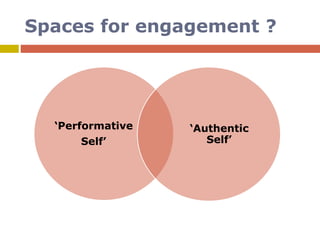
‘The performative self’ and ‘authentic
self’ MacKenzie et al (2007:47)
Argue performativity and authenticity are two
different dimensions of identity.
‘the performative self’ is both created and then
confined by and within institutional regulations.
‘the authentic self’ may recognise demands and
act knowingly and mindfully in response to them.
Recurring tension between the two:
A starting point in understanding and re-asserting a
sense of professional purpose?
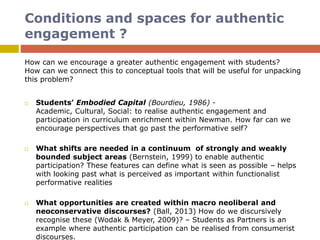
Conditions and spaces for authentic
engagement ?
How can we encourage a greater authentic engagement with students?
How can we connect this to conceptual tools that will be useful for unpacking
this problem?
 Students’ Embodied Capital (Bourdieu, 1986) -
Academic, Cultural, Social: to realise authentic engagement and
participation in curriculum enrichment within Newman. How far can we
encourage perspectives that go past the performative self?
 What shifts are needed in a continuum of strongly and weakly
bounded subject areas (Bernstein, 1999) to enable authentic
participation? These features can define what is seen as possible – helps
with looking past what is perceived as important within functionalist
performative realities
 What opportunities are created within macro neoliberal and
neoconservative discourses? (Ball, 2013) How do we discursively
recognise these (Wodak & Meyer, 2009)? – Students as Partners is an
example where authentic participation can be realised from consumerist
discourses.
Spaces for engagement ?
‘Performative
Self’
‘Authentic
Self’
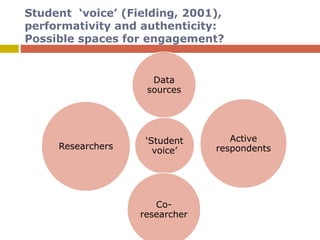
Student ‘voice’ (Fielding, 2001),
performativity and authenticity:
Possible spaces for engagement?
‘Student
voice’
Data
sources
Active
respondents
Co-
researcher
Researchers
Space for learning and
enrichment?
To be an act of knowing... demands
among teachers and students a
relationship of authentic dialogue. True
dialogue unites subjects together in the
cognition of a knowable object, which
mediates between them... learners
must assume from the beginning the
role of creative subjects
(Freire, 1985:49, my emphasis).
Pedagogy of relationships and listening
( Fielding and Moss, 2011)?
the question of Access must be inverted:
it is not only a question of access of the
excluded into universities, it is also a
question of access of universities into
the knowledge of the excluded
(Shanahan, 1997:71)
SaP project provides a space and
starting point for exploring these
questions
Questions and dilemmas:
Our learning from students
What are we learning?
Deepening understanding of ‘othering’ and
essentialising
Possible dilemmas
How can high level of engagement be
embedded?
How can engagement be reproduced and
sustained with other students?
‘Students as Partners’ and
institutional power
the difficult question of whether the
optimism enshrined in empowerment as a
concept produces a rather uncritical view
of the entrenched, hierarchical power
relations.... If it does, then student voice
activities may unfortunately result in re-
inscribing hegemonic power relations and
reducing those activities to tokenistic
intervention
Taylor and Robinson, 2009:166
DILEMMAS AND
EMERGING ISSUES
Parminder & Roger
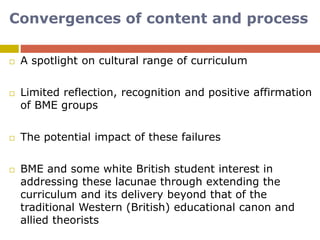
Convergences of content and process
 A spotlight on cultural range of curriculum
 Limited reflection, recognition and positive affirmation
of BME groups
 The potential impact of these failures
 BME and some white British student interest in
addressing these lacunae through extending the
curriculum and its delivery beyond that of the
traditional Western (British) educational canon and
allied theorists
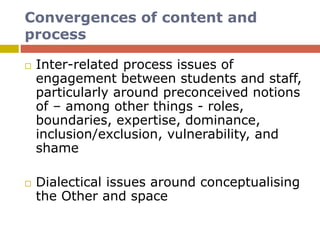
Convergences of content and
process
 Inter-related process issues of
engagement between students and staff,
particularly around preconceived notions
of – among other things - roles,
boundaries, expertise, dominance,
inclusion/exclusion, vulnerability, and
shame
 Dialectical issues around conceptualising
the Other and space
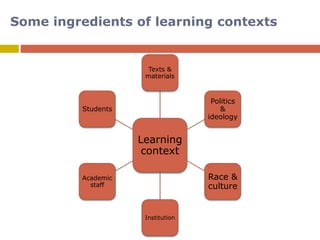
Some ingredients of learning contexts
Learning
context
Texts &
materials
Politics
&
ideology
Race &
culture
Institution
Academic
staff
Students
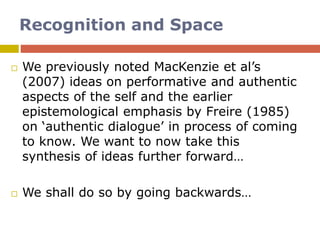
Recognition and Space
 We previously noted MacKenzie et al’s
(2007) ideas on performative and authentic
aspects of the self and the earlier
epistemological emphasis by Freire (1985)
on ‘authentic dialogue’ in process of coming
to know. We want to now take this
synthesis of ideas further forward…
 We shall do so by going backwards…
Hegel and the master-slave dialectic
 Hegel (1807) crucially clarified the dialectical
processes involved in recognising the Other,
recognising their not-me subjectivity. Such
recognition is vital to the emergence of self-
consciousness, a process also aided by the
recognition of the (often externalised) products of
one’s labour and creativity.
 More explicitly in terms of education, typically
conceptualised as Bildung, Hegel analogously argued
that this requires self development in response to
conflict and frustration (Wood, 1998)
 These arguments profoundly influenced Marx, Buber,
de Beauvoir, Lacan, Fanon, and others
Winnicott and space
 ‘I have introduced the terms 'transitional
object' and 'transitional phenomena' for
designation of the intermediate area of
experience, between the thumb and the
teddy bear, between the oral erotism and
true object-relationship, between primary
creative activity and projection of what has
already been introjected, between primary
unawareness of indebtedness and the
acknowledgement of indebtedness ('Say:
ta!')’ (Winnicott, 1953, p. 89).
Winnicott and space
‘This intermediate area of experience,
unchallenged in respect of its belonging to
inner or external (shared) reality,
constitutes the greater part of the infant's
experience and throughout life is retained
in the intense experiencing that belongs to
the arts and to religion and to imaginative
living, and to creative scientific work’
(Winnicott, 1953, p. 97).
Potential space
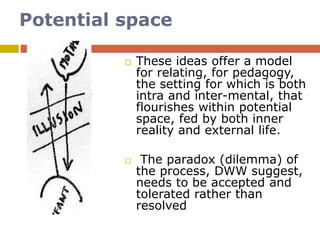
 These ideas offer a model
for relating, for pedagogy,
the setting for which is both
intra and inter-mental, that
flourishes within potential
space, fed by both inner
reality and external life.
 The paradox (dilemma) of
the process, DWW suggest,
needs to be accepted and
tolerated rather than
resolved
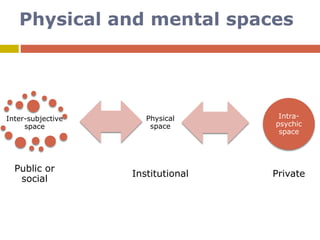
Physical and mental spaces
Inter-subjective
space
Public or
social
Physical
space
Institutional
Intra-
psychic
space
Private
Questions and comments
 How do you engage the Other and
how does the Other engage you?
 How can we best encourage
disengagement from students?
 Thank you.
Conclusion:
Our reflections on question
Students as Partners
 Maria , Nasrat and Rukshana . Each
choose particular aspect of the project
that been particularly important for you?
Lecturers as Partners
 Iain, Richard, Roger and Parminder. Each
choose particular aspect of the project
that been particularly important for us?
What next?
Enriching curriculum of
 Level 5 Research Methods
 Level 6 Learning Journeys II
 Level 6 Praxis- check title
References
Fielding, M. (2001) Students as radical agents of change,
Journal of Educational Change, 2, 123-141.
Fielding,M. and Moss,P. (2011) Radical Education and the
Common School: A Democratic Alternative. Abingdon:
Routledge.
Freire, P. (1985) The Politics of Education: Culture, Power and
Liberation.New York: Bergin and Garvey.
Hegel, G W F (1807) The Phenomenology of Spirit. New York: OUP, 1979
Mac Kenzie, H., Mc Shane, K., and Wilcox, S. (2007) Challenging
Performative Fabrication: Seeking authenticity in academic
development practice, International Journal of Academic
Development, 12:1, 45-54.
References
Northedge, A. (2003) Rethinking Teaching in the Context of
Diversity, Teaching in Higher Education, 8:1, 17-32.
Northedge, A. (2003) Enabling Participation in Academic Discourse,
Teaching in Higher Education, 8:2, 169-180.
Shenahan, P. (1997) Re-defining University Access for the excluded
in a knowledge society. In S. Hill and B. Merrill (eds) Access,
Equity, Participation and Organisational Change. Department of
Continuing Education, University of Warwick, University
Catholique de Louvain and ESREA.
Taylor , C. and Robinson , C. (2009) Student voice: theorising power
and Participation, Pedagogy, Culture & Society, 17:2, 161-175.
References
Winnicott, D W (1953). ‘Transitional Objects and Transitional
Phenomena—A Study of the First Not-Me Possession’,
International Journal of Psycho-Analysis, 34:89-97
Wood, A W (1998). ‘Hegel on Education’, in A O Rorty (ed)
Philosophy as Education, London: Routledge (available online
at: web.stanford.edu/~allenw/webpapers/HegelEd.doc).

Students as Partners Project - Conference Presentation

  • 1.
    STUDENTS AS PARTNERS: DILEMMASOF DIVERSITY AND INCLUSION Parminder Assi, Rukshana Begum,Maria Bi, Iain Jones, Richard Sanders, Nasrat Shaheen and Roger Willoughby Newman University, Birmingham Teaching and Learning Conference 16 January 2015.
  • 2.
    Presentation and themes Introduction and rationale  The Students as Partners Project  Emerging questions and dilemmas  What next?  References  Spaces for engagement  Curriculum enrichment  Dilemmas
  • 3.
    Questions for discussion Howdo students engage with lecturers as partners to enrich the curriculum? How do lecturers engage with students as partners to enrich the curriculum? What are the possibilities for developing and embedding this work further?
  • 4.
  • 5.
    Students as Partners Whydid we get involved? o Limited cultural diversity explored within curriculum taught: content, resources and lectures o Create a project based on our specific choice of enriching the curriculum o Opportunity to become active students & share ideas o Learn & experience new ways to enrich the current curriculum o Collaboratively work with lecturers o Leave a legacy – try and make a change
  • 6.
    SaP - Methods We used three different methods in collecting our data  The first was questionnaire – 55 participants  One semi-structured interview  One focus group – involving 3 participants  All data categorised into ethnic groups and analysed
  • 7.
    SaP - Findings Curriculum was relatively Eurocentric  High proportion of students from ethnic minorities felt that the curriculum could be more culturally inclusive as there is an absence of work explored from other continents such as 'Africa' and 'Asia‘  Include local, national and international academics and scholars from different ethnic backgrounds .
  • 8.
    SaP - Findings Students enjoyed the free rein on choosing topics for assessments  No difference between the delivery of lecture and seminar  Repetitive use of PowerPoint  Include more opportunity for debate and discussion
  • 9.
    SaP - Recommendations Diversify the theorists and theories to gain multiple perspectives  Include the ideas of Black and Asian thinkers and academics from local, global, past and present much earlier on in the modules.  Include the concept of multiple identities, especially religious identity across the modules from level 4  Topics and themes on the underachievement of minority ethnics could be explored through the concept of Intersectionality, which if introduced at level 4 can be interwoven into the curriculum across the modules
  • 10.
  • 11.
    Spaces for authenticengagement and curriculum enrichment?  Why did we get involved?  What do we mean by ‘authenticity’?  Contrasting opportunities to develop and enrich curriculum, degree and modules  Comparison between MEQ and SSC – and their limitations- and developing and sustaining dialogue with students within and outside of the curriculum
  • 12.
    ‘The performative self’and ‘authentic self’ MacKenzie et al (2007:47) Argue performativity and authenticity are two different dimensions of identity. ‘the performative self’ is both created and then confined by and within institutional regulations. ‘the authentic self’ may recognise demands and act knowingly and mindfully in response to them. Recurring tension between the two: A starting point in understanding and re-asserting a sense of professional purpose?
  • 13.
    Conditions and spacesfor authentic engagement ? How can we encourage a greater authentic engagement with students? How can we connect this to conceptual tools that will be useful for unpacking this problem?  Students’ Embodied Capital (Bourdieu, 1986) - Academic, Cultural, Social: to realise authentic engagement and participation in curriculum enrichment within Newman. How far can we encourage perspectives that go past the performative self?  What shifts are needed in a continuum of strongly and weakly bounded subject areas (Bernstein, 1999) to enable authentic participation? These features can define what is seen as possible – helps with looking past what is perceived as important within functionalist performative realities  What opportunities are created within macro neoliberal and neoconservative discourses? (Ball, 2013) How do we discursively recognise these (Wodak & Meyer, 2009)? – Students as Partners is an example where authentic participation can be realised from consumerist discourses.
  • 14.
    Spaces for engagement? ‘Performative Self’ ‘Authentic Self’
  • 15.
    Student ‘voice’ (Fielding,2001), performativity and authenticity: Possible spaces for engagement? ‘Student voice’ Data sources Active respondents Co- researcher Researchers
  • 16.
    Space for learningand enrichment? To be an act of knowing... demands among teachers and students a relationship of authentic dialogue. True dialogue unites subjects together in the cognition of a knowable object, which mediates between them... learners must assume from the beginning the role of creative subjects (Freire, 1985:49, my emphasis).
  • 17.
    Pedagogy of relationshipsand listening ( Fielding and Moss, 2011)? the question of Access must be inverted: it is not only a question of access of the excluded into universities, it is also a question of access of universities into the knowledge of the excluded (Shanahan, 1997:71) SaP project provides a space and starting point for exploring these questions
  • 18.
    Questions and dilemmas: Ourlearning from students What are we learning? Deepening understanding of ‘othering’ and essentialising Possible dilemmas How can high level of engagement be embedded? How can engagement be reproduced and sustained with other students?
  • 19.
    ‘Students as Partners’and institutional power the difficult question of whether the optimism enshrined in empowerment as a concept produces a rather uncritical view of the entrenched, hierarchical power relations.... If it does, then student voice activities may unfortunately result in re- inscribing hegemonic power relations and reducing those activities to tokenistic intervention Taylor and Robinson, 2009:166
  • 20.
  • 21.
    Convergences of contentand process  A spotlight on cultural range of curriculum  Limited reflection, recognition and positive affirmation of BME groups  The potential impact of these failures  BME and some white British student interest in addressing these lacunae through extending the curriculum and its delivery beyond that of the traditional Western (British) educational canon and allied theorists
  • 22.
    Convergences of contentand process  Inter-related process issues of engagement between students and staff, particularly around preconceived notions of – among other things - roles, boundaries, expertise, dominance, inclusion/exclusion, vulnerability, and shame  Dialectical issues around conceptualising the Other and space
  • 23.
    Some ingredients oflearning contexts Learning context Texts & materials Politics & ideology Race & culture Institution Academic staff Students
  • 24.
    Recognition and Space We previously noted MacKenzie et al’s (2007) ideas on performative and authentic aspects of the self and the earlier epistemological emphasis by Freire (1985) on ‘authentic dialogue’ in process of coming to know. We want to now take this synthesis of ideas further forward…  We shall do so by going backwards…
  • 25.
    Hegel and themaster-slave dialectic  Hegel (1807) crucially clarified the dialectical processes involved in recognising the Other, recognising their not-me subjectivity. Such recognition is vital to the emergence of self- consciousness, a process also aided by the recognition of the (often externalised) products of one’s labour and creativity.  More explicitly in terms of education, typically conceptualised as Bildung, Hegel analogously argued that this requires self development in response to conflict and frustration (Wood, 1998)  These arguments profoundly influenced Marx, Buber, de Beauvoir, Lacan, Fanon, and others
  • 26.
    Winnicott and space ‘I have introduced the terms 'transitional object' and 'transitional phenomena' for designation of the intermediate area of experience, between the thumb and the teddy bear, between the oral erotism and true object-relationship, between primary creative activity and projection of what has already been introjected, between primary unawareness of indebtedness and the acknowledgement of indebtedness ('Say: ta!')’ (Winnicott, 1953, p. 89).
  • 27.
    Winnicott and space ‘Thisintermediate area of experience, unchallenged in respect of its belonging to inner or external (shared) reality, constitutes the greater part of the infant's experience and throughout life is retained in the intense experiencing that belongs to the arts and to religion and to imaginative living, and to creative scientific work’ (Winnicott, 1953, p. 97).
  • 28.
    Potential space  Theseideas offer a model for relating, for pedagogy, the setting for which is both intra and inter-mental, that flourishes within potential space, fed by both inner reality and external life.  The paradox (dilemma) of the process, DWW suggest, needs to be accepted and tolerated rather than resolved
  • 29.
    Physical and mentalspaces Inter-subjective space Public or social Physical space Institutional Intra- psychic space Private
  • 30.
    Questions and comments How do you engage the Other and how does the Other engage you?  How can we best encourage disengagement from students?  Thank you.
  • 31.
    Conclusion: Our reflections onquestion Students as Partners  Maria , Nasrat and Rukshana . Each choose particular aspect of the project that been particularly important for you? Lecturers as Partners  Iain, Richard, Roger and Parminder. Each choose particular aspect of the project that been particularly important for us?
  • 32.
    What next? Enriching curriculumof  Level 5 Research Methods  Level 6 Learning Journeys II  Level 6 Praxis- check title
  • 33.
    References Fielding, M. (2001)Students as radical agents of change, Journal of Educational Change, 2, 123-141. Fielding,M. and Moss,P. (2011) Radical Education and the Common School: A Democratic Alternative. Abingdon: Routledge. Freire, P. (1985) The Politics of Education: Culture, Power and Liberation.New York: Bergin and Garvey. Hegel, G W F (1807) The Phenomenology of Spirit. New York: OUP, 1979 Mac Kenzie, H., Mc Shane, K., and Wilcox, S. (2007) Challenging Performative Fabrication: Seeking authenticity in academic development practice, International Journal of Academic Development, 12:1, 45-54.
  • 34.
    References Northedge, A. (2003)Rethinking Teaching in the Context of Diversity, Teaching in Higher Education, 8:1, 17-32. Northedge, A. (2003) Enabling Participation in Academic Discourse, Teaching in Higher Education, 8:2, 169-180. Shenahan, P. (1997) Re-defining University Access for the excluded in a knowledge society. In S. Hill and B. Merrill (eds) Access, Equity, Participation and Organisational Change. Department of Continuing Education, University of Warwick, University Catholique de Louvain and ESREA. Taylor , C. and Robinson , C. (2009) Student voice: theorising power and Participation, Pedagogy, Culture & Society, 17:2, 161-175.
  • 35.
    References Winnicott, D W(1953). ‘Transitional Objects and Transitional Phenomena—A Study of the First Not-Me Possession’, International Journal of Psycho-Analysis, 34:89-97 Wood, A W (1998). ‘Hegel on Education’, in A O Rorty (ed) Philosophy as Education, London: Routledge (available online at: web.stanford.edu/~allenw/webpapers/HegelEd.doc).