Cheska Lorena cmlorena@gmail.com

                                    JCFPDMS Lesson Plans
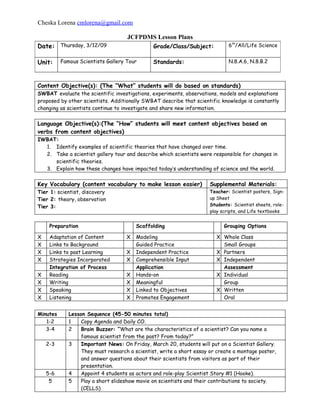
Date: Thursday, 3/12/09                        Grade/Class/Subject:           6th/All/Life Science


Unit:     Famous Scientists Gallery Tour       Standards:                     N.8.A.6, N.8.B.2


Content Objective(s): (The “What” students will do based on standards)
SWBAT evaluate the scientific investigations, experiments, observations, models and explanations
proposed by other scientists. Additionally SWBAT describe that scientific knowledge is constantly
changing as scientists continue to investigate and share new information.

Language Objective(s):(The “How” students will meet content objectives based on
verbs from content objectives)
IWBAT:
  1. Identify examples of scientific theories that have changed over time.
  2. Take a scientist gallery tour and describe which scientists were responsible for changes in
     scientific theories.
  3. Explain how these changes have impacted today’s understanding of science and the world.

Key Vocabulary (content vocabulary to make lesson easier)             Supplemental Materials:
Tier 1: scientist, discovery                                          Teacher: Scientist posters, Sign-
Tier 2: theory, observation                                           up Sheet
Tier 3:                                                               Students: Scientist sheets, role-
                                                                      play scripts, and Life textbooks


     Preparation                        Scaffolding                         Grouping Options

X    Adaptation of Content          X   Modeling                        X Whole Class
X    Links to Background                Guided Practice                   Small Groups
X    Links to past Learning         X   Independent Practice            X Partners
X    Strategies Incorporated        X   Comprehensible Input            X Independent
     Integration of Process             Application                       Assessment
X    Reading                        X   Hands–on                        X Individual
X    Writing                        X   Meaningful                        Group
X    Speaking                       X   Linked to Objectives            X Written
X    Listening                      X   Promotes Engagement               Oral


Minutes      Lesson Sequence (45-50 minutes total)
   1-2       1    Copy Agenda and Daily CO.
   3-4       2    Brain Buzzer: “What are the characteristics of a scientist? Can you name a
                  famous scientist from the past? From today?”
    2-3      3    Important News: On Friday, March 20, students will put on a Scientist Gallery.
                  They must research a scientist, write a short essay or create a montage poster,
                  and answer questions about their scientists from visitors as part of their
                  presentation.
    5-6      4    Appoint 4 students as actors and role-play Scientist Story #1 (Hooke).
     5       5    Play a short slideshow movie on scientists and their contributions to society.
                  (CELLS)
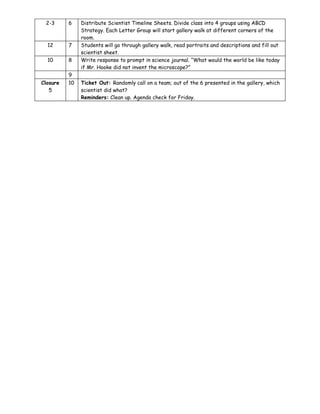
2-3      6    Distribute Scientist Timeline Sheets. Divide class into 4 groups using ABCD
               Strategy. Each Letter Group will start gallery walk at different corners of the
               room.
  12      7    Students will go through gallery walk, read portraits and descriptions and fill out
               scientist sheet.
  10      8    Write response to prompt in science journal. “What would the world be like today
               if Mr. Hooke did not invent the microscope?”
          9
Closure   10   Ticket Out: Randomly call on a team; out of the 6 presented in the gallery, which
   5           scientist did what?
               Reminders: Clean up. Agenda check for Friday.

Student Teaching Lesson Plan: Scientist Gallery 1

  • 1.
    Cheska Lorena cmlorena@gmail.com JCFPDMS Lesson Plans Date: Thursday, 3/12/09 Grade/Class/Subject: 6th/All/Life Science Unit: Famous Scientists Gallery Tour Standards: N.8.A.6, N.8.B.2 Content Objective(s): (The “What” students will do based on standards) SWBAT evaluate the scientific investigations, experiments, observations, models and explanations proposed by other scientists. Additionally SWBAT describe that scientific knowledge is constantly changing as scientists continue to investigate and share new information. Language Objective(s):(The “How” students will meet content objectives based on verbs from content objectives) IWBAT: 1. Identify examples of scientific theories that have changed over time. 2. Take a scientist gallery tour and describe which scientists were responsible for changes in scientific theories. 3. Explain how these changes have impacted today’s understanding of science and the world. Key Vocabulary (content vocabulary to make lesson easier) Supplemental Materials: Tier 1: scientist, discovery Teacher: Scientist posters, Sign- Tier 2: theory, observation up Sheet Tier 3: Students: Scientist sheets, role- play scripts, and Life textbooks Preparation Scaffolding Grouping Options X Adaptation of Content X Modeling X Whole Class X Links to Background Guided Practice Small Groups X Links to past Learning X Independent Practice X Partners X Strategies Incorporated X Comprehensible Input X Independent Integration of Process Application Assessment X Reading X Hands–on X Individual X Writing X Meaningful Group X Speaking X Linked to Objectives X Written X Listening X Promotes Engagement Oral Minutes Lesson Sequence (45-50 minutes total) 1-2 1 Copy Agenda and Daily CO. 3-4 2 Brain Buzzer: “What are the characteristics of a scientist? Can you name a famous scientist from the past? From today?” 2-3 3 Important News: On Friday, March 20, students will put on a Scientist Gallery. They must research a scientist, write a short essay or create a montage poster, and answer questions about their scientists from visitors as part of their presentation. 5-6 4 Appoint 4 students as actors and role-play Scientist Story #1 (Hooke). 5 5 Play a short slideshow movie on scientists and their contributions to society. (CELLS)
  • 2.
    2-3 6 Distribute Scientist Timeline Sheets. Divide class into 4 groups using ABCD Strategy. Each Letter Group will start gallery walk at different corners of the room. 12 7 Students will go through gallery walk, read portraits and descriptions and fill out scientist sheet. 10 8 Write response to prompt in science journal. “What would the world be like today if Mr. Hooke did not invent the microscope?” 9 Closure 10 Ticket Out: Randomly call on a team; out of the 6 presented in the gallery, which 5 scientist did what? Reminders: Clean up. Agenda check for Friday.