Copyright © 2014 McGraw-Hill Education. All rights reserved. No reproduction or
distribution without the prior written consent of McGraw-Hill Education.
SOCIAL PENETRATION THEORY
Chapter Overview
 SPT at a Glance
 Introduction
 Assumptions of SPT
 “Tearing Up” the Relationship
 Self-Disclosure
 A Social Exchange
 Stages of the Social Penetration Process
 Integration and Critique
10-1
Chapter 10
Copyright © 2014 McGraw-Hill Education. All rights reserved. No reproduction or
distribution without the prior written consent of McGraw-Hill Education.
SPT at a Glance
 Developed to understand the relational
closeness between two people
 Interpersonal relationships evolve gradually
and predictably
 Superficial relationships progress to intimate
relationships through self-disclosure
 Self-disclosure leads to more intimate
relationships and vulnerability
10-2
Copyright © 2014 McGraw-Hill Education. All rights reserved. No reproduction or
distribution without the prior written consent of McGraw-Hill Education.
Introduction
 Social penetration is the process of
bonding that moves a relationship from
superficial to more intimate.
 Includes verbal, nonverbal, and
environmentally oriented behaviors
10-3
Copyright © 2014 McGraw-Hill Education. All rights reserved. No reproduction or
distribution without the prior written consent of McGraw-Hill Education.
Introduction
 Dimensions of intimacy:
 Physical
 Intellectual
 Emotional
 Shared activities
 Discussions about social penetration
began in the 1960s and 1970s when open
and candid communication was highly
valued
10-4
Copyright © 2014 McGraw-Hill Education. All rights reserved. No reproduction or
distribution without the prior written consent of McGraw-Hill Education.
Assumptions of SPT
 Relationships progress from nonintimate
to intimate
 Relational development is generally
systematic and predictable
10-5
Copyright © 2014 McGraw-Hill Education. All rights reserved. No reproduction or
distribution without the prior written consent of McGraw-Hill Education.
Assumptions of SPT
 Relational development includes
depenetration and dissolution
 Relationships can experience transgressions
 Self-disclosure is at the core of
relationship development
 Strategic (planned) disclosures
 Nonstrategic (spontaneous) disclosures
10-6
Copyright © 2014 McGraw-Hill Education. All rights reserved. No reproduction or
distribution without the prior written consent of McGraw-Hill Education.
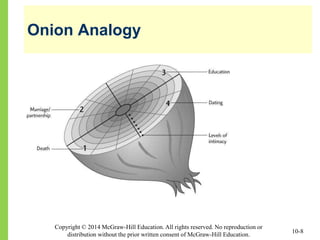
“Tearing Up” the Relationship
 Onion analogy represents various aspects
of an individual’s personality
 Outer layer represents the public image
 Central layers represent aspects of the self
revealed through self-disclosure
10-7
Copyright © 2014 McGraw-Hill Education. All rights reserved. No reproduction or
distribution without the prior written consent of McGraw-Hill Education.
Onion Analogy
10-8
Copyright © 2014 McGraw-Hill Education. All rights reserved. No reproduction or
distribution without the prior written consent of McGraw-Hill Education.
Self-Disclosure
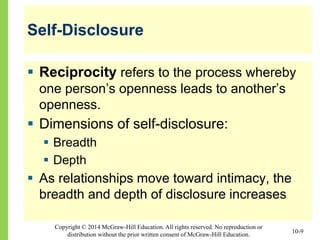
 Reciprocity refers to the process whereby
one person’s openness leads to another’s
openness.
 Dimensions of self-disclosure:
 Breadth
 Depth
 As relationships move toward intimacy, the
breadth and depth of disclosure increases
10-9
Copyright © 2014 McGraw-Hill Education. All rights reserved. No reproduction or
distribution without the prior written consent of McGraw-Hill Education.
Self-Disclosure
 The greater the depth of disclosure, the
greater the feeling of vulnerability
 Self-disclosure in relationships is a result
of trust
 Too much inappropriate disclosure may
result in relationship dissolution
10-10
Copyright © 2014 McGraw-Hill Education. All rights reserved. No reproduction or
distribution without the prior written consent of McGraw-Hill Education.
A Social Exchange:
Relational Costs and Rewards
 Relationships can be viewed as the
exchange of rewards and costs
 A reward/cost ratio is calculated and
analyzed to determine if a relationship is
more positive or negative
10-11
Copyright © 2014 McGraw-Hill Education. All rights reserved. No reproduction or
distribution without the prior written consent of McGraw-Hill Education.
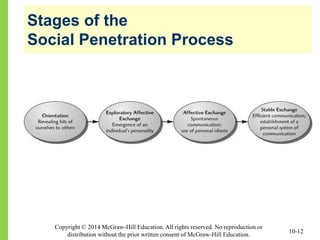
Stages of the
Social Penetration Process
10-12
Copyright © 2014 McGraw-Hill Education. All rights reserved. No reproduction or
distribution without the prior written consent of McGraw-Hill Education.
Stages of the
Social Penetration Process
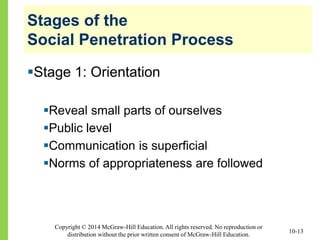
Stage 1: Orientation
Reveal small parts of ourselves
Public level
Communication is superficial
Norms of appropriateness are followed
10-13
Copyright © 2014 McGraw-Hill Education. All rights reserved. No reproduction or
distribution without the prior written consent of McGraw-Hill Education.
Stages of the
Social Penetration Process
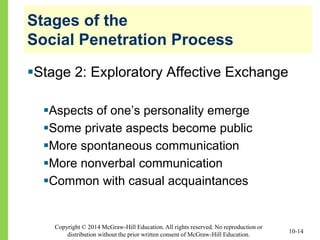
Stage 2: Exploratory Affective Exchange
Aspects of one’s personality emerge
Some private aspects become public
More spontaneous communication
More nonverbal communication
Common with casual acquaintances
10-14
Copyright © 2014 McGraw-Hill Education. All rights reserved. No reproduction or
distribution without the prior written consent of McGraw-Hill Education.
Stages of the
Social Penetration Process
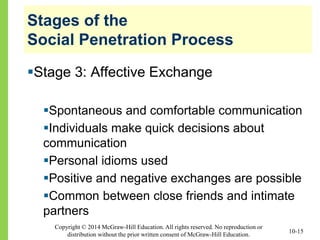
Stage 3: Affective Exchange
Spontaneous and comfortable communication
Individuals make quick decisions about
communication
Personal idioms used
Positive and negative exchanges are possible
Common between close friends and intimate
partners
10-15
Copyright © 2014 McGraw-Hill Education. All rights reserved. No reproduction or
distribution without the prior written consent of McGraw-Hill Education.
10-16

student social penetration.pptx

  • 1.
    Copyright © 2014McGraw-Hill Education. All rights reserved. No reproduction or distribution without the prior written consent of McGraw-Hill Education. SOCIAL PENETRATION THEORY Chapter Overview  SPT at a Glance  Introduction  Assumptions of SPT  “Tearing Up” the Relationship  Self-Disclosure  A Social Exchange  Stages of the Social Penetration Process  Integration and Critique 10-1 Chapter 10
  • 2.
    Copyright © 2014McGraw-Hill Education. All rights reserved. No reproduction or distribution without the prior written consent of McGraw-Hill Education. SPT at a Glance  Developed to understand the relational closeness between two people  Interpersonal relationships evolve gradually and predictably  Superficial relationships progress to intimate relationships through self-disclosure  Self-disclosure leads to more intimate relationships and vulnerability 10-2
  • 3.
    Copyright © 2014McGraw-Hill Education. All rights reserved. No reproduction or distribution without the prior written consent of McGraw-Hill Education. Introduction  Social penetration is the process of bonding that moves a relationship from superficial to more intimate.  Includes verbal, nonverbal, and environmentally oriented behaviors 10-3
  • 4.
    Copyright © 2014McGraw-Hill Education. All rights reserved. No reproduction or distribution without the prior written consent of McGraw-Hill Education. Introduction  Dimensions of intimacy:  Physical  Intellectual  Emotional  Shared activities  Discussions about social penetration began in the 1960s and 1970s when open and candid communication was highly valued 10-4
  • 5.
    Copyright © 2014McGraw-Hill Education. All rights reserved. No reproduction or distribution without the prior written consent of McGraw-Hill Education. Assumptions of SPT  Relationships progress from nonintimate to intimate  Relational development is generally systematic and predictable 10-5
  • 6.
    Copyright © 2014McGraw-Hill Education. All rights reserved. No reproduction or distribution without the prior written consent of McGraw-Hill Education. Assumptions of SPT  Relational development includes depenetration and dissolution  Relationships can experience transgressions  Self-disclosure is at the core of relationship development  Strategic (planned) disclosures  Nonstrategic (spontaneous) disclosures 10-6
  • 7.
    Copyright © 2014McGraw-Hill Education. All rights reserved. No reproduction or distribution without the prior written consent of McGraw-Hill Education. “Tearing Up” the Relationship  Onion analogy represents various aspects of an individual’s personality  Outer layer represents the public image  Central layers represent aspects of the self revealed through self-disclosure 10-7
  • 8.
    Copyright © 2014McGraw-Hill Education. All rights reserved. No reproduction or distribution without the prior written consent of McGraw-Hill Education. Onion Analogy 10-8
  • 9.
    Copyright © 2014McGraw-Hill Education. All rights reserved. No reproduction or distribution without the prior written consent of McGraw-Hill Education. Self-Disclosure  Reciprocity refers to the process whereby one person’s openness leads to another’s openness.  Dimensions of self-disclosure:  Breadth  Depth  As relationships move toward intimacy, the breadth and depth of disclosure increases 10-9
  • 10.
    Copyright © 2014McGraw-Hill Education. All rights reserved. No reproduction or distribution without the prior written consent of McGraw-Hill Education. Self-Disclosure  The greater the depth of disclosure, the greater the feeling of vulnerability  Self-disclosure in relationships is a result of trust  Too much inappropriate disclosure may result in relationship dissolution 10-10
  • 11.
    Copyright © 2014McGraw-Hill Education. All rights reserved. No reproduction or distribution without the prior written consent of McGraw-Hill Education. A Social Exchange: Relational Costs and Rewards  Relationships can be viewed as the exchange of rewards and costs  A reward/cost ratio is calculated and analyzed to determine if a relationship is more positive or negative 10-11
  • 12.
    Copyright © 2014McGraw-Hill Education. All rights reserved. No reproduction or distribution without the prior written consent of McGraw-Hill Education. Stages of the Social Penetration Process 10-12
  • 13.
    Copyright © 2014McGraw-Hill Education. All rights reserved. No reproduction or distribution without the prior written consent of McGraw-Hill Education. Stages of the Social Penetration Process Stage 1: Orientation Reveal small parts of ourselves Public level Communication is superficial Norms of appropriateness are followed 10-13
  • 14.
    Copyright © 2014McGraw-Hill Education. All rights reserved. No reproduction or distribution without the prior written consent of McGraw-Hill Education. Stages of the Social Penetration Process Stage 2: Exploratory Affective Exchange Aspects of one’s personality emerge Some private aspects become public More spontaneous communication More nonverbal communication Common with casual acquaintances 10-14
  • 15.
    Copyright © 2014McGraw-Hill Education. All rights reserved. No reproduction or distribution without the prior written consent of McGraw-Hill Education. Stages of the Social Penetration Process Stage 3: Affective Exchange Spontaneous and comfortable communication Individuals make quick decisions about communication Personal idioms used Positive and negative exchanges are possible Common between close friends and intimate partners 10-15
  • 16.
    Copyright © 2014McGraw-Hill Education. All rights reserved. No reproduction or distribution without the prior written consent of McGraw-Hill Education. 10-16