Preparing Today’s Students for Tomorrow’s World
Global Competition
Phasing Out Low-skill Jobs
Hours an Average American Student Spends in School 5:00 4:00 3:00 2:00 9:00 1:00 12:00 11:00 10:00 8:00 Sun. Sat. Fri. Thur. Wed. Tues. Mon.
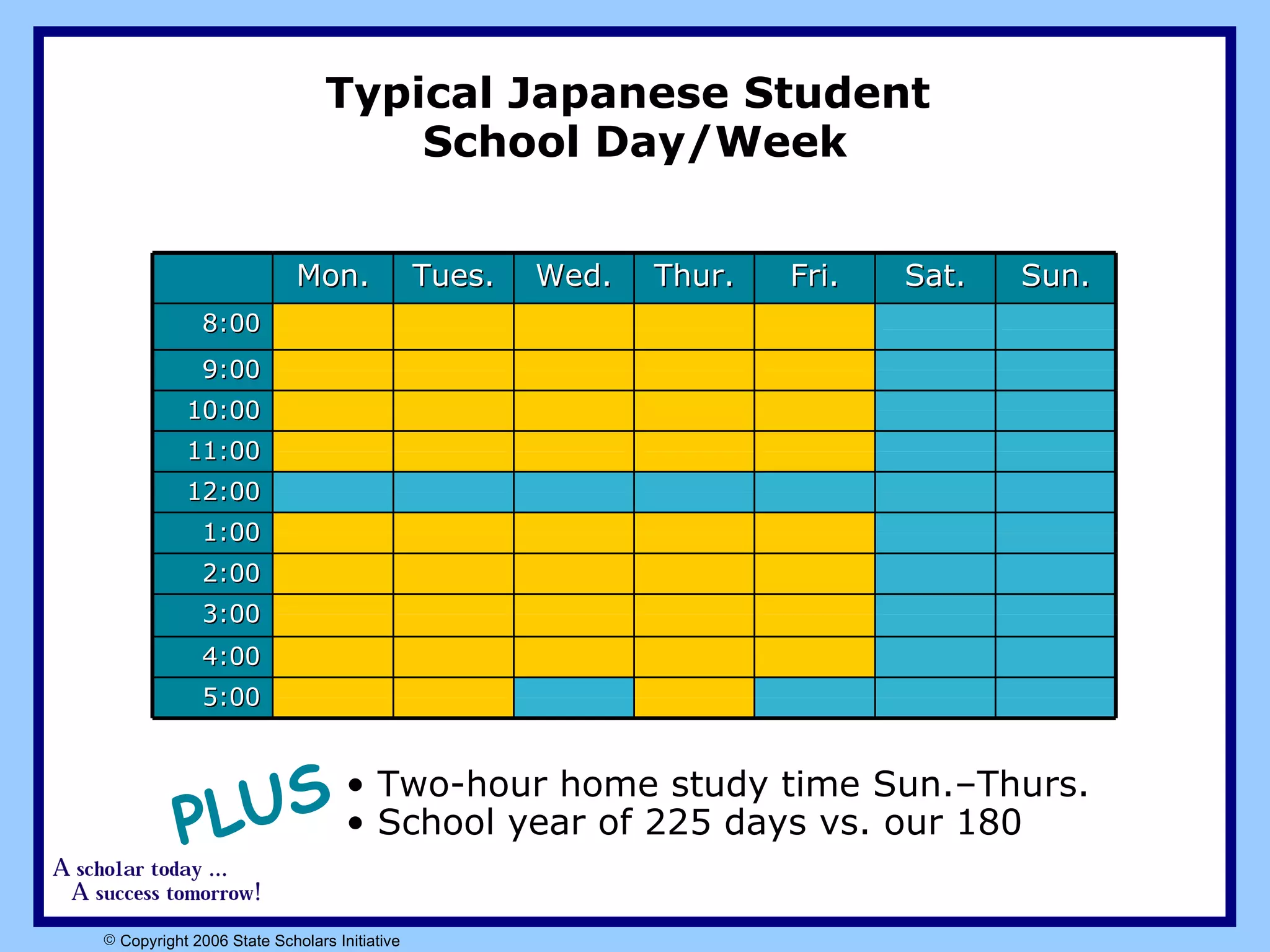
Typical Japanese Student  School Day/Week Two-hour home study time Sun.–Thurs. School year of 225 days vs. our 180 PLUS 5:00 4:00 3:00 2:00 9:00 1:00 12:00 11:00 10:00 8:00 Sun. Sat. Fri. Thur. Wed. Tues. Mon.
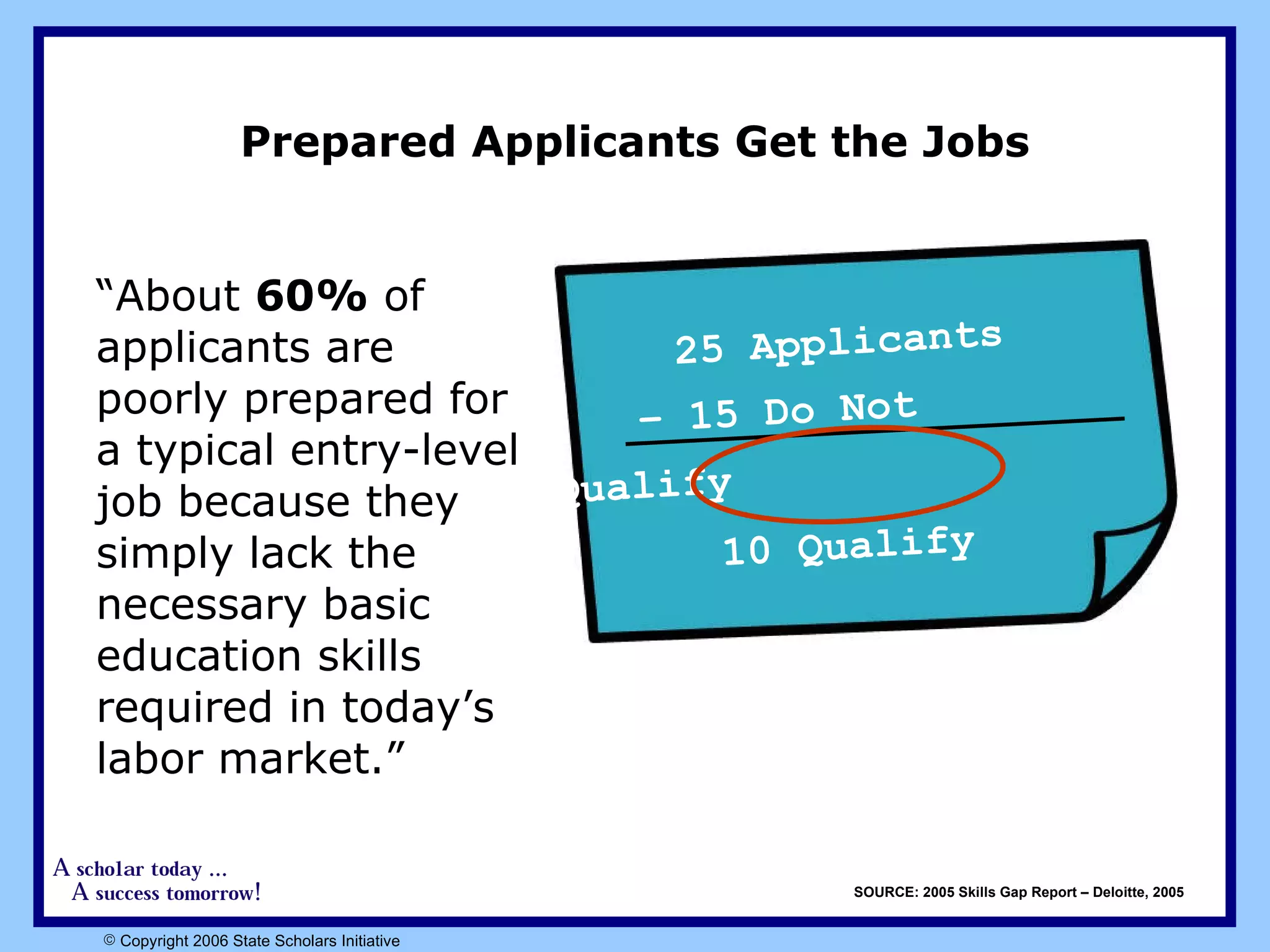
Prepared Applicants Get the Jobs “ About  60%  of applicants are poorly prepared for a typical entry-level job because they simply lack the necessary basic education skills required in today’s labor market.” SOURCE: 2005 Skills Gap Report – Deloitte, 2005 25 Applicants –  15  Do Not Qualify   10 Qualify
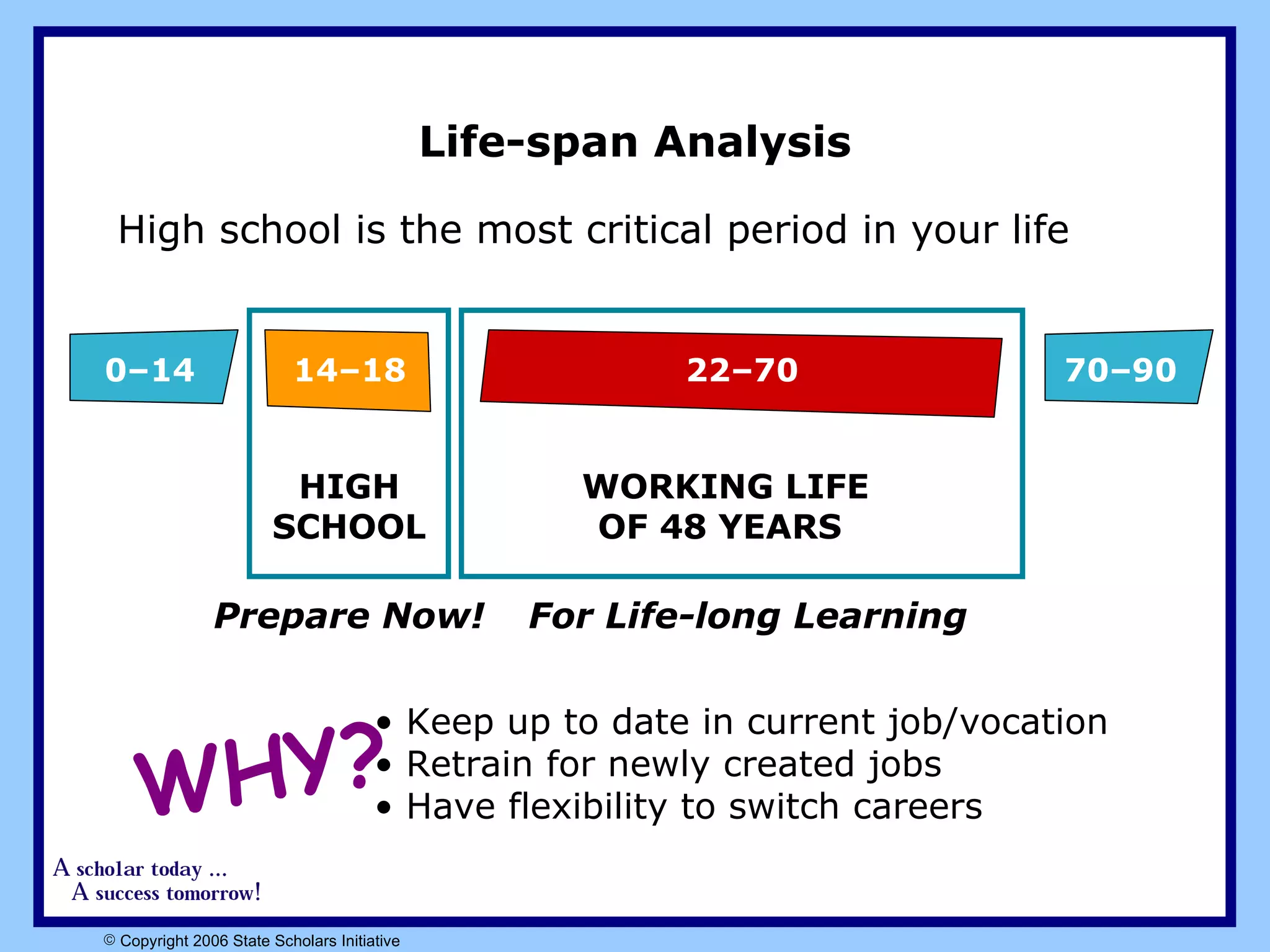
Life-span Analysis High school is the most critical period in your life WORKING LIFE OF 48 YEARS   HIGH SCHOOL 0–14 14–18 22–70 70–90 WHY? Keep up to date in current job/vocation Retrain for newly created jobs Have flexibility to switch careers Prepare Now! For Life-long Learning
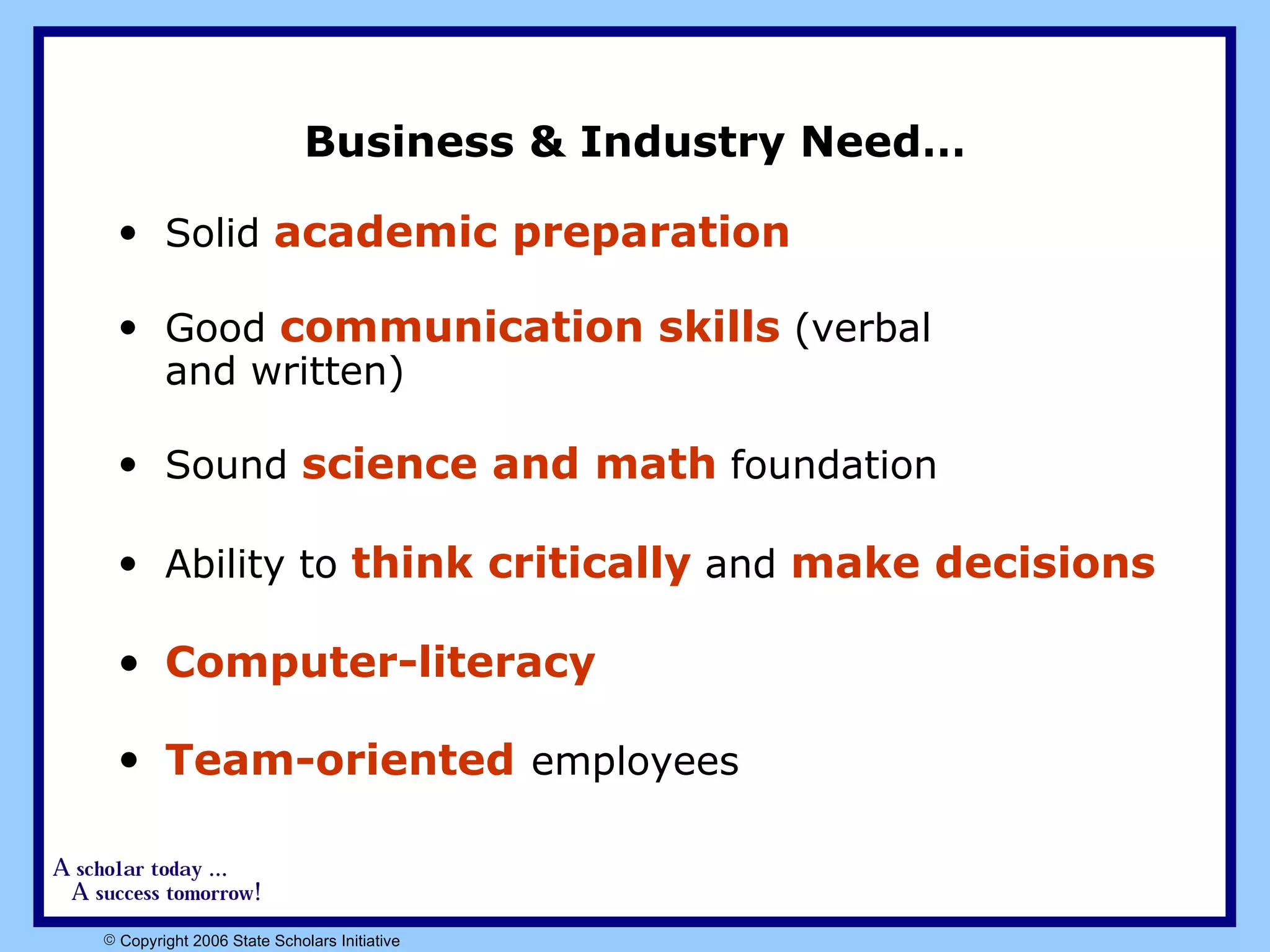
Business & Industry Need… Solid  academic preparation Good  communication skills  (verbal  and written) Sound  science and math  foundation Ability to  think critically  and  make decisions Computer-literacy  Team-oriented   employees
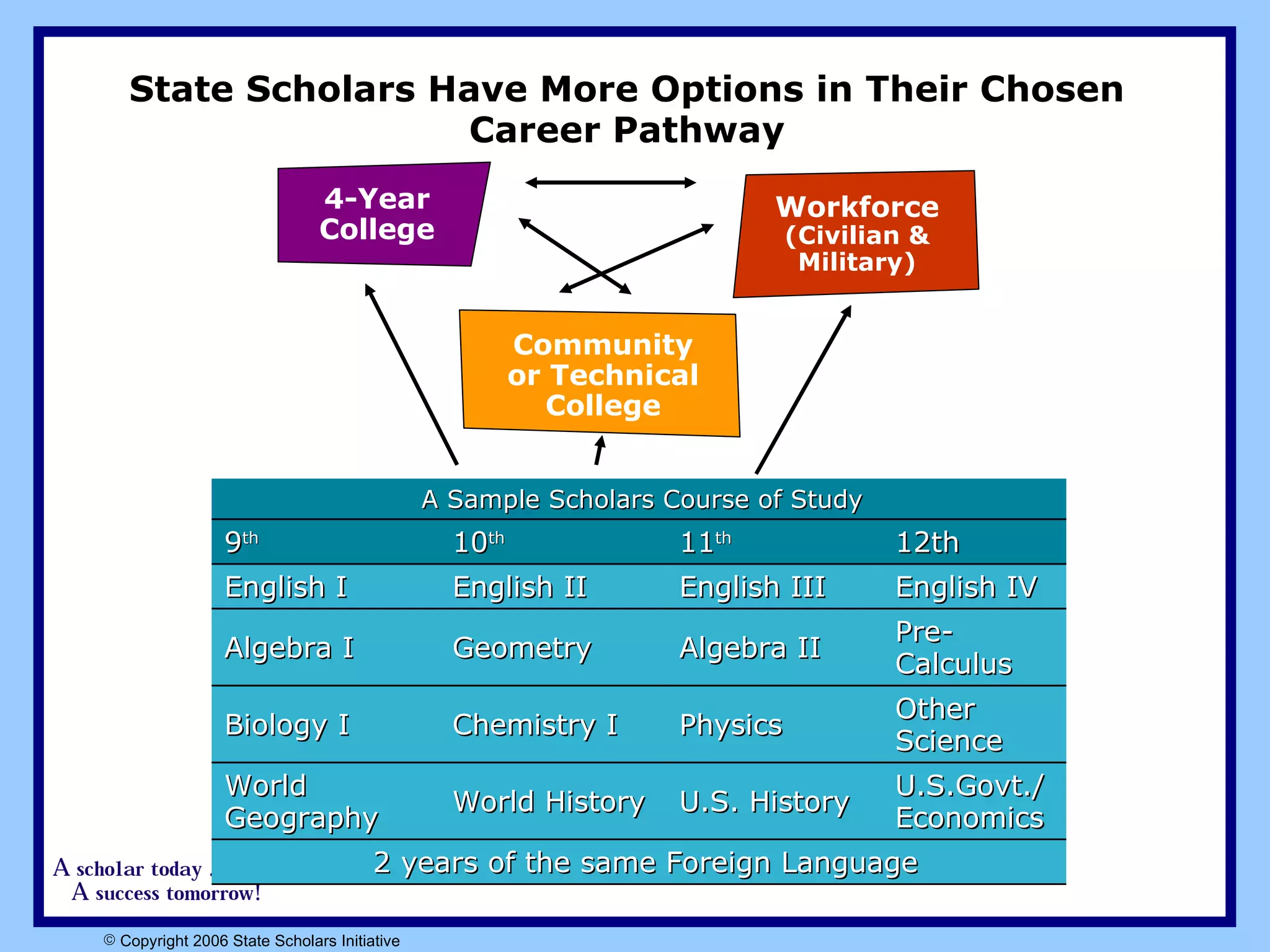
State Scholars Have More Options in Their Chosen Career Pathway 4-Year College Workforce (Civilian & Military) Community or Technical College A Sample Scholars Course of Study 12th 11 th 10 th 9 th 2 years of the same Foreign Language U.S.Govt./ Economics U.S. History World History World Geography Other Science Physics Chemistry I Biology I Pre-Calculus Algebra II Geometry Algebra I English IV English III English II English I
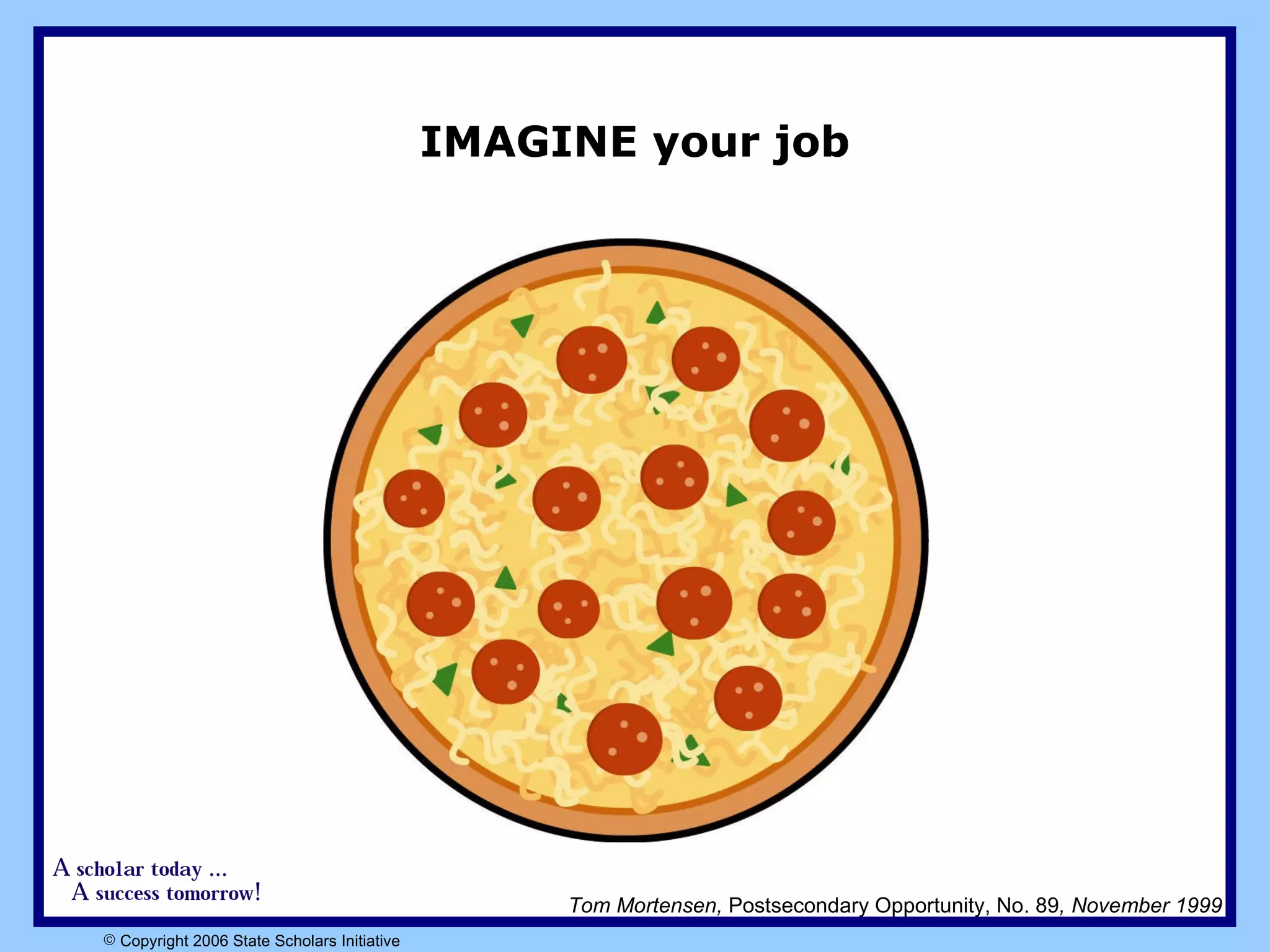
IMAGINE your job $27,000/year $2,250/month Tom Mortensen,  Postsecondary Opportunity, No. 89 , November 1999
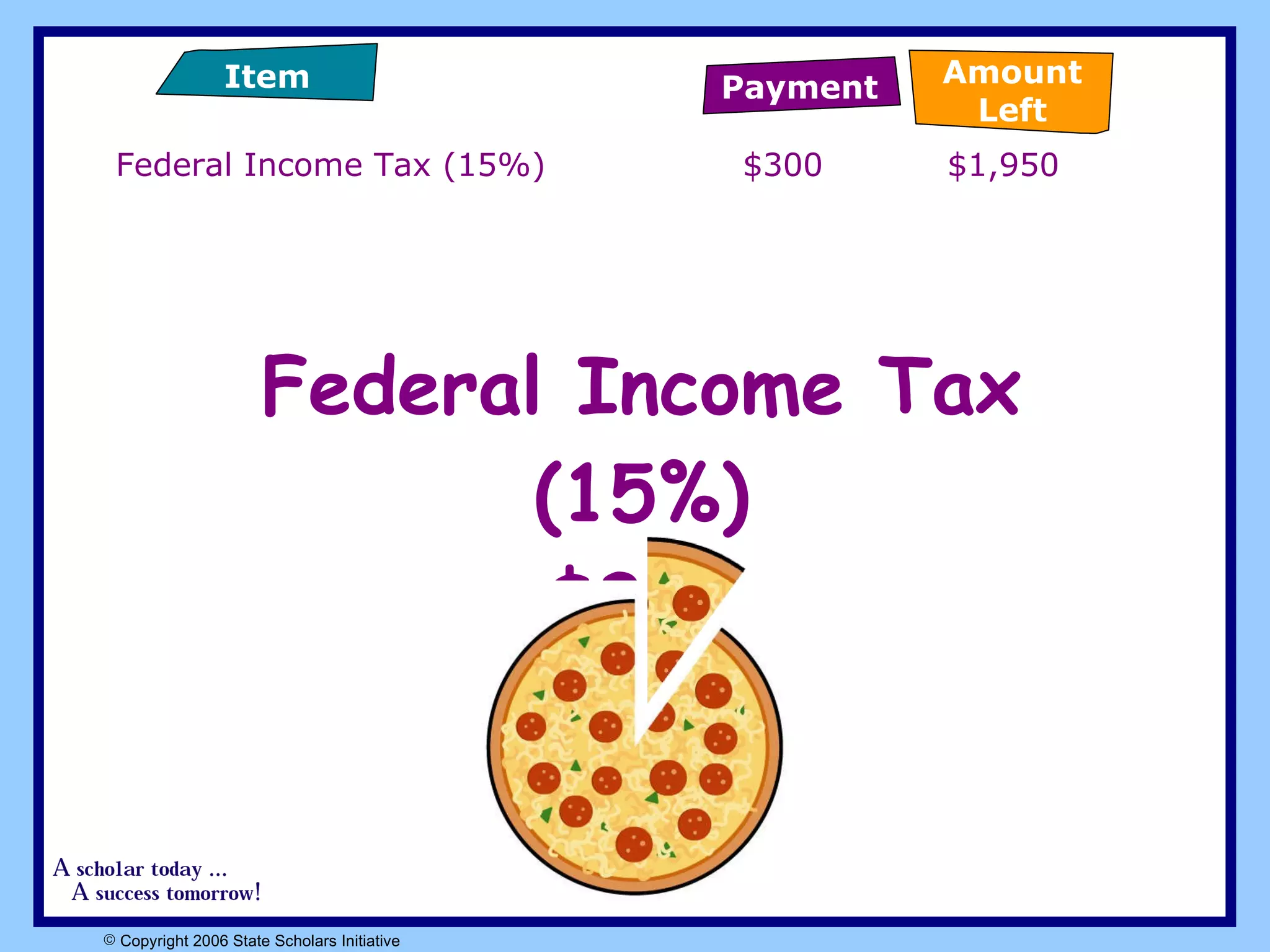
Federal Income Tax (15%) $300 Federal Income Tax (15%)  $300 $1,950 Payment Item Amount Left
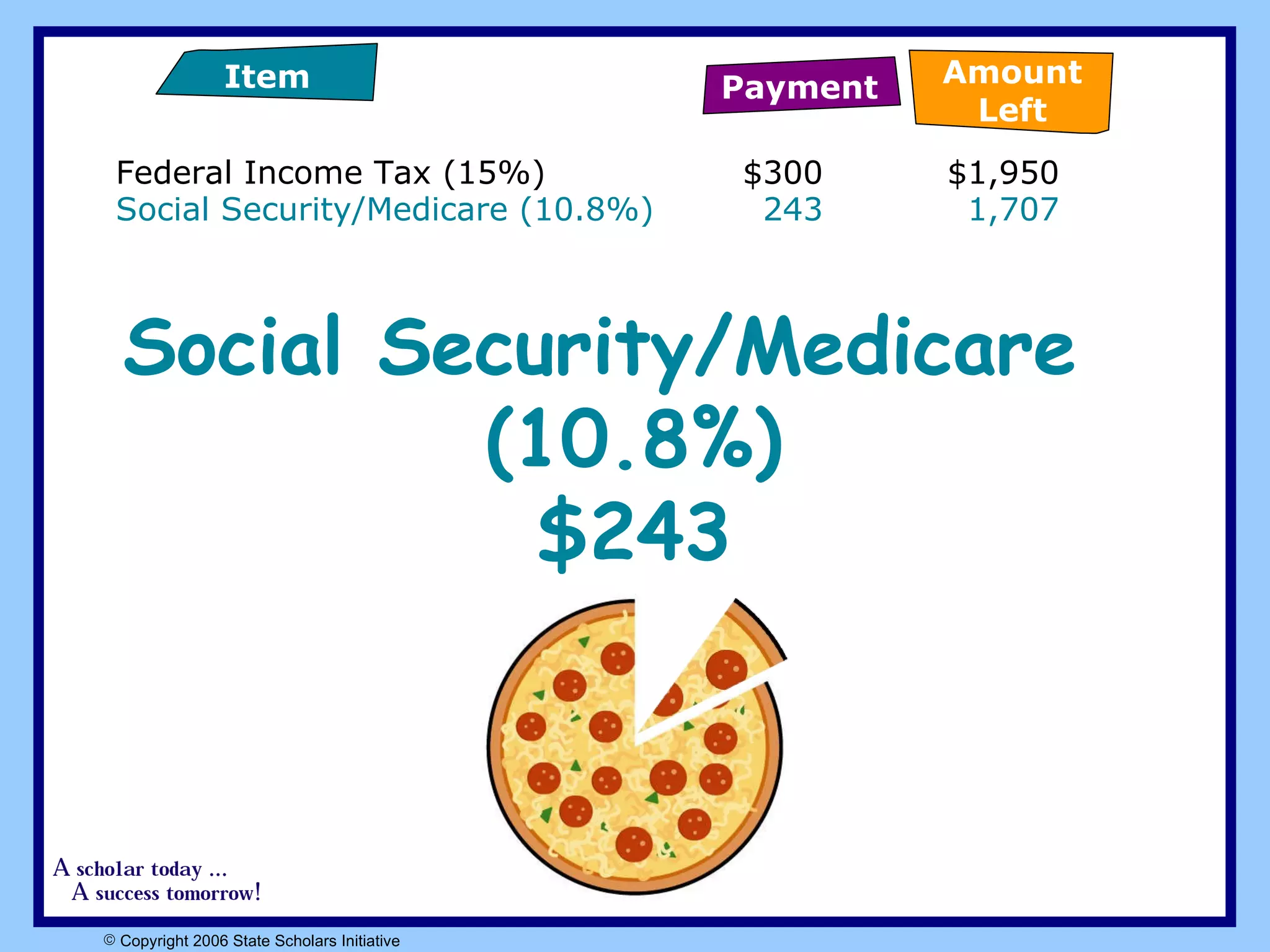
Federal Income Tax (15%)  $300 $1,950 Social Security/Medicare (10.8%)  243 1,707 Social Security/Medicare  (10.8%) $243 Payment Item Amount Left
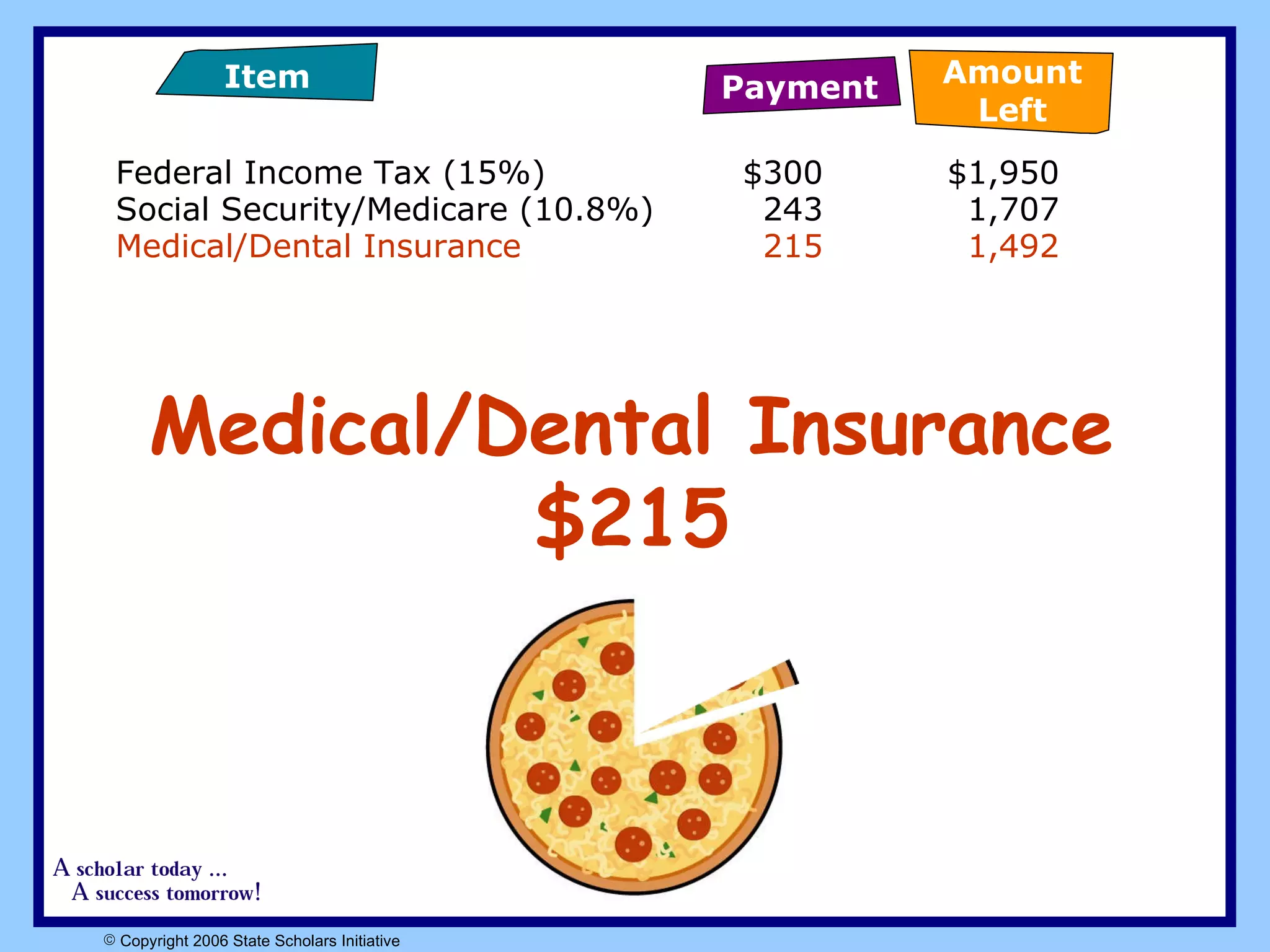
Federal Income Tax (15%)  $300 $1,950 Social Security/Medicare (10.8%)  243 1,707 Medical/Dental Insurance   215 1,492 Payment Item Amount Left Medical/Dental Insurance $215
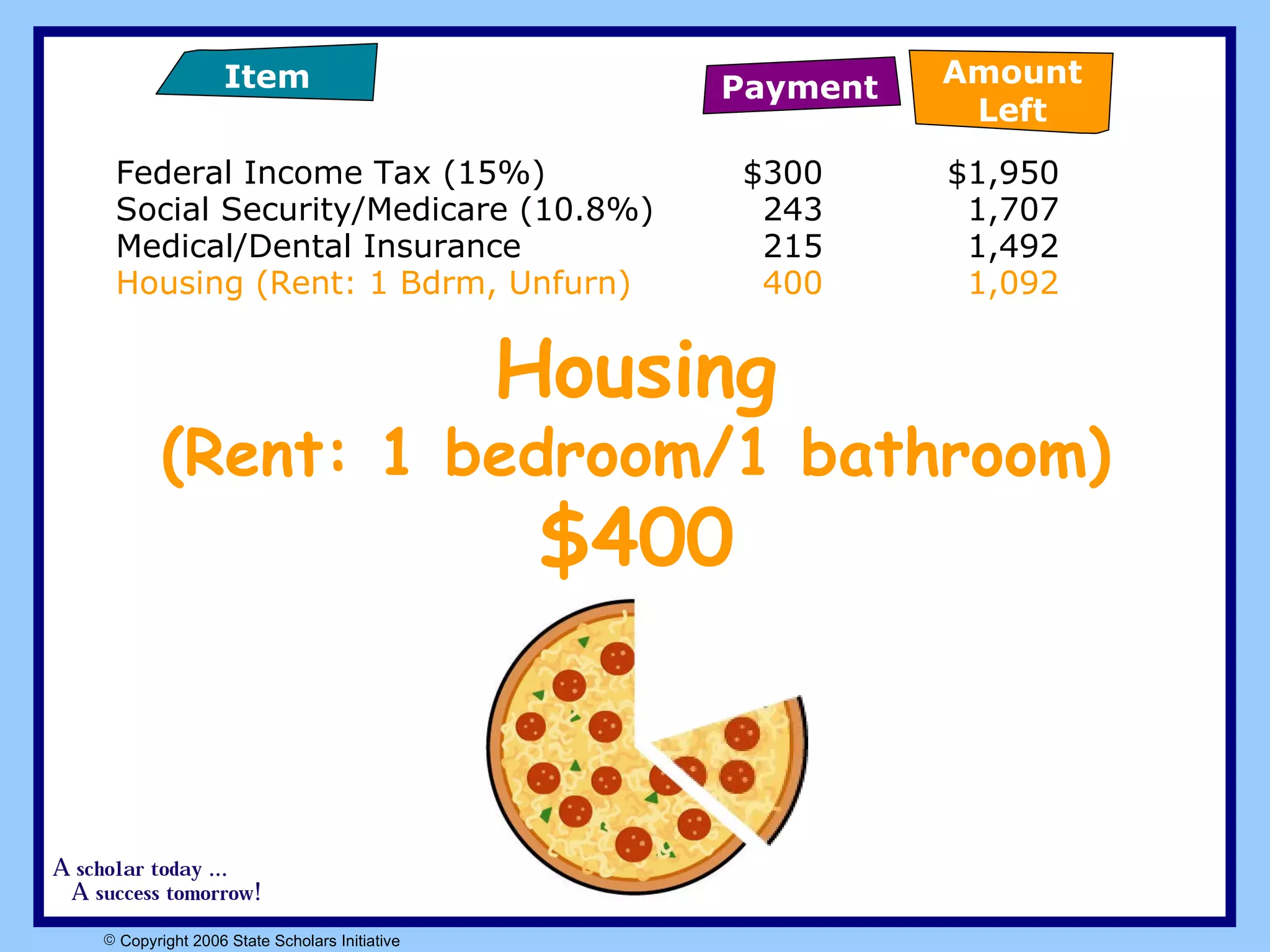
Federal Income Tax (15%)  $300 $1,950 Social Security/Medicare (10.8%)  243 1,707 Medical/Dental Insurance   215 1,492 Housing (Rent: 1 Bdrm, Unfurn) 400 1,092 Housing (Rent: 1 bedroom/1 bathroom) $400 Payment Item Amount Left
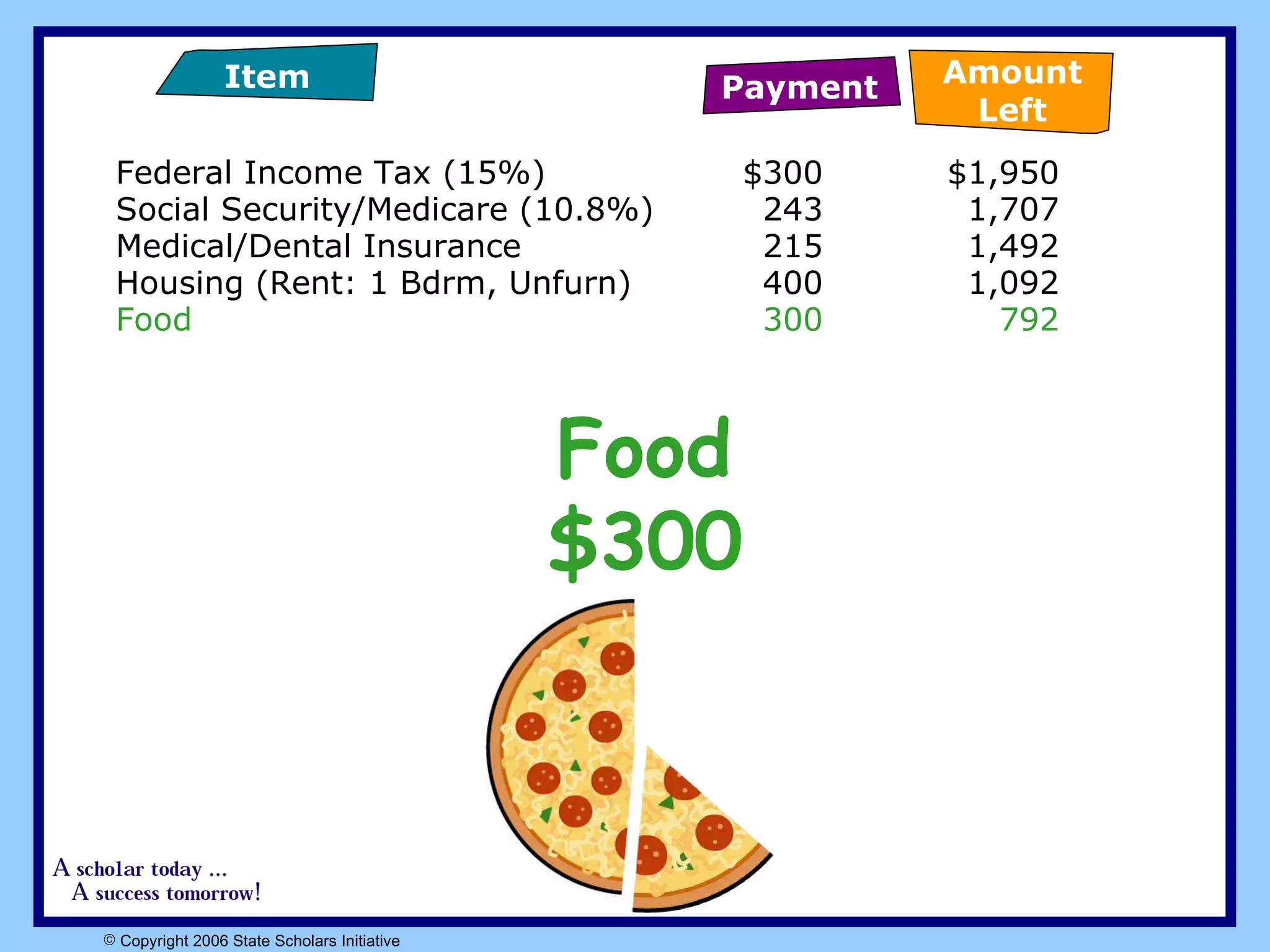
Federal Income Tax (15%)  $300 $1,950 Social Security/Medicare (10.8%)  243 1,707 Medical/Dental Insurance   215 1,492 Housing (Rent: 1 Bdrm, Unfurn) 400 1,092 Food  300 792 Food $300 Payment Item Amount Left
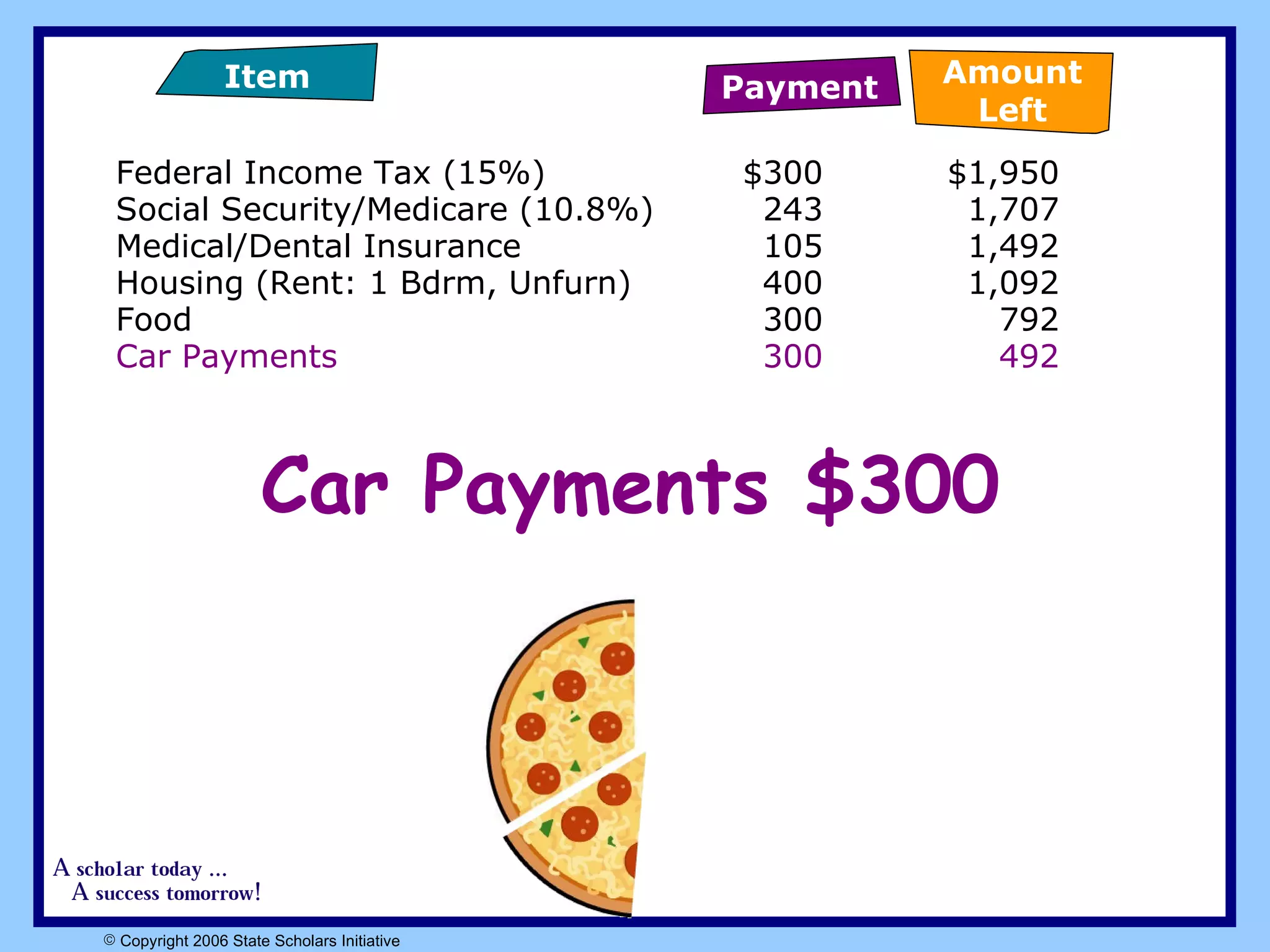
Federal Income Tax (15%)  $300 $1,950 Social Security/Medicare (10.8%)  243 1,707 Medical/Dental Insurance   105 1,492 Housing (Rent: 1 Bdrm, Unfurn) 400 1,092 Food  300 792 Car Payments 300 492 Car Payments $300 Payment Item Amount Left
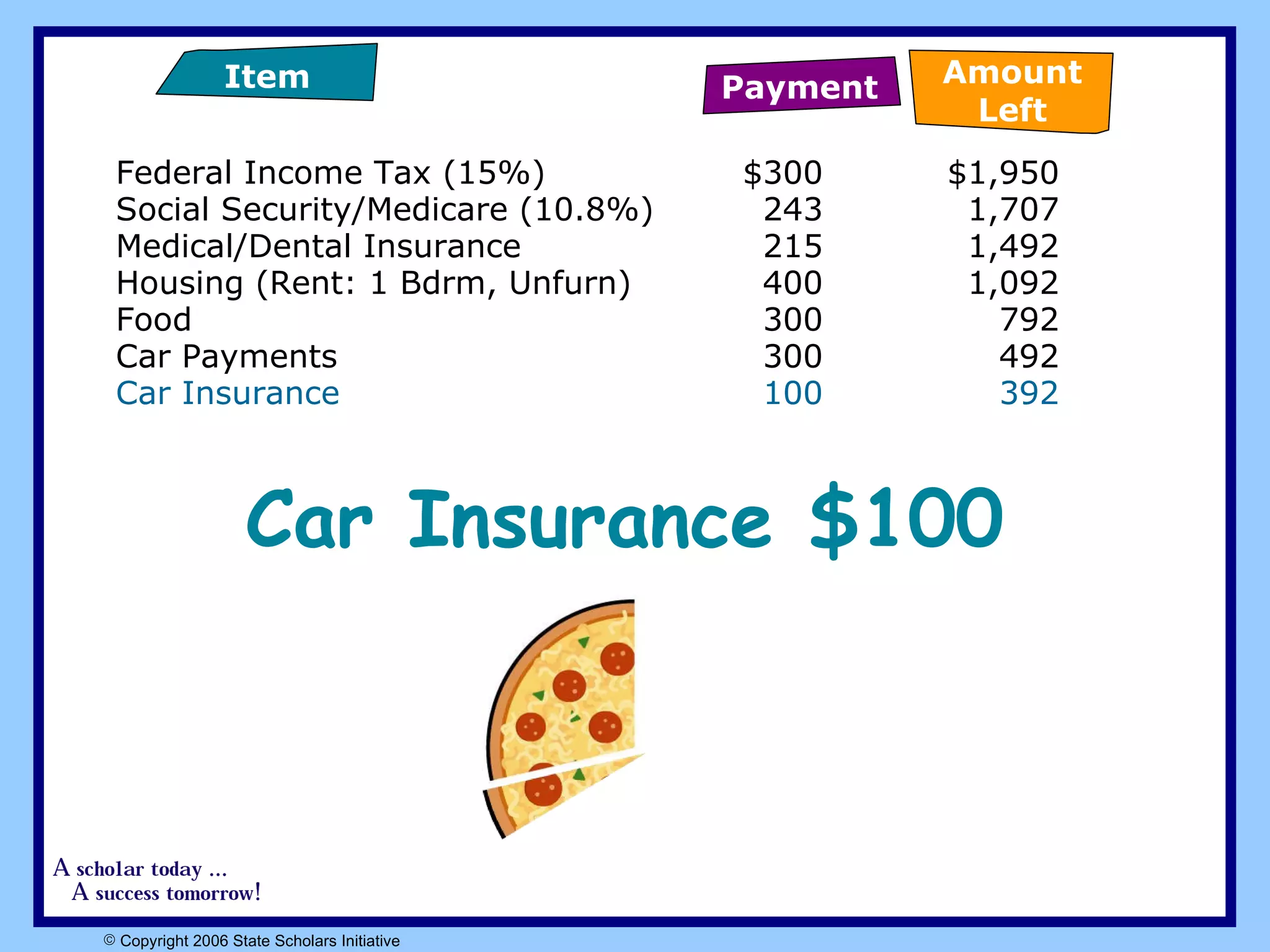
Federal Income Tax (15%)  $300 $1,950 Social Security/Medicare (10.8%)  243 1,707 Medical/Dental Insurance   215 1,492 Housing (Rent: 1 Bdrm, Unfurn) 400 1,092 Food  300 792 Car Payments 300 492 Car Insurance 100 392 Car Insurance $100 Payment Item Amount Left
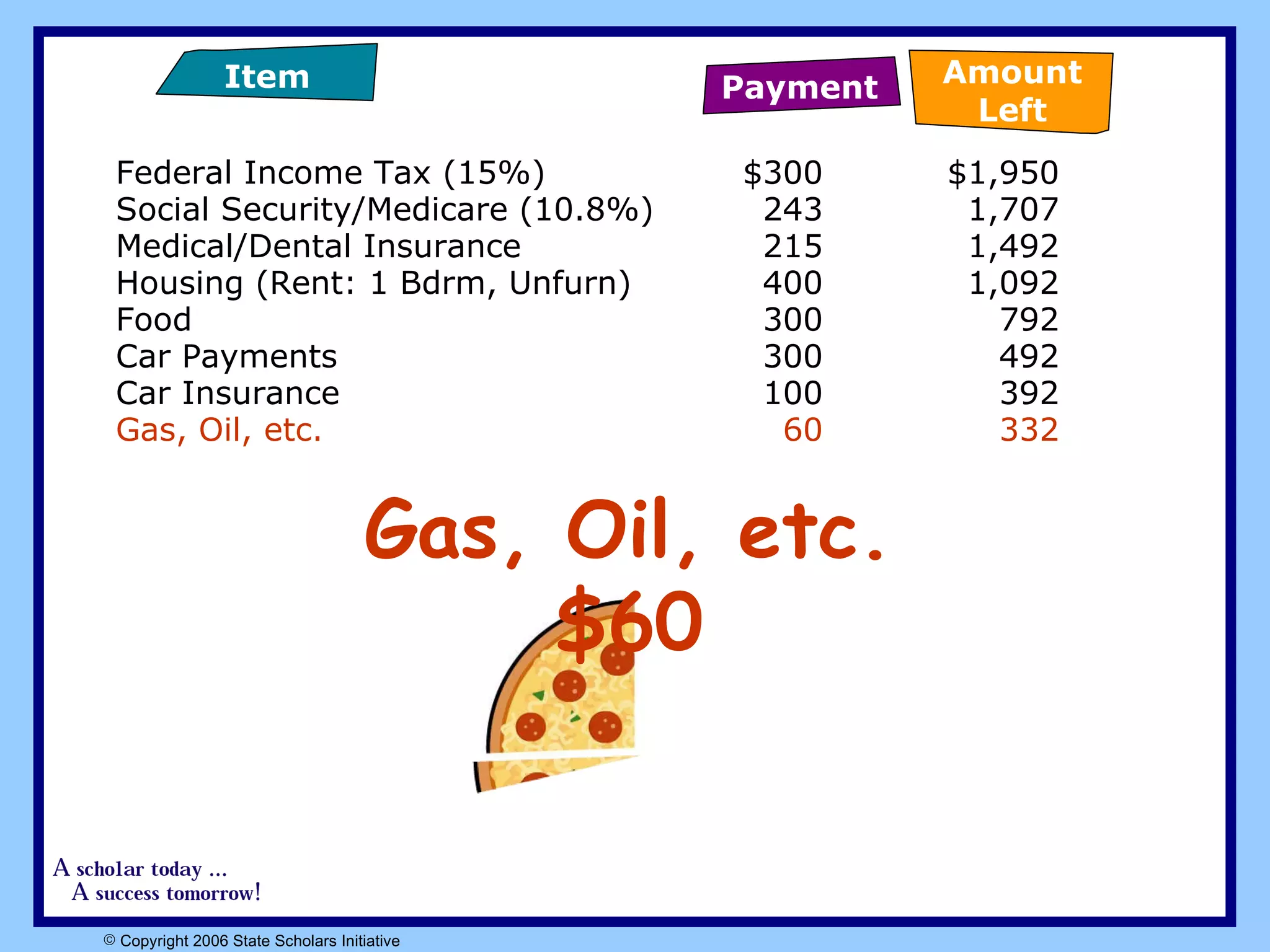
Federal Income Tax (15%)  $300 $1,950 Social Security/Medicare (10.8%)  243 1,707 Medical/Dental Insurance   215 1,492 Housing (Rent: 1 Bdrm, Unfurn) 400 1,092 Food  300 792 Car Payments 300 492 Car Insurance 100 392 Gas, Oil, etc. 60 332 Gas, Oil, etc. $60 Payment Item Amount Left
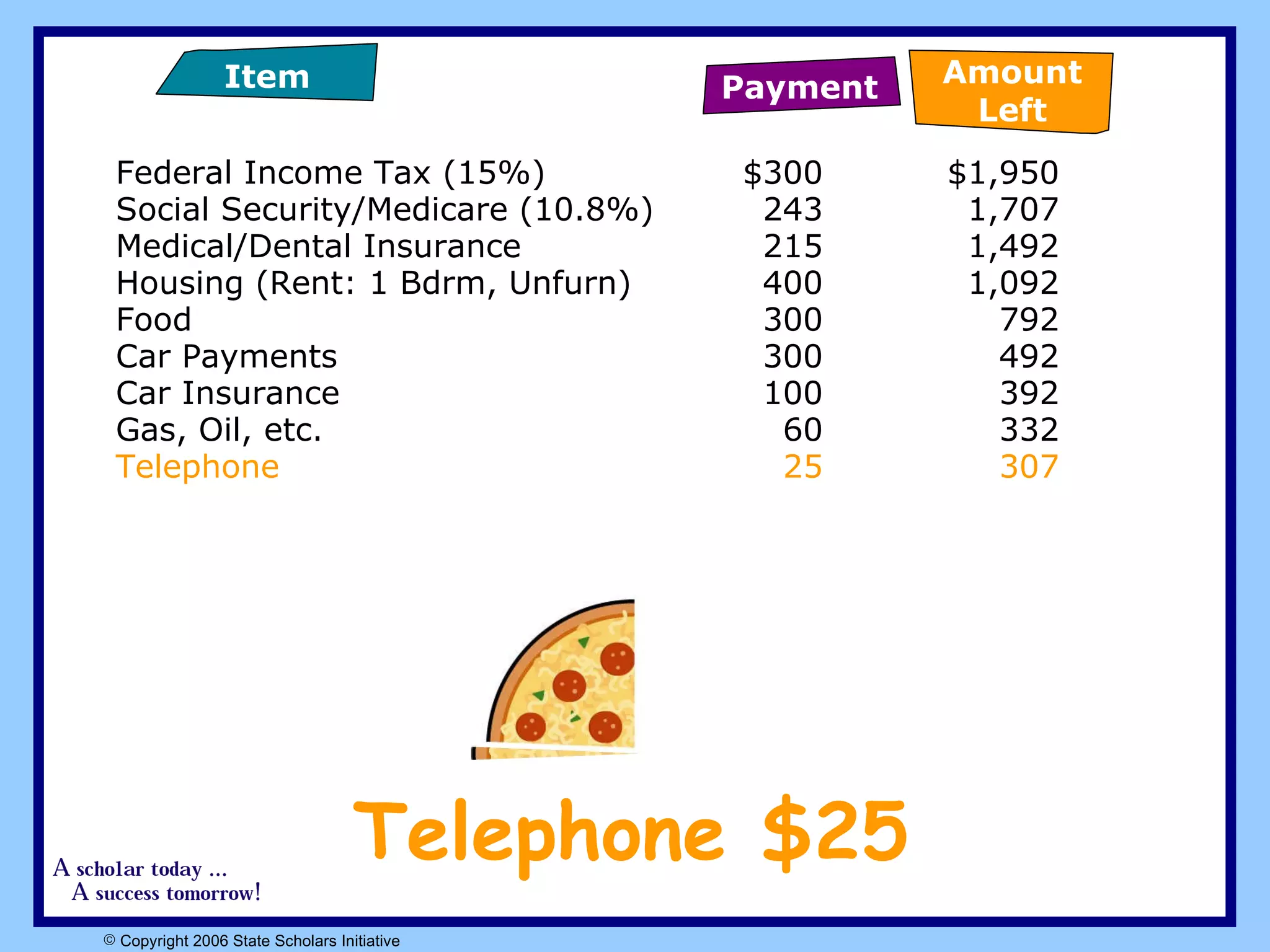
Federal Income Tax (15%)  $300 $1,950 Social Security/Medicare (10.8%)  243 1,707 Medical/Dental Insurance   215 1,492 Housing (Rent: 1 Bdrm, Unfurn) 400 1,092 Food  300 792 Car Payments 300 492 Car Insurance 100 392 Gas, Oil, etc. 60 332 Telephone 25 307 Telephone $25 Payment Item Amount Left
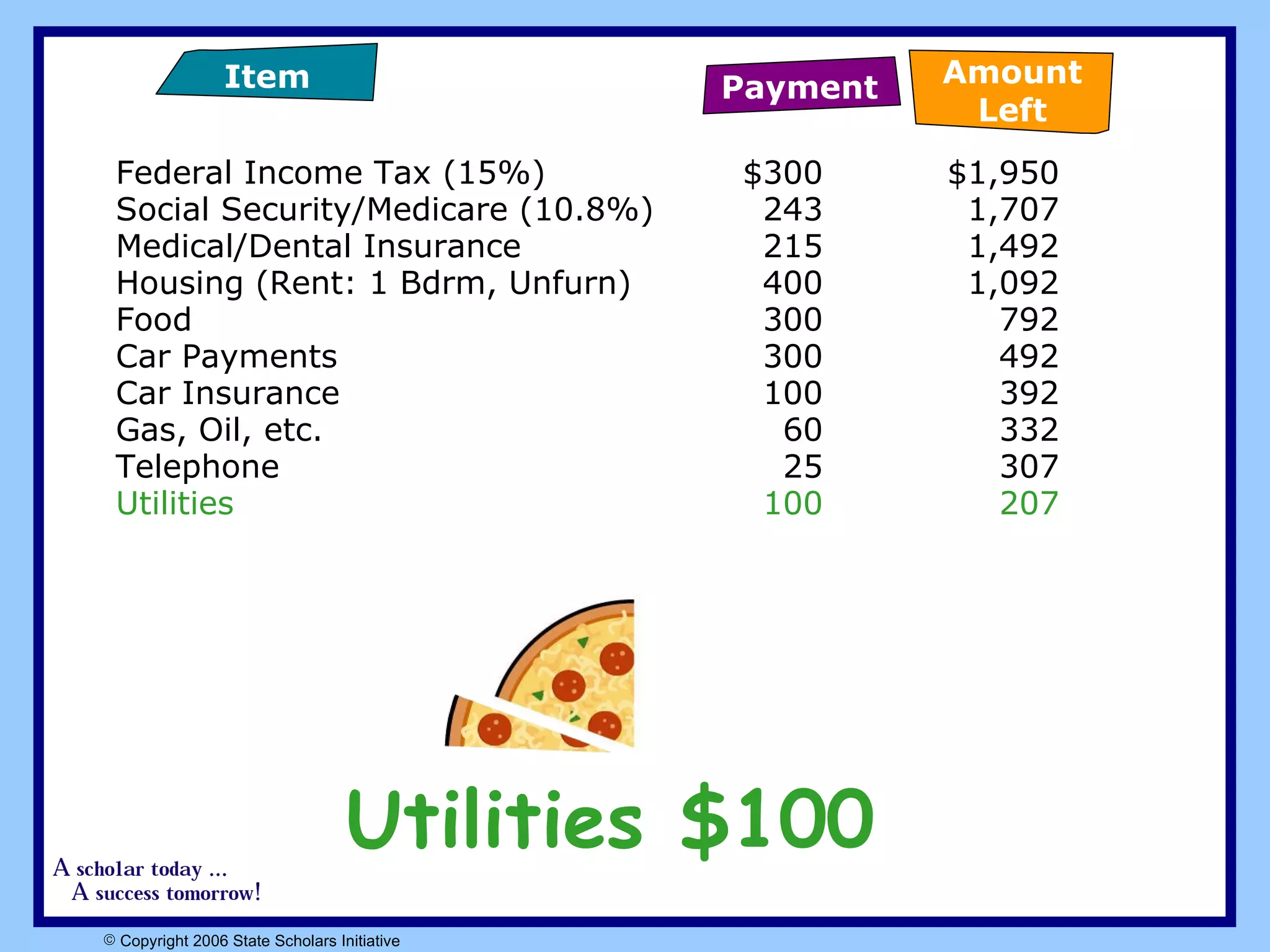
Federal Income Tax (15%)  $300 $1,950 Social Security/Medicare (10.8%)  243 1,707 Medical/Dental Insurance   215 1,492 Housing (Rent: 1 Bdrm, Unfurn) 400 1,092 Food  300 792 Car Payments 300 492 Car Insurance 100 392 Gas, Oil, etc. 60 332 Telephone 25 307 Utilities 100 207 Utilities $100 Payment Item Amount Left
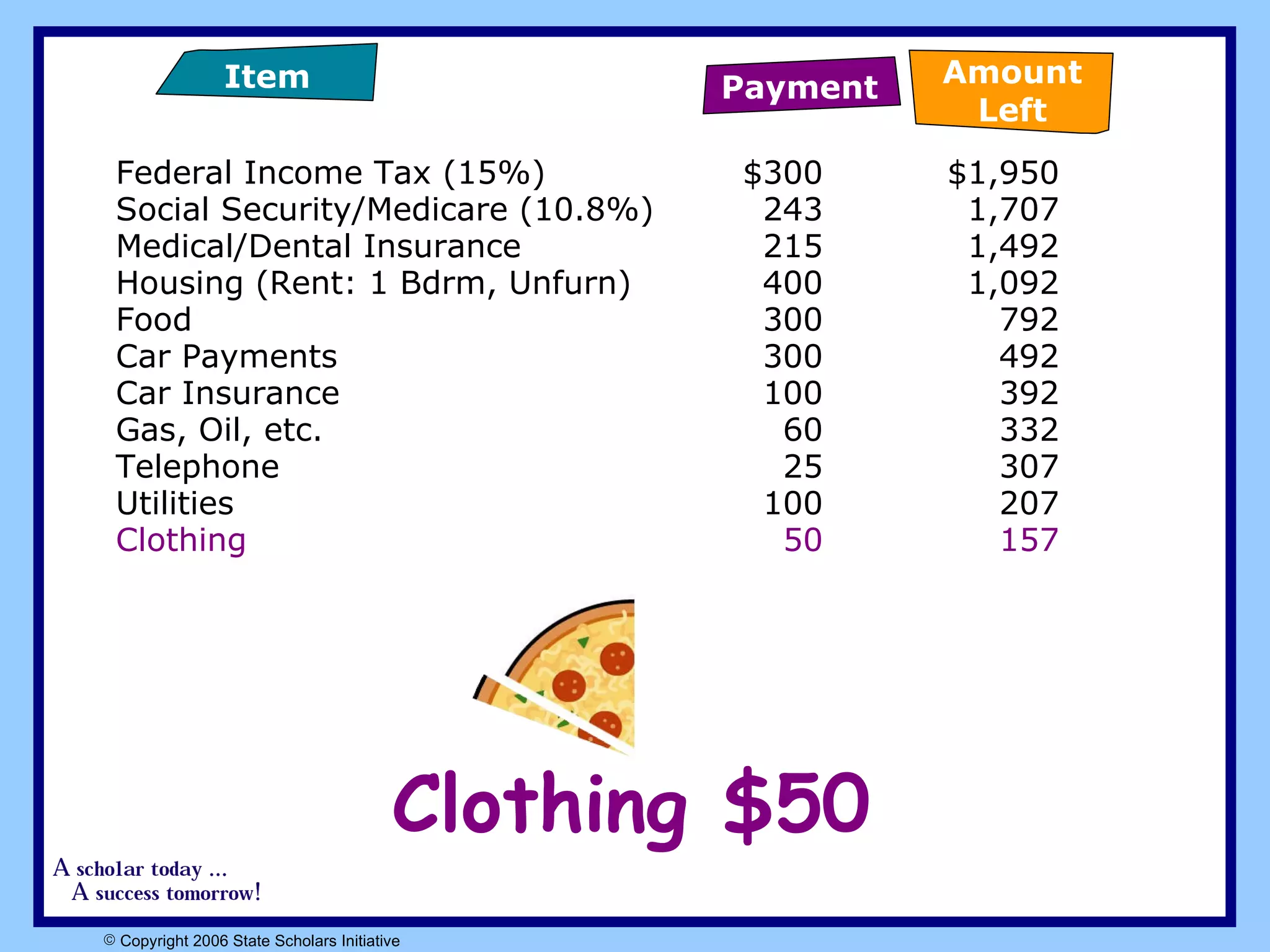
Federal Income Tax (15%)  $300 $1,950 Social Security/Medicare (10.8%)  243 1,707 Medical/Dental Insurance   215 1,492 Housing (Rent: 1 Bdrm, Unfurn) 400 1,092 Food  300 792 Car Payments 300 492 Car Insurance 100 392 Gas, Oil, etc. 60 332 Telephone 25 307 Utilities 100 207 Clothing 50 157 Clothing $50 Payment Item Amount Left
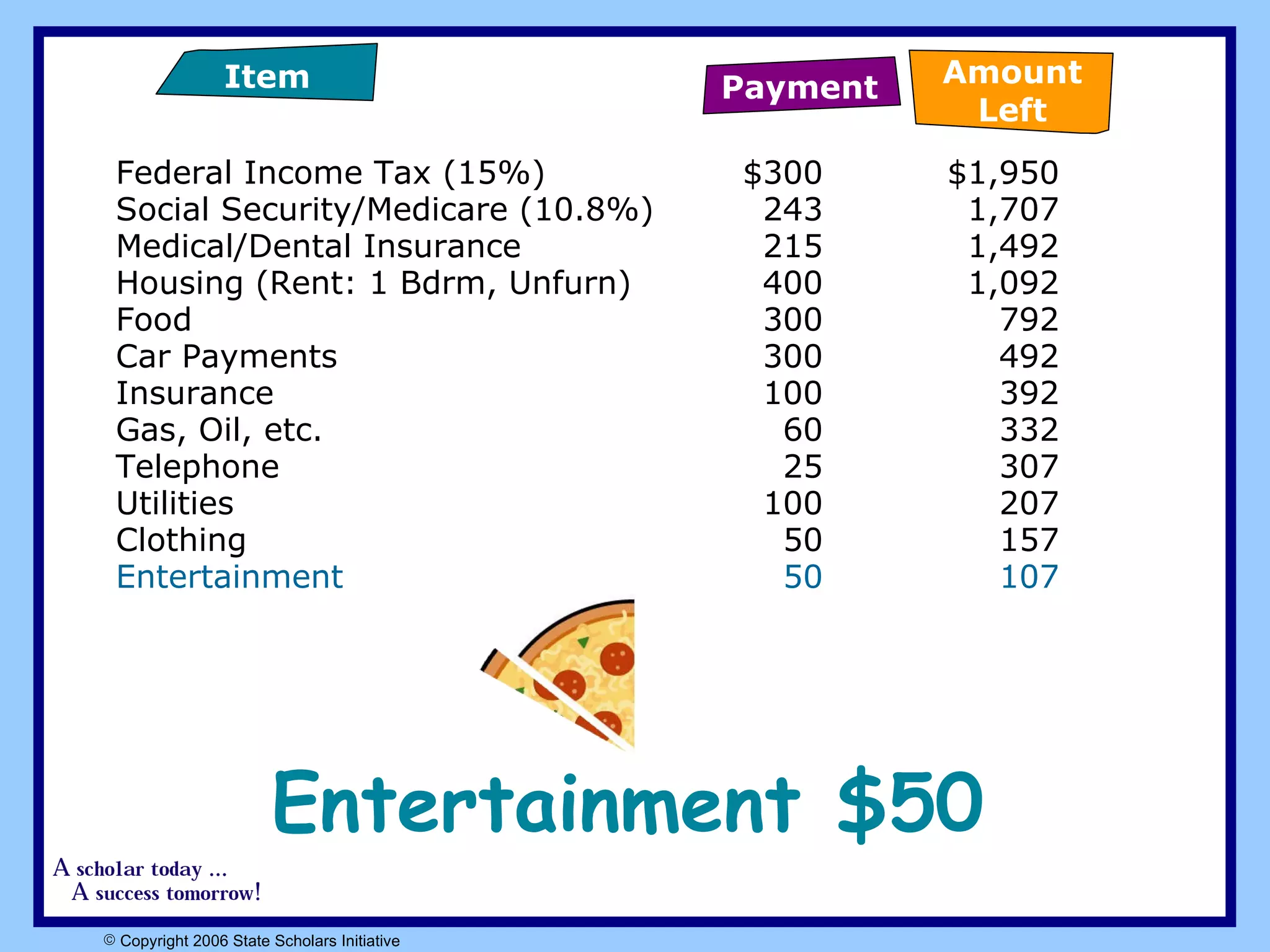
Federal Income Tax (15%)  $300 $1,950 Social Security/Medicare (10.8%)  243 1,707 Medical/Dental Insurance   215 1,492 Housing (Rent: 1 Bdrm, Unfurn) 400 1,092 Food  300 792 Car Payments 300 492 Insurance 100 392 Gas, Oil, etc. 60 332 Telephone 25 307 Utilities 100 207 Clothing 50 157 Entertainment 50 107 Entertainment $50 Payment Item Amount Left
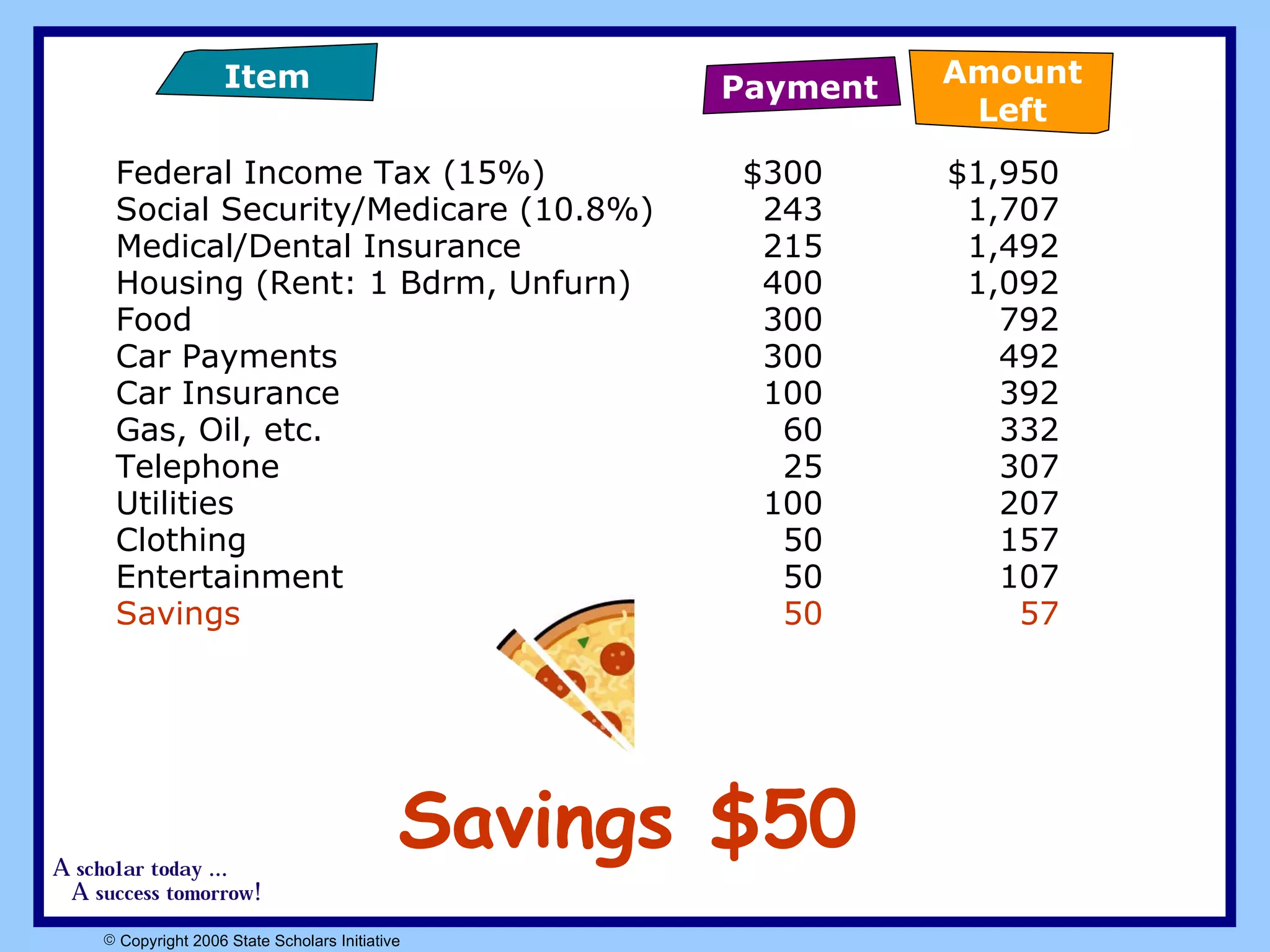
Federal Income Tax (15%)  $300 $1,950 Social Security/Medicare (10.8%)  243 1,707 Medical/Dental Insurance   215 1,492 Housing (Rent: 1 Bdrm, Unfurn) 400 1,092 Food  300 792 Car Payments 300 492 Car Insurance 100 392 Gas, Oil, etc. 60 332 Telephone 25 307 Utilities 100 207 Clothing 50 157 Entertainment 50 107 Savings 50 57 Savings $50 Payment Item Amount Left
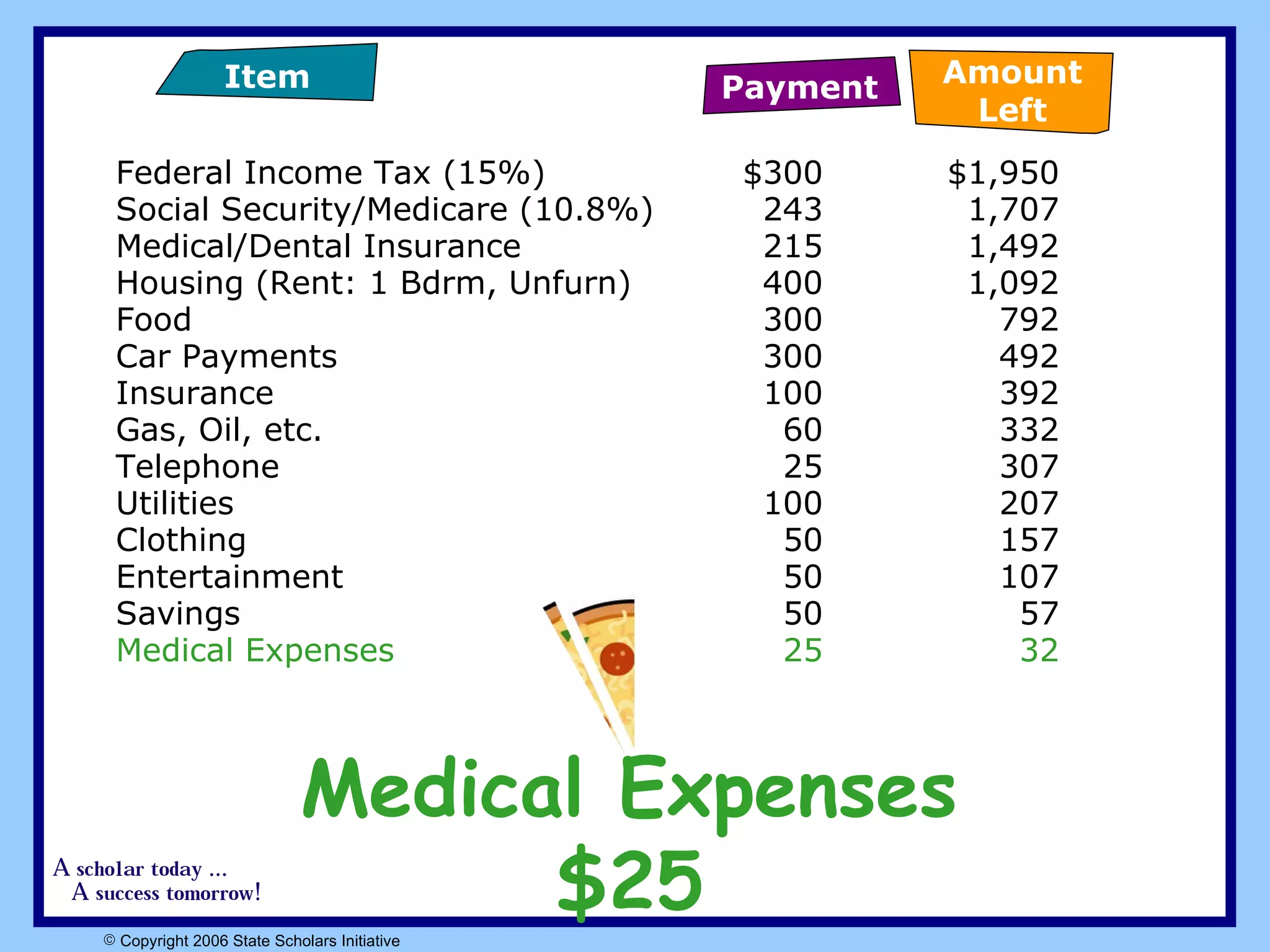
Federal Income Tax (15%)  $300 $1,950 Social Security/Medicare (10.8%)  243 1,707 Medical/Dental Insurance   215 1,492 Housing (Rent: 1 Bdrm, Unfurn) 400 1,092 Food  300 792 Car Payments 300 492 Insurance 100 392 Gas, Oil, etc. 60 332 Telephone 25 307 Utilities 100 207 Clothing 50 157 Entertainment 50 107 Savings 50 57 Medical Expenses 25 32 Medical Expenses $25 Payment Item Amount Left
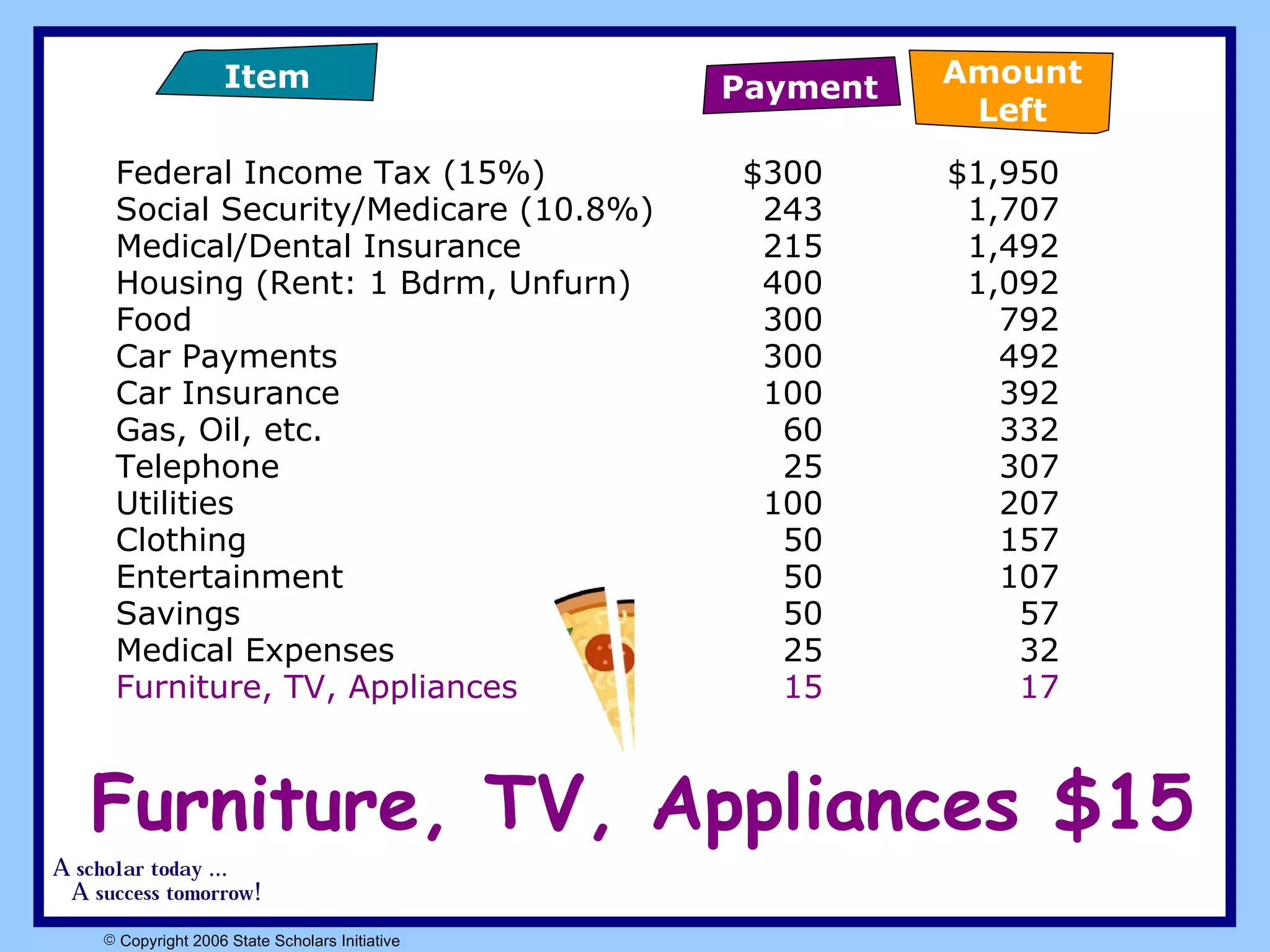
Federal Income Tax (15%)  $300 $1,950 Social Security/Medicare (10.8%)  243 1,707 Medical/Dental Insurance   215 1,492 Housing (Rent: 1 Bdrm, Unfurn) 400 1,092 Food  300 792 Car Payments 300 492 Car Insurance 100 392 Gas, Oil, etc. 60 332 Telephone 25 307 Utilities 100 207 Clothing 50 157 Entertainment 50 107 Savings 50 57 Medical Expenses 25 32 Furniture, TV, Appliances 15 17 Furniture, TV, Appliances $15 Payment Item Amount Left
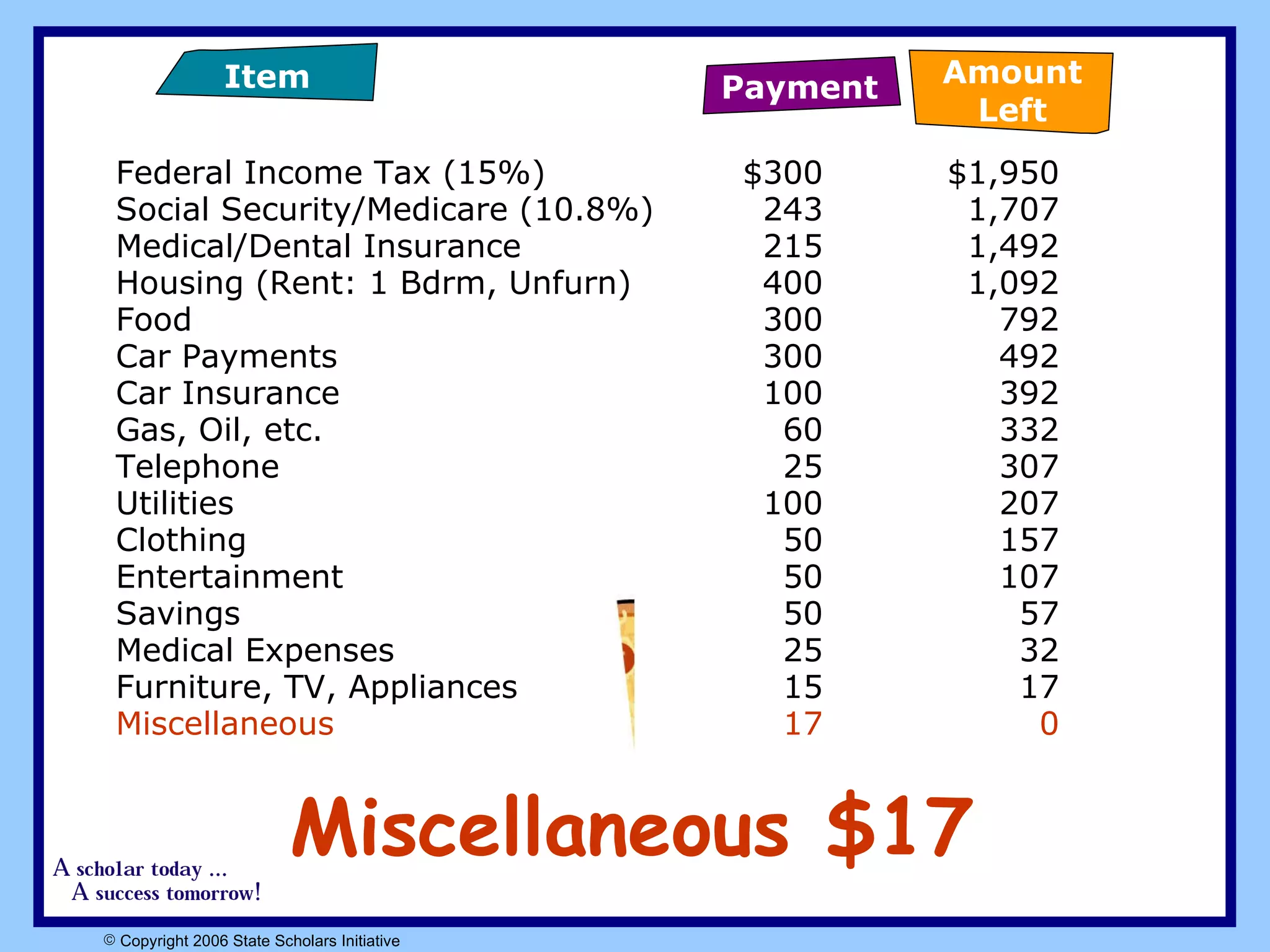
Federal Income Tax (15%)  $300 $1,950 Social Security/Medicare (10.8%)  243 1,707 Medical/Dental Insurance   215 1,492 Housing (Rent: 1 Bdrm, Unfurn) 400 1,092 Food  300 792 Car Payments 300 492 Car Insurance 100 392 Gas, Oil, etc. 60 332 Telephone 25 307 Utilities 100 207 Clothing 50 157 Entertainment 50 107 Savings 50 57 Medical Expenses 25 32 Furniture, TV, Appliances 15 17 Miscellaneous 17 0 Miscellaneous $17 Payment Item Amount Left
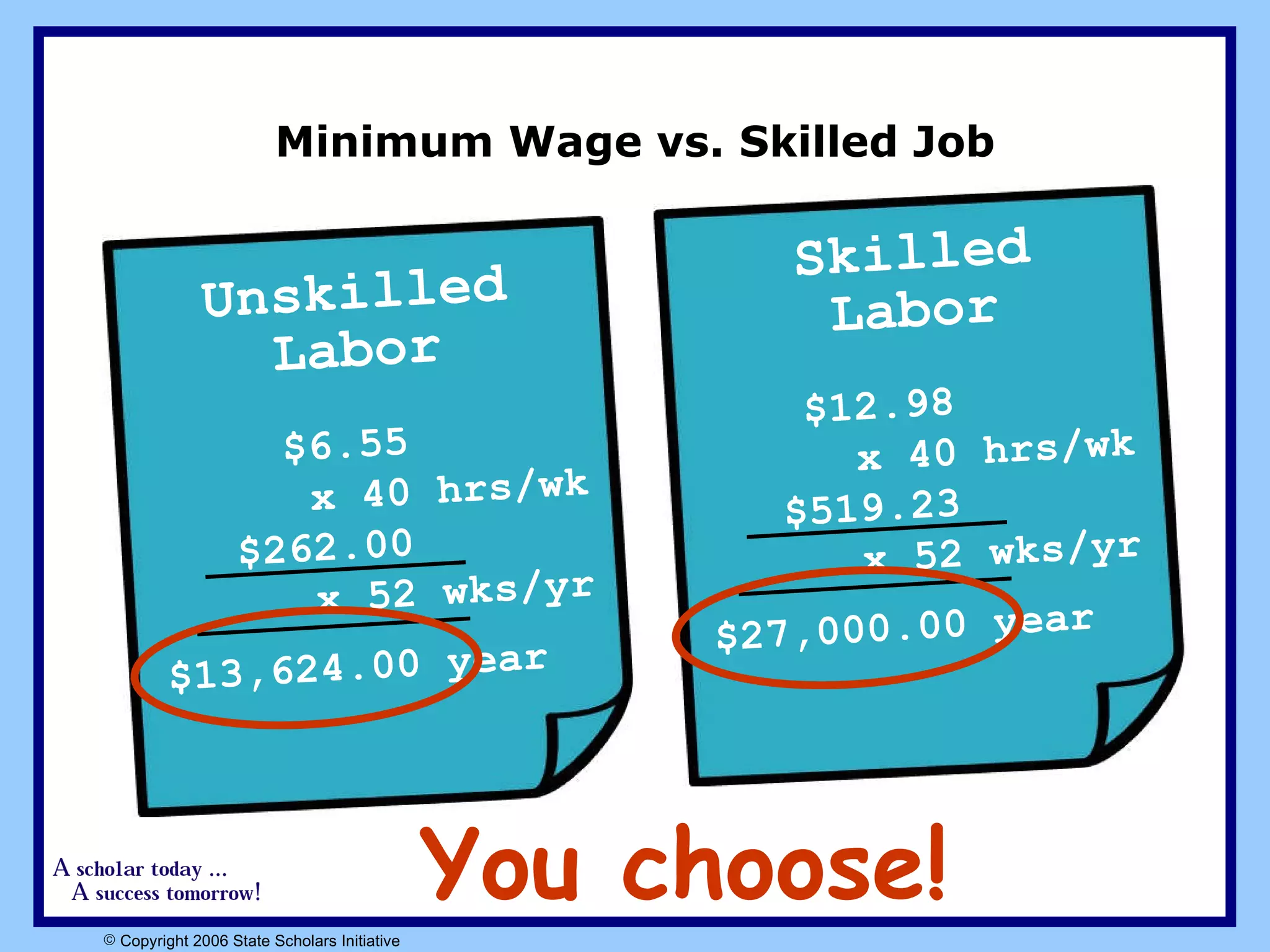
Minimum Wage vs. Skilled Job $6.55 x 40 hrs/wk $262.00 x 52 wks/yr $13,624.00 year Unskilled Labor You choose! $12.98 x 40 hrs/wk $519.23 x 52 wks/yr $27,000.00 year Skilled Labor
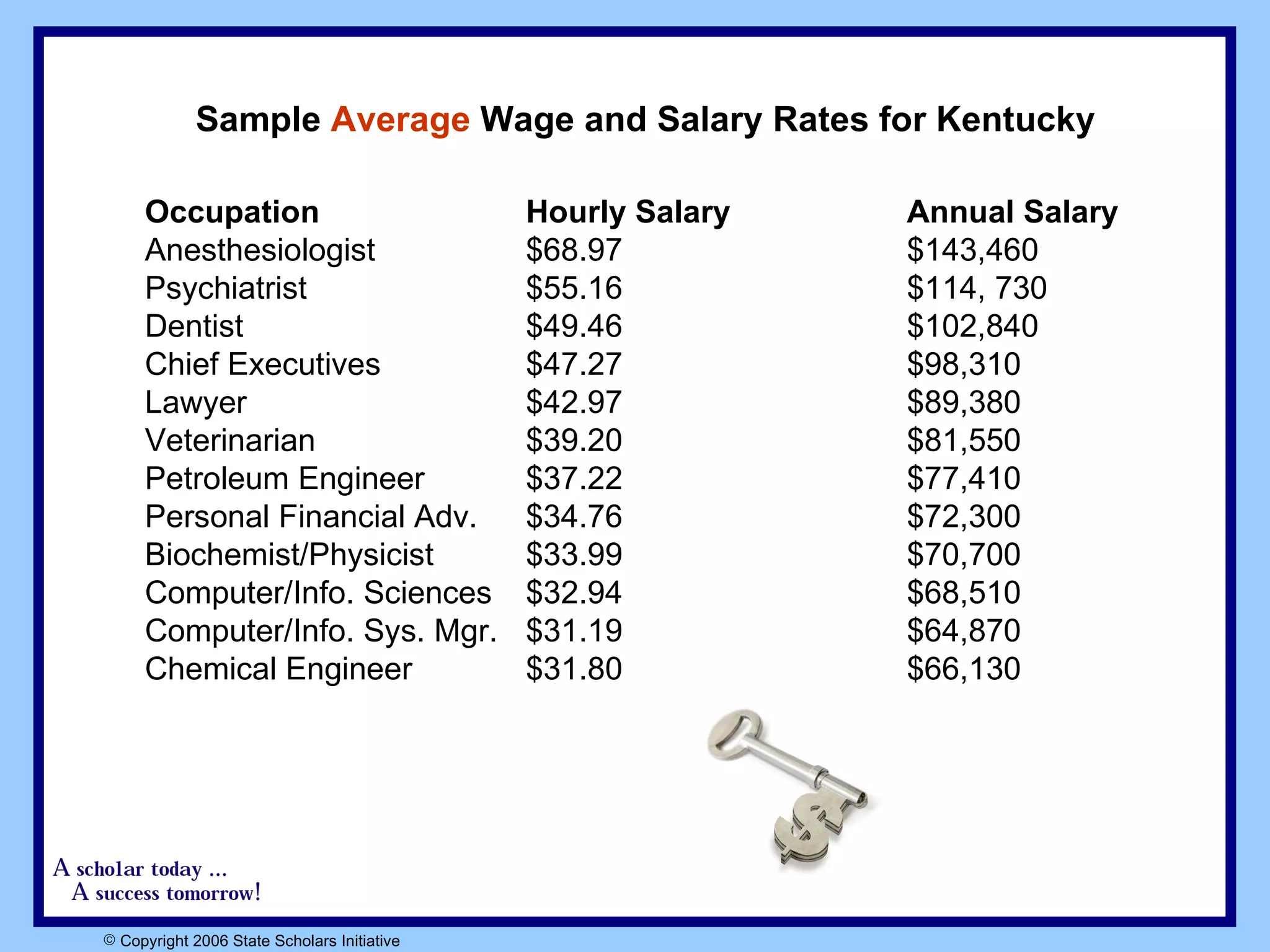
Sample  Average  Wage and Salary Rates for Kentucky Occupation Hourly Salary Annual Salary Anesthesiologist $68.97 $143,460 Psychiatrist $55.16 $114, 730 Dentist $49.46 $102,840 Chief Executives $47.27 $98,310 Lawyer $42.97 $89,380 Veterinarian $39.20 $81,550 Petroleum Engineer $37.22 $77,410 Personal Financial Adv. $34.76 $72,300 Biochemist/Physicist $33.99 $70,700 Computer/Info. Sciences $32.94 $68,510 Computer/Info. Sys. Mgr. $31.19 $64,870 Chemical Engineer $31.80 $66,130
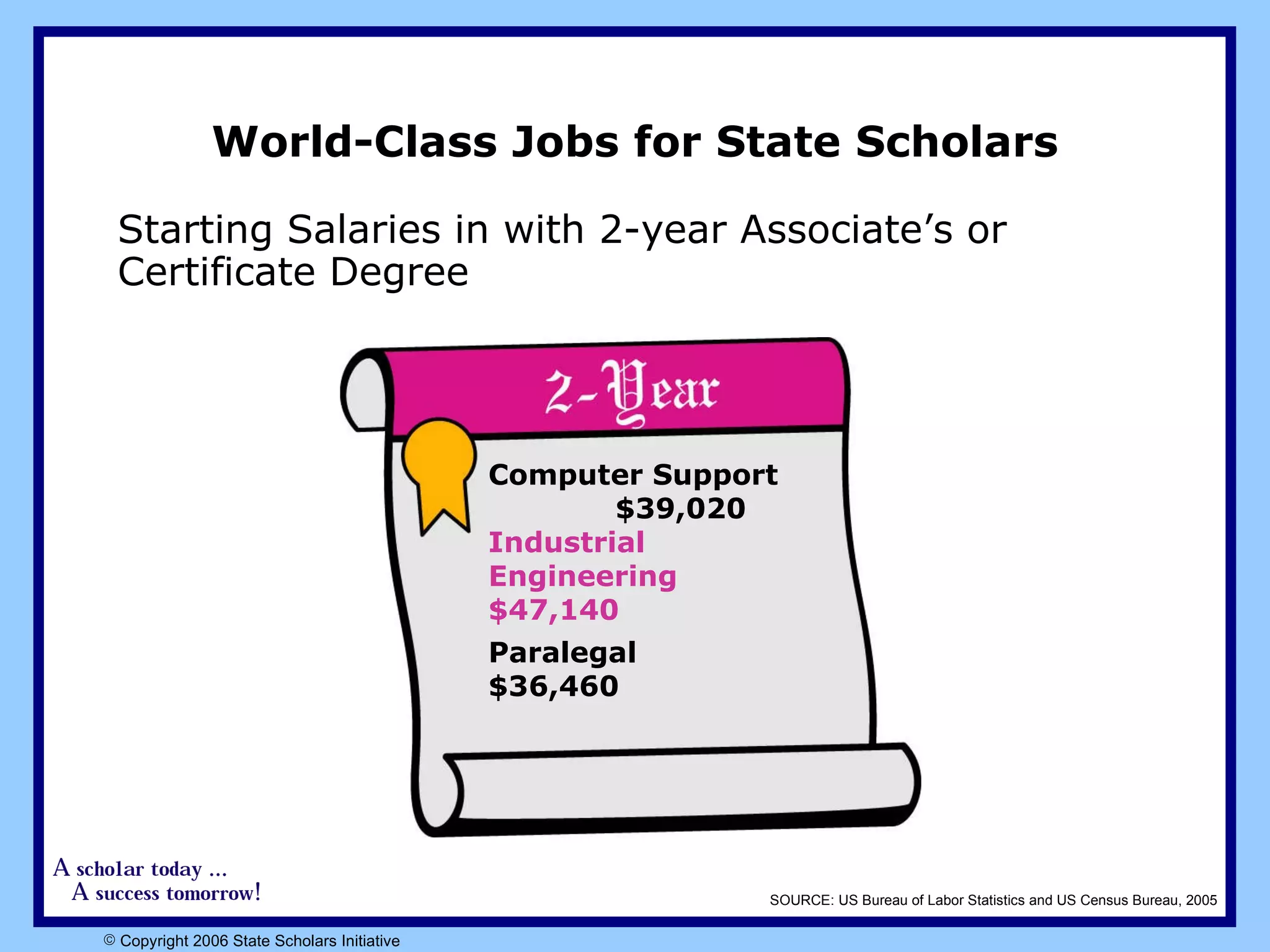
World-Class Jobs for State Scholars Starting Salaries in with 2-year Associate’s or Certificate Degree Computer Support  $39,020   Industrial Engineering  $47,140   Paralegal $36,460   SOURCE: US Bureau of Labor Statistics and US Census Bureau, 2005
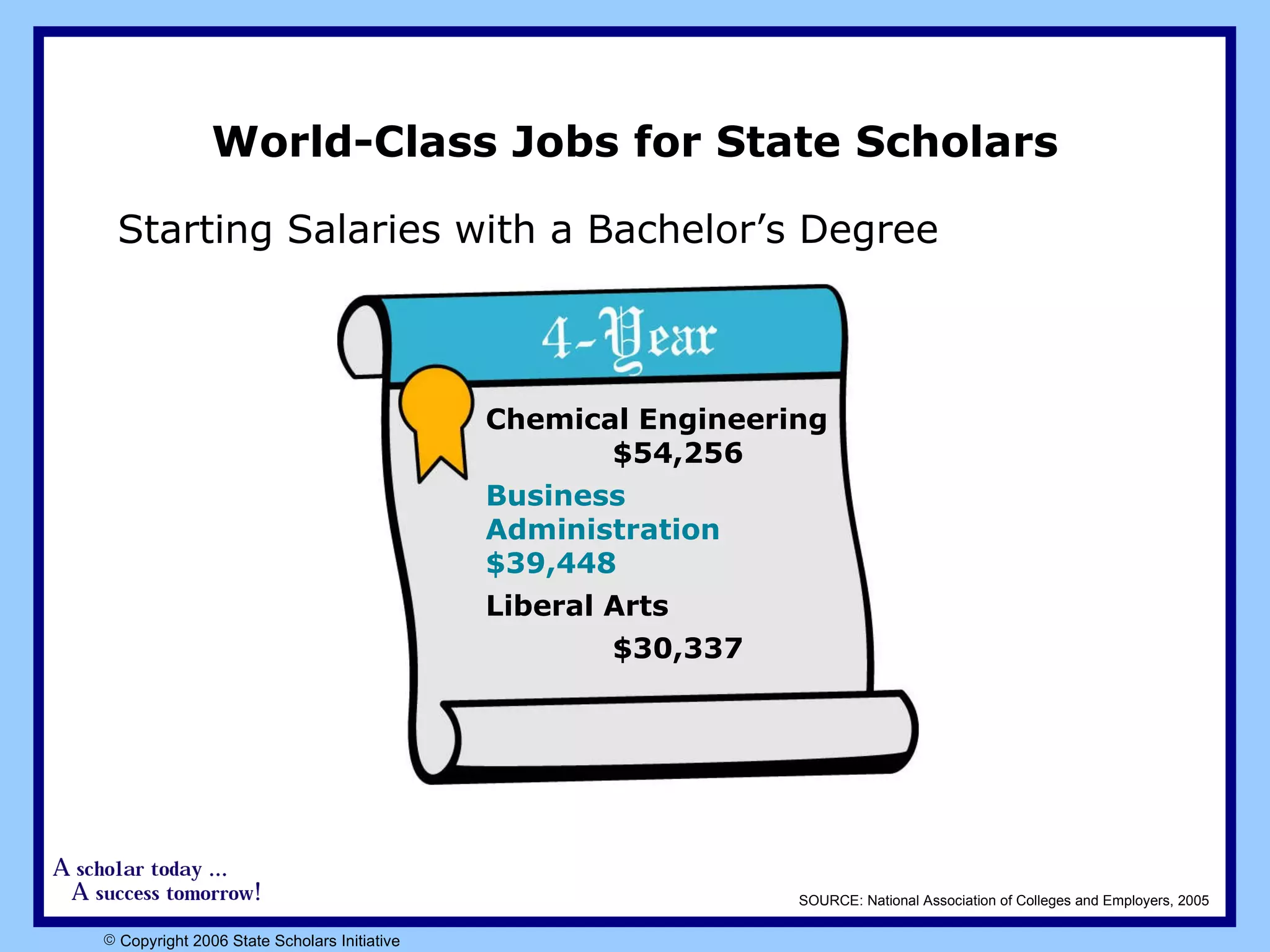
World-Class Jobs for State Scholars Starting Salaries with a Bachelor’s Degree Chemical Engineering  $54,256 Business Administration  $39,448 Liberal Arts $30,337 SOURCE: National Association of Colleges and Employers, 2005
Time To Prepare!  The  next four years  are your best chance to determine your future.  No matter what your past performance has been, you have a  brand new opportunity  to become a better student and succeed in life!  Become a Kentucky Scholar!  For more information, visit these helpful websites:   www.wiche.org Western Interstate Commission on Higher Ed http://stats.bls.gov/home.htm   Bureau of Labor Statistics www.bankrate.com   Bank rate info & payment calculators
It’s YOUR choice...
 

Student presentation spring 2009

  • 1.
    Preparing Today’s Studentsfor Tomorrow’s World
  • 2.
  • 3.
  • 4.
    Hours an AverageAmerican Student Spends in School 5:00 4:00 3:00 2:00 9:00 1:00 12:00 11:00 10:00 8:00 Sun. Sat. Fri. Thur. Wed. Tues. Mon.
  • 5.
    Typical Japanese Student School Day/Week Two-hour home study time Sun.–Thurs. School year of 225 days vs. our 180 PLUS 5:00 4:00 3:00 2:00 9:00 1:00 12:00 11:00 10:00 8:00 Sun. Sat. Fri. Thur. Wed. Tues. Mon.
  • 6.
    Prepared Applicants Getthe Jobs “ About 60% of applicants are poorly prepared for a typical entry-level job because they simply lack the necessary basic education skills required in today’s labor market.” SOURCE: 2005 Skills Gap Report – Deloitte, 2005 25 Applicants – 15 Do Not Qualify 10 Qualify
  • 7.
    Life-span Analysis Highschool is the most critical period in your life WORKING LIFE OF 48 YEARS HIGH SCHOOL 0–14 14–18 22–70 70–90 WHY? Keep up to date in current job/vocation Retrain for newly created jobs Have flexibility to switch careers Prepare Now! For Life-long Learning
  • 8.
    Business & IndustryNeed… Solid academic preparation Good communication skills (verbal and written) Sound science and math foundation Ability to think critically and make decisions Computer-literacy Team-oriented employees
  • 9.
    State Scholars HaveMore Options in Their Chosen Career Pathway 4-Year College Workforce (Civilian & Military) Community or Technical College A Sample Scholars Course of Study 12th 11 th 10 th 9 th 2 years of the same Foreign Language U.S.Govt./ Economics U.S. History World History World Geography Other Science Physics Chemistry I Biology I Pre-Calculus Algebra II Geometry Algebra I English IV English III English II English I
  • 10.
    IMAGINE your job$27,000/year $2,250/month Tom Mortensen, Postsecondary Opportunity, No. 89 , November 1999
  • 11.
    Federal Income Tax(15%) $300 Federal Income Tax (15%) $300 $1,950 Payment Item Amount Left
  • 12.
    Federal Income Tax(15%) $300 $1,950 Social Security/Medicare (10.8%) 243 1,707 Social Security/Medicare (10.8%) $243 Payment Item Amount Left
  • 13.
    Federal Income Tax(15%) $300 $1,950 Social Security/Medicare (10.8%) 243 1,707 Medical/Dental Insurance 215 1,492 Payment Item Amount Left Medical/Dental Insurance $215
  • 14.
    Federal Income Tax(15%) $300 $1,950 Social Security/Medicare (10.8%) 243 1,707 Medical/Dental Insurance 215 1,492 Housing (Rent: 1 Bdrm, Unfurn) 400 1,092 Housing (Rent: 1 bedroom/1 bathroom) $400 Payment Item Amount Left
  • 15.
    Federal Income Tax(15%) $300 $1,950 Social Security/Medicare (10.8%) 243 1,707 Medical/Dental Insurance 215 1,492 Housing (Rent: 1 Bdrm, Unfurn) 400 1,092 Food 300 792 Food $300 Payment Item Amount Left
  • 16.
    Federal Income Tax(15%) $300 $1,950 Social Security/Medicare (10.8%) 243 1,707 Medical/Dental Insurance 105 1,492 Housing (Rent: 1 Bdrm, Unfurn) 400 1,092 Food 300 792 Car Payments 300 492 Car Payments $300 Payment Item Amount Left
  • 17.
    Federal Income Tax(15%) $300 $1,950 Social Security/Medicare (10.8%) 243 1,707 Medical/Dental Insurance 215 1,492 Housing (Rent: 1 Bdrm, Unfurn) 400 1,092 Food 300 792 Car Payments 300 492 Car Insurance 100 392 Car Insurance $100 Payment Item Amount Left
  • 18.
    Federal Income Tax(15%) $300 $1,950 Social Security/Medicare (10.8%) 243 1,707 Medical/Dental Insurance 215 1,492 Housing (Rent: 1 Bdrm, Unfurn) 400 1,092 Food 300 792 Car Payments 300 492 Car Insurance 100 392 Gas, Oil, etc. 60 332 Gas, Oil, etc. $60 Payment Item Amount Left
  • 19.
    Federal Income Tax(15%) $300 $1,950 Social Security/Medicare (10.8%) 243 1,707 Medical/Dental Insurance 215 1,492 Housing (Rent: 1 Bdrm, Unfurn) 400 1,092 Food 300 792 Car Payments 300 492 Car Insurance 100 392 Gas, Oil, etc. 60 332 Telephone 25 307 Telephone $25 Payment Item Amount Left
  • 20.
    Federal Income Tax(15%) $300 $1,950 Social Security/Medicare (10.8%) 243 1,707 Medical/Dental Insurance 215 1,492 Housing (Rent: 1 Bdrm, Unfurn) 400 1,092 Food 300 792 Car Payments 300 492 Car Insurance 100 392 Gas, Oil, etc. 60 332 Telephone 25 307 Utilities 100 207 Utilities $100 Payment Item Amount Left
  • 21.
    Federal Income Tax(15%) $300 $1,950 Social Security/Medicare (10.8%) 243 1,707 Medical/Dental Insurance 215 1,492 Housing (Rent: 1 Bdrm, Unfurn) 400 1,092 Food 300 792 Car Payments 300 492 Car Insurance 100 392 Gas, Oil, etc. 60 332 Telephone 25 307 Utilities 100 207 Clothing 50 157 Clothing $50 Payment Item Amount Left
  • 22.
    Federal Income Tax(15%) $300 $1,950 Social Security/Medicare (10.8%) 243 1,707 Medical/Dental Insurance 215 1,492 Housing (Rent: 1 Bdrm, Unfurn) 400 1,092 Food 300 792 Car Payments 300 492 Insurance 100 392 Gas, Oil, etc. 60 332 Telephone 25 307 Utilities 100 207 Clothing 50 157 Entertainment 50 107 Entertainment $50 Payment Item Amount Left
  • 23.
    Federal Income Tax(15%) $300 $1,950 Social Security/Medicare (10.8%) 243 1,707 Medical/Dental Insurance 215 1,492 Housing (Rent: 1 Bdrm, Unfurn) 400 1,092 Food 300 792 Car Payments 300 492 Car Insurance 100 392 Gas, Oil, etc. 60 332 Telephone 25 307 Utilities 100 207 Clothing 50 157 Entertainment 50 107 Savings 50 57 Savings $50 Payment Item Amount Left
  • 24.
    Federal Income Tax(15%) $300 $1,950 Social Security/Medicare (10.8%) 243 1,707 Medical/Dental Insurance 215 1,492 Housing (Rent: 1 Bdrm, Unfurn) 400 1,092 Food 300 792 Car Payments 300 492 Insurance 100 392 Gas, Oil, etc. 60 332 Telephone 25 307 Utilities 100 207 Clothing 50 157 Entertainment 50 107 Savings 50 57 Medical Expenses 25 32 Medical Expenses $25 Payment Item Amount Left
  • 25.
    Federal Income Tax(15%) $300 $1,950 Social Security/Medicare (10.8%) 243 1,707 Medical/Dental Insurance 215 1,492 Housing (Rent: 1 Bdrm, Unfurn) 400 1,092 Food 300 792 Car Payments 300 492 Car Insurance 100 392 Gas, Oil, etc. 60 332 Telephone 25 307 Utilities 100 207 Clothing 50 157 Entertainment 50 107 Savings 50 57 Medical Expenses 25 32 Furniture, TV, Appliances 15 17 Furniture, TV, Appliances $15 Payment Item Amount Left
  • 26.
    Federal Income Tax(15%) $300 $1,950 Social Security/Medicare (10.8%) 243 1,707 Medical/Dental Insurance 215 1,492 Housing (Rent: 1 Bdrm, Unfurn) 400 1,092 Food 300 792 Car Payments 300 492 Car Insurance 100 392 Gas, Oil, etc. 60 332 Telephone 25 307 Utilities 100 207 Clothing 50 157 Entertainment 50 107 Savings 50 57 Medical Expenses 25 32 Furniture, TV, Appliances 15 17 Miscellaneous 17 0 Miscellaneous $17 Payment Item Amount Left
  • 27.
    Minimum Wage vs.Skilled Job $6.55 x 40 hrs/wk $262.00 x 52 wks/yr $13,624.00 year Unskilled Labor You choose! $12.98 x 40 hrs/wk $519.23 x 52 wks/yr $27,000.00 year Skilled Labor
  • 28.
    Sample Average Wage and Salary Rates for Kentucky Occupation Hourly Salary Annual Salary Anesthesiologist $68.97 $143,460 Psychiatrist $55.16 $114, 730 Dentist $49.46 $102,840 Chief Executives $47.27 $98,310 Lawyer $42.97 $89,380 Veterinarian $39.20 $81,550 Petroleum Engineer $37.22 $77,410 Personal Financial Adv. $34.76 $72,300 Biochemist/Physicist $33.99 $70,700 Computer/Info. Sciences $32.94 $68,510 Computer/Info. Sys. Mgr. $31.19 $64,870 Chemical Engineer $31.80 $66,130
  • 29.
    World-Class Jobs forState Scholars Starting Salaries in with 2-year Associate’s or Certificate Degree Computer Support $39,020 Industrial Engineering $47,140 Paralegal $36,460 SOURCE: US Bureau of Labor Statistics and US Census Bureau, 2005
  • 30.
    World-Class Jobs forState Scholars Starting Salaries with a Bachelor’s Degree Chemical Engineering $54,256 Business Administration $39,448 Liberal Arts $30,337 SOURCE: National Association of Colleges and Employers, 2005
  • 31.
    Time To Prepare! The next four years are your best chance to determine your future. No matter what your past performance has been, you have a brand new opportunity to become a better student and succeed in life! Become a Kentucky Scholar! For more information, visit these helpful websites: www.wiche.org Western Interstate Commission on Higher Ed http://stats.bls.gov/home.htm Bureau of Labor Statistics www.bankrate.com Bank rate info & payment calculators
  • 32.
  • 33.

Editor's Notes

  • #2 ICE BREAKER/OPENER: I’m here today to talk with you a bit about the future, but before we get there, tell me what do you think is the best job in the world? Why? What’s so good about that job? What kind of background or experience will you need to get that job? Will you need any schooling beyond high school? What happens if you don’t get that job….what will you do? Who will be competing with you for that job? Will it just be students in this room? INTRODUCTION OPTION: I’m here today as a representative of our community. I’m already out in the workforce and I know a bit about what you need to do right now in order to compete for tomorrow’s best jobs…like the ones you just describe. That’s what we are going to talk about. Who can tell me what experts say is the single greatest predictor of life success? The latest research suggests tells us that the courses you take, starting right now and throughout high school, will determine, to a large extent how successful you are in work or college. You have important decisions to make about the courses you will take during high school. I’d like to share some thoughts, some of my experiences with you--give you some things to think about as you make these decisions. One more question before we move on…who in this room would like to make a million dollars? If you do, pay attention because those of you in this room who are willing to go to college will make, AT LEAST, a million dollars over the course of your lifetime when compared to students who just stop after high school. Now, since we’ve been talking a bit about competition… let me ask you this
  • #3 What is Global Competition or a Global Economy? To emphasize this point, you might ask one or more of the following : Where were your clothes made? Does anyone in your family have a cell phone? Where was it manufactured? (Biggest manufacturer is Nokia, which is headquartered in Finland) What model car(s) does your family drive? Where was your car manufactured? Germany? Japan, Korea? Sweden? Note that even U.S. car manufacturers utilize many parts made in other countries ASK: Why do so many companies make their products overseas? ( Cheaper labor is a likely to be the answer…but ask if there are other reasons) Today’s employers are telling us they are having a very hard time finding qualified applicants to fill job openings. Any idea why that happens? Many employers are also telling us they are moving job operations out of our country and across the ocean because they can’t find the right employees here in the U.S. TRANSITION What is happening to lots of jobs in our world today?
  • #4 Does anyone in the room know someone who’s lost a job? Why did they lose that job? There’s a good chance that technology may have played a part. Any of you ever eat a meal at McDonald’s? If so, in the not to distant future you may find yourself placing your order in a computer, not with a person. Do your parents ever check out at the grocery in the self check-out aisle? What happened to people who used to have those jobs? In addition to increased global competition, here’s another fact of modern life. Thanks, in part, to our current economic climate, companies are streamlining operations, eliminating unnecessary workers, and cutting costs. At the same time, however, they’re looking to hire highly skilled new workers, frequently those with high tech skills. So…what’s going to happen in competition for those jobs at the top? When should you start preparing for those jobs? (Hopefully, someone will answer right now…) In order to compete for almost any job, you’ll need a strong academic foundation and the willingness to train and retrain to adapt to changing business conditions throughout your life. KEY Fact: Thanks to the role that technology is playing in our lives, 70% of jobs that may be available to you after high school have not even been invented yet. That’s why you have to be prepared!
  • #5 “ So, let’s take a look at what’s going on in school… and how we spend our time. “ How many hours does an average American student spend in school?” Classes typically run from about 8:30 a.m. to 3:30.p.m., with time for lunch, five days per week. Questions for Consideration: Is that a lot of time to spend learning? Is it enough time? Would you like to be spending more time in school?
  • #6 How does the U.S. school day compare to the hours spent by Japanese students in school? Japanese classes last from 8 a.m. to 6 p.m. on Mondays, Tuesdays and Thursdays; 8 a.m. to 5 p.m. on Wednesdays and Fridays. In addition, students have a mandatory two-hour period of home study each night. The Japanese school year lasts 225 days, compared to 180 days in much of the United States. International studies show that Japanese students score significantly higher than American students on standardized tests. Question for Consideration : Does that mean they’re smarter than you? NO! But they do have a built-in advantage because they go to school more than you do. They can study topics in more depth and sooner than most American students. So, in some ways international competition is catching up and surpassing American students. HELPFUL TIDBITS: Science starts today are in Finland, China, Canada and Japan South Korea, with one sixth of our population now graduates more engineers than the U.S. does QUESTION FOR CONSIDERATION: So, if we don’t want the U.S. to lengthen the school year to 225 days what can we do to catch up? ANSWER : We must make the best possible use of our time while we’re in school. Let’s take a look at how long that is…
  • #7 How tough is the competition? (SEE NOTE ON STUDENT PARTICIPATION) Let’s take a look. With all the change taking place, employers are having a difficult time finding enough qualified job applicants! To be eligible for higher paying jobs, you must have the necessary basic education skills. Student participation suggestion : Before the presentation starts hand 40% of the class (about 12 students out of 30) a piece of paper or note card with a red J marked in some spot. Then, before revealing the second part of this slide ask all students to stand. Then, ask all students with a red J to stand while the rest must sit down. Then say…”Congratulations – those of you standing, according to today’s statistics have earned a good job. The rest of you have not even qualified for an interview.”
  • #8 QUESTION: How many years do you spend in high school? How many years will you spend working? ANSWER: According to government projections, most of you will live to be more than 80 years of age and you will spend about 50 years in the workforce! Would you prefer to be in a job that is interesting, one that you enjoy, one for which you will be well-compensated? To do so, you need to prepare yourself now by taking tough courses, going to class every day, participating, and learning. Therefore, the next four years are the most critical time of your life as you lay the academic foundation for success after high school. You will need a positive attitude and the willingness to work to achieve your goals. From ages 18 to 22, you will have the choice of post-secondary education or going into the workforce. And throughout your life, you will need a solid academic foundation from high school to continue to learn new skills and apply your knowledge in a continually changing economy.
  • #9 We’ve just seen how competitive today’s workforce is. Tomorrow’s should be even more competitive. What skills will you need to have in order to get those good jobs? NOTE: Use examples from your own company or employer as appropriate. Employers across the country tell us you need at least these skills. Research tells us that you get these skills by taking the right kinds of classes in middle and high school. What kinds of classes? Let’s take a look!
  • #10 Right now graduation probably seems a long way off. But it’s sooner than you think. We want you to be prepared for the world outside of school by taking the right courses now. The courses listed on this slide are the building blocks of the State Scholars Course of Study. These building blocks will give you lots of options. Complete at least this course of study successfully and you can choose between a technical college or institute, community college, university or the workplace. These courses represent the basic academic courses that most public universities now require, and they will also serve you well if you decide to go into the military or into the workforce directly after high school. More and more employers and colleges are looking at the courses you take in high school, not just your grades. Remember what does research tells us is the single greatest predictor of your success after high school…is it your grades? No, it’s the courses you take – courses like these. Research also tells us that those students who take rigorous courses in high school do much better in college but those who don’t go on to college earn better pay than those who took the easy route through school.
  • #11 Let’s talk more about what life will be like after high school. In fact, let’s imagine that I am going to hire you for $27,000 ($2,250 a month) right after you graduate. Take my word for it, that’s a good salary for someone who has just finished high school and has little job experience. So let’s take a look at what life would be like with this kind of money, the “whole pizza pie.” Participation Opportunity : If your district chooses too, hand students a blank copy of the budget sheet and encourage them to follow along, making their own figures, etc… Note: Tell them this is your budget – how you are going to spend your salary The following figures are conservative. Apartment rent may be lower or higher in different areas of the state. Food budget is figured using what students think it costs to eat fast food three meals per day--usually $10/day multiplied by 30 days. Car payments are figured for a used car. (2002 Honda Civic with $75,000 miles – example) Car insurance is for liability only. Phone = local service only (no long distance, cell phone, call-waiting). Utilities include gas, electricity, water. Sometimes these are included in the rent, but then rent is higher. Students may argue $50 for clothing is too low. You can tell them they can spend more for clothing, but must cut elsewhere. Students may think they won’t have medical costs because they pay for insurance. Note this figure includes everything from headache to over-the-counter medication to insurance co-pays and prescriptions. Furniture assumes students inherit cast-offs from family and friends. Otherwise, $75 for time payments leaves their apt. practically vacant. By the end, students realize $27K will not go as far as they’d thought. ALONG THE WAY: Engage students by asking them questions as they go for certain slides: What is Social Security? What is Federal Income Tax? Does everyone have to pay it? Where do you want to live , what kind of house or apartment? Well, on our budget this is all I can afford – it’s a one bedroom efficiency – I may have to get a roommate too! How much money do you need to spend on food? Let’s figure 3 meals a day at McDonald’s…or will you eat with your folks….or can you live on Ramen noodles? What kind of car do you see yourself driving right after high school or college? How much insurance will you need to cover that more expensive car? How much do your shoes cost, your jeans cost? It may be possible for you to buy one shoe this month and one shoe next… Point out how much it costs you or your employees or employees you know to cover health insurance costs Gas and Oil Costs – on our salary we may need to get a bike and hope our jobs are close by so we can save some gas money. Very few people can live on this budget! Entertainment – how much does it cost to go to the movies these days? How much does a video game cost? Could you take a date on this kind of allowance? Medical Expenses – remember, even with the best health insurance, you’ll need to make co-pays, buy aspirin, cough syrup, cold medicine, band-aids
  • #12 Now, everyone may end up with a different budget but all of us have to take out income tax – the government insists that you do it – so it’s not an option.
  • #13 Got to have social security too.
  • #14 Does anyone in the room have an idea of what their parents pay monthly for health insurance? If you are an employer – provide an example of how much your employees would have to pay or how much you pay personally. Remind them that this figure would only be realistic in a company that paid almost 100% of their bill and how rare that is these days. This figure also represents very healthy, typically very young student health rates. Remind them to add their own figures – but that they cannot be lower than this figure.
  • #15 Think you can find a room or an apartment to rent for $400 per month? It’s going to be tough in today’s market. But, that’s all I’m willing to spend at this point. It’s likely I’ll have a one bedroom efficiency in the least popular part of town and…I’ll likely need a roommate.
  • #16 How many of you eat a meal every now and then from McDonald’s, Arby’s, Subway – something like that? How much does your meal typically cost? Remember, we’re on our own here, with no one to cook or clean for us so this gives us about $30 per day. Can we eat out 3x per day and make our budget? NOTE: Expect many in the class to mention Ramen noodles as the cheapest food option they know of. If they don’t, ask if anyone knows how much they cost and then offer that “we could live on Ramen noodles I suppose.”
  • #17 Ask: What kind of car do you see yourself driving when you’re a working adult? Any idea how much it’ll cost, what the down payment might be, what the insurance will cost per month or year? Ask: What kind of car do you think we’ll get on this amount of money? According to BankRate.com – this budget figure will buy a used 1999 Honda Civic with 100,000 miles or more.
  • #18 Don’t forget, your on your own now. Your family won’t be covering your insurance – life insurance, auto insurance, etc. Many states require that you have it.
  • #19 Ask: What’s the price of gas per gallon right now? Now, let’s think about what car we’ll be driving from the last slide – how much gas do you think you’ll need? Will your job be close to home? Most of us would be lucky to spend just $60 per week on gas. You’d better plan on riding your bike or hitching a ride with friends because on this budget we can only afford $60 per month.
  • #20 Ask students how many own or use a cell phone, or if their parents have cell phones. Ask if they know how much a cell phone bill typically costs per month. Suggest they might have to go on the budget plan with their parents if their bill typically exceeds $25 per month.
  • #21 Ah, don’t forget – we’ll have to have electricity and perhaps gas in our new digs – that is if we want lights on and heat in the winter.
  • #22 Most students will laugh at this figure. Ask how much a pair of tennis shoes costs or a pair of jeans. NOTE: Students will typically respond that shoes cost anywhere from $50 to $100. Offer that they could buy one shoe this month and one shoe next month on this budget. Also remind them this is a monthly budget – they might spend several hundred dollars at the beginning of the year.
  • #23 OK, tell me: How much does a video game cost today? How much does going to a movie cost? If you took a date how often could you go out on $50 per month? Remember we’ve got $2,000 to spend. Sounds like watching TV at home with friends may be our entertainment.
  • #24 What happens if you have an accident that keeps you from work and your employer won’t pay you while you’re off? What will you live on? Those who study on it suggest that you always have a savings account in case your life takes a turn and you can’t work temporarily.
  • #25 Ask what medical expenses might not be covered by insurance. Examples: co-pays, aspirins, cough medicines, allergy remedies
  • #26 And now, in our new apartment we’ve got to have some furniture, a TV and some appliances because at the rate we’re paying it doesn’t come furnished. We may just have to rent everything which means we don’t get to keep it when we move out. Let’s hope we know someone who’s got some old furniture they’re willing to loan us.
  • #27 Looks like we’re working toward the end of our monthly budget. What do we have left for every other expense we encounter? How will take that vacation to the beach, buy that cool new phone, order the newest video games, buy gifts for our girlfriends/boyfriends? STOP HERE and ask – What kind of job do you expect to get in your summers between high school and college years? NOTE: Most will answer McDonald’s, Wal-Mart – a variety of minimum wage jobs which is what you’re gearing them to do. Ask: How much money will you make in those jobs? How much is the minimum wage today? What happens if you work 40 hours per week in a minimum wage job? Let’s take a look…move to next slide
  • #28 Caution: This slide can become very sensitive to if you inadvertently label certain types of work as not good work or demeaning. If you get answers such as McDonalds, flipping burgers, janitorial work, cafeteria work, etc., please take time to inform students that all work is good work and lots of families get by on it, but they often have to work two and three jobs just to make ends meet - it’s even better when your work is your passion… QUESTIONS FOR CONSIDERATION… Are minimum wage jobs good jobs? Yes, for many reasons: 1) Gives you spending money and 2) Gives you good job experience 3) Most people start out in entry level/minimum wage jobs, and based on level of experience and education, eventually are promoted to higher level positions. You saw how hard it is to live well on $27,000 per year. So how well would will you manage on minimum wage? [If no student speaks up, point out the fact that they could work two minimum wage jobs without reaching $27,000! MAIN MESSAGE: In today’s economy what really makes the difference, what sets you apart is what you know: it’s your level of education and preparation. What you learn will affect what you earn. Let’s take a look a what you could earn in certain professions in Kentucky.
  • #29 As we look at these jobs, remember – many of them are AVERAGES – it’s highly possible that you could earn much more in each of them. QUESTIONS FOR CONSIDERATION: Does anyone notice anything about these professions? What do they require…some of them require additional education beyond college, most of them require college degrees but what would you have to do right now, right here if you wanted to think about being in one of them? TAKE TOUGH COURSES IN HIGH SCHOOL . Even if you decide you want to do something different, or work right out of high school, research tells us you will make more money if you take on challenging courses? Worried about your KEES money? Today, more than 60% of students who receive KEES money never graduate with a degree. Why? Because they didn’t take the classes in high school that prepared them to succeed in college.
  • #30 Many jobs in the economy do not require a four-year degree. The jobs in this slide all require one to two years additional training beyond high school. Classes can be taken at our closest community college. These job categories will continue to be big growth areas in the future. And some of the salaries are even higher than those you see here. You can enter these professions and earn enough money to support a family. But to train for these jobs, you will need a strong high school background with math, science, and other courses.
  • #31 What about jobs for people with four-year college degrees? These are statewide averages for starting salaries in several fields. [Depending on where you live, some salaries may be higher or lower.] [Note to State: Customize this slide for your state.]
  • #32 Our world is changing very quickly…for lots of reasons but one thing is certain – the choices you make today and tomorrow and throughout high school will make a big difference in your ability to compete for almost any job. I want you to succeed. I want you to have a job that you enjoy and the flexibility to change that job if you need to. Your colleagues around the country are signing on to become State Scholars. We’re ready to support you in your journey to become a Kentucky Scholar.
  • #34 Call the students to action! Pass out scholars information and direct them to the school official who can answer questions about joining the SSI. It’s important to ask for their “buy in” here and answer questions (or direct them to someone who can) If students ask what’s in it for me… Being a KY Scholar will prepare you to succeed in college – we know that college grads make at least one million dollars over the course of a lifetime more than those who just finish high school If you are Pell eligible, you can apply for Academic Competitiveness and SMART Grants Companies, like Columbia Gas, are beginning to add money to scholarships for students who graduate as KY Scholars All in all – we know, without a doubt that education and your future are critically linked. Sign up to become a Kentucky Scholar!