Student Harassment   William Allan Kritsonis, PhD
What Is Harassments? Harassment is a form of repeated aggression that is directed by one or more people towards another person.  Also, harassment is some of the most serious forms of peer harassment involve groups. People often do things in groups that they would not do alone. They may be fearful of losing the group's approval if they don't go along.Ā 
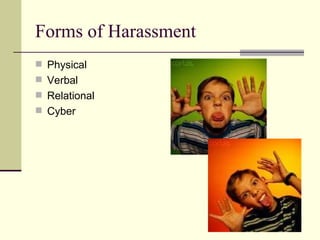
Forms of Harassment  Physical Verbal Relational Cyber
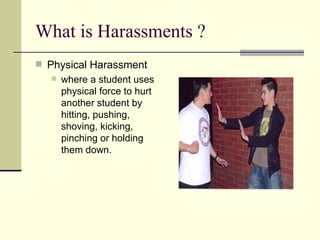
What is Harassments ? Physical Harassment  where a student uses physical force to hurt another student by hitting, pushing, shoving, kicking, pinching or holding them down.
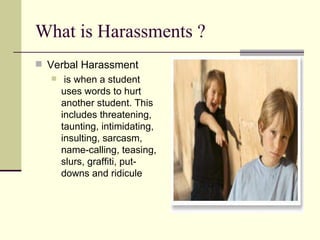
What is Harassments ? Verbal Harassment is when a student uses words to hurt another student. This includes threatening, taunting, intimidating, insulting, sarcasm, name-calling, teasing, slurs, graffiti, put-downs and ridicule
What is Harassment ?  Relational Harassments  occurs when students disrupt another student’s peer relationships through leaving them out, gossiping, whispering and spreading rumors.
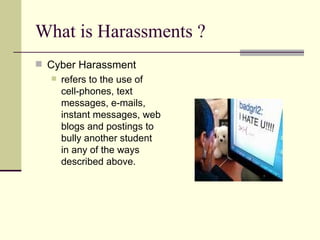
What is Harassments ? Cyber Harassment refers to the use of cell-phones, text messages, e-mails, instant messages, web blogs and postings to bully another student in any of the ways described above.
The Affects of Being Harassed Low self-esteem Poor grades Loneliness (the need to stay home} They become introverted  Faking sickness (because they don’t want to face the bullies)
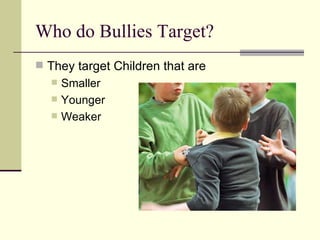
Who do Bullies Target? They target Children that are Smaller  Younger Weaker
Locations of harassment in schools Playground (recess)  Classroom Hallways Lunchroom Off campus
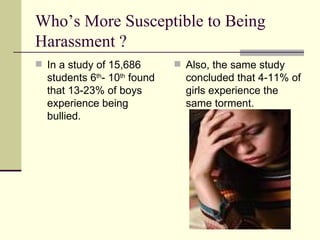
Who’s More Susceptible to Being Harassment ? In a study of 15,686 students 6 th - 10 th  found that 13-23% of boys experience being bullied.  Also, the same study concluded that 4-11% of girls experience the same torment.
Common Characteristics of Harassment  A good student who normally loves school suddenly hates school A student becomes fearful of coming to school A student becomes depressed and is unable to concentrate  A formerly good student has a noticeable drop in performance, resulting in poor grades.  A student who was formerly content considers suicide.
How to Educate Teachers and Fix The Problem Create an anti-Harassments program for  Elementary School Middle School Junior high School Interventions for Students Identified as bullies  Victims of harassments
Court Cases in Student Harassment Davis v. Monroe County Board of Education , the Supreme Court, in a 5 - 4 decision, held that such monetary damages may be recovered only where the district has "actual notice" of the harassment and is "deliberately indifferent" to the harassment. The Court also noted that the harassment must be so "severe, pervasive, and objectively offensive" that it deprived the student victim of access to educational opportunities or benefits provided by the school district.
Court Cases in Student Harassment Gebser v. Lago Vista Independent School District . In Gebser, which was decided in June 1998, the Court held that monetary damages can be recovered under Title IX where a school district employee sexually harasses a student, if a school district official who has the authority to take corrective measures has actual notice of and is deliberately indifferent to the employee's misconduct
Court Cases in Student Harassment Henkle v. Gregory, 150 F. Supp.2d 1067 (D. Nev. 2001)Constant harassment, discrimination, intimidation based on his sex and sexual orientation, name calling, assaults, punched in face, lassoed around the neck, threatened, transferred from school to school and told to keep silent about his sexual orientation, put into adult education program.
REFERENCES Burstyn, B. N., & Tallerico, M. (2004).Ā  Politics and Paradox!Ā  The Case of Urban Alternative school.Ā   Planning and Changing, 35 (1), 22-55. Dedman, B. (2000).  Bullying, torment often led to revenge in cases studied. Chicago Sun-Times, October 15. Center for the Prevention of School Violence (1995) Last retrieved November 10, 2005, from http://www.ncdjjdp.org/cpsv/
REFERENCES Snell, L., Volokh, A., School Violence Prevention: Strategies to Keep Schools Safe (2005) Retrieved November 2, 2005, from  http://www.rppi.org/ps234/ Svoboda, E. (2004)  Everyone loves a bully .  Psychology Today. (pp. 1-20). Espelage, D. (2001).  Schoolroom torment . People (pp. 91-92).

Student Harassment Bullying

  • 1.
    Student Harassment William Allan Kritsonis, PhD
  • 2.
    What Is Harassments?Harassment is a form of repeated aggression that is directed by one or more people towards another person. Also, harassment is some of the most serious forms of peer harassment involve groups. People often do things in groups that they would not do alone. They may be fearful of losing the group's approval if they don't go along.Ā 
  • 3.
    Forms of Harassment Physical Verbal Relational Cyber
  • 4.
    What is Harassments? Physical Harassment where a student uses physical force to hurt another student by hitting, pushing, shoving, kicking, pinching or holding them down.
  • 5.
    What is Harassments? Verbal Harassment is when a student uses words to hurt another student. This includes threatening, taunting, intimidating, insulting, sarcasm, name-calling, teasing, slurs, graffiti, put-downs and ridicule
  • 6.
    What is Harassment? Relational Harassments occurs when students disrupt another student’s peer relationships through leaving them out, gossiping, whispering and spreading rumors.
  • 7.
    What is Harassments? Cyber Harassment refers to the use of cell-phones, text messages, e-mails, instant messages, web blogs and postings to bully another student in any of the ways described above.
  • 8.
    The Affects ofBeing Harassed Low self-esteem Poor grades Loneliness (the need to stay home} They become introverted Faking sickness (because they don’t want to face the bullies)
  • 9.
    Who do BulliesTarget? They target Children that are Smaller Younger Weaker
  • 10.
    Locations of harassmentin schools Playground (recess) Classroom Hallways Lunchroom Off campus
  • 11.
    Who’s More Susceptibleto Being Harassment ? In a study of 15,686 students 6 th - 10 th found that 13-23% of boys experience being bullied. Also, the same study concluded that 4-11% of girls experience the same torment.
  • 12.
    Common Characteristics ofHarassment A good student who normally loves school suddenly hates school A student becomes fearful of coming to school A student becomes depressed and is unable to concentrate A formerly good student has a noticeable drop in performance, resulting in poor grades. A student who was formerly content considers suicide.
  • 13.
    How to EducateTeachers and Fix The Problem Create an anti-Harassments program for Elementary School Middle School Junior high School Interventions for Students Identified as bullies Victims of harassments
  • 14.
    Court Cases inStudent Harassment Davis v. Monroe County Board of Education , the Supreme Court, in a 5 - 4 decision, held that such monetary damages may be recovered only where the district has "actual notice" of the harassment and is "deliberately indifferent" to the harassment. The Court also noted that the harassment must be so "severe, pervasive, and objectively offensive" that it deprived the student victim of access to educational opportunities or benefits provided by the school district.
  • 15.
    Court Cases inStudent Harassment Gebser v. Lago Vista Independent School District . In Gebser, which was decided in June 1998, the Court held that monetary damages can be recovered under Title IX where a school district employee sexually harasses a student, if a school district official who has the authority to take corrective measures has actual notice of and is deliberately indifferent to the employee's misconduct
  • 16.
    Court Cases inStudent Harassment Henkle v. Gregory, 150 F. Supp.2d 1067 (D. Nev. 2001)Constant harassment, discrimination, intimidation based on his sex and sexual orientation, name calling, assaults, punched in face, lassoed around the neck, threatened, transferred from school to school and told to keep silent about his sexual orientation, put into adult education program.
  • 17.
    REFERENCES Burstyn, B.N., & Tallerico, M. (2004).Ā  Politics and Paradox!Ā  The Case of Urban Alternative school.Ā  Planning and Changing, 35 (1), 22-55. Dedman, B. (2000). Bullying, torment often led to revenge in cases studied. Chicago Sun-Times, October 15. Center for the Prevention of School Violence (1995) Last retrieved November 10, 2005, from http://www.ncdjjdp.org/cpsv/
  • 18.
    REFERENCES Snell, L.,Volokh, A., School Violence Prevention: Strategies to Keep Schools Safe (2005) Retrieved November 2, 2005, from http://www.rppi.org/ps234/ Svoboda, E. (2004) Everyone loves a bully . Psychology Today. (pp. 1-20). Espelage, D. (2001). Schoolroom torment . People (pp. 91-92).