Rio Tinto’s Biodiversity
Strategy:
An approach to biodiversity and
Ecosystem Service management
Business, Biodiversity & Ecosystem Services; Melbourne, 2012
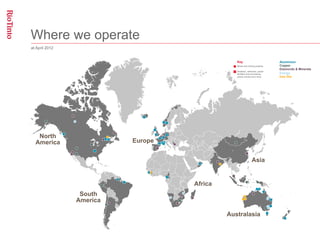
Where we operate
at April 2012


                                               Key                           Aluminium
                                               Mines and mining projects     Copper
                                                                             Diamonds & Minerals
                                               Smelters, refineries, power
                                               facilities and processing     Energy
                                               plants remote from mine       Iron Ore


   North
  America                 Europe


                                                             Asia


                                   Africa
                 South
                America

                                            Australasia
What’s in it for a mining company?

• Maintain	
  access	
  to	
  resources	
  
• Strengthen	
  access	
  to	
  capital,	
  
considering,	
  e.g.,	
  revised	
  IFC	
  PS6	
  
• Strengthen	
  social	
  licence	
  to	
  
operate	
  
• Facilitate	
  adherence	
  to	
  na;onal	
  
legisla;on	
  where	
  this	
  already	
  exists	
  
• First-­‐mover	
  advantage	
  in	
  advance	
  
of	
  regula;on	


                                                       www.riotinto.com/NPI
Biodiversity policy

Rio Tinto’s biodiversity goal is to achieve
a net positive impact on biodiversity by
closure of our operations. And in doing so,
it is our goal to be NPI positive as early in
the life of the operation as possible.
We aim to achieve this by:
•  Avoiding unacceptable impacts to
   biodiversity
•  Reducing the impacts that may occur
•  Restoring impacted ecosystems
•  Compensating for residual impacts
   with offsets
•  Seeking additional opportunities
•  to contribute to local conservation
                                                www.Riotinto.com/NPI
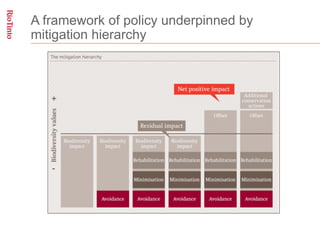
A framework of policy underpinned by
mitigation hierarchy
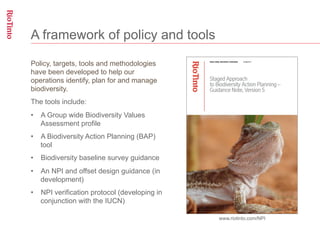
A framework of policy and tools

Policy, targets, tools and methodologies
have been developed to help our
operations identify, plan for and manage
biodiversity.
The tools include:
•  A Group wide Biodiversity Values
   Assessment profile
•  A Biodiversity Action Planning (BAP)
   tool
•  Biodiversity baseline survey guidance
•  An NPI and offset design guidance (in
   development)
•  NPI verification protocol (developing in
   conjunction with the IUCN)

                                              www.riotinto.com/NPI
Prioritization and Planning

Prioritising action at our sites               Understanding and planning for
                                               biodiversity conservation priorities
In 2007, we introduced an annual group-
                                               All of our sites who rank as ‘very high’ or
wide Global Biodiversity Values                ‘high’ are required to have in place a
Assessment Protocol (GBVA) to help us          Biodiversity Action Plan (BAP).
identify which of our operations are
located in the most sensitive areas.           The BAP requires an operation to work with
                                               biodiversity stakeholders to:
The GBVA assesses the biodiversity             •    identify the important biological features
values of our land holdings and                     in the area in which they operate;
surrounding areas based on land in
                                               •    understand the impacts and risks that
proximity to biodiversity-rich habitats,            their activities might have on those
species of conservation significance                features;
additional site-specific biodiversity values
                                               •    develop and implement a plan to avoid,
and/or threats and the external                     mitigate, restore and offset those
conservation context.                               impacts.
                                               The BAP provides the framework that plans
                                               and guides an operation’s progress towards
                                               NPI.
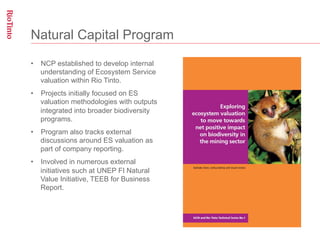
Natural Capital Program

•  NCP established to develop internal
   understanding of Ecosystem Service
   valuation within Rio Tinto.
•  Projects initially focused on ES
   valuation methodologies with outputs
   integrated into broader biodiversity
   programs.
•  Program also tracks external
   discussions around ES valuation as
   part of company reporting.
•  Involved in numerous external
   initiatives such at UNEP FI Natural
   Value Initiative, TEEB for Business
   Report.
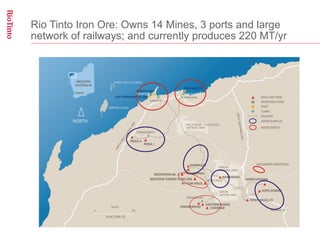
Rio Tinto Iron Ore: Owns 14 Mines, 3 ports and large
network of railways; and currently produces 220 MT/yr
Our Challenges in the Rapidly Expanding
World

Our production will increase from 220 to 353 MT /yr
Expansions in the next forty years:
    •    require accessing the ore located below water table;
    •  Involves dewatering and discharging large volumes of
       groundwater and
    •  will increase the footprint by ‘an order of magnitude’
Lowering of water table could be more than 140 metres
Understanding and addressing the Traditional Owners concerns (their
spiritual and other connection with land and water)
Dewatering creates a larger drawdown and
    •    Managing large volumes of water could be a challenge
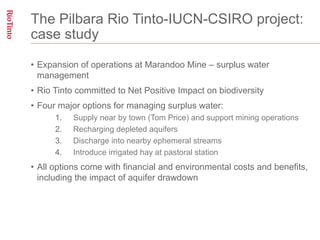
The Pilbara Rio Tinto-IUCN-CSIRO project:
case study

•  Expansion of operations at Marandoo Mine – surplus water
   management
•  Rio Tinto committed to Net Positive Impact on biodiversity
•  Four major options for managing surplus water:
      1.    Supply near by town (Tom Price) and support mining operations
      2.    Recharging depleted aquifers
      3.    Discharge into nearby ephemeral streams
      4.    Introduce irrigated hay at pastoral station
•  All options come with financial and environmental costs and benefits,
   including the impact of aquifer drawdown
How will the information be used?

Develop a set of recommendations for water resources and
   ecosystem management at Marandoo, and more broadly in the
   Pilbara
Develop a replicable analytical framework, including ecosystem
   valuation, which can be incorporated into current and future
   company processes for:
   •    Environmental & Social Impact Assessments;
   •    Biodiversity Offsetting (to achieve NPI);
   •    Financial Assessments connected with stakeholder engagements and
        consultations, and corporate reporting,
Innovations in Managing Biodiversity and
Achieving a Net Positive Impact (NPI)


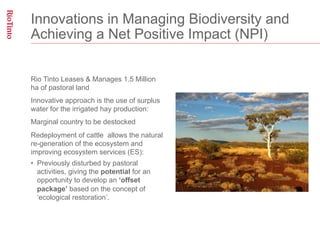
Rio Tinto Leases & Manages 1.5 Million
ha of pastoral land
Innovative approach is the use of surplus
water for the irrigated hay production:
Marginal country to be destocked
Redeployment of cattle allows the natural
re-generation of the ecosystem and
improving ecosystem services (ES):
•  Previously disturbed by pastoral
   activities, giving the potential for an
   opportunity to develop an ‘offset
   package’ based on the concept of
   ‘ecological restoration’.
Valuing Non Timber Forest products

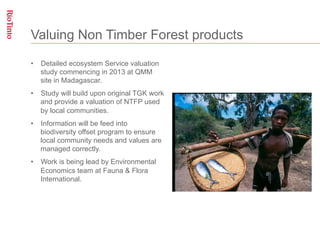
•  Detailed ecosystem Service valuation
   study commencing in 2013 at QMM
   site in Madagascar.
•  Study will build upon original TGK work
   and provide a valuation of NTFP used
   by local communities.
•  Information will be feed into
   biodiversity offset program to ensure
   local community needs and values are
   managed correctly.
•  Work is being lead by Environmental
   Economics team at Fauna & Flora
   International.

Stuart Anstee, Rio Tinto - Presentation - UNAA Vic Natural Capital Seminar

  • 1.
    Rio Tinto’s Biodiversity Strategy: Anapproach to biodiversity and Ecosystem Service management Business, Biodiversity & Ecosystem Services; Melbourne, 2012
  • 2.
    Where we operate atApril 2012 Key Aluminium Mines and mining projects Copper Diamonds & Minerals Smelters, refineries, power facilities and processing Energy plants remote from mine Iron Ore North America Europe Asia Africa South America Australasia
  • 3.
    What’s in itfor a mining company? • Maintain  access  to  resources   • Strengthen  access  to  capital,   considering,  e.g.,  revised  IFC  PS6   • Strengthen  social  licence  to   operate   • Facilitate  adherence  to  na;onal   legisla;on  where  this  already  exists   • First-­‐mover  advantage  in  advance   of  regula;on   www.riotinto.com/NPI
  • 4.
    Biodiversity policy Rio Tinto’sbiodiversity goal is to achieve a net positive impact on biodiversity by closure of our operations. And in doing so, it is our goal to be NPI positive as early in the life of the operation as possible. We aim to achieve this by: •  Avoiding unacceptable impacts to biodiversity •  Reducing the impacts that may occur •  Restoring impacted ecosystems •  Compensating for residual impacts with offsets •  Seeking additional opportunities •  to contribute to local conservation www.Riotinto.com/NPI
  • 5.
    A framework ofpolicy underpinned by mitigation hierarchy
  • 6.
    A framework ofpolicy and tools Policy, targets, tools and methodologies have been developed to help our operations identify, plan for and manage biodiversity. The tools include: •  A Group wide Biodiversity Values Assessment profile •  A Biodiversity Action Planning (BAP) tool •  Biodiversity baseline survey guidance •  An NPI and offset design guidance (in development) •  NPI verification protocol (developing in conjunction with the IUCN) www.riotinto.com/NPI
  • 7.
    Prioritization and Planning Prioritisingaction at our sites Understanding and planning for biodiversity conservation priorities In 2007, we introduced an annual group- All of our sites who rank as ‘very high’ or wide Global Biodiversity Values ‘high’ are required to have in place a Assessment Protocol (GBVA) to help us Biodiversity Action Plan (BAP). identify which of our operations are located in the most sensitive areas. The BAP requires an operation to work with biodiversity stakeholders to: The GBVA assesses the biodiversity •  identify the important biological features values of our land holdings and in the area in which they operate; surrounding areas based on land in •  understand the impacts and risks that proximity to biodiversity-rich habitats, their activities might have on those species of conservation significance features; additional site-specific biodiversity values •  develop and implement a plan to avoid, and/or threats and the external mitigate, restore and offset those conservation context. impacts. The BAP provides the framework that plans and guides an operation’s progress towards NPI.
  • 8.
    Natural Capital Program • NCP established to develop internal understanding of Ecosystem Service valuation within Rio Tinto. •  Projects initially focused on ES valuation methodologies with outputs integrated into broader biodiversity programs. •  Program also tracks external discussions around ES valuation as part of company reporting. •  Involved in numerous external initiatives such at UNEP FI Natural Value Initiative, TEEB for Business Report.
  • 9.
    Rio Tinto IronOre: Owns 14 Mines, 3 ports and large network of railways; and currently produces 220 MT/yr
  • 10.
    Our Challenges inthe Rapidly Expanding World Our production will increase from 220 to 353 MT /yr Expansions in the next forty years: •  require accessing the ore located below water table; •  Involves dewatering and discharging large volumes of groundwater and •  will increase the footprint by ‘an order of magnitude’ Lowering of water table could be more than 140 metres Understanding and addressing the Traditional Owners concerns (their spiritual and other connection with land and water) Dewatering creates a larger drawdown and •  Managing large volumes of water could be a challenge
  • 11.
    The Pilbara RioTinto-IUCN-CSIRO project: case study •  Expansion of operations at Marandoo Mine – surplus water management •  Rio Tinto committed to Net Positive Impact on biodiversity •  Four major options for managing surplus water: 1.  Supply near by town (Tom Price) and support mining operations 2.  Recharging depleted aquifers 3.  Discharge into nearby ephemeral streams 4.  Introduce irrigated hay at pastoral station •  All options come with financial and environmental costs and benefits, including the impact of aquifer drawdown
  • 12.
    How will theinformation be used? Develop a set of recommendations for water resources and ecosystem management at Marandoo, and more broadly in the Pilbara Develop a replicable analytical framework, including ecosystem valuation, which can be incorporated into current and future company processes for: •  Environmental & Social Impact Assessments; •  Biodiversity Offsetting (to achieve NPI); •  Financial Assessments connected with stakeholder engagements and consultations, and corporate reporting,
  • 13.
    Innovations in ManagingBiodiversity and Achieving a Net Positive Impact (NPI) Rio Tinto Leases & Manages 1.5 Million ha of pastoral land Innovative approach is the use of surplus water for the irrigated hay production: Marginal country to be destocked Redeployment of cattle allows the natural re-generation of the ecosystem and improving ecosystem services (ES): •  Previously disturbed by pastoral activities, giving the potential for an opportunity to develop an ‘offset package’ based on the concept of ‘ecological restoration’.
  • 14.
    Valuing Non TimberForest products •  Detailed ecosystem Service valuation study commencing in 2013 at QMM site in Madagascar. •  Study will build upon original TGK work and provide a valuation of NTFP used by local communities. •  Information will be feed into biodiversity offset program to ensure local community needs and values are managed correctly. •  Work is being lead by Environmental Economics team at Fauna & Flora International.