Structure of the Earth
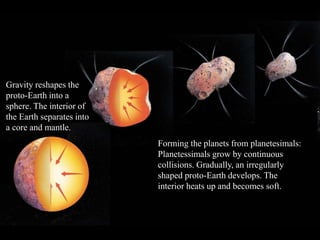
Gravity reshapes the
proto-Earth into a
sphere. The interior of
the Earth separates into
a core and mantle.
Forming the planets from planetesimals:
Planetessimals grow by continuous
collisions. Gradually, an irregularly
shaped proto-Earth develops. The
interior heats up and becomes soft.
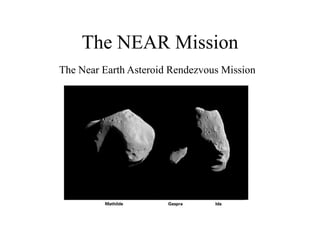
The NEAR Mission
The Near Earth Asteroid Rendezvous Mission
Why is the Earth (near) spherical?
• Accretion: the gradual addition of new
material
• When the Earth first accreted, it probably
wasn’t spherical
• What happened?
HEAT was generated and retained
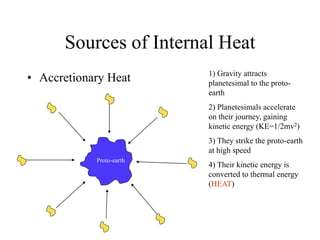
Sources of Internal Heat
• Accretionary Heat
Proto-earth
1) Gravity attracts
planetesimal to the proto-
earth
2) Planetesimals accelerate
on their journey, gaining
kinetic energy (KE=1/2mv2)
3) They strike the proto-earth
at high speed
4) Their kinetic energy is
converted to thermal energy
(HEAT)
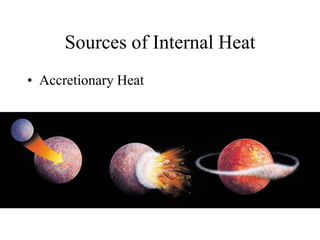
Sources of Internal Heat
• Accretionary Heat
Sources of Internal Heat
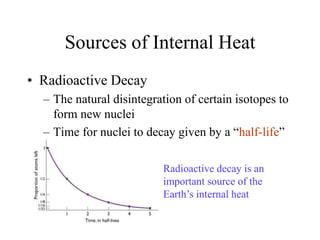
• Radioactive Decay
– The natural disintegration of certain isotopes to
form new nuclei
– Time for nuclei to decay given by a “half-life”
Radioactive decay is an
important source of the
Earth’s internal heat
Sources of Internal Heat
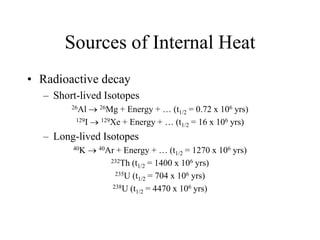
• Radioactive decay
– Short-lived Isotopes
26Al  26Mg + Energy + … (t1/2 = 0.72 x 10⁶ yrs)
129I  129Xe + Energy + … (t1/2 = 16 x 106 yrs)
– Long-lived Isotopes
40K  40Ar + Energy + … (t1/2 = 1270 x 106 yrs)
232Th (t1/2 = 1400 x 106 yrs)
235U (t1/2 = 704 x 106 yrs)
238U (t1/2 = 4470 x 106 yrs)
The Differentiated Earth
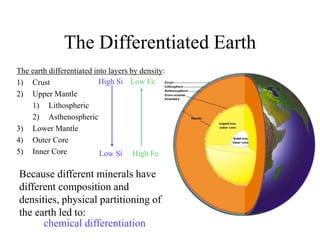
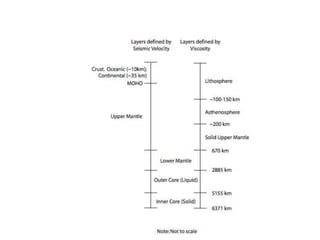
The earth differentiated into layers by density:
1) Crust
2) Upper Mantle
1) Lithospheric
2) Asthenospheric
3) Lower Mantle
4) Outer Core
5) Inner Core
Least Dense
Most Dense
Because different minerals have
different composition and
densities, physical partitioning of
the earth led to:
chemical differentiation
High Si
High Fe
Low Si
Low Fe
The Differentiated Earth
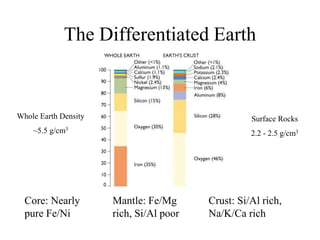
Whole Earth Density
~5.5 g/cm3
Surface Rocks
2.2 - 2.5 g/cm3
Core: Nearly
pure Fe/Ni
Mantle: Fe/Mg
rich, Si/Al poor
Crust: Si/Al rich,
Na/K/Ca rich
Another Source of Internal Heat
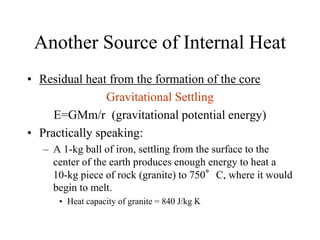
• Residual heat from the formation of the core
Gravitational Settling
E=GMm/r (gravitational potential energy)
• Practically speaking:
– A 1-kg ball of iron, settling from the surface to the
center of the earth produces enough energy to heat a
10-kg piece of rock (granite) to 750°C, where it would
begin to melt.
• Heat capacity of granite = 840 J/kg K
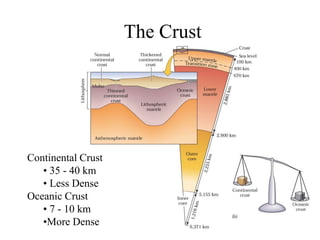
The Crust
Continental Crust
• 35 - 40 km
• Less Dense
Oceanic Crust
• 7 - 10 km
•More Dense
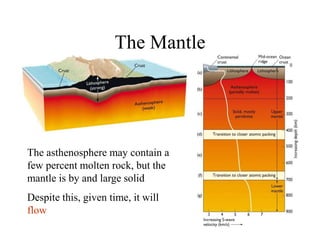
The Mantle
The asthenosphere may contain a
few percent molten rock, but the
mantle is by and large solid
Despite this, given time, it will
flow
Loss of Internal Heat
• All celestial bodies lose heat
– Asteroids > Moon > Mars > Earth
• There are three main mechanisms
– Conduction
– Convection
– Radiation
• Conduction is the transfer of heat without
movement of material
Temperatures in the Earth
The geotherm is the description of how the temperature of the
earth increases with depth.
Near the surface
(to 8 km depth):
2-3 °C/100 m depth
Heat loss by conduction!
Pure conduction geotherm
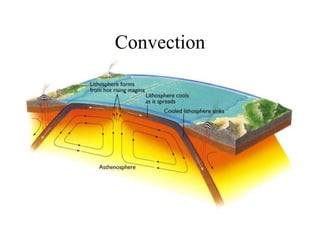
Convection
Heating at the bottom:
• Increases temperature
• Decreases density
Less dense hot water rises…
• Displacing the cooler, denser
water at the top
Denser, cool water descends…
• Where it is heated
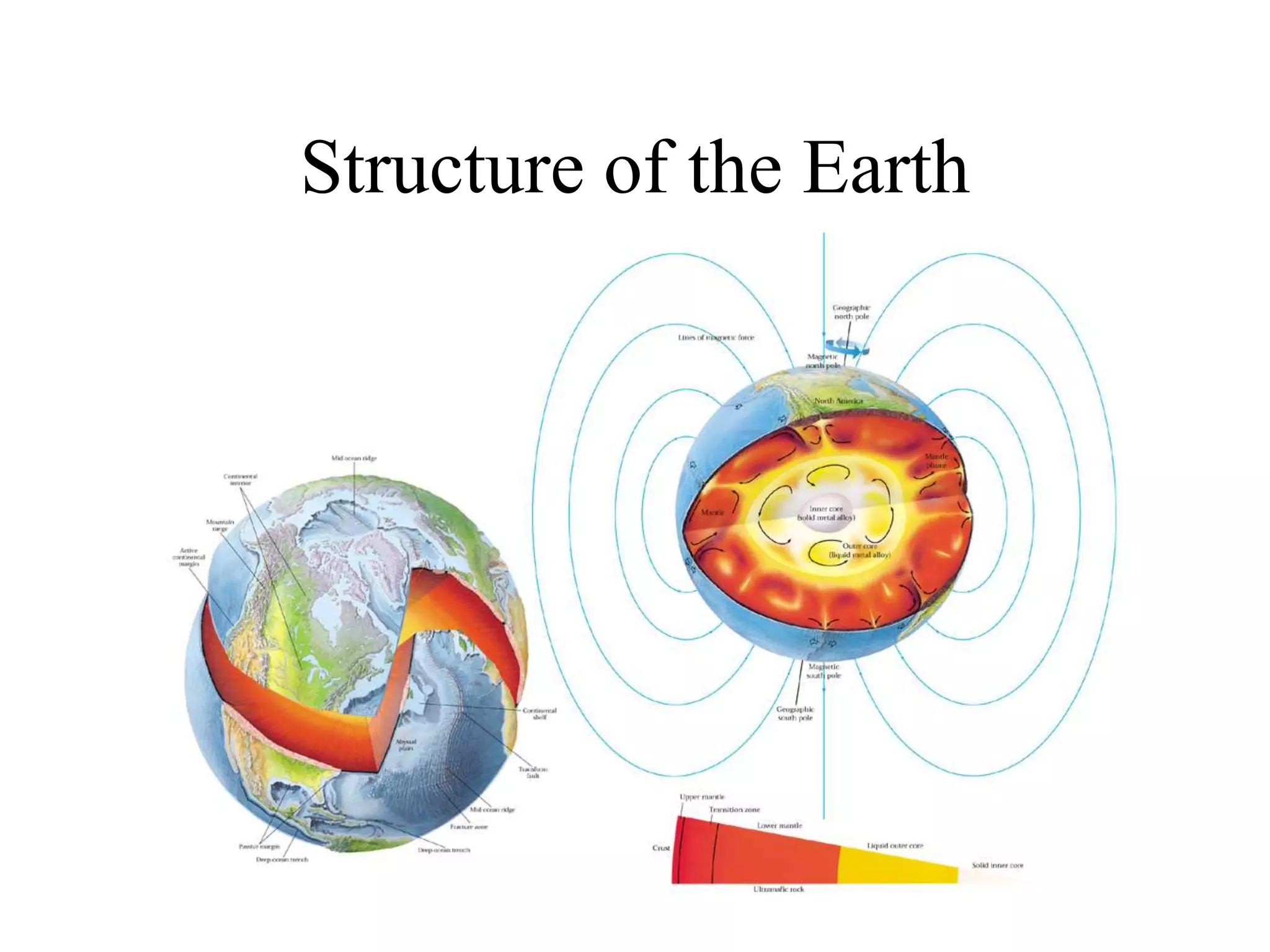
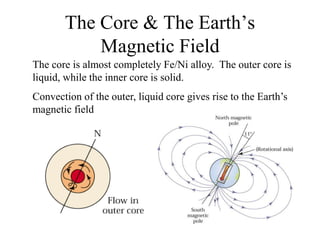
The Core & The Earth’s
Magnetic Field
The core is almost completely Fe/Ni alloy. The outer core is
liquid, while the inner core is solid.
Convection of the outer, liquid core gives rise to the Earth’s
magnetic field
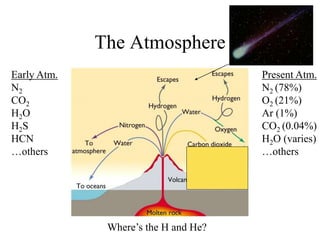
The Atmosphere
Present Atm.
N2 (78%)
O2 (21%)
Ar (1%)
CO2 (0.04%)
H2O (varies)
…others
Early Atm.
N2
CO2
H2O
H2S
HCN
…others
Where’s the H and He?
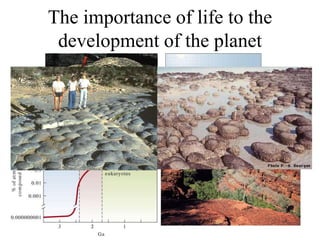
The importance of life to the
development of the planet

Structure of the Earth.ppt

  • 1.
  • 2.
    Gravity reshapes the proto-Earthinto a sphere. The interior of the Earth separates into a core and mantle. Forming the planets from planetesimals: Planetessimals grow by continuous collisions. Gradually, an irregularly shaped proto-Earth develops. The interior heats up and becomes soft.
  • 3.
    The NEAR Mission TheNear Earth Asteroid Rendezvous Mission
  • 4.
    Why is theEarth (near) spherical? • Accretion: the gradual addition of new material • When the Earth first accreted, it probably wasn’t spherical • What happened? HEAT was generated and retained
  • 5.
    Sources of InternalHeat • Accretionary Heat Proto-earth 1) Gravity attracts planetesimal to the proto- earth 2) Planetesimals accelerate on their journey, gaining kinetic energy (KE=1/2mv2) 3) They strike the proto-earth at high speed 4) Their kinetic energy is converted to thermal energy (HEAT)
  • 6.
    Sources of InternalHeat • Accretionary Heat
  • 7.
    Sources of InternalHeat • Radioactive Decay – The natural disintegration of certain isotopes to form new nuclei – Time for nuclei to decay given by a “half-life” Radioactive decay is an important source of the Earth’s internal heat
  • 8.
    Sources of InternalHeat • Radioactive decay – Short-lived Isotopes 26Al  26Mg + Energy + … (t1/2 = 0.72 x 10⁶ yrs) 129I  129Xe + Energy + … (t1/2 = 16 x 106 yrs) – Long-lived Isotopes 40K  40Ar + Energy + … (t1/2 = 1270 x 106 yrs) 232Th (t1/2 = 1400 x 106 yrs) 235U (t1/2 = 704 x 106 yrs) 238U (t1/2 = 4470 x 106 yrs)
  • 9.
    The Differentiated Earth Theearth differentiated into layers by density: 1) Crust 2) Upper Mantle 1) Lithospheric 2) Asthenospheric 3) Lower Mantle 4) Outer Core 5) Inner Core Least Dense Most Dense Because different minerals have different composition and densities, physical partitioning of the earth led to: chemical differentiation High Si High Fe Low Si Low Fe
  • 10.
    The Differentiated Earth WholeEarth Density ~5.5 g/cm3 Surface Rocks 2.2 - 2.5 g/cm3 Core: Nearly pure Fe/Ni Mantle: Fe/Mg rich, Si/Al poor Crust: Si/Al rich, Na/K/Ca rich
  • 11.
    Another Source ofInternal Heat • Residual heat from the formation of the core Gravitational Settling E=GMm/r (gravitational potential energy) • Practically speaking: – A 1-kg ball of iron, settling from the surface to the center of the earth produces enough energy to heat a 10-kg piece of rock (granite) to 750°C, where it would begin to melt. • Heat capacity of granite = 840 J/kg K
  • 12.
    The Crust Continental Crust •35 - 40 km • Less Dense Oceanic Crust • 7 - 10 km •More Dense
  • 13.
    The Mantle The asthenospheremay contain a few percent molten rock, but the mantle is by and large solid Despite this, given time, it will flow
  • 15.
    Loss of InternalHeat • All celestial bodies lose heat – Asteroids > Moon > Mars > Earth • There are three main mechanisms – Conduction – Convection – Radiation • Conduction is the transfer of heat without movement of material
  • 16.
    Temperatures in theEarth The geotherm is the description of how the temperature of the earth increases with depth. Near the surface (to 8 km depth): 2-3 °C/100 m depth Heat loss by conduction! Pure conduction geotherm
  • 17.
    Convection Heating at thebottom: • Increases temperature • Decreases density Less dense hot water rises… • Displacing the cooler, denser water at the top Denser, cool water descends… • Where it is heated
  • 18.
    The Core &The Earth’s Magnetic Field The core is almost completely Fe/Ni alloy. The outer core is liquid, while the inner core is solid. Convection of the outer, liquid core gives rise to the Earth’s magnetic field
  • 19.
    The Atmosphere Present Atm. N2(78%) O2 (21%) Ar (1%) CO2 (0.04%) H2O (varies) …others Early Atm. N2 CO2 H2O H2S HCN …others Where’s the H and He?
  • 20.
    The importance oflife to the development of the planet