Lt Col Sameena Kausar
MBBS,FCPS(DERM), CHPE (NUMS)
Assisstant Professor of Dermatology
• What is the largest organ of the body?
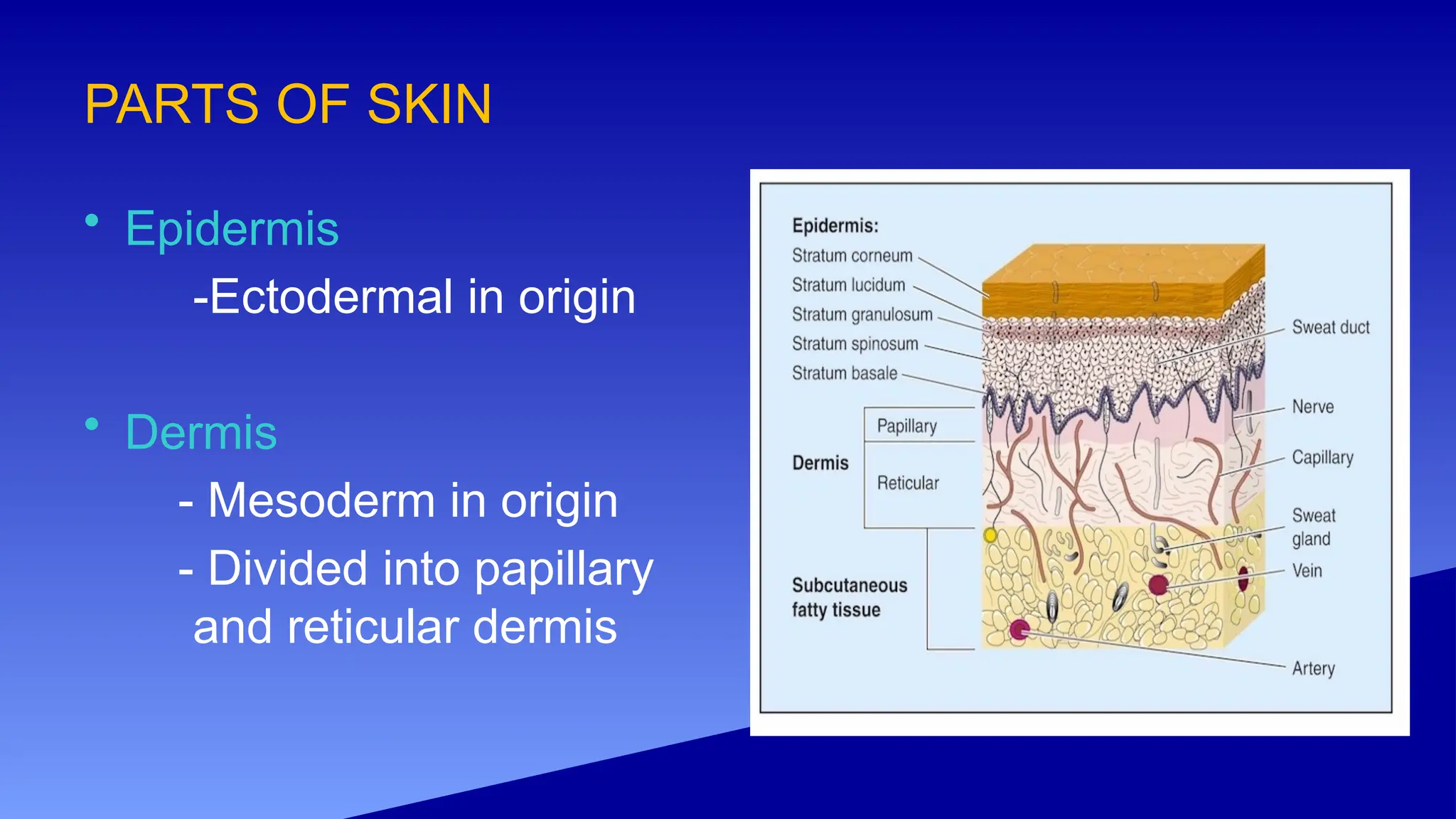
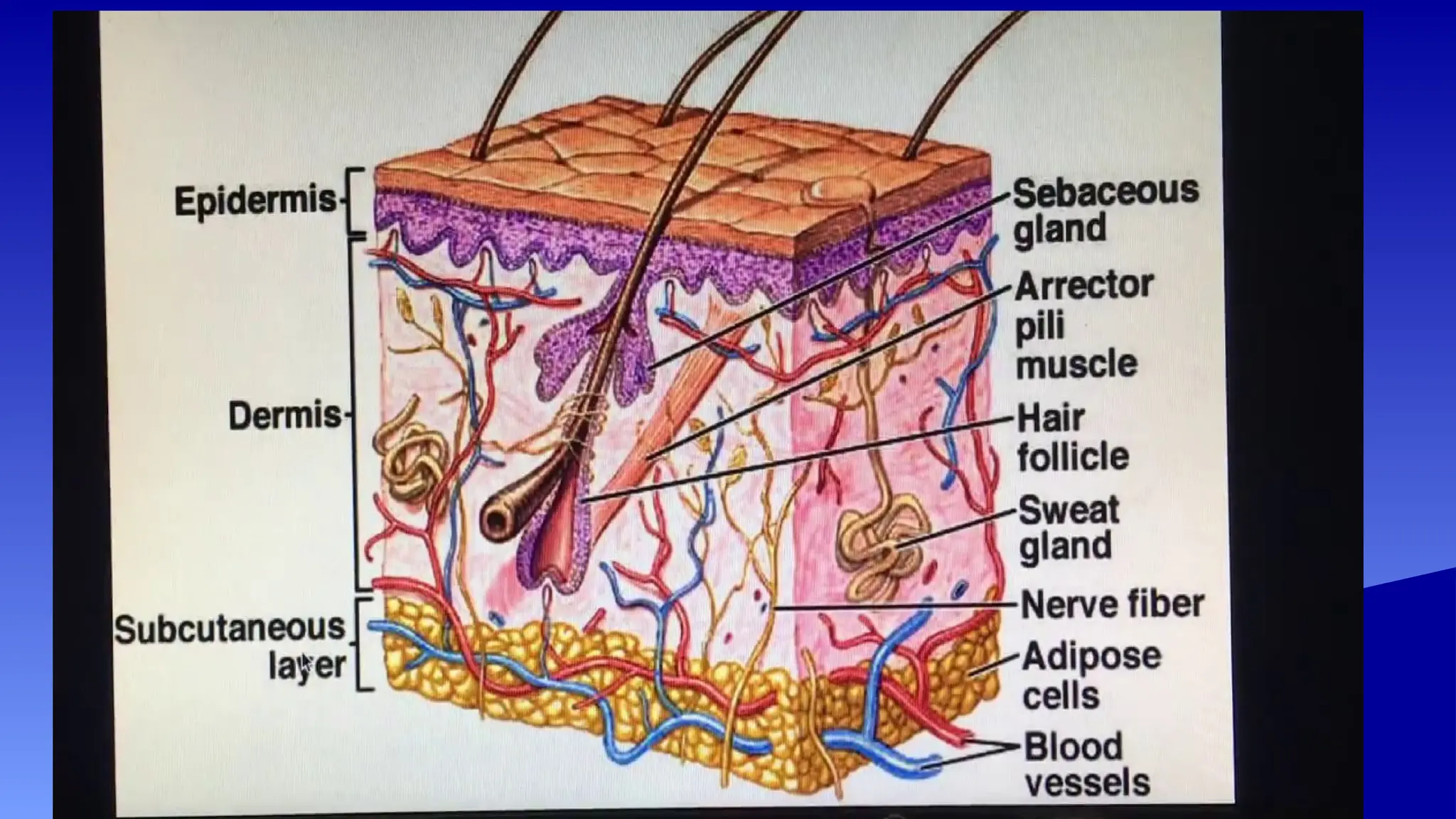
PARTS OF SKIN
• Epidermis
-Ectodermal in origin
• Dermis
- Mesoderm in origin
- Divided into papillary
and reticular dermis
Layers of skin
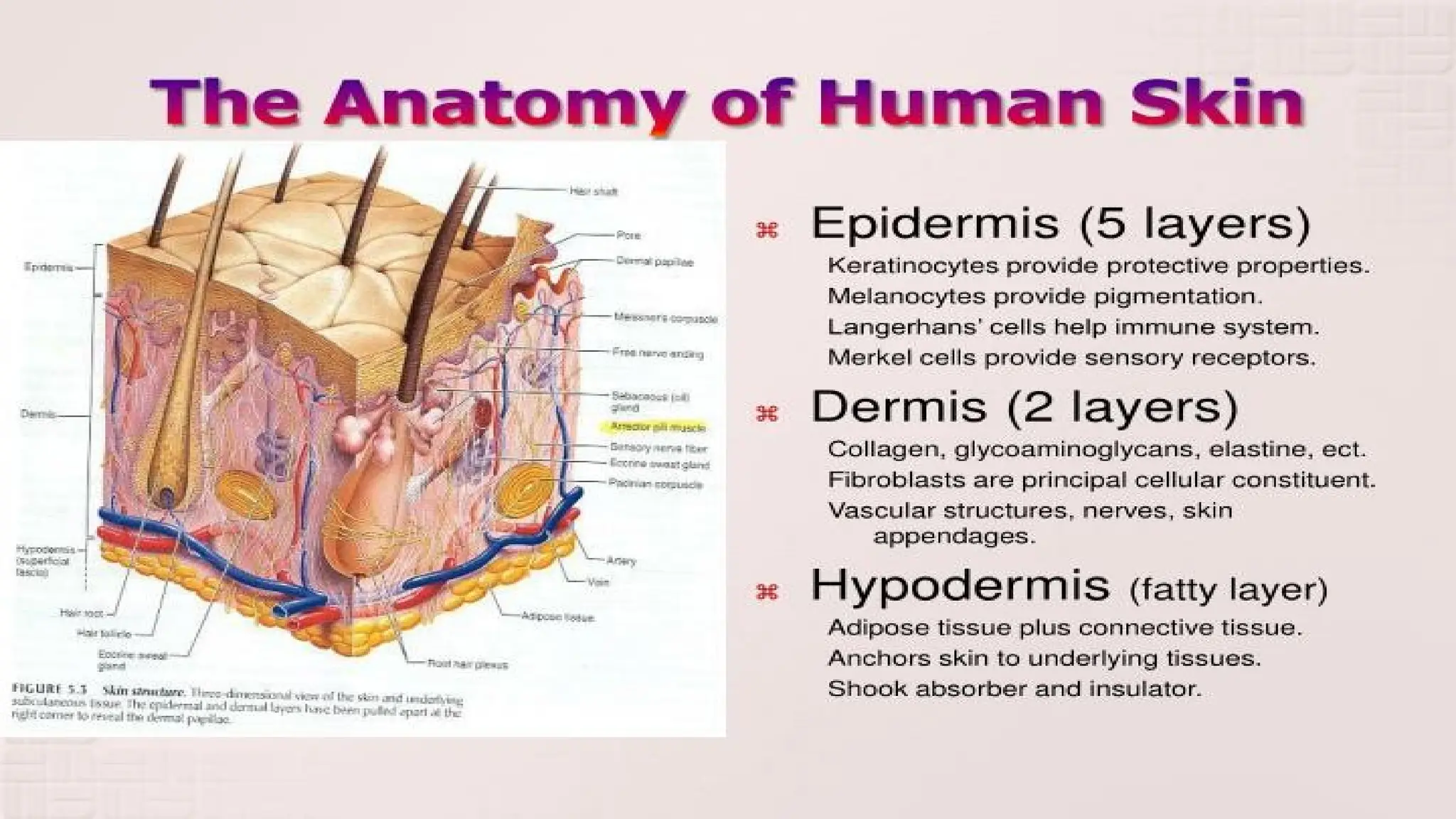
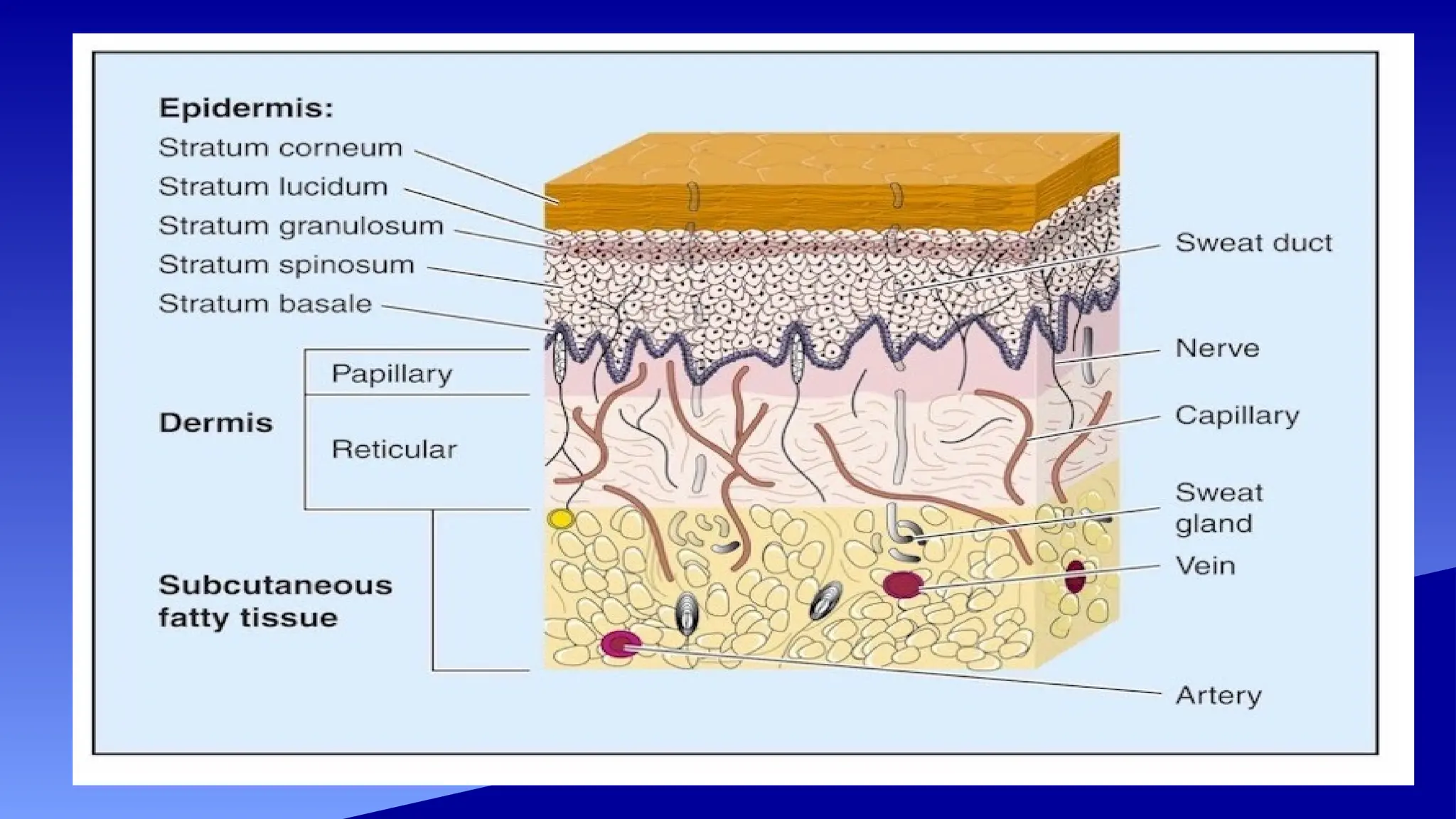
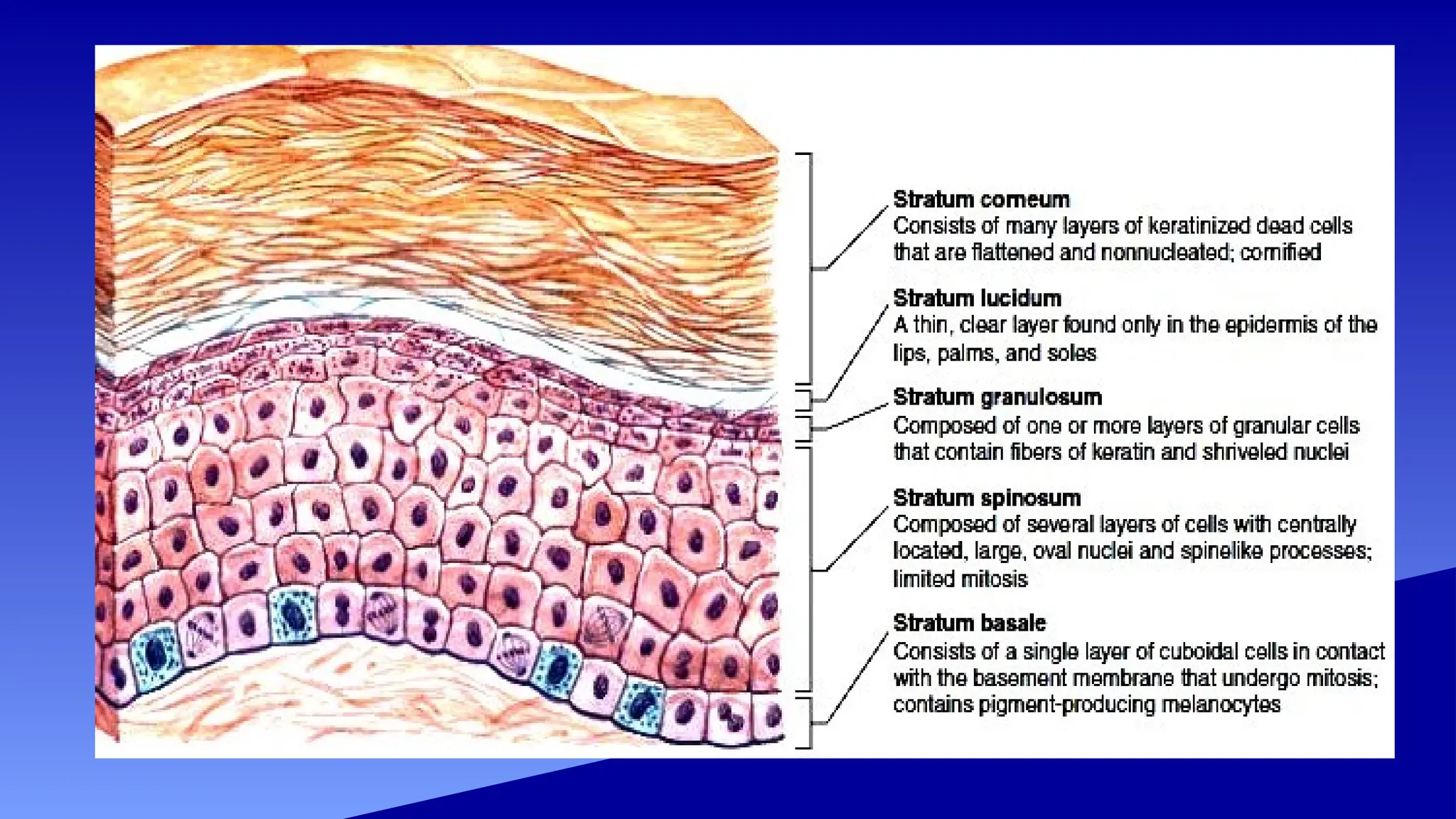
EPIDERMIS
• Stratum corneum - Horny layer
• Stratum lucidum- Palms and soles
• Stratum granulosum- Granular layer
• Stratum spinosum -Pickle cell layer
• Stratum basale - Basal layer
DERMIS
• Connective tissue... Collagen & elastic fibres
• Cells... WBC, Mast cells, fibroblasts
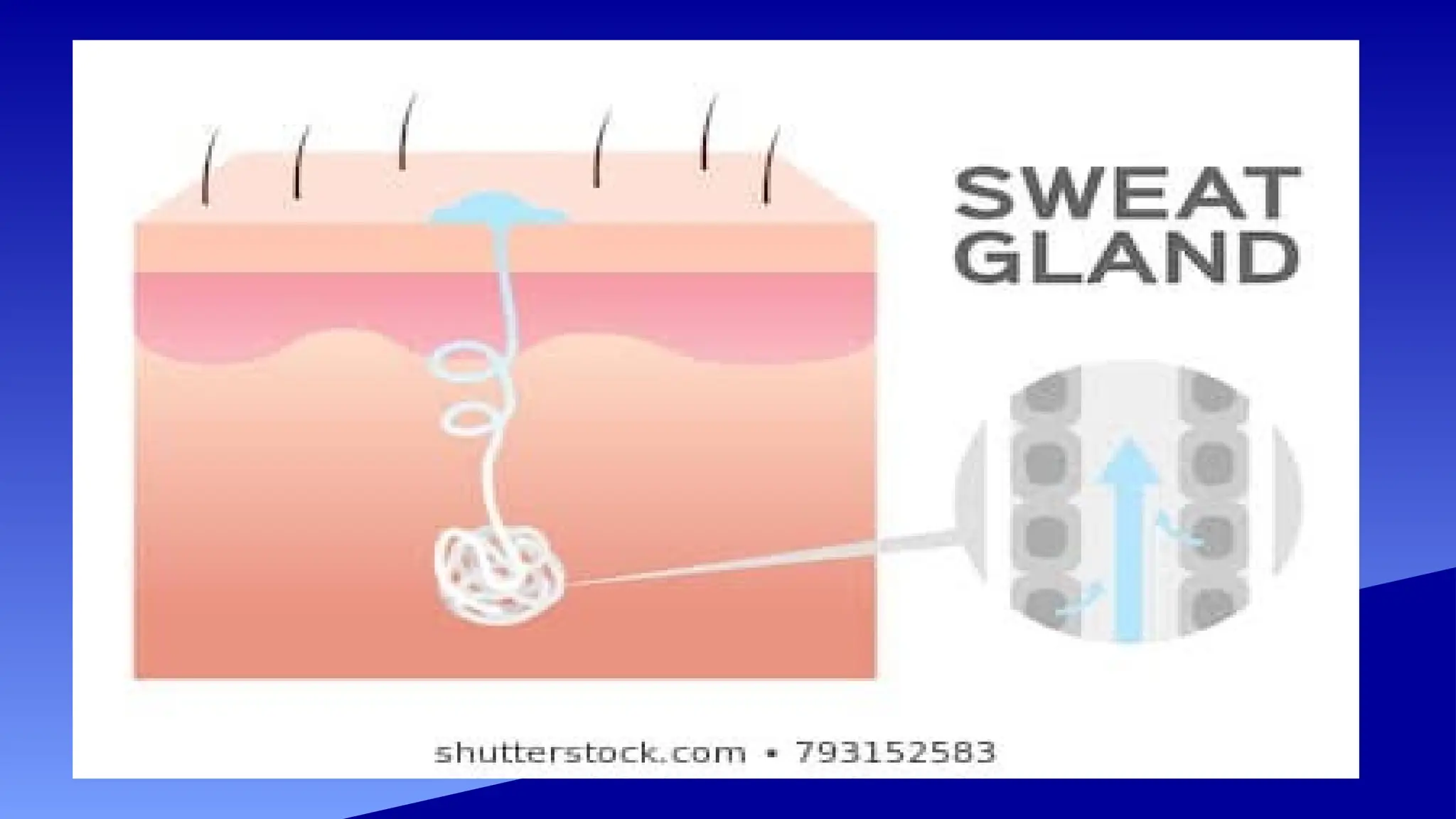
• Skin appendages...Hair follicle, sebaceous gland, Eccrine
apocrine gland, Hair and nail
• Blood vessels
• Nerves
• Lymphatics
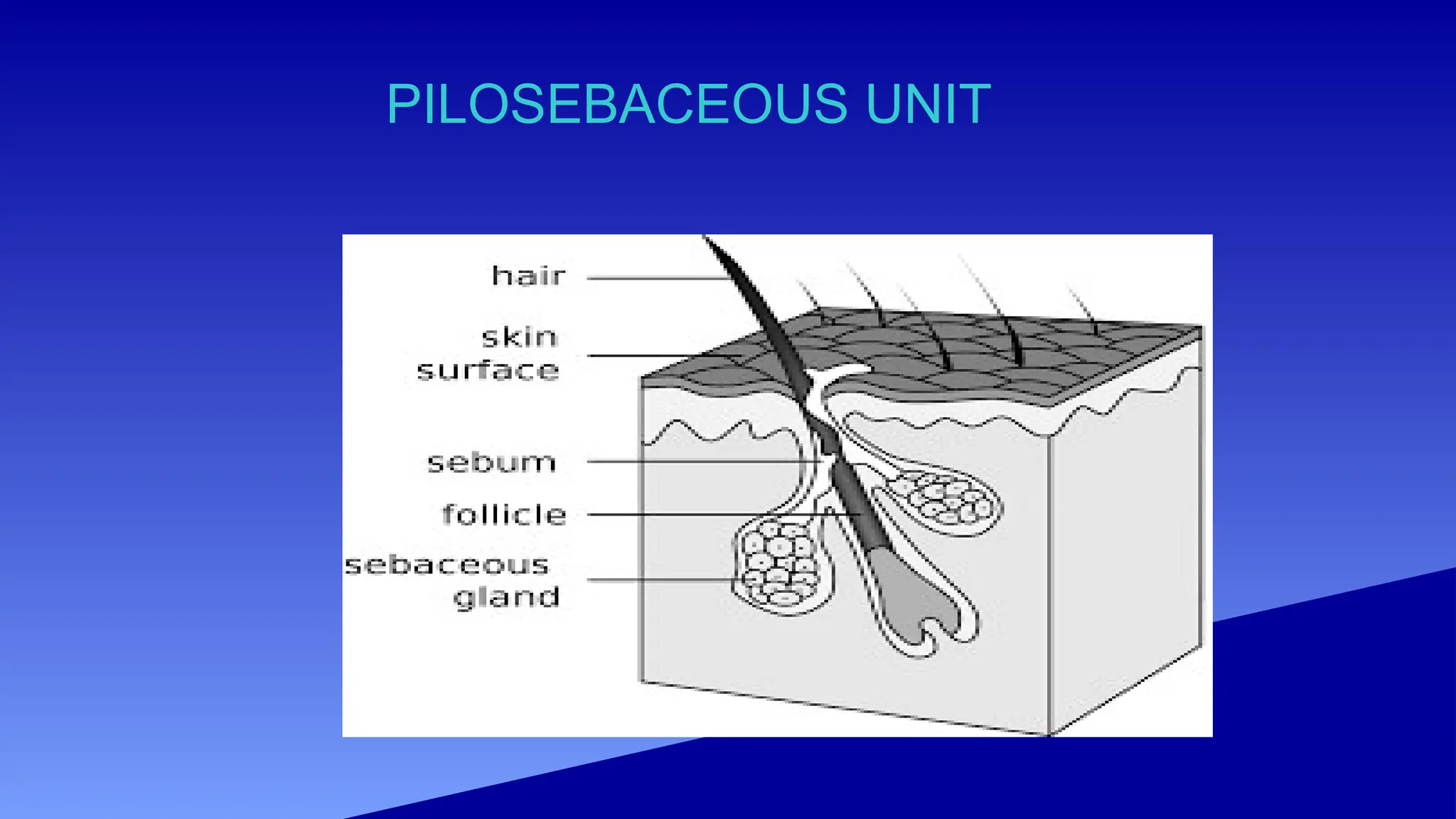
PILOSEBACEOUS UNIT
What is the importance of skin?
FUNCTION OF SKIN
Protection:
• Physical and mechanical barrier to skin
• Barrier to chemical hazards
Regulation of body temperature:
• Regulate water loss and prevent dehydration
• Maintain body temperature
Photoprotection:
• Protect excessive ultraviolet exposure via melanin
FUNCTION OF SKIN
Immunity:
• Antigen presentation by Langerhans cells
Metabolic function
• Production of vitamin D
Sensory and autonomic function
• Meissners & Pacinian corpuscles
• Pain, heat and cold receptors
Sociosexual & cosmetic function
Lesions Of Skin
TYPES OF LESIONS
Primary Lesions
Secondary Lesions
Tertiary Lesions
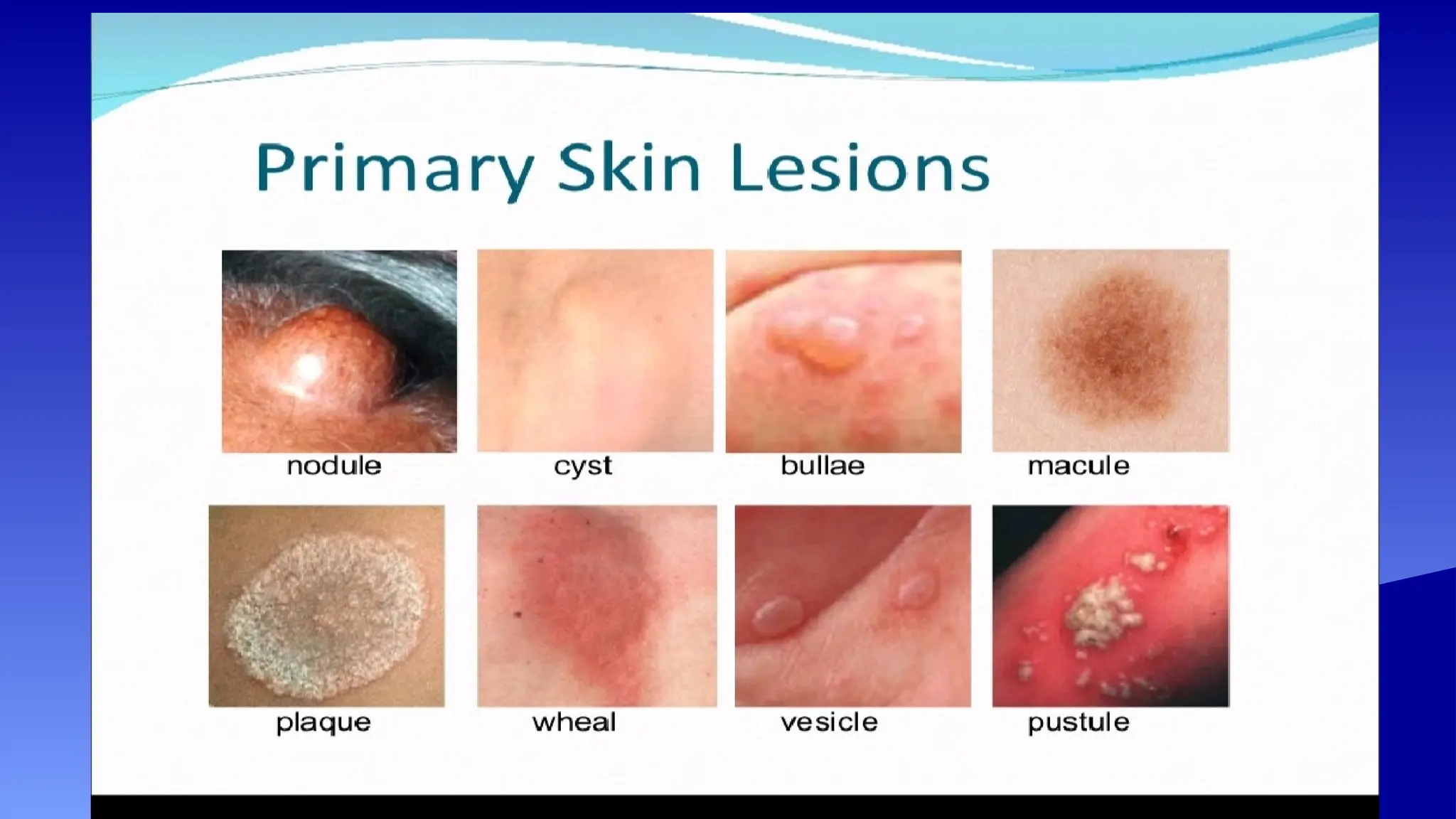
PRIMARY LESIONS
Definition :
• lesion occurring on non pathological skin
which have not been altered by trauma,
manipulation (scratching, scrubbing) or
natural regression over time
Examples
• Macule
• Papule
• Patch ???
• Plaque
• Nodule
• Wheal
• Vesicle
• Bulla
• Pustule
• Cyst
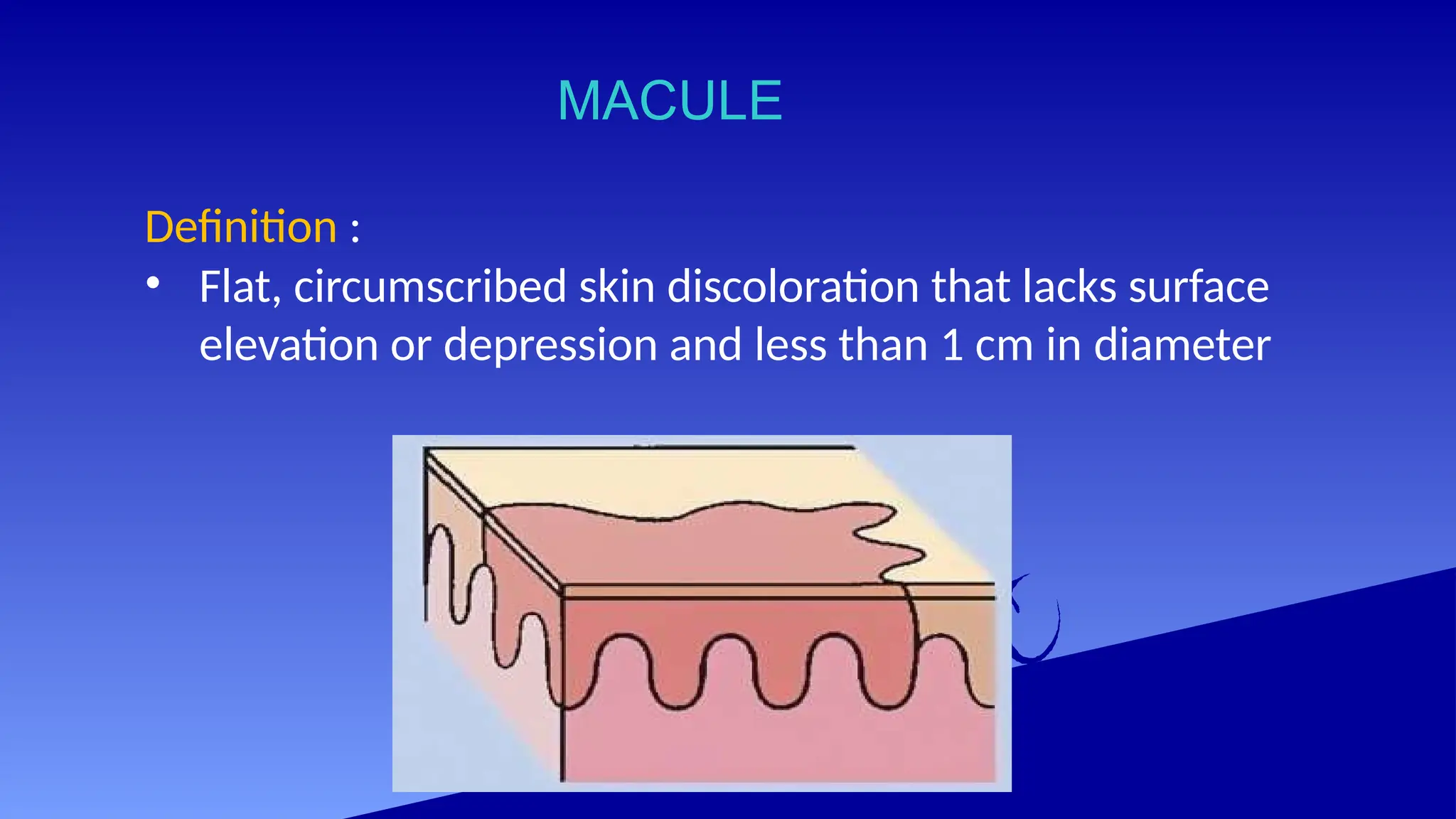
MACULE
Definition :
• Flat, circumscribed skin discoloration that lacks surface
elevation or depression and less than 1 cm in diameter
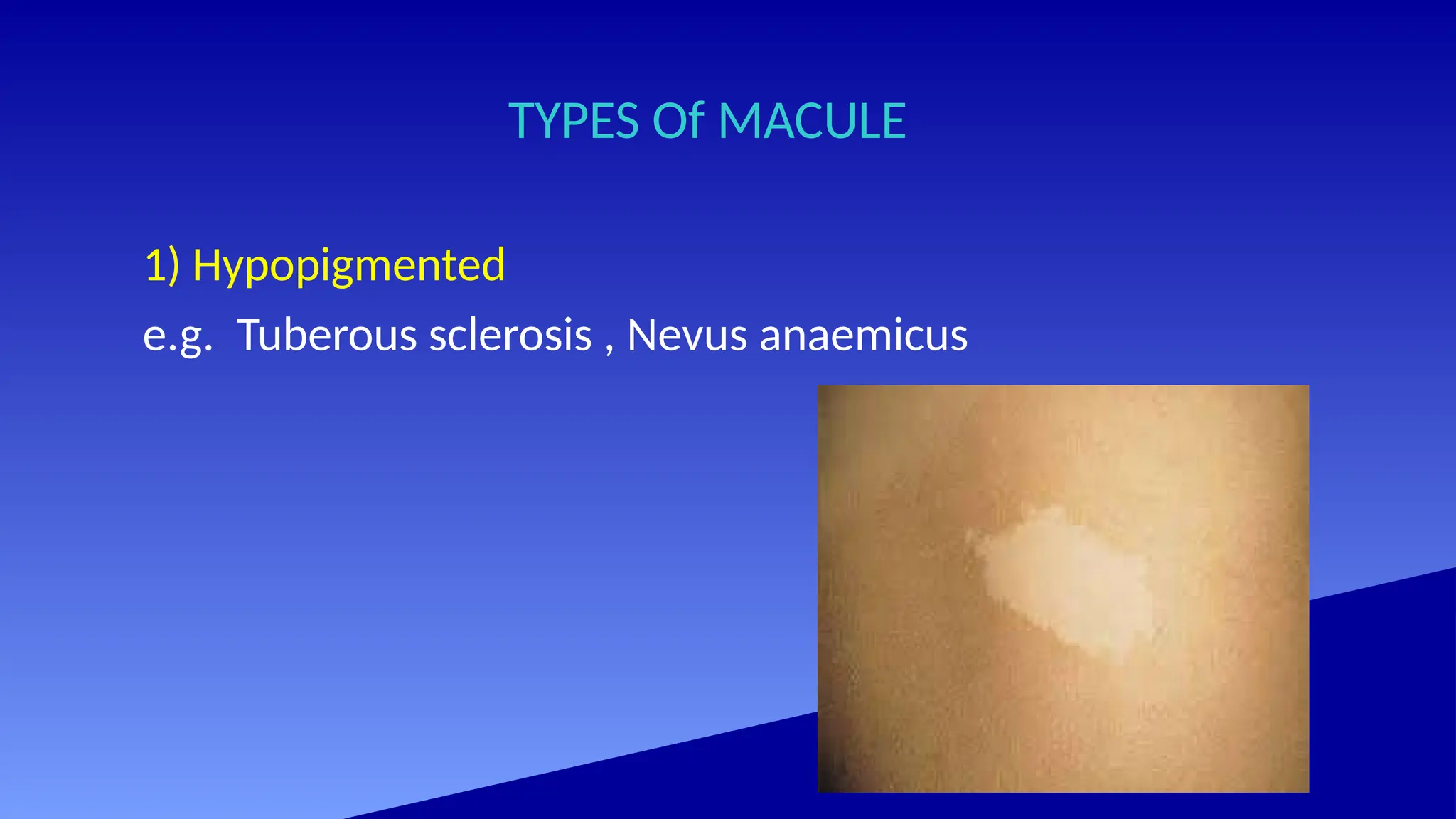
TYPES Of MACULE
1) Hypopigmented
e.g. Tuberous sclerosis , Nevus anaemicus
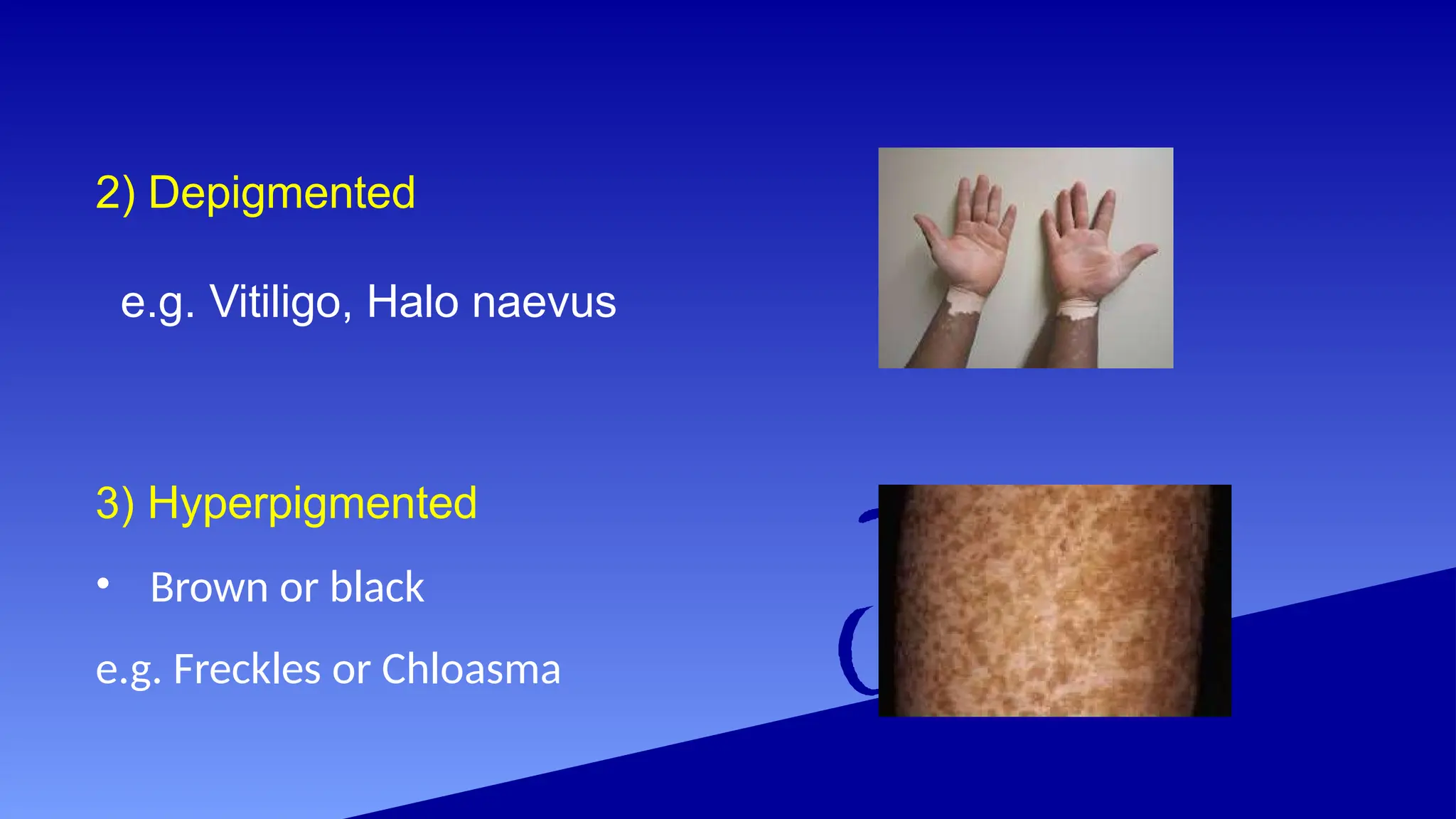
2) Depigmented
e.g. Vitiligo, Halo naevus
3) Hyperpigmented
• Brown or black
e.g. Freckles or Chloasma
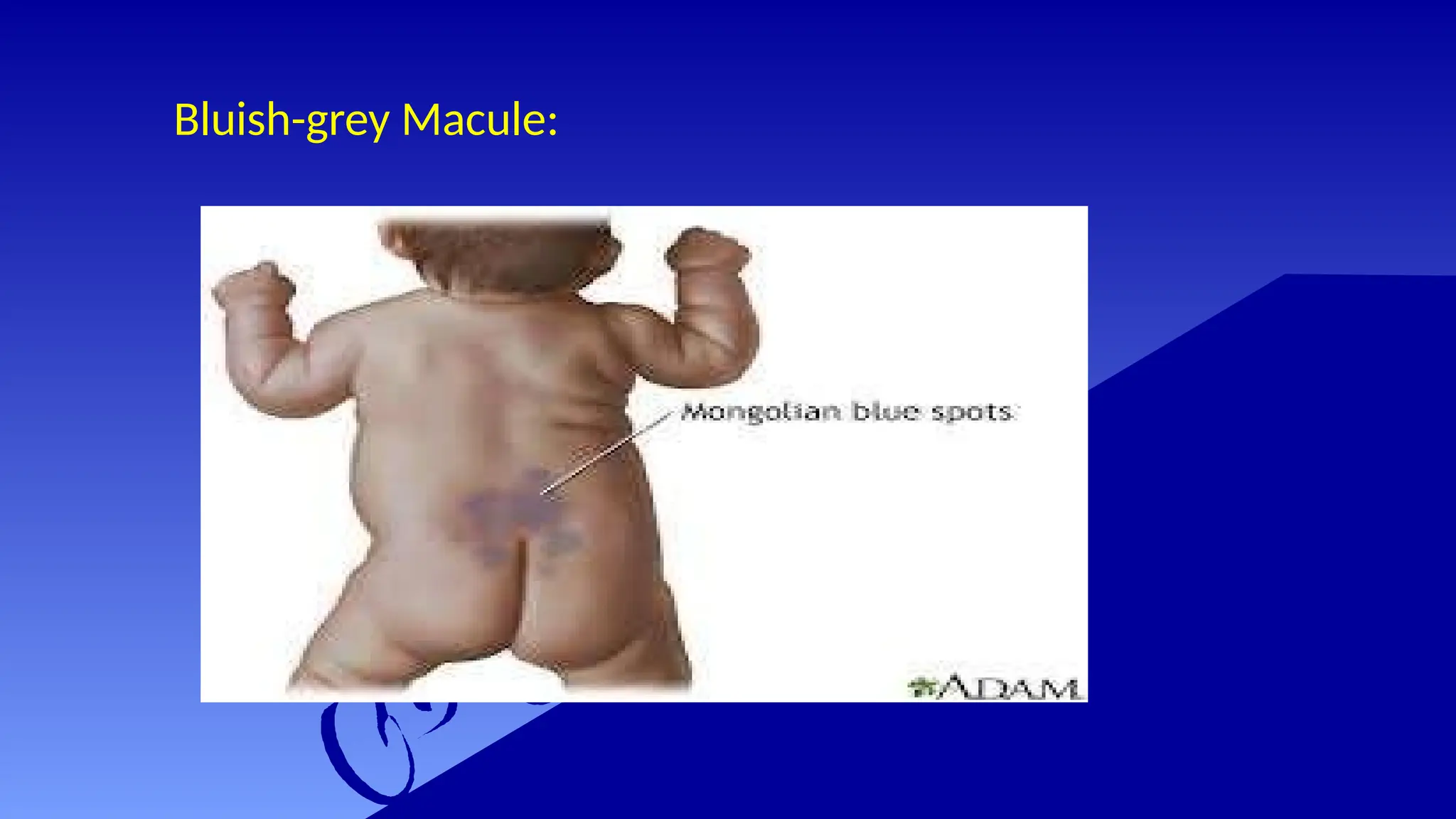
Bluish-grey Macule:
PATCH
• Patch / Large macule ???
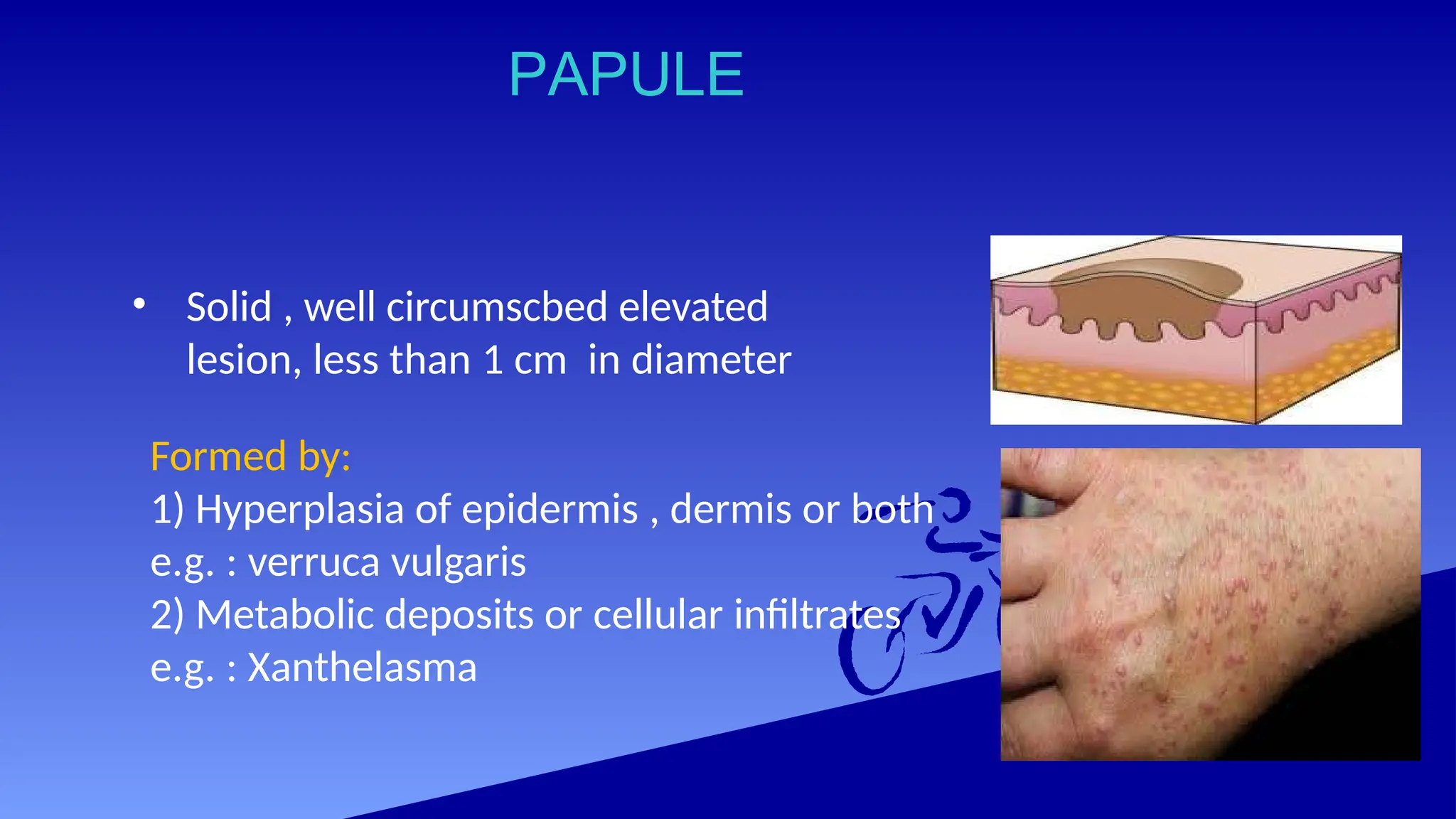
PAPULE
• Solid , well circumscbed elevated
lesion, less than 1 cm in diameter
Formed by:
1) Hyperplasia of epidermis , dermis or both
e.g. : verruca vulgaris
2) Metabolic deposits or cellular infiltrates
e.g. : Xanthelasma
COLOUR OF PAPULE
• Red : Psoriasis
• Pearly white : Molluscum contagiosum
• Violaceous : Lichen planus
• Coppery : Secondary syphilis
• Yellowish : Xanthelasma
• Blue/Black : Mallignant Melanoma
• Purpuric : Henoch-schönlein purpura
PLAQUE
•Elevated well circumscribed, more than 1 cm in
diameter ,occupying relatively large surface area
in comparison with its height above the skin
surface
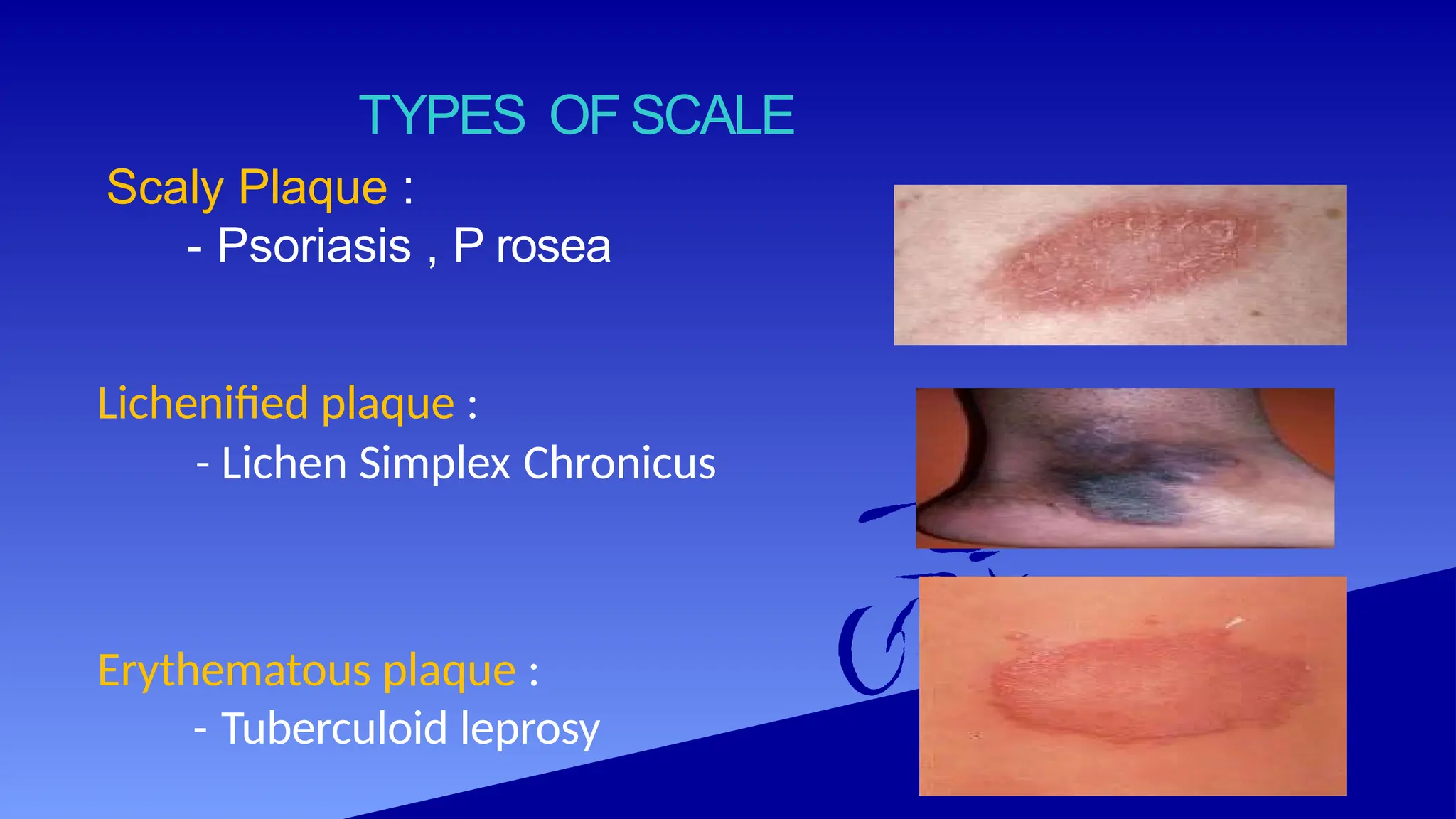
TYPES OF SCALE
Scaly Plaque :
- Psoriasis , P rosea
Lichenified plaque :
- Lichen Simplex Chronicus
Erythematous plaque :
- Tuberculoid leprosy
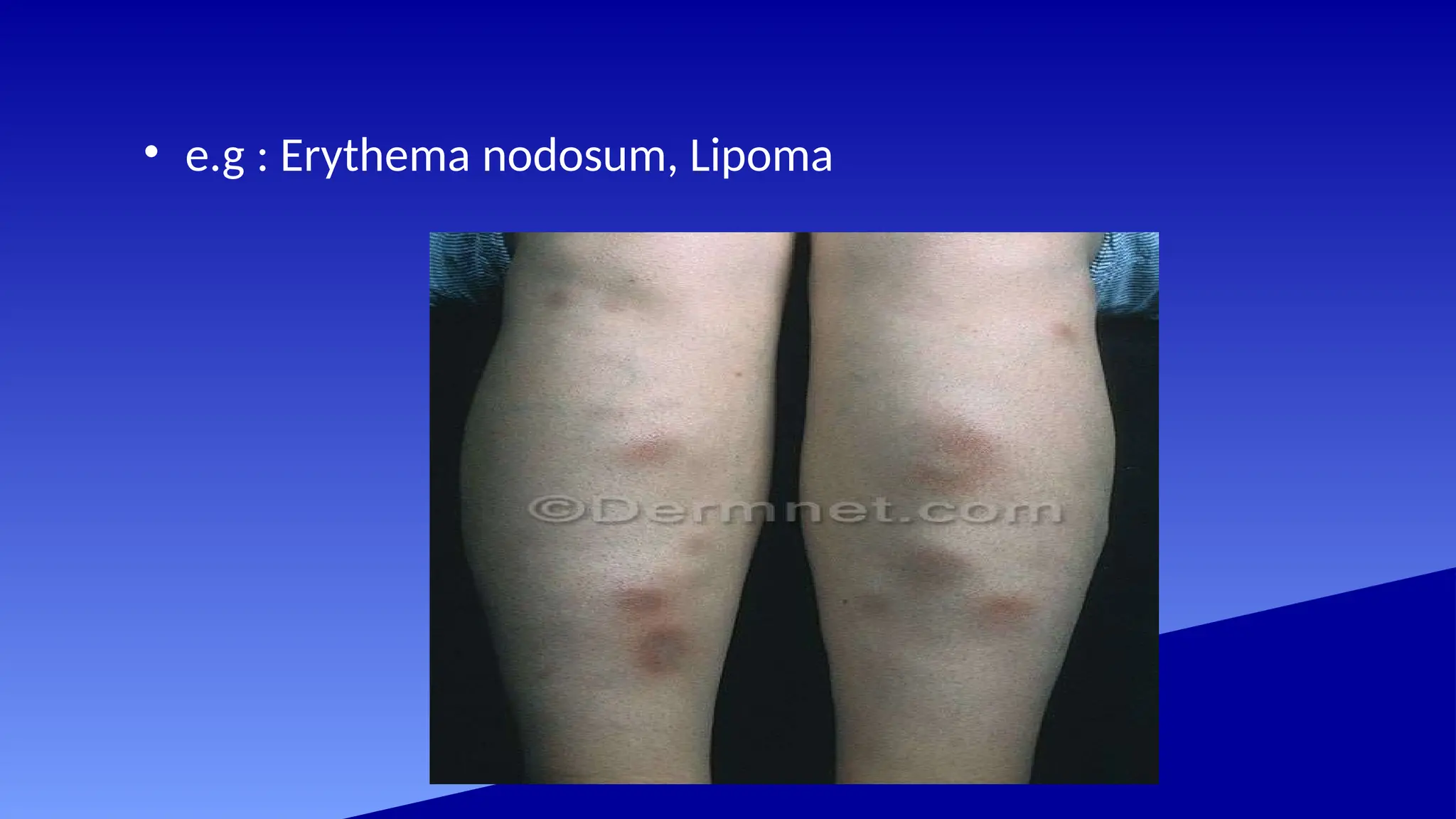
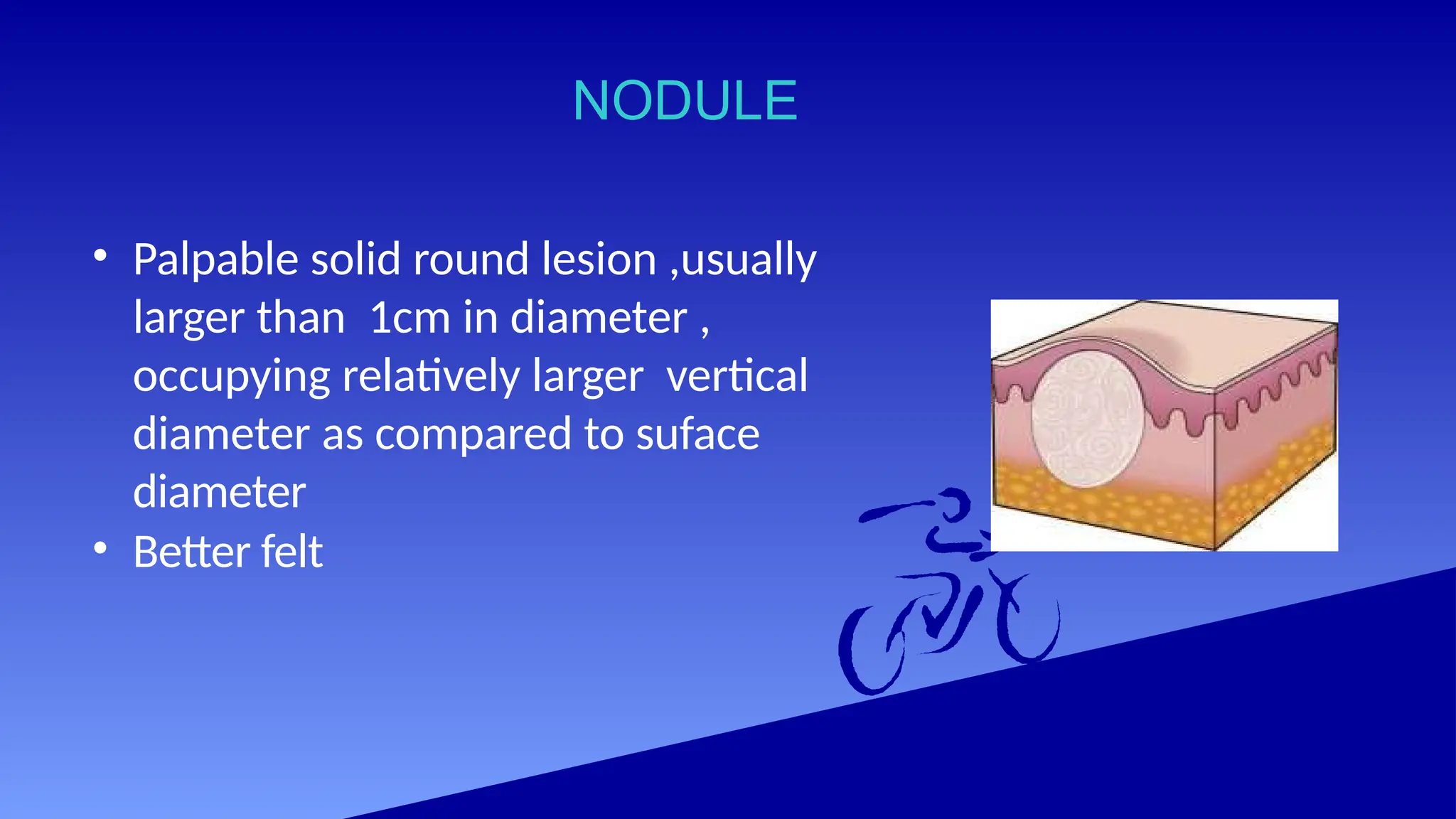
NODULE
• Palpable solid round lesion ,usually
larger than 1cm in diameter ,
occupying relatively larger vertical
diameter as compared to suface
diameter
• Better felt
• e.g : Erythema nodosum, Lipoma
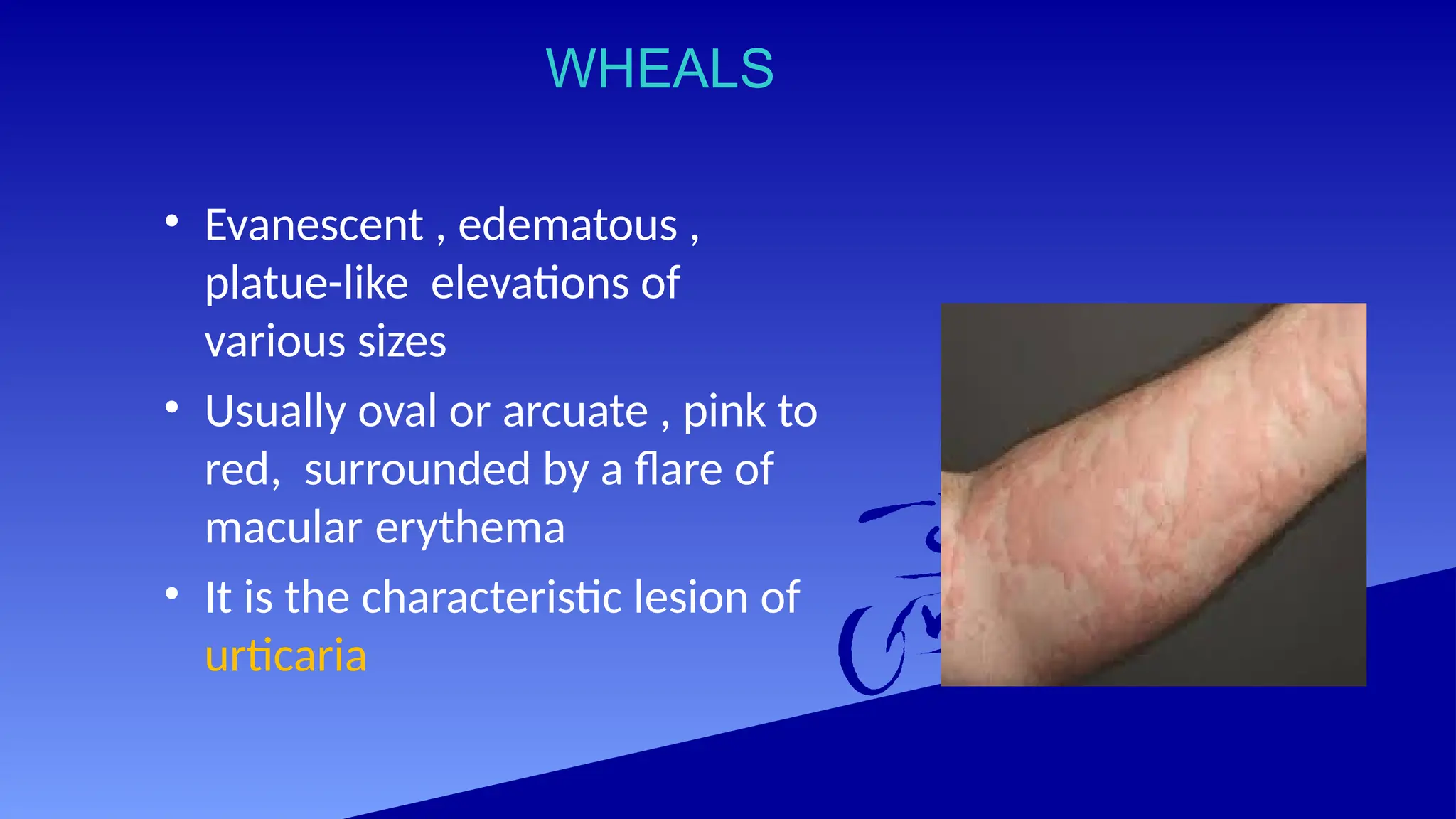
WHEALS
• Evanescent , edematous ,
platue-like elevations of
various sizes
• Usually oval or arcuate , pink to
red, surrounded by a flare of
macular erythema
• It is the characteristic lesion of
urticaria
VESICLE AND BULLAE
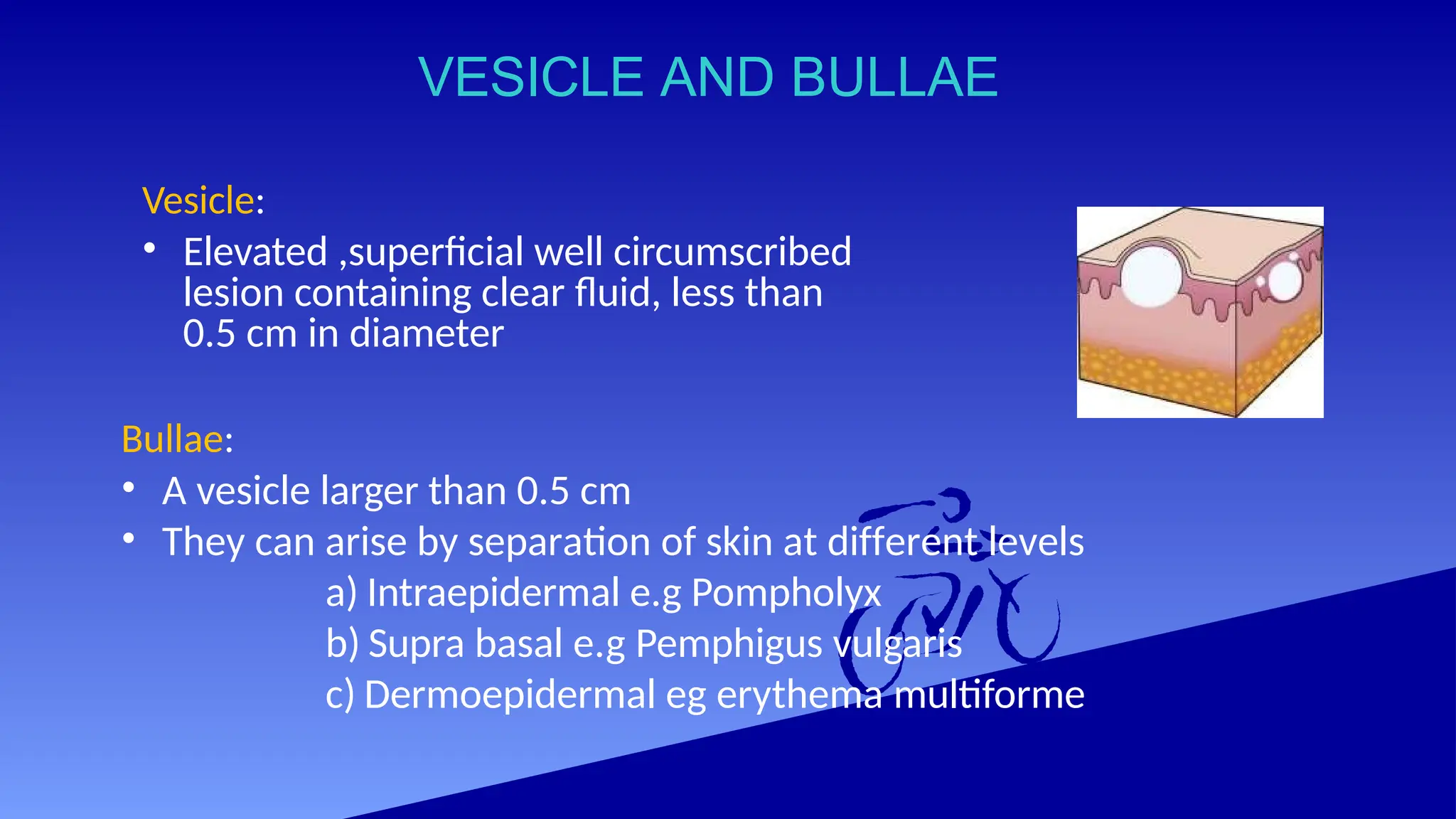
Vesicle:
• Elevated ,superficial well circumscribed
lesion containing clear fluid, less than
0.5 cm in diameter
Bullae:
• A vesicle larger than 0.5 cm
• They can arise by separation of skin at different levels
a) Intraepidermal e.g Pompholyx
b) Supra basal e.g Pemphigus vulgaris
c) Dermoepidermal eg erythema multiforme
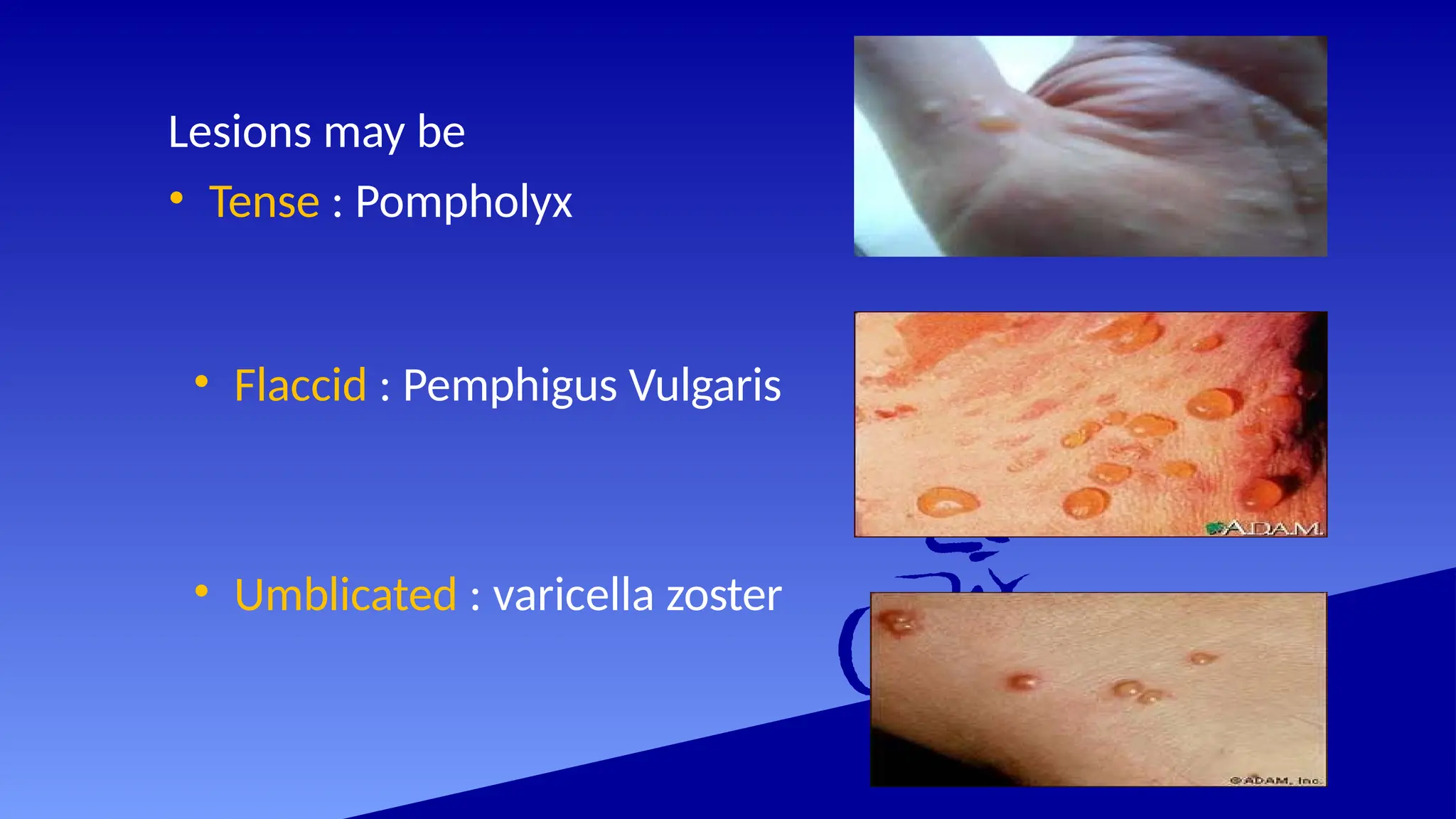
Lesions may be
• Tense : Pompholyx
• Flaccid : Pemphigus Vulgaris
• Umblicated : varicella zoster
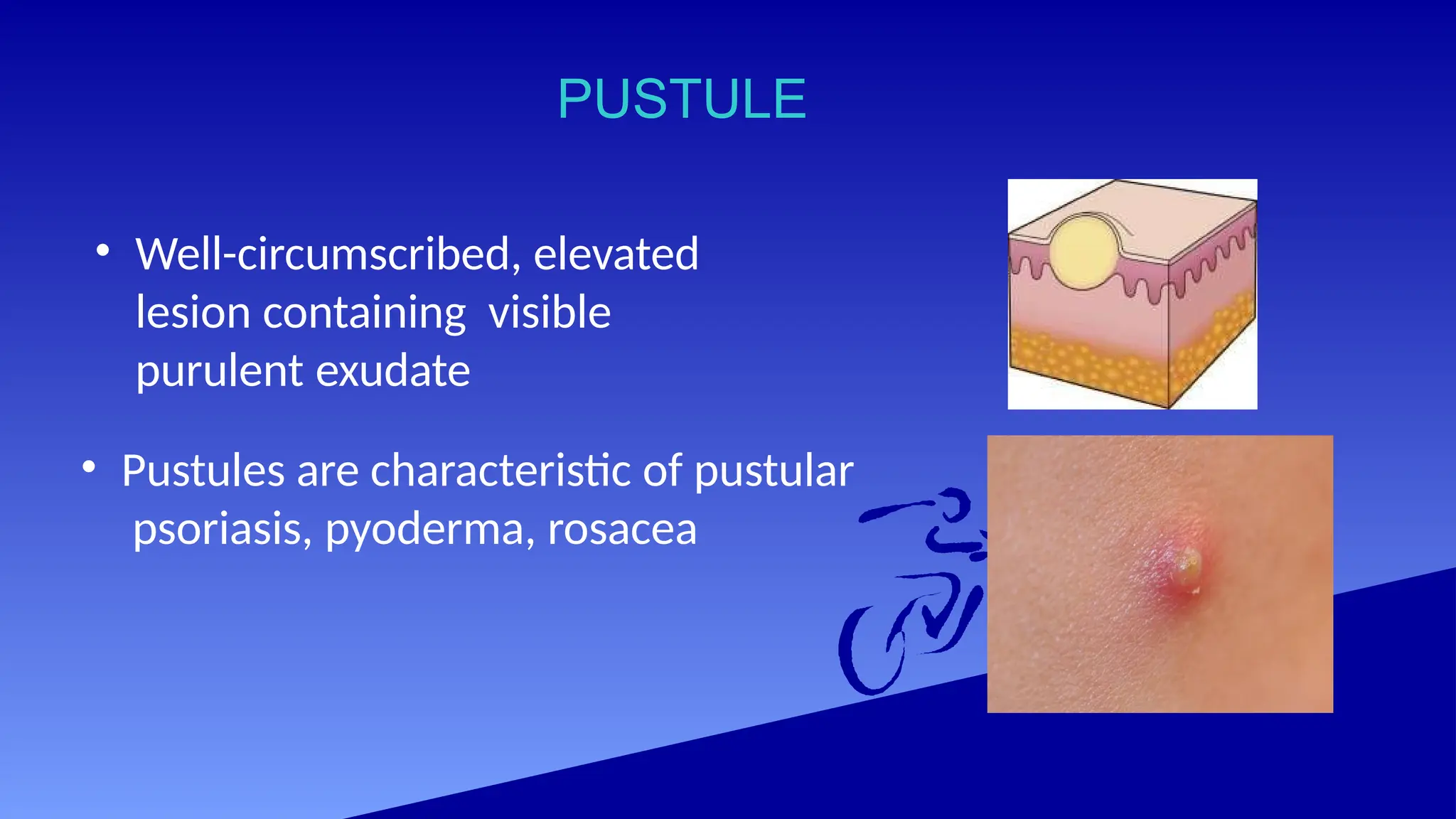
PUSTULE
• Well-circumscribed, elevated
lesion containing visible
purulent exudate
• Pustules are characteristic of pustular
psoriasis, pyoderma, rosacea
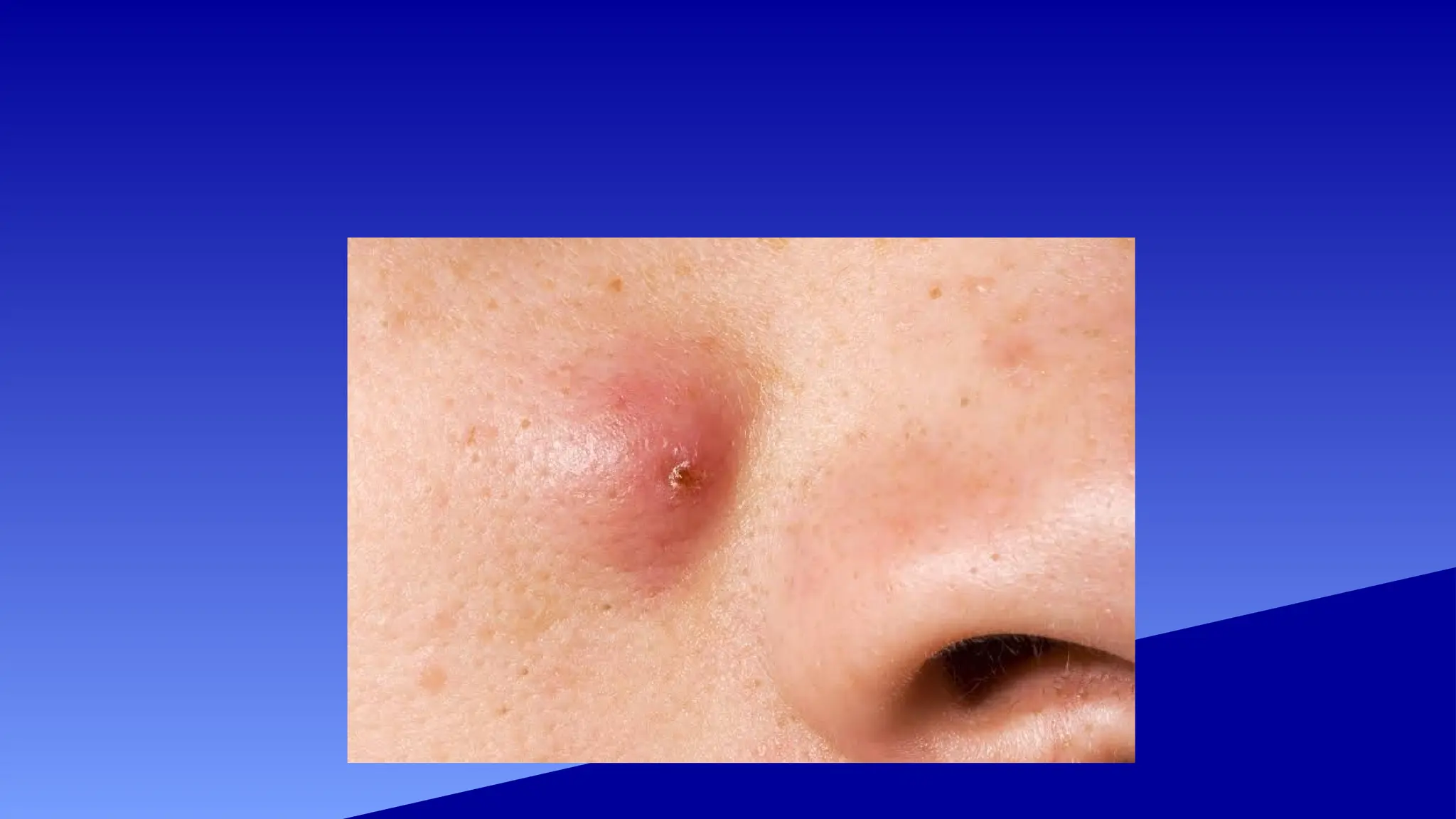
CYST
• A sac that contains liquid or semisolid material
in a well-defined cavity
Types of cyst:
• Epidermal cyst: lined with squamous
epithelium and produce keratinous material
• Pilar cyst
ABSCESS
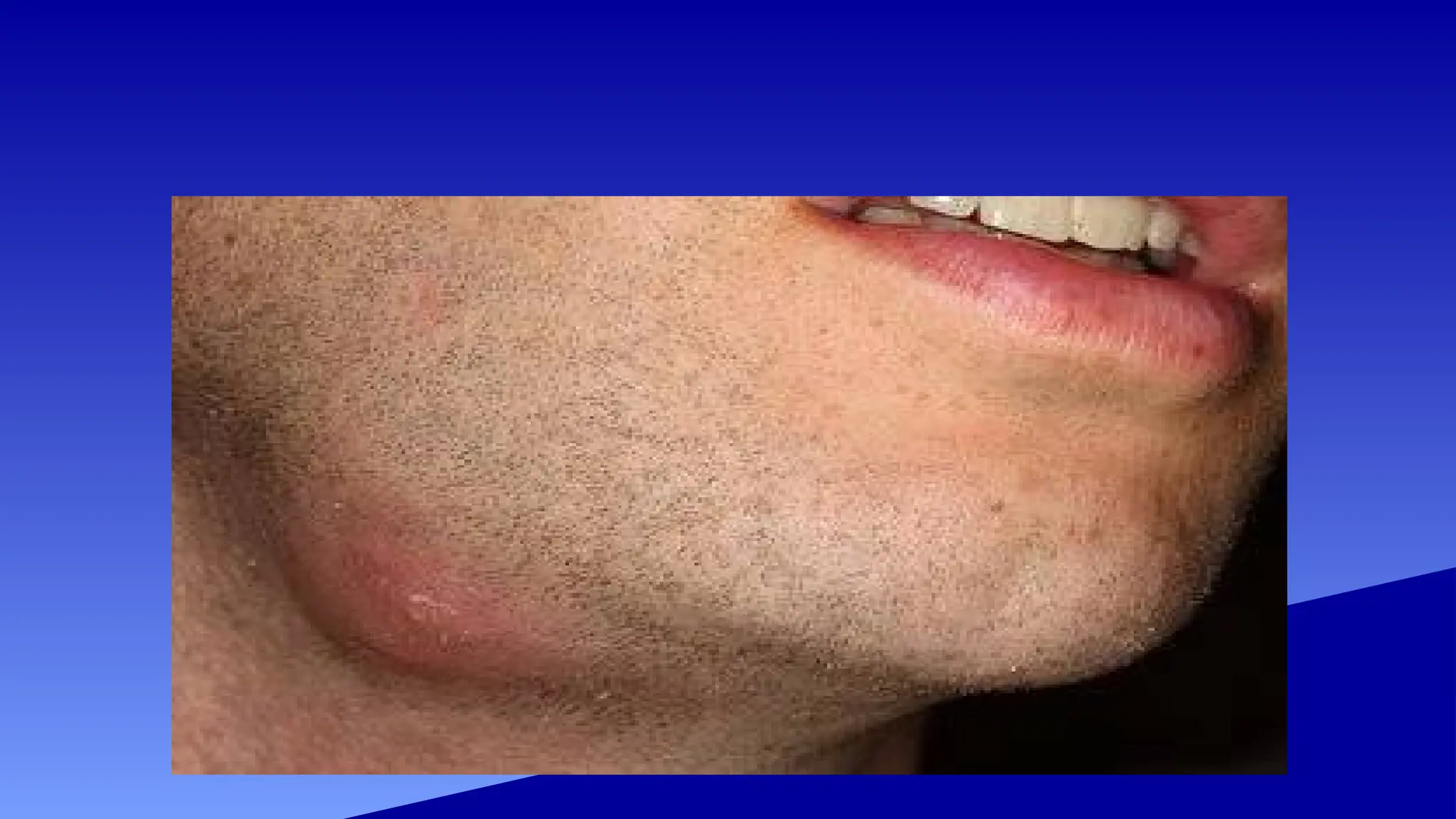
• An abscess is a collection of pus below the
skin
• Pus in an abscess is invisible but clinically
be interpreted as sign of inflammation in
the overlying skin
• Abscess cavities do not have well-defined
lining as cyst
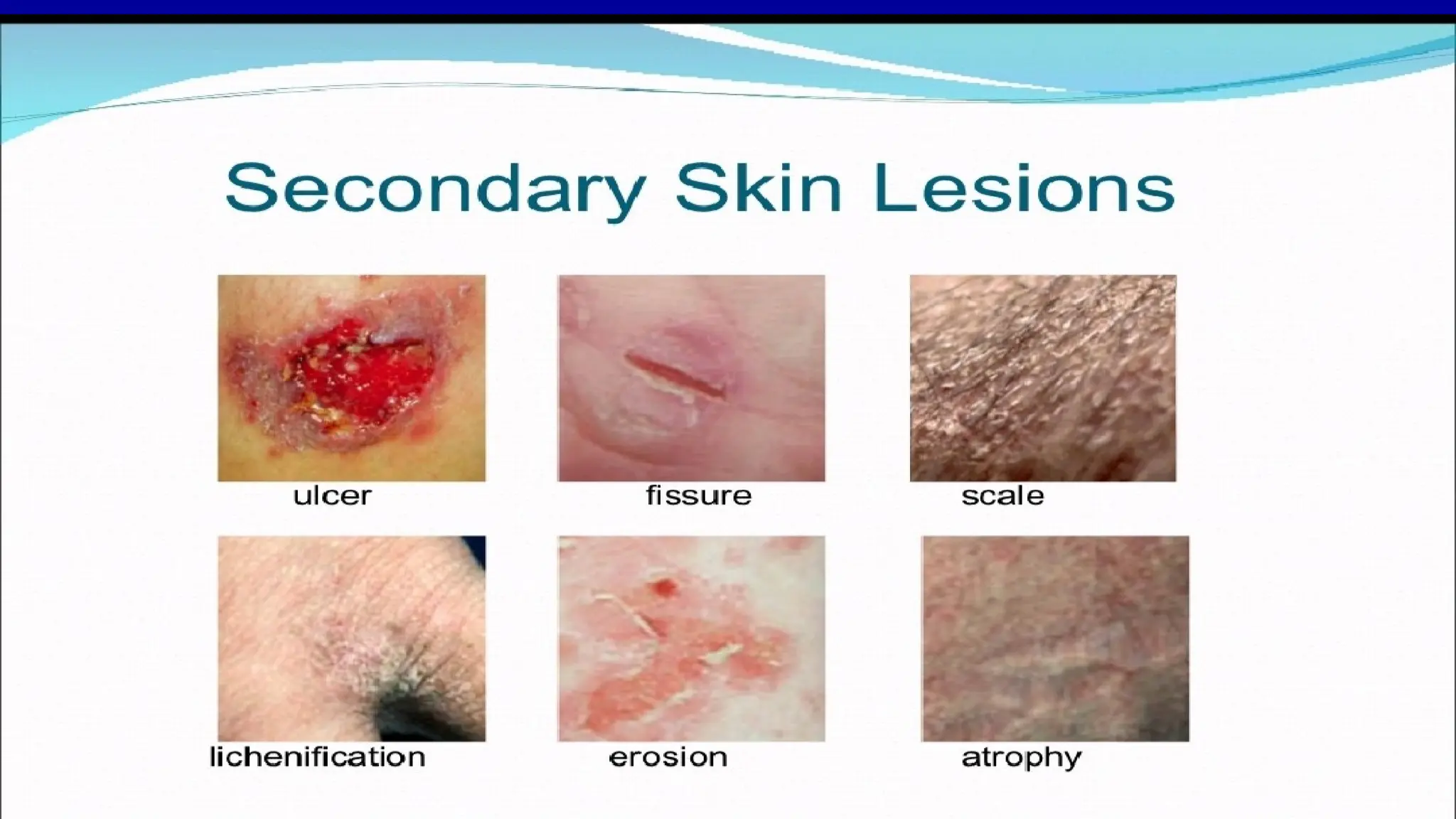
SECONDARY LESIONS
Modification of primary skin lesions that result from
traumatic injury , evolution from primary lesion , or other
external factors
• Crust
• Scale
• Erosion
• Ulcer
• Fissure
• Scar
• Atrophy
• Telangiectasia
CRUST
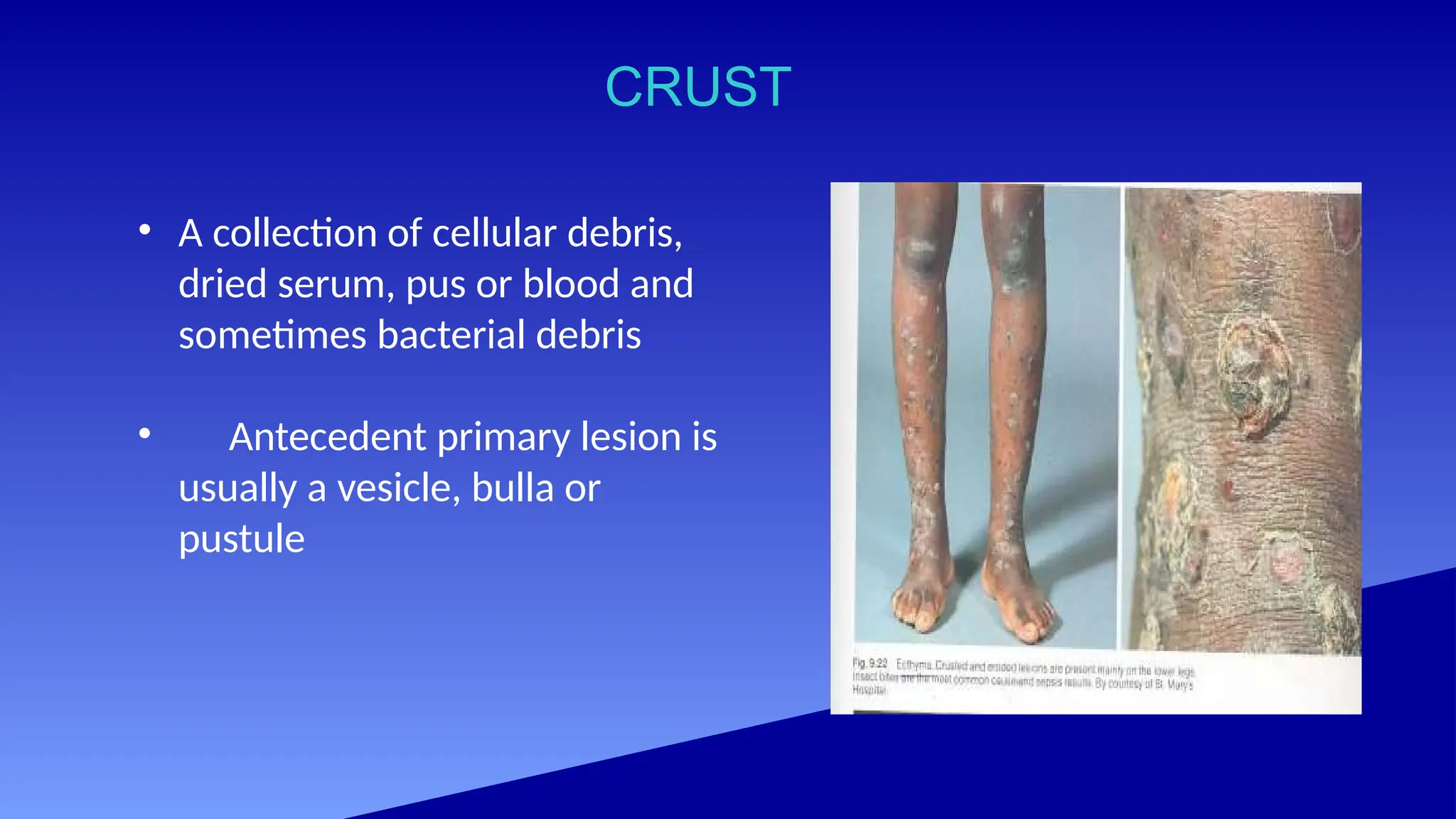
• A collection of cellular debris,
dried serum, pus or blood and
sometimes bacterial debris
• Antecedent primary lesion is
usually a vesicle, bulla or
pustule
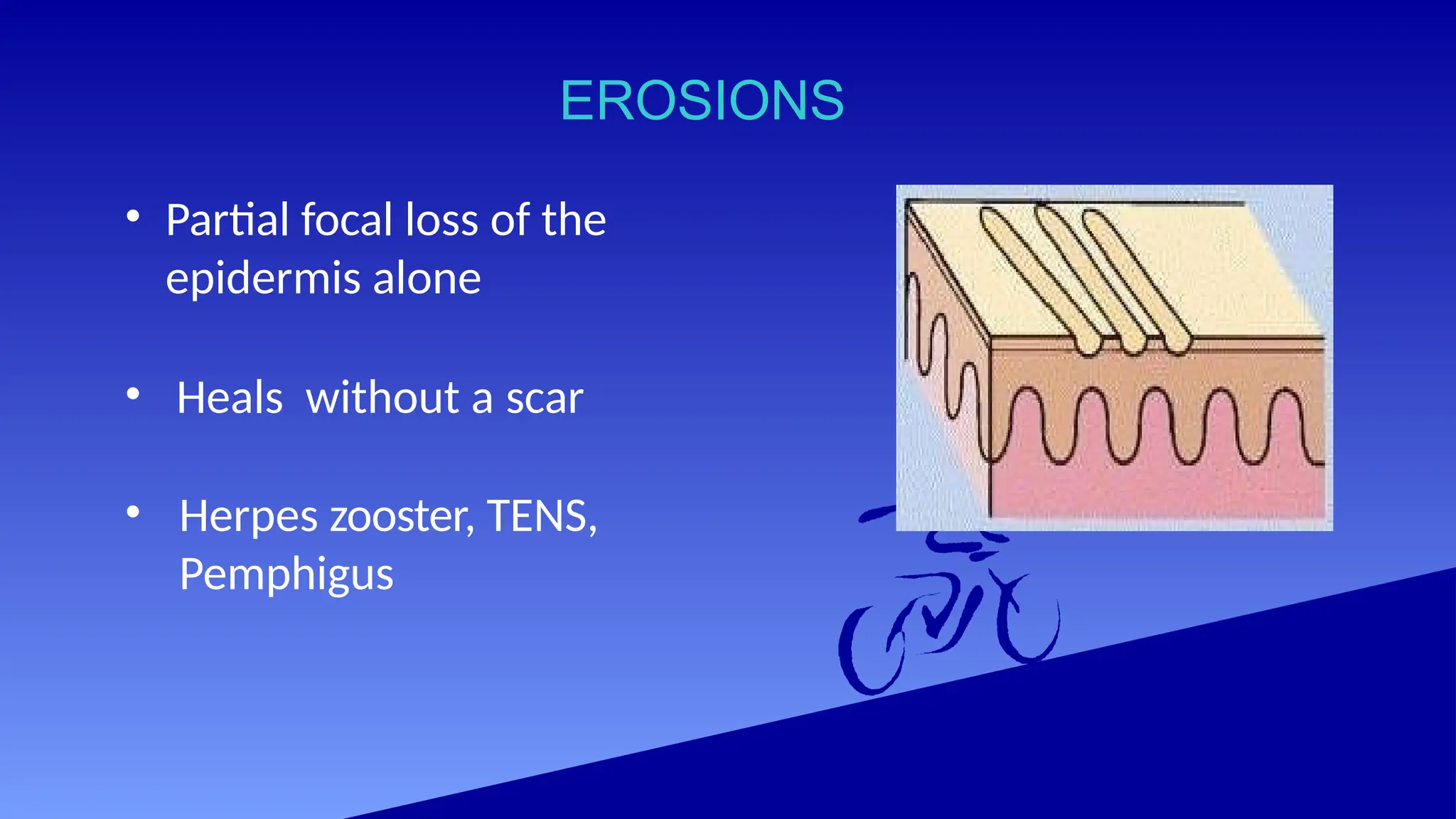
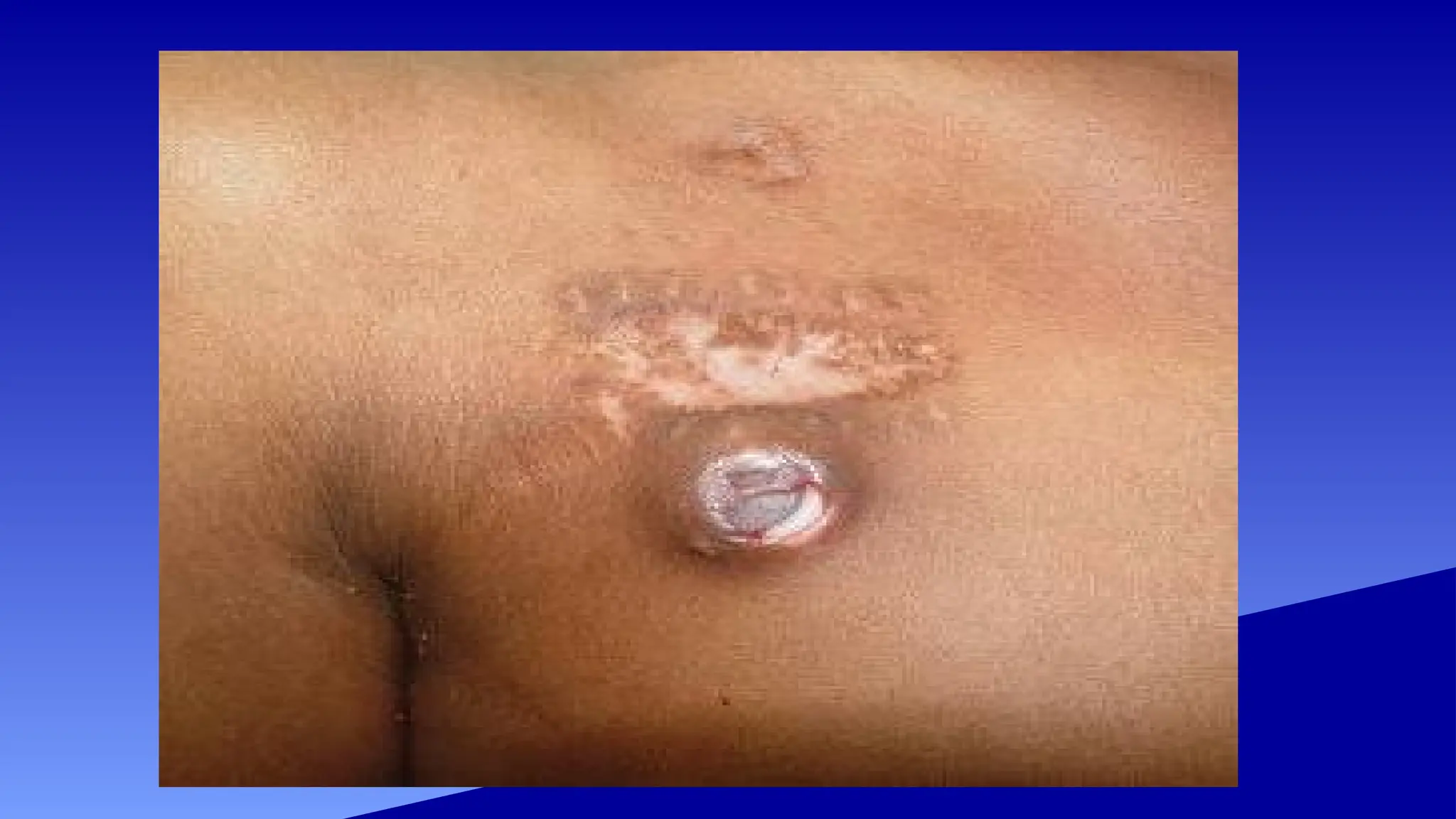
EROSIONS
• Partial focal loss of the
epidermis alone
• Heals without a scar
• Herpes zooster, TENS,
Pemphigus
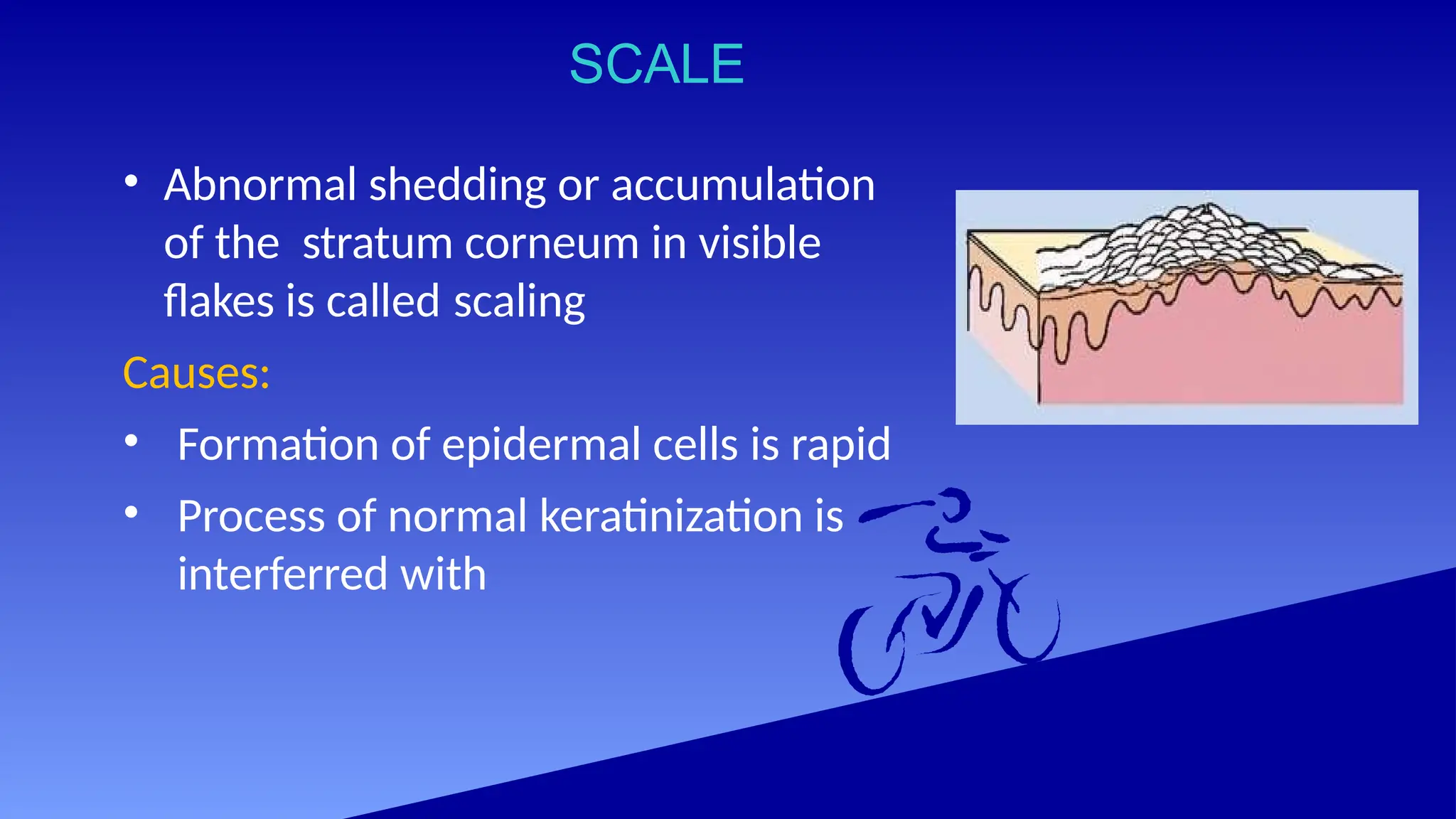
SCALE
• Abnormal shedding or accumulation
of the stratum corneum in visible
flakes is called scaling
Causes:
• Formation of epidermal cells is rapid
• Process of normal keratinization is
interferred with
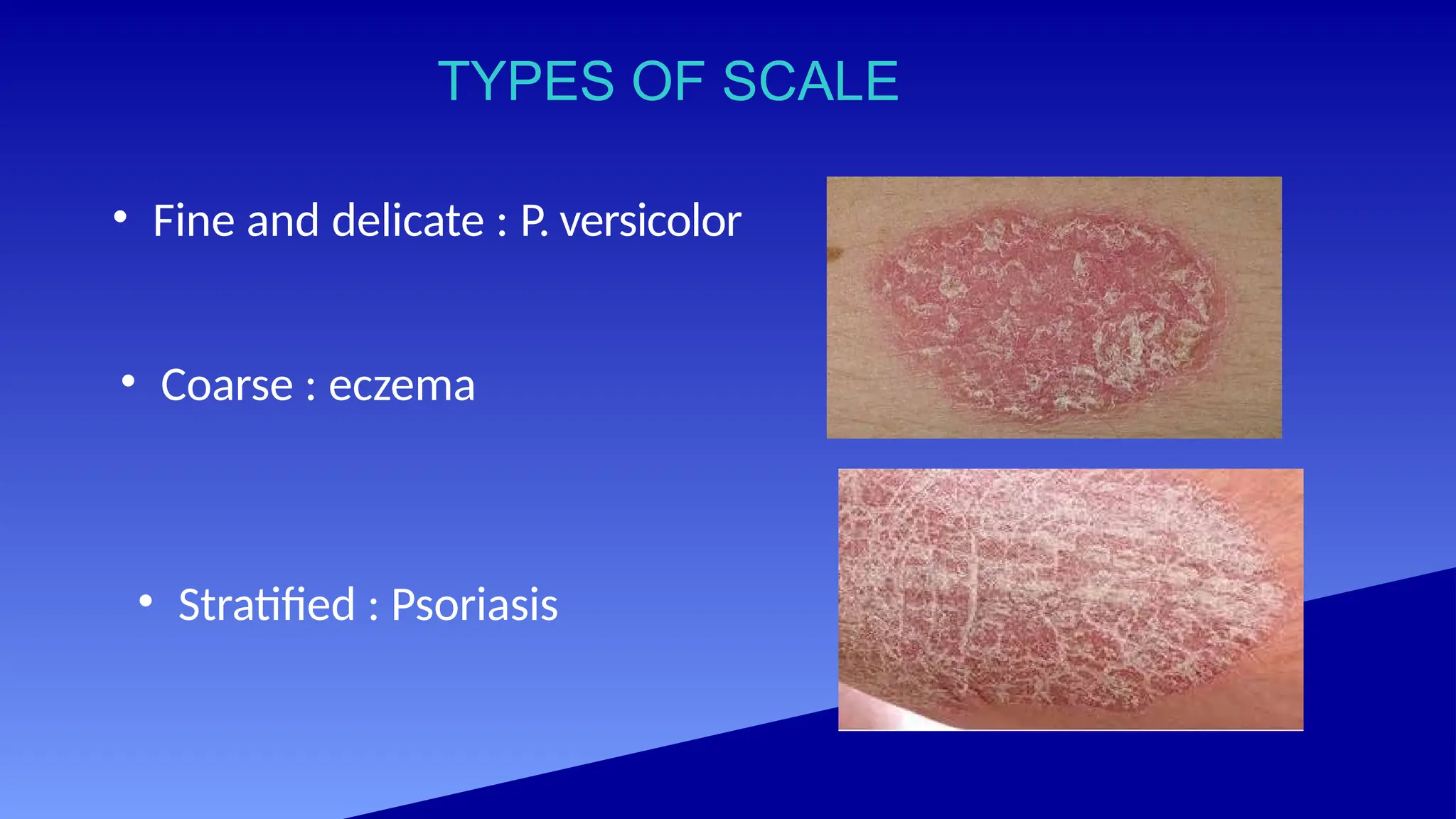
TYPES OF SCALE
• Fine and delicate : P. versicolor
• Coarse : eczema
• Stratified : Psoriasis
ULCER
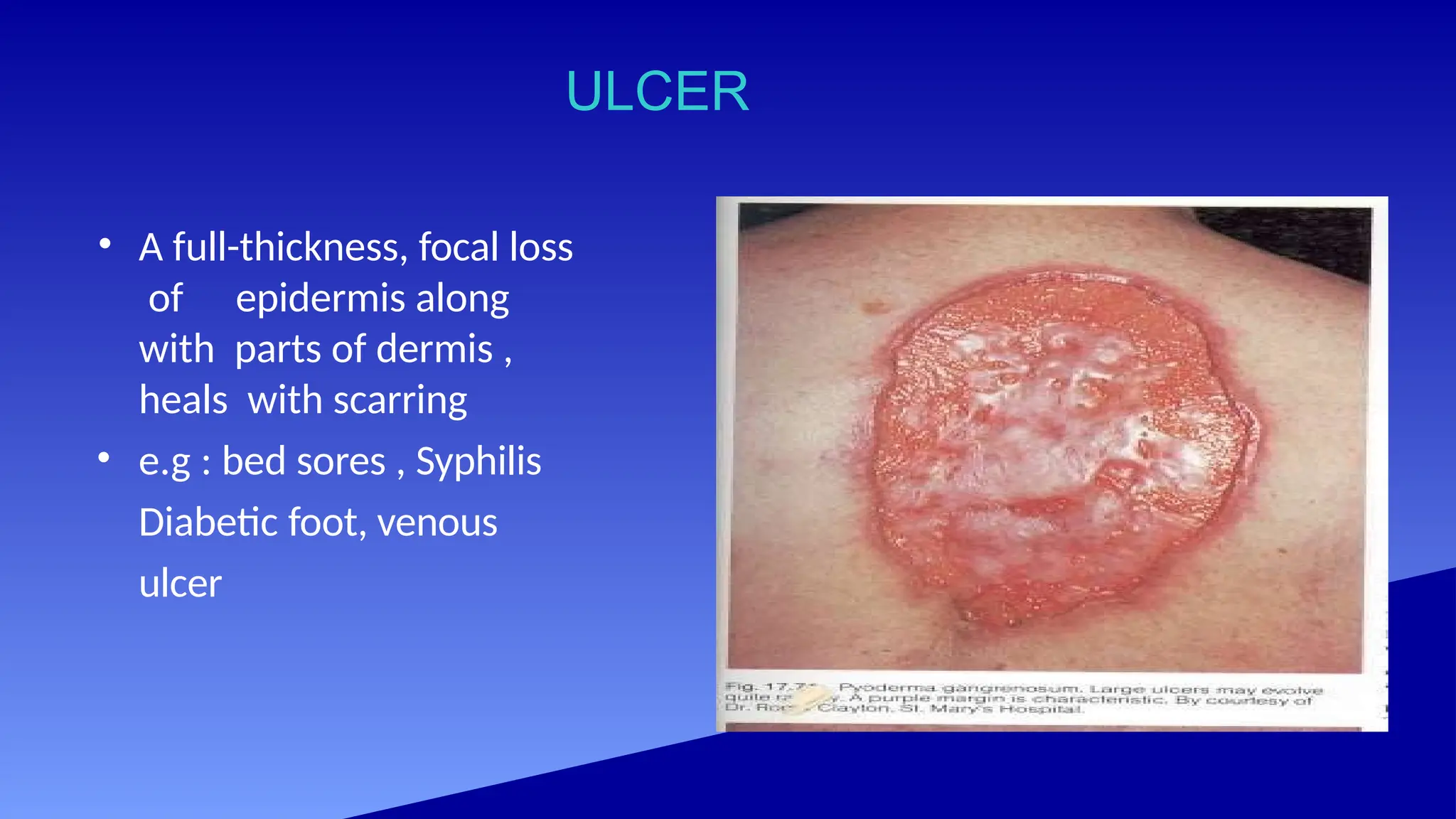
• A full-thickness, focal loss
of epidermis along
with parts of dermis ,
heals with scarring
• e.g : bed sores , Syphilis
Diabetic foot, venous
ulcer
FISSURE
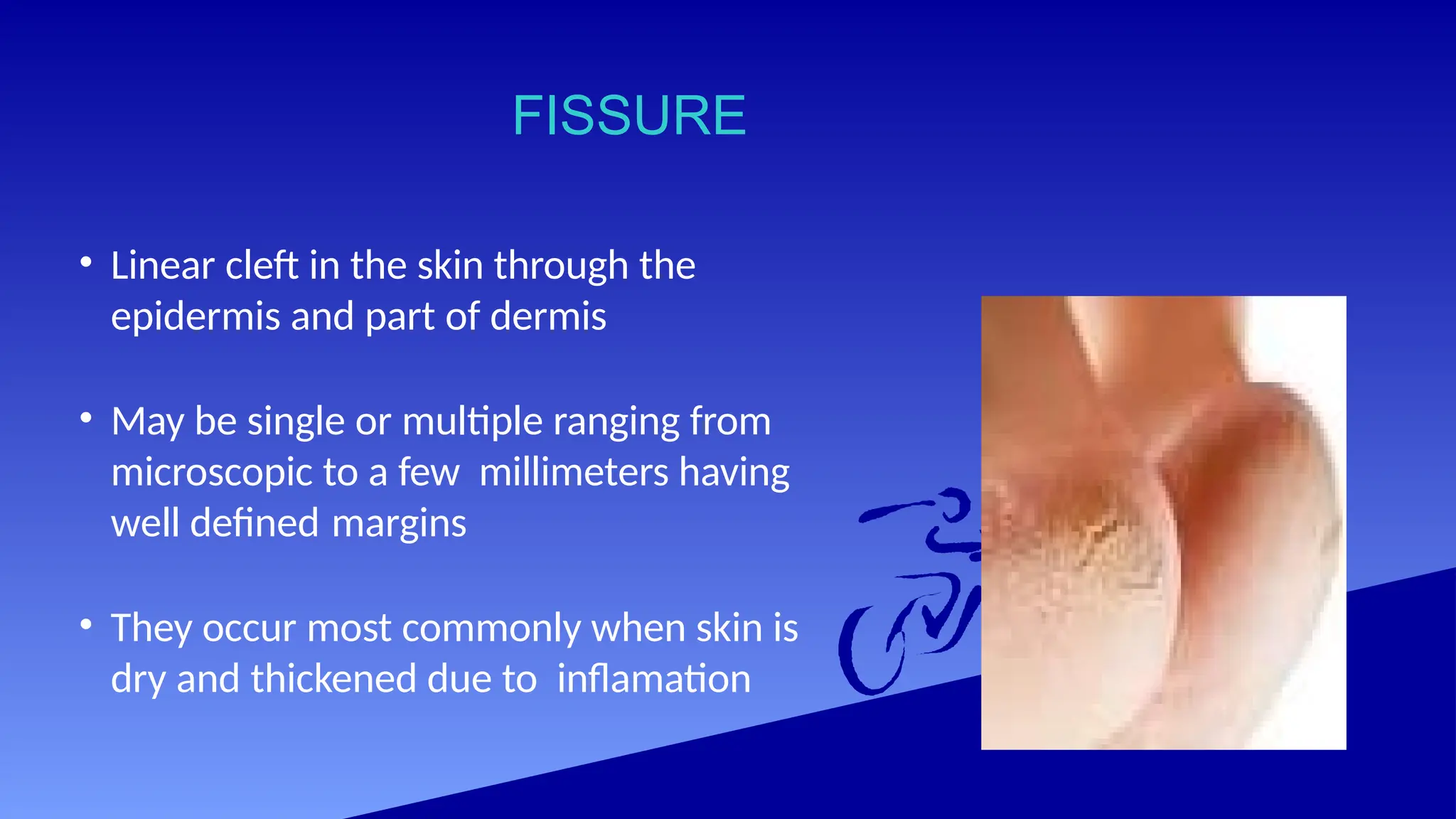
• Linear cleft in the skin through the
epidermis and part of dermis
• May be single or multiple ranging from
microscopic to a few millimeters having
well defined margins
• They occur most commonly when skin is
dry and thickened due to inflamation
SCAR
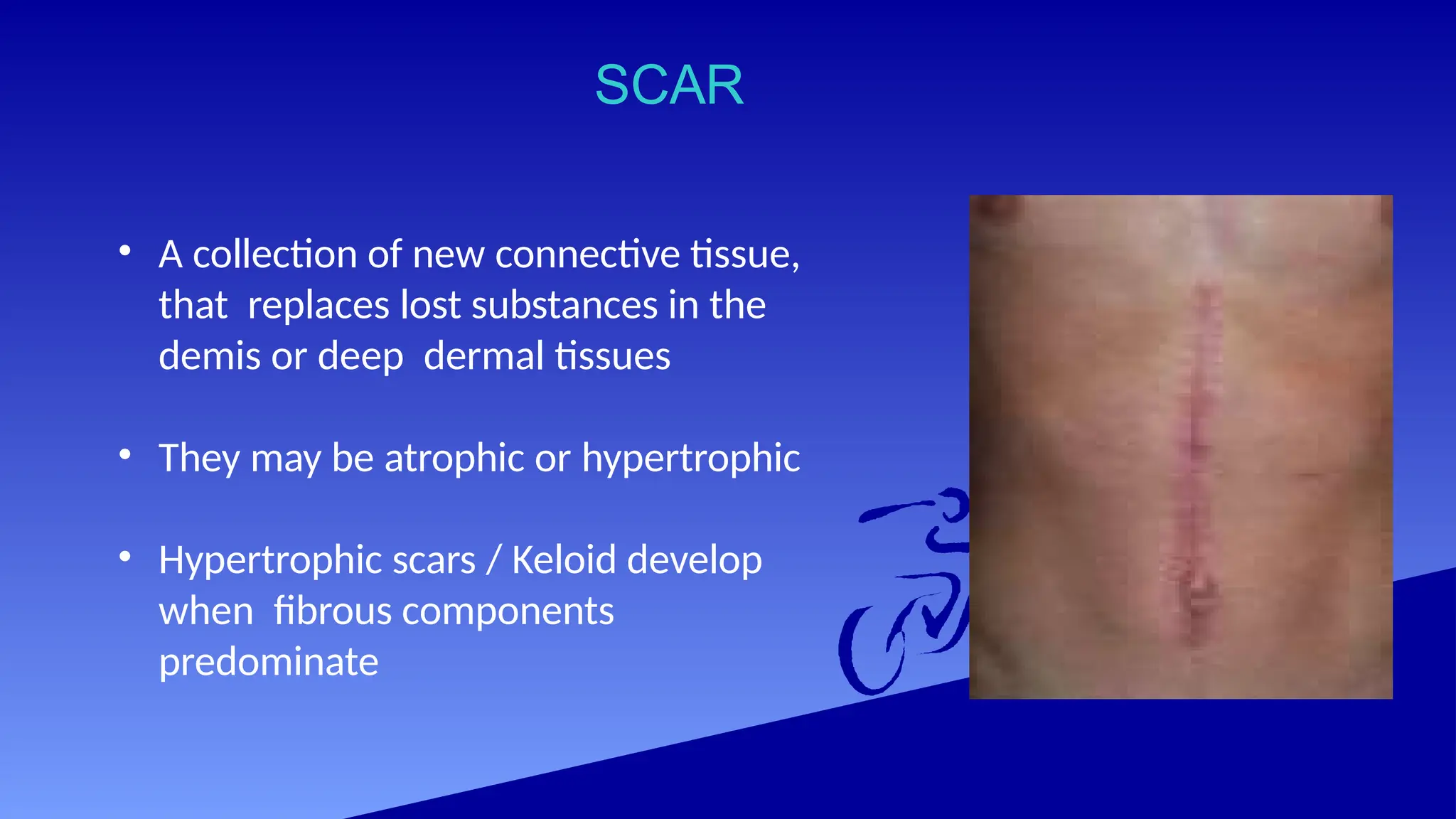
• A collection of new connective tissue,
that replaces lost substances in the
demis or deep dermal tissues
• They may be atrophic or hypertrophic
• Hypertrophic scars / Keloid develop
when fibrous components
predominate
EXCORIATION AND ABRASION
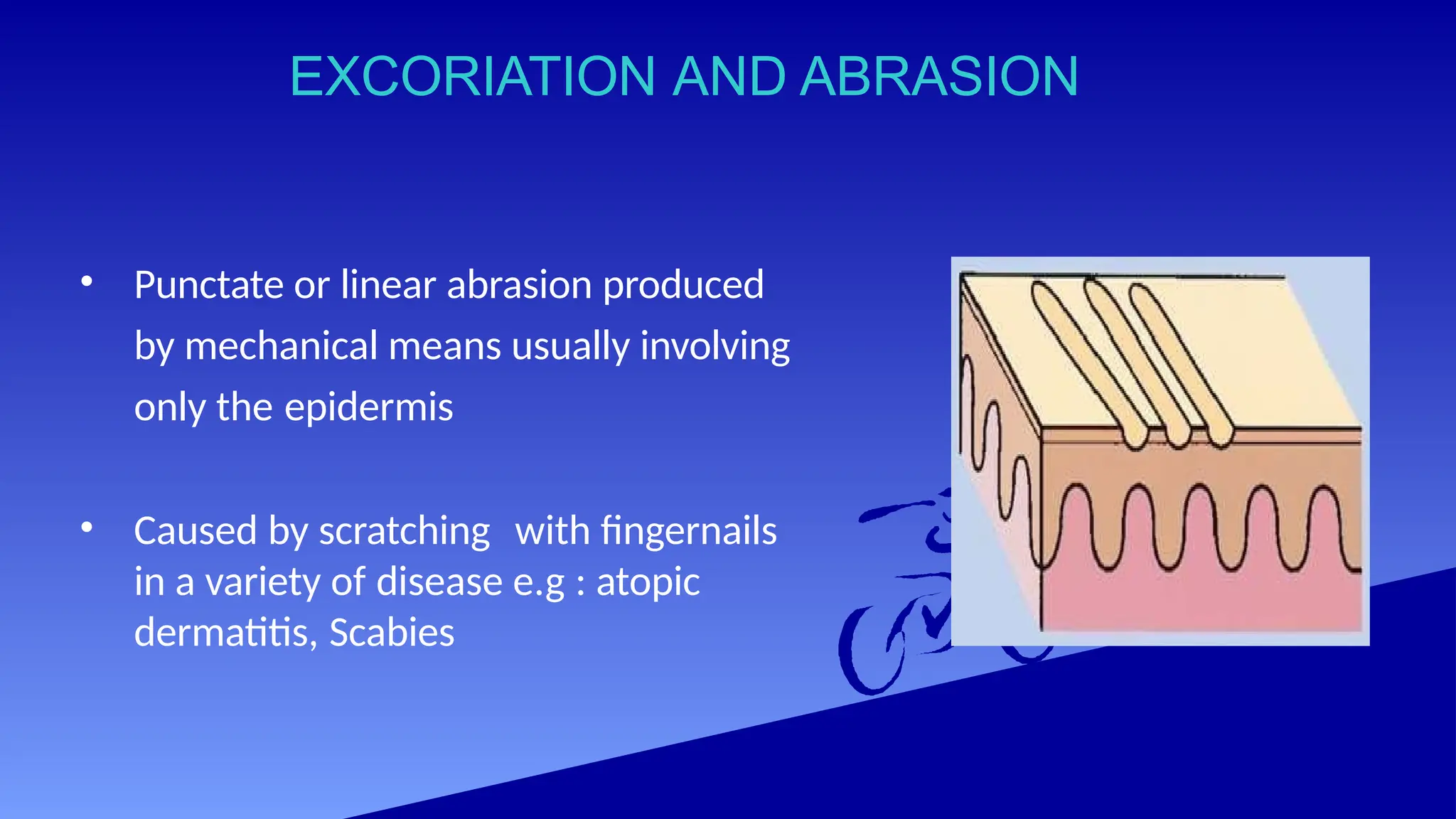
• Punctate or linear abrasion produced
by mechanical means usually involving
only the epidermis
• Caused by scratching with fingernails
in a variety of disease e.g : atopic
dermatitis, Scabies
ATROPHY
Reduction in the components of a tissue, Organ or
part of body. In the skin
1) Epidermal Atrophy: results from decrease in
epidermal cells .Gives rise to frequently transparent
epidermis and alteration of skin surface i.e. loss of
normal skin lines and fine wrinkling
2) Dermal Atrophy: results from decrease in the
reticular or papillary dermis. Clinically seen as
depression of skin
LICHENIFICATION
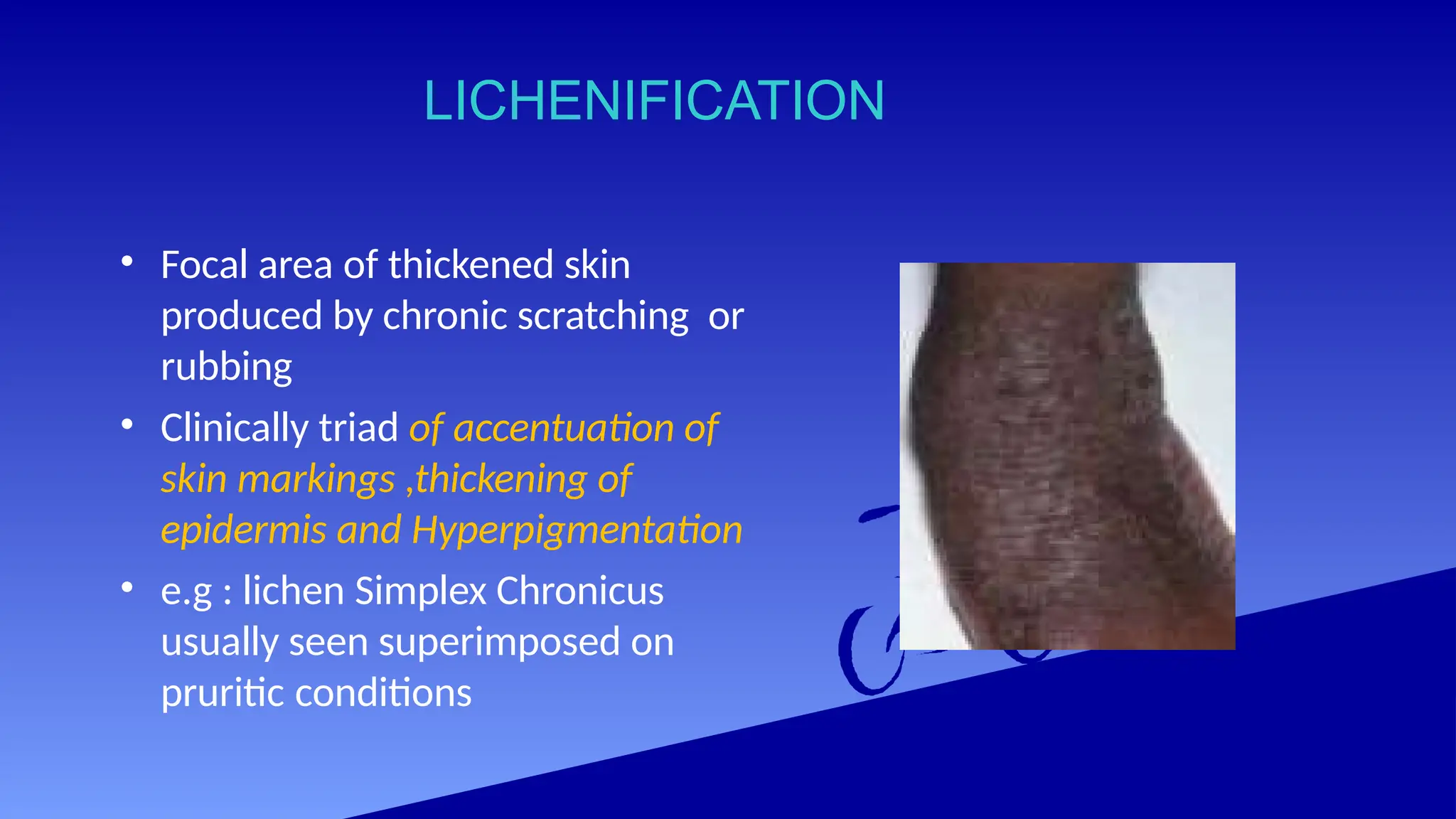
• Focal area of thickened skin
produced by chronic scratching or
rubbing
• Clinically triad of accentuation of
skin markings ,thickening of
epidermis and Hyperpigmentation
• e.g : lichen Simplex Chronicus
usually seen superimposed on
pruritic conditions
SPECIAL LESIONS
• Lesions that are pathognomic to certain skin
conditions
TARGET LESIONS
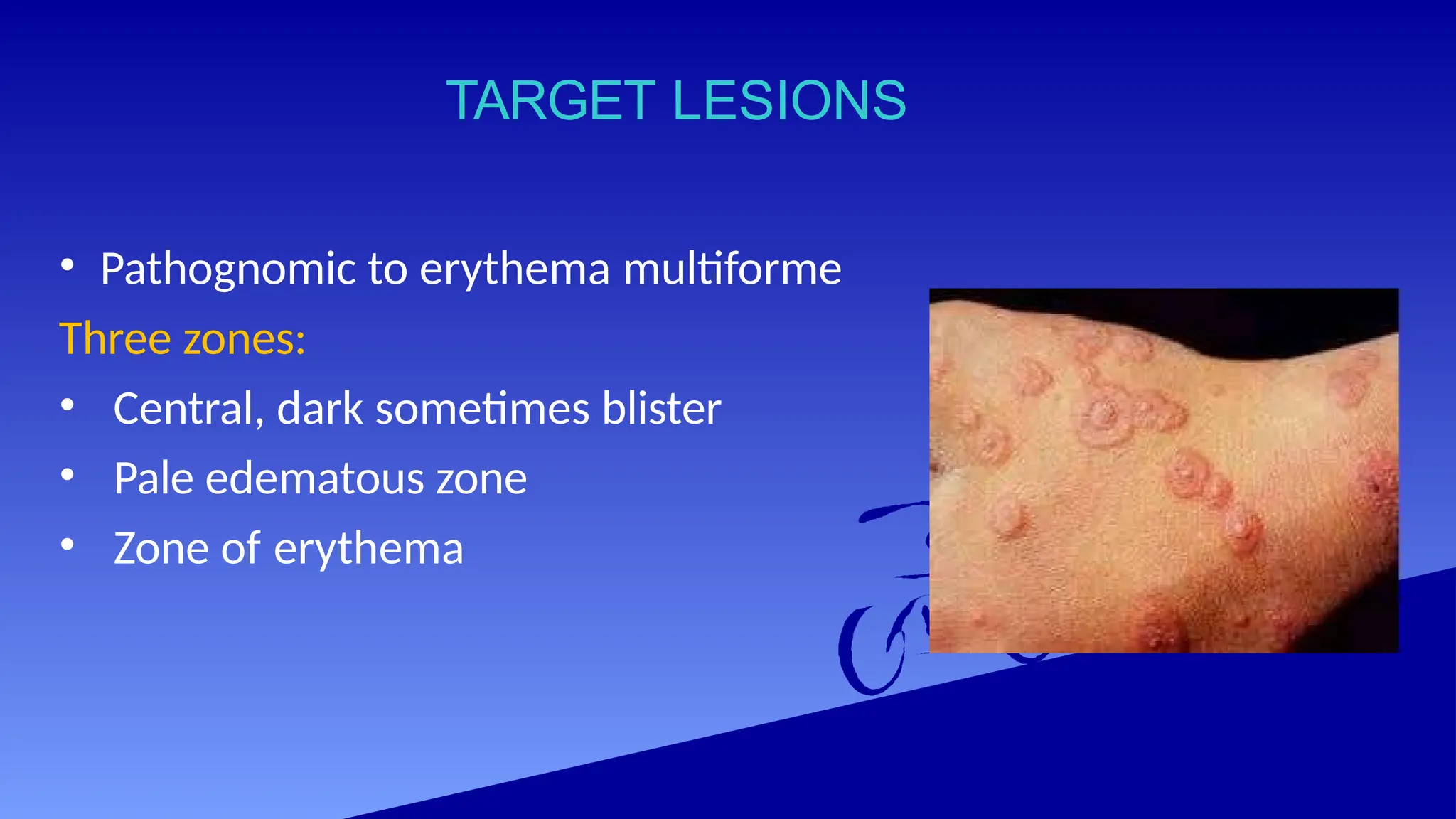
• Pathognomic to erythema multiforme
Three zones:
• Central, dark sometimes blister
• Pale edematous zone
• Zone of erythema
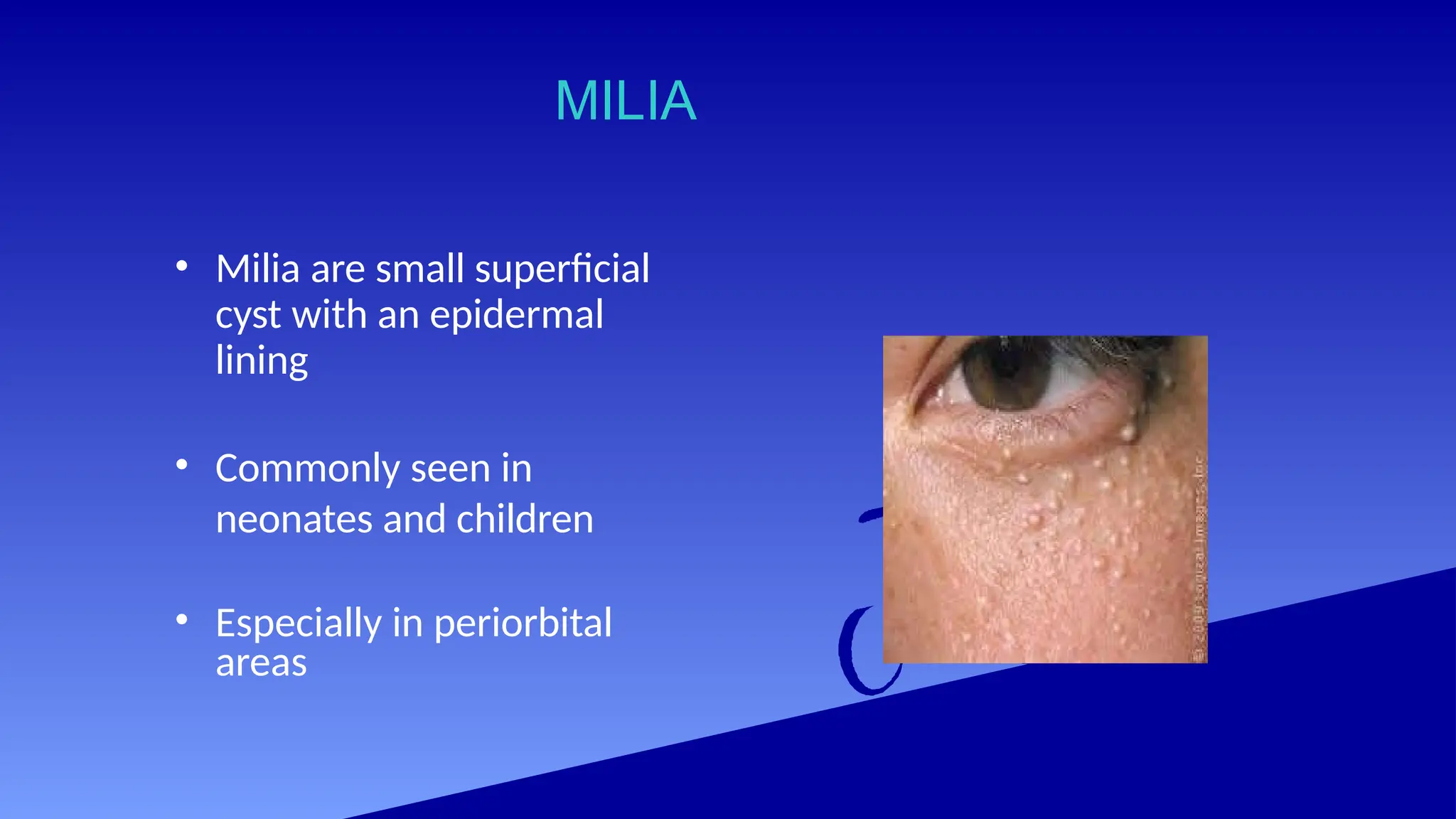
MILIA
• Milia are small superficial
cyst with an epidermal
lining
• Commonly seen in
neonates and children
• Especially in periorbital
areas
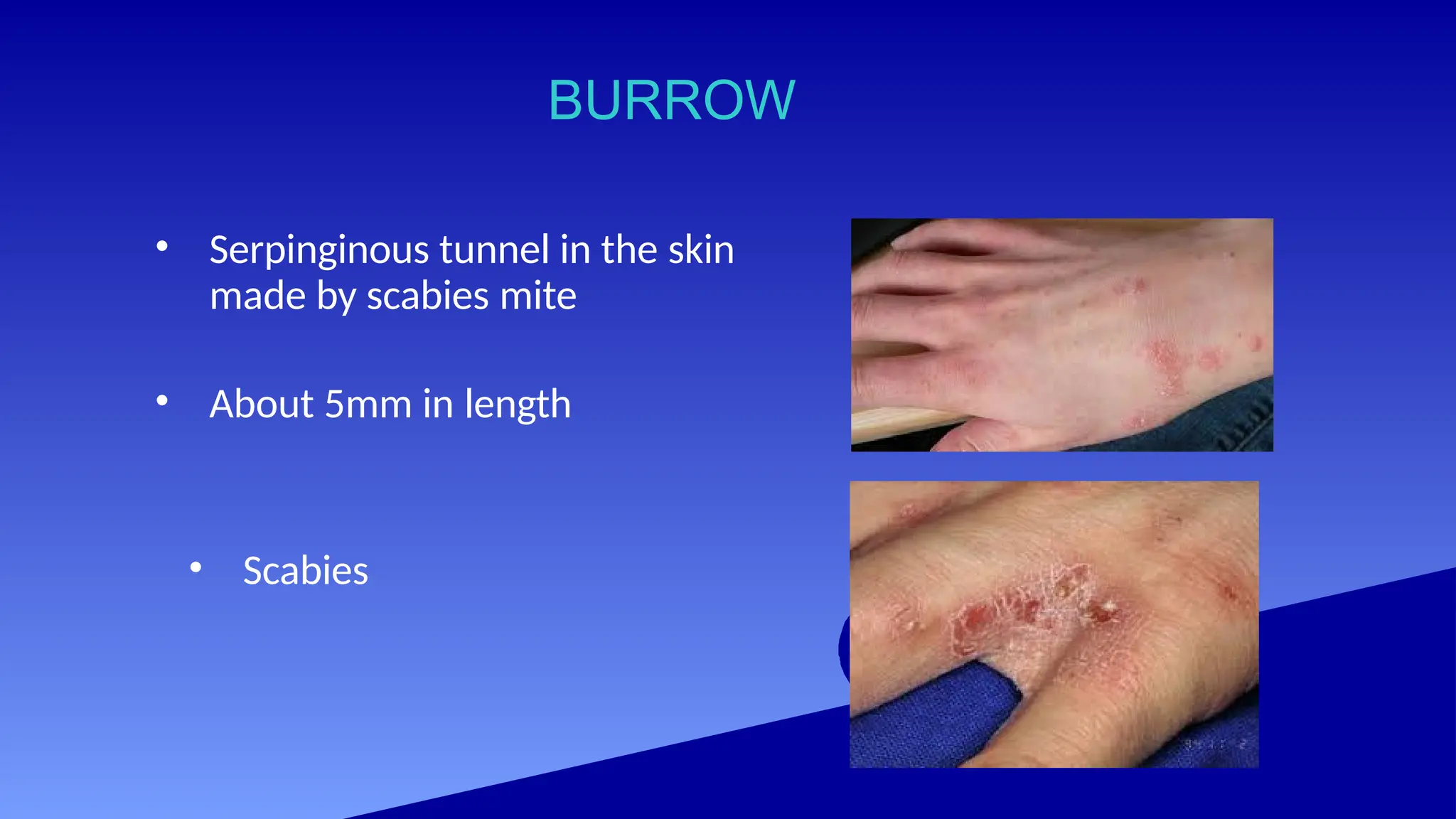
BURROW
• Serpinginous tunnel in the skin
made by scabies mite
• About 5mm in length
• Scabies
structure and function of structure and function of skin-

structure and function of structure and function of skin-

  • 1.
    Lt Col SameenaKausar MBBS,FCPS(DERM), CHPE (NUMS) Assisstant Professor of Dermatology
  • 2.
    • What isthe largest organ of the body?
  • 3.
    PARTS OF SKIN •Epidermis -Ectodermal in origin • Dermis - Mesoderm in origin - Divided into papillary and reticular dermis
  • 4.
  • 6.
    EPIDERMIS • Stratum corneum- Horny layer • Stratum lucidum- Palms and soles • Stratum granulosum- Granular layer • Stratum spinosum -Pickle cell layer • Stratum basale - Basal layer
  • 8.
    DERMIS • Connective tissue...Collagen & elastic fibres • Cells... WBC, Mast cells, fibroblasts • Skin appendages...Hair follicle, sebaceous gland, Eccrine apocrine gland, Hair and nail • Blood vessels • Nerves • Lymphatics
  • 10.
  • 12.
    What is theimportance of skin?
  • 13.
    FUNCTION OF SKIN Protection: •Physical and mechanical barrier to skin • Barrier to chemical hazards Regulation of body temperature: • Regulate water loss and prevent dehydration • Maintain body temperature Photoprotection: • Protect excessive ultraviolet exposure via melanin
  • 14.
    FUNCTION OF SKIN Immunity: •Antigen presentation by Langerhans cells Metabolic function • Production of vitamin D Sensory and autonomic function • Meissners & Pacinian corpuscles • Pain, heat and cold receptors Sociosexual & cosmetic function
  • 15.
  • 16.
    TYPES OF LESIONS PrimaryLesions Secondary Lesions Tertiary Lesions
  • 17.
    PRIMARY LESIONS Definition : •lesion occurring on non pathological skin which have not been altered by trauma, manipulation (scratching, scrubbing) or natural regression over time
  • 18.
    Examples • Macule • Papule •Patch ??? • Plaque • Nodule • Wheal • Vesicle • Bulla • Pustule • Cyst
  • 19.
    MACULE Definition : • Flat,circumscribed skin discoloration that lacks surface elevation or depression and less than 1 cm in diameter
  • 20.
    TYPES Of MACULE 1)Hypopigmented e.g. Tuberous sclerosis , Nevus anaemicus
  • 21.
    2) Depigmented e.g. Vitiligo,Halo naevus 3) Hyperpigmented • Brown or black e.g. Freckles or Chloasma
  • 22.
  • 23.
    PATCH • Patch /Large macule ???
  • 25.
    PAPULE • Solid ,well circumscbed elevated lesion, less than 1 cm in diameter Formed by: 1) Hyperplasia of epidermis , dermis or both e.g. : verruca vulgaris 2) Metabolic deposits or cellular infiltrates e.g. : Xanthelasma
  • 26.
    COLOUR OF PAPULE •Red : Psoriasis • Pearly white : Molluscum contagiosum • Violaceous : Lichen planus • Coppery : Secondary syphilis • Yellowish : Xanthelasma • Blue/Black : Mallignant Melanoma • Purpuric : Henoch-schönlein purpura
  • 27.
    PLAQUE •Elevated well circumscribed,more than 1 cm in diameter ,occupying relatively large surface area in comparison with its height above the skin surface
  • 28.
    TYPES OF SCALE ScalyPlaque : - Psoriasis , P rosea Lichenified plaque : - Lichen Simplex Chronicus Erythematous plaque : - Tuberculoid leprosy
  • 29.
    NODULE • Palpable solidround lesion ,usually larger than 1cm in diameter , occupying relatively larger vertical diameter as compared to suface diameter • Better felt
  • 30.
    • e.g :Erythema nodosum, Lipoma
  • 31.
    WHEALS • Evanescent ,edematous , platue-like elevations of various sizes • Usually oval or arcuate , pink to red, surrounded by a flare of macular erythema • It is the characteristic lesion of urticaria
  • 32.
    VESICLE AND BULLAE Vesicle: •Elevated ,superficial well circumscribed lesion containing clear fluid, less than 0.5 cm in diameter Bullae: • A vesicle larger than 0.5 cm • They can arise by separation of skin at different levels a) Intraepidermal e.g Pompholyx b) Supra basal e.g Pemphigus vulgaris c) Dermoepidermal eg erythema multiforme
  • 33.
    Lesions may be •Tense : Pompholyx • Flaccid : Pemphigus Vulgaris • Umblicated : varicella zoster
  • 34.
    PUSTULE • Well-circumscribed, elevated lesioncontaining visible purulent exudate • Pustules are characteristic of pustular psoriasis, pyoderma, rosacea
  • 35.
    CYST • A sacthat contains liquid or semisolid material in a well-defined cavity Types of cyst: • Epidermal cyst: lined with squamous epithelium and produce keratinous material • Pilar cyst
  • 37.
    ABSCESS • An abscessis a collection of pus below the skin • Pus in an abscess is invisible but clinically be interpreted as sign of inflammation in the overlying skin • Abscess cavities do not have well-defined lining as cyst
  • 39.
    SECONDARY LESIONS Modification ofprimary skin lesions that result from traumatic injury , evolution from primary lesion , or other external factors • Crust • Scale • Erosion • Ulcer • Fissure • Scar • Atrophy • Telangiectasia
  • 41.
    CRUST • A collectionof cellular debris, dried serum, pus or blood and sometimes bacterial debris • Antecedent primary lesion is usually a vesicle, bulla or pustule
  • 42.
    EROSIONS • Partial focalloss of the epidermis alone • Heals without a scar • Herpes zooster, TENS, Pemphigus
  • 44.
    SCALE • Abnormal sheddingor accumulation of the stratum corneum in visible flakes is called scaling Causes: • Formation of epidermal cells is rapid • Process of normal keratinization is interferred with
  • 45.
    TYPES OF SCALE •Fine and delicate : P. versicolor • Coarse : eczema • Stratified : Psoriasis
  • 46.
    ULCER • A full-thickness,focal loss of epidermis along with parts of dermis , heals with scarring • e.g : bed sores , Syphilis Diabetic foot, venous ulcer
  • 47.
    FISSURE • Linear cleftin the skin through the epidermis and part of dermis • May be single or multiple ranging from microscopic to a few millimeters having well defined margins • They occur most commonly when skin is dry and thickened due to inflamation
  • 48.
    SCAR • A collectionof new connective tissue, that replaces lost substances in the demis or deep dermal tissues • They may be atrophic or hypertrophic • Hypertrophic scars / Keloid develop when fibrous components predominate
  • 49.
    EXCORIATION AND ABRASION •Punctate or linear abrasion produced by mechanical means usually involving only the epidermis • Caused by scratching with fingernails in a variety of disease e.g : atopic dermatitis, Scabies
  • 50.
    ATROPHY Reduction in thecomponents of a tissue, Organ or part of body. In the skin 1) Epidermal Atrophy: results from decrease in epidermal cells .Gives rise to frequently transparent epidermis and alteration of skin surface i.e. loss of normal skin lines and fine wrinkling 2) Dermal Atrophy: results from decrease in the reticular or papillary dermis. Clinically seen as depression of skin
  • 51.
    LICHENIFICATION • Focal areaof thickened skin produced by chronic scratching or rubbing • Clinically triad of accentuation of skin markings ,thickening of epidermis and Hyperpigmentation • e.g : lichen Simplex Chronicus usually seen superimposed on pruritic conditions

  • 52.
    SPECIAL LESIONS • Lesionsthat are pathognomic to certain skin conditions
  • 53.
    TARGET LESIONS • Pathognomicto erythema multiforme Three zones: • Central, dark sometimes blister • Pale edematous zone • Zone of erythema
  • 54.
    MILIA • Milia aresmall superficial cyst with an epidermal lining • Commonly seen in neonates and children • Especially in periorbital areas
  • 55.
    BURROW • Serpinginous tunnelin the skin made by scabies mite • About 5mm in length • Scabies