Skin Lesions and Diagnosis
James H Herndon MD
Clinical Professor, Dermatology
UT Southwestern Medical Center
Skin Lesions and Diagnosis
• Recognition of the significant can be life-
and health-saving (melanoma, RMSF,
vasculitis)
• Failure to recognize normal/inconsequential
can also cause harm (the black seborrheic
keratosis, pigmentary purpura of the lower
legs, physiologic variations in genital areas)
Skin Lesions and Diagnosis
• Skin acts as window in several ways. Two
examples:
– Point mutations may cause skin and internal change.
• Birt-Hogg-Dube Syndrome causes cutaneous
fibrofolliculomas, renal tumors, and spontaneous
pneumothorax by affecting the folliculin gene.
– Hormonal overdose causes skin and internal change.
• PCOS causes elevated androgens -> acne, hirsutism and
also hyperinsulinemia -> acanthosis nigricans and diabetes
Skin Lesions and Diagnosis
• How to bring order to confusion:
– What component is mainly affected? (dermis,
epidermis, subcutaneous fat, blood vessels)
– What is the primary change and what is secondary?
– Next assess the lesions by type, shape, arrangement,
and distribution.
– Finally, how did the changes evolve over time?
Skin Lesions and Diagnosis
• How to bring order from confusion, continued.
– History should contain: exact description of onset,
first lesions if any, details of development.
– Prior treatment, of home or physician source, and the
diagnosis(es) based on.
– Other drugs, herbal remedies, ethnic medications.
– Effect of sunlight, season, contact with immediate
environment (plants, animals, chemicals, metals).
– Role of physiologic changes (menses, pregnancy).
Skin Lesions and Diagnosis
• Why do experienced clinicians often view the
rash before taking a history?
– Visual diagnosis may be sharper without
preconceived ideas.
– Some lesions and patterns are so distinctive that
history is needed only as confirmation.
– In other cases the rash guides and interacts with the
history, allowing one to diagnose more efficiently.
Macule
A macule is a circumscribed, flat lesion that
differs from surrounding skin only because of its
colour. Macules may have any size or shape.
They may be hyperpigmented, hypopigmented,
erythematous due to vascular dilatation, or
purpuric. Macules with a very fine scale at their
surfaces are called maculosquamous, as in the
tinea versicolor.
Macule
Macule
The clinical photo shows an eruption consisting of
multiple, well-defined red macules of varying size
which blanch on pressure with a glass slide
(diascopy), and are thus due to the inflammatory
vasodilatation. It in this case the patient has a drug
reaction due to phenolphthalein
Papule
• Small, solid, elevated lesion. Papules are
smaller than 1 cm in diameter, and the major
portion of a papule projects upward, above the
plane of the skin. Papules may result from
metabolic deposits in the dermis, localized
cellular infiltrates or from localized hyperplasia
of cellular elements in the dermis or epidermis.
Papules with scaling are called
papulosquamous lesions and occur in, for
example, psoriasis.
Papule
Papule
The clinical photos show first, a patient
with two solid, well-defined and dome-
shaped papules of firm consistency and
brownish color. In the lower photo one
sees multiple, well-defined, and
coalescing papules of varying size.
Commonly seen in Lichen Planus.
Plaque
Mesa-like elevation occupying a relatively
large surface area in comparison with its
height above the skin surface. Well-
defined, reddish, scaling plaques that
coalesce to cover large areas of the
posterior thigh are seen in the upper
clinical photograph.
Seen in Psoriasis and Eczema
Plaque
Lichenification
Lichenification represents a thickening of
the skin together with accentuation of skin
markings. The process results from
repeated rubbing and frequently develops
in persons with atopic eczema or any
condition associated with chronic itching.
This process is still in an early stage in
the lower clinical photograph, taken of a
patient with eczema.
Nodule
Palpable, solid, round lesion. It differs
from a papule mainly by depth of
involvement and/or substantive palpability
rather than by diameter. A nodule may
consist of cells derived from the
epidermis, from an epidermal appendage,
from a neoplasm, or from a metabolic
deposit.
Nodule: Metastatic Melanoma
Wheal
A wheal is a rounded or flat-topped elevated
lesion that characteristically lasts only a few
hours. Wheals may appear as tiny papules 3 to
4 mm in diameter (eg in urticaria shown in the
middle photograph). In other patients they may
be large, coalescing plaques, as in allergic
reactions to medications shown in the far right
photograph of an urticarial reaction to penicillin.
Wheal
Vesicle
A vesicle is a circumscribed and elevated
lesion that contains fluid. The drawing
shows subcorneal vesicles resulting from
cleavage just below the stratum corneum,
and spongiotic vesicles resulting from
intercellular edema. A bulla is a vesicle
larger than 0.5 cm.
Vesicle
Vesicle
The clinical photograph shows multiple
translucent subcorneal vesicles which are
fragile, collapse easily, and lead to crusting.
These lesions represent impetigo due either to
streptococci or staphylococci, either of which
can synthesize a specific epidermolytic toxin
capable of inactivating an important adhesive
protein, desmoglein 3, found mainly in the
upper epidermis. .
Acantholytic vesicles
• Acantholytic vesicles result from cleavage
within the epidermis due to loss of intercellular
attachments. Ballooning degeneration of
epidermal cells leads to the formation of
vesicles in many viral infections such as
varicella-zoster shown in the photograph. The
characteristic feature of centrally-located
umbilication is seen in many of these vesicles
Acantholytic Vesicle
Subepidermal vesicles
Subepidermal vesicles occur following
pathologic change in the region of the
dermal-epidermal junction. This important
area sustains damage in bullous
erythema multiforme, porphyria cutanea
tarda, epidermolysis bullosa, dermatitis
herpetiformis, and bullous pemphigoid.
Sub-epidermal Vesicles: bullous
pemphigoid
The clinical photograph illustrates bullous
pemphigoid. Some of the bullae arise on
normal and some on erythematous skin.
Most of them are tense and filled with
serious or haemorrhagic fluid. Some have
collapsed and become crusted.
Erosion
An erosion is a moist, circumscribed,
usually depressed lesion resulting from
loss of all or a portion of the viable
epidermis. Erosions remain after the roofs
of vesicles and bullae become detached
and usually heal without scarring. The
clinical photograph represents an erosion
from herpes simplex infection
Erosion
Pustule
A pustule, shown in the drawing on the
left, is a circumscribed, raised lesion
(usually a papule) that contains purulent
exudate. Primary, non-follicular pustules
occur in pustular psoriasis, shown on the
right. These are very superficial,
subcorneal pustules which coalesce,
occasionally forming lakes of pus. .
Skin Lesions and Diagnosis: Pustule
Cyst
A cyst is a sac that contains liquid or semisolid
material such as fluid, cells, and cell products.
A spherical or oval nodule or papule may
clinically be suspected of being a cyst if it is
resilient on palpation.
Cyst
Cysts
The common cysts, shown in the drawing
at left, include epidermal cysts (A), lined
with squamous epithelium which produce
keratinous material. Cysts of hair follicle
origin are lined with multilayered
epithelium that does not mature through a
granular layer. These are called pilar
cysts (B).
Cystic Adnexial Tumour
The bluish resilient cyst shown on the
right photograph represents a cystic
adnexal tumor, in this case a cystic
hidradenoma, which is filled with a
mucus-like material.
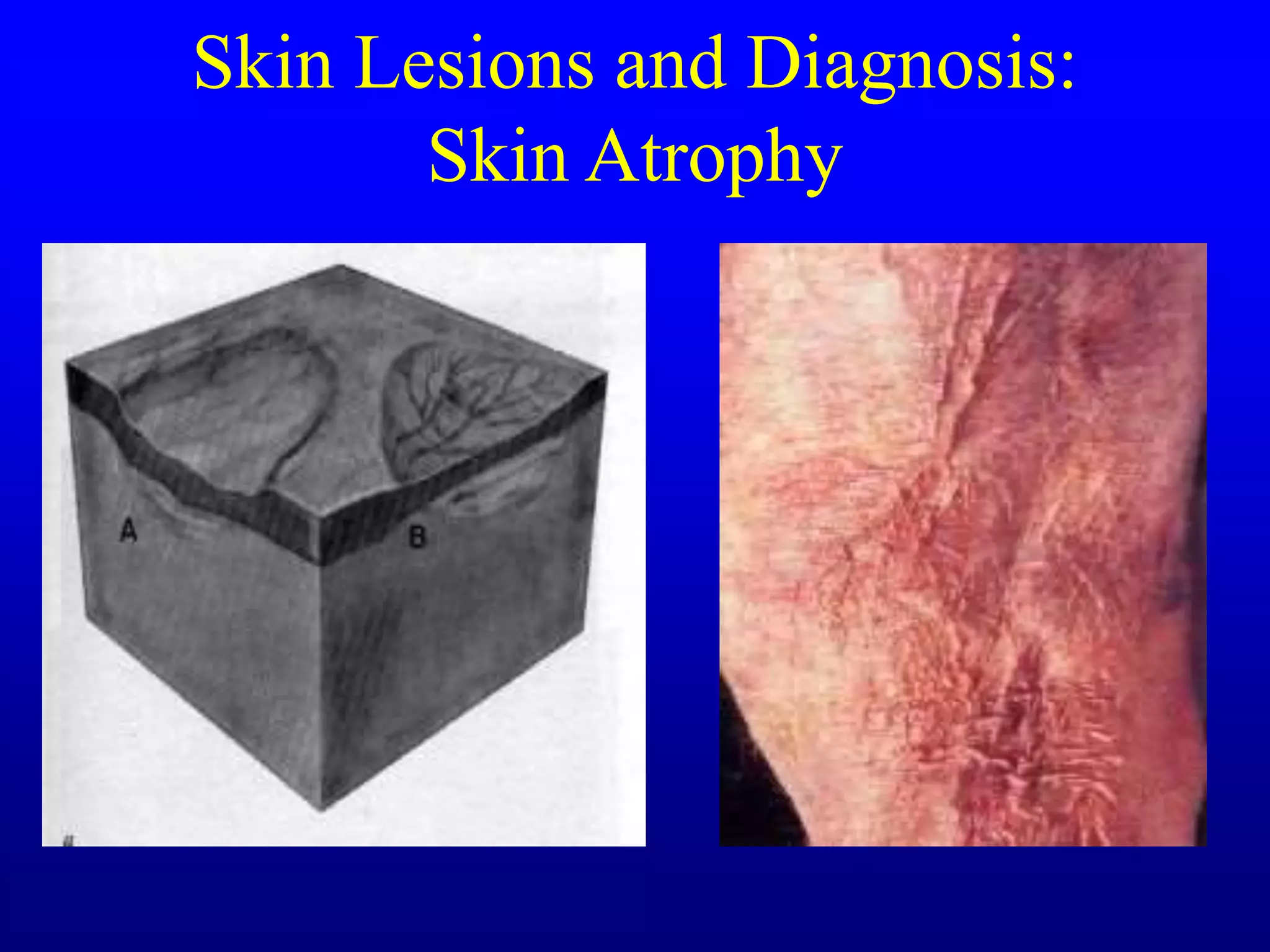
Skin Atrophy
Atrophy of the skin may be limited to the
epidermis or the dermis or may
simultaneously occur in both. Epidermal
atrophy (B) displays a thin, almost
transparent epidermis. Atrophic epidermis
may or may not retain the normal skin
lines.
Skin Atrophy
• Dermal atrophy (A) results from a decrease in
the papillary or reticular dermal connective
tissue and produces a depression in the skin.
• Atrophy of the subcutaneous tissue may also
lead to depressions in the surface of the skin.
The clinical photograph shows marked
dermal and epidermal atrophy with loss of
normal skin texture, thinning, and wrinkling.
Skin Lesions and Diagnosis:
Skin Atrophy
Ulcer
An ulcer is a depressed lesion in which
the epidermis and at least the upper,
papillary dermis have been destroyed.
Ulcers always heal with scarring for this
reason. The clinical photograph shows a
sharply demarcated, punched-out ulcer
following a severe recurrence of herpes
simplex of the buttock area.
Ulcer
Scar
• A scar occurs whenever ulceration has taken
place. It develops so as to reflect the pattern of
healing characteristic of that area of skin. A
scar may be hypertrophic (A) or atrophic (B).
• The photograph shows a typical clinical
example of hypertrophic scar. (A keloidal scar
differs from a hypertrophic one in exhibiting a
pattern of growth that outstrips the boundaries
of the original ulcer or wound).
Scar
Scaling
Abnormal shedding or accumulation of stratum
corneum in the form of perceptible flakes is
called scaling and is shown in the drawing.
Parakeratotic scale ( in which the nuclei are
retained) is seen in association with psoriasis
and psoriasiform dermatitis(A). Densely
adherent scale with a sandpaper-like surface
is seen covering actinic keratoses (B).
Psoriatic Scaling
A typical silvery psoriatic scaling is shown
in the photograph. Occasionally scales in
this disease adhere tightly to the
underlying epidermis, building up to form
an asbestos-like layer that obscures the
underlying cutaneous details.
Scaling
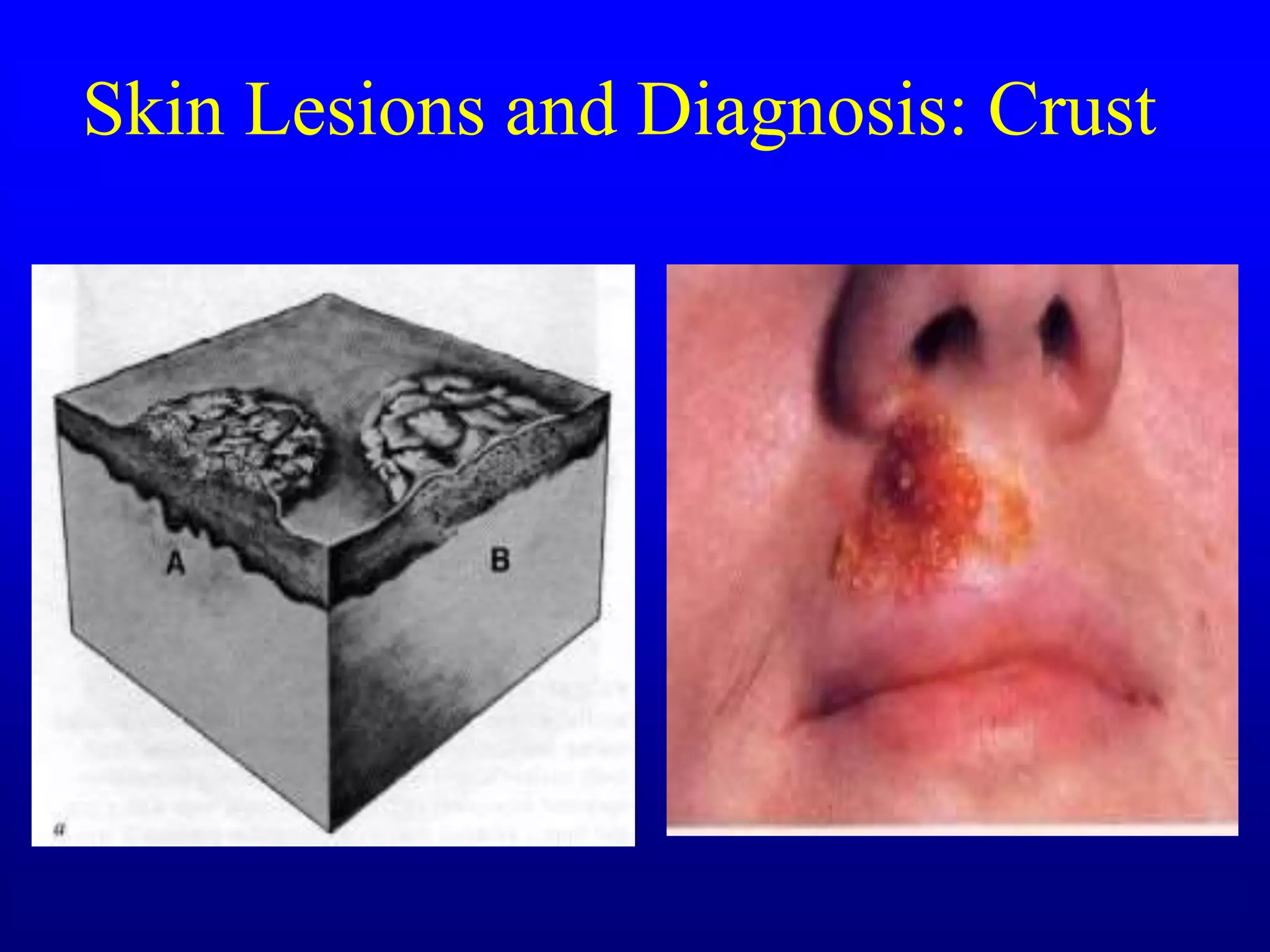
Crusting
Crusts or crusted exudates result when
serum, blood, or purulent exudate dries
on the skin surface. Crusts may be thin,
delicate, and friable(A), as in some cases
of impetigo as shown in the photograph,
or thick and adherent (B) as shown in the
drawing.
Skin Lesions and Diagnosis: Crust
Immunologically-mediated skin
conditions
• Iris-type lesions are those which a clear in the
center and, usually circular or oval, possess
accentuated borders. Granuloma annulare,
erythema multiforme, and many others
present this way.
Skin Lesions and Diagnosis:
Erythema multiforme and
Granuloma Annulare
Herpetiform and Zosteriform patterns
• The grouped (or herpetiform) lesions of
herpes viruses depend on an anatomic
arrangement. Here the cutaneous nerves
arborize beneath the surface, reaching their
nerve endings in a tightly grouped pattern.
• A zosteriform pattern depends on the macro,
dermatomal nerve distribution, following the
layout of spinal and cranial nerves.
Skin Lesions and Diagnosis:
herpetiform and zosteriform

Dr Nzau Skin Lesions.ppt

  • 1.
    Skin Lesions andDiagnosis James H Herndon MD Clinical Professor, Dermatology UT Southwestern Medical Center
  • 2.
    Skin Lesions andDiagnosis • Recognition of the significant can be life- and health-saving (melanoma, RMSF, vasculitis) • Failure to recognize normal/inconsequential can also cause harm (the black seborrheic keratosis, pigmentary purpura of the lower legs, physiologic variations in genital areas)
  • 3.
    Skin Lesions andDiagnosis • Skin acts as window in several ways. Two examples: – Point mutations may cause skin and internal change. • Birt-Hogg-Dube Syndrome causes cutaneous fibrofolliculomas, renal tumors, and spontaneous pneumothorax by affecting the folliculin gene. – Hormonal overdose causes skin and internal change. • PCOS causes elevated androgens -> acne, hirsutism and also hyperinsulinemia -> acanthosis nigricans and diabetes
  • 4.
    Skin Lesions andDiagnosis • How to bring order to confusion: – What component is mainly affected? (dermis, epidermis, subcutaneous fat, blood vessels) – What is the primary change and what is secondary? – Next assess the lesions by type, shape, arrangement, and distribution. – Finally, how did the changes evolve over time?
  • 5.
    Skin Lesions andDiagnosis • How to bring order from confusion, continued. – History should contain: exact description of onset, first lesions if any, details of development. – Prior treatment, of home or physician source, and the diagnosis(es) based on. – Other drugs, herbal remedies, ethnic medications. – Effect of sunlight, season, contact with immediate environment (plants, animals, chemicals, metals). – Role of physiologic changes (menses, pregnancy).
  • 6.
    Skin Lesions andDiagnosis • Why do experienced clinicians often view the rash before taking a history? – Visual diagnosis may be sharper without preconceived ideas. – Some lesions and patterns are so distinctive that history is needed only as confirmation. – In other cases the rash guides and interacts with the history, allowing one to diagnose more efficiently.
  • 7.
    Macule A macule isa circumscribed, flat lesion that differs from surrounding skin only because of its colour. Macules may have any size or shape. They may be hyperpigmented, hypopigmented, erythematous due to vascular dilatation, or purpuric. Macules with a very fine scale at their surfaces are called maculosquamous, as in the tinea versicolor.
  • 8.
  • 9.
    Macule The clinical photoshows an eruption consisting of multiple, well-defined red macules of varying size which blanch on pressure with a glass slide (diascopy), and are thus due to the inflammatory vasodilatation. It in this case the patient has a drug reaction due to phenolphthalein
  • 10.
    Papule • Small, solid,elevated lesion. Papules are smaller than 1 cm in diameter, and the major portion of a papule projects upward, above the plane of the skin. Papules may result from metabolic deposits in the dermis, localized cellular infiltrates or from localized hyperplasia of cellular elements in the dermis or epidermis. Papules with scaling are called papulosquamous lesions and occur in, for example, psoriasis.
  • 11.
  • 12.
    Papule The clinical photosshow first, a patient with two solid, well-defined and dome- shaped papules of firm consistency and brownish color. In the lower photo one sees multiple, well-defined, and coalescing papules of varying size. Commonly seen in Lichen Planus.
  • 13.
    Plaque Mesa-like elevation occupyinga relatively large surface area in comparison with its height above the skin surface. Well- defined, reddish, scaling plaques that coalesce to cover large areas of the posterior thigh are seen in the upper clinical photograph. Seen in Psoriasis and Eczema
  • 14.
  • 15.
    Lichenification Lichenification represents athickening of the skin together with accentuation of skin markings. The process results from repeated rubbing and frequently develops in persons with atopic eczema or any condition associated with chronic itching. This process is still in an early stage in the lower clinical photograph, taken of a patient with eczema.
  • 16.
    Nodule Palpable, solid, roundlesion. It differs from a papule mainly by depth of involvement and/or substantive palpability rather than by diameter. A nodule may consist of cells derived from the epidermis, from an epidermal appendage, from a neoplasm, or from a metabolic deposit.
  • 17.
  • 18.
    Wheal A wheal isa rounded or flat-topped elevated lesion that characteristically lasts only a few hours. Wheals may appear as tiny papules 3 to 4 mm in diameter (eg in urticaria shown in the middle photograph). In other patients they may be large, coalescing plaques, as in allergic reactions to medications shown in the far right photograph of an urticarial reaction to penicillin.
  • 19.
  • 20.
    Vesicle A vesicle isa circumscribed and elevated lesion that contains fluid. The drawing shows subcorneal vesicles resulting from cleavage just below the stratum corneum, and spongiotic vesicles resulting from intercellular edema. A bulla is a vesicle larger than 0.5 cm.
  • 21.
  • 22.
    Vesicle The clinical photographshows multiple translucent subcorneal vesicles which are fragile, collapse easily, and lead to crusting. These lesions represent impetigo due either to streptococci or staphylococci, either of which can synthesize a specific epidermolytic toxin capable of inactivating an important adhesive protein, desmoglein 3, found mainly in the upper epidermis. .
  • 23.
    Acantholytic vesicles • Acantholyticvesicles result from cleavage within the epidermis due to loss of intercellular attachments. Ballooning degeneration of epidermal cells leads to the formation of vesicles in many viral infections such as varicella-zoster shown in the photograph. The characteristic feature of centrally-located umbilication is seen in many of these vesicles
  • 24.
  • 25.
    Subepidermal vesicles Subepidermal vesiclesoccur following pathologic change in the region of the dermal-epidermal junction. This important area sustains damage in bullous erythema multiforme, porphyria cutanea tarda, epidermolysis bullosa, dermatitis herpetiformis, and bullous pemphigoid.
  • 26.
  • 27.
    The clinical photographillustrates bullous pemphigoid. Some of the bullae arise on normal and some on erythematous skin. Most of them are tense and filled with serious or haemorrhagic fluid. Some have collapsed and become crusted.
  • 28.
    Erosion An erosion isa moist, circumscribed, usually depressed lesion resulting from loss of all or a portion of the viable epidermis. Erosions remain after the roofs of vesicles and bullae become detached and usually heal without scarring. The clinical photograph represents an erosion from herpes simplex infection
  • 29.
  • 30.
    Pustule A pustule, shownin the drawing on the left, is a circumscribed, raised lesion (usually a papule) that contains purulent exudate. Primary, non-follicular pustules occur in pustular psoriasis, shown on the right. These are very superficial, subcorneal pustules which coalesce, occasionally forming lakes of pus. .
  • 31.
    Skin Lesions andDiagnosis: Pustule
  • 32.
    Cyst A cyst isa sac that contains liquid or semisolid material such as fluid, cells, and cell products. A spherical or oval nodule or papule may clinically be suspected of being a cyst if it is resilient on palpation.
  • 33.
  • 34.
    Cysts The common cysts,shown in the drawing at left, include epidermal cysts (A), lined with squamous epithelium which produce keratinous material. Cysts of hair follicle origin are lined with multilayered epithelium that does not mature through a granular layer. These are called pilar cysts (B).
  • 35.
    Cystic Adnexial Tumour Thebluish resilient cyst shown on the right photograph represents a cystic adnexal tumor, in this case a cystic hidradenoma, which is filled with a mucus-like material.
  • 36.
    Skin Atrophy Atrophy ofthe skin may be limited to the epidermis or the dermis or may simultaneously occur in both. Epidermal atrophy (B) displays a thin, almost transparent epidermis. Atrophic epidermis may or may not retain the normal skin lines.
  • 37.
    Skin Atrophy • Dermalatrophy (A) results from a decrease in the papillary or reticular dermal connective tissue and produces a depression in the skin. • Atrophy of the subcutaneous tissue may also lead to depressions in the surface of the skin. The clinical photograph shows marked dermal and epidermal atrophy with loss of normal skin texture, thinning, and wrinkling.
  • 38.
    Skin Lesions andDiagnosis: Skin Atrophy
  • 39.
    Ulcer An ulcer isa depressed lesion in which the epidermis and at least the upper, papillary dermis have been destroyed. Ulcers always heal with scarring for this reason. The clinical photograph shows a sharply demarcated, punched-out ulcer following a severe recurrence of herpes simplex of the buttock area.
  • 40.
  • 41.
    Scar • A scaroccurs whenever ulceration has taken place. It develops so as to reflect the pattern of healing characteristic of that area of skin. A scar may be hypertrophic (A) or atrophic (B). • The photograph shows a typical clinical example of hypertrophic scar. (A keloidal scar differs from a hypertrophic one in exhibiting a pattern of growth that outstrips the boundaries of the original ulcer or wound).
  • 42.
  • 43.
    Scaling Abnormal shedding oraccumulation of stratum corneum in the form of perceptible flakes is called scaling and is shown in the drawing. Parakeratotic scale ( in which the nuclei are retained) is seen in association with psoriasis and psoriasiform dermatitis(A). Densely adherent scale with a sandpaper-like surface is seen covering actinic keratoses (B).
  • 44.
    Psoriatic Scaling A typicalsilvery psoriatic scaling is shown in the photograph. Occasionally scales in this disease adhere tightly to the underlying epidermis, building up to form an asbestos-like layer that obscures the underlying cutaneous details.
  • 45.
  • 46.
    Crusting Crusts or crustedexudates result when serum, blood, or purulent exudate dries on the skin surface. Crusts may be thin, delicate, and friable(A), as in some cases of impetigo as shown in the photograph, or thick and adherent (B) as shown in the drawing.
  • 47.
    Skin Lesions andDiagnosis: Crust
  • 48.
    Immunologically-mediated skin conditions • Iris-typelesions are those which a clear in the center and, usually circular or oval, possess accentuated borders. Granuloma annulare, erythema multiforme, and many others present this way.
  • 49.
    Skin Lesions andDiagnosis: Erythema multiforme and Granuloma Annulare
  • 50.
    Herpetiform and Zosteriformpatterns • The grouped (or herpetiform) lesions of herpes viruses depend on an anatomic arrangement. Here the cutaneous nerves arborize beneath the surface, reaching their nerve endings in a tightly grouped pattern. • A zosteriform pattern depends on the macro, dermatomal nerve distribution, following the layout of spinal and cranial nerves.
  • 51.
    Skin Lesions andDiagnosis: herpetiform and zosteriform