Introduction to architectural technology 2nd ed
(Online-ausg.). Edition Pete Silver download
https://ebookultra.com/download/introduction-to-architectural-
technology-2nd-ed-online-ausg-edition-pete-silver/
Explore and download more ebooks or textbooks
at ebookultra.com
Here are some recommended products for you. Click the link to
download, or explore more at ebookultra.com
Introduction to Architectural Science The Basis of
Sustainable Design 2nd edition Steven Szokolay
https://ebookultra.com/download/introduction-to-architectural-science-
the-basis-of-sustainable-design-2nd-edition-steven-szokolay/
An Introduction to Music Technology 2nd Edition Dan Hosken
https://ebookultra.com/download/an-introduction-to-music-
technology-2nd-edition-dan-hosken/
Introduction to Latin 2nd ed Edition Shelmerdine
https://ebookultra.com/download/introduction-to-latin-2nd-ed-edition-
shelmerdine/
Introduction to rhetorical theory 2nd ed. Edition Hauser
https://ebookultra.com/download/introduction-to-rhetorical-theory-2nd-
ed-edition-hauser/
Introduction to Digital Video 2nd ed Edition Watkinson
https://ebookultra.com/download/introduction-to-digital-video-2nd-ed-
edition-watkinson/
Introduction to homeland security 2nd ed. Edition Doss
https://ebookultra.com/download/introduction-to-homeland-security-2nd-
ed-edition-doss/
An Introduction to Science and Technology Studies 2nd
Edition Sergio Sismondo
https://ebookultra.com/download/an-introduction-to-science-and-
technology-studies-2nd-edition-sergio-sismondo/
Start to Finish 24 Weeks to an Endurance Triathlon 3rd ed
(Online-ausg.) Edition Frey
https://ebookultra.com/download/start-to-finish-24-weeks-to-an-
endurance-triathlon-3rd-ed-online-ausg-edition-frey/
Introduction to Instrumentation Measmnts 2nd ed. Edition
R. Northrop
https://ebookultra.com/download/introduction-to-instrumentation-
measmnts-2nd-ed-edition-r-northrop/
Introduction to architectural technology 2nd ed (Online-
ausg.). Edition Pete Silver Digital Instant Download
Author(s): Pete Silver; Dason Whitsett; WilliamMacLean
ISBN(s): 9781780674681, 1780674686
Edition: 2nd ed (Online-ausg.).
File Details: PDF, 13.53 MB
Year: 2013
Language: english
Pete Silver
Will McLean
with contributions by
Dason Whitsett
Introduction to Architectural Technology
Second edition
Pete Silver
Will McLean
with contributions by
Dason Whitsett
Laurence King Publishing
Introduction to Architectural Technology
Second edition
First published in 2008 by
Laurence King Publishing Ltd
361–373 City Road
London EC1V 1LR
Second edition published in 2013
by Laurence King Publishing Ltd
Tel: +44 20 7841 6900
Fax: +44 20 7841 6910
email: enquiries@laurenceking.com
www.laurenceking.com
© 2008 and 2013 Pete Silver and Will McLean
The moral right of the authors has been asserted.
All rights reserved. No part of this publication may be
reproduced or transmitted in any form or by any
means, electronic or mechanical, including photocopy,
recording or any information retrieval system, without
permission in writing from the publisher.
A catalogue record of this book is available from the
British Library.
ISBN 978 1 78067 294 6
Design: Hamish Muir
Picture Research: Annalaura Palma
Printed and bound in China.
Dedicated to the memory of
James Madge
Right
National Aquatic Center, Beijing, China
(detail), designed by CSCEC
International Design and Architects
Peddle Thorp Walker in conjunction
with Arup Engineers and Vector Foiltec.
12
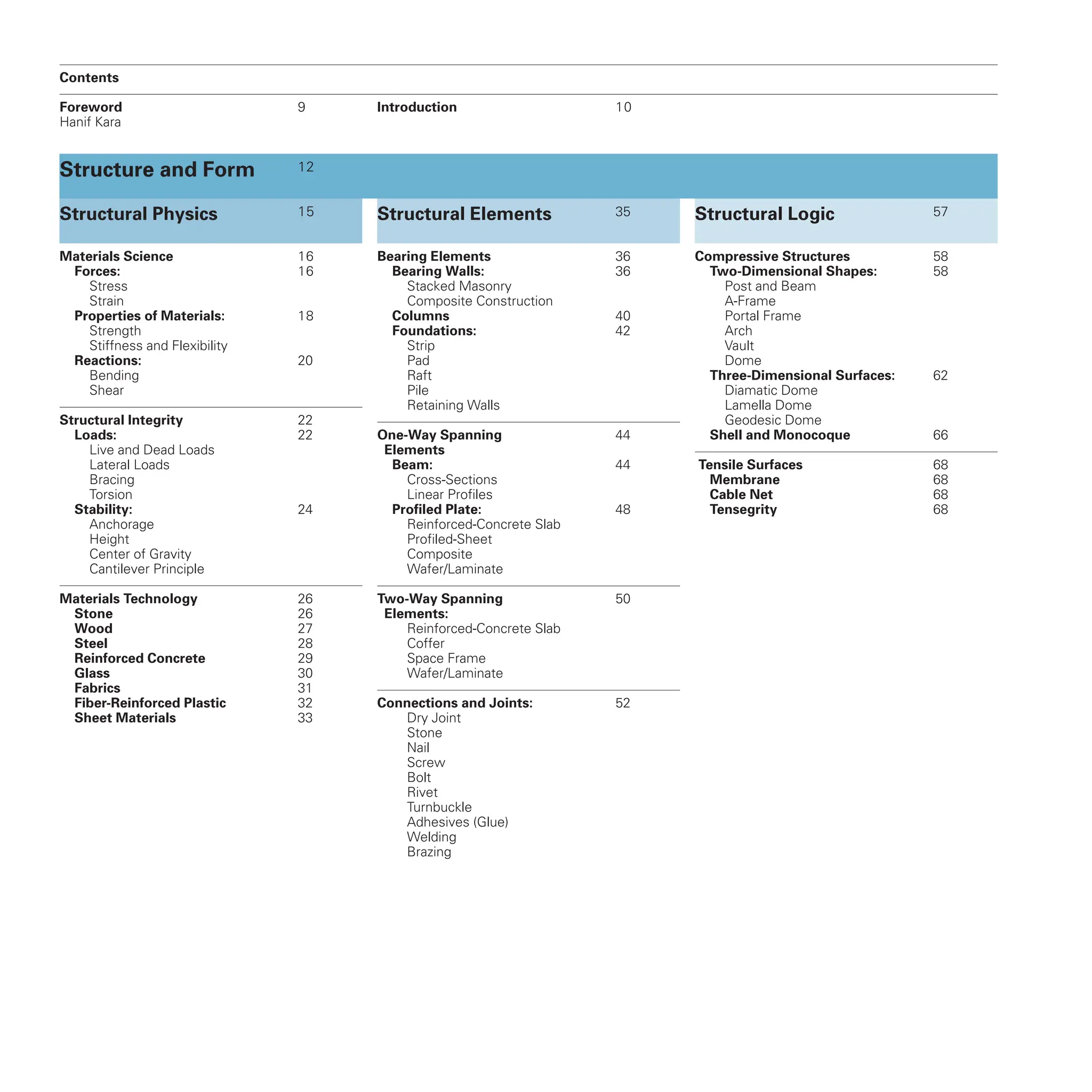
Structural Physics 15
Materials Science 16
Forces: 16
Stress
Strain
Properties of Materials: 18
Strength
Stiffness and Flexibility
Reactions: 20
Bending
Shear
Structural Integrity 22
Loads: 22
Live and Dead Loads
Lateral Loads
Bracing
Torsion
Stability: 24
Anchorage
Height
Center of Gravity
Cantilever Principle
Materials Technology 26
Stone 26
Wood 27
Steel 28
Reinforced Concrete 29
Glass 30
Fabrics 31
Fiber-Reinforced Plastic 32
Sheet Materials 33
Structure and Form
Structural Elements 35
Bearing Elements 36
Bearing Walls: 36
Stacked Masonry
Composite Construction
Columns 40
Foundations: 42
Strip
Pad
Raft
Pile
Retaining Walls
One-Way Spanning 44
Elements
Beam: 44
Cross-Sections
Linear Profiles
Profiled Plate: 48
Reinforced-Concrete Slab
Profiled-Sheet
Composite
Wafer/Laminate
Two-Way Spanning 50
Elements:
Reinforced-Concrete Slab
Coffer
Space Frame
Wafer/Laminate
Connections and Joints: 52
Dry Joint
Stone
Nail
Screw
Bolt
Rivet
Turnbuckle
Adhesives (Glue)
Welding
Brazing
Structural Logic 57
Compressive Structures 58
Two-Dimensional Shapes: 58
Post and Beam
A-Frame
Portal Frame
Arch
Vault
Dome
Three-Dimensional Surfaces: 62
Diamatic Dome
Lamella Dome
Geodesic Dome
Shell and Monocoque 66
Tensile Surfaces 68
Membrane 68
Cable Net 68
Tensegrity 68
Foreword 9
Hanif Kara
Introduction 10
Contents
70
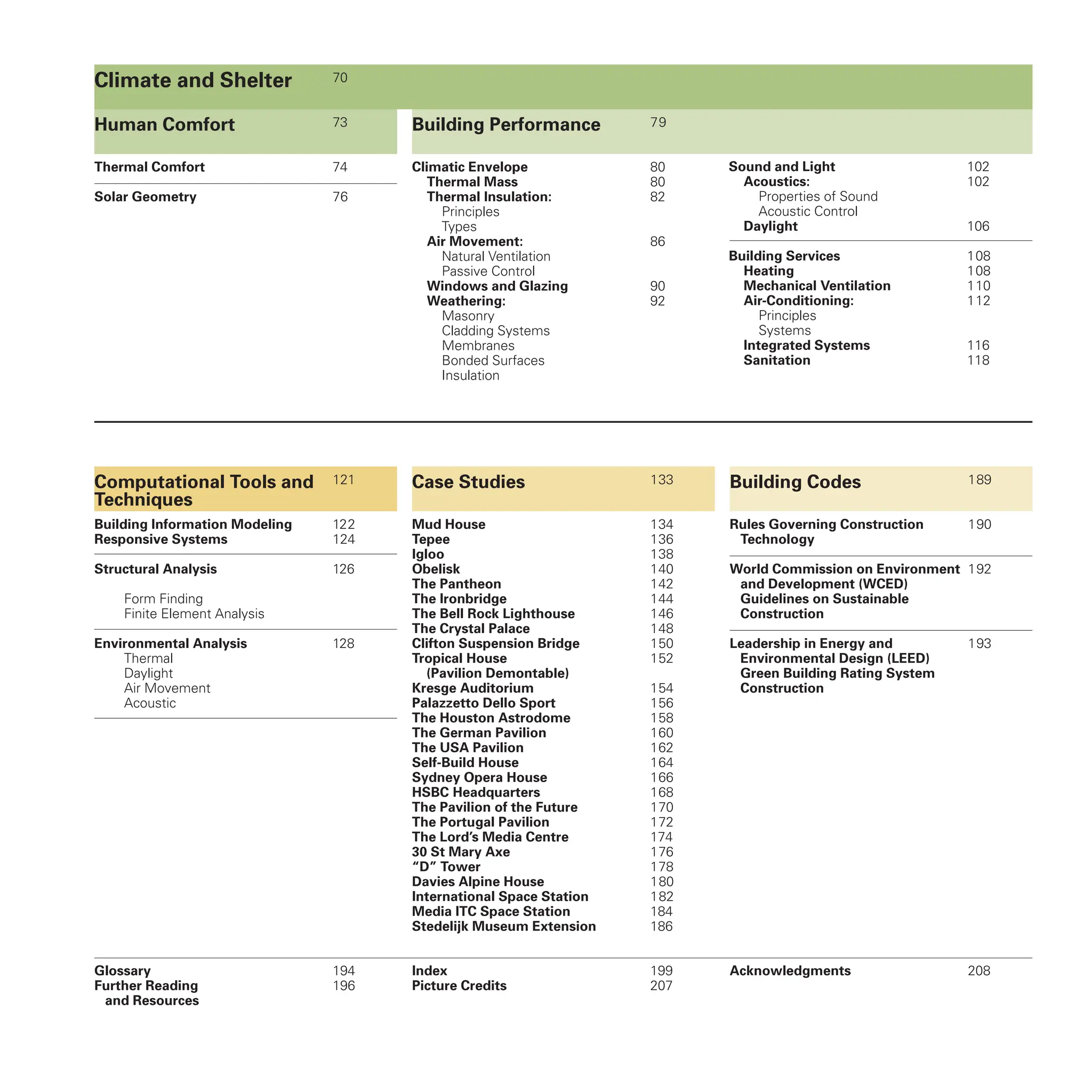
Human Comfort 73
Thermal Comfort 74
Solar Geometry 76
Climate and Shelter
Building Performance 79
Climatic Envelope 80
Thermal Mass 80
Thermal Insulation: 82
Principles
Types
Air Movement: 86
Natural Ventilation
Passive Control
Windows and Glazing 90
Weathering: 92
Masonry
Cladding Systems
Membranes
Bonded Surfaces
Insulation
Glossary 194
Further Reading 196
and Resources
Index 199
Picture Credits 207
Acknowledgments 208
Computational Tools and 121
Techniques
Building Information Modeling 122
Responsive Systems 124
Structural Analysis 126
Form Finding
Finite Element Analysis
Environmental Analysis 128
Thermal
Daylight
Air Movement
Acoustic
Case Studies 133
Mud House 134
Tepee 136
Igloo 138
Obelisk 140
The Pantheon 142
The Ironbridge 144
The Bell Rock Lighthouse 146
The Crystal Palace 148
Clifton Suspension Bridge 150
Tropical House 152
(Pavilion Demontable)
Kresge Auditorium 154
Palazzetto Dello Sport 156
The Houston Astrodome 158
The German Pavilion 160
The USA Pavilion 162
Self-Build House 164
Sydney Opera House 166
HSBC Headquarters 168
The Pavilion of the Future 170
The Portugal Pavilion 172
The Lord’s Media Centre 174
30 St Mary Axe 176
“D” Tower 178
Davies Alpine House 180
International Space Station 182
Media ITC Space Station 184
Stedelijk Museum Extension 186
Building Codes 189
Rules Governing Construction 190
Technology
World Commission on Environment 192
and Development (WCED)
Guidelines on Sustainable
Construction
Leadership in Energy and 193
Environmental Design (LEED)
Green Building Rating System
Construction
Sound and Light 102
Acoustics: 102
Properties of Sound
Acoustic Control
Daylight 106
Building Services 108
Heating 108
Mechanical Ventilation 110
Air-Conditioning: 112
Principles
Systems
Integrated Systems 116
Sanitation 118
9
In the course of my practice as a structural engineer
and as a visiting teacher at a variety of architecture and
engineering schools, I have encountered much
discussion, debate, information, and misinformation
about the role of “technology” in architecture. Many
use the subject to discuss the different ways in which
buildings are put together, while others draw on the
digital realm – where the materials are processes,
networks, and flows that have been enabled by the
pace of change in computers as a design tool.
What is clear to me is that the best systems prosper
when both of these approaches are exploited in
design development – as intellectual activities that
integrate production, assembly, and creation to bring
together quantative and qualitative satisfaction in the
built environment.
At one extreme very little practical illustration is
published that shows, for example, the role of basic
structural systems or basic ways of using materials.
On the other hand it is common to see students
produce amazing diagrams of flow or stress analysis
that then magically produce “architecture” at the
other extreme.
What is needed is the middle ground, and in this
respect, this book provides easy access for the
beginning student of architecture. Learning through a
selection of contemporary architectural projects
introduces students to basic systems and appropriate
use of both new and old materials, of both techniques
and tools.
What the authors have carefully catalogued is the
fundamental information that the architecture student
must know, and to be aware of the need to work with
experts in various disciplines and to learn from past
precedents. This will give them a better chance of
designing with originality and novelty without becoming
an engineer or computer scientist. They will learn to
produce architecture by facilitating dialogue between
experts, manufacturers, politicians, and communities.
At a time when we are not short of information, what
is needed is the skill to edit the information to suit the
purpose; something which this book achieves with
great success.
Hanif Kara, F.I. StructE, FRIBA (hon)
Adams Kara Taylor
November 2007
Foreword
Left
The USA Pavilion, Montreal, Canada
(detail), designed by R. Buckminster
Fuller and Shoji Sadao.
“Aerodynamics is for people who can’t design
engines.” Enzo Ferrari
Both structurally and environmentally, the architect
designs the way in which buildings are organized. Along
with the art – the social, cultural, philosophical, and
political factors that influence design – it is the tools and
techniques of the engineer – technology – that gives
form and performance to the built environment.
Critical to an understanding of architecture is the
relationship between design and technology. The aim
of this textbook is to introduce the scope of that
relationship to those who may be considering a career
in architecture, as well as to enable students of
architecture to integrate their design thinking with
appropriate structural and environmental solutions.
The book sets out to explain the relationships between
physical phenomena, materials, building elements, and
structural types, using simple classification systems
and real examples. Photographic images are used to
familiarize the user with common construction
technology, while historical examples are employed
to chart significant moments in the history of
architectural engineering.
The book introduces structural and environmental
engineering to architects and, while it does not include
mathematical calculation, it does make reference to
current computer techniques that assist designers in
predicting the structural and environmental behavior of
buildings. At the same time, it makes liberal reference
to historical precedents since it is important for the
user to understand that the way in which the success
of technology is measured is directly related to its
cultural context. Some would say that the Gothic
cathedral is the pinnacle of architectural engineering
given the tools, materials, and techniques of the day.
Currently, the world is far more conscious of the clean
and efficient use of the planet’s resources, and the
success of technology is measured thus.
Technology by nature is concerned with invention,
and it is only ever possible to take a “snapshot” of
technological achievements at any one moment in
time. From materials science through to construction
site procedures, invention, and progress in architectural
technology occur constantly; it is hoped that a
compendium of technology such as this book will not
only aid students to understand its scope and historical
context, but will also inspire them to invent new
solutions for the future.
Second Edition
This second edition includes new information on the
fast growing field of Building Information Modeling
(BIM), as well as a section on the ways in which
computer control may be used to enable buildings to
adapt and respond to environmental changes. New
diagrams have also been added to many of the case
studies, and typical details have been included in the
section on weathering. Under Building Services, there
are new sections on integrating active and passive
systems and on sanitation.
Introduction
10
11
Architectural technologies are classified
under two major headings: Structure and
Form, and Climate and Shelter. While
the very first primitive shelters, such as
mud huts and igloos, employed the same
materials and building components to
both create structural form and withstand
the elements, even a simple tent such
as the North American tepee employed
one type of material and component
(timber posts) to generate the form and
another (animal skins) to maintain its
internal climate.
Structure and Form
This section is subdivided into three main
topics: Structural Physics, Structural
Elements, and Structural Logic. This is a
linear progression from the fundamental
principles of structural form – materials
science, materials technology, and structural
integrity – through descriptions of the
common elements used in the construction
of buildings, such as walls, columns, floors,
and roofs, to how these elements are
combined to form different building types,
from simple “post and beam” structures
through Gothic vaults to aluminum
monocoque shells and tensile nets.
Climate and Shelter
The subdivisions in this section deal with
two main topics: Human Comfort and
Building Performance. Before examining
how buildings are constructed in relation
to their local environment, it is important to
establish the thresholds within which the
human body is able to sustain life. The first
part of the section looks at the principles of
thermal comfort and its provider, the sun.
The second part considers ways in which
the built environment can be designed to
maintain human comfort. As well as
exploring how the design and fabric of a
building – the climatic envelope – can both
control and interact with its environment,
passively and actively, it considers human
comfort in the context of sound and light.
The book includes three additional sections:
Computational Tools and Techniques
The ways in which architects design are
now much influenced by computers. Quite
apart from their use in drafting and
illustrating, they may assist designers to
predict both the structural and environmental
behavior of their buildings – through
modeling and analysis – as well as supplying
databases for materials, components and
systems; indeed they can store, and create a
virtual model of, all of the information
needed for a construction project. This
section explores the use of computers as
analytical and organizational tools.
Case Studies
A range of case studies is used to
explore the origins of construction types
and illustrates the historic relationship
between design and technology in
architecture and civil engineering. The
examples are listed chronologically and are
described in relation to the structural and
environmental taxonomies described in the
first two sections.
Building Codes
Throughout the world, the construction
industry is controlled by rules and
regulations that are there to ensure the
health and safety of both construction
industry operatives and end-users. Building
codes cover all aspects of construction and,
increasingly, are concerned with regulating
towards low-energy, sustainable solutions.
Contents Page
This is designed as a branching system
so the user can contextualize any topic
within the book. Every spread has a topic
heading that can be cross-referenced with
the contents tree.
Captions
The main body of the text is supplemented
by illustrations, both diagrammatic and
photographic. Captions are used to supply
additional information and should be read as
a continuation of the main text.
Taxonomy Charts and Icons
There are two major taxonomy charts used
in Structure and Form, one for Structural
Elements and one for Structural Logic. The
organization of the charts is directly related
to the page spreads that follow, and the
individual diagrams are then employed as
iconic references. These icons are also
employed to cross-reference case studies
with the main body of the text.
Further Reading
Related publications are listed under each of
the major headings. It is also recommended
that users reference the source information,
both publications and web sites.
Structure of the book
Introduction
Structure and Form
15
Covering the fundamental principles of structural form
Materials Science
In order to understand how buildings work as
structures, it is necessary to appreciate the natural
laws that govern structural form. This involves an
understanding of the forces that act upon materials and
the ways in which the materials will react to those
forces according to their fundamental properties.
Materials Science covers: forces – how, through gravity,
materials are subject to stress and strain; properties
of materials – how materials can be analyzed and
manipulated for strength and stiffness; and reactions –
how components behave when subjected to forces
through bending and shear.
Materials Technology
While materials science is the study of the interplay
between the properties, structure, and changes in
solids, materials technology is the utilization of this
knowledge in the production and fabrication of
materials and structural components. Most fabrication
processes involve a series of primary ways of acting on
materials – cutting, sawing, bending, welding, etc. –
with the precise nature of the process determined by
the properties of the material to which it is applied. In
general, the ability to move raw materials and finished
products around factories, building sites, and indeed
around the world, places finite limitations on the size,
shape and weight of prefabricated building
components. Materials technology explores a range
of common building materials: stone, timber, steel,
reinforced concrete, glass, fabric, fiber-reinforced
plastic, and sheet materials.
Structural Integrity
Knowing the behavior of the materials and components
that go to form structures enables the architect to
organize them in such a way that the whole structure
will be rigid and stable under load. Structural Integrity
examines the types of load to which buildings are
subjected – live and dead loads, lateral loads, bracing,
and torsion – and how structures may be constructed to
resist them through triangulation and bracing. Overall
stability, as in the rooting of a tree, is then considered in
the context of the center of gravity and the cantilever
(or branching) principle.
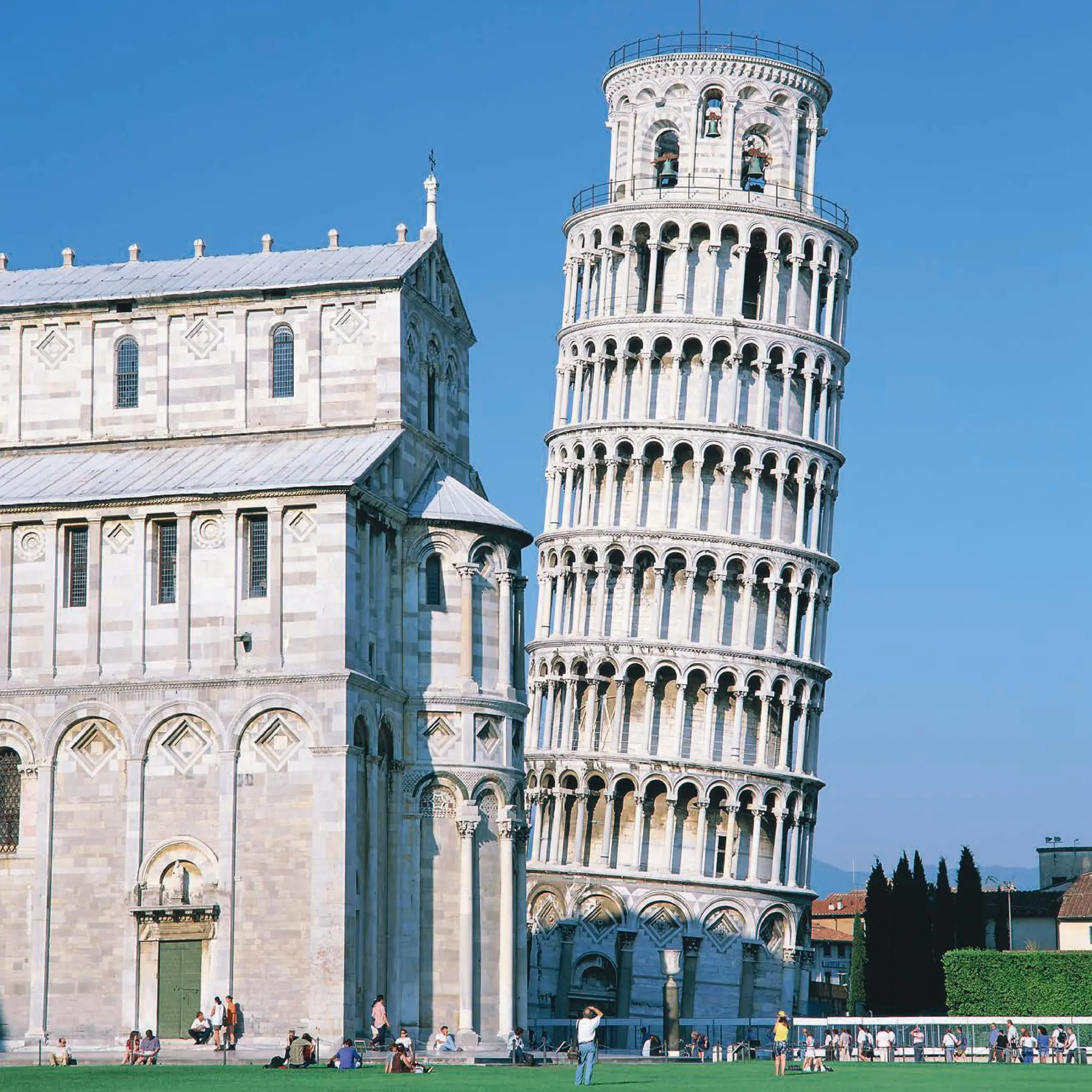
Left
The leaning tower of Pisa, Italy, 1173.
The tower is 55.8 m high and it leans at
an angle of 5.5 degrees.
Structural Physics
Structure and Form
Random documents with unrelated
content Scribd suggests to you:
ontinuation of Mr. John Clayton's Account
of Virginia.
Of the Earth and Soil.
When you make the Capes of Virginia, you may observe it low Land, so
that at some distance the Trees appear as if they grew in the Water; and as
you approach nigher to emerge thence. For a hundred Miles up into the
Country, there are few Stones to be found, only in some places, Rocks of
Iron Oar appear, which made me expect to have found many Waters turn
Purple with Galls, but never met with any. Providence has supplied the
common use of Stones, by making the Roads very good: so that they ride
their Horses without shooing them; which yet are more rarely beaten on
their Feet, than ours are in England, the Country and Clime being dry, their
Hoofs are much harder; For I observed, that take a Horse out of the wet
Marshes, and Swamps, as they there call them, and ride him immediatly,
and he'll quickly be tender-footed. In some places, for several Miles
together, the Earth is so intermix'd with Oyster-shells, that there may seem
as many Shells as Earth; and how deep they lie thus inter-mingled, I think,
is not yet known: for at broken Banks they discover themselves to be
continued many Yards perpendicular. In several places these Shells are
much closer, and being petrefied, seem to make a Vein of a Rock. I have
seen in several places, Veins of these Rocky Shells, three or four Yards
thick, at the foot of a Hill, whose Precipice might be twenty Yards
perpendicular, whose Delf, I suppose, shot under the Hill, pieces of these
Rocks broken off, lie there, which, I suppose, may weigh twenty or thirty
Tuns a piece, and are as difficult to be broken as our Free-stone. Of these
Rocks of Oyster-shells that are not so much petrified, they burn and make
all their Lime; whereof they have that store, that no Generation will
consume. Whether these were formerly Oysters, which left by the subsiding
Seas, (as some suppose, that all that Tract of Land, now high Ground, was
once overflowed by the Sea) were since petrefied, or truly Stones, sui
Generis, I leave to the Honourable Society to determin. But when I
consider the constant and distinct shooting of several Salts, Nature's
Curiosity, in every thing, so far exceeding that of Art, that the most
Ingenious, when referr'd thereto, seem only endued with an Apish
fondness, I cannot think any thing too difficult or wonderful for Nature; and
indeed I do not apprehend, why it may not be as feasible to suppose them
to have been Rocks, at first shot into those Figures, as to conceive the Sea
to have amass'd such a vast number of Oyster-shells one upon another,
and afterwards subsiding, should leave them cover'd with such Mountains
of Earth, under which they should petrify: But not to launch forth too far
into those Disputes, since I must modestly remember to whom I write.
Often, in the looser Banks of Shells and Earth, are found perfect Teeth
petrefied, some whereof I have seen, could not be less than two or three
Inches long, and above an Inch broad: Tho' they were not Maxillary Teeth,
the part that one might suppose grew out of the Jaw, was polish'd, and
black, almost as Jet; the part which had been fasten'd in the Jaw and
Gums, was brown, and not so shiningly polish'd, or smooth; if they were,
as they seemed to be, really Teeth, I suppose, they must have been of
Fishes. The back-Bone of a Whale, and as I remember, they told me of
some of the Ribs, were digg'd out of the side of a Hill, several Yards deep in
the Ground, about four Miles distant from James Town, and the River. Mr.
Banister, a Gentleman pretty curious in those things, shew'd me likewise
the Joint of a Whale's back-Bone, and several Teeth, some whereof, he
said, were found in Hills beyond the Falls of James River, at least, a
hundred and fifty Miles up into the Country. The Soil in general is Sandy: I
had designed, and I think it might be worth a critical Remark, to observe,
the difference of Soils seem appropriated to the several sorts of Tobacco:
For there is not only the two distinct sorts of a sweet-scented, and Aranoko
Tobacco, but of each of these be several sorts much different, the Seeds
whereof are known by distinct Names, they having given them the Names
of those Gentlemen most famed for such sort of Tobacco, as of Prior-seed,
&c. Nay, the same sort of Seed in different Earths, will produce Tobacco
much different, as to goodness. The richer the Ground, the better it is for
Aranoko Tobacco, whose Scent is not much minded, their only aim being to
have it specious, large, and to procure it a bright Kite's Foot colour. Had not
my Microscopes, &c. Tools to grind Glasses, been cast away, with my other
things, I had made some critical Enquiries into their several Natures, I
would have examin'd what proportions of Salts, all the sorts of Earths had
afforded, and how Water impregnated with their Salts, would have changed
with infusing Galls, how with the Syrup of Violets, and how they would
have precipitated Mercury, or the like, and so far forth as I had been able,
examined them by the several Tryals of Fire. I conceive Tobacco to be a
Plant abounding with Nitro-Sulphurious Particles; for the Planters try the
goodness of their Seed, by casting a little thereof into the Fire; if it be
good, it will sparkle after the manner of Gun-powder: so will the Stalks of
Tobacco-leaves, and perhaps has something analogous to the Narcotick
Sulphur of Venus, which the Chymists so industriously labour after. The
World knows little of the efficacy of its Oyl, which has wonderful Effects in
the curing of old inveterate Sores, and Scrophulous Swellings, and some,
otherwise applied and qualified. The goodness of Tobacco I look on
primarily consists in the volatility of its Nitre: And hence the sandy Grounds
that are most impregnated therewith, and whose Nitrous Salt is most
Volatile, for such Grounds are quickliest spent, yield Tobacco's that have the
richest Scent, and that shortly becomes a pleasant Smoak; whereas, in
Tobacco that grows on stiff Ground, the Salts seem more fix'd, and lock'd
up in the Oyl, so that whilst new, 'tis very heady and strong, and requires
some time for its Salts to free themselves, and become Volatile; which it
manifests, by its having an Urinous Smell. The same Reason satisfies, why
Tobacco that grows on low Lands as far as the Salts, tho' the Plant be
never overflowed with Salt Water, yet the Ground that feeds the Plant being
impregnated with Salt Water, that Tobacco Smoaks not pleasantly, and will
scarcely keep Fire, but do all that a Man can, will oft go out, and gives
much trouble in frequent lighting the Pipe, 'till after it has been kept some
considerable time: Which may be assign'd to the fixeder Saline Particles of
the Marine Salt in these Plants, which require more time e'er they be
render'd Volatile. Here it might be worthy an Enquiry into the Nature of
Filtration of Plants, since we may hence gather, Particles of the Marine Salt
are carried along with the Succus Nutritius of the Plant; concerning which,
if it were not too much to deviate from the Matter in hand, I should offer
some Reflections of my own, which the Learned Society might perhaps
improve: For I think thence might be made many happy Conjectures as to
the Virtues of Plants. So where we see Plants, or Trees, of an open Pore
growing low, we shall find their Juice has subtile Parts: So have all Vines,
whether the Grape Vine, or Briony, or a Smilax, or the like. If a Gummous
Plant or Tree, that grows low, and close Pored, it abounds with acid Spirits,
as Lignum Vitæ, &c. if it grow tall, and be open Pored, it abounds with a
subtile Volatile Spirit, as your Firs, and the Turpentine Tree. But to insist no
further herein, than as this may be applicable to the present Discourse: For
I have observed, that that which is called Pine-wood Land, tho' it be a
sandy Soil, even the Sweet-scented Tobacco that grows thereon, being
large and porous, agreeable to Aranoko Tobacco; it smoaks as coarsely as
Aranoko: Wherefore 'tis, that I believe the Microscope might make notable
Discoveries towards the knowledge of good Tobacco: For the closer the
Composition of the Leaf, the better the Tobacco; and therefore the Planters
and Merchants brag of the Substance of their Tobacco; which word, did
they always take it in a true Sence, for the Solidness, and not mistake it for
the Thickness, it would be more consonant to a true Observation: for as I
said of the Pine-wood Tobacco, some of it is thick and not Solid, and differs
from the best Tobacco, as Buff does from Tann'd Leather; so that if the
Tobacco be sound and not Rotten, you may give a great guess at the
goodness of Tobacco, when you weigh the Hogsheads, before you see
them: For if an equal care be taken in the packing of them the best
Tobacco will weigh the heaviest, and Pack the closest. Now I said, that the
Sweet-scented Tobacco most in vogue, which was most fam'd for its Scent,
was that that grew on sandy Land; which is true, if you would Smoak it
whilst new, or whilst only two or three Years Old; but if you keep the stiff
Land Tobacco, which is generally a Tobacco of great Substance five or six
Years, it will much excel: For tho' the sandy Land Tobacco abound with a
Volatile Nitre at first, yet the stiff Land Tobacco abounds with a greater
quantity of Nitre, only that it is lock'd up in its Oyl at first, and requires
more time to extricate it self, and become Volatile; but the Pine-wood Land
having little of the Nitro-Sulphurious Particles, neither is, nor ever will make
any thing of a rich Smoak. Discoursing hereof some days since, to a
Gentleman of good Observation, that has been versed with Malting, he
assured me, to back this my Supposition, or Hypothesis, he had observed,
that Barly that grew on stiff Ground, requir'd more time considerably to
Mellow, and come to perfection, than that that grew on light Land. Having
proceeded thus far to speak of Tobacco, I shall add one or two things
more. The Planters differ in their Judgments about the Time of Planting, or
Pitching their Crops: Some are for Pitching their Crops very early, others
late, without any distinction of the Nature of the Soils; and 'tis from the
different Effects that they find, in that, sometimes early, sometimes the late
Planting succeeds: But they have not the Reason to judge of the Cause, to
consider the Accidents of the Year, and the Difference of the Soils. In sandy
Grounds they need not strive so much for early Planting, the Looseness of
the Earth, and the kind natur'd Soil, yielding all that it can, easily and
speedily, and Sand retaining the Heat, makes the Plants grow faster. But in
stiff Soils, if the Crops be not early pitch'd, so that during the Season of
Rains it have got considerable Roots, and shot them some depth, if early
Droughts come, it so binds the Land, that the Roots never spread or shoot
deeper, or further than the Hill that they are planted in: For they plant them
as we do Cabbages, raising Hills to set every Plant in, about the bigness of
a common Mole-hill: observing this on the Plantation where I lived, that it
was stiff Ground, I advised them to Plant their Crops as early as possible;
and in order thereunto, I tried several ways to further the Plants; but not to
trouble you with the several Experiments that I made, in reference thereto:
What I found most advantageous was, by taking an infusion of Horse-dung,
and putting thereon Soot, and then my Seeds; this I kept Forty eight Hours
in an ordinary digestive heat, I had two Beds left me to Sow, in the midst
of those the People sow'd, and the quantity of Seed that they generally
allotted to the same quantity of Ground; when I sow'd, I mix'd Ashes with
the Seed, having decanted the Liquor, that the Seed might sow the evener:
The effect was, that my Plants came up much sooner, grew swifter, and I
had five Plants for one more than any of the other Beds bore; I left the
Country shortly after, and so no certainty of the final Result. There be had
various Accidents and Distempers, whereunto Tobacco is liable, as the
Worm, the Fly, Firing to Turn, as they call them, French-men, and the like. I
propos'd several ways to kill the Worm and Fly, as by Sulphur and the like;
but had no opportunity to experiment it: I shall set down that I had most
hopes of, which perhaps may give a hint to others to try or improve.
Tobacco-seed is very small, and by consequence so is the young Plant at
first, that if gleamy Weather happen at that time, it breeds a small Fly,
which consumes the Plume of the Plant; now it being early in the Year
when they Sow the Seed, viz. about the fourteenth of January, they cover
the Ground, to secure, as well as they can, their tender Plants, from the
nipping Frosts, that may happen in the Nights; they cover them only with a
few Oak-leaves, or the like; for Straw they find apt to Harbour and Breed
this Fly: I therefore would advise them to smoak Straw with Brimstone,
once in two or three Nights, and so they might cover them securely, with
that which would preserve them infinitely beyond the Covering with Oak-
boughs; indeed, I would advise them to keep peculiarly so much of their
Indian Corn-blades, which they gather for their Fodder, for this very
purpose, being as I conceive, much the best, there being no Chaff to foul
their Beds, and prejudice them when they should weed them. What they
call Firing is this: When Plants are of small Substance, as when there has
been a very Wet and Cold Season, and very hot Weather suddainly ensues,
the Leaves turn Brown, and dry to dust: the cause I conceive to be hence:
The Plant being feeble, and having a small quantity of Oyl, which makes
the more solid part of the Plant, the Earth being suddainly heated by the
Sun's fiercer Beams, the Roots are rather scorch'd and dried up in the
Earth, than nourish'd; so that the Plant consisting only of watry parts, is
consumed, as it were, by Fire: sometimes hopeful Plants, when by a
sudden Gust some Master Veins are broken, if suddain heat ensues, they
likewise Fire: For being not come to maturity, and being deprived of the
Supports of Life and Vegetation, they likewise perish, are dried up, and fall
to dust. French-men they call those Plants, whose leaves do not spread and
grow large, but rather spire upwards, and grow tall; these Plants they do
not tend, being not worthy their Labour. Were they so Critical, I believe,
they might have great Guess what Plants were most likely to turn French-
men, by observing whether the Roots of the Plants run downwards, as
those whose Branches are aptest to spire upwards: For tho' I have not
made positive proof thereof, I have something more than bare fancy for my
conjecture; I have pull'd up some of these French-men, and compar'd them
with the Roots of some other Plants, and found them much longer than
others; and 'tis observable, loose Soils, and sandy Ground, are more
subject thereto than the stiff Land. The Country of it self is one entire
Wood, consisting of large Timber Trees of several sorts, free from Thickets
or under Wood, the small Shrubs growing only on Lands, that have been
clear'd, or in Swamps; and thus it is for several Hundreds of Miles, even as
far as has yet been discover'd. But that shall be reserv'd 'till another
opportunity.
I am, &c.
John Clayton, Rector of Crofton at
Wakefield, his Letter to the Royal Society,
giving a farther Account of the Soil, and
other Observables of Virginia.
I shall here present you with a continuation of my Remarks on the River,
Soil, and Plants of Virginia. And first, as to the River on the other side the
Mountains, said to Ebb and Flow. I have been assured by Col. Bird, who is
one of the Intelligentest Gentlemen in all Virginia, and knows more of
Indian Affairs than any Man in the Country, that it was a Mistake; for that it
must run into a Lake, now called Lake Petite, which is fresh Water; for
since that time a Colony of the French are come down from Canada, and
have seated themselves on the back of Virginia, where Fallam and the rest
suppos'd there might be a Bay, but is a Lake, to which they have given the
Name of Lake Petite, there being several larger Lakes 'twixt that and
Canada. The French possessing themselves of these Lakes, no doubt will in
short time be absolute Masters of the Beaver Trade, the greatest number of
Beavers being catch'd there. The Colonel told me likewise, that the
common Notion of the Lake of Canada, he was assured was a Mistake, for
the River supposed to come out of it, had no Communication with any of
the Lakes, nor the Lakes one with another, but were distinct. But not to
ramble after hear-say, and other matters; but to return to the Parts of
Virginia inhabited by the English, which in general is a very Fertile Soil, far
surpassing England, for there English Wheat (as they call it, to distinguish it
from Maze, commonly called Virginia Wheat) yields generally 'twixt Fifteen
and Thirty fold, the Ground only once plow'd; whereas 'tis a good Crop in
England that yields above Eight fold, after all their Toil and Labour. And yet
in truth 'tis only the barrennest Parts that they have cultivated, Tilling and
Planting only the High-Lands, leaving the Richer Vales unstirr'd, because
they understand not any thing of Draining. So that the Richest Meadow-
Lands, which is one third of the Country, is Boggy, Marsh, and Swamp,
whereof they make little Advantage, but loose in them abundance of their
Cattle, especially at the first of the Spring, when the Cattle are weak, and
venture too far after young Grass. Whereas vast Improvements might be
made thereof; for the generality of Virginia is a Sandy Land with a shallow
Soil. So that after they have cleared a fresh piece of Ground out of the
Woods, it will not bear Tobacco past two or three Years, unless Cow-pen'd;
for they Manure their Ground by keeping their Cattle, as in the South you
do your Sheep, every Night confining them within Hurdles, which they
remove when they have sufficiently dung'd one spot of Ground; but alas!
they cannot Improve much thus, besides it produces a strong sort of
Tobacco, in which the Smoakers say they can plainly taste the fulsomeness
of the Dung. Therefore every three or four Years they must be for clearing
a new piece of Ground out of Woods, which requires much Labour and Toil,
it being so thick grown all over with Massy Timber. Thus their Plantations
run over vast Tracts of Ground, each ambitioning to engross as much as
they can, that they may be sure to have enough to Plant, and for their
Stocks and Herds of Cattel to Range and Feed in, that Plantations of 1000,
2000, or 3000 Acres are common, whereby the Country is thinly inhabited;
their Living solitary and unsociable; Trading confused and dispersed;
besides other Inconveniences: Whereas they might Improve 200 or 300
Acres to more Advantage, and would make the Country much more
Healthy; for those that have 3000 Acres, have scarce cleared 600 Acres
thereof, which is peculiarly term'd the Plantation, being surrounded with
the 2400 Acres of Woods: so that there can be no free or even motion of
the Air, but the Air is kept either stagnant, or the lofty Sulphurous Particles
of the Air, that are higher than the tops of the Trees, which are above as
high again as the generality of the Woods in England, descending when
they pass over the cleared spots of Ground, must needs in the violent heat
of Summer, raise a preternatural Ferment, and produce bad Effects. Nor is
it any advantage to their Stocks, or Crops; for did they but drain their
Swamps, and Low-Lands, they have a very deep Soil, that would endure
Planting twenty or thirty Years, and some would scarce ever be worn out,
but be ever longer better, for they might lay them all Winter, or when they
Pleased in Water, and the product of their Labour would be double or
treble, whether Corn or Tobacco; and that this is no fond Projection,
(though when I have discoursed the same to several, and in part shewn
them how their particular Grounds might be drained at a very easie rate)
they have either been so conceited of their old way, so sottish as not to
apprehend, or so negligent as not to apply themselves thereto. But on the
Plantation where I lived, I drained a good large Swamp, which fully
answered expectation. The Gentlewoman where I lived, was a very Acute
Ingenious Lady; who one day Discoursing the Overseer of her Servants,
about pitching the ensuing Year's Crop. The Overseer was naming one
place where he designed to Plant 30000 Plants, another place for 15000,
another for 10000, and so forth the whole Crop, designed to be about
100000 Plants: Having observed the Year before he had done the like, and
scattered his Crop up and down the Plantation, at Places a Mile, or a Mile
and a half asunder, which was very Inconvenient, and whereby they lost
much time. I interposed, and asked, why they did not Plant all their Crop
together? The Fellow smiled as it were at my Ignorance, and said, there
was very good Reason for it. I replied, that was it I enquir'd after. He
returned, the Plantation had been an old planted Plantation, and being but
a small Plot of Ground, was almost worn out, so that they had not Ground
altogether that would bring forth Tobacco. I told him then they had better
Ground than ever yet they had planted, and more than their Hands could
manage. He smil'd again, and asked me, where? I then named such a
Swamp. He then said scornfully, he thought what a Planter I was; that I
understood better how to make a Sermon, then managing Tobacco. I
replied with some warmness, tho' I hoped so, that was Impertinence, and
no Answer. He then said, that the Tobacco there would drown, and the
Roots rot. I replied, that the whole Country would drown if the Rivers were
stopt, but it might be laid as dry as any Land on the Plantation. In short,
we discoursed it very warmly, till he told me, he understood his own
Business well enough, and did not desire to learn of me. But the
Gentlewoman attended somewhat better to my Reasoning, and got me one
day to go and shew her how I projected the draining of the Swamp, and
thought it so feasible, that she was resolved to have it done; and therefore
desir'd me I would again Discourse her Overseer, which I did several times,
but he would by no means hearken thereto, and was so positive, that she
was forc'd to turn him away, to have her Servants set about the Work; and
with three Men in thirteen Days I drained the whole Swamp, it being Sandy
Land, soaks and drains admirably well, and what I little expected, laid a
Well dry at a considerable distance. The Gentlewoman was in England last
Year, and I think Dr. Moulin was by when she asked me. Now to teach her
how she might make her Tobacco that grew in the Swamp less, for it
produced so very large, that it was suspected to be of the Aranoko kind: I
told her, though the complaint was rare, yet there was an Excellent Remedy
for that, in letting every Plant bear eight or nine Leaves instead of four or
five, and she would have more Tobacco, and less Leaves. Now you must
know they top their Tobacco, that is, take away the little top-bud, when the
Plant has put forth as many Leaves as they think the Richness of the
Ground will bring to a Substance; but generally when it has shot forth four
or six Leaves. And when the top-bud is gone, it puts forth no more Leaves,
but Side-branches, which they call Suckers, which they are careful ever to
take away, that they may not empoverish the Leaves. I have been more
tedious in the Particulars, the fullier to evince how resolute they are and
conceitedly bent to follow their old Practice and Custom, rather than to
receive Directions from others, tho' plain, easie, and advantageous. There
are many other Places as easie to drain as this, tho' of larger extent, and
richer Soil, for some of which I have given directions, and have only had
the return perhaps of a flout afterwards: Even in James Town Island, which
is much what of an Oval Figure, there's a Swamp runs Diagonal-wise over
the Island, whereby is lost at least 150 Acres of Land, which would be
Meadow, which would turn to as good Account as if it were in England:
Besides it is the great annoyance of the Town, and no doubt but makes it
much more unhealthy. If therefore they but scour'd the Channel, and made
a pretty ordinary Trench all along the middle of the Swamp, plac'd a Sluice
at the Mouth, where it opens into the back Creek; for the Mouth of the
Channel there is narrow, has a good hard bottom, and is not past two
Yards deep when the Flood is out; as if Nature had designed it before
hand: They might thus drain all the Swamp absolutely dry, or lay it under
Water at their Pleasure. I have talked several times hereof to Mr. Sherwood,
the owner of the Swamp, yet nothing is essayed in Order thereto. And now
since we are speaking of James Town give me leave to adjoin some
Reflections as to the Situation and Fortifications of the Place. The Natural
Situation of the place is such, as perhaps the World has not a more
commodious Place for a Town, where all things conspire for Advantage
thereof.
James Town Island is rather a Peninsula, being joined to the Continent by a
small Neck of Land, not past Twenty or Thirty Yards over, and which at
Spring-Tides is overflow'd, and is then an absolute Island. Now they have
built a silly sort of a Fort, that is, a Brick Wall in the shape of a Half-Moon,
at the beginning of the Swamp, because the Channel of the River lies very
nigh the Shoar; but it is the same as if a Fort were built at Chelsey to
secure London from being taken by Shipping. Besides Ships passing up the
River are secured from the Guns of the Fort, till they come directly over-
against the Fort, by reason the Fort stands in a Vale, and all the Guns
directed down the River, that should play on the Ships, as they are coming
up the River, will lodge their Shot within Ten, Twenty, or Forty Yards in the
rising Bank, which is much above the Level of the Fort; so that if a Ship
gave but a good Broad-side, just when she comes to bear upon the Fort,
she might put the Fort into that confusion, as to have free Passage enough.
There was indeed an old Fort of Earth in the Town, being a sort of
Tetragone, with something like Bastions at the four Corners, as I
remember; but the Channel lying further off to the middle of the River
there, they let it be demolished, and built that new one spoke of, of Brick,
which seems little better than a blind Wall, to shoot Wild Ducks or Geese.
If they would build a Fort for the Security of the Town and Country, I
conceive it should be on Archer's Hope Point, for that would stop the Ships
from passing up the River, before they came to the Town, and would secure
the Town from being block'd up by Sea. The Channel at Archer's Hope Point
lies close by the Shoar, and makes such an Angle there by reason of Hog
Island, that going up or down the River, let the Wind be where it will, they
must there bring the contrary Tack on Board, and generally when they
About the Ship as they call it, they are so near the Shoar, that a Man may
almost fling a Finger-stone on Board. How much this hinders the motion of
a Ship, and what Confusion it must be to them to bring a contrary Tack on
Board, whilst they have all the Guns of a Fort playing so nigh upon them,
may readily be conceived. Archer's Hope is a Neck of Land, that runs down
three Miles long, not much past half a Mile broad betwixt the Main River
and Archer's Hope Creek, which has large Marshes and Swamps; so that a
Citadel built upon the Point, would almost be Impregnable, being it could
be attack'd no way but one, which is so narrow a slender Neck of Land,
that it would be difficult to take it that way: And it would secure James
Town from being block'd, being it would not be past a Mile by Water, to the
Point of James Town Island. The Island is so surrounded with Water and
Marshy Land, that the Town could never be Bomb'd by Land. But now to
return to the Reflections of Improving, and Manuring of Land in Virginia;
hitherto, as I have said, they have used none but that of Cow-penning; yet
I suppose they might find very good Marle in many places, I have seen
both the red and blew Marle at some breaks of Hills: This would be the
properest Manure for their Sandy Land, if they spread it not too thick,
theirs being, as I have said, a shallow, Sandy Soil, which was the Reason I
never advised any to use Lime, tho' they have very good Lime of Oyster-
shells; but that's the properest Manure for cold Clay Land, and not for a
Sandy Soil. But as most Lands have one Swamp or another bordering on
them, they may certainly get admirable Slitch, wherewith to Manure all
their uplands. But this, say they, will not improve Ground, but clods and
grows hard; 'tis true, it will do so for some time, a Year or two at the first;
but did they cast it in heaps, and let it lie for two or three Years after a
Frost or two had seized it, and it had been well pierced therewith, I doubt
not it would turn to good Account: And for this too I have something more
than bare conjecture; for Discoursing it once with a good notable Planter,
we went to view a heap thereof, that casually he had cast up 'twixt three
and four Years before, and we found it not very binding, but rather a fine
Natural Mold, whereupon he did confess, he then remembred that out of a
ridge of the like Mold he had very large Plants, which must have been of
the like Slime or Slitch cast up before: But said, that himself and others
despaired of this Manure, because they had taken of this Slitch fresh and
moist out of the Swamp, and fill'd Tobacco Hills with it, and in the midst of
it planted their Plants, which so bound the Roots of their Plants, that they
never came to any thing. But he said, he then saw his Error, yet I have not
heard he has remembred to Correct it. But 'tis strange in how many things
besides they are remiss, which one would think English Men should not be
guilty of. They neither House nor Milk any of their Cows in Winter, having a
Notion that it would kill them; yet I perswaded the afore-mentioned Lady
where I lived, to Milk four Cows the last Winter that I staid in the Country,
whereof she found so good Effect, that she assured me she would keep to
my Advice for the future; and also as I had further urged, House them too,
for which they have mighty Conveniencies, their Tobacco Houses being
empty ever at that time of the Year, and may easily be fitted in two or three
days time without any Prejudice; whereby their Cattle would be much
sheltered from those Pinching sharp Frosts that some Nights on a sudden
become very severe. I had another Project for the Preservation of their
Cattle proved very successful; I urged the Lady to sow her Wheat as early
as possibly she could, so that before Winter it might be well rooted, to be
early and flourishing at the first of the Spring: So that she might turn
thereon her weak Cattle, and such as should at any time be swamp'd,
whereby they might be recruited and saved, and it would do the Wheat
good also. I advised her likewise to save, and carefully gather her Indian
Corn-tops, and blades, and all her Straw, whatever could be made Fodder,
for her Cattle; for they get no Hay, tho' I was urging her to that too, and to
sow Saintfoin; for being a Sandy Soil, I am confident it would turn to very
good Account. They have little or no Grass in Winter, so that their Cattle are
pined and starved, and many that are brought low and weak, when the
Spring begins, venture too far into the Swamps after the fresh Grass, where
they perish; so that several Persons lose ten, twenty or thirty Head of
Cattle in a Year: I observed this was much owing to their Inadvertency and
Error in their way of Managing and Feeding them; for they get little Fodder,
but as they think Corn being more Nourishing, feed them with their Indian
Corn, which they give them Morning and Evening; they spend thus a great
quantity of Corn, and when all's done, what signifies two or three Heads of
Corn to a Beast in a Morning? It makes them only linger about the Houses
for more? and after that sweet Food they are not so prompt to browse on
the Trees, and the course Grass which the Country affords. So that thus
their Guts shrink up, and they become Belly-shot as they call it. I advised
therefore never to give them any thing in a Morning, whereby as soon as
they were set forth of the Cow-pens, they would fall a feeding, and tho'
they filled their Bellies only with such course stuff as had little Nourishment
in it, yet it would keep out their Bellies, and they would have a better
Digestion; and then when they were come home at Nights, to Fodder them,
beginning with Straw and their coarsest Fodder, which they would learn to
eat by degrees, before they tasted that that was more delicate, and whilst
their digestion was strong, would yield them Nourishment to keep them still
so; afterwards when the Winter pinched, their fine Fodder then would
stand them in stead; and hereby they might preserve their weakest Cattle.
By these Methods, and the help of the Wheat-patch, she, the Gentlewoman
where I lived, saved all her Cattle, and lost not one in Two Winters after,
that I staid there; besides she saved above Twenty Barrels of Corn, as I
remember that she told me she used to spend upon her Stock; and a Barrel
of Corn is commonly worth Ten Shillings. Nay further, The last Spring she
fed Two Beasts, a Bullock and a Cow, Fat, upon her Wheat, with the
addition only of a little boil'd Corn, and yet the Wheat was scarce eat down
enough. But to return again to the Nature of the Earth, which may be
pretty well gather'd from what I have already said. I have observed, that at
Five or Six yards deep, at the breaks of some banks, I have found veins of
Clay, admirable good to make Pots, Pipes, or the like of, and whereof I
suppose the Indians make their Pipes, and Pots, to boil their Meat in, which
they make very handsomly, and will endure the Fire better than most
Crucibles: I took of this Clay, dryed, powder'd, and sifted it; powdered and
sifted Potsherds, and Glass; Three parts, Two parts and One part as I
remember, and therewith made a large Crucible, which was the best I yet
ever tried in my Life; I took it once red hot out of the Fire, and clapt it
immediately into Water, and it started not at all. The Country abounds
mightily with Iron Oar, that as I have been assured by some upon tryal, has
been found very good. There are Rocks thereof appear at the precipice of
Hills, at the foot whereof there runs a River fit for a Forge, and there's
Wood enough to supply it with Charcoal; as I have heard there was
formerly some Persons undertook the Work, and when they had made but
a small quantity of Iron, which proved very good, the Indian Massacre
happened, and they being higher seated than the then Inhabited part of
the Country, were all cut off, and the Works demolished; so that it has
frighted others I think from the like attempt; besides, such a work requires
a greater Fund, and Bank of Mony to carry it on, than any there are able to
lay out; and for Persons in England to meddle therewith, is certainly to be
cheated at such a distance; some Indians brought Col. Bird some Black
Lead, whereof he told me there was great store. There's very curious Chalk
towards the falls of Rapahanock River, which they burn and make a delicate
white Wash of it. The Secretary of State Col. Spencer, has assured me,
there were Vitriolick or Alluminous Earth on the Banks of Potomack. And
thus far of what my Memory supplies me, referring to the Earth; in the next
place I shall give a short account of the Birds.
Of the BIRDS
I had indeed begun once whilst I was in that Country to have made a
Collection of the Birds, but falling sick of the Griping of the Guts, some of
them for want of care corrupted, which made them fling others away that I
had thoroughly cured; for I was past taking care of them my self, there
remaining but small hopes of my Life.
There are Three sorts of Eagles, the largest I take to be that they call the
Grey Eagle, being much of the colour of our Kite or Glead.
The Second is the Bald Eagle, for the Body and part of the Neck being of a
dark brown, the upper part of the Neck and Head is covered with a white
sort of Down, whereby it looks very bald, whence it is so named.
The Third is the Black Eagle, resembling most the English Eagle; they build
their Nests much after the manner that Dr. Willoughby describes, and
generally at the top of some tall old Tree, naked of Bows and nigh the River
side, and the People fall the Tree generally when they take the young; they
are most frequently sitting on some tall Tree by the River side, whence they
may have a prospect up and down the River, as I suppose to observe the
Fishing Hauks; for when they see the Fishing Hauk has struck a Fish,
immediately they take Wing, and 'tis sometimes very pleasant to behold the
Flight, for when the Fishing Hauk perceives her self pursued, she will
scream and make a terrible noise, till at length she lets fall the Fish to make
her own escape, which the Eagle frequently catches before it reach the
Earth or Water. These Eagles kill young Lambs, Pigs, &c.
The Fishing Hauk is an absolute Species of a Kings-fisher, but full as large,
or larger than our Jay, much of the Colour and Shape of a Kings-fisher, tho'
not altogether so curiously Feather'd; it has a large Crop, as I remember,
there is a little Kings-fisher much the same in every respect with ours.
If I much mistake not, I have seen both Goss Hauk and Falcon; besides
there are several sorts of the lesser Kind of Stannels.
There is likewise the Kite and the Ringtail.
I never heard the Cuckow there to my remembrance.
There's both a brown Owl and white Owl, much what as large as a Goose,
which often kills their Hens and Poultry in the Night; the white Owl is a very
delicate Feather'd Bird, all the Feathers upon her Breast and Back being
Snow-white, and tipp'd with a Punctal of Jet-black: besides there is a Barn
Owl much like ours; and a little sort of Scritch Owl.
There's both the Raven, and the Carrion-Crow; I do not remember I ever
saw any Rooks there. Dr. Moulin and my self, when we made our
Anatomies together, when I was at London, we shew'd to the Royal
Society, that all Flat-bill'd Birds that groped for their Meat, had three Pair of
Nerves, that came down into their Bills; whereby as we conceived they had
that accuracy to distinguish what was proper for Food, and what to be
rejected by their Taste when they did not see it; and as this was most
evident in a Duck's Bill and Head, I draw'd a Cut thereof, and left it in your
Custody: A Duck has larger Nerves that come into their Bills than Geese or
any other Bird that I have seen and therefore quaffer and grope out their
Meat the most: But I had then discover'd none of these Nerves in Round-
bill'd Birds: But since in my Anatomies in the Country, in a Rook I first
observed two Nerves came down betwixt the Eyes into the upper Bill, but
considerably smaller than any or the three Pair of Nerves in the Bills of
Ducks, but larger than the Nerves in any other Round-bill'd Birds; and 'tis
remarkable these Birds more than any other Round-bill'd Birds seem to
grope for their Meat in Cow-dung and the like: Since I have found in
several Round-bill'd Birds the like Nerves coming down betwixt the Eyes,
but so very small that had I not seen them first in a Rook I should scarce
have made the discovery; in the lower Bill there are Nerves have much the
same situation with the Flat-bill'd Birds, but very small, and scarce
discernable, unless to the Cautious and Curious.
The Night Raven, which some call the Virginia Bat, is about the bigness of a
Cuckow, feather'd like them but very short, and short Leg'd, not discernable
when it flies, which is only in the Evening scudding like our Night Raven.
There's a great sort of ravenous Bird that feeds upon Carrion, as big very
nigh as an Eagle, which they call a Turky Bustard, its Feathers are of a
Duskish black, it has red Gills, resembling those of a Turky, whence it has
its Name; it is nothing of the same sort of Bird with our English Turky
Bustard, but is rather a Species of the Kites, for it will hover on the Wing
something like them, and is carnivorous; the Fat thereof dissolved into an
Oil, is recommended mightily against old Aches and Sciatica Pains.
I think there are no Jackdaws, nor any Magpys; they there prize a Magpye
as much as we do their Red Bird.
The Pica Glandaria, or Jay, is much less than our English Jay, and of
another colour, for it is all blue where ours is brown, the Wings marbled as
curiously as ours are, it has both the same Cry, and sudden jetting Motion.
There are great Variety and Curiosity in the Wood-peckers, there's one as
big as our Magpye, with blackish brown Feathers, and a large Scarlet Tuft
on the top of the Head: There are four or five sorts of Wood-peckers more,
variegated with Green, Yellow and Red Heads, others spotted black and
white, most lovely to behold. There's a Tradition amongst them, that the
Tongue of one of these Wood-peckers dryed will make the Teeth drop out if
pick'd therewith, and cure the Tooth-ach (tho' I believe little of it, but look
on it as ridiculous) yet I thought fit to hint as much that others may try; for
sometimes such old Stories refer to some peculiar Virtues, tho' not to all
that is said of them.
There be wild Turkies extream large; they talk of Turkies that have been
kill'd, that have weigh'd betwixt 50 and 60 Pound weight; the largest that
ever I saw, weigh'd something better than 38 Pound; they have very long
Legs, and will run prodigiously fast. I remember not that ever I saw any of
them on the Wing, except it were once: Their Feathers are of a blackish
shining Colour, that in the Sun shine like a Dove's Neck, very specious.
Hens and Cocks are for the most part without Tails and Rumps; and as
some have assured me our English Hens after some time being kept there
have their Rumps Rot off; which I'm the apter to believe, being all their
Hens are certainly of English breed. I'm sorry I made no Anatomical
Observations thereof, and Remarks about the Use of the Rumps in Birds,
which at present I take to be a couple of Glands, containing a sort of Juice
for the Varnishing the Feathers; having observed all Birds have much
recourse with their Bills to the Rumps when they dress their Plumes,
whereby they scud thro' the Air more nimbly in their Flight.
Partridges there are much smaller than ours, and resort in Covies as ours
do; their Flesh is very white, and much excels ours in my mind, Sed de
gustibus non est disputandum.
Their Turtle-Doves are of a duskish blue colour, much less than our
common Pidgeon, the whole Train is longer much than the Tails of our
Pidgeons, the middle Feather being the longest. There's the strangest Story
of a vast number of these Pidgeons that came in a Flock a few Years before
I came thither; they say they came thro' New England, New York and
Virginia, and were so prodigious in number as to darken the Sky for several
Hours in the place over which they flew, and brake massie Bows where
they light; and many like things which I have had asserted to me by many
Eye-witnesses of Credit, that to me it was without doubt, the Relaters being
very sober Persons, and all agreeing in a Story: nothing of the like ever
happen'd since, nor did I ever see past Ten in a Flock together that I
remember. I am not fond of such Stories, and had suppressed the relating
of it, but that I have heard the same from very many.
The Thrush and Feldefire are much like ours, and are only seen in Winter
there, accordingly as they are here.
Their Mocking Birds may be compared to our Singing Thrushes, being much
of the same bigness; there are two sorts, the Gray and the Red, the gray
has Feathers much of the colour of our gray Plovers with white in the
Wings like a Magpye; this has the much softer Note, and will imitate, in its
singing, the Notes of all Birds that it hears, and is accounted much the
finest Singing Bird in the World. Dr. Moulin and I made in our Anatomy
many Observations of Singing Birds to this effect: The Ears of Birds differ
much from those of Men or Beasts, there's almost a direct passage from
one Ear to the other of Birds, so that prick but the small Membrane call'd
the Drum on either Ear, and Water poured in at one Ear will run out at the
other: But this is not all, but what is much more remarkable, they have no
Coclea, but instead thereof there's a small Cocleous or twisting Passage
that opens into a large Cavity, that runs betwixt two Sculls, and passes all
round the Head, the upper Scull is supported by many hundreds of small
Thred-like Pillars or Fibers, which as we supposed had another use also, to
break the Sound from making any confused Echo, and to make it one and
distinct; this passage we observed betwixt the two Skulls was much larger
in Singing Birds than in others that do not sing, so very remarkable that
any Person that has been but show'd this may easily judge by the Head
what Bird is a Singing Bird, or has aptitude thereto, tho' he never saw the
Bird before, nor knew what Bird it were: This has often made me reflect
how much the Modification of Voices depends upon the accuracy of the Ear,
and how deaf Persons become Dumb: And since I have observed that
many Children that have an acute Wit enough that are slow of Speech, that
is long before they speak are much longer before they can pronounce those
Letters that are sharps, as g. h. r. and never have an aptitude to learn to
sing. Hence I judge that Songs that have many Sharps in them are the
difficultest to sing well, and discover any Persons skill upon the trial of
Musick most. This I suppose only, having no Skill in Musick my self, nor
having ever discoursed any Person about it. As I remember we show'd
some of these things to the Royal Society, and I drew some Cuts thereof,
and gave the Doctor upon promise that he would put these and many other
our joint Observations in Print, but I hear he is since dead. I have
Anatomized most sorts of Creatures, and never found any Four-footed
Creature with an Ear like a Bird, unless a Mole; and a Mole has an Ear
much like them, with a very thin double Scull, and great Cavity like a Bird,
and is very acute of hearing, the Scull by reason of the large Cavity is very
slender and easily crush'd, so that a Mole is quickly kill'd with a bruise on
the Scull like a Lark, and upon the bruise the Membranes of the Scull turn
black; whence Segerus mistake Membranæ Cerebri in superficie exteriori
omnino nigræ visæ. But when I have taken care not to bruise the Skull the
Membranes were not black at all, both Segerus and Severinus I think had
some perceptions of the different Structure of a Mole's Ear, but not any
thing of its Analogy to a Bird's Ear; they speak of a Bone Egregie
pumicosum: And Segerus says there's a Ductus ad ossis usque petrosi
cavitatem protensus, plurimis fibrillis Membraneis annectabatur. But to
return, this Mocking Bird having its Name from Mimicking, all other Birds in
singing is a wonderful mettled Bird, bold and brisk, and yet seems to be of
a very tender Constitution, neither singing in Winter, nor in the midst of
Summer, and with much difficulty are any of them brought to live in
England.
The Red Mocking is of a duskish red, or rather brown; it sings very well,
but has not so soft a Note as the gray Mocking Bird.
Of Virginia Nightingale, or red Bird, there are two sorts, the Cocks of both
sorts are of a pure Scarlet, the Hens of a Duskish red; I distinguish them
into two sorts, for the one has a tufted Cops on the Head, the other is
smooth-feather'd. I never saw a tufted Cock with a smooth-headed Hen, or
on the contrary; they generally resorting a Cock and Hen together, and play
in a Thicket of Thorns or Bryars in the Winter, nigh to which the Boys set
their Traps, and so catch them and sell them to the Merchants for about Six
Pence apiece; by whom they are brought for England; they are something
less than a Thrush.
There's a Bird very injurious to Corn, they call a Blackbird; I look on it a
sort of Starling, for they cry something like them but do not sing, are much
what of the same bigness, have Flesh blackish like theirs; they resort in
great Flocks together, they are as black as a Crow all over their Bills and all,
only some of them have scarlet Feathers in the Pinions of their Wings.
Quæry, Whether a distinct Species?
They have a Lark nothing differing from our common Lark; they have
another Bird which they call a Lark that is much larger, as big as a Starling,
it has a soft Note, feeds on the Ground; and as I remember has the
Specifical Character of a long Heel, it is more inclined to yellow, and has a
large half Moon on its Breast of yellow; if it have not a long Heel, Quære,
Whether a Species of the Yellow-hammer?
They have a Martin very like, only larger than ours, that builds after the
same manner. The honourable Col. Bacon has remarked for several Years,
that they constantly come thither upon the Tenth of March one or two of
them appearing before, being seen hovering in the Air for a Day or two
then go away, and as he supposed return'd with the great Flock. The
Colonel delighted much in this Bird, and made like Pidgeon-holes at the end
of his House with Boards purposely for them.
Their Swallow differs but little from ours.
They have a Bird they call a Blue-bird, of a curious azure colour about the
bigness of a Chaffinch.
There be other sorts of Goldfinches variegated with Orange and Yellow
Feathers, very specious and beautiful.
Sparrows not much different from the English, but build not in the Eaves of
Houses that ever I saw.
The Snow-bird which I take to be much the same with our Hedge-Sparrow;
this is so called because it seldom appears about Houses but against Snow
or very cold Weather.
The Humming Bird that feeds upon the Honey of Flowers: I have been told
by some Persons, that they have kept of these Humming Birds alive, and
fed them with Water and Sugar: they are much the smallest of all Birds,
have long Bills and curious coloured Feathers, but differ much in colour.
Herons three or four several sorts, one larger than the English, feather'd
much like a Spanish Goose.
Another sort that only comes in Summer Milk white, with red Legs very
lovely to behold.
The Bittern is there less than in England, and does not make that sounding
Noise that ever I heard.
Curlews something less than our English, tho' bigger than a Wimbrel.
The Sandpiper much resembling the English.
The Snipe, two sorts, one resembling ours, the other much less.
The Tewits are smaller than the English, and have no long Toppins, but just
like a young one that begins to fly.
There are a great number of wild Swans.
Wild-geese and Brent-geese all Winter in mighty Flocks, Wild-ducks
innumerable, Teal, Wigeon, Sheldrakes, Virginia-didapers, the Black-diver,
&c.
In my return home for England, May 1686., off of the Banks of
Newfoundland, when we were, according to account, a hundred Leagues
from the Shoar, we saw several prodigious floating Islands of the Ice, no
less to our Wonder than Terror, for they were very dangerous: I got the
Master to sail one day as nigh one of them as we securely durst, which we
judged to be full a League in length, and was higher above Water than the
top of our Main-mast; the Snow drove to and fro upon it as upon a large
Plane. There was a great Flock of small Black-divers, that were not much
bigger than a Fieldfare, came to us a little before, but all of them then left
and betook themselves to this Island of Ice. They dived the constantly'st,
and the longest at a time of any Bird that I ever saw. We saw, as I
remember, nigh Thirty of these Islands of Ice. Captain Rider being some
fews days later in his Passage, and bearing more to the Nore, told me, he
saw many more of these Islands of Ice, and some much larger.
There are in Virginia a great many Cormorants; several sorts of Gulls, and
in about the Bay many Bannets. Thus much for the Birds.
Yours, &c.
Welcome to our website – the ideal destination for book lovers and
knowledge seekers. With a mission to inspire endlessly, we offer a
vast collection of books, ranging from classic literary works to
specialized publications, self-development books, and children's
literature. Each book is a new journey of discovery, expanding
knowledge and enriching the soul of the reade
Our website is not just a platform for buying books, but a bridge
connecting readers to the timeless values of culture and wisdom. With
an elegant, user-friendly interface and an intelligent search system,
we are committed to providing a quick and convenient shopping
experience. Additionally, our special promotions and home delivery
services ensure that you save time and fully enjoy the joy of reading.
Let us accompany you on the journey of exploring knowledge and
personal growth!
ebookultra.com

Introduction to architectural technology 2nd ed (Online-ausg.). Edition Pete Silver
  • 1.
    Introduction to architecturaltechnology 2nd ed (Online-ausg.). Edition Pete Silver download https://ebookultra.com/download/introduction-to-architectural- technology-2nd-ed-online-ausg-edition-pete-silver/ Explore and download more ebooks or textbooks at ebookultra.com

  • 2.
    Here are somerecommended products for you. Click the link to download, or explore more at ebookultra.com Introduction to Architectural Science The Basis of Sustainable Design 2nd edition Steven Szokolay https://ebookultra.com/download/introduction-to-architectural-science- the-basis-of-sustainable-design-2nd-edition-steven-szokolay/ An Introduction to Music Technology 2nd Edition Dan Hosken https://ebookultra.com/download/an-introduction-to-music- technology-2nd-edition-dan-hosken/ Introduction to Latin 2nd ed Edition Shelmerdine https://ebookultra.com/download/introduction-to-latin-2nd-ed-edition- shelmerdine/ Introduction to rhetorical theory 2nd ed. Edition Hauser https://ebookultra.com/download/introduction-to-rhetorical-theory-2nd- ed-edition-hauser/
  • 3.
    Introduction to DigitalVideo 2nd ed Edition Watkinson https://ebookultra.com/download/introduction-to-digital-video-2nd-ed- edition-watkinson/ Introduction to homeland security 2nd ed. Edition Doss https://ebookultra.com/download/introduction-to-homeland-security-2nd- ed-edition-doss/ An Introduction to Science and Technology Studies 2nd Edition Sergio Sismondo https://ebookultra.com/download/an-introduction-to-science-and- technology-studies-2nd-edition-sergio-sismondo/ Start to Finish 24 Weeks to an Endurance Triathlon 3rd ed (Online-ausg.) Edition Frey https://ebookultra.com/download/start-to-finish-24-weeks-to-an- endurance-triathlon-3rd-ed-online-ausg-edition-frey/ Introduction to Instrumentation Measmnts 2nd ed. Edition R. Northrop https://ebookultra.com/download/introduction-to-instrumentation- measmnts-2nd-ed-edition-r-northrop/
  • 5.
    Introduction to architecturaltechnology 2nd ed (Online- ausg.). Edition Pete Silver Digital Instant Download Author(s): Pete Silver; Dason Whitsett; WilliamMacLean ISBN(s): 9781780674681, 1780674686 Edition: 2nd ed (Online-ausg.). File Details: PDF, 13.53 MB Year: 2013 Language: english
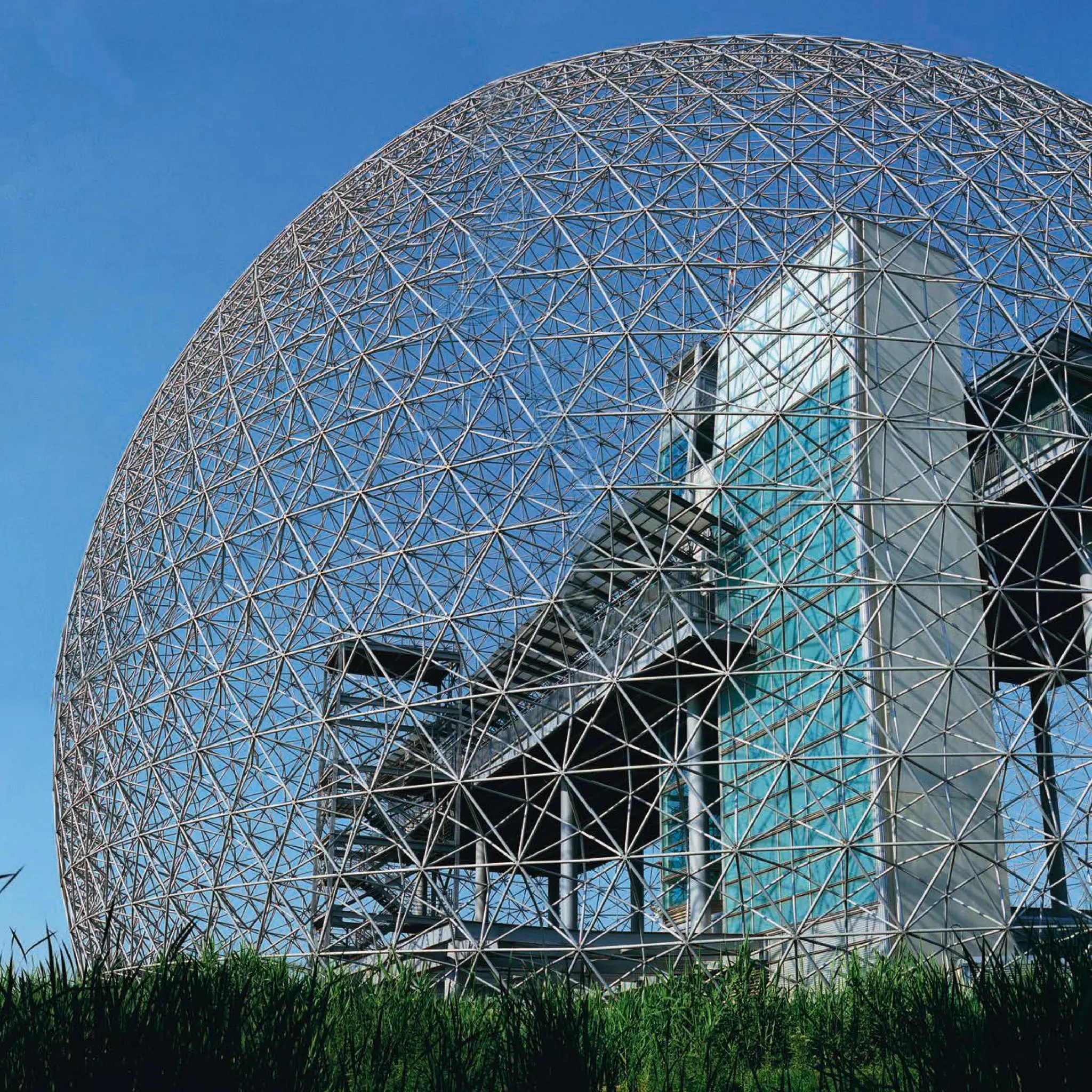
  • 6.
    Pete Silver Will McLean withcontributions by Dason Whitsett Introduction to Architectural Technology Second edition
  • 8.
    Pete Silver Will McLean withcontributions by Dason Whitsett Laurence King Publishing Introduction to Architectural Technology Second edition

  • 9.
    First published in2008 by Laurence King Publishing Ltd 361–373 City Road London EC1V 1LR Second edition published in 2013 by Laurence King Publishing Ltd Tel: +44 20 7841 6900 Fax: +44 20 7841 6910 email: enquiries@laurenceking.com www.laurenceking.com © 2008 and 2013 Pete Silver and Will McLean The moral right of the authors has been asserted. All rights reserved. No part of this publication may be reproduced or transmitted in any form or by any means, electronic or mechanical, including photocopy, recording or any information retrieval system, without permission in writing from the publisher. A catalogue record of this book is available from the British Library. ISBN 978 1 78067 294 6 Design: Hamish Muir Picture Research: Annalaura Palma Printed and bound in China. Dedicated to the memory of James Madge Right National Aquatic Center, Beijing, China (detail), designed by CSCEC International Design and Architects Peddle Thorp Walker in conjunction with Arup Engineers and Vector Foiltec.
  • 11.
    12 Structural Physics 15 MaterialsScience 16 Forces: 16 Stress Strain Properties of Materials: 18 Strength Stiffness and Flexibility Reactions: 20 Bending Shear Structural Integrity 22 Loads: 22 Live and Dead Loads Lateral Loads Bracing Torsion Stability: 24 Anchorage Height Center of Gravity Cantilever Principle Materials Technology 26 Stone 26 Wood 27 Steel 28 Reinforced Concrete 29 Glass 30 Fabrics 31 Fiber-Reinforced Plastic 32 Sheet Materials 33 Structure and Form Structural Elements 35 Bearing Elements 36 Bearing Walls: 36 Stacked Masonry Composite Construction Columns 40 Foundations: 42 Strip Pad Raft Pile Retaining Walls One-Way Spanning 44 Elements Beam: 44 Cross-Sections Linear Profiles Profiled Plate: 48 Reinforced-Concrete Slab Profiled-Sheet Composite Wafer/Laminate Two-Way Spanning 50 Elements: Reinforced-Concrete Slab Coffer Space Frame Wafer/Laminate Connections and Joints: 52 Dry Joint Stone Nail Screw Bolt Rivet Turnbuckle Adhesives (Glue) Welding Brazing Structural Logic 57 Compressive Structures 58 Two-Dimensional Shapes: 58 Post and Beam A-Frame Portal Frame Arch Vault Dome Three-Dimensional Surfaces: 62 Diamatic Dome Lamella Dome Geodesic Dome Shell and Monocoque 66 Tensile Surfaces 68 Membrane 68 Cable Net 68 Tensegrity 68 Foreword 9 Hanif Kara Introduction 10 Contents
  • 12.
    70 Human Comfort 73 ThermalComfort 74 Solar Geometry 76 Climate and Shelter Building Performance 79 Climatic Envelope 80 Thermal Mass 80 Thermal Insulation: 82 Principles Types Air Movement: 86 Natural Ventilation Passive Control Windows and Glazing 90 Weathering: 92 Masonry Cladding Systems Membranes Bonded Surfaces Insulation Glossary 194 Further Reading 196 and Resources Index 199 Picture Credits 207 Acknowledgments 208 Computational Tools and 121 Techniques Building Information Modeling 122 Responsive Systems 124 Structural Analysis 126 Form Finding Finite Element Analysis Environmental Analysis 128 Thermal Daylight Air Movement Acoustic Case Studies 133 Mud House 134 Tepee 136 Igloo 138 Obelisk 140 The Pantheon 142 The Ironbridge 144 The Bell Rock Lighthouse 146 The Crystal Palace 148 Clifton Suspension Bridge 150 Tropical House 152 (Pavilion Demontable) Kresge Auditorium 154 Palazzetto Dello Sport 156 The Houston Astrodome 158 The German Pavilion 160 The USA Pavilion 162 Self-Build House 164 Sydney Opera House 166 HSBC Headquarters 168 The Pavilion of the Future 170 The Portugal Pavilion 172 The Lord’s Media Centre 174 30 St Mary Axe 176 “D” Tower 178 Davies Alpine House 180 International Space Station 182 Media ITC Space Station 184 Stedelijk Museum Extension 186 Building Codes 189 Rules Governing Construction 190 Technology World Commission on Environment 192 and Development (WCED) Guidelines on Sustainable Construction Leadership in Energy and 193 Environmental Design (LEED) Green Building Rating System Construction Sound and Light 102 Acoustics: 102 Properties of Sound Acoustic Control Daylight 106 Building Services 108 Heating 108 Mechanical Ventilation 110 Air-Conditioning: 112 Principles Systems Integrated Systems 116 Sanitation 118
  • 14.
    9 In the courseof my practice as a structural engineer and as a visiting teacher at a variety of architecture and engineering schools, I have encountered much discussion, debate, information, and misinformation about the role of “technology” in architecture. Many use the subject to discuss the different ways in which buildings are put together, while others draw on the digital realm – where the materials are processes, networks, and flows that have been enabled by the pace of change in computers as a design tool. What is clear to me is that the best systems prosper when both of these approaches are exploited in design development – as intellectual activities that integrate production, assembly, and creation to bring together quantative and qualitative satisfaction in the built environment. At one extreme very little practical illustration is published that shows, for example, the role of basic structural systems or basic ways of using materials. On the other hand it is common to see students produce amazing diagrams of flow or stress analysis that then magically produce “architecture” at the other extreme. What is needed is the middle ground, and in this respect, this book provides easy access for the beginning student of architecture. Learning through a selection of contemporary architectural projects introduces students to basic systems and appropriate use of both new and old materials, of both techniques and tools. What the authors have carefully catalogued is the fundamental information that the architecture student must know, and to be aware of the need to work with experts in various disciplines and to learn from past precedents. This will give them a better chance of designing with originality and novelty without becoming an engineer or computer scientist. They will learn to produce architecture by facilitating dialogue between experts, manufacturers, politicians, and communities. At a time when we are not short of information, what is needed is the skill to edit the information to suit the purpose; something which this book achieves with great success. Hanif Kara, F.I. StructE, FRIBA (hon) Adams Kara Taylor November 2007 Foreword Left The USA Pavilion, Montreal, Canada (detail), designed by R. Buckminster Fuller and Shoji Sadao.
  • 15.
    “Aerodynamics is forpeople who can’t design engines.” Enzo Ferrari Both structurally and environmentally, the architect designs the way in which buildings are organized. Along with the art – the social, cultural, philosophical, and political factors that influence design – it is the tools and techniques of the engineer – technology – that gives form and performance to the built environment. Critical to an understanding of architecture is the relationship between design and technology. The aim of this textbook is to introduce the scope of that relationship to those who may be considering a career in architecture, as well as to enable students of architecture to integrate their design thinking with appropriate structural and environmental solutions. The book sets out to explain the relationships between physical phenomena, materials, building elements, and structural types, using simple classification systems and real examples. Photographic images are used to familiarize the user with common construction technology, while historical examples are employed to chart significant moments in the history of architectural engineering. The book introduces structural and environmental engineering to architects and, while it does not include mathematical calculation, it does make reference to current computer techniques that assist designers in predicting the structural and environmental behavior of buildings. At the same time, it makes liberal reference to historical precedents since it is important for the user to understand that the way in which the success of technology is measured is directly related to its cultural context. Some would say that the Gothic cathedral is the pinnacle of architectural engineering given the tools, materials, and techniques of the day. Currently, the world is far more conscious of the clean and efficient use of the planet’s resources, and the success of technology is measured thus. Technology by nature is concerned with invention, and it is only ever possible to take a “snapshot” of technological achievements at any one moment in time. From materials science through to construction site procedures, invention, and progress in architectural technology occur constantly; it is hoped that a compendium of technology such as this book will not only aid students to understand its scope and historical context, but will also inspire them to invent new solutions for the future. Second Edition This second edition includes new information on the fast growing field of Building Information Modeling (BIM), as well as a section on the ways in which computer control may be used to enable buildings to adapt and respond to environmental changes. New diagrams have also been added to many of the case studies, and typical details have been included in the section on weathering. Under Building Services, there are new sections on integrating active and passive systems and on sanitation. Introduction 10
  • 16.
    11 Architectural technologies areclassified under two major headings: Structure and Form, and Climate and Shelter. While the very first primitive shelters, such as mud huts and igloos, employed the same materials and building components to both create structural form and withstand the elements, even a simple tent such as the North American tepee employed one type of material and component (timber posts) to generate the form and another (animal skins) to maintain its internal climate. Structure and Form This section is subdivided into three main topics: Structural Physics, Structural Elements, and Structural Logic. This is a linear progression from the fundamental principles of structural form – materials science, materials technology, and structural integrity – through descriptions of the common elements used in the construction of buildings, such as walls, columns, floors, and roofs, to how these elements are combined to form different building types, from simple “post and beam” structures through Gothic vaults to aluminum monocoque shells and tensile nets. Climate and Shelter The subdivisions in this section deal with two main topics: Human Comfort and Building Performance. Before examining how buildings are constructed in relation to their local environment, it is important to establish the thresholds within which the human body is able to sustain life. The first part of the section looks at the principles of thermal comfort and its provider, the sun. The second part considers ways in which the built environment can be designed to maintain human comfort. As well as exploring how the design and fabric of a building – the climatic envelope – can both control and interact with its environment, passively and actively, it considers human comfort in the context of sound and light. The book includes three additional sections: Computational Tools and Techniques The ways in which architects design are now much influenced by computers. Quite apart from their use in drafting and illustrating, they may assist designers to predict both the structural and environmental behavior of their buildings – through modeling and analysis – as well as supplying databases for materials, components and systems; indeed they can store, and create a virtual model of, all of the information needed for a construction project. This section explores the use of computers as analytical and organizational tools. Case Studies A range of case studies is used to explore the origins of construction types and illustrates the historic relationship between design and technology in architecture and civil engineering. The examples are listed chronologically and are described in relation to the structural and environmental taxonomies described in the first two sections. Building Codes Throughout the world, the construction industry is controlled by rules and regulations that are there to ensure the health and safety of both construction industry operatives and end-users. Building codes cover all aspects of construction and, increasingly, are concerned with regulating towards low-energy, sustainable solutions. Contents Page This is designed as a branching system so the user can contextualize any topic within the book. Every spread has a topic heading that can be cross-referenced with the contents tree. Captions The main body of the text is supplemented by illustrations, both diagrammatic and photographic. Captions are used to supply additional information and should be read as a continuation of the main text. Taxonomy Charts and Icons There are two major taxonomy charts used in Structure and Form, one for Structural Elements and one for Structural Logic. The organization of the charts is directly related to the page spreads that follow, and the individual diagrams are then employed as iconic references. These icons are also employed to cross-reference case studies with the main body of the text. Further Reading Related publications are listed under each of the major headings. It is also recommended that users reference the source information, both publications and web sites. Structure of the book Introduction
  • 18.
  • 20.
    15 Covering the fundamentalprinciples of structural form Materials Science In order to understand how buildings work as structures, it is necessary to appreciate the natural laws that govern structural form. This involves an understanding of the forces that act upon materials and the ways in which the materials will react to those forces according to their fundamental properties. Materials Science covers: forces – how, through gravity, materials are subject to stress and strain; properties of materials – how materials can be analyzed and manipulated for strength and stiffness; and reactions – how components behave when subjected to forces through bending and shear. Materials Technology While materials science is the study of the interplay between the properties, structure, and changes in solids, materials technology is the utilization of this knowledge in the production and fabrication of materials and structural components. Most fabrication processes involve a series of primary ways of acting on materials – cutting, sawing, bending, welding, etc. – with the precise nature of the process determined by the properties of the material to which it is applied. In general, the ability to move raw materials and finished products around factories, building sites, and indeed around the world, places finite limitations on the size, shape and weight of prefabricated building components. Materials technology explores a range of common building materials: stone, timber, steel, reinforced concrete, glass, fabric, fiber-reinforced plastic, and sheet materials. Structural Integrity Knowing the behavior of the materials and components that go to form structures enables the architect to organize them in such a way that the whole structure will be rigid and stable under load. Structural Integrity examines the types of load to which buildings are subjected – live and dead loads, lateral loads, bracing, and torsion – and how structures may be constructed to resist them through triangulation and bracing. Overall stability, as in the rooting of a tree, is then considered in the context of the center of gravity and the cantilever (or branching) principle. Left The leaning tower of Pisa, Italy, 1173. The tower is 55.8 m high and it leans at an angle of 5.5 degrees. Structural Physics Structure and Form
  • 21.
    Random documents withunrelated content Scribd suggests to you:
  • 23.
    ontinuation of Mr.John Clayton's Account of Virginia. Of the Earth and Soil. When you make the Capes of Virginia, you may observe it low Land, so that at some distance the Trees appear as if they grew in the Water; and as you approach nigher to emerge thence. For a hundred Miles up into the Country, there are few Stones to be found, only in some places, Rocks of Iron Oar appear, which made me expect to have found many Waters turn Purple with Galls, but never met with any. Providence has supplied the common use of Stones, by making the Roads very good: so that they ride their Horses without shooing them; which yet are more rarely beaten on their Feet, than ours are in England, the Country and Clime being dry, their Hoofs are much harder; For I observed, that take a Horse out of the wet Marshes, and Swamps, as they there call them, and ride him immediatly, and he'll quickly be tender-footed. In some places, for several Miles together, the Earth is so intermix'd with Oyster-shells, that there may seem as many Shells as Earth; and how deep they lie thus inter-mingled, I think, is not yet known: for at broken Banks they discover themselves to be continued many Yards perpendicular. In several places these Shells are much closer, and being petrefied, seem to make a Vein of a Rock. I have seen in several places, Veins of these Rocky Shells, three or four Yards thick, at the foot of a Hill, whose Precipice might be twenty Yards perpendicular, whose Delf, I suppose, shot under the Hill, pieces of these Rocks broken off, lie there, which, I suppose, may weigh twenty or thirty Tuns a piece, and are as difficult to be broken as our Free-stone. Of these Rocks of Oyster-shells that are not so much petrified, they burn and make all their Lime; whereof they have that store, that no Generation will consume. Whether these were formerly Oysters, which left by the subsiding Seas, (as some suppose, that all that Tract of Land, now high Ground, was once overflowed by the Sea) were since petrefied, or truly Stones, sui Generis, I leave to the Honourable Society to determin. But when I consider the constant and distinct shooting of several Salts, Nature's Curiosity, in every thing, so far exceeding that of Art, that the most
  • 24.
    Ingenious, when referr'dthereto, seem only endued with an Apish fondness, I cannot think any thing too difficult or wonderful for Nature; and indeed I do not apprehend, why it may not be as feasible to suppose them to have been Rocks, at first shot into those Figures, as to conceive the Sea to have amass'd such a vast number of Oyster-shells one upon another, and afterwards subsiding, should leave them cover'd with such Mountains of Earth, under which they should petrify: But not to launch forth too far into those Disputes, since I must modestly remember to whom I write. Often, in the looser Banks of Shells and Earth, are found perfect Teeth petrefied, some whereof I have seen, could not be less than two or three Inches long, and above an Inch broad: Tho' they were not Maxillary Teeth, the part that one might suppose grew out of the Jaw, was polish'd, and black, almost as Jet; the part which had been fasten'd in the Jaw and Gums, was brown, and not so shiningly polish'd, or smooth; if they were, as they seemed to be, really Teeth, I suppose, they must have been of Fishes. The back-Bone of a Whale, and as I remember, they told me of some of the Ribs, were digg'd out of the side of a Hill, several Yards deep in the Ground, about four Miles distant from James Town, and the River. Mr. Banister, a Gentleman pretty curious in those things, shew'd me likewise the Joint of a Whale's back-Bone, and several Teeth, some whereof, he said, were found in Hills beyond the Falls of James River, at least, a hundred and fifty Miles up into the Country. The Soil in general is Sandy: I had designed, and I think it might be worth a critical Remark, to observe, the difference of Soils seem appropriated to the several sorts of Tobacco: For there is not only the two distinct sorts of a sweet-scented, and Aranoko Tobacco, but of each of these be several sorts much different, the Seeds whereof are known by distinct Names, they having given them the Names of those Gentlemen most famed for such sort of Tobacco, as of Prior-seed, &c. Nay, the same sort of Seed in different Earths, will produce Tobacco much different, as to goodness. The richer the Ground, the better it is for Aranoko Tobacco, whose Scent is not much minded, their only aim being to have it specious, large, and to procure it a bright Kite's Foot colour. Had not my Microscopes, &c. Tools to grind Glasses, been cast away, with my other things, I had made some critical Enquiries into their several Natures, I would have examin'd what proportions of Salts, all the sorts of Earths had afforded, and how Water impregnated with their Salts, would have changed with infusing Galls, how with the Syrup of Violets, and how they would have precipitated Mercury, or the like, and so far forth as I had been able, examined them by the several Tryals of Fire. I conceive Tobacco to be a
  • 25.
    Plant abounding withNitro-Sulphurious Particles; for the Planters try the goodness of their Seed, by casting a little thereof into the Fire; if it be good, it will sparkle after the manner of Gun-powder: so will the Stalks of Tobacco-leaves, and perhaps has something analogous to the Narcotick Sulphur of Venus, which the Chymists so industriously labour after. The World knows little of the efficacy of its Oyl, which has wonderful Effects in the curing of old inveterate Sores, and Scrophulous Swellings, and some, otherwise applied and qualified. The goodness of Tobacco I look on primarily consists in the volatility of its Nitre: And hence the sandy Grounds that are most impregnated therewith, and whose Nitrous Salt is most Volatile, for such Grounds are quickliest spent, yield Tobacco's that have the richest Scent, and that shortly becomes a pleasant Smoak; whereas, in Tobacco that grows on stiff Ground, the Salts seem more fix'd, and lock'd up in the Oyl, so that whilst new, 'tis very heady and strong, and requires some time for its Salts to free themselves, and become Volatile; which it manifests, by its having an Urinous Smell. The same Reason satisfies, why Tobacco that grows on low Lands as far as the Salts, tho' the Plant be never overflowed with Salt Water, yet the Ground that feeds the Plant being impregnated with Salt Water, that Tobacco Smoaks not pleasantly, and will scarcely keep Fire, but do all that a Man can, will oft go out, and gives much trouble in frequent lighting the Pipe, 'till after it has been kept some considerable time: Which may be assign'd to the fixeder Saline Particles of the Marine Salt in these Plants, which require more time e'er they be render'd Volatile. Here it might be worthy an Enquiry into the Nature of Filtration of Plants, since we may hence gather, Particles of the Marine Salt are carried along with the Succus Nutritius of the Plant; concerning which, if it were not too much to deviate from the Matter in hand, I should offer some Reflections of my own, which the Learned Society might perhaps improve: For I think thence might be made many happy Conjectures as to the Virtues of Plants. So where we see Plants, or Trees, of an open Pore growing low, we shall find their Juice has subtile Parts: So have all Vines, whether the Grape Vine, or Briony, or a Smilax, or the like. If a Gummous Plant or Tree, that grows low, and close Pored, it abounds with acid Spirits, as Lignum Vitæ, &c. if it grow tall, and be open Pored, it abounds with a subtile Volatile Spirit, as your Firs, and the Turpentine Tree. But to insist no further herein, than as this may be applicable to the present Discourse: For I have observed, that that which is called Pine-wood Land, tho' it be a sandy Soil, even the Sweet-scented Tobacco that grows thereon, being large and porous, agreeable to Aranoko Tobacco; it smoaks as coarsely as
  • 26.
    Aranoko: Wherefore 'tis,that I believe the Microscope might make notable Discoveries towards the knowledge of good Tobacco: For the closer the Composition of the Leaf, the better the Tobacco; and therefore the Planters and Merchants brag of the Substance of their Tobacco; which word, did they always take it in a true Sence, for the Solidness, and not mistake it for the Thickness, it would be more consonant to a true Observation: for as I said of the Pine-wood Tobacco, some of it is thick and not Solid, and differs from the best Tobacco, as Buff does from Tann'd Leather; so that if the Tobacco be sound and not Rotten, you may give a great guess at the goodness of Tobacco, when you weigh the Hogsheads, before you see them: For if an equal care be taken in the packing of them the best Tobacco will weigh the heaviest, and Pack the closest. Now I said, that the Sweet-scented Tobacco most in vogue, which was most fam'd for its Scent, was that that grew on sandy Land; which is true, if you would Smoak it whilst new, or whilst only two or three Years Old; but if you keep the stiff Land Tobacco, which is generally a Tobacco of great Substance five or six Years, it will much excel: For tho' the sandy Land Tobacco abound with a Volatile Nitre at first, yet the stiff Land Tobacco abounds with a greater quantity of Nitre, only that it is lock'd up in its Oyl at first, and requires more time to extricate it self, and become Volatile; but the Pine-wood Land having little of the Nitro-Sulphurious Particles, neither is, nor ever will make any thing of a rich Smoak. Discoursing hereof some days since, to a Gentleman of good Observation, that has been versed with Malting, he assured me, to back this my Supposition, or Hypothesis, he had observed, that Barly that grew on stiff Ground, requir'd more time considerably to Mellow, and come to perfection, than that that grew on light Land. Having proceeded thus far to speak of Tobacco, I shall add one or two things more. The Planters differ in their Judgments about the Time of Planting, or Pitching their Crops: Some are for Pitching their Crops very early, others late, without any distinction of the Nature of the Soils; and 'tis from the different Effects that they find, in that, sometimes early, sometimes the late Planting succeeds: But they have not the Reason to judge of the Cause, to consider the Accidents of the Year, and the Difference of the Soils. In sandy Grounds they need not strive so much for early Planting, the Looseness of the Earth, and the kind natur'd Soil, yielding all that it can, easily and speedily, and Sand retaining the Heat, makes the Plants grow faster. But in stiff Soils, if the Crops be not early pitch'd, so that during the Season of Rains it have got considerable Roots, and shot them some depth, if early Droughts come, it so binds the Land, that the Roots never spread or shoot
  • 27.
    deeper, or furtherthan the Hill that they are planted in: For they plant them as we do Cabbages, raising Hills to set every Plant in, about the bigness of a common Mole-hill: observing this on the Plantation where I lived, that it was stiff Ground, I advised them to Plant their Crops as early as possible; and in order thereunto, I tried several ways to further the Plants; but not to trouble you with the several Experiments that I made, in reference thereto: What I found most advantageous was, by taking an infusion of Horse-dung, and putting thereon Soot, and then my Seeds; this I kept Forty eight Hours in an ordinary digestive heat, I had two Beds left me to Sow, in the midst of those the People sow'd, and the quantity of Seed that they generally allotted to the same quantity of Ground; when I sow'd, I mix'd Ashes with the Seed, having decanted the Liquor, that the Seed might sow the evener: The effect was, that my Plants came up much sooner, grew swifter, and I had five Plants for one more than any of the other Beds bore; I left the Country shortly after, and so no certainty of the final Result. There be had various Accidents and Distempers, whereunto Tobacco is liable, as the Worm, the Fly, Firing to Turn, as they call them, French-men, and the like. I propos'd several ways to kill the Worm and Fly, as by Sulphur and the like; but had no opportunity to experiment it: I shall set down that I had most hopes of, which perhaps may give a hint to others to try or improve. Tobacco-seed is very small, and by consequence so is the young Plant at first, that if gleamy Weather happen at that time, it breeds a small Fly, which consumes the Plume of the Plant; now it being early in the Year when they Sow the Seed, viz. about the fourteenth of January, they cover the Ground, to secure, as well as they can, their tender Plants, from the nipping Frosts, that may happen in the Nights; they cover them only with a few Oak-leaves, or the like; for Straw they find apt to Harbour and Breed this Fly: I therefore would advise them to smoak Straw with Brimstone, once in two or three Nights, and so they might cover them securely, with that which would preserve them infinitely beyond the Covering with Oak- boughs; indeed, I would advise them to keep peculiarly so much of their Indian Corn-blades, which they gather for their Fodder, for this very purpose, being as I conceive, much the best, there being no Chaff to foul their Beds, and prejudice them when they should weed them. What they call Firing is this: When Plants are of small Substance, as when there has been a very Wet and Cold Season, and very hot Weather suddainly ensues, the Leaves turn Brown, and dry to dust: the cause I conceive to be hence: The Plant being feeble, and having a small quantity of Oyl, which makes the more solid part of the Plant, the Earth being suddainly heated by the
  • 28.
    Sun's fiercer Beams,the Roots are rather scorch'd and dried up in the Earth, than nourish'd; so that the Plant consisting only of watry parts, is consumed, as it were, by Fire: sometimes hopeful Plants, when by a sudden Gust some Master Veins are broken, if suddain heat ensues, they likewise Fire: For being not come to maturity, and being deprived of the Supports of Life and Vegetation, they likewise perish, are dried up, and fall to dust. French-men they call those Plants, whose leaves do not spread and grow large, but rather spire upwards, and grow tall; these Plants they do not tend, being not worthy their Labour. Were they so Critical, I believe, they might have great Guess what Plants were most likely to turn French- men, by observing whether the Roots of the Plants run downwards, as those whose Branches are aptest to spire upwards: For tho' I have not made positive proof thereof, I have something more than bare fancy for my conjecture; I have pull'd up some of these French-men, and compar'd them with the Roots of some other Plants, and found them much longer than others; and 'tis observable, loose Soils, and sandy Ground, are more subject thereto than the stiff Land. The Country of it self is one entire Wood, consisting of large Timber Trees of several sorts, free from Thickets or under Wood, the small Shrubs growing only on Lands, that have been clear'd, or in Swamps; and thus it is for several Hundreds of Miles, even as far as has yet been discover'd. But that shall be reserv'd 'till another opportunity. I am, &c.
  • 30.
    John Clayton, Rectorof Crofton at Wakefield, his Letter to the Royal Society, giving a farther Account of the Soil, and other Observables of Virginia. I shall here present you with a continuation of my Remarks on the River, Soil, and Plants of Virginia. And first, as to the River on the other side the Mountains, said to Ebb and Flow. I have been assured by Col. Bird, who is one of the Intelligentest Gentlemen in all Virginia, and knows more of Indian Affairs than any Man in the Country, that it was a Mistake; for that it must run into a Lake, now called Lake Petite, which is fresh Water; for since that time a Colony of the French are come down from Canada, and have seated themselves on the back of Virginia, where Fallam and the rest suppos'd there might be a Bay, but is a Lake, to which they have given the Name of Lake Petite, there being several larger Lakes 'twixt that and Canada. The French possessing themselves of these Lakes, no doubt will in short time be absolute Masters of the Beaver Trade, the greatest number of Beavers being catch'd there. The Colonel told me likewise, that the common Notion of the Lake of Canada, he was assured was a Mistake, for the River supposed to come out of it, had no Communication with any of the Lakes, nor the Lakes one with another, but were distinct. But not to ramble after hear-say, and other matters; but to return to the Parts of Virginia inhabited by the English, which in general is a very Fertile Soil, far surpassing England, for there English Wheat (as they call it, to distinguish it from Maze, commonly called Virginia Wheat) yields generally 'twixt Fifteen and Thirty fold, the Ground only once plow'd; whereas 'tis a good Crop in England that yields above Eight fold, after all their Toil and Labour. And yet in truth 'tis only the barrennest Parts that they have cultivated, Tilling and Planting only the High-Lands, leaving the Richer Vales unstirr'd, because they understand not any thing of Draining. So that the Richest Meadow- Lands, which is one third of the Country, is Boggy, Marsh, and Swamp, whereof they make little Advantage, but loose in them abundance of their Cattle, especially at the first of the Spring, when the Cattle are weak, and venture too far after young Grass. Whereas vast Improvements might be
  • 31.
    made thereof; forthe generality of Virginia is a Sandy Land with a shallow Soil. So that after they have cleared a fresh piece of Ground out of the Woods, it will not bear Tobacco past two or three Years, unless Cow-pen'd; for they Manure their Ground by keeping their Cattle, as in the South you do your Sheep, every Night confining them within Hurdles, which they remove when they have sufficiently dung'd one spot of Ground; but alas! they cannot Improve much thus, besides it produces a strong sort of Tobacco, in which the Smoakers say they can plainly taste the fulsomeness of the Dung. Therefore every three or four Years they must be for clearing a new piece of Ground out of Woods, which requires much Labour and Toil, it being so thick grown all over with Massy Timber. Thus their Plantations run over vast Tracts of Ground, each ambitioning to engross as much as they can, that they may be sure to have enough to Plant, and for their Stocks and Herds of Cattel to Range and Feed in, that Plantations of 1000, 2000, or 3000 Acres are common, whereby the Country is thinly inhabited; their Living solitary and unsociable; Trading confused and dispersed; besides other Inconveniences: Whereas they might Improve 200 or 300 Acres to more Advantage, and would make the Country much more Healthy; for those that have 3000 Acres, have scarce cleared 600 Acres thereof, which is peculiarly term'd the Plantation, being surrounded with the 2400 Acres of Woods: so that there can be no free or even motion of the Air, but the Air is kept either stagnant, or the lofty Sulphurous Particles of the Air, that are higher than the tops of the Trees, which are above as high again as the generality of the Woods in England, descending when they pass over the cleared spots of Ground, must needs in the violent heat of Summer, raise a preternatural Ferment, and produce bad Effects. Nor is it any advantage to their Stocks, or Crops; for did they but drain their Swamps, and Low-Lands, they have a very deep Soil, that would endure Planting twenty or thirty Years, and some would scarce ever be worn out, but be ever longer better, for they might lay them all Winter, or when they Pleased in Water, and the product of their Labour would be double or treble, whether Corn or Tobacco; and that this is no fond Projection, (though when I have discoursed the same to several, and in part shewn them how their particular Grounds might be drained at a very easie rate) they have either been so conceited of their old way, so sottish as not to apprehend, or so negligent as not to apply themselves thereto. But on the Plantation where I lived, I drained a good large Swamp, which fully answered expectation. The Gentlewoman where I lived, was a very Acute Ingenious Lady; who one day Discoursing the Overseer of her Servants,
  • 32.
    about pitching theensuing Year's Crop. The Overseer was naming one place where he designed to Plant 30000 Plants, another place for 15000, another for 10000, and so forth the whole Crop, designed to be about 100000 Plants: Having observed the Year before he had done the like, and scattered his Crop up and down the Plantation, at Places a Mile, or a Mile and a half asunder, which was very Inconvenient, and whereby they lost much time. I interposed, and asked, why they did not Plant all their Crop together? The Fellow smiled as it were at my Ignorance, and said, there was very good Reason for it. I replied, that was it I enquir'd after. He returned, the Plantation had been an old planted Plantation, and being but a small Plot of Ground, was almost worn out, so that they had not Ground altogether that would bring forth Tobacco. I told him then they had better Ground than ever yet they had planted, and more than their Hands could manage. He smil'd again, and asked me, where? I then named such a Swamp. He then said scornfully, he thought what a Planter I was; that I understood better how to make a Sermon, then managing Tobacco. I replied with some warmness, tho' I hoped so, that was Impertinence, and no Answer. He then said, that the Tobacco there would drown, and the Roots rot. I replied, that the whole Country would drown if the Rivers were stopt, but it might be laid as dry as any Land on the Plantation. In short, we discoursed it very warmly, till he told me, he understood his own Business well enough, and did not desire to learn of me. But the Gentlewoman attended somewhat better to my Reasoning, and got me one day to go and shew her how I projected the draining of the Swamp, and thought it so feasible, that she was resolved to have it done; and therefore desir'd me I would again Discourse her Overseer, which I did several times, but he would by no means hearken thereto, and was so positive, that she was forc'd to turn him away, to have her Servants set about the Work; and with three Men in thirteen Days I drained the whole Swamp, it being Sandy Land, soaks and drains admirably well, and what I little expected, laid a Well dry at a considerable distance. The Gentlewoman was in England last Year, and I think Dr. Moulin was by when she asked me. Now to teach her how she might make her Tobacco that grew in the Swamp less, for it produced so very large, that it was suspected to be of the Aranoko kind: I told her, though the complaint was rare, yet there was an Excellent Remedy for that, in letting every Plant bear eight or nine Leaves instead of four or five, and she would have more Tobacco, and less Leaves. Now you must know they top their Tobacco, that is, take away the little top-bud, when the Plant has put forth as many Leaves as they think the Richness of the
  • 33.
    Ground will bringto a Substance; but generally when it has shot forth four or six Leaves. And when the top-bud is gone, it puts forth no more Leaves, but Side-branches, which they call Suckers, which they are careful ever to take away, that they may not empoverish the Leaves. I have been more tedious in the Particulars, the fullier to evince how resolute they are and conceitedly bent to follow their old Practice and Custom, rather than to receive Directions from others, tho' plain, easie, and advantageous. There are many other Places as easie to drain as this, tho' of larger extent, and richer Soil, for some of which I have given directions, and have only had the return perhaps of a flout afterwards: Even in James Town Island, which is much what of an Oval Figure, there's a Swamp runs Diagonal-wise over the Island, whereby is lost at least 150 Acres of Land, which would be Meadow, which would turn to as good Account as if it were in England: Besides it is the great annoyance of the Town, and no doubt but makes it much more unhealthy. If therefore they but scour'd the Channel, and made a pretty ordinary Trench all along the middle of the Swamp, plac'd a Sluice at the Mouth, where it opens into the back Creek; for the Mouth of the Channel there is narrow, has a good hard bottom, and is not past two Yards deep when the Flood is out; as if Nature had designed it before hand: They might thus drain all the Swamp absolutely dry, or lay it under Water at their Pleasure. I have talked several times hereof to Mr. Sherwood, the owner of the Swamp, yet nothing is essayed in Order thereto. And now since we are speaking of James Town give me leave to adjoin some Reflections as to the Situation and Fortifications of the Place. The Natural Situation of the place is such, as perhaps the World has not a more commodious Place for a Town, where all things conspire for Advantage thereof. James Town Island is rather a Peninsula, being joined to the Continent by a small Neck of Land, not past Twenty or Thirty Yards over, and which at Spring-Tides is overflow'd, and is then an absolute Island. Now they have built a silly sort of a Fort, that is, a Brick Wall in the shape of a Half-Moon, at the beginning of the Swamp, because the Channel of the River lies very nigh the Shoar; but it is the same as if a Fort were built at Chelsey to secure London from being taken by Shipping. Besides Ships passing up the River are secured from the Guns of the Fort, till they come directly over- against the Fort, by reason the Fort stands in a Vale, and all the Guns directed down the River, that should play on the Ships, as they are coming up the River, will lodge their Shot within Ten, Twenty, or Forty Yards in the rising Bank, which is much above the Level of the Fort; so that if a Ship
  • 34.
    gave but agood Broad-side, just when she comes to bear upon the Fort, she might put the Fort into that confusion, as to have free Passage enough. There was indeed an old Fort of Earth in the Town, being a sort of Tetragone, with something like Bastions at the four Corners, as I remember; but the Channel lying further off to the middle of the River there, they let it be demolished, and built that new one spoke of, of Brick, which seems little better than a blind Wall, to shoot Wild Ducks or Geese. If they would build a Fort for the Security of the Town and Country, I conceive it should be on Archer's Hope Point, for that would stop the Ships from passing up the River, before they came to the Town, and would secure the Town from being block'd up by Sea. The Channel at Archer's Hope Point lies close by the Shoar, and makes such an Angle there by reason of Hog Island, that going up or down the River, let the Wind be where it will, they must there bring the contrary Tack on Board, and generally when they About the Ship as they call it, they are so near the Shoar, that a Man may almost fling a Finger-stone on Board. How much this hinders the motion of a Ship, and what Confusion it must be to them to bring a contrary Tack on Board, whilst they have all the Guns of a Fort playing so nigh upon them, may readily be conceived. Archer's Hope is a Neck of Land, that runs down three Miles long, not much past half a Mile broad betwixt the Main River and Archer's Hope Creek, which has large Marshes and Swamps; so that a Citadel built upon the Point, would almost be Impregnable, being it could be attack'd no way but one, which is so narrow a slender Neck of Land, that it would be difficult to take it that way: And it would secure James Town from being block'd, being it would not be past a Mile by Water, to the Point of James Town Island. The Island is so surrounded with Water and Marshy Land, that the Town could never be Bomb'd by Land. But now to return to the Reflections of Improving, and Manuring of Land in Virginia; hitherto, as I have said, they have used none but that of Cow-penning; yet I suppose they might find very good Marle in many places, I have seen both the red and blew Marle at some breaks of Hills: This would be the properest Manure for their Sandy Land, if they spread it not too thick, theirs being, as I have said, a shallow, Sandy Soil, which was the Reason I never advised any to use Lime, tho' they have very good Lime of Oyster- shells; but that's the properest Manure for cold Clay Land, and not for a Sandy Soil. But as most Lands have one Swamp or another bordering on them, they may certainly get admirable Slitch, wherewith to Manure all their uplands. But this, say they, will not improve Ground, but clods and grows hard; 'tis true, it will do so for some time, a Year or two at the first;
  • 35.
    but did theycast it in heaps, and let it lie for two or three Years after a Frost or two had seized it, and it had been well pierced therewith, I doubt not it would turn to good Account: And for this too I have something more than bare conjecture; for Discoursing it once with a good notable Planter, we went to view a heap thereof, that casually he had cast up 'twixt three and four Years before, and we found it not very binding, but rather a fine Natural Mold, whereupon he did confess, he then remembred that out of a ridge of the like Mold he had very large Plants, which must have been of the like Slime or Slitch cast up before: But said, that himself and others despaired of this Manure, because they had taken of this Slitch fresh and moist out of the Swamp, and fill'd Tobacco Hills with it, and in the midst of it planted their Plants, which so bound the Roots of their Plants, that they never came to any thing. But he said, he then saw his Error, yet I have not heard he has remembred to Correct it. But 'tis strange in how many things besides they are remiss, which one would think English Men should not be guilty of. They neither House nor Milk any of their Cows in Winter, having a Notion that it would kill them; yet I perswaded the afore-mentioned Lady where I lived, to Milk four Cows the last Winter that I staid in the Country, whereof she found so good Effect, that she assured me she would keep to my Advice for the future; and also as I had further urged, House them too, for which they have mighty Conveniencies, their Tobacco Houses being empty ever at that time of the Year, and may easily be fitted in two or three days time without any Prejudice; whereby their Cattle would be much sheltered from those Pinching sharp Frosts that some Nights on a sudden become very severe. I had another Project for the Preservation of their Cattle proved very successful; I urged the Lady to sow her Wheat as early as possibly she could, so that before Winter it might be well rooted, to be early and flourishing at the first of the Spring: So that she might turn thereon her weak Cattle, and such as should at any time be swamp'd, whereby they might be recruited and saved, and it would do the Wheat good also. I advised her likewise to save, and carefully gather her Indian Corn-tops, and blades, and all her Straw, whatever could be made Fodder, for her Cattle; for they get no Hay, tho' I was urging her to that too, and to sow Saintfoin; for being a Sandy Soil, I am confident it would turn to very good Account. They have little or no Grass in Winter, so that their Cattle are pined and starved, and many that are brought low and weak, when the Spring begins, venture too far into the Swamps after the fresh Grass, where they perish; so that several Persons lose ten, twenty or thirty Head of Cattle in a Year: I observed this was much owing to their Inadvertency and
  • 36.
    Error in theirway of Managing and Feeding them; for they get little Fodder, but as they think Corn being more Nourishing, feed them with their Indian Corn, which they give them Morning and Evening; they spend thus a great quantity of Corn, and when all's done, what signifies two or three Heads of Corn to a Beast in a Morning? It makes them only linger about the Houses for more? and after that sweet Food they are not so prompt to browse on the Trees, and the course Grass which the Country affords. So that thus their Guts shrink up, and they become Belly-shot as they call it. I advised therefore never to give them any thing in a Morning, whereby as soon as they were set forth of the Cow-pens, they would fall a feeding, and tho' they filled their Bellies only with such course stuff as had little Nourishment in it, yet it would keep out their Bellies, and they would have a better Digestion; and then when they were come home at Nights, to Fodder them, beginning with Straw and their coarsest Fodder, which they would learn to eat by degrees, before they tasted that that was more delicate, and whilst their digestion was strong, would yield them Nourishment to keep them still so; afterwards when the Winter pinched, their fine Fodder then would stand them in stead; and hereby they might preserve their weakest Cattle. By these Methods, and the help of the Wheat-patch, she, the Gentlewoman where I lived, saved all her Cattle, and lost not one in Two Winters after, that I staid there; besides she saved above Twenty Barrels of Corn, as I remember that she told me she used to spend upon her Stock; and a Barrel of Corn is commonly worth Ten Shillings. Nay further, The last Spring she fed Two Beasts, a Bullock and a Cow, Fat, upon her Wheat, with the addition only of a little boil'd Corn, and yet the Wheat was scarce eat down enough. But to return again to the Nature of the Earth, which may be pretty well gather'd from what I have already said. I have observed, that at Five or Six yards deep, at the breaks of some banks, I have found veins of Clay, admirable good to make Pots, Pipes, or the like of, and whereof I suppose the Indians make their Pipes, and Pots, to boil their Meat in, which they make very handsomly, and will endure the Fire better than most Crucibles: I took of this Clay, dryed, powder'd, and sifted it; powdered and sifted Potsherds, and Glass; Three parts, Two parts and One part as I remember, and therewith made a large Crucible, which was the best I yet ever tried in my Life; I took it once red hot out of the Fire, and clapt it immediately into Water, and it started not at all. The Country abounds mightily with Iron Oar, that as I have been assured by some upon tryal, has been found very good. There are Rocks thereof appear at the precipice of Hills, at the foot whereof there runs a River fit for a Forge, and there's
  • 37.
    Wood enough tosupply it with Charcoal; as I have heard there was formerly some Persons undertook the Work, and when they had made but a small quantity of Iron, which proved very good, the Indian Massacre happened, and they being higher seated than the then Inhabited part of the Country, were all cut off, and the Works demolished; so that it has frighted others I think from the like attempt; besides, such a work requires a greater Fund, and Bank of Mony to carry it on, than any there are able to lay out; and for Persons in England to meddle therewith, is certainly to be cheated at such a distance; some Indians brought Col. Bird some Black Lead, whereof he told me there was great store. There's very curious Chalk towards the falls of Rapahanock River, which they burn and make a delicate white Wash of it. The Secretary of State Col. Spencer, has assured me, there were Vitriolick or Alluminous Earth on the Banks of Potomack. And thus far of what my Memory supplies me, referring to the Earth; in the next place I shall give a short account of the Birds. Of the BIRDS I had indeed begun once whilst I was in that Country to have made a Collection of the Birds, but falling sick of the Griping of the Guts, some of them for want of care corrupted, which made them fling others away that I had thoroughly cured; for I was past taking care of them my self, there remaining but small hopes of my Life. There are Three sorts of Eagles, the largest I take to be that they call the Grey Eagle, being much of the colour of our Kite or Glead. The Second is the Bald Eagle, for the Body and part of the Neck being of a dark brown, the upper part of the Neck and Head is covered with a white sort of Down, whereby it looks very bald, whence it is so named. The Third is the Black Eagle, resembling most the English Eagle; they build their Nests much after the manner that Dr. Willoughby describes, and generally at the top of some tall old Tree, naked of Bows and nigh the River side, and the People fall the Tree generally when they take the young; they are most frequently sitting on some tall Tree by the River side, whence they may have a prospect up and down the River, as I suppose to observe the Fishing Hauks; for when they see the Fishing Hauk has struck a Fish, immediately they take Wing, and 'tis sometimes very pleasant to behold the Flight, for when the Fishing Hauk perceives her self pursued, she will
  • 38.
    scream and makea terrible noise, till at length she lets fall the Fish to make her own escape, which the Eagle frequently catches before it reach the Earth or Water. These Eagles kill young Lambs, Pigs, &c. The Fishing Hauk is an absolute Species of a Kings-fisher, but full as large, or larger than our Jay, much of the Colour and Shape of a Kings-fisher, tho' not altogether so curiously Feather'd; it has a large Crop, as I remember, there is a little Kings-fisher much the same in every respect with ours. If I much mistake not, I have seen both Goss Hauk and Falcon; besides there are several sorts of the lesser Kind of Stannels. There is likewise the Kite and the Ringtail. I never heard the Cuckow there to my remembrance. There's both a brown Owl and white Owl, much what as large as a Goose, which often kills their Hens and Poultry in the Night; the white Owl is a very delicate Feather'd Bird, all the Feathers upon her Breast and Back being Snow-white, and tipp'd with a Punctal of Jet-black: besides there is a Barn Owl much like ours; and a little sort of Scritch Owl. There's both the Raven, and the Carrion-Crow; I do not remember I ever saw any Rooks there. Dr. Moulin and my self, when we made our Anatomies together, when I was at London, we shew'd to the Royal Society, that all Flat-bill'd Birds that groped for their Meat, had three Pair of Nerves, that came down into their Bills; whereby as we conceived they had that accuracy to distinguish what was proper for Food, and what to be rejected by their Taste when they did not see it; and as this was most evident in a Duck's Bill and Head, I draw'd a Cut thereof, and left it in your Custody: A Duck has larger Nerves that come into their Bills than Geese or any other Bird that I have seen and therefore quaffer and grope out their Meat the most: But I had then discover'd none of these Nerves in Round- bill'd Birds: But since in my Anatomies in the Country, in a Rook I first observed two Nerves came down betwixt the Eyes into the upper Bill, but considerably smaller than any or the three Pair of Nerves in the Bills of Ducks, but larger than the Nerves in any other Round-bill'd Birds; and 'tis remarkable these Birds more than any other Round-bill'd Birds seem to grope for their Meat in Cow-dung and the like: Since I have found in several Round-bill'd Birds the like Nerves coming down betwixt the Eyes, but so very small that had I not seen them first in a Rook I should scarce have made the discovery; in the lower Bill there are Nerves have much the
  • 39.
    same situation withthe Flat-bill'd Birds, but very small, and scarce discernable, unless to the Cautious and Curious. The Night Raven, which some call the Virginia Bat, is about the bigness of a Cuckow, feather'd like them but very short, and short Leg'd, not discernable when it flies, which is only in the Evening scudding like our Night Raven. There's a great sort of ravenous Bird that feeds upon Carrion, as big very nigh as an Eagle, which they call a Turky Bustard, its Feathers are of a Duskish black, it has red Gills, resembling those of a Turky, whence it has its Name; it is nothing of the same sort of Bird with our English Turky Bustard, but is rather a Species of the Kites, for it will hover on the Wing something like them, and is carnivorous; the Fat thereof dissolved into an Oil, is recommended mightily against old Aches and Sciatica Pains. I think there are no Jackdaws, nor any Magpys; they there prize a Magpye as much as we do their Red Bird. The Pica Glandaria, or Jay, is much less than our English Jay, and of another colour, for it is all blue where ours is brown, the Wings marbled as curiously as ours are, it has both the same Cry, and sudden jetting Motion. There are great Variety and Curiosity in the Wood-peckers, there's one as big as our Magpye, with blackish brown Feathers, and a large Scarlet Tuft on the top of the Head: There are four or five sorts of Wood-peckers more, variegated with Green, Yellow and Red Heads, others spotted black and white, most lovely to behold. There's a Tradition amongst them, that the Tongue of one of these Wood-peckers dryed will make the Teeth drop out if pick'd therewith, and cure the Tooth-ach (tho' I believe little of it, but look on it as ridiculous) yet I thought fit to hint as much that others may try; for sometimes such old Stories refer to some peculiar Virtues, tho' not to all that is said of them. There be wild Turkies extream large; they talk of Turkies that have been kill'd, that have weigh'd betwixt 50 and 60 Pound weight; the largest that ever I saw, weigh'd something better than 38 Pound; they have very long Legs, and will run prodigiously fast. I remember not that ever I saw any of them on the Wing, except it were once: Their Feathers are of a blackish shining Colour, that in the Sun shine like a Dove's Neck, very specious. Hens and Cocks are for the most part without Tails and Rumps; and as some have assured me our English Hens after some time being kept there have their Rumps Rot off; which I'm the apter to believe, being all their
  • 40.
    Hens are certainlyof English breed. I'm sorry I made no Anatomical Observations thereof, and Remarks about the Use of the Rumps in Birds, which at present I take to be a couple of Glands, containing a sort of Juice for the Varnishing the Feathers; having observed all Birds have much recourse with their Bills to the Rumps when they dress their Plumes, whereby they scud thro' the Air more nimbly in their Flight. Partridges there are much smaller than ours, and resort in Covies as ours do; their Flesh is very white, and much excels ours in my mind, Sed de gustibus non est disputandum. Their Turtle-Doves are of a duskish blue colour, much less than our common Pidgeon, the whole Train is longer much than the Tails of our Pidgeons, the middle Feather being the longest. There's the strangest Story of a vast number of these Pidgeons that came in a Flock a few Years before I came thither; they say they came thro' New England, New York and Virginia, and were so prodigious in number as to darken the Sky for several Hours in the place over which they flew, and brake massie Bows where they light; and many like things which I have had asserted to me by many Eye-witnesses of Credit, that to me it was without doubt, the Relaters being very sober Persons, and all agreeing in a Story: nothing of the like ever happen'd since, nor did I ever see past Ten in a Flock together that I remember. I am not fond of such Stories, and had suppressed the relating of it, but that I have heard the same from very many. The Thrush and Feldefire are much like ours, and are only seen in Winter there, accordingly as they are here. Their Mocking Birds may be compared to our Singing Thrushes, being much of the same bigness; there are two sorts, the Gray and the Red, the gray has Feathers much of the colour of our gray Plovers with white in the Wings like a Magpye; this has the much softer Note, and will imitate, in its singing, the Notes of all Birds that it hears, and is accounted much the finest Singing Bird in the World. Dr. Moulin and I made in our Anatomy many Observations of Singing Birds to this effect: The Ears of Birds differ much from those of Men or Beasts, there's almost a direct passage from one Ear to the other of Birds, so that prick but the small Membrane call'd the Drum on either Ear, and Water poured in at one Ear will run out at the other: But this is not all, but what is much more remarkable, they have no Coclea, but instead thereof there's a small Cocleous or twisting Passage that opens into a large Cavity, that runs betwixt two Sculls, and passes all
  • 41.
    round the Head,the upper Scull is supported by many hundreds of small Thred-like Pillars or Fibers, which as we supposed had another use also, to break the Sound from making any confused Echo, and to make it one and distinct; this passage we observed betwixt the two Skulls was much larger in Singing Birds than in others that do not sing, so very remarkable that any Person that has been but show'd this may easily judge by the Head what Bird is a Singing Bird, or has aptitude thereto, tho' he never saw the Bird before, nor knew what Bird it were: This has often made me reflect how much the Modification of Voices depends upon the accuracy of the Ear, and how deaf Persons become Dumb: And since I have observed that many Children that have an acute Wit enough that are slow of Speech, that is long before they speak are much longer before they can pronounce those Letters that are sharps, as g. h. r. and never have an aptitude to learn to sing. Hence I judge that Songs that have many Sharps in them are the difficultest to sing well, and discover any Persons skill upon the trial of Musick most. This I suppose only, having no Skill in Musick my self, nor having ever discoursed any Person about it. As I remember we show'd some of these things to the Royal Society, and I drew some Cuts thereof, and gave the Doctor upon promise that he would put these and many other our joint Observations in Print, but I hear he is since dead. I have Anatomized most sorts of Creatures, and never found any Four-footed Creature with an Ear like a Bird, unless a Mole; and a Mole has an Ear much like them, with a very thin double Scull, and great Cavity like a Bird, and is very acute of hearing, the Scull by reason of the large Cavity is very slender and easily crush'd, so that a Mole is quickly kill'd with a bruise on the Scull like a Lark, and upon the bruise the Membranes of the Scull turn black; whence Segerus mistake Membranæ Cerebri in superficie exteriori omnino nigræ visæ. But when I have taken care not to bruise the Skull the Membranes were not black at all, both Segerus and Severinus I think had some perceptions of the different Structure of a Mole's Ear, but not any thing of its Analogy to a Bird's Ear; they speak of a Bone Egregie pumicosum: And Segerus says there's a Ductus ad ossis usque petrosi cavitatem protensus, plurimis fibrillis Membraneis annectabatur. But to return, this Mocking Bird having its Name from Mimicking, all other Birds in singing is a wonderful mettled Bird, bold and brisk, and yet seems to be of a very tender Constitution, neither singing in Winter, nor in the midst of Summer, and with much difficulty are any of them brought to live in England.
  • 42.
    The Red Mockingis of a duskish red, or rather brown; it sings very well, but has not so soft a Note as the gray Mocking Bird. Of Virginia Nightingale, or red Bird, there are two sorts, the Cocks of both sorts are of a pure Scarlet, the Hens of a Duskish red; I distinguish them into two sorts, for the one has a tufted Cops on the Head, the other is smooth-feather'd. I never saw a tufted Cock with a smooth-headed Hen, or on the contrary; they generally resorting a Cock and Hen together, and play in a Thicket of Thorns or Bryars in the Winter, nigh to which the Boys set their Traps, and so catch them and sell them to the Merchants for about Six Pence apiece; by whom they are brought for England; they are something less than a Thrush. There's a Bird very injurious to Corn, they call a Blackbird; I look on it a sort of Starling, for they cry something like them but do not sing, are much what of the same bigness, have Flesh blackish like theirs; they resort in great Flocks together, they are as black as a Crow all over their Bills and all, only some of them have scarlet Feathers in the Pinions of their Wings. Quæry, Whether a distinct Species? They have a Lark nothing differing from our common Lark; they have another Bird which they call a Lark that is much larger, as big as a Starling, it has a soft Note, feeds on the Ground; and as I remember has the Specifical Character of a long Heel, it is more inclined to yellow, and has a large half Moon on its Breast of yellow; if it have not a long Heel, Quære, Whether a Species of the Yellow-hammer? They have a Martin very like, only larger than ours, that builds after the same manner. The honourable Col. Bacon has remarked for several Years, that they constantly come thither upon the Tenth of March one or two of them appearing before, being seen hovering in the Air for a Day or two then go away, and as he supposed return'd with the great Flock. The Colonel delighted much in this Bird, and made like Pidgeon-holes at the end of his House with Boards purposely for them. Their Swallow differs but little from ours. They have a Bird they call a Blue-bird, of a curious azure colour about the bigness of a Chaffinch. There be other sorts of Goldfinches variegated with Orange and Yellow Feathers, very specious and beautiful.
  • 43.
    Sparrows not muchdifferent from the English, but build not in the Eaves of Houses that ever I saw. The Snow-bird which I take to be much the same with our Hedge-Sparrow; this is so called because it seldom appears about Houses but against Snow or very cold Weather. The Humming Bird that feeds upon the Honey of Flowers: I have been told by some Persons, that they have kept of these Humming Birds alive, and fed them with Water and Sugar: they are much the smallest of all Birds, have long Bills and curious coloured Feathers, but differ much in colour. Herons three or four several sorts, one larger than the English, feather'd much like a Spanish Goose. Another sort that only comes in Summer Milk white, with red Legs very lovely to behold. The Bittern is there less than in England, and does not make that sounding Noise that ever I heard. Curlews something less than our English, tho' bigger than a Wimbrel. The Sandpiper much resembling the English. The Snipe, two sorts, one resembling ours, the other much less. The Tewits are smaller than the English, and have no long Toppins, but just like a young one that begins to fly. There are a great number of wild Swans. Wild-geese and Brent-geese all Winter in mighty Flocks, Wild-ducks innumerable, Teal, Wigeon, Sheldrakes, Virginia-didapers, the Black-diver, &c. In my return home for England, May 1686., off of the Banks of Newfoundland, when we were, according to account, a hundred Leagues from the Shoar, we saw several prodigious floating Islands of the Ice, no less to our Wonder than Terror, for they were very dangerous: I got the Master to sail one day as nigh one of them as we securely durst, which we judged to be full a League in length, and was higher above Water than the top of our Main-mast; the Snow drove to and fro upon it as upon a large Plane. There was a great Flock of small Black-divers, that were not much bigger than a Fieldfare, came to us a little before, but all of them then left and betook themselves to this Island of Ice. They dived the constantly'st,
  • 44.
    and the longestat a time of any Bird that I ever saw. We saw, as I remember, nigh Thirty of these Islands of Ice. Captain Rider being some fews days later in his Passage, and bearing more to the Nore, told me, he saw many more of these Islands of Ice, and some much larger. There are in Virginia a great many Cormorants; several sorts of Gulls, and in about the Bay many Bannets. Thus much for the Birds. Yours, &c.
  • 46.
    Welcome to ourwebsite – the ideal destination for book lovers and knowledge seekers. With a mission to inspire endlessly, we offer a vast collection of books, ranging from classic literary works to specialized publications, self-development books, and children's literature. Each book is a new journey of discovery, expanding knowledge and enriching the soul of the reade Our website is not just a platform for buying books, but a bridge connecting readers to the timeless values of culture and wisdom. With an elegant, user-friendly interface and an intelligent search system, we are committed to providing a quick and convenient shopping experience. Additionally, our special promotions and home delivery services ensure that you save time and fully enjoy the joy of reading. Let us accompany you on the journey of exploring knowledge and personal growth! ebookultra.com