Introduction to Architectural Technology Third Edition William Mclean
Introduction to Architectural Technology Third Edition William Mclean
Introduction to Architectural Technology Third Edition William Mclean
Introduction to Architectural Technology Third Edition William Mclean
Introduction to Architectural Technology Third Edition William Mclean
1.
Introduction to ArchitecturalTechnology Third
Edition William Mclean install download
https://ebookmeta.com/product/introduction-to-architectural-
technology-third-edition-william-mclean/
Download more ebook from https://ebookmeta.com
2.
We believe theseproducts will be a great fit for you. Click
the link to download now, or visit ebookmeta.com
to discover even more!
Introduction to radiologic technology Eighth Edition.
Edition William Joseph Callaway
https://ebookmeta.com/product/introduction-to-radiologic-
technology-eighth-edition-edition-william-joseph-callaway/
Tools for Ideas Introduction to Architectural Design
Christian Gänshirt
https://ebookmeta.com/product/tools-for-ideas-introduction-to-
architectural-design-christian-ganshirt/
Information Technology In The Third World Can I T Lead
To Humane National Development 1st Edition William
James Stover
https://ebookmeta.com/product/information-technology-in-the-
third-world-can-i-t-lead-to-humane-national-development-1st-
edition-william-james-stover/
Algebra and Trigonometry Jay Abramson
https://ebookmeta.com/product/algebra-and-trigonometry-jay-
abramson/
3.
Chemistry The MolecularNature of Matter and Change 9th
Edition Martin S. Silberberg
https://ebookmeta.com/product/chemistry-the-molecular-nature-of-
matter-and-change-9th-edition-martin-s-silberberg/
Chemistry for Today General Organic and Biochemistry
9th Edition Spencer L. Seager
https://ebookmeta.com/product/chemistry-for-today-general-
organic-and-biochemistry-9th-edition-spencer-l-seager/
Treating Later-Life Depression: A Cognitive-Behavioral
Therapy Approach, Clinician Guide (Treatments That
Work) 2nd Edition Ann M. Steffen
https://ebookmeta.com/product/treating-later-life-depression-a-
cognitive-behavioral-therapy-approach-clinician-guide-treatments-
that-work-2nd-edition-ann-m-steffen/
History and Education Engaging the Global Class War
First Edition Curry Stephenson Malott
https://ebookmeta.com/product/history-and-education-engaging-the-
global-class-war-first-edition-curry-stephenson-malott/
Twisted Daddies Twisted Tales Anthology Series Book 1
1st Edition Pepper North Paige Michaels Allysa Hart
Adaline Raine Lucky Moon Maren Smith
https://ebookmeta.com/product/twisted-daddies-twisted-tales-
anthology-series-book-1-1st-edition-pepper-north-paige-michaels-
allysa-hart-adaline-raine-lucky-moon-maren-smith/
4.
Essential Computer Science- A Programmer’s Guide to
Foundational Concepts 1st Edition Paul D. Crutcher
https://ebookmeta.com/product/essential-computer-science-a-
programmers-guide-to-foundational-concepts-1st-edition-paul-d-
crutcher/
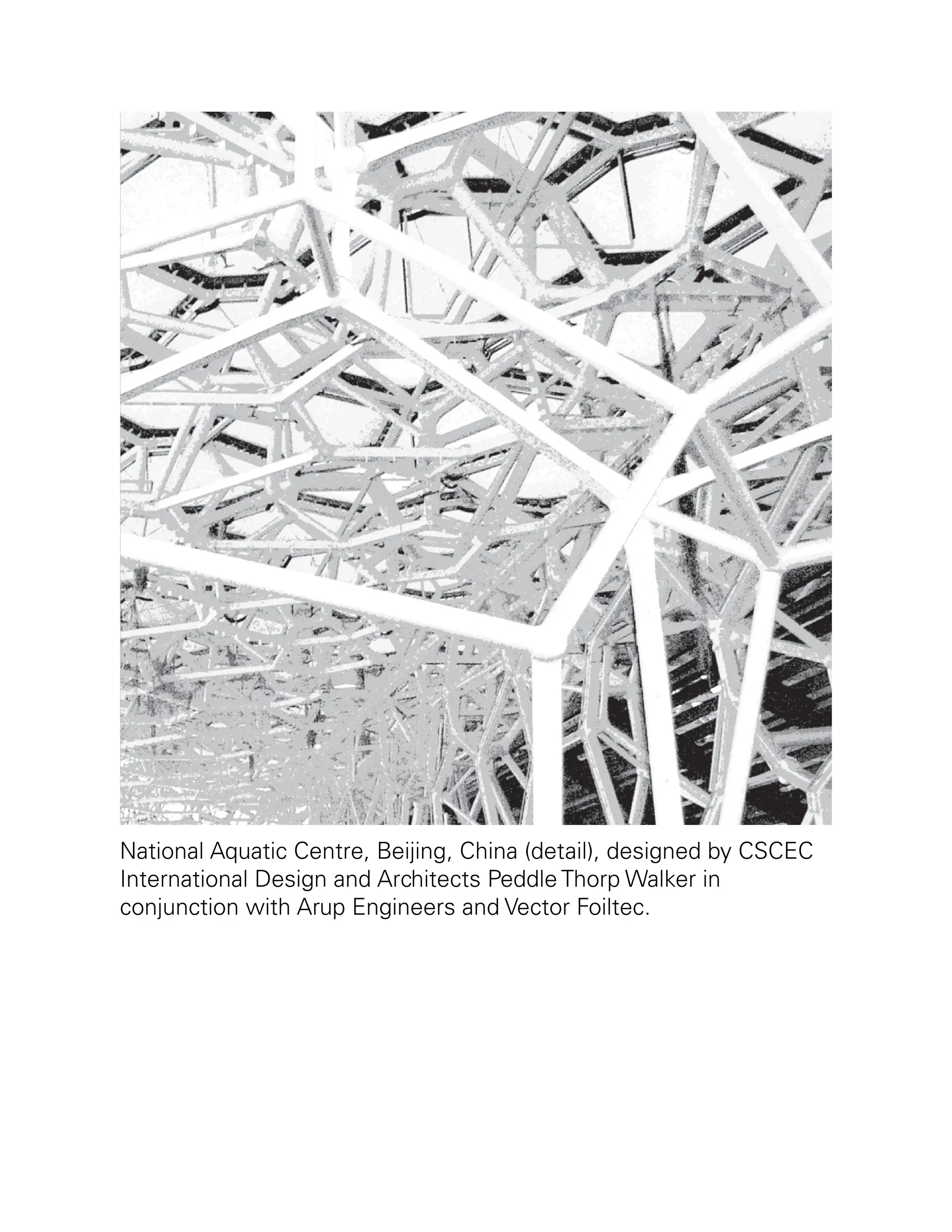
National Aquatic Centre,Beijing, China (detail), designed by CSCEC
International Design and Architects Peddle Thorp Walker in
conjunction with Arup Engineers and Vector Foiltec.
12.
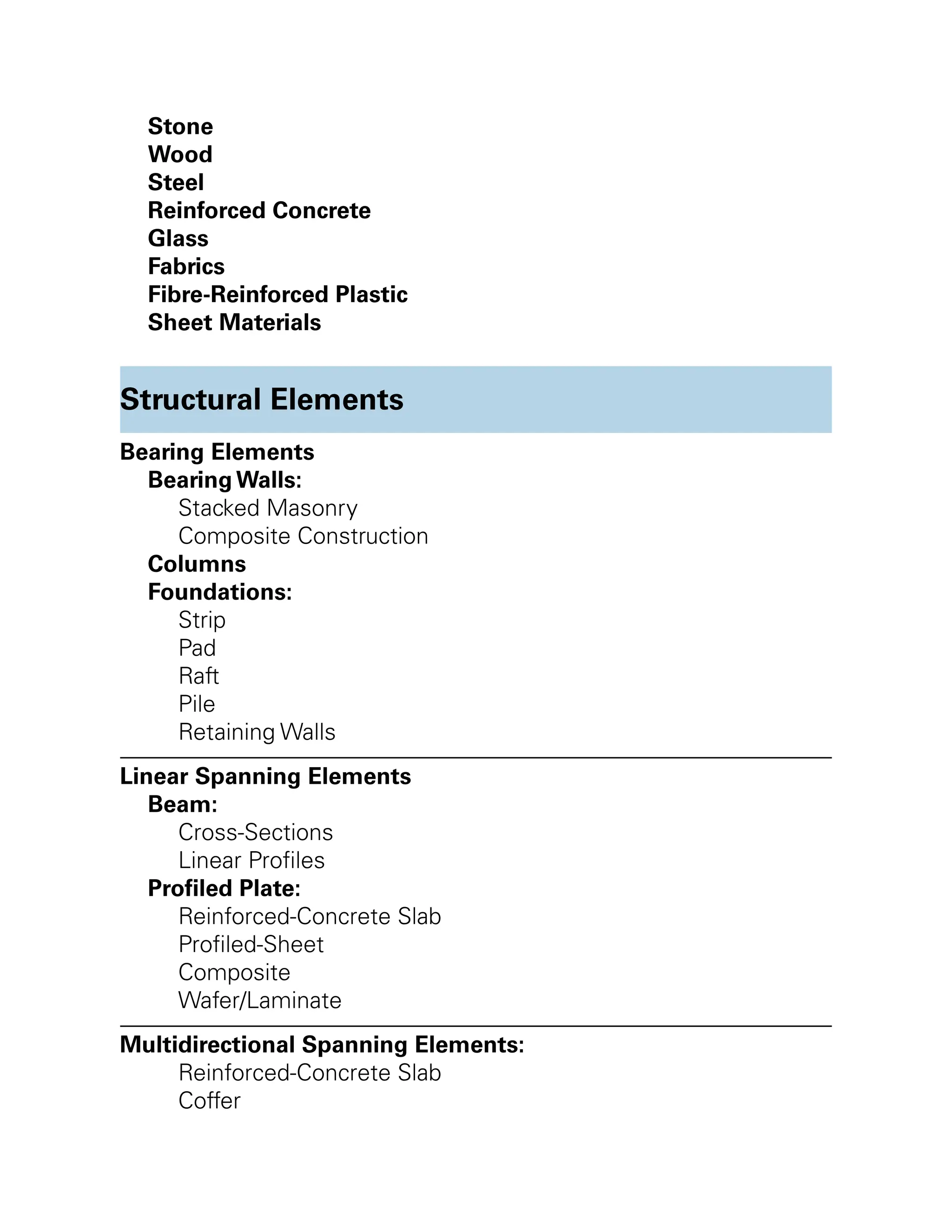
Contents
Introduction
Structure and Form
StructuralPhysics
Materials Science
Forces:
Stress
Strain
Properties of Materials:
Strength
Stiffness and Flexibility
Reactions:
Bending
Shear
Structural Integrity
Loads:
Live and Dead Loads
Lateral Loads
Bracing
Torsion
Stability:
Anchorage
Height
Centre of Gravity
Cantilever Principle
MaterialsTechnology
13.
Stone
Wood
Steel
Reinforced Concrete
Glass
Fabrics
Fibre-Reinforced Plastic
SheetMaterials
Structural Elements
Bearing Elements
Bearing Walls:
Stacked Masonry
Composite Construction
Columns
Foundations:
Strip
Pad
Raft
Pile
Retaining Walls
Linear Spanning Elements
Beam:
Cross-Sections
Linear Profiles
Profiled Plate:
Reinforced-Concrete Slab
Profiled-Sheet
Composite
Wafer/Laminate
Multidirectional Spanning Elements:
Reinforced-Concrete Slab
Coffer
14.
Space Frame
Wafer/Laminate
Connections andJoints:
Dry Joint
Stone
Nail
Screw
Bolt
Rivet
Turnbuckle
Adhesives (Glue)
Welding
Brazing
Structural Logic
Two-Dimensional Shapes
Compressive Structures:
Post and Beam
A-Frame
Portal Frame
Arch
Vault
Simple Dome
Two-Dimensional Shapes
Tensile Structures:
Cable Stayed
Cable Hung
Synclastic Surfaces
Compressive Structures:
Diamatic Dome
Lamella Dome
Geodesic Dome
Anticlastic Surfaces
15.
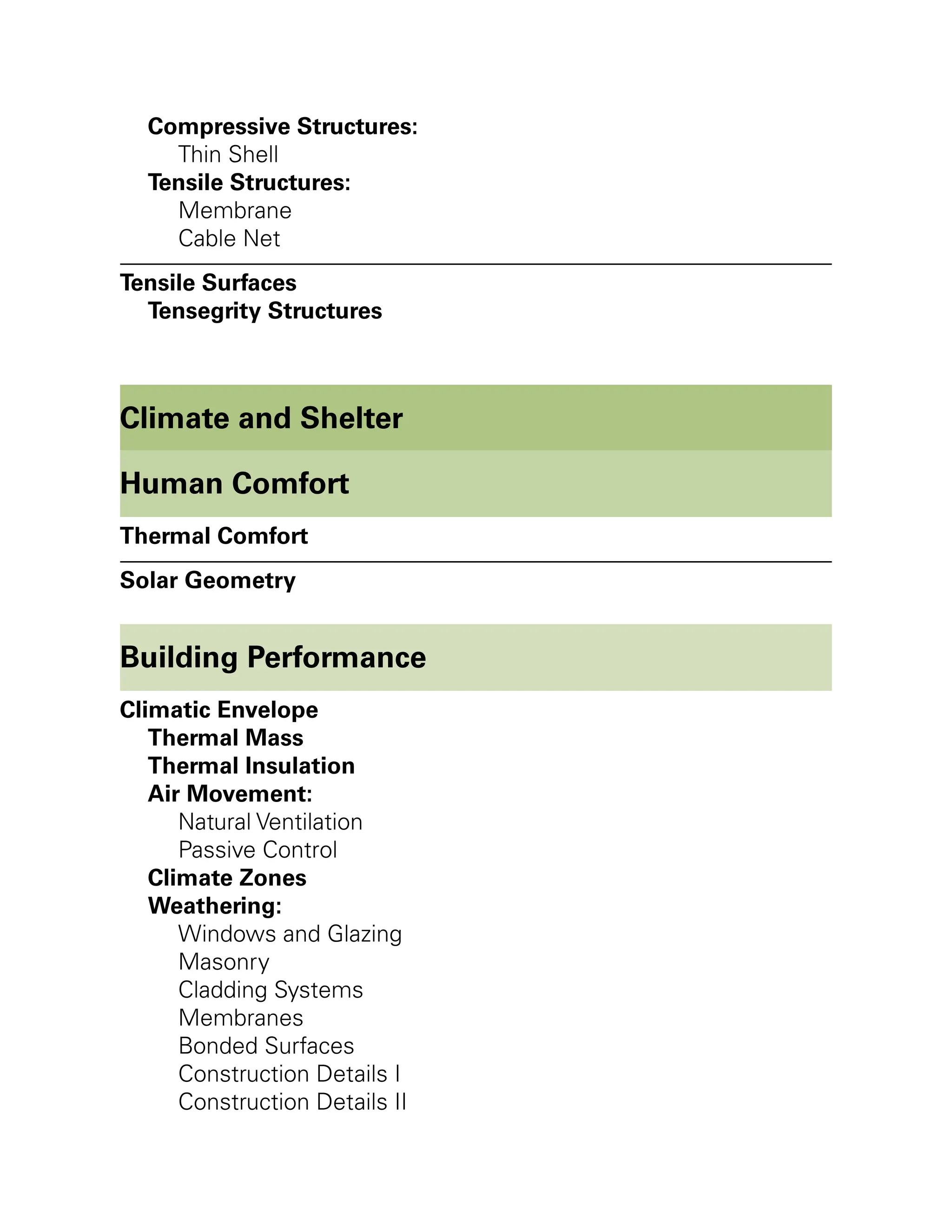
Compressive Structures:
Thin Shell
TensileStructures:
Membrane
Cable Net
Tensile Surfaces
Tensegrity Structures
Climate and Shelter
Human Comfort
Thermal Comfort
Solar Geometry
Building Performance
Climatic Envelope
Thermal Mass
Thermal Insulation
Air Movement:
Natural Ventilation
Passive Control
Climate Zones
Weathering:
Windows and Glazing
Masonry
Cladding Systems
Membranes
Bonded Surfaces
Construction Details I
Construction Details II
16.
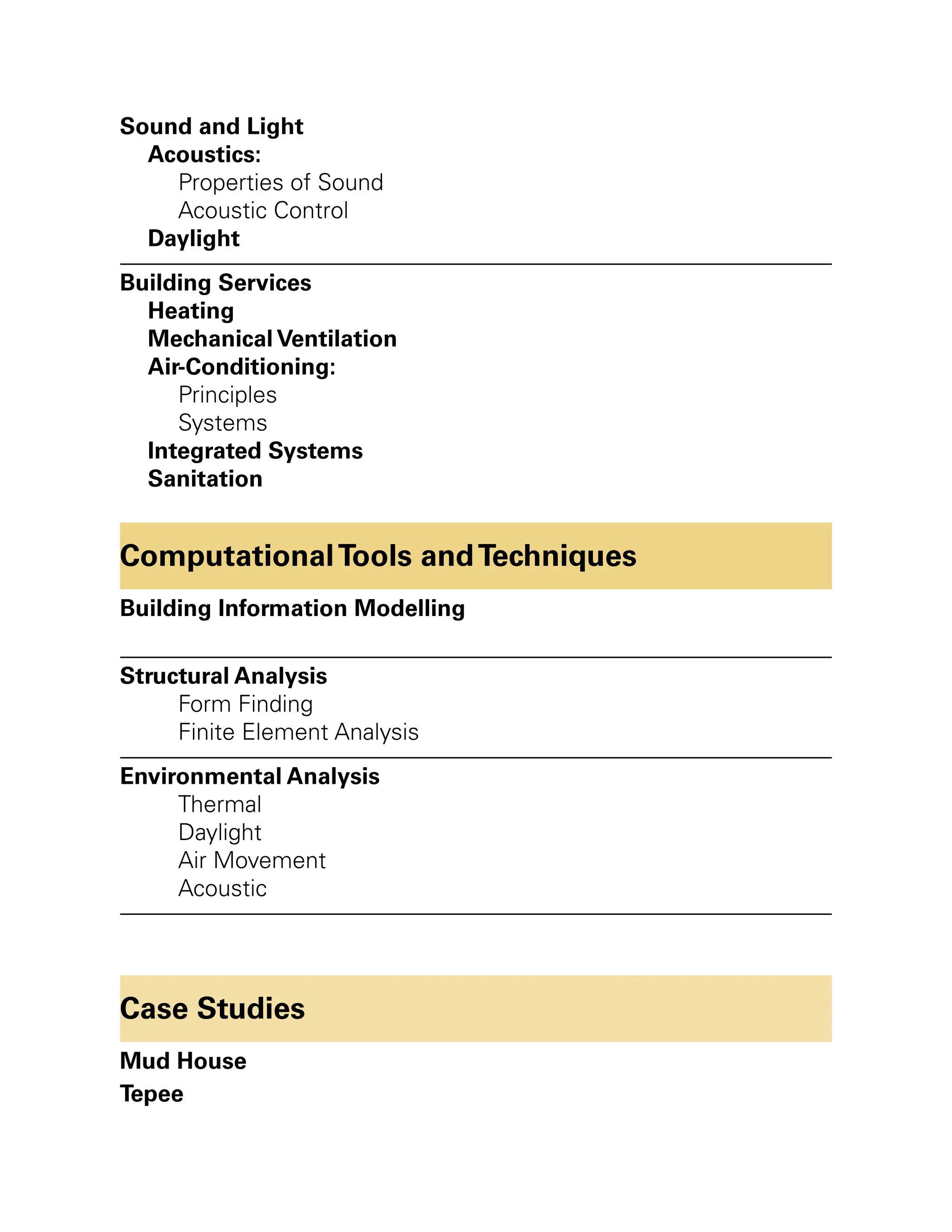
Sound and Light
Acoustics:
Propertiesof Sound
Acoustic Control
Daylight
Building Services
Heating
Mechanical Ventilation
Air-Conditioning:
Principles
Systems
Integrated Systems
Sanitation
ComputationalTools andTechniques
Building Information Modelling
Structural Analysis
Form Finding
Finite Element Analysis
Environmental Analysis
Thermal
Daylight
Air Movement
Acoustic
Case Studies
Mud House
Tepee
17.
Igloo
Obelisk
The Pantheon
The Ironbridge
TheBell Rock Lighthouse
The Crystal Palace
Clifton Suspension Bridge
Tropical House (Pavillon Démontable)
Kresge Auditorium
Palazzetto Dello Sport
Church of Jesus Christ the Worker
The Houston Astrodome
The German Pavilion
The USA Pavilion
Self-Build House
Sydney Opera House
HSBC Headquarters
The Pavilion of the Future
The Portugal Pavilion
The Lord’s Media Centre
LeaningTower of Pisa: Remedial Works
30 St Mary Axe
‘D’Tower
Davies Alpine House
International Space Station
Mapungubwe Interpretive Centre
Media-ICT
Stedelijk Museum Extension
Glass Lantern, Apple Zorlu
432 Park Avenue
Grandview Heights Aquatic Centre
18.
Building Codes
Rules GoverningConstructionTechnology: UK
World Commission on Environment and Development (WCED)
Guidelines on Sustainable Construction
European Guidelines on Sustainable Construction
Rules Governing ConstructionTechnology: US/Green Building
Rating System
Timeline: Evolution of Structural Form
Glossary
Further Reading and Resources
Index
Picture Credits
Acknowledgements
19.
Introduction
‘Aerodynamics is forpeople who can’t design
engines.’ Enzo Ferrari
Both structurally and environmentally, the architect
designs the way in which buildings are organized.
Along with the art – the social, cultural, philosophical
and political factors that influence design – it is the
tools and techniques of the engineer – technology –
that give form and performance to the built
environment.
Critical to an understanding of architecture is the
relationship between design and technology. The aim
of this textbook is to introduce the scope of that
relationship to those who may be considering a
career in architecture, as well as to enable students
of architecture to integrate their design thinking with
appropriate structural and environmental solutions.
The book sets out to explain the relationships
between physical phenomena, materials, building
elements and structural types, using simple
classification systems and real examples.
Photographic images are used to familiarize the user
with common construction technology, while
20.
historical examples areemployed to chart significant
moments in the history of architectural engineering.
The book introduces structural and environmental
engineering to architects and, while it does not
include mathematical calculation, it does make
reference to current computer techniques that assist
designers in predicting the structural and
environmental behaviour of buildings. At the same
time, it makes liberal reference to historical
precedents since it is important for the user to
understand that the way in which the success of
technology is measured is directly related to its
cultural context. Some would say that the Gothic
cathedral is the pinnacle of architectural engineering
given the tools, materials and techniques of the day.
Currently, the world is far more conscious of the
clean and efficient use of the planet’s resources, and
the success of technology is measured thus.
Technology is by nature concerned with invention,
and it is only ever possible to take a ‘snapshot’ of
technological achievements at any one moment in
time. From materials science through to construction
site procedures, invention and progress in
architectural technology occur constantly; it is hoped
that a compendium of technology such as this book
will not only aid students to understand its scope
21.
•
•
•
•
•
and historical context,but will also inspire them to
invent new solutions for the future.
Third Edition
This third edition builds on the amendments and
additions to the second.
The Structural Logic chart has been significantly
developed in order to include cable-hung
structures and to re-categorize three-dimensional
surfaces as fundamentally anticlastic or synclastic
in form.
A spread on passive building principles for
different climate zones has been added to the
section on building performance.
Further detailed drawings have been added to the
section on weathering.
In the section on computational tools and
techniques, the authors have included a
description of parametric modelling.
The introduction to the Case Study section has
been expanded to include a brief history of the
evolution of architectural technology. Six new case
studies of unique and exemplary structures from
the past and present have been added.
Structure of the book
22.
Architectural technologies areclassified under two major headings:
Structure and Form, and Climate and Shelter. While the very first
primitive shelters, such as mud huts and igloos, employed the same
materials and building components to both create structural form
and withstand the elements, even a simple tent such as the North
American tepee employed one type of material and component
(timber posts) to generate the form and another (animal skins) to
maintain its internal climate.
Structure and Form
This section is subdivided into three main topics: Structural
Physics, Structural Elements and Structural Logic. This is a linear
progression from the fundamental principles of structural form –
materials science, materials technology and structural integrity –
through descriptions of the common elements used in the
construction of buildings, such as walls, columns, floors and roofs,
to how these elements are combined to form different building
types, from simple ‘post and beam’ structures through Gothic vaults
to aluminium monocoque shells and tensile nets.
Climate and Shelter
The subdivisions in this section deal with two main topics: Human
Comfort and Building Performance. Before examining how
buildings are constructed in relation to their local environment, it is
important to establish the thresholds within which the human body
is able to sustain life. The first part of the section looks at the
principles of thermal comfort and its provider, the sun.
The second part considers ways in which the built environment
can be designed to maintain human comfort. As well as exploring
how the design and fabric of a building – the climatic envelope – can
both control and interact with its environment, passively and actively,
it considers human comfort in the context of sound and light.
The book includes three additional sections:
23.
ComputationalTools andTechniques
The waysin which architects design are now much influenced by
computers. Quite apart from their use in drafting and illustrating,
they may assist designers to predict both the structural and
environmental behaviour of their buildings – through modelling and
analysis – as well as supplying databases for materials, components
and systems; indeed they can store, and create a virtual model of, all
of the information needed for a construction project. This section
explores the use of computers as analytical and organizational tools.
Case Studies
A range of case studies is used to explore the origins of construction
types and illustrates the historic relationship between design and
technology in architecture and civil engineering. The examples are
listed chronologically and are described in relation to the structural
and environmental taxonomies described in the first two sections.
Building Codes
Throughout the world, the construction industry is controlled by
rules and regulations that are there to ensure the health and safety
of both construction industry operatives and end-users. Building
codes cover all aspects of construction and, increasingly, are
concerned with regulating towards low-energy, sustainable
solutions.
Contents Page
This is designed as a branching system so the user can contextualize
any topic within the book. Every spread has a topic heading that can
be cross-referenced with the contents tree.
Captions
The main body of the text is supplemented by illustrations, both
diagrammatic and photographic. Captions are used to supply
additional information and should be read as a continuation of the
main text.
24.
Taxonomy Charts andIcons
There are two major taxonomy charts used in Structure and Form,
one for Structural Elements and one for Structural Logic. The
organization of the charts is directly related to the page spreads that
follow, and the individual diagrams are then employed as iconic
references. These icons are also employed to cross-reference case
studies with the main body of the text.
Further Reading
Related publications are listed under each of the major headings. It
is also recommended that users reference the source information,
both publications and websites.
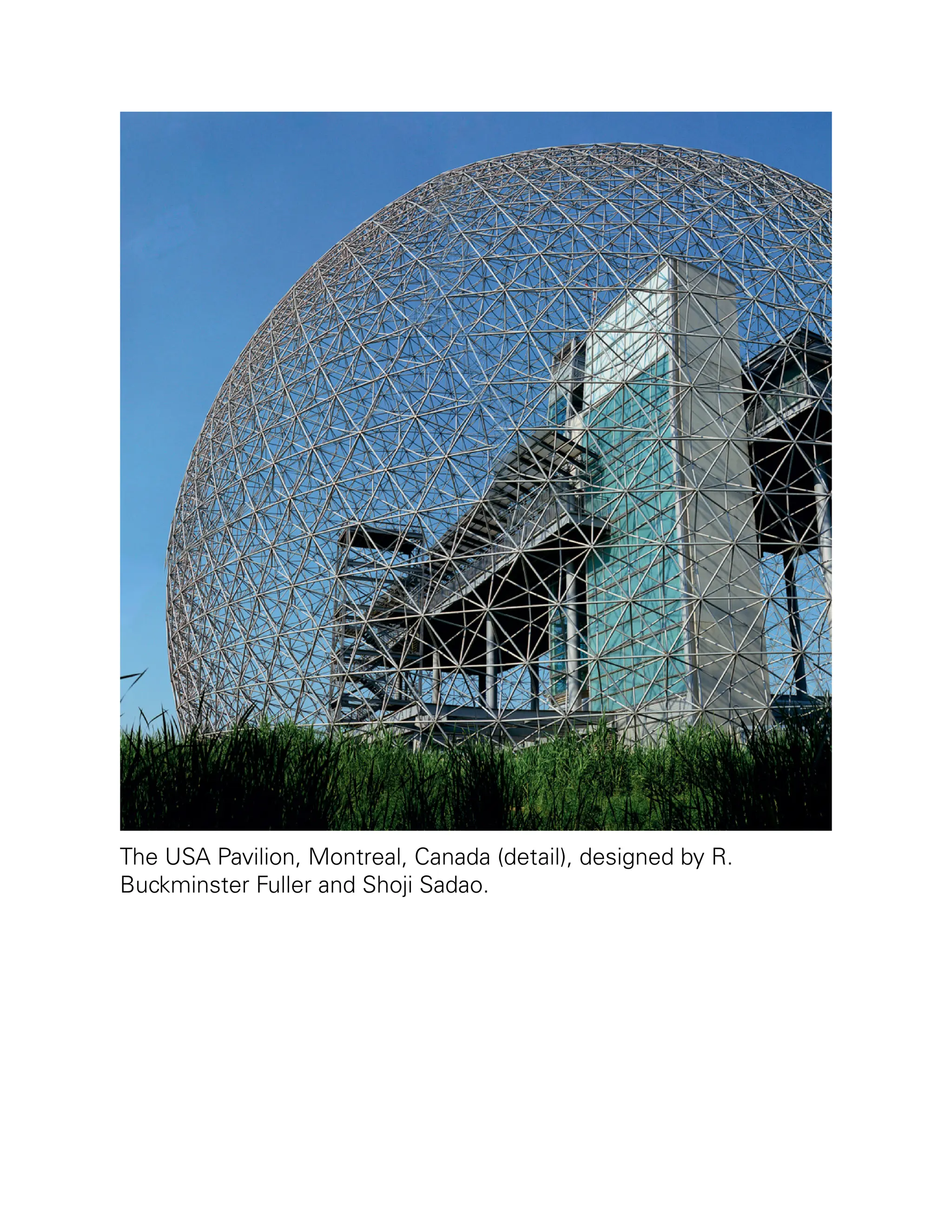
The USA Pavilion,Montreal, Canada (detail), designed by R.
Buckminster Fuller and Shoji Sadao.
27.
Structural Physics
Covering thefundamental principles of structural
form
Materials Science
In order to understand how buildings work as
structures, it is necessary to appreciate the natural
laws that govern structural form. This involves an
understanding of the forces that act upon materials
and the ways in which the materials will react to
those forces according to their fundamental
properties. Materials Science covers: forces – how,
through gravity, materials are subject to stress and
strain; properties of materials – how materials can be
analyzed and manipulated for strength and stiffness;
and reactions – how components behave when
subjected to forces through bending and shear.
MaterialsTechnology
While materials science is the study of the interplay
between the properties, structure and changes in
solids, materials technology is the utilization of this
knowledge in the production and fabrication of
materials and structural components. Most
fabrication processes involve a series of primary
28.
ways of actingon materials – cutting, sawing,
bending, welding, etc. – with the precise nature of
the process determined by the properties of the
material to which it is applied. In general, the ability
to move raw materials and finished products around
factories, building sites, and indeed around the
world, places finite limitations on the size, shape and
weight of prefabricated building components.
Materials technology explores a range of common
building materials: stone, timber, steel, reinforced
concrete, glass, fabric, fibre-reinforced plastic and
sheet materials.
Structural Integrity
Knowing the behaviour of the materials and
components that go to form structures enables the
architect to organize them in such a way that the
whole structure will be rigid and stable under load.
Structural Integrity examines the types of load to
which buildings are subjected – live and dead loads,
lateral loads, bracing and torsion – and how
structures may be constructed to resist them
through triangulation and bracing. Overall stability, as
in the rooting of a tree, is then considered in the
context of the centre of gravity and the cantilever (or
branching) principle.
29.
Materials Science /Forces: Stress, Strain
Newton’s Second Law of Motion
Structural engineering is concerned with calculating the ability of
structures and materials to withstand forces. When you talk about
the weight of an object, you are actually describing the force that the
object exerts as a result of gravity acting on its mass. Gravity is
responsible for attracting all objects towards the centre of the earth.
Over 300 years ago, Isaac Newton discovered that this gravitational
‘pull’ (indeed, all forces) produce an acceleration of the system or
object that they are acting upon, hence:
FORCE = MASS (kg/lb) ×
ACCELERATION (m/ft per sec., squared)
Force is measured in Newtons:
1 Newton = 1 kg × 1 m/sec2
(21
/5 lb × 3 ft 3 in/sec2)
Gravity is calculated as: g = 9.81 m/sec2
(g = 32 ft 2 in/sec2)
Structural Form
All objects have an underlying structure that maintains the form of
the object when it is subjected to forces. The forces act upon the
object, and the object reacts according to the properties of the
materials from which it is made and the way in which they have
been shaped and assembled. Stress is the term used to describe
the forces acting on a material or structure; strain is the term used to
describe the material or structure’s response to those forces.
Stress
30.
Forces can acton materials in one of two fundamental ways: they
can push, which is a compressive force, or they can stretch or pull,
which is a tensile force. These applied forces are described in
physics as stress, which is measured as the force per unit area
across any given cross-section of the material:
f (STRESS) = P (FORCE) / A (AREA)
Strain
Materials use their internal structures to resist forces. Every material
reacts to stress by distributing it in such a way that there is an equal
balance of internal forces. The result is strain – a change in the form
of the structure, measured as the fractional extension perpendicular
to the cross-section. Hence, compression may be described as
stress that acts to shorten an object and tension as stress that acts
to lengthen it.
31.
1 Compression
Bulgarian weightlifterGlagoi Blagoev’s body is put into compression
by the weights held aloft (approximately 195.5 kg/430 lb) or over
twice his own body weight).
32.
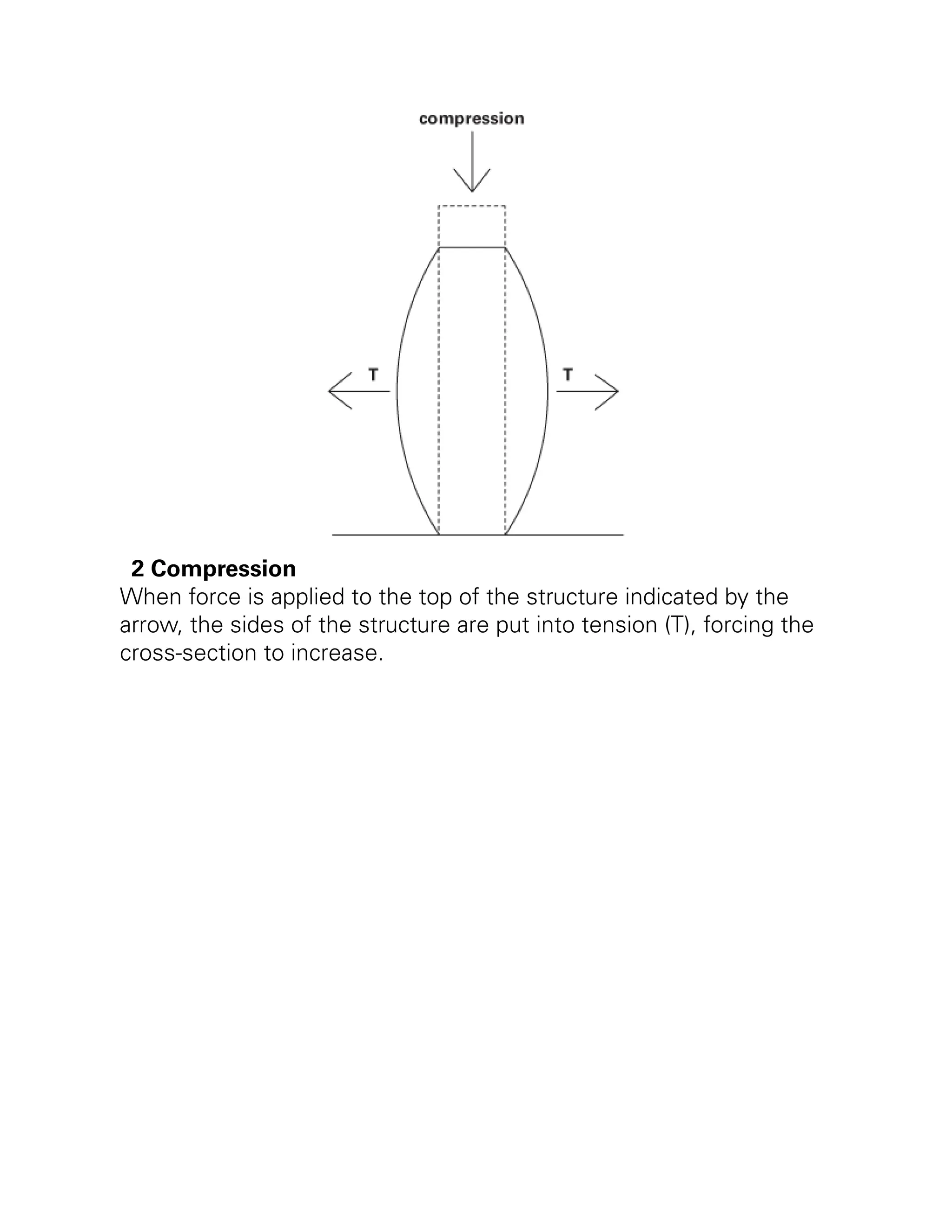
2 Compression
When forceis applied to the top of the structure indicated by the
arrow, the sides of the structure are put into tension (T), forcing the
cross-section to increase.
33.
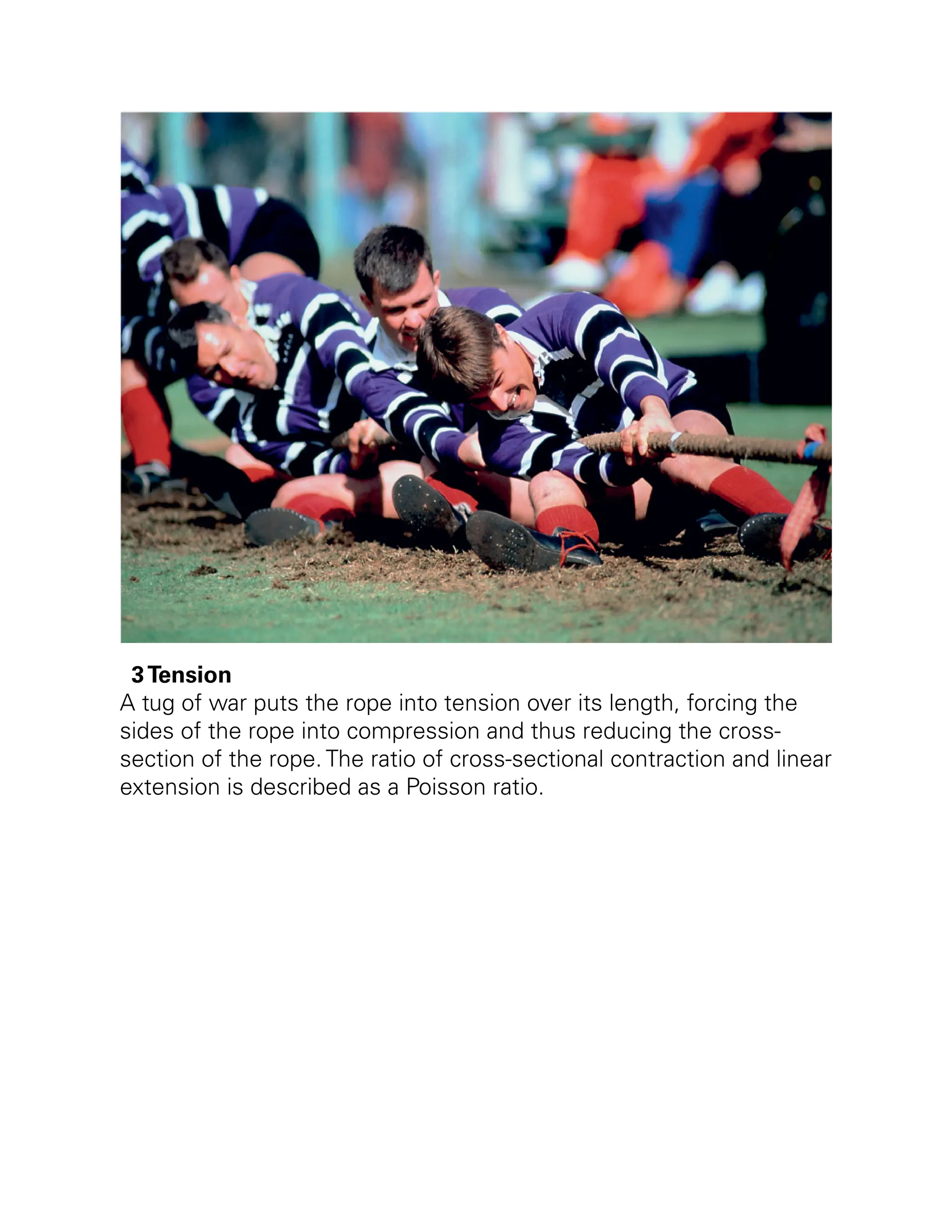
3Tension
A tug ofwar puts the rope into tension over its length, forcing the
sides of the rope into compression and thus reducing the cross-
section of the rope. The ratio of cross-sectional contraction and linear
extension is described as a Poisson ratio.
34.
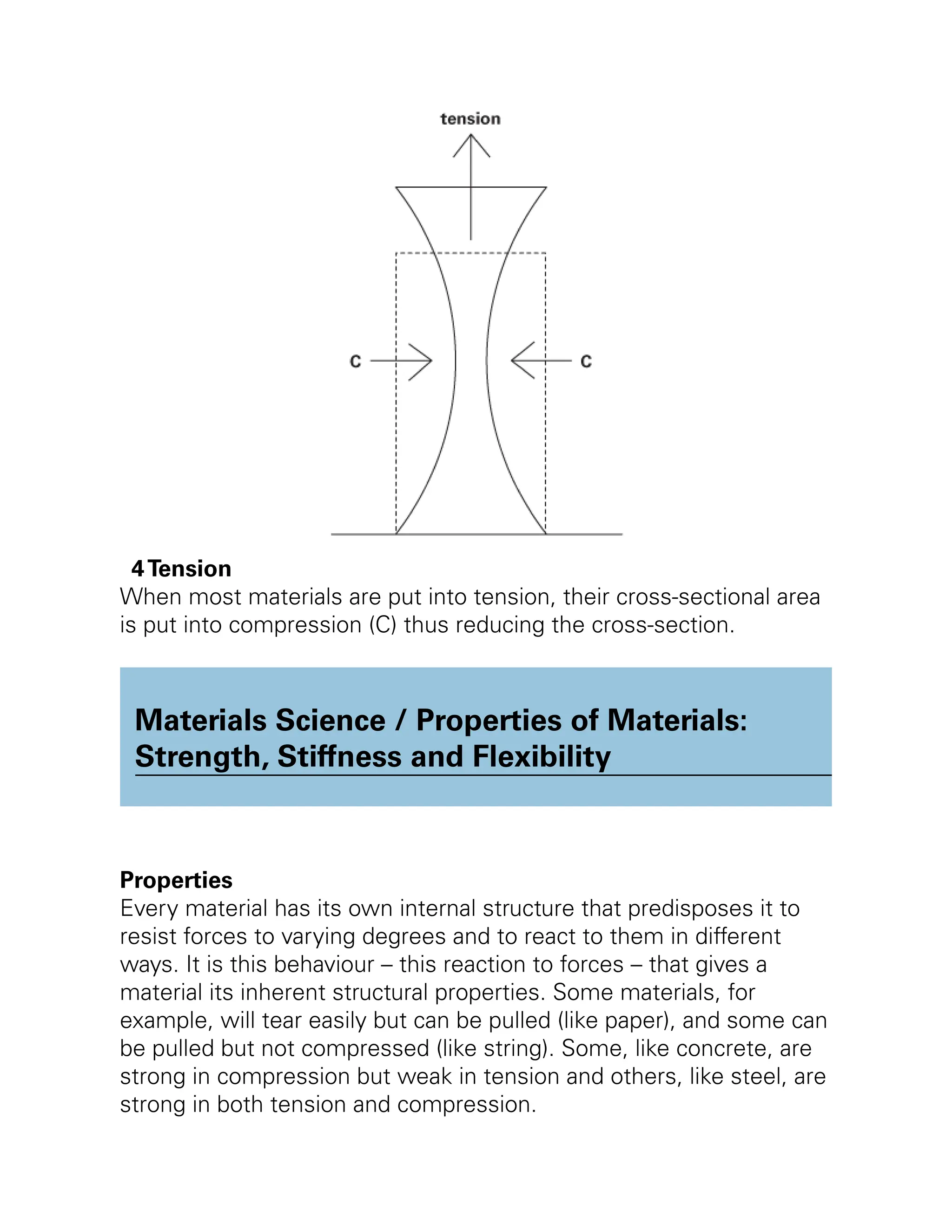
4Tension
When most materialsare put into tension, their cross-sectional area
is put into compression (C) thus reducing the cross-section.
Materials Science / Properties of Materials:
Strength, Stiffness and Flexibility
Properties
Every material has its own internal structure that predisposes it to
resist forces to varying degrees and to react to them in different
ways. It is this behaviour – this reaction to forces – that gives a
material its inherent structural properties. Some materials, for
example, will tear easily but can be pulled (like paper), and some can
be pulled but not compressed (like string). Some, like concrete, are
strong in compression but weak in tension and others, like steel, are
strong in both tension and compression.
35.
Plastic-Elastic Behaviour
As itresists forces a material will react by deforming its internal
structure. With plastic materials the internal structures readily
deform and adapt to a new shape when stressed. A plastic material
distorts easily but does not break (an example is lead). With elastic
materials the internal structures remain the same but are warped or
stretched; they always remember their original shape and want to
return to it. An elastic material returns to its original length (or shape)
when the stress is removed (an example is bamboo).*
Strength
While a fishing rod is not strong, it is very elastic – it will bend a
great deal before it snaps. It is the ability of an elastic material to
resist bending (elastic deformation) that will determine its strength.
All materials have an elastic limit – if you stretch them far enough,
they will fail. They will either warp or buckle, or they will break –
fracture or tear. A strong material is one with a high breaking stress,
a weak material one with a low breaking stress.**
Stiffness and Flexibility
A stiff material needs a large force (stress) to produce a small
extension (strain) – it is difficult to change its shape. A flexible
material needs only a small stress to produce a large extension – it is
not difficult to change its shape.
* Materials with low plasticity are prone to breaking or fracturing
under stress – are brittle – and are likely to become more so as
temperatures decrease. Highly plastic materials deform without
breaking or fracturing – are ductile – and are likely to become more
so as temperatures increase. Heating metals increases their
plasticity.
** Steel will fail at around 250 N/mm2 (30 ksi), while concrete will
reach its ultimate stress at 30 N/mm2 (1.0 ksi).
36.
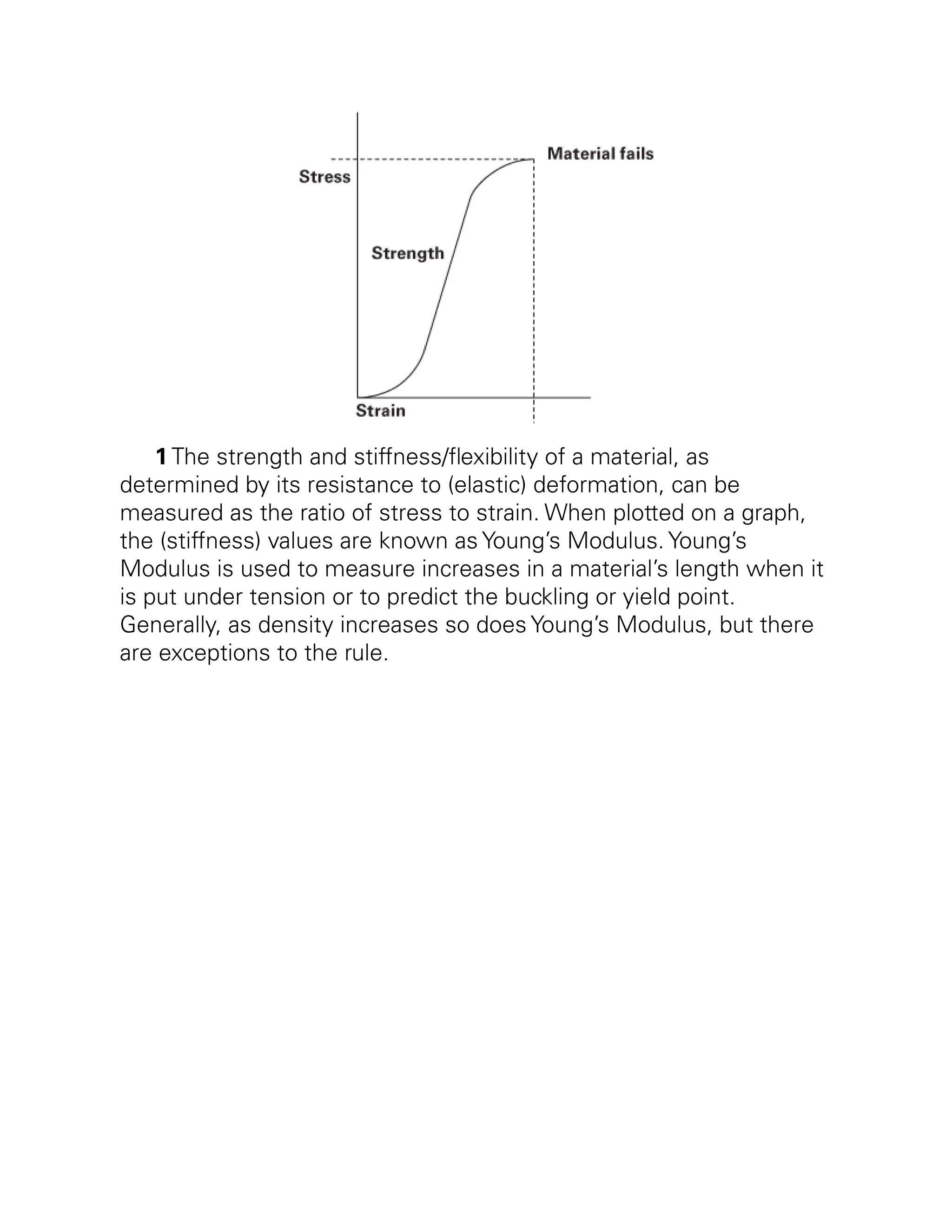
1 The strengthand stiffness/flexibility of a material, as
determined by its resistance to (elastic) deformation, can be
measured as the ratio of stress to strain. When plotted on a graph,
the (stiffness) values are known as Young’s Modulus. Young’s
Modulus is used to measure increases in a material’s length when it
is put under tension or to predict the buckling or yield point.
Generally, as density increases so does Young’s Modulus, but there
are exceptions to the rule.
37.
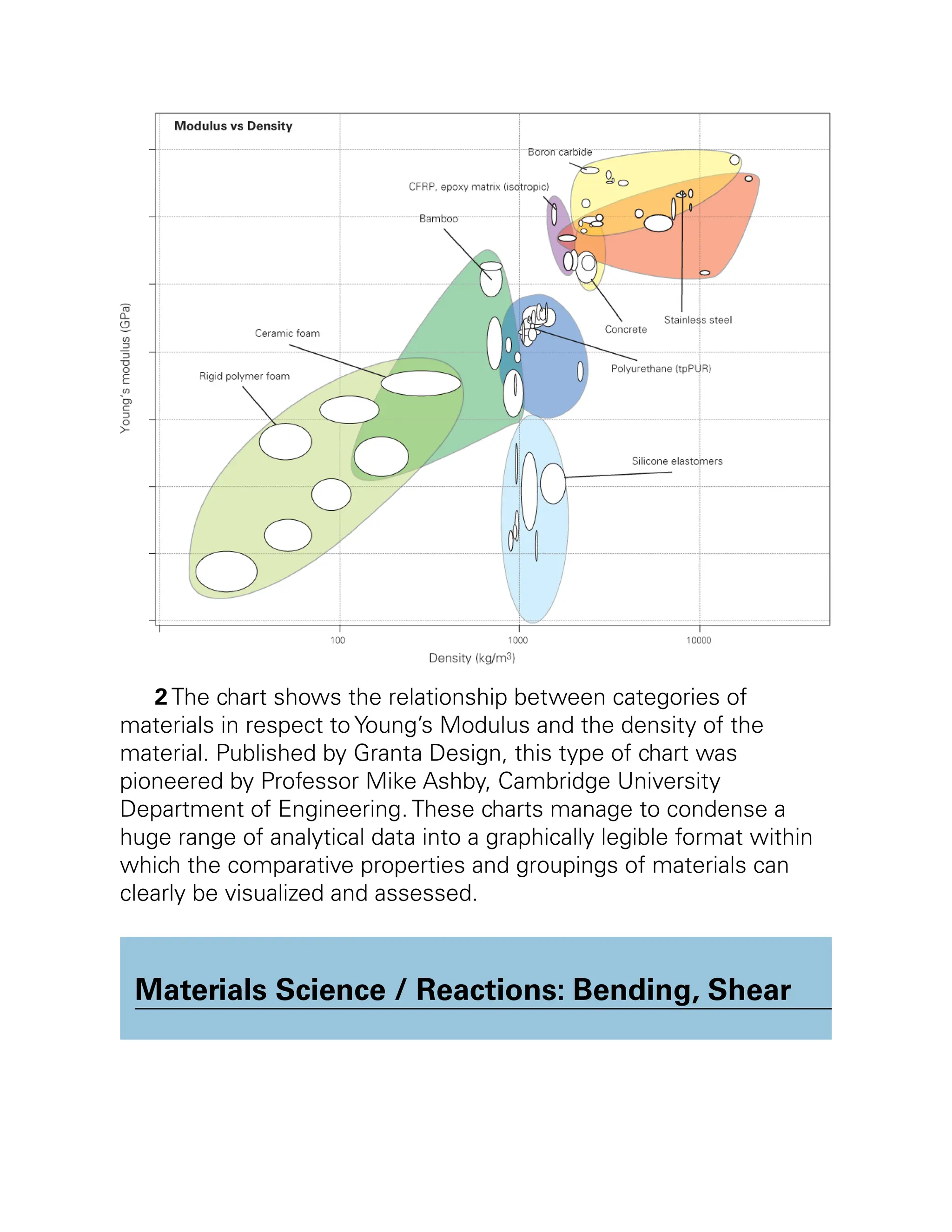
2 The chartshows the relationship between categories of
materials in respect to Young’s Modulus and the density of the
material. Published by Granta Design, this type of chart was
pioneered by Professor Mike Ashby, Cambridge University
Department of Engineering. These charts manage to condense a
huge range of analytical data into a graphically legible format within
which the comparative properties and groupings of materials can
clearly be visualized and assessed.
Materials Science / Reactions: Bending, Shear
38.
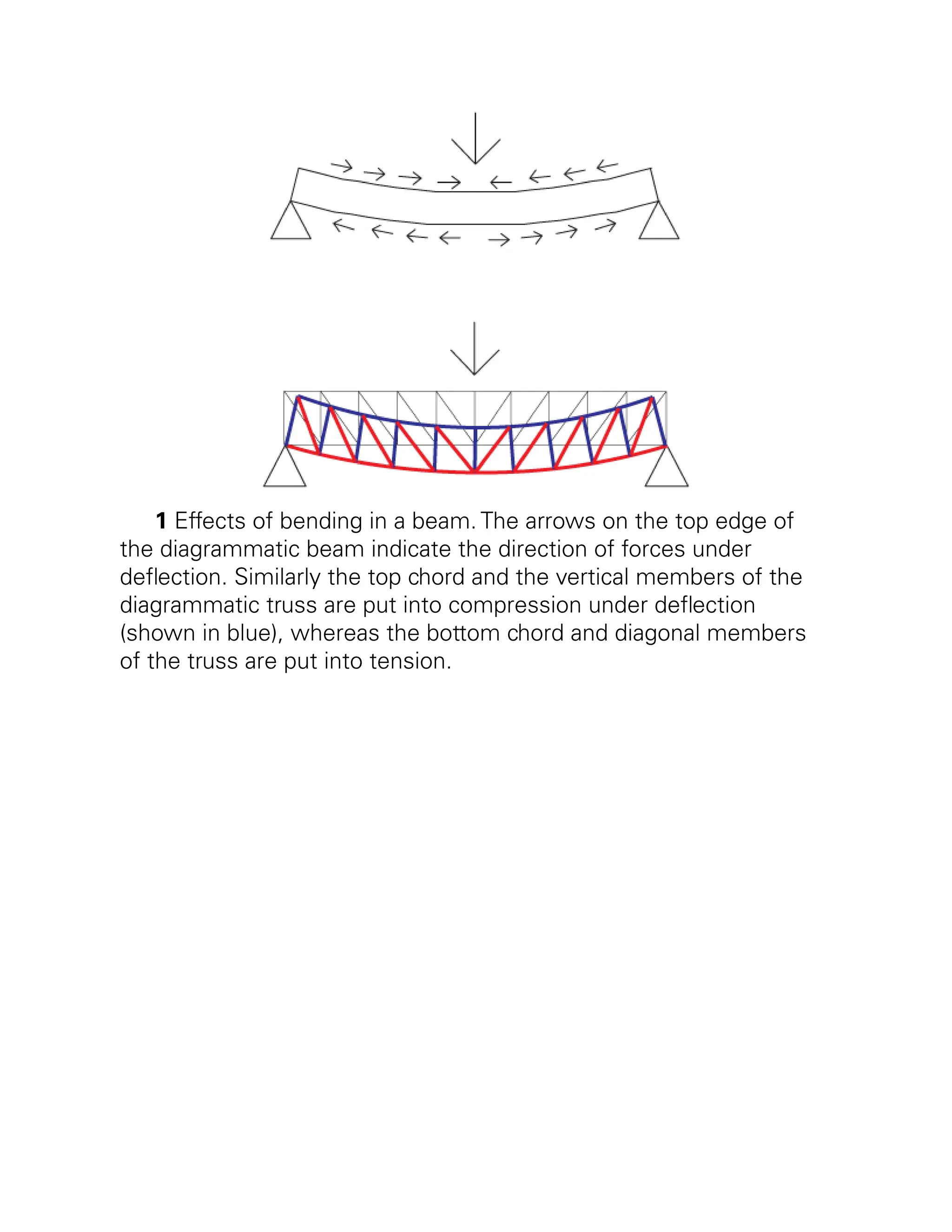
Bending
Bending is theresult of a material deforming itself under stress. In
diagram 1, the beam at the top is subjected to an external,
compressive force that in turn creates internal strain through
bending (exaggerated in the diagram): the top side becomes
compressed – shortened – and the underside becomes tensioned –
lengthened. The lower diagram describes bending in a truss,
showing the reactions of the individual components: red are in
tension, blue in compression.
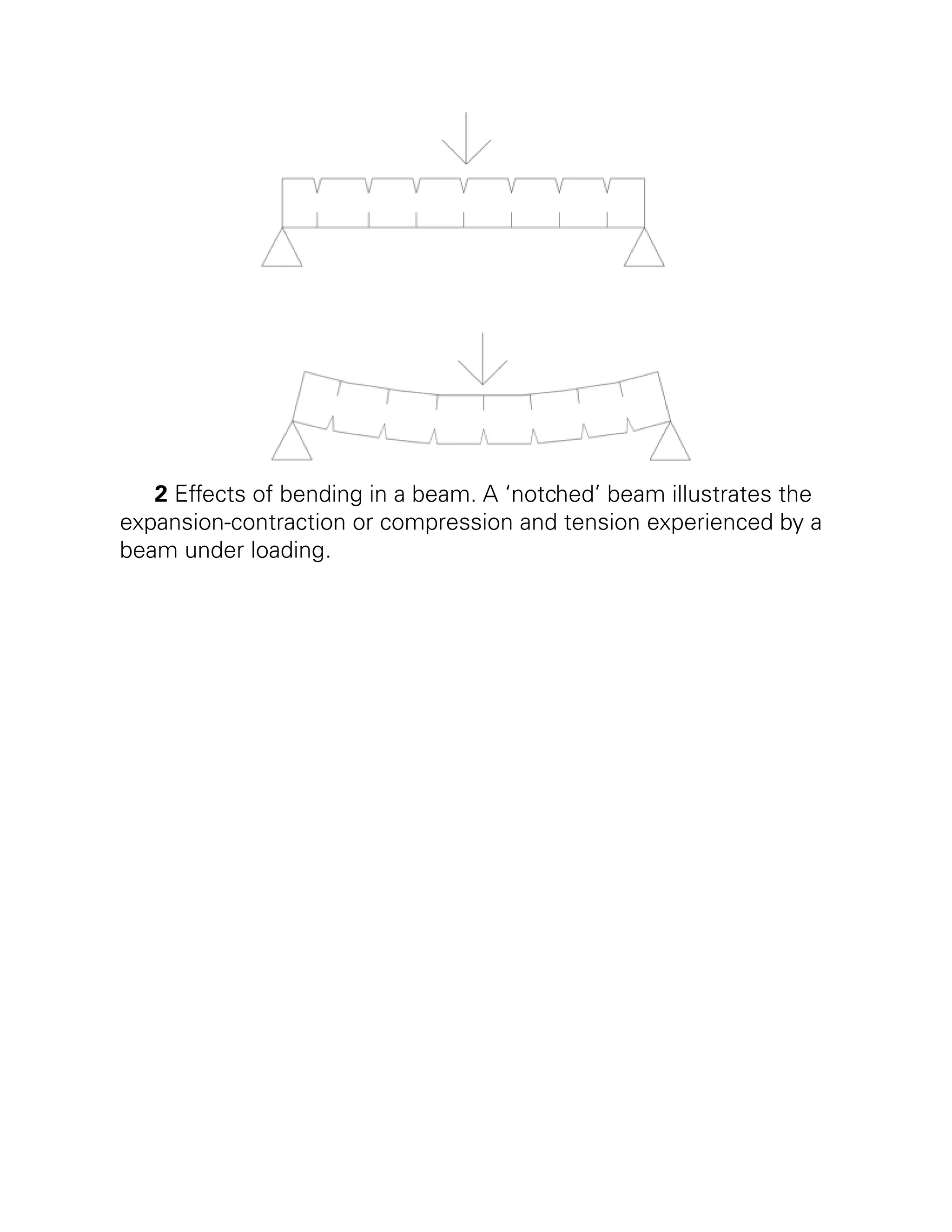
In diagram 2, bending has been exaggerated by the insertion of
cuts and wedges in the beam. Once loaded, the wedges in the
upper side will be compressed and close up, while the cuts in the
lower side will be pulled apart to form wedges. Excessive bending
will cause failure.
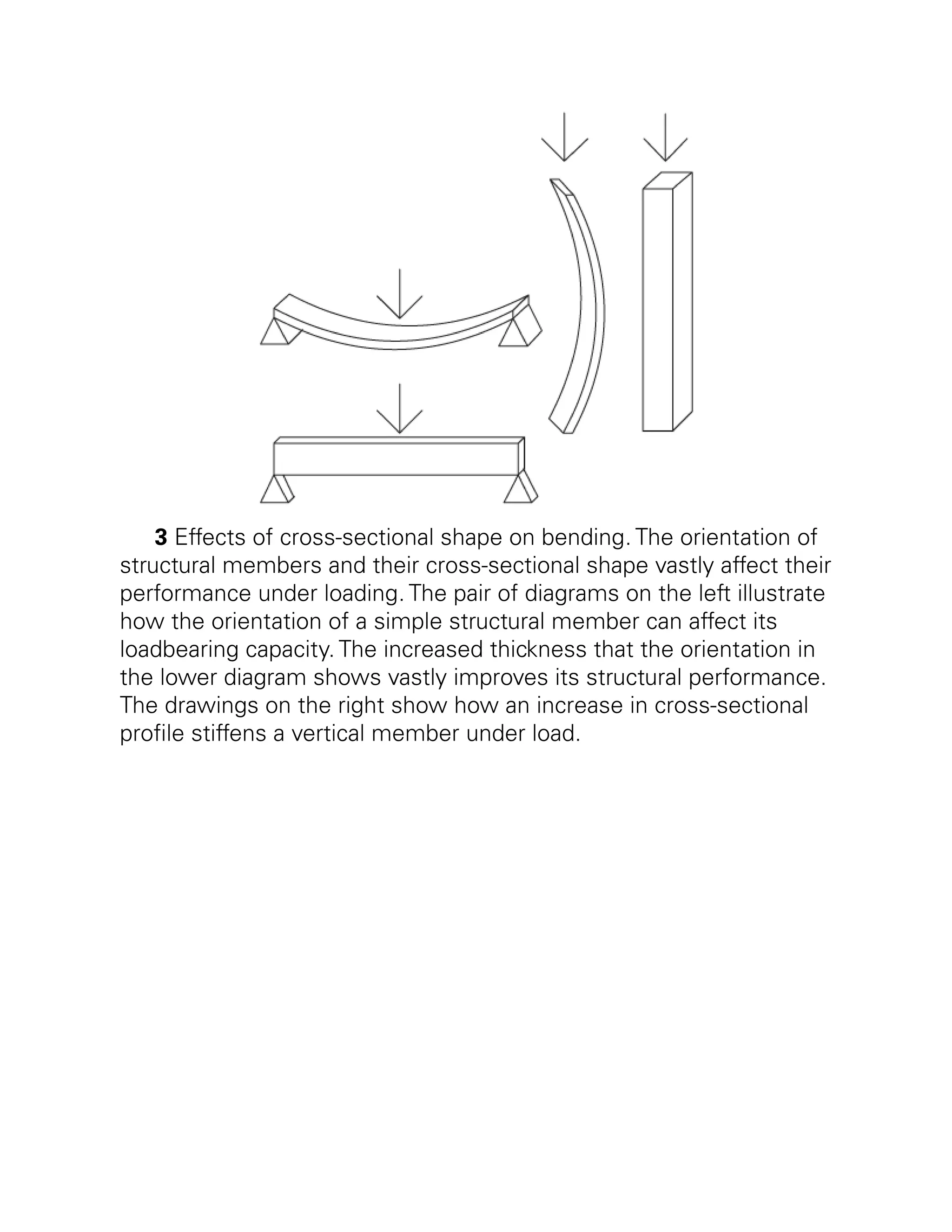
Shape and Form
When materials are formed into structural elements, the distribution
of stresses is modified by how they are shaped and formed – the
deeper a beam, the further apart are these internal forces and the
more even the distribution of stresses. Diagram 3 illustrates the
effect of cross-sectional shape on bending.
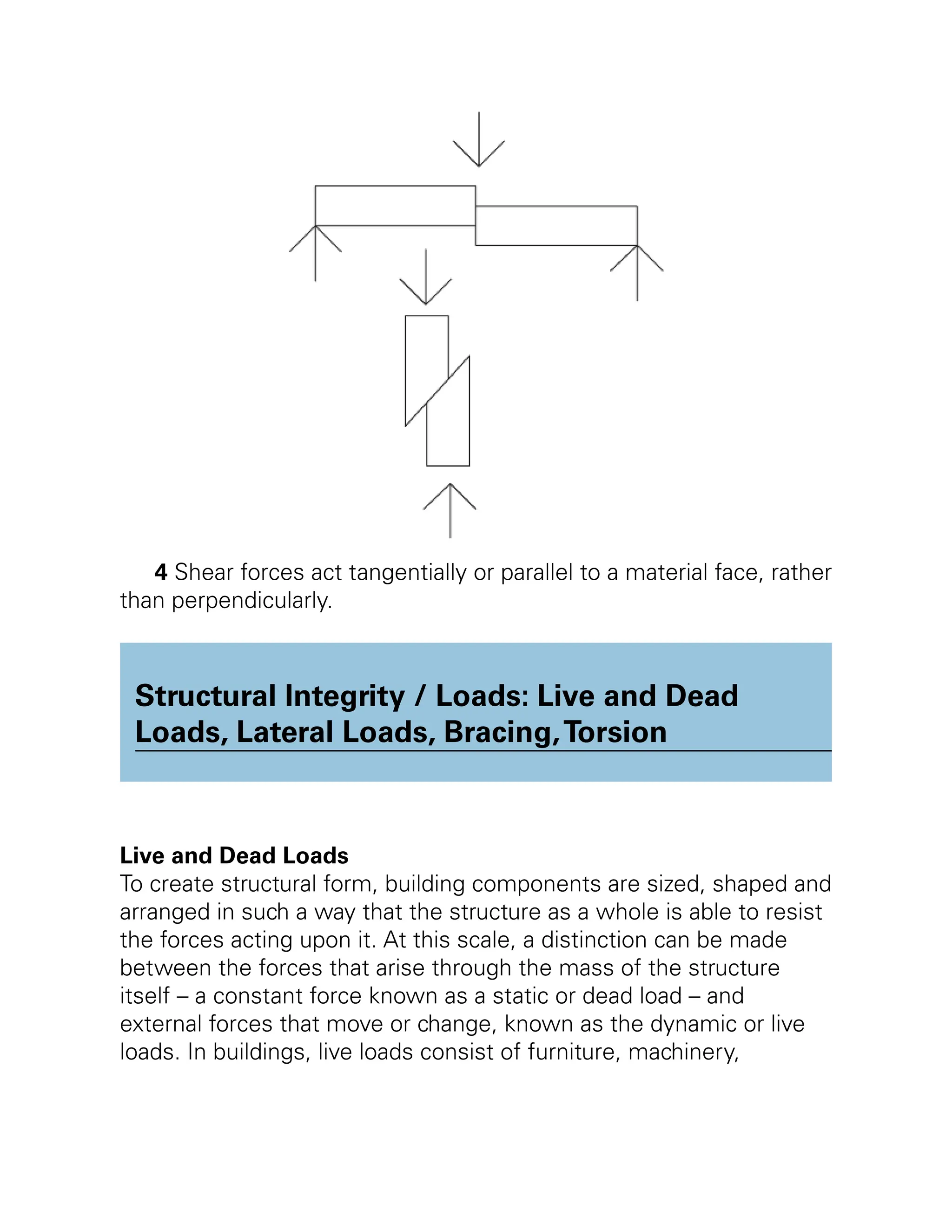
Shear
Unlike tension and compression, where surfaces move towards or
away from one another, shear refers to deformation in which parallel
surfaces slide past one another, as shown in diagram 4. Shear stress
is a stress state where the stress is parallel or tangential to a face of
the material, as opposed to normal stress when the stress is
perpendicular to the face. In structural and mechanical engineering
the shear strength of a component is important for designing the
dimensions and materials to be used for its manufacture.
With an I-beam for example, the flange resists bending and the
web resists shear. See Beam: Cross-Sections, here.
39.
1 Effects ofbending in a beam. The arrows on the top edge of
the diagrammatic beam indicate the direction of forces under
deflection. Similarly the top chord and the vertical members of the
diagrammatic truss are put into compression under deflection
(shown in blue), whereas the bottom chord and diagonal members
of the truss are put into tension.
40.
2 Effects ofbending in a beam. A ‘notched’ beam illustrates the
expansion-contraction or compression and tension experienced by a
beam under loading.
41.
3 Effects ofcross-sectional shape on bending. The orientation of
structural members and their cross-sectional shape vastly affect their
performance under loading. The pair of diagrams on the left illustrate
how the orientation of a simple structural member can affect its
loadbearing capacity. The increased thickness that the orientation in
the lower diagram shows vastly improves its structural performance.
The drawings on the right show how an increase in cross-sectional
profile stiffens a vertical member under load.
42.
4 Shear forcesact tangentially or parallel to a material face, rather
than perpendicularly.
Structural Integrity / Loads: Live and Dead
Loads, Lateral Loads, Bracing,Torsion
Live and Dead Loads
To create structural form, building components are sized, shaped and
arranged in such a way that the structure as a whole is able to resist
the forces acting upon it. At this scale, a distinction can be made
between the forces that arise through the mass of the structure
itself – a constant force known as a static or dead load – and
external forces that move or change, known as the dynamic or live
loads. In buildings, live loads consist of furniture, machinery,
43.
occupants, and snowand ice, as well as, crucially, the lateral impact
from wind.
Lateral Loads
A chair must be strong enough to resist the vertical load of its
occupant. However, as the occupant shifts their load – to lean,
wobble, or sway – the chair remains fixed or rigid. This is because it
is designed to resist these non-vertical loads through a combination
of the stiffness of its components and the rigidity of the whole
structure. This rigidity is, in effect, an equalizing of the vertical and
horizontal forces throughout the structure by the use of diagonals –
i.e. through triangulation.
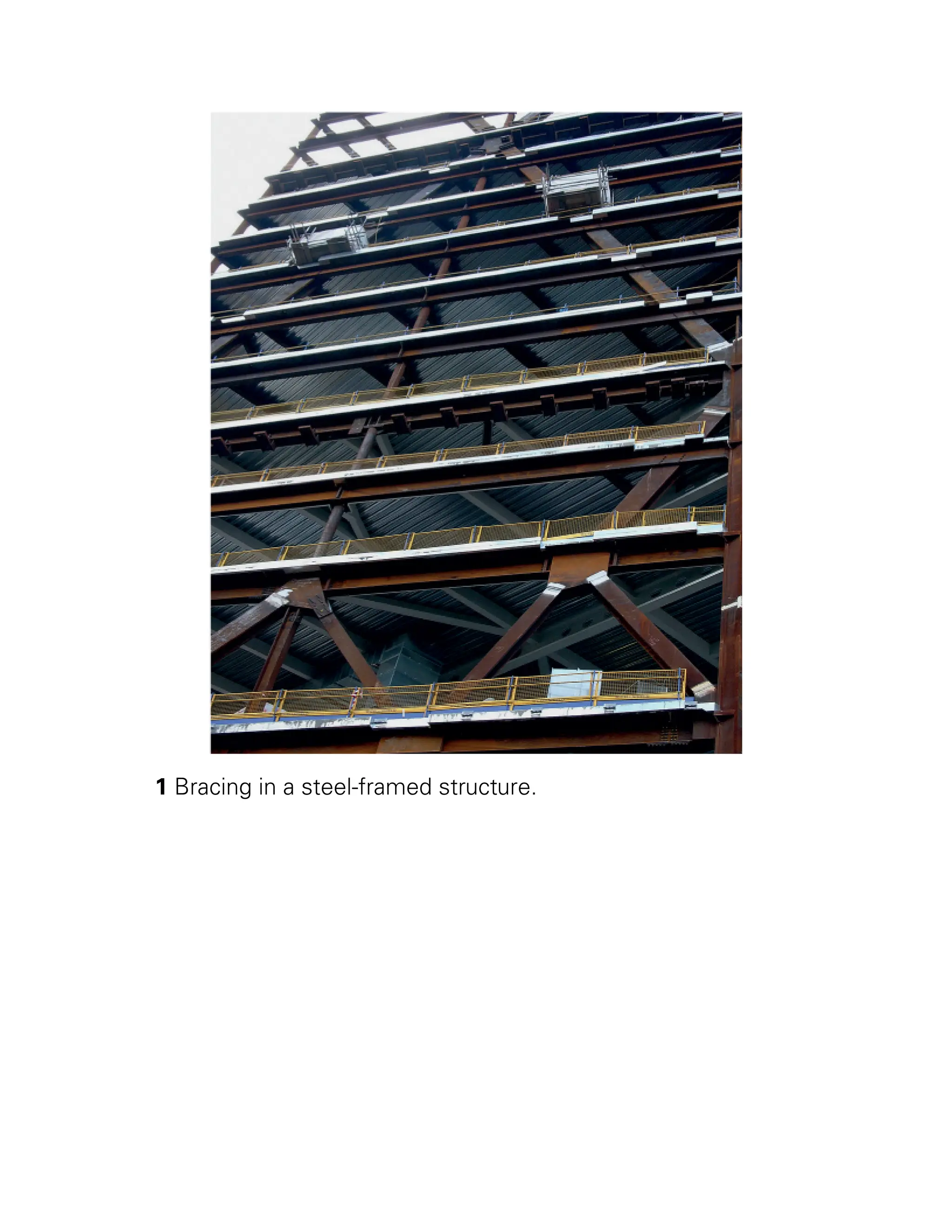
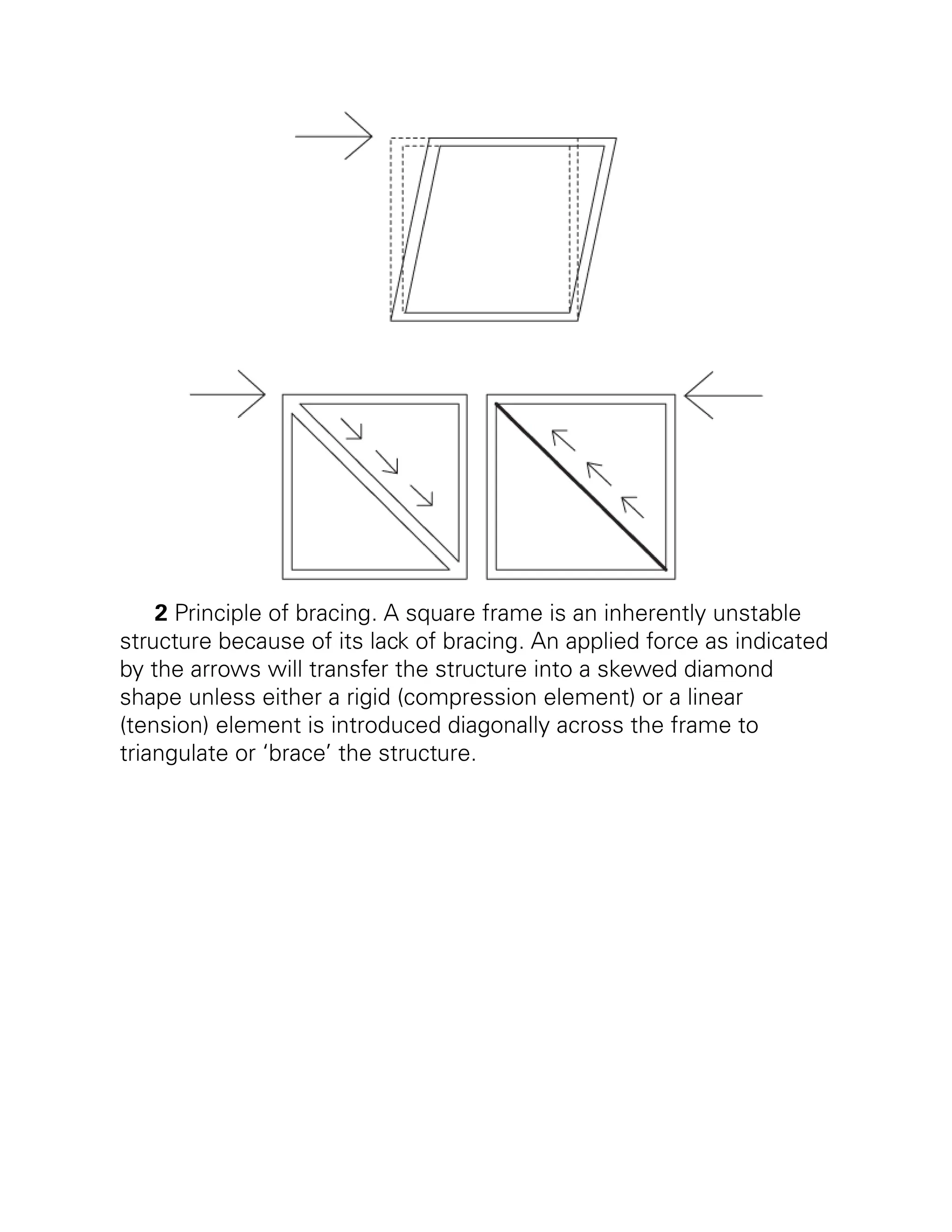
Bracing
Take a simple, square frame. If you add a force to one side of it, it
will deform (shear). If, however, you were to put a stick from one
corner to the other, the square would remain stable. If you pushed
on the other side of the square, the stick would still work but only if
it was connected at both ends, as it is transferring the load by being
pulled. In the first case, the stick is used as a compressive element;
in the second, it is in tension and could be replaced with string or
wire.
Torsion
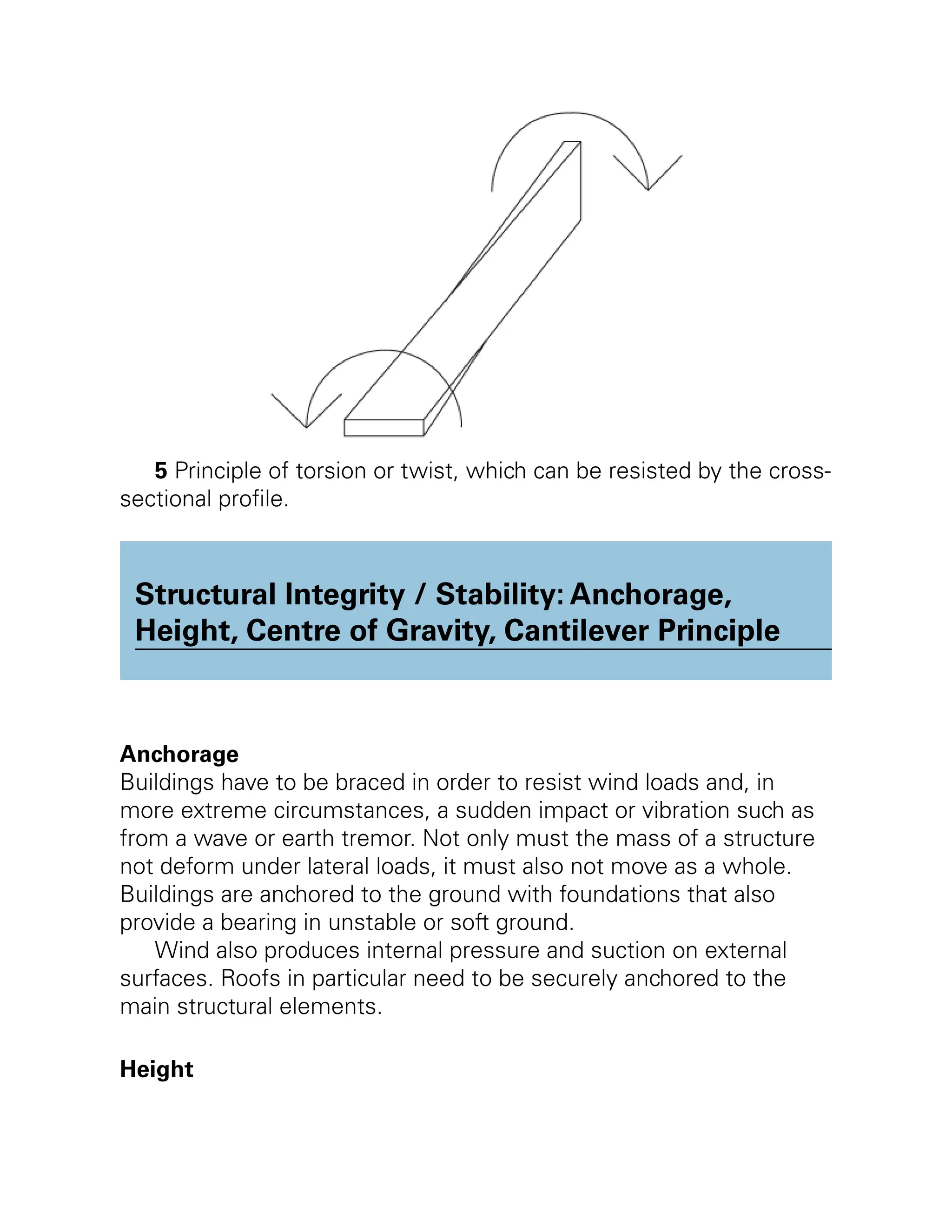
Structural components may also have to be braced so as to prevent
them twisting. Though sometimes referred to as a force in itself,
torsion or twisting is in fact the result of opposing (tensile or
compressive) forces acting in a rotary fashion.
2 Principle ofbracing. A square frame is an inherently unstable
structure because of its lack of bracing. An applied force as indicated
by the arrows will transfer the structure into a skewed diamond
shape unless either a rigid (compression element) or a linear
(tension) element is introduced diagonally across the frame to
triangulate or ‘brace’ the structure.
46.
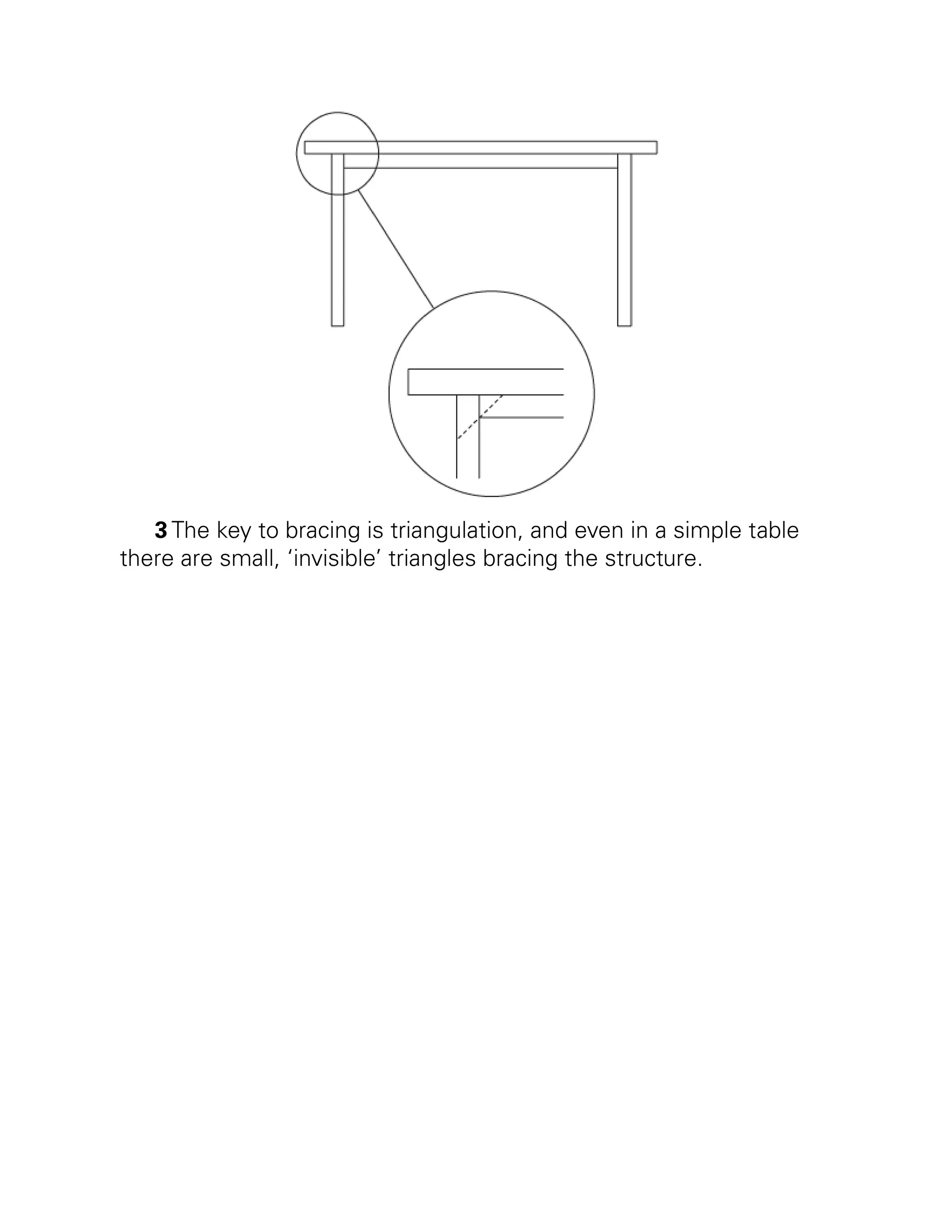
3 The keyto bracing is triangulation, and even in a simple table
there are small, ‘invisible’ triangles bracing the structure.
47.
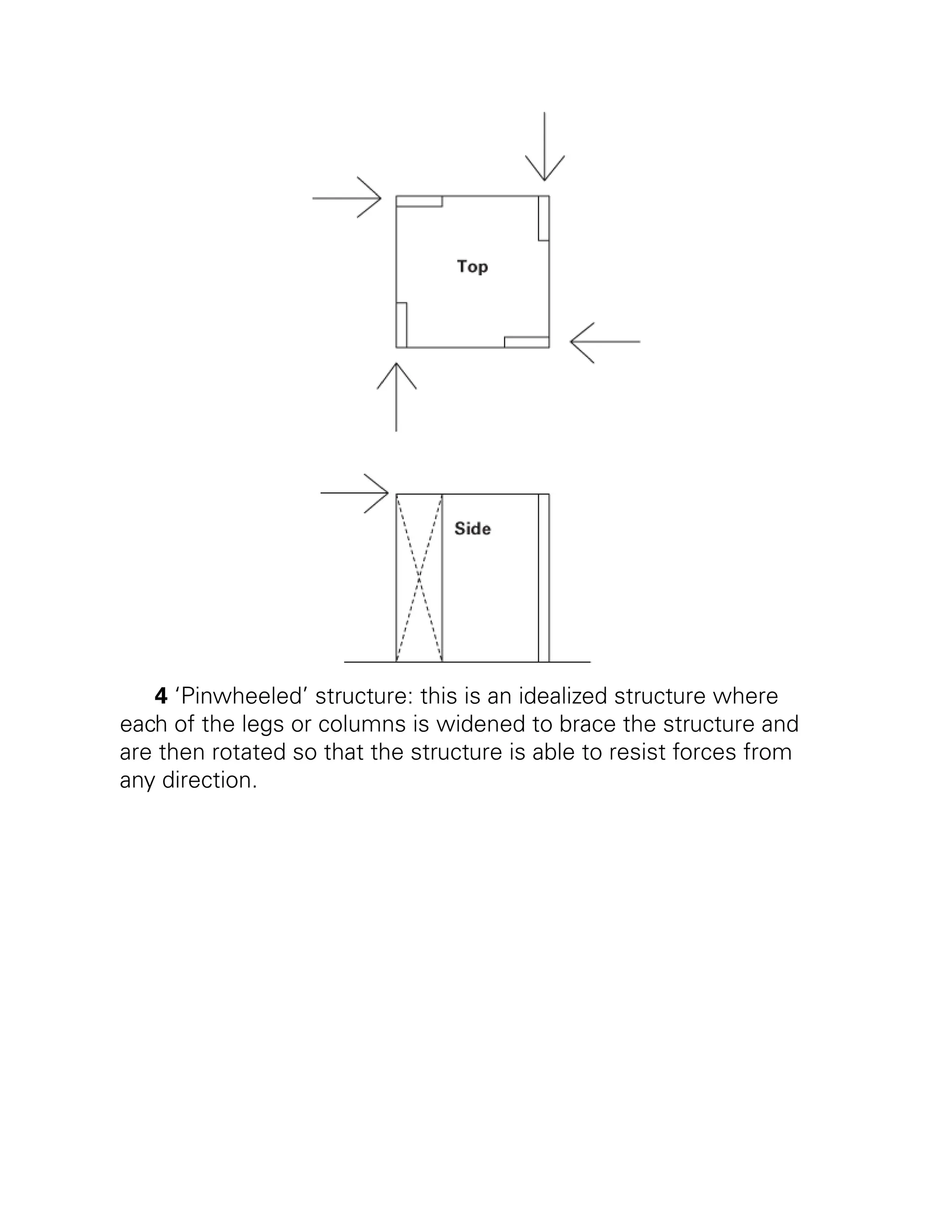
4 ‘Pinwheeled’ structure:this is an idealized structure where
each of the legs or columns is widened to brace the structure and
are then rotated so that the structure is able to resist forces from
any direction.
48.
5 Principle oftorsion or twist, which can be resisted by the cross-
sectional profile.
Structural Integrity / Stability: Anchorage,
Height, Centre of Gravity, Cantilever Principle
Anchorage
Buildings have to be braced in order to resist wind loads and, in
more extreme circumstances, a sudden impact or vibration such as
from a wave or earth tremor. Not only must the mass of a structure
not deform under lateral loads, it must also not move as a whole.
Buildings are anchored to the ground with foundations that also
provide a bearing in unstable or soft ground.
Wind also produces internal pressure and suction on external
surfaces. Roofs in particular need to be securely anchored to the
main structural elements.
Height
49.
Tall structures haveto withstand not only high-speed gusts of wind,
but also the vibrations that wind can induce (similar to those of a
tuning fork). Tall buildings are designed to resist these forces by
having a rigid, central core with floor plates that are carried from
perimeter columns and connected back to the core. The core is also
used to contain elevators, staircases and service ducts. Tall
structures may also be stabilized by employing diagonal struts
wrapped around the outside of the building in a criss-cross fashion;
when used without a central core, these are known as tube
structures.
A dense honeycomb of internal walls will also improve structural
stability.
Centre of Gravity
Try leaning forward from the hips. At some point your centre of
gravity goes ‘outside of you’, and one leg moves forward to form the
triangle that keeps you from toppling over – keeps you stable. Carry
on bending, and you will reach the point when the only way to
maintain your centre of gravity is to extend your other leg behind
you. This is a process known as ‘cantilevering’.
Cantilever Principle
A cantilever is a description of an element that projects laterally from
the vertical. It relies on counterbalance for its stability and on
triangulation to resist the bending movements and shear forces of
the lever arms.
Then there wasa long silence. “All right now,” muttered Joe
gleefully. “He much huggum and kissum. He no go crazy like ole
man. He marryum in church with flowers and girls to wearum white,”
and quietly obliterating himself among the shadows of the house, he
went in peace and contentment to his camp.
52.
CHAPTER XLI
IN DEEPDESPAIR
Judy was curled up like a dog on the library door mat. “I will not
get up—I will not get up,” she cried, groveling at Vivienne’s feet, as
she came out, “till you tell me that you are not going to leave us.”
“I am,” said Vivienne; “but you are to go with me.”
“With you, my precious?” cried the girl springing to her feet.
“Where are you going?”
“To England.”
“When?” almost screamed the excited girl.
“To-morrow.”
“And Stanton—what is he going to do?”
“Marry me and go too.”
“Oh this is delicious,” said Judy clasping her around the waist. “I
never dreamed of this. Oh I will be good. I shall never get out of
temper now,” and she sidled in ecstasy up and down the hall.
“My father will accompany us, I hope,” said Vivienne. “I wish
never to separate from him again. I must go to see him now, the
beloved martyr. I can scarcely believe that he is here; so many
wonderful things have happened to-night. My head is in a whirl.”
“Don’t go,” said Judy detaining her. "Mamma gave him the best
room in the house, where he has, I hope, quietly gone to sleep. You
will see him in a few hours; let us talk some more about England
and your marriage. I don’t understand perfectly yet. Things have
been so rushed that I am confused. Will you explain to me about
your father? I thought Uncle Colonel liked him. Why did he wish to
get rid of him?”
53.
“Dear Judy,” andVivienne drew the girl to a seat beside her, “it
seems to me that all the trouble and all the comfort in the world
comes through women. You know sometimes men love the women
they should not. It is a shocking thing to say, but my father tells me
that Colonel Armour loved my mother better than he has ever loved
any person in the world.”
“Shocking indeed,” said Judy, “in plain English, brutal; for I
suppose in liking her, his first thought was to get rid of your father.”
“Yes, he wished to ruin him, to bring about a separation between
him and my mother, and he hoped that my father, being of a
sensitive nature, would take his own life, and my mother being
proud and hating treachery, would despise his memory and marry
him.”
“The old wretch!”
“But my mother was more clever than he thought her. She
understood his wiles, and though she could prove nothing, she told
him that he himself had falsified the books that he accused my
father of doing, and that she loved her husband more than ever
when he became an unhappy victim.”
“And where does MacDaly come in?”
“He overheard a conversation in which my father rebuked Colonel
Armour for his obsequious attentions paid to my mother during the
absence of her husband. Colonel Armour lost his temper and in a
fury dismissed him from his service, declaring that he would ruin
him.”
“Which he certainly did,” interrupted Judy. “It is a strange thing
that all this has not been found out before. That creature MacDaly
ought to be horsewhipped.”
“He was afraid for himself,” said Vivivenne, “for it was he that set
the warehouse on fire.”
“What, MacDaly?”
“Yes, but without an intention of doing it. It happened in this way:
he listened to the altercation between my father and Colonel Armour,
then went into a place of hiding. No stir was made with regard to
the affair, so he issued from his place and loitered about to hear
later on a conversation between Colonel Armour and Stanton.
54.
Colonel Armour saidthat he was coming back that evening to write
in the office. This was unusual; MacDaly suspected that it bore on
my father’s case and resolved to watch. Therefore returning
stealthily at an earlier hour than his customary one to the
warehouse, he saw Colonel Armour enter and leave his office.
MacDaly then crept to the room. He found the safes closed, but he
guessed shrewdly that his master had been tampering with the
accounts of his clerk. While shuffling over loose papers on the table
he mistakenly thought he heard Colonel Armour’s returning step. He
ran, forgetting a lighted cigar or pipe he had laid down. It set fire to
the papers. MacDaly, watching from the wharf, saw the windows
bright with flames. He rushed to the spot but he could not
extinguish the fire. He feared to call for help, and not till the
passers-by saw the blazing building, was an alarm sounded. Then
unfortunately, it was too late. The cunning MacDaly hid himself till
the fire was over; but Colonel Armour suspected his connection with
it, and taxed him with it, only sparing him from exposure because
his purpose was to have my father blamed. This is a whip that he
has held over MacDaly’s head to keep him from making any
revelations about my father.”
“That if he did he would be punished for setting fire to the
building?” said Judy inquiringly.
“Yes, Colonel Armour frightened him by saying that he would
prove that he had done it intentionally, which by the common law is
felony. The simple MacDaly knew that his master was rich and
powerful, and he did not dare to brave him.”
“And how do you feel about it all?”
“It is horrible,” whispered Vivienne raising her hands as if to lift
some heavy weight from her shoulders. “To think of all these years
of agony, my mother’s death, my father’s martyrdom, Stanton’s slow
misery, my unhappiness, and all through the sin of one man. Now all
seems brightness except the living death that has come upon the
one who has caused all this trouble. If he never comes out of it,
Judy, if he has no chance for repentance!”
“Don’t worry about him,” said Judy scornfully. “Think of your
father. Hasn’t he a sweet face, and isn’t he a perfect gentleman?
55.
And you andStanton thought to find him in some cobbler’s shop!”
“A cobbler can be a gentleman, Judy.”
“Ah, Miss Aristocrat, you’ve rather changed your opinions since
you came to Halifax. By the way, why do we leave so soon as to-
morrow? Is it because you are in a hurry to get Stanton away?”
“Yes, Judy.”
“And here comes that man you are so proud of. I think I’ll go to
bed. I’ve stuff for a dozen nightmares.”
56.
CHAPTER XLII
ACROSS THESEA
Some weeks later Armour and his wife, with Judy and Mr.
Delavigne, installed themselves in a suite of apartments in the
principal hotel of a gray old English town. Outside Armour’s room ran
a narrow iron balcony, and on this balcony he stood one evening, his
hands behind his back, his face upturned to the sky.
“What star are your thoughts on?” asked Vivienne softly, as she
came to the open window.
“One called Vivienne; won’t you come out?” he said. “It is very
warm.”
“It seems to me that you think a very great deal about that star,”
she said roguishly as she accepted the mute invitation of his arm to
come and stand beside him.
He wrapped her white-furred dressing gown more closely about
her and stowed her long hair in a hood at the back of it. “Now I can
see your face. Why should I not think of you, Vivienne? You are a
constant source of interest to me with your pretty feminine ways. I
don’t think women understand how odd it is for a man who has
always lived to himself to have some woman about him with her
constant care of him, and her questions as to why he does this thing
and that thing and what he is thinking about.”
Vivienne laughed merrily. “Is that why you watch me with such
profound interest when I mend your gloves, and why you looked at
me in such surprise when I went to your rescue the other day as you
struggled with an obstinate necktie?”
“Yes; you are a very fearful and wonderful creation to me at all
times; but when I think of you with all your attributes you are a
57.
mystery.”
“You are nota mystery to me,” said Vivienne. “I understand you
and I am satisfied. Over there is a rookery, Stanton. In the morning
you will hear such a cawing.”
“And yonder is the school where you used to sit and look over the
trees toward Canada?”
“Yes, Stanton.”
“And read my brief, cold letters, darling? I wish I had known what
I know now. How differently I should have written.”
“Yes, I used to read them there, but they did not worry me so
very much.”
“And it was there,” he said, “that you, one year ago, put up the
photograph to send to me that was to make such a change in my
life.”
“Yes, my dear husband, it was. Madame Dubois and I were
spending the summer here.”
“I have never told you of the day that I received it, Vivienne. I
was exceedingly busy, and in the midst of my rush of work I
unfastened the string on the cardboard, and there was your face
looking serenely at me. I was completely upset by your surprising
likeness to your father, and at once the project of having you come
to Canada flashed into my mind. I thought, surely if my father were
confronted with you, the daughter of a woman that he had virtually
murdered—for I believe if it had not been for him your mother would
be alive to-day—his toughened conscience would be touched.”
“What became of the photograph? You have never told me.”
Armour blushed slightly. “I am ashamed to say that I tore it up. I
almost hated you in those days; for I thought if the Delavignes had
never been born, my father would not have been tempted to commit
the crime of his life. I would give a thousand dollars to have it
again.”
“Five shillings will get you one,” said Vivienne lightly. “We will visit
the photographer to-morrow, and I will order one like it.”
Armour was silent for a time. Then he said thoughtfully, “I wonder
how affairs are going on at home.”
58.
“We know thatStargarde goes to the cottage every day to weep
and pray beside your father,” said Vivienne softly, “and Flora is happy
with the housekeeping, and Valentine practises—ah, Stanton, that
first Sunday he sang in church, when he stood beside the organ and
raised his calm face to sing ‘Come unto me all ye that labor and are
heavy laden,’ I could not keep back the tears. How glad he will be to
have us home again."
“How long do you wish to stay away, Vivienne?” asked Armour.
“Until you are happy in returning.”
“I could go back to-morrow.”
“Stanton!” and she looked up at his face which was illumined by
the gaslight from the room behind.
“Yes,” he said firmly. “I see now that there is no place to retrieve a
lost reputation like one’s own home. If acquaintances of long
standing are more curious and critical than strangers they are also
more compassionate. The people of Halifax are my people. My father
has sinned among them and among them will I endeavor, God
helping me, to make what amendment I can for his sins, and for my
own sins of pride and obstinacy, and begin my new life where I lived
the old.”
Vivienne surveyed him in passionate affection. “I thank heaven
every day of my life that I have married a man who is strong enough
to acknowledge his weakness, and who knows where to look for aid.
Ah, the Divine guidance, Stanton, what should we do without it?”
And standing with her hand in her husband’s, she repeated slowly
the words of one of her beloved Canadian poets:
59.
"Forever constant tothe good
Still arm our faith, thou Guard sublime,
To scorn, like all who’ve understood,
The atheist dangers of the time.
“Thou hearest! Lo, we feel our love
Of loyal thoughts and actions free
Tow’rd all divine achievement move,
Ennobled, blest, ensured, by Thee.”
60.
Transcriber’s Note
Errors deemedmost likely to be the printer’s have
been corrected, and are noted here. The references are
to the page and line in the original. The following issues
should be noted, along with the resolutions.
23.28 I have been mis[in]formed
about Canada.
Added.
77.29 she turned toward the
staircase[.]
Added.
94.14 she said quietly[.] Added.
111.14 the d[u/e]luge arrived. Replaced.
128.24 asked Mr. Armour
soberly[,/.]
Replaced.
129.2 for some of my
children[,/.]"
Replaced.
130.6 Just Brian[’s]
Camperdown’s age;
Removed.
143.26 is full of blood to me[.] Added.
155.6 [“]She had no rags to
conceal it among,”
Added.
191.24 Then he said aloud[./,] Replaced.
201.9 to the we[e/a]k-kneed
drunkard
Replaced.
203.20 “I must send some one to
look for him.[”]
Added.
208.17 of their excellent
presence, and——[’]”
Added.
282.25 “I hope that you are not
feverish.[”]
Added.
61.
369.11 the supremecontrol of our
ménage?[’/”]
Replaced.
416.7 [“]That will tickle her
palate
Added.
423.21 contin[u]ed MacDaly. Added.
440.23 “Have you sent for Dr.
Camperdown?[’/”]
Replaced.
451.27 she was fond of
singing[,/.]
Replaced.
471.20 Miss Turner, compose
you[r]self
Added.
492.27 who had gone shopping
with her.[”]
Removed.
508.25 Lord and Lady Vaulabel do
not expect it.[”]
Added.
516.29 The D[a/e]lavignes
continued to lend
Replaced.
535.12 Why did he wish to get rid
of him?[”]
Added.
541.28 said Vivienne softly, [“]and
Flora is happy
Added.
237.22 gallantly resisted the
bes[ei/ie]ging force
Transposed.
62.
*** END OFTHE PROJECT GUTENBERG EBOOK THE HOUSE OF
ARMOUR ***
Updated editions will replace the previous one—the old editions
will be renamed.
Creating the works from print editions not protected by U.S.
copyright law means that no one owns a United States
copyright in these works, so the Foundation (and you!) can copy
and distribute it in the United States without permission and
without paying copyright royalties. Special rules, set forth in the
General Terms of Use part of this license, apply to copying and
distributing Project Gutenberg™ electronic works to protect the
PROJECT GUTENBERG™ concept and trademark. Project
Gutenberg is a registered trademark, and may not be used if
you charge for an eBook, except by following the terms of the
trademark license, including paying royalties for use of the
Project Gutenberg trademark. If you do not charge anything for
copies of this eBook, complying with the trademark license is
very easy. You may use this eBook for nearly any purpose such
as creation of derivative works, reports, performances and
research. Project Gutenberg eBooks may be modified and
printed and given away—you may do practically ANYTHING in
the United States with eBooks not protected by U.S. copyright
law. Redistribution is subject to the trademark license, especially
commercial redistribution.
START: FULL LICENSE
PLEASE READ THISBEFORE YOU DISTRIBUTE OR USE THIS WORK
To protect the Project Gutenberg™ mission of promoting the
free distribution of electronic works, by using or distributing this
work (or any other work associated in any way with the phrase
“Project Gutenberg”), you agree to comply with all the terms of
the Full Project Gutenberg™ License available with this file or
online at www.gutenberg.org/license.
Section 1. General Terms of Use and
Redistributing Project Gutenberg™
electronic works
1.A. By reading or using any part of this Project Gutenberg™
electronic work, you indicate that you have read, understand,
agree to and accept all the terms of this license and intellectual
property (trademark/copyright) agreement. If you do not agree
to abide by all the terms of this agreement, you must cease
using and return or destroy all copies of Project Gutenberg™
electronic works in your possession. If you paid a fee for
obtaining a copy of or access to a Project Gutenberg™
electronic work and you do not agree to be bound by the terms
of this agreement, you may obtain a refund from the person or
entity to whom you paid the fee as set forth in paragraph 1.E.8.
1.B. “Project Gutenberg” is a registered trademark. It may only
be used on or associated in any way with an electronic work by
people who agree to be bound by the terms of this agreement.
There are a few things that you can do with most Project
Gutenberg™ electronic works even without complying with the
full terms of this agreement. See paragraph 1.C below. There
are a lot of things you can do with Project Gutenberg™
electronic works if you follow the terms of this agreement and
help preserve free future access to Project Gutenberg™
electronic works. See paragraph 1.E below.
65.
1.C. The ProjectGutenberg Literary Archive Foundation (“the
Foundation” or PGLAF), owns a compilation copyright in the
collection of Project Gutenberg™ electronic works. Nearly all the
individual works in the collection are in the public domain in the
United States. If an individual work is unprotected by copyright
law in the United States and you are located in the United
States, we do not claim a right to prevent you from copying,
distributing, performing, displaying or creating derivative works
based on the work as long as all references to Project
Gutenberg are removed. Of course, we hope that you will
support the Project Gutenberg™ mission of promoting free
access to electronic works by freely sharing Project Gutenberg™
works in compliance with the terms of this agreement for
keeping the Project Gutenberg™ name associated with the
work. You can easily comply with the terms of this agreement
by keeping this work in the same format with its attached full
Project Gutenberg™ License when you share it without charge
with others.
1.D. The copyright laws of the place where you are located also
govern what you can do with this work. Copyright laws in most
countries are in a constant state of change. If you are outside
the United States, check the laws of your country in addition to
the terms of this agreement before downloading, copying,
displaying, performing, distributing or creating derivative works
based on this work or any other Project Gutenberg™ work. The
Foundation makes no representations concerning the copyright
status of any work in any country other than the United States.
1.E. Unless you have removed all references to Project
Gutenberg:
1.E.1. The following sentence, with active links to, or other
immediate access to, the full Project Gutenberg™ License must
appear prominently whenever any copy of a Project
Gutenberg™ work (any work on which the phrase “Project
66.
Gutenberg” appears, orwith which the phrase “Project
Gutenberg” is associated) is accessed, displayed, performed,
viewed, copied or distributed:
This eBook is for the use of anyone anywhere in the United
States and most other parts of the world at no cost and
with almost no restrictions whatsoever. You may copy it,
give it away or re-use it under the terms of the Project
Gutenberg License included with this eBook or online at
www.gutenberg.org. If you are not located in the United
States, you will have to check the laws of the country
where you are located before using this eBook.
1.E.2. If an individual Project Gutenberg™ electronic work is
derived from texts not protected by U.S. copyright law (does not
contain a notice indicating that it is posted with permission of
the copyright holder), the work can be copied and distributed to
anyone in the United States without paying any fees or charges.
If you are redistributing or providing access to a work with the
phrase “Project Gutenberg” associated with or appearing on the
work, you must comply either with the requirements of
paragraphs 1.E.1 through 1.E.7 or obtain permission for the use
of the work and the Project Gutenberg™ trademark as set forth
in paragraphs 1.E.8 or 1.E.9.
1.E.3. If an individual Project Gutenberg™ electronic work is
posted with the permission of the copyright holder, your use and
distribution must comply with both paragraphs 1.E.1 through
1.E.7 and any additional terms imposed by the copyright holder.
Additional terms will be linked to the Project Gutenberg™
License for all works posted with the permission of the copyright
holder found at the beginning of this work.
1.E.4. Do not unlink or detach or remove the full Project
Gutenberg™ License terms from this work, or any files
67.
containing a partof this work or any other work associated with
Project Gutenberg™.
1.E.5. Do not copy, display, perform, distribute or redistribute
this electronic work, or any part of this electronic work, without
prominently displaying the sentence set forth in paragraph 1.E.1
with active links or immediate access to the full terms of the
Project Gutenberg™ License.
1.E.6. You may convert to and distribute this work in any binary,
compressed, marked up, nonproprietary or proprietary form,
including any word processing or hypertext form. However, if
you provide access to or distribute copies of a Project
Gutenberg™ work in a format other than “Plain Vanilla ASCII” or
other format used in the official version posted on the official
Project Gutenberg™ website (www.gutenberg.org), you must,
at no additional cost, fee or expense to the user, provide a copy,
a means of exporting a copy, or a means of obtaining a copy
upon request, of the work in its original “Plain Vanilla ASCII” or
other form. Any alternate format must include the full Project
Gutenberg™ License as specified in paragraph 1.E.1.
1.E.7. Do not charge a fee for access to, viewing, displaying,
performing, copying or distributing any Project Gutenberg™
works unless you comply with paragraph 1.E.8 or 1.E.9.
1.E.8. You may charge a reasonable fee for copies of or
providing access to or distributing Project Gutenberg™
electronic works provided that:
• You pay a royalty fee of 20% of the gross profits you derive
from the use of Project Gutenberg™ works calculated using the
method you already use to calculate your applicable taxes. The
fee is owed to the owner of the Project Gutenberg™ trademark,
but he has agreed to donate royalties under this paragraph to
the Project Gutenberg Literary Archive Foundation. Royalty
68.
payments must bepaid within 60 days following each date on
which you prepare (or are legally required to prepare) your
periodic tax returns. Royalty payments should be clearly marked
as such and sent to the Project Gutenberg Literary Archive
Foundation at the address specified in Section 4, “Information
about donations to the Project Gutenberg Literary Archive
Foundation.”
• You provide a full refund of any money paid by a user who
notifies you in writing (or by e-mail) within 30 days of receipt
that s/he does not agree to the terms of the full Project
Gutenberg™ License. You must require such a user to return or
destroy all copies of the works possessed in a physical medium
and discontinue all use of and all access to other copies of
Project Gutenberg™ works.
• You provide, in accordance with paragraph 1.F.3, a full refund of
any money paid for a work or a replacement copy, if a defect in
the electronic work is discovered and reported to you within 90
days of receipt of the work.
• You comply with all other terms of this agreement for free
distribution of Project Gutenberg™ works.
1.E.9. If you wish to charge a fee or distribute a Project
Gutenberg™ electronic work or group of works on different
terms than are set forth in this agreement, you must obtain
permission in writing from the Project Gutenberg Literary
Archive Foundation, the manager of the Project Gutenberg™
trademark. Contact the Foundation as set forth in Section 3
below.
1.F.
1.F.1. Project Gutenberg volunteers and employees expend
considerable effort to identify, do copyright research on,
transcribe and proofread works not protected by U.S. copyright
69.
law in creatingthe Project Gutenberg™ collection. Despite these
efforts, Project Gutenberg™ electronic works, and the medium
on which they may be stored, may contain “Defects,” such as,
but not limited to, incomplete, inaccurate or corrupt data,
transcription errors, a copyright or other intellectual property
infringement, a defective or damaged disk or other medium, a
computer virus, or computer codes that damage or cannot be
read by your equipment.
1.F.2. LIMITED WARRANTY, DISCLAIMER OF DAMAGES - Except
for the “Right of Replacement or Refund” described in
paragraph 1.F.3, the Project Gutenberg Literary Archive
Foundation, the owner of the Project Gutenberg™ trademark,
and any other party distributing a Project Gutenberg™ electronic
work under this agreement, disclaim all liability to you for
damages, costs and expenses, including legal fees. YOU AGREE
THAT YOU HAVE NO REMEDIES FOR NEGLIGENCE, STRICT
LIABILITY, BREACH OF WARRANTY OR BREACH OF CONTRACT
EXCEPT THOSE PROVIDED IN PARAGRAPH 1.F.3. YOU AGREE
THAT THE FOUNDATION, THE TRADEMARK OWNER, AND ANY
DISTRIBUTOR UNDER THIS AGREEMENT WILL NOT BE LIABLE
TO YOU FOR ACTUAL, DIRECT, INDIRECT, CONSEQUENTIAL,
PUNITIVE OR INCIDENTAL DAMAGES EVEN IF YOU GIVE
NOTICE OF THE POSSIBILITY OF SUCH DAMAGE.
1.F.3. LIMITED RIGHT OF REPLACEMENT OR REFUND - If you
discover a defect in this electronic work within 90 days of
receiving it, you can receive a refund of the money (if any) you
paid for it by sending a written explanation to the person you
received the work from. If you received the work on a physical
medium, you must return the medium with your written
explanation. The person or entity that provided you with the
defective work may elect to provide a replacement copy in lieu
of a refund. If you received the work electronically, the person
or entity providing it to you may choose to give you a second
opportunity to receive the work electronically in lieu of a refund.
70.
If the secondcopy is also defective, you may demand a refund
in writing without further opportunities to fix the problem.
1.F.4. Except for the limited right of replacement or refund set
forth in paragraph 1.F.3, this work is provided to you ‘AS-IS’,
WITH NO OTHER WARRANTIES OF ANY KIND, EXPRESS OR
IMPLIED, INCLUDING BUT NOT LIMITED TO WARRANTIES OF
MERCHANTABILITY OR FITNESS FOR ANY PURPOSE.
1.F.5. Some states do not allow disclaimers of certain implied
warranties or the exclusion or limitation of certain types of
damages. If any disclaimer or limitation set forth in this
agreement violates the law of the state applicable to this
agreement, the agreement shall be interpreted to make the
maximum disclaimer or limitation permitted by the applicable
state law. The invalidity or unenforceability of any provision of
this agreement shall not void the remaining provisions.
1.F.6. INDEMNITY - You agree to indemnify and hold the
Foundation, the trademark owner, any agent or employee of the
Foundation, anyone providing copies of Project Gutenberg™
electronic works in accordance with this agreement, and any
volunteers associated with the production, promotion and
distribution of Project Gutenberg™ electronic works, harmless
from all liability, costs and expenses, including legal fees, that
arise directly or indirectly from any of the following which you
do or cause to occur: (a) distribution of this or any Project
Gutenberg™ work, (b) alteration, modification, or additions or
deletions to any Project Gutenberg™ work, and (c) any Defect
you cause.
Section 2. Information about the Mission
of Project Gutenberg™
71.
Project Gutenberg™ issynonymous with the free distribution of
electronic works in formats readable by the widest variety of
computers including obsolete, old, middle-aged and new
computers. It exists because of the efforts of hundreds of
volunteers and donations from people in all walks of life.
Volunteers and financial support to provide volunteers with the
assistance they need are critical to reaching Project
Gutenberg™’s goals and ensuring that the Project Gutenberg™
collection will remain freely available for generations to come. In
2001, the Project Gutenberg Literary Archive Foundation was
created to provide a secure and permanent future for Project
Gutenberg™ and future generations. To learn more about the
Project Gutenberg Literary Archive Foundation and how your
efforts and donations can help, see Sections 3 and 4 and the
Foundation information page at www.gutenberg.org.
Section 3. Information about the Project
Gutenberg Literary Archive Foundation
The Project Gutenberg Literary Archive Foundation is a non-
profit 501(c)(3) educational corporation organized under the
laws of the state of Mississippi and granted tax exempt status
by the Internal Revenue Service. The Foundation’s EIN or
federal tax identification number is 64-6221541. Contributions
to the Project Gutenberg Literary Archive Foundation are tax
deductible to the full extent permitted by U.S. federal laws and
your state’s laws.
The Foundation’s business office is located at 809 North 1500
West, Salt Lake City, UT 84116, (801) 596-1887. Email contact
links and up to date contact information can be found at the
Foundation’s website and official page at
www.gutenberg.org/contact
72.
Section 4. Informationabout Donations to
the Project Gutenberg Literary Archive
Foundation
Project Gutenberg™ depends upon and cannot survive without
widespread public support and donations to carry out its mission
of increasing the number of public domain and licensed works
that can be freely distributed in machine-readable form
accessible by the widest array of equipment including outdated
equipment. Many small donations ($1 to $5,000) are particularly
important to maintaining tax exempt status with the IRS.
The Foundation is committed to complying with the laws
regulating charities and charitable donations in all 50 states of
the United States. Compliance requirements are not uniform
and it takes a considerable effort, much paperwork and many
fees to meet and keep up with these requirements. We do not
solicit donations in locations where we have not received written
confirmation of compliance. To SEND DONATIONS or determine
the status of compliance for any particular state visit
www.gutenberg.org/donate.
While we cannot and do not solicit contributions from states
where we have not met the solicitation requirements, we know
of no prohibition against accepting unsolicited donations from
donors in such states who approach us with offers to donate.
International donations are gratefully accepted, but we cannot
make any statements concerning tax treatment of donations
received from outside the United States. U.S. laws alone swamp
our small staff.
Please check the Project Gutenberg web pages for current
donation methods and addresses. Donations are accepted in a
number of other ways including checks, online payments and
73.
credit card donations.To donate, please visit:
www.gutenberg.org/donate.
Section 5. General Information About
Project Gutenberg™ electronic works
Professor Michael S. Hart was the originator of the Project
Gutenberg™ concept of a library of electronic works that could
be freely shared with anyone. For forty years, he produced and
distributed Project Gutenberg™ eBooks with only a loose
network of volunteer support.
Project Gutenberg™ eBooks are often created from several
printed editions, all of which are confirmed as not protected by
copyright in the U.S. unless a copyright notice is included. Thus,
we do not necessarily keep eBooks in compliance with any
particular paper edition.
Most people start at our website which has the main PG search
facility: www.gutenberg.org.
This website includes information about Project Gutenberg™,
including how to make donations to the Project Gutenberg
Literary Archive Foundation, how to help produce our new
eBooks, and how to subscribe to our email newsletter to hear
about new eBooks.








![Transcriber’s Note
Errors deemed most likely to be the printer’s have
been corrected, and are noted here. The references are
to the page and line in the original. The following issues
should be noted, along with the resolutions.
23.28 I have been mis[in]formed
about Canada.
Added.
77.29 she turned toward the
staircase[.]
Added.
94.14 she said quietly[.] Added.
111.14 the d[u/e]luge arrived. Replaced.
128.24 asked Mr. Armour
soberly[,/.]
Replaced.
129.2 for some of my
children[,/.]"
Replaced.
130.6 Just Brian[’s]
Camperdown’s age;
Removed.
143.26 is full of blood to me[.] Added.
155.6 [“]She had no rags to
conceal it among,”
Added.
191.24 Then he said aloud[./,] Replaced.
201.9 to the we[e/a]k-kneed
drunkard
Replaced.
203.20 “I must send some one to
look for him.[”]
Added.
208.17 of their excellent
presence, and——[’]”
Added.
282.25 “I hope that you are not
feverish.[”]
Added.](https://image.slidesharecdn.com/54095-250525183556-a59f3df0/75/Introduction-to-Architectural-Technology-Third-Edition-William-Mclean-60-2048.jpg)
![369.11 the supreme control of our
ménage?[’/”]
Replaced.
416.7 [“]That will tickle her
palate
Added.
423.21 contin[u]ed MacDaly. Added.
440.23 “Have you sent for Dr.
Camperdown?[’/”]
Replaced.
451.27 she was fond of
singing[,/.]
Replaced.
471.20 Miss Turner, compose
you[r]self
Added.
492.27 who had gone shopping
with her.[”]
Removed.
508.25 Lord and Lady Vaulabel do
not expect it.[”]
Added.
516.29 The D[a/e]lavignes
continued to lend
Replaced.
535.12 Why did he wish to get rid
of him?[”]
Added.
541.28 said Vivienne softly, [“]and
Flora is happy
Added.
237.22 gallantly resisted the
bes[ei/ie]ging force
Transposed.](https://image.slidesharecdn.com/54095-250525183556-a59f3df0/75/Introduction-to-Architectural-Technology-Third-Edition-William-Mclean-61-2048.jpg)