Structure
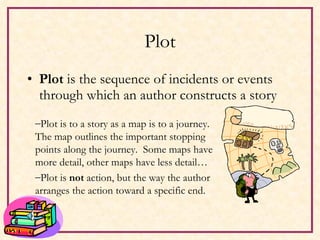
Plot Plot  is the sequence of incidents or events through which an author constructs a story Plot is to a story as a map is to a journey.  The map outlines the important stopping points along the journey.  Some maps have more detail, other maps have less detail… Plot is  not  action, but the way the author arranges the action toward a specific end.
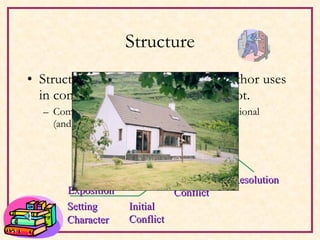
Structure Structure refers to the pattern an author uses in constructing and arranging the plot. Commercial fiction usually follows a conventional  (and familiar) structure. Setting Character Initial Conflict Main Conflict Complications Climax Resolution Exposition
Structure For a literary writer, a complex structure is often required to convey complex meanings. Flashback Stream of Consciousness Out of order chronology Changes in narration/narrator Implied details
Structure In literary fiction, the subtle exchange of words among characters can be just as significant as the more action oriented sequences. “ Maggie can’t appreciate these quilts!” she said.  “She’d probably be backward enough to put them to everyday use.”
Conflict Structure comes out of conflict. A clash of actions, ideas, desires, or wills Man vs. Man Man vs. Self Man vs. Nature Man vs. Supernatural Man vs. Fate
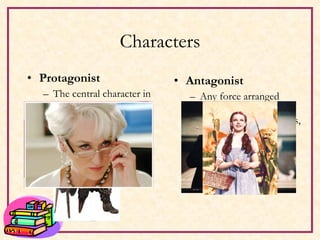
Characters Protagonist The central character in a conflict, whether sympathetic or unsympathetic. Antagonist Any force arranged against the protagonist including people, things, conventions of society, and the protagonist’s own character traits.
Suspense Suspense is the quality in a story that makes readers ask “What’s going to happen next?” or “How will this turn out?” Suspense increases when a reader’s curiosity is combined with anxiety about the fate of a likable, sympathetic character. In literary fiction the suspense often involves not so much the question  what  as the question  why.  Why is the protagonist behaving this way?  How do I relate the protagonist’s behavior to universal human character?
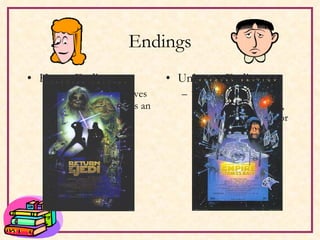
Endings Happy Ending The protagonist solves her problem, defeats an adversary, wins her man. Unhappy Ending The protagonist does not solve his problem, defeat the adversary, or win his woman.
Justifying Unhappy Endings Many situations in real life do have unpleasant outcomes; therefore, if fiction is to reflect and illuminate life, it must acknowledge human defeats as well as triumphs. The unhappy ending may cause readers to brood over the outcome, to relive the story in their minds, and by searching out its implications to get much more meaning and significance from it.  The unhappy ending is more likely to raise significant issues.
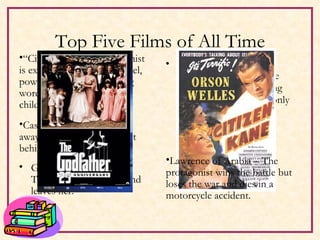
Top Five Films of All Time The Godfather – the protagonist struggles the whole film to resist being dragged into the mob, only to commit an act that places him firmly in La Cosa Nostra Gone With The Wind – The protagonist’s husband leaves her. Casablanca – The girl flies away leaving the protagonist behind. “ Citizen Kane” – Protagonist is exposed as a ruthless, cruel, power monger whose dying words were about his childhood sled. Lawrence of Arabia – The protagonist wins the battle but loses the war and dies in a motorcycle accident.

Structure

  • 1.
  • 2.
    Plot Plot is the sequence of incidents or events through which an author constructs a story Plot is to a story as a map is to a journey. The map outlines the important stopping points along the journey. Some maps have more detail, other maps have less detail… Plot is not action, but the way the author arranges the action toward a specific end.
  • 3.
    Structure Structure refersto the pattern an author uses in constructing and arranging the plot. Commercial fiction usually follows a conventional (and familiar) structure. Setting Character Initial Conflict Main Conflict Complications Climax Resolution Exposition
  • 4.
    Structure For aliterary writer, a complex structure is often required to convey complex meanings. Flashback Stream of Consciousness Out of order chronology Changes in narration/narrator Implied details
  • 5.
    Structure In literaryfiction, the subtle exchange of words among characters can be just as significant as the more action oriented sequences. “ Maggie can’t appreciate these quilts!” she said. “She’d probably be backward enough to put them to everyday use.”
  • 6.
    Conflict Structure comesout of conflict. A clash of actions, ideas, desires, or wills Man vs. Man Man vs. Self Man vs. Nature Man vs. Supernatural Man vs. Fate
  • 7.
    Characters Protagonist Thecentral character in a conflict, whether sympathetic or unsympathetic. Antagonist Any force arranged against the protagonist including people, things, conventions of society, and the protagonist’s own character traits.
  • 8.
    Suspense Suspense isthe quality in a story that makes readers ask “What’s going to happen next?” or “How will this turn out?” Suspense increases when a reader’s curiosity is combined with anxiety about the fate of a likable, sympathetic character. In literary fiction the suspense often involves not so much the question what as the question why. Why is the protagonist behaving this way? How do I relate the protagonist’s behavior to universal human character?
  • 9.
    Endings Happy EndingThe protagonist solves her problem, defeats an adversary, wins her man. Unhappy Ending The protagonist does not solve his problem, defeat the adversary, or win his woman.
  • 10.
    Justifying Unhappy EndingsMany situations in real life do have unpleasant outcomes; therefore, if fiction is to reflect and illuminate life, it must acknowledge human defeats as well as triumphs. The unhappy ending may cause readers to brood over the outcome, to relive the story in their minds, and by searching out its implications to get much more meaning and significance from it. The unhappy ending is more likely to raise significant issues.
  • 11.
    Top Five Filmsof All Time The Godfather – the protagonist struggles the whole film to resist being dragged into the mob, only to commit an act that places him firmly in La Cosa Nostra Gone With The Wind – The protagonist’s husband leaves her. Casablanca – The girl flies away leaving the protagonist behind. “ Citizen Kane” – Protagonist is exposed as a ruthless, cruel, power monger whose dying words were about his childhood sled. Lawrence of Arabia – The protagonist wins the battle but loses the war and dies in a motorcycle accident.