Elements of
Plot&Structure
Chapter II
Tabaran Higher Education Institute
Fall 2016
V.Jami
v.jami@yahoo.com
Plot and Structure
 Plot- The sequence of incidents or events through which an author
constructs a story.
*The plot is not merely the action itself, but the way the author arranges the
action toward a specific end (structure).
 Important elements of Plot:
*Conflict- A clash of actions, ideas, desires, or wills
Types of Conflict: Person vs. Person, Person vs. Environment, Person vs. Self.
*Protagonist- The central character in a conflict
*Antagonist- Any force arranged against the protagonist- whether persons,
things, conventions of society, or the protagonists own personality traits.
*Suspense- The quality in a story that makes readers ask “what’s going to
happen next?”. In more literary forms of fiction the suspense involves
more “why” than “what”. Usually produced through two devices; either
mystery (an unusual set of circumstances for which the reader craves an
explanation) or dilemma (a position in which a character must choose
between two courses of action, both undesirable.)
Plot and Structure (cont.)
*Artistic unity- Essential for a good plot. There must be nothing in the story
that is irrelevant, that does not contribute to the meaning. Each event should
grow out of the preceding one and lead logically to the next. The work should
have a quality of natural inevitability, given the specific set of characters and the
initial situation.
*Deus Ex Machina- Latin for “God from a machine”. The saving of the
protagonist from an impossible situation. A form of plot manipulation.
Endings-
*Happy Ending- Everything ends well for our protagonist. More often used in
commercial fiction.
*Unhappy Ending- Most instances in life do not have pleasant ends, so literary
fiction that tries to emulate life is more apt to have an unhappy conclusion.
These endings force the reader to contemplate the complexities of life.
*Indeterminate Ending- No definitive ending is reached. This leaves the reader
to ponder the many issues raised through the story without being handed a neat
solution.
 Whathappens in the story; whatthe story is about
 The sequence of related events thatmake up a story
 Applies to books, plays, short stories, movies, TV shows, etc.
Plot
 The beginningof thestory where the reader is EXPOSed to
the
 Setting
 Characters
 Details
 Example:HarryPotter&theSorcerer’s Stone
 Harry is left at the Dursley’s
 Voldemort is introduced through Dumbledore & McGonagall’s
discussion
 Harry and life with the Dursleys is introduced
Exposition
 The “hook”
 Where the action kicks intogear & it begins to get interesting
 Where the conflict is introduced
 Example:HarryPotter&theSorcerer’s Stone
 Harry begins talkingto the snakeat the zoo & the glass disappears
Inciting Event
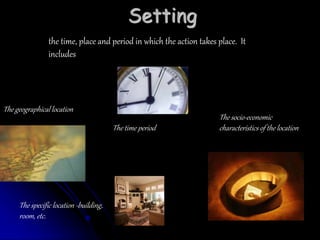
Setting
the time, place and period in which the action takes place. It
includes
The socio-economic
characteristics of the location
The geographicallocation
The time period
The specific location -building,
room, etc.
Setting
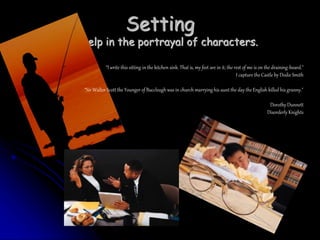
can help in the portrayal of characters.
“I write this sitting in the kitchen sink. That is, my feet are in it; the rest of me is on the draining-board."
I capture the Castle by Dodie Smith
“Sir Walter Scott the Younger of Buccleugh was in church marrying his aunt the day the English killed his granny."
Dorothy Dunnett
Disorderly Knights
Setting
in some works of fiction action is so closely related to
setting that the plot is directed by it.
"Francis St. Croix spotted it first, a black dot floating in an ocean of water and ice. When he and Ernie
rowed alongside for a look, they couldn't believe their eyes. There was a baby inside a makeshift cradle on
an ice pan, bobbing like an ice cube on the sea. How had a baby come to be in the North Atlantic?"
Latitudes of Melt
Joan Clark
It was a bright cold day in April, and the clocks were striking thirteen.”
George Orwell, 1984;
Setting
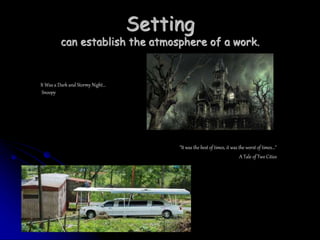
can establish the atmosphere of a work.
"It was the best of times, it was the worst of times..."
A Tale of Two Cities
It Was a Dark and Stormy Night…
Snoopy
Plot
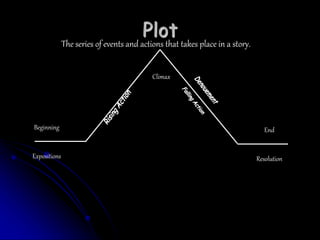
The series of events and actions that takes place in a story.
Beginning
Expositions
Climax
End
Resolution
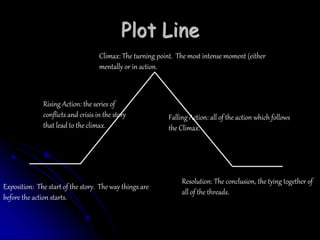
Plot Line
Exposition: The start of the story. The way things are
before the action starts.
Rising Action: the series of
conflicts and crisis in the story
that lead to the climax.
Climax: The turning point. The most intense moment (either
mentally or in action.
Falling Action: all of the action which follows
the Climax.
Resolution: The conclusion, the tying together of
all of the threads.
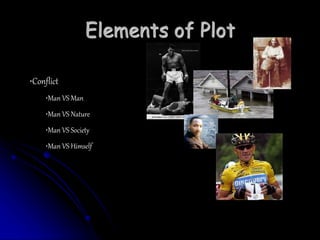
Elements of Plot
•Conflict
•Man VS Man
•Man VS Nature
•Man VS Society
•Man VS Himself
 Takes up thebulk of the story
 The story gets more complicated & intenseas the action rises
 The series of events and complications thatincrease the
tensionand suspense and make you wantto know how the
story is going to turn outin the end
Rising Action
 The point where theconflict reaches peak intensity& is
resolved
 The emotionalpeak of thestory
 Oftenacts as theturning point
 Example:HarryPotter&theSorcerer’s Stone
 when Harry, Ron, & Hermione go through the challenges
protecting the Sorcerer’s Stone
 When Harry faces Quirrell & Voldemort
Climax
 Where the authorties up loose ends thatremainafter the
climax
 Example:HarryPotter&theSorcerer’s Stone
 Harry wakesup in the hospital
 We find out Ron is ok
 Dumbledore tells Harry about Nicolas Flamel & the fate of the
Sorcerer’s Stone
 Gryffindor wins the House Cup
Falling Action
 Story wraps up
 Long-termeffectsof conflict are revealed
 Example:HarryPotter&theSorcerer’s Stone
 Examresults
 Packing up
 Harry is picked up by the Dursley’s at the trainstation
 TheymeetRon, his family, & Hermione
 Foreshadows Harry’s summerwith them (and the fact that they don’t
know hecan’t perform magic!)
Resolution
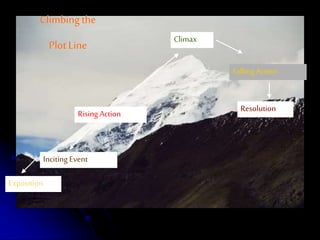
Climbingthe
Plot Line
Exposition
Rising Action
Climax
Falling Action
Resolution
Inciting Event
 The maincharacter of thestory
 Is oftenconsidered the “Hero”
Protagonist
 The person, force, or thingopposing theprotagonist
 It is possible for the protagonist to be theirown antagonist
Antagonist
 Time, place, or mood of thestory
Setting
 The basis of the story/plot
 Creates interest, suspense, & tension
 The protagonist’s struggle against someone or something
AND thereason why they are struggling
 Stories oftencontain multi-layeredconflicts
Conflict
 Internal
 External
Types ofConflict
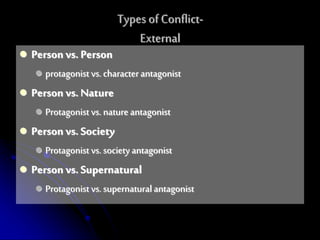
 Person vs. Person
 protagonist vs. character antagonist
 Person vs. Nature
 Protagonist vs. nature antagonist
 Person vs. Society
 Protagonist vs. society antagonist
 Person vs. Supernatural
 Protagonist vs. supernatural antagonist
Types of Conflict-
External
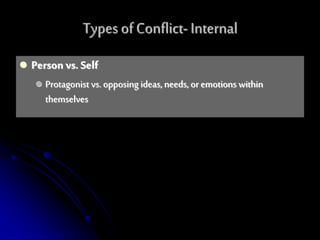
 Person vs. Self
 Protagonist vs. opposing ideas, needs, or emotions within
themselves
Types ofConflict-Internal

Elements of plot.2

  • 1.
    Elements of Plot&Structure Chapter II TabaranHigher Education Institute Fall 2016 V.Jami v.jami@yahoo.com
  • 2.
    Plot and Structure Plot- The sequence of incidents or events through which an author constructs a story. *The plot is not merely the action itself, but the way the author arranges the action toward a specific end (structure).  Important elements of Plot: *Conflict- A clash of actions, ideas, desires, or wills Types of Conflict: Person vs. Person, Person vs. Environment, Person vs. Self. *Protagonist- The central character in a conflict *Antagonist- Any force arranged against the protagonist- whether persons, things, conventions of society, or the protagonists own personality traits. *Suspense- The quality in a story that makes readers ask “what’s going to happen next?”. In more literary forms of fiction the suspense involves more “why” than “what”. Usually produced through two devices; either mystery (an unusual set of circumstances for which the reader craves an explanation) or dilemma (a position in which a character must choose between two courses of action, both undesirable.)
  • 3.
    Plot and Structure(cont.) *Artistic unity- Essential for a good plot. There must be nothing in the story that is irrelevant, that does not contribute to the meaning. Each event should grow out of the preceding one and lead logically to the next. The work should have a quality of natural inevitability, given the specific set of characters and the initial situation. *Deus Ex Machina- Latin for “God from a machine”. The saving of the protagonist from an impossible situation. A form of plot manipulation. Endings- *Happy Ending- Everything ends well for our protagonist. More often used in commercial fiction. *Unhappy Ending- Most instances in life do not have pleasant ends, so literary fiction that tries to emulate life is more apt to have an unhappy conclusion. These endings force the reader to contemplate the complexities of life. *Indeterminate Ending- No definitive ending is reached. This leaves the reader to ponder the many issues raised through the story without being handed a neat solution.
  • 4.
     Whathappens inthe story; whatthe story is about  The sequence of related events thatmake up a story  Applies to books, plays, short stories, movies, TV shows, etc. Plot
  • 5.
     The beginningofthestory where the reader is EXPOSed to the  Setting  Characters  Details  Example:HarryPotter&theSorcerer’s Stone  Harry is left at the Dursley’s  Voldemort is introduced through Dumbledore & McGonagall’s discussion  Harry and life with the Dursleys is introduced Exposition
  • 6.
     The “hook” Where the action kicks intogear & it begins to get interesting  Where the conflict is introduced  Example:HarryPotter&theSorcerer’s Stone  Harry begins talkingto the snakeat the zoo & the glass disappears Inciting Event
  • 7.
    Setting the time, placeand period in which the action takes place. It includes The socio-economic characteristics of the location The geographicallocation The time period The specific location -building, room, etc.
  • 8.
    Setting can help inthe portrayal of characters. “I write this sitting in the kitchen sink. That is, my feet are in it; the rest of me is on the draining-board." I capture the Castle by Dodie Smith “Sir Walter Scott the Younger of Buccleugh was in church marrying his aunt the day the English killed his granny." Dorothy Dunnett Disorderly Knights
  • 9.
    Setting in some worksof fiction action is so closely related to setting that the plot is directed by it. "Francis St. Croix spotted it first, a black dot floating in an ocean of water and ice. When he and Ernie rowed alongside for a look, they couldn't believe their eyes. There was a baby inside a makeshift cradle on an ice pan, bobbing like an ice cube on the sea. How had a baby come to be in the North Atlantic?" Latitudes of Melt Joan Clark It was a bright cold day in April, and the clocks were striking thirteen.” George Orwell, 1984;
  • 10.
    Setting can establish theatmosphere of a work. "It was the best of times, it was the worst of times..." A Tale of Two Cities It Was a Dark and Stormy Night… Snoopy
  • 11.
    Plot The series ofevents and actions that takes place in a story. Beginning Expositions Climax End Resolution
  • 12.
    Plot Line Exposition: Thestart of the story. The way things are before the action starts. Rising Action: the series of conflicts and crisis in the story that lead to the climax. Climax: The turning point. The most intense moment (either mentally or in action. Falling Action: all of the action which follows the Climax. Resolution: The conclusion, the tying together of all of the threads.
  • 13.
    Elements of Plot •Conflict •ManVS Man •Man VS Nature •Man VS Society •Man VS Himself
  • 14.
     Takes upthebulk of the story  The story gets more complicated & intenseas the action rises  The series of events and complications thatincrease the tensionand suspense and make you wantto know how the story is going to turn outin the end Rising Action
  • 15.
     The pointwhere theconflict reaches peak intensity& is resolved  The emotionalpeak of thestory  Oftenacts as theturning point  Example:HarryPotter&theSorcerer’s Stone  when Harry, Ron, & Hermione go through the challenges protecting the Sorcerer’s Stone  When Harry faces Quirrell & Voldemort Climax
  • 16.
     Where theauthorties up loose ends thatremainafter the climax  Example:HarryPotter&theSorcerer’s Stone  Harry wakesup in the hospital  We find out Ron is ok  Dumbledore tells Harry about Nicolas Flamel & the fate of the Sorcerer’s Stone  Gryffindor wins the House Cup Falling Action
  • 17.
     Story wrapsup  Long-termeffectsof conflict are revealed  Example:HarryPotter&theSorcerer’s Stone  Examresults  Packing up  Harry is picked up by the Dursley’s at the trainstation  TheymeetRon, his family, & Hermione  Foreshadows Harry’s summerwith them (and the fact that they don’t know hecan’t perform magic!) Resolution
  • 18.
  • 19.
     The maincharacterof thestory  Is oftenconsidered the “Hero” Protagonist
  • 20.
     The person,force, or thingopposing theprotagonist  It is possible for the protagonist to be theirown antagonist Antagonist
  • 21.
     Time, place,or mood of thestory Setting
  • 22.
     The basisof the story/plot  Creates interest, suspense, & tension  The protagonist’s struggle against someone or something AND thereason why they are struggling  Stories oftencontain multi-layeredconflicts Conflict
  • 23.
  • 24.
     Person vs.Person  protagonist vs. character antagonist  Person vs. Nature  Protagonist vs. nature antagonist  Person vs. Society  Protagonist vs. society antagonist  Person vs. Supernatural  Protagonist vs. supernatural antagonist Types of Conflict- External
  • 25.
     Person vs.Self  Protagonist vs. opposing ideas, needs, or emotions within themselves Types ofConflict-Internal