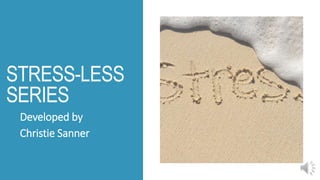
STRESS-LESS
SERIES
Developed by
Christie Sanner
In This Series:
•What is stress and its effects on the body
•Gaining a better awareness about managing stress
•Relaxation
•Effective Communication
•Managing Anger and Resolving Conflicts
•Coping With Anxiety
•Balanced Nutrition for Stress Reduction and Healthy Living
•Regular Physical Activity and Exercise
•Managing Our Time
•Implementing a Stress Reduction Plan
Part 1
Understanding Stress
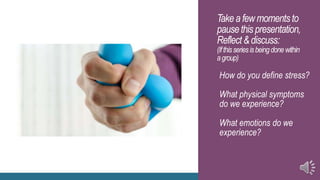
Takea fewmomentsto
pausethispresentation,
Reflect&discuss:
(Ifthisseriesisbeingdonewithin
agroup)
How do you define stress?
What physical symptoms
do we experience?
What emotions do we
experience?
Some Words Used to Describe Stress
•Feeling pressured/overwhelmed
•Feeling down
•Anger
•Anxiety
•Nervousness
•Having butterflies in the stomach
•Feeling strained
•Feeling uptight
•Depressed
•Feeling under the weather
•Tension
•Feeling upset
Stress
• “Originates from the Latin word strictus, meaning “hardship, adversity,
or affliction’” (Romas & Sharma, 2017).
• “Hans Selye defines stress as “a nonspecific response of the body
to any demand made upon it” (Romas & Sharma, 2017).
• Evolved from estresse (Old French) and stresse (Middle English)
• 3 Perspectives of Stress:
Environmental (or external) - outside of the body
Mental - internal state of tension
Physical – body’s reaction to stress
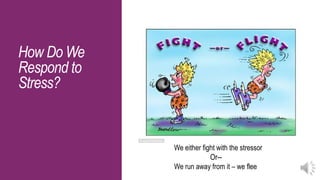
How Do We
Respond to
Stress?
We either fight with the stressor
Or--
We run away from it – we flee
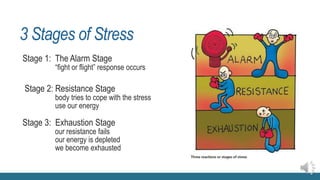
3 Stages of Stress
Stage 1: The Alarm Stage
“fight or flight” response occurs
Stage 2: Resistance Stage
body tries to cope with the stress
use our energy
Stage 3: Exhaustion Stage
our resistance fails
our energy is depleted
we become exhausted
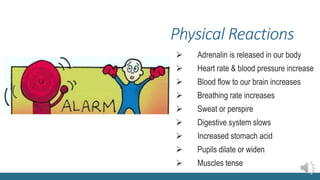
Physical Reactions
 Adrenalin is released in our body
 Heart rate & blood pressure increase
 Blood flow to our brain increases
 Breathing rate increases
 Sweat or perspire
 Digestive system slows
 Increased stomach acid
 Pupils dilate or widen
 Muscles tense
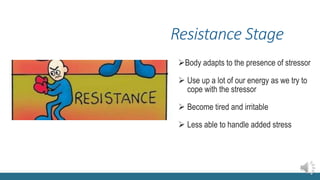
Resistance Stage
Body adapts to the presence of stressor
 Use up a lot of our energy as we try to
cope with the stressor
 Become tired and irritable
 Less able to handle added stress
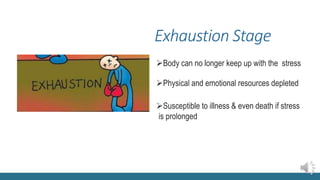
Exhaustion Stage
Body can no longer keep up with the stress
Physical and emotional resources depleted
Susceptible to illness & even death if stress
is prolonged
Good Stress vs. Bad Stress
Eustress
•Motivates you
•Helps you focus
•Feels exciting
•Improves your performance
•Doesn’t last for a long time
Distress
• Anxiety producing
•Overwhelming
•Feels unpleasant
•Decreases performance
•Can last for a long time
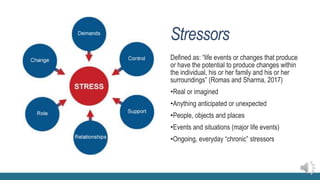
Stressors
Defined as: “life events or changes that produce
or have the potential to produce changes within
the individual, his or her family and his or her
surroundings” (Romas and Sharma, 2017)
•Real or imagined
•Anything anticipated or unexpected
•People, objects and places
•Events and situations (major life events)
•Ongoing, everyday “chronic” stressors
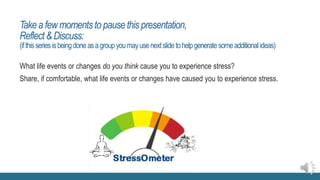
Takea fewmomentstopausethispresentation,
Reflect&Discuss:
(ifthisseriesisbeingdoneasagroupyoumayusenextslidetohelpgeneratesomeadditional ideas)
What life events or changes do you think cause you to experience stress?
Share, if comfortable, what life events or changes have caused you to experience stress.
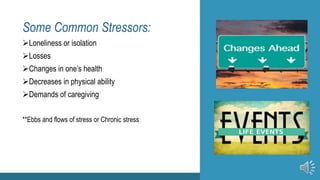
Some Common Stressors:
Loneliness or isolation
Losses
Changes in one’s health
Decreases in physical ability
Demands of caregiving
**Ebbs and flows of stress or Chronic stress
We Are Each Different
In How We “Perceive Stress”
How we “appraise” the stressor
How much “control” we have over the situation (to cope)
How we “appraise” the stressor
 How we “appraise” the stressor
 How much “control” we have over the situation (to cope)
The important messages to remember:
**What is stressful for one person, may not be stressful for someone else
& vice-versa
**And to “be kind & supportive to one another” in our differences
of how we respond to stress.
References
Dinardo, D. (2019, January 29). What's your stress threshold? Retrieved July 07, 2020, from https://drandreadinardo.com/2016/10/05/whats-your-
stress-threshold/
Gloria Steinem Quote: "Everyone is unique and each experience is different." (n.d.). Retrieved July 07, 2020, from
https://quotefancy.com/quote/819001/Gloria-Steinem-Everyone-is-unique-and-each-experience-is-different
Limited, A. (n.d.). Stock Photo - Changes ahead freeway road sign with sunset sky. Retrieved July 07, 2020, from https://www.alamy.com/changes-
ahead-freeway-road-sign-with-sunset-sky-image69212554.html
Herreid, A. (2011). [Relieving Stress, the Word Stress Being Washed Away by a Wave on a Beach] [Photograph] iStock by Getty Images.
https://www.istockphoto.com/photo/stress-being-washed-away-gm120739485-16271480
Life Events. (n.d.). Retrieved July 07, 2020, from https://www.olivetlutheran.org/life-events/
Matters, P., Education Matters I'm a that kind of an educator who always yearns to be educated. View Archive →, Education Matters, I'm a that kind of
an educator who always yearns to be educated. View Archive →, →, V., & (required), N. (2016, January 30). Understanding Stress. Retrieved July 07,
2020, from https://kamundihblog.wordpress.com/2015/10/08/understanding-stress/
Roberto, D. (2016). [Anti-stress balls in hand, according to the window with bright sunlight] [Photograph] iStock by Getty Images.
https://www.istockphoto.com/photo/anti-stress-balls-in-hand-gm511597984-86728065
Swerdlow, [Fight or Flight Response] [Photograph] Simply Psychology. https://www.simplypsychology.org/stress-biology.html
Photograph courtesy of Complete Track and Field. https://www.completetrackandfield.com/general-adaptation-syndrome-and-cross-
country-training/
Romas, J. A., & Sharma, M. (2017). Practical stress management: A comprehensive workbook (7th ed.). London: Academic Press.

Stress-Less Series

  • 1.
  • 2.
    In This Series: •Whatis stress and its effects on the body •Gaining a better awareness about managing stress •Relaxation •Effective Communication •Managing Anger and Resolving Conflicts •Coping With Anxiety •Balanced Nutrition for Stress Reduction and Healthy Living •Regular Physical Activity and Exercise •Managing Our Time •Implementing a Stress Reduction Plan
  • 3.
  • 4.
    Takea fewmomentsto pausethispresentation, Reflect&discuss: (Ifthisseriesisbeingdonewithin agroup) How doyou define stress? What physical symptoms do we experience? What emotions do we experience?
  • 5.
    Some Words Usedto Describe Stress •Feeling pressured/overwhelmed •Feeling down •Anger •Anxiety •Nervousness •Having butterflies in the stomach •Feeling strained •Feeling uptight •Depressed •Feeling under the weather •Tension •Feeling upset
  • 6.
    Stress • “Originates fromthe Latin word strictus, meaning “hardship, adversity, or affliction’” (Romas & Sharma, 2017). • “Hans Selye defines stress as “a nonspecific response of the body to any demand made upon it” (Romas & Sharma, 2017). • Evolved from estresse (Old French) and stresse (Middle English) • 3 Perspectives of Stress: Environmental (or external) - outside of the body Mental - internal state of tension Physical – body’s reaction to stress
  • 7.
    How Do We Respondto Stress? We either fight with the stressor Or-- We run away from it – we flee
  • 8.
    3 Stages ofStress Stage 1: The Alarm Stage “fight or flight” response occurs Stage 2: Resistance Stage body tries to cope with the stress use our energy Stage 3: Exhaustion Stage our resistance fails our energy is depleted we become exhausted
  • 9.
    Physical Reactions  Adrenalinis released in our body  Heart rate & blood pressure increase  Blood flow to our brain increases  Breathing rate increases  Sweat or perspire  Digestive system slows  Increased stomach acid  Pupils dilate or widen  Muscles tense
  • 10.
    Resistance Stage Body adaptsto the presence of stressor  Use up a lot of our energy as we try to cope with the stressor  Become tired and irritable  Less able to handle added stress
  • 11.
    Exhaustion Stage Body canno longer keep up with the stress Physical and emotional resources depleted Susceptible to illness & even death if stress is prolonged
  • 12.
    Good Stress vs.Bad Stress Eustress •Motivates you •Helps you focus •Feels exciting •Improves your performance •Doesn’t last for a long time Distress • Anxiety producing •Overwhelming •Feels unpleasant •Decreases performance •Can last for a long time
  • 13.
    Stressors Defined as: “lifeevents or changes that produce or have the potential to produce changes within the individual, his or her family and his or her surroundings” (Romas and Sharma, 2017) •Real or imagined •Anything anticipated or unexpected •People, objects and places •Events and situations (major life events) •Ongoing, everyday “chronic” stressors
  • 14.
    Takea fewmomentstopausethispresentation, Reflect&Discuss: (ifthisseriesisbeingdoneasagroupyoumayusenextslidetohelpgeneratesomeadditional ideas) Whatlife events or changes do you think cause you to experience stress? Share, if comfortable, what life events or changes have caused you to experience stress.
  • 15.
    Some Common Stressors: Lonelinessor isolation Losses Changes in one’s health Decreases in physical ability Demands of caregiving **Ebbs and flows of stress or Chronic stress
  • 16.
    We Are EachDifferent In How We “Perceive Stress” How we “appraise” the stressor How much “control” we have over the situation (to cope) How we “appraise” the stressor  How we “appraise” the stressor  How much “control” we have over the situation (to cope)  How much “control” we have over the situation (to cope) The important messages to remember: **What is stressful for one person, may not be stressful for someone else & vice-versa **And to “be kind & supportive to one another” in our differences of how we respond to stress.
  • 17.
    References Dinardo, D. (2019,January 29). What's your stress threshold? Retrieved July 07, 2020, from https://drandreadinardo.com/2016/10/05/whats-your- stress-threshold/ Gloria Steinem Quote: "Everyone is unique and each experience is different." (n.d.). Retrieved July 07, 2020, from https://quotefancy.com/quote/819001/Gloria-Steinem-Everyone-is-unique-and-each-experience-is-different Limited, A. (n.d.). Stock Photo - Changes ahead freeway road sign with sunset sky. Retrieved July 07, 2020, from https://www.alamy.com/changes- ahead-freeway-road-sign-with-sunset-sky-image69212554.html Herreid, A. (2011). [Relieving Stress, the Word Stress Being Washed Away by a Wave on a Beach] [Photograph] iStock by Getty Images. https://www.istockphoto.com/photo/stress-being-washed-away-gm120739485-16271480 Life Events. (n.d.). Retrieved July 07, 2020, from https://www.olivetlutheran.org/life-events/ Matters, P., Education Matters I'm a that kind of an educator who always yearns to be educated. View Archive →, Education Matters, I'm a that kind of an educator who always yearns to be educated. View Archive →, →, V., & (required), N. (2016, January 30). Understanding Stress. Retrieved July 07, 2020, from https://kamundihblog.wordpress.com/2015/10/08/understanding-stress/ Roberto, D. (2016). [Anti-stress balls in hand, according to the window with bright sunlight] [Photograph] iStock by Getty Images. https://www.istockphoto.com/photo/anti-stress-balls-in-hand-gm511597984-86728065 Swerdlow, [Fight or Flight Response] [Photograph] Simply Psychology. https://www.simplypsychology.org/stress-biology.html Photograph courtesy of Complete Track and Field. https://www.completetrackandfield.com/general-adaptation-syndrome-and-cross- country-training/ Romas, J. A., & Sharma, M. (2017). Practical stress management: A comprehensive workbook (7th ed.). London: Academic Press.

Editor's Notes

  • #8 We respond to stress in one of 2 ways We either fight with the stressor Or, we run away from it – we flee
  • #16 Loneliness or isolation Losses loss of a spouse (death or divorce) loss of family members (death, relocation, divorce, conflict loss of friends loss of a pet loss of communication with a loved one Loss of Purpose life changes – retirement loss of being needed loss of position within the community Loss of independence loss of ability to drive safely loss of transportation services distance from family and friends increased health care costs Changes in health increase dependence on others diagnosis of a chronic disease Decreased physical ability loss of ability to live alone loss of energy loss of control over daily routine inability to do favorite things loss of ability to drive Demands of caregiving difficulty caring for an ill spouse of partner loss of freedom for self and dreams feeling overwhelmed with responsibility Ebb and flows of stress: we experience a stressful event and then it passes Chronic stress – persistent occurs on a daily basis & longer duration