Recommended
PPT
PDF
STRESS and how to manage stress in daily life
PPTX
COPING AND STRESS MANAGEMENT-PPT Explanation and concept
PPTX
STRESS & ITS MANAGEMENT AT BATTTOR HOSPITAL.pptx
PDF
Stress Management Workshop mecanismos para lidiar con el estres
PPTX
Stress Management - Silent & Violent Killer
PPTX
PPT
PPT
PPTX
Stress is a natural physical, mental, and emotional reaction to a demand or c...
PPTX
PPT
STRESS MANAGEMENT. EMPHASIS ON CABIN CREW AND STUDENTS
PPTX
Stress_Management training presentation.pptx
PPTX
Social Science- Understanding the Self-TAKING CARE OF ONE’S HEALTH.pptx
PPTX
Stress Management PPT.pptx
PPTX
Stress, causes and it's Management.pptx
PPTX
PPTX
PPTX
PPTX
Lesson 1 - Stress Management Strategies PPT.pptx
PDF
Coping Strategies for Stress: Effective Techniques for Managing Your Mental H...
PPTX
Stress management, Different practices to manage stress
PPTX
PDF
Management Plan in Understanding Stress.pdf
PPT
PPTX
Lecture 1_ Stress Management.pptx
PPTX
PPT
slides about stress management
PPTX
Cultivation practice of Okra in Nepal.pptx
PPTX
Plant fibres used as surgical dressings & Sutures – Surgical Catgut and Ligat...
More Related Content
PPT
PDF
STRESS and how to manage stress in daily life
PPTX
COPING AND STRESS MANAGEMENT-PPT Explanation and concept
PPTX
STRESS & ITS MANAGEMENT AT BATTTOR HOSPITAL.pptx
PDF
Stress Management Workshop mecanismos para lidiar con el estres
PPTX
Stress Management - Silent & Violent Killer
PPTX
PPT
Similar to Stress_Management_Mental_Health_Presentation.pptx
PPT
PPTX
Stress is a natural physical, mental, and emotional reaction to a demand or c...
PPTX
PPT
STRESS MANAGEMENT. EMPHASIS ON CABIN CREW AND STUDENTS
PPTX
Stress_Management training presentation.pptx
PPTX
Social Science- Understanding the Self-TAKING CARE OF ONE’S HEALTH.pptx
PPTX
Stress Management PPT.pptx
PPTX
Stress, causes and it's Management.pptx
PPTX
PPTX
PPTX
PPTX
Lesson 1 - Stress Management Strategies PPT.pptx
PDF
Coping Strategies for Stress: Effective Techniques for Managing Your Mental H...
PPTX
Stress management, Different practices to manage stress
PPTX
PDF
Management Plan in Understanding Stress.pdf
PPT
PPTX
Lecture 1_ Stress Management.pptx
PPTX
PPT
slides about stress management
Recently uploaded
PPTX
Cultivation practice of Okra in Nepal.pptx
PPTX
Plant fibres used as surgical dressings & Sutures – Surgical Catgut and Ligat...
PPTX
How to Change Shipping Label Size in Odoo 18 Inventory
PPTX
WEEK 2 (2).pptx TLE COOKERY 10 QUARTER 4
PDF
Holm Community Heritage at St Nicholas Kirk - 2025 AGM Minutes (30.04.2025)
PDF
Tetracycline Class of Antibiotics: SAR, MOA and Uses
PDF
Workshop 29 Crystal Review All Students by YogiGoddess
PDF
Artificial Intelligence in Research and Academic Writing, Workshop on Researc...
PDF
Pratishta Educational Society., Courses & Opportunities
PPTX
Biological source, chemical constituents, and therapeutic efficacy of the fol...
PPTX
ENGLISH-7-Quarter-4-Week-3 Matatag .pptx
PPTX
Math 8 Quarter 4 Week 3 PRIMARY DATA.pptx
PDF
Unit Plan and Unit Test-pdf-Dr. Rajashekhar Shirvalkar, Principal, SMRS B.Ed ...
PPTX
Math 8 Quarter 4 Week 4-SECONDARY DATA.pptx
PDF
Pharmaceutical Quality Assurance Unit 1 (BP606T)
PDF
How "Raiders of the Lost Ark" and "Ordinary People" Employ Non-Verbal Acting
PDF
PPT Daftar Bahan Kelas Bedah Kitab Matius Khotbah di Bukit
PPTX
ECP Demo ppt.pptx Visualizing and Identifying solid figures using concrete an...
PPTX
Modeling Simple Equation using Bar Model.pptx
PPTX
Lesson_1 Acceleration.pptx_Science 8-4th quarter
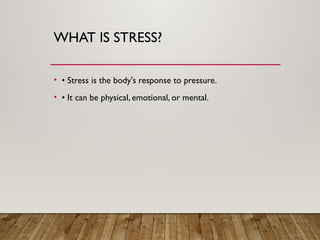
Stress_Management_Mental_Health_Presentation.pptx 1. 2. WHAT IS STRESS?
• • Stress is the body's response to pressure.
• • It can be physical, emotional, or mental.
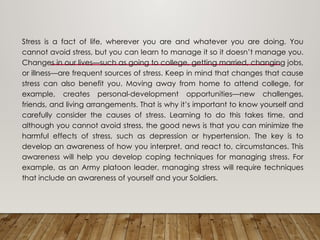
3. Stress is a fact of life, wherever you are and whatever you are doing. You
cannot avoid stress, but you can learn to manage it so it doesn’t manage you.
Changes in our lives—such as going to college, getting married, changing jobs,
or illness—are frequent sources of stress. Keep in mind that changes that cause
stress can also benefit you. Moving away from home to attend college, for
example, creates personal-development opportunities—new challenges,
friends, and living arrangements. That is why it’s important to know yourself and
carefully consider the causes of stress. Learning to do this takes time, and
although you cannot avoid stress, the good news is that you can minimize the
harmful effects of stress, such as depression or hypertension. The key is to
develop an awareness of how you interpret, and react to, circumstances. This
awareness will help you develop coping techniques for managing stress. For
example, as an Army platoon leader, managing stress will require techniques
that include an awareness of yourself and your Soldiers.
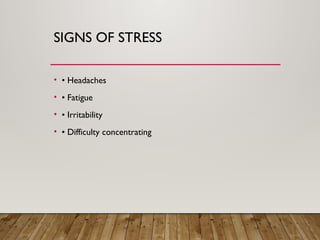
4. SIGNS OF STRESS
• • Headaches
• • Fatigue
• • Irritability
• • Difficulty concentrating
5.