www.compassionategeek.com
Stress Management for
IT Professionals
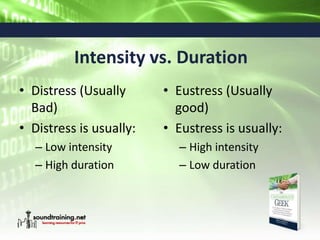
Intensity vs. Duration
• Distress (Usually
Bad)
• Distress is usually:
– Low intensity
– High duration
• Eustress (Usually
good)
• Eustress is usually:
– High intensity
– Low duration
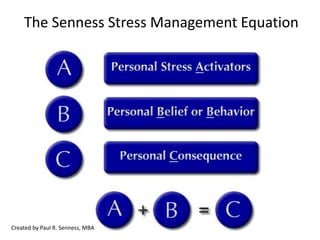
The Senness Stress Management Equation
Created by Paul R. Senness, MBA
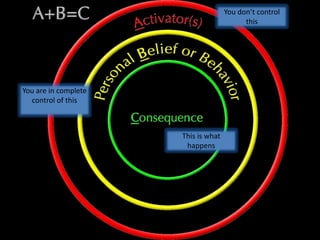
You don’t control
this
You are in complete
control of this
This is what
happens
Stress Activators
• Conflict
• Impossible deadlines
• Regulatory environment
• Ambiguity
• Disorganization
• Water cooler politics
• Change
• Lack of resources
Personal Beliefs
Personal Belief Set A
• It’s a black and white world
• You’re either with me or
you’re against me
• You’ve got to stand your
ground, no matter what
• Other people need to
understand where I’m
coming from
Personal Belief Set B
• The world is comprised of
varying shades of gray
• You and I may not agree on
everything. We both
understand that there are
often several correct paths to
a destination
• As we receive new
information, sometimes a
course correction is necessary
• Seek first to understand, then
to be understood
Personal Behaviors
Personal Behavior Set A
• Get in your face and tell
you what I think
• Work long hours and be a
martyr
• Gossip
• Agree to everything, but
do nothing
• Make arbitrary decisions
Personal Behavior Set B
• Respectfully say you
disagree
• Document and discuss
• Inform yourself and stop
gossip and innuendo
• Respectfully discuss
issues
• Ask for help in deciding
what to cut
Stress Warning Signals
• Tiredness
• Feeling on edge
• Anxiety
• Depression
• Long-term health condition
• Boredom
• Insomnia
Dealing with
The Serenity Prayer
Grant me the serenity
to accept the things I cannot change;
courage to change the things I can;
and wisdom to know the difference.
Several Ways to Manage Your
Stress
• Identify what’s within your control and what’s not. Deal with what is and let
go of what’s not.
• Go into another room or even the bathroom or closet if you just need to get
away for a few minutes.
• Rinse your face with cool water.
• Walk around the building or the block.
• Push back from your desk. Do shoulder rolls, head rolls, and ankle rolls.
• Close your eyes and breathe deeply.
• Unload on your spouse or a close friend (but avoid unloading about work
problems at work)
• Laugh
• Find a distraction (join a group, play music, take a class)
• Are you too focused on your own problems?
Page 26/Section 33
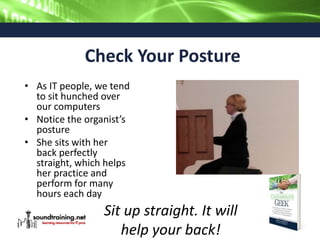
Check Your Posture
• As IT people, we tend
to sit hunched over
our computers
• Notice the organist’s
posture
• She sits with her
back perfectly
straight, which helps
her practice and
perform for many
hours each day
Sit up straight. It will
help your back!
Dealing with Stress
• You have the freedom to choose your
response to any situation
– (Freedom is a condition of the mind; liberty is a
condition of the environment.)
• Focus on things within your control
• Change your vocabulary from “If I only
had…” to “I can be…”
The Importance of Breathing
• We normally breathe in short, shallow
breaths
• Try controlled breathing.
– Breathe in to a count of five
– Breathe out to a count of five
– Repeat
Get Out of Stress Free Card
• On a blank 3 x 5 card or sheet of paper, list:
– Things that make you happy
– Things that make you peaceful
– Pictures of people, places, and things that bring
you joy
• Keep it in your desk and when things
get stressful, take it out and look at it
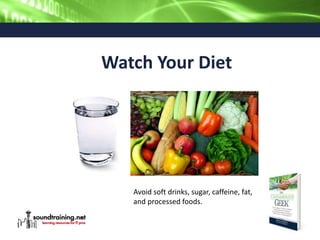
Watch Your Diet
Avoid soft drinks, sugar, caffeine, fat,
and processed foods.
Watch more videos on my YouTube channel at
www.youtube.com/doncrawley
For Reflection and Discussion
• What causes you stress? What can you do
about it?
• Read and study about people who are worse
off than you.
• Look for models and mentors who don’t seem
to be affected by stress.
• Find ways to accept the things you
can’t control.
To-Dos
• Create a Get Out of Stress Free card
• Journal your diet
• Enroll in a yoga class, a meditation class, or an exercise
class
• Go for a walk in a park
• Volunteer at a homeless shelter
• Mentor a high school kid
• Listen to calming music
• Laugh!
Stress Management for IT Professionals

Stress Management for IT Professionals

  • 1.
  • 2.
    Intensity vs. Duration •Distress (Usually Bad) • Distress is usually: – Low intensity – High duration • Eustress (Usually good) • Eustress is usually: – High intensity – Low duration
  • 3.
    The Senness StressManagement Equation Created by Paul R. Senness, MBA
  • 4.
    You don’t control this Youare in complete control of this This is what happens
  • 5.
    Stress Activators • Conflict •Impossible deadlines • Regulatory environment • Ambiguity • Disorganization • Water cooler politics • Change • Lack of resources
  • 6.
    Personal Beliefs Personal BeliefSet A • It’s a black and white world • You’re either with me or you’re against me • You’ve got to stand your ground, no matter what • Other people need to understand where I’m coming from Personal Belief Set B • The world is comprised of varying shades of gray • You and I may not agree on everything. We both understand that there are often several correct paths to a destination • As we receive new information, sometimes a course correction is necessary • Seek first to understand, then to be understood
  • 7.
    Personal Behaviors Personal BehaviorSet A • Get in your face and tell you what I think • Work long hours and be a martyr • Gossip • Agree to everything, but do nothing • Make arbitrary decisions Personal Behavior Set B • Respectfully say you disagree • Document and discuss • Inform yourself and stop gossip and innuendo • Respectfully discuss issues • Ask for help in deciding what to cut
  • 8.
    Stress Warning Signals •Tiredness • Feeling on edge • Anxiety • Depression • Long-term health condition • Boredom • Insomnia
  • 9.
  • 10.
    The Serenity Prayer Grantme the serenity to accept the things I cannot change; courage to change the things I can; and wisdom to know the difference.
  • 11.
    Several Ways toManage Your Stress • Identify what’s within your control and what’s not. Deal with what is and let go of what’s not. • Go into another room or even the bathroom or closet if you just need to get away for a few minutes. • Rinse your face with cool water. • Walk around the building or the block. • Push back from your desk. Do shoulder rolls, head rolls, and ankle rolls. • Close your eyes and breathe deeply. • Unload on your spouse or a close friend (but avoid unloading about work problems at work) • Laugh • Find a distraction (join a group, play music, take a class) • Are you too focused on your own problems? Page 26/Section 33
  • 12.
    Check Your Posture •As IT people, we tend to sit hunched over our computers • Notice the organist’s posture • She sits with her back perfectly straight, which helps her practice and perform for many hours each day Sit up straight. It will help your back!
  • 13.
    Dealing with Stress •You have the freedom to choose your response to any situation – (Freedom is a condition of the mind; liberty is a condition of the environment.) • Focus on things within your control • Change your vocabulary from “If I only had…” to “I can be…”
  • 14.
    The Importance ofBreathing • We normally breathe in short, shallow breaths • Try controlled breathing. – Breathe in to a count of five – Breathe out to a count of five – Repeat
  • 15.
    Get Out ofStress Free Card • On a blank 3 x 5 card or sheet of paper, list: – Things that make you happy – Things that make you peaceful – Pictures of people, places, and things that bring you joy • Keep it in your desk and when things get stressful, take it out and look at it
  • 16.
    Watch Your Diet Avoidsoft drinks, sugar, caffeine, fat, and processed foods.
  • 17.
    Watch more videoson my YouTube channel at www.youtube.com/doncrawley
  • 18.
    For Reflection andDiscussion • What causes you stress? What can you do about it? • Read and study about people who are worse off than you. • Look for models and mentors who don’t seem to be affected by stress. • Find ways to accept the things you can’t control.
  • 19.
    To-Dos • Create aGet Out of Stress Free card • Journal your diet • Enroll in a yoga class, a meditation class, or an exercise class • Go for a walk in a park • Volunteer at a homeless shelter • Mentor a high school kid • Listen to calming music • Laugh!