Prof. Rupesh G. Vaishnav
rupesh.vaishnav@darshan.ac.in
94280-37452
Information & Network Security (2170709) Darshan Institute of Engineering & Technology
UNIT-2
Stream ciphers
and block ciphers
Unit-2 Darshan Institute of Engineering & Technology 2
Unit-2
 Stream ciphers and block ciphers
 Block Cipher structure
 Data Encryption standard (DES)
 Design principles of block cipher
 AES with structure
 AES Transformation functions
 Key expansion
Unit-2 Darshan Institute of Engineering & Technology 3
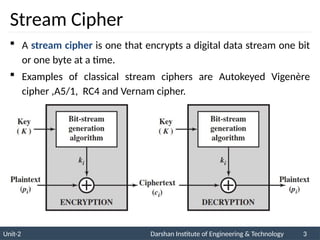
Stream Cipher
 A stream cipher is one that encrypts a digital data stream one bit
or one byte at a time.
 Examples of classical stream ciphers are Autokeyed Vigenère
cipher ,A5/1, RC4 and Vernam cipher.
Unit-2 Darshan Institute of Engineering & Technology 4
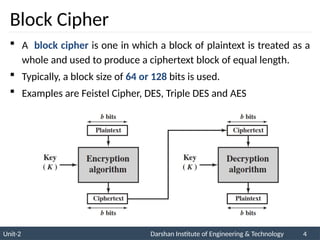
Block Cipher
 A block cipher is one in which a block of plaintext is treated as a
whole and used to produce a ciphertext block of equal length.
 Typically, a block size of 64 or 128 bits is used.
 Examples are Feistel Cipher, DES, Triple DES and AES
Unit-2 Darshan Institute of Engineering & Technology 5
Diffusion and Confusion
 Diffusion hides the relationship between the ciphertext and the
plaintext.
 This is achieved by having each plaintext digit affect the value of
many ciphertext digits.
 Confusion hides the relationship between the ciphertext and the
key.
 This is achieved by the use of a complex substitution algorithm.
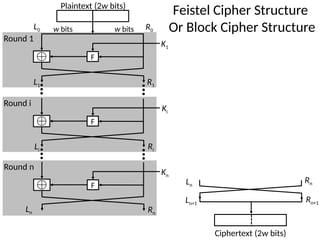
Round 1
Plaintext (2w bits)
F
w bits
w bits R0
L0
K1
R1
L1
Rn+1
Ln+1
Round i
F
Ki
Ri
Li
Round n
F
Kn
Ln Rn
Rn
Ln
Ciphertext (2w bits)
Feistel Cipher Structure
Or Block Cipher Structure
Unit-2 Darshan Institute of Engineering & Technology 7
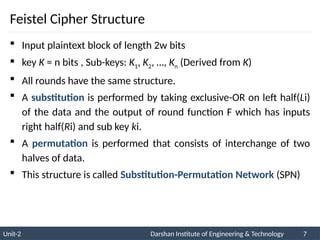
Feistel Cipher Structure
 Input plaintext block of length 2w bits
 key K = n bits , Sub-keys: K1, K2, …, Kn (Derived from K)
 All rounds have the same structure.
 A substitution is performed by taking exclusive-OR on left half(Li)
of the data and the output of round function F which has inputs
right half(Ri) and sub key ki.
 A permutation is performed that consists of interchange of two
halves of data.
 This structure is called Substitution-Permutation Network (SPN)
Unit-2 Darshan Institute of Engineering & Technology 8
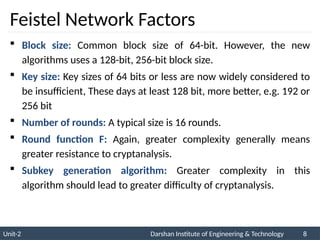
Feistel Network Factors
 Block size: Common block size of 64-bit. However, the new
algorithms uses a 128-bit, 256-bit block size.
 Key size: Key sizes of 64 bits or less are now widely considered to
be insufficient, These days at least 128 bit, more better, e.g. 192 or
256 bit
 Number of rounds: A typical size is 16 rounds.
 Round function F: Again, greater complexity generally means
greater resistance to cryptanalysis.
 Subkey generation algorithm: Greater complexity in this
algorithm should lead to greater difficulty of cryptanalysis.
Feistel Encryption & Decryption
 Prove that o/p of first round
of Decryption is equal to 32-
bit swap of i/p of 16th
round of
Encryption
 LD1=RE15 & RD1=LE15
𝐿𝐸16=𝑅 𝐸15
𝑅𝐸16=𝐿𝐸15 ⊕ 𝐹(𝑅𝐸15 ,𝐾16)
 On Encryption Side:
𝐿𝐷1=𝑅𝐷0=𝐿𝐸16=𝑅𝐸15
𝑅𝐷1=𝐿 𝐷0⊕ 𝐹 (𝑅 𝐷0 ,𝐾16)
 On Decryption Side:
¿ 𝑅𝐸16 ⊕ 𝐹 (𝑅𝐸15 , 𝐾 16 )
¿[𝐿𝐸¿¿15⊕𝐹 (𝑅𝐸15 , 𝐾16)] ⊕𝐹 (𝑅𝐸15 , 𝐾16)¿
XOR Associativity
Property
Unit-2 Darshan Institute of Engineering & Technology 10
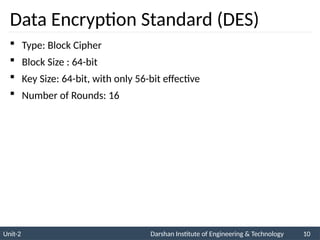
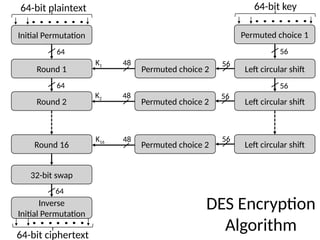
Data Encryption Standard (DES)
 Type: Block Cipher
 Block Size : 64-bit
 Key Size: 64-bit, with only 56-bit effective
 Number of Rounds: 16
Initial Permutation
Round 1
Round 2
Round 16
32-bit swap
Inverse
Initial Permutation
Permuted choice 2
Permuted choice 1
Left circular shift
Permuted choice 2 Left circular shift
64-bit plaintext 64-bit key
64-bit ciphertext
64 56
64
64
56
56
56
56
48
K1
48
K2
48
K16
DES Encryption
Algorithm
Unit-2 Darshan Institute of Engineering & Technology 12
DES Encryption Algorithm (Cont…)
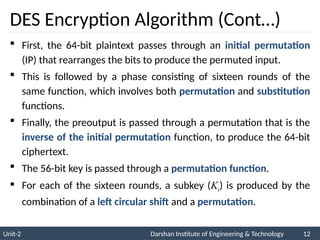
 First, the 64-bit plaintext passes through an initial permutation
(IP) that rearranges the bits to produce the permuted input.
 This is followed by a phase consisting of sixteen rounds of the
same function, which involves both permutation and substitution
functions.
 Finally, the preoutput is passed through a permutation that is the
inverse of the initial permutation function, to produce the 64-bit
ciphertext.
 The 56-bit key is passed through a permutation function.
 For each of the sixteen rounds, a subkey (Ki) is produced by the
combination of a left circular shift and a permutation.
Unit-2 Darshan Institute of Engineering & Technology 13
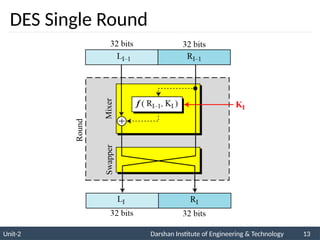
DES Single Round
𝐿𝑖 −1
32-bits
𝑅𝑖 −1
32-bits
𝐶𝑖 − 1
28-bits
𝐷𝑖 −1
28-bits
Expansion/ permutation
(E table)
XOR
Substitution/choice
(S-box)
Permutation
(P)
XOR
𝐿𝑖 𝑅𝑖 𝐶 𝑖 𝐷𝑖
Left Shift
(S)
Left Shift
(S)
Permutation/
compression
(Permuted choice 2)
48
Ki
48
48
32
32
Unit-2 Darshan Institute of Engineering & Technology 15
DES Single Round (Cont…)
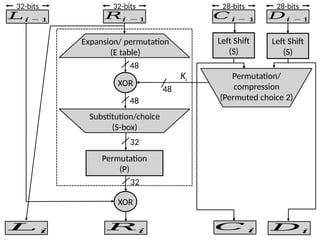
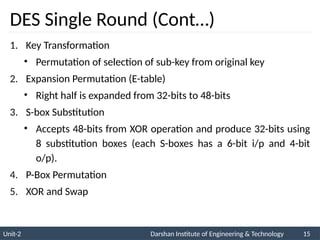
1. Key Transformation
• Permutation of selection of sub-key from original key
2. Expansion Permutation (E-table)
• Right half is expanded from 32-bits to 48-bits
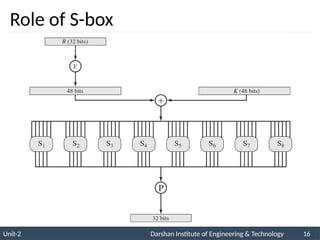
3. S-box Substitution
• Accepts 48-bits from XOR operation and produce 32-bits using
8 substitution boxes (each S-boxes has a 6-bit i/p and 4-bit
o/p).
4. P-Box Permutation
5. XOR and Swap
Unit-2 Darshan Institute of Engineering & Technology 16
Role of S-box
Unit-2 Darshan Institute of Engineering & Technology 17
Role of S-box (Cont…)
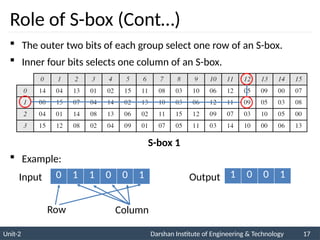
 The outer two bits of each group select one row of an S-box.
 Inner four bits selects one column of an S-box.
 Example:
S-box 1
0 1 1 0 0 1
Row Column
Input Output 1 0 0 1
Unit-2 Darshan Institute of Engineering & Technology 18
Avalanche Effect
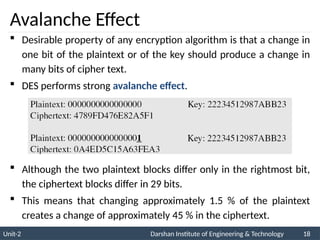
 Desirable property of any encryption algorithm is that a change in
one bit of the plaintext or of the key should produce a change in
many bits of cipher text.
 DES performs strong avalanche effect.
 Although the two plaintext blocks differ only in the rightmost bit,
the ciphertext blocks differ in 29 bits.
 This means that changing approximately 1.5 % of the plaintext
creates a change of approximately 45 % in the ciphertext.
Unit-2 Darshan Institute of Engineering & Technology 19
AES (Advanced Encryption Standard)
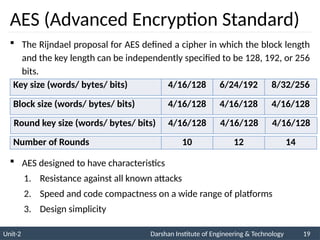
 The Rijndael proposal for AES defined a cipher in which the block length
and the key length can be independently specified to be 128, 192, or 256
bits.
 AES designed to have characteristics
1. Resistance against all known attacks
2. Speed and code compactness on a wide range of platforms
3. Design simplicity
Key size (words/ bytes/ bits) 4/16/128 6/24/192 8/32/256
Block size (words/ bytes/ bits) 4/16/128 4/16/128 4/16/128
Round key size (words/ bytes/ bits) 4/16/128 4/16/128 4/16/128
Number of Rounds 10 12 14
Unit-2 Darshan Institute of Engineering & Technology 20
AES (Advanced Encryption Standard)
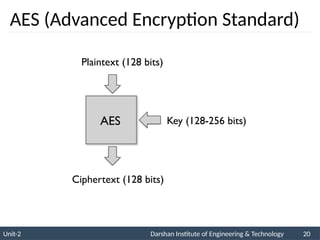
AES
Plaintext (128 bits)
Ciphertext (128 bits)
Key (128-256 bits)
AES Structure
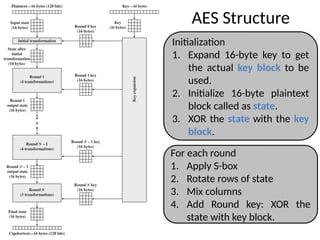
Initialization
1. Expand 16-byte key to get
the actual key block to be
used.
2. Initialize 16-byte plaintext
block called as state.
3. XOR the state with the key
block.
For each round
1. Apply S-box
2. Rotate rows of state
3. Mix columns
4. Add Round key: XOR the
state with key block.
Unit-2 Darshan Institute of Engineering & Technology 22
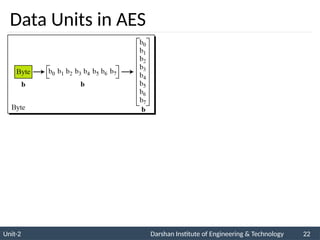
Data Units in AES
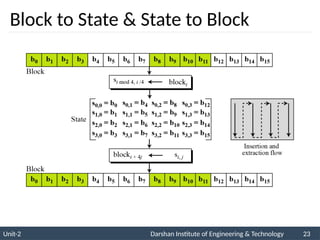
Unit-2 Darshan Institute of Engineering & Technology 23
Block to State & State to Block
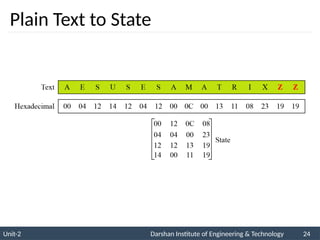
Unit-2 Darshan Institute of Engineering & Technology 24
Plain Text to State
Unit-2 Darshan Institute of Engineering & Technology 25
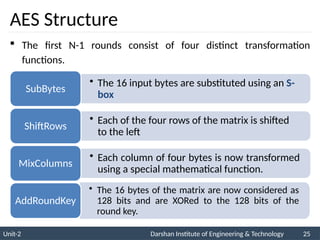
AES Structure
 The first N-1 rounds consist of four distinct transformation
functions.
• The 16 input bytes are substituted using an S-
box
SubBytes
• Each of the four rows of the matrix is shifted
to the left
ShiftRows
• Each column of four bytes is now transformed
using a special mathematical function.
MixColumns
• The 16 bytes of the matrix are now considered as
128 bits and are XORed to the 128 bits of the
round key.
AddRoundKey
Unit-2 Darshan Institute of Engineering & Technology 26
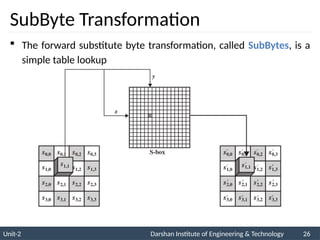
SubByte Transformation
 The forward substitute byte transformation, called SubBytes, is a
simple table lookup
Unit-2 Darshan Institute of Engineering & Technology 27
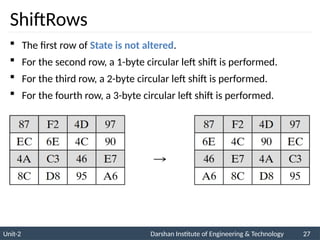
ShiftRows
 The first row of State is not altered.
 For the second row, a 1-byte circular left shift is performed.
 For the third row, a 2-byte circular left shift is performed.
 For the fourth row, a 3-byte circular left shift is performed.
Unit-2 Darshan Institute of Engineering & Technology 28
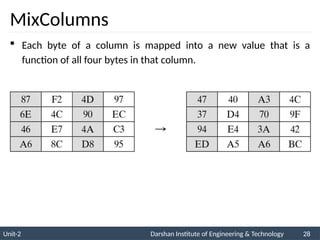
MixColumns
 Each byte of a column is mapped into a new value that is a
function of all four bytes in that column.
Unit-2 Darshan Institute of Engineering & Technology 29
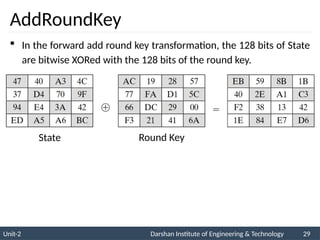
AddRoundKey
 In the forward add round key transformation, the 128 bits of State
are bitwise XORed with the 128 bits of the round key.
State Round Key
Unit-2 Darshan Institute of Engineering & Technology 30
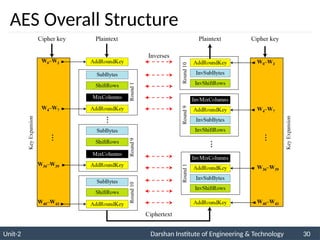
AES Overall Structure
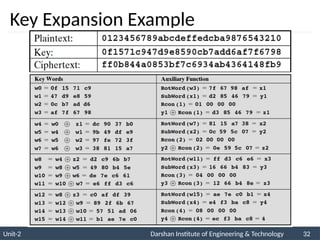
 The AES key expansion algorithm takes as
input a four-word (16-byte) key and produces
a linear array of 44 words (176 bytes).
 Each added word w[i] depends on the
immediately preceding word, w[i - 1].
 In three out of four cases, a simple XOR is
used.
AES Key Expansion
Unit-2 Darshan Institute of Engineering & Technology 32
Key Expansion Example
Stream Ciphers and Block Ciphers in Security.pptx

Stream Ciphers and Block Ciphers in Security.pptx

  • 1.
    Prof. Rupesh G.Vaishnav rupesh.vaishnav@darshan.ac.in 94280-37452 Information & Network Security (2170709) Darshan Institute of Engineering & Technology UNIT-2 Stream ciphers and block ciphers
  • 2.
    Unit-2 Darshan Instituteof Engineering & Technology 2 Unit-2  Stream ciphers and block ciphers  Block Cipher structure  Data Encryption standard (DES)  Design principles of block cipher  AES with structure  AES Transformation functions  Key expansion
  • 3.
    Unit-2 Darshan Instituteof Engineering & Technology 3 Stream Cipher  A stream cipher is one that encrypts a digital data stream one bit or one byte at a time.  Examples of classical stream ciphers are Autokeyed Vigenère cipher ,A5/1, RC4 and Vernam cipher.
  • 4.
    Unit-2 Darshan Instituteof Engineering & Technology 4 Block Cipher  A block cipher is one in which a block of plaintext is treated as a whole and used to produce a ciphertext block of equal length.  Typically, a block size of 64 or 128 bits is used.  Examples are Feistel Cipher, DES, Triple DES and AES
  • 5.
    Unit-2 Darshan Instituteof Engineering & Technology 5 Diffusion and Confusion  Diffusion hides the relationship between the ciphertext and the plaintext.  This is achieved by having each plaintext digit affect the value of many ciphertext digits.  Confusion hides the relationship between the ciphertext and the key.  This is achieved by the use of a complex substitution algorithm.
  • 6.
    Round 1 Plaintext (2wbits) F w bits w bits R0 L0 K1 R1 L1 Rn+1 Ln+1 Round i F Ki Ri Li Round n F Kn Ln Rn Rn Ln Ciphertext (2w bits) Feistel Cipher Structure Or Block Cipher Structure
  • 7.
    Unit-2 Darshan Instituteof Engineering & Technology 7 Feistel Cipher Structure  Input plaintext block of length 2w bits  key K = n bits , Sub-keys: K1, K2, …, Kn (Derived from K)  All rounds have the same structure.  A substitution is performed by taking exclusive-OR on left half(Li) of the data and the output of round function F which has inputs right half(Ri) and sub key ki.  A permutation is performed that consists of interchange of two halves of data.  This structure is called Substitution-Permutation Network (SPN)
  • 8.
    Unit-2 Darshan Instituteof Engineering & Technology 8 Feistel Network Factors  Block size: Common block size of 64-bit. However, the new algorithms uses a 128-bit, 256-bit block size.  Key size: Key sizes of 64 bits or less are now widely considered to be insufficient, These days at least 128 bit, more better, e.g. 192 or 256 bit  Number of rounds: A typical size is 16 rounds.  Round function F: Again, greater complexity generally means greater resistance to cryptanalysis.  Subkey generation algorithm: Greater complexity in this algorithm should lead to greater difficulty of cryptanalysis.
  • 9.
    Feistel Encryption &Decryption  Prove that o/p of first round of Decryption is equal to 32- bit swap of i/p of 16th round of Encryption  LD1=RE15 & RD1=LE15 𝐿𝐸16=𝑅 𝐸15 𝑅𝐸16=𝐿𝐸15 ⊕ 𝐹(𝑅𝐸15 ,𝐾16)  On Encryption Side: 𝐿𝐷1=𝑅𝐷0=𝐿𝐸16=𝑅𝐸15 𝑅𝐷1=𝐿 𝐷0⊕ 𝐹 (𝑅 𝐷0 ,𝐾16)  On Decryption Side: ¿ 𝑅𝐸16 ⊕ 𝐹 (𝑅𝐸15 , 𝐾 16 ) ¿[𝐿𝐸¿¿15⊕𝐹 (𝑅𝐸15 , 𝐾16)] ⊕𝐹 (𝑅𝐸15 , 𝐾16)¿ XOR Associativity Property
  • 10.
    Unit-2 Darshan Instituteof Engineering & Technology 10 Data Encryption Standard (DES)  Type: Block Cipher  Block Size : 64-bit  Key Size: 64-bit, with only 56-bit effective  Number of Rounds: 16
  • 11.
    Initial Permutation Round 1 Round2 Round 16 32-bit swap Inverse Initial Permutation Permuted choice 2 Permuted choice 1 Left circular shift Permuted choice 2 Left circular shift Permuted choice 2 Left circular shift 64-bit plaintext 64-bit key 64-bit ciphertext 64 56 64 64 56 56 56 56 48 K1 48 K2 48 K16 DES Encryption Algorithm
  • 12.
    Unit-2 Darshan Instituteof Engineering & Technology 12 DES Encryption Algorithm (Cont…)  First, the 64-bit plaintext passes through an initial permutation (IP) that rearranges the bits to produce the permuted input.  This is followed by a phase consisting of sixteen rounds of the same function, which involves both permutation and substitution functions.  Finally, the preoutput is passed through a permutation that is the inverse of the initial permutation function, to produce the 64-bit ciphertext.  The 56-bit key is passed through a permutation function.  For each of the sixteen rounds, a subkey (Ki) is produced by the combination of a left circular shift and a permutation.
  • 13.
    Unit-2 Darshan Instituteof Engineering & Technology 13 DES Single Round
  • 14.
    𝐿𝑖 −1 32-bits 𝑅𝑖 −1 32-bits 𝐶𝑖− 1 28-bits 𝐷𝑖 −1 28-bits Expansion/ permutation (E table) XOR Substitution/choice (S-box) Permutation (P) XOR 𝐿𝑖 𝑅𝑖 𝐶 𝑖 𝐷𝑖 Left Shift (S) Left Shift (S) Permutation/ compression (Permuted choice 2) 48 Ki 48 48 32 32
  • 15.
    Unit-2 Darshan Instituteof Engineering & Technology 15 DES Single Round (Cont…) 1. Key Transformation • Permutation of selection of sub-key from original key 2. Expansion Permutation (E-table) • Right half is expanded from 32-bits to 48-bits 3. S-box Substitution • Accepts 48-bits from XOR operation and produce 32-bits using 8 substitution boxes (each S-boxes has a 6-bit i/p and 4-bit o/p). 4. P-Box Permutation 5. XOR and Swap
  • 16.
    Unit-2 Darshan Instituteof Engineering & Technology 16 Role of S-box
  • 17.
    Unit-2 Darshan Instituteof Engineering & Technology 17 Role of S-box (Cont…)  The outer two bits of each group select one row of an S-box.  Inner four bits selects one column of an S-box.  Example: S-box 1 0 1 1 0 0 1 Row Column Input Output 1 0 0 1
  • 18.
    Unit-2 Darshan Instituteof Engineering & Technology 18 Avalanche Effect  Desirable property of any encryption algorithm is that a change in one bit of the plaintext or of the key should produce a change in many bits of cipher text.  DES performs strong avalanche effect.  Although the two plaintext blocks differ only in the rightmost bit, the ciphertext blocks differ in 29 bits.  This means that changing approximately 1.5 % of the plaintext creates a change of approximately 45 % in the ciphertext.
  • 19.
    Unit-2 Darshan Instituteof Engineering & Technology 19 AES (Advanced Encryption Standard)  The Rijndael proposal for AES defined a cipher in which the block length and the key length can be independently specified to be 128, 192, or 256 bits.  AES designed to have characteristics 1. Resistance against all known attacks 2. Speed and code compactness on a wide range of platforms 3. Design simplicity Key size (words/ bytes/ bits) 4/16/128 6/24/192 8/32/256 Block size (words/ bytes/ bits) 4/16/128 4/16/128 4/16/128 Round key size (words/ bytes/ bits) 4/16/128 4/16/128 4/16/128 Number of Rounds 10 12 14
  • 20.
    Unit-2 Darshan Instituteof Engineering & Technology 20 AES (Advanced Encryption Standard) AES Plaintext (128 bits) Ciphertext (128 bits) Key (128-256 bits)
  • 21.
    AES Structure Initialization 1. Expand16-byte key to get the actual key block to be used. 2. Initialize 16-byte plaintext block called as state. 3. XOR the state with the key block. For each round 1. Apply S-box 2. Rotate rows of state 3. Mix columns 4. Add Round key: XOR the state with key block.
  • 22.
    Unit-2 Darshan Instituteof Engineering & Technology 22 Data Units in AES
  • 23.
    Unit-2 Darshan Instituteof Engineering & Technology 23 Block to State & State to Block
  • 24.
    Unit-2 Darshan Instituteof Engineering & Technology 24 Plain Text to State
  • 25.
    Unit-2 Darshan Instituteof Engineering & Technology 25 AES Structure  The first N-1 rounds consist of four distinct transformation functions. • The 16 input bytes are substituted using an S- box SubBytes • Each of the four rows of the matrix is shifted to the left ShiftRows • Each column of four bytes is now transformed using a special mathematical function. MixColumns • The 16 bytes of the matrix are now considered as 128 bits and are XORed to the 128 bits of the round key. AddRoundKey
  • 26.
    Unit-2 Darshan Instituteof Engineering & Technology 26 SubByte Transformation  The forward substitute byte transformation, called SubBytes, is a simple table lookup
  • 27.
    Unit-2 Darshan Instituteof Engineering & Technology 27 ShiftRows  The first row of State is not altered.  For the second row, a 1-byte circular left shift is performed.  For the third row, a 2-byte circular left shift is performed.  For the fourth row, a 3-byte circular left shift is performed.
  • 28.
    Unit-2 Darshan Instituteof Engineering & Technology 28 MixColumns  Each byte of a column is mapped into a new value that is a function of all four bytes in that column.
  • 29.
    Unit-2 Darshan Instituteof Engineering & Technology 29 AddRoundKey  In the forward add round key transformation, the 128 bits of State are bitwise XORed with the 128 bits of the round key. State Round Key
  • 30.
    Unit-2 Darshan Instituteof Engineering & Technology 30 AES Overall Structure
  • 31.
     The AESkey expansion algorithm takes as input a four-word (16-byte) key and produces a linear array of 44 words (176 bytes).  Each added word w[i] depends on the immediately preceding word, w[i - 1].  In three out of four cases, a simple XOR is used. AES Key Expansion
  • 32.
    Unit-2 Darshan Instituteof Engineering & Technology 32 Key Expansion Example

Editor's Notes

  • #2 X.800 and RFC 2828 International Telecommunication Union (ITU)
  • #14 confusion step is the S-box substitution, while the diffusion step is where the output of the S-boxes is rearranged according to the P-box permutation rules.