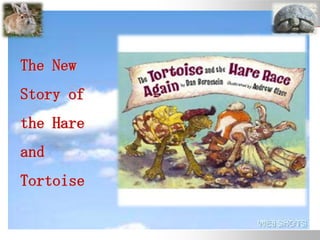
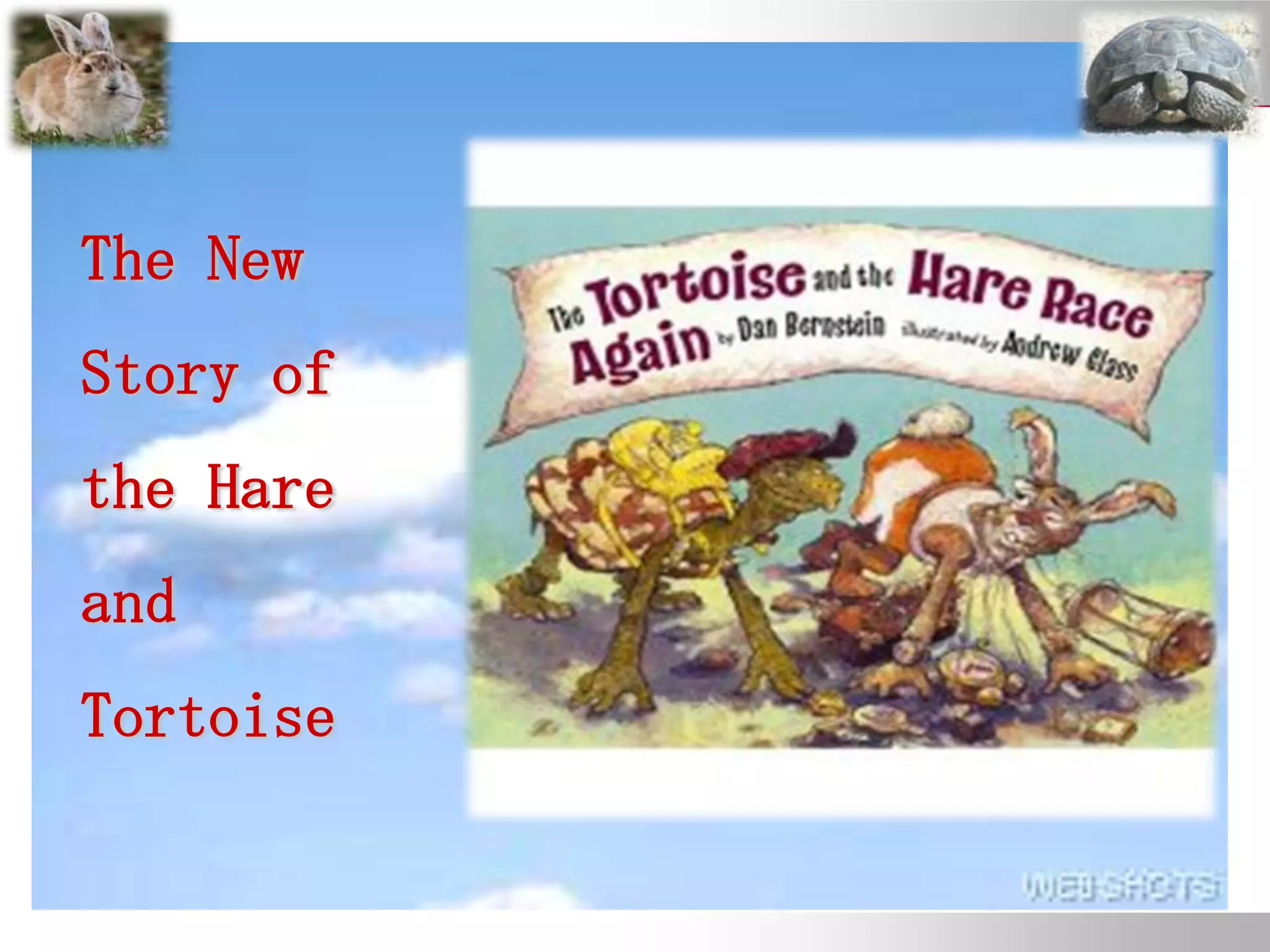












The New
Story of
the Hare
and
Tortoise
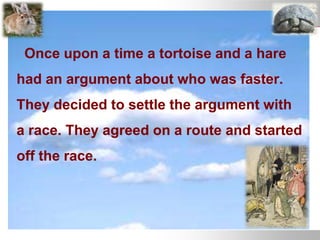
Once upon a time a tortoise and a hare
had an argument about who was faster.
They decided to settle the argument with
a race. They agreed on a route and started
off the race.
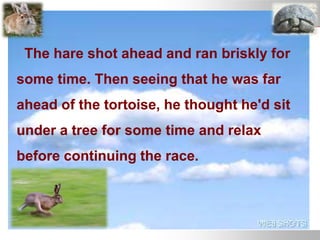
The hare shot ahead and ran briskly for
some time. Then seeing that he was far
ahead of the tortoise, he thought he'd sit
under a tree for some time and relax
before continuing the race.
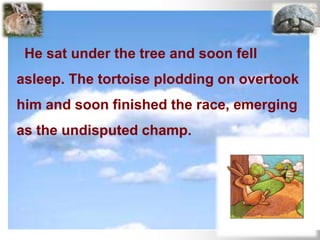
He sat under the tree and soon fell
asleep. The tortoise plodding on overtook
him and soon finished the race, emerging
as the undisputed champ.
The hare woke up and realized that he'd
lost the race. The moral of the story is that
slow and steady wins the race.
This is the version of the story that we've
all grown up with.
But then the story is NOT over. The
modern day Hare and the modern day
Tortoise do NOT leave it at that.
They do not let things lie.
It continues.
The hare was disappointed at losing the
race and he did some Defect Prevention
(Root Cause Analysis). He realized that
he'd lost the race only because he had
been overconfident, careless and lax.
If he had not taken things for granted,
there's no way the tortoise could have
beaten him. So he challenged the tortoise
to another race. The tortoise agreed.
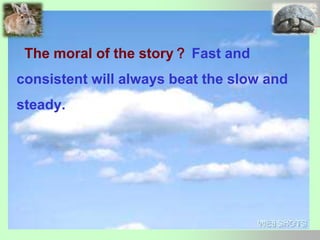
This time, the hare went all out and ran
without stopping from start to finish. He
won by several miles.
The moral of the story? Fast and
consistent will always beat the slow and
steady.
If you have two people in your organization,
one slow, methodical and reliable, and the other
fast and still reliable at what he does, the fast
and reliable person will consistently climb the
organizational ladder faster than the slow,
methodical person.
Moral:
It's good to be slow and steady; but it's
better to be fast and reliable.
But the story doesn't end here.
The tortoise did some thinking this time,
and realized that there's no way he can
beat the hare in a race the way it was
currently formatted.
He thought for a while, and then
challenged the hare to another race, but
on a slightly different route.
The hare agreed. They started off. In
keeping with his self-made commitment to
be consistently fast, the hare took off and
ran at top speed until he came to a broad
river.
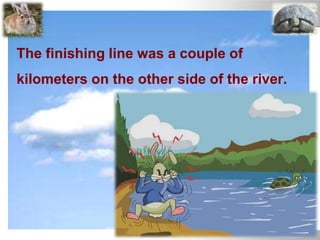
The finishing line was a couple of
kilometers on the other side of the river.
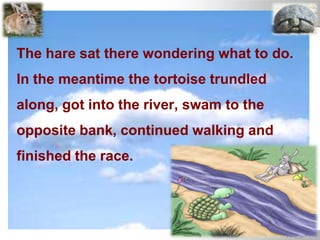
The hare sat there wondering what to do.
In the meantime the tortoise trundled
along, got into the river, swam to the
opposite bank, continued walking and
finished the race.
The moral of the story?
First identify your core competency and
then change the playing field to suit your
core competency.
In an organization, if you are a good
speaker, make sure you create
opportunities to give presentations that
enable senior management to notice you.
If your strength is analysis, make sure
you do some sort of research, make a
report and send it upstairs. Working to
your strengths will not only get you
noticed but will also create opportunities
for growth and advancement.
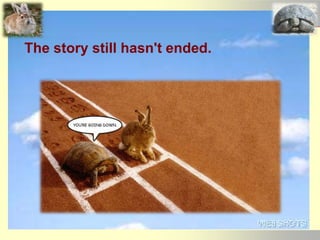
The story still hasn't ended.
The hare and the tortoise, by this time,
had become pretty good friends and they
did some thinking together. Both realized
that the last race could have been run
much better.
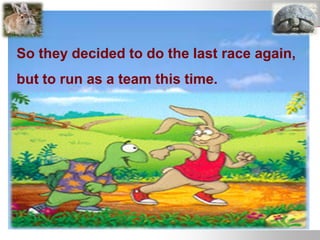
So they decided to do the last race again,
but to run as a team this time.
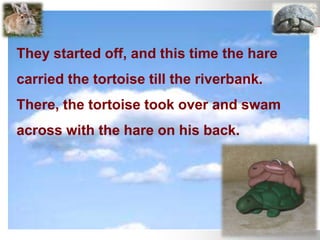
They started off, and this time the hare
carried the tortoise till the riverbank.
There, the tortoise took over and swam
across with the hare on his back.
On the opposite bank, the hare again
carried the tortoise and they reached the
finishing line together. They both felt a
greater sense of satisfaction than they'd
felt earlier.
The moral of the story?
It's good to be individually brilliant & to
have strong core competencies; but
unless you're able to work in a team &
harness each other's core competencies,
you'll always perform below par because
there will always be situations at which
you'll do poorly & someone else does well.
Teamwork is mainly about situational
leadership, letting the person with the
relevant core competency for a situation
take leadership.
There are more lessons to be learnt from
this story.
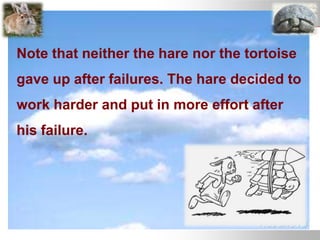
Note that neither the hare nor the tortoise
gave up after failures. The hare decided to
work harder and put in more effort after
his failure.
The tortoise changed his strategy
because he was already working as hard
as he could. In life, when faced with
failure, sometimes it is appropriate to
work harder and put in more effort.
And sometimes it is appropriate to
change strategy and try something
different.
And sometimes it is appropriate to do
both.
The hare and the tortoise also learnt
another vital lesson.
When we stop competing against a rival
and instead start competing against the
situation, we perform far better.
When Roberto Goizueta took over as CEO
of Coca-Cola in the 1980s, he was faced
with intense competition from Pepsi that
was eating into Coke's growth.
His executives were Pepsi-focussed and
intent on increasing market share 0.1 per
cent a time. Market Share
Market Share
Goizueta decided to stop competing
against Pepsi and instead compete
against the situation of 0.1 per cent
growth.
He asked his executives what was the
average fluid intake of an American per
day? The answer was 14 ounces.
What was Coke's share of that? Two
ounces. Goizueta said Coke needed a
larger share of that market.
The competition wasn't Pepsi. It was the
water, tea, coffee, milk and fruit juices that
went into the remaining 12 ounces. The
public should reach for a Coke whenever
they felt like drinking something.
To this end, Coke purchased Powerade to
capture the 24 hour cycle of each
American: starting right from the
Breakfast table onwards
(In India Limca, Maaza, Thumbs up)
The moral of the story? It's good to be
individually brilliant & to have strong core
competencies; but unless you're able to
work in a team & harness each other's
core competencies, you'll always perform
below par because there will always be
situations at which you'll do poorly and
someone else does well.
To sum up, the story of the hare and tortoise teaches us
many things.
Important lessons are:
• That fast and consistent will always beat slow and
steady;
• Work to your competencies;
• Pooling resources and working as a team will always
beat individual performers;
• Never give up when faced with failure;
• Finally, compete against the situation. Not against a
rival.
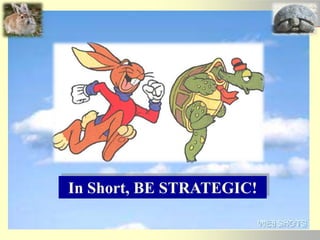
In Short, BE STRATEGIC!
I would request for your or
or your views at
my contact details:
colsengupta@outlook.com
facebook.com/colsengupta
+91 90 510 25672

Strategy hare & tortoise

  • 1.
    The New Story of theHare and Tortoise
  • 2.
    Once upon atime a tortoise and a hare had an argument about who was faster. They decided to settle the argument with a race. They agreed on a route and started off the race.
  • 3.
    The hare shotahead and ran briskly for some time. Then seeing that he was far ahead of the tortoise, he thought he'd sit under a tree for some time and relax before continuing the race.
  • 4.
    He sat underthe tree and soon fell asleep. The tortoise plodding on overtook him and soon finished the race, emerging as the undisputed champ.
  • 5.
    The hare wokeup and realized that he'd lost the race. The moral of the story is that slow and steady wins the race.
  • 6.
    This is theversion of the story that we've all grown up with.
  • 7.
    But then thestory is NOT over. The modern day Hare and the modern day Tortoise do NOT leave it at that. They do not let things lie. It continues.
  • 8.
    The hare wasdisappointed at losing the race and he did some Defect Prevention (Root Cause Analysis). He realized that he'd lost the race only because he had been overconfident, careless and lax.
  • 9.
    If he hadnot taken things for granted, there's no way the tortoise could have beaten him. So he challenged the tortoise to another race. The tortoise agreed.
  • 10.
    This time, thehare went all out and ran without stopping from start to finish. He won by several miles.
  • 11.
    The moral ofthe story? Fast and consistent will always beat the slow and steady.
  • 12.
    If you havetwo people in your organization, one slow, methodical and reliable, and the other fast and still reliable at what he does, the fast and reliable person will consistently climb the organizational ladder faster than the slow, methodical person.
  • 13.
    Moral: It's good tobe slow and steady; but it's better to be fast and reliable.
  • 14.
    But the storydoesn't end here. The tortoise did some thinking this time, and realized that there's no way he can beat the hare in a race the way it was currently formatted.
  • 15.
    He thought fora while, and then challenged the hare to another race, but on a slightly different route.
  • 16.
    The hare agreed.They started off. In keeping with his self-made commitment to be consistently fast, the hare took off and ran at top speed until he came to a broad river.
  • 17.
    The finishing linewas a couple of kilometers on the other side of the river.
  • 18.
    The hare satthere wondering what to do. In the meantime the tortoise trundled along, got into the river, swam to the opposite bank, continued walking and finished the race.
  • 19.
    The moral ofthe story? First identify your core competency and then change the playing field to suit your core competency.
  • 20.
    In an organization,if you are a good speaker, make sure you create opportunities to give presentations that enable senior management to notice you.
  • 21.
    If your strengthis analysis, make sure you do some sort of research, make a report and send it upstairs. Working to your strengths will not only get you noticed but will also create opportunities for growth and advancement.
  • 22.
    The story stillhasn't ended.
  • 23.
    The hare andthe tortoise, by this time, had become pretty good friends and they did some thinking together. Both realized that the last race could have been run much better.
  • 24.
    So they decidedto do the last race again, but to run as a team this time.
  • 25.
    They started off,and this time the hare carried the tortoise till the riverbank. There, the tortoise took over and swam across with the hare on his back.
  • 26.
    On the oppositebank, the hare again carried the tortoise and they reached the finishing line together. They both felt a greater sense of satisfaction than they'd felt earlier.
  • 27.
    The moral ofthe story?
  • 29.
    It's good tobe individually brilliant & to have strong core competencies; but unless you're able to work in a team & harness each other's core competencies, you'll always perform below par because there will always be situations at which you'll do poorly & someone else does well.
  • 30.
    Teamwork is mainlyabout situational leadership, letting the person with the relevant core competency for a situation take leadership.
  • 31.
    There are morelessons to be learnt from this story.
  • 32.
    Note that neitherthe hare nor the tortoise gave up after failures. The hare decided to work harder and put in more effort after his failure.
  • 33.
    The tortoise changedhis strategy because he was already working as hard as he could. In life, when faced with failure, sometimes it is appropriate to work harder and put in more effort.
  • 34.
    And sometimes itis appropriate to change strategy and try something different. And sometimes it is appropriate to do both.
  • 35.
    The hare andthe tortoise also learnt another vital lesson. When we stop competing against a rival and instead start competing against the situation, we perform far better.
  • 36.
    When Roberto Goizuetatook over as CEO of Coca-Cola in the 1980s, he was faced with intense competition from Pepsi that was eating into Coke's growth.
  • 37.
    His executives werePepsi-focussed and intent on increasing market share 0.1 per cent a time. Market Share Market Share
  • 38.
    Goizueta decided tostop competing against Pepsi and instead compete against the situation of 0.1 per cent growth.
  • 39.
    He asked hisexecutives what was the average fluid intake of an American per day? The answer was 14 ounces. What was Coke's share of that? Two ounces. Goizueta said Coke needed a larger share of that market.
  • 40.
    The competition wasn'tPepsi. It was the water, tea, coffee, milk and fruit juices that went into the remaining 12 ounces. The public should reach for a Coke whenever they felt like drinking something.
  • 41.
    To this end,Coke purchased Powerade to capture the 24 hour cycle of each American: starting right from the Breakfast table onwards (In India Limca, Maaza, Thumbs up)
  • 42.
    The moral ofthe story? It's good to be individually brilliant & to have strong core competencies; but unless you're able to work in a team & harness each other's core competencies, you'll always perform below par because there will always be situations at which you'll do poorly and someone else does well.
  • 43.
    To sum up,the story of the hare and tortoise teaches us many things. Important lessons are: • That fast and consistent will always beat slow and steady; • Work to your competencies; • Pooling resources and working as a team will always beat individual performers; • Never give up when faced with failure; • Finally, compete against the situation. Not against a rival.
  • 44.
    In Short, BESTRATEGIC!
  • 45.
    I would requestfor your or or your views at my contact details: colsengupta@outlook.com facebook.com/colsengupta +91 90 510 25672