Strategies & Qualification
methodologies for
Visual Inspection
Bram Keymolen
07 June 2018
Strategies & Qualification methodologies for
Visual Inspection
1. Introduction: Defect categories & definitions
2. Qualification methodologies for automated inspection: Strategies
and Mindsets
3. Quality Control testing of difficult to inspect products
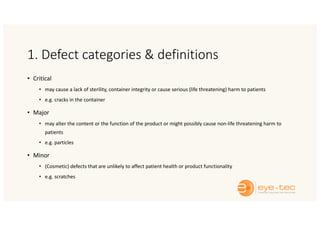
1. Defect categories & definitions
• Critical
• may cause a lack of sterility, container integrity or cause serious (life threatening) harm to patients
• e.g. cracks in the container
• Major
• may alter the content or the function of the product or might possibly cause non-life threatening harm to
patients
• e.g. particles
• Minor
• (Cosmetic) defects that are unlikely to affect patient health or product functionality
• e.g. scratches
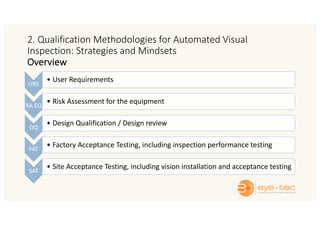
2. Qualification Methodologies for Automated Visual
Inspection: Strategies and Mindsets
Overview
URS
• User Requirements
RA EQ
• Risk Assessment for the equipment
DQ
• Design Qualification / Design review
FAT
• Factory Acceptance Testing, including inspection performance testing
SAT
• Site Acceptance Testing, including vision installation and acceptance testing
2. Qualification Methodologies for Automated Visual
Inspection: Strategies and Mindsets
Overview
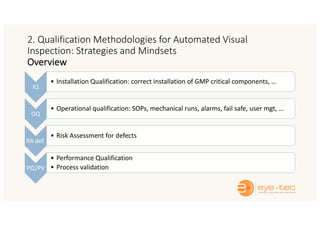
IQ
• Installation Qualification: correct installation of GMP critical components, …
OQ
• Operational qualification: SOPs, mechanical runs, alarms, fail safe, user mgt, …
RA def.
• Risk Assessment for defects
PQ/PV
• Performance Qualification
• Process validation
2. Qualification Methodologies for Automated Visual
Inspection: Strategies and Mindsets
Risk Assessment for defects
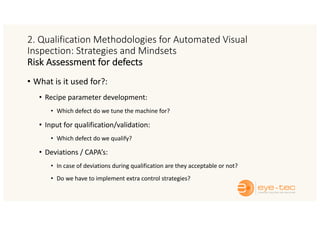
• What is it used for?:
• Recipe parameter development:
• Which defect do we tune the machine for?
• Input for qualification/validation:
• Which defect do we qualify?
• Deviations / CAPA’s:
• In case of deviations during qualification are they acceptable or not?
• Do we have to implement extra control strategies?
2. Qualification Methodologies for Automated Visual
Inspection: Strategies and Mindsets
Risk Assessment for defects
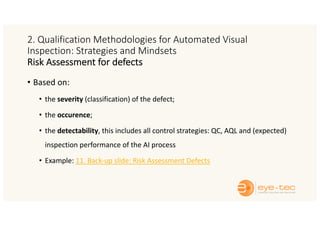
• Based on:
• the severity (classification) of the defect;
• the occurence;
• the detectability, this includes all control strategies: QC, AQL and (expected)
inspection performance of the AI process
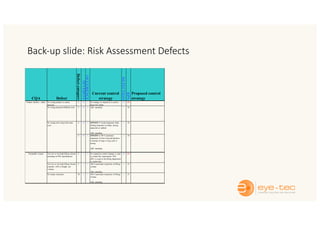
• Example: 11. Back-up slide: Risk Assessment Defects
2. Qualification Methodologies for Automated Visual Inspection: Strategies and Mindsets
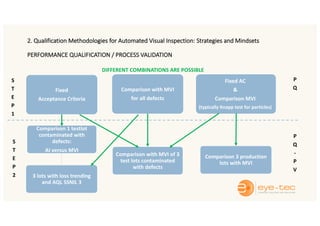
PERFORMANCE QUALIFICATION / PROCESS VALIDATION
Comparison with MVI
for all defects
Comparison 3 production
lots with MVI
Fixed
Acceptance Criteria
Fixed AC
&
Comparison MVI
(typically Knapp test for particles)
Comparison 1 testlot
contaminated with
defects:
AI versus MVI
Comparison with MVI of 3
test lots contaminated
with defects
3 lots with loss trending
and AQL SSNIL 3
S
T
E
P
1
S
T
E
P
2
P
Q
P
Q
-
P
V
DIFFERENT COMBINATIONS ARE POSSIBLE
2. Qualification Methodologies for Automated Visual Inspection:
Strategies and Mindsets
Knapp test
• a method which has been developed to evaluate the inspection efficiency of an
inspection process/system (semi-automatic or automatic) with a reference
inspection method (in most cases manual visual inspection)
• Basics:
• All containers which are rejected ³ 70% by manual visual inspection are considered defects
• Acceptance criteria:
• The overall inspection efficiency for these defects of automatic visual inspection has to be equal or
greater than the inspection efficiency of manual inspection for these defects
• Initially developed for particles. Is and can be used for other defects.
2. Qualification Methodologies for Automated Visual Inspection:
Strategies and Mindsets
Performance qualification / Process Validation – recommendations
• Regulatory expectation: compare every defect category to Manual Visual
Inspection (gold standard)
• Use bracketing approach during PQ/PV for defining which lots should be
inspected, based on:
• Container type (e.g 2 ml vial)
• Fill level / strength, e.g. lowest and highest fill level
• Product type (suspension, solution, freeze dry, …)
2. Qualification Methodologies for Automated Visual
Inspection: Strategies and Mindsets
TEST SETS
• What should be in?:
• All defects which can be inspected by AI
• Existing products: based on hystorical data / defect library
• New products: based on upstream processes or hystorical data of similar products
• Composition: based on hystorical data and criticality
• Assembly:
• OPTION 1: Real production defects
• OPTION 2: Artificially and characterized defects
• For test sets which are compared with MVI:
• Use invisble ink to mark (UV)
• Not more than 10 % defects
• Use a logbook for each test set
2. Qualification Methodologies for Automated Visual
Inspection: Strategies and Mindsets
Control strategies
• Routine operation:
• Functional test set: clear defects, use to check functionality of machine
• Reject trending & control limits: for automated inspection, overall reject, per reject station, per camera
station and/or area of inspection (e.g. side wall)
• AQL sampling (ANSI/ASQ Z1.4, ISO2859-1):
• Critical 0.01 – 0.1
• Major 0.1 – 0.65
• Minor 1.0 – 4.0
• Requalification / Revalidation
• Periodic review of production data, change controls, CAPA’s
• Every 3 to 5 years product specific?
3. Quality Control testing
of difficult to inspect products
Introduction
Visual Inspection may have limited adequacy to detect visible particulate
matter, due to
• Product characteristics (non-transparent)
• Container characteristics
Guidance Documents
• PDA TR79 Particulate Matter Control in Difficult to Inspect Parenterals
• USP <1790> Visual Inspection of Injections
• USP <1> Injections
3. USP <1790>
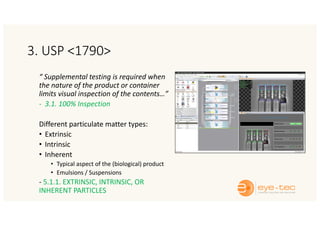
“ Supplemental testing is required when
the nature of the product or container
limits visual inspection of the contents…”
- 3.1. 100% Inspection
Different particulate matter types:
• Extrinsic
• Intrinsic
• Inherent
• Typical aspect of the (biological) product
• Emulsions / Suspensions
- 5.1.1. EXTRINSIC, INTRINSIC, OR
INHERENT PARTICLES
3. USP <1790>
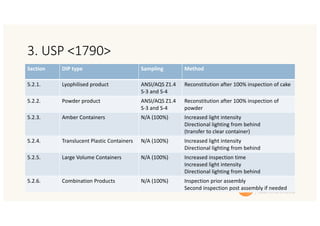
Section DIP type Sampling Method
5.2.1. Lyophilised product ANSI/AQS Z1.4
S-3 and S-4
Reconstitution after 100% inspection of cake
5.2.2. Powder product ANSI/AQS Z1.4
S-3 and S-4
Reconstitution after 100% inspection of
powder
5.2.3. Amber Containers N/A (100%) Increased light intensity
Directional lighting from behind
(transfer to clear container)
5.2.4. Translucent Plastic Containers N/A (100%) Increased light intensity
Directional lighting from behind
5.2.5. Large Volume Containers N/A (100%) Increased inspection time
Increased light intensity
Directional lighting from behind
5.2.6. Combination Products N/A (100%) Inspection prior assembly
Second inspection post assembly if needed
3. PDA Technical Report No. 79
PDA Survey on DIP (3.1)
• All companies do 100% inspection
• Only half of companies perform supplemental destructive testing
• Only 1/3 apply AQL limits <0,1% for DIP
• Sampling plans based on
• ISO 2859
• ANSI/ASQ Z1.4
• Fixed sample sizes
3. PDA Technical Report No. 79
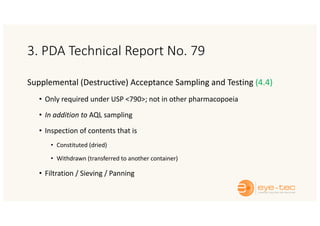
Supplemental (Destructive) Acceptance Sampling and Testing (4.4)
• Only required under USP <790>; not in other pharmacopoeia
• In addition to AQL sampling
• Inspection of contents that is
• Constituted (dried)
• Withdrawn (transferred to another container)
• Filtration / Sieving / Panning
3. PDA Technical Report No. 79
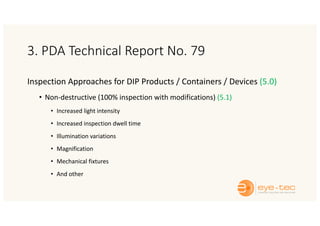
Inspection Approaches for DIP Products / Containers / Devices (5.0)
• Non-destructive (100% inspection with modifications) (5.1)
• Increased light intensity
• Increased inspection dwell time
• Illumination variations
• Magnification
• Mechanical fixtures
• And other
3. PDA Technical Report No. 79
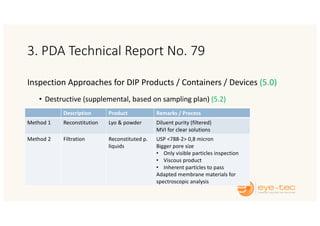
Inspection Approaches for DIP Products / Containers / Devices (5.0)
• Destructive (supplemental, based on sampling plan) (5.2)
Description Product Remarks / Process
Method 1 Reconstitution Lyo & powder Diluent purity (filtered)
MVI for clear solutions
Method 2 Filtration Reconstituted p.
liquids
USP <788-2> 0,8 micron
Bigger pore size
• Only visible particles inspection
• Viscous product
• Inherent particles to pass
Adapted membrane materials for
spectroscopic analysis
3. PDA Technical Report No. 79
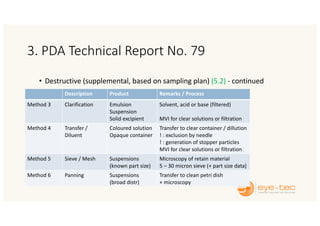
• Destructive (supplemental, based on sampling plan) (5.2) - continued
Description Product Remarks / Process
Method 3 Clarification Emulsion
Suspension
Solid excipient
Solvent, acid or base (filtered)
MVI for clear solutions or filtration
Method 4 Transfer /
Diluent
Coloured solution
Opaque container
Transfer to clear container / dillution
! : exclusion by needle
! : generation of stopper particles
MVI for clear solutions or filtration
Method 5 Sieve / Mesh Suspensions
(known part size)
Microscopy of retain material
5 – 30 micron sieve (+ part size data)
Method 6 Panning Suspensions
(broad distr)
Transfer to clean petri dish
+ microscopy
3. PDA Technical Report No. 79
• Destructive (supplemental, based on sampling plan) (5.2) - continued
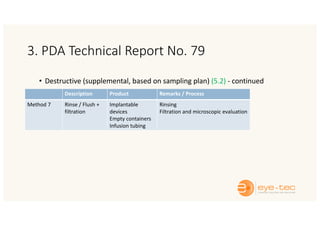
Description Product Remarks / Process
Method 7 Rinse / Flush +
filtration
Implantable
devices
Empty containers
Infusion tubing
Rinsing
Filtration and microscopic evaluation
END
Thank you for listening
Back-up slide: Risk Assessment Defects
CQA Defect
Defect
category
SEVERITY
OCCURENCE
Current control
strategy
DETECTION
RPN
Proposed control
strategy
No wrong product in correct
ampoule
C 10 1 No strategy in inspection is used to
detect this defect
10 100
No wrong ampoule (different size) C 10 3 AQL sampling 1 30
C 10 1 OPTION 1 Visual inspection when
feeding ampoules at infeed, traying
ampoules at outfeed.
AQL sampling
7 70
C 10 1 OPTION 2 100 % automatic
inspection of color ring and rejection
if number of rings or ring color is
wrong.
AQL sampling
1 10
Too low or too high filling volume
according to PPS specifications
C 5 5 No inspection control strategy is used
to control this requirement. SPC
(IPC) is used in the filling department
to control this.
10 250
Too low or too high filling volume
(outside ± 20% in height, not
volume)
C 7 5 100 % automatic inspection of filling
volume
AQL sampling
1 35
No empty containers M 5 7 100 % automatic inspection of filling
volume
AQL sampling
1 35
Extractable volume
No wrong color ring (with same
size)
Product identity / safety

Strategies & Qualification Methodologies for visual Inspection

  • 1.
    Strategies & Qualification methodologiesfor Visual Inspection Bram Keymolen 07 June 2018
  • 2.
    Strategies & Qualificationmethodologies for Visual Inspection 1. Introduction: Defect categories & definitions 2. Qualification methodologies for automated inspection: Strategies and Mindsets 3. Quality Control testing of difficult to inspect products
  • 3.
    1. Defect categories& definitions • Critical • may cause a lack of sterility, container integrity or cause serious (life threatening) harm to patients • e.g. cracks in the container • Major • may alter the content or the function of the product or might possibly cause non-life threatening harm to patients • e.g. particles • Minor • (Cosmetic) defects that are unlikely to affect patient health or product functionality • e.g. scratches
  • 4.
    2. Qualification Methodologiesfor Automated Visual Inspection: Strategies and Mindsets Overview URS • User Requirements RA EQ • Risk Assessment for the equipment DQ • Design Qualification / Design review FAT • Factory Acceptance Testing, including inspection performance testing SAT • Site Acceptance Testing, including vision installation and acceptance testing
  • 5.
    2. Qualification Methodologiesfor Automated Visual Inspection: Strategies and Mindsets Overview IQ • Installation Qualification: correct installation of GMP critical components, … OQ • Operational qualification: SOPs, mechanical runs, alarms, fail safe, user mgt, … RA def. • Risk Assessment for defects PQ/PV • Performance Qualification • Process validation
  • 6.
    2. Qualification Methodologiesfor Automated Visual Inspection: Strategies and Mindsets Risk Assessment for defects • What is it used for?: • Recipe parameter development: • Which defect do we tune the machine for? • Input for qualification/validation: • Which defect do we qualify? • Deviations / CAPA’s: • In case of deviations during qualification are they acceptable or not? • Do we have to implement extra control strategies?
  • 7.
    2. Qualification Methodologiesfor Automated Visual Inspection: Strategies and Mindsets Risk Assessment for defects • Based on: • the severity (classification) of the defect; • the occurence; • the detectability, this includes all control strategies: QC, AQL and (expected) inspection performance of the AI process • Example: 11. Back-up slide: Risk Assessment Defects
  • 8.
    2. Qualification Methodologiesfor Automated Visual Inspection: Strategies and Mindsets PERFORMANCE QUALIFICATION / PROCESS VALIDATION Comparison with MVI for all defects Comparison 3 production lots with MVI Fixed Acceptance Criteria Fixed AC & Comparison MVI (typically Knapp test for particles) Comparison 1 testlot contaminated with defects: AI versus MVI Comparison with MVI of 3 test lots contaminated with defects 3 lots with loss trending and AQL SSNIL 3 S T E P 1 S T E P 2 P Q P Q - P V DIFFERENT COMBINATIONS ARE POSSIBLE
  • 9.
    2. Qualification Methodologiesfor Automated Visual Inspection: Strategies and Mindsets Knapp test • a method which has been developed to evaluate the inspection efficiency of an inspection process/system (semi-automatic or automatic) with a reference inspection method (in most cases manual visual inspection) • Basics: • All containers which are rejected ³ 70% by manual visual inspection are considered defects • Acceptance criteria: • The overall inspection efficiency for these defects of automatic visual inspection has to be equal or greater than the inspection efficiency of manual inspection for these defects • Initially developed for particles. Is and can be used for other defects.
  • 10.
    2. Qualification Methodologiesfor Automated Visual Inspection: Strategies and Mindsets Performance qualification / Process Validation – recommendations • Regulatory expectation: compare every defect category to Manual Visual Inspection (gold standard) • Use bracketing approach during PQ/PV for defining which lots should be inspected, based on: • Container type (e.g 2 ml vial) • Fill level / strength, e.g. lowest and highest fill level • Product type (suspension, solution, freeze dry, …)
  • 11.
    2. Qualification Methodologiesfor Automated Visual Inspection: Strategies and Mindsets TEST SETS • What should be in?: • All defects which can be inspected by AI • Existing products: based on hystorical data / defect library • New products: based on upstream processes or hystorical data of similar products • Composition: based on hystorical data and criticality • Assembly: • OPTION 1: Real production defects • OPTION 2: Artificially and characterized defects • For test sets which are compared with MVI: • Use invisble ink to mark (UV) • Not more than 10 % defects • Use a logbook for each test set
  • 12.
    2. Qualification Methodologiesfor Automated Visual Inspection: Strategies and Mindsets Control strategies • Routine operation: • Functional test set: clear defects, use to check functionality of machine • Reject trending & control limits: for automated inspection, overall reject, per reject station, per camera station and/or area of inspection (e.g. side wall) • AQL sampling (ANSI/ASQ Z1.4, ISO2859-1): • Critical 0.01 – 0.1 • Major 0.1 – 0.65 • Minor 1.0 – 4.0 • Requalification / Revalidation • Periodic review of production data, change controls, CAPA’s • Every 3 to 5 years product specific?
  • 13.
    3. Quality Controltesting of difficult to inspect products Introduction Visual Inspection may have limited adequacy to detect visible particulate matter, due to • Product characteristics (non-transparent) • Container characteristics Guidance Documents • PDA TR79 Particulate Matter Control in Difficult to Inspect Parenterals • USP <1790> Visual Inspection of Injections • USP <1> Injections
  • 14.
    3. USP <1790> “Supplemental testing is required when the nature of the product or container limits visual inspection of the contents…” - 3.1. 100% Inspection Different particulate matter types: • Extrinsic • Intrinsic • Inherent • Typical aspect of the (biological) product • Emulsions / Suspensions - 5.1.1. EXTRINSIC, INTRINSIC, OR INHERENT PARTICLES
  • 15.
    3. USP <1790> SectionDIP type Sampling Method 5.2.1. Lyophilised product ANSI/AQS Z1.4 S-3 and S-4 Reconstitution after 100% inspection of cake 5.2.2. Powder product ANSI/AQS Z1.4 S-3 and S-4 Reconstitution after 100% inspection of powder 5.2.3. Amber Containers N/A (100%) Increased light intensity Directional lighting from behind (transfer to clear container) 5.2.4. Translucent Plastic Containers N/A (100%) Increased light intensity Directional lighting from behind 5.2.5. Large Volume Containers N/A (100%) Increased inspection time Increased light intensity Directional lighting from behind 5.2.6. Combination Products N/A (100%) Inspection prior assembly Second inspection post assembly if needed
  • 16.
    3. PDA TechnicalReport No. 79 PDA Survey on DIP (3.1) • All companies do 100% inspection • Only half of companies perform supplemental destructive testing • Only 1/3 apply AQL limits <0,1% for DIP • Sampling plans based on • ISO 2859 • ANSI/ASQ Z1.4 • Fixed sample sizes
  • 17.
    3. PDA TechnicalReport No. 79 Supplemental (Destructive) Acceptance Sampling and Testing (4.4) • Only required under USP <790>; not in other pharmacopoeia • In addition to AQL sampling • Inspection of contents that is • Constituted (dried) • Withdrawn (transferred to another container) • Filtration / Sieving / Panning
  • 18.
    3. PDA TechnicalReport No. 79 Inspection Approaches for DIP Products / Containers / Devices (5.0) • Non-destructive (100% inspection with modifications) (5.1) • Increased light intensity • Increased inspection dwell time • Illumination variations • Magnification • Mechanical fixtures • And other
  • 19.
    3. PDA TechnicalReport No. 79 Inspection Approaches for DIP Products / Containers / Devices (5.0) • Destructive (supplemental, based on sampling plan) (5.2) Description Product Remarks / Process Method 1 Reconstitution Lyo & powder Diluent purity (filtered) MVI for clear solutions Method 2 Filtration Reconstituted p. liquids USP <788-2> 0,8 micron Bigger pore size • Only visible particles inspection • Viscous product • Inherent particles to pass Adapted membrane materials for spectroscopic analysis
  • 20.
    3. PDA TechnicalReport No. 79 • Destructive (supplemental, based on sampling plan) (5.2) - continued Description Product Remarks / Process Method 3 Clarification Emulsion Suspension Solid excipient Solvent, acid or base (filtered) MVI for clear solutions or filtration Method 4 Transfer / Diluent Coloured solution Opaque container Transfer to clear container / dillution ! : exclusion by needle ! : generation of stopper particles MVI for clear solutions or filtration Method 5 Sieve / Mesh Suspensions (known part size) Microscopy of retain material 5 – 30 micron sieve (+ part size data) Method 6 Panning Suspensions (broad distr) Transfer to clean petri dish + microscopy
  • 21.
    3. PDA TechnicalReport No. 79 • Destructive (supplemental, based on sampling plan) (5.2) - continued Description Product Remarks / Process Method 7 Rinse / Flush + filtration Implantable devices Empty containers Infusion tubing Rinsing Filtration and microscopic evaluation
  • 22.
  • 23.
    Back-up slide: RiskAssessment Defects CQA Defect Defect category SEVERITY OCCURENCE Current control strategy DETECTION RPN Proposed control strategy No wrong product in correct ampoule C 10 1 No strategy in inspection is used to detect this defect 10 100 No wrong ampoule (different size) C 10 3 AQL sampling 1 30 C 10 1 OPTION 1 Visual inspection when feeding ampoules at infeed, traying ampoules at outfeed. AQL sampling 7 70 C 10 1 OPTION 2 100 % automatic inspection of color ring and rejection if number of rings or ring color is wrong. AQL sampling 1 10 Too low or too high filling volume according to PPS specifications C 5 5 No inspection control strategy is used to control this requirement. SPC (IPC) is used in the filling department to control this. 10 250 Too low or too high filling volume (outside ± 20% in height, not volume) C 7 5 100 % automatic inspection of filling volume AQL sampling 1 35 No empty containers M 5 7 100 % automatic inspection of filling volume AQL sampling 1 35 Extractable volume No wrong color ring (with same size) Product identity / safety