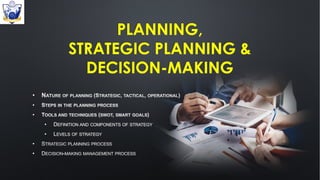
PLANNING,
STRATEGIC PLANNING &
DECISION-MAKING
•
•
•
• DEFINITION AND COMPONENTS OF STRATEGY
• LEVELS OF STRATEGY
•
•
•
•
•
Philippine Christian University - Master in Business Administration - Management
“If you fail to plan, to plan to fail”
•
•
•
•
•
Philippine Christian University - Master in Business Administration - Management
• GOAL-ORIENTED:
• PRIMARY FUNCTION:
• PERVASIVE:
• CONTINUOUS:
• DECISION-FOCUSED:
• FUTURISTIC:
Type Time Frame Management Level Focus Example
Strategic Planning
Long term (3-5
years)
Top-level
Organizational
direction and goals
Setting the
company vision
and mission
Tactical Planning
Mid-term (1-3
years)
Middle-level
Departmental
objectives
Developing a
marketing plan for
a new product
Operational
Planning
Short-term (daily – 1
year)
Lower-level Routine operations
Managing
inventory orders
Philippine Christian University - Master in Business Administration - Management
STEPS IN THE PLANNING PROCESS
1. Establishing
Organizational
Goals and
Objectives
2. Environmental
Scanning and
Situational
Analysis
3. Identifying
Alternative of
Actions
4. Evaluating
Alternatives
5. Selecting the
Best Alternative
6. Developing
Action Plan
7. Implementing
Action Plan
8. Monitoring
and Evaluating
Progress
Philippine Christian University - Master in Business Administration - Management
• Goals should
be SMART
(must be
aligned with
the vision
and mission
of the org.
• Provides
direction
and purpose
• MBO (P.
Drucker)
• Helps org.
anticipate
trends and
make
informed
decisions
grounded in
data and
forecasts
• SWOT
• PESTEL
• Porter's Five
Forces
• Generating
a range of
possible
strategies
and actions
that could
help
achieve
goals.
• Managers
must weigh
options
based on
limited
information
and time.
• Selecting the
most
appropriate,
efficient, &
sustainable
strategy.
• Cost-benefits,
Feasibility,
• Risk Factors,
Alignment
with
Organizational
Goals
• Decision-
making
based on
evaluation.
• Strategic
judgment
and
compromise.
• Choice must
be justified in
terms of
value
creation and
goal
alignment.
• Order and
discipline
(Fayol’s
Principles) –
to ensure
coordination
and clarity.
• Assigning
responsibilitie
s
• Setting
timelines
• Allocating
resources
• Establishing
monitoring
metrics.
• Putting the
plan into
action
(teams or
individuals).
• Effective
leadership,
communicat
ion, and
motivation
are vital to
ensure
compliance
and
performanc
e.
• Adaptive
decision-
making.
• KPIs
• Balanced
Scorecard
• Feedback
loops
Philippine Christian University - Master in Business Administration - Management
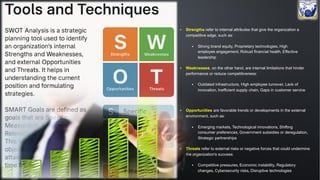
§ Strengths refer to internal attributes that give the organization a
competitive edge, such as:
§ Strong brand equity, Proprietary technologies, High
employee engagement, Robust financial health, Effective
leadership
§ Weaknesses, on the other hand, are internal limitations that hinder
performance or reduce competitiveness:
§ Outdated infrastructure, High employee turnover, Lack of
innovation, Inefficient supply chain, Gaps in customer service
§ Opportunities are favorable trends or developments in the external
environment, such as:
§ Emerging markets, Technological innovations, Shifting
consumer preferences, Government subsidies or deregulation,
Strategic partnerships
§ Threats refer to external risks or negative forces that could undermine
the organization's success:
§ Competitive pressures, Economic instability, Regulatory
changes, Cybersecurity risks, Disruptive technologies
Philippine Christian University - Master in Business Administration - Management
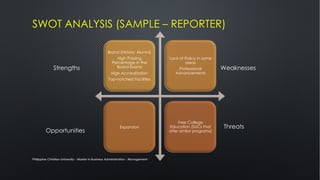
SWOT ANALYSIS (SAMPLE – REPORTER)
Brand (History; Alumni)
High Passing
Percentage in the
Board Exams
High Accreditation
Top-notched Facilities
Lack of Policy in some
areas
Professional
Advancements
Expansion
Free College
Education (SUCs that
offer similar programs)
Strengths
Threats
Opportunities
Weaknesses
Philippine Christian University - Master in Business Administration - Management
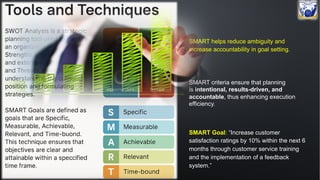
SMART helps reduce ambiguity and
increase accountability in goal setting.
SMART Goal: “Increase customer
satisfaction ratings by 10% within the next 6
months through customer service training
and the implementation of a feedback
system.”
SMART criteria ensure that planning
is intentional, results-driven, and
accountable, thus enhancing execution
efficiency.
Philippine Christian University - Master in Business Administration - Management
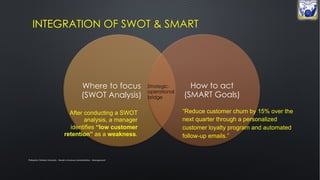
Where to focus
(SWOT Analysis)
How to act
(SMART Goals)
INTEGRATION OF SWOT & SMART
Strategic-
operational
bridge
After conducting a SWOT
analysis, a manager
identifies “low customer
retention” as a weakness.
“Reduce customer churn by 15% over the
next quarter through a personalized
customer loyalty program and automated
follow-up emails.”
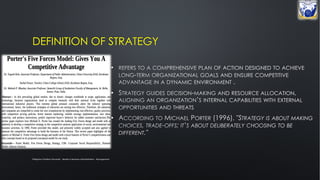
DEFINITION OF STRATEGY
•
•
•
Philippine Christian University - Master in Business Administration - Management
•
•
•
•
•
Philippine Christian University - Master in Business Administration - Management
KEY CHARACTERISTICS OF STRATEGY
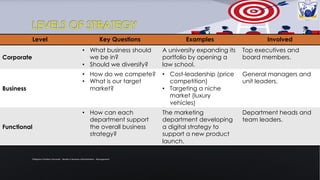
Level Key Questions Examples Involved
Corporate
• What business should
we be in?
• Should we diversify?
A university expanding its
portfolio by opening a
law school.
Top executives and
board members.
Business
• How do we compete?
• What is our target
market?
• Cost-leadership (price
competition)
• Targeting a niche
market (luxury
vehicles)
General managers and
unit leaders.
Functional
• How can each
department support
the overall business
strategy?
The marketing
department developing
a digital strategy to
support a new product
launch.
Department heads and
team leaders.
Philippine Christian University - Master in Business Administration - Management
LEVELS OF STRATEGY
Philippine Christian University - Master in Business Administration - Management
Prepared and Presented by:
Jeremy Floyd L. Pedregosa
Thank you!
Philippine Christian University - Master in Business Administration - Management

Strategic Planning & Decision-Making.pdf

  • 1.
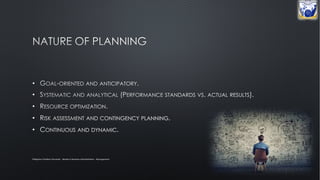
    PLANNING, STRATEGIC PLANNING & DECISION-MAKING • • • •DEFINITION AND COMPONENTS OF STRATEGY • LEVELS OF STRATEGY • •
  • 2.
    • • • Philippine Christian University- Master in Business Administration - Management “If you fail to plan, to plan to fail”
  • 3.
    • • • • • Philippine Christian University- Master in Business Administration - Management
  • 4.
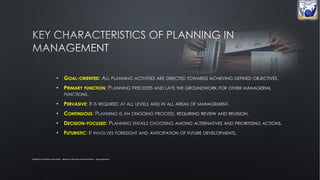
    Philippine Christian University- Master in Business Administration - Management • GOAL-ORIENTED: • PRIMARY FUNCTION: • PERVASIVE: • CONTINUOUS: • DECISION-FOCUSED: • FUTURISTIC:
  • 5.
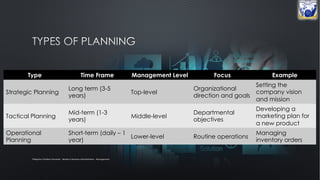
    Type Time FrameManagement Level Focus Example Strategic Planning Long term (3-5 years) Top-level Organizational direction and goals Setting the company vision and mission Tactical Planning Mid-term (1-3 years) Middle-level Departmental objectives Developing a marketing plan for a new product Operational Planning Short-term (daily – 1 year) Lower-level Routine operations Managing inventory orders Philippine Christian University - Master in Business Administration - Management
  • 6.
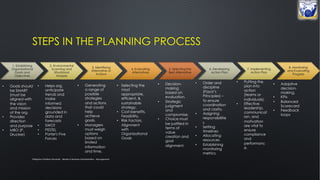
    STEPS IN THEPLANNING PROCESS 1. Establishing Organizational Goals and Objectives 2. Environmental Scanning and Situational Analysis 3. Identifying Alternative of Actions 4. Evaluating Alternatives 5. Selecting the Best Alternative 6. Developing Action Plan 7. Implementing Action Plan 8. Monitoring and Evaluating Progress Philippine Christian University - Master in Business Administration - Management • Goals should be SMART (must be aligned with the vision and mission of the org. • Provides direction and purpose • MBO (P. Drucker) • Helps org. anticipate trends and make informed decisions grounded in data and forecasts • SWOT • PESTEL • Porter's Five Forces • Generating a range of possible strategies and actions that could help achieve goals. • Managers must weigh options based on limited information and time. • Selecting the most appropriate, efficient, & sustainable strategy. • Cost-benefits, Feasibility, • Risk Factors, Alignment with Organizational Goals • Decision- making based on evaluation. • Strategic judgment and compromise. • Choice must be justified in terms of value creation and goal alignment. • Order and discipline (Fayol’s Principles) – to ensure coordination and clarity. • Assigning responsibilitie s • Setting timelines • Allocating resources • Establishing monitoring metrics. • Putting the plan into action (teams or individuals). • Effective leadership, communicat ion, and motivation are vital to ensure compliance and performanc e. • Adaptive decision- making. • KPIs • Balanced Scorecard • Feedback loops
  • 7.
    Philippine Christian University- Master in Business Administration - Management § Strengths refer to internal attributes that give the organization a competitive edge, such as: § Strong brand equity, Proprietary technologies, High employee engagement, Robust financial health, Effective leadership § Weaknesses, on the other hand, are internal limitations that hinder performance or reduce competitiveness: § Outdated infrastructure, High employee turnover, Lack of innovation, Inefficient supply chain, Gaps in customer service § Opportunities are favorable trends or developments in the external environment, such as: § Emerging markets, Technological innovations, Shifting consumer preferences, Government subsidies or deregulation, Strategic partnerships § Threats refer to external risks or negative forces that could undermine the organization's success: § Competitive pressures, Economic instability, Regulatory changes, Cybersecurity risks, Disruptive technologies
  • 8.
    Philippine Christian University- Master in Business Administration - Management SWOT ANALYSIS (SAMPLE – REPORTER) Brand (History; Alumni) High Passing Percentage in the Board Exams High Accreditation Top-notched Facilities Lack of Policy in some areas Professional Advancements Expansion Free College Education (SUCs that offer similar programs) Strengths Threats Opportunities Weaknesses
  • 9.
    Philippine Christian University- Master in Business Administration - Management SMART helps reduce ambiguity and increase accountability in goal setting. SMART Goal: “Increase customer satisfaction ratings by 10% within the next 6 months through customer service training and the implementation of a feedback system.” SMART criteria ensure that planning is intentional, results-driven, and accountable, thus enhancing execution efficiency.
  • 10.
    Philippine Christian University- Master in Business Administration - Management Where to focus (SWOT Analysis) How to act (SMART Goals) INTEGRATION OF SWOT & SMART Strategic- operational bridge After conducting a SWOT analysis, a manager identifies “low customer retention” as a weakness. “Reduce customer churn by 15% over the next quarter through a personalized customer loyalty program and automated follow-up emails.”
  • 11.
    DEFINITION OF STRATEGY • • • PhilippineChristian University - Master in Business Administration - Management
  • 12.
    • • • • • Philippine Christian University- Master in Business Administration - Management KEY CHARACTERISTICS OF STRATEGY
  • 13.
    Level Key QuestionsExamples Involved Corporate • What business should we be in? • Should we diversify? A university expanding its portfolio by opening a law school. Top executives and board members. Business • How do we compete? • What is our target market? • Cost-leadership (price competition) • Targeting a niche market (luxury vehicles) General managers and unit leaders. Functional • How can each department support the overall business strategy? The marketing department developing a digital strategy to support a new product launch. Department heads and team leaders. Philippine Christian University - Master in Business Administration - Management LEVELS OF STRATEGY
  • 14.
    Philippine Christian University- Master in Business Administration - Management Prepared and Presented by: Jeremy Floyd L. Pedregosa Thank you!
  • 15.
    Philippine Christian University- Master in Business Administration - Management
  • 16.
    Philippine Christian University- Master in Business Administration - Management