Strategic Management
Anindya Prasisca RZP, M.Sc
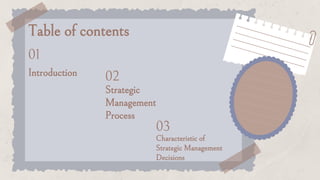
01
02
03
Table of contents
Introduction
Strategic
Management
Process
Characteristic of
Strategic Management
Decisions
INTRODUCTION
01
What is
strategy ?
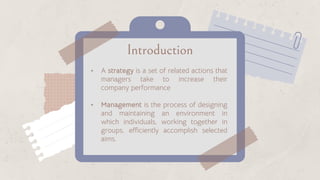
Introduction
• A strategy is a set of related actions that
managers take to increase their
company performance
• Management is the process of designing
and maintaining an environment in
which individuals, working together in
groups, efficiently accomplish selected
aims.
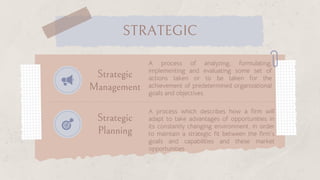
Strategic
Management
Strategic
Planning
A process of analyzing, formulating,
implementing and evaluating some set of
actions taken or to be taken for the
achievement of predetermined organizational
goals and objectives
A process which describes how a firm will
adapt to take advantages of opportunities in
its constantly changing environment, in order
to maintain a strategic fit between the firm’s
goals and capabilities and these market
opportunities
STRATEGIC
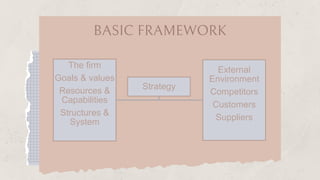
BASIC FRAMEWORK
The firm
Goals & values
Resources &
Capabilities
Structures &
System
External
Environment
Competitors
Customers
Suppliers
Strategy
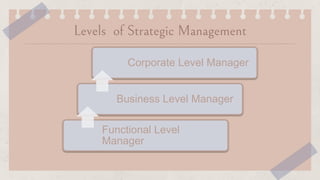
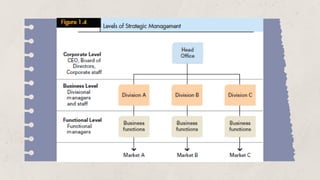
Levels of Strategic Management
Corporate Level Manager
Business Level Manager
Functional Level
Manager
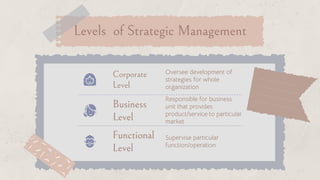
Corporate
Level
Oversee development of
strategies for whole
organization
Responsible for business
unit that provides
product/service to particular
market
Supervise particular
function/operation
Business
Level
Functional
Level
Levels of Strategic Management
STRATEGIC
MANAGEMENT
PROCESS
02
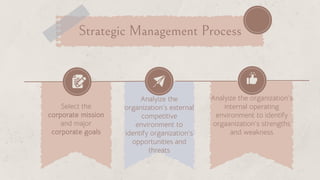
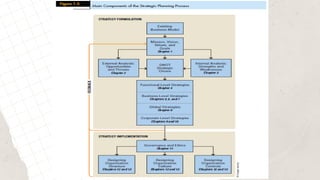
Strategic Management Process
Select the
corporate mission
and major
corporate goals
Analyize the
organization’s external
competitive
environment to
identify organization’s
opportunities and
threats
Analyize the organization’s
internal operating
environment to identify
orgaanization’s strengths
and weakness
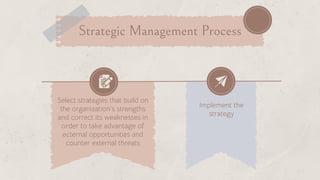
Strategic Management Process
Select strategies that build on
the organization’s strengths
and correct its weaknesses in
order to take advantage of
ecternal opportunities and
counter external threats
Implement the
strategy
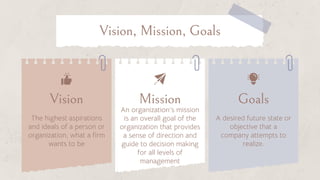
Vision
The highest aspirations
and ideals of a person or
organization, what a firm
wants to be
An organization’s mission
is an overall goal of the
organization that provides
a sense of direction and
guide to decision making
for all levels of
management
A desired future state or
objective that a
company attempts to
realize.
Mission Goals
Vision, Mission, Goals
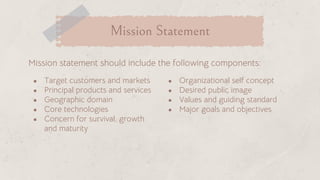
Mission Statement
● Target customers and markets
● Principal products and services
● Geographic domain
● Core technologies
● Concern for survival, growth
and maturity
● Organizational self concept
● Desired public image
● Values and guiding standard
● Major goals and objectives
Mission statement should include the following components:
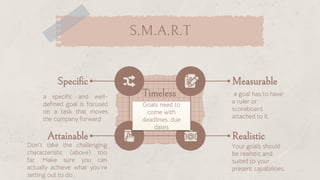
S.M.A.R.T
Characteristic of well constructed goals is :
Is there anyone
knows what is
S.M.A.R.T ?
S.M.A.R.T
a specific and well-
defined goal is focused
on a task that moves
the company forward
Specific
a goal has to have
a ruler or
scoreboard
attached to it.
Measurable
Don't take the challenging
characteristic (above) too
far. Make sure you can
actually achieve what you're
setting out to do..
Attainable
Your goals should
be realistic and
suited to your
present capabilities.
Realistic
Timeless
Goals need to
come with
deadlines, due
dates
EXTERNAL ANALYSIS
The purpose of the external analysis is to
identify strategic opportunities and threats
within the organization’s operating
environment that will affect how it pursue
its mission
INTERNAL ANALYSIS
The goal of a SWOT analysis :
 Create, affirm, or fine-tune a company-specific
business model
 Design a model that will best align, fit or match
a company’s resources and capabilities to the
demands of the environment in which it
operates
Functional – level
strategies
Directed at improving the
effectiveness of operations
within a company
 The way a company position
itself in the marketplace to
gain a competitive advatage
 The different position
strategies that can be used in
different industry settings
 Manufacturing, marketing,
materials management,
product development, and
customer service
Business – level
strategies
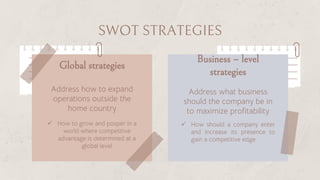
SWOT STRATEGIES
Global strategies
Address how to expand
operations outside the
home country
 How should a company enter
and increase its presence to
gain a competitive edge
 How to grow and posper in a
world where competitive
advantage is determined at a
global level
Business – level
strategies
SWOT STRATEGIES
Address what business
should the company be in
to maximize profitability
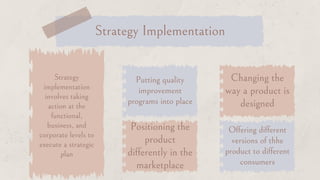
Strategy
implementation
involves taking
action at the
functional,
business, and
corporate levels to
execute a strategic
plan
Putting quality
improvement
programs into place
Changing the
way a product is
designed
Positioning the
product
differently in the
marketplace
Offering different
versions of thhe
product to different
consumers
Strategy Implementation
CHARACTERISTICS OF
STRATEGIC MANAGEMENT
DECISIONS
03
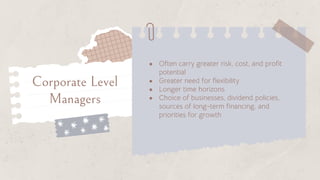
● Often carry greater risk, cost, and profit
potential
● Greater need for flexibility
● Longer time horizons
● Choice of businesses, dividend policies,
sources of long-term financing, and
priorities for growth
Corporate Level
Managers
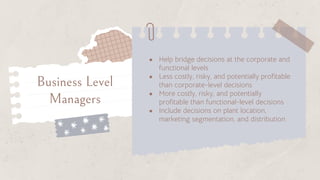
● Help bridge decisions at the corporate and
functional levels
● Less costly, risky, and potentially profitable
than corporate-level decisions
● More costly, risky, and potentially
profitable than functional-level decisions
● Include decisions on plant location,
marketing segmentation, and distribution
Business Level
Managers
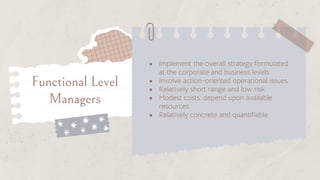
● Implement the overall strategy formulated
at the corporate and business levels
● Involve action-oriented operational issues
● Relatively short range and low risk
● Modest costs: depend upon available
resources
● Relatively concrete and quantifiable
Functional Level
Managers
THANK
YOU

CHAPTER 1 STRATEGIC MANAGEMENT BUSINESS.pdf

  • 1.
  • 2.
  • 3.
  • 4.
  • 5.
    Introduction • A strategyis a set of related actions that managers take to increase their company performance • Management is the process of designing and maintaining an environment in which individuals, working together in groups, efficiently accomplish selected aims.
  • 6.
    Strategic Management Strategic Planning A process ofanalyzing, formulating, implementing and evaluating some set of actions taken or to be taken for the achievement of predetermined organizational goals and objectives A process which describes how a firm will adapt to take advantages of opportunities in its constantly changing environment, in order to maintain a strategic fit between the firm’s goals and capabilities and these market opportunities STRATEGIC
  • 7.
    BASIC FRAMEWORK The firm Goals& values Resources & Capabilities Structures & System External Environment Competitors Customers Suppliers Strategy
  • 8.
    Levels of StrategicManagement Corporate Level Manager Business Level Manager Functional Level Manager
  • 9.
    Corporate Level Oversee development of strategiesfor whole organization Responsible for business unit that provides product/service to particular market Supervise particular function/operation Business Level Functional Level Levels of Strategic Management
  • 12.
  • 13.
    Strategic Management Process Selectthe corporate mission and major corporate goals Analyize the organization’s external competitive environment to identify organization’s opportunities and threats Analyize the organization’s internal operating environment to identify orgaanization’s strengths and weakness
  • 14.
    Strategic Management Process Selectstrategies that build on the organization’s strengths and correct its weaknesses in order to take advantage of ecternal opportunities and counter external threats Implement the strategy
  • 16.
    Vision The highest aspirations andideals of a person or organization, what a firm wants to be An organization’s mission is an overall goal of the organization that provides a sense of direction and guide to decision making for all levels of management A desired future state or objective that a company attempts to realize. Mission Goals Vision, Mission, Goals
  • 17.
    Mission Statement ● Targetcustomers and markets ● Principal products and services ● Geographic domain ● Core technologies ● Concern for survival, growth and maturity ● Organizational self concept ● Desired public image ● Values and guiding standard ● Major goals and objectives Mission statement should include the following components:
  • 18.
    S.M.A.R.T Characteristic of wellconstructed goals is :
  • 19.
    Is there anyone knowswhat is S.M.A.R.T ?
  • 20.
    S.M.A.R.T a specific andwell- defined goal is focused on a task that moves the company forward Specific a goal has to have a ruler or scoreboard attached to it. Measurable Don't take the challenging characteristic (above) too far. Make sure you can actually achieve what you're setting out to do.. Attainable Your goals should be realistic and suited to your present capabilities. Realistic Timeless Goals need to come with deadlines, due dates
  • 21.
    EXTERNAL ANALYSIS The purposeof the external analysis is to identify strategic opportunities and threats within the organization’s operating environment that will affect how it pursue its mission
  • 22.
    INTERNAL ANALYSIS The goalof a SWOT analysis :  Create, affirm, or fine-tune a company-specific business model  Design a model that will best align, fit or match a company’s resources and capabilities to the demands of the environment in which it operates
  • 23.
    Functional – level strategies Directedat improving the effectiveness of operations within a company  The way a company position itself in the marketplace to gain a competitive advatage  The different position strategies that can be used in different industry settings  Manufacturing, marketing, materials management, product development, and customer service Business – level strategies SWOT STRATEGIES
  • 24.
    Global strategies Address howto expand operations outside the home country  How should a company enter and increase its presence to gain a competitive edge  How to grow and posper in a world where competitive advantage is determined at a global level Business – level strategies SWOT STRATEGIES Address what business should the company be in to maximize profitability
  • 25.
    Strategy implementation involves taking action atthe functional, business, and corporate levels to execute a strategic plan Putting quality improvement programs into place Changing the way a product is designed Positioning the product differently in the marketplace Offering different versions of thhe product to different consumers Strategy Implementation
  • 26.
  • 28.
    ● Often carrygreater risk, cost, and profit potential ● Greater need for flexibility ● Longer time horizons ● Choice of businesses, dividend policies, sources of long-term financing, and priorities for growth Corporate Level Managers
  • 29.
    ● Help bridgedecisions at the corporate and functional levels ● Less costly, risky, and potentially profitable than corporate-level decisions ● More costly, risky, and potentially profitable than functional-level decisions ● Include decisions on plant location, marketing segmentation, and distribution Business Level Managers
  • 30.
    ● Implement theoverall strategy formulated at the corporate and business levels ● Involve action-oriented operational issues ● Relatively short range and low risk ● Modest costs: depend upon available resources ● Relatively concrete and quantifiable Functional Level Managers
  • 31.