1
MANB1133:
STRATEGIC BUSINESS MANAGEMENT
Meeting1
Introduction to Strategic Business Management
Assoc. Prof. Dr. Nor Zairah Ab. Rahim
nzairah@utm.my | 019 314 2975 | http://people.utm.my/norzairah
Informatics Department, Razak Faculty of Technology & Informatics
Universiti Teknologi Malaysia
2.
2
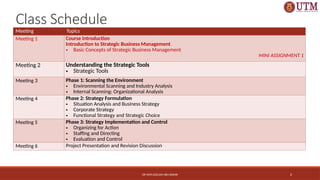
Class Schedule
DR NURAZALIAH ABU BAKAR
Meeting Topics
Meeting 1 Course Introduction
Introduction to Strategic Business Management
• Basic Concepts of Strategic Business Management
MINI ASSIGNMENT 1
Meeting 2 Understanding the Strategic Tools
• Strategic Tools
Meeting 3 Phase 1: Scanning the Environment
• Environmental Scanning and Industry Analysis
• Internal Scanning: Organizational Analysis
Meeting 4 Phase 2: Strategy Formulation
• Situation Analysis and Business Strategy
• Corporate Strategy
• Functional Strategy and Strategic Choice
Meeting 5 Phase 3: Strategy Implementation and Control
• Organizing for Action
• Staffing and Directing
• Evaluation and Control
Meeting 6 Project Presentation and Revision Discussion
3.
3
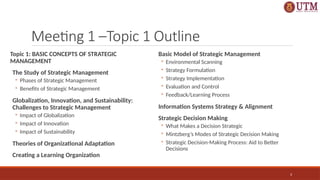
Meeting 1 –Topic1 Outline
Topic 1: BASIC CONCEPTS OF STRATEGIC
MANAGEMENT
The Study of Strategic Management
◦ Phases of Strategic Management
◦ Benefits of Strategic Management
Globalization, Innovation, and Sustainability:
Challenges to Strategic Management
◦ Impact of Globalization
◦ Impact of Innovation
◦ Impact of Sustainability
Theories of Organizational Adaptation
Creating a Learning Organization
Basic Model of Strategic Management
◦ Environmental Scanning
◦ Strategy Formulation
◦ Strategy Implementation
◦ Evaluation and Control
◦ Feedback/Learning Process
Information Systems Strategy & Alignment
Strategic Decision Making
◦ What Makes a Decision Strategic
◦ Mintzberg’s Modes of Strategic Decision Making
◦ Strategic Decision-Making Process: Aid to Better
Decisions
4.
4
In your ownwords
Michael’s Porter
What is Strategy?
5.
5
What is Strategy?
Acompany’s strategy consists of the set of competitive moves and
business approaches that management is employing to run the
company
• Strategy is management’s “game plan” to
– Attract and please customers
– Stake out a market position
– Conduct operations
– Compete successfully
- Achieve organizational objectives
6.
6
Why Are StrategiesNeeded?
To proactively shape how a company’s business will
be conducted
To mold the independent actions and decisions of
managers and employees into a
coordinated,company-wide game plan
9
Basic Concepts ofStrategic Management
1.Basic financial planning: initiate some planning when they requested to set up their
budgets; considers activities for one year.
2.Forecast-based planning: consider projects for more than a year. The time horizon is
usually 3-5 years. Extrapolate current trends in the future.
3.Externally-oriented planning: conduct strategic planning by top management and
they leave implementation to low level.
4.Strategic management: planning by forming a team from all levels in the company.
12
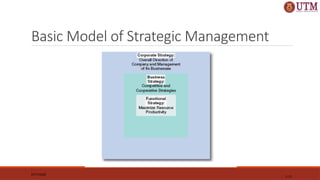
Corporate Strategy
– Composedof members of BOD’s, Directors, and CEO’s.
– Responsible for financial/non-financial performance. E.g. corporate image
and social responsibility.
– Generally determine the business in which the company should be involved.
– Identify distinctive competitiveness or competencies by adopting portfolio
approach.
– Orientations at the corporate level reflect the concern of stockholdersand
society at large.
13.
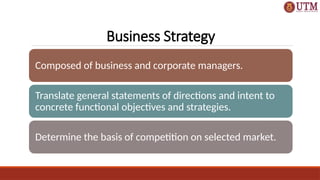
Business Strategy
Composed ofbusiness and corporate managers.
Translate general statements of directions and intent to
concrete functional objectives and strategies.
Determine the basis of competition on selected market.
14.
14
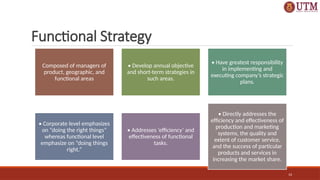
Functional Strategy
Composed ofmanagers of
product, geographic, and
functional areas
• Develop annual objective
and short-term strategies in
such areas.
• Have greatest responsibility
in implementing and
executing company’s strategic
plans.
• Corporate level emphasizes
on “doing the right things”
whereas functional level
emphasize on “doing things
right.”
• Addresses ‘efficiency’ and
effectiveness of functional
tasks.
• Directly addresses the
efficiency and effectiveness of
production and marketing
systems, the quality and
extent of customer service,
and the success of particular
products and services in
increasing the market share.
15.
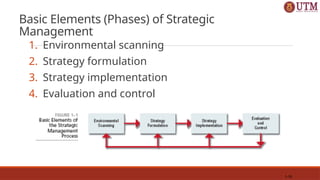
Basic Elements (Phases)of Strategic
Management
1-15
1. Environmental scanning
2. Strategy formulation
3. Strategy implementation
4. Evaluation and control
Basic Elements ofStrategic Management
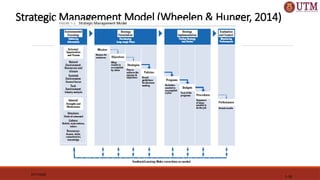
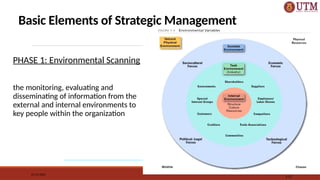
PHASE 1: Environmental Scanning
the monitoring, evaluating and
disseminating of information from the
external and internal environments to
key people within the organization
07/11/2025
1-17
18.
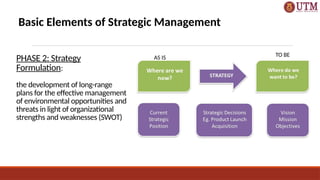
PHASE 2: Strategy
Formulation:
thedevelopment of long-range
plans for the effective management
of environmental opportunities and
threats in light of organizational
strengths and weaknesses (SWOT)
Basic Elements of Strategic Management
AS IS TO BE
19.
Phase 2: StrategyFormulation
-Basic Elements of Strategic Management
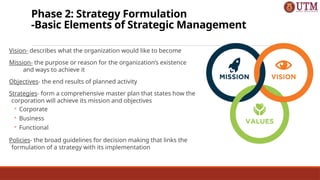
Vision- describes what the organization would like to become
Mission- the purpose or reason for the organization’s existence
and ways to achieve it
Objectives- the end results of planned activity
Strategies- form a comprehensive master plan that states how the
corporation will achieve its mission and objectives
◦ Corporate
◦ Business
◦ Functional
Policies- the broad guidelines for decision making that links the
formulation of a strategy with its implementation
20.
20
What is aMission Statement?
A mission statement is a formal summary that explains:
What you do.
How you do it.
Why you do it.
A good mission statement can surprise, inspire, and transform your business. They provide a
clearly stated purpose of your business and the goals you have for succeeding.
The best mission statements go hand-in-hand with corporate philosophy and culture and help
guide a company from the present into the future.
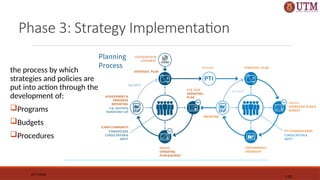
Phase 3: StrategyImplementation
the process by which
strategies and policies are
put into action through the
development of:
Programs
Budgets
Procedures
07/11/2025
1-23
24.
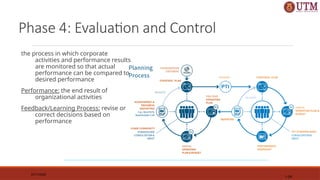
Phase 4: Evaluationand Control
the process in which corporate
activities and performance results
are monitored so that actual
performance can be compared to
desired performance
Performance: the end result of
organizational activities
Feedback/Learning Process: revise or
correct decisions based on
performance
07/11/2025
1-24
25.
Information Systems Alignment
AnIS that is inappropriate for a given operating environment can
actually inhibit and confuse things, or even lead to a crisis
environments.
The IS department is not an island within a firm.
The IS department manages an infrastructure that is essential to the
firm’s functioning .
A firm’s IS must be aligned with the way it manages its employees
and processes .
26.
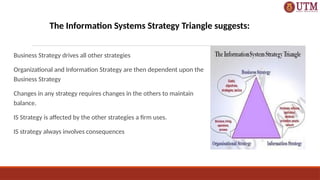
IS Strategy Triangle
BusinessStrategy drives all other strategies
Organizational and Information Strategy are then dependent upon the
Business Strategy
Changes in any strategy requires changes in the others to maintain
balance.
IS Strategy is affected by the other strategies a firm uses.
IS strategy always involves consequences
The Information Systems Strategy Triangle suggests:
27.
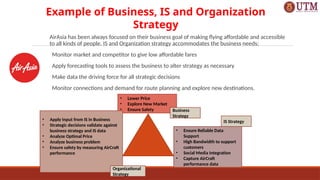
Example of Business,IS and Organization
Strategy
AirAsia has been always focused on their business goal of making flying affordable and accessible
to all kinds of people. IS and Organization strategy accommodates the business needs:
Monitor market and competitor to give low affordable fares
Apply forecasting tools to assess the business to alter strategy as necessary
Make data the driving force for all strategic decisions
Monitor connections and demand for route planning and explore new destinations.
• Lower Price
• Explore New Market
• Ensure Safety
• Ensure Reliable Data
Support
• High Bandwidth to support
customers
• Social Media Integration
• Capture AirCraft
performance data
• Apply Input from IS in Business
• Strategic decisions validate against
business strategy and IS data
• Analyze Optimal Price
• Analyze business problem
• Ensure safety by measuring AirCraft
performance
Business
Strategy
IS Strategy
Organizational
Strategy
28.
Benefits of StrategicManagement
Financial Benefits
• Improvement in sales
• Improvement in profitability
• Productivity improvement
Non-Financial Benefits
• Improved understanding of competitors strategies
• Enhanced awareness of threats
• Reduced resistance to change
• Enhanced problem-prevention capabilities
1-28
29.
Additional Benefits ofStrategic
Management
Clearer sense of strategic vision for the firm
Sharper focus on what is strategically important
Improved understanding of a rapidly changing environment
Improved organizational performance
Achieves a match between the organization’s environment and its strategy, structure
and processes
Important in unstable environments
Strategic thinking
Organizational learning
07/11/2025
1-29
30.
30
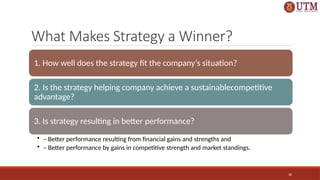
What Makes Strategya Winner?
1. How well does the strategy fit the company’s situation?
2. Is the strategy helping company achieve a sustainablecompetitive
advantage?
3. Is strategy resulting in better performance?
• – Better performance resulting from financial gains and strengths and
• – Better performance by gains in competitive strength and market standings.
31.
Impact of Globalization
1-31
Globalization:the integration and
internationalization of markets and
corporations
Globalisation means that the world is becoming
interconnected by trade and culture exchange.
https://courses.lumenlearning.com/wm-introductiontobusiness/chapter/globalization-and-business/
32.
Impact of EnvironmentalSustainability
Environmental Sustainability: the use of business practices to reduce a company’s
impact on the natural, physical environment
1-32
33.
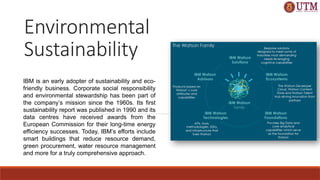
IBM is anearly adopter of sustainability and eco-
friendly business. Corporate social responsibility
and environmental stewardship has been part of
the company’s mission since the 1960s. Its first
sustainability report was published in 1990 and its
data centres have received awards from the
European Commission for their long-time energy
efficiency successes. Today, IBM’s efforts include
smart buildings that reduce resource demand,
green procurement, water resource management
and more for a truly comprehensive approach.
Environmental
Sustainability
34.
1-34
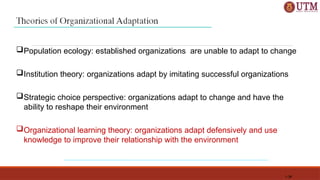
Population ecology: establishedorganizations are unable to adapt to change
Institution theory: organizations adapt by imitating successful organizations
Strategic choice perspective: organizations adapt to change and have the
ability to reshape their environment
Organizational learning theory: organizations adapt defensively and use
knowledge to improve their relationship with the environment
35.
1-35
Strategic flexibility:the ability to shift from one dominant strategy to
another and requires:
Long-term commitment to the development and nurturing of
critical resources
Learning organization: an organization skilled at creating,
acquiring, and transferring knowledge and at modifying its
behavior to reflect new knowledge and insights
36.
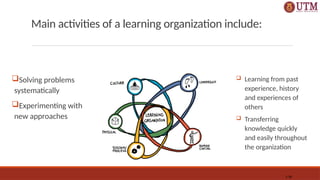
Main activities ofa learning organization include:
Solving problems
systematically
Experimenting with
new approaches
1-36
Learning from past
experience, history
and experiences of
others
Transferring
knowledge quickly
and easily throughout
the organization
07/11/2025
1-39
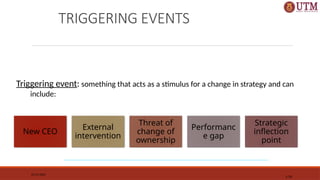
TRIGGERING EVENTS
Triggering event:something that acts as a stimulus for a change in strategy and can
include:
New CEO
External
intervention
Threat of
change of
ownership
Performanc
e gap
Strategic
inflection
point
40.
CHARACTERISTICS OF STRATEGIC
DECISON
WhatMakes a Strategic Decision?
Strategic decision making focuses on the long-run future of the organization
Characteristics of strategic decision making include:
Rare- unusual, no precedent to follow.
Consequential=important- require substantial resources and commitment from all.
Directive- set precedent for future action.
07/11/2025 PRENTICE HALL, 2012
1-40
41.
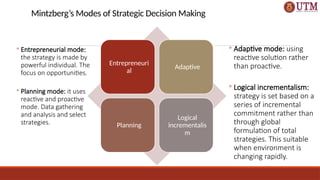
Mintzberg’s Modes ofStrategic Decision Making
Entrepreneuri
al
Adaptive
Planning
Logical
incrementalis
m
◦ Entrepreneurial mode:
the strategy is made by
powerful individual. The
focus on opportunities.
◦ Planning mode: it uses
reactive and proactive
mode. Data gathering
and analysis and select
strategies.
◦ Adaptive mode: using
reactive solution rather
than proactive.
◦ Logical incrementalism:
strategy is set based on a
series of incremental
commitment rather than
through global
formulation of total
strategies. This suitable
when environment is
changing rapidly.
42.
The Role ofthe General Manager
A key decisions maker.
Not necessary to have a deep technical knowledge of there is.
Aggressively seek to understand the consequences of using technologies
relevant to the business’s environment.
Ask questions when it’s not clear.
Should not leave IS decisions solely to the IS professionals
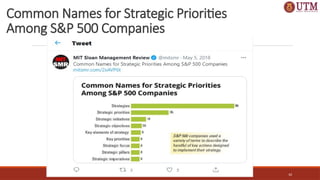
#10 the S&P 500,[6] or just the S&P,[7][8] is an American stock market index based on the market capitalizations of 500 large companies having common stock listed on the NYSE, NASDAQ, or the Cboe BZX Exchange.
#25 In BP’s case, it became clear that personnel policies needed to be adjusted to insure engineers and crew followed all procedures associated with monitoring results, and additional processes were needed to insure quality standards were appropriate and
met from vendor-supplied systems.
#26 Information Systems Strategy Triangle relates business strategy with IS strategy and organizational strategy.
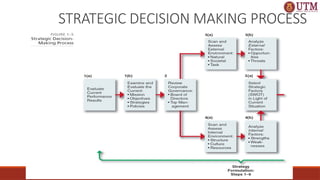
#37 Evaluate current performance results
Review corporate governance
Scan and assess the external environment
Scan and assess the internal corporate environment
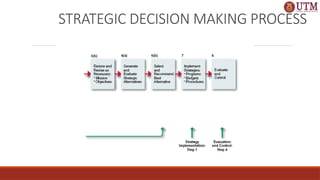
#38 Analyze strategic (SWOT) factors
Generate, evaluate and select the best alternative strategy
Implement selected strategies
Evaluate implemented strategies
#43 Although IS can facilitate the movement, exchange, and processing of information.





![str_mgnt_1comp_mode[2].ppt and its components](https://cdn.slidesharecdn.com/ss_thumbnails/strmgnt1compmode2-240630151143-2120a020-thumbnail.jpg?width=640&height=640&fit=bounds)


