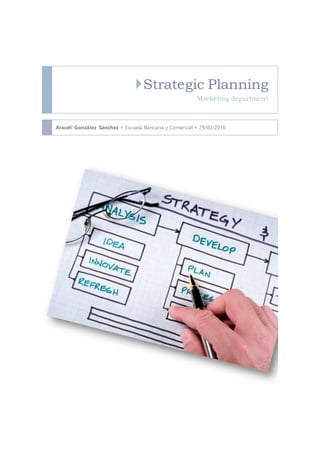
Strategic Planning
Marketing department
Araceli González Sánchez  Escuela Bancaria y Comercial  29/02/2016
Strategic Planning
Marketing department
Every organization requires general and specific plans to achieve its purpose. Strategic Marketing
Planning is a key ingredient in the success of the marketing tactics no matter how large or small the
business is. The main objective of any business is bring value and benefits. We have key ingredients
which are strategies and creative plans which can guide the marketing activities. Those require discipline
and flexibility, so the companies have to go in the same way with the strategies and they have to improve
them all the time.
Developing an effective strategic plan and actually making it effective is a challenging exercise and how
to do it right is often misunderstood.
In such a dynamic and changing environment, the strategic process should take into account the forms
of macro-environmental change that we haven’t control over such as the economy, legal issues,
environmental and society change; through to micro-environmental forces - people, technology,
suppliers, operational systems and processes, financial and market influences that arise due to everyday
business.
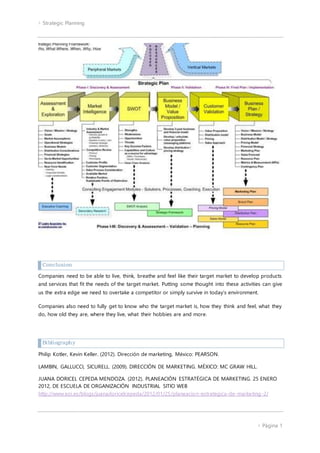
When we talk about strategic marketing planning, we refer to the planning process that yields decisions
in how a business unit can best compete in the markets it elects to serve. This process is necessary to
outline and simplify a direct map of the company’s objectives and how to achieve them.
In strategic planning managers mapped resources of the organization Marketing opportunities in the
long run.
It consist in three phases:
1. Planning phase is the most important as it analyses internal strengths and weaknesses, external
competition, changes in technology, industry culture shifts and provides an overall picture of the state
of the organization. This phase has four key components:
I. Swot analysis: the results should be used as a basis for developing the company’s marketing
plan
II. Marketing mix: is the how aspect of the planning phase which focuses on the 4Ps
III. Set marketing goals
IV. Market-Product focus and Goal Setting: determine where the resources will be allocated, and
how to turn plans into focused action.
2. Implementation phase is the action of the process. We can use the following four components:
I. Obtaining Resources: sums of cash to develop and market new products.
II. Designing marketing organization: there should be put in place a marketing hierarchy to
properly see the plans
III. Developing planning schedules: time needs to be allocated to specific tasks so they can be
accomplished
 Strategic Planning
 Página 1
IV. Executing the marketing plan: we will take attention to detail, and focus on the strategy and
tactics
3. Evaluation and control phase, this process involves ensuring that the results of the program are in
line with the goals set. We will need to observe any deviations in the plan and quickly correct negative
deviations to get back on course. We could pay attention to:
I. Strategy vs tactic
II. Measurable vs vague
III. Actionable vs Contingent
IV. Marketing strategy
According to Center for Simplified Strategic Planning, “Any strategic planning process involves digesting
information and some fairly difficult analysis. Good strategic planning should be simplified, not
simplistic.” And it should also answer the questions: what are we selling, to whom and how do we beat
the competition? The first two questions will determine the focus of your overall business while the third
will help you specify your strategies to market. The following five steps are essential to accomplishing a
simple, effective strategic plan.
1. Identify objectives and determine mission
2. Do business environmental scan-including trends and competition
3. Create strategies including SWOT, budget, marketing, price and distribution
4. Implement strategy-put we plan into action
5. Evaluate and modify- measure how close or far we are from objectives, track what works and
change what doesn’t.
Benefits
The primary benefit of a strategic marketing plan is that it puts a written guide in place for a business to
follow to reach its goals and objectives. The second major advantage of strategic marketing planning is
that is allows the business to create and utilize consistent messaging internally and externally. Consistent
messaging in marketing creates efficient companies because employees and customers understand
what the company offers and how the company offers it. They work toward a common goal. Efficient
companies typically see an increase in revenues and market share, while it sees a decrease in expenses.
Ultimately, it all leads to an increase in company profitability.
 Strategic Planning
 Página 1
Conclusion
Companies need to be able to live, think, breathe and feel like their target market to develop products
and services that fit the needs of the target market. Putting some thought into these activities can give
us the extra edge we need to overtake a competitor or simply survive in today’s environment.
Companies also need to fully get to know who the target market is, how they think and feel, what they
do, how old they are, where they live, what their hobbies are and more.
Bibliography
Philip Kotler, Kevin Keller. (2012). Dirección de marketing, México: PEARSON.
LAMBIN, GALLUCCI, SICURELL. (2009). DIRECCIÓN DE MARKETING. MÉXICO: MC GRAW HILL.
JUANA DORICEL CEPEDA MENDOZA. (2012). PLANEACIÓN ESTRATÉGICA DE MARKETING. 25 ENERO
2012, DE ESCUELA DE ORGANIZACIÓN INDUSTRIAL SITIO WEB
http://www.eoi.es/blogs/juanadoricelcepeda/2012/01/25/planeacion-estrategica-de-marketing-2/
 Strategic Planning
 Página 2
Kristie Lorette. (2016). What is marketing strategy planning? . January 10, de Small Business web site:
http://smallbusiness.chron.com/marketing-strategy-planning-628.html
Adrian Slade. (2015). How will you look in 2015 and beyond. 13/01/2015, de Marketing Kitchen Sitio
web: http://www.marketingkitchen.co.uk/blog/how-will-you-look-in-2015-and-beyond/

Strategic planning

  • 1.
    Strategic Planning Marketing department AraceliGonzález Sánchez  Escuela Bancaria y Comercial  29/02/2016
  • 3.
    Strategic Planning Marketing department Everyorganization requires general and specific plans to achieve its purpose. Strategic Marketing Planning is a key ingredient in the success of the marketing tactics no matter how large or small the business is. The main objective of any business is bring value and benefits. We have key ingredients which are strategies and creative plans which can guide the marketing activities. Those require discipline and flexibility, so the companies have to go in the same way with the strategies and they have to improve them all the time. Developing an effective strategic plan and actually making it effective is a challenging exercise and how to do it right is often misunderstood. In such a dynamic and changing environment, the strategic process should take into account the forms of macro-environmental change that we haven’t control over such as the economy, legal issues, environmental and society change; through to micro-environmental forces - people, technology, suppliers, operational systems and processes, financial and market influences that arise due to everyday business. When we talk about strategic marketing planning, we refer to the planning process that yields decisions in how a business unit can best compete in the markets it elects to serve. This process is necessary to outline and simplify a direct map of the company’s objectives and how to achieve them. In strategic planning managers mapped resources of the organization Marketing opportunities in the long run. It consist in three phases: 1. Planning phase is the most important as it analyses internal strengths and weaknesses, external competition, changes in technology, industry culture shifts and provides an overall picture of the state of the organization. This phase has four key components: I. Swot analysis: the results should be used as a basis for developing the company’s marketing plan II. Marketing mix: is the how aspect of the planning phase which focuses on the 4Ps III. Set marketing goals IV. Market-Product focus and Goal Setting: determine where the resources will be allocated, and how to turn plans into focused action. 2. Implementation phase is the action of the process. We can use the following four components: I. Obtaining Resources: sums of cash to develop and market new products. II. Designing marketing organization: there should be put in place a marketing hierarchy to properly see the plans III. Developing planning schedules: time needs to be allocated to specific tasks so they can be accomplished
  • 4.
     Strategic Planning Página 1 IV. Executing the marketing plan: we will take attention to detail, and focus on the strategy and tactics 3. Evaluation and control phase, this process involves ensuring that the results of the program are in line with the goals set. We will need to observe any deviations in the plan and quickly correct negative deviations to get back on course. We could pay attention to: I. Strategy vs tactic II. Measurable vs vague III. Actionable vs Contingent IV. Marketing strategy
  • 5.
    According to Centerfor Simplified Strategic Planning, “Any strategic planning process involves digesting information and some fairly difficult analysis. Good strategic planning should be simplified, not simplistic.” And it should also answer the questions: what are we selling, to whom and how do we beat the competition? The first two questions will determine the focus of your overall business while the third will help you specify your strategies to market. The following five steps are essential to accomplishing a simple, effective strategic plan. 1. Identify objectives and determine mission 2. Do business environmental scan-including trends and competition 3. Create strategies including SWOT, budget, marketing, price and distribution 4. Implement strategy-put we plan into action 5. Evaluate and modify- measure how close or far we are from objectives, track what works and change what doesn’t. Benefits The primary benefit of a strategic marketing plan is that it puts a written guide in place for a business to follow to reach its goals and objectives. The second major advantage of strategic marketing planning is that is allows the business to create and utilize consistent messaging internally and externally. Consistent messaging in marketing creates efficient companies because employees and customers understand what the company offers and how the company offers it. They work toward a common goal. Efficient companies typically see an increase in revenues and market share, while it sees a decrease in expenses. Ultimately, it all leads to an increase in company profitability.
  • 6.
     Strategic Planning Página 1 Conclusion Companies need to be able to live, think, breathe and feel like their target market to develop products and services that fit the needs of the target market. Putting some thought into these activities can give us the extra edge we need to overtake a competitor or simply survive in today’s environment. Companies also need to fully get to know who the target market is, how they think and feel, what they do, how old they are, where they live, what their hobbies are and more. Bibliography Philip Kotler, Kevin Keller. (2012). Dirección de marketing, México: PEARSON. LAMBIN, GALLUCCI, SICURELL. (2009). DIRECCIÓN DE MARKETING. MÉXICO: MC GRAW HILL. JUANA DORICEL CEPEDA MENDOZA. (2012). PLANEACIÓN ESTRATÉGICA DE MARKETING. 25 ENERO 2012, DE ESCUELA DE ORGANIZACIÓN INDUSTRIAL SITIO WEB http://www.eoi.es/blogs/juanadoricelcepeda/2012/01/25/planeacion-estrategica-de-marketing-2/
  • 7.
     Strategic Planning Página 2 Kristie Lorette. (2016). What is marketing strategy planning? . January 10, de Small Business web site: http://smallbusiness.chron.com/marketing-strategy-planning-628.html Adrian Slade. (2015). How will you look in 2015 and beyond. 13/01/2015, de Marketing Kitchen Sitio web: http://www.marketingkitchen.co.uk/blog/how-will-you-look-in-2015-and-beyond/