LEADERSHIP AND STRATEGIC
MANAGEMENT
Educational Management 508
Presenter:
Zabala, Jhosa Lei I.
WHAT IS A STRATEGIC PLAN?
• A written document mapping of the path to
success
• The “recipe” to achieve the vision and
mission
• It’s the school’s voice
• Can be defined as a set of decisions about
what to do, why, and how to do it
WHAT IS A STRATEGIC PLAN?
• Provides the central point around which a
school community can focus and unite to
ensure that every child at the school can
get the best possible education.
WHY IS IT IMPORTANT TO PLAN?
• To examine the school’s values, current
status, and environment
• It’s the opportunity to discuss and articulate
the vision and mission of the school
• Ensures a path toward fulfilling the vision and
mission
• More resources do not necessarily stand for
the best results. The way one uses these
resources can lead to different levels of
benefits and results
WHY IS IT IMPORTANT TO PLAN?
• Develops common vocabulary for all
stakeholders
• Engage the different stakeholders in a process
to determine appropriate long-term goals and
the specific objectives to achieve goals.
• Empowers stakeholders to feel in control of
the school’s future
BASIC STRATEGIC PLANNING STEPS
1. Situation Analysis
►Refers to analysis of current status, gaps and
internal and external environment and factors
that influence its existence and performance,
progress and sustainability and also the problems
and root causes of problems and possible
solutions.
SWOT Analysis
(Strengths, Weaknesses,
Opportunities, Threats)
SWOT ANALYSIS
• A common, very effective tool used in brain
storming sessions to enhance stakeholder
participation in discussions and also it is an effective
tool in extracting very valuable views and opinions
from stakeholders
• When analysis is completed a SWOT Profile can be
generated and use as the basis of goal setting,
strategy formulation and implementation.
2. Defining The Future State
Building the MISSION AND VISION STATEMENT
◘Where it wants to be?
◘What it wants to do?
BASIC STRATEGIC PLANNING STEPS
VISION AND MISSION STATEMENT
• Vision
◘A vision statement tells us where we are going
◘Describes the ideals and values we represent
◘Paints a picture of the dreams and aspirations
• Mission
◘ This statement describes what we want to achieve,
who we are, and how we will execute to achieve our
vision of the future
3. DETERMINATION OF OBJECTIVES AND
STRATEGIES
►After the Mission and Vision has defined,
the school can now have a set of
objectives that will lead to the overall
strategic goal or vision.
BASIC STRATEGIC PLANNING STEPS
►Evaluation is done to see if there’s a
need to readjust long-term objectives.
4. Implementation and Evaluation
► Constant monitoring and assessment
►Next step is to implement and evaluate the
plan. This step has different executions
depending on the goals a school wants to
achieve.
◘The following steps ensure that plans are
used to guide the work of the organization:
• managing the implementation of the plan,
• supervising the actual work,
• monitoring and reporting progress on the
plan
• conduct assessments of its performance by
gathering and analyzing information;
• convene the planning group to review
performance and reassess goals,
outcomes, strategies, action steps
• make recommendations for changes
BASIC STRATEGIC PLANNING STEPS
5. Revising
►This stage starts the cycle over
again, allowing the plan to be
continuously updated.
►This will keep the plan current and
meaningful to the organization.
WHAT SHOULD SCHOOL COUNCIL
KNOW?
The following questions are really important in the
strategic planning process:
•What is the school wanting our students to achieve?
•Where is the school now?
•What does the school need to do so that our
students can do better?
•How will the school make this happen? What
money or people will it need and how will it get
this?
•How will we know if/when the school has been
successful?
DOS
• Get input from the community
• Leave off the rose colored glasses
• Consider the people issues
• Prioritize your strategic choices
• Be SMART
DON’TS
• Forget to consider how you will
resource your plan
• File your plan away and only look at it
once a year when reflecting on
progress
• Create a set of “wish lists” – your plan
must be practical and do-able
• Crowd the plan with operational issues
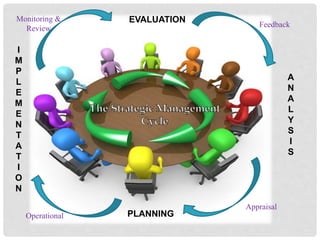
A
N
A
L
Y
S
I
S
EVALUATION
PLANNING
I
M
P
L
E
M
E
N
T
A
T
I
O
N
Appraisal
Operational
Monitoring &
Review Feedback
Strategic planning

Strategic planning

  • 2.
    LEADERSHIP AND STRATEGIC MANAGEMENT EducationalManagement 508 Presenter: Zabala, Jhosa Lei I.
  • 3.
    WHAT IS ASTRATEGIC PLAN? • A written document mapping of the path to success • The “recipe” to achieve the vision and mission • It’s the school’s voice • Can be defined as a set of decisions about what to do, why, and how to do it
  • 4.
    WHAT IS ASTRATEGIC PLAN? • Provides the central point around which a school community can focus and unite to ensure that every child at the school can get the best possible education.
  • 6.
    WHY IS ITIMPORTANT TO PLAN? • To examine the school’s values, current status, and environment • It’s the opportunity to discuss and articulate the vision and mission of the school • Ensures a path toward fulfilling the vision and mission • More resources do not necessarily stand for the best results. The way one uses these resources can lead to different levels of benefits and results
  • 7.
    WHY IS ITIMPORTANT TO PLAN? • Develops common vocabulary for all stakeholders • Engage the different stakeholders in a process to determine appropriate long-term goals and the specific objectives to achieve goals. • Empowers stakeholders to feel in control of the school’s future
  • 8.
    BASIC STRATEGIC PLANNINGSTEPS 1. Situation Analysis ►Refers to analysis of current status, gaps and internal and external environment and factors that influence its existence and performance, progress and sustainability and also the problems and root causes of problems and possible solutions.
  • 9.
  • 10.
    SWOT ANALYSIS • Acommon, very effective tool used in brain storming sessions to enhance stakeholder participation in discussions and also it is an effective tool in extracting very valuable views and opinions from stakeholders • When analysis is completed a SWOT Profile can be generated and use as the basis of goal setting, strategy formulation and implementation.
  • 11.
    2. Defining TheFuture State Building the MISSION AND VISION STATEMENT ◘Where it wants to be? ◘What it wants to do? BASIC STRATEGIC PLANNING STEPS
  • 12.
    BASIC STRATEGIC PLANNINGSTEPS VISION AND MISSION STATEMENT • Vision ◘A vision statement tells us where we are going ◘Describes the ideals and values we represent ◘Paints a picture of the dreams and aspirations • Mission ◘ This statement describes what we want to achieve, who we are, and how we will execute to achieve our vision of the future
  • 13.
    3. DETERMINATION OFOBJECTIVES AND STRATEGIES ►After the Mission and Vision has defined, the school can now have a set of objectives that will lead to the overall strategic goal or vision. BASIC STRATEGIC PLANNING STEPS
  • 14.
    BASIC STRATEGIC PLANNINGSTEPS ►Evaluation is done to see if there’s a need to readjust long-term objectives. 4. Implementation and Evaluation ► Constant monitoring and assessment ►Next step is to implement and evaluate the plan. This step has different executions depending on the goals a school wants to achieve.
  • 15.
    ◘The following stepsensure that plans are used to guide the work of the organization: • managing the implementation of the plan, • supervising the actual work, • monitoring and reporting progress on the plan • conduct assessments of its performance by gathering and analyzing information; • convene the planning group to review performance and reassess goals, outcomes, strategies, action steps • make recommendations for changes
  • 16.
    BASIC STRATEGIC PLANNINGSTEPS 5. Revising ►This stage starts the cycle over again, allowing the plan to be continuously updated. ►This will keep the plan current and meaningful to the organization.
  • 17.
    WHAT SHOULD SCHOOLCOUNCIL KNOW? The following questions are really important in the strategic planning process: •What is the school wanting our students to achieve? •Where is the school now? •What does the school need to do so that our students can do better? •How will the school make this happen? What money or people will it need and how will it get this? •How will we know if/when the school has been successful?
  • 18.
    DOS • Get inputfrom the community • Leave off the rose colored glasses • Consider the people issues • Prioritize your strategic choices • Be SMART
  • 19.
    DON’TS • Forget toconsider how you will resource your plan • File your plan away and only look at it once a year when reflecting on progress • Create a set of “wish lists” – your plan must be practical and do-able • Crowd the plan with operational issues
  • 20.