STRATEGIC MANAGEMENT
INTRODUCTION
Defining Strategic Management
Strategic management
 the art and science of formulating,
implementing, and evaluating cross-
functional decisions that enable an
organization to achieve its objectives
1-2
Copyright ©2013 Pearson Education, Inc. publishing as Prentice Hall
Defining Strategic Management
Strategic management is used
synonymously with the term strategic
planning.
Sometimes the term strategic
management is used to refer to strategy
formulation, implementation, and
evaluation, with strategic planning
referring only to strategy formulation.
1-3
Copyright ©2013 Pearson Education, Inc. publishing as Prentice Hall
Defining Strategic Management
A strategic plan is a company’s game
plan.
A strategic plan results from tough
managerial choices among numerous
good alternatives, and it signals
commitment to specific markets, policies,
procedures, and operations.
1-4
Copyright ©2013 Pearson Education, Inc. publishing as Prentice Hall
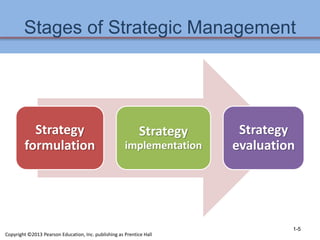
Stages of Strategic Management
Strategy
formulation
Strategy
implementation
Strategy
evaluation
1-5
Copyright ©2013 Pearson Education, Inc. publishing as Prentice Hall
Stages of Strategic Management
Strategy formulation
includes developing a vision and mission,
identifying an organization’s external
opportunities and threats, determining internal
strengths and weaknesses, establishing long-
term objectives, generating alternative
strategies, and choosing particular strategies to
pursue
1-6
Copyright ©2013 Pearson Education, Inc. publishing as Prentice Hall
Strategy Formulation
Deciding what new businesses to enter,
What businesses to abandon,
How to allocate resources,
Whether to expand operations or
diversify,
Whether to enter international markets,
Whether to merge or form a joint venture,
How to avoid a hostile takeover.
1-7
Copyright ©2013 Pearson Education, Inc. publishing as Prentice Hall
Stages of Strategic Management
Strategy implementation
requires a firm to establish annual objectives,
devise policies, motivate employees, and
allocate resources so that formulated strategies
can be executed often called the action stage
1-8
Copyright ©2013 Pearson Education, Inc. publishing as Prentice Hall
Stages of Strategic Management
Strategy evaluation
reviewing external and internal factors that are
the bases for current strategies, measuring
performance, and taking corrective actions
1-9
Copyright ©2013 Pearson Education, Inc. publishing as Prentice Hall
Stages of Strategic Management
Strategy formulation, implementation, and
evaluation activities occur at three
hierarchical levels in a large organization:
corporate, divisional or strategic business
unit, and functional
Strategic management helps a firm
function as a competitive team
1-10
Copyright ©2013 Pearson Education, Inc. publishing as Prentice Hall
Integrating Intuition and Analysis
Most organizations can benefit from
strategic management, which is based
upon integrating intuition and analysis in
decision making
Intuition is particularly useful for making
decisions in situations of great uncertainty
or little precedent
1-11
Copyright ©2013 Pearson Education, Inc. publishing as Prentice Hall
Key Terms in Strategic Management
Competitive
advantage
anything that a firm
does especially well
compared to rival
firms
Strategists
the individuals who
are most responsible
for the success or
failure of an
organization
1-12
Copyright ©2013 Pearson Education, Inc. publishing as Prentice Hall
Key Terms in Strategic Management
Vision statement
answers the question “What do we want to
become?”
often considered the first step in strategic
planning
1-13
Copyright ©2013 Pearson Education, Inc. publishing as Prentice Hall
Key Terms in Strategic Management
Mission statements
enduring statements of purpose that distinguish
one business from other similar firms
identifies the scope of a firm’s operations in
product and market terms
addresses the basic question that faces all
strategists: “What is our business?”
1-14
Copyright ©2013 Pearson Education, Inc. publishing as Prentice Hall
Key Terms in Strategic Management
External opportunities and external
threats
refer to economic, social, cultural, demographic,
environmental, political, legal, governmental,
technological, and competitive trends and
events that could significantly benefit or harm
an organization in the future
1-15
Copyright ©2013 Pearson Education, Inc. publishing as Prentice Hall
Some Opportunities and Threats
 Computer hacker problems are increasing.
 Intense price competition is plaguing most
firms.
 Unemployment and underemployment rates
remain high.
 Interest rates are rising.
 Product life cycles are becoming shorter.
 State and local governments are financially
weak.
1-16
Copyright ©2013 Pearson Education, Inc. publishing as Prentice Hall
Key Terms in Strategic Management
Internal strengths and internal
weaknesses
an organization’s controllable activities that are
performed especially well or poorly determined
relative to competitors
1-17
Copyright ©2013 Pearson Education, Inc. publishing as Prentice Hall
Key Terms in Strategic Management
Objectives
pecific results that an organization seeks to
achieve in pursuing its basic mission
long-term means more than one year
should be challenging, measurable, consistent,
reasonable, and clear
1-18
Copyright ©2013 Pearson Education, Inc. publishing as Prentice Hall
Key Terms in Strategic Management
Strategies
the means by which long-term objectives will be
achieved
may include geographic expansion,
diversification, acquisition, product
development, market penetration,
retrenchment, divestiture, liquidation, and joint
ventures
1-19
Copyright ©2013 Pearson Education, Inc. publishing as Prentice Hall
Key Terms in Strategic Management
Annual objectives
short-term milestones that organizations must
achieve to reach long-term objectives
should be measurable, quantitative,
challenging, realistic, consistent, and prioritized
should be established at the corporate,
divisional, and functional levels in a large
organization
1-20
Copyright ©2013 Pearson Education, Inc. publishing as Prentice Hall
Key Terms in Strategic Management
Policies
the means by which annual objectives will be
achieved
include guidelines, rules, and procedures
established to support efforts to achieve stated
objectives
guides to decision making and address
repetitive or recurring situations
1-21
Copyright ©2013 Pearson Education, Inc. publishing as Prentice Hall
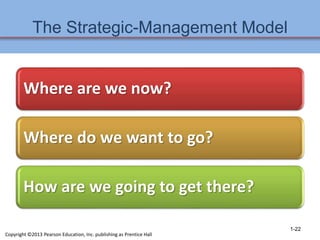
The Strategic-Management Model
Where are we now?
Where do we want to go?
How are we going to get there?
1-22
Copyright ©2013 Pearson Education, Inc. publishing as Prentice Hall
Benefits of Strategic Management
Historically, the principal benefit of
strategic management has been to help
organizations formulate better strategies
through the use of a more systematic,
logical, and rational approach to strategic
choice
1-23
Copyright ©2013 Pearson Education, Inc. publishing as Prentice Hall
Benefits of Strategic Management
Communication is a key to successful
strategic management
Through dialogue and participation,
managers and employees become
committed to supporting the organization
Copyright ©2013 Pearson Education, Inc. publishing as Prentice Hall
1-24
Financial Benefits
 Businesses using strategic-management
concepts show significant improvement in
sales, profitability, and productivity
compared to firms without systematic
planning activities
 High-performing firms seem to make more
informed decisions with good anticipation of
both short- and long-term consequences
1-25
Copyright ©2013 Pearson Education, Inc. publishing as Prentice Hall
Nonfinancial Benefits
It allows for identification, prioritization,
and exploitation of opportunities.
It provides an objective view of
management problems.
It represents a framework for improved
coordination and control of activities.
It minimizes the effects of adverse
conditions and changes.
1-26
Copyright ©2013 Pearson Education, Inc. publishing as Prentice Hall
Nonfinancial Benefits
 It allows major decisions to better support
established objectives.
 It allows more effective allocation of time
and resources to identified opportunities.
 It allows fewer resources and less time to be
devoted to correcting erroneous or ad hoc
decisions.
 It creates a framework for internal
communication among personnel.
1-27
Copyright ©2013 Pearson Education, Inc. publishing as Prentice Hall
Why Some Firms Do No
Strategic Planning
Lack of knowledge in strategic planning
Poor reward structures
Firefighting
Waste of time
Too expensive
Laziness
Content with success
1-28
Copyright ©2013 Pearson Education, Inc. publishing as Prentice Hall
Why Some Firms Do No
Strategic Planning
Fear of failure
Overconfidence
Prior bad experience
Self-interest
Fear of the unknown
Honest difference of opinion
Suspicion
1-29
Copyright ©2013 Pearson Education, Inc. publishing as Prentice Hall

Strategic management intro

  • 1.
  • 2.
    Defining Strategic Management Strategicmanagement  the art and science of formulating, implementing, and evaluating cross- functional decisions that enable an organization to achieve its objectives 1-2 Copyright ©2013 Pearson Education, Inc. publishing as Prentice Hall
  • 3.
    Defining Strategic Management Strategicmanagement is used synonymously with the term strategic planning. Sometimes the term strategic management is used to refer to strategy formulation, implementation, and evaluation, with strategic planning referring only to strategy formulation. 1-3 Copyright ©2013 Pearson Education, Inc. publishing as Prentice Hall
  • 4.
    Defining Strategic Management Astrategic plan is a company’s game plan. A strategic plan results from tough managerial choices among numerous good alternatives, and it signals commitment to specific markets, policies, procedures, and operations. 1-4 Copyright ©2013 Pearson Education, Inc. publishing as Prentice Hall
  • 5.
    Stages of StrategicManagement Strategy formulation Strategy implementation Strategy evaluation 1-5 Copyright ©2013 Pearson Education, Inc. publishing as Prentice Hall
  • 6.
    Stages of StrategicManagement Strategy formulation includes developing a vision and mission, identifying an organization’s external opportunities and threats, determining internal strengths and weaknesses, establishing long- term objectives, generating alternative strategies, and choosing particular strategies to pursue 1-6 Copyright ©2013 Pearson Education, Inc. publishing as Prentice Hall
  • 7.
    Strategy Formulation Deciding whatnew businesses to enter, What businesses to abandon, How to allocate resources, Whether to expand operations or diversify, Whether to enter international markets, Whether to merge or form a joint venture, How to avoid a hostile takeover. 1-7 Copyright ©2013 Pearson Education, Inc. publishing as Prentice Hall
  • 8.
    Stages of StrategicManagement Strategy implementation requires a firm to establish annual objectives, devise policies, motivate employees, and allocate resources so that formulated strategies can be executed often called the action stage 1-8 Copyright ©2013 Pearson Education, Inc. publishing as Prentice Hall
  • 9.
    Stages of StrategicManagement Strategy evaluation reviewing external and internal factors that are the bases for current strategies, measuring performance, and taking corrective actions 1-9 Copyright ©2013 Pearson Education, Inc. publishing as Prentice Hall
  • 10.
    Stages of StrategicManagement Strategy formulation, implementation, and evaluation activities occur at three hierarchical levels in a large organization: corporate, divisional or strategic business unit, and functional Strategic management helps a firm function as a competitive team 1-10 Copyright ©2013 Pearson Education, Inc. publishing as Prentice Hall
  • 11.
    Integrating Intuition andAnalysis Most organizations can benefit from strategic management, which is based upon integrating intuition and analysis in decision making Intuition is particularly useful for making decisions in situations of great uncertainty or little precedent 1-11 Copyright ©2013 Pearson Education, Inc. publishing as Prentice Hall
  • 12.
    Key Terms inStrategic Management Competitive advantage anything that a firm does especially well compared to rival firms Strategists the individuals who are most responsible for the success or failure of an organization 1-12 Copyright ©2013 Pearson Education, Inc. publishing as Prentice Hall
  • 13.
    Key Terms inStrategic Management Vision statement answers the question “What do we want to become?” often considered the first step in strategic planning 1-13 Copyright ©2013 Pearson Education, Inc. publishing as Prentice Hall
  • 14.
    Key Terms inStrategic Management Mission statements enduring statements of purpose that distinguish one business from other similar firms identifies the scope of a firm’s operations in product and market terms addresses the basic question that faces all strategists: “What is our business?” 1-14 Copyright ©2013 Pearson Education, Inc. publishing as Prentice Hall
  • 15.
    Key Terms inStrategic Management External opportunities and external threats refer to economic, social, cultural, demographic, environmental, political, legal, governmental, technological, and competitive trends and events that could significantly benefit or harm an organization in the future 1-15 Copyright ©2013 Pearson Education, Inc. publishing as Prentice Hall
  • 16.
    Some Opportunities andThreats  Computer hacker problems are increasing.  Intense price competition is plaguing most firms.  Unemployment and underemployment rates remain high.  Interest rates are rising.  Product life cycles are becoming shorter.  State and local governments are financially weak. 1-16 Copyright ©2013 Pearson Education, Inc. publishing as Prentice Hall
  • 17.
    Key Terms inStrategic Management Internal strengths and internal weaknesses an organization’s controllable activities that are performed especially well or poorly determined relative to competitors 1-17 Copyright ©2013 Pearson Education, Inc. publishing as Prentice Hall
  • 18.
    Key Terms inStrategic Management Objectives pecific results that an organization seeks to achieve in pursuing its basic mission long-term means more than one year should be challenging, measurable, consistent, reasonable, and clear 1-18 Copyright ©2013 Pearson Education, Inc. publishing as Prentice Hall
  • 19.
    Key Terms inStrategic Management Strategies the means by which long-term objectives will be achieved may include geographic expansion, diversification, acquisition, product development, market penetration, retrenchment, divestiture, liquidation, and joint ventures 1-19 Copyright ©2013 Pearson Education, Inc. publishing as Prentice Hall
  • 20.
    Key Terms inStrategic Management Annual objectives short-term milestones that organizations must achieve to reach long-term objectives should be measurable, quantitative, challenging, realistic, consistent, and prioritized should be established at the corporate, divisional, and functional levels in a large organization 1-20 Copyright ©2013 Pearson Education, Inc. publishing as Prentice Hall
  • 21.
    Key Terms inStrategic Management Policies the means by which annual objectives will be achieved include guidelines, rules, and procedures established to support efforts to achieve stated objectives guides to decision making and address repetitive or recurring situations 1-21 Copyright ©2013 Pearson Education, Inc. publishing as Prentice Hall
  • 22.
    The Strategic-Management Model Whereare we now? Where do we want to go? How are we going to get there? 1-22 Copyright ©2013 Pearson Education, Inc. publishing as Prentice Hall
  • 23.
    Benefits of StrategicManagement Historically, the principal benefit of strategic management has been to help organizations formulate better strategies through the use of a more systematic, logical, and rational approach to strategic choice 1-23 Copyright ©2013 Pearson Education, Inc. publishing as Prentice Hall
  • 24.
    Benefits of StrategicManagement Communication is a key to successful strategic management Through dialogue and participation, managers and employees become committed to supporting the organization Copyright ©2013 Pearson Education, Inc. publishing as Prentice Hall 1-24
  • 25.
    Financial Benefits  Businessesusing strategic-management concepts show significant improvement in sales, profitability, and productivity compared to firms without systematic planning activities  High-performing firms seem to make more informed decisions with good anticipation of both short- and long-term consequences 1-25 Copyright ©2013 Pearson Education, Inc. publishing as Prentice Hall
  • 26.
    Nonfinancial Benefits It allowsfor identification, prioritization, and exploitation of opportunities. It provides an objective view of management problems. It represents a framework for improved coordination and control of activities. It minimizes the effects of adverse conditions and changes. 1-26 Copyright ©2013 Pearson Education, Inc. publishing as Prentice Hall
  • 27.
    Nonfinancial Benefits  Itallows major decisions to better support established objectives.  It allows more effective allocation of time and resources to identified opportunities.  It allows fewer resources and less time to be devoted to correcting erroneous or ad hoc decisions.  It creates a framework for internal communication among personnel. 1-27 Copyright ©2013 Pearson Education, Inc. publishing as Prentice Hall
  • 28.
    Why Some FirmsDo No Strategic Planning Lack of knowledge in strategic planning Poor reward structures Firefighting Waste of time Too expensive Laziness Content with success 1-28 Copyright ©2013 Pearson Education, Inc. publishing as Prentice Hall
  • 29.
    Why Some FirmsDo No Strategic Planning Fear of failure Overconfidence Prior bad experience Self-interest Fear of the unknown Honest difference of opinion Suspicion 1-29 Copyright ©2013 Pearson Education, Inc. publishing as Prentice Hall

Editor's Notes

  • #3 Strategic management is defined as the art and science of formulating, implementing, and evaluating cross-functional decisions that enable an organization to achieve its objectives
  • #4 Strategic management in this text is used synonymously with the term strategic planning Sometimes the term strategic management is used to refer to strategy formulation, implementation, and evaluation, with strategic planning referring only to strategy formulation.
  • #5 A strategic plan results from tough managerial choices among numerous good alternatives, and it signals commitment to specific markets, policies, procedures, and operations in lieu of other, “less desirable” courses of action.
  • #6 The strategic-management process consists of three stages: strategy formulation, strategy implementation, and strategy evaluation.
  • #7 Strategy formulation includes developing a vision and mission, identifying an organization’s external opportunities and threats, determining internal strengths and weaknesses, establishing long-term objectives, generating alternative strategies, and choosing particular strategies to pursue
  • #8 Deciding what new businesses to enter, What businesses to abandon, How to allocate resources, Whether to expand operations or diversify, Whether to enter international markets, Whether to merge or form a joint venture How to avoid a hostile takeover.
  • #9 Strategy implementation requires a firm to establish annual objectives, devise policies, motivate employees, and allocate resources so that formulated strategies can be executed and is often called the action stage
  • #10 Strategy evaluation is defined as reviewing external and internal factors that are the bases for current strategies, measuring performance, and taking corrective actions
  • #11 Strategy formulation, implementation, and evaluation activities occur at three hierarchical levels in a large organization: corporate, divisional or strategic business unit, and functional Strategic management helps a firm function as a competitive team
  • #12 Most organizations can benefit from strategic management, which is based upon integrating intuition and analysis in decision making Intuition is particularly useful for making decisions in situations of great uncertainty or little precedent
  • #13 Competitive advantage is anything that a firm does especially well compared to rival firms Strategists are the individuals who are most responsible for the success or failure of an organization.
  • #14 The Vision statement answers the question “What do we want to become?” and is often considered the first step in strategic planning
  • #15 Mission statements are enduring statements of purpose that distinguish one business from other similar firms. It identifies the scope of a firm’s operations in product and market terms and addresses the basic question that faces all strategists: “What is our business?”
  • #16 External opportunities and external threats refer to economic, social, cultural, demographic, environmental, political, legal, governmental, technological, and competitive trends and events that could significantly benefit or harm an organization in the future
  • #17 • Availability of capital can no longer be taken for granted. • Consumers expect green operations and products. • Marketing moving rapidly to the Internet. • Commodity food prices are increasing. • Political unrest in the Middle East is raising oil prices. • Computer hacker problems are increasing. • Intense price competition is plaguing most firms. • Unemployment and underemployment rates remain high. • Interest rates are rising. • Product life cycles are becoming shorter. • State and local governments are financially weak. • Turmoil and violence in Mexico is increasing. • Winters are colder and summers hotter than usual. • Home prices remain exceptionally low. • Global markets offer the highest growth in revenues.
  • #18 Internal strengths and internal weaknesses are an organization’s controllable activities that are performed especially well or poorly and are determined relative to competitors
  • #19 Objectives are specific results that an organization seeks to achieve in pursuing its basic mission. Long-term means more than one year They should be challenging, measurable, consistent, reasonable, and clear
  • #20 Strategies are the means by which long-term objectives will be achieved. They may include geographic expansion, diversification, acquisition, product development, market penetration, retrenchment, divestiture, liquidation, and joint ventures.
  • #21 Annual objectives are short-term milestones that organizations must achieve to reach long-term objectives. They should be measurable, quantitative, challenging, realistic, consistent, and prioritized They should be established at the corporate, divisional, and functional levels in a large organization.
  • #22 Policies are the means by which annual objectives will be achieved. They include guidelines, rules, and procedures established to support efforts to achieve stated objectives Policies are guides to decision making and address repetitive or recurring situations
  • #23 These are three important questions to answer in developing a strategic plan: Where are we now? Where do we want to go? How are we going to get there?
  • #24 Historically, the principal benefit of strategic management has been to help organizations formulate better strategies through the use of a more systematic, logical, and rational approach to strategic choice
  • #26 Businesses using strategic-management concepts show significant improvement in sales, profitability, and productivity compared to firms without systematic planning activities High-performing firms seem to make more informed decisions with good anticipation of both short- and long-term consequences
  • #27 It allows for identification, prioritization, and exploitation of opportunities. It provides an objective view of management problems. It represents a framework for improved coordination and control of activities. It minimizes the effects of adverse conditions and changes.
  • #28 It allows major decisions to better support established objectives. It allows more effective allocation of time and resources to identified opportunities. It allows fewer resources and less time to be devoted to correcting erroneous or ad hoc decisions. It creates a framework for internal communication among personnel.
  • #29 • Lack of knowledge or experience in strategic planning—No training in strategic planning. • Poor reward structures—When an organization assumes success, it often fails to reward success. When failure occurs, then the firm may punish. • Firefighting—An organization can be so deeply embroiled in resolving crises and firefighting that it reserves no time for planning. • Waste of time—Some firms see planning as a waste of time because no marketable product is produced. Time spent on planning is an investment. • Too expensive—Some organizations see planning as too expensive in time and money. • Laziness—People may not want to put forth the effort needed to formulate a plan. • Content with success—Particularly if a firm is successful, individuals may feel there is no need to plan because things are fine as they stand. But success today does not guarantee success tomorrow.
  • #30 • Fear of failure—By not taking action, there is little risk of failure unless a problem is urgent and pressing. Whenever something worthwhile is attempted, there is some risk of failure. • Overconfidence—As managers amass experience, they may rely less on formalized planning. Rarely, however, is this appropriate. Being overconfident or overestimating experience can bring demise. Forethought is rarely wasted and is often the mark of professionalism. • Prior bad experience—People may have had a previous bad experience with planning, that is, cases in which plans have been long, cumbersome, impractical, or inflexible. Planning, like anything else, can be done badly. • Self-interest—When someone has achieved status, privilege, or self-esteem through effectively using an old system, he or she often sees a new plan as a threat. • Fear of the unknown—People may be uncertain of their abilities to learn new skills, of their aptitude with new systems, or of their ability to take on new roles. • Honest difference of opinion—People may sincerely believe the plan is wrong. They may view the situation from a different viewpoint, or they may have aspirations for themselves or the organization that are different from the plan. Different people in different jobs have different perceptions of a situation. • Suspicion—Employees may not trust management