Institute of Chartered
Accountants of Nigeria
Strategic Financial
Management
Study Text
ICAN
ICAN
Strategic financial management
© Emile Woolf International ii The Institute of Chartered Accountants of Nigeria
First edition published by
Emile Woolf International
Bracknell Enterprise & Innovation Hub
Ocean House, 12th Floor, The Ring
Bracknell, Berkshire, RG12 1AX United Kingdom
Email: info@ewiglobal.com
www.emilewoolf.com
© Emile Woolf International, December 2014
All rights reserved. No part of this publication may be reproduced, stored in a retrieval
system, or transmitted, in any form or by any means, electronic, mechanical, photocopying,
recording, scanning or otherwise, without the prior permission in writing of Emile Woolf
International, or as expressly permitted by law, or under the terms agreed with the
appropriate reprographics rights organisation.
You must not circulate this book in any other binding or cover and you must impose the
same condition on any acquirer.
Notice
Emile Woolf International has made every effort to ensure that at the time of writing the
contents of this study text are accurate, but neither Emile Woolf International nor its directors
or employees shall be under any liability whatsoever for any inaccurate or misleading
information this work could contain.
www.icanig.org
© Emile Woolf International iii The Institute of Chartered Accountants of Nigeria
Professional level
Strategic financial management
C
Contents
Page
Syllabus v
Chapter
1 An introduction to strategic financial management 1
2 Regulatory background 31
3 The financial management environment 45
4 Introduction to investment appraisal 77
5 Discounted cash flow 95
6 DCF: taxation and inflation 129
7 DCF: risk and uncertainty 149
8 DCF: specific applications 171
9 Capital rationing 189
10 Working capital management 209
11 Inventory management 233
12 Management of receivables and payables 259
13 Cash management 281
14 Cost of capital 307
15 Portfolio theory and the capital asset pricing model (CAPM) 345
16 Sources of finance: equity 375
17 Sources of finance: debt 391
18 Finance for small and medium entities (SMEs) 405
Strategic financial management
© Emile Woolf International iv The Institute of Chartered Accountants of Nigeria
Page
19 A summary of features of different sources of finance 413
20 Dividend policy 421
21 Financing of projects 431
22 Business valuation 477
23 Value based management and modern business valuation
techniques 507
24 Mergers and acquisitions 535
25 Corporate reconstruction and reorganisation 555
26 Evaluating financial performance 573
27 Corporate failure 595
28 Foreign exchange risk and currency risk management 611
29 International investment decisions 647
30 Interest rate risk: Hedging with FRAs and swaps 663
31 Futures and hedging with futures 687
32 Hedging with options 719
33 Option pricing theory 741
34 Emerging issues 791
Index 805
© Emile Woolf International v The Institute of Chartered Accountants of Nigeria
Professional level
Strategic financial management
S
Syllabus
PROFESSIONAL LEVEL
STRATEGIC FINANCIAL MANAGEMENT
Purpose
Strategic Financial Management supports management in making informed decisions.
Candidates are expected to apply relevant knowledge in recommending appropriate
options for financing a business, recognising and managing financial risks and investments.
Professional accountants need a strong background in: Accounting, Economics, Law,
Mathematics and Behavioural Sciences.
Content and competencies - overview
Grid Weighting
A Financial environment and role of financial managers 15
B Business analysis 25
C Financial analysis 25
D Mergers and acquisitions/corporate restructuring 20
E Management of financial risk 15
Total 100
Strategic financial management
© Emile Woolf International vi The Institute of Chartered Accountants of Nigeria
Contents and competencies Chapter
A Financial environment and role of financial managers
a) Analyse and evaluate financial objectives within the strategic planning
process.
1
b) Assess and advise on key stakeholders of organisations and the
interests of each stakeholder group.
1
c) Evaluate the impact of macroeconomics and the role of international
financial institutions in strategic financial management.
2
d) Evaluate and apply the concept of Corporate Social Responsibility, its
relationship to the objective of maximising shareholders’ wealth.
1
e) Assess and advise on agency theory and its relevance to financial
managers.
1
f) Report on the professional, regulatory and legal framework relevant to
financial management including: Stock exchange requirements,
money laundering, directors’ responsibilities.
2
g) Evaluate and communicate the key activities undertaken by treasury
managers.
1
h) Analyse and evaluate Centralised treasury management and the
arguments for and against.
1
i) Identify and assess the impact of emerging issues in strategic financial
management.
34
B Business analysis
Evaluate and assess the value of businesses and shareholder value giving
advice based on business scenarios using:
a) Calculate the value of shares and businesses using appropriate
investment appraisal techniques
i) Dividend yield based valuation techniques. 14, 22
ii) Price earnings ratio based valuation techniques. 22
iii) Discounted cash flow based valuation techniques. 22, 23
iv) Asset based and net asset based measures of value. 22
v) Options based techniques. 22
vi) Value based management. 23
vii) Shareholder value analysis. 23
viii) Short and long term growth rates and terminal values. 23
ix) Economic profit methods. 23
x) Cash flow return on investment. 23
xi) Total shareholder return. 23
Syllabus
© Emile Woolf International vii The Institute of Chartered Accountants of Nigeria
Contents and competencies Chapter
B Business analysis (continued)
xii) Market value added. 23
xiii) Efficient Market Hypothesis (EMH) and practical considerations
in the valuation of shares 22
b) Compute and discuss the effects of working capital on businesses.
i) The nature, elements and importance of working capital 10
ii) Management of inventories, accounts receivable, accounts
payable and cash
11, 12,
13
iii) Determine working capital needs and funding strategies 10
c) Apply appraisal techniques and demonstrate how interpretation of
results from the techniques can influence investment decisions using
the following:
i) Investment appraisal techniques including:
 Net Present Value 5
 Adjusted Present Value 21
 Internal Rate of Return 5
 Payback. 4
 Profitability index 9
ii) Inflation and specific price variation 6
iii) Taxation including capital allowances 6
iv) Single period and multi-period capital rationing. Multi-period
capital rationing to include the formulation of linear programming
technique 9
v) Specific investment decisions (lease or buy; asset replacement,
capital rationing) 8
vi) Adjusting for risk and uncertainty in investment appraisal. 7
vii) Analyse and evaluate the potential economic return (using
internal rate of return (IRR) and modified internal rate of return)
and advise on a project’s return margin. Discuss the relative
merits of NPV and IRR. 5
Strategic financial management
© Emile Woolf International viii The Institute of Chartered Accountants of Nigeria
Contents and competencies Chapter
C Financial analysis
a) Identify capital requirements of business and assess financing options. 21
b) Evaluate and apply financing options for a business giving advice
based on business scenarios including the use of:
i) Short, medium and long term alternatives including Islamic
financing.
16-19,
34
ii) Issues of new capital. 16,17
iii) Gearing and capital structure. 21
iv) Finance for micro and small and medium sized entities (MSMEs) 18
v) Raising short and long term finance through Islamic financing 34
vi) Dividend policy. 20
c) Evaluate and apply on the effect of capital gearing on investors’
perception of financial risk and return. 21
d) Evaluate and apply on how group reconstructions, purchase of own
shares and distributions using distributable profits may support
financing decisions. 25
e) Evaluate and apply the cost of capital, portfolio analysis and bond
evaluation based on business scenarios including the use of:
i) Cost of capital techniques including the cost of equity, debt,
preference shares, bank finance, the weighted average cost of
capital, convertibles and public sector discount rates. 14
ii) Portfolio theory, the capital asset pricing model, the cost of
capital and the international cost of capital. 15
iii) Bond pricing using net present values. 14, 22
iv) Understanding of yields, yields to maturity, duration and price
volatility, term interest rates, corporate borrowing and default
risk. 14, 33
f) Develop proposals on long-term business plans from prescribed
information.
No specific
chapter
g) Evaluate a business plan from the perspective of an equity investor or
provider of debt funding. 26
h) Compare and evaluate the financial management of an organisation
with that of competitors and industry norms. 26
i) Prepare, evaluate and discuss key financial management indicators
based on the published financial statements of an organisation. 26
j) Benchmarking of selected financial Key Performance Indicators (KPIs)
against companies in the same industry sector. 26
Syllabus
© Emile Woolf International ix The Institute of Chartered Accountants of Nigeria
Contents and competencies Chapter
D Mergers and acquisitions/corporate restructuring
a) Assess and advise on;
i) Organic and acquisitive corporate growth. 24
ii) Benefits of mergers and acquisitions to shareholders. 24
iii) Procedures to be complied with during an acquisition. 24
iv) Valuation of an organisation in the context of a potential
takeover, using different methodologies. 23, 24
v) Methods of financing mergers and takeovers, including cash,
debt, equity and hybrids. 24
vi) Tactics used for friendly takeovers 24
vii) Defence tactics used during a hostile takeover. 24
viii) The role of legal and financial due diligence during a
merger/acquisition. 24
ix) The attractions and risks associated with Management Buy-outs
(MBOs). 25
x) Sources of finance for MBOs. 25
xi) The advantages and disadvantages of management buy-ins. 25
xii) The arguments for and against a quoted company going private 25
xiii) Forms of insolvency, preparation of statement of affairs 27
b) Analyse and evaluate on the symptoms and causes of corporate
failure. 27
c) Advice on avoidance of corporate failure. 27
Strategic financial management
© Emile Woolf International x The Institute of Chartered Accountants of Nigeria
Contents and competencies Chapter
E Management of financial risk
a) Evaluate and apply on the financial risks of a business based on a
given scenario, data and information. 26-32
b) Assess and advise on how financial instruments such as hedging and
derivative products may be used to manage risks and the nature of
such products.
28,
30 - 32
c) Assess and advise on the alternative approaches to managing interest
rate exposure based on a given scenario, data and information
evaluating the costs of basic hedging arrangements.
30, 31,
32
d) Assess and advise on the alternative approaches to managing
currency rate exposure based on a given scenario, data and
information evaluating the costs of basic hedging arrangements.
28, 31,
32
e) Evaluate and apply financial and planning options for a business
giving advice based on business scenarios including the use of:
i) Futures, options and swaps:
 Interest rate futures. 31
 Interest rate options. 32
 Interest rate forward contracts. 30
 Interest rate swaps. 30
ii) Foreign exchange planning:
 Exchange rate determinants and risks. 28
 Forward contracts. 28
 Money market cover. 28
 Currency options. 32
 Currency swaps. 30
iii) Option values: in Capitalization
 Value of a call option. 33
 Value of a put option. 33
 The Black Scholes option pricing model. 33
 The binominal option pricing model. 33
 Real option pricing. 33
© Emile Woolf International 1 The Institute of Chartered Accountants of Nigeria
Professional level
Strategic Financial Management
C
H
A
P
T
E
R
1
An introduction to strategic
financial management
Contents
1 Strategic financial management
2 Financial objectives
3 The treasury function
4 Stakeholders
5 Corporate social responsibility
6 Chapter review
Strategic financial management
© Emile Woolf International 2 The Institute of Chartered Accountants of Nigeria
INTRODUCTION
Purpose
Strategic financial management supports management in making informed decisions.
Candidates are expected to apply relevant knowledge in recommending appropriate options
for financing a business, recognising and managing financial risks and investments.
Professional accountants need a strong background in accounting, economics, law,
mathematics and behavioural sciences.
Competencies
A Financial environment and role of financial managers
(a) Analyse and evaluate financial objectives within the strategic planning
process.
(b) Assess and advise on key stakeholders of organisations and the interests of
each stakeholder group.
(d) Evaluate and apply the concept of Corporate Social Responsibility, its
relationship to the objective of maximising shareholders’ wealth.
(e) Assess and advise on agency theory and its relevance to financial managers.
(g) Evaluate and communicate the key activities undertaken by treasury
managers.
(h) Analyse and evaluate Centralised treasury management and the arguments
for and against.
Exam context
This chapter provides a broad introduction to aspects of financial management. It defines
strategy in order to provide a foundation for what follows. The chapter explains the impact
and interaction of financial management objectives. It continues by explaining the treasury
function of large organisations and continues with a discussion of stakeholders. It concludes
by talking about corporate social responsibility.
Chapter 1: An introduction to strategic financial management
© Emile Woolf International 3 The Institute of Chartered Accountants of Nigeria
By the end of this chapter you will be able to:
 Explain the meaning of financial strategy and strategic financial management.
 Explain the formulation of corporate objectives and identify the primary corporate
objective
 Explain how other objectives (both financial and non-financial) link to the primary
corporate objective
 Explain the treasury function
 Define and list stakeholders and identify their interest in an organisation
 Define corporate social responsibility and explain how it links corporate objectives to
stakeholder requirements
Strategic financial management
© Emile Woolf International 4 The Institute of Chartered Accountants of Nigeria
1 STRATEGIC FINANCIAL MANAGEMENT
Section overview
 Definitions of strategy
 The nature of financial management
1.1 Definitions of strategy
There is no single definition of corporate strategy.
Definitions: Strategy
Chandler
The determination of the basic long-term goals and the objectives of an
enterprise, and the adoption of courses of action and the allocation of resources
necessary for carrying out these goals.
Drucker
A pattern of activities that seek to achieve the objectives of the organisation and
adapt its scope, resources and operations to environmental changes in the long
term.
Johnson, Scholes and Whittington
The direction and scope of an organisation over the long term, which achieves
advantage in a changing environment through its configuration of resources and
competencies with the aim of fulfilling stakeholder expectations.
Each of the above definitions has a different focus but all refer to actions
(courses of action, pattern of activities, configuration of resources and
competencies) undertaken to achieve the objectives (aim) of an organisation.
In other words:
 a strategy consists of organised activities; and
 the purpose of these activities (the strategy) is to achieve an objective.
Strategy is long-term. Formal strategic planning by large companies, for example,
might cover five years or ten years or longer into the future.
The strategic choices that an enterprise makes are strongly influenced by the
environment in which the enterprise exists. The environment is continually
changing, which means that strategies cannot be rigid and unchanging.
Strategies involve an enterprise in doing different things with different resources
over time, as it is forced to adapt to changes in its environment.
Financial strategy
Financial strategy is a component of the overall corporate strategy of an
organisation.
Business strategies and action plans include financial strategies and plans.
Chapter 1: An introduction to strategic financial management
© Emile Woolf International 5 The Institute of Chartered Accountants of Nigeria
1.2 The nature of financial management
Financial management refers to that aspect of management which involves
planning and controlling the financial affairs of an organisation, to ensure that the
organisation achieves its objectives (particularly its financial objectives).
This involves decisions about:
 how much finance the business needs for its day-to-day operations and for
longer-term investment projects;
 where the finance should be obtained from (debt or equity) and whether it
should be long term (long-term debt r equity) or short term (trade suppliers
and bank overdrafts);
 how to manage short term cash surpluses and short term cash deficits;
 amounts to be paid out as dividends; and
 how to protect the organisation against financial risks.
Strategic financial management
Strategic financial management refers to financial management on a bigger scale
and with a longer time frame.
Strategic financial management is concerned with bigger decisions than financial
management and those decisions might have a profound effect on the
organisation.
Strategic financial management encompasses the full range of a company's
finances including:
 setting out objectives;
 identifying resources;
 analysing data;
 making financial decisions; and
 monitoring performance to identify problems.
Strategic financial management
© Emile Woolf International 6 The Institute of Chartered Accountants of Nigeria
2 FINANCIAL OBJECTIVES
Section overview
 Financial objectives and corporate strategy
 The primary corporate objective
 Wealth maximisation
 Maximising profits
 Growth in earnings per share
 Measuring the achievement of financial objectives
 Financial objectives: conclusion
 Other objectives
 Role of the financial manager: Three decisions
2.1 Financial objectives and corporate strategy
Every organisation exists for a purpose. For example, an organisation might exist
to manufacture electronic equipment, manufacture chemicals, provide a transport
service or provide an education to children.
Within this overall purpose, an organisation should have a primary objective.
 the main objective of a company might be to maximise the wealth of the
company’s owners, its equity shareholders;
 the main objective of a state-owned organisation might be stated in terms
of providing a certain standard of public service;
 the main objective of a charity would be to fulfil its charitable purpose (for
example, provide maximum aid or support for a particular group of people).
When the main objective of an organisation is not a financial objective, there is
always a financial constraint on its objective, such as providing the highest quality
of public service with the available finance.
The identification of a primary objective is a starting point for the formulation of a
strategy to achieve that objective.
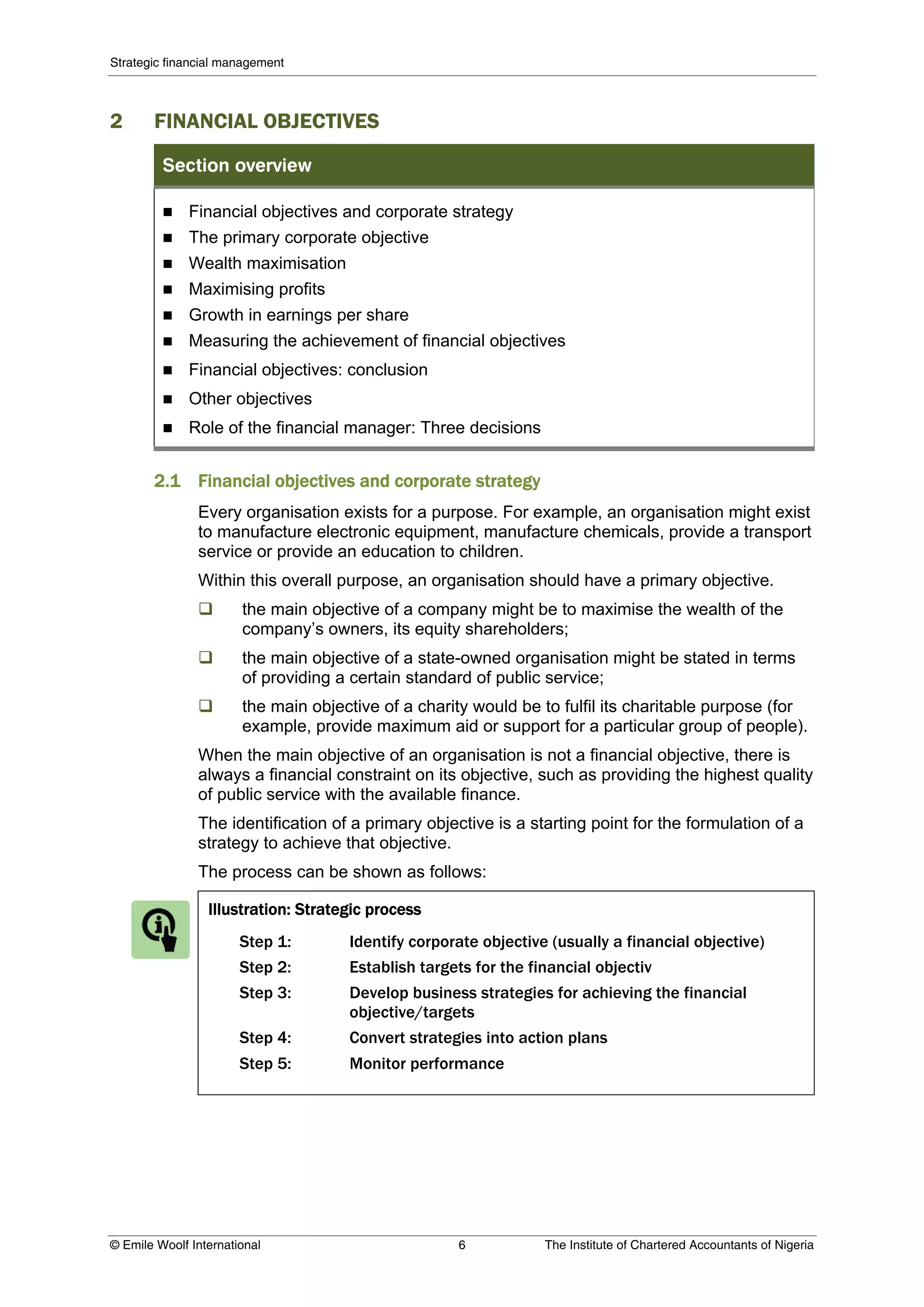
The process can be shown as follows:
Illustration: Strategic process
Step 1: Identify corporate objective (usually a financial objective)
Step 2: Establish targets for the financial objectiv
Step 3: Develop business strategies for achieving the financial
objective/targets
Step 4: Convert strategies into action plans
Step 5: Monitor performance
Chapter 1: An introduction to strategic financial management
© Emile Woolf International 7 The Institute of Chartered Accountants of Nigeria
2.2 The primary corporate objective
For companies, the primary corporate objective is often stated as maximising the
wealth of its owners (equity shareholders). This means maximising the market
value of the company.
 Many of financial management models covered later in this text test a
proposed course of action in terms of its impact on the value of the
company;
 The objective is not just a theoretical one. In practice, surveys have shown
that most chief executives view increasing the market value of the company
which they control as their main responsibility.
The primary objective is directed to the benefit of a single stakeholder group (the
owners). In reality, the wealth maximisation objective must be pursued within the
boundaries of the needs of other stakeholders. For example, cocaine smuggling
or money laundering might lead to large positive cash flows for a company but
one of the company’s stakeholders (the government) prohibits these activities.
Corporate social responsibility (CSR)
Corporate social responsibility is a term to describe the view that a company
should pursue objectives that are in the interests of stakeholder groups other
than shareholders, such as employees and society as a whole (the ‘public’). This
is discussed in more detail later in this chapter.
2.3 Wealth maximisation
The main corporate objective is the maximisation of shareholder wealth and this
is taken as maximising the market value of the company.
Shareholder wealth is increased by dividend payments and a higher share price.
Corporate strategies are therefore desirable if they result in higher dividends, a
higher share price, or both.
There are practical problems with using this objective:
 What should be the time period for setting targets for wealth maximisation?
 How will wealth creation be measured, and how can targets be divided into
targets for dividend payments and targets for share price growth?
 Share prices are often affected by general stock market sentiment, and
short-term increases or falls in a share price might be caused by investor
attitudes rather than any real success or failing of the company itself.
The objective of maximising shareholder wealth is generally accepted as a sound
basis for financial planning, but is not practical in terms of actually setting
financial performance targets and measuring actual performance against the
target. Other financial objectives might therefore be used instead, in the
expectation that if these objectives are achieved, shareholder wealth will be
increased by an optimal amount.
These include:
 maximising profits; and
 achieving growth in earnings per share.
Strategic financial management
© Emile Woolf International 8 The Institute of Chartered Accountants of Nigeria
2.4 Maximising profits
A company might express its main financial objectives in terms of profit
maximisation, and targets can be set for profit growth over a strategic planning
period.
Profit growth objectives have the advantage of simplicity. When a company
states that its aim is to increase profits by 20% per year for the next three years,
the intention is quite clear and easily understood – by managers, investors and
others.
The main problem with an objective of maximising profits is to decide the time
period over which profit performance should be measured.
 Short-term profits might be increased only by taking action that will have a
harmful effect on profits in the longer term. For example, a company might
avoid replacing ageing equipment in order to avoid higher depreciation and
interest charges, or might avoid investing in new projects if they will make
losses initially – regardless of how profitable they might be in the longer
term.
 It is often necessary to invest now to improve profits over the longer term.
Innovation and taking business risks are often essential for long-term
success. However, longer-term success is usually only achieved by making
some sacrifices in the short term.
In practice, managers often focus on short-term profitability, and give insufficient
thought to the longer term:
 Partly because much of their remuneration might depend on meeting
annual performance targets. Annual cash bonuses, for example, might be
dependent on making a minimum amount of profit for the year.
 Partly because managers often do not expect to remain in the same job for
more than a few years; therefore short-term achievements might mean
more to them than longer-term benefits after they have moved on to a
different position or job.
Another problem with an objective of profit maximisation is that profits can be
increased by raising and investing more capital. When share capital is increased,
total profits might increase due to the bigger investment, but the profit per share
might fall. This is why a company’s financial objective might be expressed in
terms of profit per share or growth in profit per share.
2.5 Growth in earnings per share
The most common measure of profit per share is earnings per share or EPS. A
financial objective might be to increase the earnings per share each year, and
possibly to grow EPS by a target amount each year for the next few years. If
there is growth in EPS, there will be more profits to pay out in dividends per
share, or there will be more retained profits to reinvest with the intention of
increasing earnings per share even more in the future. EPS growth should
therefore result in growth in shareholder wealth over the long term.
However, there are some problems with using EPS growth as a financial
objective. It might be possible to increase EPS through borrowing and debt
capital. If a company needs more capital to expand its operations, it can raise the
money by borrowing. Tax relief is available on the interest charges, and this
reduces the effective cost of borrowing. Shareholders benefit from any growth in
profits after interest, allowing for tax relief on the interest, and EPS increases.
Chapter 1: An introduction to strategic financial management
© Emile Woolf International 9 The Institute of Chartered Accountants of Nigeria
However, higher financial gearing (the ratio of debt capital to total capital) can
expose shareholders to greater financial risk. As a consequence of higher
gearing, the share price might fall even when EPS increases.
2.6 Measuring the achievement of financial objectives
When a financial objective is established, actual performance should be
measured against the objective.
This requires the calculation of one or more suitable performance measurements.
Financial objectives are commonly measured using ratio analysis. Financial ratios
can be used to make comparisons. These might be:
 Comparisons over a number of years. By looking at the ratios of a company
over a number of years, it might be possible to detect improvements or a
deterioration in the financial performance or financial position of the entity.
Ratios can therefore be used to make comparisons over time, and to
identify changes or trends
 Comparisons with the similar ratios of other, similar companies for the
same period.
 Comparisons with ‘industry average’ ratios.
Return on capital employed (ROCE)
Profit-making companies should try to make a profit that is large enough in
relation to the amount of money or capital invested in the business. The most
important profitability ratio is return on capital employed or ROCE.
For a single company:
Formula:
ROCE =
Profit before interest and taxation
X 100%
(Share capital and reserves + long-term debt capital
+ preference share capital)
The capital employed is the share capital and reserves, plus long-term debt
capital such as bank loans, bonds and loan stock.
Where possible, use the average capital employed during the year. This is
usually the average of the capital employed at the beginning of the year and end
of the year.
Strategic financial management
© Emile Woolf International 10 The Institute of Chartered Accountants of Nigeria
Example: Return on capital employed
The following figures relate to Company X for Year 1.
1 January
Year 1
31 December
Year 1
₦ ₦
Share capital (₦1 shares) 200,000 200,000
Share premium 100,000 100,000
Retained earnings 500,000 600,000
Bank loans 200,000 500,000
1,000,000 1,400,000
₦
Profit before tax 210,000
Income tax expense (65,000)
Profit after tax 145,000
Interest charges on bank loans were ₦30,000.
ROCE is calculated as follows:
ROCE = 240,000 (W1)/1,200,000 (W2)  100 = 20%
W1 Profit before interest and tax ₦
Profit before tax 210,000
Add back interest deducted 30,000
Profit before interest and tax 240,000
W2 Capital employed ₦
Capital employed at the beginning of the year 1,000,000
Capital employed at the end of the year 1,400,000
2,400,000
÷2
Average capital employed 1,200,000
This ROCE figure can be compared with the ROCE achieved by the
company in previous years, and with the ROCE achieved by other
companies, particularly competitors.
Chapter 1: An introduction to strategic financial management
© Emile Woolf International 11 The Institute of Chartered Accountants of Nigeria
Return on shareholder capital
Return on shareholder capital (ROSC) measures the return on investment that
the shareholders of the company have made. This ratio normally uses the values
of the shareholders’ investment as shown in the statement of financial position
(rather than market values of the shares).
Formula: Return on shareholder capital
ROSC =
Profit after taxation and preference dividend
 100
Share capital and reserves
The average value of shareholder capital should be used if possible. This is the
average of the shareholder capital at the beginning and the end of the year.
Profit after tax is used as the most suitable measure of return for the
shareholders, since this is a measure of earnings (available for payment as
dividends or for reinvestment in the business).
Example: Return on shareholder capital
The following figures relate to Company X for Year 1.
1 January
Year 1
31 December
Year 1
₦ ₦
Share capital (₦1 shares) 200,000 200,000
Share premium 100,000 100,000
Retained earnings 500,000 600,000
Shareholder capital 800,000 900,000
Bank loans 200,000 500,000
1,000,000 1,400,000
₦
Profit before tax 210,000
Income tax expense (65,000)
Profit after tax 145,000
Interest charges on bank loans were ₦30,000.
ROSC is calculated as follows:
ROSC = 145,000/850,000 (W2)  100 = 17.06%
W1 Shareholder capital ₦
Shareholder capital at the beginning of the year 800,000
Shareholder capital at the end of the year 900,000
1,700,000
÷2
Average shareholder capital 850,000
Strategic financial management
© Emile Woolf International 12 The Institute of Chartered Accountants of Nigeria
Note that the return on shareholder’s capital is not directly comparable with
ROCE because ROCE is a before-tax measure of return whereas return on
equity is measured after tax.
Earnings per share and dividend per share
Formula: Basic EPS
Net profit (or loss) attributable to ordinary shareholders during a period
weighted average number of shares in issue during the period
The earnings per share (EPS) is a measure of the profit after taxation (and
preference share dividend, if any) per equity share, during the course of a
financial year. The EPS might be:
 a historical EPS, as reported in the company’s financial statements, or
 a forward-looking EPS, which is the EPS that the company will expect to
achieve in the future, usually in the next financial year.
Dividend per share may be important for shareholders who are seeking income
from shares rather than capital growth. The company may have a dividend policy
which aims for steady growth of dividend per share.
Example: Earnings per share
Using the figures in the previous example:
EPS = profit after tax/Number of ordinary shares = ₦145,000/200,000 = 0.725
per share
Changes in share price and dividend
Financial performance can also be measured by the return provided to
shareholders over a period of time such as a financial year. The total return
consists of dividend payments plus the increase in the share price during the
period (or minus the fall in the share price).
This total return, often called the Total Shareholder Return or TSR, can be
expressed as a percentage of the value of the shares at the beginning of the
period.
Example: Total Shareholder Return
At 1 January the market value of a company’s shares was ₦840 per share.
During the year dividends of ₦45 per share were paid and at 31 December the
share price was ₦900.
The share price has risen by ₦60; therefore TSR = ₦(60 + 45)/₦840 = 0.125 or
12.5%.
Chapter 1: An introduction to strategic financial management
© Emile Woolf International 13 The Institute of Chartered Accountants of Nigeria
2.7 Financial objectives: conclusion
It is generally accepted that the main financial objective of a company should be
to maximise (or at least increase) shareholder wealth.
There are practical difficulties in selecting a suitable measurement for growth in
shareholder wealth. Financial targets such as profit maximisation and growth in
EPS might be used, but no financial target on its own is ideal.
Financial performance is therefore assessed in a variety of ways: by the actual or
expected increase in the share price, growth in profits, growth in EPS, and so on.
In practice, companies might have other stated objectives but these can usually
be justified in terms of the pursuit of wealth maximisation.
Stated objective Link to wealth maximisation
To maximise profits This would lead to the ability to pay out bigger
dividends and to the ability to take advantage of
favourable investment opportunities.
This should lead to increased market value
To increase
earnings per share
year on year.
This would lead to a positive perception in the market
place which in turn should lead to a higher demand for
the shares thus increasing market value.
2.8 Other objectives
Companies might have other stated non-financial objectives but these can also
be justified in terms of the pursuit of wealth maximisation.
Stated objective Link to wealth maximisation
To pay staff
competitive salaries
This should lead to happy and competent staff who will
work hard for the company thus enabling it to achieve
good performance.
This should lead to increased market value
To invest in staff
training
This should lead to staff with higher skills leading to
improved performance.
This should lead to increased market value
To invest in new
product
development
This would lead to bigger profits in the future (if
successful).
This should lead to increased market value
To take into account
the needs of society
and the need to
preserve the
environment
If the company was seen to do otherwise it would lead
to bad publicity which would be reflected in the share
price falling.
Strategic financial management
© Emile Woolf International 14 The Institute of Chartered Accountants of Nigeria
2.9 Role of the financial manager: Three decisions
A large part of the role of the senior financial manager is advisory, providing
advice on financial strategy and policies.
In order to achieve its corporate objectives, a company must develop strategies.
To achieve an objective of maximising shareholder wealth, financial strategies
should be formulated by the board of directors. Financial strategy is often (but not
always) targeted towards achieving growth in annual earnings and achieving a
return on investment in excess of the cost of the funds used to make the
investment.
Financial managers provide advice concerned with three fundamental decisions:
 Investment decisions – Which investments should be undertaken using
capital resources
 Financing decisions – How finance should be raised in order to minimise
cost of capital
 Dividend decisions – What the balance should be between the amount of
profit distributed and that held back for reinvestment in the business.
Further responsibilities would include advice on:
 communicating financial policy to internal and external stakeholders
 financial planning and control
 management of risk.
These are covered in more detail later in this text.
Chapter 1: An introduction to strategic financial management
© Emile Woolf International 15 The Institute of Chartered Accountants of Nigeria
3 THE TREASURY FUNCTION
Section overview
 Role of the treasury function
 Cash flow forecasting and cash management
 Financing long-term and short-term investments
 Financial risk management
 Possible risks of operating a treasury department
 Treasury department as a profit centre
3.1 Role of the treasury function
Cash management in a large organisation is often handled by a specialist
department, known as the treasury department.
The central treasury department is responsible for making sure that cash is
available in the right amounts, at the right time and in the right place. To do this, it
must:
 produce regular cash flow forecasts to predict surpluses and shortfalls;
 arrange short-term borrowing and investment when necessary;
 deal with the entity’s banks;
 finance the business on a day-to-day basis, for example by arranging
facilities with a bank;
 advise senior management on long-term financing requirements;
 arrange to purchase foreign currency when needed, and arrange to sell
foreign currency cash receipts;
 protect the business against the risk of adverse movements in foreign
exchange rates, when the business has receipts and payments, or loans
and investments.
Some of these are discussed in more detail below.
3.2 Cash flow forecasting and cash management
A role of the treasury department is to centralise the control of cash, to make
sure that:
 cash is used as efficiently as possible;
 surpluses in one part of the business (for example, in one profit centre) are
used to fund shortfalls elsewhere in the business, and
 surpluses are suitably invested and mature when the cash is needed.
Cash flow forecasting
Cash flow forecasting is an important aspect of treasury management. A
company must have enough cash (or access to borrowing, such as a bank
overdraft facility) to meet its payment obligations. Cash forecasts are therefore
made and revised regularly, to establish whether the organisation expects to
have a cash surplus or to be short of cash.
Strategic financial management
© Emile Woolf International 16 The Institute of Chartered Accountants of Nigeria
 If a cash deficit is forecast, measures should be taken to ensure that cash
will be available. It might be necessary to ask a bank for more finance.
Some expenditure might be deferred. Alternatively, measures might be
taken to speed up receipts from customers.
 If a cash surplus is forecast, the treasury department will consider how the
surplus funds should be used. For example, if the surplus is expected to be
temporary, how long will the surplus last and what is the most profitable
method of investing the money (without risk) for that period?
Short-term cash forecasts can be prepared using receipts and payments cash
budgets. Longer-term cash forecasts can be made by preparing an expected
cash flow statement for the forecast period.
Larger businesses find it much easier than smaller businesses to raise cash
when they are expecting a cash shortfall. Similarly, when they have a cash
surplus, they find it easier to invest the cash.
Cash management
A centralised treasury department is able to manage the cash position of the
group as a whole. It can manage total cash receipts, total cash payments and
total net cash balances.
One technique for doing this is to pool bank accounts. All the bank accounts
throughout the group for a particular currency might be pooled. At the end of
each day, the balances in each account are transferred to a centralised cash
account. (The cash is ‘pooled’). The cash deficits in some accounts and cash
surpluses in other accounts are therefore netted. In this way, the company can
avoid interest charges on accounts that are in deficit, and transfer cash between
accounts as required.
Pooling and netting of cash flows therefore improves cash management.
However, for pooling and netting to be effective, the cash has to be managed by
a central treasury department.
Advantages
Making the management of cash the responsibility of a centralised treasury
department has significant advantages.
 Cash is managed by specialist staff – improving cash management
efficiency.
 All the cash surpluses and deficits from different bank accounts used by the
entity can be ‘pooled’ together into a central bank account. This means that
cash can be channelled to where it is needed, and overdraft interest
charges can be minimised.
 Central control over cash lowers the total amount of cash that needs to be
kept for precautionary reasons. If individual units had to hold their own
‘safety stock’ of cash, then the total amount of surplus cash would be
higher (when added together) than if cash management is handled by one
department.
 Putting all the cash resources into one place increases the negotiating
power of the treasury department to get the best deals from the banks.
Chapter 1: An introduction to strategic financial management
© Emile Woolf International 17 The Institute of Chartered Accountants of Nigeria
3.3 Financing long-term and short-term investments
A company must be able to finance its planned long-term and short-term
investments (including any proposed takeovers). Preference share capital is rare,
and the options available to companies are therefore as follows:
 For long-term investments, there should be long-term finance. Long-term
finance is either equity or debt. Bank loans might be classified as long-term
debt, provided that it is a fixed loan or a revolving credit facility for several
years. However, bank loans are typically for up to about seven years
 Short-term investments might be defined as working capital assets.
Inventory and receivables should normally be financed by a combination of
long-term finance and short-term liabilities (such as trade payables).
Sources of equity
For many companies, the main source of new equity finance is retained profits.
Profits are retained and reinvested to finance new investments and further
growth.
Occasionally, a company might wish to raise extra capital by issuing new shares
for cash. However, it is difficult for a small company to raise new finance in this
way if its shares are not traded on a stock market and it has only a small number
of individual shareholders.
A company whose shares are traded on the stock market might wish to issue
new shares for cash. In some countries (such as the UK), it is a legal requirement
for companies issuing new shares for cash to offer the shares to the existing
shareholders in proportion to their existing shareholding. (The shareholders might
agree to waive this right in certain circumstances and within certain limits).
A company will only be able to issue new shares for cash in this way if it has the
confidence and support of its shareholders and other institutions in the stock
market.
In a takeover bid, the shareholders in the target company might be offered new
shares in the bidding company as the purchase consideration.
In some cases, a company whose shares are not traded on the stock market
might be able to raise new capital by issuing shares, when the new equity finance
is provided by specialist ‘venture capital’ organisations.
Sources of debt
For most companies, the main source of debt capital is their bank or banks.
Large companies, however, are able to raise debt capital by issuing bonds in the
bond markets.
Sources of short-term finance
Companies obtain short-term finance mainly from trade credit and bank lending.
Large companies might have access to other sources of short-term borrowing,
such as:
 commercial paper programmes (CP), or
 bankers’ acceptance facilities (BA acceptances).
Strategic financial management
© Emile Woolf International 18 The Institute of Chartered Accountants of Nigeria
Trade finance
When the company needs finance to support its foreign trade, the treasury
function might be responsible for arranging the financing.
3.4 Financial risk management
The treasury department is usually responsible for the management of financial
risk. The main financial risks facing companies are:
 foreign exchange risk or currency risk;
 interest rate risk;
 credit risk;
 market risk, where companies hold large quantities of market securities
(such as shares and bonds) as assets. Market risk is the risk of an adverse
movement in the market price of these assets.
Foreign exchange risk and interest rate risk are described in later chapters.
Credit risk
Credit risk is the risk that a debt will not be paid and will become a bad debt, or
that a customer will make debt payments later than scheduled. Credit control and
credit risk management are aspects of day-to-day financial management, and
you should already be familiar with credit management and debt collection
systems.
Companies that borrow from banks are a credit risk to the bank, and a function of
the treasury department in large companies might be to monitor the perceived
credit risk of the company. Large companies might have a formal credit rating
from one of the credit rating agencies (such as Moody’s and Standard & Poor’s).
The cost of borrowing for these companies depends on their credit rating.
 Banks will charge a higher ‘spread’ over the risk-free rate on loans to
companies with a lower credit rating.
 If a company wants to issue new bonds, the interest payable on the bonds
will depend on the credit rating attached to them.
The treasury management of a company that has debt with a credit rating might
therefore be required to monitor the rating and maintain a dialogue with the credit
rating agencies.
The link between credit ratings spreads over the risk-free rate and the cost of
borrowing is explained in a later chapter.
Chapter 1: An introduction to strategic financial management
© Emile Woolf International 19 The Institute of Chartered Accountants of Nigeria
3.5 Possible risks of operating a treasury department
The main risks in treasury operations, for a large Treasury department, may be
as follows.
 There is a risk that the treasury department will raise finance for the entity
in an inefficient or inappropriate way. For example, interest rates on
borrowing may be higher than necessary. There may be too much short-
term borrowing and not enough longer-term borrowing (or not enough
short-term borrowing and too much long-term borrowing). The balance
between equity finance and debt may be inappropriate, resulting in a high
cost of capital for the entity.
 The treasury department may fail to manage the financial risks of the entity
sufficiently. For example, it might make insufficient use of forward contracts
(for foreign exchange) and may fail to manage interest rate risk using
derivatives such as swaps.
 The treasury department may employ ‘dealers’ for foreign exchange or
investing surplus funds. Dealers may exceed their trading limits. They may
make mistakes when dealing, such as buying when they ought to sell, or
making a mistake when agreeing the price or the quantity for a transaction.
Dealers may also fail to record/document their transactions properly.
 The treasury department may earn only a low return on their investment of
surplus funds.
3.6 Treasury department as a profit centre
A treasury department might be run as a cost centre or as a profit centre. The
aim of establishing a treasury department as a profit centre is to motivate
management (both in treasury and in its customers in the other parts of the
organisation) to deal on a market priced basis.
Advantages of running treasury department as a profit centre
 potential for additional profits;
 the department is motivated to operate efficiently; and
 transfer costs to the business units would be realistic as they should be at
the market value of services received.
Disadvantages of running treasury department as a profit centre
 potential for huge losses due to speculative deals;
 additional administrative costs in running a profit centre; and
 the additional cost of management time in terms of negotiating transfer
prices.
Strategic financial management
© Emile Woolf International 20 The Institute of Chartered Accountants of Nigeria
4 STAKEHOLDERS
Section overview
 Stakeholders and their objectives
 Conflicts between different stakeholder objectives
 Agency theory
 Incentive schemes (management reward schemes
4.1 Stakeholders and their objectives
Although the theoretical objective of a private sector company might be to
maximise the wealth of its owners, other individuals and groups have an interest
in what a company does and they might be able to influence its corporate
objectives. Anyone with an interest in the activities or performance of a company
are ‘stakeholders’ because they have a stake or interest in what happens.
It is usual to group stakeholders into categories, with each category having its
own interests and concerns. The main categories of stakeholder group in a
company are usually the following.
 Shareholders. The shareholders themselves are a stakeholder group.
Their interest is to obtain a suitable return from their investment and to
‘maximise their wealth’. However there might be different types of
shareholder in a company: some shareholders are long-term investors who
have an interest in longer-term share price growth as well as short-term
dividends and gains. Other shareholders might be short-term investors,
hoping for a quick capital gain and /or high short-term profits and dividends.
 Directors and senior managers. An organisation is led by its board of
directors and senior executive management. These are individuals whose
careers, income and personal wealth might depend on the company they
work for.
 Other employees. Similarly other employees in a company have a
personal interest in what the company does. They receive their salary or
wages from the company, and the company might also offer them job
security or career prospects. However, unlike directors and senior
executives, other employees might have less influence on what the
company does, unless they have strong trade union representation or have
some other source of ‘power’ and influence, such as specialist skills that
the company needs and relies on.
 Lenders. When a company borrows money, the lender or lenders are
stakeholders. Lenders might be banks or investors in the company’s bonds.
The main concern for lenders is to protect their investment. If the company
is heavily in debt, credit risk might be a problem, and lenders might be
concerned about the ability of the company to meet its interest and principal
repayment obligations. They might also want to ensure that the company
does not continue to borrow even more money, so that the credit risk
increases further.
 The government. The government also has an interest in companies,
especially large companies, for a variety of reasons.
 The government regulates commercial and industrial activity;
therefore it has an interest in companies as a regulator.
Chapter 1: An introduction to strategic financial management
© Emile Woolf International 21 The Institute of Chartered Accountants of Nigeria
 Companies are an important source of taxation income for the
government, both from tax on corporate profits but also from tax on
employment income and sales taxes.
 Companies are also employers, and one of the economic aims of
government might be to achieve full employment.
 Some companies are major suppliers to the government.
 Customers. Customers have an interest in the actions of companies
whose goods or services they buy, and might be able to influence what
companies do.
 Suppliers. Similarly major suppliers to a company might have some
influence over its actions.
 Society as a whole. A company might need to consider the concerns of
society as a whole, about issues such as business ethics, human rights, the
protection of the environment, the preservation of natural resources and
avoiding pollution. Companies might need to consider how to protect their
‘reputation’ in the mind of the public, since a poor reputation might lead to
public pressure for new legislation, or a loss in consumer (customer)
support for the company’s products or services.
Companies might therefore state their objectives in terms of seeking to increase
the wealth of their shareholders, but subject to a need to satisfy other
stakeholders too - rewarding employees well and being a good employer, acting
ethically in business, and showing due concern for social and environmental
issues.
The ability of stakeholders to influence what a company does will depend to a
large extent on:
 the extent to which their interests can be accommodated and do not conflict
with each other
 the power of each group of stakeholders to determine or influence the
company’s objectives and strategies.
4.2 Conflicts between different stakeholder objectives
Different stakeholders have differing interests in a company, and these might be
incompatible and in conflict with each other. When stakeholders have conflicting
interests:
 either a compromise will be found so that the interests of each stakeholder
group are satisfied partially but not in full
 or the company will act in the interests of the most powerful stakeholder
group, so that the interests of the other stakeholder groups are ignored.
In practice there might be a combination of these two possible outcomes. A
company might make small concessions to some stakeholder groups but act
mainly in the interests of its most powerful stakeholder group (or groups).
Some examples of conflicting interests of stakeholder groups are as follows.
 If a company needs to raise more long-term finance, its directors and
shareholders might wish to do so by raising more debt capital, because
debt capital is usually cheaper than equity finance. (The reason why this is
so will be explained in a later chapter.) However, existing lenders might
believe that the company should not borrow any more without first
Strategic financial management
© Emile Woolf International 22 The Institute of Chartered Accountants of Nigeria
increasing its equity capital – by issuing more shares or retaining more
profits. The terms of loan agreements (the lending ‘covenants’) might
therefore include a specification that the company must not allow its debt
level (gearing level) to exceed a specified maximum amount.
 The government might want to receive tax on a company’s profits, whereas
the company will want to minimise its tax liabilities, through ‘efficient’ tax
avoidance schemes.
 A company cannot maximise returns to its shareholders if it also seeks to
maintain a contented work force, possibly by paying them high wages and
salaries.
 A company cannot maximise short-term profits if it spends money on
environmental protection measures and safe waste disposal measures.
However the most significant conflict of interest between stakeholders in a large
company, especially a public company whose shares are traded on a stock
market, is generally considered to be the conflict of interests between:
 the shareholders and
 the board of directors, especially the executive directors, and the other
senior executive managers.
This perceived conflict of interests is fundamental to agency theory and the
concepts of good corporate governance that have developed from agency theory.
4.3 Agency theory
Agency theory was developed by Jensen and Meckling (1976) who defined the
agency relationship as a form of contract between a company’s owners and its
managers, where the owners appoint an agent (the managers) to manage the
company on their behalf. As a part of this arrangement, the owners must
delegate decision-making authority to the management.
The owners expect the agents to act in the best interests of the owners. Ideally,
the ‘contract’ between the owners and the managers should ensure that the
managers always act in the best interests of the shareholders. However, it is
impossible to arrange the ‘perfect contract’, because decisions by the managers
(agents) affect their own personal interests as well as the interests of the owners.
Managers will give priority to their personal interests over those of the
shareholders.
When this happens, there is a weakness or failing on the governance of the
company.
Agency conflicts
Agency conflicts are differences in the interests of a company’s owners and
managers. They arise in several ways.
 Moral hazard. A manager has an interest in receiving benefits from his or
her position as a manager. These include all the benefits that come from
status, such as a company car, use of a company airplane, lunches,
attendance at sponsored sporting events, and so on. Jensen and Meckling
suggested that a manger’s incentive to obtain these benefits is higher when
he has no shares, or only a few shares, in the company. The biggest
problem is in large companies.
Chapter 1: An introduction to strategic financial management
© Emile Woolf International 23 The Institute of Chartered Accountants of Nigeria
 Effort level. Managers may work less hard than they would if they were the
owners of the company. The effect of this ‘lack of effort’ could be lower
profits and a lower share price. The problem will exist in a large company at
middle levels of management as well as at senior management level. The
interests of middle managers and the interests of senior managers might
well be different, especially if senior management are given pay incentives
to achieve higher profits, but the middle managers are not.
 Earnings retention. The remuneration of directors and senior managers is
often related to the size of the company, rather than its profits. This gives
managers an incentive to grow the company, and increase its sales
turnover and assets, rather than to increase the returns to the company’s
shareholders. Management are more likely to want to re-invest profits in
order to make the company bigger, rather than payout the profits as
dividends.
 Risk aversion. Executive directors and senior managers usually earn most
of their income from the company they work for. They are therefore
interested in the stability of the company, because this will protect their job
and their future income. This means that management might be risk-
averse, and reluctant to invest in higher-risk projects. In contrast,
shareholders might want a company to take bigger risks, if the expected
returns are sufficiently high.
 Time horizon. Shareholders are concerned about the long-term financial
prospects of their company, because the value of their shares depends on
expectations for the long-term future. In contrast, managers might only be
interested in the short-term. This is partly because they might receive
annual bonuses based on short-term performance, and partly because they
might not expect to be with the company for more than a few years.
Managers might therefore have an incentive to increase accounting return
on capital employed (or return on investment), whereas shareholders have
a greater interest in long-term share value.
Agency costs
Agency costs are the costs that the shareholders incur when professional
managers to run their company.
 Agency costs do not exist when the owners and the managers are exactly
the same individuals.
 Agency costs start to arise as soon as some of the shareholders are not
also directors of the company.
 Agency costs are potentially very high in large companies, where there are
many different shareholders and a large professional management.
There are three aspects to agency costs:
 They include the costs of monitoring. A company establishes systems for
monitoring the actions and performance of management, to try to ensure
that management are acting in their best interests. An important example of
monitoring is the requirement for the directors to present an annual report
and audited accounts to the shareholders, setting out the financial
performance and financial position of the company. Preparing accounts and
having them audited has a cost.
 Agency costs also include the costs to the shareholder that arise when the
managers take decisions that are not in the best interests of the
Strategic financial management
© Emile Woolf International 24 The Institute of Chartered Accountants of Nigeria
shareholders (but are in the interests of the managers themselves). For
example, agency costs arise when a company’s directors decide to acquire
a new subsidiary, and pay more for the acquisition than it is worth. The
managers would gain personally from the enhanced status of managing a
larger group of companies. The cost to the shareholders comes from the
fall in share price that would result from paying too much for the acquisition.
 The third aspect of agency costs is costs that might be incurred to provide
incentives to managers to act in the best interests of the shareholders.
These are sometimes called bonding costs. The main example of bonding
costs are the costs of remuneration packages for senior executives. These
costs are intended to reduce the size of the agency problem. Directors and
other senior managers might be given incentives in the form of free shares
in the company, or share options. In addition, directors and senior
managers might be paid cash bonuses if the company achieves certain
specified financial targets.
Reducing the agency problem
Jensen and Meckling argued that in order to reduce the agency problem,
incentives should be provided to management to increase their willingness to
take ‘value-maximising decisions’ – in other words, to take decisions that benefit
the shareholders by maximising the value of their shares.
Several methods of reducing the agency problem have been suggested. These
include:
 Devising a remuneration package for executive directors and senior
managers that gives them an incentive to act in the best interests of the
shareholders.
 Fama and Jensen (1983) argued that an effective board must consist
largely of independent non-executive directors. Independent non-
executive directors have no executive role in the company and are not full-
time employees. They are able to act in the best interests of the
shareholders.
 Independent non-executive directors should also take the decisions where
there is (or could be) a conflict of interest between executive directors and
the best interests of the company. For example, non-executive directors
should be responsible for the remuneration packages for executive
directors and other senior managers.
These ideas for reducing the agency problem are contained in codes of corporate
governance.
Chapter 1: An introduction to strategic financial management
© Emile Woolf International 25 The Institute of Chartered Accountants of Nigeria
4.4 Incentive schemes (management reward schemes)
This chapter has so far made the point that the main objective of a company
should be a financial objective, but there are different ways of stating this
objective and in measuring the extent to which the objective has been achieved.
There are different stakeholder groups with an interest in a company, and these
are likely to have conflicting interests. The main conflict of interests is the agency
problem and the different interests of shareholders and senior executive
managers and directors.
This raises the question: Can the agency problem be reduced and can managers
be persuaded to focus on returns to shareholders as the main objective of the
company? Managers may be encouraged to work in the best interests of the
company if there are remuneration incentive schemes (reward schemes) linked to
profits, earnings, share price or Total Shareholder Return.
Most, if not all, large stock market companies have remuneration schemes for
their executive directors and other senior managers, and the purpose of such
schemes is to make the personal interests of the directors and managers similar
to those of the shareholders. By achieving a financial performance that is in the
interests of the shareholders, directors and managers will also obtain personal
benefits for themselves.
Structure of a remuneration package for senior executives
The structure of a remuneration package for executive directors or senior
managers can vary, but it is usual for a remuneration package to have at least
three elements.
 A basic salary (with pension entitlements). Basic salaries need to be high
enough to attract and retain individuals with the required skills and talent.
 Annual performance incentives, where the reward is based on achieving or
exceeding specified annual performance targets. The performance target
might be stated as profit or earnings growth, EPS growth, achieving a profit
target or achieving a target for TSR. Some managers might also have a
non-financial performance target. Some managers might have several
annual performance targets, and there is a reward for achieving each
separate target. Annual rewards are usually in the form of a cash bonus.
 Long-term performance incentives, which are linked in some way to
share price growth or TSR over a longer period of time (in practice typically
three years). Long-term incentives are usually provided in the form of share
awards or share options in the company. The purpose of these awards is
to give the manager a personal incentive in trying to increase the value of
the company’s shares. As a holder of shares or share options, the manager
will benefit financially from a rising share price.
Share awards
With a share award scheme, the company purchases a quantity of its own shares
and awards these to its executive directors and other senior managers on
condition that certain ‘long-term’ financial targets are achieved, typically over a
three-year period.
Share options
A company might award share options to its executives. A share option gives its
holder the right to purchase new shares in the company on or after a specified
Strategic financial management
© Emile Woolf International 26 The Institute of Chartered Accountants of Nigeria
date in the future, typically from three years after the options have been awarded.
The right to buy new shares in the company is at a fixed price (an ‘exercise
price’) that is specified when the share options are awarded. Typically the
exercise price is the market price of the shares at the time the options are
awarded. The holder of a share option gains from any increase in the share price
above the exercise price, and so has a direct personal interest in a rising share
price.
For example, a company might award share options to its chief executive officer.
If the market price of the shares at the date of the award is, say, ₦7.00, the CEO
might be given 500,000 share options at ₦7 per share, exercisable from three
years after the date of the option award. If the share price three years later is,
say, ₦10, the CEO will be able to buy 500,000 new shares at ₦7 and sell them
immediately at ₦10, to make a personal financial gain of ₦1,500,000.
Chapter 1: An introduction to strategic financial management
© Emile Woolf International 27 The Institute of Chartered Accountants of Nigeria
5 CORPORATE SOCIAL RESPONSIBILITY
Section overview
 Definition of corporate social responsibility (CSR)
 Principles of CSR
 CSR and stakeholders in the company
 The effect of CSR on company strategy
5.1 Definition of corporate social responsibility (CSR)
Corporate social responsibility refers to the responsibilities that a company has
towards society. CSR can be described decision-making by a business that is
linked to ethical values and respect for individuals, society and the environment,
as well as compliance with legal requirements.
CSR is based on the concept that a company is a citizen of the society in which it
exists and operates.
 As a corporate citizen of society, it owes the same sort of responsibilities to
society at large that other citizens should owe.
 There is a social contract between a company and the society in which it
operates. As the owner or user of large amounts of property and other
resources, companies as corporate citizens also owe a duty to society to
use its property and resources in a responsible way. In return, society
allows the company to operate and remain in existence.
Corporate Social Responsibility is related to the idea that as well as their
responsibilities to shareholders, boards of companies are also responsible to the
general public and other stakeholder groups.
There are two key areas of responsibility:
 General responsibilities that are a key part of the board’s duties which need
to be completed in order to succeed in their industry and/or are
regulatory/legal requirements that are imposed on them; and
 Duties that are seen by some people feel go beyond these general
responsibilities.
5.2 Principles of CSR
Corporate social responsibility has five main aspects. For any company, some of
these aspects might be more significant than others.
 A company should operate in an ethical way, and with integrity. A company
should have a recognised code of ethical behaviour and should expect
everyone in the company to act in accordance with the ethical guidelines in
that code.
 A company should treat its employees fairly and with respect. The fair
treatment of employees can be assessed by the company’s employment
policies, such as providing good working conditions and providing
education and training to employees.
 A company should demonstrate respect for basic human rights. For
example, it should not tolerate child labour.
Strategic financial management
© Emile Woolf International 28 The Institute of Chartered Accountants of Nigeria
 A company should be a responsible citizen in its community. Responsibility
to the community might be shown in the form of investing in local
communities, such as local schools or hospitals. This can be an important
aspect of CSR for companies that operate in under-developed countries or
regions of the world.
 A company should do what it can to sustain the environment for future
generations. This could take the form of:
 reducing pollution of the air, land or rivers and seas
 developing a sustainable business, whereby all the resources used
by the company are replaced
 cutting down the use of non-renewable (and polluting) energy
resources such as oil and coal and increasing the use of renewable
energy sources (water, wind)
 re-cycling of waste materials.
5.3 CSR and stakeholders in the company
The concept of corporate citizenship and corporate social responsibility is
consistent with a stakeholder view of how a company should be governed. A
company has responsibilities not only to its shareholders, but also to its
employees, all its customers and suppliers, and to society as a whole.
In developing strategies for the future, a company should recognise these
responsibilities. The objective of profit maximisation without regard for social and
environmental responsibilities should not be acceptable.
Example: CSR
When a company promotes itself as a company with strong ethical views and a
considered policy on CSR, it exposes itself to reputation risk. This is the risk that
its reputation with the general public and customers will be damaged by an
unexpected event or disclosure.
For example, an ethical company might find that one or more of its major
suppliers, based in a foreign country, is using forced labour or child labour in the
production of goods that the company buys.
5.4 The effect of CSR on company strategy
The awareness of CSR will vary between different countries. To remain
successful in business, companies must respond to changes in the expectations
of its customers. In many countries, there has been a significant increase in
public awareness of environmental problems, such as global warming (pollution
and energy consumption) and the potential for natural disasters that this creates.
There is also concern about the irreplaceable loss of many natural resources and
the failure to re-cycle many raw materials that could be used again in products or
services.
If companies fail to respond to growing public concern about social and
environmental issues, they will suffer a damage to their reputation and the
possible loss (long term) of sales and profits. This is the problem for companies
of reputation risk.
Unfortunately, although there is genuine concern by some companies for CSR
issues, other companies express concerns about CSR issues in order to improve
Chapter 1: An introduction to strategic financial management
© Emile Woolf International 29 The Institute of Chartered Accountants of Nigeria
their public relations image with the public, and as a way of marketing their
products.
Strategic financial management
© Emile Woolf International 30 The Institute of Chartered Accountants of Nigeria
6 CHAPTER REVIEW
Chapter review
Before moving on to the next chapter check that you now know how to:
 Explain the meaning of financial strategy and strategic financial management.
 Explain the formulation of corporate objectives and identify the primary corporate
objective
 Explain how other objectives (both financial and non-financial) link to the primary
corporate objective
 Explain the treasury function
 Define and list stakeholders and identify their interest in an organisation
 Define corporate social responsibility and explain how it links corporate objectives
to stakeholder requirements
© Emile Woolf International 31 The Institute of Chartered Accountants of Nigeria
Professional level
Strategic financial management
C
H
A
P
T
E
R
2
Regulatory background
Contents
1 Money laundering
2 Duties of directors
3 Nigerian stock exchange
4 Chapter review
Strategic financial management
© Emile Woolf International 32 The Institute of Chartered Accountants of Nigeria
INTRODUCTION
Purpose
Strategic financial management supports management in making informed decisions.
Candidates are expected to apply relevant knowledge in recommending appropriate options
for financing a business, recognising and managing financial risks and investments.
Professional accountants need a strong background in accounting, economics, law,
mathematics and behavioural sciences.
Competencies
A Financial environment and role of financial managers
(f) Report on the professional, regulatory and legal framework relevant to
financial management including: Stock exchange requirements, money
laundering, directors’ responsibilities.
Exam context
This chapter explains certain aspects of the regulatory and legal framework relevant to
financial management in Nigeria.
By the end of this chapter you will be able to:
 Define money laundering
 Explain the main legal rules enacted in Nigeria to combat money laundering
 Explain directors’ responsibilities under Nigerian law
 Explain in overview the regulatory role of the Securities Exchange Commission
 Explain in overview the role of Nigerian Stock Exchange
Chapter 2: Regulatory background
© Emile Woolf International 33 The Institute of Chartered Accountants of Nigeria
1 MONEY LAUNDERING
Section overview
 Introduction
 Financial Action Task Force against Money Laundering
 Nigeria
 Specific rules on cash transfers
 Specific rules with regard to financial institutions and designated non-financial
institutions
 Rules specific to designated non- financial institutions
 Rules specific to financial institutions
1.1 Introduction
Money laundering is an international problem which is addressed on an
international level by mutual co-operation between countries and international
bodies.
Money laundering covers any activity by which the apparent source and
ownership of money or property representing the proceeds of crime are changed,
so that they appear to have been obtained legitimately.
The methods by which money may be laundered are varied and can range in
sophistication from simple to complex.
Money laundering often occurs in three steps:
 Cash is introduced into the financial system by some means (“placement”);
then
 Complex financial transactions camouflage the illegal source (“layering”);
then
 Wealth appears to have been generated from legal sources (“integration”).
Money laundering takes several different forms although most methods can be
categorized into one of a few types including:
 Structuring (smurfing): A method of placement by which cash is deposited
with banks in smaller amounts in order to avoid suspicion.
 Bulk cash smuggling to jurisdictions with greater bank secrecy or less
rigorous money laundering enforcement.
 Cash-intensive businesses that simply deposit both legitimate and
criminally derived cash as legitimate earnings.
 Real estate may be purchased with illegal proceeds, and then sold. The
proceeds from the sale appear to outsiders to be legitimate income
Strategic financial management
© Emile Woolf International 34 The Institute of Chartered Accountants of Nigeria
1.2 Financial Action Task Force against Money Laundering
Formed in 1989 by the G7 countries, the Financial Action Task Force on Money
Laundering (FATF) is an inter-governmental body whose purpose is to develop
and promote an international response to combat money laundering and combat
the financing of terrorism.
FATF is a policy-making body, which brings together legal, financial and law
enforcement experts to achieve national legislation and regulatory reforms.
FATF recommendations
Countries should criminalise money laundering on the basis of the United Nations
Conventions.
Countries should ensure that financial institution secrecy laws do not inhibit
implementation of the FATF Recommendations.
Financial institutions should not keep anonymous accounts or accounts in
obviously fictitious names.
Financial institutions should undertake customer due diligence measures,
including identifying and verifying the identity of their customers, when:
 Establishing business relations;
 Carrying out occasional transactions above the applicable designated
threshold or that are wire transfers;
 There is a suspicion of money laundering or terrorist financing; or
 The financial institution has doubts about the veracity or adequacy of
previously obtained customer identification data.
Financial institutions should pay special attention to all complex, unusual large
transactions, and all unusual patterns of transactions, which have no apparent
economic or visible lawful purpose.
If a financial institution suspects or has reasonable grounds to suspect that funds
are the proceeds of a criminal activity, or are related to terrorist financing, it
should be required, directly by law or regulation, to report promptly its suspicions
to the financial intelligence unit
Financial institutions should develop programmes against money laundering and
terrorist financing. These programmes should include:
 The development of internal policies, procedures and controls, including
appropriate compliance management arrangements, and adequate
screening procedures to ensure high standards when hiring employees.
 An ongoing employee training programme.
 An audit function to test the system.
FATF assesses each member country against these recommendations in
published reports. Countries seen as not being sufficiently compliant with such
recommendations are subjected to financial sanctions.
Chapter 2: Regulatory background
© Emile Woolf International 35 The Institute of Chartered Accountants of Nigeria
1.3 Nigeria
Nigeria has comprehensive anti-money laundering legislation.
The Money Laundering (Prohibition) Act 2011 (as amended in 2012) contains the
primary Nigerian anti-money laundering legislation.
It requires businesses within the regulated sector (banking, investment, money
transmission, certain professions, etc.) to report to the authorities suspicions of
money laundering by customers or others.
Money laundering is widely defined in Nigeria to include any handling or
involvement with the proceeds of any crime as well as activities which would fall
within the traditional definition.
Money laundering is prohibited in Nigeria.
It is an offence to:
 conceal or disguise the origin of;
 convert or transfer;
 removes from the jurisdiction; or
 acquire, use, retain or take possession or control of, any fund or property,
which is known or reasonably ought to have been known to be the
proceeds of an unlawful act.
Unlawful acts are defined very widely and would include tax evasion and
securities fraud.
1.4 Specific rules on cash transfers
Cash payments exceeding N5,000,000.00 in the case of an individual, or
N10,000,000.00 in the case of a body corporate are illegal unless made through
a financial institution.
Any cash transfer to a foreign country exceeding $10,000 transfer must be
reported to the Central Bank of Nigeria within 7 days from the date of the
transaction.
Transportation of cash or negotiable instruments in excess of US$10,000 or its
equivalent by individuals in or out of the country must be declared to the
Nigerian Customs Service.
Strategic financial management
© Emile Woolf International 36 The Institute of Chartered Accountants of Nigeria
1.5 Specific rules with regard to financial institutions and designated non-
financial institutions
There is a significant burden based on financial institutions and designated non-
financial Institutions (referred to as regulated entities in the following description).
Definition: Designated non-financial institution
Designated non-financial institutions includes dealers in jewellery, cars and luxury
goods, chartered accountants, audit firms, tax consultants, clearing and
settlement companies, legal practitioners, hotels, casinos, supermarkets, or
such other businesses as the Federal Ministry of Commerce or appropriate
regulatory authorities may from time to time designate
Identification of customers
Regulated entities must identify customers and verify their identity using reliable,
independent source documents. In addition they must identify and verify the
identity of any beneficial owner.
Regulated entities must undertake customer due diligence measures when:
 establishing business relationships;
 carrying out occasional transactions above the applicable designated
threshold prescribed by relevant regulation;
 carrying out occasional transaction that are wire transfers;
 there is a suspicion of money laundering or terrorist financing, regardless of
any exemptions or thresholds; or `
 the company has doubts about the veracity or adequacy of previously
obtained customer identification data.
Due diligence
Regulated entities must also:
 conduct on-going due diligent on a business relationship;
 scrutinize transactions undertaken during the course of the relationship to
ensure that the transactions are consistent with the institution’s knowledge
of their customer their business and risk profile and where necessary, the
source of funds; and
 ensure that documents, data or information collected under the customer
due diligence process is kept up-to-date and relevant by undertaking
reviews of existing records, particularly for higher risk categories of
customers or business relationships.
Chapter 2: Regulatory background
© Emile Woolf International 37 The Institute of Chartered Accountants of Nigeria
Internal procedures, policies and controls
Regulated entities must develop programmes to combat the laundering of the
proceeds of a crime or other illegal act, and these must include-
 the designation of compliance officers at management level at its
headquarters and at every branch and local office;
 regular training programmes for its employees;
 the centralization of the information collected; and
 the establishment of an internal audit unit to ensure compliance with and
ensure the effectiveness of the measures taken to enforce the provision of
this Act.
Sundry
Where such a regulated entity suspects or has reasonable grounds to suspect
that the amount involved in a transaction is the proceeds of a crime or an
illegal act it must require identification of the customer notwithstanding that the
amount involved in the transaction is less than US$1,000 or its equivalent.
Where the customer is a politically exposed person (as defined), the company
must put in place appropriate risk management systems and obtain senior
management approval before establishing and during any business relationship
with the politically exposed person.
Suspicious transactions reporting
A transaction may:
 Involves a frequency which is unjustifiable or unreasonable; or
 Be surrounded by conditions of unusual or unjustified complexity; or
 Appear to have no economic justification or lawful objective; or
 (in the opinion of the regulated entity) involve terrorist financing or be
inconsistent with the known transaction pattern of the account or business
relationship.
Such transactions are deemed to be suspicious. The regulated entity must seek
information from the customer as to the origin and destination of the fund, the
aim of the transaction and the identity of the beneficiary.
The regulated entity must immediately report any suspicious transaction to the
Economic and Financial Crimes Commission´;
Strategic financial management
© Emile Woolf International 38 The Institute of Chartered Accountants of Nigeria
1.6 Rules specific to designated non- financial institutions
Such a regulated entity whose business involves the one of cash transaction
must submit to the Ministry a declaration of its activities before commencement
of the business.
It must also identify a customer by requiring him to fill a standard data form
and present his international passport, driving license, national identity card or
such other document bearing his photograph as may be prescribed by the
Ministry prior to any transaction involving a sum exceeding US$1,000 or its
equivalent.
Such a regulated entity must record all such transaction chronological order,
indicating each customers surname, forenames and address in a register
numbered and forwarded to the Ministry.
1.7 Rules specific to financial institutions.
Companies must report to the EFCC in writing within 7 and 30 days respectively
any single transaction in excess of-
 N5,000,000 or its equivalent, in the case of an individual; or
 N10, 000,000 or its equivalent, in the case of a body corporate.
The opening or maintaining of numbered or anonymous accounts by any person,
Financial Institution or corporate body is prohibited.
A person must not establish or operate a shell bank in Nigeria.
The Nigerian regulatory authorities can apply to the Federal High Court for
permission:
 To place any bank account or any other account comparable to a bank
account under surveillance; or
 To obtain access to any suspected computer system;
 To obtain communication of any authentic instrument or private contract,
together with all bank, financial and commercial records, when the account,
telephone line or computer system is used by any person suspected of
taking part in a transaction involving the proceeds, of a financial or other
crime.
Banking secrecy or preservation of customer confidentiality c a n n o t b e
invoked as a ground for objecting to the measures set out.
Chapter 2: Regulatory background
© Emile Woolf International 39 The Institute of Chartered Accountants of Nigeria
2 DUTIES OF DIRECTORS
Section overview
 Duties of directors
 Conflicts of duties and interests
 Duty of care and skill
2.1 Duties of directors
A director of a company stands in a fiduciary relationship towards the company
and must act in the utmost good faith towards the company in any transaction
with it or on its behalf.
Definition
A fiduciary is an individual in whom another has placed the utmost trust and
confidence to manage and protect property or money.
Fiduciary relationship is where one person has an obligation to act for another's
benefit.
A director also owes a fiduciary relationship with the company in the following
circumstances:
 Where a director is acting as agent of a particular shareholder;
 Where even though he is not an agent of any shareholder, such a
shareholder or other person is dealing with the company's securities.
A director must act at all times in what he believes to be the best interests of the
company as a whole so as to preserve its assets, further its business, and
promote the purposes for which it was formed. He must act in such manner as a
faithful, diligent, careful and ordinarily skilful director would act in the
circumstances.
In the performance of his functions, a director must have regard to the interests
of the company's employees in general, as well as the interests of its members.
A director must exercise his powers for the purpose for which he is specified and
must not do so for a collateral purpose. The power, if exercised for the right
purpose, does not constitute a breach of duty, if it, incidentally, affects a member
adversely.
Where, under the provisions set out in CAMA, a director is allowed to delegate
his powers this must not be done in such a way that it may amount to an
abdication of duty.
Illustration: Delegation
Directors have the responsibility to produce financial statements.
This responsibility might be delegated to an accountant employed for that
purpose.
However, it is still the directors’ responsibility that the financial statements are
properly prepared. They must employ a competent person to perform the
delegated task.
Strategic financial management
© Emile Woolf International 40 The Institute of Chartered Accountants of Nigeria
A director’s responsibilities under law cannot be relieved in any way by provisions
contained in the articles or resolutions of a company, or in any contract.
Legal position of directors
A director is an agent of the company.
Directors are trustees of the company's assets and powers.
 They must account for all the moneys over which they exercise control and
must refund any moneys improperly paid away.
 They must exercise their powers honestly in the interest of the company
and all the shareholders (not in their own or sectional interests).
2.2 Conflicts of duties and interests
The personal interest of a director must not conflict with any of his duties as a
director.
A director must not make any secret profit when performing his duties. If the
director discloses his interest in a transaction before he may escape liability. In
other words, the profits are not secret and he might be entitled to keep them.
A director is privy to confidential information about a company. This is known as
inside information. Directors must not misuse such information. This applies to a
person who once was a director but has now left the company. He is still
accountable and could be restrained by an injunction from misusing the
information received by virtue of his previous position.
2.3 Duty of care and skill
This applies to both executive and non‐executive directors:
Every director of a company must exercise the powers and discharge the duties
of his office honestly, in good faith and in the best interests of the company.
A director must exercise that degree of care, diligence and skill which a
reasonably prudent director would exercise in comparable circumstances.
Failure to take reasonable care may be grounds for an action for negligence and
breach of duty.
Each director is individually responsible for the actions of the board in which he
participated. Being absent from the board's deliberations (unless justified) does
not relieve a director of such responsibility.
Chapter 2: Regulatory background
© Emile Woolf International 41 The Institute of Chartered Accountants of Nigeria
3 NIGERIAN STOCK EXCHANGE
Section overview
 Introduction
 Methods of listing securities
 General requirements of the listing rules
3.1 Introduction
The Nigerian Stock Exchange is regulated by the Securities and Exchange
Commission and subject to its regulations.
Securities and Exchange Commission (SEC)
The SEC has a number of roles including:
 Registers all securities to be offered for sale to, or for subscription by, the
public;
 Approves timing of new issues;
 Maintains surveillance over dealings in securities;
 Registers all stock exchanges including their branches and capital market
operators; and
 Protects the securities market against any manipulations including insider
trading.
Companies wishing to be admitted to the official list of the Nigerian Stock
Exchange must, in addition to complying with the exchange’s listing rules, comply
with the relevant provisions of the Companies And Allied Matters Act 1990 and
the Investment and Securities Act, 2007 Rules and Regulations.
The Nigerian Stock Exchange (NSE)
The NSE has a number of roles including:
 Provides the platform for buying and selling of existing securities;
 Provides liquidity for investors;
 Regulates the activities of the stock brokers;
 Encourages transactions in the new issue market.; and
 Helps to spread promoters’ risks.
The detailed listings requirements of The Nigerian Stock Exchange are set out in
10 Chapters in the Green Book.
Strategic financial management
© Emile Woolf International 42 The Institute of Chartered Accountants of Nigeria
3.2 Methods of listing securities
In broad outline, the methods for listing of securities on the NSE are as follows:
 Offer for subscription: An invitation by or on behalf of a company or other
authority to the public, for subscription of securities at a fixed price;
 Offer for sale: An offer to the public by or on behalf of a shareholder, the
proceeds which will go to the vendor(s);
 Placing: Sale by a broker to his clients, of securities, which have previously
been purchased or subscribed for;
 Rights offer/issue: A privilege offer/issue to existing shareholders to
acquire proportionately additional shares in the company usually at a
special price;
 Capitalisation issue: A bonus/scrip issue to existing shareholders;
 Tender: An offer of specific quantity of shares and stock to the public by or
on behalf of a company or other authority or a third party for bidding;
 Introduction: The listing of securities already widely held;
 Conversion: An exchange for or conversion of securities into other classes
of securities;
 Options: An offer to buy or sell some shares at an agreed price and time;
3.3 General requirements of the listing rules
An application for listing will only be entertained if sponsored by a dealing
member of the exchange.
The company must be a public company, which will issue or has issued an
invitation to the public to subscribe for its shares or has satisfied council that the
public is sufficiently interested in the company’s shares to warrant listing.
All securities for which listing is sought must first be registered with the Securities
and Exchange Commission.
All application and documents to be considered or approved by Council should
always be submitted to the exchange at the earliest possible date.
The final prospectus for approval must be forwarded to the exchange at least
seven working days before the date for the completion board meeting.
Before the grant of listing, all applicant companies must sign a general
undertaking that they will provide promptly certain information about their
operations and that they will follow certain administrative procedures.
Where it is desired to increase the authorized share capital, the directors must
state, in the explanatory circular or other documents accompanying the notice of
meeting, whether or not they presently have any intention of issuing all or any
part thereof.
A company which applies for listing must comply with the minimum public float
requirement, prescribed by the listing standard criteria chosen by the issuer.
Subscriptions list must remain open for a maximum period of 28 working days.
A maximum of 10% of an offering will be allowed to staff of a company (or its
subsidiaries or associated companies) on special application forms. Such
offerings may be placed in trust for the employees.
Chapter 2: Regulatory background
© Emile Woolf International 43 The Institute of Chartered Accountants of Nigeria
Where a proportion of the shares in a placement or public offer is reserved for
employees, the company must provide the exchange along with the general
undertaking a list of members of staff who have been allotted shares, the number
of such shares, the capacity in which they work for the company and the number
of years of service with the company.
All companies admitted to listing on the exchange must pay a listing fee as
specified.
All clauses in the company’s memorandum & articles of association that restrict
the transfer of fully paid-up shares must be expunged.
All listed companies must advertise the notice of their annual general meetings in
at least two widely read newspapers at least 21 days before the annual general
meeting and such advertisement must be conspicuously placed to cover a
reasonable portion of a page.
The subscription monies pending allotment and return of funds to subscribers
must be deposited in a designated bank account appointed by the issuing house
and the company.
All accrued interests in respect of cleared allotments must be paid to the
company to offset part of the cost of the Issue.
Return monies arising from an unsuccessful application or abortion of an
offer/issue attract interest at the rate determined by the commission.
Strategic financial management
© Emile Woolf International 44 The Institute of Chartered Accountants of Nigeria
4 CHAPTER REVIEW
Chapter review
Before moving on to the next chapter check that you now know how to:
 Define money laundering
 Explain the main legal rules enacted in Nigeria to combat money laundering
 Explain directors’ responsibilities under Nigerian law
 Explain in overview the regulatory role of the Securities Exchange Commission
 Explain in overview the role of Nigerian Stock Exchange
© Emile Woolf International 45 The Institute of Chartered Accountants of Nigeria
Professional level
Strategic financial management
C
H
A
P
T
E
R
3
The financial
management environment
Contents
1 The economic environment
2 Other influences of government on business
3 The financial management framework
4 The financial markets
5 The money markets
6 Money market instruments
7 Chapter review
Strategic financial management
© Emile Woolf International 46 The Institute of Chartered Accountants of Nigeria
INTRODUCTION
Purpose
Strategic financial management supports management in making informed decisions.
Candidates are expected to apply relevant knowledge in recommending appropriate options
for financing a business, recognising and managing financial risks and investments.
Professional accountants need a strong background in accounting, economics, law,
mathematics and behavioural sciences.
Competencies
A Financial environment and role of financial managers
(c) Evaluate the impact of macroeconomics and the role of international financial
institutions in strategic financial management.
Exam context
Companies operate within an economic and financial environment, and changes in the
conditions within this environment can be important for financial management. This chapter
provides a brief survey of factors that might need to be taken into consideration by
companies, and that might affect the decisions that management take.
By the end of this chapter you will be able to:
 Explain how government has a profound influence on the economic environment
through the exercise of fiscal and monetary policy
 Explain further government influences
 Explain the role of the capital markets
 Describe the characteristics of government securities
 List the participants in financial markets and comment on their roles (some of this was
covered in chapter 2)
 Explain the role of the money markets
 Describe money market instruments
Chapter 3: The financial management environment
© Emile Woolf International 47 The Institute of Chartered Accountants of Nigeria
1 THE ECONOMIC ENVIRONMENT
Section overview
 Government economic policy and macroeconomic policy targets
 Economic growth and gross domestic product (GDP)
 Economic policy
 Fiscal policy and its effect on business
 Monetary policy and inflation
 Monetary policy and the exchange rate
 Monetary policy and business
1.1 Government economic policy and macroeconomic policy targets
Macroeconomics refers to economics at a national or international level, as
distinct from microeconomics, which is the economics of individual firms and
markets, and macroeconomic policy is formulated by the country’s government.
Macroeconomic policy, and changes in economic policy and economic
conditions, can have important consequences for corporate objectives and
management decisions.
In advanced economies, there are normally five main macroeconomic policy
objectives:
 To achieve sustained real growth in the national economy
 To achieve ‘full employment’
 Price level stability
 To achieve balance of payments equilibrium
 Income redistribution
Success in achieving and maintaining ‘full’ employment depends to a large extent
on success in achieving sustained real economic growth.
1.2 Economic growth and gross domestic product (GDP)
Economic growth is measured by the rate of growth in economic activity each
year within a country.
GDP can be measured in any of three ways:
 By the volume of output of goods and services, and other economic activity,
each year: the output approach
 By the amount of income earned each year by individuals and
organisations within the year (e.g. company profits and the wages and
salaries of individuals): this is the income approach
 By the amount of spending in the economy each year: this is the
expenditure approach
Total GDP should be the same in total using any of the three methods of
measurement. However, the expenditure approach to measuring GDP is the
most useful for the purpose of analysis. Using this approach the total value of
Strategic financial management
© Emile Woolf International 48 The Institute of Chartered Accountants of Nigeria
GDP within a given period, typically one year, can be expressed in the following
formula:
Formula: Gross domestic product (GDP)
GDP = C + G + I + (X – M)
Where:
C = Total annual consumption spending each year (by companies as
well as individuals): this is spending on goods and services other
than capital investment
G = Spending by the government (on consumption and investment by
government)
I = Investment spending (other than investment spending by
government)
X = The value of exports of goods and services
M = The value of imports of goods and services
(X – M) is the annual balance of trade for the country in international
trade.
This formula shows that growth in GDP from one year to the next can be
obtained through higher spending on consumption, higher government spending,
more investment or an improvement in the balance of trade. However, growth is
only achievable if an increase in C, G or I does not result in a matching fall in one
of the other elements in the formula.
 For example the government might increase its annual spending by raising
taxation. In raising taxation, it will reduce the spending power of individuals
and companies, and as a consequence their might be a matching fall in
consumption spending C or investment by companies I.
 Companies might want to increase investment spending, but to do so they
will need to raise extra funds from somewhere. Funds for investment come
from savings by individuals and organisations, and higher savings will result
in less money for consumption.
GDP and inflation
The formula for GDP is a ‘money’ measurement that ignores inflation. There is a
difference between:
 Growth in GDP in money terms and
 Growth in GDP in ‘real’ terms, which is growth after the effects of inflation
have been removed.
For example, if GDP grows at an annual rate of 3% but the annual general rate of
inflation is 2%, real growth in the economy is only 1%. If GDP grows at 3% but
the rate of inflation is 5%, there will be ‘negative growth’ of about 2% in real terms
(i.e. GDP will be about 2% less in real terms than in the previous year).
Government would be concerned about inflation for two reasons:
 It will want to achieve real growth in national income each year, not simply
growth in ‘money’ terms.
Chapter 3: The financial management environment
© Emile Woolf International 49 The Institute of Chartered Accountants of Nigeria
 A high rate of inflation can have harmful effects on the economy and lead
eventually to a fall in the rate of economic growth (and possibly economic
recession).
There are several reasons why the government will try to prevent excessive
inflation.
 Inflation results in a transfer of wealth within the economy in ways that
might be considered unfair. Individuals on fixed incomes, such as many
people with fixed pensions, will find that the real value of their income falls
each year. Other members of society, such as owners of property, might
benefit from rising asset prices.
 Inflation creates pressure for general cost increases. Employees will
demand higher annual pay rises if the rate of inflation is rising. Higher
employment costs might force employers to put up the prices of their goods
and services, and at the same time avoid as many extra costs as possible –
by making some workers redundant, perhaps, or by deferring investment
spending.
 Experience has shown that a high rate of inflation, and high inflationary
expectations, has the effect eventually of reducing real growth in the
economy.
For the government, an economic policy objective to support the aims of growth
in national income and full employment might therefore be to limit the rate of
annual price inflation.
1.3 Economic policy
A government uses economic policy to try to influence economic conditions, with
the objective of achieving sustained growth and full employment and restricting
the rate of inflation. There are two main aspects of economic policy:
 Fiscal policy and
 Monetary policy.
1.4 Fiscal policy and its effect on business
Fiscal policy relates to government spending, taxation and borrowing.
The central government spends enormous amounts of money every year, and
higher government spending increases GDP. However, government spending
has to be financed, and the money is obtained from:
 taxation, and
 borrowing.
When the government plans an increase in its spending programme, it will
probably seek to finance the higher spending, in full or in part, through higher
taxation. Taxation is raised from a variety of sources, but the main sources of tax
income are likely to be:
 The taxation of income of individuals
 The taxation of profits of companies
 Indirect taxation on expenditure, in the form of a sales tax or value added
tax.
Strategic financial management
© Emile Woolf International 50 The Institute of Chartered Accountants of Nigeria
When the government spends more than it raises in taxes, it has to borrow the
difference. In Nigeria, the main sources of borrowing for the government are:
 To obtain long-term finance, to issue government bonds through the Debt
Management Office known as Sovereign bonds. This source accounts for
the bulk of Nigeria’s public debt.
 To obtain long-term finance, to borrow from multilateral sources (World
Bank, African Development Bank etc.) and bilateral sources (China, etc.).
 To obtain short-term funding, to issue short-term financial instruments
known as Treasury bills. (Treasury bills are a form of short term borrowing
because the borrowed money is repaid when the bills are ’redeemed’,
usually after 91 days).
Fiscal policy and business
Fiscal policy affects business in a variety of ways.
 Companies might try to minimize their tax liabilities, possibly by transferring
business operations to low-tax countries.
 The investment decisions by companies could be affected by tax. For
example, the government might offer some tax relief for new investments,
and companies will expect to receive tax allowances for capital investment.
 Spending decisions by customers could be affected by the rate of sales tax
or value added tax. If the government increases the rate of value added
tax, the volume of customer demand for the goods and services of
companies will probably fall.
 Other tax changes can affect the rate of growth in the economy. For
example, an increase in rates of income tax on individuals will reduce their
spending ability.
If the government borrows by issuing bonds, investors will be attracted by the
risk-free nature of investing in the bonds. (These bonds are regarded as risk-free
because the government is most unlikely to default on its debts, especially when
the debt is denominated in the national currency. If it needs to it can print more
money to pay off its debts.)
Government borrowing might affect borrowing by companies. If companies also
want to borrow by issuing bonds, they will need to offer a higher rate of interest to
investors than the interest rate on government bonds, to persuade them to put
their money in risky corporate bonds rather than risk-free government bonds.
1.5 Monetary policy and inflation
Monetary policy is policy relating to monetary issues in the economy, in
particular:
 The rate of inflation
 Interest rates
 The exchange rate for the domestic currency against foreign currencies.
As explained earlier, there is a link between economic growth and the rate of
inflation. Excessive inflation is associated with an ‘over-heating’ economy,
leading to a slow-down in economic growth and possibly economic recession.
A major target of the government’s monetary policy is likely to be control over
inflation. This is currently the main objective of monetary policy, for example, in
Chapter 3: The financial management environment
© Emile Woolf International 51 The Institute of Chartered Accountants of Nigeria
the US, the eurozone countries and the UK. In these countries, interest rate
policy is the main instrument of economic policy for controlling the rate of
inflation. In Nigeria also, the Central Bank of Nigeria (CBN) uses the Monetary
Policy Rate (the interest rate it charges when it lends to banks) as a major
instrument of controlling inflation.
The link between interest rates and the rate of inflation can be summarised as
follows.
In order to reduce the rate of inflation in the long term it is essential to reduce
general expectations about what the future rate of inflation will be. Inflation will
increase when inflationary expectations are high.
To reduce inflationary expectations, the authorities must be seen to take action to
reduce inflationary pressures whenever these become evident. In the UK, USA
and eurozone, the ‘authorities’ are the central bank.
The central bank can take action by raising the rate of interest at which it lends
money to other banks. This rate of interest is sometimes called the ‘central bank
base rate’.
There is a ‘transmission effect’ in the economy, whereby the effect of the
increase in the base rate works its way through to the rest of the economy. If
banks have to pay more to borrow from the central bank, they will put up their
interests rates to borrowers. In time higher costs of borrowing might reduce the
demand by companies and individuals to borrow, and this in turn might reduce
consumption spending.
 If spending in the economy is rising too quickly, and there is a risk of
inflation, interest rates should therefore be raised. Higher interest rates will
eventually discourage borrowing and the growth in credit, and so restrict
the growth in spending
 If on the other hand the economy could grow more quickly without the
threat of inflation, interest rates might be lowered, to stimulate spending
and investment.
For companies, the implications of interest rate policy are perhaps fairly clear. If
the central bank alters its rate of interest on lending to banks, this is likely to
affect the rate at which companies can borrow from banks, and changes in the
cost of borrowing might affect investment decisions.
1.6 Monetary policy and the exchange rate
Monetary policy can also affect the value of a country’s currency. In general
terms:
 Higher interest rates are likely to attract more investors into buying
investments in the currency, and
 Lower interest is likely to persuade investors to sell their investments in the
currency.
Changes in interest rates, by affecting supply and demand for the currency, can
therefore alter its exchange rate value.
It would be possible for the government or central bank to make the exchange
rate a key economic policy target, possibly with the aim of stabilising the value of
the currency and encouraging international trade. However if the authorities use
interest rates to manage the value of the country’s currency in the foreign
Strategic financial management
© Emile Woolf International 52 The Institute of Chartered Accountants of Nigeria
exchange markets, interest rate policy cannot be used at the same time as a
policy weapon for controlling inflation.
In the case of Nigeria, where a significant proportion of foreign exchange receipts
come from oil, the exchange rate is largely a function of the price of oil in the
international oil market. A rise in oil price and oil income leads to naira
appreciation while a fall in oil receipts will bring about a depreciation of the naira
in the long run (in the short run, to defend the value of the naira, the CBN usually
intervenes using available foreign reserves).
1.7 Monetary policy and business
Businesses might be affected by the monetary policies of the government in a
variety of ways.
 In the long term, businesses benefit from government control over the rate
of inflation and restricted rises in prices, because real economic growth is
likely to be greater.
 Changes in interest rates affect the cost of borrowing, and so profits. Higher
interest rates on long-term finance might deter companies from making
some new investments, which will result in a reduction in their capital
spending.
 Changes in interest rates might affect spending by customers. For
example, higher interest rates might reduce consumer spending, and so
make it more difficult for companies to sell their goods and services.
 Changes in the exchange rate affect companies that sell goods to other
countries or buy from suppliers in other countries.
 If there is a fall in the value of the currency, the products of exporting
companies become cheaper to foreign buyers and export demand
should increase. However, the cost of imported goods, priced in other
currencies, will rise. This could lead to an inflationary spiral as higher
costs lead to higher prices and higher wage demands.
 If there is an increase in the value of the currency, the products of
exporting companies become more expensive to foreign buyers and
export demand is likely to fall. The cost of imported goods, priced in
other currencies, will fall. This will reduce the costs for companies of
purchases from abroad, but could also increase the market
competition from imported goods.
In your examination, you might be required to consider the implications for a
company of a change in economic conditions, or a change in economic policy by
the government, by considering how a company might be affected by the change
and respond to it.
Chapter 3: The financial management environment
© Emile Woolf International 53 The Institute of Chartered Accountants of Nigeria
2 OTHER INFLUENCES OF GOVERNMENT ON BUSINESS
Section overview
 Introduction
 Competition policy
 Government assistance for business
 Green policies
 Corporate governance regulations
2.1 Introduction
Government can influence the activities and performance of businesses in other
ways, in addition to the effects of fiscal policy and monetary policy. The following
are specific areas where planning and decision-making by companies might be
affected by government policy and regulation:
 competition policy;
 government assistance for business;
 green policies;
 corporate governance regulations.
2.2 Competition policy
The government might have laws or regulations for preventing anti-competitive
actions by companies.
There might be rules preventing the creation of ‘monopolies’. A monopoly is a
company that is so large that it dominates the industry and market in which it
operates.
There are some advantages for society in having monopolies, when a company
needs to be very large in order to benefit fully from ‘economies of scale’ that
reduce the costs of output products or services. Some of the benefits of lower
costs for the producer might be passed on to customers in the form of lower
prices. It has been argued that monopoly supply is necessary in utility industries,
such as the provision of water, gas and electricity supplies.
Adverse consequences of monopoly
Monopolies are often considered ‘undesirable’ because they are often able to
control prices and output of goods and services to a market. For example, a
monopoly might be able to restrict the supply of goods or a service to a market,
and in doing so might be able to raise prices. This will boost the company’s
profits at the expense of its customers. In a more competitive market, supply is
not restricted and prices are more competitive and ‘fair’.
It is also possible that when a company holds a monopoly position in its market, it
has no incentive to innovate and develop new products, because there is no
competition creating pressures for product development. There is also no
incentive to improve managerial and operational efficiency in a monopoly.
Strategic financial management
© Emile Woolf International 54 The Institute of Chartered Accountants of Nigeria
Government regulation of monopolies
A government might try to regulate and control monopolies and other anti-
competitive behaviour by companies in several ways.
 One way of regulating monopolies is to establish a government body with
the power to investigate and, if necessary, prevent proposed mergers or
takeovers. Proposed mergers or takeovers that would create a monopoly
might be prohibited, or allowed subject to certain conditions (such as a
requirement that the merged company must sell off parts of its business to
prevent the creation of a monopoly).
 In addition, if a company grows to such a large size that it might become a
monopoly the government might order that the company should be broken
up into several smaller companies.
The government might also prohibit anti-competitive practices by companies, and
give a government body powers to investigate cases where anti-competitive
practices are suspected. An example of such a practice is a cartel arrangement
between companies, whereby all the companies in the cartel reach a secret
agreement to:
 Restrict the supply of goods to the market, and ‘divide’ the market between
themselves in agreed shares, and
 Control the prices charged to customers by charging the same price and
avoiding price competition.
In the UK, the Competition Commission has powers to investigate proposed
mergers and takeovers, existing monopolies and suspected cartel arrangements.
In some cases, UK companies might be deterred from making a takeover bid for
a rival company because of the expectation that the takeover will be investigated
and then prohibited by the Competition Commission.
In Nigeria, the regulation of mergers and takeovers is the responsibility of the
Securities and Exchange Commission.
2.3 Government assistance for business
The government might provide aid to companies in particular industries, or
companies investing in particular parts of the country (such as development
areas).
 Cash grants might persuade a company to invest in a country or region
where they are available, rather than in other areas where they are not.
 In some cases, there might be competition between the development
agencies in different countries to offer grants to foreign companies in order
to persuade them to invest in their country.
2.4 Green policies
Companies might make profits because they do not have to take account of the
full economic cost of their activities. The economic cost of business activity
includes not only the direct costs of the business operations but also social costs.
Social costs include the costs of damage to the environment and the costs of
having to clean up waste and pollution created by business activities. These
costs created by companies are sometimes referred to as ‘externalities’.
Chapter 3: The financial management environment
© Emile Woolf International 55 The Institute of Chartered Accountants of Nigeria
Many of these social costs are paid for by government, and so are paid by the
taxpayer, but there is a growing recognition of these costs in some countries,
where the government has developed ‘green policies’ aimed at either:
 reducing the amount of social costs or externalities, or
 making companies pay for the social costs they incur.
The government might therefore have a range of ‘green’ policies for the
protection of the environment and promotion of ‘sustainable business’. These
include policies for:
 The prevention or reduction of pollution of the air, land or water (rivers and
seas)
 Protection of natural resources such as deep sea fish stocks or hardwood
timber forests
 The development of ‘cleaner’ and environmentally-friendly energy sources.
Many companies have been directly affected by ‘green policy’ legislation or
regulations, and it seems inevitable that regulation will become more extensive
and more restrictive over time, and that companies will react to the new
regulations in the most appropriate way to protect their interests. Examples of
ways in which companies might need to react include:
 Investing in technology that reduces pollution from factories and other
manufacturing centres
 Developing products or packaging that are more ‘environmentally friendly,
such as robust biodegradable packaging materials
 Trading in ‘carbon credits’ in industries where these apply. Companies that
create excessive levels of pollution might be able to avoid fines or penalties
from the government by purchasing carbon credits in the market (a market
that has been in existence for only a few years so far).
In addition if companies have to pay for the environmental costs they incur, these
costs will be reflected in product prices charged by the companies. Product
prices should therefore reflect more fairly their full economic cost.
2.5 Corporate governance regulations
Government might respond to serious financial mismanagement in companies
with more regulation and restrictions on corporate activity.
Bad corporate governance might result in financial mismanagement which then
might lead on to a corporate scandal and possibly the collapse of the company.
The initial demand for better corporate governance in the UK was prompted by
financial scandals in several companies, including the Mirror Group Newspapers
and Polly Peck International in the 1980s, which threatened to destroy investor
confidence in the stock market.
Similarly the Sarbanes-Oxley Act was passed in the USA in 2002 as a result of
several corporate scandals, including Enron and WorldCom, two of the largest
corporations in the world at the time. The aim of the legislation was not only to
prevent similar scandals in the future, but to restore confidence to the stock
markets.
Also, the consolidation of the banking industry in Nigeria necessitated the issue
of a code of corporate governance for banks post consolidation effective April
2006. In order to address weaknesses and improve the mechanisms for
Strategic financial management
© Emile Woolf International 56 The Institute of Chartered Accountants of Nigeria
enforcing its code of corporate governance issued in 2003, the SEC of Nigeria
issued a revised code applicable to all public companies effective April 2011.
There are pressures for greater regulation of banks, particularly in the USA and
Europe, following the ‘sub-prime mortgage’ lending scandal in 2007, as a result
of which banks lost billions of dollars and some required financial support from
the authorities or had to raise new equity finance to restore their capital. There is
a view that stricter regulation is needed to restore confidence and liquidity in the
lending markets.
Chapter 3: The financial management environment
© Emile Woolf International 57 The Institute of Chartered Accountants of Nigeria
3 THE FINANCIAL MANAGEMENT FRAMEWORK
Section overview
 Businesses and sources of finance
 Financial intermediaries
 The trade-off between risk and return
3.1 Businesses and sources of finance
Businesses raise new finance to invest. Long-term finance is needed to invest in
long-term assets and working capital. Short-term finance might be needed to help
with cash flow problems, and to ensure that the entity has enough funds to pay
its suppliers and liabilities on time. Finance has a cost, because the providers of
finance to a company expect a return on their investment.
Financial management involves deciding how to raise additional finance, and for
how long, and ensuring that the providers of finance receive the returns to which
they are either entitled (in the case of lenders) or which they expect (in the case
of shareholders). Financial managers therefore need to have an understanding of
the financial markets.
The main sources of new finance for companies include:
 Banks which might provide short-term lending facilities such as an overdraft
or longer-term loan;
 The capital markets;
 The money markets.
3.2 Financial intermediaries
Borrowers of finance include companies, governments and individuals that need
to raise money. Providers of finance are individuals, companies and other
organisations with surplus funds to invest. Although it is possible for borrowers to
obtain funding directly from an investor, it is usual for borrowers and
investors/lenders to be brought together by financial intermediaries in the
financial markets.
A financial intermediary is a person or organisation that operates between savers
(investors) and borrowers. Their role is to re-direct the funds of savers and
investors to the individuals and organisations that need to obtain finance.
Without financial intermediaries, it would be difficult for businesses to find
individuals willing to provide all the money they need, for the length of time that
they need it and at a cost they are willing to pay.
Banks as financial intermediaries
Banks are financial intermediaries. They take deposits from customers, and lend
this money to other customers in the form of bank loans and bank overdrafts. If a
company needs to borrow, it can go to a bank (the intermediary), instead of
having to find an individual or an organisation with spare funds for lending.
Banks are important financial intermediaries because:
 They are a major source of debt finance for many companies and
individuals
Strategic financial management
© Emile Woolf International 58 The Institute of Chartered Accountants of Nigeria
 They also create new credit.
The role of banks in credit creation is unique. Suppose that banks receive new
customer deposits of ₦1 million. The banks can re-lend some of this money, but
will hold some in the form of cash or near-cash investments, to cover the
possibility that some of the deposits will be withdrawn. When banks lend money,
this money becomes new customer bank deposits. In other words, by lending
money, banks create more bank deposits, which can be lent. The new money
that is lent becomes more new bank deposits, which can also be lent.
In performing an intermediary role, banks perform several functions.
 They are able to accept small deposits from customers and lend in much
larger amounts to borrowers. Without banks, loans in large amounts would
be difficult to obtain.
 Banks also to provide maturity transformation. Many bank deposits are
short-term in nature and deposits can be withdrawn on demand or by giving
only short notice. On the other hand, many borrowers want loans for
several years – far longer than most customers are willing to keep deposits
or savings accounts. Banks are able to accept short-term deposits and lend
to borrowers over longer terms. In other words, short-term deposits are
transformed by banks into longer-term loans.
 Banks also provide risk transformation for savers. If an individual lent
money directly to a borrower, the individual would be faced with the risk of
default by the borrower. However, if an individual deposits money with a
bank and the bank re-lends the money to a borrower, the bank would be
exposed to the credit risk from the borrower. The individual’s credit risk
would be limited to the risk of insolvency of the bank. Generally, this risk is
much lower.
Banks are an important source of finance for all types of business and all sizes of
business. In the case of small businesses, bank loans and overdrafts (and
possibly lease finance) are the only readily-available source of borrowed capital.
Other financial intermediaries
The term ‘financial intermediary’ can be used to describe any person or
organisation that brings together investors and individuals or organisations
seeking to raise funds. In this sense, financial intermediaries include:
 Some investment banks and commercial banks, that deal in the capital
markets with investors (buying and selling shares or bonds in the
‘secondary’ markets)
 Stock markets, which provide a market place for trading in shares.
Chapter 3: The financial management environment
© Emile Woolf International 59 The Institute of Chartered Accountants of Nigeria
3.3 The trade-off between risk and return
When investors put money into financial investments, they expect to receive a
return on their investment. In most cases, they also expect to accept some
investment risk. Investment risk is the risk that returns will not be as high as
expected.
For example:
 An investment might fall in value, as well as rise in value; for example,
shares can go up or down in price;
 The investment will lose all its value, for example if a company goes into
liquidation, there is a risk that shareholders will lose their entire investment;
 Borrowers will not repay what they owe in full or on time. For example, if a
company goes into liquidation, its bondholders will not be repaid in full,
although there might be some receipts from the sell-off of the collapsed
company’s assets.
 Investors in bonds rely on the creditworthiness of the bond issuer. Some
bond issuers are more creditworthy than others, and so the investment is
less risky.
In the case of equities, investors buy shares hoping for some dividends out of the
profits each year, and for some increase over time in the share price. Equity
returns are therefore a combination of dividends and capital gain. However,
unprofitable companies might pay no dividends, and share prices might fall.
Equity investors can therefore face a substantial risk of negative returns.
As a general rule, investors will demand a higher return for putting their money
into higher-risk investments. Each investor has his own preference for risk and
returns, and will build an investment portfolio that appears to provide a suitable
balance or ‘trade-off’ between risk and return.
The same principle applies to interest rates on bank loans. Banks will charge a
higher rate of interest on loans where they consider the credit risk to be higher.
Therefore:
 The interest rate on secured loans will be lower than the rate for unsecured
loans to the same borrower
 The interest rate on a subordinated loan will be higher than the rate on a
senior loan to the same borrower. (A subordinated loan ranks below a
senior loan in the right to payment of interest, and the right to repayment
out of selling the borrower’s assets in the event of the borrower’s default
and liquidation).
Financial managers should be interested in risk and return in financial
investments, and the risks and returns from the financial markets (for example,
the equity markets) as a whole. However, financial managers do not concern
themselves with the investment decisions of investors, and how individual
investors make the trade-off between risk and return in their personal investment
portfolio.
Separating the risk and return characteristics of market investments from the
individual investment decisions of investors (and their individual preferences for
risk and return) is known as the Separation Theorem.
Strategic financial management
© Emile Woolf International 60 The Institute of Chartered Accountants of Nigeria
A guide to the risk in capital instruments is as follows:
Risk level Instrument Comment
Highest risk Equities Risk of lower dividends and a falling
share price.
If the company goes into liquidation,
equity shareholders are the last in line
for payment from the sale of the
company’s assets.
Shareholders are not entitled to any
dividend unless there are distributed
profits available after paying all
interest obligations and any dividend
payment obligations to preference
shareholders.
High risk Junk bonds Bonds issued by companies that are
considered a high credit risk. Junk
bonds have a ‘sub-investment grade’
credit rating. A high interest yield is
required to compensate investors for
the high risk of default.
Corporate bonds
with an
investment grade
rating
Bonds issued by companies with a
higher credit rating are ‘investment
grade rating’. Top-rated bonds are
‘triple-A rated’ (credit rating AAA).
The better the credit rating, the lower
the credit risk and the lower the yield
paid to bondholders.
Low risk Government
bonds
Bonds issued by a government in their
own currency, such as Nigerian
Treasury Bills and Sovereign Bonds,
gilts issued by the UK government or
Treasuries issued by the US
government, are considered risk-free.
Investors consider the risk of default
by the issuer to be zero.
The interest yield on domestic
government bonds of a government in
a stable economy is therefore
considered ‘risk free’. In financial
management, we refer to this interest
yield as the ‘risk-free rate of return’.
Chapter 3: The financial management environment
© Emile Woolf International 61 The Institute of Chartered Accountants of Nigeria
4 THE FINANCIAL MARKETS
Section overview
 Introduction
 Capital markets
 Characteristics of quoted government securities
 Participants in the capital markets
4.1 Introduction
The financial markets bring together organisations and individuals wishing to
obtain finance and organisations and individuals wishing to invest.
In addition to the bank lending markets, the financial markets can be classified as
capital markets or money markets.
The capital markets can be classified into:
 Equity markets; and
 Bond markets.
4.2 Capital markets
Capital markets are financial markets for primary issues and secondary market
trading in long-term investments: equities and bonds. The capital markets are
both national (‘domestic’) and international.
Many countries have at least one stock market. Although some bonds might be
traded on stock markets, the main purpose of stock markets is to trade in shares
of companies.
There is a primary market and a secondary market for shares.
 The primary market is used by companies to sell shares to investors for the
first time, for example by issuing new shares to raise cash. The primary
capital markets are therefore a source of new long-term capital for
companies, governments and other organisations.
 The secondary market is used by investors to sell shares that they own, or
to buy shares that are already in issue.
A successful primary market relies on a large and liquid secondary market,
because when investors buy shares in the primary market, they want to know
that they can sell their investment at any time at a fair market price.
Functions of a stock market
A stock market is a market place for buying and selling shares in companies that
apply to have their shares traded on the exchange and whose application is
accepted. It acts as both a primary market and a secondary market for shares.
In Nigeria, companies must obtain a listing for their shares and also apply to have
their shares traded on the stock exchange. The major stock exchanges trade
shares of domestic companies (companies registered in the same country) but
also the shares of some international companies.
Strategic financial management
© Emile Woolf International 62 The Institute of Chartered Accountants of Nigeria
The international stock markets therefore consist mainly of national stock
exchanges that also trade shares of some foreign companies. However the New
York Stock Exchange owns Euronext which in turn owns the national stock
exchanges of France, Belgium and the Netherlands.
The main functions of a stock exchange are to:
 Provide a system in which shares can be traded in a regulated manner
 Enforce rules of business conduct on market participants, to ensure fair
dealing
 Ensure that there is an efficient system for providing new financial
information about companies to investors in the market
 Provide a system for recording information about the prices at which shares
are bought and sold, and providing share price information to participants in
the market.
The bond markets
There are also domestic bond markets. Bonds are debt instruments issued by
governments, government agencies, international organisations and companies.
Most bonds are issued for a fixed period of time (maturity) after which they are
redeemed by the issuer, usually at their face value. During the time they are in
issue, the issuer pays interest to the bondholders, usually once, twice or quarterly
in each year at a fixed rate of interest.
Investors can trade the bonds in a secondary bond market, and so invest or
disinvest at any time of their choosing.
In the US, the largest bond market is for US government bonds (Treasuries), but
there is also a large and active market for corporate bonds, which are bonds
issued by companies. In the UK, there is a large bond market for UK government
bonds (gilts) but only a very small domestic market for corporate bonds.
As in the UK, the bond market in Nigeria is dominated by government bonds
mainly federal government and some state bonds (Lagos, Edo, Delta, Imo,
Rivers, Ogun have issued bonds at one time or the other). The size of corporate
bonds is very small as only a few companies (mainly banks, Zenith, GTBank)
have issued corporate bonds.
There are international bond markets. (At one time, these bond markets were
called the ‘eurobond markets’.) The international bond markets are used by large
companies, governments and international organisations to issue bonds, usually
in a major currency (US dollars or euros). The markets are organised by
international investment banks. These banks advise issuers and organise the
selling of the bonds to investors. Nigeria issued its first Eurobond in January
2011 ($500million) and another $1billion Eurobond in 2013.
International bonds are also traded in a secondary market, although much of the
trading is arranged by telephone and e-mail. There is also an electronic trading
platform for trading bonds electronically.
The bond markets are not accessible to small companies. The international bond
markets are used by governments and very large companies to issue bonds
denominated mainly in either US dollars or euros (although bonds in other
currencies such a Japanese yen, Swiss francs or British pounds might
occasionally be issued). Smaller non-US companies are able to borrow in the US
corporate bond market, by issuing bonds denominated in dollars. However,
Chapter 3: The financial management environment
© Emile Woolf International 63 The Institute of Chartered Accountants of Nigeria
foreign companies need to be fairly large and well-established to persuade US
investors to buy their bonds.
4.3 Characteristics of quoted government securities
The characteristics of government securities quoted on the Nigerian Stock
Exchange are discussed under the following headings:
Issuing prices
These are usually in units of ₦1,000 and at so much percent. The ₦1,000
represents the nominal or par value of the security.
Interest
Each government security usually has a rate of interest attached to it at the time
of issuance. This is referred to as the nominal rate of interest (also called coupon
rate).
This coupon rate may be fixed or variable. If it is fixed, it means the issuer
guarantees a fixed amount of interest every year payable usually, twice a year.
If it is variable, it means the interest rate will be linked to movement in a particular
market index such as the CBN monetary policy rate (MPR) but with a floor rate
and a ceiling rate.
Example: Variable rate bond
A state revenue bond is issued at a coupon rate of 4½% above the MPR of 10%
(with a maximum rate of 18%).
The floor rate will be 14½% and the ceiling rate will be 18%.
Investors in this bond are protected against interest rate risk although not against
inflation risk if interest rates do not adjust fully for expected inflation
Yield
This is the market rate of interest and the driving force for the market price (real
value) of all quoted fixed - interest government securities.
The higher the yield or market interest rate the lower the value of a quoted fixed
interest bond and vice versa.
For example, if investors feel that a fair rate of interest for investing now in long-
term government securities is 20%, a previously issued State Revenue Bond with
a fixed coupon of 10% and par value of ₦1000, will now be worth ₦500. Thus, a
prospective investor in this particular bond will now pay ₦500 per unit.
Example:
Investors decide that a fair rate of interest for investing now in long- term
government securities is 20%.
If a government issued a bond with a nominal value ₦1000 and a fixed coupon of
10% it would raise ₦500.
(The prospective investors would anticipate an interest stream of ₦100 per
annum and set a price such that this interest stream would be 20% of that price
Strategic financial management
© Emile Woolf International 64 The Institute of Chartered Accountants of Nigeria
Return
Return comprises both interest actually received during the period the security is
held plus capital appreciation.
It is mathematically expressed as:
Formula: Annual return on a security
R =
I + (P1  P0)
 100
P0
Where:
I = interest receipts
P1 = value of bond at the end of the year
P0 = value of bond at the start of the year
Redemption
Repayment of the nominal amount borrowed by the government will be made at a
specified future date (say 2020) or within a specified future period (2020-2025).
Where government bonds are undated, these bonds will probably never be
repaid as the government has no obligation to repay by a specific date and
repayment will depend on sharply falling interest rates when new issues could be
made at a lower coupon on the same nominal value.
Repayment of a state bond is usually based on the issue of an Irrevocable
Standing Payment Order (ISPO) which serves as a first charge upon (and is
payable out of) the state's statutory allocation.
Advantages and disadvantages of investing in government bonds
Advantages
 Security of capital: Capital is usually secured as it is backed by the Federal
or State government as the case may be. Also, as a bond approaches its
repayment date, the market value will not fluctuate so much from its par
value.
 Security of income: Income is also secured as default in paying interest is
not expected from government
 Liquidity: Being a quoted security, there is a market where disposal can
take place if there is need for cash
Disadvantages
 Risk: Being a quoted security, the bond has a price that could fluctuate.
 Inflation: Both income streams and capital values may be eroded by
inflation.
Chapter 3: The financial management environment
© Emile Woolf International 65 The Institute of Chartered Accountants of Nigeria
4.4 Participants in the capital markets
The participants in the capital markets are those who are actively involved in the
purchase and sale of stocks and shares and those institutions that are involved
as regulatory authorities.
They include in the main:
 Individuals and companies;
 Banks and other financial institutions;
 Issuing houses;
 Stockbrokers;
 The Nigerian Stock Exchange (NSE) (covered in chapter 2);
 Securities and Exchange Commission (SEC) (covered in chapter 2); and
 Central Bank of Nigeria (CBN).
 Registrars
 Fund/Portfolio managers
 Receiving bankers
 Trustees
 Capital market consultants
 Central Securities Clearing System
Individuals, companies etc.
Individuals, companies, banks other financial institutions (insurance companies,
unit trusts, finance houses) participate in the financial markets either as buyers or
as sellers of securities.
Issuing houses
Issuing houses act as financial intermediaries in:
 The pricing of new issues (along with the issuing company);
 Underwriting of securities;
 Bringing new issues to the market;
 Determining the timing of new issues (subject to the approval of SEC).
 Performing specialist activities; and
 Providing financial advisory services.
Stockbrokers
Stockbrokers act as agents on behalf of buyers and sellers of securities on the
stock market and collect commission called "brokerage". Investors can only buy
or sell through stockbrokers who are licensed to represent them and trade on the
Stock Exchanges.
Stockbrokers also provide professional advice on the selection and management
of investments and assist project sponsors to raise money on the capital market.
Strategic financial management
© Emile Woolf International 66 The Institute of Chartered Accountants of Nigeria
Central Bank of Nigeria
The CBN operates mainly in the money markets and has a number of roles
including:
 Managing the interest rate;
 Safeguarding the nation's economy against depreciation of the value of the
naira; and
 Managing inflation.
 Responsible for financial system stability (money and capital market).
Registrars
Registrars:
 Keep the register of members of a company and effect appropriate
changes in the register.
 Issue share certificates, effect payment of return/surplus monies (monies
for rejected applications.
 Prepare and dispatch dividend and interest warrants, distribute Rights
circulars, dispatch annual reports/accounts/notices of meetings.
 Verify certificates for purposes of sale and dispatch certificate to new
investors.
Fund/Portfolio Managers
Fund/Portfolio managers perform advisory and investment services to their
clients i.e. manage funds and portfolios on behalf of investors. In the process,
they determine securities to transact in on behalf of their clients and also publish
financial market periodicals to guide investors.
Receiving bankers
Receiving bankers receive and keep custody of proceeds of the public offers until
disbursed to the Issuer by the Issuing house in accordance with the rules.
Trustees
Trustees:
 Monitor activities of fund managers on behalf of and in the interest of
investors.
 Keep custody of assets (funds and documents) relating to Trusts for which
they are appointed.
 Monitor the register of unit/note holders or contributors in a collective
Investment scheme.
 Ascertain profitability of investments and the rationale behind investment
decisions of Fund/investment managers as well as their compliance with
relevant statutory provisions and Trust Deeds.
 Ensure that monthly and other mandatory periodic returns/reports are filed
with SEC.
Chapter 3: The financial management environment
© Emile Woolf International 67 The Institute of Chartered Accountants of Nigeria
Capital Market Consultants
The solicitor to the company ensures that necessary resolutions are passed by
the board of the Issuer; ensures that other necessary legal documents are
prepared as appropriate and when needed.
The solicitor to the offer protects the interest of investors in any offer. He drafts
relevant agreements e.g. trust deed, underwriting and vending agreements, etc.
in consultation with the issuing house and other stakeholders. He verifies all legal
documents supplied by other parties to an offer. He generally ensures that the
offer fully complies with all regulatory requirements.
The reporting accountant reviews issuers audited accounts or statement of
affairs and prepares reports addressed to the directors of company and for the
attention of the issuing house(s). In that report, he is expected to express his
professional opinion on the adequacy of the audited financial statements and the
forecasts reviewed by him.
Central Securities Clearing System
Exchanges also act as the clearing house for each transaction, meaning that they
collect and deliver the shares, and guarantee payment to the seller of a security.
This eliminates the risk to an individual buyer or seller that the counterparty could
default on the transaction.
In Nigeria, the Central Securities Clearing System (CSCS) is responsible for
clearing and settlement of securities traded on the exchange. It also currently
serves as a depository for dematerialized securities i.e. a reservoir of securities
whose certificates have been verified and ready for transaction upon the
mandate of the true owner.
Strategic financial management
© Emile Woolf International 68 The Institute of Chartered Accountants of Nigeria
5 THE MONEY MARKETS
Section overview
 Definition of the money markets
 Purpose of the money markets
 The inter-bank market
 The repo market
 Comparison of the repo market and inter-bank market
5.1 Definition of the money markets
The money markets are wholesale markets for dealing in short-term lending and
borrowing and for trading short-dated financial instruments.
 ‘Wholesale’ markets are markets for large-value transactions.
 Short-dated financial instruments are financial instruments that have one
year or less to maturity when they are issued. They include Treasury bills,
bills of exchange, commercial paper and certificates of deposit (CDs). The
repo market, which is one of the money markets, also deals in short-dated
bonds (bonds with a short time remaining to maturity) as well as other
money market securities.
The main money markets are:
 The inter-bank market; and
 The repo market.
There are international money markets for all the main currencies. For example,
London is a major money market centre which operates large money markets in
US dollars, euros, yen, Swiss francs and Canadian dollars as well as sterling.
5.2 Purpose of the money markets
The main purpose of the money markets is to provide:
 Short-term liquidity to entities needing money; and
 Short-term investment opportunities for entities with surplus liquidity.
Banks are the most active participants in the money markets, but some large
companies also have direct access to the markets. Smaller companies and
individuals might be offered an opportunity by their bank to borrow or lend at
money market interest rates, and their access to the money markets is made
through the bank. This means that companies are able to borrow or deposit
money short-term in the money markets through their bank. When they
participate through their bank, they can borrow or lend much smaller amounts of
money than the normal size of money market transaction.
Money markets also provide ready access to short-term borrowing and lending
opportunities in foreign currency. This is important for companies involved in
international trade that need short-term finance for transactions involving a
foreign currency.
Chapter 3: The financial management environment
© Emile Woolf International 69 The Institute of Chartered Accountants of Nigeria
5.3 The inter-bank market
The inter-bank market is a market for borrowing and lending large amounts of
money for a short-term, often ‘overnight’ (for one day) but possibly up to one
year. As the name of the market indicates, it is mainly a market for borrowing or
lending between banks, but as explained earlier, companies are able to
participate directly or through their bank. (When they participate through their
bank, they can borrow or lend much smaller quantities of money.)
Interest rates in the inter-bank market vary according to:
 The duration of the loan; and
 The credit rating or credit status of the borrowing bank.
Banks with a very high credit rating are able to borrow at lower rates than banks
with a lower credit rating.
The interest rates charged to top-quality banks are monitored. In London for
example, a number of banks report their borrowing rates to the British Bankers
Association (BBA) each day, and the BBA uses these rates to determine the
average borrowing rates for top-rated banks.
LIBOR
The BBA publishes these rates as the BBA London Inter-Bank Offered Rate or
LIBOR. LIBOR (also written as Libor) is an important rate in the London markets,
because it provides a guideline on interest rates to banks and it is also used as a
benchmark interest rate in some derivatives markets. (Derivatives are explained
later.)
The financial press publishes LIBOR rates, which might be presented as follows:
Illustration: Publication of LIBOR rates
18th July Overnight Month Three
months
Six
months
One year
US$ Libor 5.30375 5.32000 5.36000 5.40906 5.50594
Euro Libor 4.09063 4.11463 4.14250 4.28488 4.52538
£ Libor 5.60625 5.67125 5.84875 6.00250 6.26000
Swiss Fr
Libor 2.39000 2.42000 2.48833 2.65083 2.91250
Yen Libor 0.61250 0.64250 0.74563 0.84938 0.99750
Canada
Libor 4.34833 4.32167 4.46000 4.64000 4.89833
LIBOR can be regarded as a risk-free money market rate. The money market
yield curve is normally upward-sloping, but this is not always the case, and a
yield curve may be downward sloping along all or a part of its length.
Only a few LIBOR rates are published in the financial press, and it is possible to
borrow or lend for any money market period.
The Nigerian equivalent of LIBOR is the Nigerian Inter-Bank Offered Rate
(NIBOR).
Strategic financial management
© Emile Woolf International 70 The Institute of Chartered Accountants of Nigeria
Money market rates are shown as annual rates of interest. The actual amount of
interest payable on a money market loan, or receivable on a money market
deposit, depends on the term of the loan or deposit as well as the interest rate.
There are specific rules for the calculation of money market interest, but for the
purpose of your examination, you can assume that the interest payable or
receivable is the annual interest rate multiplied by the number of months of the
loan or deposit and divided by 12. Here are some examples.
 For a three-month loan of $1,000,000 when three-month LIBOR is 5.36%,
the interest rate is (5.36% × 3/12) 1.34% and the interest payable is
$13,400.
 For a six-month deposit of €1,000,000 when six month LIBOR is 4.28488%,
the interest rate is 2.14244% and interest receivable will be €21,424.40.
Only top-rated banks are able to borrow at LIBOR. Other banks and companies
borrow at a ‘spread’ above LIBOR or earn interest on deposits at a rate below
LIBOR. For example a company might be able to borrow at LIBOR plus 0.5%
(plus 50 basis points), and if one-month LIBOR is 6.125%, it is able to borrow for
one month at 6.625%.
Note on base rates
Not all companies borrow from their bank at a rate of interest based on LIBOR.
Many companies, especially smaller companies, might pay a rate of interest on
an overdraft or variable rate loan at an interest rate linked to the bank’s base
rate. For example a company might borrow at base rate plus 2%. A base rate is
an ‘administered rate’ which means that it is set by the lending bank and is not
directly related to market rates of interest.
Changes in money market interest rates
Money market interest rates can change rapidly, in response to market conditions
and prospects for the economy. However, in the United States, the European
Union and the UK, the biggest influence on LIBOR rates is the central bank. The
central bank is able to raise or lower the money market interest rate for its
dealings with commercial banks, and it uses interest rates to try to influence the
state of the economy (and in particular the rate of inflation). If the central bank in
the UK raises its interest rate by 0.25% for example, banks will immediately
increase their LIBOR rates by the same amount.
5.4 The repo market
A repo is a sale and repurchase transaction. In a repo transaction, one party sells
a quantity of short-dated bonds or money market securities to the other party and
at the same time undertakes to buy them back at a specified future date at a
higher price.
For example Bank A might arrange a repo transaction with Bank B, in which
Bank A sells a quantity of short-dated government bonds and money market
instruments to Bank B for $20 million and agrees to buy them back after 14 days
for $20.046 million.
In effect a repo transaction is a short-term secured loan. In this example, Bank B
is effectively lending $20 million to Bank A for 14 days and takes government
bonds and money market instruments as security for the loan. When the
repurchase takes place after 14 days, Bank B receives $46,000 more than it lent,
which is the interest on the loan.
Chapter 3: The financial management environment
© Emile Woolf International 71 The Institute of Chartered Accountants of Nigeria
Importance of the repo market
The repo market is important in the USA, European Union and UK for two
reasons.
 The central bank uses the repo market to provide liquidity to commercial
banks, and sets the interest rate (repo rate) for these transactions. The 14-
day ‘gilt repo’ rate is in effect the marginal cost of borrowing for banks that
cannot obtain liquidity anywhere else. This rate is used by the central bank
to influence other money market interest rates, as explained above.
 Commercial banks use the repo market for secured borrowing and lending
between themselves. It is an alternative to the inter-bank market, where
borrowing and lending is unsecured.
5.5 Comparison of the repo market and inter-bank market
Interest rates in the inter-bank market are slightly higher than interest rates in the
repo market. This is because repo transactions are a form of secured lending
whereas inter-bank loans are unsecured.
A bank with a large quantity of short-dated government bonds or money market
securities will therefore prefer to borrow in the repo market than in the inter-bank
market, because borrowing costs are less. However, banks might not hold large
quantities of short-dated government bonds or money market securities. If these
banks need to borrow, they will use the inter-bank market.
For the purpose of your examination, the inter-bank market and inter-bank
market interest rate (LIBOR) are more significant than the repo rate, because the
inter-bank rate is more relevant for obtaining short-term liquidity and for hedging
both interest rate risk and foreign exchange risk. (Hedging risks is described
later.)
Strategic financial management
© Emile Woolf International 72 The Institute of Chartered Accountants of Nigeria
6 MONEY MARKET INSTRUMENTS
Section overview
 Coupon-bearing and discount instruments
 Treasury bills
 Bills of exchange
 Certificates of deposit (CDs)
 Commercial paper (CP)
The largest money market is the inter-bank market for loans and deposits. There are
also markets for dealing in other money market ‘instruments’ or securities. These
include:
 Treasury bills
 Bills of exchange (including bankers’ acceptances or BAs)
 Certificates of deposit (CDs)
 Commercial paper (CP).
6.1 Coupon-bearing and discount instruments
There are two broad categories of money market instrument, coupon-bearing and
discount instruments.
 Coupon-bearing instruments are instruments or securities on which interest
is payable at a stated interest rate (or ‘coupon’) on a fixed amount of
principal. When the instrument or security reaches its maturity date, its
holder receives the initial principal plus interest in settlement. Examples of
coupon-bearing instruments are certificates of deposit.
 Discount instruments are instruments or securities where the borrower
undertakes to pay a fixed amount of principal at maturity, and the
instrument is issued at a discount to its ‘face value’. The difference between
the discounted issue price and the eventual redemption price (face value)
represents interest on the borrowing. Examples of discount instruments are
Treasury bills, bills of exchange and commercial paper.
6.2 Treasury bills
Treasury bills are short-dated securities issued by a government, when money is
needed to meet a short-term financing requirement. Treasury bills are normally
issued for 91 days (three months).
They are discount instruments. The government might issue 91-day Treasury
bills with a face value of ₦100 million at a price of, say, 98.75. It would raise
₦98.75 million from the issue and at the end of the 91 days it would pay ₦100
million to the holders of the bills. Interest for the three-month period would be
₦1.25 million on the ₦98.75 million raised, which is an interest rate of about 5%
(annual).
There is an active market in Treasury bills. Buyers of Treasury bills can re-sell
them before they mature to other investors or banks. Treasury bills should be
risk-free, because they are promises to pay by the government. A company with
Chapter 3: The financial management environment
© Emile Woolf International 73 The Institute of Chartered Accountants of Nigeria
a short-term cash surplus might therefore decide to invest in Treasury bills, which
can be re-sold at any time or held until the bills eventually mature.
6.3 Bills of exchange
A bill of exchange is a form of promise to pay a stated amount of money at a date
in the future (usually in several months’ time). A bill has a drawer and a drawee.
 The bill is issued by the borrower, and is ‘drawn on’ the drawee. When the
bill is drawn, it is a form of ‘You Owe Me’. With the bill the drawer is stating
that the drawee owes a specified amount of money.
 The bill is then ‘accepted’ by the drawee, who signs the bill to indicate
acceptance. An accepted bill becomes an undertaking by the drawee to
pay the specified amount of money at the specified date.
A bill of exchange that is drawn on and accepted by a bank is called a bank bill.
There is an active market in bank bills, especially bills that have been accepted
by banks with high credit ratings. This means that the drawer of a bill is able to
obtain short-term finance by selling the accepted bill in the money markets.
Bank bills might be used as a source of short-term finance by companies in two
ways.
 As a method of financing foreign trade transactions. Trade finance is
described in a later section.
 As a method of raising short-term finance by means of bankers’
acceptances (BAs), as an alternative to bank borrowing or issuing
commercial paper.
Bankers’ acceptances (BAs)
A company that intends to borrow amounts of money for a short-term over a
period of time in the future might arrange a BA programme with a bank. Under
the terms of the agreement, the bank undertakes to accept bills of exchange that
are drawn on it by the company, up to a maximum amount. When the company
needs short-term funding, it draws a bill on the bank. The bank accepts it and
then sells it in the money market on behalf of the company at a discount.
The company therefore receives the money ‘now’. The company must also pay
the bank the face value of the bill when it reaches maturity, to enable the bank to
settle the bill. The bill is therefore a form of short-term finance, and the interest
cost is the difference between the discounted value of the bill when it is sold and
the face value of the bill that must be paid in settlement
An advantage of BAs for a company is that if the programme is arranged with a
top-quality bank, the discount rate (interest rate) on the accepted bills might be
fairly low – lower than on other forms of money market borrowing.
Strategic financial management
© Emile Woolf International 74 The Institute of Chartered Accountants of Nigeria
Example: Bankers’ acceptances
A company has arranged a bankers’ acceptances programme with its bank.
Under the terms of the arrangement, which lasts for one year, the company is
able to draw bills on the bank up to a total value in issue at any time of ₦25
million.
The company might draw a bill on the bank for ₦1,000,000 with a settlement
date in three months’ time. The bank accepts the bill and sells it for the company
in the bills market. The company might receive, say, ₦985,222, so that the
discount on the bill is ₦14,778.
The discount means that the rate of interest for the three months is about:
(₦14,778/₦985,222) × 12/3 = 6.0%
After three months when the bill reaches maturity, the bank pays the bill and the
company pays ₦1,000,000 to the bank.
6.4 Certificates of deposit (CDs)
A certificate of deposit is a certificate issued by a bank stating that the bank is
holding a specified quantity of money as a term deposit, on which interest is
being earned at a specified rate. The deposit cannot be removed from the bank
until the end of the stated term, but it can be sold in a money market for CDs.
For example, an investor might place a deposit of ₦20 million with a bank for a
fixed term of six months, and receive interest at 5.5% on the deposit. It might be
agreed that the bank should issue a certificate of deposit that the depositor holds.
However, if the depositor needs access to money before the end of the six
months, it can sell the CD on to another investor or a bank and receive
immediate cash.
6.5 Commercial paper (CP)
Large creditworthy companies have several ways of raising short-term finance,
and might select the least-cost financing method. This might be borrowing at
money market rates from a bank, arranging a BA programme or issuing
commercial paper. The cheapest rate of financing might vary according to
conditions in each of the money markets.
Commercial paper (CP) is an unsecured promissory note. A promissory note is a
promise by the issuer of the note to pay a specific amount of money on a
specified date. When a company issues CP it promises to pay the face value of
the paper at a specified date in the future.
Non-financial companies issue CP through a bank, as part of a commercial paper
programme. The bank issues the CP on behalf of the company and sells it to
investors. All CP is negotiable, which means that it can be sold in the money
market. In practice, however, investors buying CP normally hold it to maturity
when they are paid the face value of the paper they have bought.
The company issuing the CP therefore receives immediate cash (at a discount to
the face value of the paper) and makes a payment when the paper reaches
maturity.
Only companies with a good credit rating are able to issue CP, and commercial
paper is normally given a credit rating by one or more of the major credit rating
agencies (Moody’s, Standard & Poor’s and Fitch). The interest rate payable on
Chapter 3: The financial management environment
© Emile Woolf International 75 The Institute of Chartered Accountants of Nigeria
CP varies with the term to maturity of the paper when it is issued, the credit rating
for the paper and conditions in the market at the time of the issue.
Example: Commercial paper
A large company has arranged a commercial paper programme with a bank. The
programme will last for two years. During that time the company may issue CP up
to a total value of ₦300 million in issue at any time.
Initially, the company might issue ₦50 million of CP with a maturity date in three
months’ time. The bank sells the paper to a number of investors, who buy the
paper at a discount and will receive payment of the full face value after three
months.
Investors buying the CP are able to re-sell it if they wish to do so at any time
before maturity, through a bank that deals in the CP market.
The company can issue more CP at any time, up to the specified limit.
Example: Commercial paper
A company has arranged a commercial paper programme with a bank. It issues
₦40 million of paper with a maturity of three months. The interest rate is 6.2%
Required
Calculate the amount of money the company will receive from the CP issue.
Answer
The annual interest rate is 6.2%, so for three months the interest rate is
approximately 6.2% × 3/12 = 1.55%.
Amount received from the issue × 1.0155 = ₦40 million.
Amount received from the issue = ₦40 million/1.0155 = ₦39,389,463.
Interest payable will be ₦40 million - ₦39,389,463 = ₦610,537.
Strategic financial management
© Emile Woolf International 76 The Institute of Chartered Accountants of Nigeria
7 CHAPTER REVIEW
Chapter review
Before moving on to the next chapter check that you now know how to:
 Explain how government has a profound influence on the economic environment
through the exercise of fiscal and monetary policy
 Explain further government influences
 Explain the role of the capital markets
 Describe the characteristics of government securities
 List the participants in financial markets and comment on their roles (some of this
was covered in chapter 2)
 Explain the role of the money markets
 Describe money market instruments
© Emile Woolf International 77 The Institute of Chartered Accountants of Nigeria
Professional level
Strategic financial management
C
H
A
P
T
E
R
4
Introduction to investment appraisal
Contents
1 Capital expenditure, investment appraisal and capital
budgeting
2 Accounting rate of return (ARR) method
3 The payback method of capital investment appraisal
4 Relevant costs in investment decisions
5 Chapter review
Strategic financial management
© Emile Woolf International 78 The Institute of Chartered Accountants of Nigeria
INTRODUCTION
Purpose
Strategic financial management supports management in making informed decisions.
Candidates are expected to apply relevant knowledge in recommending appropriate options
for financing a business, recognising and managing financial risks and investments.
Professional accountants need a strong background in accounting, economics, law,
mathematics and behavioural sciences.
Competencies
B Business analysis: Evaluate and assess the value of businesses and
shareholder value giving advice based on business scenarios using:
(c) Apply appraisal techniques and demonstrate how interpretation of results from
the techniques can influence investment decisions using the following:
i) Investment appraisal techniques including:
 Payback.
Exam context
This chapter provides an introduction to investment appraisal and explains accounting rate of
return method and the payback method of appraising investments. The accounting rate of
return method is not mentioned in the syllabus but is a widely used method in practice.
The chapter also provides a revision of how to identify relevant cash flows for use in cash
based techniques (payback and discounted cash flow which is covered in the next chapter).
By the end of this chapter you will be able to:
 Explain the ARR method
 Use the ARR method in project appraisal
 Explain the payback method
 Use the payback method in project appraisal
 Identify relevant costs
Chapter 4: Introduction to investment appraisal
© Emile Woolf International 79 The Institute of Chartered Accountants of Nigeria
1 CAPITAL EXPENDITURE, INVESTMENT APPRAISAL AND CAPITAL
BUDGETING
Section overview
 Capital expenditure
 Investment appraisal
 Capital budgeting
 Features of investment projects
 Methods of investment appraisal
 The basis for making an investment decision
1.1 Capital expenditure
Capital expenditure is spending on non-current assets, such as buildings and
equipment, or investing in a new business. As a result of capital expenditure, a
new non-current asset appears on the statement of financial position (balance
sheet), possibly as an ‘investment in subsidiary’.
In contrast revenue expenditure refers to expenditure that does not create long-
term assets, but is either written off as an expense in the income statement in the
period that it is incurred, or that creates a short-term asset (such as the purchase
of inventory).
Capital expenditure initiatives are often referred to as investment projects, or
‘capital projects’. They can involve just a small amount of spending, but in many
cases large amounts of expenditure are involved.
A distinction might possibly be made between:
 Essential capital spending to replace worn-out assets and maintain
operational capability
 Discretionary capital expenditure on new business initiatives that are
intended to develop the business make a suitable financial return on the
investment.
Examination questions usually focus on discretionary capital expenditure.
1.2 Investment appraisal
Before capital expenditure projects are undertaken, they should be assessed and
evaluated. As a general rule, projects should not be undertaken unless:
 They are expected to provide a suitable financial return, and
 The investment risk is acceptable.
Investment appraisal is the evaluation of proposed investment projects involving
capital expenditure. The purpose of investment appraisal is to make a decision
about whether the capital expenditure is worthwhile and whether the investment
project should be undertaken.
1.3 Capital budgeting
Capital expenditure by a company should provide a long-term financial return,
and spending should therefore be consistent with the company’s long-term
Strategic financial management
© Emile Woolf International 80 The Institute of Chartered Accountants of Nigeria
corporate and financial objectives. Capital expenditure should therefore be made
with the intention of implementing chosen business strategies that have been
agreed by the board of directors.
Many companies have a capital budget, and capital expenditure is undertaken
within the agreed budget framework and capital spending limits. For example, a
company might have a five-year capital budget, setting out in broad terms its
intended capital expenditure for the next five years. This budget should be
reviewed and updated regularly, typically each year.
Within the long-term capital budget, there should be more detailed spending
plans for the next year or two.
 Individual capital projects that are formally approved should be included
within the capital budget.
 New ideas for capital projects, if they satisfy the investment appraisal
criteria and are expected to provide a suitable financial return, might be
approved provided that they are consistent with the capital budget and
overall spending limits.
Investment appraisal and capital budgets
Investment appraisal therefore takes place within the framework of a capital
budget and strategic planning. It involves
 Generating capital investment proposals in line with the company’s
strategic objectives.
 Forecasting relevant cash flows relating to the project
 Evaluating the projects
 Implementing projects which satisfy the company’s criteria for deciding
whether the project will earn a satisfactory return on investment
 Monitoring the performance of investment projects to ensure that they
perform in line with expectations.
1.4 Features of investment projects
Many investment projects have the following characteristics:
 The project involves the purchase of an asset with an expected life of
several years, and involves the payment of a large sum of money at the
beginning of the project. Returns on the investment consist largely of net
income from additional profits over the course of the project’s life.
 The asset might also have a disposal value (residual value) at the end of its
useful life.
 A capital project might also need an investment in working capital. Working
capital also involves an investment of cash.
Alternatively a capital investment project might involve the purchase of another
business, or setting up a new business venture. These projects involve an initial
capital outlay, and possibly some working capital investment. Financial returns
from the investment might be expected over a long period of time, perhaps
indefinitely.
Chapter 4: Introduction to investment appraisal
© Emile Woolf International 81 The Institute of Chartered Accountants of Nigeria
1.5 Methods of investment appraisal
There are four methods of evaluating a proposed capital expenditure project. Any
or all of the methods can be used, but some methods are preferable to others,
because they provide a more accurate and meaningful assessment.
The four methods of appraisal are:
 Accounting rate of return (ARR) method
 Payback method
 Discounted cash flow (DCF) methods:
 Net present value (NPV) method
 Internal rate of return (IRR) method
Each method of appraisal considers a different financial aspect of the proposed
capital investment.
1.6 The basis for making an investment decision
When deciding whether or not to make a capital investment, management must
decide on a basis for decision-making. The decision to invest or not invest will be
made for financial reasons in most cases, although non-financial considerations
could be important as well.
There are different financial reasons that might be used to make a capital
investment decision. Management could consider:
 the effect the investment will have on the accounting return on capital
employed, as measured by financial accounting methods. If so, they might
Strategic financial management
© Emile Woolf International 82 The Institute of Chartered Accountants of Nigeria
use accounting rate of return (ARR) /return on investment (ROI) as the
basis for making the decision
 the time it will take to recover the cash invested in the project. If so, they
might use the payback period as the basis for the investment decision
 the expected investment returns from the project. If so, they should use
discounted cash flow (DCF) as a basis for their decision. DCF considers
both the size of expected future returns and the length of time before they
are earned.
There are two different ways of using DCF as a basis for making an investment
decision:
 Net present value (NPV) approach. With this approach, a present value is
given to the expected costs of the project and the expected benefits. The
value of the project is measured as the net present value (the present value
of income or benefits minus the present value of costs). The project should
be undertaken if it adds value. It adds value if the net present value is
positive (greater than 0).
 Internal rate of return (IRR) approach. With this approach, the expected
return on investment over the life of the project is calculated, and compared
with the minimum required investment return. The project should be
undertaken if its expected return (as an average percentage annual
amount) exceeds the required return.
The remainder of this chapter considers the accounting rate of return (ARR)
method and the payback method of appraisal
Chapter 4: Introduction to investment appraisal
© Emile Woolf International 83 The Institute of Chartered Accountants of Nigeria
2 ACCOUNTING RATE OF RETURN (ARR) METHOD
Section overview
 Decision rule for the ARR method
 Definition of ARR
 Advantages and disadvantages of using the ARR method
2.1 Decision rule for the ARR method
The accounting rate of return (ARR) from an investment project is the accounting
profit, usually before interest and tax, as a percentage of the capital invested. It is
similar to return on capital employed (ROCE), except that whereas ROCE is a
measure of financial return for a company or business as a whole, ARR
measures the financial return from specific capital project.
The essential feature of ARR is that it is based on accounting profits, and the
accounting value of assets employed. The decision rule for capital investment
appraisal using the ARR method is that a capital project meets the criteria for
approval if its expected ARR is higher than a minimum target ARR or minimum
acceptable ARR.
Alternatively the decision rule might be to approve a project if the return on
capital employed (ROCE) of the company as a whole will increase as a result of
undertaking the project.
2.2 Definition of ARR
If accounting rate of return (ARR) is used to decide whether or not to make a
capital investment, we calculate the expected annual accounting return over the
life of the project. The financial return will vary from one year to the next during
the project; therefore we have to calculate an average annual return.
If the ARR of the project exceeds a target accounting return, the project would be
undertaken. If its ARR is less than the minimum target, the project should be
rejected and should not be undertaken
Unfortunately, a standard definition of accounting rate of return does not exist.
There are two main definitions:
 Average annual profit as a percentage of the average investment in the
project
 Average annual profit as a percentage of the initial investment.
You would normally be told which definition to apply. If in doubt, assume that
capital employed is the average amount of capital employed over the project life.
Formula: Capital employed
=
Initial cost of equipment + residual value
+ working capital
2
However, you might be expected to define capital employed as the total initial
investment (capital expenditure + working capital investment).
Strategic financial management
© Emile Woolf International 84 The Institute of Chartered Accountants of Nigeria
Profits will vary from one year to the next over the life of an investment project.
As indicated earlier, profit is defined as the accounting profit, after depreciation
but before interest and taxation. Since profits vary over the life of the project, it is
normal to use the average annual profit to calculate ARR.
Profit is calculated using normal accounting rules, and is after deduction of
depreciation on non-current assets.
Example: Accounting rate of return
A company is considering a project which requires an investment of ₦120,000 in
machinery. The machinery will last four years after which it will have scrap value
of ₦20,000. The investment in additional working capital will be ₦15,000.
The expected annual profits before depreciation are:
Year
1 ₦45,000
2 ₦45,000
3 ₦40,000
4 ₦25,000
The company requires a minimum accounting rate of return of 15% from projects
of this type. ARR is measured as average annual profits as a percentage of the
average investment.
Should the project be undertaken?
Answer:
Total project profits before depreciation: ₦
Year 1 45,000
Year 2 45,000
Year 3 40,000
Year 4 25,000
155,000
Total depreciation = ₦120,000 - ₦20,000 (100,000)
Total project after before depreciation: 55,000
Length of project (÷) 4
Average annual accounting profit 13,750
Average investment
₦(120,000 + 20,000)/2 + ₦15,000 85,000
ARR (₦13,750/₦85,000)  100% 16.2%
Chapter 4: Introduction to investment appraisal
© Emile Woolf International 85 The Institute of Chartered Accountants of Nigeria
2.3 Advantages and disadvantages of using the ARR method
The main advantages of the ARR are that:
 It is fairly easy to understand. It uses concepts that are familiar to business
managers, such as profits and capital employed.
 It is easy to calculate.
However, there are significant disadvantages with the ARR method.
 It is based on accounting profits, and not cash flows. However investments
are about investing cash to obtain cash returns. Investment decisions
should therefore be based on cash flows, and not accounting profits.
 Accounting profits are an unreliable measure. For example, the annual
profit and the average annual investment can both be changed simply by
altering the rate of depreciation and the estimated residual value.
 The ARR method ignores the timing of the accounting profits. Using the
ARR method, a profit of ₦10,000 in Year 1 and ₦90,000 in Year 2 is just as
valuable as a profit of ₦90,000 in Year 1 and ₦10,000 in Year 2. However,
the timing of profits is significant, because the sooner the cash returns are
received, the sooner they can be reinvested to increase returns even more.
 The ARR is a percentage return, relating the average profit to the size of
the investment. It does not give us an absolute return. However the
absolute return can be significant. For example if the ARR on an
investment of ₦1,000 is 50%, the average profit is ₦500; whereas if the
ARR on an investment of ₦1 million is 20%, the average annual profit will
be ₦200,000. An accounting return of ₦200,000 on an investment of ₦1
million might be preferred to an accounting return of 50% on an investment
of ₦1,000.
 When using the ARR method for investment appraisal, a decision has to be
made about what the minimum target ARR should be. There is no rational
economic basis for setting a minimum target for ARR. Any such minimum
target accounting return is a subjective target, with no economic or
investment significance.
Practice question 1
A capital project would involve the purchase of an item of equipment costing
₦240,000. The equipment will have a useful life of six years and would generate
cash flows of ₦66,000 each year for the first three years and ₦42,000 each year
for the final three years.
The scrap value of the equipment is expected to be ₦24,000 after six years. An
additional investment of ₦40,000 in working capital would be required.
The business currently achieves a return on capital employed, as measured from
the data in its financial statements, of 10%.
Required
(a) Calculate the ARR of the project, using the initial cost of the equipment to
calculate capital employed.
(b) Calculate the ARR of the project, using the average cost of the equipment
to calculate capital employed.
(c) Suggest whether or not the project should be undertaken, on the basis of
its expected ARR.
Strategic financial management
© Emile Woolf International 86 The Institute of Chartered Accountants of Nigeria
3 THE PAYBACK METHOD OF CAPITAL INVESTMENT APPRAISAL
Section overview
 Definition of payback
 Decision rule for the payback method
 Advantages and disadvantages of the payback method
3.1 Definition of payback
Payback is measured by cash flows, not profits.
It is the length of time before the cash invested in a project will be recovered
(paid back) from the net cash returns from the investment project.
For example, suppose that a project will involve capital expenditure of ₦80,000
and the annual net cash returns from the project will be ₦30,000 each year for
five years.
The expected payback period is: ₦80.000/₦30,000 = 2.67 years.
3.2 Decision rule for the payback method
Using the payback method, a maximum acceptable payback period is decided,
as a matter of policy. The expected payback period for the project is calculated.
 If the expected payback is within the maximum acceptable time limit, the
project is acceptable.
 If the expected payback does not happen until after the maximum
acceptable time limit, the project is not acceptable.
The time value of money is ignored, and the total return on investment is not
considered.
Example: Payback
A company requires all investment projects to pay back their initial investment
within three years. It is considering a new project requiring a capital outlay of
₦140,000 on plant and equipment and an investment of ₦20,000 in working
capital. The project is expected to earn the following net cash receipts:
Year
1 ₦40,000
2 ₦50,000
3 ₦90,000
4 ₦25,000
Should the investment be undertaken?
Chapter 4: Introduction to investment appraisal
© Emile Woolf International 87 The Institute of Chartered Accountants of Nigeria
Answer
Note that ‘now’ is usually referred to as ‘Time 0’.
The investment in working capital should be included as an outflow of cash at the
beginning of the project. This is because when there is an increase in working
capital, cash flows are lower than cash profits by the amount of the increase.
Similarly when working capital is reduced to ₦0 at the end of the project, the
reduction is added to cash flows because when there is a reduction in working
capital, cash flows are higher than cash profits by the amount of the reduction.
Year Cash flow
Cumulative cash
position at the
end of the year
₦
0 (160,000) (160,000) (₦140,000 + ₦20,000)
1 40,000 (120,000)
2 50,000 (70,000)
3 90,000 20,000
4 45,000 65,000 cash flow = ₦25,000 + ₦20,000
(a) If we assume that all cash flows occur at the end of each year, the payback
period is three years.
(b) If we assume that cash flows arise evenly over the course of each year, then
the payback period is:
2 years + (70,000/90,000) year = 2.78 years = 2 years 9 months.
Note: The payback period of 2 years 9 months is calculated as follow.
(1) Payback occurs during the third year. At the beginning of year 3 the
cumulative cash flow is ₦(70,000).
During the year there are net cash flows of ₦90,000.
The cumulative cash flow therefore starts to become positive, assuming even
cash flows through the year, after 70,000/90,000 of the year = 0.78 year.
(2) A decimal value for a year can be converted into months by multiplying by
12, or into days by multiplying by 365.
So 0.78 years = 9 months (= 0.78  12) or 285 days (= 0.78  365).
Strategic financial management
© Emile Woolf International 88 The Institute of Chartered Accountants of Nigeria
3.3 Advantages and disadvantages of the payback method
The advantages of the payback method for investment appraisal are as follows:
 Simplicity – The payback is easy to calculate and understand.
 The method analyses cash flows, not accounting profits. Investments are
about investing cash to earn cash returns. In this respect, the payback
method is better than the ARR method.
 Payback is often used together with a DCF method, particularly by
companies that have liquidity problems and do not want to tie up cash for
long periods. Payback can be used to eliminate projects that will take too
long to pay back. Investments that pass the payback test can then be
evaluated using one of the DCF methods.
The disadvantages of the payback method are as follows:
 It ignores all cash flows after the payback period, and so ignores the total
cash returns from the project. This is a significant weakness with the
payback method.
 It ignores the timing of the cash flows during the payback period. For
example, for an investment of ₦100,000, cash flows of ₦10,000 in Year 1
and ₦90,000 in Year 2 are no different from cash flows of ₦90,000 in Year
1 and ₦10,000 in Year 2, because both pay back after two years. However
it is clearly better to receive ₦90,000 in Year 1 and ₦10,000 in Year 2 than
to receive ₦10,000 in Year 1 and ₦90,000 in Year 2.
Practice questions 2
A company must choose between two investments, Project A and Project B. It
cannot undertake both investments. The expected cash flows for each project
are:
Year Project A Project B
₦ ₦
0 (80,000) (80,000)
1 20,000 60,000
2 36,000 24,000
3 36,000 2,000
4 17,000 -
The company has a policy that the maximum permissible payback period for an
investment is three years and if a choice has to be made between two projects,
the project with the earlier payback will be chosen.
Required
1) Calculate the payback period for each project:
(a) assuming that cash flows occur at that year end
(b) assuming that cash flows after Year 0 occur at a constant rate
throughout each year
2) Are the projects acceptable, according to the company’s payback rule?
Which project should be selected?
3) Do you agree that this is the most appropriate investment decision?
Chapter 4: Introduction to investment appraisal
© Emile Woolf International 89 The Institute of Chartered Accountants of Nigeria
4 RELEVANT COSTS IN INVESTMENT DECISIONS
Section overview
 Relevant costs and decision-making
 Relevant cost of materials
 Relevant cost of existing equipment
 Relevant cost of investment in working capital
 Opportunity costs
4.1 Relevant costs and decision-making
You should already be familiar with the concept that when any decision is
evaluated in accounting, relevant costs should be used for the evaluation. Since
the ARR method uses accounting profits and not cash flows, it is a poor
investment appraisal method that should not be used for making investment
decisions.
Relevant costs are used for payback method analysis and for DCF analysis. DCF
analysis is described in the next chapter.
Definition of relevant costs and benefits
Relevant costs and benefits are future cash flows arising as a direct
consequence of the decision under consideration.
 Relevant costs are cash flows. Any items of cost that are not cash flows
must be ignored for the purpose of decision. For example, depreciation
expenses are not cash flows and must always be ignored.
 Relevant costs are future cash flows. Costs that have already been
incurred are not relevant to a decision that is being made now. The cost
has already been incurred, whatever decision is made, and it should
therefore not influence the decision. For example, a company might incur
initial investigation costs of ₦20,000 when looking into the possibility of
making a capital investment. When deciding later whether to undertake the
project, the investigation costs are irrelevant, because they have already
been spent.
 Relevant costs are also costs that will arise as a direct consequence of
the decision, even if they are future cash flows. If the costs will be incurred
whatever decision is taken, they are not relevant to the decision.
Some examples of relevant costs are given below, but you should already be
familiar with the concept of relevant costs from your previous studies.
Strategic financial management
© Emile Woolf International 90 The Institute of Chartered Accountants of Nigeria
4.2 Relevant costs of materials
When materials will have to be purchased for a project, because there are no
existing inventories of the materials, their relevant cost is their future purchase
cost.
However if the materials required for a project are already held in inventory, their
relevant cost depends on circumstances.
 If the materials are in regular use, and quantities consumed for the
investment project would be replaced in the normal course of trading
operations, the relevant cost of the materials is their current replacement
cost.
 If the materials will not be replaced if they are used for the investment
project, their relevant cost is the higher of:
 their net disposal value and
 the net contribution that could be earned using the materials for
another available use.
4.3 Relevant cost of existing equipment
When new capital equipment will have to be purchased for a project, the
purchase cost of the equipment will be a part of the initial capital expenditure,
and so a relevant cost.
However, if an investment project will also make use of equipment that the
business already owns, the relevant cost of the equipment will be the higher of:
 The current disposal value of the equipment, and
 The present value of the cash flows that could be earned by having an
alternative use for the equipment.
4.4 Relevant cost of investment in working capital
It is important that you should understand the relevance of investment in working
capital for cash flows. This point has been explained previously.
Strictly speaking, an investment in working capital is not a cash flow. However, it
should be treated as a cash flow, because:
 When capital investment projects are evaluated, it is usual to estimate the
cash profits for each year of the project
 However, actual cash flows will differ from cash profits by the amount of the
increase or decrease in working capital.
You should be familiar with this concept from cash flow statements.
 If there is an increase in working capital, cash flows from operations will be
lower than the amount of cash profits. The increase in working capital can
therefore be treated as a cash outflow, to adjust the cash profits to the
expected cash flow for the year.
 If there is a reduction in working capital, cash flows from operations will be
higher than the amount of cash profits. The reduction in working capital can
therefore be treated as a cash inflow, to adjust the cash profits to the
expected cash flow for the year.
Chapter 4: Introduction to investment appraisal
© Emile Woolf International 91 The Institute of Chartered Accountants of Nigeria
Example: Relevant costs
A company is considering whether to invest in the production of a new product.
The project would have a six-year life. Investment in working capital would be
₦30,000 at the beginning of Year 1 and a further ₦20,000 at the beginning of
Year 2.
It is usually assumed that a cash flow, early during a year, should be treated as a
cash flow as at the end of the previous year.
The relevant cash flows for the working capital investment would therefore be as
follows:
Year ₦
1 (cash outflow) (30,000)
2 (cash outflow) (20,000)
6 (cash inflow) 50,000
4.5 Opportunity costs
Opportunity costs are the benefits forgone by using assets or resources for one
purpose, instead of using them in the most profitable alternative way. Opportunity
costs are commonly measured as contribution forgone, but might also be
measured as a present value (in DCF analysis).
When resources have more than one alternative use, and are in limited supply,
their opportunity cost is the contribution forgone by using them for one purpose
and so being unable to use them for another purpose.
Example: Opportunity costs
A company is considering an investment in a major new information system. The
investment will require the use of six of the company’s IT specialists for the first
one year of the project.
These IT specialists are each paid ₦100,000 each per year.
IT specialists are difficult to recruit. If the six specialists are not used on this
project, they will be employed on other projects that would earn a total
contribution of ₦500,000.
The relevant cost of the IT specialist in Year 1 of the project would be:
₦
Basic salaries 600,000
Contribution forgone 500,000
Total relevant cost 1,100,000
Strategic financial management
© Emile Woolf International 92 The Institute of Chartered Accountants of Nigeria
5 CHAPTER REVIEW
Chapter review
Before moving on to the next chapter check that you now know how to:
 Explain the ARR method
 Use the ARR method in project appraisal
 Explain the payback method
 Use the payback method in project appraisal
 Identify relevant costs
Chapter 4: Introduction to investment appraisal
© Emile Woolf International 93 The Institute of Chartered Accountants of Nigeria
SOLUTIONS TO PRACTICE QUESTIONS
1
a)
( )
%
4
.
6
=
%
100
×
000
,
40
+
000
,
240
000
,
18
=
ARR
Workings
Total cash profits: ₦
Years 1 – 3 (3 × ₦66,000) 198,000
Years 4 – 6 (3 × ₦42,000) 126,000
324,000
Less depreciation over six years (240,000 – 24,000) 216,000
Total profits 108,000
Average annual profit (÷6) 18,000
b)
10.5%
=
100%
×
172,000
18,000
=
ARR
Workings
Starting value of the equipment 240,000
Value of the equipment at the end of Year 6 24,000
264,000
Average capital employed in the equipment (÷ 2) 132,000
Working capital 40,000
Average investment 172,000
c) A project should not be undertaken on the basis of its ARR.
Strategic financial management
© Emile Woolf International 94 The Institute of Chartered Accountants of Nigeria
Solution 2
Project A Project B
Year Cash flow
Cumulative
cash flow Cash flow
Cumulative
cash flow
₦ ₦ ₦ ₦
0 (80,000) (80,000) (80,000) (80,000)
1 20,000 (60,000) 60,000 (20,000)
2 36,000 (24,000) 24,000 4,000
3 36,000 12,000
1a If cash flows occur at the end of each year, Project A will pay back after three
years and Project B will pay back after two years.
1b If cash flows occur at a constant rate throughout the year:
Project A will pay back after:
2 years + [(24,000/36,000) × 12 months] = 2 years 8 months.
Project B will pay back after:
1 year + [(20,000/24,000) × 12 months] = 1 year 10 months.
2) Both projects meet the policy requirement that investments must pay back
within three years. The preferred choice would be project B, which pays back
more quickly.
3) An investment decision should not be made on the basis of payback alone.
Payback ignores the total expected returns from a project. In this example,
project A is expected to be more profitable over its full life.
In addition, payback method ignores the time value of money.
© Emile Woolf International 95 The Institute of Chartered Accountants of Nigeria
Professional level
Strategic financial management
C
H
A
P
T
E
R
5
Discounted cash flow
Contents
1 Discounting
2 Net present value (NPV) method of investment
appraisal
3 Discounting annuities and perpetuities
4 Internal rate of return (IRR)
5 Relative merits of NPV and IRR
6 Modified internal rate of return (MIRR)
7 Chapter review
Strategic financial management
© Emile Woolf International 96 The Institute of Chartered Accountants of Nigeria
INTRODUCTION
Purpose
Strategic financial management supports management in making informed decisions.
Candidates are expected to apply relevant knowledge in recommending appropriate options
for financing a business, recognising and managing financial risks and investments.
Professional accountants need a strong background in accounting, economics, law,
mathematics and behavioural sciences.
Competencies
B Business analysis: Evaluate and assess the value of businesses and
shareholder value giving advice based on business scenarios using:
(c) Apply appraisal techniques and demonstrate how interpretation of results from
the techniques can influence investment decisions using the following:
i) Investment appraisal techniques including:
 Net Present Value
 Internal Rate of Return
vii) Analyse and evaluate the potential economic return (using internal rate
of return (IRR) and modified internal rate of return) and advise on a
project’s return margin. Discuss the relative merits of NPV and IRR.
Exam context
This chapter explains discounted cash flow and its use in appraising capital investments.
Much of the content of this chapter will be familiar to you from an earlier paper.
By the end of this chapter you will be able to:
 Explain discounting
 Explain NPV and apply the technique in project appraisal
 Explain IRR and apply the technique in project appraisal
 Discuss the relative merits of NPV and IRR
 Explain MIRR and apply the technique in project appraisal
Chapter 5: Discounted cash flow
© Emile Woolf International 97 The Institute of Chartered Accountants of Nigeria
1 DISCOUNTING
Section overview
 The time value of money
 Discounting
 Discount tables
1.1 The time value of money
One of the basic principles of finance is that a sum of money today is worth more
than the same sum in the future. If offered a choice between receiving ₦10,000
today or in 1 year’s time a person would choose today.
A sum today can be invested to earn a return. This alone makes it worth more
than the same sum in the future. This is referred to as the time value of money.
The impact of time value can be estimated using one of two methods:
 Compounding which estimates future cash flows that will arise as a result of
investing an amount today at a given rate of interest for a given period.
 An amount invested today is multiplied by a compound factor to give
the amount of cash expected at a specified time in the future
assuming a given interest rate.
 Discounting which estimates the present day equivalent (present value
which is usually abbreviated to PV) of a future cash flow at a specified time
in the future at a given rate of interest
 An amount expected at a specified time in the future is multiplied by a
discount factor to give the present value of that amount at a given
rate of interest.
 The discount factor is the inverse of a compound factor for the same
period and interest rate. Therefore, multiplying by a discount factor is
the same as dividing by a compounding factor.
 Discounting is the reverse of compounding.
1.2 Discounting
Formula: Discount factor
Discount factor =
1
(1 + r)
Where:
r = the period interest rate (cost of capital)
n = number of periods
Strategic financial management
© Emile Woolf International 98 The Institute of Chartered Accountants of Nigeria
Example: Discounting
A person expects to receive ₦13,310 in 3 years.
If the person faces an interest rate of 10% what is the present value of this
amount?
Present value = Future cash flow ×
1
(1 + r)
Present value = 13,310 ×
1
(1.1)
Present value = 10,000
Emphasis
Illustration: Discounting is the reverse of compounding
Compounding Future value = Amount today × (1 + r)
Rearranging (and
renaming the
“amount today” as
present value)
Present value = Future value ×
1
(1 + r)
Interpreting present values
The present value of a future cash flow is the amount that an investor would need
to invest today to receive that amount in the future. This is simply another way of
saying that discounting is the reverse of compounding.
It is important to realise that the present value of a cash flow is the equivalent of
its future value. Using the above example to illustrate this, ₦10,000 today is
exactly the same as ₦13,310 in 3 years at an interest rate of 10%. The person in
the example would be indifferent between the two amounts. He would look on
them as being identical.
Also the present value of a future cash flow is a present day cash equivalent. The
person in the example would be indifferent between an offer of ₦10,000 cash
today and ₦13,310 in 3 years.
Chapter 5: Discounted cash flow
© Emile Woolf International 99 The Institute of Chartered Accountants of Nigeria
Using present values
Discounting cash flows to their present value is a very important technique. It can
be used to compare future cash flows expected at different points in time by
discounting them back to their present values.
Example: Comparing cash flows.
A borrower is due to repay a loan of ₦120,000 in 3 years.
He has offered to pay an extra ₦20,000 as long as he can repay after 5 years.
The lender faces interest rates of 7%. Is the offer acceptable?
Existing contract PV = 120,000 ×
1
(1.07)
= ₦ ,
Client’s offer Present value = 140,000 ×
1
(1.07)
= ₦ ,
The client’s offer is acceptable as the present value of the new amount is
greater than the present value of the receipt under the existing contract.
Example: Comparing cash flows
An investor wants to make a return on his investments of at least 7% per year.
He has been offered the chance to invest in a bond that will cost ₦200,000 and
will pay ₦270,000 at the end of four years.
In order to earn ₦270,000 after four years at an interest rate of 7% the amount of
his investment now would need to be:
= , ×
( . )
= ₦ ,
The investor would be willing to invest ₦206,010 to earn ₦270,000 after 4 years.
However, he only needs to invest ₦200,000.
This indicates that the bond provides a return in excess of 7% per year.
Example: Comparing cash flows
How much would an investor need to invest now in order to have ₦100,000 after
12 months, if the compound interest on the investment is 0.5% each month?
The investment ‘now’ must be the present value of ₦100,000 in 12 months,
discounted at 0.5% per month.
= , ×
( . )
= ₦ ,
Present values can be used to appraise large projects with multiple cash flows.
This is covered in the section 2 of this chapter.
Strategic financial management
© Emile Woolf International 100 The Institute of Chartered Accountants of Nigeria
1.3 Discount tables
Discount factors can be calculated as shown earlier but can also be obtained
from discount tables. These are tables of discount rates which list discount
factors by interest rates and duration.
Illustration: Discount tables (extract)
(Full tables are given as an appendix to this text).
Discount rates (r)
(n) 5% 6% 7% 8% 9% 10%
1 0.952 0.943 0.935 0.926 0.917 0.909
2 0.907 0.890 0.873 0.857 0.842 0.826
3 0.864 0.840 0.816 0.794 0.772 0.751
4 0.823 0.792 0.763 0.735 0.708 0.683
Where:
n = number of periods
Example: Discount factors from formula or tables
Calculate the present value of ₦60,000 received in 4 years assuming a cost of
capital of 7%.
From formula
PV = 60,000 ×
1
(1.07)
= 45,773
From table (above) PV = 60,000 × 0.763 = 45,780
The difference is due to rounding. The discount factor in the above table
has been rounded to 3 decimal places whereas the discount factor from
the formula has not been rounded.
Chapter 5: Discounted cash flow
© Emile Woolf International 101 The Institute of Chartered Accountants of Nigeria
2 NET PRESENT VALUE (NPV) METHOD OF INVESTMENT APPRAISAL
Section overview
 Introduction to discounted cash flow (DCF) analysis
 Calculating the NPV of an investment project
 Two methods of presentation
2.1 Introduction to discounted cash flow (DCF) analysis
Discounted cash flow is a technique for evaluating proposed investments, to
decide whether they are financially worthwhile.
There are two methods of DCF:
 Net present value (NPV) method: the cost of capital r is the return
required by the investor or company
 Internal rate of return (IRR) method: the cost of capital r is the actual
return expected from the investment.
All cash flows are assumed to arise at a distinct point in time (usually the end of a
year). For example, sales of ₦20m in year four are discounted as if they arose as
a single amount at the end of year 4.
2.2 Calculating the NPV of an investment project
Approach
Step 1: List all cash flows expected to arise from the project. This will include the
initial investment, future cash inflows and future cash outflows.
Step 2: Discount these cash flows to their present values using the cost that the
company has to pay for its capital (cost of capital) as a discount rate. All cash
flows are now expressed in terms of ‘today’s value’.
Step 3: The net present value (NPV) of a project is difference between the
present value of all the costs incurred and the present value of all the cash flow
benefits (savings or revenues).
 The project is acceptable if the NPV is positive.
 The project should be rejected if the NPV is negative.
Strategic financial management
© Emile Woolf International 102 The Institute of Chartered Accountants of Nigeria
Example: NPV appraisal
A company with a cost of capital of 10% is considering investing in a project with
the following cash flows.
Year ₦(m)
0 (10,000)
1 6,000
2 8,000
Should the project be undertaken?
NPV calculation:
Year Cash flow
Discount factor
(10%)
Present
value
₦(m) ₦(m)
0 (10,000) 1 (10,000)
1 6,000
1
(1.1)
5,456
2 8,000
1
(1.1)
6,612
NPV 2,068
The NPV is positive so the project should be accepted.
Note that the above example refers to year 0, year 1 etc. This actually refers to
points in time. “Year 0” is now. “Year 1” is at the end of the first year and so on.
Sometimes they are referred to as t0 (now) , t1 (end of first year), t2 (end of
second year) etc.
It is less confusing to think of the project starting at time 0 rather than describing
it as Year 0 (as there is no year 0).
Chapter 5: Discounted cash flow
© Emile Woolf International 103 The Institute of Chartered Accountants of Nigeria
Practice questions 1
1 A company is considering whether to invest in a new item of equipment
costing ₦53,000 to make a new product.
The product would have a four-year life, and the estimated cash profits
over the four-year period are as follows.
Year ₦
1 17,000
2 25,000
3 16,000
4 12,000
Calculate the NPV of the project using a discount rate of 11%
2 A company is considering whether to invest in a new item of equipment
costing ₦65,000 to make a new product.
The product would have a three-year life, and the estimated cash
profits over this period are as follows.
Year ₦
1 27,000
2 31,000
3 15,000
Calculate the NPV of the project using a discount rate of 8%
Strategic financial management
© Emile Woolf International 104 The Institute of Chartered Accountants of Nigeria
2.3 Two methods of presentation
There are two methods of presenting DCF calculations. Both are shown below,
with illustrative figures.
Format 1
Illustration: NPV layout
Year Description
Cash flow
(₦)
Discount
factor at
10%
Present
value (₦)
0 Machine (40,000) 1.000 (40,000)
0 Working capital (5,000) 1.000 (5,000)
1-3 Cash profits 20,000 2.487 49,740
3 Sale of machine 6,000 0.751 4,506
3
Recovery of
working capital 5,000 0.751 3,755
NPV 13,001
Format 2
Illustration: NPV layout
Year 0 1 2 3
₦ ₦ ₦ ₦
Machine/sale of
machine (40,000) 6,000
Working capital (5,000) 5,000
Cash receipts 50,000 50,000 50,000
Cash expenditures (30,000) (30,000) (30,000)
Net cash flow (45,000) 20,000 20,000 31,000
Discount factor at
10% 1.000 0.909 0.826 0.751
Present value (45,000) 18,180 16,520 23,281
NPV 12,981
For computations with a large number of cash flow items, the second format is
probably easier. This is because the discounting for each year will only need to
be done once.
Note that changes in working capital are included as cash flows. An increase in
working capital, usually at the beginning of the project in Year 0, is a cash outflow
and a reduction in working capital is a cash inflow. Any working capital
investment becomes ₦0 at the end of the project.
Chapter 5: Discounted cash flow
© Emile Woolf International 105 The Institute of Chartered Accountants of Nigeria
3 DISCOUNTING ANNUITIES AND PERPETUITIES
Section overview
 Annuities
 Perpetuities
 Application of annuity arithmetic
3.1 Annuities
An annuity is a constant cash flow for a given number of time periods. A capital
project might include estimated annual cash flows that are an annuity.
Examples of annuities are:
 ₦30,000 each year for years 1 – 5
 ₦20,000 each year for years 3 – 10
 ₦500 each month for months 1 – 24.
The present value of an annuity can be computed by multiplying each individual
amount by the individual discount factor and then adding each product. This is
fine for annuities of just a few periods but would be too time consuming for long
periods. An alternative approach is to use the annuity factor.
An annuity factor for a number of periods is the sum of the individual discount
factors for those periods.
Example:
Calculate the present value of ₦50,000 per year for years 1 – 3 at a discount rate
of 9%.
Year Cash flow Discount factor
at 9%
Present
value
1 50,000
1
(1.09)
= 0.917 45,850
2 50,000
1
(1.09)
= 0 842 42,100
3 50,000
1
(1.09)
= 0.772
38,600
NPV 126,550
or:
1 to 3 50,000 2.531 126,550
Strategic financial management
© Emile Woolf International 106 The Institute of Chartered Accountants of Nigeria
An annuity factor can be constructed by calculating the individual period factors
and adding them up but this would not save any time. In practice a formula or
annuity factor tables are used.
Formula: Annuity factor (discount factor of an annuity)
There are two version of the annuity factor formula:
Method 1 Method 2
Annuity factor =
1
r
1 −
1
(1 + r)
=
1 − (1 + r)
r
Where:
r = discount rate, as a proportion
n = number of time periods
Example: Present value of an annuity factor
Year Cash flow Discount
factor
Present
value
1 to 3 50,000 2.531 (W) 126,550
Working: Calculation of annuity factor
Method 1: Method 2:
=
1
r
1 −
1
(1 + r)
=
1 − (1 + r)
r
=
1
0.09
1 −
1
(1.09)
=
1 − (1.09)
0.09
=
1
0.09
1 −
1
1.295
=
1 − 0.7722
0.09
=
1
0.09
(1 − 0.7722) =
0.2278
0.09
=
1
0.09
(0.2278) = 2.531 = 2.531
Chapter 5: Discounted cash flow
© Emile Woolf International 107 The Institute of Chartered Accountants of Nigeria
Illustration: Annuity factor table (extract)
(Full tables are given as an appendix to this text).
Discount rates (r)
(n) 5% 6% 7% 8% 9% 10%
1 0.952 0.943 0.935 0.926 0.917 0.909
2 1.859 1.833 1.808 1.783 1.759 1.736
3 2.723 2.673 2.624 2.577 2.531 2.487
4 3.546 3.465 3.387 3.312 3.240 3.170
5 4.329 4.212 4.100 3.993 3.890 3.791
Where:
n = number of periods
Practice questions 2
1 A company is considering whether to invest in a project which would
involve the purchase of machinery with a life of five years
The machine would cost ₦556,000 and would have a net disposal
value of ₦56,000 at the end of Year 5.
The project would earn annual cash flows (receipts minus payments) of
₦200,000.
Calculate the NPV of the project using a discount rate of 15%
2 A company is considering whether to invest in a project which would
involve the purchase of machinery with a life of four years
The machine would cost ₦1,616,000 and would have a net disposal
value of ₦301,000 at the end of Year 4.
The project would earn annual cash flows (receipts minus payments) of
₦500,000.
Calculate the NPV of the project using a discount rate of 10%
Strategic financial management
© Emile Woolf International 108 The Institute of Chartered Accountants of Nigeria
3.2 Perpetuities
A perpetuity is a constant annual cash flow ‘forever’, or into the long-term future.
In investment appraisal, an annuity might be assumed when a constant annual
cash flow is expected for a long time into the future.
Formula: Perpetuity factor
Perpetuity factor =
1
r
Where:
r = the cost of capital
Examples: Present value of perpetuities
Cash flow Present value
2,000 in perpetuity, starting
in Year 1
Cost of capital = 8%
=
1
r
× Annual cash flow
=
1
0.08
× 2,000 = 25,000
Chapter 5: Discounted cash flow
© Emile Woolf International 109 The Institute of Chartered Accountants of Nigeria
3.3 Application of annuity arithmetic
Equivalent annual costs
An annuity is multiplied by an annuity factor to give the present value of the
annuity.
This can work in reverse. If the present value is known it can be divided by the
annuity factor to give the annual cash flow for a given period that would give rise
to it.
Illustration: Equivalent annual costs
What is the present value of 10,000 per annum from t1 to t5 at 10%?
Time Cash flow Discount factor Present value
1 to 5 10,000 3.791 37,910
What annual cash flow from t1 to t5 at 10% would give a present value of 37,910?
37,910
Divide by the 5 year, 10% annuity factor 3.791
10,000
This can be used to address the following problems.
Example:
A company is considering an investment of ₦70,000 in a project. The project life
would be five years.
What must be the minimum annual cash returns from the project to earn a return
of at least 9% per annum?
Investment = ₦70,000
Annuity factor at 9%, years 1 – 5 = 3.890
Minimum annuity required = ₦17,995 (= ₦70,000/3.890)
Loan repayments
Example: Loan repayments
A company borrows ₦10,000,000.
This to be repaid by 5 equal annual payments at an interest rate of 8%.
Calculate the payments.
The approach is to simply divide the amount borrowed by the annuity
factor that relates to the payment term and interest rate
₦
Amount borrowed 10,000,000
Divide by the 5 year, 8% annuity factor 3.993
Annual repayment 2,504,383
Strategic financial management
© Emile Woolf International 110 The Institute of Chartered Accountants of Nigeria
Sinking funds
A person may save a constant annual amount to produce a required amount at a
specific point in time in the future. This is known as a sinking fund.
Example: Sinking fund
A man wishes to invest equal annual amounts so that he accumulates ₦5,000,000
by the end of 10 years.
The annual interest rate available for investment is 6%.
What equal annual amounts should he set aside?
Step 1: Calculate the present value of the amount required in 10 years.
PV = 5,000,000 ×
1
(1.06)
= 2,791,974
Step 2: Calculate the equivalent annual cash flows that result in this
present value
₦
Present value 2,791,974
Divide by the 10 year, 6% annuity factor 7.36
Annual amount to set aside 379,344
If the man invests ₦379,344 for 10 years at 6% it will accumulate to
₦5,000,000.
An alternative to the above approach is to use a sinking fund factor.
Formula: Sinking fund factor
There are two version of the annuity factor formula:
Sinking fund factor =
(1 + r) − 1
r
Where:
r = interest rate, as a proportion
n = number of time periods
Chapter 5: Discounted cash flow
© Emile Woolf International 111 The Institute of Chartered Accountants of Nigeria
Example: Sinking fund (using sinking fund factor)
A man wishes to invest equal annual amounts so that he accumulates ₦5,000,000
by the end of 10 years.
The annual interest rate available for investment is 6%.
What equal annual amounts should he set aside?
Step 1: Estimate the sinking fund factor
=
(1 + 0.06) − 1
0.06
= 13.181
Step 2: Calculate the annual amount to be set aside by dividing the
target amount by the sinking fund factor.
₦
Present value 5,000,000
Divide by the 10 year, 6% sinking fund factor 13.181
Annual amount to set aside 379,344
Slight difference is due to rounding
Strategic financial management
© Emile Woolf International 112 The Institute of Chartered Accountants of Nigeria
4 INTERNAL RATE OF RETURN (IRR)
Section overview
 Internal rate of return (IRR)
 Estimating the IRR of an investment project
 IRR as an estimate
4.1 Internal rate of return (IRR)
The internal rate of return method (IRR method) is another method of investment
appraisal using DCF.
The internal rate of return of a project is the discounted rate of return on the
investment.
 It is the average annual investment return from the project
 Discounted at the IRR, the NPV of the project cash flows must come to
zero.
 The internal rate of return is therefore the discount rate that will give a net
present value of zero.
The investment decision rule with IRR
A company might establish the minimum rate of return that it wants to earn on an
investment. If other factors such as non-financial considerations and risk and
uncertainty are ignored:
 If a project IRR is equal to or higher than the minimum acceptable rate of
return, it should be undertaken
 If the IRR is lower than the minimum required return, it should be rejected.
Since NPV and IRR are both methods of DCF analysis, the same investment
decision should normally be reached using either method.
The internal rate of return is illustrated in the diagram below:
Illustration: IRR
It is more correct to say that IRR is estimated rather than calculated. This is
explained in more detail in the following sections.
Chapter 5: Discounted cash flow
© Emile Woolf International 113 The Institute of Chartered Accountants of Nigeria
4.2 Estimating the IRR of an investment project
To estimate the IRR, you should begin by calculating the NPV of the project at
two different discount rates.
 One of the NPVs should be positive, and the other NPV should be
negative. (This is not essential. Both NPVs might be positive or both might
be negative, but the estimate of the IRR will then be less reliable.)
 Ideally, the NPVs should both be close to zero, for better accuracy in the
estimate of the IRR.
When the NPV for one discount rate is positive NPV and the NPV for another
discount rate is negative, the IRR must be somewhere between these two
discount rates.
Although in reality the graph of NPVs at various discount rates is a curved line,
as shown in the diagram above, using the interpolation method we assume that
the graph is a straight line between the two NPVs that we have calculated. We
can then use linear interpolation to estimate the IRR, to a reasonable level of
accuracy.
The interpolation formula
Formula: IRR interpolation formula
IRR = A% +
NPV
NPV − NPV
× (B − A)%
Ideally, the NPV at A% should be positive and the NPV at B% should be
negative.
Where:
NPVA = NPV at A%
NPVB = NPV at B%
Strategic financial management
© Emile Woolf International 114 The Institute of Chartered Accountants of Nigeria
Example: IRR
A business requires a minimum expected rate of return of 12% on its investments.
A proposed capital investment has the following expected cash flows.
Year
Cash
flow
Discount
factor at
10%
Present
value at
10%
Discount
factor at
15%
Present
value at
15%
0 (80,000) 1.000 (80,000) 1,000 (80,000)
1 20,000 0.909 18,180 0.870 17,400
2 36,000 0.826 29,736 0.756 27,216
3 30,000 0.751 22,530 0.658 19,740
4 17,000 0.683 11,611 0.572 9,724
NPV + 2,057 (5,920)
Using
IRR = A% +
NPV
NPV − NPV
× (B − A)%
IRR = 10% +
2,057
2,057 − −5,920
× (15 − 10)%
IRR = 10% +
2,057
2,057 + 5,920
× 5%
IRR = 10% +
2,057
7,977
× 5%
IRR = 10% + 0.258 × 5% = 10% + 1.3%
IRR = 11.3
Conclusion The IRR of the project (11.3%) is less than the
target return (12%).
The project should be rejected.
Chapter 5: Discounted cash flow
© Emile Woolf International 115 The Institute of Chartered Accountants of Nigeria
Practice questions 3
1 The following information is about a project.
Year ₦
0 (53,000)
1 17,000
2 25,000
3 16,000
4 12,000
This project has an NPV of ₦2,210 at a discount rate of 11%
Estimate the IRR of the project.
2 The following information is about a project.
Year ₦
0 (65,000)
1 27,000
2 31,000
3 15,000
This project has an NPV of ₦(1,515) at a discount rate of 8%
Estimate the IRR of the project.
Strategic financial management
© Emile Woolf International 116 The Institute of Chartered Accountants of Nigeria
4.3 IRR as an estimate
The interpolation method is only approximate and is not exact. This is because it
assumes that the IRR decreases at a constant rate between the two NPVs.
Illustration: IRR by interpolation
For a ‘typical’ project, the IRR estimated by the interpolation method is slightly
higher than the actual IRR. The interpolation method gives a more accurate
estimate of the IRR when:
 both NPVs in the calculation are close to 0; and
 the NPV at A% is positive and the NPV at B% is negative.
(Note that the IRR function in excel estimates IRR in a similar way. However,
excel uses the initial IRR to recalculate the NPV and inputs this into a new
calculation of IRR, and so on, until it reaches a point where the both NPVs are
very close to zero. This means that for all practical purposes, excel calculates the
IRR rather than estimates it).
Chapter 5: Discounted cash flow
© Emile Woolf International 117 The Institute of Chartered Accountants of Nigeria
5 RELATIVE MERITS OF NPV AND IRR
Section overview
 Advantages of DCF techniques
 Advantages and disadvantages of the NPV method
 Advantages and disadvantages of the IRR method
5.1 Advantages of DCF techniques
NPV and IRR have several advantages in common.
 Both techniques are based on cash flows rather than accounting profits
which are easier to manipulate and more difficult to interpret.
 Both techniques take account of time value. This is a very important
variable that is not considered by less sophisticated techniques like return
on capital employed.
 Both techniques take account of all cash flows modelled and not just those
in a payback period.
5.2 Advantages and disadvantages of the NPV method
Advantages of the NPV method (compared to the IRR method)
NPV provides a single absolute value which indicates the amount by which the
project should add to the value of the company.
The NPV decision rule is consistent with the objective of maximisation of
shareholders’ wealth.
Disadvantages of the NPV method (compared to the IRR method)
The following are often stated as the main disadvantages of the NPV method
(compared to the IRR method).
Disadvantage Commentary
The time value of money and present
value are concepts that are not easily
understood by those without a
financial education.
This might be true but decision
makers tend to be intelligent and
educated people. If they do not
understand something, they can have
it explained to them).
There might be some uncertainty
about what the appropriate cost of
capital or discount rate should be for
applying to any project. The approach
would give a perfect answer in a
perfect world but companies do not
operate with perfect information so
this undermines the usefulness of
NPV.
Capital markets may not be perfect
but they are often efficient.
Companies should be able to arrive at
a cost of capital that can be used.
Also, the inability to measure a cost of
capital could be considered a
weakness of the IRR because the IRR
has to be measured against a
benchmark and the best of these
would be the cost of capital.
Strategic financial management
© Emile Woolf International 118 The Institute of Chartered Accountants of Nigeria
5.3 Advantages and disadvantages of the IRR method
Advantages of the IRR method (compared to the NPV method)
Advantage Commentary
The main advantage of the IRR
method of investment appraisal
(compared to the NPV method) is
often given as it is easier to
understand an investment return as a
percentage return on investment than
as a money value NPV.
Commentary: People are used to
receiving information based on
percentages and so would be more
comfortable with the notion of IRR but
this does not mean that they would
understand it.
The supposed simplicity of IRR is an
illusion. The percentage return is an
average which takes account of time
value. Without a certain level of
financial education it is difficult to fully
appreciate what the percentage
answer actually means.
Also remember that the decision
makers are not the average man on
the street. They are clever, educated
people so would understand NPV or
be in a position to do so.
Another advantage of the IRR method
is that it does not require an estimate
of the cost of capital.
It is true that it is not necessary to
know the cost of capital to calculate
the IRR.
However, once calculated it must be
compared to something and this is
usually the cost of capital.
Therefore, the cost of capital may not
be necessary in the calculation of the
IRR but is important in its use.
Disadvantages of the IRR method (compared to the NPV method)
Disadvantage Commentary
One disadvantage of the IRR method
compared to NPV is that it is a relative
measure, not an absolute measure.
The technique cannot choose
between a 10% IRR based on an
initial investment of ₦10,000 or a 10%
IRR based on an initial investment of
₦10,000,000 or would choose a
project with an IRR of 11% on an
initial investment of ₦10,000 instead
of a 10% IRR based on an initial
investment of ₦10,000,000.
This is a weakness of the technique
but techniques do not make decisions
– people do.
A decision maker should be able to
understand the difference between
these projects even if the technique
does not provide that information.
Chapter 5: Discounted cash flow
© Emile Woolf International 119 The Institute of Chartered Accountants of Nigeria
The following disadvantages of IRR compared to NPV are more fundamental.
Mutually exclusive projects
For accept/reject decisions on individual projects, the IRR method will give the
same decision as the NPV method. However, in making a choice between two
mutually exclusive projects IRR might give a decision that is in conflict with NPV.
Consider the following graphs which illustrate NPV profiles at different costs of
capital for two projects.
Illustration: Conflict of NPV and IRR for mutually exclusive projects
Project A has the higher NPV at the company’s cost of capital but project B has
the higher IRR.
Resolving the conflict is easy – use NPV! This can be justified on the basis that
NPV has a more realistic reinvestment assumption than IRR. The concept of the
reinvestment assumption refers to the discount rate used to re-express cash
flows in different time terms. The NPV approach “time shifts” values using the
cost of capital, whereas the IRR method “time shifts” values using the IRR. It is
argued that using the cost of capital is more realistic as this is the cost faced by
the company at the date of the appraisal.
Strategic financial management
© Emile Woolf International 120 The Institute of Chartered Accountants of Nigeria
Multiple IRRs
Another disadvantage of the IRR method is that a project might have two or more
different IRRs, when some annual cash flows during the life of the project are
negative. How should the different IRRs be interpreted?
Illustration: Multiple IRRs
Chapter 5: Discounted cash flow
© Emile Woolf International 121 The Institute of Chartered Accountants of Nigeria
6 MODIFIED INTERNAL RATE OF RETURN (MIRR)
Section overview
 Modified internal rate of return (MIRR)
 Calculating MIRR
6.1 Modified internal rate of return (MIRR)
A criticism of the IRR method is that in calculating the IRR, an assumption is that
all cash flows earned by the project can be reinvested to earn a return equal to
the IRR.
For example, suppose that a project has an NPV of + ₦300,000 when discounted
at the cost of capital of 8%, and the IRR of the project is 14%. In calculating the
IRR, an assumption would be that all cash flows from the project will be
reinvested as soon as they are received to earn a return of 14% - even though
the company’s cost of capital is only 8%.
Modified internal rate of return is a calculation of the return from a project, as a
percentage yield, where it is assumed that cash flows earned from a project will
be reinvested to earn a return equal to the company’s cost of capital. So in the
previous example of the project with an NPV of ₦300,000 at a cost of capital of
8%, MIRR would be calculated using the assumption that project cash flows are
reinvested when they are received to earn a return of 8% per year.
Using MIRR for project appraisal
It might be argued that if a company wishes to use the discounted return on
investment as a method of capital investment appraisal, it should use MIRR
rather than IRR, because MIRR is more realistic because it is based on the cost
of capital as the reinvestment rate.
6.2 Calculating MIRR
Approach
The MIRR of a project is calculated as follows:
Step 1: Calculate the total PV of the cash flows involved in the investment phase
of the project. Do this by taking the negative net cash flows in the early years of
the project, and discount these to a present value.
If the only negative cash flow is at time 0, the PV of the investment phase is this
cash flow. However, if there are negative cash flows in Year 1, or Year 1 and 2,
discount these to a present value and add them to the Year 0 cash outflow.
Step 2: Take the cash flows from the year that the project cash flows start to turn
positive and compound these to an end-of-project terminal value, assuming that
cash flows are reinvested at the cost of capital.
For example, if cash flows are positive from Year 1 of a five-year project:
 Compound the cash flow in Year 1 to end-of-year 5 value using the cost of
capital as the compound rate
 Compound the cash flow in Year 2 to end-of-year 5 value using the cost of
capital as the compound rate
Strategic financial management
© Emile Woolf International 122 The Institute of Chartered Accountants of Nigeria
 Compound the cash flow in Year 3 to end-of-year 5 value using the cost of
capital as the compound rate
 Compound the cash flow in Year 4 to end-of-year 5 value using the cost of
capital as the compound rate
 Add the compounded values for each year to the cash flow at the end of
Year 5.
The total of the compounded values is the total value of returns during the
‘recovery’ phase of the project, expressed as an end-of-project value.
Step 3: The MIRR is then calculated as follows:
Formula: Modified internal rate of return (MIRR)
MIRR =
A
B
− 1
Where:
n = the project life in years
A = the end-of-year investment returns during the recovery phase of the
project (as calculated in Step 2)
B = the present value of the capital investment in the investment phase
(as calculated in Phase 1)
Example: Modified internal rate of return
A business requires a minimum expected rate of return of 8% on its investments.
A proposed capital investment has the following expected cash flows and NPV.
Year Cash flow
Discount
factor at 8%
Present
value
₦ ₦
0 (60,000) 1.000 (60,000)
1 (20,000) 0.926 (18,520)
2 30,000 0.857 25,710
3 50,000 0.794 39,700
4 40,000 0.735 29,400
5 (10,000) 0.681 (6,810)
NPV 9,480
The IRR of the project is about 11.5% (workings not shown).
Chapter 5: Discounted cash flow
© Emile Woolf International 123 The Institute of Chartered Accountants of Nigeria
Example (continued): Modified internal rate of return
The modified internal rate of return (MIRR) is calculated as follows:
Step 1. The PV of investment in the investment phase
Year Cash flow
Discount factor
at 8%
Present
value
₦ ₦
0 (60,000) 1.000 (60,000)
1 (20,000) 0.926 (18,520)
(78,520)
Step 2. Reinvest cash flows in the recovery phase at the cost of capital, 8%
Year Cash flow
Compound at 8%
to end of Year 5
Present
value
₦ ₦
2 30,000 × (1.08)3 37,791
3 50,000 × (1.08)2 58,320
4 40,000 × (1.08)1 43,200
5 (10,000) (10,000)
Total 129,311
Step 3. Calculate MIRR using the formula
MIRR = 1
520
,
78
311
,
129
5 
MIRR = 0.1049 or 10.49%, say 10.5%.
The IRR is 11.5%, but the MIRR is lower because it assumes a lower reinvestment
rate of cash inflows.
Strategic financial management
© Emile Woolf International 124 The Institute of Chartered Accountants of Nigeria
7 CHAPTER REVIEW
Chapter review
Before moving on to the next chapter check that you now know how to:
 Explain discounting
 Explain NPV and apply the technique in project appraisal
 Explain IRR and apply the technique in project appraisal
 Discuss the relative merits of NPV and IRR
 Explain MIRR and apply the technique in project appraisal
Chapter 5: Discounted cash flow
© Emile Woolf International 125 The Institute of Chartered Accountants of Nigeria
SOLUTIONS TO PRACTICE QUESTIONS
Solutions 1
1 NPV calculation:
Year Cash flow Discount
factor (11%)
Present
value
0 (53,000) 1 (53,000)
1 17,000
1
(1.11)
15,315
2 25,000
1
(1.11)
20,291
3 16,000
1
(1.11)
11,699
4 12,000
1
(1.11)
7,905
NPV 2,210
The NPV is positive so the project should be accepted.
2 NPV calculation:
Year Cash flow Discount
factor (8%)
Present
value
0 (65,000) 1 (65,000)
1 27,000
1
(1.08)
25,000
2 31,000
1
(1.08)
26,578
3 15,000
1
(1.08)
11,907
NPV (1,515)
The NPV is negative so the project should be rejected.
Strategic financial management
© Emile Woolf International 126 The Institute of Chartered Accountants of Nigeria
Solutions 2
1 NPV calculation:
Year Cash flow Discount factor (15%) Present value
0 (556,000) 1 (556,000)
5 56,000
1
(1.15)
27,842
1  5 200,000 =
1
0.15
1 −
1
1.15
670,431
NPV 142,273
The NPV is positive so the project should be accepted.
2 NPV calculation:
Year Cash flow Discount factor (10%) Present value
0 (1,616,000) 1 (1,616,000)
4 301,000
1
(1.1)
205,587
1  4 500,000 =
1
0.1
1 −
1
1.1
1,584,932
NPV 174,519
The NPV is positive so the project should be accepted.
Chapter 5: Discounted cash flow
© Emile Woolf International 127 The Institute of Chartered Accountants of Nigeria
Solutions 3
1 NPV at 11% is ₦2,210. A higher rate is needed to produce a negative
NPV. (say 15%)
Year
Cash
flow
Discount factor
at 15%
Present value
at 15%
0 (53,000) 1,000 (53,000)
1 17,000 0.870 14,790
2 25,000 0.756 18,900
3 16,000 0.658 10,528
4 12,000 0.572 6,864
NPV (1,918)
Using
IRR = A% +
NPV
NPV − NPV
× (B − A)%
IRR = 10% +
2,210
2,210 − −1,918
× (15 − 10)%
IRR = 10% +
2,210
2,210 + 1,918
× 5%
IRR = 10% +
2,210
4,128
× 5%
IRR = 10% + 0.535 × 5% = 10% + 2.7%
IRR = 12.7%
Strategic financial management
© Emile Woolf International 128 The Institute of Chartered Accountants of Nigeria
Solutions 3
2 NPV at 8% is ₦(1,515). A lower rate is needed to produce a positive
NPV. (say 5%)
Year
Cash
flow
Discount factor
at 5%
Present value
at 5%
0 (65,000) 1,000 (65,000)
1 27,000 0.952 25,704
2 31,000 0.907 28,117
3 15,000 0.864 12,960
NPV 1,781
Using
IRR = A% +
NPV
NPV − NPV
× (B − A)%
IRR = 5% +
1,781
1,781 − −1,515
× (8 − 5)%
IRR = 5% +
1,781
1,781 + 1,515
× 3%
IRR = 5% +
1,781
3,296
× 3%
IRR = 5% + 0.540 × 3% = 5% + 1.6%
IRR = 6.6%
© Emile Woolf International 129 The Institute of Chartered Accountants of Nigeria
Professional level
Strategic financial management
C
H
A
P
T
E
R
6
DCF: taxation and inflation
Contents
1 DCF and taxation
2 Tax-allowable depreciation (capital allowances)
3 DCF and inflation
4 Chapter review
Strategic financial management
© Emile Woolf International 130 The Institute of Chartered Accountants of Nigeria
INTRODUCTION
Purpose
Strategic financial management supports management in making informed decisions.
Candidates are expected to apply relevant knowledge in recommending appropriate options
for financing a business, recognising and managing financial risks and investments.
Professional accountants need a strong background in accounting, economics, law,
mathematics and behavioural sciences.
Competencies
B Business analysis: Evaluate and assess the value of businesses and
shareholder value giving advice based on business scenarios using:
(c) Apply appraisal techniques and demonstrate how interpretation of results from
the techniques can influence investment decisions using the following:
i) Investment appraisal techniques including:
 Net Present Value
 Internal Rate of Return
ii) Inflation and specific price variation
iii) Taxation including capital allowances
Exam context
This chapter explains how to incorporate taxation and inflation into discounted cash flow
models.
By the end of this chapter you will be able to:
 Identify taxation cash flows
 Distinguish the money cost of capital and the real cost of capital
 Apply the Fisher equation to evaluate an unknown variable
 Explain the link between money cash flows and real cash flows
 Identify money cash flows by taking inflation into account
 Perform discounted cash flow analysis taking both taxation and inflation into account
Chapter 6: DCF: taxation and inflation
© Emile Woolf International 131 The Institute of Chartered Accountants of Nigeria
1 DCF AND TAXATION
Section overview
 Taxation cash flows in investment appraisal
 Interest costs and taxation
 Timing of cash flows for taxation
1.1 Taxation cash flows in investment appraisal
In project appraisal, cash flows arise due to the effects of taxation. When an
investment results in higher profits, there will be higher taxation. Tax cash flows
should be included in DCF analysis. In DCF analysis it is normally assumed that
tax is payable on the amount of cash profits in any year.
For example, if taxation on profits is 30% and a company earns ₦10,000 cash
profit each year from an investment, the pre-tax cash inflow is ₦10,000, but there
is a tax payment of ₦3,000.
Similarly, if an investment results in lower profits, tax is reduced. For example, if
an investment causes higher spending of ₦5,000 each year and the tax on profits
is 30%, there will be a cash outflow of ₦5,000 but a cash benefit from a reduction
in tax payments of ₦1,500.
1.2 Interest costs and taxation
Interest cash flows are not included in DCF analysis. This is because the interest
cost is in the cost of capital (discount rate).
Interest costs are also allowable expenses for tax purposes, therefore, present
values are estimated using the post-tax cost of capital. The post-tax cost of
capital is a discount rate that allows for the tax relief on interest payments. This
means that because interest costs are allowable for tax purposes, the cost of
capital is adjusted to allow for this and is reduced accordingly.
The cost of capital is explained in more detail in a later chapter. Briefly however,
the following formula holds in cases where debt is irredeemable.
Formula: Post-tax interest cost
Post tax-cost of debt = Pre-tax interest cost (1 – tax rate)
Example: Post-tax interest cost
Interest on debt capital is 10% and the rate of tax on company profits is 30%.
Post tax-cost of debt = Pre-tax interest cost (1 – tax rate)
= 10% (1  0.3) = 7%
Strategic financial management
© Emile Woolf International 132 The Institute of Chartered Accountants of Nigeria
1.3 Timing of cash flows for taxation
When cash flows for taxation are included in investment appraisal, an
assumption must be made about when the tax payments are made. The actual
timing of tax payments depends on the tax rules that apply in the relevant
jurisdiction. Usually, one or other of the following assumptions is used.
 tax is payable in the same year as the profits to which the tax relates; or
 tax is payable one year later (‘one year in arrears’). (For example, tax on
the cash profits in Year 1 is payable in Year 2).
Either of these two assumptions could be correct. An examination question
should specify which assumption you should use.
Example: Timing of cash flows for taxation
A project costing ₦60,000 is expected to result in net cash inflows of ₦40,000 in
year 1 and ₦50,000 in year 2.
Taxation at 30% occurs one year in arrears of the profits or losses to which they
relate.
The post-tax cost of capital is 8%.
Assume that the cost of the project is not an allowable cost for tax purposes (i.e.
capital allowances should be ignored).
Required
Calculate the NPV of the project.
Answer
0 1 2 3
Initial outlay (60,000)
Cash inflows 40,000 50,000
Tax on inflows (12,000) (15,000)
Annual cash flows (60,000) 40,000 38,000 (15,000)
Discount factors 1 0.926 0.857 0.794
Present values (60,000) 37,040 32,566 (11,910)
NPV (2,304)
Chapter 6: DCF: taxation and inflation
© Emile Woolf International 133 The Institute of Chartered Accountants of Nigeria
2 TAX-ALLOWABLE DEPRECIATION (CAPITAL ALLOWANCES)
Section overview
 The nature of capital allowances
 Straight-line method
 Reducing balance method
 Balancing charge or balancing allowance on disposal
2.1 The nature of capital allowances
When a business buys a non-current asset, depreciation is charged in the
financial accounts. However, depreciation in the financial accounts is not an
allowable expense for tax purposes.
Instead, the tax rules provide for ‘tax-allowable depreciation’ or capital
allowances, according to rules determined by the government.
Tax-allowable depreciation affects the cash flows from an investment, and the tax
effects must be included in the project cash flows.
There are two ways of allowing depreciation for tax purposes:
 The straight-line method; and
 The reducing balance method.
2.2 Straight-line method
Example: Calculation of tax effect of capital allowances – straight line method
An asset costs ₦80,000 and has an expected economic life of four years with no
residual value.
If depreciation is allowed for tax purposes over four years using the straight-line
method, the allowable depreciation would be ₦20,000 each year.
If the rate of tax on profits is 30%, the annual reduction in tax from the capital
allowance is ₦20,000 × 30% = ₦6,000 for four years.
Tax written down
value (TWDV)
Tax allowable
depreciation
Tax saving
at 30%
₦ ₦ ₦
Time 0 Cost 80,000
Year 1 Allowance claimed (20,000) 20,000 6,000
60,000
Year 2 Allowance claimed (20,000) 20,000 6,000
40,000
Year 3 Allowance claimed (20,000) 20,000 6,000
20,000
Year 4 Allowance claimed (20,000) 20,000 6,000
0
Strategic financial management
© Emile Woolf International 134 The Institute of Chartered Accountants of Nigeria
The tax cash flows (tax savings) should be treated as cash inflows in the
appropriate year in the DCF analysis. In the above example:
 If tax cash flows occur in the same year as that the allowance is claimed,
the cash inflows of ₦5,000 will occur in each of the years 1 – 4.
 If tax cash flows occur in the year following the claim for the allowance, the
cash inflows of ₦5,000 will occur in each of the years 2 – 5.
2.3 Reducing balance method
With the reducing balance method, the tax-allowable depreciation expense in
each year is a constant percentage each year of the tax written down value
(TWDV) of the asset as at the beginning of the year. The TWDV of the asset is its
cost minus all accumulated capital allowances to date.
Example: Calculation of tax effect of capital allowances – reducing balance
method
An asset costs ₦80,000. Tax-allowable depreciation is 25% on a reducing
balance basis.
Tax on profits is payable at the rate of 30%. The cash flow benefits from the tax
depreciation are calculated as follows:
Year TWDV
Tax allowable
depreciation
(25%)
Tax saved
(30%)
₦ ₦ ₦
0 Cost 80,000
1 Allowance claimed (20,000) 20,000 6,000
60,000
2 Allowance claimed (15,000) 15,000 4,500
45,000
3 Allowance claimed (11,250) 11,250 3,375
33,750
4 Allowance claimed (8,438) 8,438 2,531
25,312
5 Allowance claimed (6,328) 6,328 1,898
TWDV, end of Year 5 18,984
The tax cash flows (tax savings) should be treated as cash inflows in the
appropriate year in the DCF analysis (either in the same year that the allowance
is claimed or one year in arrears, depending on the assumption used about the
timing of tax payments).
Note that the relevant cash flow to be included in DCF analyses are the tax
effects of the capital allowances not the capital allowances themselves.
Chapter 6: DCF: taxation and inflation
© Emile Woolf International 135 The Institute of Chartered Accountants of Nigeria
2.4 Balancing charge or balancing allowance on disposal
When an asset reaches the end of its useful life, it will be scrapped or disposed
of. An asset might also be disposed of before the end of its useful life. On
disposal, there might be a balancing charge or a balancing allowance. This is the
difference between:
 The written-down value of the asset for tax purposes (TWDV); and
 Its disposal value (if any).
The effect of a balancing allowance or balancing charge is to ensure that over the
life of the asset the total amount of capital allowances claimed is equal to the cost
of the asset less its residual value.
Balancing allowance:
This occurs when the written-down value of the asset for tax purposes is higher
than its disposal value.
The balancing allowance is an additional claim against taxable profits.
Balancing charge
This occurs when the written-down value of the asset for tax purposes is lower
than the disposal value.
The balancing charge is a taxable amount, and will result in an increase in tax
payments.
Impact on DCF analysis
The cash saving or cash payment is included in the cash flows for DCF analysis,
either in the year of disposal of the asset or in the following year, depending on
the assumption used about the timing of tax payments.
Note: An annual capital allowance is not claimed in the year of disposal of an
asset. Instead, there is simply a balancing allowance (or a balancing charge).
Example: Impact on DCF analysis
A company is considering an investment in a non-current asset costing ₦80,000.
The project would generate the following cash inflows:
Year ₦
1 50,000
2 40,000
3 20,000
4 10,000
Capital allowances are claimed at 25%, by the reducing balance method.
It is expected to have a scrap value of ₦20,000 at the end of year 4.
The post-tax cost of capital is 9%.
Tax on profits is 30% and paid one year in arrears.
Required
Calculate the NPV of the project.
Strategic financial management
© Emile Woolf International 136 The Institute of Chartered Accountants of Nigeria
Answer
0 1 2 3 4 5
₦000 ₦000 ₦000 ₦000 ₦000 ₦000
Capital flows (80) 20.0
Tax saving on
capital
allowances (W) 6.0 4.5 3.4 2.5 4.1
Cash inflows 50.0 40.0 20 10.0
Tax on cash
inflows (15.0) (12) (6.0) (3.0)
Net cash flows (80) 56.0 29.5 11.4 26.5 1.1
Discount factor 1.000 0.917 0.842 0.772 0.708 0.650
Present values (80) 51.4 24.8 8.8 18.8 0.7
NPV 24.5
Working
Year TWDV
Tax allowable
depreciation
(25%)
Tax saved
(30%)
₦ ₦ ₦
0 Cost 80,000
1 Allowance claimed (20,000) 20,000 6,000
60,000
2 Allowance claimed (15,000) 15,000 4,500
45,000
3 Allowance claimed (11,250) 11,250 3,375
33,750
4 Cash proceeds (20,000)
Balancing charge 13,750 13,750 4,125
The impact of the balancing allowance (charge) is that the amount claimed in
allowances is always equal to the cost of the asset less its disposal proceeds.
This means that the amount of tax saved is always the tax rate applied to this
difference. Therefore, in the above example:
 Total tax allowable depreciation = 80,000 – 20,000 = 60,000 (20,000 +
15,000 + 11,250 + 13,750)
 Total tax saved = 30%  60,000 = 18,000 (6,000 + 4,500 + 3,375 + 4,125)
Chapter 6: DCF: taxation and inflation
© Emile Woolf International 137 The Institute of Chartered Accountants of Nigeria
Practice question 1
A company is considering whether to invest in a new item of equipment. The
equipment would cost ₦120,000 and have a useful life of four years, after which
it would be disposed of for ₦45,000.
The equipment will reduce running costs by ₦50,000 each year (before taxation).
Taxation is at the rate of 30%. The equipment would attract tax-allowable
depreciation of 25% each year, by the reducing balance method.
Taxation cash flows occur one year in arrears of the cost or benefit to which they
relate.
The cost of capital is 11% (after tax).
Required
Calculate the NPV of the project and recommend whether the investment in the
project is worthwhile.
Strategic financial management
© Emile Woolf International 138 The Institute of Chartered Accountants of Nigeria
3 DCF AND INFLATION
Section overview
 Inflation and long-term projects
 Discounting money cash flows at the money cost of capital
 Discounting real cash flows at the real cost of capital
3.1 Inflation and long-term projects
When a company makes a long-term investment, there will be costs and benefits
for a number of years. In all probability, the future cash flows will be affected by
inflation in sales prices and inflation in costs. DCF analysis should take inflation
into account.
There are two ways of incorporating inflation into DCF analysis. A company
should either:
 Discount the money cash flows at the money cost of capital; or
 Discount the real terms cash flows at the real cost of capital.
Discounting real cash flows using a real cost of capital will give the same NPV as
discounting money cash flows using the money cost of capital, where the same
rate of inflation applies to all items of cash flow.
Money/real cash flows
Real terms cash flows are what an item would cost or be sold for in current prices
(i.e. before considering inflation).
Money cash flows refer to the amount that is actually received or paid at different
points in time in the future (i.e. taking inflation into account. The money cash
flows are estimated by initially pricing cash flows at current prices and then
inflating them by the expected inflation rates.
Example: Money/real cash flows
A component costs ₦1,000 at today’s prices
Inflation for the next two years is expected to be 4% per year
The component will cost ₦1,082 (₦1,000  1.04  1.04) in 2 years
₦1,000 is the cost of the component in real terms (real terms cash flow)
₦1,082 is the cost of the component in money terms (money cash flow)
Money/real cost of capital
Cost of capital is explained in detail in later chapters but briefly it is the rate of
return required by the investors for investing in a project of a given risk. The
models covered later estimate the money cost of capital.
Real cost of capital is the return that investors would require without inflation.
Money cost of capital is the return that investors would require with inflation. It
follows that the money cost is higher than the real cost in times of inflation.
Chapter 6: DCF: taxation and inflation
© Emile Woolf International 139 The Institute of Chartered Accountants of Nigeria
Investors want a return to compensate them for the risk in the project and an
extra return to compensate them for the value of money falling.
A real rate of return can be calculated using the relationship
Formula: Link between money cost, real cost and inflation (Fisher equation)
1 + m = (1 + r)(1+i)
Where:
m = money cost of capital
r = real cost of capital
I = inflation rate
Example: Money cost of capital to real cost of capital
If a company has a cost of capital of 12% and inflation is 5%
Therefore:
(1 + m) = (1 + r) × (1 + i)
(1 + 0.12) = (1 + r) × (1 + 0.05)
(1 + r) = 1.12/1.05
r = 1.12/1.05 – 1 = 0.0667 or 6.67%
Information availability
In practice companies would have access to current prices and the money cost of
capital. In order to perform DCF one or other of these must be changed.
Either the money cost of capital is restated to the real cost and this is used to
discount the cash flows expressed in current terms, or the cash flows expressed
in current prices are inflated and these are discounted at the money cost.
The second of these approaches is the most commonly used and should be
adopted by you unless a question tells you otherwise.
Strategic financial management
© Emile Woolf International 140 The Institute of Chartered Accountants of Nigeria
3.2 Discounting money cash flows at the money cost of capital
The cost of capital used in DCF analysis is normally a ‘money’ cost of capital.
This is a cost of capital calculated from current market returns and yields.
When estimates are made for inflation in future cash flows, the rules are as
follows:
 Estimate all cash flows at their inflated amount. Since cash flows are
assumed to occur at the year-end, they should be increased by the rate of
inflation for the full year.
 To estimate a future cash flow at its inflated amount, you can apply the
formula:
Cash flow in year n at inflated amount = [Cash flow at current price level] ×
(1 + i)n
(where i is the annual rate of inflation).
 Discount the inflated cash flows at the money cost of capital, to obtain
present values for cash flows in each year of the project and the NPV for
the project.
Example: Discounting money cash flows at the money cost of capital
A company is considering an investment in an item of equipment costing
₦150,000. The equipment would be used to make a product. The selling price of
the product at today’s prices would be ₦10 per unit, and the variable cost per unit
(all cash costs) would be ₦6.
The project would have a four-year life, and sales are expected to be:
Year Units of sale
1 20,000
2 40,000
3 60,000
4 20,000
At today’s prices, it is expected that the equipment will be sold at the end of Year
4 for ₦10,000. There will be additional fixed cash overheads of ₦50,000 each
year as a result of the project, at today’s price levels.
The company expects prices and costs to increase due to inflation at the following
annual rates:
Item Annual inflation rate
Sales 5%
Variable costs 8%
Fixed costs 8%
Equipment disposal value 6%
The company’s money cost of capital is 12%. Ignore taxation.
Required
Calculate the NPV of the project.
Chapter 6: DCF: taxation and inflation
© Emile Woolf International 141 The Institute of Chartered Accountants of Nigeria
All the cash flows must be re-stated at their inflated amounts. An assumption
needs to be made about what the cash flows will be in Year 1. Are ‘today’s’ price
levels the price levels to use in Year 1, or should the cash flows in Year 1 be
increased to allow for inflation?
An examination question might tell you which assumption to use. If it does not,
state your assumption in the answer. The usual assumption is that information is
given in current prices so that Year 1 cash flows (which the model assumes to
occur at the end of Year 1) must be inflated. This assumption is used to answer
this question.
Answer
Item Time 0 Year 1 Year 2 Year 3 Year 4
₦ ₦ ₦ ₦ ₦
Initial outlay (150,000)
Disposal (₦10k ×
(1.06)4) 12,625
Revenue
At today’s prices 200,000 400,000 600,000 200,000
Inflation factor  1.05  1.052  1.053  1.054
Money cash flows 210,000 441,000 694,575 243,101
Costs
Variable (current
prices) 120,000 240,000 360,000 120,000
Fixed (current
prices) 50,000 50,000 50,000 50,000
Total (current
prices) 170,000 290,000 410,000 170,000
Inflation factor  1.08  1.082  1.083  1.084
Money cash flows 183,600 338,256 516,482 231,283
Net cash flow (150,000) 26,400 102,744 178,093 24,443
Discount factors
(at 12%) 1.000 0.893 0.797 0.712 0.636
(150,000) 23,575 81,886 126,802 15,546
NPV 97,809
Strategic financial management
© Emile Woolf International 142 The Institute of Chartered Accountants of Nigeria
Practice question 2
A company is considering whether or not to invest in a five-year project. The
investment will involve buying an item of machinery for ₦200,000.
At today’s prices, the annual operating cash flows would be:
Year Revenues Running costs
₦ ₦
1 200,000 100,000
2 200,000 100,000
3 250,000 125,000
4 150,000 75,000
5 100,000 50,000
Revenues are expected to go up by 7% each year due to inflation, and costs are
expected to go up by 12% per year due to inflation.
The machinery is expected to have a re-sale value at the end of year 5 of
₦20,000 at today’s prices, but this amount is expected to rise by 5% each year
due to inflation.
The cost of capital is 16%.
Required
Calculate the NPV of the investment project.
Chapter 6: DCF: taxation and inflation
© Emile Woolf International 143 The Institute of Chartered Accountants of Nigeria
3.3 Discounting real cash flows at the real cost of capital
The cost of capital given for use in DCF analysis is normally a ‘money’ rate of
return (also known as a nominal rate of return). The money rate of return
should be used to discount money cash flows which have been adjusted to take
into account inflation increases.
An alternative approach to DCF analysis is to discount real cash flows using a
real cost of capital. Real cash flows are shown at today’s prices.
Example: Both methods
A company is considering an investment in an item of equipment costing
₦150,000. Contribution per unit is expected to be ₦4 and sales are expected to
be:
Year Units
1 20,000
2 40,000
3 60,000
4 20,000
Fixed costs are expected to be ₦50,000 at today’s price levels and the equipment
can be disposed of in year 4 for ₦10,000 at today’s price levels. The inflation rate
is expected to be 6% and the money cost of capital is 15%.
Required
Calculate the NPV of the project:
(a) using money cash flows and the money cost of capital
(b) using the real value of cash flows and the real cost of capital
Strategic financial management
© Emile Woolf International 144 The Institute of Chartered Accountants of Nigeria
Answer
(a) Using money cash flows and a money discount rate
Item Time 0 Year 1 Year 2 Year 3 Year 4
₦ ₦ ₦ ₦ ₦
Initial outlay (150,000)
Contribution 80,000 160,000 240,000 80,000
Fixed costs (50,000) (50,000) (50,000) (50,000)
Disposal
proceeds 10,000
Net cash flow
(at today’s
prices) (150,000) 30,000 110,000 190,000 40,000
Adjust for
inflation  1.06  1.062  1.063  1.064
Money cash
flows (150,000) 31,800 123,596 226,293 50,499
Discount at
15% 1.000 0.870 0.756 0.658 0.572
Present value (150,000) 27,666 93,439 148,901 28,885
NPV 148,891
(b) Using real cash flows and a real discount rate
The real discount rate = 1.15/1.06 – 1 = 0.085 = 8.5%
Item Time 0 Year 1 Year 2 Year 3 Year 4
₦ ₦ ₦ ₦ ₦
Initial outlay (150,000)
Contribution 80,000 160,000 240,000 80,000
Fixed costs (50,000) (50,000) (50,000) (50,000)
Disposal
proceeds 10,000
Net cash flow
(at today’s
prices) (150,000) 30,000 110,000 190,000 40,000
Discount at
8.5% 1/1.085 1/1.0852 1/1.0853 1/1.0854
Present value (150,000) 27,650 93,440 148,753 28,863
148,706
Both approaches give the same solution, with a small difference due to rounding
errors.
Chapter 6: DCF: taxation and inflation
© Emile Woolf International 145 The Institute of Chartered Accountants of Nigeria
4 CHAPTER REVIEW
Chapter review
Before moving on to the next chapter check that you now know how to:
 Identify taxation cash flows
 Distinguish the money cost of capital and the real cost of capital
 Apply the Fisher equation to evaluate an unknown variable
 Explain the link between money cash flows and real cash flows
 Identify money cash flows by taking inflation into account
 Perform discounted cash flow analysis taking both taxation and inflation into
account
Strategic financial management
© Emile Woolf International 146 The Institute of Chartered Accountants of Nigeria
SOLUTIONS TO PRACTICE QUESTIONS
Solution 1
Year 0 1 2 3 4 5
₦ ₦ ₦ ₦ ₦ ₦
Capital
equipment (120,000) 45,000
Savings before
tax 50,000 50,000 50,000 50,000
Tax on savings
(30%) (15,000) (15,000) (15,000) (15,000)
Cash effect of
allowances 9,000 6,750 5,063 3,797 (2,109)
Net cash flow (120,000) 59,000 41,750 40,063 83,797 (17,109)
DCF factor at
11% 1.000 0.901 0.812 0.731 0.659 0.593
PV of cash flow (120,000) 53,159 33,901 29,286 55,222 (10,146)
NPV 41,422
The NPV is positive. This indicates that the project should be undertaken.
Working: Tax allowances on the investment
Tax WDV
Tax saving (30%
of allowance) Timing
₦ ₦
Time 0 Cost 120,000
Allowance claimed (30,000) 9,000 1
90,000
Year 1 Allowance claimed (22,500) 6,750 2
67,500
Year 2 Allowance claimed (16,875) 5,063 3
50,625
Year 3 Allowance claimed (12,656) 3,797 4
37,969
Year 4 Disposal (45,000)
Balancing charge (7,031) (2,109) 5
Chapter 6: DCF: taxation and inflation
© Emile Woolf International 147 The Institute of Chartered Accountants of Nigeria
Solution 2
0 1 2 3 4 5
₦ ₦ ₦ ₦ ₦ ₦
Initial outlay (200,000)
Disposal (₦20k
× (1.05)5) 25,526
Revenue
At today’s prices 200,000 200,000 250,000 150,000 100,000
Inflation factor  1.07  1.072  1.073  1.074  1.075
Money cash
flows 214,000 228,980 306,261 196,619 140,255
Costs
At today’s prices 100,000 100,000 125,000 75,000 50,000
Inflation factor  1.12  1.122  1.123  1.124  1.125
Money cash
flows 112,000 125,440 175,616 118,014 88,117
Net cash flow 102,000 103,540 130,645 78,605 77,664
Discount factors
(at 16%) 1.000 0.862 0.743 0.641 0.552 0.476
(200,000) 87,924 76,930 83,743 43,390 36,968
NPV 128,955
Strategic financial management
© Emile Woolf International 148 The Institute of Chartered Accountants of Nigeria
© Emile Woolf International 149 The Institute of Chartered Accountants of Nigeria
Professional level
Strategic financial management
C
H
A
P
T
E
R
7
DCF: risk and uncertainty
Contents
1 Risk and uncertainty in capital investment appraisal
2 Sensitivity analysis
3 Expected value of the NPV: assessment of project risk
4 Risk adjusted discount rates
5 Other methods of risk and uncertainty analysis
6 Chapter review
Strategic financial management
© Emile Woolf International 150 The Institute of Chartered Accountants of Nigeria
INTRODUCTION
Purpose
Strategic financial management supports management in making informed decisions.
Candidates are expected to apply relevant knowledge in recommending appropriate options
for financing a business, recognising and managing financial risks and investments.
Professional accountants need a strong background in accounting, economics, law,
mathematics and behavioural sciences.
Competencies
B Business analysis: Evaluate and assess the value of businesses and
shareholder value giving advice based on business scenarios using:
(c) Apply appraisal techniques and demonstrate how interpretation of results from
the techniques can influence investment decisions using the following:
vi) Adjusting for risk and uncertainty in investment appraisal.
Exam context
This chapter explains how to adjust for (or otherwise take into account) risk and uncertainty
in investment appraisal.
By the end of this chapter you will be able to:
 Perform sensitivity analysis and comment on its results
 Use expected values as a means taking account of risk and uncertainty
 Explain how risk adjusted discount rates might be used to adjust for project risk
 Explain simulation
 Explain and calculate discounted payback
Chapter 7: DCF: risk and uncertainty
© Emile Woolf International 151 The Institute of Chartered Accountants of Nigeria
1 RISK AND UNCERTAINTY IN CAPITAL INVESTMENT APPRAISAL
Section overview
 The problem of risk and uncertainty
 Methods of assessing risk and uncertainty
1.1 The problem of risk and uncertainty
Investment projects are long-term projects, often with a time scale of many years.
When the cash flows for an investment project are estimated, the estimates might
be incorrect. Estimates of cash flows might be wrong for two main reasons:
 Risk in the investment, and
 Uncertainty about the future.
Risk
Risk exists when the actual outcome from a project could be any of several
different possibilities, and it is not possible in advance to predict which of the
possible outcomes will actually occur.
The simplest example of risk is rolling a dice. When a dice is rolled, the result will
be 1, 2, 3, 4, 5 or 6. These six possible outcomes are known in advance, but it is
not possible in advance to know which of these possibilities will be the actual
outcome. With risk assessment, it is often possible to estimate the probabilities of
different outcomes. For example, we can predict that the result of rolling a dice
will be 1, 2, 3, 4, 5 or 6, each with a probability of 1/6.
Risk can often be measured and evaluated mathematically, using probability
estimates for each possible future outcome.
Uncertainty
Uncertainty exists when there is insufficient information to be sure about what
will happen, or what the probability of different possible outcomes might be. For
example, a business might predict that sales in three years’ time will be
₦500,000, but this might be largely guesswork, and based on best-available
assumptions about sales demand and sales prices.
Uncertainty occurs due to a lack of sufficient information about what is likely to
happen.
It is possible to assess the uncertainty in a project, but with less mathematical
precision than for the assessment of risk.
Management should try to evaluate the risk and uncertainty, and take it into
account, when making their investment decisions. In other words, investment
decisions should consider the risk and uncertainty in investment projects, as well
as the expected returns and NPV.
Strategic financial management
© Emile Woolf International 152 The Institute of Chartered Accountants of Nigeria
1.2 Methods of assessing risk and uncertainty
There are several methods of analysing and assessing risk and uncertainty. In
particular:
 Sensitivity analysis can be used to assess a project when there is
uncertainty about future cash flows;
 Probability analysis can be used to assess projects in which there is risk.
Other methods of risk and uncertainty analysis include:
 Risk modelling and simulation;
 Risk-adjusted discount rates; and
 Using discounted payback as one of the criteria for investing in capital
projects.
Chapter 7: DCF: risk and uncertainty
© Emile Woolf International 153 The Institute of Chartered Accountants of Nigeria
2 SENSITIVITY ANALYSIS
Section overview
 The purpose of sensitivity analysis: assessment of project uncertainty
 “What if” testing
 Sensitivity testing
 Estimating the sensitivity of a project to changes in the cost of capital
 The usefulness of sensitivity analysis
2.1 The purpose of sensitivity analysis: assessment of project uncertainty
Sensitivity analysis is a useful but simple technique for assessing investment risk
in a capital expenditure project when there is uncertainty about the estimates of
future cash flows. It is recognised that estimates of cash flows could be
inaccurate, or that events might occur that will make the estimates wrong.
The purpose of sensitivity analysis is to assess how the NPV of the project might
be affected if cash flow estimates are worse than expected.
There are two main methods of carrying out sensitivity analysis on a capital
expenditure project.
Method 1
Sensitivity analysis can be used to calculate the effect on the NPV of a given
percentage reduction in benefits or a given percentage increase in costs. For
example:
 What would the NPV of the project be if sales volumes were 10% below
estimate?
 What would the NPV of the project be if annual running costs were 5%
higher than estimate?
The percentage variation in the expected cash flows should be an amount that
might reasonably occur, given the uncertainty in the cash flow estimates.
There are also forms of ‘stress testing’, similar to sensitivity analysis, that might
be used to assess the investment risk. An assessment could be made to
estimate the effects of:
 Of an unexpected event occurring in the future that would make the cash
flow estimates for the project wrong; or
 The effect of a delay so that the expected cash inflows from the project
occur later than planned.
This sort of analysis is sometimes called “what if?” analysis.
Method 2
Alternatively, sensitivity analysis can be used to calculate the percentage amount
by which a cash flow could change before the project NPV changed. For
example:
 By how much (in percentage terms) would sales volumes need to fall below
the expected volumes, before the project NPV became negative?
Strategic financial management
© Emile Woolf International 154 The Institute of Chartered Accountants of Nigeria
 By how much (in percentage terms) would running costs need to exceed
the expected amount before the NPV became negative?
Chapter 7: DCF: risk and uncertainty
© Emile Woolf International 155 The Institute of Chartered Accountants of Nigeria
2.2 “What if” testing
Example: What if testing
A company is considering the following project.
Item Time 0 Year 1 Year 2 Year 3 Year 4
₦ ₦ ₦ ₦ ₦
Initial outlay (55,000)
Income 50,000 80,000 100,000 40,000
Running costs (35,000) (55,000) (70,000) (30,000)
Net cash flow (55,000) 15,000 25,000 30,000 10,000
Discount factors
(at 10%) 1.000 0.909 0.826 0.751 0.683
(55,000) 13,635 20,650 22,530 6,830
NPV 8,645
Required
Estimate the sensitivity of the project to income being 5% lower than forecast.
(What if sales were 5% lower than forecast?)
Answer
The change must be incorporated into the cash flows and the NPV must be
recalculated.
Item Time 0 Year 1 Year 2 Year 3 Year 4
₦ ₦ ₦ ₦ ₦
Initial outlay (55,000)
Income (95%) 47,500 76,000 95,000 38,000
Running costs (35,000) (55,000) (70,000) (30,000)
Net cash flow (55,000) 12,500 21,000 25,000 8,000
Discount factors
(at 10%) 1.000 0.909 0.826 0.751 0.683
(55,000) 11,363 17,346 18,775 5,464
NPV (2,053)
This analysis shows that if income is 5% less than expected, the NPV will be
negative and the project would fail to provide a 10% return.
Practice question
Estimate the sensitivity of the project to running costs being 5% higher than
forecast.
1
Strategic financial management
© Emile Woolf International 156 The Institute of Chartered Accountants of Nigeria
2.3 Sensitivity testing
An alternative method of sensitivity analysis is to calculate by how much cash
flows need to be worse than expected before a decision would change (where
the NPV becomes negative). This is described as method 2 above
This requires the calculation of the present value of each input cash flow. The
NPV can then be compared to this to see by how much it would have to change
before the NPV were to fall to zero.
Example: What if testing
A company is considering the following project.
Item Time 0 Year 1 Year 2 Year 3 Year 4
₦ ₦ ₦ ₦ ₦
Initial outlay (55,000)
Income 50,000 80,000 100,000 40,000
Running costs (35,000) (55,000) (70,000) (30,000)
Net cash flow (55,000) 15,000 25,000 30,000 10,000
Discount factors
(at 10%) 1.000 0.909 0.826 0.751 0.683
(55,000) 13,635 20,650 22,530 6,830
NPV 8,645
Required
Estimate the sensitivity of the project to income being lower than forecast.
Answer
The NPV will become negative if the PV of any cost is more than ₦8,645 above
estimate or if the PV of benefits is more than ₦8,645 below estimate.
Step 1: Calculate the present value of the income stream.
Item Year 1 Year 2 Year 3 Year 4
₦ ₦ ₦ ₦
Income (95%) 50,000 80,000 100,000 40,000
Discount factors
(at 10%) 0.909 0.826 0.751 0.683
45,450 66,080 75,100 27,230
PV of income 213,950
Step 2: Compare the NPV of the project to this number to estimate the
percentage change that would reduce the NPV to zero (at which point the
decision would change).
The project would cease to have a positive NPV if income is below the estimate by
more than (8,645/213,950) = 0.040 or 4.0%.
Chapter 7: DCF: risk and uncertainty
© Emile Woolf International 157 The Institute of Chartered Accountants of Nigeria
Practice questions
Using the information from the previous example:
2
a) Estimate the project’s sensitivity to the equipment costs being
higher than expected.
b) Estimate the project’s sensitivity to running costs being higher than
expected.
2.4 Estimating the sensitivity of a project to changes in the cost of capital
The sensitivity of the project to a change in the cost of capital can be found by
calculating the project IRR. This can be compared with the company’s cost of
capital.
Example:
A company is considering the following project:
Year Net cash
flow
DCF factor
at 15%
PV DCF factor
at 20%
PV
₦ ₦ ₦
0 (55,000) 1.000 (55,000) 1.000 (55,000)
1 15,000 0.870 13,050 0.833 12,495
2 25,000 0.756 18,900 0.694 17,350
3 30,000 0.658 19,740 0.579 17,370
4 10,000 0.572 5,720 0.482 4,820
NPV 2,410 (2,965)
IRR = 15% + [2,410 / (2,410 + 2,965) ] × (20 – 15)% = 17.2%
The sensitivity of the project to changes in the cost of capital is quite small. The
cost of capital is 10% but the cost of capital would have to be over 17.2% before
the NPV became negative.
This is a rise of 7.2% in absolute terms and 72% in relative terms. (Be careful
when you make statements like this about cost of capital).
Strategic financial management
© Emile Woolf International 158 The Institute of Chartered Accountants of Nigeria
2.5 The usefulness of sensitivity analysis
Sensitivity analysis is useful because it directs management attention to the
critical variables in the project. These are the variables where a variation in the
cash flows by a fairly small amount – and certainly by an amount that might
reasonably be expected, given uncertainty about the cash flows – would make
the NPV negative and the project not financially viable.
 If the project is undertaken, sensitive items of cash flow should be closely
monitored and action taken if they vary from plan.
 If a project NPV is particularly sensitive to an item of cost or revenue,
management might decide to reject the project because of the investment
risk involved.
A major problem with sensitivity analysis is that only one variable is varied at a
time and it is assumed that all variables are independent of each other. In reality
variables may all vary to some extent and they may be interdependent. For this
reason simulation models may provide additional information when assessing
risk.
Chapter 7: DCF: risk and uncertainty
© Emile Woolf International 159 The Institute of Chartered Accountants of Nigeria
3 EXPECTED VALUE OF THE NPV: ASSESSMENT OF PROJECT RISK
Section overview
 Definition of expected value
 Calculating and using the EV of the NPV
 Advantages and disadvantages of using expected values
3.1 Definition of expected value
An expected value is a weighted average value, calculated using probability
estimates of different possible outcomes. To calculate an expected value, the
probability of each possible outcome is estimated, and the mean (average)
outcome is calculated.
3.2 Calculating and using the EV of the NPV
Formula: Expected value
Expected value = Σpx
Where:
p = the probability of each outcome
x = the value of each outcome
When expected values are used to assess the risk in capital investment
appraisal, x would be the NPV for each possible outcome, and the EV would be
the expected value of the project net present value (the EV of the NPV).
The basic decision rule is that an investment project should be undertaken if
the expected value of its NPV is positive.
However, a project with a positive EV of NPV might not be undertaken if the risk
involved seems too great in relation to the amount of the return expected.
Strategic financial management
© Emile Woolf International 160 The Institute of Chartered Accountants of Nigeria
Example: Expected value of NPV
A company is considering an investment in a project.
The project is expected to run for five years and would cost ₦200,000.
The actual returns from the investment are subject to uncertainty, but the
following estimates have been prepared for the different possible outcomes.
Probability NPV (₦)
0.10 (8,000)
0.30 4,000
0.40 12,000
0.20 20,000
The EV of the NPV is calculated as follows:
Probability NPV (₦) EV (₦)
p x Px
₦ ₦
0.10 (8,000) (800)
0.30 4,000 1,200
0.40 12,000 4,800
0.20 20,000 4,000
EV of NPV 9,200
The EV of the NPV is positive, +₦9,200. The decision should therefore be to
undertake the investment, provided that the risk does not seem too great. In this
example there is a 10% probability that the NPV will be negative, –₦8,000.
Management might therefore consider whether the investment is worth
undertaking, in view of this risk.
Chapter 7: DCF: risk and uncertainty
© Emile Woolf International 161 The Institute of Chartered Accountants of Nigeria
Practice question 3
A company is considering an investment project which would involve an
investment of ₦1,000,000.
The expected returns will depend on economic conditions over the next four
years. The following estimates have been prepared.
The cost of capital is 10%.
Year
Strong
economy
Weak
economy
₦ ₦
0 (1,000,000) (1,000,000)
1 400,000 100,000
2 600,000 300,000
3 400,000 200,000
4 300,000 50,000
Probability 0.75 0.25
Required
Calculate the EV of the NPV of the project, and recommend whether the project
should or should not be undertaken.
3.3 Advantages and disadvantages of using expected values
The advantages of using expected values of the NPV are as follows:
 It is a weighted average measure of all the possible outcomes. It is
therefore, arguably, a more appropriate measure of return than the most
likely or most probable EV of NPV.
 It provides a single figure, not a range of different figures, for making an
investment decision.
The disadvantages of using expected values of the NPV are as follows:
 The estimates of probabilities might be subjective, and based on judgement
and guesswork.
 The EV of the NPV is not a value for any of the actual possible outcomes.
In other words, the EV itself will not happen. It is simply an average
representing a number of different possible outcomes.
 An EV is much more reliable for estimating the average outcome from
events that will happen repeatedly, many times over. A weighted average is
not nearly as suitable for estimating the expected outcome for a once-only
capital expenditure project.
 Most important of all, an EV does not provide any analysis of the project
risk. When capital investment projects are evaluated, and a decision is
made whether or not to undertake the investment, there should be a
thorough analysis of the risk as well as the expected returns.
Strategic financial management
© Emile Woolf International 162 The Institute of Chartered Accountants of Nigeria
4 RISK ADJUSTED DISCOUNT RATES
Section overview
 Introduction
 Certainty equivalents
 Risk adjusted discount rates
4.1 Introduction
The calculation of NPV involves modelling the project cash flows and then
discounting them. It is possible to take account of the riskiness of the project
cash flows in this process. Two approaches are possible;
 Cash flows can be restated to the risk free equivalent (certainty
equivalents) and discounted at the risk free cost of capital; or
 The cash flows as modelled can be discounted at the risk adjusted discount
rate.
4.2 Certainty equivalents
A certainty equivalent is the risk free equivalent of a risky cash flow. This is
difficult to understand at first and is best illustrated by way of example.
Example: Certainty equivalents
Suppose Mr A was offered a chance to win ₦1,000,000 on the flip of a coin.
Under the offer Mr A would receive ₦1,000,000 if the coin landed on heads but
zero if it landed on tails.
Mr A owns an asset (being the opportunity to win ₦1,000,000) and this asset has
an expected value of ₦500,000. However, Mr A is not being offered any course of
action that would result in this amount as he would either receive ₦1,000,000 or
nothing.
Now suppose that Mr B offered to buy the asset off him for ₦100. It is likely that
Mr A would reject this as a certain amount of ₦100 is not much compensation for
a 50% chance of receiving a million.
However, if Mr B kept increasing the offer there would be a point where Mr A
would be indifferent between the certainty of the sum offered and a 50% chance
of receiving a million. That point is the certainty equivalent.
For example suppose that Mr B’s increased his offer by increments until Mr A
accepted an offer of ₦310,000 for his right.
The ₦310,000 is the certainty equivalent of the risky asset
Chapter 7: DCF: risk and uncertainty
© Emile Woolf International 163 The Institute of Chartered Accountants of Nigeria
4.3 Risk adjusted discount rates
The discount rate should always reflect the risk of the underlying cash flows
being discounted. (This is the case under the certainty equivalent approach
where the risk free equivalent cash flows are discounted at the risk free rate).
The weighted average discount rate (WACC) of a company is the rate of return
required by its owners to compensate them for tying up their capital in that
company. The owners decide on the level of return they require for investing in a
company by comparing the risk of the company to the risk of alternative
investment opportunities. Therefore, in a very real sense, the WACC of a
company reflects the risk of that company’s assets and returns. The WACC of
capital of a company reflects the risk of that company.
It is only appropriate for a company to use its WACC as a discount rate if the risk
of the project is the same as the overall risk of the company. If this is not the case
an alternative rate should be used to reflect the risk of the project.
Discount rates are increased to reflect future cash inflows of higher risk. The use
of a higher discount rate results in a lower NPV. This is as would be expected.
Suppose a business expected two receipts of ₦10,000 in one year’s time but one
of these was more risky than the other. In that case the riskier asset would be
worth less. A higher discount rate would achieve this.
The calculation of WACC is explained in a later chapter.
Source of risk adjusted discount rates
In practice the treasury department of a multinational might provide a list of rates
to be used to appraise projects of different types. For example they might specify
10% for asset replacement decisions but 12% for expansion decisions which by
their nature are more risky. Such rates should be derived from a capital asset
pricing model (CAPM) based approach but this is not always the case.
The CAPM will be explained in a later chapter. It is a technique which provides
the required rate of return for an appropriate level of risk (measured as ) by
adding a risk premium to the risk free rate.
Risk adjusted discount rates for negative cash flows
Discount rates are increased to reflect future cash inflows of higher risk. The
use of a higher discount rate results in a lower positive NPV for a higher risk cash
inflow.
Discount rates are decreased to reflect future cash outflows of higher risk. The
use of a lower discount rate results in a higher negative NPV for a higher risk
cash outflow. This is as would be expected.
Suppose a business faced two payments of ₦10,000 in one year’s time but one
of these was more risky than the other. In that case the riskier liability would be
more expensive. A third party would demand a greater sum to take the risky
liability than it would to take the less risky. A lower discount rate would achieve
this.
Strategic financial management
© Emile Woolf International 164 The Institute of Chartered Accountants of Nigeria
5 OTHER METHODS OF RISK AND UNCERTAINTY ANALYSIS
Section overview
 Risk modelling: simulation modelling
 Discounted payback period
5.1 Risk modelling: simulation modelling
The risk in an investment can be assessed by constructing a ‘model’ for the
investment, and then considering possible variations in the possible outcomes.
For capital investment appraisal, a risk model might be constructed using a
spreadsheet.
Having constructed the model, the risk in the investment can be assessed by
testing different scenarios, such as delays in achieving the benefits from an
investment, and combinations of variations in costs and benefits.
Simulation modelling
A complex risk model can be used to assess the range of possible outcomes
from the investment, and to construct a probability distribution of possible
outcomes, for statistical analysis. One such type of risk model is a Monte Carlo
simulation model.
A Monte Carlo simulation is one that employs a random device for identifying
what happens at a different point in a simulation.
A simulation model contains a large number of inter-related variables (for
example sales volumes of each product, sales prices of each product, availability
of constraining resources, resources per unit of product, costs of materials and
labour, and so on).
For each variable, there are estimated probabilities of different possible values.
These probabilities are used to assign a range of random numbers to each
variable. (The random number allocation should reflect the probability
distribution).
Chapter 7: DCF: risk and uncertainty
© Emile Woolf International 165 The Institute of Chartered Accountants of Nigeria
Example: Simulation
A company wishes to use simulation to provide forecasts of possible profit levels
under different circumstances.
The company identifies four variables (sales volume, sales price, variable cost per
unit and fixed costs) and believes that the value of each of these variables is
independent of the other three variables. (Note that this would be very unlikely for
sales volume and sales price).
The company has identified the possible values for each variable with their
associated probability, and assigned a range of random numbers to these values
as follows:
Sales volume Variable cost per unit
Units Probability
Random
number
range ₦ Probability
Random
number
range
10,000 20% 01 – 20 2 10% 01 – 10
20,000 50% 21 – 70 3 30% 11 – 40
30,000 30% 71 – 00 4 40% 41 – 80
5 20% 81 – 00
Sales price per unit Fixed costs
₦14 15% 01 – 15 ₦200,000 85% 01 – 85
₦15 40% 16 – 55 ₦220,000 10% 86 – 95
₦16 35% 56 – 90 ₦240,000 5% 96 – 00
₦17 10% 91 – 00
The model is then used to calculate the value of the outcome or result, for a
given set of values for each variable.
This simple model can be used to calculate the expected profit, given a
combination of sales volume, sales price, variable cost and fixed costs.
The values for each variable are determined by generating random
numbers for each variable.
For example: If random numbers 14856327 are generated these become
14, 85, 63, 27 and are assigned as follows:
Units Probability
Random
number
range
Random
number
Sales volume 10,000 20% 00 – 19 14
Sales price ₦16 35% 55 – 89 85
Variable cost per unit 4 40% 40 – 79 63
Fixed cost ₦200,000 85% 00 – 84 27
Strategic financial management
© Emile Woolf International 166 The Institute of Chartered Accountants of Nigeria
With a complex model, a large number of different variables could be given
various possible values, with associated probabilities and random number
allocations.
The model is then used to produce a large number of possible outcomes and
NPVs for the project. For each possible outcome, random values are given to
each of the uncertain variables by generating random numbers and deciding the
value in accordance with the random number generated.
If the model produces hundreds, possibly thousands, of different possible NPVs,
each calculated using different values for the variables according to the random
numbers generated, the different outcomes can be analysed into a probability
distribution with a mean and a standard deviation.
In many cases, the probability distribution will show the characteristics of a
normal statistical distribution.
Where a normal distribution is produced, the mean and standard deviation can
be used to analyse the possible outcomes from the project in some detail. For
example, the probability of a negative NPV can be calculated, or the minimum
expected NPV at the 95% or the 99% confidence level.
Advantages of simulation
 The model can include all the possible values for each variable and their
associated probabilities
 Simulation can be very useful for the analysis of large and complex
investment projects.
Disadvantages of simulation
 Constructing a reliable simulation model can be complex, time-consuming
and expensive. The benefits might not be worth the time and cost.
 The probability estimates for each of the variables may be highly subjective
and unreliable. This will affect the reliability of the risk assessment and
probability distribution derived from the model.
Chapter 7: DCF: risk and uncertainty
© Emile Woolf International 167 The Institute of Chartered Accountants of Nigeria
5.2 Discounted payback period
Instead of using the ordinary payback to decide whether a project is acceptable,
discounted payback might be used as an alternative. A maximum discounted
payback period is established and projects should not be undertaken unless they
pay back within this time.
A consequence of applying a discounted payback rule (and the same applies to
ordinary payback) is that projects are unlikely to be accepted if they rely on cash
profits in the long-term future to make a suitable financial return. Since longer-
term estimates of cash flows are usually more unreliable than estimates in the
shorter-term, using discounted payback as a criterion for project selection will
result in the rejection of risky projects.
A discounted payback period is calculated in the same way as the ‘ordinary’
payback period, with the exception that the cash flows of the project are
converted to their present value. The discounted payback period is the number of
years before the cumulative NPV of the project reaches zero.
Example: Discounted payback
Discounted payback period is calculated as follows.
Year
Annual cash
flow (₦)
Discount factor
(10%)
PV of cash
flow (₦)
Cumulative
NPV (₦)
0 (200,000) 1.000 (200,000) (200,000)
1 (40,000) 0.909 (36,360) (236,360)
2 30,000 0.826 24,780 (211,580)
3 120,000 0.751 90,120 (121,460)
4 150,000 0.683 102,450 (19,010)
5 100,000 0.621 62,100 43,090
6 50,000 0.564 28,200 71,290
NPV 71,290
The discounted payback period is Year 5, and we can estimate it in years
and months as:
4 years + (19,010/62,100) × 12 months = 4 years 4 months.
The discounted period for a capital investment is always longer than the ‘ordinary’
non-discounted payback period.
One criticism of the discounted payback method of project evaluation is the same
as for the non-discounted payback method. It ignores the expected cash flows
from the project after the payback period has been reached.
Strategic financial management
© Emile Woolf International 168 The Institute of Chartered Accountants of Nigeria
6 CHAPTER REVIEW
Chapter review
Before moving on to the next chapter check that you now know how to:
 Perform sensitivity analysis and comment on its results
 Use expected values as a means taking account of risk and uncertainty
 Explain how risk adjusted discount rates might be used to adjust for project risk
 Explain simulation
 Explain and calculate discounted payback
Chapter 7: DCF: risk and uncertainty
© Emile Woolf International 169 The Institute of Chartered Accountants of Nigeria
SOLUTIONS TO PRACTICE QUESTIONS
Solution 1
Item Time 0 Year 1 Year 2 Year 3 Year 4
₦ ₦ ₦ ₦ ₦
Initial outlay (55,000)
Income 50,000 80,000 100,000 40,000
Running costs (105%) (36,750) (57,750) (73,500) (31,500)
Net cash flow (55,000) 13,250 22,250 26,500 8,500
Discount factors (at
10%) 1.000 0.909 0.826 0.751 0.683
(55,000) 12,044 18,379 19,902 5,806
NPV 1,130
This analysis shows that the NPV would fall from 8,645 to 1,130 if running costs were
5% more than expected.
Solution 2
Part a: Equipment cost
Step 1: Calculate the present value of the equipment cost.
This is given as 55,000.
Step 2: Compare the NPV of the project to this number to estimate the percentage
change that would reduce the NPV to zero (at which point the decision would change).
The project would cease to have a positive NPV if the equipment cost was above the
forecast by more than (8,645/55,000) = 0.157 or 15.7%
Part b: Running costs
Step 1: Calculate the present value of the running costs
Item Year 1 Year 2 Year 3 Year 4
₦ ₦ ₦ ₦
Running costs 35,000 55,000 70,000 30,000
Discount factors (at 10%) 0.909 0.826 0.751 0.683
31,815 55,430 52,570 20,490
PV of running costs 150,305
Step 2: Compare the NPV of the project to this number to estimate the percentage
change that would reduce the NPV to zero (at which point the decision would change).
The project would cease to have a positive NPV if running costs are above the estimate
by more than (8,645/150,305) = 0.058 or 5.8%.
Strategic financial management
© Emile Woolf International 170 The Institute of Chartered Accountants of Nigeria
Solution 3
Strong economy
(p = 0.75)
Weak economy
(p = 0.25)
Year Cash flow PV Cash flow PV
₦ ₦ ₦ ₦
0 1.000 (1,000,000) (1,000,000) (1,000,000) (1,000,000)
1 0.909 400,000 363,600 100,000 90,900
2 0.826 600,000 495,600 300,000 247,800
3 0.751 400,000 300,400 200,000 150,200
4 0.683 300,000 204,900 50,000 34,150
NPV 364,500 (476,950)
Expected value of the NPV
= (0.75 × ₦364,500) + (0.25 × ₦(476,950)) = + ₦154,138.
Using the EV of NPV as the basis for making the investment decision, the project
should be undertaken. However, there is a 25% risk that the NPV will be
negative.
© Emile Woolf International 171 The Institute of Chartered Accountants of Nigeria
Professional level
Strategic financial management
C
H
A
P
T
E
R
8
DCF: Specific applications
Contents
1 The lease versus buy decision
2 Asset replacement decisions
3 Chapter review
Strategic financial management
© Emile Woolf International 172 The Institute of Chartered Accountants of Nigeria
INTRODUCTION
Purpose
Strategic financial management supports management in making informed decisions.
Candidates are expected to apply relevant knowledge in recommending appropriate options
for financing a business, recognising and managing financial risks and investments.
Professional accountants need a strong background in accounting, economics, law,
mathematics and behavioural sciences.
Competencies
B Business analysis: Evaluate and assess the value of businesses and
shareholder value giving advice based on business scenarios using:
(c) Apply appraisal techniques and demonstrate how interpretation of results from
the techniques can influence investment decisions using the following:
v) Specific investment decisions (lease or buy; asset replacement, capital
rationing)
Exam context
This chapter explains how to make lease or buy and asset replacement decisions.
By the end of this chapter you will be able to:
 Make lease or buy decisions
 Identify the optimum replacement cycle of an asset that is needed on a continual basis
Chapter 8: DCF: specific applications
© Emile Woolf International 173 The Institute of Chartered Accountants of Nigeria
1 THE LEASE VERSUS BUY DECISION
Section overview
 The nature of the lease versus buy decision
 The acquisition decision
 The financing decision
 Example
1.1 The nature of the lease versus buy decision
A company might be faced with a decision about whether or not to acquire a new
non-current asset, and if the asset is acquired, whether the acquisition should be
financed with a bank loan or by means of a lease arrangement. This is usually
referred to as a ‘lease versus buy’ decision.
The decision should be considered in two separate stages.
 The acquisition decision (or investment decision). The first step is to
decide whether or not the asset should be acquired. This decision is based
on the assumption that the asset will be purchased.
 The financing decision. The second stage is to make a financing decision.
If the decision is to acquire the asset, this stage of the decision is to select
the preferred method of financing the acquisition. In other words, whether
to buy the asset for cash (financed by a bank loan) or whether to lease it.
Types of lease
IAS 17 describes two types of lease (with each type being accounted for in a
different way):
 finance leases; and
 operating leases.
The definitions of each type are repeated here for convenience.
A lease is classified as a finance lease if it transfers substantially all the risks and
rewards incidental to ownership. A lease is classified as an operating lease if it
does not transfer substantially all the risks and rewards incidental to ownership.
Whether a lease is a finance lease or an operating lease depends on the
substance of the transaction rather than the form of the contract.
The legal form of a finance lease is that the lessor is the legal owner of the
leased asset.
The economic substance of a finance lease is that the lessee has all the benefits
and costs associated with ownership of the asset. The finance lessee is in the
same position as it would have been if it had borrowed money to buy the asset
itself. That is why such leases are called finance leases; they provide finance for
the use of an asset.
Strategic financial management
© Emile Woolf International 174 The Institute of Chartered Accountants of Nigeria
Key features of a lease that would indicate that it was a finance lease would be:
 The lessee has the option, at a future date, to purchase the asset from the
lessor, and the agreed purchase price is substantially lower than the
expected fair value of the asset at the date the option to buy can be
exercised.
 The term of the lease is for a major part of the expected economic life of
the asset;
 At the inception of the lease, the present value of all the future lease
payments amounts to substantially all of the fair value of the leased asset,
or more;
 The leased asset is of such a specialised nature that it can only be used by
the lessee (without the need for a major modification);
1.2 The acquisition decision
The acquisition decision should be reached using the normal NPV method of
investment appraisal.
The cash flows include:
 The purchase cost of the asset (usually as time 0 cash outflow).
 The expected benefits and costs from the project, such as extra cash
revenues and cash expenses each year, and working capital requirements.
 The residual value at the end of the asset’s life as a cash flow of the project
in the final year.
 The tax cash flows which consist of the tax effect on tax of higher or lower
annual cash profits, and also the effect on cash flows of tax-allowable
depreciation (capital allowances).
The cost of capital should be the company’s normal (after-tax) cost of capital.
1.3 The financing decision
If the decision in stage 1 is that the asset should be acquired, the next stage –
the financing decision – is to decide on the best method of financing for the
asset.
The financing decision is only necessary once the investment decision has been
made and that decision is to proceed with the project. This means that the NPV
of the project must positive after taking into account the cash cost of the asset.
The finance decision then looks for a cheaper alternative to financing the use of
the asset.
The preferred financing method is the one with the lower (or lowest) PV of cost.
Relevant cash flows
The asset will be acquired, no matter what financing method is chosen. This
means that all the cash flows that will occur regardless of the financing method
can be ignored because they are not relevant to the financing decision.
The only relevant cash flows are the cash flows which will change as a result of
the financing method.
Chapter 8: DCF: specific applications
© Emile Woolf International 175 The Institute of Chartered Accountants of Nigeria
The relevant cash flows can be summarised as follows:
Purchase price of the asset (the amount borrowed)
If the purchase of the asset is financed with a bank loan, the cash flows for the
bank loan should be discounted to a PV at the after-tax cost of borrowing.
However, the PV of the cash flows associated with a loan (interest payments and
the tax relief on interest payments) discounted at the after-tax cost of capital is
equal to the amount of the loan. (This is explained in a later chapter where cost
of capital is covered). This means that the amount borrowed can be used instead
of discounting future interest and tax relief on that interest.
The PV of the option to purchase the asset with a loan is reduced by the
reduction in tax payments that will occur by claiming capital allowances on the
asset. The net PV of cost is therefore the amount of the loan minus the PV of the
tax benefits from capital allowances.
Tax savings on capital allowances
Nigerian rules in regard to capital allowances are as follows:
 A company that buys an asset to use in its business can claim capital
allowances.
 A company that leases an asset under a finance lease can also claim
capital allowances.
 A company leasing an asset under an operating lease cannot claim capital
allowances. These are claimed by the lessor.
Therefore, the tax effect of the capital allowances is incremental to the financing
decision between borrowing and buying an asset and leasing the asset under an
operating lease.
The tax effect of capital allowances is not incremental to the financing decision
between borrowing and buying an asset and leasing the asset under a finance
lease.
Rentals
Rental payments by the lessee are incremental to borrowing and buying the
asset for both finance leases and operating leases.
Tax relief on the rentals
Operating lease rental payments are deductible in full. Therefore, the tax relief on
the rentals is incremental to the financing decision between borrowing and buying
an asset and leasing the asset under an operating lease.
Only the interest element of a finance lease rental is tax deductible. Therefore,
only the tax relief on the rentals is incremental to the financing decision between
borrowing and buying an asset and leasing the asset under a finance lease.
Disposal proceeds
A lessee does not own the asset. Therefore, a lessee cannot benefit from the
sale of an asset at the end of its useful life. This is incremental to the financing
decision.
Strategic financial management
© Emile Woolf International 176 The Institute of Chartered Accountants of Nigeria
The relevant cash flows can be summarised as follows:
Cash flow
Borrow and buy
the asset
Finance
lease
Operating
lease
Purchase price of the
asset (the amount
borrowed)
Yes
Disposal proceeds from
selling the asset
Yes
Tax savings on capital
allowances
Yes Yes
Lease rentals Yes Yes
Tax relief on full lease
rentals
Yes
Tax relief on interest
element of the lease
rental
Yes
Discount rate
The financing cash flows of the alternative financing method should be
discounted at the post-tax cost of the borrowing.
1.4 Example
Example: Lease or buy decision
Crimson is considering a project requiring a new machine. The machine costs ₦3
million and it would have a useful life of three years and no residual value at the
end of that time.
The machine will produce cash operating surpluses of ₦1.6 million each year. Tax
allowable depreciation is 15% on a straight-line basis.
Tax is 30% on operating cash flows and is payable one year in arrears.
Crimson has an after-tax cost of capital of 20%.
It is considering either borrowing from the bank at the pre-tax interest rate of
14% and buying the asset outright, or leasing it at a cost of ₦1.3 million each
year for three years, with the lease payments payable in arrears at the end of
each year. (The lease is a finance lease).
Required
Evaluate the project. Should the asset be acquired, and if so which financing
method should be used?
Chapter 8: DCF: specific applications
© Emile Woolf International 177 The Institute of Chartered Accountants of Nigeria
Investment decision
Answer
Stage 1: The acquisition decision (investment decision)
Year 0 1 2 3 4
₦000 ₦000 ₦000 ₦000 ₦000
Machine cost (3,000)
Tax relief on machine 135 135 135 495
Operating cash flows 1,600 1,600 1,600
Tax on operating cash
flows (480) (480) (480)
Net cash flows (3,000) 1,735 1,255 1,255 15
Discount factor at 20% 1.000 0.833 0.694 0.579 0.482
PV at 20% (3,000) 1,445 871 727 7
NPV (in ₦000) 50
Acquisition decision
The NPV is positive; therefore the machine should be acquired.
Workings:
Tax-allowable depreciation = 15% × ₦3,000,000 = ₦450,000 per annum in years
1 – 3.
Therefore, total tax allowable depreciation = 3 × ₦450,000 = ₦1,350,000.
Therefore, balancing allowance at end of Year 3 = ₦1,650,000 (₦3,000,000 –
₦1,350,000).
It is assumed that the first tax allowance for depreciation would be claimed early
in Year 1, i.e. in Year 0, resulting in a tax saving (one year later) at the end of Year
1. The savings in tax payments will therefore be (one year in arrears):
For Years 1 – 3: ₦450,000 × 30% = ₦135,000.
For Year 4: ₦1,650,000 × 30% = ₦495,000.
Strategic financial management
© Emile Woolf International 178 The Institute of Chartered Accountants of Nigeria
Finance decision: borrow and buy or finance lease
Answer: Stage 2: The finance decision (finance lease)
There are two financing options: to buy the asset with a bank loan or to obtain the
asset under a finance lease arrangement.
The present value of the cash flows associated with the two financing options
should be compared.
Tax impact of the capital allowances can be ignored as they would be claimed
however the asset is financed
The PV are calculated using the post-tax cost of borrowing which is:
14% × (1 – 30%) = 9.8%.
PV of cost of purchasing (3,000,000)
PV of leasing cost
Year 1 2 3
₦000 ₦000 ₦000 ₦000
Lease payments (1,300) (1,300) (1,300)
Tax relief on payments (W) 130 92 49
Net cash flows (1,300) (910) (910) 390
Discount factor at 9.8% 0.911 0.829 0.755 0.688
PV at 9.8% (1,184) (970) (913) 34
PV of leasing cost (3,033)
Financing decision
Leasing is more expensive than borrowing the cash to buy the asset.
Crimson should borrow money at 14% and buy the asset.
Workings (to find the tax relief on the rentals)
Step 1: Calculate the IRR of the rentals
Year Cash flow
Discount
factor at
10%
Present
value at
10%
Discount
factor at
15%
Present
value at
15%
₦000 ₦000 ₦000
0 (3,000) 1.000 (3,000) 1,000 (3,000)
1 to 3 1,300 2.487 3,233 1.283 2,968
NPV 233 (32)
Using
IRR = A% +
NPV
NPV − NPV
× B − A %
IRR = 10% +
233
265
× 15 − 10 %
IRR = 14.36
The cost of the lease is 14.4%
Chapter 8: DCF: specific applications
© Emile Woolf International 179 The Institute of Chartered Accountants of Nigeria
Answer: Stage 2: The finance decision (finance lease)
Workings continued
Step 2: Construct an amortisation table
Year
Opening
liability
Interest at
14.36%
Rental
payment
Closing
liability
1 3,000 431 (1,300) 2,131
2 2,131 306 (1,300) 1.137
3 1.137 163 (1,300) 0
Step 3: Tax relief on interest element of the rentals
Year Interest Tax on interest (30%)
1 431 130
2 306 92
3 163 49
Strategic financial management
© Emile Woolf International 180 The Institute of Chartered Accountants of Nigeria
Finance decision: borrow and buy or operating lease
Example: Lease or buy decision
Crimson is considering a project requiring a new machine. The machine costs ₦3
million and it would have a useful life of three years and no residual value at the
end of that time.
Tax allowable depreciation is 15% on a straight-line basis.
Tax is 30% on operating cash flows and is payable one year in arrears.
Crimson has an after-tax cost of capital of 20%.
It is considering either borrowing from the bank at the pre-tax interest rate of
14% and buying the asset outright, or leasing an equivalent facility at a cost of
₦1.3 million each year for three years, with the lease payments payable in
advance at the beginning of each year. (Assume that this lease is an operating
lease).
Required
Which financing method should be used?
Answer
PV of cost of purchasing
Year 0 1 2 3 4
₦000 ₦000 ₦000 ₦000 ₦000
Machine cost (3,000)
Tax relief on machine 135 135 135 495
Net cash flows (3,000) 135 135 135 495
Discount factor at 9.8% 1.000 0.911 0.829 0.755 0.688
PV at 9.8% (3,000) 123 112 102 341
PV of cost of purchasing (2,322)
PV of leasing cost
Year 1 2 3 4
₦000 ₦000 ₦000 ₦000
Lease payments (1,300) (1,300) (1,300)
Tax relief on payments
(30%) 390 390 390
Net cash flows (1,300) (910) (910) 390
Discount factor at 9.8% 0.911 0.829 0.755 0.688
PV at 9.8% (1,184) (754) (687) 268
PV of leasing cost (2,357)
Financing decision
An operating lease is more expensive than borrowing the cash to buy the asset.
Crimson should borrow money at 14% and buy the asset.
Chapter 8: DCF: specific applications
© Emile Woolf International 181 The Institute of Chartered Accountants of Nigeria
2 ASSET REPLACEMENT DECISIONS
Section overview
 The nature of asset replacement decisions
 Relevant cash flows
 Equivalent annual cost method
2.1 The nature of asset replacement decisions
An asset replacement decision involves deciding how frequently a non-current
asset should be replaced, when it is in regular use, so that when the asset
reaches the end of its useful life, it will be replaced by an identical asset.
In other words, this type of decision is about identifying the most appropriate
useful economic life of a non-current asset, and how frequently it should be
replaced.
Here we are not dealing with a one-off decision about whether or not to acquire
an asset. Instead we are deciding when to replace an asset we are currently
using with another new asset; and then when the new asset has been used up,
replacing it again with an identical asset; and so on in perpetuity. We are
evaluating the cycle of replacing the machine – considering the various options
for how long we should keep it before replacing it.
The decision rule is that the preferred replacement cycle for an asset should be
the least-cost replacement cycle. This is the frequency of replacement that
minimises the PV of cost.
2.2 Relevant cash flows
The cash flows that must be considered when making the asset replacement
decision are:
 The capital cost (purchase cost) of the asset.
 The maintenance and operating costs of the asset: these will usually
increase each year as the asset gets older.
 Tax relief on the running costs (which are allowable expenses for tax
purposes).
 Tax relief on the asset (tax-allowable depreciation).
 The scrap value or resale value of the asset at the end of its life.
The main problem with evaluating an asset replacement decision is comparing
these costs over a similar time frame. For example, how can we compare the PV
of costs for asset replacement cycles of one, two, three, four and five years?
For example, you cannot simply compare the PV of cost over a two-year
replacement cycle with the PV of cost over a three-year replacement cycle,
because you would be comparing costs over two years with costs over three
years, which is not a fair comparison.
Strategic financial management
© Emile Woolf International 182 The Institute of Chartered Accountants of Nigeria
2.3 The equivalent annual cost method
The equivalent annual cost method of calculating the most cost-effective
replacement cycle for assets is as follows:
 For each choice of replacement cycle, the PV of cost is calculated over one
full replacement cycle, with the asset purchased in year 0 and disposed of
at the end of the life cycle.
 This PV of cost is then converted into an equivalent annual cost or annuity.
The equivalent annual cost is calculated by dividing the PV of cost of the
life cycle by the annuity factor for the cost of capital, for the number of
years in the life cycle.
Formula: Equivalent annual cost
Equivalent annual cost for
replacement every n years
=
PV of costs over one replacement
cycle of length n
Annuity factor (1 to n)
 The replacement cycle with the lowest equivalent annual cost is selected as
the least-cost replacement cycle.
Example: Equivalent annual cost
NTN is considering its replacement policy for a particular machine, which it
intends to replace every year, every two years or every three years.
The machine has purchase cost of ₦17,000 and a maximum useful life of three
years.
The following information is also relevant:
Year
Maintenance/running
costs of machine
Scrap value if sold
at end of year
₦ ₦
1 1,900 8,000
2 2,400 5,500
3 3,750 4,000
The cost of capital for NTN is 10%.
What is the optimum replacement cycle? Ignore taxation. Use the equivalent
annual cost method.
Chapter 8: DCF: specific applications
© Emile Woolf International 183 The Institute of Chartered Accountants of Nigeria
Answer
Replace every year
Year Cash flow
Discount factor
at 10% PV
₦ ₦
0 Purchase (17,000) 1.000 (17,000)
1 Maintenance costs (1,900) 0.909 (1,727)
1 Resale value 8,000 0.909 7,272
PV of cost (11,455)
Equivalent annual cost = PV of cost/Annuity factor at 10% for 1 year
= ₦11,455/0.909 = ₦12,602.
Replace every two years
Year Cash flow
Discount factor at
10% PV
₦ ₦
0 Purchase (17,000) 1.000 (17,000)
1 Maintenance costs (1,900) 0.909 (1,727)
2 Maintenance costs (2,400) 0.826 (1,982)
2 Resale value 5,500 0.826 4,543
PV of cost (16,166)
Equivalent annual cost = PV of cost/Annuity factor at 10% for 2 years
= ₦16,166/1.736 = ₦9,312.
Replace every three years
Year
Cash
flow
Discount factor
at 10% PV
₦ ₦
0 Purchase (17,000) 1.000 (17,000)
1 Maintenance costs (1,900) 0.909 (1,727)
2 Maintenance costs (2,400) 0.826 (1,982)
3 Maintenance costs (3,750) 0.751 (2,816)
1 Resale value 4,000 0.751 3,004
PV of cost (20,521)
Equivalent annual cost = PV of cost/Annuity factor at 10% for 3 years
= ₦20,521/2.487 = ₦8,251.
Summary
Replace Equivalent annual cost
₦
Every year 12,602
Every two years 9,312
Every three years 8,251
Conclusion
The least-cost decision is to replace the asset every three years, because a three-
year replacement cycle has the lowest equivalent annual cost.
Strategic financial management
© Emile Woolf International 184 The Institute of Chartered Accountants of Nigeria
Practice questions 1
LONG is considering its replacement policy for an item of equipment which has a
maximum useful life of four years.
The machine has purchase cost of ₦30,000.
The following information is also relevant:
Year
Maintenance/running costs
of machine
Scrap value if sold
at end of year
₦ ₦
1 4,000 15,000
2 5,000 10,000
3 6,500 6,000
4 8,000 1,000
The cost of capital for LONG is 12%.
What is the optimum replacement cycle? Ignore taxation.
Chapter 8: DCF: specific applications
© Emile Woolf International 185 The Institute of Chartered Accountants of Nigeria
3 CHAPTER REVIEW
Chapter review
Before moving on to the next chapter check that you now know how to:
 Make lease or buy decisions
 Identify the optimum replacement cycle of an asset that is needed on a continual
basis
Strategic financial management
© Emile Woolf International 186 The Institute of Chartered Accountants of Nigeria
SOLUTIONS TO PRACTICE QUESTIONS
Solution 1
Replace every one year
Year Cash flow
Discount
factor (12%) PV
₦ ₦
0 Purchase cost (30,000) 1.000 (30,000)
1 Running costs 4,000
1 Disposal value 15,000
1 Net cash flow, Year 1 11,000 0.893 9,823
(20,177)
1 year, 12% annuity factor 0.893
Equivalent annual cost ₦(22,595)
Replace every two years
Year Cash flow
Discount
factor (12%) PV
₦ ₦
0 Purchase cost (30,000) 1.000 (30,000)
1 Running costs (4,000) 0.893 (3,572)
2 Running costs (5,000)
2 Disposal value 10,000
2 Net cash flow, Year 2 5,000 0.797 3,985
(29,587)
2 year, 12% annuity factor 1.690
Equivalent annual cost ₦(17,507)
Replace every three years
Year Cash flow
Discount
factor (12%) PV
₦ ₦
0 Purchase cost (30,000) 1.000 (30,000)
1 Running costs (4,000) 0.893 (3,572)
2 Running costs (5,000) 0.797 (3,985)
3 Running costs (6,500)
3 Disposal value 6,000
3 Net cash flow, Year 3 (500) 0.712 (356)
(37,913)
3 year, 12% annuity factor 2.402
Equivalent annual cost ₦(15,784)
Chapter 8: DCF: specific applications
© Emile Woolf International 187 The Institute of Chartered Accountants of Nigeria
Solution 1
Replace every four years
Year Cash flow
Discount
factor (12%) PV
₦ ₦
0 Purchase cost (30,000) 1.000 (30,000)
1 Running costs (4,000) 0.893 (3,572)
2 Running costs (5,000) 0.797 (3,985)
3 Running costs (6,500) 0.712 (4,628)
4 Running costs (8,000)
4 Disposal value 1,000
4 Net cash flow, Year 4 (7,000) 0.636 (4,452)
(46,637)
4 year, 12% annuity factor 3.037
Equivalent annual cost ₦(15,356)
Recommendation
The machine should be replaced every four years, because this
replacement policy gives the lowest equivalent annual cost.
Strategic financial management
© Emile Woolf International 188 The Institute of Chartered Accountants of Nigeria
© Emile Woolf International 189 The Institute of Chartered Accountants of Nigeria
Professional level
Strategic financial management
C
H
A
P
T
E
R
9
Capital rationing
Contents
1 Capital rationing decisions
2 Multi-period capital rationing
3 Chapter review
Strategic financial management
© Emile Woolf International 190 The Institute of Chartered Accountants of Nigeria
INTRODUCTION
Purpose
Strategic financial management supports management in making informed decisions.
Candidates are expected to apply relevant knowledge in recommending appropriate options
for financing a business, recognising and managing financial risks and investments.
Professional accountants need a strong background in accounting, economics, law,
mathematics and behavioural sciences.
Competencies
B Business analysis: Evaluate and assess the value of businesses and
shareholder value giving advice based on business scenarios using:
(c) Apply appraisal techniques and demonstrate how interpretation of results from
the techniques can influence investment decisions using the following:
i) Investment appraisal techniques including:
 Profitability index
iv) Single period and multi-period capital rationing. Multi-period capital
rationing to include the formulation of linear programming technique
Exam context
This chapter explains single period and multi-period capital rationing.
The approach to identifying the optimum investment plan when capital is rationed in a single
period is similar to that used in key factor analysis, a technique covered in an earlier paper.
Whereas key factor analysis ranks products by identifying contribution per unit of scarce
resource, the approach here is to rank projects by identifying the NPV per unit of capital
investment (profitability index).
Multi-period capital rationing requires a linear programming approach. Note that the syllabus
requires you to be able to formulate (but not solve) the programme.
By the end of this chapter you will be able to:
 Identify the optimum investment plan when capital is rationed in a single period and
project and when the projects are divisible
 Identify the optimum investment plan when capital is rationed in a single period and
project and when the projects are not divisible
 Formulate a linear programme that if solved would identify the optimum investment
plan when capital is rationed in a more than one period and when the projects are
divisible
Chapter 9: Capital rationing
© Emile Woolf International 191 The Institute of Chartered Accountants of Nigeria
1 CAPITAL RATIONING DECISIONS
Section overview
 The nature of capital rationing
 Single period capital rationing: divisible projects
 Single period capital rationing: non-divisible projects
1.1 The nature of capital rationing
Capital rationing occurs where there are insufficient funds available to invest in all
projects that have a positive NPV.
As capital is in short supply, a decision has to be made about which projects to
invest in with the capital that is available.
A distinction is sometimes made between ‘hard’ and ‘soft’ capital rationing.
 Hard capital rationing occurs when there is a real shortage of capital for
investment. For example, a company might be unable to raise new capital
in the capital markets or borrow large amounts from a bank. Its capital for
investment might therefore be limited to the amount of capital it adds to the
business each year as cash flows from retained profits.
 Soft capital rationing occurs when there is sufficient capital to invest in
every project, but management has taken a policy decision that spending
on capital investment should be limited to a budgeted maximum amount.
The policy decision therefore sets a limit on the amount of capital available.
Several methods have been devised for indicating which projects should be
selected for investment when there is capital rationing. These methods are based
on the following assumptions:
 The choice of projects or investments should have the objective of
maximising total NPV.
 The projects that are available for investment are comparable in terms of
risk.
The method used to identify which projects to select depends on how many years
of capital rationing there will be. Capital rationing might be for one year only
(single period capital rationing) or might be for several years, and the investment
projects will require some additional investment in each of the years when there
will be capital rationing (multi-period capital rationing).
Types of problem
There are three types of problem to solve:
 Single period capital rationing where the projects are freely divisible;
 Single period capital rationing where the projects are indivisible; and
 Multi-period capital rationing where the projects are freely divisible
1.2 Single period capital rationing: divisible projects
Single period capital rationing describes a situation where the capital available for
investment is in limited supply, but for one time period only (one year only). The
Strategic financial management
© Emile Woolf International 192 The Institute of Chartered Accountants of Nigeria
limitation in supply is usually at time 0 (now) with capital freely available in other
periods.
A decision needs to be made about which projects to invest in. Projects will not
be undertaken unless they have a positive NPV, but when there is capital
rationing a choice must be made between alternative projects that all have a
positive NPV.
The method of reaching the decision about which projects to select for
investment depends on whether the investments are fully divisible, or indivisible.
Assumption
Projects are fully divisible. This means that a part of a project can be undertaken
leading to a partial return (proportional to the amount invested).
For example suppose that an investment costing ₦100,000 is fully divisible and
has an expected NPV of + ₦20,000. If capital is in short supply, the assumption is
that it would be possible to invest a proportion of the ₦100,000, to obtain the
same proportion of the NPV of + ₦20,000.
For example, it would be possible to invest only ₦50,000 in the project and the
expected NPV would then be + ₦10,000.
This assumption looks very unrealistic at first sight but it often might occur in
practice where companies construct joint ventures to exploit major opportunities.
Decision approach
Fully divisible projects are selected so as to maximise the NPV of the project mix.
The technique is to calculate NPV per ₦1 of capital invested (in the year of
capital rationing) for each project, and to prioritise the projects for investment by
ranking them in order of NPV per ₦1 invested.
The ratio of NPV to capital investment is called the profitability index.
The decision rule is therefore to invest in the projects with the highest profitability
index, up to the limit of the investment capital available.
The approach is very similar to that used in key factor analysis which you
covered in an earlier paper.
Chapter 9: Capital rationing
© Emile Woolf International 193 The Institute of Chartered Accountants of Nigeria
Example: Single period capital rationing: divisible projects
Capital for investment is limited at time 0 to ₦5,000,000.
There are four investment projects available with a positive NPV. All four projects
are fully divisible.
The investment required for each project and the project NPVs are as follows:
Project I II III IV
₦’000 ₦’000 ₦’000 ₦’000
Investment at time 0 5,000 2,100 1,400 1,500
NPV 6,250 4,200 1,540 1,950
Which projects should be selected for investment, in order to maximise the total
NPV?
Answer
Rank the projects in order of profitability index (NPV per ₦1 invested in the year
of capital rationing).
Project I II III IV
₦’000 ₦’000 ₦’000 ₦’000
NPV 6,250 4,200 1,540 1,950
Investment at time 0 5,000 2,100 1,400 1,500
Profitability index 1.25 2.00 1.10 1.30
Ranking 3rd 1st 4th 2nd
The investment plan should be:
Project Invest NPV
₦’000 ₦’000
II 2,100 4,200
IV 1,500 1,950
3,600 6,150
I (balance)* 1,400 1,750
Total 5,000 7,900
*The NPV earned is proportional to the investment = ₦1,400 × 1.25 = ₦1,750.
Strategic financial management
© Emile Woolf International 194 The Institute of Chartered Accountants of Nigeria
1.3 Single period capital rationing: non-divisible projects
When investment projects are non-divisible, the investment in a project can be
either all or nothing. Part-investment is not possible.
The selection of investments should be those that offer the maximum NPV with
the capital available. Finding the combination of projects that maximises NPV is a
matter of trial-and-error, and testing all the possible combinations of investments
that can be undertaken with the capital available.
Example: Single period capital rationing: non-divisible projects
Capital for investment is limited at time 0 to ₦5,000,000.
There are four investment projects available with a positive NPV.
The projects are indivisible.
The investment required for each project and the project NPVs are as follows:
Project I II III IV
₦’000 ₦’000 ₦’000 ₦’000
Investment at time 0 5,000 2,100 1,400 1,500
NPV 6,250 4,200 1,540 1,950
Which projects should be selected for investment, in order to maximise the total
NPV?
Answer
The possibilities would be assessed as follows:
Possible combinations
Amount of
investment NPV
₦’000 ₦’000
I only 5,000 6,250
or
II 2,100 4,200
III 1,400 1,540
IV 1,500 1,950
Total 5,000 7,690
No other combinations of investment are possible with the amount of capital
available.
The decision that would maximise NPV is to invest in Projects II, III and IV.
Chapter 9: Capital rationing
© Emile Woolf International 195 The Institute of Chartered Accountants of Nigeria
Practice questions
A company has ₦20 million to invest at time 0.
There are four projects available for investment, all similar in terms of risk.
The amount of investment required and the NPV of each project are as
follows:
1
Project
Capital required at
time 0
Capital required at
time 1 NPV
₦m ₦m ₦m
A 8 0 + 3.0
B 5 1 + 2.0
C 6 0 + 2.5
D 10 2 + 4.2
Required:
(a) Which projects should be selected if they are not divisible?
(b) Which projects should be selected if they are divisible?
Strategic financial management
© Emile Woolf International 196 The Institute of Chartered Accountants of Nigeria
2 MULTI-PERIOD CAPITAL RATIONING DECISIONS
Section overview
 Multi-period capital rationing and the simplex method
 Multi-period capital rationing with two projects
 Multi-period capital rationing with two or more projects: The simplex method
 Simplex technique: Constructing the initial tableau
 The simplex method and your examination
2.1 Multi-period capital rationing and the simplex method
When there is capital rationing in more than one year, and some or all of the
projects require additional finance in each year where there will be capital
rationing, a different method is needed to identify the combination of projects that
will maximise total NPV, where the projects are divisible.
Linear programming is used to identify the NPV-maximising combination of
projects.
 If there are only two projects the linear programme can be solved using a
graphical approach in the usual way.
 If there are more than two projects the simplex techniques must be used.
(Simplex can of course also be used to solve problems where there only
two projects but that would be a needlessly complicated approach).
For your examination, you are not required to solve a linear programming
problem. However, you should understand how to formulate a linear
programming problem, and how the simplex method works.
The method will be explained using an example.
Chapter 9: Capital rationing
© Emile Woolf International 197 The Institute of Chartered Accountants of Nigeria
2.2 Multi-period capital rationing with two projects
Example: Multi-period capital rationing with two projects
A company is considering two divisible projects – A and B.
The cost of capital is 10%. The maximum capital for investment is ₦25,000 at
time 0 and ₦30,000 at time 1.
The expected project cash flows and their NPVs are as follows
Year Project A Project B
₦ ₦
0 (25,000) (20,000)
1 (15,000) (30,000)
2 80,000 70,000
NPV 52,000 20,000
There is capital rationing in both Year 0 and Year 1 because in each year the
capital available for investment is less than the total needed to invest in both
projects.
Required
Identify the investment policy that will maximise the NPV, and calculate the NPV
from the investment.
Formulating the linear programming problem
A linear programming problem is stated as an objective function that is subject to
certain constraints or limitations. The objective function is to maximise or
minimise something.
With capital rationing, the objective function should be to maximise the total NPV.
Overall approach
Step 1: Define variables.
Step 2: Construct an objective function
Step 3: Construct inequalities to represent the constraints.
Step 4: Plot the constraints on a graph
Step 5: Identify the feasible region. This is an area that represents the
combinations of projects that are possible in the light of the constraints.
Step 6: Identify the proportion of the projects that lead to the optimum value of
the objective function.
Step 7: Quantify the optimum solution.
Strategic financial management
© Emile Woolf International 198 The Institute of Chartered Accountants of Nigeria
Example (continued): Multi-period capital rationing with two projects
Step 1: Define variables
Let:
a = the proportion of Project A undertaken
b = the proportion of Project B undertaken
Step 2: Construct the objective function
Maximise NPV = 52,000a + 20,000b
Step 3: Construct the constraints (The objective function is subject to the
constraints)
Capital constraint at time 0 25,000a + 20,000b < 25,000
Capital constraint at time 1 15,000a + 30,000b < 30,000
a is a proportion so the maximum
value it can take is 1
a  1
b is a proportion so the maximum
value it can take is 1
b  1
a cannot be negative a  0
b cannot be negative b  0
Step 4: Plot the constraints
Step 5: Identify the feasible region
The feasible region for a solution is 0XYZ. Any point within this region is
achievable.
The optimal solution is identified by moving the objective function line
away from the origin – until it just touches the last achievable point in the
feasible region.
Chapter 9: Capital rationing
© Emile Woolf International 199 The Institute of Chartered Accountants of Nigeria
Example (continued): Multi-period capital rationing with two projects
Step 6: Identify the optimum solution
The optimal solution is identified by moving the objective function line
away from the origin – until it just touches the last achievable point in the
feasible region.
The last achievable point is Z. Therefore the optimum solution is 100%
investment in Project I and no investment in Project II. This will maximise
the NPV.
Step 7: Quantify the optimum solution
The feasible region for a solution is 0XYZ. Any point within this region is
achievable.
Maximise ₦52,000a + ₦20,000b
a = 1 and b = 0
Therefore NPV = ₦52,000.
Strategic financial management
© Emile Woolf International 200 The Institute of Chartered Accountants of Nigeria
2.3 Multi-period capital rationing with two or more projects: The simplex method
Simplex is a tabular solution procedure for solving linear programmes.
Simplex works by establishing an initial table that represents a corner of the
feasible region and then moves to the next point. The direction of movement is
decided by which direction has the biggest impact on the objective function.
 The starting point (called the initial tableau) is constructed to show the
situation at the origin of the feasible area/volume where x and y are both
zero and the value of the objective function is therefore zero. This is
described as the initial feasible solution. It is the starting point for finding the
optimum point in the feasible region.
 The table is then transformed to calculate the value of the objective function
at the next “corner” of the feasible area/volume.
 This continues until the optimum is found.
Overall approach to constructing the initial tableau
Step 1: Define variables.
Step 2: Construct an objective function
Step 3: Construct inequalities to represent the constraints.
Step 4: Convert the inequalities to equalities using slack variables
Step 5: Assemble the initial tableau
Note that these are not the steps to a full solution but just to the construction of
the initial tableau.
This is best explained with an example.
2.4 Simplex technique: Constructing the initial tableau
Example: Simplex technique: Constructing the initial tableau
A company has ₦9 million to invest at time 0 and ₦6 million to invest at time 1.
There are three projects available for investment, all similar in terms of risk. The
amount of investment required and the NPV of each project are as follows:
Project Capital required at
time 0
Capital required at
time 1
NPV
₦m ₦m ₦m
X 6 3 + 4.0
Y 2 1 + 2.0
Z 5 2 + 2.0
There is capital rationing in both Year 0 and Year 1 because in each year the
capital available for investment is less than the total needed to invest in all three
projects.
Required
Which projects should be selected if they are all divisible?
Chapter 9: Capital rationing
© Emile Woolf International 201 The Institute of Chartered Accountants of Nigeria
Example (continued): Simplex technique: Constructing the initial tableau
Step 1: Define variables
Let:
x = the proportion of Project X undertaken
y = the proportion of Project Y undertaken
z = the proportion of Project Z undertaken
Step 2: Construct the objective function
Maximise NPV = 4x + 2y + 2z
Step 3: Construct the constraints (The objective function is subject to the
constraints)
Capital constraint at time 0 6x + 2y + 5z ≤ 9.0
Capital constraint at time 1 3x + y + 2z ≤ 6.0
x, y and z are proportions so their
maximum value is 1
x  1
y  1
z  1
x, y and z cannot be negative x  0
y  0
z  0
Strategic financial management
© Emile Woolf International 202 The Institute of Chartered Accountants of Nigeria
Step 4: Inequalities into equalities
The next thing to do is to change the inequalities into equalities.
This is done by introducing a slack variable into each constraint (except for the
non-negativity constraints).
A slack variable represents the amount of unused resource or proportion of each
project not undertaken.
This requires the definition of further variables.
The constraints become as follows:
Example: Simplex: Inequalities changed to equalities
6x + 2y + 5z + S0 = 9
3x + y + z + S1 = 6
x + Ux 1
y + Uy 1
z + Uz 1
Where:
S0 = Amount of capital not used at time 1
S1 = Amount of capital not used at time 2
Ux = Proportion of project X not undertaken
Uy = Proportion of project Y not undertaken
Uz = Proportion of project Z not undertaken
The equations are said to be in the standard form. This means (in part) that they
now equate to a value.
Chapter 9: Capital rationing
© Emile Woolf International 203 The Institute of Chartered Accountants of Nigeria
The objective function must also be expressed in the standard form. This is easy
to do by rearranging the equation.
Step 5: Assemble the initial tableau
The resultant equations can then be used to construct a table called the initial
tableau.
The first column is the variable that each equation solves to and the last column
is the value that the equation solves to. In between there is a column for each
unknown. The heading for these columns is the unknown variable being solved
for. The content of each columns are the coefficient of each unknown.
A tableau should have:
 One column for each variable in the problem, one column for each
constraint, and a total column
 One row for each variable in the solution and a row for the objective
function. There will always be exactly as many variables in the solution as
there are constraints in the linear programming problem. In our example,
this is 5.
The initial tableau for this problem is constructed as follows:
Example: Initial tableau
Solution variable x y z S0 S1 Ux Uy Uz Total
S0 6 2 5 1 0 0 0 0 9
S1 3 1 2 0 1 0 0 0 6
Ux 1 0 0 0 0 1 0 0 1
Uy 0 1 0 0 0 0 1 0 1
Uz 0 0 1 0 0 0 0 1 1
Objective function 4 2 2 0 0 0 0 0 0
Notice that the figures in each row of the x, y and z columns are taken directly
from the linear programme, and the objective function on the bottom row shows
the NPV of each project with a minus sign. This represents that the amount of the
objective function that it is still possible to obtain.
It is worth spending some time to ensure that you understand what this initial
tableau means.
 Each line represents an equation. The first column highlights what is being
solved in the equation set out in the remaining columns.
 The initial tableau tests the feasible solution that there is 9 million of unused
capital at time 0 and 6 million of unused capital at time 1.
 The proportion of each project not invested in is 1.0 (100%)
 S0, S1, Ux, Uy and Uz are the five variables in this feasible solution, and the
values of x, y and z are 0.
 The total NPV (bottom row, total column) is ₦0 million.
Strategic financial management
© Emile Woolf International 204 The Institute of Chartered Accountants of Nigeria
Testing other feasible solutions
This is clearly not the optimal solution. The simplex method involves transforming
the tableau to another feasible solution where the value of the objective function
is higher. Each transformation is in effect looking at a corner or limit of the
feasible solution.
The transformation is not examinable but the result of one is shown here for
completeness. The second tableau might be as follows:
Example: Transformed tableau
Solution variable x y z S0 S1 Ux Uy Uz Total
S0 0 2 5 1 0 - 6 0 0 3.0
S1 0 1 2 0 1 - 3 0 0 3.0
x 1 0 0 0 0 1 0 0 1.0
Uy 0 1 0 0 0 0 1 0 1.0
Uz 0 0 1 0 0 0 0 1 1.0
Objective function 0 2 2 0 0 4.0 0 0 4.0
This tableau has introduced x into the solution in place of Ux.
This solution shows what would happen if the company invested in 100% of
project X (since x = 1.0 in the tableau and Ux no longer appears as a solution
variable).
This would leave unused capital of ₦3.0 million at time 0 and ₦3.0 million at time
2. The total NPV would be ₦4 million.
This is not the optimal solution, because there are still some minus signs in the
objective function row. This implies that for every unit of y or z that is introduced
into the solution, the total NPV can be increased by ₦2 million.
Chapter 9: Capital rationing
© Emile Woolf International 205 The Institute of Chartered Accountants of Nigeria
The final solution and its interpretation
Example: Final tableau
Solution variable x y z S0 S1 Ux Uy Uz Total
Project Z (z) 0 2 5 1 0 - 6 0 0 0.2
S1 0 1 2 0 1 - 3 0 0 1.6
Project X (x) 1 0 0 0 0 1 0 0 1.0
Project Y (y) 0 1 0 0 0 0 1 0 1.0
Uz 0 0 1 0 0 0 0 1 0.8
Objective function 0 0 0 0.6 0 1.6 0.8 0 6.4
The final tableau is shown here, with the solution that maximises total NPV.
 To maximise total NPV, the company should invest in 100% of Project X,
100% of Project Y and 20% of Project Z (since x = 1.0, y = 1.0 and z = 0.2).
 This will leave unused capital of ₦1.6 million at time 1 (since S1 = 1.6).
 The proportion of Project Z not invested in is 0.8.
 Total NPV will be ₦6.4 million.
The final solution: dual prices or shadow prices
The solution also shows the dual prices or shadow prices of the variables that are
not in the solution. These are S0, Ux and Uy.
 All the available capital at time 0 is used up by the solution. The dual price
indicates that if ₦1 of extra capital could be made available at time 0, the
total NPV could be increased by ₦0.64.
 The maximum investment is made in project X, so Ux = 0 in the final
solution. The dual price for Ux indicates that if the maximum investment in
project X could exceed 100%, the total NPV could be increased by ₦1.6
million for every additional project X that is available.
 The maximum investment is made in project Y, so Uy = 0 in the final
solution. The dual price for Uy indicates that if the maximum investment in
project Y could exceed 100%, the total NPV could be increased by ₦0.8
million for every additional project Y that is available.
Dual prices for projects are not particularly significant. However, the dual price
or shadow price for capital is significant. It shows by how much total NPV
could be increased if more capital could be made available in that year (given no
change in any other constraint in the problem).
For example, this solution indicates that if the available capital at time 0 could be
increased by, say, ₦1 million, from ₦9 million to ₦10 million, there would be a
different optimal solution and the total NPV for this solution would be higher by
₦600,000 (₦1 million × 0.6).
Strategic financial management
© Emile Woolf International 206 The Institute of Chartered Accountants of Nigeria
2.5 The simplex method and your examination
The examination syllabus indicates that you need to know about multi-period
capital rationing to include the formulation of linear programming
technique. This indicates that some knowledge is required for the examination of
linear programming and the use of the simplex method for solving capital
rationing problems.
You should therefore try to familiarise yourself with the nature of a simplex
tableau, and what the solution tells you (including the meaning of dual prices or
shadow prices).
Chapter 9: Capital rationing
© Emile Woolf International 207 The Institute of Chartered Accountants of Nigeria
3 CHAPTER REVIEW
Chapter review
Before moving on to the next chapter check that you now know how to:
 Identify the optimum investment plan when capital is rationed in a single period
and project and when the projects are divisible
 Identify the optimum investment plan when capital is rationed in a single period
and project and when the projects are not divisible
 Formulate a linear programme that if solved would identify the optimum
investment plan when capital is rationed in a more than one period and when the
projects are divisible X
Strategic financial management
© Emile Woolf International 208 The Institute of Chartered Accountants of Nigeria
SOLUTIONS TO PRACTICE QUESTIONS
Solutions 1
(a) Projects are not divisible
If the projects are not divisible, the first step is to identify the combinations of
projects that may be selected with the capital available at time 0. The total NPV
for each combination should be calculated and the combination with the highest
total NPV should be selected.
Combinati
on of
projects
Capital used
at time 0
Total capital
required at
time 0
NPV
generated
Total NPV
₦m ₦m ₦m ₦m
A + B + C 8 + 5 + 6 19 3 + 2 + 2.5 7.5
A + D 8 + 10 18 3 + 4.2 7.2
B + D 5 + 10 15 2 + 4.2 6.2
C + D 6 + 10 16 2.5 + 4.2 6.7
Here, the combinations are easy to identify, and total NPV will be maximised by
investing in projects A, B and C.
(b) Projects are divisible
If the projects are divisible and there is a maximum investment in each project,
the aim should be to maximise the NPV per ₦1 invested at time 0 (the year of
capital rationing: Year 1 is ignored because there is no capital rationing at time
1).
Project NPV
Capital required
at time 0
NPV per ₦1
invested at time 0
Priority for
investment
₦m ₦m ₦m
A 3.0 8 0.375 4th
B 2.0 5 0.400 3rd
C 2.5 6 0.417 2nd
D 4.2 10 0.420 1st
The choice of investments should be as follows:
Project Priority
Capital
required at
time 0
NPV per ₦1
invested at
time 0 Total NPV
₦m ₦m ₦m
D 1st 10 0.420 4.2
C 2nd 6 0.417 2.5
16
B (balance) 3rd 4 0.400 1.6
20 8.3
Total NPV is maximised by spending the ₦20 million at time 0 by investing in 100% of
Projects D and C, and investing the remaining ₦4 million in 80% of Project B. The
total NPV will be (in ₦ million) 4.2 + 2.5 + (80% × 2) = ₦8.3 million.
The total NPV should always be higher when projects are divisible than when they are
not divisible.
© Emile Woolf International 209 The Institute of Chartered Accountants of Nigeria
Professional level
Strategic financial management
C
H
A
P
T
E
R
10
Working capital management
Contents
1 Financing working capital
2 Cash operating cycle
3 Other working capital ratios
4 Overtrading
5 Chapter review
Strategic financial management
© Emile Woolf International 210 The Institute of Chartered Accountants of Nigeria
INTRODUCTION
Purpose
Strategic financial management supports management in making informed decisions.
Candidates are expected to apply relevant knowledge in recommending appropriate options
for financing a business, recognising and managing financial risks and investments.
Professional accountants need a strong background in accounting, economics, law,
mathematics and behavioural sciences.
Competencies
B Business analysis: Evaluate and assess the value of businesses and
shareholder value giving advice based on business scenarios using:
(b) Compute and discuss the effects of working capital on businesses.
i) The nature, elements and importance of working capital
ii) Management of inventories, accounts receivable, accounts payable and
cash
iii) Determine working capital needs and funding strategies
Exam context
This chapter explains the nature, elements and importance of working capital and different
ways in which it might be financed.
By the end of this chapter you will be able to:
 Define working capital and its components.
 Explain the objectives of working capital management
 Explain and evaluate a cash operating cycle
 Define and use ratios used in working capital management
 Define and be able to identify the characteristics of overtrading
Chapter 10: Working capital management
© Emile Woolf International 211 The Institute of Chartered Accountants of Nigeria
1 FINANCING WORKING CAPITAL
Section overview
 The nature and elements of working capital
 The objectives of working capital management
 Investment in working capital
 Determining the level of working capital investment
 Financing working capital: short-term or long-term finance
1.1 The nature and elements of working capital
Working capital is the capital (finance) that an entity needs to support its
everyday operations. To operate a business, an entity must invest in inventories
and it must sell its goods or services on credit. Holding inventories and selling on
credit costs money.
Some of the finance required for operations is provided by taking credit from
suppliers. This means that the suppliers to an entity are helping to support the
business operations of that entity. Some short-term operating finance might also
be obtained by having a bank overdraft.
Cash and short-term investments are also elements of working capital. Some
cash might be held for operational use, to pay liabilities. Surplus cash in excess
of operational requirements might be invested short-term to earn some interest.
Working capital can therefore be defined as the net current assets (or net current
operating assets) of a business. (This is the net concept and is adopted in this
chapter. There is also the gross concept which views working capital as a firm’s
total investment in current assets).
The total investment in working capital is calculated as:
Illustration: Working capital
Current assets: ₦
Inventory X
Trade receivables X
Short-term investments X
Cash X
X
Minus current liabilities:
Bank overdraft X
Trade payables X
Other current liabilities X
(X)
Working capital X
Strategic financial management
© Emile Woolf International 212 The Institute of Chartered Accountants of Nigeria
1.2 The objectives of working capital management
The management of working capital is an aspect of financial management, and is
concerned with:
 Ensuring that the investment in working capital is not excessive;
 Ensuring that enough working capital is available to support operating
activities.
Note on surplus cash and short-term investments. For entities with surplus
cash, there is also the management problem of how to use the surplus. If the
surplus is only temporary, it might be invested in short-term financial assets. The
aim should be to select investments that provide a suitable return without undue
risk, and that can be converted back into cash without difficulty when the money
is eventually required. The management of surplus cash is discussed in more
detail in a later chapter.
Avoiding excessive working capital
An aim of working capital management should be to avoid excessive investment
in working capital. As stated earlier, working capital is financed by long-term
capital (equity or debt) which has a cost.
It can be argued that it is essential to hold inventory and to offer credit to
customers, so investment in current assets is unavoidable. However, the
investment in inventory and trade receivables does not provide any additional
financial return. So investment in working capital has a cost without providing any
direct financial return.
Avoiding liquidity problems
On the other hand, a shortage of working capital might result in liquidity problems
due to having insufficient operational cash flows to pay liabilities when payment is
due. Operational cash flows come into a business from the sale of inventories
and payment by customers: inventory and trade receivables are therefore a
source of future cash income. These must be sufficient for the payment of
liabilities.
A company that has insufficient working capital might find that it has to make
payments to suppliers (or other short-term liabilities) but does not have enough
cash or bank overdraft facility to do so, because its current assets are insufficient
to generate the cash inflows that are needed and when payment falls due.
Liquidity problems, when serious, can result in insolvency.
The conflict of objectives with working capital management
A conflict of objectives therefore exists with working capital management. Over-
investment should be avoided, because it reduces profits or returns to
shareholders. Under-investment should be avoided because it creates a liquidity
risk. These issues are explained in more detail below.
Chapter 10: Working capital management
© Emile Woolf International 213 The Institute of Chartered Accountants of Nigeria
1.3 Investment in working capital
The total amount that an entity invests in working capital should be managed
carefully.
 The investment should not be too high, with excessive inventories and
trade receivables. If the investment is too high, the entity is incurring a cost
(the interest cost of the investment) without obtaining any benefits.
 The investment should not be too low. In particular the entity should not
rely, for its financing of operations, on large amounts of trade credit from
suppliers or a large bank overdraft. If working capital is too low, there could
be a risk of having insufficient cash and liquidity.
The amount to invest in working capital depends on the trade-off between:
 The benefits of having sufficient finance to support trading operations
without excessive liquidity risk, and
 The costs of financing the working capital.
Benefits of investing in working capital
There are significant benefits of investing in working capital:
 Holding inventory allows the entity to supply its customers on demand.
 Entities are expected by many customers to sell to them on credit. Unless
customers are given credit (which means having to invest trade
receivables) they will buy instead from competitors who will offer credit.
 It is also useful for an entity to have some cash in the bank to meet
demands for immediate payment.
Disadvantages of excessive investment in working capital
However, money tied up in inventories, trade receivables and a current bank
account earns nothing. Investing in working capital therefore involves a cost. The
cost of investing in working capital is the reduction in profit that results from the
money being invested in inventories, receivables or cash in the bank account,
rather than being invested in wealth-producing assets and long-term projects.
The cost of investing in working capital can be stated simply as:
Average investment in working capital × Annual cost of finance (%)
= Annual cost of working capital investment.
Strategic financial management
© Emile Woolf International 214 The Institute of Chartered Accountants of Nigeria
1.4 Determining the level of working capital investment
The target level of working capital investment in an organisation is a policy
decision which is dependent on several factors including;
 The length of the working capital cycle
 Management attitude to risk
The length of the working capital cycle
Different industries will have different working capital requirements. The working
capital cycle measures the time taken from the payment made to suppliers of raw
materials to the payments received from customers. In a manufacturing company
this will include the time that:
 Raw materials are held in inventory before they are used in production
 The product takes in the production process
 Finished goods are held in inventory before being purchased by a
customer.
The working capital cycle will also be affected by the terms of trade. This is the
amount of credit given to customers compared to the credit taken from suppliers.
In a manufacturing company it may be normal practise to give customers lengthy
periods of credit.
The level of working capital in manufacturing industry is therefore likely to be
higher than in retailing where goods are bought in for re-sale and may not be
held in inventory for a very long period and where most sales are for cash rather
than on credit terms.
Management attitude to risk
High levels of working capital are expensive but low levels of working capital are
high risk.
 An aggressive working capital policy will seek to keep working capital to a
minimum. Low finished goods inventory will run the risk that customers will
not be supplied and will instead buy from customers. Low raw material
inventory may lead to stock-outs (or ‘inventory-outs’) and therefore high
costs of idle time or expensive replacement suppliers having to be found.
Tight credit control may alienate customers and taking long periods of
credit from suppliers may run the risk of them refusing to supply on credit at
all. However low levels of working capital will be cheap to finance and if
managed effectively could increase profitability.
 A conservative working capital policy aims to keep adequate working
capital for the organisation’s needs. Inventories are held at a level to
ensure customers will be supplied and stock-outs will not occur. Generous
terms are given to customers which may attract more customers. Suppliers
are paid on time.
Risk-seeking managers may prefer to follow a more aggressive working capital
policy and risk-averse managers a more conservative working capital policy.
Chapter 10: Working capital management
© Emile Woolf International 215 The Institute of Chartered Accountants of Nigeria
1.5 Financing working capital: short-term or long-term finance?
Working capital may be permanent or fluctuating.
 Permanent working capital refers to the minimum level of working capital
which is required all of the time. It includes minimum levels of inventories,
trade receivables and trade payables.
 Fluctuating working capital refers to working capital which is required at
certain times in the trade cycle. For example it may be economic for
companies to purchase raw materials in bulk. The finance required to fund
the purchase of the order will be a temporary requirement because
eventually the raw material will be made into a product and sold to
customers. The levels of fluctuating working capital may be higher if
companies have seasonal demand. For example manufacturers of skiing
equipment might build up inventories of products before the winter season.
Long-term finance, such as equity and debt, is expensive but low risk. Short-term
finance is less expensive but there is a higher risk of it being withdrawn. The
type of financing used within the business may depend on management attitude
to risk.
 Aggressive funding policies use long-term finance to fund non-current
assets and short-term finance to fund all working capital requirements
 Matching funding policies use long-term finance to fund non-current
assets and permanent working capital. Fluctuating working capital is funded
using short-term finance.
 Conservative funding policies use long-term finance to fund non-current
assets, permanent working capital and a proportion of fluctuating working
capital. Minimal short-term finance is used.
The benefits of using short-term finance (trade payables and a bank overdraft)
rather than long-term finance are as follows:
 Lower cost. Trade credit is the cheapest form of short-term finance – it
costs nothing. The supplier has provided goods or services but the entity
has not yet had to pay.
 Much more flexible. A bank overdraft is variable in size, and is only used
when needed.
However, although there are the benefits of low cost and flexibility with short-term
finance, there are also risks in relying too much on short-term finance.
 Short-term finance runs out more quickly and has to be renewed. Suppliers
must be asked for trade credit every time goods or services are bought
from them.
 A bank overdraft facility is risky, because the bank has the right to demand
immediate repayment of an overdraft at any time. When an entity needs a
higher bank overdraft, this can often be the time that the bank decides to
withdraw the overdraft facility.
Strategic financial management
© Emile Woolf International 216 The Institute of Chartered Accountants of Nigeria
2 CASH OPERATING CYCLE
Section overview
 The nature of the cash operating cycle
 Elements in the cash operating cycle
 Calculating the inventory turnover period
 Calculating the average collection period
 Calculating the average payables period
 Analysing the cash operating cycle
 Changes in the cash flow cycle and implications for operating cash flow
2.1 The nature of the cash operating cycle
An important way of assessing the adequacy of working capital and the efficiency
of working capital management is to calculate the length of the cash operating
cycle.
This cycle is the average length of time between paying suppliers for goods and
services received to receiving cash from customers for sales of finished goods or
services.
The cash operating cycle is linked to the business operating cycle. A business
operating cycle is the average length of time between obtaining goods and
services from suppliers to selling the finished goods to suppliers.
A cash operating cycle differs significantly for different types of business. For
example, a company in a service industry such as a holiday tour operator does
not have much inventory, and it might collect payments for holidays from
customers in advance. The time between paying suppliers and receiving cash
from customers might be very short.
In contrast a manufacturing company might have to hold large inventories of raw
materials and components, work in progress and finished goods, and most of its
sales will be on credit so that it has substantial trade receivables too. The time
between paying for raw materials and eventually receiving payment for finished
goods could be lengthy.
Retail companies have differing cash operating cycles. Major supermarkets have
a very short cash operating cycle, because they often sell goods to customers
before they have even paid their suppliers for them. This is because
supermarkets enjoy very fast turnover of most items and their sales are for cash.
In contrast a furniture retailer might hold inventory for a much longer time before
selling it, and some customers might arrange to pay for their purchases in
instalments.
Cash operating cycle and working capital requirements
The cash operating cycle is a key factor in deciding the minimum amount of
working capital required by a company. A longer cash operating cycle means a
larger investment in working capital.
The cash operating cycle, and each of the elements in the cycle, must be
managed to ensure that the investment in working capital is not excessive (i.e.
the cash cycle is not too long) nor too small (i.e. the cash cycle is too short,
perhaps because the credit period taken from suppliers is too long).
Chapter 10: Working capital management
© Emile Woolf International 217 The Institute of Chartered Accountants of Nigeria
2.2 Elements in the cash operating cycle
There are three main elements in the cash operating cycle:
 The average length of time that inventory is held before it is used or sold
 The average credit period taken from suppliers
 The average length of credit period taken by (or given to) credit customers.
A cash cycle or operating cycle is measured as follows.
Illustration: Cash operating cycle
Days/weeks/
months
Average inventory holding period X
Average trade receivables collection period X
X
Average period of credit taken from suppliers (X)
Operating cycle X
The working capital ratios and the length of the cash cycle should be monitored
over time. The cycle should not be allowed to become unreasonable in length,
with a risk of over-investment or under-investment in working capital.
Measuring the cash operating cycle: a manufacturing business
For a manufacturing business, it might be appropriate to calculate the inventory
turnover period as the sum of three separate elements:
 the average time raw materials and purchased components are held in
inventory before they are issued to production (raw materials inventory
turnover period), plus
 the production cycle (which relates to inventories of work-in-progress), plus
 the average time that finished goods are held in inventory before they are
sold (finished goods inventory turnover).
2.3 Calculating the inventory turnover period
For a company in the retail sector or service sector of industry, the average
inventory turnover period is normally calculated as follows:
Formula: Average time for holding inventory (Inventory holding period or average
inventory days)
Average inventory days =
Inventory
 365 days
Cost of sales
If possible, average inventory should be used to calculate the ratio because the
year-end inventory level might not be representative of the average inventory in
the period. Average inventory is usually calculated as the average of the
inventory levels at the beginning and end of the period. However, the year-end
Strategic financial management
© Emile Woolf International 218 The Institute of Chartered Accountants of Nigeria
inventory should be used when opening inventory is not given and average
inventory cannot be calculated.
For companies in the retailing or service sector, the cost of sales is normally used
‘below the line’ in calculating inventory turnover. However, if the value for annual
purchases of materials is given, it might be more appropriate to use the figure for
purchases instead of cost of sales.
For a manufacturing company, the total inventory turnover period is the sum of
the raw materials turnover period, production cycle and finished goods turnover
period, calculated as follows.
Illustration: Inventory turnover period for a manufacturing company
Days
Raw material = (Average raw material inventory/Annual raw
material purchases)  365 days X
Production cycle = (Average WIP/Annual cost of sales)  365
days X
Finished inventory = (Average finished inventory/Annual cost
of sales)  365 days (X)
Total X
Inventory turnover and the turnover period
Inventory turnover is the inverse of the inventory turnover period.
 If the average inventory turnover period is 2 months, this means that
inventory is ‘turned over’ (used) on average six times each year (= 12
months/2 months).
 If the inventory turnover is 8 times each year, we can calculate the average
inventory turnover period as 1.5 months (= 12 months/8) or 46 days (= 365
days/8).
2.4 Calculating the average collection period
The average period for collection of receivables can be calculated as follows:
Formula: Average time to collect (average collection period or average
receivables days)
Average time to collect =
Trade receivables
 365 days
Credit sales
When normal credit terms offered to customers are 30 days (i.e. the customer is
required to pay within 30 days of the invoice date), the average collection period
should be about 30 days. If it exceeds 30 days, this would indicate that some
customers are taking longer to pay than they should, and this might indicate
inefficient collection procedures for receivables.
Chapter 10: Working capital management
© Emile Woolf International 219 The Institute of Chartered Accountants of Nigeria
2.5 Calculating the average payables period
The average period of credit taken from suppliers before payment of trade
payables can be calculated as follows:
Formula: Average time to pay suppliers (Average payables days)
Average time to pay =
Trade payables
 365 days
Purchases
The average payment period should be close to the normal credit terms offered
by suppliers in the industry.
 If the average payment period is much shorter than the industry average,
this might suggest that the company has not negotiated reasonable credit
terms from suppliers, or that invoices are being paid much sooner than
necessary, which is inefficient working capital management.
 If the average payment period is much longer than the industry average,
this might indicate that the company has succeeded in obtaining very
favourable credit terms from its suppliers. Alternatively, it means that the
company is taking much longer credit than it should, and is failing to comply
with its credit terms. This might be an indication of either cash flow
problems or (possibly) unethical business practice.
Example:
Extracts from the statement of financial position (balance sheet) and income
statement of a company are set out below.
₦
Inventories:
Raw materials 864,000
Work in progress 448,128
Finished goods 1,567,893
Trade receivables 1,425,600
Trade payables 604,800
Annual purchases 1,745,000
Annual cost of sales 5,272,128
Annual sales 5,802,400
Required
Calculate the length of the cash operating cycle for the company.
Strategic financial management
© Emile Woolf International 220 The Institute of Chartered Accountants of Nigeria
Answer
Item Days
Raw material turnover (864,000/1,745,000) × 365 days 181
Production cycle (448,128/5,272,128) × 365 days 31
Finished goods turnover (1,567,893/5,272,128) × 365 da 109
Credit period given to
customers (1,425,600/5,802,400) × 365 da 90
411
Minus:
Credit period from suppliers (604,800/1,745,000) × 365 days (127)
Cash operating cycle 284
In this example, it takes the company 284 days on average from paying for the
goods and services that go into making its products, before it gets paid the cash
from the sales. If the cash cycle gets longer, this would mean having to find ever-
increasing amounts to finance the investment in inventory and trade receivables,
and it could result in serious cash flow and liquidity problems for the business.
2.6 Analysing the cash operating cycle
The cash operating cycle can be analysed to assess whether the total investment
in working capital is too large or possibly too small. The analysis can be made by
comparing each element of the cash operating cycle, and the cash operating
cycle as a whole, with:
 the cash operating cycle of other companies in the same industry
 the company’s own cash operating cycle in previous years, to establish
whether it is getting longer or shorter.
Comparisons with other companies in the industry
As a general rule, the inventory turnover period, average collection period and
average payment period should be about the same for all companies operating in
the same industry. If there are differences, there might be reasons. For example
a company with an unusually large proportion of sales to other countries might
have a longer average collection period because of the longer time that it takes to
deliver goods to customers.
If it is not possible to explain significant differences in any ratio between a
company’s own turnover periods and the industry average, the differences might
be due to inefficient working capital management (or possibly efficient
management). For example an unusually long inventory turnover period
compared with the industry average might indicate inefficiency due to excessive
holding of inventory. Slow-moving inventory might also indicate that a write off of
obsolete inventory might be necessary at some time in the near future.
Chapter 10: Working capital management
© Emile Woolf International 221 The Institute of Chartered Accountants of Nigeria
Comparisons with previous years: trends
There might be a noticeable trend over time in a company’s turnover ratios from
one year to the next. A trend towards longer or shorter turnover and cycle times
should be investigated.
A particular cause for concern might be a trend towards longer inventory turnover
periods and longer average collection times, which might be an indication of
excessive inventories (inefficient inventory management) or inefficient collection
procedures for trade payables.
Example:
In the financial year just ended, a retailing company had closing inventory costing
₦425,000 and sales in the year were ₦4.5 million. In the previous year, closing
inventory was ₦320,000 and sales during that year were ₦4.3 million.
In this example, end-of-year inventory levels are used to calculate inventory
turnover periods, because average inventory for the previous year cannot be
calculated.
Average inventory turnover in the current year:
= ₦425,000/₦4.5 million  365 = 34 days.
Average inventory turnover in the previous year:
= ₦320,000/₦4.3 million  365 = 27 days.
The average turnover period has increased by 7 days. This might have
implications for profitability. If the turnover period had remained 27 days in the
current year, closing inventory would be ₦333,000 (= 27/365  ₦4.5 million).
This is ₦95,000 less than the actual inventory level, suggesting that with better
inventory management, working capital might have been lower by about
₦95,000.
If the higher inventory level at the end of the year indicates that it is taking longer
to sell inventory, this might suggest that the inventory will not be sold unless the
retail company has a sale and the goods are sold at a low gross profit margin.
2.7 Changes in the cash cycle and implications for operating cash flow
When there are changes in the length of the cash operating cycle, this has
implications for cash flow as well as working capital investment.
 A longer cash operating cycle, given no change in sales or the cost of
sales, increases the total investment in working capital. An increase in the
inventory turnover period means more inventory, and an increase in the
average collection period means more trade receivables. A reduction in the
average payables period means fewer trade payables, which also
increases working capital.
 An increase in working capital reduces operational cash flows in the period.
The reverse is also true. A shorter cash operating cycle results in less working
capital investment, and the fall in working capital increases operating cash flows
in the period.
Strategic financial management
© Emile Woolf International 222 The Institute of Chartered Accountants of Nigeria
3 OTHER WORKING CAPITAL RATIOS
Section overview
 Liquidity
 Liquidity ratios
 Sales revenue net working capital ratio
The previous section explained the cash operating cycle and the relevance of turnover
periods for inventory, trade receivables and trade payables for cash flow and the size
of investment in working capital.
Other working capital ratios can also be used to analyse whether a company has too
much or too little working capital, and whether it has adequate liquidity.
3.1 Liquidity
Liquidity for an entity means having access to sufficient cash to meet all payment
obligations when they fall due.
The main sources of liquidity for a business are:
 Cash flows from operations: a business expects to make its payments for
operating expenditures out of the cash that it receives from operations.
Cash comes in when customers eventually pay what they owe (and from
cash sales).
 Holding ‘liquid assets’: these are assets that are either in the form of cash
already (money in a bank account) or are in the form of investments that
can be sold quickly and easily for their fair market value.
 Access to a ‘committed’ borrowing facility from a bank (a ‘revolving credit
facility’). Large companies are often able to negotiate an arrangement with
a bank whereby they can obtain additional finance whenever they need it.
A key element of managing working capital is to make sure the organisation has
sufficient liquidity to meet its payment commitments as they fall due. Having
sufficient liquidity is a key to survival in business.
If there is insufficient liquidity, then even if the entity is making profits, it will go
out of business. If the entity cannot pay what it owes when the payment is due,
legal action will probably be taken to recover the unpaid money and the entity will
be put into liquidation. In practice, banks are usually the unpaid creditors who put
illiquid entities into liquidation.
The liquidity of a business entity can be assessed by analysing:
 Its liquidity ratios; and
 The length of its cash operating cycle (explained earlier).
Chapter 10: Working capital management
© Emile Woolf International 223 The Institute of Chartered Accountants of Nigeria
3.2 Liquidity ratios
A liquidity ratio is used to assess the liquidity of a business. There are two
liquidity ratios:
Formula: Current ratio
Current ratio =
Current assets
Current liabilities
Formula: Quick ratio
Quick ratio =
Current assets excluding inventory
Current liabilities
You should use the values in the closing balance sheet to calculate these two
ratios.
The purpose of a liquidity ratio is to compare the amount of liquid assets held by
a company with its current liabilities. This is because the money to pay the
current liabilities should be expected to come from the cash flows generated by
the liquid assets.
Unlike the cash operating cycle ratios, the liquidity ratios include all current
assets (including cash and short-term investments) and all current liabilities
(including any bank overdraft and current tax payable).
Analysing the liquidity ratios
If the liquidity ratios are too high, this indicates that there is too much investment
in working capital. If the liquidity ratios are low, this indicates that the company
might not have enough liquidity, and might be at risk of being unable to settle its
liabilities when they fall due. So how do we assess whether the liquidity ratios are
too high or too low.
The liquidity ratios of a company may be compared with:
 the liquidity ratios of other companies in the same industry, to assess
whether the company’s liquidity ratios are higher or lower than the industry
average or norm and
 changes in the company’s liquidity ratios over time and whether its current
assets are rising or falling in proportion to its current liabilities.
It has sometimes been suggested that there ‘ideal liquidity ratios and that:
 the ‘ideal’ current ratio might be 2:1.
 the ‘ideal’ quick ratio might be 1:1.
When the ratios are below these ‘ideal’ levels, management might need to
consider how liquidity might be improved.
However, these ‘ideal’ ratios are only a very general guide.
 The ‘normal’ or ‘acceptable’ liquidity ratios vary significantly between
different industries. The ideal liquidity ratios depend to a large extent on the
‘ideal’ or ‘normal’ turnover periods for inventory, collections and payments
to suppliers.
Strategic financial management
© Emile Woolf International 224 The Institute of Chartered Accountants of Nigeria
 A high ratio might be attributable to an unusually large holding of cash.
When a company has surplus cash or short-term investments, this might be
temporary and the company might have plans for how the cash will be used
in the near future.
The most appropriate way of using liquidity ratios is probably to monitor
changes in the ratio over time. When the ratios fall below a ‘safe‘ level, and
continue to fall, the entity might well have a serious liquidity problem.
Note
Which of the two liquidity ratios is more significant? The answer to this question is
that it depends on the normal speed of turnover for inventory. If inventory is held
only for a short time before it is used or sold, the current ratio is probably a more
useful ratio, because inventory is a liquid asset (convertible into cash within a
short time).
On the other hand, if inventory is slow moving, and so fairly illiquid, the quick ratio
is probably a better guide to an entity’s liquidity position.
Example:
20X7 20X8 20X9
₦m ₦m ₦m
Inventory 130 240 225
Trade receivables 245 312 400
Cash 100 54 23
Current assets 475 606 648
Current liabilities (200) (300) (450)
Net current assets 275 306 198
In addition, the following information is available:
Credit sales 1,500 1,530
Cost of goods sold 1,120 1,200
Required
Assess the entity’s liquidity position, using:
 inventory turnover time
 the average collection time
 liquidity ratios.
Chapter 10: Working capital management
© Emile Woolf International 225 The Institute of Chartered Accountants of Nigeria
Answer
When the information is available, you should use average inventory and average
trade receivables for the year, rather than the year-end value.
It is assumed that average values for the year are the average of the beginning–
of-year and end-of-year values.
Inventory turnover
Average inventory:
20X9 = (240 + 225)/2 = 232.5
20X8 = (130 + 240)/2 = 185.0
Inventory turnover:
20X9 = (232.5/1,200) × 365 days = 71 days
20X8 = (185/1,120) × 365 days = 60 days.
Inventory turnover was slower in 20X9 than in 20X8. This could be an indication
of problems with inventory management, as well as deteriorating liquidity.
The slower inventory turnover implies that we are not converting the stock to cash
as quickly as before. As a result more money is being tied up in working capital.
Average time for customers to pay
Average trade receivables:
20X9 = (312 + 400)/2 = 356.0
20X8 = (245 + 312)/2 = 278.5
Average time for credit customers to pay
20X9 = (356/1,530) × 365 days = 85 days
20X8 = (278.5/1,500) × 365 days = 68 days
As with inventory turnover, the payment time for trade receivables is worsening
and trade receivables are not converting to cash as quickly as before. This implies
that the liquidity position is deteriorating.
Liquidity ratios
Current ratio
20X7 20X8 20X9
Current assets 475 606 648
Current liabilities (÷) 200 300 450
2.38 times 2.02 times 1.44 times
Strategic financial management
© Emile Woolf International 226 The Institute of Chartered Accountants of Nigeria
Answer (continued)
The liquidity position of the business, as measured by the current ratio, has
become much worse in 20X9 compared with 20X8 and 20X6. It could well be
getting worse continually. Creditor payments were covered by nearly 2.5 times in
20X7. By 20X9, the cover had shrunk to around 1.5 times. This indicates a
potential problem for the business, possibly in the near future.
However, before making this judgement you should want to know the reasons for
the deterioration in inventory turnover time and the average time for customers
to pay, because these will be linked to the deterioration in the current ratio.
Quick ratio
20X7 20X8 20X9
Current assets 345 366 423
Current liabilities (÷) 200 300 450
1.73 times 1.22 times 0.94 times
This ratio confirms the analysis. The liquidity position is getting worse. However, a
ratio of 0.94 is only just below the ‘ideal’ quick ratio of 1.0 times; therefore
further analysis should be carried out to assess the problem, and what must be
done to resolve it. It might be appropriate to prepare a cash flow forecast for the
next few months, to assess the possible need for cash in the near future.
Chapter 10: Working capital management
© Emile Woolf International 227 The Institute of Chartered Accountants of Nigeria
3.3 Sales revenue: net working capital ratio
The sales revenue: net working capital ratio is another ratio that might be used to
assess whether the investment in working capital is too large or insufficient. This
is because it might be assumed that the amount of working capital should be
proportional to the value of annual sales, because there should be a certain
amount of working capital to ‘support’ a given quantity of sales.
‘Net working capital’ is simply total current assets less total current liabilities.
Example: Sales revenue: net working capital ratio
Last year a company had sales revenue of ₦20 million. Its average current assets
were ₦2.8 million and its average current liabilities were ₦1.1 million.
Last year its sales: net working capital ratio was 12.5 times. The current average
sales: net working capital ratio for other companies in the same industry is 12.4
times.
Current year
Net working capital = ₦1.7 million
Sales: net working capital ratio = ₦20 million/₦1.7 million = 11.8 times
Analysis
The company’s sales: net working capital ratio has fallen since the previous year.
It is now below the industry average.
A lower ratio means that working capital is now larger relative to sales revenue.
This might be an indication that the investment in working capital is getting too
large.
If the ratio had remained at 12.5, the same as last year, working capital would be
₦1.6 million (= ₦20 million/12.5). This suggests that working capital might now
be about ₦100,000 more than necessary.
If the ratio had been 12.4, the industry average, working capital would be about
₦1.61 million (= ₦20 million/12.4). This suggests that working capital might now
be about ₦90,000 more than necessary.
This analysis is not necessarily conclusive, but it might be sufficient to justify a
closer investigation into working capital investment, the reasons for the change in
the ratio and whether measures might be taken to improve the management of
working capital (and in doing so increase the ratio back towards the industry
average).
Strategic financial management
© Emile Woolf International 228 The Institute of Chartered Accountants of Nigeria
4 OVERTRADING
Section overview
 The meaning of overtrading
 Symptoms of overtrading
 Consequences of overtrading and possible remedial action
4.1 The meaning of overtrading
Overtrading means carrying on an excessive volume of trading in relation to the
amount of long-term capital invested in the business. A company that is
overtrading has inadequate capital for the volume of sales revenue it is earning.
Although it is possible for any business entity to overtrade, it is probably most
common in small companies that are now expanding rapidly, with a very high rate
of sales growth.
4.2 Symptoms of overtrading
A company that is overtrading will usually show most of the following symptoms.
 A high rate of annual sales growth.
 Low profitability. The company might be reducing its gross profit margin in
order to grow sales quickly. As it grows, the company might also incur
much higher expenses, such as higher administration costs, which reduce
the net profit margin.
 Because profitability is low, retained profits are also low. Retained profits
are an important source of new equity, but the company is not increasing its
equity investment quickly enough because there are insufficient profits.
 The growth in sales revenue will also mean a large increase in inventory
and trade receivables. Working capital management might become less
efficient, because systems that operated well when the company was small
(such as inventory control and collection of receivables) no longer operate
efficiently when the company is larger. Turnover times for inventory and
collections might increase.
 The company might also need to acquire some new non-current assets to
support the growth in sales volume.
 The growth in assets has to be financed by equity and liabilities. Because
profits are low, equity capital increases only by a small amount. The growth
in assets is therefore financed by liabilities, and in particular by current
liabilities.
 The increase in current liabilities takes the form of:
 a much longer time to pay suppliers, so that the average payments
period increases substantially and trade payables in the statement of
financial position (balance sheet) are much higher
 a very big increase in its bank overdraft.
Chapter 10: Working capital management
© Emile Woolf International 229 The Institute of Chartered Accountants of Nigeria
Example: Overtrading
Vesuvius is a rapidly-growing company. Its summarised financial statements for
the current financial year (just ended) and the previous year are as follows.
Summarised income statements
Current year Previous year
₦000 ₦000
Revenue 4,000 3,000
Cost of sales 2,400 1,500
–––––––– ––––––––
Gross profit 1,600 1,500
Operating expenses 1,550 1,250
–––––––– ––––––––
Net profit 50 250
–––––––– ––––––––
Summarised statements of financial position
Current year Previous year
₦000 ₦000 ₦000 ₦000
Non-current assets 2,000 1,800
Current assets
Inventory 600 300
Trade receivables 650 330
Cash nil 20
1,250 650
Total assets 3,250 2,450
Equity and liabilities
Share capital 1,800 1,800
Retained earnings 500 450
2,300 2,250
Current liabilities
Trade payables 450 200
Bank overdraft 500 nil
950 200
3,250 2,450
This is a company that displays all the symptoms of overtrading.
Sales in the current year are 33.3% higher than in the previous year. This is a very
high rate of sales growth.
Profits are low. The gross profit margin has fallen to 40% in the current year
compared with 50% in the previous year. The company might be reducing its
sales prices in order to sell more goods.
Net profit fell from ₦250,000 in the previous year to just ₦50,000 in the current
year. All this profit has been retained, but the growth in equity and reserves is
small in relation to the growth in the size of the business.
Strategic financial management
© Emile Woolf International 230 The Institute of Chartered Accountants of Nigeria
Example (continued): Overtrading
There has been a big increase in inventory, by 100%. The average turnover period
for inventory increased to 91 days in the current year [(600/2,400)  365] from
73 days in the previous year [(300/1,500)  365].
The average time to collect trade receivables has also increased substantially, by
₦320,000 or 97%. The average collection period was 59 days in the current year
[(650/4,000)  365] but only 40 days in the previous year [(330/3,000)  365].
There has been some increase in non-current assets, which has been largely
financed by current liabilities – probably bank overdraft.
There has been a very large increase of ₦250,000 or 125% in trade payables, as
well as a movement from a cash surplus of ₦20,000 to a bank overdraft of
₦500,000. The increase in trade payables is due not only to the growth in sales
volume and cost of sales, but also to an increase in the average payment period
to 68 days in the current year [(450/2,400)  365] from 49 days in the previous
year [(200/1,500)  365].
4.3 Consequences of overtrading and possible remedial action
The consequences of overtrading are eventual insolvency, unless remedial
measures are taken. Insolvency will occur if sales continue to grow and
overtrading continues because a company cannot finance its growth in business
indefinitely with growth in current liabilities.
In the previous example, the company’s bank will eventually refuse to allow any
more overdraft, and might even withdraw the existing overdraft facility if it
believes that the company cannot repay what it already owes. The company’s
suppliers will also eventually refuse to allow longer credit.
Overtrading therefore eventually leads to inadequate liquidity due to insufficient
long-term capital funding.
Remedial action
The action to restore the financial position when a company is overtrading is
either to increase capital or reduce the volume of business that the company is
conducting. The aim should be to achieve a better ratio of long-term capital to
sales, and a suitable level of working capital investment.
One way of increasing long-term capital is to increase profits. A company that is
overtrading should look for ways of improving both the gross profit and net profit
margins, by cutting costs or increasing sales prices. Higher profits will enable the
company to improve its operating cash flows and also to increase its equity
capital by retaining more profit.
However, a problem with trying to resolve a problem of overtrading by improving
profits is that the company might not have time to build up cash flows and profits
soon enough. The bank might withdraw its overdraft facility without notice,
making the company insolvent.
Chapter 10: Working capital management
© Emile Woolf International 231 The Institute of Chartered Accountants of Nigeria
5 CHAPTER REVIEW
Chapter review
Before moving on to the next chapter check that you now know how to:
 Define working capital and its components.
 Explain the objectives of working capital management
 Explain and evaluate a cash operating cycle
 Define and use ratios used in working capital management
 Define and be able to identify the characteristics of overtrading
Strategic financial management
© Emile Woolf International 232 The Institute of Chartered Accountants of Nigeria
© Emile Woolf International 233 The Institute of Chartered Accountants of Nigeria
Professional level
Strategic financial management
C
H
A
P
T
E
R
11
Inventory management
Contents
1 Material purchase quantities: Economic order quantity
2 Reorder level and buffer stock
3 Just-in-Time (JIT) and other inventory management
methods
4 Chapter review
Strategic financial management
© Emile Woolf International 234 The Institute of Chartered Accountants of Nigeria
INTRODUCTION
Purpose
Strategic financial management supports management in making informed decisions.
Candidates are expected to apply relevant knowledge in recommending appropriate options
for financing a business, recognising and managing financial risks and investments.
Professional accountants need a strong background in accounting, economics, law,
mathematics and behavioural sciences.
Competencies
B Business analysis: Evaluate and assess the value of businesses and
shareholder value giving advice based on business scenarios using:
(b) Compute and discuss the effects of working capital on businesses.
i) The nature, elements and importance of working capital
ii) Management of inventories, accounts receivable, accounts payable and
cash
iii) Determine working capital needs and funding strategies
Exam context
This chapter explains the mathematical models that may be used to identify the lowest costs
associated with holding inventory at given level of activity. It also explains other approaches
that might be used in practice including just-in-time inventory management.
By the end of this chapter you will be able to:
 Describe the economic order quantity (EOQ) and apply the concept in given scenarios
 Calculate the EOQ from data provided
 Describe safety stocks for inventories
 Explain the reasons for maintaining safety stock
 Calculate the safety stock using data provided
 Explain re-order levels and the objectives of setting re-order levels
 Calculate of re-order levels using data provided
Chapter 11: Inventory management
© Emile Woolf International 235 The Institute of Chartered Accountants of Nigeria
1 MATERIAL PURCHASE QUANTITIES: ECONOMIC ORDER QUANTITY
Section overview
 Costs associated with inventory
 Economic order quantity (EOQ)
 Optimum order quantity with price discounts for large orders
1.1 Costs associated with inventory
Many companies, particularly manufacturing and retailing companies, might hold
large amounts of inventory. They usually hold inventory so that they can meet
customer demand as soon as it arises. If there is no inventory when the customer
asks for it (if there is a ‘stock-out’ or ‘inventory-out’) the customer might buy the
product from a competitor instead. However holding inventory creates costs.
The costs associated with inventory are:
 Purchase price of the inventory;
 Re-order costs are the costs of making orders to purchase a quantity of a
material item from a supplier. They include costs such as:
 the cost of delivery of the purchased items, if these are paid for by the
buyer;
 the costs associated with placing an order, such as the costs of
telephone calls;
 costs associated with checking the inventory after delivery from the
supplier;
 batch set up costs if the inventory is produced internally.
 Inventory holding costs:
 cost of capital tied up;
 insurance costs;
 cost of warehousing;
 obsolescence, deterioration and theft.
 Shortage costs
 lost profit on sale;
 future loss of profit due to loss of customer goodwill;
 costs due to production stoppage due to shortage of raw materials;
Strategic financial management
© Emile Woolf International 236 The Institute of Chartered Accountants of Nigeria
Investment in inventory has a cost. Capital is tied up in inventory and the capital
investment has a cost. Inventory has to be paid for, and when an organisation
holds a quantity of inventory it must therefore obtain finance to pay for it.
Example: Cost of holding inventory
A company holds between 0 units and 10,000 units of an item of material that
costs ₦1,000 per unit to purchase.
The cost of the materials held in store therefore varies between ₦0 and
₦10,000,000.
If demand for the inventory is constant throughout the year the average cost of
inventory held is ₦5,000,000 (half the maximum).
This inventory must be financed, and it is usual to assume (for simplicity) that it is
financed by borrowing that has an interest cost.
If the interest cost of holding inventory is 5% per year, the cost per year of holding
the inventory would be ₦250,000 (₦5,000,000  5%).
There are also running expenses incurred in holding inventory, such as the
warehousing costs (warehouse rental, wages or salaries of warehouse staff).
A distinction can be made between variable inventory holding costs (cost of
capital, cost of losses through deterioration and loss) and fixed inventory costs
(wages and salaries, warehouse rental). Changing inventory levels will affect
variable inventory holding costs but not fixed costs.
Trade off
Note that there is a trade-off between holding costs and ordering costs.
Example: Trade-off between holding costs and ordering costs
A company requires 12,000 of a certain component every year.
Demand for the component is constant. (This condition means that the average
inventory is half of the maximum as long as there is no safety stock).
The company can decide on the number it orders and this affects the holding cost
and ordering costs.
Let: Q = Order size
D = Annual demand
Order size (Q)
12,000 6,000 3,000
Average inventory (Q/2) 6,000 3,000 1,500
Number of orders (D/Q) 1 2 3
The average inventory falls as the order size falls thus reducing holding cost.
However, smaller orders mean more of them. This increases the order cost.
A business will be concerned with minimising costs and will make decisions
based on this objective. Note that any decision making model must focus on
those costs that are relevant to the decision. The relevant costs are only those
that change with a decision. When choosing between two courses of action, say
Chapter 11: Inventory management
© Emile Woolf International 237 The Institute of Chartered Accountants of Nigeria
A and B, any cost that will be incurred whether action A or action B is undertaken
can be ignored. This is covered in more detail in chapter 14.
1.2 Economic order quantity (EOQ)
The Economic Order Quantity model (EOQ) is a mathematical model used to
calculate the quantity of inventory to order from a supplier each time that an order
is made. The aim of the model is to identify the order quantity for any item of
inventory that minimises total annual inventory costs.
The model is based on simplifying assumptions.
Assumption Implication
There are no bulk purchase discounts
for making orders in large sizes. All
units purchased for each item of
material cost the same unit price.
Order size (Q) does not affect the total
annual purchase cost of the items.
Purchase price can be ignored in the
decision as it does not affect the
outcome.
The order lead time (the time between
placing an order and receiving
delivery from the supplier) is constant
and known.
Delivery of a new order is always
timed to coincide with running out of
inventory so the maximum inventory is
the order size (Q)
There is no risk of being out of stock.
Shortage costs can be ignored.
Annual demand for the inventory item
is constant throughout the year.
Average inventory is the order size
/2
because the maximum inventory is Q
As a result of the simplifying assumptions the relevant costs are the annual
holding cost per item per annum and the annual ordering costs.
If the price of materials is the same, no matter what the size of the purchase
order, the purchase order quantity that minimises total costs is the quantity at
which ordering costs plus the costs of holding inventory are minimised.
The EOQ model formula
The order quantity or purchase quantity that minimises the total annual cost of
ordering the item plus holding it in store is called the economic order quantity or
EOQ.
Formula: Economic order quantity (Q)
Q =
2C D
C
Where:
Q = Quantity purchased in each order to minimise costs
CO = Fixed cost per order
CH = the cost of holding one item of inventory per annum
D = Annual demand
Strategic financial management
© Emile Woolf International 238 The Institute of Chartered Accountants of Nigeria
Notes:
There will be an immediate supply of new materials (Q units) as soon as existing
quantities in store run down to zero. The minimum quantity held in store is
therefore zero units and this always occurs just before a new purchase order
quantity is received.
The maximum quantity held is Q units. The average amount of inventory held is
therefore Q
/2 and total holding costs each year are (Q
/2) × CH.
The number of orders each year is D
/Q. Total ordering costs each year are
therefore (D
/Q) × CO.
The economic order quantity (EOQ) is the order size that minimises the sum of
these costs during a period (normally one year), given the assumptions stated
above.
Example: Economic order quantity
A company uses 120,000 units of Material X each year, which costs ₦300 for each
unit. The cost of placing an order is ₦6,500 for each order. The annual cost of
holding inventory each year is 10% of the purchase price of a unit.
The economic order quantity for Material X is as follows:
CO = Fixed cost per order = ₦6,500
CH = the cost of holding one item of inventory per annum = 10%  300=
₦30
D = Annual demand = 120,000 units
Q =
2C D
C
=
2  6,500 × 120,000
30
= 7,211.1 units
The EOQ is the quantity that minimises the sum of the annual order costs and
the annual holding costs. The annual holding costs equal the annual order costs
at this level.
Example: Annual costs of the EOQ
Using information from the previous example
Annual order costs: ₦
Number of orders  fixed cost per order
D/Q  CO = 120,000/7211.1  6,500 108,166
Annual holding costs:
Average inventory  cost of holding one item per annum:
Q/2  30 = 7,211.1/2  30 108,166
Total annual cost that is minimised by the EOQ 216,332
Annual purchase price (D  Price = 120,000  300) 36,000,000
Total annual cost 36,216,332
Chapter 11: Inventory management
© Emile Woolf International 239 The Institute of Chartered Accountants of Nigeria
The costs that are minimised are often very small compared to the purchase
price in the model. The purchase price is irrelevant in deciding the order quantity
because it is not affected by the order size when the annual demand is constant.
Total annual ordering costs and annual holding costs are always the same
whenever the purchase quantity for materials is the EOQ and the assumptions on
which the EOQ is based (described earlier) apply. This would not be the case if
safety inventory was held (but the simplifying assumptions preclude this from
happening).
Practice questions 1
1 A company uses the economic order quantity (EOQ) model to
determine the purchase order quantities for materials.
The demand for material item M234 is 12,000 units every three
months.
The item costs ₦80 per unit, and the annual holding cost is 6% of the
purchase cost per year. The cost of placing an order for the item is
₦250.
What is the economic order quantity for material item M234 (to the
nearest unit)?
2 A company uses the economic order quantity (EOQ) model to
determine the purchase order quantities for materials.
The demand for material item M456 is 135,000 units per year. The
item costs ₦100 per unit, and the annual holding cost is 5% of the
purchase cost per year.
The cost of placing an order for the item is ₦240.
What are the annual holding costs for material item M456?
3 A company uses a chemical compound, XYZ in its production
processes.
XYZ costs ₦1,120 per kg. Each month, the company uses 5,000 kg of
XYZ and holding costs per kg. per annum are ₦20.
Every time the company places an order for XYZ it incurs administrative
costs of ₦180.
What is the economic order quantity for material item XYZ (to the
nearest unit)?
Strategic financial management
© Emile Woolf International 240 The Institute of Chartered Accountants of Nigeria
1.3 Optimum order quantity with price discounts for large orders
When the EOQ formula is used to calculate the purchase quantity, it is assumed
that the purchase cost per unit of material is a constant amount, regardless of the
order quantity.
If a supplier offers a discount on the purchase price for orders above a certain
quantity the purchase price becomes a relevant cost. When this situation arises,
the order quantity that minimises total costs will be either:
 The economic order quantity; or
 The minimum order quantity necessary to obtain the price discount.
The total costs each year including purchases, ordering costs and holding costs,
must be calculated for the EOQ and the minimum order quantity to obtain each
discount on offer.
Example: Optimum order quantity with price discounts
A company uses 120,000 units of Material X each year, which costs ₦300 for
each unit.
The cost of placing an order is ₦6,500 for each order.
The annual cost of holding inventory each year is 10% of the purchase cost.
The EOQ based on the above information is 7,211 units.
The supplier offers a price discount of ₦5 per unit for orders of 10,000 or more.
The order quantity that will minimise total costs is found as follows:
Order quantity: 7,211.1 units 10,000 units
₦ ₦
Annual ordering costs (
D/Q  CO = 120,000/7211.1  6,500 108,166
D/Q  CO = 120,000/10,000  6,500 78,000
Holding costs
Q/2  30 = 7,211.1/2  30 108,166
Q/2  30 = 10,000/2  30 150,000
216,332 228,000
Annual purchase costs
120,000  ₦300 36,000,000
120,000  ₦(300  5) 35,400,000
Total costs 36,216,332 35,628,000
Conclusion: The order quantity that minimises total costs is 10,000 units.
(The sum of the annual ordering costs plus the annual holding costs is greater for
10,000 units as would be expected from our knowledge of the EOQ model.
However this increase is more than compensated for by the saving in purchase
price at this order level.)
Chapter 11: Inventory management
© Emile Woolf International 241 The Institute of Chartered Accountants of Nigeria
Practice question 2
A company uses 120,000 units of Material X each year, which costs ₦3
for each unit before discount.
The costs of making an order are ₦605 for each order. The annual cost of
holding inventory is 10% of the purchase cost.
The supplier offers a price discount of ₦0.10 per unit for orders of 25,000
up to 40,000 units, and a discount of ₦0.20 per unit for orders of 40,000
units or more.
Find the quantity that will minimise total costs.
Strategic financial management
© Emile Woolf International 242 The Institute of Chartered Accountants of Nigeria
2 REORDER LEVEL AND BUFFER STOCK
Section overview
 Inventory reorder level and other warning levels
 Reorder level avoiding stock-outs and buffer stock
 Maximum inventory level
 Minimum inventory level
 Using a probability table to decide the optimal reorder level
2.1 Inventory reorder level and other warning levels
So far, it has been assumed that when an item of materials is purchased from a
supplier, the delivery from the supplier will happen immediately. In practice,
however, there is likely to be some uncertainty about when to make a new order
for inventory in order to avoid the risk of running out of inventory before the new
order arrives from the supplier. There are two reasons for this:
 There is a supply lead time. This is the period of time between placing a
new order with a supplier and receiving the delivery of the purchased items.
The length of this supply lead time might be uncertain and might be several
days, weeks or even months.
 The daily or weekly usage of the material might not be a constant amount.
During the supply lead time, the actual usage of the material may be more
than or less than the average usage.
If demand for an inventory item exceeds the available quantity of inventory during
the reorder period, there will be a stock-out (inventory-out). When there is a
stock-out of a key item of inventory used in production, there would be a hold-up
in production and a disruption to the production schedules. This in turn may lead
to a loss of sales and profits. Stock-outs therefore have a cost.
Management responsible for inventory control might like to know:
 What the reorder level should be for each item of materials, in order to
avoid any stock-out. (reorder level is the level of inventory at which a new
order for the item should be placed with the supplier);
 Whether the inventory level for each item of material appears to be too high
or too low;
 What the reorder level should be for each item of materials, if stock-outs
can be allowed to happen.
In an inventory control system, if there is uncertainty about the length of the
supply lead time and demand during the lead time there might be three warning
levels for inventory, to warn management that:
 The item should now be reordered (the reorder level)
 The inventory level is too high (a maximum inventory level) or
 The inventory level is getting dangerously low (a minimum inventory level).
Chapter 11: Inventory management
© Emile Woolf International 243 The Institute of Chartered Accountants of Nigeria
2.2 Reorder level avoiding stock-outs and buffer stock
If the management policy is to avoid stock-outs entirely, the reorder level should
be high enough to ensure that no stock-out occurs during the supply lead time. A
new quantity of materials should be ordered when current inventory reaches the
reorder level for that material.
If the supply lead time (time between placing an order and receiving delivery) is
certain and demand during the lead time is constant a company would be able to
set a reorder level such that it used the last item just as a new order arrived thus
reducing holding costs to a minimum.
The reorder level to do this is found as follows.
Illustration: Reorder level – Certain lead time and constant demand
Demand for the material item per day/week × Lead time in days/weeks
If the supply lead time is uncertain, and demand during the lead time is also
uncertain, there should be a safety level of inventory. A company may wish to
ensure that they are never out of stock. The reorder level to achieve this is found
as follows.
Illustration: Reorder level: Uncertain demand in lead time
Maximum demand for the
material item per day/week 
Maximum supply lead time in
days/weeks
Safety inventory (‘buffer stock’ or ‘safety stock’)
The reorder level is therefore set at the maximum expected consumption of the
material item during the supply lead time. This is more than the average usage
during the supply lead time. As a result more inventory is held that is needed on
average.
Illustration: Average inventory
Q/2 + Safety inventory
Safety inventory is the average amount of inventory held in excess of average
requirements in order to remove the risk of a stock-out. The size of the safety
inventory is calculated as follows:
Illustration: Safety inventory (also known as buffer stock)
Units
Reorder level:
Maximum demand per day  Maximum lead time X
Average usage in the lead time period:
Average demand per day  Average lead time (X)
Safety inventory X
The cost of holding safety inventory is the size of the safety inventory multiplied
by the holding cost per unit per annum.
Strategic financial management
© Emile Woolf International 244 The Institute of Chartered Accountants of Nigeria
2.3 Maximum inventory level
A company will set a maximum level for inventory. Inventory held above this
would incur extra holding cost without adding any benefit to the company.
The inventory level should never exceed a maximum level. If it does, something
unusual has happened to either the supply lead time or demand during the
supply lead time. The company would investigate this and take action perhaps
adjusting purchasing behaviour.
When demand during the supply lead time is uncertain and the supply lead time
is also uncertain, the maximum inventory level is found as follows.
Illustration: Maximum inventory level
Units
Reorder level X
Reorder quantity X
X
Less:
Minimum demand per
day/week 
Minimum supply lead time in
days/weeks
(X)
X
This maximum level should occur at the time that a new delivery of the item has
been received from the supplier. The supply lead time is short; therefore there
are still some units of inventory when the new delivery is received.
2.4 Minimum inventory level
The inventory level could be dangerously low if it falls below a minimum warning
level. When inventory falls below this amount, management should check that a
new supply will be delivered before all the inventory is used up, so that there will
be no stock-out.
When demand during the supply lead time is uncertain and the supply lead time
is also uncertain, the minimum (warning) level for inventory is set as follows.
Illustration: Minimum inventory level
Units
Reorder level X
Less:
Average demand per
day/week 
Average lead time in
days/weeks
(X)
X
Chapter 11: Inventory management
© Emile Woolf International 245 The Institute of Chartered Accountants of Nigeria
Example: Reorder levels and buffer stock
A company uses material item BC67. The reorder quantity for this material is
12,000 units. There is some uncertainty about the length of the lead time
between ordering more materials and receiving delivery from the supplier. There
is also some variability in weekly demand for the item.
Supply lead time (weeks)
Average 2.5
Maximum 3
Minimum 1
Demand per week (units)
Average 1,200
Maximum 1,500
Minimum 800
Re-order level
Maximum demand for the
material item per day 
Maximum lead time
in days/weeks
= Reorder level
1,500 units  3 weeks = 4,500 units
Buffer stock (safety inventory) Units
Re-order level 4,500
Average demand per week 1,200 units
Average lead time (weeks) × 2.5 weeks
Subtract: (3,000)
1,500
Maximum inventory level Units
Re-order level 4,500
Reorder quantity 12,000
Minimum demand per week 800 units
Minimum lead time (weeks) × 1 week
(800)
15,700
Minimum inventory level Units
Re-order level 4,500
Average demand per week 1,200 units
Average lead time (weeks) × 2.5 weeks
Subtract: (3,000)
1,500
The minimum inventory level is the buffer stock quantity.
Strategic financial management
© Emile Woolf International 246 The Institute of Chartered Accountants of Nigeria
A question might combine the EOQ model and reorder level or safety inventory
(buffer stock).
Example: EOQ model and reorder level
A company orders 50,000 units of an item when the inventory level falls to
100,000 units.
Annual consumption of the item is 1,800,000 units per year.
The holding cost per unit is ₦1.50 per unit per year and the cost of making an
order for delivery of the item is ₦375 per order.
The supply lead time is 2 weeks (assume a 50-week year and constant weekly
demand for the item).
Required
Calculate the cost of the current ordering policy and calculate how much annual
savings could be obtained using the EOQ model if the existing policy on buffer
stack was retained.
Answer
Step 1: Calculate the safety inventory
Weekly demand = 1,800,000/50 weeks = 36,000 units.
Safety inventory = 100,000 units – (36,000 units  2 weeks) = 28,000 units.
Average inventory = 50,000 units/2 + Safety inventory = 25,000 + 28,000 = 53,000
units.
Step 2: Work out the annual costs of the current policy
Annual cost of current policy ₦
Order costs: ₦375  (1,800,000/50,000) 13,500
Holding costs of order quantity: (50,000 units/2)  ₦1.50 37,500
Holding costs of safety inventory: 28,000  ₦1.50 42,000
Holding costs of average inventory: 53,000  ₦1.50 79,500
93,000
Step 3: work out the annual costs associated with the EOQ
EOQ = 




 

1.5
375
1,800,000
2
= 0
900,000,00 = 30,000 units
Average inventory = 30,000 units/2 + Safety inventory = 15,000 + 28,000 =
43,000 units.
Annual cost of EOQ policy ₦
Order costs: ₦375  (1,800,000/30,000) 22,500
Holding costs of EOQ : (30,000/2)  ₦1.50 22,500
Holding cost of safety inventory: 28,000  ₦1.50 42,000
Holding costs of new average inventory: 43,000  ₦1.50
87,000
Cost of current policy 93,000
Annual saving by ordering EOQ 6,000
Chapter 11: Inventory management
© Emile Woolf International 247 The Institute of Chartered Accountants of Nigeria
2.5 Using a probability table to decide the optimal reorder level
When a company is prepared to accept the risk of stock-outs, the optimal reorder
level might be estimated using probabilities of demand (and probabilities of the
supply lead time) to calculate the reorder level that has the lowest expected value
of total cost.
A probability table can be prepared. For each possible reorder level under
consideration, we can calculate:
 The probable demand in the lead time between order and delivery;
 The risk of having excess inventory (buffer stock) and its cost;
 The risk of stock-outs, and their cost.
The reorder level selected might be the reorder level at which the expected value
(EV) of cost is minimised.
Example: Reorder level and probabilities
Entity X uses item Z in its production process. It purchases item Z from an
external supplier, in batches.
For item Z, the following information is relevant:
Holding cost ₦15 per unit per year
Stock out cost ₦5 for each stock-out
Lead-time 1 week
EOQ 270 units
Entity X operates for 48 weeks each year. Weekly demand for unit Z for
production is variable, as follows:
Units demanded
during the lead time Probability
70 10%
80 20%
90 30%
100 40%
Required
Suggest whether a reorder level of 90 units or 100 units would be more
appropriate.
Strategic financial management
© Emile Woolf International 248 The Institute of Chartered Accountants of Nigeria
Answer
Step 1: Calculate the average demand in the lead time
The average demand in the lead-time is:
(70 × 10%) + (80 × 20%) + (90 × 30%) + (100 × 40%) = 90 units
Average annual demand is 48 weeks × 90 units = 4,320 units.
Since the EOQ is 270 units, entity X will expect to place
270
4,320
orders = 16 orders
each year. Therefore there will be 16 lead times each year.
Step 2: Set up a probability table
(Starting with a reorder level is set to the average demand in the lead time and
then looking at higher reorder levels).
Reorder level of 90 (the company will be out of stock if demand is
greater than 90)
Demand = 100
Stock outs if demand is 100 10 units
Probability of demand of 100  0.4
Cost per stock out  ₦5
Number of orders per year  16
Annual stock out cost 320
Buffer stock (reorder level  average demand in lead time) nil
320
Reorder level of 100 (the company will never be out of stock)
Stock out cost nil
Buffer stock (reorder level  average demand in lead time) 10 units
Holding cost per unit per annum  ₦15
₦150
The reorder level should be set at 100 units. The extra cost of the buffer
stock (₦150) achieves savings by reducing the stock out cost (₦320).
Notice the trade off, in the above example, between the cost of stock out and the
holding costs at different reorder levels. A higher reorder level reduces the
chance of a stock out but incurs higher holding costs.
Chapter 11: Inventory management
© Emile Woolf International 249 The Institute of Chartered Accountants of Nigeria
3 JUST-IN-TIME (JIT) AND OTHER INVENTORY MANAGEMENT METHODS
Section overview
 JIT production and JIT purchasing
 Practical implications of JIT
 Other inventory control systems
 ABC method of inventory control
3.1 JIT production and JIT purchasing
Just-in-Time (JIT) management methods originated in Japan in the 1970s. JIT is
a radically different approach to inventory management compared with
management using the EOQ model and reorder levels.
The principle of JIT is that producing items for inventory is wasteful, because
inventory adds no value, and holding inventory is therefore an expense for which
there is no benefit.
If there is no immediate demand for output from any part of the system, a
production system should not produce finished goods output for holding as
inventory. There is no value in achieving higher volumes of output if the extra
output goes into inventory as it has no immediate use.
Similarly, if there is no immediate demand for raw materials, there should not be
any of the raw materials in inventory. Raw materials should be obtained only
when they are actually needed.
It follows that in an ideal production system:
 There should be no inventory of finished goods: items should be produced
just in time to meet customer orders, and not before ( just in time
production); and
 There should be no inventories of purchased materials and components:
purchases should be delivered by external suppliers just in time for when
they are needed in production (just in time purchasing).
3.2 Practical implications of JIT
JIT production
It is important that items should be available when required. Finished goods must
be available when customers order them, and raw materials and components
must be supplied when they are needed for production.
In practice, this means that:
 Production times must be very fast. If there is no inventory of finished
goods, production has to be fast in order to meet new customer orders
quickly.
 Production must be reliable, and there must be no hold-ups, stoppages or
bottlenecks. Poor quality production, leading to rejected items and scrap, is
unacceptable.
Strategic financial management
© Emile Woolf International 250 The Institute of Chartered Accountants of Nigeria
 Deliveries from suppliers must be reliable: suppliers must deliver quickly
and purchased materials and components must be of a high quality (so that
there will be no scrapped items or rejected items in production).
JIT purchasing
JIT depends for its success not only on highly efficient and high-quality
production, but also on efficient and reliable supply arrangements with key
suppliers. For successful JIT purchasing, there must be an excellent relationship
with key suppliers. Collaborative long-term relationships should be established
with major suppliers, and purchasing should not be based on selecting the lowest
price offered by competing suppliers.
By implementing a JIT system, an entity will be working with its key (‘strategic’)
suppliers to implement a manufacturing system that will:
 Reduce or eliminate inventories and WIP;
 Reduce order sizes, since output is produced to meet specific demand and
raw material deliveries should be timed to coincide with production
requirements; and
 Ensure deliveries arrive in the factory exactly at the time that they are
needed.
The overall emphasis of a JIT purchasing policy is on consistency and quality,
rather than looking for the lowest purchase price available.
Problems with JIT
There might be several problems with using JIT in practice.
 Zero inventories cannot be achieved in some industries, where customer
demand cannot be predicted with certainty and the production cycle is quite
long. In these situations, it is necessary to hold some inventories of finished
goods.
 It might be difficult to arrange a reliable supply system with key suppliers,
whereby suppliers are able to deliver materials exactly at the time required.
 If the EOQ model succeeds in minimising total costs of holding costs and
ordering costs, this suggests that with a JIT purchasing system, ordering
costs might be very high.
3.3 Other inventory control systems
EOQ and JIT are two methods of managing and controlling inventory and
purchasing quantities. Other systems might be used.
Two bin system
When a two-bin system is used in a warehouse or stores department, each item
of inventory is stored in two bins or large containers. Inventory is taken from Bin 1
until it is empty, and a new order is placed sufficient to fill Bin 1 again.
However, the delivery of more units of the item will take time, and since Bin 1 is
empty, units are now taken from Bin 2. Bin 2 is large enough to continue
supplying the item until the new delivery arrives. On delivery both bins are
replenished and units are once again supplied from Bin 1.
This cycle continues indefinitely.
Chapter 11: Inventory management
© Emile Woolf International 251 The Institute of Chartered Accountants of Nigeria
Periodic review system
In a periodic review system, there is a reorder quantity and a reorder level for
each item of inventory.
Inventory levels are checked periodically, say every one, two, three or four
weeks. If the inventory level for any item has fallen below its reorder level, a new
order for the reorder quantity is placed immediately.
Example:
The demand for an inventory item each week is 400 units, and inventory control
is applied by means of a three-weekly periodic review. The lead-time for a new
order is two weeks.
The minimum inventory level should therefore be (3 weeks + 2 weeks) = 5 weeks
× 400 units = 2,000 units.
If the inventory level is found to be lower than this level at any periodic review, a
new order for the item should be made.
3.4 ABC method of inventory control
With the ABC method of inventory control, it is recognised that some items of
inventory cost much more than others to hold. Inventory can perhaps be divided
into three broad categories:
 Category A inventory items, for which inventory holding costs are high.
 Category B inventory items, for which inventory holding costs are fairly
high, but not as high as for category A items.
 Category C inventory items, for which inventory holding costs are low and
insignificant. Holding excessive amounts of these inventory items would not
affect costs significantly.
The ABC approach to inventory control is to control each category of inventory
differently, and apply the closest control to those items in the most costly
category, A. For example:
 Category A items might be controlled by purchasing the EOQ as soon as
the inventory level falls to a set reorder level.
 Category B items might be controlled by a periodic review system, with
orders placed to restore the inventory level to a maximum level.
 Category C items might be purchased in large quantities, and controlled by
means of a two-bin system.
Identifying categories
A company operating this system would introduce a policy to identify which
inventory lines are in which category.
The policy would be based on the value of inventory used in the year.
Strategic financial management
© Emile Woolf International 252 The Institute of Chartered Accountants of Nigeria
Example: ABC system of inventory control
A company operates the ABC system of inventory control.
Category A: The fewest Items which account for at least 50% of the company’s
annual expenditure on inventory.
Category B: Items accounting from the end of items identified as A up to an
including 80% annual expenditure on inventory.
Category C: All other items.
The following information has been identified in respect of the company’s inventory
line in a year.
Inventory
line
Cost per
item
Annual
usage
(units)
101 50 100
102 360 50
103 30 120
104 90 50
105 30 100
106 25 180
107 15 165
108 150 50
109 400 75
110 20 120
Example: ABC system of inventory control
Step 1: Identify the total amount spent on each inventory line by multiplying the
cost per item by the number of items used.
Inventory
line
Cost per
item
Annual
usage
(units)
Total
amount
spent
101 50 100 5,000
102 360 50 18,000
103 30 120 3,600
104 90 50 4,500
105 30 100 3,000
106 25 180 4,500
107 15 165 2,475
108 150 50 7,500
109 400 75 30,000
110 20 120 2,400
Chapter 11: Inventory management
© Emile Woolf International 253 The Institute of Chartered Accountants of Nigeria
Example: ABC system of inventory control
Step 3: Rank the items by total spend (highest first) and sum the total spend
column.
(You must always estimate the total spend and then rank the items in order to
identify the high value items).
Stock
line
Cost per
item
Annual
usage
(units)
Total
amount
spent
109 400 75 30,000
102 360 50 18,000
108 150 50 7,500
101 50 100 5,000
104 90 50 4,500
106 25 180 4,500
103 30 120 3,600
105 30 100 3,000
107 15 165 2,475
110 20 120 2,400
80,975
Example: ABC system of inventory control
Step 4: Express each individual total spend figure as a percentage of the total
spend on all stock lines and construct a cumulative percentage column.
For example: Total spend on line 109 is 37% of the total (30,000/80,975)
Stock
line
Cost per
item
Annual
usage
(units)
Total
amount
spent
Annual
value as a %
of total
Cumulative
%
109 400 75 30,000 37.0% 37.0%
102 360 50 18,000 22.2% 59.3%
108 150 50 7,500 9.3% 68.5%
101 50 100 5,000 6.2% 74.7%
104 90 50 4,500 5.6% 80.3%
106 25 180 4,500 5.6% 85.8%
103 30 120 3,600 4.4% 90.3%
105 30 100 3,000 3.7% 94.0%
107 15 165 2,475 3.1% 97.0%
110 20 120 2,400 3.0% 100.0%
80,975
Strategic financial management
© Emile Woolf International 254 The Institute of Chartered Accountants of Nigeria
Example: ABC system of inventory control
Step 5: Identify categories based on the stated policy.
Stock
line
Cumulative
% Category
109 37.0% A The fewest Items which account
for at least 50% of the company’s
annual expenditure
102 59.3% A
108 68.5% B Items accounting from the end of
items identified as A up to an
including 80% annual
expenditure on inventory.
101 74.7% B
104 80.3% B
106 85.8% C Other items
103 90.3% C
105 94.0% C
107 97.0% C
110 100.0% C
In the above examples the categories have been identified by applying
percentages to total. This could also be done using annual usage of items.
Chapter 11: Inventory management
© Emile Woolf International 255 The Institute of Chartered Accountants of Nigeria
Example: ABC system of inventory control
The company might want to identify the categories using annual usage. In this case
the items are ranked as before but selected based on percentage usage.
Percentage columns are built for usage instead of for total spend.
Using the previous example the company now wishes to identify categories as
follows:
Category A: The fewest Items which account for at least 30% of the company’s
annual usage on inventory.
Category B: Items accounting from the end of items identified as A up to an
including 75% annual usage on inventory.
Category C: All other items.
The analysis would be completed as follows:
Stock
line
Cost per
item
Annual
usage
(units)
Total
amount
spent
Annual
usage as a
% of total
Cumulative
%
109 400 75 30,000 7.4% 7.4%
102 360 50 18,000 5.0% 12.4%
108 150 50 7,500 5.0% 17.3%
101 50 100 5,000 9.9% 27.2%
104 90 50 4,500 5.0% 32.2%
106 25 180 4,500 17.8% 50.0%
103 30 120 3,600 11.9% 61.9%
105 30 100 3,000 9.9% 71.8%
107 15 165 2,475 16.3% 88.1%
110 20 120 2,400 11.9% 100.0%
1,010
Example: ABC system of inventory control
Identify categories based on the stated policy.
Stock
line
Cumulative
% Category
109 7.4% A
The fewest Items which account
for at least 30% of the company’s
annual usage on inventory.
102 12.4% A
108 17.3% A
101 27.2% A
104 32.2% A
106 50.0% B Items accounting from the end of
items identified as A up to an
including 75% annual usage on
inventory
103 61.9% B
105 71.8% B
107 88.1% C
110 100.0% C
Strategic financial management
© Emile Woolf International 256 The Institute of Chartered Accountants of Nigeria
4 CHAPTER REVIEW
Chapter review
Before moving on to the next chapter check that you now know how to:
 Describe the economic order quantity (EOQ) and apply the concept in given
scenarios
 Calculate the EOQ from data provided
 Describe safety stocks for inventories
 Explain the reasons for maintaining safety stock
 Calculate the safety stock using data provided
 Explain re-order levels and the objectives of setting re-order levels
 Calculate of re-order levels using data provided
Chapter 11: Inventory management
© Emile Woolf International 257 The Institute of Chartered Accountants of Nigeria
SOLUTIONS TO PRACTICE QUESTIONS
Solutions 1
1 Economic order quantity
Q =
2C D
C
=
2  250 × 4 × 12,000
6% × 80
= 2,236 units
2 Economic order quantity
Q =
2C D
C
=
2  240 × 135,000
5% × 100
= 3,600 units
Annual holding cost
Q
2
× C =
3,600
2
× 5 = ₦9,000
3 Economic order quantity
Q =
2C D
C
=
2  180 × 5,000 × 12
20
= 1,039 units
Strategic financial management
© Emile Woolf International 258 The Institute of Chartered Accountants of Nigeria
Solutions 2
EOQ
H
o
C
D
2C
EOQ 
Where:
CO = 605
D = 120,000
CH = 10% × 3 = 0.3
= 




 

0.3
605
120,000
2
= 0
484,000,00 = 22,000 units
The economic order quantity is 22,000 units
The order quantity that will minimise total costs is found as follows:
Order quantity
22,000
units
25,000
units
40,000
units
₦ ₦ ₦
Annual purchase costs
120,000 × ₦3 360,000
120,000 × ₦(3 – 0.10) 348,000
120,000 × ₦(3 – 0.20) 336,000
Annual ordering costs (D/Q  CO)
(120,000/22,000) × ₦605 3,300
(120,000/25,000) × ₦605 2,904
(120,000/40,000) × ₦605 1,815
Holding costs (Q/2  CH)
(22,000/2) × ₦0.3 3,300
(25,000/2) × ₦0.29 3,625
(40,000/2) × ₦0.28 5,600
Total costs 366,600 354,529 343,415
Conclusion
The order quantity that minimises total costs is 40,000 units.
© Emile Woolf International 259 The Institute of Chartered Accountants of Nigeria
Professional level
Strategic financial management
C
H
A
P
T
E
R
12
Management of receivables
and payables
Contents
1 Costs and benefits of giving credit
2 The management of trade receivables
3 Debt factors and invoice discounting
4 Settlement discounts
5 Management of working capital for foreign trade
6 Management of trade payables
7 Chapter review
Strategic financial management
© Emile Woolf International 260 The Institute of Chartered Accountants of Nigeria
INTRODUCTION
Purpose
Strategic financial management supports management in making informed decisions.
Candidates are expected to apply relevant knowledge in recommending appropriate options
for financing a business, recognising and managing financial risks and investments.
Professional accountants need a strong background in accounting, economics, law,
mathematics and behavioural sciences.
Competencies
B Business analysis: Evaluate and assess the value of businesses and
shareholder value giving advice based on business scenarios using:
(b) Compute and discuss the effects of working capital on businesses.
ii) Management of inventories, accounts receivable, accounts payable and
cash
Exam context
This chapter explains the management of payables and receivables.
By the end of this chapter you will be able to:
 Explain the benefits and costs of giving credit
 Explain the components of a receivables management system
 Evaluate the impact of a change in working capital management policy
 Explain debt factoring
 Measure the cost of settlement discounts
 Understand trade payables as a source of short term finance
Chapter 12: Management of receivables and payables
© Emile Woolf International 261 The Institute of Chartered Accountants of Nigeria
1 COSTS AND BENEFITS OF GIVING CREDIT
Section overview
 Benefits of giving credit
 Cost of giving credit
Business entities that sell to other businesses normally sell on agreed credit terms.
Often ‘standard’ credit terms are applied for most business transactions, such as 30
days or 60 days from the date of the invoice. Most sales to consumers are for cash, but
some businesses might even sell to consumers on credit.
It is generally assumed that if customers are allowed time to pay what they owe, they
will take the full period of credit. For example, if a customer is allowed 30 days to pay
an invoice, it is generally assumed that the customer will not pay until day 30.
1.1 Benefits of giving credit
By giving credit, sales volume will be higher. Higher sales volumes result in
higher contribution, and higher profit.
If a business does not give credit to customers, customers are likely to buy from
competitors who do offer credit.
1.2 Cost of giving credit
There are several costs of giving credit.
 Finance costs: There is a finance cost. Trade receivables must be
financed. The longer the period of credit allowed to customers, the bigger
the investment in working capital must be. The cost of investing in trade
receivables is usually calculated as: Average trade receivables in the
period × Cost of capital for the period
 Bad debt costs: Selling on credit creates a risk that the customer might
never pay for the goods supplied. The cost of bad debts is usually
measured as the amount of sales revenue due from the customers, that is
written off as non-collectable.
 Administration costs: Additional administration costs might be incurred in
negotiating credit terms with customers, and monitoring the credit position
of customers. In dealing with problems about the cost of trade receivables,
you should consider only the incremental administration costs incurred as a
consequence of providing credit.
Strategic financial management
© Emile Woolf International 262 The Institute of Chartered Accountants of Nigeria
Example: Cost of giving credit
Green Company currently offers customers 30 days’ credit. Annual credit sales
are ₦12 million, the contribution/sales ratio is 25% and bad debts are 1% of
sales. The company has estimated that if it increased credit to 60 days, total
annual sales would increase by 10%, but bad debts would rise to 1.5% of sales.
The cost of capital for Green Company is 9%.
Assume that a year has 360 days.
Required
Estimate the effect on annual profit of increasing the credit period from 30 to 60
days.
Answer
Annual sales will increase from ₦12 million to ₦13.2 million.
₦
Current average receivables 30/360 × ₦12 million 1,000,000
Average receivables with credit of
60 days 60/360 × ₦13.2 million 2,200,000
Increase in average receivables 1,200,000
Annual interest cost of increase in trade receivables = ₦1,200,000 × 9% =
₦108,000.
₦ ₦
Annual contribution with credit 30 days 3,000,000
Annual contribution with credit 60 days 3,300,000
Increase in annual contribution 300,000
Bad debts with credit 30 days (1% × ₦12 million) 120,000
Bad debts with credit 60 days (1.5% × ₦13.2
million) 198,000
Increase in bad debts 78,000
Annual interest cost of extra receivables 108,000
Total extra cost of longer credit 186,000
Net annual gain from increasing credit to 60 days 114,000
Chapter 12: Management of receivables and payables
© Emile Woolf International 263 The Institute of Chartered Accountants of Nigeria
2 THE MANAGEMENT OF TRADE RECEIVABLES
Section overview
 Giving credit
 Monitoring payments
 Efficient collection of debts
 Bad debts and reducing bad debts
Giving credit to customers results in higher costs, in particular higher interest costs and
some bad debts. These costs must be kept under control. To do this, trade receivables
must be properly managed.
Good management of trade receivables involves systems for:
 Deciding whether to give customers credit, and how much credit to give them
 Monitoring payments
 Collecting overdue payments.
2.1 Giving credit
There should be procedures for deciding whether to give credit to a customer,
and if so, how much. The procedures should differ between existing customers
wanting extra credit, and new customers asking for credit for the first time. This is
because existing customers already have a credit history. A company knows from
experience whether an existing customer is likely to pay on time, or might have
difficulty with payments.
When deciding whether or not to give extra credit to an existing customer, the
decision can therefore be based largely on whether the customer has paid
promptly in the past, and so whether on the basis of past performance the
customer appears to be a good credit risk.
For new business customers, a variety of credit checks might be carried out.
 Asking for trade references from other suppliers to the customer who
already give credit
 Asking for a reference from the customer’s bank
 Making credit checks to discover whether any court judgements have been
made against the customer for non-payment of debts
 Credit checks on small businesses can be purchased from credit reference
agencies
 For business customers, asking for a copy of the most recent financial
statements and carrying out a ratio analysis. Banks can usually persuade a
business customer to provide a copy of its financial statements for
decisions about granting a bank loan; but it is much more difficult for non-
banks to do so, for decisions about giving trade credit
 Using reports from the company’s salesmen. If a company sales
representative has visited the business premises of the customer, a report
about the apparent condition of the customer’s business might be used to
decide about whether or not to offer credit.
Strategic financial management
© Emile Woolf International 264 The Institute of Chartered Accountants of Nigeria
Usually, a company establishes credit policy guidelines that should be followed
when giving credit to a new business customer. For example, a company might
have a credit policy that for a new business customer, subject to a satisfactory
credit check, it would be appropriate to offer credit for up to ₦2,000 for 30 days.
This credit limit might then be reviewed after several months, if the customer
pays invoices promptly within the credit terms.
The credit terms set for each customer will consist of:
 A credit period: The customer should be required to pay invoices within a
stated number of days. Credit limits of 30 days or 60 days are common.
 A credit limit: This is the maximum amount of credit that the customer will
be permitted. The limit is likely to be small at first for a new customer,
increasing as the trading relationship develops.
 Interest charges on overdue payments: It might also be a condition of
giving credit that the customer agrees to pay interest on any overdue
payment. However, interest charges on late payments can create bad
feeling, and customers who are charged interest might take their business
to a rival supplier. Interest charges on late payments are therefore
uncommon in practice.
(Note: Credit checks on individuals should be carried out by companies that give
credit to customers, such as banks and credit card companies. Many companies,
however, might give credit to corporate customers but ask for cash
payment/credit card payment from individuals.)
2.2 Monitoring payments
A company should have a system for monitoring payments of invoices by
customers. A regular report should be produced listing the unpaid debts, and
which of these are overdue. This report might be called an aged debtors list’or
aged receivables list.
A typical report might summarise the current position by showing how much
money is owed by customers and for how long the money has been owed. A
simple example of a summary is shown below.
Illustration: Aged receivables list
Total 0 – 30 days 31 – 60
days
60 – 90
days
Over 90
days
₦ ₦ ₦ ₦ ₦
Receivable 17,894,100 12,506,900 4,277,200 1,045,000 65,000
The report will also provide a detailed list of the unpaid invoices in each time
period. By monitoring regular reports, the team responsible for collecting
payments can decide which customers to ‘chase’ for payment and also to assess
whether collections of receivables is under control. In the example above, if the
company has normal credit terms of 30 days, it might be concerned that such a
large amount of receivables – over ₦5 million, remain unpaid after 30 days.
Chapter 12: Management of receivables and payables
© Emile Woolf International 265 The Institute of Chartered Accountants of Nigeria
2.3 Efficient collection of debts
When credit is given to customers, there should be efficient procedures for
ensuring that customers pay on time, and that action is taken to obtain overdue
payments.
Procedures for efficient debt collection include the following:
 Sending invoices to customers promptly, as soon as the goods or services
have been provided.
 Sending regular statements to credit customers, showing how much they
owe in total and how much is currently due for payment. Statements act as
a reminder to customers to make a payment.
 Ensuring that credit terms are not exceeded, and the customer is not
allowed to take longer credit or more credit than agreed.
Procedures for chasing overdue payments include:
 Telephone calls
 Reminder letters
 Taking a decision to withhold further supplies and further credit until an
overdue debt is paid.
In extreme cases, measures might include:
 Using the services of a debt collection agency.
 Sending an official letter from a solicitor, threatening legal action.
 Legal action – obtaining a court judgement against the customer to force
the customer to pay. This is a measure of last resort, to be taken only when
there is a breakdown in the trading relationship.
2.4 Bad debts and reducing bad debts
When a company gives credit, there will be some bad debts. Bad debts are an
expense in the income statement and have a direct impact on profitability. A
company should try to minimise its bad debts, whilst accepting that even with
efficient collection procedures some losses are unavoidable. For example some
customers might become insolvent and go out of business still owing money.
There are several ways in which bad debts can be reduced:
 More extensive and careful credit checking procedures when deciding
whether to give credit to customers
 More efficient collection procedures
 Reducing the amount of credit in total. As the total amount of credit given to
customers increases, there will be an increase in the cost of bad debts, and
the proportion of receivables that become bad debts. Reducing the total
amount of credit will therefore reduce bad debts. However reducing the
amount of credit to customers will probably result in lower sales revenue
and lower gross profit.
Strategic financial management
© Emile Woolf International 266 The Institute of Chartered Accountants of Nigeria
Example: Bad debts
A company has annual sales of ₦20 million and all customers are given credit of
60 days. Gross profit on sales is 40%. Currently bad debts are 1.5% of sales. The
cost of capital for the company is 10%.
Management is concerned about the high level of bad debts and they estimate
that by reducing credit terms to 30 days for all customers, bad debts can be
reduced to 0.5% of sales. However total sales revenue is likely to fall by 5% as a
consequence of making the credit terms less generous.
Required
Calculate the estimated effect on annual profit of reducing the credit terms from
60 days to 30 days.
Answer
Current situation
Annual gross profit on current level of sales = 40%  ₦20 million = ₦8,000,000.
Current average trade receivables = (60/365)  ₦20 million = ₦3.29 million.
Current level of bad debts = 1.5%  ₦20 million = ₦300,000
₦
Cost of investment in trade receivables (10%  ₦3.29 million) 329,000
Cost of bad debts 300,000
629,000
Consequences of reducing credit to 30 days
Average trade receivables = (30/365)  95% of ₦20 million = ₦1.56 million.
Bad debts = 0.5%  95% of ₦20 million = ₦95,000
₦
Fall in gross profit (5%  ₦8,000,000) 400,000
Cost of investment in trade receivables (10%  ₦1.56 million) 156,000
Cost of bad debts 95,000
651,000
The effect of offering stricter credit terms would be to reduce annual profit by
₦22,000 (651,000 – 629,000) due to the loss in sales and gross profit that
would occur.
Chapter 12: Management of receivables and payables
© Emile Woolf International 267 The Institute of Chartered Accountants of Nigeria
3 DEBT FACTORS AND INVOICE DISCOUNTING
Section overview
 Debt factors and the services they provide
 The costs of factoring services
 Benefits and disadvantages of using a factor
 Evaluation of a factor’s services
 Invoice discounting
3.1 Debt factors and the services they provide
Companies might use a factoring organisation to assist with the management of
receivables and also to help with the financing of receivables.
Debt factors are specialist organisations. They specialise in:
 Assisting client firms to administer their trade receivables ledger;
 Providing short-term finance to client firms, secured by the trade
receivables;
 In some cases, providing insurance against bad debts.
The services of a debt factor can be particularly useful for a small-to-medium-
sized company that:
 Has a large number of credit customers;
 Does not have efficient debt collection procedures and therefore has a fairly
high level of bad debts; and
 Does not have sufficient finance for its working capital.
A debt factor offers three main services to a client business:
 The administration of the client’s trade receivables;
 Credit insurance; and
 Debt finance.
Trade receivables administration
A factor will take over the administration of trade receivables on behalf of a client.
It sends out invoices on behalf of the client. Each invoice shows that the factor
has issued the invoice, and the invoice asks for payment to be made to a bank
account under the control of the factor. The factor collects the payments, and
chases customers who are late with payment. The factor is also responsible for
the client’s trade receivables ledger, recording details of invoices and payments
received in the ledger on behalf of the client.
The factor makes a charge for this service, typically an agreed percentage of the
value of invoices sent out.
Credit insurance
If the factor is given the task of trade receivables administration, it may also
agree (for an additional fee) to provide insurance against bad debts for the client.
This is known as without recourse factoring or non-recourse factoring. If a
customer of the client fails to pay an invoice that was issued by the factor, the
Strategic financial management
© Emile Woolf International 268 The Institute of Chartered Accountants of Nigeria
factor will accept the bad debt loss itself, and the factor will pay the client the full
amount of the unpaid invoice.
A factor will only provide without recourse factoring for invoices that are approved
in advance by the factor. This is to prevent the client from giving credit to high-
risk customers and exposing the factor to the risk of bad debts.
However, factors also provide with recourse factoring. With this type of
arrangement, if a customer of the client fails to pay an invoice, the factor will not
pay anything to the client, and the client must suffer the bad debt loss. (If the
factor has already made a payment to the client against the security of the
receivable, the client must repay the money it has received.)
Debt finance
The factor will provide advances of up to 80% of the face value of the client’s
trade receivables, for all receivables that are approved by the factor. The finance
is provided at an agreed rate of interest, and is repayable when the customers’
invoices are eventually paid. In effect, this means that when a customer pays the
factor will remit the remaining 20% of the money to the client, less the interest
(and other fees).
3.2 The costs of factoring services
The costs of a factoring service might therefore consist of:
 A service fee for the administration and collection of trade receivables;
 A commission charge, based on the total amount of trade receivables, for a
non-recourse factoring service; and
 Interest charges for finance advanced against the trade receivables.
3.3 Benefits and disadvantages of using a factor
The benefits of using a factor are as follows:
 There should be savings in internal administration costs, because the factor
administers the trade receivables ledger.
 With non-recourse factoring, there is a reduction in the cost of bad debts.
 A factor is a source of finance for trade receivables.
The disadvantages of using a factor are as follows.
 Interest charges on factor finance are likely to be higher than other sources
of finance.
 Effect on customer goodwill. The factor is unlikely to treat the client’s
customers with the same degree of care and consideration that the client’s
own sales ledger administration team would.
 The client’s reputation may be affected by the need to use a factor.
Customers might believe that using a factor is a sign of financial weakness.
Chapter 12: Management of receivables and payables
© Emile Woolf International 269 The Institute of Chartered Accountants of Nigeria
3.4 Evaluation of a factor’s services
To assess the cost of using the services of a factor, you need to compare the
total costs of the alternative policies.
As indicated above, the costs you will probably need to consider are:
 Costs of receivables ledger administration
 Costs of bad debts
 Financing costs for trade receivables.
Example: Debt factoring
Blue Company has annual credit sales of ₦1,000,000. Credit customers take 45
days to pay. Bad debts are 2% of sales. The company finances its trade
receivables with a bank overdraft, on which interest is payable at an annual rate
of 15%.
A factor has offered to take over administration of the receivables ledger and
collections for a fee of 2.5% of the credit sales. This will be a non-recourse
factoring service. It has also guaranteed to reduce the payment period to 30 days.
It will provide finance for 80% of the trade receivables, at an interest cost of 8%
per year.
Blue Company estimates that by using the factor, it will save administration costs
of ₦8,000 per year.
Required
What would be the effect on annual profits if Blue Company decides to use the
factor’s services? (Assume a 365-day year).
Answer
₦
Current average trade receivables 45/365 × ₦1 million 123,288
Average receivables with the factor 30/365 × ₦1 million 82,192
It is assumed that if the factor’s services are used, 80% will be financed by the
factor at 8% and the remaining 20% will be financed by bank overdraft at 15%.
Annual interest costs ₦
Current situation ₦123,288 × 15% 18,493
With the factor (80% × ₦82,192 × 8%) + (20% × ₦82,192
× 15%)
(7,726)
Saving in annual interest costs 10,767
Summary of comparative costs ₦
Saving in annual interest costs 10,767
Annual saving in bad debts (2% of ₦1 million) 20,000
Annual saving in administration costs 8,000
38,767
Annual costs of factor’s services (2.5% of ₦1 million) (25,000)
Net increase in profit by using the factor 13,767
Strategic financial management
© Emile Woolf International 270 The Institute of Chartered Accountants of Nigeria
3.5 Invoice discounting
Invoice discounting is similar to the provision of finance by a factor. A difference
is that whereas a factor provides finance against the security of all approved
invoices of the client, an invoice discounter might provide finance against only a
small number of selected invoices.
Another difference between a debt factor and an invoice discounter is that the
invoice discounter will only provide finance services. An invoice discounter will
not administer the trade receivables ledger or provide protection against the risk
of bad debt. The invoice to the customer is sent out by the client firm, and
payment is collected by the client firm (and paid into a special bank account set
up for the purpose).
Example: Invoice discounting
A company might need to arrange finance for an invoice for ₦3 million to a
customer, for which the agreed credit period is 90 days. An invoice discounter
might be prepared to finance 80% of the invoiced amount, at an interest rate of
10%.
The company will issue the invoice to the customer for ₦3 million. The invoice
discounter provides the company with a payment of ₦2.4 million (80% of ₦3
million).
After 90 days, the invoice discounter will expect repayment of the ₦2.4 million
advance, plus interest of ₦59,178.
If the customer pays promptly, this repayment will be made out of the ₦3 million
invoice payment by the customer. The invoice discounter will take ₦2,459,178
and the remaining ₦540,822 will go to the company.
Chapter 12: Management of receivables and payables
© Emile Woolf International 271 The Institute of Chartered Accountants of Nigeria
4 SETTLEMENT DISCOUNTS
Section overview
 The nature and purpose of settlement discounts
 Evaluating a settlement discount
4.1 The nature and purpose of settlement discounts
The cost of financing trade receivables can be high. More important perhaps, if a
company has a large investment in trade receivables, it might have cash flow
problems and liquidity difficulties.
A company might therefore try to minimise its investment in trade receivables.
One way of doing this is to ensure that collection procedures are efficient.
Another policy for reducing trade receivables is to offer a discount for early
payment of an invoice. This type of discount is called a settlement discount (or
early settlement discount, or cash discount).
For example, a company might offer its customers normal credit terms of 60
days, but a discount of 2% for payment within ten days of the invoice date. If
customers take the discount, there will be a reduction in average trade
receivables.
4.2 Evaluating a settlement discount
The benefit of a settlement discount is that it reduces average trade receivables,
and this reduces the annual interest cost of investing in trade receivables.
On the other hand, the discounts taken by customers reduce annual profit.
Evaluating a proposal to offer settlement discounts to customers therefore
involves comparing the improvements in cash flow and reductions in interest cost
with the cost of the discounts allowed.
Strategic financial management
© Emile Woolf International 272 The Institute of Chartered Accountants of Nigeria
The implied interest cost of settlement discounts
One way of evaluating a settlement discount is to calculate the implied interest
cost of offering settlement discounts.
A formula for calculating the implied cost of offering a settlement discount is as
follows
Formula: Cost of a settlement discount
 
1
d
100
d
1 t
365

















Where:
d = the size of the discount.
t = the difference in days between normal credit terms and the
maximum credit period for taking advantage of the settlement
discount.
Example: Cost of a settlement discount
For example, suppose that a company offers its customers normal credit terms of
60 days, but a discount of 2% for payment within ten days of the invoice date.
This discount policy implies that the company is prepared to accept ₦98 on day
ten rather than accepting ₦100 on day 60. Financially, the company considers it
beneficial to have ₦98 ‘now’ rather than ₦100 in 50 days’ time. This implies an
average annual interest cost of:
 
15.66%
or
0.1566
1
98
2
1 10
60
365














 
If it costs the company less to borrow money to finance its trade
receivables, it would be cheaper to offer credit of 60 days, and not to
offer the discount of 2% for payment within ten days.
Practice question
Entity X borrows on overdraft at an annual interest rate of 15%.
Customers are normally required to pay within 45 days. Entity X offers a
1.5% discount if payment is made within ten days.
What is the effective annual cost of offering the settlement discount, and is
the discount policy financially justified?
1
Chapter 12: Management of receivables and payables
© Emile Woolf International 273 The Institute of Chartered Accountants of Nigeria
Calculating the total annual costs
An alternative method of calculating the cost of settlement discounts, compared
with a policy of not offering discounts, would be to compare the total annual costs
with each policy.
Example:
Entity X borrows on overdraft at an annual interest rate of 15%.
It has annual credit sales of ₦5 million, and all customers buy on credit.
Customers are normally required to pay within 45 days. Entity X offers a 1.5%
discount if payment is made within ten days. 60% of customers take the
discount.
What is the annual cost of the discount policy?
Answer
Cost of annual settlement discounts = ₦5 million × 60% × 1.5% = ₦45,000.
Average receivables without the discount policy
= 





365
45
× ₦5 million = ₦616,438.
Average receivables with the discount policy:
₦
Customers who will not take
the discount (45/365)  40%  ₦5 million 246,575
Customers who will take the
discount (10/365)  60%  ₦5 million 82,192
Total receivables with the
discount policy 328,767
The net cost or benefit of the discount policy can be calculated as follows.
₦
Interest cost of receivables:
Without discount policy ₦616,438  15% 92,466
With discount policy ₦328,767  15% 49,315
Interest saved with the discount policy 43,151
Cost of annual settlement discounts 45,000
Extra annual cost of discount policy 1,849
In this case, the settlement discount will be expected to reduce annual profit by
about ₦1,800.
Strategic financial management
© Emile Woolf International 274 The Institute of Chartered Accountants of Nigeria
5 MANAGEMENT OF WORKING CAPITAL FOR FOREIGN TRADE
Section overview
 The additional problems with foreign trade
 Obtaining quicker payment
 Protection against credit risks
 Forward exchange contracts to hedge against foreign currency risk
5.1 The additional problems with foreign trade
When a business entity sells to customers in other countries, and the customer is
in a country with a different currency, there are extra problems for working capital
management, and risks for the business. The extra risks are:
 The longer time period between despatching goods to the customer and
receiving payment. When goods are shipped to another country, it could
take several weeks before the customer receives the goods. Foreign
customers are usually unwilling to pay for goods until they are certain of
receipt.
If a longer payment period is allowed for foreign customers, the investment
in trade receivables will be larger than if normal credit is allowed, and the
interest cost will therefore be higher.
 There is a greater risk of bad debt. If a foreign customer does not pay, it
will be more difficult and expensive to take action to collect the debt. For
example, the company might have no understanding of the legal
procedures for collecting unpaid debts in other countries.
 Foreign currency risks. If a company invoices its foreign customers in a
foreign currency, there will be a foreign exchange risk. This is the risk that
the value of the foreign currency will deteriorate between the time of issuing
the invoice to the customer and the time of receiving payment. A movement
in foreign exchange rates could even wipe out the expected profit on a
foreign sale.
5.2 Obtaining quicker payment
In many cases, a company that sells to foreign customers must accept that it will
have to wait longer for payment. A large investment in foreign trade receivables
could therefore be unavoidable, and the interest cost has to be accepted.
However, in some cases it might be possible to arrange quicker payment. One
method of both reducing the bad debt risk and obtaining quicker payment is to
arrange an export sale using a letter of credit.
A letter of credit is an arrangement in which the exporter undertakes to provide
the foreign buyer with specific documents that provide evidence that the goods
have been shipped. The required documents normally include suitable shipping
and insurance documents, and an invoice.
If the exporter delivers the specified documents to a bank representing the
foreign buyer, the buyer agrees to make the payment. Payment is usually
arranged by means of a bank bill of exchange. A bank representing the foreign
buyer undertakes to pay a bill of exchange, for the amount of the invoice at a
future date (the end of the credit period for the foreign buyer). Since the bank is
Chapter 12: Management of receivables and payables
© Emile Woolf International 275 The Institute of Chartered Accountants of Nigeria
undertaking to pay the bill of exchange, the exporter’s credit risk is not the foreign
buyer, but the bank. The credit risk should therefore be low.
If the exporter wants quicker payment, it can arrange with its own bank for the bill
of exchange to be sold in the discount market. Bills are sold in the discount
market for less than their face value; therefore by selling a bank bill to get quicker
payment, the exporter incurs a cost. (When the bank bill reaches maturity, the
bank will make its payment to the holder of the bill. The bank will recover the
money from its client, the foreign buyer).
Letters of credit are fairly expensive to arrange, but they offer the benefits to an
exporter of:
 Lower credit risk; and
 If required, earlier payment (minus the discount on the bank bill when it is
sold).
5.3 Protection against credit risks
As indicated above, the credit risk in foreign trade can be reduced by arranging
an irrevocable letter of credit.
Another method of reducing the credit risk might be to buy credit risk insurance.
Credit insurance is available from specialist organisations, and also possibly from
some banks/insurance companies.
5.4 Forward exchange contracts to hedge against foreign currency risk
There is a risk that if a sale to a foreign buyer is priced in a foreign currency, the
value of the foreign currency could depreciate in the time between selling the
goods and eventually receiving payment.
Example: Exchange loss
A Nigerian company sells goods to a buyer in the US for $550,000, and the
customer is given 90 days’ credit.
The exchange rate when the goods were shipped was ₦100 = $1.
The customer pays three months later when the exchange rate is ₦100 = $1.10.
When the goods were sold, the expected income in naira was ₦55,000,000
($550,000  100/1).
Because of the change in the exchange rate, the actual naira value of the dollar
receipts is just ₦50,000,000 ($550,000  100/1.1).
There has been a loss on exchange of ₦5,000,000 in this transaction.
An exporter who is concerned about the risk to income and profit from adverse
exchange rate movements during a credit period can ‘hedge’ the risk by
arranging a forward exchange contract.
A forward exchange contract is an agreement made ‘now’ with a bank for the
purchase or sale of a quantity of one currency in exchange for another, for
settlement at a specified future date.
Strategic financial management
© Emile Woolf International 276 The Institute of Chartered Accountants of Nigeria
The exporter would therefore know in advance exactly how much it will be
earning in its domestic currency from an export sale.
Forward exchange contracts and other methods of hedging foreign currency risks
are explained in more detail in a later chapter.
Chapter 12: Management of receivables and payables
© Emile Woolf International 277 The Institute of Chartered Accountants of Nigeria
6 MANAGEMENT OF TRADE PAYABLES
Section overview
 Trade payables as a source of finance
 Settlement discounts from suppliers
6.1 Trade payables as a source of finance
Trade credit is an excellent source for financing short-term working capital needs.
The supplier has provided goods or services that have not yet been paid for, and
which may or may not already have been used.
Trade credit allows the buyer to hold or make use of goods obtained from
suppliers without yet having to pay for them. It therefore postpones the need to
find the cash to make payments for goods and services purchased.
Unlike other sources of finance, including a bank overdraft or a bank loan, trade
credit does not have any cost.
However, goods are supplied on agreed credit terms. The supplier expects to
receive payment at the end of the agreed credit period. If a buyer tries to take
advantage of trade credit, and delay payment until after the agreed credit period
has ended, the trading relationship between supplier and buyer could become
difficult and unfriendly.
A company should therefore take advantage of the trade credit terms it is offered,
and negotiate the best credit terms that it can get, because it is a free source of
finance for working capital. However it should not exceed the amount of credit
allowed.
6.2 Settlement discounts from suppliers
A supplier might offer a settlement discount for early payment. The value of a
settlement discount from a supplier should be assessed in the same way as the
cost of a settlement discount to customers. If the value of taking the settlement
discount is higher than the cost of having to finance the payment by bank
overdraft, the discount should be taken and the trade debt should be paid at the
latest time possible in order to obtain the discount.
Example: Settlement discounts
Purple is offered a 2% settlement discount if it pays invoices from Supplier X in
ten days rather than after the normal 30-day credit period. It can borrow on its
overdraft at 12% per annum.
The value of the settlement discount is:
 
44.6%
0.446
1
98
2
1 10
30
365

























 
The value of the settlement discount is much higher than the cost of a bank
overdraft.
Purple should take the discount and pay invoices on day 10.
Strategic financial management
© Emile Woolf International 278 The Institute of Chartered Accountants of Nigeria
7 CHAPTER REVIEW
Chapter review
Before moving on to the next chapter check that you now know how to:
 Explain the benefits and costs of giving credit
 Explain the components of a receivables management system
 Evaluate the impact of a change in working capital management policy
 Explain debt factoring
 Measure the cost of settlement discounts
 Understand trade payables as a source of short term finance
Chapter 12: Management of receivables and payables
© Emile Woolf International 279 The Institute of Chartered Accountants of Nigeria
SOLUTIONS TO PRACTICE QUESTIONS
Solution 1
By giving the discount, Entity X is effectively losing ₦1.50 in every ₦100 of its cash
receipts from customers to get the money 35 days earlier (45 days – 10 days).
The effective annual cost of the settlement discount is:
17%
say
0.1707,
1
98.5
1.5
1 35
365















Therefore, offering the settlement discount is not worthwhile. It is cheaper to borrow on
overdraft at 15%.
Strategic financial management
© Emile Woolf International 280 The Institute of Chartered Accountants of Nigeria
© Emile Woolf International 281 The Institute of Chartered Accountants of Nigeria
Professional level
Strategic financial management
C
H
A
P
T
E
R
13
Cash management
Contents
1 The nature of cash management
2 Cash budgets and cash flow forecasts
3 Cash models: Baumol model and Miller-Orr model
4 Other aspects of cash management
5 Chapter review
Strategic financial management
© Emile Woolf International 282 The Institute of Chartered Accountants of Nigeria
INTRODUCTION
Purpose
Strategic financial management supports management in making informed decisions.
Candidates are expected to apply relevant knowledge in recommending appropriate options
for financing a business, recognising and managing financial risks and investments.
Professional accountants need a strong background in accounting, economics, law,
mathematics and behavioural sciences.
Competencies
B Business analysis: Evaluate and assess the value of businesses and
shareholder value giving advice based on business scenarios using:
(b) Compute and discuss the effects of working capital on businesses.
ii) Management of inventories, accounts receivable, accounts payable and
cash
Exam context
This chapter explains facets of cash management.
By the end of this chapter you will be able to:
 Explain the reasons for holding cash balances
 Prepare cash budgets
 Explain and apply the Baumol model of cash management
 Explain and apply the Miller-Orr model of cash management
 Comment on possible uses of surplus cash
Chapter 13: Cash management
© Emile Woolf International 283 The Institute of Chartered Accountants of Nigeria
1 THE NATURE OF CASH MANAGEMENT
Section overview
 Reasons for holding cash
 Objective of good cash management
 Aspects of cash management
The importance of cash and liquidity for a business was explained in the earlier section
on liquidity ratios. If a company is unable to pay what it owes at the required time, a
creditor might take legal action to recover the unpaid amount. Even if such extreme
action is not taken, but a company is slow in paying invoices, creditors will be reluctant
to provide additional credit.
It is therefore essential for a business to ensure that its cash flows are well managed
and that it has sufficient liquidity.
1.1 Reasons for holding cash
There are several reasons why a business entity might choose to hold cash.
 To settle transactions. Cash is needed to pay expenses, and to settle
debts.
 As a precaution against unexpected requirements for cash. A business
might hold some additional cash in the event that there is a need to make
an unexpected and unforeseen payment.
 For speculative reasons. A company might hold some cash that can be
used if a business opportunity arises. Some investment opportunities, such
as the opportunity to purchase a rival business, might require some
element of cash. Holding a ‘war chest’ of cash might therefore be a
strategic measure taken by a company, to take opportunities for developing
the business whenever an attractive opportunity arises.
However, cash does not earn a high return. Cash in a normal business bank
account earns no interest at all. Holding cash therefore provides a company with
liquidity (an ability to pay), but reduces profitability (the lost income resulting from
holding cash rather than investing it in business development).
1.2 Objective of good cash management
The objective of good cash management is to hold sufficient cash to meet
liabilities as they fall due, whilst making sure that not too much cash is held.
Money held as cash is not being invested in the wealth-creating assets of the
organisation – thereby affecting profitability.
If a business entity wants to maintain sufficient liquidity, but does not want to hold
too much cash, it might consider investing cash that is surplus to short-term
requirements. Surplus cash can be invested in short-term financial instruments or
even savings accounts, and so can earn some interest (although possibly not
much) until it is needed. When the cash is eventually needed, the investments
can be sold, or cash can be withdrawn from the savings accounts.
Strategic financial management
© Emile Woolf International 284 The Institute of Chartered Accountants of Nigeria
1.3 Aspects of cash management
You might be required to consider any of the following three aspects of cash
management.
 Forecasting cash flow requirements and operational cash flows. This is
done by means of cash budgeting or cash flow forecasting. In your
examination it is more likely that you will be required to prepare a cash flow
forecast rather than a detailed cash budget.
 Deciding how to invest surplus cash in short-term investments.
 Deciding how much cash to keep and how much to invest in short-term
investments. In addition, if money is invested in short-term investments,
deciding how many investments to sell in exchange for cash when some
cash is eventually needed for operational requirements.
Chapter 13: Cash management
© Emile Woolf International 285 The Institute of Chartered Accountants of Nigeria
2 CASH BUDGETS AND CASH FLOW FORECASTS
Section overview
 Cash budgets
 Preparing a cash budget
 Cash flow forecasts
 Cash flow statement approach
 Revenue and cost estimation approach
 Free cash flow
2.1 Cash budgets
A cash budget is a detailed plan of cash receipts and cash payments during a
planning period. The planning period is sub-divided into shorter periods, and the
cash receipts and payments are forecast/planned for each of the sub-divisions of
time.
For an annual master budget, the cash budget might be prepared on a monthly
basis, or possibly a quarterly basis. Some business entities prepare new cash
budgets regularly, possibly forecasting daily cash flows for the next week, or
weekly cash flows for the next month.
The main uses of a cash budget are as follows:
 To forecast how much cash receipts and payments are expected to be over
the planning period.
 To learn whether there will be a shortage of cash at any time during the
period, or possibly a cash surplus.
 If there is a forecast shortage of cash, to consider measures in advance for
dealing with the problem - for example by planning to defer some
purchases of non-current assets, or approaching the bank for a larger bank
overdraft facility.
 To monitor actual cash flows during the planning period, by comparing
actual cash flows with the budget.
Strategic financial management
© Emile Woolf International 286 The Institute of Chartered Accountants of Nigeria
2.2 Preparing a cash budget
A cash budget can be prepared by producing a table for the cash receipts and
cash payments, containing each item of cash receipt and each item of cash
payment. The cash receipts and then the cash payments should be listed in rows
of the table, and each column of the table represents a time period, such as one
month.
A typical format for a monthly cash budget is shown below.
Example: Cash flow budget
January February March
Cash receipts ₦ ₦ ₦
Cash sales 5,000 6,000 5,000
Cash from credit sales 72,000 64,000 64,000
Other cash receipts 4,000 2,000 2,000
Total cash receipts 81,000 72,000 71,000
Cash payments
Cash purchases 6,000 6,600 6,200
Payments for credit purchases 8,400 9,000 9,900
Rental payments - 30,000 -
Wages and salaries 23,000 23,000 23,000
Dividend payments - - 40,000
Other payments 3,000 73,000 13,000
Total cash payments (40,400) (141,600) (92,100)
Receipts minus payments (net
cash flow) 40,600 (69,600) (21,100)
Cash balance at the beginning
of the month 45,000 85,600 16,000
Cash balance at the end of the
month 85,600 16,000 (5,100)
2.3 Cash flow forecasts
Cash flow forecasts, like cash budgets, are used to predict future cash
requirements, or future cash surpluses. However, unlike cash budgets:
 They are prepared throughout the financial year, and are not a part of a
formal budget plan
 They are often prepared in much less detail than a cash budget.
Chapter 13: Cash management
© Emile Woolf International 287 The Institute of Chartered Accountants of Nigeria
The main objectives of cash flow forecasting, like the purposes of a cash budget,
are to:
 Make sure that the entity is still expected to have sufficient cash to meet its
payment commitments as they fall due
 Identify periods when there will be a shortfall in cash resources, so that
financing can be arranged
 Identify whether there will be a surplus of cash, so that the surplus can be
invested
 Assess whether operating activities are generating the cash that is
expected from them.
The main focus of cash flow forecasting is likely to be operating cash flows,
although some investing and financing cash flows might also be significant.
Techniques for preparing a cash flow forecast
There are no rules about how to prepare a cash flow forecast. A forecast need
not be in the same amount of detail as a cash budget. However there are two
basic approaches that might be used:
 Producing a cash flow forecast similar to a statement of cash flows
prepared using the indirect method
 Forecasting cash flows by estimating revenues and costs to arrive at an
estimate of earnings before interest, tax and depreciation (EBITDA).
2.4 Cash flow statement approach
One way of preparing a cash flow forecast for a period of time is to produce a
statement similar to a statement of cash flows in financial reporting. The general
structure of the forecast will therefore be as follows:
Strategic financial management
© Emile Woolf International 288 The Institute of Chartered Accountants of Nigeria
Example: Cash flow forecast – statement of cash flows approach
Cash flow forecast
₦
Expected trading profit in the period 34,000
Adjustments for non-cash items:
Depreciation 22,000
56,000
Adjustments for working capital
Increase in inventory (15,000)
Increase in trade receivables (18,000)
Increase in trade payables 10,000
(23,000)
Operational cash flows 33,000
Interest payments (10,000)
Tax payments (on profits) (7,000)
Cash flows from operating activities 16,000
Cash flows from investing activities
Sale of non-current asset 4,000
Purchase of non-current asset (25,000)
Cash flows from investing activities (21,000)
Cash flows from financing activities
Repayment of loan (12,000)
Payment of dividend (15,000)
Cash flows from financing activities (27,000)
Net change in cash position (32,000)
Cash at beginning of forecast period 40,000
Cash at end of forecast period 8,000
Trading profit (profit before interest and tax)
The expected trading profit might be estimated by projecting the current year’s
trading profit (profit before interest and tax). For example, if trading profits have
been increasing by about 5% per year and were ₦300,000 in the year just ended,
it might be assumed for the purpose of the cash forecast that trading profit will be
₦315,000 next year.
Depreciation (and amortisation)
Depreciation is not a cash flow; therefore it must be added back to profit in order
to calculate cash flows. Detailed information might be available about non-current
assets to enable an accurate estimate of future depreciation charges (and
amortisation charges, if there are any intangible assets). Alternatively, it might be
assumed that the depreciation charge in the next year will be about the same as
in the current year.
Chapter 13: Cash management
© Emile Woolf International 289 The Institute of Chartered Accountants of Nigeria
An assumption has to be made about depreciation charges, and alternative
assumptions might be more appropriate. If you have to make an estimate of
depreciation for the purpose of cash flow forecasting in your examination, you
should make the most reasonable assumption available on the basis of the
information provided in the question.
Changes in inventory, trade receivables and trade payables
The figure for profit must also be adjusted for changes in working capital in order
to estimate cash flows from operational activities. The most appropriate
assumptions about working capital changes might be one of the following:
 That there will be no changes in working capital
 That inventory, trade receivables and trade payables will increase by the
same percentage amount as the growth in sales. For example, if sales are
expected to increase by 5%, it might be reasonable to assume that
inventory, trade receivables and trade payables will also increase by 5%
above their amount at the beginning of the year.
Interest payments and tax payments
Assumptions might be needed about interest and tax payments in the cash flow
forecast.
 It might be assumed that interest payments will be the same as interest
costs in the current year’s income statement, on the assumption that the
company’s total borrowings will not change significantly and interest rates
will remain stable.
 It might be assumed that tax payments will be a percentage of the figure for
trading profit.
 However, other assumptions might be more appropriate, given the
information provided in an examination question.
Investing cash flows
Investing cash flows might be included in a cash flow forecast if:
 It is expected that additional non-current assets will be purchased in the
period
 It is expected that some non-current assets will be sold/disposed of
 It is assumed that some essential replacement of ageing and worn-out non-
current assets will be necessary. For example it might be assumed that
purchases of replacement non-current assets will be necessary, and the
amount of replacements required will be equal approximately to the annual
depreciation charge for those assets.
Financing cash flows
It might also be appropriate to include some financing cash flows in the cash flow
forecast, where these are expected. In particular, if the company intends to pay
an equity dividend, this should be included I n the forecast as a cash outflow.
Strategic financial management
© Emile Woolf International 290 The Institute of Chartered Accountants of Nigeria
2.5 Revenue and cost estimation approach
Another approach to preparing a cash flow statement is to estimate earnings
before interest, tax, depreciation and amortisation (EBITDA) using estimates of
revenues and costs.
Example: Cash flow forecast – Revenue and cost estimation approach
Cash flow forecast
₦
Sales revenue forecast 300,000
Cost of sales (% of sales revenue) (180,000)
Gross profit 120,000
Other expenses (possibly fixed, possibly a % of sales
revenue) (90,000)
Net profit 30,000
Add
Depreciation and amortisation 26,000
EBITDA 56,000
The figure for EBITDA is equivalent to the figure in the cash flow statement for
operational cash flows before working capital adjustments. Adjustments can be
made to EBITDA for working capital changes, interest and tax payments,
investing cash flows and financing cash flows, in order to arrive at an estimate of
the net cash flow surplus or deficit for the period.
Sales revenue forecast
The sales revenue forecast should be based on sales revenue in the previous
year will an adjustment for volume growth (and possibly an increase in unit sales
prices).
Cost of sales and gross profit
If the ratio of cost of sales: sales and the gross profit margin percentage have
been fairly stable in recent years, it might be assumed that these ratios will apply
in the future.
For example, if sales revenue in the previous year was ₦10 million, gross profit
has been 60% of sales for the past few year and sales revenue should increase
by 5% next year with volume growth the estimate of gross profit for next year will
be ₦10 million  1.05  60% = ₦6.3 million.
Chapter 13: Cash management
© Emile Woolf International 291 The Institute of Chartered Accountants of Nigeria
Other expenses
The estimate for other expenses should be based on reasonable assumptions.
For example it might be assumed that these are fixed costs and so will be
unchanged next year. Alternatively, it might be assumed that these costs will be
the same percentage amount of sales revenue as in previous years.
Other adjustments might be necessary, to allow for known changes in cost (for
example, if an exceptionally large increase in raw material costs is forecast, this
will affect the gross profit margin. Other costs might be affected by an
expectation of an unusually large increase in administrative labour costs, and so
on.
Depreciation and amortisation
If the estimates of cost of sales and other expenses include depreciation costs
and amortisation costs, these must be added back in order to obtain an estimate
of EBITDA.
Example: Revenue and cost estimation approach
A company wants to make a cash flow forecast for next year. The following
information is available.
Annual sales ₦ million
Current year (forecast) 80
Previous year (Year – 1) 75
Year – 2 72
Year – 3 67
Year – 4 64
The company has achieved a gross profit margin of between 57% and 62% in the
past four years. Other costs (distribution and administration costs) in the current
year are expected to be ₦36 million. Labour costs make up 25% of other costs.
These labour costs are expected to rise by 10% per year for the next two years
and then in line with the general rate of cost inflation. The general rate of annual
cost inflation for the next few years is expected to be 2%.
The company currently has ₦100 million of freehold land (50% land and 50%
buildings) and ₦40 million (at cost) of other non-current assets. Buildings are
depreciated by 2% per year and other non-current assets are depreciated over
eight years by the straight-line method to a zero residual value. The investment in
working capital (trade receivables plus inventory, less trade payables) is currently
₦120 million.
Required
Prepare an estimate of cash flows from operations for each of the next two years.
Strategic financial management
© Emile Woolf International 292 The Institute of Chartered Accountants of Nigeria
Answer
Sales revenue has grown by a factor of 1.25 (= 80/64) over the past four years.
This gives an average annual growth rate in sales of 5.7% (= fourth root of 1.25,
minus 1). It might therefore be assumed that sales growth will be 6% per year in
each of the next two years.
The gross profit margin has varied between 57% and 62%. It might therefore be
assumed that in the next two years gross profit will be 60% sales.
It might also be assumed that growth in sales and the cost of sales allows for 2%
per annum price inflation.
Other costs are ₦36 million in the current year, consisting of ₦9 million of labour
costs and ₦27 million of other costs. It might be assumed that these are fixed
costs, except that they rise by 10% per year in the case of labour and 2% for other
costs.
Current year Year 1 Year 2
₦m ₦m ₦m
Labour (growing at
10% per annum) 9 9.9 10.9
Other costs (growing at
2% per annum) 27 27.5 28.1
Total 36 37.4 39.0
Depreciation charges each year are expected to be ₦1 million (2% × ₦50 million)
for buildings. For other non-current assets, depreciation will be ₦5 million (= ₦40
million/8 years).
If sales increase by 6% per year, it is assumed that working capital will grow at
the same rate, to ₦127 million in Year 1 and ₦135 million in Year 2.
An estimate of EBITDA, adjusted for expected working capital changes, can now
be prepared.
Current
year Year 1 Year 2
₦m ₦m ₦m
Revenue 80.0 84.8 89.9
Cost of sales (40%) (32.0) (33.9) (36.0)
Gross profit (60%) 48.0 50.9 53.9
Other costs: see workings (36.0) (37.4) (39.0)
12.0 13.5 14.9
Depreciation
Buildings 1.0 1.0
Other non-current assets 5.0 5.0
EBITDA 19.5 20.9
Increase in working capital (7.0) (8.0)
EBITDA adjusted for working
capital changes 12.5 12.9
Chapter 13: Cash management
© Emile Woolf International 293 The Institute of Chartered Accountants of Nigeria
2.6 Free cash flow
The concept of free cash flow might also be used in cash flow forecasts. Free
cash flow is the amount of surplus cash flow (or the cash flow deficit) after
allowing for all cash payments that are essential and non-discretionary. Free
cash flow is the amount of cash flow that management are able to use at their
discretion for any purpose.
Free cash flow does not have an exact definition, and there may be differences in
assumptions about essential cash flows. However, a useful definition of free cash
flow is as follows.
Illustration: Free cash flow
₦
EBITDA X
Less:
Payments of interest (X)
Payments of taxation (X)
Changes in working capital X/(X)
(inventory, trade receivables, trade payables)
Essential capital expenditure (replacement of worn-out
assets) (X)
Free cash flow X/(X)
Free cash flow can be used to pay dividends, make discretionary purchases of
non-current assets, repay debt capital to lenders, or retain as a cash surplus.
Example: Free cash flow
Suppose that in the previous example the company expects to have interest costs
of ₦500,000 each year for the next two years, and that taxation will be 25% of
EBITDA.
Assume that essential capital expenditure is equal to the depreciation charge on
non-current assets.
Required
Estimate free cash flow for the year.
Strategic financial management
© Emile Woolf International 294 The Institute of Chartered Accountants of Nigeria
Answer
Free cash flow might therefore be estimated as follows:
Year 1 Year 2
₦m ₦m
Revenue 84.8 89.9
Cost of sales (40%) (33.9) (36.0)
Gross profit (60%) 50.9 53.9
Other costs: see workings (37.4) (39.0)
13.5 14.9
Depreciation
Buildings 1.0 1.0
Other non-current assets 5.0 5.0
EBITDA 19.5 20.9
Interest payments (0.5) (0.5)
Tax payments (25% of 19.5 and 20.9) (4.9) (5.2)
Increase in working capital (7.0) (8.0)
Essential capital expenditure (6.0) (6.0)
Free cash flow 1.1 1.2
This forecast suggests that after making essential cash payments, the remaining
free cash flow will be just over ₦1 million in each year, which might be
insufficient to pay for proposed equity dividends or discretionary new capital
expenditure projects.
In this example, if the company is hoping to expand it will need to consider ways
of raising finance from sources other than operational cash flows.
Chapter 13: Cash management
© Emile Woolf International 295 The Institute of Chartered Accountants of Nigeria
3 CASH MODELS: BAUMOL MODEL AND MILLER-ORR MODEL
Section overview
 Purpose of cash models
 Baumol model
 Miller-Orr model
3.1 Purpose of cash models
Cash models might be used when an entity has periods of surplus cash and
periods when cash is needed. A model can be used to decide:
 How much cash to hold and how much to invest short-term to earn interest;
and
 When cash is needed, how many investments to sell (how much cash to
obtain).
Two such cash models are the Baumol model and the Miller-Orr model
3.2 Baumol model
The Baumol cash model is based on similar principles to the economic order
quantity (EOQ) model used for inventory control. It assumes that a company
spends cash regularly on expenses and that to obtain the cash it has to sell
short-term investments. The company therefore makes regular sales of
investments in order to obtain cash to pay its operational expenses.
The purpose of the Baumol cash model is to calculate the optimal amount of
cash that should be obtained each time that short-term investments are sold.
The assumptions used in the model are as follows:
 The company uses cash at a constant rate throughout each year (the same
amount of cash every day).
 The company can replenish its cash immediately, as soon as it runs out of
the cash it has.
 Cash is replenished by selling short-term investments. These investments
earn interest. The amount of investments sold, and the amount of cash
from selling the investments, is ₦X.
 Holding cash has a cost. This is the opportunity cost of not investing the
cash to earn interest. The opportunity cost, CH, can be expressed as an
interest rate. For example, if investments earn interest at 4% per year, the
annual cost of holding cash is 0.04.
 Selling securities or investments to obtain cash has a transaction cost
(similar to the cost of placing an order with the EOQ inventory model). In
the model, this is shown as Co.
The maximum amount of cash is therefore X and the average cash holding is
2
X
The annual cost of holding cash is therefore 





2
X
× CH
Strategic financial management
© Emile Woolf International 296 The Institute of Chartered Accountants of Nigeria
If the annual demand for cash is ₦D, the annual transaction costs of selling
securities (short-term investments) is:






X
D
× Co
The model identifies the optimal amount of cash to obtain by selling securities, X.
It is the amount of cash that minimises the total opportunity costs of holding cash
and the transaction costs of selling securities.
The total of 


























O
H C
X
D
C
2
X
is minimised where
H
O
C
D
2C
X 
Example: Baumol’s cash model
Entity KL makes payments to its creditors of ₦3 million a year, at an equal rate
each day.
Each time it converts investments into cash, it pays transaction charges of ₦150.
The opportunity cost of holding cash rather than investing it is 6% per year.
Using the Baumol model, calculate what quantity of investments should be sold
whenever more cash is needed by Entity KL.
Answer
06
.
0
000
,
000
,
3
×
150
×
2
=
x = ₦122,474
This might be rounded to ₦122,500.
There would then be ₦3,000,000/₦122,500 = between 24 and 25 transfers of
cash during the year.
Practice questions 1
Entity GF invests all cash as soon as it is received, to earn interest at 5%. It incurs
cash expenditures of ₦16,000,000 each year, and pays for these at a constant
rate each day. The cost of converting a batch of investments into cash is ₦250,
regardless of the size of the transaction.
Required
Use the Baumol model to decide how much cash should be obtained each time
investments are sold.
Chapter 13: Cash management
© Emile Woolf International 297 The Institute of Chartered Accountants of Nigeria
3.3 Miller-Orr model
The Baumol model assumes that cash payments are evenly spread over time,
and are a constant amount each period. In reality, this is unlikely to happen.
There will be much more uncertainty over the timing of cash payments and
receipts.
The Miller-Orr model recognises this uncertainty in cash flows, which are
measured statistically. Daily cash flows might be positive or negative. The net
daily cash flows are then assumed to be normally distributed around the daily
average net cash flow. (However, you do not need to know the statistical details
of the model.)
The model is used as follows:
Illustration: Miller-Orr model
The model has a minimum cash holding. This is called the lower limit.
This is usually decided by management.
If the cash balance falls to the lower limit, then investments will be
converted into cash, to take the balance back to a predetermined
amount, known as the return point.
There is also a maximum cash holding limit, the upper limit.
The difference between the lower limit and the upper limit is called the
spread.
If the cash balance reaches the upper limit, cash is used to buy
investments. The amount of cash used to buy investments is sufficient to
return the cash balance to the return point.
The cash balance should therefore fluctuate between the upper and
lower limits, and should not exceed these limits.
The distance between the lower limit and the return point is usually 1/3
of the total spread.
The distance between the upper limit and the return point is usually 2/3
of the total spread.
Strategic financial management
© Emile Woolf International 298 The Institute of Chartered Accountants of Nigeria
The Miller-Orr model formula for the size of the spread
The Miller-Orr model formula for the size of the spread is as follows:
Formula: The Miller-Orr model formula for the size of the spread
Notes
(a) The transaction cost is the cost of the sale and purchase of securities
(b) The variance of cash flows is a statistical measure of the variation in the
amount of daily net cash flows.. The variance should relate to the same
period of time as the interest rate. For example, if the variance is a variance
of daily cash flows, the interest rate (expressed as a proportion) must be a
daily interest rate. If in doubt, to calculate a daily interest rate from an
annual interest rate, divide the annual interest rate by 365. Alternatively, if
you prefer to be more exact, take the 365th
root (1 + interest rate), then
subtract 1 to get the daily interest rate.
(c) To convert an annual variance of cash flows to a daily variance, divide by
365.
(d) Remember also that the variance is the square of the standard deviation
(and the standard deviation is the square root of the variance).
(e) A value to the power of one-third means the cube root. Make sure that you
have a calculator that can calculate a cube root.
Chapter 13: Cash management
© Emile Woolf International 299 The Institute of Chartered Accountants of Nigeria
Example: Miller-Orr model
Entity ASD decides that it needs a minimum cash balance of ₦15,000.
It estimates that it has transaction costs of ₦50 for each purchase or sale of
short-term investments.
Based on its measured historical observations, the standard deviation of daily
cash flows is ₦1,400.
The annual market interest rate on short-term investments is 8%.
Required
Calculate the upper cash limit and the return point using the Miller-Orr model.
Answer
The variance of daily cash flows = (1,400)2 = 1,960,000.
The daily interest rate =
365
0.08
= 0.000219
Using the formula to calculate the difference between the limits
Spread = 3  ¾  50  1,960,000 1/3
0.000219
= ₦20,848
Lower limit (decided by management) = ₦15,000
Upper limit = ₦15,000 + ₦20,848 = ₦35,848
Return point = ₦15,000 + (1/3 × ₦20,848) = ₦21,949.
Alternative calculation of daily interest rate
Daily interest rate =   0.000211
1.08
365

Spread = 3  ¾  50  1,960,000 1/3
0.000211
= ₦21,108
Lower limit (decided by management) = ₦15,000
Upper limit = ₦15,000 + ₦21,108 = ₦36,108
Strategic financial management
© Emile Woolf International 300 The Institute of Chartered Accountants of Nigeria
Practice questions 2
Entity Green decides that it needs a minimum cash balance of ₦40,000.
It estimates that it has transaction costs of ₦120 for each purchase or sale of
short-term investments.
Based on its measured historical observations, the standard deviation of daily
cash flows is ₦1,800.
The annual market interest rate on short-term investments is 7%.
Required
Using the Miller-Orr model, calculate the upper cash limit, and the return point.
Chapter 13: Cash management
© Emile Woolf International 301 The Institute of Chartered Accountants of Nigeria
4 OTHER ASPECTS OF CASH MANAGEMENT
Section overview
 Use of surplus cash: investing short term
 Ways of investing short term
 Dealing with shortfalls of cash
 Cash management in larger organisations
 Functions of a treasury department
4.1 Use of surplus cash: investing short term
Surplus cash arises when a business entity has cash that it does not need
immediately for its day-to-day operations. Surpluses may be short-term
(temporary).
When a surplus is identified, the entity should plan how to use it. Holding it as
cash is wasteful, because cash in a business bank account earns no interest.
If the surplus is likely to be long-term, the cash should be invested long-term in
wealth-producing assets of the business – perhaps through a plan of market
expansion. Alternatively, if no suitable wealth-producing project is available, the
entity should consider returning cash as dividends to its owners – the
shareholders.
If the surplus is likely to be temporary, it would be more appropriate to invest it
for the short term, and then cash in the investments when the cash is eventually
needed.
When deciding on how to use temporary surplus cash, the following
considerations are important:
 Liquidity – Short-term investments should ideally be liquid. This means
that they should be convertible into cash fairly quickly, at a fair price and
without difficulty. The more liquid the investment, the easier it is to convert it
back into cash. Market securities can be sold immediately on the market,
but at some risk of obtaining a poor price. Money in a savings account can
be withdrawn without loss (except perhaps there might be some loss of
interest if the money is withdrawn without providing the required minimum
notice period).
 Safety – The level of investment risk should be acceptable. There is a risk
of losing money on the investment, due to a fall in its market value. With
investments such as a savings account, there would be no risk of capital
loss, but the interest on the savings might be very low. On the other hand
investing in shares of other companies is much more risky since share
prices fluctuate.
 Profitability – The aim should be to earn the highest possible return on the
surplus cash, consistent with the objectives of liquidity and safety.
There has to be a trade-off. The greater the liquidity and safety, then generally
the lower will be the interest rate earned (profitability).
Strategic financial management
© Emile Woolf International 302 The Institute of Chartered Accountants of Nigeria
4.2 Ways of investing short term
There are various possible short-term investment options for cash.
Savings accounts and interest-earning deposits
Savings accounts. Some banks might allow a business to place short-term cash
in a savings account. However, banks do not like companies to use a savings
account in the same way as a normal current account, with frequent deposits and
withdrawals. The bank might insist on a minimum amount of deposit and a
minimum notice period for withdrawals.
If the surplus is fairly large, a bank will usually help a business customer to place
surplus cash on short-term deposit in the money markets (interbank market).
Money market rates might be higher than rates on savings accounts.
Money market investments
It is also possible to purchase some money market investments, such as
Treasury bills and Certificates of Deposit.
Treasury bills are short-term debt instruments issued by the government. They
are usually issued by the government for a period of three months (91 days) or
possibly six months, and redeemed at the end of that time. They are very secure
(‘risk-free’) since the central government owes the money. They are also very
liquid, and can be sold in the market before maturity if required. However,
because they are short-term, very liquid and very safe, the rate of return (yield)
tends to be low.
(Note: Treasury bills are issued at a discount to their par value and are redeemed
at par. For example Nigerian 91-day Treasury bills might be issued at ₦99.00
and redeemed by the government at maturity for ₦100. During the 91-day period
the bills can be sold in the market if required, and the market price should move
towards ₦100 as the maturity date approaches.)
Certificates of Deposit issued by banks. These are certificates giving their
holder the right to ownership of a deposit of cash with the bank, plus interest, at a
date in the future (the maturity date for the CD). The market for CDs is liquid, and
CDs can be sold easily if the cash is required before the bank deposit reaches
maturity.
Short-dated government bonds. The government issues long-dated bonds
(‘Treasury bonds’) as well as short-dated Treasury bills. When these bonds are
nearing their maturity, they are an attractive short-term investment. They are as
secure as Treasury bills, and possibly even more liquid.
Longer-term securities as short-term investments
Bonds traded in the bond markets. These normally offer a higher return than
short-term investments, because there is greater risk for the investor.
Bondholders can sell their investment in the secondary bond market if they need
to convert the investment back into cash.
However, there is an investment risk. Bond prices can fall if bond yields in the
market rise. Bond prices can also fall if the credit rating of the bond issuer falls. In
addition, the bond market is not always liquid, so it might also be difficult to sell
the bonds for a fair price when the cash is needed. (However, the domestic
market for government bonds is normally very liquid. The problem with market
liquidity relates more to corporate bonds and the international bond markets.)
Chapter 13: Cash management
© Emile Woolf International 303 The Institute of Chartered Accountants of Nigeria
Bonds are therefore inadvisable as a short-term investment, unless the investor
is willing to accept the risk that bond prices might fall.
Equity. Investing in the shares of other companies is a high-risk investment as
there is no guarantee of return of capital value. Share prices can fall as well as
rise, and dividend payments are at the discretion of the directors, and usually
only paid twice a year. If the shares are quoted, then there will be some liquidity
as they will be tradable in the secondary market.
Investing in shares is not recommended as a short-term investment for surplus
cash, because of the risk from volatility in share prices.
4.3 Dealing with shortfalls of cash
If the cash flow forecast or the cash budget indicates a shortage of cash,
measures must be taken to deal with the problem. An entity must have the cash
that it needs to continue in operation.
If the entity does not have short-term investments that it can sell, it will need to
obtain long-term capital or short-term funds.
Long-term funding. A company can consider raising long-term funds by issuing
new shares for cash.
Alternatively, an entity might be able to borrow long term, by means of issuing
loan stock (bonds) or obtaining a medium-term bank loan.
Various short-term sources of cash might also be available.
 Bank overdrafts – These are very popular with small and medium-sized
businesses. Obtaining a bank overdraft is usually the easiest way for a
small business to obtain finance.
 The advantage of a bank overdraft is that the borrower pays interest
only on the amount of the overdraft balance.
 However, overdrafts are expensive (the interest rate is comparatively
high compared with other sources of finance). Overdrafts are also are
repayable to the bank on demand. The bank can ask for immediate
repayment at any time that it wishes. Overdrafts can therefore be a
high-risk source of finance, especially for businesses with cash flow
difficulties – in other words, the businesses that are usually in
greatest need of an overdraft!
 Bank overdrafts should only be used to finance fluctuating levels of
cash shortfalls. If the cash shortfall looks more permanent, other
sources of finance should be used.
 Short-term bank loans – The main difference between a loan and a bank
overdraft is that a loan is arranged for a specific period and the capital
borrowed, together with the interest, is repaid according to an agreed
schedule and over an agreed time period. They are not repayable on
demand before maturity, provided the borrower keeps up the payments.
Interest is payable on the full amount of the outstanding loan. However, the
bank may demand security for a loan, for example in the form of a fixed and
floating charge over the assets of the business.
 Debt factoring – Some business entities use the services of a debt factor.
The debt factor undertakes to administer the sales receivables ledger of the
client business, issuing invoices and collecting payments. In addition, the
factor will be prepared to advance cash to the client business in advance of
Strategic financial management
© Emile Woolf International 304 The Institute of Chartered Accountants of Nigeria
receiving payment. Typically, a factor will lend a client up to 80% of the
value of outstanding trade receivables, and charge interest on the amount
of the loan. However, debt factor services can be expensive.
4.4 Cash management in larger organisations
Larger businesses find it much easier than smaller businesses to raise cash
when they are expecting a cash shortfall. Similarly, when they have a cash
surplus, they find it easier to invest the cash.
Cash management in a large organisation is often handled by a specialist
department, known as the treasury department. One role of the treasury
department is to centralise the control of cash, to make sure that:
 Cash is used as efficiently as possible
 Surpluses in one part of the business (for example, in one profit centre) are
used to fund shortfalls elsewhere in the business, and
 Surpluses are suitably invested and mature when the cash is needed.
Making the management of cash the responsibility of a centralised treasury
department has significant advantages.
 Cash is managed by specialist staff – improving cash management
efficiency.
 All the cash surpluses and deficits from different bank accounts used by the
entity can be ‘pooled’ together into a central bank account. This means that
cash can be channelled to where it is needed, and overdraft interest
charges can be minimised.
 Central control over cash lowers the total amount of cash that needs to be
kept for precautionary reasons. If individual units had to hold their own
‘safety stock’ of cash, then the total amount of surplus cash would be
higher (when added together) than if cash management is handled by one
department.
 Putting all the cash resources into one place increases the negotiating
power of the treasury department to get the best deals from the banks.
4.5 Functions of a treasury department
The central treasury department is responsible for making sure that cash is
available in the right amounts, at the right time and in the right place. To do this, it
must:
 Produce regular cash flow forecasts to predict surpluses and shortfalls
 Arrange short-term borrowing and investment when necessary
 Arrange to purchase foreign currency when needed, and arrange to sell
foreign currency cash receipts
 Protect the business against the risk of adverse movements in foreign
exchange rates, when the business has receipts and payments, or loans
and investments
 Deal with the entity’s banks
 Finance the business on a day-to-day basis, for example by arranging
facilities with a bank
 Advise senior management on long-term financing requirements.
Chapter 13: Cash management
© Emile Woolf International 305 The Institute of Chartered Accountants of Nigeria
5 CHAPTER REVIEW
Chapter review
Before moving on to the next chapter check that you now know how to:
 Explain the reasons for holding cash balances
 Prepare cash budgets
 Explain and apply the Baumol model of cash management
 Explain and apply the Miller-Orr model of cash management
 Comment on possible uses of surplus cash
Strategic financial management
© Emile Woolf International 306 The Institute of Chartered Accountants of Nigeria
SOLUTIONS TO PRACTICE QUESTIONS
Solution 1
05
.
0
000
,
000
,
16
250
2 

= 400,000
Solution 2
Daily interest rate   000185
.
0
1
07
.
1
365



 
3
1
2
4
3
/
000185
.
0
800
,
1
120
/
3
Spread







 


 = 3 × ₦11,638 = ₦34,914.
The upper limit = ₦40,000 + ₦34,914 = ₦74,914, say ₦75,000.
The return point = ₦40,000 + ₦11,638 = ₦51,638. This may be rounded to
₦51,500 or ₦52,000.
© Emile Woolf International 307 The Institute of Chartered Accountants of Nigeria
Professional level
Strategic financial management
C
H
A
P
T
E
R
14
Cost of capital
Contents
1 Relative costs of equity and debt
2 Cost of equity
3 Cost of debt capital
4 Calculating the weighted average cost of capital
(WACC)
5 Duration
6 Yield curves
7 Credit risk
8 Chapter overview
Strategic financial management
© Emile Woolf International 308 The Institute of Chartered Accountants of Nigeria
INTRODUCTION
Purpose
Strategic financial management supports management in making informed decisions.
Candidates are expected to apply relevant knowledge in recommending appropriate options
for financing a business, recognising and managing financial risks and investments.
Professional accountants need a strong background in accounting, economics, law,
mathematics and behavioural sciences.
Competencies
C Financial analysis
(e) Evaluate and apply the cost of capital, portfolio analysis and bond evaluation
based on business scenarios including the use of:
i) Cost of capital techniques including the cost of equity, debt, preference
shares, bank finance, the weighted average cost of capital, convertibles
and public sector discount rates (Public sector discount rates are
discussed in the next chapter).
iii) Bond pricing using net present values.
iv) Understanding of yields, yields to maturity, duration and price volatility,
term interest rates, corporate borrowing and default risk.
Exam context
This chapter explains how to measure the cost of capital. It also includes sections on
duration, yield curves and the measurement of default risk on debt.
By the end of this chapter you will be able to:
 Use the dividend valuation model to measure the value of equity
 Measure the cost of equity using the dividend valuation model with and without growth
 Measure the pre-tax and post-tax cost of both irredeemable and redeemable debt
 Measure the cost of convertible bonds
 Calculate the weighted average cost of capital
 Explain the concept of duration
 Explain the shape of yield curves
 Value a bond using a yield curve
 Explain credit risk and credit ratings
 Estimate cost of debt using the term structure of interest rates
Chapter 14: Cost of capital
© Emile Woolf International 309 The Institute of Chartered Accountants of Nigeria
1 RELATIVE COSTS OF EQUITY AND DEBT
Section overview
 Cost of equity, cost of debt and the weighted average cost of capital (WACC)
 Average and marginal cost of capital
 Comparing the cost of equity and the cost of debt
1.1 Cost of equity, cost of debt and the weighted average cost of capital (WACC)
The cost of capital for investors is the return that investors require from their
investment. Companies must be able to make a sufficient return from their own
capital investments to pay the returns required by their shareholders and holders
of debt capital. The cost of capital for investors therefore establishes a cost of
capital for companies.
 For each company there is a cost of equity. This is the return required by its
shareholders, in the form of dividends or share price growth
 There is a cost for each item of debt finance. This is the yield required by
the lender or bond investor
 When there are preference shares, there is also a cost of preference share
capital.
The cost of capital for a company is the return that it must make on its
investments so that it can afford to pay its investors the returns that they require.
The cost of capital for investors and the cost of capital for companies should
theoretically be the same. However, they are different because of the differing tax
positions of investors and companies.
 The cost of capital for investors is measured as a pre-tax cost of capital
 The cost of capital for companies recognises that interest costs are an
allowable expense for tax purposes, and the cost of debt capital to a
company should allow for the tax relief that companies receive on interest
payments, reducing their tax payments. The cost of debt capital for
companies is measured as an after-tax cost.
The weighted average cost of capital (WACC) is the average cost of all the
sources of capital that a company uses. This average is weighted, to allow for the
relative proportions of the different types of capital in the company’s capital
structure.
1.2 Average and marginal cost of capital
One approach to the evaluation of capital investments by companies is that all of
their investment projects should be expected to provide a return equal to or in
excess of the WACC. If all their investment projects earn a return in excess of the
WACC, the company will earn sufficient returns overall to meet the cost of its
capital and provide its investors with the returns they require. An alternative is to
use the marginal cost of capital when evaluating investment projects.
The marginal cost of capital is the cost of the next increment of capital raised by
the company.
Strategic financial management
© Emile Woolf International 310 The Institute of Chartered Accountants of Nigeria
1.3 Comparing the cost of equity and the cost of debt
The cost of equity is always higher than the cost of debt capital. This is because
equity investment in a company is always more risky than investment in the debt
capital of the same company.
 Interest on debt capital is often fixed: bondholders for example receive a
fixed amount of annual interest on their bonds. In contrast, earnings per
share are volatile and can go up or down depending on changes in the
company’s profitability.
 Providers of debt capital have a contractual right to receive interest and the
repayment of the debt principal on schedule. If the company fails to make
payments on schedule, the debt capital providers can take legal action to
protect their legal or contractual rights. Shareholders do not have any rights
to dividend payments.
 Providers of secured debt are able to enforce their security if the company
defaults on its interest payments or capital repayments.
 In the event of insolvency of the company and liquidation of its assets,
providers of debt capital are entitled to payment of what they are owed by
the company before the shareholders can receive any payment themselves
out of the liquidated assets.
Since equity has a higher investment risk for investors, the expected returns on
equity are higher than the expected returns on debt capital.
In addition, from a company’s perspective, the cost of debt is also reduced by the
tax relief on interest payments. This makes debt finance even lower than the cost
of equity.
The effect of more debt capital, and higher financial gearing, on the WACC is
considered in more detail later.
Chapter 14: Cost of capital
© Emile Woolf International 311 The Institute of Chartered Accountants of Nigeria
2 COST OF EQUITY
Section overview
 Methods of calculating the cost of equity
 The dividend valuation model method of estimating the cost of equity
 The dividend growth model method of estimating the cost of equity
 Estimating growth
 The CAPM method of estimating the cost of equity
2.1 Methods of calculating the cost of equity
The cost of equity is the annual return expected by ordinary shareholders, in the
form of dividends and share price growth. However, share price growth is
assumed to occur when shareholder expectations are raised about future
dividends. If future dividends are expected to increase, the share price will also
increase over time. At any time, the share price can be explained as a present
value of all future dividend expectations.
Using this assumption we can therefore say that the current value of a share is
the present value of future dividends in perpetuity, discounted at the cost of
equity (i.e. the return required by the providers of equity capital).
There are two methods that you need to know for estimating what the share price
in a company ought to be:
 The dividend valuation model;
 The dividend growth model (Gordon growth model)
Each of these methods for obtaining a share price valuation uses a formula that
includes the cost of equity capital.
The same models can therefore be used to estimate a cost of equity if the share
price is known. In other words, the dividend valuation model and dividend growth
model can be used either:
 To calculate an expected share price when the cost of equity is known; or
 To calculate the cost of equity when the share price is known.
Another method of estimating the cost of capital is the capital asset pricing
model or CAPM. This is an alternative to using a dividend valuation model
method, and it produces a different estimate of the cost of equity.
Strategic financial management
© Emile Woolf International 312 The Institute of Chartered Accountants of Nigeria
2.2 The dividend valuation model method of estimating the cost of equity
If it is assumed that future annual dividends are expected to remain constant into
the foreseeable future, the cost of equity can be calculated by re-arranging the
dividend valuation model.
Formula: Dividend valuation model (without growth)
This is the present value of a perpetuity
rearranging:
This is an IRR of a perpetuity
Where:
rE = the cost of equity
d = the expected future annual dividend (starting at time 1)
MV = the share price ex dividend
The formula assumes that dividends are paid annually and that the first dividend
is received in one year’s time. It is the present value of a constant perpetuity.
‘Ex dividend’ means that if the company will pay a dividend in the near future,
the share price must be a price that excludes this dividend.
For example a company might declare on 1 March that it will pay a dividend of
₦0.60 per share to all holders of equity shares on 30 April, and the dividend will
be paid on 31 May. Until 30 April the share price allows for the fact that a
dividend of ₦0.60 will be paid in the near future and the shares are said to be
traded ‘cum dividend’ or ‘with dividend’.
After 30 April, if shares are sold they are traded without the entitlement to
dividend, or ‘ex dividend’. This is the share price to use in the cost of equity
formula whenever a dividend is payable in the near future and shares are being
traded cum dividend.
Example: DVM
A company’s shares are currently valued at ₦8.20 and the company is expected
to pay an annual dividend of ₦0.70 per share for the foreseeable future.
The cost of equity in the company can therefore be estimated as:
(0.70/8.20) = 0.085 or 8.5%.
Practice question
A company’s shares are currently valued at ₦8.20 and the company is
expected to pay an annual dividend of ₦0.70 per share for the foreseeable
future.
The next annual dividend is payable in the near future and the share price
of ₦8.20 is a cum dividend price.
Estimate the cost of equity
1
Chapter 14: Cost of capital
© Emile Woolf International 313 The Institute of Chartered Accountants of Nigeria
2.3 The dividend growth model method of estimating the cost of equity
If it is assumed that the annual dividend will grow at a constant percentage rate
into the foreseeable future, the cost of equity can be calculated by re-arranging
the dividend growth model.
Formula: Dividend valuation model (with growth)
Note: this formula gives the present value of
any cash flow which starts in one year’s time
and grows at a constant rate in perpetuity
rearranging:
Where:
rE = the cost of equity
d = the annual dividend for the year that has just ended
g = the expected annual growth rate expressed as a proportion (4% =
0.04, 2.5% = 0.025 etc.)
Therefore, d(1 + g) = expected annual dividend next year or d1
MV = the share price ex dividend.
Example: DVM with growth
A company’s share price is ₦8.20. The company has just paid an annual dividend
of ₦0.70 per share, and the dividend is expected to grow by 3.5% into the
foreseeable future. The next annual dividend will be paid in one year’s time.
The cost of equity in the company can be estimated as follows:
0.035
+
8.20
(1.035)
0.70
=
rE
= 0.123 or 12.3%.
Practice question
A company’s share price is ₦5.00. The next annual dividend will be paid in
one year’s time and dividends are expected to grow by 4% per year into the
foreseeable future. The next annual dividend is expected to be ₦0.45 per
share
2
Strategic financial management
© Emile Woolf International 314 The Institute of Chartered Accountants of Nigeria
2.4 Estimating growth
The growth rate used in the expression is the growth rate that investors expect to
occur in the future. This can be estimated in one of two ways:
 Extrapolation of historical growth; and
 Gordon’s growth model
Extrapolation of historical growth
This is based on the idea that the shareholders’ expectations will be based on
what has been experienced in the past.
An average rate of growth is estimated by taking the geometric mean of growth
rates in recent years.
Formula: Geometric mean
Where:
n = number of terms in the series (e.g. years of growth)
Example: Extrapolation of historical growth
A company has paid out the following dividends in recent years:
Year Dividend
20X1 100
20X2 110
20X3 120
20X4 134
20X5 148
The average rate is calculated as follows:
Chapter 14: Cost of capital
© Emile Woolf International 315 The Institute of Chartered Accountants of Nigeria
Gordon’s growth model (the earnings retention valuation model
Dividend growth can be achieved by retaining some profits (retained earnings) for
reinvestment in the business. Reinvested earnings should provide extra profits in
the future, so that higher dividends can be paid.
When a company retains a proportion of its earnings each year, the expected
annual future growth rate in dividends can be estimated using the formula:
Formula: Gordon’s growth model
g = br
Where:
g = annual growth rate in dividends in perpetuity
b = proportion of earnings retained (for reinvestment in the business)
r = rate of return that the company will make on its investments
Example: Gordon’s growth model
A company has just achieved annual earnings per share of ₦50 of which 40% has
been paid in dividends and 60% has been reinvested as retained earnings.
The company is expected to retain 60% of its earnings every year and pay out the
rest as dividends.
The cost of equity capital is 8%.
The current annual dividend is 40%  ₦50 = ₦20.
The anticipated annual growth in dividends = br = 60% × 8% = 4.8% or 0.048.
Using the dividend growth model, the expected value per share is:
d(1 +g)/re  g = ₦20 (1.048)/0.08  0.048 = ₦655
2.5 The CAPM method of estimating the cost of equity
Another approach to calculating the cost of equity in a company is to use the
capital asset pricing model (CAPM). The CAPM is considered in more detail in
the next chapter.
Strategic financial management
© Emile Woolf International 316 The Institute of Chartered Accountants of Nigeria
The formula for the model is as follows:
Formula: Capital asset pricing model (CAPM)
RE = RRF + β (RM – RRF)
Where:
RE = the cost of equity for a company’s shares
RRF = the risk-free rate of return: this is the return that investors receive
on risk-free investments such as government bonds
RM = the average return on market investments as a whole, excluding
risk-free investments
β = the beta factor for the company’s equity shares. The nature of the
beta factor is explained in the next chapter.
Example: CAPM
The rate of return available for investors on government bonds is 4%. The average
return on market investments is 7%. The company’s equity beta is 0.92.
Using the CAPM, the company’s cost of equity is therefore:
4% + 0.92 (7 – 4)% = 6.76%.
Practice questions
A company’s shares have a current market value of ₦13.00. The most
recent annual dividend has just been paid. This was ₦1.50 per share.
Required
Estimate the cost of equity in this company in each of the following
circumstances:
3
a) Using the DVM and when the annual dividend is expected to
remain ₦1.50 into the foreseeable future.
b) Using the DVM and when the annual dividend is expected to grow
by 4% each year into the foreseeable future
c) The CAPM is used, the equity beta is 1.20, the risk-free cost of
capital is 5% and the expected market return is 14%.
Chapter 14: Cost of capital
© Emile Woolf International 317 The Institute of Chartered Accountants of Nigeria
3 COST OF DEBT CAPITAL
Section overview
 Introduction
 Cost of irredeemable fixed rate debt (perpetual bonds)
 Cost of redeemable fixed rate debt (redeemable fixed rate bonds)
 Cost of convertible debt
 Cost of preference shares
3.1 Introduction
Each item of debt finance for a company has a different cost. This is because
different types of debt capital have differing risk, according to whether the debt is
secured, whether it is senior or subordinated debt, and the amount of time
remaining to maturity. (Note: Longer-dated debt normally has a higher cost than
shorter-dated debt).
Calculation of the cost of debt uses the same sort of approach as that used to
calculate the cost of equity using the dividend valuation model.
The market value of debt is the present value of all future cash flows in servicing
the debt. A difference between debt and equity is that interest payments are tax
deductible whereas dividend payments are not.
This means that debt might be valued from two different viewpoints:
 The lenders’ viewpoint: discount the pre-tax cash flows (i.e. ignoring the tax
relief on the interest) at the lenders’ required rate of return (the pre-tax cost
of debt.
 The company’s viewpoint: discount the post-tax cash flows (i.e. including
the tax relief on the interest) at the cost to the company (the post-tax cost of
debt). This is the rate that is input into WACC calculations.
Example: Pre and post-tax cost of debt
A company takes out a bank loan.
The bank charges interest at 10%.
The company pays interest at 10% but obtains tax relief on this at 30%.
The pre-tax cost of the debt is 10% and the post-tax cost is 10 (1 – 0.3) = 7%. This
would be a component of the WACC calculation.
The required rate of return can be found by calculating the IRR of the cash flows
associated with the debt using the market value as the amount of cash flow at
time 0.
This is easily achieved if debt is irredeemable (i.e. it is never paid back so interest
must be paid into infinity) by rearranging the expressions for cost of debt.
Calculating the cost of redeemable debt requires a full IRR calculation.
Strategic financial management
© Emile Woolf International 318 The Institute of Chartered Accountants of Nigeria
Nominal rate of interest
This is another rate that appears in cost of debt calculations. The nominal interest
rate is used to identify the cash flow paid on a nominal amount of debt.
Example: Nominal interest rate
A company borrows ₦1,000,000 by issuing ₦1,000, 10% bonds.
This means that it has issued 1,000 bonds and each of these is for ₦1,000.
The company has to pay interest of 10% which totals to be ₦100,000 per annum
(or ₦100 per annum for each individual bond).
Suppose the market value of the bonds changed to ₦2,000 (perhaps because the
company’s debt was looked on very favourably by the market).
This would have no effect on the nominal interest rate which is still 10% of the
nominal value of the bonds.
However, the bondholders (the lenders) are now receiving ₦100,000 on an
investment worth ₦2,000,000. This is a return of 5%. This is the pre=tax return
and is also known as the yield on the bond.
3.2 Cost of irredeemable fixed rate debt (perpetual bonds)
The expressions for the market of irredeemable fixed rate bonds (perpetual
bonds) and the rearrangement to provide an expression for the cost of debt are
as follows:
Formula: Cost of irredeemable fixed rate debt
Pre-tax cost of debt (the lender’s
required rate of return)
Post tax cost of debt
rearranging:
Where:
rD = the cost of the debt capital
i = the annual interest payable
t = rate of tax on company profits.
MV = Ex interest market value of the debt
Note that calculations are usually performed on a nominal amount of
100 or 1,000.
Chapter 14: Cost of capital
© Emile Woolf International 319 The Institute of Chartered Accountants of Nigeria
Example: Cost of debt
The coupon rate of interest on a company’s irredeemable bonds (‘perpetual
bonds’) is 6% and the market value of the bonds is 103.60. The tax rate is 25%.
(a) The pre-tax cost of the debt is 6/103.60 = 0.058 or 5.8%.
(b) The after-tax cost of the bonds is 6 (1 – 0.25)/103.60 = 0.043 or 4.3%.
3.3 Cost of redeemable fixed rate debt (redeemable fixed rate bonds)
Value of redeemable debt
This is calculated as the present value of the future cash flows:
 To be received by the lender discounted at the pre-tax cost of debt (the
lender’s required rate of return); or
 To be paid by the company (net of tax relief on the interest flows)
discounted at the post-tax cost of debt (the cost to the company).
Example: Market value of loan stock
A company has issued 7% loan stock.
Annual interest has just been paid. The bonds will be redeemed at par after four
years.
The lenders’ required rate of return is 8.14%.
Required
Calculate the market value of the loan stock.
Answer
Year Cash flow
Year Cash
flow
Discount
factor
(8.14%)
PV
1 Interest 7.00 0.925 6.48
2 Interest 7.00 0.855 5.99
3 Interest 7.00 0.791 5.55
4 Interest 7.00 0.731 5.13
4 Redemption 100.00 0.731 73.10
0 Market value 96.25
Strategic financial management
© Emile Woolf International 320 The Institute of Chartered Accountants of Nigeria
Cost of redeemable debt
The cost of redeemable bonds is their redemption yield. This is the return,
expressed as an average annual interest rate or yield, that investors in the
bonds will receive between ’now’ and the maturity and redemption of the bond,
taking the current market value of the bonds as the investment. It is the
investment yield at which the bonds are currently trading in the bond market.
This is calculated as the rate of return that equates the present value of the future
cash flows payable on the bond (to maturity) with the current market value of the
bond. In other words, it is the IRR of the cash flows on the bond to maturity,
assuming that the current market price is a cash outflow.
The redemption of the principal at maturity is not an allowable expense for tax
purposes. This means that post-tax cost of redeemable debt cannot be
calculated by multiplying the pre-tax cost by (1  t). A full IRR calculation must be
carried out.
The approach is to calculate the post-tax cost of debt as the IRR of the future
cash flows, allowing for tax relief on the interest payments and the absence of tax
relief on the principal repayment using the market value as the cash flow at time
0.
The cash flows for calculating the cost of redeemable debt
The cash flows used to calculate an IRR (redemption yield) are:
 The current market value of the bond, excluding any interest payable in the
near future (shown as a cash outflow).
 The annual interest payments on the bond (shown as a cash inflow).
 Tax relief on these annual interest payments : these are cash outflows (the
opposite of the interest payments) and occur either in the same year as the
interest payments or one year in arrears, depending on the assumption
used about the timing of tax payments (shown as a cash outflow)
 The redemption value of the bonds, which is often par (shown as a cash
inflow).
Tutorial comment
Note: You may find the direction of cash flows to be a little confusing here. For
example, the interest payments are to be shown as an inflow!
You do not have to do this. What really matters is that the market value and tax
benefits are shown as being in one direction and the interest and redemption in
the other. You could show the former as inflows and the latter as outflows and it
would give exactly the same answer.
However, we are used to calculating IRRs where there is an initial cash outflow so
it is better to structure these calculations in this way as you have less chance of
making an error in the interpolation.
Chapter 14: Cost of capital
© Emile Woolf International 321 The Institute of Chartered Accountants of Nigeria
Example: Post-tax cost of debt
The current market value of a company’s 7% loan stock is 96.25.
Annual interest has just been paid. The bonds will be redeemed at par after four
years.
The rate of taxation on company profits is 30%.
Required
Calculate the after-tax cost of the bonds for the company.
Answer
It is assumed here that tax savings on interest payments occur in the same year
as the interest payments.
Try 6% Try 5%
Yr. Cash flow
Discount
factor PV
Discount
factor PV
0 Market value (96.25) 1.000 (96.25) 1.000 (96.25)
1 Interest less tax 4.90 0.943 4.62 0.952 4.66
2 Interest less tax 4.90 0.890 4.36 0.907 4.44
3 Interest less tax 4.90 0.840 4.12 0.864 4.23
4 Interest less tax 4.90 0.792 3.88 0.823 4.03
4 Redemption 100.00 0.792 79.20 0.823 82.30
NPV (0.07) + 3.41
Using interpolation, the after-tax cost of the debt is:
 
  5.98%
%
5
6
0.07
3.41
3.41
5% 



 , say 6.0%.
Strategic financial management
© Emile Woolf International 322 The Institute of Chartered Accountants of Nigeria
3.4 Cost of convertible debt
The cost of a convertible bond is the higher of:
 The cost of the bond as a straight bond that will be redeemed at maturity,
and
 The IRR of the relevant cash flows assuming that the conversion of the
bonds into equity will take place in the future.
The cost of capital of the bond as a straight bond is only the actual cost of the
bond if the bonds are not converted into shares at the conversion date. The IRR
of the relevant cash flows is the cost of the convertible bond assuming that
conversion will take place.
The relevant cash flows for calculating this yield (IRR) are:
 The current market value of the bonds (Year 0 outflow);
 Annual interest on the bonds up to the time of conversion into equity
(annual inflows);
 Tax relief on the interest (annual outflows);
 The expected market value of the shares, at conversion date, into which
the bonds can be converted.
Example:
The current market value of a company’s 7% convertible debenture is ₦108.70.
Annual interest has just been paid.
The debenture will be convertible into equity shares in three years’ time, at a rate
of 40 shares per debenture.
The current ordinary share price is ₦3.20 and the rate of taxation on company
profits is 30%.
The post-tax cost of the bonds are calculated as follows.
Try 10% Try 9%
Yr.
Cash
flow
DCF
factor PV
DCF
factor PV
0 Market value (108.7) 1.000 (108.7) 1.000 (108.7)
1- 3 Interest less tax 4.9 2.487 12.19 2.531 12.40
3 Value of shares on
conversion (40 x
₦3.2) 128.0 0.751 96.13 0.772 98.82
NPV (0.38) + 2.52
Using interpolation, the after-tax cost of the debt is:
9% + [2.52/(2.52+ 0.38)] × (10 – 9)% = 9.9%.
The cost of the convertibles as a straight bond is obviously less than 9.9% (since
the market value is above par and the coupon is only 7%). The market therefore
expects the bonds to be converted into equity, and the after-tax cost is 9.9%.
Chapter 14: Cost of capital
© Emile Woolf International 323 The Institute of Chartered Accountants of Nigeria
Practice questions 4
A company has issued 4% convertible bonds that can be converted into shares in
two years’ time at the rate of 25 shares for every ₦100 of bonds (nominal value).
It is expected that the share price in two years’ time will be ₦4.25.
If the bonds are not converted, they will be redeemed at par after four years.
The yield required by investors in these convertibles is 6%.
What is the value of the convertible bonds?
3.5 Cost of preference shares
For irredeemable preference shares, the cost of capital is calculated in the
same way as the cost of equity assuming a constant annual dividend, and using
the dividend valuation model.
Formula: Dividend valuation model (without growth)
This is the present value of a perpetuity
rearranging:
This is an IRR of a perpetuity
Where:
rp = the cost of preference shares
d = the expected future annual dividend (starting at time 1)
MV = the share price ex dividend
For redeemable preference shares, the cost of the shares is calculated in the
same way as the pre-tax cost of irredeemable debt. (Dividend payments are not
subject to tax relief, therefore the cost of preference shares is calculated ignoring
tax, just as the cost of equity ignores tax.)
Strategic financial management
© Emile Woolf International 324 The Institute of Chartered Accountants of Nigeria
4 CALCULATING THE WEIGHTED AVERAGE COST OF CAPITAL (WACC)
Section overview
 Method of calculating the weighted average cost of capital (WACC)
 WACC and market values
4.1 Method of calculating the weighted average cost of capital (WACC)
The weighted average cost of capital (WACC) is a weighted average of the (after-
tax) cost of all the sources of capital for the company.
The different costs are weighted according to their market values. This can be
done using a formula or a table.
Formula: WACC
There would be a different term for each type of capital in the above formula.
Illustration: WACC
Source of finance Market value × Cost (r)
Market value ×
cost
r rMV
Equity MVE × rE rEMVE
Preference shares MVP × rP rP MVP
Debt MVD × rD rDMVD
Total MV rMV
WACC = rMV/MV
Example: WACC
A company has 10 million shares each with a value of ₦4.20, whose cost is 7.5%.
It has ₦30 million of 5% bonds with a market value of 101.00 and an after-tax
cost of 3.5%.
It has a bank loan of ₦5 million whose after-tax cost is 3.2%.
It also has 2 million 8% preference shares of ₦1 whose market price is ₦1.33 per
share and whose cost is 6%.
Calculate the WACC.
Chapter 14: Cost of capital
© Emile Woolf International 325 The Institute of Chartered Accountants of Nigeria
Answer
Source of finance
Market
value Cost
Market value ×
cost
₦ million r MV × r
Equity 42.00 0.075 3.150
Preference shares 2.66 0.060 0.160
Bonds 30.30 0.035 1.061
Bank loan 5.00 0.032 0.160
79.96 4.531
WACC = 0.05667
79.960
4.531
 , say 5.7%.
Formula for WACC
WACC =
(0.075  42/79.96) + (0.06  2.66/79.96) + (0.035  30.3/79.96) (0.032  5/79.96)
= 0.05667 or 5.7%
Practice questions
A company has 20 million shares each with a value of ₦6.00, whose cost is
9%.
It has debt capital with a market value of ₦80 million and a before-tax cost
of 6%.
The rate of taxation on profits is 30%.
Calculate the WACC.
5
Strategic financial management
© Emile Woolf International 326 The Institute of Chartered Accountants of Nigeria
4.2 WACC and market values
For a company with constant annual ‘cash profits’, there is an important
connection between WACC and market value. (Note: ‘Cash profits’ are cash
flows generated from operations, before deducting interest costs.)
If we assume that annual earnings are a constant amount in perpetuity, the total
value of a company (equity plus debt capital) is calculated as follows:
Formula: WACC and market value
Total market value of a company =
Earnings (1  t)
WACC
From this formula, the following conclusions can be made:
 The lower the WACC, the higher the total value of the company will be
(equity + debt capital), for any given amount of annual profits.
 Similarly, the higher the WACC, the lower the total value of the company.
For example, ignoring taxation, if annual cash profits are, say, ₦12 million, the
total market value of the company would be:
 ₦100 million if the WACC is 12% (₦12 million/0.12)
 ₦120 million if the WACC is 10% (₦12 million/0.10)
 ₦200 million if the WACC is 6% (₦12 million/0.06).
The aim should therefore be to achieve a level of financial gearing that minimises
the WACC, in order to maximise the value of the company.
Important questions in financial management are:
 For each company, is there an ‘ideal’ level of gearing that minimises the
WACC?
 If there is, what is it?
These issues are addressed in a later chapter on gearing and capital structure.
Chapter 14: Cost of capital
© Emile Woolf International 327 The Institute of Chartered Accountants of Nigeria
5 DURATION
Section overview
 The concept of duration
 McCauley’s duration
 Capital investment projects and duration
5.1 The concept of duration
Duration can be defined as the time to recover one half of the project value.
The concept of duration is widely used by analysts in the bond markets. It is a
measure of how long an investor in bonds must wait before his investment in the
bond is recovered.
Duration of bonds
For example, suppose that there are two bonds X and Y, each with a maturity of
four years.
The returns for the investor on the bonds will be as follows:
Year Year Year Year Total return
₦ ₦ ₦ ₦ ₦
Bond X 10 10 10 110 140
Bond Y 20 20 20 120 180
For the investor, investing in a bond would be a four-year capital investment.
If the investor is interested in how long he must wait to recover his investment,
we could calculate the average time that this will take. Average time can be
calculated as the weighted average number of years that this will take.
To calculate a weighted average period for obtaining the investment returns, the
cash flows in each year should be given a weighting. For an investment with n
years, the weighting for Year 1 should be 1, for Year 2 it should be 2 and for year
3 it should be 3, and so on. The weighting for the cash flow in Year n is n.
With four-year bonds, the weighting for the return in Year 1 is therefore 1, and so
on.
Bond X Bond Y
Year Return
R
Weighting
W
R × W Return
R
Weighting
W
R × W
1 10 1 10 20 1 20
2 10 2 20 20 2 40
3 10 3 30 20 3 60
4 110 4 440 120 4 480
140 500 180 600
The non-discounted average time to recover the investment is:
 For Bond X, 500/140 = 3.57 years
 For bond Y, 600/180 = 3.33 years.
Strategic financial management
© Emile Woolf International 328 The Institute of Chartered Accountants of Nigeria
5.2 McCauley’s duration
The average times calculated above are similar to the calculation of a non-
discounted payback period. The calculation fails to recognise the time value of
money by discounting the returns in each year before weighting them.
A value for the duration of a bond, known as Macaulay’s duration, is calculated
using the present value of the returns in each year.
In the previous example of the two bonds, suppose that the investor’s cost of
capital is 10%. The value for Macaulay’s duration of each bond is calculated as
follows:
Bond X
Year Return R Discount
factor at 10%
PV of return Weighting PV × W
1 10 0.909 9.09 1 9.09
2 10 0.826 8.26 2 16.52
3 10 0.751 7.51 3 22.53
4 110 0.683 75.13 4 300.52
99.99 348.66
Duration of Bond X = 348.66/99.99 = 3.49 years.
Bond Y
Year Return R Discount
factor at 10%
PV of return Weighting PV × W
1 20 0.909 18.18 1 18.18
2 20 0.826 16.52 2 33.04
3 20 0.751 15.02 3 45.06
4 120 0.683 81.96 4 327.84
131.68 424.12
Duration of Bond Y = 424.12/131.68 = 3.22 years.
The significance of bond duration
The duration of a bond is an indication of the price sensitivity of the bond to a
change in market yields on bonds. When there is a rise in interest rate, the fall in
price of a bond (as a percentage) is greater for bonds with a higher/longer
duration. The actual amount by which bonds will change in price following a
change in market interest rates can also be calculated.
Investors in bonds can therefore manage the risk in their bond portfolio by
selecting bonds with a suitable duration.
5.3 Capital investment projects and duration
Duration can be calculated for a capital investment project in exactly the same
way as for a bond. It is a measure of the average time to obtain the returns from
the investment. Another way of saying this is that the duration of a project is the
time required to cover one half of the value of the investment returns.
Duration can be used in capital investment appraisal to assess the payback on a
project. Unlike payback and discounted payback, however, it takes into
consideration the total expected returns from the entire project (at their
discounted value), not just the returns up to the payback time.
Chapter 14: Cost of capital
© Emile Woolf International 329 The Institute of Chartered Accountants of Nigeria
 If the duration of a project is short relative to the life of the project – for
example, if the duration is less than half the expected total life of the project
– this means that most of the returns from the project will be recovered in
the early years.
 If the duration of a project is a large proportion of the total life of the project
– for example if the duration is 75% or more of the total life of the project –
this means that most of the returns from the project will be recovered in the
later years.
It could therefore be argued that duration is the best available method of
assessing the time for an investment to provide its return on the capital invested.
Example: Duration
The cash flows and present values of a project are as follows:
Year
Annual cash
flow
Discount factor
at 10%
PV of cash
flow
₦ ₦
0 (200,000) 1.000 (200,000)
1 (40,000) 0.909 (36,360)
2 30,000 0.826 24,780
3 120,000 0.751 90,120
4 150,000 0.683 102,450
5 100,000 0.621 62,100
6 50,000 0.564 28,200
NPV + 71,290
To calculate duration for a project, the negative cash flows at the beginning of the
project are ignored. Duration is calculated using cash flows from the year that the
cash flows start to turn positive.
However, if there are negative cash flows in any year after the cash flows turn
positive, such as in the final year of the project, these negative cash flows are
included in the calculation of duration (as negative values).
In this example, the cash flows start to turn positive from Year 2, so duration is
calculated using the present values of the cash flows from Year 2 to Year 6. The
Year 2 cash flow is given a weighting of 2, the Year 3 cash flow a weighting of 3,
and so on.
Duration is therefore calculated as follows:
Year
Annual
cash flow
Discount
factor at
10%
PV of cash
flow Weighting
PV ×
Weighting
₦ ₦
2 30,000 0.826 24,780 2 49,560
3 120,000 0.751 90,120 3 270,360
4 150,000 0.683 102,450 4 409,800
5 100,000 0.621 62,100 5 310,500
6 50,000 0.564 28,200 6 169,200
307,650 1,209,420
The duration of the project is 1,209,420/307,650 = 3.93 years.
Strategic financial management
© Emile Woolf International 330 The Institute of Chartered Accountants of Nigeria
6 YIELD CURVES
Section overview
 Background
 Shape of the yield curve (term structure of interest rates)
 Bond valuation using the yield curve
 Estimating the yield curve
Each item of debt finance for a company has a different cost. This is because debt
capital has differing risk, according to whether the debt is secured, whether it is senior
or subordinated debt, and the amount of time remaining to maturity.
Furthermore, the cost of debt differs for different periods of borrowing. This is because
lenders might require compensation for the risk of having their cash tied up for longer
and/or there might be an expectation of future changes in interest rates. The
relationship between length of borrowing and interest rates is described by the yield
curve. This session looks at the derivation and use of yield curves.
6.1 Background
An earlier section covered the relationship that exists between the market value
of a bond, the cash flows that must be paid to service that bond and the cost of
debt inherent in that bond.
The market value of a bond is the present value of the future cash flows that
must be paid to service the debt, discounted at the lender’s required rate of
return (pre-tax cost of debt).
The lender’s required rate of return (the pre-tax cost of debt) is the IRR of the
cash flows (pre-tax) that must be paid to service the debt.
Example: Market value of bond
A company has issued a bond that will be redeemed in 4 years. The bond has a
nominal interest rate of 6%.
The required rate of return on the bond is 6%.
Required
Calculate what the market value of the bond would be if the required rate of
return was 5% or 6% or 7%.
Chapter 14: Cost of capital
© Emile Woolf International 331 The Institute of Chartered Accountants of Nigeria
Answer
Example text
Year
Cash
flow
Discount
factor
(5%)
PV
(5%)
Discount
factor
(6%)
PV
(6%)
Discount
factor
(7%)
PV
(7%)
1 Interest 6 0.952 5.71 0.943 5.66 0.935 5.61
2 Interest 6 0.907 5.44 0.890 5.34 0.873 5.24
3 Interest 6 0.864 5.18 0.840 5.04 0.816 4.90
4 Interest +
redemption 106 0.823 87.21 0.792 83.96 0.763 80.87
Market
value 103.54 100.00 96.62
Note that there is an inverse relationship between the lender’s required rate of
return and the market value. The cash flows do not change. The investor can
increase his rate of return by offering less for the bond. If the investor offers more
the rate of return falls. In 2011 UK Government debt was showing the lowest
yields for many years. This was good news for the government! It meant that their
debt was in demand by investors so it pushed up the amount that they were
willing to pay for a given bond. This in turn meant that the UK government was
able to borrow at a low rate.
It follows from the above example, that if the cash flows were given as above
together with a market value of ₦103.54, the required rate of return could have
been calculated as the IRR of these amounts, i.e. 5%. This would then be the pre-
tax cost of debt.
Similarly, a market value of ₦100 would give a cost of debt of 6% and a market
value of ₦96.62 would give a cost of debt of 7%.
The IRRs calculated in this way can be described in a number of ways including:
lenders’ required rate of return;
cost of debt (pre-tax);
gross redemption yield;
yield to maturity.
The implied yield for a market value of ₦103.54 is 5%. This implies that an
investor in the bond discounts each of the future cash flows at 5% in order to
arrive at the market value of the bond.
This is a simplification. The 5% is an average required rate of return over the life
of the bond. In fact, an investor might require a higher rate of return for the year 2
cash flows than for the year 1 cash flows and a higher rate of return for the year 3
cash flows than for the year 4 cash flows and so on. In other words, cash flows
with different maturities are looked on differently by investors.
A plot of required rates of return (yields) against maturity is called a yield curve.
The normal expectation is that the yield curve will slope upwards (as described
above) though this is not always the case.
Strategic financial management
© Emile Woolf International 332 The Institute of Chartered Accountants of Nigeria
6.2 Shape of the yield curve (term structure of interest rates)
The cost of fixed-rate debt is commonly referred to as the ‘interest yield’. The
interest yield on debt capital varies with the remaining term to maturity of the
debt.
 As a general rule, the interest yield on debt increases with the remaining
term to maturity. For example, it should normally be expected that the
interest yield on a fixed-rate bond with one year to maturity/redemption will
be lower than the yield on a similar bond with ten years remaining to
redemption. Interest rates are normally higher for longer maturities to
compensate the lender for tying up his funds for a longer time.
 When interest rates are expected to fall in the future, interest yields might
vary inversely with the remaining time to maturity. For example, the yield on
a one-year bond might be lower than the yield on a ten-year bond when
rates are expected to fall in the next few months.
 When interest rates are expected to rise in the future, the opposite might
happen, and yields on longer-dated bonds might be much higher than on
shorter-dated bonds.
Interest yields on similar debt instruments can be plotted on a graph, with the x-
axis representing the remaining term to maturity, and the y-axis showing the
interest yield. A graph which shows the ‘term structure of interest rates’, is called
a yield curve.
Illustration: Normal yield curve
Time to maturity
As indicated above, a normal yield curve slopes upwards, because interest yields
are normally higher for longer-dated debt instruments.
Sometimes it might slope upwards, but with an unusually steep slope (steeply
positive yield curve).
However, on occasions, the yield curve might slope downwards, when it is said to
be ‘negative’ or ‘inverse’.
Chapter 14: Cost of capital
© Emile Woolf International 333 The Institute of Chartered Accountants of Nigeria
Illustration: Inverse yield curve
When the yield curve is inverse, this is usually an indication that the markets
expect short-term interest rates to fall at some time in the future.
When the yield curve has a steep upward slope, this indicates that the markets
expect short-term interest rates to rise at some time in the future.
Yield curves are widely used in the financial services industry. Two points that
should be noted about a yield curve are that:
 Yields are gross yields, ignoring taxation (pre-tax yields).
 A yield curve is constructed for ‘risk-free’ debt securities, such as
government bonds. A yield curve therefore shows ‘risk-free yields’.
As the name implies, risk-free debt is debt where the investor has no credit risk
whatsoever, because it is certain that the borrower will repay the debt at maturity.
Debt securities issued by governments with AAA credit ratings (see later) in their
domestic currency by the government should be risk-free.
6.3 Bond valuation using the yield curve
Annual spot (valid on the day they are published) yield curves are published in
the financial press.
The cost of new debt can be estimated by reference to a yield curve.
Example:
A company wants to issue a bond that is redeemable at par in four years and
pays interest at 6% of nominal value.
The annual spot yield curve for a bond of this class of risk is as follows:
Maturity Yield
One year 3.0%
Two years 3.5%
Three years 4.2%
Four years 5.0%
Required
Calculate the price that the bond could be sold for (this is the amount that the
company could raise) and then use this to calculate the gross redemption yield
(yield to maturity, cost of debt).
Strategic financial management
© Emile Woolf International 334 The Institute of Chartered Accountants of Nigeria
Answer
An investor will receive a stream of cash flows from this bond and will discount
each of those to decide how much he is willing to pay for them.
The first year flow will be discounted at 3.0%, the second year flow at 3.5% and
so on. (Note that the two year rate of 3.5% does not mean that this is the rate in
the second year. It means that this is the average annual rate for a flow in 2
years’ time).
Year Cash
flow Discount factor PV (4%)
1 Interest 6 1/1.03 = 0.971 5.83
2 Interest 6 1/1.0352 = 0.934 5.60
3 Interest 6 1/0423 = 0.884 5.30
4 Interest + redemption 106 1/1.054 = 0.823 87.21
Market value 103.94
The company would need to issue a ₦100 nominal value bond for ₦103.94.
The cost of debt (gross redemption yield) of the bond can be calculated in the
usual way by calculating the IRR of the flows that the company faces.
Try 4% Try 6%
Year
Cash
flow
Discount
factor PV
Discount
factor PV
0
Market
value (103.94) 1.000 (103.94) 1.000 (103.94)
1 Interest 6.00 0.962 5.77 0.943 5.66
2 Interest 6.00 0.925 5.55 0.890 5.34
3 Interest 6.00 0.889 5.33 0.840 5.04
4
Interest +
redemption 106.00 0.855 90.61 0.792 83.96
NPV + 3.32 (3.94)
Using interpolation, the before-tax cost of the debt is:
4% + 3.32/(3.32 + 3.94)  (6 – 4)% = 4.91%
The cost of the debt is therefore estimated as 4.91%. This is the average cost that
the entity is paying for this debt.
Chapter 14: Cost of capital
© Emile Woolf International 335 The Institute of Chartered Accountants of Nigeria
6.4 Estimating the yield curve
A yield curve was provided in the previous section. The next issue to consider is
how these are constructed.
This technique is called “bootstrapping”.
Example: Estimating the yield curve
There are three bonds in issue for a given risk class.
All three bonds pay interest annually in arrears and are to be redeemed for par at
maturity.
Relevant information about the three bonds is as follows:
Bond Maturity Coupon rate Market value
A 1 year 6.0% 102
B 2 years 5.0% 101
C 3 years 4.0% 97
Required
Construct the yield curve that is implied by this data.
Answer
Step 1 – Calculate the rate for one year maturity
Work out the rate of return for bond A.
The investor will pay ₦102 for a cash flow in one year of ₦106.
This gives an IRR of (106/102) -1 = 0.0392 or 3.92%
Step 2 – Calculate the rate for two year maturity
The market value bond B is made up of the present value of the year one cash
flow discounted at 3.92% (from step 1) and the present value of the two year
cash flow discounted at an unknown rate.
This can be modelled as follows:
t
Cash
flow
Discount
factor
PV (4%)
1 Interest 5 1/1.0392 4.81
2 Interest + redemption 105 1/(1 +r)2 96.19
(Balancing
figure)
Market value (given) 101.00
Therefore:
105 × 1/(1+r)2 = 96.19
Rearranging:
105/96.19 = (1 + r)2
r = 19
.
96
/
105 - 1 = 0.0448 or 4.48%
Strategic financial management
© Emile Woolf International 336 The Institute of Chartered Accountants of Nigeria
Answer (continued)
Step 3 – Calculate the rate for three year maturity
The market value of the three year bond is made up of the present value of the
year one cash flow discounted at 3.92% (from step 1), the present value of the
two year cash flow discounted at 4.48% (from step 2) and the present value of
the three year cash flow discounted at an unknown rate.
This can be modelled as follows:
t
Cash
flow
Discount
factor
PV (4%)
1 Interest 4 1/1.0392 3.85
2 Interest 4 1/1.04482 3.66
3 Interest + redemption 104 1/(1 +r)3 89.49
(Balancing
figure)
Market value (given) 97.00
Therefore:
104 × 1/(1+r)3 = 89.49
Rearranging:
104/89.49 = (1 + r)3
r =
3
49
.
89
/
104 - 1 = 0.051 or 5.1%
Step 4 – Summarise in a table
Maturity Yield
1 year 3.92%
2 year 4.48%
3 year 5.1%
Chapter 14: Cost of capital
© Emile Woolf International 337 The Institute of Chartered Accountants of Nigeria
7 CREDIT RISK
Section overview
 Introduction
 Credit ratings
 Cost of debt from term structure and credit spreads
 Expected loss
7.1 Introduction
The cost of a company’s debt is the rate of return that lenders require for lending
to that company. In other words, the interest yield on corporate debt is higher
than the yield on risk-free debt with the same maturity.
The higher yield is to compensate investors in corporate bonds for the fact that
the debt is not risk-free. The company might default.
Example: Credit risk
The interest rate on a sterling bond of ABC Company with two-years to maturity
will be higher than the interest yield on a two-year UK government bond.
The amount that a lender requires is made up of:
Risk free rate (for debt of that maturity) + credit risk premium
Credit risk (default risk) is the risk that a party to whom cash is loaned will not be
able to service the debt. A lender demands an extra rate of return to compensate
for this extra risk.
The credit risk premium is called a ‘spread’. The spread is the difference between
the cost of debt under consideration and the risk-free rate of return. (Note that
the credit spread can be estimated by comparing the cost of debt for a given
bond to the risk free rate of the same maturity).
Example: Credit spread
A company wishes to issue a 5 year bond.
The risk-free return on five-year government bonds is 5.4%.
The spread for the company’s five-year bonds is 80 basis points
Therefore the yield on the company bonds is: = 5.40% + 0.80% = 6.20%.
(Note: 1 basis point = 0.01% and 100 basis points = 1%, so 80 bp = 0.80%).
The size of spreads
The size of the spread allows for the additional risk in the debt that is not risk-
free. The spread is therefore higher for debt that has a higher risk for investors or
lenders.
Strategic financial management
© Emile Woolf International 338 The Institute of Chartered Accountants of Nigeria
7.2 Credit ratings
Many large companies are given a credit rating by a credit rating agency, such as
Moody’s, Standard & Poor’s and Fitch. (Strictly, the company’s debt is given a
credit rating, but it is common to speak of companies having a credit rating rather
than the debt having a credit rating.)
 The top credit rating is a ‘triple-A’ credit rating.
 Spreads are lowest for the top credit ratings, and higher for lower credit
ratings.
Each credit rating agency uses its own credit rating system. The most well-known
are the rating systems of Standard & Poor’s and Moody’s. Their ratings for bonds
are set out in the table below.
Illustration: Credit ratings
Standard &
Poor’s Moody’s
Investment grade
Prime AAA Aaa
High grade: AA+ Aa1
AA Aa2
AA Aa3
Upper medium grade A+ A1
A A2
AA A3
Lower medium grade BBB+ Baa1
BBB Baa2
BBB Baa3
Sub-investment grade (‘junk’)
Speculative BB+ Ba1
BB Ba2
BB Ba3
Highly speculative B+ B1
B B2
B B3
Substantial risks CCC+ Caa1
Extremely speculative CCC Caa2
CCC Caa3
In default/low prospect of recovery CC Ca
C
D D
Sub-investment grade debt, also called ‘junk bonds’, is a speculative investment
for the lender or bondholder, and yields required by investors are normally much
higher than on investment grade debt.
Chapter 14: Cost of capital
© Emile Woolf International 339 The Institute of Chartered Accountants of Nigeria
What drives credit ratings?
The rating agencies each employ their own risk models. These models assign a
score in respect of variables which the agency has chosen as being vital
indicators of credit risk. These are then multiplied by constants used to reflect the
relative importance of each variable and the amounts totalled to give a credit
score. This score is then expressed as a credit rating.
Key variables might include:
 firm size;
 financial gearing;
 the risk characteristics of the industry;
 the risk characteristics of the country;
 standing of the company compared to others in the same industry and
country;
 perceived strength of management;
 asset backing of the company;
 cash generating ability.
7.3 Cost of debt from term structure and credit spreads
Example: Cost of debt from term structure and credit spreads
Yield spreads on US bonds for companies in the construction industry are as
follows:
Spreads: Years to maturity
Rating 1 2 3 5 7 10
AAA/ Aaa 2 4 10 15 20 25
AA+/Aa1 6 10 16 24 30 38
AA/Aa2 9 15 24 34 44 55
AA-/Aa3 15 24 30 40 52 64
A+/A1 24 35 45 60 75 88
A/A2 32 45 58 78 95 112
A-/A3 45 60 75 100 120 142
Example: Cost of debt from term structure and credit spreads
A US company wishes to issue a 7 year bond.
The credit rating for the bonds is expected to be AA
The yield curve shows the risk-free rate on US government bonds (‘Treasuries’) to
be 6.6%
The yield on the company’s bonds will be 6.6% + 0.52% = 7.12%.
Strategic financial management
© Emile Woolf International 340 The Institute of Chartered Accountants of Nigeria
7.4 Expected loss
The degree of credit risk reflects the expected loss from a loan. The expected
loss is a function of the loss given default (LGD) and the probability of default
(p(d)). This is a simple expected value calculation.
The loss given default is the amount that could be lost if a lender defaults. It is
not necessarily the amount of the loan as the lender might hold some form of
collateral or the borrower may be able to pay a percentage of the amount owed.
Example: Expected loss
A bank has loaned ₦10,000,000 to X Inc.
The bank holds collateral worth ₦8,000,000.
The probability of default is estimated at 2%.
The expected loss is = LGD  p(d) = (10,000,000  ₦8,000,000)  2% = ₦40,000.
The loss given default might be presented as a percentage. The same information
might be presented as a recovery rate (100%  LGD%).
Example: Expected loss
A bank has loaned ₦10,000,000 to X Inc. The expected recovery is 80% due to
collateral held.
The probability of default is estimated at 2%.
The expected loss is = LGD  p(d) = (10,000,000  (80% of ₦10,000,000)  2% =
₦40,000.
Chapter 14: Cost of capital
© Emile Woolf International 341 The Institute of Chartered Accountants of Nigeria
8 CHAPTER REVIEW
Chapter review
Before moving on to the next chapter check that you now know how to:
 Use the dividend valuation model to measure the value of equity
 Measure the cost of equity using the dividend valuation model with and without
growth
 Measure the pre-tax and post-tax cost of both irredeemable and redeemable debt
 Measure the cost of convertible bonds
 Calculate the weighted average cost of capital
 Explain the concept of duration
 Explain the shape of yield curves
 Value a bond using a yield curve
 Explain credit risk and credit ratings
 Estimate cost of debt using the term structure of interest rates
Strategic financial management
© Emile Woolf International 342 The Institute of Chartered Accountants of Nigeria
SOLUTIONS TO PRACTICE QUESTIONS
Solution
The cost of equity in the company can be estimated as:
0.70/(8.20 – 0.70) = 0.70/7.50 = 0.093 or 9.3%.
1
Solution
The cost of equity in the company can be estimated as follows:
0.04
+
5.00
0.45
=
rE = 0.13 or 13%.
2
Solution
(a) Cost of equity = %
5
.
11
or
115
.
0
00
.
13
50
.
1
 .
(b) Cost of equity =
  %
16
or
16
.
0
04
.
0
00
.
13
04
.
1
50
.
1

 .
(c) Cost of equity = 5% + 1.20 (14 – 5)% = 15.8%.
3
Solution
Value of the convertible bond if it is expected to convert the bonds into shares
4
Year Amount
Discount
factor at 6%
Present
value
₦ ₦
1 Interest 4.00 0.943 3.77
2 Interest 4.00 0.890 3.56
2 Share value (25 × ₦4.25) 106.25 0.890 94.56
101.89
Value of the convertible bond if not converted into shares
Year Amount
Discount
factor at 6%
Present
value
₦ ₦
1 Interest 4 0.943 3.77
2 Interest 4 0.890 3.56
3 Interest 4 0.840 3.36
4
Interest and capital
redemption 104 0.792 82.37
93.06
The value of the convertible bond will be 101.78, in the expectation that the bonds
will be converted into shares when the opportunity arises
Chapter 14: Cost of capital
© Emile Woolf International 343 The Institute of Chartered Accountants of Nigeria
Solution 5
The after-tax cost of the debt capital is 6% (1 – 0.30) = 4.2%.
Using a table for calculations:
Source of finance Market value Cost Market value × Cost
₦ million r MV × r
Equity 120.00 0.090 10.80
Bonds 80.00 0.042 3.36
200.00 14.16
WACC = 14.16/200 = 7.08%
Using the formula:
WACC =
120
9% +
80
6% (1 – 0.30)
200 200
= 5.4% + 1.68% = 7.08%
Both methods give the same WACC.
Strategic financial management
© Emile Woolf International 344 The Institute of Chartered Accountants of Nigeria
© Emile Woolf International 345 The Institute of Chartered Accountants of Nigeria
Professional level
Strategic financial management
C
H
A
P
T
E
R
15
Portfolio theory and the capital
asset pricing model (CAPM)
Contents
1 Risk and investments
2 Portfolio theory
3 Capital asset pricing model (CAPM)
4 The cost of capital for capital investment appraisal
5 Public sector discount rates
6 Chapter overview
Strategic financial management
© Emile Woolf International 346 The Institute of Chartered Accountants of Nigeria
INTRODUCTION
Purpose
Strategic financial management supports management in making informed decisions.
Candidates are expected to apply relevant knowledge in recommending appropriate options
for financing a business, recognising and managing financial risks and investments.
Professional accountants need a strong background in accounting, economics, law,
mathematics and behavioural sciences.
Competencies
C Financial analysis
(e) Evaluate and apply the cost of capital, portfolio analysis and bond evaluation
based on business scenarios including the use of:
i) Cost of capital techniques including …..public sector discount rates.
ii) Portfolio theory, the capital asset pricing model, the cost of capital and
the international cost of capital. (International cost of capital is discussed
in a later chapter).
Exam context
This chapter explains two models which can be used to take account of the risk of
investments. These are portfolio theory and the capital asset pricing model.
By the end of this chapter you will be able to:
 Measure risk as a variance
 Explain portfolio theory
 Measure the risk return characteristics of a two asset portfolio
 Comment on the risk return characteristics of a two asset portfolio
 Explain the difference between systematic and unsystematic risk
 Explain how beta values are used as a measure of systematic risk
 Measure a required rate of return using the CAPM equation
 Explain how the CAPM can be used to identify discount rates for capital projects
 Discuss the issues in deriving public sector discount rates
Chapter 15: Portfolio theory and the capital asset pricing model (CAPM)
© Emile Woolf International 347 The Institute of Chartered Accountants of Nigeria
1 RISK AND INVESTMENTS
Section overview
 Risk and return in investments
 What is investment risk?
 Measuring risk as a variance or standard deviation of expected returns
 Diversification to reduce risk
1.1 Risk and return in investments
Investors invest in shares and bonds in the expectation of making a return. The
return that they want from any investment could be described as:
 A return as reward for providing funds and keeping those funds invested,
plus
 A return to compensate the investor for the risk.
As a basic rule, an investor will expect a higher return when the investment risk is
higher.
1.2 What is investment risk?
Investors in bonds, investors in shares and companies all face investment risk.
In the case of bonds, the risks for the investor are as follows:
 The bond issuer may default, and fail to pay the interest on the bonds, or
fail to repay the principal at maturity.
 There may be a change in market rates of interest, including interest yields
on bonds. A change in yields will alter the market value of the bonds. If
interest rates rise, the market value of bonds will fall, and the bond investor
will suffer a loss in the value of his investment.
In the examination, you might be told to assume that debt capital is risk-free for
the purpose of analysing the cost of equity. In practice however, only government
debt denominated in the domestic currency of the government is risk-free.
In the case of equity shares, the risks for the investor are that:
 The company might go into liquidation, or,
 Much more significantly, the company’s profits might fluctuate, and
dividends might also rise or fall from one year to the next.
For investors in equities, the biggest investment risk comes from uncertainty and
change from one year to the next in annual profits and dividends. Changes in
expected profits and dividends will affect the value of the shares. Bigger risk is
associated with greater variability in annual earnings and dividends.
When a company invests in a new project, there will be an investment risk. This
is the risk that actual returns from the investment will not be the same as the
expected returns but could be higher or lower. This investment risk for companies
is similar to the investment risk facing equity investors.
Some types of investment are more risky than others because of the nature of
the industry and markets. For example, investments by a supermarkets group in
building a new supermarket is likely to be less risky than investment by an IT
Strategic financial management
© Emile Woolf International 348 The Institute of Chartered Accountants of Nigeria
company in a new type of software. This is because the IT business is inherently
more risky than the supermarkets business. When business risk is higher, returns
are less predictable or more volatile, and the expected returns should be
higher to compensate for the higher business risk.
1.3 Measuring risk as a variance or standard deviation of expected returns
The risk of variations in annual profits and dividends can be measured. When
annual returns can differ by a large amount from normal or expected (average)
returns, and there are considerable differences in returns from one year to the
next, returns are volatile.
High volatility in returns is associated with high investment risk.
Risk can be measured statistically, either from an analysis of historical returns
achieved in the past, or from probability estimates of returns in the future. The
measurement of risk is a measurement of the volatility of possible returns.
This volatility can be measured as either the variance or standard deviation of
expected returns.
For an investment, we can measure both:
 An expected or average annual return; and
 A variance or standard deviation of the returns. (The standard deviation is
the square root of the variance).
Formula: Variance
∑ p(r - r)2
Where:
p = the probability of a given return on the investment
r = the amount of that return
r = the average expected return on the investment. This is the expected
value (EV) of the return.
If you are not familiar with the calculation of a variance, study the following
example carefully.
Chapter 15: Portfolio theory and the capital asset pricing model (CAPM)
© Emile Woolf International 349 The Institute of Chartered Accountants of Nigeria
Example: Measuring risk as a variance or standard deviation of expected returns
Based on historical analysis, it has been established that the probable returns on
equity investment A are:
Probability
p
Return
r
Expected value
(EV) of return
p  r
% %
0.2 2 0.4
0.5 6 3.0
0.3 8 2.4
r bar = 5.8
The variance of the returns is calculated as follows:
Probability
p
Return
r r – r (r – r )2 p (r – r )2
% %
0.2 2 - 3.8 14.44 2.888
0.5 6 + 0.2 0.04 0.020
0.3 8 + 2.2 4.84 1.452
Variance (2) 4.360
The variance of the returns is 4.36% and the standard deviation (= the square
root of the variance,  ) = 2.09%.
The expected return from the investment is therefore 5.8% with a standard
deviation of 2.8%. The statistical significance of the standard deviation depends
on whether the variability in possible returns has a recognisable statistical
distribution, such as a standard normal distribution.
1.4 Diversification to reduce risk
To a certain extent, an investor can reduce the investment risk – in other words,
reduce the volatility of expected returns – by diversifying his investments, and
holding a portfolio of different investments.
Creating a portfolio of different investments can reduce the variation of returns
from the total portfolio, because if some investments provide a lower-than-
expected return, others will provide a higher-than-expected return. Extremely
high or low returns are therefore less likely to occur.
Similarly, a company could reduce the investment risk in its business by
diversifying, and building a portfolio of different investments. However, it can be
argued that there is no reason for a company to diversify its investments,
because an investor can achieve all the diversification he requires by selecting a
diversified portfolio of equity investments.
An investment portfolio consisting of all stock market securities (excluding risk-
free securities), weighted according to the total market value of each security, is
called the market portfolio.
Strategic financial management
© Emile Woolf International 350 The Institute of Chartered Accountants of Nigeria
2 PORTFOLIO THEORY
Section overview
 Introduction to portfolio theory
 Diversification to reduce risk
 Two-asset portfolios
 Making investment decisions
 Systematic and unsystematic risks
2.1 Introduction to portfolio theory
Portfolio theory is concerned with how investors should build a portfolio of
investments that gives them a suitable balance between return and investment
risk. Portfolio theory provides a theoretical basis for the capital asset pricing
model, which is an important model in financial management.
Risk adverse investors will accept risk provided that they are compensated for it
by an adequate return. However if they could reduce their risk without a reduction
in return this would be even better.
This is possible by the process of diversification.
2.2 Diversification to reduce risk
An investor can reduce the investment risk (in other words, reduce the volatility of
expected returns) by diversifying his investments, and holding a portfolio of
different investments.
Creating a portfolio of different investments can reduce the variance and
standard deviation of returns from the total portfolio, because if some
investments provide a lower-than-expected return, others will provide a higher-
than-expected return. Extremely high or low returns are therefore less likely to
occur.
(Similarly, a company could reduce the investment risk in its business by
diversifying, and building a portfolio of different investments. However, it can be
argued that there is no reason for a company to diversify its investments,
because an investor can achieve all the diversification he requires by selecting a
diversified portfolio of equity investments.)
Diversification to reduce risk: the correlation of investment returns
The extent to which investment risk can be reduced by building a portfolio of
different investments depends on the correlation of the returns from the
different investments in the portfolio.
 When returns from different investments in a portfolio are positively
correlated, this means that when the returns from one of the investments
is higher than expected, the returns from the other investments will also be
higher than expected. Similarly, when returns from one investment are
lower than expected, the returns from all the investments in the portfolio will
be lower than expected.
Chapter 15: Portfolio theory and the capital asset pricing model (CAPM)
© Emile Woolf International 351 The Institute of Chartered Accountants of Nigeria
 When returns from two different investments in a portfolio are negatively
correlated, this means that when the returns from one of the investments
is higher than expected, the returns from the other investment will be lower
than expected.
 When returns from two investments are neither positively nor negatively
correlated, this means that when the returns from one investment are
higher than expected, the returns from the other investment might be either
higher or lower than expected.
Investment risk is reduced by building up a portfolio of investments whose returns
are negatively correlated, or where correlation is low.
Correlation coefficient of investment returns
The correlation of the returns from different investments can be measured
statistically by a correlation coefficient, from an analysis of historical data about
returns (or from probability estimates of future returns).
A correlation coefficient can range in value from +1 (perfect positive correlation)
to – 1 (perfect negative correlation).
A correlation coefficient close to zero indicates very little correlation between
investment returns.
Investment risk is reduced most effectively by having investments in a portfolio
whose returns are negatively correlated, or where there is not much correlation.
You might be required to calculate the correlation coefficient of the returns from
two investments in a portfolio (a two-investment portfolio). You will not be
required to make any calculations of correlation for a portfolio of more than two
investments, but the same principles apply to larger portfolios.
Summary
When an investment(a) is added to an existing portfolio (b) the risk of the new
portfolio formed will usually be less than a simple weighted average of the
individual risks of a and b alone.
Some investments might do even more than this. Some investments can be
added to an existing portfolio to give a new portfolio of lower risk than the existing
portfolio. This is because of the way that the investments’ returns interact with
each other in different sets of economic conditions – “states of the world”.
Whether such investments are acceptable will depend on the effect that they
have on the return of the existing portfolio.
Strategic financial management
© Emile Woolf International 352 The Institute of Chartered Accountants of Nigeria
2.3 Two-asset portfolios
Portfolio theory works by looking at the impact that a new investment will have on
an existing portfolio. The risk/return characteristics of the existing portfolio are
compared to those of the portfolio if the new investment were included.
Expected return from a two-asset portfolio
The expected return from a two-asset portfolio is the weighted average of the
returns from the two investments.
Formula: Expected return from a two-asset portfolio
RP = RA x + RB(1 – x)
Where:
RP = the expected return from the two-asset portfolio
RA = the expected return from investment A
RB = the expected return from investment B
x = the proportion of investment A in the portfolio (for example, 40% =
0.40)
(1 – x) = the proportion of investment B in the portfolio
The above equation shows that the expected return from a two asset portfolio is
a simple weighted average of the returns of each asset in the portfolio.
Standard deviation of return for a two-asset portfolio
The overall standard deviation of the return from a two-asset portfolio can be
calculated using the following formula, which is given to you in the formula sheet
for the examination.
Formula: Standard deviation of return for a two-asset portfolio
 =  x +  (1 − x) + 2x(1 − x)  
Where:
P = the standard deviation of returns of the portfolio
A = the standard deviation of returns of investment A
B = the standard deviation of returns of investment B
x = the proportion of the portfolio consisting of investment A
(1 – x) = the proportion of the portfolio consisting of investment B
AB = the correlation coefficient of the returns of investment A and
investment B
AB A B = the covariance of the returns for investment A and
investment B
Chapter 15: Portfolio theory and the capital asset pricing model (CAPM)
© Emile Woolf International 353 The Institute of Chartered Accountants of Nigeria
Example: Standard deviation of return for a two-asset portfolio (with perfect
positive correlation)
A portfolio consists of 70% of investment A and 30% of investment B.
The expected return on investment A is 7% and the expected return on
investment B is 9%.
The standard deviation of returns of investment A is 2.19%.
The standard deviation of returns of investment B is 4.1%.
The correlation coefficient of the returns of investment A and investment B = +1
Expected return from the portfolio:
(7% × 70%) + (9% × 30%) = 7.6%.
Standard deviation (risk) of the returns from the portfolio:
 =  x +  (1 − x) + 2x(1 − x)  
 = (2.19) (0.7) + (4.1) (0.3) + 2(0.7)(0.3)(1)(2.19)(4.1) = √7.634
 = √7.634 = 2.763
The portfolio therefore has an expected return of 7.6% with a standard deviation
of 2.763%.
If the correlation of returns of the two investments in a portfolio is +1 (perfect
positive correlation) the standard deviation of the portfolio is the simple weighted
average of the standard deviations of the returns of the individual investments.
Demonstration:
 = (2.19 × 0.7) + (4.1 × 0.3) = 2.763 (as above)
Further comment:
You can arrive at this conclusion as follows
 = (2.19) (0.7) + (4.1) (0.3) + 2(0.7)(0.3)(1)(2.19)(4.1)
simplifies to:
 = (2.19 × 0.7) + (4.1 × 0.3) )
Cancelling the square root and the squares give:
 = (2.19 × 0.7) + (4.1 × 0.3) = 2.763
If the returns on the two investments are perfectly positively correlated the value
of the correlation coefficient is +1. This is the highest value it can take.
 Therefore, any other value for the correlation coefficient would be less than
this.
 Therefore any other value for the standard deviation of the returns of the
portfolio must be less than a simple weighted average of the standard
deviation of the returns of the individual investments.
Strategic financial management
© Emile Woolf International 354 The Institute of Chartered Accountants of Nigeria
It would be very unusual in practice to find two investments the returns of which
show perfect positive correlation. This means that in practice two asset portfolios
will almost always have a risk (because that is what we are talking about) which
is less than a simple weighted average of the risks of the individual investments.
Let us return to the above example. Imagine an investor who held a portfolio
which only included shares in A. His return would be 7% with a risk of 2.19%.
If he included an investment in B in his portfolio (in the given proportions):
 return would increase from 7% to 7.6%; but
 risk would increase from 2.19% to 2.763%.
If the investor was able to find shares offering a similar return to those of B but
the returns of which showed a lower correlation of returns with the shares he
already holds (A in this case) he might be able to achieve the increased return
and lower his risk.
The following example illustrates this by showing what happens if there is a high
degree of negative correlation.
Example: Standard deviation of return for a two-asset portfolio (with perfect
negative correlation)
A portfolio consists of 70% of investment A and 30% of investment B.
The expected return on investment A is 7% and the expected return on
investment B is 9%.
The standard deviation of returns of investment A is 2.19%.
The standard deviation of returns of investment B is 4.1%.
The correlation coefficient of the returns of investment A and investment B = 1
Expected return from the portfolio:
(7% × 70%) + (9% × 30%) = 7.6%.
Standard deviation (risk) of the returns from the portfolio:
 =  +  (1 − ) + 2 (1 − )  
 = (2.19) 0.7 + 4.1 (0.3) + 2(0.7)(0.3)(−1)(2.19)(4.1) = √0.091809
 = √0.091809 = 0.303
The portfolio therefore has an expected return of 7.6% with a standard deviation
of 0.303%.
The risk in this portfolio is significantly less than the risk from the two individual
investments (whose standard deviations are 2.19% and 4.10%).
This is due to the fact that the returns from the two investments have perfect
negative correlation.
Just as it would be very unusual in practice to find two investments the returns of
which show perfect positive correlation it would also be rare to find two
investments the returns of which show perfect negative correlation. However, an
investor does not need to find such an investment in order to reduce his risk. The
following table shows the risk of the above portfolio assuming different values for
the correlation coefficient.
Chapter 15: Portfolio theory and the capital asset pricing model (CAPM)
© Emile Woolf International 355 The Institute of Chartered Accountants of Nigeria
Example: Standard deviation of return for a two-asset portfolio
A portfolio consists of 70% of investment A and 30% of investment B.
The expected return on investment A is 7% and the expected return on
investment B is 9%.
The standard deviation of returns of investment A is 2.19%.
The standard deviation of returns of investment B is 4.1%.
The risk associated with the above portfolio given different degrees of correlation
of the returns of A and those of B are as follows:
Correlation coefficent
Standard deviation of
returns of the
portfolio (risk)
1 2.763%
0 1.9654%
0.3 1.6528%
0.4 1.5344%
0.5 1.4062%
0.6 1.2650%
0.7 1.1059%
0.8 0.9198%
0.9 0.6848%
1 0.3030%
The above example shows that an investor who held a portfolio which only
included shares in A, could increase his return and decrease his risk if he could
find shares with the risk return characteristics of shares in B as long as the
returns on those shares showed zero correlation (or less) with the returns of A.
This applies to portfolios with many different investments, not just to two-
investment portfolios. However, the equivalent expression, to find the risk of
portfolios with more than two investments, quickly becomes much more complex.
Strategic financial management
© Emile Woolf International 356 The Institute of Chartered Accountants of Nigeria
2.4 Making investment decisions
If the risk return characteristics of a portfolio are compared to those of the
portfolio with a new investment there are a series of possible outcomes. Not all of
these would allow a decision to be made:
RETURN RISK CONCLUSION
Improved by new
investment
Risk lowered by
new investment
Accept the investment – it
improves the risk return position
Improved by new
investment
Stays the same
Stays the same Risk lowered by
new investment
Return reduced by
new investment
Risk increased by
new investment
Reject the investment – it will
make the risk/return position less
favourable
Stays the same Risk increased by
new investment
Return reduced by
new investment
Stays the same
  Unable to decide. It depends on
whether the fall in return is
compensated by the fall in risk
  Unable to decide. It depends on
whether the increase in return is
thought to be adequate
compensation for the increase in
risk
Example:
Suppose that an investor has a choice of selecting any of the following portfolios:
Portfolio Expected return Risk (=  )
% %
A 6.0 4.0
B 7.0 3.0
C 9.0 5.5
D 8.0 6.0
A normal (risk-averse) investor will not select Portfolio A, because Portfolio B
offers a higher return than Portfolio A for less risk
Similarly, a risk-averse investor will not select Portfolio D, because Portfolio C
offers a higher return than Portfolio D for less risk
It is not clear whether a risk-averse investor would select Portfolio B or Portfolio C,
because Portfolio C offers a higher return for greater risk, and Portfolio B offers a
lower return but less risk.
Chapter 15: Portfolio theory and the capital asset pricing model (CAPM)
© Emile Woolf International 357 The Institute of Chartered Accountants of Nigeria
2.5 Systematic and unsystematic risk
Although investors can reduce their investment risk by diversifying, not all risk
can be eliminated. There will always be some investment risk that cannot be
eliminated by diversification.
 When the economy is weak and in recession, returns from the market
portfolio as a whole are likely to fall. Diversification will not protect investors
against falling returns from the market as a whole
 Similarly, when the economy is strong, returns from the market as a whole
are likely to rise. Investors in all or most shares in the market will benefit
from the general increase in returns.
Therefore there are two types of risk:
 Unsystematic risk, which is risk that is unique to individual investments or
securities, that can be eliminated through diversification
 Systematic risk, or market risk. This is risk that cannot be diversified
away, because it is risk that affects the market as a whole, and all
investments in the market in the same way.
Implications of systematic and unsystematic risk for portfolio investment
The distinction between systematic risk and unsystematic risk has important
implications for investment.
 Investors expect a return on their investment that is higher than the risk-
free rate of return (unless they invest 100% in risk-free investments).
 The higher expected return is to compensate investors for the higher
investment risk.
 By diversifying, and investing in a wide range of different securities,
investors can eliminate unsystematic risk. This is because if some
investments in the portfolio perform much worse than expected, others will
perform much better. The good-performing and poor-performing
investments ‘cancel each other out’.
 In a well-diversified portfolio, the unsystematic risk is therefore zero.
Investors should therefore not require any additional return to compensate
them for unsystematic risk.
 The only risk for which investors should want a higher return is systematic
risk. This is the risk that the market as a whole will perform worse or better
than expected.
Strategic financial management
© Emile Woolf International 358 The Institute of Chartered Accountants of Nigeria
3 CAPITAL ASSET PRICING MODEL (CAPM)
Section overview
 Systematic risk in securities
 The beta factor of a security
 Formula for the CAPM
 The beta factor of a small portfolio
 Alpha factor
 Does the CAPM have predictive power?
 Advantages and disadvantages of the CAPM
 Arbitrage pricing model
3.1 Systematic risk in securities
The capital asset pricing model (CAPM) establishes a relationship between
investment risk and expected return from individual securities. It can also be used
to establish a relationship between investment risk and the expected return from
specific capital investment projects by companies.
The CAPM was explained in an earlier chapter as a model for estimating the cost
of equity in a company, i.e. the returns that are required by equity investors. This
section explains some of the assumptions and components of the CAPM.
As explained in the previous section, systematic risk is risk that cannot be
eliminated by diversifying. Every individual security, with the exception of risk-free
securities, has some systematic risk. This is the same systematic risk that applies
to the market portfolio as a whole, but the amount of systematic risk for the
shares in an individual company might be higher or lower than the systematic risk
for the market portfolio as a whole.
Since investors can eliminate unsystematic risk through diversification and
holding a portfolio of shares, their only concern should be with the systematic risk
of the securities they hold in their portfolio. The return that they expect to receive
should be based on their assessment of systematic risk, rather than total risk
(systematic + unsystematic risk) in the security.
The CAPM assumes that investors hold diversified investment portfolios and are
therefore concerned with systematic risk only and not unsystematic risk.
The systematic risk of a security can be compared with the systematic risk in the
market portfolio as a whole.
 A security might have a higher systematic risk than the market portfolio.
This means that when the average market return rises, due perhaps to
growth in the economy, the return from the security should rise by an even
larger amount. Similarly, if the average market return falls due to
deterioration in business conditions, the return from the security will fall by
an even larger amount.
 A security might have a lower systematic risk than the market portfolio, so
that when the average market return rises, the return from the security will
rise, but by a smaller amount. Similarly, when the average market return
falls, the return from the security will also fall, but by a smaller amount.
Chapter 15: Portfolio theory and the capital asset pricing model (CAPM)
© Emile Woolf International 359 The Institute of Chartered Accountants of Nigeria
A risk-free security has no systematic risk, because returns on these securities
are unaffected by changes in market conditions. The shares of every individual
company, however, have some systematic risk.
3.2 The beta factor of a security
The systematic risk for an individual security is measured as a beta factor. This is
a measurement of the systematic risk of the security, in relation to the systematic
risk of the market portfolio as a whole.
The beta factor for the market portfolio itself = 1.0.
Beta factor of risk-free securities
Risk-free investments provide a predictable and secure return. They have no
systematic risk.
In the real world there are no risk-free investments, but short-term government
debt issued in the domestic currency can normally be regarded as very safe
investments. The current yield on short-term government debt is usually taken as
a risk-free return. In the UK this is the current yield on UK government Treasury
bills.
Since they have no systematic risk, the beta factor for risk-free securities = 0.
The risk-free rate of return varies between different countries, and can go up or
down. The beta factor of a risk-free security, however, is 0 at all times.
Beta factor of company securities
The formula for calculating a security’s beta factor is as follows:
Formula:
S =
S
M
Where:
S = Beta factor of security S
S = Systematic risk of security S
M = Systematic risk of the market as a whole
The ‘market as a whole’ is the market portfolio.
The beta factor for the shares of an individual company:
 Must always be higher than the risk-free beta factor (higher than 0)
 Will be less than 1.0 if its systematic risk is less than the systematic risk for
the market portfolio as a whole
 Will be more than 1.0 if its systematic risk is greater than the systematic
risk for the market portfolio as a whole.
When the beta factor for an individual security is greater than 1, the increase or
fall in its expected return (ignoring unsystematic risk) will be greater than any
given increase or decrease in the return on the market portfolio as a whole (= the
‘market return’).
Strategic financial management
© Emile Woolf International 360 The Institute of Chartered Accountants of Nigeria
When the beta factor for a security is less than 1, the security is relatively low-
risk. The expected increase or decrease in its expected return (ignoring
unsystematic risk) will be less than any given increase or decrease in the market
return.
Beta factors for stock market companies (quoted companies) are measured
statistically from historical stock market data (using regression analysis) and are
available on the internet from sources such as DataStream and the London
Business School Risk Management Service.
3.3 Formula for the CAPM
The formula for the capital asset pricing model is used to calculate the expected
return from a security (ignoring unsystematic risk).
Formula: Capital asset pricing model (CAPM)
RE = RRF + β (RM – RRF)
Where:
RE = the cost of equity for a company’s shares
RRF = the risk-free rate of return: this is the return that investors receive
on risk-free investments such as government bonds
RM = the average return on market investments as a whole, excluding
risk-free investments
β = the beta factor for the company’s equity shares.
The expected return from an individual security will therefore vary up or down as
the return on the market as a whole goes up or down. The size of the increase or
fall in the expected return will depend on:
 The size of the change in the returns from the market as a whole, and
 The beta factor of the individual security.
Example: CAPM
The risk-free rate of return is 4% and the return on the market portfolio is 8.5%.
What is the expected return from shares in companies X and Y if:
a) the beta factor for company X shares is 1.25
b) the beta factor for company Y shares is 0.90?
Answer
a) Company X: RS = 4% + 1.25 (8.5 – 4)% = 9.625%
b) Company Y: RS = 4% + 0.90 (8.5 – 4)% = 8.05%.
Chapter 15: Portfolio theory and the capital asset pricing model (CAPM)
© Emile Woolf International 361 The Institute of Chartered Accountants of Nigeria
The market premium
If an investor invests in a portfolio of risk-free assets, he will receive the risk-free
rate of return, which is the interest yield on those risk-free assets.
To compensate an investor for investing in the market portfolio, the expected
return must be higher than on risk-free investments. The market premium is the
difference between the expected return on the market portfolio and a portfolio of
risk-free investments.
Formula: Market premium
Market premium = RM – RRF
Where:
RM is the market rate of return (the expected return on the market
portfolio)
RRF is the risk-free rate of return
If you look again at the CAPM formula, you will see that the market premium is an
element in the formula for the CAPM. The return required from shares in any
company by an investor who holds a diversified portfolio should consist of:
 The return on risk-free securities
 Plus a premium for the systematic investment risk: this premium is the
market premium multiplied by the beta factor for the particular security.
In the UK, the market premium historically has normally been within the range of
about 3.5% to 5%.
Strategic financial management
© Emile Woolf International 362 The Institute of Chartered Accountants of Nigeria
3.4 The beta factor of a small portfolio
A portfolio of investments containing just a few securities will not be fully
representative of the market portfolio, and its systematic risk will therefore be
different from the systematic risk for the market as a whole.
The relationship between the systematic risk of a small portfolio and the
systematic risk of the market as a whole can be measured as a beta factor for the
portfolio.
A beta factor for a portfolio is the weighted average value of the beta factors of all
the individual securities in the portfolio. The weighting allows for the relative
proportions of each security in the portfolio.
Example: Beta factor of a portfolio
A portfolio contains five securities. The proportions of each security in the
portfolio and the beta factor of each security are as follows:
Security
Proportion of the
portfolio
Beta factor of the
security
1 10% 1.20
2 25% 0.90
3 15% 0.96
4 30% 1.15
5 20% 1.06
The beta factor for the portfolio is calculated as follows:
Security
Proportion of the
portfolio
Beta factor of
the security
p β pβ
1 10% 1.20 0.120
2 25% 0.90 0.225
3 15% 0.96 0.144
4 30% 1.15 0.345
5 20% 1.06 0.212
Beta factor for the portfolio 1.046
3.5 Alpha factor
The beta factor for shares is a measure of systematic risk and it ignores
variations in the equity returns caused by unsystematic risk factors. When shares
yield more or less than their expected return (based on the CAPM), the difference
is an abnormal return. This abnormal return might be referred to as the alpha
factor.
Chapter 15: Portfolio theory and the capital asset pricing model (CAPM)
© Emile Woolf International 363 The Institute of Chartered Accountants of Nigeria
The alpha factor for a security is simply the balancing figure in the following
formula:
Formula: Capital asset pricing model (CAPM) with alpha value
RS = RRF + βS (RM – RRF) + 
Example: Abnormal return
The return on shares of company A is 11%, but its normal beta factor is 1.10. The
risk-free rate of return is 5% and the market rate of return is 8%.
There is an abnormal return on the shares:
11% = 5% + 1.10 (8 – 5)% + 
 = 2.7%.
Example: Abnormal return
An investor tries to buy shares or bonds for his portfolio that provide a positive
abnormal return. He is considering two shares and two bonds for adding to his
portfolio.
The required return on shares is measured by the Capital Asset Pricing Model
(CAPM). The required return for bonds is measured using a model similar to the
CAPM, except that the ‘beta’ for a bond is measured as the ratio of the duration
of the bond in years to the duration of the bond market as a whole.
The following information is available:
Shares
Expected
actual return
(%)
Standard
deviation
of returns
Correlation coefficient
of returns with the
market
Equity
market
11.0 12 1.00
Company X 9.5 14 0.92
Company Y 12.0 17 0.83
Bonds Duration
(years)
Coupon
(%)
Redemption yield (%)
Bond
market
6.0 - 6.2
Bond P 5.0 7 6.4
Bond Q 8.5 6 6.5
The risk-free rate of return is 5%.
Required:
Identify which of these investments currently offers a positive abnormal return.
Strategic financial management
© Emile Woolf International 364 The Institute of Chartered Accountants of Nigeria
Answer
The first step is to calculate beta factors for the shares and the similar factors for
the bonds.
For shares, the beta factor is calculated as the correlation coefficient multiplied
by the standard deviation of returns for the share, divided by the standard
deviation of market returns.
Security Beta factor
Share X (0.92 × 14)/12 1.073
Share Y (0.83 × 17)/12 1.176
Bond P (5.0/6.0) 0.833
Bond Q (8.5/6.0) 1.417
We can now calculate the required return for each security (using the CAPM) and
compare it with the expected actual returns. The difference is the abnormal
return. For bonds, the redemption yield should be used as the measure of return.
Security
Required
return
Actual
expected
return
Abnormal
return
% % %
Share X 5% + 1.073(11 – 5)% 11.44 9.50 – 1.94
Share Y 5% + 1.176(11 – 5)% 12.06 12.00 – 0.06
Bond P 5% + 0.833(6.2 – 5)% 6.00 6.40 + 0.40
Bond Q 5% + 1.417(6.2 – 5)% 6.70 6.50 – 0.20
Only bond P offers a positive abnormal return. If the investor makes investment
decisions on the basis of abnormal returns, he will invest in this bond and add it
to his portfolio. (However, the abnormal return could be eliminated by a rise in the
price of the bond.)
3.6 Does the CAPM have predictive power?
If CAPM says a 16.5% return should be expected from Company A shares is that
found to be the case in practice?
CAPM is, generally, quite a good predictor of returns on shares. However there
are anomalies including the following:
 Companies with beta values greater than 1 tend to give slightly lower
returns that CAPM would suggest and shares with betas of less than 1
produce slightly higher returns than CAPM would lead us to expect.
 The CAPM is a particularly poor predictor of the return on shares in certain
industries, for example oil and gas and mining companies.
The CAPM is not perfect, but it is probably the best model available.
Chapter 15: Portfolio theory and the capital asset pricing model (CAPM)
© Emile Woolf International 365 The Institute of Chartered Accountants of Nigeria
3.7 Advantages and disadvantages of the CAPM
The CAPM is based on some simplifying assumptions. For example, the CAPM
assumes:
 A perfect capital market, in which all investors have access to all available
information about the financial markets
 Uniformity of investor expectations
 All forecasts (expectations) are made in the context of just one time period.
In spite of these simplifying assumptions, the CAPM appears to be reliable in
practice. The advantages and disadvantages of the CAPM are summarised in the
following table.
Advantages of CAPM Weaknesses of CAPM
It provides a measurable relationship
between risk and return.
It can be difficult to estimate
statistically reliable values for the risk-
free rate and market rate of return,
and the beta factor for a security.
It can be used to estimate the cost of
capital for securities, notably equity
shares.
It focuses on systematic risk only and
ignores unsystematic risk.
Unsystematic risk is significant for an
investor who does not have a well-
diversified portfolio.
It can be adapted to establishing a
required (risk-adjusted) DCF return on
capital investments by a company.
It makes no distinction between the
ways in which a security provides its
return (for example dividends or share
price increase).
Strategic financial management
© Emile Woolf International 366 The Institute of Chartered Accountants of Nigeria
3.8 Arbitrage pricing model
The CAPM is a "single factor" model. It calculates a return on an investment by
relating the market risk premium to the systematic risk of the investment.
Researchers claim to have identified other factors that also affect return,
including:
 company size;
 unexpected changes in interest rates;
 unexpected changes in industrial production levels; and
 unexpected inflation
Multi-factor models have been developed. The best known of these is the
arbitrage pricing model. The model is similar to the CAPM in that it relates a risk
premium to the underlying risk factor. However, whereas the CAPM says that
there is only one such factor (systematic risk) the arbitrage pricing model says
there are several. Therefore, according to this model, an investor requires a
return to compensate for each of these separate risk factors.
Formula: Arbitrage pricing model
RE = RRF + β1 (R1 – RRF) + β2 (R2 – RRF) + β3 (R3 – RRF) (and so on)
Where:
RE = the cost of equity for a company’s shares
β1, 2, 3 = the beta factor for factor 1, 2, 3(i.e ameasure of the risk
associated with the factor)
(R1, 2, 3  RRF)= the risk-premium associated with factor 1, 2 or 3
Systematic risk is by far the most important determinant of return, but it probably
is not the only one.
Chapter 15: Portfolio theory and the capital asset pricing model (CAPM)
© Emile Woolf International 367 The Institute of Chartered Accountants of Nigeria
4 THE COST OF CAPITAL FOR CAPITAL INVESTMENT APPRAISAL
Section overview
 CAPM and the WACC
 Company value and cost of capital
 Average and marginal cost of capital
 Using the CAPM for capital investment appraisal
4.1 CAPM and the WACC
The capital asset pricing model can be used to calculate a cost of equity for any
company. It can also be used to calculate a cost of capital for corporate debt, but
this is less likely to feature in your examination. The cost of equity calculated
using the CAPM can then be used in the calculation of the company’s weighted
average cost of capital.
The CAPM probably provides a more reliable estimate of the cost of equity than
the dividend valuation model or the dividend growth model, because:
 The CAPM ignores volatility in returns caused by unsystematic risk factors,
which should not affect the cost of equity for well-diversified investors
 The beta factor for each company is measured statistically from historical
stock market data.
In your examination you might be required to calculate a cost of equity using the
CAPM and then use your cost of equity to calculate a WACC.
4.2 Company value and cost of capital
The previous chapter explained how the cost of capital can be calculated from
expected returns (dividends or interest) and the market value of securities. It is
also possible, using the same mathematical method, to calculate what the market
value of shares or bonds ought to be, given expectations of future returns
(dividends and interest) and the cost of capital. One basic rule is that for a given
size of expected future returns, the total value of a company is higher when the
cost of capital is lower.
By making simplifying assumptions of constant annual operating profits, and
paying out all earnings as dividends each year, we can state a formula linking the
total value of a company to its WACC:
Formula: WACC and market value
Total market value of a company =
Earnings (1  t)
WACC
Where: t = the corporate tax rate
Strategic financial management
© Emile Woolf International 368 The Institute of Chartered Accountants of Nigeria
There is a direct relationship between expected future returns for investors, the
cost of capital and the total market value of a company.
A similar concept is applied in investment appraisal and DCF analysis of capital
projects. There is a relationship between:
(a) the future cash flows that a capital investment project will be expected to
provide;
(b) the cost of capital; and
(c) the value that the future cash flows will create.
With investment appraisal using DCF analysis, the expected future cash flows
(cash profits) from a capital investment project are discounted at a cost of capital.
The total value of the company should increase if the project has a positive NPV
when the cash flows are discounted at the appropriate cost of capital. The
expected increase in the value of the company should be the amount of the NPV.
The appropriate cost of capital for calculating the NPV should be a cost of capital
that represents the investment risk of the project and the returns that the project
must earn to meet the requirements of the providers of the capital.
4.3 Average and marginal cost of capital
The marginal cost of capital of a capital investment project is the additional
minimum return that the project must provide to meet the requirements of the
providers of the capital. The cost of the additional capital required for a new
capital investment project can be defined as the marginal cost of capital. There
will be an increase in the total value of the company from investing in a project
only if its NPV is positive when its cash flows are discounted at the marginal cost
of the capital.
The average cost of capital is the cost of capital of all existing capital, debt and
equity. This is represented by the WACC.
Capital investments should be discounted at their marginal cost of capital, but are
usually discounted at the company’s WACC.
This is because it is generally assumed that the effect of an individual project on
the company’s marginal cost of capital is not significant; therefore all investment
projects can be evaluated using DCF analysis and the WACC, on the assumption
that the WACC will be unchanged by investing in the new project.
In some cases, however, this assumption is not valid. The marginal cost of capital
is not the WACC in cases where:
 The capital structure will change because the project is a large project that
will be financed mainly by either debt or equity capital, and the change in
capital structure will alter the WACC. If the WACC changes, the marginal
cost of capital and the WACC will not be the same.
 A new capital project might have completely different business risk
characteristics from the normal business operations of the company. If the
business risk for a project is completely different, the required return from
the project will also be different. In such cases, the CAPM might be used to
establish a suitable marginal cost of capital for capital investment appraisal
of the specific project.
Chapter 15: Portfolio theory and the capital asset pricing model (CAPM)
© Emile Woolf International 369 The Institute of Chartered Accountants of Nigeria
4.4 Using the CAPM for capital investment appraisal
Some types of capital investment projects are more risky than others because
the business risk is greater. For example, the systematic risk of investing in the
manufacture of cars may be higher than the systematic risk of investing in a
retailing business. Investing in the construction of residential houses might be
less risky than investing in the construction of office blocks. Similarly, the risk of
investing in one country may be higher than the risk of investing in another
country, due to differences in the business environment or economic conditions.
Since different types of business operation have different business risk, the asset
betas of each type of business operation are also different.
When there are significant differences in business risk between different capital
investment projects, if follows that the required return from particular investments
should be adjusted to allow for differences in systematic risk.
If a beta factor for a particular project can be established, a risk-adjusted cost of
capital can be applied to the project. This risk-adjusted cost of capital should then
be used to calculate the project NPV.
The calculation of a project-specific discount rate is explained in a later chapter.
Strategic financial management
© Emile Woolf International 370 The Institute of Chartered Accountants of Nigeria
5 PUBLIC SECTOR DISCOUNT RATES
Section overview
 The time value of money
 Should discount rates be used in the public sector?
 What discount rate should be used?
 Public sector discount rates in practice
5.1 The time value of money
One of the basic principles of finance is that cash flows have a time value.
A sum of money today is worth more than the same sum in the future. If offered a
choice between receiving ₦10,000 today or in 1 year’s time a person would
choose today.
This reflects the idea that individuals prefer to increase their utility (well-being)
today rather than wait until the future. However, a person might be prepared to
forego a benefit today in return for a larger benefit in the future.
Individuals are described as having a time preference. This refers to the relative
value of a benefit received at an earlier date compared with its valuation at a later
date. The higher the time preference, the higher the discount placed on returns
receivable or costs payable in the future.
Investment appraisal models represent time preferences mathematically in the
discount function. The higher the discount rate, the higher the presumed time
preference for immediate costs and benefits, and the lower the value placed on
future benefits and costs. In other words, the higher the discount rate the greater
the benefit in the future must be to compensate for foregoing a benefit to day.
5.2 Should discount rates be used in the public sector?
It is widely accepted that time value should be taken into account when
appraising investments in the private sector.
Discount rates in the private sector are derived from the opportunity cost of
capital available to an entity for investment in a project of a given risk. The
discount rate is a function of the time preferences represented in the capital
markets which, in turn, take account of the risk of various investment
opportunities.
The situation is not as clear cut for investment appraisal in the public sector.
Some hold the view that discount rates should not be used at all. Others argue
for discounting but cannot agree on a suitable discount rate.
Problems in using a discount rate in the public sector
In order to discount a future benefit (or cost) it must be quantifiable. However, the
benefits of many public sector projects are difficult to quantify. For example, most
people would agree that an initiative to improve health care for pregnant women
is a good thing but how can the benefits be measured for discounting? Many
such decisions might not lend themselves easily to a discounting based
approach.
Chapter 15: Portfolio theory and the capital asset pricing model (CAPM)
© Emile Woolf International 371 The Institute of Chartered Accountants of Nigeria
Discounting by its nature reduces the value of future benefits in today’s terms.
The discounted value of a future benefit is less than its value today. Some
benefits of public sector projects might be many years in the future leading to
present values which do not seem to justify the initial outlay. However, the project
might be in the public interest in the long-run?
Another problem with the long term nature of many public sector investments is
that many individuals may not live to see the benefits of the investment which is
based in part on their cash (as collected by the government through the tax
system). Projects appraised on the basis on commercial rates of time preference
might be rejected out of hand.
5.3 What discount rate should be used?
Most commentators accept that time value should be taken into consideration in
the appraisal of public sector projects. One of the key issues is the identification
of a discount rate. There is disagreement on how this should be calculated.
Opportunity cost of capital
One view is that a discount rate applied to a project should be independent of
who is undertaking that project. For example, if a public sector entity undertaking
a project should use the same discount rate as a private sector entity undertaking
the same project. Proponents of this view believe that public sector discount
rates should be estimated in the same way as those in the private sector.
The view is based on the belief that what is valid for individuals (i.e. relatively
strong preference for the present) is also valid for society as a whole. Under this
view, social discount rates (i.e. those used for appraising public investment)
should be based upon individual preferences as represented in the capital
markets.
Social rate of time preference
Others believe that social discount rates cannot be based on the high time
preferences of individuals, and should be set at a lower rate than those
suggested by the market.
They argue that rates should be lower because entity risk and project risk is
lower in the public sector though many researchers have challenged this idea.
Proponents of this view argue that appraisal of projects using the same discount
rate as the private sector, might lead to rejection of projects that might be good
for society. This could be due to the very long term nature of the project or the
difficulty in quantifying the future benefits.
5.4 Public sector discount rates in practice
Discount rates for social projects are set differently in different countries.
 Many countries adopt a CAPM based approach. This might involve
identifying risks from the particular view of the public sector. These might
not be the same as those identified by a private sector entity looking at the
same project leading to a different view of the discount rate. Furthermore
the approach lends itself to arriving at different discount rates for different
types of investment.
 The UK uses an approach based on economic theory deriving a discount
rate as the sum of individuals’ time preference plus a component that takes
Strategic financial management
© Emile Woolf International 372 The Institute of Chartered Accountants of Nigeria
into account the idea that as per capita income grows people will care less
about additional income and this increases the preference for money today
than in the future. This “black box” leads to the use of a discount rate of
3.5%
Many countries opt to set their public sector discount rates lower than private
sector discount rates leading to wide disparity in practice.
Chapter 15: Portfolio theory and the capital asset pricing model (CAPM)
© Emile Woolf International 373 The Institute of Chartered Accountants of Nigeria
6 CHAPTER REVIEW
Chapter review
Before moving on to the next chapter check that you now know how to:
 Measure risk as a variance
 Explain portfolio theory
 Measure the risk return characteristics of a two asset portfolio
 Comment on the risk return characteristics of a two asset portfolio
 Explain the difference between systematic and unsystematic risk
 Explain how beta values are used as a measure of systematic risk
 Measure a required rate of return using the CAPM equation
 Explain how the CAPM can be used to identify discount rates for capital projects
 Discuss the issues in deriving public sector discount rates
Strategic financial management
© Emile Woolf International 374 The Institute of Chartered Accountants of Nigeria
© Emile Woolf International 375 The Institute of Chartered Accountants of Nigeria
Professional level
Strategic financial management
C
H
A
P
T
E
R
16
Sources of finance: equity
Contents
1 Sources of long-term and short-term finance
2 Raising new equity externally
3 Rights issues
4 Chapter review
Strategic financial management
© Emile Woolf International 376 The Institute of Chartered Accountants of Nigeria
INTRODUCTION
Purpose
Strategic financial management supports management in making informed decisions.
Candidates are expected to apply relevant knowledge in recommending appropriate options
for financing a business, recognising and managing financial risks and investments.
Professional accountants need a strong background in accounting, economics, law,
mathematics and behavioural sciences.
Competencies
C Financial analysis
(a) Identify capital requirements of business and assess financing options.
(b) Evaluate and apply financing options for a business giving advice based on
business scenarios including the use of:
i) Short, medium and long term alternatives including Islamic financing.
ii) Issues of new capital.
Exam context
This chapter explains different sources of short and long term funds. It continues to discuss
different methods of raising equity.
By the end of this chapter you will be able to:
 Explain how retained profits are a major source of funds
 List different types of short and long term funds
 Explain different means of raising funds through issuing equity
 Measure the value of a rights issue
Chapter 16: Sources of finance: equity
© Emile Woolf International 377 The Institute of Chartered Accountants of Nigeria
1 SOURCES OF LONG-TERM AND SHORT-TERM FINANCE
Section overview
 Sources of finance and financial management
 Sources of short-term funds
 Sources of long-term funds
 Introduction to equity finance
 Internal sources of finance and dividend policy
1.1 Sources of finance and financial management
An important aspect of financial management is the choice of methods of
financing for a company’s assets. Companies use a variety of sources of finance
and the aim should be to achieve an efficient capital structure that provides:
 A suitable balance between short-term and long-term funding
 Adequate working capital
 A suitable balance between equity and debt capital in the long-term capital
structure.
1.2 Sources of short-term funds
Sources of short-term funding are used to finance some current assets. (In some
cases, companies operate with current liabilities in excess of current assets, but
this is unusual.)
Most of the usual sources of short-term finance have been described in an earlier
chapter on working capital. Briefly, these are:
 Bank overdraft
 Short-term bank loans
 Suppliers (trade payables).
The main points to note about these sources of finance are as follows.
Bank overdraft
A company might arrange a bank overdraft to finance its need for cash to meet
payment obligations. An overdraft facility is negotiated with a bank, which sets a
limit to the amount of overdraft that is allowed. From the point of view of the bank,
the company should be expected to use its overdraft facility as follows:
 The overdraft should be used to finance short-term cash deficits from
operational activities. The company’s bank balance ought to fluctuate
regularly between deficit (overdraft) and surplus. There should not be a
‘permanent’ element to the overdraft, and an overdraft should not be seen
as a long-term source of funding.
 An overdraft facility is for operational requirements and paying for running
costs. An overdraft should not be used to finance the purchase of long-term
(non-current) assets.
Strategic financial management
© Emile Woolf International 378 The Institute of Chartered Accountants of Nigeria
 The bank normally has the right to call in an overdraft at any time, and
might do so if it believes the company is not managing its finances and
cash flows well.
Short-term bank loans
Short-term bank loans might be arranged for a specific purpose, for example to
finance the purchase of specific items. Unlike an overdraft facility, a bank loan is
for a specific period of time, and there is a repayment schedule.
Trade payables
As explained in an earlier chapter, a company should try to negotiate favourable
credit terms from its suppliers. Trade credit from suppliers has no cost, and is
therefore an attractive method of short-term finance. However, a company should
honour its credit arrangements and pay its suppliers on time at the end of the
agreed credit period. It is inappropriate for a company to increase the amount of
its trade payables by taking excess credit and making payments late.
Debt factoring
Companies that use debt factors to collect their trade receivables might obtain
financing for most of their trade receivables from the factor. Factoring was
explained in the earlier chapter on the management of trade receivables. One of
the services offered by a factor is to provide finance for up to 70% or 80% of the
value of outstanding trade receivables that the factor has undertaken to collect.
Operating leases
In some cases, operating leases might be an alternative to obtaining short-term
finance. Operating leases are similar to rental agreements for the use of non-
current assets, although they might have a longer term. (Rental agreements are
usually very short term.).
Companies that obtain the use of non-current assets with operating lease
agreements avoid the need to purchase the assets and to finance these
purchases with capital.
Operating leases might be used extensively by small and medium-sized business
enterprises which find it difficult to obtain finance to pay for non-current asset
purchases.
1.3 Sources of long-term funds
Long-term funding is required for a company’s long-term assets and also to
finance working capital. The main sources of long-term capital are:
 Equity finance
 Debt finance
 Lease finance (finance leases).
Debt finance and lease finance are dealt with in the next chapter.
For some companies, long-term finance might be provided in the form of venture
capital. Venture capital is described in the later chapter on sources of finance for
small and medium-sized enterprises.
Chapter 16: Sources of finance: equity
© Emile Woolf International 379 The Institute of Chartered Accountants of Nigeria
1.4 Introduction to equity finance
Equity finance is finance provided by the owners of a company – its ordinary
shareholders, also called equity shareholders. (Some forms of irredeemable
preference share might be regarded as equity finance, but in practice
irredeemable preference shares are rare in public companies.)
New equity finance can be raised by issuing new shares for cash, or issuing new
shares to acquire a subsidiary in a takeover. Methods of issuing new shares are
described in the next section of this chapter.
For most companies, however, the main source of new equity finance is internal,
from retained profits.
1.5 Internal sources of finance and dividend policy
When companies retain profits in the business, the increase in retained profits
adds to equity reserves. The retained capital, in principle, is reinvested in the
business and contributes towards further growth in profits.
Increasing long-term capital by retaining profits has several major benefits for
companies.
 When new equity is raised by issuing shares, there are large expenses
associated with the costs of the issue. When equity is increased through
retained earnings, there are no issue costs because no new shares are
issued.
 The finance is readily-available, without having to present a case to a bank
or new shareholders. Shareholder approval is not required for the retention
of earnings.
However there may be a limit to the amount of earnings available for retention.
There are three main reasons for this.
 The company might not earn large profits. Earnings can only be retained if
the company is profitable.
 Retained earnings must be used efficiently, to provide a suitable return on
investment. Unless retained earnings contribute to future growth in
earnings and dividends, shareholders will demand higher dividends and
lower earnings retention.
 Earnings are either retained or paid out to shareholders as dividends. By
retaining earnings, a company is therefore withholding dividends from its
shareholders. A company might have a dividend policy, and its
shareholders might have expectations about what future dividends ought to
be. Earnings retention is therefore restricted by the constraints of dividend
policy.
Long-term finance and working capital management
Improvements in working capital efficiency can also release cash. Efficient
inventory management, collection of trade receivables and payment of trade
payables can reduce the requirement for working capital. A reduction in working
capital generates a one-off additional source of cash funding that can be used for
investment.
Strategic financial management
© Emile Woolf International 380 The Institute of Chartered Accountants of Nigeria
2 RAISING NEW EQUITY EXTERNALLY
Section overview
 Private companies and public companies: issuing new shares
 Methods of issuing new shares for cash
 Public offer
 Placing
 Stock market introduction
 Rights issue
 Underwriting of new share issues
 Share repurchases
2.1 Private companies and public companies: issuing new shares
Companies can raise equity capital externally by issuing new shares for cash, but
the opportunity to do so is much more restricted for private companies than for
public companies.
Private companies and issuing shares for cash
Private companies cannot offer their shares for sale to the general investing
public, and shares in private companies cannot be traded on a stock market.
They can sell shares privately to investors but it is usually difficult to find investors
who are willing to put cash into equity investments in private companies.
The existing owners of a company might not have enough personal capital to buy
more shares in their company. Existing shareholders are therefore a limited
source of new capital.
Other investors usually avoid investing in the equity of private companies
because the shares are not traded on a stock exchange, and consequently they
might be:
 Difficult to value;
 Difficult to sell when the shareholder wants to cash in the investment.
Small companies and most medium-sized companies are private companies, and
most are unable to raise significant amounts of new equity capital by issuing
shares. They rely on retained earnings for new equity capital, but given their
small size, profits are relatively small and this restricts the amount of retained
profits they can reinvest in the business.
Public companies and new share issues
Public companies may offer their shares to the general public. Many public
companies arrange for their shares to be traded on a stock market. The stock
market can be used both as a market for issuing new shares for cash, and also a
secondary market where investors can buy or sell existing shares of the
company. The existence of a secondary market and stock market trading in
shares means that:
 The shares of a company have a recognisable value (their current stock
market price) and
Chapter 16: Sources of finance: equity
© Emile Woolf International 381 The Institute of Chartered Accountants of Nigeria
 Shareholders can sell their shareholdings in the market whenever they
want to cash in their shareholding.
However, before their shares can be traded on a stock exchange, a public
company must:
 Satisfy the regulatory authorities that the company and its shares comply
with the appropriate regulatory requirements, and appropriate information
about the company and its shares will be made available to investors, and
 Obtain acceptance by the appropriate stock exchange for trading in the
shares.
In Nigeria, there is a main stock market operated by the Nigerian Stock
Exchange, and a secondary market for shares in smaller companies, the
Emerging market. (Companies wanting to have their shares accepted for trading
on this must meet certain regulatory requirements, but these are not as onerous
as the requirements for companies on the main market.)
Electronic trading platforms for secondary market trading in shares have been
developed and are capturing a substantial proportion of the total volume of
secondary market trading in shares of the major companies, especially in the
USA and the European Community.
2.2 Methods of issuing new shares for cash
There are three main methods of issuing new shares for cash:
 Issuing new shares for purchase by the general investing public: this is
called a public offer.
 Issuing new shares to a relatively small number of selected investors: this
is called a placing
 Issuing new shares to existing shareholders in a rights issue.
2.3 Public offer
A public offer is an offer of new shares to the general investing public. Because
of the high costs involved with a public issue, these are normally large share
issues that raise a substantial amount of money from investors.
In many countries, including the UK and USA, a company whose shares are
already traded on the stock market cannot make a public offer of new shares
without shareholder permission (which is unlikely to be obtained, because
existing shareholders would suffer a dilution in their shareholding in the company
and would own a smaller proportion of the company).
Instead, companies whose shares are already traded on the stock market will
use a rights issue or a placing when it wishes to issue new shares for cash.
A public offer might be used to bring the shares of a company to the stock market
for the first time. The term for this type of share issue is an Initial Public
Offering or IPO. The company comes to the stock market for the first time in a
‘stock market flotation’. In the UK, the terms ‘prospectus issue’ and ‘offer for sale’
are also used to describe a public offer. A distinction is often made between an
Offer for subscription and an Offer for sale. Unlike in the case of the former, an
offer for sale does not bring about an increase in the share capital of the
company and the proceeds go to the vendor and not the company as it involves
mere redistribution of shares from the current owner/vendor (who is selling) to the
public
Strategic financial management
© Emile Woolf International 382 The Institute of Chartered Accountants of Nigeria
The shares that are offered to investors in an IPO might be a combination of:
 new shares (issued to raise cash for the company) and
 shares already in issue that the current owners are now selling.
Only the new shares issued by the company in the IPO will provide new equity
capital for the company.
Example: IPO
Stabba is a company that is being converted from private to public company
status and is planning a stock market flotation with a public offer of shares.
In the flotation, the company wants to raise ₦800 million in cash for investment
in its businesses. Issue costs will be 5% of the total amount of capital raised.
The company’s investment bank advisers have suggested that a share price of
₦800 to ₦900 per share should be sustainable after the flotation, and a suitable
issue price per share would therefore be ₦800.
Required
How many new shares should be issued and sold in the public offer?
Answer
Cash required after issue costs (= 95% of cash raised): ₦800 million
Capital required before issue costs deducted: ₦800 million/0.95 = ₦842.1
million
Number of shares to issue to raise:
₦842.1 million = ₦842.1m/₦800 = 10,526,250 shares.
Offer for sale by tender
In a normal public offer, the issue price for the new shares is a fixed price and the
new shares are offered at that price. With an offer for sale by tender, investors
are invited to apply to purchase any amount of shares at a price of their own
choosing. The actual issue price for the new shares is the minimum price
tendered by investors that will be sufficient for all the shares in the issue to be
sold. Offers for sale by tender are now very uncommon.
2.4 Placing
A placing involves the sale of a relatively small number of new shares, usually to
selected investment institutions. A placing raises cash for the company when the
company does not need a large amount of new capital. A placing might be made
by companies whose shares are already traded on the stock exchange, but
which now wishes to issue a fairly small amount of new shares.
The prior approval of existing shareholders for a placing should be obtained.
2.5 Stock exchange introduction
In a stock exchange introduction, a company brings its existing shares to the
stock market for the first time, without issuing new shares and without raising any
cash. The company simply obtains stock market status, so that its existing shares
can be traded on the stock market.
Chapter 16: Sources of finance: equity
© Emile Woolf International 383 The Institute of Chartered Accountants of Nigeria
The rules of the stock exchange might require that a minimum percentage of the
shares of the company should be held by the general investing public. If so, a
stock exchange introduction is only possible for a company that has already
issued shares to the public but without having them traded on the stock market.
A stock market introduction is rare, but might be used by a well-established
company (formerly a private company) whose shares are now held by a wide
number of individuals and institutions.
When a company makes a stock market introduction, it is able at some time in
the future to issue new shares for cash, should it wish to do so, through a placing
or a rights issue.
2.6 Rights issue
A rights issue is a large issue of new shares to raise cash, by a company whose
shares are already traded on the stock market.
Company law about rights issues varies between countries. In the UK, any
company (public or private) wishing to issue new shares to obtain cash must
issue them in the form of a rights issue, unless the shareholders agree in
advance to waive their ‘rights’. Large new share issues by existing stock market
companies will therefore always take the form of a rights issue.
A rights issue involves offering the new shares to existing shareholders in
proportion to their existing shareholding. For example, if a company has 8 million
shares in issue already, and now wants to issue 2 million new shares to raise
cash, a rights issue would involve offering the existing shareholders one new
share for every four shares that they currently hold (2 million: 8 million = a 1 for 4
rights issue).
Rights issues are described in more detail in the next section.
2.7 Underwriting of new share issues
Large new issues of shares for cash are usually underwritten. When an issue is
underwritten, a group of investment institutions (the underwriters) agree to buy up
to a maximum stated quantity of the new shares at the issue price, if the shares
are not purchased by other investors in the share issue. Each underwriter agrees
to buy up to a maximum quantity of the new shares, in return for an underwriting
commission (an agreed percentage of the issue value of the shares they
underwrite).
The advantage of underwriting is that it ensures that there will be no unsold
shares in the issue, and the company can be certain of raising the expected
amount of cash.
The main disadvantage of underwriting is the cost (the underwriting commission
payable by the company to the underwriters).
If a company does not want to pay to underwrite a rights issue, it might offer the
new shares at a very low price compared to the market price of the existing
shares. The very low price should, in theory, attract investors and ensure a
successful share issue. This type of low-priced share issue is called a deep-
discounted issue.
Both public offers and rights issues are commonly underwritten. In Nigeria, every
public offer must be 80% underwritten by the Issuing House(s). This ensures that
the Issuer of securities receive proceeds of at least 80% of the total volume of
Strategic financial management
© Emile Woolf International 384 The Institute of Chartered Accountants of Nigeria
securities on offer notwithstanding the level of subscription of the offer by the
public.
2.8 Share repurchases
Instead of increasing their equity capital by issuing new shares, a company might
repurchase some of its equity shares and cancel them. The shares might be
repurchased in the stock market, or bought back directly from some
shareholders. The effect of repurchasing shares and cancelling them is to reduce
the company’s equity capital, with a corresponding fall in cash.
Example: Share repurchases
A company has 200 million shares of ₦100 each (par value) in issue and the
shares have a market price of ₦300.
The company repurchases 50,000 shares at this market price and cancels them.
The cost of ₦15 million would result in a reduction in share capital and reserves
of ₦15 million, and a reduction in cash of ₦15 million.
The company would be left with 19.995 million shares in issue.
There are two main reasons why a company might repurchase and cancel
shares.
 It has more cash than it needs and the surplus cash is earning a low return.
There is no foreseeable requirement for the surplus cash. Buying back and
cancelling some shares will therefore increase the earnings per share for
the remaining shares, and so might result in a higher share price for the
remaining shares. In this situation, the company is overcapitalised and
share repurchases can bring its total capital down to a more suitable level.
 Debt capital is readily-available and is cheaper than equity. A company
might therefore repurchase some of its shares and cancel them, and
replace the cancelled equity with debt capital, by issuing new corporate
bonds or by borrowing from a bank. The result will be a capital structure
with higher financial gearing.
Chapter 16: Sources of finance: equity
© Emile Woolf International 385 The Institute of Chartered Accountants of Nigeria
3 RIGHTS ISSUES
Section overview
 The issue price
 The theoretical ex-rights price
 The shareholders’ choices
 Advantages and disadvantages of rights issues
A rights issue is an issue for shares for cash, where the new shares are offered to
existing shareholders in proportion to their current shareholding.
3.1 The issue price
The share price of the new shares in a rights issue should be lower than the
current market price of the existing shares. Pricing the new shares in this way
gives the shareholders an incentive to subscribe for them. There are no fixed
rules about what the share price for a rights issue should be, but as a broad
guideline the issue price for the rights issue might be about 10% - 15% below the
market price of existing shares just before the rights issue.
Example:
A company planning a 1 for 3 rights issue when the market price of its shares is
₦600, might offer the new shares in the rights issue at a fixed price in the region
of ₦510 to ₦540.
3.2 The theoretical ex-rights price
When a company announces a rights issue, the market price of the existing
shares just before the new issue takes place is called the ‘cum rights’ price.
(‘Cum rights’ means ‘with the rights’).
The theoretical ex-rights price is what the share price ought to be, in theory, after
the rights issue has taken place.
 All the shares will have the same market price after the issue.
 In theory, since the new shares will be issued at a price below the cum
rights price, the theoretical price after the issue will be lower than the cum
rights price.
The theoretical ex-rights price is simply the weighted average price of the
current shares ‘cum rights’ and the issue price for the new shares in the rights
issue.
Strategic financial management
© Emile Woolf International 386 The Institute of Chartered Accountants of Nigeria
Example: Theoretical ex-rights price
A company announces a 2 for 5 rights issue at a price of ₦300 per share.
The market price of the existing shares before the rights issue is ₦370.
The theoretical ex-rights price can be calculated as follows.
Market value of 5 existing shares (5 × ₦370) 1,850
Issue price of 2 shares in the rights issue (2 × ₦300) 600
Theoretical value of 7 shares 2,450
Theoretical ex-rights price (= ₦2,450/7) ₦350
The value of rights
The holder of five shares in the company in the previous example could buy two
new shares in the rights issue for ₦300 each, and these two shares will be
expected to rise in value to ₦350, a gain of ₦50 for each new share or ₦100 in
total for the five existing shares.
We can therefore say that the theoretical value of the rights is:
 ₦50 for each new share issued; or
 ₦20 (₦100/5 shares) for each current share held.
Shareholders are allowed to sell their rights to subscribe for the shares in the
rights issue, and investors who buy the rights are entitled to subscribe for shares
in the rights issue at the rights issue price. The most common way of stating the
value of rights is the value of the rights for each existing share. In the example,
the theoretical value of the shares would normally be stated as ₦20.
There is no real gain as the shareholder has paid cash to the company equal to
the amount of the change in share price.
3.3 The shareholders’ choices
When a company announces a rights issue, the shareholders have the following
choices:
 They can take up their rights, and buy the new shares that have been
offered to them.
 They can renounce their rights, and sell the rights in the market. By
selling rights, the shareholder is selling to another investor the right to
subscribe for the new shares at the issue price.
 They can take up some rights and renounce the rest. This is a combination
of the two options above.
 They can do nothing. If they do nothing, their existing shares will fall in
value after the rights issue (perhaps from the cum rights price to the
theoretical ex-rights price), and they will suffer a loss in the value of their
investment. The company might try to sell the new shares to which the ‘do-
nothing’ shareholders were entitled, and pay them any surplus receipts
above the rights issue price. However, the ‘do-nothing’ shareholders are
still likely to suffer a loss.
Chapter 16: Sources of finance: equity
© Emile Woolf International 387 The Institute of Chartered Accountants of Nigeria
If a shareholder takes up his rights, in theory he will be no worse and no better
off. Similarly, if a shareholder renounces his rights and sells them, he will be no
better and no worse off.
Example: Shareholders’ choices
A company announces a 1 for 4 rights issue. The issue price is ₦500 per share.
The current market price per existing share is ₦625.
The theoretical ex-rights price can be calculated as follows:
Market value of 4 existing shares (4 × ₦625) 2,500
Issue price of 1 share in the rights issue (1 × ₦500) 500
Theoretical value of 5 shares 3,000
Theoretical ex-rights price (₦3,000/5) ₦600
Rights taken up
If a shareholder takes up his rights, he will be required to subscribe ₦500 in cash
to purchase each new share. In theory, the value of his shares will rise from
₦2,500 for every four shares he owns to ₦3,000 for every five shares that he
owns, but he has paid an additional ₦500 to the company.
In theory, he will therefore be neither better off nor worse off. In practice, the gain
or loss on his investment will depend on what the actual share price is after the
rights issue (since the actual share price might be higher or lower than the
theoretical ex-rights price).
Rights renounced and sold
If the shareholder renounces his rights and sells them, the theoretical value of his
rights will be ₦250 (₦(600 – 500)/4 shares)) for each existing share. If he sells
his rights at this price, he will earn ₦100 for every four shares that he owns.
After the rights issue, the value of his four shares will fall, in theory, from ₦625 to
₦600 each, or from ₦2500 to ₦2400 for every four shares. There will be a
theoretical fall in his investment value by ₦100 for every four shares held, but
this is offset by the sales value of the rights.
In theory, he will therefore be neither better off nor worse off.
₦
Cum rights value of four shares (4 × ₦625) 2,500
Theoretical ex-rights value of four shares (4 × ₦600) 2,400
Expected fall in value of four shares (100)
Sale value of rights (4 × ₦0.25) 100
Net gain/loss zero
Strategic financial management
© Emile Woolf International 388 The Institute of Chartered Accountants of Nigeria
3.4 Advantages and disadvantages of rights issues
Rights issues give existing shareholders the right to buy the new shares in a
share issue. If an issue did not have to be a rights issue, the company would be
able to offer the shares to all investors.
Advantages
The advantages of a rights issue are as follows:
 A rights issue gives shareholders the right to retain the same percentage of
the company’s total share capital, and so avoid a ‘dilution’ in the proportion
of the company that he owns.
 A rights issue prevents the company from selling new shares at below the
current market price to other investors.
Disadvantages
The disadvantages of a rights issue are as follows:
 The company might want to raise a large amount of cash for new
investment, but the existing shareholders might be unwilling or unable to
invest in the new shares.
 Shareholders can retain the same proportion of shares in the company by
subscribing for new shares in the issue. There is no reason to give them
preferential treatment.
 If a new share issue is offered to all investors, the issue price might be at or
near the current market price, instead of at a discount to the current ‘cum
rights’ price.
Chapter 16: Sources of finance: equity
© Emile Woolf International 389 The Institute of Chartered Accountants of Nigeria
4 CHAPTER REVIEW
Chapter review
Before moving on to the next chapter check that you now know how to:
 Explain how retained profits are a major source of funds
 List different types of short and long term funds
 Explain different means of raising funds through issuing equity
 Measure the value of a rights issue
Strategic financial management
© Emile Woolf International 390 The Institute of Chartered Accountants of Nigeria
© Emile Woolf International 391 The Institute of Chartered Accountants of Nigeria
Professional level
Strategic financial management
C
H
A
P
T
E
R
17
Sources of finance: debt
Contents
1 Using debt capital
2 Convertible bonds and bonds with warrants attached
3 Preference shares
4 Chapter review
Strategic financial management
© Emile Woolf International 392 The Institute of Chartered Accountants of Nigeria
INTRODUCTION
Purpose
Strategic financial management supports management in making informed decisions.
Candidates are expected to apply relevant knowledge in recommending appropriate options
for financing a business, recognising and managing financial risks and investments.
Professional accountants need a strong background in accounting, economics, law,
mathematics and behavioural sciences.
Competencies
C Financial analysis
(a) Identify capital requirements of business and assess financing options.
(b) Evaluate and apply financing options for a business giving advice based on
business scenarios including the use of:
i) Short, medium and long term alternatives including Islamic financing.
ii) Issues of new capital.
Exam context
This chapter explains debt as a source of finance.
By the end of this chapter you will be able to:
 Explain and use the terminology of debt finance
 Describe the features of convertibles
 Describe the features of preference shares
Chapter 17: Sources of finance: debt
© Emile Woolf International 393 The Institute of Chartered Accountants of Nigeria
1 USING DEBT CAPITAL
Section overview
 The nature of debt finance
 Long-term, medium-term and short-term debt finance
 Interest payments
 Tax relief on interest
 Straight debt
 Access to the bond markets for companies
 Debt finance and risk for the borrower
 Advantages and disadvantages of debt finance to the investor
 Finance leases
1.1 The nature of debt finance
The term ‘debt finance’ is used to describe finance where:
 The borrower receives capital, either for a specific period of time
(redeemable debt) or possibly in perpetuity (irredeemable debt);
 The borrower acknowledges an obligation to pay interest on the debt for as
long as the debt remains outstanding; and
 The borrower agrees to repay the amount borrowed when the debt matures
(reaches the end of the borrowing period).
For companies, the most common forms of debt finance are:
 Borrowing from banks; and
 Issuing debt securities.
Debt finance might be secured against assets of the borrower. When a debt is
secured, the lender has the right to seek repayment of the outstanding debt out
of the secured asset or assets, in the event that the borrower fails to make
payments of interest and repayments of capital on schedule. The secured assets
provide a second source of repayment if the first source fails.
When a debt is unsecured, the lender does not have this second source of
repayment in an event of default by the borrower.
For both secured and unsecured debt, the borrower is usually required to give
certain undertakings or ‘covenants’ to the lender, including an undertaking to
make interest payments in full and on time. The borrower will be in default for any
breach of covenant, and the lenders will then have the right to take legal action
against the borrower to recover the debt.
Strategic financial management
© Emile Woolf International 394 The Institute of Chartered Accountants of Nigeria
1.2 Long-term, medium-term and short-term debt finance
Debt finance can be long-term, medium-term or short-term finance. For
companies:
 Long-term finance is usually obtained by issuing bonds. Bonds might also
be called loan stock or debentures.
 Medium-term debt finance (with a maturity of up to about five or seven
years) is usually in the form of bank loans, but a company might also issue
bonds with a maturity of just a few years. Medium-dated bonds are often
called ‘notes’.
 Short-term debt finance is usually in the form of a bank overdraft or similar
bank facility. Large companies might be able to obtain short-term debt
finance in other ways, such as:
 by issuing short-term debt securities in the money markets as
commercial paper, within a commercial paper programme
 by arranging a ‘bills acceptances’ programme with a bank
Irredeemable debt
Debt capital might be irredeemable or ‘permanent’. However, irredeemable debt
is not common, and virtually all debt is redeemable (or possibly convertible, see
below).
Committed and uncommitted funds
Most debt finance is committed, which means that the lender has undertaken to
provide the finance until the agreed maturity of the debt. The borrower does not
have the risk that the lender will demand immediate repayment of the debt,
without notice before the agreed maturity date.
Some lending is uncommitted, which means that the lender is not obliged to lend
the money, and having lent the money can demand immediate repayment at any
time. A bank overdraft facility is normally uncommitted lending by the bank, and
the bank has the right to demand immediate repayment at any time. A bank
overdraft can therefore be a fairly risky type of borrowing for a company.
1.3 Interest payments
The frequency of interest payments varies according to the type of debt.
 For a bank loan or a bond, the interest payable is calculated on the full
amount of the debt.
 For a bank overdraft (or a revolving credit with a bank), interest is charged
only on the current overdraft balance.
For example, if a company has a loan of ₦100,000, it will pay interest on the full
amount of the loan. However, if it has a bank overdraft facility of ₦100,000, it will
pay interest only on the overdraft balance, typically with interest charged on a
daily basis.
The interest rate on most medium-term bank loans is a floating rate or variable
rate. This means that the rate of interest is adjusted for each successive
payment period, according to any changes that have occurred in the interest rate
since the beginning of the previous interest period. Lending to companies is at
either a margin above the bank’s base rate or a margin above another reference
rate of interest, such as the London Inter-bank Offered Rate (LIBOR).
Chapter 17: Sources of finance: debt
© Emile Woolf International 395 The Institute of Chartered Accountants of Nigeria
For example, the interest rate on a bank loan might be payable every six months
at six-month LIBOR plus 1%. At the beginning of each six-monthly interest
period, the interest for the period will be fixed at whatever the current six-month
LIBOR rate happens to be, plus 1%.
The interest rate on most bonds and notes is at a fixed coupon rate. The
interest payable in each interest period is a fixed amount, calculated as the fixed
coupon percentage of the nominal value of the bonds. For example, if a company
issues 6% bonds with interest payable every six months, the company will pay
₦30 for every ₦1,000 nominal value of bonds every six months.
1.4 Tax relief on interest
Interest costs are an allowable expense for tax purposes. This can make debt
finance an attractive ‘cheap’ source of finance.
Example:
A company borrows ₦10 million at an interest cost of 5% per year. The rate of
taxation is 30%.
The company will pay ₦500,000 each year in interest.
Its tax payments to the federal government will be reduced by ₦150,000 (30% ×
₦500,000). The net cost of interest is therefore ₦350,000, and the after-tax cost
of debt is 3.5% (₦350,000/₦10 million, or 5% × (100 – 30)).
In comparison, dividends on shares are not an allowable cost for tax purposes.
Dividends are paid out of after-tax profits.
1.5 Straight debt
The term ‘straight debt’ means a fixed amount of redeemable debt at a fixed rate
of interest.
For example, a company might issue ₦200 million of 6% bonds, with a maturity of
15 years. The company will pay interest of ₦12 million each year on the bonds,
for 15 years, and at the end of the 15 years, the company will redeem the bonds,
usually at par value or face value, and so would return ₦200 million to the
bondholders.
1.6 Access to the bond markets for companies
Many companies cannot borrow by issuing bonds in the bond markets. Private
companies are prohibited by law from offering bonds to the general public;
therefore if these companies want to borrow, they must seek a bank loan or find
investors who are willing to invest in their bonds or loan notes.
Large public companies are able to raise capital by issuing bonds in the
international bond markets, and they usually pay to have their bonds given a
credit rating by one or more credit rating agencies such as Moody’s and Standard
& Poor’s. Investment institutions are often prepared to invest in corporate bonds
with a good credit rating (an ‘investment grade’ rating) if the return (‘yield’) is
attractive. Bonds in the international markets are usually denominated in US
dollars or euros, although there are some issues in other currencies such as yen,
Swiss francs and British pounds.
Strategic financial management
© Emile Woolf International 396 The Institute of Chartered Accountants of Nigeria
Smaller public companies outside the US find it more difficult to issue bonds in
the bond market, because the amount of debt they need to raise is often too
small to interest major investors, and only major investors buy bonds.
There is a much larger market in the US for corporate bonds, denominated in US
dollars. By offering a high fixed rate of interest, companies are often able to issue
bonds even though they are not ‘investment grade’ (i.e. ‘sub-investment grade
bonds’ or ‘junk bonds’).
The secondary market in bonds is operated by bond dealers in banks, and the
liquidity of the secondary market is variable. Many investors in bonds hold them
as long-term investments and do not acquire them for short-term reasons. Unlike
equity share prices, bond prices are generally fairly stable and do not offer
investors an opportunity for quick capital gains from buying and re-selling.
1.7 Debt finance and risk for the borrower
Although debt capital is cheap, particularly in view of the tax relief on interest
payments, it can also be a risky form of finance for a company.
 Lenders have a prior right to payment, before the right of shareholders to a
dividend. If a company has low profits before interest and a large amount of
debt, the profits available for dividends could be very small.
 There is always a risk that the borrower will fail to meet interest payments
or the repayment of debt principal on schedule. If a borrower is late with a
payment, or misses a payment, there is a default on the loan. A default
gives the lenders the right to take action against the borrower to recover the
loan.
In comparison with providers of debt capital, equity shareholders do not have
similar rights for non-payment of dividends.
Companies should therefore avoid excessive amounts of debt finance, because
of the default risk. (However, there are differing views about how much debt
finance is ‘safe’ and how high debt levels can rise before the capital structure of a
company becomes too risky.)
1.8 Advantages and disadvantages of debt finance to the investor
The comments about debt finance have so far focused on the borrower. A
financial manager also needs to be aware of the attractions and disadvantages of
debt capital for the lender or investor.
Advantages
There are significant advantages for an investor to lend money (by purchasing
bonds) rather than to invest in equity. Lending is considered safer than investing
in equity:
 The loan is usually redeemable, so that the capital will be returned.
 The interest has to be paid by the company, irrespective of how well or
badly it has performed.
 The debt might be legally secured on assets of the company – the debt
holder can force the company to sell the assets on which the loan is
secured if the company defaults. However, most bonds are unsecured.
Chapter 17: Sources of finance: debt
© Emile Woolf International 397 The Institute of Chartered Accountants of Nigeria
 Debt ranks higher than equity in a winding up of a company and the
liquidation of its assets. Lenders therefore have more chance of getting
their investment returned, compared to the equity holders.
Main disadvantage
The main disadvantage of debt finance compared with equity finance for the
investor is that:
 The returns from investing in debt bonds are fairly predictable. The interest
rate is fixed. There might be some increase or decrease in the market value
of bonds, if market yields on bonds change: however, the size of any such
capital gain or loss is usually fairly small.
 In contrast, with equity investments, shareholders benefit when the
company is successful. Dividends will probably rise in the company’s
annual profits growth, and there could also be substantial capital gains from
increases in the share price.
1.9 Finance leases
Finance leases are a form of debt finance.
Companies can acquire assets with leasing finance instead of buying assets with
equity or debt capital. Operating leases have been referred to earlier as a means
of acquiring assets for the fairly short term. Finance leases are similar to
operating leases, except that the lease agreement covers most or all of the
asset’s expected economic life.
The main features of a finance lease arrangement are as follows:
 A company acquires a new non-current asset, such as a machine, an item
of equipment, a motor vehicle, or even an aeroplane or ship.
 The purchase cost of the leased asset is paid by a lease finance company.
 The lease finance company (the lessor) and the company (the lessee)
enter into a lease agreement, which covers all or most of the economic life
of the asset.
 Under the terms of the lease agreement, the lessee agrees to make a
number of regular fixed payments to the lessor over the term of the lease.
 Each payment comprises a capital element and an interest element. The
lessee can claim tax relief on the interest (not the full rental).
 The lessee is responsible for insurance and running and maintenance costs
for the asset.
 The lessor is the legal owner of the asset in law but for practical purposes,
the lessee treats the asset as if it is the owner.
 The lessee is entitled to claim the relevant capital allowances.
For financial reporting purposes, the principle of ‘substance over form’ applies.
The leased asset is reported in the statement of financial position (balance sheet)
of the lessee as a non-current asset. This is matched (initially) by a long-term
debt obligation to the lessor, which is gradually paid off over the term of the
lease.
This means that for financial reporting purposes, lease finance is actually
reported in the statement of financial position (balance sheet) as a debt
Strategic financial management
© Emile Woolf International 398 The Institute of Chartered Accountants of Nigeria
obligation, and the regular lease payments are reported as a mixture of finance
costs (interest) and repayment of the obligation to the lessor.
Example: Finance lease
A Limited acquires a machine under a finance lease arrangement. The purchase
cost of the machine would be ₦100,000. However, the company arranges to
make six annual lease payments of ₦19,000 over the term of the lease
agreement.
The legal owner of the machine is the lessor.
A Limited (as lessee) will make the six annual lease payments and claim the tax
relief.
In the financial accounts, A Limited will show the machine as a non-current asset
at a cost of ₦100,000, and this will be depreciated over the term of the lease.
Initially, there will also be a debt of ₦100,000 in the balance sheet, payable to
the lessor. This will be repaid gradually over the term of the lease.
For the purpose of the income statement, the lease payments are treated partly
as a repayment of the lease ‘debt’ and partly as an interest cost on this debt.
This paper does not require you to know the details of the financial reporting rules
for lease finance. However, you need to be aware that lease finance is a source of
‘debt finance’ that is widely used by companies of all sizes.
Chapter 17: Sources of finance: debt
© Emile Woolf International 399 The Institute of Chartered Accountants of Nigeria
2 CONVERTIBLE BONDS AND BONDS WITH WARRANTS ATTACHED
Section overview
 Convertible bonds
 Bonds with warrants attached
 Comparison of convertibles and bonds with warrants
Sometimes, companies issue bonds with an equity element included or attached.
These bonds are sometimes called ‘hybrid debt’ securities, because they combine debt
and equity features. (For financial reporting purposes, companies are required to
segregate the debt from the equity element in the statement of financial position
(balance sheet)).
The two main types of hybrid debt instrument are:
 Convertible bonds, and
 Bonds with equity warrants attached.
2.1 Convertible bonds
Convertible bonds are bonds that give their holder the right, but not the
obligation, at a specified future date to convert their bonds into a specific quantity
of new equity shares.
 If the bondholders choose to exercise the right, they will become
shareholders in the company, but will surrender their bonds.
 If the bondholders decide not to exercise their right to convert, the bonds
will be redeemed at maturity.
Example: Convertible bonds
B Limited issues ₦100 million of 3% convertible bonds. The bonds are convertible
into equity shares after five years, at the rate of 20 shares for each ₦1,000 of
bonds. If the shares are not converted, the company will have the right to redeem
them at par immediately. Alternatively, the bonds will be redeemed after ten
years.
For the first five years, the company will pay interest on the convertible bonds.
After five years, the bondholders must decide whether or not to convert the bonds
into shares.
If the market value of 20 shares is higher than the market value of ₦1,000 of the
convertibles, the bondholders will exercise their right and convert the bonds into
shares. They will make an immediate capital gain on their investment. (For
example, if the share price is ₦60, the bondholders will exchange ₦1,000 of
bonds for 20 shares, and the value of their investment will rise to ₦1,200).
If the market value of 20 shares is lower than the market value of ₦1,000 of the
convertibles, the bondholders will not exercise their right to convert, and will hold
their bonds until they are redeemed by the company (which will be either
immediately or at the end of the tenth year).
Strategic financial management
© Emile Woolf International 400 The Institute of Chartered Accountants of Nigeria
Conversion premium
When convertible bonds are first issued, the market value of the shares into
which the bonds will be convertible is always less than the market value of the
convertibles.
This is because convertibles are issued in the expectation that the share price
will rise before the date for conversion. Investors will hope that the market value
of the shares will rise by enough to make the market value of the shares into
which the bonds will be convertible higher than the value of the convertible as a
‘straight bond’.
The amount by which the market value of the convertible exceeds the market
value of the shares into which the bonds will be convertible is called the
conversion premium.
Example: Conversion premium
A company issues 4% convertibles bonds at a price of ₦1,015.
The bonds will be convertible after six years into equity shares at the rate of 30
shares for every ₦1,000 of bonds. The current market price of the company’s
shares is ₦25.
The market price of the bonds is ₦1,015 for every ₦1,000 face value of bonds.
The conversion premium is therefore ₦1,015 – (30 × ₦25) = ₦265 for every
₦1,000 of convertibles.
Advantages of convertibles
The advantages of convertibles for companies are as follows:
 The company can issue bonds now, and receive tax relief on the interest
charges, but hope to convert the debt capital into equity in the future.
 The interest rate on convertibles is lower than the interest rate on similar
straight bonds. This is because investors in the convertibles are expected
to accept a lower interest rate in return for the option to convert the bonds
into equities in the future.
 Occasionally, there is strong demand from investors for convertibles, and
companies can respond to investors’ demand by issuing convertibles in
order to raise new capital.
The advantages of convertibles for investors are as follows:
 Investors receive a minimum annual income up to the conversion date, in
the form of fixed interest.
 In addition, investors in convertibles will be able to benefit from a rise in the
company’s share price, and hope to make an immediate capital gain on
conversion.
 Convertibles therefore combine some fixed annual income and the
opportunity to benefit from a rising share price.
The risk for investors in convertibles is that the share price will not rise sufficiently
to make conversion worthwhile. When this happens, it would have been better to
invest in straight bonds, which would have paid higher interest.
Chapter 17: Sources of finance: debt
© Emile Woolf International 401 The Institute of Chartered Accountants of Nigeria
2.2 Bonds with warrants attached
A company might issue bonds with share warrants attached.
Share warrants are a form of option, giving the holder of a warrant in a company
the right, but not the obligation, to subscribe for a specified quantity of new
shares in the company at a future date, at a fixed purchase price.
Example: Bonds with warrants attached
A company might issue ten-year 4% bonds with warrants attached.
Each ₦1,000 of bonds might give the holder the right to subscribe for ten new
shares in the company after four years, at a price of ₦55 per share.
If the share price is higher than ₦55 when the date for exercising the warrants
arrives, the warrant holder will exercise his right to buy new shares at ₦55.
If the share price is less than ₦55 when the date for exercising the warrants
arrives, the warrant holder will not exercise the warrants, and will let his rights
lapse.
2.3 Comparison of convertibles and bonds with warrants
Bonds with warrants attached are similar to convertibles, and the advantages of
issuing them are similar.
The main difference between bonds with warrants and convertibles is that:
 With convertibles, the right to subscribe for equity shares is included in the
bond itself, and if the bonds are converted, the investor gives up the bonds
in exchange for the equity shares.
 With bonds with warrants, the warrants are detachable from the bonds. The
bonds are therefore redeemed at maturity, in the same way as straight
bonds. The warrants are separated from the bonds, and the warrant holder
either exercises the warrants to subscribe for new shares when the time to
do so arrives, or lets the warrants lapse.
Since warrants are detachable from the bonds, they can be traded separately.
The right to subscribe for new shares belongs to the owner of the warrants, not
the bondholder. This means that an investor can buy bonds with warrants
attached when the company issues them, sell the warrants in the stock market
and retain the bonds.
Strategic financial management
© Emile Woolf International 402 The Institute of Chartered Accountants of Nigeria
3 PREFERENCE SHARES
Section overview
 Near-debt
 Basic features of preference shares
 Types of preference shares
 Advantages and disadvantages of preference shares
3.1 Near-debt
Near-debt is a term to describe finance that is neither debt nor equity, but is
closer to debt in characteristics than equity.
Various types of preference shares might be described as near-debt. They are
not debt finance, but neither are they equity. In financial reporting, preference
shares are more likely to be shown in the statement of financial position (balance
sheet) as long-term liabilities, rather than equity, although this depends on the
characteristics of the shares.
3.2 Basic features of preference shares
The basic features of preference shares are as follows:
 Most preference shares are issued with a fixed rate of annual dividend. For
example, a company might issue 7% preference shares of ₦1, with
dividends of ₦0.035 per share payable every six months (dividends of
₦0.07 per ₦1 share every year). If the company’s annual profits rise or fall,
the preference dividend remains the same.
 Preference dividends are paid out of after-tax profits. Preference dividends,
like equity dividends, do not attract tax relief. This usually means that
preference shares are a more expensive form of capital for companies than
debt finance.
 Preference shareholders will be entitled to receive dividends out of profits
before any remaining profit can be distributed to equity shareholders as
equity dividends.
 If the company goes into liquidation, preference shareholders rank ahead of
equity shareholders, but after providers of debt finance, in the right to
payment out of the proceeds from sale of the company’s assets.
Preference shares do not have any significant advantages for investors or for
companies above straight debt finance. They are fairly uncommon, except
perhaps in companies financed largely by venture capital.
In financial reporting, preference shares might be shown in the statement of
financial position (balance sheet) as debt finance rather than equity, and
preference share dividends are reported as interest costs in the income
statement if the preference shares are reported as debt. However, even if
preference dividends are reported as interest costs, they do not attract tax relief.
Chapter 17: Sources of finance: debt
© Emile Woolf International 403 The Institute of Chartered Accountants of Nigeria
3.3 Types of preference shares
A company might issue different classes of preference shares. Each class of
preference shares might have different characteristics; for example one class of
shares might pay a dividend of 5% and another might pay a dividend of 6%; one
class might be redeemable preference shares and another irredeemable shares,
and so on.
The different types of preference shares are summarised below.
 Redeemable preference shares are redeemable by the company,
typically at their par value, at a specified date in the future. Irredeemable
preference shares are perpetual shares and will not be redeemed.
 Cumulative preference shares are shares for which the dividend
accumulates if the company fails to make a dividend payment on schedule.
For example, if a company fails to make a dividend payment to its
cumulative preference shareholders in one year, because it does not have
enough cash for example, the unpaid dividend is added to the next year’s
dividend. The arrears of preference dividend must be paid before any
dividend payments on equity shares can be resumed. With non-
cumulative preference shares, unpaid dividends in any year do not
accumulate, and will not be paid at a later date.
 Participating preference shares: These shares give their owners the right
to participate, to a certain extent, in excess profits of the company when it
has a good year. The dividend rate is therefore not necessarily fixed each
year. For this reason, the coupon dividend rate tends to be lower than for
other types of preference shares.
 Convertible preference shares: These are similar to convertible bonds.
They give the shareholders the right to convert their shares at a future date
into a fixed quantity of equity shares in the company.
3.4 Advantages and disadvantages of preference shares
The advantages of preference shares for companies are that:
 The annual dividend is fixed, and so predictable (with the possible
exception of participating preference shares).
 Dividends do not have to be paid unless the company can afford to pay
them, and failure to pay preference dividends, unlike failure to pay interest
on time, is not an event of default.
The disadvantages of preference shares for companies are that:
 Dividends are not an allowable cost for tax purposes
 They are not particularly attractive to investors.
Strategic financial management
© Emile Woolf International 404 The Institute of Chartered Accountants of Nigeria
4 CHAPTER REVIEW
Chapter review
Before moving on to the next chapter check that you now know how to:
 Explain and use the terminology of debt finance
 Describe the features of convertibles
 Describe the features of preference shares
© Emile Woolf International 405 The Institute of Chartered Accountants of Nigeria
Professional level
Strategic financial management
C
H
A
P
T
E
R
18
Finance for small and medium
sized entities (SMEs)
Contents
1 The characteristics of SMEs
2 The financing problem
3 Venture capital
4 Chapter review
Strategic financial management
© Emile Woolf International 406 The Institute of Chartered Accountants of Nigeria
INTRODUCTION
Purpose
Strategic financial management supports management in making informed decisions.
Candidates are expected to apply relevant knowledge in recommending appropriate options
for financing a business, recognising and managing financial risks and investments.
Professional accountants need a strong background in accounting, economics, law,
mathematics and behavioural sciences.
Competencies
C Financial analysis
(a) Identify capital requirements of business and assess financing options.
(b) Evaluate and apply financing options for a business giving advice based on
business scenarios including the use of:
iv) Finance for micro and small and medium sized entities (MSMEs)
Exam context
This chapter explains the sources of finance available to small and medium sized entities.
By the end of this chapter you will be able to:
 Understand the importance of SMEs in the economy
 Explain possible sources of finance to an SME
 Explain venture capital
Chapter 18: Finance for small and medium sized entities (SMEs)
© Emile Woolf International 407 The Institute of Chartered Accountants of Nigeria
1 THE CHARACTERISTICS OF SMES
Section overview
 Definition
 Relative importance
1.1 Definition
While there is no universally-accepted definition of what constitutes a small or
medium sized enterprise, they are
 Private companies;
 Owned by a few individuals, typically a family group.
The precise definition of what constitutes a SME may differ according to the
industry in which the firm operates.
The Central Bank of Nigeria’s communiqué No 69 of the monetary policy
committee meeting of April 15, 2010 acknowledged the existence of several
definitions of SMEs one of which states that an enterprise that has an asset base
(excluding land) of between N5 million to N500million and labour force of
between 11 and 300 belongs to the SME sub-sector.
1.2 Relative importance
The National Bureau of Statistics (NBS) put the total number of SMEs in Nigeria
at over 17 million in 2014.
Of the total number of businesses in the EU, less than 0.5% are classified as
large businesses. In the EU, small and medium enterprises account for almost
66% of employment and more than 54% of turnover. The majority of employment
growth has come from small firms in the EU and the US.
This means that small and medium-sized enterprises make up a very large part
of a national economy. For a company to grow its economy, it is therefore
important that SMEs should be able to grow their businesses. To do this, they
need long-term capital.
The problem of raising sufficient long-term capital to grow their business is much
greater for SMEs than for larger companies.
Strategic financial management
© Emile Woolf International 408 The Institute of Chartered Accountants of Nigeria
2 THE FINANCING PROBLEM
Section overview
 Equity finance and SMEs
 Debt finance and SMEs
 Leasing and SMEs
2.1 Equity finance and SMEs
SMEs are normally owned by a few individuals. These existing owners are often
reluctant to issue new equity to new investors as this will dilute their control of the
business. External investors might also be reluctant to buy shares in a SME,
because of the high investment risk.
One possible source of new equity capital for a SME would be a new issue of
shares to the existing owners, who would then put more of their personal wealth
into their company. However the existing owners might not be willing to put more
of their own money into their company. Even if they were willing to put more
money into their company, they might not have enough personal wealth to meet
the company’s capital requirements.
If SMEs cannot raise extra equity capital by issuing new shares, retained
earnings are their only source of new equity. Even in profitable small companies,
it takes a long time to build up capital through retained earnings, and it might be
too late to take advantage of the required investment opportunities. Opportunities
for growing the business even faster might be lost.
Short-term sources of capital can be used to some extent to help a small
company to grow its business, but SMEs cannot rely extensively on short-term
finance. SMEs might even face difficulties in negotiating trade credit if they have
not been in business long enough to build up a track record for creditworthiness.
Banks are also reluctant to offer a large overdraft, unless the owner of a
company is willing to provide a personal guarantee for the facility (perhaps in the
form of a bank mortgage over the family home). Too much reliance on short-term
finance also increases the risk of overtrading, which was explained in an earlier
chapter.
Without additional external capital, many SMEs are unable to grow as quickly as
their owners would wish. Many SMEs try to obtain finance in the form of medium-
term or longer-term debt, or to acquire assets through leasing.
2.2 Debt finance and SMEs
The main source of external finance available to SMEs is bank finance. There are
many problems for a SME in negotiating bank finance:
 SMEs are often limited companies or partnerships for which financial
information does not have to be published to a wide audience. There may
be only limited requirements for external audit, or no legal requirement for
an annual audit. The SME will have to provide the bank with sufficient
financial information and also convince the bank that it has a credible
business plan that should ensure its ability to repay the money it borrows.
Chapter 18: Finance for small and medium sized entities (SMEs)
© Emile Woolf International 409 The Institute of Chartered Accountants of Nigeria
 The SME may lack experienced management and a bank may be unwilling
to trust them with its money. For example a bank might suspect that the
profit forecasts provided by the management of an SME might be far too
optimistic and inaccurate.
 The SME might have few assets to offer the bank as security for a loan. It is
often the case that long-term loans are easier to obtain as these can be
secured with mortgages against property (land and buildings) owned by the
SME. The main problem arises with short and medium-term loans, for
which adequate security does not exist, and this is known as the ‘maturity
gap’.
 The high-risk nature of investment projects by SMEs might mean that even
if a bank is willing to lend money, it will require a high risk premium to be
incorporated into the interest rate.
2.3 Leasing and SMEs
SMEs make extensive use of leasing as a method of obtaining long-term assets.
Both operating leases and finance leases might be used. A feature of a lease is
that the leasing company remains the owner of the asset. In the event that a
company cannot make the scheduled lease payment, the lessor is able to take
back the asset. This provides some form of security. A lessor might therefore be
more willing to agree a leasing deal with an SME than a bank is willing to make a
loan or offer a large bank overdraft facility.
Strategic financial management
© Emile Woolf International 410 The Institute of Chartered Accountants of Nigeria
3 VENTURE CAPITAL
Section overview
 The nature of venture capital
 Business angel finance
 Obtaining venture capital
3.1 The nature of venture capital
SMEs will usually try to raise the finance they need from retained earnings and
bank finance, and by leasing assets. Working capital requirements can be
reduced by negotiating credit terms with suppliers, and possibly by factoring
trade receivables and obtaining some factor finance.
For SMEs with an ambitious strategy for growth, these sources of finance are
unlikely to be sufficient. In some cases it might be possible to raise new finance
in the form of venture capital.
Venture capital is capital provided to a SME by one or more external investors, in
the form of equity capital, preference shares or debt finance – perhaps a mixture
of all three. Some investment institutions specialise in providing venture capital
finance to private companies to support their growing businesses.
Venture capital investors require large returns on their investment, because of
the high risks involved. They want the profits on their successful investments to
cover the losses they inevitably suffer on business ventures that fail.
3.2 Business angel finance
Business angels are wealthy individuals who invest directly in small businesses,
usually by purchasing new equity shares. The business angel does not get
involved personally in the management of the company, but hopes to make a
large return on his investment from dividends and eventually from the sale of the
shares when the company has grown.
The main problems with business angel finance are as follows.
 There are not many business angels, and it is usually very difficult for a
small company to identify an individual who might be willing to consider
making an equity investment in the company.
 Since there are not many business angels, there is far too little business
angel finance available to meet the potential demand for equity capital from
small companies.
3.3 Obtaining venture capital
The term ‘venture capital’ is normally used to mean capital provided to a private
company by specialist investment institutions, sometimes with support from
banks.
Venture capitalists might be willing to provide finance to new businesses in return
for an equity stake in the business. In addition to equity capital they might also
agree to provide extra finance in the form of preference shares. With some
venture capital arrangements, a bank might also be willing to provide loan capital
as part of an overall financing package for the company.
Chapter 18: Finance for small and medium sized entities (SMEs)
© Emile Woolf International 411 The Institute of Chartered Accountants of Nigeria
The company will have to demonstrate to the venture capitalist organisation that
it has a clear strategy and a convincing business plan. It must demonstrate that
its management are experienced, have sufficient skills to make a success of the
business and are committed to achieving success. Sometimes the venture capital
organisation will require a representative to be on the board or will appoint an
independent director.
Exit route for the venture capital investor
A venture capital organisation will not invest money in a company unless it is
satisfied that there is a strategy for the company that will enable them to withdraw
their investment at a profit, of the company is successful. This is known as an
‘exit route’ for their investment, and a venture capitalist might expect an exit route
to be available after about five years or so from the time of making the
investment in the company.
The exit route might be:
 A stock market listing, if the company grows quickly and is successful.
When the company’s shares are brought to the stock market, the venture
capitalist can sell its shares.
 A ‘trade sale’ of the company to a larger company. A venture capitalist
investor might insist that the company should be sold to a larger rival, so
that they can take their profits and disinvest.
 Refinancing by another venture capital organisation. A venture capitalist
might be able to transfer its investment in a company to another venture
capitalist.
Problems with obtaining venture capital finance
The main problem with obtaining venture capital finance is finding a venture
capital organisation that is prepared to look at the possibility of investing in the
company.
The problem is particularly severe for companies that want to raise ‘seed corn’
finance to build up their business from a very small beginning. Venture capitalists
are often reluctant to spend time and resources in looking at small ventures
where the potential returns are likely to be small. They are much more likely to be
interested in financing well-established medium-sized private companies, such as
private companies that gain ‘independence’ in a management buyout. Medium-
sized businesses often need new equity to enable them to build their business to
a point where a stock market flotation is possible, and the risk of business failure
is lower than with smaller ‘start-up’ ventures.
In the UK, for example, most of the larger venture capital organisations are not
prepared to consider providing finance for start-up companies or newly-
established small companies, and focus instead on more well-established
companies such as management buyout companies.
On the other hand there are some very large financial institutions that provide
venture capital to companies on a global scale, including the provision of capital
to companies in China and India. For example in April 2008 US-based private
equity group Warburg Pincus announced the creation of a $15 billion global fund
for investing mainly in venture capital investments and ‘growth capital’ for private
companies. The company announced at the time that it was looking at a five-year
to seven-year time frame for its investments.
Strategic financial management
© Emile Woolf International 412 The Institute of Chartered Accountants of Nigeria
4 CHAPTER REVIEW
Chapter review
Before moving on to the next chapter check that you now know how to:
 Understand the importance of SMEs in the economy
 Explain possible sources of finance to an SME
 Explain venture capital
© Emile Woolf International 413 The Institute of Chartered Accountants of Nigeria
Professional level
Strategic financial management
C
H
A
P
T
E
R
19
A summary of features of
different sources of finance
Contents
1 Summary of sources and costs of finance
2 Chapter review
Strategic financial management
© Emile Woolf International 414 The Institute of Chartered Accountants of Nigeria
INTRODUCTION
Purpose
Strategic financial management supports management in making informed decisions.
Candidates are expected to apply relevant knowledge in recommending appropriate options
for financing a business, recognising and managing financial risks and investments.
Professional accountants need a strong background in accounting, economics, law,
mathematics and behavioural sciences.
Competencies
C Financial analysis
(a) Identify capital requirements of business and assess financing options.
(b) Evaluate and apply financing options for a business giving advice based on
business scenarios including the use of:
Exam context
This chapter contains a summary of the features of different sources of finance explained in
earlier chapters.
By the end of this chapter you will be able to:
 List the features of different sources of finance
Chapter 19: A summary of features of different sources of finance
© Emile Woolf International 415 The Institute of Chartered Accountants of Nigeria
2 SUMMARY OF SOURCES AND COSTS OF FINANCE
Section overview
 Introduction
 Equity
 Debt
 Hybrids
 Leases
 Venture capital
 Business angels
 Private equity
 Asset securitisation and sale
1.1 Introduction
An important aspect of financial management is the choice of methods of
financing for a company’s assets. Companies use a variety of sources of finance
and the aim should be to achieve an efficient capital structure that provides:
 A suitable balance between short-term and long-term funding
 Adequate working capital
 A suitable balance between equity and debt capital in the long-term capital
structure.
Factors that must be considered include:
 Amount needed
 Cost
 Duration
 Flexibility
 Repayment
 Impact on financial statements
1.2 Equity
Features
Finance raised through sale of shares to existing or new investors (existing
investors often have a right to invest first – pre-emption rights).
Providers of equity are the ultimate owner of the company.
Issue costs can be high.
Cost of equity is higher than other forms of finance.
New issues to new investors will dilute control of existing owners.
Strategic financial management
© Emile Woolf International 416 The Institute of Chartered Accountants of Nigeria
When appropriate
Used to provide long term finance. May be used in preference to debt finance if
company is already highly geared.
Private companies may not be allowed to offer shares for sale to the public at
large (e.g. in the UK).
1.3 Debt
Can be short term or long term.
Short term includes:
 Bank overdrafts
 Bank loans
Bank overdrafts – Features
Flexible with regard to amount and available immediately within pre-arranged
limits.
Interest and fees are tax deductible.
Interest is only paid when the account is overdrawn.
Penalties for breaching overdraft limits can be severe.
Overdrafts are repayable on demand.
When appropriate
Used to finance day to day operations.
An important component of working capital management policies
Bank loans – Features
Available for specified periods and must be repaid according to a pre agreed
schedule. This means that the company knows where it stands in terms of
needing to meet cash payments.
Interest and fees are tax deductible.
Once the loan is taken interest is paid for the duration of the loan.
A loan might be repayable if loan covenants are breached but failing that the
cash is available for the term of the loan.
Can be taken out in a foreign currency as a hedge of a foreign investment.
A company can offer security in order to secure a loan.
When appropriate
Short term loans are suitable for funding smaller investments.
Long term loans are suitable for funding major investments.
Chapter 19: A summary of features of different sources of finance
© Emile Woolf International 417 The Institute of Chartered Accountants of Nigeria
1.4 Hybrids
Features
A hybrid is a financial instrument that combines features of equity and debt for
example, convertible debt.
Interest is paid at an agreed rate for a specified period. At the end of the period
the holder can choose to be repaid in cash or to change the debt into equity
shares. Whether or not conversion occurs depends on the share price at the
conversion date.
The issuing company will to raise cash in order to pay back the amount if
conversion is not chosen.
Lower interest rates than straightforward (vanilla) debt as the lender is, in effect,
lending money and buying a call option on the company’s shares.
Interest and fees are tax deductible.
When appropriate
For long term investments. Useful if the share price is low at the time of issue
thus making equity issue too dilutive.
1.5 Leases
Features
Two types:
 Operating leases – off balance sheet
 Finance leases – on balance sheet
Legal ownership of the asset remains with the lessor.
Lessee has the right of use of the asset in return for a series of rental payments.
Tax deductibility of rental payments depends on the tax regime but typically they
are tax deductible in one way or another.
Finance leases are capitalised and affect key ratios (ROCE, gearing)
When appropriate?
Operating leases
 For the acquisition of smaller assets but also for very expensive assets.
 Common in the airline industry
Finance leases – Can be used for very big assets (e.g. oil field servicing vessels)
1.6 Venture capital
Features
The term ‘venture capital’ is normally used to mean capital provided to a private
company by specialist investment institutions, sometimes with support from
banks in the form of loans.
The company must demonstrate to the venture capitalist organisation that it has
a clear strategy and a convincing business plan.
Strategic financial management
© Emile Woolf International 418 The Institute of Chartered Accountants of Nigeria
A venture capital organisation will only invest if there is a clear ‘exit route’ (e.g. a
listing on an exchange).
Investment is typically for 3-7 years
When appropriate?
An important source of finance for management buy-outs.
Can provide finance to take young private companies to the next level.
May provide cash for start-ups but this is less likely.
1.7 Business angels
Features
Business angels are wealthy individuals who invest directly in small businesses,
usually by purchasing new equity shares but do not get involved in the
management of the company.
Business angels are not that common.
There is too little business angel finance available to meet the potential demand
for equity capital from small companies.
When appropriate?
A way for small companies to raise equity finance.
1.8 Private equity funds
Features
Private equity is equity in operating companies that are not publicly traded on a
stock exchange.
Private equity as a source of finance includes venture capital and private equity
funds.
A private equity fund looks to take a reasonably large stake in mature
businesses.
In a typical leveraged buyout transaction, the private equity firm buys majority
control of an existing or mature firm and tries to enhance value by eliminating
inefficiencies or driving growth.
Their view is to realise the investment possibly by breaking the business into
smaller parts.
When appropriate?
If used as a source of funding a private equity fund will take a large stake (30% is
typical) and appoint directors.
It is a method for a private company to raise equity finance where it is not allowed
to do so from the market.
Chapter 19: A summary of features of different sources of finance
© Emile Woolf International 419 The Institute of Chartered Accountants of Nigeria
1.9 Asset securitisation and sale
Features
Securitisation is the process of conversion of existing assets or future cash flows
into marketable securities.
Typically the following occur simultaneously:
 Company A sets up Company B (described as a special purpose vehicle or
SPV) and transfers an asset to it (or rights to future cash flows).
 Company B issues securities to investors for cash. These investors are
then entitled to the benefits that will accrue from the asset.
 The cash raised by Company B is then paid to Company A
In substance this is like Company A raising cash and using the asset as security.
Accounting rules might require Company A to consolidate Company B even
though it might have no ownership interest in it.
Conversion of existing assets into marketable securities is known as asset-
backed securitisation and the conversion of future cash flows into marketable
securities is known as future-flows securitisation.
Used extensively in the financial services industry.
When appropriate?
Allows the conversion of assets which are not marketable into marketable ones.
Securitisation allows the company to borrow at rates that are commensurate with
the rating of the asset. A company with a credit rating of BB might hold an asset
rated at AA. If it securitises the asset it gains access to AA borrowing rates.
Strategic financial management
© Emile Woolf International 420 The Institute of Chartered Accountants of Nigeria
2 CHAPTER REVIEW
Chapter review
Before moving on to the next chapter check that you now know how to:
 List the features of different sources of finance
© Emile Woolf International 421 The Institute of Chartered Accountants of Nigeria
Professional level
Strategic financial management
C
H
A
P
T
E
R
20
Dividend policy
Contents
1 Dividend policy
2 Practical issues
3 Chapter review
Strategic financial management
© Emile Woolf International 422 The Institute of Chartered Accountants of Nigeria
INTRODUCTION
Purpose
Strategic financial management supports management in making informed decisions.
Candidates are expected to apply relevant knowledge in recommending appropriate options
for financing a business, recognising and managing financial risks and investments.
Professional accountants need a strong background in accounting, economics, law,
mathematics and behavioural sciences.
Competencies
C Financial analysis
(b) Evaluate and apply financing options for a business giving advice based on
business scenarios including the use of:
vi) Dividend policy.
Exam context
This chapter explains the theoretical and practical bases of dividend policy.
By the end of this chapter you will be able to:
 Explain the different theories of dividend policy
 Identify the practical influences on the payment of a dividend
 Suggest alternatives to the payment of a cash dividend
Chapter 20: Dividend policy
© Emile Woolf International 423 The Institute of Chartered Accountants of Nigeria
1 DIVIDEND POLICY
Section overview
 The relationship between the dividend decision and the financing decision
 Shareholder preferences
 The nature of dividend policy
 Theories of dividend policy
 Modigliani and Miller’s dividend irrelevance theory
1.1 The relationship between the dividend decision and the financing decision
Total earnings are retained or paid out in dividends. Retained earnings are the
surplus profits available to the company for investment after dividend has been
paid. Dividends reduce equity capital.
When a company wants to raise more capital for investment, it could do so by
paying no dividend at all and retaining 100% of earnings. The only external
capital it then needs to raise is the amount by which its capital requirements
exceed its earnings.
In practice, however, not many companies would do this. Instead, they have a
dividend policy that they make known to their shareholders and try to apply in
practice (subject to profits being large enough). Even when they want to raise
fresh capital, they will probably continue to pay dividends.
1.2 Shareholder preferences
Some shareholders prefer to receive dividends from their equity investments.
Others are not concerned about dividends and would prefer the company to
reinvest all its earnings in order to pursue growth strategies that will increase the
market value of the shares. Many shareholders prefer a mixture of dividends and
retaining some profits for share price growth. (For many years, for example,
software giant Microsoft had a policy of retaining its earnings to invest in growth,
with no dividend payouts.)
Shareholders will buy and hold shares of companies that pursue a dividend
policy consistent with their preferences for dividends or share price growth, and
companies might try to pursue a dividend policy consistent with the preferences
of most of their shareholders
1.3 The nature of dividend policy
In practice dividend policy might be stated in terms of an intention of the board of
directors to increase annual dividends in line with growth in earnings per share.
When dividends increase by the same proportionate amount as the rise in EPS, it
is said to maintain a constant ‘payout ratio’.
Shareholders can monitor the future profit expectations of the company to predict
the amount of dividends they are likely to receive in the future.
Strategic financial management
© Emile Woolf International 424 The Institute of Chartered Accountants of Nigeria
1.4 Theories of dividend policy
There are several theories about dividend policy. These theories are intended to
identify the optimal amount of dividends that a company should pay to the
shareholders.
Three of these theories are:
 The traditional view of dividend policy;
 Residual theory; and
 Modigliani and Miller’s dividend irrelevance theory.
Traditional view of dividend policy
The traditional view of dividend policy is that the amount of dividend payments
should be at a level that enables the company to maximise the value of its
shares. Retaining earnings adds to earnings growth in the future, and earnings
growth will enable the company to increase dividends in the future.
Example: Traditional view of dividend policy
A company pays out 40% of its earnings in dividends and retains the remaining
60% of earnings which it can reinvest in the business to earn a return of 10% per
year.
For every ₦100 of earnings in the current year, it will pay dividends of ₦40 and by
reinvesting ₦60 it will add to future annual earnings by 6% (= 60%  10%) each
year.
Annual earnings next year will be ₦106.
This model is Gordon’s growth model and was described in an earlier chapter.
According to traditional theory of dividend policy, the optimal dividend policy is
the dividends and retentions policy that maximises the share price using the
dividend growth model to obtain a share price valuation.
Residual theory of dividend policy
The residual theory of dividend policy is that the optimal amount of dividends
should be decided as follows.
 If a company has capital investment opportunities that will have a positive
NPV, it should invest in them because they will add to the value of the
company and its shares.
 The capital to invest in these projects should be obtained internally (from
earnings) if possible.
 The amount of dividends paid by a company should be the residual amount
of earnings remaining after all these available capital projects have been
funded by retained earnings.
 In this way, the company will maximise its total value and the market price
of its shares.
A practical problem with residual theory is that annual dividends will fluctuate,
depending on the availability of worthwhile capital projects. Shareholders will
therefore be unable to predict what their dividends will be.
Chapter 20: Dividend policy
© Emile Woolf International 425 The Institute of Chartered Accountants of Nigeria
1.5 Modigliani and Miller’s dividend irrelevance theory
Modigliani and Miller (MM) developed a theory to suggest that dividend policy is
irrelevant, and the level of dividends paid out by a company does not matter. The
total market value of a company will be the same regardless of whether the
dividend payout ratio is 0%, 100% or any ratio in between.
Their theory was based on certain assumptions. One of these was that taxation
(and the differing tax position of shareholders and companies) can be ignored.
Their theory assumes a tax-free situation.
MM argued that the value of a company’s shares depends on the rate of return it
can earn from its business. ‘Earning power’ matters, but dividends do not. They
argued that if a company has opportunities for investing in capital projects with a
positive NPV, they can either:
 Use retained earnings to finance the investment, or
 Pay out earnings and dividends and obtain the equity that it needs for
capital investment from the stock market.
For example, if a company has earnings of ₦100 million and investment
opportunities costing ₦100 million that have a positive NPV, it does not matter
whether it pays no dividend and invests all its earnings on the capital projects, or
whether it pays dividends of ₦100 million and raises new equity capital of ₦100
million for the capital project investments.
If the company pays out dividends and raises new equity capital, the existing
shares will fall in value by the amount of the dividend payments. However this
loss of value will be replaced by the new equity raised in the market, so the total
value of the company’s equity will be unaffected.
 Loss in value of existing shares = Amount of dividends paid
 Total value of equity before the dividend payment and equity issue = Total
value of equity after the dividend payment and equity issue
Whenever shareholders want cash, it does not matter whether they obtain it in
the form of dividends or by selling their shares in the market.
One initial criticism of this theory of dividend irrelevance was that some
shareholders have a preference for high dividends, so dividend policy does
matter. MM responded by arguing that companies often have a consistent
dividend policy with a constant payout ratio. Shareholders will be attracted to
holding shares in the companies whose dividend policy is consistent with their
own dividend preference.
Criticisms of irrelevance theory
However, there are other criticisms of MM’s theory of dividend irrelevance.
 The theory assumes that there are no costs involved in raising new equity
capital, so that there is no cost difference between retaining earnings and
raising new equity.
 Similarly, MM assumed that there are no costs involved in selling shares,
so that shareholders should be indifferent between getting cash in the form
of dividends or getting it by selling some shares.
 MM assumed that shareholders possess perfect information about the
returns that will be obtained by companies from their new capital
investments. Since future earnings can be predicted with confidence, MM
argued that share prices would remain close to their real value. In practice,
Strategic financial management
© Emile Woolf International 426 The Institute of Chartered Accountants of Nigeria
however, this is not the case. Shareholders cannot always assess the real
value of their shares with confidence: this is one reason why many
shareholders prefer high cash dividends instead of the prospect of bigger
capital gains in the future.
Chapter 20: Dividend policy
© Emile Woolf International 427 The Institute of Chartered Accountants of Nigeria
2 PRACTICAL ISSUES
Section overview
 Practical influences on the dividend decision
 Alternatives to cash dividends
 Dates associated with dividend payments
2.1 Practical influences on the dividend decision
There are several practical limitations and influences on the amount of dividends
paid by companies.
Investment opportunities
The amount of earnings a company wishes to retain might be affected by the
number of suitable investment opportunities available to the company. If there
are few investment projects available which can generate sufficient return then
surplus cash should be returned to shareholders. Companies might payout as
dividends any surplus cash for which they have no long-term need
Legal constraints
There might be legal restrictions on the maximum dividend payments.
Companies can only pay dividends out of accumulated net realised profits. There
may also be restrictions imposed by loan agreements to protect lenders.
Liquidity
Retained profit is not the same as retained cash. A company might be highly
profitable but still have low levels of surplus cash. The dividends paid must not
threaten a company’s liquidity and dividends might be limited by the availability of
cash.
Dividends as a signal to investors and shareholder expectations
A dividend which differs from shareholders expectations about dividends might
send signals to the market and affect share price.
 A higher than expected dividend may signal that the board of directors are
confident about the future and may lead to an increase in share price
 A lower than expected dividend may signal that the company is in financial
difficulties and lead to a fall in share price.
Investors usually expect a consistent dividend policy from year to year or steady
dividend growth. This can lead to pay-out ratios fluctuating as companies seek to
hold a steady dividend as earnings fluctuate.
A company might also use dividend policy to send signals to the stock market
about its future prospects and intentions.
Other factors which may affect the dividend policy of a firm include:
 dividend policies of similar firms;
 loan redemption obligations;
 taxation; and
Strategic financial management
© Emile Woolf International 428 The Institute of Chartered Accountants of Nigeria
 level of inflation.
2.2 Alternatives to cash dividends
There are alternatives to paying cash dividends.
Scrip dividends
A company that wants to retain cash for reinvestment but does not want to
reduce its dividends might offer its shareholders a scrip dividend. A scrip dividend
is a dividend paid in the form of new shares. Instead of receiving cash, the
shareholder receives new shares.
The rules of the stock exchange might require that when a company wants to
make a scrip dividend, it must offer a cash dividend alternative, so that
shareholders can choose between new shares and cash.
In practice, scrip dividends have not proved popular and they are fairly
uncommon.
Share repurchases
Share repurchases were mentioned earlier in chapter 17.
If a company has surplus cash and is over-capitalised, it might decide to
repurchase some shares as an alternative to paying out the cash in the form of a
higher dividend.
If a company chooses to pay a higher dividend, this might act as a signal to
shareholders who then expect high dividends in future years too. If the cash is
used for share repurchases instead of higher dividends, future dividend
expectations will not be affected.
2.3 Dates associated with dividend payments
Dividend payments could be made once at the end of the financial year (final) or
staggered in the course of the year in addition to the one made at the end of the
year (interim and final). The following dates are associated with dividend
payments:
 Declaration date: the date the Board of Directors announces the dividend.
 Record date: the date share transfer books are to be closed.
 Payment date: the date dividend cheques are mailed out.
Chapter 20: Dividend policy
© Emile Woolf International 429 The Institute of Chartered Accountants of Nigeria
3 CHAPTER REVIEW
Chapter review
Before moving on to the next chapter check that you now know how to:
 Explain the different theories of dividend policy
 Identify the practical influences on the payment of a dividend
 Suggest alternatives to the payment of a cash dividend
Strategic financial management
© Emile Woolf International 430 The Institute of Chartered Accountants of Nigeria
© Emile Woolf International 431 The Institute of Chartered Accountants of Nigeria
Professional level
Strategic financial management
C
H
A
P
T
E
R
21
Financing of projects
Contents
1 Choosing the method of financing an investment
2 Cost of capital and gearing
3 Change in gearing, the WACC and capital investment
appraisal
4 Asset and equity beta factors
5 Adjusted present value method (APV method) of
project appraisal
6 Chapter review
Strategic financial management
© Emile Woolf International 432 The Institute of Chartered Accountants of Nigeria
INTRODUCTION
Purpose
Strategic financial management supports management in making informed decisions.
Candidates are expected to apply relevant knowledge in recommending appropriate options
for financing a business, recognising and managing financial risks and investments.
Professional accountants need a strong background in accounting, economics, law,
mathematics and behavioural sciences.
Competencies
B Business analysis: Evaluate and assess the value of businesses and
shareholder value giving advice based on business scenarios using:
(c) Apply appraisal techniques and demonstrate how interpretation of results from
the techniques can influence investment decisions using the following:
i) Investment appraisal techniques including:
 Adjusted Present Value
C Financial analysis
(a) Identify capital requirements of business and assess financing options.
(b) Evaluate and apply financing options for a business giving advice based on
business scenarios including the use of:
iii) Gearing and capital structure.
(c) Evaluate and apply on the effect of capital gearing on investors’ perception of
financial risk and return.
Exam context
This chapter explains the different theories of the impact that capital structure has on cost of
capital and hence market value. It explains the theories of Modigliani and Miller and
continues to show how their ideas impacted the capital asset pricing model, specifically, the
link between asset and equity betas. This allows the use of proxy companies to find a beta
that reflects the risk appropriate to a project and hence project specific discount rates.
The last section explains the adjusted present value method of project appraisal.
By the end of this chapter you will be able to:
 Describe gearing theories
 Apply the M and M equations
 Degear and regear betas and hence find project specific discount rates
 Explain and calculate adjusted present values
Chapter 21: Financing of projects
© Emile Woolf International 433 The Institute of Chartered Accountants of Nigeria
1 CHOOSING THE METHOD OF FINANCING AN INVESTMENT
Section overview
 Theories about selecting the financing method for an investment
 Static trade-off theory
 Pecking order theory
 Market timing theory
 Agency effects on capital structure
1.1 Theories about selecting the financing method for an investment
Capital investments have to be financed, and management must choose which
method of financing they will use. There are different theories about how the
method of financing is decided. These include:
 Static trade-off theory;
 Pecking order theory;
 Market timing theory.
There is also a view that the choice of financing method is affected by agency
costs.
These differing theories are considered in this section.
1.2 Static trade-off theory
Static trade-off theory argues that for each company there is an optimal capital
structure, with an optimal level of gearing.
There is a trade-off between the benefits of taking on more debt and the costs of
higher indebtedness.
 The benefits of taking on debt (rather than equity) are mainly in the tax
relief that is obtained on debt interest. Modigliani and Miller have argued
that although the cost of equity rises as gearing increases, the tax relief on
debt means that the company’s weighted average cost of capital falls as
gearing rises. It is therefore beneficial to take in more debt and increase
gearing up to the point where the marginal costs of extra debt start to
exceed the marginal benefits of extra debt.
 The marginal costs of extra debt are related to the greater risks from
‘financial distress.’ If lenders perceive that a company with high levels of
debt could be in financial distress (and in danger of failing to make
payments of interest and repayments of loan capital on schedule), it
becomes much more difficult to raise extra debt finance. The cost of debt
might therefore increase substantially to compensate a lender for the high
credit risk.
The optimal gearing level for a company is reached at a point where:
 the marginal benefits of taking on additional debt capital
 equals the marginal costs of taking on the extra debt.
The optimal gearing level varies between companies, depending on their
profitability. A very profitable company can take on higher gearing because the
Strategic financial management
© Emile Woolf International 434 The Institute of Chartered Accountants of Nigeria
marginal costs of financial distress will not become significant until the gearing
level is very high.
For a company with low profitability, the situation is different. These companies
provide low returns to their shareholders, and increasing the gearing level by
borrowing more would increase the risks of bankruptcy and the cost of borrowing.
Companies with low profits will therefore try to avoid additional borrowing, and
they will also be reluctant to incur the costs of making new equity issues. To
finance an investment, they will therefore rely on retained profits. They might
even decide against investing in a capital project with a positive NPV unless they
can finance it with funds from retained profits.
Static trade-off theory summarised
Static trade-off theory therefore states that:
 Companies have an optimal level of gearing.
 In choosing the method of financing for a new investment, they will try to
maintain or achieve the optimal gearing level.
 The optimal gearing level is higher for companies with high profits than
companies with low profits.
 This means that there is a positive correlation between profitability and
gearing level.
1.3 Pecking order theory
Pecking order theory takes a different view of gearing and methods of financing
new investments. It was put forward by Myers in 1984 as a challenge to static
trade-off theory.
This theory states that companies show preferences for the source of finance
that they use. There is an order of preference or ‘pecking order’.
 1st. The source of finance that is preferred most is retained earnings.
 2nd. Debt capital is the source of finance second in the order of
preference.
 3rd. New equity capital (an issue of new shares) is the least preferred
source of finance for investment.
This means that if a company has an opportunity to invest in a capital project with
a positive NPV, it will prefer to fund the project from retained profits. If it is unable
to do this, it will look for debt capital to finance the investment. Only if retained
profits and debt capital are unavailable (because cash flows are weak and
profitability is low) will the company consider a new issue of shares.
Companies are likely to choose a long-term dividend policy that will allow them to
finance future investments largely through retained earnings.
Chapter 21: Financing of projects
© Emile Woolf International 435 The Institute of Chartered Accountants of Nigeria
The reasons for the pecking order of preferences for sources of finance can be
explained by practical considerations.
 Using retained earnings is convenient. If a company wants to finance a new
investment with equity, it is much simpler and cheaper to use retained
earnings than to arrange a new share issue. Retained earnings are also
much more convenient than new borrowing.
 If a company cannot finance an investment with retained earnings, it will
prefer new borrowing to a new issue of shares because borrowing is
cheaper. It is cheaper to arrange a loan than to issue new shares. The cost
of debt is also less because of the tax relief on interest payments.
Pecking order theory states that the gearing of a company is the result of a series
of financing decisions based on these preferences for sources of finance. An
optimal level of gearing does not exist, and companies do not try to achieve an
optimal gearing level.
Pecking order theory summarised
Pecking order theory therefore states that:
 Companies do not have an optimal level of gearing.
 In choosing the method of financing for a new investment, they have an
order of preference: retained earnings followed by new debt capital
followed by an issue of new shares.
 Companies with high profits can rely on retained profits as a source of
finance more than companies with low profits.
 This means that there is a negative correlation between profitability and
gearing level.
1.4 Market timing theory
Market timing theory states that the choice of financing method for companies
can be driven by opportunities in the capital markets. These opportunities occur
because of ‘asymmetries of information’. These occur when the managers of a
company have more information and better information about the company than
shareholders and other investors.
Management should know when the future prospects for the company are better
than investors are expecting, and when the prospects for the future are worse
than investors are expecting. Company management might therefore recognise
occasions when the company’s shares are currently under-valued or over-valued.
 Companies will therefore wish to make a new issue of shares when they
consider the share price to be over-valued.
 They will consider share repurchases when they consider the share price to
be under-valued.
Taking advantage of opportunities in the market to issue new shares or buy back
existing shares affects the gearing level. A company therefore does not have a
target optimal gearing level. Its financing decisions are determined more by
market opportunity and market timing.
Strategic financial management
© Emile Woolf International 436 The Institute of Chartered Accountants of Nigeria
1.5 Agency effects on capital structure
Agency theory can be used to explain the capital structure of a company and its
choices of financing for new investment. Agency theory, which was developed by
Jensen and Meckling (1976), states that the governance of a company is based
on conflicts of interest between the company’s owners (shareholders), its
managers and major providers of debt finance.
Each of these groups has different interests and objectives.
 The shareholders want to increase their income and wealth. Their interest
is with the returns that the company will provide in the form of dividends,
and also in the value of their shares. The value of their shares depends on
the long-term financial prospects for the company. Shareholders are
therefore concerned about dividends, but they are even more concerned
about long-term profitability and financial prospects, because these affect
the value of their shares.
 The directors and managers are employed to run the company on behalf
of the shareholders. However, if the managers do not own shares in the
company, they have no direct interest in future returns for shareholders, or
in the value of the shares. Unless they own shares, or unless their
remuneration is linked to profits or share values, their main interests are
likely to be the size of their remuneration package, and other benefits from
their job and position such as their status as company managers.
 The major providers of debt have an interest in sound financial
management by the company’s managers, so that the company will be able
to pay its debts in full and on time. Major lenders will often be concerned
that a company will borrow more because the cost of borrowing is fairly low,
and invest the money in high-risk ventures.
These conflicts of interest can have implications for capital gearing and
preferences for financing method.
 Shareholders might prefer debt finance as a new source of funding. When
managers own shares in the company, a new issue of shares might dilute
their interest in the company’s equity, and other shareholders should want
to prevent this from happening. Borrowing to finance growth rather than
relying on equity also reduces the amount of free cash for managers to
spend on personal interests and benefits.
 Providers of debt capital might be worried by the fact that debt capital gives
shareholders an incentive to invest in high-risk projects. They might
therefore oppose new borrowing by a company when they think that this
will put their interest (the security of their investment and returns) at risk.
Jensen and Meckling argued that the ‘optimal’ capital structure for a company is
obtained by trading off not just the marginal benefits and marginal costs of extra
debt (as suggested by static trade-off theory) but also by trading off the ‘agency
costs’ of additional debt and the ‘agency costs’ of additional equity.
Chapter 21: Financing of projects
© Emile Woolf International 437 The Institute of Chartered Accountants of Nigeria
2 COST OF CAPITAL AND GEARING
Section overview
 Introduction
 The traditional view of gearing and WACC
 The Modigliani-Miller propositions: ignoring corporate taxation
 The Modigliani-Miller propositions: allowing for corporate taxation
2.1 Introduction
For a given level of annual cash profits before interest and tax, the value of a
company (equity + debt) is maximised at the level of gearing where WACC is
lowest. This should also be the level of gearing that optimises the wealth of
equity shareholders.
The question is therefore how does a change in gearing affect the WACC, and is
there a level of gearing where the WACC is minimised?
The most important analysis of gearing and the cost of capital, for the purpose of
your examination, is the analysis provided by Modigliani and Miller that allows for
tax relief on debt interest.
However, the traditional view of WACC and gearing, and Modigliani and Miller’s
propositions ignoring tax relief on debt are also described briefly.
2.2 The traditional view of gearing and WACC
The traditional view of gearing is that there is an optimum level of gearing for a
company. This is the level of gearing at which the WACC is minimised.
 As gearing increases, the cost of equity rises. However, as gearing
increases, there is a greater proportion of debt capital in the capital
structure, and the cost of debt is cheaper than the cost of equity. Up to a
certain level of gearing, the effect of having more debt capital has a bigger
effect on the WACC than the rising cost of equity, so that the WACC falls
as gearing increases.
 However, when gearing rises still further, the increase in the cost of equity
has a greater effect than the larger proportion of cheap debt capital, and
the WACC starts to rise.
The traditional view of gearing is therefore that an optimum level of gearing
exists, where WACC is minimised and the value of the company is maximised.
Strategic financial management
© Emile Woolf International 438 The Institute of Chartered Accountants of Nigeria
Illustration: Traditional view of gearing and the WACC
2.3 The Modigliani-Miller propositions: ignoring corporate taxation
Modigliani and Miller sought to explain the real world influences on gearing. Their
objective was to build models that would aid financial managers in making
decisions about gearing levels.
Their starting point was to construct a model based on a series of simplifying
assumptions to see what would be expected in this simple world. The
assumptions include the following:
 Capital markets are perfect:
 All investors value securities in the same way
 There are no dealing costs
 Perfect information (all participants know and understand any new
information the instance it comes into existence)
 No taxation
 No bankruptcy risk
 Investors are indifferent between borrowing themselves or investing in
companies that borrow for them.
Remember that they did not say the world was like this. The nature of
mathematical modelling is such that the model is constructed to describe a
simplified version of what is being studied. Predictions based on the model can
then be compared with the real world in an attempt to understand the impact of
real world influences. Often, people write that their model was incorrect or was
open to criticism but the more accurate statement is that the model does not
accurately describe the real world. However, they did not expect it to!
Chapter 21: Financing of projects
© Emile Woolf International 439 The Institute of Chartered Accountants of Nigeria
MM (no tax) predictions
You do not need to know Modigliani and Miller’s arguments, only the conclusions
they reached.
Their model predicted that if corporate taxation is ignored, an increase in gearing
will have the following effect:
 As the level of gearing increases, there is a greater proportion of cheaper
debt capital in the capital structure of the firm.
 However, the cost of equity rises as gearing increases.
 As gearing increases, the net effect of the greater proportion of cheaper
debt and the higher cost of equity is that the WACC remains unchanged.
 The WACC is the same at all levels of financial gearing.
 The total value of the company is therefore the same at all levels of
financial gearing
Modigliani and Miller therefore reached the conclusion that in this simple world,
the level of gearing is irrelevant for the value of a company. There is no optimum
level of gearing that a company should be trying to achieve.
Illustration: Modigliani-Miller view of gearing and the WACC: no taxation
Modigliani and Miller’s propositions: (no taxation)
Modigliani and Miller’s arguments, ignoring taxation, can be summarised as two
propositions.
 Proposition 1. The WACC is constant at all levels of gearing. For
companies with identical annual profits and identical business risk
characteristics, their total market value (equity plus debt) will be the same
regardless of differences in gearing between the companies.
 Proposition 2. The cost of equity rises as the gearing increases. The cost
of equity will rise to a level such that, given no change in the cost of debt,
the WACC remains unchanged.
Strategic financial management
© Emile Woolf International 440 The Institute of Chartered Accountants of Nigeria
Modigliani-Miller formulae: ignoring taxation
There are three formulae for the Modigliani and Miller theory, ignoring corporate
taxation. These are shown below.
Formula: Modigliani and Miller’s propositions: (no taxation)
Proposition 1:
The WACC in a geared company and the WACC in an identical (same size
earnings and same risk class) but ungeared (all-equity) company are the
same:
WACCG = WACCU
The total value of an ungeared company is equal to the total value of an
identical geared company (combined value of equity + debt capital):
VG = VU
Proposition 2
The cost of equity in a geared company is higher than the cost of equity
in an ungeared company.
The cost of equity in a geared company is equal to the cost of equity of
an ungeared company plus a financial risk premium.
KEG  KEU 
D
E
KEU KD
 
Where:
WACCG = Weighted average cost of capital of a geared company
WACCU = Weighted average cost of capital of an ungeared company
VG = Total market value (E + D) of a geared company
VU = Total market value (E + D) of an ungeared company
E = Market value of equity of the geared company
D = Market value of debt
KEU = Cost of equity of an ungeared company
KEG = = Cost of equity of a geared company
KD = Cost of debt
Chapter 21: Financing of projects
© Emile Woolf International 441 The Institute of Chartered Accountants of Nigeria
Example: M and M (no tax)
An all-equity company has a market value of ₦150 million and a cost of equity of
10%. It borrows ₦50 million of debt finance, costing 6%, and uses this to buy
back and cancel ₦50 million of equity. Tax relief on debt interest is ignored.
Required
According to Modigliani and Miller, if taxation is ignored, what would be the effect
of the higher gearing on
(a) the WACC;
(b) the total market value of the company; and
(c) the cost of equity in the company?
Answer
According to Modigliani and Miller:
(a) WACC. The WACC in the company is unchanged, at 10%.
(b) Total value. The total market value of the company with gearing is identical
to the market value of the company when it was all equity, at ₦150 million.
This now consists of ₦50 million in debt and ₦100 million equity (₦150
million – ₦50 million of debt)
(c) Cost of equity. The cost of equity in the geared company is
  12.0%
%
6
10
100
50
10% 









Example: M and M (no tax)
A company has ₦500 million of equity capital and ₦100 million of debt capital,
all at current market value. The cost of equity is 14% and the cost of the debt
capital is 8%.
The company is planning to raise ₦100 million by issuing new shares. It will use
the money to redeem all the debt capital.
Required
According to Modigliani and Miller, if the company issues new equity and
redeems all its debt capital, what will be the cost of equity of the company after
the debt has been redeemed?
Strategic financial management
© Emile Woolf International 442 The Institute of Chartered Accountants of Nigeria
Answer
In the previous example, the Modigliani-Miller formulae were used to calculate a
cost of equity in a geared company, given the cost of equity in the company when
it is ungeared (all-equity). This example works the other way, from the cost of
equity in a geared company to a cost of equity in an ungeared company. The
same formulae can be used.
Using the known values for the geared company, we can calculate the cost of
equity in the ungeared company after the debt has been redeemed.
KEG = KEU + D/E [KEU - KD]
14.0 = KEU + 100/500 [KEU – 8.0]
1.2 KEU = 14.0 + 1.6
KEU = 13.0% (15.6/1.2).
Chapter 21: Financing of projects
© Emile Woolf International 443 The Institute of Chartered Accountants of Nigeria
2.4 The Modigliani-Miller view: allowing for corporate taxation
M and M model without tax leads to the conclusion that gearing is irrelevant.
However, this is clearly not true in the real world as many companies are geared.
This leads to the question of what is there in the real world which would cause
the model to behave differently. One possibility is the existence of corporate
taxes. The existence of tax relief on interest reduces the cost of debt and this
puts an additional downward pressure on WACC.
Modigliani and Miller revised their model to include corporate taxes.
You do not need to know the arguments they used to reach their conclusions, but
you must know what their conclusions were. You should also know and be able
to apply the formulae described below.
Their model predicted that if corporate taxation is taken into account, an increase
in gearing will have the following effect:
 As the level of gearing increases, there is a greater proportion of cheaper
debt capital in the capital structure of the firm. However, the cost of equity
rises as gearing increases.
 As gearing increases, the net effect of the greater proportion of cheaper
debt and the higher cost of equity is that the WACC becomes lower.
Increases in gearing result in a reduction in the WACC.
 The WACC is therefore at its lowest at the highest practicable level of
gearing. (There are practical limitations on gearing that stop it from
reaching very high levels. For example, lenders will not provide more debt
capital except at a much higher cost, due to the high credit risk).
 The total value of the company is therefore higher for a geared company
than for an identical all-equity company. The value of a company will rise,
for a given level of annual cash profits before interest, as its gearing
increases.
Modigliani and Miller therefore reached the conclusion that because of tax relief
on interest, there is an optimum level of gearing that a company should be trying
to achieve. A company should be trying to make its gearing as high as possible,
to the maximum practicable level, in order to maximise its value.
Illustration: Modigliani-Miller view of gearing and the WACC: with taxation
Strategic financial management
© Emile Woolf International 444 The Institute of Chartered Accountants of Nigeria
Modigliani and Miller’s propositions: allowing for taxation
Modigliani and Miller’s arguments, allowing taxation, can be summarised as two
propositions.
 Proposition 1. The WACC falls continually as the level of gearing
increases. In theory, the lowest cost of capital is where gearing is 100%
and the company is financed entirely by debt. (Modigliani and Miller
recognised, however, that ‘financial distress’ factors have an effect at high
levels of gearing, increasing the cost of debt and the WACC.) For
companies with identical annual profits and identical business risk
characteristics, their total market value (equity plus debt) will be higher for a
company with higher gearing.
 Proposition 2. The cost of equity rises as the gearing increases. There is a
positive correlation between the cost of equity and gearing (as measured
by the debt/equity ratio).
Formula: Modigliani and Miller’s propositions: (with taxation)
Proposition 1:
The WACC in a geared company is lower than the WACC in an all-equity
company
 








E
D
Dt
1
WACC
WACC U
G
The total value of a geared company is greater than the total value of an
identical ungeared company:
The total value of a geared company (equity + debt) is equal to the total
value of an identical ungeared company plus the value of the ‘tax shield’.
This is the market value of the debt in the geared company multiplied by
the rate of taxation (Dt).
VG  VU Dt
Proposition 2
(The proposition is the same as without tax but the equation now
includes a tax term)
The cost of equity in a geared company is higher than the cost of equity
in an ungeared company.
The cost of equity in a geared company is equal to the cost of equity of
an ungeared company plus a financial risk premium.
 
E
D
K
K
)
1
(
K
K D
EU
EU
EG 


 t
Where the terms are as given above.
Chapter 21: Financing of projects
© Emile Woolf International 445 The Institute of Chartered Accountants of Nigeria
Example: M and M with tax
An all-equity company has a market value of ₦60 million and a cost of equity of
8%. It borrows ₦20 million of debt finance, costing 5%, and uses this to buy back
and cancel ₦20 million of equity. The rate of taxation on company profits is 25%.
According to Modigliani and Miller:
(a) Market value
The market value of the company after the increase in its gearing will be:
VG  VU Dt
VG = ₦60 million + (₦20 million × 0.25) = ₦75 million.
The market value of the debt capital is ₦20 million; therefore the market
value of the equity in the geared company is ₦55 million (₦75 million –
₦20 million).
(b) WACC of the geared company
The WACC of the company after the increase in its gearing is calculated as
follows:
 








E
D
Dt
1
WACC
WACC U
G
 
 
  7.38%
0.9231
8%
million
$65
25%
million
$20
1
8%
WACCG 






 


(c) Cost of equity in the geared company
 
E
D
K
K
)
1
(
K
K D
EU
EU
EG 


 t
KEG = 8% + [(1 – 0.25) (8 – 5) 20/45] = 8% + 1% = 9%
Check: the WACC can now be calculated as follows:
Source of finance Market value Cost Market value x Cost
₦ million r MV x r
Equity 45.00 9.00 405
Debt (after-tax cost) 20.00 3.75 75
65.00 480
7.38%
65.00
480
WACC 

Strategic financial management
© Emile Woolf International 446 The Institute of Chartered Accountants of Nigeria
3 CHANGE IN GEARING, THE WACC AND CAPITAL INVESTMENT
APPRAISAL
Section overview
 Modigliani and Miller with taxation: from one level of gearing to another
 The method
 Relevance for capital investment appraisal
3.1 Modigliani and Miller with taxation: from one level of gearing to another
When a company is considering a major new capital investment project (where
the business risk is similar to the risk with the company’s other business
operations), the method of financing the investment might alter the company’s
gearing. For example, if a project is financed entirely by new debt capital, its
gearing level will increase.
 A change in gearing will alter the cost of equity (Modigliani and Miller
proposition 2).
 There might be a change in the cost of debt, where the gearing level rises
to such a high level that ‘financial distress’ concerns make debt capital
more expensive. However, at lower levels of gearing it is assumed that the
cost of debt is unaffected by changes in the gearing level.
 There will be a reduction in the WACC (Modigliani and Miller proposition 1).
If the project is evaluated using the WACC to estimate the NPV, the new WACC
should be used for the NPV evaluation.
This means that when a new capital project will result in a change in gearing, it is
necessary to calculate a new WACC before going on to the NPV calculations.
The Modigliani and Miller formulae can be used to do this. The explanation that
follows concentrates on the formula for the cost of equity, because this is the
formula that you will be given in the examination.
3.2 The method
The approach should be as follows:
 Step 1. Start with the company at its original level of gearing. You should
be given the value of the company (the value of its equity and the value of
its debt capital) and the cost of its equity and debt capital.
 Step 2. Use these values to calculate the value of a comparable ungeared
company, and the cost of equity in the ungeared company. Use the
Modigliani and Miller formulae to do this. (You now have the cost of equity
in a comparable ungeared company).
 Step 3. Use these values for the ungeared company to work out values for
the company at its new level of gearing: total value, value of equity, WACC
and cost of equity.
Chapter 21: Financing of projects
© Emile Woolf International 447 The Institute of Chartered Accountants of Nigeria
Example: M and M with tax
A company has a total current value of ₦100 million, consisting of ₦80 million
equity and ₦20 million of debt capital.
The cost of equity is 10% and the pre-tax cost of the debt capital is 6%.
The rate of tax on company profits is 25%.
The company proposes to borrow an additional ₦20 million of debt capital, and
use the money to buy back and cancel ₦20 million of its equity.
Required
According to Modigliani and Miller, what will be the following values for the
company at its new level of gearing?
(a) Its total value, divided into a value for the equity and a value for the debt
capital
(b) Its WACC
(c) The cost of its equity capital.
This is a long example, but you should work through the solution carefully.
Answer
(a) Total value of the company
(i) Step 1: Value of a similar all-equity company.
We have the current value of the geared company, which is ₦100
million, consisting of ₦80 million equity and ₦20 million debt capital.
We can calculate the cost of a similar company that is all-equity
financed.
Dt
V
V U
G 

100 million = VU + (20 million × 0.25)
VU = 95 million.
(ii) Step 2: Value of the company at the new level of gearing.
The company will be replacing ₦20 million of equity with ₦20 million
of debt capital, so in the new gearing structure, debt capital
increases.
The market value of the debt will be ₦20 million + ₦20 million = ₦40
million.
We can calculate the total cost of the company at its new gearing
level, using the same MM formula.
Dt
V
V U
G 

VG = 95 million + (40 million × 0.25) = 105 million.
The total value of the company at the new gearing level will be ₦105
million. Of this, ₦40 million will be debt capital; therefore the value of
the remaining equity will be ₦65 million.
Strategic financial management
© Emile Woolf International 448 The Institute of Chartered Accountants of Nigeria
Answer
(b) WACC
(i) Step 1: WACC of a similar all-equity company.
The WACC of the company at its current level of gearing is calculated
as follows:
Source of finance
Market
value Cost
Market value
x Cost
₦ million r MV x r
Equity 80.00 0.10 8.00
Debt (after-tax cost) 20.00 0.045 0.90
100.00 8.90
WACC = 8.9/100 = 0.089 or 8.9%.
We can use the MM formula for WACC to calculate what the WACC
would be in a similar ungeared company.
The WACC of a similar ungeared company is:





 

80)
+
(20
0.25
20
-
1
WACC
=
0.089 U
0.089 = 0.95 WACCU
WACCU = 0.09368
(ii) Step 2: WACC of the company at the new level of gearing.
Having established the WACC in an all-equity company, we can now
use the same formula to calculate the WACC in the company at its
new level of gearing, with ₦40 million debt and ₦65 million of equity.
(The value of equity and debt capital at the new level of gearing were
calculated in (a)).





 

65)
+
(40
0.25
40
-
1
0.09368
=
WACCG
WACCG = 0.09368 × 0.90476
WACCG = 0.085 = 8.5%.
Chapter 21: Financing of projects
© Emile Woolf International 449 The Institute of Chartered Accountants of Nigeria
Answer
(c) Cost of equity
(i) Step 1: Cost of equity of a similar all-equity company.
A similar approach is taken for calculating the cost of equity. We
start by calculating the cost of equity in a similar all-equity company,
using the MM formula for Proposition 2. We know the value of KEG
and we need to calculate a value for KEU.
In the original geared company, the value of equity is ₦80 million
and the value of debt capital is ₦20 million.
The cost of equity in a similar all-equity company is calculated as
follows:
 
E
D
K
K
)
1
(
K
K D
EU
EU
EG 


 t
10 = KEU + [(1 – 0.25) (KEU – 6) 20/80]
10 = KEU + 0.1875 KEU – 1.125
1.1875 KEU = 11.125
KEU = 9.3684.
(ii) Step 2: Cost of equity of the company at the new level of gearing.
Having calculated the cost of equity in a similar all-equity company,
we can now calculate the cost of equity in the company at its new
level of gearing. Debt capital is ₦40 million and equity is ₦65 million.
(The value of equity and debt capital at the new level of gearing were
calculated in (a).)
 
E
D
K
K
)
1
(
K
K D
EU
EU
EG 


 t
KEG = 9.3684 + (1 – 0.25) (9.3684 – 6) 40/65
KEG = 9.3684 + 1.5546 = 10.923, say 10.9%.
Strategic financial management
© Emile Woolf International 450 The Institute of Chartered Accountants of Nigeria
3.3 Relevance for capital investment appraisal
The Modigliani and Miler formulae can be used to re-calculate the cost of equity
and the WACC in a company where the level of gearing changes, provided there
is no change in the overall business risk and the company is therefore similar in
all respects except for its gearing.
When a company plans a new capital investment that will alter its gearing,
without affecting its business risk profile, the MM formulae can be used to
calculate the cost of equity and WACC at the new level of gearing. The new
WACC can then be used as the discount rate for calculating the NPV of the
proposed project.
Study the following example carefully.
Example: M and M with tax
A US company has a current total market value of ₦12 billion, consisting of ₦10
billion of equity and ₦2 billion of debt capital. The debt capital will mature in four
years’ time. The current weighted average cost of capital is 6.5%.
The company is considering a new investment costing ₦3 billion, which it would
finance entirely by ₦3 billion of new ten-year bonds.
The yield curve for US government bonds (Treasuries) shows that the risk-free
cost of four-year debt is 4% and the risk-free cost of ten-year debt is 4.25%. The
credit rating on the company’s current debt capital is AA, but if the new bond
issue takes place there is a 75% probability that all the company’s debt will be re-
rated to AA- and a 25% probability that all the company’s debt will be re-rated to
A+. (This applies to both the existing debt and the new bonds.)
The spreads for yields on corporate bonds above the US Treasuries yield curve are
as follows:
Credit rating Spreads (basis points)
4-year bonds 10-year bonds
AA 30 50
AA - 40 60
A + 45 70
The rate of taxation on company profits is 30%
Required
Calculate the weighted average cost of capital in the company if the project goes
ahead and is financed entirely by ten-year bonds. Assume that there will be no
change in the company’s business risk.
Chapter 21: Financing of projects
© Emile Woolf International 451 The Institute of Chartered Accountants of Nigeria
Answer
Total value of the company
In the previous example, it was possible to re-calculate the total value of the
company using the Modigliani and Miller formula Dt
V
V U
G 
 .
In this example, this is not possible, because the company is raising additional
debt capital. The MM formula applies only when the size of the company is
unchanged, and equity replaces debt or debt replaces equity. The formula cannot
be used when additional debt capital is raised.
An assumption will therefore be made (even though it is unsatisfactory) that
when the company obtains its additional debt capital of ₦3 billion, the value of
the equity will be unchanged at ₦10 billion.
Preliminary workings
We need to calculate the current cost of equity in the company, in order to use
the MM formula for Proposition 2. We know the current WACC which is 6.5%. We
also know that the current credit rating for the four-year debt capital is AA, which
means that the pre-tax cost of debt is the risk-free yield of 4.00% plus a spread of
30 basis points. The pre-tax cost of debt is therefore 4.30% and the after-tax cost
of debt is 4.30% (1 – 0.30) = 3.01%.
We now have enough data to calculate the current cost of equity.
The WACC, which is 6.5%, is calculated as follows:
Source of finance
Market
value Cost
Market value
× Cost
₦ billion % MV × r
Equity 10.0 r 10r
Debt 2.0 3.01 6.02
12.0 10r + 6.02
WACC = 6.5% = %
12
6.02
10r 
6.5 (12) = 10r + 6.02
10r = 71.98
r = 7.198%
The current cost of equity is 7.198%.
We also need to calculate the cost of debt in the company after the new bond
issue.
If AA - If A +
4 year 10 year 4 year 10 year
Risk-free 4.00 4.25 4.00 4.25
Spread 0.40 0.60 0.45 0.70
Pre-tax cost 4.40 4.85 4.45 4.95
Strategic financial management
© Emile Woolf International 452 The Institute of Chartered Accountants of Nigeria
Answer
We can calculate a weighted average pre-tax cost of the debt capital, as follows:
Market
value
AA - A +
₦bn Cost Cost × MV Cost Cost × MV
4 year 2 4.40 8.80 4.45 8.90
10 year 3 4.85 14.55 4.95 14.85
5 23.35 23.75
Weighted average before-tax cost of debt if credit rating is AA - = 23.35/5 =
4.67%.
Weighted average before-tax cost of debt if credit rating is A + = 23.75/5 =
4.75%.
Expected weighted average before tax cost of debt = (0.75 × 4.67) + (0.25 ×
4.75)% = 4.69%.
Expected weighted average after-tax cost of debt = 4.69% (1 – 0.30) = 3.283%.
Calculate the cost of equity in the company after the new bond issue
Step 1. Calculate the cost of equity in an ungeared company at the current level
of gearing. We know that the current cost of equity at the current level of gearing
is 7.198%.
 
E
D
K
K
)
1
(
K
K D
EU
EU
EG 


 t
7.198 = KEU + [(1 – 0.30) (KEU – 4.30) 2/10]
7.198 = KEU + 0.14 KEU – 0.602
1.14 KEU = 7.8
KEU = 6.842.
Step 2. Calculate the cost of equity in the company at the new level of gearing,
making the assumption about market value discussed above, but assuming no
change in the cost of debt. (Changing the cost of debt in this calculation would
produce an incorrect valuation for the cost of equity.)
 
E
D
K
K
)
1
(
K
K D
EU
EU
EG 


 t
KEG = 6.842 + 0.890 = 7.732.
Calculate the WACC at the new level of gearing
Source of finance
Market
value Cost
Market value
× Cost
₦ billion % MV × r
Equity 10.0 7.732 77.320
Debt (weighted average) 5.0 3.283 16.415
15.0 93.735
WACC = 93.735/15 = 6.249, say 6.25%.
A discount rate of 6.25% should be used to calculate the NPV of the proposed
new capital investment.
Chapter 21: Financing of projects
© Emile Woolf International 453 The Institute of Chartered Accountants of Nigeria
4 ASSET AND EQUITY BETA FACTORS
Section overview
 Asset betas, equity betas and debt betas
 Using the asset beta formula
 Project-specific discount rates
 Changing from one level of gearing to another
 Estimating an equity beta factor for a private company
4.1 Asset betas, equity betas and debt betas
Modigliani and Miller’s theories are used to demonstrate that as the level of
gearing in a company increases, assuming no change in business risk, the cost
of equity also increases. This also means that as gearing increases, the beta
factor of the company’s equity must also increase, since there is no change in the
risk-free rate of return or the returns on the market portfolio.
Companies that are otherwise identical except for their level of gearing will
therefore have different equity beta factors and hence different costs of equity.
Similarly, if a company changes its gearing level without changing its business
risk profile, there will be a change in its cost of equity and equity beta factor.
Asset beta
When a company has no debt capital and is ungeared, its beta factor reflects the
business risk of its business operations. The beta factor is higher for ungeared
companies with higher business risk.
The beta factor for a company’s business operations is called its asset beta.
If the company continues with the same business operations, its business risk will
not change and its asset beta remains constant.
An asset beta is the beta factor that would be applied to a company’s assets if
financing risk is removed from the calculation. It is therefore a beta factor that
applies to entire companies or individual projects. It provides a measure of the
underlying business risk faced by the entire firm regardless of its financing
structure.
An asset beta is sometimes called unlevered beta or ungeared beta, and could
be described as the beta of equity in a company that is totally equity-financed.
Equity beta and debt beta
When a company takes on debt capital and its gearing increases, there is
financial risk as well as business risk. The cost of equity increases to compensate
equity investors for the financial risk. The ‘equity beta’ a company is the beta
factor of its equity capital, that allows for both business risk and financial risk.
 The equity beta in an ungeared company is lower than the equity beta in a
geared company because there is no financial risk in an ungeared
company.
 The equity beta in an ungeared company is equal to the asset beta: it
allows for business risk only, with no financial risk.
Strategic financial management
© Emile Woolf International 454 The Institute of Chartered Accountants of Nigeria
 The equity beta in a geared company (known as its geared beta) is
therefore higher than the company’s asset beta (known as its ungeared
beta.
Debt capital also has a beta factor (a ‘debt beta’), although this is much lower
than the equity beta.
There is a formula for the relationship between a company’s asset beta, equity
beta and debt beta.
Formula: Asset beta, equity beta and debt beta
 
 
 
t
1
D
E
t
1
D
t
1
D
E
E
D
EG
A








 


Where:
βA = the company’s asset beta: this is the same as the equity beta for an
ungeared (all-equity) company
βEG = the beta factor of equity in the company: if the company has debt
capital, this ‘equity beta’ is the ‘geared beta’ for the company’s equity
capital
βD = the beta factor for the debt capital in the company
D = the market value of debt in the company
E = the market value of equity in the company
Assumption that the debt beta is 0
It is often assumed that the beta factor of debt capital in a company is very small
and it is therefore possible to assume that is actually 0. In other words, it is often
assumed that a company’s debt capital is risk-free.
If it is assumed that corporate debt is risk-free, this formula simplifies to:
Formula: Asset beta and equity beta
 
t
1
D
E
E
EG
A



 

This formula can be used to gear and ungear betas when necessary.
Note that if the company is ungeared and is all-equity financed, the asset beta
and the equity beta are the same, because D = 0.
Chapter 21: Financing of projects
© Emile Woolf International 455 The Institute of Chartered Accountants of Nigeria
Example: Asset beta and equity beta
Plassid Company has an equity beta of 1.25. The beta factor of its debt capital is
0.05.
The total market value of the shares of Plassid is ₦600 million and the total
market value of its debt capital is ₦200 million. The rate of corporate taxation is
30%.
Required:
(a) Calculate the asset beta of the company.
(b) Re-calculate the asset beta of Plassid assuming that the debt capital is
risk-free.
Answer
(a)
 
 
 
0.30
1
200
600
0.30
1
200
05
.
0
0.30
1
200
600
600
25
.
1
A










= (1.25  600/740) + 0.05  140/740)
= 1.0135 + 0.0095 = 1.023
(b) If the debt capital is risk-free, the asset beta is 1.0135 (see workings
above).
It is often assumed that debt capital is risk-free because the estimate of the
asset beta is not affected significantly by this simplifying assumption.
Practice questions
A company is all-equity financed, and its equity beta factor is 1.05. Its total
market value is ₦240 million. This includes debt capital with a market
value of ₦80 million.
It is assumed that the debt capital is risk-free. The rate of tax is 30%.
Required
Calculate the asset beta for the company.
1
Strategic financial management
© Emile Woolf International 456 The Institute of Chartered Accountants of Nigeria
4.2 Using the asset beta formula
The asset beta formula might be used in the following circumstances:
 To estimate project specific discount rates:
 The asset beta is a beta factor that reflects the business risk of a
particular business operation. It can be used to estimate a cost of
equity capital for a specific capital investment project and so a project
specific discount rate for use
 to estimate the beta factor for a capital investment project (a project
beta), where the gearing will be different from the company’s current
capital structure
 When a company uses the CAPM to estimate a cost of equity and WACC,
in a situation where a capital expenditure project will change the gearing of
the company
 In order to estimate a cost of equity in a private company by comparing it
with a similar public company.
4.3 Project-specific discount rates
The CAPM can be applied to capital expenditure appraisal. The cost of capital for
a project can be determined according to the risk of the project. If the beta factor
for a project can be determined, the CAPM can then be used to decide what the
cost of capital for the project should be, allowing for its beta and systematic risk.
In addition, adjustments can be made for differences in gearing.Need for project
specific discount rates
A specific discount rate should be used for DCF appraisal of capital projects
where either:
 The business risk of the new project is different from the business risk of
the company’s other business operations, or
 The financial risk will be different because financing the project will involve
a major change in the company’s capital structure.
Proxy companies
To calculate a suitable cost of capital to use in DCF analysis for a specific project
where business risk is different from the company’s normal business operations,
the first step is to estimate the business risk.
The business risk of a business operation or capital investment project can be
measured by the asset beta for that type of business.
An estimate of the asset beta can be obtained from the beta factors of quoted
companies that operate in the same industry and markets. For example if a
house-building company is considering a project to construct a new road bridge,
for which the business risk will be very different, it can estimate an asset beta for
a bridge-building project by obtaining the beta factors of quoted companies in the
bridge-building industry.
These companies that operate in the relevant industry and markets are called
‘proxy companies’ and the beta factors of their shares are called ‘proxy equity
betas’.
Chapter 21: Financing of projects
© Emile Woolf International 457 The Institute of Chartered Accountants of Nigeria
It is assumed that the business risk within the proxy equity betas of these proxy
companies is similar to the business risk in the new capital investment project
that the company is considering.
Estimating asset beta from proxy equity beta (de-gearing the asset beta)
For each of the proxy companies selected, an asset beta can be calculated using
the asset beta formula. In your examination you might be told to assume that
debt capital in the proxy companies is risk-free; therefore the asset beta for each
company can be calculated using the formula:
Formula: Asset beta and equity beta
 
t
1
D
E
E
EG
A



 

You have seen this earlier. It is repeated here for your convenience.
The asset betas for the proxy companies will not be exactly the same, but they
should be similar.
An asset beta for the capital investment project might therefore be estimated as
the average of the asset betas of the proxy companies.
Example: Averaging asset betas
Three proxy companies have been selected with asset betas of 1.14, 1.20 and
1.22
An estimate of a suitable asset beta would be (1.14 + 1.20 + 1.23)/3 = 1.19.
Asset betas might also be averaged using the market values of the companies to
which they belong as a weighting factor.
Using an asset beta to calculate an equity beta (re--gearing the asset beta)
An asset beta measures business risk but not financial risk. If a company is
geared, or intends to finance a project with a mixture of equity and debt capital,
the equity beta for the project will be higher than the asset beta.
The asset beta should therefore be re-geared, and converted into an equity beta,
using the asset beta formula and data about the capital structure of the company.
Having calculated an equity beta, the CAPM can be used to calculate a cost of
equity for the project.
 This cost of equity can then be used to calculate a weighted average cost
of capital for the project, allowing for the capital structure of the company.
 Alternatively, an examination question might instruct you to assume that the
project-specific cost of equity you calculate should be used as the discount
rate (cost of capital) for capital investment appraisal of the project.
Strategic financial management
© Emile Woolf International 458 The Institute of Chartered Accountants of Nigeria
Summary of the steps for calculating a project-specific discount rate
The steps for calculating a project-specific discount rate for a project with
different business risk can be summarised as follows.
1 Identify a proxy company.
2 Obtain the available market data about its capital structure and beta
factors.
3 Use the formula to de-gear the equity beta to find the asset beta (which
reflects the business risk of the proxy company).
4 If the project is all equity financed use this asset beta to calculate a
discount rate using the CAPM equation.
5 If the project is not all equity financed convert this asset beta into a ‘geared
equity’ beta for the project/company, using available data about its capital
structure. The normal assumption is that the debt capital of the company is
risk-free.
6 This geared equity beta should be used to calculate a cost of equity for the
project, using the CAPM.
7 Use this cost of equity in the calculation of a weighted average cost of
capital for the project.
Example: Degearing proxy betas
An all-equity company operates in an industry where its beta factor is 0.90. It is
considering whether to invest in a completely different industry.
In this other industry, the average debt/equity ratio is 40% and the average beta
factor is 1.25.
The risk-free rate of return is 4% and the average market return is 7%. If the
company does invest in this other industry, it will remain all-equity financed. The
rate of taxation is 30%. Assume that debt is risk-free.
Required
What cost of capital should be used to evaluate the proposed investment?
Answer
The appropriate discount rate should be one that applies to the industry in which
the investment will be made. We know that the ‘geared beta’ in this industry is
1.25, with a debt: equity ratio of 0.40. We can calculate the asset beta for the
industry as:
 
 
0.85
88
60
1.25
0.30
1
40
60
60
1.25
=
A 






Since the company will be all-equity financed, the cost of equity to apply to the
project is therefore:
4% + 0.85 (7 – 4)% = 6.55%.
Chapter 21: Financing of projects
© Emile Woolf International 459 The Institute of Chartered Accountants of Nigeria
Practice questions
An all-equity company operates in an industry where its beta factor is 0.90.
It is considering whether to invest in a completely different industry. In this
other industry, the average debt/equity ratio is 40% and the average beta
factor is 1.25. The risk-free rate of return is 4% and the average market
return is 7%. If the company does invest in this other industry, it will remain
all-equity financed. The rate of taxation is 30%. Assume that debt is risk-
free.
Required
What cost of capital should be used to evaluate the proposed investment?
2
Practice question
A company is planning to invest in a project in a new industry where it has
not invested before. The asset beta for the project has been estimated as
1.35. The project will be financed two-thirds by equity capital and one-third
by debt capital. The rate of taxation on company profits is 30%.
Assume that the debt capital is risk-free.
The risk-free rate of return is 3% and the market return is 8%.
What cost of equity should be used to calculate the marginal cost of capital
for this project?
3
Practice question
A company is considering whether to invest in a new capital project where
the business risk will be significantly different from its normal business
operations. The company is financed 80% by equity capital and 20% by
debt capital.
It has identified three companies in the same industry as the proposed
capital investment and has obtained the following information about them:
(1) Company 1 has an equity beta of 1.05 and is financed 30% by debt
capital and 70% by equity.
(2) Company 2 has an equity beta of 1.24 and is financed 50% by debt
capital and 50% by equity.
(3) Company 3 has an equity beta of 1.15 and is financed 40% by debt
capital and 60% by equity.
The risk-free rate of return is 5% and the market rate of return is 8%. Tax on
company profits is at the rate of 30%. Assume that the debt capital in each
company is risk-free.
Required:
Calculate a project-specific discount rate for the project, assuming that this
is:
(a) the project-specific cost of equity for the project, or
(b) the weighted average of the project-specific equity cost and the
company’s cost of debt capital.
4
Strategic financial management
© Emile Woolf International 460 The Institute of Chartered Accountants of Nigeria
Summary: using the CAPM to obtain a project-specific discount rate
The WACC is often used as the cost of capital in capital expenditure appraisal
because it is assumed that individual projects will not significantly affect the
WACC. The WACC is therefore an acceptable measure of the marginal cost of
capital.
A different situation arises when a new project will significantly affect the capital
gearing or have significantly different business risk. In these cases, an
appropriate cost of equity capital can be estimated using the asset beta formula,
and assuming a risk-free cost of debt capital. The CAPM can therefore be used
to obtain a project-specific discount rate.
4.4 Changing from one level of gearing to another
A company might be planning a capital investment that will alter its level of
gearing. In these cases, to work out the equity beta factor and cost of equity at
the new level of gearing, it is necessary to calculate the asset beta first (the beta
for a similar ungeared company).
To calculate a cost of equity using the CAPM, where the level of gearing
changes, we can calculate the asset beta and then convert this asset beta to an
equity beta on the basis of the new expected level of gearing.
The approach should be as follows:
 Start with the company at its original level of gearing. You should be given
the value of the company (the value of its equity and the value of its debt
capital) and the cost of its equity and debt capital, and the equity beta
factor.
 You may assume, unless instructed otherwise, that the debt capital in the
company is risk-free, and the simplified version of the asset beta formula
can be used.
 Having calculated the asset beta, you can calculate a new equity beta for
the company at its new level of gearing, using the same formula.
Example: Changing from one level of gearing to another
A company has a total current value of ₦80 million, consisting of ₦60 million
equity and ₦20 million of debt capital. The cost of equity is 12% and the pre-tax
cost of the debt capital is 7%. The rate of tax on company profits is 30%. The
equity beta factor is 0.925. The debt capital is risk-free. The return on the market
portfolio is 13.67%.
Required
What will be the equity beta factor and the cost of equity in the company, if the
company issues new equity to raise ₦10 million and uses this money to repay
₦10 million of debt?
Chapter 21: Financing of projects
© Emile Woolf International 461 The Institute of Chartered Accountants of Nigeria
Answer
The equity beta of the company at its current level of gearing is 0.925.
The asset beta of the company (the equity beta of a similar ungeared company)
will be:
 
t
1
D
E
E
EG
A



 

βA = 0.925 × 60/[60 + 20 (1 – 0.30)]
βA = 0.925 × 60/74
βA = 0.75
We can calculate the total value of the company if it is ungeared, using the data
for the company at its current gearing level.
Total value of an all-equity company:
VG = VU + Dt
₦80 million = VU + (₦20 million × 0.30)
VU = ₦74 million.
At the new level of gearing, the market value of the debt capital will be ₦10
million (₦20 million minus ₦10 million redeemed). We can calculate the total
value of the company at the new gearing level, using the value of the company if
it is ungeared.
VG = VU + Dt
VG = ₦74 million + (₦10 million × 0.30)
VG = ₦77 million.
Of this total value, ₦10 million is debt capital; therefore the value of the equity is
₦67 million.
We now have the information to calculate a beta factor for the equity at the new
level of gearing. The asset beta was calculated earlier, and is 0.75.
 
t
1
D
E
E
EG
A



 

0.30)
-
(1
10
+
67
67
=
0.75 EG 

0.9054 βEG = 0.75
βEU = 0.828, say 0.83.
Using the CAPM, we can calculate the cost of equity at the new gearing level as:
7% + 0.83 (13.67 – 7.0) = 12.5361, say 12.5%.
Strategic financial management
© Emile Woolf International 462 The Institute of Chartered Accountants of Nigeria
4.5 Estimating an equity beta factor for a private company
The asset beta formula can also be used to estimate the equity beta for a private
company (and its cost of equity) where the private company is comparable in
size, business mix and business risk to a public company whose shares are
traded on a stock market.
Data for the public company can be used to estimate an asset beta, and the
asset beta can then be applied to the private company to obtain an equity beta
for the private company.
Since there is no market data for the private company, an assumption has to be
made that accounting book b=values in the balance sheet are a reasonable
approximation to market values, and the calculations use book values for equity
and debt rather than market values.
Example: Estimating an equity beta factor for a private company
An investor is interested in acquiring Greenco, which is a private company with
net assets of ₦240 million and debt capital of ₦160 million in its balance sheet.
Greenco can be compared to a public company Redco, which operates in the
same industry and has a similar business mix and business risk. The following
information is available about Redco:
Market value of equity ₦450 million
Equity beta 1.60
Debt capital Risk-free (debt capital beta = 0)
Price to book value of equity 1.50 times
Gearing (total debt to equity value) 1.25
The rate of tax on profits is 30%. The risk-free rate of interest is 5% and the equity
risk premium is 3%.
Required
Use this information to estimate a cost of equity in Greenco.
Chapter 21: Financing of projects
© Emile Woolf International 463 The Institute of Chartered Accountants of Nigeria
Answer
Greenco is a private company and estimating a cost of equity has to be based on
a comparison with the similar public company, Redco.
The asset beta formula uses market values for debt and equity. Although we have
these market values for Redco, we do not have them for Greenco. An assumption
should therefore be that book values are a reasonable approximation for market
values, and book values will be used in the calculations.
It is also assumed that debt in Greenco is risk-free.
Taking data about Redco and book values rather than market values, we can
estimate an asset beta for Redco and then assume that the same asset beta
applies to Greenco.
Market value of Redco equity = ₦450 million
Price to book value of equity = 1.5
Book value of equity = ₦450 million/1.5 = ₦300 million
Debt: equity ratio = 1.25 times
Book value of debt = ₦300 million × 1.25 = ₦450 million
 
0.30
1
450
300
300
60
.
1
A





βA = 1.60 × 0.4878 = 0.78
This asset beta can be used to estimate an equity beta for Greenco:
0.30)
-
(1
160
+
240
240
=
0.78 EG 

0.6818 βEG = 0.78
βEG = 1.14
The CAPM can now be used to estimate a cost of equity in Greenco:
KE = 5% + 1.14 (3%)
KE = 8.42%
Weaknesses with this method
Using the asset beta formula to estimate a cost of equity in a private company,
using data from a comparable public company, has some weaknesses and
limitations.
 It is assumed that book values are a reasonable approximation for market
values, but this assumption is questionable.
 It is assumed that the business risk faced by both companies is the same,
which might not be true.
 It is assumed that the cost of debt and equity in the private company is not
affected by factors such as greater default risk, its private company status,
and its smaller size. This assumption is also questionable.
Strategic financial management
© Emile Woolf International 464 The Institute of Chartered Accountants of Nigeria
5 ADJUSTED PRESENT VALUE METHOD (APV METHOD) OF PROJECT
APPRAISAL
Section overview
 Introduction to the APV method
 The decision rule for the APV method
 Base case NPV
 PV of other costs
 Present value of the tax shield (PV of the tax relief on interest costs)
 Summary of the APV method
 Reasons for using the APV method
 Comparison of NPV and APV methods
5.1 Introduction to the APV method
The most common method for a company to evaluate a proposed capital
expenditure project is to discount the expected future cash flows of the project at
the WACC. Where appropriate, the cost of equity and WACC may be adjusted to
allow for the different systematic risk characteristics of the project.
An alternative approach to capital investment appraisal is the adjusted present
value (APV) method.
The APV method may be used when a business entity is considering an
investment in a project that will have different business risks and different
financial risks from its current operations. For example, a business entity might
wish to evaluate an investment in a different industry or a different market, and
raise new capital to finance the investment.
The APV method is an alternative to calculating a new cost of equity and a new
WACC, for example using the Modigliani-Miller formulae or the asset beta
formula.
5.2 The decision rule for the APV method
A project is financially viable and should be undertaken if its adjusted present
value (APV) is positive. The APV of a project contains three elements, and is
calculated as follows:
Illustration: Adjusted present value
₦
Base case NPV X
minus: PV of other costs (X)
plus: PV of tax relief on interest X
Adjusted present value (APV) X
To calculate the NPV of a project, we must therefore calculate three amounts: the
base case NPV, the PV of other costs and the PV of tax relief on interest.
Chapter 21: Financing of projects
© Emile Woolf International 465 The Institute of Chartered Accountants of Nigeria
5.3 Base case NPV
The approach with the APV method is to calculate an NPV ignoring entirely the
way in which the project will be financed. The cost of capital should therefore be
calculated using an asset beta that is typical for the industry or type of business
in which the investment will be made. Having estimated an appropriate asset
beta, a cost of equity (cost of equity in an ungeared company) can be calculated
using the CAPM, and this is the discount rate.
The base case NPV is therefore calculated assuming the project is financed
entirely by equity, so that the method of financing is ignored.
It is therefore necessary to calculate the cost of equity in an all-equity company in
the same industry or the market in which the capital investment will be made. To
do this:
 convert a geared beta for the industry to an asset beta (ungeared beta) for
the industry, and then
 use this asset beta (ungeared beta) and the CAPM to establish the cost of
equity in an ungeared company.
Normal DCF techniques are used to establish the expected cash flows for the
project. Having established a cost of equity for an ungeared company, the
expected project cash flows are discounted at this cost of equity to obtain the
base case NPV.
Example: Base case NPV
A company operating in the insurance industry is considering whether to diversify
by investing in a project in the transport industry.
The company has a gearing ratio of 30% debt and 70% equity, and its equity beta
is 0.940. Its debt capital is risk-free.
The transport industry has an average equity beta of 1.362, and firms in the
transport industry on average have a gearing ratio of 40% debt to 60% equity.
The risk-free rate of return is 5.3% and the expected market return is 8.3%.
The rate of taxation on profits is 23%.
The cash flows of the project after tax will be:
Year 0 ₦(600,000)
Years 1–3 ₦250,000
Required
Calculate the base case NPV.
Strategic financial management
© Emile Woolf International 466 The Institute of Chartered Accountants of Nigeria
Answer
The all-equity beta for the transport industry is calculated by un-gearing the equity
beta for the transport industry.
0.23)
-
(1
40
+
60
60
1.362
=
A 
 = 0.90.
This is input to the CAPM equation to calculate the cost of an all-equity financed
company in the transport industry:
5.3% + 0.90 (8.3% - 5.3%) = 8.0%.
This cost of capital is used to discount the project cash flows, to obtain the base
case NPV.
Year Cash flow
Discount
factor at 8% PV
₦ ₦
0 (600,000) 1.000 (600,000)
1 – 3 250,000 2.577 644,250
Base case NPV + 44,250
5.4 PV of other costs
Other costs are the costs arising a consequence of the project, but not directly
related to the project cash flows. Typically, these costs include the costs of
raising new equity to finance the project, or the costs of obtaining debt finance.
Issue costs might be an allowable expense for tax purposes. When they are tax-
allowable, the PV of issue costs must allow for the reduction in tax payments that
will occur. The PV of the issue costs is therefore net of the present value of any
tax relief on the costs.
Unless you are given other information, you should assume that the PV of other
costs is calculated using the risk-free cost of capital as the discount rate.
Examination hint
If a company plans to raise new capital to finance a project, it will want to raise
enough capital to finance the project after paying the issue costs. For example,
suppose that a company intends to issue new equity to raise ₦20 million and
issue costs are 5% of the amount raised. The company needs ₦20 million after
paying the issue costs, and presumably the issue costs will be paid for out of the
proceeds from raising the finance.
₦20 million is therefore 95% (100% – 5%) of the capital to be raised.
The capital to be raised = ₦20 million /0.95 = ₦21,052,632.
This means that the issue costs will be ₦1,052,632.
Since the finance will be raised at the beginning of the project, the PV of the
issue costs for the equity is ₦1,052,632, minus the PV of the tax relief on the
issue costs.
Chapter 21: Financing of projects
© Emile Woolf International 467 The Institute of Chartered Accountants of Nigeria
Example: PV of the issue costs
Assume that in the previous example, the investment of ₦600,000 would be
financed by ₦400,000 of new equity and ₦200,000 of new debt.
Issue costs are 5% of the funds raised for equity and 2% of the funds raised for
debt capital.
The risk-free cost of capital is 5.3%. The rate of taxation on profits is 23%. Issue
costs are allowable for tax purposes.
Required
Calculate the PV of the issue costs for financing the project. Assume that tax is
paid in the year following the year in which the taxable profit occurs.
Answer
The finance required is:
Equity: ₦400,000 after issue costs and ₦400,000/0.95 = ₦421,053 before issue
costs.
Debt: ₦200,000 after issue costs and ₦200,000/0.98 = ₦204,082 before issue
costs
Issue costs before tax: ₦
Equity ₦400,000 × 5/95 21,053
Debt ₦200,000 × 2/98 4,081
Total issue costs 25,134
The PV of issue costs is calculated using the risk-free rate of 5.3% as the discount
rate. There is tax relief on the issue costs, which will be received one year in
arrears.
Year Item Cash flow
Discount factor
at 5.3% PV
₦ ₦
0 Issue costs (25,134) 1.000 (25,134)
1 Tax saved at 23% 5,781 1/(1.053) 5,490
PV of issue costs (19,644)
Strategic financial management
© Emile Woolf International 468 The Institute of Chartered Accountants of Nigeria
5.5 Present value of the tax shield (PV of the tax relief on interest costs)
When a new project is financed wholly or partly with new debt finance, there will
be tax relief on the interest. The PV of these tax benefits should be included in
the APV of the project.
The PV of the tax relief on interest is calculated by:
 calculating the interest costs in each year
 calculating the savings in taxation arising as a consequence, for each year
of the project
 discounting these savings in taxation to a present value, using the pre-tax
(before-tax) rate of interest on the debt as the discount rate.
Calculating interest payments
The amount of interest costs in each year will depend on the terms of repayment
of the debt capital.
 If the debt finance is repaid in full at the end of the term of the borrowing,
the interest cost is calculated simply as:
Amount borrowed × Interest rate on the loan or the bonds
 If the loan is an amortising loan, and the debt is repaid gradually over the
term of the loan, you will need to work out:
 the annual payment on the loan, principal repayment + interest, and
 separate this total annual payment into the principal repayment and
the interest payment.
This separation of interest charges and the loan principal repayment is necessary
because the tax relief applies to the interest payments only and not to the
repayment of the loan principal.
Example: PV of the tax shield (PV of the tax relief on interest costs)
In the previous example, suppose that the company obtains borrows ₦204,081 in
the form of a three-year amortising loan at 5.3% interest.
The annuity factor for years 1 – 3 at 5.3% is 2.708.
The rate of taxation is 23% and tax is payable in the year following the profit to
which the tax relates.
Required
Calculate the PV of the interest tax shield.
Chapter 21: Financing of projects
© Emile Woolf International 469 The Institute of Chartered Accountants of Nigeria
Answer
The annual payments on the amortising loan can be calculated using the annuity
factor for Years 1 – 3 at 5.3%, which is the cost of borrowing:
Amount borrowed
=
₦204,081
= ₦75,362
Annuity factor at 5.3%, Years 1 - 3 2.708
The interest costs each year are calculated on the amount of the loan principal
still unpaid at the beginning of the year.
The amount of principal repaid each year is the difference between the total
annual payment and the interest charge. In this example, the figures are
calculated as follows:
Year Loan principal
unpaid
Interest at
5.3%
Loan principal repaid
₦ ₦ ₦
1 204,081 10,816 (75,362 – 10,816) 64,546
(64,546)
2 139,535 7,395 (75,362 – 7,395) 67,967
(67,967)
3 71,568 3,793 (75,362 – 3,793) 71,569
(71,569)
(1) (rounding error)
Having calculated the interest payments on the debt finance, we can now
calculate the tax relief on the interest payments, and the PV of this tax relief.
Year Item Cash flow
Discount
factor at
5.3% PV
₦ ₦
2 Tax relief on
Year 1
interest (23% × 10,816) 2,488 1/(1.053)2 2,244
3 Tax relief on
Year 2
interest (23% × 7,395) 1,701 1/(1.053)3 1,456
4 Tax relief on
Year 3
interest (23% × 3,793) 872 1/(1.053)4 709
PV of tax shield 4,409
Strategic financial management
© Emile Woolf International 470 The Institute of Chartered Accountants of Nigeria
5.6 Summary of the APV method
Taking the three previous examples together, the APV of the investment project
would be calculated as follows:
Example: Adjusted present value
₦
Base case NPV 44,250
minus: PV of other costs (19,644)
plus: PV of tax relief on interest 4,409
Adjusted present value (APV) 29,015
The APV of the project is positive; therefore on financial considerations (but
ignoring the project risk) the project is worthwhile and should be undertaken.
5.7 Reasons for using the APV method
The APV method might be used in preference to adjusting the weighted average
cost of capital (WACC) of the company using the Modigliani-Miller formulas. This
is for several reasons.
 The APV method does not rely on assumptions about the new WACC of
the firm if the project is undertaken.
 The APV method allows for the specific tax relief on the borrowing to
finance the project, and does not assume that the debt will be perpetual
debt.
 The APV method allows for other costs, such as the costs of raising new
finance (issue costs).
It might be argued that APV is therefore the best method of estimating the effect
of a new investment on the value of the business entity, and the wealth of its
shareholders.
5.8 Comparison of NPV and APV methods
The NPV method of project evaluation and the APV method provide different
valuations for proposed capital investment projects. It is possible that one method
might indicate that a project is acceptable financially, whereas the other method
indicates that the project is not viable.
The NPV and the base case NPV are calculated using the same cash flows,
except that the cash flows for the base case NPV should exclude ‘other costs’
such as financing costs, whereas these are included in the calculation of an NPV.
Chapter 21: Financing of projects
© Emile Woolf International 471 The Institute of Chartered Accountants of Nigeria
Practice questions 5
Example:
A company is considering whether to invest in setting up a new business. The cost
of the investment would be ₦9 million. The project would be financed by raising
₦4.5 million of new equity finance and the same amount of new debt finance.
The ₦9 million would be used to purchase assets for ₦8 million. There would be
an investment of ₦700,000 in working capital, and issue costs would be
₦200,000 for the equity and ₦100,000 for the debt finance.
The purchased assets would attract capital allowances in the form of a 25%
annual writing down allowance on a reducing balance basis.
The pre-tax operating cash flows from the investment are expected to be as
follows:
Year Pre-tax operating
cash flows
₦000
1 1,800
2 2,100
3 2,400
4 2,700
Tax on profits is at the rate of 30%. Assume that tax payments occur in the same
year as the profit or benefit to which they relate.
At the end of Year 4, the intention is to sell off the business as a continuing
operation, and the expected receipts from the sale, net of tax, are ₦3.60 million.
The following information is also relevant:
(1) The investment will alter the company’s gearing to 80% equity and 20%
debt capital.
(2) The equity beta for the project is 1.25.
(3) The debt finance for the project will be the same as for the company’s
other debt, which is 7% before tax.
(4) The issue costs of raising the new equity and debt finance would not be
allowable for tax purposes.
(5) The risk-free rate of return is 5% and the market return is 9%.
Required
(a) Calculate the NPV of the project.
(b) Calculate the APV of the project.
Strategic financial management
© Emile Woolf International 472 The Institute of Chartered Accountants of Nigeria
6 CHAPTER REVIEW
Chapter review
Before moving on to the next chapter check that you now know how to:
 Describe gearing theories
 Apply the M and M equations
 Degear and regear betas and hence find project specific discount rates
 Explain and calculate adjusted present values
Chapter 21: Financing of projects
© Emile Woolf International 473 The Institute of Chartered Accountants of Nigeria
SOLUTIONS TO PRACTICE QUESTIONS
Solution 1
Using the asset beta formula and assuming a risk-free cost of debt.
(meaning that βD = 0):
 
0.30
1
80
160
160
05
.
1
A





βA = 1.05 × 0.74074 = 0.778
Solution 2
The appropriate discount rate should be one that applies to the industry in which the
investment will be made. We know that the geared beta in this industry is 1.25, with a
debt: equity ratio of 0.40. We can calculate the asset beta (ungeared equity beta) for
the industry as:
 
 
0.85
88
60
1.25
0.30
1
40
60
60
1.25
=
A 






Since the company will be all-equity financed, the cost of equity to apply to the project
is therefore:
4% + 0.85 (7 – 4)% = 6.55%.
Note: If the company has proposed to finance the project with some debt, the asset
beta could be used to calculate a new geared beta for the appropriate level of gearing,
and a new cost of equity and new WACC could be calculated.
Solution 3
The asset beta of 1.35 allows for business risk only and assumes that the project will
be all-equity financed. The asset beta can be converted into a ‘geared beta’ for the
equity capital as follows:
0.30)
-
(1
1
+
2
2
=
1.35 EG 

βEG = (1.35  2.70)/2 = 1.8225.
The beta factor for the equity finance can be used to obtain a cost of capital for the
equity, using the CAPM.
r = 3% + 1.8225 (8 – 3)% = 12.1125%, say 12%.
Since the debt capital is risk-free, its pre-tax cost is 3%. The cost of capital for the
project, financed two-thirds by equity and one-third by debt, is:
[2/3  12%] + [1/3  3%  (1 – 0.30)] = 8.7%.
Strategic financial management
© Emile Woolf International 474 The Institute of Chartered Accountants of Nigeria
Solutions 4
Asset betas can be calculated for each proxy company as follows:
Company 1
 
 
0.81
91
70
1.05
0.30
1
30
70
70
1.05
=
A 






Company 2
 
 
0.73
85
50
1.24
0.30
1
50
50
50
1.24
=
A 






Company 3
 
 
0.78
88
60
1.15
0.30
1
40
60
60
1.15
=
A 






The average of these asset betas is (0.81 + 0.73 + 0.78)/3 = 0.77.
The asset beta for the capital project is 0.77. This should now be re-geared to obtain an
equity beta for the project.
 
 
0.30
1
20
80
80
=
77
.
0 EG




βEG = 0.77 [80 + 20(1 – 0.30)]/80
βEG = 0.77  94/80 = 0.90.
The project-specific cost of equity is now calculated using the CAPM:
KE = 5% + 0.90 (8 – 5)% = 7.7%
(a) If the project-specific discount rate is taken to be the project-specific cost of
equity, the discount rate for the project should be 7.7%.
(b) If the project-specific discount rate is taken to be a weighted average cost of
capital, this is calculated as follows:
Source of finance
Market
value
After-tax
cost
r MV × r
Equity 80% 0.077 0.0616
Debt capital: cost = (5%  (1 – 0.30) 20% 0.035 0.0070
0.0686
The project-specific cost of capital would now be 6.86%, say 6.9%.
Chapter 21: Financing of projects
© Emile Woolf International 475 The Institute of Chartered Accountants of Nigeria
Solutions 5
Workings: Capital allowances and tax relief
Year Written down
value
Capital allowance Tax relief
25% 30%
₦000 ₦000 ₦000
8,000
1 (2,000) 2,000 600
6,000
2 (1,500) 1,500 450
4,500
3 (1,125) 1,125 338
3,375
4 (844) 844 253
There is no balancing charge, because it is assumed that the disposal value at the end
of year 4, net of tax, includes the estimated tax effect of the disposal of the business.
Net present value
Cost of equity KE = 5% + 1.25 (9 – 5)% = 10%.
WACC = [80% × 10%] + [20% × 7% × (1 – 0.30)] = 8.98%, say 9%.
Year 0 1 2 3 4
₦000 ₦000 ₦000 ₦000 ₦000
Investment (9,000)
Sale value 3,600
Operating cash flow 1,800 2,100 2,400 2,700
Tax (30%) (540) (630) (720) (810)
Tax relief (workings) 600 450 338 253
Net cash flow (9,000) 1,860 1,920 2,018 5,743
Discount factor 9% 1.000 0.917 0.842 0.772 0.708
Present value (9,000) 1,706 1,617 1,558 4,066
NPV – ₦53
Strategic financial management
© Emile Woolf International 476 The Institute of Chartered Accountants of Nigeria
Solutions 5
Adjusted present value
The project will be financed 50% with equity and 50% with debt capital.
Asset beta = 1.25 × 4,500/[4,500 + (4,500 × 0.70)] = 0.7353.
Cost of ungeared equity KEU = 5% + 0.7353(9 – 5)% = 7.94%, say 8%.
The cash flows for discounting are the same as for the NPV method, with the exception
that issue costs should be removed. These are ₦300,000 in Year 0.
Year 0 1 2 3 4
₦000 ₦000 ₦000 ₦000 ₦000
Net cash flow (8,700) 1,860 1,920 2,018 5,743
Discount factor 8% 1.000 0.926 0.857 0.794 0.735
Present value (8,700) 1,722 1,645 1,602 4,221
Base case NPV ₦490
Other costs
There is no tax relief on the issue costs, so the PV of issue costs (all in Year 0) is
₦300,000.
PV of the tax shield
It is assumed that interest costs each year will be ₦4,500,000 × 7% = ₦315,000.
Tax relief on these interest costs at 30% will be ₦94,500 per year for 4 years.
This tax relief should be discounted at 7%.
PV of tax relief on interest = ₦94,500 × 3.387 = ₦320,000.
Summary
₦000
Base case NPV 490
- PV of other costs (300)
+ PV of tax relief on interest 320
= APV + 510
The APV is + ₦510,000, indicating that the project should be undertaken, whereas the
NPV is negative, indicating that it should not be undertaken.
In this particular example, the APV and NPV methods give conflicting
recommendations.
© Emile Woolf International 477 The Institute of Chartered Accountants of Nigeria
Professional level
Strategic financial management
C
H
A
P
T
E
R
22
Business valuations
Contents
1 Nature and purpose of business valuations
2 Asset-based valuation models
3 Income based valuation models
4 Dividend valuation models
5 Valuation of debt and preference shares
6 Efficient market hypothesis (EMH)
7 Behavioural finance
8 Chapter review
Strategic financial management
© Emile Woolf International 478 The Institute of Chartered Accountants of Nigeria
INTRODUCTION
Purpose
Strategic financial management supports management in making informed decisions.
Candidates are expected to apply relevant knowledge in recommending appropriate options
for financing a business, recognising and managing financial risks and investments.
Professional accountants need a strong background in accounting, economics, law,
mathematics and behavioural sciences.
Competencies
B Business analysis: Evaluate and assess the value of businesses and
shareholder value giving advice based on business scenarios using:
(a) Calculate the value of shares and businesses using appropriate investment
appraisal techniques
i) Dividend yield based valuation techniques.
ii) Price earnings ratio based valuation techniques.
iv) Asset based and net asset based measures of value.
v) Options based techniques (covered in chapter 33)
xiii) Efficient Market Hypothesis (EMH) and practical considerations in the
valuation of shares
Exam context
This chapter explains different approaches to business valuation. The use of the option
based techniques has been left to a later chapter).
By the end of this chapter you will be able to:
 Estimate the market value of a business using dividend yield
 Estimate the market value of a business price earnings ratios
 Estimate the market value of a business using asset based methods
 Estimate the market value of a business using the dividend valuation model
 Estimate the market value of debt and preference shares
 Explain the efficient market hypothesis
Chapter 22: Business valuations
© Emile Woolf International 479 The Institute of Chartered Accountants of Nigeria
1 NATURE AND PURPOSE OF BUSINESS VALUATIONS
Section overview
 Reasons for business valuation
 Valuation models
1.1 Reasons for business valuation
This chapter describes various techniques for calculating a value for the shares
of a company, or the value of an entire company (equity plus debt). There are
several reasons why a valuation might be required.
Quoted companies. Quoted companies already have a share price valuation:
this is the current market price of the shares. The main reason for making a
business valuation for a quoted company is when there is a takeover bid. In a
takeover bid, the bidder always offers more for the shares in the target company
than their current market price. A valuation might be made by the bidder in order
to establish a fair price or a maximum price that he will bid for the shares in the
target company. The valuation placed on a target company by the bidder can
vary substantially, depending on the plans that the bidder has for the target
company after the takeover has been completed.
Unquoted companies. For unquoted companies, a business valuation may be
carried out for any of the following reasons:
 The company might be converted into a public limited company with the
intention of launching it on to the stock market. When a company comes to
the stock market for the first time, an issue price for the shares has to be
decided.
 When shares in an unquoted company are sold privately, the buyer and
seller have to agree a price. The buyer has to decide the minimum price he
is willing to accept and the seller has to decide the maximum price he is
willing to pay.
 When there is a merger involving unquoted companies, a valuation is
needed as a basis for deciding on the terms of the merger.
 When a shareholder in an unquoted company dies, a valuation is needed
for the purpose of establishing the tax liability on his estate.
1.2 Valuation models
All valuation methods are based on estimates and assumptions.
Each method produces a different valuation, but each valuation can provide
useful information and help with deciding what the offer price should be. You
should be prepared to use each of the different valuation methods, and then
discuss the assumptions and estimates on which the valuation is based. You
might also be required to compare the different valuations produced by each
method, and then recommend (with reasons) a valuation that you consider
appropriate as a basis for making an offer to the target company shareholders.
There are several approaches to making a valuation of the shares in a company:
 Asset based valuation which as the name suggests are based on the asset
value of the target company.
Strategic financial management
© Emile Woolf International 480 The Institute of Chartered Accountants of Nigeria
 Market-based valuations, using estimates of future earnings or dividends
 Cash-flow based valuations, using discounted cash flow of expected future
returns from the acquisition. The expected value added (EVA) model is
another form of cash flow-based model.
There are many different techniques within these three broad approaches and
they lead to different valuations of the business.
All the valuation methods described in this chapter have a rational basis. This
means that there is logic to the valuation, and the valuation is obtained through
objective analysis and assessment.
Valuation methods can be used to decide on an offer price in a mergers and
acquisitions scenario, or may be used to justify an offer price. The final price is
often agreed through negotiation, and the management of the bidding company
must use judgement in deciding how high a price they might be willing to pay.
The only ‘correct’ valuation is the price that the bidder makes and the
shareholders in the target company accept.
Chapter 22: Business valuations
© Emile Woolf International 481 The Institute of Chartered Accountants of Nigeria
2 ASSET-BASED VALUATION MODELS
Section overview
 Net asset value ‘balance sheet basis’, taken from the statement of financial
position
 Net asset value (net realisable value)
 Net asset value (replacement value)
2.1 Net asset value (‘balance sheet basis’, taken from the statement of financial
position)
Asset based valuation models use the net tangible assets of a business as a
valuation. Different figures arise from the different valuation placed on the
business assets and liabilities.
This approach uses the book values for assets and liabilities. These figures are
readily-available from the accounts ledgers of the company. However, non-
current assets might be stated at historical cost less accumulated depreciation,
and this might bear no resemblance to a company’s current value.
Some important intangible assets such as internal goodwill and the value of the
company’s human capital (e.g. the skills of its employees) are ignored because
they are not included in the balance sheet. At best this method will provide the
minimum value of a target company.
In practice, a minimum valuation for a target company might be based on the
book value of its assets. The minimum value of the equity would then be the book
value of the assets minus the book value of the liabilities.
Some assets might be under-valued, but where non-current assets are re-valued
regularly book value might be sufficient for an asset-based valuation without the
need for further adjustments.
If you are required to make an asset-based valuation in your examination, you
should be prepared to consider some adjustments to the valuation of certain
assets, where information in the question indicates that the valuation of certain
assets (particularly intangible assets) might be too high or too low.
A valuation based on the book value of net assets should be considered a
minimum valuation, and not one that the target company shareholders are likely
to accept. An offer price would have to be in excess of book value (‘book value
plus’) for the bid to have any chance of success.
Strategic financial management
© Emile Woolf International 482 The Institute of Chartered Accountants of Nigeria
Example: Net asset value
The following information is available about a private company, Company Z.
₦000
Tangible non-current assets 250
Intangible non-current assets 75
Current assets 60
385
Ordinary shares of ₦1 50
Revaluation reserve 80
Retained profits 145
275
Bank loans 90
Current liabilities 20
385
Required
Provide an asset-based valuation of the shares in Company Z.
Answer
The book value of the net assets is ₦275,000 or ₦5.50 per share. However, this
valuation is based on the assumption that the tangible non-current assets are
suitably valued, and that ₦75,000 represent a realistic value for the intangible
non-current assets.
It is therefore unlikely that the target company shareholders will accept an offer
below ₦5.50 per share, and the offer will almost certainly need to be higher than
₦5.50 if the takeover is to succeed.
Valuations based on other valuation methods should be compared with the asset-
based valuation. There should be some concern (for the bidding company) if a
valuation based on expected earnings, dividends or cash flows is lower than the
asset-based valuation.
Chapter 22: Business valuations
© Emile Woolf International 483 The Institute of Chartered Accountants of Nigeria
2.2 Net asset value (net realisable value)
The minimum value of a target company is the value of its net assets. (Net assets
are the value of the company’s total assets minus its liabilities.) If net assets can
be valued according to the disposal value of the assets, this would indicate the
amount that could be obtained for the shareholders of the company in the event
that the company is liquidated and its assets sold off.
However the net disposal value (or ‘break-up’ value) of the target company’s
assets is usually irrelevant, unless asset value is higher than the value of the
business as a going concern. A target company is usually acquired with the
intention of continuing its business operations, and the value of assets in a going
concern should be higher than their break-up value.
In a takeover bid, it is also impractical to estimate the disposal value of the target
company’s assets, except perhaps as a very approximate estimate.
However, this method may be used when the assets of the company are
valuable, and their current disposable value might be worth more than the
expected future dividends or earnings that the company will provide from using
the assets. This valuation may be appropriate if the intention is for the business
to be liquidated and the assets sold.
A company can never be worth less than its break-up value.
Example:
A company has assets that have been valued at ₦20 million. This valuation is
based on the current disposal value of the assets. The company has ₦4 million of
liabilities. It has share capital of 200,000 shares of ₦0.25 each.
A valuation of the shares based on the net asset value of the company would be:
2.3 Net asset value (replacement value)
Replacement value measures the value of net assets at their cost of acquisition
on the open market. Whilst this is likely to be a more accurate cost than book
values it will still undervalue the company as intangible assets will be excluded.
In addition it will be very difficult to identify and value individual assets and
liabilities.
All asset-based valuation methods can be criticised, because unless there is an
intention to sell off all or some of a company’s assets, the value of a business
comes from the expected returns it will generate, not the reported value of its
assets.
Strategic financial management
© Emile Woolf International 484 The Institute of Chartered Accountants of Nigeria
3 INCOME BASED VALUATION METHODS
Section overview
 P/E ratio method
 Earnings yield method
 Dividend yield method
3.1 P/E ratio method
A price/earnings ratio or P/E ratio is the ratio of the market value of a share to the
annual earnings per share. For every company whose shares are traded on a
stock market, there is a P/E ratio. For private companies (companies whose
shares are not traded on a stock market) a suitable P/E ratio can be selected and
used to derive a valuation for the shares.
A simple method of estimating a value for a company in the absence of a stock
market value is:
Value = EPS × Estimated P/E ratio.
 The EPS might be the EPS in the previous year, an average EPS for a
number of recent years or a forecast of EPS in a future year
 The P/E ratio is selected as a ratio that seems appropriate or suitable. The
selected ratio might be based on the average P/E ratio of a number of
similar companies whose shares are traded on a stock market, for which a
current P/E ratio is therefore available.
Example: P/E ratio method
The EPS of a private company, ABC Company, was ₦15 last year and is expected
to rise to ₦18 next year. Similar companies whose shares are quoted on the
stock market have P/E ratios ranging from 10.0 to 15.6. The average P/E ratio of
these companies is 12.5.
A valuation of the company might be to take the prospective EPS and apply the
average P/E ratio for similar companies:
Valuation = ₦18 × 12.5 = ₦225 per share.
An alternative evaluation might be to take the actual EPS last year and apply the
lowest P/E ratio of any other similar stock market company, reduced by, say,
10% to allow for the fact that ABC Company is a private company and does not
have a stock market quotation.
Valuation = ₦18 × (90% × 10) = ₦162.
Here, a P/E ratio of 9 (= 90% × 10) has been used in the valuation.
Another valuation might be to use the EPS for last year and a P/E ratio of 9. This
would give a share value of ₦15 × 9 = ₦135.
Chapter 22: Business valuations
© Emile Woolf International 485 The Institute of Chartered Accountants of Nigeria
From this example, it might be apparent that the P/E ratio valuation method has a
number of weaknesses:
It is based on subjective opinions about what EPS figure and what P/E ratio
figure to use.
 It is not an objective or scientific valuation method.
 It is based on accounting measures (EPS) and not cash flows. However,
the value of an investment such as an investment in shares ought to be
derived from the cash that the investment is expected to provide to the
investor (shareholder).
However, the P/E ratio valuation method is commonly used as one approach to
valuation for:
 The valuation of a private company seeking a stock market listing for the
first time
 The valuation of a company for the purpose of making a takeover bid.
The main advantage of a P/E ratio valuation is its simplicity. By taking the annual
earnings of the company (profits after tax) and multiplying this by a P/E ratio that
seems ‘appropriate’, an estimated valuation for the company’s shares is
obtained. This provides a useful benchmark valuation for negotiations in a
takeover, or for discussing the flotation price for shares with the company’s
investment bank advisers.
3.2 Earnings yield method
With the earnings yield method of valuation, a company’s shares are valued
using its annual earnings and a suitable earnings yield.
Formula: Earnings yield
Earnings yield =
Earnings per share
 100
Current market price per share
Using the earnings yield method of valuation, this formula is adapted as follows:
Current market price per share =
Earnings per share
Earnings yield
A suitable earnings yield for a private company might be similar to the earnings
yield on shares in similar quoted companies.
It might be more appropriate to select an earnings yield that is higher than the
earnings yield for similar quoted companies, to allow for the higher risk of
investing in private companies.
The earnings yield method of valuation is essentially a variation of the P/E ratio
method of valuation and is subject to the same criticisms.
Strategic financial management
© Emile Woolf International 486 The Institute of Chartered Accountants of Nigeria
Example: Earnings yield method
The earnings of Kickstart, a private company, were ₦450,000 last year.
Stock market companies in the same industry provide an earnings yield of about
9% to their shareholders.
Using the earnings yield method of valuation, suggest a suitable valuation for the
equity shares in Kickstart.
Answer
If an appropriate earnings yield for Kickstart is 9%, the valuation of its equity
would be:
₦450,000/9% = ₦5,000,000.
However since Kickstart is a private company, a higher earnings yield should
possibly be used for the valuation. If an appropriate earnings yield for Kickstart is
10%, say, the valuation of its equity would be:
₦450,000/10% = ₦4,500,000.
The valuation depends on arbitrary assumptions about a suitable earnings yield
to apply, as well as assumptions about expected annual earnings.
3.3 Dividend yield method
With the dividend yield method of valuation, a company’s shares are valued
using its dividend for the year and a suitable dividend yield.
Formula: Dividend yield
Dividend yield =
Dividend per share
 100
Current market price per share
Using the dividend yield method of valuation, this formula is adapted as follows:
Current market price per share =
Dividend per share
Dividend yield
A suitable dividend yield for a private company might be similar to the dividend
yield on shares in similar quoted companies.
It might be more appropriate to select a dividend yield that is higher than the
dividend yield for similar quoted companies, to allow for the higher risk of
investing in private companies.
Dividend yield is used to value small shareholdings where the shareholder may
have little say in the running of the business and is interested only in the income
stream that it provides.
Chapter 22: Business valuations
© Emile Woolf International 487 The Institute of Chartered Accountants of Nigeria
4 DIVIDEND VALUATION MODELS
Section overview
 Dividend valuation model: constant annual dividends
 Dividend valuation method: constant rate of growth in annual dividends
 Retained earnings: the earnings retention valuation model
4.1 Dividend valuation model: constant annual dividends
The dividend valuation model is a more objective and cash-based approach to
the valuation of shares. Like the P/E ratio method and earnings yield method, it is
an income-based valuation method. However the valuation is based on expected
future dividends rather than on total earnings.
The basic assumption with the dividend valuation models is that the value of
shares to shareholders is the value of all the future dividends that they expect to
receive from those shares in the future.
If the fair value of a share represents the value of all expected future dividends,
this value can be estimated by discounting expected future dividends to a present
value at the shareholders’ cost of capital. All expected future dividends ‘in
perpetuity’ are therefore discounted to a present value at the cost of equity
capital.
Without going into the mathematics to prove the valuation model, it can be shown
that if it is assumed that the company will pay a constant annual dividend every
year into the foreseeable future, the present value of those dividends, and so the
value of the shares, is:
Formula: Dividend valuation model (without growth)
This is the present value of a perpetuity
Where:
rE = the shareholders’ required rate of return (cost of equity)
d = the expected future annual dividend (starting at time 1)
MV = the share price ex dividend
This valuation model assumes that the dividend is paid annually, and that the
current year’s dividend has just been paid. This is the assumption that is
commonly used in examination questions. For an ‘exact’ valuation using this
model, it should be assumed the next dividend is payable in one year’s time.
If the annual dividend in the current year has not yet been paid, but will soon be
paid, the value of the share is its value ‘cum dividend’. You might be asked to
suggest a cum dividend valuation, where an annual dividend will be paid in the
near future. If so, you should estimate the ex dividend price using the dividend
valuation model, and then add the current dividend to arrive at a cum dividend
valuation.
Strategic financial management
© Emile Woolf International 488 The Institute of Chartered Accountants of Nigeria
Example: DVM
A company is expected to pay an annual dividend of ₦48 per share into the
foreseeable future and the shareholders’ cost of capital is 12%. The most recent
annual dividend has just been paid.
Required:
(a) Using the dividend valuation model, suggest what the value of the shares
should be.
(b) Show how this valuation would change if the expected annual dividend in
future years is ₦54.
(c) Show how this valuation would change if the expected annual dividend in
future years is ₦48 but the cost of equity capital is 12.5%
Answer
(a) Using the dividend valuation model, the value of the share (ex dividend)
ought to be ₦48/0.12 = ₦400.
(b) If expectations about future annual dividends change from ₦48 per share
to ₦54 per share, the valuation of the share will be ₦450 (₦54/0.12). This
is a higher valuation than in (a) because the annual dividend is higher.
(c) If future annual dividends are expected to be ₦48 per share, but the
shareholders’ cost of capital changes to 12.5%, the valuation of the share
will fall to ₦384 (₦48/0.125). This is a lower valuation than in (a) because
the cost of equity is higher.
The dividend valuation model therefore provides an explanation of how the value
of shares will rise or fall when there are changes in either:
 the expected annual dividend, or
 the shareholders’ required rate of return (the equity cost of capital).
Chapter 22: Business valuations
© Emile Woolf International 489 The Institute of Chartered Accountants of Nigeria
4.2 Dividend valuation method: constant rate of growth in annual dividends
An alternative assumption in the dividend valuation model is that the annual
dividend will grow in the future. A simplifying assumption is that the dividends will
grow at a constant annual percentage rate.
Again, without going into the mathematics to prove the valuation model, it can be
shown that if it is assumed that the company will pay an annual dividend that
grows by a constant percentage amount every year into the foreseeable future,
the present value of those dividends, and so the value of the shares, is:
Formula: Dividend valuation model (with growth)
Note: this formula gives the present value of
any cash flow which starts in one year’s time
and grows at a constant rate in perpetuity
Where:
rE = the cost of equity
d = the annual dividend for the year that has just ended
g = the expected annual growth rate expressed as a proportion (4% =
0.04, 2.5% = 0.025 etc.)
Therefore, d(1 + g) = expected annual dividend next year or d1
MV = the share price ex dividend.
This is the valuation of the share ex dividend. Note that this valuation formula is
based on the assumptions that:
 The dividend is paid annually; and
 The dividend for the current year has just been paid.
Strategic financial management
© Emile Woolf International 490 The Institute of Chartered Accountants of Nigeria
Example: DVM with growth
A company has just paid an annual dividend of ₦48. Dividends are expected to
grow by 4% each year into the foreseeable future. The shareholders’ cost of
capital is 12%.
Using the dividend valuation model, the expected value of the share (ex dividend)
is:
( )
0.04
0.12
1.04
48
=
div)
-
MV(ex = ₦624
If there is no expected growth in annual dividends, and the company is expected
to pay a constant annual dividend in the future, the share valuation would have
been ₦40 (see the earlier example). Because the annual dividend is expected to
increase every year, the valuation is much higher.
Using the dividend growth model, the valuation of shares changes with:
 changes in expected future dividends (for example, changes in the
expected annual growth rate in dividends); or
 changes in the shareholders’ required rate of return (the equity cost of
capital).
Example: DVM with growth
In the previous example, if the expected growth rate in annual dividends falls
from 4% to 3%, the valuation of the shares will fall to:
( )
0.03)
(0.12
1.03
48
=
div)
-
(ex
MV = ₦549
This is a lower valuation, because future dividends are expected to be lower.
An examination question might test your understanding of the dividend growth
model by asking you to calculate the annual growth rate g, given an annual
dividend and the current market price of the shares.
Chapter 22: Business valuations
© Emile Woolf International 491 The Institute of Chartered Accountants of Nigeria
Example:
The share price of ABC Company is currently ₦400. The cost of equity capital is
12%.
The annual dividend has just been paid. It is expected that the annual dividend
next year will be ₦20 per share and that annual dividends will then grow at a
constant annual rate into the foreseeable future.
Required:
(a) Calculate the expected annual growth rate in dividends from next year
onwards.
(b) Suppose that the stock market now receives new and unexpected
information about the company that makes investors re-assess the future
annual dividends. Investors now expect that the annual dividend next year
will be 10% lower than previously expected, and that annual growth in
dividends in subsequent years will be only 4%.
Calculate the price that should now be expected for shares in ABC
Company.
Answer
(a) Let the annual growth rate in dividends be g.
g
-
0.12
20
=
400
400 (0.12 – g) = 20
48 – 400g = 20
400g = 28
g = 0.07 or 7%.
(b) The annual dividend next year is now expected to be ₦18.
0.04
0.12
18
=
div)
(ex
MV
-
0.8 MV (ex div) =18
MV (ex div) = 22.5.
The share price should fall to ₦22.5.
Example:
A company has just paid an annual dividend of ₦63. This dividend is expected to
remain constant for two more years, but from Year 3 it is expected to grow by 3%
each year into the foreseeable future. The cost of shareholders’ funds is 10%.
What should be the current market value of the company’s shares?
Strategic financial management
© Emile Woolf International 492 The Institute of Chartered Accountants of Nigeria
Answer
The dividend valuation model and the dividend growth model calculate the
present value of all expected future dividends by discounting them at the cost of
equity capital. A valuation can be obtained in this example using discount tables.
When dividend growth begins in Year 1, we can obtain a Year 0 valuation using
the dividend growth model. In this example, we know that dividend growth is
expected to begin in Year 3. We can therefore obtain a Year 2 valuation using the
dividend valuation model.
The expected value of the share (ex dividend) at the end of Year 2 can be
calculated using the dividend growth model as follows:
( )
927
=
0.03
0.10
1.03
63
=
P2
-
The expected current value of the share is this valuation at the end of Year 2
discounted to a Year 0 value, plus the present value of the expected dividends at
the end of Year 1 and Year 2.
Year
Dividend
/future
valuation
Discount
factor at 10%
Current
valuation
₦ ₦
1 Dividend 0.63 0.909 0.57
2 Dividend 0.63 0.826 0.52
2 End of Year 2 value 9.27 0.826 7.66
Share value 8.75
4.3 Retained earnings: the earnings retention valuation model
Dividend growth can be achieved by retaining some profits (retained earnings) for
reinvestment in the business. Reinvested earnings should provide extra profits in
the future, so that higher dividends can be paid. When a company retains a
proportion of its earnings each year, the expected annual future growth rate in
dividends can be estimated using the formula:
Formula: Gordon’s growth model
g = br
Where:
g = annual growth rate in dividends in perpetuity
b = proportion of earnings retained (for reinvestment in the business)
r = rate of return that the company will make on its investments
Chapter 22: Business valuations
© Emile Woolf International 493 The Institute of Chartered Accountants of Nigeria
Example: Gordon’s growth model
A company has just achieved annual earnings per share of ₦50, of which 40%
has been paid in dividends and 60% has been reinvested as retained earnings.
The company is expected to retain 60% of its earnings every year and pay out the
rest as dividends.
The expected return on investments is 10%
The cost of equity capital is 8%.
The current annual dividend is 40%  ₦50 = ₦20.
The anticipated annual growth in dividends = br = 60% × 10% = 6% or 0.06.
Using the dividend growth model, the expected value per share is:
( )
0.06
0.08
1.06
20
=
div)
(ex
MV
-
=₦1,060
Strategic financial management
© Emile Woolf International 494 The Institute of Chartered Accountants of Nigeria
5 THE VALUATION OF DEBT AND PREFERENCE SHARES
Section overview
 Valuation of debt securities: the basic principle
 Valuation of irredeemable fixed rate debt
 Valuation of redeemable fixed rate debt
 Valuation of convertible bonds
5.1 Valuation of debt securities: the basic principle
The valuation of debt capital is based on the same basic principle as the
valuation of shares using the dividend valuation model or dividend growth model.
The value of debt securities (bonds) is the present value of all future interest
payments and the repayment of the debt principal, discounted at the cost of the
debt.
Taxation is ignored in the valuation, because the personal tax positions of
investors differ. The valuation is obtained by discounting interest payments and
the eventual redemption value of the bonds at the pre-tax cost of the bonds.
Since the future investment income from fixed-rate bonds (interest and
repayment of the principal) are known amounts, not estimates, the valuation
model for bonds is more exact than the dividend valuation model for shares.
For fixed rate bonds, the present value of all future interest payments and the
repayment of the debt principal is therefore calculated using DCF to obtain a
present value of future cash flows from the bond.
Cost of debt securities and the valuation of debt securities
The earlier chapter on cost of capital explained how the cost of debt capital can
be calculated from the future cash flows from the bond and the market value of
the bond.
Here we are calculating the market value of a bond from the future cash flows
from the bond and the (before-tax) cost of capital.
5.2 Valuation of irredeemable fixed rate debt
The value of irredeemable fixed rate debt is the present value of interest
payments in perpetuity. The valuation model for irredeemable debt is similar to
the dividend valuation model with constant annual dividends.
Chapter 22: Business valuations
© Emile Woolf International 495 The Institute of Chartered Accountants of Nigeria
Formula: MV of irredeemable fixed rate debt
MV of debt using lender’s required
rate of return
MV of debt using borrower’s cost
Where:
rD = the cost of the debt capital
i = the annual interest payable
t = rate of tax on company profits.
MV = Ex interest market value of the debt
Note that calculations are usually performed on a nominal amount of
100 or 1,000.
By convention, bonds are usually valued at an amount per ₦100 or ₦1,000
nominal value of the bonds.
Example: MV of irredeemable fixed rate debt
A 7% bond, denominated in euros, pays interest annually.
The interest yield required by the bond investors is 8%.
The value of the bonds (ex-interest) is therefore (€100 × 7%)/8%) = €87.50 per
€100 nominal value of the bonds.
Example: MV of irredeemable fixed rate debt
A 10% irredeemable bond, denominated in naira, pays interest every six months.
The interest yield required by investors in the bonds is 8% per annum. What is the
market value of these bonds?
Answer
If the annual cost of debt is 8%, the six-month cost of debt will be about 4%.
Valuation
=
Six-monthly interest
=
₦50
Six-monthly cost of debt 0.04
= ₦1,250
Strategic financial management
© Emile Woolf International 496 The Institute of Chartered Accountants of Nigeria
5.3 Valuation of redeemable fixed rate debt
The value of redeemable fixed rate debt is the present value of all future interest
payments on the bond to maturity, plus the present value of the principal
repayment at maturity, discounted at the interest yield on the bond.
Example: Valuation of redeemable fixed rate debt
A dollar-denominated 6% bond pays interest annually, and has three years
remaining to maturity. It will be redeemed at par.
The interest yield required by the bond investors is 5% per annum. An annual
interest payment has just been made.
The value of the bond is calculated as follows, for each ₦1,000 nominal value of the
bonds.
Year Amount
Discount
factor at 5%
Present
value
₦ ₦
1 Interest 60 0.952 57.1
2 Interest 60 0.907 54.4
3 Interest and debt principal 1,060 0.864 915.8
Bond value 1,027.3
The bond will have a market value of 1,027.3 and at this price investors in the
bonds will receive an average annual return of 5% if they hold the bonds until
maturity.
5.4 Valuation of convertible bonds
The market value of a convertible bond is the higher of:
 The value of the bond as a straight bond that will be redeemed at maturity,
and
 The present value of future interest payments up to the time that the bonds
can be converted into shares, plus the present value of the expected
market value of the shares into which the bonds can be converted.
A convertible should therefore be valued by each of these methods, and its value
will be the higher of these two valuations.
Chapter 22: Business valuations
© Emile Woolf International 497 The Institute of Chartered Accountants of Nigeria
Example: Valuation of convertible bonds
A company has issued some 4% dollar-denominated convertible bonds. These are
convertible into shares of the company in four years’ time at the rate of 25 shares
for every ₦1,000 bonds. Interest on the bonds is payable annually, and the
current year interest has just been paid.
The current market price of the company’s shares is ₦46, and shareholders
expect annual dividends to grow by 5% per year into the foreseeable future. The
dividend is paid annually and a dividend for the current year has just been paid.
The convertible bondholders require an annual return of 6% per year on their
investment.
What is the current price of the convertible bonds likely to be?
Answer
The current price of the convertible bond will be the higher of the value of the
bond as a straight redeemable bond redeemable in four years’ time and the value
of a bond that will be converted into shares in four years’ time.
The current share price is ₦46, but if dividends are expected to rise by 5% per
year into the foreseeable future, the share price will also be expected to rise at
the same rate. The expected share price in four years’ time is therefore: ₦46 
(1.05)4 = ₦55.9.
Value of the convertible as a straight bond
Year Amount
Discount
factor at 6%
Present
value
₦ ₦
1 - 4 Interest 40 3.465 138.6
4 Redemption value 1,000 0.792 792.0
Value as straight bond 930.6
Value of the convertible if shares are converted
Year Amount
Discount
factor at 6%
Present
value
₦ ₦
1 - 4 Interest 40.0 3.465 138.6
4 Value of shares (25  ₦55.9) 1397.5 0.792 1,106.8
Value 1,245.4
The convertibles should have a current price of about ₦1,245.4.
(Note: In this example, by comparing the cash flows of the convertible as a
straight bond and the convertible if the bonds are converted into shares, it should
be obvious which has the higher present value. In this example, it should
therefore be unnecessary to calculate the PV of the convertible as a straight
bond.)
Strategic financial management
© Emile Woolf International 498 The Institute of Chartered Accountants of Nigeria
6 EFFICIENT MARKET HYPOTHESIS (EMH)
Section overview
 The efficiency of capital markets and fair prices
 The nature of capital market efficiency
 The purpose of the efficient market hypothesis (EMH)
 Weak form efficiency
 Semi-strong form efficiency
 Strong form efficiency
 Implications of strong capital market efficiency
 Factors that may have an impact on the market value of shares
6.1 The efficiency of capital markets and fair prices
Investors in securities such as shares and convertible bonds want to be confident
that the price they pay for their securities is a fair price. In order for market prices
to be fair, it is important that the stock market should be able to process the
relevant available information about companies and that investors should have
immediate access to this information and act on it when making decisions about
buying and selling shares.
The efficient markets hypothesis provides a rational explanation of how share
prices change in organised stock markets. The hypothesis is based on the
assumption that share prices change in a logical and consistent way, in response
to new information that becomes available to investors. The speed with which
share prices change depends on how quickly new information reaches investors,
and this varies with the efficiency of the market.
6.2 The nature of capital market efficiency
There are four types of capital market efficiency:
 Operational efficiency. A capital market is efficient operationally when
transaction costs for buying and selling shares are low, and do not
discourage investors from taking decisions to buy or sell.
 Informational efficiency. A capital market is efficient ‘informationally’
when available information about companies is processed and made
available to investors.
 Pricing efficiency. A market has pricing efficiency when investors react
quickly to new information that is made available in the market, so that
current share prices are a fair reflection of all this information. For pricing
efficiency to exist, a capital market must also be operationally and
informationally efficient.
 Allocational efficiency. When there is allocational efficiency in a capital
market, available investment funds are allocated to their most productive
use. Allocational efficiency arises from pricing efficiency.
Research into stock market efficiency focuses on pricing efficiency.
Chapter 22: Business valuations
© Emile Woolf International 499 The Institute of Chartered Accountants of Nigeria
Efficiency therefore refers to the speed with which information is made available
to the market, and the response of market prices to this information. In an
efficient market, all investors are reasonably well informed at the same time
about new developments that might affect market prices, so that some investors
with ‘insider knowledge’ cannot exploit their knowledge to make profits at the
expense of other investors.
If all relevant information is made available to all investors at the same time, all
investors are able to make decisions at the same time about buying or selling
investment, and about whether current prices are too high or too low.
Although the concept of market efficiency applies to all financial markets, it is
probably most easily understood in the context of equity shares and the equity
markets.
6.3 The purpose of the efficient market hypothesis (EMH)
The efficient market hypothesis (EMH) is a theory of market efficiency, based on
research into share price behaviour in stock markets. The purpose of this
research is to establish the extent to which capital markets show pricing
efficiency.
According to this theory there are three possible levels or ‘forms’ of market
efficiency:
 Weak form efficiency
 Semi-strong form efficiency, and
 Strong form efficiency.
Each financial market can be categorised as being weak form, semi-strong form
or strong form efficient.
In equities markets, the way in which share prices move in response to available
information varies according to the efficiency of the market.
6.4 Weak form efficiency
The efficient markets hypothesis states that when a market has weak form
efficiency, share prices respond to the publication of historical information, such
as the previous year’s financial statements.
When the market displays a weak form, it also means that the current share price
embodies all the historical information that is known about the company and its
shares, including information about share price movements in the past. Until the
next publication of more historical information about the company, there is no
other information about the company that will affect the share price in any
obvious way.
The weak form suggests that the current price reflects all past prices and that
past prices and upward or downward trends in the share price cannot be used to
predict whether the price will go up or down in the future. Share prices do rise
and fall, with supply and demand in the market, but the next price movement is
equally likely to be up as down.
Strategic financial management
© Emile Woolf International 500 The Institute of Chartered Accountants of Nigeria
Random walk theory (versus Chartism)
A weak form of stock market efficiency is consistent with the random walk
theory. This is the theory that share prices move up and down randomly over
time, in response to the arrival of favourable or unfavourable information on the
market.
Random walk theory is opposed to the view that future share price movements
can be predicted from patterns of share price movements in the past, since
patterns repeat themselves, and historical trends can be used to predict future
trends. Some stock market analysts believe that they can predict future
movements in share prices from recognisable patterns of share price movement.
These analysts are sometimes called chartists, because recognisable patterns
of share price movements can be illustrated by graphs or charts of share prices
over a period of time. Chartism does not have a rational justification.
6.5 Semi-strong form efficiency
When a market has semi-strong form efficiency, current share prices reflect all
publicly-available information about the company and its prospects, in addition to
historical information. For example, share prices might respond to a new
announcement by a company about its trading prospects for the remainder of the
year. Similarly, the share price might also respond to an announcement that the
company is seeking to make a new acquisition, or a major new investment.
If a market displays semi-strong form efficiency, share prices should move when
new information becomes available to the public, but not before. For example, if a
company is planning a major acquisition, the share price should not be affected
by unconfirmed rumours in the market. However, the share price will react to the
official announcement of a takeover bid by a company.
It also means that individuals who have access to information that has not yet
been made public (‘inside information’) will be able to buy or sell the shares in
advance of the information becoming public, and make a large personal profit.
This is because the inside information will indicate whether the share price is
likely to go up or down, and the individual can buy or sell accordingly.
Using inside information to make a personal profit from trading in shares is called
insider dealing, which is illegal in countries with well-established stock markets.
6.6 Strong form efficiency
When a market has strong form efficiency, current share prices reflect all relevant
information about the company as soon as it comes into existence, even if it has
not been made publicly-available. In other words, the share price reflects all
inside information as well as publicly-available information. The market is so
efficient that all information is immediately transmitted throughout the market
instantly, and all investors have access to this same information.
If the stock market has strong form efficiency, it is impossible for individuals to
profit from insider trading, because there is no inside knowledge that the market
has not already found out about.
In practice, research suggests that most markets have weak form efficiency, but
some well-developed markets such as the New York Stock Exchange and
London Stock Exchange are semi-strong form efficient.
Chapter 22: Business valuations
© Emile Woolf International 501 The Institute of Chartered Accountants of Nigeria
Example: Efficient markets hypothesis
A company decides to undertake a major capital investment. The investment will
be in a five-year project, and over the course of the five years, the company’s
directors believe that the net profits will add ₦125 million to the value of the
company’s shares.
The company made the decision to invest on 1st October Year 1, and the first year
of profits from the investment will be Year 2. It announces the investment and
the expected benefits to the stock market on 1st December. It is assumed that
the stock market investors believe the company’s estimate that the project will
add ₦125 million to share values.
Strong form efficiency
If the stock market has strong form efficiency, the company’s share price should
go up on 1st October, as soon as the decision to invest is made. The total increase
in share value should be ₦125 million.
Semi-strong form efficiency
If the stock market has semi-strong form efficiency, the share price should go up
on 1st December, when the investment and its expected benefits are announced
to the market and so become public information. (Between 1st October and 1st
December, the information is ‘inside information’).
Weak form efficiency
If the stock market displays weak form efficiency, the share price will not be
affected by the announcement on 1st December Year 1. The share price will
eventually respond, after each of the next five years, when the actual historical
profits of the company, including the profits from the new investment, are
announced.
6.7 Implications of strong capital market efficiency
There are several theoretical implications of market efficiency. If a capital market
has strong efficiency:
 Share prices will be fair at all times and reflect all information about a
company. This means that there is no ‘good time’ or ‘bad time’ to try issuing
new shares or bonds.
 Companies will gain no benefit from trying to manipulate their financial
results and present their performance and financial position in a favourable
light. In a market with strong-form efficiency, investors will see through the
pretence and will understand the true financial position of the company.
 For investors there will never be any ‘bargains’ in the stock market, where
share prices are under-valued. Similarly there will be no over-priced shares
that clever investors will sell before a share price fall.
 If the capital market has strong form efficiency, if a company invests in any
new capital project with a positive net present value, the share price should
respond by going up to reflect the increase in the value of the company
represented by the project NPV.
Strategic financial management
© Emile Woolf International 502 The Institute of Chartered Accountants of Nigeria
6.8 Factors that may have an impact on the market value of shares
In practice, research suggests that most markets have either weak form or semi-
strong form efficiency. Factors which may impact on the efficiency of the market
include:
 The marketability and liquidity of shares. The greater the volume of shares
traded the more opportunity there is to reflect new information in the share
price.
 Availability of information. Not all information can be available to all
investors at the same time. Shares which are traded more by professional
dealers are more likely to reflect full information as they can afford to pay
for better monitoring systems and may have better access to early
information.
 Pricing anomalies. Share prices may be affected by investor behaviour at
the end of the tax year.
Chapter 22: Business valuations
© Emile Woolf International 503 The Institute of Chartered Accountants of Nigeria
7 BEHAVIOURAL FINANCE
Section overview
 Introduction
 Definitions and explanations of behavioural finance
 Concepts in behavioural finance
7.1 Introduction
The efficient markets hypothesis and the methods of share valuation described
earlier are based on an assumption that every investors is a ‘rational economic
man’. There is a logical and rational explanation for the valuation of financial
assets, and these valuations should be their actual market value in an efficient
market.
The assumption of rational behaviour and logical economic valuation has been
challenged on the grounds that this is not what happens in the real world. Actual
share prices and share price movements cannot be explained entirely or
consistently by rational behaviour of investors.
It can be argued that other factors affect share prices and share price
movements. In particular, market prices are affected by human psychology and
the oddities of human behaviour.
For example, stock market ‘bubbles’ (often followed by a stock market ‘crash’)
have shown beyond doubt that investors do not act in a rational way all the time,
and behavioural factors are clearly important.
7.1 Definitions and explanations of behavioural finance
Behavioural finance is closely linked to behavioural economics. It is the study of
how psychology affects the behaviour of human investors (as distinct from
computer investment models) and the effect that human behaviour has on
financial markets and asset values.
Behavioural finance can explain both why and how markets might not be
efficient (and why share prices might differ from what they perhaps ought
logically to be). However, it cannot be used to predict share price movements.
Some definitions and explanations of behavioural finance are set out below.
 ‘Behavioural finance is the study of the influence of psychology on the
behaviour of financial practitioners and the subsequent effect on markets’
(Sewell, 2005).
 ‘Behavioural finance is the study of how psychology affects financial
decision making and financial markets’ (Shefrin , 2001).
 ‘Behavioural economics combines the twin disciplines of psychology and
economics to explain why and how people make seemingly irrational or
illogical decisions when they spend, invest, save and borrow money’
(Belsky and Gilovich, 1999).
 ‘For most economists it is an article of faith that financial markets reach
rational aggregate outcomes, despite the irrational behaviour of some
participants, since sophisticated players stand ready to capitalise on
mistakes of the naïve…. Yet financial markets have been subject to
Strategic financial management
© Emile Woolf International 504 The Institute of Chartered Accountants of Nigeria
speculative fads, from Dutch tulip mania to junk bonds and to occasional
dramatic losses in value such as occurred in October 1987, that are hard to
interpret as rational…. Psychology can help to explain such aberrant
macrophenomena’ (Patel, Zeckhauser and Hendricks, 1991).
Supporters of the arguments of behavioural finance accept that many investors in
the financial markets do act in a rational way, and seek to maximise returns. If
investors identify shares or bonds in the market that are clearly over-valued or
under-valued, they will sell or buy them until the market price changes to the
point where the price anomaly no longer exists. This is called arbitrage. However
it is argued that whereas some investors might make rational investment
decisions, the actions of other investors can be more influential on market prices.
 Psychology can explain why many investors do not behave in a totally
rational way.
 There are ‘limits to arbitrage’. The actions of rational investors cannot offset
the illogical effect on asset prices that are caused by less rational investors.
7.2 Concepts in behavioural finance
The recent origins of behavioural economics date back to the 1950s, but the
origin of behavioural finance can probably be traced to an article by De Bondt
and Thaler in 1985 ‘Does the Stock Market Over-react?’ De Bondt and Thaler
demonstrated that investors over-react systematically to unexpected and
dramatic news.
There are many different behavioural or psychological concepts in behavioural
finance. Some of these are explained below.
 Loss aversion. There is a noticeable lack of symmetry between decisions
to buy and decisions to sell investment assets. Investors are often unwilling
to sell shares when they would make a nominal loss on the sale. Loss
aversion is also evident in the reluctance of house owners to reduce the
selling price of their house, even in a period of weak demand from home
buyers.
 Under-reaction and over-reaction. Share price movements are often
characterised by under-reaction to new events or new information, followed
by over-reaction.
 There is sometimes a ‘herd instinct’ and investors simply do the same as
other investors – and buy or sell shares – without considering the logic of
what they are doing.
 Status quo bias. When there is uncertainty in the stock market about
which shares should be ‘winners’ and which should be ‘losers’, there may
be a bias towards the status quo, and share prices of both ‘winners’ and
‘losers’ might remain stable when they ought logically to move up or down.
 There is also evidence that people often prefer to invest in what is
familiar to them, rather than using the rational principles of portfolio theory
in their investment selection.
Some of these concepts might seem familiar to you, and you might agree that
investors are likely to behave in illogical ways.
However, there are limitations to the value of behavioural finance.
 Behavioural finance can explain why investors might act irrationally and
why share prices move higher or lower than should be expected on rational
Chapter 22: Business valuations
© Emile Woolf International 505 The Institute of Chartered Accountants of Nigeria
economic grounds. However, concepts of behavioural finance cannot be
used to predict what share prices will be, or how they will move. It does not
therefore provide a reliable basis for making investment decisions.
 It might also be argued that irrational behaviour affects share prices in the
short term, but essentially investors are likely to act in a way they consider
rational, in order to maximise their investment returns. In spite of the effects
of psychology and irrational behaviour on share prices, the logical methods
of share price valuation are probably the most reliable methods of valuation
we can use.
Strategic financial management
© Emile Woolf International 506 The Institute of Chartered Accountants of Nigeria
8 CHAPTER REVIEW
Chapter review
Before moving on to the next chapter check that you now know how to:
 Estimate the market value of a business using dividend yield
 Estimate the market value of a business price earnings ratios
 Estimate the market value of a business using asset based methods
 Estimate the market value of a business using the dividend valuation model
 Estimate the market value of debt and preference shares
 Explain the efficient market hypothesis
© Emile Woolf International 507 The Institute of Chartered Accountants of Nigeria
Professional level
Strategic financial management
C
H
A
P
T
E
R
23
Value based management and
modern business
valuation techniques
Contents
1 Value based management
2 Economic value added (EVA) and market value added
3 Cash flow valuation methods
4 Chapter review
Strategic financial management
© Emile Woolf International 508 The Institute of Chartered Accountants of Nigeria
INTRODUCTION
Purpose
Strategic financial management supports management in making informed decisions.
Candidates are expected to apply relevant knowledge in recommending appropriate options
for financing a business, recognising and managing financial risks and investments.
Professional accountants need a strong background in accounting, economics, law,
mathematics and behavioural sciences.
Competencies
B Business analysis: Evaluate and assess the value of businesses and
shareholder value giving advice based on business scenarios using:
(a) Calculate the value of shares and businesses using appropriate investment
appraisal techniques
iii) Discounted cash flow based valuation techniques.
vi) Value based management.
vii) Shareholder value analysis.
viii) Short and long term growth rates and terminal values.
ix) Economic profit methods.
x) Cash flow return on investment.
xi) Total shareholder return.
xii) Market value added.
Exam context
This chapter explains several, more sophisticated methods of estimating the valuation of a
company and also explains the meaning of value based management.
By the end of this chapter you will be able to:
 Explain the meaning of value based management
 Explain and estimate, economic value added, cash flow return on investment and total
shareholder return
 Estimate the market value of a business using market value added
 Explain and identify free cash flows
 Estimate the market value of a business using discounted cash flow techniques
Chapter 23: Value based management and modern business valuation techniques
© Emile Woolf International 509 The Institute of Chartered Accountants of Nigeria
1 VALUE BASED MANAGEMENT
Section overview
 Value-based management (VBM)
 Shareholder value analysis
1.1 Value-based management (VBM)
VBM is a management approach based on the concept that the ultimate measure
of a company's success is the extent to which it increases the wealth of
shareholders.
Value is created when companies invest capital at returns that exceed the cost of
that capital.
VBM adopts approaches that focus on how value creation is linked to
management actions. The aim is to guide decision making at all levels in an
organisation in a way that leads to value creation.
Value drivers
A value driver is any variable that affects the value of the company. They should
be ranked in terms of their impact on value and responsibility assigned to
individuals who can help the organisation meet its targets. Value drivers can be
difficult to identify as it requires an organisation to think about its processes in a
different way and existing reporting systems are often not equipped to supply the
necessary information. It has been suggested that a good way of relating a
range of value drivers is to use scenario analysis. It is a way of assessing the
impact of different sets of mutually consistent assumptions on the value of a
company or its business units.
No single manager can directly influence shareholder value. However, managers
do have influence over aspects of the business that drive value.
Value drivers are variables that affect the value of the company or business unit.
A widely used model comprises 7 drivers of shareholder value,[19] giving some
guidance to managers:
 Revenue;
 Operating margin;
 Cash tax rate;
 Incremental capital expenditure;
 Investment in working capital;
 Cost of capital;
 Competitive advantage period.
Performance measures can be established directed at guiding management
behaviour towards value enhancement, for example by controlling costs to
improve margin.
The main advantage of SVA is that it encourages focus on value creating
activities rather than on short term profit-related activities which may not create
value
Strategic financial management
© Emile Woolf International 510 The Institute of Chartered Accountants of Nigeria
1.2 Shareholder value analysis
SVA is the process of analysing how certain decisions affect the net present
value of cash to shareholders.
For example, it provides a framework for evaluating options for improving
shareholder value by determining the trade-offs between investment policy and
dividend policy.
There are several techniques associated with SVA. These include:
 Economic value added (EVA)
 Market value added (MVA – an extension of EVA)
 Cash flow return on investment (CFROI)
 Total shareholder return
EVA and MVA are covered in a later section.
Cash flow return on investment (CFROI)
This technique is an Economic Profit (Cash Flow) based valuation framework.
CFROI is a real rate of return measure that identifies the relationship between the
cash generated by a business relative to the cash invested in it. In essence it is
an internal rate of return (IRR).
CFROI is compared to a hurdle rate to determine if investment/product is
performing adequately. The hurdle rate is the total cost of capital for the
corporation calculated by a mix of cost of debt financing plus investors `expected
return on equity investments. The CFROI must exceed the hurdle rate to satisfy
both the debt financing and the investors expected return.
The cash flow return on investment (CFROI) measures a company's cash return
on invested assets. It is determined by dividing a company's gross cash flow by
its gross investment.
Formula: Cash flow return on investment
CFROI =
Cash flows
Market value of capital employed
Total shareholder return
Total Shareholder Return (TSR) (or simply Total Return) is a measure of the
performance of different companies’ stocks and shares over time. It combines
share price appreciation and dividends paid to show the total return to the
shareholder expressed as an annualised percentage.
It is calculated by the growth in capital from purchasing a share in the company
assuming that the dividends are reinvested each time they are paid. This growth
is expressed as a percentage as the compound annual growth rate.
Chapter 23: Value based management and modern business valuation techniques
© Emile Woolf International 511 The Institute of Chartered Accountants of Nigeria
Formula: Total shareholder return
Total shareholder return =
(Share price at end - share price at
beginning) + Cash paid to shareholders
Share price at beginning
The cash pay-outs to shareholders include dividends, share buy-backs and any
other cash payments.
Strategic financial management
© Emile Woolf International 512 The Institute of Chartered Accountants of Nigeria
2 ECONOMIC VALUE ADDED (EVA) AND MARKET VALUE ADDED (MVA)
Section overview
 The origins of the EVA method
 The concept of economic value added
 Calculating EVA
 Market value added: MVA
 The link between EVA and MVA
 EVA and MVA as a valuation method for companies
 Advantages and disadvantages of EVA and MVA for valuation
2.1 The origins of the EVA method
Economic value added or EVA is a measure of performance that provides a
useful assessment of how much shareholder value has been added during a
period.
 One method of measuring the creation of shareholder value is to take the
change in the share price during the period and add dividend payments.
However, this measure of the increase in shareholder value is unreliable
and so unsatisfactory, because short-term movements in share prices are
dependent on factors other than financial performance.
 It is usual to assess management performance by the profit earned during
a period or the return on investment ROI (return on net assets RONA).
However, accounting profit is an unsatisfactory measurement of
shareholder value added. ROI is also criticised as a measure of
performance because it can encourage management decision-making that
is not in the best interests of the company – such as deferring capital
investments and choosing not to invest in research and development,
because these would reduce ROI in the short-term.
EVA was developed as a measure of performance that is closely correlated to
shareholder wealth. In addition, when EVA is used as a basis for a management
incentive scheme, it can encourage management to make decisions that are in
the best interests of the company, such as investing for the longer term, in capital
expenditure, research and development (innovation) and brand-building.
Chapter 23: Value based management and modern business valuation techniques
© Emile Woolf International 513 The Institute of Chartered Accountants of Nigeria
2.2 The concept of economic value added
Measuring EVA is a complex calculation, but the basic concept is very simple. (It
is similar to the concept of residual income.)
 Managers should be charged for the capital that they use. This should
include equity capital as well as debt capital.
 A company, and each operating division within a company, should make
enough profits after tax to provide the returns that are expected by the
providers of capital (equity and debt).
 A charge for the use of capital should therefore be deducted from operating
profit after tax.
 If operating profit exceeds the capital charge, economic value has been
added and shareholder value has been created.
 If operating profit is not sufficient to cover the capital charge, value has
been lost. Providers of capital would be justified in wanting to move their
capital to an investment yielding higher returns, or in wanting to replace the
current managers with new management who are better at creating value.
The economic value added during a period is calculated as follows:
Formula: Economic value added
EVA =
Net Operating Profit after
Tax (NOPAT)
–
WACC x Capital
Employed
Where:
WACC = the weighted average cost of capital.
Capital employed is capital employed at the beginning of the financial
year, with some adjustments (as described later).
The net operating profit figure is after deduction of a charge for tax
(unlike normal measurements of ROI and residual income). The cost of
debt interest is included in the capital charge; therefore interest costs
are not deducted in arriving at the figure for net operating profit. NOPAT
is operating profit before deducting interest charges but after deducting
an amount for tax.
2.3 Calculating EVA
The concept of EVA was developed by the consultancy firm Stern Stewart.
It is argued that accounting measurements of operating profit and capital
employed are unreliable and unrealistic in various respects. The figures that
should be used are:
 The economic value of capital employed; and
 An estimate of economic profit.
These figures can be estimated by making adjustments to the accounting figures
for capital employed and profit. Stern Stewart have identified a large number of
adjustments that should be made to the accounting figures for profit and capital
employed. Originally they identified 164 adjustments that should be made.
However making all these adjustments would be time-consuming and many of
them would not have a material impact on the resulting figure for EVA.
Strategic financial management
© Emile Woolf International 514 The Institute of Chartered Accountants of Nigeria
In practice, companies using EVA therefore make about 5 to 15 adjustments,
which affect EVA by a material amount. Some of these are explained here.
Adjustments to capital employed
Several adjustments should be made to the accounting (balance sheet) value of
capital employed to arrive at an estimate for the economic value of capital
employed.
 Expenditure on some ‘intangible items’ is treated as an expense in the
income statement, and written off in the year that it is incurred. However,
some spending on intangibles adds to the economic value of a company’s
assets. The expenditure should therefore be capitalised and amortised over
a number of years. An important example is spending on research and
development. It could also be argued that some spending on training and
on advertising to develop a brand name are items that should be
capitalised and amortised over several years.
 Provisions or allowances in the accounting balance sheet are not ‘real’
reductions in capital, and should be added back. In particular, any deferred
tax reserve and allowance for doubtful debts should be added back to
capital.
 On the other hand, long-term leases should not be capitalised. If they have
been capitalised, they should be deducted from capital. The rent paid on a
lease is a measure of its economic cost. Instead of including depreciation of
a leased asset and a finance charge in the income statement, these should
be replaced by the actual lease rental for the period.
Capital employed can be measured in either of two ways:
Assets method Liabilities and equity method
Current assets minus non-interest
bearing current liabilities (such as
trade payables)
Interest-bearing current liabilities (for
example, a bank overdraft)
Plus Plus
Non-current assets net of depreciation
and impairment
Interest-bearing non-current liabilities
(for example, bonds and long-term
loans)
Plus (or minus) Plus (or minus)
Adjustments to assets/equity as
described above
Adjustments to assets/equity as
described above
Equals: Capital employed Equals: Capital employed
Chapter 23: Value based management and modern business valuation techniques
© Emile Woolf International 515 The Institute of Chartered Accountants of Nigeria
Adjustments to NOPAT
Some adjustments must also be made to the accounting figure for NOPAT in
order to reach an estimate of the economic profit before capital charge.
 Amounts charged as an expense in the income statement that should be
capitalised (such as research and development expenditure) should be
added back to profit, but an amortisation charge should be made to reflect
the loss of economic value in the intangible asset during the period.
 Depreciation and finance charges for leased assets (finance leases) should
be added back to profit, but the actual lease rental should be deducted.
 Any addition to the deferred taxation reserve should be added back to
NOPAT (or any reduction in deferred tax should be subtracted from
NOPAT). The tax charge in calculating NOPAT should be the actual
amount of tax that the company expects to pay on its profits for the year.
 A calculation of NOPAT might also allow for the fact that the ‘cash’ tax
charge includes tax relief on debt interest. The tax relief on debt interest is
allowed for in the weighted average cost of capital; including tax relief in the
tax charge would be ‘double-counting’. The tax charge should therefore be
increased by the amount of tax relief on debt interest.
Capital charge
The capital charge for the year is the economic value of capital employed
multiplied by the company’s weighted average cost of capital. Usually, the WACC
is applied to the capital employed as at the beginning of the year.
EVA and depreciation and impairment of non-current assets
You might notice that the adjustments to capital employed and NOPAT do not
include any adjustment for the depreciation and impairment of non-current
assets.
Assets lose economic value each year, and it is appropriate to make a charge for
the loss of economic value – economic depreciation or economic impairment. A
figure for economic depreciation should be used in calculating EVA, and this
should replace the accounting figure for depreciation.
 Economic depreciation must be recovered from the company’s cash flows.
It might help to think of this as cash that is needed for the essential
replacement of worn-out assets. There must be a charge for economic
depreciation in calculating EVA.
 It is often assumed that accounting depreciation is a reasonable
approximation of economic depreciation of tangible non-current assets.
 For these reasons, there is no adjustment to EVA for accounting
depreciation charges.
It is also appropriate to assume that any charge for impairment of assets
(including goodwill) in the accounting balance sheet is an appropriate measure of
the impairment of economic value.
As a result, no adjustments are made to the depreciation charge or the amounts
written off for impairment of tangible non-current assets, goodwill or other
intangible non-current assets in the accounting balance sheet.
Strategic financial management
© Emile Woolf International 516 The Institute of Chartered Accountants of Nigeria
Note
EVA is NOT an estimate of cash flow profits and should not be confused with
cash flows or ‘free cash flow’.
 NOPAT is an estimate of economic profit, and it includes charges for
depreciation and amortisation.
 The charge for the cost of capital includes a charge for the cost of equity,
which is not a cash item of cost.
A simplified example is shown below to illustrate how EVA might be calculated.
Example: EVA
At the beginning of a financial year, a company’s balance sheet capital employed
was ₦150 million (accounting measurements).
During the year, the company’s profits were as follows in the financial accounts:
₦
million
₦
million
Profit before interest and tax 24.0
Interest 4.0
20.0
Taxation
Tax on current year profits 6.0
Deferred tax 2.0
8.0
Profit after tax 12.0
Dividends 5.0
Retained profit for the year 7.0
The following additional information is available:
(1) For the first time, the company has invested in research and development.
Expenditure during the year was ₦5 million and the full cost has been
written off as an expense in the income statement. To measure EVA, it
should be assumed that the amortisation charge for R&D for the year
should be ₦1 million.
(2) There was an increase in the allowance for doubtful debts from ₦1.5
million to ₦2 million.
(3) Taxation is 30% of profits.
(4) The company’s weighted average cost of capital is 10%.
Required
(a) Calculate an estimate of economic value added for the year. Assume for
the purpose of this example that the capital charge is calculated using the
year-end value of capital employed, before adding EVA for the year.
(b) Calculate the economic value of the company’s capital employed as at the
beginning of the following financial year.
Chapter 23: Value based management and modern business valuation techniques
© Emile Woolf International 517 The Institute of Chartered Accountants of Nigeria
Answer
Capital employed ₦ million
At the beginning of the year (no adjustments) 150.0
Adjustments for:
Allowance for doubtful debts 2.0
Research and development 4.0
(₦5 million minus ₦1 million amortisation)
Year-end economic value of capital employed 156.0
Note: The capital charge will be calculated in this example on the year-end value
of the capital employed before adding EVA. In practice, the beginning-of-the-year
value of capital employed is normally used.
Method 1 Method 2
₦m ₦m
Profit before interest and
tax
24.0 Accounting profit
after tax
12.0
Tax charge on profit (6.0) Tax relief on interest (1.2)
Plus tax relief on interest (1.2) Add back
Interest charge 4.0
Deferred tax 2.0
16.8 16.8
Adjustments Adjustments for
Increase in allowance for
doubtful debts
0.5 Increase in
allowance for
doubtful debts
0.5
R&D expenditure
capitalised
5.0 R&D capitalised 5.0
Amortisation of R&D (1.0) Amortisation of R&D (1.0)
NOPAT 21.3 NOPAT 21.3
Economic value added ₦ m
NOPAT 21.3
Capital charge (₦156 million × 10%) (15.6)
EVA 5.7
Economic value of capital employed ₦ m
Year-end value before adding EVA 156.0
EVA for the year 5.7
Dividends paid (5.0)
At the beginning of the next financial year 156.7
Strategic financial management
© Emile Woolf International 518 The Institute of Chartered Accountants of Nigeria
2.4 Market value added: MVA
Market value added or MVA is a measurement of value that builds on the Stern
Stewart EVA model. EVA measures the economic value that has been added to
a company during a specific period of time, such as a financial year. MVA
provides a link between EVA and the market valuation of companies.
Measuring MVA
MVA can be calculated as follows:
 Take the total amount of money that has been invested in the company,
through share issues, borrowing and retained earnings. Make adjustments
to retained earnings, to allow for differences between accounting profit and
economic value. The resulting figure should be the economic book value of
the capital employed in the company.
 Calculate the current total market value of the company’s capital – equity
and debt.
 Calculate the difference between these two amounts, to obtain MVA.
Formula: Market value added
MVA =
Market value of
debt
+
Market value
of equity
–
Book value of
equity
MVA is therefore the premium over the economic book value of the company’s
assets that investors have given to the company’s securities.
 If MVA increases, value has been created.
 If MVA falls, value has been lost or destroyed.
 Over time, if a company adds shareholder value each year, and has a
positive EVA, MVA should increase.
2.5 The link between EVA and MVA
If MVA is positive, it represents a premium that investors place on the company’s
securities, in excess of the economic book value of its assets. It therefore
represents a value that investors give to the expected future growth opportunities
for the company. This value can be defined as the present value given by
investors to the expected EVA that the company will create in future years.
Chapter 23: Value based management and modern business valuation techniques
© Emile Woolf International 519 The Institute of Chartered Accountants of Nigeria
2.6 EVA and MVA as a valuation method for companies
EVA and MVA could be used as a method of putting a valuation to a company
(public or private company) or to an operating division of a company. A valuation
could be obtained as follows:
Illustration: MVA as a valuation method
₦
Current economic value of assets X
Estimated MVA X
Valuation of company/division X
The MVA can be calculated by estimating the expected EVA for the company or
division over a selected number of years into the future. These EVAs should then
be discounted to a present value using a suitable cost of capital, to obtain a
valuation for MVA.
Example: MVA valuation
ABC, a public limited company, is considering a takeover bid for XYZ, a private
company. The takeover will be ‘friendly’, but ABC needs to decide a price that it is
prepared to offer for the acquisition of the shares in XYZ.
The accounts of XYZ for the past few years have been analysed, and adjustments
have been made to obtain an estimated economic book value of the assets of
XYZ, which is ₦50 million. It has also been estimated that for each of the past
five years, XYZ has made economic value added of ₦4 million.
ABC is prepared to pay for the economic value of XYZ’s assets plus a premium
based on MVA. It proposes to calculate MVA as the present value of expected
annual EVAs for the next ten years. It is estimated that EVA will be ₦4.5 million
per year in the future. A suitable cost of capital to apply to the valuation is 9%.
The price that ABC will offer is therefore calculated as follows:
₦ million
Current economic value of assets 50.0
Estimated MVA (see working) 28.9
Valuation of company 78.9
Working: Calculation of MVA
Annual EVA = ₦4.5 million
Discount factor, years 1 – 10, at 9% = 6.418
MVA = ₦4.5 million × 6.418 = ₦28.9 million
Strategic financial management
© Emile Woolf International 520 The Institute of Chartered Accountants of Nigeria
2.7 Advantages and disadvantages of EVA and MVA for valuation
There are several advantages with the EVA/MVA valuation method.
 The concept is quite simple, although the calculation of EVA might be
complex.
 It can be applied to private companies and also to divisions of companies.
 It links the valuation of companies to the creation of shareholder value.
(Research appears to show that over time, changes in the MVA of
companies have been closely correlated to EVA.)
There are several disadvantages with the EVA/MVA valuation method.
 To use EVA for a company valuation, we use estimates of EVA in future
years. EVA was actually devised as a historical measure of past
performance.
 It could be argued that a valuation based on the PV of free cash flows from
the acquired company is more appropriate than a valuation based on a
conceptual value such as EVA.
Chapter 23: Value based management and modern business valuation techniques
© Emile Woolf International 521 The Institute of Chartered Accountants of Nigeria
3 CASH FLOW VALUATION METHODS
Section overview
 Discounted cash flow basis
 Net present value method
 Shareholder value analysis
 Measuring free cash flow
3.1 Discounted cash flow basis
A discounted cash flow basis might be used when a takeover of a company is
under consideration, to value either
 the company in total (equity and debt capital); or
 the company’s equity shares only.
The basic assumptions in a DCF-based valuation are as follows.
 The acquisition of the target company is a form of capital investment by the
company making the acquisition.
 Like any other capital investment, it can be evaluated by DCF, using the
NPV method.
 After the target company is acquired, its cash flows will come under the
control of the company making the acquisition.
 A maximum valuation for the target company can therefore be obtained by
estimating the future cash flows from acquiring the company, and
discounting these to a present value at a suitable cost of capital (perhaps
the acquiring company’s WACC).
Valuation of a business using DCF
DCF can be used to estimate a present value of the future profitability of a
company. Management might want to know the present value of expected profits
of a business in future years. One reason for wanting this information is to enable
management to put a current value on the business, possibly in order to:
 decide how much to offer for a target company in a takeover bid; or
 decide whether to accept or reject a takeover offer from another company.
The value of a business can be estimated by discounting expected future cash
flows from the business over a number of years into the future. The cash flows
that should be used for discounting are the expected free cash flows of the
business. Forecasts of free cash flows might include growth (inflation)
assumptions that are dealt with in the usual way.
The advantages of a cash flow basis for business valuation
There are several strong arguments in favour of a cash flow approach to
valuation.
 Cash flows earned by a business are much more closely correlated to
value and shareholder wealth than accounting profits. Valuations should
therefore be based on expectations of future cash flows rather than
expectations of profit or accounting return on investment.
Strategic financial management
© Emile Woolf International 522 The Institute of Chartered Accountants of Nigeria
 Returns on an investment, such as the acquisition of another company,
must be sufficient to cover the costs of the finance used to make the
acquisition. This includes the cost of equity finance as well as the cost of
any debt finance. It is therefore appropriate to assess the value future cash
flows from an acquisition in terms of whether they provide a return in
excess of the total cost of financing.
A key point to note is that if the purchase price for an acquisition exceeds the
value of the returns that will be obtained from the acquisition, allowing for the
acquirer’s cost of capital, the acquisition will destroy value. The value of the
acquisition will be less than the acquirer pays for it.
This is a strong argument for suggesting that businesses should be valued on the
basis of expected future cash flows and the cost of capital.
3.2 Net present value method
The net present value method is straightforward. The valuation of a company or a
business should be calculated as the net present value of expected future cash
flows from the business, discounted at an appropriate cost of capital.
The following steps are required to apply the NPV valuation method.
 Estimate the relevant incremental cash flows from the business to be
acquired.
 Discount these cash flows at an appropriate cost of capital that reflects the
risk of the investment.
 The maximum price that should be paid for the business is the present
value (or net present value) of these future expected cash flows.
The NPV method might be appropriate where the future cash flows from an
acquired business will be affected by the acquisition.
For example, the acquirer might have plans to invest extra capital in the acquired
business after the acquisition has taken place. This additional investment will
affect future cash flows, and so should affect the valuation.
Terminal value – a calculation complication
A DCF based approach requires an estimate of future cash flows. The cash flows
of a business would be expected to continue into perpetuity.
Forecasts of cash flows become more difficult further into the future so in
practice, it is common to divide the future into two periods:
 an explicit forecast period which is the smallest period for which it is
possible to predict cash flows with reasonable accuracy (say the first five
years); with
 cash flows expected after the end of this period are represented as a
terminal value.
The terminal value is calculated as a “future” present value of all cash flows
expected to arise after the end of the explicit forecast period. In other words, a
present value is calculated in the future. This present value is a cash equivalent
of all future cash flows arising after this point in time. It has to discounted back to
give a “current” present value.
This is a little tricky to understand at first and is best seen with an example.
Chapter 23: Value based management and modern business valuation techniques
© Emile Woolf International 523 The Institute of Chartered Accountants of Nigeria
Example: Terminal value
A company is valuing an acquisition target and has made the following forecasts
of its cash flows.
Year Cash flows
1 10,000
2 15,000
3 20,000
4   21,000
The company’s cost of capital is 8%.
Required
Calculate the NPV of the cash flows
Answer
Item Year 1 Year 2 Year 3
Year 4 to
infinity
₦ ₦ ₦ ₦
10,000 15,000 20,000 21,000
Step 1: Calculate terminal
value
Multiply by 1/r (see below) 1/0.08
262,500 
Cash flows 10,000 15,000 282,500
Discount factors (at 8%) 0.926 0.857 0.794
9,260 12,855 224,305
PV 246,420
Discounting a cash flow by 1/r gives a present value, where the present is
one year before the first cash flow.
Therefore, discounting the t4 to infinity cash flow by 1/r gives a present
value, where the present is t3.
This is the same as a sum of cash at t3 of this size. This must be discounted
back from t3 to t0 in the usual way
Terminal value with growth
In the above example the cash flows from 4 to infinity were expected to be
constant. Usually a growth rate is expected and this must be built in to the
calculation of the terminal value using the DVM (with growth) approach
Strategic financial management
© Emile Woolf International 524 The Institute of Chartered Accountants of Nigeria
Formula: Discount factor for a cash flow expected to grow at a constant rate in
perpetuity
Note: this formula gives the present value of
any cash flow which starts in one year’s time
and grows at a constant rate in perpetuity
Which can be re-expressed in general term as:
Example: Terminal value
A company is valuing an acquisition target and has made the following forecasts
of its cash flows.
Year Cash flows
1 10,000
2 15,000
3 20,000
The cash flow at time 3 is expected to grow at 5% in perpetuity
The company’s cost of capital is 8%.
Required
Calculate the NPV of the cash flows
Answer
Item Year 1 Year 2 Year 3
Year 4 to
infinity
₦ ₦ ₦ ₦
10,000 15,000 20,000 21,000
Terminal value
Multiply by 1/r (see below) 1/0.08 – 0.05
700,000 
Cash flows 10,000 15,000 720,000
Discount factors (at 8%) 0.926 0.857 0.794
9,260 12,855 571,680
PV 593,795
Chapter 23: Value based management and modern business valuation techniques
© Emile Woolf International 525 The Institute of Chartered Accountants of Nigeria
Example: Terminal value with inflation
QX Company is considering the acquisition of an operating division from a
multinational company. If it acquires the division, it will invest an additional ₦12
million immediately to modernise equipment.
It has been estimated that the annual after-tax cash flows after the acquisition
and additional investment will be as follows:
Year ₦ million
1 6
2 8
3 10
4 8
5 onwards (per year) 4
An appropriate after-tax cost of capital for valuing the acquisition is 8%.
Required
Estimate the maximum amount that QX Company should be prepared to pay to
acquire the operating division from the multinational company.
Answer
Item Time 0 Year 1 Year 2 Year 3 Year 4
Year 5
to 
₦m ₦m ₦m ₦m ₦m ₦m
(12) 6 8 10 8 4
1/0.08
Terminal value 50 
(12) 6 8 10 58
Discount factors
(at 8%) 1.000 0.926 0.857 0.794 0.735
(12) 5.556 6.856 7.940 42.63
NPV 50.98
Strategic financial management
© Emile Woolf International 526 The Institute of Chartered Accountants of Nigeria
Practice question
Ruffin Company is considering the acquisition of 100% of Tread, a private
company. It is expected that if the takeover bid is successful, it will be
necessary to invest ₦6 million immediately in capital equipment which will
qualify for capital allowances at an annual rate of 25% by the straight-line
method. This equipment will have no expected residual value.
It is expected that annual cash profits of the acquired company would be
₦1 million in the first year, rising to ₦2 million in the second year, ₦3
million in the third year and ₦4 million in the fourth and subsequent years.
Taxation is 30% and is payable in the same year as the profits to which
they relate. The cost of capital for evaluating the acquisition is 14%.
Required
What is the maximum price that Ruffin Company should offer to acquire
the whole of Tread?
1
Practice question
Company WY is considering the acquisition of another company, Company
BN. Company BN has 4 million shares in issue.
After the acquisition Company WY intends to invest a further ₦6 million for
the purchase of new operating assets in Company B. It is expected that
annual cash flows for equity will be ₦1.0 million in the first year following
the acquisition, and that these will increase by 8% each year for the next
four years, after which the rate of growth in annual cash flows will fall to
3%.
The cost of capital is 10%.
Required
Calculate a valuation of the equity capital of Company BN.
2
Chapter 23: Value based management and modern business valuation techniques
© Emile Woolf International 527 The Institute of Chartered Accountants of Nigeria
3.3 Shareholder value analysis
Shareholder value analysis estimates a value for the equity capital of a company
by calculating the present value of all future annual free cash flows to obtain a
valuation for the entire company and then deducting the value of the company’s
debt capital.
Illustration: SVA approach to valuation
₦
Value of firm as a whole (PV of free cash flows) X
Value of debt (X)
Value of equity X
Example: SVA approach to valuation
A company is expected to have a free cash flow of ₦2.5m per annum in
perpetuity.
The weighted average cost of capital of the company is 8% (after tax).
The current market value of the company’s debt is ₦7 million.
Using the SVA method, the fair value of the company’s shares is estimated as
follows:
₦m
Value of firm as a whole (₦2.5m  1/.08) 31.25
Value of debt (7.00)
Value of equity 24.25
One way of estimating the cash profits or cash flows from a major acquisition is to
estimate the free cash flows of the target company and discount these to a
present value. Free cash flow is the annual cash flow after paying for all essential
expenditures.
This method makes the following assumptions:
 Free cash flow can be defined in a variety of different, although similar
ways. One definition is that free cash flow in each year is the total earnings
before interest, tax, depreciation and amortisation, less essential payments
of interest, tax and purchases of replacement capital expenditure. Another
definition of free cash flow is explained later.
 The annual free cash flows that a company is expected to earn in
perpetuity can be discounted to a present value, using the company’s
weighted average cost of capital (WACC) as the discount rate.
 This discounted value of future free cash flows gives a total valuation for
the company’s equity capital (shares) plus its debt capital.
 The fair value of the company’s shares is therefore the present value of
these free cash flows minus the current market value of the company’s
debt. This is known as shareholder value and the approach is known as
shareholder value analysis (SVA).
Strategic financial management
© Emile Woolf International 528 The Institute of Chartered Accountants of Nigeria
Definition of free cash flow
Free cash flow is the amount of cash that is available for management to use in
any way they want (at their discretion), after all essential payments have been
made.
Essential payments include taxation payments and capital expenditure to replace
ageing non-current assets (‘replacement’ capital expenditure). Free cash flow is
therefore the amount of cash generated by the company that management are
able to decide how to use.
In other words, it is the amount that they are free to use.
A company might measure free cash flows for equity in order to value the share
capital of the company. However, the usual approach is to use free cash flow for
the firm to value the entire business (equity plus debt) and then to find the value
of equity by deducting the value of debt.
Free cash flow to the firm
Free cash flow to the firm is the amount of free cash flow generated by the
business as a whole, regardless of the source of finance. It is therefore
calculated without deducting interest payments as an essential cash payment.
There are differing views about whether capital expenditure for expanding the
business is an essential cash payment.
 One view is that only replacement capital expenditure should be deducted
as essential cash payments.
 A different view is that replacement capital expenditure and capital
expenditure to grow the business internally (organically) should both be
deducted in calculating free cash flows, but that capital spending on
acquisitions and cash received from business disposals should be
excluded.
 A third view is that all capital expenditure (net of proceeds from disposals)
should be included in the calculation of free cash flow.
There is no ‘correct’ answer. However, free cash flow is the amount of cash that
management can decide how to use.
 If it is assumed that expanding the business is a free decision by
management, only replacement capital expenditure should be deducted in
calculating free cash flow.
 On the other hand, if it is assumed that capital expenditure to pay for
expansion of the business is necessary to grow operating cash flows in
future years, a better definition of free cash flow would be one where both
replacement capital expenditure and capital expenditure to pay for growth
and expansion are deducted.
Chapter 23: Value based management and modern business valuation techniques
© Emile Woolf International 529 The Institute of Chartered Accountants of Nigeria
3.4 Measuring free cash flow to the firm
There are two methods of calculating free cash flow to the firm, although they are
closely connected.
One method starts with operating profit and the other starts with cash flow from
operations (as given in the cash flow statement).
Method 1
Illustration: Free cash flows to the firm (method 1)
₦
Earnings before interest and tax (EBIT) X
Less tax on EBIT (X)
Add back: Depreciation (and any other non-cash expenditures) X
X
Less: Working capital increases (X)
Plus: Working capital decreases X
X
Less: Replacement capital expenditure (X)
Free cash flow to the firm X
Minus: Interest payments (X)
Equals: Free cash flow to equity X
Strategic financial management
© Emile Woolf International 530 The Institute of Chartered Accountants of Nigeria
Example:
A company measures its free cash flow as follows:
₦
Profit before interest and tax 1,500,000
Interest 600,000
900,000
Tax (30%) 270,000
630,000
There was an increase of ₦50,000 in working capital during the year and
expenditure on fixed assets (non-current assets) was ₦250,000. The depreciation
charge for the year was ₦180,000.
The company’s cost of capital is 11%. It expects free cash flow to increase by 6%
each year for the foreseeable future.
Required
Estimate a total value for the company.
Answer
Example text
₦
EBIT 1,500,000
Tax at 30% 450,000
1,050,000
Depreciation 180,000
Increase in working capital (50,000)
Expenditure on non-current assets (250,000)
Free cash flow 930,000
Using the growth model valuation formula, an estimate of the total value of the
company is:
P =
930,000 (1.06)
(0.11 – 0.06)
= ₦19,716,000.
Chapter 23: Value based management and modern business valuation techniques
© Emile Woolf International 531 The Institute of Chartered Accountants of Nigeria
Method 2
Illustration: Free cash flows to the firm (method 2)
₦
Cash flow from operations X
Less:
Tax payments on profit (X)
Replacement capital expenditure (X)
Free cash flow to the firm X
Example: SVA valuation
X plc is considering buying Y plc and has made the following estimates
1. Y will generate operating cash flows of ₦1 million pa;
2. Synergistic benefits of ₦200,000 pa are expected;
3. X plc estimates terminal values at t5 as 5 x annual post tax cash flow in
year 5;
4. All surpluses to be taxed at 30%
5. Y has surplus assets which can be sold for ₦2m;
6. Y has loan stock with a current market value of ₦1.5m;
7. An appropriate discount rate is 10%
Calculate how much should be paid for Target’s equity
Answer
Item Time 0 Year 1 Year 2 Year 3 Year 4 Year 5
₦m ₦m ₦m ₦m ₦m ₦m
Operating cash
flows 1.00 1.00 1.00 1.00 1.00
Synergies 0.20 0.20 0.20 0.20 0.20
Sale of head office 2.00
Tax at 30% (0.60) (0.36) (0.36) (0.36) (0.36) (0.36)
Terminal value
(5  0.84) 4.20
1.40 0.84 0.84 0.84 0.84 5.04
Discount factors
(at 10%) 1.000 0.909 0.826 0.751 0.683 0.621
1.40 0.76 0.70 0.63 0.57 3.12
NPV 7.19
Less the value of debt (1.50)
Value of equity (1.50)
Strategic financial management
© Emile Woolf International 532 The Institute of Chartered Accountants of Nigeria
4 CHAPTER REVIEW
Chapter review
Before moving on to the next chapter check that you now know how to:
 Explain the meaning of value based management
 Explain and estimate, economic value added, cash flow return on investment and
total shareholder return
 Estimate the market value of a business using market value added
 Explain and identify free cash flows
 Estimate the market value of a business using discounted cash flow techniques
Chapter 23: Value based management and modern business valuation techniques
© Emile Woolf International 533 The Institute of Chartered Accountants of Nigeria
SOLUTIONS TO PRACTICE QUESTIONS
Solutions 1
Workings
Capital allowances on the equipment purchased
Year Tax WDV
Allowance
claimed
Tax benefit
(30%)
₦ ₦ ₦
0 (Cost) 600,000
1 (150,000) 150,000 45,000
2 (150,000) 150,000 45,000
3 (150,000) 150,000 45,000
4 (150,000) 150,000 45,000
Annual cash flows
Year Capital
equipment
Cash profits
less tax at
30%
Tax benefit
from capital
allowances
Net cash flow
₦ ₦ ₦ ₦
0 (6,000,000) (6,000,000)
1 700,000 45,000 745,000
2 1,400,000 45,000 1,445,000
3 2,100,000 45,000 2,145,000
4 2,800,000 45,000 2,845,000
5 onwards 2,800,000 2,800,000
The cash flows from Year 5 onwards in perpetuity are ₦2,800,000 per year. These can
be converted into a Year 4 value by discounting them at the cost of capital 14%.
Year 4 value of ₦2,800,000 per year in perpetuity from Year 5 onwards
= ₦2,800,000/0.14 = ₦20,000,000
DCF valuation
The maximum amount at which Tread should be valued is calculated as follows:
Year Net cash flow/
valuation
Discount factor
at 14%
Present
value
₦ ₦
0 (6,000,000) 1.000 (6,000,000)
1 745,000 0.877 653,365
2 1,445,000 0.769 1,111,205
3 2,145,000 0.675 1,447,875
4 2,845,000 0.592 1,684,240
5 onwards 20,000,000 0.592 11,840,000
NPV 10,736,685
The maximum that should be offered for the entire capital of Tread is about ₦10.737
million, say ₦10.5 million.
Strategic financial management
© Emile Woolf International 534 The Institute of Chartered Accountants of Nigeria
Solutions 2
Item Time 0 Year 1 Year 2 Year 3 Year 4 Year 5
Year 6
to 
₦000 ₦000 ₦000 ₦000 ₦000 ₦000 ₦000
(6,000)
1,000
Growing at 8% 1,080 1,166 1,260 1,360
Growing at 3% 1,401
1/0.1 – 0.3
Terminal value 20,014 
(6,000) 1,000 1,080 1,166 1,260 21374
1.000 0.909 0.826 0.751 0.683 0.621
(6,000) 909 892 876 861 13,274
NPV 10,811
© Emile Woolf International 535 The Institute of Chartered Accountants of Nigeria
Professional level
Strategic financial management
C
H
A
P
T
E
R
24
Mergers and acquisitions
Contents
1 Mergers and takeovers: strategic and regulatory
issues
2 Valuation for mergers and acquisitions
3 Financing acquisitions and mergers
4 Chapter review
Strategic financial management
© Emile Woolf International 536 The Institute of Chartered Accountants of Nigeria
INTRODUCTION
Purpose
Strategic financial management supports management in making informed decisions.
Candidates are expected to apply relevant knowledge in recommending appropriate options
for financing a business, recognising and managing financial risks and investments.
Professional accountants need a strong background in accounting, economics, law,
mathematics and behavioural sciences.
Competencies
D Mergers and acquisitions/corporate restructuring
(a) Assess and advise on;
i) Organic and acquisitive corporate growth.
ii) Benefits of mergers and acquisitions to shareholders.
iii) Procedures to be complied with during an acquisition.
iv) Valuation of an organisation in the context of a potential takeover, using
different methodologies.
v) Methods of financing mergers and takeovers, including cash, debt,
equity and hybrids.
vi) Tactics used for friendly takeovers
vii) Defence tactics used during a hostile takeover.
viii) The role of legal and financial due diligence during a merger/acquisition.
Exam context
This chapter explains the various aspects, characteristics, processes and features of
mergers and acquisition mentioned above.
By the end of this chapter you will be able to:
 Appraise a choice between organic growth and acquisition
 Explain the benefits of mergers and acquisitions to shareholders
 Explain the procedures to be complied with during an acquisition
 Describe methods of financing mergers and takeovers
 Explain the defence tactics used during a hostile takeover
 Explain the role of legal and financial due diligence during a merger/acquisition
Chapter 24: Mergers and acquisitions
© Emile Woolf International 537 The Institute of Chartered Accountants of Nigeria
1 MERGERS AND TAKEOVERS: STRATEGIC AND REGULATORY ISSUES
Section overview
 The distinction between acquisitions and mergers
 The objective of a merger or takeover
 Criteria for choosing an acquisition target
 Synergy
 The high failure rate of acquisitions
 The regulatory framework for acquisitions
 Defences against a hostile takeover bid
 Will shareholders in the target company accept an offer for their shares?
 Due diligence
1.1 The distinction between acquisitions and mergers
A company with a growth strategy might seek to grow by means of a merger or
acquisition. Mergers and acquisitions involve the amalgamation of two
companies.
 Typically, one company acquires the other and becomes the parent
company. The second company becomes a subsidiary within the group.
 Occasionally, a new parent company might be created, and the two
merging companies become subsidiaries of the new parent company.
A merger is an amalgamation of two companies of approximately equal size. In a
takeover, a larger company usually acquires a majority of the share capital in a
smaller ‘target’ company. In practice, business combinations are usually an
acquisition of one company by another.
However the financial management issues are broadly the same for mergers as
for acquisitions.
1.2 The objective of a merger or takeover
The objective of a takeover should be consistent with the overall objectives of the
company making the takeover, which should be to increase the wealth of its
shareholders. Similarly, the objective of a merger should be to satisfy the
objectives of both companies – to increase the wealth of the shareholders of both
companies. It is not always obvious, however, how a merger or takeover might
add value and create wealth for shareholders.
More specifically, the purpose of an acquisition or a merger is to grow the
company. In an acquisition, the acquiring company takes over the business of the
target company – its net assets, its other resources, its sales and markets and
(hopefully) its profits.
Alternatives to acquisitions
A company that is pursuing an expansion strategy might consider alternative
expansion strategies. The main alternatives are:
 growth through internal development of the business
Strategic financial management
© Emile Woolf International 538 The Institute of Chartered Accountants of Nigeria
 Growth by means of a joint venture.
A comparison of growth by acquisition and internal growth
Advantages of acquisitions and mergers
Acquisitions and mergers have several advantages as a strategy for growth,
compared with a strategy of internal development.
 Growth by acquisition or merger is much faster than growth through internal
development.
 An acquisition can give the buyer immediate ownership of new products,
new markets and new customers, that would be difficult to obtain through
internal development.
 An acquisition enables an entity to enter new market where the barriers to
entry are high, so that it would be very difficult to set up a new business in
competition.
 An acquisition prevents a competitor from making the acquisition instead.
 It might result in cost savings and higher profits (‘synergy’). This point is
discussed in more detail later.
Disadvantages of acquisitions and mergers
 An acquisition might be expensive. The bid price has to be high enough to
make the shareholders of the target company willing to sell their shares.
The return on investment for the entity making the acquisition might
therefore be very low.
 A merger or acquisition can result in a loss of proportional ownership of the
entity. For example, if two entities with an equal total value are merged
together, a shareholder who held say 10% of one of the companies before
the merger might only own 5% of the merged company. (The actual change
in proportional ownership will depend on the structure of the merger or
acquisition, and how it is financed.)
 The two entities will have different organisation structures, different
management styles, different cultures, different systems of salaries and
wages. Bringing them together into a single entity will be extremely difficult.
Naturally, many employees will feel threatened, as often takeovers are
followed by the company seeking cost efficiencies (including
redundancies). Many good employees could leave. Generally, the period of
disruption following a takeover or merger will last around a year.
 When individuals from different ‘cultures’ are brought together into a single
organisation, there will probably be a ‘clash of cultures’, and it may be
difficult for individuals from the different cultures to work together easily.
They will have a different outlook on business, and will have different ideas
about the way that work should get done. The problems of a clash of
cultures are particularly severe when companies merge, or when one
company takes over another. There have been several well-publicised
examples of a clash of cultures in the banking industry, when a commercial
bank (a traditional ‘lending bank’) merges with an investment bank.
Chapter 24: Mergers and acquisitions
© Emile Woolf International 539 The Institute of Chartered Accountants of Nigeria
1.3 Criteria for choosing an acquisition target
The choice of acquisition targets might be based on any of the following criteria:
 Strategic aims and objectives. An acquisition target is usually selected
because acquiring the target would help the acquiring company to achieve
its strategic targets. For example, a company might be seeking to grow the
business by expanding its product range for its existing markets, or moving
into new geographical markets. Acquiring a suitable business would enable
a company to expand its product range or move into new geographical
markets. Some companies have pursued a strategy of buying up a large
number of small companies in a fragmented market, with the intention of
becoming the largest company and market leader.
 Cost and relative size. Although there are occasional examples of small
companies acquiring much larger ones in a ‘reverse takeover’, target
companies are usually selected because they are affordable.
 Opportunity and availability. In many cases, targets for acquisition are
selected because of circumstances. An opportunity to acquire a particular
company might arise, and the acquiring company might decide to take the
opportunity whilst it is available.
 Potential synergy. Acquisition targets might possibly be selected because
they provide an opportunity to increase total profits through improvements
in efficiency. One reason for the success of private equity funds in acquiring
target companies has been their ability to achieve additional efficiencies
and economies that the previous company management had been unable
to do. A strategy of private equity funds might be to look for target
companies that they consider under-valued, with the intention of improving
their operations and creating extra value.
1.4 Synergy
Synergy is sometimes called the ‘2 + 2 = 5’ effect. It is the concept that the
combined sum of two separate entities after a merger or acquisition will be worth
more than their sum as two separate entities. When two separate entities come
together into a single entity, opportunities might arise for increasing profits.
Synergies might be divided into three categories:
 Revenue synergies
 Cost synergies
 Financial synergies.
Revenue synergies
Revenue synergies are increases in total sales revenue following a merger or
acquisition, by increasing total combined market share. For example, if Company
A has annual sales revenue of ₦500 million acquires Company B which has
annual sales revenue of ₦200 million, the combined revenue of the two
companies after the merger might be, say, ₦750 million.
It is unusual for revenue synergies to occur, but they might occur in the following
circumstances:
 The acquisition or merger creates an enlarged company that is able to
promote its brand more effectively, and market share increases because
customers are attracted by the new brand image.
Strategic financial management
© Emile Woolf International 540 The Institute of Chartered Accountants of Nigeria
 The acquisition or merger creates an enlarged company that is able to bid
for large contracts, such as contracts to supply the government, which the
two companies were unable to do before they combined due to their
smaller size.
Cost synergies
Cost synergies are reductions in costs as a consequence of a merger or
takeover. They might arise because it is possible to improve efficiency. For
example, it might be possible to reduce the size and cost of administrative
departments by combining the administrative functions of the two companies. It is
not unusual for takeovers to result in staff redundancies, partly for this reason.
Cost synergies might also be possible by combining other activities, such as
combining warehouse facilities.
Experience has shown, however, that companies often have difficulty in
achieving planned cost synergies after a takeover, because combining the
activities of the two companies after the takeover is often a long and complex
process.
Financial synergies
A larger (combined) company or group might be able to raise finance in a
cheaper way. The enlarged company might have access to financial markets,
such as the bond market, that the two individuals companies could not access
before the takeover, due to their smaller size.
The larger company might also be seen as a lower credit risk, so that it is able to
borrow from banks at a lower rate of interest.
1.5 The high failure rate of acquisitions
Many acquisitions fail, and do not provide the value for shareholders that was
expected when the acquisition was made. There are several reasons for failure.
 The purchase price paid for an acquisition is often too high.
 The expected synergies do not occur.
 There are serious problems with integrating the acquired company into the
new group.
 Employees in the acquired company might find it difficult to accept the
different culture of the acquiring company, and a new set of policies
and procedures. The loss of staff might be high, and valuable
knowledge and expertise might be lost.
 There might be problems with establishing effective management
control in the acquired company. Control systems might have to be
reviewed and changed.
 Senior management in the acquiring company might not give the acquired
company sufficient time and attention to make the acquisition operationally
and financially successful.
 Competitors might react to an acquisition with a new competitive strategy of
their own. Increased competition might drive down the profits for all
participants in the market.
Chapter 24: Mergers and acquisitions
© Emile Woolf International 541 The Institute of Chartered Accountants of Nigeria
1.6 The regulatory framework for acquisitions
Regulation of mergers and acquisitions in Nigeria
Mergers in Nigeria are guided by the provisions of the companies and Allied
Matters Act (CAMA 1990 as amended). The details of all these legal provisions
are beyond the scope of this pack.
However, according to the Act the conditions for a scheme of mergers to be
effective and binding include the following:
 The special resolutions to be proposed at the court ordered meetings must
be duly passed.
 Securities and Exchange Commission (SEC) must approve the terms and
conditions of the scheme as agreed by the majority of the shareholders of
both companies.
 The scheme must have been approved by a majority representing three -
fourths in value of the shareholders of each of the two companies voting
either in person or by proxy, at their separate meetings convened by order
of the court.
 The court must sanction the scheme and confirm the cancellation of the
target company, the merger of its assets and liabilities and undertakings,
with those of the bidding company as provided in the scheme; and the
dissolution of the target company without winding up.
 Delivery of the office copy of the court order to the Registrar - General of
the Corporate Affairs Commission (CAC)
Securities and Exchange Commission
The body responsible with the smooth running of the Nigerian capital markets is
the Securities and Exchange Commission.
The SEC have prescribed rules and regulations in order to effectively and
efficiently carry out the objectives of securities regulation as embodied in the
Investments and Securities Act.
These rules and regulations contain both rules of general and specific
applications governing securities exchanges; capital market operators; securities
offered for sale or subscription; mergers, acquisitions and combinations;
collective investment schemes; borrowing by Federal, States, local Government
and other Government agencies as well as Supra national bodies amongst other
things.
These contain the following definitions:
 Acquisition means the take-over by one company of sufficient shares in
another company to give the acquiring company control over that other
company;
 Merger means any amalgamation of the undertakings or any part of the
undertakings or interest of two or more companies and one or more
corporate bodies;
The rules and regulations apply to:
 Public or private companies;
Strategic financial management
© Emile Woolf International 542 The Institute of Chartered Accountants of Nigeria
 Every merger, acquisition or combination between or among companies,
involving acquisitions of shares or assets of another company.
Every merger acquisition or external restructuring between or among companies
is subject to the prior review and approval of the Commission.
Such approval is given in cases where the merger is not likely to cause
substantial restraint of competition or tend to create monopoly in any line of
business enterprise. An exception to this is that although merger is likely to
restrain competition, one of the parties to the merger has proved that it is failing.
The Commission regulates acquisitions in both private and public unquoted
companies through the following process:
 Filling requirements for acquisition by a corporate entity/individual:-
 The acquirer shall file a letter of intent accompanied with the following
documents; the filling shall be done by a registered capital market operator
registered to function as an issuing house.
1.7 Defences against a hostile takeover bid
In a friendly takeover bid, the company wanting to make the acquisition makes a
bid that the board of the target company will recommend to their shareholders. In
this situation, the target company will allow the acquirer access to its accounts,
records and management information, so that the acquirer is able to carry out
‘due diligence’ and satisfy themselves that they are offering a fair price for the
business.
A hostile bid occurs when the board of the target company rejects a takeover
offer and refuses to recommend it to the shareholders.
A hostile takeover bid is risky, because the bidder has to make the offer for the
target company’s shares without the benefit of management information about
the company (for example, management accounting information about current
financial performance). If the takeover bid is ‘friendly’ and welcomed by the board
of directors of the target company, confidential information will probably be made
available to the bidder.
The most important defence against a hostile takeover is to persuade the
shareholders to reject the bid. There are several ways in which this might be
done. In each case, the directors of the company must deal honestly with the
shareholders, and should not give them information that is incorrect or
misleading.
Methods of persuading the shareholders to reject a bid include the following:
 Announcing that the company expects to increase its profits substantially in
the future; therefore the offer price from the bidder is too low.
 Announcing an intention to return a large amount of equity to the
shareholders in the near future, in the form of an increased dividend or a
share buy-back; therefore the offer price from the bidder is too low.
 Explaining the future strategy of the board of directors for increasing the
company’s profits in the future.
Chapter 24: Mergers and acquisitions
© Emile Woolf International 543 The Institute of Chartered Accountants of Nigeria
When it is uncertain whether shareholders will be persuaded to reject the offer,
other methods of defence include:
 To find a ‘white knight’. A white knight is another company that is
prepared to make its own takeover bid for the company, at a higher price or
on better terms.
 Using a poison pill defence. This involves establishing a contract whereby a
large liability would crystallise if the business was sold (for example, if the
business is sold every director receives a ₦ 10,000,000 bonus). This sort of
defence would be open to legal challenge in most jurisdictions.
 Changing voting structures to require a larger majority to agree takeover
bids. This would probably be OK if established before a bid was received
but might be open to legal challenge if a change was made after a bid was
received.
1.8 Will shareholders in the target company accept an offer for their shares?
A company making a takeover bid wants to win sufficient acceptances from
shareholders in the target company that it acquires full control of the company.
The willingness of shareholders to accept a bid for their shares will depend on
several factors:
 The offer price (share price valuations were explained in an earlier
chapter).
 The purchase consideration (cash, debt capital or shares in the bidding
company: the significance of the purchase consideration is explained later).
 Job security (When the directors, managers and employees of the target
company are major shareholders, job security might be relevant. These
shareholders might reject an offer if they are concerned about their job
security after a takeover).
 Alternative options (There might be the possibility of a rival and more
attractive offer).
Strategic financial management
© Emile Woolf International 544 The Institute of Chartered Accountants of Nigeria
1.9 Due diligence
Whenever anybody buys something they run the risk that what they are actually
buying is different to what they think they are buying.
Problems can arise where the seller has information denied to the buyer.
Example: Information asymmetry
Suppose A was buying a used car off B.
B might have information about the car that A does not. For example, B might
know that he has had recent trouble with the gear box.
If A does not know this he may pay more for the car than it is actually worth.
A could reduce this risk by taking the car for test drive and having it checked over
by a competent mechanic.
Buying a company is similar in some respects but of course there are much
larger sums of money at stake.
Due diligence is a process which attempts to reduce the risk associated with a
transaction. It is an investigation of a business or person prior to signing a
contract. One example of due diligence is the examination of a potential
acquisition target by a buyer.
Due diligence will thus attempt to achieve the following.
 Confirm the accuracy of information and assumptions on which a bid is
based
 Provide the an independent assessment and review of the target business
 Identify and quantify areas of commercial and financial risk
 Provide assurance to providers of finance
There are many different aspects of a transaction that might be subject to due
diligence.
Financial due diligence
Financial due diligence is a review of the target company's financial position,
financial risk and projections.
Financial due diligence will examine:
 Financial statements
 Management accounts
 Projections
It will be particularly concerned with the assumptions upon which any projections
are based.
Chapter 24: Mergers and acquisitions
© Emile Woolf International 545 The Institute of Chartered Accountants of Nigeria
Legal due diligence
This focusses on any legal matters which might be relevant to the value of the
company or its continued success in the future. For example:
 Hidden warranties
 Security given on assets
 Legal disputes
 Break clauses in supply contracts that might result in loss of customers
Strategic financial management
© Emile Woolf International 546 The Institute of Chartered Accountants of Nigeria
2 VALUATION FOR MERGERS AND ACQUISITIONS
Section overview
 The need for a valuation
 Factors to consider in pricing a takeover bid
 Valuation methods
 Types of acquisition
2.1 The need for a valuation
Valuation and the offer price are key issues in a merger or acquisition. When a
merger is negotiated, the two companies need to reach agreement on the
valuation of shares in each company for the purpose of deciding the terms of the
merger. In a takeover:
 The acquiring company needs to decide what price it is prepared to offer for
the target company
 The directors of the target company need to decide whether the offer is
acceptable and whether it should be recommended to the shareholder, and
 The shareholders in the target company need to decide whether they are
willing to accept the offer made for their shares.
The target company might be a public company whose shares are already
quoted on a stock market. In such cases the current share price is a useful guide
to valuation, but a bidder will not succeed unless the offer price is higher than the
current market price. Without a higher offer, the shareholders in the target
company have no reason to accept and agree to sell their shares to the bidder.
When the target company is a private company, there is no market price that can
act as a benchmark or guide to an offer price.
In bidding for both public and private companies, the acquiring company
therefore needs to make estimates of the value of the target company, in order to
decide what price it might be prepared to offer. The price should be sufficiently
high to win acceptance from the target company shareholders, but not so high
that the bidding company pays too much. When an acquisition is over-priced, the
return on the investment will be low and the acquiring company will lose value for
its shareholders.
It is not usual to make a bid to buy the debt capital or the preference shares of a
target company. A valuation is required for the equity shares in the target
company, and not a valuation for the company as a whole.
Valuation is an art, not a science
It is important to remember that the valuation of companies for the purpose of a
merger or acquisition is not a science. Although there are valuation methods,
these are all based on estimates and assumptions.
Valuation methods can be used to decide on an offer price, or may be used to
justify an offer price. However, the final price is often agreed through negotiation,
and the management of the bidding company must use judgement in deciding
how high a price they might be willing to pay. The only ‘correct’ valuation is the
price that the bidder makes and the shareholders in the target company accept.
Chapter 24: Mergers and acquisitions
© Emile Woolf International 547 The Institute of Chartered Accountants of Nigeria
A company preparing to make a takeover bid should consider several valuation
methods and compare the different valuations they produce. Judgement should
then be used to arrive at a price that should be offered for the target company
shares.
2.2 Factors to consider in pricing a takeover bid
When a company is considering a takeover bid for another company, there a
several important factors to consider before deciding what offer price might be
appropriate.
These include:
 Synergy
 Risk exposure. An acquisition or merger might alter the exposure to
market risk, and either increase or reduce the asset beta of the enlarged
company. Before masking a takeover bid, or deciding on a suitable offer
price, the company making the acquisition should consider what changes
might happen to its risk exposures, and how significant they might be.
 Real options. An acquisition might create real options to expand
operations or re-deploy at some time in the future. Real options are
described in another chapter. Briefly, a real option is an option to take a
course of action at some time in the future, often depending on how the
business develops. If an acquisition creates a real option, such as an option
to expand into a new geographical market at some time in the future, this
option has some value.
 Financing. An acquisition often requires substantial financing, and the
acquiring company needs to consider how it might be able to raise the
finance. It might be difficult to raise new debt finance to acquire a highly-
geared target company (depending on conditions in the debt markets)
when the acquiring company is also highly-geared. Using retained earnings
to finance acquisitions might have implications for dividend policy.
 Valuation assumptions. In a takeover process, separate valuations for the
target company are made by the company making the takeover bid and the
directors of the target company. Shareholders in both companies might
also have their own views on valuation. Valuations are based on
assumptions, but many assumptions are based on judgements rather than
‘hard evidence’. Estimates might be unreliable, such as estimates of the
growth rate in future profits or free cash flows of the target company. To
allow for negotiations on price, the directors of the company making the
takeover bid should consider an initial offer price and a price that they might
be willing to go up to. The directors of the target company should consider
whether to reject an initial offer from the bidding company, but then
consider the minimum price they would be willing to agree to and
recommend to their shareholders.
2.3 Valuation methods
You might be required in your examination to use several methods for valuation
of a target company. Each method will produce a different valuation, but each
valuation can provide useful information and help with deciding what the offer
price should be. You should be prepared to use each of the different valuation
methods, and then discuss the assumptions and estimates on which the
valuation is based. You might also be required to compare the different
Strategic financial management
© Emile Woolf International 548 The Institute of Chartered Accountants of Nigeria
valuations produced by each method, and then recommend (with reasons) a
valuation that you consider appropriate as a basis for making an offer to the
target company shareholders.
There are several approaches to making a valuation of the shares in a company:
 A valuation based on the net asset value of the target company.
 Market-based valuations, using estimates of future earnings or dividends
 Cash-flow based valuations, using discounted cash flow of expected future
returns from the acquisition
 A valuation based on an expected value added (EVA) model: this is
another form of cash flow-based model.
Many of these were covered in chapters 23 and 24.
2.4 Types of acquisition
Risk profile
Acquisitions might impact the risk profile of the acquiring company. There are two
aspects to the risk profile:
 Financial risk: the financial risk of the acquiring company might change
because of a change in financial gearing due to the method used to finance
the acquisition. For example, if gearing increases because the acquisition is
financed largely by debt capital, the financial risk of the company will
increase as a consequence of the acquisition.
 Business risk. The target company might operate in an industry or market
sector where the business risk is very different from the business risk
profile of the acquiring company. When this happens, the business risk
profile of the company will change as a result of the acquisition.
Chapter 24: Mergers and acquisitions
© Emile Woolf International 549 The Institute of Chartered Accountants of Nigeria
Categorising acquisitions
Acquisitions can be categorised in terms of their impact on risk profile and this in
turn can influence the valuation techniques used.
Effect on risk profile Appropriate valuation
method
Type I acquisitions None.
Acquisitions that impact
neither the acquiring
company’s exposure to
financial risk nor to
business risk
Asset based valuations
Market-based
valuations (dividends or
earnings)
Cash flow models
(using free cash flows
as covered earlier but
also including EVATM
and MVA which will be
covered later in this
chapter).
As there is no change in
the risk profile the
company’s current cost
of capital can be used in
valuations.
Type II acquisitions Acquisitions that affect the
acquiring company’s
exposure to financial risk
but not to business risk.
Adjusted present value
model.
Type III acquisitions Acquisitions that affect the
acquiring company’s
exposure to both financial
risk and business risk.
Iterative valuation
procedures.
Many of the methods used to value businesses have already been covered in
chapter 12.
Strategic financial management
© Emile Woolf International 550 The Institute of Chartered Accountants of Nigeria
3 FINANCING ACQUISITIONS AND MERGERS
Section overview
 Purchase consideration
 All-share consideration
 Cash or debt finance in the purchase consideration
3.1 Purchase consideration
In a merger, one company might acquire the other company by issuing new
shares. The shareholders in the other company exchange their shares for the
new shares in the first company. For example, if company A and company B
merge, company A might issue new shares in exchange for the shares in
company B. The company B shareholders therefore become shareholders in the
enlarged company A.
Similarly, a takeover might be paid for by issuing new shares to the shareholders
in the target company, who will then become shareholders in the buying
company after the takeover.
Example: Purchase consideration
Company X makes a successful bid to acquire the shares in company Y. Company
Y consists of 500,000 shares of ₦1 each. Company X offers 3 new shares for
every 2 shares in company Y. Company X therefore issues 750,000 new shares to
purchase the shares in company Y and the company Y shareholders become
shareholders of company X. If the shares of company X are valued at ₦4 each
before and after the takeover, the takeover price is ₦3,000,000 (750,000 shares
× ₦4).
Instead of making an acquisition by exchanging shares, a company might pay for
some or all of the acquisition:
1. in cash (which it might obtain by borrowing)
2. by issuing debt securities in exchange for some of the shares in the target
company
In the example above for example, company X might have acquired the shares in
company Y for ₦3 million by paying ₦2 million in cash and ₦2 of redeemable
loan stock for every 1 share in company Y.
Cash to finance a takeover bid might be obtained from existing cash resources,
or by issuing new shares to other investors, or by borrowing.
The purchase consideration – both the total purchase price for a takeover and
the nature of the purchase consideration (shares, cash or debt securities) – are
usually subject to negotiation in a friendly takeover.
In a friendly takeover, the directors of the target company negotiate terms that
they then recommend to their shareholders for acceptance.
Chapter 24: Mergers and acquisitions
© Emile Woolf International 551 The Institute of Chartered Accountants of Nigeria
In a hostile takeover, the bidding company makes an offer to the shareholders in
the target company, without the co-operation of the board of directors of the
target company. With a hostile takeover bid, the bid is much more likely to
succeed if it is an all-cash offer, because the shareholders in the target company
might not want to retain any investment in the acquiring company.
3.2 All-share consideration
When a takeover is financed by issuing new shares as the purchase
consideration, either the shareholders in the buying company or the shareholders
in the target company will gain value at the expense of the shareholders in the
other company.
Example: All-share consideration
Company A and company B are companies whose shares are traded on a stock
market. Company A makes profits after tax of ₦800,000 each year and company
B makes after-tax profits of ₦400,000. Both companies have 1 million shares in
issue. Company A shares are valued on a price/earnings multiple of 10 and
company B shares are valued on a P/E multiple of 9 (₦3.60 per share).
Suppose that company A makes an offer of ₦4.40 per share for company B,
valuing company B at ₦4.4 million. This values the company on a P/E ratio of 11.
Its own shares are valued at ₦8 each (EPS ₦0.80 × P/E ratio 10). If company A
makes an all-share offer, it would therefore propose to issue 550,000 new shares
to the shareholders in company B (₦4.4 million/₦8 per share). The terms of its
offer would therefore be 11 new shares in company A for every 20 shares in
company B.
If the offer is accepted by the shareholders of company B, company A would
consist of 1,550,000 shares after the takeover. The combined after-tax profits of
the company might be ₦1.2 million (₦800,000 + ₦400,000), which is the sum of
the profits of the individual companies before the takeover.
Does the takeover create wealth for the shareholders of company A?
The answer depends on what happens to the share price of company X after the
takeover. Unless there is an increase in the P/E ratio, or an increase in the profits
of the combined companies, a takeover will destroy value for the shareholders of
the company making the takeover when all of the following conditions apply:
1. The purchase consideration is all shares.
2. The purchase price is on a higher P/E multiple than the P/E ratio of the
company making the takeover.
3. There is no increase in the combined profits of the two companies after
the takeover.
Strategic financial management
© Emile Woolf International 552 The Institute of Chartered Accountants of Nigeria
Example (continued): All-share consideration
In this example, if the P/E ratio of the company after the takeover is 10, the total
value of the company will be ₦12 million (₦1.2 million × 10), which is ₦7.74 per
share (₦12 million/1,550,000 shares).
The former shareholders in the two separate companies will therefore lose or
gain value in their investment, as follows:
Shares owned by
Number of
shares
Value at
₦7.74
Investment
value before
the takeover
(Loss)/gain
in value
₦m ₦m ₦m
Original shareholders
in A 1,000,000 7.74 8.00 (0.26)
Former shareholders
of B 550,000 4.26 3.60 0.66
12.00 11.60
There has been some increase in value in the combined company, because the
earnings of company B are now valued on a higher P/E multiple. However, all the
benefits are enjoyed by the former shareholders in company B. The original
shareholders in company A have suffered a loss in value due to the takeover.
All-share consideration: the effect of synergy
If there is synergy, and total annual earnings and cash profits increase, the total
value of the businesses should be expected to increase, adding value for the
shareholders.
Example: All-share consideration
In the example above, suppose that after the acquisition of company B by
company A, there are benefits from economies of scale and total annual earnings
increase by ₦200,000 to ₦1,400,000. Suppose also that the P/E ratio of the
enlarged company A is 10. The total value of company A will now be ₦1.4 million
× 10 = ₦14 million. The price per share will be ₦9.03.
The former shareholders in the two separate companies will therefore gain value
in their investment, as follows:
Shares owned by
Number of
shares
Value at
₦7.74
Investment
value before
the takeover
(Loss)/gain
in value
₦m ₦m ₦m
Original
shareholders in A
1,000,000 9.03 8.00 1.03
Former shareholders
of B
550,000 4.97 3.60 1.37
14.00 11.60
Because of the synergy and growth in combined earnings (or cash profits),
shareholders in both companies benefit from the takeover.
Chapter 24: Mergers and acquisitions
© Emile Woolf International 553 The Institute of Chartered Accountants of Nigeria
3.3 Cash or debt finance in the purchase consideration
Another way of providing extra value for shareholders in a takeover might be to
pay for the acquisition in whole or in part with either cash (financed by borrowing)
or debt securities. The benefit of paying in these ways is that there is tax relief on
the interest cost.
The target company’s shareholders might want to be paid in cash; therefore
offering to buy the target company’s shares for cash (financed by new debt)
could be attractive to those shareholders, who will be cashing in their investment
by accepting the takeover offer.
Example: Cash or debt finance in the purchase consideration
Returning to the previous example, suppose that a takeover price of ₦4,400,000
is agreed for company B, and that this purchase price is paid all in cash, with the
money obtained from a bank loan at 8% interest.
The rate of tax is 25%, and after the takeover there is no synergy. The company’s
shares continue to be valued on a P/E multiple of 10.
The company’s earnings and value after the takeover can be calculated as
follows:
₦ ₦
Profits of ‘old’ company A 800,000
Profits of ‘old’ company B 400,000
1,200,000
Interest on debt (₦4.4 million × 8%) (352,000)
Less tax relief at 25% 88,000
Net cost of interest (264,000)
Annual earnings after the takeover 936,000
Value of company A shares ₦
After the takeover (₦936,000 × 10) 9,360,000
Before the takeover 8,000,000
Gain to company A shareholders 1,360,000
Company A will now be geared, and its cost of capital might therefore change. If
so, the P/E ratio would no longer be 10. Even so, financing a takeover with debt
capital can add to the wealth of the shareholders because of the tax relief on
debt interest.
Strategic financial management
© Emile Woolf International 554 The Institute of Chartered Accountants of Nigeria
4 CHAPTER REVIEW
Chapter review
Before moving on to the next chapter check that you now know how to:
 Appraise a choice between organic growth and acquisition
 Explain the benefits of mergers and acquisitions to shareholders
 Explain the procedures to be complied with during an acquisition
 Describe methods of financing mergers and takeovers
 Explain the defence tactics used during a hostile takeover
 Explain the role of legal and financial due diligence during a merger/acquisition
© Emile Woolf International 555 The Institute of Chartered Accountants of Nigeria
Professional level
Strategic financial management
C
H
A
P
T
E
R
25
Corporate reconstruction
and reorganisation
Contents
1 Capital reconstructions
2 Business reorganisation
3 Sundry issues
4 Chapter review
Strategic financial management
© Emile Woolf International 556 The Institute of Chartered Accountants of Nigeria
INTRODUCTION
Purpose
Strategic financial management supports management in making informed decisions.
Candidates are expected to apply relevant knowledge in recommending appropriate options
for financing a business, recognising and managing financial risks and investments.
Professional accountants need a strong background in accounting, economics, law,
mathematics and behavioural sciences.
Competencies
C Financial analysis
(d) Evaluate and apply on how group reconstructions, purchase of own shares
and distributions using distributable profits may support financing decisions.
D Mergers and acquisitions/corporate restructuring
(a) Assess and advise on;
ix) The attractions and risks associated with Management Buy-outs
(MBOs).
x) Sources of finance for MBOs.
xi) The advantages and disadvantages of management buy-ins.
xii) The arguments for and against a quoted company going private
Exam context
This chapter explains the meaning and process of group reconstructions and purchase of
own shares. It further explains the rules on distributable profit and provides information on
other types of change in ownership.
By the end of this chapter you will be able to:
 Explain , execute and evaluate a group reconstruction
 Explain demergers and different types of divestment
 Explain and apply the rules on purchase of own shares (share buybacks)
 Explain MBOs and MBIs
Chapter 25: Corporate reconstruction and reorganisation
© Emile Woolf International 557 The Institute of Chartered Accountants of Nigeria
1 CAPITAL RECONSTRUCTIONS
Section overview
 Definition of a reconstruction
 The purpose of a reconstruction
 The problems with a reconstruction scheme
 Examination questions on reconstructions
1.1 Definition of a reconstruction
A capital reconstruction is a major reorganisation of the capital structure of a
company. When a reconstruction occurs, the reason is usually because the
company is in financial difficulties. For example, its Z score (see chapter 27)
might indicate that it is in danger of financial collapse. It is more probable
however that cash flow projections, and possibly profit projections, indicate that
the company cannot avoid financial collapse and liquidation unless urgent action
is taken to reconstruct the company’s finances.
A reconstruction might involve:
 Revaluation of assets;
 Raising new capital;
 The conversion of debt capital into equity; and
 Possibly the conversion of equity shares from one form to another.
Existing equity shareholders might be required to relinquish all their shares and
accept a much smaller quantity of new shares in the reconstructed company.
The majority of the new shares on the reconstructed company might be held by
lending banks or bond investors, who agree to exchange their loans or bonds for
new shares in the reconstructed company.
1.2 The purpose of a reconstruction
The purpose of a capital reconstruction is to find a way of allowing the company
to continue in business, and avoid insolvency and liquidation. A reconstruction is
therefore only worth considering:
 If it is likely to be more beneficial to all the parties concerned than a
liquidation of the company (and the sale of its assets); and
 The reconstructed company has a good chance of surviving and restoring
itself to profitability.
A reconstruction will benefit all the parties if it is likely to result in them getting
more cash or more value from the reconstruction than from an enforced
liquidation of the company.
For example, the effect of a reconstruction scheme might be to:
 Reduce the total debt of the company (because some debt capital might be
exchanged for new equity); and
 Defer the repayment obligations for other debt capital.
Strategic financial management
© Emile Woolf International 558 The Institute of Chartered Accountants of Nigeria
This reduction in total debt and deferral of interest payments and principal
repayments might allow the company to make a profit and achieve positive cash
flows.
If the company is able to recover, it should be able to pay back its outstanding
debts and also create value (in the share price) for the former lenders who are
now equity shareholders.
The parties who must agree to a reconstruction therefore include all the creditors
of the company (or a sufficient number of them, in accordance with the
requirements of national company law) and the shareholders.
1.3 The problems with a reconstruction scheme
There are some major problems with arranging a capital reconstruction. These
are:
 Finding a reconstruction arrangement that will benefit all the parties; and
 Getting all the parties to agree to the proposal.
Each of the parties involved in a reconstruction (banks who are lending money,
bondholders, unpaid trade creditors and the shareholders) need to believe that
the reconstruction offers them the prospect of more cash or more value than a
liquidation of the company.
Each of the parties will therefore compare what they will probably receive:
 If the construction scheme is agreed; and
 If the scheme is rejected and liquidation occurs.
Chapter 25: Corporate reconstruction and reorganisation
© Emile Woolf International 559 The Institute of Chartered Accountants of Nigeria
Example: Scheme of reconstruction
A company has proposed the following scheme of reconstruction
1 Assets are to be revalued as follows:
₦000
Property, plant and machinery 980
Goodwill zero
Receivables 290
Inventory 350
2 Ordinary share capital is to be surrendered and reissued 250 for each
1,000 held.
3 The existing ordinary share holders are to subscribe new share capital
with a nominal value of ₦250,000 at a consideration of ₦750,000.
4 Preference share capital is to be reduced by 25%
5 Debenture holders are to accept shares with a nominal value of
₦125,000 for debentures worth ₦250,000.
6 The accumulated loss is to be written off.
The statement of financial position before the reconstruction is as
follows:
₦000
Property, plant and equipment 1,000
Goodwill 500
Cash -
Receivables 300
Inventory 400
2,200
Ordinary share capital 1,500
Preference share capital 200
Accumulated loss (300)
10% debenture (secured on property, plant
and equipment) 500
Bank overdraft 300
2,200
Required
Execute the scheme of reconstruction
The easiest way of doing this is to construct the new statement of financial
position by including the new values for the assets and the liabilities and also to
write the accumulated loss to zero.
A balancing figure can then be recognised as a capital reserve.
Strategic financial management
© Emile Woolf International 560 The Institute of Chartered Accountants of Nigeria
Example: Scheme of reconstruction
A company has proposed the following scheme of reconstruction
Before After
₦000 ₦000
Property, plant and equipment 1,000 980
Goodwill 500 -
Cash - 450 W2
Receivables 300 290
Inventory 400 350
2,200 2,070
Ordinary share capital 1,500 750 W1
Preference share capital 200 150
Share premium 500 W2
Accumulated loss (300) -
Capital reserve (balancing figure) 420
1,400 1,820
10% debenture 500 250
Bank overdraft 300 - W2
2,200 2,070
Workings:
W1: Ordinary share capital
Reduction of existing share capital
(25% of 1,500) 375
New shares subscribed 250
Issued to debenture holders 125
750
W2: Cash from new share subscription ₦000
Used to pay overdraft 300
Balance to cash account 450
Amount raised
(NV = ₦250k therefore share premium = ₦500k) 750
Chapter 25: Corporate reconstruction and reorganisation
© Emile Woolf International 561 The Institute of Chartered Accountants of Nigeria
1.4 Examination questions on reconstructions
An examination question might give you some details about a company that is in
financial difficulties, and give details of a reconstruction scheme that has been
proposed. You might then be asked to comment on the proposed scheme.
To answer this type of question, you should consider three aspects to the
proposal.
Aspect 1
The first step is to make sure that you understand what the capital of the
reconstructed company will be. How many shares will be in issue and who will
own them? How much debt capital will the company have, and what will be the
rate of interest payable on the debt?
Aspect 2
Having established what the new capital structure will be, you should make a
financial analysis to decide whether the company is likely to become profitable
and have positive cash flows after the reconstruction has occurred. If the
company is unlikely to survive in its reconstructed form, the reconstruction
proposal should not be supported or recommended.
Aspect 3
If you consider that the company will return to profits and positive cash flows if
the reconstruction occurs, you should then look at each of the investor groups in
the company. If any investor group is unlikely to benefit from the reconstruction, it
will not support the reconstruction proposals. For each investor group – ordinary
shareholders, preference shareholders, bondholders and banks – you should
consider what will happen to them:
 If there is no reconstruction;
 If the company is reconstructed.
Those with most to lose should give up more in the capital reconstruction. The
creditors would not be willing to reduce their rights unless they see that the
shareholders are contributing to a greater extent.
Strategic financial management
© Emile Woolf International 562 The Institute of Chartered Accountants of Nigeria
2 BUSINESS REORGANISATION
Section overview
 Definition of a business reorganisation
 Demergers
 Divestments
 Other divestments methods
 Management buyouts and management buy-ins
 Going private
2.1 Definition of a business reorganisation
A capital reconstruction is a major change in the capital structure and ownership
of a company in financial difficulties. A business reorganisation is similar, in the
sense that it often involves a change in capital structure and a change in
ownership. However, a reorganisation normally involves a company that is not in
financial difficulties as the result of a business strategy decision, such as selling
off a non-core part of the group’s business operations, or de-merging two
divisions of a company into two entirely separate and independent companies.
2.2 Demergers
A demerger is the splitting up of a group of companies into two (or more)
separate and independent companies. Often, the group in a demerger is a
conglomerate, consisting of widely-different businesses. For example, some
years ago in the UK, there was a demerger of chemicals company ICI from
pharmaceuticals company Zeneca. In 2007 Cadbury Schweppes proposed either
to demerge its confectionery division (Cadbury) and soft drinks division
(Schweppes) into independent companies, or to sell off its soft drinks division as
part of a strategic review.
The shareholders in the company before the demerger receive shares in both
demerged companies. They can choose to hold all the shares, and be a
shareholder in both companies. Alternatively, they can sell their shares in one of
the companies and remain a shareholder in just one of the demerged companies.
(They could also sell their shares in both companies.)
If the company before the demerger has debt capital, it will have to negotiate with
its banks or representatives of its bondholders, to agree which of the demerged
companies should take on the debt obligations.
Purpose of a demerger
A demerger requires the consent of the company’s shareholders, and the
purpose of the demerger should be in the best interests of the shareholders. This
means that a demerger is only justified if it is expected to increase the total
wealth of the shareholders.
The reasons that may be put forward for a demerger are as follows:
 A conglomerate group of different businesses is often valued at less than
the sum of the value of its separate businesses, if these were independent.
This is because stock market investors often prefer ‘specialised’
businesses to conglomerates.
Chapter 25: Corporate reconstruction and reorganisation
© Emile Woolf International 563 The Institute of Chartered Accountants of Nigeria
 ‘Specialised’ businesses can focus on their core competencies.
 Specialised businesses can develop their own strategies for the future and
are more likely to be successful if they can decide their strategies
independently.
 There might be some savings in head office costs, no longer incurred after
the demerger.
2.3 Divestments
A divestment is the sale of a business by a company to an external purchaser (or
external purchasers). The business that is sold might be a subsidiary company or
a sub-group of subsidiary companies within the overall group.
Examples of divestments would be:
 The sale of a business to another company
 The sale of a business to a management team, in a management buy-out
(MBO): the management team, often supported by venture capital finance,
become the shareholders of the divested company
 The sale of a business to external buyers who become the management
team as well as the shareholders (a management buy-in).
The company making the divestment should try to ensure that it obtains a
satisfactory price for the subsidiary or division. The buyers should try to ensure
that they pay a reasonable price and that the purchase is financed in the best
way possible.
In contrast to a demerger, where the shareholders of the original company
become shareholders in both demerged companies, a divestment (or ‘spin-off’)
involves the sale of the ownership of a business.
The purchase consideration for a divestment:
 Normally consists mainly or entirely of cash
 Although the selling company might retain an equity interest, and continue
to hold a proportion of the shares.
Purpose of divestments
A divestment can have any of the following purposes:
 To raise cash for the company, when it needs additional funding or has
liquidity difficulties
 To get rid of a loss-making business
 Because the company receives a very attractive offer price for selling the
business
 For strategic reasons.
The strategic reason most commonly suggested for making a divestment is
because the company is selling off a ‘non-core’ business. The company has a
competitive advantage over rivals in businesses where it has ‘core
competencies’, and it should therefore concentrate on these areas of business. In
principle, the divestment should allow the company to invest all its resources in
those parts of the business where it can make the greatest profits. This will
benefit the shareholders.
Strategic financial management
© Emile Woolf International 564 The Institute of Chartered Accountants of Nigeria
2.4 Other divestments methods
Equity carve out
An equity carve-out is a type of corporate reorganisation, in which a company
creates a new subsidiary and transfers part of its business to this new subsidiary.
Shares in the new company are then sold to the public. The parent sells only a
non-controlling interest in that new subsidiary to the public, thus maintaining
control of the company.
The ultimate goal of the company may be to fully divest its interests, but this may
not be for several years. The equity carve-out allows the company to receive
cash for the shares it sells now.
This type of carve-out may be used if the company does not believe that a single
buyer for the entire business is available, or if the company wants to maintain
some control over the business unit.
Potential investors in the carved out subsidiary need to consider the reason for
the carve-out and what would happen if the parent cut all ties from the subsidiary.
Sell-offs
These occur where one company sells part of its business to another company
usually for cash or securities. It is expected that the disposal will create value.
The decision criterion is whether the present value of the stream of future cash
flows of the part sold will be less (if it remains) than the value received.
Spin off
An equity carve-out is a type of corporate reorganisation, in which a company
divests a business unit by turning it into a stand-alone company. Shares in the
new company are then issued to the parent company shareholders in proportion
to their current holdings.
The spun off business unit is now an independent company with its own
shareholders. The original parent company may still own an equity stake.
Spin-offs may arise from:
 The need to carve out a separate identity for that part of the business.
 The need of the company to avoid its takeover.(Spinning off a valuable
part of a company may make the remaining company unattractive to an
acquirer).
Split offs
In a split-off, the parent company offers its shareholders the opportunity to
exchange their parent company shares for new shares of a subsidiary.
This tender offer often includes a premium to encourage existing parent company
shareholders to accept the offer. For example parent company might offer its
shareholders ₦1,100 worth of subsidiary shares in exchange for ₦1,000 of parent
company shares (a 10% premium).
Chapter 25: Corporate reconstruction and reorganisation
© Emile Woolf International 565 The Institute of Chartered Accountants of Nigeria
Liquidations
This occurs where a company is brought to an end. This is usually preceded by a
sale of its trade and asset.
Possible reasons for a liquidation include:
 financial difficulty,
 the company was set up for a particular purpose which has now been met;
or
 the liquidation would benefit the shareholders because the value of the
company when liquidated is greater than the present values of its stream of
future cash flows if not liquidated. The idea is that the assets when sold
separately to individual buyers would have higher value than when sold as
a whole as in merger.
2.5 Management buyouts and management buy-ins
Management buyouts and management buy-ins are divestments for the company
selling the business, but business ventures for the management team that buys
it.
With a management buyout, the purchasers of the divested business include a
team of managers who work for the subsidiary or division that is being sold off,
and these managers will run the business (as entrepreneurs) after they have
bought it.
A management buy-in involves the purchase of a divested business by an
external management team, which run the business (as entrepreneurs) after they
have bought it.
With both management buyouts and management buy-ins, it is usually the case
that the management team do not have sufficient capital of their own to afford the
business they are trying to buy, and they have to rely on the support of venture
capital finance.
The structure of venture capital finance
A venture capital firm might be willing to provide capital support to a
management buyout or a management buy-in if it believes that:
 The management team have a robust and realistic business plan for the
company
 The management team appear to have the capabilities to make the
company a success
 The management team makes a significant capital contribution to the
purchase of the business, so that they have a strong financial motive for
making the business a success
 The financial returns appear satisfactory, allowing for the high business risk
in the project.
Venture capital firms expect a high return on their investments, because a
proportion of them are not successful and the investment risk is high.
Strategic financial management
© Emile Woolf International 566 The Institute of Chartered Accountants of Nigeria
The financing of a management buyout or management buy-in might be as
follows:
 The individual managers in the management team agree to subscribe some
of their own money to buy shares in the company they are buying. (If the
MBO or MBI involves setting up a new company, the managers agree to
buy a quantity of shares in the new company.)
 The venture capital firm also buys a quantity of equity shares, so that the
proportions of shares owned by the management team and by the venture
capital firm are in a satisfactory balance. The venture capital firm will want
an equity stake in the company, but will not want its stake to be so large
that there is no incentive or motivation for the management team to make
the company a success.
 The venture capital firm will provide additional finance, possibly in the form
of redeemable preference shares or unsecured lending. The intention
should be that as the company grows and becomes more profitable and
cash-rich, it will be able to redeem the preference shares or loan.
 The venture capital firm often negotiates additional loans, possibly secured
bank loans, to bring the total capital available up to the amount needed to
buy the company.
 The management team may be given an incentive scheme (such as a
share option scheme) that will allow them to take more equity if the
company is successful.
An MBO or MBI cannot go ahead unless enough capital is provided to purchase
the business, and the expected profits from the business must be sufficient to
meet the costs of debt interest and preference share dividends, and achieve a
profit for the equity shareholders.
2.6 Going private
A ‘public company’ might ‘go private’. The public company must be a company
whose shares are traded on a stock market. When it goes private, it abandons its
stock market status and it shares are no longer traded on the market.
Going private usually involves a major change in the share ownership of the
company. When its shares are traded on a stock market, the majority of the
shares are probably held by institutional investors. When the company ‘goes
private’, the shares are normally acquired by either:
 A small number of former managers in the company and venture capital
organisations, or
 A private equity organisation.
Typically, the chairman or chief executive officer of the company, who might be a
significant shareholder, decides to withdraw the company from the stock market.
He seeks financial support from venture capitalists and banks, and makes an
offer to the existing shareholders to buy their shares. The existing shareholders
must be offered a sufficiently high price for their shares, to persuade them to sell.
Chapter 25: Corporate reconstruction and reorganisation
© Emile Woolf International 567 The Institute of Chartered Accountants of Nigeria
Reasons for going private
When a company goes private, the reasons may be as follows:
 The company is obtaining no benefit from its stock market status. For
example:
 The company might not want to use the stock market to raise new
equity capital
 Investors might be unwilling to support a new share issue, so that the
company is unable to obtain new funding from the stock market
 The company either does not want to issue new equity to finance
takeovers, or is unable to persuade the shareholders of target
companies to accept its shares as the purchase consideration for a
takeover.
 The chairman or chief executive officer, who is also a major shareholder,
might think that the shares are under-valued. By taking the company
private and acquiring more of the shares, he will expect to increase his own
wealth.
When a significant number of companies revert to private status and give up their
stock market status, this would be an indication that the stock market is not
acting efficiently in providing capital to companies and that having a stock market
status does not help to increase share values.
Private equity
Private equity organisations specialise in buying companies, often companies
that are not as successful as they should be.
 The private equity firm has a fund for buying companies, and often borrows
from banks to obtain large quantities of additional debt finance.
 A company acquired by a private equity firm may be a public company
whose shares are traded on a stock market. If so, the private equity firm will
buy the company and ‘take it private’. This means that the company’s
shares are withdrawn from trading on the stock market, and the shares are
‘de-listed’.
A new management team is appointed to run the company. These managers are
usually offered large incentives to make the company successful. This is the key
to a successful private equity venture: the acquired company must be changed
from an under-performing company to a company with much more value.
In addition, the purchased company might have valuable assets such as land and
buildings that the new owners use to raise more capital. For example, property
might be sold and leased back or used as collateral for additional borrowing.
If the company is successful, the private equity firm may decide to ‘cash in’ its
investment. One way of doing this is to re-list the shares and re-launch the
company on the stock market. When the company is re-launched on the market,
the private equity firm will sell its shares to other investors.
Private equity firms have been particularly successful in recent years. Some of
this success has been due to the low cost of borrowing. A large proportion of the
purchase price of target companies has been paid for with debt capital, on which
the interest rate has been fairly low (and there is tax relief on the interest
payments).
Strategic financial management
© Emile Woolf International 568 The Institute of Chartered Accountants of Nigeria
3 SUNDRY ISSUES
Section overview
 Share buy-back (purchase of own shares)
 Companies and Allied Matters Act
 Securities and Exchange Commission regulations
 Declaration of dividends
3.1 Share buy-back (purchase of own shares)
A share buy-back is the purchase by a company of some of its own equity
shares, which are then cancelled.
 The shares might be purchased in the stock market at the current market
price.
 Alternatively, the company might offer to buy back a quantity of shares at a
fixed price from shareholders willing to sell them.
After a share buy-back, the company will have fewer shares in issue.
Purpose of a share buy-back
A share buy-back might be appropriate when the company has a large amount of
surplus cash, and cannot find enough new investment opportunities for investing
the money. Instead of holding the cash (and earning a low rate of interest), it
would benefit shareholders if the cash is paid back to them.
An alternative to a share buy-back is a special dividend payment. A dividend
would be paid to all the shareholders, and so all the shareholders would receive
some cash. However, the company might wish to avoid giving the impression that
higher dividends will continue to be paid in the future.
There might be a tax advantage for shareholders in selling back shares rather
than receiving a higher dividend.
By reducing the number of shares in issue, the cash profits per share and
earning per share after the buy-back should be higher, and the market value of
the remaining shares should therefore increase. A share buy-back should
therefore be expected to increase the wealth of the remaining shareholders.
Increasing the company’s financial gearing
Another reason for a share buy-back is to increase the company’s gearing. The
company may borrow debt capital and use the money to buy back and cancel
some of its shares. Replacing equity with low-cost debt may reduce the WACC
and increase the value per share of the remaining shares.
Problematic motives
Unfortunately, some motivations for share buyback are undesirable.
A share buyback could allow shareholders to remove cash from a failing
company to the detriment of the creditors.
A share buyback could also be used to try to support a company’s share price.
This would be contrary to the aims of the stock exchange in ensuring that
securities are fairly priced and deal carried out in a transparent manner.
Chapter 25: Corporate reconstruction and reorganisation
© Emile Woolf International 569 The Institute of Chartered Accountants of Nigeria
There are strict rules to counter these possibilities. These rules are found in:
 Companies and Allied Matters Act (1990) as amended; and
 Securities and Exchange Commission regulations.
3.2 Companies and Allied Matters Act
A company is not allowed to give financial assistance for the purchase of its own
shares. This does not apply to say a bank who makes a loan in the ordinary
course of its business.
Shares must only be purchased out of profits of the company which would
otherwise be available for dividend or the proceeds of a fresh issue of shares
made for the purpose of the purchase (or a combination of these).
Example: Share buyback
X Plc repurchases shares with a nominal value of 100,000 for 110,000.
Debit Credit
Share capital 100,000
Retained profits 10,000
Cash 110,000
Retained profits 100,000
Capital redemption reserve 100,000
Example: Share buyback
X Plc repurchases shares with a nominal value of ₦100,000 for ₦110,000.
This was funded by the issue of ₦40,000 share capital at par.
Debit Credit
Share capital 100,000
Retained profits 10,000
Cash 110,000
Cash 40,000
Share capital 40,000
Retained profits 60,000
Capital redemption reserve 60,000
Strategic financial management
© Emile Woolf International 570 The Institute of Chartered Accountants of Nigeria
Redeemable shares must not be purchased at a price greater than the lowest
price at which they are redeemable.
The transaction must not reduce the total number of its shares (or of its shares of
anyone class) held by persons other than the company or its nominees to below
less than 85 per cent of the total number of shares (or of shares of that class).
Redeemable preference
Redeemable preference shares cannot be redeemed unless they are fully paid.
Redemption must be made only out of‐
 Profits of the company which would otherwise be available for dividend; or
 The proceeds of a fresh issue of shares made for the purposes of the
redemption.
Premium on redemption (if any) must be provided for out of the profits of the
company or out of the company's share premium account.
If shares are not redeemed out of the proceeds of a fresh issue, the company
must make a transfer out of profits into a capital redemption reserve fund. The
amount transferred must be equal to the nominal amount of the shares
redeemed.
Act relating to the reduction of the share capital of a company shall, except as
provided in this section, apply as if the capital redemption reserve fund were
paid‐up share capital of the company.
The capital redemption reserve fund may be used to fund bonus issues.
3.3 Securities and Exchange Commission regulations
These rules apply to publicly quoted companies;
Every company acquiring its own shares must file an application with the
Commission for the approval of that acquisition.
This must be accompanied with detailed information about the transaction
including the company’s latest audited financial statements.
Every company acquiring its own shares must comply with the following:-
 The aggregate number of shares to be brought back must not exceed 15%
of the existing issued and paid-up equity capital in any given financial year.
 No voting rights may be exercised by the company in respect of the
acquired shares;
 The company and/or the directors must file details of the directors’
shareholding before and after the acquisition.
 Buy back must be authorised by special resolution.
 Shares must only be purchased out of the profit of the company which
would otherwise be available for dividends, or the proceeds of a fresh issue
of shares made for the purpose of the purchase. These must be reflected in
the latest audited accounts which must not be more than nine months old.
 The debt equity ratio must not exceed 2:1 after the buy-back.
 A declaration of solvency must be filed with the Commission by the board
of directors stating that they believe that the Company would remain
solvent in the foreseeable future;
Chapter 25: Corporate reconstruction and reorganisation
© Emile Woolf International 571 The Institute of Chartered Accountants of Nigeria
 A buy-back cannot be made if the company is illiquid.
 Redeemable shares must not be purchased at a price greater than the
lowest price at which they are redeemable
3.4 Declaration of dividends
Dividends are declared, in respect of a period, in a general meeting on the
recommendation of the directors.
 A company may pay interim dividends;
 The general meeting can decrease but not increase the amount of dividend
recommended by the directors.
Dividends are payable only out of the distributable profits of the company.
These are:
 Profits arising from the use of the company's property although it is a
wasting asset;
 Revenue reserves;
 Realised profit on a fixed asset sold, but where more than one asset is
sold, the net realised profit on the assets sold.
A company must not declare or pay dividend if there are reasonable grounds for
believing that the company is or would be unable to pay its liabilities as they
become due after the payment.
A dividend cannot be paid out of the share premium account or capital
redemption reserve though these can be used to fund bonus issues.
Strategic financial management
© Emile Woolf International 572 The Institute of Chartered Accountants of Nigeria
4 CHAPTER REVIEW
Chapter review
Before moving on to the next chapter check that you now know how to:
 Explain , execute and evaluate a group reconstruction
 Explain demergers and different types of divestment
 Explain and apply the rules on purchase of own shares (share buybacks)
 Explain MBOs and MBIs
© Emile Woolf International 573 The Institute of Chartered Accountants of Nigeria
Professional level
Strategic financial management
C
H
A
P
T
E
R
26
Evaluating financial performance
Contents
1 Critical success factors for products and services
2 Financial performance indicators (FPIs)
3 Non-financial performance indicators (NFPIs)
4 Assessment of strategies
5 Chapter review
Strategic financial management
© Emile Woolf International 574 The Institute of Chartered Accountants of Nigeria
INTRODUCTION
Purpose
Strategic financial management supports management in making informed decisions.
Candidates are expected to apply relevant knowledge in recommending appropriate options
for financing a business, recognising and managing financial risks and investments.
Professional accountants need a strong background in accounting, economics, law,
mathematics and behavioural sciences.
Competencies
C Financial analysis
(g) Evaluate a business plan from the perspective of an equity investor or
provider of debt funding.
(h) Compare and evaluate the financial management of an organisation with that
of competitors and industry norms.
(i) Prepare, evaluate and discuss key financial management indicators based on
the published financial statements of an organisation.
(j) Benchmarking of selected financial Key Performance Indicators (KPIs) against
companies in the same industry sector.
Exam context
This chapter explains the link between critical success factors and key performance
indicators. It provides a revision of key financial performance measures which can be used to
judge the performance of a company against expected performance and against that of
competitors.
By the end of this chapter you will be able to:
 Link critical success factors to key performance indicators
 Explain and use a range of financial and non-financial performance measures to
evaluate the financial management of an organisation
 Prepare, evaluate and discuss key financial management indicators based on the
published financial statements
 Explain and use a range of financial performance measures benchmark against
companies in the same industry sector
 Use the suitability, feasibility, acceptability framework to appraise the financial strategy
of an organisation
Chapter 26: Evaluating financial performance
© Emile Woolf International 575 The Institute of Chartered Accountants of Nigeria
1 CRITICAL SUCCESS FACTORS FOR PRODUCTS AND SERVICES
Section overview
 Introduction to critical success factors
 CSFs for products and services
 CSFs and key performance indicators (KPIs)
 Six-step approach to using CSFs
1.1 Introduction to critical success factors
Critical success factors (CSFs) are factors that are essential to the strategic
success of a business entity. They have been defined as: ‘those components of
strategy in which the organisation must excel to out-perform competition’
(Johnson and Scholes).
When management are analysing a market and customers in the market, they
should try to understand which factors are essential to succeed in business in the
market, and which factors are not so important. Strategic success is achieved by
identifying the CSFs and setting targets for performance linked to those critical
factors.
Example: Critical success factors
A firm of accountants has an office in a Lagos. The partners are considering an
expansion of the business, by opening another office in Benin City.
The partners want to expand their business, but they are cautious about investing
in a project that might not succeed and might cost them a lot of money. They
have a meeting to discuss the factors that would be critical to the success of a
new office. They prepare the following list of factors:
Employing top-quality accountants for the new office.
Charging lower fees than other accountancy firms in the city.
Obtaining a minimum number of corporate clients.
Obtaining a minimum number of private (individual) clients.
Offering a full range of audit and accountancy services.
Locating the new office in attractive city-centre premises.
All these factors could be important, and might help the new office to be a
success. However, not all of them might be critical to the success of the venture.
If the partners can agree which factor or factors are critical to success, they can
concentrate on setting reasonable targets for each key factor and making every
effort to ensure that those targets are achieved.
Strategic financial management
© Emile Woolf International 576 The Institute of Chartered Accountants of Nigeria
1.2 CSFs for products and services
The previous example considers the CSFs for a new business venture (a new
office for an accounting firm). Strategic planners might want to identify the CSFs
for a particular product or service.
These are the features that the product must have if it is to be a success with
customers.
The CSFs of a product or service must be related to customer needs. They are
the features of a product or service that will have the main influence on the
decisions by customers to buy it.
Example: Critical success factors
A parcel delivery service (such as DHL or FedEx) might identify critical success
factors as prompt collection once an order has been placed and rapid and reliable
delivery.
The management of a company seeking to bring a new sports car to the market
might identify that CSFs include building cars that match competitors in
performance (top speeds, acceleration, engine capacity) whilst exceeding them in
reliability.
1.3 CSFs and key performance indicators (KPIs)
Critical success factors might be identified at several stages in the strategic
planning process.
 CSFs should be identified during the process of assessing strategic
position. Management need to understand the main reasons why particular
products or services are successful.
 CSFs are important in the process of making strategic choices. A business
entity should select strategies that will enable it to achieve a competitive
advantage over its competitors. These are strategies where the entity has
the ability to achieve the critical success factors for its products or services.
 CSFs are also important for strategy implementation. Performance targets
should be set for each CSF. This involves deciding on a measurement of
performance, that can be used to assess each CSF, and then setting a
quantified target for achievement within a given period of time.
Measured targets for CSFs are called key performance indicators (KPIs).
Chapter 26: Evaluating financial performance
© Emile Woolf International 577 The Institute of Chartered Accountants of Nigeria
1.4 Six-step approach to using CSFs
Johnson and Scholes have suggested a six-step approach to achieving
competitive advantage through the use of CSFs.
Step Detail
Step 1 Identify the success factors that are critical for profitability (long-term
as well as short-term). These might include ‘low selling price’, and
also aspects of service and quality such as ‘prompt delivery after
receipt of orders’ or ‘low level of sales returns’. It is useful to think
about customer needs and the 4Ps of the marketing mix when trying
to identify the CSFs for products or services.
Step 2 Identify what is necessary (the ‘critical competencies’) in order to
achieve a superior performance in the critical success factors. This
means identifying what the entity must do to achieve success. For
example:
If a critical success factor is ‘low sales price’, a critical competence
might be ‘strict control over costs’.
If a critical success factor is ‘prompt delivery after receipt of orders’,
a critical competence might be either ‘fast production cycle’ or
‘maintaining adequate inventories’.
If a critical success factor is ‘low level of sales returns’, a critical
competence might be either ‘zero defects in production’ or
‘identifying 100% of defects on inspection’.
Step 3 The entity should develop the level of critical competence so that it
acquires the ability to gain a competitive advantage in the CSF.
Step 4 Identify appropriate key performance indicators for each critical
competence. The target KPIs, if achieved, should ensure that the
level of critical competence creates a competitive advantage is
obtained in the CSF.
Step 5 Give emphasis to developing critical competencies for each aspect
of performance, so that competitors will find it difficult to achieve a
matching level of competence.
Step 6 Monitor the firm’s achievement of its target KPIs, and also monitor
the comparative performance of competitors.
Strategic financial management
© Emile Woolf International 578 The Institute of Chartered Accountants of Nigeria
2 FINANCIAL PERFORMANCE INDICATORS (FPIs)
Section overview
 Aspects of financial performance
 Using ratios: comparisons
 FPIs for measuring profitability
 FPIs for measuring liquidity
 FPIs for measuring financial risk
 The limitations of financial ratios
2.1 Aspects of financial performance
A common method of analysing and measuring the financial performance of an
organisation is by means of ratio analysis. Although profitability is a very
important aspect of business performance, it is not the only aspect of financial
performance that should be monitored. The main aspects of financial
performance are usually:
 Profitability;
 Liquidity; and
 Financial risk.
Information for measuring financial performance is obtained largely from internal
sources – financial statements produced by the entity and its accounting
systems.
Each financial ratio should be a potential significance. Remember that it is not
good enough simply to know how to calculate a ratio. You need to understand
what the ratio might tell you about financial performance.
2.2 Using ratios: comparisons
Financial ratios can be used to make comparisons:
 Comparisons over a number of years. By looking at the ratios of a business
entity over a number of years, it might be possible to detect improvements
or a deterioration in the financial performance or financial position. For
example, changes over time can be used to measure rates of growth or
decline in sales or profits. Ratios can therefore be used to make
comparisons over time, to identify changes or trends, and (perhaps) to
assess whether the rate of change is ‘good’ or ‘bad’.
 Comparisons with the similar ratios of other, similar companies for the
same period.
 In some cases, perhaps, comparisons with ‘industry average’ ratios.
Chapter 26: Evaluating financial performance
© Emile Woolf International 579 The Institute of Chartered Accountants of Nigeria
2.3 FPIs for measuring profitability
Profitability depends on sales revenues and costs. Financial performance
indicators that may be relevant for assessing performance therefore include
ratios for sales and costs, as well as profit.
Profitability may also be assessed by relating profit to the amount of capital
employed by the business. Return on investment (ROI) and other similar financial
ratios are explained in the next chapter.
Percentage annual growth in sales
Business entities will monitor their annual growth (or decline) in sales, measured
as a percentage of sales in the previous year.
For example, if sales in the year just ended were ₦5,800,000 and sales in the
previous year were ₦5,500,000, the annual growth in sales has been
(₦300,000/₦5,500,000) × 100% = 5.45%.
Sales growth can be a very important measure of financial performance for a
number of reasons.
 If a company wishes to increase its annual profits, it will probably want to
increase its annual sales revenue. Sales growth is usually necessary for
achieving a sustained growth in profits over time.
 The rate of growth can be significant. For example, suppose that the annual
rate of growth in a particular market is 7%. If a company achieves sales
growth in the year of 15%, it will probably consider this to be a good
performance. If sales growth is 3%, this would probably be considered poor
performance – although sales have increased, they have not increased in
line with growth in the market.
 The period of time over which growth is achieved can also be important.
For example, if a company achieves growth in sales of 20% during one
year, this might be considered a good performance. However, performance
would be even better if the company achieves annual growth in sales of
20% over a five-year period. Sustained growth would indicate that
performance has been improving over the long term, and might therefore
be expected to continue in the future.
Sales growth (or a decline in sales) can usually be attributed to two causes:
 sales prices and
 sales volume.
Any growth in sales should be analysed to identify whether it has been caused by
changes in sales prices, changes in sales volume or a combination of both.
(Note: In some cases, a company may introduce new products, or cease
producing some of its products; in such cases, growth or decline in sales will also
be attributable to changes in the number of products sold).
Strategic financial management
© Emile Woolf International 580 The Institute of Chartered Accountants of Nigeria
Example: Sales performance
Laffco sells orange juice in standard-sized cartons. The market for orange juice is
very competitive and there are several larger competitors in the market. Sales
data for the previous three years are as follows.
Current year Year – 1 Year – 2
(just ended) (previous year)
Sales revenue ₦15 million ₦13.5 million ₦12 million
Cartons sold (millions) 6 million 5 million 4 million
Required
Analyse sales performance.
Answer
Sales growth in the current year was ₦(15 million – 13.5 million)/₦13.5 million
= 11.1%.
Sales growth in the previous year was ₦(13.5 million – 12 million)/₦12 million
= 12.5%.
The growth ratios are easy to calculate, but how should they be interpreted?
In a competitive market, achieving growth in revenue of 12.5% in one year
followed by 11.1% the next should probably be considered very good
performance.
The average sales price per carton was ₦3 two years ago, ₦2.70 one year ago
and ₦2.50 in the current year. This may suggest that sales growth has been
achieved by cutting the sales price: lower sales prices often result in a higher
volume of sales.
The volume of sales (cartons sold) rose by 25% two years ago and 20% in the
current year. This strong growth in sales may be due to excellent marketing
activity by the company, or to the reductions in the selling price.
On the basis of the limited information available, it seems possible that the
company has succeeded in increasing sales within a competitive market by
reducing its selling prices.
Chapter 26: Evaluating financial performance
© Emile Woolf International 581 The Institute of Chartered Accountants of Nigeria
Profit margin
Profit margin is the profit as a percentage of sales revenue. It is therefore the
ratio of the profit that has been achieved for every ₦1 of sales.
Formula: Profit margin
Profit margin =
Profit
 100
Sales
It is wrong to conclude, without further analysis, that a high profit margin means
‘good performance’ and a low profit margin means ‘bad performance’. To assess
performance by looking at profit margins, it is necessary to look at the
circumstances in which the profit margin has been achieved.
 Some companies operate in an industry or market where profit margins are
high, although sales volume may be low. Other companies may operate in
a market where profit margins are low but sales volumes are much higher.
For example, the profit margin earned on high-fashion clothes should be
much higher than the profit margin on low-priced clothing sold in large
supermarkets or stores.
 Changes in the profit margin from one year to the next should be
monitored; improvements may be a sign of ‘good performance’ and falling
profit margins may be a cause for concern.
There are several ways of measuring profit margin. If you are required to
measure profit margin in your examination, the most suitable ratio is likely to be:
 Gross profit margin (= gross profit/sales). Gross profit is sales revenue
minus the cost of sales.
 Net profit margin (= net profit/sales). Net profit = gross profit minus all other
costs, such as administration costs and selling and distribution costs.
Any change in profit margin from one year to the next will be caused by:
 Changes in selling prices, or
 Changes in costs as a percentage of sales, or
 A combination of both.
Strategic financial management
© Emile Woolf International 582 The Institute of Chartered Accountants of Nigeria
Changes in costs as a percentage of sales may be caused by a growth or fall in
sales volumes, where there are fixed costs in the entity’s cost structure.
Example: Profitability analysis
Sobco makes and sells footwear. Its profits and sales revenue for the past three
years are as follows
Current year Year – 1 Year – 2
(just ended) (previous year)
Sales revenue ₦20 million ₦22 million ₦24 million
Items sold 1 million 1.1 million 1.2 million
Gross profit ₦5.8 million ₦6.6million ₦6.8 million
Net profit ₦0.4 million ₦1.2 million ₦1.4 million
Required
Analyse profitability and costs.
Chapter 26: Evaluating financial performance
© Emile Woolf International 583 The Institute of Chartered Accountants of Nigeria
Answer
Profit margins are as follows:
Current year Year – 1 Year – 2
(just ended) (previous year)
Gross profit margin (%) 29.0% 30.0% 28.3%
Net profit margin (%) 2.0% 5.5% 5.8%
The gross profit margin has fallen slightly in the current year, but is higher than
the gross profit margin two years ago. There is insufficient information to assess
performance, except to conclude that the gross profit margin has been fairly
stable over the three-year period.
(This means that the ratio of cost of sales as a percentage of sales has also been
fairly constant. The cost of sales/sales ratio is simply 100% minus the gross
profit margin.)
The net profit margin has fallen from 5.8% two years ago to 2.0% in the current
year. The actual net profit has fallen from ₦1.4 million to ₦0.4 million. The
reason for the fall in net profit margin is attributable to either changes in selling
prices or changes in costs (as a percentage of sales).
The average selling price per unit has been ₦20 in each of the three years,
suggesting that the fall in net profit margin is not caused by changes in selling
prices.
The fall in net profit margin is therefore due to changes in costs. Although there
has been some variability in the ratio of cost of sales to sales revenue, the main
problem appears to be changes in ‘other costs’ as a percentage of sales.
Other costs = the difference between gross profit and net profit. Two years ago
these were ₦5.4 million (= ₦6.8 million - ₦1.4 million), one year ago they were
₦5.4 million (= ₦6.6 million - ₦1.2 million) and in the current year they were also
₦5.4 million (= ₦5.8 million - ₦0.4 million). This suggests that other costs are all
fixed costs.
Fixed costs have remained constant each year, but sales revenue has fallen due
to falling sales volume. The reduction in the net profit margin can therefore be
attributed mainly to the higher ratio of other fixed costs to sales revenue – in
other words, to falling sales.
Cost/sales ratios
Profitability may also be measured by cost/sales ratios, such as:
 Ratio of cost of sales/sales
 Ratio of administration costs/sales
 Ratio of sales and distribution costs/sales
 Ratio of total labour costs/sales.
Performance may be assessed by looking at changes in these ratios over time. A
large increase or reduction in any of these ratios would have a significant effect
on profit margin.
Strategic financial management
© Emile Woolf International 584 The Institute of Chartered Accountants of Nigeria
2.4 FPIs for measuring liquidity
Liquidity for a business entity means having enough cash, or having ready
access to additional cash, to meet liabilities when they fall due for payment. The
most important sources of liquidity for non-bank companies are:
 operational cash flows (cash from sales)
 liquid investments, such as cash held on deposit or readily-marketable
shares in other companies
 a bank overdraft arrangement or a similar readily-available borrowing
facility from a bank.
Cash may also come from other sources, such as the sale of a valuable non-
current asset (such as land and buildings), although obtaining cash from these
sources may need some time.
Liquidity is important for a business entity because without it, the entity may
become insolvent even though it is operating at a profit. If the entity is unable to
settle its liabilities when they fall due, there is a risk that a creditor will take legal
action and this action could lead on to insolvency proceedings.
In December 2008 a long-established retail company, Woolworths, became
insolvent. Although the company was operating at a loss, a major factor in the
collapse was lack of sufficient cash to pay for leases on premises that fell due for
payment in the month, and which the company did not have the cash to pay.
On the other hand a business entity may have too much liquidity, when it is
holding much more cash than it needs, so that the cash is ‘idle’, earning little or
no interest. Managing liquidity is often a matter of ensuring that there is sufficient
liquidity, but without having too much.
Changes in the cash balance or bank overdraft balance
A simple method of monitoring liquidity is to keep the cash balance at the bank
under continual review, and look for any deterioration (or improvement) in the
cash position. If the entity has a bank overdraft facility, the cash position should
be monitored to makes sure that the overdraft does not get too close to the limit.
When there is a big change in the cash position, it is important to investigate its
cause and judge whether liquidity has become a matter for concern. If you are
familiar with statements of cash flows, you should be aware of the various
sources of cash and reasons for payments of cash. A large fall in cash (or a big
increase in the bank overdraft) may be caused by:
 Operating losses
 Increases in working capital (inventory plus receivables, minus trade
payables)
 Expenditures on investments, such as purchases of new non-current
assets
 Repayments of debt capital (bank loans) or payments of dividends.
A reduction in cash caused by operating losses would be the most serious
reason for a loss of liquidity, but when a business entity is short of liquidity
anything that uses up cash may be significant.
Chapter 26: Evaluating financial performance
© Emile Woolf International 585 The Institute of Chartered Accountants of Nigeria
Liquidity ratios
Liquidity may also be monitored by looking at changes in a liquidity ratio over
time. There are two ratios for measuring liquidity that could be used:
 Current ratio
 Quick ratio, also called the acid test ratio.
The more suitable ratio for use depends on whether inventory is considered a
liquid asset that will soon be used or sold, and converted into cash from sales.
The current ratio is the ratio of current assets to current liabilities.
Formula: Current ratio
Current ratio =
Current assets
Current liabilities
It is sometimes suggested that there is an ‘ideal’ current ratio of 2.0 times (2:1).
However, this is not necessarily true and in some industries, much lower current
ratios are normal. It is important to assess a current ratio by considering:
 Changes in the ratio over time
 The liquidity ratios of other companies in the same industry.
The quick ratio or acid test ratio is the ratio of ‘current assets excluding
inventory’ to current liabilities. Inventory is excluded from current assets on the
assumption that it is not a very liquid item.
Formula: Quick ratio
Quick ratio =
Current assets excluding inventory
Current liabilities
This ratio is a better measurement of liquidity than the current ratio when
inventory turnover times are very slow, and inventory is not a liquid asset.
It is sometimes suggested that there is an ‘ideal’ quick ratio of 1.0 times (1:1).
However, this is not necessarily true and in some industries, much lower quick
ratios are normal. As indicated earlier, it is important to assess liquidity by looking
at changes in the ratio over time, and comparisons with other companies and the
industry norm.
When there is a significant change in liquidity, the reason should be investigated.
Liquidity ratios will deteriorate (i.e. get smaller) when:
 There is an increase in current liabilities without an increase in current
assets
 There is a reduction in current assets without a reduction in current
liabilities (for example, writing off inventory or bad debts).
Examples of reasons for a reduction in liquidity are:
 Operating losses
 Using cash to purchase new non-current assets.
Strategic financial management
© Emile Woolf International 586 The Institute of Chartered Accountants of Nigeria
2.5 FPIs for measuring financial risk
Financial risk is the risk to a business entity that arises for reasons related to its
financial structure or financial arrangements. There are several major sources of
financial risk, such as credit risk (the risk of bad debts because customers who
are given credit will fail to pay what they owe) and foreign exchange for
companies that import or export goods or services (the risk of an adverse
movement in an important currency exchange rate).
A significant risk is the risk that could arise through borrowing. If an entity
borrows money, it will have to pay the money back at some time, and will also
have to pay interest. The risk is that if an entity borrows very large amounts of
money, it might fail to generate enough cash from its business operations to pay
the interest or repay the debt principal.
Example: Financial risk
Zapco is an advertising agency. Next year it expects to make a profit before
interest of ₦300,000. The company has a bank loan of ₦3 million, which is
repayable in one year’s time and on which the rate of interest is 8%.
What are the financial risks for Zapco?
Answer
The annual cost of interest on the bank loan is ₦240,000 (= 8%  ₦3,000,000).
The profit is enough to cover the interest, but with only ₦60,000 to spare.
A financial risk for Zapco is that if profit next year is more than ₦60,000 below
expectation, it will make a loss after interest.
Another risk is that it may be unable to meet the interest payments on the loan,
unless it has spare cash that it can use or other sources of liquidity such as extra
bank borrowing.
A third risk is that when the bank loan has to be repaid in one year’s time, Zapco
may need to borrow more money in order to repay the loan. This is often referred
to as ‘renewing’ a loan. However the bank might refuse to re-lend the money and
might insist on repayment in full and on time. If Zapco can’t do this, it will be
faced with the risk of insolvency.
Financial risk depends to a large extent on conditions in the financial markets.
There have been times when ‘credit’ has been easy to obtain, and a company
wishing to borrow more money could do so quite easily. However, a ‘credit
bubble’ can turn into a ‘credit squeeze’, when banks cut their lending and are
reluctant to renew loans. A global credit squeeze began in 2007, and for many
companies with large amounts of borrowing, the risks of insolvency became
much greater.
Debt ratios
Debt ratios can be used to assess whether the total debts of the entity are within
control and are not excessive.
Chapter 26: Evaluating financial performance
© Emile Woolf International 587 The Institute of Chartered Accountants of Nigeria
Gearing ratio (leverage)
Gearing, also called leverage, measures the total long-term debt of a company
as a percentage of either:
 the equity capital in the company, or
 the total capital of the company.
Formula: Gearing ratio
Gearing ratio =
Long term debt
 100
Share capital + reserves + long term debt
Alternatively:
Formula: Debt to equity ratio
Debt to equity ratio =
Long term debt
 100
Share capital + reserves
When there are preference shares, it is usual to include the preference shares
within long-term debt, not share capital.
A company is said to be high-geared or highly-leveraged when its debt capital
exceeds its share capital and reserves. This means that a company is high-
geared when the gearing ratio is above either 50% or 100%, depending on which
method is used to calculate the ratio.
A company is said to be low-geared when the amount of its debt capital is less
than its share capital and reserves. This means that a company is low-geared
when the gearing ratio is less than either 50% or 100%, depending on which
method is used to calculate the ratio.
The gearing ratio can be used to monitor changes in the amount of debt of a
company over time. It can also be used to make comparisons with the gearing
levels of other, similar companies, to judge whether the company has too much
debt, or perhaps too little, in its capital structure.
Interest cover ratio
Interest cover measures the ability of the company to meet its obligations to pay
interest.
Formula: Interest cover
Interest cover =
Profit before interest and tax
Interest charges in the year
An interest cover ratio of less than 3.0 times is considered very low, suggesting
that the company could be at risk from too much debt in relation to the amount of
profits it is earning.
The risk is that a significant fall in profitability could mean that profits are
insufficient to cover interest charges, and the entity will therefore be at risk from
any legal action or other action that lenders might take.
Strategic financial management
© Emile Woolf International 588 The Institute of Chartered Accountants of Nigeria
2.6 The limitations of financial ratios
There are several limitations or weaknesses in the use of financial ratios for
analysing the performance of companies.
 Financial statements are published infrequently. If ratios are used to study
trends and developments over time, they are only useful for trends or
changes over one year or longer, and not changes in the short-term.
 Ratios can only indicate possible strengths or weaknesses in financial
position and financial performance. They might raise questions about
performance, but do not provide answers. They are not easy to interpret,
and changes in financial ratios over time might not be easy to explain.
 Using financial ratios to measure performance can lead managers to focus
on the short-term rather than the long-term success of the business.
 There is some risk that managers may decide to ‘manipulate’ financial
performance, for example by delaying a large item of expenditure or
bringing forward the date of a major business transaction, in order to
increase or reduce profitability in one period (and so reduce or increase the
profit for the next financial period). The risk of manipulating financial results
is particularly significant when managers are paid annual bonuses on the
basis of financial performance.
Non-financial aspects of performance should also be assessed, because:
 as suggested earlier, non-financial aspects of performance determine the
size of profits that a company will make in the longer-term
 therefore targets should be established for non-financial aspects of
performance, and performance should be measured against those targets.
Chapter 26: Evaluating financial performance
© Emile Woolf International 589 The Institute of Chartered Accountants of Nigeria
3 NON-FINANCIAL PERFORMANCE INDICATORS (NFPIs)
Section overview
 Difficulties of target setting for non-financial aspects of performance
 Analysing non-financial performance
 NFPIs in service industries
 Benchmarking
3.1 Difficulties of target setting for non-financial aspects of performance
There are several difficulties with measuring and assessing performance using
NFPIs.
Selecting the key performance indicators
Non-financial performance refers to every aspect of operations within a business
except the financial aspect, and performance targets can be set for every
department throughout the entity.
Here are just several non-financial performance indicators that might be used in a
reporting system:
 Product quality or quality of service;
 Speed of order processing or speed of any other processing cycle;
 Customer satisfaction;
 Brand awareness amongst target customers;
 Labour turnover rate;
 Number of man-days of training provided for employees;
 Amount of down-time with IT systems;
 Number of suppliers identified for key raw material supplies;
 Length of delays on completion of projects;
 Capacity utilised (as a percentage of 100% capacity).
For the purpose of assessing the performance of the entity as a whole, however,
it is necessary to identify which aspects of non-financial performance are the
most important. The problem is to decide which aspects of performance are
critically important.
The balanced scorecard is an approach to selecting key non-financial
performance indicators.
Variability in the circumstances of different businesses
With financial performance measurement, there are a limited number of financial
ratios that are used, which can be applied to all types of business.
With NFPIs, the key measures of performance vary between different types of
business, and depend on the nature of the business. For example, the key non-
financial measures of performance for a chemical manufacturer will differ from
those of a passenger transport company such as a bus or train company.
Strategic financial management
© Emile Woolf International 590 The Institute of Chartered Accountants of Nigeria
Time scale for achievement
Financial performance targets are often set for a budget period, and actual
performance is compared against budget. Non-financial performance targets
need not be restricted to one year, and in some cases it may be sensible to
establish targets for a longer term (or possibly a shorter term) than one year.
Unfortunately, if some employees are awarded cash bonuses for achieving non-
financial performance targets, there will be a tendency to set annual targets in
order to fit in with the annual budget cycle.
Setting targets for quality
The quality of a product or service may be a key aspect of non-financial
performance. However, it can be very difficult to define what is meant by ‘quality’.
For example, quality could refer to:
 Features of a product design or aspects of a service
 The number of mistakes that are made in a process
 The number of rejected items in quality inspection
 Value for money.
There are different aspects of quality, but for the purpose of performance
measurement it is necessary to identify which are the critical or key aspects of
quality, and set quality performance targets accordingly.
3.2 Analysing NFPIs
Note the earlier guidance about measuring and assessing performance. The
same guidance applies to non-financial performance as to financial performance.
 It is not sufficient simply to calculate a performance ratio or other
performance measurement.
 You need to explain the significance of the ratio – What does it mean?
Does it indicate good or bad performance, and why?
 Look at the background information given in the exam question and try to
identify a possible cause or reason for the good or bad performance.
 Possibly, think of a suggestion for improving performance. What might be
done by management to make performance better?
3.3 NFPIs in service industries
Management accounting has its origins in manufacturing and construction
industries. Over time, service industries have become a much more significant
aspect of business, especially in countries with developed economies.
Performance measures – both financial and non-financial – are needed for
service industries, but the key measures that are best suited to service industries
are often very different from the key NFPIs in manufacturing.
Even some of the key financial performance measures in service industries may
be a combination of both financial and non-financial performance, such as:
 Annual sales revenue per cubic metre of shelf space (ratio used by
supermarkets and other stores)
 Cost per tonne-mile carried (road haulage companies)
Chapter 26: Evaluating financial performance
© Emile Woolf International 591 The Institute of Chartered Accountants of Nigeria
 Cost per passenger-mile carried (transport companies)
 Average income per consultant day (management consultancy company).
3.4 Benchmarking
It may be useful to be aware of benchmarking as a method of assessing
performance. Benchmarking involves comparing performance with the
performance of another, similar organisation or operation. In other words, another
organisation or department is used as a ‘benchmark for comparison’.
Performance can be assessed in terms of whether it has been better or worse
than the selected benchmark. By making such comparisons, it should be possible
to identify strengths and weaknesses in performance.
There are three main types of benchmarking.
 Internal benchmarking. An entity may have many similar operations, such
as regional or area branches. For example, a bank may have a network of
branches, and a retail company may have a network of retail stores. The
best-performing branches or departments can be used as a benchmark,
and the performance of other branches compared against it.
 Competitive benchmarking. This involves comparing the performance of
the organisation against the performance of its most successful
competitors. In this way, the areas of performance where the competitor is
better can be identified, and measures can then be planned for reducing
the gap in performance.
The practical difficulty with competitive benchmarking is that the competitor
will not willingly act as a benchmark, and allow its competitors to make a
detailed study of its operations. Competitive benchmarking is therefore
usually done without the competitor’s knowledge. For example, a company
might buy a product of a successful competitor and analyse its qualities and
features in detail, perhaps by taking it apart in a laboratory and
investigating its structure and components.
 Operational benchmarking. A company might use benchmarking to
assess the performance of a particular aspect of its operations, such as
customer order handling, handling e-commerce orders from the Internet, or
warehousing and despatch operations. It might be able to identify a
company in a completely different industry that carries out similar
operations successfully. The other company might be prepared to act as a
benchmark, and allow its operations to be studied and its staff interviewed.
The benefit of this type of benchmarking is that a business is able to learn
from world-class companies how to improve its operations and raise its
performance levels.
Strategic financial management
© Emile Woolf International 592 The Institute of Chartered Accountants of Nigeria
4 ASSESSMENT OF STRATEGIES
Section overview
 The basis for assessing business strategy
 Suitability of a strategy
 Feasibility of a strategy
 Acceptability of a strategy
4.1 The basis for assessing business strategy
You might be required to appraise a proposed strategy.
Johnson and Scholes suggested that when judging the strengths or weaknesses
of a proposed strategy, the strategy should be evaluated for its:
 Suitability: does it address the strategic requirements, given the
circumstances and the situation?
 Acceptability: does it address the strategic requirements in a way that will
be acceptable to significant stakeholders?
 Feasibility: is it practical?
Included within an assessment of acceptability or feasibility should be a financial
analysis of the proposed strategy. Strategies might be suitable, and they might
succeed in achieving their business objectives. However, if the expected financial
return is too low, or if the strategy could only be implemented at a loss, it should
not be undertaken.
An assessment of strategy must always consider the financial aspects.
4.2 Suitability of a strategy
A strategy is suitable if it would achieve the strategic objective for which it is
intended.
 If the purpose of the strategy is to enhance shareholder value it is
necessary to assess how the strategy will achieve this. For proposed
investments this will usually be done by calculating the NPV of the project.
 If the purpose of the strategy is to improve performance in a key area it is
necessary to assess whether the strategy will achieve this. This might
involve recalculating performance measures to include the effects of the
proposal and comparing these to previous figures and targets.
 Is the business risk in the strategy acceptable, or might the risk be too
high?
Several techniques might be used to assess the suitability of a strategy. These
Chapter 26: Evaluating financial performance
© Emile Woolf International 593 The Institute of Chartered Accountants of Nigeria
4.3 Feasibility of a strategy
The feasibility of a strategy is concerned with whether it will work. A strategy is
feasible if it can be implemented successfully. Assessing whether or not a
strategy is feasible will require some judgement by management.
Some of the questions to consider are as follows:
 Is there sufficient finance for the strategy? Can we afford it?
 Can we achieve the necessary level of quality that the strategy will require?
 Do we have the marketing skills to reach the market position that the
strategy will expect us to achieve?
 Do we have enough employees with the necessary skills to implement this
strategy successfully?
 Can we obtain the raw materials that will be needed to implement this
strategy?
 Will our technology be sufficient to implement the strategy successfully?
For example, will our IT systems be good enough?
If there are serious doubts about the feasibility of a strategy, it should not be
selected.
An important aspect of strategy evaluation is the financial assessment.
 Will the strategy provide a satisfactory return on investment?
 Is the risk acceptable for the level of expected return?
 What will be the expected costs and benefits of the strategy? How will it
affect profitability?
 What effect is the strategy likely to have on the share price?
4.4 Acceptability of a strategy
The acceptability of a strategy is concerned with whether it will be acceptable to
key stakeholders. If it is not acceptable to a key stakeholder, the stakeholder will
oppose the strategy. Management should then consider whether a strategy that
is not acceptable to a key stakeholder should be undertaken or not.
In most cases, management are likely to reject a strategy that will not be
acceptable to a key stakeholder.
There are several aspects of ‘acceptability’.
 Management will not regard a strategy as acceptable if the expected
returns on investment are too low, or if the risk is too high in relation to the
expected return.
 Investors might regard a strategy as unacceptable if they will be expected
to provide a large amount of additional investment finance.
 Employees and investors might consider a strategy unacceptable if they
regard it as unethical.
Strategic financial management
© Emile Woolf International 594 The Institute of Chartered Accountants of Nigeria
5 CHAPTER REVIEW
Chapter review
Before moving on to the next chapter check that you now know how to:
 Link critical success factors to key performance indicators
 Explain and use a range of financial and non-financial performance measures to
evaluate the financial management of an organisation
 Prepare, evaluate and discuss key financial management indicators based on the
published financial statements
 Explain and use a range of financial performance measures benchmark against
companies in the same industry sector
 Use the suitability, feasibility, acceptability framework to appraise the financial
strategy of an organisation
© Emile Woolf International 595 The Institute of Chartered Accountants of Nigeria
Professional level
Strategic financial management
C
H
A
P
T
E
R
27
Corporate failure
Contents
1 Predicting corporate failure
2 Nigerian insolvency law
3 Chapter review
Strategic financial management
© Emile Woolf International 596 The Institute of Chartered Accountants of Nigeria
INTRODUCTION
Purpose
Strategic financial management supports management in making informed decisions.
Candidates are expected to apply relevant knowledge in recommending appropriate options
for financing a business, recognising and managing financial risks and investments.
Professional accountants need a strong background in accounting, economics, law,
mathematics and behavioural sciences.
Competencies
D Mergers and acquisitions/corporate restructuring
(a) Assess and advise on;
xiii) Forms of insolvency, preparation of statement of affairs
(b) Analyse and evaluate on the symptoms and causes of corporate failure.
(c) Advice on avoidance of corporate failure.
Exam context
This chapter explains corporate failure. It explains different approaches that might be used to
predict corporate failure. It continues to explain the forms of insolvency described in law.
By the end of this chapter you will be able to:
 Identify the causes of corporate failure
 Explain different approaches to predicting corporate failure
 Explain the tests of insolvency described in Nigerian law
 Explain the meaning, process and consequences of receivership and how it is brought
to a conclusion
 Explain the meaning, process and consequences of winding up and how it is brought to
a conclusion
 Explain the meaning, process and consequences of schemes of rearrangement and
compromise and how they are brought to a conclusion
 Explain the meaning and purpose of a statement of affairs
Chapter 27: Corporate failure
© Emile Woolf International 597 The Institute of Chartered Accountants of Nigeria
1 PREDICTING CORPORATE FAILURE
Section overview
 Causes of corporate failure: two differing views
 Quantitative corporate failure prediction models: financial ratio analysis
 Quantitative corporate failure prediction models: the Z score model
 Altman: Z score model
 Predicting corporate failure: qualitative measures
 Other symptoms of failure
 Using failure prediction models to prevent corporate failure
 Other indicators of failure
 Avoiding failure
1.1 Causes of corporate failure: two differing views
Corporate failure occurs when a company becomes insolvent and goes out of
business. Companies that fail have obviously performed badly. After a company
has failed, it should be possible to analyse the reasons why failure happened and
what went wrong.
Corporate failure prediction is concerned with trying to identify companies that
are at risk of failure, before the failure actually happens. If management can
identify the signs of failure in advance, they might be able to take action to deal
with the problems and prevent failure from happening.
There are two differing views about predicting corporate failure.
 One view is that corporate failure is caused by financial problems, such as
losses or an inability to pay creditors (liquidity problems).
 Another view is that the causes of failure are not financial. Financial
problems are the consequences of other problems, and failure is caused by
these other non-financial reasons.
Predicting the failure of companies may be based on either a quantitative
approach or a qualitative approach. If failure can be predicted by the existence of
financial problems, it should be possible to use financial ratios and quantitative
analysis to predict the failure. On the other hand, if the causes of failure are non-
financial, it might be necessary to use qualitative measures of performance – and
judgement – to predict failure.
1.2 Quantitative corporate failure prediction models: financial ratio analysis
Financial ratio analysis is widely used to assess financial performance. For
example:
 ROCE is used to assess profitability in relation to the amount of capital
invested. A low ROCE or losses are an indication of a poor financial
performance.
 Financial gearing is used to assess the size of a company’s long-term
debts in relation to equity capital. A high gearing ratio might indicate that
the company could have difficulty in meeting its interest payment
obligations.
Strategic financial management
© Emile Woolf International 598 The Institute of Chartered Accountants of Nigeria
 Liquidity ratios (the current ratio and quick ratio) can be used to assess the
liquidity of a company, and whether it might be at risk from a shortage of
liquidity (cash).
It is generally accepted that the key factors making the difference between firms
that fail and firms that survive are:
 Profitability
 Cash flow
 Return on equity, including dividends
 Gearing or debt levels
 Volatility in business revenue.
The purpose of quantitative corporate failure prediction models is to identify a
financial ratio (on its own) or a number of financial ratios that can be used to
decide whether a company is at risk of failure.
An early approach to the use of financial ratios to predict corporate failure was
suggested by William Beaver in the 1960s. He studied a sample of companies
that had failed and a sample of companies that had not failed. He studied
whether the differences in any one particular financial ratio between these two
samples of companies (failed and non-failed) were significant, so that the ratio
would provide a reliable guide for failure prediction.
Beaver concluded that of the financial ratios that he examined, the ratio of cash
flow to total debt was the most significant, and there were differences in this ratio
between most failed and most non-failed companies.
A weakness in Beaver’s approach was that he tried to identify whether any one
financial ratio on its own was a good predictor of corporate failure. In reality
however, individual financial ratios are probably not sufficient to provide reliable
predictions of corporate failure.
 It is difficult to assess when an individual financial ratio is at a dangerous
level.
 The ratios of a company change over time.
 Financial ratios might also give contradictory signals: for example, if a
company has poor liquidity (a low current ratio) but good profitability (a high
ROCE), what is the probability of corporate failure?
1.3 Quantitative corporate failure prediction models: the Z score model
A quantitative corporate failure prediction model is a formula that can be used to
predict corporate failure. The formula consists of a number of key financial ratios
and each ratio is given a weighting. It produces a ‘score’ from the ratios, and this
score can be used to decide whether the company is at risk of corporate failure.
Creating a failure prediction model
A quantitative corporate failure prediction model is based on an objective
statistical analysis of historical financial data. There are several statistical
methods that might be used to construct a model, but the most commonly-used
method is called Multiple Discriminant Analysis or MDA.
Researchers have developed different MDA models for different industries, and
for different countries. The key financial ratios for predicting failure have been
found to differ between industries, countries and size of company.
Chapter 27: Corporate failure
© Emile Woolf International 599 The Institute of Chartered Accountants of Nigeria
MDA models are constructed in the following way:
 A sample is taken of a number of different companies of the same type.
These are grouped into two different categories: those that have failed and
those that have not failed (and continue in business).
 Historical financial data is gathered for all the companies in the sample, and
a variety of financial ratios are calculated for each company.
 Statistical analysis is used to identify the ratios that appear to discriminate
most between the two different groups or categories of company (failed
companies and successful companies).
 Weightings are given to these key financial ratios according to how
significant they appear to be in discriminating between failed and
successful companies.
 A Z score model is established. This is the score obtained from the model.
A Z score can be calculated for any company. Statistical analysis is used to
establish three categories of Z score.
 A Z score above a certain value indicates that the company is ‘safe’ and is
not at risk of failure.
 A Z score below a certain value indicates that the company has a high risk
of failure within a given period of time, such as within the next one or two
years.
 A Z score between these two values (safe and high risk) indicates that the
company is in a ‘grey area’. There is some risk of corporate failure, but the
risk is not (yet) high.
1.4 Altman: Z score model
Altman was the first person to develop a corporate failure prediction model using
the MDA method. This model was developed in the 1970s, from a study of 22 US
companies.
His first Z score model used five key accounting ratios. The model was as
follows:
Formula: Altman’s Z score
Z score = 0.012X1 + 0.014X2 + 0.33X3 + 0.06X4 + 1.0X5
Where:
X1 = working capital/total assets
X2 = retained earnings/total assets
X3 = earnings before interest and tax/total assets
X4 = market value of equity/book value of total debt
X5 = sales/total assets.
Strategic financial management
© Emile Woolf International 600 The Institute of Chartered Accountants of Nigeria
With this model, Altman predicted that:
 a Z score of 2.7 or higher indicated that the company was not at risk of
failure
 a Z score below 1.8 indicated a high risk of failure
 a Z score between 1.8 and 2.7 was in the ‘grey area’ where failure was a
possibility but not a high risk.
Z score has been used in practice to predict corporate failure.
Other Z score models
In 1991, the first industry-specific Z score model was developed for the airline
industry. This is called the AIRSCORE model but is based on the Altman Z score
model.
Researchers generally agree that their models are good for predicting corporate
failure up to two years in the future, but are not reliable for longer-term
predictions.
H score model
The H score model was devised by Company Watch. An H score is a
percentage score between 0 and 100.
If a company has an H score of, say, 15 this means that only 15% of companies
have financial characteristics that are more indicative of a company at risk of
failure.
Similarly an H sco
Strategic Financial Management.pdf

Strategic Financial Management.pdf

  • 1.
    Institute of Chartered Accountantsof Nigeria Strategic Financial Management Study Text ICAN
  • 3.
  • 4.
    © Emile WoolfInternational ii The Institute of Chartered Accountants of Nigeria First edition published by Emile Woolf International Bracknell Enterprise & Innovation Hub Ocean House, 12th Floor, The Ring Bracknell, Berkshire, RG12 1AX United Kingdom Email: info@ewiglobal.com www.emilewoolf.com © Emile Woolf International, December 2014 All rights reserved. No part of this publication may be reproduced, stored in a retrieval system, or transmitted, in any form or by any means, electronic, mechanical, photocopying, recording, scanning or otherwise, without the prior permission in writing of Emile Woolf International, or as expressly permitted by law, or under the terms agreed with the appropriate reprographics rights organisation. You must not circulate this book in any other binding or cover and you must impose the same condition on any acquirer. Notice Emile Woolf International has made every effort to ensure that at the time of writing the contents of this study text are accurate, but neither Emile Woolf International nor its directors or employees shall be under any liability whatsoever for any inaccurate or misleading information this work could contain. www.icanig.org
  • 5.
    © Emile WoolfInternational iii The Institute of Chartered Accountants of Nigeria Professional level Strategic financial management C Contents Page Syllabus v Chapter 1 An introduction to strategic financial management 1 2 Regulatory background 31 3 The financial management environment 45 4 Introduction to investment appraisal 77 5 Discounted cash flow 95 6 DCF: taxation and inflation 129 7 DCF: risk and uncertainty 149 8 DCF: specific applications 171 9 Capital rationing 189 10 Working capital management 209 11 Inventory management 233 12 Management of receivables and payables 259 13 Cash management 281 14 Cost of capital 307 15 Portfolio theory and the capital asset pricing model (CAPM) 345 16 Sources of finance: equity 375 17 Sources of finance: debt 391 18 Finance for small and medium entities (SMEs) 405
  • 6.
    Strategic financial management ©Emile Woolf International iv The Institute of Chartered Accountants of Nigeria Page 19 A summary of features of different sources of finance 413 20 Dividend policy 421 21 Financing of projects 431 22 Business valuation 477 23 Value based management and modern business valuation techniques 507 24 Mergers and acquisitions 535 25 Corporate reconstruction and reorganisation 555 26 Evaluating financial performance 573 27 Corporate failure 595 28 Foreign exchange risk and currency risk management 611 29 International investment decisions 647 30 Interest rate risk: Hedging with FRAs and swaps 663 31 Futures and hedging with futures 687 32 Hedging with options 719 33 Option pricing theory 741 34 Emerging issues 791 Index 805
  • 7.
    © Emile WoolfInternational v The Institute of Chartered Accountants of Nigeria Professional level Strategic financial management S Syllabus PROFESSIONAL LEVEL STRATEGIC FINANCIAL MANAGEMENT Purpose Strategic Financial Management supports management in making informed decisions. Candidates are expected to apply relevant knowledge in recommending appropriate options for financing a business, recognising and managing financial risks and investments. Professional accountants need a strong background in: Accounting, Economics, Law, Mathematics and Behavioural Sciences. Content and competencies - overview Grid Weighting A Financial environment and role of financial managers 15 B Business analysis 25 C Financial analysis 25 D Mergers and acquisitions/corporate restructuring 20 E Management of financial risk 15 Total 100
  • 8.
    Strategic financial management ©Emile Woolf International vi The Institute of Chartered Accountants of Nigeria Contents and competencies Chapter A Financial environment and role of financial managers a) Analyse and evaluate financial objectives within the strategic planning process. 1 b) Assess and advise on key stakeholders of organisations and the interests of each stakeholder group. 1 c) Evaluate the impact of macroeconomics and the role of international financial institutions in strategic financial management. 2 d) Evaluate and apply the concept of Corporate Social Responsibility, its relationship to the objective of maximising shareholders’ wealth. 1 e) Assess and advise on agency theory and its relevance to financial managers. 1 f) Report on the professional, regulatory and legal framework relevant to financial management including: Stock exchange requirements, money laundering, directors’ responsibilities. 2 g) Evaluate and communicate the key activities undertaken by treasury managers. 1 h) Analyse and evaluate Centralised treasury management and the arguments for and against. 1 i) Identify and assess the impact of emerging issues in strategic financial management. 34 B Business analysis Evaluate and assess the value of businesses and shareholder value giving advice based on business scenarios using: a) Calculate the value of shares and businesses using appropriate investment appraisal techniques i) Dividend yield based valuation techniques. 14, 22 ii) Price earnings ratio based valuation techniques. 22 iii) Discounted cash flow based valuation techniques. 22, 23 iv) Asset based and net asset based measures of value. 22 v) Options based techniques. 22 vi) Value based management. 23 vii) Shareholder value analysis. 23 viii) Short and long term growth rates and terminal values. 23 ix) Economic profit methods. 23 x) Cash flow return on investment. 23 xi) Total shareholder return. 23
  • 9.
    Syllabus © Emile WoolfInternational vii The Institute of Chartered Accountants of Nigeria Contents and competencies Chapter B Business analysis (continued) xii) Market value added. 23 xiii) Efficient Market Hypothesis (EMH) and practical considerations in the valuation of shares 22 b) Compute and discuss the effects of working capital on businesses. i) The nature, elements and importance of working capital 10 ii) Management of inventories, accounts receivable, accounts payable and cash 11, 12, 13 iii) Determine working capital needs and funding strategies 10 c) Apply appraisal techniques and demonstrate how interpretation of results from the techniques can influence investment decisions using the following: i) Investment appraisal techniques including:  Net Present Value 5  Adjusted Present Value 21  Internal Rate of Return 5  Payback. 4  Profitability index 9 ii) Inflation and specific price variation 6 iii) Taxation including capital allowances 6 iv) Single period and multi-period capital rationing. Multi-period capital rationing to include the formulation of linear programming technique 9 v) Specific investment decisions (lease or buy; asset replacement, capital rationing) 8 vi) Adjusting for risk and uncertainty in investment appraisal. 7 vii) Analyse and evaluate the potential economic return (using internal rate of return (IRR) and modified internal rate of return) and advise on a project’s return margin. Discuss the relative merits of NPV and IRR. 5
  • 10.
    Strategic financial management ©Emile Woolf International viii The Institute of Chartered Accountants of Nigeria Contents and competencies Chapter C Financial analysis a) Identify capital requirements of business and assess financing options. 21 b) Evaluate and apply financing options for a business giving advice based on business scenarios including the use of: i) Short, medium and long term alternatives including Islamic financing. 16-19, 34 ii) Issues of new capital. 16,17 iii) Gearing and capital structure. 21 iv) Finance for micro and small and medium sized entities (MSMEs) 18 v) Raising short and long term finance through Islamic financing 34 vi) Dividend policy. 20 c) Evaluate and apply on the effect of capital gearing on investors’ perception of financial risk and return. 21 d) Evaluate and apply on how group reconstructions, purchase of own shares and distributions using distributable profits may support financing decisions. 25 e) Evaluate and apply the cost of capital, portfolio analysis and bond evaluation based on business scenarios including the use of: i) Cost of capital techniques including the cost of equity, debt, preference shares, bank finance, the weighted average cost of capital, convertibles and public sector discount rates. 14 ii) Portfolio theory, the capital asset pricing model, the cost of capital and the international cost of capital. 15 iii) Bond pricing using net present values. 14, 22 iv) Understanding of yields, yields to maturity, duration and price volatility, term interest rates, corporate borrowing and default risk. 14, 33 f) Develop proposals on long-term business plans from prescribed information. No specific chapter g) Evaluate a business plan from the perspective of an equity investor or provider of debt funding. 26 h) Compare and evaluate the financial management of an organisation with that of competitors and industry norms. 26 i) Prepare, evaluate and discuss key financial management indicators based on the published financial statements of an organisation. 26 j) Benchmarking of selected financial Key Performance Indicators (KPIs) against companies in the same industry sector. 26
  • 11.
    Syllabus © Emile WoolfInternational ix The Institute of Chartered Accountants of Nigeria Contents and competencies Chapter D Mergers and acquisitions/corporate restructuring a) Assess and advise on; i) Organic and acquisitive corporate growth. 24 ii) Benefits of mergers and acquisitions to shareholders. 24 iii) Procedures to be complied with during an acquisition. 24 iv) Valuation of an organisation in the context of a potential takeover, using different methodologies. 23, 24 v) Methods of financing mergers and takeovers, including cash, debt, equity and hybrids. 24 vi) Tactics used for friendly takeovers 24 vii) Defence tactics used during a hostile takeover. 24 viii) The role of legal and financial due diligence during a merger/acquisition. 24 ix) The attractions and risks associated with Management Buy-outs (MBOs). 25 x) Sources of finance for MBOs. 25 xi) The advantages and disadvantages of management buy-ins. 25 xii) The arguments for and against a quoted company going private 25 xiii) Forms of insolvency, preparation of statement of affairs 27 b) Analyse and evaluate on the symptoms and causes of corporate failure. 27 c) Advice on avoidance of corporate failure. 27
  • 12.
    Strategic financial management ©Emile Woolf International x The Institute of Chartered Accountants of Nigeria Contents and competencies Chapter E Management of financial risk a) Evaluate and apply on the financial risks of a business based on a given scenario, data and information. 26-32 b) Assess and advise on how financial instruments such as hedging and derivative products may be used to manage risks and the nature of such products. 28, 30 - 32 c) Assess and advise on the alternative approaches to managing interest rate exposure based on a given scenario, data and information evaluating the costs of basic hedging arrangements. 30, 31, 32 d) Assess and advise on the alternative approaches to managing currency rate exposure based on a given scenario, data and information evaluating the costs of basic hedging arrangements. 28, 31, 32 e) Evaluate and apply financial and planning options for a business giving advice based on business scenarios including the use of: i) Futures, options and swaps:  Interest rate futures. 31  Interest rate options. 32  Interest rate forward contracts. 30  Interest rate swaps. 30 ii) Foreign exchange planning:  Exchange rate determinants and risks. 28  Forward contracts. 28  Money market cover. 28  Currency options. 32  Currency swaps. 30 iii) Option values: in Capitalization  Value of a call option. 33  Value of a put option. 33  The Black Scholes option pricing model. 33  The binominal option pricing model. 33  Real option pricing. 33
  • 13.
    © Emile WoolfInternational 1 The Institute of Chartered Accountants of Nigeria Professional level Strategic Financial Management C H A P T E R 1 An introduction to strategic financial management Contents 1 Strategic financial management 2 Financial objectives 3 The treasury function 4 Stakeholders 5 Corporate social responsibility 6 Chapter review
  • 14.
    Strategic financial management ©Emile Woolf International 2 The Institute of Chartered Accountants of Nigeria INTRODUCTION Purpose Strategic financial management supports management in making informed decisions. Candidates are expected to apply relevant knowledge in recommending appropriate options for financing a business, recognising and managing financial risks and investments. Professional accountants need a strong background in accounting, economics, law, mathematics and behavioural sciences. Competencies A Financial environment and role of financial managers (a) Analyse and evaluate financial objectives within the strategic planning process. (b) Assess and advise on key stakeholders of organisations and the interests of each stakeholder group. (d) Evaluate and apply the concept of Corporate Social Responsibility, its relationship to the objective of maximising shareholders’ wealth. (e) Assess and advise on agency theory and its relevance to financial managers. (g) Evaluate and communicate the key activities undertaken by treasury managers. (h) Analyse and evaluate Centralised treasury management and the arguments for and against. Exam context This chapter provides a broad introduction to aspects of financial management. It defines strategy in order to provide a foundation for what follows. The chapter explains the impact and interaction of financial management objectives. It continues by explaining the treasury function of large organisations and continues with a discussion of stakeholders. It concludes by talking about corporate social responsibility.
  • 15.
    Chapter 1: Anintroduction to strategic financial management © Emile Woolf International 3 The Institute of Chartered Accountants of Nigeria By the end of this chapter you will be able to:  Explain the meaning of financial strategy and strategic financial management.  Explain the formulation of corporate objectives and identify the primary corporate objective  Explain how other objectives (both financial and non-financial) link to the primary corporate objective  Explain the treasury function  Define and list stakeholders and identify their interest in an organisation  Define corporate social responsibility and explain how it links corporate objectives to stakeholder requirements
  • 16.
    Strategic financial management ©Emile Woolf International 4 The Institute of Chartered Accountants of Nigeria 1 STRATEGIC FINANCIAL MANAGEMENT Section overview  Definitions of strategy  The nature of financial management 1.1 Definitions of strategy There is no single definition of corporate strategy. Definitions: Strategy Chandler The determination of the basic long-term goals and the objectives of an enterprise, and the adoption of courses of action and the allocation of resources necessary for carrying out these goals. Drucker A pattern of activities that seek to achieve the objectives of the organisation and adapt its scope, resources and operations to environmental changes in the long term. Johnson, Scholes and Whittington The direction and scope of an organisation over the long term, which achieves advantage in a changing environment through its configuration of resources and competencies with the aim of fulfilling stakeholder expectations. Each of the above definitions has a different focus but all refer to actions (courses of action, pattern of activities, configuration of resources and competencies) undertaken to achieve the objectives (aim) of an organisation. In other words:  a strategy consists of organised activities; and  the purpose of these activities (the strategy) is to achieve an objective. Strategy is long-term. Formal strategic planning by large companies, for example, might cover five years or ten years or longer into the future. The strategic choices that an enterprise makes are strongly influenced by the environment in which the enterprise exists. The environment is continually changing, which means that strategies cannot be rigid and unchanging. Strategies involve an enterprise in doing different things with different resources over time, as it is forced to adapt to changes in its environment. Financial strategy Financial strategy is a component of the overall corporate strategy of an organisation. Business strategies and action plans include financial strategies and plans.
  • 17.
    Chapter 1: Anintroduction to strategic financial management © Emile Woolf International 5 The Institute of Chartered Accountants of Nigeria 1.2 The nature of financial management Financial management refers to that aspect of management which involves planning and controlling the financial affairs of an organisation, to ensure that the organisation achieves its objectives (particularly its financial objectives). This involves decisions about:  how much finance the business needs for its day-to-day operations and for longer-term investment projects;  where the finance should be obtained from (debt or equity) and whether it should be long term (long-term debt r equity) or short term (trade suppliers and bank overdrafts);  how to manage short term cash surpluses and short term cash deficits;  amounts to be paid out as dividends; and  how to protect the organisation against financial risks. Strategic financial management Strategic financial management refers to financial management on a bigger scale and with a longer time frame. Strategic financial management is concerned with bigger decisions than financial management and those decisions might have a profound effect on the organisation. Strategic financial management encompasses the full range of a company's finances including:  setting out objectives;  identifying resources;  analysing data;  making financial decisions; and  monitoring performance to identify problems.
  • 18.
    Strategic financial management ©Emile Woolf International 6 The Institute of Chartered Accountants of Nigeria 2 FINANCIAL OBJECTIVES Section overview  Financial objectives and corporate strategy  The primary corporate objective  Wealth maximisation  Maximising profits  Growth in earnings per share  Measuring the achievement of financial objectives  Financial objectives: conclusion  Other objectives  Role of the financial manager: Three decisions 2.1 Financial objectives and corporate strategy Every organisation exists for a purpose. For example, an organisation might exist to manufacture electronic equipment, manufacture chemicals, provide a transport service or provide an education to children. Within this overall purpose, an organisation should have a primary objective.  the main objective of a company might be to maximise the wealth of the company’s owners, its equity shareholders;  the main objective of a state-owned organisation might be stated in terms of providing a certain standard of public service;  the main objective of a charity would be to fulfil its charitable purpose (for example, provide maximum aid or support for a particular group of people). When the main objective of an organisation is not a financial objective, there is always a financial constraint on its objective, such as providing the highest quality of public service with the available finance. The identification of a primary objective is a starting point for the formulation of a strategy to achieve that objective. The process can be shown as follows: Illustration: Strategic process Step 1: Identify corporate objective (usually a financial objective) Step 2: Establish targets for the financial objectiv Step 3: Develop business strategies for achieving the financial objective/targets Step 4: Convert strategies into action plans Step 5: Monitor performance
  • 19.
    Chapter 1: Anintroduction to strategic financial management © Emile Woolf International 7 The Institute of Chartered Accountants of Nigeria 2.2 The primary corporate objective For companies, the primary corporate objective is often stated as maximising the wealth of its owners (equity shareholders). This means maximising the market value of the company.  Many of financial management models covered later in this text test a proposed course of action in terms of its impact on the value of the company;  The objective is not just a theoretical one. In practice, surveys have shown that most chief executives view increasing the market value of the company which they control as their main responsibility. The primary objective is directed to the benefit of a single stakeholder group (the owners). In reality, the wealth maximisation objective must be pursued within the boundaries of the needs of other stakeholders. For example, cocaine smuggling or money laundering might lead to large positive cash flows for a company but one of the company’s stakeholders (the government) prohibits these activities. Corporate social responsibility (CSR) Corporate social responsibility is a term to describe the view that a company should pursue objectives that are in the interests of stakeholder groups other than shareholders, such as employees and society as a whole (the ‘public’). This is discussed in more detail later in this chapter. 2.3 Wealth maximisation The main corporate objective is the maximisation of shareholder wealth and this is taken as maximising the market value of the company. Shareholder wealth is increased by dividend payments and a higher share price. Corporate strategies are therefore desirable if they result in higher dividends, a higher share price, or both. There are practical problems with using this objective:  What should be the time period for setting targets for wealth maximisation?  How will wealth creation be measured, and how can targets be divided into targets for dividend payments and targets for share price growth?  Share prices are often affected by general stock market sentiment, and short-term increases or falls in a share price might be caused by investor attitudes rather than any real success or failing of the company itself. The objective of maximising shareholder wealth is generally accepted as a sound basis for financial planning, but is not practical in terms of actually setting financial performance targets and measuring actual performance against the target. Other financial objectives might therefore be used instead, in the expectation that if these objectives are achieved, shareholder wealth will be increased by an optimal amount. These include:  maximising profits; and  achieving growth in earnings per share.
  • 20.
    Strategic financial management ©Emile Woolf International 8 The Institute of Chartered Accountants of Nigeria 2.4 Maximising profits A company might express its main financial objectives in terms of profit maximisation, and targets can be set for profit growth over a strategic planning period. Profit growth objectives have the advantage of simplicity. When a company states that its aim is to increase profits by 20% per year for the next three years, the intention is quite clear and easily understood – by managers, investors and others. The main problem with an objective of maximising profits is to decide the time period over which profit performance should be measured.  Short-term profits might be increased only by taking action that will have a harmful effect on profits in the longer term. For example, a company might avoid replacing ageing equipment in order to avoid higher depreciation and interest charges, or might avoid investing in new projects if they will make losses initially – regardless of how profitable they might be in the longer term.  It is often necessary to invest now to improve profits over the longer term. Innovation and taking business risks are often essential for long-term success. However, longer-term success is usually only achieved by making some sacrifices in the short term. In practice, managers often focus on short-term profitability, and give insufficient thought to the longer term:  Partly because much of their remuneration might depend on meeting annual performance targets. Annual cash bonuses, for example, might be dependent on making a minimum amount of profit for the year.  Partly because managers often do not expect to remain in the same job for more than a few years; therefore short-term achievements might mean more to them than longer-term benefits after they have moved on to a different position or job. Another problem with an objective of profit maximisation is that profits can be increased by raising and investing more capital. When share capital is increased, total profits might increase due to the bigger investment, but the profit per share might fall. This is why a company’s financial objective might be expressed in terms of profit per share or growth in profit per share. 2.5 Growth in earnings per share The most common measure of profit per share is earnings per share or EPS. A financial objective might be to increase the earnings per share each year, and possibly to grow EPS by a target amount each year for the next few years. If there is growth in EPS, there will be more profits to pay out in dividends per share, or there will be more retained profits to reinvest with the intention of increasing earnings per share even more in the future. EPS growth should therefore result in growth in shareholder wealth over the long term. However, there are some problems with using EPS growth as a financial objective. It might be possible to increase EPS through borrowing and debt capital. If a company needs more capital to expand its operations, it can raise the money by borrowing. Tax relief is available on the interest charges, and this reduces the effective cost of borrowing. Shareholders benefit from any growth in profits after interest, allowing for tax relief on the interest, and EPS increases.
  • 21.
    Chapter 1: Anintroduction to strategic financial management © Emile Woolf International 9 The Institute of Chartered Accountants of Nigeria However, higher financial gearing (the ratio of debt capital to total capital) can expose shareholders to greater financial risk. As a consequence of higher gearing, the share price might fall even when EPS increases. 2.6 Measuring the achievement of financial objectives When a financial objective is established, actual performance should be measured against the objective. This requires the calculation of one or more suitable performance measurements. Financial objectives are commonly measured using ratio analysis. Financial ratios can be used to make comparisons. These might be:  Comparisons over a number of years. By looking at the ratios of a company over a number of years, it might be possible to detect improvements or a deterioration in the financial performance or financial position of the entity. Ratios can therefore be used to make comparisons over time, and to identify changes or trends  Comparisons with the similar ratios of other, similar companies for the same period.  Comparisons with ‘industry average’ ratios. Return on capital employed (ROCE) Profit-making companies should try to make a profit that is large enough in relation to the amount of money or capital invested in the business. The most important profitability ratio is return on capital employed or ROCE. For a single company: Formula: ROCE = Profit before interest and taxation X 100% (Share capital and reserves + long-term debt capital + preference share capital) The capital employed is the share capital and reserves, plus long-term debt capital such as bank loans, bonds and loan stock. Where possible, use the average capital employed during the year. This is usually the average of the capital employed at the beginning of the year and end of the year.
  • 22.
    Strategic financial management ©Emile Woolf International 10 The Institute of Chartered Accountants of Nigeria Example: Return on capital employed The following figures relate to Company X for Year 1. 1 January Year 1 31 December Year 1 ₦ ₦ Share capital (₦1 shares) 200,000 200,000 Share premium 100,000 100,000 Retained earnings 500,000 600,000 Bank loans 200,000 500,000 1,000,000 1,400,000 ₦ Profit before tax 210,000 Income tax expense (65,000) Profit after tax 145,000 Interest charges on bank loans were ₦30,000. ROCE is calculated as follows: ROCE = 240,000 (W1)/1,200,000 (W2)  100 = 20% W1 Profit before interest and tax ₦ Profit before tax 210,000 Add back interest deducted 30,000 Profit before interest and tax 240,000 W2 Capital employed ₦ Capital employed at the beginning of the year 1,000,000 Capital employed at the end of the year 1,400,000 2,400,000 ÷2 Average capital employed 1,200,000 This ROCE figure can be compared with the ROCE achieved by the company in previous years, and with the ROCE achieved by other companies, particularly competitors.
  • 23.
    Chapter 1: Anintroduction to strategic financial management © Emile Woolf International 11 The Institute of Chartered Accountants of Nigeria Return on shareholder capital Return on shareholder capital (ROSC) measures the return on investment that the shareholders of the company have made. This ratio normally uses the values of the shareholders’ investment as shown in the statement of financial position (rather than market values of the shares). Formula: Return on shareholder capital ROSC = Profit after taxation and preference dividend  100 Share capital and reserves The average value of shareholder capital should be used if possible. This is the average of the shareholder capital at the beginning and the end of the year. Profit after tax is used as the most suitable measure of return for the shareholders, since this is a measure of earnings (available for payment as dividends or for reinvestment in the business). Example: Return on shareholder capital The following figures relate to Company X for Year 1. 1 January Year 1 31 December Year 1 ₦ ₦ Share capital (₦1 shares) 200,000 200,000 Share premium 100,000 100,000 Retained earnings 500,000 600,000 Shareholder capital 800,000 900,000 Bank loans 200,000 500,000 1,000,000 1,400,000 ₦ Profit before tax 210,000 Income tax expense (65,000) Profit after tax 145,000 Interest charges on bank loans were ₦30,000. ROSC is calculated as follows: ROSC = 145,000/850,000 (W2)  100 = 17.06% W1 Shareholder capital ₦ Shareholder capital at the beginning of the year 800,000 Shareholder capital at the end of the year 900,000 1,700,000 ÷2 Average shareholder capital 850,000
  • 24.
    Strategic financial management ©Emile Woolf International 12 The Institute of Chartered Accountants of Nigeria Note that the return on shareholder’s capital is not directly comparable with ROCE because ROCE is a before-tax measure of return whereas return on equity is measured after tax. Earnings per share and dividend per share Formula: Basic EPS Net profit (or loss) attributable to ordinary shareholders during a period weighted average number of shares in issue during the period The earnings per share (EPS) is a measure of the profit after taxation (and preference share dividend, if any) per equity share, during the course of a financial year. The EPS might be:  a historical EPS, as reported in the company’s financial statements, or  a forward-looking EPS, which is the EPS that the company will expect to achieve in the future, usually in the next financial year. Dividend per share may be important for shareholders who are seeking income from shares rather than capital growth. The company may have a dividend policy which aims for steady growth of dividend per share. Example: Earnings per share Using the figures in the previous example: EPS = profit after tax/Number of ordinary shares = ₦145,000/200,000 = 0.725 per share Changes in share price and dividend Financial performance can also be measured by the return provided to shareholders over a period of time such as a financial year. The total return consists of dividend payments plus the increase in the share price during the period (or minus the fall in the share price). This total return, often called the Total Shareholder Return or TSR, can be expressed as a percentage of the value of the shares at the beginning of the period. Example: Total Shareholder Return At 1 January the market value of a company’s shares was ₦840 per share. During the year dividends of ₦45 per share were paid and at 31 December the share price was ₦900. The share price has risen by ₦60; therefore TSR = ₦(60 + 45)/₦840 = 0.125 or 12.5%.
  • 25.
    Chapter 1: Anintroduction to strategic financial management © Emile Woolf International 13 The Institute of Chartered Accountants of Nigeria 2.7 Financial objectives: conclusion It is generally accepted that the main financial objective of a company should be to maximise (or at least increase) shareholder wealth. There are practical difficulties in selecting a suitable measurement for growth in shareholder wealth. Financial targets such as profit maximisation and growth in EPS might be used, but no financial target on its own is ideal. Financial performance is therefore assessed in a variety of ways: by the actual or expected increase in the share price, growth in profits, growth in EPS, and so on. In practice, companies might have other stated objectives but these can usually be justified in terms of the pursuit of wealth maximisation. Stated objective Link to wealth maximisation To maximise profits This would lead to the ability to pay out bigger dividends and to the ability to take advantage of favourable investment opportunities. This should lead to increased market value To increase earnings per share year on year. This would lead to a positive perception in the market place which in turn should lead to a higher demand for the shares thus increasing market value. 2.8 Other objectives Companies might have other stated non-financial objectives but these can also be justified in terms of the pursuit of wealth maximisation. Stated objective Link to wealth maximisation To pay staff competitive salaries This should lead to happy and competent staff who will work hard for the company thus enabling it to achieve good performance. This should lead to increased market value To invest in staff training This should lead to staff with higher skills leading to improved performance. This should lead to increased market value To invest in new product development This would lead to bigger profits in the future (if successful). This should lead to increased market value To take into account the needs of society and the need to preserve the environment If the company was seen to do otherwise it would lead to bad publicity which would be reflected in the share price falling.
  • 26.
    Strategic financial management ©Emile Woolf International 14 The Institute of Chartered Accountants of Nigeria 2.9 Role of the financial manager: Three decisions A large part of the role of the senior financial manager is advisory, providing advice on financial strategy and policies. In order to achieve its corporate objectives, a company must develop strategies. To achieve an objective of maximising shareholder wealth, financial strategies should be formulated by the board of directors. Financial strategy is often (but not always) targeted towards achieving growth in annual earnings and achieving a return on investment in excess of the cost of the funds used to make the investment. Financial managers provide advice concerned with three fundamental decisions:  Investment decisions – Which investments should be undertaken using capital resources  Financing decisions – How finance should be raised in order to minimise cost of capital  Dividend decisions – What the balance should be between the amount of profit distributed and that held back for reinvestment in the business. Further responsibilities would include advice on:  communicating financial policy to internal and external stakeholders  financial planning and control  management of risk. These are covered in more detail later in this text.
  • 27.
    Chapter 1: Anintroduction to strategic financial management © Emile Woolf International 15 The Institute of Chartered Accountants of Nigeria 3 THE TREASURY FUNCTION Section overview  Role of the treasury function  Cash flow forecasting and cash management  Financing long-term and short-term investments  Financial risk management  Possible risks of operating a treasury department  Treasury department as a profit centre 3.1 Role of the treasury function Cash management in a large organisation is often handled by a specialist department, known as the treasury department. The central treasury department is responsible for making sure that cash is available in the right amounts, at the right time and in the right place. To do this, it must:  produce regular cash flow forecasts to predict surpluses and shortfalls;  arrange short-term borrowing and investment when necessary;  deal with the entity’s banks;  finance the business on a day-to-day basis, for example by arranging facilities with a bank;  advise senior management on long-term financing requirements;  arrange to purchase foreign currency when needed, and arrange to sell foreign currency cash receipts;  protect the business against the risk of adverse movements in foreign exchange rates, when the business has receipts and payments, or loans and investments. Some of these are discussed in more detail below. 3.2 Cash flow forecasting and cash management A role of the treasury department is to centralise the control of cash, to make sure that:  cash is used as efficiently as possible;  surpluses in one part of the business (for example, in one profit centre) are used to fund shortfalls elsewhere in the business, and  surpluses are suitably invested and mature when the cash is needed. Cash flow forecasting Cash flow forecasting is an important aspect of treasury management. A company must have enough cash (or access to borrowing, such as a bank overdraft facility) to meet its payment obligations. Cash forecasts are therefore made and revised regularly, to establish whether the organisation expects to have a cash surplus or to be short of cash.
  • 28.
    Strategic financial management ©Emile Woolf International 16 The Institute of Chartered Accountants of Nigeria  If a cash deficit is forecast, measures should be taken to ensure that cash will be available. It might be necessary to ask a bank for more finance. Some expenditure might be deferred. Alternatively, measures might be taken to speed up receipts from customers.  If a cash surplus is forecast, the treasury department will consider how the surplus funds should be used. For example, if the surplus is expected to be temporary, how long will the surplus last and what is the most profitable method of investing the money (without risk) for that period? Short-term cash forecasts can be prepared using receipts and payments cash budgets. Longer-term cash forecasts can be made by preparing an expected cash flow statement for the forecast period. Larger businesses find it much easier than smaller businesses to raise cash when they are expecting a cash shortfall. Similarly, when they have a cash surplus, they find it easier to invest the cash. Cash management A centralised treasury department is able to manage the cash position of the group as a whole. It can manage total cash receipts, total cash payments and total net cash balances. One technique for doing this is to pool bank accounts. All the bank accounts throughout the group for a particular currency might be pooled. At the end of each day, the balances in each account are transferred to a centralised cash account. (The cash is ‘pooled’). The cash deficits in some accounts and cash surpluses in other accounts are therefore netted. In this way, the company can avoid interest charges on accounts that are in deficit, and transfer cash between accounts as required. Pooling and netting of cash flows therefore improves cash management. However, for pooling and netting to be effective, the cash has to be managed by a central treasury department. Advantages Making the management of cash the responsibility of a centralised treasury department has significant advantages.  Cash is managed by specialist staff – improving cash management efficiency.  All the cash surpluses and deficits from different bank accounts used by the entity can be ‘pooled’ together into a central bank account. This means that cash can be channelled to where it is needed, and overdraft interest charges can be minimised.  Central control over cash lowers the total amount of cash that needs to be kept for precautionary reasons. If individual units had to hold their own ‘safety stock’ of cash, then the total amount of surplus cash would be higher (when added together) than if cash management is handled by one department.  Putting all the cash resources into one place increases the negotiating power of the treasury department to get the best deals from the banks.
  • 29.
    Chapter 1: Anintroduction to strategic financial management © Emile Woolf International 17 The Institute of Chartered Accountants of Nigeria 3.3 Financing long-term and short-term investments A company must be able to finance its planned long-term and short-term investments (including any proposed takeovers). Preference share capital is rare, and the options available to companies are therefore as follows:  For long-term investments, there should be long-term finance. Long-term finance is either equity or debt. Bank loans might be classified as long-term debt, provided that it is a fixed loan or a revolving credit facility for several years. However, bank loans are typically for up to about seven years  Short-term investments might be defined as working capital assets. Inventory and receivables should normally be financed by a combination of long-term finance and short-term liabilities (such as trade payables). Sources of equity For many companies, the main source of new equity finance is retained profits. Profits are retained and reinvested to finance new investments and further growth. Occasionally, a company might wish to raise extra capital by issuing new shares for cash. However, it is difficult for a small company to raise new finance in this way if its shares are not traded on a stock market and it has only a small number of individual shareholders. A company whose shares are traded on the stock market might wish to issue new shares for cash. In some countries (such as the UK), it is a legal requirement for companies issuing new shares for cash to offer the shares to the existing shareholders in proportion to their existing shareholding. (The shareholders might agree to waive this right in certain circumstances and within certain limits). A company will only be able to issue new shares for cash in this way if it has the confidence and support of its shareholders and other institutions in the stock market. In a takeover bid, the shareholders in the target company might be offered new shares in the bidding company as the purchase consideration. In some cases, a company whose shares are not traded on the stock market might be able to raise new capital by issuing shares, when the new equity finance is provided by specialist ‘venture capital’ organisations. Sources of debt For most companies, the main source of debt capital is their bank or banks. Large companies, however, are able to raise debt capital by issuing bonds in the bond markets. Sources of short-term finance Companies obtain short-term finance mainly from trade credit and bank lending. Large companies might have access to other sources of short-term borrowing, such as:  commercial paper programmes (CP), or  bankers’ acceptance facilities (BA acceptances).
  • 30.
    Strategic financial management ©Emile Woolf International 18 The Institute of Chartered Accountants of Nigeria Trade finance When the company needs finance to support its foreign trade, the treasury function might be responsible for arranging the financing. 3.4 Financial risk management The treasury department is usually responsible for the management of financial risk. The main financial risks facing companies are:  foreign exchange risk or currency risk;  interest rate risk;  credit risk;  market risk, where companies hold large quantities of market securities (such as shares and bonds) as assets. Market risk is the risk of an adverse movement in the market price of these assets. Foreign exchange risk and interest rate risk are described in later chapters. Credit risk Credit risk is the risk that a debt will not be paid and will become a bad debt, or that a customer will make debt payments later than scheduled. Credit control and credit risk management are aspects of day-to-day financial management, and you should already be familiar with credit management and debt collection systems. Companies that borrow from banks are a credit risk to the bank, and a function of the treasury department in large companies might be to monitor the perceived credit risk of the company. Large companies might have a formal credit rating from one of the credit rating agencies (such as Moody’s and Standard & Poor’s). The cost of borrowing for these companies depends on their credit rating.  Banks will charge a higher ‘spread’ over the risk-free rate on loans to companies with a lower credit rating.  If a company wants to issue new bonds, the interest payable on the bonds will depend on the credit rating attached to them. The treasury management of a company that has debt with a credit rating might therefore be required to monitor the rating and maintain a dialogue with the credit rating agencies. The link between credit ratings spreads over the risk-free rate and the cost of borrowing is explained in a later chapter.
  • 31.
    Chapter 1: Anintroduction to strategic financial management © Emile Woolf International 19 The Institute of Chartered Accountants of Nigeria 3.5 Possible risks of operating a treasury department The main risks in treasury operations, for a large Treasury department, may be as follows.  There is a risk that the treasury department will raise finance for the entity in an inefficient or inappropriate way. For example, interest rates on borrowing may be higher than necessary. There may be too much short- term borrowing and not enough longer-term borrowing (or not enough short-term borrowing and too much long-term borrowing). The balance between equity finance and debt may be inappropriate, resulting in a high cost of capital for the entity.  The treasury department may fail to manage the financial risks of the entity sufficiently. For example, it might make insufficient use of forward contracts (for foreign exchange) and may fail to manage interest rate risk using derivatives such as swaps.  The treasury department may employ ‘dealers’ for foreign exchange or investing surplus funds. Dealers may exceed their trading limits. They may make mistakes when dealing, such as buying when they ought to sell, or making a mistake when agreeing the price or the quantity for a transaction. Dealers may also fail to record/document their transactions properly.  The treasury department may earn only a low return on their investment of surplus funds. 3.6 Treasury department as a profit centre A treasury department might be run as a cost centre or as a profit centre. The aim of establishing a treasury department as a profit centre is to motivate management (both in treasury and in its customers in the other parts of the organisation) to deal on a market priced basis. Advantages of running treasury department as a profit centre  potential for additional profits;  the department is motivated to operate efficiently; and  transfer costs to the business units would be realistic as they should be at the market value of services received. Disadvantages of running treasury department as a profit centre  potential for huge losses due to speculative deals;  additional administrative costs in running a profit centre; and  the additional cost of management time in terms of negotiating transfer prices.
  • 32.
    Strategic financial management ©Emile Woolf International 20 The Institute of Chartered Accountants of Nigeria 4 STAKEHOLDERS Section overview  Stakeholders and their objectives  Conflicts between different stakeholder objectives  Agency theory  Incentive schemes (management reward schemes 4.1 Stakeholders and their objectives Although the theoretical objective of a private sector company might be to maximise the wealth of its owners, other individuals and groups have an interest in what a company does and they might be able to influence its corporate objectives. Anyone with an interest in the activities or performance of a company are ‘stakeholders’ because they have a stake or interest in what happens. It is usual to group stakeholders into categories, with each category having its own interests and concerns. The main categories of stakeholder group in a company are usually the following.  Shareholders. The shareholders themselves are a stakeholder group. Their interest is to obtain a suitable return from their investment and to ‘maximise their wealth’. However there might be different types of shareholder in a company: some shareholders are long-term investors who have an interest in longer-term share price growth as well as short-term dividends and gains. Other shareholders might be short-term investors, hoping for a quick capital gain and /or high short-term profits and dividends.  Directors and senior managers. An organisation is led by its board of directors and senior executive management. These are individuals whose careers, income and personal wealth might depend on the company they work for.  Other employees. Similarly other employees in a company have a personal interest in what the company does. They receive their salary or wages from the company, and the company might also offer them job security or career prospects. However, unlike directors and senior executives, other employees might have less influence on what the company does, unless they have strong trade union representation or have some other source of ‘power’ and influence, such as specialist skills that the company needs and relies on.  Lenders. When a company borrows money, the lender or lenders are stakeholders. Lenders might be banks or investors in the company’s bonds. The main concern for lenders is to protect their investment. If the company is heavily in debt, credit risk might be a problem, and lenders might be concerned about the ability of the company to meet its interest and principal repayment obligations. They might also want to ensure that the company does not continue to borrow even more money, so that the credit risk increases further.  The government. The government also has an interest in companies, especially large companies, for a variety of reasons.  The government regulates commercial and industrial activity; therefore it has an interest in companies as a regulator.
  • 33.
    Chapter 1: Anintroduction to strategic financial management © Emile Woolf International 21 The Institute of Chartered Accountants of Nigeria  Companies are an important source of taxation income for the government, both from tax on corporate profits but also from tax on employment income and sales taxes.  Companies are also employers, and one of the economic aims of government might be to achieve full employment.  Some companies are major suppliers to the government.  Customers. Customers have an interest in the actions of companies whose goods or services they buy, and might be able to influence what companies do.  Suppliers. Similarly major suppliers to a company might have some influence over its actions.  Society as a whole. A company might need to consider the concerns of society as a whole, about issues such as business ethics, human rights, the protection of the environment, the preservation of natural resources and avoiding pollution. Companies might need to consider how to protect their ‘reputation’ in the mind of the public, since a poor reputation might lead to public pressure for new legislation, or a loss in consumer (customer) support for the company’s products or services. Companies might therefore state their objectives in terms of seeking to increase the wealth of their shareholders, but subject to a need to satisfy other stakeholders too - rewarding employees well and being a good employer, acting ethically in business, and showing due concern for social and environmental issues. The ability of stakeholders to influence what a company does will depend to a large extent on:  the extent to which their interests can be accommodated and do not conflict with each other  the power of each group of stakeholders to determine or influence the company’s objectives and strategies. 4.2 Conflicts between different stakeholder objectives Different stakeholders have differing interests in a company, and these might be incompatible and in conflict with each other. When stakeholders have conflicting interests:  either a compromise will be found so that the interests of each stakeholder group are satisfied partially but not in full  or the company will act in the interests of the most powerful stakeholder group, so that the interests of the other stakeholder groups are ignored. In practice there might be a combination of these two possible outcomes. A company might make small concessions to some stakeholder groups but act mainly in the interests of its most powerful stakeholder group (or groups). Some examples of conflicting interests of stakeholder groups are as follows.  If a company needs to raise more long-term finance, its directors and shareholders might wish to do so by raising more debt capital, because debt capital is usually cheaper than equity finance. (The reason why this is so will be explained in a later chapter.) However, existing lenders might believe that the company should not borrow any more without first
  • 34.
    Strategic financial management ©Emile Woolf International 22 The Institute of Chartered Accountants of Nigeria increasing its equity capital – by issuing more shares or retaining more profits. The terms of loan agreements (the lending ‘covenants’) might therefore include a specification that the company must not allow its debt level (gearing level) to exceed a specified maximum amount.  The government might want to receive tax on a company’s profits, whereas the company will want to minimise its tax liabilities, through ‘efficient’ tax avoidance schemes.  A company cannot maximise returns to its shareholders if it also seeks to maintain a contented work force, possibly by paying them high wages and salaries.  A company cannot maximise short-term profits if it spends money on environmental protection measures and safe waste disposal measures. However the most significant conflict of interest between stakeholders in a large company, especially a public company whose shares are traded on a stock market, is generally considered to be the conflict of interests between:  the shareholders and  the board of directors, especially the executive directors, and the other senior executive managers. This perceived conflict of interests is fundamental to agency theory and the concepts of good corporate governance that have developed from agency theory. 4.3 Agency theory Agency theory was developed by Jensen and Meckling (1976) who defined the agency relationship as a form of contract between a company’s owners and its managers, where the owners appoint an agent (the managers) to manage the company on their behalf. As a part of this arrangement, the owners must delegate decision-making authority to the management. The owners expect the agents to act in the best interests of the owners. Ideally, the ‘contract’ between the owners and the managers should ensure that the managers always act in the best interests of the shareholders. However, it is impossible to arrange the ‘perfect contract’, because decisions by the managers (agents) affect their own personal interests as well as the interests of the owners. Managers will give priority to their personal interests over those of the shareholders. When this happens, there is a weakness or failing on the governance of the company. Agency conflicts Agency conflicts are differences in the interests of a company’s owners and managers. They arise in several ways.  Moral hazard. A manager has an interest in receiving benefits from his or her position as a manager. These include all the benefits that come from status, such as a company car, use of a company airplane, lunches, attendance at sponsored sporting events, and so on. Jensen and Meckling suggested that a manger’s incentive to obtain these benefits is higher when he has no shares, or only a few shares, in the company. The biggest problem is in large companies.
  • 35.
    Chapter 1: Anintroduction to strategic financial management © Emile Woolf International 23 The Institute of Chartered Accountants of Nigeria  Effort level. Managers may work less hard than they would if they were the owners of the company. The effect of this ‘lack of effort’ could be lower profits and a lower share price. The problem will exist in a large company at middle levels of management as well as at senior management level. The interests of middle managers and the interests of senior managers might well be different, especially if senior management are given pay incentives to achieve higher profits, but the middle managers are not.  Earnings retention. The remuneration of directors and senior managers is often related to the size of the company, rather than its profits. This gives managers an incentive to grow the company, and increase its sales turnover and assets, rather than to increase the returns to the company’s shareholders. Management are more likely to want to re-invest profits in order to make the company bigger, rather than payout the profits as dividends.  Risk aversion. Executive directors and senior managers usually earn most of their income from the company they work for. They are therefore interested in the stability of the company, because this will protect their job and their future income. This means that management might be risk- averse, and reluctant to invest in higher-risk projects. In contrast, shareholders might want a company to take bigger risks, if the expected returns are sufficiently high.  Time horizon. Shareholders are concerned about the long-term financial prospects of their company, because the value of their shares depends on expectations for the long-term future. In contrast, managers might only be interested in the short-term. This is partly because they might receive annual bonuses based on short-term performance, and partly because they might not expect to be with the company for more than a few years. Managers might therefore have an incentive to increase accounting return on capital employed (or return on investment), whereas shareholders have a greater interest in long-term share value. Agency costs Agency costs are the costs that the shareholders incur when professional managers to run their company.  Agency costs do not exist when the owners and the managers are exactly the same individuals.  Agency costs start to arise as soon as some of the shareholders are not also directors of the company.  Agency costs are potentially very high in large companies, where there are many different shareholders and a large professional management. There are three aspects to agency costs:  They include the costs of monitoring. A company establishes systems for monitoring the actions and performance of management, to try to ensure that management are acting in their best interests. An important example of monitoring is the requirement for the directors to present an annual report and audited accounts to the shareholders, setting out the financial performance and financial position of the company. Preparing accounts and having them audited has a cost.  Agency costs also include the costs to the shareholder that arise when the managers take decisions that are not in the best interests of the
  • 36.
    Strategic financial management ©Emile Woolf International 24 The Institute of Chartered Accountants of Nigeria shareholders (but are in the interests of the managers themselves). For example, agency costs arise when a company’s directors decide to acquire a new subsidiary, and pay more for the acquisition than it is worth. The managers would gain personally from the enhanced status of managing a larger group of companies. The cost to the shareholders comes from the fall in share price that would result from paying too much for the acquisition.  The third aspect of agency costs is costs that might be incurred to provide incentives to managers to act in the best interests of the shareholders. These are sometimes called bonding costs. The main example of bonding costs are the costs of remuneration packages for senior executives. These costs are intended to reduce the size of the agency problem. Directors and other senior managers might be given incentives in the form of free shares in the company, or share options. In addition, directors and senior managers might be paid cash bonuses if the company achieves certain specified financial targets. Reducing the agency problem Jensen and Meckling argued that in order to reduce the agency problem, incentives should be provided to management to increase their willingness to take ‘value-maximising decisions’ – in other words, to take decisions that benefit the shareholders by maximising the value of their shares. Several methods of reducing the agency problem have been suggested. These include:  Devising a remuneration package for executive directors and senior managers that gives them an incentive to act in the best interests of the shareholders.  Fama and Jensen (1983) argued that an effective board must consist largely of independent non-executive directors. Independent non- executive directors have no executive role in the company and are not full- time employees. They are able to act in the best interests of the shareholders.  Independent non-executive directors should also take the decisions where there is (or could be) a conflict of interest between executive directors and the best interests of the company. For example, non-executive directors should be responsible for the remuneration packages for executive directors and other senior managers. These ideas for reducing the agency problem are contained in codes of corporate governance.
  • 37.
    Chapter 1: Anintroduction to strategic financial management © Emile Woolf International 25 The Institute of Chartered Accountants of Nigeria 4.4 Incentive schemes (management reward schemes) This chapter has so far made the point that the main objective of a company should be a financial objective, but there are different ways of stating this objective and in measuring the extent to which the objective has been achieved. There are different stakeholder groups with an interest in a company, and these are likely to have conflicting interests. The main conflict of interests is the agency problem and the different interests of shareholders and senior executive managers and directors. This raises the question: Can the agency problem be reduced and can managers be persuaded to focus on returns to shareholders as the main objective of the company? Managers may be encouraged to work in the best interests of the company if there are remuneration incentive schemes (reward schemes) linked to profits, earnings, share price or Total Shareholder Return. Most, if not all, large stock market companies have remuneration schemes for their executive directors and other senior managers, and the purpose of such schemes is to make the personal interests of the directors and managers similar to those of the shareholders. By achieving a financial performance that is in the interests of the shareholders, directors and managers will also obtain personal benefits for themselves. Structure of a remuneration package for senior executives The structure of a remuneration package for executive directors or senior managers can vary, but it is usual for a remuneration package to have at least three elements.  A basic salary (with pension entitlements). Basic salaries need to be high enough to attract and retain individuals with the required skills and talent.  Annual performance incentives, where the reward is based on achieving or exceeding specified annual performance targets. The performance target might be stated as profit or earnings growth, EPS growth, achieving a profit target or achieving a target for TSR. Some managers might also have a non-financial performance target. Some managers might have several annual performance targets, and there is a reward for achieving each separate target. Annual rewards are usually in the form of a cash bonus.  Long-term performance incentives, which are linked in some way to share price growth or TSR over a longer period of time (in practice typically three years). Long-term incentives are usually provided in the form of share awards or share options in the company. The purpose of these awards is to give the manager a personal incentive in trying to increase the value of the company’s shares. As a holder of shares or share options, the manager will benefit financially from a rising share price. Share awards With a share award scheme, the company purchases a quantity of its own shares and awards these to its executive directors and other senior managers on condition that certain ‘long-term’ financial targets are achieved, typically over a three-year period. Share options A company might award share options to its executives. A share option gives its holder the right to purchase new shares in the company on or after a specified
  • 38.
    Strategic financial management ©Emile Woolf International 26 The Institute of Chartered Accountants of Nigeria date in the future, typically from three years after the options have been awarded. The right to buy new shares in the company is at a fixed price (an ‘exercise price’) that is specified when the share options are awarded. Typically the exercise price is the market price of the shares at the time the options are awarded. The holder of a share option gains from any increase in the share price above the exercise price, and so has a direct personal interest in a rising share price. For example, a company might award share options to its chief executive officer. If the market price of the shares at the date of the award is, say, ₦7.00, the CEO might be given 500,000 share options at ₦7 per share, exercisable from three years after the date of the option award. If the share price three years later is, say, ₦10, the CEO will be able to buy 500,000 new shares at ₦7 and sell them immediately at ₦10, to make a personal financial gain of ₦1,500,000.
  • 39.
    Chapter 1: Anintroduction to strategic financial management © Emile Woolf International 27 The Institute of Chartered Accountants of Nigeria 5 CORPORATE SOCIAL RESPONSIBILITY Section overview  Definition of corporate social responsibility (CSR)  Principles of CSR  CSR and stakeholders in the company  The effect of CSR on company strategy 5.1 Definition of corporate social responsibility (CSR) Corporate social responsibility refers to the responsibilities that a company has towards society. CSR can be described decision-making by a business that is linked to ethical values and respect for individuals, society and the environment, as well as compliance with legal requirements. CSR is based on the concept that a company is a citizen of the society in which it exists and operates.  As a corporate citizen of society, it owes the same sort of responsibilities to society at large that other citizens should owe.  There is a social contract between a company and the society in which it operates. As the owner or user of large amounts of property and other resources, companies as corporate citizens also owe a duty to society to use its property and resources in a responsible way. In return, society allows the company to operate and remain in existence. Corporate Social Responsibility is related to the idea that as well as their responsibilities to shareholders, boards of companies are also responsible to the general public and other stakeholder groups. There are two key areas of responsibility:  General responsibilities that are a key part of the board’s duties which need to be completed in order to succeed in their industry and/or are regulatory/legal requirements that are imposed on them; and  Duties that are seen by some people feel go beyond these general responsibilities. 5.2 Principles of CSR Corporate social responsibility has five main aspects. For any company, some of these aspects might be more significant than others.  A company should operate in an ethical way, and with integrity. A company should have a recognised code of ethical behaviour and should expect everyone in the company to act in accordance with the ethical guidelines in that code.  A company should treat its employees fairly and with respect. The fair treatment of employees can be assessed by the company’s employment policies, such as providing good working conditions and providing education and training to employees.  A company should demonstrate respect for basic human rights. For example, it should not tolerate child labour.
  • 40.
    Strategic financial management ©Emile Woolf International 28 The Institute of Chartered Accountants of Nigeria  A company should be a responsible citizen in its community. Responsibility to the community might be shown in the form of investing in local communities, such as local schools or hospitals. This can be an important aspect of CSR for companies that operate in under-developed countries or regions of the world.  A company should do what it can to sustain the environment for future generations. This could take the form of:  reducing pollution of the air, land or rivers and seas  developing a sustainable business, whereby all the resources used by the company are replaced  cutting down the use of non-renewable (and polluting) energy resources such as oil and coal and increasing the use of renewable energy sources (water, wind)  re-cycling of waste materials. 5.3 CSR and stakeholders in the company The concept of corporate citizenship and corporate social responsibility is consistent with a stakeholder view of how a company should be governed. A company has responsibilities not only to its shareholders, but also to its employees, all its customers and suppliers, and to society as a whole. In developing strategies for the future, a company should recognise these responsibilities. The objective of profit maximisation without regard for social and environmental responsibilities should not be acceptable. Example: CSR When a company promotes itself as a company with strong ethical views and a considered policy on CSR, it exposes itself to reputation risk. This is the risk that its reputation with the general public and customers will be damaged by an unexpected event or disclosure. For example, an ethical company might find that one or more of its major suppliers, based in a foreign country, is using forced labour or child labour in the production of goods that the company buys. 5.4 The effect of CSR on company strategy The awareness of CSR will vary between different countries. To remain successful in business, companies must respond to changes in the expectations of its customers. In many countries, there has been a significant increase in public awareness of environmental problems, such as global warming (pollution and energy consumption) and the potential for natural disasters that this creates. There is also concern about the irreplaceable loss of many natural resources and the failure to re-cycle many raw materials that could be used again in products or services. If companies fail to respond to growing public concern about social and environmental issues, they will suffer a damage to their reputation and the possible loss (long term) of sales and profits. This is the problem for companies of reputation risk. Unfortunately, although there is genuine concern by some companies for CSR issues, other companies express concerns about CSR issues in order to improve
  • 41.
    Chapter 1: Anintroduction to strategic financial management © Emile Woolf International 29 The Institute of Chartered Accountants of Nigeria their public relations image with the public, and as a way of marketing their products.
  • 42.
    Strategic financial management ©Emile Woolf International 30 The Institute of Chartered Accountants of Nigeria 6 CHAPTER REVIEW Chapter review Before moving on to the next chapter check that you now know how to:  Explain the meaning of financial strategy and strategic financial management.  Explain the formulation of corporate objectives and identify the primary corporate objective  Explain how other objectives (both financial and non-financial) link to the primary corporate objective  Explain the treasury function  Define and list stakeholders and identify their interest in an organisation  Define corporate social responsibility and explain how it links corporate objectives to stakeholder requirements
  • 43.
    © Emile WoolfInternational 31 The Institute of Chartered Accountants of Nigeria Professional level Strategic financial management C H A P T E R 2 Regulatory background Contents 1 Money laundering 2 Duties of directors 3 Nigerian stock exchange 4 Chapter review
  • 44.
    Strategic financial management ©Emile Woolf International 32 The Institute of Chartered Accountants of Nigeria INTRODUCTION Purpose Strategic financial management supports management in making informed decisions. Candidates are expected to apply relevant knowledge in recommending appropriate options for financing a business, recognising and managing financial risks and investments. Professional accountants need a strong background in accounting, economics, law, mathematics and behavioural sciences. Competencies A Financial environment and role of financial managers (f) Report on the professional, regulatory and legal framework relevant to financial management including: Stock exchange requirements, money laundering, directors’ responsibilities. Exam context This chapter explains certain aspects of the regulatory and legal framework relevant to financial management in Nigeria. By the end of this chapter you will be able to:  Define money laundering  Explain the main legal rules enacted in Nigeria to combat money laundering  Explain directors’ responsibilities under Nigerian law  Explain in overview the regulatory role of the Securities Exchange Commission  Explain in overview the role of Nigerian Stock Exchange
  • 45.
    Chapter 2: Regulatorybackground © Emile Woolf International 33 The Institute of Chartered Accountants of Nigeria 1 MONEY LAUNDERING Section overview  Introduction  Financial Action Task Force against Money Laundering  Nigeria  Specific rules on cash transfers  Specific rules with regard to financial institutions and designated non-financial institutions  Rules specific to designated non- financial institutions  Rules specific to financial institutions 1.1 Introduction Money laundering is an international problem which is addressed on an international level by mutual co-operation between countries and international bodies. Money laundering covers any activity by which the apparent source and ownership of money or property representing the proceeds of crime are changed, so that they appear to have been obtained legitimately. The methods by which money may be laundered are varied and can range in sophistication from simple to complex. Money laundering often occurs in three steps:  Cash is introduced into the financial system by some means (“placement”); then  Complex financial transactions camouflage the illegal source (“layering”); then  Wealth appears to have been generated from legal sources (“integration”). Money laundering takes several different forms although most methods can be categorized into one of a few types including:  Structuring (smurfing): A method of placement by which cash is deposited with banks in smaller amounts in order to avoid suspicion.  Bulk cash smuggling to jurisdictions with greater bank secrecy or less rigorous money laundering enforcement.  Cash-intensive businesses that simply deposit both legitimate and criminally derived cash as legitimate earnings.  Real estate may be purchased with illegal proceeds, and then sold. The proceeds from the sale appear to outsiders to be legitimate income
  • 46.
    Strategic financial management ©Emile Woolf International 34 The Institute of Chartered Accountants of Nigeria 1.2 Financial Action Task Force against Money Laundering Formed in 1989 by the G7 countries, the Financial Action Task Force on Money Laundering (FATF) is an inter-governmental body whose purpose is to develop and promote an international response to combat money laundering and combat the financing of terrorism. FATF is a policy-making body, which brings together legal, financial and law enforcement experts to achieve national legislation and regulatory reforms. FATF recommendations Countries should criminalise money laundering on the basis of the United Nations Conventions. Countries should ensure that financial institution secrecy laws do not inhibit implementation of the FATF Recommendations. Financial institutions should not keep anonymous accounts or accounts in obviously fictitious names. Financial institutions should undertake customer due diligence measures, including identifying and verifying the identity of their customers, when:  Establishing business relations;  Carrying out occasional transactions above the applicable designated threshold or that are wire transfers;  There is a suspicion of money laundering or terrorist financing; or  The financial institution has doubts about the veracity or adequacy of previously obtained customer identification data. Financial institutions should pay special attention to all complex, unusual large transactions, and all unusual patterns of transactions, which have no apparent economic or visible lawful purpose. If a financial institution suspects or has reasonable grounds to suspect that funds are the proceeds of a criminal activity, or are related to terrorist financing, it should be required, directly by law or regulation, to report promptly its suspicions to the financial intelligence unit Financial institutions should develop programmes against money laundering and terrorist financing. These programmes should include:  The development of internal policies, procedures and controls, including appropriate compliance management arrangements, and adequate screening procedures to ensure high standards when hiring employees.  An ongoing employee training programme.  An audit function to test the system. FATF assesses each member country against these recommendations in published reports. Countries seen as not being sufficiently compliant with such recommendations are subjected to financial sanctions.
  • 47.
    Chapter 2: Regulatorybackground © Emile Woolf International 35 The Institute of Chartered Accountants of Nigeria 1.3 Nigeria Nigeria has comprehensive anti-money laundering legislation. The Money Laundering (Prohibition) Act 2011 (as amended in 2012) contains the primary Nigerian anti-money laundering legislation. It requires businesses within the regulated sector (banking, investment, money transmission, certain professions, etc.) to report to the authorities suspicions of money laundering by customers or others. Money laundering is widely defined in Nigeria to include any handling or involvement with the proceeds of any crime as well as activities which would fall within the traditional definition. Money laundering is prohibited in Nigeria. It is an offence to:  conceal or disguise the origin of;  convert or transfer;  removes from the jurisdiction; or  acquire, use, retain or take possession or control of, any fund or property, which is known or reasonably ought to have been known to be the proceeds of an unlawful act. Unlawful acts are defined very widely and would include tax evasion and securities fraud. 1.4 Specific rules on cash transfers Cash payments exceeding N5,000,000.00 in the case of an individual, or N10,000,000.00 in the case of a body corporate are illegal unless made through a financial institution. Any cash transfer to a foreign country exceeding $10,000 transfer must be reported to the Central Bank of Nigeria within 7 days from the date of the transaction. Transportation of cash or negotiable instruments in excess of US$10,000 or its equivalent by individuals in or out of the country must be declared to the Nigerian Customs Service.
  • 48.
    Strategic financial management ©Emile Woolf International 36 The Institute of Chartered Accountants of Nigeria 1.5 Specific rules with regard to financial institutions and designated non- financial institutions There is a significant burden based on financial institutions and designated non- financial Institutions (referred to as regulated entities in the following description). Definition: Designated non-financial institution Designated non-financial institutions includes dealers in jewellery, cars and luxury goods, chartered accountants, audit firms, tax consultants, clearing and settlement companies, legal practitioners, hotels, casinos, supermarkets, or such other businesses as the Federal Ministry of Commerce or appropriate regulatory authorities may from time to time designate Identification of customers Regulated entities must identify customers and verify their identity using reliable, independent source documents. In addition they must identify and verify the identity of any beneficial owner. Regulated entities must undertake customer due diligence measures when:  establishing business relationships;  carrying out occasional transactions above the applicable designated threshold prescribed by relevant regulation;  carrying out occasional transaction that are wire transfers;  there is a suspicion of money laundering or terrorist financing, regardless of any exemptions or thresholds; or `  the company has doubts about the veracity or adequacy of previously obtained customer identification data. Due diligence Regulated entities must also:  conduct on-going due diligent on a business relationship;  scrutinize transactions undertaken during the course of the relationship to ensure that the transactions are consistent with the institution’s knowledge of their customer their business and risk profile and where necessary, the source of funds; and  ensure that documents, data or information collected under the customer due diligence process is kept up-to-date and relevant by undertaking reviews of existing records, particularly for higher risk categories of customers or business relationships.
  • 49.
    Chapter 2: Regulatorybackground © Emile Woolf International 37 The Institute of Chartered Accountants of Nigeria Internal procedures, policies and controls Regulated entities must develop programmes to combat the laundering of the proceeds of a crime or other illegal act, and these must include-  the designation of compliance officers at management level at its headquarters and at every branch and local office;  regular training programmes for its employees;  the centralization of the information collected; and  the establishment of an internal audit unit to ensure compliance with and ensure the effectiveness of the measures taken to enforce the provision of this Act. Sundry Where such a regulated entity suspects or has reasonable grounds to suspect that the amount involved in a transaction is the proceeds of a crime or an illegal act it must require identification of the customer notwithstanding that the amount involved in the transaction is less than US$1,000 or its equivalent. Where the customer is a politically exposed person (as defined), the company must put in place appropriate risk management systems and obtain senior management approval before establishing and during any business relationship with the politically exposed person. Suspicious transactions reporting A transaction may:  Involves a frequency which is unjustifiable or unreasonable; or  Be surrounded by conditions of unusual or unjustified complexity; or  Appear to have no economic justification or lawful objective; or  (in the opinion of the regulated entity) involve terrorist financing or be inconsistent with the known transaction pattern of the account or business relationship. Such transactions are deemed to be suspicious. The regulated entity must seek information from the customer as to the origin and destination of the fund, the aim of the transaction and the identity of the beneficiary. The regulated entity must immediately report any suspicious transaction to the Economic and Financial Crimes Commission´;
  • 50.
    Strategic financial management ©Emile Woolf International 38 The Institute of Chartered Accountants of Nigeria 1.6 Rules specific to designated non- financial institutions Such a regulated entity whose business involves the one of cash transaction must submit to the Ministry a declaration of its activities before commencement of the business. It must also identify a customer by requiring him to fill a standard data form and present his international passport, driving license, national identity card or such other document bearing his photograph as may be prescribed by the Ministry prior to any transaction involving a sum exceeding US$1,000 or its equivalent. Such a regulated entity must record all such transaction chronological order, indicating each customers surname, forenames and address in a register numbered and forwarded to the Ministry. 1.7 Rules specific to financial institutions. Companies must report to the EFCC in writing within 7 and 30 days respectively any single transaction in excess of-  N5,000,000 or its equivalent, in the case of an individual; or  N10, 000,000 or its equivalent, in the case of a body corporate. The opening or maintaining of numbered or anonymous accounts by any person, Financial Institution or corporate body is prohibited. A person must not establish or operate a shell bank in Nigeria. The Nigerian regulatory authorities can apply to the Federal High Court for permission:  To place any bank account or any other account comparable to a bank account under surveillance; or  To obtain access to any suspected computer system;  To obtain communication of any authentic instrument or private contract, together with all bank, financial and commercial records, when the account, telephone line or computer system is used by any person suspected of taking part in a transaction involving the proceeds, of a financial or other crime. Banking secrecy or preservation of customer confidentiality c a n n o t b e invoked as a ground for objecting to the measures set out.
  • 51.
    Chapter 2: Regulatorybackground © Emile Woolf International 39 The Institute of Chartered Accountants of Nigeria 2 DUTIES OF DIRECTORS Section overview  Duties of directors  Conflicts of duties and interests  Duty of care and skill 2.1 Duties of directors A director of a company stands in a fiduciary relationship towards the company and must act in the utmost good faith towards the company in any transaction with it or on its behalf. Definition A fiduciary is an individual in whom another has placed the utmost trust and confidence to manage and protect property or money. Fiduciary relationship is where one person has an obligation to act for another's benefit. A director also owes a fiduciary relationship with the company in the following circumstances:  Where a director is acting as agent of a particular shareholder;  Where even though he is not an agent of any shareholder, such a shareholder or other person is dealing with the company's securities. A director must act at all times in what he believes to be the best interests of the company as a whole so as to preserve its assets, further its business, and promote the purposes for which it was formed. He must act in such manner as a faithful, diligent, careful and ordinarily skilful director would act in the circumstances. In the performance of his functions, a director must have regard to the interests of the company's employees in general, as well as the interests of its members. A director must exercise his powers for the purpose for which he is specified and must not do so for a collateral purpose. The power, if exercised for the right purpose, does not constitute a breach of duty, if it, incidentally, affects a member adversely. Where, under the provisions set out in CAMA, a director is allowed to delegate his powers this must not be done in such a way that it may amount to an abdication of duty. Illustration: Delegation Directors have the responsibility to produce financial statements. This responsibility might be delegated to an accountant employed for that purpose. However, it is still the directors’ responsibility that the financial statements are properly prepared. They must employ a competent person to perform the delegated task.
  • 52.
    Strategic financial management ©Emile Woolf International 40 The Institute of Chartered Accountants of Nigeria A director’s responsibilities under law cannot be relieved in any way by provisions contained in the articles or resolutions of a company, or in any contract. Legal position of directors A director is an agent of the company. Directors are trustees of the company's assets and powers.  They must account for all the moneys over which they exercise control and must refund any moneys improperly paid away.  They must exercise their powers honestly in the interest of the company and all the shareholders (not in their own or sectional interests). 2.2 Conflicts of duties and interests The personal interest of a director must not conflict with any of his duties as a director. A director must not make any secret profit when performing his duties. If the director discloses his interest in a transaction before he may escape liability. In other words, the profits are not secret and he might be entitled to keep them. A director is privy to confidential information about a company. This is known as inside information. Directors must not misuse such information. This applies to a person who once was a director but has now left the company. He is still accountable and could be restrained by an injunction from misusing the information received by virtue of his previous position. 2.3 Duty of care and skill This applies to both executive and non‐executive directors: Every director of a company must exercise the powers and discharge the duties of his office honestly, in good faith and in the best interests of the company. A director must exercise that degree of care, diligence and skill which a reasonably prudent director would exercise in comparable circumstances. Failure to take reasonable care may be grounds for an action for negligence and breach of duty. Each director is individually responsible for the actions of the board in which he participated. Being absent from the board's deliberations (unless justified) does not relieve a director of such responsibility.
  • 53.
    Chapter 2: Regulatorybackground © Emile Woolf International 41 The Institute of Chartered Accountants of Nigeria 3 NIGERIAN STOCK EXCHANGE Section overview  Introduction  Methods of listing securities  General requirements of the listing rules 3.1 Introduction The Nigerian Stock Exchange is regulated by the Securities and Exchange Commission and subject to its regulations. Securities and Exchange Commission (SEC) The SEC has a number of roles including:  Registers all securities to be offered for sale to, or for subscription by, the public;  Approves timing of new issues;  Maintains surveillance over dealings in securities;  Registers all stock exchanges including their branches and capital market operators; and  Protects the securities market against any manipulations including insider trading. Companies wishing to be admitted to the official list of the Nigerian Stock Exchange must, in addition to complying with the exchange’s listing rules, comply with the relevant provisions of the Companies And Allied Matters Act 1990 and the Investment and Securities Act, 2007 Rules and Regulations. The Nigerian Stock Exchange (NSE) The NSE has a number of roles including:  Provides the platform for buying and selling of existing securities;  Provides liquidity for investors;  Regulates the activities of the stock brokers;  Encourages transactions in the new issue market.; and  Helps to spread promoters’ risks. The detailed listings requirements of The Nigerian Stock Exchange are set out in 10 Chapters in the Green Book.
  • 54.
    Strategic financial management ©Emile Woolf International 42 The Institute of Chartered Accountants of Nigeria 3.2 Methods of listing securities In broad outline, the methods for listing of securities on the NSE are as follows:  Offer for subscription: An invitation by or on behalf of a company or other authority to the public, for subscription of securities at a fixed price;  Offer for sale: An offer to the public by or on behalf of a shareholder, the proceeds which will go to the vendor(s);  Placing: Sale by a broker to his clients, of securities, which have previously been purchased or subscribed for;  Rights offer/issue: A privilege offer/issue to existing shareholders to acquire proportionately additional shares in the company usually at a special price;  Capitalisation issue: A bonus/scrip issue to existing shareholders;  Tender: An offer of specific quantity of shares and stock to the public by or on behalf of a company or other authority or a third party for bidding;  Introduction: The listing of securities already widely held;  Conversion: An exchange for or conversion of securities into other classes of securities;  Options: An offer to buy or sell some shares at an agreed price and time; 3.3 General requirements of the listing rules An application for listing will only be entertained if sponsored by a dealing member of the exchange. The company must be a public company, which will issue or has issued an invitation to the public to subscribe for its shares or has satisfied council that the public is sufficiently interested in the company’s shares to warrant listing. All securities for which listing is sought must first be registered with the Securities and Exchange Commission. All application and documents to be considered or approved by Council should always be submitted to the exchange at the earliest possible date. The final prospectus for approval must be forwarded to the exchange at least seven working days before the date for the completion board meeting. Before the grant of listing, all applicant companies must sign a general undertaking that they will provide promptly certain information about their operations and that they will follow certain administrative procedures. Where it is desired to increase the authorized share capital, the directors must state, in the explanatory circular or other documents accompanying the notice of meeting, whether or not they presently have any intention of issuing all or any part thereof. A company which applies for listing must comply with the minimum public float requirement, prescribed by the listing standard criteria chosen by the issuer. Subscriptions list must remain open for a maximum period of 28 working days. A maximum of 10% of an offering will be allowed to staff of a company (or its subsidiaries or associated companies) on special application forms. Such offerings may be placed in trust for the employees.
  • 55.
    Chapter 2: Regulatorybackground © Emile Woolf International 43 The Institute of Chartered Accountants of Nigeria Where a proportion of the shares in a placement or public offer is reserved for employees, the company must provide the exchange along with the general undertaking a list of members of staff who have been allotted shares, the number of such shares, the capacity in which they work for the company and the number of years of service with the company. All companies admitted to listing on the exchange must pay a listing fee as specified. All clauses in the company’s memorandum & articles of association that restrict the transfer of fully paid-up shares must be expunged. All listed companies must advertise the notice of their annual general meetings in at least two widely read newspapers at least 21 days before the annual general meeting and such advertisement must be conspicuously placed to cover a reasonable portion of a page. The subscription monies pending allotment and return of funds to subscribers must be deposited in a designated bank account appointed by the issuing house and the company. All accrued interests in respect of cleared allotments must be paid to the company to offset part of the cost of the Issue. Return monies arising from an unsuccessful application or abortion of an offer/issue attract interest at the rate determined by the commission.
  • 56.
    Strategic financial management ©Emile Woolf International 44 The Institute of Chartered Accountants of Nigeria 4 CHAPTER REVIEW Chapter review Before moving on to the next chapter check that you now know how to:  Define money laundering  Explain the main legal rules enacted in Nigeria to combat money laundering  Explain directors’ responsibilities under Nigerian law  Explain in overview the regulatory role of the Securities Exchange Commission  Explain in overview the role of Nigerian Stock Exchange
  • 57.
    © Emile WoolfInternational 45 The Institute of Chartered Accountants of Nigeria Professional level Strategic financial management C H A P T E R 3 The financial management environment Contents 1 The economic environment 2 Other influences of government on business 3 The financial management framework 4 The financial markets 5 The money markets 6 Money market instruments 7 Chapter review
  • 58.
    Strategic financial management ©Emile Woolf International 46 The Institute of Chartered Accountants of Nigeria INTRODUCTION Purpose Strategic financial management supports management in making informed decisions. Candidates are expected to apply relevant knowledge in recommending appropriate options for financing a business, recognising and managing financial risks and investments. Professional accountants need a strong background in accounting, economics, law, mathematics and behavioural sciences. Competencies A Financial environment and role of financial managers (c) Evaluate the impact of macroeconomics and the role of international financial institutions in strategic financial management. Exam context Companies operate within an economic and financial environment, and changes in the conditions within this environment can be important for financial management. This chapter provides a brief survey of factors that might need to be taken into consideration by companies, and that might affect the decisions that management take. By the end of this chapter you will be able to:  Explain how government has a profound influence on the economic environment through the exercise of fiscal and monetary policy  Explain further government influences  Explain the role of the capital markets  Describe the characteristics of government securities  List the participants in financial markets and comment on their roles (some of this was covered in chapter 2)  Explain the role of the money markets  Describe money market instruments
  • 59.
    Chapter 3: Thefinancial management environment © Emile Woolf International 47 The Institute of Chartered Accountants of Nigeria 1 THE ECONOMIC ENVIRONMENT Section overview  Government economic policy and macroeconomic policy targets  Economic growth and gross domestic product (GDP)  Economic policy  Fiscal policy and its effect on business  Monetary policy and inflation  Monetary policy and the exchange rate  Monetary policy and business 1.1 Government economic policy and macroeconomic policy targets Macroeconomics refers to economics at a national or international level, as distinct from microeconomics, which is the economics of individual firms and markets, and macroeconomic policy is formulated by the country’s government. Macroeconomic policy, and changes in economic policy and economic conditions, can have important consequences for corporate objectives and management decisions. In advanced economies, there are normally five main macroeconomic policy objectives:  To achieve sustained real growth in the national economy  To achieve ‘full employment’  Price level stability  To achieve balance of payments equilibrium  Income redistribution Success in achieving and maintaining ‘full’ employment depends to a large extent on success in achieving sustained real economic growth. 1.2 Economic growth and gross domestic product (GDP) Economic growth is measured by the rate of growth in economic activity each year within a country. GDP can be measured in any of three ways:  By the volume of output of goods and services, and other economic activity, each year: the output approach  By the amount of income earned each year by individuals and organisations within the year (e.g. company profits and the wages and salaries of individuals): this is the income approach  By the amount of spending in the economy each year: this is the expenditure approach Total GDP should be the same in total using any of the three methods of measurement. However, the expenditure approach to measuring GDP is the most useful for the purpose of analysis. Using this approach the total value of
  • 60.
    Strategic financial management ©Emile Woolf International 48 The Institute of Chartered Accountants of Nigeria GDP within a given period, typically one year, can be expressed in the following formula: Formula: Gross domestic product (GDP) GDP = C + G + I + (X – M) Where: C = Total annual consumption spending each year (by companies as well as individuals): this is spending on goods and services other than capital investment G = Spending by the government (on consumption and investment by government) I = Investment spending (other than investment spending by government) X = The value of exports of goods and services M = The value of imports of goods and services (X – M) is the annual balance of trade for the country in international trade. This formula shows that growth in GDP from one year to the next can be obtained through higher spending on consumption, higher government spending, more investment or an improvement in the balance of trade. However, growth is only achievable if an increase in C, G or I does not result in a matching fall in one of the other elements in the formula.  For example the government might increase its annual spending by raising taxation. In raising taxation, it will reduce the spending power of individuals and companies, and as a consequence their might be a matching fall in consumption spending C or investment by companies I.  Companies might want to increase investment spending, but to do so they will need to raise extra funds from somewhere. Funds for investment come from savings by individuals and organisations, and higher savings will result in less money for consumption. GDP and inflation The formula for GDP is a ‘money’ measurement that ignores inflation. There is a difference between:  Growth in GDP in money terms and  Growth in GDP in ‘real’ terms, which is growth after the effects of inflation have been removed. For example, if GDP grows at an annual rate of 3% but the annual general rate of inflation is 2%, real growth in the economy is only 1%. If GDP grows at 3% but the rate of inflation is 5%, there will be ‘negative growth’ of about 2% in real terms (i.e. GDP will be about 2% less in real terms than in the previous year). Government would be concerned about inflation for two reasons:  It will want to achieve real growth in national income each year, not simply growth in ‘money’ terms.
  • 61.
    Chapter 3: Thefinancial management environment © Emile Woolf International 49 The Institute of Chartered Accountants of Nigeria  A high rate of inflation can have harmful effects on the economy and lead eventually to a fall in the rate of economic growth (and possibly economic recession). There are several reasons why the government will try to prevent excessive inflation.  Inflation results in a transfer of wealth within the economy in ways that might be considered unfair. Individuals on fixed incomes, such as many people with fixed pensions, will find that the real value of their income falls each year. Other members of society, such as owners of property, might benefit from rising asset prices.  Inflation creates pressure for general cost increases. Employees will demand higher annual pay rises if the rate of inflation is rising. Higher employment costs might force employers to put up the prices of their goods and services, and at the same time avoid as many extra costs as possible – by making some workers redundant, perhaps, or by deferring investment spending.  Experience has shown that a high rate of inflation, and high inflationary expectations, has the effect eventually of reducing real growth in the economy. For the government, an economic policy objective to support the aims of growth in national income and full employment might therefore be to limit the rate of annual price inflation. 1.3 Economic policy A government uses economic policy to try to influence economic conditions, with the objective of achieving sustained growth and full employment and restricting the rate of inflation. There are two main aspects of economic policy:  Fiscal policy and  Monetary policy. 1.4 Fiscal policy and its effect on business Fiscal policy relates to government spending, taxation and borrowing. The central government spends enormous amounts of money every year, and higher government spending increases GDP. However, government spending has to be financed, and the money is obtained from:  taxation, and  borrowing. When the government plans an increase in its spending programme, it will probably seek to finance the higher spending, in full or in part, through higher taxation. Taxation is raised from a variety of sources, but the main sources of tax income are likely to be:  The taxation of income of individuals  The taxation of profits of companies  Indirect taxation on expenditure, in the form of a sales tax or value added tax.
  • 62.
    Strategic financial management ©Emile Woolf International 50 The Institute of Chartered Accountants of Nigeria When the government spends more than it raises in taxes, it has to borrow the difference. In Nigeria, the main sources of borrowing for the government are:  To obtain long-term finance, to issue government bonds through the Debt Management Office known as Sovereign bonds. This source accounts for the bulk of Nigeria’s public debt.  To obtain long-term finance, to borrow from multilateral sources (World Bank, African Development Bank etc.) and bilateral sources (China, etc.).  To obtain short-term funding, to issue short-term financial instruments known as Treasury bills. (Treasury bills are a form of short term borrowing because the borrowed money is repaid when the bills are ’redeemed’, usually after 91 days). Fiscal policy and business Fiscal policy affects business in a variety of ways.  Companies might try to minimize their tax liabilities, possibly by transferring business operations to low-tax countries.  The investment decisions by companies could be affected by tax. For example, the government might offer some tax relief for new investments, and companies will expect to receive tax allowances for capital investment.  Spending decisions by customers could be affected by the rate of sales tax or value added tax. If the government increases the rate of value added tax, the volume of customer demand for the goods and services of companies will probably fall.  Other tax changes can affect the rate of growth in the economy. For example, an increase in rates of income tax on individuals will reduce their spending ability. If the government borrows by issuing bonds, investors will be attracted by the risk-free nature of investing in the bonds. (These bonds are regarded as risk-free because the government is most unlikely to default on its debts, especially when the debt is denominated in the national currency. If it needs to it can print more money to pay off its debts.) Government borrowing might affect borrowing by companies. If companies also want to borrow by issuing bonds, they will need to offer a higher rate of interest to investors than the interest rate on government bonds, to persuade them to put their money in risky corporate bonds rather than risk-free government bonds. 1.5 Monetary policy and inflation Monetary policy is policy relating to monetary issues in the economy, in particular:  The rate of inflation  Interest rates  The exchange rate for the domestic currency against foreign currencies. As explained earlier, there is a link between economic growth and the rate of inflation. Excessive inflation is associated with an ‘over-heating’ economy, leading to a slow-down in economic growth and possibly economic recession. A major target of the government’s monetary policy is likely to be control over inflation. This is currently the main objective of monetary policy, for example, in
  • 63.
    Chapter 3: Thefinancial management environment © Emile Woolf International 51 The Institute of Chartered Accountants of Nigeria the US, the eurozone countries and the UK. In these countries, interest rate policy is the main instrument of economic policy for controlling the rate of inflation. In Nigeria also, the Central Bank of Nigeria (CBN) uses the Monetary Policy Rate (the interest rate it charges when it lends to banks) as a major instrument of controlling inflation. The link between interest rates and the rate of inflation can be summarised as follows. In order to reduce the rate of inflation in the long term it is essential to reduce general expectations about what the future rate of inflation will be. Inflation will increase when inflationary expectations are high. To reduce inflationary expectations, the authorities must be seen to take action to reduce inflationary pressures whenever these become evident. In the UK, USA and eurozone, the ‘authorities’ are the central bank. The central bank can take action by raising the rate of interest at which it lends money to other banks. This rate of interest is sometimes called the ‘central bank base rate’. There is a ‘transmission effect’ in the economy, whereby the effect of the increase in the base rate works its way through to the rest of the economy. If banks have to pay more to borrow from the central bank, they will put up their interests rates to borrowers. In time higher costs of borrowing might reduce the demand by companies and individuals to borrow, and this in turn might reduce consumption spending.  If spending in the economy is rising too quickly, and there is a risk of inflation, interest rates should therefore be raised. Higher interest rates will eventually discourage borrowing and the growth in credit, and so restrict the growth in spending  If on the other hand the economy could grow more quickly without the threat of inflation, interest rates might be lowered, to stimulate spending and investment. For companies, the implications of interest rate policy are perhaps fairly clear. If the central bank alters its rate of interest on lending to banks, this is likely to affect the rate at which companies can borrow from banks, and changes in the cost of borrowing might affect investment decisions. 1.6 Monetary policy and the exchange rate Monetary policy can also affect the value of a country’s currency. In general terms:  Higher interest rates are likely to attract more investors into buying investments in the currency, and  Lower interest is likely to persuade investors to sell their investments in the currency. Changes in interest rates, by affecting supply and demand for the currency, can therefore alter its exchange rate value. It would be possible for the government or central bank to make the exchange rate a key economic policy target, possibly with the aim of stabilising the value of the currency and encouraging international trade. However if the authorities use interest rates to manage the value of the country’s currency in the foreign
  • 64.
    Strategic financial management ©Emile Woolf International 52 The Institute of Chartered Accountants of Nigeria exchange markets, interest rate policy cannot be used at the same time as a policy weapon for controlling inflation. In the case of Nigeria, where a significant proportion of foreign exchange receipts come from oil, the exchange rate is largely a function of the price of oil in the international oil market. A rise in oil price and oil income leads to naira appreciation while a fall in oil receipts will bring about a depreciation of the naira in the long run (in the short run, to defend the value of the naira, the CBN usually intervenes using available foreign reserves). 1.7 Monetary policy and business Businesses might be affected by the monetary policies of the government in a variety of ways.  In the long term, businesses benefit from government control over the rate of inflation and restricted rises in prices, because real economic growth is likely to be greater.  Changes in interest rates affect the cost of borrowing, and so profits. Higher interest rates on long-term finance might deter companies from making some new investments, which will result in a reduction in their capital spending.  Changes in interest rates might affect spending by customers. For example, higher interest rates might reduce consumer spending, and so make it more difficult for companies to sell their goods and services.  Changes in the exchange rate affect companies that sell goods to other countries or buy from suppliers in other countries.  If there is a fall in the value of the currency, the products of exporting companies become cheaper to foreign buyers and export demand should increase. However, the cost of imported goods, priced in other currencies, will rise. This could lead to an inflationary spiral as higher costs lead to higher prices and higher wage demands.  If there is an increase in the value of the currency, the products of exporting companies become more expensive to foreign buyers and export demand is likely to fall. The cost of imported goods, priced in other currencies, will fall. This will reduce the costs for companies of purchases from abroad, but could also increase the market competition from imported goods. In your examination, you might be required to consider the implications for a company of a change in economic conditions, or a change in economic policy by the government, by considering how a company might be affected by the change and respond to it.
  • 65.
    Chapter 3: Thefinancial management environment © Emile Woolf International 53 The Institute of Chartered Accountants of Nigeria 2 OTHER INFLUENCES OF GOVERNMENT ON BUSINESS Section overview  Introduction  Competition policy  Government assistance for business  Green policies  Corporate governance regulations 2.1 Introduction Government can influence the activities and performance of businesses in other ways, in addition to the effects of fiscal policy and monetary policy. The following are specific areas where planning and decision-making by companies might be affected by government policy and regulation:  competition policy;  government assistance for business;  green policies;  corporate governance regulations. 2.2 Competition policy The government might have laws or regulations for preventing anti-competitive actions by companies. There might be rules preventing the creation of ‘monopolies’. A monopoly is a company that is so large that it dominates the industry and market in which it operates. There are some advantages for society in having monopolies, when a company needs to be very large in order to benefit fully from ‘economies of scale’ that reduce the costs of output products or services. Some of the benefits of lower costs for the producer might be passed on to customers in the form of lower prices. It has been argued that monopoly supply is necessary in utility industries, such as the provision of water, gas and electricity supplies. Adverse consequences of monopoly Monopolies are often considered ‘undesirable’ because they are often able to control prices and output of goods and services to a market. For example, a monopoly might be able to restrict the supply of goods or a service to a market, and in doing so might be able to raise prices. This will boost the company’s profits at the expense of its customers. In a more competitive market, supply is not restricted and prices are more competitive and ‘fair’. It is also possible that when a company holds a monopoly position in its market, it has no incentive to innovate and develop new products, because there is no competition creating pressures for product development. There is also no incentive to improve managerial and operational efficiency in a monopoly.
  • 66.
    Strategic financial management ©Emile Woolf International 54 The Institute of Chartered Accountants of Nigeria Government regulation of monopolies A government might try to regulate and control monopolies and other anti- competitive behaviour by companies in several ways.  One way of regulating monopolies is to establish a government body with the power to investigate and, if necessary, prevent proposed mergers or takeovers. Proposed mergers or takeovers that would create a monopoly might be prohibited, or allowed subject to certain conditions (such as a requirement that the merged company must sell off parts of its business to prevent the creation of a monopoly).  In addition, if a company grows to such a large size that it might become a monopoly the government might order that the company should be broken up into several smaller companies. The government might also prohibit anti-competitive practices by companies, and give a government body powers to investigate cases where anti-competitive practices are suspected. An example of such a practice is a cartel arrangement between companies, whereby all the companies in the cartel reach a secret agreement to:  Restrict the supply of goods to the market, and ‘divide’ the market between themselves in agreed shares, and  Control the prices charged to customers by charging the same price and avoiding price competition. In the UK, the Competition Commission has powers to investigate proposed mergers and takeovers, existing monopolies and suspected cartel arrangements. In some cases, UK companies might be deterred from making a takeover bid for a rival company because of the expectation that the takeover will be investigated and then prohibited by the Competition Commission. In Nigeria, the regulation of mergers and takeovers is the responsibility of the Securities and Exchange Commission. 2.3 Government assistance for business The government might provide aid to companies in particular industries, or companies investing in particular parts of the country (such as development areas).  Cash grants might persuade a company to invest in a country or region where they are available, rather than in other areas where they are not.  In some cases, there might be competition between the development agencies in different countries to offer grants to foreign companies in order to persuade them to invest in their country. 2.4 Green policies Companies might make profits because they do not have to take account of the full economic cost of their activities. The economic cost of business activity includes not only the direct costs of the business operations but also social costs. Social costs include the costs of damage to the environment and the costs of having to clean up waste and pollution created by business activities. These costs created by companies are sometimes referred to as ‘externalities’.
  • 67.
    Chapter 3: Thefinancial management environment © Emile Woolf International 55 The Institute of Chartered Accountants of Nigeria Many of these social costs are paid for by government, and so are paid by the taxpayer, but there is a growing recognition of these costs in some countries, where the government has developed ‘green policies’ aimed at either:  reducing the amount of social costs or externalities, or  making companies pay for the social costs they incur. The government might therefore have a range of ‘green’ policies for the protection of the environment and promotion of ‘sustainable business’. These include policies for:  The prevention or reduction of pollution of the air, land or water (rivers and seas)  Protection of natural resources such as deep sea fish stocks or hardwood timber forests  The development of ‘cleaner’ and environmentally-friendly energy sources. Many companies have been directly affected by ‘green policy’ legislation or regulations, and it seems inevitable that regulation will become more extensive and more restrictive over time, and that companies will react to the new regulations in the most appropriate way to protect their interests. Examples of ways in which companies might need to react include:  Investing in technology that reduces pollution from factories and other manufacturing centres  Developing products or packaging that are more ‘environmentally friendly, such as robust biodegradable packaging materials  Trading in ‘carbon credits’ in industries where these apply. Companies that create excessive levels of pollution might be able to avoid fines or penalties from the government by purchasing carbon credits in the market (a market that has been in existence for only a few years so far). In addition if companies have to pay for the environmental costs they incur, these costs will be reflected in product prices charged by the companies. Product prices should therefore reflect more fairly their full economic cost. 2.5 Corporate governance regulations Government might respond to serious financial mismanagement in companies with more regulation and restrictions on corporate activity. Bad corporate governance might result in financial mismanagement which then might lead on to a corporate scandal and possibly the collapse of the company. The initial demand for better corporate governance in the UK was prompted by financial scandals in several companies, including the Mirror Group Newspapers and Polly Peck International in the 1980s, which threatened to destroy investor confidence in the stock market. Similarly the Sarbanes-Oxley Act was passed in the USA in 2002 as a result of several corporate scandals, including Enron and WorldCom, two of the largest corporations in the world at the time. The aim of the legislation was not only to prevent similar scandals in the future, but to restore confidence to the stock markets. Also, the consolidation of the banking industry in Nigeria necessitated the issue of a code of corporate governance for banks post consolidation effective April 2006. In order to address weaknesses and improve the mechanisms for
  • 68.
    Strategic financial management ©Emile Woolf International 56 The Institute of Chartered Accountants of Nigeria enforcing its code of corporate governance issued in 2003, the SEC of Nigeria issued a revised code applicable to all public companies effective April 2011. There are pressures for greater regulation of banks, particularly in the USA and Europe, following the ‘sub-prime mortgage’ lending scandal in 2007, as a result of which banks lost billions of dollars and some required financial support from the authorities or had to raise new equity finance to restore their capital. There is a view that stricter regulation is needed to restore confidence and liquidity in the lending markets.
  • 69.
    Chapter 3: Thefinancial management environment © Emile Woolf International 57 The Institute of Chartered Accountants of Nigeria 3 THE FINANCIAL MANAGEMENT FRAMEWORK Section overview  Businesses and sources of finance  Financial intermediaries  The trade-off between risk and return 3.1 Businesses and sources of finance Businesses raise new finance to invest. Long-term finance is needed to invest in long-term assets and working capital. Short-term finance might be needed to help with cash flow problems, and to ensure that the entity has enough funds to pay its suppliers and liabilities on time. Finance has a cost, because the providers of finance to a company expect a return on their investment. Financial management involves deciding how to raise additional finance, and for how long, and ensuring that the providers of finance receive the returns to which they are either entitled (in the case of lenders) or which they expect (in the case of shareholders). Financial managers therefore need to have an understanding of the financial markets. The main sources of new finance for companies include:  Banks which might provide short-term lending facilities such as an overdraft or longer-term loan;  The capital markets;  The money markets. 3.2 Financial intermediaries Borrowers of finance include companies, governments and individuals that need to raise money. Providers of finance are individuals, companies and other organisations with surplus funds to invest. Although it is possible for borrowers to obtain funding directly from an investor, it is usual for borrowers and investors/lenders to be brought together by financial intermediaries in the financial markets. A financial intermediary is a person or organisation that operates between savers (investors) and borrowers. Their role is to re-direct the funds of savers and investors to the individuals and organisations that need to obtain finance. Without financial intermediaries, it would be difficult for businesses to find individuals willing to provide all the money they need, for the length of time that they need it and at a cost they are willing to pay. Banks as financial intermediaries Banks are financial intermediaries. They take deposits from customers, and lend this money to other customers in the form of bank loans and bank overdrafts. If a company needs to borrow, it can go to a bank (the intermediary), instead of having to find an individual or an organisation with spare funds for lending. Banks are important financial intermediaries because:  They are a major source of debt finance for many companies and individuals
  • 70.
    Strategic financial management ©Emile Woolf International 58 The Institute of Chartered Accountants of Nigeria  They also create new credit. The role of banks in credit creation is unique. Suppose that banks receive new customer deposits of ₦1 million. The banks can re-lend some of this money, but will hold some in the form of cash or near-cash investments, to cover the possibility that some of the deposits will be withdrawn. When banks lend money, this money becomes new customer bank deposits. In other words, by lending money, banks create more bank deposits, which can be lent. The new money that is lent becomes more new bank deposits, which can also be lent. In performing an intermediary role, banks perform several functions.  They are able to accept small deposits from customers and lend in much larger amounts to borrowers. Without banks, loans in large amounts would be difficult to obtain.  Banks also to provide maturity transformation. Many bank deposits are short-term in nature and deposits can be withdrawn on demand or by giving only short notice. On the other hand, many borrowers want loans for several years – far longer than most customers are willing to keep deposits or savings accounts. Banks are able to accept short-term deposits and lend to borrowers over longer terms. In other words, short-term deposits are transformed by banks into longer-term loans.  Banks also provide risk transformation for savers. If an individual lent money directly to a borrower, the individual would be faced with the risk of default by the borrower. However, if an individual deposits money with a bank and the bank re-lends the money to a borrower, the bank would be exposed to the credit risk from the borrower. The individual’s credit risk would be limited to the risk of insolvency of the bank. Generally, this risk is much lower. Banks are an important source of finance for all types of business and all sizes of business. In the case of small businesses, bank loans and overdrafts (and possibly lease finance) are the only readily-available source of borrowed capital. Other financial intermediaries The term ‘financial intermediary’ can be used to describe any person or organisation that brings together investors and individuals or organisations seeking to raise funds. In this sense, financial intermediaries include:  Some investment banks and commercial banks, that deal in the capital markets with investors (buying and selling shares or bonds in the ‘secondary’ markets)  Stock markets, which provide a market place for trading in shares.
  • 71.
    Chapter 3: Thefinancial management environment © Emile Woolf International 59 The Institute of Chartered Accountants of Nigeria 3.3 The trade-off between risk and return When investors put money into financial investments, they expect to receive a return on their investment. In most cases, they also expect to accept some investment risk. Investment risk is the risk that returns will not be as high as expected. For example:  An investment might fall in value, as well as rise in value; for example, shares can go up or down in price;  The investment will lose all its value, for example if a company goes into liquidation, there is a risk that shareholders will lose their entire investment;  Borrowers will not repay what they owe in full or on time. For example, if a company goes into liquidation, its bondholders will not be repaid in full, although there might be some receipts from the sell-off of the collapsed company’s assets.  Investors in bonds rely on the creditworthiness of the bond issuer. Some bond issuers are more creditworthy than others, and so the investment is less risky. In the case of equities, investors buy shares hoping for some dividends out of the profits each year, and for some increase over time in the share price. Equity returns are therefore a combination of dividends and capital gain. However, unprofitable companies might pay no dividends, and share prices might fall. Equity investors can therefore face a substantial risk of negative returns. As a general rule, investors will demand a higher return for putting their money into higher-risk investments. Each investor has his own preference for risk and returns, and will build an investment portfolio that appears to provide a suitable balance or ‘trade-off’ between risk and return. The same principle applies to interest rates on bank loans. Banks will charge a higher rate of interest on loans where they consider the credit risk to be higher. Therefore:  The interest rate on secured loans will be lower than the rate for unsecured loans to the same borrower  The interest rate on a subordinated loan will be higher than the rate on a senior loan to the same borrower. (A subordinated loan ranks below a senior loan in the right to payment of interest, and the right to repayment out of selling the borrower’s assets in the event of the borrower’s default and liquidation). Financial managers should be interested in risk and return in financial investments, and the risks and returns from the financial markets (for example, the equity markets) as a whole. However, financial managers do not concern themselves with the investment decisions of investors, and how individual investors make the trade-off between risk and return in their personal investment portfolio. Separating the risk and return characteristics of market investments from the individual investment decisions of investors (and their individual preferences for risk and return) is known as the Separation Theorem.
  • 72.
    Strategic financial management ©Emile Woolf International 60 The Institute of Chartered Accountants of Nigeria A guide to the risk in capital instruments is as follows: Risk level Instrument Comment Highest risk Equities Risk of lower dividends and a falling share price. If the company goes into liquidation, equity shareholders are the last in line for payment from the sale of the company’s assets. Shareholders are not entitled to any dividend unless there are distributed profits available after paying all interest obligations and any dividend payment obligations to preference shareholders. High risk Junk bonds Bonds issued by companies that are considered a high credit risk. Junk bonds have a ‘sub-investment grade’ credit rating. A high interest yield is required to compensate investors for the high risk of default. Corporate bonds with an investment grade rating Bonds issued by companies with a higher credit rating are ‘investment grade rating’. Top-rated bonds are ‘triple-A rated’ (credit rating AAA). The better the credit rating, the lower the credit risk and the lower the yield paid to bondholders. Low risk Government bonds Bonds issued by a government in their own currency, such as Nigerian Treasury Bills and Sovereign Bonds, gilts issued by the UK government or Treasuries issued by the US government, are considered risk-free. Investors consider the risk of default by the issuer to be zero. The interest yield on domestic government bonds of a government in a stable economy is therefore considered ‘risk free’. In financial management, we refer to this interest yield as the ‘risk-free rate of return’.
  • 73.
    Chapter 3: Thefinancial management environment © Emile Woolf International 61 The Institute of Chartered Accountants of Nigeria 4 THE FINANCIAL MARKETS Section overview  Introduction  Capital markets  Characteristics of quoted government securities  Participants in the capital markets 4.1 Introduction The financial markets bring together organisations and individuals wishing to obtain finance and organisations and individuals wishing to invest. In addition to the bank lending markets, the financial markets can be classified as capital markets or money markets. The capital markets can be classified into:  Equity markets; and  Bond markets. 4.2 Capital markets Capital markets are financial markets for primary issues and secondary market trading in long-term investments: equities and bonds. The capital markets are both national (‘domestic’) and international. Many countries have at least one stock market. Although some bonds might be traded on stock markets, the main purpose of stock markets is to trade in shares of companies. There is a primary market and a secondary market for shares.  The primary market is used by companies to sell shares to investors for the first time, for example by issuing new shares to raise cash. The primary capital markets are therefore a source of new long-term capital for companies, governments and other organisations.  The secondary market is used by investors to sell shares that they own, or to buy shares that are already in issue. A successful primary market relies on a large and liquid secondary market, because when investors buy shares in the primary market, they want to know that they can sell their investment at any time at a fair market price. Functions of a stock market A stock market is a market place for buying and selling shares in companies that apply to have their shares traded on the exchange and whose application is accepted. It acts as both a primary market and a secondary market for shares. In Nigeria, companies must obtain a listing for their shares and also apply to have their shares traded on the stock exchange. The major stock exchanges trade shares of domestic companies (companies registered in the same country) but also the shares of some international companies.
  • 74.
    Strategic financial management ©Emile Woolf International 62 The Institute of Chartered Accountants of Nigeria The international stock markets therefore consist mainly of national stock exchanges that also trade shares of some foreign companies. However the New York Stock Exchange owns Euronext which in turn owns the national stock exchanges of France, Belgium and the Netherlands. The main functions of a stock exchange are to:  Provide a system in which shares can be traded in a regulated manner  Enforce rules of business conduct on market participants, to ensure fair dealing  Ensure that there is an efficient system for providing new financial information about companies to investors in the market  Provide a system for recording information about the prices at which shares are bought and sold, and providing share price information to participants in the market. The bond markets There are also domestic bond markets. Bonds are debt instruments issued by governments, government agencies, international organisations and companies. Most bonds are issued for a fixed period of time (maturity) after which they are redeemed by the issuer, usually at their face value. During the time they are in issue, the issuer pays interest to the bondholders, usually once, twice or quarterly in each year at a fixed rate of interest. Investors can trade the bonds in a secondary bond market, and so invest or disinvest at any time of their choosing. In the US, the largest bond market is for US government bonds (Treasuries), but there is also a large and active market for corporate bonds, which are bonds issued by companies. In the UK, there is a large bond market for UK government bonds (gilts) but only a very small domestic market for corporate bonds. As in the UK, the bond market in Nigeria is dominated by government bonds mainly federal government and some state bonds (Lagos, Edo, Delta, Imo, Rivers, Ogun have issued bonds at one time or the other). The size of corporate bonds is very small as only a few companies (mainly banks, Zenith, GTBank) have issued corporate bonds. There are international bond markets. (At one time, these bond markets were called the ‘eurobond markets’.) The international bond markets are used by large companies, governments and international organisations to issue bonds, usually in a major currency (US dollars or euros). The markets are organised by international investment banks. These banks advise issuers and organise the selling of the bonds to investors. Nigeria issued its first Eurobond in January 2011 ($500million) and another $1billion Eurobond in 2013. International bonds are also traded in a secondary market, although much of the trading is arranged by telephone and e-mail. There is also an electronic trading platform for trading bonds electronically. The bond markets are not accessible to small companies. The international bond markets are used by governments and very large companies to issue bonds denominated mainly in either US dollars or euros (although bonds in other currencies such a Japanese yen, Swiss francs or British pounds might occasionally be issued). Smaller non-US companies are able to borrow in the US corporate bond market, by issuing bonds denominated in dollars. However,
  • 75.
    Chapter 3: Thefinancial management environment © Emile Woolf International 63 The Institute of Chartered Accountants of Nigeria foreign companies need to be fairly large and well-established to persuade US investors to buy their bonds. 4.3 Characteristics of quoted government securities The characteristics of government securities quoted on the Nigerian Stock Exchange are discussed under the following headings: Issuing prices These are usually in units of ₦1,000 and at so much percent. The ₦1,000 represents the nominal or par value of the security. Interest Each government security usually has a rate of interest attached to it at the time of issuance. This is referred to as the nominal rate of interest (also called coupon rate). This coupon rate may be fixed or variable. If it is fixed, it means the issuer guarantees a fixed amount of interest every year payable usually, twice a year. If it is variable, it means the interest rate will be linked to movement in a particular market index such as the CBN monetary policy rate (MPR) but with a floor rate and a ceiling rate. Example: Variable rate bond A state revenue bond is issued at a coupon rate of 4½% above the MPR of 10% (with a maximum rate of 18%). The floor rate will be 14½% and the ceiling rate will be 18%. Investors in this bond are protected against interest rate risk although not against inflation risk if interest rates do not adjust fully for expected inflation Yield This is the market rate of interest and the driving force for the market price (real value) of all quoted fixed - interest government securities. The higher the yield or market interest rate the lower the value of a quoted fixed interest bond and vice versa. For example, if investors feel that a fair rate of interest for investing now in long- term government securities is 20%, a previously issued State Revenue Bond with a fixed coupon of 10% and par value of ₦1000, will now be worth ₦500. Thus, a prospective investor in this particular bond will now pay ₦500 per unit. Example: Investors decide that a fair rate of interest for investing now in long- term government securities is 20%. If a government issued a bond with a nominal value ₦1000 and a fixed coupon of 10% it would raise ₦500. (The prospective investors would anticipate an interest stream of ₦100 per annum and set a price such that this interest stream would be 20% of that price
  • 76.
    Strategic financial management ©Emile Woolf International 64 The Institute of Chartered Accountants of Nigeria Return Return comprises both interest actually received during the period the security is held plus capital appreciation. It is mathematically expressed as: Formula: Annual return on a security R = I + (P1  P0)  100 P0 Where: I = interest receipts P1 = value of bond at the end of the year P0 = value of bond at the start of the year Redemption Repayment of the nominal amount borrowed by the government will be made at a specified future date (say 2020) or within a specified future period (2020-2025). Where government bonds are undated, these bonds will probably never be repaid as the government has no obligation to repay by a specific date and repayment will depend on sharply falling interest rates when new issues could be made at a lower coupon on the same nominal value. Repayment of a state bond is usually based on the issue of an Irrevocable Standing Payment Order (ISPO) which serves as a first charge upon (and is payable out of) the state's statutory allocation. Advantages and disadvantages of investing in government bonds Advantages  Security of capital: Capital is usually secured as it is backed by the Federal or State government as the case may be. Also, as a bond approaches its repayment date, the market value will not fluctuate so much from its par value.  Security of income: Income is also secured as default in paying interest is not expected from government  Liquidity: Being a quoted security, there is a market where disposal can take place if there is need for cash Disadvantages  Risk: Being a quoted security, the bond has a price that could fluctuate.  Inflation: Both income streams and capital values may be eroded by inflation.
  • 77.
    Chapter 3: Thefinancial management environment © Emile Woolf International 65 The Institute of Chartered Accountants of Nigeria 4.4 Participants in the capital markets The participants in the capital markets are those who are actively involved in the purchase and sale of stocks and shares and those institutions that are involved as regulatory authorities. They include in the main:  Individuals and companies;  Banks and other financial institutions;  Issuing houses;  Stockbrokers;  The Nigerian Stock Exchange (NSE) (covered in chapter 2);  Securities and Exchange Commission (SEC) (covered in chapter 2); and  Central Bank of Nigeria (CBN).  Registrars  Fund/Portfolio managers  Receiving bankers  Trustees  Capital market consultants  Central Securities Clearing System Individuals, companies etc. Individuals, companies, banks other financial institutions (insurance companies, unit trusts, finance houses) participate in the financial markets either as buyers or as sellers of securities. Issuing houses Issuing houses act as financial intermediaries in:  The pricing of new issues (along with the issuing company);  Underwriting of securities;  Bringing new issues to the market;  Determining the timing of new issues (subject to the approval of SEC).  Performing specialist activities; and  Providing financial advisory services. Stockbrokers Stockbrokers act as agents on behalf of buyers and sellers of securities on the stock market and collect commission called "brokerage". Investors can only buy or sell through stockbrokers who are licensed to represent them and trade on the Stock Exchanges. Stockbrokers also provide professional advice on the selection and management of investments and assist project sponsors to raise money on the capital market.
  • 78.
    Strategic financial management ©Emile Woolf International 66 The Institute of Chartered Accountants of Nigeria Central Bank of Nigeria The CBN operates mainly in the money markets and has a number of roles including:  Managing the interest rate;  Safeguarding the nation's economy against depreciation of the value of the naira; and  Managing inflation.  Responsible for financial system stability (money and capital market). Registrars Registrars:  Keep the register of members of a company and effect appropriate changes in the register.  Issue share certificates, effect payment of return/surplus monies (monies for rejected applications.  Prepare and dispatch dividend and interest warrants, distribute Rights circulars, dispatch annual reports/accounts/notices of meetings.  Verify certificates for purposes of sale and dispatch certificate to new investors. Fund/Portfolio Managers Fund/Portfolio managers perform advisory and investment services to their clients i.e. manage funds and portfolios on behalf of investors. In the process, they determine securities to transact in on behalf of their clients and also publish financial market periodicals to guide investors. Receiving bankers Receiving bankers receive and keep custody of proceeds of the public offers until disbursed to the Issuer by the Issuing house in accordance with the rules. Trustees Trustees:  Monitor activities of fund managers on behalf of and in the interest of investors.  Keep custody of assets (funds and documents) relating to Trusts for which they are appointed.  Monitor the register of unit/note holders or contributors in a collective Investment scheme.  Ascertain profitability of investments and the rationale behind investment decisions of Fund/investment managers as well as their compliance with relevant statutory provisions and Trust Deeds.  Ensure that monthly and other mandatory periodic returns/reports are filed with SEC.
  • 79.
    Chapter 3: Thefinancial management environment © Emile Woolf International 67 The Institute of Chartered Accountants of Nigeria Capital Market Consultants The solicitor to the company ensures that necessary resolutions are passed by the board of the Issuer; ensures that other necessary legal documents are prepared as appropriate and when needed. The solicitor to the offer protects the interest of investors in any offer. He drafts relevant agreements e.g. trust deed, underwriting and vending agreements, etc. in consultation with the issuing house and other stakeholders. He verifies all legal documents supplied by other parties to an offer. He generally ensures that the offer fully complies with all regulatory requirements. The reporting accountant reviews issuers audited accounts or statement of affairs and prepares reports addressed to the directors of company and for the attention of the issuing house(s). In that report, he is expected to express his professional opinion on the adequacy of the audited financial statements and the forecasts reviewed by him. Central Securities Clearing System Exchanges also act as the clearing house for each transaction, meaning that they collect and deliver the shares, and guarantee payment to the seller of a security. This eliminates the risk to an individual buyer or seller that the counterparty could default on the transaction. In Nigeria, the Central Securities Clearing System (CSCS) is responsible for clearing and settlement of securities traded on the exchange. It also currently serves as a depository for dematerialized securities i.e. a reservoir of securities whose certificates have been verified and ready for transaction upon the mandate of the true owner.
  • 80.
    Strategic financial management ©Emile Woolf International 68 The Institute of Chartered Accountants of Nigeria 5 THE MONEY MARKETS Section overview  Definition of the money markets  Purpose of the money markets  The inter-bank market  The repo market  Comparison of the repo market and inter-bank market 5.1 Definition of the money markets The money markets are wholesale markets for dealing in short-term lending and borrowing and for trading short-dated financial instruments.  ‘Wholesale’ markets are markets for large-value transactions.  Short-dated financial instruments are financial instruments that have one year or less to maturity when they are issued. They include Treasury bills, bills of exchange, commercial paper and certificates of deposit (CDs). The repo market, which is one of the money markets, also deals in short-dated bonds (bonds with a short time remaining to maturity) as well as other money market securities. The main money markets are:  The inter-bank market; and  The repo market. There are international money markets for all the main currencies. For example, London is a major money market centre which operates large money markets in US dollars, euros, yen, Swiss francs and Canadian dollars as well as sterling. 5.2 Purpose of the money markets The main purpose of the money markets is to provide:  Short-term liquidity to entities needing money; and  Short-term investment opportunities for entities with surplus liquidity. Banks are the most active participants in the money markets, but some large companies also have direct access to the markets. Smaller companies and individuals might be offered an opportunity by their bank to borrow or lend at money market interest rates, and their access to the money markets is made through the bank. This means that companies are able to borrow or deposit money short-term in the money markets through their bank. When they participate through their bank, they can borrow or lend much smaller amounts of money than the normal size of money market transaction. Money markets also provide ready access to short-term borrowing and lending opportunities in foreign currency. This is important for companies involved in international trade that need short-term finance for transactions involving a foreign currency.
  • 81.
    Chapter 3: Thefinancial management environment © Emile Woolf International 69 The Institute of Chartered Accountants of Nigeria 5.3 The inter-bank market The inter-bank market is a market for borrowing and lending large amounts of money for a short-term, often ‘overnight’ (for one day) but possibly up to one year. As the name of the market indicates, it is mainly a market for borrowing or lending between banks, but as explained earlier, companies are able to participate directly or through their bank. (When they participate through their bank, they can borrow or lend much smaller quantities of money.) Interest rates in the inter-bank market vary according to:  The duration of the loan; and  The credit rating or credit status of the borrowing bank. Banks with a very high credit rating are able to borrow at lower rates than banks with a lower credit rating. The interest rates charged to top-quality banks are monitored. In London for example, a number of banks report their borrowing rates to the British Bankers Association (BBA) each day, and the BBA uses these rates to determine the average borrowing rates for top-rated banks. LIBOR The BBA publishes these rates as the BBA London Inter-Bank Offered Rate or LIBOR. LIBOR (also written as Libor) is an important rate in the London markets, because it provides a guideline on interest rates to banks and it is also used as a benchmark interest rate in some derivatives markets. (Derivatives are explained later.) The financial press publishes LIBOR rates, which might be presented as follows: Illustration: Publication of LIBOR rates 18th July Overnight Month Three months Six months One year US$ Libor 5.30375 5.32000 5.36000 5.40906 5.50594 Euro Libor 4.09063 4.11463 4.14250 4.28488 4.52538 £ Libor 5.60625 5.67125 5.84875 6.00250 6.26000 Swiss Fr Libor 2.39000 2.42000 2.48833 2.65083 2.91250 Yen Libor 0.61250 0.64250 0.74563 0.84938 0.99750 Canada Libor 4.34833 4.32167 4.46000 4.64000 4.89833 LIBOR can be regarded as a risk-free money market rate. The money market yield curve is normally upward-sloping, but this is not always the case, and a yield curve may be downward sloping along all or a part of its length. Only a few LIBOR rates are published in the financial press, and it is possible to borrow or lend for any money market period. The Nigerian equivalent of LIBOR is the Nigerian Inter-Bank Offered Rate (NIBOR).
  • 82.
    Strategic financial management ©Emile Woolf International 70 The Institute of Chartered Accountants of Nigeria Money market rates are shown as annual rates of interest. The actual amount of interest payable on a money market loan, or receivable on a money market deposit, depends on the term of the loan or deposit as well as the interest rate. There are specific rules for the calculation of money market interest, but for the purpose of your examination, you can assume that the interest payable or receivable is the annual interest rate multiplied by the number of months of the loan or deposit and divided by 12. Here are some examples.  For a three-month loan of $1,000,000 when three-month LIBOR is 5.36%, the interest rate is (5.36% × 3/12) 1.34% and the interest payable is $13,400.  For a six-month deposit of €1,000,000 when six month LIBOR is 4.28488%, the interest rate is 2.14244% and interest receivable will be €21,424.40. Only top-rated banks are able to borrow at LIBOR. Other banks and companies borrow at a ‘spread’ above LIBOR or earn interest on deposits at a rate below LIBOR. For example a company might be able to borrow at LIBOR plus 0.5% (plus 50 basis points), and if one-month LIBOR is 6.125%, it is able to borrow for one month at 6.625%. Note on base rates Not all companies borrow from their bank at a rate of interest based on LIBOR. Many companies, especially smaller companies, might pay a rate of interest on an overdraft or variable rate loan at an interest rate linked to the bank’s base rate. For example a company might borrow at base rate plus 2%. A base rate is an ‘administered rate’ which means that it is set by the lending bank and is not directly related to market rates of interest. Changes in money market interest rates Money market interest rates can change rapidly, in response to market conditions and prospects for the economy. However, in the United States, the European Union and the UK, the biggest influence on LIBOR rates is the central bank. The central bank is able to raise or lower the money market interest rate for its dealings with commercial banks, and it uses interest rates to try to influence the state of the economy (and in particular the rate of inflation). If the central bank in the UK raises its interest rate by 0.25% for example, banks will immediately increase their LIBOR rates by the same amount. 5.4 The repo market A repo is a sale and repurchase transaction. In a repo transaction, one party sells a quantity of short-dated bonds or money market securities to the other party and at the same time undertakes to buy them back at a specified future date at a higher price. For example Bank A might arrange a repo transaction with Bank B, in which Bank A sells a quantity of short-dated government bonds and money market instruments to Bank B for $20 million and agrees to buy them back after 14 days for $20.046 million. In effect a repo transaction is a short-term secured loan. In this example, Bank B is effectively lending $20 million to Bank A for 14 days and takes government bonds and money market instruments as security for the loan. When the repurchase takes place after 14 days, Bank B receives $46,000 more than it lent, which is the interest on the loan.
  • 83.
    Chapter 3: Thefinancial management environment © Emile Woolf International 71 The Institute of Chartered Accountants of Nigeria Importance of the repo market The repo market is important in the USA, European Union and UK for two reasons.  The central bank uses the repo market to provide liquidity to commercial banks, and sets the interest rate (repo rate) for these transactions. The 14- day ‘gilt repo’ rate is in effect the marginal cost of borrowing for banks that cannot obtain liquidity anywhere else. This rate is used by the central bank to influence other money market interest rates, as explained above.  Commercial banks use the repo market for secured borrowing and lending between themselves. It is an alternative to the inter-bank market, where borrowing and lending is unsecured. 5.5 Comparison of the repo market and inter-bank market Interest rates in the inter-bank market are slightly higher than interest rates in the repo market. This is because repo transactions are a form of secured lending whereas inter-bank loans are unsecured. A bank with a large quantity of short-dated government bonds or money market securities will therefore prefer to borrow in the repo market than in the inter-bank market, because borrowing costs are less. However, banks might not hold large quantities of short-dated government bonds or money market securities. If these banks need to borrow, they will use the inter-bank market. For the purpose of your examination, the inter-bank market and inter-bank market interest rate (LIBOR) are more significant than the repo rate, because the inter-bank rate is more relevant for obtaining short-term liquidity and for hedging both interest rate risk and foreign exchange risk. (Hedging risks is described later.)
  • 84.
    Strategic financial management ©Emile Woolf International 72 The Institute of Chartered Accountants of Nigeria 6 MONEY MARKET INSTRUMENTS Section overview  Coupon-bearing and discount instruments  Treasury bills  Bills of exchange  Certificates of deposit (CDs)  Commercial paper (CP) The largest money market is the inter-bank market for loans and deposits. There are also markets for dealing in other money market ‘instruments’ or securities. These include:  Treasury bills  Bills of exchange (including bankers’ acceptances or BAs)  Certificates of deposit (CDs)  Commercial paper (CP). 6.1 Coupon-bearing and discount instruments There are two broad categories of money market instrument, coupon-bearing and discount instruments.  Coupon-bearing instruments are instruments or securities on which interest is payable at a stated interest rate (or ‘coupon’) on a fixed amount of principal. When the instrument or security reaches its maturity date, its holder receives the initial principal plus interest in settlement. Examples of coupon-bearing instruments are certificates of deposit.  Discount instruments are instruments or securities where the borrower undertakes to pay a fixed amount of principal at maturity, and the instrument is issued at a discount to its ‘face value’. The difference between the discounted issue price and the eventual redemption price (face value) represents interest on the borrowing. Examples of discount instruments are Treasury bills, bills of exchange and commercial paper. 6.2 Treasury bills Treasury bills are short-dated securities issued by a government, when money is needed to meet a short-term financing requirement. Treasury bills are normally issued for 91 days (three months). They are discount instruments. The government might issue 91-day Treasury bills with a face value of ₦100 million at a price of, say, 98.75. It would raise ₦98.75 million from the issue and at the end of the 91 days it would pay ₦100 million to the holders of the bills. Interest for the three-month period would be ₦1.25 million on the ₦98.75 million raised, which is an interest rate of about 5% (annual). There is an active market in Treasury bills. Buyers of Treasury bills can re-sell them before they mature to other investors or banks. Treasury bills should be risk-free, because they are promises to pay by the government. A company with
  • 85.
    Chapter 3: Thefinancial management environment © Emile Woolf International 73 The Institute of Chartered Accountants of Nigeria a short-term cash surplus might therefore decide to invest in Treasury bills, which can be re-sold at any time or held until the bills eventually mature. 6.3 Bills of exchange A bill of exchange is a form of promise to pay a stated amount of money at a date in the future (usually in several months’ time). A bill has a drawer and a drawee.  The bill is issued by the borrower, and is ‘drawn on’ the drawee. When the bill is drawn, it is a form of ‘You Owe Me’. With the bill the drawer is stating that the drawee owes a specified amount of money.  The bill is then ‘accepted’ by the drawee, who signs the bill to indicate acceptance. An accepted bill becomes an undertaking by the drawee to pay the specified amount of money at the specified date. A bill of exchange that is drawn on and accepted by a bank is called a bank bill. There is an active market in bank bills, especially bills that have been accepted by banks with high credit ratings. This means that the drawer of a bill is able to obtain short-term finance by selling the accepted bill in the money markets. Bank bills might be used as a source of short-term finance by companies in two ways.  As a method of financing foreign trade transactions. Trade finance is described in a later section.  As a method of raising short-term finance by means of bankers’ acceptances (BAs), as an alternative to bank borrowing or issuing commercial paper. Bankers’ acceptances (BAs) A company that intends to borrow amounts of money for a short-term over a period of time in the future might arrange a BA programme with a bank. Under the terms of the agreement, the bank undertakes to accept bills of exchange that are drawn on it by the company, up to a maximum amount. When the company needs short-term funding, it draws a bill on the bank. The bank accepts it and then sells it in the money market on behalf of the company at a discount. The company therefore receives the money ‘now’. The company must also pay the bank the face value of the bill when it reaches maturity, to enable the bank to settle the bill. The bill is therefore a form of short-term finance, and the interest cost is the difference between the discounted value of the bill when it is sold and the face value of the bill that must be paid in settlement An advantage of BAs for a company is that if the programme is arranged with a top-quality bank, the discount rate (interest rate) on the accepted bills might be fairly low – lower than on other forms of money market borrowing.
  • 86.
    Strategic financial management ©Emile Woolf International 74 The Institute of Chartered Accountants of Nigeria Example: Bankers’ acceptances A company has arranged a bankers’ acceptances programme with its bank. Under the terms of the arrangement, which lasts for one year, the company is able to draw bills on the bank up to a total value in issue at any time of ₦25 million. The company might draw a bill on the bank for ₦1,000,000 with a settlement date in three months’ time. The bank accepts the bill and sells it for the company in the bills market. The company might receive, say, ₦985,222, so that the discount on the bill is ₦14,778. The discount means that the rate of interest for the three months is about: (₦14,778/₦985,222) × 12/3 = 6.0% After three months when the bill reaches maturity, the bank pays the bill and the company pays ₦1,000,000 to the bank. 6.4 Certificates of deposit (CDs) A certificate of deposit is a certificate issued by a bank stating that the bank is holding a specified quantity of money as a term deposit, on which interest is being earned at a specified rate. The deposit cannot be removed from the bank until the end of the stated term, but it can be sold in a money market for CDs. For example, an investor might place a deposit of ₦20 million with a bank for a fixed term of six months, and receive interest at 5.5% on the deposit. It might be agreed that the bank should issue a certificate of deposit that the depositor holds. However, if the depositor needs access to money before the end of the six months, it can sell the CD on to another investor or a bank and receive immediate cash. 6.5 Commercial paper (CP) Large creditworthy companies have several ways of raising short-term finance, and might select the least-cost financing method. This might be borrowing at money market rates from a bank, arranging a BA programme or issuing commercial paper. The cheapest rate of financing might vary according to conditions in each of the money markets. Commercial paper (CP) is an unsecured promissory note. A promissory note is a promise by the issuer of the note to pay a specific amount of money on a specified date. When a company issues CP it promises to pay the face value of the paper at a specified date in the future. Non-financial companies issue CP through a bank, as part of a commercial paper programme. The bank issues the CP on behalf of the company and sells it to investors. All CP is negotiable, which means that it can be sold in the money market. In practice, however, investors buying CP normally hold it to maturity when they are paid the face value of the paper they have bought. The company issuing the CP therefore receives immediate cash (at a discount to the face value of the paper) and makes a payment when the paper reaches maturity. Only companies with a good credit rating are able to issue CP, and commercial paper is normally given a credit rating by one or more of the major credit rating agencies (Moody’s, Standard & Poor’s and Fitch). The interest rate payable on
  • 87.
    Chapter 3: Thefinancial management environment © Emile Woolf International 75 The Institute of Chartered Accountants of Nigeria CP varies with the term to maturity of the paper when it is issued, the credit rating for the paper and conditions in the market at the time of the issue. Example: Commercial paper A large company has arranged a commercial paper programme with a bank. The programme will last for two years. During that time the company may issue CP up to a total value of ₦300 million in issue at any time. Initially, the company might issue ₦50 million of CP with a maturity date in three months’ time. The bank sells the paper to a number of investors, who buy the paper at a discount and will receive payment of the full face value after three months. Investors buying the CP are able to re-sell it if they wish to do so at any time before maturity, through a bank that deals in the CP market. The company can issue more CP at any time, up to the specified limit. Example: Commercial paper A company has arranged a commercial paper programme with a bank. It issues ₦40 million of paper with a maturity of three months. The interest rate is 6.2% Required Calculate the amount of money the company will receive from the CP issue. Answer The annual interest rate is 6.2%, so for three months the interest rate is approximately 6.2% × 3/12 = 1.55%. Amount received from the issue × 1.0155 = ₦40 million. Amount received from the issue = ₦40 million/1.0155 = ₦39,389,463. Interest payable will be ₦40 million - ₦39,389,463 = ₦610,537.
  • 88.
    Strategic financial management ©Emile Woolf International 76 The Institute of Chartered Accountants of Nigeria 7 CHAPTER REVIEW Chapter review Before moving on to the next chapter check that you now know how to:  Explain how government has a profound influence on the economic environment through the exercise of fiscal and monetary policy  Explain further government influences  Explain the role of the capital markets  Describe the characteristics of government securities  List the participants in financial markets and comment on their roles (some of this was covered in chapter 2)  Explain the role of the money markets  Describe money market instruments
  • 89.
    © Emile WoolfInternational 77 The Institute of Chartered Accountants of Nigeria Professional level Strategic financial management C H A P T E R 4 Introduction to investment appraisal Contents 1 Capital expenditure, investment appraisal and capital budgeting 2 Accounting rate of return (ARR) method 3 The payback method of capital investment appraisal 4 Relevant costs in investment decisions 5 Chapter review
  • 90.
    Strategic financial management ©Emile Woolf International 78 The Institute of Chartered Accountants of Nigeria INTRODUCTION Purpose Strategic financial management supports management in making informed decisions. Candidates are expected to apply relevant knowledge in recommending appropriate options for financing a business, recognising and managing financial risks and investments. Professional accountants need a strong background in accounting, economics, law, mathematics and behavioural sciences. Competencies B Business analysis: Evaluate and assess the value of businesses and shareholder value giving advice based on business scenarios using: (c) Apply appraisal techniques and demonstrate how interpretation of results from the techniques can influence investment decisions using the following: i) Investment appraisal techniques including:  Payback. Exam context This chapter provides an introduction to investment appraisal and explains accounting rate of return method and the payback method of appraising investments. The accounting rate of return method is not mentioned in the syllabus but is a widely used method in practice. The chapter also provides a revision of how to identify relevant cash flows for use in cash based techniques (payback and discounted cash flow which is covered in the next chapter). By the end of this chapter you will be able to:  Explain the ARR method  Use the ARR method in project appraisal  Explain the payback method  Use the payback method in project appraisal  Identify relevant costs
  • 91.
    Chapter 4: Introductionto investment appraisal © Emile Woolf International 79 The Institute of Chartered Accountants of Nigeria 1 CAPITAL EXPENDITURE, INVESTMENT APPRAISAL AND CAPITAL BUDGETING Section overview  Capital expenditure  Investment appraisal  Capital budgeting  Features of investment projects  Methods of investment appraisal  The basis for making an investment decision 1.1 Capital expenditure Capital expenditure is spending on non-current assets, such as buildings and equipment, or investing in a new business. As a result of capital expenditure, a new non-current asset appears on the statement of financial position (balance sheet), possibly as an ‘investment in subsidiary’. In contrast revenue expenditure refers to expenditure that does not create long- term assets, but is either written off as an expense in the income statement in the period that it is incurred, or that creates a short-term asset (such as the purchase of inventory). Capital expenditure initiatives are often referred to as investment projects, or ‘capital projects’. They can involve just a small amount of spending, but in many cases large amounts of expenditure are involved. A distinction might possibly be made between:  Essential capital spending to replace worn-out assets and maintain operational capability  Discretionary capital expenditure on new business initiatives that are intended to develop the business make a suitable financial return on the investment. Examination questions usually focus on discretionary capital expenditure. 1.2 Investment appraisal Before capital expenditure projects are undertaken, they should be assessed and evaluated. As a general rule, projects should not be undertaken unless:  They are expected to provide a suitable financial return, and  The investment risk is acceptable. Investment appraisal is the evaluation of proposed investment projects involving capital expenditure. The purpose of investment appraisal is to make a decision about whether the capital expenditure is worthwhile and whether the investment project should be undertaken. 1.3 Capital budgeting Capital expenditure by a company should provide a long-term financial return, and spending should therefore be consistent with the company’s long-term
  • 92.
    Strategic financial management ©Emile Woolf International 80 The Institute of Chartered Accountants of Nigeria corporate and financial objectives. Capital expenditure should therefore be made with the intention of implementing chosen business strategies that have been agreed by the board of directors. Many companies have a capital budget, and capital expenditure is undertaken within the agreed budget framework and capital spending limits. For example, a company might have a five-year capital budget, setting out in broad terms its intended capital expenditure for the next five years. This budget should be reviewed and updated regularly, typically each year. Within the long-term capital budget, there should be more detailed spending plans for the next year or two.  Individual capital projects that are formally approved should be included within the capital budget.  New ideas for capital projects, if they satisfy the investment appraisal criteria and are expected to provide a suitable financial return, might be approved provided that they are consistent with the capital budget and overall spending limits. Investment appraisal and capital budgets Investment appraisal therefore takes place within the framework of a capital budget and strategic planning. It involves  Generating capital investment proposals in line with the company’s strategic objectives.  Forecasting relevant cash flows relating to the project  Evaluating the projects  Implementing projects which satisfy the company’s criteria for deciding whether the project will earn a satisfactory return on investment  Monitoring the performance of investment projects to ensure that they perform in line with expectations. 1.4 Features of investment projects Many investment projects have the following characteristics:  The project involves the purchase of an asset with an expected life of several years, and involves the payment of a large sum of money at the beginning of the project. Returns on the investment consist largely of net income from additional profits over the course of the project’s life.  The asset might also have a disposal value (residual value) at the end of its useful life.  A capital project might also need an investment in working capital. Working capital also involves an investment of cash. Alternatively a capital investment project might involve the purchase of another business, or setting up a new business venture. These projects involve an initial capital outlay, and possibly some working capital investment. Financial returns from the investment might be expected over a long period of time, perhaps indefinitely.
  • 93.
    Chapter 4: Introductionto investment appraisal © Emile Woolf International 81 The Institute of Chartered Accountants of Nigeria 1.5 Methods of investment appraisal There are four methods of evaluating a proposed capital expenditure project. Any or all of the methods can be used, but some methods are preferable to others, because they provide a more accurate and meaningful assessment. The four methods of appraisal are:  Accounting rate of return (ARR) method  Payback method  Discounted cash flow (DCF) methods:  Net present value (NPV) method  Internal rate of return (IRR) method Each method of appraisal considers a different financial aspect of the proposed capital investment. 1.6 The basis for making an investment decision When deciding whether or not to make a capital investment, management must decide on a basis for decision-making. The decision to invest or not invest will be made for financial reasons in most cases, although non-financial considerations could be important as well. There are different financial reasons that might be used to make a capital investment decision. Management could consider:  the effect the investment will have on the accounting return on capital employed, as measured by financial accounting methods. If so, they might
  • 94.
    Strategic financial management ©Emile Woolf International 82 The Institute of Chartered Accountants of Nigeria use accounting rate of return (ARR) /return on investment (ROI) as the basis for making the decision  the time it will take to recover the cash invested in the project. If so, they might use the payback period as the basis for the investment decision  the expected investment returns from the project. If so, they should use discounted cash flow (DCF) as a basis for their decision. DCF considers both the size of expected future returns and the length of time before they are earned. There are two different ways of using DCF as a basis for making an investment decision:  Net present value (NPV) approach. With this approach, a present value is given to the expected costs of the project and the expected benefits. The value of the project is measured as the net present value (the present value of income or benefits minus the present value of costs). The project should be undertaken if it adds value. It adds value if the net present value is positive (greater than 0).  Internal rate of return (IRR) approach. With this approach, the expected return on investment over the life of the project is calculated, and compared with the minimum required investment return. The project should be undertaken if its expected return (as an average percentage annual amount) exceeds the required return. The remainder of this chapter considers the accounting rate of return (ARR) method and the payback method of appraisal
  • 95.
    Chapter 4: Introductionto investment appraisal © Emile Woolf International 83 The Institute of Chartered Accountants of Nigeria 2 ACCOUNTING RATE OF RETURN (ARR) METHOD Section overview  Decision rule for the ARR method  Definition of ARR  Advantages and disadvantages of using the ARR method 2.1 Decision rule for the ARR method The accounting rate of return (ARR) from an investment project is the accounting profit, usually before interest and tax, as a percentage of the capital invested. It is similar to return on capital employed (ROCE), except that whereas ROCE is a measure of financial return for a company or business as a whole, ARR measures the financial return from specific capital project. The essential feature of ARR is that it is based on accounting profits, and the accounting value of assets employed. The decision rule for capital investment appraisal using the ARR method is that a capital project meets the criteria for approval if its expected ARR is higher than a minimum target ARR or minimum acceptable ARR. Alternatively the decision rule might be to approve a project if the return on capital employed (ROCE) of the company as a whole will increase as a result of undertaking the project. 2.2 Definition of ARR If accounting rate of return (ARR) is used to decide whether or not to make a capital investment, we calculate the expected annual accounting return over the life of the project. The financial return will vary from one year to the next during the project; therefore we have to calculate an average annual return. If the ARR of the project exceeds a target accounting return, the project would be undertaken. If its ARR is less than the minimum target, the project should be rejected and should not be undertaken Unfortunately, a standard definition of accounting rate of return does not exist. There are two main definitions:  Average annual profit as a percentage of the average investment in the project  Average annual profit as a percentage of the initial investment. You would normally be told which definition to apply. If in doubt, assume that capital employed is the average amount of capital employed over the project life. Formula: Capital employed = Initial cost of equipment + residual value + working capital 2 However, you might be expected to define capital employed as the total initial investment (capital expenditure + working capital investment).
  • 96.
    Strategic financial management ©Emile Woolf International 84 The Institute of Chartered Accountants of Nigeria Profits will vary from one year to the next over the life of an investment project. As indicated earlier, profit is defined as the accounting profit, after depreciation but before interest and taxation. Since profits vary over the life of the project, it is normal to use the average annual profit to calculate ARR. Profit is calculated using normal accounting rules, and is after deduction of depreciation on non-current assets. Example: Accounting rate of return A company is considering a project which requires an investment of ₦120,000 in machinery. The machinery will last four years after which it will have scrap value of ₦20,000. The investment in additional working capital will be ₦15,000. The expected annual profits before depreciation are: Year 1 ₦45,000 2 ₦45,000 3 ₦40,000 4 ₦25,000 The company requires a minimum accounting rate of return of 15% from projects of this type. ARR is measured as average annual profits as a percentage of the average investment. Should the project be undertaken? Answer: Total project profits before depreciation: ₦ Year 1 45,000 Year 2 45,000 Year 3 40,000 Year 4 25,000 155,000 Total depreciation = ₦120,000 - ₦20,000 (100,000) Total project after before depreciation: 55,000 Length of project (÷) 4 Average annual accounting profit 13,750 Average investment ₦(120,000 + 20,000)/2 + ₦15,000 85,000 ARR (₦13,750/₦85,000)  100% 16.2%
  • 97.
    Chapter 4: Introductionto investment appraisal © Emile Woolf International 85 The Institute of Chartered Accountants of Nigeria 2.3 Advantages and disadvantages of using the ARR method The main advantages of the ARR are that:  It is fairly easy to understand. It uses concepts that are familiar to business managers, such as profits and capital employed.  It is easy to calculate. However, there are significant disadvantages with the ARR method.  It is based on accounting profits, and not cash flows. However investments are about investing cash to obtain cash returns. Investment decisions should therefore be based on cash flows, and not accounting profits.  Accounting profits are an unreliable measure. For example, the annual profit and the average annual investment can both be changed simply by altering the rate of depreciation and the estimated residual value.  The ARR method ignores the timing of the accounting profits. Using the ARR method, a profit of ₦10,000 in Year 1 and ₦90,000 in Year 2 is just as valuable as a profit of ₦90,000 in Year 1 and ₦10,000 in Year 2. However, the timing of profits is significant, because the sooner the cash returns are received, the sooner they can be reinvested to increase returns even more.  The ARR is a percentage return, relating the average profit to the size of the investment. It does not give us an absolute return. However the absolute return can be significant. For example if the ARR on an investment of ₦1,000 is 50%, the average profit is ₦500; whereas if the ARR on an investment of ₦1 million is 20%, the average annual profit will be ₦200,000. An accounting return of ₦200,000 on an investment of ₦1 million might be preferred to an accounting return of 50% on an investment of ₦1,000.  When using the ARR method for investment appraisal, a decision has to be made about what the minimum target ARR should be. There is no rational economic basis for setting a minimum target for ARR. Any such minimum target accounting return is a subjective target, with no economic or investment significance. Practice question 1 A capital project would involve the purchase of an item of equipment costing ₦240,000. The equipment will have a useful life of six years and would generate cash flows of ₦66,000 each year for the first three years and ₦42,000 each year for the final three years. The scrap value of the equipment is expected to be ₦24,000 after six years. An additional investment of ₦40,000 in working capital would be required. The business currently achieves a return on capital employed, as measured from the data in its financial statements, of 10%. Required (a) Calculate the ARR of the project, using the initial cost of the equipment to calculate capital employed. (b) Calculate the ARR of the project, using the average cost of the equipment to calculate capital employed. (c) Suggest whether or not the project should be undertaken, on the basis of its expected ARR.
  • 98.
    Strategic financial management ©Emile Woolf International 86 The Institute of Chartered Accountants of Nigeria 3 THE PAYBACK METHOD OF CAPITAL INVESTMENT APPRAISAL Section overview  Definition of payback  Decision rule for the payback method  Advantages and disadvantages of the payback method 3.1 Definition of payback Payback is measured by cash flows, not profits. It is the length of time before the cash invested in a project will be recovered (paid back) from the net cash returns from the investment project. For example, suppose that a project will involve capital expenditure of ₦80,000 and the annual net cash returns from the project will be ₦30,000 each year for five years. The expected payback period is: ₦80.000/₦30,000 = 2.67 years. 3.2 Decision rule for the payback method Using the payback method, a maximum acceptable payback period is decided, as a matter of policy. The expected payback period for the project is calculated.  If the expected payback is within the maximum acceptable time limit, the project is acceptable.  If the expected payback does not happen until after the maximum acceptable time limit, the project is not acceptable. The time value of money is ignored, and the total return on investment is not considered. Example: Payback A company requires all investment projects to pay back their initial investment within three years. It is considering a new project requiring a capital outlay of ₦140,000 on plant and equipment and an investment of ₦20,000 in working capital. The project is expected to earn the following net cash receipts: Year 1 ₦40,000 2 ₦50,000 3 ₦90,000 4 ₦25,000 Should the investment be undertaken?
  • 99.
    Chapter 4: Introductionto investment appraisal © Emile Woolf International 87 The Institute of Chartered Accountants of Nigeria Answer Note that ‘now’ is usually referred to as ‘Time 0’. The investment in working capital should be included as an outflow of cash at the beginning of the project. This is because when there is an increase in working capital, cash flows are lower than cash profits by the amount of the increase. Similarly when working capital is reduced to ₦0 at the end of the project, the reduction is added to cash flows because when there is a reduction in working capital, cash flows are higher than cash profits by the amount of the reduction. Year Cash flow Cumulative cash position at the end of the year ₦ 0 (160,000) (160,000) (₦140,000 + ₦20,000) 1 40,000 (120,000) 2 50,000 (70,000) 3 90,000 20,000 4 45,000 65,000 cash flow = ₦25,000 + ₦20,000 (a) If we assume that all cash flows occur at the end of each year, the payback period is three years. (b) If we assume that cash flows arise evenly over the course of each year, then the payback period is: 2 years + (70,000/90,000) year = 2.78 years = 2 years 9 months. Note: The payback period of 2 years 9 months is calculated as follow. (1) Payback occurs during the third year. At the beginning of year 3 the cumulative cash flow is ₦(70,000). During the year there are net cash flows of ₦90,000. The cumulative cash flow therefore starts to become positive, assuming even cash flows through the year, after 70,000/90,000 of the year = 0.78 year. (2) A decimal value for a year can be converted into months by multiplying by 12, or into days by multiplying by 365. So 0.78 years = 9 months (= 0.78  12) or 285 days (= 0.78  365).
  • 100.
    Strategic financial management ©Emile Woolf International 88 The Institute of Chartered Accountants of Nigeria 3.3 Advantages and disadvantages of the payback method The advantages of the payback method for investment appraisal are as follows:  Simplicity – The payback is easy to calculate and understand.  The method analyses cash flows, not accounting profits. Investments are about investing cash to earn cash returns. In this respect, the payback method is better than the ARR method.  Payback is often used together with a DCF method, particularly by companies that have liquidity problems and do not want to tie up cash for long periods. Payback can be used to eliminate projects that will take too long to pay back. Investments that pass the payback test can then be evaluated using one of the DCF methods. The disadvantages of the payback method are as follows:  It ignores all cash flows after the payback period, and so ignores the total cash returns from the project. This is a significant weakness with the payback method.  It ignores the timing of the cash flows during the payback period. For example, for an investment of ₦100,000, cash flows of ₦10,000 in Year 1 and ₦90,000 in Year 2 are no different from cash flows of ₦90,000 in Year 1 and ₦10,000 in Year 2, because both pay back after two years. However it is clearly better to receive ₦90,000 in Year 1 and ₦10,000 in Year 2 than to receive ₦10,000 in Year 1 and ₦90,000 in Year 2. Practice questions 2 A company must choose between two investments, Project A and Project B. It cannot undertake both investments. The expected cash flows for each project are: Year Project A Project B ₦ ₦ 0 (80,000) (80,000) 1 20,000 60,000 2 36,000 24,000 3 36,000 2,000 4 17,000 - The company has a policy that the maximum permissible payback period for an investment is three years and if a choice has to be made between two projects, the project with the earlier payback will be chosen. Required 1) Calculate the payback period for each project: (a) assuming that cash flows occur at that year end (b) assuming that cash flows after Year 0 occur at a constant rate throughout each year 2) Are the projects acceptable, according to the company’s payback rule? Which project should be selected? 3) Do you agree that this is the most appropriate investment decision?
  • 101.
    Chapter 4: Introductionto investment appraisal © Emile Woolf International 89 The Institute of Chartered Accountants of Nigeria 4 RELEVANT COSTS IN INVESTMENT DECISIONS Section overview  Relevant costs and decision-making  Relevant cost of materials  Relevant cost of existing equipment  Relevant cost of investment in working capital  Opportunity costs 4.1 Relevant costs and decision-making You should already be familiar with the concept that when any decision is evaluated in accounting, relevant costs should be used for the evaluation. Since the ARR method uses accounting profits and not cash flows, it is a poor investment appraisal method that should not be used for making investment decisions. Relevant costs are used for payback method analysis and for DCF analysis. DCF analysis is described in the next chapter. Definition of relevant costs and benefits Relevant costs and benefits are future cash flows arising as a direct consequence of the decision under consideration.  Relevant costs are cash flows. Any items of cost that are not cash flows must be ignored for the purpose of decision. For example, depreciation expenses are not cash flows and must always be ignored.  Relevant costs are future cash flows. Costs that have already been incurred are not relevant to a decision that is being made now. The cost has already been incurred, whatever decision is made, and it should therefore not influence the decision. For example, a company might incur initial investigation costs of ₦20,000 when looking into the possibility of making a capital investment. When deciding later whether to undertake the project, the investigation costs are irrelevant, because they have already been spent.  Relevant costs are also costs that will arise as a direct consequence of the decision, even if they are future cash flows. If the costs will be incurred whatever decision is taken, they are not relevant to the decision. Some examples of relevant costs are given below, but you should already be familiar with the concept of relevant costs from your previous studies.
  • 102.
    Strategic financial management ©Emile Woolf International 90 The Institute of Chartered Accountants of Nigeria 4.2 Relevant costs of materials When materials will have to be purchased for a project, because there are no existing inventories of the materials, their relevant cost is their future purchase cost. However if the materials required for a project are already held in inventory, their relevant cost depends on circumstances.  If the materials are in regular use, and quantities consumed for the investment project would be replaced in the normal course of trading operations, the relevant cost of the materials is their current replacement cost.  If the materials will not be replaced if they are used for the investment project, their relevant cost is the higher of:  their net disposal value and  the net contribution that could be earned using the materials for another available use. 4.3 Relevant cost of existing equipment When new capital equipment will have to be purchased for a project, the purchase cost of the equipment will be a part of the initial capital expenditure, and so a relevant cost. However, if an investment project will also make use of equipment that the business already owns, the relevant cost of the equipment will be the higher of:  The current disposal value of the equipment, and  The present value of the cash flows that could be earned by having an alternative use for the equipment. 4.4 Relevant cost of investment in working capital It is important that you should understand the relevance of investment in working capital for cash flows. This point has been explained previously. Strictly speaking, an investment in working capital is not a cash flow. However, it should be treated as a cash flow, because:  When capital investment projects are evaluated, it is usual to estimate the cash profits for each year of the project  However, actual cash flows will differ from cash profits by the amount of the increase or decrease in working capital. You should be familiar with this concept from cash flow statements.  If there is an increase in working capital, cash flows from operations will be lower than the amount of cash profits. The increase in working capital can therefore be treated as a cash outflow, to adjust the cash profits to the expected cash flow for the year.  If there is a reduction in working capital, cash flows from operations will be higher than the amount of cash profits. The reduction in working capital can therefore be treated as a cash inflow, to adjust the cash profits to the expected cash flow for the year.
  • 103.
    Chapter 4: Introductionto investment appraisal © Emile Woolf International 91 The Institute of Chartered Accountants of Nigeria Example: Relevant costs A company is considering whether to invest in the production of a new product. The project would have a six-year life. Investment in working capital would be ₦30,000 at the beginning of Year 1 and a further ₦20,000 at the beginning of Year 2. It is usually assumed that a cash flow, early during a year, should be treated as a cash flow as at the end of the previous year. The relevant cash flows for the working capital investment would therefore be as follows: Year ₦ 1 (cash outflow) (30,000) 2 (cash outflow) (20,000) 6 (cash inflow) 50,000 4.5 Opportunity costs Opportunity costs are the benefits forgone by using assets or resources for one purpose, instead of using them in the most profitable alternative way. Opportunity costs are commonly measured as contribution forgone, but might also be measured as a present value (in DCF analysis). When resources have more than one alternative use, and are in limited supply, their opportunity cost is the contribution forgone by using them for one purpose and so being unable to use them for another purpose. Example: Opportunity costs A company is considering an investment in a major new information system. The investment will require the use of six of the company’s IT specialists for the first one year of the project. These IT specialists are each paid ₦100,000 each per year. IT specialists are difficult to recruit. If the six specialists are not used on this project, they will be employed on other projects that would earn a total contribution of ₦500,000. The relevant cost of the IT specialist in Year 1 of the project would be: ₦ Basic salaries 600,000 Contribution forgone 500,000 Total relevant cost 1,100,000
  • 104.
    Strategic financial management ©Emile Woolf International 92 The Institute of Chartered Accountants of Nigeria 5 CHAPTER REVIEW Chapter review Before moving on to the next chapter check that you now know how to:  Explain the ARR method  Use the ARR method in project appraisal  Explain the payback method  Use the payback method in project appraisal  Identify relevant costs
  • 105.
    Chapter 4: Introductionto investment appraisal © Emile Woolf International 93 The Institute of Chartered Accountants of Nigeria SOLUTIONS TO PRACTICE QUESTIONS 1 a) ( ) % 4 . 6 = % 100 × 000 , 40 + 000 , 240 000 , 18 = ARR Workings Total cash profits: ₦ Years 1 – 3 (3 × ₦66,000) 198,000 Years 4 – 6 (3 × ₦42,000) 126,000 324,000 Less depreciation over six years (240,000 – 24,000) 216,000 Total profits 108,000 Average annual profit (÷6) 18,000 b) 10.5% = 100% × 172,000 18,000 = ARR Workings Starting value of the equipment 240,000 Value of the equipment at the end of Year 6 24,000 264,000 Average capital employed in the equipment (÷ 2) 132,000 Working capital 40,000 Average investment 172,000 c) A project should not be undertaken on the basis of its ARR.
  • 106.
    Strategic financial management ©Emile Woolf International 94 The Institute of Chartered Accountants of Nigeria Solution 2 Project A Project B Year Cash flow Cumulative cash flow Cash flow Cumulative cash flow ₦ ₦ ₦ ₦ 0 (80,000) (80,000) (80,000) (80,000) 1 20,000 (60,000) 60,000 (20,000) 2 36,000 (24,000) 24,000 4,000 3 36,000 12,000 1a If cash flows occur at the end of each year, Project A will pay back after three years and Project B will pay back after two years. 1b If cash flows occur at a constant rate throughout the year: Project A will pay back after: 2 years + [(24,000/36,000) × 12 months] = 2 years 8 months. Project B will pay back after: 1 year + [(20,000/24,000) × 12 months] = 1 year 10 months. 2) Both projects meet the policy requirement that investments must pay back within three years. The preferred choice would be project B, which pays back more quickly. 3) An investment decision should not be made on the basis of payback alone. Payback ignores the total expected returns from a project. In this example, project A is expected to be more profitable over its full life. In addition, payback method ignores the time value of money.
  • 107.
    © Emile WoolfInternational 95 The Institute of Chartered Accountants of Nigeria Professional level Strategic financial management C H A P T E R 5 Discounted cash flow Contents 1 Discounting 2 Net present value (NPV) method of investment appraisal 3 Discounting annuities and perpetuities 4 Internal rate of return (IRR) 5 Relative merits of NPV and IRR 6 Modified internal rate of return (MIRR) 7 Chapter review
  • 108.
    Strategic financial management ©Emile Woolf International 96 The Institute of Chartered Accountants of Nigeria INTRODUCTION Purpose Strategic financial management supports management in making informed decisions. Candidates are expected to apply relevant knowledge in recommending appropriate options for financing a business, recognising and managing financial risks and investments. Professional accountants need a strong background in accounting, economics, law, mathematics and behavioural sciences. Competencies B Business analysis: Evaluate and assess the value of businesses and shareholder value giving advice based on business scenarios using: (c) Apply appraisal techniques and demonstrate how interpretation of results from the techniques can influence investment decisions using the following: i) Investment appraisal techniques including:  Net Present Value  Internal Rate of Return vii) Analyse and evaluate the potential economic return (using internal rate of return (IRR) and modified internal rate of return) and advise on a project’s return margin. Discuss the relative merits of NPV and IRR. Exam context This chapter explains discounted cash flow and its use in appraising capital investments. Much of the content of this chapter will be familiar to you from an earlier paper. By the end of this chapter you will be able to:  Explain discounting  Explain NPV and apply the technique in project appraisal  Explain IRR and apply the technique in project appraisal  Discuss the relative merits of NPV and IRR  Explain MIRR and apply the technique in project appraisal
  • 109.
    Chapter 5: Discountedcash flow © Emile Woolf International 97 The Institute of Chartered Accountants of Nigeria 1 DISCOUNTING Section overview  The time value of money  Discounting  Discount tables 1.1 The time value of money One of the basic principles of finance is that a sum of money today is worth more than the same sum in the future. If offered a choice between receiving ₦10,000 today or in 1 year’s time a person would choose today. A sum today can be invested to earn a return. This alone makes it worth more than the same sum in the future. This is referred to as the time value of money. The impact of time value can be estimated using one of two methods:  Compounding which estimates future cash flows that will arise as a result of investing an amount today at a given rate of interest for a given period.  An amount invested today is multiplied by a compound factor to give the amount of cash expected at a specified time in the future assuming a given interest rate.  Discounting which estimates the present day equivalent (present value which is usually abbreviated to PV) of a future cash flow at a specified time in the future at a given rate of interest  An amount expected at a specified time in the future is multiplied by a discount factor to give the present value of that amount at a given rate of interest.  The discount factor is the inverse of a compound factor for the same period and interest rate. Therefore, multiplying by a discount factor is the same as dividing by a compounding factor.  Discounting is the reverse of compounding. 1.2 Discounting Formula: Discount factor Discount factor = 1 (1 + r) Where: r = the period interest rate (cost of capital) n = number of periods
  • 110.
    Strategic financial management ©Emile Woolf International 98 The Institute of Chartered Accountants of Nigeria Example: Discounting A person expects to receive ₦13,310 in 3 years. If the person faces an interest rate of 10% what is the present value of this amount? Present value = Future cash flow × 1 (1 + r) Present value = 13,310 × 1 (1.1) Present value = 10,000 Emphasis Illustration: Discounting is the reverse of compounding Compounding Future value = Amount today × (1 + r) Rearranging (and renaming the “amount today” as present value) Present value = Future value × 1 (1 + r) Interpreting present values The present value of a future cash flow is the amount that an investor would need to invest today to receive that amount in the future. This is simply another way of saying that discounting is the reverse of compounding. It is important to realise that the present value of a cash flow is the equivalent of its future value. Using the above example to illustrate this, ₦10,000 today is exactly the same as ₦13,310 in 3 years at an interest rate of 10%. The person in the example would be indifferent between the two amounts. He would look on them as being identical. Also the present value of a future cash flow is a present day cash equivalent. The person in the example would be indifferent between an offer of ₦10,000 cash today and ₦13,310 in 3 years.
  • 111.
    Chapter 5: Discountedcash flow © Emile Woolf International 99 The Institute of Chartered Accountants of Nigeria Using present values Discounting cash flows to their present value is a very important technique. It can be used to compare future cash flows expected at different points in time by discounting them back to their present values. Example: Comparing cash flows. A borrower is due to repay a loan of ₦120,000 in 3 years. He has offered to pay an extra ₦20,000 as long as he can repay after 5 years. The lender faces interest rates of 7%. Is the offer acceptable? Existing contract PV = 120,000 × 1 (1.07) = ₦ , Client’s offer Present value = 140,000 × 1 (1.07) = ₦ , The client’s offer is acceptable as the present value of the new amount is greater than the present value of the receipt under the existing contract. Example: Comparing cash flows An investor wants to make a return on his investments of at least 7% per year. He has been offered the chance to invest in a bond that will cost ₦200,000 and will pay ₦270,000 at the end of four years. In order to earn ₦270,000 after four years at an interest rate of 7% the amount of his investment now would need to be: = , × ( . ) = ₦ , The investor would be willing to invest ₦206,010 to earn ₦270,000 after 4 years. However, he only needs to invest ₦200,000. This indicates that the bond provides a return in excess of 7% per year. Example: Comparing cash flows How much would an investor need to invest now in order to have ₦100,000 after 12 months, if the compound interest on the investment is 0.5% each month? The investment ‘now’ must be the present value of ₦100,000 in 12 months, discounted at 0.5% per month. = , × ( . ) = ₦ , Present values can be used to appraise large projects with multiple cash flows. This is covered in the section 2 of this chapter.
  • 112.
    Strategic financial management ©Emile Woolf International 100 The Institute of Chartered Accountants of Nigeria 1.3 Discount tables Discount factors can be calculated as shown earlier but can also be obtained from discount tables. These are tables of discount rates which list discount factors by interest rates and duration. Illustration: Discount tables (extract) (Full tables are given as an appendix to this text). Discount rates (r) (n) 5% 6% 7% 8% 9% 10% 1 0.952 0.943 0.935 0.926 0.917 0.909 2 0.907 0.890 0.873 0.857 0.842 0.826 3 0.864 0.840 0.816 0.794 0.772 0.751 4 0.823 0.792 0.763 0.735 0.708 0.683 Where: n = number of periods Example: Discount factors from formula or tables Calculate the present value of ₦60,000 received in 4 years assuming a cost of capital of 7%. From formula PV = 60,000 × 1 (1.07) = 45,773 From table (above) PV = 60,000 × 0.763 = 45,780 The difference is due to rounding. The discount factor in the above table has been rounded to 3 decimal places whereas the discount factor from the formula has not been rounded.
  • 113.
    Chapter 5: Discountedcash flow © Emile Woolf International 101 The Institute of Chartered Accountants of Nigeria 2 NET PRESENT VALUE (NPV) METHOD OF INVESTMENT APPRAISAL Section overview  Introduction to discounted cash flow (DCF) analysis  Calculating the NPV of an investment project  Two methods of presentation 2.1 Introduction to discounted cash flow (DCF) analysis Discounted cash flow is a technique for evaluating proposed investments, to decide whether they are financially worthwhile. There are two methods of DCF:  Net present value (NPV) method: the cost of capital r is the return required by the investor or company  Internal rate of return (IRR) method: the cost of capital r is the actual return expected from the investment. All cash flows are assumed to arise at a distinct point in time (usually the end of a year). For example, sales of ₦20m in year four are discounted as if they arose as a single amount at the end of year 4. 2.2 Calculating the NPV of an investment project Approach Step 1: List all cash flows expected to arise from the project. This will include the initial investment, future cash inflows and future cash outflows. Step 2: Discount these cash flows to their present values using the cost that the company has to pay for its capital (cost of capital) as a discount rate. All cash flows are now expressed in terms of ‘today’s value’. Step 3: The net present value (NPV) of a project is difference between the present value of all the costs incurred and the present value of all the cash flow benefits (savings or revenues).  The project is acceptable if the NPV is positive.  The project should be rejected if the NPV is negative.
  • 114.
    Strategic financial management ©Emile Woolf International 102 The Institute of Chartered Accountants of Nigeria Example: NPV appraisal A company with a cost of capital of 10% is considering investing in a project with the following cash flows. Year ₦(m) 0 (10,000) 1 6,000 2 8,000 Should the project be undertaken? NPV calculation: Year Cash flow Discount factor (10%) Present value ₦(m) ₦(m) 0 (10,000) 1 (10,000) 1 6,000 1 (1.1) 5,456 2 8,000 1 (1.1) 6,612 NPV 2,068 The NPV is positive so the project should be accepted. Note that the above example refers to year 0, year 1 etc. This actually refers to points in time. “Year 0” is now. “Year 1” is at the end of the first year and so on. Sometimes they are referred to as t0 (now) , t1 (end of first year), t2 (end of second year) etc. It is less confusing to think of the project starting at time 0 rather than describing it as Year 0 (as there is no year 0).
  • 115.
    Chapter 5: Discountedcash flow © Emile Woolf International 103 The Institute of Chartered Accountants of Nigeria Practice questions 1 1 A company is considering whether to invest in a new item of equipment costing ₦53,000 to make a new product. The product would have a four-year life, and the estimated cash profits over the four-year period are as follows. Year ₦ 1 17,000 2 25,000 3 16,000 4 12,000 Calculate the NPV of the project using a discount rate of 11% 2 A company is considering whether to invest in a new item of equipment costing ₦65,000 to make a new product. The product would have a three-year life, and the estimated cash profits over this period are as follows. Year ₦ 1 27,000 2 31,000 3 15,000 Calculate the NPV of the project using a discount rate of 8%
  • 116.
    Strategic financial management ©Emile Woolf International 104 The Institute of Chartered Accountants of Nigeria 2.3 Two methods of presentation There are two methods of presenting DCF calculations. Both are shown below, with illustrative figures. Format 1 Illustration: NPV layout Year Description Cash flow (₦) Discount factor at 10% Present value (₦) 0 Machine (40,000) 1.000 (40,000) 0 Working capital (5,000) 1.000 (5,000) 1-3 Cash profits 20,000 2.487 49,740 3 Sale of machine 6,000 0.751 4,506 3 Recovery of working capital 5,000 0.751 3,755 NPV 13,001 Format 2 Illustration: NPV layout Year 0 1 2 3 ₦ ₦ ₦ ₦ Machine/sale of machine (40,000) 6,000 Working capital (5,000) 5,000 Cash receipts 50,000 50,000 50,000 Cash expenditures (30,000) (30,000) (30,000) Net cash flow (45,000) 20,000 20,000 31,000 Discount factor at 10% 1.000 0.909 0.826 0.751 Present value (45,000) 18,180 16,520 23,281 NPV 12,981 For computations with a large number of cash flow items, the second format is probably easier. This is because the discounting for each year will only need to be done once. Note that changes in working capital are included as cash flows. An increase in working capital, usually at the beginning of the project in Year 0, is a cash outflow and a reduction in working capital is a cash inflow. Any working capital investment becomes ₦0 at the end of the project.
  • 117.
    Chapter 5: Discountedcash flow © Emile Woolf International 105 The Institute of Chartered Accountants of Nigeria 3 DISCOUNTING ANNUITIES AND PERPETUITIES Section overview  Annuities  Perpetuities  Application of annuity arithmetic 3.1 Annuities An annuity is a constant cash flow for a given number of time periods. A capital project might include estimated annual cash flows that are an annuity. Examples of annuities are:  ₦30,000 each year for years 1 – 5  ₦20,000 each year for years 3 – 10  ₦500 each month for months 1 – 24. The present value of an annuity can be computed by multiplying each individual amount by the individual discount factor and then adding each product. This is fine for annuities of just a few periods but would be too time consuming for long periods. An alternative approach is to use the annuity factor. An annuity factor for a number of periods is the sum of the individual discount factors for those periods. Example: Calculate the present value of ₦50,000 per year for years 1 – 3 at a discount rate of 9%. Year Cash flow Discount factor at 9% Present value 1 50,000 1 (1.09) = 0.917 45,850 2 50,000 1 (1.09) = 0 842 42,100 3 50,000 1 (1.09) = 0.772 38,600 NPV 126,550 or: 1 to 3 50,000 2.531 126,550
  • 118.
    Strategic financial management ©Emile Woolf International 106 The Institute of Chartered Accountants of Nigeria An annuity factor can be constructed by calculating the individual period factors and adding them up but this would not save any time. In practice a formula or annuity factor tables are used. Formula: Annuity factor (discount factor of an annuity) There are two version of the annuity factor formula: Method 1 Method 2 Annuity factor = 1 r 1 − 1 (1 + r) = 1 − (1 + r) r Where: r = discount rate, as a proportion n = number of time periods Example: Present value of an annuity factor Year Cash flow Discount factor Present value 1 to 3 50,000 2.531 (W) 126,550 Working: Calculation of annuity factor Method 1: Method 2: = 1 r 1 − 1 (1 + r) = 1 − (1 + r) r = 1 0.09 1 − 1 (1.09) = 1 − (1.09) 0.09 = 1 0.09 1 − 1 1.295 = 1 − 0.7722 0.09 = 1 0.09 (1 − 0.7722) = 0.2278 0.09 = 1 0.09 (0.2278) = 2.531 = 2.531
  • 119.
    Chapter 5: Discountedcash flow © Emile Woolf International 107 The Institute of Chartered Accountants of Nigeria Illustration: Annuity factor table (extract) (Full tables are given as an appendix to this text). Discount rates (r) (n) 5% 6% 7% 8% 9% 10% 1 0.952 0.943 0.935 0.926 0.917 0.909 2 1.859 1.833 1.808 1.783 1.759 1.736 3 2.723 2.673 2.624 2.577 2.531 2.487 4 3.546 3.465 3.387 3.312 3.240 3.170 5 4.329 4.212 4.100 3.993 3.890 3.791 Where: n = number of periods Practice questions 2 1 A company is considering whether to invest in a project which would involve the purchase of machinery with a life of five years The machine would cost ₦556,000 and would have a net disposal value of ₦56,000 at the end of Year 5. The project would earn annual cash flows (receipts minus payments) of ₦200,000. Calculate the NPV of the project using a discount rate of 15% 2 A company is considering whether to invest in a project which would involve the purchase of machinery with a life of four years The machine would cost ₦1,616,000 and would have a net disposal value of ₦301,000 at the end of Year 4. The project would earn annual cash flows (receipts minus payments) of ₦500,000. Calculate the NPV of the project using a discount rate of 10%
  • 120.
    Strategic financial management ©Emile Woolf International 108 The Institute of Chartered Accountants of Nigeria 3.2 Perpetuities A perpetuity is a constant annual cash flow ‘forever’, or into the long-term future. In investment appraisal, an annuity might be assumed when a constant annual cash flow is expected for a long time into the future. Formula: Perpetuity factor Perpetuity factor = 1 r Where: r = the cost of capital Examples: Present value of perpetuities Cash flow Present value 2,000 in perpetuity, starting in Year 1 Cost of capital = 8% = 1 r × Annual cash flow = 1 0.08 × 2,000 = 25,000
  • 121.
    Chapter 5: Discountedcash flow © Emile Woolf International 109 The Institute of Chartered Accountants of Nigeria 3.3 Application of annuity arithmetic Equivalent annual costs An annuity is multiplied by an annuity factor to give the present value of the annuity. This can work in reverse. If the present value is known it can be divided by the annuity factor to give the annual cash flow for a given period that would give rise to it. Illustration: Equivalent annual costs What is the present value of 10,000 per annum from t1 to t5 at 10%? Time Cash flow Discount factor Present value 1 to 5 10,000 3.791 37,910 What annual cash flow from t1 to t5 at 10% would give a present value of 37,910? 37,910 Divide by the 5 year, 10% annuity factor 3.791 10,000 This can be used to address the following problems. Example: A company is considering an investment of ₦70,000 in a project. The project life would be five years. What must be the minimum annual cash returns from the project to earn a return of at least 9% per annum? Investment = ₦70,000 Annuity factor at 9%, years 1 – 5 = 3.890 Minimum annuity required = ₦17,995 (= ₦70,000/3.890) Loan repayments Example: Loan repayments A company borrows ₦10,000,000. This to be repaid by 5 equal annual payments at an interest rate of 8%. Calculate the payments. The approach is to simply divide the amount borrowed by the annuity factor that relates to the payment term and interest rate ₦ Amount borrowed 10,000,000 Divide by the 5 year, 8% annuity factor 3.993 Annual repayment 2,504,383
  • 122.
    Strategic financial management ©Emile Woolf International 110 The Institute of Chartered Accountants of Nigeria Sinking funds A person may save a constant annual amount to produce a required amount at a specific point in time in the future. This is known as a sinking fund. Example: Sinking fund A man wishes to invest equal annual amounts so that he accumulates ₦5,000,000 by the end of 10 years. The annual interest rate available for investment is 6%. What equal annual amounts should he set aside? Step 1: Calculate the present value of the amount required in 10 years. PV = 5,000,000 × 1 (1.06) = 2,791,974 Step 2: Calculate the equivalent annual cash flows that result in this present value ₦ Present value 2,791,974 Divide by the 10 year, 6% annuity factor 7.36 Annual amount to set aside 379,344 If the man invests ₦379,344 for 10 years at 6% it will accumulate to ₦5,000,000. An alternative to the above approach is to use a sinking fund factor. Formula: Sinking fund factor There are two version of the annuity factor formula: Sinking fund factor = (1 + r) − 1 r Where: r = interest rate, as a proportion n = number of time periods
  • 123.
    Chapter 5: Discountedcash flow © Emile Woolf International 111 The Institute of Chartered Accountants of Nigeria Example: Sinking fund (using sinking fund factor) A man wishes to invest equal annual amounts so that he accumulates ₦5,000,000 by the end of 10 years. The annual interest rate available for investment is 6%. What equal annual amounts should he set aside? Step 1: Estimate the sinking fund factor = (1 + 0.06) − 1 0.06 = 13.181 Step 2: Calculate the annual amount to be set aside by dividing the target amount by the sinking fund factor. ₦ Present value 5,000,000 Divide by the 10 year, 6% sinking fund factor 13.181 Annual amount to set aside 379,344 Slight difference is due to rounding
  • 124.
    Strategic financial management ©Emile Woolf International 112 The Institute of Chartered Accountants of Nigeria 4 INTERNAL RATE OF RETURN (IRR) Section overview  Internal rate of return (IRR)  Estimating the IRR of an investment project  IRR as an estimate 4.1 Internal rate of return (IRR) The internal rate of return method (IRR method) is another method of investment appraisal using DCF. The internal rate of return of a project is the discounted rate of return on the investment.  It is the average annual investment return from the project  Discounted at the IRR, the NPV of the project cash flows must come to zero.  The internal rate of return is therefore the discount rate that will give a net present value of zero. The investment decision rule with IRR A company might establish the minimum rate of return that it wants to earn on an investment. If other factors such as non-financial considerations and risk and uncertainty are ignored:  If a project IRR is equal to or higher than the minimum acceptable rate of return, it should be undertaken  If the IRR is lower than the minimum required return, it should be rejected. Since NPV and IRR are both methods of DCF analysis, the same investment decision should normally be reached using either method. The internal rate of return is illustrated in the diagram below: Illustration: IRR It is more correct to say that IRR is estimated rather than calculated. This is explained in more detail in the following sections.
  • 125.
    Chapter 5: Discountedcash flow © Emile Woolf International 113 The Institute of Chartered Accountants of Nigeria 4.2 Estimating the IRR of an investment project To estimate the IRR, you should begin by calculating the NPV of the project at two different discount rates.  One of the NPVs should be positive, and the other NPV should be negative. (This is not essential. Both NPVs might be positive or both might be negative, but the estimate of the IRR will then be less reliable.)  Ideally, the NPVs should both be close to zero, for better accuracy in the estimate of the IRR. When the NPV for one discount rate is positive NPV and the NPV for another discount rate is negative, the IRR must be somewhere between these two discount rates. Although in reality the graph of NPVs at various discount rates is a curved line, as shown in the diagram above, using the interpolation method we assume that the graph is a straight line between the two NPVs that we have calculated. We can then use linear interpolation to estimate the IRR, to a reasonable level of accuracy. The interpolation formula Formula: IRR interpolation formula IRR = A% + NPV NPV − NPV × (B − A)% Ideally, the NPV at A% should be positive and the NPV at B% should be negative. Where: NPVA = NPV at A% NPVB = NPV at B%
  • 126.
    Strategic financial management ©Emile Woolf International 114 The Institute of Chartered Accountants of Nigeria Example: IRR A business requires a minimum expected rate of return of 12% on its investments. A proposed capital investment has the following expected cash flows. Year Cash flow Discount factor at 10% Present value at 10% Discount factor at 15% Present value at 15% 0 (80,000) 1.000 (80,000) 1,000 (80,000) 1 20,000 0.909 18,180 0.870 17,400 2 36,000 0.826 29,736 0.756 27,216 3 30,000 0.751 22,530 0.658 19,740 4 17,000 0.683 11,611 0.572 9,724 NPV + 2,057 (5,920) Using IRR = A% + NPV NPV − NPV × (B − A)% IRR = 10% + 2,057 2,057 − −5,920 × (15 − 10)% IRR = 10% + 2,057 2,057 + 5,920 × 5% IRR = 10% + 2,057 7,977 × 5% IRR = 10% + 0.258 × 5% = 10% + 1.3% IRR = 11.3 Conclusion The IRR of the project (11.3%) is less than the target return (12%). The project should be rejected.
  • 127.
    Chapter 5: Discountedcash flow © Emile Woolf International 115 The Institute of Chartered Accountants of Nigeria Practice questions 3 1 The following information is about a project. Year ₦ 0 (53,000) 1 17,000 2 25,000 3 16,000 4 12,000 This project has an NPV of ₦2,210 at a discount rate of 11% Estimate the IRR of the project. 2 The following information is about a project. Year ₦ 0 (65,000) 1 27,000 2 31,000 3 15,000 This project has an NPV of ₦(1,515) at a discount rate of 8% Estimate the IRR of the project.
  • 128.
    Strategic financial management ©Emile Woolf International 116 The Institute of Chartered Accountants of Nigeria 4.3 IRR as an estimate The interpolation method is only approximate and is not exact. This is because it assumes that the IRR decreases at a constant rate between the two NPVs. Illustration: IRR by interpolation For a ‘typical’ project, the IRR estimated by the interpolation method is slightly higher than the actual IRR. The interpolation method gives a more accurate estimate of the IRR when:  both NPVs in the calculation are close to 0; and  the NPV at A% is positive and the NPV at B% is negative. (Note that the IRR function in excel estimates IRR in a similar way. However, excel uses the initial IRR to recalculate the NPV and inputs this into a new calculation of IRR, and so on, until it reaches a point where the both NPVs are very close to zero. This means that for all practical purposes, excel calculates the IRR rather than estimates it).
  • 129.
    Chapter 5: Discountedcash flow © Emile Woolf International 117 The Institute of Chartered Accountants of Nigeria 5 RELATIVE MERITS OF NPV AND IRR Section overview  Advantages of DCF techniques  Advantages and disadvantages of the NPV method  Advantages and disadvantages of the IRR method 5.1 Advantages of DCF techniques NPV and IRR have several advantages in common.  Both techniques are based on cash flows rather than accounting profits which are easier to manipulate and more difficult to interpret.  Both techniques take account of time value. This is a very important variable that is not considered by less sophisticated techniques like return on capital employed.  Both techniques take account of all cash flows modelled and not just those in a payback period. 5.2 Advantages and disadvantages of the NPV method Advantages of the NPV method (compared to the IRR method) NPV provides a single absolute value which indicates the amount by which the project should add to the value of the company. The NPV decision rule is consistent with the objective of maximisation of shareholders’ wealth. Disadvantages of the NPV method (compared to the IRR method) The following are often stated as the main disadvantages of the NPV method (compared to the IRR method). Disadvantage Commentary The time value of money and present value are concepts that are not easily understood by those without a financial education. This might be true but decision makers tend to be intelligent and educated people. If they do not understand something, they can have it explained to them). There might be some uncertainty about what the appropriate cost of capital or discount rate should be for applying to any project. The approach would give a perfect answer in a perfect world but companies do not operate with perfect information so this undermines the usefulness of NPV. Capital markets may not be perfect but they are often efficient. Companies should be able to arrive at a cost of capital that can be used. Also, the inability to measure a cost of capital could be considered a weakness of the IRR because the IRR has to be measured against a benchmark and the best of these would be the cost of capital.
  • 130.
    Strategic financial management ©Emile Woolf International 118 The Institute of Chartered Accountants of Nigeria 5.3 Advantages and disadvantages of the IRR method Advantages of the IRR method (compared to the NPV method) Advantage Commentary The main advantage of the IRR method of investment appraisal (compared to the NPV method) is often given as it is easier to understand an investment return as a percentage return on investment than as a money value NPV. Commentary: People are used to receiving information based on percentages and so would be more comfortable with the notion of IRR but this does not mean that they would understand it. The supposed simplicity of IRR is an illusion. The percentage return is an average which takes account of time value. Without a certain level of financial education it is difficult to fully appreciate what the percentage answer actually means. Also remember that the decision makers are not the average man on the street. They are clever, educated people so would understand NPV or be in a position to do so. Another advantage of the IRR method is that it does not require an estimate of the cost of capital. It is true that it is not necessary to know the cost of capital to calculate the IRR. However, once calculated it must be compared to something and this is usually the cost of capital. Therefore, the cost of capital may not be necessary in the calculation of the IRR but is important in its use. Disadvantages of the IRR method (compared to the NPV method) Disadvantage Commentary One disadvantage of the IRR method compared to NPV is that it is a relative measure, not an absolute measure. The technique cannot choose between a 10% IRR based on an initial investment of ₦10,000 or a 10% IRR based on an initial investment of ₦10,000,000 or would choose a project with an IRR of 11% on an initial investment of ₦10,000 instead of a 10% IRR based on an initial investment of ₦10,000,000. This is a weakness of the technique but techniques do not make decisions – people do. A decision maker should be able to understand the difference between these projects even if the technique does not provide that information.
  • 131.
    Chapter 5: Discountedcash flow © Emile Woolf International 119 The Institute of Chartered Accountants of Nigeria The following disadvantages of IRR compared to NPV are more fundamental. Mutually exclusive projects For accept/reject decisions on individual projects, the IRR method will give the same decision as the NPV method. However, in making a choice between two mutually exclusive projects IRR might give a decision that is in conflict with NPV. Consider the following graphs which illustrate NPV profiles at different costs of capital for two projects. Illustration: Conflict of NPV and IRR for mutually exclusive projects Project A has the higher NPV at the company’s cost of capital but project B has the higher IRR. Resolving the conflict is easy – use NPV! This can be justified on the basis that NPV has a more realistic reinvestment assumption than IRR. The concept of the reinvestment assumption refers to the discount rate used to re-express cash flows in different time terms. The NPV approach “time shifts” values using the cost of capital, whereas the IRR method “time shifts” values using the IRR. It is argued that using the cost of capital is more realistic as this is the cost faced by the company at the date of the appraisal.
  • 132.
    Strategic financial management ©Emile Woolf International 120 The Institute of Chartered Accountants of Nigeria Multiple IRRs Another disadvantage of the IRR method is that a project might have two or more different IRRs, when some annual cash flows during the life of the project are negative. How should the different IRRs be interpreted? Illustration: Multiple IRRs
  • 133.
    Chapter 5: Discountedcash flow © Emile Woolf International 121 The Institute of Chartered Accountants of Nigeria 6 MODIFIED INTERNAL RATE OF RETURN (MIRR) Section overview  Modified internal rate of return (MIRR)  Calculating MIRR 6.1 Modified internal rate of return (MIRR) A criticism of the IRR method is that in calculating the IRR, an assumption is that all cash flows earned by the project can be reinvested to earn a return equal to the IRR. For example, suppose that a project has an NPV of + ₦300,000 when discounted at the cost of capital of 8%, and the IRR of the project is 14%. In calculating the IRR, an assumption would be that all cash flows from the project will be reinvested as soon as they are received to earn a return of 14% - even though the company’s cost of capital is only 8%. Modified internal rate of return is a calculation of the return from a project, as a percentage yield, where it is assumed that cash flows earned from a project will be reinvested to earn a return equal to the company’s cost of capital. So in the previous example of the project with an NPV of ₦300,000 at a cost of capital of 8%, MIRR would be calculated using the assumption that project cash flows are reinvested when they are received to earn a return of 8% per year. Using MIRR for project appraisal It might be argued that if a company wishes to use the discounted return on investment as a method of capital investment appraisal, it should use MIRR rather than IRR, because MIRR is more realistic because it is based on the cost of capital as the reinvestment rate. 6.2 Calculating MIRR Approach The MIRR of a project is calculated as follows: Step 1: Calculate the total PV of the cash flows involved in the investment phase of the project. Do this by taking the negative net cash flows in the early years of the project, and discount these to a present value. If the only negative cash flow is at time 0, the PV of the investment phase is this cash flow. However, if there are negative cash flows in Year 1, or Year 1 and 2, discount these to a present value and add them to the Year 0 cash outflow. Step 2: Take the cash flows from the year that the project cash flows start to turn positive and compound these to an end-of-project terminal value, assuming that cash flows are reinvested at the cost of capital. For example, if cash flows are positive from Year 1 of a five-year project:  Compound the cash flow in Year 1 to end-of-year 5 value using the cost of capital as the compound rate  Compound the cash flow in Year 2 to end-of-year 5 value using the cost of capital as the compound rate
  • 134.
    Strategic financial management ©Emile Woolf International 122 The Institute of Chartered Accountants of Nigeria  Compound the cash flow in Year 3 to end-of-year 5 value using the cost of capital as the compound rate  Compound the cash flow in Year 4 to end-of-year 5 value using the cost of capital as the compound rate  Add the compounded values for each year to the cash flow at the end of Year 5. The total of the compounded values is the total value of returns during the ‘recovery’ phase of the project, expressed as an end-of-project value. Step 3: The MIRR is then calculated as follows: Formula: Modified internal rate of return (MIRR) MIRR = A B − 1 Where: n = the project life in years A = the end-of-year investment returns during the recovery phase of the project (as calculated in Step 2) B = the present value of the capital investment in the investment phase (as calculated in Phase 1) Example: Modified internal rate of return A business requires a minimum expected rate of return of 8% on its investments. A proposed capital investment has the following expected cash flows and NPV. Year Cash flow Discount factor at 8% Present value ₦ ₦ 0 (60,000) 1.000 (60,000) 1 (20,000) 0.926 (18,520) 2 30,000 0.857 25,710 3 50,000 0.794 39,700 4 40,000 0.735 29,400 5 (10,000) 0.681 (6,810) NPV 9,480 The IRR of the project is about 11.5% (workings not shown).
  • 135.
    Chapter 5: Discountedcash flow © Emile Woolf International 123 The Institute of Chartered Accountants of Nigeria Example (continued): Modified internal rate of return The modified internal rate of return (MIRR) is calculated as follows: Step 1. The PV of investment in the investment phase Year Cash flow Discount factor at 8% Present value ₦ ₦ 0 (60,000) 1.000 (60,000) 1 (20,000) 0.926 (18,520) (78,520) Step 2. Reinvest cash flows in the recovery phase at the cost of capital, 8% Year Cash flow Compound at 8% to end of Year 5 Present value ₦ ₦ 2 30,000 × (1.08)3 37,791 3 50,000 × (1.08)2 58,320 4 40,000 × (1.08)1 43,200 5 (10,000) (10,000) Total 129,311 Step 3. Calculate MIRR using the formula MIRR = 1 520 , 78 311 , 129 5  MIRR = 0.1049 or 10.49%, say 10.5%. The IRR is 11.5%, but the MIRR is lower because it assumes a lower reinvestment rate of cash inflows.
  • 136.
    Strategic financial management ©Emile Woolf International 124 The Institute of Chartered Accountants of Nigeria 7 CHAPTER REVIEW Chapter review Before moving on to the next chapter check that you now know how to:  Explain discounting  Explain NPV and apply the technique in project appraisal  Explain IRR and apply the technique in project appraisal  Discuss the relative merits of NPV and IRR  Explain MIRR and apply the technique in project appraisal
  • 137.
    Chapter 5: Discountedcash flow © Emile Woolf International 125 The Institute of Chartered Accountants of Nigeria SOLUTIONS TO PRACTICE QUESTIONS Solutions 1 1 NPV calculation: Year Cash flow Discount factor (11%) Present value 0 (53,000) 1 (53,000) 1 17,000 1 (1.11) 15,315 2 25,000 1 (1.11) 20,291 3 16,000 1 (1.11) 11,699 4 12,000 1 (1.11) 7,905 NPV 2,210 The NPV is positive so the project should be accepted. 2 NPV calculation: Year Cash flow Discount factor (8%) Present value 0 (65,000) 1 (65,000) 1 27,000 1 (1.08) 25,000 2 31,000 1 (1.08) 26,578 3 15,000 1 (1.08) 11,907 NPV (1,515) The NPV is negative so the project should be rejected.
  • 138.
    Strategic financial management ©Emile Woolf International 126 The Institute of Chartered Accountants of Nigeria Solutions 2 1 NPV calculation: Year Cash flow Discount factor (15%) Present value 0 (556,000) 1 (556,000) 5 56,000 1 (1.15) 27,842 1  5 200,000 = 1 0.15 1 − 1 1.15 670,431 NPV 142,273 The NPV is positive so the project should be accepted. 2 NPV calculation: Year Cash flow Discount factor (10%) Present value 0 (1,616,000) 1 (1,616,000) 4 301,000 1 (1.1) 205,587 1  4 500,000 = 1 0.1 1 − 1 1.1 1,584,932 NPV 174,519 The NPV is positive so the project should be accepted.
  • 139.
    Chapter 5: Discountedcash flow © Emile Woolf International 127 The Institute of Chartered Accountants of Nigeria Solutions 3 1 NPV at 11% is ₦2,210. A higher rate is needed to produce a negative NPV. (say 15%) Year Cash flow Discount factor at 15% Present value at 15% 0 (53,000) 1,000 (53,000) 1 17,000 0.870 14,790 2 25,000 0.756 18,900 3 16,000 0.658 10,528 4 12,000 0.572 6,864 NPV (1,918) Using IRR = A% + NPV NPV − NPV × (B − A)% IRR = 10% + 2,210 2,210 − −1,918 × (15 − 10)% IRR = 10% + 2,210 2,210 + 1,918 × 5% IRR = 10% + 2,210 4,128 × 5% IRR = 10% + 0.535 × 5% = 10% + 2.7% IRR = 12.7%
  • 140.
    Strategic financial management ©Emile Woolf International 128 The Institute of Chartered Accountants of Nigeria Solutions 3 2 NPV at 8% is ₦(1,515). A lower rate is needed to produce a positive NPV. (say 5%) Year Cash flow Discount factor at 5% Present value at 5% 0 (65,000) 1,000 (65,000) 1 27,000 0.952 25,704 2 31,000 0.907 28,117 3 15,000 0.864 12,960 NPV 1,781 Using IRR = A% + NPV NPV − NPV × (B − A)% IRR = 5% + 1,781 1,781 − −1,515 × (8 − 5)% IRR = 5% + 1,781 1,781 + 1,515 × 3% IRR = 5% + 1,781 3,296 × 3% IRR = 5% + 0.540 × 3% = 5% + 1.6% IRR = 6.6%
  • 141.
    © Emile WoolfInternational 129 The Institute of Chartered Accountants of Nigeria Professional level Strategic financial management C H A P T E R 6 DCF: taxation and inflation Contents 1 DCF and taxation 2 Tax-allowable depreciation (capital allowances) 3 DCF and inflation 4 Chapter review
  • 142.
    Strategic financial management ©Emile Woolf International 130 The Institute of Chartered Accountants of Nigeria INTRODUCTION Purpose Strategic financial management supports management in making informed decisions. Candidates are expected to apply relevant knowledge in recommending appropriate options for financing a business, recognising and managing financial risks and investments. Professional accountants need a strong background in accounting, economics, law, mathematics and behavioural sciences. Competencies B Business analysis: Evaluate and assess the value of businesses and shareholder value giving advice based on business scenarios using: (c) Apply appraisal techniques and demonstrate how interpretation of results from the techniques can influence investment decisions using the following: i) Investment appraisal techniques including:  Net Present Value  Internal Rate of Return ii) Inflation and specific price variation iii) Taxation including capital allowances Exam context This chapter explains how to incorporate taxation and inflation into discounted cash flow models. By the end of this chapter you will be able to:  Identify taxation cash flows  Distinguish the money cost of capital and the real cost of capital  Apply the Fisher equation to evaluate an unknown variable  Explain the link between money cash flows and real cash flows  Identify money cash flows by taking inflation into account  Perform discounted cash flow analysis taking both taxation and inflation into account
  • 143.
    Chapter 6: DCF:taxation and inflation © Emile Woolf International 131 The Institute of Chartered Accountants of Nigeria 1 DCF AND TAXATION Section overview  Taxation cash flows in investment appraisal  Interest costs and taxation  Timing of cash flows for taxation 1.1 Taxation cash flows in investment appraisal In project appraisal, cash flows arise due to the effects of taxation. When an investment results in higher profits, there will be higher taxation. Tax cash flows should be included in DCF analysis. In DCF analysis it is normally assumed that tax is payable on the amount of cash profits in any year. For example, if taxation on profits is 30% and a company earns ₦10,000 cash profit each year from an investment, the pre-tax cash inflow is ₦10,000, but there is a tax payment of ₦3,000. Similarly, if an investment results in lower profits, tax is reduced. For example, if an investment causes higher spending of ₦5,000 each year and the tax on profits is 30%, there will be a cash outflow of ₦5,000 but a cash benefit from a reduction in tax payments of ₦1,500. 1.2 Interest costs and taxation Interest cash flows are not included in DCF analysis. This is because the interest cost is in the cost of capital (discount rate). Interest costs are also allowable expenses for tax purposes, therefore, present values are estimated using the post-tax cost of capital. The post-tax cost of capital is a discount rate that allows for the tax relief on interest payments. This means that because interest costs are allowable for tax purposes, the cost of capital is adjusted to allow for this and is reduced accordingly. The cost of capital is explained in more detail in a later chapter. Briefly however, the following formula holds in cases where debt is irredeemable. Formula: Post-tax interest cost Post tax-cost of debt = Pre-tax interest cost (1 – tax rate) Example: Post-tax interest cost Interest on debt capital is 10% and the rate of tax on company profits is 30%. Post tax-cost of debt = Pre-tax interest cost (1 – tax rate) = 10% (1  0.3) = 7%
  • 144.
    Strategic financial management ©Emile Woolf International 132 The Institute of Chartered Accountants of Nigeria 1.3 Timing of cash flows for taxation When cash flows for taxation are included in investment appraisal, an assumption must be made about when the tax payments are made. The actual timing of tax payments depends on the tax rules that apply in the relevant jurisdiction. Usually, one or other of the following assumptions is used.  tax is payable in the same year as the profits to which the tax relates; or  tax is payable one year later (‘one year in arrears’). (For example, tax on the cash profits in Year 1 is payable in Year 2). Either of these two assumptions could be correct. An examination question should specify which assumption you should use. Example: Timing of cash flows for taxation A project costing ₦60,000 is expected to result in net cash inflows of ₦40,000 in year 1 and ₦50,000 in year 2. Taxation at 30% occurs one year in arrears of the profits or losses to which they relate. The post-tax cost of capital is 8%. Assume that the cost of the project is not an allowable cost for tax purposes (i.e. capital allowances should be ignored). Required Calculate the NPV of the project. Answer 0 1 2 3 Initial outlay (60,000) Cash inflows 40,000 50,000 Tax on inflows (12,000) (15,000) Annual cash flows (60,000) 40,000 38,000 (15,000) Discount factors 1 0.926 0.857 0.794 Present values (60,000) 37,040 32,566 (11,910) NPV (2,304)
  • 145.
    Chapter 6: DCF:taxation and inflation © Emile Woolf International 133 The Institute of Chartered Accountants of Nigeria 2 TAX-ALLOWABLE DEPRECIATION (CAPITAL ALLOWANCES) Section overview  The nature of capital allowances  Straight-line method  Reducing balance method  Balancing charge or balancing allowance on disposal 2.1 The nature of capital allowances When a business buys a non-current asset, depreciation is charged in the financial accounts. However, depreciation in the financial accounts is not an allowable expense for tax purposes. Instead, the tax rules provide for ‘tax-allowable depreciation’ or capital allowances, according to rules determined by the government. Tax-allowable depreciation affects the cash flows from an investment, and the tax effects must be included in the project cash flows. There are two ways of allowing depreciation for tax purposes:  The straight-line method; and  The reducing balance method. 2.2 Straight-line method Example: Calculation of tax effect of capital allowances – straight line method An asset costs ₦80,000 and has an expected economic life of four years with no residual value. If depreciation is allowed for tax purposes over four years using the straight-line method, the allowable depreciation would be ₦20,000 each year. If the rate of tax on profits is 30%, the annual reduction in tax from the capital allowance is ₦20,000 × 30% = ₦6,000 for four years. Tax written down value (TWDV) Tax allowable depreciation Tax saving at 30% ₦ ₦ ₦ Time 0 Cost 80,000 Year 1 Allowance claimed (20,000) 20,000 6,000 60,000 Year 2 Allowance claimed (20,000) 20,000 6,000 40,000 Year 3 Allowance claimed (20,000) 20,000 6,000 20,000 Year 4 Allowance claimed (20,000) 20,000 6,000 0
  • 146.
    Strategic financial management ©Emile Woolf International 134 The Institute of Chartered Accountants of Nigeria The tax cash flows (tax savings) should be treated as cash inflows in the appropriate year in the DCF analysis. In the above example:  If tax cash flows occur in the same year as that the allowance is claimed, the cash inflows of ₦5,000 will occur in each of the years 1 – 4.  If tax cash flows occur in the year following the claim for the allowance, the cash inflows of ₦5,000 will occur in each of the years 2 – 5. 2.3 Reducing balance method With the reducing balance method, the tax-allowable depreciation expense in each year is a constant percentage each year of the tax written down value (TWDV) of the asset as at the beginning of the year. The TWDV of the asset is its cost minus all accumulated capital allowances to date. Example: Calculation of tax effect of capital allowances – reducing balance method An asset costs ₦80,000. Tax-allowable depreciation is 25% on a reducing balance basis. Tax on profits is payable at the rate of 30%. The cash flow benefits from the tax depreciation are calculated as follows: Year TWDV Tax allowable depreciation (25%) Tax saved (30%) ₦ ₦ ₦ 0 Cost 80,000 1 Allowance claimed (20,000) 20,000 6,000 60,000 2 Allowance claimed (15,000) 15,000 4,500 45,000 3 Allowance claimed (11,250) 11,250 3,375 33,750 4 Allowance claimed (8,438) 8,438 2,531 25,312 5 Allowance claimed (6,328) 6,328 1,898 TWDV, end of Year 5 18,984 The tax cash flows (tax savings) should be treated as cash inflows in the appropriate year in the DCF analysis (either in the same year that the allowance is claimed or one year in arrears, depending on the assumption used about the timing of tax payments). Note that the relevant cash flow to be included in DCF analyses are the tax effects of the capital allowances not the capital allowances themselves.
  • 147.
    Chapter 6: DCF:taxation and inflation © Emile Woolf International 135 The Institute of Chartered Accountants of Nigeria 2.4 Balancing charge or balancing allowance on disposal When an asset reaches the end of its useful life, it will be scrapped or disposed of. An asset might also be disposed of before the end of its useful life. On disposal, there might be a balancing charge or a balancing allowance. This is the difference between:  The written-down value of the asset for tax purposes (TWDV); and  Its disposal value (if any). The effect of a balancing allowance or balancing charge is to ensure that over the life of the asset the total amount of capital allowances claimed is equal to the cost of the asset less its residual value. Balancing allowance: This occurs when the written-down value of the asset for tax purposes is higher than its disposal value. The balancing allowance is an additional claim against taxable profits. Balancing charge This occurs when the written-down value of the asset for tax purposes is lower than the disposal value. The balancing charge is a taxable amount, and will result in an increase in tax payments. Impact on DCF analysis The cash saving or cash payment is included in the cash flows for DCF analysis, either in the year of disposal of the asset or in the following year, depending on the assumption used about the timing of tax payments. Note: An annual capital allowance is not claimed in the year of disposal of an asset. Instead, there is simply a balancing allowance (or a balancing charge). Example: Impact on DCF analysis A company is considering an investment in a non-current asset costing ₦80,000. The project would generate the following cash inflows: Year ₦ 1 50,000 2 40,000 3 20,000 4 10,000 Capital allowances are claimed at 25%, by the reducing balance method. It is expected to have a scrap value of ₦20,000 at the end of year 4. The post-tax cost of capital is 9%. Tax on profits is 30% and paid one year in arrears. Required Calculate the NPV of the project.
  • 148.
    Strategic financial management ©Emile Woolf International 136 The Institute of Chartered Accountants of Nigeria Answer 0 1 2 3 4 5 ₦000 ₦000 ₦000 ₦000 ₦000 ₦000 Capital flows (80) 20.0 Tax saving on capital allowances (W) 6.0 4.5 3.4 2.5 4.1 Cash inflows 50.0 40.0 20 10.0 Tax on cash inflows (15.0) (12) (6.0) (3.0) Net cash flows (80) 56.0 29.5 11.4 26.5 1.1 Discount factor 1.000 0.917 0.842 0.772 0.708 0.650 Present values (80) 51.4 24.8 8.8 18.8 0.7 NPV 24.5 Working Year TWDV Tax allowable depreciation (25%) Tax saved (30%) ₦ ₦ ₦ 0 Cost 80,000 1 Allowance claimed (20,000) 20,000 6,000 60,000 2 Allowance claimed (15,000) 15,000 4,500 45,000 3 Allowance claimed (11,250) 11,250 3,375 33,750 4 Cash proceeds (20,000) Balancing charge 13,750 13,750 4,125 The impact of the balancing allowance (charge) is that the amount claimed in allowances is always equal to the cost of the asset less its disposal proceeds. This means that the amount of tax saved is always the tax rate applied to this difference. Therefore, in the above example:  Total tax allowable depreciation = 80,000 – 20,000 = 60,000 (20,000 + 15,000 + 11,250 + 13,750)  Total tax saved = 30%  60,000 = 18,000 (6,000 + 4,500 + 3,375 + 4,125)
  • 149.
    Chapter 6: DCF:taxation and inflation © Emile Woolf International 137 The Institute of Chartered Accountants of Nigeria Practice question 1 A company is considering whether to invest in a new item of equipment. The equipment would cost ₦120,000 and have a useful life of four years, after which it would be disposed of for ₦45,000. The equipment will reduce running costs by ₦50,000 each year (before taxation). Taxation is at the rate of 30%. The equipment would attract tax-allowable depreciation of 25% each year, by the reducing balance method. Taxation cash flows occur one year in arrears of the cost or benefit to which they relate. The cost of capital is 11% (after tax). Required Calculate the NPV of the project and recommend whether the investment in the project is worthwhile.
  • 150.
    Strategic financial management ©Emile Woolf International 138 The Institute of Chartered Accountants of Nigeria 3 DCF AND INFLATION Section overview  Inflation and long-term projects  Discounting money cash flows at the money cost of capital  Discounting real cash flows at the real cost of capital 3.1 Inflation and long-term projects When a company makes a long-term investment, there will be costs and benefits for a number of years. In all probability, the future cash flows will be affected by inflation in sales prices and inflation in costs. DCF analysis should take inflation into account. There are two ways of incorporating inflation into DCF analysis. A company should either:  Discount the money cash flows at the money cost of capital; or  Discount the real terms cash flows at the real cost of capital. Discounting real cash flows using a real cost of capital will give the same NPV as discounting money cash flows using the money cost of capital, where the same rate of inflation applies to all items of cash flow. Money/real cash flows Real terms cash flows are what an item would cost or be sold for in current prices (i.e. before considering inflation). Money cash flows refer to the amount that is actually received or paid at different points in time in the future (i.e. taking inflation into account. The money cash flows are estimated by initially pricing cash flows at current prices and then inflating them by the expected inflation rates. Example: Money/real cash flows A component costs ₦1,000 at today’s prices Inflation for the next two years is expected to be 4% per year The component will cost ₦1,082 (₦1,000  1.04  1.04) in 2 years ₦1,000 is the cost of the component in real terms (real terms cash flow) ₦1,082 is the cost of the component in money terms (money cash flow) Money/real cost of capital Cost of capital is explained in detail in later chapters but briefly it is the rate of return required by the investors for investing in a project of a given risk. The models covered later estimate the money cost of capital. Real cost of capital is the return that investors would require without inflation. Money cost of capital is the return that investors would require with inflation. It follows that the money cost is higher than the real cost in times of inflation.
  • 151.
    Chapter 6: DCF:taxation and inflation © Emile Woolf International 139 The Institute of Chartered Accountants of Nigeria Investors want a return to compensate them for the risk in the project and an extra return to compensate them for the value of money falling. A real rate of return can be calculated using the relationship Formula: Link between money cost, real cost and inflation (Fisher equation) 1 + m = (1 + r)(1+i) Where: m = money cost of capital r = real cost of capital I = inflation rate Example: Money cost of capital to real cost of capital If a company has a cost of capital of 12% and inflation is 5% Therefore: (1 + m) = (1 + r) × (1 + i) (1 + 0.12) = (1 + r) × (1 + 0.05) (1 + r) = 1.12/1.05 r = 1.12/1.05 – 1 = 0.0667 or 6.67% Information availability In practice companies would have access to current prices and the money cost of capital. In order to perform DCF one or other of these must be changed. Either the money cost of capital is restated to the real cost and this is used to discount the cash flows expressed in current terms, or the cash flows expressed in current prices are inflated and these are discounted at the money cost. The second of these approaches is the most commonly used and should be adopted by you unless a question tells you otherwise.
  • 152.
    Strategic financial management ©Emile Woolf International 140 The Institute of Chartered Accountants of Nigeria 3.2 Discounting money cash flows at the money cost of capital The cost of capital used in DCF analysis is normally a ‘money’ cost of capital. This is a cost of capital calculated from current market returns and yields. When estimates are made for inflation in future cash flows, the rules are as follows:  Estimate all cash flows at their inflated amount. Since cash flows are assumed to occur at the year-end, they should be increased by the rate of inflation for the full year.  To estimate a future cash flow at its inflated amount, you can apply the formula: Cash flow in year n at inflated amount = [Cash flow at current price level] × (1 + i)n (where i is the annual rate of inflation).  Discount the inflated cash flows at the money cost of capital, to obtain present values for cash flows in each year of the project and the NPV for the project. Example: Discounting money cash flows at the money cost of capital A company is considering an investment in an item of equipment costing ₦150,000. The equipment would be used to make a product. The selling price of the product at today’s prices would be ₦10 per unit, and the variable cost per unit (all cash costs) would be ₦6. The project would have a four-year life, and sales are expected to be: Year Units of sale 1 20,000 2 40,000 3 60,000 4 20,000 At today’s prices, it is expected that the equipment will be sold at the end of Year 4 for ₦10,000. There will be additional fixed cash overheads of ₦50,000 each year as a result of the project, at today’s price levels. The company expects prices and costs to increase due to inflation at the following annual rates: Item Annual inflation rate Sales 5% Variable costs 8% Fixed costs 8% Equipment disposal value 6% The company’s money cost of capital is 12%. Ignore taxation. Required Calculate the NPV of the project.
  • 153.
    Chapter 6: DCF:taxation and inflation © Emile Woolf International 141 The Institute of Chartered Accountants of Nigeria All the cash flows must be re-stated at their inflated amounts. An assumption needs to be made about what the cash flows will be in Year 1. Are ‘today’s’ price levels the price levels to use in Year 1, or should the cash flows in Year 1 be increased to allow for inflation? An examination question might tell you which assumption to use. If it does not, state your assumption in the answer. The usual assumption is that information is given in current prices so that Year 1 cash flows (which the model assumes to occur at the end of Year 1) must be inflated. This assumption is used to answer this question. Answer Item Time 0 Year 1 Year 2 Year 3 Year 4 ₦ ₦ ₦ ₦ ₦ Initial outlay (150,000) Disposal (₦10k × (1.06)4) 12,625 Revenue At today’s prices 200,000 400,000 600,000 200,000 Inflation factor  1.05  1.052  1.053  1.054 Money cash flows 210,000 441,000 694,575 243,101 Costs Variable (current prices) 120,000 240,000 360,000 120,000 Fixed (current prices) 50,000 50,000 50,000 50,000 Total (current prices) 170,000 290,000 410,000 170,000 Inflation factor  1.08  1.082  1.083  1.084 Money cash flows 183,600 338,256 516,482 231,283 Net cash flow (150,000) 26,400 102,744 178,093 24,443 Discount factors (at 12%) 1.000 0.893 0.797 0.712 0.636 (150,000) 23,575 81,886 126,802 15,546 NPV 97,809
  • 154.
    Strategic financial management ©Emile Woolf International 142 The Institute of Chartered Accountants of Nigeria Practice question 2 A company is considering whether or not to invest in a five-year project. The investment will involve buying an item of machinery for ₦200,000. At today’s prices, the annual operating cash flows would be: Year Revenues Running costs ₦ ₦ 1 200,000 100,000 2 200,000 100,000 3 250,000 125,000 4 150,000 75,000 5 100,000 50,000 Revenues are expected to go up by 7% each year due to inflation, and costs are expected to go up by 12% per year due to inflation. The machinery is expected to have a re-sale value at the end of year 5 of ₦20,000 at today’s prices, but this amount is expected to rise by 5% each year due to inflation. The cost of capital is 16%. Required Calculate the NPV of the investment project.
  • 155.
    Chapter 6: DCF:taxation and inflation © Emile Woolf International 143 The Institute of Chartered Accountants of Nigeria 3.3 Discounting real cash flows at the real cost of capital The cost of capital given for use in DCF analysis is normally a ‘money’ rate of return (also known as a nominal rate of return). The money rate of return should be used to discount money cash flows which have been adjusted to take into account inflation increases. An alternative approach to DCF analysis is to discount real cash flows using a real cost of capital. Real cash flows are shown at today’s prices. Example: Both methods A company is considering an investment in an item of equipment costing ₦150,000. Contribution per unit is expected to be ₦4 and sales are expected to be: Year Units 1 20,000 2 40,000 3 60,000 4 20,000 Fixed costs are expected to be ₦50,000 at today’s price levels and the equipment can be disposed of in year 4 for ₦10,000 at today’s price levels. The inflation rate is expected to be 6% and the money cost of capital is 15%. Required Calculate the NPV of the project: (a) using money cash flows and the money cost of capital (b) using the real value of cash flows and the real cost of capital
  • 156.
    Strategic financial management ©Emile Woolf International 144 The Institute of Chartered Accountants of Nigeria Answer (a) Using money cash flows and a money discount rate Item Time 0 Year 1 Year 2 Year 3 Year 4 ₦ ₦ ₦ ₦ ₦ Initial outlay (150,000) Contribution 80,000 160,000 240,000 80,000 Fixed costs (50,000) (50,000) (50,000) (50,000) Disposal proceeds 10,000 Net cash flow (at today’s prices) (150,000) 30,000 110,000 190,000 40,000 Adjust for inflation  1.06  1.062  1.063  1.064 Money cash flows (150,000) 31,800 123,596 226,293 50,499 Discount at 15% 1.000 0.870 0.756 0.658 0.572 Present value (150,000) 27,666 93,439 148,901 28,885 NPV 148,891 (b) Using real cash flows and a real discount rate The real discount rate = 1.15/1.06 – 1 = 0.085 = 8.5% Item Time 0 Year 1 Year 2 Year 3 Year 4 ₦ ₦ ₦ ₦ ₦ Initial outlay (150,000) Contribution 80,000 160,000 240,000 80,000 Fixed costs (50,000) (50,000) (50,000) (50,000) Disposal proceeds 10,000 Net cash flow (at today’s prices) (150,000) 30,000 110,000 190,000 40,000 Discount at 8.5% 1/1.085 1/1.0852 1/1.0853 1/1.0854 Present value (150,000) 27,650 93,440 148,753 28,863 148,706 Both approaches give the same solution, with a small difference due to rounding errors.
  • 157.
    Chapter 6: DCF:taxation and inflation © Emile Woolf International 145 The Institute of Chartered Accountants of Nigeria 4 CHAPTER REVIEW Chapter review Before moving on to the next chapter check that you now know how to:  Identify taxation cash flows  Distinguish the money cost of capital and the real cost of capital  Apply the Fisher equation to evaluate an unknown variable  Explain the link between money cash flows and real cash flows  Identify money cash flows by taking inflation into account  Perform discounted cash flow analysis taking both taxation and inflation into account
  • 158.
    Strategic financial management ©Emile Woolf International 146 The Institute of Chartered Accountants of Nigeria SOLUTIONS TO PRACTICE QUESTIONS Solution 1 Year 0 1 2 3 4 5 ₦ ₦ ₦ ₦ ₦ ₦ Capital equipment (120,000) 45,000 Savings before tax 50,000 50,000 50,000 50,000 Tax on savings (30%) (15,000) (15,000) (15,000) (15,000) Cash effect of allowances 9,000 6,750 5,063 3,797 (2,109) Net cash flow (120,000) 59,000 41,750 40,063 83,797 (17,109) DCF factor at 11% 1.000 0.901 0.812 0.731 0.659 0.593 PV of cash flow (120,000) 53,159 33,901 29,286 55,222 (10,146) NPV 41,422 The NPV is positive. This indicates that the project should be undertaken. Working: Tax allowances on the investment Tax WDV Tax saving (30% of allowance) Timing ₦ ₦ Time 0 Cost 120,000 Allowance claimed (30,000) 9,000 1 90,000 Year 1 Allowance claimed (22,500) 6,750 2 67,500 Year 2 Allowance claimed (16,875) 5,063 3 50,625 Year 3 Allowance claimed (12,656) 3,797 4 37,969 Year 4 Disposal (45,000) Balancing charge (7,031) (2,109) 5
  • 159.
    Chapter 6: DCF:taxation and inflation © Emile Woolf International 147 The Institute of Chartered Accountants of Nigeria Solution 2 0 1 2 3 4 5 ₦ ₦ ₦ ₦ ₦ ₦ Initial outlay (200,000) Disposal (₦20k × (1.05)5) 25,526 Revenue At today’s prices 200,000 200,000 250,000 150,000 100,000 Inflation factor  1.07  1.072  1.073  1.074  1.075 Money cash flows 214,000 228,980 306,261 196,619 140,255 Costs At today’s prices 100,000 100,000 125,000 75,000 50,000 Inflation factor  1.12  1.122  1.123  1.124  1.125 Money cash flows 112,000 125,440 175,616 118,014 88,117 Net cash flow 102,000 103,540 130,645 78,605 77,664 Discount factors (at 16%) 1.000 0.862 0.743 0.641 0.552 0.476 (200,000) 87,924 76,930 83,743 43,390 36,968 NPV 128,955
  • 160.
    Strategic financial management ©Emile Woolf International 148 The Institute of Chartered Accountants of Nigeria
  • 161.
    © Emile WoolfInternational 149 The Institute of Chartered Accountants of Nigeria Professional level Strategic financial management C H A P T E R 7 DCF: risk and uncertainty Contents 1 Risk and uncertainty in capital investment appraisal 2 Sensitivity analysis 3 Expected value of the NPV: assessment of project risk 4 Risk adjusted discount rates 5 Other methods of risk and uncertainty analysis 6 Chapter review
  • 162.
    Strategic financial management ©Emile Woolf International 150 The Institute of Chartered Accountants of Nigeria INTRODUCTION Purpose Strategic financial management supports management in making informed decisions. Candidates are expected to apply relevant knowledge in recommending appropriate options for financing a business, recognising and managing financial risks and investments. Professional accountants need a strong background in accounting, economics, law, mathematics and behavioural sciences. Competencies B Business analysis: Evaluate and assess the value of businesses and shareholder value giving advice based on business scenarios using: (c) Apply appraisal techniques and demonstrate how interpretation of results from the techniques can influence investment decisions using the following: vi) Adjusting for risk and uncertainty in investment appraisal. Exam context This chapter explains how to adjust for (or otherwise take into account) risk and uncertainty in investment appraisal. By the end of this chapter you will be able to:  Perform sensitivity analysis and comment on its results  Use expected values as a means taking account of risk and uncertainty  Explain how risk adjusted discount rates might be used to adjust for project risk  Explain simulation  Explain and calculate discounted payback
  • 163.
    Chapter 7: DCF:risk and uncertainty © Emile Woolf International 151 The Institute of Chartered Accountants of Nigeria 1 RISK AND UNCERTAINTY IN CAPITAL INVESTMENT APPRAISAL Section overview  The problem of risk and uncertainty  Methods of assessing risk and uncertainty 1.1 The problem of risk and uncertainty Investment projects are long-term projects, often with a time scale of many years. When the cash flows for an investment project are estimated, the estimates might be incorrect. Estimates of cash flows might be wrong for two main reasons:  Risk in the investment, and  Uncertainty about the future. Risk Risk exists when the actual outcome from a project could be any of several different possibilities, and it is not possible in advance to predict which of the possible outcomes will actually occur. The simplest example of risk is rolling a dice. When a dice is rolled, the result will be 1, 2, 3, 4, 5 or 6. These six possible outcomes are known in advance, but it is not possible in advance to know which of these possibilities will be the actual outcome. With risk assessment, it is often possible to estimate the probabilities of different outcomes. For example, we can predict that the result of rolling a dice will be 1, 2, 3, 4, 5 or 6, each with a probability of 1/6. Risk can often be measured and evaluated mathematically, using probability estimates for each possible future outcome. Uncertainty Uncertainty exists when there is insufficient information to be sure about what will happen, or what the probability of different possible outcomes might be. For example, a business might predict that sales in three years’ time will be ₦500,000, but this might be largely guesswork, and based on best-available assumptions about sales demand and sales prices. Uncertainty occurs due to a lack of sufficient information about what is likely to happen. It is possible to assess the uncertainty in a project, but with less mathematical precision than for the assessment of risk. Management should try to evaluate the risk and uncertainty, and take it into account, when making their investment decisions. In other words, investment decisions should consider the risk and uncertainty in investment projects, as well as the expected returns and NPV.
  • 164.
    Strategic financial management ©Emile Woolf International 152 The Institute of Chartered Accountants of Nigeria 1.2 Methods of assessing risk and uncertainty There are several methods of analysing and assessing risk and uncertainty. In particular:  Sensitivity analysis can be used to assess a project when there is uncertainty about future cash flows;  Probability analysis can be used to assess projects in which there is risk. Other methods of risk and uncertainty analysis include:  Risk modelling and simulation;  Risk-adjusted discount rates; and  Using discounted payback as one of the criteria for investing in capital projects.
  • 165.
    Chapter 7: DCF:risk and uncertainty © Emile Woolf International 153 The Institute of Chartered Accountants of Nigeria 2 SENSITIVITY ANALYSIS Section overview  The purpose of sensitivity analysis: assessment of project uncertainty  “What if” testing  Sensitivity testing  Estimating the sensitivity of a project to changes in the cost of capital  The usefulness of sensitivity analysis 2.1 The purpose of sensitivity analysis: assessment of project uncertainty Sensitivity analysis is a useful but simple technique for assessing investment risk in a capital expenditure project when there is uncertainty about the estimates of future cash flows. It is recognised that estimates of cash flows could be inaccurate, or that events might occur that will make the estimates wrong. The purpose of sensitivity analysis is to assess how the NPV of the project might be affected if cash flow estimates are worse than expected. There are two main methods of carrying out sensitivity analysis on a capital expenditure project. Method 1 Sensitivity analysis can be used to calculate the effect on the NPV of a given percentage reduction in benefits or a given percentage increase in costs. For example:  What would the NPV of the project be if sales volumes were 10% below estimate?  What would the NPV of the project be if annual running costs were 5% higher than estimate? The percentage variation in the expected cash flows should be an amount that might reasonably occur, given the uncertainty in the cash flow estimates. There are also forms of ‘stress testing’, similar to sensitivity analysis, that might be used to assess the investment risk. An assessment could be made to estimate the effects of:  Of an unexpected event occurring in the future that would make the cash flow estimates for the project wrong; or  The effect of a delay so that the expected cash inflows from the project occur later than planned. This sort of analysis is sometimes called “what if?” analysis. Method 2 Alternatively, sensitivity analysis can be used to calculate the percentage amount by which a cash flow could change before the project NPV changed. For example:  By how much (in percentage terms) would sales volumes need to fall below the expected volumes, before the project NPV became negative?
  • 166.
    Strategic financial management ©Emile Woolf International 154 The Institute of Chartered Accountants of Nigeria  By how much (in percentage terms) would running costs need to exceed the expected amount before the NPV became negative?
  • 167.
    Chapter 7: DCF:risk and uncertainty © Emile Woolf International 155 The Institute of Chartered Accountants of Nigeria 2.2 “What if” testing Example: What if testing A company is considering the following project. Item Time 0 Year 1 Year 2 Year 3 Year 4 ₦ ₦ ₦ ₦ ₦ Initial outlay (55,000) Income 50,000 80,000 100,000 40,000 Running costs (35,000) (55,000) (70,000) (30,000) Net cash flow (55,000) 15,000 25,000 30,000 10,000 Discount factors (at 10%) 1.000 0.909 0.826 0.751 0.683 (55,000) 13,635 20,650 22,530 6,830 NPV 8,645 Required Estimate the sensitivity of the project to income being 5% lower than forecast. (What if sales were 5% lower than forecast?) Answer The change must be incorporated into the cash flows and the NPV must be recalculated. Item Time 0 Year 1 Year 2 Year 3 Year 4 ₦ ₦ ₦ ₦ ₦ Initial outlay (55,000) Income (95%) 47,500 76,000 95,000 38,000 Running costs (35,000) (55,000) (70,000) (30,000) Net cash flow (55,000) 12,500 21,000 25,000 8,000 Discount factors (at 10%) 1.000 0.909 0.826 0.751 0.683 (55,000) 11,363 17,346 18,775 5,464 NPV (2,053) This analysis shows that if income is 5% less than expected, the NPV will be negative and the project would fail to provide a 10% return. Practice question Estimate the sensitivity of the project to running costs being 5% higher than forecast. 1
  • 168.
    Strategic financial management ©Emile Woolf International 156 The Institute of Chartered Accountants of Nigeria 2.3 Sensitivity testing An alternative method of sensitivity analysis is to calculate by how much cash flows need to be worse than expected before a decision would change (where the NPV becomes negative). This is described as method 2 above This requires the calculation of the present value of each input cash flow. The NPV can then be compared to this to see by how much it would have to change before the NPV were to fall to zero. Example: What if testing A company is considering the following project. Item Time 0 Year 1 Year 2 Year 3 Year 4 ₦ ₦ ₦ ₦ ₦ Initial outlay (55,000) Income 50,000 80,000 100,000 40,000 Running costs (35,000) (55,000) (70,000) (30,000) Net cash flow (55,000) 15,000 25,000 30,000 10,000 Discount factors (at 10%) 1.000 0.909 0.826 0.751 0.683 (55,000) 13,635 20,650 22,530 6,830 NPV 8,645 Required Estimate the sensitivity of the project to income being lower than forecast. Answer The NPV will become negative if the PV of any cost is more than ₦8,645 above estimate or if the PV of benefits is more than ₦8,645 below estimate. Step 1: Calculate the present value of the income stream. Item Year 1 Year 2 Year 3 Year 4 ₦ ₦ ₦ ₦ Income (95%) 50,000 80,000 100,000 40,000 Discount factors (at 10%) 0.909 0.826 0.751 0.683 45,450 66,080 75,100 27,230 PV of income 213,950 Step 2: Compare the NPV of the project to this number to estimate the percentage change that would reduce the NPV to zero (at which point the decision would change). The project would cease to have a positive NPV if income is below the estimate by more than (8,645/213,950) = 0.040 or 4.0%.
  • 169.
    Chapter 7: DCF:risk and uncertainty © Emile Woolf International 157 The Institute of Chartered Accountants of Nigeria Practice questions Using the information from the previous example: 2 a) Estimate the project’s sensitivity to the equipment costs being higher than expected. b) Estimate the project’s sensitivity to running costs being higher than expected. 2.4 Estimating the sensitivity of a project to changes in the cost of capital The sensitivity of the project to a change in the cost of capital can be found by calculating the project IRR. This can be compared with the company’s cost of capital. Example: A company is considering the following project: Year Net cash flow DCF factor at 15% PV DCF factor at 20% PV ₦ ₦ ₦ 0 (55,000) 1.000 (55,000) 1.000 (55,000) 1 15,000 0.870 13,050 0.833 12,495 2 25,000 0.756 18,900 0.694 17,350 3 30,000 0.658 19,740 0.579 17,370 4 10,000 0.572 5,720 0.482 4,820 NPV 2,410 (2,965) IRR = 15% + [2,410 / (2,410 + 2,965) ] × (20 – 15)% = 17.2% The sensitivity of the project to changes in the cost of capital is quite small. The cost of capital is 10% but the cost of capital would have to be over 17.2% before the NPV became negative. This is a rise of 7.2% in absolute terms and 72% in relative terms. (Be careful when you make statements like this about cost of capital).
  • 170.
    Strategic financial management ©Emile Woolf International 158 The Institute of Chartered Accountants of Nigeria 2.5 The usefulness of sensitivity analysis Sensitivity analysis is useful because it directs management attention to the critical variables in the project. These are the variables where a variation in the cash flows by a fairly small amount – and certainly by an amount that might reasonably be expected, given uncertainty about the cash flows – would make the NPV negative and the project not financially viable.  If the project is undertaken, sensitive items of cash flow should be closely monitored and action taken if they vary from plan.  If a project NPV is particularly sensitive to an item of cost or revenue, management might decide to reject the project because of the investment risk involved. A major problem with sensitivity analysis is that only one variable is varied at a time and it is assumed that all variables are independent of each other. In reality variables may all vary to some extent and they may be interdependent. For this reason simulation models may provide additional information when assessing risk.
  • 171.
    Chapter 7: DCF:risk and uncertainty © Emile Woolf International 159 The Institute of Chartered Accountants of Nigeria 3 EXPECTED VALUE OF THE NPV: ASSESSMENT OF PROJECT RISK Section overview  Definition of expected value  Calculating and using the EV of the NPV  Advantages and disadvantages of using expected values 3.1 Definition of expected value An expected value is a weighted average value, calculated using probability estimates of different possible outcomes. To calculate an expected value, the probability of each possible outcome is estimated, and the mean (average) outcome is calculated. 3.2 Calculating and using the EV of the NPV Formula: Expected value Expected value = Σpx Where: p = the probability of each outcome x = the value of each outcome When expected values are used to assess the risk in capital investment appraisal, x would be the NPV for each possible outcome, and the EV would be the expected value of the project net present value (the EV of the NPV). The basic decision rule is that an investment project should be undertaken if the expected value of its NPV is positive. However, a project with a positive EV of NPV might not be undertaken if the risk involved seems too great in relation to the amount of the return expected.
  • 172.
    Strategic financial management ©Emile Woolf International 160 The Institute of Chartered Accountants of Nigeria Example: Expected value of NPV A company is considering an investment in a project. The project is expected to run for five years and would cost ₦200,000. The actual returns from the investment are subject to uncertainty, but the following estimates have been prepared for the different possible outcomes. Probability NPV (₦) 0.10 (8,000) 0.30 4,000 0.40 12,000 0.20 20,000 The EV of the NPV is calculated as follows: Probability NPV (₦) EV (₦) p x Px ₦ ₦ 0.10 (8,000) (800) 0.30 4,000 1,200 0.40 12,000 4,800 0.20 20,000 4,000 EV of NPV 9,200 The EV of the NPV is positive, +₦9,200. The decision should therefore be to undertake the investment, provided that the risk does not seem too great. In this example there is a 10% probability that the NPV will be negative, –₦8,000. Management might therefore consider whether the investment is worth undertaking, in view of this risk.
  • 173.
    Chapter 7: DCF:risk and uncertainty © Emile Woolf International 161 The Institute of Chartered Accountants of Nigeria Practice question 3 A company is considering an investment project which would involve an investment of ₦1,000,000. The expected returns will depend on economic conditions over the next four years. The following estimates have been prepared. The cost of capital is 10%. Year Strong economy Weak economy ₦ ₦ 0 (1,000,000) (1,000,000) 1 400,000 100,000 2 600,000 300,000 3 400,000 200,000 4 300,000 50,000 Probability 0.75 0.25 Required Calculate the EV of the NPV of the project, and recommend whether the project should or should not be undertaken. 3.3 Advantages and disadvantages of using expected values The advantages of using expected values of the NPV are as follows:  It is a weighted average measure of all the possible outcomes. It is therefore, arguably, a more appropriate measure of return than the most likely or most probable EV of NPV.  It provides a single figure, not a range of different figures, for making an investment decision. The disadvantages of using expected values of the NPV are as follows:  The estimates of probabilities might be subjective, and based on judgement and guesswork.  The EV of the NPV is not a value for any of the actual possible outcomes. In other words, the EV itself will not happen. It is simply an average representing a number of different possible outcomes.  An EV is much more reliable for estimating the average outcome from events that will happen repeatedly, many times over. A weighted average is not nearly as suitable for estimating the expected outcome for a once-only capital expenditure project.  Most important of all, an EV does not provide any analysis of the project risk. When capital investment projects are evaluated, and a decision is made whether or not to undertake the investment, there should be a thorough analysis of the risk as well as the expected returns.
  • 174.
    Strategic financial management ©Emile Woolf International 162 The Institute of Chartered Accountants of Nigeria 4 RISK ADJUSTED DISCOUNT RATES Section overview  Introduction  Certainty equivalents  Risk adjusted discount rates 4.1 Introduction The calculation of NPV involves modelling the project cash flows and then discounting them. It is possible to take account of the riskiness of the project cash flows in this process. Two approaches are possible;  Cash flows can be restated to the risk free equivalent (certainty equivalents) and discounted at the risk free cost of capital; or  The cash flows as modelled can be discounted at the risk adjusted discount rate. 4.2 Certainty equivalents A certainty equivalent is the risk free equivalent of a risky cash flow. This is difficult to understand at first and is best illustrated by way of example. Example: Certainty equivalents Suppose Mr A was offered a chance to win ₦1,000,000 on the flip of a coin. Under the offer Mr A would receive ₦1,000,000 if the coin landed on heads but zero if it landed on tails. Mr A owns an asset (being the opportunity to win ₦1,000,000) and this asset has an expected value of ₦500,000. However, Mr A is not being offered any course of action that would result in this amount as he would either receive ₦1,000,000 or nothing. Now suppose that Mr B offered to buy the asset off him for ₦100. It is likely that Mr A would reject this as a certain amount of ₦100 is not much compensation for a 50% chance of receiving a million. However, if Mr B kept increasing the offer there would be a point where Mr A would be indifferent between the certainty of the sum offered and a 50% chance of receiving a million. That point is the certainty equivalent. For example suppose that Mr B’s increased his offer by increments until Mr A accepted an offer of ₦310,000 for his right. The ₦310,000 is the certainty equivalent of the risky asset
  • 175.
    Chapter 7: DCF:risk and uncertainty © Emile Woolf International 163 The Institute of Chartered Accountants of Nigeria 4.3 Risk adjusted discount rates The discount rate should always reflect the risk of the underlying cash flows being discounted. (This is the case under the certainty equivalent approach where the risk free equivalent cash flows are discounted at the risk free rate). The weighted average discount rate (WACC) of a company is the rate of return required by its owners to compensate them for tying up their capital in that company. The owners decide on the level of return they require for investing in a company by comparing the risk of the company to the risk of alternative investment opportunities. Therefore, in a very real sense, the WACC of a company reflects the risk of that company’s assets and returns. The WACC of capital of a company reflects the risk of that company. It is only appropriate for a company to use its WACC as a discount rate if the risk of the project is the same as the overall risk of the company. If this is not the case an alternative rate should be used to reflect the risk of the project. Discount rates are increased to reflect future cash inflows of higher risk. The use of a higher discount rate results in a lower NPV. This is as would be expected. Suppose a business expected two receipts of ₦10,000 in one year’s time but one of these was more risky than the other. In that case the riskier asset would be worth less. A higher discount rate would achieve this. The calculation of WACC is explained in a later chapter. Source of risk adjusted discount rates In practice the treasury department of a multinational might provide a list of rates to be used to appraise projects of different types. For example they might specify 10% for asset replacement decisions but 12% for expansion decisions which by their nature are more risky. Such rates should be derived from a capital asset pricing model (CAPM) based approach but this is not always the case. The CAPM will be explained in a later chapter. It is a technique which provides the required rate of return for an appropriate level of risk (measured as ) by adding a risk premium to the risk free rate. Risk adjusted discount rates for negative cash flows Discount rates are increased to reflect future cash inflows of higher risk. The use of a higher discount rate results in a lower positive NPV for a higher risk cash inflow. Discount rates are decreased to reflect future cash outflows of higher risk. The use of a lower discount rate results in a higher negative NPV for a higher risk cash outflow. This is as would be expected. Suppose a business faced two payments of ₦10,000 in one year’s time but one of these was more risky than the other. In that case the riskier liability would be more expensive. A third party would demand a greater sum to take the risky liability than it would to take the less risky. A lower discount rate would achieve this.
  • 176.
    Strategic financial management ©Emile Woolf International 164 The Institute of Chartered Accountants of Nigeria 5 OTHER METHODS OF RISK AND UNCERTAINTY ANALYSIS Section overview  Risk modelling: simulation modelling  Discounted payback period 5.1 Risk modelling: simulation modelling The risk in an investment can be assessed by constructing a ‘model’ for the investment, and then considering possible variations in the possible outcomes. For capital investment appraisal, a risk model might be constructed using a spreadsheet. Having constructed the model, the risk in the investment can be assessed by testing different scenarios, such as delays in achieving the benefits from an investment, and combinations of variations in costs and benefits. Simulation modelling A complex risk model can be used to assess the range of possible outcomes from the investment, and to construct a probability distribution of possible outcomes, for statistical analysis. One such type of risk model is a Monte Carlo simulation model. A Monte Carlo simulation is one that employs a random device for identifying what happens at a different point in a simulation. A simulation model contains a large number of inter-related variables (for example sales volumes of each product, sales prices of each product, availability of constraining resources, resources per unit of product, costs of materials and labour, and so on). For each variable, there are estimated probabilities of different possible values. These probabilities are used to assign a range of random numbers to each variable. (The random number allocation should reflect the probability distribution).
  • 177.
    Chapter 7: DCF:risk and uncertainty © Emile Woolf International 165 The Institute of Chartered Accountants of Nigeria Example: Simulation A company wishes to use simulation to provide forecasts of possible profit levels under different circumstances. The company identifies four variables (sales volume, sales price, variable cost per unit and fixed costs) and believes that the value of each of these variables is independent of the other three variables. (Note that this would be very unlikely for sales volume and sales price). The company has identified the possible values for each variable with their associated probability, and assigned a range of random numbers to these values as follows: Sales volume Variable cost per unit Units Probability Random number range ₦ Probability Random number range 10,000 20% 01 – 20 2 10% 01 – 10 20,000 50% 21 – 70 3 30% 11 – 40 30,000 30% 71 – 00 4 40% 41 – 80 5 20% 81 – 00 Sales price per unit Fixed costs ₦14 15% 01 – 15 ₦200,000 85% 01 – 85 ₦15 40% 16 – 55 ₦220,000 10% 86 – 95 ₦16 35% 56 – 90 ₦240,000 5% 96 – 00 ₦17 10% 91 – 00 The model is then used to calculate the value of the outcome or result, for a given set of values for each variable. This simple model can be used to calculate the expected profit, given a combination of sales volume, sales price, variable cost and fixed costs. The values for each variable are determined by generating random numbers for each variable. For example: If random numbers 14856327 are generated these become 14, 85, 63, 27 and are assigned as follows: Units Probability Random number range Random number Sales volume 10,000 20% 00 – 19 14 Sales price ₦16 35% 55 – 89 85 Variable cost per unit 4 40% 40 – 79 63 Fixed cost ₦200,000 85% 00 – 84 27
  • 178.
    Strategic financial management ©Emile Woolf International 166 The Institute of Chartered Accountants of Nigeria With a complex model, a large number of different variables could be given various possible values, with associated probabilities and random number allocations. The model is then used to produce a large number of possible outcomes and NPVs for the project. For each possible outcome, random values are given to each of the uncertain variables by generating random numbers and deciding the value in accordance with the random number generated. If the model produces hundreds, possibly thousands, of different possible NPVs, each calculated using different values for the variables according to the random numbers generated, the different outcomes can be analysed into a probability distribution with a mean and a standard deviation. In many cases, the probability distribution will show the characteristics of a normal statistical distribution. Where a normal distribution is produced, the mean and standard deviation can be used to analyse the possible outcomes from the project in some detail. For example, the probability of a negative NPV can be calculated, or the minimum expected NPV at the 95% or the 99% confidence level. Advantages of simulation  The model can include all the possible values for each variable and their associated probabilities  Simulation can be very useful for the analysis of large and complex investment projects. Disadvantages of simulation  Constructing a reliable simulation model can be complex, time-consuming and expensive. The benefits might not be worth the time and cost.  The probability estimates for each of the variables may be highly subjective and unreliable. This will affect the reliability of the risk assessment and probability distribution derived from the model.
  • 179.
    Chapter 7: DCF:risk and uncertainty © Emile Woolf International 167 The Institute of Chartered Accountants of Nigeria 5.2 Discounted payback period Instead of using the ordinary payback to decide whether a project is acceptable, discounted payback might be used as an alternative. A maximum discounted payback period is established and projects should not be undertaken unless they pay back within this time. A consequence of applying a discounted payback rule (and the same applies to ordinary payback) is that projects are unlikely to be accepted if they rely on cash profits in the long-term future to make a suitable financial return. Since longer- term estimates of cash flows are usually more unreliable than estimates in the shorter-term, using discounted payback as a criterion for project selection will result in the rejection of risky projects. A discounted payback period is calculated in the same way as the ‘ordinary’ payback period, with the exception that the cash flows of the project are converted to their present value. The discounted payback period is the number of years before the cumulative NPV of the project reaches zero. Example: Discounted payback Discounted payback period is calculated as follows. Year Annual cash flow (₦) Discount factor (10%) PV of cash flow (₦) Cumulative NPV (₦) 0 (200,000) 1.000 (200,000) (200,000) 1 (40,000) 0.909 (36,360) (236,360) 2 30,000 0.826 24,780 (211,580) 3 120,000 0.751 90,120 (121,460) 4 150,000 0.683 102,450 (19,010) 5 100,000 0.621 62,100 43,090 6 50,000 0.564 28,200 71,290 NPV 71,290 The discounted payback period is Year 5, and we can estimate it in years and months as: 4 years + (19,010/62,100) × 12 months = 4 years 4 months. The discounted period for a capital investment is always longer than the ‘ordinary’ non-discounted payback period. One criticism of the discounted payback method of project evaluation is the same as for the non-discounted payback method. It ignores the expected cash flows from the project after the payback period has been reached.
  • 180.
    Strategic financial management ©Emile Woolf International 168 The Institute of Chartered Accountants of Nigeria 6 CHAPTER REVIEW Chapter review Before moving on to the next chapter check that you now know how to:  Perform sensitivity analysis and comment on its results  Use expected values as a means taking account of risk and uncertainty  Explain how risk adjusted discount rates might be used to adjust for project risk  Explain simulation  Explain and calculate discounted payback
  • 181.
    Chapter 7: DCF:risk and uncertainty © Emile Woolf International 169 The Institute of Chartered Accountants of Nigeria SOLUTIONS TO PRACTICE QUESTIONS Solution 1 Item Time 0 Year 1 Year 2 Year 3 Year 4 ₦ ₦ ₦ ₦ ₦ Initial outlay (55,000) Income 50,000 80,000 100,000 40,000 Running costs (105%) (36,750) (57,750) (73,500) (31,500) Net cash flow (55,000) 13,250 22,250 26,500 8,500 Discount factors (at 10%) 1.000 0.909 0.826 0.751 0.683 (55,000) 12,044 18,379 19,902 5,806 NPV 1,130 This analysis shows that the NPV would fall from 8,645 to 1,130 if running costs were 5% more than expected. Solution 2 Part a: Equipment cost Step 1: Calculate the present value of the equipment cost. This is given as 55,000. Step 2: Compare the NPV of the project to this number to estimate the percentage change that would reduce the NPV to zero (at which point the decision would change). The project would cease to have a positive NPV if the equipment cost was above the forecast by more than (8,645/55,000) = 0.157 or 15.7% Part b: Running costs Step 1: Calculate the present value of the running costs Item Year 1 Year 2 Year 3 Year 4 ₦ ₦ ₦ ₦ Running costs 35,000 55,000 70,000 30,000 Discount factors (at 10%) 0.909 0.826 0.751 0.683 31,815 55,430 52,570 20,490 PV of running costs 150,305 Step 2: Compare the NPV of the project to this number to estimate the percentage change that would reduce the NPV to zero (at which point the decision would change). The project would cease to have a positive NPV if running costs are above the estimate by more than (8,645/150,305) = 0.058 or 5.8%.
  • 182.
    Strategic financial management ©Emile Woolf International 170 The Institute of Chartered Accountants of Nigeria Solution 3 Strong economy (p = 0.75) Weak economy (p = 0.25) Year Cash flow PV Cash flow PV ₦ ₦ ₦ ₦ 0 1.000 (1,000,000) (1,000,000) (1,000,000) (1,000,000) 1 0.909 400,000 363,600 100,000 90,900 2 0.826 600,000 495,600 300,000 247,800 3 0.751 400,000 300,400 200,000 150,200 4 0.683 300,000 204,900 50,000 34,150 NPV 364,500 (476,950) Expected value of the NPV = (0.75 × ₦364,500) + (0.25 × ₦(476,950)) = + ₦154,138. Using the EV of NPV as the basis for making the investment decision, the project should be undertaken. However, there is a 25% risk that the NPV will be negative.
  • 183.
    © Emile WoolfInternational 171 The Institute of Chartered Accountants of Nigeria Professional level Strategic financial management C H A P T E R 8 DCF: Specific applications Contents 1 The lease versus buy decision 2 Asset replacement decisions 3 Chapter review
  • 184.
    Strategic financial management ©Emile Woolf International 172 The Institute of Chartered Accountants of Nigeria INTRODUCTION Purpose Strategic financial management supports management in making informed decisions. Candidates are expected to apply relevant knowledge in recommending appropriate options for financing a business, recognising and managing financial risks and investments. Professional accountants need a strong background in accounting, economics, law, mathematics and behavioural sciences. Competencies B Business analysis: Evaluate and assess the value of businesses and shareholder value giving advice based on business scenarios using: (c) Apply appraisal techniques and demonstrate how interpretation of results from the techniques can influence investment decisions using the following: v) Specific investment decisions (lease or buy; asset replacement, capital rationing) Exam context This chapter explains how to make lease or buy and asset replacement decisions. By the end of this chapter you will be able to:  Make lease or buy decisions  Identify the optimum replacement cycle of an asset that is needed on a continual basis
  • 185.
    Chapter 8: DCF:specific applications © Emile Woolf International 173 The Institute of Chartered Accountants of Nigeria 1 THE LEASE VERSUS BUY DECISION Section overview  The nature of the lease versus buy decision  The acquisition decision  The financing decision  Example 1.1 The nature of the lease versus buy decision A company might be faced with a decision about whether or not to acquire a new non-current asset, and if the asset is acquired, whether the acquisition should be financed with a bank loan or by means of a lease arrangement. This is usually referred to as a ‘lease versus buy’ decision. The decision should be considered in two separate stages.  The acquisition decision (or investment decision). The first step is to decide whether or not the asset should be acquired. This decision is based on the assumption that the asset will be purchased.  The financing decision. The second stage is to make a financing decision. If the decision is to acquire the asset, this stage of the decision is to select the preferred method of financing the acquisition. In other words, whether to buy the asset for cash (financed by a bank loan) or whether to lease it. Types of lease IAS 17 describes two types of lease (with each type being accounted for in a different way):  finance leases; and  operating leases. The definitions of each type are repeated here for convenience. A lease is classified as a finance lease if it transfers substantially all the risks and rewards incidental to ownership. A lease is classified as an operating lease if it does not transfer substantially all the risks and rewards incidental to ownership. Whether a lease is a finance lease or an operating lease depends on the substance of the transaction rather than the form of the contract. The legal form of a finance lease is that the lessor is the legal owner of the leased asset. The economic substance of a finance lease is that the lessee has all the benefits and costs associated with ownership of the asset. The finance lessee is in the same position as it would have been if it had borrowed money to buy the asset itself. That is why such leases are called finance leases; they provide finance for the use of an asset.
  • 186.
    Strategic financial management ©Emile Woolf International 174 The Institute of Chartered Accountants of Nigeria Key features of a lease that would indicate that it was a finance lease would be:  The lessee has the option, at a future date, to purchase the asset from the lessor, and the agreed purchase price is substantially lower than the expected fair value of the asset at the date the option to buy can be exercised.  The term of the lease is for a major part of the expected economic life of the asset;  At the inception of the lease, the present value of all the future lease payments amounts to substantially all of the fair value of the leased asset, or more;  The leased asset is of such a specialised nature that it can only be used by the lessee (without the need for a major modification); 1.2 The acquisition decision The acquisition decision should be reached using the normal NPV method of investment appraisal. The cash flows include:  The purchase cost of the asset (usually as time 0 cash outflow).  The expected benefits and costs from the project, such as extra cash revenues and cash expenses each year, and working capital requirements.  The residual value at the end of the asset’s life as a cash flow of the project in the final year.  The tax cash flows which consist of the tax effect on tax of higher or lower annual cash profits, and also the effect on cash flows of tax-allowable depreciation (capital allowances). The cost of capital should be the company’s normal (after-tax) cost of capital. 1.3 The financing decision If the decision in stage 1 is that the asset should be acquired, the next stage – the financing decision – is to decide on the best method of financing for the asset. The financing decision is only necessary once the investment decision has been made and that decision is to proceed with the project. This means that the NPV of the project must positive after taking into account the cash cost of the asset. The finance decision then looks for a cheaper alternative to financing the use of the asset. The preferred financing method is the one with the lower (or lowest) PV of cost. Relevant cash flows The asset will be acquired, no matter what financing method is chosen. This means that all the cash flows that will occur regardless of the financing method can be ignored because they are not relevant to the financing decision. The only relevant cash flows are the cash flows which will change as a result of the financing method.
  • 187.
    Chapter 8: DCF:specific applications © Emile Woolf International 175 The Institute of Chartered Accountants of Nigeria The relevant cash flows can be summarised as follows: Purchase price of the asset (the amount borrowed) If the purchase of the asset is financed with a bank loan, the cash flows for the bank loan should be discounted to a PV at the after-tax cost of borrowing. However, the PV of the cash flows associated with a loan (interest payments and the tax relief on interest payments) discounted at the after-tax cost of capital is equal to the amount of the loan. (This is explained in a later chapter where cost of capital is covered). This means that the amount borrowed can be used instead of discounting future interest and tax relief on that interest. The PV of the option to purchase the asset with a loan is reduced by the reduction in tax payments that will occur by claiming capital allowances on the asset. The net PV of cost is therefore the amount of the loan minus the PV of the tax benefits from capital allowances. Tax savings on capital allowances Nigerian rules in regard to capital allowances are as follows:  A company that buys an asset to use in its business can claim capital allowances.  A company that leases an asset under a finance lease can also claim capital allowances.  A company leasing an asset under an operating lease cannot claim capital allowances. These are claimed by the lessor. Therefore, the tax effect of the capital allowances is incremental to the financing decision between borrowing and buying an asset and leasing the asset under an operating lease. The tax effect of capital allowances is not incremental to the financing decision between borrowing and buying an asset and leasing the asset under a finance lease. Rentals Rental payments by the lessee are incremental to borrowing and buying the asset for both finance leases and operating leases. Tax relief on the rentals Operating lease rental payments are deductible in full. Therefore, the tax relief on the rentals is incremental to the financing decision between borrowing and buying an asset and leasing the asset under an operating lease. Only the interest element of a finance lease rental is tax deductible. Therefore, only the tax relief on the rentals is incremental to the financing decision between borrowing and buying an asset and leasing the asset under a finance lease. Disposal proceeds A lessee does not own the asset. Therefore, a lessee cannot benefit from the sale of an asset at the end of its useful life. This is incremental to the financing decision.
  • 188.
    Strategic financial management ©Emile Woolf International 176 The Institute of Chartered Accountants of Nigeria The relevant cash flows can be summarised as follows: Cash flow Borrow and buy the asset Finance lease Operating lease Purchase price of the asset (the amount borrowed) Yes Disposal proceeds from selling the asset Yes Tax savings on capital allowances Yes Yes Lease rentals Yes Yes Tax relief on full lease rentals Yes Tax relief on interest element of the lease rental Yes Discount rate The financing cash flows of the alternative financing method should be discounted at the post-tax cost of the borrowing. 1.4 Example Example: Lease or buy decision Crimson is considering a project requiring a new machine. The machine costs ₦3 million and it would have a useful life of three years and no residual value at the end of that time. The machine will produce cash operating surpluses of ₦1.6 million each year. Tax allowable depreciation is 15% on a straight-line basis. Tax is 30% on operating cash flows and is payable one year in arrears. Crimson has an after-tax cost of capital of 20%. It is considering either borrowing from the bank at the pre-tax interest rate of 14% and buying the asset outright, or leasing it at a cost of ₦1.3 million each year for three years, with the lease payments payable in arrears at the end of each year. (The lease is a finance lease). Required Evaluate the project. Should the asset be acquired, and if so which financing method should be used?
  • 189.
    Chapter 8: DCF:specific applications © Emile Woolf International 177 The Institute of Chartered Accountants of Nigeria Investment decision Answer Stage 1: The acquisition decision (investment decision) Year 0 1 2 3 4 ₦000 ₦000 ₦000 ₦000 ₦000 Machine cost (3,000) Tax relief on machine 135 135 135 495 Operating cash flows 1,600 1,600 1,600 Tax on operating cash flows (480) (480) (480) Net cash flows (3,000) 1,735 1,255 1,255 15 Discount factor at 20% 1.000 0.833 0.694 0.579 0.482 PV at 20% (3,000) 1,445 871 727 7 NPV (in ₦000) 50 Acquisition decision The NPV is positive; therefore the machine should be acquired. Workings: Tax-allowable depreciation = 15% × ₦3,000,000 = ₦450,000 per annum in years 1 – 3. Therefore, total tax allowable depreciation = 3 × ₦450,000 = ₦1,350,000. Therefore, balancing allowance at end of Year 3 = ₦1,650,000 (₦3,000,000 – ₦1,350,000). It is assumed that the first tax allowance for depreciation would be claimed early in Year 1, i.e. in Year 0, resulting in a tax saving (one year later) at the end of Year 1. The savings in tax payments will therefore be (one year in arrears): For Years 1 – 3: ₦450,000 × 30% = ₦135,000. For Year 4: ₦1,650,000 × 30% = ₦495,000.
  • 190.
    Strategic financial management ©Emile Woolf International 178 The Institute of Chartered Accountants of Nigeria Finance decision: borrow and buy or finance lease Answer: Stage 2: The finance decision (finance lease) There are two financing options: to buy the asset with a bank loan or to obtain the asset under a finance lease arrangement. The present value of the cash flows associated with the two financing options should be compared. Tax impact of the capital allowances can be ignored as they would be claimed however the asset is financed The PV are calculated using the post-tax cost of borrowing which is: 14% × (1 – 30%) = 9.8%. PV of cost of purchasing (3,000,000) PV of leasing cost Year 1 2 3 ₦000 ₦000 ₦000 ₦000 Lease payments (1,300) (1,300) (1,300) Tax relief on payments (W) 130 92 49 Net cash flows (1,300) (910) (910) 390 Discount factor at 9.8% 0.911 0.829 0.755 0.688 PV at 9.8% (1,184) (970) (913) 34 PV of leasing cost (3,033) Financing decision Leasing is more expensive than borrowing the cash to buy the asset. Crimson should borrow money at 14% and buy the asset. Workings (to find the tax relief on the rentals) Step 1: Calculate the IRR of the rentals Year Cash flow Discount factor at 10% Present value at 10% Discount factor at 15% Present value at 15% ₦000 ₦000 ₦000 0 (3,000) 1.000 (3,000) 1,000 (3,000) 1 to 3 1,300 2.487 3,233 1.283 2,968 NPV 233 (32) Using IRR = A% + NPV NPV − NPV × B − A % IRR = 10% + 233 265 × 15 − 10 % IRR = 14.36 The cost of the lease is 14.4%
  • 191.
    Chapter 8: DCF:specific applications © Emile Woolf International 179 The Institute of Chartered Accountants of Nigeria Answer: Stage 2: The finance decision (finance lease) Workings continued Step 2: Construct an amortisation table Year Opening liability Interest at 14.36% Rental payment Closing liability 1 3,000 431 (1,300) 2,131 2 2,131 306 (1,300) 1.137 3 1.137 163 (1,300) 0 Step 3: Tax relief on interest element of the rentals Year Interest Tax on interest (30%) 1 431 130 2 306 92 3 163 49
  • 192.
    Strategic financial management ©Emile Woolf International 180 The Institute of Chartered Accountants of Nigeria Finance decision: borrow and buy or operating lease Example: Lease or buy decision Crimson is considering a project requiring a new machine. The machine costs ₦3 million and it would have a useful life of three years and no residual value at the end of that time. Tax allowable depreciation is 15% on a straight-line basis. Tax is 30% on operating cash flows and is payable one year in arrears. Crimson has an after-tax cost of capital of 20%. It is considering either borrowing from the bank at the pre-tax interest rate of 14% and buying the asset outright, or leasing an equivalent facility at a cost of ₦1.3 million each year for three years, with the lease payments payable in advance at the beginning of each year. (Assume that this lease is an operating lease). Required Which financing method should be used? Answer PV of cost of purchasing Year 0 1 2 3 4 ₦000 ₦000 ₦000 ₦000 ₦000 Machine cost (3,000) Tax relief on machine 135 135 135 495 Net cash flows (3,000) 135 135 135 495 Discount factor at 9.8% 1.000 0.911 0.829 0.755 0.688 PV at 9.8% (3,000) 123 112 102 341 PV of cost of purchasing (2,322) PV of leasing cost Year 1 2 3 4 ₦000 ₦000 ₦000 ₦000 Lease payments (1,300) (1,300) (1,300) Tax relief on payments (30%) 390 390 390 Net cash flows (1,300) (910) (910) 390 Discount factor at 9.8% 0.911 0.829 0.755 0.688 PV at 9.8% (1,184) (754) (687) 268 PV of leasing cost (2,357) Financing decision An operating lease is more expensive than borrowing the cash to buy the asset. Crimson should borrow money at 14% and buy the asset.
  • 193.
    Chapter 8: DCF:specific applications © Emile Woolf International 181 The Institute of Chartered Accountants of Nigeria 2 ASSET REPLACEMENT DECISIONS Section overview  The nature of asset replacement decisions  Relevant cash flows  Equivalent annual cost method 2.1 The nature of asset replacement decisions An asset replacement decision involves deciding how frequently a non-current asset should be replaced, when it is in regular use, so that when the asset reaches the end of its useful life, it will be replaced by an identical asset. In other words, this type of decision is about identifying the most appropriate useful economic life of a non-current asset, and how frequently it should be replaced. Here we are not dealing with a one-off decision about whether or not to acquire an asset. Instead we are deciding when to replace an asset we are currently using with another new asset; and then when the new asset has been used up, replacing it again with an identical asset; and so on in perpetuity. We are evaluating the cycle of replacing the machine – considering the various options for how long we should keep it before replacing it. The decision rule is that the preferred replacement cycle for an asset should be the least-cost replacement cycle. This is the frequency of replacement that minimises the PV of cost. 2.2 Relevant cash flows The cash flows that must be considered when making the asset replacement decision are:  The capital cost (purchase cost) of the asset.  The maintenance and operating costs of the asset: these will usually increase each year as the asset gets older.  Tax relief on the running costs (which are allowable expenses for tax purposes).  Tax relief on the asset (tax-allowable depreciation).  The scrap value or resale value of the asset at the end of its life. The main problem with evaluating an asset replacement decision is comparing these costs over a similar time frame. For example, how can we compare the PV of costs for asset replacement cycles of one, two, three, four and five years? For example, you cannot simply compare the PV of cost over a two-year replacement cycle with the PV of cost over a three-year replacement cycle, because you would be comparing costs over two years with costs over three years, which is not a fair comparison.
  • 194.
    Strategic financial management ©Emile Woolf International 182 The Institute of Chartered Accountants of Nigeria 2.3 The equivalent annual cost method The equivalent annual cost method of calculating the most cost-effective replacement cycle for assets is as follows:  For each choice of replacement cycle, the PV of cost is calculated over one full replacement cycle, with the asset purchased in year 0 and disposed of at the end of the life cycle.  This PV of cost is then converted into an equivalent annual cost or annuity. The equivalent annual cost is calculated by dividing the PV of cost of the life cycle by the annuity factor for the cost of capital, for the number of years in the life cycle. Formula: Equivalent annual cost Equivalent annual cost for replacement every n years = PV of costs over one replacement cycle of length n Annuity factor (1 to n)  The replacement cycle with the lowest equivalent annual cost is selected as the least-cost replacement cycle. Example: Equivalent annual cost NTN is considering its replacement policy for a particular machine, which it intends to replace every year, every two years or every three years. The machine has purchase cost of ₦17,000 and a maximum useful life of three years. The following information is also relevant: Year Maintenance/running costs of machine Scrap value if sold at end of year ₦ ₦ 1 1,900 8,000 2 2,400 5,500 3 3,750 4,000 The cost of capital for NTN is 10%. What is the optimum replacement cycle? Ignore taxation. Use the equivalent annual cost method.
  • 195.
    Chapter 8: DCF:specific applications © Emile Woolf International 183 The Institute of Chartered Accountants of Nigeria Answer Replace every year Year Cash flow Discount factor at 10% PV ₦ ₦ 0 Purchase (17,000) 1.000 (17,000) 1 Maintenance costs (1,900) 0.909 (1,727) 1 Resale value 8,000 0.909 7,272 PV of cost (11,455) Equivalent annual cost = PV of cost/Annuity factor at 10% for 1 year = ₦11,455/0.909 = ₦12,602. Replace every two years Year Cash flow Discount factor at 10% PV ₦ ₦ 0 Purchase (17,000) 1.000 (17,000) 1 Maintenance costs (1,900) 0.909 (1,727) 2 Maintenance costs (2,400) 0.826 (1,982) 2 Resale value 5,500 0.826 4,543 PV of cost (16,166) Equivalent annual cost = PV of cost/Annuity factor at 10% for 2 years = ₦16,166/1.736 = ₦9,312. Replace every three years Year Cash flow Discount factor at 10% PV ₦ ₦ 0 Purchase (17,000) 1.000 (17,000) 1 Maintenance costs (1,900) 0.909 (1,727) 2 Maintenance costs (2,400) 0.826 (1,982) 3 Maintenance costs (3,750) 0.751 (2,816) 1 Resale value 4,000 0.751 3,004 PV of cost (20,521) Equivalent annual cost = PV of cost/Annuity factor at 10% for 3 years = ₦20,521/2.487 = ₦8,251. Summary Replace Equivalent annual cost ₦ Every year 12,602 Every two years 9,312 Every three years 8,251 Conclusion The least-cost decision is to replace the asset every three years, because a three- year replacement cycle has the lowest equivalent annual cost.
  • 196.
    Strategic financial management ©Emile Woolf International 184 The Institute of Chartered Accountants of Nigeria Practice questions 1 LONG is considering its replacement policy for an item of equipment which has a maximum useful life of four years. The machine has purchase cost of ₦30,000. The following information is also relevant: Year Maintenance/running costs of machine Scrap value if sold at end of year ₦ ₦ 1 4,000 15,000 2 5,000 10,000 3 6,500 6,000 4 8,000 1,000 The cost of capital for LONG is 12%. What is the optimum replacement cycle? Ignore taxation.
  • 197.
    Chapter 8: DCF:specific applications © Emile Woolf International 185 The Institute of Chartered Accountants of Nigeria 3 CHAPTER REVIEW Chapter review Before moving on to the next chapter check that you now know how to:  Make lease or buy decisions  Identify the optimum replacement cycle of an asset that is needed on a continual basis
  • 198.
    Strategic financial management ©Emile Woolf International 186 The Institute of Chartered Accountants of Nigeria SOLUTIONS TO PRACTICE QUESTIONS Solution 1 Replace every one year Year Cash flow Discount factor (12%) PV ₦ ₦ 0 Purchase cost (30,000) 1.000 (30,000) 1 Running costs 4,000 1 Disposal value 15,000 1 Net cash flow, Year 1 11,000 0.893 9,823 (20,177) 1 year, 12% annuity factor 0.893 Equivalent annual cost ₦(22,595) Replace every two years Year Cash flow Discount factor (12%) PV ₦ ₦ 0 Purchase cost (30,000) 1.000 (30,000) 1 Running costs (4,000) 0.893 (3,572) 2 Running costs (5,000) 2 Disposal value 10,000 2 Net cash flow, Year 2 5,000 0.797 3,985 (29,587) 2 year, 12% annuity factor 1.690 Equivalent annual cost ₦(17,507) Replace every three years Year Cash flow Discount factor (12%) PV ₦ ₦ 0 Purchase cost (30,000) 1.000 (30,000) 1 Running costs (4,000) 0.893 (3,572) 2 Running costs (5,000) 0.797 (3,985) 3 Running costs (6,500) 3 Disposal value 6,000 3 Net cash flow, Year 3 (500) 0.712 (356) (37,913) 3 year, 12% annuity factor 2.402 Equivalent annual cost ₦(15,784)
  • 199.
    Chapter 8: DCF:specific applications © Emile Woolf International 187 The Institute of Chartered Accountants of Nigeria Solution 1 Replace every four years Year Cash flow Discount factor (12%) PV ₦ ₦ 0 Purchase cost (30,000) 1.000 (30,000) 1 Running costs (4,000) 0.893 (3,572) 2 Running costs (5,000) 0.797 (3,985) 3 Running costs (6,500) 0.712 (4,628) 4 Running costs (8,000) 4 Disposal value 1,000 4 Net cash flow, Year 4 (7,000) 0.636 (4,452) (46,637) 4 year, 12% annuity factor 3.037 Equivalent annual cost ₦(15,356) Recommendation The machine should be replaced every four years, because this replacement policy gives the lowest equivalent annual cost.
  • 200.
    Strategic financial management ©Emile Woolf International 188 The Institute of Chartered Accountants of Nigeria
  • 201.
    © Emile WoolfInternational 189 The Institute of Chartered Accountants of Nigeria Professional level Strategic financial management C H A P T E R 9 Capital rationing Contents 1 Capital rationing decisions 2 Multi-period capital rationing 3 Chapter review
  • 202.
    Strategic financial management ©Emile Woolf International 190 The Institute of Chartered Accountants of Nigeria INTRODUCTION Purpose Strategic financial management supports management in making informed decisions. Candidates are expected to apply relevant knowledge in recommending appropriate options for financing a business, recognising and managing financial risks and investments. Professional accountants need a strong background in accounting, economics, law, mathematics and behavioural sciences. Competencies B Business analysis: Evaluate and assess the value of businesses and shareholder value giving advice based on business scenarios using: (c) Apply appraisal techniques and demonstrate how interpretation of results from the techniques can influence investment decisions using the following: i) Investment appraisal techniques including:  Profitability index iv) Single period and multi-period capital rationing. Multi-period capital rationing to include the formulation of linear programming technique Exam context This chapter explains single period and multi-period capital rationing. The approach to identifying the optimum investment plan when capital is rationed in a single period is similar to that used in key factor analysis, a technique covered in an earlier paper. Whereas key factor analysis ranks products by identifying contribution per unit of scarce resource, the approach here is to rank projects by identifying the NPV per unit of capital investment (profitability index). Multi-period capital rationing requires a linear programming approach. Note that the syllabus requires you to be able to formulate (but not solve) the programme. By the end of this chapter you will be able to:  Identify the optimum investment plan when capital is rationed in a single period and project and when the projects are divisible  Identify the optimum investment plan when capital is rationed in a single period and project and when the projects are not divisible  Formulate a linear programme that if solved would identify the optimum investment plan when capital is rationed in a more than one period and when the projects are divisible
  • 203.
    Chapter 9: Capitalrationing © Emile Woolf International 191 The Institute of Chartered Accountants of Nigeria 1 CAPITAL RATIONING DECISIONS Section overview  The nature of capital rationing  Single period capital rationing: divisible projects  Single period capital rationing: non-divisible projects 1.1 The nature of capital rationing Capital rationing occurs where there are insufficient funds available to invest in all projects that have a positive NPV. As capital is in short supply, a decision has to be made about which projects to invest in with the capital that is available. A distinction is sometimes made between ‘hard’ and ‘soft’ capital rationing.  Hard capital rationing occurs when there is a real shortage of capital for investment. For example, a company might be unable to raise new capital in the capital markets or borrow large amounts from a bank. Its capital for investment might therefore be limited to the amount of capital it adds to the business each year as cash flows from retained profits.  Soft capital rationing occurs when there is sufficient capital to invest in every project, but management has taken a policy decision that spending on capital investment should be limited to a budgeted maximum amount. The policy decision therefore sets a limit on the amount of capital available. Several methods have been devised for indicating which projects should be selected for investment when there is capital rationing. These methods are based on the following assumptions:  The choice of projects or investments should have the objective of maximising total NPV.  The projects that are available for investment are comparable in terms of risk. The method used to identify which projects to select depends on how many years of capital rationing there will be. Capital rationing might be for one year only (single period capital rationing) or might be for several years, and the investment projects will require some additional investment in each of the years when there will be capital rationing (multi-period capital rationing). Types of problem There are three types of problem to solve:  Single period capital rationing where the projects are freely divisible;  Single period capital rationing where the projects are indivisible; and  Multi-period capital rationing where the projects are freely divisible 1.2 Single period capital rationing: divisible projects Single period capital rationing describes a situation where the capital available for investment is in limited supply, but for one time period only (one year only). The
  • 204.
    Strategic financial management ©Emile Woolf International 192 The Institute of Chartered Accountants of Nigeria limitation in supply is usually at time 0 (now) with capital freely available in other periods. A decision needs to be made about which projects to invest in. Projects will not be undertaken unless they have a positive NPV, but when there is capital rationing a choice must be made between alternative projects that all have a positive NPV. The method of reaching the decision about which projects to select for investment depends on whether the investments are fully divisible, or indivisible. Assumption Projects are fully divisible. This means that a part of a project can be undertaken leading to a partial return (proportional to the amount invested). For example suppose that an investment costing ₦100,000 is fully divisible and has an expected NPV of + ₦20,000. If capital is in short supply, the assumption is that it would be possible to invest a proportion of the ₦100,000, to obtain the same proportion of the NPV of + ₦20,000. For example, it would be possible to invest only ₦50,000 in the project and the expected NPV would then be + ₦10,000. This assumption looks very unrealistic at first sight but it often might occur in practice where companies construct joint ventures to exploit major opportunities. Decision approach Fully divisible projects are selected so as to maximise the NPV of the project mix. The technique is to calculate NPV per ₦1 of capital invested (in the year of capital rationing) for each project, and to prioritise the projects for investment by ranking them in order of NPV per ₦1 invested. The ratio of NPV to capital investment is called the profitability index. The decision rule is therefore to invest in the projects with the highest profitability index, up to the limit of the investment capital available. The approach is very similar to that used in key factor analysis which you covered in an earlier paper.
  • 205.
    Chapter 9: Capitalrationing © Emile Woolf International 193 The Institute of Chartered Accountants of Nigeria Example: Single period capital rationing: divisible projects Capital for investment is limited at time 0 to ₦5,000,000. There are four investment projects available with a positive NPV. All four projects are fully divisible. The investment required for each project and the project NPVs are as follows: Project I II III IV ₦’000 ₦’000 ₦’000 ₦’000 Investment at time 0 5,000 2,100 1,400 1,500 NPV 6,250 4,200 1,540 1,950 Which projects should be selected for investment, in order to maximise the total NPV? Answer Rank the projects in order of profitability index (NPV per ₦1 invested in the year of capital rationing). Project I II III IV ₦’000 ₦’000 ₦’000 ₦’000 NPV 6,250 4,200 1,540 1,950 Investment at time 0 5,000 2,100 1,400 1,500 Profitability index 1.25 2.00 1.10 1.30 Ranking 3rd 1st 4th 2nd The investment plan should be: Project Invest NPV ₦’000 ₦’000 II 2,100 4,200 IV 1,500 1,950 3,600 6,150 I (balance)* 1,400 1,750 Total 5,000 7,900 *The NPV earned is proportional to the investment = ₦1,400 × 1.25 = ₦1,750.
  • 206.
    Strategic financial management ©Emile Woolf International 194 The Institute of Chartered Accountants of Nigeria 1.3 Single period capital rationing: non-divisible projects When investment projects are non-divisible, the investment in a project can be either all or nothing. Part-investment is not possible. The selection of investments should be those that offer the maximum NPV with the capital available. Finding the combination of projects that maximises NPV is a matter of trial-and-error, and testing all the possible combinations of investments that can be undertaken with the capital available. Example: Single period capital rationing: non-divisible projects Capital for investment is limited at time 0 to ₦5,000,000. There are four investment projects available with a positive NPV. The projects are indivisible. The investment required for each project and the project NPVs are as follows: Project I II III IV ₦’000 ₦’000 ₦’000 ₦’000 Investment at time 0 5,000 2,100 1,400 1,500 NPV 6,250 4,200 1,540 1,950 Which projects should be selected for investment, in order to maximise the total NPV? Answer The possibilities would be assessed as follows: Possible combinations Amount of investment NPV ₦’000 ₦’000 I only 5,000 6,250 or II 2,100 4,200 III 1,400 1,540 IV 1,500 1,950 Total 5,000 7,690 No other combinations of investment are possible with the amount of capital available. The decision that would maximise NPV is to invest in Projects II, III and IV.
  • 207.
    Chapter 9: Capitalrationing © Emile Woolf International 195 The Institute of Chartered Accountants of Nigeria Practice questions A company has ₦20 million to invest at time 0. There are four projects available for investment, all similar in terms of risk. The amount of investment required and the NPV of each project are as follows: 1 Project Capital required at time 0 Capital required at time 1 NPV ₦m ₦m ₦m A 8 0 + 3.0 B 5 1 + 2.0 C 6 0 + 2.5 D 10 2 + 4.2 Required: (a) Which projects should be selected if they are not divisible? (b) Which projects should be selected if they are divisible?
  • 208.
    Strategic financial management ©Emile Woolf International 196 The Institute of Chartered Accountants of Nigeria 2 MULTI-PERIOD CAPITAL RATIONING DECISIONS Section overview  Multi-period capital rationing and the simplex method  Multi-period capital rationing with two projects  Multi-period capital rationing with two or more projects: The simplex method  Simplex technique: Constructing the initial tableau  The simplex method and your examination 2.1 Multi-period capital rationing and the simplex method When there is capital rationing in more than one year, and some or all of the projects require additional finance in each year where there will be capital rationing, a different method is needed to identify the combination of projects that will maximise total NPV, where the projects are divisible. Linear programming is used to identify the NPV-maximising combination of projects.  If there are only two projects the linear programme can be solved using a graphical approach in the usual way.  If there are more than two projects the simplex techniques must be used. (Simplex can of course also be used to solve problems where there only two projects but that would be a needlessly complicated approach). For your examination, you are not required to solve a linear programming problem. However, you should understand how to formulate a linear programming problem, and how the simplex method works. The method will be explained using an example.
  • 209.
    Chapter 9: Capitalrationing © Emile Woolf International 197 The Institute of Chartered Accountants of Nigeria 2.2 Multi-period capital rationing with two projects Example: Multi-period capital rationing with two projects A company is considering two divisible projects – A and B. The cost of capital is 10%. The maximum capital for investment is ₦25,000 at time 0 and ₦30,000 at time 1. The expected project cash flows and their NPVs are as follows Year Project A Project B ₦ ₦ 0 (25,000) (20,000) 1 (15,000) (30,000) 2 80,000 70,000 NPV 52,000 20,000 There is capital rationing in both Year 0 and Year 1 because in each year the capital available for investment is less than the total needed to invest in both projects. Required Identify the investment policy that will maximise the NPV, and calculate the NPV from the investment. Formulating the linear programming problem A linear programming problem is stated as an objective function that is subject to certain constraints or limitations. The objective function is to maximise or minimise something. With capital rationing, the objective function should be to maximise the total NPV. Overall approach Step 1: Define variables. Step 2: Construct an objective function Step 3: Construct inequalities to represent the constraints. Step 4: Plot the constraints on a graph Step 5: Identify the feasible region. This is an area that represents the combinations of projects that are possible in the light of the constraints. Step 6: Identify the proportion of the projects that lead to the optimum value of the objective function. Step 7: Quantify the optimum solution.
  • 210.
    Strategic financial management ©Emile Woolf International 198 The Institute of Chartered Accountants of Nigeria Example (continued): Multi-period capital rationing with two projects Step 1: Define variables Let: a = the proportion of Project A undertaken b = the proportion of Project B undertaken Step 2: Construct the objective function Maximise NPV = 52,000a + 20,000b Step 3: Construct the constraints (The objective function is subject to the constraints) Capital constraint at time 0 25,000a + 20,000b < 25,000 Capital constraint at time 1 15,000a + 30,000b < 30,000 a is a proportion so the maximum value it can take is 1 a  1 b is a proportion so the maximum value it can take is 1 b  1 a cannot be negative a  0 b cannot be negative b  0 Step 4: Plot the constraints Step 5: Identify the feasible region The feasible region for a solution is 0XYZ. Any point within this region is achievable. The optimal solution is identified by moving the objective function line away from the origin – until it just touches the last achievable point in the feasible region.
  • 211.
    Chapter 9: Capitalrationing © Emile Woolf International 199 The Institute of Chartered Accountants of Nigeria Example (continued): Multi-period capital rationing with two projects Step 6: Identify the optimum solution The optimal solution is identified by moving the objective function line away from the origin – until it just touches the last achievable point in the feasible region. The last achievable point is Z. Therefore the optimum solution is 100% investment in Project I and no investment in Project II. This will maximise the NPV. Step 7: Quantify the optimum solution The feasible region for a solution is 0XYZ. Any point within this region is achievable. Maximise ₦52,000a + ₦20,000b a = 1 and b = 0 Therefore NPV = ₦52,000.
  • 212.
    Strategic financial management ©Emile Woolf International 200 The Institute of Chartered Accountants of Nigeria 2.3 Multi-period capital rationing with two or more projects: The simplex method Simplex is a tabular solution procedure for solving linear programmes. Simplex works by establishing an initial table that represents a corner of the feasible region and then moves to the next point. The direction of movement is decided by which direction has the biggest impact on the objective function.  The starting point (called the initial tableau) is constructed to show the situation at the origin of the feasible area/volume where x and y are both zero and the value of the objective function is therefore zero. This is described as the initial feasible solution. It is the starting point for finding the optimum point in the feasible region.  The table is then transformed to calculate the value of the objective function at the next “corner” of the feasible area/volume.  This continues until the optimum is found. Overall approach to constructing the initial tableau Step 1: Define variables. Step 2: Construct an objective function Step 3: Construct inequalities to represent the constraints. Step 4: Convert the inequalities to equalities using slack variables Step 5: Assemble the initial tableau Note that these are not the steps to a full solution but just to the construction of the initial tableau. This is best explained with an example. 2.4 Simplex technique: Constructing the initial tableau Example: Simplex technique: Constructing the initial tableau A company has ₦9 million to invest at time 0 and ₦6 million to invest at time 1. There are three projects available for investment, all similar in terms of risk. The amount of investment required and the NPV of each project are as follows: Project Capital required at time 0 Capital required at time 1 NPV ₦m ₦m ₦m X 6 3 + 4.0 Y 2 1 + 2.0 Z 5 2 + 2.0 There is capital rationing in both Year 0 and Year 1 because in each year the capital available for investment is less than the total needed to invest in all three projects. Required Which projects should be selected if they are all divisible?
  • 213.
    Chapter 9: Capitalrationing © Emile Woolf International 201 The Institute of Chartered Accountants of Nigeria Example (continued): Simplex technique: Constructing the initial tableau Step 1: Define variables Let: x = the proportion of Project X undertaken y = the proportion of Project Y undertaken z = the proportion of Project Z undertaken Step 2: Construct the objective function Maximise NPV = 4x + 2y + 2z Step 3: Construct the constraints (The objective function is subject to the constraints) Capital constraint at time 0 6x + 2y + 5z ≤ 9.0 Capital constraint at time 1 3x + y + 2z ≤ 6.0 x, y and z are proportions so their maximum value is 1 x  1 y  1 z  1 x, y and z cannot be negative x  0 y  0 z  0
  • 214.
    Strategic financial management ©Emile Woolf International 202 The Institute of Chartered Accountants of Nigeria Step 4: Inequalities into equalities The next thing to do is to change the inequalities into equalities. This is done by introducing a slack variable into each constraint (except for the non-negativity constraints). A slack variable represents the amount of unused resource or proportion of each project not undertaken. This requires the definition of further variables. The constraints become as follows: Example: Simplex: Inequalities changed to equalities 6x + 2y + 5z + S0 = 9 3x + y + z + S1 = 6 x + Ux 1 y + Uy 1 z + Uz 1 Where: S0 = Amount of capital not used at time 1 S1 = Amount of capital not used at time 2 Ux = Proportion of project X not undertaken Uy = Proportion of project Y not undertaken Uz = Proportion of project Z not undertaken The equations are said to be in the standard form. This means (in part) that they now equate to a value.
  • 215.
    Chapter 9: Capitalrationing © Emile Woolf International 203 The Institute of Chartered Accountants of Nigeria The objective function must also be expressed in the standard form. This is easy to do by rearranging the equation. Step 5: Assemble the initial tableau The resultant equations can then be used to construct a table called the initial tableau. The first column is the variable that each equation solves to and the last column is the value that the equation solves to. In between there is a column for each unknown. The heading for these columns is the unknown variable being solved for. The content of each columns are the coefficient of each unknown. A tableau should have:  One column for each variable in the problem, one column for each constraint, and a total column  One row for each variable in the solution and a row for the objective function. There will always be exactly as many variables in the solution as there are constraints in the linear programming problem. In our example, this is 5. The initial tableau for this problem is constructed as follows: Example: Initial tableau Solution variable x y z S0 S1 Ux Uy Uz Total S0 6 2 5 1 0 0 0 0 9 S1 3 1 2 0 1 0 0 0 6 Ux 1 0 0 0 0 1 0 0 1 Uy 0 1 0 0 0 0 1 0 1 Uz 0 0 1 0 0 0 0 1 1 Objective function 4 2 2 0 0 0 0 0 0 Notice that the figures in each row of the x, y and z columns are taken directly from the linear programme, and the objective function on the bottom row shows the NPV of each project with a minus sign. This represents that the amount of the objective function that it is still possible to obtain. It is worth spending some time to ensure that you understand what this initial tableau means.  Each line represents an equation. The first column highlights what is being solved in the equation set out in the remaining columns.  The initial tableau tests the feasible solution that there is 9 million of unused capital at time 0 and 6 million of unused capital at time 1.  The proportion of each project not invested in is 1.0 (100%)  S0, S1, Ux, Uy and Uz are the five variables in this feasible solution, and the values of x, y and z are 0.  The total NPV (bottom row, total column) is ₦0 million.
  • 216.
    Strategic financial management ©Emile Woolf International 204 The Institute of Chartered Accountants of Nigeria Testing other feasible solutions This is clearly not the optimal solution. The simplex method involves transforming the tableau to another feasible solution where the value of the objective function is higher. Each transformation is in effect looking at a corner or limit of the feasible solution. The transformation is not examinable but the result of one is shown here for completeness. The second tableau might be as follows: Example: Transformed tableau Solution variable x y z S0 S1 Ux Uy Uz Total S0 0 2 5 1 0 - 6 0 0 3.0 S1 0 1 2 0 1 - 3 0 0 3.0 x 1 0 0 0 0 1 0 0 1.0 Uy 0 1 0 0 0 0 1 0 1.0 Uz 0 0 1 0 0 0 0 1 1.0 Objective function 0 2 2 0 0 4.0 0 0 4.0 This tableau has introduced x into the solution in place of Ux. This solution shows what would happen if the company invested in 100% of project X (since x = 1.0 in the tableau and Ux no longer appears as a solution variable). This would leave unused capital of ₦3.0 million at time 0 and ₦3.0 million at time 2. The total NPV would be ₦4 million. This is not the optimal solution, because there are still some minus signs in the objective function row. This implies that for every unit of y or z that is introduced into the solution, the total NPV can be increased by ₦2 million.
  • 217.
    Chapter 9: Capitalrationing © Emile Woolf International 205 The Institute of Chartered Accountants of Nigeria The final solution and its interpretation Example: Final tableau Solution variable x y z S0 S1 Ux Uy Uz Total Project Z (z) 0 2 5 1 0 - 6 0 0 0.2 S1 0 1 2 0 1 - 3 0 0 1.6 Project X (x) 1 0 0 0 0 1 0 0 1.0 Project Y (y) 0 1 0 0 0 0 1 0 1.0 Uz 0 0 1 0 0 0 0 1 0.8 Objective function 0 0 0 0.6 0 1.6 0.8 0 6.4 The final tableau is shown here, with the solution that maximises total NPV.  To maximise total NPV, the company should invest in 100% of Project X, 100% of Project Y and 20% of Project Z (since x = 1.0, y = 1.0 and z = 0.2).  This will leave unused capital of ₦1.6 million at time 1 (since S1 = 1.6).  The proportion of Project Z not invested in is 0.8.  Total NPV will be ₦6.4 million. The final solution: dual prices or shadow prices The solution also shows the dual prices or shadow prices of the variables that are not in the solution. These are S0, Ux and Uy.  All the available capital at time 0 is used up by the solution. The dual price indicates that if ₦1 of extra capital could be made available at time 0, the total NPV could be increased by ₦0.64.  The maximum investment is made in project X, so Ux = 0 in the final solution. The dual price for Ux indicates that if the maximum investment in project X could exceed 100%, the total NPV could be increased by ₦1.6 million for every additional project X that is available.  The maximum investment is made in project Y, so Uy = 0 in the final solution. The dual price for Uy indicates that if the maximum investment in project Y could exceed 100%, the total NPV could be increased by ₦0.8 million for every additional project Y that is available. Dual prices for projects are not particularly significant. However, the dual price or shadow price for capital is significant. It shows by how much total NPV could be increased if more capital could be made available in that year (given no change in any other constraint in the problem). For example, this solution indicates that if the available capital at time 0 could be increased by, say, ₦1 million, from ₦9 million to ₦10 million, there would be a different optimal solution and the total NPV for this solution would be higher by ₦600,000 (₦1 million × 0.6).
  • 218.
    Strategic financial management ©Emile Woolf International 206 The Institute of Chartered Accountants of Nigeria 2.5 The simplex method and your examination The examination syllabus indicates that you need to know about multi-period capital rationing to include the formulation of linear programming technique. This indicates that some knowledge is required for the examination of linear programming and the use of the simplex method for solving capital rationing problems. You should therefore try to familiarise yourself with the nature of a simplex tableau, and what the solution tells you (including the meaning of dual prices or shadow prices).
  • 219.
    Chapter 9: Capitalrationing © Emile Woolf International 207 The Institute of Chartered Accountants of Nigeria 3 CHAPTER REVIEW Chapter review Before moving on to the next chapter check that you now know how to:  Identify the optimum investment plan when capital is rationed in a single period and project and when the projects are divisible  Identify the optimum investment plan when capital is rationed in a single period and project and when the projects are not divisible  Formulate a linear programme that if solved would identify the optimum investment plan when capital is rationed in a more than one period and when the projects are divisible X
  • 220.
    Strategic financial management ©Emile Woolf International 208 The Institute of Chartered Accountants of Nigeria SOLUTIONS TO PRACTICE QUESTIONS Solutions 1 (a) Projects are not divisible If the projects are not divisible, the first step is to identify the combinations of projects that may be selected with the capital available at time 0. The total NPV for each combination should be calculated and the combination with the highest total NPV should be selected. Combinati on of projects Capital used at time 0 Total capital required at time 0 NPV generated Total NPV ₦m ₦m ₦m ₦m A + B + C 8 + 5 + 6 19 3 + 2 + 2.5 7.5 A + D 8 + 10 18 3 + 4.2 7.2 B + D 5 + 10 15 2 + 4.2 6.2 C + D 6 + 10 16 2.5 + 4.2 6.7 Here, the combinations are easy to identify, and total NPV will be maximised by investing in projects A, B and C. (b) Projects are divisible If the projects are divisible and there is a maximum investment in each project, the aim should be to maximise the NPV per ₦1 invested at time 0 (the year of capital rationing: Year 1 is ignored because there is no capital rationing at time 1). Project NPV Capital required at time 0 NPV per ₦1 invested at time 0 Priority for investment ₦m ₦m ₦m A 3.0 8 0.375 4th B 2.0 5 0.400 3rd C 2.5 6 0.417 2nd D 4.2 10 0.420 1st The choice of investments should be as follows: Project Priority Capital required at time 0 NPV per ₦1 invested at time 0 Total NPV ₦m ₦m ₦m D 1st 10 0.420 4.2 C 2nd 6 0.417 2.5 16 B (balance) 3rd 4 0.400 1.6 20 8.3 Total NPV is maximised by spending the ₦20 million at time 0 by investing in 100% of Projects D and C, and investing the remaining ₦4 million in 80% of Project B. The total NPV will be (in ₦ million) 4.2 + 2.5 + (80% × 2) = ₦8.3 million. The total NPV should always be higher when projects are divisible than when they are not divisible.
  • 221.
    © Emile WoolfInternational 209 The Institute of Chartered Accountants of Nigeria Professional level Strategic financial management C H A P T E R 10 Working capital management Contents 1 Financing working capital 2 Cash operating cycle 3 Other working capital ratios 4 Overtrading 5 Chapter review
  • 222.
    Strategic financial management ©Emile Woolf International 210 The Institute of Chartered Accountants of Nigeria INTRODUCTION Purpose Strategic financial management supports management in making informed decisions. Candidates are expected to apply relevant knowledge in recommending appropriate options for financing a business, recognising and managing financial risks and investments. Professional accountants need a strong background in accounting, economics, law, mathematics and behavioural sciences. Competencies B Business analysis: Evaluate and assess the value of businesses and shareholder value giving advice based on business scenarios using: (b) Compute and discuss the effects of working capital on businesses. i) The nature, elements and importance of working capital ii) Management of inventories, accounts receivable, accounts payable and cash iii) Determine working capital needs and funding strategies Exam context This chapter explains the nature, elements and importance of working capital and different ways in which it might be financed. By the end of this chapter you will be able to:  Define working capital and its components.  Explain the objectives of working capital management  Explain and evaluate a cash operating cycle  Define and use ratios used in working capital management  Define and be able to identify the characteristics of overtrading
  • 223.
    Chapter 10: Workingcapital management © Emile Woolf International 211 The Institute of Chartered Accountants of Nigeria 1 FINANCING WORKING CAPITAL Section overview  The nature and elements of working capital  The objectives of working capital management  Investment in working capital  Determining the level of working capital investment  Financing working capital: short-term or long-term finance 1.1 The nature and elements of working capital Working capital is the capital (finance) that an entity needs to support its everyday operations. To operate a business, an entity must invest in inventories and it must sell its goods or services on credit. Holding inventories and selling on credit costs money. Some of the finance required for operations is provided by taking credit from suppliers. This means that the suppliers to an entity are helping to support the business operations of that entity. Some short-term operating finance might also be obtained by having a bank overdraft. Cash and short-term investments are also elements of working capital. Some cash might be held for operational use, to pay liabilities. Surplus cash in excess of operational requirements might be invested short-term to earn some interest. Working capital can therefore be defined as the net current assets (or net current operating assets) of a business. (This is the net concept and is adopted in this chapter. There is also the gross concept which views working capital as a firm’s total investment in current assets). The total investment in working capital is calculated as: Illustration: Working capital Current assets: ₦ Inventory X Trade receivables X Short-term investments X Cash X X Minus current liabilities: Bank overdraft X Trade payables X Other current liabilities X (X) Working capital X
  • 224.
    Strategic financial management ©Emile Woolf International 212 The Institute of Chartered Accountants of Nigeria 1.2 The objectives of working capital management The management of working capital is an aspect of financial management, and is concerned with:  Ensuring that the investment in working capital is not excessive;  Ensuring that enough working capital is available to support operating activities. Note on surplus cash and short-term investments. For entities with surplus cash, there is also the management problem of how to use the surplus. If the surplus is only temporary, it might be invested in short-term financial assets. The aim should be to select investments that provide a suitable return without undue risk, and that can be converted back into cash without difficulty when the money is eventually required. The management of surplus cash is discussed in more detail in a later chapter. Avoiding excessive working capital An aim of working capital management should be to avoid excessive investment in working capital. As stated earlier, working capital is financed by long-term capital (equity or debt) which has a cost. It can be argued that it is essential to hold inventory and to offer credit to customers, so investment in current assets is unavoidable. However, the investment in inventory and trade receivables does not provide any additional financial return. So investment in working capital has a cost without providing any direct financial return. Avoiding liquidity problems On the other hand, a shortage of working capital might result in liquidity problems due to having insufficient operational cash flows to pay liabilities when payment is due. Operational cash flows come into a business from the sale of inventories and payment by customers: inventory and trade receivables are therefore a source of future cash income. These must be sufficient for the payment of liabilities. A company that has insufficient working capital might find that it has to make payments to suppliers (or other short-term liabilities) but does not have enough cash or bank overdraft facility to do so, because its current assets are insufficient to generate the cash inflows that are needed and when payment falls due. Liquidity problems, when serious, can result in insolvency. The conflict of objectives with working capital management A conflict of objectives therefore exists with working capital management. Over- investment should be avoided, because it reduces profits or returns to shareholders. Under-investment should be avoided because it creates a liquidity risk. These issues are explained in more detail below.
  • 225.
    Chapter 10: Workingcapital management © Emile Woolf International 213 The Institute of Chartered Accountants of Nigeria 1.3 Investment in working capital The total amount that an entity invests in working capital should be managed carefully.  The investment should not be too high, with excessive inventories and trade receivables. If the investment is too high, the entity is incurring a cost (the interest cost of the investment) without obtaining any benefits.  The investment should not be too low. In particular the entity should not rely, for its financing of operations, on large amounts of trade credit from suppliers or a large bank overdraft. If working capital is too low, there could be a risk of having insufficient cash and liquidity. The amount to invest in working capital depends on the trade-off between:  The benefits of having sufficient finance to support trading operations without excessive liquidity risk, and  The costs of financing the working capital. Benefits of investing in working capital There are significant benefits of investing in working capital:  Holding inventory allows the entity to supply its customers on demand.  Entities are expected by many customers to sell to them on credit. Unless customers are given credit (which means having to invest trade receivables) they will buy instead from competitors who will offer credit.  It is also useful for an entity to have some cash in the bank to meet demands for immediate payment. Disadvantages of excessive investment in working capital However, money tied up in inventories, trade receivables and a current bank account earns nothing. Investing in working capital therefore involves a cost. The cost of investing in working capital is the reduction in profit that results from the money being invested in inventories, receivables or cash in the bank account, rather than being invested in wealth-producing assets and long-term projects. The cost of investing in working capital can be stated simply as: Average investment in working capital × Annual cost of finance (%) = Annual cost of working capital investment.
  • 226.
    Strategic financial management ©Emile Woolf International 214 The Institute of Chartered Accountants of Nigeria 1.4 Determining the level of working capital investment The target level of working capital investment in an organisation is a policy decision which is dependent on several factors including;  The length of the working capital cycle  Management attitude to risk The length of the working capital cycle Different industries will have different working capital requirements. The working capital cycle measures the time taken from the payment made to suppliers of raw materials to the payments received from customers. In a manufacturing company this will include the time that:  Raw materials are held in inventory before they are used in production  The product takes in the production process  Finished goods are held in inventory before being purchased by a customer. The working capital cycle will also be affected by the terms of trade. This is the amount of credit given to customers compared to the credit taken from suppliers. In a manufacturing company it may be normal practise to give customers lengthy periods of credit. The level of working capital in manufacturing industry is therefore likely to be higher than in retailing where goods are bought in for re-sale and may not be held in inventory for a very long period and where most sales are for cash rather than on credit terms. Management attitude to risk High levels of working capital are expensive but low levels of working capital are high risk.  An aggressive working capital policy will seek to keep working capital to a minimum. Low finished goods inventory will run the risk that customers will not be supplied and will instead buy from customers. Low raw material inventory may lead to stock-outs (or ‘inventory-outs’) and therefore high costs of idle time or expensive replacement suppliers having to be found. Tight credit control may alienate customers and taking long periods of credit from suppliers may run the risk of them refusing to supply on credit at all. However low levels of working capital will be cheap to finance and if managed effectively could increase profitability.  A conservative working capital policy aims to keep adequate working capital for the organisation’s needs. Inventories are held at a level to ensure customers will be supplied and stock-outs will not occur. Generous terms are given to customers which may attract more customers. Suppliers are paid on time. Risk-seeking managers may prefer to follow a more aggressive working capital policy and risk-averse managers a more conservative working capital policy.
  • 227.
    Chapter 10: Workingcapital management © Emile Woolf International 215 The Institute of Chartered Accountants of Nigeria 1.5 Financing working capital: short-term or long-term finance? Working capital may be permanent or fluctuating.  Permanent working capital refers to the minimum level of working capital which is required all of the time. It includes minimum levels of inventories, trade receivables and trade payables.  Fluctuating working capital refers to working capital which is required at certain times in the trade cycle. For example it may be economic for companies to purchase raw materials in bulk. The finance required to fund the purchase of the order will be a temporary requirement because eventually the raw material will be made into a product and sold to customers. The levels of fluctuating working capital may be higher if companies have seasonal demand. For example manufacturers of skiing equipment might build up inventories of products before the winter season. Long-term finance, such as equity and debt, is expensive but low risk. Short-term finance is less expensive but there is a higher risk of it being withdrawn. The type of financing used within the business may depend on management attitude to risk.  Aggressive funding policies use long-term finance to fund non-current assets and short-term finance to fund all working capital requirements  Matching funding policies use long-term finance to fund non-current assets and permanent working capital. Fluctuating working capital is funded using short-term finance.  Conservative funding policies use long-term finance to fund non-current assets, permanent working capital and a proportion of fluctuating working capital. Minimal short-term finance is used. The benefits of using short-term finance (trade payables and a bank overdraft) rather than long-term finance are as follows:  Lower cost. Trade credit is the cheapest form of short-term finance – it costs nothing. The supplier has provided goods or services but the entity has not yet had to pay.  Much more flexible. A bank overdraft is variable in size, and is only used when needed. However, although there are the benefits of low cost and flexibility with short-term finance, there are also risks in relying too much on short-term finance.  Short-term finance runs out more quickly and has to be renewed. Suppliers must be asked for trade credit every time goods or services are bought from them.  A bank overdraft facility is risky, because the bank has the right to demand immediate repayment of an overdraft at any time. When an entity needs a higher bank overdraft, this can often be the time that the bank decides to withdraw the overdraft facility.
  • 228.
    Strategic financial management ©Emile Woolf International 216 The Institute of Chartered Accountants of Nigeria 2 CASH OPERATING CYCLE Section overview  The nature of the cash operating cycle  Elements in the cash operating cycle  Calculating the inventory turnover period  Calculating the average collection period  Calculating the average payables period  Analysing the cash operating cycle  Changes in the cash flow cycle and implications for operating cash flow 2.1 The nature of the cash operating cycle An important way of assessing the adequacy of working capital and the efficiency of working capital management is to calculate the length of the cash operating cycle. This cycle is the average length of time between paying suppliers for goods and services received to receiving cash from customers for sales of finished goods or services. The cash operating cycle is linked to the business operating cycle. A business operating cycle is the average length of time between obtaining goods and services from suppliers to selling the finished goods to suppliers. A cash operating cycle differs significantly for different types of business. For example, a company in a service industry such as a holiday tour operator does not have much inventory, and it might collect payments for holidays from customers in advance. The time between paying suppliers and receiving cash from customers might be very short. In contrast a manufacturing company might have to hold large inventories of raw materials and components, work in progress and finished goods, and most of its sales will be on credit so that it has substantial trade receivables too. The time between paying for raw materials and eventually receiving payment for finished goods could be lengthy. Retail companies have differing cash operating cycles. Major supermarkets have a very short cash operating cycle, because they often sell goods to customers before they have even paid their suppliers for them. This is because supermarkets enjoy very fast turnover of most items and their sales are for cash. In contrast a furniture retailer might hold inventory for a much longer time before selling it, and some customers might arrange to pay for their purchases in instalments. Cash operating cycle and working capital requirements The cash operating cycle is a key factor in deciding the minimum amount of working capital required by a company. A longer cash operating cycle means a larger investment in working capital. The cash operating cycle, and each of the elements in the cycle, must be managed to ensure that the investment in working capital is not excessive (i.e. the cash cycle is not too long) nor too small (i.e. the cash cycle is too short, perhaps because the credit period taken from suppliers is too long).
  • 229.
    Chapter 10: Workingcapital management © Emile Woolf International 217 The Institute of Chartered Accountants of Nigeria 2.2 Elements in the cash operating cycle There are three main elements in the cash operating cycle:  The average length of time that inventory is held before it is used or sold  The average credit period taken from suppliers  The average length of credit period taken by (or given to) credit customers. A cash cycle or operating cycle is measured as follows. Illustration: Cash operating cycle Days/weeks/ months Average inventory holding period X Average trade receivables collection period X X Average period of credit taken from suppliers (X) Operating cycle X The working capital ratios and the length of the cash cycle should be monitored over time. The cycle should not be allowed to become unreasonable in length, with a risk of over-investment or under-investment in working capital. Measuring the cash operating cycle: a manufacturing business For a manufacturing business, it might be appropriate to calculate the inventory turnover period as the sum of three separate elements:  the average time raw materials and purchased components are held in inventory before they are issued to production (raw materials inventory turnover period), plus  the production cycle (which relates to inventories of work-in-progress), plus  the average time that finished goods are held in inventory before they are sold (finished goods inventory turnover). 2.3 Calculating the inventory turnover period For a company in the retail sector or service sector of industry, the average inventory turnover period is normally calculated as follows: Formula: Average time for holding inventory (Inventory holding period or average inventory days) Average inventory days = Inventory  365 days Cost of sales If possible, average inventory should be used to calculate the ratio because the year-end inventory level might not be representative of the average inventory in the period. Average inventory is usually calculated as the average of the inventory levels at the beginning and end of the period. However, the year-end
  • 230.
    Strategic financial management ©Emile Woolf International 218 The Institute of Chartered Accountants of Nigeria inventory should be used when opening inventory is not given and average inventory cannot be calculated. For companies in the retailing or service sector, the cost of sales is normally used ‘below the line’ in calculating inventory turnover. However, if the value for annual purchases of materials is given, it might be more appropriate to use the figure for purchases instead of cost of sales. For a manufacturing company, the total inventory turnover period is the sum of the raw materials turnover period, production cycle and finished goods turnover period, calculated as follows. Illustration: Inventory turnover period for a manufacturing company Days Raw material = (Average raw material inventory/Annual raw material purchases)  365 days X Production cycle = (Average WIP/Annual cost of sales)  365 days X Finished inventory = (Average finished inventory/Annual cost of sales)  365 days (X) Total X Inventory turnover and the turnover period Inventory turnover is the inverse of the inventory turnover period.  If the average inventory turnover period is 2 months, this means that inventory is ‘turned over’ (used) on average six times each year (= 12 months/2 months).  If the inventory turnover is 8 times each year, we can calculate the average inventory turnover period as 1.5 months (= 12 months/8) or 46 days (= 365 days/8). 2.4 Calculating the average collection period The average period for collection of receivables can be calculated as follows: Formula: Average time to collect (average collection period or average receivables days) Average time to collect = Trade receivables  365 days Credit sales When normal credit terms offered to customers are 30 days (i.e. the customer is required to pay within 30 days of the invoice date), the average collection period should be about 30 days. If it exceeds 30 days, this would indicate that some customers are taking longer to pay than they should, and this might indicate inefficient collection procedures for receivables.
  • 231.
    Chapter 10: Workingcapital management © Emile Woolf International 219 The Institute of Chartered Accountants of Nigeria 2.5 Calculating the average payables period The average period of credit taken from suppliers before payment of trade payables can be calculated as follows: Formula: Average time to pay suppliers (Average payables days) Average time to pay = Trade payables  365 days Purchases The average payment period should be close to the normal credit terms offered by suppliers in the industry.  If the average payment period is much shorter than the industry average, this might suggest that the company has not negotiated reasonable credit terms from suppliers, or that invoices are being paid much sooner than necessary, which is inefficient working capital management.  If the average payment period is much longer than the industry average, this might indicate that the company has succeeded in obtaining very favourable credit terms from its suppliers. Alternatively, it means that the company is taking much longer credit than it should, and is failing to comply with its credit terms. This might be an indication of either cash flow problems or (possibly) unethical business practice. Example: Extracts from the statement of financial position (balance sheet) and income statement of a company are set out below. ₦ Inventories: Raw materials 864,000 Work in progress 448,128 Finished goods 1,567,893 Trade receivables 1,425,600 Trade payables 604,800 Annual purchases 1,745,000 Annual cost of sales 5,272,128 Annual sales 5,802,400 Required Calculate the length of the cash operating cycle for the company.
  • 232.
    Strategic financial management ©Emile Woolf International 220 The Institute of Chartered Accountants of Nigeria Answer Item Days Raw material turnover (864,000/1,745,000) × 365 days 181 Production cycle (448,128/5,272,128) × 365 days 31 Finished goods turnover (1,567,893/5,272,128) × 365 da 109 Credit period given to customers (1,425,600/5,802,400) × 365 da 90 411 Minus: Credit period from suppliers (604,800/1,745,000) × 365 days (127) Cash operating cycle 284 In this example, it takes the company 284 days on average from paying for the goods and services that go into making its products, before it gets paid the cash from the sales. If the cash cycle gets longer, this would mean having to find ever- increasing amounts to finance the investment in inventory and trade receivables, and it could result in serious cash flow and liquidity problems for the business. 2.6 Analysing the cash operating cycle The cash operating cycle can be analysed to assess whether the total investment in working capital is too large or possibly too small. The analysis can be made by comparing each element of the cash operating cycle, and the cash operating cycle as a whole, with:  the cash operating cycle of other companies in the same industry  the company’s own cash operating cycle in previous years, to establish whether it is getting longer or shorter. Comparisons with other companies in the industry As a general rule, the inventory turnover period, average collection period and average payment period should be about the same for all companies operating in the same industry. If there are differences, there might be reasons. For example a company with an unusually large proportion of sales to other countries might have a longer average collection period because of the longer time that it takes to deliver goods to customers. If it is not possible to explain significant differences in any ratio between a company’s own turnover periods and the industry average, the differences might be due to inefficient working capital management (or possibly efficient management). For example an unusually long inventory turnover period compared with the industry average might indicate inefficiency due to excessive holding of inventory. Slow-moving inventory might also indicate that a write off of obsolete inventory might be necessary at some time in the near future.
  • 233.
    Chapter 10: Workingcapital management © Emile Woolf International 221 The Institute of Chartered Accountants of Nigeria Comparisons with previous years: trends There might be a noticeable trend over time in a company’s turnover ratios from one year to the next. A trend towards longer or shorter turnover and cycle times should be investigated. A particular cause for concern might be a trend towards longer inventory turnover periods and longer average collection times, which might be an indication of excessive inventories (inefficient inventory management) or inefficient collection procedures for trade payables. Example: In the financial year just ended, a retailing company had closing inventory costing ₦425,000 and sales in the year were ₦4.5 million. In the previous year, closing inventory was ₦320,000 and sales during that year were ₦4.3 million. In this example, end-of-year inventory levels are used to calculate inventory turnover periods, because average inventory for the previous year cannot be calculated. Average inventory turnover in the current year: = ₦425,000/₦4.5 million  365 = 34 days. Average inventory turnover in the previous year: = ₦320,000/₦4.3 million  365 = 27 days. The average turnover period has increased by 7 days. This might have implications for profitability. If the turnover period had remained 27 days in the current year, closing inventory would be ₦333,000 (= 27/365  ₦4.5 million). This is ₦95,000 less than the actual inventory level, suggesting that with better inventory management, working capital might have been lower by about ₦95,000. If the higher inventory level at the end of the year indicates that it is taking longer to sell inventory, this might suggest that the inventory will not be sold unless the retail company has a sale and the goods are sold at a low gross profit margin. 2.7 Changes in the cash cycle and implications for operating cash flow When there are changes in the length of the cash operating cycle, this has implications for cash flow as well as working capital investment.  A longer cash operating cycle, given no change in sales or the cost of sales, increases the total investment in working capital. An increase in the inventory turnover period means more inventory, and an increase in the average collection period means more trade receivables. A reduction in the average payables period means fewer trade payables, which also increases working capital.  An increase in working capital reduces operational cash flows in the period. The reverse is also true. A shorter cash operating cycle results in less working capital investment, and the fall in working capital increases operating cash flows in the period.
  • 234.
    Strategic financial management ©Emile Woolf International 222 The Institute of Chartered Accountants of Nigeria 3 OTHER WORKING CAPITAL RATIOS Section overview  Liquidity  Liquidity ratios  Sales revenue net working capital ratio The previous section explained the cash operating cycle and the relevance of turnover periods for inventory, trade receivables and trade payables for cash flow and the size of investment in working capital. Other working capital ratios can also be used to analyse whether a company has too much or too little working capital, and whether it has adequate liquidity. 3.1 Liquidity Liquidity for an entity means having access to sufficient cash to meet all payment obligations when they fall due. The main sources of liquidity for a business are:  Cash flows from operations: a business expects to make its payments for operating expenditures out of the cash that it receives from operations. Cash comes in when customers eventually pay what they owe (and from cash sales).  Holding ‘liquid assets’: these are assets that are either in the form of cash already (money in a bank account) or are in the form of investments that can be sold quickly and easily for their fair market value.  Access to a ‘committed’ borrowing facility from a bank (a ‘revolving credit facility’). Large companies are often able to negotiate an arrangement with a bank whereby they can obtain additional finance whenever they need it. A key element of managing working capital is to make sure the organisation has sufficient liquidity to meet its payment commitments as they fall due. Having sufficient liquidity is a key to survival in business. If there is insufficient liquidity, then even if the entity is making profits, it will go out of business. If the entity cannot pay what it owes when the payment is due, legal action will probably be taken to recover the unpaid money and the entity will be put into liquidation. In practice, banks are usually the unpaid creditors who put illiquid entities into liquidation. The liquidity of a business entity can be assessed by analysing:  Its liquidity ratios; and  The length of its cash operating cycle (explained earlier).
  • 235.
    Chapter 10: Workingcapital management © Emile Woolf International 223 The Institute of Chartered Accountants of Nigeria 3.2 Liquidity ratios A liquidity ratio is used to assess the liquidity of a business. There are two liquidity ratios: Formula: Current ratio Current ratio = Current assets Current liabilities Formula: Quick ratio Quick ratio = Current assets excluding inventory Current liabilities You should use the values in the closing balance sheet to calculate these two ratios. The purpose of a liquidity ratio is to compare the amount of liquid assets held by a company with its current liabilities. This is because the money to pay the current liabilities should be expected to come from the cash flows generated by the liquid assets. Unlike the cash operating cycle ratios, the liquidity ratios include all current assets (including cash and short-term investments) and all current liabilities (including any bank overdraft and current tax payable). Analysing the liquidity ratios If the liquidity ratios are too high, this indicates that there is too much investment in working capital. If the liquidity ratios are low, this indicates that the company might not have enough liquidity, and might be at risk of being unable to settle its liabilities when they fall due. So how do we assess whether the liquidity ratios are too high or too low. The liquidity ratios of a company may be compared with:  the liquidity ratios of other companies in the same industry, to assess whether the company’s liquidity ratios are higher or lower than the industry average or norm and  changes in the company’s liquidity ratios over time and whether its current assets are rising or falling in proportion to its current liabilities. It has sometimes been suggested that there ‘ideal liquidity ratios and that:  the ‘ideal’ current ratio might be 2:1.  the ‘ideal’ quick ratio might be 1:1. When the ratios are below these ‘ideal’ levels, management might need to consider how liquidity might be improved. However, these ‘ideal’ ratios are only a very general guide.  The ‘normal’ or ‘acceptable’ liquidity ratios vary significantly between different industries. The ideal liquidity ratios depend to a large extent on the ‘ideal’ or ‘normal’ turnover periods for inventory, collections and payments to suppliers.
  • 236.
    Strategic financial management ©Emile Woolf International 224 The Institute of Chartered Accountants of Nigeria  A high ratio might be attributable to an unusually large holding of cash. When a company has surplus cash or short-term investments, this might be temporary and the company might have plans for how the cash will be used in the near future. The most appropriate way of using liquidity ratios is probably to monitor changes in the ratio over time. When the ratios fall below a ‘safe‘ level, and continue to fall, the entity might well have a serious liquidity problem. Note Which of the two liquidity ratios is more significant? The answer to this question is that it depends on the normal speed of turnover for inventory. If inventory is held only for a short time before it is used or sold, the current ratio is probably a more useful ratio, because inventory is a liquid asset (convertible into cash within a short time). On the other hand, if inventory is slow moving, and so fairly illiquid, the quick ratio is probably a better guide to an entity’s liquidity position. Example: 20X7 20X8 20X9 ₦m ₦m ₦m Inventory 130 240 225 Trade receivables 245 312 400 Cash 100 54 23 Current assets 475 606 648 Current liabilities (200) (300) (450) Net current assets 275 306 198 In addition, the following information is available: Credit sales 1,500 1,530 Cost of goods sold 1,120 1,200 Required Assess the entity’s liquidity position, using:  inventory turnover time  the average collection time  liquidity ratios.
  • 237.
    Chapter 10: Workingcapital management © Emile Woolf International 225 The Institute of Chartered Accountants of Nigeria Answer When the information is available, you should use average inventory and average trade receivables for the year, rather than the year-end value. It is assumed that average values for the year are the average of the beginning– of-year and end-of-year values. Inventory turnover Average inventory: 20X9 = (240 + 225)/2 = 232.5 20X8 = (130 + 240)/2 = 185.0 Inventory turnover: 20X9 = (232.5/1,200) × 365 days = 71 days 20X8 = (185/1,120) × 365 days = 60 days. Inventory turnover was slower in 20X9 than in 20X8. This could be an indication of problems with inventory management, as well as deteriorating liquidity. The slower inventory turnover implies that we are not converting the stock to cash as quickly as before. As a result more money is being tied up in working capital. Average time for customers to pay Average trade receivables: 20X9 = (312 + 400)/2 = 356.0 20X8 = (245 + 312)/2 = 278.5 Average time for credit customers to pay 20X9 = (356/1,530) × 365 days = 85 days 20X8 = (278.5/1,500) × 365 days = 68 days As with inventory turnover, the payment time for trade receivables is worsening and trade receivables are not converting to cash as quickly as before. This implies that the liquidity position is deteriorating. Liquidity ratios Current ratio 20X7 20X8 20X9 Current assets 475 606 648 Current liabilities (÷) 200 300 450 2.38 times 2.02 times 1.44 times
  • 238.
    Strategic financial management ©Emile Woolf International 226 The Institute of Chartered Accountants of Nigeria Answer (continued) The liquidity position of the business, as measured by the current ratio, has become much worse in 20X9 compared with 20X8 and 20X6. It could well be getting worse continually. Creditor payments were covered by nearly 2.5 times in 20X7. By 20X9, the cover had shrunk to around 1.5 times. This indicates a potential problem for the business, possibly in the near future. However, before making this judgement you should want to know the reasons for the deterioration in inventory turnover time and the average time for customers to pay, because these will be linked to the deterioration in the current ratio. Quick ratio 20X7 20X8 20X9 Current assets 345 366 423 Current liabilities (÷) 200 300 450 1.73 times 1.22 times 0.94 times This ratio confirms the analysis. The liquidity position is getting worse. However, a ratio of 0.94 is only just below the ‘ideal’ quick ratio of 1.0 times; therefore further analysis should be carried out to assess the problem, and what must be done to resolve it. It might be appropriate to prepare a cash flow forecast for the next few months, to assess the possible need for cash in the near future.
  • 239.
    Chapter 10: Workingcapital management © Emile Woolf International 227 The Institute of Chartered Accountants of Nigeria 3.3 Sales revenue: net working capital ratio The sales revenue: net working capital ratio is another ratio that might be used to assess whether the investment in working capital is too large or insufficient. This is because it might be assumed that the amount of working capital should be proportional to the value of annual sales, because there should be a certain amount of working capital to ‘support’ a given quantity of sales. ‘Net working capital’ is simply total current assets less total current liabilities. Example: Sales revenue: net working capital ratio Last year a company had sales revenue of ₦20 million. Its average current assets were ₦2.8 million and its average current liabilities were ₦1.1 million. Last year its sales: net working capital ratio was 12.5 times. The current average sales: net working capital ratio for other companies in the same industry is 12.4 times. Current year Net working capital = ₦1.7 million Sales: net working capital ratio = ₦20 million/₦1.7 million = 11.8 times Analysis The company’s sales: net working capital ratio has fallen since the previous year. It is now below the industry average. A lower ratio means that working capital is now larger relative to sales revenue. This might be an indication that the investment in working capital is getting too large. If the ratio had remained at 12.5, the same as last year, working capital would be ₦1.6 million (= ₦20 million/12.5). This suggests that working capital might now be about ₦100,000 more than necessary. If the ratio had been 12.4, the industry average, working capital would be about ₦1.61 million (= ₦20 million/12.4). This suggests that working capital might now be about ₦90,000 more than necessary. This analysis is not necessarily conclusive, but it might be sufficient to justify a closer investigation into working capital investment, the reasons for the change in the ratio and whether measures might be taken to improve the management of working capital (and in doing so increase the ratio back towards the industry average).
  • 240.
    Strategic financial management ©Emile Woolf International 228 The Institute of Chartered Accountants of Nigeria 4 OVERTRADING Section overview  The meaning of overtrading  Symptoms of overtrading  Consequences of overtrading and possible remedial action 4.1 The meaning of overtrading Overtrading means carrying on an excessive volume of trading in relation to the amount of long-term capital invested in the business. A company that is overtrading has inadequate capital for the volume of sales revenue it is earning. Although it is possible for any business entity to overtrade, it is probably most common in small companies that are now expanding rapidly, with a very high rate of sales growth. 4.2 Symptoms of overtrading A company that is overtrading will usually show most of the following symptoms.  A high rate of annual sales growth.  Low profitability. The company might be reducing its gross profit margin in order to grow sales quickly. As it grows, the company might also incur much higher expenses, such as higher administration costs, which reduce the net profit margin.  Because profitability is low, retained profits are also low. Retained profits are an important source of new equity, but the company is not increasing its equity investment quickly enough because there are insufficient profits.  The growth in sales revenue will also mean a large increase in inventory and trade receivables. Working capital management might become less efficient, because systems that operated well when the company was small (such as inventory control and collection of receivables) no longer operate efficiently when the company is larger. Turnover times for inventory and collections might increase.  The company might also need to acquire some new non-current assets to support the growth in sales volume.  The growth in assets has to be financed by equity and liabilities. Because profits are low, equity capital increases only by a small amount. The growth in assets is therefore financed by liabilities, and in particular by current liabilities.  The increase in current liabilities takes the form of:  a much longer time to pay suppliers, so that the average payments period increases substantially and trade payables in the statement of financial position (balance sheet) are much higher  a very big increase in its bank overdraft.
  • 241.
    Chapter 10: Workingcapital management © Emile Woolf International 229 The Institute of Chartered Accountants of Nigeria Example: Overtrading Vesuvius is a rapidly-growing company. Its summarised financial statements for the current financial year (just ended) and the previous year are as follows. Summarised income statements Current year Previous year ₦000 ₦000 Revenue 4,000 3,000 Cost of sales 2,400 1,500 –––––––– –––––––– Gross profit 1,600 1,500 Operating expenses 1,550 1,250 –––––––– –––––––– Net profit 50 250 –––––––– –––––––– Summarised statements of financial position Current year Previous year ₦000 ₦000 ₦000 ₦000 Non-current assets 2,000 1,800 Current assets Inventory 600 300 Trade receivables 650 330 Cash nil 20 1,250 650 Total assets 3,250 2,450 Equity and liabilities Share capital 1,800 1,800 Retained earnings 500 450 2,300 2,250 Current liabilities Trade payables 450 200 Bank overdraft 500 nil 950 200 3,250 2,450 This is a company that displays all the symptoms of overtrading. Sales in the current year are 33.3% higher than in the previous year. This is a very high rate of sales growth. Profits are low. The gross profit margin has fallen to 40% in the current year compared with 50% in the previous year. The company might be reducing its sales prices in order to sell more goods. Net profit fell from ₦250,000 in the previous year to just ₦50,000 in the current year. All this profit has been retained, but the growth in equity and reserves is small in relation to the growth in the size of the business.
  • 242.
    Strategic financial management ©Emile Woolf International 230 The Institute of Chartered Accountants of Nigeria Example (continued): Overtrading There has been a big increase in inventory, by 100%. The average turnover period for inventory increased to 91 days in the current year [(600/2,400)  365] from 73 days in the previous year [(300/1,500)  365]. The average time to collect trade receivables has also increased substantially, by ₦320,000 or 97%. The average collection period was 59 days in the current year [(650/4,000)  365] but only 40 days in the previous year [(330/3,000)  365]. There has been some increase in non-current assets, which has been largely financed by current liabilities – probably bank overdraft. There has been a very large increase of ₦250,000 or 125% in trade payables, as well as a movement from a cash surplus of ₦20,000 to a bank overdraft of ₦500,000. The increase in trade payables is due not only to the growth in sales volume and cost of sales, but also to an increase in the average payment period to 68 days in the current year [(450/2,400)  365] from 49 days in the previous year [(200/1,500)  365]. 4.3 Consequences of overtrading and possible remedial action The consequences of overtrading are eventual insolvency, unless remedial measures are taken. Insolvency will occur if sales continue to grow and overtrading continues because a company cannot finance its growth in business indefinitely with growth in current liabilities. In the previous example, the company’s bank will eventually refuse to allow any more overdraft, and might even withdraw the existing overdraft facility if it believes that the company cannot repay what it already owes. The company’s suppliers will also eventually refuse to allow longer credit. Overtrading therefore eventually leads to inadequate liquidity due to insufficient long-term capital funding. Remedial action The action to restore the financial position when a company is overtrading is either to increase capital or reduce the volume of business that the company is conducting. The aim should be to achieve a better ratio of long-term capital to sales, and a suitable level of working capital investment. One way of increasing long-term capital is to increase profits. A company that is overtrading should look for ways of improving both the gross profit and net profit margins, by cutting costs or increasing sales prices. Higher profits will enable the company to improve its operating cash flows and also to increase its equity capital by retaining more profit. However, a problem with trying to resolve a problem of overtrading by improving profits is that the company might not have time to build up cash flows and profits soon enough. The bank might withdraw its overdraft facility without notice, making the company insolvent.
  • 243.
    Chapter 10: Workingcapital management © Emile Woolf International 231 The Institute of Chartered Accountants of Nigeria 5 CHAPTER REVIEW Chapter review Before moving on to the next chapter check that you now know how to:  Define working capital and its components.  Explain the objectives of working capital management  Explain and evaluate a cash operating cycle  Define and use ratios used in working capital management  Define and be able to identify the characteristics of overtrading
  • 244.
    Strategic financial management ©Emile Woolf International 232 The Institute of Chartered Accountants of Nigeria
  • 245.
    © Emile WoolfInternational 233 The Institute of Chartered Accountants of Nigeria Professional level Strategic financial management C H A P T E R 11 Inventory management Contents 1 Material purchase quantities: Economic order quantity 2 Reorder level and buffer stock 3 Just-in-Time (JIT) and other inventory management methods 4 Chapter review
  • 246.
    Strategic financial management ©Emile Woolf International 234 The Institute of Chartered Accountants of Nigeria INTRODUCTION Purpose Strategic financial management supports management in making informed decisions. Candidates are expected to apply relevant knowledge in recommending appropriate options for financing a business, recognising and managing financial risks and investments. Professional accountants need a strong background in accounting, economics, law, mathematics and behavioural sciences. Competencies B Business analysis: Evaluate and assess the value of businesses and shareholder value giving advice based on business scenarios using: (b) Compute and discuss the effects of working capital on businesses. i) The nature, elements and importance of working capital ii) Management of inventories, accounts receivable, accounts payable and cash iii) Determine working capital needs and funding strategies Exam context This chapter explains the mathematical models that may be used to identify the lowest costs associated with holding inventory at given level of activity. It also explains other approaches that might be used in practice including just-in-time inventory management. By the end of this chapter you will be able to:  Describe the economic order quantity (EOQ) and apply the concept in given scenarios  Calculate the EOQ from data provided  Describe safety stocks for inventories  Explain the reasons for maintaining safety stock  Calculate the safety stock using data provided  Explain re-order levels and the objectives of setting re-order levels  Calculate of re-order levels using data provided
  • 247.
    Chapter 11: Inventorymanagement © Emile Woolf International 235 The Institute of Chartered Accountants of Nigeria 1 MATERIAL PURCHASE QUANTITIES: ECONOMIC ORDER QUANTITY Section overview  Costs associated with inventory  Economic order quantity (EOQ)  Optimum order quantity with price discounts for large orders 1.1 Costs associated with inventory Many companies, particularly manufacturing and retailing companies, might hold large amounts of inventory. They usually hold inventory so that they can meet customer demand as soon as it arises. If there is no inventory when the customer asks for it (if there is a ‘stock-out’ or ‘inventory-out’) the customer might buy the product from a competitor instead. However holding inventory creates costs. The costs associated with inventory are:  Purchase price of the inventory;  Re-order costs are the costs of making orders to purchase a quantity of a material item from a supplier. They include costs such as:  the cost of delivery of the purchased items, if these are paid for by the buyer;  the costs associated with placing an order, such as the costs of telephone calls;  costs associated with checking the inventory after delivery from the supplier;  batch set up costs if the inventory is produced internally.  Inventory holding costs:  cost of capital tied up;  insurance costs;  cost of warehousing;  obsolescence, deterioration and theft.  Shortage costs  lost profit on sale;  future loss of profit due to loss of customer goodwill;  costs due to production stoppage due to shortage of raw materials;
  • 248.
    Strategic financial management ©Emile Woolf International 236 The Institute of Chartered Accountants of Nigeria Investment in inventory has a cost. Capital is tied up in inventory and the capital investment has a cost. Inventory has to be paid for, and when an organisation holds a quantity of inventory it must therefore obtain finance to pay for it. Example: Cost of holding inventory A company holds between 0 units and 10,000 units of an item of material that costs ₦1,000 per unit to purchase. The cost of the materials held in store therefore varies between ₦0 and ₦10,000,000. If demand for the inventory is constant throughout the year the average cost of inventory held is ₦5,000,000 (half the maximum). This inventory must be financed, and it is usual to assume (for simplicity) that it is financed by borrowing that has an interest cost. If the interest cost of holding inventory is 5% per year, the cost per year of holding the inventory would be ₦250,000 (₦5,000,000  5%). There are also running expenses incurred in holding inventory, such as the warehousing costs (warehouse rental, wages or salaries of warehouse staff). A distinction can be made between variable inventory holding costs (cost of capital, cost of losses through deterioration and loss) and fixed inventory costs (wages and salaries, warehouse rental). Changing inventory levels will affect variable inventory holding costs but not fixed costs. Trade off Note that there is a trade-off between holding costs and ordering costs. Example: Trade-off between holding costs and ordering costs A company requires 12,000 of a certain component every year. Demand for the component is constant. (This condition means that the average inventory is half of the maximum as long as there is no safety stock). The company can decide on the number it orders and this affects the holding cost and ordering costs. Let: Q = Order size D = Annual demand Order size (Q) 12,000 6,000 3,000 Average inventory (Q/2) 6,000 3,000 1,500 Number of orders (D/Q) 1 2 3 The average inventory falls as the order size falls thus reducing holding cost. However, smaller orders mean more of them. This increases the order cost. A business will be concerned with minimising costs and will make decisions based on this objective. Note that any decision making model must focus on those costs that are relevant to the decision. The relevant costs are only those that change with a decision. When choosing between two courses of action, say
  • 249.
    Chapter 11: Inventorymanagement © Emile Woolf International 237 The Institute of Chartered Accountants of Nigeria A and B, any cost that will be incurred whether action A or action B is undertaken can be ignored. This is covered in more detail in chapter 14. 1.2 Economic order quantity (EOQ) The Economic Order Quantity model (EOQ) is a mathematical model used to calculate the quantity of inventory to order from a supplier each time that an order is made. The aim of the model is to identify the order quantity for any item of inventory that minimises total annual inventory costs. The model is based on simplifying assumptions. Assumption Implication There are no bulk purchase discounts for making orders in large sizes. All units purchased for each item of material cost the same unit price. Order size (Q) does not affect the total annual purchase cost of the items. Purchase price can be ignored in the decision as it does not affect the outcome. The order lead time (the time between placing an order and receiving delivery from the supplier) is constant and known. Delivery of a new order is always timed to coincide with running out of inventory so the maximum inventory is the order size (Q) There is no risk of being out of stock. Shortage costs can be ignored. Annual demand for the inventory item is constant throughout the year. Average inventory is the order size /2 because the maximum inventory is Q As a result of the simplifying assumptions the relevant costs are the annual holding cost per item per annum and the annual ordering costs. If the price of materials is the same, no matter what the size of the purchase order, the purchase order quantity that minimises total costs is the quantity at which ordering costs plus the costs of holding inventory are minimised. The EOQ model formula The order quantity or purchase quantity that minimises the total annual cost of ordering the item plus holding it in store is called the economic order quantity or EOQ. Formula: Economic order quantity (Q) Q = 2C D C Where: Q = Quantity purchased in each order to minimise costs CO = Fixed cost per order CH = the cost of holding one item of inventory per annum D = Annual demand
  • 250.
    Strategic financial management ©Emile Woolf International 238 The Institute of Chartered Accountants of Nigeria Notes: There will be an immediate supply of new materials (Q units) as soon as existing quantities in store run down to zero. The minimum quantity held in store is therefore zero units and this always occurs just before a new purchase order quantity is received. The maximum quantity held is Q units. The average amount of inventory held is therefore Q /2 and total holding costs each year are (Q /2) × CH. The number of orders each year is D /Q. Total ordering costs each year are therefore (D /Q) × CO. The economic order quantity (EOQ) is the order size that minimises the sum of these costs during a period (normally one year), given the assumptions stated above. Example: Economic order quantity A company uses 120,000 units of Material X each year, which costs ₦300 for each unit. The cost of placing an order is ₦6,500 for each order. The annual cost of holding inventory each year is 10% of the purchase price of a unit. The economic order quantity for Material X is as follows: CO = Fixed cost per order = ₦6,500 CH = the cost of holding one item of inventory per annum = 10%  300= ₦30 D = Annual demand = 120,000 units Q = 2C D C = 2  6,500 × 120,000 30 = 7,211.1 units The EOQ is the quantity that minimises the sum of the annual order costs and the annual holding costs. The annual holding costs equal the annual order costs at this level. Example: Annual costs of the EOQ Using information from the previous example Annual order costs: ₦ Number of orders  fixed cost per order D/Q  CO = 120,000/7211.1  6,500 108,166 Annual holding costs: Average inventory  cost of holding one item per annum: Q/2  30 = 7,211.1/2  30 108,166 Total annual cost that is minimised by the EOQ 216,332 Annual purchase price (D  Price = 120,000  300) 36,000,000 Total annual cost 36,216,332
  • 251.
    Chapter 11: Inventorymanagement © Emile Woolf International 239 The Institute of Chartered Accountants of Nigeria The costs that are minimised are often very small compared to the purchase price in the model. The purchase price is irrelevant in deciding the order quantity because it is not affected by the order size when the annual demand is constant. Total annual ordering costs and annual holding costs are always the same whenever the purchase quantity for materials is the EOQ and the assumptions on which the EOQ is based (described earlier) apply. This would not be the case if safety inventory was held (but the simplifying assumptions preclude this from happening). Practice questions 1 1 A company uses the economic order quantity (EOQ) model to determine the purchase order quantities for materials. The demand for material item M234 is 12,000 units every three months. The item costs ₦80 per unit, and the annual holding cost is 6% of the purchase cost per year. The cost of placing an order for the item is ₦250. What is the economic order quantity for material item M234 (to the nearest unit)? 2 A company uses the economic order quantity (EOQ) model to determine the purchase order quantities for materials. The demand for material item M456 is 135,000 units per year. The item costs ₦100 per unit, and the annual holding cost is 5% of the purchase cost per year. The cost of placing an order for the item is ₦240. What are the annual holding costs for material item M456? 3 A company uses a chemical compound, XYZ in its production processes. XYZ costs ₦1,120 per kg. Each month, the company uses 5,000 kg of XYZ and holding costs per kg. per annum are ₦20. Every time the company places an order for XYZ it incurs administrative costs of ₦180. What is the economic order quantity for material item XYZ (to the nearest unit)?
  • 252.
    Strategic financial management ©Emile Woolf International 240 The Institute of Chartered Accountants of Nigeria 1.3 Optimum order quantity with price discounts for large orders When the EOQ formula is used to calculate the purchase quantity, it is assumed that the purchase cost per unit of material is a constant amount, regardless of the order quantity. If a supplier offers a discount on the purchase price for orders above a certain quantity the purchase price becomes a relevant cost. When this situation arises, the order quantity that minimises total costs will be either:  The economic order quantity; or  The minimum order quantity necessary to obtain the price discount. The total costs each year including purchases, ordering costs and holding costs, must be calculated for the EOQ and the minimum order quantity to obtain each discount on offer. Example: Optimum order quantity with price discounts A company uses 120,000 units of Material X each year, which costs ₦300 for each unit. The cost of placing an order is ₦6,500 for each order. The annual cost of holding inventory each year is 10% of the purchase cost. The EOQ based on the above information is 7,211 units. The supplier offers a price discount of ₦5 per unit for orders of 10,000 or more. The order quantity that will minimise total costs is found as follows: Order quantity: 7,211.1 units 10,000 units ₦ ₦ Annual ordering costs ( D/Q  CO = 120,000/7211.1  6,500 108,166 D/Q  CO = 120,000/10,000  6,500 78,000 Holding costs Q/2  30 = 7,211.1/2  30 108,166 Q/2  30 = 10,000/2  30 150,000 216,332 228,000 Annual purchase costs 120,000  ₦300 36,000,000 120,000  ₦(300  5) 35,400,000 Total costs 36,216,332 35,628,000 Conclusion: The order quantity that minimises total costs is 10,000 units. (The sum of the annual ordering costs plus the annual holding costs is greater for 10,000 units as would be expected from our knowledge of the EOQ model. However this increase is more than compensated for by the saving in purchase price at this order level.)
  • 253.
    Chapter 11: Inventorymanagement © Emile Woolf International 241 The Institute of Chartered Accountants of Nigeria Practice question 2 A company uses 120,000 units of Material X each year, which costs ₦3 for each unit before discount. The costs of making an order are ₦605 for each order. The annual cost of holding inventory is 10% of the purchase cost. The supplier offers a price discount of ₦0.10 per unit for orders of 25,000 up to 40,000 units, and a discount of ₦0.20 per unit for orders of 40,000 units or more. Find the quantity that will minimise total costs.
  • 254.
    Strategic financial management ©Emile Woolf International 242 The Institute of Chartered Accountants of Nigeria 2 REORDER LEVEL AND BUFFER STOCK Section overview  Inventory reorder level and other warning levels  Reorder level avoiding stock-outs and buffer stock  Maximum inventory level  Minimum inventory level  Using a probability table to decide the optimal reorder level 2.1 Inventory reorder level and other warning levels So far, it has been assumed that when an item of materials is purchased from a supplier, the delivery from the supplier will happen immediately. In practice, however, there is likely to be some uncertainty about when to make a new order for inventory in order to avoid the risk of running out of inventory before the new order arrives from the supplier. There are two reasons for this:  There is a supply lead time. This is the period of time between placing a new order with a supplier and receiving the delivery of the purchased items. The length of this supply lead time might be uncertain and might be several days, weeks or even months.  The daily or weekly usage of the material might not be a constant amount. During the supply lead time, the actual usage of the material may be more than or less than the average usage. If demand for an inventory item exceeds the available quantity of inventory during the reorder period, there will be a stock-out (inventory-out). When there is a stock-out of a key item of inventory used in production, there would be a hold-up in production and a disruption to the production schedules. This in turn may lead to a loss of sales and profits. Stock-outs therefore have a cost. Management responsible for inventory control might like to know:  What the reorder level should be for each item of materials, in order to avoid any stock-out. (reorder level is the level of inventory at which a new order for the item should be placed with the supplier);  Whether the inventory level for each item of material appears to be too high or too low;  What the reorder level should be for each item of materials, if stock-outs can be allowed to happen. In an inventory control system, if there is uncertainty about the length of the supply lead time and demand during the lead time there might be three warning levels for inventory, to warn management that:  The item should now be reordered (the reorder level)  The inventory level is too high (a maximum inventory level) or  The inventory level is getting dangerously low (a minimum inventory level).
  • 255.
    Chapter 11: Inventorymanagement © Emile Woolf International 243 The Institute of Chartered Accountants of Nigeria 2.2 Reorder level avoiding stock-outs and buffer stock If the management policy is to avoid stock-outs entirely, the reorder level should be high enough to ensure that no stock-out occurs during the supply lead time. A new quantity of materials should be ordered when current inventory reaches the reorder level for that material. If the supply lead time (time between placing an order and receiving delivery) is certain and demand during the lead time is constant a company would be able to set a reorder level such that it used the last item just as a new order arrived thus reducing holding costs to a minimum. The reorder level to do this is found as follows. Illustration: Reorder level – Certain lead time and constant demand Demand for the material item per day/week × Lead time in days/weeks If the supply lead time is uncertain, and demand during the lead time is also uncertain, there should be a safety level of inventory. A company may wish to ensure that they are never out of stock. The reorder level to achieve this is found as follows. Illustration: Reorder level: Uncertain demand in lead time Maximum demand for the material item per day/week  Maximum supply lead time in days/weeks Safety inventory (‘buffer stock’ or ‘safety stock’) The reorder level is therefore set at the maximum expected consumption of the material item during the supply lead time. This is more than the average usage during the supply lead time. As a result more inventory is held that is needed on average. Illustration: Average inventory Q/2 + Safety inventory Safety inventory is the average amount of inventory held in excess of average requirements in order to remove the risk of a stock-out. The size of the safety inventory is calculated as follows: Illustration: Safety inventory (also known as buffer stock) Units Reorder level: Maximum demand per day  Maximum lead time X Average usage in the lead time period: Average demand per day  Average lead time (X) Safety inventory X The cost of holding safety inventory is the size of the safety inventory multiplied by the holding cost per unit per annum.
  • 256.
    Strategic financial management ©Emile Woolf International 244 The Institute of Chartered Accountants of Nigeria 2.3 Maximum inventory level A company will set a maximum level for inventory. Inventory held above this would incur extra holding cost without adding any benefit to the company. The inventory level should never exceed a maximum level. If it does, something unusual has happened to either the supply lead time or demand during the supply lead time. The company would investigate this and take action perhaps adjusting purchasing behaviour. When demand during the supply lead time is uncertain and the supply lead time is also uncertain, the maximum inventory level is found as follows. Illustration: Maximum inventory level Units Reorder level X Reorder quantity X X Less: Minimum demand per day/week  Minimum supply lead time in days/weeks (X) X This maximum level should occur at the time that a new delivery of the item has been received from the supplier. The supply lead time is short; therefore there are still some units of inventory when the new delivery is received. 2.4 Minimum inventory level The inventory level could be dangerously low if it falls below a minimum warning level. When inventory falls below this amount, management should check that a new supply will be delivered before all the inventory is used up, so that there will be no stock-out. When demand during the supply lead time is uncertain and the supply lead time is also uncertain, the minimum (warning) level for inventory is set as follows. Illustration: Minimum inventory level Units Reorder level X Less: Average demand per day/week  Average lead time in days/weeks (X) X
  • 257.
    Chapter 11: Inventorymanagement © Emile Woolf International 245 The Institute of Chartered Accountants of Nigeria Example: Reorder levels and buffer stock A company uses material item BC67. The reorder quantity for this material is 12,000 units. There is some uncertainty about the length of the lead time between ordering more materials and receiving delivery from the supplier. There is also some variability in weekly demand for the item. Supply lead time (weeks) Average 2.5 Maximum 3 Minimum 1 Demand per week (units) Average 1,200 Maximum 1,500 Minimum 800 Re-order level Maximum demand for the material item per day  Maximum lead time in days/weeks = Reorder level 1,500 units  3 weeks = 4,500 units Buffer stock (safety inventory) Units Re-order level 4,500 Average demand per week 1,200 units Average lead time (weeks) × 2.5 weeks Subtract: (3,000) 1,500 Maximum inventory level Units Re-order level 4,500 Reorder quantity 12,000 Minimum demand per week 800 units Minimum lead time (weeks) × 1 week (800) 15,700 Minimum inventory level Units Re-order level 4,500 Average demand per week 1,200 units Average lead time (weeks) × 2.5 weeks Subtract: (3,000) 1,500 The minimum inventory level is the buffer stock quantity.
  • 258.
    Strategic financial management ©Emile Woolf International 246 The Institute of Chartered Accountants of Nigeria A question might combine the EOQ model and reorder level or safety inventory (buffer stock). Example: EOQ model and reorder level A company orders 50,000 units of an item when the inventory level falls to 100,000 units. Annual consumption of the item is 1,800,000 units per year. The holding cost per unit is ₦1.50 per unit per year and the cost of making an order for delivery of the item is ₦375 per order. The supply lead time is 2 weeks (assume a 50-week year and constant weekly demand for the item). Required Calculate the cost of the current ordering policy and calculate how much annual savings could be obtained using the EOQ model if the existing policy on buffer stack was retained. Answer Step 1: Calculate the safety inventory Weekly demand = 1,800,000/50 weeks = 36,000 units. Safety inventory = 100,000 units – (36,000 units  2 weeks) = 28,000 units. Average inventory = 50,000 units/2 + Safety inventory = 25,000 + 28,000 = 53,000 units. Step 2: Work out the annual costs of the current policy Annual cost of current policy ₦ Order costs: ₦375  (1,800,000/50,000) 13,500 Holding costs of order quantity: (50,000 units/2)  ₦1.50 37,500 Holding costs of safety inventory: 28,000  ₦1.50 42,000 Holding costs of average inventory: 53,000  ₦1.50 79,500 93,000 Step 3: work out the annual costs associated with the EOQ EOQ =         1.5 375 1,800,000 2 = 0 900,000,00 = 30,000 units Average inventory = 30,000 units/2 + Safety inventory = 15,000 + 28,000 = 43,000 units. Annual cost of EOQ policy ₦ Order costs: ₦375  (1,800,000/30,000) 22,500 Holding costs of EOQ : (30,000/2)  ₦1.50 22,500 Holding cost of safety inventory: 28,000  ₦1.50 42,000 Holding costs of new average inventory: 43,000  ₦1.50 87,000 Cost of current policy 93,000 Annual saving by ordering EOQ 6,000
  • 259.
    Chapter 11: Inventorymanagement © Emile Woolf International 247 The Institute of Chartered Accountants of Nigeria 2.5 Using a probability table to decide the optimal reorder level When a company is prepared to accept the risk of stock-outs, the optimal reorder level might be estimated using probabilities of demand (and probabilities of the supply lead time) to calculate the reorder level that has the lowest expected value of total cost. A probability table can be prepared. For each possible reorder level under consideration, we can calculate:  The probable demand in the lead time between order and delivery;  The risk of having excess inventory (buffer stock) and its cost;  The risk of stock-outs, and their cost. The reorder level selected might be the reorder level at which the expected value (EV) of cost is minimised. Example: Reorder level and probabilities Entity X uses item Z in its production process. It purchases item Z from an external supplier, in batches. For item Z, the following information is relevant: Holding cost ₦15 per unit per year Stock out cost ₦5 for each stock-out Lead-time 1 week EOQ 270 units Entity X operates for 48 weeks each year. Weekly demand for unit Z for production is variable, as follows: Units demanded during the lead time Probability 70 10% 80 20% 90 30% 100 40% Required Suggest whether a reorder level of 90 units or 100 units would be more appropriate.
  • 260.
    Strategic financial management ©Emile Woolf International 248 The Institute of Chartered Accountants of Nigeria Answer Step 1: Calculate the average demand in the lead time The average demand in the lead-time is: (70 × 10%) + (80 × 20%) + (90 × 30%) + (100 × 40%) = 90 units Average annual demand is 48 weeks × 90 units = 4,320 units. Since the EOQ is 270 units, entity X will expect to place 270 4,320 orders = 16 orders each year. Therefore there will be 16 lead times each year. Step 2: Set up a probability table (Starting with a reorder level is set to the average demand in the lead time and then looking at higher reorder levels). Reorder level of 90 (the company will be out of stock if demand is greater than 90) Demand = 100 Stock outs if demand is 100 10 units Probability of demand of 100  0.4 Cost per stock out  ₦5 Number of orders per year  16 Annual stock out cost 320 Buffer stock (reorder level  average demand in lead time) nil 320 Reorder level of 100 (the company will never be out of stock) Stock out cost nil Buffer stock (reorder level  average demand in lead time) 10 units Holding cost per unit per annum  ₦15 ₦150 The reorder level should be set at 100 units. The extra cost of the buffer stock (₦150) achieves savings by reducing the stock out cost (₦320). Notice the trade off, in the above example, between the cost of stock out and the holding costs at different reorder levels. A higher reorder level reduces the chance of a stock out but incurs higher holding costs.
  • 261.
    Chapter 11: Inventorymanagement © Emile Woolf International 249 The Institute of Chartered Accountants of Nigeria 3 JUST-IN-TIME (JIT) AND OTHER INVENTORY MANAGEMENT METHODS Section overview  JIT production and JIT purchasing  Practical implications of JIT  Other inventory control systems  ABC method of inventory control 3.1 JIT production and JIT purchasing Just-in-Time (JIT) management methods originated in Japan in the 1970s. JIT is a radically different approach to inventory management compared with management using the EOQ model and reorder levels. The principle of JIT is that producing items for inventory is wasteful, because inventory adds no value, and holding inventory is therefore an expense for which there is no benefit. If there is no immediate demand for output from any part of the system, a production system should not produce finished goods output for holding as inventory. There is no value in achieving higher volumes of output if the extra output goes into inventory as it has no immediate use. Similarly, if there is no immediate demand for raw materials, there should not be any of the raw materials in inventory. Raw materials should be obtained only when they are actually needed. It follows that in an ideal production system:  There should be no inventory of finished goods: items should be produced just in time to meet customer orders, and not before ( just in time production); and  There should be no inventories of purchased materials and components: purchases should be delivered by external suppliers just in time for when they are needed in production (just in time purchasing). 3.2 Practical implications of JIT JIT production It is important that items should be available when required. Finished goods must be available when customers order them, and raw materials and components must be supplied when they are needed for production. In practice, this means that:  Production times must be very fast. If there is no inventory of finished goods, production has to be fast in order to meet new customer orders quickly.  Production must be reliable, and there must be no hold-ups, stoppages or bottlenecks. Poor quality production, leading to rejected items and scrap, is unacceptable.
  • 262.
    Strategic financial management ©Emile Woolf International 250 The Institute of Chartered Accountants of Nigeria  Deliveries from suppliers must be reliable: suppliers must deliver quickly and purchased materials and components must be of a high quality (so that there will be no scrapped items or rejected items in production). JIT purchasing JIT depends for its success not only on highly efficient and high-quality production, but also on efficient and reliable supply arrangements with key suppliers. For successful JIT purchasing, there must be an excellent relationship with key suppliers. Collaborative long-term relationships should be established with major suppliers, and purchasing should not be based on selecting the lowest price offered by competing suppliers. By implementing a JIT system, an entity will be working with its key (‘strategic’) suppliers to implement a manufacturing system that will:  Reduce or eliminate inventories and WIP;  Reduce order sizes, since output is produced to meet specific demand and raw material deliveries should be timed to coincide with production requirements; and  Ensure deliveries arrive in the factory exactly at the time that they are needed. The overall emphasis of a JIT purchasing policy is on consistency and quality, rather than looking for the lowest purchase price available. Problems with JIT There might be several problems with using JIT in practice.  Zero inventories cannot be achieved in some industries, where customer demand cannot be predicted with certainty and the production cycle is quite long. In these situations, it is necessary to hold some inventories of finished goods.  It might be difficult to arrange a reliable supply system with key suppliers, whereby suppliers are able to deliver materials exactly at the time required.  If the EOQ model succeeds in minimising total costs of holding costs and ordering costs, this suggests that with a JIT purchasing system, ordering costs might be very high. 3.3 Other inventory control systems EOQ and JIT are two methods of managing and controlling inventory and purchasing quantities. Other systems might be used. Two bin system When a two-bin system is used in a warehouse or stores department, each item of inventory is stored in two bins or large containers. Inventory is taken from Bin 1 until it is empty, and a new order is placed sufficient to fill Bin 1 again. However, the delivery of more units of the item will take time, and since Bin 1 is empty, units are now taken from Bin 2. Bin 2 is large enough to continue supplying the item until the new delivery arrives. On delivery both bins are replenished and units are once again supplied from Bin 1. This cycle continues indefinitely.
  • 263.
    Chapter 11: Inventorymanagement © Emile Woolf International 251 The Institute of Chartered Accountants of Nigeria Periodic review system In a periodic review system, there is a reorder quantity and a reorder level for each item of inventory. Inventory levels are checked periodically, say every one, two, three or four weeks. If the inventory level for any item has fallen below its reorder level, a new order for the reorder quantity is placed immediately. Example: The demand for an inventory item each week is 400 units, and inventory control is applied by means of a three-weekly periodic review. The lead-time for a new order is two weeks. The minimum inventory level should therefore be (3 weeks + 2 weeks) = 5 weeks × 400 units = 2,000 units. If the inventory level is found to be lower than this level at any periodic review, a new order for the item should be made. 3.4 ABC method of inventory control With the ABC method of inventory control, it is recognised that some items of inventory cost much more than others to hold. Inventory can perhaps be divided into three broad categories:  Category A inventory items, for which inventory holding costs are high.  Category B inventory items, for which inventory holding costs are fairly high, but not as high as for category A items.  Category C inventory items, for which inventory holding costs are low and insignificant. Holding excessive amounts of these inventory items would not affect costs significantly. The ABC approach to inventory control is to control each category of inventory differently, and apply the closest control to those items in the most costly category, A. For example:  Category A items might be controlled by purchasing the EOQ as soon as the inventory level falls to a set reorder level.  Category B items might be controlled by a periodic review system, with orders placed to restore the inventory level to a maximum level.  Category C items might be purchased in large quantities, and controlled by means of a two-bin system. Identifying categories A company operating this system would introduce a policy to identify which inventory lines are in which category. The policy would be based on the value of inventory used in the year.
  • 264.
    Strategic financial management ©Emile Woolf International 252 The Institute of Chartered Accountants of Nigeria Example: ABC system of inventory control A company operates the ABC system of inventory control. Category A: The fewest Items which account for at least 50% of the company’s annual expenditure on inventory. Category B: Items accounting from the end of items identified as A up to an including 80% annual expenditure on inventory. Category C: All other items. The following information has been identified in respect of the company’s inventory line in a year. Inventory line Cost per item Annual usage (units) 101 50 100 102 360 50 103 30 120 104 90 50 105 30 100 106 25 180 107 15 165 108 150 50 109 400 75 110 20 120 Example: ABC system of inventory control Step 1: Identify the total amount spent on each inventory line by multiplying the cost per item by the number of items used. Inventory line Cost per item Annual usage (units) Total amount spent 101 50 100 5,000 102 360 50 18,000 103 30 120 3,600 104 90 50 4,500 105 30 100 3,000 106 25 180 4,500 107 15 165 2,475 108 150 50 7,500 109 400 75 30,000 110 20 120 2,400
  • 265.
    Chapter 11: Inventorymanagement © Emile Woolf International 253 The Institute of Chartered Accountants of Nigeria Example: ABC system of inventory control Step 3: Rank the items by total spend (highest first) and sum the total spend column. (You must always estimate the total spend and then rank the items in order to identify the high value items). Stock line Cost per item Annual usage (units) Total amount spent 109 400 75 30,000 102 360 50 18,000 108 150 50 7,500 101 50 100 5,000 104 90 50 4,500 106 25 180 4,500 103 30 120 3,600 105 30 100 3,000 107 15 165 2,475 110 20 120 2,400 80,975 Example: ABC system of inventory control Step 4: Express each individual total spend figure as a percentage of the total spend on all stock lines and construct a cumulative percentage column. For example: Total spend on line 109 is 37% of the total (30,000/80,975) Stock line Cost per item Annual usage (units) Total amount spent Annual value as a % of total Cumulative % 109 400 75 30,000 37.0% 37.0% 102 360 50 18,000 22.2% 59.3% 108 150 50 7,500 9.3% 68.5% 101 50 100 5,000 6.2% 74.7% 104 90 50 4,500 5.6% 80.3% 106 25 180 4,500 5.6% 85.8% 103 30 120 3,600 4.4% 90.3% 105 30 100 3,000 3.7% 94.0% 107 15 165 2,475 3.1% 97.0% 110 20 120 2,400 3.0% 100.0% 80,975
  • 266.
    Strategic financial management ©Emile Woolf International 254 The Institute of Chartered Accountants of Nigeria Example: ABC system of inventory control Step 5: Identify categories based on the stated policy. Stock line Cumulative % Category 109 37.0% A The fewest Items which account for at least 50% of the company’s annual expenditure 102 59.3% A 108 68.5% B Items accounting from the end of items identified as A up to an including 80% annual expenditure on inventory. 101 74.7% B 104 80.3% B 106 85.8% C Other items 103 90.3% C 105 94.0% C 107 97.0% C 110 100.0% C In the above examples the categories have been identified by applying percentages to total. This could also be done using annual usage of items.
  • 267.
    Chapter 11: Inventorymanagement © Emile Woolf International 255 The Institute of Chartered Accountants of Nigeria Example: ABC system of inventory control The company might want to identify the categories using annual usage. In this case the items are ranked as before but selected based on percentage usage. Percentage columns are built for usage instead of for total spend. Using the previous example the company now wishes to identify categories as follows: Category A: The fewest Items which account for at least 30% of the company’s annual usage on inventory. Category B: Items accounting from the end of items identified as A up to an including 75% annual usage on inventory. Category C: All other items. The analysis would be completed as follows: Stock line Cost per item Annual usage (units) Total amount spent Annual usage as a % of total Cumulative % 109 400 75 30,000 7.4% 7.4% 102 360 50 18,000 5.0% 12.4% 108 150 50 7,500 5.0% 17.3% 101 50 100 5,000 9.9% 27.2% 104 90 50 4,500 5.0% 32.2% 106 25 180 4,500 17.8% 50.0% 103 30 120 3,600 11.9% 61.9% 105 30 100 3,000 9.9% 71.8% 107 15 165 2,475 16.3% 88.1% 110 20 120 2,400 11.9% 100.0% 1,010 Example: ABC system of inventory control Identify categories based on the stated policy. Stock line Cumulative % Category 109 7.4% A The fewest Items which account for at least 30% of the company’s annual usage on inventory. 102 12.4% A 108 17.3% A 101 27.2% A 104 32.2% A 106 50.0% B Items accounting from the end of items identified as A up to an including 75% annual usage on inventory 103 61.9% B 105 71.8% B 107 88.1% C 110 100.0% C
  • 268.
    Strategic financial management ©Emile Woolf International 256 The Institute of Chartered Accountants of Nigeria 4 CHAPTER REVIEW Chapter review Before moving on to the next chapter check that you now know how to:  Describe the economic order quantity (EOQ) and apply the concept in given scenarios  Calculate the EOQ from data provided  Describe safety stocks for inventories  Explain the reasons for maintaining safety stock  Calculate the safety stock using data provided  Explain re-order levels and the objectives of setting re-order levels  Calculate of re-order levels using data provided
  • 269.
    Chapter 11: Inventorymanagement © Emile Woolf International 257 The Institute of Chartered Accountants of Nigeria SOLUTIONS TO PRACTICE QUESTIONS Solutions 1 1 Economic order quantity Q = 2C D C = 2  250 × 4 × 12,000 6% × 80 = 2,236 units 2 Economic order quantity Q = 2C D C = 2  240 × 135,000 5% × 100 = 3,600 units Annual holding cost Q 2 × C = 3,600 2 × 5 = ₦9,000 3 Economic order quantity Q = 2C D C = 2  180 × 5,000 × 12 20 = 1,039 units
  • 270.
    Strategic financial management ©Emile Woolf International 258 The Institute of Chartered Accountants of Nigeria Solutions 2 EOQ H o C D 2C EOQ  Where: CO = 605 D = 120,000 CH = 10% × 3 = 0.3 =         0.3 605 120,000 2 = 0 484,000,00 = 22,000 units The economic order quantity is 22,000 units The order quantity that will minimise total costs is found as follows: Order quantity 22,000 units 25,000 units 40,000 units ₦ ₦ ₦ Annual purchase costs 120,000 × ₦3 360,000 120,000 × ₦(3 – 0.10) 348,000 120,000 × ₦(3 – 0.20) 336,000 Annual ordering costs (D/Q  CO) (120,000/22,000) × ₦605 3,300 (120,000/25,000) × ₦605 2,904 (120,000/40,000) × ₦605 1,815 Holding costs (Q/2  CH) (22,000/2) × ₦0.3 3,300 (25,000/2) × ₦0.29 3,625 (40,000/2) × ₦0.28 5,600 Total costs 366,600 354,529 343,415 Conclusion The order quantity that minimises total costs is 40,000 units.
  • 271.
    © Emile WoolfInternational 259 The Institute of Chartered Accountants of Nigeria Professional level Strategic financial management C H A P T E R 12 Management of receivables and payables Contents 1 Costs and benefits of giving credit 2 The management of trade receivables 3 Debt factors and invoice discounting 4 Settlement discounts 5 Management of working capital for foreign trade 6 Management of trade payables 7 Chapter review
  • 272.
    Strategic financial management ©Emile Woolf International 260 The Institute of Chartered Accountants of Nigeria INTRODUCTION Purpose Strategic financial management supports management in making informed decisions. Candidates are expected to apply relevant knowledge in recommending appropriate options for financing a business, recognising and managing financial risks and investments. Professional accountants need a strong background in accounting, economics, law, mathematics and behavioural sciences. Competencies B Business analysis: Evaluate and assess the value of businesses and shareholder value giving advice based on business scenarios using: (b) Compute and discuss the effects of working capital on businesses. ii) Management of inventories, accounts receivable, accounts payable and cash Exam context This chapter explains the management of payables and receivables. By the end of this chapter you will be able to:  Explain the benefits and costs of giving credit  Explain the components of a receivables management system  Evaluate the impact of a change in working capital management policy  Explain debt factoring  Measure the cost of settlement discounts  Understand trade payables as a source of short term finance
  • 273.
    Chapter 12: Managementof receivables and payables © Emile Woolf International 261 The Institute of Chartered Accountants of Nigeria 1 COSTS AND BENEFITS OF GIVING CREDIT Section overview  Benefits of giving credit  Cost of giving credit Business entities that sell to other businesses normally sell on agreed credit terms. Often ‘standard’ credit terms are applied for most business transactions, such as 30 days or 60 days from the date of the invoice. Most sales to consumers are for cash, but some businesses might even sell to consumers on credit. It is generally assumed that if customers are allowed time to pay what they owe, they will take the full period of credit. For example, if a customer is allowed 30 days to pay an invoice, it is generally assumed that the customer will not pay until day 30. 1.1 Benefits of giving credit By giving credit, sales volume will be higher. Higher sales volumes result in higher contribution, and higher profit. If a business does not give credit to customers, customers are likely to buy from competitors who do offer credit. 1.2 Cost of giving credit There are several costs of giving credit.  Finance costs: There is a finance cost. Trade receivables must be financed. The longer the period of credit allowed to customers, the bigger the investment in working capital must be. The cost of investing in trade receivables is usually calculated as: Average trade receivables in the period × Cost of capital for the period  Bad debt costs: Selling on credit creates a risk that the customer might never pay for the goods supplied. The cost of bad debts is usually measured as the amount of sales revenue due from the customers, that is written off as non-collectable.  Administration costs: Additional administration costs might be incurred in negotiating credit terms with customers, and monitoring the credit position of customers. In dealing with problems about the cost of trade receivables, you should consider only the incremental administration costs incurred as a consequence of providing credit.
  • 274.
    Strategic financial management ©Emile Woolf International 262 The Institute of Chartered Accountants of Nigeria Example: Cost of giving credit Green Company currently offers customers 30 days’ credit. Annual credit sales are ₦12 million, the contribution/sales ratio is 25% and bad debts are 1% of sales. The company has estimated that if it increased credit to 60 days, total annual sales would increase by 10%, but bad debts would rise to 1.5% of sales. The cost of capital for Green Company is 9%. Assume that a year has 360 days. Required Estimate the effect on annual profit of increasing the credit period from 30 to 60 days. Answer Annual sales will increase from ₦12 million to ₦13.2 million. ₦ Current average receivables 30/360 × ₦12 million 1,000,000 Average receivables with credit of 60 days 60/360 × ₦13.2 million 2,200,000 Increase in average receivables 1,200,000 Annual interest cost of increase in trade receivables = ₦1,200,000 × 9% = ₦108,000. ₦ ₦ Annual contribution with credit 30 days 3,000,000 Annual contribution with credit 60 days 3,300,000 Increase in annual contribution 300,000 Bad debts with credit 30 days (1% × ₦12 million) 120,000 Bad debts with credit 60 days (1.5% × ₦13.2 million) 198,000 Increase in bad debts 78,000 Annual interest cost of extra receivables 108,000 Total extra cost of longer credit 186,000 Net annual gain from increasing credit to 60 days 114,000
  • 275.
    Chapter 12: Managementof receivables and payables © Emile Woolf International 263 The Institute of Chartered Accountants of Nigeria 2 THE MANAGEMENT OF TRADE RECEIVABLES Section overview  Giving credit  Monitoring payments  Efficient collection of debts  Bad debts and reducing bad debts Giving credit to customers results in higher costs, in particular higher interest costs and some bad debts. These costs must be kept under control. To do this, trade receivables must be properly managed. Good management of trade receivables involves systems for:  Deciding whether to give customers credit, and how much credit to give them  Monitoring payments  Collecting overdue payments. 2.1 Giving credit There should be procedures for deciding whether to give credit to a customer, and if so, how much. The procedures should differ between existing customers wanting extra credit, and new customers asking for credit for the first time. This is because existing customers already have a credit history. A company knows from experience whether an existing customer is likely to pay on time, or might have difficulty with payments. When deciding whether or not to give extra credit to an existing customer, the decision can therefore be based largely on whether the customer has paid promptly in the past, and so whether on the basis of past performance the customer appears to be a good credit risk. For new business customers, a variety of credit checks might be carried out.  Asking for trade references from other suppliers to the customer who already give credit  Asking for a reference from the customer’s bank  Making credit checks to discover whether any court judgements have been made against the customer for non-payment of debts  Credit checks on small businesses can be purchased from credit reference agencies  For business customers, asking for a copy of the most recent financial statements and carrying out a ratio analysis. Banks can usually persuade a business customer to provide a copy of its financial statements for decisions about granting a bank loan; but it is much more difficult for non- banks to do so, for decisions about giving trade credit  Using reports from the company’s salesmen. If a company sales representative has visited the business premises of the customer, a report about the apparent condition of the customer’s business might be used to decide about whether or not to offer credit.
  • 276.
    Strategic financial management ©Emile Woolf International 264 The Institute of Chartered Accountants of Nigeria Usually, a company establishes credit policy guidelines that should be followed when giving credit to a new business customer. For example, a company might have a credit policy that for a new business customer, subject to a satisfactory credit check, it would be appropriate to offer credit for up to ₦2,000 for 30 days. This credit limit might then be reviewed after several months, if the customer pays invoices promptly within the credit terms. The credit terms set for each customer will consist of:  A credit period: The customer should be required to pay invoices within a stated number of days. Credit limits of 30 days or 60 days are common.  A credit limit: This is the maximum amount of credit that the customer will be permitted. The limit is likely to be small at first for a new customer, increasing as the trading relationship develops.  Interest charges on overdue payments: It might also be a condition of giving credit that the customer agrees to pay interest on any overdue payment. However, interest charges on late payments can create bad feeling, and customers who are charged interest might take their business to a rival supplier. Interest charges on late payments are therefore uncommon in practice. (Note: Credit checks on individuals should be carried out by companies that give credit to customers, such as banks and credit card companies. Many companies, however, might give credit to corporate customers but ask for cash payment/credit card payment from individuals.) 2.2 Monitoring payments A company should have a system for monitoring payments of invoices by customers. A regular report should be produced listing the unpaid debts, and which of these are overdue. This report might be called an aged debtors list’or aged receivables list. A typical report might summarise the current position by showing how much money is owed by customers and for how long the money has been owed. A simple example of a summary is shown below. Illustration: Aged receivables list Total 0 – 30 days 31 – 60 days 60 – 90 days Over 90 days ₦ ₦ ₦ ₦ ₦ Receivable 17,894,100 12,506,900 4,277,200 1,045,000 65,000 The report will also provide a detailed list of the unpaid invoices in each time period. By monitoring regular reports, the team responsible for collecting payments can decide which customers to ‘chase’ for payment and also to assess whether collections of receivables is under control. In the example above, if the company has normal credit terms of 30 days, it might be concerned that such a large amount of receivables – over ₦5 million, remain unpaid after 30 days.
  • 277.
    Chapter 12: Managementof receivables and payables © Emile Woolf International 265 The Institute of Chartered Accountants of Nigeria 2.3 Efficient collection of debts When credit is given to customers, there should be efficient procedures for ensuring that customers pay on time, and that action is taken to obtain overdue payments. Procedures for efficient debt collection include the following:  Sending invoices to customers promptly, as soon as the goods or services have been provided.  Sending regular statements to credit customers, showing how much they owe in total and how much is currently due for payment. Statements act as a reminder to customers to make a payment.  Ensuring that credit terms are not exceeded, and the customer is not allowed to take longer credit or more credit than agreed. Procedures for chasing overdue payments include:  Telephone calls  Reminder letters  Taking a decision to withhold further supplies and further credit until an overdue debt is paid. In extreme cases, measures might include:  Using the services of a debt collection agency.  Sending an official letter from a solicitor, threatening legal action.  Legal action – obtaining a court judgement against the customer to force the customer to pay. This is a measure of last resort, to be taken only when there is a breakdown in the trading relationship. 2.4 Bad debts and reducing bad debts When a company gives credit, there will be some bad debts. Bad debts are an expense in the income statement and have a direct impact on profitability. A company should try to minimise its bad debts, whilst accepting that even with efficient collection procedures some losses are unavoidable. For example some customers might become insolvent and go out of business still owing money. There are several ways in which bad debts can be reduced:  More extensive and careful credit checking procedures when deciding whether to give credit to customers  More efficient collection procedures  Reducing the amount of credit in total. As the total amount of credit given to customers increases, there will be an increase in the cost of bad debts, and the proportion of receivables that become bad debts. Reducing the total amount of credit will therefore reduce bad debts. However reducing the amount of credit to customers will probably result in lower sales revenue and lower gross profit.
  • 278.
    Strategic financial management ©Emile Woolf International 266 The Institute of Chartered Accountants of Nigeria Example: Bad debts A company has annual sales of ₦20 million and all customers are given credit of 60 days. Gross profit on sales is 40%. Currently bad debts are 1.5% of sales. The cost of capital for the company is 10%. Management is concerned about the high level of bad debts and they estimate that by reducing credit terms to 30 days for all customers, bad debts can be reduced to 0.5% of sales. However total sales revenue is likely to fall by 5% as a consequence of making the credit terms less generous. Required Calculate the estimated effect on annual profit of reducing the credit terms from 60 days to 30 days. Answer Current situation Annual gross profit on current level of sales = 40%  ₦20 million = ₦8,000,000. Current average trade receivables = (60/365)  ₦20 million = ₦3.29 million. Current level of bad debts = 1.5%  ₦20 million = ₦300,000 ₦ Cost of investment in trade receivables (10%  ₦3.29 million) 329,000 Cost of bad debts 300,000 629,000 Consequences of reducing credit to 30 days Average trade receivables = (30/365)  95% of ₦20 million = ₦1.56 million. Bad debts = 0.5%  95% of ₦20 million = ₦95,000 ₦ Fall in gross profit (5%  ₦8,000,000) 400,000 Cost of investment in trade receivables (10%  ₦1.56 million) 156,000 Cost of bad debts 95,000 651,000 The effect of offering stricter credit terms would be to reduce annual profit by ₦22,000 (651,000 – 629,000) due to the loss in sales and gross profit that would occur.
  • 279.
    Chapter 12: Managementof receivables and payables © Emile Woolf International 267 The Institute of Chartered Accountants of Nigeria 3 DEBT FACTORS AND INVOICE DISCOUNTING Section overview  Debt factors and the services they provide  The costs of factoring services  Benefits and disadvantages of using a factor  Evaluation of a factor’s services  Invoice discounting 3.1 Debt factors and the services they provide Companies might use a factoring organisation to assist with the management of receivables and also to help with the financing of receivables. Debt factors are specialist organisations. They specialise in:  Assisting client firms to administer their trade receivables ledger;  Providing short-term finance to client firms, secured by the trade receivables;  In some cases, providing insurance against bad debts. The services of a debt factor can be particularly useful for a small-to-medium- sized company that:  Has a large number of credit customers;  Does not have efficient debt collection procedures and therefore has a fairly high level of bad debts; and  Does not have sufficient finance for its working capital. A debt factor offers three main services to a client business:  The administration of the client’s trade receivables;  Credit insurance; and  Debt finance. Trade receivables administration A factor will take over the administration of trade receivables on behalf of a client. It sends out invoices on behalf of the client. Each invoice shows that the factor has issued the invoice, and the invoice asks for payment to be made to a bank account under the control of the factor. The factor collects the payments, and chases customers who are late with payment. The factor is also responsible for the client’s trade receivables ledger, recording details of invoices and payments received in the ledger on behalf of the client. The factor makes a charge for this service, typically an agreed percentage of the value of invoices sent out. Credit insurance If the factor is given the task of trade receivables administration, it may also agree (for an additional fee) to provide insurance against bad debts for the client. This is known as without recourse factoring or non-recourse factoring. If a customer of the client fails to pay an invoice that was issued by the factor, the
  • 280.
    Strategic financial management ©Emile Woolf International 268 The Institute of Chartered Accountants of Nigeria factor will accept the bad debt loss itself, and the factor will pay the client the full amount of the unpaid invoice. A factor will only provide without recourse factoring for invoices that are approved in advance by the factor. This is to prevent the client from giving credit to high- risk customers and exposing the factor to the risk of bad debts. However, factors also provide with recourse factoring. With this type of arrangement, if a customer of the client fails to pay an invoice, the factor will not pay anything to the client, and the client must suffer the bad debt loss. (If the factor has already made a payment to the client against the security of the receivable, the client must repay the money it has received.) Debt finance The factor will provide advances of up to 80% of the face value of the client’s trade receivables, for all receivables that are approved by the factor. The finance is provided at an agreed rate of interest, and is repayable when the customers’ invoices are eventually paid. In effect, this means that when a customer pays the factor will remit the remaining 20% of the money to the client, less the interest (and other fees). 3.2 The costs of factoring services The costs of a factoring service might therefore consist of:  A service fee for the administration and collection of trade receivables;  A commission charge, based on the total amount of trade receivables, for a non-recourse factoring service; and  Interest charges for finance advanced against the trade receivables. 3.3 Benefits and disadvantages of using a factor The benefits of using a factor are as follows:  There should be savings in internal administration costs, because the factor administers the trade receivables ledger.  With non-recourse factoring, there is a reduction in the cost of bad debts.  A factor is a source of finance for trade receivables. The disadvantages of using a factor are as follows.  Interest charges on factor finance are likely to be higher than other sources of finance.  Effect on customer goodwill. The factor is unlikely to treat the client’s customers with the same degree of care and consideration that the client’s own sales ledger administration team would.  The client’s reputation may be affected by the need to use a factor. Customers might believe that using a factor is a sign of financial weakness.
  • 281.
    Chapter 12: Managementof receivables and payables © Emile Woolf International 269 The Institute of Chartered Accountants of Nigeria 3.4 Evaluation of a factor’s services To assess the cost of using the services of a factor, you need to compare the total costs of the alternative policies. As indicated above, the costs you will probably need to consider are:  Costs of receivables ledger administration  Costs of bad debts  Financing costs for trade receivables. Example: Debt factoring Blue Company has annual credit sales of ₦1,000,000. Credit customers take 45 days to pay. Bad debts are 2% of sales. The company finances its trade receivables with a bank overdraft, on which interest is payable at an annual rate of 15%. A factor has offered to take over administration of the receivables ledger and collections for a fee of 2.5% of the credit sales. This will be a non-recourse factoring service. It has also guaranteed to reduce the payment period to 30 days. It will provide finance for 80% of the trade receivables, at an interest cost of 8% per year. Blue Company estimates that by using the factor, it will save administration costs of ₦8,000 per year. Required What would be the effect on annual profits if Blue Company decides to use the factor’s services? (Assume a 365-day year). Answer ₦ Current average trade receivables 45/365 × ₦1 million 123,288 Average receivables with the factor 30/365 × ₦1 million 82,192 It is assumed that if the factor’s services are used, 80% will be financed by the factor at 8% and the remaining 20% will be financed by bank overdraft at 15%. Annual interest costs ₦ Current situation ₦123,288 × 15% 18,493 With the factor (80% × ₦82,192 × 8%) + (20% × ₦82,192 × 15%) (7,726) Saving in annual interest costs 10,767 Summary of comparative costs ₦ Saving in annual interest costs 10,767 Annual saving in bad debts (2% of ₦1 million) 20,000 Annual saving in administration costs 8,000 38,767 Annual costs of factor’s services (2.5% of ₦1 million) (25,000) Net increase in profit by using the factor 13,767
  • 282.
    Strategic financial management ©Emile Woolf International 270 The Institute of Chartered Accountants of Nigeria 3.5 Invoice discounting Invoice discounting is similar to the provision of finance by a factor. A difference is that whereas a factor provides finance against the security of all approved invoices of the client, an invoice discounter might provide finance against only a small number of selected invoices. Another difference between a debt factor and an invoice discounter is that the invoice discounter will only provide finance services. An invoice discounter will not administer the trade receivables ledger or provide protection against the risk of bad debt. The invoice to the customer is sent out by the client firm, and payment is collected by the client firm (and paid into a special bank account set up for the purpose). Example: Invoice discounting A company might need to arrange finance for an invoice for ₦3 million to a customer, for which the agreed credit period is 90 days. An invoice discounter might be prepared to finance 80% of the invoiced amount, at an interest rate of 10%. The company will issue the invoice to the customer for ₦3 million. The invoice discounter provides the company with a payment of ₦2.4 million (80% of ₦3 million). After 90 days, the invoice discounter will expect repayment of the ₦2.4 million advance, plus interest of ₦59,178. If the customer pays promptly, this repayment will be made out of the ₦3 million invoice payment by the customer. The invoice discounter will take ₦2,459,178 and the remaining ₦540,822 will go to the company.
  • 283.
    Chapter 12: Managementof receivables and payables © Emile Woolf International 271 The Institute of Chartered Accountants of Nigeria 4 SETTLEMENT DISCOUNTS Section overview  The nature and purpose of settlement discounts  Evaluating a settlement discount 4.1 The nature and purpose of settlement discounts The cost of financing trade receivables can be high. More important perhaps, if a company has a large investment in trade receivables, it might have cash flow problems and liquidity difficulties. A company might therefore try to minimise its investment in trade receivables. One way of doing this is to ensure that collection procedures are efficient. Another policy for reducing trade receivables is to offer a discount for early payment of an invoice. This type of discount is called a settlement discount (or early settlement discount, or cash discount). For example, a company might offer its customers normal credit terms of 60 days, but a discount of 2% for payment within ten days of the invoice date. If customers take the discount, there will be a reduction in average trade receivables. 4.2 Evaluating a settlement discount The benefit of a settlement discount is that it reduces average trade receivables, and this reduces the annual interest cost of investing in trade receivables. On the other hand, the discounts taken by customers reduce annual profit. Evaluating a proposal to offer settlement discounts to customers therefore involves comparing the improvements in cash flow and reductions in interest cost with the cost of the discounts allowed.
  • 284.
    Strategic financial management ©Emile Woolf International 272 The Institute of Chartered Accountants of Nigeria The implied interest cost of settlement discounts One way of evaluating a settlement discount is to calculate the implied interest cost of offering settlement discounts. A formula for calculating the implied cost of offering a settlement discount is as follows Formula: Cost of a settlement discount   1 d 100 d 1 t 365                  Where: d = the size of the discount. t = the difference in days between normal credit terms and the maximum credit period for taking advantage of the settlement discount. Example: Cost of a settlement discount For example, suppose that a company offers its customers normal credit terms of 60 days, but a discount of 2% for payment within ten days of the invoice date. This discount policy implies that the company is prepared to accept ₦98 on day ten rather than accepting ₦100 on day 60. Financially, the company considers it beneficial to have ₦98 ‘now’ rather than ₦100 in 50 days’ time. This implies an average annual interest cost of:   15.66% or 0.1566 1 98 2 1 10 60 365                 If it costs the company less to borrow money to finance its trade receivables, it would be cheaper to offer credit of 60 days, and not to offer the discount of 2% for payment within ten days. Practice question Entity X borrows on overdraft at an annual interest rate of 15%. Customers are normally required to pay within 45 days. Entity X offers a 1.5% discount if payment is made within ten days. What is the effective annual cost of offering the settlement discount, and is the discount policy financially justified? 1
  • 285.
    Chapter 12: Managementof receivables and payables © Emile Woolf International 273 The Institute of Chartered Accountants of Nigeria Calculating the total annual costs An alternative method of calculating the cost of settlement discounts, compared with a policy of not offering discounts, would be to compare the total annual costs with each policy. Example: Entity X borrows on overdraft at an annual interest rate of 15%. It has annual credit sales of ₦5 million, and all customers buy on credit. Customers are normally required to pay within 45 days. Entity X offers a 1.5% discount if payment is made within ten days. 60% of customers take the discount. What is the annual cost of the discount policy? Answer Cost of annual settlement discounts = ₦5 million × 60% × 1.5% = ₦45,000. Average receivables without the discount policy =       365 45 × ₦5 million = ₦616,438. Average receivables with the discount policy: ₦ Customers who will not take the discount (45/365)  40%  ₦5 million 246,575 Customers who will take the discount (10/365)  60%  ₦5 million 82,192 Total receivables with the discount policy 328,767 The net cost or benefit of the discount policy can be calculated as follows. ₦ Interest cost of receivables: Without discount policy ₦616,438  15% 92,466 With discount policy ₦328,767  15% 49,315 Interest saved with the discount policy 43,151 Cost of annual settlement discounts 45,000 Extra annual cost of discount policy 1,849 In this case, the settlement discount will be expected to reduce annual profit by about ₦1,800.
  • 286.
    Strategic financial management ©Emile Woolf International 274 The Institute of Chartered Accountants of Nigeria 5 MANAGEMENT OF WORKING CAPITAL FOR FOREIGN TRADE Section overview  The additional problems with foreign trade  Obtaining quicker payment  Protection against credit risks  Forward exchange contracts to hedge against foreign currency risk 5.1 The additional problems with foreign trade When a business entity sells to customers in other countries, and the customer is in a country with a different currency, there are extra problems for working capital management, and risks for the business. The extra risks are:  The longer time period between despatching goods to the customer and receiving payment. When goods are shipped to another country, it could take several weeks before the customer receives the goods. Foreign customers are usually unwilling to pay for goods until they are certain of receipt. If a longer payment period is allowed for foreign customers, the investment in trade receivables will be larger than if normal credit is allowed, and the interest cost will therefore be higher.  There is a greater risk of bad debt. If a foreign customer does not pay, it will be more difficult and expensive to take action to collect the debt. For example, the company might have no understanding of the legal procedures for collecting unpaid debts in other countries.  Foreign currency risks. If a company invoices its foreign customers in a foreign currency, there will be a foreign exchange risk. This is the risk that the value of the foreign currency will deteriorate between the time of issuing the invoice to the customer and the time of receiving payment. A movement in foreign exchange rates could even wipe out the expected profit on a foreign sale. 5.2 Obtaining quicker payment In many cases, a company that sells to foreign customers must accept that it will have to wait longer for payment. A large investment in foreign trade receivables could therefore be unavoidable, and the interest cost has to be accepted. However, in some cases it might be possible to arrange quicker payment. One method of both reducing the bad debt risk and obtaining quicker payment is to arrange an export sale using a letter of credit. A letter of credit is an arrangement in which the exporter undertakes to provide the foreign buyer with specific documents that provide evidence that the goods have been shipped. The required documents normally include suitable shipping and insurance documents, and an invoice. If the exporter delivers the specified documents to a bank representing the foreign buyer, the buyer agrees to make the payment. Payment is usually arranged by means of a bank bill of exchange. A bank representing the foreign buyer undertakes to pay a bill of exchange, for the amount of the invoice at a future date (the end of the credit period for the foreign buyer). Since the bank is
  • 287.
    Chapter 12: Managementof receivables and payables © Emile Woolf International 275 The Institute of Chartered Accountants of Nigeria undertaking to pay the bill of exchange, the exporter’s credit risk is not the foreign buyer, but the bank. The credit risk should therefore be low. If the exporter wants quicker payment, it can arrange with its own bank for the bill of exchange to be sold in the discount market. Bills are sold in the discount market for less than their face value; therefore by selling a bank bill to get quicker payment, the exporter incurs a cost. (When the bank bill reaches maturity, the bank will make its payment to the holder of the bill. The bank will recover the money from its client, the foreign buyer). Letters of credit are fairly expensive to arrange, but they offer the benefits to an exporter of:  Lower credit risk; and  If required, earlier payment (minus the discount on the bank bill when it is sold). 5.3 Protection against credit risks As indicated above, the credit risk in foreign trade can be reduced by arranging an irrevocable letter of credit. Another method of reducing the credit risk might be to buy credit risk insurance. Credit insurance is available from specialist organisations, and also possibly from some banks/insurance companies. 5.4 Forward exchange contracts to hedge against foreign currency risk There is a risk that if a sale to a foreign buyer is priced in a foreign currency, the value of the foreign currency could depreciate in the time between selling the goods and eventually receiving payment. Example: Exchange loss A Nigerian company sells goods to a buyer in the US for $550,000, and the customer is given 90 days’ credit. The exchange rate when the goods were shipped was ₦100 = $1. The customer pays three months later when the exchange rate is ₦100 = $1.10. When the goods were sold, the expected income in naira was ₦55,000,000 ($550,000  100/1). Because of the change in the exchange rate, the actual naira value of the dollar receipts is just ₦50,000,000 ($550,000  100/1.1). There has been a loss on exchange of ₦5,000,000 in this transaction. An exporter who is concerned about the risk to income and profit from adverse exchange rate movements during a credit period can ‘hedge’ the risk by arranging a forward exchange contract. A forward exchange contract is an agreement made ‘now’ with a bank for the purchase or sale of a quantity of one currency in exchange for another, for settlement at a specified future date.
  • 288.
    Strategic financial management ©Emile Woolf International 276 The Institute of Chartered Accountants of Nigeria The exporter would therefore know in advance exactly how much it will be earning in its domestic currency from an export sale. Forward exchange contracts and other methods of hedging foreign currency risks are explained in more detail in a later chapter.
  • 289.
    Chapter 12: Managementof receivables and payables © Emile Woolf International 277 The Institute of Chartered Accountants of Nigeria 6 MANAGEMENT OF TRADE PAYABLES Section overview  Trade payables as a source of finance  Settlement discounts from suppliers 6.1 Trade payables as a source of finance Trade credit is an excellent source for financing short-term working capital needs. The supplier has provided goods or services that have not yet been paid for, and which may or may not already have been used. Trade credit allows the buyer to hold or make use of goods obtained from suppliers without yet having to pay for them. It therefore postpones the need to find the cash to make payments for goods and services purchased. Unlike other sources of finance, including a bank overdraft or a bank loan, trade credit does not have any cost. However, goods are supplied on agreed credit terms. The supplier expects to receive payment at the end of the agreed credit period. If a buyer tries to take advantage of trade credit, and delay payment until after the agreed credit period has ended, the trading relationship between supplier and buyer could become difficult and unfriendly. A company should therefore take advantage of the trade credit terms it is offered, and negotiate the best credit terms that it can get, because it is a free source of finance for working capital. However it should not exceed the amount of credit allowed. 6.2 Settlement discounts from suppliers A supplier might offer a settlement discount for early payment. The value of a settlement discount from a supplier should be assessed in the same way as the cost of a settlement discount to customers. If the value of taking the settlement discount is higher than the cost of having to finance the payment by bank overdraft, the discount should be taken and the trade debt should be paid at the latest time possible in order to obtain the discount. Example: Settlement discounts Purple is offered a 2% settlement discount if it pays invoices from Supplier X in ten days rather than after the normal 30-day credit period. It can borrow on its overdraft at 12% per annum. The value of the settlement discount is:   44.6% 0.446 1 98 2 1 10 30 365                            The value of the settlement discount is much higher than the cost of a bank overdraft. Purple should take the discount and pay invoices on day 10.
  • 290.
    Strategic financial management ©Emile Woolf International 278 The Institute of Chartered Accountants of Nigeria 7 CHAPTER REVIEW Chapter review Before moving on to the next chapter check that you now know how to:  Explain the benefits and costs of giving credit  Explain the components of a receivables management system  Evaluate the impact of a change in working capital management policy  Explain debt factoring  Measure the cost of settlement discounts  Understand trade payables as a source of short term finance
  • 291.
    Chapter 12: Managementof receivables and payables © Emile Woolf International 279 The Institute of Chartered Accountants of Nigeria SOLUTIONS TO PRACTICE QUESTIONS Solution 1 By giving the discount, Entity X is effectively losing ₦1.50 in every ₦100 of its cash receipts from customers to get the money 35 days earlier (45 days – 10 days). The effective annual cost of the settlement discount is: 17% say 0.1707, 1 98.5 1.5 1 35 365                Therefore, offering the settlement discount is not worthwhile. It is cheaper to borrow on overdraft at 15%.
  • 292.
    Strategic financial management ©Emile Woolf International 280 The Institute of Chartered Accountants of Nigeria
  • 293.
    © Emile WoolfInternational 281 The Institute of Chartered Accountants of Nigeria Professional level Strategic financial management C H A P T E R 13 Cash management Contents 1 The nature of cash management 2 Cash budgets and cash flow forecasts 3 Cash models: Baumol model and Miller-Orr model 4 Other aspects of cash management 5 Chapter review
  • 294.
    Strategic financial management ©Emile Woolf International 282 The Institute of Chartered Accountants of Nigeria INTRODUCTION Purpose Strategic financial management supports management in making informed decisions. Candidates are expected to apply relevant knowledge in recommending appropriate options for financing a business, recognising and managing financial risks and investments. Professional accountants need a strong background in accounting, economics, law, mathematics and behavioural sciences. Competencies B Business analysis: Evaluate and assess the value of businesses and shareholder value giving advice based on business scenarios using: (b) Compute and discuss the effects of working capital on businesses. ii) Management of inventories, accounts receivable, accounts payable and cash Exam context This chapter explains facets of cash management. By the end of this chapter you will be able to:  Explain the reasons for holding cash balances  Prepare cash budgets  Explain and apply the Baumol model of cash management  Explain and apply the Miller-Orr model of cash management  Comment on possible uses of surplus cash
  • 295.
    Chapter 13: Cashmanagement © Emile Woolf International 283 The Institute of Chartered Accountants of Nigeria 1 THE NATURE OF CASH MANAGEMENT Section overview  Reasons for holding cash  Objective of good cash management  Aspects of cash management The importance of cash and liquidity for a business was explained in the earlier section on liquidity ratios. If a company is unable to pay what it owes at the required time, a creditor might take legal action to recover the unpaid amount. Even if such extreme action is not taken, but a company is slow in paying invoices, creditors will be reluctant to provide additional credit. It is therefore essential for a business to ensure that its cash flows are well managed and that it has sufficient liquidity. 1.1 Reasons for holding cash There are several reasons why a business entity might choose to hold cash.  To settle transactions. Cash is needed to pay expenses, and to settle debts.  As a precaution against unexpected requirements for cash. A business might hold some additional cash in the event that there is a need to make an unexpected and unforeseen payment.  For speculative reasons. A company might hold some cash that can be used if a business opportunity arises. Some investment opportunities, such as the opportunity to purchase a rival business, might require some element of cash. Holding a ‘war chest’ of cash might therefore be a strategic measure taken by a company, to take opportunities for developing the business whenever an attractive opportunity arises. However, cash does not earn a high return. Cash in a normal business bank account earns no interest at all. Holding cash therefore provides a company with liquidity (an ability to pay), but reduces profitability (the lost income resulting from holding cash rather than investing it in business development). 1.2 Objective of good cash management The objective of good cash management is to hold sufficient cash to meet liabilities as they fall due, whilst making sure that not too much cash is held. Money held as cash is not being invested in the wealth-creating assets of the organisation – thereby affecting profitability. If a business entity wants to maintain sufficient liquidity, but does not want to hold too much cash, it might consider investing cash that is surplus to short-term requirements. Surplus cash can be invested in short-term financial instruments or even savings accounts, and so can earn some interest (although possibly not much) until it is needed. When the cash is eventually needed, the investments can be sold, or cash can be withdrawn from the savings accounts.
  • 296.
    Strategic financial management ©Emile Woolf International 284 The Institute of Chartered Accountants of Nigeria 1.3 Aspects of cash management You might be required to consider any of the following three aspects of cash management.  Forecasting cash flow requirements and operational cash flows. This is done by means of cash budgeting or cash flow forecasting. In your examination it is more likely that you will be required to prepare a cash flow forecast rather than a detailed cash budget.  Deciding how to invest surplus cash in short-term investments.  Deciding how much cash to keep and how much to invest in short-term investments. In addition, if money is invested in short-term investments, deciding how many investments to sell in exchange for cash when some cash is eventually needed for operational requirements.
  • 297.
    Chapter 13: Cashmanagement © Emile Woolf International 285 The Institute of Chartered Accountants of Nigeria 2 CASH BUDGETS AND CASH FLOW FORECASTS Section overview  Cash budgets  Preparing a cash budget  Cash flow forecasts  Cash flow statement approach  Revenue and cost estimation approach  Free cash flow 2.1 Cash budgets A cash budget is a detailed plan of cash receipts and cash payments during a planning period. The planning period is sub-divided into shorter periods, and the cash receipts and payments are forecast/planned for each of the sub-divisions of time. For an annual master budget, the cash budget might be prepared on a monthly basis, or possibly a quarterly basis. Some business entities prepare new cash budgets regularly, possibly forecasting daily cash flows for the next week, or weekly cash flows for the next month. The main uses of a cash budget are as follows:  To forecast how much cash receipts and payments are expected to be over the planning period.  To learn whether there will be a shortage of cash at any time during the period, or possibly a cash surplus.  If there is a forecast shortage of cash, to consider measures in advance for dealing with the problem - for example by planning to defer some purchases of non-current assets, or approaching the bank for a larger bank overdraft facility.  To monitor actual cash flows during the planning period, by comparing actual cash flows with the budget.
  • 298.
    Strategic financial management ©Emile Woolf International 286 The Institute of Chartered Accountants of Nigeria 2.2 Preparing a cash budget A cash budget can be prepared by producing a table for the cash receipts and cash payments, containing each item of cash receipt and each item of cash payment. The cash receipts and then the cash payments should be listed in rows of the table, and each column of the table represents a time period, such as one month. A typical format for a monthly cash budget is shown below. Example: Cash flow budget January February March Cash receipts ₦ ₦ ₦ Cash sales 5,000 6,000 5,000 Cash from credit sales 72,000 64,000 64,000 Other cash receipts 4,000 2,000 2,000 Total cash receipts 81,000 72,000 71,000 Cash payments Cash purchases 6,000 6,600 6,200 Payments for credit purchases 8,400 9,000 9,900 Rental payments - 30,000 - Wages and salaries 23,000 23,000 23,000 Dividend payments - - 40,000 Other payments 3,000 73,000 13,000 Total cash payments (40,400) (141,600) (92,100) Receipts minus payments (net cash flow) 40,600 (69,600) (21,100) Cash balance at the beginning of the month 45,000 85,600 16,000 Cash balance at the end of the month 85,600 16,000 (5,100) 2.3 Cash flow forecasts Cash flow forecasts, like cash budgets, are used to predict future cash requirements, or future cash surpluses. However, unlike cash budgets:  They are prepared throughout the financial year, and are not a part of a formal budget plan  They are often prepared in much less detail than a cash budget.
  • 299.
    Chapter 13: Cashmanagement © Emile Woolf International 287 The Institute of Chartered Accountants of Nigeria The main objectives of cash flow forecasting, like the purposes of a cash budget, are to:  Make sure that the entity is still expected to have sufficient cash to meet its payment commitments as they fall due  Identify periods when there will be a shortfall in cash resources, so that financing can be arranged  Identify whether there will be a surplus of cash, so that the surplus can be invested  Assess whether operating activities are generating the cash that is expected from them. The main focus of cash flow forecasting is likely to be operating cash flows, although some investing and financing cash flows might also be significant. Techniques for preparing a cash flow forecast There are no rules about how to prepare a cash flow forecast. A forecast need not be in the same amount of detail as a cash budget. However there are two basic approaches that might be used:  Producing a cash flow forecast similar to a statement of cash flows prepared using the indirect method  Forecasting cash flows by estimating revenues and costs to arrive at an estimate of earnings before interest, tax and depreciation (EBITDA). 2.4 Cash flow statement approach One way of preparing a cash flow forecast for a period of time is to produce a statement similar to a statement of cash flows in financial reporting. The general structure of the forecast will therefore be as follows:
  • 300.
    Strategic financial management ©Emile Woolf International 288 The Institute of Chartered Accountants of Nigeria Example: Cash flow forecast – statement of cash flows approach Cash flow forecast ₦ Expected trading profit in the period 34,000 Adjustments for non-cash items: Depreciation 22,000 56,000 Adjustments for working capital Increase in inventory (15,000) Increase in trade receivables (18,000) Increase in trade payables 10,000 (23,000) Operational cash flows 33,000 Interest payments (10,000) Tax payments (on profits) (7,000) Cash flows from operating activities 16,000 Cash flows from investing activities Sale of non-current asset 4,000 Purchase of non-current asset (25,000) Cash flows from investing activities (21,000) Cash flows from financing activities Repayment of loan (12,000) Payment of dividend (15,000) Cash flows from financing activities (27,000) Net change in cash position (32,000) Cash at beginning of forecast period 40,000 Cash at end of forecast period 8,000 Trading profit (profit before interest and tax) The expected trading profit might be estimated by projecting the current year’s trading profit (profit before interest and tax). For example, if trading profits have been increasing by about 5% per year and were ₦300,000 in the year just ended, it might be assumed for the purpose of the cash forecast that trading profit will be ₦315,000 next year. Depreciation (and amortisation) Depreciation is not a cash flow; therefore it must be added back to profit in order to calculate cash flows. Detailed information might be available about non-current assets to enable an accurate estimate of future depreciation charges (and amortisation charges, if there are any intangible assets). Alternatively, it might be assumed that the depreciation charge in the next year will be about the same as in the current year.
  • 301.
    Chapter 13: Cashmanagement © Emile Woolf International 289 The Institute of Chartered Accountants of Nigeria An assumption has to be made about depreciation charges, and alternative assumptions might be more appropriate. If you have to make an estimate of depreciation for the purpose of cash flow forecasting in your examination, you should make the most reasonable assumption available on the basis of the information provided in the question. Changes in inventory, trade receivables and trade payables The figure for profit must also be adjusted for changes in working capital in order to estimate cash flows from operational activities. The most appropriate assumptions about working capital changes might be one of the following:  That there will be no changes in working capital  That inventory, trade receivables and trade payables will increase by the same percentage amount as the growth in sales. For example, if sales are expected to increase by 5%, it might be reasonable to assume that inventory, trade receivables and trade payables will also increase by 5% above their amount at the beginning of the year. Interest payments and tax payments Assumptions might be needed about interest and tax payments in the cash flow forecast.  It might be assumed that interest payments will be the same as interest costs in the current year’s income statement, on the assumption that the company’s total borrowings will not change significantly and interest rates will remain stable.  It might be assumed that tax payments will be a percentage of the figure for trading profit.  However, other assumptions might be more appropriate, given the information provided in an examination question. Investing cash flows Investing cash flows might be included in a cash flow forecast if:  It is expected that additional non-current assets will be purchased in the period  It is expected that some non-current assets will be sold/disposed of  It is assumed that some essential replacement of ageing and worn-out non- current assets will be necessary. For example it might be assumed that purchases of replacement non-current assets will be necessary, and the amount of replacements required will be equal approximately to the annual depreciation charge for those assets. Financing cash flows It might also be appropriate to include some financing cash flows in the cash flow forecast, where these are expected. In particular, if the company intends to pay an equity dividend, this should be included I n the forecast as a cash outflow.
  • 302.
    Strategic financial management ©Emile Woolf International 290 The Institute of Chartered Accountants of Nigeria 2.5 Revenue and cost estimation approach Another approach to preparing a cash flow statement is to estimate earnings before interest, tax, depreciation and amortisation (EBITDA) using estimates of revenues and costs. Example: Cash flow forecast – Revenue and cost estimation approach Cash flow forecast ₦ Sales revenue forecast 300,000 Cost of sales (% of sales revenue) (180,000) Gross profit 120,000 Other expenses (possibly fixed, possibly a % of sales revenue) (90,000) Net profit 30,000 Add Depreciation and amortisation 26,000 EBITDA 56,000 The figure for EBITDA is equivalent to the figure in the cash flow statement for operational cash flows before working capital adjustments. Adjustments can be made to EBITDA for working capital changes, interest and tax payments, investing cash flows and financing cash flows, in order to arrive at an estimate of the net cash flow surplus or deficit for the period. Sales revenue forecast The sales revenue forecast should be based on sales revenue in the previous year will an adjustment for volume growth (and possibly an increase in unit sales prices). Cost of sales and gross profit If the ratio of cost of sales: sales and the gross profit margin percentage have been fairly stable in recent years, it might be assumed that these ratios will apply in the future. For example, if sales revenue in the previous year was ₦10 million, gross profit has been 60% of sales for the past few year and sales revenue should increase by 5% next year with volume growth the estimate of gross profit for next year will be ₦10 million  1.05  60% = ₦6.3 million.
  • 303.
    Chapter 13: Cashmanagement © Emile Woolf International 291 The Institute of Chartered Accountants of Nigeria Other expenses The estimate for other expenses should be based on reasonable assumptions. For example it might be assumed that these are fixed costs and so will be unchanged next year. Alternatively, it might be assumed that these costs will be the same percentage amount of sales revenue as in previous years. Other adjustments might be necessary, to allow for known changes in cost (for example, if an exceptionally large increase in raw material costs is forecast, this will affect the gross profit margin. Other costs might be affected by an expectation of an unusually large increase in administrative labour costs, and so on. Depreciation and amortisation If the estimates of cost of sales and other expenses include depreciation costs and amortisation costs, these must be added back in order to obtain an estimate of EBITDA. Example: Revenue and cost estimation approach A company wants to make a cash flow forecast for next year. The following information is available. Annual sales ₦ million Current year (forecast) 80 Previous year (Year – 1) 75 Year – 2 72 Year – 3 67 Year – 4 64 The company has achieved a gross profit margin of between 57% and 62% in the past four years. Other costs (distribution and administration costs) in the current year are expected to be ₦36 million. Labour costs make up 25% of other costs. These labour costs are expected to rise by 10% per year for the next two years and then in line with the general rate of cost inflation. The general rate of annual cost inflation for the next few years is expected to be 2%. The company currently has ₦100 million of freehold land (50% land and 50% buildings) and ₦40 million (at cost) of other non-current assets. Buildings are depreciated by 2% per year and other non-current assets are depreciated over eight years by the straight-line method to a zero residual value. The investment in working capital (trade receivables plus inventory, less trade payables) is currently ₦120 million. Required Prepare an estimate of cash flows from operations for each of the next two years.
  • 304.
    Strategic financial management ©Emile Woolf International 292 The Institute of Chartered Accountants of Nigeria Answer Sales revenue has grown by a factor of 1.25 (= 80/64) over the past four years. This gives an average annual growth rate in sales of 5.7% (= fourth root of 1.25, minus 1). It might therefore be assumed that sales growth will be 6% per year in each of the next two years. The gross profit margin has varied between 57% and 62%. It might therefore be assumed that in the next two years gross profit will be 60% sales. It might also be assumed that growth in sales and the cost of sales allows for 2% per annum price inflation. Other costs are ₦36 million in the current year, consisting of ₦9 million of labour costs and ₦27 million of other costs. It might be assumed that these are fixed costs, except that they rise by 10% per year in the case of labour and 2% for other costs. Current year Year 1 Year 2 ₦m ₦m ₦m Labour (growing at 10% per annum) 9 9.9 10.9 Other costs (growing at 2% per annum) 27 27.5 28.1 Total 36 37.4 39.0 Depreciation charges each year are expected to be ₦1 million (2% × ₦50 million) for buildings. For other non-current assets, depreciation will be ₦5 million (= ₦40 million/8 years). If sales increase by 6% per year, it is assumed that working capital will grow at the same rate, to ₦127 million in Year 1 and ₦135 million in Year 2. An estimate of EBITDA, adjusted for expected working capital changes, can now be prepared. Current year Year 1 Year 2 ₦m ₦m ₦m Revenue 80.0 84.8 89.9 Cost of sales (40%) (32.0) (33.9) (36.0) Gross profit (60%) 48.0 50.9 53.9 Other costs: see workings (36.0) (37.4) (39.0) 12.0 13.5 14.9 Depreciation Buildings 1.0 1.0 Other non-current assets 5.0 5.0 EBITDA 19.5 20.9 Increase in working capital (7.0) (8.0) EBITDA adjusted for working capital changes 12.5 12.9
  • 305.
    Chapter 13: Cashmanagement © Emile Woolf International 293 The Institute of Chartered Accountants of Nigeria 2.6 Free cash flow The concept of free cash flow might also be used in cash flow forecasts. Free cash flow is the amount of surplus cash flow (or the cash flow deficit) after allowing for all cash payments that are essential and non-discretionary. Free cash flow is the amount of cash flow that management are able to use at their discretion for any purpose. Free cash flow does not have an exact definition, and there may be differences in assumptions about essential cash flows. However, a useful definition of free cash flow is as follows. Illustration: Free cash flow ₦ EBITDA X Less: Payments of interest (X) Payments of taxation (X) Changes in working capital X/(X) (inventory, trade receivables, trade payables) Essential capital expenditure (replacement of worn-out assets) (X) Free cash flow X/(X) Free cash flow can be used to pay dividends, make discretionary purchases of non-current assets, repay debt capital to lenders, or retain as a cash surplus. Example: Free cash flow Suppose that in the previous example the company expects to have interest costs of ₦500,000 each year for the next two years, and that taxation will be 25% of EBITDA. Assume that essential capital expenditure is equal to the depreciation charge on non-current assets. Required Estimate free cash flow for the year.
  • 306.
    Strategic financial management ©Emile Woolf International 294 The Institute of Chartered Accountants of Nigeria Answer Free cash flow might therefore be estimated as follows: Year 1 Year 2 ₦m ₦m Revenue 84.8 89.9 Cost of sales (40%) (33.9) (36.0) Gross profit (60%) 50.9 53.9 Other costs: see workings (37.4) (39.0) 13.5 14.9 Depreciation Buildings 1.0 1.0 Other non-current assets 5.0 5.0 EBITDA 19.5 20.9 Interest payments (0.5) (0.5) Tax payments (25% of 19.5 and 20.9) (4.9) (5.2) Increase in working capital (7.0) (8.0) Essential capital expenditure (6.0) (6.0) Free cash flow 1.1 1.2 This forecast suggests that after making essential cash payments, the remaining free cash flow will be just over ₦1 million in each year, which might be insufficient to pay for proposed equity dividends or discretionary new capital expenditure projects. In this example, if the company is hoping to expand it will need to consider ways of raising finance from sources other than operational cash flows.
  • 307.
    Chapter 13: Cashmanagement © Emile Woolf International 295 The Institute of Chartered Accountants of Nigeria 3 CASH MODELS: BAUMOL MODEL AND MILLER-ORR MODEL Section overview  Purpose of cash models  Baumol model  Miller-Orr model 3.1 Purpose of cash models Cash models might be used when an entity has periods of surplus cash and periods when cash is needed. A model can be used to decide:  How much cash to hold and how much to invest short-term to earn interest; and  When cash is needed, how many investments to sell (how much cash to obtain). Two such cash models are the Baumol model and the Miller-Orr model 3.2 Baumol model The Baumol cash model is based on similar principles to the economic order quantity (EOQ) model used for inventory control. It assumes that a company spends cash regularly on expenses and that to obtain the cash it has to sell short-term investments. The company therefore makes regular sales of investments in order to obtain cash to pay its operational expenses. The purpose of the Baumol cash model is to calculate the optimal amount of cash that should be obtained each time that short-term investments are sold. The assumptions used in the model are as follows:  The company uses cash at a constant rate throughout each year (the same amount of cash every day).  The company can replenish its cash immediately, as soon as it runs out of the cash it has.  Cash is replenished by selling short-term investments. These investments earn interest. The amount of investments sold, and the amount of cash from selling the investments, is ₦X.  Holding cash has a cost. This is the opportunity cost of not investing the cash to earn interest. The opportunity cost, CH, can be expressed as an interest rate. For example, if investments earn interest at 4% per year, the annual cost of holding cash is 0.04.  Selling securities or investments to obtain cash has a transaction cost (similar to the cost of placing an order with the EOQ inventory model). In the model, this is shown as Co. The maximum amount of cash is therefore X and the average cash holding is 2 X The annual cost of holding cash is therefore       2 X × CH
  • 308.
    Strategic financial management ©Emile Woolf International 296 The Institute of Chartered Accountants of Nigeria If the annual demand for cash is ₦D, the annual transaction costs of selling securities (short-term investments) is:       X D × Co The model identifies the optimal amount of cash to obtain by selling securities, X. It is the amount of cash that minimises the total opportunity costs of holding cash and the transaction costs of selling securities. The total of                            O H C X D C 2 X is minimised where H O C D 2C X  Example: Baumol’s cash model Entity KL makes payments to its creditors of ₦3 million a year, at an equal rate each day. Each time it converts investments into cash, it pays transaction charges of ₦150. The opportunity cost of holding cash rather than investing it is 6% per year. Using the Baumol model, calculate what quantity of investments should be sold whenever more cash is needed by Entity KL. Answer 06 . 0 000 , 000 , 3 × 150 × 2 = x = ₦122,474 This might be rounded to ₦122,500. There would then be ₦3,000,000/₦122,500 = between 24 and 25 transfers of cash during the year. Practice questions 1 Entity GF invests all cash as soon as it is received, to earn interest at 5%. It incurs cash expenditures of ₦16,000,000 each year, and pays for these at a constant rate each day. The cost of converting a batch of investments into cash is ₦250, regardless of the size of the transaction. Required Use the Baumol model to decide how much cash should be obtained each time investments are sold.
  • 309.
    Chapter 13: Cashmanagement © Emile Woolf International 297 The Institute of Chartered Accountants of Nigeria 3.3 Miller-Orr model The Baumol model assumes that cash payments are evenly spread over time, and are a constant amount each period. In reality, this is unlikely to happen. There will be much more uncertainty over the timing of cash payments and receipts. The Miller-Orr model recognises this uncertainty in cash flows, which are measured statistically. Daily cash flows might be positive or negative. The net daily cash flows are then assumed to be normally distributed around the daily average net cash flow. (However, you do not need to know the statistical details of the model.) The model is used as follows: Illustration: Miller-Orr model The model has a minimum cash holding. This is called the lower limit. This is usually decided by management. If the cash balance falls to the lower limit, then investments will be converted into cash, to take the balance back to a predetermined amount, known as the return point. There is also a maximum cash holding limit, the upper limit. The difference between the lower limit and the upper limit is called the spread. If the cash balance reaches the upper limit, cash is used to buy investments. The amount of cash used to buy investments is sufficient to return the cash balance to the return point. The cash balance should therefore fluctuate between the upper and lower limits, and should not exceed these limits. The distance between the lower limit and the return point is usually 1/3 of the total spread. The distance between the upper limit and the return point is usually 2/3 of the total spread.
  • 310.
    Strategic financial management ©Emile Woolf International 298 The Institute of Chartered Accountants of Nigeria The Miller-Orr model formula for the size of the spread The Miller-Orr model formula for the size of the spread is as follows: Formula: The Miller-Orr model formula for the size of the spread Notes (a) The transaction cost is the cost of the sale and purchase of securities (b) The variance of cash flows is a statistical measure of the variation in the amount of daily net cash flows.. The variance should relate to the same period of time as the interest rate. For example, if the variance is a variance of daily cash flows, the interest rate (expressed as a proportion) must be a daily interest rate. If in doubt, to calculate a daily interest rate from an annual interest rate, divide the annual interest rate by 365. Alternatively, if you prefer to be more exact, take the 365th root (1 + interest rate), then subtract 1 to get the daily interest rate. (c) To convert an annual variance of cash flows to a daily variance, divide by 365. (d) Remember also that the variance is the square of the standard deviation (and the standard deviation is the square root of the variance). (e) A value to the power of one-third means the cube root. Make sure that you have a calculator that can calculate a cube root.
  • 311.
    Chapter 13: Cashmanagement © Emile Woolf International 299 The Institute of Chartered Accountants of Nigeria Example: Miller-Orr model Entity ASD decides that it needs a minimum cash balance of ₦15,000. It estimates that it has transaction costs of ₦50 for each purchase or sale of short-term investments. Based on its measured historical observations, the standard deviation of daily cash flows is ₦1,400. The annual market interest rate on short-term investments is 8%. Required Calculate the upper cash limit and the return point using the Miller-Orr model. Answer The variance of daily cash flows = (1,400)2 = 1,960,000. The daily interest rate = 365 0.08 = 0.000219 Using the formula to calculate the difference between the limits Spread = 3  ¾  50  1,960,000 1/3 0.000219 = ₦20,848 Lower limit (decided by management) = ₦15,000 Upper limit = ₦15,000 + ₦20,848 = ₦35,848 Return point = ₦15,000 + (1/3 × ₦20,848) = ₦21,949. Alternative calculation of daily interest rate Daily interest rate =   0.000211 1.08 365  Spread = 3  ¾  50  1,960,000 1/3 0.000211 = ₦21,108 Lower limit (decided by management) = ₦15,000 Upper limit = ₦15,000 + ₦21,108 = ₦36,108
  • 312.
    Strategic financial management ©Emile Woolf International 300 The Institute of Chartered Accountants of Nigeria Practice questions 2 Entity Green decides that it needs a minimum cash balance of ₦40,000. It estimates that it has transaction costs of ₦120 for each purchase or sale of short-term investments. Based on its measured historical observations, the standard deviation of daily cash flows is ₦1,800. The annual market interest rate on short-term investments is 7%. Required Using the Miller-Orr model, calculate the upper cash limit, and the return point.
  • 313.
    Chapter 13: Cashmanagement © Emile Woolf International 301 The Institute of Chartered Accountants of Nigeria 4 OTHER ASPECTS OF CASH MANAGEMENT Section overview  Use of surplus cash: investing short term  Ways of investing short term  Dealing with shortfalls of cash  Cash management in larger organisations  Functions of a treasury department 4.1 Use of surplus cash: investing short term Surplus cash arises when a business entity has cash that it does not need immediately for its day-to-day operations. Surpluses may be short-term (temporary). When a surplus is identified, the entity should plan how to use it. Holding it as cash is wasteful, because cash in a business bank account earns no interest. If the surplus is likely to be long-term, the cash should be invested long-term in wealth-producing assets of the business – perhaps through a plan of market expansion. Alternatively, if no suitable wealth-producing project is available, the entity should consider returning cash as dividends to its owners – the shareholders. If the surplus is likely to be temporary, it would be more appropriate to invest it for the short term, and then cash in the investments when the cash is eventually needed. When deciding on how to use temporary surplus cash, the following considerations are important:  Liquidity – Short-term investments should ideally be liquid. This means that they should be convertible into cash fairly quickly, at a fair price and without difficulty. The more liquid the investment, the easier it is to convert it back into cash. Market securities can be sold immediately on the market, but at some risk of obtaining a poor price. Money in a savings account can be withdrawn without loss (except perhaps there might be some loss of interest if the money is withdrawn without providing the required minimum notice period).  Safety – The level of investment risk should be acceptable. There is a risk of losing money on the investment, due to a fall in its market value. With investments such as a savings account, there would be no risk of capital loss, but the interest on the savings might be very low. On the other hand investing in shares of other companies is much more risky since share prices fluctuate.  Profitability – The aim should be to earn the highest possible return on the surplus cash, consistent with the objectives of liquidity and safety. There has to be a trade-off. The greater the liquidity and safety, then generally the lower will be the interest rate earned (profitability).
  • 314.
    Strategic financial management ©Emile Woolf International 302 The Institute of Chartered Accountants of Nigeria 4.2 Ways of investing short term There are various possible short-term investment options for cash. Savings accounts and interest-earning deposits Savings accounts. Some banks might allow a business to place short-term cash in a savings account. However, banks do not like companies to use a savings account in the same way as a normal current account, with frequent deposits and withdrawals. The bank might insist on a minimum amount of deposit and a minimum notice period for withdrawals. If the surplus is fairly large, a bank will usually help a business customer to place surplus cash on short-term deposit in the money markets (interbank market). Money market rates might be higher than rates on savings accounts. Money market investments It is also possible to purchase some money market investments, such as Treasury bills and Certificates of Deposit. Treasury bills are short-term debt instruments issued by the government. They are usually issued by the government for a period of three months (91 days) or possibly six months, and redeemed at the end of that time. They are very secure (‘risk-free’) since the central government owes the money. They are also very liquid, and can be sold in the market before maturity if required. However, because they are short-term, very liquid and very safe, the rate of return (yield) tends to be low. (Note: Treasury bills are issued at a discount to their par value and are redeemed at par. For example Nigerian 91-day Treasury bills might be issued at ₦99.00 and redeemed by the government at maturity for ₦100. During the 91-day period the bills can be sold in the market if required, and the market price should move towards ₦100 as the maturity date approaches.) Certificates of Deposit issued by banks. These are certificates giving their holder the right to ownership of a deposit of cash with the bank, plus interest, at a date in the future (the maturity date for the CD). The market for CDs is liquid, and CDs can be sold easily if the cash is required before the bank deposit reaches maturity. Short-dated government bonds. The government issues long-dated bonds (‘Treasury bonds’) as well as short-dated Treasury bills. When these bonds are nearing their maturity, they are an attractive short-term investment. They are as secure as Treasury bills, and possibly even more liquid. Longer-term securities as short-term investments Bonds traded in the bond markets. These normally offer a higher return than short-term investments, because there is greater risk for the investor. Bondholders can sell their investment in the secondary bond market if they need to convert the investment back into cash. However, there is an investment risk. Bond prices can fall if bond yields in the market rise. Bond prices can also fall if the credit rating of the bond issuer falls. In addition, the bond market is not always liquid, so it might also be difficult to sell the bonds for a fair price when the cash is needed. (However, the domestic market for government bonds is normally very liquid. The problem with market liquidity relates more to corporate bonds and the international bond markets.)
  • 315.
    Chapter 13: Cashmanagement © Emile Woolf International 303 The Institute of Chartered Accountants of Nigeria Bonds are therefore inadvisable as a short-term investment, unless the investor is willing to accept the risk that bond prices might fall. Equity. Investing in the shares of other companies is a high-risk investment as there is no guarantee of return of capital value. Share prices can fall as well as rise, and dividend payments are at the discretion of the directors, and usually only paid twice a year. If the shares are quoted, then there will be some liquidity as they will be tradable in the secondary market. Investing in shares is not recommended as a short-term investment for surplus cash, because of the risk from volatility in share prices. 4.3 Dealing with shortfalls of cash If the cash flow forecast or the cash budget indicates a shortage of cash, measures must be taken to deal with the problem. An entity must have the cash that it needs to continue in operation. If the entity does not have short-term investments that it can sell, it will need to obtain long-term capital or short-term funds. Long-term funding. A company can consider raising long-term funds by issuing new shares for cash. Alternatively, an entity might be able to borrow long term, by means of issuing loan stock (bonds) or obtaining a medium-term bank loan. Various short-term sources of cash might also be available.  Bank overdrafts – These are very popular with small and medium-sized businesses. Obtaining a bank overdraft is usually the easiest way for a small business to obtain finance.  The advantage of a bank overdraft is that the borrower pays interest only on the amount of the overdraft balance.  However, overdrafts are expensive (the interest rate is comparatively high compared with other sources of finance). Overdrafts are also are repayable to the bank on demand. The bank can ask for immediate repayment at any time that it wishes. Overdrafts can therefore be a high-risk source of finance, especially for businesses with cash flow difficulties – in other words, the businesses that are usually in greatest need of an overdraft!  Bank overdrafts should only be used to finance fluctuating levels of cash shortfalls. If the cash shortfall looks more permanent, other sources of finance should be used.  Short-term bank loans – The main difference between a loan and a bank overdraft is that a loan is arranged for a specific period and the capital borrowed, together with the interest, is repaid according to an agreed schedule and over an agreed time period. They are not repayable on demand before maturity, provided the borrower keeps up the payments. Interest is payable on the full amount of the outstanding loan. However, the bank may demand security for a loan, for example in the form of a fixed and floating charge over the assets of the business.  Debt factoring – Some business entities use the services of a debt factor. The debt factor undertakes to administer the sales receivables ledger of the client business, issuing invoices and collecting payments. In addition, the factor will be prepared to advance cash to the client business in advance of
  • 316.
    Strategic financial management ©Emile Woolf International 304 The Institute of Chartered Accountants of Nigeria receiving payment. Typically, a factor will lend a client up to 80% of the value of outstanding trade receivables, and charge interest on the amount of the loan. However, debt factor services can be expensive. 4.4 Cash management in larger organisations Larger businesses find it much easier than smaller businesses to raise cash when they are expecting a cash shortfall. Similarly, when they have a cash surplus, they find it easier to invest the cash. Cash management in a large organisation is often handled by a specialist department, known as the treasury department. One role of the treasury department is to centralise the control of cash, to make sure that:  Cash is used as efficiently as possible  Surpluses in one part of the business (for example, in one profit centre) are used to fund shortfalls elsewhere in the business, and  Surpluses are suitably invested and mature when the cash is needed. Making the management of cash the responsibility of a centralised treasury department has significant advantages.  Cash is managed by specialist staff – improving cash management efficiency.  All the cash surpluses and deficits from different bank accounts used by the entity can be ‘pooled’ together into a central bank account. This means that cash can be channelled to where it is needed, and overdraft interest charges can be minimised.  Central control over cash lowers the total amount of cash that needs to be kept for precautionary reasons. If individual units had to hold their own ‘safety stock’ of cash, then the total amount of surplus cash would be higher (when added together) than if cash management is handled by one department.  Putting all the cash resources into one place increases the negotiating power of the treasury department to get the best deals from the banks. 4.5 Functions of a treasury department The central treasury department is responsible for making sure that cash is available in the right amounts, at the right time and in the right place. To do this, it must:  Produce regular cash flow forecasts to predict surpluses and shortfalls  Arrange short-term borrowing and investment when necessary  Arrange to purchase foreign currency when needed, and arrange to sell foreign currency cash receipts  Protect the business against the risk of adverse movements in foreign exchange rates, when the business has receipts and payments, or loans and investments  Deal with the entity’s banks  Finance the business on a day-to-day basis, for example by arranging facilities with a bank  Advise senior management on long-term financing requirements.
  • 317.
    Chapter 13: Cashmanagement © Emile Woolf International 305 The Institute of Chartered Accountants of Nigeria 5 CHAPTER REVIEW Chapter review Before moving on to the next chapter check that you now know how to:  Explain the reasons for holding cash balances  Prepare cash budgets  Explain and apply the Baumol model of cash management  Explain and apply the Miller-Orr model of cash management  Comment on possible uses of surplus cash
  • 318.
    Strategic financial management ©Emile Woolf International 306 The Institute of Chartered Accountants of Nigeria SOLUTIONS TO PRACTICE QUESTIONS Solution 1 05 . 0 000 , 000 , 16 250 2   = 400,000 Solution 2 Daily interest rate   000185 . 0 1 07 . 1 365      3 1 2 4 3 / 000185 . 0 800 , 1 120 / 3 Spread             = 3 × ₦11,638 = ₦34,914. The upper limit = ₦40,000 + ₦34,914 = ₦74,914, say ₦75,000. The return point = ₦40,000 + ₦11,638 = ₦51,638. This may be rounded to ₦51,500 or ₦52,000.
  • 319.
    © Emile WoolfInternational 307 The Institute of Chartered Accountants of Nigeria Professional level Strategic financial management C H A P T E R 14 Cost of capital Contents 1 Relative costs of equity and debt 2 Cost of equity 3 Cost of debt capital 4 Calculating the weighted average cost of capital (WACC) 5 Duration 6 Yield curves 7 Credit risk 8 Chapter overview
  • 320.
    Strategic financial management ©Emile Woolf International 308 The Institute of Chartered Accountants of Nigeria INTRODUCTION Purpose Strategic financial management supports management in making informed decisions. Candidates are expected to apply relevant knowledge in recommending appropriate options for financing a business, recognising and managing financial risks and investments. Professional accountants need a strong background in accounting, economics, law, mathematics and behavioural sciences. Competencies C Financial analysis (e) Evaluate and apply the cost of capital, portfolio analysis and bond evaluation based on business scenarios including the use of: i) Cost of capital techniques including the cost of equity, debt, preference shares, bank finance, the weighted average cost of capital, convertibles and public sector discount rates (Public sector discount rates are discussed in the next chapter). iii) Bond pricing using net present values. iv) Understanding of yields, yields to maturity, duration and price volatility, term interest rates, corporate borrowing and default risk. Exam context This chapter explains how to measure the cost of capital. It also includes sections on duration, yield curves and the measurement of default risk on debt. By the end of this chapter you will be able to:  Use the dividend valuation model to measure the value of equity  Measure the cost of equity using the dividend valuation model with and without growth  Measure the pre-tax and post-tax cost of both irredeemable and redeemable debt  Measure the cost of convertible bonds  Calculate the weighted average cost of capital  Explain the concept of duration  Explain the shape of yield curves  Value a bond using a yield curve  Explain credit risk and credit ratings  Estimate cost of debt using the term structure of interest rates
  • 321.
    Chapter 14: Costof capital © Emile Woolf International 309 The Institute of Chartered Accountants of Nigeria 1 RELATIVE COSTS OF EQUITY AND DEBT Section overview  Cost of equity, cost of debt and the weighted average cost of capital (WACC)  Average and marginal cost of capital  Comparing the cost of equity and the cost of debt 1.1 Cost of equity, cost of debt and the weighted average cost of capital (WACC) The cost of capital for investors is the return that investors require from their investment. Companies must be able to make a sufficient return from their own capital investments to pay the returns required by their shareholders and holders of debt capital. The cost of capital for investors therefore establishes a cost of capital for companies.  For each company there is a cost of equity. This is the return required by its shareholders, in the form of dividends or share price growth  There is a cost for each item of debt finance. This is the yield required by the lender or bond investor  When there are preference shares, there is also a cost of preference share capital. The cost of capital for a company is the return that it must make on its investments so that it can afford to pay its investors the returns that they require. The cost of capital for investors and the cost of capital for companies should theoretically be the same. However, they are different because of the differing tax positions of investors and companies.  The cost of capital for investors is measured as a pre-tax cost of capital  The cost of capital for companies recognises that interest costs are an allowable expense for tax purposes, and the cost of debt capital to a company should allow for the tax relief that companies receive on interest payments, reducing their tax payments. The cost of debt capital for companies is measured as an after-tax cost. The weighted average cost of capital (WACC) is the average cost of all the sources of capital that a company uses. This average is weighted, to allow for the relative proportions of the different types of capital in the company’s capital structure. 1.2 Average and marginal cost of capital One approach to the evaluation of capital investments by companies is that all of their investment projects should be expected to provide a return equal to or in excess of the WACC. If all their investment projects earn a return in excess of the WACC, the company will earn sufficient returns overall to meet the cost of its capital and provide its investors with the returns they require. An alternative is to use the marginal cost of capital when evaluating investment projects. The marginal cost of capital is the cost of the next increment of capital raised by the company.
  • 322.
    Strategic financial management ©Emile Woolf International 310 The Institute of Chartered Accountants of Nigeria 1.3 Comparing the cost of equity and the cost of debt The cost of equity is always higher than the cost of debt capital. This is because equity investment in a company is always more risky than investment in the debt capital of the same company.  Interest on debt capital is often fixed: bondholders for example receive a fixed amount of annual interest on their bonds. In contrast, earnings per share are volatile and can go up or down depending on changes in the company’s profitability.  Providers of debt capital have a contractual right to receive interest and the repayment of the debt principal on schedule. If the company fails to make payments on schedule, the debt capital providers can take legal action to protect their legal or contractual rights. Shareholders do not have any rights to dividend payments.  Providers of secured debt are able to enforce their security if the company defaults on its interest payments or capital repayments.  In the event of insolvency of the company and liquidation of its assets, providers of debt capital are entitled to payment of what they are owed by the company before the shareholders can receive any payment themselves out of the liquidated assets. Since equity has a higher investment risk for investors, the expected returns on equity are higher than the expected returns on debt capital. In addition, from a company’s perspective, the cost of debt is also reduced by the tax relief on interest payments. This makes debt finance even lower than the cost of equity. The effect of more debt capital, and higher financial gearing, on the WACC is considered in more detail later.
  • 323.
    Chapter 14: Costof capital © Emile Woolf International 311 The Institute of Chartered Accountants of Nigeria 2 COST OF EQUITY Section overview  Methods of calculating the cost of equity  The dividend valuation model method of estimating the cost of equity  The dividend growth model method of estimating the cost of equity  Estimating growth  The CAPM method of estimating the cost of equity 2.1 Methods of calculating the cost of equity The cost of equity is the annual return expected by ordinary shareholders, in the form of dividends and share price growth. However, share price growth is assumed to occur when shareholder expectations are raised about future dividends. If future dividends are expected to increase, the share price will also increase over time. At any time, the share price can be explained as a present value of all future dividend expectations. Using this assumption we can therefore say that the current value of a share is the present value of future dividends in perpetuity, discounted at the cost of equity (i.e. the return required by the providers of equity capital). There are two methods that you need to know for estimating what the share price in a company ought to be:  The dividend valuation model;  The dividend growth model (Gordon growth model) Each of these methods for obtaining a share price valuation uses a formula that includes the cost of equity capital. The same models can therefore be used to estimate a cost of equity if the share price is known. In other words, the dividend valuation model and dividend growth model can be used either:  To calculate an expected share price when the cost of equity is known; or  To calculate the cost of equity when the share price is known. Another method of estimating the cost of capital is the capital asset pricing model or CAPM. This is an alternative to using a dividend valuation model method, and it produces a different estimate of the cost of equity.
  • 324.
    Strategic financial management ©Emile Woolf International 312 The Institute of Chartered Accountants of Nigeria 2.2 The dividend valuation model method of estimating the cost of equity If it is assumed that future annual dividends are expected to remain constant into the foreseeable future, the cost of equity can be calculated by re-arranging the dividend valuation model. Formula: Dividend valuation model (without growth) This is the present value of a perpetuity rearranging: This is an IRR of a perpetuity Where: rE = the cost of equity d = the expected future annual dividend (starting at time 1) MV = the share price ex dividend The formula assumes that dividends are paid annually and that the first dividend is received in one year’s time. It is the present value of a constant perpetuity. ‘Ex dividend’ means that if the company will pay a dividend in the near future, the share price must be a price that excludes this dividend. For example a company might declare on 1 March that it will pay a dividend of ₦0.60 per share to all holders of equity shares on 30 April, and the dividend will be paid on 31 May. Until 30 April the share price allows for the fact that a dividend of ₦0.60 will be paid in the near future and the shares are said to be traded ‘cum dividend’ or ‘with dividend’. After 30 April, if shares are sold they are traded without the entitlement to dividend, or ‘ex dividend’. This is the share price to use in the cost of equity formula whenever a dividend is payable in the near future and shares are being traded cum dividend. Example: DVM A company’s shares are currently valued at ₦8.20 and the company is expected to pay an annual dividend of ₦0.70 per share for the foreseeable future. The cost of equity in the company can therefore be estimated as: (0.70/8.20) = 0.085 or 8.5%. Practice question A company’s shares are currently valued at ₦8.20 and the company is expected to pay an annual dividend of ₦0.70 per share for the foreseeable future. The next annual dividend is payable in the near future and the share price of ₦8.20 is a cum dividend price. Estimate the cost of equity 1
  • 325.
    Chapter 14: Costof capital © Emile Woolf International 313 The Institute of Chartered Accountants of Nigeria 2.3 The dividend growth model method of estimating the cost of equity If it is assumed that the annual dividend will grow at a constant percentage rate into the foreseeable future, the cost of equity can be calculated by re-arranging the dividend growth model. Formula: Dividend valuation model (with growth) Note: this formula gives the present value of any cash flow which starts in one year’s time and grows at a constant rate in perpetuity rearranging: Where: rE = the cost of equity d = the annual dividend for the year that has just ended g = the expected annual growth rate expressed as a proportion (4% = 0.04, 2.5% = 0.025 etc.) Therefore, d(1 + g) = expected annual dividend next year or d1 MV = the share price ex dividend. Example: DVM with growth A company’s share price is ₦8.20. The company has just paid an annual dividend of ₦0.70 per share, and the dividend is expected to grow by 3.5% into the foreseeable future. The next annual dividend will be paid in one year’s time. The cost of equity in the company can be estimated as follows: 0.035 + 8.20 (1.035) 0.70 = rE = 0.123 or 12.3%. Practice question A company’s share price is ₦5.00. The next annual dividend will be paid in one year’s time and dividends are expected to grow by 4% per year into the foreseeable future. The next annual dividend is expected to be ₦0.45 per share 2
  • 326.
    Strategic financial management ©Emile Woolf International 314 The Institute of Chartered Accountants of Nigeria 2.4 Estimating growth The growth rate used in the expression is the growth rate that investors expect to occur in the future. This can be estimated in one of two ways:  Extrapolation of historical growth; and  Gordon’s growth model Extrapolation of historical growth This is based on the idea that the shareholders’ expectations will be based on what has been experienced in the past. An average rate of growth is estimated by taking the geometric mean of growth rates in recent years. Formula: Geometric mean Where: n = number of terms in the series (e.g. years of growth) Example: Extrapolation of historical growth A company has paid out the following dividends in recent years: Year Dividend 20X1 100 20X2 110 20X3 120 20X4 134 20X5 148 The average rate is calculated as follows:
  • 327.
    Chapter 14: Costof capital © Emile Woolf International 315 The Institute of Chartered Accountants of Nigeria Gordon’s growth model (the earnings retention valuation model Dividend growth can be achieved by retaining some profits (retained earnings) for reinvestment in the business. Reinvested earnings should provide extra profits in the future, so that higher dividends can be paid. When a company retains a proportion of its earnings each year, the expected annual future growth rate in dividends can be estimated using the formula: Formula: Gordon’s growth model g = br Where: g = annual growth rate in dividends in perpetuity b = proportion of earnings retained (for reinvestment in the business) r = rate of return that the company will make on its investments Example: Gordon’s growth model A company has just achieved annual earnings per share of ₦50 of which 40% has been paid in dividends and 60% has been reinvested as retained earnings. The company is expected to retain 60% of its earnings every year and pay out the rest as dividends. The cost of equity capital is 8%. The current annual dividend is 40%  ₦50 = ₦20. The anticipated annual growth in dividends = br = 60% × 8% = 4.8% or 0.048. Using the dividend growth model, the expected value per share is: d(1 +g)/re  g = ₦20 (1.048)/0.08  0.048 = ₦655 2.5 The CAPM method of estimating the cost of equity Another approach to calculating the cost of equity in a company is to use the capital asset pricing model (CAPM). The CAPM is considered in more detail in the next chapter.
  • 328.
    Strategic financial management ©Emile Woolf International 316 The Institute of Chartered Accountants of Nigeria The formula for the model is as follows: Formula: Capital asset pricing model (CAPM) RE = RRF + β (RM – RRF) Where: RE = the cost of equity for a company’s shares RRF = the risk-free rate of return: this is the return that investors receive on risk-free investments such as government bonds RM = the average return on market investments as a whole, excluding risk-free investments β = the beta factor for the company’s equity shares. The nature of the beta factor is explained in the next chapter. Example: CAPM The rate of return available for investors on government bonds is 4%. The average return on market investments is 7%. The company’s equity beta is 0.92. Using the CAPM, the company’s cost of equity is therefore: 4% + 0.92 (7 – 4)% = 6.76%. Practice questions A company’s shares have a current market value of ₦13.00. The most recent annual dividend has just been paid. This was ₦1.50 per share. Required Estimate the cost of equity in this company in each of the following circumstances: 3 a) Using the DVM and when the annual dividend is expected to remain ₦1.50 into the foreseeable future. b) Using the DVM and when the annual dividend is expected to grow by 4% each year into the foreseeable future c) The CAPM is used, the equity beta is 1.20, the risk-free cost of capital is 5% and the expected market return is 14%.
  • 329.
    Chapter 14: Costof capital © Emile Woolf International 317 The Institute of Chartered Accountants of Nigeria 3 COST OF DEBT CAPITAL Section overview  Introduction  Cost of irredeemable fixed rate debt (perpetual bonds)  Cost of redeemable fixed rate debt (redeemable fixed rate bonds)  Cost of convertible debt  Cost of preference shares 3.1 Introduction Each item of debt finance for a company has a different cost. This is because different types of debt capital have differing risk, according to whether the debt is secured, whether it is senior or subordinated debt, and the amount of time remaining to maturity. (Note: Longer-dated debt normally has a higher cost than shorter-dated debt). Calculation of the cost of debt uses the same sort of approach as that used to calculate the cost of equity using the dividend valuation model. The market value of debt is the present value of all future cash flows in servicing the debt. A difference between debt and equity is that interest payments are tax deductible whereas dividend payments are not. This means that debt might be valued from two different viewpoints:  The lenders’ viewpoint: discount the pre-tax cash flows (i.e. ignoring the tax relief on the interest) at the lenders’ required rate of return (the pre-tax cost of debt.  The company’s viewpoint: discount the post-tax cash flows (i.e. including the tax relief on the interest) at the cost to the company (the post-tax cost of debt). This is the rate that is input into WACC calculations. Example: Pre and post-tax cost of debt A company takes out a bank loan. The bank charges interest at 10%. The company pays interest at 10% but obtains tax relief on this at 30%. The pre-tax cost of the debt is 10% and the post-tax cost is 10 (1 – 0.3) = 7%. This would be a component of the WACC calculation. The required rate of return can be found by calculating the IRR of the cash flows associated with the debt using the market value as the amount of cash flow at time 0. This is easily achieved if debt is irredeemable (i.e. it is never paid back so interest must be paid into infinity) by rearranging the expressions for cost of debt. Calculating the cost of redeemable debt requires a full IRR calculation.
  • 330.
    Strategic financial management ©Emile Woolf International 318 The Institute of Chartered Accountants of Nigeria Nominal rate of interest This is another rate that appears in cost of debt calculations. The nominal interest rate is used to identify the cash flow paid on a nominal amount of debt. Example: Nominal interest rate A company borrows ₦1,000,000 by issuing ₦1,000, 10% bonds. This means that it has issued 1,000 bonds and each of these is for ₦1,000. The company has to pay interest of 10% which totals to be ₦100,000 per annum (or ₦100 per annum for each individual bond). Suppose the market value of the bonds changed to ₦2,000 (perhaps because the company’s debt was looked on very favourably by the market). This would have no effect on the nominal interest rate which is still 10% of the nominal value of the bonds. However, the bondholders (the lenders) are now receiving ₦100,000 on an investment worth ₦2,000,000. This is a return of 5%. This is the pre=tax return and is also known as the yield on the bond. 3.2 Cost of irredeemable fixed rate debt (perpetual bonds) The expressions for the market of irredeemable fixed rate bonds (perpetual bonds) and the rearrangement to provide an expression for the cost of debt are as follows: Formula: Cost of irredeemable fixed rate debt Pre-tax cost of debt (the lender’s required rate of return) Post tax cost of debt rearranging: Where: rD = the cost of the debt capital i = the annual interest payable t = rate of tax on company profits. MV = Ex interest market value of the debt Note that calculations are usually performed on a nominal amount of 100 or 1,000.
  • 331.
    Chapter 14: Costof capital © Emile Woolf International 319 The Institute of Chartered Accountants of Nigeria Example: Cost of debt The coupon rate of interest on a company’s irredeemable bonds (‘perpetual bonds’) is 6% and the market value of the bonds is 103.60. The tax rate is 25%. (a) The pre-tax cost of the debt is 6/103.60 = 0.058 or 5.8%. (b) The after-tax cost of the bonds is 6 (1 – 0.25)/103.60 = 0.043 or 4.3%. 3.3 Cost of redeemable fixed rate debt (redeemable fixed rate bonds) Value of redeemable debt This is calculated as the present value of the future cash flows:  To be received by the lender discounted at the pre-tax cost of debt (the lender’s required rate of return); or  To be paid by the company (net of tax relief on the interest flows) discounted at the post-tax cost of debt (the cost to the company). Example: Market value of loan stock A company has issued 7% loan stock. Annual interest has just been paid. The bonds will be redeemed at par after four years. The lenders’ required rate of return is 8.14%. Required Calculate the market value of the loan stock. Answer Year Cash flow Year Cash flow Discount factor (8.14%) PV 1 Interest 7.00 0.925 6.48 2 Interest 7.00 0.855 5.99 3 Interest 7.00 0.791 5.55 4 Interest 7.00 0.731 5.13 4 Redemption 100.00 0.731 73.10 0 Market value 96.25
  • 332.
    Strategic financial management ©Emile Woolf International 320 The Institute of Chartered Accountants of Nigeria Cost of redeemable debt The cost of redeemable bonds is their redemption yield. This is the return, expressed as an average annual interest rate or yield, that investors in the bonds will receive between ’now’ and the maturity and redemption of the bond, taking the current market value of the bonds as the investment. It is the investment yield at which the bonds are currently trading in the bond market. This is calculated as the rate of return that equates the present value of the future cash flows payable on the bond (to maturity) with the current market value of the bond. In other words, it is the IRR of the cash flows on the bond to maturity, assuming that the current market price is a cash outflow. The redemption of the principal at maturity is not an allowable expense for tax purposes. This means that post-tax cost of redeemable debt cannot be calculated by multiplying the pre-tax cost by (1  t). A full IRR calculation must be carried out. The approach is to calculate the post-tax cost of debt as the IRR of the future cash flows, allowing for tax relief on the interest payments and the absence of tax relief on the principal repayment using the market value as the cash flow at time 0. The cash flows for calculating the cost of redeemable debt The cash flows used to calculate an IRR (redemption yield) are:  The current market value of the bond, excluding any interest payable in the near future (shown as a cash outflow).  The annual interest payments on the bond (shown as a cash inflow).  Tax relief on these annual interest payments : these are cash outflows (the opposite of the interest payments) and occur either in the same year as the interest payments or one year in arrears, depending on the assumption used about the timing of tax payments (shown as a cash outflow)  The redemption value of the bonds, which is often par (shown as a cash inflow). Tutorial comment Note: You may find the direction of cash flows to be a little confusing here. For example, the interest payments are to be shown as an inflow! You do not have to do this. What really matters is that the market value and tax benefits are shown as being in one direction and the interest and redemption in the other. You could show the former as inflows and the latter as outflows and it would give exactly the same answer. However, we are used to calculating IRRs where there is an initial cash outflow so it is better to structure these calculations in this way as you have less chance of making an error in the interpolation.
  • 333.
    Chapter 14: Costof capital © Emile Woolf International 321 The Institute of Chartered Accountants of Nigeria Example: Post-tax cost of debt The current market value of a company’s 7% loan stock is 96.25. Annual interest has just been paid. The bonds will be redeemed at par after four years. The rate of taxation on company profits is 30%. Required Calculate the after-tax cost of the bonds for the company. Answer It is assumed here that tax savings on interest payments occur in the same year as the interest payments. Try 6% Try 5% Yr. Cash flow Discount factor PV Discount factor PV 0 Market value (96.25) 1.000 (96.25) 1.000 (96.25) 1 Interest less tax 4.90 0.943 4.62 0.952 4.66 2 Interest less tax 4.90 0.890 4.36 0.907 4.44 3 Interest less tax 4.90 0.840 4.12 0.864 4.23 4 Interest less tax 4.90 0.792 3.88 0.823 4.03 4 Redemption 100.00 0.792 79.20 0.823 82.30 NPV (0.07) + 3.41 Using interpolation, the after-tax cost of the debt is:     5.98% % 5 6 0.07 3.41 3.41 5%      , say 6.0%.
  • 334.
    Strategic financial management ©Emile Woolf International 322 The Institute of Chartered Accountants of Nigeria 3.4 Cost of convertible debt The cost of a convertible bond is the higher of:  The cost of the bond as a straight bond that will be redeemed at maturity, and  The IRR of the relevant cash flows assuming that the conversion of the bonds into equity will take place in the future. The cost of capital of the bond as a straight bond is only the actual cost of the bond if the bonds are not converted into shares at the conversion date. The IRR of the relevant cash flows is the cost of the convertible bond assuming that conversion will take place. The relevant cash flows for calculating this yield (IRR) are:  The current market value of the bonds (Year 0 outflow);  Annual interest on the bonds up to the time of conversion into equity (annual inflows);  Tax relief on the interest (annual outflows);  The expected market value of the shares, at conversion date, into which the bonds can be converted. Example: The current market value of a company’s 7% convertible debenture is ₦108.70. Annual interest has just been paid. The debenture will be convertible into equity shares in three years’ time, at a rate of 40 shares per debenture. The current ordinary share price is ₦3.20 and the rate of taxation on company profits is 30%. The post-tax cost of the bonds are calculated as follows. Try 10% Try 9% Yr. Cash flow DCF factor PV DCF factor PV 0 Market value (108.7) 1.000 (108.7) 1.000 (108.7) 1- 3 Interest less tax 4.9 2.487 12.19 2.531 12.40 3 Value of shares on conversion (40 x ₦3.2) 128.0 0.751 96.13 0.772 98.82 NPV (0.38) + 2.52 Using interpolation, the after-tax cost of the debt is: 9% + [2.52/(2.52+ 0.38)] × (10 – 9)% = 9.9%. The cost of the convertibles as a straight bond is obviously less than 9.9% (since the market value is above par and the coupon is only 7%). The market therefore expects the bonds to be converted into equity, and the after-tax cost is 9.9%.
  • 335.
    Chapter 14: Costof capital © Emile Woolf International 323 The Institute of Chartered Accountants of Nigeria Practice questions 4 A company has issued 4% convertible bonds that can be converted into shares in two years’ time at the rate of 25 shares for every ₦100 of bonds (nominal value). It is expected that the share price in two years’ time will be ₦4.25. If the bonds are not converted, they will be redeemed at par after four years. The yield required by investors in these convertibles is 6%. What is the value of the convertible bonds? 3.5 Cost of preference shares For irredeemable preference shares, the cost of capital is calculated in the same way as the cost of equity assuming a constant annual dividend, and using the dividend valuation model. Formula: Dividend valuation model (without growth) This is the present value of a perpetuity rearranging: This is an IRR of a perpetuity Where: rp = the cost of preference shares d = the expected future annual dividend (starting at time 1) MV = the share price ex dividend For redeemable preference shares, the cost of the shares is calculated in the same way as the pre-tax cost of irredeemable debt. (Dividend payments are not subject to tax relief, therefore the cost of preference shares is calculated ignoring tax, just as the cost of equity ignores tax.)
  • 336.
    Strategic financial management ©Emile Woolf International 324 The Institute of Chartered Accountants of Nigeria 4 CALCULATING THE WEIGHTED AVERAGE COST OF CAPITAL (WACC) Section overview  Method of calculating the weighted average cost of capital (WACC)  WACC and market values 4.1 Method of calculating the weighted average cost of capital (WACC) The weighted average cost of capital (WACC) is a weighted average of the (after- tax) cost of all the sources of capital for the company. The different costs are weighted according to their market values. This can be done using a formula or a table. Formula: WACC There would be a different term for each type of capital in the above formula. Illustration: WACC Source of finance Market value × Cost (r) Market value × cost r rMV Equity MVE × rE rEMVE Preference shares MVP × rP rP MVP Debt MVD × rD rDMVD Total MV rMV WACC = rMV/MV Example: WACC A company has 10 million shares each with a value of ₦4.20, whose cost is 7.5%. It has ₦30 million of 5% bonds with a market value of 101.00 and an after-tax cost of 3.5%. It has a bank loan of ₦5 million whose after-tax cost is 3.2%. It also has 2 million 8% preference shares of ₦1 whose market price is ₦1.33 per share and whose cost is 6%. Calculate the WACC.
  • 337.
    Chapter 14: Costof capital © Emile Woolf International 325 The Institute of Chartered Accountants of Nigeria Answer Source of finance Market value Cost Market value × cost ₦ million r MV × r Equity 42.00 0.075 3.150 Preference shares 2.66 0.060 0.160 Bonds 30.30 0.035 1.061 Bank loan 5.00 0.032 0.160 79.96 4.531 WACC = 0.05667 79.960 4.531  , say 5.7%. Formula for WACC WACC = (0.075  42/79.96) + (0.06  2.66/79.96) + (0.035  30.3/79.96) (0.032  5/79.96) = 0.05667 or 5.7% Practice questions A company has 20 million shares each with a value of ₦6.00, whose cost is 9%. It has debt capital with a market value of ₦80 million and a before-tax cost of 6%. The rate of taxation on profits is 30%. Calculate the WACC. 5
  • 338.
    Strategic financial management ©Emile Woolf International 326 The Institute of Chartered Accountants of Nigeria 4.2 WACC and market values For a company with constant annual ‘cash profits’, there is an important connection between WACC and market value. (Note: ‘Cash profits’ are cash flows generated from operations, before deducting interest costs.) If we assume that annual earnings are a constant amount in perpetuity, the total value of a company (equity plus debt capital) is calculated as follows: Formula: WACC and market value Total market value of a company = Earnings (1  t) WACC From this formula, the following conclusions can be made:  The lower the WACC, the higher the total value of the company will be (equity + debt capital), for any given amount of annual profits.  Similarly, the higher the WACC, the lower the total value of the company. For example, ignoring taxation, if annual cash profits are, say, ₦12 million, the total market value of the company would be:  ₦100 million if the WACC is 12% (₦12 million/0.12)  ₦120 million if the WACC is 10% (₦12 million/0.10)  ₦200 million if the WACC is 6% (₦12 million/0.06). The aim should therefore be to achieve a level of financial gearing that minimises the WACC, in order to maximise the value of the company. Important questions in financial management are:  For each company, is there an ‘ideal’ level of gearing that minimises the WACC?  If there is, what is it? These issues are addressed in a later chapter on gearing and capital structure.
  • 339.
    Chapter 14: Costof capital © Emile Woolf International 327 The Institute of Chartered Accountants of Nigeria 5 DURATION Section overview  The concept of duration  McCauley’s duration  Capital investment projects and duration 5.1 The concept of duration Duration can be defined as the time to recover one half of the project value. The concept of duration is widely used by analysts in the bond markets. It is a measure of how long an investor in bonds must wait before his investment in the bond is recovered. Duration of bonds For example, suppose that there are two bonds X and Y, each with a maturity of four years. The returns for the investor on the bonds will be as follows: Year Year Year Year Total return ₦ ₦ ₦ ₦ ₦ Bond X 10 10 10 110 140 Bond Y 20 20 20 120 180 For the investor, investing in a bond would be a four-year capital investment. If the investor is interested in how long he must wait to recover his investment, we could calculate the average time that this will take. Average time can be calculated as the weighted average number of years that this will take. To calculate a weighted average period for obtaining the investment returns, the cash flows in each year should be given a weighting. For an investment with n years, the weighting for Year 1 should be 1, for Year 2 it should be 2 and for year 3 it should be 3, and so on. The weighting for the cash flow in Year n is n. With four-year bonds, the weighting for the return in Year 1 is therefore 1, and so on. Bond X Bond Y Year Return R Weighting W R × W Return R Weighting W R × W 1 10 1 10 20 1 20 2 10 2 20 20 2 40 3 10 3 30 20 3 60 4 110 4 440 120 4 480 140 500 180 600 The non-discounted average time to recover the investment is:  For Bond X, 500/140 = 3.57 years  For bond Y, 600/180 = 3.33 years.
  • 340.
    Strategic financial management ©Emile Woolf International 328 The Institute of Chartered Accountants of Nigeria 5.2 McCauley’s duration The average times calculated above are similar to the calculation of a non- discounted payback period. The calculation fails to recognise the time value of money by discounting the returns in each year before weighting them. A value for the duration of a bond, known as Macaulay’s duration, is calculated using the present value of the returns in each year. In the previous example of the two bonds, suppose that the investor’s cost of capital is 10%. The value for Macaulay’s duration of each bond is calculated as follows: Bond X Year Return R Discount factor at 10% PV of return Weighting PV × W 1 10 0.909 9.09 1 9.09 2 10 0.826 8.26 2 16.52 3 10 0.751 7.51 3 22.53 4 110 0.683 75.13 4 300.52 99.99 348.66 Duration of Bond X = 348.66/99.99 = 3.49 years. Bond Y Year Return R Discount factor at 10% PV of return Weighting PV × W 1 20 0.909 18.18 1 18.18 2 20 0.826 16.52 2 33.04 3 20 0.751 15.02 3 45.06 4 120 0.683 81.96 4 327.84 131.68 424.12 Duration of Bond Y = 424.12/131.68 = 3.22 years. The significance of bond duration The duration of a bond is an indication of the price sensitivity of the bond to a change in market yields on bonds. When there is a rise in interest rate, the fall in price of a bond (as a percentage) is greater for bonds with a higher/longer duration. The actual amount by which bonds will change in price following a change in market interest rates can also be calculated. Investors in bonds can therefore manage the risk in their bond portfolio by selecting bonds with a suitable duration. 5.3 Capital investment projects and duration Duration can be calculated for a capital investment project in exactly the same way as for a bond. It is a measure of the average time to obtain the returns from the investment. Another way of saying this is that the duration of a project is the time required to cover one half of the value of the investment returns. Duration can be used in capital investment appraisal to assess the payback on a project. Unlike payback and discounted payback, however, it takes into consideration the total expected returns from the entire project (at their discounted value), not just the returns up to the payback time.
  • 341.
    Chapter 14: Costof capital © Emile Woolf International 329 The Institute of Chartered Accountants of Nigeria  If the duration of a project is short relative to the life of the project – for example, if the duration is less than half the expected total life of the project – this means that most of the returns from the project will be recovered in the early years.  If the duration of a project is a large proportion of the total life of the project – for example if the duration is 75% or more of the total life of the project – this means that most of the returns from the project will be recovered in the later years. It could therefore be argued that duration is the best available method of assessing the time for an investment to provide its return on the capital invested. Example: Duration The cash flows and present values of a project are as follows: Year Annual cash flow Discount factor at 10% PV of cash flow ₦ ₦ 0 (200,000) 1.000 (200,000) 1 (40,000) 0.909 (36,360) 2 30,000 0.826 24,780 3 120,000 0.751 90,120 4 150,000 0.683 102,450 5 100,000 0.621 62,100 6 50,000 0.564 28,200 NPV + 71,290 To calculate duration for a project, the negative cash flows at the beginning of the project are ignored. Duration is calculated using cash flows from the year that the cash flows start to turn positive. However, if there are negative cash flows in any year after the cash flows turn positive, such as in the final year of the project, these negative cash flows are included in the calculation of duration (as negative values). In this example, the cash flows start to turn positive from Year 2, so duration is calculated using the present values of the cash flows from Year 2 to Year 6. The Year 2 cash flow is given a weighting of 2, the Year 3 cash flow a weighting of 3, and so on. Duration is therefore calculated as follows: Year Annual cash flow Discount factor at 10% PV of cash flow Weighting PV × Weighting ₦ ₦ 2 30,000 0.826 24,780 2 49,560 3 120,000 0.751 90,120 3 270,360 4 150,000 0.683 102,450 4 409,800 5 100,000 0.621 62,100 5 310,500 6 50,000 0.564 28,200 6 169,200 307,650 1,209,420 The duration of the project is 1,209,420/307,650 = 3.93 years.
  • 342.
    Strategic financial management ©Emile Woolf International 330 The Institute of Chartered Accountants of Nigeria 6 YIELD CURVES Section overview  Background  Shape of the yield curve (term structure of interest rates)  Bond valuation using the yield curve  Estimating the yield curve Each item of debt finance for a company has a different cost. This is because debt capital has differing risk, according to whether the debt is secured, whether it is senior or subordinated debt, and the amount of time remaining to maturity. Furthermore, the cost of debt differs for different periods of borrowing. This is because lenders might require compensation for the risk of having their cash tied up for longer and/or there might be an expectation of future changes in interest rates. The relationship between length of borrowing and interest rates is described by the yield curve. This session looks at the derivation and use of yield curves. 6.1 Background An earlier section covered the relationship that exists between the market value of a bond, the cash flows that must be paid to service that bond and the cost of debt inherent in that bond. The market value of a bond is the present value of the future cash flows that must be paid to service the debt, discounted at the lender’s required rate of return (pre-tax cost of debt). The lender’s required rate of return (the pre-tax cost of debt) is the IRR of the cash flows (pre-tax) that must be paid to service the debt. Example: Market value of bond A company has issued a bond that will be redeemed in 4 years. The bond has a nominal interest rate of 6%. The required rate of return on the bond is 6%. Required Calculate what the market value of the bond would be if the required rate of return was 5% or 6% or 7%.
  • 343.
    Chapter 14: Costof capital © Emile Woolf International 331 The Institute of Chartered Accountants of Nigeria Answer Example text Year Cash flow Discount factor (5%) PV (5%) Discount factor (6%) PV (6%) Discount factor (7%) PV (7%) 1 Interest 6 0.952 5.71 0.943 5.66 0.935 5.61 2 Interest 6 0.907 5.44 0.890 5.34 0.873 5.24 3 Interest 6 0.864 5.18 0.840 5.04 0.816 4.90 4 Interest + redemption 106 0.823 87.21 0.792 83.96 0.763 80.87 Market value 103.54 100.00 96.62 Note that there is an inverse relationship between the lender’s required rate of return and the market value. The cash flows do not change. The investor can increase his rate of return by offering less for the bond. If the investor offers more the rate of return falls. In 2011 UK Government debt was showing the lowest yields for many years. This was good news for the government! It meant that their debt was in demand by investors so it pushed up the amount that they were willing to pay for a given bond. This in turn meant that the UK government was able to borrow at a low rate. It follows from the above example, that if the cash flows were given as above together with a market value of ₦103.54, the required rate of return could have been calculated as the IRR of these amounts, i.e. 5%. This would then be the pre- tax cost of debt. Similarly, a market value of ₦100 would give a cost of debt of 6% and a market value of ₦96.62 would give a cost of debt of 7%. The IRRs calculated in this way can be described in a number of ways including: lenders’ required rate of return; cost of debt (pre-tax); gross redemption yield; yield to maturity. The implied yield for a market value of ₦103.54 is 5%. This implies that an investor in the bond discounts each of the future cash flows at 5% in order to arrive at the market value of the bond. This is a simplification. The 5% is an average required rate of return over the life of the bond. In fact, an investor might require a higher rate of return for the year 2 cash flows than for the year 1 cash flows and a higher rate of return for the year 3 cash flows than for the year 4 cash flows and so on. In other words, cash flows with different maturities are looked on differently by investors. A plot of required rates of return (yields) against maturity is called a yield curve. The normal expectation is that the yield curve will slope upwards (as described above) though this is not always the case.
  • 344.
    Strategic financial management ©Emile Woolf International 332 The Institute of Chartered Accountants of Nigeria 6.2 Shape of the yield curve (term structure of interest rates) The cost of fixed-rate debt is commonly referred to as the ‘interest yield’. The interest yield on debt capital varies with the remaining term to maturity of the debt.  As a general rule, the interest yield on debt increases with the remaining term to maturity. For example, it should normally be expected that the interest yield on a fixed-rate bond with one year to maturity/redemption will be lower than the yield on a similar bond with ten years remaining to redemption. Interest rates are normally higher for longer maturities to compensate the lender for tying up his funds for a longer time.  When interest rates are expected to fall in the future, interest yields might vary inversely with the remaining time to maturity. For example, the yield on a one-year bond might be lower than the yield on a ten-year bond when rates are expected to fall in the next few months.  When interest rates are expected to rise in the future, the opposite might happen, and yields on longer-dated bonds might be much higher than on shorter-dated bonds. Interest yields on similar debt instruments can be plotted on a graph, with the x- axis representing the remaining term to maturity, and the y-axis showing the interest yield. A graph which shows the ‘term structure of interest rates’, is called a yield curve. Illustration: Normal yield curve Time to maturity As indicated above, a normal yield curve slopes upwards, because interest yields are normally higher for longer-dated debt instruments. Sometimes it might slope upwards, but with an unusually steep slope (steeply positive yield curve). However, on occasions, the yield curve might slope downwards, when it is said to be ‘negative’ or ‘inverse’.
  • 345.
    Chapter 14: Costof capital © Emile Woolf International 333 The Institute of Chartered Accountants of Nigeria Illustration: Inverse yield curve When the yield curve is inverse, this is usually an indication that the markets expect short-term interest rates to fall at some time in the future. When the yield curve has a steep upward slope, this indicates that the markets expect short-term interest rates to rise at some time in the future. Yield curves are widely used in the financial services industry. Two points that should be noted about a yield curve are that:  Yields are gross yields, ignoring taxation (pre-tax yields).  A yield curve is constructed for ‘risk-free’ debt securities, such as government bonds. A yield curve therefore shows ‘risk-free yields’. As the name implies, risk-free debt is debt where the investor has no credit risk whatsoever, because it is certain that the borrower will repay the debt at maturity. Debt securities issued by governments with AAA credit ratings (see later) in their domestic currency by the government should be risk-free. 6.3 Bond valuation using the yield curve Annual spot (valid on the day they are published) yield curves are published in the financial press. The cost of new debt can be estimated by reference to a yield curve. Example: A company wants to issue a bond that is redeemable at par in four years and pays interest at 6% of nominal value. The annual spot yield curve for a bond of this class of risk is as follows: Maturity Yield One year 3.0% Two years 3.5% Three years 4.2% Four years 5.0% Required Calculate the price that the bond could be sold for (this is the amount that the company could raise) and then use this to calculate the gross redemption yield (yield to maturity, cost of debt).
  • 346.
    Strategic financial management ©Emile Woolf International 334 The Institute of Chartered Accountants of Nigeria Answer An investor will receive a stream of cash flows from this bond and will discount each of those to decide how much he is willing to pay for them. The first year flow will be discounted at 3.0%, the second year flow at 3.5% and so on. (Note that the two year rate of 3.5% does not mean that this is the rate in the second year. It means that this is the average annual rate for a flow in 2 years’ time). Year Cash flow Discount factor PV (4%) 1 Interest 6 1/1.03 = 0.971 5.83 2 Interest 6 1/1.0352 = 0.934 5.60 3 Interest 6 1/0423 = 0.884 5.30 4 Interest + redemption 106 1/1.054 = 0.823 87.21 Market value 103.94 The company would need to issue a ₦100 nominal value bond for ₦103.94. The cost of debt (gross redemption yield) of the bond can be calculated in the usual way by calculating the IRR of the flows that the company faces. Try 4% Try 6% Year Cash flow Discount factor PV Discount factor PV 0 Market value (103.94) 1.000 (103.94) 1.000 (103.94) 1 Interest 6.00 0.962 5.77 0.943 5.66 2 Interest 6.00 0.925 5.55 0.890 5.34 3 Interest 6.00 0.889 5.33 0.840 5.04 4 Interest + redemption 106.00 0.855 90.61 0.792 83.96 NPV + 3.32 (3.94) Using interpolation, the before-tax cost of the debt is: 4% + 3.32/(3.32 + 3.94)  (6 – 4)% = 4.91% The cost of the debt is therefore estimated as 4.91%. This is the average cost that the entity is paying for this debt.
  • 347.
    Chapter 14: Costof capital © Emile Woolf International 335 The Institute of Chartered Accountants of Nigeria 6.4 Estimating the yield curve A yield curve was provided in the previous section. The next issue to consider is how these are constructed. This technique is called “bootstrapping”. Example: Estimating the yield curve There are three bonds in issue for a given risk class. All three bonds pay interest annually in arrears and are to be redeemed for par at maturity. Relevant information about the three bonds is as follows: Bond Maturity Coupon rate Market value A 1 year 6.0% 102 B 2 years 5.0% 101 C 3 years 4.0% 97 Required Construct the yield curve that is implied by this data. Answer Step 1 – Calculate the rate for one year maturity Work out the rate of return for bond A. The investor will pay ₦102 for a cash flow in one year of ₦106. This gives an IRR of (106/102) -1 = 0.0392 or 3.92% Step 2 – Calculate the rate for two year maturity The market value bond B is made up of the present value of the year one cash flow discounted at 3.92% (from step 1) and the present value of the two year cash flow discounted at an unknown rate. This can be modelled as follows: t Cash flow Discount factor PV (4%) 1 Interest 5 1/1.0392 4.81 2 Interest + redemption 105 1/(1 +r)2 96.19 (Balancing figure) Market value (given) 101.00 Therefore: 105 × 1/(1+r)2 = 96.19 Rearranging: 105/96.19 = (1 + r)2 r = 19 . 96 / 105 - 1 = 0.0448 or 4.48%
  • 348.
    Strategic financial management ©Emile Woolf International 336 The Institute of Chartered Accountants of Nigeria Answer (continued) Step 3 – Calculate the rate for three year maturity The market value of the three year bond is made up of the present value of the year one cash flow discounted at 3.92% (from step 1), the present value of the two year cash flow discounted at 4.48% (from step 2) and the present value of the three year cash flow discounted at an unknown rate. This can be modelled as follows: t Cash flow Discount factor PV (4%) 1 Interest 4 1/1.0392 3.85 2 Interest 4 1/1.04482 3.66 3 Interest + redemption 104 1/(1 +r)3 89.49 (Balancing figure) Market value (given) 97.00 Therefore: 104 × 1/(1+r)3 = 89.49 Rearranging: 104/89.49 = (1 + r)3 r = 3 49 . 89 / 104 - 1 = 0.051 or 5.1% Step 4 – Summarise in a table Maturity Yield 1 year 3.92% 2 year 4.48% 3 year 5.1%
  • 349.
    Chapter 14: Costof capital © Emile Woolf International 337 The Institute of Chartered Accountants of Nigeria 7 CREDIT RISK Section overview  Introduction  Credit ratings  Cost of debt from term structure and credit spreads  Expected loss 7.1 Introduction The cost of a company’s debt is the rate of return that lenders require for lending to that company. In other words, the interest yield on corporate debt is higher than the yield on risk-free debt with the same maturity. The higher yield is to compensate investors in corporate bonds for the fact that the debt is not risk-free. The company might default. Example: Credit risk The interest rate on a sterling bond of ABC Company with two-years to maturity will be higher than the interest yield on a two-year UK government bond. The amount that a lender requires is made up of: Risk free rate (for debt of that maturity) + credit risk premium Credit risk (default risk) is the risk that a party to whom cash is loaned will not be able to service the debt. A lender demands an extra rate of return to compensate for this extra risk. The credit risk premium is called a ‘spread’. The spread is the difference between the cost of debt under consideration and the risk-free rate of return. (Note that the credit spread can be estimated by comparing the cost of debt for a given bond to the risk free rate of the same maturity). Example: Credit spread A company wishes to issue a 5 year bond. The risk-free return on five-year government bonds is 5.4%. The spread for the company’s five-year bonds is 80 basis points Therefore the yield on the company bonds is: = 5.40% + 0.80% = 6.20%. (Note: 1 basis point = 0.01% and 100 basis points = 1%, so 80 bp = 0.80%). The size of spreads The size of the spread allows for the additional risk in the debt that is not risk- free. The spread is therefore higher for debt that has a higher risk for investors or lenders.
  • 350.
    Strategic financial management ©Emile Woolf International 338 The Institute of Chartered Accountants of Nigeria 7.2 Credit ratings Many large companies are given a credit rating by a credit rating agency, such as Moody’s, Standard & Poor’s and Fitch. (Strictly, the company’s debt is given a credit rating, but it is common to speak of companies having a credit rating rather than the debt having a credit rating.)  The top credit rating is a ‘triple-A’ credit rating.  Spreads are lowest for the top credit ratings, and higher for lower credit ratings. Each credit rating agency uses its own credit rating system. The most well-known are the rating systems of Standard & Poor’s and Moody’s. Their ratings for bonds are set out in the table below. Illustration: Credit ratings Standard & Poor’s Moody’s Investment grade Prime AAA Aaa High grade: AA+ Aa1 AA Aa2 AA Aa3 Upper medium grade A+ A1 A A2 AA A3 Lower medium grade BBB+ Baa1 BBB Baa2 BBB Baa3 Sub-investment grade (‘junk’) Speculative BB+ Ba1 BB Ba2 BB Ba3 Highly speculative B+ B1 B B2 B B3 Substantial risks CCC+ Caa1 Extremely speculative CCC Caa2 CCC Caa3 In default/low prospect of recovery CC Ca C D D Sub-investment grade debt, also called ‘junk bonds’, is a speculative investment for the lender or bondholder, and yields required by investors are normally much higher than on investment grade debt.
  • 351.
    Chapter 14: Costof capital © Emile Woolf International 339 The Institute of Chartered Accountants of Nigeria What drives credit ratings? The rating agencies each employ their own risk models. These models assign a score in respect of variables which the agency has chosen as being vital indicators of credit risk. These are then multiplied by constants used to reflect the relative importance of each variable and the amounts totalled to give a credit score. This score is then expressed as a credit rating. Key variables might include:  firm size;  financial gearing;  the risk characteristics of the industry;  the risk characteristics of the country;  standing of the company compared to others in the same industry and country;  perceived strength of management;  asset backing of the company;  cash generating ability. 7.3 Cost of debt from term structure and credit spreads Example: Cost of debt from term structure and credit spreads Yield spreads on US bonds for companies in the construction industry are as follows: Spreads: Years to maturity Rating 1 2 3 5 7 10 AAA/ Aaa 2 4 10 15 20 25 AA+/Aa1 6 10 16 24 30 38 AA/Aa2 9 15 24 34 44 55 AA-/Aa3 15 24 30 40 52 64 A+/A1 24 35 45 60 75 88 A/A2 32 45 58 78 95 112 A-/A3 45 60 75 100 120 142 Example: Cost of debt from term structure and credit spreads A US company wishes to issue a 7 year bond. The credit rating for the bonds is expected to be AA The yield curve shows the risk-free rate on US government bonds (‘Treasuries’) to be 6.6% The yield on the company’s bonds will be 6.6% + 0.52% = 7.12%.
  • 352.
    Strategic financial management ©Emile Woolf International 340 The Institute of Chartered Accountants of Nigeria 7.4 Expected loss The degree of credit risk reflects the expected loss from a loan. The expected loss is a function of the loss given default (LGD) and the probability of default (p(d)). This is a simple expected value calculation. The loss given default is the amount that could be lost if a lender defaults. It is not necessarily the amount of the loan as the lender might hold some form of collateral or the borrower may be able to pay a percentage of the amount owed. Example: Expected loss A bank has loaned ₦10,000,000 to X Inc. The bank holds collateral worth ₦8,000,000. The probability of default is estimated at 2%. The expected loss is = LGD  p(d) = (10,000,000  ₦8,000,000)  2% = ₦40,000. The loss given default might be presented as a percentage. The same information might be presented as a recovery rate (100%  LGD%). Example: Expected loss A bank has loaned ₦10,000,000 to X Inc. The expected recovery is 80% due to collateral held. The probability of default is estimated at 2%. The expected loss is = LGD  p(d) = (10,000,000  (80% of ₦10,000,000)  2% = ₦40,000.
  • 353.
    Chapter 14: Costof capital © Emile Woolf International 341 The Institute of Chartered Accountants of Nigeria 8 CHAPTER REVIEW Chapter review Before moving on to the next chapter check that you now know how to:  Use the dividend valuation model to measure the value of equity  Measure the cost of equity using the dividend valuation model with and without growth  Measure the pre-tax and post-tax cost of both irredeemable and redeemable debt  Measure the cost of convertible bonds  Calculate the weighted average cost of capital  Explain the concept of duration  Explain the shape of yield curves  Value a bond using a yield curve  Explain credit risk and credit ratings  Estimate cost of debt using the term structure of interest rates
  • 354.
    Strategic financial management ©Emile Woolf International 342 The Institute of Chartered Accountants of Nigeria SOLUTIONS TO PRACTICE QUESTIONS Solution The cost of equity in the company can be estimated as: 0.70/(8.20 – 0.70) = 0.70/7.50 = 0.093 or 9.3%. 1 Solution The cost of equity in the company can be estimated as follows: 0.04 + 5.00 0.45 = rE = 0.13 or 13%. 2 Solution (a) Cost of equity = % 5 . 11 or 115 . 0 00 . 13 50 . 1  . (b) Cost of equity =   % 16 or 16 . 0 04 . 0 00 . 13 04 . 1 50 . 1   . (c) Cost of equity = 5% + 1.20 (14 – 5)% = 15.8%. 3 Solution Value of the convertible bond if it is expected to convert the bonds into shares 4 Year Amount Discount factor at 6% Present value ₦ ₦ 1 Interest 4.00 0.943 3.77 2 Interest 4.00 0.890 3.56 2 Share value (25 × ₦4.25) 106.25 0.890 94.56 101.89 Value of the convertible bond if not converted into shares Year Amount Discount factor at 6% Present value ₦ ₦ 1 Interest 4 0.943 3.77 2 Interest 4 0.890 3.56 3 Interest 4 0.840 3.36 4 Interest and capital redemption 104 0.792 82.37 93.06 The value of the convertible bond will be 101.78, in the expectation that the bonds will be converted into shares when the opportunity arises
  • 355.
    Chapter 14: Costof capital © Emile Woolf International 343 The Institute of Chartered Accountants of Nigeria Solution 5 The after-tax cost of the debt capital is 6% (1 – 0.30) = 4.2%. Using a table for calculations: Source of finance Market value Cost Market value × Cost ₦ million r MV × r Equity 120.00 0.090 10.80 Bonds 80.00 0.042 3.36 200.00 14.16 WACC = 14.16/200 = 7.08% Using the formula: WACC = 120 9% + 80 6% (1 – 0.30) 200 200 = 5.4% + 1.68% = 7.08% Both methods give the same WACC.
  • 356.
    Strategic financial management ©Emile Woolf International 344 The Institute of Chartered Accountants of Nigeria
  • 357.
    © Emile WoolfInternational 345 The Institute of Chartered Accountants of Nigeria Professional level Strategic financial management C H A P T E R 15 Portfolio theory and the capital asset pricing model (CAPM) Contents 1 Risk and investments 2 Portfolio theory 3 Capital asset pricing model (CAPM) 4 The cost of capital for capital investment appraisal 5 Public sector discount rates 6 Chapter overview
  • 358.
    Strategic financial management ©Emile Woolf International 346 The Institute of Chartered Accountants of Nigeria INTRODUCTION Purpose Strategic financial management supports management in making informed decisions. Candidates are expected to apply relevant knowledge in recommending appropriate options for financing a business, recognising and managing financial risks and investments. Professional accountants need a strong background in accounting, economics, law, mathematics and behavioural sciences. Competencies C Financial analysis (e) Evaluate and apply the cost of capital, portfolio analysis and bond evaluation based on business scenarios including the use of: i) Cost of capital techniques including …..public sector discount rates. ii) Portfolio theory, the capital asset pricing model, the cost of capital and the international cost of capital. (International cost of capital is discussed in a later chapter). Exam context This chapter explains two models which can be used to take account of the risk of investments. These are portfolio theory and the capital asset pricing model. By the end of this chapter you will be able to:  Measure risk as a variance  Explain portfolio theory  Measure the risk return characteristics of a two asset portfolio  Comment on the risk return characteristics of a two asset portfolio  Explain the difference between systematic and unsystematic risk  Explain how beta values are used as a measure of systematic risk  Measure a required rate of return using the CAPM equation  Explain how the CAPM can be used to identify discount rates for capital projects  Discuss the issues in deriving public sector discount rates
  • 359.
    Chapter 15: Portfoliotheory and the capital asset pricing model (CAPM) © Emile Woolf International 347 The Institute of Chartered Accountants of Nigeria 1 RISK AND INVESTMENTS Section overview  Risk and return in investments  What is investment risk?  Measuring risk as a variance or standard deviation of expected returns  Diversification to reduce risk 1.1 Risk and return in investments Investors invest in shares and bonds in the expectation of making a return. The return that they want from any investment could be described as:  A return as reward for providing funds and keeping those funds invested, plus  A return to compensate the investor for the risk. As a basic rule, an investor will expect a higher return when the investment risk is higher. 1.2 What is investment risk? Investors in bonds, investors in shares and companies all face investment risk. In the case of bonds, the risks for the investor are as follows:  The bond issuer may default, and fail to pay the interest on the bonds, or fail to repay the principal at maturity.  There may be a change in market rates of interest, including interest yields on bonds. A change in yields will alter the market value of the bonds. If interest rates rise, the market value of bonds will fall, and the bond investor will suffer a loss in the value of his investment. In the examination, you might be told to assume that debt capital is risk-free for the purpose of analysing the cost of equity. In practice however, only government debt denominated in the domestic currency of the government is risk-free. In the case of equity shares, the risks for the investor are that:  The company might go into liquidation, or,  Much more significantly, the company’s profits might fluctuate, and dividends might also rise or fall from one year to the next. For investors in equities, the biggest investment risk comes from uncertainty and change from one year to the next in annual profits and dividends. Changes in expected profits and dividends will affect the value of the shares. Bigger risk is associated with greater variability in annual earnings and dividends. When a company invests in a new project, there will be an investment risk. This is the risk that actual returns from the investment will not be the same as the expected returns but could be higher or lower. This investment risk for companies is similar to the investment risk facing equity investors. Some types of investment are more risky than others because of the nature of the industry and markets. For example, investments by a supermarkets group in building a new supermarket is likely to be less risky than investment by an IT
  • 360.
    Strategic financial management ©Emile Woolf International 348 The Institute of Chartered Accountants of Nigeria company in a new type of software. This is because the IT business is inherently more risky than the supermarkets business. When business risk is higher, returns are less predictable or more volatile, and the expected returns should be higher to compensate for the higher business risk. 1.3 Measuring risk as a variance or standard deviation of expected returns The risk of variations in annual profits and dividends can be measured. When annual returns can differ by a large amount from normal or expected (average) returns, and there are considerable differences in returns from one year to the next, returns are volatile. High volatility in returns is associated with high investment risk. Risk can be measured statistically, either from an analysis of historical returns achieved in the past, or from probability estimates of returns in the future. The measurement of risk is a measurement of the volatility of possible returns. This volatility can be measured as either the variance or standard deviation of expected returns. For an investment, we can measure both:  An expected or average annual return; and  A variance or standard deviation of the returns. (The standard deviation is the square root of the variance). Formula: Variance ∑ p(r - r)2 Where: p = the probability of a given return on the investment r = the amount of that return r = the average expected return on the investment. This is the expected value (EV) of the return. If you are not familiar with the calculation of a variance, study the following example carefully.
  • 361.
    Chapter 15: Portfoliotheory and the capital asset pricing model (CAPM) © Emile Woolf International 349 The Institute of Chartered Accountants of Nigeria Example: Measuring risk as a variance or standard deviation of expected returns Based on historical analysis, it has been established that the probable returns on equity investment A are: Probability p Return r Expected value (EV) of return p  r % % 0.2 2 0.4 0.5 6 3.0 0.3 8 2.4 r bar = 5.8 The variance of the returns is calculated as follows: Probability p Return r r – r (r – r )2 p (r – r )2 % % 0.2 2 - 3.8 14.44 2.888 0.5 6 + 0.2 0.04 0.020 0.3 8 + 2.2 4.84 1.452 Variance (2) 4.360 The variance of the returns is 4.36% and the standard deviation (= the square root of the variance,  ) = 2.09%. The expected return from the investment is therefore 5.8% with a standard deviation of 2.8%. The statistical significance of the standard deviation depends on whether the variability in possible returns has a recognisable statistical distribution, such as a standard normal distribution. 1.4 Diversification to reduce risk To a certain extent, an investor can reduce the investment risk – in other words, reduce the volatility of expected returns – by diversifying his investments, and holding a portfolio of different investments. Creating a portfolio of different investments can reduce the variation of returns from the total portfolio, because if some investments provide a lower-than- expected return, others will provide a higher-than-expected return. Extremely high or low returns are therefore less likely to occur. Similarly, a company could reduce the investment risk in its business by diversifying, and building a portfolio of different investments. However, it can be argued that there is no reason for a company to diversify its investments, because an investor can achieve all the diversification he requires by selecting a diversified portfolio of equity investments. An investment portfolio consisting of all stock market securities (excluding risk- free securities), weighted according to the total market value of each security, is called the market portfolio.
  • 362.
    Strategic financial management ©Emile Woolf International 350 The Institute of Chartered Accountants of Nigeria 2 PORTFOLIO THEORY Section overview  Introduction to portfolio theory  Diversification to reduce risk  Two-asset portfolios  Making investment decisions  Systematic and unsystematic risks 2.1 Introduction to portfolio theory Portfolio theory is concerned with how investors should build a portfolio of investments that gives them a suitable balance between return and investment risk. Portfolio theory provides a theoretical basis for the capital asset pricing model, which is an important model in financial management. Risk adverse investors will accept risk provided that they are compensated for it by an adequate return. However if they could reduce their risk without a reduction in return this would be even better. This is possible by the process of diversification. 2.2 Diversification to reduce risk An investor can reduce the investment risk (in other words, reduce the volatility of expected returns) by diversifying his investments, and holding a portfolio of different investments. Creating a portfolio of different investments can reduce the variance and standard deviation of returns from the total portfolio, because if some investments provide a lower-than-expected return, others will provide a higher- than-expected return. Extremely high or low returns are therefore less likely to occur. (Similarly, a company could reduce the investment risk in its business by diversifying, and building a portfolio of different investments. However, it can be argued that there is no reason for a company to diversify its investments, because an investor can achieve all the diversification he requires by selecting a diversified portfolio of equity investments.) Diversification to reduce risk: the correlation of investment returns The extent to which investment risk can be reduced by building a portfolio of different investments depends on the correlation of the returns from the different investments in the portfolio.  When returns from different investments in a portfolio are positively correlated, this means that when the returns from one of the investments is higher than expected, the returns from the other investments will also be higher than expected. Similarly, when returns from one investment are lower than expected, the returns from all the investments in the portfolio will be lower than expected.
  • 363.
    Chapter 15: Portfoliotheory and the capital asset pricing model (CAPM) © Emile Woolf International 351 The Institute of Chartered Accountants of Nigeria  When returns from two different investments in a portfolio are negatively correlated, this means that when the returns from one of the investments is higher than expected, the returns from the other investment will be lower than expected.  When returns from two investments are neither positively nor negatively correlated, this means that when the returns from one investment are higher than expected, the returns from the other investment might be either higher or lower than expected. Investment risk is reduced by building up a portfolio of investments whose returns are negatively correlated, or where correlation is low. Correlation coefficient of investment returns The correlation of the returns from different investments can be measured statistically by a correlation coefficient, from an analysis of historical data about returns (or from probability estimates of future returns). A correlation coefficient can range in value from +1 (perfect positive correlation) to – 1 (perfect negative correlation). A correlation coefficient close to zero indicates very little correlation between investment returns. Investment risk is reduced most effectively by having investments in a portfolio whose returns are negatively correlated, or where there is not much correlation. You might be required to calculate the correlation coefficient of the returns from two investments in a portfolio (a two-investment portfolio). You will not be required to make any calculations of correlation for a portfolio of more than two investments, but the same principles apply to larger portfolios. Summary When an investment(a) is added to an existing portfolio (b) the risk of the new portfolio formed will usually be less than a simple weighted average of the individual risks of a and b alone. Some investments might do even more than this. Some investments can be added to an existing portfolio to give a new portfolio of lower risk than the existing portfolio. This is because of the way that the investments’ returns interact with each other in different sets of economic conditions – “states of the world”. Whether such investments are acceptable will depend on the effect that they have on the return of the existing portfolio.
  • 364.
    Strategic financial management ©Emile Woolf International 352 The Institute of Chartered Accountants of Nigeria 2.3 Two-asset portfolios Portfolio theory works by looking at the impact that a new investment will have on an existing portfolio. The risk/return characteristics of the existing portfolio are compared to those of the portfolio if the new investment were included. Expected return from a two-asset portfolio The expected return from a two-asset portfolio is the weighted average of the returns from the two investments. Formula: Expected return from a two-asset portfolio RP = RA x + RB(1 – x) Where: RP = the expected return from the two-asset portfolio RA = the expected return from investment A RB = the expected return from investment B x = the proportion of investment A in the portfolio (for example, 40% = 0.40) (1 – x) = the proportion of investment B in the portfolio The above equation shows that the expected return from a two asset portfolio is a simple weighted average of the returns of each asset in the portfolio. Standard deviation of return for a two-asset portfolio The overall standard deviation of the return from a two-asset portfolio can be calculated using the following formula, which is given to you in the formula sheet for the examination. Formula: Standard deviation of return for a two-asset portfolio  =  x +  (1 − x) + 2x(1 − x)   Where: P = the standard deviation of returns of the portfolio A = the standard deviation of returns of investment A B = the standard deviation of returns of investment B x = the proportion of the portfolio consisting of investment A (1 – x) = the proportion of the portfolio consisting of investment B AB = the correlation coefficient of the returns of investment A and investment B AB A B = the covariance of the returns for investment A and investment B
  • 365.
    Chapter 15: Portfoliotheory and the capital asset pricing model (CAPM) © Emile Woolf International 353 The Institute of Chartered Accountants of Nigeria Example: Standard deviation of return for a two-asset portfolio (with perfect positive correlation) A portfolio consists of 70% of investment A and 30% of investment B. The expected return on investment A is 7% and the expected return on investment B is 9%. The standard deviation of returns of investment A is 2.19%. The standard deviation of returns of investment B is 4.1%. The correlation coefficient of the returns of investment A and investment B = +1 Expected return from the portfolio: (7% × 70%) + (9% × 30%) = 7.6%. Standard deviation (risk) of the returns from the portfolio:  =  x +  (1 − x) + 2x(1 − x)    = (2.19) (0.7) + (4.1) (0.3) + 2(0.7)(0.3)(1)(2.19)(4.1) = √7.634  = √7.634 = 2.763 The portfolio therefore has an expected return of 7.6% with a standard deviation of 2.763%. If the correlation of returns of the two investments in a portfolio is +1 (perfect positive correlation) the standard deviation of the portfolio is the simple weighted average of the standard deviations of the returns of the individual investments. Demonstration:  = (2.19 × 0.7) + (4.1 × 0.3) = 2.763 (as above) Further comment: You can arrive at this conclusion as follows  = (2.19) (0.7) + (4.1) (0.3) + 2(0.7)(0.3)(1)(2.19)(4.1) simplifies to:  = (2.19 × 0.7) + (4.1 × 0.3) ) Cancelling the square root and the squares give:  = (2.19 × 0.7) + (4.1 × 0.3) = 2.763 If the returns on the two investments are perfectly positively correlated the value of the correlation coefficient is +1. This is the highest value it can take.  Therefore, any other value for the correlation coefficient would be less than this.  Therefore any other value for the standard deviation of the returns of the portfolio must be less than a simple weighted average of the standard deviation of the returns of the individual investments.
  • 366.
    Strategic financial management ©Emile Woolf International 354 The Institute of Chartered Accountants of Nigeria It would be very unusual in practice to find two investments the returns of which show perfect positive correlation. This means that in practice two asset portfolios will almost always have a risk (because that is what we are talking about) which is less than a simple weighted average of the risks of the individual investments. Let us return to the above example. Imagine an investor who held a portfolio which only included shares in A. His return would be 7% with a risk of 2.19%. If he included an investment in B in his portfolio (in the given proportions):  return would increase from 7% to 7.6%; but  risk would increase from 2.19% to 2.763%. If the investor was able to find shares offering a similar return to those of B but the returns of which showed a lower correlation of returns with the shares he already holds (A in this case) he might be able to achieve the increased return and lower his risk. The following example illustrates this by showing what happens if there is a high degree of negative correlation. Example: Standard deviation of return for a two-asset portfolio (with perfect negative correlation) A portfolio consists of 70% of investment A and 30% of investment B. The expected return on investment A is 7% and the expected return on investment B is 9%. The standard deviation of returns of investment A is 2.19%. The standard deviation of returns of investment B is 4.1%. The correlation coefficient of the returns of investment A and investment B = 1 Expected return from the portfolio: (7% × 70%) + (9% × 30%) = 7.6%. Standard deviation (risk) of the returns from the portfolio:  =  +  (1 − ) + 2 (1 − )    = (2.19) 0.7 + 4.1 (0.3) + 2(0.7)(0.3)(−1)(2.19)(4.1) = √0.091809  = √0.091809 = 0.303 The portfolio therefore has an expected return of 7.6% with a standard deviation of 0.303%. The risk in this portfolio is significantly less than the risk from the two individual investments (whose standard deviations are 2.19% and 4.10%). This is due to the fact that the returns from the two investments have perfect negative correlation. Just as it would be very unusual in practice to find two investments the returns of which show perfect positive correlation it would also be rare to find two investments the returns of which show perfect negative correlation. However, an investor does not need to find such an investment in order to reduce his risk. The following table shows the risk of the above portfolio assuming different values for the correlation coefficient.
  • 367.
    Chapter 15: Portfoliotheory and the capital asset pricing model (CAPM) © Emile Woolf International 355 The Institute of Chartered Accountants of Nigeria Example: Standard deviation of return for a two-asset portfolio A portfolio consists of 70% of investment A and 30% of investment B. The expected return on investment A is 7% and the expected return on investment B is 9%. The standard deviation of returns of investment A is 2.19%. The standard deviation of returns of investment B is 4.1%. The risk associated with the above portfolio given different degrees of correlation of the returns of A and those of B are as follows: Correlation coefficent Standard deviation of returns of the portfolio (risk) 1 2.763% 0 1.9654% 0.3 1.6528% 0.4 1.5344% 0.5 1.4062% 0.6 1.2650% 0.7 1.1059% 0.8 0.9198% 0.9 0.6848% 1 0.3030% The above example shows that an investor who held a portfolio which only included shares in A, could increase his return and decrease his risk if he could find shares with the risk return characteristics of shares in B as long as the returns on those shares showed zero correlation (or less) with the returns of A. This applies to portfolios with many different investments, not just to two- investment portfolios. However, the equivalent expression, to find the risk of portfolios with more than two investments, quickly becomes much more complex.
  • 368.
    Strategic financial management ©Emile Woolf International 356 The Institute of Chartered Accountants of Nigeria 2.4 Making investment decisions If the risk return characteristics of a portfolio are compared to those of the portfolio with a new investment there are a series of possible outcomes. Not all of these would allow a decision to be made: RETURN RISK CONCLUSION RETURN RISK CONCLUSION Improved by new investment Risk lowered by new investment Accept the investment – it improves the risk return position Improved by new investment Stays the same Stays the same Risk lowered by new investment Return reduced by new investment Risk increased by new investment Reject the investment – it will make the risk/return position less favourable Stays the same Risk increased by new investment Return reduced by new investment Stays the same   Unable to decide. It depends on whether the fall in return is compensated by the fall in risk   Unable to decide. It depends on whether the increase in return is thought to be adequate compensation for the increase in risk Example: Suppose that an investor has a choice of selecting any of the following portfolios: Portfolio Expected return Risk (=  ) % % A 6.0 4.0 B 7.0 3.0 C 9.0 5.5 D 8.0 6.0 A normal (risk-averse) investor will not select Portfolio A, because Portfolio B offers a higher return than Portfolio A for less risk Similarly, a risk-averse investor will not select Portfolio D, because Portfolio C offers a higher return than Portfolio D for less risk It is not clear whether a risk-averse investor would select Portfolio B or Portfolio C, because Portfolio C offers a higher return for greater risk, and Portfolio B offers a lower return but less risk.
  • 369.
    Chapter 15: Portfoliotheory and the capital asset pricing model (CAPM) © Emile Woolf International 357 The Institute of Chartered Accountants of Nigeria 2.5 Systematic and unsystematic risk Although investors can reduce their investment risk by diversifying, not all risk can be eliminated. There will always be some investment risk that cannot be eliminated by diversification.  When the economy is weak and in recession, returns from the market portfolio as a whole are likely to fall. Diversification will not protect investors against falling returns from the market as a whole  Similarly, when the economy is strong, returns from the market as a whole are likely to rise. Investors in all or most shares in the market will benefit from the general increase in returns. Therefore there are two types of risk:  Unsystematic risk, which is risk that is unique to individual investments or securities, that can be eliminated through diversification  Systematic risk, or market risk. This is risk that cannot be diversified away, because it is risk that affects the market as a whole, and all investments in the market in the same way. Implications of systematic and unsystematic risk for portfolio investment The distinction between systematic risk and unsystematic risk has important implications for investment.  Investors expect a return on their investment that is higher than the risk- free rate of return (unless they invest 100% in risk-free investments).  The higher expected return is to compensate investors for the higher investment risk.  By diversifying, and investing in a wide range of different securities, investors can eliminate unsystematic risk. This is because if some investments in the portfolio perform much worse than expected, others will perform much better. The good-performing and poor-performing investments ‘cancel each other out’.  In a well-diversified portfolio, the unsystematic risk is therefore zero. Investors should therefore not require any additional return to compensate them for unsystematic risk.  The only risk for which investors should want a higher return is systematic risk. This is the risk that the market as a whole will perform worse or better than expected.
  • 370.
    Strategic financial management ©Emile Woolf International 358 The Institute of Chartered Accountants of Nigeria 3 CAPITAL ASSET PRICING MODEL (CAPM) Section overview  Systematic risk in securities  The beta factor of a security  Formula for the CAPM  The beta factor of a small portfolio  Alpha factor  Does the CAPM have predictive power?  Advantages and disadvantages of the CAPM  Arbitrage pricing model 3.1 Systematic risk in securities The capital asset pricing model (CAPM) establishes a relationship between investment risk and expected return from individual securities. It can also be used to establish a relationship between investment risk and the expected return from specific capital investment projects by companies. The CAPM was explained in an earlier chapter as a model for estimating the cost of equity in a company, i.e. the returns that are required by equity investors. This section explains some of the assumptions and components of the CAPM. As explained in the previous section, systematic risk is risk that cannot be eliminated by diversifying. Every individual security, with the exception of risk-free securities, has some systematic risk. This is the same systematic risk that applies to the market portfolio as a whole, but the amount of systematic risk for the shares in an individual company might be higher or lower than the systematic risk for the market portfolio as a whole. Since investors can eliminate unsystematic risk through diversification and holding a portfolio of shares, their only concern should be with the systematic risk of the securities they hold in their portfolio. The return that they expect to receive should be based on their assessment of systematic risk, rather than total risk (systematic + unsystematic risk) in the security. The CAPM assumes that investors hold diversified investment portfolios and are therefore concerned with systematic risk only and not unsystematic risk. The systematic risk of a security can be compared with the systematic risk in the market portfolio as a whole.  A security might have a higher systematic risk than the market portfolio. This means that when the average market return rises, due perhaps to growth in the economy, the return from the security should rise by an even larger amount. Similarly, if the average market return falls due to deterioration in business conditions, the return from the security will fall by an even larger amount.  A security might have a lower systematic risk than the market portfolio, so that when the average market return rises, the return from the security will rise, but by a smaller amount. Similarly, when the average market return falls, the return from the security will also fall, but by a smaller amount.
  • 371.
    Chapter 15: Portfoliotheory and the capital asset pricing model (CAPM) © Emile Woolf International 359 The Institute of Chartered Accountants of Nigeria A risk-free security has no systematic risk, because returns on these securities are unaffected by changes in market conditions. The shares of every individual company, however, have some systematic risk. 3.2 The beta factor of a security The systematic risk for an individual security is measured as a beta factor. This is a measurement of the systematic risk of the security, in relation to the systematic risk of the market portfolio as a whole. The beta factor for the market portfolio itself = 1.0. Beta factor of risk-free securities Risk-free investments provide a predictable and secure return. They have no systematic risk. In the real world there are no risk-free investments, but short-term government debt issued in the domestic currency can normally be regarded as very safe investments. The current yield on short-term government debt is usually taken as a risk-free return. In the UK this is the current yield on UK government Treasury bills. Since they have no systematic risk, the beta factor for risk-free securities = 0. The risk-free rate of return varies between different countries, and can go up or down. The beta factor of a risk-free security, however, is 0 at all times. Beta factor of company securities The formula for calculating a security’s beta factor is as follows: Formula: S = S M Where: S = Beta factor of security S S = Systematic risk of security S M = Systematic risk of the market as a whole The ‘market as a whole’ is the market portfolio. The beta factor for the shares of an individual company:  Must always be higher than the risk-free beta factor (higher than 0)  Will be less than 1.0 if its systematic risk is less than the systematic risk for the market portfolio as a whole  Will be more than 1.0 if its systematic risk is greater than the systematic risk for the market portfolio as a whole. When the beta factor for an individual security is greater than 1, the increase or fall in its expected return (ignoring unsystematic risk) will be greater than any given increase or decrease in the return on the market portfolio as a whole (= the ‘market return’).
  • 372.
    Strategic financial management ©Emile Woolf International 360 The Institute of Chartered Accountants of Nigeria When the beta factor for a security is less than 1, the security is relatively low- risk. The expected increase or decrease in its expected return (ignoring unsystematic risk) will be less than any given increase or decrease in the market return. Beta factors for stock market companies (quoted companies) are measured statistically from historical stock market data (using regression analysis) and are available on the internet from sources such as DataStream and the London Business School Risk Management Service. 3.3 Formula for the CAPM The formula for the capital asset pricing model is used to calculate the expected return from a security (ignoring unsystematic risk). Formula: Capital asset pricing model (CAPM) RE = RRF + β (RM – RRF) Where: RE = the cost of equity for a company’s shares RRF = the risk-free rate of return: this is the return that investors receive on risk-free investments such as government bonds RM = the average return on market investments as a whole, excluding risk-free investments β = the beta factor for the company’s equity shares. The expected return from an individual security will therefore vary up or down as the return on the market as a whole goes up or down. The size of the increase or fall in the expected return will depend on:  The size of the change in the returns from the market as a whole, and  The beta factor of the individual security. Example: CAPM The risk-free rate of return is 4% and the return on the market portfolio is 8.5%. What is the expected return from shares in companies X and Y if: a) the beta factor for company X shares is 1.25 b) the beta factor for company Y shares is 0.90? Answer a) Company X: RS = 4% + 1.25 (8.5 – 4)% = 9.625% b) Company Y: RS = 4% + 0.90 (8.5 – 4)% = 8.05%.
  • 373.
    Chapter 15: Portfoliotheory and the capital asset pricing model (CAPM) © Emile Woolf International 361 The Institute of Chartered Accountants of Nigeria The market premium If an investor invests in a portfolio of risk-free assets, he will receive the risk-free rate of return, which is the interest yield on those risk-free assets. To compensate an investor for investing in the market portfolio, the expected return must be higher than on risk-free investments. The market premium is the difference between the expected return on the market portfolio and a portfolio of risk-free investments. Formula: Market premium Market premium = RM – RRF Where: RM is the market rate of return (the expected return on the market portfolio) RRF is the risk-free rate of return If you look again at the CAPM formula, you will see that the market premium is an element in the formula for the CAPM. The return required from shares in any company by an investor who holds a diversified portfolio should consist of:  The return on risk-free securities  Plus a premium for the systematic investment risk: this premium is the market premium multiplied by the beta factor for the particular security. In the UK, the market premium historically has normally been within the range of about 3.5% to 5%.
  • 374.
    Strategic financial management ©Emile Woolf International 362 The Institute of Chartered Accountants of Nigeria 3.4 The beta factor of a small portfolio A portfolio of investments containing just a few securities will not be fully representative of the market portfolio, and its systematic risk will therefore be different from the systematic risk for the market as a whole. The relationship between the systematic risk of a small portfolio and the systematic risk of the market as a whole can be measured as a beta factor for the portfolio. A beta factor for a portfolio is the weighted average value of the beta factors of all the individual securities in the portfolio. The weighting allows for the relative proportions of each security in the portfolio. Example: Beta factor of a portfolio A portfolio contains five securities. The proportions of each security in the portfolio and the beta factor of each security are as follows: Security Proportion of the portfolio Beta factor of the security 1 10% 1.20 2 25% 0.90 3 15% 0.96 4 30% 1.15 5 20% 1.06 The beta factor for the portfolio is calculated as follows: Security Proportion of the portfolio Beta factor of the security p β pβ 1 10% 1.20 0.120 2 25% 0.90 0.225 3 15% 0.96 0.144 4 30% 1.15 0.345 5 20% 1.06 0.212 Beta factor for the portfolio 1.046 3.5 Alpha factor The beta factor for shares is a measure of systematic risk and it ignores variations in the equity returns caused by unsystematic risk factors. When shares yield more or less than their expected return (based on the CAPM), the difference is an abnormal return. This abnormal return might be referred to as the alpha factor.
  • 375.
    Chapter 15: Portfoliotheory and the capital asset pricing model (CAPM) © Emile Woolf International 363 The Institute of Chartered Accountants of Nigeria The alpha factor for a security is simply the balancing figure in the following formula: Formula: Capital asset pricing model (CAPM) with alpha value RS = RRF + βS (RM – RRF) +  Example: Abnormal return The return on shares of company A is 11%, but its normal beta factor is 1.10. The risk-free rate of return is 5% and the market rate of return is 8%. There is an abnormal return on the shares: 11% = 5% + 1.10 (8 – 5)% +   = 2.7%. Example: Abnormal return An investor tries to buy shares or bonds for his portfolio that provide a positive abnormal return. He is considering two shares and two bonds for adding to his portfolio. The required return on shares is measured by the Capital Asset Pricing Model (CAPM). The required return for bonds is measured using a model similar to the CAPM, except that the ‘beta’ for a bond is measured as the ratio of the duration of the bond in years to the duration of the bond market as a whole. The following information is available: Shares Expected actual return (%) Standard deviation of returns Correlation coefficient of returns with the market Equity market 11.0 12 1.00 Company X 9.5 14 0.92 Company Y 12.0 17 0.83 Bonds Duration (years) Coupon (%) Redemption yield (%) Bond market 6.0 - 6.2 Bond P 5.0 7 6.4 Bond Q 8.5 6 6.5 The risk-free rate of return is 5%. Required: Identify which of these investments currently offers a positive abnormal return.
  • 376.
    Strategic financial management ©Emile Woolf International 364 The Institute of Chartered Accountants of Nigeria Answer The first step is to calculate beta factors for the shares and the similar factors for the bonds. For shares, the beta factor is calculated as the correlation coefficient multiplied by the standard deviation of returns for the share, divided by the standard deviation of market returns. Security Beta factor Share X (0.92 × 14)/12 1.073 Share Y (0.83 × 17)/12 1.176 Bond P (5.0/6.0) 0.833 Bond Q (8.5/6.0) 1.417 We can now calculate the required return for each security (using the CAPM) and compare it with the expected actual returns. The difference is the abnormal return. For bonds, the redemption yield should be used as the measure of return. Security Required return Actual expected return Abnormal return % % % Share X 5% + 1.073(11 – 5)% 11.44 9.50 – 1.94 Share Y 5% + 1.176(11 – 5)% 12.06 12.00 – 0.06 Bond P 5% + 0.833(6.2 – 5)% 6.00 6.40 + 0.40 Bond Q 5% + 1.417(6.2 – 5)% 6.70 6.50 – 0.20 Only bond P offers a positive abnormal return. If the investor makes investment decisions on the basis of abnormal returns, he will invest in this bond and add it to his portfolio. (However, the abnormal return could be eliminated by a rise in the price of the bond.) 3.6 Does the CAPM have predictive power? If CAPM says a 16.5% return should be expected from Company A shares is that found to be the case in practice? CAPM is, generally, quite a good predictor of returns on shares. However there are anomalies including the following:  Companies with beta values greater than 1 tend to give slightly lower returns that CAPM would suggest and shares with betas of less than 1 produce slightly higher returns than CAPM would lead us to expect.  The CAPM is a particularly poor predictor of the return on shares in certain industries, for example oil and gas and mining companies. The CAPM is not perfect, but it is probably the best model available.
  • 377.
    Chapter 15: Portfoliotheory and the capital asset pricing model (CAPM) © Emile Woolf International 365 The Institute of Chartered Accountants of Nigeria 3.7 Advantages and disadvantages of the CAPM The CAPM is based on some simplifying assumptions. For example, the CAPM assumes:  A perfect capital market, in which all investors have access to all available information about the financial markets  Uniformity of investor expectations  All forecasts (expectations) are made in the context of just one time period. In spite of these simplifying assumptions, the CAPM appears to be reliable in practice. The advantages and disadvantages of the CAPM are summarised in the following table. Advantages of CAPM Weaknesses of CAPM It provides a measurable relationship between risk and return. It can be difficult to estimate statistically reliable values for the risk- free rate and market rate of return, and the beta factor for a security. It can be used to estimate the cost of capital for securities, notably equity shares. It focuses on systematic risk only and ignores unsystematic risk. Unsystematic risk is significant for an investor who does not have a well- diversified portfolio. It can be adapted to establishing a required (risk-adjusted) DCF return on capital investments by a company. It makes no distinction between the ways in which a security provides its return (for example dividends or share price increase).
  • 378.
    Strategic financial management ©Emile Woolf International 366 The Institute of Chartered Accountants of Nigeria 3.8 Arbitrage pricing model The CAPM is a "single factor" model. It calculates a return on an investment by relating the market risk premium to the systematic risk of the investment. Researchers claim to have identified other factors that also affect return, including:  company size;  unexpected changes in interest rates;  unexpected changes in industrial production levels; and  unexpected inflation Multi-factor models have been developed. The best known of these is the arbitrage pricing model. The model is similar to the CAPM in that it relates a risk premium to the underlying risk factor. However, whereas the CAPM says that there is only one such factor (systematic risk) the arbitrage pricing model says there are several. Therefore, according to this model, an investor requires a return to compensate for each of these separate risk factors. Formula: Arbitrage pricing model RE = RRF + β1 (R1 – RRF) + β2 (R2 – RRF) + β3 (R3 – RRF) (and so on) Where: RE = the cost of equity for a company’s shares β1, 2, 3 = the beta factor for factor 1, 2, 3(i.e ameasure of the risk associated with the factor) (R1, 2, 3  RRF)= the risk-premium associated with factor 1, 2 or 3 Systematic risk is by far the most important determinant of return, but it probably is not the only one.
  • 379.
    Chapter 15: Portfoliotheory and the capital asset pricing model (CAPM) © Emile Woolf International 367 The Institute of Chartered Accountants of Nigeria 4 THE COST OF CAPITAL FOR CAPITAL INVESTMENT APPRAISAL Section overview  CAPM and the WACC  Company value and cost of capital  Average and marginal cost of capital  Using the CAPM for capital investment appraisal 4.1 CAPM and the WACC The capital asset pricing model can be used to calculate a cost of equity for any company. It can also be used to calculate a cost of capital for corporate debt, but this is less likely to feature in your examination. The cost of equity calculated using the CAPM can then be used in the calculation of the company’s weighted average cost of capital. The CAPM probably provides a more reliable estimate of the cost of equity than the dividend valuation model or the dividend growth model, because:  The CAPM ignores volatility in returns caused by unsystematic risk factors, which should not affect the cost of equity for well-diversified investors  The beta factor for each company is measured statistically from historical stock market data. In your examination you might be required to calculate a cost of equity using the CAPM and then use your cost of equity to calculate a WACC. 4.2 Company value and cost of capital The previous chapter explained how the cost of capital can be calculated from expected returns (dividends or interest) and the market value of securities. It is also possible, using the same mathematical method, to calculate what the market value of shares or bonds ought to be, given expectations of future returns (dividends and interest) and the cost of capital. One basic rule is that for a given size of expected future returns, the total value of a company is higher when the cost of capital is lower. By making simplifying assumptions of constant annual operating profits, and paying out all earnings as dividends each year, we can state a formula linking the total value of a company to its WACC: Formula: WACC and market value Total market value of a company = Earnings (1  t) WACC Where: t = the corporate tax rate
  • 380.
    Strategic financial management ©Emile Woolf International 368 The Institute of Chartered Accountants of Nigeria There is a direct relationship between expected future returns for investors, the cost of capital and the total market value of a company. A similar concept is applied in investment appraisal and DCF analysis of capital projects. There is a relationship between: (a) the future cash flows that a capital investment project will be expected to provide; (b) the cost of capital; and (c) the value that the future cash flows will create. With investment appraisal using DCF analysis, the expected future cash flows (cash profits) from a capital investment project are discounted at a cost of capital. The total value of the company should increase if the project has a positive NPV when the cash flows are discounted at the appropriate cost of capital. The expected increase in the value of the company should be the amount of the NPV. The appropriate cost of capital for calculating the NPV should be a cost of capital that represents the investment risk of the project and the returns that the project must earn to meet the requirements of the providers of the capital. 4.3 Average and marginal cost of capital The marginal cost of capital of a capital investment project is the additional minimum return that the project must provide to meet the requirements of the providers of the capital. The cost of the additional capital required for a new capital investment project can be defined as the marginal cost of capital. There will be an increase in the total value of the company from investing in a project only if its NPV is positive when its cash flows are discounted at the marginal cost of the capital. The average cost of capital is the cost of capital of all existing capital, debt and equity. This is represented by the WACC. Capital investments should be discounted at their marginal cost of capital, but are usually discounted at the company’s WACC. This is because it is generally assumed that the effect of an individual project on the company’s marginal cost of capital is not significant; therefore all investment projects can be evaluated using DCF analysis and the WACC, on the assumption that the WACC will be unchanged by investing in the new project. In some cases, however, this assumption is not valid. The marginal cost of capital is not the WACC in cases where:  The capital structure will change because the project is a large project that will be financed mainly by either debt or equity capital, and the change in capital structure will alter the WACC. If the WACC changes, the marginal cost of capital and the WACC will not be the same.  A new capital project might have completely different business risk characteristics from the normal business operations of the company. If the business risk for a project is completely different, the required return from the project will also be different. In such cases, the CAPM might be used to establish a suitable marginal cost of capital for capital investment appraisal of the specific project.
  • 381.
    Chapter 15: Portfoliotheory and the capital asset pricing model (CAPM) © Emile Woolf International 369 The Institute of Chartered Accountants of Nigeria 4.4 Using the CAPM for capital investment appraisal Some types of capital investment projects are more risky than others because the business risk is greater. For example, the systematic risk of investing in the manufacture of cars may be higher than the systematic risk of investing in a retailing business. Investing in the construction of residential houses might be less risky than investing in the construction of office blocks. Similarly, the risk of investing in one country may be higher than the risk of investing in another country, due to differences in the business environment or economic conditions. Since different types of business operation have different business risk, the asset betas of each type of business operation are also different. When there are significant differences in business risk between different capital investment projects, if follows that the required return from particular investments should be adjusted to allow for differences in systematic risk. If a beta factor for a particular project can be established, a risk-adjusted cost of capital can be applied to the project. This risk-adjusted cost of capital should then be used to calculate the project NPV. The calculation of a project-specific discount rate is explained in a later chapter.
  • 382.
    Strategic financial management ©Emile Woolf International 370 The Institute of Chartered Accountants of Nigeria 5 PUBLIC SECTOR DISCOUNT RATES Section overview  The time value of money  Should discount rates be used in the public sector?  What discount rate should be used?  Public sector discount rates in practice 5.1 The time value of money One of the basic principles of finance is that cash flows have a time value. A sum of money today is worth more than the same sum in the future. If offered a choice between receiving ₦10,000 today or in 1 year’s time a person would choose today. This reflects the idea that individuals prefer to increase their utility (well-being) today rather than wait until the future. However, a person might be prepared to forego a benefit today in return for a larger benefit in the future. Individuals are described as having a time preference. This refers to the relative value of a benefit received at an earlier date compared with its valuation at a later date. The higher the time preference, the higher the discount placed on returns receivable or costs payable in the future. Investment appraisal models represent time preferences mathematically in the discount function. The higher the discount rate, the higher the presumed time preference for immediate costs and benefits, and the lower the value placed on future benefits and costs. In other words, the higher the discount rate the greater the benefit in the future must be to compensate for foregoing a benefit to day. 5.2 Should discount rates be used in the public sector? It is widely accepted that time value should be taken into account when appraising investments in the private sector. Discount rates in the private sector are derived from the opportunity cost of capital available to an entity for investment in a project of a given risk. The discount rate is a function of the time preferences represented in the capital markets which, in turn, take account of the risk of various investment opportunities. The situation is not as clear cut for investment appraisal in the public sector. Some hold the view that discount rates should not be used at all. Others argue for discounting but cannot agree on a suitable discount rate. Problems in using a discount rate in the public sector In order to discount a future benefit (or cost) it must be quantifiable. However, the benefits of many public sector projects are difficult to quantify. For example, most people would agree that an initiative to improve health care for pregnant women is a good thing but how can the benefits be measured for discounting? Many such decisions might not lend themselves easily to a discounting based approach.
  • 383.
    Chapter 15: Portfoliotheory and the capital asset pricing model (CAPM) © Emile Woolf International 371 The Institute of Chartered Accountants of Nigeria Discounting by its nature reduces the value of future benefits in today’s terms. The discounted value of a future benefit is less than its value today. Some benefits of public sector projects might be many years in the future leading to present values which do not seem to justify the initial outlay. However, the project might be in the public interest in the long-run? Another problem with the long term nature of many public sector investments is that many individuals may not live to see the benefits of the investment which is based in part on their cash (as collected by the government through the tax system). Projects appraised on the basis on commercial rates of time preference might be rejected out of hand. 5.3 What discount rate should be used? Most commentators accept that time value should be taken into consideration in the appraisal of public sector projects. One of the key issues is the identification of a discount rate. There is disagreement on how this should be calculated. Opportunity cost of capital One view is that a discount rate applied to a project should be independent of who is undertaking that project. For example, if a public sector entity undertaking a project should use the same discount rate as a private sector entity undertaking the same project. Proponents of this view believe that public sector discount rates should be estimated in the same way as those in the private sector. The view is based on the belief that what is valid for individuals (i.e. relatively strong preference for the present) is also valid for society as a whole. Under this view, social discount rates (i.e. those used for appraising public investment) should be based upon individual preferences as represented in the capital markets. Social rate of time preference Others believe that social discount rates cannot be based on the high time preferences of individuals, and should be set at a lower rate than those suggested by the market. They argue that rates should be lower because entity risk and project risk is lower in the public sector though many researchers have challenged this idea. Proponents of this view argue that appraisal of projects using the same discount rate as the private sector, might lead to rejection of projects that might be good for society. This could be due to the very long term nature of the project or the difficulty in quantifying the future benefits. 5.4 Public sector discount rates in practice Discount rates for social projects are set differently in different countries.  Many countries adopt a CAPM based approach. This might involve identifying risks from the particular view of the public sector. These might not be the same as those identified by a private sector entity looking at the same project leading to a different view of the discount rate. Furthermore the approach lends itself to arriving at different discount rates for different types of investment.  The UK uses an approach based on economic theory deriving a discount rate as the sum of individuals’ time preference plus a component that takes
  • 384.
    Strategic financial management ©Emile Woolf International 372 The Institute of Chartered Accountants of Nigeria into account the idea that as per capita income grows people will care less about additional income and this increases the preference for money today than in the future. This “black box” leads to the use of a discount rate of 3.5% Many countries opt to set their public sector discount rates lower than private sector discount rates leading to wide disparity in practice.
  • 385.
    Chapter 15: Portfoliotheory and the capital asset pricing model (CAPM) © Emile Woolf International 373 The Institute of Chartered Accountants of Nigeria 6 CHAPTER REVIEW Chapter review Before moving on to the next chapter check that you now know how to:  Measure risk as a variance  Explain portfolio theory  Measure the risk return characteristics of a two asset portfolio  Comment on the risk return characteristics of a two asset portfolio  Explain the difference between systematic and unsystematic risk  Explain how beta values are used as a measure of systematic risk  Measure a required rate of return using the CAPM equation  Explain how the CAPM can be used to identify discount rates for capital projects  Discuss the issues in deriving public sector discount rates
  • 386.
    Strategic financial management ©Emile Woolf International 374 The Institute of Chartered Accountants of Nigeria
  • 387.
    © Emile WoolfInternational 375 The Institute of Chartered Accountants of Nigeria Professional level Strategic financial management C H A P T E R 16 Sources of finance: equity Contents 1 Sources of long-term and short-term finance 2 Raising new equity externally 3 Rights issues 4 Chapter review
  • 388.
    Strategic financial management ©Emile Woolf International 376 The Institute of Chartered Accountants of Nigeria INTRODUCTION Purpose Strategic financial management supports management in making informed decisions. Candidates are expected to apply relevant knowledge in recommending appropriate options for financing a business, recognising and managing financial risks and investments. Professional accountants need a strong background in accounting, economics, law, mathematics and behavioural sciences. Competencies C Financial analysis (a) Identify capital requirements of business and assess financing options. (b) Evaluate and apply financing options for a business giving advice based on business scenarios including the use of: i) Short, medium and long term alternatives including Islamic financing. ii) Issues of new capital. Exam context This chapter explains different sources of short and long term funds. It continues to discuss different methods of raising equity. By the end of this chapter you will be able to:  Explain how retained profits are a major source of funds  List different types of short and long term funds  Explain different means of raising funds through issuing equity  Measure the value of a rights issue
  • 389.
    Chapter 16: Sourcesof finance: equity © Emile Woolf International 377 The Institute of Chartered Accountants of Nigeria 1 SOURCES OF LONG-TERM AND SHORT-TERM FINANCE Section overview  Sources of finance and financial management  Sources of short-term funds  Sources of long-term funds  Introduction to equity finance  Internal sources of finance and dividend policy 1.1 Sources of finance and financial management An important aspect of financial management is the choice of methods of financing for a company’s assets. Companies use a variety of sources of finance and the aim should be to achieve an efficient capital structure that provides:  A suitable balance between short-term and long-term funding  Adequate working capital  A suitable balance between equity and debt capital in the long-term capital structure. 1.2 Sources of short-term funds Sources of short-term funding are used to finance some current assets. (In some cases, companies operate with current liabilities in excess of current assets, but this is unusual.) Most of the usual sources of short-term finance have been described in an earlier chapter on working capital. Briefly, these are:  Bank overdraft  Short-term bank loans  Suppliers (trade payables). The main points to note about these sources of finance are as follows. Bank overdraft A company might arrange a bank overdraft to finance its need for cash to meet payment obligations. An overdraft facility is negotiated with a bank, which sets a limit to the amount of overdraft that is allowed. From the point of view of the bank, the company should be expected to use its overdraft facility as follows:  The overdraft should be used to finance short-term cash deficits from operational activities. The company’s bank balance ought to fluctuate regularly between deficit (overdraft) and surplus. There should not be a ‘permanent’ element to the overdraft, and an overdraft should not be seen as a long-term source of funding.  An overdraft facility is for operational requirements and paying for running costs. An overdraft should not be used to finance the purchase of long-term (non-current) assets.
  • 390.
    Strategic financial management ©Emile Woolf International 378 The Institute of Chartered Accountants of Nigeria  The bank normally has the right to call in an overdraft at any time, and might do so if it believes the company is not managing its finances and cash flows well. Short-term bank loans Short-term bank loans might be arranged for a specific purpose, for example to finance the purchase of specific items. Unlike an overdraft facility, a bank loan is for a specific period of time, and there is a repayment schedule. Trade payables As explained in an earlier chapter, a company should try to negotiate favourable credit terms from its suppliers. Trade credit from suppliers has no cost, and is therefore an attractive method of short-term finance. However, a company should honour its credit arrangements and pay its suppliers on time at the end of the agreed credit period. It is inappropriate for a company to increase the amount of its trade payables by taking excess credit and making payments late. Debt factoring Companies that use debt factors to collect their trade receivables might obtain financing for most of their trade receivables from the factor. Factoring was explained in the earlier chapter on the management of trade receivables. One of the services offered by a factor is to provide finance for up to 70% or 80% of the value of outstanding trade receivables that the factor has undertaken to collect. Operating leases In some cases, operating leases might be an alternative to obtaining short-term finance. Operating leases are similar to rental agreements for the use of non- current assets, although they might have a longer term. (Rental agreements are usually very short term.). Companies that obtain the use of non-current assets with operating lease agreements avoid the need to purchase the assets and to finance these purchases with capital. Operating leases might be used extensively by small and medium-sized business enterprises which find it difficult to obtain finance to pay for non-current asset purchases. 1.3 Sources of long-term funds Long-term funding is required for a company’s long-term assets and also to finance working capital. The main sources of long-term capital are:  Equity finance  Debt finance  Lease finance (finance leases). Debt finance and lease finance are dealt with in the next chapter. For some companies, long-term finance might be provided in the form of venture capital. Venture capital is described in the later chapter on sources of finance for small and medium-sized enterprises.
  • 391.
    Chapter 16: Sourcesof finance: equity © Emile Woolf International 379 The Institute of Chartered Accountants of Nigeria 1.4 Introduction to equity finance Equity finance is finance provided by the owners of a company – its ordinary shareholders, also called equity shareholders. (Some forms of irredeemable preference share might be regarded as equity finance, but in practice irredeemable preference shares are rare in public companies.) New equity finance can be raised by issuing new shares for cash, or issuing new shares to acquire a subsidiary in a takeover. Methods of issuing new shares are described in the next section of this chapter. For most companies, however, the main source of new equity finance is internal, from retained profits. 1.5 Internal sources of finance and dividend policy When companies retain profits in the business, the increase in retained profits adds to equity reserves. The retained capital, in principle, is reinvested in the business and contributes towards further growth in profits. Increasing long-term capital by retaining profits has several major benefits for companies.  When new equity is raised by issuing shares, there are large expenses associated with the costs of the issue. When equity is increased through retained earnings, there are no issue costs because no new shares are issued.  The finance is readily-available, without having to present a case to a bank or new shareholders. Shareholder approval is not required for the retention of earnings. However there may be a limit to the amount of earnings available for retention. There are three main reasons for this.  The company might not earn large profits. Earnings can only be retained if the company is profitable.  Retained earnings must be used efficiently, to provide a suitable return on investment. Unless retained earnings contribute to future growth in earnings and dividends, shareholders will demand higher dividends and lower earnings retention.  Earnings are either retained or paid out to shareholders as dividends. By retaining earnings, a company is therefore withholding dividends from its shareholders. A company might have a dividend policy, and its shareholders might have expectations about what future dividends ought to be. Earnings retention is therefore restricted by the constraints of dividend policy. Long-term finance and working capital management Improvements in working capital efficiency can also release cash. Efficient inventory management, collection of trade receivables and payment of trade payables can reduce the requirement for working capital. A reduction in working capital generates a one-off additional source of cash funding that can be used for investment.
  • 392.
    Strategic financial management ©Emile Woolf International 380 The Institute of Chartered Accountants of Nigeria 2 RAISING NEW EQUITY EXTERNALLY Section overview  Private companies and public companies: issuing new shares  Methods of issuing new shares for cash  Public offer  Placing  Stock market introduction  Rights issue  Underwriting of new share issues  Share repurchases 2.1 Private companies and public companies: issuing new shares Companies can raise equity capital externally by issuing new shares for cash, but the opportunity to do so is much more restricted for private companies than for public companies. Private companies and issuing shares for cash Private companies cannot offer their shares for sale to the general investing public, and shares in private companies cannot be traded on a stock market. They can sell shares privately to investors but it is usually difficult to find investors who are willing to put cash into equity investments in private companies. The existing owners of a company might not have enough personal capital to buy more shares in their company. Existing shareholders are therefore a limited source of new capital. Other investors usually avoid investing in the equity of private companies because the shares are not traded on a stock exchange, and consequently they might be:  Difficult to value;  Difficult to sell when the shareholder wants to cash in the investment. Small companies and most medium-sized companies are private companies, and most are unable to raise significant amounts of new equity capital by issuing shares. They rely on retained earnings for new equity capital, but given their small size, profits are relatively small and this restricts the amount of retained profits they can reinvest in the business. Public companies and new share issues Public companies may offer their shares to the general public. Many public companies arrange for their shares to be traded on a stock market. The stock market can be used both as a market for issuing new shares for cash, and also a secondary market where investors can buy or sell existing shares of the company. The existence of a secondary market and stock market trading in shares means that:  The shares of a company have a recognisable value (their current stock market price) and
  • 393.
    Chapter 16: Sourcesof finance: equity © Emile Woolf International 381 The Institute of Chartered Accountants of Nigeria  Shareholders can sell their shareholdings in the market whenever they want to cash in their shareholding. However, before their shares can be traded on a stock exchange, a public company must:  Satisfy the regulatory authorities that the company and its shares comply with the appropriate regulatory requirements, and appropriate information about the company and its shares will be made available to investors, and  Obtain acceptance by the appropriate stock exchange for trading in the shares. In Nigeria, there is a main stock market operated by the Nigerian Stock Exchange, and a secondary market for shares in smaller companies, the Emerging market. (Companies wanting to have their shares accepted for trading on this must meet certain regulatory requirements, but these are not as onerous as the requirements for companies on the main market.) Electronic trading platforms for secondary market trading in shares have been developed and are capturing a substantial proportion of the total volume of secondary market trading in shares of the major companies, especially in the USA and the European Community. 2.2 Methods of issuing new shares for cash There are three main methods of issuing new shares for cash:  Issuing new shares for purchase by the general investing public: this is called a public offer.  Issuing new shares to a relatively small number of selected investors: this is called a placing  Issuing new shares to existing shareholders in a rights issue. 2.3 Public offer A public offer is an offer of new shares to the general investing public. Because of the high costs involved with a public issue, these are normally large share issues that raise a substantial amount of money from investors. In many countries, including the UK and USA, a company whose shares are already traded on the stock market cannot make a public offer of new shares without shareholder permission (which is unlikely to be obtained, because existing shareholders would suffer a dilution in their shareholding in the company and would own a smaller proportion of the company). Instead, companies whose shares are already traded on the stock market will use a rights issue or a placing when it wishes to issue new shares for cash. A public offer might be used to bring the shares of a company to the stock market for the first time. The term for this type of share issue is an Initial Public Offering or IPO. The company comes to the stock market for the first time in a ‘stock market flotation’. In the UK, the terms ‘prospectus issue’ and ‘offer for sale’ are also used to describe a public offer. A distinction is often made between an Offer for subscription and an Offer for sale. Unlike in the case of the former, an offer for sale does not bring about an increase in the share capital of the company and the proceeds go to the vendor and not the company as it involves mere redistribution of shares from the current owner/vendor (who is selling) to the public
  • 394.
    Strategic financial management ©Emile Woolf International 382 The Institute of Chartered Accountants of Nigeria The shares that are offered to investors in an IPO might be a combination of:  new shares (issued to raise cash for the company) and  shares already in issue that the current owners are now selling. Only the new shares issued by the company in the IPO will provide new equity capital for the company. Example: IPO Stabba is a company that is being converted from private to public company status and is planning a stock market flotation with a public offer of shares. In the flotation, the company wants to raise ₦800 million in cash for investment in its businesses. Issue costs will be 5% of the total amount of capital raised. The company’s investment bank advisers have suggested that a share price of ₦800 to ₦900 per share should be sustainable after the flotation, and a suitable issue price per share would therefore be ₦800. Required How many new shares should be issued and sold in the public offer? Answer Cash required after issue costs (= 95% of cash raised): ₦800 million Capital required before issue costs deducted: ₦800 million/0.95 = ₦842.1 million Number of shares to issue to raise: ₦842.1 million = ₦842.1m/₦800 = 10,526,250 shares. Offer for sale by tender In a normal public offer, the issue price for the new shares is a fixed price and the new shares are offered at that price. With an offer for sale by tender, investors are invited to apply to purchase any amount of shares at a price of their own choosing. The actual issue price for the new shares is the minimum price tendered by investors that will be sufficient for all the shares in the issue to be sold. Offers for sale by tender are now very uncommon. 2.4 Placing A placing involves the sale of a relatively small number of new shares, usually to selected investment institutions. A placing raises cash for the company when the company does not need a large amount of new capital. A placing might be made by companies whose shares are already traded on the stock exchange, but which now wishes to issue a fairly small amount of new shares. The prior approval of existing shareholders for a placing should be obtained. 2.5 Stock exchange introduction In a stock exchange introduction, a company brings its existing shares to the stock market for the first time, without issuing new shares and without raising any cash. The company simply obtains stock market status, so that its existing shares can be traded on the stock market.
  • 395.
    Chapter 16: Sourcesof finance: equity © Emile Woolf International 383 The Institute of Chartered Accountants of Nigeria The rules of the stock exchange might require that a minimum percentage of the shares of the company should be held by the general investing public. If so, a stock exchange introduction is only possible for a company that has already issued shares to the public but without having them traded on the stock market. A stock market introduction is rare, but might be used by a well-established company (formerly a private company) whose shares are now held by a wide number of individuals and institutions. When a company makes a stock market introduction, it is able at some time in the future to issue new shares for cash, should it wish to do so, through a placing or a rights issue. 2.6 Rights issue A rights issue is a large issue of new shares to raise cash, by a company whose shares are already traded on the stock market. Company law about rights issues varies between countries. In the UK, any company (public or private) wishing to issue new shares to obtain cash must issue them in the form of a rights issue, unless the shareholders agree in advance to waive their ‘rights’. Large new share issues by existing stock market companies will therefore always take the form of a rights issue. A rights issue involves offering the new shares to existing shareholders in proportion to their existing shareholding. For example, if a company has 8 million shares in issue already, and now wants to issue 2 million new shares to raise cash, a rights issue would involve offering the existing shareholders one new share for every four shares that they currently hold (2 million: 8 million = a 1 for 4 rights issue). Rights issues are described in more detail in the next section. 2.7 Underwriting of new share issues Large new issues of shares for cash are usually underwritten. When an issue is underwritten, a group of investment institutions (the underwriters) agree to buy up to a maximum stated quantity of the new shares at the issue price, if the shares are not purchased by other investors in the share issue. Each underwriter agrees to buy up to a maximum quantity of the new shares, in return for an underwriting commission (an agreed percentage of the issue value of the shares they underwrite). The advantage of underwriting is that it ensures that there will be no unsold shares in the issue, and the company can be certain of raising the expected amount of cash. The main disadvantage of underwriting is the cost (the underwriting commission payable by the company to the underwriters). If a company does not want to pay to underwrite a rights issue, it might offer the new shares at a very low price compared to the market price of the existing shares. The very low price should, in theory, attract investors and ensure a successful share issue. This type of low-priced share issue is called a deep- discounted issue. Both public offers and rights issues are commonly underwritten. In Nigeria, every public offer must be 80% underwritten by the Issuing House(s). This ensures that the Issuer of securities receive proceeds of at least 80% of the total volume of
  • 396.
    Strategic financial management ©Emile Woolf International 384 The Institute of Chartered Accountants of Nigeria securities on offer notwithstanding the level of subscription of the offer by the public. 2.8 Share repurchases Instead of increasing their equity capital by issuing new shares, a company might repurchase some of its equity shares and cancel them. The shares might be repurchased in the stock market, or bought back directly from some shareholders. The effect of repurchasing shares and cancelling them is to reduce the company’s equity capital, with a corresponding fall in cash. Example: Share repurchases A company has 200 million shares of ₦100 each (par value) in issue and the shares have a market price of ₦300. The company repurchases 50,000 shares at this market price and cancels them. The cost of ₦15 million would result in a reduction in share capital and reserves of ₦15 million, and a reduction in cash of ₦15 million. The company would be left with 19.995 million shares in issue. There are two main reasons why a company might repurchase and cancel shares.  It has more cash than it needs and the surplus cash is earning a low return. There is no foreseeable requirement for the surplus cash. Buying back and cancelling some shares will therefore increase the earnings per share for the remaining shares, and so might result in a higher share price for the remaining shares. In this situation, the company is overcapitalised and share repurchases can bring its total capital down to a more suitable level.  Debt capital is readily-available and is cheaper than equity. A company might therefore repurchase some of its shares and cancel them, and replace the cancelled equity with debt capital, by issuing new corporate bonds or by borrowing from a bank. The result will be a capital structure with higher financial gearing.
  • 397.
    Chapter 16: Sourcesof finance: equity © Emile Woolf International 385 The Institute of Chartered Accountants of Nigeria 3 RIGHTS ISSUES Section overview  The issue price  The theoretical ex-rights price  The shareholders’ choices  Advantages and disadvantages of rights issues A rights issue is an issue for shares for cash, where the new shares are offered to existing shareholders in proportion to their current shareholding. 3.1 The issue price The share price of the new shares in a rights issue should be lower than the current market price of the existing shares. Pricing the new shares in this way gives the shareholders an incentive to subscribe for them. There are no fixed rules about what the share price for a rights issue should be, but as a broad guideline the issue price for the rights issue might be about 10% - 15% below the market price of existing shares just before the rights issue. Example: A company planning a 1 for 3 rights issue when the market price of its shares is ₦600, might offer the new shares in the rights issue at a fixed price in the region of ₦510 to ₦540. 3.2 The theoretical ex-rights price When a company announces a rights issue, the market price of the existing shares just before the new issue takes place is called the ‘cum rights’ price. (‘Cum rights’ means ‘with the rights’). The theoretical ex-rights price is what the share price ought to be, in theory, after the rights issue has taken place.  All the shares will have the same market price after the issue.  In theory, since the new shares will be issued at a price below the cum rights price, the theoretical price after the issue will be lower than the cum rights price. The theoretical ex-rights price is simply the weighted average price of the current shares ‘cum rights’ and the issue price for the new shares in the rights issue.
  • 398.
    Strategic financial management ©Emile Woolf International 386 The Institute of Chartered Accountants of Nigeria Example: Theoretical ex-rights price A company announces a 2 for 5 rights issue at a price of ₦300 per share. The market price of the existing shares before the rights issue is ₦370. The theoretical ex-rights price can be calculated as follows. Market value of 5 existing shares (5 × ₦370) 1,850 Issue price of 2 shares in the rights issue (2 × ₦300) 600 Theoretical value of 7 shares 2,450 Theoretical ex-rights price (= ₦2,450/7) ₦350 The value of rights The holder of five shares in the company in the previous example could buy two new shares in the rights issue for ₦300 each, and these two shares will be expected to rise in value to ₦350, a gain of ₦50 for each new share or ₦100 in total for the five existing shares. We can therefore say that the theoretical value of the rights is:  ₦50 for each new share issued; or  ₦20 (₦100/5 shares) for each current share held. Shareholders are allowed to sell their rights to subscribe for the shares in the rights issue, and investors who buy the rights are entitled to subscribe for shares in the rights issue at the rights issue price. The most common way of stating the value of rights is the value of the rights for each existing share. In the example, the theoretical value of the shares would normally be stated as ₦20. There is no real gain as the shareholder has paid cash to the company equal to the amount of the change in share price. 3.3 The shareholders’ choices When a company announces a rights issue, the shareholders have the following choices:  They can take up their rights, and buy the new shares that have been offered to them.  They can renounce their rights, and sell the rights in the market. By selling rights, the shareholder is selling to another investor the right to subscribe for the new shares at the issue price.  They can take up some rights and renounce the rest. This is a combination of the two options above.  They can do nothing. If they do nothing, their existing shares will fall in value after the rights issue (perhaps from the cum rights price to the theoretical ex-rights price), and they will suffer a loss in the value of their investment. The company might try to sell the new shares to which the ‘do- nothing’ shareholders were entitled, and pay them any surplus receipts above the rights issue price. However, the ‘do-nothing’ shareholders are still likely to suffer a loss.
  • 399.
    Chapter 16: Sourcesof finance: equity © Emile Woolf International 387 The Institute of Chartered Accountants of Nigeria If a shareholder takes up his rights, in theory he will be no worse and no better off. Similarly, if a shareholder renounces his rights and sells them, he will be no better and no worse off. Example: Shareholders’ choices A company announces a 1 for 4 rights issue. The issue price is ₦500 per share. The current market price per existing share is ₦625. The theoretical ex-rights price can be calculated as follows: Market value of 4 existing shares (4 × ₦625) 2,500 Issue price of 1 share in the rights issue (1 × ₦500) 500 Theoretical value of 5 shares 3,000 Theoretical ex-rights price (₦3,000/5) ₦600 Rights taken up If a shareholder takes up his rights, he will be required to subscribe ₦500 in cash to purchase each new share. In theory, the value of his shares will rise from ₦2,500 for every four shares he owns to ₦3,000 for every five shares that he owns, but he has paid an additional ₦500 to the company. In theory, he will therefore be neither better off nor worse off. In practice, the gain or loss on his investment will depend on what the actual share price is after the rights issue (since the actual share price might be higher or lower than the theoretical ex-rights price). Rights renounced and sold If the shareholder renounces his rights and sells them, the theoretical value of his rights will be ₦250 (₦(600 – 500)/4 shares)) for each existing share. If he sells his rights at this price, he will earn ₦100 for every four shares that he owns. After the rights issue, the value of his four shares will fall, in theory, from ₦625 to ₦600 each, or from ₦2500 to ₦2400 for every four shares. There will be a theoretical fall in his investment value by ₦100 for every four shares held, but this is offset by the sales value of the rights. In theory, he will therefore be neither better off nor worse off. ₦ Cum rights value of four shares (4 × ₦625) 2,500 Theoretical ex-rights value of four shares (4 × ₦600) 2,400 Expected fall in value of four shares (100) Sale value of rights (4 × ₦0.25) 100 Net gain/loss zero
  • 400.
    Strategic financial management ©Emile Woolf International 388 The Institute of Chartered Accountants of Nigeria 3.4 Advantages and disadvantages of rights issues Rights issues give existing shareholders the right to buy the new shares in a share issue. If an issue did not have to be a rights issue, the company would be able to offer the shares to all investors. Advantages The advantages of a rights issue are as follows:  A rights issue gives shareholders the right to retain the same percentage of the company’s total share capital, and so avoid a ‘dilution’ in the proportion of the company that he owns.  A rights issue prevents the company from selling new shares at below the current market price to other investors. Disadvantages The disadvantages of a rights issue are as follows:  The company might want to raise a large amount of cash for new investment, but the existing shareholders might be unwilling or unable to invest in the new shares.  Shareholders can retain the same proportion of shares in the company by subscribing for new shares in the issue. There is no reason to give them preferential treatment.  If a new share issue is offered to all investors, the issue price might be at or near the current market price, instead of at a discount to the current ‘cum rights’ price.
  • 401.
    Chapter 16: Sourcesof finance: equity © Emile Woolf International 389 The Institute of Chartered Accountants of Nigeria 4 CHAPTER REVIEW Chapter review Before moving on to the next chapter check that you now know how to:  Explain how retained profits are a major source of funds  List different types of short and long term funds  Explain different means of raising funds through issuing equity  Measure the value of a rights issue
  • 402.
    Strategic financial management ©Emile Woolf International 390 The Institute of Chartered Accountants of Nigeria
  • 403.
    © Emile WoolfInternational 391 The Institute of Chartered Accountants of Nigeria Professional level Strategic financial management C H A P T E R 17 Sources of finance: debt Contents 1 Using debt capital 2 Convertible bonds and bonds with warrants attached 3 Preference shares 4 Chapter review
  • 404.
    Strategic financial management ©Emile Woolf International 392 The Institute of Chartered Accountants of Nigeria INTRODUCTION Purpose Strategic financial management supports management in making informed decisions. Candidates are expected to apply relevant knowledge in recommending appropriate options for financing a business, recognising and managing financial risks and investments. Professional accountants need a strong background in accounting, economics, law, mathematics and behavioural sciences. Competencies C Financial analysis (a) Identify capital requirements of business and assess financing options. (b) Evaluate and apply financing options for a business giving advice based on business scenarios including the use of: i) Short, medium and long term alternatives including Islamic financing. ii) Issues of new capital. Exam context This chapter explains debt as a source of finance. By the end of this chapter you will be able to:  Explain and use the terminology of debt finance  Describe the features of convertibles  Describe the features of preference shares
  • 405.
    Chapter 17: Sourcesof finance: debt © Emile Woolf International 393 The Institute of Chartered Accountants of Nigeria 1 USING DEBT CAPITAL Section overview  The nature of debt finance  Long-term, medium-term and short-term debt finance  Interest payments  Tax relief on interest  Straight debt  Access to the bond markets for companies  Debt finance and risk for the borrower  Advantages and disadvantages of debt finance to the investor  Finance leases 1.1 The nature of debt finance The term ‘debt finance’ is used to describe finance where:  The borrower receives capital, either for a specific period of time (redeemable debt) or possibly in perpetuity (irredeemable debt);  The borrower acknowledges an obligation to pay interest on the debt for as long as the debt remains outstanding; and  The borrower agrees to repay the amount borrowed when the debt matures (reaches the end of the borrowing period). For companies, the most common forms of debt finance are:  Borrowing from banks; and  Issuing debt securities. Debt finance might be secured against assets of the borrower. When a debt is secured, the lender has the right to seek repayment of the outstanding debt out of the secured asset or assets, in the event that the borrower fails to make payments of interest and repayments of capital on schedule. The secured assets provide a second source of repayment if the first source fails. When a debt is unsecured, the lender does not have this second source of repayment in an event of default by the borrower. For both secured and unsecured debt, the borrower is usually required to give certain undertakings or ‘covenants’ to the lender, including an undertaking to make interest payments in full and on time. The borrower will be in default for any breach of covenant, and the lenders will then have the right to take legal action against the borrower to recover the debt.
  • 406.
    Strategic financial management ©Emile Woolf International 394 The Institute of Chartered Accountants of Nigeria 1.2 Long-term, medium-term and short-term debt finance Debt finance can be long-term, medium-term or short-term finance. For companies:  Long-term finance is usually obtained by issuing bonds. Bonds might also be called loan stock or debentures.  Medium-term debt finance (with a maturity of up to about five or seven years) is usually in the form of bank loans, but a company might also issue bonds with a maturity of just a few years. Medium-dated bonds are often called ‘notes’.  Short-term debt finance is usually in the form of a bank overdraft or similar bank facility. Large companies might be able to obtain short-term debt finance in other ways, such as:  by issuing short-term debt securities in the money markets as commercial paper, within a commercial paper programme  by arranging a ‘bills acceptances’ programme with a bank Irredeemable debt Debt capital might be irredeemable or ‘permanent’. However, irredeemable debt is not common, and virtually all debt is redeemable (or possibly convertible, see below). Committed and uncommitted funds Most debt finance is committed, which means that the lender has undertaken to provide the finance until the agreed maturity of the debt. The borrower does not have the risk that the lender will demand immediate repayment of the debt, without notice before the agreed maturity date. Some lending is uncommitted, which means that the lender is not obliged to lend the money, and having lent the money can demand immediate repayment at any time. A bank overdraft facility is normally uncommitted lending by the bank, and the bank has the right to demand immediate repayment at any time. A bank overdraft can therefore be a fairly risky type of borrowing for a company. 1.3 Interest payments The frequency of interest payments varies according to the type of debt.  For a bank loan or a bond, the interest payable is calculated on the full amount of the debt.  For a bank overdraft (or a revolving credit with a bank), interest is charged only on the current overdraft balance. For example, if a company has a loan of ₦100,000, it will pay interest on the full amount of the loan. However, if it has a bank overdraft facility of ₦100,000, it will pay interest only on the overdraft balance, typically with interest charged on a daily basis. The interest rate on most medium-term bank loans is a floating rate or variable rate. This means that the rate of interest is adjusted for each successive payment period, according to any changes that have occurred in the interest rate since the beginning of the previous interest period. Lending to companies is at either a margin above the bank’s base rate or a margin above another reference rate of interest, such as the London Inter-bank Offered Rate (LIBOR).
  • 407.
    Chapter 17: Sourcesof finance: debt © Emile Woolf International 395 The Institute of Chartered Accountants of Nigeria For example, the interest rate on a bank loan might be payable every six months at six-month LIBOR plus 1%. At the beginning of each six-monthly interest period, the interest for the period will be fixed at whatever the current six-month LIBOR rate happens to be, plus 1%. The interest rate on most bonds and notes is at a fixed coupon rate. The interest payable in each interest period is a fixed amount, calculated as the fixed coupon percentage of the nominal value of the bonds. For example, if a company issues 6% bonds with interest payable every six months, the company will pay ₦30 for every ₦1,000 nominal value of bonds every six months. 1.4 Tax relief on interest Interest costs are an allowable expense for tax purposes. This can make debt finance an attractive ‘cheap’ source of finance. Example: A company borrows ₦10 million at an interest cost of 5% per year. The rate of taxation is 30%. The company will pay ₦500,000 each year in interest. Its tax payments to the federal government will be reduced by ₦150,000 (30% × ₦500,000). The net cost of interest is therefore ₦350,000, and the after-tax cost of debt is 3.5% (₦350,000/₦10 million, or 5% × (100 – 30)). In comparison, dividends on shares are not an allowable cost for tax purposes. Dividends are paid out of after-tax profits. 1.5 Straight debt The term ‘straight debt’ means a fixed amount of redeemable debt at a fixed rate of interest. For example, a company might issue ₦200 million of 6% bonds, with a maturity of 15 years. The company will pay interest of ₦12 million each year on the bonds, for 15 years, and at the end of the 15 years, the company will redeem the bonds, usually at par value or face value, and so would return ₦200 million to the bondholders. 1.6 Access to the bond markets for companies Many companies cannot borrow by issuing bonds in the bond markets. Private companies are prohibited by law from offering bonds to the general public; therefore if these companies want to borrow, they must seek a bank loan or find investors who are willing to invest in their bonds or loan notes. Large public companies are able to raise capital by issuing bonds in the international bond markets, and they usually pay to have their bonds given a credit rating by one or more credit rating agencies such as Moody’s and Standard & Poor’s. Investment institutions are often prepared to invest in corporate bonds with a good credit rating (an ‘investment grade’ rating) if the return (‘yield’) is attractive. Bonds in the international markets are usually denominated in US dollars or euros, although there are some issues in other currencies such as yen, Swiss francs and British pounds.
  • 408.
    Strategic financial management ©Emile Woolf International 396 The Institute of Chartered Accountants of Nigeria Smaller public companies outside the US find it more difficult to issue bonds in the bond market, because the amount of debt they need to raise is often too small to interest major investors, and only major investors buy bonds. There is a much larger market in the US for corporate bonds, denominated in US dollars. By offering a high fixed rate of interest, companies are often able to issue bonds even though they are not ‘investment grade’ (i.e. ‘sub-investment grade bonds’ or ‘junk bonds’). The secondary market in bonds is operated by bond dealers in banks, and the liquidity of the secondary market is variable. Many investors in bonds hold them as long-term investments and do not acquire them for short-term reasons. Unlike equity share prices, bond prices are generally fairly stable and do not offer investors an opportunity for quick capital gains from buying and re-selling. 1.7 Debt finance and risk for the borrower Although debt capital is cheap, particularly in view of the tax relief on interest payments, it can also be a risky form of finance for a company.  Lenders have a prior right to payment, before the right of shareholders to a dividend. If a company has low profits before interest and a large amount of debt, the profits available for dividends could be very small.  There is always a risk that the borrower will fail to meet interest payments or the repayment of debt principal on schedule. If a borrower is late with a payment, or misses a payment, there is a default on the loan. A default gives the lenders the right to take action against the borrower to recover the loan. In comparison with providers of debt capital, equity shareholders do not have similar rights for non-payment of dividends. Companies should therefore avoid excessive amounts of debt finance, because of the default risk. (However, there are differing views about how much debt finance is ‘safe’ and how high debt levels can rise before the capital structure of a company becomes too risky.) 1.8 Advantages and disadvantages of debt finance to the investor The comments about debt finance have so far focused on the borrower. A financial manager also needs to be aware of the attractions and disadvantages of debt capital for the lender or investor. Advantages There are significant advantages for an investor to lend money (by purchasing bonds) rather than to invest in equity. Lending is considered safer than investing in equity:  The loan is usually redeemable, so that the capital will be returned.  The interest has to be paid by the company, irrespective of how well or badly it has performed.  The debt might be legally secured on assets of the company – the debt holder can force the company to sell the assets on which the loan is secured if the company defaults. However, most bonds are unsecured.
  • 409.
    Chapter 17: Sourcesof finance: debt © Emile Woolf International 397 The Institute of Chartered Accountants of Nigeria  Debt ranks higher than equity in a winding up of a company and the liquidation of its assets. Lenders therefore have more chance of getting their investment returned, compared to the equity holders. Main disadvantage The main disadvantage of debt finance compared with equity finance for the investor is that:  The returns from investing in debt bonds are fairly predictable. The interest rate is fixed. There might be some increase or decrease in the market value of bonds, if market yields on bonds change: however, the size of any such capital gain or loss is usually fairly small.  In contrast, with equity investments, shareholders benefit when the company is successful. Dividends will probably rise in the company’s annual profits growth, and there could also be substantial capital gains from increases in the share price. 1.9 Finance leases Finance leases are a form of debt finance. Companies can acquire assets with leasing finance instead of buying assets with equity or debt capital. Operating leases have been referred to earlier as a means of acquiring assets for the fairly short term. Finance leases are similar to operating leases, except that the lease agreement covers most or all of the asset’s expected economic life. The main features of a finance lease arrangement are as follows:  A company acquires a new non-current asset, such as a machine, an item of equipment, a motor vehicle, or even an aeroplane or ship.  The purchase cost of the leased asset is paid by a lease finance company.  The lease finance company (the lessor) and the company (the lessee) enter into a lease agreement, which covers all or most of the economic life of the asset.  Under the terms of the lease agreement, the lessee agrees to make a number of regular fixed payments to the lessor over the term of the lease.  Each payment comprises a capital element and an interest element. The lessee can claim tax relief on the interest (not the full rental).  The lessee is responsible for insurance and running and maintenance costs for the asset.  The lessor is the legal owner of the asset in law but for practical purposes, the lessee treats the asset as if it is the owner.  The lessee is entitled to claim the relevant capital allowances. For financial reporting purposes, the principle of ‘substance over form’ applies. The leased asset is reported in the statement of financial position (balance sheet) of the lessee as a non-current asset. This is matched (initially) by a long-term debt obligation to the lessor, which is gradually paid off over the term of the lease. This means that for financial reporting purposes, lease finance is actually reported in the statement of financial position (balance sheet) as a debt
  • 410.
    Strategic financial management ©Emile Woolf International 398 The Institute of Chartered Accountants of Nigeria obligation, and the regular lease payments are reported as a mixture of finance costs (interest) and repayment of the obligation to the lessor. Example: Finance lease A Limited acquires a machine under a finance lease arrangement. The purchase cost of the machine would be ₦100,000. However, the company arranges to make six annual lease payments of ₦19,000 over the term of the lease agreement. The legal owner of the machine is the lessor. A Limited (as lessee) will make the six annual lease payments and claim the tax relief. In the financial accounts, A Limited will show the machine as a non-current asset at a cost of ₦100,000, and this will be depreciated over the term of the lease. Initially, there will also be a debt of ₦100,000 in the balance sheet, payable to the lessor. This will be repaid gradually over the term of the lease. For the purpose of the income statement, the lease payments are treated partly as a repayment of the lease ‘debt’ and partly as an interest cost on this debt. This paper does not require you to know the details of the financial reporting rules for lease finance. However, you need to be aware that lease finance is a source of ‘debt finance’ that is widely used by companies of all sizes.
  • 411.
    Chapter 17: Sourcesof finance: debt © Emile Woolf International 399 The Institute of Chartered Accountants of Nigeria 2 CONVERTIBLE BONDS AND BONDS WITH WARRANTS ATTACHED Section overview  Convertible bonds  Bonds with warrants attached  Comparison of convertibles and bonds with warrants Sometimes, companies issue bonds with an equity element included or attached. These bonds are sometimes called ‘hybrid debt’ securities, because they combine debt and equity features. (For financial reporting purposes, companies are required to segregate the debt from the equity element in the statement of financial position (balance sheet)). The two main types of hybrid debt instrument are:  Convertible bonds, and  Bonds with equity warrants attached. 2.1 Convertible bonds Convertible bonds are bonds that give their holder the right, but not the obligation, at a specified future date to convert their bonds into a specific quantity of new equity shares.  If the bondholders choose to exercise the right, they will become shareholders in the company, but will surrender their bonds.  If the bondholders decide not to exercise their right to convert, the bonds will be redeemed at maturity. Example: Convertible bonds B Limited issues ₦100 million of 3% convertible bonds. The bonds are convertible into equity shares after five years, at the rate of 20 shares for each ₦1,000 of bonds. If the shares are not converted, the company will have the right to redeem them at par immediately. Alternatively, the bonds will be redeemed after ten years. For the first five years, the company will pay interest on the convertible bonds. After five years, the bondholders must decide whether or not to convert the bonds into shares. If the market value of 20 shares is higher than the market value of ₦1,000 of the convertibles, the bondholders will exercise their right and convert the bonds into shares. They will make an immediate capital gain on their investment. (For example, if the share price is ₦60, the bondholders will exchange ₦1,000 of bonds for 20 shares, and the value of their investment will rise to ₦1,200). If the market value of 20 shares is lower than the market value of ₦1,000 of the convertibles, the bondholders will not exercise their right to convert, and will hold their bonds until they are redeemed by the company (which will be either immediately or at the end of the tenth year).
  • 412.
    Strategic financial management ©Emile Woolf International 400 The Institute of Chartered Accountants of Nigeria Conversion premium When convertible bonds are first issued, the market value of the shares into which the bonds will be convertible is always less than the market value of the convertibles. This is because convertibles are issued in the expectation that the share price will rise before the date for conversion. Investors will hope that the market value of the shares will rise by enough to make the market value of the shares into which the bonds will be convertible higher than the value of the convertible as a ‘straight bond’. The amount by which the market value of the convertible exceeds the market value of the shares into which the bonds will be convertible is called the conversion premium. Example: Conversion premium A company issues 4% convertibles bonds at a price of ₦1,015. The bonds will be convertible after six years into equity shares at the rate of 30 shares for every ₦1,000 of bonds. The current market price of the company’s shares is ₦25. The market price of the bonds is ₦1,015 for every ₦1,000 face value of bonds. The conversion premium is therefore ₦1,015 – (30 × ₦25) = ₦265 for every ₦1,000 of convertibles. Advantages of convertibles The advantages of convertibles for companies are as follows:  The company can issue bonds now, and receive tax relief on the interest charges, but hope to convert the debt capital into equity in the future.  The interest rate on convertibles is lower than the interest rate on similar straight bonds. This is because investors in the convertibles are expected to accept a lower interest rate in return for the option to convert the bonds into equities in the future.  Occasionally, there is strong demand from investors for convertibles, and companies can respond to investors’ demand by issuing convertibles in order to raise new capital. The advantages of convertibles for investors are as follows:  Investors receive a minimum annual income up to the conversion date, in the form of fixed interest.  In addition, investors in convertibles will be able to benefit from a rise in the company’s share price, and hope to make an immediate capital gain on conversion.  Convertibles therefore combine some fixed annual income and the opportunity to benefit from a rising share price. The risk for investors in convertibles is that the share price will not rise sufficiently to make conversion worthwhile. When this happens, it would have been better to invest in straight bonds, which would have paid higher interest.
  • 413.
    Chapter 17: Sourcesof finance: debt © Emile Woolf International 401 The Institute of Chartered Accountants of Nigeria 2.2 Bonds with warrants attached A company might issue bonds with share warrants attached. Share warrants are a form of option, giving the holder of a warrant in a company the right, but not the obligation, to subscribe for a specified quantity of new shares in the company at a future date, at a fixed purchase price. Example: Bonds with warrants attached A company might issue ten-year 4% bonds with warrants attached. Each ₦1,000 of bonds might give the holder the right to subscribe for ten new shares in the company after four years, at a price of ₦55 per share. If the share price is higher than ₦55 when the date for exercising the warrants arrives, the warrant holder will exercise his right to buy new shares at ₦55. If the share price is less than ₦55 when the date for exercising the warrants arrives, the warrant holder will not exercise the warrants, and will let his rights lapse. 2.3 Comparison of convertibles and bonds with warrants Bonds with warrants attached are similar to convertibles, and the advantages of issuing them are similar. The main difference between bonds with warrants and convertibles is that:  With convertibles, the right to subscribe for equity shares is included in the bond itself, and if the bonds are converted, the investor gives up the bonds in exchange for the equity shares.  With bonds with warrants, the warrants are detachable from the bonds. The bonds are therefore redeemed at maturity, in the same way as straight bonds. The warrants are separated from the bonds, and the warrant holder either exercises the warrants to subscribe for new shares when the time to do so arrives, or lets the warrants lapse. Since warrants are detachable from the bonds, they can be traded separately. The right to subscribe for new shares belongs to the owner of the warrants, not the bondholder. This means that an investor can buy bonds with warrants attached when the company issues them, sell the warrants in the stock market and retain the bonds.
  • 414.
    Strategic financial management ©Emile Woolf International 402 The Institute of Chartered Accountants of Nigeria 3 PREFERENCE SHARES Section overview  Near-debt  Basic features of preference shares  Types of preference shares  Advantages and disadvantages of preference shares 3.1 Near-debt Near-debt is a term to describe finance that is neither debt nor equity, but is closer to debt in characteristics than equity. Various types of preference shares might be described as near-debt. They are not debt finance, but neither are they equity. In financial reporting, preference shares are more likely to be shown in the statement of financial position (balance sheet) as long-term liabilities, rather than equity, although this depends on the characteristics of the shares. 3.2 Basic features of preference shares The basic features of preference shares are as follows:  Most preference shares are issued with a fixed rate of annual dividend. For example, a company might issue 7% preference shares of ₦1, with dividends of ₦0.035 per share payable every six months (dividends of ₦0.07 per ₦1 share every year). If the company’s annual profits rise or fall, the preference dividend remains the same.  Preference dividends are paid out of after-tax profits. Preference dividends, like equity dividends, do not attract tax relief. This usually means that preference shares are a more expensive form of capital for companies than debt finance.  Preference shareholders will be entitled to receive dividends out of profits before any remaining profit can be distributed to equity shareholders as equity dividends.  If the company goes into liquidation, preference shareholders rank ahead of equity shareholders, but after providers of debt finance, in the right to payment out of the proceeds from sale of the company’s assets. Preference shares do not have any significant advantages for investors or for companies above straight debt finance. They are fairly uncommon, except perhaps in companies financed largely by venture capital. In financial reporting, preference shares might be shown in the statement of financial position (balance sheet) as debt finance rather than equity, and preference share dividends are reported as interest costs in the income statement if the preference shares are reported as debt. However, even if preference dividends are reported as interest costs, they do not attract tax relief.
  • 415.
    Chapter 17: Sourcesof finance: debt © Emile Woolf International 403 The Institute of Chartered Accountants of Nigeria 3.3 Types of preference shares A company might issue different classes of preference shares. Each class of preference shares might have different characteristics; for example one class of shares might pay a dividend of 5% and another might pay a dividend of 6%; one class might be redeemable preference shares and another irredeemable shares, and so on. The different types of preference shares are summarised below.  Redeemable preference shares are redeemable by the company, typically at their par value, at a specified date in the future. Irredeemable preference shares are perpetual shares and will not be redeemed.  Cumulative preference shares are shares for which the dividend accumulates if the company fails to make a dividend payment on schedule. For example, if a company fails to make a dividend payment to its cumulative preference shareholders in one year, because it does not have enough cash for example, the unpaid dividend is added to the next year’s dividend. The arrears of preference dividend must be paid before any dividend payments on equity shares can be resumed. With non- cumulative preference shares, unpaid dividends in any year do not accumulate, and will not be paid at a later date.  Participating preference shares: These shares give their owners the right to participate, to a certain extent, in excess profits of the company when it has a good year. The dividend rate is therefore not necessarily fixed each year. For this reason, the coupon dividend rate tends to be lower than for other types of preference shares.  Convertible preference shares: These are similar to convertible bonds. They give the shareholders the right to convert their shares at a future date into a fixed quantity of equity shares in the company. 3.4 Advantages and disadvantages of preference shares The advantages of preference shares for companies are that:  The annual dividend is fixed, and so predictable (with the possible exception of participating preference shares).  Dividends do not have to be paid unless the company can afford to pay them, and failure to pay preference dividends, unlike failure to pay interest on time, is not an event of default. The disadvantages of preference shares for companies are that:  Dividends are not an allowable cost for tax purposes  They are not particularly attractive to investors.
  • 416.
    Strategic financial management ©Emile Woolf International 404 The Institute of Chartered Accountants of Nigeria 4 CHAPTER REVIEW Chapter review Before moving on to the next chapter check that you now know how to:  Explain and use the terminology of debt finance  Describe the features of convertibles  Describe the features of preference shares
  • 417.
    © Emile WoolfInternational 405 The Institute of Chartered Accountants of Nigeria Professional level Strategic financial management C H A P T E R 18 Finance for small and medium sized entities (SMEs) Contents 1 The characteristics of SMEs 2 The financing problem 3 Venture capital 4 Chapter review
  • 418.
    Strategic financial management ©Emile Woolf International 406 The Institute of Chartered Accountants of Nigeria INTRODUCTION Purpose Strategic financial management supports management in making informed decisions. Candidates are expected to apply relevant knowledge in recommending appropriate options for financing a business, recognising and managing financial risks and investments. Professional accountants need a strong background in accounting, economics, law, mathematics and behavioural sciences. Competencies C Financial analysis (a) Identify capital requirements of business and assess financing options. (b) Evaluate and apply financing options for a business giving advice based on business scenarios including the use of: iv) Finance for micro and small and medium sized entities (MSMEs) Exam context This chapter explains the sources of finance available to small and medium sized entities. By the end of this chapter you will be able to:  Understand the importance of SMEs in the economy  Explain possible sources of finance to an SME  Explain venture capital
  • 419.
    Chapter 18: Financefor small and medium sized entities (SMEs) © Emile Woolf International 407 The Institute of Chartered Accountants of Nigeria 1 THE CHARACTERISTICS OF SMES Section overview  Definition  Relative importance 1.1 Definition While there is no universally-accepted definition of what constitutes a small or medium sized enterprise, they are  Private companies;  Owned by a few individuals, typically a family group. The precise definition of what constitutes a SME may differ according to the industry in which the firm operates. The Central Bank of Nigeria’s communiqué No 69 of the monetary policy committee meeting of April 15, 2010 acknowledged the existence of several definitions of SMEs one of which states that an enterprise that has an asset base (excluding land) of between N5 million to N500million and labour force of between 11 and 300 belongs to the SME sub-sector. 1.2 Relative importance The National Bureau of Statistics (NBS) put the total number of SMEs in Nigeria at over 17 million in 2014. Of the total number of businesses in the EU, less than 0.5% are classified as large businesses. In the EU, small and medium enterprises account for almost 66% of employment and more than 54% of turnover. The majority of employment growth has come from small firms in the EU and the US. This means that small and medium-sized enterprises make up a very large part of a national economy. For a company to grow its economy, it is therefore important that SMEs should be able to grow their businesses. To do this, they need long-term capital. The problem of raising sufficient long-term capital to grow their business is much greater for SMEs than for larger companies.
  • 420.
    Strategic financial management ©Emile Woolf International 408 The Institute of Chartered Accountants of Nigeria 2 THE FINANCING PROBLEM Section overview  Equity finance and SMEs  Debt finance and SMEs  Leasing and SMEs 2.1 Equity finance and SMEs SMEs are normally owned by a few individuals. These existing owners are often reluctant to issue new equity to new investors as this will dilute their control of the business. External investors might also be reluctant to buy shares in a SME, because of the high investment risk. One possible source of new equity capital for a SME would be a new issue of shares to the existing owners, who would then put more of their personal wealth into their company. However the existing owners might not be willing to put more of their own money into their company. Even if they were willing to put more money into their company, they might not have enough personal wealth to meet the company’s capital requirements. If SMEs cannot raise extra equity capital by issuing new shares, retained earnings are their only source of new equity. Even in profitable small companies, it takes a long time to build up capital through retained earnings, and it might be too late to take advantage of the required investment opportunities. Opportunities for growing the business even faster might be lost. Short-term sources of capital can be used to some extent to help a small company to grow its business, but SMEs cannot rely extensively on short-term finance. SMEs might even face difficulties in negotiating trade credit if they have not been in business long enough to build up a track record for creditworthiness. Banks are also reluctant to offer a large overdraft, unless the owner of a company is willing to provide a personal guarantee for the facility (perhaps in the form of a bank mortgage over the family home). Too much reliance on short-term finance also increases the risk of overtrading, which was explained in an earlier chapter. Without additional external capital, many SMEs are unable to grow as quickly as their owners would wish. Many SMEs try to obtain finance in the form of medium- term or longer-term debt, or to acquire assets through leasing. 2.2 Debt finance and SMEs The main source of external finance available to SMEs is bank finance. There are many problems for a SME in negotiating bank finance:  SMEs are often limited companies or partnerships for which financial information does not have to be published to a wide audience. There may be only limited requirements for external audit, or no legal requirement for an annual audit. The SME will have to provide the bank with sufficient financial information and also convince the bank that it has a credible business plan that should ensure its ability to repay the money it borrows.
  • 421.
    Chapter 18: Financefor small and medium sized entities (SMEs) © Emile Woolf International 409 The Institute of Chartered Accountants of Nigeria  The SME may lack experienced management and a bank may be unwilling to trust them with its money. For example a bank might suspect that the profit forecasts provided by the management of an SME might be far too optimistic and inaccurate.  The SME might have few assets to offer the bank as security for a loan. It is often the case that long-term loans are easier to obtain as these can be secured with mortgages against property (land and buildings) owned by the SME. The main problem arises with short and medium-term loans, for which adequate security does not exist, and this is known as the ‘maturity gap’.  The high-risk nature of investment projects by SMEs might mean that even if a bank is willing to lend money, it will require a high risk premium to be incorporated into the interest rate. 2.3 Leasing and SMEs SMEs make extensive use of leasing as a method of obtaining long-term assets. Both operating leases and finance leases might be used. A feature of a lease is that the leasing company remains the owner of the asset. In the event that a company cannot make the scheduled lease payment, the lessor is able to take back the asset. This provides some form of security. A lessor might therefore be more willing to agree a leasing deal with an SME than a bank is willing to make a loan or offer a large bank overdraft facility.
  • 422.
    Strategic financial management ©Emile Woolf International 410 The Institute of Chartered Accountants of Nigeria 3 VENTURE CAPITAL Section overview  The nature of venture capital  Business angel finance  Obtaining venture capital 3.1 The nature of venture capital SMEs will usually try to raise the finance they need from retained earnings and bank finance, and by leasing assets. Working capital requirements can be reduced by negotiating credit terms with suppliers, and possibly by factoring trade receivables and obtaining some factor finance. For SMEs with an ambitious strategy for growth, these sources of finance are unlikely to be sufficient. In some cases it might be possible to raise new finance in the form of venture capital. Venture capital is capital provided to a SME by one or more external investors, in the form of equity capital, preference shares or debt finance – perhaps a mixture of all three. Some investment institutions specialise in providing venture capital finance to private companies to support their growing businesses. Venture capital investors require large returns on their investment, because of the high risks involved. They want the profits on their successful investments to cover the losses they inevitably suffer on business ventures that fail. 3.2 Business angel finance Business angels are wealthy individuals who invest directly in small businesses, usually by purchasing new equity shares. The business angel does not get involved personally in the management of the company, but hopes to make a large return on his investment from dividends and eventually from the sale of the shares when the company has grown. The main problems with business angel finance are as follows.  There are not many business angels, and it is usually very difficult for a small company to identify an individual who might be willing to consider making an equity investment in the company.  Since there are not many business angels, there is far too little business angel finance available to meet the potential demand for equity capital from small companies. 3.3 Obtaining venture capital The term ‘venture capital’ is normally used to mean capital provided to a private company by specialist investment institutions, sometimes with support from banks. Venture capitalists might be willing to provide finance to new businesses in return for an equity stake in the business. In addition to equity capital they might also agree to provide extra finance in the form of preference shares. With some venture capital arrangements, a bank might also be willing to provide loan capital as part of an overall financing package for the company.
  • 423.
    Chapter 18: Financefor small and medium sized entities (SMEs) © Emile Woolf International 411 The Institute of Chartered Accountants of Nigeria The company will have to demonstrate to the venture capitalist organisation that it has a clear strategy and a convincing business plan. It must demonstrate that its management are experienced, have sufficient skills to make a success of the business and are committed to achieving success. Sometimes the venture capital organisation will require a representative to be on the board or will appoint an independent director. Exit route for the venture capital investor A venture capital organisation will not invest money in a company unless it is satisfied that there is a strategy for the company that will enable them to withdraw their investment at a profit, of the company is successful. This is known as an ‘exit route’ for their investment, and a venture capitalist might expect an exit route to be available after about five years or so from the time of making the investment in the company. The exit route might be:  A stock market listing, if the company grows quickly and is successful. When the company’s shares are brought to the stock market, the venture capitalist can sell its shares.  A ‘trade sale’ of the company to a larger company. A venture capitalist investor might insist that the company should be sold to a larger rival, so that they can take their profits and disinvest.  Refinancing by another venture capital organisation. A venture capitalist might be able to transfer its investment in a company to another venture capitalist. Problems with obtaining venture capital finance The main problem with obtaining venture capital finance is finding a venture capital organisation that is prepared to look at the possibility of investing in the company. The problem is particularly severe for companies that want to raise ‘seed corn’ finance to build up their business from a very small beginning. Venture capitalists are often reluctant to spend time and resources in looking at small ventures where the potential returns are likely to be small. They are much more likely to be interested in financing well-established medium-sized private companies, such as private companies that gain ‘independence’ in a management buyout. Medium- sized businesses often need new equity to enable them to build their business to a point where a stock market flotation is possible, and the risk of business failure is lower than with smaller ‘start-up’ ventures. In the UK, for example, most of the larger venture capital organisations are not prepared to consider providing finance for start-up companies or newly- established small companies, and focus instead on more well-established companies such as management buyout companies. On the other hand there are some very large financial institutions that provide venture capital to companies on a global scale, including the provision of capital to companies in China and India. For example in April 2008 US-based private equity group Warburg Pincus announced the creation of a $15 billion global fund for investing mainly in venture capital investments and ‘growth capital’ for private companies. The company announced at the time that it was looking at a five-year to seven-year time frame for its investments.
  • 424.
    Strategic financial management ©Emile Woolf International 412 The Institute of Chartered Accountants of Nigeria 4 CHAPTER REVIEW Chapter review Before moving on to the next chapter check that you now know how to:  Understand the importance of SMEs in the economy  Explain possible sources of finance to an SME  Explain venture capital
  • 425.
    © Emile WoolfInternational 413 The Institute of Chartered Accountants of Nigeria Professional level Strategic financial management C H A P T E R 19 A summary of features of different sources of finance Contents 1 Summary of sources and costs of finance 2 Chapter review
  • 426.
    Strategic financial management ©Emile Woolf International 414 The Institute of Chartered Accountants of Nigeria INTRODUCTION Purpose Strategic financial management supports management in making informed decisions. Candidates are expected to apply relevant knowledge in recommending appropriate options for financing a business, recognising and managing financial risks and investments. Professional accountants need a strong background in accounting, economics, law, mathematics and behavioural sciences. Competencies C Financial analysis (a) Identify capital requirements of business and assess financing options. (b) Evaluate and apply financing options for a business giving advice based on business scenarios including the use of: Exam context This chapter contains a summary of the features of different sources of finance explained in earlier chapters. By the end of this chapter you will be able to:  List the features of different sources of finance
  • 427.
    Chapter 19: Asummary of features of different sources of finance © Emile Woolf International 415 The Institute of Chartered Accountants of Nigeria 2 SUMMARY OF SOURCES AND COSTS OF FINANCE Section overview  Introduction  Equity  Debt  Hybrids  Leases  Venture capital  Business angels  Private equity  Asset securitisation and sale 1.1 Introduction An important aspect of financial management is the choice of methods of financing for a company’s assets. Companies use a variety of sources of finance and the aim should be to achieve an efficient capital structure that provides:  A suitable balance between short-term and long-term funding  Adequate working capital  A suitable balance between equity and debt capital in the long-term capital structure. Factors that must be considered include:  Amount needed  Cost  Duration  Flexibility  Repayment  Impact on financial statements 1.2 Equity Features Finance raised through sale of shares to existing or new investors (existing investors often have a right to invest first – pre-emption rights). Providers of equity are the ultimate owner of the company. Issue costs can be high. Cost of equity is higher than other forms of finance. New issues to new investors will dilute control of existing owners.
  • 428.
    Strategic financial management ©Emile Woolf International 416 The Institute of Chartered Accountants of Nigeria When appropriate Used to provide long term finance. May be used in preference to debt finance if company is already highly geared. Private companies may not be allowed to offer shares for sale to the public at large (e.g. in the UK). 1.3 Debt Can be short term or long term. Short term includes:  Bank overdrafts  Bank loans Bank overdrafts – Features Flexible with regard to amount and available immediately within pre-arranged limits. Interest and fees are tax deductible. Interest is only paid when the account is overdrawn. Penalties for breaching overdraft limits can be severe. Overdrafts are repayable on demand. When appropriate Used to finance day to day operations. An important component of working capital management policies Bank loans – Features Available for specified periods and must be repaid according to a pre agreed schedule. This means that the company knows where it stands in terms of needing to meet cash payments. Interest and fees are tax deductible. Once the loan is taken interest is paid for the duration of the loan. A loan might be repayable if loan covenants are breached but failing that the cash is available for the term of the loan. Can be taken out in a foreign currency as a hedge of a foreign investment. A company can offer security in order to secure a loan. When appropriate Short term loans are suitable for funding smaller investments. Long term loans are suitable for funding major investments.
  • 429.
    Chapter 19: Asummary of features of different sources of finance © Emile Woolf International 417 The Institute of Chartered Accountants of Nigeria 1.4 Hybrids Features A hybrid is a financial instrument that combines features of equity and debt for example, convertible debt. Interest is paid at an agreed rate for a specified period. At the end of the period the holder can choose to be repaid in cash or to change the debt into equity shares. Whether or not conversion occurs depends on the share price at the conversion date. The issuing company will to raise cash in order to pay back the amount if conversion is not chosen. Lower interest rates than straightforward (vanilla) debt as the lender is, in effect, lending money and buying a call option on the company’s shares. Interest and fees are tax deductible. When appropriate For long term investments. Useful if the share price is low at the time of issue thus making equity issue too dilutive. 1.5 Leases Features Two types:  Operating leases – off balance sheet  Finance leases – on balance sheet Legal ownership of the asset remains with the lessor. Lessee has the right of use of the asset in return for a series of rental payments. Tax deductibility of rental payments depends on the tax regime but typically they are tax deductible in one way or another. Finance leases are capitalised and affect key ratios (ROCE, gearing) When appropriate? Operating leases  For the acquisition of smaller assets but also for very expensive assets.  Common in the airline industry Finance leases – Can be used for very big assets (e.g. oil field servicing vessels) 1.6 Venture capital Features The term ‘venture capital’ is normally used to mean capital provided to a private company by specialist investment institutions, sometimes with support from banks in the form of loans. The company must demonstrate to the venture capitalist organisation that it has a clear strategy and a convincing business plan.
  • 430.
    Strategic financial management ©Emile Woolf International 418 The Institute of Chartered Accountants of Nigeria A venture capital organisation will only invest if there is a clear ‘exit route’ (e.g. a listing on an exchange). Investment is typically for 3-7 years When appropriate? An important source of finance for management buy-outs. Can provide finance to take young private companies to the next level. May provide cash for start-ups but this is less likely. 1.7 Business angels Features Business angels are wealthy individuals who invest directly in small businesses, usually by purchasing new equity shares but do not get involved in the management of the company. Business angels are not that common. There is too little business angel finance available to meet the potential demand for equity capital from small companies. When appropriate? A way for small companies to raise equity finance. 1.8 Private equity funds Features Private equity is equity in operating companies that are not publicly traded on a stock exchange. Private equity as a source of finance includes venture capital and private equity funds. A private equity fund looks to take a reasonably large stake in mature businesses. In a typical leveraged buyout transaction, the private equity firm buys majority control of an existing or mature firm and tries to enhance value by eliminating inefficiencies or driving growth. Their view is to realise the investment possibly by breaking the business into smaller parts. When appropriate? If used as a source of funding a private equity fund will take a large stake (30% is typical) and appoint directors. It is a method for a private company to raise equity finance where it is not allowed to do so from the market.
  • 431.
    Chapter 19: Asummary of features of different sources of finance © Emile Woolf International 419 The Institute of Chartered Accountants of Nigeria 1.9 Asset securitisation and sale Features Securitisation is the process of conversion of existing assets or future cash flows into marketable securities. Typically the following occur simultaneously:  Company A sets up Company B (described as a special purpose vehicle or SPV) and transfers an asset to it (or rights to future cash flows).  Company B issues securities to investors for cash. These investors are then entitled to the benefits that will accrue from the asset.  The cash raised by Company B is then paid to Company A In substance this is like Company A raising cash and using the asset as security. Accounting rules might require Company A to consolidate Company B even though it might have no ownership interest in it. Conversion of existing assets into marketable securities is known as asset- backed securitisation and the conversion of future cash flows into marketable securities is known as future-flows securitisation. Used extensively in the financial services industry. When appropriate? Allows the conversion of assets which are not marketable into marketable ones. Securitisation allows the company to borrow at rates that are commensurate with the rating of the asset. A company with a credit rating of BB might hold an asset rated at AA. If it securitises the asset it gains access to AA borrowing rates.
  • 432.
    Strategic financial management ©Emile Woolf International 420 The Institute of Chartered Accountants of Nigeria 2 CHAPTER REVIEW Chapter review Before moving on to the next chapter check that you now know how to:  List the features of different sources of finance
  • 433.
    © Emile WoolfInternational 421 The Institute of Chartered Accountants of Nigeria Professional level Strategic financial management C H A P T E R 20 Dividend policy Contents 1 Dividend policy 2 Practical issues 3 Chapter review
  • 434.
    Strategic financial management ©Emile Woolf International 422 The Institute of Chartered Accountants of Nigeria INTRODUCTION Purpose Strategic financial management supports management in making informed decisions. Candidates are expected to apply relevant knowledge in recommending appropriate options for financing a business, recognising and managing financial risks and investments. Professional accountants need a strong background in accounting, economics, law, mathematics and behavioural sciences. Competencies C Financial analysis (b) Evaluate and apply financing options for a business giving advice based on business scenarios including the use of: vi) Dividend policy. Exam context This chapter explains the theoretical and practical bases of dividend policy. By the end of this chapter you will be able to:  Explain the different theories of dividend policy  Identify the practical influences on the payment of a dividend  Suggest alternatives to the payment of a cash dividend
  • 435.
    Chapter 20: Dividendpolicy © Emile Woolf International 423 The Institute of Chartered Accountants of Nigeria 1 DIVIDEND POLICY Section overview  The relationship between the dividend decision and the financing decision  Shareholder preferences  The nature of dividend policy  Theories of dividend policy  Modigliani and Miller’s dividend irrelevance theory 1.1 The relationship between the dividend decision and the financing decision Total earnings are retained or paid out in dividends. Retained earnings are the surplus profits available to the company for investment after dividend has been paid. Dividends reduce equity capital. When a company wants to raise more capital for investment, it could do so by paying no dividend at all and retaining 100% of earnings. The only external capital it then needs to raise is the amount by which its capital requirements exceed its earnings. In practice, however, not many companies would do this. Instead, they have a dividend policy that they make known to their shareholders and try to apply in practice (subject to profits being large enough). Even when they want to raise fresh capital, they will probably continue to pay dividends. 1.2 Shareholder preferences Some shareholders prefer to receive dividends from their equity investments. Others are not concerned about dividends and would prefer the company to reinvest all its earnings in order to pursue growth strategies that will increase the market value of the shares. Many shareholders prefer a mixture of dividends and retaining some profits for share price growth. (For many years, for example, software giant Microsoft had a policy of retaining its earnings to invest in growth, with no dividend payouts.) Shareholders will buy and hold shares of companies that pursue a dividend policy consistent with their preferences for dividends or share price growth, and companies might try to pursue a dividend policy consistent with the preferences of most of their shareholders 1.3 The nature of dividend policy In practice dividend policy might be stated in terms of an intention of the board of directors to increase annual dividends in line with growth in earnings per share. When dividends increase by the same proportionate amount as the rise in EPS, it is said to maintain a constant ‘payout ratio’. Shareholders can monitor the future profit expectations of the company to predict the amount of dividends they are likely to receive in the future.
  • 436.
    Strategic financial management ©Emile Woolf International 424 The Institute of Chartered Accountants of Nigeria 1.4 Theories of dividend policy There are several theories about dividend policy. These theories are intended to identify the optimal amount of dividends that a company should pay to the shareholders. Three of these theories are:  The traditional view of dividend policy;  Residual theory; and  Modigliani and Miller’s dividend irrelevance theory. Traditional view of dividend policy The traditional view of dividend policy is that the amount of dividend payments should be at a level that enables the company to maximise the value of its shares. Retaining earnings adds to earnings growth in the future, and earnings growth will enable the company to increase dividends in the future. Example: Traditional view of dividend policy A company pays out 40% of its earnings in dividends and retains the remaining 60% of earnings which it can reinvest in the business to earn a return of 10% per year. For every ₦100 of earnings in the current year, it will pay dividends of ₦40 and by reinvesting ₦60 it will add to future annual earnings by 6% (= 60%  10%) each year. Annual earnings next year will be ₦106. This model is Gordon’s growth model and was described in an earlier chapter. According to traditional theory of dividend policy, the optimal dividend policy is the dividends and retentions policy that maximises the share price using the dividend growth model to obtain a share price valuation. Residual theory of dividend policy The residual theory of dividend policy is that the optimal amount of dividends should be decided as follows.  If a company has capital investment opportunities that will have a positive NPV, it should invest in them because they will add to the value of the company and its shares.  The capital to invest in these projects should be obtained internally (from earnings) if possible.  The amount of dividends paid by a company should be the residual amount of earnings remaining after all these available capital projects have been funded by retained earnings.  In this way, the company will maximise its total value and the market price of its shares. A practical problem with residual theory is that annual dividends will fluctuate, depending on the availability of worthwhile capital projects. Shareholders will therefore be unable to predict what their dividends will be.
  • 437.
    Chapter 20: Dividendpolicy © Emile Woolf International 425 The Institute of Chartered Accountants of Nigeria 1.5 Modigliani and Miller’s dividend irrelevance theory Modigliani and Miller (MM) developed a theory to suggest that dividend policy is irrelevant, and the level of dividends paid out by a company does not matter. The total market value of a company will be the same regardless of whether the dividend payout ratio is 0%, 100% or any ratio in between. Their theory was based on certain assumptions. One of these was that taxation (and the differing tax position of shareholders and companies) can be ignored. Their theory assumes a tax-free situation. MM argued that the value of a company’s shares depends on the rate of return it can earn from its business. ‘Earning power’ matters, but dividends do not. They argued that if a company has opportunities for investing in capital projects with a positive NPV, they can either:  Use retained earnings to finance the investment, or  Pay out earnings and dividends and obtain the equity that it needs for capital investment from the stock market. For example, if a company has earnings of ₦100 million and investment opportunities costing ₦100 million that have a positive NPV, it does not matter whether it pays no dividend and invests all its earnings on the capital projects, or whether it pays dividends of ₦100 million and raises new equity capital of ₦100 million for the capital project investments. If the company pays out dividends and raises new equity capital, the existing shares will fall in value by the amount of the dividend payments. However this loss of value will be replaced by the new equity raised in the market, so the total value of the company’s equity will be unaffected.  Loss in value of existing shares = Amount of dividends paid  Total value of equity before the dividend payment and equity issue = Total value of equity after the dividend payment and equity issue Whenever shareholders want cash, it does not matter whether they obtain it in the form of dividends or by selling their shares in the market. One initial criticism of this theory of dividend irrelevance was that some shareholders have a preference for high dividends, so dividend policy does matter. MM responded by arguing that companies often have a consistent dividend policy with a constant payout ratio. Shareholders will be attracted to holding shares in the companies whose dividend policy is consistent with their own dividend preference. Criticisms of irrelevance theory However, there are other criticisms of MM’s theory of dividend irrelevance.  The theory assumes that there are no costs involved in raising new equity capital, so that there is no cost difference between retaining earnings and raising new equity.  Similarly, MM assumed that there are no costs involved in selling shares, so that shareholders should be indifferent between getting cash in the form of dividends or getting it by selling some shares.  MM assumed that shareholders possess perfect information about the returns that will be obtained by companies from their new capital investments. Since future earnings can be predicted with confidence, MM argued that share prices would remain close to their real value. In practice,
  • 438.
    Strategic financial management ©Emile Woolf International 426 The Institute of Chartered Accountants of Nigeria however, this is not the case. Shareholders cannot always assess the real value of their shares with confidence: this is one reason why many shareholders prefer high cash dividends instead of the prospect of bigger capital gains in the future.
  • 439.
    Chapter 20: Dividendpolicy © Emile Woolf International 427 The Institute of Chartered Accountants of Nigeria 2 PRACTICAL ISSUES Section overview  Practical influences on the dividend decision  Alternatives to cash dividends  Dates associated with dividend payments 2.1 Practical influences on the dividend decision There are several practical limitations and influences on the amount of dividends paid by companies. Investment opportunities The amount of earnings a company wishes to retain might be affected by the number of suitable investment opportunities available to the company. If there are few investment projects available which can generate sufficient return then surplus cash should be returned to shareholders. Companies might payout as dividends any surplus cash for which they have no long-term need Legal constraints There might be legal restrictions on the maximum dividend payments. Companies can only pay dividends out of accumulated net realised profits. There may also be restrictions imposed by loan agreements to protect lenders. Liquidity Retained profit is not the same as retained cash. A company might be highly profitable but still have low levels of surplus cash. The dividends paid must not threaten a company’s liquidity and dividends might be limited by the availability of cash. Dividends as a signal to investors and shareholder expectations A dividend which differs from shareholders expectations about dividends might send signals to the market and affect share price.  A higher than expected dividend may signal that the board of directors are confident about the future and may lead to an increase in share price  A lower than expected dividend may signal that the company is in financial difficulties and lead to a fall in share price. Investors usually expect a consistent dividend policy from year to year or steady dividend growth. This can lead to pay-out ratios fluctuating as companies seek to hold a steady dividend as earnings fluctuate. A company might also use dividend policy to send signals to the stock market about its future prospects and intentions. Other factors which may affect the dividend policy of a firm include:  dividend policies of similar firms;  loan redemption obligations;  taxation; and
  • 440.
    Strategic financial management ©Emile Woolf International 428 The Institute of Chartered Accountants of Nigeria  level of inflation. 2.2 Alternatives to cash dividends There are alternatives to paying cash dividends. Scrip dividends A company that wants to retain cash for reinvestment but does not want to reduce its dividends might offer its shareholders a scrip dividend. A scrip dividend is a dividend paid in the form of new shares. Instead of receiving cash, the shareholder receives new shares. The rules of the stock exchange might require that when a company wants to make a scrip dividend, it must offer a cash dividend alternative, so that shareholders can choose between new shares and cash. In practice, scrip dividends have not proved popular and they are fairly uncommon. Share repurchases Share repurchases were mentioned earlier in chapter 17. If a company has surplus cash and is over-capitalised, it might decide to repurchase some shares as an alternative to paying out the cash in the form of a higher dividend. If a company chooses to pay a higher dividend, this might act as a signal to shareholders who then expect high dividends in future years too. If the cash is used for share repurchases instead of higher dividends, future dividend expectations will not be affected. 2.3 Dates associated with dividend payments Dividend payments could be made once at the end of the financial year (final) or staggered in the course of the year in addition to the one made at the end of the year (interim and final). The following dates are associated with dividend payments:  Declaration date: the date the Board of Directors announces the dividend.  Record date: the date share transfer books are to be closed.  Payment date: the date dividend cheques are mailed out.
  • 441.
    Chapter 20: Dividendpolicy © Emile Woolf International 429 The Institute of Chartered Accountants of Nigeria 3 CHAPTER REVIEW Chapter review Before moving on to the next chapter check that you now know how to:  Explain the different theories of dividend policy  Identify the practical influences on the payment of a dividend  Suggest alternatives to the payment of a cash dividend
  • 442.
    Strategic financial management ©Emile Woolf International 430 The Institute of Chartered Accountants of Nigeria
  • 443.
    © Emile WoolfInternational 431 The Institute of Chartered Accountants of Nigeria Professional level Strategic financial management C H A P T E R 21 Financing of projects Contents 1 Choosing the method of financing an investment 2 Cost of capital and gearing 3 Change in gearing, the WACC and capital investment appraisal 4 Asset and equity beta factors 5 Adjusted present value method (APV method) of project appraisal 6 Chapter review
  • 444.
    Strategic financial management ©Emile Woolf International 432 The Institute of Chartered Accountants of Nigeria INTRODUCTION Purpose Strategic financial management supports management in making informed decisions. Candidates are expected to apply relevant knowledge in recommending appropriate options for financing a business, recognising and managing financial risks and investments. Professional accountants need a strong background in accounting, economics, law, mathematics and behavioural sciences. Competencies B Business analysis: Evaluate and assess the value of businesses and shareholder value giving advice based on business scenarios using: (c) Apply appraisal techniques and demonstrate how interpretation of results from the techniques can influence investment decisions using the following: i) Investment appraisal techniques including:  Adjusted Present Value C Financial analysis (a) Identify capital requirements of business and assess financing options. (b) Evaluate and apply financing options for a business giving advice based on business scenarios including the use of: iii) Gearing and capital structure. (c) Evaluate and apply on the effect of capital gearing on investors’ perception of financial risk and return. Exam context This chapter explains the different theories of the impact that capital structure has on cost of capital and hence market value. It explains the theories of Modigliani and Miller and continues to show how their ideas impacted the capital asset pricing model, specifically, the link between asset and equity betas. This allows the use of proxy companies to find a beta that reflects the risk appropriate to a project and hence project specific discount rates. The last section explains the adjusted present value method of project appraisal. By the end of this chapter you will be able to:  Describe gearing theories  Apply the M and M equations  Degear and regear betas and hence find project specific discount rates  Explain and calculate adjusted present values
  • 445.
    Chapter 21: Financingof projects © Emile Woolf International 433 The Institute of Chartered Accountants of Nigeria 1 CHOOSING THE METHOD OF FINANCING AN INVESTMENT Section overview  Theories about selecting the financing method for an investment  Static trade-off theory  Pecking order theory  Market timing theory  Agency effects on capital structure 1.1 Theories about selecting the financing method for an investment Capital investments have to be financed, and management must choose which method of financing they will use. There are different theories about how the method of financing is decided. These include:  Static trade-off theory;  Pecking order theory;  Market timing theory. There is also a view that the choice of financing method is affected by agency costs. These differing theories are considered in this section. 1.2 Static trade-off theory Static trade-off theory argues that for each company there is an optimal capital structure, with an optimal level of gearing. There is a trade-off between the benefits of taking on more debt and the costs of higher indebtedness.  The benefits of taking on debt (rather than equity) are mainly in the tax relief that is obtained on debt interest. Modigliani and Miller have argued that although the cost of equity rises as gearing increases, the tax relief on debt means that the company’s weighted average cost of capital falls as gearing rises. It is therefore beneficial to take in more debt and increase gearing up to the point where the marginal costs of extra debt start to exceed the marginal benefits of extra debt.  The marginal costs of extra debt are related to the greater risks from ‘financial distress.’ If lenders perceive that a company with high levels of debt could be in financial distress (and in danger of failing to make payments of interest and repayments of loan capital on schedule), it becomes much more difficult to raise extra debt finance. The cost of debt might therefore increase substantially to compensate a lender for the high credit risk. The optimal gearing level for a company is reached at a point where:  the marginal benefits of taking on additional debt capital  equals the marginal costs of taking on the extra debt. The optimal gearing level varies between companies, depending on their profitability. A very profitable company can take on higher gearing because the
  • 446.
    Strategic financial management ©Emile Woolf International 434 The Institute of Chartered Accountants of Nigeria marginal costs of financial distress will not become significant until the gearing level is very high. For a company with low profitability, the situation is different. These companies provide low returns to their shareholders, and increasing the gearing level by borrowing more would increase the risks of bankruptcy and the cost of borrowing. Companies with low profits will therefore try to avoid additional borrowing, and they will also be reluctant to incur the costs of making new equity issues. To finance an investment, they will therefore rely on retained profits. They might even decide against investing in a capital project with a positive NPV unless they can finance it with funds from retained profits. Static trade-off theory summarised Static trade-off theory therefore states that:  Companies have an optimal level of gearing.  In choosing the method of financing for a new investment, they will try to maintain or achieve the optimal gearing level.  The optimal gearing level is higher for companies with high profits than companies with low profits.  This means that there is a positive correlation between profitability and gearing level. 1.3 Pecking order theory Pecking order theory takes a different view of gearing and methods of financing new investments. It was put forward by Myers in 1984 as a challenge to static trade-off theory. This theory states that companies show preferences for the source of finance that they use. There is an order of preference or ‘pecking order’.  1st. The source of finance that is preferred most is retained earnings.  2nd. Debt capital is the source of finance second in the order of preference.  3rd. New equity capital (an issue of new shares) is the least preferred source of finance for investment. This means that if a company has an opportunity to invest in a capital project with a positive NPV, it will prefer to fund the project from retained profits. If it is unable to do this, it will look for debt capital to finance the investment. Only if retained profits and debt capital are unavailable (because cash flows are weak and profitability is low) will the company consider a new issue of shares. Companies are likely to choose a long-term dividend policy that will allow them to finance future investments largely through retained earnings.
  • 447.
    Chapter 21: Financingof projects © Emile Woolf International 435 The Institute of Chartered Accountants of Nigeria The reasons for the pecking order of preferences for sources of finance can be explained by practical considerations.  Using retained earnings is convenient. If a company wants to finance a new investment with equity, it is much simpler and cheaper to use retained earnings than to arrange a new share issue. Retained earnings are also much more convenient than new borrowing.  If a company cannot finance an investment with retained earnings, it will prefer new borrowing to a new issue of shares because borrowing is cheaper. It is cheaper to arrange a loan than to issue new shares. The cost of debt is also less because of the tax relief on interest payments. Pecking order theory states that the gearing of a company is the result of a series of financing decisions based on these preferences for sources of finance. An optimal level of gearing does not exist, and companies do not try to achieve an optimal gearing level. Pecking order theory summarised Pecking order theory therefore states that:  Companies do not have an optimal level of gearing.  In choosing the method of financing for a new investment, they have an order of preference: retained earnings followed by new debt capital followed by an issue of new shares.  Companies with high profits can rely on retained profits as a source of finance more than companies with low profits.  This means that there is a negative correlation between profitability and gearing level. 1.4 Market timing theory Market timing theory states that the choice of financing method for companies can be driven by opportunities in the capital markets. These opportunities occur because of ‘asymmetries of information’. These occur when the managers of a company have more information and better information about the company than shareholders and other investors. Management should know when the future prospects for the company are better than investors are expecting, and when the prospects for the future are worse than investors are expecting. Company management might therefore recognise occasions when the company’s shares are currently under-valued or over-valued.  Companies will therefore wish to make a new issue of shares when they consider the share price to be over-valued.  They will consider share repurchases when they consider the share price to be under-valued. Taking advantage of opportunities in the market to issue new shares or buy back existing shares affects the gearing level. A company therefore does not have a target optimal gearing level. Its financing decisions are determined more by market opportunity and market timing.
  • 448.
    Strategic financial management ©Emile Woolf International 436 The Institute of Chartered Accountants of Nigeria 1.5 Agency effects on capital structure Agency theory can be used to explain the capital structure of a company and its choices of financing for new investment. Agency theory, which was developed by Jensen and Meckling (1976), states that the governance of a company is based on conflicts of interest between the company’s owners (shareholders), its managers and major providers of debt finance. Each of these groups has different interests and objectives.  The shareholders want to increase their income and wealth. Their interest is with the returns that the company will provide in the form of dividends, and also in the value of their shares. The value of their shares depends on the long-term financial prospects for the company. Shareholders are therefore concerned about dividends, but they are even more concerned about long-term profitability and financial prospects, because these affect the value of their shares.  The directors and managers are employed to run the company on behalf of the shareholders. However, if the managers do not own shares in the company, they have no direct interest in future returns for shareholders, or in the value of the shares. Unless they own shares, or unless their remuneration is linked to profits or share values, their main interests are likely to be the size of their remuneration package, and other benefits from their job and position such as their status as company managers.  The major providers of debt have an interest in sound financial management by the company’s managers, so that the company will be able to pay its debts in full and on time. Major lenders will often be concerned that a company will borrow more because the cost of borrowing is fairly low, and invest the money in high-risk ventures. These conflicts of interest can have implications for capital gearing and preferences for financing method.  Shareholders might prefer debt finance as a new source of funding. When managers own shares in the company, a new issue of shares might dilute their interest in the company’s equity, and other shareholders should want to prevent this from happening. Borrowing to finance growth rather than relying on equity also reduces the amount of free cash for managers to spend on personal interests and benefits.  Providers of debt capital might be worried by the fact that debt capital gives shareholders an incentive to invest in high-risk projects. They might therefore oppose new borrowing by a company when they think that this will put their interest (the security of their investment and returns) at risk. Jensen and Meckling argued that the ‘optimal’ capital structure for a company is obtained by trading off not just the marginal benefits and marginal costs of extra debt (as suggested by static trade-off theory) but also by trading off the ‘agency costs’ of additional debt and the ‘agency costs’ of additional equity.
  • 449.
    Chapter 21: Financingof projects © Emile Woolf International 437 The Institute of Chartered Accountants of Nigeria 2 COST OF CAPITAL AND GEARING Section overview  Introduction  The traditional view of gearing and WACC  The Modigliani-Miller propositions: ignoring corporate taxation  The Modigliani-Miller propositions: allowing for corporate taxation 2.1 Introduction For a given level of annual cash profits before interest and tax, the value of a company (equity + debt) is maximised at the level of gearing where WACC is lowest. This should also be the level of gearing that optimises the wealth of equity shareholders. The question is therefore how does a change in gearing affect the WACC, and is there a level of gearing where the WACC is minimised? The most important analysis of gearing and the cost of capital, for the purpose of your examination, is the analysis provided by Modigliani and Miller that allows for tax relief on debt interest. However, the traditional view of WACC and gearing, and Modigliani and Miller’s propositions ignoring tax relief on debt are also described briefly. 2.2 The traditional view of gearing and WACC The traditional view of gearing is that there is an optimum level of gearing for a company. This is the level of gearing at which the WACC is minimised.  As gearing increases, the cost of equity rises. However, as gearing increases, there is a greater proportion of debt capital in the capital structure, and the cost of debt is cheaper than the cost of equity. Up to a certain level of gearing, the effect of having more debt capital has a bigger effect on the WACC than the rising cost of equity, so that the WACC falls as gearing increases.  However, when gearing rises still further, the increase in the cost of equity has a greater effect than the larger proportion of cheap debt capital, and the WACC starts to rise. The traditional view of gearing is therefore that an optimum level of gearing exists, where WACC is minimised and the value of the company is maximised.
  • 450.
    Strategic financial management ©Emile Woolf International 438 The Institute of Chartered Accountants of Nigeria Illustration: Traditional view of gearing and the WACC 2.3 The Modigliani-Miller propositions: ignoring corporate taxation Modigliani and Miller sought to explain the real world influences on gearing. Their objective was to build models that would aid financial managers in making decisions about gearing levels. Their starting point was to construct a model based on a series of simplifying assumptions to see what would be expected in this simple world. The assumptions include the following:  Capital markets are perfect:  All investors value securities in the same way  There are no dealing costs  Perfect information (all participants know and understand any new information the instance it comes into existence)  No taxation  No bankruptcy risk  Investors are indifferent between borrowing themselves or investing in companies that borrow for them. Remember that they did not say the world was like this. The nature of mathematical modelling is such that the model is constructed to describe a simplified version of what is being studied. Predictions based on the model can then be compared with the real world in an attempt to understand the impact of real world influences. Often, people write that their model was incorrect or was open to criticism but the more accurate statement is that the model does not accurately describe the real world. However, they did not expect it to!
  • 451.
    Chapter 21: Financingof projects © Emile Woolf International 439 The Institute of Chartered Accountants of Nigeria MM (no tax) predictions You do not need to know Modigliani and Miller’s arguments, only the conclusions they reached. Their model predicted that if corporate taxation is ignored, an increase in gearing will have the following effect:  As the level of gearing increases, there is a greater proportion of cheaper debt capital in the capital structure of the firm.  However, the cost of equity rises as gearing increases.  As gearing increases, the net effect of the greater proportion of cheaper debt and the higher cost of equity is that the WACC remains unchanged.  The WACC is the same at all levels of financial gearing.  The total value of the company is therefore the same at all levels of financial gearing Modigliani and Miller therefore reached the conclusion that in this simple world, the level of gearing is irrelevant for the value of a company. There is no optimum level of gearing that a company should be trying to achieve. Illustration: Modigliani-Miller view of gearing and the WACC: no taxation Modigliani and Miller’s propositions: (no taxation) Modigliani and Miller’s arguments, ignoring taxation, can be summarised as two propositions.  Proposition 1. The WACC is constant at all levels of gearing. For companies with identical annual profits and identical business risk characteristics, their total market value (equity plus debt) will be the same regardless of differences in gearing between the companies.  Proposition 2. The cost of equity rises as the gearing increases. The cost of equity will rise to a level such that, given no change in the cost of debt, the WACC remains unchanged.
  • 452.
    Strategic financial management ©Emile Woolf International 440 The Institute of Chartered Accountants of Nigeria Modigliani-Miller formulae: ignoring taxation There are three formulae for the Modigliani and Miller theory, ignoring corporate taxation. These are shown below. Formula: Modigliani and Miller’s propositions: (no taxation) Proposition 1: The WACC in a geared company and the WACC in an identical (same size earnings and same risk class) but ungeared (all-equity) company are the same: WACCG = WACCU The total value of an ungeared company is equal to the total value of an identical geared company (combined value of equity + debt capital): VG = VU Proposition 2 The cost of equity in a geared company is higher than the cost of equity in an ungeared company. The cost of equity in a geared company is equal to the cost of equity of an ungeared company plus a financial risk premium. KEG  KEU  D E KEU KD   Where: WACCG = Weighted average cost of capital of a geared company WACCU = Weighted average cost of capital of an ungeared company VG = Total market value (E + D) of a geared company VU = Total market value (E + D) of an ungeared company E = Market value of equity of the geared company D = Market value of debt KEU = Cost of equity of an ungeared company KEG = = Cost of equity of a geared company KD = Cost of debt
  • 453.
    Chapter 21: Financingof projects © Emile Woolf International 441 The Institute of Chartered Accountants of Nigeria Example: M and M (no tax) An all-equity company has a market value of ₦150 million and a cost of equity of 10%. It borrows ₦50 million of debt finance, costing 6%, and uses this to buy back and cancel ₦50 million of equity. Tax relief on debt interest is ignored. Required According to Modigliani and Miller, if taxation is ignored, what would be the effect of the higher gearing on (a) the WACC; (b) the total market value of the company; and (c) the cost of equity in the company? Answer According to Modigliani and Miller: (a) WACC. The WACC in the company is unchanged, at 10%. (b) Total value. The total market value of the company with gearing is identical to the market value of the company when it was all equity, at ₦150 million. This now consists of ₦50 million in debt and ₦100 million equity (₦150 million – ₦50 million of debt) (c) Cost of equity. The cost of equity in the geared company is   12.0% % 6 10 100 50 10%           Example: M and M (no tax) A company has ₦500 million of equity capital and ₦100 million of debt capital, all at current market value. The cost of equity is 14% and the cost of the debt capital is 8%. The company is planning to raise ₦100 million by issuing new shares. It will use the money to redeem all the debt capital. Required According to Modigliani and Miller, if the company issues new equity and redeems all its debt capital, what will be the cost of equity of the company after the debt has been redeemed?
  • 454.
    Strategic financial management ©Emile Woolf International 442 The Institute of Chartered Accountants of Nigeria Answer In the previous example, the Modigliani-Miller formulae were used to calculate a cost of equity in a geared company, given the cost of equity in the company when it is ungeared (all-equity). This example works the other way, from the cost of equity in a geared company to a cost of equity in an ungeared company. The same formulae can be used. Using the known values for the geared company, we can calculate the cost of equity in the ungeared company after the debt has been redeemed. KEG = KEU + D/E [KEU - KD] 14.0 = KEU + 100/500 [KEU – 8.0] 1.2 KEU = 14.0 + 1.6 KEU = 13.0% (15.6/1.2).
  • 455.
    Chapter 21: Financingof projects © Emile Woolf International 443 The Institute of Chartered Accountants of Nigeria 2.4 The Modigliani-Miller view: allowing for corporate taxation M and M model without tax leads to the conclusion that gearing is irrelevant. However, this is clearly not true in the real world as many companies are geared. This leads to the question of what is there in the real world which would cause the model to behave differently. One possibility is the existence of corporate taxes. The existence of tax relief on interest reduces the cost of debt and this puts an additional downward pressure on WACC. Modigliani and Miller revised their model to include corporate taxes. You do not need to know the arguments they used to reach their conclusions, but you must know what their conclusions were. You should also know and be able to apply the formulae described below. Their model predicted that if corporate taxation is taken into account, an increase in gearing will have the following effect:  As the level of gearing increases, there is a greater proportion of cheaper debt capital in the capital structure of the firm. However, the cost of equity rises as gearing increases.  As gearing increases, the net effect of the greater proportion of cheaper debt and the higher cost of equity is that the WACC becomes lower. Increases in gearing result in a reduction in the WACC.  The WACC is therefore at its lowest at the highest practicable level of gearing. (There are practical limitations on gearing that stop it from reaching very high levels. For example, lenders will not provide more debt capital except at a much higher cost, due to the high credit risk).  The total value of the company is therefore higher for a geared company than for an identical all-equity company. The value of a company will rise, for a given level of annual cash profits before interest, as its gearing increases. Modigliani and Miller therefore reached the conclusion that because of tax relief on interest, there is an optimum level of gearing that a company should be trying to achieve. A company should be trying to make its gearing as high as possible, to the maximum practicable level, in order to maximise its value. Illustration: Modigliani-Miller view of gearing and the WACC: with taxation
  • 456.
    Strategic financial management ©Emile Woolf International 444 The Institute of Chartered Accountants of Nigeria Modigliani and Miller’s propositions: allowing for taxation Modigliani and Miller’s arguments, allowing taxation, can be summarised as two propositions.  Proposition 1. The WACC falls continually as the level of gearing increases. In theory, the lowest cost of capital is where gearing is 100% and the company is financed entirely by debt. (Modigliani and Miller recognised, however, that ‘financial distress’ factors have an effect at high levels of gearing, increasing the cost of debt and the WACC.) For companies with identical annual profits and identical business risk characteristics, their total market value (equity plus debt) will be higher for a company with higher gearing.  Proposition 2. The cost of equity rises as the gearing increases. There is a positive correlation between the cost of equity and gearing (as measured by the debt/equity ratio). Formula: Modigliani and Miller’s propositions: (with taxation) Proposition 1: The WACC in a geared company is lower than the WACC in an all-equity company           E D Dt 1 WACC WACC U G The total value of a geared company is greater than the total value of an identical ungeared company: The total value of a geared company (equity + debt) is equal to the total value of an identical ungeared company plus the value of the ‘tax shield’. This is the market value of the debt in the geared company multiplied by the rate of taxation (Dt). VG  VU Dt Proposition 2 (The proposition is the same as without tax but the equation now includes a tax term) The cost of equity in a geared company is higher than the cost of equity in an ungeared company. The cost of equity in a geared company is equal to the cost of equity of an ungeared company plus a financial risk premium.   E D K K ) 1 ( K K D EU EU EG     t Where the terms are as given above.
  • 457.
    Chapter 21: Financingof projects © Emile Woolf International 445 The Institute of Chartered Accountants of Nigeria Example: M and M with tax An all-equity company has a market value of ₦60 million and a cost of equity of 8%. It borrows ₦20 million of debt finance, costing 5%, and uses this to buy back and cancel ₦20 million of equity. The rate of taxation on company profits is 25%. According to Modigliani and Miller: (a) Market value The market value of the company after the increase in its gearing will be: VG  VU Dt VG = ₦60 million + (₦20 million × 0.25) = ₦75 million. The market value of the debt capital is ₦20 million; therefore the market value of the equity in the geared company is ₦55 million (₦75 million – ₦20 million). (b) WACC of the geared company The WACC of the company after the increase in its gearing is calculated as follows:           E D Dt 1 WACC WACC U G       7.38% 0.9231 8% million $65 25% million $20 1 8% WACCG            (c) Cost of equity in the geared company   E D K K ) 1 ( K K D EU EU EG     t KEG = 8% + [(1 – 0.25) (8 – 5) 20/45] = 8% + 1% = 9% Check: the WACC can now be calculated as follows: Source of finance Market value Cost Market value x Cost ₦ million r MV x r Equity 45.00 9.00 405 Debt (after-tax cost) 20.00 3.75 75 65.00 480 7.38% 65.00 480 WACC  
  • 458.
    Strategic financial management ©Emile Woolf International 446 The Institute of Chartered Accountants of Nigeria 3 CHANGE IN GEARING, THE WACC AND CAPITAL INVESTMENT APPRAISAL Section overview  Modigliani and Miller with taxation: from one level of gearing to another  The method  Relevance for capital investment appraisal 3.1 Modigliani and Miller with taxation: from one level of gearing to another When a company is considering a major new capital investment project (where the business risk is similar to the risk with the company’s other business operations), the method of financing the investment might alter the company’s gearing. For example, if a project is financed entirely by new debt capital, its gearing level will increase.  A change in gearing will alter the cost of equity (Modigliani and Miller proposition 2).  There might be a change in the cost of debt, where the gearing level rises to such a high level that ‘financial distress’ concerns make debt capital more expensive. However, at lower levels of gearing it is assumed that the cost of debt is unaffected by changes in the gearing level.  There will be a reduction in the WACC (Modigliani and Miller proposition 1). If the project is evaluated using the WACC to estimate the NPV, the new WACC should be used for the NPV evaluation. This means that when a new capital project will result in a change in gearing, it is necessary to calculate a new WACC before going on to the NPV calculations. The Modigliani and Miller formulae can be used to do this. The explanation that follows concentrates on the formula for the cost of equity, because this is the formula that you will be given in the examination. 3.2 The method The approach should be as follows:  Step 1. Start with the company at its original level of gearing. You should be given the value of the company (the value of its equity and the value of its debt capital) and the cost of its equity and debt capital.  Step 2. Use these values to calculate the value of a comparable ungeared company, and the cost of equity in the ungeared company. Use the Modigliani and Miller formulae to do this. (You now have the cost of equity in a comparable ungeared company).  Step 3. Use these values for the ungeared company to work out values for the company at its new level of gearing: total value, value of equity, WACC and cost of equity.
  • 459.
    Chapter 21: Financingof projects © Emile Woolf International 447 The Institute of Chartered Accountants of Nigeria Example: M and M with tax A company has a total current value of ₦100 million, consisting of ₦80 million equity and ₦20 million of debt capital. The cost of equity is 10% and the pre-tax cost of the debt capital is 6%. The rate of tax on company profits is 25%. The company proposes to borrow an additional ₦20 million of debt capital, and use the money to buy back and cancel ₦20 million of its equity. Required According to Modigliani and Miller, what will be the following values for the company at its new level of gearing? (a) Its total value, divided into a value for the equity and a value for the debt capital (b) Its WACC (c) The cost of its equity capital. This is a long example, but you should work through the solution carefully. Answer (a) Total value of the company (i) Step 1: Value of a similar all-equity company. We have the current value of the geared company, which is ₦100 million, consisting of ₦80 million equity and ₦20 million debt capital. We can calculate the cost of a similar company that is all-equity financed. Dt V V U G   100 million = VU + (20 million × 0.25) VU = 95 million. (ii) Step 2: Value of the company at the new level of gearing. The company will be replacing ₦20 million of equity with ₦20 million of debt capital, so in the new gearing structure, debt capital increases. The market value of the debt will be ₦20 million + ₦20 million = ₦40 million. We can calculate the total cost of the company at its new gearing level, using the same MM formula. Dt V V U G   VG = 95 million + (40 million × 0.25) = 105 million. The total value of the company at the new gearing level will be ₦105 million. Of this, ₦40 million will be debt capital; therefore the value of the remaining equity will be ₦65 million.
  • 460.
    Strategic financial management ©Emile Woolf International 448 The Institute of Chartered Accountants of Nigeria Answer (b) WACC (i) Step 1: WACC of a similar all-equity company. The WACC of the company at its current level of gearing is calculated as follows: Source of finance Market value Cost Market value x Cost ₦ million r MV x r Equity 80.00 0.10 8.00 Debt (after-tax cost) 20.00 0.045 0.90 100.00 8.90 WACC = 8.9/100 = 0.089 or 8.9%. We can use the MM formula for WACC to calculate what the WACC would be in a similar ungeared company. The WACC of a similar ungeared company is:         80) + (20 0.25 20 - 1 WACC = 0.089 U 0.089 = 0.95 WACCU WACCU = 0.09368 (ii) Step 2: WACC of the company at the new level of gearing. Having established the WACC in an all-equity company, we can now use the same formula to calculate the WACC in the company at its new level of gearing, with ₦40 million debt and ₦65 million of equity. (The value of equity and debt capital at the new level of gearing were calculated in (a)).         65) + (40 0.25 40 - 1 0.09368 = WACCG WACCG = 0.09368 × 0.90476 WACCG = 0.085 = 8.5%.
  • 461.
    Chapter 21: Financingof projects © Emile Woolf International 449 The Institute of Chartered Accountants of Nigeria Answer (c) Cost of equity (i) Step 1: Cost of equity of a similar all-equity company. A similar approach is taken for calculating the cost of equity. We start by calculating the cost of equity in a similar all-equity company, using the MM formula for Proposition 2. We know the value of KEG and we need to calculate a value for KEU. In the original geared company, the value of equity is ₦80 million and the value of debt capital is ₦20 million. The cost of equity in a similar all-equity company is calculated as follows:   E D K K ) 1 ( K K D EU EU EG     t 10 = KEU + [(1 – 0.25) (KEU – 6) 20/80] 10 = KEU + 0.1875 KEU – 1.125 1.1875 KEU = 11.125 KEU = 9.3684. (ii) Step 2: Cost of equity of the company at the new level of gearing. Having calculated the cost of equity in a similar all-equity company, we can now calculate the cost of equity in the company at its new level of gearing. Debt capital is ₦40 million and equity is ₦65 million. (The value of equity and debt capital at the new level of gearing were calculated in (a).)   E D K K ) 1 ( K K D EU EU EG     t KEG = 9.3684 + (1 – 0.25) (9.3684 – 6) 40/65 KEG = 9.3684 + 1.5546 = 10.923, say 10.9%.
  • 462.
    Strategic financial management ©Emile Woolf International 450 The Institute of Chartered Accountants of Nigeria 3.3 Relevance for capital investment appraisal The Modigliani and Miler formulae can be used to re-calculate the cost of equity and the WACC in a company where the level of gearing changes, provided there is no change in the overall business risk and the company is therefore similar in all respects except for its gearing. When a company plans a new capital investment that will alter its gearing, without affecting its business risk profile, the MM formulae can be used to calculate the cost of equity and WACC at the new level of gearing. The new WACC can then be used as the discount rate for calculating the NPV of the proposed project. Study the following example carefully. Example: M and M with tax A US company has a current total market value of ₦12 billion, consisting of ₦10 billion of equity and ₦2 billion of debt capital. The debt capital will mature in four years’ time. The current weighted average cost of capital is 6.5%. The company is considering a new investment costing ₦3 billion, which it would finance entirely by ₦3 billion of new ten-year bonds. The yield curve for US government bonds (Treasuries) shows that the risk-free cost of four-year debt is 4% and the risk-free cost of ten-year debt is 4.25%. The credit rating on the company’s current debt capital is AA, but if the new bond issue takes place there is a 75% probability that all the company’s debt will be re- rated to AA- and a 25% probability that all the company’s debt will be re-rated to A+. (This applies to both the existing debt and the new bonds.) The spreads for yields on corporate bonds above the US Treasuries yield curve are as follows: Credit rating Spreads (basis points) 4-year bonds 10-year bonds AA 30 50 AA - 40 60 A + 45 70 The rate of taxation on company profits is 30% Required Calculate the weighted average cost of capital in the company if the project goes ahead and is financed entirely by ten-year bonds. Assume that there will be no change in the company’s business risk.
  • 463.
    Chapter 21: Financingof projects © Emile Woolf International 451 The Institute of Chartered Accountants of Nigeria Answer Total value of the company In the previous example, it was possible to re-calculate the total value of the company using the Modigliani and Miller formula Dt V V U G   . In this example, this is not possible, because the company is raising additional debt capital. The MM formula applies only when the size of the company is unchanged, and equity replaces debt or debt replaces equity. The formula cannot be used when additional debt capital is raised. An assumption will therefore be made (even though it is unsatisfactory) that when the company obtains its additional debt capital of ₦3 billion, the value of the equity will be unchanged at ₦10 billion. Preliminary workings We need to calculate the current cost of equity in the company, in order to use the MM formula for Proposition 2. We know the current WACC which is 6.5%. We also know that the current credit rating for the four-year debt capital is AA, which means that the pre-tax cost of debt is the risk-free yield of 4.00% plus a spread of 30 basis points. The pre-tax cost of debt is therefore 4.30% and the after-tax cost of debt is 4.30% (1 – 0.30) = 3.01%. We now have enough data to calculate the current cost of equity. The WACC, which is 6.5%, is calculated as follows: Source of finance Market value Cost Market value × Cost ₦ billion % MV × r Equity 10.0 r 10r Debt 2.0 3.01 6.02 12.0 10r + 6.02 WACC = 6.5% = % 12 6.02 10r  6.5 (12) = 10r + 6.02 10r = 71.98 r = 7.198% The current cost of equity is 7.198%. We also need to calculate the cost of debt in the company after the new bond issue. If AA - If A + 4 year 10 year 4 year 10 year Risk-free 4.00 4.25 4.00 4.25 Spread 0.40 0.60 0.45 0.70 Pre-tax cost 4.40 4.85 4.45 4.95
  • 464.
    Strategic financial management ©Emile Woolf International 452 The Institute of Chartered Accountants of Nigeria Answer We can calculate a weighted average pre-tax cost of the debt capital, as follows: Market value AA - A + ₦bn Cost Cost × MV Cost Cost × MV 4 year 2 4.40 8.80 4.45 8.90 10 year 3 4.85 14.55 4.95 14.85 5 23.35 23.75 Weighted average before-tax cost of debt if credit rating is AA - = 23.35/5 = 4.67%. Weighted average before-tax cost of debt if credit rating is A + = 23.75/5 = 4.75%. Expected weighted average before tax cost of debt = (0.75 × 4.67) + (0.25 × 4.75)% = 4.69%. Expected weighted average after-tax cost of debt = 4.69% (1 – 0.30) = 3.283%. Calculate the cost of equity in the company after the new bond issue Step 1. Calculate the cost of equity in an ungeared company at the current level of gearing. We know that the current cost of equity at the current level of gearing is 7.198%.   E D K K ) 1 ( K K D EU EU EG     t 7.198 = KEU + [(1 – 0.30) (KEU – 4.30) 2/10] 7.198 = KEU + 0.14 KEU – 0.602 1.14 KEU = 7.8 KEU = 6.842. Step 2. Calculate the cost of equity in the company at the new level of gearing, making the assumption about market value discussed above, but assuming no change in the cost of debt. (Changing the cost of debt in this calculation would produce an incorrect valuation for the cost of equity.)   E D K K ) 1 ( K K D EU EU EG     t KEG = 6.842 + 0.890 = 7.732. Calculate the WACC at the new level of gearing Source of finance Market value Cost Market value × Cost ₦ billion % MV × r Equity 10.0 7.732 77.320 Debt (weighted average) 5.0 3.283 16.415 15.0 93.735 WACC = 93.735/15 = 6.249, say 6.25%. A discount rate of 6.25% should be used to calculate the NPV of the proposed new capital investment.
  • 465.
    Chapter 21: Financingof projects © Emile Woolf International 453 The Institute of Chartered Accountants of Nigeria 4 ASSET AND EQUITY BETA FACTORS Section overview  Asset betas, equity betas and debt betas  Using the asset beta formula  Project-specific discount rates  Changing from one level of gearing to another  Estimating an equity beta factor for a private company 4.1 Asset betas, equity betas and debt betas Modigliani and Miller’s theories are used to demonstrate that as the level of gearing in a company increases, assuming no change in business risk, the cost of equity also increases. This also means that as gearing increases, the beta factor of the company’s equity must also increase, since there is no change in the risk-free rate of return or the returns on the market portfolio. Companies that are otherwise identical except for their level of gearing will therefore have different equity beta factors and hence different costs of equity. Similarly, if a company changes its gearing level without changing its business risk profile, there will be a change in its cost of equity and equity beta factor. Asset beta When a company has no debt capital and is ungeared, its beta factor reflects the business risk of its business operations. The beta factor is higher for ungeared companies with higher business risk. The beta factor for a company’s business operations is called its asset beta. If the company continues with the same business operations, its business risk will not change and its asset beta remains constant. An asset beta is the beta factor that would be applied to a company’s assets if financing risk is removed from the calculation. It is therefore a beta factor that applies to entire companies or individual projects. It provides a measure of the underlying business risk faced by the entire firm regardless of its financing structure. An asset beta is sometimes called unlevered beta or ungeared beta, and could be described as the beta of equity in a company that is totally equity-financed. Equity beta and debt beta When a company takes on debt capital and its gearing increases, there is financial risk as well as business risk. The cost of equity increases to compensate equity investors for the financial risk. The ‘equity beta’ a company is the beta factor of its equity capital, that allows for both business risk and financial risk.  The equity beta in an ungeared company is lower than the equity beta in a geared company because there is no financial risk in an ungeared company.  The equity beta in an ungeared company is equal to the asset beta: it allows for business risk only, with no financial risk.
  • 466.
    Strategic financial management ©Emile Woolf International 454 The Institute of Chartered Accountants of Nigeria  The equity beta in a geared company (known as its geared beta) is therefore higher than the company’s asset beta (known as its ungeared beta. Debt capital also has a beta factor (a ‘debt beta’), although this is much lower than the equity beta. There is a formula for the relationship between a company’s asset beta, equity beta and debt beta. Formula: Asset beta, equity beta and debt beta       t 1 D E t 1 D t 1 D E E D EG A             Where: βA = the company’s asset beta: this is the same as the equity beta for an ungeared (all-equity) company βEG = the beta factor of equity in the company: if the company has debt capital, this ‘equity beta’ is the ‘geared beta’ for the company’s equity capital βD = the beta factor for the debt capital in the company D = the market value of debt in the company E = the market value of equity in the company Assumption that the debt beta is 0 It is often assumed that the beta factor of debt capital in a company is very small and it is therefore possible to assume that is actually 0. In other words, it is often assumed that a company’s debt capital is risk-free. If it is assumed that corporate debt is risk-free, this formula simplifies to: Formula: Asset beta and equity beta   t 1 D E E EG A       This formula can be used to gear and ungear betas when necessary. Note that if the company is ungeared and is all-equity financed, the asset beta and the equity beta are the same, because D = 0.
  • 467.
    Chapter 21: Financingof projects © Emile Woolf International 455 The Institute of Chartered Accountants of Nigeria Example: Asset beta and equity beta Plassid Company has an equity beta of 1.25. The beta factor of its debt capital is 0.05. The total market value of the shares of Plassid is ₦600 million and the total market value of its debt capital is ₦200 million. The rate of corporate taxation is 30%. Required: (a) Calculate the asset beta of the company. (b) Re-calculate the asset beta of Plassid assuming that the debt capital is risk-free. Answer (a)       0.30 1 200 600 0.30 1 200 05 . 0 0.30 1 200 600 600 25 . 1 A           = (1.25  600/740) + 0.05  140/740) = 1.0135 + 0.0095 = 1.023 (b) If the debt capital is risk-free, the asset beta is 1.0135 (see workings above). It is often assumed that debt capital is risk-free because the estimate of the asset beta is not affected significantly by this simplifying assumption. Practice questions A company is all-equity financed, and its equity beta factor is 1.05. Its total market value is ₦240 million. This includes debt capital with a market value of ₦80 million. It is assumed that the debt capital is risk-free. The rate of tax is 30%. Required Calculate the asset beta for the company. 1
  • 468.
    Strategic financial management ©Emile Woolf International 456 The Institute of Chartered Accountants of Nigeria 4.2 Using the asset beta formula The asset beta formula might be used in the following circumstances:  To estimate project specific discount rates:  The asset beta is a beta factor that reflects the business risk of a particular business operation. It can be used to estimate a cost of equity capital for a specific capital investment project and so a project specific discount rate for use  to estimate the beta factor for a capital investment project (a project beta), where the gearing will be different from the company’s current capital structure  When a company uses the CAPM to estimate a cost of equity and WACC, in a situation where a capital expenditure project will change the gearing of the company  In order to estimate a cost of equity in a private company by comparing it with a similar public company. 4.3 Project-specific discount rates The CAPM can be applied to capital expenditure appraisal. The cost of capital for a project can be determined according to the risk of the project. If the beta factor for a project can be determined, the CAPM can then be used to decide what the cost of capital for the project should be, allowing for its beta and systematic risk. In addition, adjustments can be made for differences in gearing.Need for project specific discount rates A specific discount rate should be used for DCF appraisal of capital projects where either:  The business risk of the new project is different from the business risk of the company’s other business operations, or  The financial risk will be different because financing the project will involve a major change in the company’s capital structure. Proxy companies To calculate a suitable cost of capital to use in DCF analysis for a specific project where business risk is different from the company’s normal business operations, the first step is to estimate the business risk. The business risk of a business operation or capital investment project can be measured by the asset beta for that type of business. An estimate of the asset beta can be obtained from the beta factors of quoted companies that operate in the same industry and markets. For example if a house-building company is considering a project to construct a new road bridge, for which the business risk will be very different, it can estimate an asset beta for a bridge-building project by obtaining the beta factors of quoted companies in the bridge-building industry. These companies that operate in the relevant industry and markets are called ‘proxy companies’ and the beta factors of their shares are called ‘proxy equity betas’.
  • 469.
    Chapter 21: Financingof projects © Emile Woolf International 457 The Institute of Chartered Accountants of Nigeria It is assumed that the business risk within the proxy equity betas of these proxy companies is similar to the business risk in the new capital investment project that the company is considering. Estimating asset beta from proxy equity beta (de-gearing the asset beta) For each of the proxy companies selected, an asset beta can be calculated using the asset beta formula. In your examination you might be told to assume that debt capital in the proxy companies is risk-free; therefore the asset beta for each company can be calculated using the formula: Formula: Asset beta and equity beta   t 1 D E E EG A       You have seen this earlier. It is repeated here for your convenience. The asset betas for the proxy companies will not be exactly the same, but they should be similar. An asset beta for the capital investment project might therefore be estimated as the average of the asset betas of the proxy companies. Example: Averaging asset betas Three proxy companies have been selected with asset betas of 1.14, 1.20 and 1.22 An estimate of a suitable asset beta would be (1.14 + 1.20 + 1.23)/3 = 1.19. Asset betas might also be averaged using the market values of the companies to which they belong as a weighting factor. Using an asset beta to calculate an equity beta (re--gearing the asset beta) An asset beta measures business risk but not financial risk. If a company is geared, or intends to finance a project with a mixture of equity and debt capital, the equity beta for the project will be higher than the asset beta. The asset beta should therefore be re-geared, and converted into an equity beta, using the asset beta formula and data about the capital structure of the company. Having calculated an equity beta, the CAPM can be used to calculate a cost of equity for the project.  This cost of equity can then be used to calculate a weighted average cost of capital for the project, allowing for the capital structure of the company.  Alternatively, an examination question might instruct you to assume that the project-specific cost of equity you calculate should be used as the discount rate (cost of capital) for capital investment appraisal of the project.
  • 470.
    Strategic financial management ©Emile Woolf International 458 The Institute of Chartered Accountants of Nigeria Summary of the steps for calculating a project-specific discount rate The steps for calculating a project-specific discount rate for a project with different business risk can be summarised as follows. 1 Identify a proxy company. 2 Obtain the available market data about its capital structure and beta factors. 3 Use the formula to de-gear the equity beta to find the asset beta (which reflects the business risk of the proxy company). 4 If the project is all equity financed use this asset beta to calculate a discount rate using the CAPM equation. 5 If the project is not all equity financed convert this asset beta into a ‘geared equity’ beta for the project/company, using available data about its capital structure. The normal assumption is that the debt capital of the company is risk-free. 6 This geared equity beta should be used to calculate a cost of equity for the project, using the CAPM. 7 Use this cost of equity in the calculation of a weighted average cost of capital for the project. Example: Degearing proxy betas An all-equity company operates in an industry where its beta factor is 0.90. It is considering whether to invest in a completely different industry. In this other industry, the average debt/equity ratio is 40% and the average beta factor is 1.25. The risk-free rate of return is 4% and the average market return is 7%. If the company does invest in this other industry, it will remain all-equity financed. The rate of taxation is 30%. Assume that debt is risk-free. Required What cost of capital should be used to evaluate the proposed investment? Answer The appropriate discount rate should be one that applies to the industry in which the investment will be made. We know that the ‘geared beta’ in this industry is 1.25, with a debt: equity ratio of 0.40. We can calculate the asset beta for the industry as:     0.85 88 60 1.25 0.30 1 40 60 60 1.25 = A        Since the company will be all-equity financed, the cost of equity to apply to the project is therefore: 4% + 0.85 (7 – 4)% = 6.55%.
  • 471.
    Chapter 21: Financingof projects © Emile Woolf International 459 The Institute of Chartered Accountants of Nigeria Practice questions An all-equity company operates in an industry where its beta factor is 0.90. It is considering whether to invest in a completely different industry. In this other industry, the average debt/equity ratio is 40% and the average beta factor is 1.25. The risk-free rate of return is 4% and the average market return is 7%. If the company does invest in this other industry, it will remain all-equity financed. The rate of taxation is 30%. Assume that debt is risk- free. Required What cost of capital should be used to evaluate the proposed investment? 2 Practice question A company is planning to invest in a project in a new industry where it has not invested before. The asset beta for the project has been estimated as 1.35. The project will be financed two-thirds by equity capital and one-third by debt capital. The rate of taxation on company profits is 30%. Assume that the debt capital is risk-free. The risk-free rate of return is 3% and the market return is 8%. What cost of equity should be used to calculate the marginal cost of capital for this project? 3 Practice question A company is considering whether to invest in a new capital project where the business risk will be significantly different from its normal business operations. The company is financed 80% by equity capital and 20% by debt capital. It has identified three companies in the same industry as the proposed capital investment and has obtained the following information about them: (1) Company 1 has an equity beta of 1.05 and is financed 30% by debt capital and 70% by equity. (2) Company 2 has an equity beta of 1.24 and is financed 50% by debt capital and 50% by equity. (3) Company 3 has an equity beta of 1.15 and is financed 40% by debt capital and 60% by equity. The risk-free rate of return is 5% and the market rate of return is 8%. Tax on company profits is at the rate of 30%. Assume that the debt capital in each company is risk-free. Required: Calculate a project-specific discount rate for the project, assuming that this is: (a) the project-specific cost of equity for the project, or (b) the weighted average of the project-specific equity cost and the company’s cost of debt capital. 4
  • 472.
    Strategic financial management ©Emile Woolf International 460 The Institute of Chartered Accountants of Nigeria Summary: using the CAPM to obtain a project-specific discount rate The WACC is often used as the cost of capital in capital expenditure appraisal because it is assumed that individual projects will not significantly affect the WACC. The WACC is therefore an acceptable measure of the marginal cost of capital. A different situation arises when a new project will significantly affect the capital gearing or have significantly different business risk. In these cases, an appropriate cost of equity capital can be estimated using the asset beta formula, and assuming a risk-free cost of debt capital. The CAPM can therefore be used to obtain a project-specific discount rate. 4.4 Changing from one level of gearing to another A company might be planning a capital investment that will alter its level of gearing. In these cases, to work out the equity beta factor and cost of equity at the new level of gearing, it is necessary to calculate the asset beta first (the beta for a similar ungeared company). To calculate a cost of equity using the CAPM, where the level of gearing changes, we can calculate the asset beta and then convert this asset beta to an equity beta on the basis of the new expected level of gearing. The approach should be as follows:  Start with the company at its original level of gearing. You should be given the value of the company (the value of its equity and the value of its debt capital) and the cost of its equity and debt capital, and the equity beta factor.  You may assume, unless instructed otherwise, that the debt capital in the company is risk-free, and the simplified version of the asset beta formula can be used.  Having calculated the asset beta, you can calculate a new equity beta for the company at its new level of gearing, using the same formula. Example: Changing from one level of gearing to another A company has a total current value of ₦80 million, consisting of ₦60 million equity and ₦20 million of debt capital. The cost of equity is 12% and the pre-tax cost of the debt capital is 7%. The rate of tax on company profits is 30%. The equity beta factor is 0.925. The debt capital is risk-free. The return on the market portfolio is 13.67%. Required What will be the equity beta factor and the cost of equity in the company, if the company issues new equity to raise ₦10 million and uses this money to repay ₦10 million of debt?
  • 473.
    Chapter 21: Financingof projects © Emile Woolf International 461 The Institute of Chartered Accountants of Nigeria Answer The equity beta of the company at its current level of gearing is 0.925. The asset beta of the company (the equity beta of a similar ungeared company) will be:   t 1 D E E EG A       βA = 0.925 × 60/[60 + 20 (1 – 0.30)] βA = 0.925 × 60/74 βA = 0.75 We can calculate the total value of the company if it is ungeared, using the data for the company at its current gearing level. Total value of an all-equity company: VG = VU + Dt ₦80 million = VU + (₦20 million × 0.30) VU = ₦74 million. At the new level of gearing, the market value of the debt capital will be ₦10 million (₦20 million minus ₦10 million redeemed). We can calculate the total value of the company at the new gearing level, using the value of the company if it is ungeared. VG = VU + Dt VG = ₦74 million + (₦10 million × 0.30) VG = ₦77 million. Of this total value, ₦10 million is debt capital; therefore the value of the equity is ₦67 million. We now have the information to calculate a beta factor for the equity at the new level of gearing. The asset beta was calculated earlier, and is 0.75.   t 1 D E E EG A       0.30) - (1 10 + 67 67 = 0.75 EG   0.9054 βEG = 0.75 βEU = 0.828, say 0.83. Using the CAPM, we can calculate the cost of equity at the new gearing level as: 7% + 0.83 (13.67 – 7.0) = 12.5361, say 12.5%.
  • 474.
    Strategic financial management ©Emile Woolf International 462 The Institute of Chartered Accountants of Nigeria 4.5 Estimating an equity beta factor for a private company The asset beta formula can also be used to estimate the equity beta for a private company (and its cost of equity) where the private company is comparable in size, business mix and business risk to a public company whose shares are traded on a stock market. Data for the public company can be used to estimate an asset beta, and the asset beta can then be applied to the private company to obtain an equity beta for the private company. Since there is no market data for the private company, an assumption has to be made that accounting book b=values in the balance sheet are a reasonable approximation to market values, and the calculations use book values for equity and debt rather than market values. Example: Estimating an equity beta factor for a private company An investor is interested in acquiring Greenco, which is a private company with net assets of ₦240 million and debt capital of ₦160 million in its balance sheet. Greenco can be compared to a public company Redco, which operates in the same industry and has a similar business mix and business risk. The following information is available about Redco: Market value of equity ₦450 million Equity beta 1.60 Debt capital Risk-free (debt capital beta = 0) Price to book value of equity 1.50 times Gearing (total debt to equity value) 1.25 The rate of tax on profits is 30%. The risk-free rate of interest is 5% and the equity risk premium is 3%. Required Use this information to estimate a cost of equity in Greenco.
  • 475.
    Chapter 21: Financingof projects © Emile Woolf International 463 The Institute of Chartered Accountants of Nigeria Answer Greenco is a private company and estimating a cost of equity has to be based on a comparison with the similar public company, Redco. The asset beta formula uses market values for debt and equity. Although we have these market values for Redco, we do not have them for Greenco. An assumption should therefore be that book values are a reasonable approximation for market values, and book values will be used in the calculations. It is also assumed that debt in Greenco is risk-free. Taking data about Redco and book values rather than market values, we can estimate an asset beta for Redco and then assume that the same asset beta applies to Greenco. Market value of Redco equity = ₦450 million Price to book value of equity = 1.5 Book value of equity = ₦450 million/1.5 = ₦300 million Debt: equity ratio = 1.25 times Book value of debt = ₦300 million × 1.25 = ₦450 million   0.30 1 450 300 300 60 . 1 A      βA = 1.60 × 0.4878 = 0.78 This asset beta can be used to estimate an equity beta for Greenco: 0.30) - (1 160 + 240 240 = 0.78 EG   0.6818 βEG = 0.78 βEG = 1.14 The CAPM can now be used to estimate a cost of equity in Greenco: KE = 5% + 1.14 (3%) KE = 8.42% Weaknesses with this method Using the asset beta formula to estimate a cost of equity in a private company, using data from a comparable public company, has some weaknesses and limitations.  It is assumed that book values are a reasonable approximation for market values, but this assumption is questionable.  It is assumed that the business risk faced by both companies is the same, which might not be true.  It is assumed that the cost of debt and equity in the private company is not affected by factors such as greater default risk, its private company status, and its smaller size. This assumption is also questionable.
  • 476.
    Strategic financial management ©Emile Woolf International 464 The Institute of Chartered Accountants of Nigeria 5 ADJUSTED PRESENT VALUE METHOD (APV METHOD) OF PROJECT APPRAISAL Section overview  Introduction to the APV method  The decision rule for the APV method  Base case NPV  PV of other costs  Present value of the tax shield (PV of the tax relief on interest costs)  Summary of the APV method  Reasons for using the APV method  Comparison of NPV and APV methods 5.1 Introduction to the APV method The most common method for a company to evaluate a proposed capital expenditure project is to discount the expected future cash flows of the project at the WACC. Where appropriate, the cost of equity and WACC may be adjusted to allow for the different systematic risk characteristics of the project. An alternative approach to capital investment appraisal is the adjusted present value (APV) method. The APV method may be used when a business entity is considering an investment in a project that will have different business risks and different financial risks from its current operations. For example, a business entity might wish to evaluate an investment in a different industry or a different market, and raise new capital to finance the investment. The APV method is an alternative to calculating a new cost of equity and a new WACC, for example using the Modigliani-Miller formulae or the asset beta formula. 5.2 The decision rule for the APV method A project is financially viable and should be undertaken if its adjusted present value (APV) is positive. The APV of a project contains three elements, and is calculated as follows: Illustration: Adjusted present value ₦ Base case NPV X minus: PV of other costs (X) plus: PV of tax relief on interest X Adjusted present value (APV) X To calculate the NPV of a project, we must therefore calculate three amounts: the base case NPV, the PV of other costs and the PV of tax relief on interest.
  • 477.
    Chapter 21: Financingof projects © Emile Woolf International 465 The Institute of Chartered Accountants of Nigeria 5.3 Base case NPV The approach with the APV method is to calculate an NPV ignoring entirely the way in which the project will be financed. The cost of capital should therefore be calculated using an asset beta that is typical for the industry or type of business in which the investment will be made. Having estimated an appropriate asset beta, a cost of equity (cost of equity in an ungeared company) can be calculated using the CAPM, and this is the discount rate. The base case NPV is therefore calculated assuming the project is financed entirely by equity, so that the method of financing is ignored. It is therefore necessary to calculate the cost of equity in an all-equity company in the same industry or the market in which the capital investment will be made. To do this:  convert a geared beta for the industry to an asset beta (ungeared beta) for the industry, and then  use this asset beta (ungeared beta) and the CAPM to establish the cost of equity in an ungeared company. Normal DCF techniques are used to establish the expected cash flows for the project. Having established a cost of equity for an ungeared company, the expected project cash flows are discounted at this cost of equity to obtain the base case NPV. Example: Base case NPV A company operating in the insurance industry is considering whether to diversify by investing in a project in the transport industry. The company has a gearing ratio of 30% debt and 70% equity, and its equity beta is 0.940. Its debt capital is risk-free. The transport industry has an average equity beta of 1.362, and firms in the transport industry on average have a gearing ratio of 40% debt to 60% equity. The risk-free rate of return is 5.3% and the expected market return is 8.3%. The rate of taxation on profits is 23%. The cash flows of the project after tax will be: Year 0 ₦(600,000) Years 1–3 ₦250,000 Required Calculate the base case NPV.
  • 478.
    Strategic financial management ©Emile Woolf International 466 The Institute of Chartered Accountants of Nigeria Answer The all-equity beta for the transport industry is calculated by un-gearing the equity beta for the transport industry. 0.23) - (1 40 + 60 60 1.362 = A   = 0.90. This is input to the CAPM equation to calculate the cost of an all-equity financed company in the transport industry: 5.3% + 0.90 (8.3% - 5.3%) = 8.0%. This cost of capital is used to discount the project cash flows, to obtain the base case NPV. Year Cash flow Discount factor at 8% PV ₦ ₦ 0 (600,000) 1.000 (600,000) 1 – 3 250,000 2.577 644,250 Base case NPV + 44,250 5.4 PV of other costs Other costs are the costs arising a consequence of the project, but not directly related to the project cash flows. Typically, these costs include the costs of raising new equity to finance the project, or the costs of obtaining debt finance. Issue costs might be an allowable expense for tax purposes. When they are tax- allowable, the PV of issue costs must allow for the reduction in tax payments that will occur. The PV of the issue costs is therefore net of the present value of any tax relief on the costs. Unless you are given other information, you should assume that the PV of other costs is calculated using the risk-free cost of capital as the discount rate. Examination hint If a company plans to raise new capital to finance a project, it will want to raise enough capital to finance the project after paying the issue costs. For example, suppose that a company intends to issue new equity to raise ₦20 million and issue costs are 5% of the amount raised. The company needs ₦20 million after paying the issue costs, and presumably the issue costs will be paid for out of the proceeds from raising the finance. ₦20 million is therefore 95% (100% – 5%) of the capital to be raised. The capital to be raised = ₦20 million /0.95 = ₦21,052,632. This means that the issue costs will be ₦1,052,632. Since the finance will be raised at the beginning of the project, the PV of the issue costs for the equity is ₦1,052,632, minus the PV of the tax relief on the issue costs.
  • 479.
    Chapter 21: Financingof projects © Emile Woolf International 467 The Institute of Chartered Accountants of Nigeria Example: PV of the issue costs Assume that in the previous example, the investment of ₦600,000 would be financed by ₦400,000 of new equity and ₦200,000 of new debt. Issue costs are 5% of the funds raised for equity and 2% of the funds raised for debt capital. The risk-free cost of capital is 5.3%. The rate of taxation on profits is 23%. Issue costs are allowable for tax purposes. Required Calculate the PV of the issue costs for financing the project. Assume that tax is paid in the year following the year in which the taxable profit occurs. Answer The finance required is: Equity: ₦400,000 after issue costs and ₦400,000/0.95 = ₦421,053 before issue costs. Debt: ₦200,000 after issue costs and ₦200,000/0.98 = ₦204,082 before issue costs Issue costs before tax: ₦ Equity ₦400,000 × 5/95 21,053 Debt ₦200,000 × 2/98 4,081 Total issue costs 25,134 The PV of issue costs is calculated using the risk-free rate of 5.3% as the discount rate. There is tax relief on the issue costs, which will be received one year in arrears. Year Item Cash flow Discount factor at 5.3% PV ₦ ₦ 0 Issue costs (25,134) 1.000 (25,134) 1 Tax saved at 23% 5,781 1/(1.053) 5,490 PV of issue costs (19,644)
  • 480.
    Strategic financial management ©Emile Woolf International 468 The Institute of Chartered Accountants of Nigeria 5.5 Present value of the tax shield (PV of the tax relief on interest costs) When a new project is financed wholly or partly with new debt finance, there will be tax relief on the interest. The PV of these tax benefits should be included in the APV of the project. The PV of the tax relief on interest is calculated by:  calculating the interest costs in each year  calculating the savings in taxation arising as a consequence, for each year of the project  discounting these savings in taxation to a present value, using the pre-tax (before-tax) rate of interest on the debt as the discount rate. Calculating interest payments The amount of interest costs in each year will depend on the terms of repayment of the debt capital.  If the debt finance is repaid in full at the end of the term of the borrowing, the interest cost is calculated simply as: Amount borrowed × Interest rate on the loan or the bonds  If the loan is an amortising loan, and the debt is repaid gradually over the term of the loan, you will need to work out:  the annual payment on the loan, principal repayment + interest, and  separate this total annual payment into the principal repayment and the interest payment. This separation of interest charges and the loan principal repayment is necessary because the tax relief applies to the interest payments only and not to the repayment of the loan principal. Example: PV of the tax shield (PV of the tax relief on interest costs) In the previous example, suppose that the company obtains borrows ₦204,081 in the form of a three-year amortising loan at 5.3% interest. The annuity factor for years 1 – 3 at 5.3% is 2.708. The rate of taxation is 23% and tax is payable in the year following the profit to which the tax relates. Required Calculate the PV of the interest tax shield.
  • 481.
    Chapter 21: Financingof projects © Emile Woolf International 469 The Institute of Chartered Accountants of Nigeria Answer The annual payments on the amortising loan can be calculated using the annuity factor for Years 1 – 3 at 5.3%, which is the cost of borrowing: Amount borrowed = ₦204,081 = ₦75,362 Annuity factor at 5.3%, Years 1 - 3 2.708 The interest costs each year are calculated on the amount of the loan principal still unpaid at the beginning of the year. The amount of principal repaid each year is the difference between the total annual payment and the interest charge. In this example, the figures are calculated as follows: Year Loan principal unpaid Interest at 5.3% Loan principal repaid ₦ ₦ ₦ 1 204,081 10,816 (75,362 – 10,816) 64,546 (64,546) 2 139,535 7,395 (75,362 – 7,395) 67,967 (67,967) 3 71,568 3,793 (75,362 – 3,793) 71,569 (71,569) (1) (rounding error) Having calculated the interest payments on the debt finance, we can now calculate the tax relief on the interest payments, and the PV of this tax relief. Year Item Cash flow Discount factor at 5.3% PV ₦ ₦ 2 Tax relief on Year 1 interest (23% × 10,816) 2,488 1/(1.053)2 2,244 3 Tax relief on Year 2 interest (23% × 7,395) 1,701 1/(1.053)3 1,456 4 Tax relief on Year 3 interest (23% × 3,793) 872 1/(1.053)4 709 PV of tax shield 4,409
  • 482.
    Strategic financial management ©Emile Woolf International 470 The Institute of Chartered Accountants of Nigeria 5.6 Summary of the APV method Taking the three previous examples together, the APV of the investment project would be calculated as follows: Example: Adjusted present value ₦ Base case NPV 44,250 minus: PV of other costs (19,644) plus: PV of tax relief on interest 4,409 Adjusted present value (APV) 29,015 The APV of the project is positive; therefore on financial considerations (but ignoring the project risk) the project is worthwhile and should be undertaken. 5.7 Reasons for using the APV method The APV method might be used in preference to adjusting the weighted average cost of capital (WACC) of the company using the Modigliani-Miller formulas. This is for several reasons.  The APV method does not rely on assumptions about the new WACC of the firm if the project is undertaken.  The APV method allows for the specific tax relief on the borrowing to finance the project, and does not assume that the debt will be perpetual debt.  The APV method allows for other costs, such as the costs of raising new finance (issue costs). It might be argued that APV is therefore the best method of estimating the effect of a new investment on the value of the business entity, and the wealth of its shareholders. 5.8 Comparison of NPV and APV methods The NPV method of project evaluation and the APV method provide different valuations for proposed capital investment projects. It is possible that one method might indicate that a project is acceptable financially, whereas the other method indicates that the project is not viable. The NPV and the base case NPV are calculated using the same cash flows, except that the cash flows for the base case NPV should exclude ‘other costs’ such as financing costs, whereas these are included in the calculation of an NPV.
  • 483.
    Chapter 21: Financingof projects © Emile Woolf International 471 The Institute of Chartered Accountants of Nigeria Practice questions 5 Example: A company is considering whether to invest in setting up a new business. The cost of the investment would be ₦9 million. The project would be financed by raising ₦4.5 million of new equity finance and the same amount of new debt finance. The ₦9 million would be used to purchase assets for ₦8 million. There would be an investment of ₦700,000 in working capital, and issue costs would be ₦200,000 for the equity and ₦100,000 for the debt finance. The purchased assets would attract capital allowances in the form of a 25% annual writing down allowance on a reducing balance basis. The pre-tax operating cash flows from the investment are expected to be as follows: Year Pre-tax operating cash flows ₦000 1 1,800 2 2,100 3 2,400 4 2,700 Tax on profits is at the rate of 30%. Assume that tax payments occur in the same year as the profit or benefit to which they relate. At the end of Year 4, the intention is to sell off the business as a continuing operation, and the expected receipts from the sale, net of tax, are ₦3.60 million. The following information is also relevant: (1) The investment will alter the company’s gearing to 80% equity and 20% debt capital. (2) The equity beta for the project is 1.25. (3) The debt finance for the project will be the same as for the company’s other debt, which is 7% before tax. (4) The issue costs of raising the new equity and debt finance would not be allowable for tax purposes. (5) The risk-free rate of return is 5% and the market return is 9%. Required (a) Calculate the NPV of the project. (b) Calculate the APV of the project.
  • 484.
    Strategic financial management ©Emile Woolf International 472 The Institute of Chartered Accountants of Nigeria 6 CHAPTER REVIEW Chapter review Before moving on to the next chapter check that you now know how to:  Describe gearing theories  Apply the M and M equations  Degear and regear betas and hence find project specific discount rates  Explain and calculate adjusted present values
  • 485.
    Chapter 21: Financingof projects © Emile Woolf International 473 The Institute of Chartered Accountants of Nigeria SOLUTIONS TO PRACTICE QUESTIONS Solution 1 Using the asset beta formula and assuming a risk-free cost of debt. (meaning that βD = 0):   0.30 1 80 160 160 05 . 1 A      βA = 1.05 × 0.74074 = 0.778 Solution 2 The appropriate discount rate should be one that applies to the industry in which the investment will be made. We know that the geared beta in this industry is 1.25, with a debt: equity ratio of 0.40. We can calculate the asset beta (ungeared equity beta) for the industry as:     0.85 88 60 1.25 0.30 1 40 60 60 1.25 = A        Since the company will be all-equity financed, the cost of equity to apply to the project is therefore: 4% + 0.85 (7 – 4)% = 6.55%. Note: If the company has proposed to finance the project with some debt, the asset beta could be used to calculate a new geared beta for the appropriate level of gearing, and a new cost of equity and new WACC could be calculated. Solution 3 The asset beta of 1.35 allows for business risk only and assumes that the project will be all-equity financed. The asset beta can be converted into a ‘geared beta’ for the equity capital as follows: 0.30) - (1 1 + 2 2 = 1.35 EG   βEG = (1.35  2.70)/2 = 1.8225. The beta factor for the equity finance can be used to obtain a cost of capital for the equity, using the CAPM. r = 3% + 1.8225 (8 – 3)% = 12.1125%, say 12%. Since the debt capital is risk-free, its pre-tax cost is 3%. The cost of capital for the project, financed two-thirds by equity and one-third by debt, is: [2/3  12%] + [1/3  3%  (1 – 0.30)] = 8.7%.
  • 486.
    Strategic financial management ©Emile Woolf International 474 The Institute of Chartered Accountants of Nigeria Solutions 4 Asset betas can be calculated for each proxy company as follows: Company 1     0.81 91 70 1.05 0.30 1 30 70 70 1.05 = A        Company 2     0.73 85 50 1.24 0.30 1 50 50 50 1.24 = A        Company 3     0.78 88 60 1.15 0.30 1 40 60 60 1.15 = A        The average of these asset betas is (0.81 + 0.73 + 0.78)/3 = 0.77. The asset beta for the capital project is 0.77. This should now be re-geared to obtain an equity beta for the project.     0.30 1 20 80 80 = 77 . 0 EG     βEG = 0.77 [80 + 20(1 – 0.30)]/80 βEG = 0.77  94/80 = 0.90. The project-specific cost of equity is now calculated using the CAPM: KE = 5% + 0.90 (8 – 5)% = 7.7% (a) If the project-specific discount rate is taken to be the project-specific cost of equity, the discount rate for the project should be 7.7%. (b) If the project-specific discount rate is taken to be a weighted average cost of capital, this is calculated as follows: Source of finance Market value After-tax cost r MV × r Equity 80% 0.077 0.0616 Debt capital: cost = (5%  (1 – 0.30) 20% 0.035 0.0070 0.0686 The project-specific cost of capital would now be 6.86%, say 6.9%.
  • 487.
    Chapter 21: Financingof projects © Emile Woolf International 475 The Institute of Chartered Accountants of Nigeria Solutions 5 Workings: Capital allowances and tax relief Year Written down value Capital allowance Tax relief 25% 30% ₦000 ₦000 ₦000 8,000 1 (2,000) 2,000 600 6,000 2 (1,500) 1,500 450 4,500 3 (1,125) 1,125 338 3,375 4 (844) 844 253 There is no balancing charge, because it is assumed that the disposal value at the end of year 4, net of tax, includes the estimated tax effect of the disposal of the business. Net present value Cost of equity KE = 5% + 1.25 (9 – 5)% = 10%. WACC = [80% × 10%] + [20% × 7% × (1 – 0.30)] = 8.98%, say 9%. Year 0 1 2 3 4 ₦000 ₦000 ₦000 ₦000 ₦000 Investment (9,000) Sale value 3,600 Operating cash flow 1,800 2,100 2,400 2,700 Tax (30%) (540) (630) (720) (810) Tax relief (workings) 600 450 338 253 Net cash flow (9,000) 1,860 1,920 2,018 5,743 Discount factor 9% 1.000 0.917 0.842 0.772 0.708 Present value (9,000) 1,706 1,617 1,558 4,066 NPV – ₦53
  • 488.
    Strategic financial management ©Emile Woolf International 476 The Institute of Chartered Accountants of Nigeria Solutions 5 Adjusted present value The project will be financed 50% with equity and 50% with debt capital. Asset beta = 1.25 × 4,500/[4,500 + (4,500 × 0.70)] = 0.7353. Cost of ungeared equity KEU = 5% + 0.7353(9 – 5)% = 7.94%, say 8%. The cash flows for discounting are the same as for the NPV method, with the exception that issue costs should be removed. These are ₦300,000 in Year 0. Year 0 1 2 3 4 ₦000 ₦000 ₦000 ₦000 ₦000 Net cash flow (8,700) 1,860 1,920 2,018 5,743 Discount factor 8% 1.000 0.926 0.857 0.794 0.735 Present value (8,700) 1,722 1,645 1,602 4,221 Base case NPV ₦490 Other costs There is no tax relief on the issue costs, so the PV of issue costs (all in Year 0) is ₦300,000. PV of the tax shield It is assumed that interest costs each year will be ₦4,500,000 × 7% = ₦315,000. Tax relief on these interest costs at 30% will be ₦94,500 per year for 4 years. This tax relief should be discounted at 7%. PV of tax relief on interest = ₦94,500 × 3.387 = ₦320,000. Summary ₦000 Base case NPV 490 - PV of other costs (300) + PV of tax relief on interest 320 = APV + 510 The APV is + ₦510,000, indicating that the project should be undertaken, whereas the NPV is negative, indicating that it should not be undertaken. In this particular example, the APV and NPV methods give conflicting recommendations.
  • 489.
    © Emile WoolfInternational 477 The Institute of Chartered Accountants of Nigeria Professional level Strategic financial management C H A P T E R 22 Business valuations Contents 1 Nature and purpose of business valuations 2 Asset-based valuation models 3 Income based valuation models 4 Dividend valuation models 5 Valuation of debt and preference shares 6 Efficient market hypothesis (EMH) 7 Behavioural finance 8 Chapter review
  • 490.
    Strategic financial management ©Emile Woolf International 478 The Institute of Chartered Accountants of Nigeria INTRODUCTION Purpose Strategic financial management supports management in making informed decisions. Candidates are expected to apply relevant knowledge in recommending appropriate options for financing a business, recognising and managing financial risks and investments. Professional accountants need a strong background in accounting, economics, law, mathematics and behavioural sciences. Competencies B Business analysis: Evaluate and assess the value of businesses and shareholder value giving advice based on business scenarios using: (a) Calculate the value of shares and businesses using appropriate investment appraisal techniques i) Dividend yield based valuation techniques. ii) Price earnings ratio based valuation techniques. iv) Asset based and net asset based measures of value. v) Options based techniques (covered in chapter 33) xiii) Efficient Market Hypothesis (EMH) and practical considerations in the valuation of shares Exam context This chapter explains different approaches to business valuation. The use of the option based techniques has been left to a later chapter). By the end of this chapter you will be able to:  Estimate the market value of a business using dividend yield  Estimate the market value of a business price earnings ratios  Estimate the market value of a business using asset based methods  Estimate the market value of a business using the dividend valuation model  Estimate the market value of debt and preference shares  Explain the efficient market hypothesis
  • 491.
    Chapter 22: Businessvaluations © Emile Woolf International 479 The Institute of Chartered Accountants of Nigeria 1 NATURE AND PURPOSE OF BUSINESS VALUATIONS Section overview  Reasons for business valuation  Valuation models 1.1 Reasons for business valuation This chapter describes various techniques for calculating a value for the shares of a company, or the value of an entire company (equity plus debt). There are several reasons why a valuation might be required. Quoted companies. Quoted companies already have a share price valuation: this is the current market price of the shares. The main reason for making a business valuation for a quoted company is when there is a takeover bid. In a takeover bid, the bidder always offers more for the shares in the target company than their current market price. A valuation might be made by the bidder in order to establish a fair price or a maximum price that he will bid for the shares in the target company. The valuation placed on a target company by the bidder can vary substantially, depending on the plans that the bidder has for the target company after the takeover has been completed. Unquoted companies. For unquoted companies, a business valuation may be carried out for any of the following reasons:  The company might be converted into a public limited company with the intention of launching it on to the stock market. When a company comes to the stock market for the first time, an issue price for the shares has to be decided.  When shares in an unquoted company are sold privately, the buyer and seller have to agree a price. The buyer has to decide the minimum price he is willing to accept and the seller has to decide the maximum price he is willing to pay.  When there is a merger involving unquoted companies, a valuation is needed as a basis for deciding on the terms of the merger.  When a shareholder in an unquoted company dies, a valuation is needed for the purpose of establishing the tax liability on his estate. 1.2 Valuation models All valuation methods are based on estimates and assumptions. Each method produces a different valuation, but each valuation can provide useful information and help with deciding what the offer price should be. You should be prepared to use each of the different valuation methods, and then discuss the assumptions and estimates on which the valuation is based. You might also be required to compare the different valuations produced by each method, and then recommend (with reasons) a valuation that you consider appropriate as a basis for making an offer to the target company shareholders. There are several approaches to making a valuation of the shares in a company:  Asset based valuation which as the name suggests are based on the asset value of the target company.
  • 492.
    Strategic financial management ©Emile Woolf International 480 The Institute of Chartered Accountants of Nigeria  Market-based valuations, using estimates of future earnings or dividends  Cash-flow based valuations, using discounted cash flow of expected future returns from the acquisition. The expected value added (EVA) model is another form of cash flow-based model. There are many different techniques within these three broad approaches and they lead to different valuations of the business. All the valuation methods described in this chapter have a rational basis. This means that there is logic to the valuation, and the valuation is obtained through objective analysis and assessment. Valuation methods can be used to decide on an offer price in a mergers and acquisitions scenario, or may be used to justify an offer price. The final price is often agreed through negotiation, and the management of the bidding company must use judgement in deciding how high a price they might be willing to pay. The only ‘correct’ valuation is the price that the bidder makes and the shareholders in the target company accept.
  • 493.
    Chapter 22: Businessvaluations © Emile Woolf International 481 The Institute of Chartered Accountants of Nigeria 2 ASSET-BASED VALUATION MODELS Section overview  Net asset value ‘balance sheet basis’, taken from the statement of financial position  Net asset value (net realisable value)  Net asset value (replacement value) 2.1 Net asset value (‘balance sheet basis’, taken from the statement of financial position) Asset based valuation models use the net tangible assets of a business as a valuation. Different figures arise from the different valuation placed on the business assets and liabilities. This approach uses the book values for assets and liabilities. These figures are readily-available from the accounts ledgers of the company. However, non- current assets might be stated at historical cost less accumulated depreciation, and this might bear no resemblance to a company’s current value. Some important intangible assets such as internal goodwill and the value of the company’s human capital (e.g. the skills of its employees) are ignored because they are not included in the balance sheet. At best this method will provide the minimum value of a target company. In practice, a minimum valuation for a target company might be based on the book value of its assets. The minimum value of the equity would then be the book value of the assets minus the book value of the liabilities. Some assets might be under-valued, but where non-current assets are re-valued regularly book value might be sufficient for an asset-based valuation without the need for further adjustments. If you are required to make an asset-based valuation in your examination, you should be prepared to consider some adjustments to the valuation of certain assets, where information in the question indicates that the valuation of certain assets (particularly intangible assets) might be too high or too low. A valuation based on the book value of net assets should be considered a minimum valuation, and not one that the target company shareholders are likely to accept. An offer price would have to be in excess of book value (‘book value plus’) for the bid to have any chance of success.
  • 494.
    Strategic financial management ©Emile Woolf International 482 The Institute of Chartered Accountants of Nigeria Example: Net asset value The following information is available about a private company, Company Z. ₦000 Tangible non-current assets 250 Intangible non-current assets 75 Current assets 60 385 Ordinary shares of ₦1 50 Revaluation reserve 80 Retained profits 145 275 Bank loans 90 Current liabilities 20 385 Required Provide an asset-based valuation of the shares in Company Z. Answer The book value of the net assets is ₦275,000 or ₦5.50 per share. However, this valuation is based on the assumption that the tangible non-current assets are suitably valued, and that ₦75,000 represent a realistic value for the intangible non-current assets. It is therefore unlikely that the target company shareholders will accept an offer below ₦5.50 per share, and the offer will almost certainly need to be higher than ₦5.50 if the takeover is to succeed. Valuations based on other valuation methods should be compared with the asset- based valuation. There should be some concern (for the bidding company) if a valuation based on expected earnings, dividends or cash flows is lower than the asset-based valuation.
  • 495.
    Chapter 22: Businessvaluations © Emile Woolf International 483 The Institute of Chartered Accountants of Nigeria 2.2 Net asset value (net realisable value) The minimum value of a target company is the value of its net assets. (Net assets are the value of the company’s total assets minus its liabilities.) If net assets can be valued according to the disposal value of the assets, this would indicate the amount that could be obtained for the shareholders of the company in the event that the company is liquidated and its assets sold off. However the net disposal value (or ‘break-up’ value) of the target company’s assets is usually irrelevant, unless asset value is higher than the value of the business as a going concern. A target company is usually acquired with the intention of continuing its business operations, and the value of assets in a going concern should be higher than their break-up value. In a takeover bid, it is also impractical to estimate the disposal value of the target company’s assets, except perhaps as a very approximate estimate. However, this method may be used when the assets of the company are valuable, and their current disposable value might be worth more than the expected future dividends or earnings that the company will provide from using the assets. This valuation may be appropriate if the intention is for the business to be liquidated and the assets sold. A company can never be worth less than its break-up value. Example: A company has assets that have been valued at ₦20 million. This valuation is based on the current disposal value of the assets. The company has ₦4 million of liabilities. It has share capital of 200,000 shares of ₦0.25 each. A valuation of the shares based on the net asset value of the company would be: 2.3 Net asset value (replacement value) Replacement value measures the value of net assets at their cost of acquisition on the open market. Whilst this is likely to be a more accurate cost than book values it will still undervalue the company as intangible assets will be excluded. In addition it will be very difficult to identify and value individual assets and liabilities. All asset-based valuation methods can be criticised, because unless there is an intention to sell off all or some of a company’s assets, the value of a business comes from the expected returns it will generate, not the reported value of its assets.
  • 496.
    Strategic financial management ©Emile Woolf International 484 The Institute of Chartered Accountants of Nigeria 3 INCOME BASED VALUATION METHODS Section overview  P/E ratio method  Earnings yield method  Dividend yield method 3.1 P/E ratio method A price/earnings ratio or P/E ratio is the ratio of the market value of a share to the annual earnings per share. For every company whose shares are traded on a stock market, there is a P/E ratio. For private companies (companies whose shares are not traded on a stock market) a suitable P/E ratio can be selected and used to derive a valuation for the shares. A simple method of estimating a value for a company in the absence of a stock market value is: Value = EPS × Estimated P/E ratio.  The EPS might be the EPS in the previous year, an average EPS for a number of recent years or a forecast of EPS in a future year  The P/E ratio is selected as a ratio that seems appropriate or suitable. The selected ratio might be based on the average P/E ratio of a number of similar companies whose shares are traded on a stock market, for which a current P/E ratio is therefore available. Example: P/E ratio method The EPS of a private company, ABC Company, was ₦15 last year and is expected to rise to ₦18 next year. Similar companies whose shares are quoted on the stock market have P/E ratios ranging from 10.0 to 15.6. The average P/E ratio of these companies is 12.5. A valuation of the company might be to take the prospective EPS and apply the average P/E ratio for similar companies: Valuation = ₦18 × 12.5 = ₦225 per share. An alternative evaluation might be to take the actual EPS last year and apply the lowest P/E ratio of any other similar stock market company, reduced by, say, 10% to allow for the fact that ABC Company is a private company and does not have a stock market quotation. Valuation = ₦18 × (90% × 10) = ₦162. Here, a P/E ratio of 9 (= 90% × 10) has been used in the valuation. Another valuation might be to use the EPS for last year and a P/E ratio of 9. This would give a share value of ₦15 × 9 = ₦135.
  • 497.
    Chapter 22: Businessvaluations © Emile Woolf International 485 The Institute of Chartered Accountants of Nigeria From this example, it might be apparent that the P/E ratio valuation method has a number of weaknesses: It is based on subjective opinions about what EPS figure and what P/E ratio figure to use.  It is not an objective or scientific valuation method.  It is based on accounting measures (EPS) and not cash flows. However, the value of an investment such as an investment in shares ought to be derived from the cash that the investment is expected to provide to the investor (shareholder). However, the P/E ratio valuation method is commonly used as one approach to valuation for:  The valuation of a private company seeking a stock market listing for the first time  The valuation of a company for the purpose of making a takeover bid. The main advantage of a P/E ratio valuation is its simplicity. By taking the annual earnings of the company (profits after tax) and multiplying this by a P/E ratio that seems ‘appropriate’, an estimated valuation for the company’s shares is obtained. This provides a useful benchmark valuation for negotiations in a takeover, or for discussing the flotation price for shares with the company’s investment bank advisers. 3.2 Earnings yield method With the earnings yield method of valuation, a company’s shares are valued using its annual earnings and a suitable earnings yield. Formula: Earnings yield Earnings yield = Earnings per share  100 Current market price per share Using the earnings yield method of valuation, this formula is adapted as follows: Current market price per share = Earnings per share Earnings yield A suitable earnings yield for a private company might be similar to the earnings yield on shares in similar quoted companies. It might be more appropriate to select an earnings yield that is higher than the earnings yield for similar quoted companies, to allow for the higher risk of investing in private companies. The earnings yield method of valuation is essentially a variation of the P/E ratio method of valuation and is subject to the same criticisms.
  • 498.
    Strategic financial management ©Emile Woolf International 486 The Institute of Chartered Accountants of Nigeria Example: Earnings yield method The earnings of Kickstart, a private company, were ₦450,000 last year. Stock market companies in the same industry provide an earnings yield of about 9% to their shareholders. Using the earnings yield method of valuation, suggest a suitable valuation for the equity shares in Kickstart. Answer If an appropriate earnings yield for Kickstart is 9%, the valuation of its equity would be: ₦450,000/9% = ₦5,000,000. However since Kickstart is a private company, a higher earnings yield should possibly be used for the valuation. If an appropriate earnings yield for Kickstart is 10%, say, the valuation of its equity would be: ₦450,000/10% = ₦4,500,000. The valuation depends on arbitrary assumptions about a suitable earnings yield to apply, as well as assumptions about expected annual earnings. 3.3 Dividend yield method With the dividend yield method of valuation, a company’s shares are valued using its dividend for the year and a suitable dividend yield. Formula: Dividend yield Dividend yield = Dividend per share  100 Current market price per share Using the dividend yield method of valuation, this formula is adapted as follows: Current market price per share = Dividend per share Dividend yield A suitable dividend yield for a private company might be similar to the dividend yield on shares in similar quoted companies. It might be more appropriate to select a dividend yield that is higher than the dividend yield for similar quoted companies, to allow for the higher risk of investing in private companies. Dividend yield is used to value small shareholdings where the shareholder may have little say in the running of the business and is interested only in the income stream that it provides.
  • 499.
    Chapter 22: Businessvaluations © Emile Woolf International 487 The Institute of Chartered Accountants of Nigeria 4 DIVIDEND VALUATION MODELS Section overview  Dividend valuation model: constant annual dividends  Dividend valuation method: constant rate of growth in annual dividends  Retained earnings: the earnings retention valuation model 4.1 Dividend valuation model: constant annual dividends The dividend valuation model is a more objective and cash-based approach to the valuation of shares. Like the P/E ratio method and earnings yield method, it is an income-based valuation method. However the valuation is based on expected future dividends rather than on total earnings. The basic assumption with the dividend valuation models is that the value of shares to shareholders is the value of all the future dividends that they expect to receive from those shares in the future. If the fair value of a share represents the value of all expected future dividends, this value can be estimated by discounting expected future dividends to a present value at the shareholders’ cost of capital. All expected future dividends ‘in perpetuity’ are therefore discounted to a present value at the cost of equity capital. Without going into the mathematics to prove the valuation model, it can be shown that if it is assumed that the company will pay a constant annual dividend every year into the foreseeable future, the present value of those dividends, and so the value of the shares, is: Formula: Dividend valuation model (without growth) This is the present value of a perpetuity Where: rE = the shareholders’ required rate of return (cost of equity) d = the expected future annual dividend (starting at time 1) MV = the share price ex dividend This valuation model assumes that the dividend is paid annually, and that the current year’s dividend has just been paid. This is the assumption that is commonly used in examination questions. For an ‘exact’ valuation using this model, it should be assumed the next dividend is payable in one year’s time. If the annual dividend in the current year has not yet been paid, but will soon be paid, the value of the share is its value ‘cum dividend’. You might be asked to suggest a cum dividend valuation, where an annual dividend will be paid in the near future. If so, you should estimate the ex dividend price using the dividend valuation model, and then add the current dividend to arrive at a cum dividend valuation.
  • 500.
    Strategic financial management ©Emile Woolf International 488 The Institute of Chartered Accountants of Nigeria Example: DVM A company is expected to pay an annual dividend of ₦48 per share into the foreseeable future and the shareholders’ cost of capital is 12%. The most recent annual dividend has just been paid. Required: (a) Using the dividend valuation model, suggest what the value of the shares should be. (b) Show how this valuation would change if the expected annual dividend in future years is ₦54. (c) Show how this valuation would change if the expected annual dividend in future years is ₦48 but the cost of equity capital is 12.5% Answer (a) Using the dividend valuation model, the value of the share (ex dividend) ought to be ₦48/0.12 = ₦400. (b) If expectations about future annual dividends change from ₦48 per share to ₦54 per share, the valuation of the share will be ₦450 (₦54/0.12). This is a higher valuation than in (a) because the annual dividend is higher. (c) If future annual dividends are expected to be ₦48 per share, but the shareholders’ cost of capital changes to 12.5%, the valuation of the share will fall to ₦384 (₦48/0.125). This is a lower valuation than in (a) because the cost of equity is higher. The dividend valuation model therefore provides an explanation of how the value of shares will rise or fall when there are changes in either:  the expected annual dividend, or  the shareholders’ required rate of return (the equity cost of capital).
  • 501.
    Chapter 22: Businessvaluations © Emile Woolf International 489 The Institute of Chartered Accountants of Nigeria 4.2 Dividend valuation method: constant rate of growth in annual dividends An alternative assumption in the dividend valuation model is that the annual dividend will grow in the future. A simplifying assumption is that the dividends will grow at a constant annual percentage rate. Again, without going into the mathematics to prove the valuation model, it can be shown that if it is assumed that the company will pay an annual dividend that grows by a constant percentage amount every year into the foreseeable future, the present value of those dividends, and so the value of the shares, is: Formula: Dividend valuation model (with growth) Note: this formula gives the present value of any cash flow which starts in one year’s time and grows at a constant rate in perpetuity Where: rE = the cost of equity d = the annual dividend for the year that has just ended g = the expected annual growth rate expressed as a proportion (4% = 0.04, 2.5% = 0.025 etc.) Therefore, d(1 + g) = expected annual dividend next year or d1 MV = the share price ex dividend. This is the valuation of the share ex dividend. Note that this valuation formula is based on the assumptions that:  The dividend is paid annually; and  The dividend for the current year has just been paid.
  • 502.
    Strategic financial management ©Emile Woolf International 490 The Institute of Chartered Accountants of Nigeria Example: DVM with growth A company has just paid an annual dividend of ₦48. Dividends are expected to grow by 4% each year into the foreseeable future. The shareholders’ cost of capital is 12%. Using the dividend valuation model, the expected value of the share (ex dividend) is: ( ) 0.04 0.12 1.04 48 = div) - MV(ex = ₦624 If there is no expected growth in annual dividends, and the company is expected to pay a constant annual dividend in the future, the share valuation would have been ₦40 (see the earlier example). Because the annual dividend is expected to increase every year, the valuation is much higher. Using the dividend growth model, the valuation of shares changes with:  changes in expected future dividends (for example, changes in the expected annual growth rate in dividends); or  changes in the shareholders’ required rate of return (the equity cost of capital). Example: DVM with growth In the previous example, if the expected growth rate in annual dividends falls from 4% to 3%, the valuation of the shares will fall to: ( ) 0.03) (0.12 1.03 48 = div) - (ex MV = ₦549 This is a lower valuation, because future dividends are expected to be lower. An examination question might test your understanding of the dividend growth model by asking you to calculate the annual growth rate g, given an annual dividend and the current market price of the shares.
  • 503.
    Chapter 22: Businessvaluations © Emile Woolf International 491 The Institute of Chartered Accountants of Nigeria Example: The share price of ABC Company is currently ₦400. The cost of equity capital is 12%. The annual dividend has just been paid. It is expected that the annual dividend next year will be ₦20 per share and that annual dividends will then grow at a constant annual rate into the foreseeable future. Required: (a) Calculate the expected annual growth rate in dividends from next year onwards. (b) Suppose that the stock market now receives new and unexpected information about the company that makes investors re-assess the future annual dividends. Investors now expect that the annual dividend next year will be 10% lower than previously expected, and that annual growth in dividends in subsequent years will be only 4%. Calculate the price that should now be expected for shares in ABC Company. Answer (a) Let the annual growth rate in dividends be g. g - 0.12 20 = 400 400 (0.12 – g) = 20 48 – 400g = 20 400g = 28 g = 0.07 or 7%. (b) The annual dividend next year is now expected to be ₦18. 0.04 0.12 18 = div) (ex MV - 0.8 MV (ex div) =18 MV (ex div) = 22.5. The share price should fall to ₦22.5. Example: A company has just paid an annual dividend of ₦63. This dividend is expected to remain constant for two more years, but from Year 3 it is expected to grow by 3% each year into the foreseeable future. The cost of shareholders’ funds is 10%. What should be the current market value of the company’s shares?
  • 504.
    Strategic financial management ©Emile Woolf International 492 The Institute of Chartered Accountants of Nigeria Answer The dividend valuation model and the dividend growth model calculate the present value of all expected future dividends by discounting them at the cost of equity capital. A valuation can be obtained in this example using discount tables. When dividend growth begins in Year 1, we can obtain a Year 0 valuation using the dividend growth model. In this example, we know that dividend growth is expected to begin in Year 3. We can therefore obtain a Year 2 valuation using the dividend valuation model. The expected value of the share (ex dividend) at the end of Year 2 can be calculated using the dividend growth model as follows: ( ) 927 = 0.03 0.10 1.03 63 = P2 - The expected current value of the share is this valuation at the end of Year 2 discounted to a Year 0 value, plus the present value of the expected dividends at the end of Year 1 and Year 2. Year Dividend /future valuation Discount factor at 10% Current valuation ₦ ₦ 1 Dividend 0.63 0.909 0.57 2 Dividend 0.63 0.826 0.52 2 End of Year 2 value 9.27 0.826 7.66 Share value 8.75 4.3 Retained earnings: the earnings retention valuation model Dividend growth can be achieved by retaining some profits (retained earnings) for reinvestment in the business. Reinvested earnings should provide extra profits in the future, so that higher dividends can be paid. When a company retains a proportion of its earnings each year, the expected annual future growth rate in dividends can be estimated using the formula: Formula: Gordon’s growth model g = br Where: g = annual growth rate in dividends in perpetuity b = proportion of earnings retained (for reinvestment in the business) r = rate of return that the company will make on its investments
  • 505.
    Chapter 22: Businessvaluations © Emile Woolf International 493 The Institute of Chartered Accountants of Nigeria Example: Gordon’s growth model A company has just achieved annual earnings per share of ₦50, of which 40% has been paid in dividends and 60% has been reinvested as retained earnings. The company is expected to retain 60% of its earnings every year and pay out the rest as dividends. The expected return on investments is 10% The cost of equity capital is 8%. The current annual dividend is 40%  ₦50 = ₦20. The anticipated annual growth in dividends = br = 60% × 10% = 6% or 0.06. Using the dividend growth model, the expected value per share is: ( ) 0.06 0.08 1.06 20 = div) (ex MV - =₦1,060
  • 506.
    Strategic financial management ©Emile Woolf International 494 The Institute of Chartered Accountants of Nigeria 5 THE VALUATION OF DEBT AND PREFERENCE SHARES Section overview  Valuation of debt securities: the basic principle  Valuation of irredeemable fixed rate debt  Valuation of redeemable fixed rate debt  Valuation of convertible bonds 5.1 Valuation of debt securities: the basic principle The valuation of debt capital is based on the same basic principle as the valuation of shares using the dividend valuation model or dividend growth model. The value of debt securities (bonds) is the present value of all future interest payments and the repayment of the debt principal, discounted at the cost of the debt. Taxation is ignored in the valuation, because the personal tax positions of investors differ. The valuation is obtained by discounting interest payments and the eventual redemption value of the bonds at the pre-tax cost of the bonds. Since the future investment income from fixed-rate bonds (interest and repayment of the principal) are known amounts, not estimates, the valuation model for bonds is more exact than the dividend valuation model for shares. For fixed rate bonds, the present value of all future interest payments and the repayment of the debt principal is therefore calculated using DCF to obtain a present value of future cash flows from the bond. Cost of debt securities and the valuation of debt securities The earlier chapter on cost of capital explained how the cost of debt capital can be calculated from the future cash flows from the bond and the market value of the bond. Here we are calculating the market value of a bond from the future cash flows from the bond and the (before-tax) cost of capital. 5.2 Valuation of irredeemable fixed rate debt The value of irredeemable fixed rate debt is the present value of interest payments in perpetuity. The valuation model for irredeemable debt is similar to the dividend valuation model with constant annual dividends.
  • 507.
    Chapter 22: Businessvaluations © Emile Woolf International 495 The Institute of Chartered Accountants of Nigeria Formula: MV of irredeemable fixed rate debt MV of debt using lender’s required rate of return MV of debt using borrower’s cost Where: rD = the cost of the debt capital i = the annual interest payable t = rate of tax on company profits. MV = Ex interest market value of the debt Note that calculations are usually performed on a nominal amount of 100 or 1,000. By convention, bonds are usually valued at an amount per ₦100 or ₦1,000 nominal value of the bonds. Example: MV of irredeemable fixed rate debt A 7% bond, denominated in euros, pays interest annually. The interest yield required by the bond investors is 8%. The value of the bonds (ex-interest) is therefore (€100 × 7%)/8%) = €87.50 per €100 nominal value of the bonds. Example: MV of irredeemable fixed rate debt A 10% irredeemable bond, denominated in naira, pays interest every six months. The interest yield required by investors in the bonds is 8% per annum. What is the market value of these bonds? Answer If the annual cost of debt is 8%, the six-month cost of debt will be about 4%. Valuation = Six-monthly interest = ₦50 Six-monthly cost of debt 0.04 = ₦1,250
  • 508.
    Strategic financial management ©Emile Woolf International 496 The Institute of Chartered Accountants of Nigeria 5.3 Valuation of redeemable fixed rate debt The value of redeemable fixed rate debt is the present value of all future interest payments on the bond to maturity, plus the present value of the principal repayment at maturity, discounted at the interest yield on the bond. Example: Valuation of redeemable fixed rate debt A dollar-denominated 6% bond pays interest annually, and has three years remaining to maturity. It will be redeemed at par. The interest yield required by the bond investors is 5% per annum. An annual interest payment has just been made. The value of the bond is calculated as follows, for each ₦1,000 nominal value of the bonds. Year Amount Discount factor at 5% Present value ₦ ₦ 1 Interest 60 0.952 57.1 2 Interest 60 0.907 54.4 3 Interest and debt principal 1,060 0.864 915.8 Bond value 1,027.3 The bond will have a market value of 1,027.3 and at this price investors in the bonds will receive an average annual return of 5% if they hold the bonds until maturity. 5.4 Valuation of convertible bonds The market value of a convertible bond is the higher of:  The value of the bond as a straight bond that will be redeemed at maturity, and  The present value of future interest payments up to the time that the bonds can be converted into shares, plus the present value of the expected market value of the shares into which the bonds can be converted. A convertible should therefore be valued by each of these methods, and its value will be the higher of these two valuations.
  • 509.
    Chapter 22: Businessvaluations © Emile Woolf International 497 The Institute of Chartered Accountants of Nigeria Example: Valuation of convertible bonds A company has issued some 4% dollar-denominated convertible bonds. These are convertible into shares of the company in four years’ time at the rate of 25 shares for every ₦1,000 bonds. Interest on the bonds is payable annually, and the current year interest has just been paid. The current market price of the company’s shares is ₦46, and shareholders expect annual dividends to grow by 5% per year into the foreseeable future. The dividend is paid annually and a dividend for the current year has just been paid. The convertible bondholders require an annual return of 6% per year on their investment. What is the current price of the convertible bonds likely to be? Answer The current price of the convertible bond will be the higher of the value of the bond as a straight redeemable bond redeemable in four years’ time and the value of a bond that will be converted into shares in four years’ time. The current share price is ₦46, but if dividends are expected to rise by 5% per year into the foreseeable future, the share price will also be expected to rise at the same rate. The expected share price in four years’ time is therefore: ₦46  (1.05)4 = ₦55.9. Value of the convertible as a straight bond Year Amount Discount factor at 6% Present value ₦ ₦ 1 - 4 Interest 40 3.465 138.6 4 Redemption value 1,000 0.792 792.0 Value as straight bond 930.6 Value of the convertible if shares are converted Year Amount Discount factor at 6% Present value ₦ ₦ 1 - 4 Interest 40.0 3.465 138.6 4 Value of shares (25  ₦55.9) 1397.5 0.792 1,106.8 Value 1,245.4 The convertibles should have a current price of about ₦1,245.4. (Note: In this example, by comparing the cash flows of the convertible as a straight bond and the convertible if the bonds are converted into shares, it should be obvious which has the higher present value. In this example, it should therefore be unnecessary to calculate the PV of the convertible as a straight bond.)
  • 510.
    Strategic financial management ©Emile Woolf International 498 The Institute of Chartered Accountants of Nigeria 6 EFFICIENT MARKET HYPOTHESIS (EMH) Section overview  The efficiency of capital markets and fair prices  The nature of capital market efficiency  The purpose of the efficient market hypothesis (EMH)  Weak form efficiency  Semi-strong form efficiency  Strong form efficiency  Implications of strong capital market efficiency  Factors that may have an impact on the market value of shares 6.1 The efficiency of capital markets and fair prices Investors in securities such as shares and convertible bonds want to be confident that the price they pay for their securities is a fair price. In order for market prices to be fair, it is important that the stock market should be able to process the relevant available information about companies and that investors should have immediate access to this information and act on it when making decisions about buying and selling shares. The efficient markets hypothesis provides a rational explanation of how share prices change in organised stock markets. The hypothesis is based on the assumption that share prices change in a logical and consistent way, in response to new information that becomes available to investors. The speed with which share prices change depends on how quickly new information reaches investors, and this varies with the efficiency of the market. 6.2 The nature of capital market efficiency There are four types of capital market efficiency:  Operational efficiency. A capital market is efficient operationally when transaction costs for buying and selling shares are low, and do not discourage investors from taking decisions to buy or sell.  Informational efficiency. A capital market is efficient ‘informationally’ when available information about companies is processed and made available to investors.  Pricing efficiency. A market has pricing efficiency when investors react quickly to new information that is made available in the market, so that current share prices are a fair reflection of all this information. For pricing efficiency to exist, a capital market must also be operationally and informationally efficient.  Allocational efficiency. When there is allocational efficiency in a capital market, available investment funds are allocated to their most productive use. Allocational efficiency arises from pricing efficiency. Research into stock market efficiency focuses on pricing efficiency.
  • 511.
    Chapter 22: Businessvaluations © Emile Woolf International 499 The Institute of Chartered Accountants of Nigeria Efficiency therefore refers to the speed with which information is made available to the market, and the response of market prices to this information. In an efficient market, all investors are reasonably well informed at the same time about new developments that might affect market prices, so that some investors with ‘insider knowledge’ cannot exploit their knowledge to make profits at the expense of other investors. If all relevant information is made available to all investors at the same time, all investors are able to make decisions at the same time about buying or selling investment, and about whether current prices are too high or too low. Although the concept of market efficiency applies to all financial markets, it is probably most easily understood in the context of equity shares and the equity markets. 6.3 The purpose of the efficient market hypothesis (EMH) The efficient market hypothesis (EMH) is a theory of market efficiency, based on research into share price behaviour in stock markets. The purpose of this research is to establish the extent to which capital markets show pricing efficiency. According to this theory there are three possible levels or ‘forms’ of market efficiency:  Weak form efficiency  Semi-strong form efficiency, and  Strong form efficiency. Each financial market can be categorised as being weak form, semi-strong form or strong form efficient. In equities markets, the way in which share prices move in response to available information varies according to the efficiency of the market. 6.4 Weak form efficiency The efficient markets hypothesis states that when a market has weak form efficiency, share prices respond to the publication of historical information, such as the previous year’s financial statements. When the market displays a weak form, it also means that the current share price embodies all the historical information that is known about the company and its shares, including information about share price movements in the past. Until the next publication of more historical information about the company, there is no other information about the company that will affect the share price in any obvious way. The weak form suggests that the current price reflects all past prices and that past prices and upward or downward trends in the share price cannot be used to predict whether the price will go up or down in the future. Share prices do rise and fall, with supply and demand in the market, but the next price movement is equally likely to be up as down.
  • 512.
    Strategic financial management ©Emile Woolf International 500 The Institute of Chartered Accountants of Nigeria Random walk theory (versus Chartism) A weak form of stock market efficiency is consistent with the random walk theory. This is the theory that share prices move up and down randomly over time, in response to the arrival of favourable or unfavourable information on the market. Random walk theory is opposed to the view that future share price movements can be predicted from patterns of share price movements in the past, since patterns repeat themselves, and historical trends can be used to predict future trends. Some stock market analysts believe that they can predict future movements in share prices from recognisable patterns of share price movement. These analysts are sometimes called chartists, because recognisable patterns of share price movements can be illustrated by graphs or charts of share prices over a period of time. Chartism does not have a rational justification. 6.5 Semi-strong form efficiency When a market has semi-strong form efficiency, current share prices reflect all publicly-available information about the company and its prospects, in addition to historical information. For example, share prices might respond to a new announcement by a company about its trading prospects for the remainder of the year. Similarly, the share price might also respond to an announcement that the company is seeking to make a new acquisition, or a major new investment. If a market displays semi-strong form efficiency, share prices should move when new information becomes available to the public, but not before. For example, if a company is planning a major acquisition, the share price should not be affected by unconfirmed rumours in the market. However, the share price will react to the official announcement of a takeover bid by a company. It also means that individuals who have access to information that has not yet been made public (‘inside information’) will be able to buy or sell the shares in advance of the information becoming public, and make a large personal profit. This is because the inside information will indicate whether the share price is likely to go up or down, and the individual can buy or sell accordingly. Using inside information to make a personal profit from trading in shares is called insider dealing, which is illegal in countries with well-established stock markets. 6.6 Strong form efficiency When a market has strong form efficiency, current share prices reflect all relevant information about the company as soon as it comes into existence, even if it has not been made publicly-available. In other words, the share price reflects all inside information as well as publicly-available information. The market is so efficient that all information is immediately transmitted throughout the market instantly, and all investors have access to this same information. If the stock market has strong form efficiency, it is impossible for individuals to profit from insider trading, because there is no inside knowledge that the market has not already found out about. In practice, research suggests that most markets have weak form efficiency, but some well-developed markets such as the New York Stock Exchange and London Stock Exchange are semi-strong form efficient.
  • 513.
    Chapter 22: Businessvaluations © Emile Woolf International 501 The Institute of Chartered Accountants of Nigeria Example: Efficient markets hypothesis A company decides to undertake a major capital investment. The investment will be in a five-year project, and over the course of the five years, the company’s directors believe that the net profits will add ₦125 million to the value of the company’s shares. The company made the decision to invest on 1st October Year 1, and the first year of profits from the investment will be Year 2. It announces the investment and the expected benefits to the stock market on 1st December. It is assumed that the stock market investors believe the company’s estimate that the project will add ₦125 million to share values. Strong form efficiency If the stock market has strong form efficiency, the company’s share price should go up on 1st October, as soon as the decision to invest is made. The total increase in share value should be ₦125 million. Semi-strong form efficiency If the stock market has semi-strong form efficiency, the share price should go up on 1st December, when the investment and its expected benefits are announced to the market and so become public information. (Between 1st October and 1st December, the information is ‘inside information’). Weak form efficiency If the stock market displays weak form efficiency, the share price will not be affected by the announcement on 1st December Year 1. The share price will eventually respond, after each of the next five years, when the actual historical profits of the company, including the profits from the new investment, are announced. 6.7 Implications of strong capital market efficiency There are several theoretical implications of market efficiency. If a capital market has strong efficiency:  Share prices will be fair at all times and reflect all information about a company. This means that there is no ‘good time’ or ‘bad time’ to try issuing new shares or bonds.  Companies will gain no benefit from trying to manipulate their financial results and present their performance and financial position in a favourable light. In a market with strong-form efficiency, investors will see through the pretence and will understand the true financial position of the company.  For investors there will never be any ‘bargains’ in the stock market, where share prices are under-valued. Similarly there will be no over-priced shares that clever investors will sell before a share price fall.  If the capital market has strong form efficiency, if a company invests in any new capital project with a positive net present value, the share price should respond by going up to reflect the increase in the value of the company represented by the project NPV.
  • 514.
    Strategic financial management ©Emile Woolf International 502 The Institute of Chartered Accountants of Nigeria 6.8 Factors that may have an impact on the market value of shares In practice, research suggests that most markets have either weak form or semi- strong form efficiency. Factors which may impact on the efficiency of the market include:  The marketability and liquidity of shares. The greater the volume of shares traded the more opportunity there is to reflect new information in the share price.  Availability of information. Not all information can be available to all investors at the same time. Shares which are traded more by professional dealers are more likely to reflect full information as they can afford to pay for better monitoring systems and may have better access to early information.  Pricing anomalies. Share prices may be affected by investor behaviour at the end of the tax year.
  • 515.
    Chapter 22: Businessvaluations © Emile Woolf International 503 The Institute of Chartered Accountants of Nigeria 7 BEHAVIOURAL FINANCE Section overview  Introduction  Definitions and explanations of behavioural finance  Concepts in behavioural finance 7.1 Introduction The efficient markets hypothesis and the methods of share valuation described earlier are based on an assumption that every investors is a ‘rational economic man’. There is a logical and rational explanation for the valuation of financial assets, and these valuations should be their actual market value in an efficient market. The assumption of rational behaviour and logical economic valuation has been challenged on the grounds that this is not what happens in the real world. Actual share prices and share price movements cannot be explained entirely or consistently by rational behaviour of investors. It can be argued that other factors affect share prices and share price movements. In particular, market prices are affected by human psychology and the oddities of human behaviour. For example, stock market ‘bubbles’ (often followed by a stock market ‘crash’) have shown beyond doubt that investors do not act in a rational way all the time, and behavioural factors are clearly important. 7.1 Definitions and explanations of behavioural finance Behavioural finance is closely linked to behavioural economics. It is the study of how psychology affects the behaviour of human investors (as distinct from computer investment models) and the effect that human behaviour has on financial markets and asset values. Behavioural finance can explain both why and how markets might not be efficient (and why share prices might differ from what they perhaps ought logically to be). However, it cannot be used to predict share price movements. Some definitions and explanations of behavioural finance are set out below.  ‘Behavioural finance is the study of the influence of psychology on the behaviour of financial practitioners and the subsequent effect on markets’ (Sewell, 2005).  ‘Behavioural finance is the study of how psychology affects financial decision making and financial markets’ (Shefrin , 2001).  ‘Behavioural economics combines the twin disciplines of psychology and economics to explain why and how people make seemingly irrational or illogical decisions when they spend, invest, save and borrow money’ (Belsky and Gilovich, 1999).  ‘For most economists it is an article of faith that financial markets reach rational aggregate outcomes, despite the irrational behaviour of some participants, since sophisticated players stand ready to capitalise on mistakes of the naïve…. Yet financial markets have been subject to
  • 516.
    Strategic financial management ©Emile Woolf International 504 The Institute of Chartered Accountants of Nigeria speculative fads, from Dutch tulip mania to junk bonds and to occasional dramatic losses in value such as occurred in October 1987, that are hard to interpret as rational…. Psychology can help to explain such aberrant macrophenomena’ (Patel, Zeckhauser and Hendricks, 1991). Supporters of the arguments of behavioural finance accept that many investors in the financial markets do act in a rational way, and seek to maximise returns. If investors identify shares or bonds in the market that are clearly over-valued or under-valued, they will sell or buy them until the market price changes to the point where the price anomaly no longer exists. This is called arbitrage. However it is argued that whereas some investors might make rational investment decisions, the actions of other investors can be more influential on market prices.  Psychology can explain why many investors do not behave in a totally rational way.  There are ‘limits to arbitrage’. The actions of rational investors cannot offset the illogical effect on asset prices that are caused by less rational investors. 7.2 Concepts in behavioural finance The recent origins of behavioural economics date back to the 1950s, but the origin of behavioural finance can probably be traced to an article by De Bondt and Thaler in 1985 ‘Does the Stock Market Over-react?’ De Bondt and Thaler demonstrated that investors over-react systematically to unexpected and dramatic news. There are many different behavioural or psychological concepts in behavioural finance. Some of these are explained below.  Loss aversion. There is a noticeable lack of symmetry between decisions to buy and decisions to sell investment assets. Investors are often unwilling to sell shares when they would make a nominal loss on the sale. Loss aversion is also evident in the reluctance of house owners to reduce the selling price of their house, even in a period of weak demand from home buyers.  Under-reaction and over-reaction. Share price movements are often characterised by under-reaction to new events or new information, followed by over-reaction.  There is sometimes a ‘herd instinct’ and investors simply do the same as other investors – and buy or sell shares – without considering the logic of what they are doing.  Status quo bias. When there is uncertainty in the stock market about which shares should be ‘winners’ and which should be ‘losers’, there may be a bias towards the status quo, and share prices of both ‘winners’ and ‘losers’ might remain stable when they ought logically to move up or down.  There is also evidence that people often prefer to invest in what is familiar to them, rather than using the rational principles of portfolio theory in their investment selection. Some of these concepts might seem familiar to you, and you might agree that investors are likely to behave in illogical ways. However, there are limitations to the value of behavioural finance.  Behavioural finance can explain why investors might act irrationally and why share prices move higher or lower than should be expected on rational
  • 517.
    Chapter 22: Businessvaluations © Emile Woolf International 505 The Institute of Chartered Accountants of Nigeria economic grounds. However, concepts of behavioural finance cannot be used to predict what share prices will be, or how they will move. It does not therefore provide a reliable basis for making investment decisions.  It might also be argued that irrational behaviour affects share prices in the short term, but essentially investors are likely to act in a way they consider rational, in order to maximise their investment returns. In spite of the effects of psychology and irrational behaviour on share prices, the logical methods of share price valuation are probably the most reliable methods of valuation we can use.
  • 518.
    Strategic financial management ©Emile Woolf International 506 The Institute of Chartered Accountants of Nigeria 8 CHAPTER REVIEW Chapter review Before moving on to the next chapter check that you now know how to:  Estimate the market value of a business using dividend yield  Estimate the market value of a business price earnings ratios  Estimate the market value of a business using asset based methods  Estimate the market value of a business using the dividend valuation model  Estimate the market value of debt and preference shares  Explain the efficient market hypothesis
  • 519.
    © Emile WoolfInternational 507 The Institute of Chartered Accountants of Nigeria Professional level Strategic financial management C H A P T E R 23 Value based management and modern business valuation techniques Contents 1 Value based management 2 Economic value added (EVA) and market value added 3 Cash flow valuation methods 4 Chapter review
  • 520.
    Strategic financial management ©Emile Woolf International 508 The Institute of Chartered Accountants of Nigeria INTRODUCTION Purpose Strategic financial management supports management in making informed decisions. Candidates are expected to apply relevant knowledge in recommending appropriate options for financing a business, recognising and managing financial risks and investments. Professional accountants need a strong background in accounting, economics, law, mathematics and behavioural sciences. Competencies B Business analysis: Evaluate and assess the value of businesses and shareholder value giving advice based on business scenarios using: (a) Calculate the value of shares and businesses using appropriate investment appraisal techniques iii) Discounted cash flow based valuation techniques. vi) Value based management. vii) Shareholder value analysis. viii) Short and long term growth rates and terminal values. ix) Economic profit methods. x) Cash flow return on investment. xi) Total shareholder return. xii) Market value added. Exam context This chapter explains several, more sophisticated methods of estimating the valuation of a company and also explains the meaning of value based management. By the end of this chapter you will be able to:  Explain the meaning of value based management  Explain and estimate, economic value added, cash flow return on investment and total shareholder return  Estimate the market value of a business using market value added  Explain and identify free cash flows  Estimate the market value of a business using discounted cash flow techniques
  • 521.
    Chapter 23: Valuebased management and modern business valuation techniques © Emile Woolf International 509 The Institute of Chartered Accountants of Nigeria 1 VALUE BASED MANAGEMENT Section overview  Value-based management (VBM)  Shareholder value analysis 1.1 Value-based management (VBM) VBM is a management approach based on the concept that the ultimate measure of a company's success is the extent to which it increases the wealth of shareholders. Value is created when companies invest capital at returns that exceed the cost of that capital. VBM adopts approaches that focus on how value creation is linked to management actions. The aim is to guide decision making at all levels in an organisation in a way that leads to value creation. Value drivers A value driver is any variable that affects the value of the company. They should be ranked in terms of their impact on value and responsibility assigned to individuals who can help the organisation meet its targets. Value drivers can be difficult to identify as it requires an organisation to think about its processes in a different way and existing reporting systems are often not equipped to supply the necessary information. It has been suggested that a good way of relating a range of value drivers is to use scenario analysis. It is a way of assessing the impact of different sets of mutually consistent assumptions on the value of a company or its business units. No single manager can directly influence shareholder value. However, managers do have influence over aspects of the business that drive value. Value drivers are variables that affect the value of the company or business unit. A widely used model comprises 7 drivers of shareholder value,[19] giving some guidance to managers:  Revenue;  Operating margin;  Cash tax rate;  Incremental capital expenditure;  Investment in working capital;  Cost of capital;  Competitive advantage period. Performance measures can be established directed at guiding management behaviour towards value enhancement, for example by controlling costs to improve margin. The main advantage of SVA is that it encourages focus on value creating activities rather than on short term profit-related activities which may not create value
  • 522.
    Strategic financial management ©Emile Woolf International 510 The Institute of Chartered Accountants of Nigeria 1.2 Shareholder value analysis SVA is the process of analysing how certain decisions affect the net present value of cash to shareholders. For example, it provides a framework for evaluating options for improving shareholder value by determining the trade-offs between investment policy and dividend policy. There are several techniques associated with SVA. These include:  Economic value added (EVA)  Market value added (MVA – an extension of EVA)  Cash flow return on investment (CFROI)  Total shareholder return EVA and MVA are covered in a later section. Cash flow return on investment (CFROI) This technique is an Economic Profit (Cash Flow) based valuation framework. CFROI is a real rate of return measure that identifies the relationship between the cash generated by a business relative to the cash invested in it. In essence it is an internal rate of return (IRR). CFROI is compared to a hurdle rate to determine if investment/product is performing adequately. The hurdle rate is the total cost of capital for the corporation calculated by a mix of cost of debt financing plus investors `expected return on equity investments. The CFROI must exceed the hurdle rate to satisfy both the debt financing and the investors expected return. The cash flow return on investment (CFROI) measures a company's cash return on invested assets. It is determined by dividing a company's gross cash flow by its gross investment. Formula: Cash flow return on investment CFROI = Cash flows Market value of capital employed Total shareholder return Total Shareholder Return (TSR) (or simply Total Return) is a measure of the performance of different companies’ stocks and shares over time. It combines share price appreciation and dividends paid to show the total return to the shareholder expressed as an annualised percentage. It is calculated by the growth in capital from purchasing a share in the company assuming that the dividends are reinvested each time they are paid. This growth is expressed as a percentage as the compound annual growth rate.
  • 523.
    Chapter 23: Valuebased management and modern business valuation techniques © Emile Woolf International 511 The Institute of Chartered Accountants of Nigeria Formula: Total shareholder return Total shareholder return = (Share price at end - share price at beginning) + Cash paid to shareholders Share price at beginning The cash pay-outs to shareholders include dividends, share buy-backs and any other cash payments.
  • 524.
    Strategic financial management ©Emile Woolf International 512 The Institute of Chartered Accountants of Nigeria 2 ECONOMIC VALUE ADDED (EVA) AND MARKET VALUE ADDED (MVA) Section overview  The origins of the EVA method  The concept of economic value added  Calculating EVA  Market value added: MVA  The link between EVA and MVA  EVA and MVA as a valuation method for companies  Advantages and disadvantages of EVA and MVA for valuation 2.1 The origins of the EVA method Economic value added or EVA is a measure of performance that provides a useful assessment of how much shareholder value has been added during a period.  One method of measuring the creation of shareholder value is to take the change in the share price during the period and add dividend payments. However, this measure of the increase in shareholder value is unreliable and so unsatisfactory, because short-term movements in share prices are dependent on factors other than financial performance.  It is usual to assess management performance by the profit earned during a period or the return on investment ROI (return on net assets RONA). However, accounting profit is an unsatisfactory measurement of shareholder value added. ROI is also criticised as a measure of performance because it can encourage management decision-making that is not in the best interests of the company – such as deferring capital investments and choosing not to invest in research and development, because these would reduce ROI in the short-term. EVA was developed as a measure of performance that is closely correlated to shareholder wealth. In addition, when EVA is used as a basis for a management incentive scheme, it can encourage management to make decisions that are in the best interests of the company, such as investing for the longer term, in capital expenditure, research and development (innovation) and brand-building.
  • 525.
    Chapter 23: Valuebased management and modern business valuation techniques © Emile Woolf International 513 The Institute of Chartered Accountants of Nigeria 2.2 The concept of economic value added Measuring EVA is a complex calculation, but the basic concept is very simple. (It is similar to the concept of residual income.)  Managers should be charged for the capital that they use. This should include equity capital as well as debt capital.  A company, and each operating division within a company, should make enough profits after tax to provide the returns that are expected by the providers of capital (equity and debt).  A charge for the use of capital should therefore be deducted from operating profit after tax.  If operating profit exceeds the capital charge, economic value has been added and shareholder value has been created.  If operating profit is not sufficient to cover the capital charge, value has been lost. Providers of capital would be justified in wanting to move their capital to an investment yielding higher returns, or in wanting to replace the current managers with new management who are better at creating value. The economic value added during a period is calculated as follows: Formula: Economic value added EVA = Net Operating Profit after Tax (NOPAT) – WACC x Capital Employed Where: WACC = the weighted average cost of capital. Capital employed is capital employed at the beginning of the financial year, with some adjustments (as described later). The net operating profit figure is after deduction of a charge for tax (unlike normal measurements of ROI and residual income). The cost of debt interest is included in the capital charge; therefore interest costs are not deducted in arriving at the figure for net operating profit. NOPAT is operating profit before deducting interest charges but after deducting an amount for tax. 2.3 Calculating EVA The concept of EVA was developed by the consultancy firm Stern Stewart. It is argued that accounting measurements of operating profit and capital employed are unreliable and unrealistic in various respects. The figures that should be used are:  The economic value of capital employed; and  An estimate of economic profit. These figures can be estimated by making adjustments to the accounting figures for capital employed and profit. Stern Stewart have identified a large number of adjustments that should be made to the accounting figures for profit and capital employed. Originally they identified 164 adjustments that should be made. However making all these adjustments would be time-consuming and many of them would not have a material impact on the resulting figure for EVA.
  • 526.
    Strategic financial management ©Emile Woolf International 514 The Institute of Chartered Accountants of Nigeria In practice, companies using EVA therefore make about 5 to 15 adjustments, which affect EVA by a material amount. Some of these are explained here. Adjustments to capital employed Several adjustments should be made to the accounting (balance sheet) value of capital employed to arrive at an estimate for the economic value of capital employed.  Expenditure on some ‘intangible items’ is treated as an expense in the income statement, and written off in the year that it is incurred. However, some spending on intangibles adds to the economic value of a company’s assets. The expenditure should therefore be capitalised and amortised over a number of years. An important example is spending on research and development. It could also be argued that some spending on training and on advertising to develop a brand name are items that should be capitalised and amortised over several years.  Provisions or allowances in the accounting balance sheet are not ‘real’ reductions in capital, and should be added back. In particular, any deferred tax reserve and allowance for doubtful debts should be added back to capital.  On the other hand, long-term leases should not be capitalised. If they have been capitalised, they should be deducted from capital. The rent paid on a lease is a measure of its economic cost. Instead of including depreciation of a leased asset and a finance charge in the income statement, these should be replaced by the actual lease rental for the period. Capital employed can be measured in either of two ways: Assets method Liabilities and equity method Current assets minus non-interest bearing current liabilities (such as trade payables) Interest-bearing current liabilities (for example, a bank overdraft) Plus Plus Non-current assets net of depreciation and impairment Interest-bearing non-current liabilities (for example, bonds and long-term loans) Plus (or minus) Plus (or minus) Adjustments to assets/equity as described above Adjustments to assets/equity as described above Equals: Capital employed Equals: Capital employed
  • 527.
    Chapter 23: Valuebased management and modern business valuation techniques © Emile Woolf International 515 The Institute of Chartered Accountants of Nigeria Adjustments to NOPAT Some adjustments must also be made to the accounting figure for NOPAT in order to reach an estimate of the economic profit before capital charge.  Amounts charged as an expense in the income statement that should be capitalised (such as research and development expenditure) should be added back to profit, but an amortisation charge should be made to reflect the loss of economic value in the intangible asset during the period.  Depreciation and finance charges for leased assets (finance leases) should be added back to profit, but the actual lease rental should be deducted.  Any addition to the deferred taxation reserve should be added back to NOPAT (or any reduction in deferred tax should be subtracted from NOPAT). The tax charge in calculating NOPAT should be the actual amount of tax that the company expects to pay on its profits for the year.  A calculation of NOPAT might also allow for the fact that the ‘cash’ tax charge includes tax relief on debt interest. The tax relief on debt interest is allowed for in the weighted average cost of capital; including tax relief in the tax charge would be ‘double-counting’. The tax charge should therefore be increased by the amount of tax relief on debt interest. Capital charge The capital charge for the year is the economic value of capital employed multiplied by the company’s weighted average cost of capital. Usually, the WACC is applied to the capital employed as at the beginning of the year. EVA and depreciation and impairment of non-current assets You might notice that the adjustments to capital employed and NOPAT do not include any adjustment for the depreciation and impairment of non-current assets. Assets lose economic value each year, and it is appropriate to make a charge for the loss of economic value – economic depreciation or economic impairment. A figure for economic depreciation should be used in calculating EVA, and this should replace the accounting figure for depreciation.  Economic depreciation must be recovered from the company’s cash flows. It might help to think of this as cash that is needed for the essential replacement of worn-out assets. There must be a charge for economic depreciation in calculating EVA.  It is often assumed that accounting depreciation is a reasonable approximation of economic depreciation of tangible non-current assets.  For these reasons, there is no adjustment to EVA for accounting depreciation charges. It is also appropriate to assume that any charge for impairment of assets (including goodwill) in the accounting balance sheet is an appropriate measure of the impairment of economic value. As a result, no adjustments are made to the depreciation charge or the amounts written off for impairment of tangible non-current assets, goodwill or other intangible non-current assets in the accounting balance sheet.
  • 528.
    Strategic financial management ©Emile Woolf International 516 The Institute of Chartered Accountants of Nigeria Note EVA is NOT an estimate of cash flow profits and should not be confused with cash flows or ‘free cash flow’.  NOPAT is an estimate of economic profit, and it includes charges for depreciation and amortisation.  The charge for the cost of capital includes a charge for the cost of equity, which is not a cash item of cost. A simplified example is shown below to illustrate how EVA might be calculated. Example: EVA At the beginning of a financial year, a company’s balance sheet capital employed was ₦150 million (accounting measurements). During the year, the company’s profits were as follows in the financial accounts: ₦ million ₦ million Profit before interest and tax 24.0 Interest 4.0 20.0 Taxation Tax on current year profits 6.0 Deferred tax 2.0 8.0 Profit after tax 12.0 Dividends 5.0 Retained profit for the year 7.0 The following additional information is available: (1) For the first time, the company has invested in research and development. Expenditure during the year was ₦5 million and the full cost has been written off as an expense in the income statement. To measure EVA, it should be assumed that the amortisation charge for R&D for the year should be ₦1 million. (2) There was an increase in the allowance for doubtful debts from ₦1.5 million to ₦2 million. (3) Taxation is 30% of profits. (4) The company’s weighted average cost of capital is 10%. Required (a) Calculate an estimate of economic value added for the year. Assume for the purpose of this example that the capital charge is calculated using the year-end value of capital employed, before adding EVA for the year. (b) Calculate the economic value of the company’s capital employed as at the beginning of the following financial year.
  • 529.
    Chapter 23: Valuebased management and modern business valuation techniques © Emile Woolf International 517 The Institute of Chartered Accountants of Nigeria Answer Capital employed ₦ million At the beginning of the year (no adjustments) 150.0 Adjustments for: Allowance for doubtful debts 2.0 Research and development 4.0 (₦5 million minus ₦1 million amortisation) Year-end economic value of capital employed 156.0 Note: The capital charge will be calculated in this example on the year-end value of the capital employed before adding EVA. In practice, the beginning-of-the-year value of capital employed is normally used. Method 1 Method 2 ₦m ₦m Profit before interest and tax 24.0 Accounting profit after tax 12.0 Tax charge on profit (6.0) Tax relief on interest (1.2) Plus tax relief on interest (1.2) Add back Interest charge 4.0 Deferred tax 2.0 16.8 16.8 Adjustments Adjustments for Increase in allowance for doubtful debts 0.5 Increase in allowance for doubtful debts 0.5 R&D expenditure capitalised 5.0 R&D capitalised 5.0 Amortisation of R&D (1.0) Amortisation of R&D (1.0) NOPAT 21.3 NOPAT 21.3 Economic value added ₦ m NOPAT 21.3 Capital charge (₦156 million × 10%) (15.6) EVA 5.7 Economic value of capital employed ₦ m Year-end value before adding EVA 156.0 EVA for the year 5.7 Dividends paid (5.0) At the beginning of the next financial year 156.7
  • 530.
    Strategic financial management ©Emile Woolf International 518 The Institute of Chartered Accountants of Nigeria 2.4 Market value added: MVA Market value added or MVA is a measurement of value that builds on the Stern Stewart EVA model. EVA measures the economic value that has been added to a company during a specific period of time, such as a financial year. MVA provides a link between EVA and the market valuation of companies. Measuring MVA MVA can be calculated as follows:  Take the total amount of money that has been invested in the company, through share issues, borrowing and retained earnings. Make adjustments to retained earnings, to allow for differences between accounting profit and economic value. The resulting figure should be the economic book value of the capital employed in the company.  Calculate the current total market value of the company’s capital – equity and debt.  Calculate the difference between these two amounts, to obtain MVA. Formula: Market value added MVA = Market value of debt + Market value of equity – Book value of equity MVA is therefore the premium over the economic book value of the company’s assets that investors have given to the company’s securities.  If MVA increases, value has been created.  If MVA falls, value has been lost or destroyed.  Over time, if a company adds shareholder value each year, and has a positive EVA, MVA should increase. 2.5 The link between EVA and MVA If MVA is positive, it represents a premium that investors place on the company’s securities, in excess of the economic book value of its assets. It therefore represents a value that investors give to the expected future growth opportunities for the company. This value can be defined as the present value given by investors to the expected EVA that the company will create in future years.
  • 531.
    Chapter 23: Valuebased management and modern business valuation techniques © Emile Woolf International 519 The Institute of Chartered Accountants of Nigeria 2.6 EVA and MVA as a valuation method for companies EVA and MVA could be used as a method of putting a valuation to a company (public or private company) or to an operating division of a company. A valuation could be obtained as follows: Illustration: MVA as a valuation method ₦ Current economic value of assets X Estimated MVA X Valuation of company/division X The MVA can be calculated by estimating the expected EVA for the company or division over a selected number of years into the future. These EVAs should then be discounted to a present value using a suitable cost of capital, to obtain a valuation for MVA. Example: MVA valuation ABC, a public limited company, is considering a takeover bid for XYZ, a private company. The takeover will be ‘friendly’, but ABC needs to decide a price that it is prepared to offer for the acquisition of the shares in XYZ. The accounts of XYZ for the past few years have been analysed, and adjustments have been made to obtain an estimated economic book value of the assets of XYZ, which is ₦50 million. It has also been estimated that for each of the past five years, XYZ has made economic value added of ₦4 million. ABC is prepared to pay for the economic value of XYZ’s assets plus a premium based on MVA. It proposes to calculate MVA as the present value of expected annual EVAs for the next ten years. It is estimated that EVA will be ₦4.5 million per year in the future. A suitable cost of capital to apply to the valuation is 9%. The price that ABC will offer is therefore calculated as follows: ₦ million Current economic value of assets 50.0 Estimated MVA (see working) 28.9 Valuation of company 78.9 Working: Calculation of MVA Annual EVA = ₦4.5 million Discount factor, years 1 – 10, at 9% = 6.418 MVA = ₦4.5 million × 6.418 = ₦28.9 million
  • 532.
    Strategic financial management ©Emile Woolf International 520 The Institute of Chartered Accountants of Nigeria 2.7 Advantages and disadvantages of EVA and MVA for valuation There are several advantages with the EVA/MVA valuation method.  The concept is quite simple, although the calculation of EVA might be complex.  It can be applied to private companies and also to divisions of companies.  It links the valuation of companies to the creation of shareholder value. (Research appears to show that over time, changes in the MVA of companies have been closely correlated to EVA.) There are several disadvantages with the EVA/MVA valuation method.  To use EVA for a company valuation, we use estimates of EVA in future years. EVA was actually devised as a historical measure of past performance.  It could be argued that a valuation based on the PV of free cash flows from the acquired company is more appropriate than a valuation based on a conceptual value such as EVA.
  • 533.
    Chapter 23: Valuebased management and modern business valuation techniques © Emile Woolf International 521 The Institute of Chartered Accountants of Nigeria 3 CASH FLOW VALUATION METHODS Section overview  Discounted cash flow basis  Net present value method  Shareholder value analysis  Measuring free cash flow 3.1 Discounted cash flow basis A discounted cash flow basis might be used when a takeover of a company is under consideration, to value either  the company in total (equity and debt capital); or  the company’s equity shares only. The basic assumptions in a DCF-based valuation are as follows.  The acquisition of the target company is a form of capital investment by the company making the acquisition.  Like any other capital investment, it can be evaluated by DCF, using the NPV method.  After the target company is acquired, its cash flows will come under the control of the company making the acquisition.  A maximum valuation for the target company can therefore be obtained by estimating the future cash flows from acquiring the company, and discounting these to a present value at a suitable cost of capital (perhaps the acquiring company’s WACC). Valuation of a business using DCF DCF can be used to estimate a present value of the future profitability of a company. Management might want to know the present value of expected profits of a business in future years. One reason for wanting this information is to enable management to put a current value on the business, possibly in order to:  decide how much to offer for a target company in a takeover bid; or  decide whether to accept or reject a takeover offer from another company. The value of a business can be estimated by discounting expected future cash flows from the business over a number of years into the future. The cash flows that should be used for discounting are the expected free cash flows of the business. Forecasts of free cash flows might include growth (inflation) assumptions that are dealt with in the usual way. The advantages of a cash flow basis for business valuation There are several strong arguments in favour of a cash flow approach to valuation.  Cash flows earned by a business are much more closely correlated to value and shareholder wealth than accounting profits. Valuations should therefore be based on expectations of future cash flows rather than expectations of profit or accounting return on investment.
  • 534.
    Strategic financial management ©Emile Woolf International 522 The Institute of Chartered Accountants of Nigeria  Returns on an investment, such as the acquisition of another company, must be sufficient to cover the costs of the finance used to make the acquisition. This includes the cost of equity finance as well as the cost of any debt finance. It is therefore appropriate to assess the value future cash flows from an acquisition in terms of whether they provide a return in excess of the total cost of financing. A key point to note is that if the purchase price for an acquisition exceeds the value of the returns that will be obtained from the acquisition, allowing for the acquirer’s cost of capital, the acquisition will destroy value. The value of the acquisition will be less than the acquirer pays for it. This is a strong argument for suggesting that businesses should be valued on the basis of expected future cash flows and the cost of capital. 3.2 Net present value method The net present value method is straightforward. The valuation of a company or a business should be calculated as the net present value of expected future cash flows from the business, discounted at an appropriate cost of capital. The following steps are required to apply the NPV valuation method.  Estimate the relevant incremental cash flows from the business to be acquired.  Discount these cash flows at an appropriate cost of capital that reflects the risk of the investment.  The maximum price that should be paid for the business is the present value (or net present value) of these future expected cash flows. The NPV method might be appropriate where the future cash flows from an acquired business will be affected by the acquisition. For example, the acquirer might have plans to invest extra capital in the acquired business after the acquisition has taken place. This additional investment will affect future cash flows, and so should affect the valuation. Terminal value – a calculation complication A DCF based approach requires an estimate of future cash flows. The cash flows of a business would be expected to continue into perpetuity. Forecasts of cash flows become more difficult further into the future so in practice, it is common to divide the future into two periods:  an explicit forecast period which is the smallest period for which it is possible to predict cash flows with reasonable accuracy (say the first five years); with  cash flows expected after the end of this period are represented as a terminal value. The terminal value is calculated as a “future” present value of all cash flows expected to arise after the end of the explicit forecast period. In other words, a present value is calculated in the future. This present value is a cash equivalent of all future cash flows arising after this point in time. It has to discounted back to give a “current” present value. This is a little tricky to understand at first and is best seen with an example.
  • 535.
    Chapter 23: Valuebased management and modern business valuation techniques © Emile Woolf International 523 The Institute of Chartered Accountants of Nigeria Example: Terminal value A company is valuing an acquisition target and has made the following forecasts of its cash flows. Year Cash flows 1 10,000 2 15,000 3 20,000 4   21,000 The company’s cost of capital is 8%. Required Calculate the NPV of the cash flows Answer Item Year 1 Year 2 Year 3 Year 4 to infinity ₦ ₦ ₦ ₦ 10,000 15,000 20,000 21,000 Step 1: Calculate terminal value Multiply by 1/r (see below) 1/0.08 262,500  Cash flows 10,000 15,000 282,500 Discount factors (at 8%) 0.926 0.857 0.794 9,260 12,855 224,305 PV 246,420 Discounting a cash flow by 1/r gives a present value, where the present is one year before the first cash flow. Therefore, discounting the t4 to infinity cash flow by 1/r gives a present value, where the present is t3. This is the same as a sum of cash at t3 of this size. This must be discounted back from t3 to t0 in the usual way Terminal value with growth In the above example the cash flows from 4 to infinity were expected to be constant. Usually a growth rate is expected and this must be built in to the calculation of the terminal value using the DVM (with growth) approach
  • 536.
    Strategic financial management ©Emile Woolf International 524 The Institute of Chartered Accountants of Nigeria Formula: Discount factor for a cash flow expected to grow at a constant rate in perpetuity Note: this formula gives the present value of any cash flow which starts in one year’s time and grows at a constant rate in perpetuity Which can be re-expressed in general term as: Example: Terminal value A company is valuing an acquisition target and has made the following forecasts of its cash flows. Year Cash flows 1 10,000 2 15,000 3 20,000 The cash flow at time 3 is expected to grow at 5% in perpetuity The company’s cost of capital is 8%. Required Calculate the NPV of the cash flows Answer Item Year 1 Year 2 Year 3 Year 4 to infinity ₦ ₦ ₦ ₦ 10,000 15,000 20,000 21,000 Terminal value Multiply by 1/r (see below) 1/0.08 – 0.05 700,000  Cash flows 10,000 15,000 720,000 Discount factors (at 8%) 0.926 0.857 0.794 9,260 12,855 571,680 PV 593,795
  • 537.
    Chapter 23: Valuebased management and modern business valuation techniques © Emile Woolf International 525 The Institute of Chartered Accountants of Nigeria Example: Terminal value with inflation QX Company is considering the acquisition of an operating division from a multinational company. If it acquires the division, it will invest an additional ₦12 million immediately to modernise equipment. It has been estimated that the annual after-tax cash flows after the acquisition and additional investment will be as follows: Year ₦ million 1 6 2 8 3 10 4 8 5 onwards (per year) 4 An appropriate after-tax cost of capital for valuing the acquisition is 8%. Required Estimate the maximum amount that QX Company should be prepared to pay to acquire the operating division from the multinational company. Answer Item Time 0 Year 1 Year 2 Year 3 Year 4 Year 5 to  ₦m ₦m ₦m ₦m ₦m ₦m (12) 6 8 10 8 4 1/0.08 Terminal value 50  (12) 6 8 10 58 Discount factors (at 8%) 1.000 0.926 0.857 0.794 0.735 (12) 5.556 6.856 7.940 42.63 NPV 50.98
  • 538.
    Strategic financial management ©Emile Woolf International 526 The Institute of Chartered Accountants of Nigeria Practice question Ruffin Company is considering the acquisition of 100% of Tread, a private company. It is expected that if the takeover bid is successful, it will be necessary to invest ₦6 million immediately in capital equipment which will qualify for capital allowances at an annual rate of 25% by the straight-line method. This equipment will have no expected residual value. It is expected that annual cash profits of the acquired company would be ₦1 million in the first year, rising to ₦2 million in the second year, ₦3 million in the third year and ₦4 million in the fourth and subsequent years. Taxation is 30% and is payable in the same year as the profits to which they relate. The cost of capital for evaluating the acquisition is 14%. Required What is the maximum price that Ruffin Company should offer to acquire the whole of Tread? 1 Practice question Company WY is considering the acquisition of another company, Company BN. Company BN has 4 million shares in issue. After the acquisition Company WY intends to invest a further ₦6 million for the purchase of new operating assets in Company B. It is expected that annual cash flows for equity will be ₦1.0 million in the first year following the acquisition, and that these will increase by 8% each year for the next four years, after which the rate of growth in annual cash flows will fall to 3%. The cost of capital is 10%. Required Calculate a valuation of the equity capital of Company BN. 2
  • 539.
    Chapter 23: Valuebased management and modern business valuation techniques © Emile Woolf International 527 The Institute of Chartered Accountants of Nigeria 3.3 Shareholder value analysis Shareholder value analysis estimates a value for the equity capital of a company by calculating the present value of all future annual free cash flows to obtain a valuation for the entire company and then deducting the value of the company’s debt capital. Illustration: SVA approach to valuation ₦ Value of firm as a whole (PV of free cash flows) X Value of debt (X) Value of equity X Example: SVA approach to valuation A company is expected to have a free cash flow of ₦2.5m per annum in perpetuity. The weighted average cost of capital of the company is 8% (after tax). The current market value of the company’s debt is ₦7 million. Using the SVA method, the fair value of the company’s shares is estimated as follows: ₦m Value of firm as a whole (₦2.5m  1/.08) 31.25 Value of debt (7.00) Value of equity 24.25 One way of estimating the cash profits or cash flows from a major acquisition is to estimate the free cash flows of the target company and discount these to a present value. Free cash flow is the annual cash flow after paying for all essential expenditures. This method makes the following assumptions:  Free cash flow can be defined in a variety of different, although similar ways. One definition is that free cash flow in each year is the total earnings before interest, tax, depreciation and amortisation, less essential payments of interest, tax and purchases of replacement capital expenditure. Another definition of free cash flow is explained later.  The annual free cash flows that a company is expected to earn in perpetuity can be discounted to a present value, using the company’s weighted average cost of capital (WACC) as the discount rate.  This discounted value of future free cash flows gives a total valuation for the company’s equity capital (shares) plus its debt capital.  The fair value of the company’s shares is therefore the present value of these free cash flows minus the current market value of the company’s debt. This is known as shareholder value and the approach is known as shareholder value analysis (SVA).
  • 540.
    Strategic financial management ©Emile Woolf International 528 The Institute of Chartered Accountants of Nigeria Definition of free cash flow Free cash flow is the amount of cash that is available for management to use in any way they want (at their discretion), after all essential payments have been made. Essential payments include taxation payments and capital expenditure to replace ageing non-current assets (‘replacement’ capital expenditure). Free cash flow is therefore the amount of cash generated by the company that management are able to decide how to use. In other words, it is the amount that they are free to use. A company might measure free cash flows for equity in order to value the share capital of the company. However, the usual approach is to use free cash flow for the firm to value the entire business (equity plus debt) and then to find the value of equity by deducting the value of debt. Free cash flow to the firm Free cash flow to the firm is the amount of free cash flow generated by the business as a whole, regardless of the source of finance. It is therefore calculated without deducting interest payments as an essential cash payment. There are differing views about whether capital expenditure for expanding the business is an essential cash payment.  One view is that only replacement capital expenditure should be deducted as essential cash payments.  A different view is that replacement capital expenditure and capital expenditure to grow the business internally (organically) should both be deducted in calculating free cash flows, but that capital spending on acquisitions and cash received from business disposals should be excluded.  A third view is that all capital expenditure (net of proceeds from disposals) should be included in the calculation of free cash flow. There is no ‘correct’ answer. However, free cash flow is the amount of cash that management can decide how to use.  If it is assumed that expanding the business is a free decision by management, only replacement capital expenditure should be deducted in calculating free cash flow.  On the other hand, if it is assumed that capital expenditure to pay for expansion of the business is necessary to grow operating cash flows in future years, a better definition of free cash flow would be one where both replacement capital expenditure and capital expenditure to pay for growth and expansion are deducted.
  • 541.
    Chapter 23: Valuebased management and modern business valuation techniques © Emile Woolf International 529 The Institute of Chartered Accountants of Nigeria 3.4 Measuring free cash flow to the firm There are two methods of calculating free cash flow to the firm, although they are closely connected. One method starts with operating profit and the other starts with cash flow from operations (as given in the cash flow statement). Method 1 Illustration: Free cash flows to the firm (method 1) ₦ Earnings before interest and tax (EBIT) X Less tax on EBIT (X) Add back: Depreciation (and any other non-cash expenditures) X X Less: Working capital increases (X) Plus: Working capital decreases X X Less: Replacement capital expenditure (X) Free cash flow to the firm X Minus: Interest payments (X) Equals: Free cash flow to equity X
  • 542.
    Strategic financial management ©Emile Woolf International 530 The Institute of Chartered Accountants of Nigeria Example: A company measures its free cash flow as follows: ₦ Profit before interest and tax 1,500,000 Interest 600,000 900,000 Tax (30%) 270,000 630,000 There was an increase of ₦50,000 in working capital during the year and expenditure on fixed assets (non-current assets) was ₦250,000. The depreciation charge for the year was ₦180,000. The company’s cost of capital is 11%. It expects free cash flow to increase by 6% each year for the foreseeable future. Required Estimate a total value for the company. Answer Example text ₦ EBIT 1,500,000 Tax at 30% 450,000 1,050,000 Depreciation 180,000 Increase in working capital (50,000) Expenditure on non-current assets (250,000) Free cash flow 930,000 Using the growth model valuation formula, an estimate of the total value of the company is: P = 930,000 (1.06) (0.11 – 0.06) = ₦19,716,000.
  • 543.
    Chapter 23: Valuebased management and modern business valuation techniques © Emile Woolf International 531 The Institute of Chartered Accountants of Nigeria Method 2 Illustration: Free cash flows to the firm (method 2) ₦ Cash flow from operations X Less: Tax payments on profit (X) Replacement capital expenditure (X) Free cash flow to the firm X Example: SVA valuation X plc is considering buying Y plc and has made the following estimates 1. Y will generate operating cash flows of ₦1 million pa; 2. Synergistic benefits of ₦200,000 pa are expected; 3. X plc estimates terminal values at t5 as 5 x annual post tax cash flow in year 5; 4. All surpluses to be taxed at 30% 5. Y has surplus assets which can be sold for ₦2m; 6. Y has loan stock with a current market value of ₦1.5m; 7. An appropriate discount rate is 10% Calculate how much should be paid for Target’s equity Answer Item Time 0 Year 1 Year 2 Year 3 Year 4 Year 5 ₦m ₦m ₦m ₦m ₦m ₦m Operating cash flows 1.00 1.00 1.00 1.00 1.00 Synergies 0.20 0.20 0.20 0.20 0.20 Sale of head office 2.00 Tax at 30% (0.60) (0.36) (0.36) (0.36) (0.36) (0.36) Terminal value (5  0.84) 4.20 1.40 0.84 0.84 0.84 0.84 5.04 Discount factors (at 10%) 1.000 0.909 0.826 0.751 0.683 0.621 1.40 0.76 0.70 0.63 0.57 3.12 NPV 7.19 Less the value of debt (1.50) Value of equity (1.50)
  • 544.
    Strategic financial management ©Emile Woolf International 532 The Institute of Chartered Accountants of Nigeria 4 CHAPTER REVIEW Chapter review Before moving on to the next chapter check that you now know how to:  Explain the meaning of value based management  Explain and estimate, economic value added, cash flow return on investment and total shareholder return  Estimate the market value of a business using market value added  Explain and identify free cash flows  Estimate the market value of a business using discounted cash flow techniques
  • 545.
    Chapter 23: Valuebased management and modern business valuation techniques © Emile Woolf International 533 The Institute of Chartered Accountants of Nigeria SOLUTIONS TO PRACTICE QUESTIONS Solutions 1 Workings Capital allowances on the equipment purchased Year Tax WDV Allowance claimed Tax benefit (30%) ₦ ₦ ₦ 0 (Cost) 600,000 1 (150,000) 150,000 45,000 2 (150,000) 150,000 45,000 3 (150,000) 150,000 45,000 4 (150,000) 150,000 45,000 Annual cash flows Year Capital equipment Cash profits less tax at 30% Tax benefit from capital allowances Net cash flow ₦ ₦ ₦ ₦ 0 (6,000,000) (6,000,000) 1 700,000 45,000 745,000 2 1,400,000 45,000 1,445,000 3 2,100,000 45,000 2,145,000 4 2,800,000 45,000 2,845,000 5 onwards 2,800,000 2,800,000 The cash flows from Year 5 onwards in perpetuity are ₦2,800,000 per year. These can be converted into a Year 4 value by discounting them at the cost of capital 14%. Year 4 value of ₦2,800,000 per year in perpetuity from Year 5 onwards = ₦2,800,000/0.14 = ₦20,000,000 DCF valuation The maximum amount at which Tread should be valued is calculated as follows: Year Net cash flow/ valuation Discount factor at 14% Present value ₦ ₦ 0 (6,000,000) 1.000 (6,000,000) 1 745,000 0.877 653,365 2 1,445,000 0.769 1,111,205 3 2,145,000 0.675 1,447,875 4 2,845,000 0.592 1,684,240 5 onwards 20,000,000 0.592 11,840,000 NPV 10,736,685 The maximum that should be offered for the entire capital of Tread is about ₦10.737 million, say ₦10.5 million.
  • 546.
    Strategic financial management ©Emile Woolf International 534 The Institute of Chartered Accountants of Nigeria Solutions 2 Item Time 0 Year 1 Year 2 Year 3 Year 4 Year 5 Year 6 to  ₦000 ₦000 ₦000 ₦000 ₦000 ₦000 ₦000 (6,000) 1,000 Growing at 8% 1,080 1,166 1,260 1,360 Growing at 3% 1,401 1/0.1 – 0.3 Terminal value 20,014  (6,000) 1,000 1,080 1,166 1,260 21374 1.000 0.909 0.826 0.751 0.683 0.621 (6,000) 909 892 876 861 13,274 NPV 10,811
  • 547.
    © Emile WoolfInternational 535 The Institute of Chartered Accountants of Nigeria Professional level Strategic financial management C H A P T E R 24 Mergers and acquisitions Contents 1 Mergers and takeovers: strategic and regulatory issues 2 Valuation for mergers and acquisitions 3 Financing acquisitions and mergers 4 Chapter review
  • 548.
    Strategic financial management ©Emile Woolf International 536 The Institute of Chartered Accountants of Nigeria INTRODUCTION Purpose Strategic financial management supports management in making informed decisions. Candidates are expected to apply relevant knowledge in recommending appropriate options for financing a business, recognising and managing financial risks and investments. Professional accountants need a strong background in accounting, economics, law, mathematics and behavioural sciences. Competencies D Mergers and acquisitions/corporate restructuring (a) Assess and advise on; i) Organic and acquisitive corporate growth. ii) Benefits of mergers and acquisitions to shareholders. iii) Procedures to be complied with during an acquisition. iv) Valuation of an organisation in the context of a potential takeover, using different methodologies. v) Methods of financing mergers and takeovers, including cash, debt, equity and hybrids. vi) Tactics used for friendly takeovers vii) Defence tactics used during a hostile takeover. viii) The role of legal and financial due diligence during a merger/acquisition. Exam context This chapter explains the various aspects, characteristics, processes and features of mergers and acquisition mentioned above. By the end of this chapter you will be able to:  Appraise a choice between organic growth and acquisition  Explain the benefits of mergers and acquisitions to shareholders  Explain the procedures to be complied with during an acquisition  Describe methods of financing mergers and takeovers  Explain the defence tactics used during a hostile takeover  Explain the role of legal and financial due diligence during a merger/acquisition
  • 549.
    Chapter 24: Mergersand acquisitions © Emile Woolf International 537 The Institute of Chartered Accountants of Nigeria 1 MERGERS AND TAKEOVERS: STRATEGIC AND REGULATORY ISSUES Section overview  The distinction between acquisitions and mergers  The objective of a merger or takeover  Criteria for choosing an acquisition target  Synergy  The high failure rate of acquisitions  The regulatory framework for acquisitions  Defences against a hostile takeover bid  Will shareholders in the target company accept an offer for their shares?  Due diligence 1.1 The distinction between acquisitions and mergers A company with a growth strategy might seek to grow by means of a merger or acquisition. Mergers and acquisitions involve the amalgamation of two companies.  Typically, one company acquires the other and becomes the parent company. The second company becomes a subsidiary within the group.  Occasionally, a new parent company might be created, and the two merging companies become subsidiaries of the new parent company. A merger is an amalgamation of two companies of approximately equal size. In a takeover, a larger company usually acquires a majority of the share capital in a smaller ‘target’ company. In practice, business combinations are usually an acquisition of one company by another. However the financial management issues are broadly the same for mergers as for acquisitions. 1.2 The objective of a merger or takeover The objective of a takeover should be consistent with the overall objectives of the company making the takeover, which should be to increase the wealth of its shareholders. Similarly, the objective of a merger should be to satisfy the objectives of both companies – to increase the wealth of the shareholders of both companies. It is not always obvious, however, how a merger or takeover might add value and create wealth for shareholders. More specifically, the purpose of an acquisition or a merger is to grow the company. In an acquisition, the acquiring company takes over the business of the target company – its net assets, its other resources, its sales and markets and (hopefully) its profits. Alternatives to acquisitions A company that is pursuing an expansion strategy might consider alternative expansion strategies. The main alternatives are:  growth through internal development of the business
  • 550.
    Strategic financial management ©Emile Woolf International 538 The Institute of Chartered Accountants of Nigeria  Growth by means of a joint venture. A comparison of growth by acquisition and internal growth Advantages of acquisitions and mergers Acquisitions and mergers have several advantages as a strategy for growth, compared with a strategy of internal development.  Growth by acquisition or merger is much faster than growth through internal development.  An acquisition can give the buyer immediate ownership of new products, new markets and new customers, that would be difficult to obtain through internal development.  An acquisition enables an entity to enter new market where the barriers to entry are high, so that it would be very difficult to set up a new business in competition.  An acquisition prevents a competitor from making the acquisition instead.  It might result in cost savings and higher profits (‘synergy’). This point is discussed in more detail later. Disadvantages of acquisitions and mergers  An acquisition might be expensive. The bid price has to be high enough to make the shareholders of the target company willing to sell their shares. The return on investment for the entity making the acquisition might therefore be very low.  A merger or acquisition can result in a loss of proportional ownership of the entity. For example, if two entities with an equal total value are merged together, a shareholder who held say 10% of one of the companies before the merger might only own 5% of the merged company. (The actual change in proportional ownership will depend on the structure of the merger or acquisition, and how it is financed.)  The two entities will have different organisation structures, different management styles, different cultures, different systems of salaries and wages. Bringing them together into a single entity will be extremely difficult. Naturally, many employees will feel threatened, as often takeovers are followed by the company seeking cost efficiencies (including redundancies). Many good employees could leave. Generally, the period of disruption following a takeover or merger will last around a year.  When individuals from different ‘cultures’ are brought together into a single organisation, there will probably be a ‘clash of cultures’, and it may be difficult for individuals from the different cultures to work together easily. They will have a different outlook on business, and will have different ideas about the way that work should get done. The problems of a clash of cultures are particularly severe when companies merge, or when one company takes over another. There have been several well-publicised examples of a clash of cultures in the banking industry, when a commercial bank (a traditional ‘lending bank’) merges with an investment bank.
  • 551.
    Chapter 24: Mergersand acquisitions © Emile Woolf International 539 The Institute of Chartered Accountants of Nigeria 1.3 Criteria for choosing an acquisition target The choice of acquisition targets might be based on any of the following criteria:  Strategic aims and objectives. An acquisition target is usually selected because acquiring the target would help the acquiring company to achieve its strategic targets. For example, a company might be seeking to grow the business by expanding its product range for its existing markets, or moving into new geographical markets. Acquiring a suitable business would enable a company to expand its product range or move into new geographical markets. Some companies have pursued a strategy of buying up a large number of small companies in a fragmented market, with the intention of becoming the largest company and market leader.  Cost and relative size. Although there are occasional examples of small companies acquiring much larger ones in a ‘reverse takeover’, target companies are usually selected because they are affordable.  Opportunity and availability. In many cases, targets for acquisition are selected because of circumstances. An opportunity to acquire a particular company might arise, and the acquiring company might decide to take the opportunity whilst it is available.  Potential synergy. Acquisition targets might possibly be selected because they provide an opportunity to increase total profits through improvements in efficiency. One reason for the success of private equity funds in acquiring target companies has been their ability to achieve additional efficiencies and economies that the previous company management had been unable to do. A strategy of private equity funds might be to look for target companies that they consider under-valued, with the intention of improving their operations and creating extra value. 1.4 Synergy Synergy is sometimes called the ‘2 + 2 = 5’ effect. It is the concept that the combined sum of two separate entities after a merger or acquisition will be worth more than their sum as two separate entities. When two separate entities come together into a single entity, opportunities might arise for increasing profits. Synergies might be divided into three categories:  Revenue synergies  Cost synergies  Financial synergies. Revenue synergies Revenue synergies are increases in total sales revenue following a merger or acquisition, by increasing total combined market share. For example, if Company A has annual sales revenue of ₦500 million acquires Company B which has annual sales revenue of ₦200 million, the combined revenue of the two companies after the merger might be, say, ₦750 million. It is unusual for revenue synergies to occur, but they might occur in the following circumstances:  The acquisition or merger creates an enlarged company that is able to promote its brand more effectively, and market share increases because customers are attracted by the new brand image.
  • 552.
    Strategic financial management ©Emile Woolf International 540 The Institute of Chartered Accountants of Nigeria  The acquisition or merger creates an enlarged company that is able to bid for large contracts, such as contracts to supply the government, which the two companies were unable to do before they combined due to their smaller size. Cost synergies Cost synergies are reductions in costs as a consequence of a merger or takeover. They might arise because it is possible to improve efficiency. For example, it might be possible to reduce the size and cost of administrative departments by combining the administrative functions of the two companies. It is not unusual for takeovers to result in staff redundancies, partly for this reason. Cost synergies might also be possible by combining other activities, such as combining warehouse facilities. Experience has shown, however, that companies often have difficulty in achieving planned cost synergies after a takeover, because combining the activities of the two companies after the takeover is often a long and complex process. Financial synergies A larger (combined) company or group might be able to raise finance in a cheaper way. The enlarged company might have access to financial markets, such as the bond market, that the two individuals companies could not access before the takeover, due to their smaller size. The larger company might also be seen as a lower credit risk, so that it is able to borrow from banks at a lower rate of interest. 1.5 The high failure rate of acquisitions Many acquisitions fail, and do not provide the value for shareholders that was expected when the acquisition was made. There are several reasons for failure.  The purchase price paid for an acquisition is often too high.  The expected synergies do not occur.  There are serious problems with integrating the acquired company into the new group.  Employees in the acquired company might find it difficult to accept the different culture of the acquiring company, and a new set of policies and procedures. The loss of staff might be high, and valuable knowledge and expertise might be lost.  There might be problems with establishing effective management control in the acquired company. Control systems might have to be reviewed and changed.  Senior management in the acquiring company might not give the acquired company sufficient time and attention to make the acquisition operationally and financially successful.  Competitors might react to an acquisition with a new competitive strategy of their own. Increased competition might drive down the profits for all participants in the market.
  • 553.
    Chapter 24: Mergersand acquisitions © Emile Woolf International 541 The Institute of Chartered Accountants of Nigeria 1.6 The regulatory framework for acquisitions Regulation of mergers and acquisitions in Nigeria Mergers in Nigeria are guided by the provisions of the companies and Allied Matters Act (CAMA 1990 as amended). The details of all these legal provisions are beyond the scope of this pack. However, according to the Act the conditions for a scheme of mergers to be effective and binding include the following:  The special resolutions to be proposed at the court ordered meetings must be duly passed.  Securities and Exchange Commission (SEC) must approve the terms and conditions of the scheme as agreed by the majority of the shareholders of both companies.  The scheme must have been approved by a majority representing three - fourths in value of the shareholders of each of the two companies voting either in person or by proxy, at their separate meetings convened by order of the court.  The court must sanction the scheme and confirm the cancellation of the target company, the merger of its assets and liabilities and undertakings, with those of the bidding company as provided in the scheme; and the dissolution of the target company without winding up.  Delivery of the office copy of the court order to the Registrar - General of the Corporate Affairs Commission (CAC) Securities and Exchange Commission The body responsible with the smooth running of the Nigerian capital markets is the Securities and Exchange Commission. The SEC have prescribed rules and regulations in order to effectively and efficiently carry out the objectives of securities regulation as embodied in the Investments and Securities Act. These rules and regulations contain both rules of general and specific applications governing securities exchanges; capital market operators; securities offered for sale or subscription; mergers, acquisitions and combinations; collective investment schemes; borrowing by Federal, States, local Government and other Government agencies as well as Supra national bodies amongst other things. These contain the following definitions:  Acquisition means the take-over by one company of sufficient shares in another company to give the acquiring company control over that other company;  Merger means any amalgamation of the undertakings or any part of the undertakings or interest of two or more companies and one or more corporate bodies; The rules and regulations apply to:  Public or private companies;
  • 554.
    Strategic financial management ©Emile Woolf International 542 The Institute of Chartered Accountants of Nigeria  Every merger, acquisition or combination between or among companies, involving acquisitions of shares or assets of another company. Every merger acquisition or external restructuring between or among companies is subject to the prior review and approval of the Commission. Such approval is given in cases where the merger is not likely to cause substantial restraint of competition or tend to create monopoly in any line of business enterprise. An exception to this is that although merger is likely to restrain competition, one of the parties to the merger has proved that it is failing. The Commission regulates acquisitions in both private and public unquoted companies through the following process:  Filling requirements for acquisition by a corporate entity/individual:-  The acquirer shall file a letter of intent accompanied with the following documents; the filling shall be done by a registered capital market operator registered to function as an issuing house. 1.7 Defences against a hostile takeover bid In a friendly takeover bid, the company wanting to make the acquisition makes a bid that the board of the target company will recommend to their shareholders. In this situation, the target company will allow the acquirer access to its accounts, records and management information, so that the acquirer is able to carry out ‘due diligence’ and satisfy themselves that they are offering a fair price for the business. A hostile bid occurs when the board of the target company rejects a takeover offer and refuses to recommend it to the shareholders. A hostile takeover bid is risky, because the bidder has to make the offer for the target company’s shares without the benefit of management information about the company (for example, management accounting information about current financial performance). If the takeover bid is ‘friendly’ and welcomed by the board of directors of the target company, confidential information will probably be made available to the bidder. The most important defence against a hostile takeover is to persuade the shareholders to reject the bid. There are several ways in which this might be done. In each case, the directors of the company must deal honestly with the shareholders, and should not give them information that is incorrect or misleading. Methods of persuading the shareholders to reject a bid include the following:  Announcing that the company expects to increase its profits substantially in the future; therefore the offer price from the bidder is too low.  Announcing an intention to return a large amount of equity to the shareholders in the near future, in the form of an increased dividend or a share buy-back; therefore the offer price from the bidder is too low.  Explaining the future strategy of the board of directors for increasing the company’s profits in the future.
  • 555.
    Chapter 24: Mergersand acquisitions © Emile Woolf International 543 The Institute of Chartered Accountants of Nigeria When it is uncertain whether shareholders will be persuaded to reject the offer, other methods of defence include:  To find a ‘white knight’. A white knight is another company that is prepared to make its own takeover bid for the company, at a higher price or on better terms.  Using a poison pill defence. This involves establishing a contract whereby a large liability would crystallise if the business was sold (for example, if the business is sold every director receives a ₦ 10,000,000 bonus). This sort of defence would be open to legal challenge in most jurisdictions.  Changing voting structures to require a larger majority to agree takeover bids. This would probably be OK if established before a bid was received but might be open to legal challenge if a change was made after a bid was received. 1.8 Will shareholders in the target company accept an offer for their shares? A company making a takeover bid wants to win sufficient acceptances from shareholders in the target company that it acquires full control of the company. The willingness of shareholders to accept a bid for their shares will depend on several factors:  The offer price (share price valuations were explained in an earlier chapter).  The purchase consideration (cash, debt capital or shares in the bidding company: the significance of the purchase consideration is explained later).  Job security (When the directors, managers and employees of the target company are major shareholders, job security might be relevant. These shareholders might reject an offer if they are concerned about their job security after a takeover).  Alternative options (There might be the possibility of a rival and more attractive offer).
  • 556.
    Strategic financial management ©Emile Woolf International 544 The Institute of Chartered Accountants of Nigeria 1.9 Due diligence Whenever anybody buys something they run the risk that what they are actually buying is different to what they think they are buying. Problems can arise where the seller has information denied to the buyer. Example: Information asymmetry Suppose A was buying a used car off B. B might have information about the car that A does not. For example, B might know that he has had recent trouble with the gear box. If A does not know this he may pay more for the car than it is actually worth. A could reduce this risk by taking the car for test drive and having it checked over by a competent mechanic. Buying a company is similar in some respects but of course there are much larger sums of money at stake. Due diligence is a process which attempts to reduce the risk associated with a transaction. It is an investigation of a business or person prior to signing a contract. One example of due diligence is the examination of a potential acquisition target by a buyer. Due diligence will thus attempt to achieve the following.  Confirm the accuracy of information and assumptions on which a bid is based  Provide the an independent assessment and review of the target business  Identify and quantify areas of commercial and financial risk  Provide assurance to providers of finance There are many different aspects of a transaction that might be subject to due diligence. Financial due diligence Financial due diligence is a review of the target company's financial position, financial risk and projections. Financial due diligence will examine:  Financial statements  Management accounts  Projections It will be particularly concerned with the assumptions upon which any projections are based.
  • 557.
    Chapter 24: Mergersand acquisitions © Emile Woolf International 545 The Institute of Chartered Accountants of Nigeria Legal due diligence This focusses on any legal matters which might be relevant to the value of the company or its continued success in the future. For example:  Hidden warranties  Security given on assets  Legal disputes  Break clauses in supply contracts that might result in loss of customers
  • 558.
    Strategic financial management ©Emile Woolf International 546 The Institute of Chartered Accountants of Nigeria 2 VALUATION FOR MERGERS AND ACQUISITIONS Section overview  The need for a valuation  Factors to consider in pricing a takeover bid  Valuation methods  Types of acquisition 2.1 The need for a valuation Valuation and the offer price are key issues in a merger or acquisition. When a merger is negotiated, the two companies need to reach agreement on the valuation of shares in each company for the purpose of deciding the terms of the merger. In a takeover:  The acquiring company needs to decide what price it is prepared to offer for the target company  The directors of the target company need to decide whether the offer is acceptable and whether it should be recommended to the shareholder, and  The shareholders in the target company need to decide whether they are willing to accept the offer made for their shares. The target company might be a public company whose shares are already quoted on a stock market. In such cases the current share price is a useful guide to valuation, but a bidder will not succeed unless the offer price is higher than the current market price. Without a higher offer, the shareholders in the target company have no reason to accept and agree to sell their shares to the bidder. When the target company is a private company, there is no market price that can act as a benchmark or guide to an offer price. In bidding for both public and private companies, the acquiring company therefore needs to make estimates of the value of the target company, in order to decide what price it might be prepared to offer. The price should be sufficiently high to win acceptance from the target company shareholders, but not so high that the bidding company pays too much. When an acquisition is over-priced, the return on the investment will be low and the acquiring company will lose value for its shareholders. It is not usual to make a bid to buy the debt capital or the preference shares of a target company. A valuation is required for the equity shares in the target company, and not a valuation for the company as a whole. Valuation is an art, not a science It is important to remember that the valuation of companies for the purpose of a merger or acquisition is not a science. Although there are valuation methods, these are all based on estimates and assumptions. Valuation methods can be used to decide on an offer price, or may be used to justify an offer price. However, the final price is often agreed through negotiation, and the management of the bidding company must use judgement in deciding how high a price they might be willing to pay. The only ‘correct’ valuation is the price that the bidder makes and the shareholders in the target company accept.
  • 559.
    Chapter 24: Mergersand acquisitions © Emile Woolf International 547 The Institute of Chartered Accountants of Nigeria A company preparing to make a takeover bid should consider several valuation methods and compare the different valuations they produce. Judgement should then be used to arrive at a price that should be offered for the target company shares. 2.2 Factors to consider in pricing a takeover bid When a company is considering a takeover bid for another company, there a several important factors to consider before deciding what offer price might be appropriate. These include:  Synergy  Risk exposure. An acquisition or merger might alter the exposure to market risk, and either increase or reduce the asset beta of the enlarged company. Before masking a takeover bid, or deciding on a suitable offer price, the company making the acquisition should consider what changes might happen to its risk exposures, and how significant they might be.  Real options. An acquisition might create real options to expand operations or re-deploy at some time in the future. Real options are described in another chapter. Briefly, a real option is an option to take a course of action at some time in the future, often depending on how the business develops. If an acquisition creates a real option, such as an option to expand into a new geographical market at some time in the future, this option has some value.  Financing. An acquisition often requires substantial financing, and the acquiring company needs to consider how it might be able to raise the finance. It might be difficult to raise new debt finance to acquire a highly- geared target company (depending on conditions in the debt markets) when the acquiring company is also highly-geared. Using retained earnings to finance acquisitions might have implications for dividend policy.  Valuation assumptions. In a takeover process, separate valuations for the target company are made by the company making the takeover bid and the directors of the target company. Shareholders in both companies might also have their own views on valuation. Valuations are based on assumptions, but many assumptions are based on judgements rather than ‘hard evidence’. Estimates might be unreliable, such as estimates of the growth rate in future profits or free cash flows of the target company. To allow for negotiations on price, the directors of the company making the takeover bid should consider an initial offer price and a price that they might be willing to go up to. The directors of the target company should consider whether to reject an initial offer from the bidding company, but then consider the minimum price they would be willing to agree to and recommend to their shareholders. 2.3 Valuation methods You might be required in your examination to use several methods for valuation of a target company. Each method will produce a different valuation, but each valuation can provide useful information and help with deciding what the offer price should be. You should be prepared to use each of the different valuation methods, and then discuss the assumptions and estimates on which the valuation is based. You might also be required to compare the different
  • 560.
    Strategic financial management ©Emile Woolf International 548 The Institute of Chartered Accountants of Nigeria valuations produced by each method, and then recommend (with reasons) a valuation that you consider appropriate as a basis for making an offer to the target company shareholders. There are several approaches to making a valuation of the shares in a company:  A valuation based on the net asset value of the target company.  Market-based valuations, using estimates of future earnings or dividends  Cash-flow based valuations, using discounted cash flow of expected future returns from the acquisition  A valuation based on an expected value added (EVA) model: this is another form of cash flow-based model. Many of these were covered in chapters 23 and 24. 2.4 Types of acquisition Risk profile Acquisitions might impact the risk profile of the acquiring company. There are two aspects to the risk profile:  Financial risk: the financial risk of the acquiring company might change because of a change in financial gearing due to the method used to finance the acquisition. For example, if gearing increases because the acquisition is financed largely by debt capital, the financial risk of the company will increase as a consequence of the acquisition.  Business risk. The target company might operate in an industry or market sector where the business risk is very different from the business risk profile of the acquiring company. When this happens, the business risk profile of the company will change as a result of the acquisition.
  • 561.
    Chapter 24: Mergersand acquisitions © Emile Woolf International 549 The Institute of Chartered Accountants of Nigeria Categorising acquisitions Acquisitions can be categorised in terms of their impact on risk profile and this in turn can influence the valuation techniques used. Effect on risk profile Appropriate valuation method Type I acquisitions None. Acquisitions that impact neither the acquiring company’s exposure to financial risk nor to business risk Asset based valuations Market-based valuations (dividends or earnings) Cash flow models (using free cash flows as covered earlier but also including EVATM and MVA which will be covered later in this chapter). As there is no change in the risk profile the company’s current cost of capital can be used in valuations. Type II acquisitions Acquisitions that affect the acquiring company’s exposure to financial risk but not to business risk. Adjusted present value model. Type III acquisitions Acquisitions that affect the acquiring company’s exposure to both financial risk and business risk. Iterative valuation procedures. Many of the methods used to value businesses have already been covered in chapter 12.
  • 562.
    Strategic financial management ©Emile Woolf International 550 The Institute of Chartered Accountants of Nigeria 3 FINANCING ACQUISITIONS AND MERGERS Section overview  Purchase consideration  All-share consideration  Cash or debt finance in the purchase consideration 3.1 Purchase consideration In a merger, one company might acquire the other company by issuing new shares. The shareholders in the other company exchange their shares for the new shares in the first company. For example, if company A and company B merge, company A might issue new shares in exchange for the shares in company B. The company B shareholders therefore become shareholders in the enlarged company A. Similarly, a takeover might be paid for by issuing new shares to the shareholders in the target company, who will then become shareholders in the buying company after the takeover. Example: Purchase consideration Company X makes a successful bid to acquire the shares in company Y. Company Y consists of 500,000 shares of ₦1 each. Company X offers 3 new shares for every 2 shares in company Y. Company X therefore issues 750,000 new shares to purchase the shares in company Y and the company Y shareholders become shareholders of company X. If the shares of company X are valued at ₦4 each before and after the takeover, the takeover price is ₦3,000,000 (750,000 shares × ₦4). Instead of making an acquisition by exchanging shares, a company might pay for some or all of the acquisition: 1. in cash (which it might obtain by borrowing) 2. by issuing debt securities in exchange for some of the shares in the target company In the example above for example, company X might have acquired the shares in company Y for ₦3 million by paying ₦2 million in cash and ₦2 of redeemable loan stock for every 1 share in company Y. Cash to finance a takeover bid might be obtained from existing cash resources, or by issuing new shares to other investors, or by borrowing. The purchase consideration – both the total purchase price for a takeover and the nature of the purchase consideration (shares, cash or debt securities) – are usually subject to negotiation in a friendly takeover. In a friendly takeover, the directors of the target company negotiate terms that they then recommend to their shareholders for acceptance.
  • 563.
    Chapter 24: Mergersand acquisitions © Emile Woolf International 551 The Institute of Chartered Accountants of Nigeria In a hostile takeover, the bidding company makes an offer to the shareholders in the target company, without the co-operation of the board of directors of the target company. With a hostile takeover bid, the bid is much more likely to succeed if it is an all-cash offer, because the shareholders in the target company might not want to retain any investment in the acquiring company. 3.2 All-share consideration When a takeover is financed by issuing new shares as the purchase consideration, either the shareholders in the buying company or the shareholders in the target company will gain value at the expense of the shareholders in the other company. Example: All-share consideration Company A and company B are companies whose shares are traded on a stock market. Company A makes profits after tax of ₦800,000 each year and company B makes after-tax profits of ₦400,000. Both companies have 1 million shares in issue. Company A shares are valued on a price/earnings multiple of 10 and company B shares are valued on a P/E multiple of 9 (₦3.60 per share). Suppose that company A makes an offer of ₦4.40 per share for company B, valuing company B at ₦4.4 million. This values the company on a P/E ratio of 11. Its own shares are valued at ₦8 each (EPS ₦0.80 × P/E ratio 10). If company A makes an all-share offer, it would therefore propose to issue 550,000 new shares to the shareholders in company B (₦4.4 million/₦8 per share). The terms of its offer would therefore be 11 new shares in company A for every 20 shares in company B. If the offer is accepted by the shareholders of company B, company A would consist of 1,550,000 shares after the takeover. The combined after-tax profits of the company might be ₦1.2 million (₦800,000 + ₦400,000), which is the sum of the profits of the individual companies before the takeover. Does the takeover create wealth for the shareholders of company A? The answer depends on what happens to the share price of company X after the takeover. Unless there is an increase in the P/E ratio, or an increase in the profits of the combined companies, a takeover will destroy value for the shareholders of the company making the takeover when all of the following conditions apply: 1. The purchase consideration is all shares. 2. The purchase price is on a higher P/E multiple than the P/E ratio of the company making the takeover. 3. There is no increase in the combined profits of the two companies after the takeover.
  • 564.
    Strategic financial management ©Emile Woolf International 552 The Institute of Chartered Accountants of Nigeria Example (continued): All-share consideration In this example, if the P/E ratio of the company after the takeover is 10, the total value of the company will be ₦12 million (₦1.2 million × 10), which is ₦7.74 per share (₦12 million/1,550,000 shares). The former shareholders in the two separate companies will therefore lose or gain value in their investment, as follows: Shares owned by Number of shares Value at ₦7.74 Investment value before the takeover (Loss)/gain in value ₦m ₦m ₦m Original shareholders in A 1,000,000 7.74 8.00 (0.26) Former shareholders of B 550,000 4.26 3.60 0.66 12.00 11.60 There has been some increase in value in the combined company, because the earnings of company B are now valued on a higher P/E multiple. However, all the benefits are enjoyed by the former shareholders in company B. The original shareholders in company A have suffered a loss in value due to the takeover. All-share consideration: the effect of synergy If there is synergy, and total annual earnings and cash profits increase, the total value of the businesses should be expected to increase, adding value for the shareholders. Example: All-share consideration In the example above, suppose that after the acquisition of company B by company A, there are benefits from economies of scale and total annual earnings increase by ₦200,000 to ₦1,400,000. Suppose also that the P/E ratio of the enlarged company A is 10. The total value of company A will now be ₦1.4 million × 10 = ₦14 million. The price per share will be ₦9.03. The former shareholders in the two separate companies will therefore gain value in their investment, as follows: Shares owned by Number of shares Value at ₦7.74 Investment value before the takeover (Loss)/gain in value ₦m ₦m ₦m Original shareholders in A 1,000,000 9.03 8.00 1.03 Former shareholders of B 550,000 4.97 3.60 1.37 14.00 11.60 Because of the synergy and growth in combined earnings (or cash profits), shareholders in both companies benefit from the takeover.
  • 565.
    Chapter 24: Mergersand acquisitions © Emile Woolf International 553 The Institute of Chartered Accountants of Nigeria 3.3 Cash or debt finance in the purchase consideration Another way of providing extra value for shareholders in a takeover might be to pay for the acquisition in whole or in part with either cash (financed by borrowing) or debt securities. The benefit of paying in these ways is that there is tax relief on the interest cost. The target company’s shareholders might want to be paid in cash; therefore offering to buy the target company’s shares for cash (financed by new debt) could be attractive to those shareholders, who will be cashing in their investment by accepting the takeover offer. Example: Cash or debt finance in the purchase consideration Returning to the previous example, suppose that a takeover price of ₦4,400,000 is agreed for company B, and that this purchase price is paid all in cash, with the money obtained from a bank loan at 8% interest. The rate of tax is 25%, and after the takeover there is no synergy. The company’s shares continue to be valued on a P/E multiple of 10. The company’s earnings and value after the takeover can be calculated as follows: ₦ ₦ Profits of ‘old’ company A 800,000 Profits of ‘old’ company B 400,000 1,200,000 Interest on debt (₦4.4 million × 8%) (352,000) Less tax relief at 25% 88,000 Net cost of interest (264,000) Annual earnings after the takeover 936,000 Value of company A shares ₦ After the takeover (₦936,000 × 10) 9,360,000 Before the takeover 8,000,000 Gain to company A shareholders 1,360,000 Company A will now be geared, and its cost of capital might therefore change. If so, the P/E ratio would no longer be 10. Even so, financing a takeover with debt capital can add to the wealth of the shareholders because of the tax relief on debt interest.
  • 566.
    Strategic financial management ©Emile Woolf International 554 The Institute of Chartered Accountants of Nigeria 4 CHAPTER REVIEW Chapter review Before moving on to the next chapter check that you now know how to:  Appraise a choice between organic growth and acquisition  Explain the benefits of mergers and acquisitions to shareholders  Explain the procedures to be complied with during an acquisition  Describe methods of financing mergers and takeovers  Explain the defence tactics used during a hostile takeover  Explain the role of legal and financial due diligence during a merger/acquisition
  • 567.
    © Emile WoolfInternational 555 The Institute of Chartered Accountants of Nigeria Professional level Strategic financial management C H A P T E R 25 Corporate reconstruction and reorganisation Contents 1 Capital reconstructions 2 Business reorganisation 3 Sundry issues 4 Chapter review
  • 568.
    Strategic financial management ©Emile Woolf International 556 The Institute of Chartered Accountants of Nigeria INTRODUCTION Purpose Strategic financial management supports management in making informed decisions. Candidates are expected to apply relevant knowledge in recommending appropriate options for financing a business, recognising and managing financial risks and investments. Professional accountants need a strong background in accounting, economics, law, mathematics and behavioural sciences. Competencies C Financial analysis (d) Evaluate and apply on how group reconstructions, purchase of own shares and distributions using distributable profits may support financing decisions. D Mergers and acquisitions/corporate restructuring (a) Assess and advise on; ix) The attractions and risks associated with Management Buy-outs (MBOs). x) Sources of finance for MBOs. xi) The advantages and disadvantages of management buy-ins. xii) The arguments for and against a quoted company going private Exam context This chapter explains the meaning and process of group reconstructions and purchase of own shares. It further explains the rules on distributable profit and provides information on other types of change in ownership. By the end of this chapter you will be able to:  Explain , execute and evaluate a group reconstruction  Explain demergers and different types of divestment  Explain and apply the rules on purchase of own shares (share buybacks)  Explain MBOs and MBIs
  • 569.
    Chapter 25: Corporatereconstruction and reorganisation © Emile Woolf International 557 The Institute of Chartered Accountants of Nigeria 1 CAPITAL RECONSTRUCTIONS Section overview  Definition of a reconstruction  The purpose of a reconstruction  The problems with a reconstruction scheme  Examination questions on reconstructions 1.1 Definition of a reconstruction A capital reconstruction is a major reorganisation of the capital structure of a company. When a reconstruction occurs, the reason is usually because the company is in financial difficulties. For example, its Z score (see chapter 27) might indicate that it is in danger of financial collapse. It is more probable however that cash flow projections, and possibly profit projections, indicate that the company cannot avoid financial collapse and liquidation unless urgent action is taken to reconstruct the company’s finances. A reconstruction might involve:  Revaluation of assets;  Raising new capital;  The conversion of debt capital into equity; and  Possibly the conversion of equity shares from one form to another. Existing equity shareholders might be required to relinquish all their shares and accept a much smaller quantity of new shares in the reconstructed company. The majority of the new shares on the reconstructed company might be held by lending banks or bond investors, who agree to exchange their loans or bonds for new shares in the reconstructed company. 1.2 The purpose of a reconstruction The purpose of a capital reconstruction is to find a way of allowing the company to continue in business, and avoid insolvency and liquidation. A reconstruction is therefore only worth considering:  If it is likely to be more beneficial to all the parties concerned than a liquidation of the company (and the sale of its assets); and  The reconstructed company has a good chance of surviving and restoring itself to profitability. A reconstruction will benefit all the parties if it is likely to result in them getting more cash or more value from the reconstruction than from an enforced liquidation of the company. For example, the effect of a reconstruction scheme might be to:  Reduce the total debt of the company (because some debt capital might be exchanged for new equity); and  Defer the repayment obligations for other debt capital.
  • 570.
    Strategic financial management ©Emile Woolf International 558 The Institute of Chartered Accountants of Nigeria This reduction in total debt and deferral of interest payments and principal repayments might allow the company to make a profit and achieve positive cash flows. If the company is able to recover, it should be able to pay back its outstanding debts and also create value (in the share price) for the former lenders who are now equity shareholders. The parties who must agree to a reconstruction therefore include all the creditors of the company (or a sufficient number of them, in accordance with the requirements of national company law) and the shareholders. 1.3 The problems with a reconstruction scheme There are some major problems with arranging a capital reconstruction. These are:  Finding a reconstruction arrangement that will benefit all the parties; and  Getting all the parties to agree to the proposal. Each of the parties involved in a reconstruction (banks who are lending money, bondholders, unpaid trade creditors and the shareholders) need to believe that the reconstruction offers them the prospect of more cash or more value than a liquidation of the company. Each of the parties will therefore compare what they will probably receive:  If the construction scheme is agreed; and  If the scheme is rejected and liquidation occurs.
  • 571.
    Chapter 25: Corporatereconstruction and reorganisation © Emile Woolf International 559 The Institute of Chartered Accountants of Nigeria Example: Scheme of reconstruction A company has proposed the following scheme of reconstruction 1 Assets are to be revalued as follows: ₦000 Property, plant and machinery 980 Goodwill zero Receivables 290 Inventory 350 2 Ordinary share capital is to be surrendered and reissued 250 for each 1,000 held. 3 The existing ordinary share holders are to subscribe new share capital with a nominal value of ₦250,000 at a consideration of ₦750,000. 4 Preference share capital is to be reduced by 25% 5 Debenture holders are to accept shares with a nominal value of ₦125,000 for debentures worth ₦250,000. 6 The accumulated loss is to be written off. The statement of financial position before the reconstruction is as follows: ₦000 Property, plant and equipment 1,000 Goodwill 500 Cash - Receivables 300 Inventory 400 2,200 Ordinary share capital 1,500 Preference share capital 200 Accumulated loss (300) 10% debenture (secured on property, plant and equipment) 500 Bank overdraft 300 2,200 Required Execute the scheme of reconstruction The easiest way of doing this is to construct the new statement of financial position by including the new values for the assets and the liabilities and also to write the accumulated loss to zero. A balancing figure can then be recognised as a capital reserve.
  • 572.
    Strategic financial management ©Emile Woolf International 560 The Institute of Chartered Accountants of Nigeria Example: Scheme of reconstruction A company has proposed the following scheme of reconstruction Before After ₦000 ₦000 Property, plant and equipment 1,000 980 Goodwill 500 - Cash - 450 W2 Receivables 300 290 Inventory 400 350 2,200 2,070 Ordinary share capital 1,500 750 W1 Preference share capital 200 150 Share premium 500 W2 Accumulated loss (300) - Capital reserve (balancing figure) 420 1,400 1,820 10% debenture 500 250 Bank overdraft 300 - W2 2,200 2,070 Workings: W1: Ordinary share capital Reduction of existing share capital (25% of 1,500) 375 New shares subscribed 250 Issued to debenture holders 125 750 W2: Cash from new share subscription ₦000 Used to pay overdraft 300 Balance to cash account 450 Amount raised (NV = ₦250k therefore share premium = ₦500k) 750
  • 573.
    Chapter 25: Corporatereconstruction and reorganisation © Emile Woolf International 561 The Institute of Chartered Accountants of Nigeria 1.4 Examination questions on reconstructions An examination question might give you some details about a company that is in financial difficulties, and give details of a reconstruction scheme that has been proposed. You might then be asked to comment on the proposed scheme. To answer this type of question, you should consider three aspects to the proposal. Aspect 1 The first step is to make sure that you understand what the capital of the reconstructed company will be. How many shares will be in issue and who will own them? How much debt capital will the company have, and what will be the rate of interest payable on the debt? Aspect 2 Having established what the new capital structure will be, you should make a financial analysis to decide whether the company is likely to become profitable and have positive cash flows after the reconstruction has occurred. If the company is unlikely to survive in its reconstructed form, the reconstruction proposal should not be supported or recommended. Aspect 3 If you consider that the company will return to profits and positive cash flows if the reconstruction occurs, you should then look at each of the investor groups in the company. If any investor group is unlikely to benefit from the reconstruction, it will not support the reconstruction proposals. For each investor group – ordinary shareholders, preference shareholders, bondholders and banks – you should consider what will happen to them:  If there is no reconstruction;  If the company is reconstructed. Those with most to lose should give up more in the capital reconstruction. The creditors would not be willing to reduce their rights unless they see that the shareholders are contributing to a greater extent.
  • 574.
    Strategic financial management ©Emile Woolf International 562 The Institute of Chartered Accountants of Nigeria 2 BUSINESS REORGANISATION Section overview  Definition of a business reorganisation  Demergers  Divestments  Other divestments methods  Management buyouts and management buy-ins  Going private 2.1 Definition of a business reorganisation A capital reconstruction is a major change in the capital structure and ownership of a company in financial difficulties. A business reorganisation is similar, in the sense that it often involves a change in capital structure and a change in ownership. However, a reorganisation normally involves a company that is not in financial difficulties as the result of a business strategy decision, such as selling off a non-core part of the group’s business operations, or de-merging two divisions of a company into two entirely separate and independent companies. 2.2 Demergers A demerger is the splitting up of a group of companies into two (or more) separate and independent companies. Often, the group in a demerger is a conglomerate, consisting of widely-different businesses. For example, some years ago in the UK, there was a demerger of chemicals company ICI from pharmaceuticals company Zeneca. In 2007 Cadbury Schweppes proposed either to demerge its confectionery division (Cadbury) and soft drinks division (Schweppes) into independent companies, or to sell off its soft drinks division as part of a strategic review. The shareholders in the company before the demerger receive shares in both demerged companies. They can choose to hold all the shares, and be a shareholder in both companies. Alternatively, they can sell their shares in one of the companies and remain a shareholder in just one of the demerged companies. (They could also sell their shares in both companies.) If the company before the demerger has debt capital, it will have to negotiate with its banks or representatives of its bondholders, to agree which of the demerged companies should take on the debt obligations. Purpose of a demerger A demerger requires the consent of the company’s shareholders, and the purpose of the demerger should be in the best interests of the shareholders. This means that a demerger is only justified if it is expected to increase the total wealth of the shareholders. The reasons that may be put forward for a demerger are as follows:  A conglomerate group of different businesses is often valued at less than the sum of the value of its separate businesses, if these were independent. This is because stock market investors often prefer ‘specialised’ businesses to conglomerates.
  • 575.
    Chapter 25: Corporatereconstruction and reorganisation © Emile Woolf International 563 The Institute of Chartered Accountants of Nigeria  ‘Specialised’ businesses can focus on their core competencies.  Specialised businesses can develop their own strategies for the future and are more likely to be successful if they can decide their strategies independently.  There might be some savings in head office costs, no longer incurred after the demerger. 2.3 Divestments A divestment is the sale of a business by a company to an external purchaser (or external purchasers). The business that is sold might be a subsidiary company or a sub-group of subsidiary companies within the overall group. Examples of divestments would be:  The sale of a business to another company  The sale of a business to a management team, in a management buy-out (MBO): the management team, often supported by venture capital finance, become the shareholders of the divested company  The sale of a business to external buyers who become the management team as well as the shareholders (a management buy-in). The company making the divestment should try to ensure that it obtains a satisfactory price for the subsidiary or division. The buyers should try to ensure that they pay a reasonable price and that the purchase is financed in the best way possible. In contrast to a demerger, where the shareholders of the original company become shareholders in both demerged companies, a divestment (or ‘spin-off’) involves the sale of the ownership of a business. The purchase consideration for a divestment:  Normally consists mainly or entirely of cash  Although the selling company might retain an equity interest, and continue to hold a proportion of the shares. Purpose of divestments A divestment can have any of the following purposes:  To raise cash for the company, when it needs additional funding or has liquidity difficulties  To get rid of a loss-making business  Because the company receives a very attractive offer price for selling the business  For strategic reasons. The strategic reason most commonly suggested for making a divestment is because the company is selling off a ‘non-core’ business. The company has a competitive advantage over rivals in businesses where it has ‘core competencies’, and it should therefore concentrate on these areas of business. In principle, the divestment should allow the company to invest all its resources in those parts of the business where it can make the greatest profits. This will benefit the shareholders.
  • 576.
    Strategic financial management ©Emile Woolf International 564 The Institute of Chartered Accountants of Nigeria 2.4 Other divestments methods Equity carve out An equity carve-out is a type of corporate reorganisation, in which a company creates a new subsidiary and transfers part of its business to this new subsidiary. Shares in the new company are then sold to the public. The parent sells only a non-controlling interest in that new subsidiary to the public, thus maintaining control of the company. The ultimate goal of the company may be to fully divest its interests, but this may not be for several years. The equity carve-out allows the company to receive cash for the shares it sells now. This type of carve-out may be used if the company does not believe that a single buyer for the entire business is available, or if the company wants to maintain some control over the business unit. Potential investors in the carved out subsidiary need to consider the reason for the carve-out and what would happen if the parent cut all ties from the subsidiary. Sell-offs These occur where one company sells part of its business to another company usually for cash or securities. It is expected that the disposal will create value. The decision criterion is whether the present value of the stream of future cash flows of the part sold will be less (if it remains) than the value received. Spin off An equity carve-out is a type of corporate reorganisation, in which a company divests a business unit by turning it into a stand-alone company. Shares in the new company are then issued to the parent company shareholders in proportion to their current holdings. The spun off business unit is now an independent company with its own shareholders. The original parent company may still own an equity stake. Spin-offs may arise from:  The need to carve out a separate identity for that part of the business.  The need of the company to avoid its takeover.(Spinning off a valuable part of a company may make the remaining company unattractive to an acquirer). Split offs In a split-off, the parent company offers its shareholders the opportunity to exchange their parent company shares for new shares of a subsidiary. This tender offer often includes a premium to encourage existing parent company shareholders to accept the offer. For example parent company might offer its shareholders ₦1,100 worth of subsidiary shares in exchange for ₦1,000 of parent company shares (a 10% premium).
  • 577.
    Chapter 25: Corporatereconstruction and reorganisation © Emile Woolf International 565 The Institute of Chartered Accountants of Nigeria Liquidations This occurs where a company is brought to an end. This is usually preceded by a sale of its trade and asset. Possible reasons for a liquidation include:  financial difficulty,  the company was set up for a particular purpose which has now been met; or  the liquidation would benefit the shareholders because the value of the company when liquidated is greater than the present values of its stream of future cash flows if not liquidated. The idea is that the assets when sold separately to individual buyers would have higher value than when sold as a whole as in merger. 2.5 Management buyouts and management buy-ins Management buyouts and management buy-ins are divestments for the company selling the business, but business ventures for the management team that buys it. With a management buyout, the purchasers of the divested business include a team of managers who work for the subsidiary or division that is being sold off, and these managers will run the business (as entrepreneurs) after they have bought it. A management buy-in involves the purchase of a divested business by an external management team, which run the business (as entrepreneurs) after they have bought it. With both management buyouts and management buy-ins, it is usually the case that the management team do not have sufficient capital of their own to afford the business they are trying to buy, and they have to rely on the support of venture capital finance. The structure of venture capital finance A venture capital firm might be willing to provide capital support to a management buyout or a management buy-in if it believes that:  The management team have a robust and realistic business plan for the company  The management team appear to have the capabilities to make the company a success  The management team makes a significant capital contribution to the purchase of the business, so that they have a strong financial motive for making the business a success  The financial returns appear satisfactory, allowing for the high business risk in the project. Venture capital firms expect a high return on their investments, because a proportion of them are not successful and the investment risk is high.
  • 578.
    Strategic financial management ©Emile Woolf International 566 The Institute of Chartered Accountants of Nigeria The financing of a management buyout or management buy-in might be as follows:  The individual managers in the management team agree to subscribe some of their own money to buy shares in the company they are buying. (If the MBO or MBI involves setting up a new company, the managers agree to buy a quantity of shares in the new company.)  The venture capital firm also buys a quantity of equity shares, so that the proportions of shares owned by the management team and by the venture capital firm are in a satisfactory balance. The venture capital firm will want an equity stake in the company, but will not want its stake to be so large that there is no incentive or motivation for the management team to make the company a success.  The venture capital firm will provide additional finance, possibly in the form of redeemable preference shares or unsecured lending. The intention should be that as the company grows and becomes more profitable and cash-rich, it will be able to redeem the preference shares or loan.  The venture capital firm often negotiates additional loans, possibly secured bank loans, to bring the total capital available up to the amount needed to buy the company.  The management team may be given an incentive scheme (such as a share option scheme) that will allow them to take more equity if the company is successful. An MBO or MBI cannot go ahead unless enough capital is provided to purchase the business, and the expected profits from the business must be sufficient to meet the costs of debt interest and preference share dividends, and achieve a profit for the equity shareholders. 2.6 Going private A ‘public company’ might ‘go private’. The public company must be a company whose shares are traded on a stock market. When it goes private, it abandons its stock market status and it shares are no longer traded on the market. Going private usually involves a major change in the share ownership of the company. When its shares are traded on a stock market, the majority of the shares are probably held by institutional investors. When the company ‘goes private’, the shares are normally acquired by either:  A small number of former managers in the company and venture capital organisations, or  A private equity organisation. Typically, the chairman or chief executive officer of the company, who might be a significant shareholder, decides to withdraw the company from the stock market. He seeks financial support from venture capitalists and banks, and makes an offer to the existing shareholders to buy their shares. The existing shareholders must be offered a sufficiently high price for their shares, to persuade them to sell.
  • 579.
    Chapter 25: Corporatereconstruction and reorganisation © Emile Woolf International 567 The Institute of Chartered Accountants of Nigeria Reasons for going private When a company goes private, the reasons may be as follows:  The company is obtaining no benefit from its stock market status. For example:  The company might not want to use the stock market to raise new equity capital  Investors might be unwilling to support a new share issue, so that the company is unable to obtain new funding from the stock market  The company either does not want to issue new equity to finance takeovers, or is unable to persuade the shareholders of target companies to accept its shares as the purchase consideration for a takeover.  The chairman or chief executive officer, who is also a major shareholder, might think that the shares are under-valued. By taking the company private and acquiring more of the shares, he will expect to increase his own wealth. When a significant number of companies revert to private status and give up their stock market status, this would be an indication that the stock market is not acting efficiently in providing capital to companies and that having a stock market status does not help to increase share values. Private equity Private equity organisations specialise in buying companies, often companies that are not as successful as they should be.  The private equity firm has a fund for buying companies, and often borrows from banks to obtain large quantities of additional debt finance.  A company acquired by a private equity firm may be a public company whose shares are traded on a stock market. If so, the private equity firm will buy the company and ‘take it private’. This means that the company’s shares are withdrawn from trading on the stock market, and the shares are ‘de-listed’. A new management team is appointed to run the company. These managers are usually offered large incentives to make the company successful. This is the key to a successful private equity venture: the acquired company must be changed from an under-performing company to a company with much more value. In addition, the purchased company might have valuable assets such as land and buildings that the new owners use to raise more capital. For example, property might be sold and leased back or used as collateral for additional borrowing. If the company is successful, the private equity firm may decide to ‘cash in’ its investment. One way of doing this is to re-list the shares and re-launch the company on the stock market. When the company is re-launched on the market, the private equity firm will sell its shares to other investors. Private equity firms have been particularly successful in recent years. Some of this success has been due to the low cost of borrowing. A large proportion of the purchase price of target companies has been paid for with debt capital, on which the interest rate has been fairly low (and there is tax relief on the interest payments).
  • 580.
    Strategic financial management ©Emile Woolf International 568 The Institute of Chartered Accountants of Nigeria 3 SUNDRY ISSUES Section overview  Share buy-back (purchase of own shares)  Companies and Allied Matters Act  Securities and Exchange Commission regulations  Declaration of dividends 3.1 Share buy-back (purchase of own shares) A share buy-back is the purchase by a company of some of its own equity shares, which are then cancelled.  The shares might be purchased in the stock market at the current market price.  Alternatively, the company might offer to buy back a quantity of shares at a fixed price from shareholders willing to sell them. After a share buy-back, the company will have fewer shares in issue. Purpose of a share buy-back A share buy-back might be appropriate when the company has a large amount of surplus cash, and cannot find enough new investment opportunities for investing the money. Instead of holding the cash (and earning a low rate of interest), it would benefit shareholders if the cash is paid back to them. An alternative to a share buy-back is a special dividend payment. A dividend would be paid to all the shareholders, and so all the shareholders would receive some cash. However, the company might wish to avoid giving the impression that higher dividends will continue to be paid in the future. There might be a tax advantage for shareholders in selling back shares rather than receiving a higher dividend. By reducing the number of shares in issue, the cash profits per share and earning per share after the buy-back should be higher, and the market value of the remaining shares should therefore increase. A share buy-back should therefore be expected to increase the wealth of the remaining shareholders. Increasing the company’s financial gearing Another reason for a share buy-back is to increase the company’s gearing. The company may borrow debt capital and use the money to buy back and cancel some of its shares. Replacing equity with low-cost debt may reduce the WACC and increase the value per share of the remaining shares. Problematic motives Unfortunately, some motivations for share buyback are undesirable. A share buyback could allow shareholders to remove cash from a failing company to the detriment of the creditors. A share buyback could also be used to try to support a company’s share price. This would be contrary to the aims of the stock exchange in ensuring that securities are fairly priced and deal carried out in a transparent manner.
  • 581.
    Chapter 25: Corporatereconstruction and reorganisation © Emile Woolf International 569 The Institute of Chartered Accountants of Nigeria There are strict rules to counter these possibilities. These rules are found in:  Companies and Allied Matters Act (1990) as amended; and  Securities and Exchange Commission regulations. 3.2 Companies and Allied Matters Act A company is not allowed to give financial assistance for the purchase of its own shares. This does not apply to say a bank who makes a loan in the ordinary course of its business. Shares must only be purchased out of profits of the company which would otherwise be available for dividend or the proceeds of a fresh issue of shares made for the purpose of the purchase (or a combination of these). Example: Share buyback X Plc repurchases shares with a nominal value of 100,000 for 110,000. Debit Credit Share capital 100,000 Retained profits 10,000 Cash 110,000 Retained profits 100,000 Capital redemption reserve 100,000 Example: Share buyback X Plc repurchases shares with a nominal value of ₦100,000 for ₦110,000. This was funded by the issue of ₦40,000 share capital at par. Debit Credit Share capital 100,000 Retained profits 10,000 Cash 110,000 Cash 40,000 Share capital 40,000 Retained profits 60,000 Capital redemption reserve 60,000
  • 582.
    Strategic financial management ©Emile Woolf International 570 The Institute of Chartered Accountants of Nigeria Redeemable shares must not be purchased at a price greater than the lowest price at which they are redeemable. The transaction must not reduce the total number of its shares (or of its shares of anyone class) held by persons other than the company or its nominees to below less than 85 per cent of the total number of shares (or of shares of that class). Redeemable preference Redeemable preference shares cannot be redeemed unless they are fully paid. Redemption must be made only out of‐  Profits of the company which would otherwise be available for dividend; or  The proceeds of a fresh issue of shares made for the purposes of the redemption. Premium on redemption (if any) must be provided for out of the profits of the company or out of the company's share premium account. If shares are not redeemed out of the proceeds of a fresh issue, the company must make a transfer out of profits into a capital redemption reserve fund. The amount transferred must be equal to the nominal amount of the shares redeemed. Act relating to the reduction of the share capital of a company shall, except as provided in this section, apply as if the capital redemption reserve fund were paid‐up share capital of the company. The capital redemption reserve fund may be used to fund bonus issues. 3.3 Securities and Exchange Commission regulations These rules apply to publicly quoted companies; Every company acquiring its own shares must file an application with the Commission for the approval of that acquisition. This must be accompanied with detailed information about the transaction including the company’s latest audited financial statements. Every company acquiring its own shares must comply with the following:-  The aggregate number of shares to be brought back must not exceed 15% of the existing issued and paid-up equity capital in any given financial year.  No voting rights may be exercised by the company in respect of the acquired shares;  The company and/or the directors must file details of the directors’ shareholding before and after the acquisition.  Buy back must be authorised by special resolution.  Shares must only be purchased out of the profit of the company which would otherwise be available for dividends, or the proceeds of a fresh issue of shares made for the purpose of the purchase. These must be reflected in the latest audited accounts which must not be more than nine months old.  The debt equity ratio must not exceed 2:1 after the buy-back.  A declaration of solvency must be filed with the Commission by the board of directors stating that they believe that the Company would remain solvent in the foreseeable future;
  • 583.
    Chapter 25: Corporatereconstruction and reorganisation © Emile Woolf International 571 The Institute of Chartered Accountants of Nigeria  A buy-back cannot be made if the company is illiquid.  Redeemable shares must not be purchased at a price greater than the lowest price at which they are redeemable 3.4 Declaration of dividends Dividends are declared, in respect of a period, in a general meeting on the recommendation of the directors.  A company may pay interim dividends;  The general meeting can decrease but not increase the amount of dividend recommended by the directors. Dividends are payable only out of the distributable profits of the company. These are:  Profits arising from the use of the company's property although it is a wasting asset;  Revenue reserves;  Realised profit on a fixed asset sold, but where more than one asset is sold, the net realised profit on the assets sold. A company must not declare or pay dividend if there are reasonable grounds for believing that the company is or would be unable to pay its liabilities as they become due after the payment. A dividend cannot be paid out of the share premium account or capital redemption reserve though these can be used to fund bonus issues.
  • 584.
    Strategic financial management ©Emile Woolf International 572 The Institute of Chartered Accountants of Nigeria 4 CHAPTER REVIEW Chapter review Before moving on to the next chapter check that you now know how to:  Explain , execute and evaluate a group reconstruction  Explain demergers and different types of divestment  Explain and apply the rules on purchase of own shares (share buybacks)  Explain MBOs and MBIs
  • 585.
    © Emile WoolfInternational 573 The Institute of Chartered Accountants of Nigeria Professional level Strategic financial management C H A P T E R 26 Evaluating financial performance Contents 1 Critical success factors for products and services 2 Financial performance indicators (FPIs) 3 Non-financial performance indicators (NFPIs) 4 Assessment of strategies 5 Chapter review
  • 586.
    Strategic financial management ©Emile Woolf International 574 The Institute of Chartered Accountants of Nigeria INTRODUCTION Purpose Strategic financial management supports management in making informed decisions. Candidates are expected to apply relevant knowledge in recommending appropriate options for financing a business, recognising and managing financial risks and investments. Professional accountants need a strong background in accounting, economics, law, mathematics and behavioural sciences. Competencies C Financial analysis (g) Evaluate a business plan from the perspective of an equity investor or provider of debt funding. (h) Compare and evaluate the financial management of an organisation with that of competitors and industry norms. (i) Prepare, evaluate and discuss key financial management indicators based on the published financial statements of an organisation. (j) Benchmarking of selected financial Key Performance Indicators (KPIs) against companies in the same industry sector. Exam context This chapter explains the link between critical success factors and key performance indicators. It provides a revision of key financial performance measures which can be used to judge the performance of a company against expected performance and against that of competitors. By the end of this chapter you will be able to:  Link critical success factors to key performance indicators  Explain and use a range of financial and non-financial performance measures to evaluate the financial management of an organisation  Prepare, evaluate and discuss key financial management indicators based on the published financial statements  Explain and use a range of financial performance measures benchmark against companies in the same industry sector  Use the suitability, feasibility, acceptability framework to appraise the financial strategy of an organisation
  • 587.
    Chapter 26: Evaluatingfinancial performance © Emile Woolf International 575 The Institute of Chartered Accountants of Nigeria 1 CRITICAL SUCCESS FACTORS FOR PRODUCTS AND SERVICES Section overview  Introduction to critical success factors  CSFs for products and services  CSFs and key performance indicators (KPIs)  Six-step approach to using CSFs 1.1 Introduction to critical success factors Critical success factors (CSFs) are factors that are essential to the strategic success of a business entity. They have been defined as: ‘those components of strategy in which the organisation must excel to out-perform competition’ (Johnson and Scholes). When management are analysing a market and customers in the market, they should try to understand which factors are essential to succeed in business in the market, and which factors are not so important. Strategic success is achieved by identifying the CSFs and setting targets for performance linked to those critical factors. Example: Critical success factors A firm of accountants has an office in a Lagos. The partners are considering an expansion of the business, by opening another office in Benin City. The partners want to expand their business, but they are cautious about investing in a project that might not succeed and might cost them a lot of money. They have a meeting to discuss the factors that would be critical to the success of a new office. They prepare the following list of factors: Employing top-quality accountants for the new office. Charging lower fees than other accountancy firms in the city. Obtaining a minimum number of corporate clients. Obtaining a minimum number of private (individual) clients. Offering a full range of audit and accountancy services. Locating the new office in attractive city-centre premises. All these factors could be important, and might help the new office to be a success. However, not all of them might be critical to the success of the venture. If the partners can agree which factor or factors are critical to success, they can concentrate on setting reasonable targets for each key factor and making every effort to ensure that those targets are achieved.
  • 588.
    Strategic financial management ©Emile Woolf International 576 The Institute of Chartered Accountants of Nigeria 1.2 CSFs for products and services The previous example considers the CSFs for a new business venture (a new office for an accounting firm). Strategic planners might want to identify the CSFs for a particular product or service. These are the features that the product must have if it is to be a success with customers. The CSFs of a product or service must be related to customer needs. They are the features of a product or service that will have the main influence on the decisions by customers to buy it. Example: Critical success factors A parcel delivery service (such as DHL or FedEx) might identify critical success factors as prompt collection once an order has been placed and rapid and reliable delivery. The management of a company seeking to bring a new sports car to the market might identify that CSFs include building cars that match competitors in performance (top speeds, acceleration, engine capacity) whilst exceeding them in reliability. 1.3 CSFs and key performance indicators (KPIs) Critical success factors might be identified at several stages in the strategic planning process.  CSFs should be identified during the process of assessing strategic position. Management need to understand the main reasons why particular products or services are successful.  CSFs are important in the process of making strategic choices. A business entity should select strategies that will enable it to achieve a competitive advantage over its competitors. These are strategies where the entity has the ability to achieve the critical success factors for its products or services.  CSFs are also important for strategy implementation. Performance targets should be set for each CSF. This involves deciding on a measurement of performance, that can be used to assess each CSF, and then setting a quantified target for achievement within a given period of time. Measured targets for CSFs are called key performance indicators (KPIs).
  • 589.
    Chapter 26: Evaluatingfinancial performance © Emile Woolf International 577 The Institute of Chartered Accountants of Nigeria 1.4 Six-step approach to using CSFs Johnson and Scholes have suggested a six-step approach to achieving competitive advantage through the use of CSFs. Step Detail Step 1 Identify the success factors that are critical for profitability (long-term as well as short-term). These might include ‘low selling price’, and also aspects of service and quality such as ‘prompt delivery after receipt of orders’ or ‘low level of sales returns’. It is useful to think about customer needs and the 4Ps of the marketing mix when trying to identify the CSFs for products or services. Step 2 Identify what is necessary (the ‘critical competencies’) in order to achieve a superior performance in the critical success factors. This means identifying what the entity must do to achieve success. For example: If a critical success factor is ‘low sales price’, a critical competence might be ‘strict control over costs’. If a critical success factor is ‘prompt delivery after receipt of orders’, a critical competence might be either ‘fast production cycle’ or ‘maintaining adequate inventories’. If a critical success factor is ‘low level of sales returns’, a critical competence might be either ‘zero defects in production’ or ‘identifying 100% of defects on inspection’. Step 3 The entity should develop the level of critical competence so that it acquires the ability to gain a competitive advantage in the CSF. Step 4 Identify appropriate key performance indicators for each critical competence. The target KPIs, if achieved, should ensure that the level of critical competence creates a competitive advantage is obtained in the CSF. Step 5 Give emphasis to developing critical competencies for each aspect of performance, so that competitors will find it difficult to achieve a matching level of competence. Step 6 Monitor the firm’s achievement of its target KPIs, and also monitor the comparative performance of competitors.
  • 590.
    Strategic financial management ©Emile Woolf International 578 The Institute of Chartered Accountants of Nigeria 2 FINANCIAL PERFORMANCE INDICATORS (FPIs) Section overview  Aspects of financial performance  Using ratios: comparisons  FPIs for measuring profitability  FPIs for measuring liquidity  FPIs for measuring financial risk  The limitations of financial ratios 2.1 Aspects of financial performance A common method of analysing and measuring the financial performance of an organisation is by means of ratio analysis. Although profitability is a very important aspect of business performance, it is not the only aspect of financial performance that should be monitored. The main aspects of financial performance are usually:  Profitability;  Liquidity; and  Financial risk. Information for measuring financial performance is obtained largely from internal sources – financial statements produced by the entity and its accounting systems. Each financial ratio should be a potential significance. Remember that it is not good enough simply to know how to calculate a ratio. You need to understand what the ratio might tell you about financial performance. 2.2 Using ratios: comparisons Financial ratios can be used to make comparisons:  Comparisons over a number of years. By looking at the ratios of a business entity over a number of years, it might be possible to detect improvements or a deterioration in the financial performance or financial position. For example, changes over time can be used to measure rates of growth or decline in sales or profits. Ratios can therefore be used to make comparisons over time, to identify changes or trends, and (perhaps) to assess whether the rate of change is ‘good’ or ‘bad’.  Comparisons with the similar ratios of other, similar companies for the same period.  In some cases, perhaps, comparisons with ‘industry average’ ratios.
  • 591.
    Chapter 26: Evaluatingfinancial performance © Emile Woolf International 579 The Institute of Chartered Accountants of Nigeria 2.3 FPIs for measuring profitability Profitability depends on sales revenues and costs. Financial performance indicators that may be relevant for assessing performance therefore include ratios for sales and costs, as well as profit. Profitability may also be assessed by relating profit to the amount of capital employed by the business. Return on investment (ROI) and other similar financial ratios are explained in the next chapter. Percentage annual growth in sales Business entities will monitor their annual growth (or decline) in sales, measured as a percentage of sales in the previous year. For example, if sales in the year just ended were ₦5,800,000 and sales in the previous year were ₦5,500,000, the annual growth in sales has been (₦300,000/₦5,500,000) × 100% = 5.45%. Sales growth can be a very important measure of financial performance for a number of reasons.  If a company wishes to increase its annual profits, it will probably want to increase its annual sales revenue. Sales growth is usually necessary for achieving a sustained growth in profits over time.  The rate of growth can be significant. For example, suppose that the annual rate of growth in a particular market is 7%. If a company achieves sales growth in the year of 15%, it will probably consider this to be a good performance. If sales growth is 3%, this would probably be considered poor performance – although sales have increased, they have not increased in line with growth in the market.  The period of time over which growth is achieved can also be important. For example, if a company achieves growth in sales of 20% during one year, this might be considered a good performance. However, performance would be even better if the company achieves annual growth in sales of 20% over a five-year period. Sustained growth would indicate that performance has been improving over the long term, and might therefore be expected to continue in the future. Sales growth (or a decline in sales) can usually be attributed to two causes:  sales prices and  sales volume. Any growth in sales should be analysed to identify whether it has been caused by changes in sales prices, changes in sales volume or a combination of both. (Note: In some cases, a company may introduce new products, or cease producing some of its products; in such cases, growth or decline in sales will also be attributable to changes in the number of products sold).
  • 592.
    Strategic financial management ©Emile Woolf International 580 The Institute of Chartered Accountants of Nigeria Example: Sales performance Laffco sells orange juice in standard-sized cartons. The market for orange juice is very competitive and there are several larger competitors in the market. Sales data for the previous three years are as follows. Current year Year – 1 Year – 2 (just ended) (previous year) Sales revenue ₦15 million ₦13.5 million ₦12 million Cartons sold (millions) 6 million 5 million 4 million Required Analyse sales performance. Answer Sales growth in the current year was ₦(15 million – 13.5 million)/₦13.5 million = 11.1%. Sales growth in the previous year was ₦(13.5 million – 12 million)/₦12 million = 12.5%. The growth ratios are easy to calculate, but how should they be interpreted? In a competitive market, achieving growth in revenue of 12.5% in one year followed by 11.1% the next should probably be considered very good performance. The average sales price per carton was ₦3 two years ago, ₦2.70 one year ago and ₦2.50 in the current year. This may suggest that sales growth has been achieved by cutting the sales price: lower sales prices often result in a higher volume of sales. The volume of sales (cartons sold) rose by 25% two years ago and 20% in the current year. This strong growth in sales may be due to excellent marketing activity by the company, or to the reductions in the selling price. On the basis of the limited information available, it seems possible that the company has succeeded in increasing sales within a competitive market by reducing its selling prices.
  • 593.
    Chapter 26: Evaluatingfinancial performance © Emile Woolf International 581 The Institute of Chartered Accountants of Nigeria Profit margin Profit margin is the profit as a percentage of sales revenue. It is therefore the ratio of the profit that has been achieved for every ₦1 of sales. Formula: Profit margin Profit margin = Profit  100 Sales It is wrong to conclude, without further analysis, that a high profit margin means ‘good performance’ and a low profit margin means ‘bad performance’. To assess performance by looking at profit margins, it is necessary to look at the circumstances in which the profit margin has been achieved.  Some companies operate in an industry or market where profit margins are high, although sales volume may be low. Other companies may operate in a market where profit margins are low but sales volumes are much higher. For example, the profit margin earned on high-fashion clothes should be much higher than the profit margin on low-priced clothing sold in large supermarkets or stores.  Changes in the profit margin from one year to the next should be monitored; improvements may be a sign of ‘good performance’ and falling profit margins may be a cause for concern. There are several ways of measuring profit margin. If you are required to measure profit margin in your examination, the most suitable ratio is likely to be:  Gross profit margin (= gross profit/sales). Gross profit is sales revenue minus the cost of sales.  Net profit margin (= net profit/sales). Net profit = gross profit minus all other costs, such as administration costs and selling and distribution costs. Any change in profit margin from one year to the next will be caused by:  Changes in selling prices, or  Changes in costs as a percentage of sales, or  A combination of both.
  • 594.
    Strategic financial management ©Emile Woolf International 582 The Institute of Chartered Accountants of Nigeria Changes in costs as a percentage of sales may be caused by a growth or fall in sales volumes, where there are fixed costs in the entity’s cost structure. Example: Profitability analysis Sobco makes and sells footwear. Its profits and sales revenue for the past three years are as follows Current year Year – 1 Year – 2 (just ended) (previous year) Sales revenue ₦20 million ₦22 million ₦24 million Items sold 1 million 1.1 million 1.2 million Gross profit ₦5.8 million ₦6.6million ₦6.8 million Net profit ₦0.4 million ₦1.2 million ₦1.4 million Required Analyse profitability and costs.
  • 595.
    Chapter 26: Evaluatingfinancial performance © Emile Woolf International 583 The Institute of Chartered Accountants of Nigeria Answer Profit margins are as follows: Current year Year – 1 Year – 2 (just ended) (previous year) Gross profit margin (%) 29.0% 30.0% 28.3% Net profit margin (%) 2.0% 5.5% 5.8% The gross profit margin has fallen slightly in the current year, but is higher than the gross profit margin two years ago. There is insufficient information to assess performance, except to conclude that the gross profit margin has been fairly stable over the three-year period. (This means that the ratio of cost of sales as a percentage of sales has also been fairly constant. The cost of sales/sales ratio is simply 100% minus the gross profit margin.) The net profit margin has fallen from 5.8% two years ago to 2.0% in the current year. The actual net profit has fallen from ₦1.4 million to ₦0.4 million. The reason for the fall in net profit margin is attributable to either changes in selling prices or changes in costs (as a percentage of sales). The average selling price per unit has been ₦20 in each of the three years, suggesting that the fall in net profit margin is not caused by changes in selling prices. The fall in net profit margin is therefore due to changes in costs. Although there has been some variability in the ratio of cost of sales to sales revenue, the main problem appears to be changes in ‘other costs’ as a percentage of sales. Other costs = the difference between gross profit and net profit. Two years ago these were ₦5.4 million (= ₦6.8 million - ₦1.4 million), one year ago they were ₦5.4 million (= ₦6.6 million - ₦1.2 million) and in the current year they were also ₦5.4 million (= ₦5.8 million - ₦0.4 million). This suggests that other costs are all fixed costs. Fixed costs have remained constant each year, but sales revenue has fallen due to falling sales volume. The reduction in the net profit margin can therefore be attributed mainly to the higher ratio of other fixed costs to sales revenue – in other words, to falling sales. Cost/sales ratios Profitability may also be measured by cost/sales ratios, such as:  Ratio of cost of sales/sales  Ratio of administration costs/sales  Ratio of sales and distribution costs/sales  Ratio of total labour costs/sales. Performance may be assessed by looking at changes in these ratios over time. A large increase or reduction in any of these ratios would have a significant effect on profit margin.
  • 596.
    Strategic financial management ©Emile Woolf International 584 The Institute of Chartered Accountants of Nigeria 2.4 FPIs for measuring liquidity Liquidity for a business entity means having enough cash, or having ready access to additional cash, to meet liabilities when they fall due for payment. The most important sources of liquidity for non-bank companies are:  operational cash flows (cash from sales)  liquid investments, such as cash held on deposit or readily-marketable shares in other companies  a bank overdraft arrangement or a similar readily-available borrowing facility from a bank. Cash may also come from other sources, such as the sale of a valuable non- current asset (such as land and buildings), although obtaining cash from these sources may need some time. Liquidity is important for a business entity because without it, the entity may become insolvent even though it is operating at a profit. If the entity is unable to settle its liabilities when they fall due, there is a risk that a creditor will take legal action and this action could lead on to insolvency proceedings. In December 2008 a long-established retail company, Woolworths, became insolvent. Although the company was operating at a loss, a major factor in the collapse was lack of sufficient cash to pay for leases on premises that fell due for payment in the month, and which the company did not have the cash to pay. On the other hand a business entity may have too much liquidity, when it is holding much more cash than it needs, so that the cash is ‘idle’, earning little or no interest. Managing liquidity is often a matter of ensuring that there is sufficient liquidity, but without having too much. Changes in the cash balance or bank overdraft balance A simple method of monitoring liquidity is to keep the cash balance at the bank under continual review, and look for any deterioration (or improvement) in the cash position. If the entity has a bank overdraft facility, the cash position should be monitored to makes sure that the overdraft does not get too close to the limit. When there is a big change in the cash position, it is important to investigate its cause and judge whether liquidity has become a matter for concern. If you are familiar with statements of cash flows, you should be aware of the various sources of cash and reasons for payments of cash. A large fall in cash (or a big increase in the bank overdraft) may be caused by:  Operating losses  Increases in working capital (inventory plus receivables, minus trade payables)  Expenditures on investments, such as purchases of new non-current assets  Repayments of debt capital (bank loans) or payments of dividends. A reduction in cash caused by operating losses would be the most serious reason for a loss of liquidity, but when a business entity is short of liquidity anything that uses up cash may be significant.
  • 597.
    Chapter 26: Evaluatingfinancial performance © Emile Woolf International 585 The Institute of Chartered Accountants of Nigeria Liquidity ratios Liquidity may also be monitored by looking at changes in a liquidity ratio over time. There are two ratios for measuring liquidity that could be used:  Current ratio  Quick ratio, also called the acid test ratio. The more suitable ratio for use depends on whether inventory is considered a liquid asset that will soon be used or sold, and converted into cash from sales. The current ratio is the ratio of current assets to current liabilities. Formula: Current ratio Current ratio = Current assets Current liabilities It is sometimes suggested that there is an ‘ideal’ current ratio of 2.0 times (2:1). However, this is not necessarily true and in some industries, much lower current ratios are normal. It is important to assess a current ratio by considering:  Changes in the ratio over time  The liquidity ratios of other companies in the same industry. The quick ratio or acid test ratio is the ratio of ‘current assets excluding inventory’ to current liabilities. Inventory is excluded from current assets on the assumption that it is not a very liquid item. Formula: Quick ratio Quick ratio = Current assets excluding inventory Current liabilities This ratio is a better measurement of liquidity than the current ratio when inventory turnover times are very slow, and inventory is not a liquid asset. It is sometimes suggested that there is an ‘ideal’ quick ratio of 1.0 times (1:1). However, this is not necessarily true and in some industries, much lower quick ratios are normal. As indicated earlier, it is important to assess liquidity by looking at changes in the ratio over time, and comparisons with other companies and the industry norm. When there is a significant change in liquidity, the reason should be investigated. Liquidity ratios will deteriorate (i.e. get smaller) when:  There is an increase in current liabilities without an increase in current assets  There is a reduction in current assets without a reduction in current liabilities (for example, writing off inventory or bad debts). Examples of reasons for a reduction in liquidity are:  Operating losses  Using cash to purchase new non-current assets.
  • 598.
    Strategic financial management ©Emile Woolf International 586 The Institute of Chartered Accountants of Nigeria 2.5 FPIs for measuring financial risk Financial risk is the risk to a business entity that arises for reasons related to its financial structure or financial arrangements. There are several major sources of financial risk, such as credit risk (the risk of bad debts because customers who are given credit will fail to pay what they owe) and foreign exchange for companies that import or export goods or services (the risk of an adverse movement in an important currency exchange rate). A significant risk is the risk that could arise through borrowing. If an entity borrows money, it will have to pay the money back at some time, and will also have to pay interest. The risk is that if an entity borrows very large amounts of money, it might fail to generate enough cash from its business operations to pay the interest or repay the debt principal. Example: Financial risk Zapco is an advertising agency. Next year it expects to make a profit before interest of ₦300,000. The company has a bank loan of ₦3 million, which is repayable in one year’s time and on which the rate of interest is 8%. What are the financial risks for Zapco? Answer The annual cost of interest on the bank loan is ₦240,000 (= 8%  ₦3,000,000). The profit is enough to cover the interest, but with only ₦60,000 to spare. A financial risk for Zapco is that if profit next year is more than ₦60,000 below expectation, it will make a loss after interest. Another risk is that it may be unable to meet the interest payments on the loan, unless it has spare cash that it can use or other sources of liquidity such as extra bank borrowing. A third risk is that when the bank loan has to be repaid in one year’s time, Zapco may need to borrow more money in order to repay the loan. This is often referred to as ‘renewing’ a loan. However the bank might refuse to re-lend the money and might insist on repayment in full and on time. If Zapco can’t do this, it will be faced with the risk of insolvency. Financial risk depends to a large extent on conditions in the financial markets. There have been times when ‘credit’ has been easy to obtain, and a company wishing to borrow more money could do so quite easily. However, a ‘credit bubble’ can turn into a ‘credit squeeze’, when banks cut their lending and are reluctant to renew loans. A global credit squeeze began in 2007, and for many companies with large amounts of borrowing, the risks of insolvency became much greater. Debt ratios Debt ratios can be used to assess whether the total debts of the entity are within control and are not excessive.
  • 599.
    Chapter 26: Evaluatingfinancial performance © Emile Woolf International 587 The Institute of Chartered Accountants of Nigeria Gearing ratio (leverage) Gearing, also called leverage, measures the total long-term debt of a company as a percentage of either:  the equity capital in the company, or  the total capital of the company. Formula: Gearing ratio Gearing ratio = Long term debt  100 Share capital + reserves + long term debt Alternatively: Formula: Debt to equity ratio Debt to equity ratio = Long term debt  100 Share capital + reserves When there are preference shares, it is usual to include the preference shares within long-term debt, not share capital. A company is said to be high-geared or highly-leveraged when its debt capital exceeds its share capital and reserves. This means that a company is high- geared when the gearing ratio is above either 50% or 100%, depending on which method is used to calculate the ratio. A company is said to be low-geared when the amount of its debt capital is less than its share capital and reserves. This means that a company is low-geared when the gearing ratio is less than either 50% or 100%, depending on which method is used to calculate the ratio. The gearing ratio can be used to monitor changes in the amount of debt of a company over time. It can also be used to make comparisons with the gearing levels of other, similar companies, to judge whether the company has too much debt, or perhaps too little, in its capital structure. Interest cover ratio Interest cover measures the ability of the company to meet its obligations to pay interest. Formula: Interest cover Interest cover = Profit before interest and tax Interest charges in the year An interest cover ratio of less than 3.0 times is considered very low, suggesting that the company could be at risk from too much debt in relation to the amount of profits it is earning. The risk is that a significant fall in profitability could mean that profits are insufficient to cover interest charges, and the entity will therefore be at risk from any legal action or other action that lenders might take.
  • 600.
    Strategic financial management ©Emile Woolf International 588 The Institute of Chartered Accountants of Nigeria 2.6 The limitations of financial ratios There are several limitations or weaknesses in the use of financial ratios for analysing the performance of companies.  Financial statements are published infrequently. If ratios are used to study trends and developments over time, they are only useful for trends or changes over one year or longer, and not changes in the short-term.  Ratios can only indicate possible strengths or weaknesses in financial position and financial performance. They might raise questions about performance, but do not provide answers. They are not easy to interpret, and changes in financial ratios over time might not be easy to explain.  Using financial ratios to measure performance can lead managers to focus on the short-term rather than the long-term success of the business.  There is some risk that managers may decide to ‘manipulate’ financial performance, for example by delaying a large item of expenditure or bringing forward the date of a major business transaction, in order to increase or reduce profitability in one period (and so reduce or increase the profit for the next financial period). The risk of manipulating financial results is particularly significant when managers are paid annual bonuses on the basis of financial performance. Non-financial aspects of performance should also be assessed, because:  as suggested earlier, non-financial aspects of performance determine the size of profits that a company will make in the longer-term  therefore targets should be established for non-financial aspects of performance, and performance should be measured against those targets.
  • 601.
    Chapter 26: Evaluatingfinancial performance © Emile Woolf International 589 The Institute of Chartered Accountants of Nigeria 3 NON-FINANCIAL PERFORMANCE INDICATORS (NFPIs) Section overview  Difficulties of target setting for non-financial aspects of performance  Analysing non-financial performance  NFPIs in service industries  Benchmarking 3.1 Difficulties of target setting for non-financial aspects of performance There are several difficulties with measuring and assessing performance using NFPIs. Selecting the key performance indicators Non-financial performance refers to every aspect of operations within a business except the financial aspect, and performance targets can be set for every department throughout the entity. Here are just several non-financial performance indicators that might be used in a reporting system:  Product quality or quality of service;  Speed of order processing or speed of any other processing cycle;  Customer satisfaction;  Brand awareness amongst target customers;  Labour turnover rate;  Number of man-days of training provided for employees;  Amount of down-time with IT systems;  Number of suppliers identified for key raw material supplies;  Length of delays on completion of projects;  Capacity utilised (as a percentage of 100% capacity). For the purpose of assessing the performance of the entity as a whole, however, it is necessary to identify which aspects of non-financial performance are the most important. The problem is to decide which aspects of performance are critically important. The balanced scorecard is an approach to selecting key non-financial performance indicators. Variability in the circumstances of different businesses With financial performance measurement, there are a limited number of financial ratios that are used, which can be applied to all types of business. With NFPIs, the key measures of performance vary between different types of business, and depend on the nature of the business. For example, the key non- financial measures of performance for a chemical manufacturer will differ from those of a passenger transport company such as a bus or train company.
  • 602.
    Strategic financial management ©Emile Woolf International 590 The Institute of Chartered Accountants of Nigeria Time scale for achievement Financial performance targets are often set for a budget period, and actual performance is compared against budget. Non-financial performance targets need not be restricted to one year, and in some cases it may be sensible to establish targets for a longer term (or possibly a shorter term) than one year. Unfortunately, if some employees are awarded cash bonuses for achieving non- financial performance targets, there will be a tendency to set annual targets in order to fit in with the annual budget cycle. Setting targets for quality The quality of a product or service may be a key aspect of non-financial performance. However, it can be very difficult to define what is meant by ‘quality’. For example, quality could refer to:  Features of a product design or aspects of a service  The number of mistakes that are made in a process  The number of rejected items in quality inspection  Value for money. There are different aspects of quality, but for the purpose of performance measurement it is necessary to identify which are the critical or key aspects of quality, and set quality performance targets accordingly. 3.2 Analysing NFPIs Note the earlier guidance about measuring and assessing performance. The same guidance applies to non-financial performance as to financial performance.  It is not sufficient simply to calculate a performance ratio or other performance measurement.  You need to explain the significance of the ratio – What does it mean? Does it indicate good or bad performance, and why?  Look at the background information given in the exam question and try to identify a possible cause or reason for the good or bad performance.  Possibly, think of a suggestion for improving performance. What might be done by management to make performance better? 3.3 NFPIs in service industries Management accounting has its origins in manufacturing and construction industries. Over time, service industries have become a much more significant aspect of business, especially in countries with developed economies. Performance measures – both financial and non-financial – are needed for service industries, but the key measures that are best suited to service industries are often very different from the key NFPIs in manufacturing. Even some of the key financial performance measures in service industries may be a combination of both financial and non-financial performance, such as:  Annual sales revenue per cubic metre of shelf space (ratio used by supermarkets and other stores)  Cost per tonne-mile carried (road haulage companies)
  • 603.
    Chapter 26: Evaluatingfinancial performance © Emile Woolf International 591 The Institute of Chartered Accountants of Nigeria  Cost per passenger-mile carried (transport companies)  Average income per consultant day (management consultancy company). 3.4 Benchmarking It may be useful to be aware of benchmarking as a method of assessing performance. Benchmarking involves comparing performance with the performance of another, similar organisation or operation. In other words, another organisation or department is used as a ‘benchmark for comparison’. Performance can be assessed in terms of whether it has been better or worse than the selected benchmark. By making such comparisons, it should be possible to identify strengths and weaknesses in performance. There are three main types of benchmarking.  Internal benchmarking. An entity may have many similar operations, such as regional or area branches. For example, a bank may have a network of branches, and a retail company may have a network of retail stores. The best-performing branches or departments can be used as a benchmark, and the performance of other branches compared against it.  Competitive benchmarking. This involves comparing the performance of the organisation against the performance of its most successful competitors. In this way, the areas of performance where the competitor is better can be identified, and measures can then be planned for reducing the gap in performance. The practical difficulty with competitive benchmarking is that the competitor will not willingly act as a benchmark, and allow its competitors to make a detailed study of its operations. Competitive benchmarking is therefore usually done without the competitor’s knowledge. For example, a company might buy a product of a successful competitor and analyse its qualities and features in detail, perhaps by taking it apart in a laboratory and investigating its structure and components.  Operational benchmarking. A company might use benchmarking to assess the performance of a particular aspect of its operations, such as customer order handling, handling e-commerce orders from the Internet, or warehousing and despatch operations. It might be able to identify a company in a completely different industry that carries out similar operations successfully. The other company might be prepared to act as a benchmark, and allow its operations to be studied and its staff interviewed. The benefit of this type of benchmarking is that a business is able to learn from world-class companies how to improve its operations and raise its performance levels.
  • 604.
    Strategic financial management ©Emile Woolf International 592 The Institute of Chartered Accountants of Nigeria 4 ASSESSMENT OF STRATEGIES Section overview  The basis for assessing business strategy  Suitability of a strategy  Feasibility of a strategy  Acceptability of a strategy 4.1 The basis for assessing business strategy You might be required to appraise a proposed strategy. Johnson and Scholes suggested that when judging the strengths or weaknesses of a proposed strategy, the strategy should be evaluated for its:  Suitability: does it address the strategic requirements, given the circumstances and the situation?  Acceptability: does it address the strategic requirements in a way that will be acceptable to significant stakeholders?  Feasibility: is it practical? Included within an assessment of acceptability or feasibility should be a financial analysis of the proposed strategy. Strategies might be suitable, and they might succeed in achieving their business objectives. However, if the expected financial return is too low, or if the strategy could only be implemented at a loss, it should not be undertaken. An assessment of strategy must always consider the financial aspects. 4.2 Suitability of a strategy A strategy is suitable if it would achieve the strategic objective for which it is intended.  If the purpose of the strategy is to enhance shareholder value it is necessary to assess how the strategy will achieve this. For proposed investments this will usually be done by calculating the NPV of the project.  If the purpose of the strategy is to improve performance in a key area it is necessary to assess whether the strategy will achieve this. This might involve recalculating performance measures to include the effects of the proposal and comparing these to previous figures and targets.  Is the business risk in the strategy acceptable, or might the risk be too high? Several techniques might be used to assess the suitability of a strategy. These
  • 605.
    Chapter 26: Evaluatingfinancial performance © Emile Woolf International 593 The Institute of Chartered Accountants of Nigeria 4.3 Feasibility of a strategy The feasibility of a strategy is concerned with whether it will work. A strategy is feasible if it can be implemented successfully. Assessing whether or not a strategy is feasible will require some judgement by management. Some of the questions to consider are as follows:  Is there sufficient finance for the strategy? Can we afford it?  Can we achieve the necessary level of quality that the strategy will require?  Do we have the marketing skills to reach the market position that the strategy will expect us to achieve?  Do we have enough employees with the necessary skills to implement this strategy successfully?  Can we obtain the raw materials that will be needed to implement this strategy?  Will our technology be sufficient to implement the strategy successfully? For example, will our IT systems be good enough? If there are serious doubts about the feasibility of a strategy, it should not be selected. An important aspect of strategy evaluation is the financial assessment.  Will the strategy provide a satisfactory return on investment?  Is the risk acceptable for the level of expected return?  What will be the expected costs and benefits of the strategy? How will it affect profitability?  What effect is the strategy likely to have on the share price? 4.4 Acceptability of a strategy The acceptability of a strategy is concerned with whether it will be acceptable to key stakeholders. If it is not acceptable to a key stakeholder, the stakeholder will oppose the strategy. Management should then consider whether a strategy that is not acceptable to a key stakeholder should be undertaken or not. In most cases, management are likely to reject a strategy that will not be acceptable to a key stakeholder. There are several aspects of ‘acceptability’.  Management will not regard a strategy as acceptable if the expected returns on investment are too low, or if the risk is too high in relation to the expected return.  Investors might regard a strategy as unacceptable if they will be expected to provide a large amount of additional investment finance.  Employees and investors might consider a strategy unacceptable if they regard it as unethical.
  • 606.
    Strategic financial management ©Emile Woolf International 594 The Institute of Chartered Accountants of Nigeria 5 CHAPTER REVIEW Chapter review Before moving on to the next chapter check that you now know how to:  Link critical success factors to key performance indicators  Explain and use a range of financial and non-financial performance measures to evaluate the financial management of an organisation  Prepare, evaluate and discuss key financial management indicators based on the published financial statements  Explain and use a range of financial performance measures benchmark against companies in the same industry sector  Use the suitability, feasibility, acceptability framework to appraise the financial strategy of an organisation
  • 607.
    © Emile WoolfInternational 595 The Institute of Chartered Accountants of Nigeria Professional level Strategic financial management C H A P T E R 27 Corporate failure Contents 1 Predicting corporate failure 2 Nigerian insolvency law 3 Chapter review
  • 608.
    Strategic financial management ©Emile Woolf International 596 The Institute of Chartered Accountants of Nigeria INTRODUCTION Purpose Strategic financial management supports management in making informed decisions. Candidates are expected to apply relevant knowledge in recommending appropriate options for financing a business, recognising and managing financial risks and investments. Professional accountants need a strong background in accounting, economics, law, mathematics and behavioural sciences. Competencies D Mergers and acquisitions/corporate restructuring (a) Assess and advise on; xiii) Forms of insolvency, preparation of statement of affairs (b) Analyse and evaluate on the symptoms and causes of corporate failure. (c) Advice on avoidance of corporate failure. Exam context This chapter explains corporate failure. It explains different approaches that might be used to predict corporate failure. It continues to explain the forms of insolvency described in law. By the end of this chapter you will be able to:  Identify the causes of corporate failure  Explain different approaches to predicting corporate failure  Explain the tests of insolvency described in Nigerian law  Explain the meaning, process and consequences of receivership and how it is brought to a conclusion  Explain the meaning, process and consequences of winding up and how it is brought to a conclusion  Explain the meaning, process and consequences of schemes of rearrangement and compromise and how they are brought to a conclusion  Explain the meaning and purpose of a statement of affairs
  • 609.
    Chapter 27: Corporatefailure © Emile Woolf International 597 The Institute of Chartered Accountants of Nigeria 1 PREDICTING CORPORATE FAILURE Section overview  Causes of corporate failure: two differing views  Quantitative corporate failure prediction models: financial ratio analysis  Quantitative corporate failure prediction models: the Z score model  Altman: Z score model  Predicting corporate failure: qualitative measures  Other symptoms of failure  Using failure prediction models to prevent corporate failure  Other indicators of failure  Avoiding failure 1.1 Causes of corporate failure: two differing views Corporate failure occurs when a company becomes insolvent and goes out of business. Companies that fail have obviously performed badly. After a company has failed, it should be possible to analyse the reasons why failure happened and what went wrong. Corporate failure prediction is concerned with trying to identify companies that are at risk of failure, before the failure actually happens. If management can identify the signs of failure in advance, they might be able to take action to deal with the problems and prevent failure from happening. There are two differing views about predicting corporate failure.  One view is that corporate failure is caused by financial problems, such as losses or an inability to pay creditors (liquidity problems).  Another view is that the causes of failure are not financial. Financial problems are the consequences of other problems, and failure is caused by these other non-financial reasons. Predicting the failure of companies may be based on either a quantitative approach or a qualitative approach. If failure can be predicted by the existence of financial problems, it should be possible to use financial ratios and quantitative analysis to predict the failure. On the other hand, if the causes of failure are non- financial, it might be necessary to use qualitative measures of performance – and judgement – to predict failure. 1.2 Quantitative corporate failure prediction models: financial ratio analysis Financial ratio analysis is widely used to assess financial performance. For example:  ROCE is used to assess profitability in relation to the amount of capital invested. A low ROCE or losses are an indication of a poor financial performance.  Financial gearing is used to assess the size of a company’s long-term debts in relation to equity capital. A high gearing ratio might indicate that the company could have difficulty in meeting its interest payment obligations.
  • 610.
    Strategic financial management ©Emile Woolf International 598 The Institute of Chartered Accountants of Nigeria  Liquidity ratios (the current ratio and quick ratio) can be used to assess the liquidity of a company, and whether it might be at risk from a shortage of liquidity (cash). It is generally accepted that the key factors making the difference between firms that fail and firms that survive are:  Profitability  Cash flow  Return on equity, including dividends  Gearing or debt levels  Volatility in business revenue. The purpose of quantitative corporate failure prediction models is to identify a financial ratio (on its own) or a number of financial ratios that can be used to decide whether a company is at risk of failure. An early approach to the use of financial ratios to predict corporate failure was suggested by William Beaver in the 1960s. He studied a sample of companies that had failed and a sample of companies that had not failed. He studied whether the differences in any one particular financial ratio between these two samples of companies (failed and non-failed) were significant, so that the ratio would provide a reliable guide for failure prediction. Beaver concluded that of the financial ratios that he examined, the ratio of cash flow to total debt was the most significant, and there were differences in this ratio between most failed and most non-failed companies. A weakness in Beaver’s approach was that he tried to identify whether any one financial ratio on its own was a good predictor of corporate failure. In reality however, individual financial ratios are probably not sufficient to provide reliable predictions of corporate failure.  It is difficult to assess when an individual financial ratio is at a dangerous level.  The ratios of a company change over time.  Financial ratios might also give contradictory signals: for example, if a company has poor liquidity (a low current ratio) but good profitability (a high ROCE), what is the probability of corporate failure? 1.3 Quantitative corporate failure prediction models: the Z score model A quantitative corporate failure prediction model is a formula that can be used to predict corporate failure. The formula consists of a number of key financial ratios and each ratio is given a weighting. It produces a ‘score’ from the ratios, and this score can be used to decide whether the company is at risk of corporate failure. Creating a failure prediction model A quantitative corporate failure prediction model is based on an objective statistical analysis of historical financial data. There are several statistical methods that might be used to construct a model, but the most commonly-used method is called Multiple Discriminant Analysis or MDA. Researchers have developed different MDA models for different industries, and for different countries. The key financial ratios for predicting failure have been found to differ between industries, countries and size of company.
  • 611.
    Chapter 27: Corporatefailure © Emile Woolf International 599 The Institute of Chartered Accountants of Nigeria MDA models are constructed in the following way:  A sample is taken of a number of different companies of the same type. These are grouped into two different categories: those that have failed and those that have not failed (and continue in business).  Historical financial data is gathered for all the companies in the sample, and a variety of financial ratios are calculated for each company.  Statistical analysis is used to identify the ratios that appear to discriminate most between the two different groups or categories of company (failed companies and successful companies).  Weightings are given to these key financial ratios according to how significant they appear to be in discriminating between failed and successful companies.  A Z score model is established. This is the score obtained from the model. A Z score can be calculated for any company. Statistical analysis is used to establish three categories of Z score.  A Z score above a certain value indicates that the company is ‘safe’ and is not at risk of failure.  A Z score below a certain value indicates that the company has a high risk of failure within a given period of time, such as within the next one or two years.  A Z score between these two values (safe and high risk) indicates that the company is in a ‘grey area’. There is some risk of corporate failure, but the risk is not (yet) high. 1.4 Altman: Z score model Altman was the first person to develop a corporate failure prediction model using the MDA method. This model was developed in the 1970s, from a study of 22 US companies. His first Z score model used five key accounting ratios. The model was as follows: Formula: Altman’s Z score Z score = 0.012X1 + 0.014X2 + 0.33X3 + 0.06X4 + 1.0X5 Where: X1 = working capital/total assets X2 = retained earnings/total assets X3 = earnings before interest and tax/total assets X4 = market value of equity/book value of total debt X5 = sales/total assets.
  • 612.
    Strategic financial management ©Emile Woolf International 600 The Institute of Chartered Accountants of Nigeria With this model, Altman predicted that:  a Z score of 2.7 or higher indicated that the company was not at risk of failure  a Z score below 1.8 indicated a high risk of failure  a Z score between 1.8 and 2.7 was in the ‘grey area’ where failure was a possibility but not a high risk. Z score has been used in practice to predict corporate failure. Other Z score models In 1991, the first industry-specific Z score model was developed for the airline industry. This is called the AIRSCORE model but is based on the Altman Z score model. Researchers generally agree that their models are good for predicting corporate failure up to two years in the future, but are not reliable for longer-term predictions. H score model The H score model was devised by Company Watch. An H score is a percentage score between 0 and 100. If a company has an H score of, say, 15 this means that only 15% of companies have financial characteristics that are more indicative of a company at risk of failure. Similarly an H sco