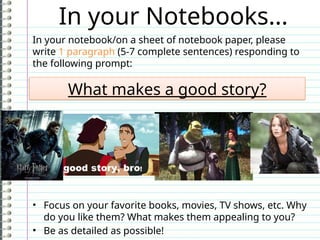
In your Notebooks...
In your notebook/on a sheet of notebook paper, please
write 1 paragraph (5-7 complete sentences) responding to
the following prompt:
• Focus on your favorite books, movies, TV shows, etc. Why
do you like them? What makes them appealing to you?
• Be as detailed as possible!
What makes a good story?
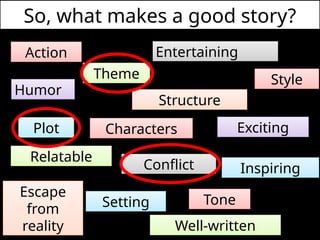
So, what makes a good story?
Action
Relatable
Characters
Plot
Conflict
Humor
Theme
Entertaining
Escape
from
reality
Inspiring
Well-written
Exciting
Structure
Setting
Style
Tone
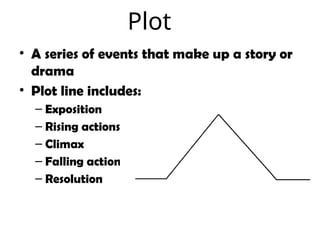
Plot
• A series of events that make up a story or
drama
• Plot line includes:
– Exposition
– Rising actions
– Climax
– Falling actions
– Resolution
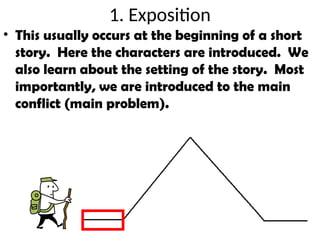
1. Exposition
• This usually occurs at the beginning of a short
story. Here the characters are introduced. We
also learn about the setting of the story. Most
importantly, we are introduced to the main
conflict (main problem).
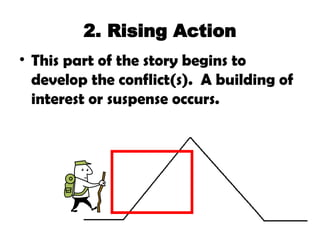
2. Rising Action
• This part of the story begins to
develop the conflict(s). A building of
interest or suspense occurs.
6 Universal Conflicts
• Man vs. Man: Character struggles with another character.
• Man vs. Nature: A character struggles with a force of nature
(natural disaster, desolation, animal, etc.) Usually, the character is
struggling to survive.
• Man vs. Society: a character or a group of characters fight against
the society in which they live. The character fights against social
traditions or rules (fight for freedom, rights, for a cause etc.)
• Man vs. Technology : Computers, machines, robots, etc.
• Man vs. Self: An internal conflict is between a character and
his/her self. The character’s struggle takes place in his/her own
mind. Usually has something to do with a choice (choosing
between right and wrong), or it may have to do with overcoming
emotions or mixed feelings.
Why is CONFLICT important?
• Without conflict, there is no plot!
• The plot mountain is created around the
conflict…
• Introduced in rising action…
• Is faced head-on during climax…
• Begins to work itself out during falling
action…
• Is resolved during resolution.
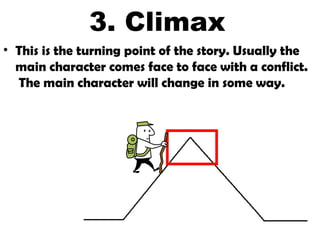
3. Climax
• This is the turning point of the story. Usually the
main character comes face to face with a conflict.
The main character will change in some way.
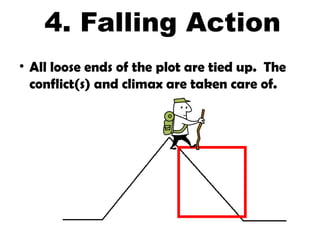
4. Falling Action
• All loose ends of the plot are tied up. The
conflict(s) and climax are taken care of.
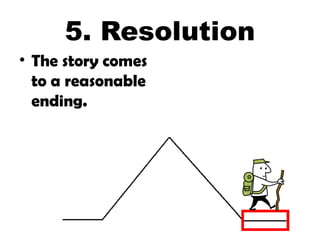
5. Resolution
• The story comes
to a reasonable
ending.
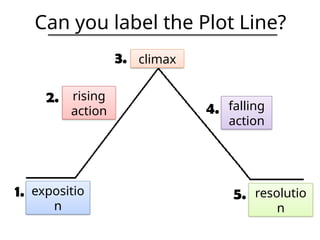
Can you label the Plot Line?
expositio
n
rising
action
climax
falling
action
resolutio
n
1.
2.
3.
4.
5.
• The central idea or message of a text
– View about life and how people behave
– Broad idea/message about life, society, or
human nature
• Usually implied (not explicitly stated)
• Explores timeless and universal ideas
• Differs from the subject or topic of a literary work in
that it is a statement
• Subject = topic
• Theme = statement/opinion about that topic
What is Theme?
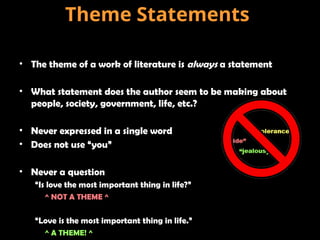
• The theme of a work of literature is always a statement
• What statement does the author seem to be making about
people, society, government, life, etc.?
• Never expressed in a single word
• Does not use “you”
• Never a question
“Is love the most important thing in life?”
^ NOT A THEME ^
“Love is the most important thing in life.”
^ A THEME! ^
Theme Statements
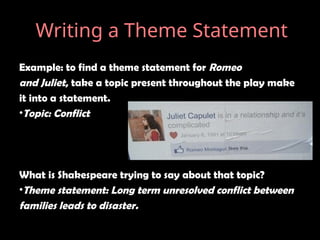
Example: to find a theme statement for Romeo
and Juliet, take a topic present throughout the play make
it into a statement.
•Topic: Conflict
What is Shakespeare trying to say about that topic?
•Theme statement: Long term unresolved conflict between
families leads to disaster.
Writing a Theme Statement
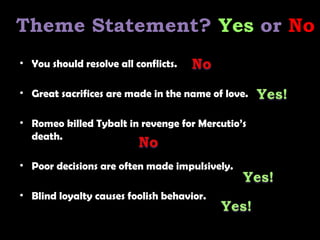
• You should resolve all conflicts.
• Great sacrifices are made in the name of love.
• Romeo killed Tybalt in revenge for Mercutio’s
death.
• Poor decisions are often made impulsively.
• Blind loyalty causes foolish behavior.
Theme Statement? Yes or No
• Theme statement involves an abstract idea and a
comment or observation about that idea that
addresses human motivation, condition, behavior,
ambition, etc.
• Theme statements:
– DO NOT include specific references to the plot or characters
– DO NOT moralize (do not say what we “should” do)
– DO NOT use absolute words (i.e. anyone, all, none, everything,
must, should, and always)
Remember:
1. Actions or events
2. Characters’ feelings
3. What the character(s) learn
4. Thoughts and conversation
An author expresses
Theme through…
• Ideas and feelings are
naturally expressed
through actions
• What does an action
"say“?
• How does the action
express an idea or
theme?
1. Characters’ actions
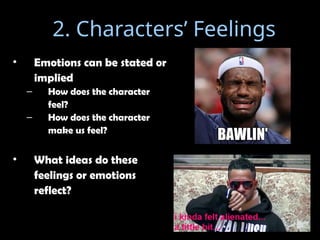
• Emotions can be stated or
implied
– How does the character
feel?
– How does the character
make us feel?
• What ideas do these
feelings or emotions
reflect?
2. Characters’ Feelings
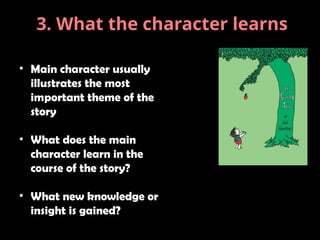
• Main character usually
illustrates the most
important theme of the
story
• What does the main
character learn in the
course of the story?
• What new knowledge or
insight is gained?
3. What the character learns
• Authors put words in their
character’s mouths only
for good reasons.
• The things a person says
are frequently on their
mind.
• Look for thoughts that
are repeated throughout
the story.
4. Thoughts and Conversation
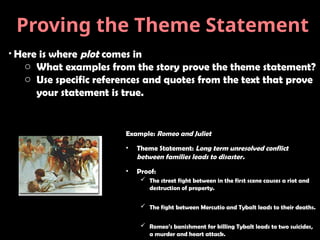
Example: Romeo and Juliet
• Theme Statement: Long term unresolved conflict
between families leads to disaster.
• Proof:
 The street fight between in the first scene causes a riot and
destruction of property.
 The fight between Mercutio and Tybalt leads to their deaths.
 Romeo’s banishment for killing Tybalt leads to two suicides,
a murder and heart attack.
Proving the Theme Statement
• Here is where plot comes in
o What examples from the story prove the theme statement?
o Use specific references and quotes from the text that prove
your statement is true.

Storytelling presentation covering Plot, theme, & conflict

  • 1.
    In your Notebooks... Inyour notebook/on a sheet of notebook paper, please write 1 paragraph (5-7 complete sentences) responding to the following prompt: • Focus on your favorite books, movies, TV shows, etc. Why do you like them? What makes them appealing to you? • Be as detailed as possible! What makes a good story?
  • 2.
    So, what makesa good story? Action Relatable Characters Plot Conflict Humor Theme Entertaining Escape from reality Inspiring Well-written Exciting Structure Setting Style Tone
  • 3.
    Plot • A seriesof events that make up a story or drama • Plot line includes: – Exposition – Rising actions – Climax – Falling actions – Resolution
  • 4.
    1. Exposition • Thisusually occurs at the beginning of a short story. Here the characters are introduced. We also learn about the setting of the story. Most importantly, we are introduced to the main conflict (main problem).
  • 5.
    2. Rising Action •This part of the story begins to develop the conflict(s). A building of interest or suspense occurs.
  • 6.
    6 Universal Conflicts •Man vs. Man: Character struggles with another character. • Man vs. Nature: A character struggles with a force of nature (natural disaster, desolation, animal, etc.) Usually, the character is struggling to survive. • Man vs. Society: a character or a group of characters fight against the society in which they live. The character fights against social traditions or rules (fight for freedom, rights, for a cause etc.) • Man vs. Technology : Computers, machines, robots, etc. • Man vs. Self: An internal conflict is between a character and his/her self. The character’s struggle takes place in his/her own mind. Usually has something to do with a choice (choosing between right and wrong), or it may have to do with overcoming emotions or mixed feelings.
  • 7.
    Why is CONFLICTimportant? • Without conflict, there is no plot! • The plot mountain is created around the conflict… • Introduced in rising action… • Is faced head-on during climax… • Begins to work itself out during falling action… • Is resolved during resolution.
  • 8.
    3. Climax • Thisis the turning point of the story. Usually the main character comes face to face with a conflict. The main character will change in some way.
  • 9.
    4. Falling Action •All loose ends of the plot are tied up. The conflict(s) and climax are taken care of.
  • 10.
    5. Resolution • Thestory comes to a reasonable ending.
  • 11.
    Can you labelthe Plot Line? expositio n rising action climax falling action resolutio n 1. 2. 3. 4. 5.
  • 12.
    • The centralidea or message of a text – View about life and how people behave – Broad idea/message about life, society, or human nature • Usually implied (not explicitly stated) • Explores timeless and universal ideas • Differs from the subject or topic of a literary work in that it is a statement • Subject = topic • Theme = statement/opinion about that topic What is Theme?
  • 13.
    • The themeof a work of literature is always a statement • What statement does the author seem to be making about people, society, government, life, etc.? • Never expressed in a single word • Does not use “you” • Never a question “Is love the most important thing in life?” ^ NOT A THEME ^ “Love is the most important thing in life.” ^ A THEME! ^ Theme Statements
  • 14.
    Example: to finda theme statement for Romeo and Juliet, take a topic present throughout the play make it into a statement. •Topic: Conflict What is Shakespeare trying to say about that topic? •Theme statement: Long term unresolved conflict between families leads to disaster. Writing a Theme Statement
  • 15.
    • You shouldresolve all conflicts. • Great sacrifices are made in the name of love. • Romeo killed Tybalt in revenge for Mercutio’s death. • Poor decisions are often made impulsively. • Blind loyalty causes foolish behavior. Theme Statement? Yes or No
  • 16.
    • Theme statementinvolves an abstract idea and a comment or observation about that idea that addresses human motivation, condition, behavior, ambition, etc. • Theme statements: – DO NOT include specific references to the plot or characters – DO NOT moralize (do not say what we “should” do) – DO NOT use absolute words (i.e. anyone, all, none, everything, must, should, and always) Remember:
  • 17.
    1. Actions orevents 2. Characters’ feelings 3. What the character(s) learn 4. Thoughts and conversation An author expresses Theme through…
  • 18.
    • Ideas andfeelings are naturally expressed through actions • What does an action "say“? • How does the action express an idea or theme? 1. Characters’ actions
  • 19.
    • Emotions canbe stated or implied – How does the character feel? – How does the character make us feel? • What ideas do these feelings or emotions reflect? 2. Characters’ Feelings
  • 20.
    • Main characterusually illustrates the most important theme of the story • What does the main character learn in the course of the story? • What new knowledge or insight is gained? 3. What the character learns
  • 21.
    • Authors putwords in their character’s mouths only for good reasons. • The things a person says are frequently on their mind. • Look for thoughts that are repeated throughout the story. 4. Thoughts and Conversation
  • 22.
    Example: Romeo andJuliet • Theme Statement: Long term unresolved conflict between families leads to disaster. • Proof:  The street fight between in the first scene causes a riot and destruction of property.  The fight between Mercutio and Tybalt leads to their deaths.  Romeo’s banishment for killing Tybalt leads to two suicides, a murder and heart attack. Proving the Theme Statement • Here is where plot comes in o What examples from the story prove the theme statement? o Use specific references and quotes from the text that prove your statement is true.