ELEMENTS OF
FICTION
Please take notes in your laptop/ MS Word,
View, Notebook layout.
Five Elements Literature
1. plot
2. setting
3. theme
4. character
5. point of view
1. PLOT
 The Plot includes the chain of events that
propels a story forward. A plot must have
a logical (it must make sense) sequence.
2. Setting
The time, place, physical
details, and circumstances in
which a situation occurs.
Settings include the
background, atmosphere or
environment in which
characters live and move,
and usually include physical
3. Theme
 A common thread or repeated idea
that is incorporated throughout a
literary work. A theme is a thought or
idea the author presents to the reader
that may be deep, difficult to
understand, or even moralistic.
4. Character
 People who are responsible for
the thoughts and actions within
a story, poem, or other
literature. Characters are
extremely important because
they are the medium through
which a reader interacts with a
5. Point of View
 A way the events of a story are conveyed
to the reader, it is the “vantage point” from
which the narrative is passed from author
to the reader. The point of view can vary
from work to work.
SIX TYPES OF
CONFLICT
Please continue to take notes.
SIX TYPES OF CONFLICT
1. Person – Person
2. Person – Self
3. Person – Nature
4. Person – Society
5. Person – Technology
6. Person -
Supernatural
CONFLICT –
BRING IT
ON!
What
examples
can you
think of for
each type
of conflict?
THEME
THE STRUCTURE OF A STORY THAT
INCLUDES:
• Exposition
• Rising Action (Conflict/Crisis)
• Climax
• Falling Action or Resolution
• Dénouement
DRAMATIC ARC
Exposition
 Status Quo (or exposition) is the
chatty part of the the story. No action
takes place because exposition includes
descriptions of time and place,
characters and sometimes of the
situation
Rising Action
 Rising Action happens when the conflict is
introduced. There are six types of conflict
(more on this soon). Suspense builds and
foreshadowing occurs. Foreshadowing is the
author’s way of hinting at future events in the
story. The author weaves clues and hints into
the story as a way of building suspense.
Climax
 The climax of the story is the most
emotional or suspenseful part. At this
point of the story, the conflict is about to
resolve one way or another. This is the
turning point of the story. The decisions
made during this part of the plot will
determine the ending.
Falling Action or Resolution
 During the falling action, or resolution,
which happens right after the climax, the
conflict between the protagonist and the
antagonist unravels, with the protagonist
winning or losing against the antagonist.
The falling action might contain a moment
of final suspense, during which the final
outcome of the conflict is in doubt.

Dénouement
 The denouement is the final part of the
plot. The character has, typically,
overcome the obstacle(s) and
conflict(s), and has found solace or
peace. Sometimes there are unresolved
conflicts at the end of the story.
What is it and how do I get it?
Theme is the the main idea of the story.
There can be several themes in one story.
The themes of a story can be the
discoveries, ideas, and life lessons we as
readers take away from the story.
THEME
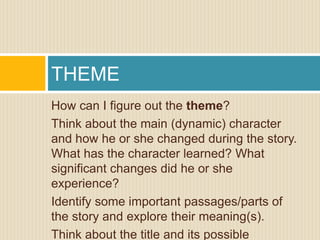
How can I figure out the theme?
Think about the main (dynamic) character
and how he or she changed during the story.
What has the character learned? What
significant changes did he or she
experience?
Identify some important passages/parts of
the story and explore their meaning(s).
Think about the title and its possible
THEME
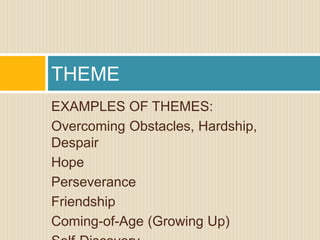
EXAMPLES OF THEMES:
Overcoming Obstacles, Hardship,
Despair
Hope
Perseverance
Friendship
Coming-of-Age (Growing Up)
THEME
MOOD & SETTING
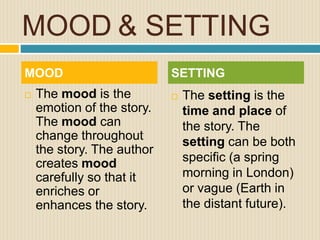
 The mood is the
emotion of the story.
The mood can
change throughout
the story. The author
creates mood
carefully so that it
enriches or
enhances the story.
 The setting is the
time and place of
the story. The
setting can be both
specific (a spring
morning in London)
or vague (Earth in
the distant future).
MOOD SETTING
CHARACTERS, some we love,
some we don’t . . .
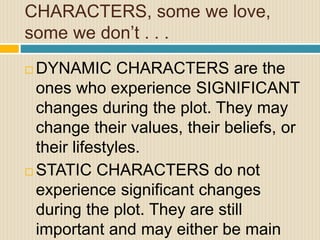
 DYNAMIC CHARACTERS are the
ones who experience SIGNIFICANT
changes during the plot. They may
change their values, their beliefs, or
their lifestyles.
 STATIC CHARACTERS do not
experience significant changes
during the plot. They are still
important and may either be main
CHARACTERS . . . Round and
flat!
 ROUND CHARACTERS are characters
whose personalities, beliefs, and interests or
examined in the story. Dynamic characters
are typically round characters. Round
characters are written to be like people you
know: flawed, interesting, real.
 FLAT CHARACTERS are characters whose
personalities, beliefs, and interests are not
examined in the story. Static characters are
sometimes also flat characters, but not
necessarily so.

Donna's elements of fiction

  • 1.
    ELEMENTS OF FICTION Please takenotes in your laptop/ MS Word, View, Notebook layout.
  • 2.
    Five Elements Literature 1.plot 2. setting 3. theme 4. character 5. point of view
  • 3.
    1. PLOT  ThePlot includes the chain of events that propels a story forward. A plot must have a logical (it must make sense) sequence.
  • 4.
    2. Setting The time,place, physical details, and circumstances in which a situation occurs. Settings include the background, atmosphere or environment in which characters live and move, and usually include physical
  • 5.
    3. Theme  Acommon thread or repeated idea that is incorporated throughout a literary work. A theme is a thought or idea the author presents to the reader that may be deep, difficult to understand, or even moralistic.
  • 6.
    4. Character  Peoplewho are responsible for the thoughts and actions within a story, poem, or other literature. Characters are extremely important because they are the medium through which a reader interacts with a
  • 7.
    5. Point ofView  A way the events of a story are conveyed to the reader, it is the “vantage point” from which the narrative is passed from author to the reader. The point of view can vary from work to work.
  • 8.
    SIX TYPES OF CONFLICT Pleasecontinue to take notes.
  • 9.
    SIX TYPES OFCONFLICT 1. Person – Person 2. Person – Self 3. Person – Nature 4. Person – Society 5. Person – Technology 6. Person - Supernatural CONFLICT – BRING IT ON! What examples can you think of for each type of conflict?
  • 10.
  • 11.
    THE STRUCTURE OFA STORY THAT INCLUDES: • Exposition • Rising Action (Conflict/Crisis) • Climax • Falling Action or Resolution • Dénouement DRAMATIC ARC
  • 12.
    Exposition  Status Quo(or exposition) is the chatty part of the the story. No action takes place because exposition includes descriptions of time and place, characters and sometimes of the situation
  • 13.
    Rising Action  RisingAction happens when the conflict is introduced. There are six types of conflict (more on this soon). Suspense builds and foreshadowing occurs. Foreshadowing is the author’s way of hinting at future events in the story. The author weaves clues and hints into the story as a way of building suspense.
  • 14.
    Climax  The climaxof the story is the most emotional or suspenseful part. At this point of the story, the conflict is about to resolve one way or another. This is the turning point of the story. The decisions made during this part of the plot will determine the ending.
  • 15.
    Falling Action orResolution  During the falling action, or resolution, which happens right after the climax, the conflict between the protagonist and the antagonist unravels, with the protagonist winning or losing against the antagonist. The falling action might contain a moment of final suspense, during which the final outcome of the conflict is in doubt. 
  • 16.
    Dénouement  The denouementis the final part of the plot. The character has, typically, overcome the obstacle(s) and conflict(s), and has found solace or peace. Sometimes there are unresolved conflicts at the end of the story.
  • 17.
    What is itand how do I get it? Theme is the the main idea of the story. There can be several themes in one story. The themes of a story can be the discoveries, ideas, and life lessons we as readers take away from the story. THEME
  • 18.
    How can Ifigure out the theme? Think about the main (dynamic) character and how he or she changed during the story. What has the character learned? What significant changes did he or she experience? Identify some important passages/parts of the story and explore their meaning(s). Think about the title and its possible THEME
  • 19.
    EXAMPLES OF THEMES: OvercomingObstacles, Hardship, Despair Hope Perseverance Friendship Coming-of-Age (Growing Up) THEME
  • 20.
    MOOD & SETTING The mood is the emotion of the story. The mood can change throughout the story. The author creates mood carefully so that it enriches or enhances the story.  The setting is the time and place of the story. The setting can be both specific (a spring morning in London) or vague (Earth in the distant future). MOOD SETTING
  • 21.
    CHARACTERS, some welove, some we don’t . . .  DYNAMIC CHARACTERS are the ones who experience SIGNIFICANT changes during the plot. They may change their values, their beliefs, or their lifestyles.  STATIC CHARACTERS do not experience significant changes during the plot. They are still important and may either be main
  • 22.
    CHARACTERS . .. Round and flat!  ROUND CHARACTERS are characters whose personalities, beliefs, and interests or examined in the story. Dynamic characters are typically round characters. Round characters are written to be like people you know: flawed, interesting, real.  FLAT CHARACTERS are characters whose personalities, beliefs, and interests are not examined in the story. Static characters are sometimes also flat characters, but not necessarily so.