STORYLINES
(PLOTS)
Ma. Angeline D. Aragoncillo
BSMT2C, Humanities 13
June 12, 2015
Mr. Jaime Cabrera
Centro Escolar University,
Philippines
I learn about literary plots,
electronic research, and
citing references by
completing this activity.
What
goes
around
comes
back
around.
See: Common Genres of Fiction here
See: Homework Guide here
PLOT or STORYLINE
 Plot is a literary term used to describe the events that make up a
story or the main part of a story. These events relate to each
other in a pattern or a sequence. The structure of
a novel depends on the organization of events in the plot of the
story.
 http://literarydevices.net/plot/
 In my own words: Sequence of events in a literary device.
 My example: In a futuristic Chicago, society is divided into 5
factions. Abnegation the selfless, Dauntless the brave, Erudite
the intelligent, Candor the honest, and Amity the peaceful.
When all teenagers reach the age of 16, they must choose to
either stay in their faction of birth, or transfer into another
faction. Beatrice Prior must make the decision to stay with her
family in a faction she feels she isn't right for, or to transfer into
another faction, and leave her family behind. What follows is a
highly competitive initiation, where the newly renamed Tris must
make some tough decisions, but she must also keep a secret
that she was warned could mean death, while she juggles
friends, initiation, and a newfound love interest. But there is a
secret lying beneath everything that threatens to tear the city
apart.
1a
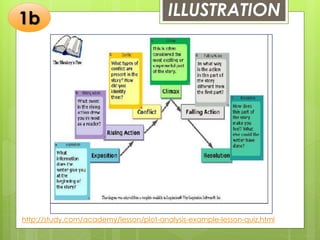
ILLUSTRATION
http://study.com/academy/lesson/plot-analysis-example-lesson-quiz.html
1b
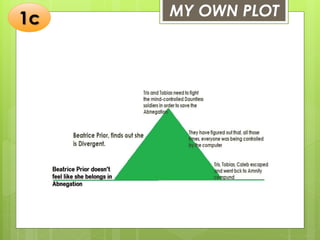
MY OWN PLOT1c
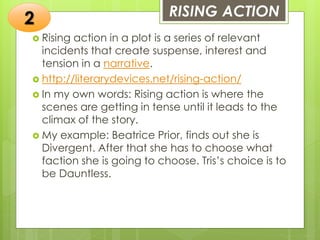
RISING ACTION
 Rising action in a plot is a series of relevant
incidents that create suspense, interest and
tension in a narrative.
 http://literarydevices.net/rising-action/
 In my own words: Rising action is where the
scenes are getting in tense until it leads to the
climax of the story.
 My example: Beatrice Prior, finds out she is
Divergent. After that she has to choose what
faction she is going to choose. Tris’s choice is to
be Dauntless.
2
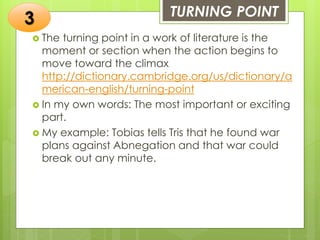
TURNING POINT
 The turning point in a work of literature is the
moment or section when the action begins to
move toward the climax
http://dictionary.cambridge.org/us/dictionary/a
merican-english/turning-point
 In my own words: The most important or exciting
part.
 My example: Tobias tells Tris that he found war
plans against Abnegation and that war could
break out any minute.
3
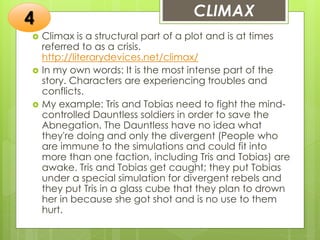
CLIMAX
 Climax is a structural part of a plot and is at times
referred to as a crisis.
http://literarydevices.net/climax/
 In my own words: It is the most intense part of the
story. Characters are experiencing troubles and
conflicts.
 My example: Tris and Tobias need to fight the mind-
controlled Dauntless soldiers in order to save the
Abnegation. The Dauntless have no idea what
they're doing and only the divergent (People who
are immune to the simulations and could fit into
more than one faction, including Tris and Tobias) are
awake. Tris and Tobias get caught; they put Tobias
under a special simulation for divergent rebels and
they put Tris in a glass cube that they plan to drown
her in because she got shot and is no use to them
hurt.
4
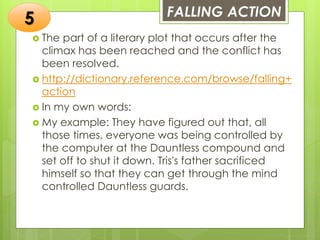
FALLING ACTION
 The part of a literary plot that occurs after the
climax has been reached and the conflict has
been resolved.
 http://dictionary.reference.com/browse/falling+
action
 In my own words:
 My example: They have figured out that, all
those times, everyone was being controlled by
the computer at the Dauntless compound and
set off to shut it down. Tris's father sacrificed
himself so that they can get through the mind
controlled Dauntless guards.
5
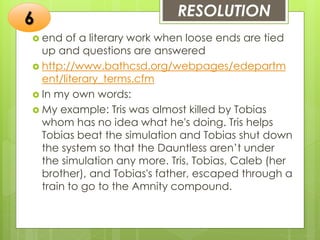
RESOLUTION
 end of a literary work when loose ends are tied
up and questions are answered
 http://www.bathcsd.org/webpages/edepartm
ent/literary_terms.cfm
 In my own words:
 My example: Tris was almost killed by Tobias
whom has no idea what he's doing. Tris helps
Tobias beat the simulation and Tobias shut down
the system so that the Dauntless aren’t under
the simulation any more. Tris, Tobias, Caleb (her
brother), and Tobias's father, escaped through a
train to go to the Amnity compound.
6
PLOT ELEMENTS:
Brain Practice
Ma. Angeline D. Aragoncillo
BSMT2C, Humanities 13
June 12, 2015
Mr. Jaime Cabrera
Centro Escolar University,
Philippines
I personalize my learning
about the parts of literary
plot by completing this
three-part activity.
Related Stuff
New concepts learned
this activity is very much relatable to a
person’s life. There came a time that you
started with nothing, bare you. There came a
time that you struggle, there came a time that
conflicts let you felt that you are already
about to give. There came a time that you
have felt a sudden relief and there came a
time that you have already nothing to worry.
NEW INPUTS
1
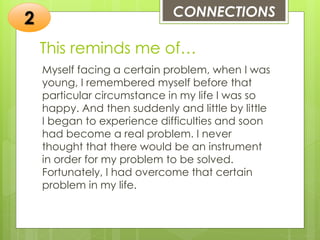
This reminds me of…
Myself facing a certain problem, when I was
young, I remembered myself before that
particular circumstance in my life I was so
happy. And then suddenly and little by little
I began to experience difficulties and soon
had become a real problem. I never
thought that there would be an instrument
in order for my problem to be solved.
Fortunately, I had overcome that certain
problem in my life.
CONNECTIONS
2
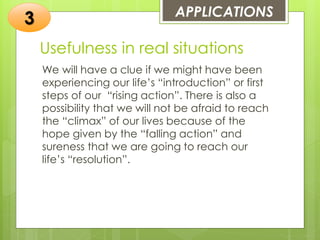
Usefulness in real situations
We will have a clue if we might have been
experiencing our life’s “introduction” or first
steps of our “rising action”. There is also a
possibility that we will not be afraid to reach
the “climax” of our lives because of the
hope given by the “falling action” and
sureness that we are going to reach our
life’s “resolution”.
APPLICATIONS
3
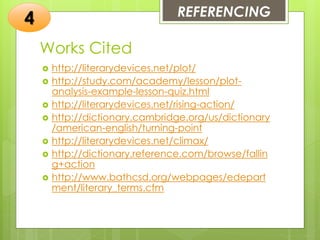
Works Cited
 http://literarydevices.net/plot/
 http://study.com/academy/lesson/plot-
analysis-example-lesson-quiz.html
 http://literarydevices.net/rising-action/
 http://dictionary.cambridge.org/us/dictionary
/american-english/turning-point
 http://literarydevices.net/climax/
 http://dictionary.reference.com/browse/fallin
g+action
 http://www.bathcsd.org/webpages/edepart
ment/literary_terms.cfm
REFERENCING
4

Storylines Plot

  • 1.
    STORYLINES (PLOTS) Ma. Angeline D.Aragoncillo BSMT2C, Humanities 13 June 12, 2015 Mr. Jaime Cabrera Centro Escolar University, Philippines I learn about literary plots, electronic research, and citing references by completing this activity. What goes around comes back around. See: Common Genres of Fiction here See: Homework Guide here
  • 2.
    PLOT or STORYLINE Plot is a literary term used to describe the events that make up a story or the main part of a story. These events relate to each other in a pattern or a sequence. The structure of a novel depends on the organization of events in the plot of the story.  http://literarydevices.net/plot/  In my own words: Sequence of events in a literary device.  My example: In a futuristic Chicago, society is divided into 5 factions. Abnegation the selfless, Dauntless the brave, Erudite the intelligent, Candor the honest, and Amity the peaceful. When all teenagers reach the age of 16, they must choose to either stay in their faction of birth, or transfer into another faction. Beatrice Prior must make the decision to stay with her family in a faction she feels she isn't right for, or to transfer into another faction, and leave her family behind. What follows is a highly competitive initiation, where the newly renamed Tris must make some tough decisions, but she must also keep a secret that she was warned could mean death, while she juggles friends, initiation, and a newfound love interest. But there is a secret lying beneath everything that threatens to tear the city apart. 1a
  • 3.
  • 4.
  • 5.
    RISING ACTION  Risingaction in a plot is a series of relevant incidents that create suspense, interest and tension in a narrative.  http://literarydevices.net/rising-action/  In my own words: Rising action is where the scenes are getting in tense until it leads to the climax of the story.  My example: Beatrice Prior, finds out she is Divergent. After that she has to choose what faction she is going to choose. Tris’s choice is to be Dauntless. 2
  • 6.
    TURNING POINT  Theturning point in a work of literature is the moment or section when the action begins to move toward the climax http://dictionary.cambridge.org/us/dictionary/a merican-english/turning-point  In my own words: The most important or exciting part.  My example: Tobias tells Tris that he found war plans against Abnegation and that war could break out any minute. 3
  • 7.
    CLIMAX  Climax isa structural part of a plot and is at times referred to as a crisis. http://literarydevices.net/climax/  In my own words: It is the most intense part of the story. Characters are experiencing troubles and conflicts.  My example: Tris and Tobias need to fight the mind- controlled Dauntless soldiers in order to save the Abnegation. The Dauntless have no idea what they're doing and only the divergent (People who are immune to the simulations and could fit into more than one faction, including Tris and Tobias) are awake. Tris and Tobias get caught; they put Tobias under a special simulation for divergent rebels and they put Tris in a glass cube that they plan to drown her in because she got shot and is no use to them hurt. 4
  • 8.
    FALLING ACTION  Thepart of a literary plot that occurs after the climax has been reached and the conflict has been resolved.  http://dictionary.reference.com/browse/falling+ action  In my own words:  My example: They have figured out that, all those times, everyone was being controlled by the computer at the Dauntless compound and set off to shut it down. Tris's father sacrificed himself so that they can get through the mind controlled Dauntless guards. 5
  • 9.
    RESOLUTION  end ofa literary work when loose ends are tied up and questions are answered  http://www.bathcsd.org/webpages/edepartm ent/literary_terms.cfm  In my own words:  My example: Tris was almost killed by Tobias whom has no idea what he's doing. Tris helps Tobias beat the simulation and Tobias shut down the system so that the Dauntless aren’t under the simulation any more. Tris, Tobias, Caleb (her brother), and Tobias's father, escaped through a train to go to the Amnity compound. 6
  • 10.
    PLOT ELEMENTS: Brain Practice Ma.Angeline D. Aragoncillo BSMT2C, Humanities 13 June 12, 2015 Mr. Jaime Cabrera Centro Escolar University, Philippines I personalize my learning about the parts of literary plot by completing this three-part activity. Related Stuff
  • 11.
    New concepts learned thisactivity is very much relatable to a person’s life. There came a time that you started with nothing, bare you. There came a time that you struggle, there came a time that conflicts let you felt that you are already about to give. There came a time that you have felt a sudden relief and there came a time that you have already nothing to worry. NEW INPUTS 1
  • 12.
    This reminds meof… Myself facing a certain problem, when I was young, I remembered myself before that particular circumstance in my life I was so happy. And then suddenly and little by little I began to experience difficulties and soon had become a real problem. I never thought that there would be an instrument in order for my problem to be solved. Fortunately, I had overcome that certain problem in my life. CONNECTIONS 2
  • 13.
    Usefulness in realsituations We will have a clue if we might have been experiencing our life’s “introduction” or first steps of our “rising action”. There is also a possibility that we will not be afraid to reach the “climax” of our lives because of the hope given by the “falling action” and sureness that we are going to reach our life’s “resolution”. APPLICATIONS 3
  • 14.
    Works Cited  http://literarydevices.net/plot/ http://study.com/academy/lesson/plot- analysis-example-lesson-quiz.html  http://literarydevices.net/rising-action/  http://dictionary.cambridge.org/us/dictionary /american-english/turning-point  http://literarydevices.net/climax/  http://dictionary.reference.com/browse/fallin g+action  http://www.bathcsd.org/webpages/edepart ment/literary_terms.cfm REFERENCING 4

Editor's Notes

  • #2 http://www.slideshare.net/caitlingillmett/types-of-conflict-5478403
  • #11 http://www.slideshare.net/caitlingillmett/types-of-conflict-5478403