ENGLISH
LITERATURE
OVERVIEW
Let´s begin
the lesson!
COURSE CONTENT
1. The Story Structure
1.1. Story Elements
1.2. Types of stories
1.2.1. Folk Tales
1.2.2. Literary Short Stories
- Sub genres:
● Adventure tale.
• Police or detective story.
● Science fiction story.
● Fantasy or marvelous tale.
● Fairy tale.
● Horror story.
2. Formalism and the New Criticism.
2.1 Psychoanalytic Criticism.
2.2 Structuralism and Deconstruction
2.3.Feminist Criticism
2.4 Reader's critique of the works read
COURSE ASSESTMENT
Participation: 10%
Workshops: 30%
Tests: 30%
Final: 30%
100%
CLASS RULES
BE RESPECTFUL
AND KIND TO
EVERYONE IN THE
CLASSROOM.
https://www.youtube.com/wat
ch?v=kB1aoErPRWs
WHAT ARE YOUR THOUGHTS
ABOUT THE VIDEO?
THE PURSUIT OF HAPPINESS
1. The Story Structure
1.1. Story Elements
1.2. Types of stories
1.2.1. Folk Tales
1.2.2. Literary Short Stories
- Sub genres:
● Adventure tale.
Police or detective story.
● Science fiction story.
● Fantasy or marvelous tale.
● Fairy tale.
● Horror story.
Let´s begin
the lesson!
1. Story Structure
Story structure, also known as narrative
structure, is the order in which events are
organized into a beginning, middle, and ending in
a novel. Narrative structure is the content of a
story and the form used to tell the story. This
feature of a creative text generally describes
the order and manner in which a narrative is
presented to a reader, listener, or viewer.
Setting.
Characters.
Plot.
Conflict.
Resolution.
Point of View.
Theme.
1.1 Story Elements
1.2. Types of Stories
1.2.1. Folk Tales
1.2.2. Literary Short Stories
1.2.1. FOLK TALES
FOLK TALES example
● Adventure tale.
• Police or detective story.
● Science fiction story.
● Fantasy or marvelous tale.
● Fairy tale.
● Horror story.
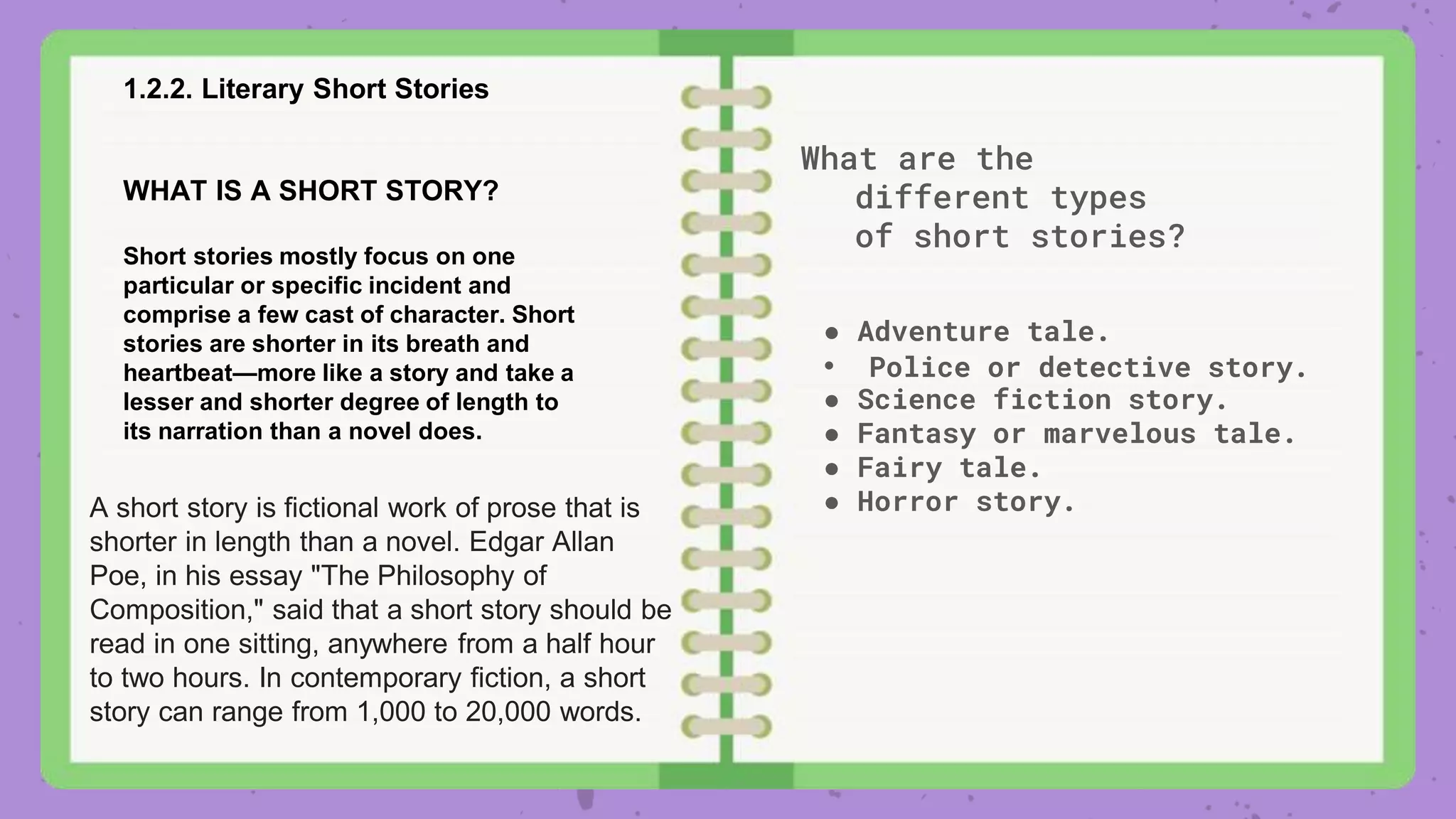
1.2.2. Literary Short Stories
WHAT IS A SHORT STORY?
Short stories mostly focus on one
particular or specific incident and
comprise a few cast of character. Short
stories are shorter in its breath and
heartbeat—more like a story and take a
lesser and shorter degree of length to
its narration than a novel does.
What are the
different types
of short stories?
A short story is fictional work of prose that is
shorter in length than a novel. Edgar Allan
Poe, in his essay "The Philosophy of
Composition," said that a short story should be
read in one sitting, anywhere from a half hour
to two hours. In contemporary fiction, a short
story can range from 1,000 to 20,000 words.
ADVENTURE TALE
An adventure story tells the tale of a
protagonist’s journey. They go on an adventure
or quest: one that could be personal or
geographical.
Definition of Adventure Story
An adventure story is a genre of
literature that features a protagonist
going on an adventure of some kind. It is
often considered to be escapist literature
due to the fact that the stories sometimes
take place in exotic, interesting, and
dangerous locations. The stories transport
readers to interesting locations and
ensure that they feel as though they, too,
are accompanying the protagonist on the
quest.
EXAMPLES OF ADVENTURE STORIES
IN LITERATURE
The Lord of the Rings series by J.R.R. Tolkien
The Lord of the Rings is a series of incredibly popular
adventure novels (with The Hobbit being in the same
realm). The three books, The Fellowship of the Ring, The
Two Towers, and The Return of the King, follow an epic
quest to defeat evil. The protagonist, Frodo Baggins, has to
carry a precious but terrible item into the heart of danger
while his companions do what they can to ensure he makes
it to the end of his journey. The difference between good
and evil in these novels couldn’t be starker. Here is a quote
from The Fellowship of the Ring:
The world is indeed full of peril, and in it there are
many dark places; but still there is much that is fair,
and though in all lands love is now mingled with grief,
it grows perhaps the greater.
The detective story is a sub-genre of
fiction that follows an investigator as
they try to track down a criminal, solve a
crime, or prevent one from happening.
The detectives/investigators/police
offices in these stories may be amateurs
or professionals. Usually, they are looking
into murders or other serious crimes.
POLICE OR DETECTIVE
STORY
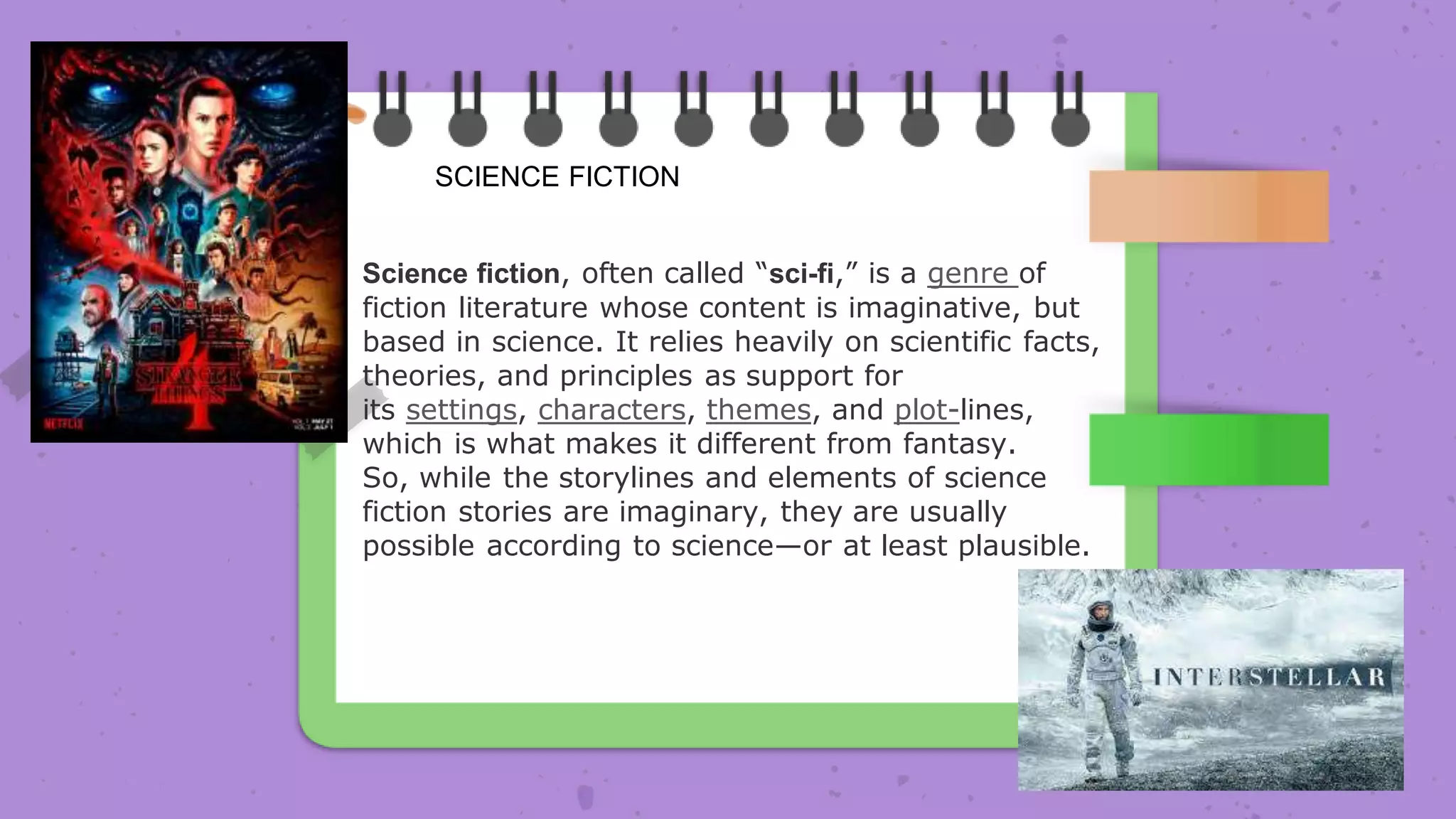
Science fiction, often called “sci-fi,” is a genre of
fiction literature whose content is imaginative, but
based in science. It relies heavily on scientific facts,
theories, and principles as support for
its settings, characters, themes, and plot-lines,
which is what makes it different from fantasy.
So, while the storylines and elements of science
fiction stories are imaginary, they are usually
possible according to science—or at least plausible.
SCIENCE FICTION
A category of fiction in which supernatural,
magical, or other wondrous impossibilities are
accepted as normal within an imagined world.
a type of story or literature that is set in a magical world,
often involving traditional myths and magical creatures and
sometimes ideas or events from the real world, especially
from the medieval period of history: Characters in children's
fantasy fiction often cross between worlds by magic.
FANTASY OR MARVELOUS TALE
A fantasy is something you imagine, which might
involve dragons, unicorns, or an imaginary best friend.
If you live in a fantasy world, you're not worrying much
about reality — pleasant, maybe, but not very practical.
Fantasy is dreams and imagination.
FANTASY OR MARVELOUS TALE
FAIRY TALE
HORROR STORY
In literature, horror (pronounced hawr-er) is a genre of
fiction whose purpose is to create feelings of fear, dread,
repulsion, and terror in the audience—in other words, it
develops an atmosphere of horror. The term’s definition
emphasizes the reaction caused by horror, stemming from
the Old French orror, meaning “to shudder or to bristle.”
Horror literature has roots in religion, folklore, and history;
focusing on topics, fears, and curiosities that have
continuously bothered humans in both the 12th and 21st
centuries alike. Horror feeds on audience’s deepest terrors
by putting life’s most frightening and perplexing things—
death, evil, supernatural powers or creatures, the afterlife,
witchcraft—at the center of attention.
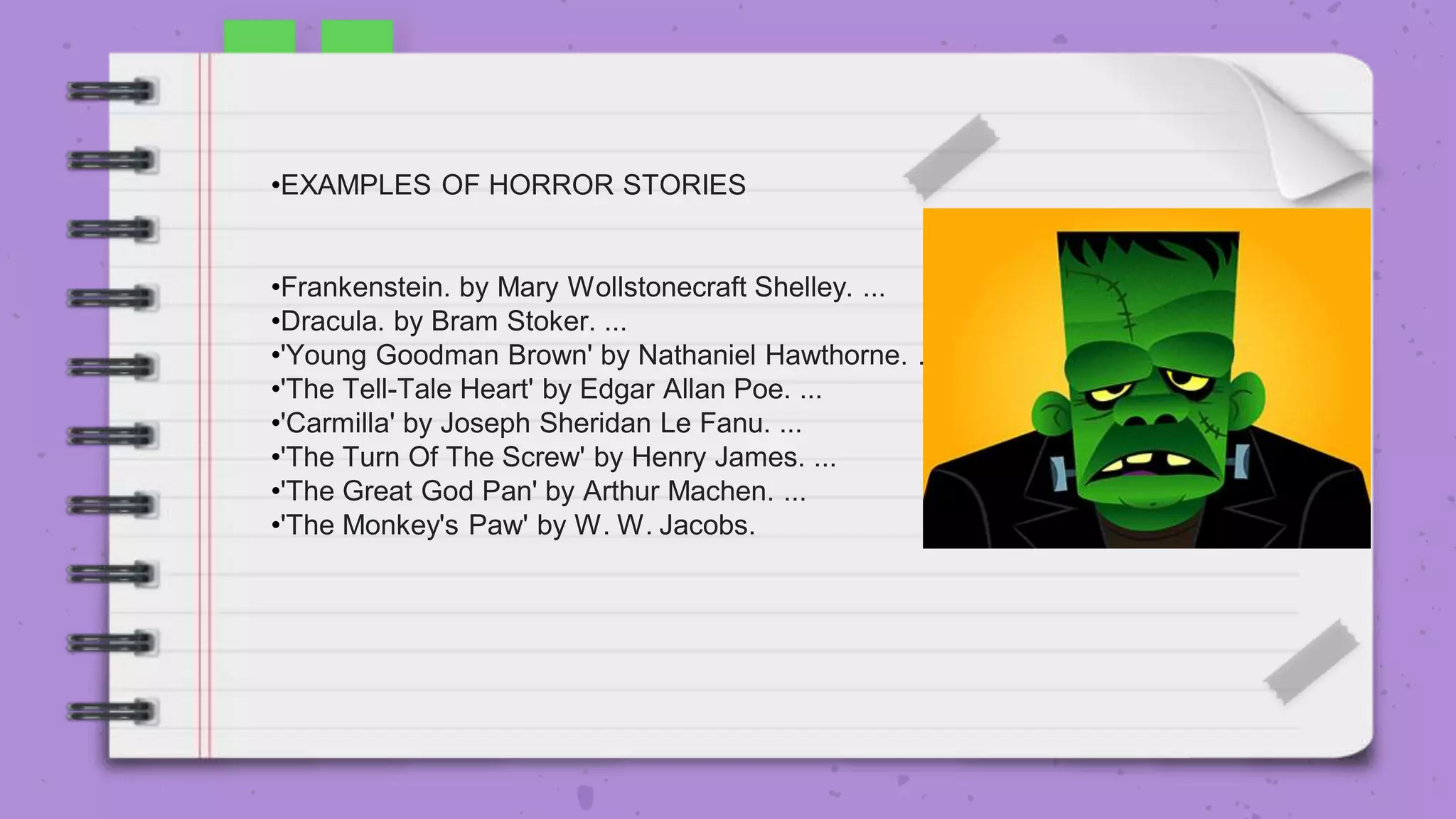
•EXAMPLES OF HORROR STORIES
•Frankenstein. by Mary Wollstonecraft Shelley. ...
•Dracula. by Bram Stoker. ...
•'Young Goodman Brown' by Nathaniel Hawthorne. ...
•'The Tell-Tale Heart' by Edgar Allan Poe. ...
•'Carmilla' by Joseph Sheridan Le Fanu. ...
•'The Turn Of The Screw' by Henry James. ...
•'The Great God Pan' by Arthur Machen. ...
•'The Monkey's Paw' by W. W. Jacobs.
story types (4).pdf

story types (4).pdf

  • 1.
  • 2.
    COURSE CONTENT 1. TheStory Structure 1.1. Story Elements 1.2. Types of stories 1.2.1. Folk Tales 1.2.2. Literary Short Stories - Sub genres: ● Adventure tale. • Police or detective story. ● Science fiction story. ● Fantasy or marvelous tale. ● Fairy tale. ● Horror story. 2. Formalism and the New Criticism. 2.1 Psychoanalytic Criticism. 2.2 Structuralism and Deconstruction 2.3.Feminist Criticism 2.4 Reader's critique of the works read
  • 3.
  • 4.
    CLASS RULES BE RESPECTFUL ANDKIND TO EVERYONE IN THE CLASSROOM.
  • 6.
    https://www.youtube.com/wat ch?v=kB1aoErPRWs WHAT ARE YOURTHOUGHTS ABOUT THE VIDEO? THE PURSUIT OF HAPPINESS
  • 7.
    1. The StoryStructure 1.1. Story Elements 1.2. Types of stories 1.2.1. Folk Tales 1.2.2. Literary Short Stories - Sub genres: ● Adventure tale. Police or detective story. ● Science fiction story. ● Fantasy or marvelous tale. ● Fairy tale. ● Horror story. Let´s begin the lesson!
  • 8.
    1. Story Structure Storystructure, also known as narrative structure, is the order in which events are organized into a beginning, middle, and ending in a novel. Narrative structure is the content of a story and the form used to tell the story. This feature of a creative text generally describes the order and manner in which a narrative is presented to a reader, listener, or viewer.
  • 9.
  • 10.
    1.2. Types ofStories 1.2.1. Folk Tales 1.2.2. Literary Short Stories
  • 11.
  • 12.
  • 13.
    ● Adventure tale. •Police or detective story. ● Science fiction story. ● Fantasy or marvelous tale. ● Fairy tale. ● Horror story. 1.2.2. Literary Short Stories WHAT IS A SHORT STORY? Short stories mostly focus on one particular or specific incident and comprise a few cast of character. Short stories are shorter in its breath and heartbeat—more like a story and take a lesser and shorter degree of length to its narration than a novel does. What are the different types of short stories? A short story is fictional work of prose that is shorter in length than a novel. Edgar Allan Poe, in his essay "The Philosophy of Composition," said that a short story should be read in one sitting, anywhere from a half hour to two hours. In contemporary fiction, a short story can range from 1,000 to 20,000 words.
  • 14.
    ADVENTURE TALE An adventurestory tells the tale of a protagonist’s journey. They go on an adventure or quest: one that could be personal or geographical. Definition of Adventure Story An adventure story is a genre of literature that features a protagonist going on an adventure of some kind. It is often considered to be escapist literature due to the fact that the stories sometimes take place in exotic, interesting, and dangerous locations. The stories transport readers to interesting locations and ensure that they feel as though they, too, are accompanying the protagonist on the quest.
  • 15.
    EXAMPLES OF ADVENTURESTORIES IN LITERATURE The Lord of the Rings series by J.R.R. Tolkien The Lord of the Rings is a series of incredibly popular adventure novels (with The Hobbit being in the same realm). The three books, The Fellowship of the Ring, The Two Towers, and The Return of the King, follow an epic quest to defeat evil. The protagonist, Frodo Baggins, has to carry a precious but terrible item into the heart of danger while his companions do what they can to ensure he makes it to the end of his journey. The difference between good and evil in these novels couldn’t be starker. Here is a quote from The Fellowship of the Ring: The world is indeed full of peril, and in it there are many dark places; but still there is much that is fair, and though in all lands love is now mingled with grief, it grows perhaps the greater.
  • 16.
    The detective storyis a sub-genre of fiction that follows an investigator as they try to track down a criminal, solve a crime, or prevent one from happening. The detectives/investigators/police offices in these stories may be amateurs or professionals. Usually, they are looking into murders or other serious crimes. POLICE OR DETECTIVE STORY
  • 17.
    Science fiction, oftencalled “sci-fi,” is a genre of fiction literature whose content is imaginative, but based in science. It relies heavily on scientific facts, theories, and principles as support for its settings, characters, themes, and plot-lines, which is what makes it different from fantasy. So, while the storylines and elements of science fiction stories are imaginary, they are usually possible according to science—or at least plausible. SCIENCE FICTION
  • 18.
    A category offiction in which supernatural, magical, or other wondrous impossibilities are accepted as normal within an imagined world. a type of story or literature that is set in a magical world, often involving traditional myths and magical creatures and sometimes ideas or events from the real world, especially from the medieval period of history: Characters in children's fantasy fiction often cross between worlds by magic. FANTASY OR MARVELOUS TALE A fantasy is something you imagine, which might involve dragons, unicorns, or an imaginary best friend. If you live in a fantasy world, you're not worrying much about reality — pleasant, maybe, but not very practical. Fantasy is dreams and imagination.
  • 19.
  • 20.
  • 21.
    HORROR STORY In literature,horror (pronounced hawr-er) is a genre of fiction whose purpose is to create feelings of fear, dread, repulsion, and terror in the audience—in other words, it develops an atmosphere of horror. The term’s definition emphasizes the reaction caused by horror, stemming from the Old French orror, meaning “to shudder or to bristle.” Horror literature has roots in religion, folklore, and history; focusing on topics, fears, and curiosities that have continuously bothered humans in both the 12th and 21st centuries alike. Horror feeds on audience’s deepest terrors by putting life’s most frightening and perplexing things— death, evil, supernatural powers or creatures, the afterlife, witchcraft—at the center of attention.
  • 22.
    •EXAMPLES OF HORRORSTORIES •Frankenstein. by Mary Wollstonecraft Shelley. ... •Dracula. by Bram Stoker. ... •'Young Goodman Brown' by Nathaniel Hawthorne. ... •'The Tell-Tale Heart' by Edgar Allan Poe. ... •'Carmilla' by Joseph Sheridan Le Fanu. ... •'The Turn Of The Screw' by Henry James. ... •'The Great God Pan' by Arthur Machen. ... •'The Monkey's Paw' by W. W. Jacobs.