Samuel Folasayo
Using GridFS in MongoDB: A
Business Case
Efficiently Handling Large Files in MongoDB
Joe Nyirenda
What is GridFS?
GridFS is a specification in MongoDB used to store and retrieve large files, like
images, videos, or documents
Instead of storing large files as a single object, GridFS breaks them into smaller
chunks.
Why GridFS?
MongoDB’s BSON format has a 16MB size limit per document.
GridFS allows storing files larger than this limit by dividing them into chunks
(typically 255KB).
Introduction to GridFS
Business Case: Media Management System
Scenario: A company needs a media management system to store high-resolution
images, videos, and large documents for their users.
Files range from a few MBs to several GBs.
Challenges:
Standard MongoDB document storage has limitations on file size.
Scalability issues with traditional file storage solutions.
Need for easy retrieval of metadata and partial file retrieval.
Business Case Overview
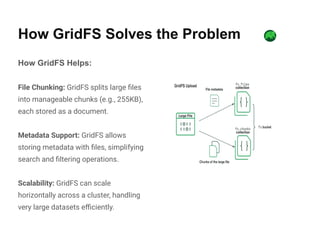
How GridFS Solves the Problem
How GridFS Helps:
File Chunking: GridFS splits large files
into manageable chunks (e.g., 255KB),
each stored as a document.
Metadata Support: GridFS allows
storing metadata with files, simplifying
search and filtering operations.
Scalability: GridFS can scale
horizontally across a cluster, handling
very large datasets efficiently.
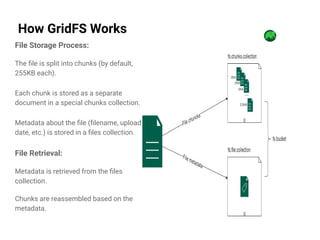
How GridFS Works
File Storage Process:
The file is split into chunks (by default,
255KB each).
Each chunk is stored as a separate
document in a special chunks collection.
Metadata about the file (filename, upload
date, etc.) is stored in a files collection.
File Retrieval:
Metadata is retrieved from the files
collection.
Chunks are reassembled based on the
metadata.
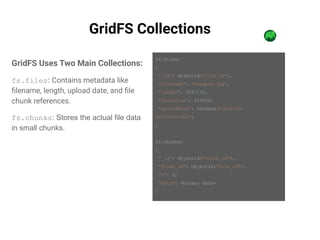
GridFS Collections
GridFS Uses Two Main Collections:
fs.files: Contains metadata like
filename, length, upload date, and file
chunk references.
fs.chunks: Stores the actual file data
in small chunks.
fs.files:
{
"_id": ObjectId("file_id"),
"filename": "example.jpg",
"length": 2097152,
"chunkSize": 255000,
"uploadDate": ISODate("2024-10-
02T10:05:00Z")
}
fs.chunks:
{
"_id": ObjectId("chunk_id"),
"files_id": ObjectId("file_id"),
"n": 0,
"data": <binary data>
}
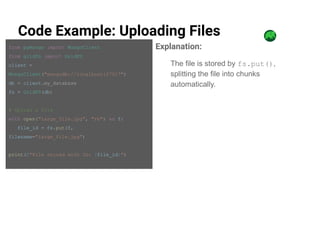
Code Example: Uploading Files
from pymongo import MongoClient
from gridfs import GridFS
client =
MongoClient("mongodb://localhost:27017")
db = client.my_database
fs = GridFS(db)
# Upload a file
with open("large_file.jpg", "rb") as f:
file_id = fs.put(f,
filename="large_file.jpg")
print(f"File stored with ID: {file_id}")
Explanation:
The file is stored by fs.put(),
splitting the file into chunks
automatically.
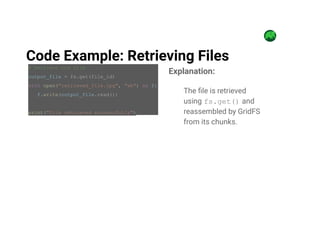
# Retrieve the file
output_file = fs.get(file_id)
with open("retrieved_file.jpg", "wb") as f:
f.write(output_file.read())
print("File retrieved successfully")
Code Example: Retrieving Files
Explanation:
The file is retrieved
using fs.get() and
reassembled by GridFS
from its chunks.
Advantages for the Media Management System:
Efficiency: Large media files can be stored and retrieved without performance
degradation.
Scalability: Supports horizontal scaling across distributed systems.
Metadata Search: Files can be searched based on metadata stored in the
fs.files collection.
Cost Savings: Eliminates the need for external file storage systems by centralizing
file storage in MongoDB.
Business Impact of Using GridFS
Additional Use Cases for GridFS:
Cloud Storage Systems: Handling user-generated content like images, videos,
and documents.
Document Management Systems: Storing and searching large PDF files or
legal documents.
Backup Systems: Storing and retrieving large backup files efficiently.
Use Cases Beyond Media Management
Chunk Size: Customize the chunk size based on the file type and
application needs.
Indexing: Ensure indexing on fs.files and fs.chunks collections for
better performance.
Backup Strategy: Implement a robust backup and recovery strategy for
the fs collections.
Partial File Retrieval: Leverage GridFS for partial retrieval of files to
optimize performance for large files.
Best Practices for Using GridFS:
Conclusion
GridFS enables efficient storage of large files within MongoDB.
It provides scalability, metadata management, and partial retrieval, which
are crucial for applications like media management systems.
Ideal for businesses that deal with large unstructured data and need a
seamless way to manage it.

Storing Large Image Files in MongoDB Using GRIDFS

  • 1.
    Samuel Folasayo Using GridFSin MongoDB: A Business Case Efficiently Handling Large Files in MongoDB Joe Nyirenda
  • 2.
    What is GridFS? GridFSis a specification in MongoDB used to store and retrieve large files, like images, videos, or documents Instead of storing large files as a single object, GridFS breaks them into smaller chunks. Why GridFS? MongoDB’s BSON format has a 16MB size limit per document. GridFS allows storing files larger than this limit by dividing them into chunks (typically 255KB). Introduction to GridFS
  • 3.
    Business Case: MediaManagement System Scenario: A company needs a media management system to store high-resolution images, videos, and large documents for their users. Files range from a few MBs to several GBs. Challenges: Standard MongoDB document storage has limitations on file size. Scalability issues with traditional file storage solutions. Need for easy retrieval of metadata and partial file retrieval. Business Case Overview
  • 4.
    How GridFS Solvesthe Problem How GridFS Helps: File Chunking: GridFS splits large files into manageable chunks (e.g., 255KB), each stored as a document. Metadata Support: GridFS allows storing metadata with files, simplifying search and filtering operations. Scalability: GridFS can scale horizontally across a cluster, handling very large datasets efficiently.
  • 5.
    How GridFS Works FileStorage Process: The file is split into chunks (by default, 255KB each). Each chunk is stored as a separate document in a special chunks collection. Metadata about the file (filename, upload date, etc.) is stored in a files collection. File Retrieval: Metadata is retrieved from the files collection. Chunks are reassembled based on the metadata.
  • 6.
    GridFS Collections GridFS UsesTwo Main Collections: fs.files: Contains metadata like filename, length, upload date, and file chunk references. fs.chunks: Stores the actual file data in small chunks. fs.files: { "_id": ObjectId("file_id"), "filename": "example.jpg", "length": 2097152, "chunkSize": 255000, "uploadDate": ISODate("2024-10- 02T10:05:00Z") } fs.chunks: { "_id": ObjectId("chunk_id"), "files_id": ObjectId("file_id"), "n": 0, "data": <binary data> }
  • 7.
    Code Example: UploadingFiles from pymongo import MongoClient from gridfs import GridFS client = MongoClient("mongodb://localhost:27017") db = client.my_database fs = GridFS(db) # Upload a file with open("large_file.jpg", "rb") as f: file_id = fs.put(f, filename="large_file.jpg") print(f"File stored with ID: {file_id}") Explanation: The file is stored by fs.put(), splitting the file into chunks automatically.
  • 8.
    # Retrieve thefile output_file = fs.get(file_id) with open("retrieved_file.jpg", "wb") as f: f.write(output_file.read()) print("File retrieved successfully") Code Example: Retrieving Files Explanation: The file is retrieved using fs.get() and reassembled by GridFS from its chunks.
  • 9.
    Advantages for theMedia Management System: Efficiency: Large media files can be stored and retrieved without performance degradation. Scalability: Supports horizontal scaling across distributed systems. Metadata Search: Files can be searched based on metadata stored in the fs.files collection. Cost Savings: Eliminates the need for external file storage systems by centralizing file storage in MongoDB. Business Impact of Using GridFS
  • 10.
    Additional Use Casesfor GridFS: Cloud Storage Systems: Handling user-generated content like images, videos, and documents. Document Management Systems: Storing and searching large PDF files or legal documents. Backup Systems: Storing and retrieving large backup files efficiently. Use Cases Beyond Media Management
  • 11.
    Chunk Size: Customizethe chunk size based on the file type and application needs. Indexing: Ensure indexing on fs.files and fs.chunks collections for better performance. Backup Strategy: Implement a robust backup and recovery strategy for the fs collections. Partial File Retrieval: Leverage GridFS for partial retrieval of files to optimize performance for large files. Best Practices for Using GridFS:
  • 12.
    Conclusion GridFS enables efficientstorage of large files within MongoDB. It provides scalability, metadata management, and partial retrieval, which are crucial for applications like media management systems. Ideal for businesses that deal with large unstructured data and need a seamless way to manage it.