Samuel Folasayo
Boost Your API with Asynchronous
Programming in FastAPI
Implementing Async Programming for High-Performance APIs
Joe Nyirenda
Learning Objectives
● Understand the fundamentals of asynchronous programming
● Learn how to set up a FastAPI environment for async development
● Use async libraries for HTTP requests, database operations, and file handling
● Implement background tasks to enhance API responsiveness
● Write and test async endpoints effectively using FastAPI's test client
● Apply best practices to avoid common pitfalls in async programming
Overview
What is Asynchronous Programming?
A programming model that allows operations to execute non-blockingly
Ideal for I/O-bound tasks like HTTP requests, database queries, and file operations
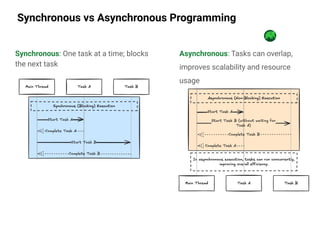
Synchronous vs Asynchronous Programming
Synchronous: One task at a time; blocks
the next task
Asynchronous: Tasks can overlap,
improves scalability and resource
usage
Why FastAPI?
Built on Starlette and Pydantic
Natively supports async/await syntax for optimal performance
Designed for high-concurrency and minimal latency
Setting Up FastAPI for Async Development
Environment Setup
Install FastAPI for async web serving:
pip install “fastapi[standard]”
Writing an Async Endpoint
Basic example:
from fastapi import FastAPI
app = FastAPI()
@app.get("/items/{item_id}")
async def read_item(item_id: int):
return {"item_id": item_id}
Key Points:
Use async def for non-blocking functions
Use await when calling async libraries
Asynchronous Libraries for FastAPI
Why Async Libraries Matter
Using synchronous libraries in an async app blocks the event loop
Leads to poor scalability and performance
Async HTTP Requests
Use httpx instead of requests:
import httpx
@app.get("/external-api" )
async def call_external_api ():
async with httpx.AsyncClient() as client:
response = await client.get("https://example.com/api" )
return response.json()
Asynchronous Libraries for FastAPI
Async Database Operations
Use async ORMs like Tortoise ORM or SQLAlchemy 1.4:
from tortoise import Tortoise
await Tortoise.init(...)
results = await MyModel.filter( name="example")
Async File Operations
Use aiofiles for non-blocking file I/O:
import aiofiles
async with aiofiles.open("file.txt", mode="r") as file:
content = await file.read()
Enhancing Performance with Async Background Tasks
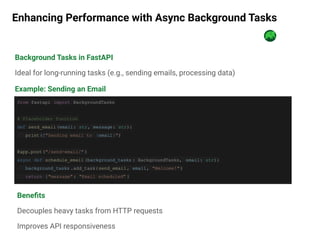
Background Tasks in FastAPI
Ideal for long-running tasks (e.g., sending emails, processing data)
Example: Sending an Email
from fastapi import BackgroundTasks
# Placeholder function
def send_email(email: str, message: str):
print(f"Sending email to {email}")
@app.post("/send-email/" )
async def schedule_email (background_tasks : BackgroundTasks, email: str):
background_tasks .add_task(send_email, email, "Welcome!")
return {"message": "Email scheduled" }
Benefits
Decouples heavy tasks from HTTP requests
Improves API responsiveness
Best Practices for Async Programming
Avoid Blocking Code Replace sync libraries with async alternatives
Monitor Performance Use tools like Prometheus or New Relic
Test Thoroughly Simulate load to identify bottlenecks in async
execution
Use Middleware Async middleware for logging or preprocessing
@app.middleware("http")
async def log_requests(request, call_next):
response = await call_next(request)
print(f"Request: {request.url}")
return response
Testing Async Endpoints
Why Test Async APIs?
Ensure endpoints work as expected under various scenarios
Validate asynchronous behavior and performance
FastAPI’s Test Client
Built on httpx for async testing
Provides an easy way to test endpoints without a running server
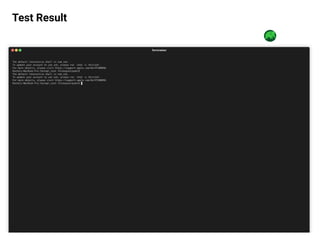
Test Result
Conclusion
Scalability: Asynchronous programming in FastAPI handles more requests efficiently,
making your APIs ready for growth.
Responsiveness: Keeps your applications fast and user-friendly, even under heavy
workloads.
Efficiency: Optimizes resource usage by avoiding idle waits during I/O operations.
Best Practices: Use async libraries, monitor performance, and thoroughly test your code for
reliability and success.

Boost Your API with Asynchronous Programming in FastAPI

  • 1.
    Samuel Folasayo Boost YourAPI with Asynchronous Programming in FastAPI Implementing Async Programming for High-Performance APIs Joe Nyirenda
  • 2.
    Learning Objectives ● Understandthe fundamentals of asynchronous programming ● Learn how to set up a FastAPI environment for async development ● Use async libraries for HTTP requests, database operations, and file handling ● Implement background tasks to enhance API responsiveness ● Write and test async endpoints effectively using FastAPI's test client ● Apply best practices to avoid common pitfalls in async programming
  • 3.
    Overview What is AsynchronousProgramming? A programming model that allows operations to execute non-blockingly Ideal for I/O-bound tasks like HTTP requests, database queries, and file operations
  • 4.
    Synchronous vs AsynchronousProgramming Synchronous: One task at a time; blocks the next task Asynchronous: Tasks can overlap, improves scalability and resource usage
  • 5.
    Why FastAPI? Built onStarlette and Pydantic Natively supports async/await syntax for optimal performance Designed for high-concurrency and minimal latency
  • 6.
    Setting Up FastAPIfor Async Development Environment Setup Install FastAPI for async web serving: pip install “fastapi[standard]” Writing an Async Endpoint Basic example: from fastapi import FastAPI app = FastAPI() @app.get("/items/{item_id}") async def read_item(item_id: int): return {"item_id": item_id} Key Points: Use async def for non-blocking functions Use await when calling async libraries
  • 7.
    Asynchronous Libraries forFastAPI Why Async Libraries Matter Using synchronous libraries in an async app blocks the event loop Leads to poor scalability and performance Async HTTP Requests Use httpx instead of requests: import httpx @app.get("/external-api" ) async def call_external_api (): async with httpx.AsyncClient() as client: response = await client.get("https://example.com/api" ) return response.json()
  • 8.
    Asynchronous Libraries forFastAPI Async Database Operations Use async ORMs like Tortoise ORM or SQLAlchemy 1.4: from tortoise import Tortoise await Tortoise.init(...) results = await MyModel.filter( name="example") Async File Operations Use aiofiles for non-blocking file I/O: import aiofiles async with aiofiles.open("file.txt", mode="r") as file: content = await file.read()
  • 9.
    Enhancing Performance withAsync Background Tasks Background Tasks in FastAPI Ideal for long-running tasks (e.g., sending emails, processing data) Example: Sending an Email from fastapi import BackgroundTasks # Placeholder function def send_email(email: str, message: str): print(f"Sending email to {email}") @app.post("/send-email/" ) async def schedule_email (background_tasks : BackgroundTasks, email: str): background_tasks .add_task(send_email, email, "Welcome!") return {"message": "Email scheduled" } Benefits Decouples heavy tasks from HTTP requests Improves API responsiveness
  • 10.
    Best Practices forAsync Programming Avoid Blocking Code Replace sync libraries with async alternatives Monitor Performance Use tools like Prometheus or New Relic Test Thoroughly Simulate load to identify bottlenecks in async execution Use Middleware Async middleware for logging or preprocessing @app.middleware("http") async def log_requests(request, call_next): response = await call_next(request) print(f"Request: {request.url}") return response
  • 11.
    Testing Async Endpoints WhyTest Async APIs? Ensure endpoints work as expected under various scenarios Validate asynchronous behavior and performance FastAPI’s Test Client Built on httpx for async testing Provides an easy way to test endpoints without a running server
  • 12.
  • 13.
    Conclusion Scalability: Asynchronous programmingin FastAPI handles more requests efficiently, making your APIs ready for growth. Responsiveness: Keeps your applications fast and user-friendly, even under heavy workloads. Efficiency: Optimizes resource usage by avoiding idle waits during I/O operations. Best Practices: Use async libraries, monitor performance, and thoroughly test your code for reliability and success.