5.6 –To determine, using
stoichiometric calculations, the
quantity of a substance involved in
a chemical reaction.
5.8 – To solve numerical problems
related to stoichiometry.
436
STOICHIOMETRY
2.
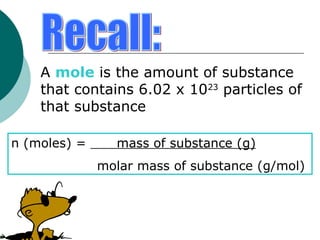
A mole isthe amount of substance
that contains 6.02 x 10²³
particles of
that substance
n (moles) = mass of substance (g)
molar mass of substance (g/mol)
3.
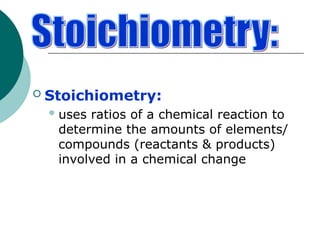
Stoichiometry:
uses ratiosof a chemical reaction to
determine the amounts of elements/
compounds (reactants & products)
involved in a chemical change
4.
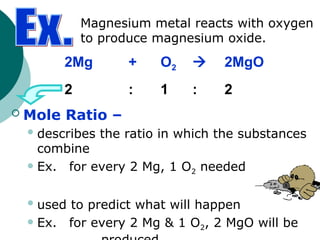
2Mg + O2 2MgO
Mole Ratio –
describes the ratio in which the substances
combine
Ex. for every 2 Mg, 1 O2 needed
used to predict what will happen
Ex. for every 2 Mg & 1 O2, 2 MgO will be
2 : 1 : 2
Magnesium metal reacts with oxygen
to produce magnesium oxide.
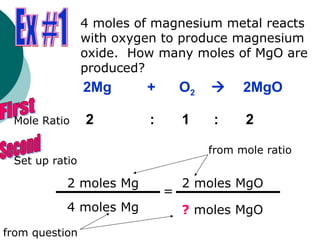
5.
2Mg + O2 2MgO
2 : 1 : 2
4 moles of magnesium metal reacts
with oxygen to produce magnesium
oxide. How many moles of MgO are
produced?
Mole Ratio
Set up ratio
2 moles Mg 2 moles MgO
=
4 moles Mg ? moles MgO
from mole ratio
from question
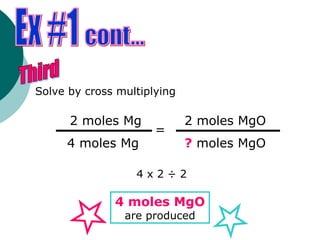
6.
Solve by crossmultiplying
2 moles Mg 2 moles MgO
=
4 moles Mg ? moles MgO
4 moles MgO
are produced
4 x 2 ÷ 2
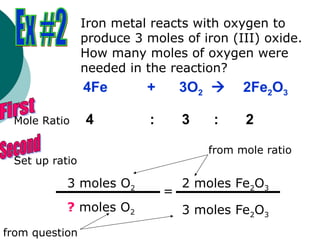
7.
4Fe + 3O2 2Fe2O3
4 : 3 : 2
Iron metal reacts with oxygen to
produce 3 moles of iron (III) oxide.
How many moles of oxygen were
needed in the reaction?
Mole Ratio
Set up ratio
3 moles O2 2 moles Fe2O3
=
? moles O2 3 moles Fe2O3
from mole ratio
from question
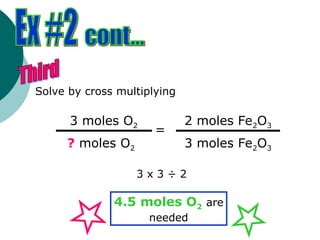
8.
Solve by crossmultiplying
3 moles O2 2 moles Fe2O3
=
? moles O2 3 moles Fe2O3
4.5 moles O2 are
needed
3 x 3 ÷ 2
9.
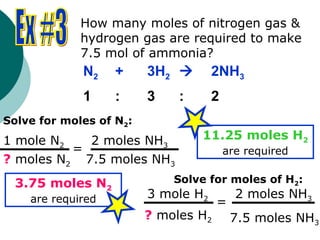
N2 + 3H2 2NH3
1 : 3 : 2
How many moles of nitrogen gas &
hydrogen gas are required to make
7.5 mol of ammonia?
Solve for moles of N2:
1 mole N2 2 moles NH3
=
? moles N2 7.5 moles NH3
3.75 moles N2
are required
Solve for moles of H2:
3 mole H2
=
2 moles NH3
? moles H2 7.5 moles NH3
11.25 moles H2
are required
10.
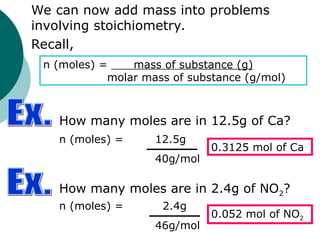
We can nowadd mass into problems
involving stoichiometry.
Recall,
n (moles) = mass of substance (g)
molar mass of substance (g/mol)
How many moles are in 12.5g of Ca?
n (moles) = 12.5g
40g/mol
0.3125 mol of Ca
How many moles are in 2.4g of NO2?
n (moles) = 2.4g
46g/mol
0.052 mol of NO2
11.
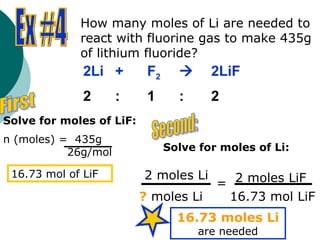
2Li + F2 2LiF
2 : 1 : 2
How many moles of Li are needed to
react with fluorine gas to make 435g
of lithium fluoride?
Solve for moles of LiF:
n (moles) = 435g
26g/mol
16.73 mol of LiF
Solve for moles of Li:
2 moles Li
= 2 moles LiF
? moles Li 16.73 mol LiF
16.73 moles Li
are needed
12.
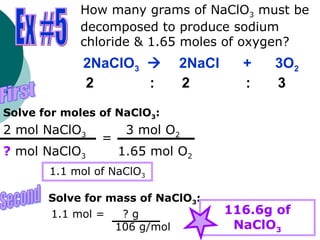
2NaClO3 2NaCl+ 3O2
2 : 2 : 3
How many grams of NaClO3 must be
decomposed to produce sodium
chloride & 1.65 moles of oxygen?
Solve for moles of NaClO3:
1.1 mol of NaClO3
2 mol NaClO3
=
3 mol O2
? mol NaClO3 1.65 mol O2
Solve for mass of NaClO3:
1.1 mol = ? g
106 g/mol
116.6g of
NaClO3
13.
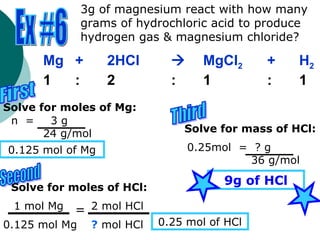
Mg + 2HCl MgCl2 + H2
1 : 2 : 1 : 1
3g of magnesium react with how many
grams of hydrochloric acid to produce
hydrogen gas & magnesium chloride?
Solve for moles of Mg:
0.125 mol of Mg
n = 3 g
24 g/mol
Solve for moles of HCl:
1 mol Mg = 2 mol HCl
0.125 mol Mg ? mol HCl 0.25 mol of HCl
Solve for mass of HCl:
0.25mol = ? g
36 g/mol
9g of HCl
14.
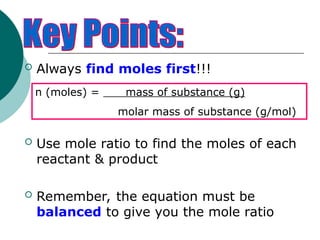
Always findmoles first!!!
Use mole ratio to find the moles of each
reactant & product
Remember, the equation must be
balanced to give you the mole ratio
n (moles) = mass of substance (g)
molar mass of substance (g/mol)




![Polymer [ बहुलक ] Chemistry Notes PDF - Irfanullah Mehar - JJ Sir Chemistry.pdf](https://cdn.slidesharecdn.com/ss_thumbnails/polymerchemistrynotespdf-irfanullahmehar-jjsirchemistry-260210172118-3f9b37f7-thumbnail.jpg?width=640&height=640&fit=bounds)
