Stock
Characters
Description of the Character Character Example and Film
Narrative
Portrayal of the Character
Hero
(Protagonist)
Generally, the Hero is one of the main
characters within the plot of a film that
overcomes the evil in the binary opposition of
good vs. bad. In the Horror genre, this is often
the last character standing after repeatedly
experiencing dangerous scenarios that could
potentially kill them. One of the major
characteristics of the Hero is the need to prove
themselves throughout the movie after being
underestimated consistently. This quality makes
them appear more personable to an audience as
they in turn will route for their success and
support the characters progression. As well as
this, the Hero is usually a physically attractive
individual. In terms of the male gaze theory, this
is frequently the case as it allows the audience
to view the main character in a sexualised way,
which objectifies them in certain perspectives.
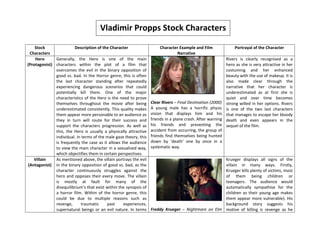
Clear Rivers – Final Destination (2000)
A young male has a horrific physic
vision that displays him and his
friends in a plane crash. After warning
his friends and preventing the
accident from occurring, the group of
friends find themselves being hunted
down by ‘death’ one by once in a
systematic way.
Rivers is clearly recognised as a
hero as she is very attractive in her
costuming and her enhanced
beauty with the use of makeup. It is
also made clear through the
narrative that her character is
underestimated as at first she is
quiet and over time becomes
strong willed in her options. Rivers
is one of the two last characters
that manages to escape her bloody
death and even appears in the
sequel of the film.
Villain
(Antagonist)
As mentioned above, the villain portrays the evil
in the binary opposition of good vs. bad, as the
character continuously struggles against the
hero and opposes their every move. The villain
is mostly at fault for many of the
disequilibrium’s that exist within the synopsis of
a horror film. Within of the horror genre, this
could be due to multiple reasons such as
revenge, traumatic past experiences,
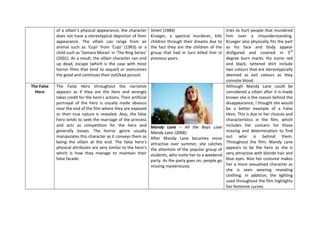
supernatural beings or an evil nature. In terms Freddy Krueger – Nightmare on Elm
Krueger displays all signs of the
villain in many ways. Firstly,
Krueger kills plenty of victims, most
of them being children or
teenagers. The audience would
automatically sympathise for the
children as their young age makes
them appear more vulnerable). His
background story suggests his
motive of killing is revenge as he
Vladimir Propps Stock Characters
of a villain’s physical appearance, the character
does not have a stereotypical depiction of their
appearance. The villain can range from an
animal such as ‘Cujo’ from ‘Cujo’ (1983) or a
child such as ‘Samara Moran’ in ‘The Ring Series’
(2001). As a result, the villain character can end
up dead, escape (which is the case with most
horror films that tend to sequel) or overcomes
the good and continues their evil/bad pursuit.
Street (1984)
Krueger, a spectral murderer, kills
children through their dreams due to
the fact they are the children of the
group that had in turn killed him in
previous years.
tries to hurt people that murdered
him over a misunderstanding.
Krueger also physically fits the part
as his face and body appear
disfigured and covered in 3rd
degree burn marks. His iconic red
and black, tattered shirt include
two colours that are stereotypically
deemed as evil colours as they
connote blood.
The False
Hero
The False Hero throughout the narrative
appears as if they are the hero and wrongly
takes credit for the hero’s actions. Their artificial
portrayal of the hero is usually made obvious
near the end of the film where they are exposed
or their true nature is revealed. Also, the false
hero tends to seek the marriage of the princess
and acts as competition for the hero and
generally looses. The horror genre usually
manipulates this character as it conveys them as
being the villain at the end. The false hero’s
physical attributes are very similar to the hero’s
which is how they manage to maintain their
false facade.
Mandy Lane – All the Boys Love
Mandy Lane (2006)
After Mandy Lane becomes more
attractive over summer, she catches
the attention of the popular group of
students, who invite her to a weekend
party. As the party goes on, people go
missing mysteriously.
Although Mandy Lane could be
considered a villain after it is made
known she is the reason behind the
disappearance, I thought she would
be a better example of a False
Hero. This is due to her choices and
characteristics in the film, which
includes her concern for those
missing and determination to find
out who is behind them.
Throughout the film, Mandy Lane
appears to be the hero as she is
very attractive with blonde hair and
blue eyes. Also her costume makes
her a more sexualised character as
she is seen wearing revealing
clothing. In addition, the lighting
used throughout the film highlights
her feminine curves.
The Donor The Donor is described as the character within
the narrative that prepares the hero for the
conquest through support or information or aids
the hero with a magical object/s. Donors that
appear in Horror films can range from mediums
that help scenarios that include the
supernatural or individuals that have studied
the cases and prove knowledge and assistance.
The fate of the Donor also varies but
stereotypically the Donor can end their life to
allow the Hero to continue their journey in
conquering the evil.
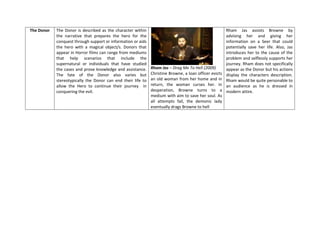
Rham Jas – Drag Me To Hell (2009)
Christine Browne, a loan officer evicts
an old woman from her home and in
return, the woman curses her. In
desperation, Browne turns to a
medium with aim to save her soul. As
all attempts fail, the demonic lady
eventually drags Browne to hell
Rham Jas assists Browne by
advising her and giving her
information on a Seer that could
potentially save her life. Also, Jas
introduces her to the cause of the
problem and selflessly supports her
journey. Rham does not specifically
appear as the Donor but his actions
display the characters description.
Rham would be quite personable to
an audience as he is dressed in
modern attire.

Stock Characters

  • 1.
    Stock Characters Description of theCharacter Character Example and Film Narrative Portrayal of the Character Hero (Protagonist) Generally, the Hero is one of the main characters within the plot of a film that overcomes the evil in the binary opposition of good vs. bad. In the Horror genre, this is often the last character standing after repeatedly experiencing dangerous scenarios that could potentially kill them. One of the major characteristics of the Hero is the need to prove themselves throughout the movie after being underestimated consistently. This quality makes them appear more personable to an audience as they in turn will route for their success and support the characters progression. As well as this, the Hero is usually a physically attractive individual. In terms of the male gaze theory, this is frequently the case as it allows the audience to view the main character in a sexualised way, which objectifies them in certain perspectives. Clear Rivers – Final Destination (2000) A young male has a horrific physic vision that displays him and his friends in a plane crash. After warning his friends and preventing the accident from occurring, the group of friends find themselves being hunted down by ‘death’ one by once in a systematic way. Rivers is clearly recognised as a hero as she is very attractive in her costuming and her enhanced beauty with the use of makeup. It is also made clear through the narrative that her character is underestimated as at first she is quiet and over time becomes strong willed in her options. Rivers is one of the two last characters that manages to escape her bloody death and even appears in the sequel of the film. Villain (Antagonist) As mentioned above, the villain portrays the evil in the binary opposition of good vs. bad, as the character continuously struggles against the hero and opposes their every move. The villain is mostly at fault for many of the disequilibrium’s that exist within the synopsis of a horror film. Within of the horror genre, this could be due to multiple reasons such as revenge, traumatic past experiences, supernatural beings or an evil nature. In terms Freddy Krueger – Nightmare on Elm Krueger displays all signs of the villain in many ways. Firstly, Krueger kills plenty of victims, most of them being children or teenagers. The audience would automatically sympathise for the children as their young age makes them appear more vulnerable). His background story suggests his motive of killing is revenge as he Vladimir Propps Stock Characters
  • 2.
    of a villain’sphysical appearance, the character does not have a stereotypical depiction of their appearance. The villain can range from an animal such as ‘Cujo’ from ‘Cujo’ (1983) or a child such as ‘Samara Moran’ in ‘The Ring Series’ (2001). As a result, the villain character can end up dead, escape (which is the case with most horror films that tend to sequel) or overcomes the good and continues their evil/bad pursuit. Street (1984) Krueger, a spectral murderer, kills children through their dreams due to the fact they are the children of the group that had in turn killed him in previous years. tries to hurt people that murdered him over a misunderstanding. Krueger also physically fits the part as his face and body appear disfigured and covered in 3rd degree burn marks. His iconic red and black, tattered shirt include two colours that are stereotypically deemed as evil colours as they connote blood. The False Hero The False Hero throughout the narrative appears as if they are the hero and wrongly takes credit for the hero’s actions. Their artificial portrayal of the hero is usually made obvious near the end of the film where they are exposed or their true nature is revealed. Also, the false hero tends to seek the marriage of the princess and acts as competition for the hero and generally looses. The horror genre usually manipulates this character as it conveys them as being the villain at the end. The false hero’s physical attributes are very similar to the hero’s which is how they manage to maintain their false facade. Mandy Lane – All the Boys Love Mandy Lane (2006) After Mandy Lane becomes more attractive over summer, she catches the attention of the popular group of students, who invite her to a weekend party. As the party goes on, people go missing mysteriously. Although Mandy Lane could be considered a villain after it is made known she is the reason behind the disappearance, I thought she would be a better example of a False Hero. This is due to her choices and characteristics in the film, which includes her concern for those missing and determination to find out who is behind them. Throughout the film, Mandy Lane appears to be the hero as she is very attractive with blonde hair and blue eyes. Also her costume makes her a more sexualised character as she is seen wearing revealing clothing. In addition, the lighting used throughout the film highlights her feminine curves.
  • 3.
    The Donor TheDonor is described as the character within the narrative that prepares the hero for the conquest through support or information or aids the hero with a magical object/s. Donors that appear in Horror films can range from mediums that help scenarios that include the supernatural or individuals that have studied the cases and prove knowledge and assistance. The fate of the Donor also varies but stereotypically the Donor can end their life to allow the Hero to continue their journey in conquering the evil. Rham Jas – Drag Me To Hell (2009) Christine Browne, a loan officer evicts an old woman from her home and in return, the woman curses her. In desperation, Browne turns to a medium with aim to save her soul. As all attempts fail, the demonic lady eventually drags Browne to hell Rham Jas assists Browne by advising her and giving her information on a Seer that could potentially save her life. Also, Jas introduces her to the cause of the problem and selflessly supports her journey. Rham does not specifically appear as the Donor but his actions display the characters description. Rham would be quite personable to an audience as he is dressed in modern attire.