M
ANAGEMENT OF
ageing plant is never
easy. Tight budgets and
scarce labour resources
following seven years
in recession have not made tank farm
management any easier.
Also, ever tightening legislative
compliance keeps everyone on their
toes. It only takes an event like
Buncefield or the recent accident in
China to remind us how important it is
to keep employees and assets safe.
56 STORAGE TERMINALS MAGAZINE
PREVENTATIVE MAINTENANCE
STAYING IN
TIPTOP SHAPE
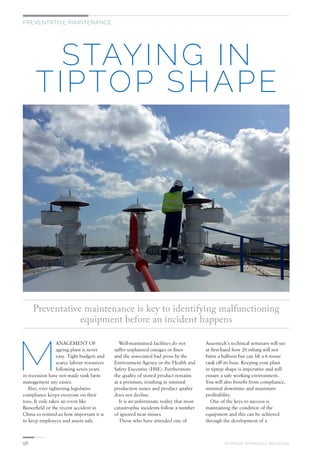
Preventative maintenance is key to identifying malfunctioning
equipment before an incident happens
Well-maintained facilities do not
suffer unplanned outages or fines
and the associated bad press by the
Environment Agency or the Health and
Safety Executive (HSE). Furthermore
the quality of stored product remains
at a premium, resulting in minimal
production issues and product quality
does not decline.
It is an unfortunate reality that most
catastrophic incidents follow a number
of ignored near misses.
Those who have attended one of
Assentech’s technical seminars will see
at first-hand how 20 mbarg will not
burst a balloon but can lift a 6 tonne
tank off its base. Keeping your plant
in tiptop shape is imperative and will
ensure a safe working environment.
You will also benefit from compliance,
minimal downtime and maximum
profitability.
One of the keys to success is
maintaining the condition of the
equipment and this can be achieved
through the development of a
59STORAGE TERMINALS MAGAZINE
PREVENTATIVE MAINTENANCE
preventative maintenance plan. An easy
to follow programme can be designed
to fit any type of site by following some
simple guidelines and setting up routine
inspections. Failing components will
be identified and corrected before an
incident occurs and the site operating
efficiency will be maintained.
Preventative maintenance plans and
structured key performance indicators
are designed to address issues of
malfunctioning and underperforming
equipment before an incident occurs.
This strategy is a well-trodden path with
high pressure relief equipment following
many years of legislative development.
A systematic and structured
maintenance procedure of low pressure
systems is less uniform between
operators. The HSE is increasing
focus and awareness of safety and
management of ageing assets by
promoting the importance of following
a structured process.
The most comprehensive preventative
plan should be developed for each
piece of equipment. Once the piece
of equipment has an asset number it
is necessary to review its suitability
for the intended service. This review
can be achieved by reviewing the
service manual, performance curve(s)
and test certificates. The distributor
or manufacturer can assist with this
process. The maintenance regime
must include information on inspection
intervals and the lubrication schedule.
With the recommended information
in hand, the plan can be tailored to fit
the usage of the equipment and/or the
site standards.
Other criteria can determine the
timeframe and frequency of equipment
detailed on your maintenance plan and
these include:
Construction	 Quality and 		
		 suitability of the 		
		 original fabrication 	
		and installation
Design		 Life limiting factors 	
		 assumed at design 	
		stage
		Design quality
		Calibration
		Documentation 		
		requirements
Suppliers		 Obsolescence of 		
		equipment
Operation	 Operating within 		
		design limits
Inspection	 Visual inspection for 	
		deterioration
Modifications	 Any modification
		 or change from 		
		original scope
61STORAGE TERMINALS MAGAZINE
PREVENTATIVE MAINTENANCE
RELEVANT STANDARDS
AND REFERENCE
● EEMUA Publication 231
Ed 1 – The mechanical integrity
of plant containing hazardous
substances
● EEMUA Publication 159 –
Users’ Guide to the Inspection,
Maintenance and Repair of Above
Ground Vertical Cylindrical Steel
Storage Tanks
● EEMUA Publication 217 Ed 1
– Safe and Effective Operation of
Storage Tanks
● EEMUA Publication 213 Ed 1 -
Emission reduction from Oil Storage
Tanks and loading operations
● HSG 176 – The storage of
flammable liquids in tanks
● API 653 – Tank inspection, repair,
alteration and reconstruction.
● API 2000 – Venting Atmospheric
and Low-pressure Storage Tanks
Buncefield Major Incident
Investigation Board http://www.hse.
gov.uk/comah/bouncefield/fuel-
storage-sites.pdf
● RR760 – Mechanical integrity
management of bulk Storage Tanks
● BS EN 14015:2004 – Site built
flat bottomed atmospheric
Storage Tanks
● ISO 28300 – Venting of
atmospheric low pressure
Storage Tanks
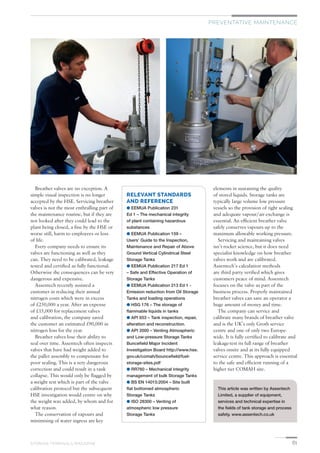
Breather valves are no exception. A
simple visual inspection is no longer
accepted by the HSE. Servicing breather
valves is not the most enthralling part of
the maintenance routine, but if they are
not looked after they could lead to the
plant being closed, a fine by the HSE or
worse still, harm to employees or loss
of life.
Every company needs to ensure its
valves are functioning as well as they
can. They need to be calibrated, leakage
tested and certified as fully functional.
Otherwise the consequences can be very
dangerous and expensive.
Assentech recently assisted a
customer in reducing their annual
nitrogen costs which were in excess
of £250,000 a year. After an expense
of £15,000 for replacement valves
and calibration, the company saved
the customer an estimated £90,000 in
nitrogen loss for the year.
Breather valves lose their ability to
seal over time. Assentech often inspects
valves that have had weight added to
the pallet assembly to compensate for
poor sealing. This is a very dangerous
correction and could result in a tank
collapse. This would only be flagged by
a weight test which is part of the valve
calibration protocol but the subsequent
HSE investigation would centre on why
the weight was added, by whom and for
what reason.
The conservation of vapours and
minimising of water ingress are key
elements in sustaining the quality
of stored liquids. Storage tanks are
typically large volume low pressure
vessels so the provision of tight sealing
and adequate vapour/air exchange is
essential. An efficient breather valve
safely conserves vapours up to the
maximum allowable working pressure.
Servicing and maintaining valves
isn’t rocket science, but it does need
specialist knowledge on how breather
valves work and are calibrated.
Assentech’s calculation methods
are third party verified which gives
customers peace of mind. Assentech
focuses on the valve as part of the
business process. Properly maintained
breather valves can save an operator a
huge amount of money and time.
The company can service and
calibrate many brands of breather valve
and is the UK’s only Groth service
centre and one of only two Europe-
wide. It is fully certified to calibrate and
leakage-test its full range of breather
valves onsite and at its fully equipped
service centre. This approach is essential
to the safe and efficient running of a
higher tier COMAH site.
This article was written by Assentech
Limited, a supplier of equipment,
services and technical expertise in
the fields of tank storage and process
safety. www.assentech.co.uk

STM_Autumn2015 Article Publication

  • 1.
    M ANAGEMENT OF ageing plantis never easy. Tight budgets and scarce labour resources following seven years in recession have not made tank farm management any easier. Also, ever tightening legislative compliance keeps everyone on their toes. It only takes an event like Buncefield or the recent accident in China to remind us how important it is to keep employees and assets safe. 56 STORAGE TERMINALS MAGAZINE PREVENTATIVE MAINTENANCE STAYING IN TIPTOP SHAPE Preventative maintenance is key to identifying malfunctioning equipment before an incident happens Well-maintained facilities do not suffer unplanned outages or fines and the associated bad press by the Environment Agency or the Health and Safety Executive (HSE). Furthermore the quality of stored product remains at a premium, resulting in minimal production issues and product quality does not decline. It is an unfortunate reality that most catastrophic incidents follow a number of ignored near misses. Those who have attended one of Assentech’s technical seminars will see at first-hand how 20 mbarg will not burst a balloon but can lift a 6 tonne tank off its base. Keeping your plant in tiptop shape is imperative and will ensure a safe working environment. You will also benefit from compliance, minimal downtime and maximum profitability. One of the keys to success is maintaining the condition of the equipment and this can be achieved through the development of a
  • 2.
    59STORAGE TERMINALS MAGAZINE PREVENTATIVEMAINTENANCE preventative maintenance plan. An easy to follow programme can be designed to fit any type of site by following some simple guidelines and setting up routine inspections. Failing components will be identified and corrected before an incident occurs and the site operating efficiency will be maintained. Preventative maintenance plans and structured key performance indicators are designed to address issues of malfunctioning and underperforming equipment before an incident occurs. This strategy is a well-trodden path with high pressure relief equipment following many years of legislative development. A systematic and structured maintenance procedure of low pressure systems is less uniform between operators. The HSE is increasing focus and awareness of safety and management of ageing assets by promoting the importance of following a structured process. The most comprehensive preventative plan should be developed for each piece of equipment. Once the piece of equipment has an asset number it is necessary to review its suitability for the intended service. This review can be achieved by reviewing the service manual, performance curve(s) and test certificates. The distributor or manufacturer can assist with this process. The maintenance regime must include information on inspection intervals and the lubrication schedule. With the recommended information in hand, the plan can be tailored to fit the usage of the equipment and/or the site standards. Other criteria can determine the timeframe and frequency of equipment detailed on your maintenance plan and these include: Construction Quality and suitability of the original fabrication and installation Design Life limiting factors assumed at design stage Design quality Calibration Documentation requirements Suppliers Obsolescence of equipment Operation Operating within design limits Inspection Visual inspection for deterioration Modifications Any modification or change from original scope
  • 3.
    61STORAGE TERMINALS MAGAZINE PREVENTATIVEMAINTENANCE RELEVANT STANDARDS AND REFERENCE ● EEMUA Publication 231 Ed 1 – The mechanical integrity of plant containing hazardous substances ● EEMUA Publication 159 – Users’ Guide to the Inspection, Maintenance and Repair of Above Ground Vertical Cylindrical Steel Storage Tanks ● EEMUA Publication 217 Ed 1 – Safe and Effective Operation of Storage Tanks ● EEMUA Publication 213 Ed 1 - Emission reduction from Oil Storage Tanks and loading operations ● HSG 176 – The storage of flammable liquids in tanks ● API 653 – Tank inspection, repair, alteration and reconstruction. ● API 2000 – Venting Atmospheric and Low-pressure Storage Tanks Buncefield Major Incident Investigation Board http://www.hse. gov.uk/comah/bouncefield/fuel- storage-sites.pdf ● RR760 – Mechanical integrity management of bulk Storage Tanks ● BS EN 14015:2004 – Site built flat bottomed atmospheric Storage Tanks ● ISO 28300 – Venting of atmospheric low pressure Storage Tanks Breather valves are no exception. A simple visual inspection is no longer accepted by the HSE. Servicing breather valves is not the most enthralling part of the maintenance routine, but if they are not looked after they could lead to the plant being closed, a fine by the HSE or worse still, harm to employees or loss of life. Every company needs to ensure its valves are functioning as well as they can. They need to be calibrated, leakage tested and certified as fully functional. Otherwise the consequences can be very dangerous and expensive. Assentech recently assisted a customer in reducing their annual nitrogen costs which were in excess of £250,000 a year. After an expense of £15,000 for replacement valves and calibration, the company saved the customer an estimated £90,000 in nitrogen loss for the year. Breather valves lose their ability to seal over time. Assentech often inspects valves that have had weight added to the pallet assembly to compensate for poor sealing. This is a very dangerous correction and could result in a tank collapse. This would only be flagged by a weight test which is part of the valve calibration protocol but the subsequent HSE investigation would centre on why the weight was added, by whom and for what reason. The conservation of vapours and minimising of water ingress are key elements in sustaining the quality of stored liquids. Storage tanks are typically large volume low pressure vessels so the provision of tight sealing and adequate vapour/air exchange is essential. An efficient breather valve safely conserves vapours up to the maximum allowable working pressure. Servicing and maintaining valves isn’t rocket science, but it does need specialist knowledge on how breather valves work and are calibrated. Assentech’s calculation methods are third party verified which gives customers peace of mind. Assentech focuses on the valve as part of the business process. Properly maintained breather valves can save an operator a huge amount of money and time. The company can service and calibrate many brands of breather valve and is the UK’s only Groth service centre and one of only two Europe- wide. It is fully certified to calibrate and leakage-test its full range of breather valves onsite and at its fully equipped service centre. This approach is essential to the safe and efficient running of a higher tier COMAH site. This article was written by Assentech Limited, a supplier of equipment, services and technical expertise in the fields of tank storage and process safety. www.assentech.co.uk