stm unit-1part-II-1.pptx about software testing tools
1.
Software Testing
Methodologies andTools
UNIT I:Introduction: Purpose of Testing, Dichotomies, Model for Testing, Consequences of
Bugs,Taxonomy of Bugs.
Flow graphs and Path testing: Basics Concepts of Path Testing, Predicates, Path Predicates
and Achievable Paths, Path Sensitizing, Path Instrumentation, Application of Path Testing.
9.
• Notational Evolution:
•The control flow graph is simplified representation of the program's structure. The
notation changes made in creation of control flow graphs:
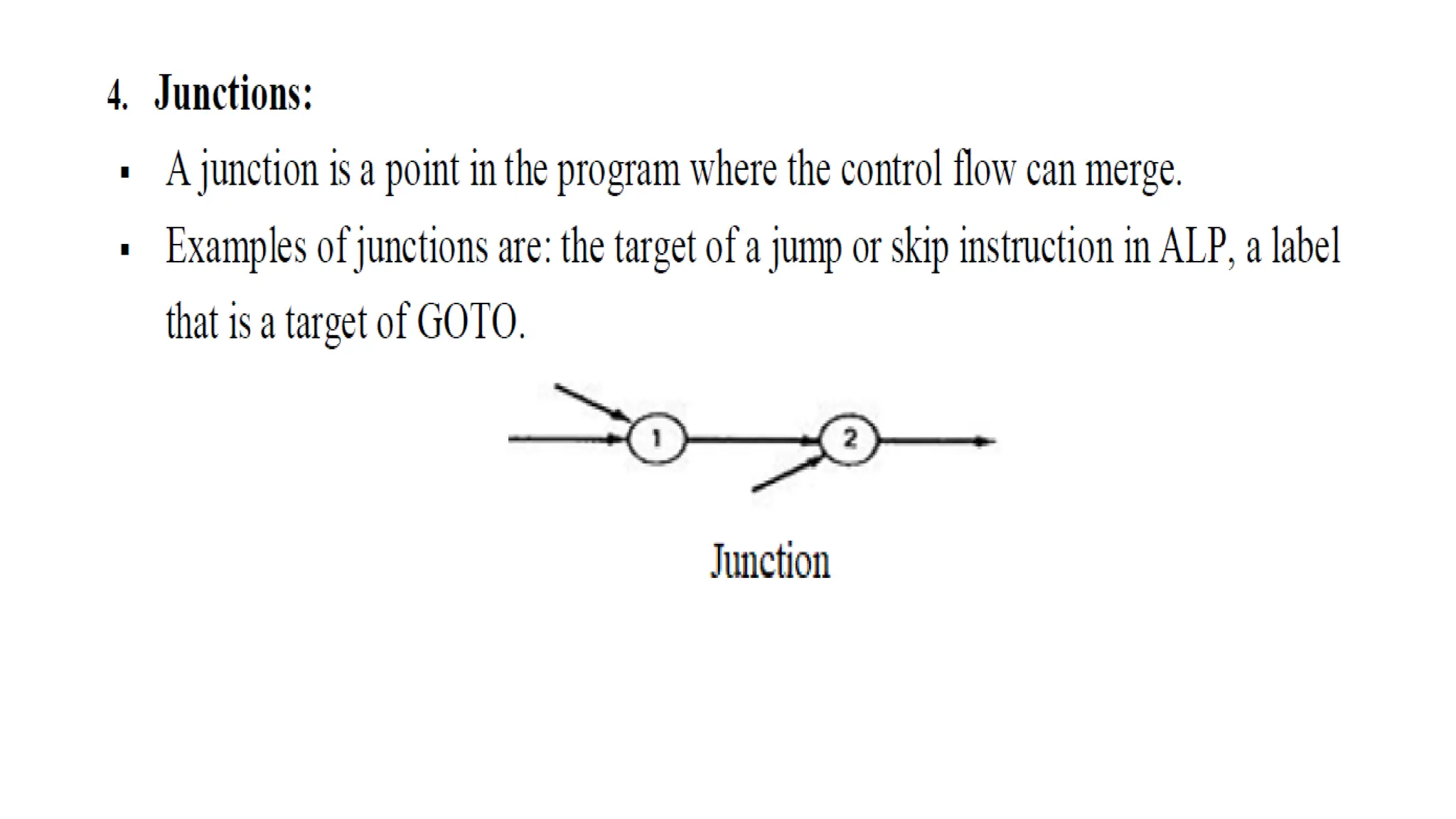
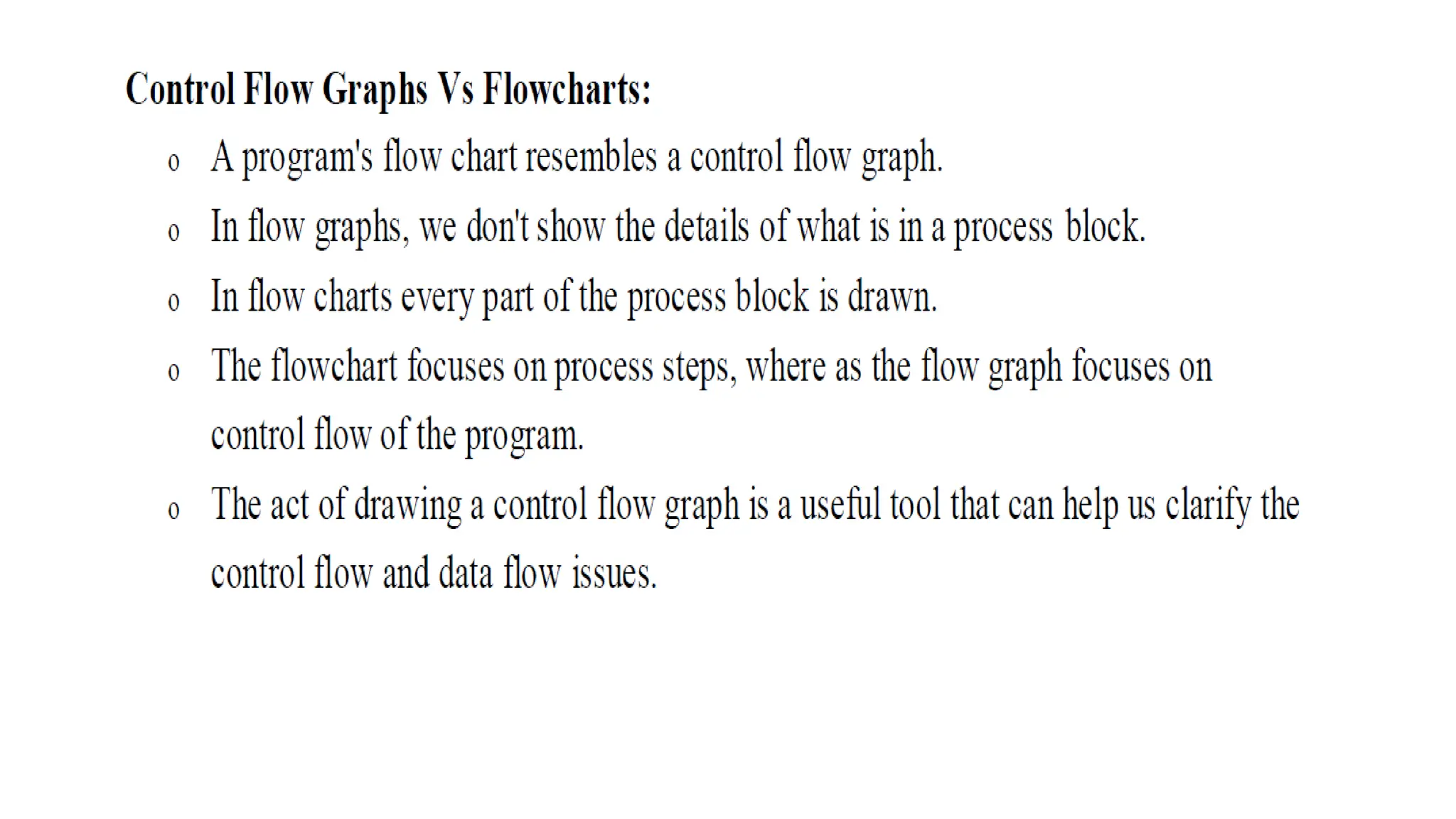
The process boxes weren't really needed. There is an implied process on every line joining junctions
and decisions.
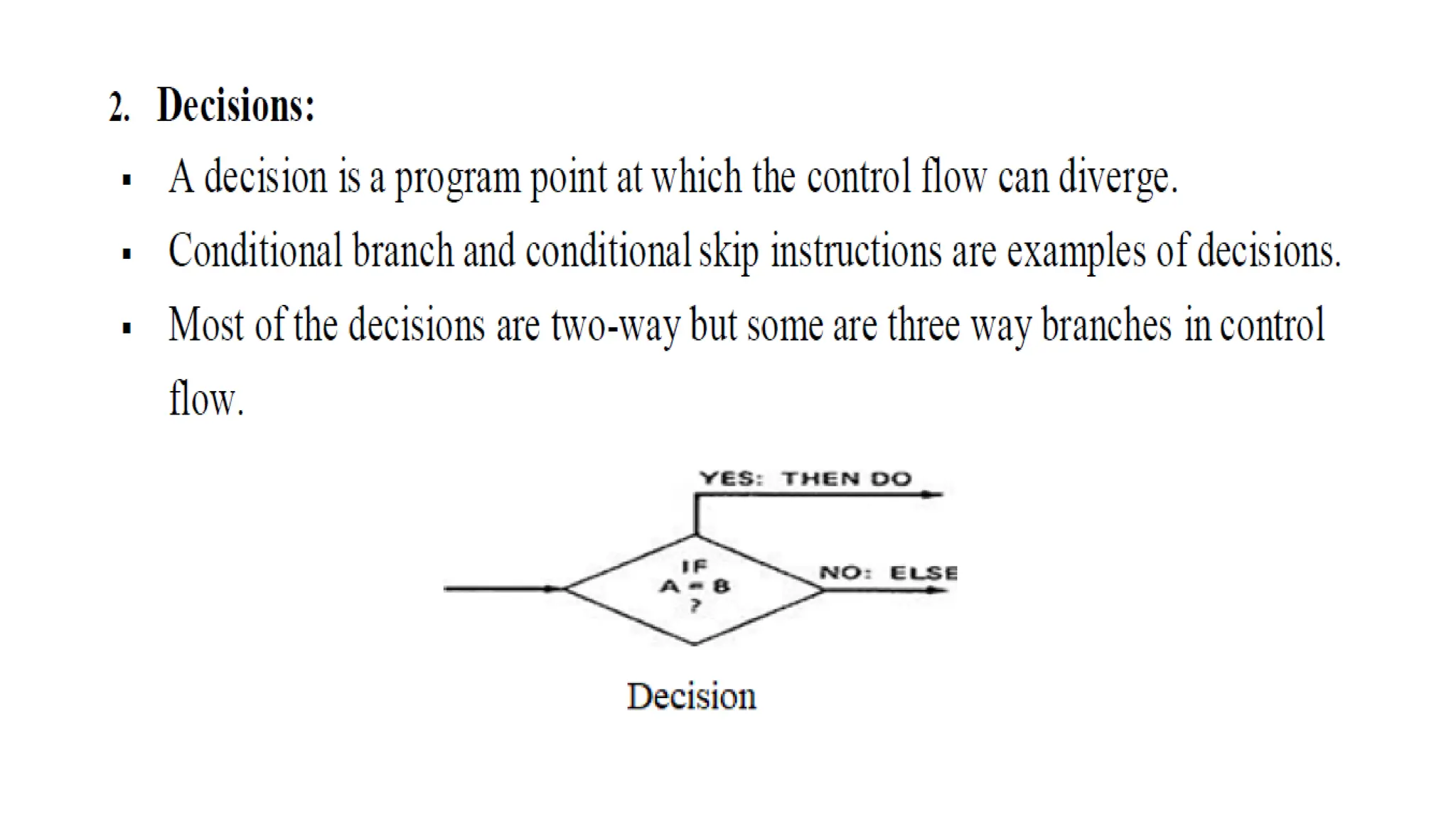
We don't need to know the specifics of the decisions, just the fact that there is a branch.
The specific target label names aren't important-just the fact that they exist. So we can replace them
by simple numbers.
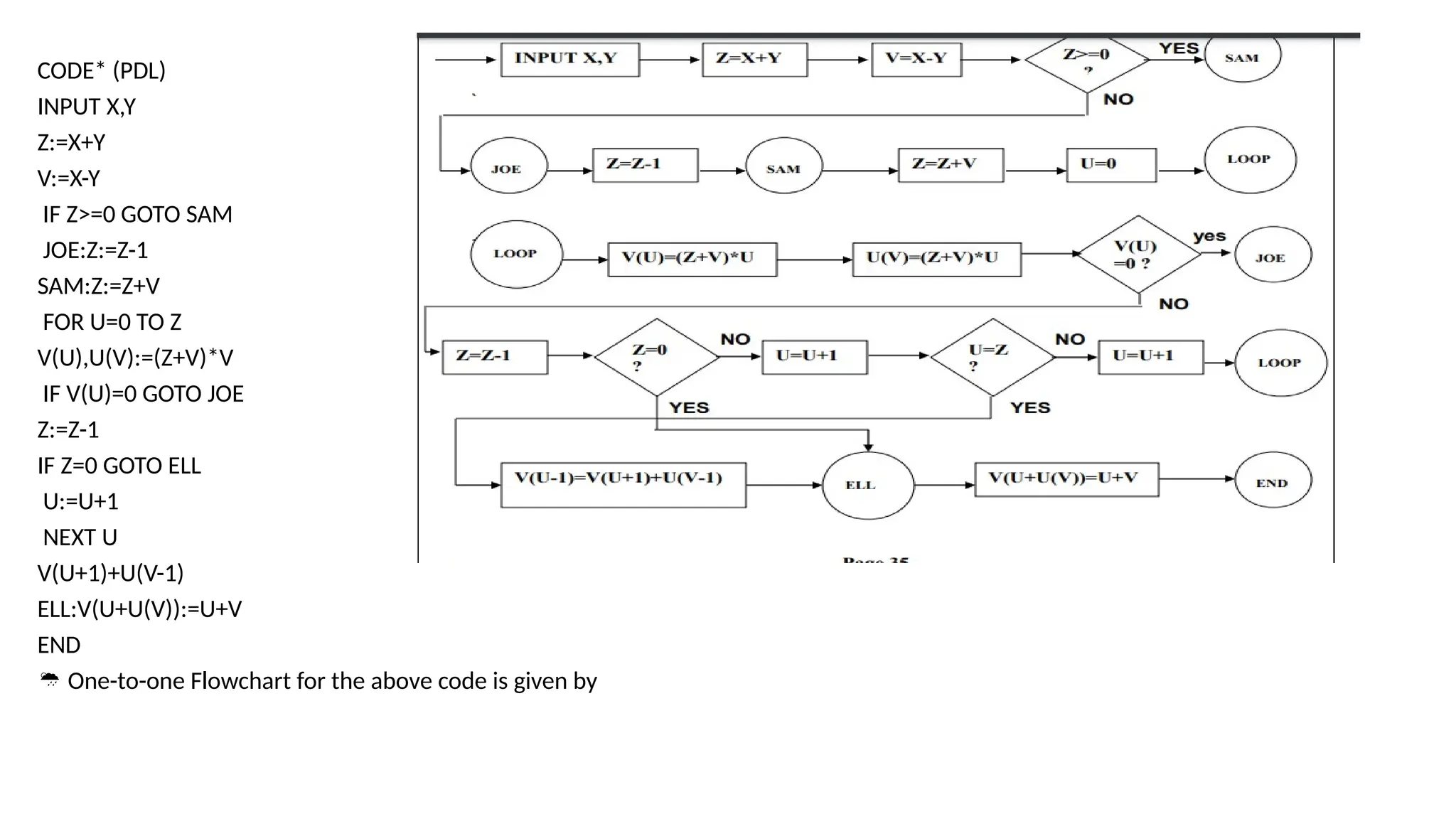
To understand this, we will go through an example (Figure 2.2) written in a FORTRAN like
programming language called Programming Design Language (PDL). The program's corresponding
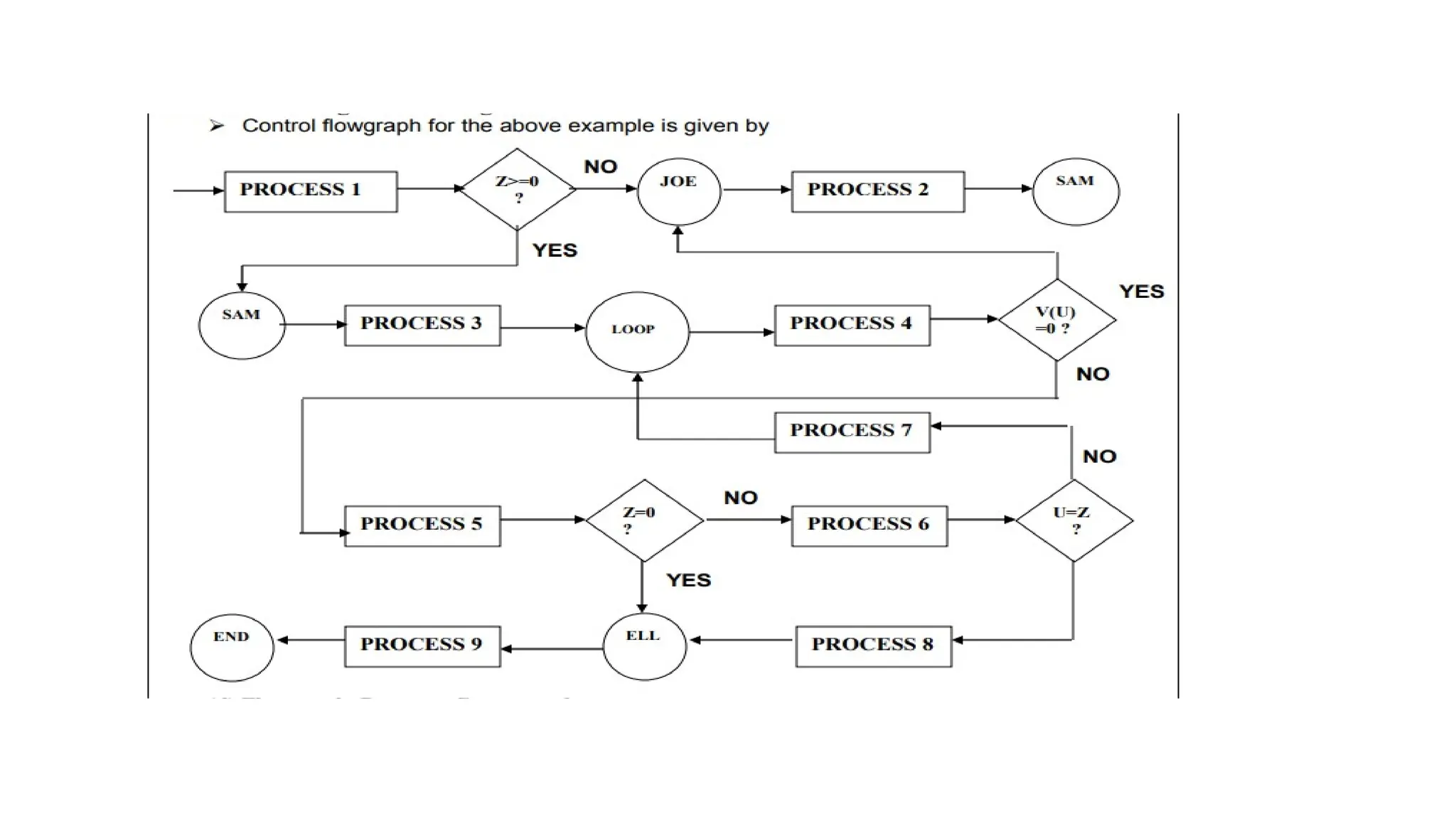
flowchart (Figure 2.3) and flow graph (Figure 2.4) were also provided below for better understanding.
The first step in translating the program to a flowchart is shown in Figure 2.3, where we have the
typical one-for-one classical flowchart. Note that complexity has increased, clarity has decreased,
and that we had to add auxiliary labels (LOOP, XX, and YY), which have no actual program
counterpart. In Figure 2.4 we merged the process steps and replaced them with the single process
box.
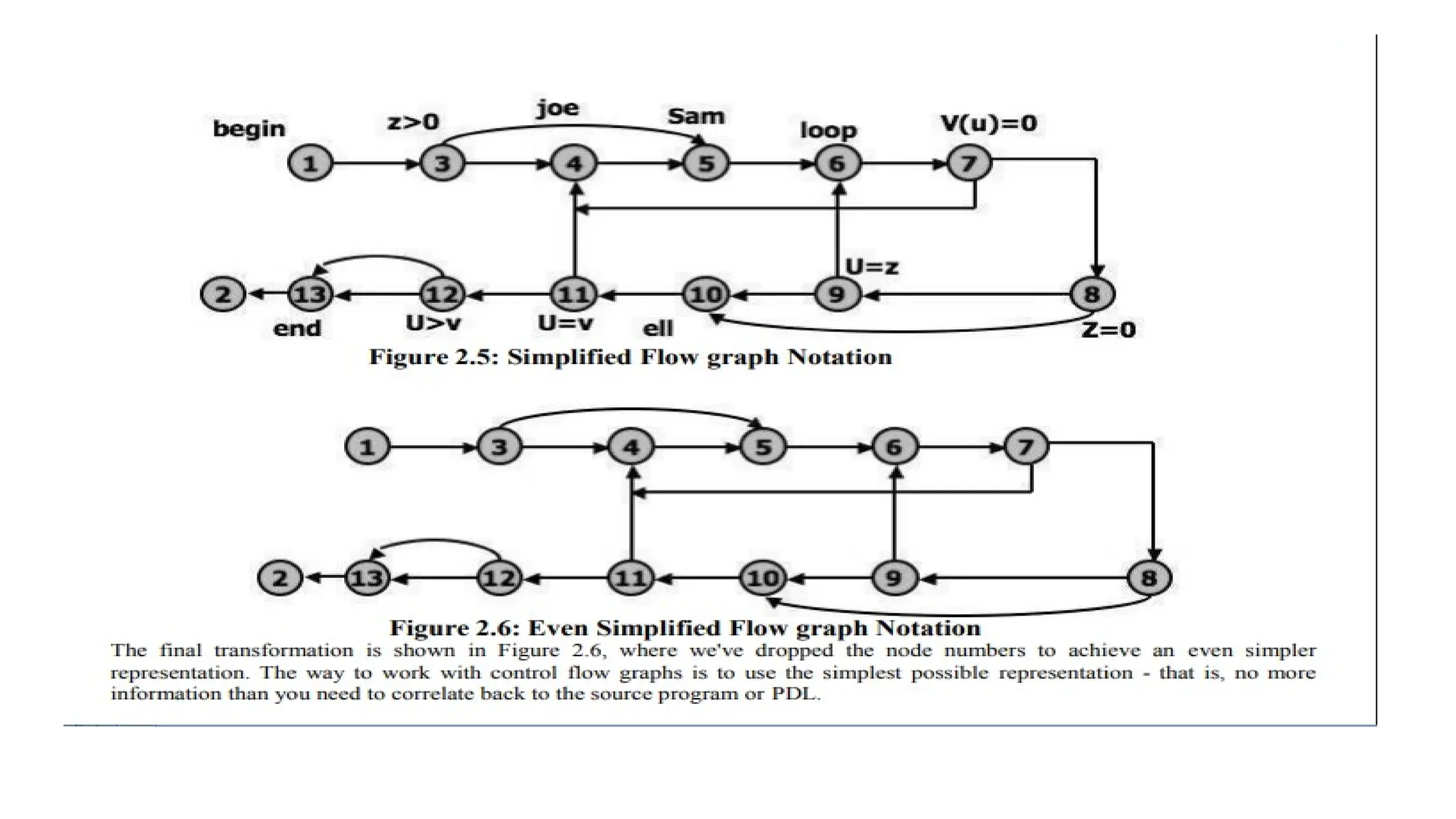
We now have a control flow graph. But this representation is still too busy. We simplify the notation
further to achieve Figure 2.5, where for the first time we can really see what the control flow looks
like.
10.
CODE* (PDL)
INPUT X,Y
Z:=X+Y
V:=X-Y
IFZ>=0 GOTO SAM
JOE:Z:=Z-1
SAM:Z:=Z+V
FOR U=0 TO Z
V(U),U(V):=(Z+V)*V
IF V(U)=0 GOTO JOE
Z:=Z-1
IF Z=0 GOTO ELL
U:=U+1
NEXT U
V(U+1)+U(V-1)
ELL:V(U+U(V)):=U+V
END
One-to-one Flowchart for the above code is given by
12.
(d) Flowgraph–Program Correspondence
•A flowgraph is a pictorial representation of a program and not the program itself.
• We can’t always associate the parts of a program in a unique way with flowgraph parts because many program
structures, such as IF–THEN–ELSE constructs, consist of a combination of decisions, junctions, and processes.
• Furthermore, the translation from a flowgraph element to a statement and vice versa is not always unique.
• A FORTRAN DO has three parts: a decision, an end–point junction, and a process that iterates the DO variable.
• The FORTRAN IF–THEN–ELSE has a decision, a junction, and three processes (including the processing associated
with the decision itself).
• Therefore, neither of these statements can be translated into a single flowgraph element.
• Some computers have looping, iterating, and EXECUTE instructions or other instruction options and modes that
prevent the direct correspondence between instructions and flowgraph elements.
• Such differences are so familiar to us that we often code without conscious awareness of their existence.
• It is, however, important that the distinction between a program and its flowgrap representation be kept in mind
during test design.
• An improper translation from flowgraph to code during coding can lead to bugs, and an improper translation
(in either direction) during test design can lead to missing test cases and consequently, to undiscovered bugs.
14.
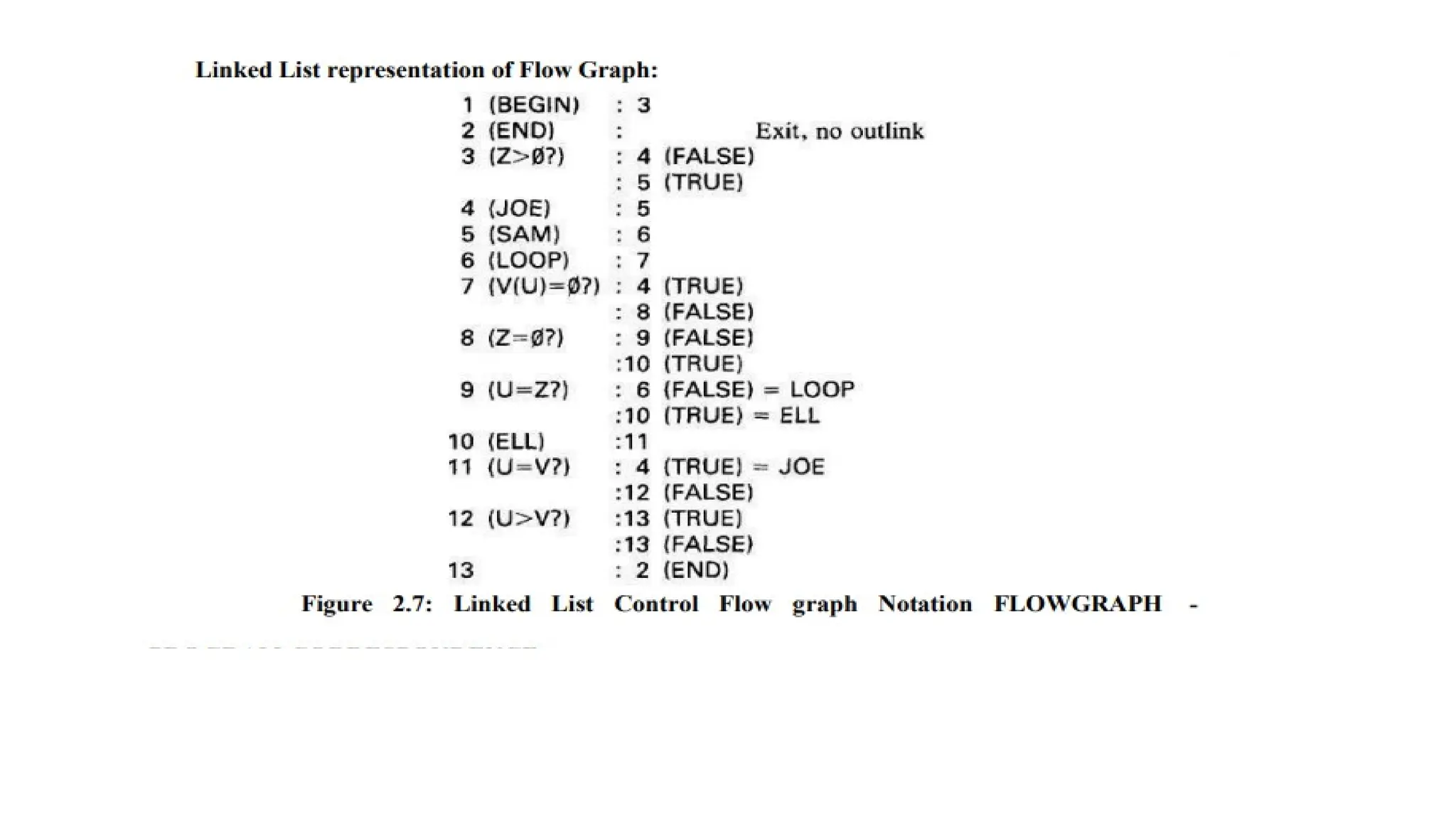
• LINKED LISTREPRESENTATION: Although graphical representations of
flow graphs are revealing, the details of the control flow inside a
program they are often inconvenient. In linked list representation,
each node has a name and there is an entry on the list for each link in
the flow graph. Only the information pertinent to the control flow is
shown.
16.
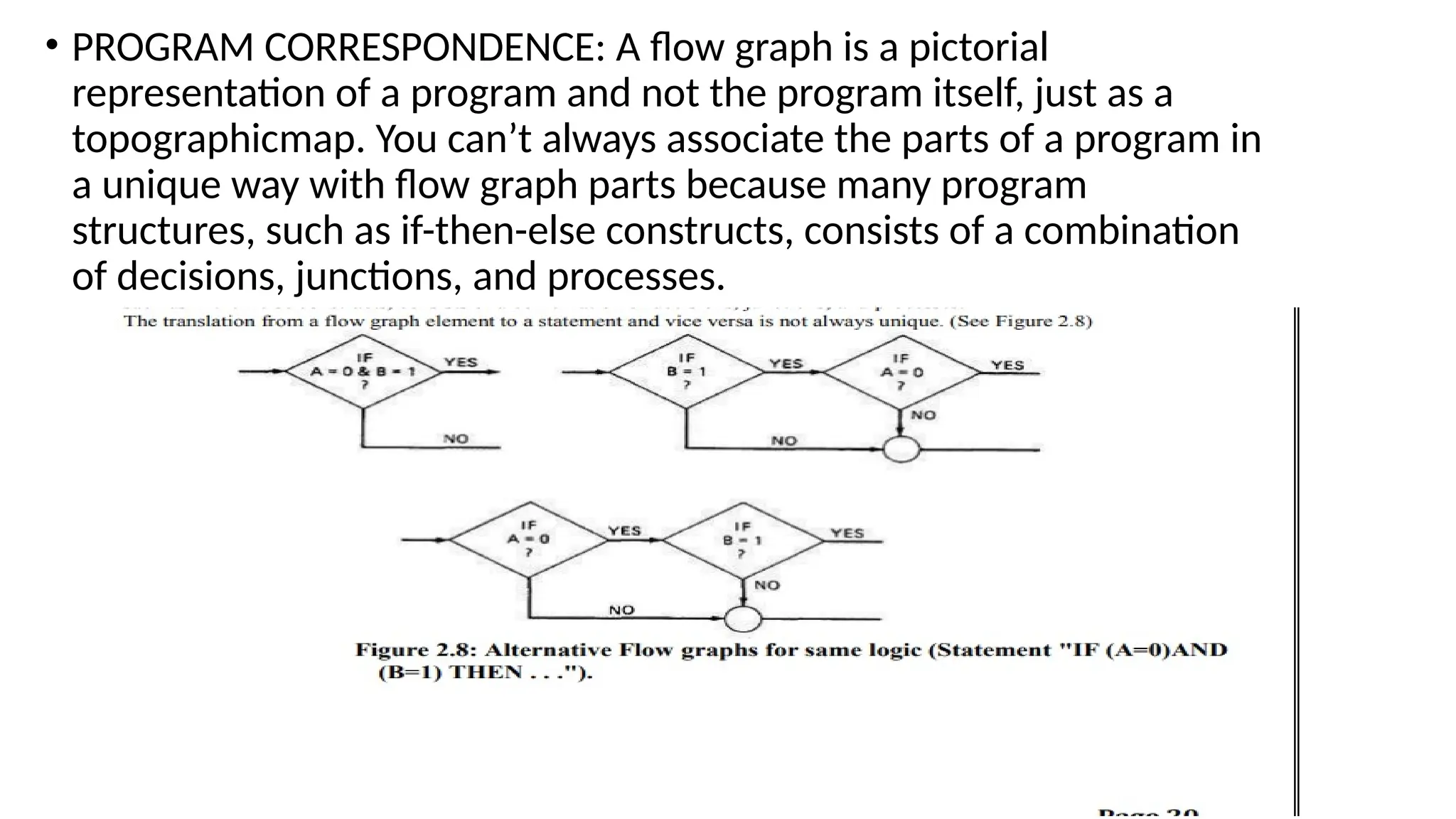
• PROGRAM CORRESPONDENCE:A flow graph is a pictorial
representation of a program and not the program itself, just as a
topographicmap. You can’t always associate the parts of a program in
a unique way with flow graph parts because many program
structures, such as if-then-else constructs, consists of a combination
of decisions, junctions, and processes.
18.
• PATH TESTING- PATHS, NODES AND LINKS:
• Path: A path through a program is a sequence of instructions or
statements that starts at an entry, junction, or decision and ends at
another, or possibly the same junction, decision, or exit.
A path may go through several junctions, processes, or decisions, one
or more times.
Paths consist of segments.
The segment is a link - a single process that lies between two nodes.
A path segment is succession of consecutive links that belongs to some
path.
The length of path measured by the number of links in it and not by
the number of the instructions or statements executed along that path.
The name of a path is the name of the nodes along the path.
19.
• FUNDAMENTAL PATHSELECTION CRITERIA:
There are many paths between the entry and exit of a typical routine.
Every decision doubles the number of potential paths. And every loop
multiplies the number of potential paths by the number of different iteration
values possible for the loop.
Defining complete testing:
• 1. Exercise every path from entry to exit.
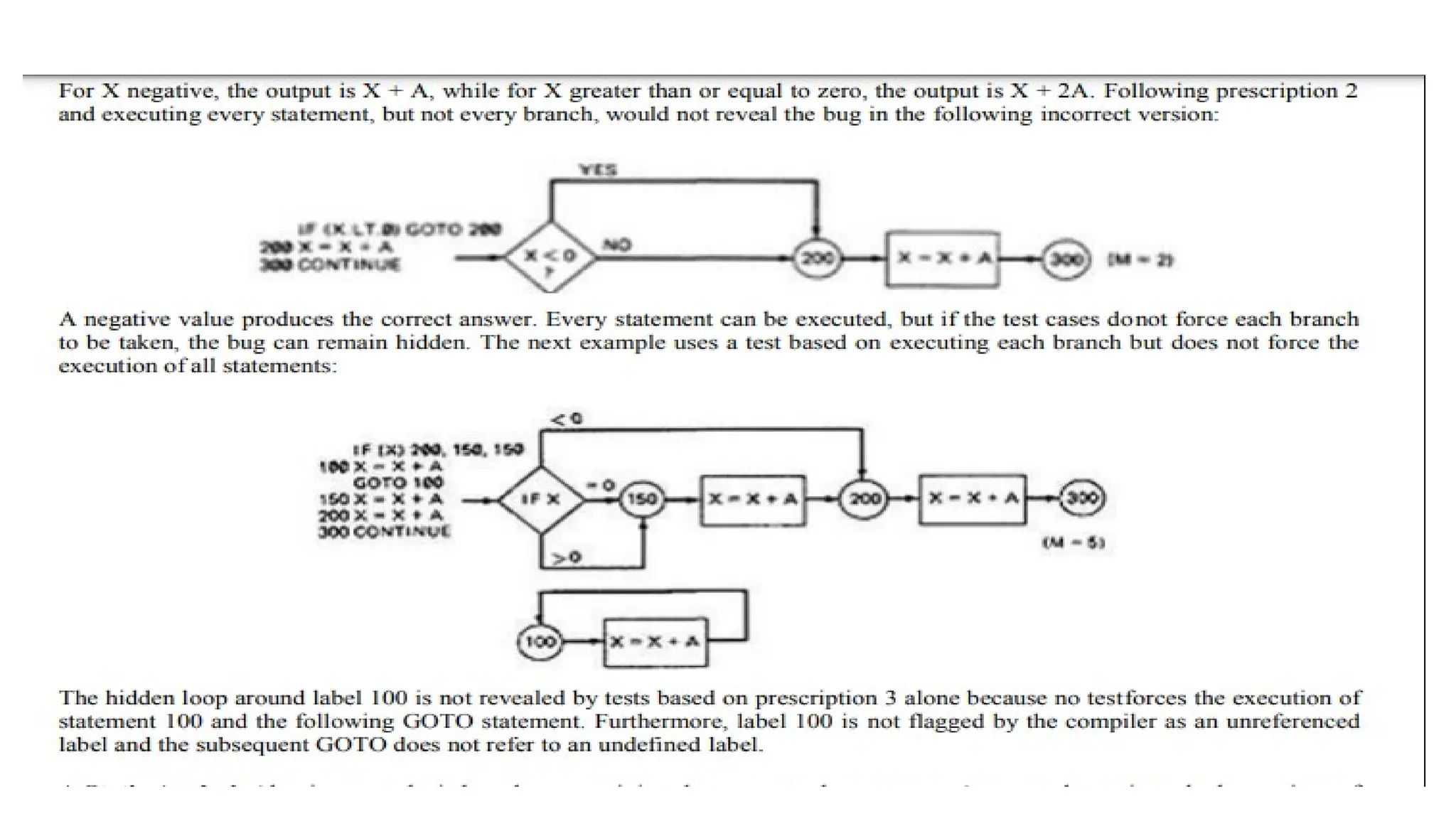
• 2. Exercise every statement or instruction at least once.
• 3. Exercise every branch and case statement, in each direction at least once.
• If prescription 1 is followed then 2 and 3 are automatically followed. But it is
impractical for most routines. It can be done for the routines that have no
loops, in which it is equivalent to 2 and 3 prescriptions.
20.
• A StaticAnalysis (that is, an analysis based on examining the source
code or structure) cannot determine whether a piece of code is or is
not reachable. There could be subroutine calls with parameters that
are subroutine labels, or in the above example there could be a GOTO
that targeted label 100 but could never achieve a value that would
send the program to that label.
• Only a Dynamic Analysis (that is, an analysis based on the code's
behavior while running - which is to say, to all intents and purposes,
testing) can determine whether code is reachable or not and
therefore distinguish between the ideal structure we think we have
and the actual, buggy structure.
21.
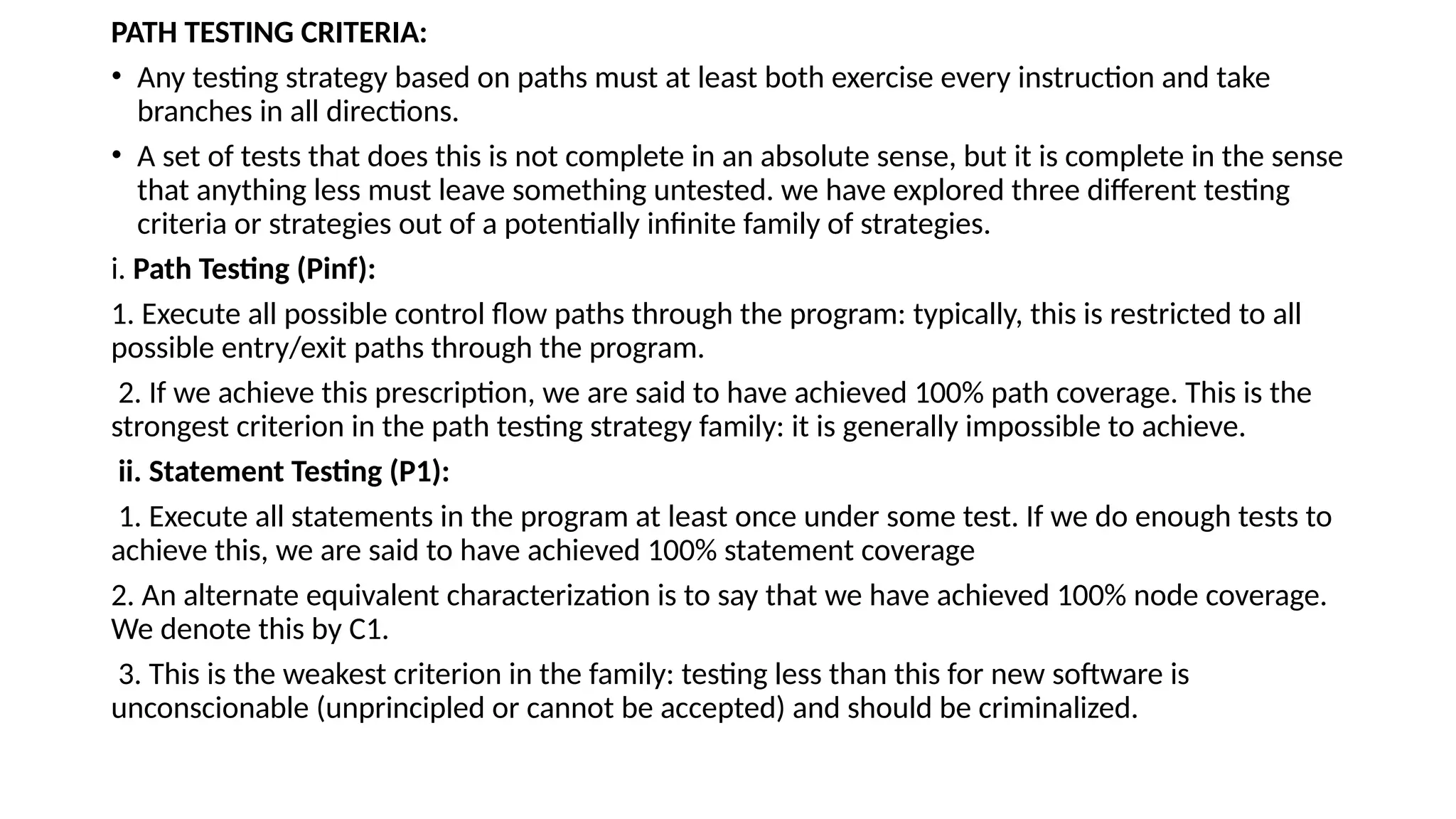
PATH TESTING CRITERIA:
•Any testing strategy based on paths must at least both exercise every instruction and take
branches in all directions.
• A set of tests that does this is not complete in an absolute sense, but it is complete in the sense
that anything less must leave something untested. we have explored three different testing
criteria or strategies out of a potentially infinite family of strategies.
i. Path Testing (Pinf):
1. Execute all possible control flow paths through the program: typically, this is restricted to all
possible entry/exit paths through the program.
2. If we achieve this prescription, we are said to have achieved 100% path coverage. This is the
strongest criterion in the path testing strategy family: it is generally impossible to achieve.
ii. Statement Testing (P1):
1. Execute all statements in the program at least once under some test. If we do enough tests to
achieve this, we are said to have achieved 100% statement coverage
2. An alternate equivalent characterization is to say that we have achieved 100% node coverage.
We denote this by C1.
3. This is the weakest criterion in the family: testing less than this for new software is
unconscionable (unprincipled or cannot be accepted) and should be criminalized.
22.
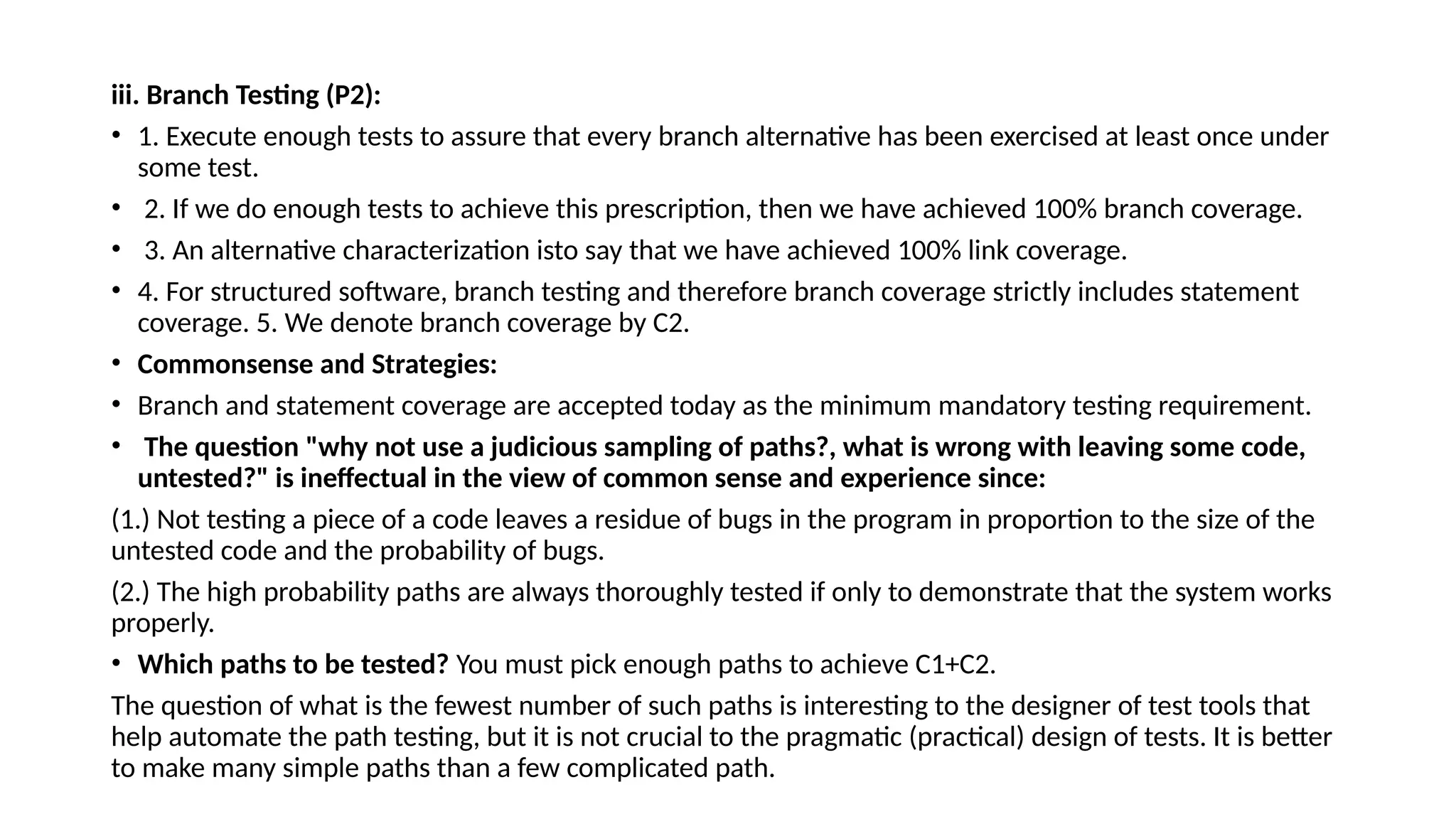
iii. Branch Testing(P2):
• 1. Execute enough tests to assure that every branch alternative has been exercised at least once under
some test.
• 2. If we do enough tests to achieve this prescription, then we have achieved 100% branch coverage.
• 3. An alternative characterization isto say that we have achieved 100% link coverage.
• 4. For structured software, branch testing and therefore branch coverage strictly includes statement
coverage. 5. We denote branch coverage by C2.
• Commonsense and Strategies:
• Branch and statement coverage are accepted today as the minimum mandatory testing requirement.
• The question "why not use a judicious sampling of paths?, what is wrong with leaving some code,
untested?" is ineffectual in the view of common sense and experience since:
(1.) Not testing a piece of a code leaves a residue of bugs in the program in proportion to the size of the
untested code and the probability of bugs.
(2.) The high probability paths are always thoroughly tested if only to demonstrate that the system works
properly.
• Which paths to be tested? You must pick enough paths to achieve C1+C2.
The question of what is the fewest number of such paths is interesting to the designer of test tools that
help automate the path testing, but it is not crucial to the pragmatic (practical) design of tests. It is better
to make many simple paths than a few complicated path.
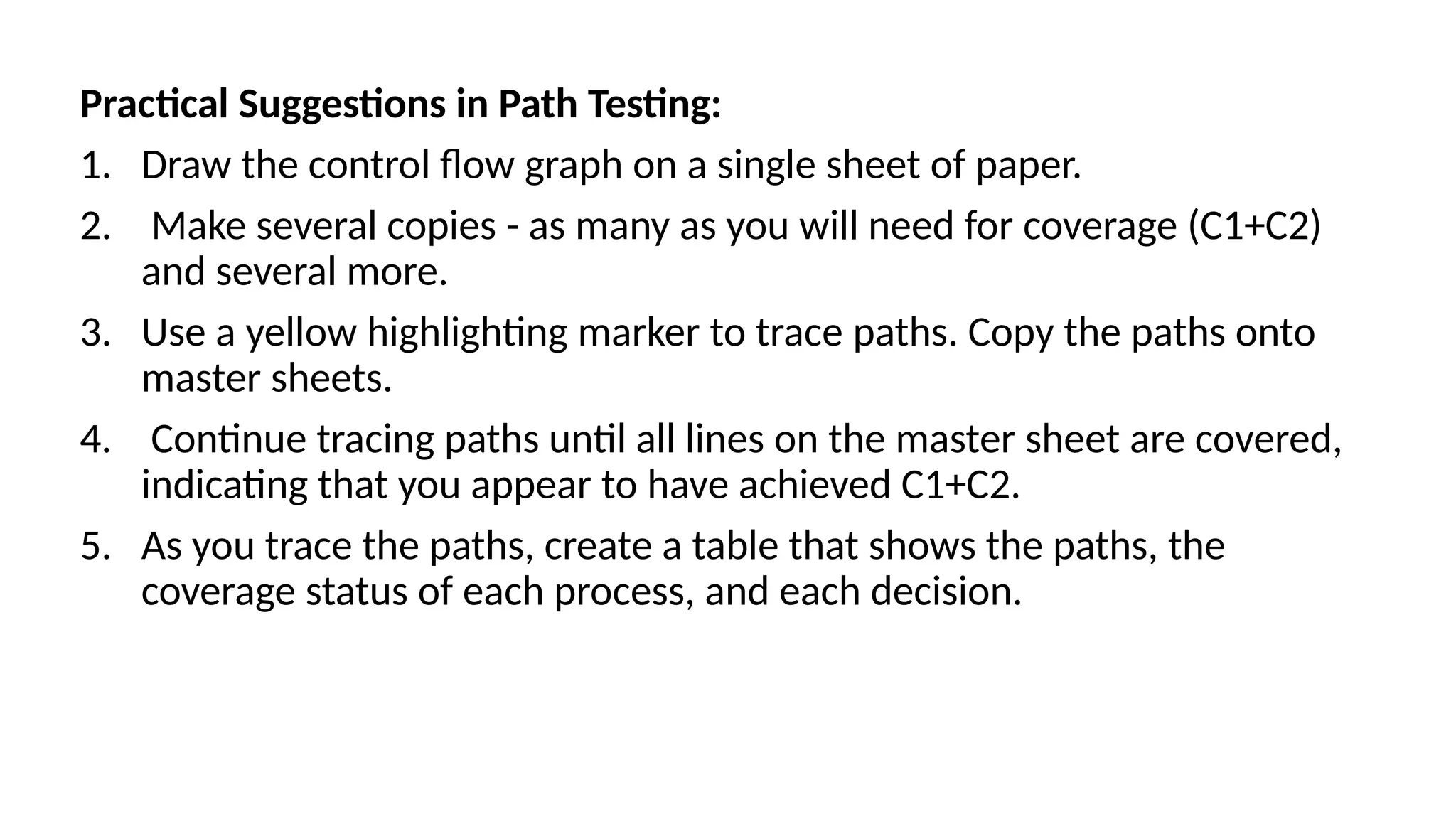
Practical Suggestions inPath Testing:
1. Draw the control flow graph on a single sheet of paper.
2. Make several copies - as many as you will need for coverage (C1+C2)
and several more.
3. Use a yellow highlighting marker to trace paths. Copy the paths onto
master sheets.
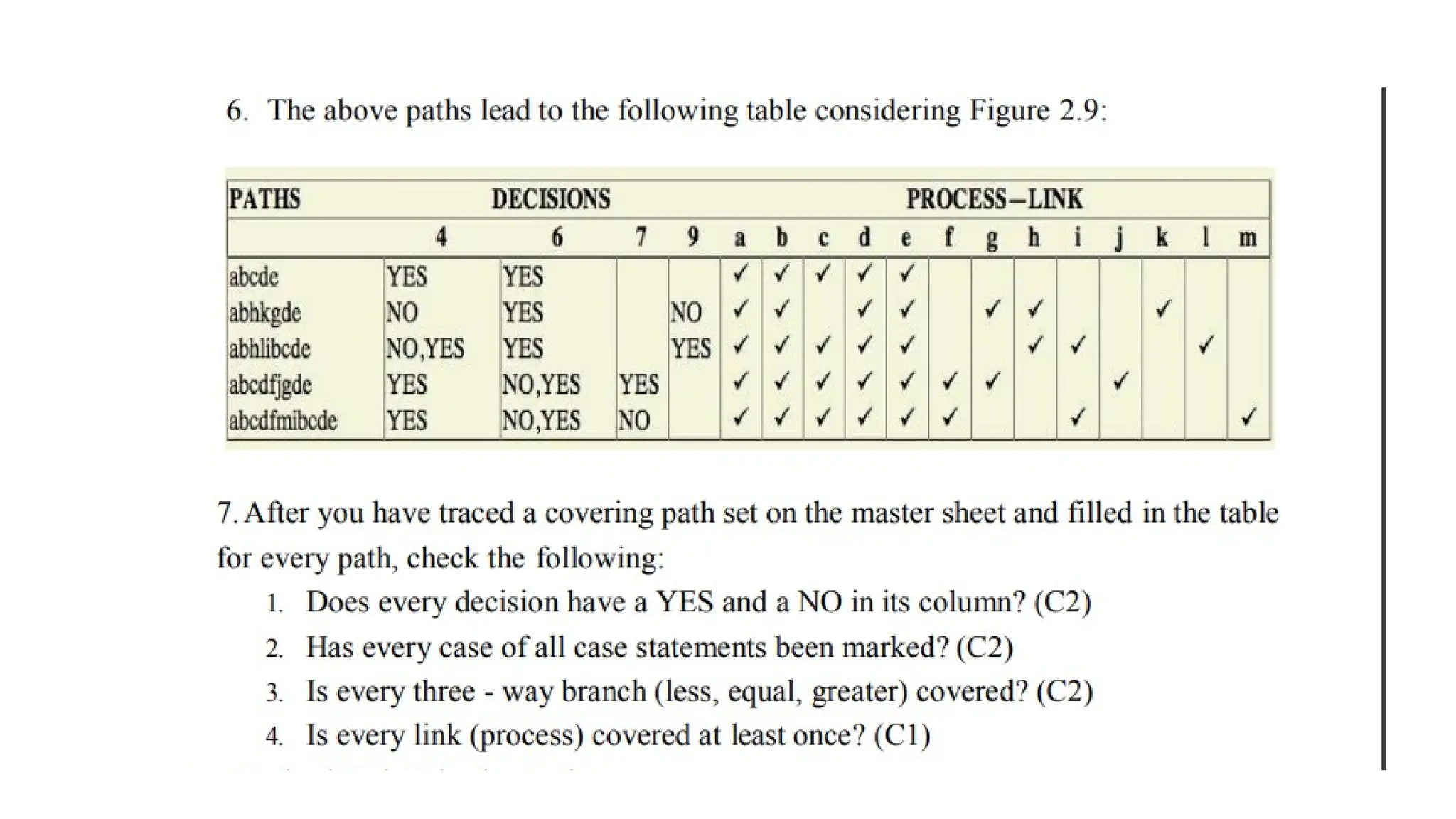
4. Continue tracing paths until all lines on the master sheet are covered,
indicating that you appear to have achieved C1+C2.
5. As you trace the paths, create a table that shows the paths, the
coverage status of each process, and each decision.
26.
• 8. RevisedPath Selection Rules:
• Pick the simplest, functionally sensible entry/exit path. Pick
additional paths as small variation from previous paths. Pick paths
that do not have loops rather than paths that do. Favor short paths
that make sense over paths that don't.
• Pick additional paths that have no obvious functional meaning only if
it's necessary to provide coverage.
• Be comfortable with your chosen paths. Play your hunches (guesses)
and give your intuition free reign as long as you achieve C1+C2.
• Don't follow rules slavishly (blindly) - except for coverage.
27.
• LOOPS:
• Casesfor a single loop:
• A Single loop can be covered with two cases: Looping and Not
looping.
• But, experience shows that many loop-related bugs are not
discovered by C1+C2.
• Bugs hide themselves in corners and congregate at boundaries - in the
cases of loops, at or around the minimum or maximum number of
times the loop can be iterated.
• The minimum number of iterations is often zero, but it need not be
28.
• CASE 1:Single loop, Zero minimum, N maximum, No excluded values
• 1. Try bypassing the loop (zero iterations). If you can't, you either have a
bug, or zero is not the minimum and you have the wrong case.
• 2. Could the loop-control variable be negative? Could it appear to
specify a negative number of iterations? What happens to such a value?
• 3. One pass through the loop.
• 4. Two passes through the loop.
• 5. A typical number of iterations, unless covered by a previous test.
• 6. One less than the maximum number of iterations.
• 7. The maximum number of iterations.
• 8. Attempt one more than the maximum number of iterations. What
prevents the loop-control variable from having this value? What will
happen with this value if it is forced?
29.
• CASE 2:Single loop, Non-zero minimum, No excluded values
• 1. Try one less than the expected minimum. What happens if the loop
control variable's value is less than the minimum? What prevents the
value from being less than the minimum?
• 2. The minimum number of iterations.
• 3. One more than the minimum number of iterations.
• 4. Once, unless covered by a previous test.
• 5. Twice, unless covered by a previous test.
• 6. A typical value.
• 7. One less than the maximum value.
• 8. The maximum number of iterations.
• 9. Attempt one more than the maximum number of iterations.
30.
• CASE 3:Single loops with excluded values
• Treat single loops with excluded values as two sets of tests consisting
of loops without excluded values, such as case 1 and 2 above.
• Example, the total range of the loop control variable was 1 to 20, but
that values 7, 8,9,10 were excluded. The two sets of tests are 1-6 and
11-20.
• The test cases to attempt would be 0,1,2,4,6,7 for the first range and
10,11,15,19,20,21 for the second range.
31.
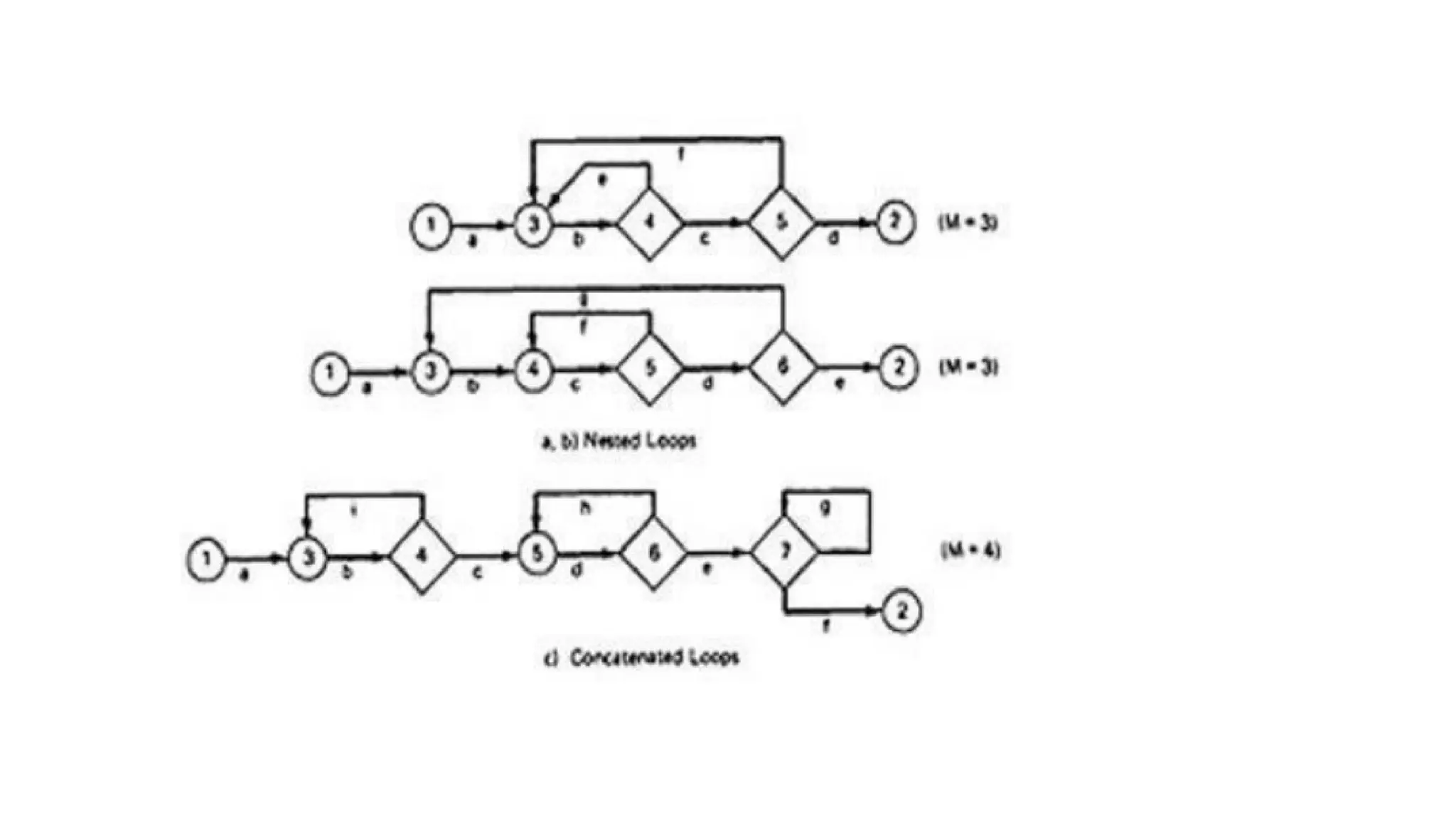
• Kinds ofLoops: There are only three kinds of loops with respect to path testing:
1. Nested Loops: The number of tests to be performed on nested loops will be the
exponent of the tests performed on single loops. As we cannot always afford to
test all combinations of nested loops' iterations values. Here's a tactic used to
discard some of these values:
• 1. Start at the inner most loop. Set all the outer loops to their minimum values.
• 2. Test the minimum, minimum+1, typical, maximum-1, and maximum for the
innermost loop, while holding the outer loops at their minimum iteration
parameter values. Expand the tests as required for out of range and excluded
values.
• 3. If you've done the outmost loop, GOTO step 5, else move out one loop and
set it up as in step 2 with all other loops set to typical values.
• 4. Continue outward in this manner until all loops have been covered.
• 5. Do all the cases for all loops in the nest simultaneously.
32.
2. Concatenated Loops:
•Concatenated loops fall between single and nested loops with respect
to test cases. Two loops are concatenated if it's possible to reach one
after exiting the other while still on a path from entrance to exit.
• If the loops cannot be on the same path, then they are not
concatenated and can be treated as individual loops.
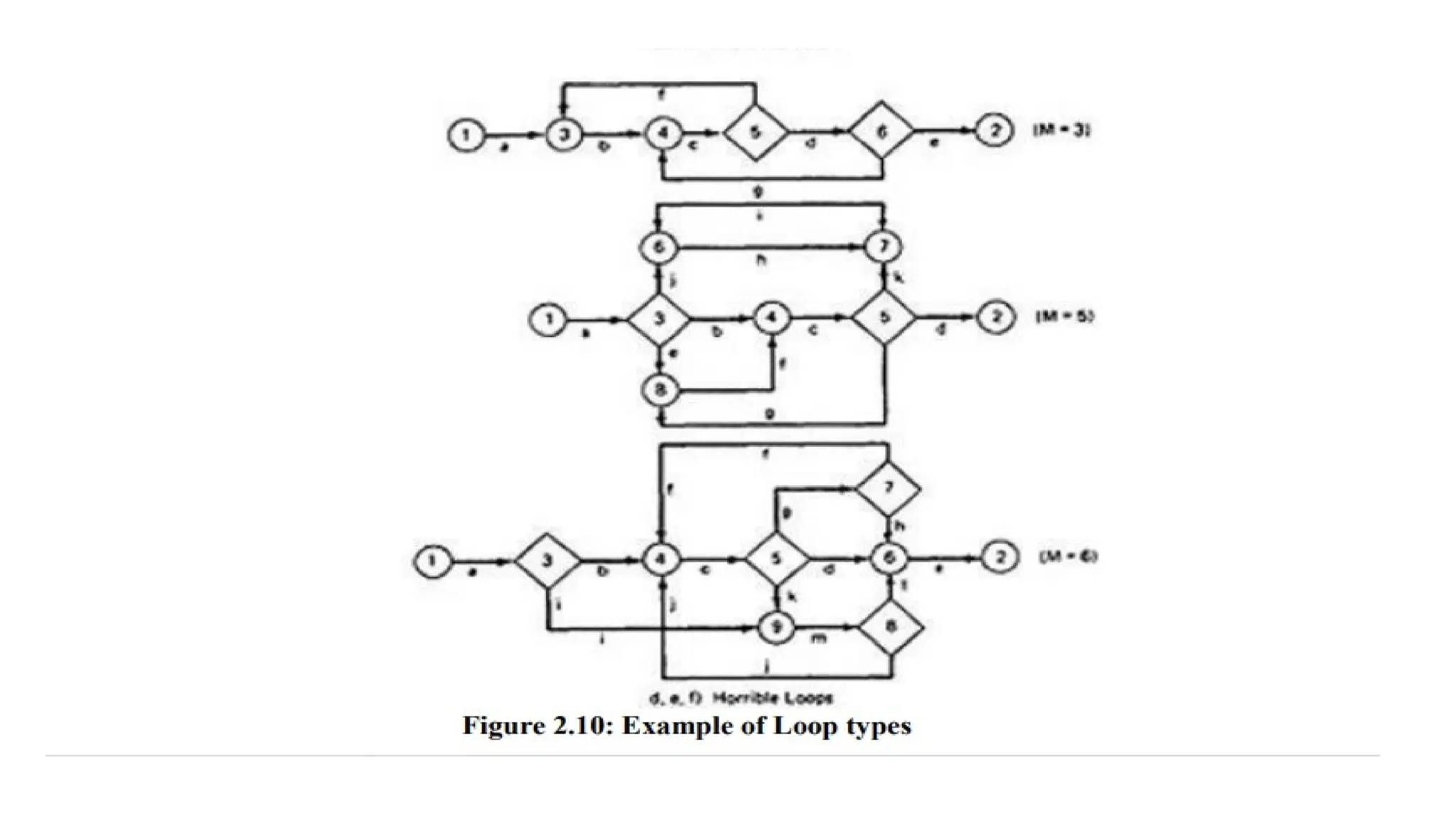
3. Horrible Loops:
• A horrible loop is a combination of nested loops, the use of code that
jumps into and out of loops, intersecting loops, hidden loops, and cross
connected loops.
• Makes iteration value selection for test cases an awesome and ugly
task, which is another reason such structures should be avoided.
35.
• Loop TestingTime: Any kind of loop can lead to long testing time,
especially if all the extreme value cases are to attempted (Max-1,
Max, Max+1).
• This situation is obviously worse for nested and dependent
concatenated loops.
• Consider nested loops in which testing the combination of extreme
values lead to long test times. Several options to deal with:
• Prove that the combined extreme cases are hypothetically possible,
they are not possible in the real world
• Put in limits or checks that prevent the combined extreme cases.
Then you have to test the software that implements such safety
measures.
36.
• PREDICATES, PATHPREDICATES AND ACHIEVABLE PATHS:
• PREDICATE: The logical function evaluated at a decision is called Predicate.
The direction taken at a decision depends on the value of decision variable.
Some examples are: A>0, x+y>=90.......
• PATH PREDICATE: A predicate associated with a path is called a Path
Predicate. For example, "x is greater than zero", "x+y>=90", "w is either
negative or equal to 10 is true" is a sequence of predicates whose truth values
will cause the routine to take a specific path
• MULTIWAY BRANCHES:
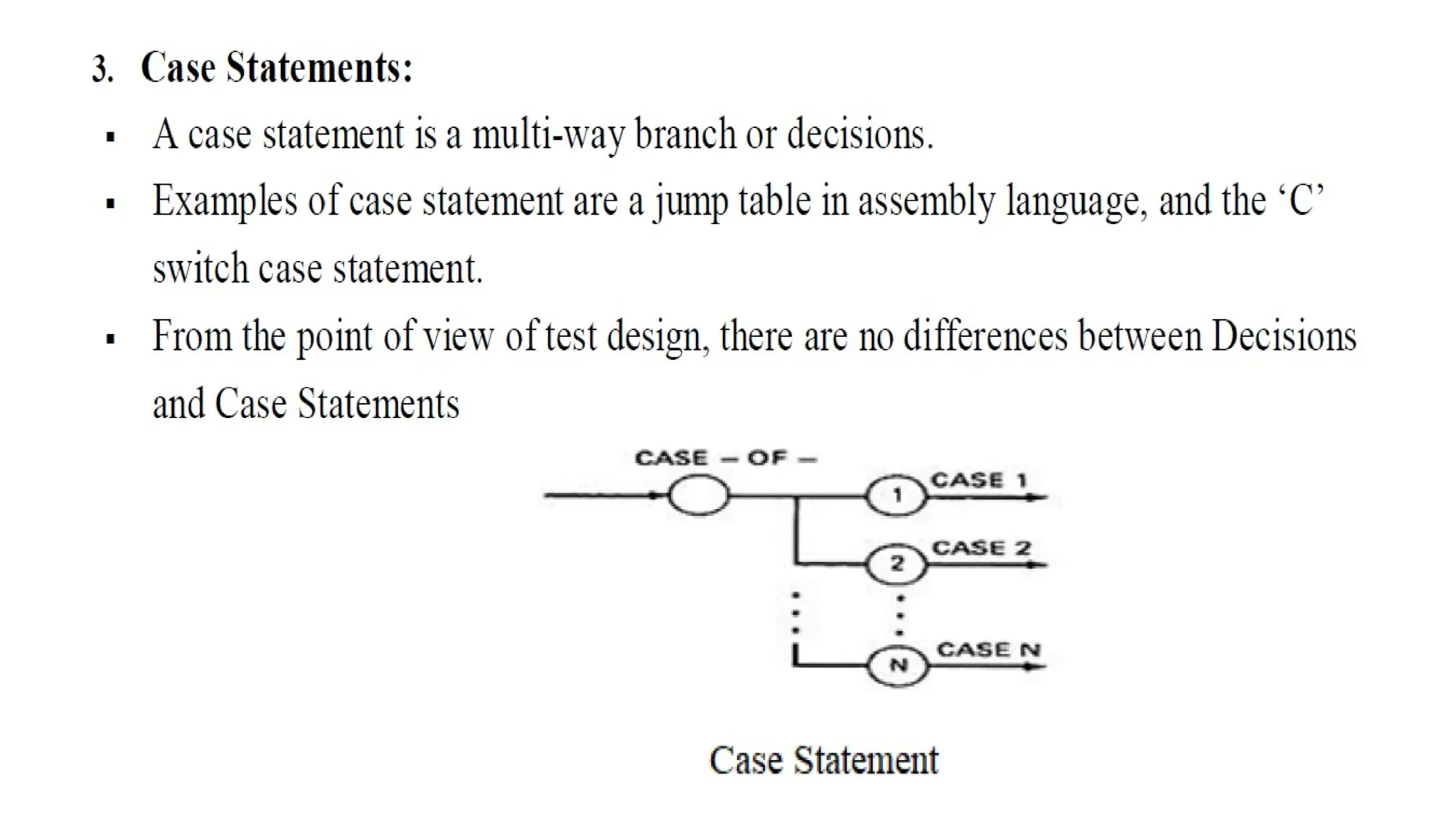
• The path taken through a multiway branch such as a computed GOTO's, case
statement, or jump tables cannot be directly expressed in TRUE/FALSE terms
• Although, it is possible to describe such alternatives by using multi valued
logic, an expedient (practical approach) is to express multiway branches as an
equivalent set of if..then..else statements
• For example a three way case statement can be written as: If case=1 DO A1
ELSE (IF Case=2 DO A2 ELSE DO A3 ENDIF)ENDIF.
37.
• INPUTS:
• Intesting, the word input is not restricted to direct inputs, such as variables in a subroutine call, but
includes all data objects referenced by the routine whose values are fixed prior to entering it.
• For example, inputs in a calling sequence, objects in a data structure, values left in registers, or any
combination of object types.
• The input for a particular test is mapped as a one dimensional array called as an Input Vector.
PREDICATE INTERPRETATION:
• The simplest predicate depends only on input variables.
• For example if x1,x2 are inputs, the predicate might be x1+x2>=7, given the values of x1 and x2 the
direction taken through the decision is based on the predicate is determined at input time and does not
depend on processing.
• Another example, assume a predicate x1+y>=0 that along a path prior to reaching this predicate we had
the assignment statement y=x2+7. although our predicate depends on processing, we can substitute the
symbolic expression for y to obtain an equivalent predicate x1+x2+7>=0.
• The act of symbolic substitution of operations along the path in order to express the predicate solely in
terms of the input vector is called predicate interpretation. Sometimes the interpretation may depend
on the path;
• The path predicates are the specific form of the predicates of the decisions along the selected path after
interpretation.
38.
• INDEPENDENCE OFVARIABLES AND PREDICATES:
• The path predicates take on truth values based on the values of input
variables, either directly or indirectly.
• If a variable's value does not change as a result of processing, that
variable is independent of the processing.
• If the variable's value can change as a result of the processing, the
variable is process dependent.
• A predicate whose truth value can change as a result of the
processing is said to be process dependent and one whose truth value
does not change as a result of the processing is process independent.
• Process dependence of a predicate does not always follow from
dependence of the input variables on which that predicate is based
39.
CORRELATION OF VARIABLESAND PREDICATES:
• Two variables are correlated if every combination of their values
cannot be independently specified.
• Variables whose values can be specified independently without
restriction are called uncorrelated.
• A pair of predicates whose outcomes depend on one or more
variables in common are said to be correlated predicates.
• For example, the predicate X==Y is followed by another predicate X+Y
== 8. If we select X and Y values to satisfy the first predicate, we might
have forced the 2nd predicate's truth value to change.
• Every path through a routine is achievable only if all the predicates in
that routine are uncorrelated.
40.
• PATH PREDICATEEXPRESSIONS:
• A path predicate expression is a set of boolean expressions, all of which must be
satisfied to achieve the selected path.
• Example:
X1+3X2+17>=0 X3=17
X4-X1>=14X2
• Any set of input values that satisfy all of the conditions of the path predicate
expression will force the routine to the path. Sometimes a predicate can have an
OR in it.
Example: A: X5 > 0 E: X6 < 0
B: X1 + 3X2 + 17>= 0 B: X1 + 3X2 + 17>= 0
C: X3 = 17 C: X3 = 17
D: X4 - X1 >= 14X2D: X4 - X1 >= 14X2
Boolean algebra notation to denote the boolean expression:
ABCD+EBCD=(A+E)BCD
41.
• PREDICATE COVERAGE:
CompoundPredicate:
• Predicates of the form A OR B, A AND B and more complicated Boolean
expressions are called as compound predicates.
• Sometimes even a simple predicate becomes compound after interpretation.
• Example: the predicate if (x=17) whose opposite branch is if x.NE.17 which is
equivalent to x>17. Or. X
TESTING BLINDNESS:
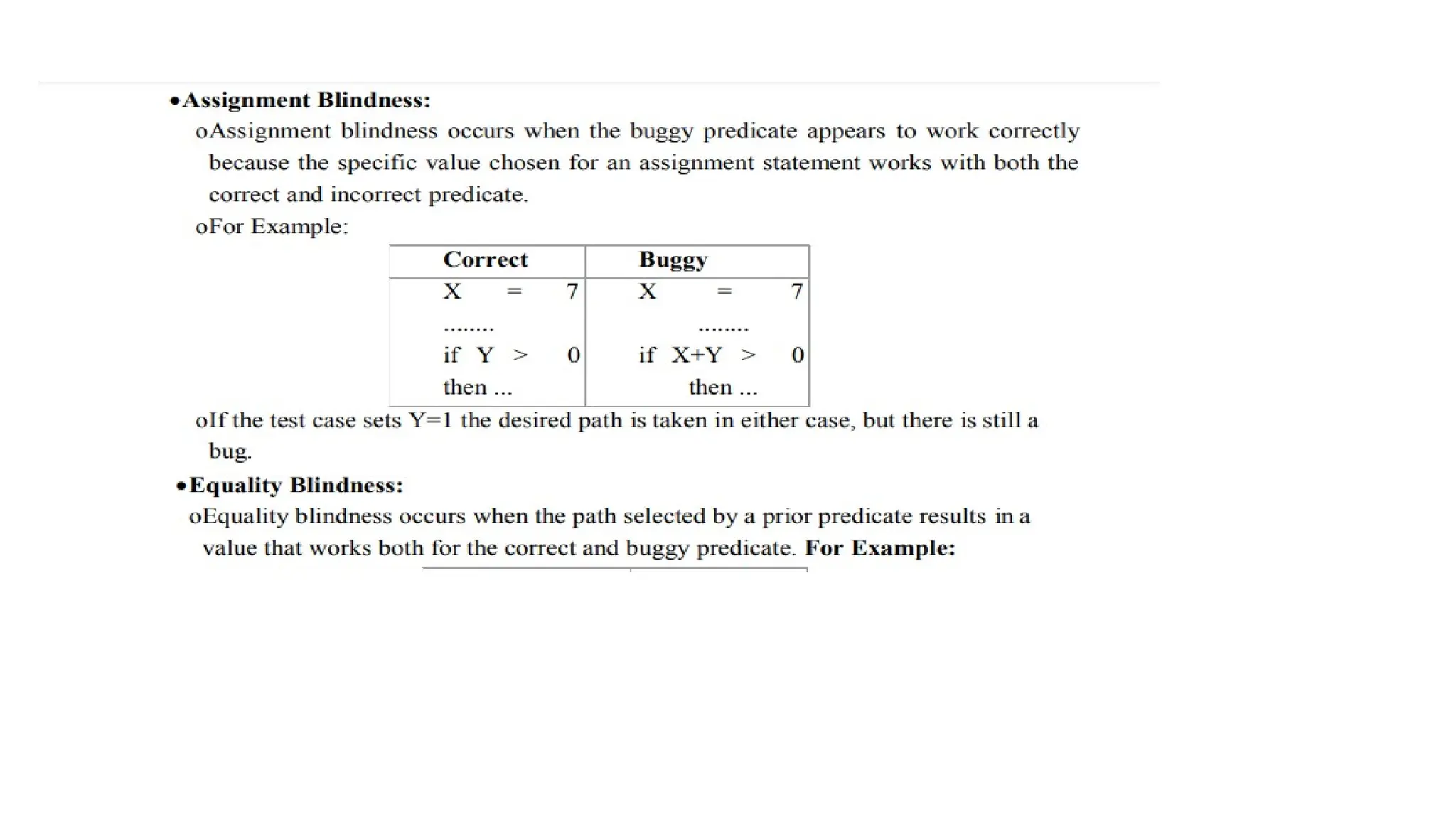
• Testing Blindness is a pathological (harmful) situation in which the desired
path is achieved for the wrong reason.
• There are three types of Testing Blindness:
• 1. Assignment Blindness 2. Equality Blindness 3. Self Blindness