Background
A role for iron acquisition during extracellular growth of
Brucella abortus
Ariel D. Muñoz, Vladimir E. Diaz-Ochoa, Renee Tsolis
Department of Medical Microbiology and Immunology, University of California Davis School of Medicine, Davis CA 95616
Hypothesis
Methods
Methods
Summary and Conclusion
Future Directions
References
Acknowledgements
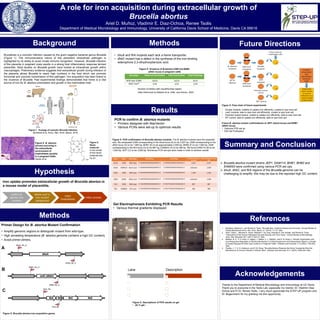
Brucellosis is a zoonotic infection caused by the gram-negative bacterial genus Brucella
(Figure 1). The immunoevasive nature of this persistent intracellular pathogen is
highlighted by its ability to avoid innate immune recognition. However, Brucella infection
of the placenta in pregnant cows results in a strong host inflammatory response termed
placentitis. Most studies on Brucella growth have looked at intracellular growth within
macrophages. Preliminary evidence suggests that extracellular growth during infection of
the placenta allows Brucella to reach high numbers in the host which can promote
horizontal and zoonotic transmission of this pathogen. Iron acquisition has been linked to
the virulence of Brucella. Past experimental findings demonstrated that heme is a vital
source of iron for B. abortus colonization and growth in the mammalian host.
Figure 1. Ecology of zoonotic Brucella infection.
Byndloss et al. Annu. Rev. Anim. Biosci. 2016
Figure X.
Heme
molecule
In the center
of the heme
molecule lies
Fe 2+.
Iron uptake promotes extracellular growth of Brucella abortus in
a mouse model of placentitis.
Figure X. Brucella abortus iron acquisition genes.
Figure X. B. abortus
(brown) surviving in
the extracellular
environment of
trophoblasts (purple)
in a pregnant heifer.
Xavier et al.
 Brucella abortus mutant strains JEP1, DAM114, BHB1, BHB2 and
EAM003 were confirmed using various PCR set ups.
 bhuA, dhbC, and ftrA regions of the Brucella genome can be
challenging to amplify; this may be due to the reported high GC content.
1. Byndloss, Mariana X., and Renee M. Tsolis. "Brucella Spp. Virulence Factors and Immunity." Annual Review of
Animal Biosciences Annu. Rev. Anim. Biosci. 4.1 (2016): 111-27. Web.
2. Atluri, Vidya L., Mariana N. Xavier, Maarten F. De Jong, Andreas B. Den Hartigh, and Renée M. Tsolis.
"Interactions of the Human Pathogenic Brucella Species with Their Hosts." Annual Review of Microbiology
Annu. Rev. Microbiol. 65.1 (2011): 523-41. Web.
3. Bellaire, B. H., P. H. Elzer, S. Hagius, J. Walker, C. L. Baldwin, and R. M. Roop Ii. "Genetic Organization and
Iron-Responsive Regulation of the Brucella Abortus 2,3-Dihydroxybenzoic Acid Biosynthesis Operon, a Cluster
of Genes Required for Wild-Type Virulence in Pregnant Cattle." Infection and Immunity 71.4 (2003): 1794-803.
Web.
4. Paulley, J. T., E. S. Anderson, and R. M. Roop. "Brucella Abortus Requires the Heme Transporter BhuA for
Maintenance of Chronic Infection in BALB/c Mice." Infection and Immunity 75.11 (2007): 5248-254. Web.
Thanks to the Department of Medical Microbiology and Immunology at UC Davis.
Thank you to everyone in the Tsolis Lab, especially my mentor, Dr. Vladimir Diaz-
Ochoa and PI Dr. Renee Tsolis. I very much appreciate the STEP-UP program and
Dr. Bogenmann for my granting me this opportunity.
bhuA
bhuA_Rv_2
bhuA_Fw_2
entC (dhbC)
dhbC_Fw_2
dhbC_Rv_2
ftrDftrCftrA ftrB
ft rA_Fw
frt A_Rv
Primer Design for B. abortus Mutant Confirmation
• Amplify genomic regions to distinguish mutant from wild-type.
• High annealing temperature (B. abortus genome contains a high GC content).
• Avoid primer-dimers.
confirm B.
abortus iron
mutants
delete vceC in
iron mutant
background
infect
trophoblasts
infect animals
A
B
C
Strain Name Genotype Fw Primer Rv Primer Predicted Amplicon
Size (bp)
Observed Amplicon Size
(bp)
bhuA 2308 Wild-type 5’-AAAGAATAGGATGCGAGATG-3' 5’-GTAACATTATGCTCAACCAC-3’ 3,527 3,527
bhuA DAM114 bhuA::scar 5’-AAAGAATAGGATGCGAGATG-3' 5’-GTAACATTATGCTCAACCAC-3’ unknown 1,500
dhbC 2308 Wild-type 5’-AAGCGGATGGAAAGAACCTA-3’ 5’-CTGCGTCGGATAATGCGTAG-3’ 1,565 1,565
dhbC BHB2 dhbC::scar 5’-AAGCGGATGGAAAGAACCTA-3’ 5’-CTGCGTCGGATAATGCGTAG-3’ unknown 1,500
ftrA 2308 Wild-type 5’-CACAATATACGGCGGGACAA-3’ 5’-GTCCTTGAACTCAAGGCGAA-3’ 887 887
ftrA EAM003 ftrA::scar 5’-CACAATATACGGCGGGACAA-3’ 5’-GTCCTTGAACTCAAGGCGAA-3’ 389 389
Genotype Maternal Colonization Fetal Colonization Fetal Pathology
Wild-type (2308) 10/10 10/10 8/10
dhbC::kanR
1/10 1/10 1/10
Figure X. Virulence of B.abortus 2308 and BHB1
(dhbC locus) in pregnant cattle
Number of heifers with result/Number tested
Data influenced by Bellaire et al. Infec. and Immun. 2003
• bhuA and ftrA mutants each lack a heme transporter.
• dhbC mutant has a defect in the synthesis of the iron-binding
siderophore 2,3-dihydroxybenzoic acid.
Results
PCR to confirm B. abortus mutants
• Primers designed with MacVector
• Various PCRs were set-up to optimize results
Figure X: PCR confirmation of Brucella abortus mutants. The B. abortus mutants were the expected
size. We anticipated 2308 corresponding to the bhuA locus (A) to be 3,527 bp; 2308 corresponding to the
dhbC locus (D) to be 1,565 bp; BHB1 (E) to be approximately 2,500 bp; BHB2 (F) to be 1,500 bp; 2308
corresponding to the ftrA locus (G) to be 887 bp; EAM003 (H) to be 389 bp. We found DAM114 (B) to be
1,500 bp; JEP1 (C) to be 3,000 bp. Numerous PCR set-ups were made in order to achieve results.
Figure X. Flow chart of future experiments
• Double mutants: inability to uptake iron efficiently; unable to lyse host cell
• vceC mutants: able to lyse host cell efficiently; unable to lyse host cell
• Parental mutant strains: unable to uptake iron efficiently; able to lyse host cell
• WT control: able to uptake iron efficiently; able to lyse host cell
Lane Description
Figure X. Descriptions of PCR results on gel
• (A) % gel...
Gel Electrophoresis Exhibiting PCR Results
• Various thermal gradients displayed
Future B. abortus mutant confirmations of JEP1 (bhuA locus) and BHB1
(dhbC locus)
• Optimize PCR set up
• Edit Gel Purification

Step-Up Poster (4)

  • 1.
    Background A role foriron acquisition during extracellular growth of Brucella abortus Ariel D. Muñoz, Vladimir E. Diaz-Ochoa, Renee Tsolis Department of Medical Microbiology and Immunology, University of California Davis School of Medicine, Davis CA 95616 Hypothesis Methods Methods Summary and Conclusion Future Directions References Acknowledgements Brucellosis is a zoonotic infection caused by the gram-negative bacterial genus Brucella (Figure 1). The immunoevasive nature of this persistent intracellular pathogen is highlighted by its ability to avoid innate immune recognition. However, Brucella infection of the placenta in pregnant cows results in a strong host inflammatory response termed placentitis. Most studies on Brucella growth have looked at intracellular growth within macrophages. Preliminary evidence suggests that extracellular growth during infection of the placenta allows Brucella to reach high numbers in the host which can promote horizontal and zoonotic transmission of this pathogen. Iron acquisition has been linked to the virulence of Brucella. Past experimental findings demonstrated that heme is a vital source of iron for B. abortus colonization and growth in the mammalian host. Figure 1. Ecology of zoonotic Brucella infection. Byndloss et al. Annu. Rev. Anim. Biosci. 2016 Figure X. Heme molecule In the center of the heme molecule lies Fe 2+. Iron uptake promotes extracellular growth of Brucella abortus in a mouse model of placentitis. Figure X. Brucella abortus iron acquisition genes. Figure X. B. abortus (brown) surviving in the extracellular environment of trophoblasts (purple) in a pregnant heifer. Xavier et al.  Brucella abortus mutant strains JEP1, DAM114, BHB1, BHB2 and EAM003 were confirmed using various PCR set ups.  bhuA, dhbC, and ftrA regions of the Brucella genome can be challenging to amplify; this may be due to the reported high GC content. 1. Byndloss, Mariana X., and Renee M. Tsolis. "Brucella Spp. Virulence Factors and Immunity." Annual Review of Animal Biosciences Annu. Rev. Anim. Biosci. 4.1 (2016): 111-27. Web. 2. Atluri, Vidya L., Mariana N. Xavier, Maarten F. De Jong, Andreas B. Den Hartigh, and Renée M. Tsolis. "Interactions of the Human Pathogenic Brucella Species with Their Hosts." Annual Review of Microbiology Annu. Rev. Microbiol. 65.1 (2011): 523-41. Web. 3. Bellaire, B. H., P. H. Elzer, S. Hagius, J. Walker, C. L. Baldwin, and R. M. Roop Ii. "Genetic Organization and Iron-Responsive Regulation of the Brucella Abortus 2,3-Dihydroxybenzoic Acid Biosynthesis Operon, a Cluster of Genes Required for Wild-Type Virulence in Pregnant Cattle." Infection and Immunity 71.4 (2003): 1794-803. Web. 4. Paulley, J. T., E. S. Anderson, and R. M. Roop. "Brucella Abortus Requires the Heme Transporter BhuA for Maintenance of Chronic Infection in BALB/c Mice." Infection and Immunity 75.11 (2007): 5248-254. Web. Thanks to the Department of Medical Microbiology and Immunology at UC Davis. Thank you to everyone in the Tsolis Lab, especially my mentor, Dr. Vladimir Diaz- Ochoa and PI Dr. Renee Tsolis. I very much appreciate the STEP-UP program and Dr. Bogenmann for my granting me this opportunity. bhuA bhuA_Rv_2 bhuA_Fw_2 entC (dhbC) dhbC_Fw_2 dhbC_Rv_2 ftrDftrCftrA ftrB ft rA_Fw frt A_Rv Primer Design for B. abortus Mutant Confirmation • Amplify genomic regions to distinguish mutant from wild-type. • High annealing temperature (B. abortus genome contains a high GC content). • Avoid primer-dimers. confirm B. abortus iron mutants delete vceC in iron mutant background infect trophoblasts infect animals A B C Strain Name Genotype Fw Primer Rv Primer Predicted Amplicon Size (bp) Observed Amplicon Size (bp) bhuA 2308 Wild-type 5’-AAAGAATAGGATGCGAGATG-3' 5’-GTAACATTATGCTCAACCAC-3’ 3,527 3,527 bhuA DAM114 bhuA::scar 5’-AAAGAATAGGATGCGAGATG-3' 5’-GTAACATTATGCTCAACCAC-3’ unknown 1,500 dhbC 2308 Wild-type 5’-AAGCGGATGGAAAGAACCTA-3’ 5’-CTGCGTCGGATAATGCGTAG-3’ 1,565 1,565 dhbC BHB2 dhbC::scar 5’-AAGCGGATGGAAAGAACCTA-3’ 5’-CTGCGTCGGATAATGCGTAG-3’ unknown 1,500 ftrA 2308 Wild-type 5’-CACAATATACGGCGGGACAA-3’ 5’-GTCCTTGAACTCAAGGCGAA-3’ 887 887 ftrA EAM003 ftrA::scar 5’-CACAATATACGGCGGGACAA-3’ 5’-GTCCTTGAACTCAAGGCGAA-3’ 389 389 Genotype Maternal Colonization Fetal Colonization Fetal Pathology Wild-type (2308) 10/10 10/10 8/10 dhbC::kanR 1/10 1/10 1/10 Figure X. Virulence of B.abortus 2308 and BHB1 (dhbC locus) in pregnant cattle Number of heifers with result/Number tested Data influenced by Bellaire et al. Infec. and Immun. 2003 • bhuA and ftrA mutants each lack a heme transporter. • dhbC mutant has a defect in the synthesis of the iron-binding siderophore 2,3-dihydroxybenzoic acid. Results PCR to confirm B. abortus mutants • Primers designed with MacVector • Various PCRs were set-up to optimize results Figure X: PCR confirmation of Brucella abortus mutants. The B. abortus mutants were the expected size. We anticipated 2308 corresponding to the bhuA locus (A) to be 3,527 bp; 2308 corresponding to the dhbC locus (D) to be 1,565 bp; BHB1 (E) to be approximately 2,500 bp; BHB2 (F) to be 1,500 bp; 2308 corresponding to the ftrA locus (G) to be 887 bp; EAM003 (H) to be 389 bp. We found DAM114 (B) to be 1,500 bp; JEP1 (C) to be 3,000 bp. Numerous PCR set-ups were made in order to achieve results. Figure X. Flow chart of future experiments • Double mutants: inability to uptake iron efficiently; unable to lyse host cell • vceC mutants: able to lyse host cell efficiently; unable to lyse host cell • Parental mutant strains: unable to uptake iron efficiently; able to lyse host cell • WT control: able to uptake iron efficiently; able to lyse host cell Lane Description Figure X. Descriptions of PCR results on gel • (A) % gel... Gel Electrophoresis Exhibiting PCR Results • Various thermal gradients displayed Future B. abortus mutant confirmations of JEP1 (bhuA locus) and BHB1 (dhbC locus) • Optimize PCR set up • Edit Gel Purification