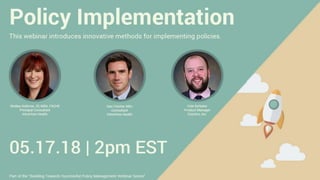
SHELLEY C. KOLTNOW, JD, MBA, FACHE
• Shelley is a lawyer and experienced healthcare compliance professional. She has
served as an executive leader for compliance, internal audit, and risk
management for hospitals, integrated health systems, third party billing
companies, Accountable Care Organizations, Medicaid Managed Care entities,
physician groups, laboratories, and post-acute providers.
• She is the Principal Consultant for IntraVires Health Compliance Consultants,
based near Chicago, IL. IntraVires Health provides customized compliance
consulting services, from developing, assessing and improving compliance
programs to managing compliance crises.
• Shelley earned her B.S. degree from Allegheny College and a Juris Doctor degree
from the University of Akron School of Law. She is admitted to the practice of
law in Ohio. Shelley is a Fellow of the American College of Healthcare Executives
and holds a Master of Business Administration.
• For over two decades, Shelley has led teams developing systems of
organizational policies and procedures across the healthcare spectrum.
DAN FISHER, MS
• Dan is a compliance professional and Consultant working with IntraVires Health
Compliance Consultants. Dan has served in consulting and managerial roles for
healthcare compliance, internal audit, and privacy programs during his time with
IntraVires Health.
• He earned his B.S. degree from The College of William & Mary and a Masters in
Population Health Sciences from the University of Wisconsin-Madison School of
Medicine and Public Health.
• Dan has played a pivotal role in developing or overhauling policy management
systems for high-risk areas of integrated health systems, Medicaid Managed Care
entities, Accountable Care Organizations, provider networks, and affiliated
physician groups.
• Dan is a member of the Health Care Compliance Association and Healthcare
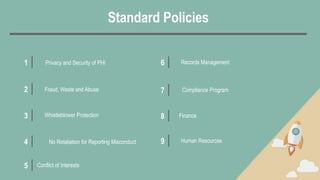
Finance Management Association.
COLE SCHLAFER
• Cole Schlafer is a Product Manager at Etactics, Inc where he has spent the last 8
years designing and implementing web based software products that help
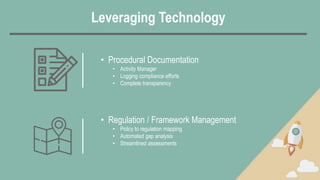
businesses run more efficiently across a wide variety of areas.
• Some of the projects Cole has worked on bringing to fruition are ConnectPlus CRM,
A/R Insite, AppealsPlus, Custom Invoices and most recently K2 Compliance. Cole
has been married to his wife, Sarah, for 8 years and has two boys age 3 (Simon) and
3 months (Michael).
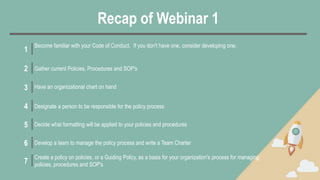
Recap of Webinar 1
Become familiar with your Code of Conduct. If you don't have one, consider developing one.
1
Gather current Policies, Procedures and SOP's2
Have an organizational chart on hand3
Designate a person to be responsible for the policy process4
Decide what formatting will be applied to your policies and procedures5
Develop a team to manage the policy process and write a Team Charter6
Create a policy on policies, or a Guiding Policy, as a basis for your organization's process for managing
policies, procedures and SOP's7
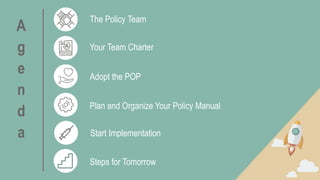
Steps for Tomorrow
A
g
e
n
d
a
The Policy Team
Your Team Charter
Adopt the POP
Plan and Organize Your Policy Manual
Start Implementation
Create a Policy Team
Keeping the Policy Process on Track
Why Have a Policy Team?
A Team has representatives from key areas of the organization and ensures that policies and
procedures go through their lifecycle appropriately
The Policy Team shows your commitment to a reliable Policy
Process....
Knowledgeable representatives of the organization can make
comments, recommendations, and decisions in the same place,
at the same time while they meet.
Choose a Policy Team Chair
• Scheduling Team meetings
• Presiding over Team meetings and deciding questions of order
• Assuring Team's work is timely
• Following the POP and the Charter
• Minutes
• Inviting Subject Matter Experts, Sponsors and Guests
The Chair should be able to fulfill responsibilities such as:
Develop a Charter
• Clarifies the team’s purpose, responsibility, and authority
• Designates how a Chair is chosen and the Chair’s term
• Describes the size of the Team
• States qualifications for members and the term for membership
• Sets out requirements for meetings, voting, tie-breaking, and other
details of the team’s work parameters
• States how the Team will function to oversee the Policy on Policies
The Charter is an important document to establish your
commitment to the Team. It also:
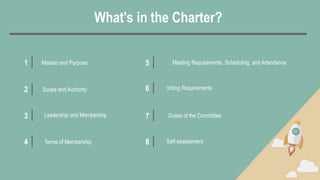
What's in the Charter?
Mission and Purpose1
Scope and Authority2
Leadership and Membership3
Terms of Membership4
Meeting Requirements, Scheduling, and Attendance5
Voting Requirements6
Duties of the Committee7
Self-assessment8
Policy Team's Purpose
State Policy Team’s Purpose….
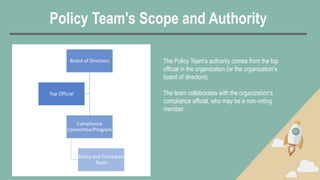
Policy Team's Scope and Authority
The Policy Team’s authority comes from the top
official in the organization (or the organization’s
board of directors)
The team collaborates with the organization’s
compliance official, who may be a non-voting
member.
Board of Directors
Compliance
Committee/Program
Policy and Procedure
Team
Top Official
Team Membership
Chair
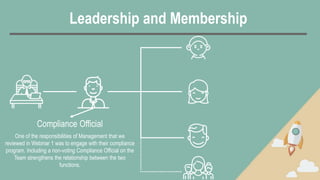
Leadership and Membership
One of the responsibilities of Management that we
reviewed in Webinar 1 was to engage with their compliance
program. Including a non-voting Compliance Official on the
Team strengthens the relationship between the two
functions.
Compliance Official
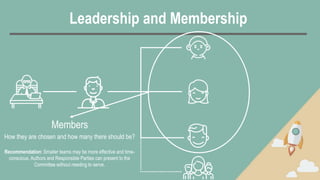
Leadership and Membership
How they are chosen and how many there should be?
Recommendation: Smaller teams may be more effective and time-
conscious. Authors and Responsible Parties can present to the
Committee without needing to serve.
Members
Leadership and Membership
Can be invited as a subject-matter and/or legal expert to
help facilitate the Team's work.
Recommendation: Consider having a Board representative join the Policy
Team or attend as a Guest. That Board Member becomes a subject matter
expert on the policies (and policy process), which will help the Board
connect with operations and understand the culture.
Guests
Terms of Membership
• Determine the term of membership and the Chair's term of office.
• How members are nominated, removed, replaced (vacancies
filled) attendance.
• Members should disclose any conflicts of interest and the team
should have a process for managing them.
Recommendation: The longer the term, the better the members understand the Team's process.
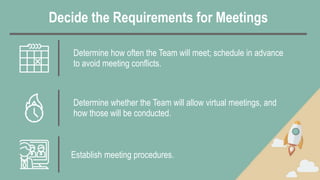
Decide the Requirements for Meetings
Determine how often the Team will meet; schedule in advance
to avoid meeting conflicts.
Determine whether the Team will allow virtual meetings, and
how those will be conducted.
Establish meeting procedures.
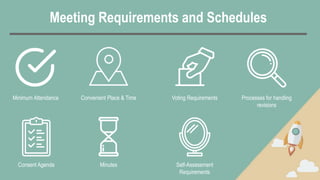
Meeting Requirements and Schedules
Minimum Attendance Convenient Place & Time Voting Requirements
Consent Agenda Minutes Self-Assessment
Requirements
Processes for handling
revisions
The Policy Manual or Repository
How should I structure my policy manual?
The Policy Manual Overview
The Policy Team oversees and controls the Policy Manual and interacts
with it on a regular basis.
Identify a member of the Policy Team to update the Policy Manual
with changes that the Team approved and to communicate updates
to everyone in the organization.
The Policy Manual Overview
• The Policy Manual can be organized in a way that best suits the organization and makes
retrieving policies easy for the people who are required to follow them.
Organization of the Manual
• Technology solutions may be very helpful in organizing and accessing
policies.
Roles and Responsibilities in the
Policy Process
Who’s in charge of all the this?
Policy Process Roles
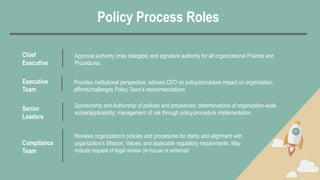
Approval authority (may delegate) and signature authority for all organizational Policies and
Procedures.
Chief
Executive
Provides institutional perspective; advises CEO on policy/procedure impact on organization;
affirms/challenges Policy Team’s recommendations
Executive
Team
Sponsorship and Authorship of policies and procedures; determinations of organization-wide
scope/applicability; management of risk through policy/procedure implementation
Senior
Leaders
Reviews organization’s policies and procedures for clarity and alignment with
organization’s Mission, Values, and applicable regulatory requirements. May
include request of legal review (in-house or external)
Compliance
Team
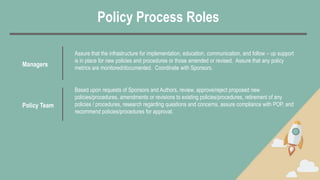
Assure that the infrastructure for implementation, education, communication, and follow – up support
is in place for new policies and procedures or those amended or revised. Assure that any policy
metrics are monitored/documented. Coordinate with Sponsors.
Managers
Based upon requests of Sponsors and Authors, review, approve/reject proposed new
policies/procedures, amendments or revisions to existing policies/procedures, retirement of any
policies / procedures, research regarding questions and concerns, assure compliance with POP, and
recommend policies/procedures for approval.
Policy Team
Policy Process Roles
Start the Policy Process
Each Policy should have a Sponsor, who is responsible for
authoring or designating the author of the policy or policy
updates.
• The Policy Team, through the Guiding Policy, may determine the Sponsors using an
organization chart.
• Sponsors are responsible for the subject matter and accuracy of the Policy submitted.
• Members of the Policy Team review Policies and Procedures per
• the Guiding Policy Requirements.
Policies That Everyone Needs
What are some policies I should have?
Standard Policies
Privacy and Security of PHI1
Fraud, Waste and Abuse2
Whistleblower Protection3
No Retaliation for Reporting Misconduct4
Conflict of Interests5
Records Management6
Compliance Program7
Finance8
Human Resources9
Implementing Policies and
Procedures
Follow these steps.
Steps for Implementation
Email to follow up and remind6
Conduct workshops – meetings to introduce/train2
Allow for and answer questions3
Highlight changes and special responsibilities4
Create and follow a standard communication process1
Quarterly assessments to assure compliance5
Fix, repeat (PDCA process)7
Leveraging Technology
• Digital Policy Library
• Establish Ownership
• Easy Navigation and Accessibility
• History & Versioning
• New Communication Medium
• Collaboration between policy team
• Push Updates & Notifications
Leveraging Technology
• Procedural Documentation
• Activity Manager
• Logging compliance efforts
• Complete transparency
• Regulation / Framework Management
• Policy to regulation mapping
• Automated gap analysis
• Streamlined assessments
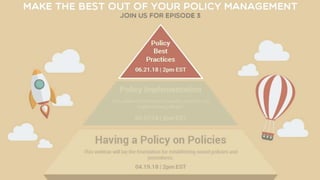
Transition ending to Part 3

Steps for Rolling out a Policy Management Process

  • 2.
    SHELLEY C. KOLTNOW,JD, MBA, FACHE • Shelley is a lawyer and experienced healthcare compliance professional. She has served as an executive leader for compliance, internal audit, and risk management for hospitals, integrated health systems, third party billing companies, Accountable Care Organizations, Medicaid Managed Care entities, physician groups, laboratories, and post-acute providers. • She is the Principal Consultant for IntraVires Health Compliance Consultants, based near Chicago, IL. IntraVires Health provides customized compliance consulting services, from developing, assessing and improving compliance programs to managing compliance crises. • Shelley earned her B.S. degree from Allegheny College and a Juris Doctor degree from the University of Akron School of Law. She is admitted to the practice of law in Ohio. Shelley is a Fellow of the American College of Healthcare Executives and holds a Master of Business Administration. • For over two decades, Shelley has led teams developing systems of organizational policies and procedures across the healthcare spectrum.
  • 3.
    DAN FISHER, MS •Dan is a compliance professional and Consultant working with IntraVires Health Compliance Consultants. Dan has served in consulting and managerial roles for healthcare compliance, internal audit, and privacy programs during his time with IntraVires Health. • He earned his B.S. degree from The College of William & Mary and a Masters in Population Health Sciences from the University of Wisconsin-Madison School of Medicine and Public Health. • Dan has played a pivotal role in developing or overhauling policy management systems for high-risk areas of integrated health systems, Medicaid Managed Care entities, Accountable Care Organizations, provider networks, and affiliated physician groups. • Dan is a member of the Health Care Compliance Association and Healthcare Finance Management Association.
  • 4.
    COLE SCHLAFER • ColeSchlafer is a Product Manager at Etactics, Inc where he has spent the last 8 years designing and implementing web based software products that help businesses run more efficiently across a wide variety of areas. • Some of the projects Cole has worked on bringing to fruition are ConnectPlus CRM, A/R Insite, AppealsPlus, Custom Invoices and most recently K2 Compliance. Cole has been married to his wife, Sarah, for 8 years and has two boys age 3 (Simon) and 3 months (Michael).
  • 5.
    Recap of Webinar1 Become familiar with your Code of Conduct. If you don't have one, consider developing one. 1 Gather current Policies, Procedures and SOP's2 Have an organizational chart on hand3 Designate a person to be responsible for the policy process4 Decide what formatting will be applied to your policies and procedures5 Develop a team to manage the policy process and write a Team Charter6 Create a policy on policies, or a Guiding Policy, as a basis for your organization's process for managing policies, procedures and SOP's7
  • 6.
    Steps for Tomorrow A g e n d a ThePolicy Team Your Team Charter Adopt the POP Plan and Organize Your Policy Manual Start Implementation
  • 7.
    Create a PolicyTeam Keeping the Policy Process on Track
  • 8.
    Why Have aPolicy Team? A Team has representatives from key areas of the organization and ensures that policies and procedures go through their lifecycle appropriately The Policy Team shows your commitment to a reliable Policy Process.... Knowledgeable representatives of the organization can make comments, recommendations, and decisions in the same place, at the same time while they meet.
  • 9.
    Choose a PolicyTeam Chair • Scheduling Team meetings • Presiding over Team meetings and deciding questions of order • Assuring Team's work is timely • Following the POP and the Charter • Minutes • Inviting Subject Matter Experts, Sponsors and Guests The Chair should be able to fulfill responsibilities such as:
  • 10.
    Develop a Charter •Clarifies the team’s purpose, responsibility, and authority • Designates how a Chair is chosen and the Chair’s term • Describes the size of the Team • States qualifications for members and the term for membership • Sets out requirements for meetings, voting, tie-breaking, and other details of the team’s work parameters • States how the Team will function to oversee the Policy on Policies The Charter is an important document to establish your commitment to the Team. It also:
  • 11.
    What's in theCharter? Mission and Purpose1 Scope and Authority2 Leadership and Membership3 Terms of Membership4 Meeting Requirements, Scheduling, and Attendance5 Voting Requirements6 Duties of the Committee7 Self-assessment8
  • 12.
    Policy Team's Purpose StatePolicy Team’s Purpose….
  • 13.
    Policy Team's Scopeand Authority The Policy Team’s authority comes from the top official in the organization (or the organization’s board of directors) The team collaborates with the organization’s compliance official, who may be a non-voting member. Board of Directors Compliance Committee/Program Policy and Procedure Team Top Official
  • 14.
  • 15.
    Leadership and Membership Oneof the responsibilities of Management that we reviewed in Webinar 1 was to engage with their compliance program. Including a non-voting Compliance Official on the Team strengthens the relationship between the two functions. Compliance Official
  • 16.
    Leadership and Membership Howthey are chosen and how many there should be? Recommendation: Smaller teams may be more effective and time- conscious. Authors and Responsible Parties can present to the Committee without needing to serve. Members
  • 17.
    Leadership and Membership Canbe invited as a subject-matter and/or legal expert to help facilitate the Team's work. Recommendation: Consider having a Board representative join the Policy Team or attend as a Guest. That Board Member becomes a subject matter expert on the policies (and policy process), which will help the Board connect with operations and understand the culture. Guests
  • 18.
    Terms of Membership •Determine the term of membership and the Chair's term of office. • How members are nominated, removed, replaced (vacancies filled) attendance. • Members should disclose any conflicts of interest and the team should have a process for managing them. Recommendation: The longer the term, the better the members understand the Team's process.
  • 19.
    Decide the Requirementsfor Meetings Determine how often the Team will meet; schedule in advance to avoid meeting conflicts. Determine whether the Team will allow virtual meetings, and how those will be conducted. Establish meeting procedures.
  • 20.
    Meeting Requirements andSchedules Minimum Attendance Convenient Place & Time Voting Requirements Consent Agenda Minutes Self-Assessment Requirements Processes for handling revisions
  • 21.
    The Policy Manualor Repository How should I structure my policy manual?
  • 22.
    The Policy ManualOverview The Policy Team oversees and controls the Policy Manual and interacts with it on a regular basis. Identify a member of the Policy Team to update the Policy Manual with changes that the Team approved and to communicate updates to everyone in the organization.
  • 23.
    The Policy ManualOverview • The Policy Manual can be organized in a way that best suits the organization and makes retrieving policies easy for the people who are required to follow them. Organization of the Manual • Technology solutions may be very helpful in organizing and accessing policies.
  • 24.
    Roles and Responsibilitiesin the Policy Process Who’s in charge of all the this?
  • 25.
    Policy Process Roles Approvalauthority (may delegate) and signature authority for all organizational Policies and Procedures. Chief Executive Provides institutional perspective; advises CEO on policy/procedure impact on organization; affirms/challenges Policy Team’s recommendations Executive Team Sponsorship and Authorship of policies and procedures; determinations of organization-wide scope/applicability; management of risk through policy/procedure implementation Senior Leaders Reviews organization’s policies and procedures for clarity and alignment with organization’s Mission, Values, and applicable regulatory requirements. May include request of legal review (in-house or external) Compliance Team
  • 26.
    Assure that theinfrastructure for implementation, education, communication, and follow – up support is in place for new policies and procedures or those amended or revised. Assure that any policy metrics are monitored/documented. Coordinate with Sponsors. Managers Based upon requests of Sponsors and Authors, review, approve/reject proposed new policies/procedures, amendments or revisions to existing policies/procedures, retirement of any policies / procedures, research regarding questions and concerns, assure compliance with POP, and recommend policies/procedures for approval. Policy Team Policy Process Roles
  • 27.
    Start the PolicyProcess Each Policy should have a Sponsor, who is responsible for authoring or designating the author of the policy or policy updates. • The Policy Team, through the Guiding Policy, may determine the Sponsors using an organization chart. • Sponsors are responsible for the subject matter and accuracy of the Policy submitted. • Members of the Policy Team review Policies and Procedures per • the Guiding Policy Requirements.
  • 28.
    Policies That EveryoneNeeds What are some policies I should have?
  • 29.
    Standard Policies Privacy andSecurity of PHI1 Fraud, Waste and Abuse2 Whistleblower Protection3 No Retaliation for Reporting Misconduct4 Conflict of Interests5 Records Management6 Compliance Program7 Finance8 Human Resources9
  • 30.
  • 31.
    Steps for Implementation Emailto follow up and remind6 Conduct workshops – meetings to introduce/train2 Allow for and answer questions3 Highlight changes and special responsibilities4 Create and follow a standard communication process1 Quarterly assessments to assure compliance5 Fix, repeat (PDCA process)7
  • 32.
    Leveraging Technology • DigitalPolicy Library • Establish Ownership • Easy Navigation and Accessibility • History & Versioning • New Communication Medium • Collaboration between policy team • Push Updates & Notifications
  • 33.
    Leveraging Technology • ProceduralDocumentation • Activity Manager • Logging compliance efforts • Complete transparency • Regulation / Framework Management • Policy to regulation mapping • Automated gap analysis • Streamlined assessments
  • 34.

Editor's Notes

  • #3 I am a consultant with IntraVires Health and for the past 20 years, I’ve been a healthcare compliance officer for health systems, hospitals, ACO’s and physician groups. I’ve been involved with policy and procedure planning and development in numerous organizations and settings and am happy to share some of the steps to successful implementation of the policy process with you today.
  • #4 I am a consultant with IntraVires Health. For the past 4 years, I’ve been involved with developing compliance departments and their programs and conducting compliance investigations. I’ve helped to build policy management systems and I’m happy to be here today.
  • #6 Cole
  • #7 Shelley
  • #8 Shelley
  • #9 Shelley
  • #10 Shelley
  • #11 Dan
  • #12 Dan
  • #14 Shelley When a policy is needed in a pinch – how to do it.
  • #15 Dan
  • #16 Dan A person who’s representing compliance will Policies are consistent with regulatory requirements Provide updates to the committee about regulatory matters Consider having outside compliance experts attend occasionally to provide insights and education to the team about compliance matters.
  • #17 Dan Members do not have to be executives or directors within the organization. They should be chosen based upon their interest and involvement in the organization and their appointment should be approved by their bosses – their time commitment should be formally approved so they can attend meetings.
  • #18 Dan In addition to compliance guests the Team might invite executives, a board member, subject matter experts, sponsors, peers and colleagues who know about procedures, legal – financial – accounting, or business process consultants, etc. to attend when appropriate.
  • #19 Shelley
  • #20 Shelley
  • #21 Shelley
  • #22 Dan
  • #23 Dan The Policy Manual is a document or database where the organization stores, organizes all of its Policies and Procedures, and its SOPs if it wishes. The policy team ultimately decides where the policy manual is kept, how people access policies and procedures, and how the manual is formatted. Updates that the policy team approves are reflected in revisions to the policy manual. Usually one member of the policy team is responsible for those changes and notifying those impacted by those updates.
  • #24 Dan Your manual should be organized in a logical manner, in a way that facilitates its use and accessibility. Give some examples: Dos: Use key words in titles to make searching for a policy easier Use a format that can be sorted by title, department, author, or other key characteristics; Enable printing of Individual Policies Group policies together under the same sponsors Link to SOPs that pertain to policies Don’ts: Use similar or duplicate titles or key words for multiple policies Publish a policy in more than one category of the manual Publish a policy without the Team’s formal approval Creating and managing a policy manual requires upkeep and attention. Often organizations turn to a technology solution to facilitate this process. Later on, we’ll discuss how technology can help.
  • #25 Shelley
  • #26 Shelley
  • #27 Shelley
  • #28 Shelley
  • #30 Shelley
  • #32  Dan Decide on the best way to communicate to those implicated by the policy process Create template communications to document each review and approval step Roll out of a policy may require additional training – arrange for workshops or training Be available for questions and have answers ready Quarterly assessments are a good idea to keep the Policy Team on track Reminder e-mails to reinforce training PDCA – Plan Do Check Act – continuous performance improvement Following up on this process can be tricky. If anyone on the webinar has additional questions about this process or wants to discuss it more in depth, please feel free to contact us offline.
  • #33 Cole
  • #35 Next time – We will cover the best practices for policy management, using all the information we’ve provided in these first two webinars. We look forward to sharing how you can easily adopt best practices for your organization.