1
2
This presentation was developed as a teaching aid with the support of the
American Institute of Steel Construction. Its objective is to provide technical
background and information for bolting and welding. The information
provided is based on common design and construction practices for
structures of twelve stories or less.
The Four Story Building Case study presentations document the construction
of a steel frame for an office building. The case study includes photographs
that were taken throughout the construction of the structural steel frame
including detailing, fabrication, and erection. Project data including plans,
schedules, specifications and other details are also included. The case study
presentations are available in the Teaching Aids section of University
Programs at http://www.aisc.org/teachingaids.
This presentation provides technical information on bolting and welding, as
well as the impacts of details and design choices on schedule, cost,
sequence and overall project management.
The information is presented with concerns of a construction manager or
general contractor in mind.
Introduction
3
• General knowledge of structural steel
• Insight into issues related to jobsite layout, mobilization, equipment,
and coordination for structural steel construction of which construction
managers and general contractors should be aware
• Familiarity with the necessary coordination between the structural steel
contractor and the construction manager and/or general contractor
• Knowledge of specific details involved with jobsite layout for structural
steel construction
• An awareness of jobsite condition requirements defined by the
Occupational Safety & Health Administration and by the American
Institute of Steel Construction
• An understanding of equipment requirements and mobilization
processes for structural steel construction
What Will You Gain From This
Presentation?
4
Some benefits associated with use of structural steel for owners are:
• Steel allows for reduced frame construction time and the ability to construct
in all seasons
• Steel makes large spans and bay sizes possible, providing more flexibility for
owners
• Steel is easier to modify and reinforce if architectural changes are made to a
facility over its life
• Steel is lightweight and can reduce foundation costs
• Steel is durable, long-lasting and recyclable
Benefits of Structural Steel
5
Procurement and management of structural steel is similar to other materials,
but there are some unique aspects to steel construction:
• Steel is fabricated off-site (above left)
• On-site erection is a rapid process (above right)
• This gives use of structural steel some scheduling advantages
• Coordination of all parties is essential for achieving potential advantages
Unique Aspects of Steel Construction
6
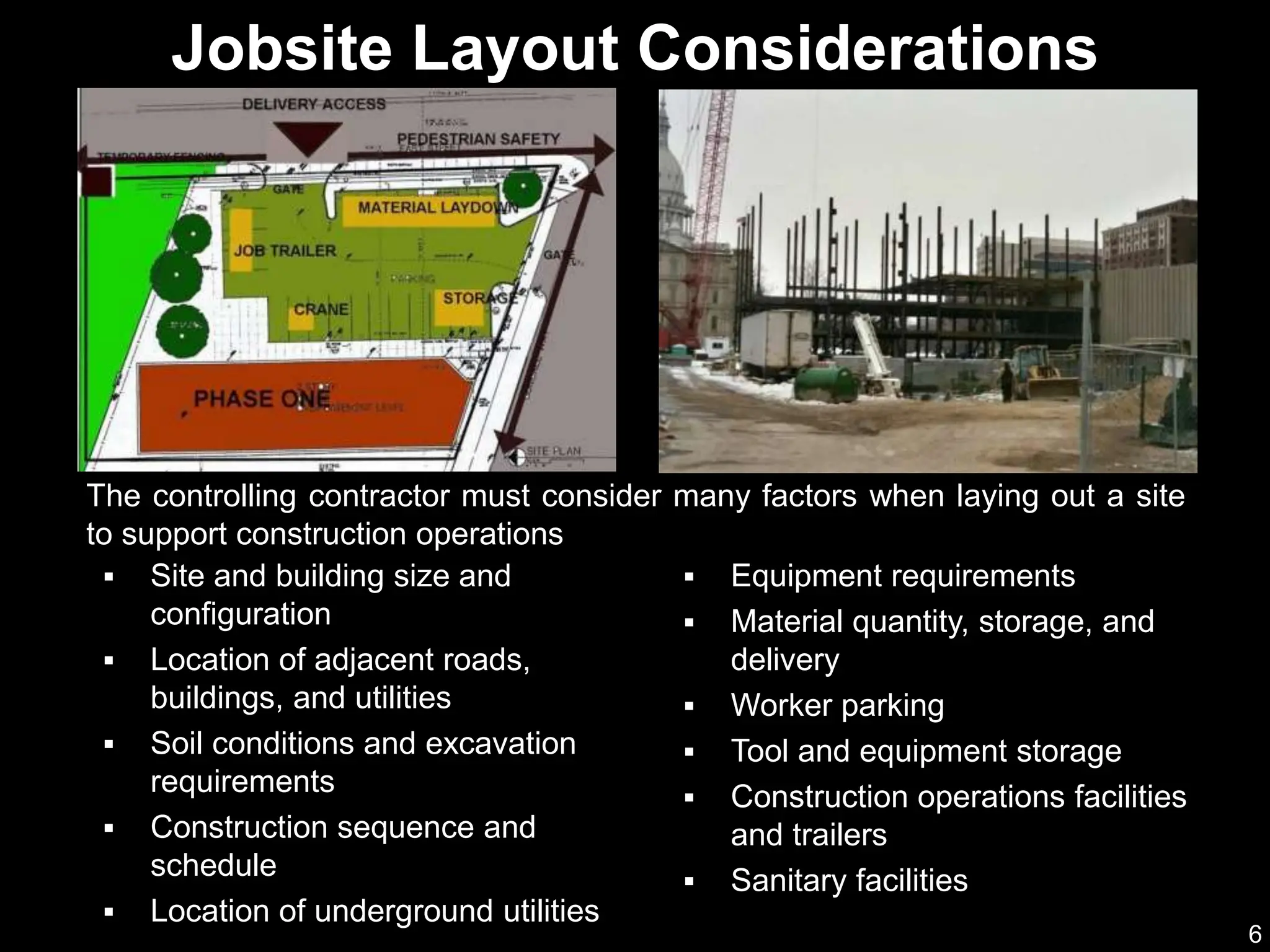
Jobsite Layout Considerations
The controlling contractor must consider many factors when laying out a site
to support construction operations
 Site and building size and
configuration
 Location of adjacent roads,
buildings, and utilities
 Soil conditions and excavation
requirements
 Construction sequence and
schedule
 Location of underground utilities
 Equipment requirements
 Material quantity, storage, and
delivery
 Worker parking
 Tool and equipment storage
 Construction operations facilities
and trailers
 Sanitary facilities
7
This figure shows the
stages of steel project
management.
Design decision to
use steel
Owner/Arch/Eng
Design
development
Develop contract
documents
Bidding
General contract
award
Steel contract
execution
Prepare erection
and shop drawings
Shop drawing
approval
Erect fabricated steel
and purchased items
Fabricate steel
Deliver fabricated
steel
Order steel
Deliver material
Award lower tier
subcontracts
Shop drawing
approval
Deliver
Stages of Steel Management
8
• While preparing bids, a controlling contractor will define subcontract
workscopes and seek prices from subcontractors
• Early interaction between a controlling contractor and subcontractors is
important
• The steel contractor should always be provided with complete contract
documents as described in the AISC Code of Standard Practice (2010)
Early Coordination
9
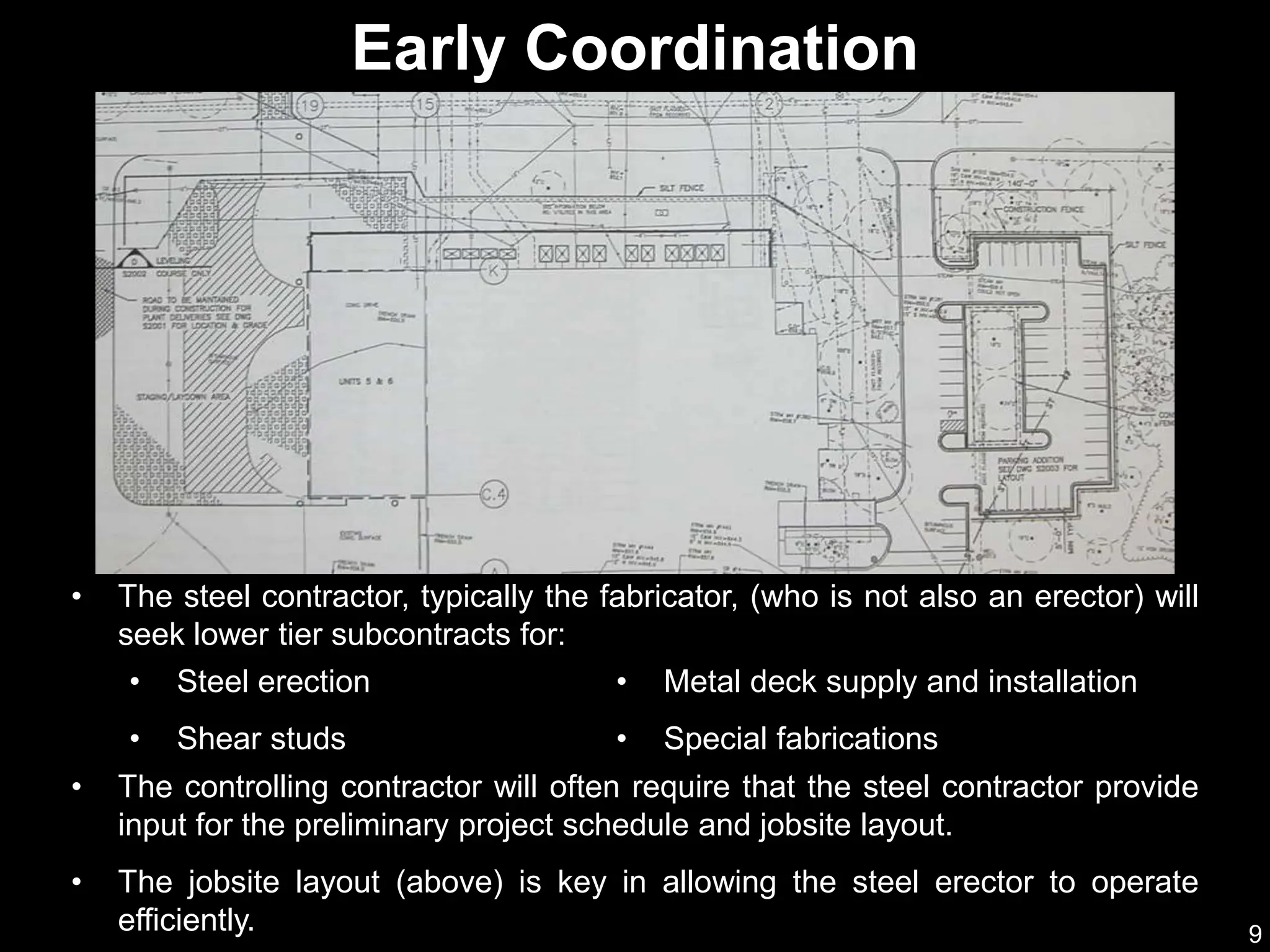
• The controlling contractor will often require that the steel contractor provide
input for the preliminary project schedule and jobsite layout.
• The jobsite layout (above) is key in allowing the steel erector to operate
efficiently.
• The steel contractor, typically the fabricator, (who is not also an erector) will
seek lower tier subcontracts for:
• Steel erection
• Shear studs
• Metal deck supply and installation
• Special fabrications
Early Coordination
10
• This figure shows the contractual lines of responsibility for a typical structural
steel project.
• It should be noted that in some cases the steel contractor will have both
fabrication and erection responsibilities.
General
Contractor
Steel
contractor
(fabricator)
Architect
Structural
engineer
Owner Steel erector
Metal deck
installer
Shear stud
installer
Steel joist
supplier
Lower tier
subcontractor,
fabricator
Steel
supplier
Metal deck
supplier
Lines of Responsibility
11
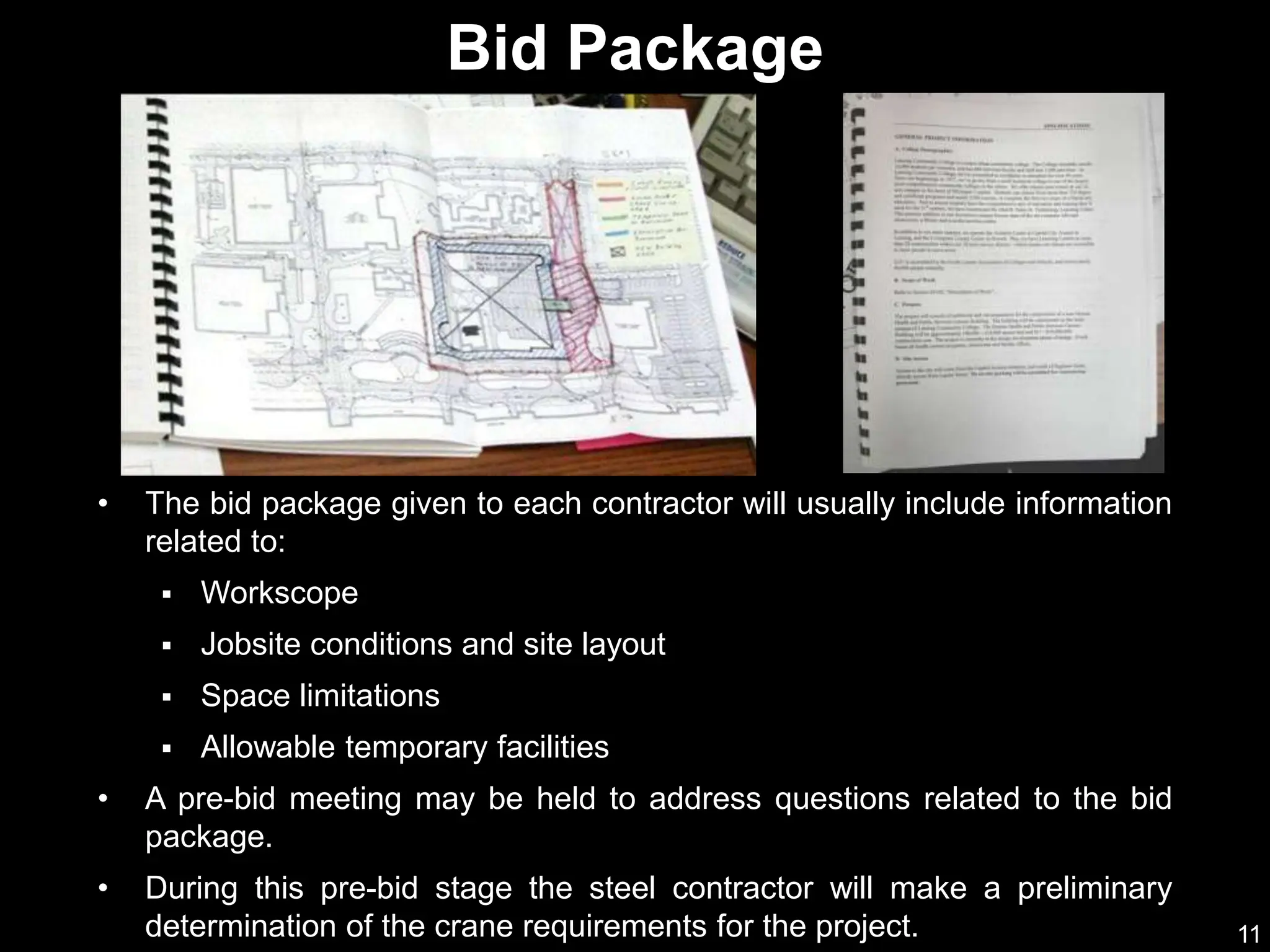
• The bid package given to each contractor will usually include information
related to:
 Workscope
 Jobsite conditions and site layout
 Space limitations
 Allowable temporary facilities
• A pre-bid meeting may be held to address questions related to the bid
package.
• During this pre-bid stage the steel contractor will make a preliminary
determination of the crane requirements for the project.
Bid Package
12
The steel contractor will need information from the controlling contractor including:
• Soil conditions
• Schedule
• Sequencing of other trades
• Crane size and provider
• Placement of crane, job trailer,
storage and laydown area
• Site access points
• Deliveries
• Parking
• Beginning and ending points
for erection of steel
• Workscope
Pre-Bid Essentials
13
• The controlling contractor defines the subcontract workscopes and solicits
subcontract prices during the bidding process.
• A workscope definition should include the general conditions or services which
the subcontractor must provide and those which the controlling contractor will
provide for the subcontractor.
• The controlling contractor may wish to subcontract the complete structural steel
package to a single steel subcontractor or may choose to divide the steel
portion of the project into multiple subcontracts.
Definition of Workscopes
14
Site Plan
• Site plans usually include existing site conditions, adjacent roads, and
topographical information
• Above is an example of a site plan that is included in the project drawings
• The black area shows the location of the building to be constructed
15
• The jobsite layout and equipment used will be controlled by the site constraints
• High on the list of considerations a steel erector will have are:
 Crane size and location(s)
 Laydown area size
 Laydown area location (Mincks and Johnston 2004)
Site Size and Configuration
16
• The goal of site layout is to optimize erection processes
 The number of crane locations is kept to a minimum
 Laydown areas should be as close as possible to the structure
• This is all dependent on site size and crane specifications
• The entire structure shown above was able to be erected with the
crawler crane located in one position on the left side of the building
Layout for Optimization
17
The relationship between a new building’s footprint and the size of the site
has a significant impact on the erector’s planning and sequencing
Space is required for:
• Deliveries
• Construction Materials
• Equipment
• Temporary Facilities
Building Footprint On Site
18
• Laydown areas may move as erection progresses to keep the steel as close as
possible to the point of installation (Mincks and Johnston 2004)
• At the site shown above the laydown area started within the building footprint
and moved to a smaller area outside the building footprint as erection
progressed
Laydown Area Location
19
• Additional communication may be required if the steel contractor determines
that it is necessary to operate the crane within the footprint of the building to
be erected
• Installation of some utilities and systems may need to be delayed to avoid
damage from the crane
Crane Inside Building Footprint
20
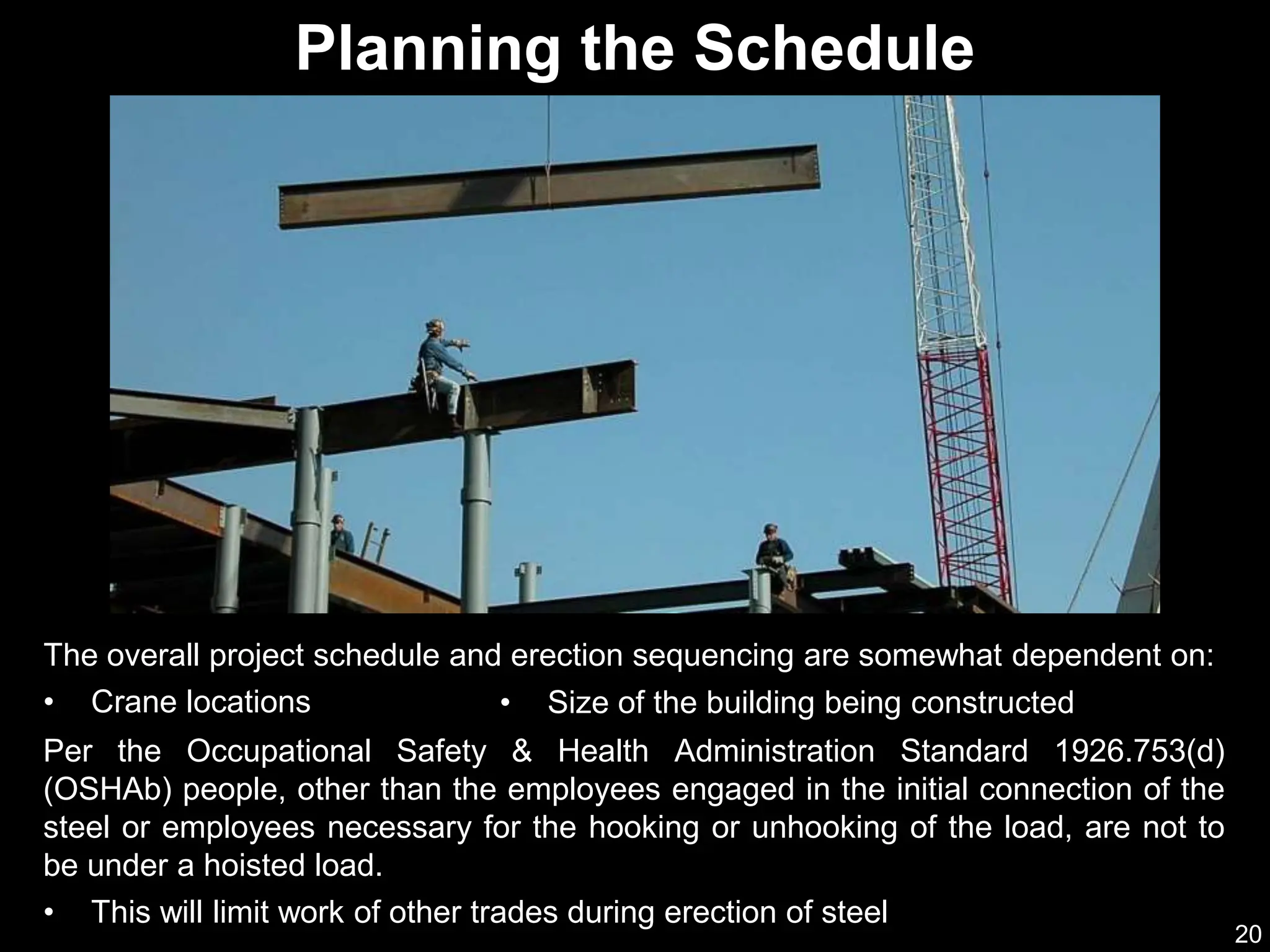
Planning the Schedule
The overall project schedule and erection sequencing are somewhat dependent on:
Per the Occupational Safety & Health Administration Standard 1926.753(d)
(OSHAb) people, other than the employees engaged in the initial connection of the
steel or employees necessary for the hooking or unhooking of the load, are not to
be under a hoisted load.
• Size of the building being constructed
• Crane locations
• This will limit work of other trades during erection of steel
21
• If the size of the building and/or jobsite allows the erection of steel to progress
efficiently without hoisting over other trade workers it may be possible for other
contractors to work during the erection of steel
• At the site shown above a new sewer line, foundation waterproofing, and floor
slab reinforcing are being installed as structural steel is being erected
Planning the Schedule
22
• Structural steel is a long lead time item that is typically ordered immediately
after contract execution
• It is important to make thorough plans and scheduling decisions early in the
project and stick to them
• Once the schedule has been determined it is important that it not be changed
• It may not be possible to make late material and/or equipment changes
without delays due to limited availability
Planning the Schedule
23
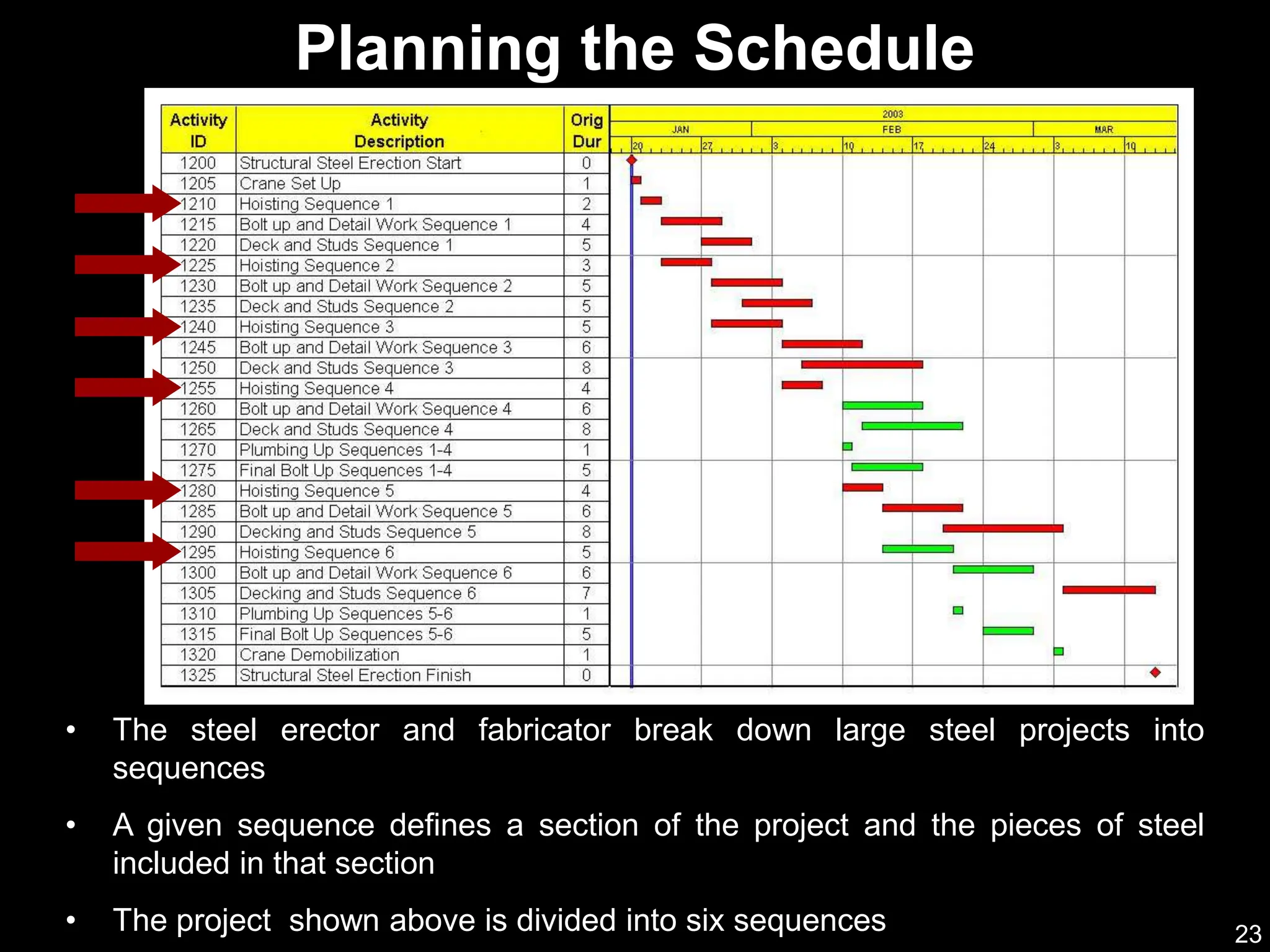
• The steel erector and fabricator break down large steel projects into
sequences
• A given sequence defines a section of the project and the pieces of steel
included in that section
• The project shown above is divided into six sequences
Planning the Schedule
24
• Pedestrian traffic must be kept at a safe distance from the
construction site
• Fencing and barricades may be necessary to block off all or part of
a road during construction operations
Adjacent Roads
25
• The controlling contractor, as stated in the Occupational Safety & Health
Administration Standard 1926.752 (OSHAa), is responsible for providing
access points into the construction site
• The steel contractor is responsible to communicate any necessary special
access requirements to the controlling contractor
Site Access Points
26
• Parking for workers is another important consideration in the jobsite layout
• Parking availability on and around a jobsite will typically be addressed in the
bid package for a project
• If parking is available on the jobsite it should be located as close to the work
operations as possible without causing interference with work operations
(Mincks and Johnston 2004)
• Space is available for only a couple of vehicles at the jobsite shown above
Worker Parking
27
In some cases parking will not be available on the jobsite
• Parking on a street or in an adjacent parking area may need to be arranged
 For the job pictured above, parking spaces along adjacent streets were
leased from the city for the duration of the project
• Some situations may require that a remote parking area be secured and
transportation be provided for workers from the parking area to the jobsite
Worker Parking
28
• The controlling contractor usually provides access for workers into the
structure of the building (above left)
• Access for the erector’s employees from floor to floor is provided by the erector
(above right)
Entrance Points for Workers
29
The controlling contractor may provide a footbridge over the excavation around a
foundation wall (above left) or temporary stairs to upper levels (above right)
Entrance Points for Workers
30
• Proper jobsite conditions are the responsibility of the controlling contractor
(AISC 2010, OSHAa)
• It is important to consider how soil conditions and excavation of a site will
change over the duration of a project
Soil Conditions and Excavation
31
• Bearing capacity of soil in areas where a crane will operate should be verified
• Consideration must be given to the proximity of the crane to the edge of an
excavation or foundation wall
• A geotechnical engineering report furnished by the controlling contractor may
be necessary
• In the pictures above the crane is positioned very close to an excavation
retaining wall
Soil Conditions and Excavation
32
• The type of soil on a jobsite and the excavation requirements for a project will
dictate if the outside edge of an excavation is to be shored, sloped, or benched
• Care should be taken not to remove more soil than necessary if the excavation
is sloped or benched
• An excavation that is sloped more shallowly than originally specified may:
 Create problems with the erector’s predetermined crane locations
 Require extra effort for the erection crew to safely access the top of the
foundation to erect steel
Soil Conditions and Excavation
33
If a man-lift is to be used on a project,
the controlling contractor should take
care to ensure that the site and the
excavated area around the building
footprint are suitable for its operation
Use of a Man-Lift
34
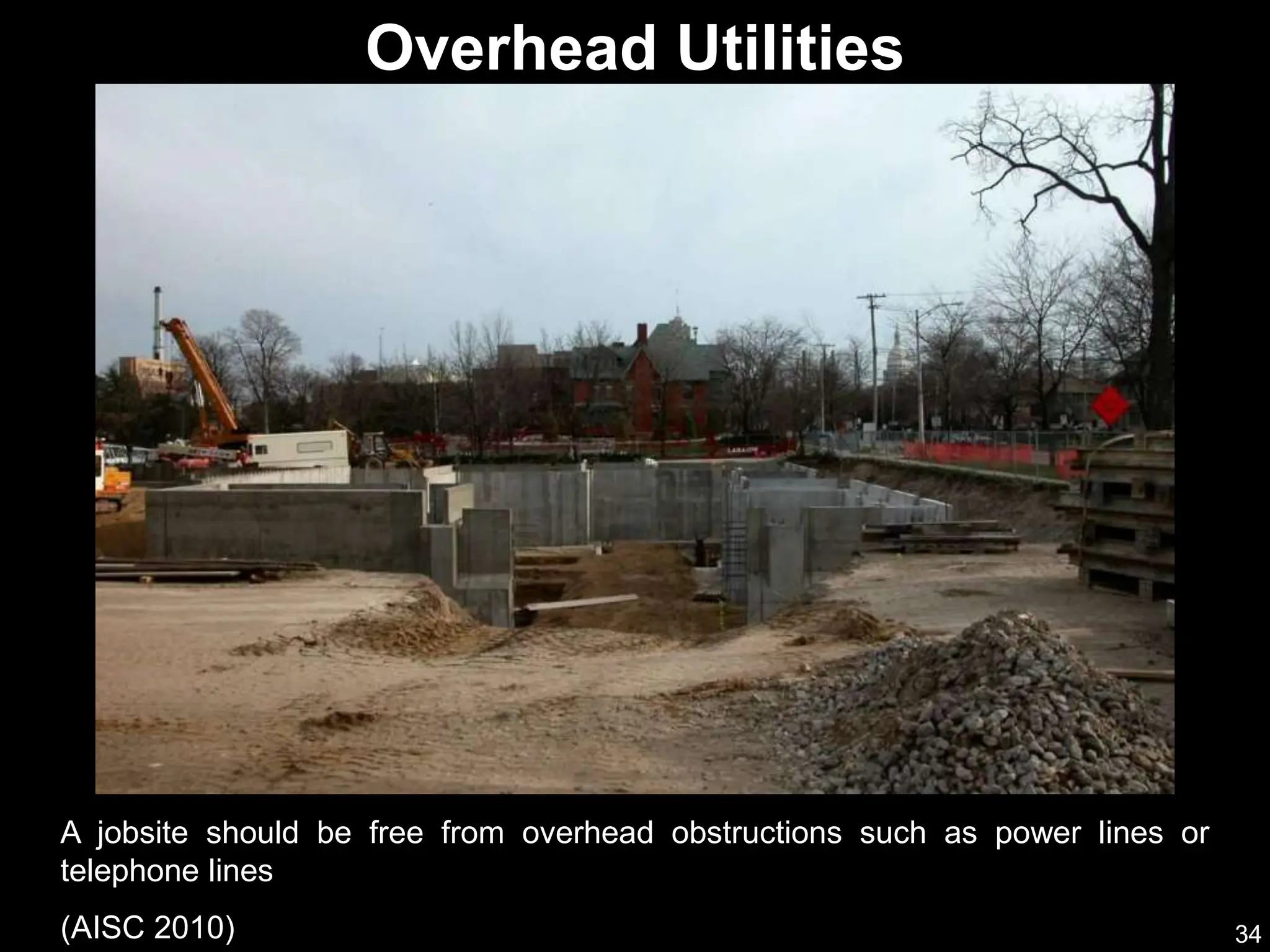
A jobsite should be free from overhead obstructions such as power lines or
telephone lines
(AISC 2010)
Overhead Utilities
35
• Precautions may need to be taken if a crane will be operated over certain
underground utilities
• The controlling contractor should inform the erector of underground utilities
located within or near the construction site
Underground Utilities
36
• In this case, a fire hydrant (right) which was not to
be removed happened to be located in the middle of
the desired crane location
• The stone base and timber mat provide just enough
clearance for operation (above)
Underground Utilities
37
Upon contract award, the steel contractor will immediately begin a number of
tasks:
• Definition of detailed workscopes, pricing, and schedules
• Steel is ordered from the steel mill
• Anchor rod setting plans, shop drawings (example above), and erection
drawings are prepared for approval
• Jobsite layout is finalized
Contract Awarded
38
• Shop drawings may be prepared and submitted to the controlling contractor in
phases to expedite the fabrication process
• Fabrication begins after the mill steel is received and the first batch of shop
drawings are approved
• Steel will be fabricated in sequences as determined during scheduling
• Once fabricated, the steel is organized and awaits delivery to the jobsite
Fabrication
39
Finalization of Jobsite Layout
• The finalized jobsite layout will include laydown area details and crane locations
• On the drawing above the crane locations have been determined by the erector
• The yellow bars represent locations of the crawler crane tracks
• The red lines represent the critical lifts to be performed from each location
 A lift is critical if it is in excess of 75% of the crane capacity
40
• Per the Occupational Safety & Health Administration Standard 1926.752 and the
AISC Code of Standard Practice Section 7.2, the Owner or Owner’s Designated
Representative for Construction shall provide and maintain certain jobsite
conditions (AISC 2010, OSHAa)
• The following slides describe the required provisions
Jobsite Condition Requirements
41
Adequate access roads into and through the site for the safe delivery and
movement of:
• Derricks
• Cranes
• Trucks
• Other necessary equipment
Adequate Access Roads
42
• Adequate access roads must be
provided into and through a site for safe
delivery and movement of materials
• There must be means and methods for
pedestrian and vehicular control
Adequate Access Roads
43
Space on the jobsite that is:
• Firm
• Properly graded
• Properly drained
Space On the Jobsite
44
Space on the jobsite that is:
• Readily accessible to the work
• Sufficient for safe operation of equipment
Space On the Jobsite
45
Space on the jobsite that is:
• Adequate for safe and secure storage of materials
• Enables the Fabricator and Erector to operate at maximum practical speed
 Unless the structure occupies the full available jobsite
Space On the Jobsite
46
The provisions described on the previous slides are to be met by the Owner
or the Owner’s Designated Representative for Construction
Jobsite Condition Requirements
47
• A steel contractor will usually need to have a job trailer or other portable dry
space on the site
• If a job trailer cannot be placed on the site due to limited space, the controlling
contractor should provide a dry, secure space from which the steel contractor
can operate
• Labor rules usually require the availability of a dry shack for workers to use for
breaks and lunches (Mincks and Johnston, 2004)
Operations Facilities
48
• The steel contractor will usually have a limited number of workers on the
jobsite at a time, so space requirements for a job trailer are minimal
• In the case shown above, a large transport van (center back) was used as the
dry facility for the workers
• Provisions for a job trailer or dry shack, such as electricity and water, will
usually be the responsibility of the steel contractor
• The controlling contractor typically provides sanitary facilities on a jobsite
(Mincks and Johnston 2004)
Operations Facilities
49
• The controlling contractor is responsible for precise location of building lines and
benchmarks on a jobsite and must provide the erector with a plan showing such
information
• It is the responsibility of subcontractors to layout their work and inspect any
construction in-place before beginning their work
• The steel fabricator supplies the controlling contractor with anchor rod setting
plans for setting the structural steel anchor rods
(AISC 2010)
Layout Responsibilities
50
• Prior to mobilization, the steel contractor should field-check the placement and
elevations of the anchor rods
• Additional costs and delays may result if anchor rods are found to be improperly
placed after mobilization
Layout Responsibilities
51
• Any discrepancies from the setting plans or necessary anchor rod repairs should
be brought to the attention of the controlling contractor
• Per the Occupational Safety & Health Administration Standard 1926.755(b)
(OSHAc):
 Anchor rods (anchor bolts) shall not be repaired, replaced or field-modified
without the approval of the project structural engineer of record.
 “Prior to the erection of a column, the controlling contractor shall provide
written notification to the steel erector if there has been any repair,
replacement or modification of the anchor rods (anchor bolts) of that column.”
Modifications to Anchor Rods
52
• The erector will typically provide most, if not all, of the erection equipment needed
• Typical equipment used for structural steel erection includes:
 Crane(s)
 Man-lifts
 Generators
 Welding Equipment
 Air Compressors
 Hand Tools
Erection and Installation Equipment
53
• There are several crane types used in construction
• Construction cranes are usually identified as either mobile cranes (above left),
tower cranes (above right), or derricks
• Mobile cranes are traditionally preferred by contractors in North America
• Tower cranes are typically only used for high-rise construction or on jobsites
where space is restricted
• A derrick is a hoisting mechanism with a hoisting engine that is not a part of the
hoisting mechanism (Shapiro et al. 2000, Peurifoy and Schexnayder 2006)
Crane Types
54
Mobile Cranes
• A crane that can move around a jobsite under its own power is a mobile crane
• Common mobile crane types are:
 Crawler
 Rough-terrain (above left)
 All-terrain
 Telescoping-boom truck mounted (above right)
 Lattice-boom truck mounted
(Shapiro et al. 2000, Peurifoy and Schexnayder 2006)
55
• Crawler cranes get their name from
the continuous, parallel crawler
tracks that are used to move them
around a construction site
 A large ground contact area is
provided by the crawler tracks
• The superstructure on a crawler
crane is fully revolving
(Peurifoy and Schexnayder 2006)
Crawler Cranes
56
• Prior to lifting a load, the crane must be leveled and the soil bearing capacity
considered
• It is common to position the crane on timber mats to further distribute the load
(Peurifoy and Schexnayder 2006)
Crawler Cranes
57
• Crawler cranes must be transported by truck, rail, or barge
• Time and cost to load, haul, assemble (or mobilize), operate, disassemble,
reload, and haul (or demobilize) need to be considered
• Some of the largest crawler cranes need up to 15 trucks to be transported
(Peurifoy and Schexnayder 2006)
Crawler Cranes
58
Boom
Boom Top
Boom Butt
Luffing Jib
Luffing Jib Top Luffing Jib Butt
Luffing Jib
Struts
Anatomy of a Crawler Crane
Hook Block
“Headache Ball”
59
Crawler
Counterweights
Operator’s Cab Mast
Gantry
Car Body Engine, Drums,
and Boom Hoist
(hidden)
Anatomy of a Crawler Crane
60
• Rough-terrain cranes are mounted on a two-axle chassis with the
operator’s cab located either on the upper works or the chassis
• Large wheels and a short wheel base make these cranes very
maneuverable on the construction site
• Outrigger beams are used to stabilize the crane during use
• Slopes of 50 to 70% can be traversed by a rough-terrain crane
(Shapiro et al. 2000, Peurifoy and Schexnayder 2006)
Rough-terrain Cranes
61
Outrigger
Counterweight
Telescopic
Boom
Oversized
Wheels
Lifting Ram
Hook Block
Boom Head
Optional Jib
Operator’s Cab
Anatomy of a Rough-terrain Crane
62
Mobilizing the Crane
• Mobilization involves transporting the crane to the jobsite and preparing the
crane for use
• Mobilizing rough-terrain, all-terrain, and telescoping-boom truck mounted
cranes is a relatively fast process
• Telescoping-boom cranes can usually be positioned and ready to hoist steel in
under thirty minutes
63
• Most rough-terrain cranes (above left) can travel on surface streets, but have a
maximum speed of about 30 mph
• For long moves between projects, rough-terrain cranes should be transported
on low-bed trailers
• All-terrain and truck mounted cranes (above right) are designed to be driven to
the jobsite on surface streets (Peurifoy and Schexnayder 2006)
Mobilizing the Crane
64
Mobilizing a Crawler Crane
• Assembling the many parts of a crawler crane may take several days
• Some crawler cranes can assemble themselves, while others require the use
of another crane for assembly
• At this site, a rough-terrain crane was used to assemble the crawler crane
65
• The counterweights are put into place (above left)
• The pieces of the jib wait to be assembled (above right)
Mobilizing a Crawler Crane
66
This photo shows line being run through the boom and jib
Mobilizing a Crawler Crane
67
• Structural steel erection requires the delivery of steel by the truckload
• It is common practice to unload steel from a truck into a laydown area
• A crew will then shakeout the steel into the order that it will be erected
• There may be several truck loads of steel in the laydown area at one time to
prevent the erection process from being interrupted
• The size and location of the laydown area are important factors to be
considered with structural steel erection
Delivery of Steel
68
• A flagman may be necessary to direct traffic around the
construction site entrance point and unloading zone during
delivery times
• Signs and gates should be used to ensure that pedestrians
cannot accidentally enter the construction site
Delivery Access
69
Some northern parts of the country will have seasonal load limits on certain roads
during late winter and early spring months
• Restrictions are implemented during the time when the ground is thawing after
the cold winter months
 This is done to reduce the wear on some roadways during the thaw cycle
• It may not be possible to deliver the required crane to a jobsite during this period
• Truck delivery capacities of structural steel may be reduced by 35 percent
Seasonal Load Limits
70
• Material delivery, quantity, and storage requirements will vary from project to
project
• There are, however, some common requirements for structural steel
construction
Materials On Site
71
Laydown Area
• The laydown area needs to be flat, firm, and well drained
• Cribbing is usually placed under the structural steel members for ease of
rigging and to keep the steel clean
• Steel erectors generally prefer to have a minimum of two truckloads of steel in
the laydown area to ensure that erection can continue without interruption
• A typical structural steel project will require a laydown area that is between 50
feet by 50 feet and 100 feet by 100 feet
 This area allows the steel members to be appropriately spaced and
organized for efficient erection
72
Some projects, where large, built-up trusses are used, will require a much larger
laydown area for fabrication on the jobsite
Laydown Area
73
Limited Space for Deliveries
• For projects where delivery space is limited, extra coordination will be
required to accomplish quick unloading
• Requirements might include:
 An off-site staging area for delivery trucks to wait until directed to
proceed to the site or for trailers to be dropped until they are needed
 Radio communication between delivery drivers and the jobsite
 A flagman to direct traffic around the delivery point
74
Erecting Structural Steel
• Per the AISC Code of Standard Practice (2010), “The Erector shall be responsible
for the means, methods and safety of erection of the Structural Steel frame.”
• Multiple lift rigging, as seen in the picture above, is the process where several
pieces of steel are lifted simultaneously to speed erection by reducing the total
number of lifts required for the frame
• Refer to the AISC Digital Library Four Story Office Building Case Study
presentations about Structural Steel Erection for more details related to the
erection of structural steel. There is a video “Structural Steel Erection” on the
Teaching Aids website (www.aisc.org/teachingaids)
75
If the size of the site and the relationship of the building to the site and surrounding
properties require that loads be lifted over adjacent property, then certain
precautions may need to be taken:
• Vacancy of the affected adjacent property
• Additional barricading to ensure a safe construction zone
• Extra care to minimize the risk of damage to any adjacent property
Adjacent Property
76
As stated in the Code of Standard Practice (AISC 2010):
• The controlling contractor shall accept the structural steel for plumbness,
elevation, and alignment prior to the placement or installation of other materials
• “Upon the completion of erection and before final acceptance, the Erector shall
remove all of the Erector’s falsework, rubbish and temporary buildings.”
Structural Steel Erection Complete
77
Per the Occupational Safety & Health Administration Standard 1926.760(e)
(OSHAd):
Custody Of Fall Protection
“Fall protection provided by the steel erector shall remain in the area where steel
erection activity has been completed, to be used by other trades, only if the
controlling contractor or its authorized representative:
• Has directed the steel erector to leave the fall protection in place; and
• Has inspected and accepted control and responsibility of the fall protection
prior to authorizing persons other than steel erectors to work in the area.”
78
Demobilization may take as much time as mobilization
• Cranes with telescoping booms may be demobilized in a matter of minutes
• Demobilization of a lattice boom crane may take several days
Demobilizing the Crane
79
This photo shows the main boom being disassembled and loaded onto
a truck for transport
Demobilizing a Crawler Crane
80
Demobilizing a Crawler Crane
• Crawler crane with the main boom and most of the counterweights
removed (above left)
• The boom butt has been removed (above right)
81
The base machine of this crawler crane has self-contained jacks (above left)
that allow a low-bed trailer to be backed under it for transport
Demobilizing a Crawler Crane
82
Structural Steel: The Material of Choice
83
AISC. (2010). Code of Standard Practice for Steel Buildings and Bridges. American Institute
of Steel Construction, Inc. Chicago, IL.
Mincks, W. R., and Johnston, H. (2004). Construction Jobsite Management. Delmar
Learning, Clifton Park, NY.
Occupational Safety & Health Administration, (OSHAa). (2001). Standard Number 1926.752.
“Site layout, site-specific erection plan and construction sequence.” Washington, DC.
Occupational Safety & Health Administration, (OSHAb). (2010). Standard Number 1926.753.
“Hoisting and Rigging.” Washington, DC.
Occupational Safety & Health Administration, (OSHAc). (2001). Standard Number 1926.755.
“Column Anchorage.” Washington, DC.
Occupational Safety & Health Administration, (OSHAd). (2001). Standard Number 1926.760.
“Fall Protection.” Washington, DC.
Peurifoy, R. L., and Schexnayder, C. J. (2006). Construction Planning, Equipment, and
Methods. McGraw-Hill Companies, Inc. New York, NY.
Shapiro, H. I., Shapiro, J. P., and Shapiro, L. K. (2000). Cranes and Derricks. McGraw-Hill
Companies, Inc. New York, NY.
References

Steel structure presentation for students

  • 1.
  • 2.
    2 This presentation wasdeveloped as a teaching aid with the support of the American Institute of Steel Construction. Its objective is to provide technical background and information for bolting and welding. The information provided is based on common design and construction practices for structures of twelve stories or less. The Four Story Building Case study presentations document the construction of a steel frame for an office building. The case study includes photographs that were taken throughout the construction of the structural steel frame including detailing, fabrication, and erection. Project data including plans, schedules, specifications and other details are also included. The case study presentations are available in the Teaching Aids section of University Programs at http://www.aisc.org/teachingaids. This presentation provides technical information on bolting and welding, as well as the impacts of details and design choices on schedule, cost, sequence and overall project management. The information is presented with concerns of a construction manager or general contractor in mind. Introduction
  • 3.
    3 • General knowledgeof structural steel • Insight into issues related to jobsite layout, mobilization, equipment, and coordination for structural steel construction of which construction managers and general contractors should be aware • Familiarity with the necessary coordination between the structural steel contractor and the construction manager and/or general contractor • Knowledge of specific details involved with jobsite layout for structural steel construction • An awareness of jobsite condition requirements defined by the Occupational Safety & Health Administration and by the American Institute of Steel Construction • An understanding of equipment requirements and mobilization processes for structural steel construction What Will You Gain From This Presentation?
  • 4.
    4 Some benefits associatedwith use of structural steel for owners are: • Steel allows for reduced frame construction time and the ability to construct in all seasons • Steel makes large spans and bay sizes possible, providing more flexibility for owners • Steel is easier to modify and reinforce if architectural changes are made to a facility over its life • Steel is lightweight and can reduce foundation costs • Steel is durable, long-lasting and recyclable Benefits of Structural Steel
  • 5.
    5 Procurement and managementof structural steel is similar to other materials, but there are some unique aspects to steel construction: • Steel is fabricated off-site (above left) • On-site erection is a rapid process (above right) • This gives use of structural steel some scheduling advantages • Coordination of all parties is essential for achieving potential advantages Unique Aspects of Steel Construction
  • 6.
    6 Jobsite Layout Considerations Thecontrolling contractor must consider many factors when laying out a site to support construction operations  Site and building size and configuration  Location of adjacent roads, buildings, and utilities  Soil conditions and excavation requirements  Construction sequence and schedule  Location of underground utilities  Equipment requirements  Material quantity, storage, and delivery  Worker parking  Tool and equipment storage  Construction operations facilities and trailers  Sanitary facilities
  • 7.
    7 This figure showsthe stages of steel project management. Design decision to use steel Owner/Arch/Eng Design development Develop contract documents Bidding General contract award Steel contract execution Prepare erection and shop drawings Shop drawing approval Erect fabricated steel and purchased items Fabricate steel Deliver fabricated steel Order steel Deliver material Award lower tier subcontracts Shop drawing approval Deliver Stages of Steel Management
  • 8.
    8 • While preparingbids, a controlling contractor will define subcontract workscopes and seek prices from subcontractors • Early interaction between a controlling contractor and subcontractors is important • The steel contractor should always be provided with complete contract documents as described in the AISC Code of Standard Practice (2010) Early Coordination
  • 9.
    9 • The controllingcontractor will often require that the steel contractor provide input for the preliminary project schedule and jobsite layout. • The jobsite layout (above) is key in allowing the steel erector to operate efficiently. • The steel contractor, typically the fabricator, (who is not also an erector) will seek lower tier subcontracts for: • Steel erection • Shear studs • Metal deck supply and installation • Special fabrications Early Coordination
  • 10.
    10 • This figureshows the contractual lines of responsibility for a typical structural steel project. • It should be noted that in some cases the steel contractor will have both fabrication and erection responsibilities. General Contractor Steel contractor (fabricator) Architect Structural engineer Owner Steel erector Metal deck installer Shear stud installer Steel joist supplier Lower tier subcontractor, fabricator Steel supplier Metal deck supplier Lines of Responsibility
  • 11.
    11 • The bidpackage given to each contractor will usually include information related to:  Workscope  Jobsite conditions and site layout  Space limitations  Allowable temporary facilities • A pre-bid meeting may be held to address questions related to the bid package. • During this pre-bid stage the steel contractor will make a preliminary determination of the crane requirements for the project. Bid Package
  • 12.
    12 The steel contractorwill need information from the controlling contractor including: • Soil conditions • Schedule • Sequencing of other trades • Crane size and provider • Placement of crane, job trailer, storage and laydown area • Site access points • Deliveries • Parking • Beginning and ending points for erection of steel • Workscope Pre-Bid Essentials
  • 13.
    13 • The controllingcontractor defines the subcontract workscopes and solicits subcontract prices during the bidding process. • A workscope definition should include the general conditions or services which the subcontractor must provide and those which the controlling contractor will provide for the subcontractor. • The controlling contractor may wish to subcontract the complete structural steel package to a single steel subcontractor or may choose to divide the steel portion of the project into multiple subcontracts. Definition of Workscopes
  • 14.
    14 Site Plan • Siteplans usually include existing site conditions, adjacent roads, and topographical information • Above is an example of a site plan that is included in the project drawings • The black area shows the location of the building to be constructed
  • 15.
    15 • The jobsitelayout and equipment used will be controlled by the site constraints • High on the list of considerations a steel erector will have are:  Crane size and location(s)  Laydown area size  Laydown area location (Mincks and Johnston 2004) Site Size and Configuration
  • 16.
    16 • The goalof site layout is to optimize erection processes  The number of crane locations is kept to a minimum  Laydown areas should be as close as possible to the structure • This is all dependent on site size and crane specifications • The entire structure shown above was able to be erected with the crawler crane located in one position on the left side of the building Layout for Optimization
  • 17.
    17 The relationship betweena new building’s footprint and the size of the site has a significant impact on the erector’s planning and sequencing Space is required for: • Deliveries • Construction Materials • Equipment • Temporary Facilities Building Footprint On Site
  • 18.
    18 • Laydown areasmay move as erection progresses to keep the steel as close as possible to the point of installation (Mincks and Johnston 2004) • At the site shown above the laydown area started within the building footprint and moved to a smaller area outside the building footprint as erection progressed Laydown Area Location
  • 19.
    19 • Additional communicationmay be required if the steel contractor determines that it is necessary to operate the crane within the footprint of the building to be erected • Installation of some utilities and systems may need to be delayed to avoid damage from the crane Crane Inside Building Footprint
  • 20.
    20 Planning the Schedule Theoverall project schedule and erection sequencing are somewhat dependent on: Per the Occupational Safety & Health Administration Standard 1926.753(d) (OSHAb) people, other than the employees engaged in the initial connection of the steel or employees necessary for the hooking or unhooking of the load, are not to be under a hoisted load. • Size of the building being constructed • Crane locations • This will limit work of other trades during erection of steel
  • 21.
    21 • If thesize of the building and/or jobsite allows the erection of steel to progress efficiently without hoisting over other trade workers it may be possible for other contractors to work during the erection of steel • At the site shown above a new sewer line, foundation waterproofing, and floor slab reinforcing are being installed as structural steel is being erected Planning the Schedule
  • 22.
    22 • Structural steelis a long lead time item that is typically ordered immediately after contract execution • It is important to make thorough plans and scheduling decisions early in the project and stick to them • Once the schedule has been determined it is important that it not be changed • It may not be possible to make late material and/or equipment changes without delays due to limited availability Planning the Schedule
  • 23.
    23 • The steelerector and fabricator break down large steel projects into sequences • A given sequence defines a section of the project and the pieces of steel included in that section • The project shown above is divided into six sequences Planning the Schedule
  • 24.
    24 • Pedestrian trafficmust be kept at a safe distance from the construction site • Fencing and barricades may be necessary to block off all or part of a road during construction operations Adjacent Roads
  • 25.
    25 • The controllingcontractor, as stated in the Occupational Safety & Health Administration Standard 1926.752 (OSHAa), is responsible for providing access points into the construction site • The steel contractor is responsible to communicate any necessary special access requirements to the controlling contractor Site Access Points
  • 26.
    26 • Parking forworkers is another important consideration in the jobsite layout • Parking availability on and around a jobsite will typically be addressed in the bid package for a project • If parking is available on the jobsite it should be located as close to the work operations as possible without causing interference with work operations (Mincks and Johnston 2004) • Space is available for only a couple of vehicles at the jobsite shown above Worker Parking
  • 27.
    27 In some casesparking will not be available on the jobsite • Parking on a street or in an adjacent parking area may need to be arranged  For the job pictured above, parking spaces along adjacent streets were leased from the city for the duration of the project • Some situations may require that a remote parking area be secured and transportation be provided for workers from the parking area to the jobsite Worker Parking
  • 28.
    28 • The controllingcontractor usually provides access for workers into the structure of the building (above left) • Access for the erector’s employees from floor to floor is provided by the erector (above right) Entrance Points for Workers
  • 29.
    29 The controlling contractormay provide a footbridge over the excavation around a foundation wall (above left) or temporary stairs to upper levels (above right) Entrance Points for Workers
  • 30.
    30 • Proper jobsiteconditions are the responsibility of the controlling contractor (AISC 2010, OSHAa) • It is important to consider how soil conditions and excavation of a site will change over the duration of a project Soil Conditions and Excavation
  • 31.
    31 • Bearing capacityof soil in areas where a crane will operate should be verified • Consideration must be given to the proximity of the crane to the edge of an excavation or foundation wall • A geotechnical engineering report furnished by the controlling contractor may be necessary • In the pictures above the crane is positioned very close to an excavation retaining wall Soil Conditions and Excavation
  • 32.
    32 • The typeof soil on a jobsite and the excavation requirements for a project will dictate if the outside edge of an excavation is to be shored, sloped, or benched • Care should be taken not to remove more soil than necessary if the excavation is sloped or benched • An excavation that is sloped more shallowly than originally specified may:  Create problems with the erector’s predetermined crane locations  Require extra effort for the erection crew to safely access the top of the foundation to erect steel Soil Conditions and Excavation
  • 33.
    33 If a man-liftis to be used on a project, the controlling contractor should take care to ensure that the site and the excavated area around the building footprint are suitable for its operation Use of a Man-Lift
  • 34.
    34 A jobsite shouldbe free from overhead obstructions such as power lines or telephone lines (AISC 2010) Overhead Utilities
  • 35.
    35 • Precautions mayneed to be taken if a crane will be operated over certain underground utilities • The controlling contractor should inform the erector of underground utilities located within or near the construction site Underground Utilities
  • 36.
    36 • In thiscase, a fire hydrant (right) which was not to be removed happened to be located in the middle of the desired crane location • The stone base and timber mat provide just enough clearance for operation (above) Underground Utilities
  • 37.
    37 Upon contract award,the steel contractor will immediately begin a number of tasks: • Definition of detailed workscopes, pricing, and schedules • Steel is ordered from the steel mill • Anchor rod setting plans, shop drawings (example above), and erection drawings are prepared for approval • Jobsite layout is finalized Contract Awarded
  • 38.
    38 • Shop drawingsmay be prepared and submitted to the controlling contractor in phases to expedite the fabrication process • Fabrication begins after the mill steel is received and the first batch of shop drawings are approved • Steel will be fabricated in sequences as determined during scheduling • Once fabricated, the steel is organized and awaits delivery to the jobsite Fabrication
  • 39.
    39 Finalization of JobsiteLayout • The finalized jobsite layout will include laydown area details and crane locations • On the drawing above the crane locations have been determined by the erector • The yellow bars represent locations of the crawler crane tracks • The red lines represent the critical lifts to be performed from each location  A lift is critical if it is in excess of 75% of the crane capacity
  • 40.
    40 • Per theOccupational Safety & Health Administration Standard 1926.752 and the AISC Code of Standard Practice Section 7.2, the Owner or Owner’s Designated Representative for Construction shall provide and maintain certain jobsite conditions (AISC 2010, OSHAa) • The following slides describe the required provisions Jobsite Condition Requirements
  • 41.
    41 Adequate access roadsinto and through the site for the safe delivery and movement of: • Derricks • Cranes • Trucks • Other necessary equipment Adequate Access Roads
  • 42.
    42 • Adequate accessroads must be provided into and through a site for safe delivery and movement of materials • There must be means and methods for pedestrian and vehicular control Adequate Access Roads
  • 43.
    43 Space on thejobsite that is: • Firm • Properly graded • Properly drained Space On the Jobsite
  • 44.
    44 Space on thejobsite that is: • Readily accessible to the work • Sufficient for safe operation of equipment Space On the Jobsite
  • 45.
    45 Space on thejobsite that is: • Adequate for safe and secure storage of materials • Enables the Fabricator and Erector to operate at maximum practical speed  Unless the structure occupies the full available jobsite Space On the Jobsite
  • 46.
    46 The provisions describedon the previous slides are to be met by the Owner or the Owner’s Designated Representative for Construction Jobsite Condition Requirements
  • 47.
    47 • A steelcontractor will usually need to have a job trailer or other portable dry space on the site • If a job trailer cannot be placed on the site due to limited space, the controlling contractor should provide a dry, secure space from which the steel contractor can operate • Labor rules usually require the availability of a dry shack for workers to use for breaks and lunches (Mincks and Johnston, 2004) Operations Facilities
  • 48.
    48 • The steelcontractor will usually have a limited number of workers on the jobsite at a time, so space requirements for a job trailer are minimal • In the case shown above, a large transport van (center back) was used as the dry facility for the workers • Provisions for a job trailer or dry shack, such as electricity and water, will usually be the responsibility of the steel contractor • The controlling contractor typically provides sanitary facilities on a jobsite (Mincks and Johnston 2004) Operations Facilities
  • 49.
    49 • The controllingcontractor is responsible for precise location of building lines and benchmarks on a jobsite and must provide the erector with a plan showing such information • It is the responsibility of subcontractors to layout their work and inspect any construction in-place before beginning their work • The steel fabricator supplies the controlling contractor with anchor rod setting plans for setting the structural steel anchor rods (AISC 2010) Layout Responsibilities
  • 50.
    50 • Prior tomobilization, the steel contractor should field-check the placement and elevations of the anchor rods • Additional costs and delays may result if anchor rods are found to be improperly placed after mobilization Layout Responsibilities
  • 51.
    51 • Any discrepanciesfrom the setting plans or necessary anchor rod repairs should be brought to the attention of the controlling contractor • Per the Occupational Safety & Health Administration Standard 1926.755(b) (OSHAc):  Anchor rods (anchor bolts) shall not be repaired, replaced or field-modified without the approval of the project structural engineer of record.  “Prior to the erection of a column, the controlling contractor shall provide written notification to the steel erector if there has been any repair, replacement or modification of the anchor rods (anchor bolts) of that column.” Modifications to Anchor Rods
  • 52.
    52 • The erectorwill typically provide most, if not all, of the erection equipment needed • Typical equipment used for structural steel erection includes:  Crane(s)  Man-lifts  Generators  Welding Equipment  Air Compressors  Hand Tools Erection and Installation Equipment
  • 53.
    53 • There areseveral crane types used in construction • Construction cranes are usually identified as either mobile cranes (above left), tower cranes (above right), or derricks • Mobile cranes are traditionally preferred by contractors in North America • Tower cranes are typically only used for high-rise construction or on jobsites where space is restricted • A derrick is a hoisting mechanism with a hoisting engine that is not a part of the hoisting mechanism (Shapiro et al. 2000, Peurifoy and Schexnayder 2006) Crane Types
  • 54.
    54 Mobile Cranes • Acrane that can move around a jobsite under its own power is a mobile crane • Common mobile crane types are:  Crawler  Rough-terrain (above left)  All-terrain  Telescoping-boom truck mounted (above right)  Lattice-boom truck mounted (Shapiro et al. 2000, Peurifoy and Schexnayder 2006)
  • 55.
    55 • Crawler cranesget their name from the continuous, parallel crawler tracks that are used to move them around a construction site  A large ground contact area is provided by the crawler tracks • The superstructure on a crawler crane is fully revolving (Peurifoy and Schexnayder 2006) Crawler Cranes
  • 56.
    56 • Prior tolifting a load, the crane must be leveled and the soil bearing capacity considered • It is common to position the crane on timber mats to further distribute the load (Peurifoy and Schexnayder 2006) Crawler Cranes
  • 57.
    57 • Crawler cranesmust be transported by truck, rail, or barge • Time and cost to load, haul, assemble (or mobilize), operate, disassemble, reload, and haul (or demobilize) need to be considered • Some of the largest crawler cranes need up to 15 trucks to be transported (Peurifoy and Schexnayder 2006) Crawler Cranes
  • 58.
    58 Boom Boom Top Boom Butt LuffingJib Luffing Jib Top Luffing Jib Butt Luffing Jib Struts Anatomy of a Crawler Crane Hook Block “Headache Ball”
  • 59.
    59 Crawler Counterweights Operator’s Cab Mast Gantry CarBody Engine, Drums, and Boom Hoist (hidden) Anatomy of a Crawler Crane
  • 60.
    60 • Rough-terrain cranesare mounted on a two-axle chassis with the operator’s cab located either on the upper works or the chassis • Large wheels and a short wheel base make these cranes very maneuverable on the construction site • Outrigger beams are used to stabilize the crane during use • Slopes of 50 to 70% can be traversed by a rough-terrain crane (Shapiro et al. 2000, Peurifoy and Schexnayder 2006) Rough-terrain Cranes
  • 61.
    61 Outrigger Counterweight Telescopic Boom Oversized Wheels Lifting Ram Hook Block BoomHead Optional Jib Operator’s Cab Anatomy of a Rough-terrain Crane
  • 62.
    62 Mobilizing the Crane •Mobilization involves transporting the crane to the jobsite and preparing the crane for use • Mobilizing rough-terrain, all-terrain, and telescoping-boom truck mounted cranes is a relatively fast process • Telescoping-boom cranes can usually be positioned and ready to hoist steel in under thirty minutes
  • 63.
    63 • Most rough-terraincranes (above left) can travel on surface streets, but have a maximum speed of about 30 mph • For long moves between projects, rough-terrain cranes should be transported on low-bed trailers • All-terrain and truck mounted cranes (above right) are designed to be driven to the jobsite on surface streets (Peurifoy and Schexnayder 2006) Mobilizing the Crane
  • 64.
    64 Mobilizing a CrawlerCrane • Assembling the many parts of a crawler crane may take several days • Some crawler cranes can assemble themselves, while others require the use of another crane for assembly • At this site, a rough-terrain crane was used to assemble the crawler crane
  • 65.
    65 • The counterweightsare put into place (above left) • The pieces of the jib wait to be assembled (above right) Mobilizing a Crawler Crane
  • 66.
    66 This photo showsline being run through the boom and jib Mobilizing a Crawler Crane
  • 67.
    67 • Structural steelerection requires the delivery of steel by the truckload • It is common practice to unload steel from a truck into a laydown area • A crew will then shakeout the steel into the order that it will be erected • There may be several truck loads of steel in the laydown area at one time to prevent the erection process from being interrupted • The size and location of the laydown area are important factors to be considered with structural steel erection Delivery of Steel
  • 68.
    68 • A flagmanmay be necessary to direct traffic around the construction site entrance point and unloading zone during delivery times • Signs and gates should be used to ensure that pedestrians cannot accidentally enter the construction site Delivery Access
  • 69.
    69 Some northern partsof the country will have seasonal load limits on certain roads during late winter and early spring months • Restrictions are implemented during the time when the ground is thawing after the cold winter months  This is done to reduce the wear on some roadways during the thaw cycle • It may not be possible to deliver the required crane to a jobsite during this period • Truck delivery capacities of structural steel may be reduced by 35 percent Seasonal Load Limits
  • 70.
    70 • Material delivery,quantity, and storage requirements will vary from project to project • There are, however, some common requirements for structural steel construction Materials On Site
  • 71.
    71 Laydown Area • Thelaydown area needs to be flat, firm, and well drained • Cribbing is usually placed under the structural steel members for ease of rigging and to keep the steel clean • Steel erectors generally prefer to have a minimum of two truckloads of steel in the laydown area to ensure that erection can continue without interruption • A typical structural steel project will require a laydown area that is between 50 feet by 50 feet and 100 feet by 100 feet  This area allows the steel members to be appropriately spaced and organized for efficient erection
  • 72.
    72 Some projects, wherelarge, built-up trusses are used, will require a much larger laydown area for fabrication on the jobsite Laydown Area
  • 73.
    73 Limited Space forDeliveries • For projects where delivery space is limited, extra coordination will be required to accomplish quick unloading • Requirements might include:  An off-site staging area for delivery trucks to wait until directed to proceed to the site or for trailers to be dropped until they are needed  Radio communication between delivery drivers and the jobsite  A flagman to direct traffic around the delivery point
  • 74.
    74 Erecting Structural Steel •Per the AISC Code of Standard Practice (2010), “The Erector shall be responsible for the means, methods and safety of erection of the Structural Steel frame.” • Multiple lift rigging, as seen in the picture above, is the process where several pieces of steel are lifted simultaneously to speed erection by reducing the total number of lifts required for the frame • Refer to the AISC Digital Library Four Story Office Building Case Study presentations about Structural Steel Erection for more details related to the erection of structural steel. There is a video “Structural Steel Erection” on the Teaching Aids website (www.aisc.org/teachingaids)
  • 75.
    75 If the sizeof the site and the relationship of the building to the site and surrounding properties require that loads be lifted over adjacent property, then certain precautions may need to be taken: • Vacancy of the affected adjacent property • Additional barricading to ensure a safe construction zone • Extra care to minimize the risk of damage to any adjacent property Adjacent Property
  • 76.
    76 As stated inthe Code of Standard Practice (AISC 2010): • The controlling contractor shall accept the structural steel for plumbness, elevation, and alignment prior to the placement or installation of other materials • “Upon the completion of erection and before final acceptance, the Erector shall remove all of the Erector’s falsework, rubbish and temporary buildings.” Structural Steel Erection Complete
  • 77.
    77 Per the OccupationalSafety & Health Administration Standard 1926.760(e) (OSHAd): Custody Of Fall Protection “Fall protection provided by the steel erector shall remain in the area where steel erection activity has been completed, to be used by other trades, only if the controlling contractor or its authorized representative: • Has directed the steel erector to leave the fall protection in place; and • Has inspected and accepted control and responsibility of the fall protection prior to authorizing persons other than steel erectors to work in the area.”
  • 78.
    78 Demobilization may takeas much time as mobilization • Cranes with telescoping booms may be demobilized in a matter of minutes • Demobilization of a lattice boom crane may take several days Demobilizing the Crane
  • 79.
    79 This photo showsthe main boom being disassembled and loaded onto a truck for transport Demobilizing a Crawler Crane
  • 80.
    80 Demobilizing a CrawlerCrane • Crawler crane with the main boom and most of the counterweights removed (above left) • The boom butt has been removed (above right)
  • 81.
    81 The base machineof this crawler crane has self-contained jacks (above left) that allow a low-bed trailer to be backed under it for transport Demobilizing a Crawler Crane
  • 82.
    82 Structural Steel: TheMaterial of Choice
  • 83.
    83 AISC. (2010). Codeof Standard Practice for Steel Buildings and Bridges. American Institute of Steel Construction, Inc. Chicago, IL. Mincks, W. R., and Johnston, H. (2004). Construction Jobsite Management. Delmar Learning, Clifton Park, NY. Occupational Safety & Health Administration, (OSHAa). (2001). Standard Number 1926.752. “Site layout, site-specific erection plan and construction sequence.” Washington, DC. Occupational Safety & Health Administration, (OSHAb). (2010). Standard Number 1926.753. “Hoisting and Rigging.” Washington, DC. Occupational Safety & Health Administration, (OSHAc). (2001). Standard Number 1926.755. “Column Anchorage.” Washington, DC. Occupational Safety & Health Administration, (OSHAd). (2001). Standard Number 1926.760. “Fall Protection.” Washington, DC. Peurifoy, R. L., and Schexnayder, C. J. (2006). Construction Planning, Equipment, and Methods. McGraw-Hill Companies, Inc. New York, NY. Shapiro, H. I., Shapiro, J. P., and Shapiro, L. K. (2000). Cranes and Derricks. McGraw-Hill Companies, Inc. New York, NY. References