Audience task by Catherine May
Cinema audience by age
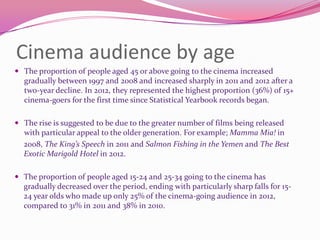
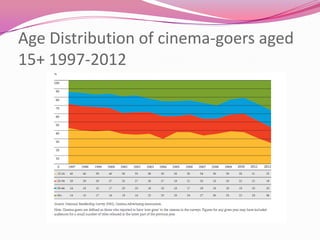
 The proportion of people aged 45 or above going to the cinema increased
gradually between 1997 and 2008 and increased sharply in 2011 and 2012 after a
two-year decline. In 2012, they represented the highest proportion (36%) of 15+
cinema-goers for the first time since Statistical Yearbook records began.
 The rise is suggested to be due to the greater number of films being released
with particular appeal to the older generation. For example; Mamma Mia! in

2008, The King’s Speech in 2011 and Salmon Fishing in the Yemen and The Best
Exotic Marigold Hotel in 2012.
 The proportion of people aged 15-24 and 25-34 going to the cinema has
gradually decreased over the period, ending with particularly sharp falls for 1524 year olds who made up only 25% of the cinema-going audience in 2012,
compared to 31% in 2011 and 38% in 2010.
Age Distribution of cinema-goers aged
15+ 1997-2012
Cinema audience by age

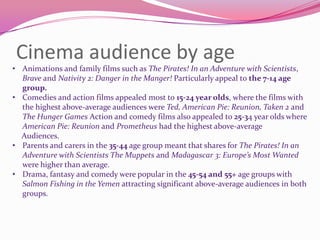
• Animations and family films such as The Pirates! In an Adventure with Scientists,
Brave and Nativity 2: Danger in the Manger! Particularly appeal to the 7-14 age
group.
• Comedies and action films appealed most to 15-24 year olds, where the films with
the highest above-average audiences were Ted, American Pie: Reunion, Taken 2 and
The Hunger Games Action and comedy films also appealed to 25-34 year olds where
American Pie: Reunion and Prometheus had the highest above-average
Audiences.
• Parents and carers in the 35-44 age group meant that shares for The Pirates! In an
Adventure with Scientists The Muppets and Madagascar 3: Europe’s Most Wanted
were higher than average.
• Drama, fantasy and comedy were popular in the 45-54 and 55+ age groups with
Salmon Fishing in the Yemen attracting significant above-average audiences in both
groups.
Film preferences by gender
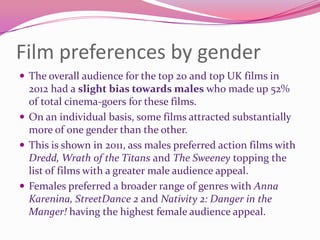
 The overall audience for the top 20 and top UK films in

2012 had a slight bias towards males who made up 52%
of total cinema-goers for these films.
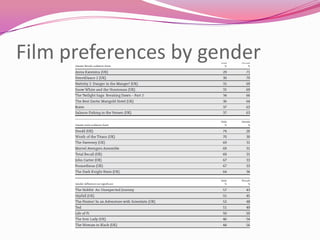
 On an individual basis, some films attracted substantially
more of one gender than the other.
 This is shown in 2011, ass males preferred action films with
Dredd, Wrath of the Titans and The Sweeney topping the
list of films with a greater male audience appeal.
 Females preferred a broader range of genres with Anna
Karenina, StreetDance 2 and Nativity 2: Danger in the
Manger! having the highest female audience appeal.
Film preferences by gender
Film preferences by social group
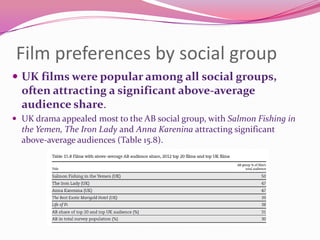
 UK films were popular among all social groups,

often attracting a significant above-average
audience share.
 UK drama appealed most to the AB social group, with Salmon Fishing in

the Yemen, The Iron Lady and Anna Karenina attracting significant
above-average audiences (Table 15.8).
Film preferences by social group
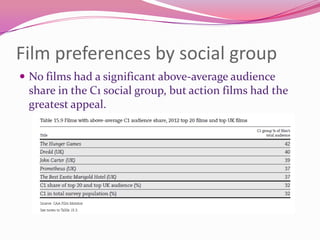
 No films had a significant above-average audience

share in the C1 social group, but action films had the
greatest appeal.
Film preferences by social group
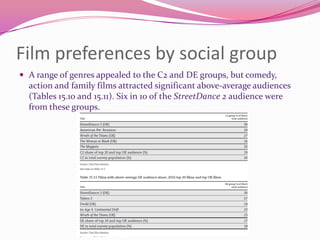
 A range of genres appealed to the C2 and DE groups, but comedy,

action and family films attracted significant above-average audiences
(Tables 15.10 and 15.11). Six in 10 of the StreetDance 2 audience were
from these groups.
Film preference by nation or region
 Most regions had one or two films with a significant

above-average audience; none of the top 20 and top
UK films attracted a significant above-average
audience in Scotland, the Midlands and Yorkshire
regions.
 However, Brave, an animation set in a mythical
Highland kingdom, had the highest audience share for
Scotland.
Film preference by ethnicity
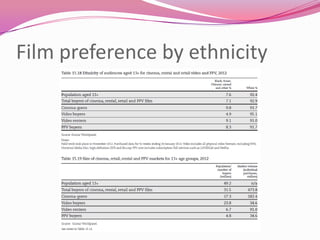
 Black and minority ethnic groups (Asian, Chinese, mixed

and other) were over-represented among buyers of cinema
tickets, video rental and pay-per-view, and underrepresented among viewers of sell-through video.
 Among white audiences sell-through video had the highest
estimated buyers, followed by cinema, which had the
highest number of individual purchases (over 182 million);
this is more than double the next highest market, video
rental.
Film preference by ethnicity

Statistical yearbook 2013

  • 1.
    Audience task byCatherine May
  • 2.
    Cinema audience byage  The proportion of people aged 45 or above going to the cinema increased gradually between 1997 and 2008 and increased sharply in 2011 and 2012 after a two-year decline. In 2012, they represented the highest proportion (36%) of 15+ cinema-goers for the first time since Statistical Yearbook records began.  The rise is suggested to be due to the greater number of films being released with particular appeal to the older generation. For example; Mamma Mia! in 2008, The King’s Speech in 2011 and Salmon Fishing in the Yemen and The Best Exotic Marigold Hotel in 2012.  The proportion of people aged 15-24 and 25-34 going to the cinema has gradually decreased over the period, ending with particularly sharp falls for 1524 year olds who made up only 25% of the cinema-going audience in 2012, compared to 31% in 2011 and 38% in 2010.
  • 3.
    Age Distribution ofcinema-goers aged 15+ 1997-2012
  • 4.
    Cinema audience byage • Animations and family films such as The Pirates! In an Adventure with Scientists, Brave and Nativity 2: Danger in the Manger! Particularly appeal to the 7-14 age group. • Comedies and action films appealed most to 15-24 year olds, where the films with the highest above-average audiences were Ted, American Pie: Reunion, Taken 2 and The Hunger Games Action and comedy films also appealed to 25-34 year olds where American Pie: Reunion and Prometheus had the highest above-average Audiences. • Parents and carers in the 35-44 age group meant that shares for The Pirates! In an Adventure with Scientists The Muppets and Madagascar 3: Europe’s Most Wanted were higher than average. • Drama, fantasy and comedy were popular in the 45-54 and 55+ age groups with Salmon Fishing in the Yemen attracting significant above-average audiences in both groups.
  • 5.
    Film preferences bygender  The overall audience for the top 20 and top UK films in 2012 had a slight bias towards males who made up 52% of total cinema-goers for these films.  On an individual basis, some films attracted substantially more of one gender than the other.  This is shown in 2011, ass males preferred action films with Dredd, Wrath of the Titans and The Sweeney topping the list of films with a greater male audience appeal.  Females preferred a broader range of genres with Anna Karenina, StreetDance 2 and Nativity 2: Danger in the Manger! having the highest female audience appeal.
  • 6.
  • 7.
    Film preferences bysocial group  UK films were popular among all social groups, often attracting a significant above-average audience share.  UK drama appealed most to the AB social group, with Salmon Fishing in the Yemen, The Iron Lady and Anna Karenina attracting significant above-average audiences (Table 15.8).
  • 8.
    Film preferences bysocial group  No films had a significant above-average audience share in the C1 social group, but action films had the greatest appeal.
  • 9.
    Film preferences bysocial group  A range of genres appealed to the C2 and DE groups, but comedy, action and family films attracted significant above-average audiences (Tables 15.10 and 15.11). Six in 10 of the StreetDance 2 audience were from these groups.
  • 10.
    Film preference bynation or region  Most regions had one or two films with a significant above-average audience; none of the top 20 and top UK films attracted a significant above-average audience in Scotland, the Midlands and Yorkshire regions.  However, Brave, an animation set in a mythical Highland kingdom, had the highest audience share for Scotland.
  • 11.
    Film preference byethnicity  Black and minority ethnic groups (Asian, Chinese, mixed and other) were over-represented among buyers of cinema tickets, video rental and pay-per-view, and underrepresented among viewers of sell-through video.  Among white audiences sell-through video had the highest estimated buyers, followed by cinema, which had the highest number of individual purchases (over 182 million); this is more than double the next highest market, video rental.
  • 12.