Electric Potential
Energy
Real-life
Applications of
Real-life Applications of Electric
Potential Energy
 Electric potential energy is a fundamental concept in physics that describes the
energy stored in an electric field.
 Electric Potential is just “Electricity”
 It has many practical applications in our daily lives, from charging our cell phones to
starting our cars.
 In this presentation, we will explore some of the ways that electric potential energy is
used in technology, medicine, space exploration, and more.
 By the end of this presentation, you will have a better understanding of the
importance of electric potential energy in our modern world.
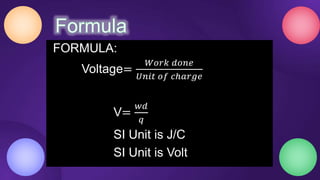
FORMULA:
Voltage=
𝑊𝑜𝑟𝑘 𝑑𝑜𝑛𝑒
𝑈𝑛𝑖𝑡 𝑜𝑓 𝑐ℎ𝑎𝑟𝑔𝑒
V=
𝑤𝑑
𝑞
SI Unit is J/C
SI Unit is Volt
What is Electric
 Electric potential energy is a type of energy that arises from the interaction between
charged particles.
 It's the energy stored in an object due to the work done on it to bring other charged
objects closer or farther away from it.
 Electric potential energy depends on the distance between charged particles and the
amount of charge they have.
 The formula:
 Electric potential energy can be converted into other forms of energy, such as kinetic
energy or light energy, depending on the system.
FORMULA:
Voltage=
𝑊𝑜𝑟𝑘 𝑑𝑜𝑛𝑒
𝑈𝑛𝑖𝑡 𝑜𝑓 𝑐ℎ𝑎𝑟𝑔𝑒
FORMULA:
Voltage=
𝑊𝑜𝑟𝑘 𝑑𝑜𝑛𝑒
𝑈𝑛𝑖𝑡 𝑜𝑓 𝑐ℎ𝑎𝑟𝑔𝑒
V=
𝑤𝑑
𝑞
SI Unit is J/C
SI Unit is Volt
• Electric potential energy is stored in the
electrical wiring of a building
• When a light switch is turned on, it
completes an electrical circuit that
allows the electric potential energy to
flow to the light bulb
• The light bulb converts the electric
potential energy into light energy,
which is then emitted as visible light
• Electric potential energy is stored in the
battery of the device
• When the battery is low, it needs to be
charged using an electrical outlet or a
portable charger
• As the battery charges, it accumulates
electric potential energy that can be
used to power the device
• Electric potential energy is stored in the
battery of the car
• When the key is turned in the ignition, it
sends an electrical signal to the starter
motor
• The starter motor uses the electric
potential energy from the battery to
turn the engine and start the car
Advantages and
limitations of using
electric potential energy
Advantages of Using Electric Potential Energy
• Efficiency: Electric potential energy can be converted into other forms of energy with
high efficiency, reducing waste and saving resources.
• Environmental Impact: Electric potential energy is a clean source of energy,
producing no harmful emissions or pollutants.
• Reliability: Electric potential energy is a reliable source of energy, with a stable and
predictable output.
Limitations of Using Electric Potential Energy
• Dependence on Infrastructure: Electric potential energy requires infrastructure such
as power grids and charging stations, which can be expensive to build and maintain.
• Energy Storage: Electric potential energy needs to be stored in batteries or other
energy storage devices, which can be costly and have limited lifetimes.
• Geographic Limitations: Some sources of electric potential energy, such as solar and
wind power, are location-dependent and may not be suitable for all areas.
Conclusion
Electric potential energy is
essential to many aspects
of modern life.
Its use has numerous
benefits and is critical to our
continued progress and
development.
Gauss Law
Electric Potential and
Electric Potential Energy
Potential Gradient
Summary for
Electrostatics
Gauss Law
• Gauss's law is a fundamental law of electromagnetism that relates the
distribution of electric charges to the electric field they produce.
• It is named after the German mathematician and physicist Carl Friedrich
Gauss, who formulated the law in 1835.
Gauss's Law Formula
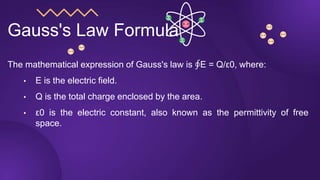
The mathematical expression of Gauss's law is ∮E = Q/ε0, where:
• E is the electric field.
• Q is the total charge enclosed by the area.
• ε0 is the electric constant, also known as the permittivity of free
space.
Application
• Lightning protection systems: Gauss's law can be used to design
effective lightning protection systems for buildings and structures. By
analyzing the electric field distribution around the building, engineers can
determine where to place lightning rods and grounding systems to
prevent lightning strikes
• Magnetic resonance imaging (MRI): MRI machines use magnetic fields to
create images of the body's internal organs and tissues. Gauss's law is
used to calculate the magnetic field strength inside the MRI machine,
ensuring that the field is uniform and safe for patients undergoing scans.
This also helps in creating accurate images.
Application
• Lightning protection systems: Gauss's law can be used to design
effective lightning protection systems for buildings and structures. By
analyzing the electric field distribution around the building, engineers can
determine where to place lightning rods and grounding systems to
prevent lightning strikes
• Magnetic resonance imaging (MRI): MRI machines use magnetic fields to
create images of the body's internal organs and tissues. Gauss's law is
used to calculate the magnetic field strength inside the MRI machine,
ensuring that the field is uniform and safe for patients undergoing scans.
This also helps in creating accurate images.
Conclusion
• Gauss's law is a powerful tool for understanding the behavior of electric
fields and their relationship with electric charges.
• The law provides a way to calculate the electric field due to a distribution
of charges, and it is often used to study the behavior of electric fields in
conductors and insulators.
• Gauss's law is a fundamental principle of electromagnetism and has
numerous applications in physics, engineering, and other fields.
Electric Potential and Electric
Potential Energy
• Electric Potential and Electric Potential Energy are important concepts in
physics that describe the behavior of charged particles in electric fields.
• The understanding of Electric Potential and Electric Potential Energy is
essential for practical applications in electrical circuits and electrostatics.
Definition and Formula for Electric
Potential
• Electric Potential is the amount of work required to move a unit of positive
charge from infinity to a point in an electric field.
• Electric Potential is expressed in volts (V).
• The formula for Electric Potential is V = W/q, where V is the Electric
Potential, W is the work done, and q is the charge.
• An example problem will be provided to demonstrate how to use the
formula.
Electric Potential and Electric
Potential Energy
• Electric Potential and Electric Potential Energy are important concepts in
physics that describe the behavior of charged particles in electric fields.
• The understanding of Electric Potential and Electric Potential Energy is
essential for practical applications in electrical circuits and electrostatics.
Application of Electric Potential and
Electric Potential Energy
• Electric Potential and Electric Potential Energy are used in real-life
situations, such as electrical circuits and electrostatics.
• In electrical circuits, Electric Potential is used to describe the potential
difference between two points in the circuit.
• In electrostatics, Electric Potential Energy is used to describe the work
done in moving charged particles between different positions in an
electric field.
Conclusion
• Electric Potential and Electric Potential Energy are important concepts in
physics that describe the behavior of charged particles in electric fields.
• Understanding these concepts is essential for practical applications in
electrical circuits and electrostatics.
• The presentation has covered the definition, formula, and application of
Electric Potential and Electric Potential Energy.
Potential Gradient
• Equipotential Surfaces are imaginary surfaces in an electric field where
the Electric Potential is constant at every point.
• Equipotential Surfaces are always perpendicular to Electric Field Lines.
• The Electric Field is strongest where the lines are closest together.
• Equipotential Surfaces are an important concept in electrostatics and are
used to understand the behavior of charged particles.
Formula
• The formula for Equipotential Surfaces is V = constant, where V is the
Electric Potential.
• Equipotential Surfaces can be constructed using mathematical equations
and graphical methods.
• Equipotential Surfaces are always perpendicular to Electric Field Lines.
• Equipotential Surfaces provide a way to calculate the Electric Field
strength and direction
Application
• Equipotential Surfaces have several applications, including:
• Electrical circuits: Equipotential Surfaces are used to understand the
behavior of charges in a circuit.
• Lightning rods: Equipotential Surfaces are used to protect buildings from
lightning strikes.
• Medical applications: Equipotential Surfaces are used in
electrocardiograms to measure the electrical activity of the heart.
• Equipotential Surfaces are also used in many other areas of physics and
engineering, including magnetism and fluid dynamics.
Conclusion
• In conclusion, Equipotential Surfaces are an important concept in physics
and engineering. They provide a way to understand the behavior of
charged particles in electric fields and are used in a variety of
applications, including electrical circuits, lightning rods, and medical
equipment. By understanding the formula for Equipotential Surfaces and
the properties of these surfaces, we can calculate the strength and
direction of electric fields and design systems that make use of these
fields.
Potential Gradient
• Potential Gradient is a measure of how fast the Electric Potential
changes as you move from one point to another in an Electric Field.
• The Potential Gradient is the change in Electric Potential per unit
distance.
• The steeper the Potential Gradient, the stronger the Electric Field.
Formula
• The formula for Potential Gradient is given by dV/dx, where dV is the
change in Electric Potential and dx is the change in distance.
• The unit of Potential Gradient is volts per meter (V/m).
• Potential Gradient can also be expressed in terms of the Electric Field
strength using the formula E = -dV/dx, where E is the Electric Field
strength.
Applications
• Potential Gradient has several applications, including:
• Capacitors: Potential Gradient is used to calculate the Electric Field
strength between the plates of a capacitor.
• Particle Accelerators: Potential Gradient is used to accelerate charged
particles to high speeds.
• Lightning: Potential Gradient is used to predict the likelihood of a lightning
strike.
• Potential Gradient is an important concept in many areas of physics and
engineering, including electronics, telecommunications, and energy
production.
Conclusion
• In conclusion, Electric Potential, Electric Potential Energy, Equipotential
Surfaces, and Potential Gradient are important concepts in electrostatics
and have many applications in physics and engineering. Understanding
these concepts allows us to understand the behavior of charged particles
in Electric Fields and to design and build devices that use Electric Fields.
Overall
• Gauss law allows us to calculate the Electric Field produced by a
charged object or distribution of charges.
• Electric Potential and Electric Potential Energy help us understand
how charges interact with each other in an electric field.
• Equipotential Surfaces are imaginary surfaces where the Electric
Potential is constant, and they have a variety of applications in
physics and engineering.
• Potential Gradient measures the change in Electric Potential with
distance and is essential for understanding the behavior of charged
particles in electric fields.
Thank
you for
listening

static-electricity-lesson-for-elementary-2.pptx

  • 1.
  • 2.
    Real-life Applications ofElectric Potential Energy  Electric potential energy is a fundamental concept in physics that describes the energy stored in an electric field.  Electric Potential is just “Electricity”  It has many practical applications in our daily lives, from charging our cell phones to starting our cars.  In this presentation, we will explore some of the ways that electric potential energy is used in technology, medicine, space exploration, and more.  By the end of this presentation, you will have a better understanding of the importance of electric potential energy in our modern world.
  • 3.
    FORMULA: Voltage= 𝑊𝑜𝑟𝑘 𝑑𝑜𝑛𝑒 𝑈𝑛𝑖𝑡 𝑜𝑓𝑐ℎ𝑎𝑟𝑔𝑒 V= 𝑤𝑑 𝑞 SI Unit is J/C SI Unit is Volt What is Electric  Electric potential energy is a type of energy that arises from the interaction between charged particles.  It's the energy stored in an object due to the work done on it to bring other charged objects closer or farther away from it.  Electric potential energy depends on the distance between charged particles and the amount of charge they have.  The formula:  Electric potential energy can be converted into other forms of energy, such as kinetic energy or light energy, depending on the system. FORMULA: Voltage= 𝑊𝑜𝑟𝑘 𝑑𝑜𝑛𝑒 𝑈𝑛𝑖𝑡 𝑜𝑓 𝑐ℎ𝑎𝑟𝑔𝑒
  • 4.
    FORMULA: Voltage= 𝑊𝑜𝑟𝑘 𝑑𝑜𝑛𝑒 𝑈𝑛𝑖𝑡 𝑜𝑓𝑐ℎ𝑎𝑟𝑔𝑒 V= 𝑤𝑑 𝑞 SI Unit is J/C SI Unit is Volt
  • 6.
    • Electric potentialenergy is stored in the electrical wiring of a building • When a light switch is turned on, it completes an electrical circuit that allows the electric potential energy to flow to the light bulb • The light bulb converts the electric potential energy into light energy, which is then emitted as visible light
  • 7.
    • Electric potentialenergy is stored in the battery of the device • When the battery is low, it needs to be charged using an electrical outlet or a portable charger • As the battery charges, it accumulates electric potential energy that can be used to power the device
  • 8.
    • Electric potentialenergy is stored in the battery of the car • When the key is turned in the ignition, it sends an electrical signal to the starter motor • The starter motor uses the electric potential energy from the battery to turn the engine and start the car
  • 9.
    Advantages and limitations ofusing electric potential energy
  • 10.
    Advantages of UsingElectric Potential Energy • Efficiency: Electric potential energy can be converted into other forms of energy with high efficiency, reducing waste and saving resources. • Environmental Impact: Electric potential energy is a clean source of energy, producing no harmful emissions or pollutants. • Reliability: Electric potential energy is a reliable source of energy, with a stable and predictable output.
  • 11.
    Limitations of UsingElectric Potential Energy • Dependence on Infrastructure: Electric potential energy requires infrastructure such as power grids and charging stations, which can be expensive to build and maintain. • Energy Storage: Electric potential energy needs to be stored in batteries or other energy storage devices, which can be costly and have limited lifetimes. • Geographic Limitations: Some sources of electric potential energy, such as solar and wind power, are location-dependent and may not be suitable for all areas.
  • 12.
    Conclusion Electric potential energyis essential to many aspects of modern life. Its use has numerous benefits and is critical to our continued progress and development.
  • 13.
    Gauss Law Electric Potentialand Electric Potential Energy Potential Gradient Summary for Electrostatics
  • 14.
    Gauss Law • Gauss'slaw is a fundamental law of electromagnetism that relates the distribution of electric charges to the electric field they produce. • It is named after the German mathematician and physicist Carl Friedrich Gauss, who formulated the law in 1835.
  • 15.
    Gauss's Law Formula Themathematical expression of Gauss's law is ∮E = Q/ε0, where: • E is the electric field. • Q is the total charge enclosed by the area. • ε0 is the electric constant, also known as the permittivity of free space.
  • 16.
    Application • Lightning protectionsystems: Gauss's law can be used to design effective lightning protection systems for buildings and structures. By analyzing the electric field distribution around the building, engineers can determine where to place lightning rods and grounding systems to prevent lightning strikes • Magnetic resonance imaging (MRI): MRI machines use magnetic fields to create images of the body's internal organs and tissues. Gauss's law is used to calculate the magnetic field strength inside the MRI machine, ensuring that the field is uniform and safe for patients undergoing scans. This also helps in creating accurate images.
  • 17.
    Application • Lightning protectionsystems: Gauss's law can be used to design effective lightning protection systems for buildings and structures. By analyzing the electric field distribution around the building, engineers can determine where to place lightning rods and grounding systems to prevent lightning strikes • Magnetic resonance imaging (MRI): MRI machines use magnetic fields to create images of the body's internal organs and tissues. Gauss's law is used to calculate the magnetic field strength inside the MRI machine, ensuring that the field is uniform and safe for patients undergoing scans. This also helps in creating accurate images.
  • 18.
    Conclusion • Gauss's lawis a powerful tool for understanding the behavior of electric fields and their relationship with electric charges. • The law provides a way to calculate the electric field due to a distribution of charges, and it is often used to study the behavior of electric fields in conductors and insulators. • Gauss's law is a fundamental principle of electromagnetism and has numerous applications in physics, engineering, and other fields.
  • 19.
    Electric Potential andElectric Potential Energy • Electric Potential and Electric Potential Energy are important concepts in physics that describe the behavior of charged particles in electric fields. • The understanding of Electric Potential and Electric Potential Energy is essential for practical applications in electrical circuits and electrostatics.
  • 20.
    Definition and Formulafor Electric Potential • Electric Potential is the amount of work required to move a unit of positive charge from infinity to a point in an electric field. • Electric Potential is expressed in volts (V). • The formula for Electric Potential is V = W/q, where V is the Electric Potential, W is the work done, and q is the charge. • An example problem will be provided to demonstrate how to use the formula.
  • 21.
    Electric Potential andElectric Potential Energy • Electric Potential and Electric Potential Energy are important concepts in physics that describe the behavior of charged particles in electric fields. • The understanding of Electric Potential and Electric Potential Energy is essential for practical applications in electrical circuits and electrostatics.
  • 22.
    Application of ElectricPotential and Electric Potential Energy • Electric Potential and Electric Potential Energy are used in real-life situations, such as electrical circuits and electrostatics. • In electrical circuits, Electric Potential is used to describe the potential difference between two points in the circuit. • In electrostatics, Electric Potential Energy is used to describe the work done in moving charged particles between different positions in an electric field.
  • 23.
    Conclusion • Electric Potentialand Electric Potential Energy are important concepts in physics that describe the behavior of charged particles in electric fields. • Understanding these concepts is essential for practical applications in electrical circuits and electrostatics. • The presentation has covered the definition, formula, and application of Electric Potential and Electric Potential Energy.
  • 24.
    Potential Gradient • EquipotentialSurfaces are imaginary surfaces in an electric field where the Electric Potential is constant at every point. • Equipotential Surfaces are always perpendicular to Electric Field Lines. • The Electric Field is strongest where the lines are closest together. • Equipotential Surfaces are an important concept in electrostatics and are used to understand the behavior of charged particles.
  • 25.
    Formula • The formulafor Equipotential Surfaces is V = constant, where V is the Electric Potential. • Equipotential Surfaces can be constructed using mathematical equations and graphical methods. • Equipotential Surfaces are always perpendicular to Electric Field Lines. • Equipotential Surfaces provide a way to calculate the Electric Field strength and direction
  • 26.
    Application • Equipotential Surfaceshave several applications, including: • Electrical circuits: Equipotential Surfaces are used to understand the behavior of charges in a circuit. • Lightning rods: Equipotential Surfaces are used to protect buildings from lightning strikes. • Medical applications: Equipotential Surfaces are used in electrocardiograms to measure the electrical activity of the heart. • Equipotential Surfaces are also used in many other areas of physics and engineering, including magnetism and fluid dynamics.
  • 27.
    Conclusion • In conclusion,Equipotential Surfaces are an important concept in physics and engineering. They provide a way to understand the behavior of charged particles in electric fields and are used in a variety of applications, including electrical circuits, lightning rods, and medical equipment. By understanding the formula for Equipotential Surfaces and the properties of these surfaces, we can calculate the strength and direction of electric fields and design systems that make use of these fields.
  • 28.
    Potential Gradient • PotentialGradient is a measure of how fast the Electric Potential changes as you move from one point to another in an Electric Field. • The Potential Gradient is the change in Electric Potential per unit distance. • The steeper the Potential Gradient, the stronger the Electric Field.
  • 29.
    Formula • The formulafor Potential Gradient is given by dV/dx, where dV is the change in Electric Potential and dx is the change in distance. • The unit of Potential Gradient is volts per meter (V/m). • Potential Gradient can also be expressed in terms of the Electric Field strength using the formula E = -dV/dx, where E is the Electric Field strength.
  • 30.
    Applications • Potential Gradienthas several applications, including: • Capacitors: Potential Gradient is used to calculate the Electric Field strength between the plates of a capacitor. • Particle Accelerators: Potential Gradient is used to accelerate charged particles to high speeds. • Lightning: Potential Gradient is used to predict the likelihood of a lightning strike. • Potential Gradient is an important concept in many areas of physics and engineering, including electronics, telecommunications, and energy production.
  • 31.
    Conclusion • In conclusion,Electric Potential, Electric Potential Energy, Equipotential Surfaces, and Potential Gradient are important concepts in electrostatics and have many applications in physics and engineering. Understanding these concepts allows us to understand the behavior of charged particles in Electric Fields and to design and build devices that use Electric Fields.
  • 32.
    Overall • Gauss lawallows us to calculate the Electric Field produced by a charged object or distribution of charges. • Electric Potential and Electric Potential Energy help us understand how charges interact with each other in an electric field. • Equipotential Surfaces are imaginary surfaces where the Electric Potential is constant, and they have a variety of applications in physics and engineering. • Potential Gradient measures the change in Electric Potential with distance and is essential for understanding the behavior of charged particles in electric fields.
  • 33.