STATIC TECHNIQUES
http://uin-suska.ac.id/
http://fst.uin-suska.ac.id/
EVA KHASANA
PROGRAM STUDI S1 SISTEM INFORMASI
FAKULTAS SAINS DAN TEKNOLOGI
UNIVERSITAS ISLAM NEGERI SULTAN SYARIF KASIM RIAU
http://sif.uin-suska.ac.id/
REVIEWS AND THE TEST PROCESS
The definition of testing outlines objectives that relate to evaluation, revealing defects
and quality. As indicated in the definition two approaches can be used to achieve these
objectives, static testing and dynamic testing.
With dynamic testing methods, software is executed using a set of input values and
its output is then examined and compared to what is expected. During static testing,
software work products are examined manually, or with a set of tools, but not executed.
As a consequence, dynamic testing can only be applied to software code. Dynamic
execution is applied as a technique to detect defects and to determine quality attributes of
the code.
REVIEW PROCESS
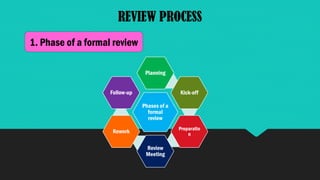
Phases of a
formal
review
Planning
Kick-off
Preparatio
n
Review
Meeting
Rework
Follow-up
1. Phase of a formal review
2. Roles and responsibilities
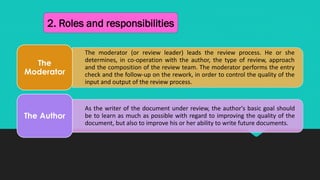
The moderator (or review leader) leads the review process. He or she
determines, in co-operation with the author, the type of review, approach
and the composition of the review team. The moderator performs the entry
check and the follow-up on the rework, in order to control the quality of the
input and output of the review process.
The
Moderator
As the writer of the document under review, the author's basic goal should
be to learn as much as possible with regard to improving the quality of the
document, but also to improve his or her ability to write future documents.
The Author
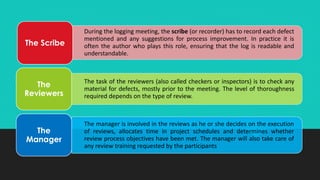
During the logging meeting, the scribe (or recorder) has to record each defect
mentioned and any suggestions for process improvement. In practice it is
often the author who plays this role, ensuring that the log is readable and
understandable.
The Scribe
The task of the reviewers (also called checkers or inspectors) is to check any
material for defects, mostly prior to the meeting. The level of thoroughness
required depends on the type of review.
The
Reviewers
The manager is involved in the reviews as he or she decides on the execution
of reviews, allocates time in project schedules and determines whether
review process objectives have been met. The manager will also take care of
any review training requested by the participants
The
Manager
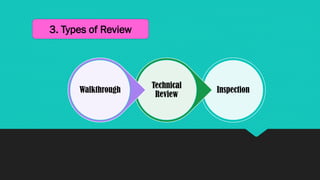
3. Types of Review
Inspection
Technical
Review
Walkthrough
Walktrough
A walkthrough is characterized by the author of the document under review guiding
the participants through the document and his or her thought processes, to achieve
a common understanding and to gather feedback. This is especially useful if people
from outside the software discipline are present, who are not used to, or cannot
easily understand software development documents. The content of the document is
explained step by step by the author, to reach consensus on changes or to gather
information.
Technical Review
A technical review is a discussion meeting that focuses on achieving consensus
about the technical content of a document. Compared to inspections, technical
reviews are less formal and there is little or no focus on defect identification on the
basis of referenced documents, intended readership and rules. During technical
reviews defects are found by experts, who focus on the content of the document.
The experts that are needed for a technical review are, for example, architects, chief
designers and key users. In practice, technical reviews vary from quite informal to
very formal.
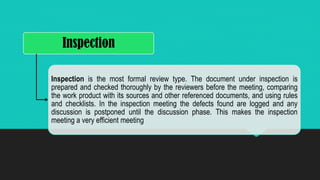
Inspection
Inspection is the most formal review type. The document under inspection is
prepared and checked thoroughly by the reviewers before the meeting, comparing
the work product with its sources and other referenced documents, and using rules
and checklists. In the inspection meeting the defects found are logged and any
discussion is postponed until the discussion phase. This makes the inspection
meeting a very efficient meeting
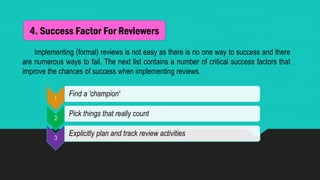
4. Success Factor For Reviewers
Implementing (formal) reviews is not easy as there is no one way to success and there
are numerous ways to fail. The next list contains a number of critical success factors that
improve the chances of success when implementing reviews.
1
Find a 'champion'
2
Pick things that really count
3
Explicitly plan and track review activities
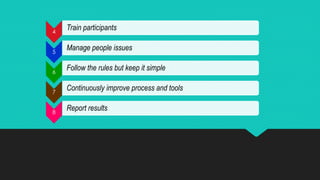
4
Train participants
5
Manage people issues
6
Follow the rules but keep it simple
7
Continuously improve process and tools
8
Report results
THANK YOU

Static techniques

  • 1.
    STATIC TECHNIQUES http://uin-suska.ac.id/ http://fst.uin-suska.ac.id/ EVA KHASANA PROGRAMSTUDI S1 SISTEM INFORMASI FAKULTAS SAINS DAN TEKNOLOGI UNIVERSITAS ISLAM NEGERI SULTAN SYARIF KASIM RIAU http://sif.uin-suska.ac.id/
  • 2.
    REVIEWS AND THETEST PROCESS The definition of testing outlines objectives that relate to evaluation, revealing defects and quality. As indicated in the definition two approaches can be used to achieve these objectives, static testing and dynamic testing. With dynamic testing methods, software is executed using a set of input values and its output is then examined and compared to what is expected. During static testing, software work products are examined manually, or with a set of tools, but not executed. As a consequence, dynamic testing can only be applied to software code. Dynamic execution is applied as a technique to detect defects and to determine quality attributes of the code.
  • 3.
    REVIEW PROCESS Phases ofa formal review Planning Kick-off Preparatio n Review Meeting Rework Follow-up 1. Phase of a formal review
  • 4.
    2. Roles andresponsibilities The moderator (or review leader) leads the review process. He or she determines, in co-operation with the author, the type of review, approach and the composition of the review team. The moderator performs the entry check and the follow-up on the rework, in order to control the quality of the input and output of the review process. The Moderator As the writer of the document under review, the author's basic goal should be to learn as much as possible with regard to improving the quality of the document, but also to improve his or her ability to write future documents. The Author
  • 5.
    During the loggingmeeting, the scribe (or recorder) has to record each defect mentioned and any suggestions for process improvement. In practice it is often the author who plays this role, ensuring that the log is readable and understandable. The Scribe The task of the reviewers (also called checkers or inspectors) is to check any material for defects, mostly prior to the meeting. The level of thoroughness required depends on the type of review. The Reviewers The manager is involved in the reviews as he or she decides on the execution of reviews, allocates time in project schedules and determines whether review process objectives have been met. The manager will also take care of any review training requested by the participants The Manager
  • 6.
    3. Types ofReview Inspection Technical Review Walkthrough
  • 7.
    Walktrough A walkthrough ischaracterized by the author of the document under review guiding the participants through the document and his or her thought processes, to achieve a common understanding and to gather feedback. This is especially useful if people from outside the software discipline are present, who are not used to, or cannot easily understand software development documents. The content of the document is explained step by step by the author, to reach consensus on changes or to gather information.
  • 8.
    Technical Review A technicalreview is a discussion meeting that focuses on achieving consensus about the technical content of a document. Compared to inspections, technical reviews are less formal and there is little or no focus on defect identification on the basis of referenced documents, intended readership and rules. During technical reviews defects are found by experts, who focus on the content of the document. The experts that are needed for a technical review are, for example, architects, chief designers and key users. In practice, technical reviews vary from quite informal to very formal.
  • 9.
    Inspection Inspection is themost formal review type. The document under inspection is prepared and checked thoroughly by the reviewers before the meeting, comparing the work product with its sources and other referenced documents, and using rules and checklists. In the inspection meeting the defects found are logged and any discussion is postponed until the discussion phase. This makes the inspection meeting a very efficient meeting
  • 10.
    4. Success FactorFor Reviewers Implementing (formal) reviews is not easy as there is no one way to success and there are numerous ways to fail. The next list contains a number of critical success factors that improve the chances of success when implementing reviews. 1 Find a 'champion' 2 Pick things that really count 3 Explicitly plan and track review activities
  • 11.
    4 Train participants 5 Manage peopleissues 6 Follow the rules but keep it simple 7 Continuously improve process and tools 8 Report results
  • 12.