Static and Class Methods in
Python
Bhanwar Singh
What?
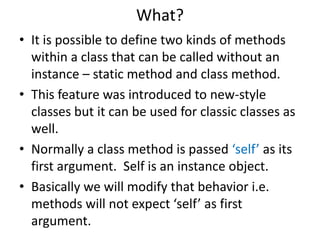
• It is possible to define two kinds of methods
within a class that can be called without an
instance – static method and class method.
• This feature was introduced to new-style
classes but it can be used for classic classes as
well.
• Normally a class method is passed ‘self’ as its
first argument. Self is an instance object.
• Basically we will modify that behavior i.e.
methods will not expect ‘self’ as first
argument.
But..Why?
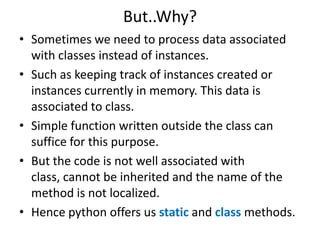
• Sometimes we need to process data associated
with classes instead of instances.
• Such as keeping track of instances created or
instances currently in memory. This data is
associated to class.
• Simple function written outside the class can
suffice for this purpose.
• But the code is not well associated with
class, cannot be inherited and the name of the
method is not localized.
• Hence python offers us static and class methods.
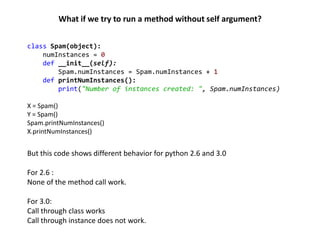
What if we try to run a method without self argument?
class Spam(object):
numInstances = 0
def __init__(self):
Spam.numInstances = Spam.numInstances + 1
def printNumInstances():
print("Number of instances created: ", Spam.numInstances)
X = Spam()
Y = Spam()
Spam.printNumInstances()
X.printNumInstances()
But this code shows different behavior for python 2.6 and 3.0
For 2.6 :
None of the method call work.
For 3.0:
Call through class works
Call through instance does not work.
Static Methods
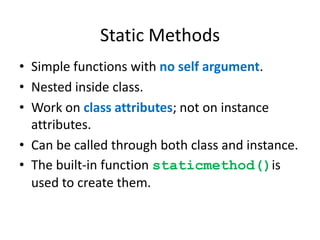
• Simple functions with no self argument.
• Nested inside class.
• Work on class attributes; not on instance
attributes.
• Can be called through both class and instance.
• The built-in function staticmethod()is
used to create them.
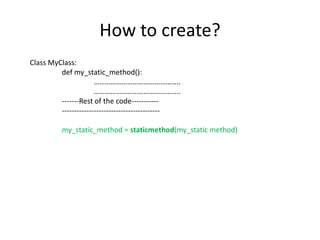
How to create?
Class MyClass:
def my_static_method():
………………………………………..
………………………………………..
-------Rest of the code-----------
----------------------------------------
my_static_method = staticmethod(my_static method)
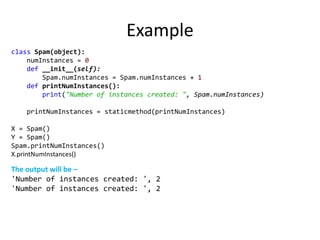
Example
class Spam(object):
numInstances = 0
def __init__(self):
Spam.numInstances = Spam.numInstances + 1
def printNumInstances():
print("Number of instances created: ", Spam.numInstances)
printNumInstances = staticmethod(printNumInstances)
X = Spam()
Y = Spam()
Spam.printNumInstances()
X.printNumInstances()
The output will be –
'Number of instances created: ', 2
Benefits of Static Methods.
• It localizes the function name in the class
scope (so it won’t clash with other names in
the module).
• It moves the function code closer to where it
is used (inside the class statement).
• It allows subclasses to customize the static
method with inheritance.
• Classes can inherit the static method without
redefining it
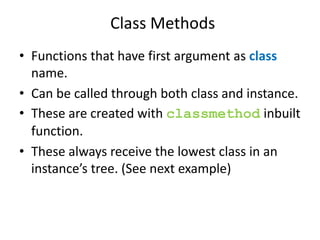
Class Methods
• Functions that have first argument as class
name.
• Can be called through both class and instance.
• These are created with classmethod inbuilt
function.
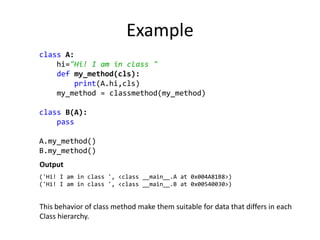
• These always receive the lowest class in an
instance’s tree. (See next example)
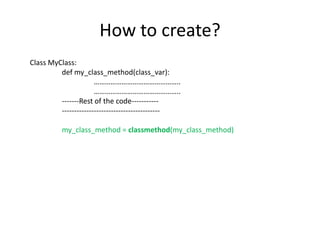
How to create?
Class MyClass:
def my_class_method(class_var):
………………………………………..
………………………………………..
-------Rest of the code-----------
----------------------------------------
my_class_method = classmethod(my_class_method)
class A:
hi="Hi! I am in class "
def my_method(cls):
print(A.hi,cls)
my_method = classmethod(my_method)
class B(A):
pass
A.my_method()
B.my_method()
('Hi! I am in class ', <class __main__.A at 0x004A81B8>)
('Hi! I am in class ', <class __main__.B at 0x00540030>)
Output
Example
This behavior of class method make them suitable for data that differs in each
Class hierarchy.
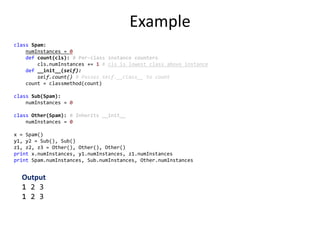
Example
class Spam:
numInstances = 0
def count(cls): # Per-class instance counters
cls.numInstances += 1 # cls is lowest class above instance
def __init__(self):
self.count() # Passes self.__class__ to count
count = classmethod(count)
class Sub(Spam):
numInstances = 0
class Other(Spam): # Inherits __init__
numInstances = 0
x = Spam()
y1, y2 = Sub(), Sub()
z1, z2, z3 = Other(), Other(), Other()
print x.numInstances, y1.numInstances, z1.numInstances
print Spam.numInstances, Sub.numInstances, Other.numInstances
Output
1 2 3
1 2 3

Advanced Python : Static and Class Methods

  • 1.
    Static and ClassMethods in Python Bhanwar Singh
  • 2.
    What? • It ispossible to define two kinds of methods within a class that can be called without an instance – static method and class method. • This feature was introduced to new-style classes but it can be used for classic classes as well. • Normally a class method is passed ‘self’ as its first argument. Self is an instance object. • Basically we will modify that behavior i.e. methods will not expect ‘self’ as first argument.
  • 3.
    But..Why? • Sometimes weneed to process data associated with classes instead of instances. • Such as keeping track of instances created or instances currently in memory. This data is associated to class. • Simple function written outside the class can suffice for this purpose. • But the code is not well associated with class, cannot be inherited and the name of the method is not localized. • Hence python offers us static and class methods.
  • 4.
    What if wetry to run a method without self argument? class Spam(object): numInstances = 0 def __init__(self): Spam.numInstances = Spam.numInstances + 1 def printNumInstances(): print("Number of instances created: ", Spam.numInstances) X = Spam() Y = Spam() Spam.printNumInstances() X.printNumInstances() But this code shows different behavior for python 2.6 and 3.0 For 2.6 : None of the method call work. For 3.0: Call through class works Call through instance does not work.
  • 5.
    Static Methods • Simplefunctions with no self argument. • Nested inside class. • Work on class attributes; not on instance attributes. • Can be called through both class and instance. • The built-in function staticmethod()is used to create them.
  • 6.
    How to create? ClassMyClass: def my_static_method(): ……………………………………….. ……………………………………….. -------Rest of the code----------- ---------------------------------------- my_static_method = staticmethod(my_static method)
  • 7.
    Example class Spam(object): numInstances =0 def __init__(self): Spam.numInstances = Spam.numInstances + 1 def printNumInstances(): print("Number of instances created: ", Spam.numInstances) printNumInstances = staticmethod(printNumInstances) X = Spam() Y = Spam() Spam.printNumInstances() X.printNumInstances() The output will be – 'Number of instances created: ', 2 'Number of instances created: ', 2
  • 8.
    Benefits of StaticMethods. • It localizes the function name in the class scope (so it won’t clash with other names in the module). • It moves the function code closer to where it is used (inside the class statement). • It allows subclasses to customize the static method with inheritance. • Classes can inherit the static method without redefining it
  • 9.
    Class Methods • Functionsthat have first argument as class name. • Can be called through both class and instance. • These are created with classmethod inbuilt function. • These always receive the lowest class in an instance’s tree. (See next example)
  • 10.
    How to create? ClassMyClass: def my_class_method(class_var): ……………………………………….. ……………………………………….. -------Rest of the code----------- ---------------------------------------- my_class_method = classmethod(my_class_method)
  • 11.
    class A: hi="Hi! Iam in class " def my_method(cls): print(A.hi,cls) my_method = classmethod(my_method) class B(A): pass A.my_method() B.my_method() ('Hi! I am in class ', <class __main__.A at 0x004A81B8>) ('Hi! I am in class ', <class __main__.B at 0x00540030>) Output Example This behavior of class method make them suitable for data that differs in each Class hierarchy.
  • 12.
    Example class Spam: numInstances =0 def count(cls): # Per-class instance counters cls.numInstances += 1 # cls is lowest class above instance def __init__(self): self.count() # Passes self.__class__ to count count = classmethod(count) class Sub(Spam): numInstances = 0 class Other(Spam): # Inherits __init__ numInstances = 0 x = Spam() y1, y2 = Sub(), Sub() z1, z2, z3 = Other(), Other(), Other() print x.numInstances, y1.numInstances, z1.numInstances print Spam.numInstances, Sub.numInstances, Other.numInstances Output 1 2 3 1 2 3