The Effect of English Language Learning
to The Communication Skills Among
Grade 7 and 8 Students of The Lovelace
Academy
General Problem
● This study aims to determine the effect of
English language learning on the communication
skills of the grade 7 and 8 students of the
Lovelace Academy.
Statement of the
Problem
● How do the Grade 7 and 8 Students Learn English
Language in terms of
1.1 Adequate Exposure
1.2 Literatures
1.3 Movies and Media
● Identify factors that may hinder the development of
communication skills
1.1 English Proficiency
1.2 Linguistic Diversity
1.3 inadequate Exposure
● Is There any significant relationships between English
language to the communication skills among Grade 7 and
8 students.
● What potential strategies or solutions can be proposed to
improve communication skills among Grade 7 and 8
students of the lovelace academy.
Conceptual
framework
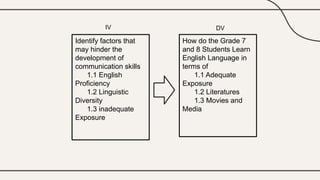
Identify factors that
may hinder the
development of
communication skills
1.1 English
Proficiency
1.2 Linguistic
Diversity
1.3 inadequate
Exposure
How do the Grade 7
and 8 Students Learn
English Language in
terms of
1.1 Adequate
Exposure
1.2 Literatures
1.3 Movies and
Media
IV DV
A Book: A Comprehensive Improvement In The
English Language
Theoretical
Framework
Theoretical Framework
According to Barbara Kawulich(2006) Theoretical backing
helps to enhance the relevance of research and provides
important insights. Making theories an essential and vital
part of a research as it is essential the skeleton frame of your
paper. This study is anchored by a study titled
“Communication Theory” by Betteke van Ruler and another
titled, “Learning Theories that Impact English Teaching and
Learning” by Xiaofei Rao.
Communication Theory
The paper titled “Communication Theory” provides a high overview of
key concepts, frameworks, and models when it comes to
understanding human communication; this includes the linear,
interactive, and transactional. Linear models depict communication as
a one-way process; interactive, on the other hand, incorporates
feedback; and transactional emphasizes that communication is
dynamic and a simulated process. Communication is defined partially
based on its process and environmental condition, so there is no grand
theory in communication fields (Ruler, 2018).
That is all,
Thank You

Statement of the problem Practical Research 1

  • 1.
    The Effect ofEnglish Language Learning to The Communication Skills Among Grade 7 and 8 Students of The Lovelace Academy
  • 2.
  • 3.
    ● This studyaims to determine the effect of English language learning on the communication skills of the grade 7 and 8 students of the Lovelace Academy.
  • 4.
  • 5.
    ● How dothe Grade 7 and 8 Students Learn English Language in terms of 1.1 Adequate Exposure 1.2 Literatures 1.3 Movies and Media ● Identify factors that may hinder the development of communication skills 1.1 English Proficiency 1.2 Linguistic Diversity 1.3 inadequate Exposure
  • 6.
    ● Is Thereany significant relationships between English language to the communication skills among Grade 7 and 8 students. ● What potential strategies or solutions can be proposed to improve communication skills among Grade 7 and 8 students of the lovelace academy.
  • 7.
  • 8.
    Identify factors that mayhinder the development of communication skills 1.1 English Proficiency 1.2 Linguistic Diversity 1.3 inadequate Exposure How do the Grade 7 and 8 Students Learn English Language in terms of 1.1 Adequate Exposure 1.2 Literatures 1.3 Movies and Media IV DV
  • 9.
    A Book: AComprehensive Improvement In The English Language
  • 10.
  • 11.
    Theoretical Framework According toBarbara Kawulich(2006) Theoretical backing helps to enhance the relevance of research and provides important insights. Making theories an essential and vital part of a research as it is essential the skeleton frame of your paper. This study is anchored by a study titled “Communication Theory” by Betteke van Ruler and another titled, “Learning Theories that Impact English Teaching and Learning” by Xiaofei Rao.
  • 12.
    Communication Theory The papertitled “Communication Theory” provides a high overview of key concepts, frameworks, and models when it comes to understanding human communication; this includes the linear, interactive, and transactional. Linear models depict communication as a one-way process; interactive, on the other hand, incorporates feedback; and transactional emphasizes that communication is dynamic and a simulated process. Communication is defined partially based on its process and environmental condition, so there is no grand theory in communication fields (Ruler, 2018).
  • 13.