Startup Lessons Learned

Mark Menard
Barcamp Albany
March 31, 2012


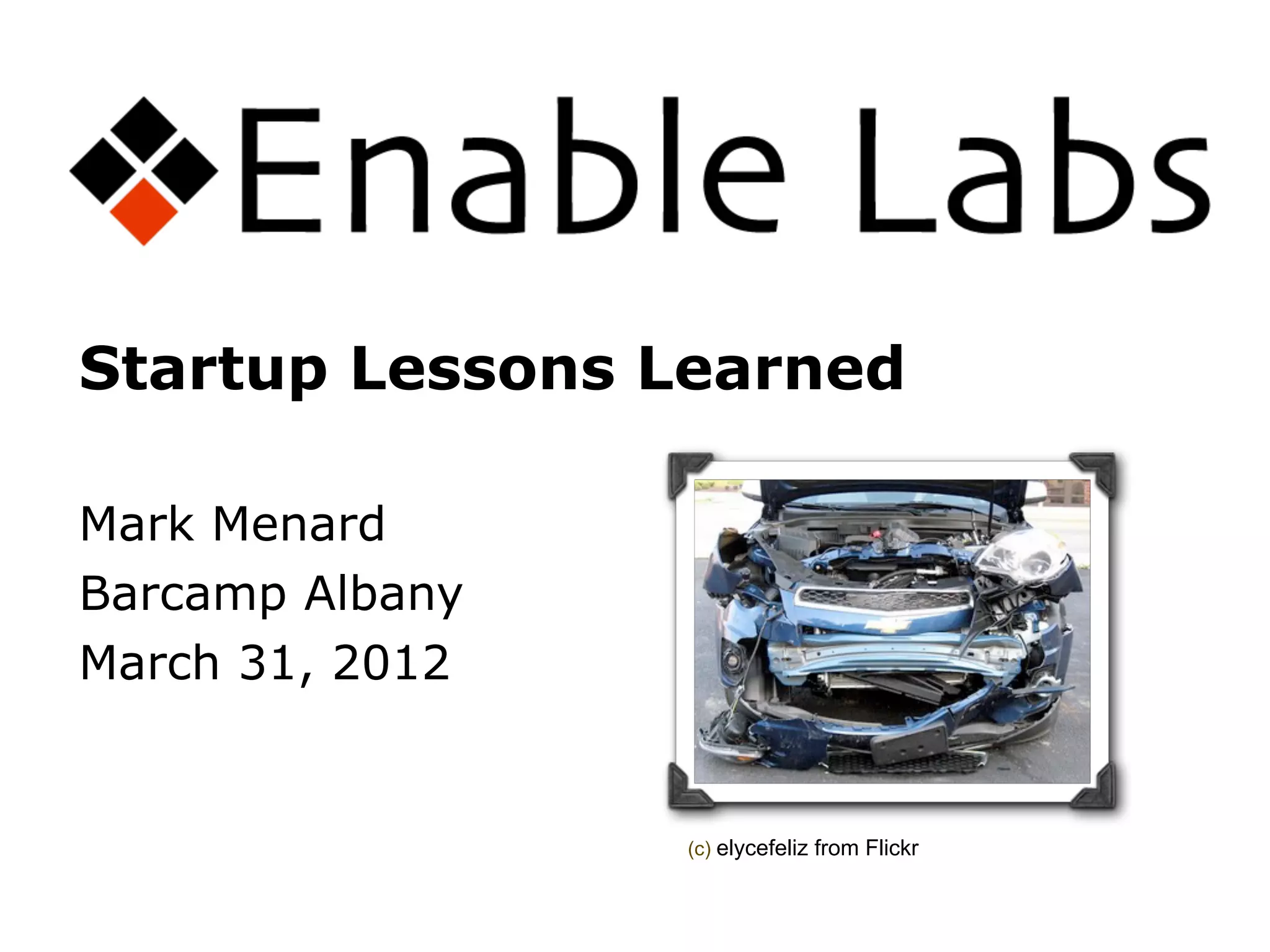
                 (c) elycefeliz from Flickr
Integration is Hard


                      2
3
Understand
Technical Limits


                   4
5
Startup are not for
Leaning the Basics


                      6
7
Grand Openings Don’t Work


                            8
9
Work Stories from
Beginning to End


                    10
(c) Al_HikesAZ from Flickr


                             11
Roll Out Iteratively


                       12
(c) Gerry Kirk from Flickr


                             13
There Can be Only One!


                         14
(c) Mashall Astor - Food Fetishist from Flickr


                                                 15
Transparency is Paramount


                            16
(c) Muffet from Flickr


                         17
Deploy Early and Often


                         18
19
Document Your
Requirements


                20
21
No API Stories Unless the
    Product is an API


                            22
(c) Julie70 from Flickr


                          23
Use a Content Management
System for CONTENT


                           24
25
I’m Mark Menard
   @mark_menard


We Build Web & Mobile Apps
   We Build Community
    We Build Startups

http://www.enablelabs.com/


                             26

Startup Lessons Learned

Editor's Notes

  • #2 \n
  • #3 \n
  • #4  Everyone underestimates the complexity.\n APIs change all the time.\n The Internet sucks at reliability.\n Exception handling is awkward at best.\n Business people don’t get it.\n
  • #5 \n
  • #6  Conventions make things cheaper.\n Breaking conventions is expensive.\n Pick and choose carefully.\n
  • #7 \n
  • #8 Don’t try to learn to program on your startup.\nDon’t try to learn graphic design on your startup.\nDon’t try to learn to be a lawyer on your startup.\nBuild a team with experienced practitioners. \nGetting up to speed is hard and is REALLY expensive.\n\nYour most valuable asset is time.\n\nUnderstand your costs. Education is expensive in time and lost opportunity.\n
  • #9 \n
  • #10 They don’t allow you to learn.\n\nStart small and iterate.\n\nYou don’t know what you’re doing yet.\n
  • #11 \n
  • #12 The only thing that matters is what the client sees. \n\nIf the customer can’t see it then it’s not done.\n\nTell story about multi-tier apps and RIA’s.\n
  • #13 \n
  • #14 Right now you know the least you will ever know about your product, market, customers, etc.\n\nIterations allow you to learn and course correct.\n
  • #15 \n
  • #16 There MUST be a product owner.\n\nOne person who has complete and total authority to answer questions about how the product is going to work.\n\nWhat’s a camel?\n\nA horse designed by a committee.\n
  • #17 \n
  • #18 If you aren’t willing to share with someone you don’t trust them. So, don’t work with them.\n\nBusiness moves too fast and dependencies develop to quickly to work with people you don’t trust.\n\n\n
  • #19 \n
  • #20 You do not want to be figuring this stuff out when you’re trying to roll out your product under the gun.\n
  • #21 \n
  • #22 Do not depend on email, spreadsheets, or other non-shared documents.\n\nTools must be:\n\n* Shared\n* versioned\n* Support workflow\n\nCollaboration is paramount.\n\nEveryone must use the same tools! Figure out a set and agree on them.\n
  • #23 \n
  • #24 If your app is an integrated front end and back end system. Until the front end is integrated with the backend it’s not done.\n\nHaving API stories and disconnecting the integration work allows people to cherry-pick the easy stuff and leave the hard work for later.\n
  • #25 \n
  • #26 Do not try to manage content in your source repository.\n
  • #27 \n