Starting Out with Python 3rd Edition Gaddis Test Bank
Starting Out with Python 3rd Edition Gaddis Test Bank
Starting Out with Python 3rd Edition Gaddis Test Bank
Starting Out with Python 3rd Edition Gaddis Test Bank
Starting Out with Python 3rd Edition Gaddis Test Bank
1.
Visit https://testbankfan.com todownload the full version and
explore more testbank or solutions manual
Starting Out with Python 3rd Edition Gaddis Test
Bank
_____ Click the link below to download _____
https://testbankfan.com/product/starting-out-with-
python-3rd-edition-gaddis-test-bank/
Explore and download more testbank or solutions manual at testbankfan.com
2.
Here are somerecommended products that we believe you will be
interested in. You can click the link to download.
Starting Out with Python 3rd Edition Gaddis Solutions
Manual
https://testbankfan.com/product/starting-out-with-python-3rd-edition-
gaddis-solutions-manual/
Starting Out with Python 4th Edition Gaddis Test Bank
https://testbankfan.com/product/starting-out-with-python-4th-edition-
gaddis-test-bank/
Starting Out With Python 2nd Edition Gaddis Solutions
Manual
https://testbankfan.com/product/starting-out-with-python-2nd-edition-
gaddis-solutions-manual/
Starting Out with Alice 3rd Edition Tony Gaddis Test Bank
https://testbankfan.com/product/starting-out-with-alice-3rd-edition-
tony-gaddis-test-bank/
3.
Starting Out withVisual Basic 7th Edition Gaddis Test
Bank
https://testbankfan.com/product/starting-out-with-visual-basic-7th-
edition-gaddis-test-bank/
Starting out with Visual C 4th Edition Gaddis Test Bank
https://testbankfan.com/product/starting-out-with-visual-c-4th-
edition-gaddis-test-bank/
Starting Out with Programming Logic and Design 3rd Edition
Tony Gaddis Test Bank
https://testbankfan.com/product/starting-out-with-programming-logic-
and-design-3rd-edition-tony-gaddis-test-bank/
Starting Out with C++ Early Objects 9th Edition Gaddis
Test Bank
https://testbankfan.com/product/starting-out-with-c-early-objects-9th-
edition-gaddis-test-bank/
Starting Out with Java Early Objects 6th Edition Gaddis
Test Bank
https://testbankfan.com/product/starting-out-with-java-early-
objects-6th-edition-gaddis-test-bank/
5.
Gaddis: Starting Outwith Python, 3e - Test Bank
Chapter Seven
MULTIPLE CHOICE
1. What are the data items in the list called?
a. data
b. elements
c. items
d. values
ANS: B
2. Which list will be referenced by the variable number after the execution of the following code?
number = range(0, 9, 2)
a. [0, 1, 2, 3, 4, 5, 6, 7, 8, 9]
b. [1, 3, 5, 7, 9]
c. [2, 4, 6, 8]
d. [0, 2, 4, 6, 8]
ANS: D
3. What would you use if an element is to be removed from a specific index?
a. del statement
b. remove method
c. index method
d. slice method
ANS: A
4. What is the first negative index in a list?
a. 0
b. -1
c. -0
d. Size of the string or list minus one
ANS: B
5. What method can be used to place an item in the list at a specific index?
a. append
b. index
c. insert
d. Add
ANS: C
6. What would be the value of the variable list after the execution of the following code?
list = [1, 2]
list = list * 3
a. [1, 2] * 3
6.
Gaddis: Starting Outwith Python, 3e - Test Bank, Chapter Seven 2
b. [3, 6]
c. [1, 2, 1, 2, 1, 2]
d. [[1, 2], [1, 2], [1, 2]]
ANS: C
7. What would be the value of the variable list after the execution of the following code?
list = [1, 2, 3, 4]
list[3] = 10
a. [1, 2, 3, 10]
b. [1, 2, 10, 4]
c. [1, 10, 10, 10]
d. invalid code
ANS: A
8. What method or operator can be used to concatenate lists?
a. *
b. +
c. %
d. concat
ANS: B
9. What would be the value of the variable list2 after the execution of the following code?
list1 = [1, 2, 3]
list2 = list1
list1 = [4, 5, 6]
a. [1, 2, 3]
b. [4, 5, 6]
c. [1, 2, 3, 4, 5, 6]
d. invalid code
ANS: B
10. What would be the value of the variable list2 after the execution of the following code?
list1 = [1, 2, 3]
list2 = []
for element in list1
list2.append(element)
list1 = [4, 5, 6]
a. [1, 2, 3]
b. [4, 5, 6]
c. [1, 2, 3, 4, 5, 6]
d. invalid code
ANS: A
7.
Gaddis: Starting Outwith Python, 3e - Test Bank, Chapter Seven 3
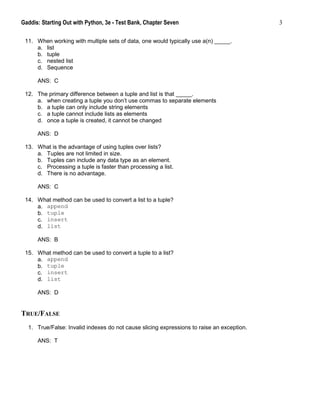
11. When working with multiple sets of data, one would typically use a(n) _____.
a. list
b. tuple
c. nested list
d. Sequence
ANS: C
12. The primary difference between a tuple and list is that _____.
a. when creating a tuple you don’t use commas to separate elements
b. a tuple can only include string elements
c. a tuple cannot include lists as elements
d. once a tuple is created, it cannot be changed
ANS: D
13. What is the advantage of using tuples over lists?
a. Tuples are not limited in size.
b. Tuples can include any data type as an element.
c. Processing a tuple is faster than processing a list.
d. There is no advantage.
ANS: C
14. What method can be used to convert a list to a tuple?
a. append
b. tuple
c. insert
d. list
ANS: B
15. What method can be used to convert a tuple to a list?
a. append
b. tuple
c. insert
d. list
ANS: D
TRUE/FALSE
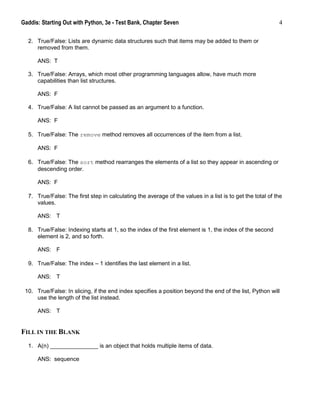
1. True/False: Invalid indexes do not cause slicing expressions to raise an exception.
ANS: T
8.
Gaddis: Starting Outwith Python, 3e - Test Bank, Chapter Seven 4
2. True/False: Lists are dynamic data structures such that items may be added to them or
removed from them.
ANS: T
3. True/False: Arrays, which most other programming languages allow, have much more
capabilities than list structures.
ANS: F
4. True/False: A list cannot be passed as an argument to a function.
ANS: F
5. True/False: The remove method removes all occurrences of the item from a list.
ANS: F
6. True/False: The sort method rearranges the elements of a list so they appear in ascending or
descending order.
ANS: F
7. True/False: The first step in calculating the average of the values in a list is to get the total of the
values.
ANS: T
8. True/False: Indexing starts at 1, so the index of the first element is 1, the index of the second
element is 2, and so forth.
ANS: F
9. True/False: The index – 1 identifies the last element in a list.
ANS: T
10. True/False: In slicing, if the end index specifies a position beyond the end of the list, Python will
use the length of the list instead.
ANS: T
FILL IN THE BLANK
1. A(n) _______________ is an object that holds multiple items of data.
ANS: sequence
9.
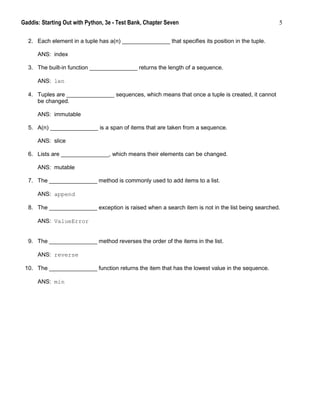
Gaddis: Starting Outwith Python, 3e - Test Bank, Chapter Seven 5
2. Each element in a tuple has a(n) _______________ that specifies its position in the tuple.
ANS: index
3. The built-in function _______________ returns the length of a sequence.
ANS: len
4. Tuples are _______________ sequences, which means that once a tuple is created, it cannot
be changed.
ANS: immutable
5. A(n) _______________ is a span of items that are taken from a sequence.
ANS: slice
6. Lists are _______________, which means their elements can be changed.
ANS: mutable
7. The _______________ method is commonly used to add items to a list.
ANS: append
8. The _______________ exception is raised when a search item is not in the list being searched.
ANS: ValueError
9. The _______________ method reverses the order of the items in the list.
ANS: reverse
10. The _______________ function returns the item that has the lowest value in the sequence.
ANS: min
smuggling on thepart of the owners of these vessels. The Chinese
openly came on board and bought and took away the opium,
“squaring” matters, so to speak, with the Mandarins. These so-called
smugglers belonged to all nationalities. There were Americans,
Portuguese, and Germans, as well as English, engaged in it.
According to the international law of European countries, the
Chinese Government ought, under the circumstances, to have had a
proper preventive service, and so put down the smuggling. But,
instead of this, the practice was openly encouraged by the Chinese
officials, some of them Mandarins of high position.
Now and then an explosion would occur; angry remonstrances would
be addressed to the British Government, and bad feeling between
the two nations would be engendered, the Chinese all along treating
us as barbarians, using the most insulting language towards us, and
subjecting our people, whenever opportunity offered, to the greatest
indignities. The missionaries have ignored all this. They appear to
have satisfied themselves so completely that we forced this trade
upon the Chinese that they have lost sight both of fact and reason.
The very existence of an opium-smuggling trade with China shows
that the article smuggled was in very great demand in that country.
People never illegally take into a country an article that is not greatly
in request there. They will not risk their lives and property unless
they know large profits are to be acquired by the venture, and such
profits can only be made upon articles in great demand. It was
because there was found to be a demand for Indian opium that this
so-called contraband trade sprang up. This furnishes the strongest
proof that the Chinese valued the opium highly, and that it was on
their invitation that the drug was introduced. There is, I believe, a
considerable contraband trade now carried on in tobacco between
Germany and Cuba and England, just because the article is in
demand here, and there is a very high duty upon it. The fact is, that
if the arguments of the Anti-Opium people are properly weighed,
they will be found, almost without exception, to cut both ways, and
with far greater force against their own side.
12.
Now with respectto smuggling, it is right that I should clear up the
misconception that seems to prevail upon the subject. Whatever
may have been the practice previous to the Treaty of Nankin, which
was signed on the 29th of August 1842, and ratified on the 26th of
June 1843—forty years ago, I say it advisedly, and challenge
contradiction, that no smuggling or quasi smuggling, or any practice
resembling smuggling, has been carried on in China by any British
subject since the signing of that treaty. Although no mention is made
of opium in that convention, it is an indisputable fact that from the
time of the making of it until the Treaty of Tientsin in 1858, Indian
opium was freely allowed into the country at an ad valorem duty.
This is shown by Don Sinibaldo de Mas, in his book, and also by Sir
Rutherford Alcock, in his valuable paper. No doubt the Chinese
themselves have since then smuggled opium into their country, and
are doing so still. They are, in truth, inveterate smugglers, and it has
been found impossible for the British authorities of Hong Kong to
prevent the practice. For the past thirty years laws have from time to
time been passed in the colony with the object of checking the
practice, which have not been wholly unsuccessful; for instance,
some twenty-five years ago an Ordinance was passed prohibiting
junks from leaving the harbour between sunset, and, I think, 6 a.m.
on the following morning, and compelling every outward-bound junk
to leave at the harbour master’s office a copy of the “Manifest”
before starting, and I have known many prosecutions for breach of
this Ordinance.
Still smuggling by Chinamen goes on more or less, but not now, I
think, to any large extent. As for any connivance or participation in
the practice by the British authorities or the British people, and,
indeed, I may say the same for all foreigners in China, there is none
whatever. I am fully borne out in this statement by the Friend of
China, which you will remember is the organ of the Anti-Opium
Society. It would appear that Sir John Pope Hennessy, lately
Governor of Hong Kong, made a speech last autumn at Nottingham,
on the occasion of the meeting of the Social Science Congress, in
the course of which he made some allusion to smuggling by the
13.
British community ofHong Kong. I have not myself read the speech,
but collect this from the statement of the journal in question, which I
shall now read to you. This is the passage:—
The present governor of Hong Kong is extremely unpopular with the
British community under his jurisdiction. Into the occasion and merit
of the feud we do not pretend to enter, but in reproducing the
Governor’s condemnation of the Colony it is only fair to note the fact
of the existing hostility between governor and governed. We are
sorry, too, that Sir John did not state that these desperate smugglers
are of Chinese race. So far as we know there is no ground for
inculpating a single Englishman in Hong Kong in these nefarious
proceedings; the English merchant sells his opium to Chinese
purchasers, and there his connection with the traffic ceases.
So much for the delusion as to smuggling by British subjects in
China. As for the “Hoppo” of Canton, who farms from the Chinese
Government the revenue of the provinces of Kwantung and Kwangsi,
and whose object it is to squeeze as much as he can from the
mercantile community of these provinces during his term of office,
he has a fleet of fast English-built steam cruisers, heavily armed,
ostensibly to put down smuggling, but really to cripple the
commerce of the port of Hong Kong, they keep the harbour
blockaded by this fleet of armed cruisers to prey upon the native
craft coming to and sailing from the colony. Wild with wrath at the
prosperity of Hong Kong, the Hoppo and his cruisers lose no
opportunity of oppressing the native junks resorting to the place. All
those vessels they think should go to Canton to swell the Hoppo’s
income. Many Chinese merchants have put cases of oppression of
the kind in my hands, where those armed cruisers simply played the
part of pirates, seizing unoffending junks, taking them to Canton,
and confiscating junk and cargo; but I regret to say that only in a
very few cases have I been able to obtain redress. This state of
things has been going on for the past fifteen or twenty years, and
should be put down by the British Government. So far as respects
the Chinese authorities, and the junk owners, and native merchants,
14.
it is simplylegalised robbery; whilst as regards the British
Government and people of the colony, foreigners as well as natives,
it is a system of insult and outrage—a very serious injury, and a
glaring breach of international law, which no European Government
would tolerate in another. I mention this to show how forbearing and
long-suffering the Government of Hong Kong and the Imperial
Government have been towards China during the continuance of this
most nefarious and unjustifiable state of things. This is in truth a
very serious matter. When Sir Henry Elliott took possession of Hong
Kong in 1841 on behalf of the Queen, he invited by proclamation the
Chinese people to settle in the place, promising them protection for
their lives and property, upon the faith of which the natives took
their families and property to the colony. But how can it be said now
that their property is protected when this piratical fleet, like a bird of
prey, hovers round the colony, pouncing down upon the native craft
going to or leaving the port?
To close this part of my subject, I may say in short, that the charges
brought by the Anti-Opium Society against the importation of Indian
opium into China are exactly on a par with the objections of a
Society established in France for the purpose of prohibiting the
importation into England of cognac, on the grounds that that spirit
intoxicated, demoralised, and ruined the English people. If any set of
men in France were fanatical and insane enough to set forth such
views, they would be laughed down at once. The answer to the
objection to the brandy trade would be, “That the English people
manufacture and drink plenty of gin and whisky, and if they, the
French, discontinued sending them brandy the English would simply
manufacture and drink more spirits of their own production.” No two
cases could be more alike.
Before proceeding to the last of the fallacies by which the opponents
of the Indo-Chinese opium trade have been so long deluding society,
I wish to refer to the statements made by Mr. Storrs Turner in his
book, and by the advocates of the Anti-Opium trade, respecting the
Treaty of Tientsin. It is alleged that Lord Elgin, who bore the highest
15.
character as astatesman and Christian gentleman, extorted the
treaty from the Chinese, and forced them to include opium in the
schedule to that treaty. Mr. Turner, at p. 95 of his book, typifies the
conduct of England thus:—
The strong man knocks down the weak one, sets his foot upon his
chest and demands:—“Will you give me the liberty to knock at your
front door and supply your children with poison ad libitum?” The
weak man gasps out from under the crushing pressure—“I will, I
will; anything you please.” And the strong man goes home rejoicing
that he is no longer under the unpleasant necessity of carrying on a
surreptitious back-door trade.
This metaphor is really absurd, and has no application whatever.
Were a man so infamous as to act in the manner stated, it would be
a matter of little concern to him whether his poison entered by the
front or the back door, so long as he got paid for the article. The fact
is, as I have stated, that since the Treaty of Nankin, in 1842, opium
has been openly allowed in the country without any difficulty or
objection. If there is any point in this metaphor of Mr. Storrs Turner’s
at all, it applies not to the insertion of opium in the tariff, but to the
clause in the treaty as to the admission of missionaries into China,
for that was really the bitter pill the Chinese swallowed. In 1858,
when the Treaty of Tientsin was being drawn up, the tariff upon
British goods had to be settled. The Chinese Commissioners, not
only as a matter of course, and without any pressure whatever,
proposed to put down opium in the schedule at the present fixed
duty of thirty taels a pikul, but actually insisted upon doing so. There
was no necessity for using pressure at all, and none in fact was
used. It was included in the tariff just like other goods. Mr. H. N. Lay,
who jointly with Sir Thomas Wade, Her Majesty’s present minister at
Pekin, was Chinese Secretary to Lord Elgin’s special mission, and
who then, I believe, filled the important post in the Chinese service
now occupied by Sir Robert Hart, expresses his opinion on the
subject as follows:—
16.
Statements have beenadvanced of late, with more or less of
precision, to the effect that the legalisation of the opium trade was
wrung from Chinese fears. At the recent meeting in Birmingham
Lord Elgin is credited, in so many words, with having “extorted” at
Tientsin the legalisation of the article in question. There is no truth
whatever in the allegation, and I do not think, in fairness to Lord
Elgin’s memory, or in justice to all concerned, that I ought to
observe silence any longer. Jointly with Sir Thomas Wade, our
present minister in China, I was Chinese Secretary to Lord Elgin’s
special mission. All the negotiations at Tientsin passed through me.
Not one word upon either side was ever said about opium from first
to last. The revision of the tariff, and the adjustment of all questions
affecting our trade, was designedly left for after deliberation and
arrangement, and it was agreed that for that purpose the Chinese
High Commissioners should meet Lord Elgin at Shanghai in the
following winter. The Treaty of Tientsin was signed on the 26th of
June 1858; the first was withdrawn, and Lord Elgin turned the
interval to account by visiting Japan and concluding a treaty there.
In the meantime the preparation of the tariff devolved upon me, at
the desire no less of the Chinese than of Lord Elgin. When I came to
“Opium” I inquired what course they proposed to take in respect to
it. The answer was, “We have resolved to put it into the tariff as
Yang Yoh (foreign medicine).” This represents with strict accuracy
the amount of the “extortion” resorted to. And I may add that the
tariff as prepared by me, although it comprises some 300 articles of
import and export, was adopted by the Chinese Commissioners
without a single alteration, which would hardly have been the case
had the tariff contained aught objectionable to them. Five months
after the signature of the Treaty of Tientsin, long subsequently to
the removal of all pressure, the Chinese High Commissioners, the
signatories of the treaty, came down to Shanghai in accordance with
the arrangement made, and after conference with their colleagues,
and due consideration, signed with Lord Elgin the tariff as prepared,
along with other commercial articles which had been drawn up in
concert with the subordinate members of the Commission who had
been charged with that duty. The Chinese Government admitted
17.
opium as alegal article of import, not under constraint, but of their
own free will deliberately.
Now Mr. H. N. Lay is a gentleman whose testimony is altogether
unimpeachable, and this is his statement. He explains the whole
transaction, and it is substantially and diametrically contrary to the
allegations of Mr. Turner and the Anti-Opium Society. His account of
the matter has the greater force, because I believe he is rather anti-
opium in his views than the opposite, and at the time of the treaty
he was in the service of the Chinese Government. The truth is, that
we never should have had the Chinese urging us to increase the
duty had they not been supported by the Anti-Opium Society. Mr.
Laurence Oliphant was Lord Elgin’s secretary at the time of the
Tientsin Treaty. This is what he says on the subject:—
As a great deal of misconception prevails in the public mind upon
this subject, I would beg to confirm what Mr. Lay has said as to the
views of the Chinese Government in the matter.
I was appointed in 1858 Commissioner for the settlement of the
trade and tariff regulations with China; and during my absence with
Lord Elgin in Japan, Mr. Lay was charged to consider the details with
the subordinate Chinese officials named for the purpose. On my
return to Shanghai I went through the tariff elaborated by these
gentlemen with the Commissioner appointed by the Chinese
Government. When we came to the article “opium,” I informed the
Commissioner that I had received instructions from Lord Elgin not to
insist on the insertion of the drug in the tariff, should the Chinese
Government wish to omit it. This he declined to do. I then proposed
that the duty should be increased beyond the figure suggested in
the tariff; but to this he objected, on the ground that it would
increase the inducements to smuggling.
I trust that the delusion that the opium trade now existing with
China was “extorted” from that country by the British Ambassador
may be finally dispelled.
18.
But Mr. StorrsTurner will doubtless still say, “Oh! these gentlemen
are Englishmen; you cannot believe them.” I do not think, however,
this kind of objection will have much weight with my readers or the
country at large.
And now, as I am on the political side of the question, I will say a
few words on the Indian aspect of the case. The Government of
India is charged by Mr. Storrs Turner and the Anti-Opium people
generally with descending to the position of opium manufacturers
and merchants, and quotes an alleged proposal of the late Lord
Lawrence to drop the traffic, leaving the cultivation and exportation
of the drug to private enterprise, and recouping itself from loss by
placing a heavy export duty on the article. If Lord Lawrence ever
proposed such an arrangement, which I doubt very much, I hardly
think he could have carefully considered the question. No doubt, in
an abstract point of view, it is contrary to sound policy for the
Government of a country to carry on mercantile business, much less
to take into its own hands a monopoly of any trade, yet the thing
has been done for a great number of years, and is still practised by
some continental Governments without the existence of any special
reason for so doing. The Indo-China opium trade, however, is an
entirely exceptional one. When an exceptional state of things has to
be dealt with, corresponding measures must be resorted to. The
opium industry in India is an ancient one; and the exportation of this
drug to China began under the Portuguese, several centuries ago.
Were the Government of India to adopt the alleged proposals of
Lord Lawrence, the result would be that a much larger quantity of
opium than is now produced in India would be turned out, so that
not only would the alleged evils now complained of by the
missionaries and the Anti-Opium Society be intensified, but the
Government of India would find its revenue greatly increased by its
export duty on the drug. This is very conclusively shown by Don
Sinibaldo de Mas, a most competent authority, who has studied the
question deeply and can have no possible object but the revelation
of the truth.
19.
There are numerousobjections to throwing open the Indian trade.
As matters now stand, the Government of India annually makes
advances to the opium growers, to enable them to produce the
drug. These advances are made at a low or nominal rate of interest.
Let the Government once drop the monopoly and throw open the
trade, and then the small farmers—and they form perhaps seventy-
five per cent. of the whole, whether they cultivate the poppy or any
other crop—would be at the mercy of the usurers, who are the curse
of India. Thus the poor cultivator, instead of paying the Government
two or three per cent. interest for the advance, would have to pay
perhaps five times that amount, with a bill for law costs; and a much
larger bill staring him in the future, in case he should be so
unfortunate as not to be up to time with his payments. The usurers
or Márwáris as I believe they are called, would in such cases profit
by the fruits of the soil instead of the growers. As to the morality of
the proposed change, I do not see what could be gained by such an
arrangement. If it is wrong to derive a revenue from opium by
direct, it is equally wrong to do so by indirect means. Before closing
this part of the subject, there is another point I wish to say a few
words upon. It is put forward by Mr. Turner in his book, with great
plausibility, and is, no doubt, accepted by his disciples as fact, that
every acre of land put under opium cultivation displaces so much
rice, the one being a poison, the other the staff of life. This is
perfectly fallacious; wherever rice is grown in China—and I fancy it is
the same in India—there are two crops taken in the year. Rice is
cultivated during the spring and summer months (that is, the rainy
season), for the grain only grows where there is abundance of water.
The poppy thrives only in the dry season, that is, during the latter
part of the autumn and the winter, when the rice crops have been
saved. The poppy requires a rich soil, so that before planting it the
farmers have to manure the ground well; then, when the poppy crop
has been secured, the land is in good heart for rice, and so the
rotation goes on. This I stated in the first edition of this lecture;
since then Mr. Spence’s Report for 1881 has appeared which fully
20.
confirms my view.Thus much for the accuracy of this statement of
Mr. Storrs Turner.
I come now to the last of the fallacies, follies, and fantasies, upon
which the huge superstructure of delusion put forward for so many
years by the Anti-Opium Society has been built. At once the least
sustainable, it is the one which carries the most weight with the
supporters of that Society, for it furnishes the raison d’être of their
whole action. It is that the introduction of Indian opium into China
has arrested the progress of Christianity in that country, and that if
the trade were discontinued the Chinese would accept the Gospel.
No greater mistake, nor more unfounded delusion than this could be
indulged in; indeed, it seems to me something very like a
profanation to mix up the Indo-China opium trade with the spread of
the Gospel in the Empire of China. If the objection to embrace
Christianity because we send opium to that country has ever, in fact,
been made by natives, that objection was a subterfuge only.
The Chinese are an acute and crafty race; when they desire to attain
an object, they seldom attempt to do so by direct means, but rather
seek to gain their ends indirectly. They despise and hate Christianity,
although they will not tell you so, much less will they argue with
you, or enter into controversy upon the subject. They will rather try
to get rid of it by a side-wind. They are a very polite and courteous
people, and understand this style of tactics very well. I have no
doubt whatever that if the British trade in opium were suppressed
to-morrow, and that no British merchant dealt any longer in the
drug, or sent a particle of it into China, and if a missionary were to
go before the Chinese and say, “We can now show clean hands, our
Government has stopped the opium trade,” and then were to open
his book and begin talking to them of Christianity, he would only be
met with derisive laughter. “This man,” they would say, “thinks that
because the English have ceased to sell us opium we should all
become Christians. If they sold us no more rice or broadcloth, we
suppose they would say that we should become Mahomedans.”
21.
Knowing the cunningand keen sense of humour of the people, I
have no doubt they would use another argument also. There is a
story told of a Scotch clergyman who rebuked one of his
congregation for not being quite so moderate in his potations as he
ought to be. “It’s a’ vera weel,” returned the other, who had reason
to know that the minister did not always practise what he preached,
“but do ye ken how they swept the streets o’ Jerusalem?” The
clergyman was obliged to own his ignorance, when Sandy replied,
“Weel, then, it was just this, every man kept his ain door clean.” And
I can well fancy in the case I have supposed, an equally shrewd
Chinaman saying to the missionary, “What for you want to make us
follow your religion? Your religion vely bad one. You have plenty men
drink too muchee sam-shu, get drunk and fight, and beat their wives
and children. Chinaman no get drunk. Chinaman no beat or kill his
wife. Too muchee sam-shu vely bad. Drink vely bad for Inglismen;
what for you don’t go home and teach them to be soba, plaupa
men?” Believe me, the Chinese know our little peccadilloes and are
very well informed respecting our doings here at home.
We send but six thousand tons of opium annually to China, which,
according to Sir Robert Hart, who ought to be a reliable authority on
the subject, inflicts no appreciable injury upon the health, wealth, or
extension of the population of that vast empire. The truth is, that
the alleged objection of the Chinese against Christianity amounts
simply to this: because some of our people do what is wrong, and
we are not as a nation faultless in morals, we should not ask them
to change their religion for ours. Perfection is not to be attained by
any nation or the professors of any creed. If we had the ability, and
were foolish enough to stop the exportation of Indian opium to
China, the natives of the country would find some other reason for
clinging to their own creeds and rejecting Christianity. They could,
and doubtless would, point to the fearful plague of intemperance
prevailing amongst us; they could also refer to the great number of
distilleries and breweries in the United Kingdom, to our Newgate
Calendar, and to the records of the Divorce Court. In short, they
would say, “You do not practise what you preach. What do you
22.
mean, then, bytrying to make Christians of us?” The same doctrine
has been used over and over again even in Christian countries, and
it is lamentable to see educated and intelligent men becoming
victims to such a delusive mode of reasoning. This sad hallucination
on the part of the missionary clergymen is the origin of the
mischievous and very stupid agitation going on against the Indo-
China opium trade, but now rapidly, I believe and hope, coming to
an end.
A few years ago I paid a short visit to Japan. Whilst I was at Tokio,
the capital, a lecture was given there by an educated Japanese
gentleman, who spoke English well and fluently. He introduced
religion into his lecture, and considered the question why the
Japanese did not embrace Christianity. “Our minds,” said he, “are like
blank paper; we are ready to receive any religion that is good, we
are not bigoted to our own, but we object to Christianity because we
do not consider it a good religion, because we see that Christians do
not reverence old age, and because they are so licentious, and so
brutal to the coolies.” But these reasons are again merely
subterfuges. The Japanese do not smoke opium, and the very same
objection they urge against Christianity might also be used by the
Chinese. The Oriental mind is very much the same, whether
Chinese, Japanese, or Indian. Upon religious or political questions
they well know how to shift their ground. As to the Chinese
embracing Christianity, I trust the day will come when they will do
so. They would then be the most powerful nation in the whole
world, and probably become our own best teachers on religion and
morals; but at present I see no immediate hope of their conversion.
I say this in view of the stand taken by the Protestant missionaries
on this opium question. Nothing, in my opinion, is more calculated to
impede the progress of missionary work than this most absurd and
unfounded delusion. The reason given by the missionaries for the
apparently small success which has hitherto attended their efforts, is
that the so-called iniquitous traffic in opium has been the one
stumbling block in their way. Put a stop to this villanous trade, they
say, and the Gospel will flourish like a green bay-tree. This sort of
23.
argument takes withthe missionaries themselves and with religious
people generally, and thus converts to the anti-opium policy are
made. Yet all these statements rest, I can assure you, on an entirely
fallacious foundation. We are not dealing with a savage but with a
civilized people. You may change a nation’s religion, but you cannot
alter its customs, and if China were evangelised to-morrow the
Chinese would still continue opium smokers. The Reverend Mr.
Galpin has hit the nail on the head when he said in his letter to the
missionaries of Peking:—
24.
Looking at Christianityin the broad and true sense, as a great
regenerating force breathing its beneficent spirit upon and
promoting the welfare of all, of course the excessive use or abuse of
opium and every other thing, is a serious hindrance to its happy
progress. But this is a very different position from that of supposing
that the present apparently slow progress of mission-work in China
is to be attributed to the importation of Indian opium. China is a
world in itself, and the influence of Christian missions has hitherto
reached but a handful of the people, for there are many serious
obstacles to its progress besides opium.
As before mentioned, the Roman Catholic missionaries have never
complained that their missionary labours were impeded by the
opium trade. I had the honour of being Solicitor at Hong Kong to a
wealthy and important religious community of that persuasion which
has missionary stations all over China, Formosa, and Tonquin, and
might call the head of the order a personal friend, yet I never heard
a complaint of the kind from him or any of his clergy. I was on very
intimate terms with a Roman Catholic gentleman who was in the
confidence of the Catholic Bishop at Hong Kong, and the Roman
Catholic community generally, and I have had conversations with
him on missionary matters. He has never uttered such a complaint,
but, on the contrary, has always spoken of the success which
attended the Roman Catholic missions throughout China. In this
connection it should not be forgotten that the Chinese treat all
foreigners alike; they know no distinction between them—English,
French, German, Spanish, Americans, Portuguese, are to them one
people. The victims of the Tientsin massacre were, with the
exception, I think, of a Russian gentleman, a community of French
nuns. The petition to the House of Commons set out in my first
letter emanated from the Protestant missionaries alone, and it has
not, I am well assured, been signed by a single Roman Catholic
missionary. It is plain, therefore, that this alleged obstacle to the
spread of the Gospel in China by the English and American
missionaries is a monster of their own creation, and has no real
25.
existence. Bishop Burden,of Hong Kong, the missionary bishop for
South China, who, although no authority on the opium question,
ought, on this point at all events, to be well informed, estimates the
number of Protestant converts in China at forty thousand, and of
Roman Catholics at one million. The disparity is great, but then it
should not be forgotten that Roman Catholic missions in China date
from a period probably two centuries earlier than Protestant
missions. If out of these forty thousand converts I allow five per
cent., or two thousand, to be really sincere and able to give a reason
for the faith that is in them, I believe that I am not underrating the
precise number of true and bona fide converts which these
missionaries have made. But knowing this as I do, it is very far from
my intention to cast blame upon the missionaries in consequence. To
those who understand the difficulties those devoted men have to
contend with in the progress of their labours, the wonder is not that
they have done so little, but that they have achieved so much. Upon
this point, I would say again, I am very far from attributing any
blame to our missionaries, save in so far as they have allowed
themselves to be cajoled by certain Chinese and others as to opium
smoking. No one is more sensible of their piety, learning, zeal, and
industry; and a very sad task it has been to me to impugn their
conduct and controvert their views as I have done. A good cause,
however, cannot and ought not to be promoted by falsehood; for
such this Anti-Opium delusion amounts to, and nothing more, and
there can be no hope for more solid results from the missionary field
until it is swept from the missionaries’ path. Two thousand sincere
converts after all is, in my belief, a great and encouraging result,
considering the tremendous obstacles our missionaries have to
encounter in overcoming in the first instance the prejudice of the
Chinese against foreigners, and then in displacing in their minds the
idolatrous and sensuous creed that has taken such firm root there,
and become, so to speak, engrained in the Chinese nature, and
implanting in its stead the truths of the Gospel. Each of these two
thousand converts will prove, I am well assured, like the grain of
mustard seed that will fructify and in time bring forth much fruit. But
it must not be forgotten that China, in the terse and apposite words
26.
of the Rev.Mr. Galpin, is “a world in itself,” containing as it does
about a fourth of the whole human race.
The custom of opium smoking has existed in the Empire of China
from time immemorial. You might as well try to reverse the course of
Niagara as to wean the Chinese from the use of their favourite drug.
As to the Treaty of Tientsin, it is unfair and ungrateful of the
missionaries to speak of it as they do. It did no more than reduce to
a formal settlement a state of things that had been for several years
tacitly acquiesced in and agreed to by the Chinese and British
authorities and people. That treaty was prepared with the greatest
deliberation by an eminent statesman who was singularly
remarkable for his humanity and benevolence, assisted by able
subordinates who were in no way deficient in those qualities. The
missionaries seem to forget that this very Treaty of Tientsin, which
they so denounce, is the charter by which they have now a footing
in China, with liberty to preach the Gospel there. They would have
no locus standi in China but for this sorely abused treaty. There is a
special clause in it drawn up by Lord Elgin himself, providing that we
should be at liberty to propagate Christianity in the country. That
treaty is the missionaries’ protection. It is to it they would now
appeal if molested by the Mandarins or people of China. They cry it
down for one purpose, and rely upon it for another. I may here not
inappropriately observe that the missionaries of Peking seem to have
been under a misapprehension as to the nature of this treaty. From
their petition to the House of Commons it would appear that they
were under the impression that some special clause legalizing the
importation of opium into China was introduced into it under
pressure from the British Government; but that was a mistake. There
is no “clause” whatever in the treaty on the subject of opium. The
only place that the word “opium” appears is in the schedule, where
it is set down amongst other dutiable articles, such as pepper and
nutmegs, exactly as stated by Mr. H. N. Lay. It is plain, then, that
these missionary gentlemen had not a copy of the Treaty of Tientsin
before them when they drew up their petition, and I doubt very
much if any of them ever read the treaty at all. They appear to have
27.
got the delusionso strongly into their heads that the legalization of
opium was wrung from the Chinese Government that it seems they
thought it quite unnecessary to read the treaty and took everything
for granted.
I have now, I think, shown and fully refuted the fallacies which
within the past thirty years have crept into the minds of the
opponents of the Indo-China opium trade, dimming the faculties,
blinding the reason, warping the judgment, ministering to the
prejudices, deluding the senses, gratifying the feelings, until these
fallacies have become so interwoven and welded together as to form
and culminate into one concrete plausible, fascinating, defamatory lie! A
cruel, false, and treacherous lie, that misleads alike its votaries and
its victims, and that, too, in the names of religion and charity.—A lie
circumstantial,—so highly genteel and respectable,—so sentimental
and pious,—so sleek and unctuous,—so caressed and flattered,—so
bravely dressed, and so beflounced and trimmed with the trappings
of truth, that even those who have bedecked the jade fail to see the
imposture they have created, so that the tawdry quean struts along
receiving homage as she goes, whilst plain honest Truth in her
russet gown wends her way unnoticed.—I have shown that this Anti-
Opium scare is a sham, a mockery, a delusion—a glittering piece of
counterfeit coin, which I have broken to pieces and proved to you
that, for all its silvery surface, there is nothing but base metal
beneath.
Let me now recapitulate. I have, I think, made it irrefutably clear—
1. That the Chinese are a civilized people, very abstemious in their
habits, especially as regards the use of opium, spirits, and stimulants
of all kinds.
2. That there is and can be no analogy or comparison whatever
between opium eating and opium smoking, as each stands separate
and apart from the other, differing totally in the mode of use and
their effects, and that opium eating is not a Chinese custom.
28.
3. That anoverdose of opium, like an excessive draught of spirits, is
poisonous and produces immediate death.
4. That opium smoking is a harmless and perfectly innocuous
practice, unless immoderately indulged in, which rarely happens, as
seldom, indeed, as over-indulgence in tea or tobacco in England.
5. That even when immoderately indulged, any depressing effects
resulting from opium smoking are removed simply by discontinuing
the use of the drug for a short period.
6. That no death from opium smoking, whether indulged in
moderately or excessively, has ever occurred, and that death from
such cause is a physical impossibility.
7. That opium smoking is a custom far less enslaving and more
easily discontinued than dram drinking or even tobacco smoking.
8. That opium smoking is a luxury which can only be indulged in by
those who are well-to-do and is wholly out of the reach of the poor,
and, save in Western China and certain other districts, where the
poppy is very extensively cultivated and opium comparatively cheap,
beyond the means of the working classes.
9. That opium smoking is a universal custom throughout the whole
of the immense empire of China, just as tea, wine, or beer drinking
is with the people of the United Kingdom, its use being limited only
by the ability of the people to procure the drug.
10. That it is admitted by Sir Robert Hart, a high official of the
Chinese Government, that the greatest quantity of Indian opium of
late years imported into China is only sufficient to supply about one
million of people with a modicum of the drug, and that, in his own
words, “neither the finances of the State, nor the wealth of the
people, nor the growth of its population,” can be specially damaged
by a luxury which only draws from five-pence to eleven-pence a-
piece from the pockets of those who enjoy it, and which is indulged
in by a comparatively small number of the Chinese people.
29.
11. That thepoppy is extensively cultivated in all the provinces of
China proper as well as in Manchuria, and that there is probably
three or four times as much native drug produced annually in China
as is imported from abroad.
12. That in the western parts of China, where the poppy is more
extensively cultivated and opium more generally smoked than in
other parts of the empire, no decadence whatever is produced in the
mental or bodily health, or the wealth, industry, and prosperity of
the people, but on the contrary, that these very people are peculiarly
strong and vigorous.
13. That the Chinese Government is not, and never was, sincere in
its professed desire to put down the practice of opium smoking in
the empire, which is evidenced by the fact that the poppy is largely
cultivated throughout the country, and that a revenue is derived by
the Government from the native drug.
14. That Hong Kong being the great depôt of Indian opium and the
place where the drug is most largely prepared for smoking purposes,
and where also the native population (about three-fourths of whom
are adult males) are in good circumstances, and therefore better
able to indulge in opium smoking than their countrymen in the
mainland of China, is the place where the alleged evils of opium
smoking, if they existed, would be found in their worst form, yet that
those evils are unknown there.
15. That the outcry, got up and disseminated for so many years past
in England against the Indo-China opium trade has not, and never
had, any substantial foundation; that such outcry has arisen from
the complaints, of the Protestant missionaries in China, which also
are equally baseless, those missionaries having been simply made
dupes of by certain designing and mendacious natives for purposes
of their own, or of the Government of China.
16. That opium was inserted into the Schedule to the Treaty of
Tientsin at the express desire and request of the Chinese authorities;
30.
that Lord Elginwished and proposed to those authorities by his
Secretary, Mr. Laurence Oliphant, to place a higher duty than thirty
taels on the drug, but that the Chinese officials declined to do so,
fearing that, if the duty were raised, an impetus would be given to
smuggling.
17. That the career of the Anti-Opium Society has been signalized by
a continuous series of mistakes and blunders—commencing with the
monstrous figment (the invention of an American missionary) that
there were twenty millions of opium smokers in China supplied by
the Indian drug, and that two millions of these smokers died
annually from the practice,—and that the Anti-Opium confederacy is
only kept alive by the continued reiteration of exploded fallacies,
sophistries, and mis-statements of the same nature.
18. That the British merchants connected with China in the past and
the present were and are wholly free from the stigmas cast upon
them by the Anti-Opium Society, anent smuggling and the opium
trade;[12] that, so far from having acted wrongfully towards China
and the Chinese, their conduct towards both has been, and still is,
emphatically characterized by honour and rectitude, and by uniform
courtesy and kindness; and that those merchants, have deserved
well of their country.
19. That the Anti-Opium Society, from its formation to the present
time, has wrought nothing but mischief, crippling by its pragmatical
efforts the action of Her Majesty’s Government, both here and in
India and China, abstracting by its mis-statements enormous sums
of money from the charitable and benevolent, and squandering that
money in the propagation of unfounded theories and injurious
reflections against our fellow-countrymen in China; and that the
public should withdraw their confidence from the Society, and cease
to supply it with one farthing more.
20. That, save in respect of the blockade of Hong Kong by the
armed cruisers of the Hoppo or Revenue Farmer of the provinces of
the two Kwangs, which inflict great and bitter hardship upon the
31.
Chinese merchants ofHong Kong and the junk owners who trade to
that place, the British nation, by its Government and people, has
amply redeemed the promises made to the people of China by Her
Majesty’s representative, Sir Henry Elliott, on taking over Hong Kong,
which is amply verified by the flourishing state of that Colony, and its
large, thriving, and contented Chinese population.
21. That, whilst it is desirable to maintain the most amicable and
cordial relations with the Government of China and its various
viceroyalties, that most unjustifiable blockade by the Hoppo or
Revenue Farmer of Canton should be promptly suppressed; a matter
which has only to be taken in hand by Her Majesty’s Consul at
Canton, supported, if necessary, by the British Minister at Peking,
and firmly but courteously pressed upon the Viceroy of the two
Kwangs, who cannot but acknowledge the gross injustice and cruel
wrong inflicted on Hong Kong and its native merchants by those
cruisers, and who has the power and only wants the will to let right
be done.
In the course of these lectures I have spoken of some of the vices of
the Chinese, and of our own also. The people of England have,
however, many virtues, the growth of centuries; one of these is a
broad and liberal charity, that pours forth a continuous stream of
benevolence over the whole world. It is a virtue that pervades all
classes, from our honoured Queen to the humblest of her subjects.
It is not without a swelling heart that one can walk through the
streets of London and see the noble charitable institutions
surrounding him upon all sides, such as hospitals, convalescent
institutions, homes for aged and infirm people, educational
institutes, and such like, supported by voluntary contributions—living
evidences of the charity and benevolence of our people in the past
and present. Yet these splendid monuments but faintly testify to the
flow of munificence perpetually running its course around us.
Observe how liberally the public respond to the appeals made to it
almost daily. Look at the case of the persecution of the Jews in
Russia, the famine in the North of China, the distress and troubles in
32.
Ireland. Then, again,there is the charity “that lets not the left hand
know what the right hand doeth,” of which the world sees nothing,
but which is known to go on unceasingly, and which probably is the
most liberal of all. The history of the world, so far as I am aware,
does not record a parallel to this in any other nation or people. With
such an active and unceasing charity going on amongst us, we
should take care that this beneficent stream is not diverted into
worthless channels, for that would be a matter concerning the whole
public.
Now, though I hold in respect all the officers and supporters of the
Anti-Opium Society, who are actuated, I admit, by the best motives,
and whose characters for benevolence and good faith I do not
question, I cannot forbear from repeating that their crusade against
the Indo-China opium trade is as unjustifiable as it is mischievous,
and is well calculated to produce the results I have deprecated. It
encourages the Chinese Government to make untenable demands
upon us, under false pretences, and it is an unwarranted
interference with an industry, wholly unobjectionable on any but
sentimental grounds, affording subsistence to millions of our fellow-
subjects in India. It aims, also, at cutting off some eight or ten
millions sterling from the revenue of that vast dependency, now
expended in ameliorating the condition of its dense population.
Furthermore, it offers to useful and legitimate legislation an
opposition and obstruction of the worst kind, seeing that it obtrudes
upon the Legislature its unfounded and exploded theories, to the
displacement or delay of really useful measures.
I say that the Anti-Opium Society, in the course of its agitation for
the abolition of this Indo-China opium trade, is vilifying its
countrymen and blackening this country in the eyes of the whole
world, so that the foreigner can convict us out of our own mouths,
and jibe at us for hypocrisy and turpitude we are wholly innocent of,
and for crimes we have never committed.[13] I say that the history of
this Society presents nothing but a dreary record of energies wasted,
talents misapplied, wealth uselessly squandered, charity perverted,


![Gaddis: Starting Out with Python, 3e - Test Bank
Chapter Seven
MULTIPLE CHOICE
1. What are the data items in the list called?
a. data
b. elements
c. items
d. values
ANS: B
2. Which list will be referenced by the variable number after the execution of the following code?
number = range(0, 9, 2)
a. [0, 1, 2, 3, 4, 5, 6, 7, 8, 9]
b. [1, 3, 5, 7, 9]
c. [2, 4, 6, 8]
d. [0, 2, 4, 6, 8]
ANS: D
3. What would you use if an element is to be removed from a specific index?
a. del statement
b. remove method
c. index method
d. slice method
ANS: A
4. What is the first negative index in a list?
a. 0
b. -1
c. -0
d. Size of the string or list minus one
ANS: B
5. What method can be used to place an item in the list at a specific index?
a. append
b. index
c. insert
d. Add
ANS: C
6. What would be the value of the variable list after the execution of the following code?
list = [1, 2]
list = list * 3
a. [1, 2] * 3](https://image.slidesharecdn.com/19895-250223181144-77cdd26f/85/Starting-Out-with-Python-3rd-Edition-Gaddis-Test-Bank-5-320.jpg)
![Gaddis: Starting Out with Python, 3e - Test Bank, Chapter Seven 2
b. [3, 6]
c. [1, 2, 1, 2, 1, 2]
d. [[1, 2], [1, 2], [1, 2]]
ANS: C
7. What would be the value of the variable list after the execution of the following code?
list = [1, 2, 3, 4]
list[3] = 10
a. [1, 2, 3, 10]
b. [1, 2, 10, 4]
c. [1, 10, 10, 10]
d. invalid code
ANS: A
8. What method or operator can be used to concatenate lists?
a. *
b. +
c. %
d. concat
ANS: B
9. What would be the value of the variable list2 after the execution of the following code?
list1 = [1, 2, 3]
list2 = list1
list1 = [4, 5, 6]
a. [1, 2, 3]
b. [4, 5, 6]
c. [1, 2, 3, 4, 5, 6]
d. invalid code
ANS: B
10. What would be the value of the variable list2 after the execution of the following code?
list1 = [1, 2, 3]
list2 = []
for element in list1
list2.append(element)
list1 = [4, 5, 6]
a. [1, 2, 3]
b. [4, 5, 6]
c. [1, 2, 3, 4, 5, 6]
d. invalid code
ANS: A](https://image.slidesharecdn.com/19895-250223181144-77cdd26f/85/Starting-Out-with-Python-3rd-Edition-Gaddis-Test-Bank-6-320.jpg)
![that Lord Elgin wished and proposed to those authorities by his
Secretary, Mr. Laurence Oliphant, to place a higher duty than thirty
taels on the drug, but that the Chinese officials declined to do so,
fearing that, if the duty were raised, an impetus would be given to
smuggling.
17. That the career of the Anti-Opium Society has been signalized by
a continuous series of mistakes and blunders—commencing with the
monstrous figment (the invention of an American missionary) that
there were twenty millions of opium smokers in China supplied by
the Indian drug, and that two millions of these smokers died
annually from the practice,—and that the Anti-Opium confederacy is
only kept alive by the continued reiteration of exploded fallacies,
sophistries, and mis-statements of the same nature.
18. That the British merchants connected with China in the past and
the present were and are wholly free from the stigmas cast upon
them by the Anti-Opium Society, anent smuggling and the opium
trade;[12] that, so far from having acted wrongfully towards China
and the Chinese, their conduct towards both has been, and still is,
emphatically characterized by honour and rectitude, and by uniform
courtesy and kindness; and that those merchants, have deserved
well of their country.
19. That the Anti-Opium Society, from its formation to the present
time, has wrought nothing but mischief, crippling by its pragmatical
efforts the action of Her Majesty’s Government, both here and in
India and China, abstracting by its mis-statements enormous sums
of money from the charitable and benevolent, and squandering that
money in the propagation of unfounded theories and injurious
reflections against our fellow-countrymen in China; and that the
public should withdraw their confidence from the Society, and cease
to supply it with one farthing more.
20. That, save in respect of the blockade of Hong Kong by the
armed cruisers of the Hoppo or Revenue Farmer of the provinces of
the two Kwangs, which inflict great and bitter hardship upon the](https://image.slidesharecdn.com/19895-250223181144-77cdd26f/85/Starting-Out-with-Python-3rd-Edition-Gaddis-Test-Bank-30-320.jpg)
![Ireland. Then, again, there is the charity “that lets not the left hand
know what the right hand doeth,” of which the world sees nothing,
but which is known to go on unceasingly, and which probably is the
most liberal of all. The history of the world, so far as I am aware,
does not record a parallel to this in any other nation or people. With
such an active and unceasing charity going on amongst us, we
should take care that this beneficent stream is not diverted into
worthless channels, for that would be a matter concerning the whole
public.
Now, though I hold in respect all the officers and supporters of the
Anti-Opium Society, who are actuated, I admit, by the best motives,
and whose characters for benevolence and good faith I do not
question, I cannot forbear from repeating that their crusade against
the Indo-China opium trade is as unjustifiable as it is mischievous,
and is well calculated to produce the results I have deprecated. It
encourages the Chinese Government to make untenable demands
upon us, under false pretences, and it is an unwarranted
interference with an industry, wholly unobjectionable on any but
sentimental grounds, affording subsistence to millions of our fellow-
subjects in India. It aims, also, at cutting off some eight or ten
millions sterling from the revenue of that vast dependency, now
expended in ameliorating the condition of its dense population.
Furthermore, it offers to useful and legitimate legislation an
opposition and obstruction of the worst kind, seeing that it obtrudes
upon the Legislature its unfounded and exploded theories, to the
displacement or delay of really useful measures.
I say that the Anti-Opium Society, in the course of its agitation for
the abolition of this Indo-China opium trade, is vilifying its
countrymen and blackening this country in the eyes of the whole
world, so that the foreigner can convict us out of our own mouths,
and jibe at us for hypocrisy and turpitude we are wholly innocent of,
and for crimes we have never committed.[13] I say that the history of
this Society presents nothing but a dreary record of energies wasted,
talents misapplied, wealth uselessly squandered, charity perverted,](https://image.slidesharecdn.com/19895-250223181144-77cdd26f/85/Starting-Out-with-Python-3rd-Edition-Gaddis-Test-Bank-32-320.jpg)


