Starting Out with Python 3rd Edition Gaddis Test Bank
Starting Out with Python 3rd Edition Gaddis Test Bank
Starting Out with Python 3rd Edition Gaddis Test Bank
Starting Out with Python 3rd Edition Gaddis Test Bank
Starting Out with Python 3rd Edition Gaddis Test Bank
1.
Starting Out withPython 3rd Edition Gaddis Test
Bank download
https://testbankdeal.com/product/starting-out-with-python-3rd-
edition-gaddis-test-bank/
Explore and download more test bank or solution manual
at testbankdeal.com
2.
We have selectedsome products that you may be interested in
Click the link to download now or visit testbankdeal.com
for more options!.
Starting Out with Python 3rd Edition Gaddis Solutions
Manual
https://testbankdeal.com/product/starting-out-with-python-3rd-edition-
gaddis-solutions-manual/
Starting Out with Python 4th Edition Gaddis Test Bank
https://testbankdeal.com/product/starting-out-with-python-4th-edition-
gaddis-test-bank/
Starting Out With Python 2nd Edition Gaddis Solutions
Manual
https://testbankdeal.com/product/starting-out-with-python-2nd-edition-
gaddis-solutions-manual/
Macroeconomics 21st Edition McConnell Test Bank
https://testbankdeal.com/product/macroeconomics-21st-edition-
mcconnell-test-bank/
3.
Aging and theLife Course An Introduction to Social
Gerontology 7th Edition Quadagno Test Bank
https://testbankdeal.com/product/aging-and-the-life-course-an-
introduction-to-social-gerontology-7th-edition-quadagno-test-bank/
American Politics Today Essentials 5th Edition Bianco Test
Bank
https://testbankdeal.com/product/american-politics-today-
essentials-5th-edition-bianco-test-bank/
Contemporary Organizational Behavior From Ideas to Action
1st Edition Elsbach Test Bank
https://testbankdeal.com/product/contemporary-organizational-behavior-
from-ideas-to-action-1st-edition-elsbach-test-bank/
Questions and Answers A Guide to Fitness and Wellness 3rd
Edition Liguori Test Bank
https://testbankdeal.com/product/questions-and-answers-a-guide-to-
fitness-and-wellness-3rd-edition-liguori-test-bank/
Intermediate Accounting Reporting and Analysis 3rd Edition
Wahlen Test Bank
https://testbankdeal.com/product/intermediate-accounting-reporting-
and-analysis-3rd-edition-wahlen-test-bank/
Gaddis: Starting Outwith Python, 3e - Test Bank
Chapter Seven
MULTIPLE CHOICE
1. What are the data items in the list called?
a. data
b. elements
c. items
d. values
ANS: B
2. Which list will be referenced by the variable number after the execution of the following code?
number = range(0, 9, 2)
a. [0, 1, 2, 3, 4, 5, 6, 7, 8, 9]
b. [1, 3, 5, 7, 9]
c. [2, 4, 6, 8]
d. [0, 2, 4, 6, 8]
ANS: D
3. What would you use if an element is to be removed from a specific index?
a. del statement
b. remove method
c. index method
d. slice method
ANS: A
4. What is the first negative index in a list?
a. 0
b. -1
c. -0
d. Size of the string or list minus one
ANS: B
5. What method can be used to place an item in the list at a specific index?
a. append
b. index
c. insert
d. Add
ANS: C
6. What would be the value of the variable list after the execution of the following code?
list = [1, 2]
list = list * 3
a. [1, 2] * 3
6.
Gaddis: Starting Outwith Python, 3e - Test Bank, Chapter Seven 2
b. [3, 6]
c. [1, 2, 1, 2, 1, 2]
d. [[1, 2], [1, 2], [1, 2]]
ANS: C
7. What would be the value of the variable list after the execution of the following code?
list = [1, 2, 3, 4]
list[3] = 10
a. [1, 2, 3, 10]
b. [1, 2, 10, 4]
c. [1, 10, 10, 10]
d. invalid code
ANS: A
8. What method or operator can be used to concatenate lists?
a. *
b. +
c. %
d. concat
ANS: B
9. What would be the value of the variable list2 after the execution of the following code?
list1 = [1, 2, 3]
list2 = list1
list1 = [4, 5, 6]
a. [1, 2, 3]
b. [4, 5, 6]
c. [1, 2, 3, 4, 5, 6]
d. invalid code
ANS: B
10. What would be the value of the variable list2 after the execution of the following code?
list1 = [1, 2, 3]
list2 = []
for element in list1
list2.append(element)
list1 = [4, 5, 6]
a. [1, 2, 3]
b. [4, 5, 6]
c. [1, 2, 3, 4, 5, 6]
d. invalid code
ANS: A
7.
Gaddis: Starting Outwith Python, 3e - Test Bank, Chapter Seven 3
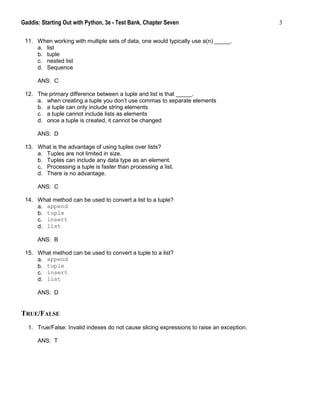
11. When working with multiple sets of data, one would typically use a(n) _____.
a. list
b. tuple
c. nested list
d. Sequence
ANS: C
12. The primary difference between a tuple and list is that _____.
a. when creating a tuple you don’t use commas to separate elements
b. a tuple can only include string elements
c. a tuple cannot include lists as elements
d. once a tuple is created, it cannot be changed
ANS: D
13. What is the advantage of using tuples over lists?
a. Tuples are not limited in size.
b. Tuples can include any data type as an element.
c. Processing a tuple is faster than processing a list.
d. There is no advantage.
ANS: C
14. What method can be used to convert a list to a tuple?
a. append
b. tuple
c. insert
d. list
ANS: B
15. What method can be used to convert a tuple to a list?
a. append
b. tuple
c. insert
d. list
ANS: D
TRUE/FALSE
1. True/False: Invalid indexes do not cause slicing expressions to raise an exception.
ANS: T
8.
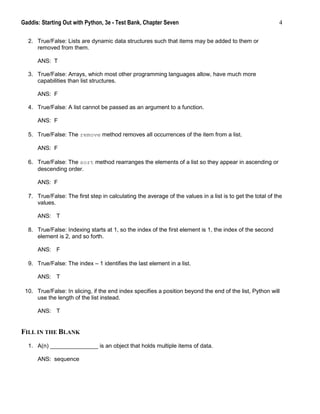
Gaddis: Starting Outwith Python, 3e - Test Bank, Chapter Seven 4
2. True/False: Lists are dynamic data structures such that items may be added to them or
removed from them.
ANS: T
3. True/False: Arrays, which most other programming languages allow, have much more
capabilities than list structures.
ANS: F
4. True/False: A list cannot be passed as an argument to a function.
ANS: F
5. True/False: The remove method removes all occurrences of the item from a list.
ANS: F
6. True/False: The sort method rearranges the elements of a list so they appear in ascending or
descending order.
ANS: F
7. True/False: The first step in calculating the average of the values in a list is to get the total of the
values.
ANS: T
8. True/False: Indexing starts at 1, so the index of the first element is 1, the index of the second
element is 2, and so forth.
ANS: F
9. True/False: The index – 1 identifies the last element in a list.
ANS: T
10. True/False: In slicing, if the end index specifies a position beyond the end of the list, Python will
use the length of the list instead.
ANS: T
FILL IN THE BLANK
1. A(n) _______________ is an object that holds multiple items of data.
ANS: sequence
9.
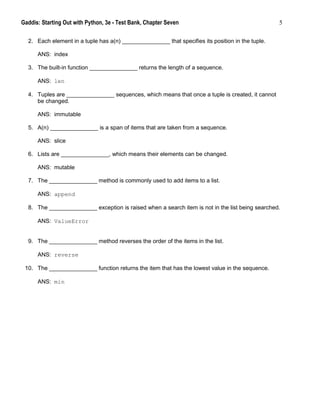
Gaddis: Starting Outwith Python, 3e - Test Bank, Chapter Seven 5
2. Each element in a tuple has a(n) _______________ that specifies its position in the tuple.
ANS: index
3. The built-in function _______________ returns the length of a sequence.
ANS: len
4. Tuples are _______________ sequences, which means that once a tuple is created, it cannot
be changed.
ANS: immutable
5. A(n) _______________ is a span of items that are taken from a sequence.
ANS: slice
6. Lists are _______________, which means their elements can be changed.
ANS: mutable
7. The _______________ method is commonly used to add items to a list.
ANS: append
8. The _______________ exception is raised when a search item is not in the list being searched.
ANS: ValueError
9. The _______________ method reverses the order of the items in the list.
ANS: reverse
10. The _______________ function returns the item that has the lowest value in the sequence.
ANS: min
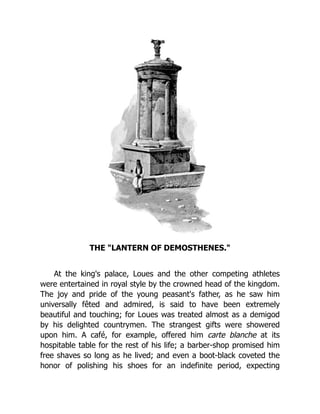
THE "LANTERN OFDEMOSTHENES."
At the king's palace, Loues and the other competing athletes
were entertained in royal style by the crowned head of the kingdom.
The joy and pride of the young peasant's father, as he saw him
universally fêted and admired, is said to have been extremely
beautiful and touching; for Loues was treated almost as a demigod
by his delighted countrymen. The strangest gifts were showered
upon him. A café, for example, offered him carte blanche at its
hospitable table for the rest of his life; a barber-shop promised him
free shaves so long as he lived; and even a boot-black coveted the
honor of polishing his shoes for an indefinite period, expecting
12.
nothing in return.Large sums of money also were offered him; but
these, with the true spirit of the athlete, Loues declined. "The only
reward I crave," he exclaimed, "is the wreath of laurel from Olympia,
such as my ancestors received two thousand years ago. I am poor,
but I ran, not for money, but for the glory of my native land."
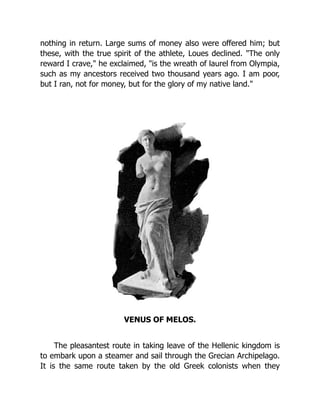
VENUS OF MELOS.
The pleasantest route in taking leave of the Hellenic kingdom is
to embark upon a steamer and sail through the Grecian Archipelago.
It is the same route taken by the old Greek colonists when they
13.
went forth tocivilize the world,—the same path followed by the
Trojan exiles when they sailed to Italy to build upon her seven hills
the walls of Rome. To coast along the shores of the Ægean, after a
tour in Athens, is one of the most exquisite enjoyments this life can
give. To the student of history in particular, the scene recalls events
so glorious that he is lost in admiration, not only of the marvelous
country as a whole, but of what the ancient Greeks accomplished for
humanity. In what department did they not excel?
Is it their sculpture that we question? At once the incomparable
Venus of Melos makes reply; that statue found (alas! in partial ruin)
on one of the islands that are scattered broadcast on this classic sea,
like disentangled pearls, and hence a fitting emblem of those
treasures of antiquity cast on the shores of time after a long-
continued and disastrous storm.
Is it their language? It was the most perfect and elastic tongue
in which men's lips have ever fashioned speech. It seems more than
chance that caused it, at the birth of Christ, to be the leading literary
language of the world, that it might thus receive, embody, and
perpetuate the truths of the New Testament. Even now we turn to
that old tongue to find exact expression for our terms of science,
and in it we name all our new inventions such as heliotypes and
photographs, the telegraph and the telephone.
14.
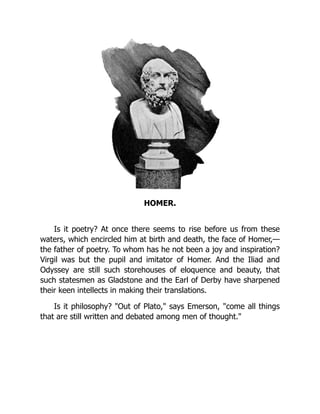
HOMER.
Is it poetry?At once there seems to rise before us from these
waters, which encircled him at birth and death, the face of Homer,—
the father of poetry. To whom has he not been a joy and inspiration?
Virgil was but the pupil and imitator of Homer. And the Iliad and
Odyssey are still such storehouses of eloquence and beauty, that
such statesmen as Gladstone and the Earl of Derby have sharpened
their keen intellects in making their translations.
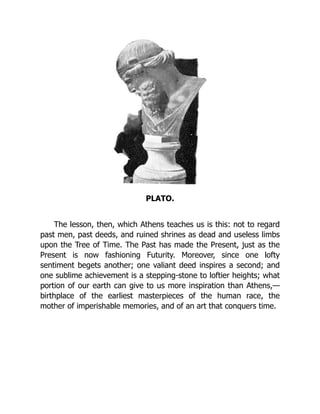
Is it philosophy? "Out of Plato," says Emerson, "come all things
that are still written and debated among men of thought."
15.
PLATO.
The lesson, then,which Athens teaches us is this: not to regard
past men, past deeds, and ruined shrines as dead and useless limbs
upon the Tree of Time. The Past has made the Present, just as the
Present is now fashioning Futurity. Moreover, since one lofty
sentiment begets another; one valiant deed inspires a second; and
one sublime achievement is a stepping-stone to loftier heights; what
portion of our earth can give to us more inspiration than Athens,—
birthplace of the earliest masterpieces of the human race, the
mother of imperishable memories, and of an art that conquers time.
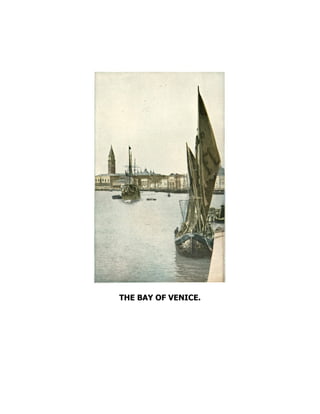
Venice is stillvictorious over Time. Despite her age, the City of
the Sea is fascinating still. She has successfully defied a dozen
centuries; she may perhaps defy as many more. All other cities in
the world resemble one another. Venice remains unique. She is the
City of Romance—the only place on earth to-day where Poetry
conquers Prose. The marriage of the Adriatic and its bride has never
been dissolved. She is to-day, as she has been for fourteen hundred
years, a capital whose streets are water and whose vehicles are
boats. She is an incomparable illustration of the poetical and the
picturesque; and, were she nothing else, would still attract the
world. But she is infinitely more. The hands of Titian and Tintoretto
have embellished her. She wears upon her breast some architectural
jewels unsurpassed in Italy. And, finally, the splendor of her history
enfolds her like the glory of her golden sunsets, and she emerges
from the waves of Time, that have repeatedly endeavored to engulf
her, as do her marble palaces from the encircling sea.
21.
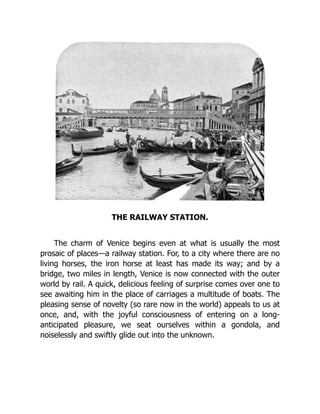
THE RAILWAY STATION.
Thecharm of Venice begins even at what is usually the most
prosaic of places—a railway station. For, to a city where there are no
living horses, the iron horse at least has made its way; and by a
bridge, two miles in length, Venice is now connected with the outer
world by rail. A quick, delicious feeling of surprise comes over one to
see awaiting him in the place of carriages a multitude of boats. The
pleasing sense of novelty (so rare now in the world) appeals to us at
once, and, with the joyful consciousness of entering on a long-
anticipated pleasure, we seat ourselves within a gondola, and
noiselessly and swiftly glide out into the unknown.
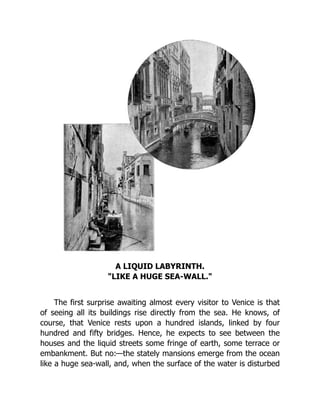
A LIQUID LABYRINTH.
"LIKEA HUGE SEA-WALL."
The first surprise awaiting almost every visitor to Venice is that
of seeing all its buildings rise directly from the sea. He knows, of
course, that Venice rests upon a hundred islands, linked by four
hundred and fifty bridges. Hence, he expects to see between the
houses and the liquid streets some fringe of earth, some terrace or
embankment. But no:—the stately mansions emerge from the ocean
like a huge sea-wall, and, when the surface of the water is disturbed
24.
by a lightbreeze or passing boat, it overflows their marble steps as
softly as the ultimate ripple of the surf spreads its white foam along
the beach. As, then, our gondolier takes us farther through this
liquid labyrinth, we naturally ask in astonishment, "What was the
origin of this mysterious city? How came it to be founded thus within
the sea?" The wonder is easily explained. In the fifth century after
Christ, when the old Roman empire had well-nigh perished under the
deadly inroads of barbarians, another devastating army entered
Italy, led by a man who was regarded as the "scourge of God." This
man was Attila. Such was the ruin always left behind him, that he
could boast with truth that the grass grew not where his horse had
trod. A few men seeking to escape this vandal, fled to a group of
uninhabited islands in the Adriatic. Exiled from land, they cast
themselves in desperation on the sea.
25.
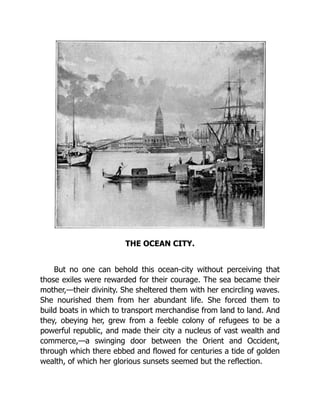
THE OCEAN CITY.
Butno one can behold this ocean-city without perceiving that
those exiles were rewarded for their courage. The sea became their
mother,—their divinity. She sheltered them with her encircling waves.
She nourished them from her abundant life. She forced them to
build boats in which to transport merchandise from land to land. And
they, obeying her, grew from a feeble colony of refugees to be a
powerful republic, and made their city a nucleus of vast wealth and
commerce,—a swinging door between the Orient and Occident,
through which there ebbed and flowed for centuries a tide of golden
wealth, of which her glorious sunsets seemed but the reflection.
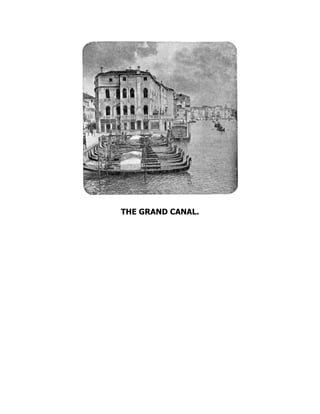
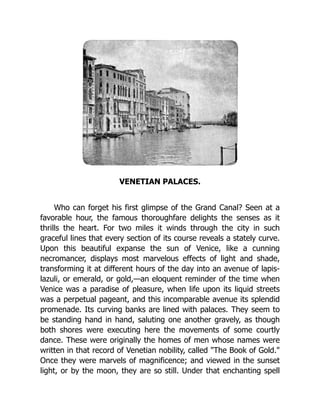
VENETIAN PALACES.
Who canforget his first glimpse of the Grand Canal? Seen at a
favorable hour, the famous thoroughfare delights the senses as it
thrills the heart. For two miles it winds through the city in such
graceful lines that every section of its course reveals a stately curve.
Upon this beautiful expanse the sun of Venice, like a cunning
necromancer, displays most marvelous effects of light and shade,
transforming it at different hours of the day into an avenue of lapis-
lazuli, or emerald, or gold,—an eloquent reminder of the time when
Venice was a paradise of pleasure, when life upon its liquid streets
was a perpetual pageant, and this incomparable avenue its splendid
promenade. Its curving banks are lined with palaces. They seem to
be standing hand in hand, saluting one another gravely, as though
both shores were executing here the movements of some courtly
dance. These were originally the homes of men whose names were
written in that record of Venetian nobility, called "The Book of Gold."
Once they were marvels of magnificence; and viewed in the sunset
light, or by the moon, they are so still. Under that enchanting spell
28.
their massive columns,marble balconies, and elegantly sculptured
arches, seem as imposing as when the Adriatic's Bride was still a
queen and wore her robes of purple and of gold.
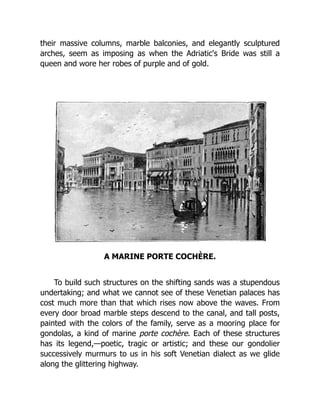
A MARINE PORTE COCHÈRE.
To build such structures on the shifting sands was a stupendous
undertaking; and what we cannot see of these Venetian palaces has
cost much more than that which rises now above the waves. From
every door broad marble steps descend to the canal, and tall posts,
painted with the colors of the family, serve as a mooring place for
gondolas, a kind of marine porte cochère. Each of these structures
has its legend,—poetic, tragic or artistic; and these our gondolier
successively murmurs to us in his soft Venetian dialect as we glide
along the glittering highway.
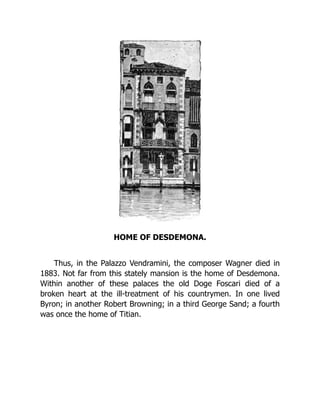
HOME OF DESDEMONA.
Thus,in the Palazzo Vendramini, the composer Wagner died in
1883. Not far from this stately mansion is the home of Desdemona.
Within another of these palaces the old Doge Foscari died of a
broken heart at the ill-treatment of his countrymen. In one lived
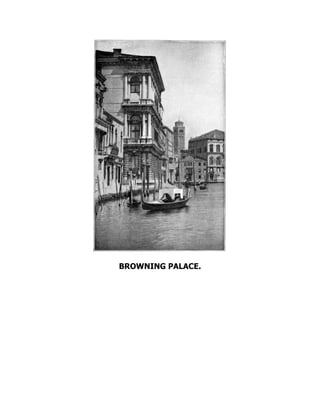
Byron; in another Robert Browning; in a third George Sand; a fourth
was once the home of Titian.
31.
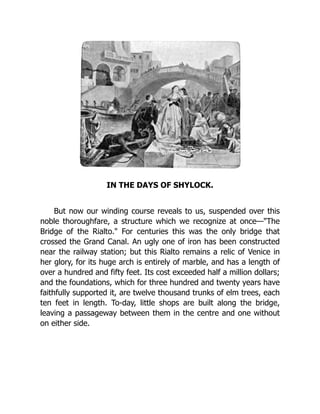
IN THE DAYSOF SHYLOCK.
But now our winding course reveals to us, suspended over this
noble thoroughfare, a structure which we recognize at once—"The
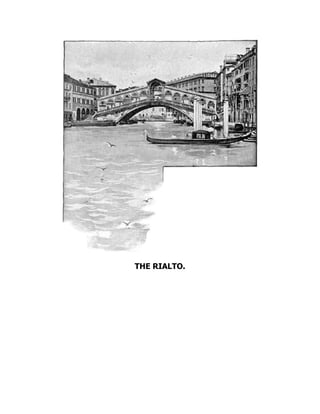
Bridge of the Rialto." For centuries this was the only bridge that
crossed the Grand Canal. An ugly one of iron has been constructed
near the railway station; but this Rialto remains a relic of Venice in
her glory, for its huge arch is entirely of marble, and has a length of
over a hundred and fifty feet. Its cost exceeded half a million dollars;
and the foundations, which for three hundred and twenty years have
faithfully supported it, are twelve thousand trunks of elm trees, each
ten feet in length. To-day, little shops are built along the bridge,
leaving a passageway between them in the centre and one without
on either side.
THE CITY OFSILENCE.
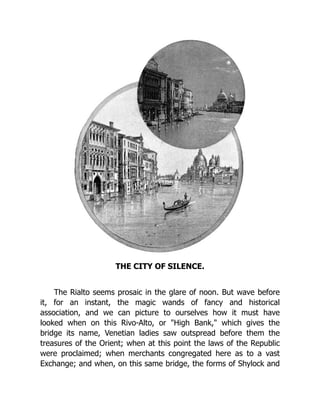
The Rialto seems prosaic in the glare of noon. But wave before
it, for an instant, the magic wands of fancy and historical
association, and we can picture to ourselves how it must have
looked when on this Rivo-Alto, or "High Bank," which gives the
bridge its name, Venetian ladies saw outspread before them the
treasures of the Orient; when at this point the laws of the Republic
were proclaimed; when merchants congregated here as to a vast
Exchange; and when, on this same bridge, the forms of Shylock and
34.
Othello may havestood out in sharp relief against the sky; when, in
a word, Venice, like Venus, had been born of the blue sea,
possessing all the fascinating languor of the East, and yet belonging
to the restless West. But to acquire that mental state in which these
visions of Venetian splendor will recur to one, certain conditions are
essential for the tourist: first, he must choose the moon for his
companion; and, second, he must manage to arrive in the City of the
Sea by night. Venice, though beautiful, shows marks of age. The
glare of day is far too strong for her pathetically fair, but wrinkled,
face. Pay her the compliment to see her at her best. In Venice make
your nights and days exchange places. Sleep through the morning
hours, and spend the afternoons reading books that tell of old
Venetian glory. Then, when the daylight wanes, and the moon turns
these streets into paths of shimmering gold, go forth to woo
Venezia, and she will give you of her best.
35.
Welcome to ourwebsite – the perfect destination for book lovers and
knowledge seekers. We believe that every book holds a new world,
offering opportunities for learning, discovery, and personal growth.
That’s why we are dedicated to bringing you a diverse collection of
books, ranging from classic literature and specialized publications to
self-development guides and children's books.
More than just a book-buying platform, we strive to be a bridge
connecting you with timeless cultural and intellectual values. With an
elegant, user-friendly interface and a smart search system, you can
quickly find the books that best suit your interests. Additionally,
our special promotions and home delivery services help you save time
and fully enjoy the joy of reading.
Join us on a journey of knowledge exploration, passion nurturing, and
personal growth every day!
testbankdeal.com



![Gaddis: Starting Out with Python, 3e - Test Bank
Chapter Seven
MULTIPLE CHOICE
1. What are the data items in the list called?
a. data
b. elements
c. items
d. values
ANS: B
2. Which list will be referenced by the variable number after the execution of the following code?
number = range(0, 9, 2)
a. [0, 1, 2, 3, 4, 5, 6, 7, 8, 9]
b. [1, 3, 5, 7, 9]
c. [2, 4, 6, 8]
d. [0, 2, 4, 6, 8]
ANS: D
3. What would you use if an element is to be removed from a specific index?
a. del statement
b. remove method
c. index method
d. slice method
ANS: A
4. What is the first negative index in a list?
a. 0
b. -1
c. -0
d. Size of the string or list minus one
ANS: B
5. What method can be used to place an item in the list at a specific index?
a. append
b. index
c. insert
d. Add
ANS: C
6. What would be the value of the variable list after the execution of the following code?
list = [1, 2]
list = list * 3
a. [1, 2] * 3](https://image.slidesharecdn.com/19895-250406033118-ff55a7b5/85/Starting-Out-with-Python-3rd-Edition-Gaddis-Test-Bank-5-320.jpg)
![Gaddis: Starting Out with Python, 3e - Test Bank, Chapter Seven 2
b. [3, 6]
c. [1, 2, 1, 2, 1, 2]
d. [[1, 2], [1, 2], [1, 2]]
ANS: C
7. What would be the value of the variable list after the execution of the following code?
list = [1, 2, 3, 4]
list[3] = 10
a. [1, 2, 3, 10]
b. [1, 2, 10, 4]
c. [1, 10, 10, 10]
d. invalid code
ANS: A
8. What method or operator can be used to concatenate lists?
a. *
b. +
c. %
d. concat
ANS: B
9. What would be the value of the variable list2 after the execution of the following code?
list1 = [1, 2, 3]
list2 = list1
list1 = [4, 5, 6]
a. [1, 2, 3]
b. [4, 5, 6]
c. [1, 2, 3, 4, 5, 6]
d. invalid code
ANS: B
10. What would be the value of the variable list2 after the execution of the following code?
list1 = [1, 2, 3]
list2 = []
for element in list1
list2.append(element)
list1 = [4, 5, 6]
a. [1, 2, 3]
b. [4, 5, 6]
c. [1, 2, 3, 4, 5, 6]
d. invalid code
ANS: A](https://image.slidesharecdn.com/19895-250406033118-ff55a7b5/85/Starting-Out-with-Python-3rd-Edition-Gaddis-Test-Bank-6-320.jpg)