Reconit Electric Starter Diagnostic Worksheet
Safety Pre-cautions:
• Always perform diagnosis with transmission set in neutral or park, parking brake set, and all electrical loads off.
• Wear face and eye protection at all times while performing diagnosis.
Following this worksheet will help determine if there is an issue with a starter motor and help prevent warranty denials for
No Trouble Found (NTF) .
1.
checking state-of-charge. Each battery must have at
least a 75% charge.
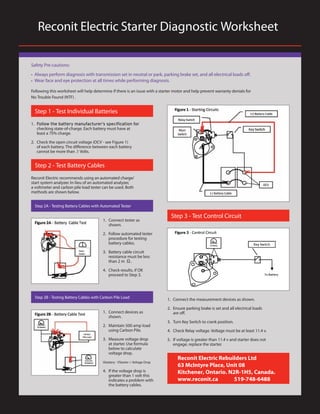
2. Check the open circuit voltage (OCV - see Figure 1)
of each battery. The difference between each battery
cannot be more than .1 Volts.
1. Connect the measurement devices as shown.
2. Ensure parking brake is set and all electrical loads
are off.
3. Turn Key Switch to crank position.
4. Check Relay voltage. Voltage must be at least 11.4 v.
5. If voltage is greater than 11.4 v and starter does not
engage, replace the starter.
Reconit Electric Rebuilders Ltd
63 McIntyre Place, Unit 08
Kitchener, Ontario. N2R-1H5, Canada.
www.reconit.ca 519-748-6488
Reconit Electric recommends using an automated charge/
start system analyzer. In-lieu of an automated analyzer,
a voltmeter and carbon pile load tester can be used. Both
methods are shown below.
1. Connect tester as
shown.
2. Follow automated tester
procedure for testing
battery cables.
3. Battery cable circuit
resistance must be less
than 2 m Ω.
4. Check results, if OK
proceed to Step 3.
1. Connect devices as
shown.
2. Maintain 500 amp load
using Carbon Pile.
3. Measure voltage drop
at starter. Use formula
below to calculate
voltage drop.
Vbattery - VStarter = Voltage Drop
4. If the voltage drop is
greater than 1 volt this
indicates a problem with
the battery cables.
Step 1 - Test Individual Batteries
Step 3 - Test Control Circuit
Step 2 - Test Battery Cables
Step 2A - Testing Battery Cables with Automated Tester
Step 2B - Testing Battery Cables with Carbon Pile Load

Starter Motor diagnostic

  • 1.
    Reconit Electric StarterDiagnostic Worksheet Safety Pre-cautions: • Always perform diagnosis with transmission set in neutral or park, parking brake set, and all electrical loads off. • Wear face and eye protection at all times while performing diagnosis. Following this worksheet will help determine if there is an issue with a starter motor and help prevent warranty denials for No Trouble Found (NTF) . 1. checking state-of-charge. Each battery must have at least a 75% charge. 2. Check the open circuit voltage (OCV - see Figure 1) of each battery. The difference between each battery cannot be more than .1 Volts. 1. Connect the measurement devices as shown. 2. Ensure parking brake is set and all electrical loads are off. 3. Turn Key Switch to crank position. 4. Check Relay voltage. Voltage must be at least 11.4 v. 5. If voltage is greater than 11.4 v and starter does not engage, replace the starter. Reconit Electric Rebuilders Ltd 63 McIntyre Place, Unit 08 Kitchener, Ontario. N2R-1H5, Canada. www.reconit.ca 519-748-6488 Reconit Electric recommends using an automated charge/ start system analyzer. In-lieu of an automated analyzer, a voltmeter and carbon pile load tester can be used. Both methods are shown below. 1. Connect tester as shown. 2. Follow automated tester procedure for testing battery cables. 3. Battery cable circuit resistance must be less than 2 m Ω. 4. Check results, if OK proceed to Step 3. 1. Connect devices as shown. 2. Maintain 500 amp load using Carbon Pile. 3. Measure voltage drop at starter. Use formula below to calculate voltage drop. Vbattery - VStarter = Voltage Drop 4. If the voltage drop is greater than 1 volt this indicates a problem with the battery cables. Step 1 - Test Individual Batteries Step 3 - Test Control Circuit Step 2 - Test Battery Cables Step 2A - Testing Battery Cables with Automated Tester Step 2B - Testing Battery Cables with Carbon Pile Load